Étiquette : Cocteau
Les racines symbolistes des « Killer Games »


Le nombre croissant de massacres commis par des adolescents et jeunes adultes « happés » par les univers persistant véhiculés par des jeux vidéo dont la violence et la perversion ne cessent de croître nous porte à regarder de plus prêt les origines de cette cyberculture et les killer games.
Par Karel Vereycken, décembre 2007.
Le nombre croissant de massacres commis par des adolescents et jeunes adultes « happés » par les univers persistant véhiculés par des jeux vidéo et les killer games dont la violence et la perversion ne cessent de croître nous porte à regarder de plus prêt les origines de cette cyberculture.
La plus grande tromperie des Killer Games c’est précisément qu’ils font croire aux joueurs et aux parents des joueurs, qu’il ne s’agit que d’un simple jeu. Une fois établi ce « fait », notre cerveau tend à renoncer à toute enquête sérieuse sur le sens explicite ou non, et encore moins des « valeurs », véhiculées par le jeu. Beaucoup d’adeptes des jeux, y compris les plus violents, nous ont confiés qu’en réalité, il ne s’intéressaient qu’à « l’environnement graphique » de leur jouet.
Si nous sommes loin d’avoir tous les éléments en main, voici quelques pistes intéressantes pour mieux comprendre la genèse des images qui finissent par créer une telle fascination dans les esprits qu’on estime que le nombre cyberdrogués a dépassé les 10 000 en France.
Les racines symbolistes
Derrière la pseudo dérision de cette « culture de la mort », tout enquêteur honnête, ayant une connaissance rudimentaire de l’histoire de l’art, reconnaît sans grande peine un remake du courant culturel qui ruina la fin du XIXe siècle : ce symbolisme dont la démarche se résumait souvent au culte de la mort et du plaisir, incarné par l’image de la femme fatale, l’évasion dans l’érotisme ou l’exaltation de l’ailleurs onirique et oriental.
Ce motif symboliste du couple eros (sexe) et thanatos (mort) provient directement des doctrines ésotériques et anti-chrétiennes n’excluant pas les sacrifices humains. Si Mme Blavatsky et ses théosophes prônaient la mise à mort du judéo-christianisme en faveur des vertus « femelles » de religions anti-prométhéennes, la montée du fascisme nécessitait la valorisation de symboles hautement plus virils et plus guerriers.
Aujourd’hui, l’on reconnaît volontiers l’influence de la Théosophie sur un des pères fondateurs de l’abstrait lyrique, le peintre russe Wassily Kandinsky ou le cubiste hollandais Piet Mondrian.
Si l’on admet aussi sans problème l’influence des Rose-croix sur le cercle post-impressionniste des « Nabis » (Paul Sérusier, Pierre Bonnard, Maurice Denis et même Aristide Maillol) et autres précurseurs de l’art moderne, l’influence du symbolisme sur l’art réaliste fantastique digital reste largement ignoré.
De la science-fiction au Killer games en passant par les films d’horreurs
Avant l’apparition du business des jeux électroniques, tout cette imagination saugrenue se donnait rendez-vous dans la littérature de science-fiction et les films d’horreur avec des résultats parfois tout aussi dévastateur.


Rappelons que le 3 juin 2002, en Loire Atlantique, un adolescent de 17 ans portant le masque du tueur anonyme du film d’horreur de Wes Craven Scream de 1996 a massacré une jeune fille de 15 ans.
Le masque du film reprend en détail la tête peinte par le peintre symboliste norvégien Edvard Munch dans son œuvre Le cri de 1893. Un texte du journal de Munch à l’époque décrit la genèse de l’œuvre :
« Je suivait un chemin accompagné de deux amis ; le soleil se couchait ; je sentais une brise de mélancolie ; soudainement le ciel devenait rouge sang ; je me suis arrêté pour me reposer contre la clôture ; mortellement fatigué ; fixant les nuages enflammés qui étaient suspendu comme du sang et une épée au-dessus du fjord bleu et la ville ; mes amis continuaient leur chemin ; j’étais là, tremblant d’angoisse ; et je ressentais un grand cri, infini, traverser la nature. »
Au-delà de l’anecdote, constatons que Munch n’était pas une victime innocente. Affirmant que « l’ironie est la politesse du désespoir », il nous montre dans sa lithographie Madone de 1902, la puissance séductrice de la femme fatale entourée d’une frise où courent en vain de frétillants spermatozoïdes tandis que dans le coin gauche un avorton lève un regard suppliant vers sa déesse, variation du motif d’eros/thanatos.
Kill Bill


Ce motif fait toujours recette. Pour rester dans le domaine cinématographique, il est à noter que le rôle attribué à Uma Thurman dans le film de Quentin Tarantino Kill Bill sorti en 2003 est également construit sur un scénario permettant de faire passer ces valeurs du symbolisme fascisant.
Dans ce film, des assassins surgissent et tirent impitoyablement et sans raison sur toutes les personnes présentes lors de la répétition d’une cérémonie de mariage à El Paso au Texas. La mariée (Uma Thurman), qui est enceinte lors de la tuerie survit.
Ancienne tueuse à gages, elle se fixe comme seul but de se venger en tuant ses anciens complices y compris le père de son enfant. Résultat : un film « d’actions » (arts martiaux à gogo) où se mélange le sang des méchants à la beauté de l’actrice grâce à des mises à mort à coups de sabre.
La vengeance est une valeur moderne et la formule eut un tel résultat commercial que Kill Bill 2 et Kill Bill 3 furent rapidement commercialisés.

Si le symboliste français Gustave Moreau (précepteur de Matisse) habillait sa fascination pour la mort de mystères plus énigmatiques, comme dans son œuvre Jupiter et Sémélé, ce thème de la femme fatale fut largement développé par des artistes symbolistes, tel que le munichois Franz von Stück (Le péché, 1893 ; Le baiser du sphinx, 1895) ou le belge Ferdinand Khnopf (Le sphinx,1896).
Mais c’est sans doute le peintre polonais Jacek Malszewski, qui nous rapproche peut-être le plus du style en vogue dans l’art digital aujourd’hui.
Dans son Thanatos I de 1898, la mort ailée (une jeune femme) affûte sa faux. Le vieil homme qui demeure dans le manoir visible sur l’arrière plan accourt au bruit.
Enthousiasmé, il va vers une mort certaine.
Heavenly Sword
Regardons maintenant le scénario de Heavenly Sword, un jeu vidéo d’action, développé par Ninja Theory et édité par Sony pour sa PlayStation 3, lancé en septembre 2007 et affichant des profits fulgurants 941 % en un an.
Le joueur s’y identifie avec Nariko, une jolie femme à la longue crinière rouge qui part elle aussi en quête de vengeance contre un roi et son armée pour avoir malmené son clan.
Equipée d’une énorme épée divine, « une lame aussi puissante que divine », Nariko n’a que quelques heures pour accomplir sa tâche.
Car l’arme, forgé il y a des siècles, fut conçue pour un dieu. Mais, n’étant qu’humaine, l’énergie vitale de Nariko est aspirée par l’épée, l’affaiblissant à chaque coup porté.
Une fois de plus, la valeur centrale est la vengeance et le besoin de faire couler le sang à temps avant que s’impose le destin fatal de sa propre mort. La psychologie du terroriste kamikaze, celui de tuer un maximum avant de périr, est omniprésente.
La figure apparaît comme un mélange entre Lara Croft de Tomb Raider, Uma Thurman dans Kill Bill, arrosé de scènes ennuyeuses et banales de Kung Fu. La ressemblance entre les cheveux rouges de Nariki et les fleuves de sang rouge visent à esthétiser la violence.

L’artiste digital à l’origine de cette imagerie maladive est le jeune génois Alessandri Taini qui signe Talexi. Il semble, selon ses productions et sa page MySpace, un fervent admirateur de l’écrivain pervers italien et femme fatale Isabella Santacroce qui exhibe sa fesse droite sur sa page MySpace.
On ne connaît rien de cette personne, à part son association avec les Giovani Cannibali (jeunes cannibales), un mouvement littéraire des années 90 qui donna naissance en Italie à un mouvement philosophique et littéraire, le Nevroromanticismo, qui vise à exprimer le désarroi de l’existence.
Son œuvre se concentre sur l’amour dans tous ses états, y compris celui qui conduit inexorablement à la mort. Dans un livre, elle affirme que la famille n’est qu’un « carnaval horrible » qui ne mérite que la mort. Une série d’œuvres « personnelles » de Talexi, Dark Demonia et Frost Flower, inspiré par des écrits névroromantiques de Santacroce, ne montrent que désolation, bains de sang et avortons métastasés.
Le triangle d’or

La figure clef qui forme un pont reliant les symbolistes du début du siècle, l’art nazi, le modernisme et le réalisme fantastique qui domine l’environnement graphique des jeux vidéo d’aujourd’hui est le peintre mystique Ernst Fuchs.

Né en 1930, cette « artiste visionnaire » est aussi graphiste, graveur, architecte, concepteur de décors, poète et compositeur. Il fut un des fondateurs, avec d’autres élèves de Albert Paris Gütersloh, de l’école viennoise du réalisme fantastique inspiré par le symboliste Gustav Klimt et autres symbolistes.
Fuchs est le dernier survivant de ce qu’on a appelé « le triangle d’or », c’est-à-dire les trois artistes dont l’œuvre domine le siècle présent : Salvador Dali, Arno Breker et Ernst Fuchs. En réalité, ce triangle d’or n’est rien d’autre que l’extension du « cercle intime » d’Adolf Hitler.
Etudiant les techniques classiques des grands maîtres, Fuchs fut adopté après la guerre par le sculpteur personnel d’Adolf Hitler, Arno Breker.
Dans son Journal (1942/1945) qui couvre la période d’occupation, Jean Cocteau se laisse dire en juin 42 par Arno Breker, parlant de Hitler : « Vous n’aurez jamais en face de vous un homme aussi sensible ».
Arno Breker, ancien élève du symboliste proche des « Nabis », Maillol, est le sculpteur fétiche du régime nazi et le confident artistique de Hitler.
Bien que cubiste en 1922, Breker fut l’auteur des statues hyperréalistes représentant la race supérieure germanique pour le stade de Berlin lors des jeux olympiques en 1936. On lui doit des statues monumentales représentant à merveille la boursouflure et le goût de vespasienne des dignitaires nazis.
Breker, intime d’Hitler et de Albert Speer, était la coqueluche des élites parisiennes dans l’entre deux guerres et fut aussi, à part son amitié avec Jean Cocteau, l’ami de Salvador Dali et plus tard le protecteur d’Ernst Fuchs.
Fuchs déclarait lors des funérailles de Breker en 1991 que « Breker était un vrai prophète du beau dans l’art » et Breker affirmait que Fuchs s’était
« illustré dans les années 70 et 80 par des œuvres monumentales, aboutissement d’un inlassable travail créatif dédié à la sublimation passionnelle de la violence et de la mort. »
Aujourd’hui, Fuchs est la référence principale pour tous ceux engagés dans le réalisme fantastique qui domine « l’art digital ».

En Angleterre, la peintre Brigid Marlin a fondé en 1961 The Society for Art of Imagination, dont Fuchs et son adepte, le peintre suisse Hans Ruedi Giger, sont des membres honoraires.
H.R. Giger s’est fait connaître au grand public pour avoir obtenu l’oscar des meilleurs effets spéciaux sur le film culte de SF et d’horreur de Ridley Scott en 1980 Alien, le huitième passager.
Avec 80 millions de dollars de recette aux Etats-Unis (pour un budget de 11 millions seulement), 3 millions d’entrées en France, oscar des meilleurs effets spéciaux en 1980… Alien, le huitième passager connut un succès considérable.
Comme nous avons commencé à le documenter ici, en bâtissant sur l’héritage de Breker, Fuchs et Giger, l’industrie du jeu vidéo s’est érigée sur l’imaginaire malade qui a échoué à imposer le fascisme il y a trois générations et travaille durement pour sa victoire aujourd’hui, notamment à travers l’Ordre d’Alexandre le Grand.

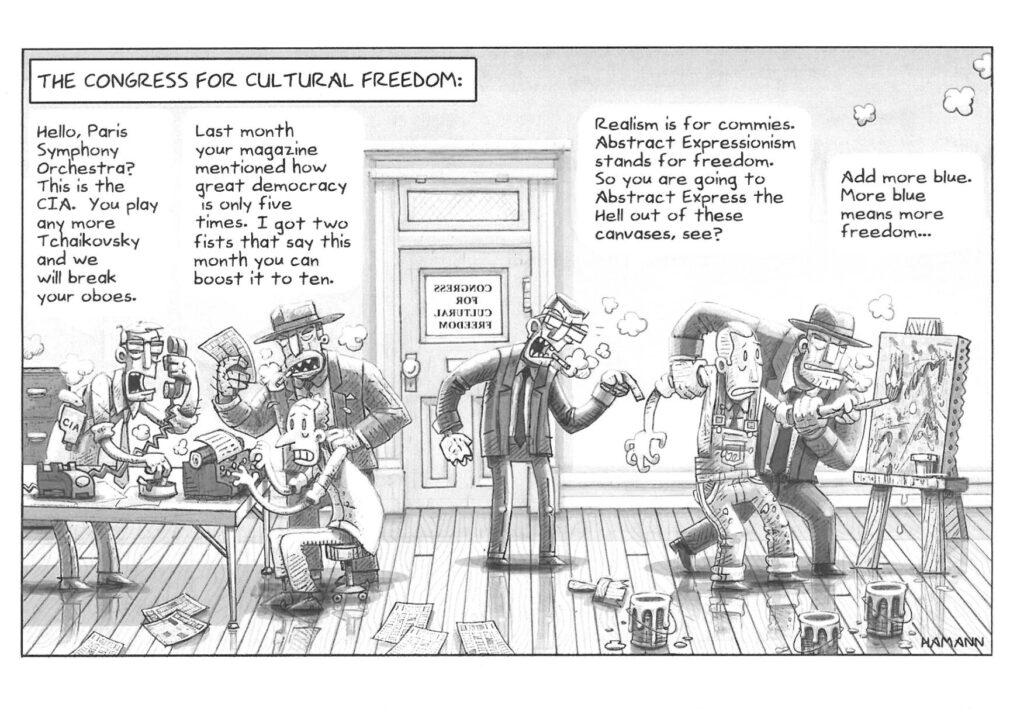
The Congress for Cultural Freedom: How the CIA « weaponized » Modern Art

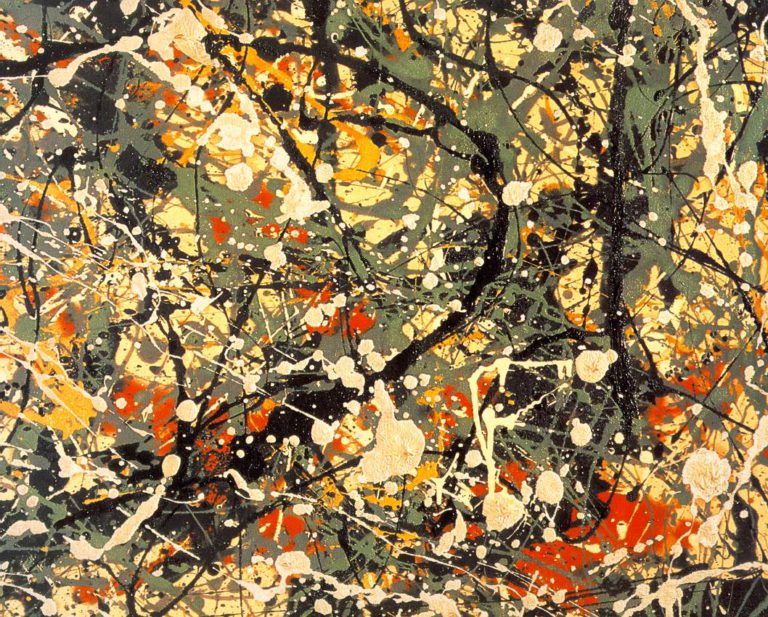
This article, first published in 2006, came as a book review of the book Who Paid the Piper of British researcher Frances Stonor Saunder, published in French Article under the title Qui mène la danse? La CIA et la guerre froide culturelle, 506 pages, Editions Denoël, Paris, 2003.
This book, which caused a stir in Germany, England and the Hispanic world, is literally appalling. Not only for what it reveals, but above all for what it leaves unsaid.
After years of meticulous research, interviews and archival work, the young writer Frances Stonor Saunders, producer of historical documentaries for the BBC, delivers an uncompromising account of the Anglo-American cultural Cold War against the Soviet Union from 1947 onwards.
Congress for Cultural Freedom
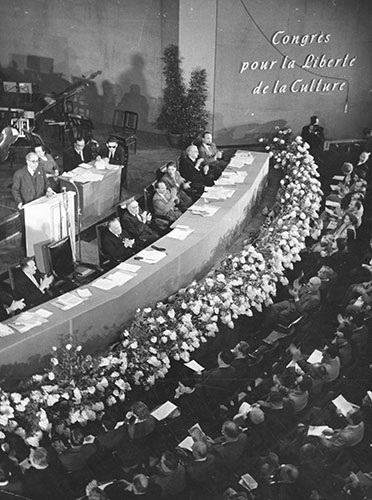
At the heart of this secret « Kulturkampf », a veritable cultural Cold War, was the Paris-based Congress for Cultural Freedom (CCF), headed from 1950 to 1967 by CIA agent Michael Josselson.
Josselson, who spoke four languages, along with music composer Nicholas Nabokov, was a former member of the psychological warfare division of the Office for Strategic Services (OSS), which US President Harry Truman replaced with the CIA in 1945.
The first thing that strikes the reader is the analogy between the language of the Cold War and the narrative of today’s war hawks to justify a new crusade « against terrorism. »
Back then, under the guise of a merciless struggle against the horrors of Stalinism, the Anglo-American imperial faction deployed whole swathes of the CIA in an attempt to impose Bertrand Russell‘s utopian vision of « world government. »
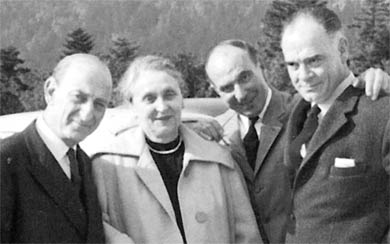
The CIA described itself as an « Order of Knights Templar » charged with « saving Western freedom from Communist darkness ». Its principal theoretician was George Kennan, Director of the Policy Planning Staff at the State Department.
Like the « Noble Lies » employed today by the neo-conservatives, followers of Leo Strauss, Kennan asserted in 1947 that the Communists had gained a position of prominence in Europe,
« through the shameless and skillful use of lies. They fought us with the weapon of unreality and irrationalism. Can we triumph over this unreality with rationalism, truth, honest and well-intentioned economic assistance? »
Obviously not! And the most formidable weapon for world domination will be, as always: the soft power of « culture ».
Indeed, « you can’t be a great power if you don’t have the art to go with it, it’s like Venice without Tintoretto or Florence without Giotto ».
So, ironically, while American public opinion was held hostage by the McCarthyite psychosis for whom « all modern art is communist », to the point of suspecting certain abstract paintings of indicating the exact location of American military bases (sic), the oligarchs saw in « lyrical abstract » expressionism the virtues of a specifically anti-communist ideology.
By a simple logic of inversion, everything that Nazis and Stalinists considered « degenerate art » automatically became emblematic of the values of freedom and free enterprise, and therefore got massively financed… in the greatest secrecy.
With a wealth of detail, the author documents the mesh of this operation over some five hundred pages. It is, of course, impossible to summarize here the descriptions of the lives of dozens of men, women, musicians, authors, magazines, networks and foundations, each page of which delivers a few pearls.
Some of the details shed a special light on contemporary French history.
The CIA in Paris
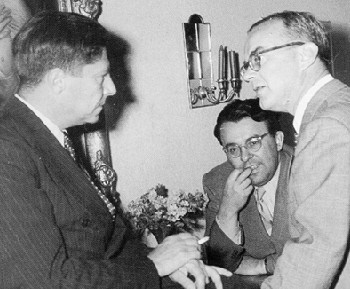
In Paris, it was Irving Brown (1911-1989), a representative of the powerful AFL-CIO union (with free access to secret Marshall Plan funds), who offered the CCF in Paris a suite in the Hôtel Baltimore on Avenue Kléber to set up its temporary headquarters, before paying the rent for a permanent office on Boulevard Haussmann.
On behalf of his boss Jay Lovestone (1897-1990), himself a helper of the CIA’s James Jesus Angleton, Irving Brown financed anything that might weaken France’s resistance to the utopia of world government, i.e. anything that might harm Gaullism and, to a certain extent, Communism.
Josselson and his wife met him quite often in a gay bar, « L’Indifférent ». One evening, they find him handing over a large sum of money to a Marseille mobster. A fan of the big boys, Brown was heavily involved in anything that could reduce the influence of the Communists.
It was from that perspective that he helped former members of the Vichy government, as well as Trotskyites. He controlled French ports, broke strikes and financed the new Force Ouvrière union to split the CGT communist union, all the while promoting modern art!*
Alongside Irving Brown, the CCF board included Michael Josselson, Lawrence de Neufville (his CIA recruiter, later appointed to Radio Free Europe), Arthur Koestler, Melvin Lasky, former Trotskyist James Burnham, as well as Carlo Schmid of the German SPD, Haakon Lie, leader of the Norwegian Labour Party, and David Rousset of the French Parti Socialiste.
In his book The Machiavellians, Burnham used Machiavelli to « challenge egalitarian political theory and show the persistence and inescapability of the elite, even in an age of equality ».
In 1953, Burnham played a crucial role in the CIA’s Operation AJAX, which overthrew Dr. Mossadegh in Teheran and replaced him with the Shah.
Later, « more presentable » funding sources than Irving Brown came into play: CIA front organizations such as the Farfield Foundation, headed by Julius Fleischman, or the Hoblitzelle Foundation, but also classics like the Ford, Carnegie or Rockefeller brothers’ foundations.
Thanks to these generous donors, the CCF made millions of dollars available to literary magazines such as
- Encounter, edited by former Trotskyite Irving Kristol (father of current neo-conservative William Kristol) in London;
- Preuves, edited in Paris by François Bondy of the European Union of Federalists;
- Der Monat, edited by Melvin Lasky in Berlin;
- Tempo Presente, edited by Ignazio Silone in Rome;
- Soviet Survey, edited in Israel by historian Walter Laqueur.
After the OSS’s (reciprocal) expressions of sympathy for Hemingway or Antoine de Saint-Exupéry, these magazines opened their columns to authors such as Jorge-Louis Borges, Raymond Aron, Arnold Toynbee, Bertrand Russell, Arthur Schlesinger Jr., Herbert Read or Hugh Trevor-Roper, or contributed to the publication of their writings.
In 1950, the CIA commissioned the production of a cartoon based on George Orwell’s Animal Farm (real name Eric Blair).
Also in Paris, CIA man Peter Matthiessen helped found the Paris Review run by John Train, a far-right liberal New York billionaire.
CIA Culture
Destruction of the well tempered music
The CCF also financed major musical events to promote « modern » twelve-tone serialism (dodecaphony), such as the April 1952 festival organized by Nicolas Nabokov in Paris.
Nabokov believed that « dodecaphony abolishes natural hierarchies » and allows us to free ourselves from the internal logic of music.
Anne C. Shreffler argues that the « compositional avant-garde » was politicized more by its advocacy of personal freedom than by political influence. Shreffler goes on to argue that both the Soviet Union and the United States sent out messages that dealt with « freedom. » However, Western Europe and the United States claimed a « moral high ground » in the struggle for individual freedom, a high ground that made certain artistic aesthetics (e.g., cubism, surrealism, dodecaphony, and existentialism) almost « obligatory » for artists.
The promotion of « liberated » music as a counterpoint to « Social Realism« , which essentially « marginalized » the populist Soviet musical aesthetic, was explicitly a politically calculated move by the Congress for Cultural Freedom.
The festival opened with « The Rite of Spring » of Igor Stravinsky, new convert to twelve-tone dodecaphonic system.
Among the participants from the USA: Leontyne Price, Aaron Copland, Samuel Barber, the New York City Ballet (Balanchine‘s troupe), the Boston Symphony Orchestra, the New York Museum of Modern Art (MoMA), James T. Farrell, W.H. Auden and Gertrude Stein.
European participants included Jean Cocteau, William Walton, Laurence Olivier, Benjamin Britten, the Vienna Opera, Covent Garden Opera, Czeslaw Milosz, Denis de Rougemont and Guido Piovene, to name but a few.
Appointed Eisenhower’s special advisor on Cold War strategy, American Vice-President Nelson Rockefeller played a fundamental role in promoting the CIA’s modernist painting. Supporting left-wing artists practicing abstract expressionism was commonplace for the Rockefellers.
Nelson’s mother, Abby Aldrich Rockefeller, had founded the Museum of Modern Art in New York – the Modern Art Museum (MoMA) – asserting that reds would stop being reds « if we gave them artistic recognition ». Several MoMA trustees were also trustees of the Farfield Foundation, as indicated, a CIA front.
As Donald Jameson of the CIA put it:
« We understood that this was the kind of art that has nothing to do with social realism and makes it even more stylized, rigid and confined than it was. »
MoMA bought works by Diego Riviera, Jackson Pollock, Arshile Gorky, Alexander Calder, Robert Motherwell, Stuart Davis, Edward Hopper and others.
By attributing the « success » of an impressive number of contemporary cultural actors to the will of an imperial elite, motivated by a more than suspect ideological blindness and endowed, what’s more, with unparalleled financial resources and communication strategies, Stonor Saunders’ book immediately casts deep discredit on all post-war artistic creation.
Most of these « artists » were chosen because they conveyed an ideology deemed compatible with the totalitarian designs of the high priests of world order.
Only the reactionary Peregrine Worsthorne titles his book review of Saunders’ Who Paid the Piper, « How Western Culture was saved by the CIA », nostalgically lamenting the Machiavellian genius of the Anglo-American elite in its heyday.
Of course, some artists weren’t necessarily aware of the source of the funds, but they all expected them to fill their pockets… And perhaps most shockingly of all, the CIA took art more seriously than many citizens or critics of the time.
So, perhaps this survey does posthumous justice to all those talents sacrificed on the altar of illusory power. Think of all those crushed hopes, sabotaged careers and stifled seeds of genius. For in this delirious tournament of the Cold War, the great priesthood ruling over the art world would only saddle those willing to bend the knee, while with a wave of the hand, send others to the deadly silence of oblivion.
NOTE:
*In his book Les Trotskistes (Fayard, 2002), Christophe Nick states, with regard to the non-communist student union UNEF, that at one time, « thanks to Irwing Brown‘s good offices, the U.S. Embassy was able to cover the student union’s end-of-month budgets ».
In Secrets de famille (Fayard, Paris 2001), Serge Raffy reveals that « Lionel Jospin, then First Secretary of the Socialist Party, met in Washington on April 14, 1982 with leaders of the American AFL-CIO union to reassure them that the Mauroy government would include Communist ministers. The man who organized the meeting was a CIA agent, Irving Brown, the same man who founded and financed the French trade union Force Ouvrière to combat the Communist CGT financed by Soviet Russia. Irving Brown is also said to have constantly maintained links between the Trotskyites, and in particular the OCI, and FO. »
On the right, the student union, Union Inter-Universitaire (UNI), which made the career of so many politicians on the right, was also backed by CIA agent of influence Irving Brown and received $575,000 between April 1984 and April 1985 from the government of the United States through the National Endowment for Democracy.