Karel Vereycken’s mastery of classical techniques
On May 24, 2026, art historian Lode Goukens wrote the following in an article published on the Belgian Flemish website ‘t Pallieterke.
The article was titled « Karel Vereycken’s mastery of classical techniques »
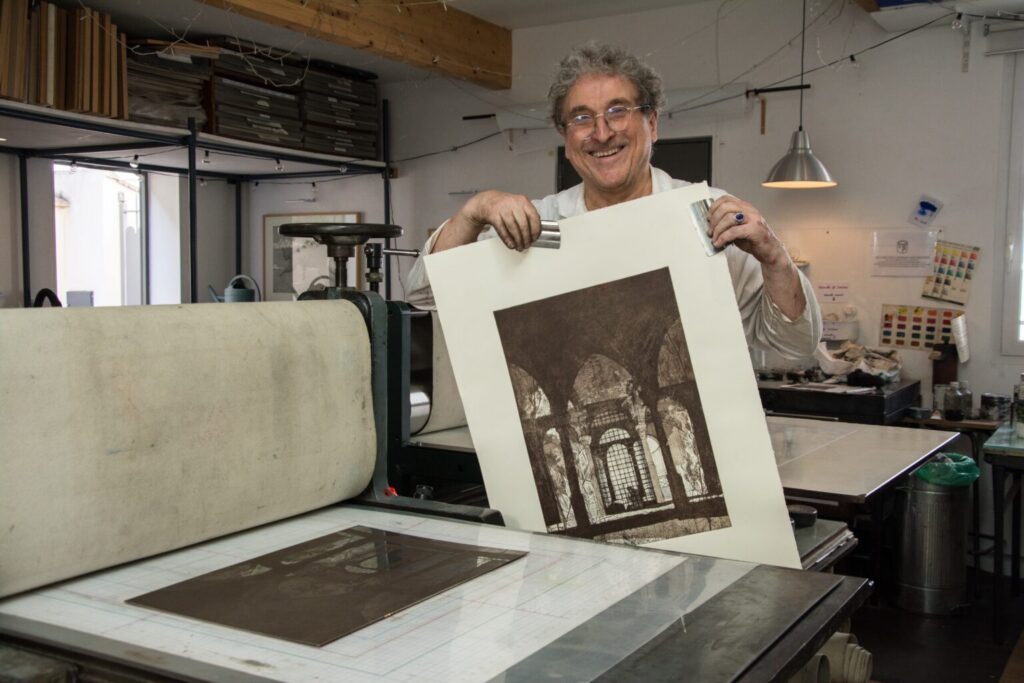
‘The Flemish painter and etcher Karel Vereycken lives and works in France. On May 1, he exhibited his latest etchings. One particularly large one depicted the interior of a monastery with a monk. This exceptional work—of which he produced four versions—illustrates his special interest in the classical masters.’
The etching measures 35 x 50 cm and costs 500 euros. A “state” is a version that is lost if further adjustments are made to the etching plate by the artist or the printer. Rembrandt is known to have sometimes produced dozens of states. Each state is therefore a limited edition, sometimes consisting of only a few copies.
Ideas and Emotions
Karel Vereycken was born in 1957 in Antwerp and grew up in a family with ties to the Port of Antwerp and the shipbuilding industry. Vereycken is primarily active as a painter and engraver, but also writes as an art historian. He studied fine arts at the Institut Saint-Luc in Brussels and subsequently studied engraving at the Académie Royale des Beaux-Arts in Brussels, where he graduated with honors.
For decades, Vereycken has focused on watercolor and printmaking, particularly etchings on zinc and copper, often using techniques such as aquatint, sugar lift, and mousse lift. His work combines classical technical mastery with a strong emphasis on symbolism, allegory, and metaphor, through which he seeks to make ideas and emotions “visible” that are not immediately present in the visible world. Vereycken is working on a book about Quinten Matsys and Da Vinci. It is scheduled to be published at the end of this year.
I spoke with Vereycken about this masterful etching. “When I was recently in Milan to receive an art award, I visited the Pinacoteca Ambrosiana. There are beautiful paintings there, and the library is a leading repository for Da Vinci’s codices. But I also knew there was a crypt. I was deeply impressed by this almost Paleo-Christian monument. I discovered that dreadful cage reminiscent of Piranesi’s depictions of torture and prisons. In the center of that cage stands a painted plaster statue of the praying Charles Borromeo (well-known in Antwerp), bishop of Milan who was made a cardinal in 1560. Borromeo went to pray in that cage every week before a tombstone that is a replica of Christ’s in Jerusalem. What impressed me is how that man (whom I do not hold dear in my heart), as a clergyman, praying in a sort of double prison (cage + crypt), apparently felt spiritually completely free in God. A divine paradox,” Vereycken said.
“So that was my starting point. Hence the Cusian title ‘Coincidence of Opposites.’ I raised the vaults and made them more monumental. I also used varnish to imprint plant motifs, to enhance a spatial effect that is both open and yet enclosed. A bit of sleight of hand, but the magic was definitely there!”
The article was translated by Karel Vereycken from Dutch into English.
Here is a link to the original Flemish version:
https://pal.be/2026/05/de-klassieke-technische-beheersing-van-karel-vereycken/
Comments are Closed