Étiquette : Bewening
Matsys topwork should return to Antwerp Cathedral, says Karel Vereycken
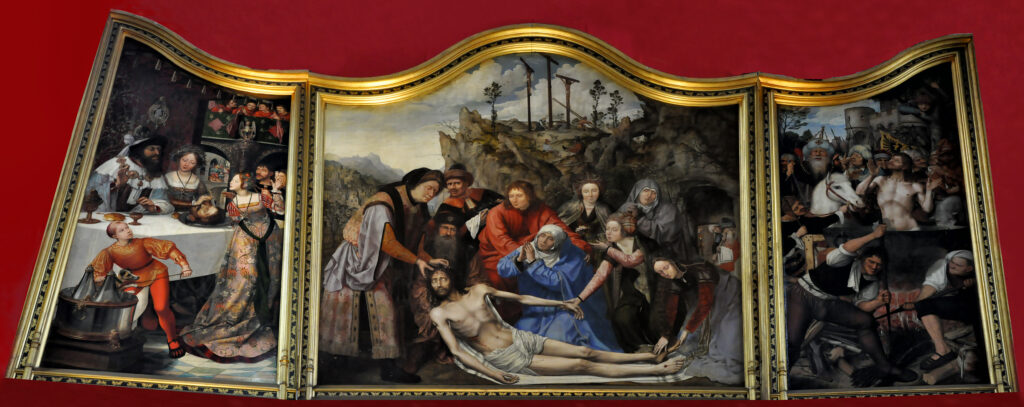

In a press statement (below) circulated by based Dutch editor BLINUET based in Groningen, who will release on Nov. 9, 2026, Karel Vereycken‘s new book « The Art of Folly, Matsys, Erasmus, Da Vinci », the author suggests that, to do justice to the Antwerp Renaissance period, the topwork of Quinten Matsys, now in the Antwerp Museum for Fine Arts (KMSK), should be exhibited again in the Antwerp Cathedral, the chuch for which it was initially intended and where it was on show between 1511 and 1581.
Karel’s book can be ordered directly on the website of the editor BLINUET.
https://blinuet.nl/boeken/de-kunst-der-zotheid
EN TRANSLATION
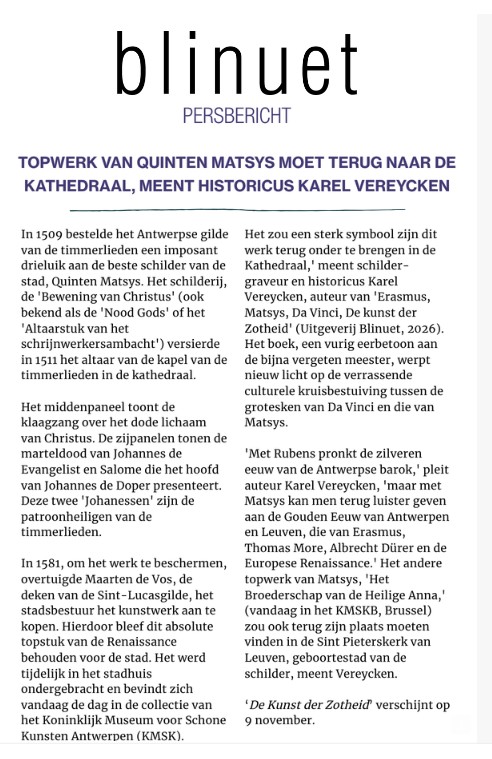
Topwork of Quinten Matsys should return to the Cathedral, says Historian Karel Vereycken
In 1509, the Antwerp Carpenters’ (Joiners’) Guild commissioned an impressive tryptique from Quinten Matsys, at that time the city’s foremost painter.
The painting decorated in 1511 the chapel of the carpenters in the Cathedral. The central panel shows the lamentation over Christ’s dead body. The side panels show the martyrdom of Saint John the Evangelist and Salome presenting the head of the decapitated John the Baptist. Both Johannes were patron saints of the carpenters.
In 1581, to protect the work, Maarten de Vos, the dean of the Saint Luke’s painters guild, convinced the city-council to buy the painting. In this way, the absolute topwork of the Renaissance was preserved for the city. The painting was temporarily housed at the City Hall and is today on show at the Royal Museum of Fine Arts (KMSK).
“It would be a powerful symbol to bring this work back to the Cathedral”, says painter-engraver and historian Karel Vereycken, author of “Erasmus, Matsys, Da Vinci, the Art of Folly” (Published by Blinuet, 2026). The book, an enthusiastic eulogy of the nearly forgotten master, throws new light on the surprising cultural cross-fertilization between Da Vinci’s grotesk heads and those of Matsys.
“With Rubens shines the Silver Age of Antwerp baroke”, argues Vereycken, “but with Matsys, we can give back glory to the Golden Century of Antwerp and Leuven, that of Erasmus, Thomas More, Albrecht Dürer and the European Renaissance.” The other masterpiece of Matsys, “The Fraternity of Saint Anna” (today in the Royal Museum of Fine Arts of Brussels) « could also find its place back in the Sint Pieters church of Leuven, the native city of the painter”, pleads Vereycken.