Étiquette : Art of Folly
Matsys topwork should return to Antwerp Cathedral, says Karel Vereycken
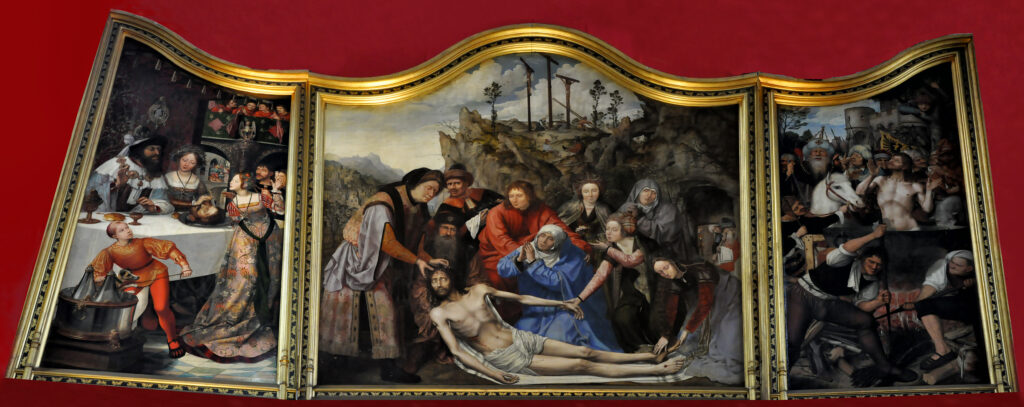

In a press statement (below) circulated by based Dutch editor BLINUET based in Groningen, who will release on Nov. 9, 2026, Karel Vereycken‘s new book « The Art of Folly, Matsys, Erasmus, Da Vinci », the author suggests that, to do justice to the Antwerp Renaissance period, the topwork of Quinten Matsys, now in the Antwerp Museum for Fine Arts (KMSK), should be exhibited again in the Antwerp Cathedral, the chuch for which it was initially intended and where it was on show between 1511 and 1581.
Karel’s book can be ordered directly on the website of the editor BLINUET.
https://blinuet.nl/boeken/de-kunst-der-zotheid
EN TRANSLATION
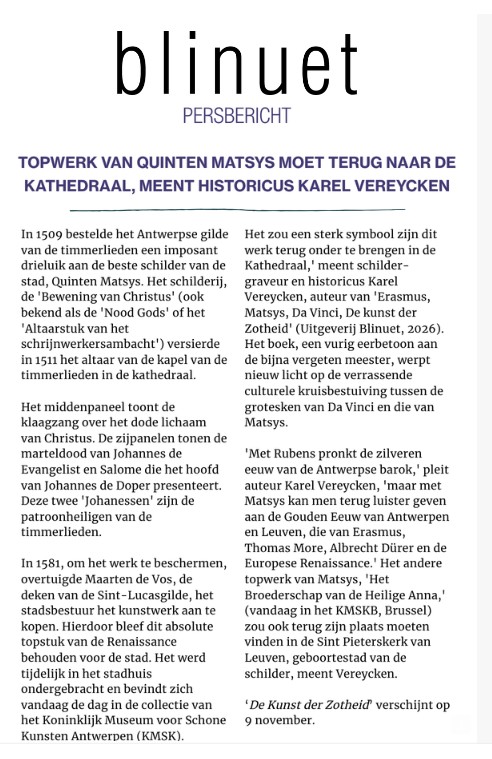
Topwork of Quinten Matsys should return to the Cathedral, says Historian Karel Vereycken
In 1509, the Antwerp Carpenters’ (Joiners’) Guild commissioned an impressive tryptique from Quinten Matsys, at that time the city’s foremost painter.
The painting decorated in 1511 the chapel of the carpenters in the Cathedral. The central panel shows the lamentation over Christ’s dead body. The side panels show the martyrdom of Saint John the Evangelist and Salome presenting the head of the decapitated John the Baptist. Both Johannes were patron saints of the carpenters.
In 1581, to protect the work, Maarten de Vos, the dean of the Saint Luke’s painters guild, convinced the city-council to buy the painting. In this way, the absolute topwork of the Renaissance was preserved for the city. The painting was temporarily housed at the City Hall and is today on show at the Royal Museum of Fine Arts (KMSK).
“It would be a powerful symbol to bring this work back to the Cathedral”, says painter-engraver and historian Karel Vereycken, author of “Erasmus, Matsys, Da Vinci, the Art of Folly” (Published by Blinuet, 2026). The book, an enthusiastic eulogy of the nearly forgotten master, throws new light on the surprising cultural cross-fertilization between Da Vinci’s grotesk heads and those of Matsys.
“With Rubens shines the Silver Age of Antwerp baroke”, argues Vereycken, “but with Matsys, we can give back glory to the Golden Century of Antwerp and Leuven, that of Erasmus, Thomas More, Albrecht Dürer and the European Renaissance.” The other masterpiece of Matsys, “The Fraternity of Saint Anna” (today in the Royal Museum of Fine Arts of Brussels) « could also find its place back in the Sint Pieters church of Leuven, the native city of the painter”, pleads Vereycken.
« The Art of Folly » arriving soon ! Karel Vereycken’s new book on Matsys, Erasmus and Da Vinci

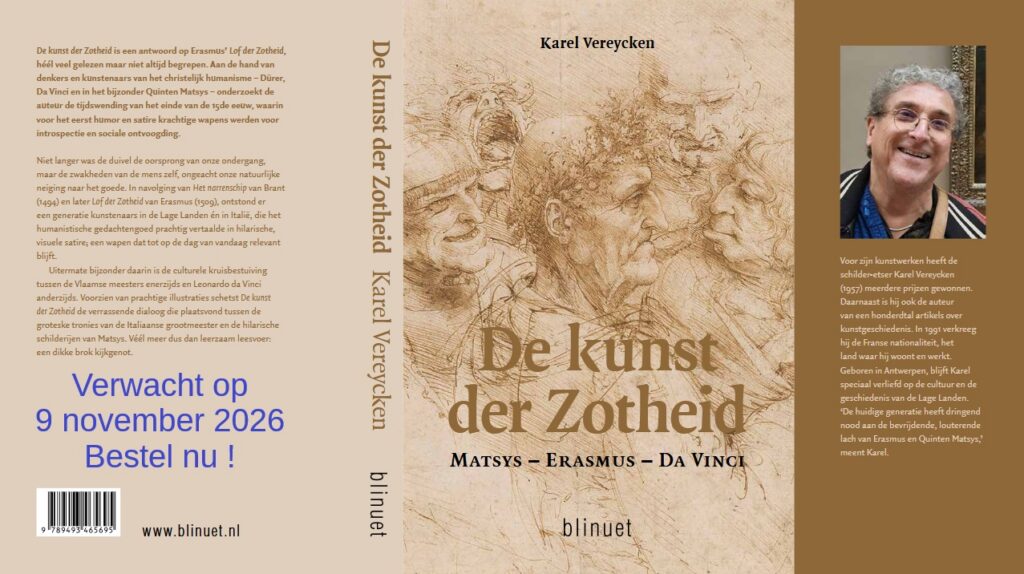

After long years of intensive research, writing and editing, painter engraver and historian Karel Vereycken is thrilled to announce that on Nov. 9, 2026, his new book « De kunst der Zotheid, Matsys – Erasmus – Da Vinci » will reach the bookstores of Belgium and the Netherlands.
The book is published in Dutch by BLINUET in Groningen, Netherlands, and can be pre-ordered as of today on the publishers website via this LINK:
https://blinuet.nl/boeken/de-kunst-der-zotheid
NEDERLANDS, achterkant van de omslag:
‘De Kunst der Zotheid’ is een antwoord of Erasmus’ Lof der Zotheid, héél veel gelezen maar niet altijd begrepen. Aan de hand van denkers en kunstenaars van het christelijk humanisme – Dürer, Da Vinci en in het bijzonder Quinten Matsys – onderzoekt de auteur de tijdswending van het einde van de 15de eeuw, waarin voor het eerst humor en satire krachtige wapens werden voor instrospectie en sociale ontvoogding.
Niet langer was de duivel de oorsprong van onze ondergang, maar de zwakheden van de mens zelf, ongeacht onze natuurlijke neiging naar het goede. In navolging van Het Narrenschip van Brant (1494) en later Lof der Zotheid (1509), ontstond er een generatie kunstenaars in de Lage Landen én in Italië, die het humanistische gedachtengoed prachtig vertaalde in hilarische, visuele satire, een wapen dat tot op de dag van vandaag relevant blijft.
Uitermate bijzonder daarin is de culturele kruisbestuiving tussen de Vlaamse meesters enerzijds en Leonardo da Vinci anderzijds. Voorzien van prachtige illustraties schets De kunst der Zotheid de verrassende dialoog die plaatsvond tussen de groteske tronies van de Italiaanse grootmeester en de hilarische schilderijen vn Matsys. Véél meer dus dan leerzaam leesvoer: een dikke brok kijkgenot.
FRANCAIS, sommaire sur le dos de couverture:
« L’Art de la folie » est un clin d’oeil à l’Éloge de la folie d’Érasme, œuvre largement lue mais pas toujours comprise. S’appuyant sur des penseurs et des artistes de l’humanisme chrétien – Dürer, Léonard de Vinci et en particulier Quinten Matsys –, l’auteur examine le tournant de la fin du XVe siècle, où l’humour et la satire devinrent pour la première fois de puissants outils d’introspection et d’émancipation sociale.
Ce n’était plus le diable qui causait notre perte, mais plutôt les faiblesses de l’homme lui-même, malgré son inclination naturelle pour le bien. Après La Nef des fous (1494) de Brant et plus tard L’éloge de la folie (1509) d’Erasme, une génération d’artistes émergea aux Pays-Bas et en Italie, qui traduisirent avec brio la pensée humaniste en une satire visuelle décapante, une arme qui reste d’une grande actualité.
La fertilisation culturelle croisée entre les maîtres flamands et Léonard de Vinci est particulièrement remarquable. Magnifiquement illustré, L’Art de la Folie esquisse le dialogue surprenant qui s’est instauré entre les visages « grotesques » du grand maître italien et les peintures hilarantes de Matsys. Bien plus qu’un simple ouvrage pédagogique: une véritable source de plaisir visuel.
ENGLISH, summary on the backcover:
The « Art of Folly » is an answer to Erasmus’ « In Praise of Folly », often read, but not always understood. Building on the thinkers and artists of Christian Humanism – Dürer, Da Vinci and especially Quinten Matsys – the author highlights the epochal shift of the end of the Xvth century, when humor and satire became powerful weapons for introspection and social emancipation.
It was not any longer the devil which was the cause of our fall, but the weaknesses of man himself, despite our natural inclination towards the Good. Inspired by the “Ship of Fools” of Brant (1494) and later Erasmus’ “In Praise of Folly” (1509), a generation of artists emerged in the Low Countries and in Italy, which translated the humanist ideas into hilarious, visual satire, a weapon that remains still relevant today.
Highly interesting in that process was the « cultural cross-pollination » between on one side the Flemish masters and Leonardo da Vinci on the other side. Richly illustrated, « The Art of Folly » documents the surprising dialogue that emerged between the Leonardo’s “grotesques” and the hilarious paintings of Matsys.
Beyond mere instructive reading material, this book stands out as a great journey of visual fun.