Étiquette : bankers
« The Art of Folly » arriving soon ! Karel Vereycken’s new book on Matsys, Erasmus and Da Vinci

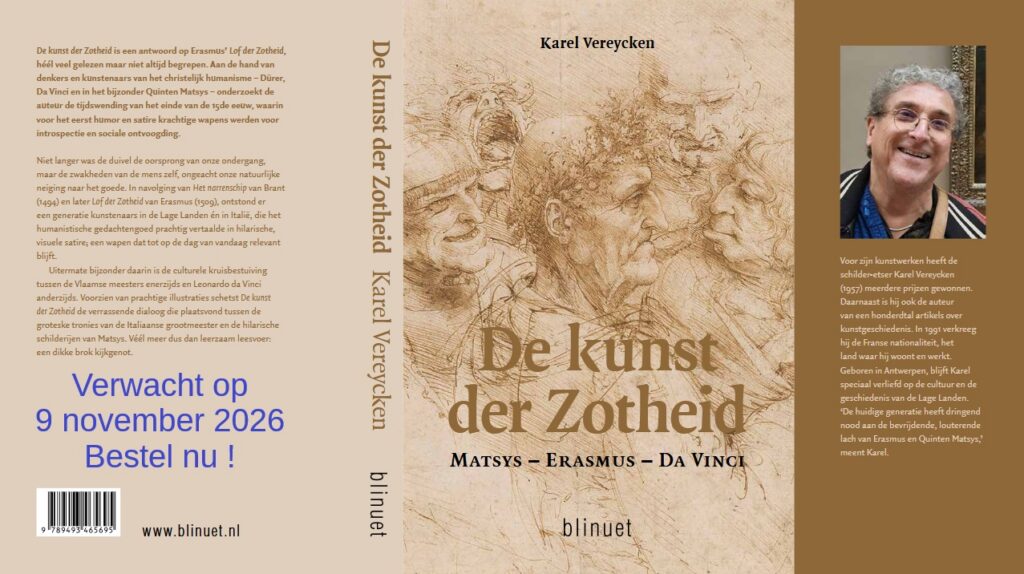

After long years of intensive research, writing and editing, painter engraver and historian Karel Vereycken is thrilled to announce that on Nov. 9, 2026, his new book « De kunst der Zotheid, Matsys – Erasmus – Da Vinci » will reach the bookstores of Belgium and the Netherlands.
The book is published in Dutch by BLINUET in Groningen, Netherlands, and can be pre-ordered as of today on the publishers website via this LINK:
https://blinuet.nl/boeken/de-kunst-der-zotheid
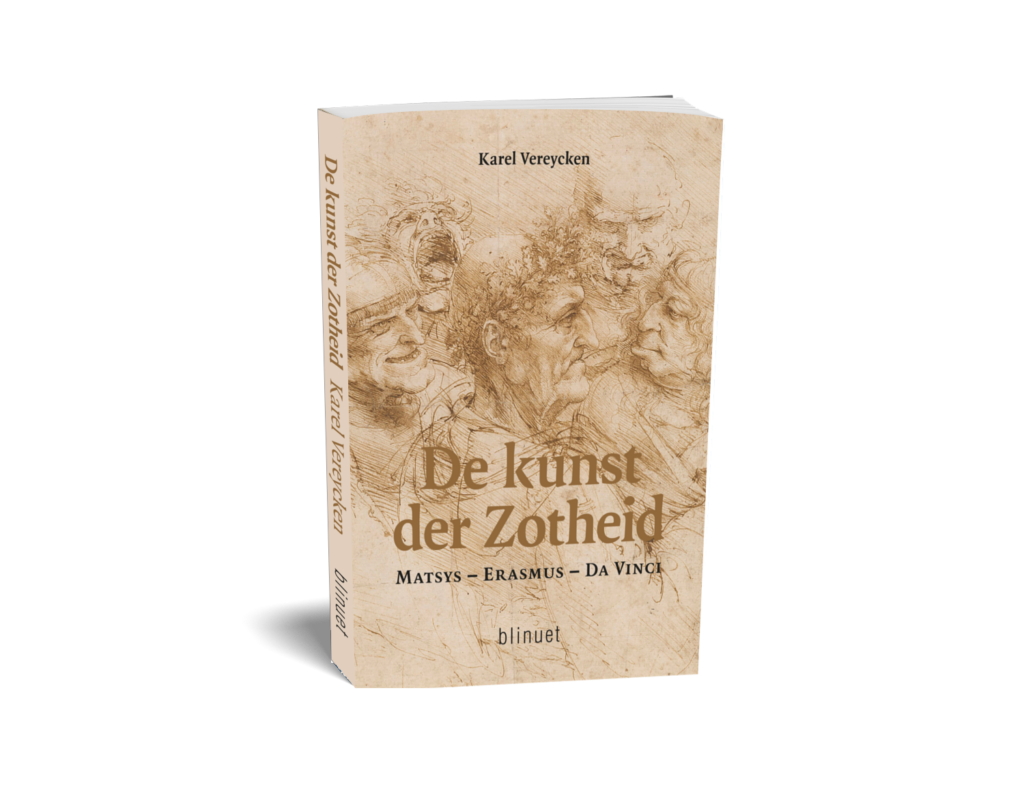
NEDERLANDS, achterkant van de omslag:
‘De Kunst der Zotheid’ is een antwoord of Erasmus’ Lof der Zotheid, héél veel gelezen maar niet altijd begrepen. Aan de hand van denkers en kunstenaars van het christelijk humanisme – Dürer, Da Vinci en in het bijzonder Quinten Matsys – onderzoekt de auteur de tijdswending van het einde van de 15de eeuw, waarin voor het eerst humor en satire krachtige wapens werden voor instrospectie en sociale ontvoogding.
Niet langer was de duivel de oorsprong van onze ondergang, maar de zwakheden van de mens zelf, ongeacht onze natuurlijke neiging naar het goede. In navolging van Het Narrenschip van Brant (1494) en later Lof der Zotheid (1509), ontstond er een generatie kunstenaars in de Lage Landen én in Italië, die het humanistische gedachtengoed prachtig vertaalde in hilarische, visuele satire, een wapen dat tot op de dag van vandaag relevant blijft.
Uitermate bijzonder daarin is de culturele kruisbestuiving tussen de Vlaamse meesters enerzijds en Leonardo da Vinci anderzijds. Voorzien van prachtige illustraties schets De kunst der Zotheid de verrassende dialoog die plaatsvond tussen de groteske tronies van de Italiaanse grootmeester en de hilarische schilderijen vn Matsys. Véél meer dus dan leerzaam leesvoer: een dikke brok kijkgenot.
FRANCAIS, sommaire sur le dos de couverture:
« L’Art de la folie » est un clin d’oeil à l’Éloge de la folie d’Érasme, œuvre largement lue mais pas toujours comprise. S’appuyant sur des penseurs et des artistes de l’humanisme chrétien – Dürer, Léonard de Vinci et en particulier Quinten Matsys –, l’auteur examine le tournant de la fin du XVe siècle, où l’humour et la satire devinrent pour la première fois de puissants outils d’introspection et d’émancipation sociale.
Ce n’était plus le diable qui causait notre perte, mais plutôt les faiblesses de l’homme lui-même, malgré son inclination naturelle pour le bien. Après La Nef des fous (1494) de Brant et plus tard L’éloge de la folie (1509) d’Erasme, une génération d’artistes émergea aux Pays-Bas et en Italie, qui traduisirent avec brio la pensée humaniste en une satire visuelle décapante, une arme qui reste d’une grande actualité.
La fertilisation culturelle croisée entre les maîtres flamands et Léonard de Vinci est particulièrement remarquable. Magnifiquement illustré, L’Art de la Folie esquisse le dialogue surprenant qui s’est instauré entre les visages « grotesques » du grand maître italien et les peintures hilarantes de Matsys. Bien plus qu’un simple ouvrage pédagogique: une véritable source de plaisir visuel.
ENGLISH, summary on the backcover:
The « Art of Folly » is an answer to Erasmus’ « In Praise of Folly », often read, but not always understood. Building on the thinkers and artists of Christian Humanism – Dürer, Da Vinci and especially Quinten Matsys – the author highlights the epochal shift of the end of the Xvth century, when humor and satire became powerful weapons for introspection and social emancipation.
It was not any longer the devil which was the cause of our fall, but the weaknesses of man himself, despite our natural inclination towards the Good. Inspired by the “Ship of Fools” of Brant (1494) and later Erasmus’ “In Praise of Folly” (1509), a generation of artists emerged in the Low Countries and in Italy, which translated the humanist ideas into hilarious, visual satire, a weapon that remains still relevant today.
Highly interesting in that process was the « cultural cross-pollination » between on one side the Flemish masters and Leonardo da Vinci on the other side. Richly illustrated, « The Art of Folly » documents the surprising dialogue that emerged between the Leonardo’s “grotesques” and the hilarious paintings of Matsys.
Beyond mere instructive reading material, this book stands out as a great journey of visual fun.

ARTKAREL AUDIO GUIDE — Matsys and the Art of « The Deal » (Berlin)


Comment on Quinten Matsys‘ painting « The Deal » (aka « The Contract ») in the Gemäldegalerie of Berlin, Germany. (June 2025)
For more on this artist, see my study on Matsys and Leonardo, the dawn of the Age of Laughter and Creativity.

Audio:
This Audio
Read:
- Quinten Matsys and Leonardo — The Dawn of the Age of Laugher and Creativity, (EN online);
- Квентин Массейс и Леонардо: на заре смехотворчества (RU pdf)
- Joachim Patinir et l’invention du paysage en peinture (FR en ligne).
- Joachim Patinir and the invention of landscape painting (EN online)
- Le Landjuweel d’Anvers de 1561 — Faire de l’art une arme pour la paix (FR en ligne)
- The 1561 Landjuweel of Antwerp that made art a weapon for Peace (EN online)
ARTKAREL AUDIO GUIDE: Why Erasmus had no time to pause for portraits (Paris)

The 1648 Peace of Westphalia, a worldwide financial reorganization

Cet article en PDF
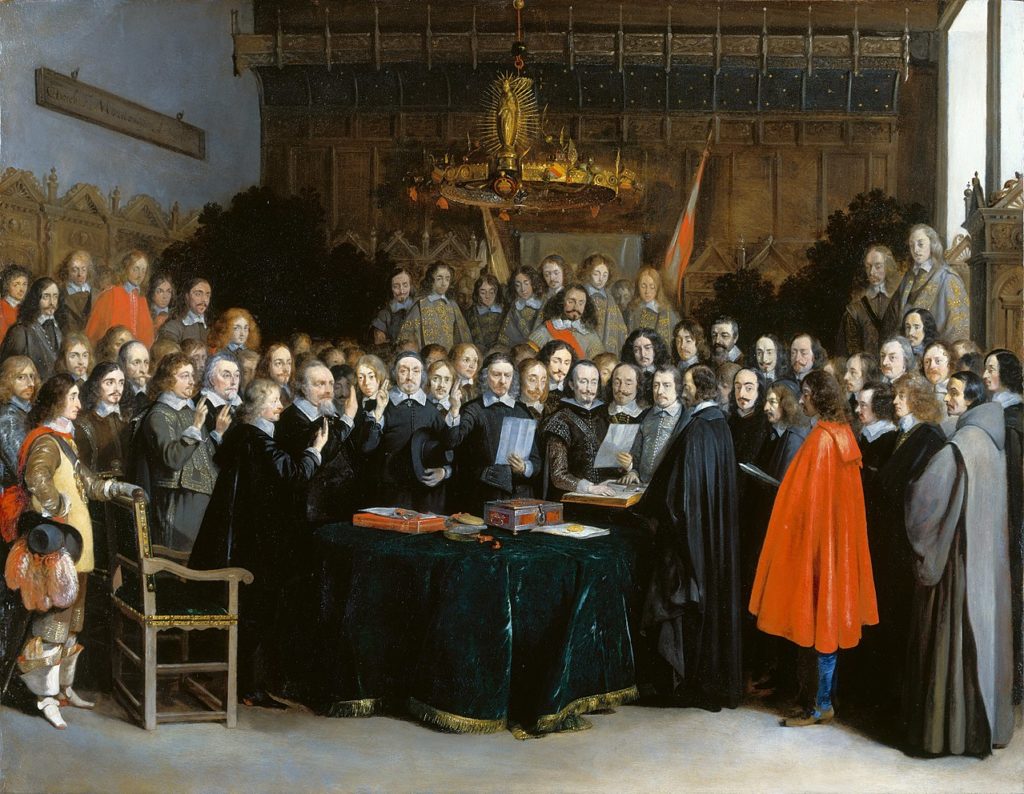
In 1648, after five years of negotiations, led by the French diplomat Abel Servien on the instructions of Cardinal Mazarin, the “Peace of Westphalia” was signed, putting an end to the Thirty Years’ War (1618-1648). Long before the UN Charter, 1648 made national sovereignty, mutual respect and the principle of non-interference the foundations of international law.
The Republic of the Netherlands and the Helvetian Confederation were recognized and numerous bilateral peace treaties put an end to many conflicts.
But that is not all. A careful reader of these treaties discovers that the commitment of all parties to take into account “the advantage of others” as much, if not more, than their own, is translated into concrete acts laying the foundations of a new international financial and economic order.
Article 1 states the fundamental philosophical principle upon which peace rests:
“That there shall be a Christian and Universal Peace, and a perpetual, true, and sincere Amity, between [list of parties renouncing combat]; That this Peace and Amity be observ’d and cultivated with such a Sincerity and Zeal, that each Party shall endeavour to procure the Benefit, Honour and Advantage of the other; that thus on all sides they may see this Peace and Friendship in the Roman Empire, and the Kingdom of France flourish, by entertaining a good and faithful Neighbourhood.”
Article 2 goes on to describe the kind of « Global Reset » so urgently needed today:
“That there shall be on the one side and the other a perpetual Oblivion, Amnesty, or Pardon of all that has been committed since the beginning of these Troubles, in what place, or what manner soever the Hostilitys have been practis’d, in such a manner, that no body, under any pretext whatsoever, shall practice any Acts of Hostility, entertain any Enmity, or cause any Trouble to each other; (…) all that has pass’d on the one side, and the other, as well before as during the War, in Words, Writings, and Outrageous Actions, in Violences, Hostilitys, Damages and Expences, without any respect to Persons or Things, shall be entirely abolish’d in such a manner that all that might be demanded of, or pretended to, by each other on that behalf, shall be bury’d in eternal Oblivion.”
For decades, most of the belligerents in the Thirty Years’ War inflicted terrible damage on each other, mainly in order to pay off their debts with the spoils of their plunder and conquests, essentially to satisfy a tiny financial oligarchy that lent as generously to one as to another. It is precisely this “enslavement by debt” that the treaty proposes to “bury in eternal oblivion”.
Hence, even before settling disputes and territorial claims, the treaty sets out to create the conditions that will put an end to the financial ruin into which all were descending.
As in the case of other rare “Debt Jubilee”, unpayable, unsustainable and illegitimate debts, interests, bonds, annuities and financial claims, explicitly identified as fueling a dynamic of perpetual war, were examined, sorted out and reorganized, most often through the cancellation of debts (articles 13 and 35, 37, 38 and 39), through moratoria or debt rescheduling according to specific timetables (article 69).
Article 40 concludes that debt cancellations will apply in most cases, “and yet the Sums of Money, which during the War have been exacted bona fide, and with a good intent, by way of Contributions, to prevent greater Evils by the Contributors, are not comprehended herein. » (Implying that these debts would have to be honored.)
Finally, looking to the future, for Commerce to be “reestablished”, the treaty abolished many tolls and customs established by “private” authorities for they were obstacles to the exchange of physical goods and know-how and hence to mutual development. (Art. 69 and 70).
In the text:
Art. 13:
“Reciprocally, the Elector of Bavaria renounces entirely for himself and his Heirs and Successors the Debt of Thirteen Millions, as also all his Pretensions in Upper Austria; and shall deliver to his Imperial Majesty immediately after the Publication of the Peace, all Acts and Arrests obtain’d for that end, in order to be made void and null.”
Art. 35:
“That the Annual Pension of the Lower Marquisate, payable to the Upper Marquisate, according to former Custom, shall by virtue of the present Treaty be intirely taken away and annihilated; and that for the future nothing shall be pretended or demanded on that account, either for the time past or to come.”
Art. 37:
“That the Contracts, Exchanges, Transactions, Obligations, Treatys, made by Constraint or Threats, and extorted illegally from States or Subjects (…) shall be so annull’d and abolish’d, that no more Enquiry shall be made after them.”
Art. 38:
“That if Debtors have by force got some Bonds from their Creditors, the same shall be restor’d, but not with prejudice to their Rights.”
Art. 39:
“That the Debts either by Purchase, Sale, Revenues, or by what other name they may be call’d, if they have been violently extorted by one of the Partys in War, and if the Debtors alledge and offer to prove there has been a real Payment, they shall be no more prosecuted, before these Exceptions be first adjusted. That the Debtors shall be oblig’d to produce their Exceptions within the term of two years after the Publication of the Peace, upon pain of being afterwards condemn’d to perpetual Silence.”
Art. 40:
“That Processes which have been hitherto enter’d on this Account, together with the Transactions and Promises made for the Restitution of Debts, shall be look’d upon as void; and yet the Sums of Money, which during the War have been exacted bona fide, and with a good intent, by way of Contributions, to prevent greater Evils by the Contributors, are not comprehended herein.”
Art. 68:
“As for the finding out of equitable and expedient means, whereby the Prosecution of Actions against Debtors, ruin’d by the Calamitys of the War, or charg’d with too great Interests, and whereby these Matters may be terminated with moderation, to obviate greater inconveniences which might arise, and to provide for the publick Tranquillity; His Imperial Majesty shall take care to hearken as well to the Advices of his Privy Council, as of the Imperial Chamber, and the States which are to be assembled, to the end that certain firm and invariable Constitutions may be made about this Matter (…)”.
Art. 69 :
“And since it much concerns the Publick, that upon the Conclusion of the Peace, Commerce be re-establish’d, for that end it has been agreed, that the Tolls, Customs, as also the Abuses of the Bull of Brabant, and the Reprisals and Arrests, which proceeded from thence, together with foreign Certifications, Exactions, Detensions; Item, The immoderate Expences and Charges of Posts, and other Obstacles to Commerce and Navigation introduc’d to its Prejudice, contrary to the Publick Benefit here and there, in the Empire on occasion of the War, and of late by a private Authority against its Rights and Privileges, without the Emperor’s and Princes of the Empire’s consent, shall be fully remov’d; and the antient Security, Jurisdiction and Custom, such as have been long before these Wars in use, shall be re-establish’d and inviolably maintain’d in the Provinces, Ports and Rivers. ”
Full texte of the quotes and the Treaty
Click on this link