Étiquette : Bamiyan
Gandhara to Dunhuang, the Silk Road as a « Living Corridor » of World Art
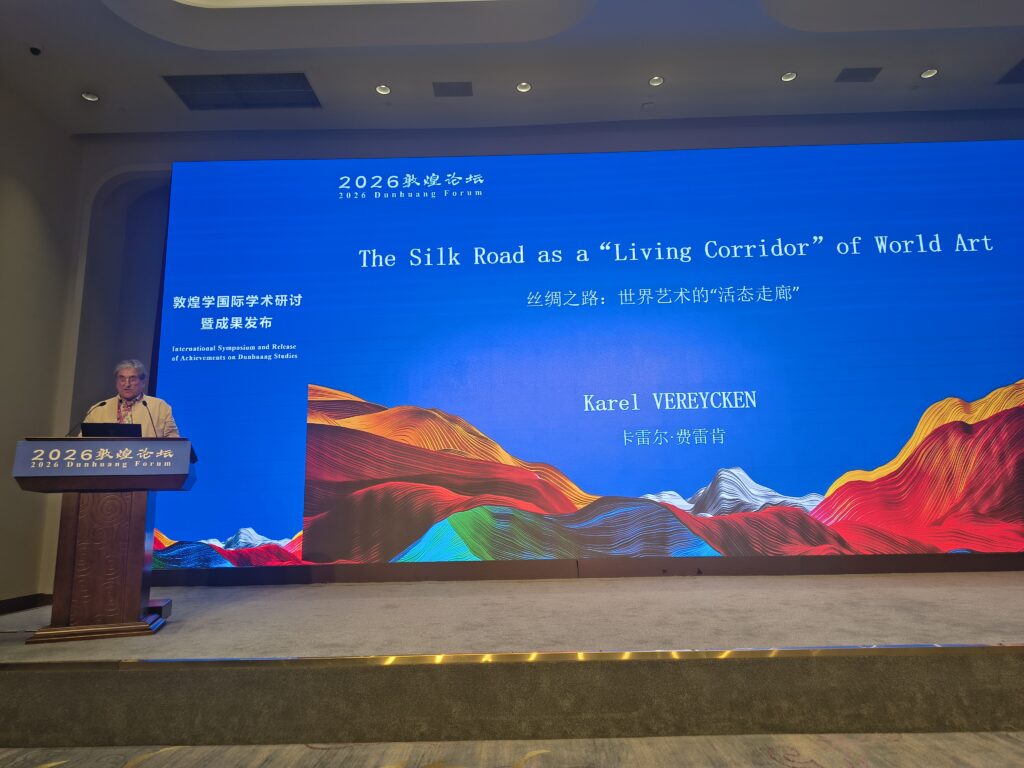
On Tuesday Nov. 3, 2026, painter-engraver and historian Karel Vereycken, as an independant scholar and contributor to the International Schiller Institute, delivered a lecture (text of the integral version below) at the International Academic Symposium “Dunhuang Studies Research in the New Era. »
The symposium, organized by the Dunhang Academy, was organized in the framework of the « 2026 Dunhuang Forum », in the ancient city of Dunhuang in the Gansu Province of China.
The next day, Nov. 4, Helga Zepp-LaRouche, the founder and president of the international Schiller Institute, keynoted another session with her speech « The Dunhuang Mogao Grottoes, Unity in Diversity. »
(A brief report on the event can be found with this LINK.)
The Dunhuang Academy is a highly-esteemed and prestigious institution that has worked hard for decades to preserve the cultural heritage of the « Mogao Caves » close to Dunhuang, a major stop on the ancient Silk Roads and a unique testimony of over a thousand years of dialogue and cooperation.
As one can see by the Conference program, the symposium brought together, besides very high level Chinese dignataries, over 130 scholars, archaelogists, authors and experts (mainly from China, but also from Japan, Russia, Germany and France) who presented their latest research on all possible facets of this outstanding and unique cultural heritage and the latest exploration techniques to explore it.
From Gandhara to Dunhuang,
the Silk Road as a « Living Corridor »
of World Art
By Karel Vereycken, independant scholar, Schiller Institute.
Lecture given on Nov. 3, 2026 at the International Academic Symposium “Dunhuang Studies Research in the New Era” of the 2026 Dunhuang Forum,
Mogao Caves, Dunhuang, China.
Dear organizers, dear colleagues, excellencies,
First, I want to thank you again for this invitation. It is a great honor for me to assist at this high-level event and to be able to share my views on the past, present and future of culture of the Silk Roads.
Most of us actually traveled over parts of these roads to arrive here in Dunhuang, a city that really needs to be honored and recognized as a milestone on the road to the utmost best of what humanity can accomplish when it acts according to its own nature, that of loving each other, celebrate human genius and creativity, and building a common future.
Archaeology is not merely about rediscovering the past in the present. Archaeology also allows us, mankind, to discover “the long shadows” of the future.
However, I’m not a professional archaeologist. I’m only a painter engraver and independent scholar active with the International Schiller Institute. My research concentrates on what one might call the “archaeology of ideas”, that is how ideas and concepts, in the domain of art in particular, travel over time and distance. And that’s where Dunhuang really captured my interest.
The birth and expansion of Buddhism
Of course, those present here know the history of Buddhism and Dunhuang in far greater detail than I can dream achieving. They should pardon me for the rough sketch I present now of that history, but for people living in different continents and from different cultures, I think they will be grateful for this short historical introduction.
I’ll make it short. Buddhism emerged during the 6th to 5th century BCE in the eastern Gangetic plain, near modern-day Nepal. Siddhartha Gautama, known as the Buddha (the « Awakened One »), founded a movement that stood for religious self-perfection and social change. Born a prince, he left his luxurious life to seek an end to human suffering, mostly through introspection. His teaching spread across Asia by three means:
- dedicated and inspiring followers,
- royal and private patronage and
- the trade networks of what has been called in the XIXth century, the “Silk Road.”
Maurya Empire (c. 321 BCE – 185 BCE)
The first breakthrough came about 200 years after the death of Buddha with the founding of the Maurya Empire (c. 321 BCE – 185 BCE).
In 321 BC, Chandragupta Maurya, with help from his clever advisor and Prime Minister Chanakya, founded a vast and powerful kingdom that united most of the Indian subcontinent after Alexander the Great left the region. The kingdom stretched from present day Afghanistan to the present day of Bangladesh, its capital was Pali Putra (present day Patna in the Northeast of India), and it lasted till 185 BC.
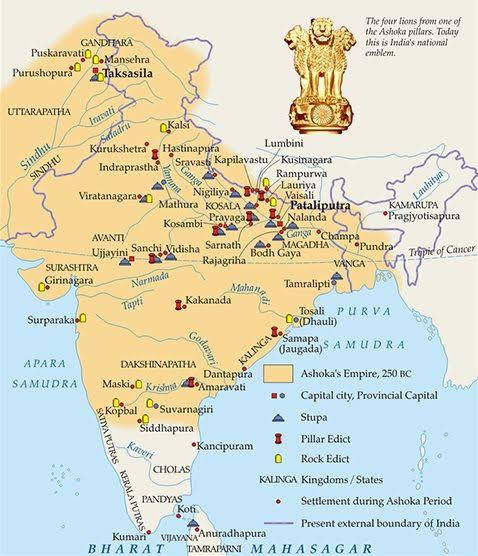
Founded in the 5th century BC, the University of Taxila (today’s Punjab) was a famed seat of Sanskrit and Vedic learning.
Then arrived the nearly forgotten king Ashoka the Great (ruled from 268 BC till 232 BC), the grandson of Maurya, who became the third ruler of the kingdom.
After having conducted unjust and cruel wars, Ashoka got gradually drawn towards peaceful Buddhism. After his conversion, Buddhism gained recognition, strength and go global.
Ashoka made several edicts that were engraved in pillars and rocks installed all over the territory of the kingdom. The edicts were written in the main languages used by the population groups of the kingdom: Greek (Ionian), Aramean and Prakrit. The edicts called for non-violence, respect for all forms of life, moderation and compassion.
Ashoka promoted Buddhism on a scale unseen till then. He ordered and financed the construction of 84,000 Buddhist temples (stupa) for Buddhist devotional practice. And following the Third Buddhist Council (ca 250 BC) that he patronized, Ashoka sent emissaries to spread Buddhist teachings abroad.
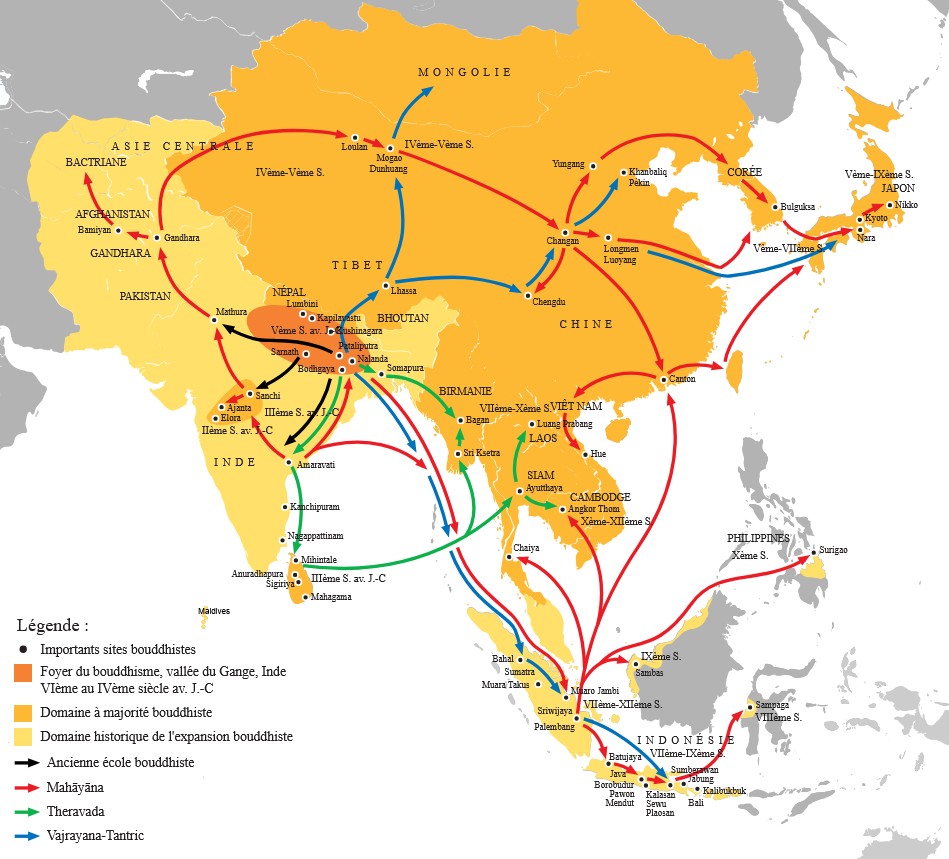
Well known is the fact that he sent his son Mahinda to Sri Lanka, making it the first region outside India to officially adopt Buddhism. From there and along the Indian maritime trade routes, this southern expansion established Theravada Buddhism (“The doctrine of the Elders”) as the dominant tradition in mainland Southeast Asia.
Over centuries, kingdoms in modern-day Myanmar, Thailand, Cambodia and Laos embraced Theravada Buddhism, deeply integrating it into their governance and cultural identities.
Kushan Empire (1st century BCE – 3rd century CE)
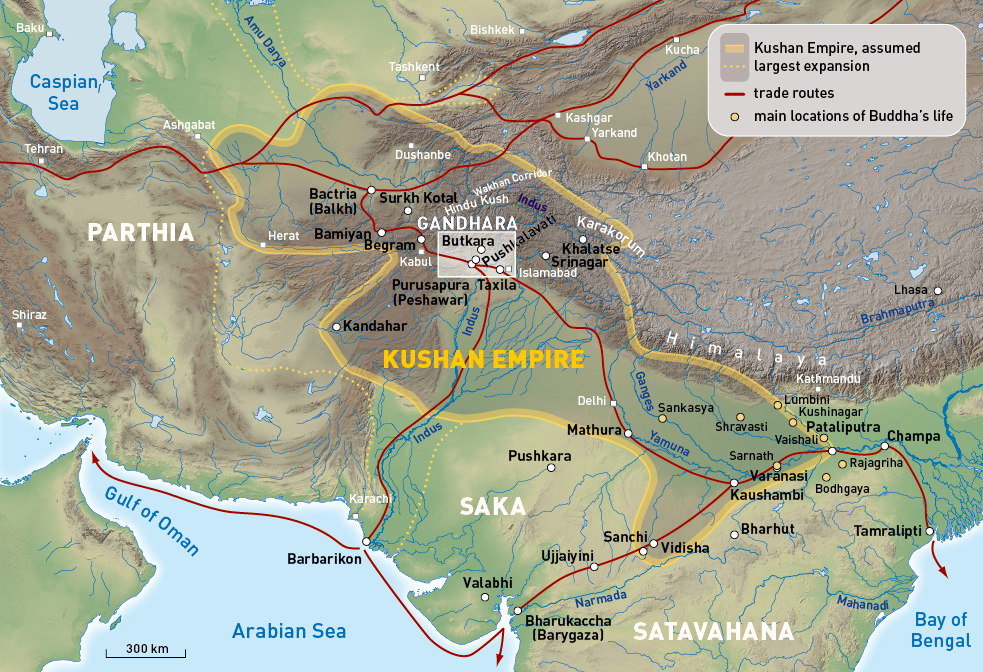
Another group of emissaries traveled to central Asia and developed another interpretation of the teachings of Buddha, Mahayana Buddhism (“The Great Vehicle” in Sanskrit). It really bloomed during the Kushan Empire (1st century BCE – 3rd century CE), an empire founded most probably by elements of the Chinese Yuezhi confederation in the early 1st century CE.
The founder of the dynasty, Kujula Kadphises, followed Iranian and Greek cultural ideas and iconography. Greek (Ionian) was the administrative language.
Initially based in the Bactrian territories, it spread to encompass much of what is now Afghanistan, India, Pakistan, Tajikistan, Turkmenistan and Uzbekistan. Kushan territory in India extended at least as far as Saketa and Sarnath near Varanasi (today’s Benares, India), where inscriptions confirm this reality.
The Kushan dynasty had diplomatic contacts with the Roman Empire, Sassanian Persia, the Aksumite Empire (Ethiopia and the Horn of Africa), and the Han dynasty of China (206 BC –220 AD). It was at the center of trade relations between the Roman Empire and China: according to Alain Daniélou, “for a time, the Kushana Empire was the center point of the major civilizations”.
While much philosophy, art, and science were created within its borders, the only textual record of the empire’s history today comes from inscriptions and accounts in other languages, particularly Chinese.
In 127 A.D., his successor Kanishka the Great, replaced Ionian with Bactrian as official language. His rule ushered in a period of relative peace for 200 years, described as “Pax Kushana.”
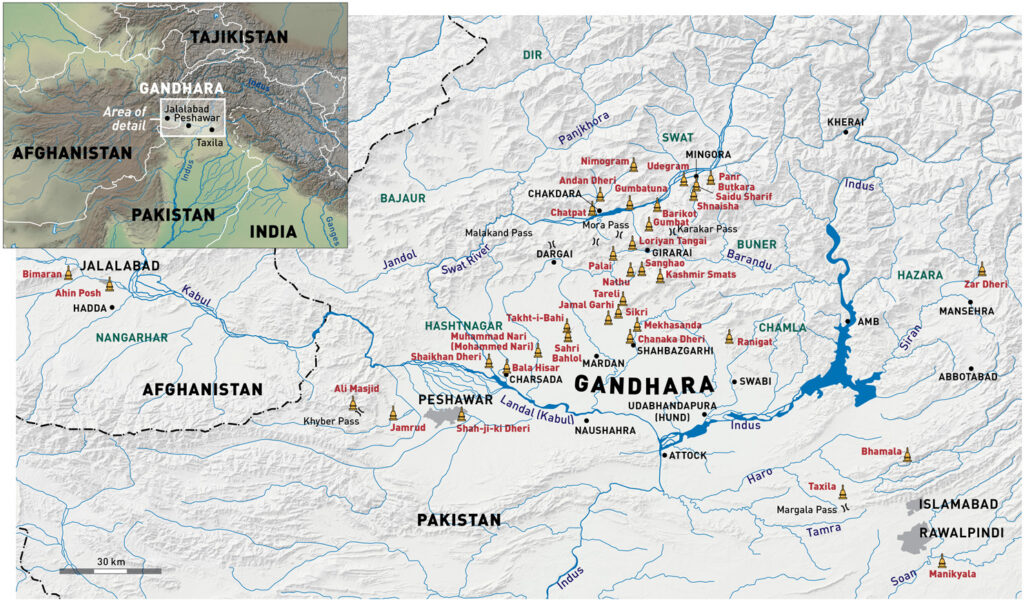
The “miracle of Gandhara”
From Gandhara, the cultural and intellectual point of gravity of the Kushan Empire, Kanishka started promoting Buddhism through learning, art and literature.
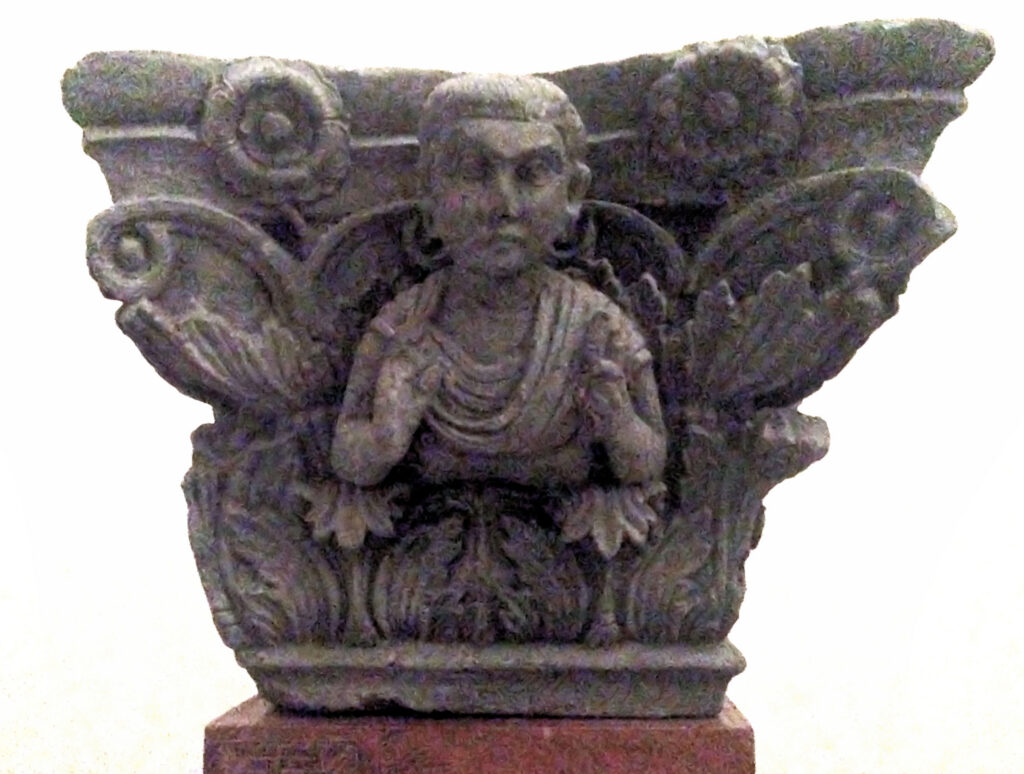
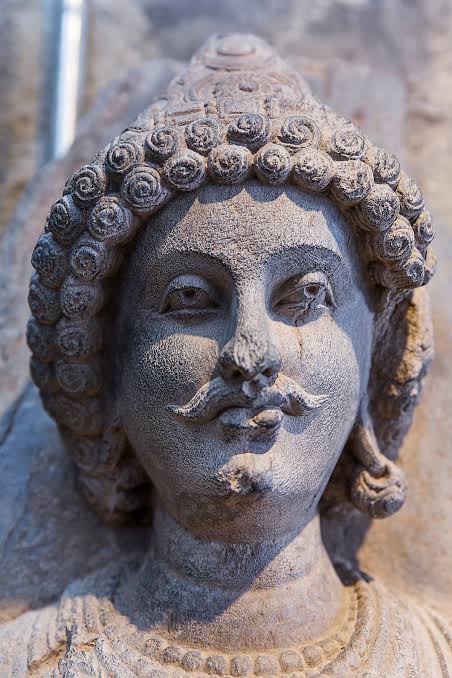
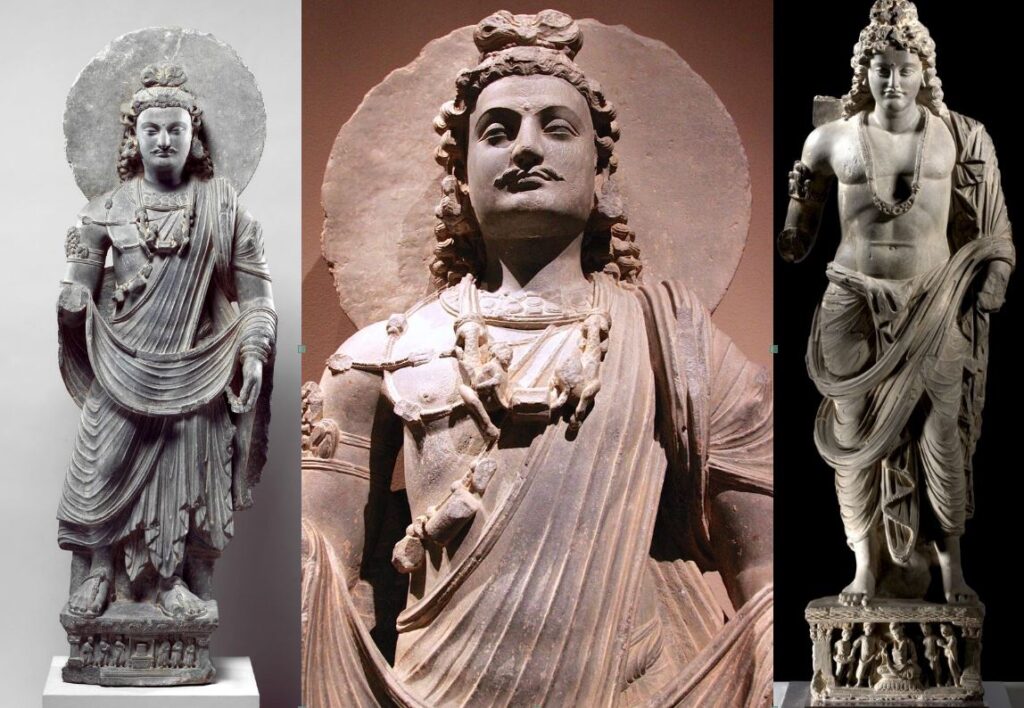
It was under Kanishka that the “miracle of Gandhara” occurred. Buddhist devotional art, which for four centuries was exclusively symbolic and an-iconic, suddenly morphed into anthropomorphic art taking the shapes of humans and using the canons and naturalistic proportions of the classical Greek period.
With human figuration Buddhism now reached out to the heart and the imagination of the common man. Buddha, after all, was not a god, but a human person that was deified for his exceptional qualities. For an ordinary person, attaining nirvana as Buddha did, was an exceptional achievement.
But Gandhara art also celebrated and mass-produced magnificent sculptures of bodhisattvas, well-intentioned human beings already on the path to nirvana, but first living their own lives and entirely devoted to liberating other humans from suffering. What is celebrated by representing them, therefore, is empathy and compassion.
A direct road from Gandhara to China remained under Kushan control for more than a century, encouraged travel across the Karakoram (the second-highest mountain range on Earth), and facilitated the spread of Mahayana Buddhism to China.
To be noted is the fact that Gandhara developed its own language: Gandhari, which became a lingua franca along the Silk Road and a major source language for the earliest Chinese translation of Buddhist sutras during the Han dynasty.
From Gandhara, Buddhism spread eastward into oasis cities like Khotan and Dunhuang and deeper into China during the Han Dynasty. In turn, China transmitted its Mahayana traditions northeast. Korean kingdoms adopted Buddhism in the 4th century, and Korean monks subsequently introduced it to the Japanese imperial court in the 6th century.
Gandhara art also traveled to Dunhuang, China, along the land routes of the ancient Silk Road, carried by traveling monks, merchants, and diplomatic envoys between the 2nd and 7th centuries.
Buddhist monasteries and nunneries on the Silk Road, financed by both the king and the merchants, were more than religious sites and favored an environment of economic well-being. Besides prayer rooms, they offered housing facilities, protection against bandits, education for children and artisans, medical care and even financial facilities. As the archaeological site of Mes Aynak (today’s Afghanistan) suggests, some Buddhist monasteries also engaged in mining and metallurgic industries.
Art and religious objects moved alongside commercial goods across the Kushan Empire and Central Asian oases. Dedicated Buddhist merchants, pilgrims, monks and nuns walked these dangerous desert routes to collect Sanskrit scriptures, bringing along visual iconography and sacred statues. They passed through key hubs like Bamiyan and Mes Anyak in Afghanistan and the Kizil Caves in Kucha (Xinjiang) before reaching Dunhuang. Small portable items—such as gilded bronze figurines, drawings, painted banners, and illuminated manuscripts—served as visual templates that easily fit inside merchant packs.
Dunhuang, as a “second” Gandhara
When the art of realistic drapery and naturalistic human anatomy reached the Mogao Caves in Dunhuang, local and foreign artists reinterpreted them. It is over-simplistic to just say the Dunhuang painting school was “influenced” by Gandhara art merely copied what arrived from outside.
In Dunhuang, there are 735 recorded caves of which 492 feature preserved murals and painted sculptures. They survived as repositories of a very precious artistic heritage. Approximately 25,000 square meters of wall paintings and more than 3,000 painted sculptures make of this site, not only one of the largest but one of the most valuable sites of Buddhist art.
Between 400 AD and 1400 AD, Dunhuang brought together many talents in a single melting pot culture. One might want to call it a “second Gandhara”. Just as in Gandhara, as a result of a friendly dialogue, mutual understanding and admiration grew between foreign (Hellenic, Persian, Indian, etc.) and Chinese traditional culture, a new form of art saw the light in Dunhuang.
Architecture
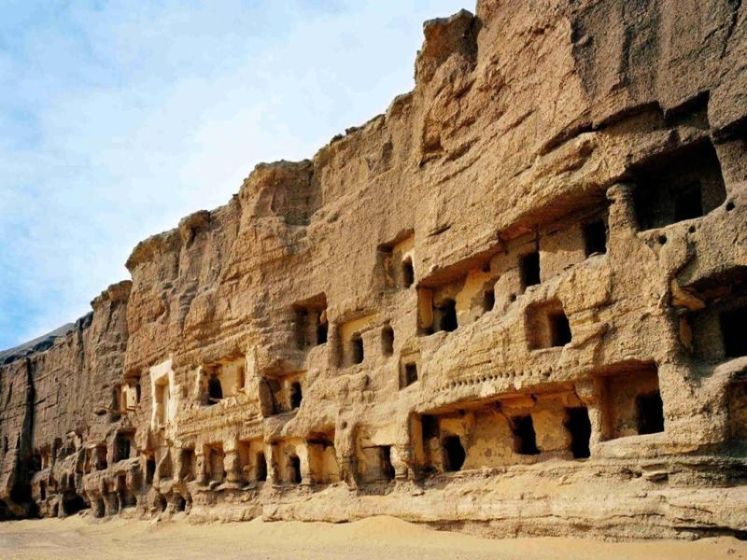
First, Gandharan monastic complexes feature small, plain cells (viharas) for residential monks surrounding a central courtyard. The northern section of the Mogao Grottoes, mirrors this setup perfectly, hosting over 200 plain, bare-walled caves that strictly functioned as living quarters, meditation cells, and work spaces for the site’s traveling artisans.
In Gandhara, monks prayed in chaityas—apsidal, vaulted rock-cut halls built around a freestanding burial mound (stupa) for circumambulation.
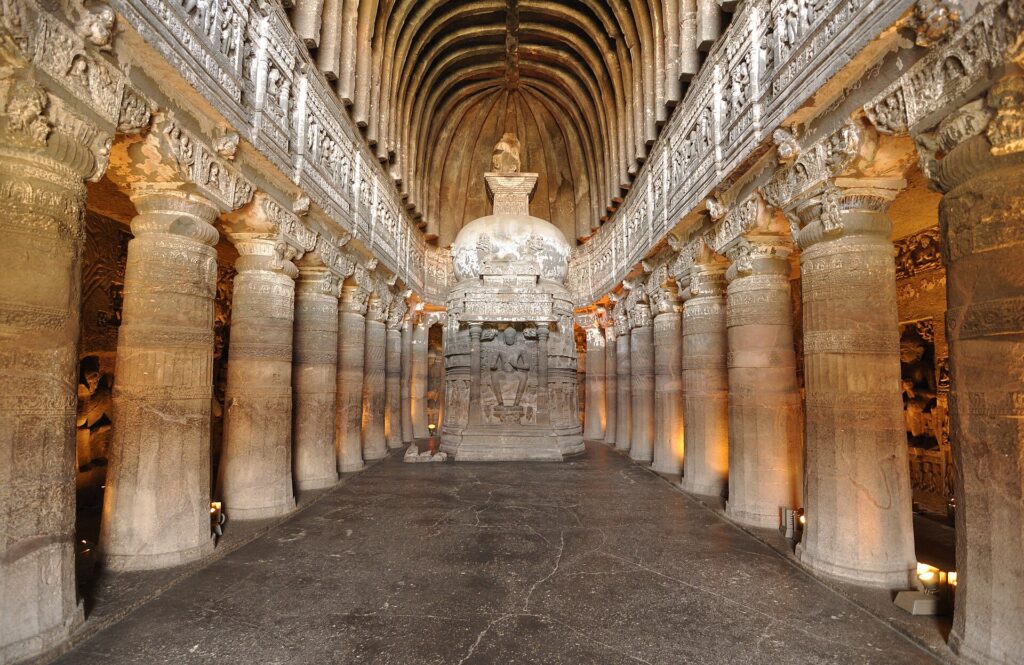
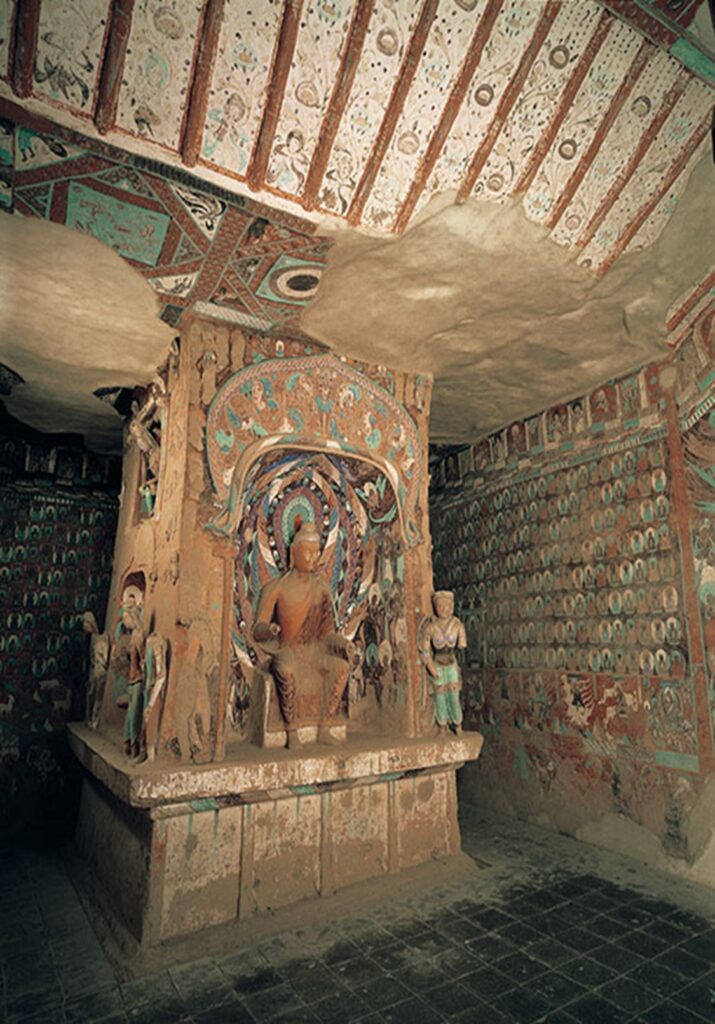
When this design reached Dunhuang, Chinese builders adapted it into “Central Pillar” Caves (e.g., Cave 254). Instead of a round stupa, they carved a solid, square rock column stretching from floor to ceiling, decorating its sides with niches containing painted statues.
Painting and sculpture: cave 275 versus Cave 45
To understand how Gandharan visual art evolved, there is no better way than to look directly at the contrast between Cave 275 and Cave 45, separated in time by three centuries.
Stepping from one into the other is like walking out of the naiver Kushan-influenced Western frontiers and straight into the peak elegance of a local Chinese imperial court.
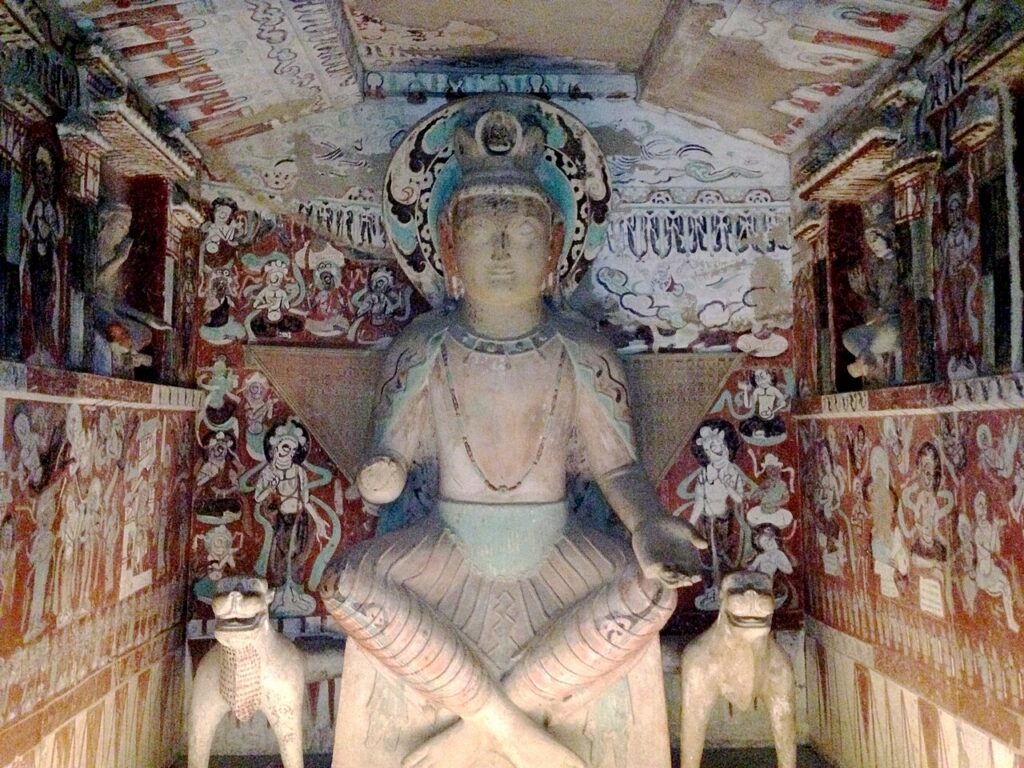
Dating back to the Northern Liang period (397–439 CE), Cave 275 is one of the absolute oldest surviving structures at Dunhuang. Its central focus is a 3.34-meter-tall painted clay statue of Maitreya Bodhisattva. 1
He sits with crossed ankles on a throne supported by two lions—a posture and royal motif directly copied from Kushan royal iconography. The statue has a robust, wide-shouldered body, a long prominent nose, and a square chin—traits echoing the Greco-Roman features of early Gandharan art. His upper chest is left bare, wrapped only in a geometric, rigid Western-style scarf.
At that time, Gandharan Greco-Roman realism directly collided with Han Chinese styling. In early caves like Cave 257 or Cave 275, paintings were designed to teach basic Buddhist morality to weary travelers.
Cave 45 was created three centuries later, at the Peak of Tang Dynasty Realism (8th Century). By this era, the foreign, rigid Gandharan foundations had completely dissolved into an incredibly fluid indigenous Chinese classical style.
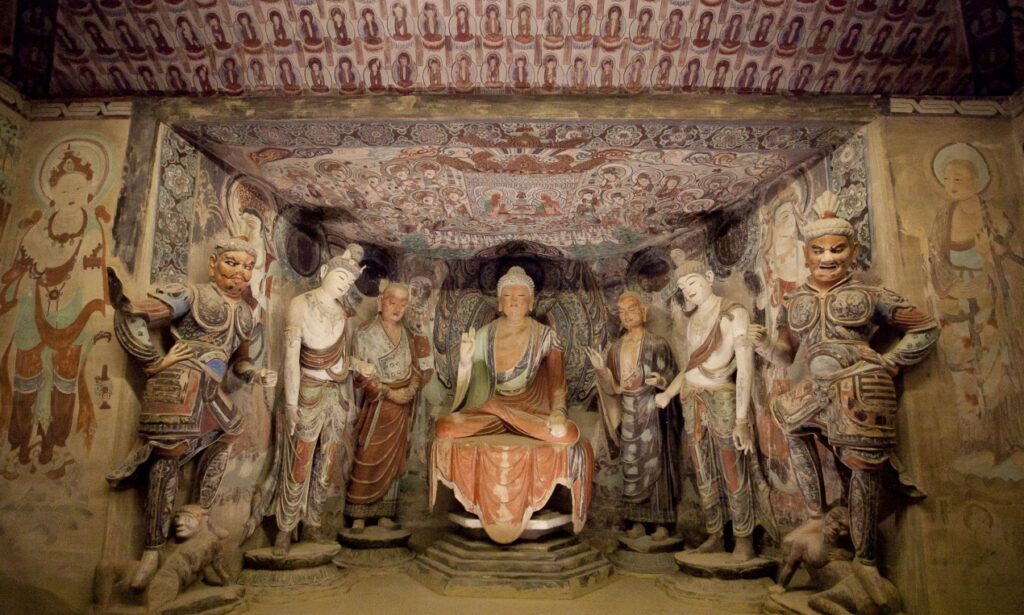
Tucked into the west wall niche is a flawlessly preserved seven-figure sculpture group containing a central preaching Buddha, two disciples, two bodhisattvas, and two heavenly guardian kings.
Gandharan relief sculptures were famous for heavy, realistic Roman toga-style drapery with deeply carved folds overlapping the body.
In the early Mogao murals, these robes were flattened into thin, tight-fitting wet-drapery lines. By the time of the Tang Dynasty, the aesthetic shifted completely to “the floating scarves of Dunhuang,” where heavy fabric folds were replaced by light, billowing, and calligraphic ribbons that conveyed rapid motion.
By the time Cave 45 was decorated, the focus shifted from earthly sacrifices to spectacular visions of heavenly salvation. On the south wall of Cave 45, the Western Pure Land Illustration presents Amitabha Buddha (Infinite Light) presiding over a massive celestial court.
Heavenly apsaras (flying celestial beings) dance dynamically overhead while newly reborn souls emerge peacefully out of lotus blossoms in a shimmering central pool. To ground this heavenly scene in human emotion, the sides of the mural contain narrow border panels depicting the tragic earthly story of Queen Vaidehi, who meditates to escape the imprisonment forced upon her by her wicked son.
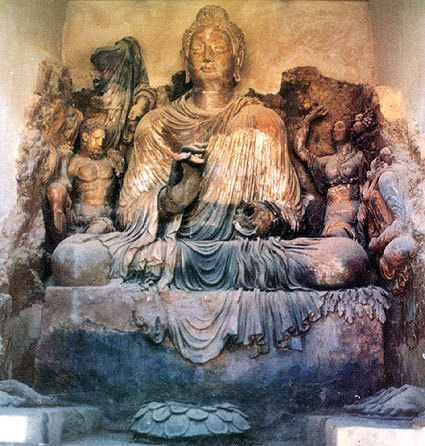
In terms of elegance, Cave 45 reminds the viewer of the famous Triad of Hadda, a group of statues excavated at Tapa Shotor, a large Sarvastivadin Buddhist monastery near Hadda in Afghanistan, dating from the 2nd century AD and certainly one of the most refined expressions of Gandhara art (now destroyed).
While Gandharan art was realistic in body structure, Tang artists added emotional expression.
Compare the two disciples in Cave 45: Ananda (on Buddha’s right hand) is modeled as a flawless, youthfully smooth and serene young monk, while the older Kashyapa (on Buddha’s left hand) is carved with a lean, wrinkled, and care-worn face reflecting a long ascetic life.
The two flanking Bodhisattvas represent the pinnacle of High Tang elegance. Moving far away from the rigid front-facing posture of Cave 275’s Maitreya, their bodies sway in an exaggerated, fluid S-curve posture, originally from Indian tribhanga but heavily refined by Chinese aesthetics.
Their silk robes and jeweled sashes drape softly like real, moving textiles. On the outer edges stand the “Heavenly Guardian Kings”. Their intense, muscular grimaces and stomping postures showcase the final evolution of defense icons: instead of wearing Roman-influenced armor, they are dressed in accurate, intricate Tang Dynasty military plate armor.
But art is more than technical virtuosity, for technical skills are mobilized to convey elevating concepts. It is the spiritual and cognitive subject matter that pushes artists to innovate their technical mastery.
Relevant here, the process by which specific Gandharan traits—such as the compassionate downward gaze and elaborate royal ornaments—merged with Chinese aesthetics, transforming figures like the Gandharan Avalokiteshvara (the bodhisattva of compassion, goddess of the traders) into the Chinese Guanyin (Goddess of Mercy and compassion in Chinese culture and East Asian Buddhism).
Painting techniques
In their fresco’s Gandharan artists utilized Western, Hellenistic three-dimensional shading to define the human body. Dunhuang painters adopted this technique into a localized style called “convex shading” (ao-tu).
They painted deep, circular rings around eye sockets, muscles, and collarbones to give the flat wall murals a lifelike, three-dimensional depth when seen under candlelight. Over the centuries, the original red lead pigment oxidized, turning these highlighted areas black and creating a distinct “panda-eye” look unique to early Silk Road murals today. 2
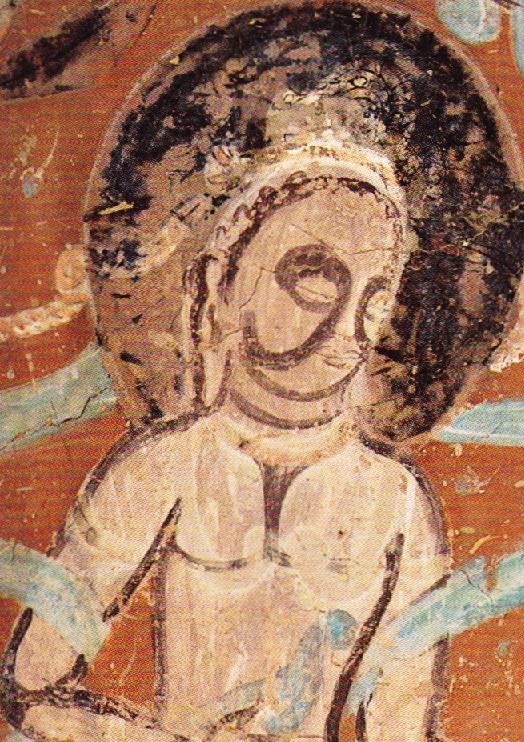
The shifting nature of colors of Dunhuang also reflects changes in trade access along the Silk Road. Artists initially relied heavily on natural mineral pigments mixed with animal glue, but the specific minerals they could source evolved.
Early painters relied on local iron oxides like hematite and ocher for deep reds and warm browns. However, for brilliant blues, they used lapis lazuli (lazurite).
Because lapis lazuli had to be imported over thousands of miles from the Badakhshan mines of modern Afghanistan, its heavy presence in early caves highlights Dunhuang’s immediate, direct economic connection to the Western regions of Central Asia.
As Chinese trade routes shifted and consolidated, artists increasingly replaced imported lapis lazuli with azurite, a deep blue copper mineral widely available within China.
Greens became intensely vibrant due to the heavy application of malachite. And while early artists used simple gold leaf sparingly or substituted it with bright yellow ocher, Tang dynasty artists mastered complex gilding techniques. They applied ultra-thin sheets of gold foil over a red iron-oxide primer to make jewelry, crowns, and celestial halos radiate light inside the dark, candle-lit cave interiors.
The Laocoon
Also in terms of emotional content, in 2019, during a lecture at the University of Hong Kong’s Centre for Buddhist Studies, Professor Osmund Bopearchchi cited several cases of highly recognizable Gandharan motifs in Buddhist iconography.
As an example, he underscored the similarities in expression between a sculpture from “greater Gandhara” depicting the cry of agony of a monk, with the agonizing layman under the Buddha’s bed lamenting the death of the Blessed One as depicted on a relief currently exhibited at the Victoria and Albert Museum (V&A) in London.
The resemblance is not only in the look and feel of the images, but also in the detail of the expressions: in the teeth, tongue, jaw, eyebrows, and staring eyes, all conveying a deep sorrow and cry of despair.
Prof. Bopearachchi hypothesized that that inspiration could have come from the Hellenistic statue Laocoon and His Sons, also known as the Laocoon Group 3, “the prototypical icon of human agony” in Western art whose importance has been underscored in the 18h Century by the German playwriter and art theorist Gotthold Ephraim Lessing.
This type of iconography directly or indirectly traveled to Dunhuang. The most famous depictions come from cave No.158 in Mogao, known as the Nirvana Cave, which features mourners witnessing the passing of the Buddha, depicted in murals along the length of the hall behind.
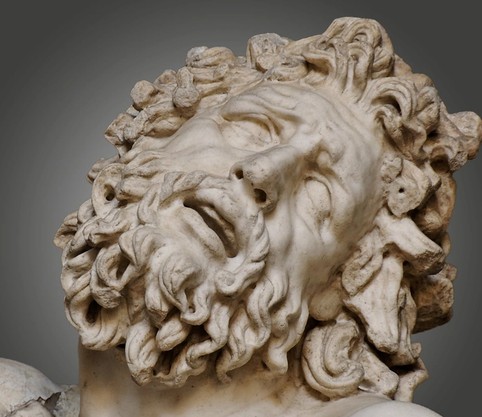
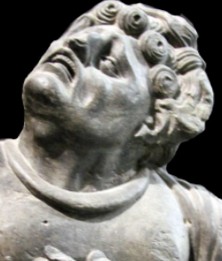
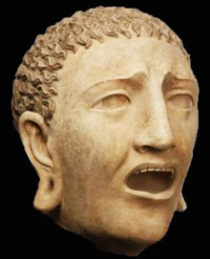
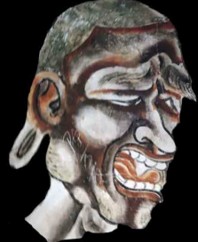
FIG. 14 a, b, c, d
The utter despair of the Trojan priest facing his own death (a) is the precursor to the passionate and emotional expressions of the agonizing Buddhist monk of the stucco sculpture from the Vardak region (b), the pain-stricken layman on the sculpture from the V&A (c), and the arahat (an enlightened person in Buddhism who has destroyed all mental constraints and escaped the cycle of rebirth) from the Mogao cave No.158 grieving the death of their beloved teacher (d).
Manuscripts, translations, paper and printing
Dunhuang was also a dynamic translation hub. Famous Buddhist monks and scripture translators worked in Dunhuang before moving further into mainland China.
For example, the legendary translator Kumarajiva stayed there, and influential local figures, such as the monk Hong Bian of the late Tang dynasty, dedicated their lives to reproducing and translating Buddhist manuscripts. Teams of officials, monks, and ordinary citizens meticulously copied translated religious and secular documents by hand, creating a vast repository of knowledge. It was from this incredible cultural and educational activity that the invention of paper and printing techniques would eventually emerge.
The invention of paper, as we know it today, took place under the Chinese Han Dynasty in AD 105. Ts’ai Lun, a court official, invented a paper making process which primarily used rags (textile waste) as the raw material with which to make paper.
Buddhist devotees, seeking to accumulate spiritual merit, financed both the digging and decoration of caves and the translation and reproduction of sacred sutras and prayers, thus creating a strong commercial and religious demand for inexpensive writing materials. Buddhist monks and pilgrims spread papermaking techniques along the Silk Road during their travels to share these texts. Monks like the Korean Buddhist monk Don Cho introduced these techniques to countries such as Japan around 610 AD.
The Library Cave
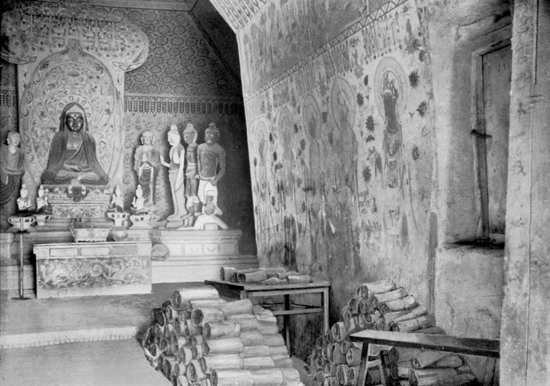
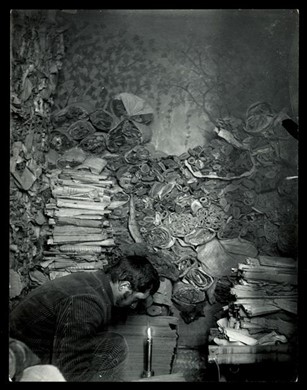
In 1900, a Taoist monk named Wang Yuanlu discovered in Mogao a cache that had been sealed at the 11th century. What is now called the “Library Cave” (Cave 17) contained upwards of 50,000 to 60,000 manuscripts.
While the majority were in Chinese and Tibetan, the cache held texts written in nearly 20 different languages and scripts, including:
- Sanskrit,
- Sogdian,
- Khotanese (Persian),
- Uyghur,
- Tangut (an extinct Tibeto-Burman language),
- Kuchean (also known as Tocharian B or Western Tocharian),
- Uyghour (Old Turkic),
- Mongolian,
- Prakrit,
- Hebrew.
The manuscripts deal with wide-ranging subjects. Among the non-religious texts:
- Social documents, such as contracts, account books and loan receipts;
- Philosophy, notably the Confucian classics;
- Literature, including Chinese folk songs;
- Classical poetry;
- History, both official and local Geography;
- Medicine, including treatments for plagues and illnesses. The medical texts include a fragment of one of the earliest Chinese pharmacological texts;
- Astronomy, including the Dunhuan Star Map that identifies over 1300 stars;
- Mathematics;
- Agriculture and cattle raising;
- Divination;
- Dictionaries;
- Music scores and dance notations, some of them foundational in Japan;
- Recreational games.
By far the largest proportion of manuscripts from the Dunhuang cave contain Buddhist texts. These include Buddhist sutras, commentaries and treatises.
Showing great respect, Li Yuan (Emperor Gaozu), the founder of the Tang dynasty, by declaring himself a descendant of the philosopher Lao Tzu, made Taoism the official state religion, while opening his kingdom to the devotional practices of the many other communities that came via the Silk Road. Chang’an (modern-day Xi’an), the Tang capital, and the major trading ports, in addition to Taoist, Confucian, and Buddhist communities, were home to numerous religious currents from abroad, notably:
- Nestorian Christianity (Jingjiao), officially recognized as early as 635 with the arrival of the monk Alopen and therefore long before the Jesuit missions;
- Zoroastrianism and Manicheanism, practiced by Sogdian merchants and diasporas of Central Asia.
- Islam of Arab and Persian merchants established in the southern ports (such as Guangzhou);
Therefore, among the non-Buddhist religious texts of the Dunhuang manuscripts, one finds:
- Taoist texts;
- Jewish Selihot prayers, as well as a version of the Old Testament in Hebrew;
- Nestorian Christian texts;
- Manichaean texts.
This incredible diversity testifies to centuries of translation efforts and intercultural dialogue.
Christian manuscripts
Among the texts discovered in the Library Cave, western explorers like the Hungarian born British archaeologist Aurel Stein and the Frenchman Paul Pelliot discovered around a dozen Christian texts written in medieval Chinese. These scrolls (such as the Sutra of Jesus Christ and the Book of Great Tensities) reveal that Nestorian scribes worked intensely to translate Christian theology into local languages. To make the concepts understandable, they adopted terminology heavily borrowed from Buddhism and Taoism.
Texts like the Sanwei mengdu zan (a Chinese version of the Gloria in excelsis deo hymn) demonstrate clearly that these manuscripts were actively used for worship by a local Christian Nestorian community in Dunhuang.
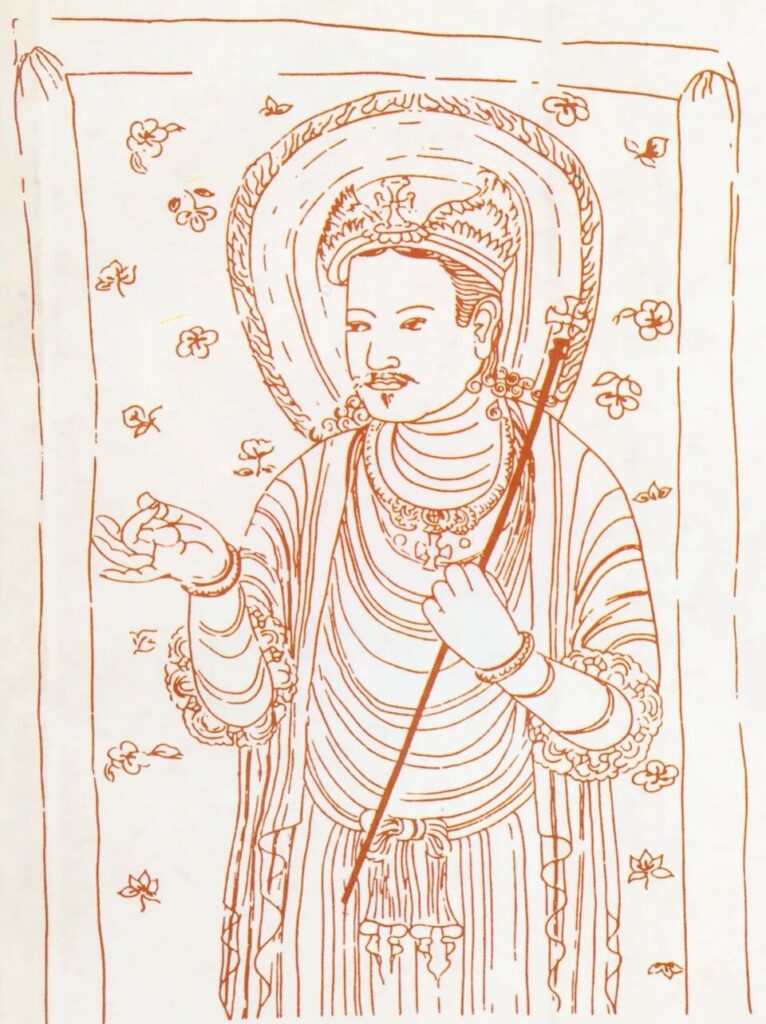
Also discovered in the Mogao Caves, a 9th-century silk painting depicting a holy figure (often identified as Christ or a saint) dressed in traditional Tang dynasty robes but wearing two distinct Nestorian crosses, one on his crown and one on his chest.
The figure is depicted with a mustache and a slight beard, appearing in a three-quarter view similar to traditional Chinese portraits of righteous scholars or divine beings. The right hand is raised to the chest in a gesture of blessing, mimicking the Christian benedictio or a Buddhist mudra.
Additional discoveries from the Mongol (Yuan) period uncovered fragments of the Book of Psalms written in Syriac, confirming that Eastern Christian monks and scholars continued to use the Mogao caves for prayer and textual work up until the 14th century.
Book printing
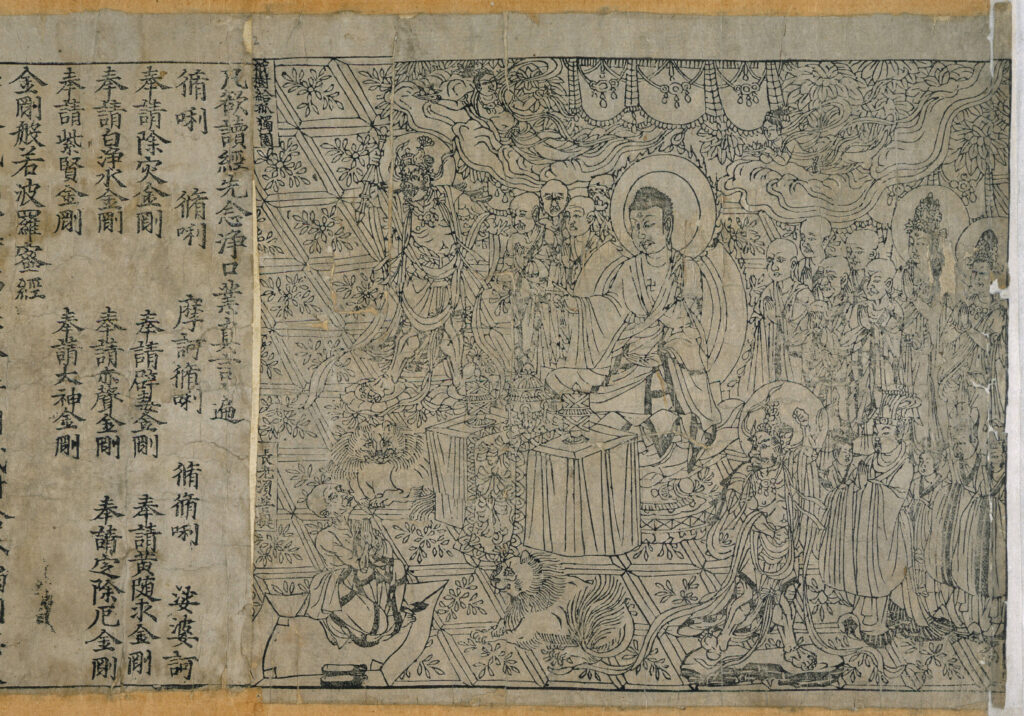
One last marvel among the treasures found, a translation from Sanskrit to Chinese of the Diamond Sutra. This Indian text narrates a dialogue on the nature of reality and illusion between the Buddha and his disciple Subhuti.
The text can be read on a 5-meter (16-foot) long horizontal scroll made of seven sheets of yellow-dyed paper joined together, featuring woodblock-printed text and an ornate frontispiece. Printed on May 11, 868 DC, it is the world earliest known complete printed book.
And in July 1377, that is, 78 years before the famous Gutenberg Bible, it was the Korean Buddhist monk Baegun (Gyeongham) who printed the Jikji (Jikjisimcheyojeol), the oldest book with movable metal types known to date, the second volume of which is kept at the Bibliothèque nationale de France (BnF).
Conclusion
So here, in Dunhuang, mankind, inspired by the accomplishments of Gandhara and other contributions from the Silk Roads, as “a living corridor”, explored a little further the creative essence of humankind and made it an object of celebration, after all the real mission of Art.
Many aspects of this cultural cross-fertilization have been discovered and are now duly documented. The opening of the copper mine and exploration of the Buddhist monasteries of Mes Aynak in Afghanistan will undoubtedly bring another treasure of cultural finds for all.
Let us work together to make this cultural beauty known to the world. As a visual celebration of the highest human qualities, Dunhuang, and the inspiration that gave birth to it, can and should be made as one of those long shadows of the future, a shadow of hope and of a positive future that mankind can decide to construct together.
Thank you for your kind attention.
Selected bibliography:
- Silk Roads: Peoples, Cultures, Landscapes. Susan Whitfield, Thames and Hudson, London, 2019;
- Spatial Dunhuang, Experiencing the Mogao Caves, Wu Hung, University of Washington Press, 2023;
- Buddhist Iconography Along the Silk Road with Prof. Osmund Bopearachchi, Part Two – The Land Route. Wendy Yu, Shantel Wong, Buddhist Global, September 3, 2019. https://www.buddhistdoor.net/features/buddhist-iconography-along-the-silk-road-with-prof-osmund-bopearachchi-part-two-the-land-route/
- Mogao caves reveal powerful India-China Buddhist link, Atul Aneja, The Hindu, Sept. 12, 2016, https://www.thehindu.com/news/international/mogao-caves-reveal-powerful-indiachina-buddhist-link/article8560771.ece
- From Gandhara to Dunhuang: The Evolution of Buddhist Art Along the Silk Road, Irum Malik, Kuiyi Shen, Progressive Research Journal of Arts & Humanities, Vol. 6, Issue 01, February 2026,
https://www.researchgate.net/publication/401971856_From_Gandhara_to_Dunhuang_The_Evolution_of_Buddhist_Art_Along_the_Silk_Road - Mogao Caves, Unesco list of cultural heritage, https://whc.unesco.org/en/list/440/
- Buddhism in Chinese Art (2nd century through 907 C.E.), Smarthistory, https://smarthistory.org/reframing-art-history/buddhism-chinese-art/
- From the Evolution of the “Flying Apsaras” Art in the Mogao Caves, the Influence of Taoism on Dunhuang, Yiran Zhang, Zeus Press; Sociology, Philosophy and Psychology; Vol.2, No.1; 2025, https://journals.zeuspress.org/index.php/SPP/article/download/125/114/524
- Blue pigments in Cave 256, Mogao Grottoes: a systematic analysis of murals and statues in Five dynasties, Song Dynasty and Qing Dynasty, Biwen Shui, Zongren Yu, Qiang Cui, Zhuo Wang, Zhiyuan Yin, Manli Sun & Boming Su, Heritage Science, volume 10, Article #89, 2022. https://www.nature.com/articles/s40494-022-00722-5
- Mogao Cave 45 (High Tang Dynasty), Dunhuang Academy, https://www.dunhuang.ds.lib.uw.edu/mogao-cave-45-high-tang-dynasty/
- The “Miracle of Gandhara”: When Buddha turned himself into man, Karel Vereycken, Artkarel.com, Feb. 28, 2024. https://artkarel.com/the-miracle-of-gandhara-when-buddha-turned-himself-into-man/
NOTES:
- Maitreya, in Buddhist tradition, is the Buddha of the future, currently a bodhisattva residing in the Tushita Heaven, who will descend to earth to preach the Dharma (the « law ») again when the teachings of Gautama Buddha have completely disappeared. Maitreya is the earliest bodhisattva around whom a cult has developed and is mentioned in texts from the 3rd century CE. He has been accepted by all schools of Buddhism and remains the only bodhisattva generally honored by the Theravada tradition. ↩︎
- Minium (or red lead) refers to lead oxide, with the formula Pb₃O₄, historically used as a red-orange pigment and as a rust-preventative paint. It is from this term that the word miniature originated, as medieval artists used it to draw illuminated initials and illustrations in manuscripts. ↩︎
- The « Laocoon Group » is a Roman marble copy of an ancient Greek bronze sculpture depicting the Trojan priest Laocoön and his two sons, punished by Zeus, being attacked by snakes. The statue may date from 40 BC. ↩︎
Afghanistan : « Le pays des 1000 cités d’or » et l’histoire d’Aï Khanoum


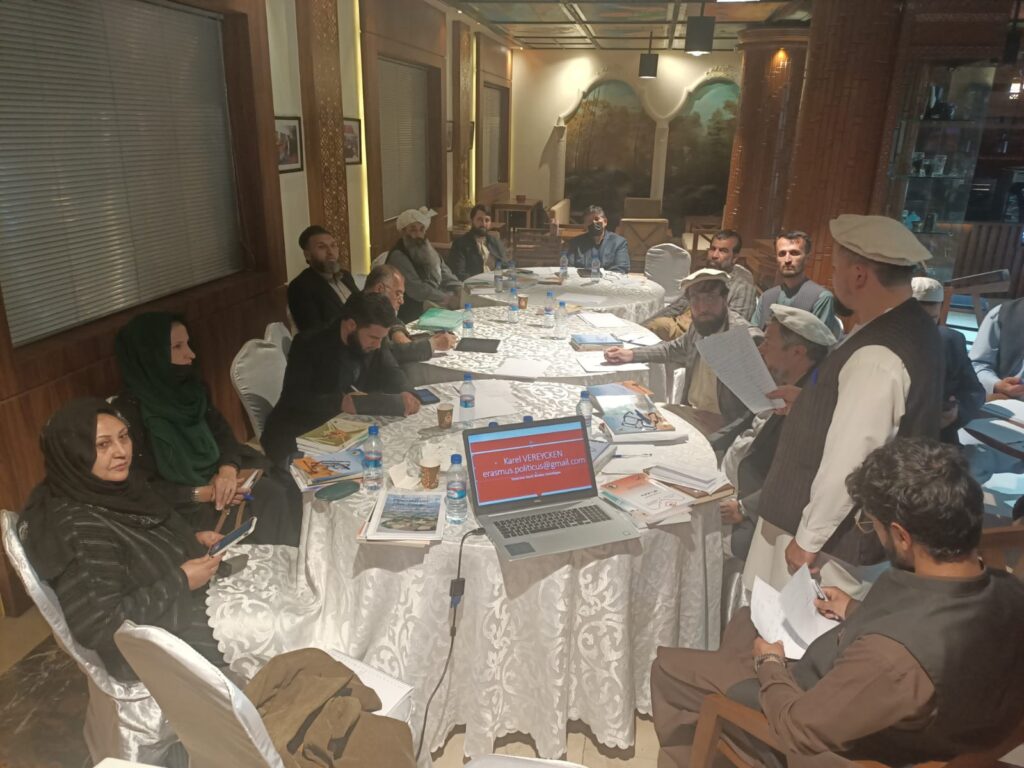
Invité par le Centre de recherche et de développement Ibn-e-Sina en tant que représentant de l’Institut Schiller, Karel Vereycken est intervenu le 7 novembre à la conférence sur la reconstruction du pays.
Son propos introductif, devant un groupe de travail composé d’historiens, d’archéologues et de membres de l’Académie des sciences d’Afghanistan, a donné lieu à une longue après-midi d’échanges sur le rôle de l’art, la méthodologie scientifique et les combats à mener pour sortir l’Afghanistan de son isolement et préserver un héritage culturel qui certes est afghan, mais appartient à toute l’humanité.
Parler de la culture d’un pays étranger est toujours une chose difficile, surtout si l’on n’en connaît pas la langue et si l’on n’a pas pu séjourner et voyager dans le pays pendant de longues périodes. Par conséquent, je ne peux que vous offrir mes impressions de l’extérieur et commenter ce que j’ai découvert dans des livres. Vous allez donc m’aider en me corrigeant et en me signalant ce qui a échappé à mon attention.
L’Afghanistan est un pays fascinant. Sa réputation de « tombeau des Empires » a capté mon imagination. Récemment, votre pays s’est émancipé de l’occupation américaine et de l’OTAN. Une poignée de combattants déterminés a mis en déroute un immense empire déjà en train de s’autodétruire. 34 ans plus tôt, le pays avait chassé l’occupant russe, après avoir résisté à l’Empire britannique au cours des trois guerres anglo-afghanes du XIXe siècle (1839-42, 1878-80 et 1919), alors que Londres, engagé dans le « Grand Jeu » (Great Game), tentait d’empêcher la Russie d’accéder aux mers chaudes.
Pour éviter d’être colonisé à la fois par la Russie et la Grande-Bretagne, l’Afghanistan a même courageusement refusé d’avoir des chemins de fer, ce qui explique qu’il n’existe aujourd’hui que 300 km de voies ferrées, une situation bien sûr inacceptable aujourd’hui.
Cette capacité de résistance et ce sentiment de dignité découlent, j’en suis convaincu, du fait que votre pays a su faire siennes les diverses influences qui s’y sont rencontrées. Voilà ce qui est devenu au fil des siècles le socle d’une forte identité afghane, totalement à l’opposé de l’étiquette tribale que les colonisateurs cherchent à lui coller.
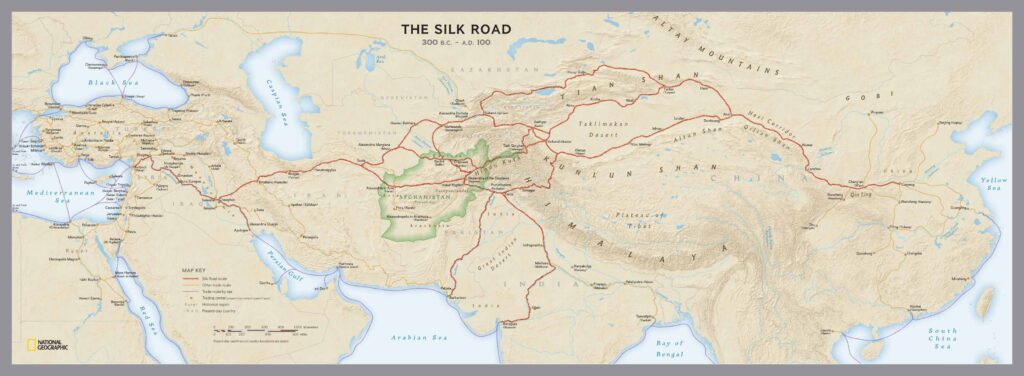
J’aborderai uniquement, aujourd’hui, l’influence grecque, qui s’est avérée majeure à partir du moment où Alexandre le Grand traverse le Hindou Kouch, en 329 av. JC.
Dès lors, des dizaines de milliers de colons grecs, appelés Ioniens, s’installent en Asie centrale.
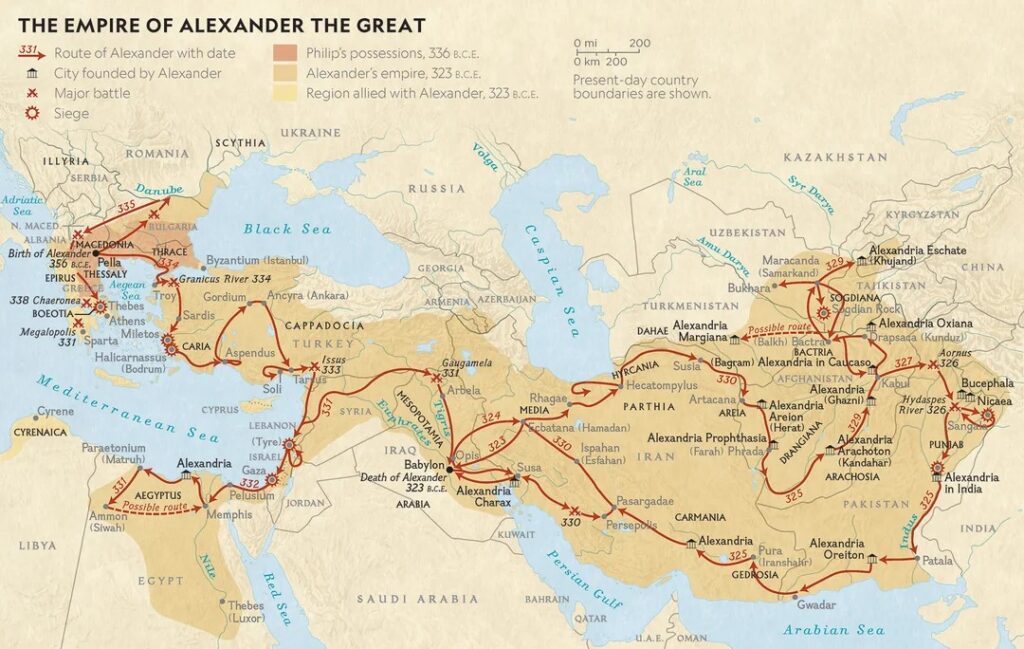
Sous le règne de ses successeurs concurrents, l’immense empire d’Alexandre le Grand se décompose en plusieurs entités et royaumes.
En 256 av. JC, Diodote Ier Soter fonde en Afghanistan le royaume gréco-bactrien, connu sous le nom de « Bactriane », dont le territoire englobe une grande partie de l’Afghanistan, de l’Ouzbékistan, du Tadjikistan et du Turkménistan actuels, ainsi que certaines parties de l’Iran et du Pakistan. L’influence grecque y perdure au moins jusqu’à l’arrivée de l’Islam au VIIIe siècle.
La Bactriane
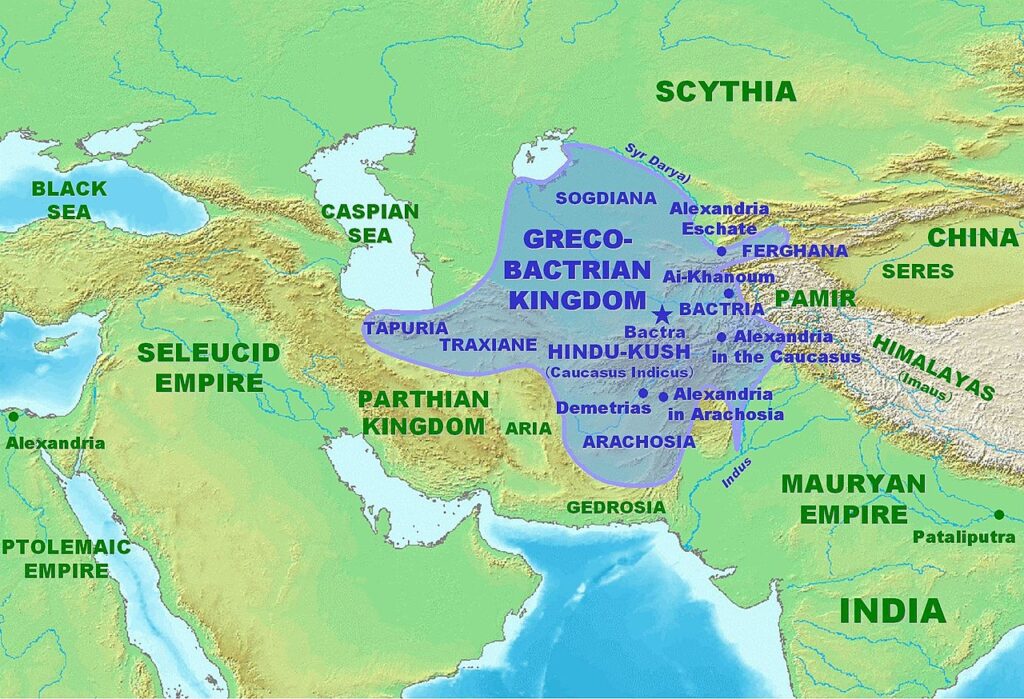
De nombreuses fouilles archéologiques confirment un développement urbain, économique, social et culturel remarquable.
Strabon (64 av. JC – 24 après JC), comme d’autres historiens grecs, qualifiait déjà la Bactriane de « Terre des mille cités », une terre que tous les écrivains, anciens et modernes, louaient pour la douceur de son climat et sa fertilité, car « la Bactriane produit tout, sauf de l’huile d’olive. »
Pour le naturaliste romain Pline l’Ancien (23 – 79 après JC), en Bactriane,
« les grains de blé poussent si gros qu’un seul grain est aussi gros que nos épis. »
Sa capitale Bactres (aujourd’hui Balkh, proche de Mazâr-e Charîf au nord de l’Afghanistan), « Mère des cités », figure parmi les villes les plus riches de l’Antiquité.
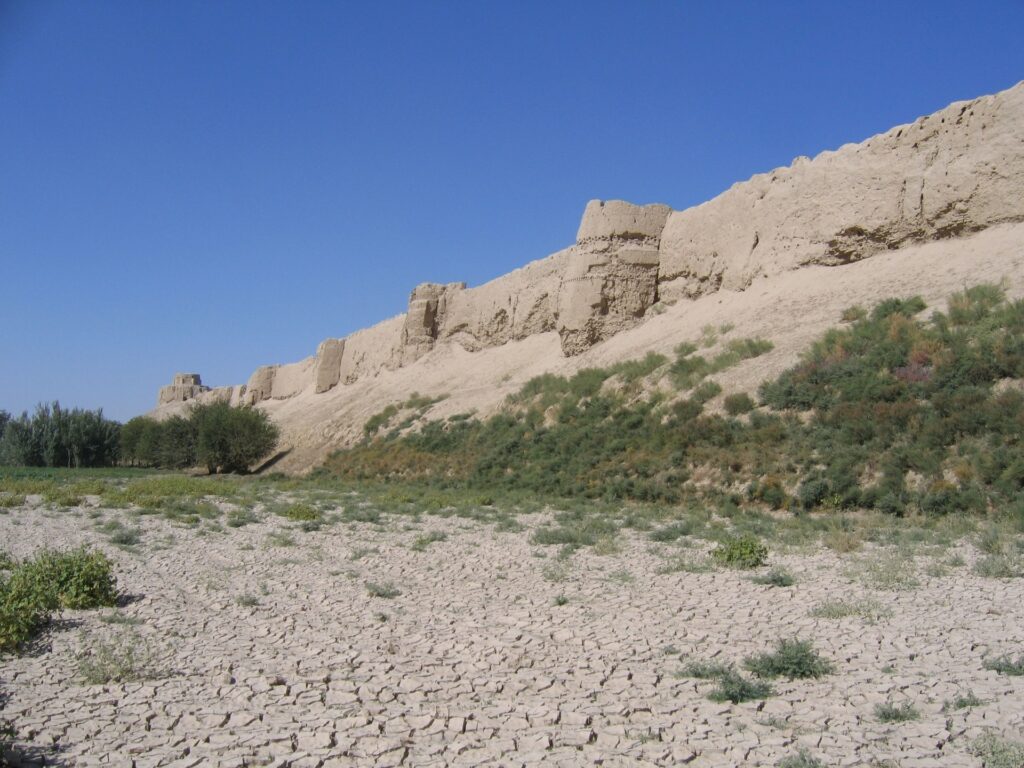
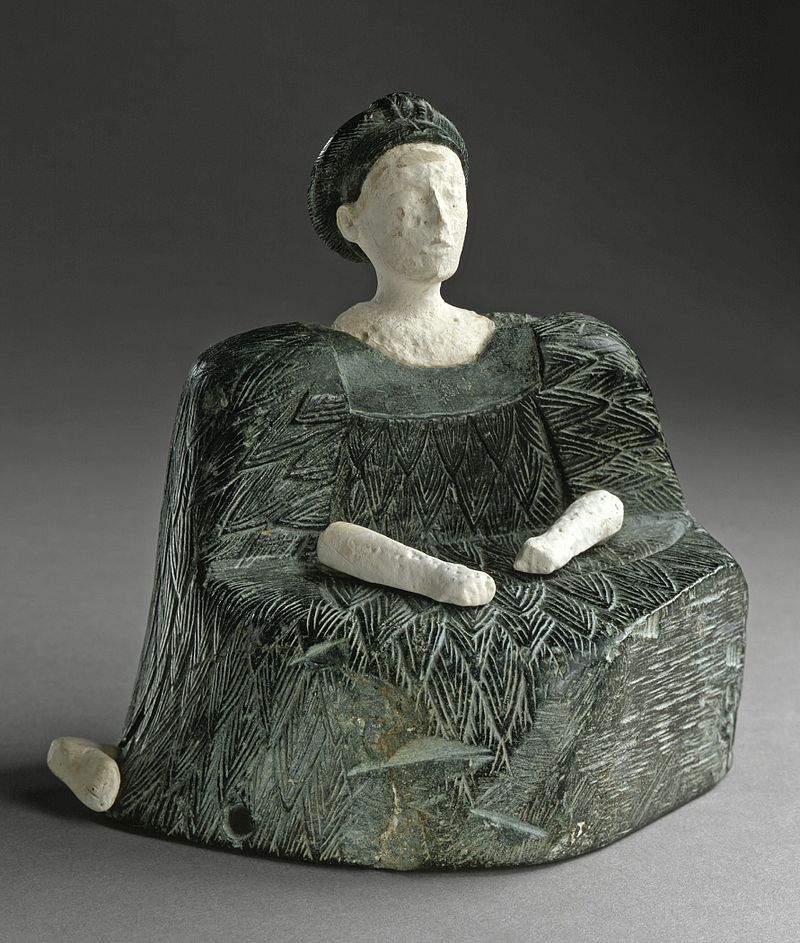
C’est là qu’Alexandre le Grand épouse Roxana (« Petite étoile ») et adopte l’habit perse pour pacifier son Empire. C’est également là que naîtra le père du grand médecin et philosophe Ibn Sina (Avicenne), avant de s’installer à Boukhara (Ouzbékistan).
Au fil du temps, la Bactriane sera le creuset de cultures et de civilisations où se mêlent, sur le plan artistique, architectural et religieux, traditions grecques et cultures locales.
Si le grec y est la langue de l’administration, les langues locales y foisonnent. Rien que les noms des villes démontrent la prédominance de la culture hellénique.
Ainsi, Ghazni s’appelle « Alexandrie en Opiana », Bagram « Alexandrie au Caucase », Kandahar « Alexandrie Arachosia », Hérat « Alexandria Ariana », etc., et la liste ne s’arrête pas là.
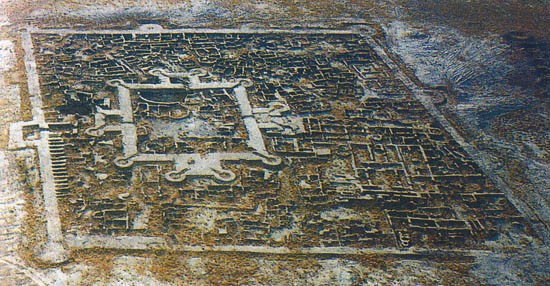
La ville de Gonur Depe (actuellement au Turkménistan, au nord de Mary, l’ancienne Merv), capitale du Royaume de Margiane, est un autre exemple de ce qu’on s’accorde maintenant à appeler la « Culture de l’Oxus »)
Aï Khanoum, la grecque

Si certaines villes ne font que changer de nom, d’autres sont construites ex nihilo. C’est le cas d’Aï Khanoum (« Dame Lune » en ouzbek), cité érigée au confluent du grand fleuve Amou Daria (l’Oxus des Grecs) et de la rivière Kokcha.
En 1961, le roi d’Afghanistan (Mohammed Zahir Shah), voulant marquer son indépendance vis-à-vis des Soviétiques et des Américains, invite la France à participer aux fouilles.
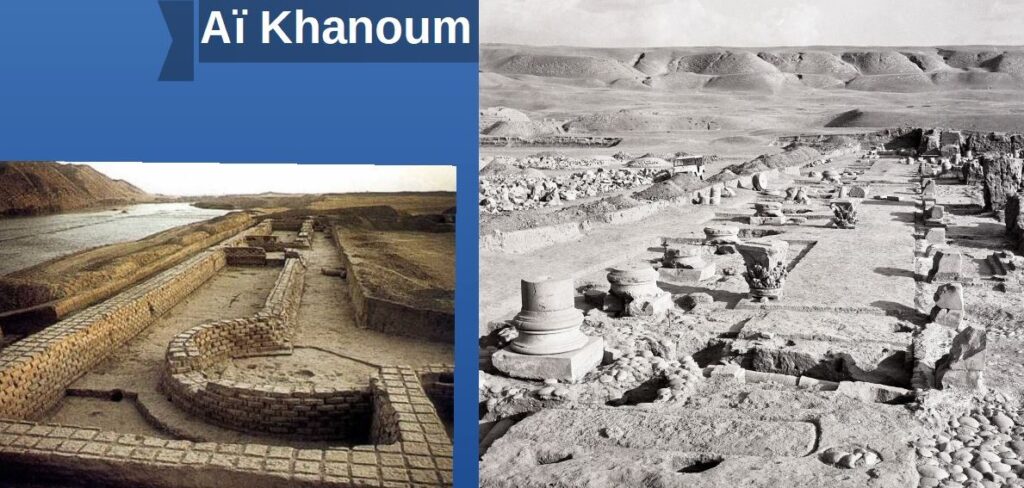
C’est le Département des archéologues français en Afghanistan (DAFA) qui met au jour les vestiges d’un immense palais dans la ville basse, ainsi qu’un grand gymnase, un théâtre pouvant accueillir 6000 spectateurs, un arsenal et deux sanctuaires.
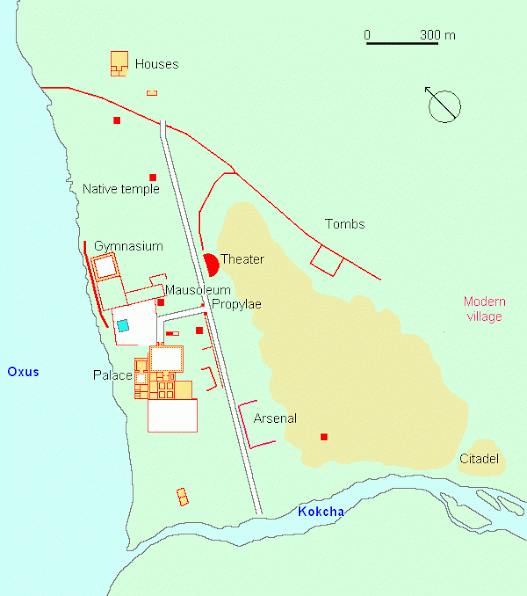
Entourée de terres agricoles bien irriguées, la ville elle-même était divisée entre une ville basse et une acropole de 60 mètres de haut.
Bien qu’elle n’est pas située sur une route commerciale majeure, Aï Khanoum commande l’accès aux mines du Hindou Koush. De vastes fortifications, continuellement entretenues et améliorées, entourent la ville.
Un monument au cœur de la ville y présente une stèle inscrite en grec avec une longue liste de maximes incarnant les idéaux de la vie grecque. Celles-ci sont copiées de Delphes et se terminent par :
« Dès l’enfance, apprends les bonnes manières ;
dans la jeunesse, maîtrise tes passions ;
dans la vieillesse, sois de bon conseil ;
dans la mort, n’aie aucun regret. »
L’architecture du site indique que les colons grecques y vivent en bonne entente avec les populations locales. Elle est très grecque mais intègre en même temps diverses influences artistiques et éléments culturels que les Ioniens ont pu observer au cours de leur voyage du bassin méditerranéen à l’Asie centrale. Par exemple, ils utilisent les styles néo-babylonien et achéménide pour la construction de leurs cours.
Shortugai et la Civilisation de la vallée de l’Indus
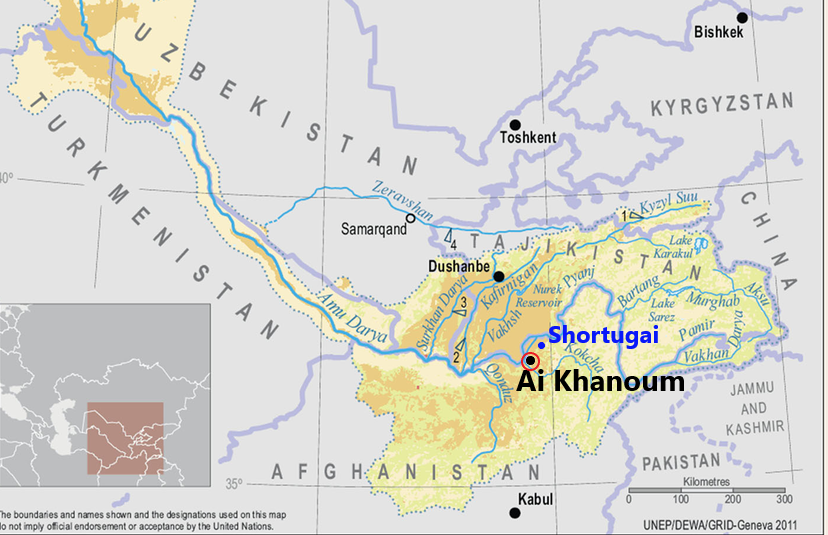
La date précise des premières fondations d’Aï Khanoum reste inconnue.
A une jetée de là, Shortugai, avant-poste commercial et minier de la fameuse civilisation de l’Indus (dite « harappéenne ») qui, au IIIe millénaire avant notre ère, était à l’avant-garde sur le plan de l’irrigation et de la maîtrise de l’eau. (voir notre article)
Des scientifiques de l’Institut indien de technologie de Kharagpur et du Service archéologique d’Inde ont publié le 25 mai 2016, dans la revue Nature, les fruits d’une recherche qui permettrait de dater la civilisation harappéenne d’au moins 8000 ans avant JC et non 5500 ans, comme on le croyait jusqu’à présent. Cette découverte majeure signifierait qu’elle serait encore plus ancienne que les civilisations mésopotamienne et égyptienne.
Shortugai est construite avec des briques standardisées typiques de la vallée de l’Indus. Des sceaux de la civilisation de la vallée de l’Indus ont également été trouvés sur d’autres sites archéologiques d’Afghanistan.
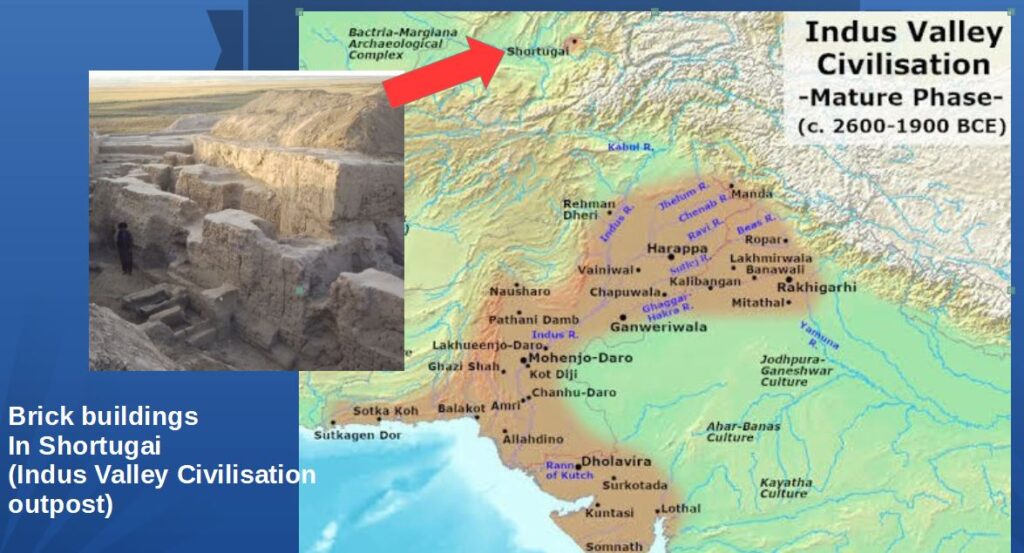
Pendant plusieurs siècles, Shortugai a fonctionné comme un site minier exceptionnel pour l’extraction de l’étain (un minerai indispensable pour la fabrication du bronze), de l’or et du fameux lapis-lazuli, cette pierre précieuse bleue qui, avec l’or, habille de sa splendeur la tombe du pharaon égyptien Toutankhamon et d’autres tombes religieuses majeures en Mésopotamie (Irak).
Les données archéologiques démontrent que Shortugai commerçait avec ses voisins d’Aï Khanoum et construisit les premiers systèmes d’irrigation de la région, une spécialité de la civilisation de la vallée de l’Indus.
Bien des sites restent inexplorés en Afghanistan, pays où les guerres, les occupations étrangères et les pillages ont perturbé ou rendu impossible les recherches archéologiques.
Voici quelques-unes des découvertes de la DAFA, dont certaines restent exposées au Musée national de Kaboul.
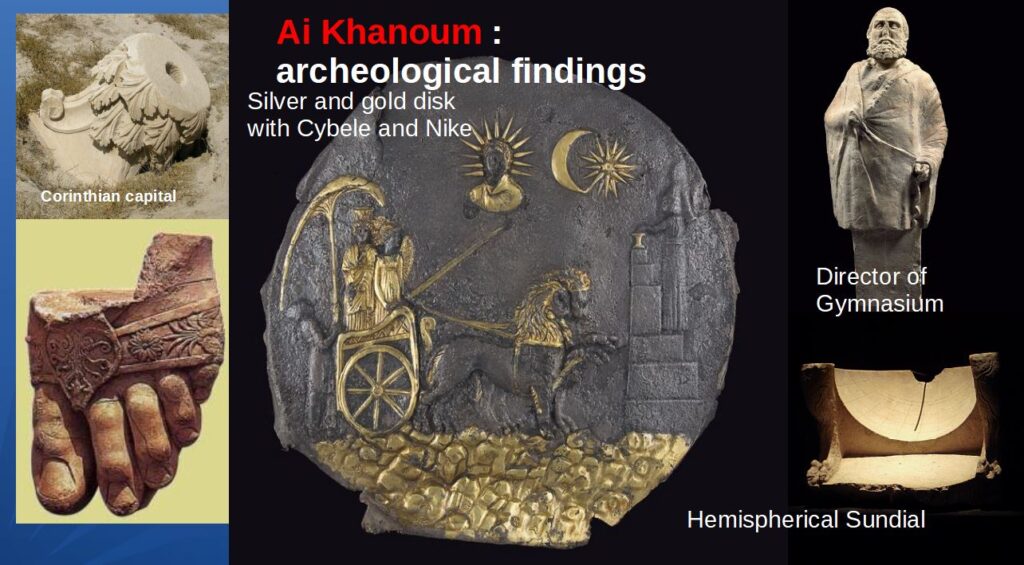
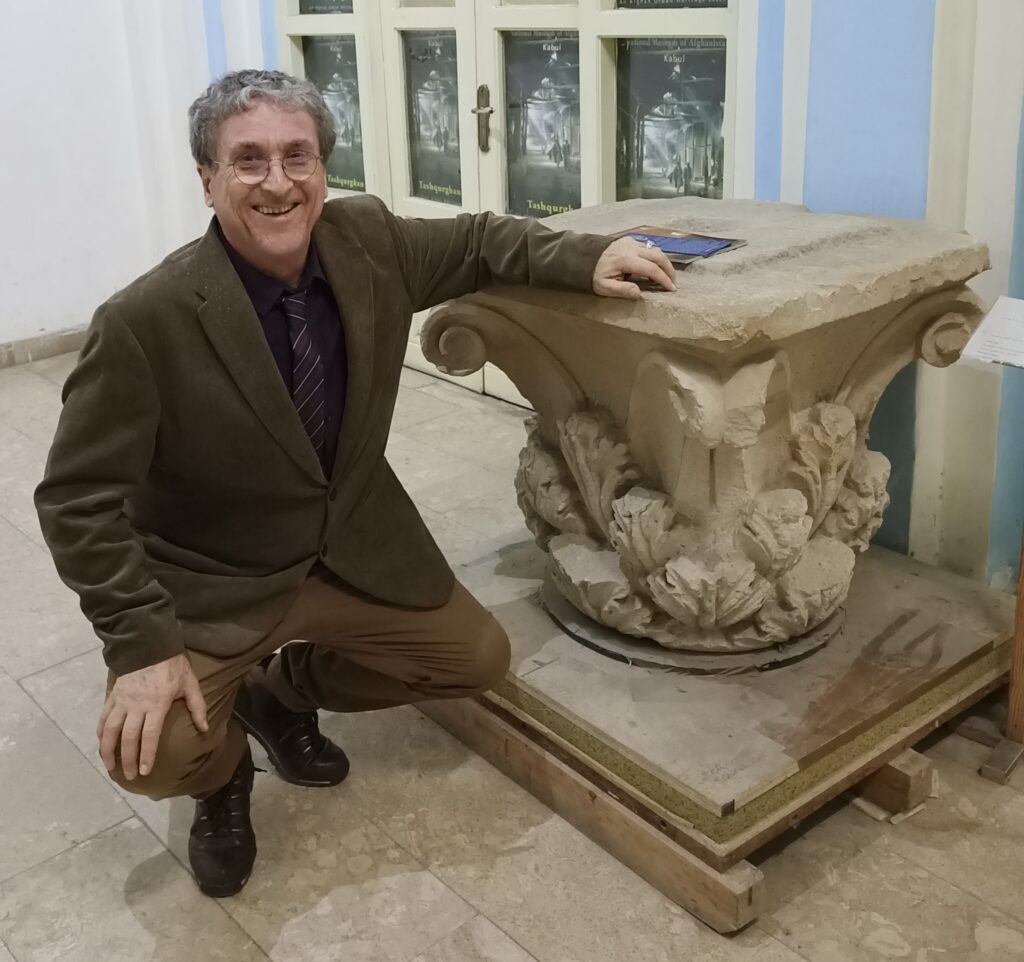
Relations avec l’Inde
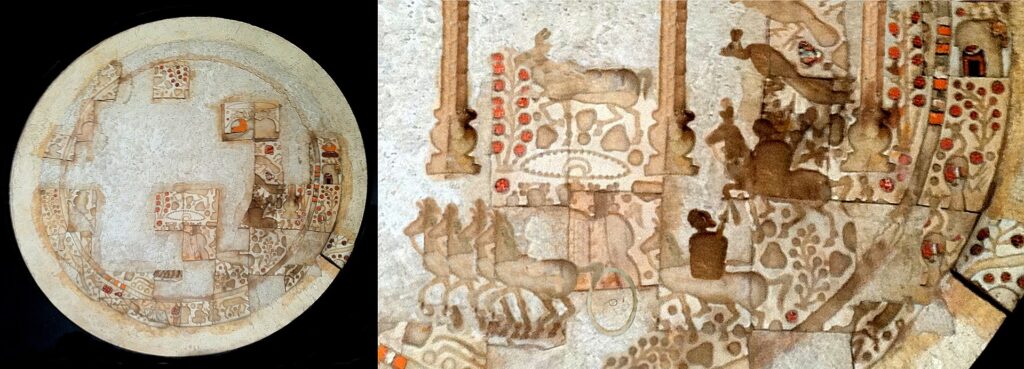
Ce qu’on a trouvé à Aï Khanoum, les pièces de monnaie, les objets et les céramiques, notamment d’origine indienne, témoigne qu’il s’agissait d’une importante plaque tournante du commerce avec l’Inde.
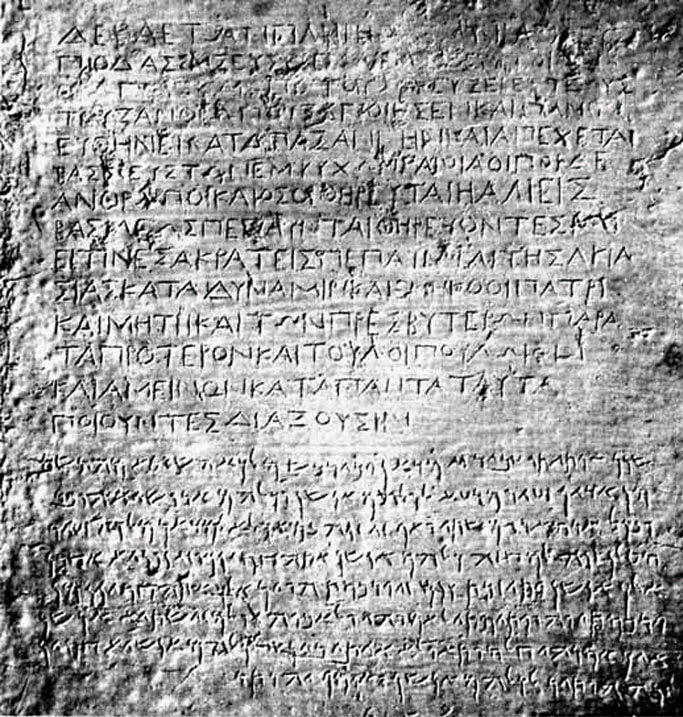
En 258 avant notre ère, Ashoka le Grand, souverain de l’empire Maurya (l’État dominant en Inde), fait ériger ce que l’on appelle « l’Edit grec d’Ashoka à Kandahar », une inscription rupestre bilingue, en grec et en araméen. Une autre inscription d’Ashoka était rédigée uniquement en grec.
Le contenu même de ces édits donne également une indication claire du niveau des échanges entre l’Inde et le monde hellénistique. Par exemple, dans son XIIIe édit, Ashoka, faisant preuve d’érudition, énumère avec précision tous les souverains du monde hellénistique de son époque.
Relations avec la Chine
Outre son interaction avec le sous-continent indien, la Bactriane établira des contacts avec une puissance située encore plus à l’est : la Chine.
À la fin du IIe siècle avant JC, Zhang Qian, diplomate et explorateur de la dynastie Han, arrive en Bactriane. Le récit de sa visite, y compris son étonnement d’y trouver des marchandises chinoises sur les marchés (acquises via l’Inde), ainsi que ses voyages dans le reste de l’Asie centrale, sont conservés dans les œuvres de l’historien Sima Qian.
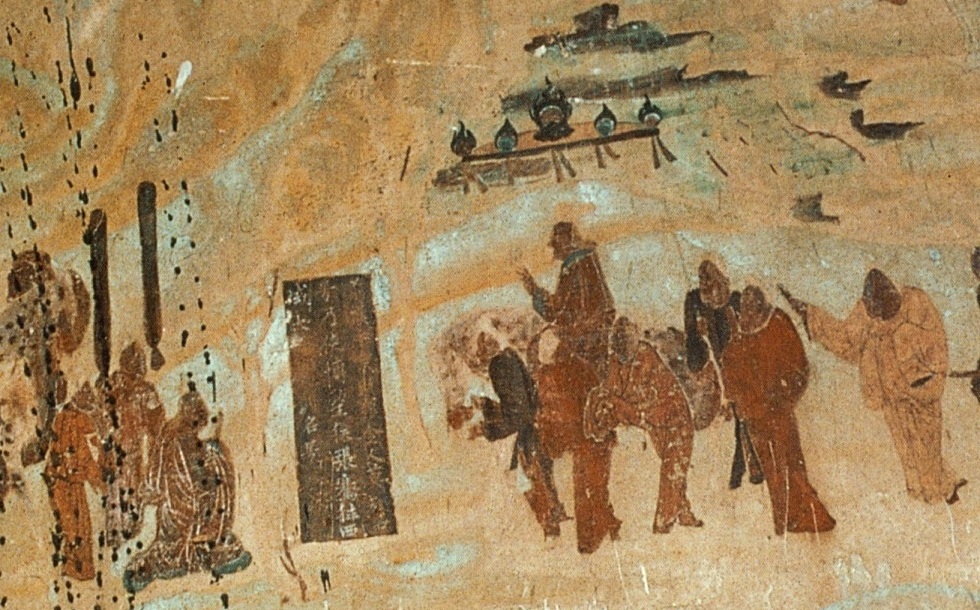
À son retour en Chine, Zhang Qian informe l’empereur de l’existence de civilisations urbaines sophistiquées en Asie centrale : le Dayuan (vallée de la Ferghana), la Bactriane (Afghanistan) et la Partie (nord-est du plateau iranien).
Les découvertes de Zhang Qian incitent l’empereur à envoyer des émissaires chinois en Asie centrale pour y favoriser le commerce avec la Chine. Certains historiens n’hésitent pas à qualifier cette décision de l’Empereur chinois de « naissance de la Route de la soie ».
Déclin et chute
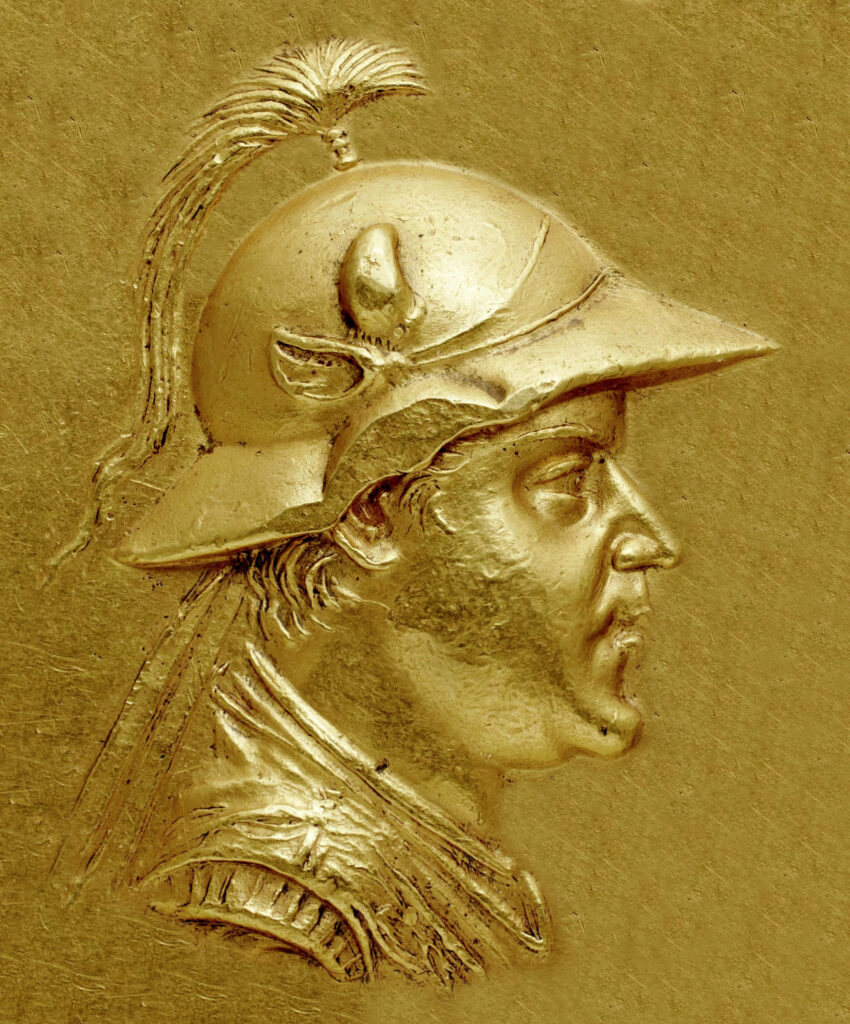
Une grande partie des ruines actuelles d’Aï Khanoum datent de l’époque d’Eucratides Ier (172-145 av. JC), qui a considérablement réaménagé la ville et l’a peut-être rebaptisée Eucratideia, d’après son nom.
Il fut assassiné en 145 av. JC. par son fils. Un an plus tard, le royaume s’effondre face à l’invasion des nomades.
Aï Khanoum est pillée une première fois en 145 av. JC par les Sakas, des tribus iraniennes d’origine scythe, suivis quinze ans plus tard par les nomades chinois Yuezhi.
Le « complexe du trésor » d’Aï Khanoum montre des signes de pillage lors de deux assauts, à quinze ans d’intervalle. D’après des témoins oculaires, certaines villes se sont arrangées avec les envahisseurs et organisèrent une coexistence pacifique. Les villes qui ont résisté, comme Aï Khanoum, ont été pillées et incendiées.
L’empire Kouchan
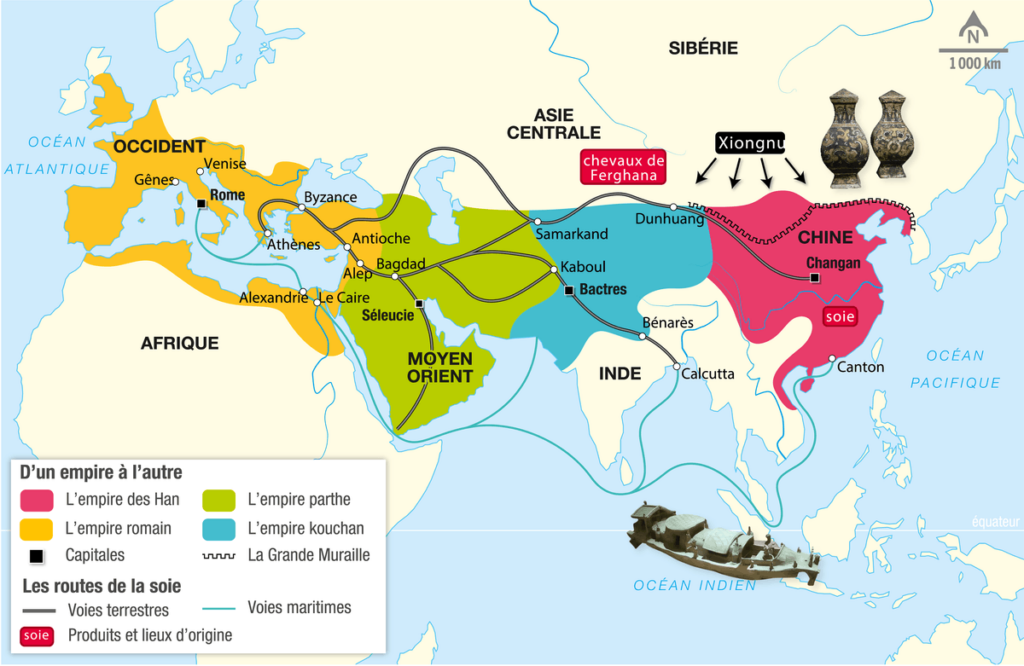
Les nomades chinois Yuezhi se sédentarisent et créent au début du Ier siècle l’Empire kouchan, qui englobe une grande partie de ce qui est aujourd’hui l’Ouzbékistan, l’Afghanistan, le Pakistan et l’Inde du Nord.
Son territoire s’étend de l’Asie centrale et du Gandhara (frontière occidentale actuelle du Pakistan) à Pataliputra, dans la plaine du Gange (Inde d’aujourd’hui). La capitale principale de son empire était située à Purushapura (aujourd’hui Peshawar au Pakistan).
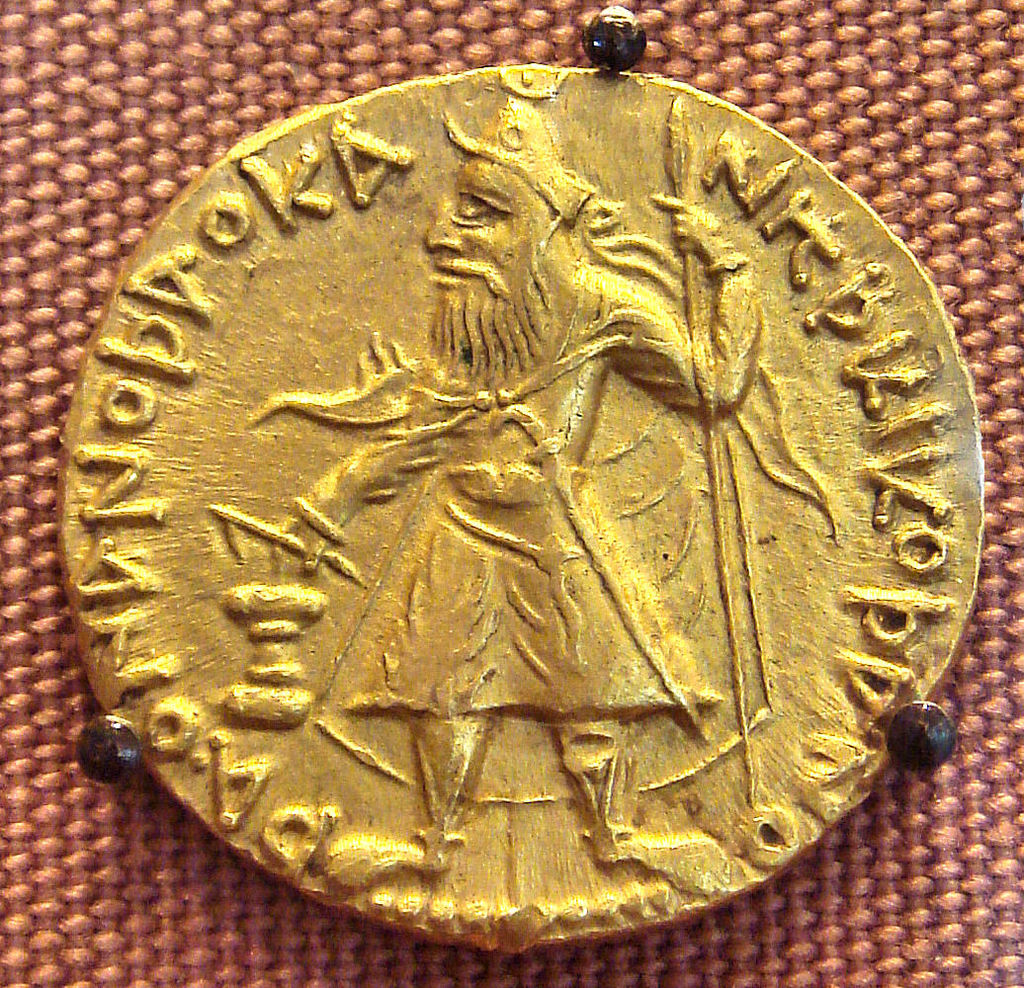
C’est sous le règne de Kanishka le Grand (vers 127-150) que l’Empire kouchan deviendra célèbre pour ses réalisations militaires, politiques et spirituelles. Kanishka échange des ambassadeurs avec l’empereur romain Marc Aurèle (161-180) et l’empereur Han de Chine. Il noue des contacts diplomatiques avec la Perse sassanide et le royaume d’Aksoum (Yémen et Arabie saoudite d’aujourd’hui).
Si la dynastie kouchane reprend la tradition gréco-bactrienne, elle se forge peu à peu sa propre identité.
Les artistes kouchans enrichirent la sculpture bouddhique en donnant à Bouddha la forme humaine, innovation qui fut la plus importante de l’époque.
En 127, Kanishka remplace le grec par le bactrien, une langue moyenne iranienne utilisant l’alphabet grec.
Le bouddhisme
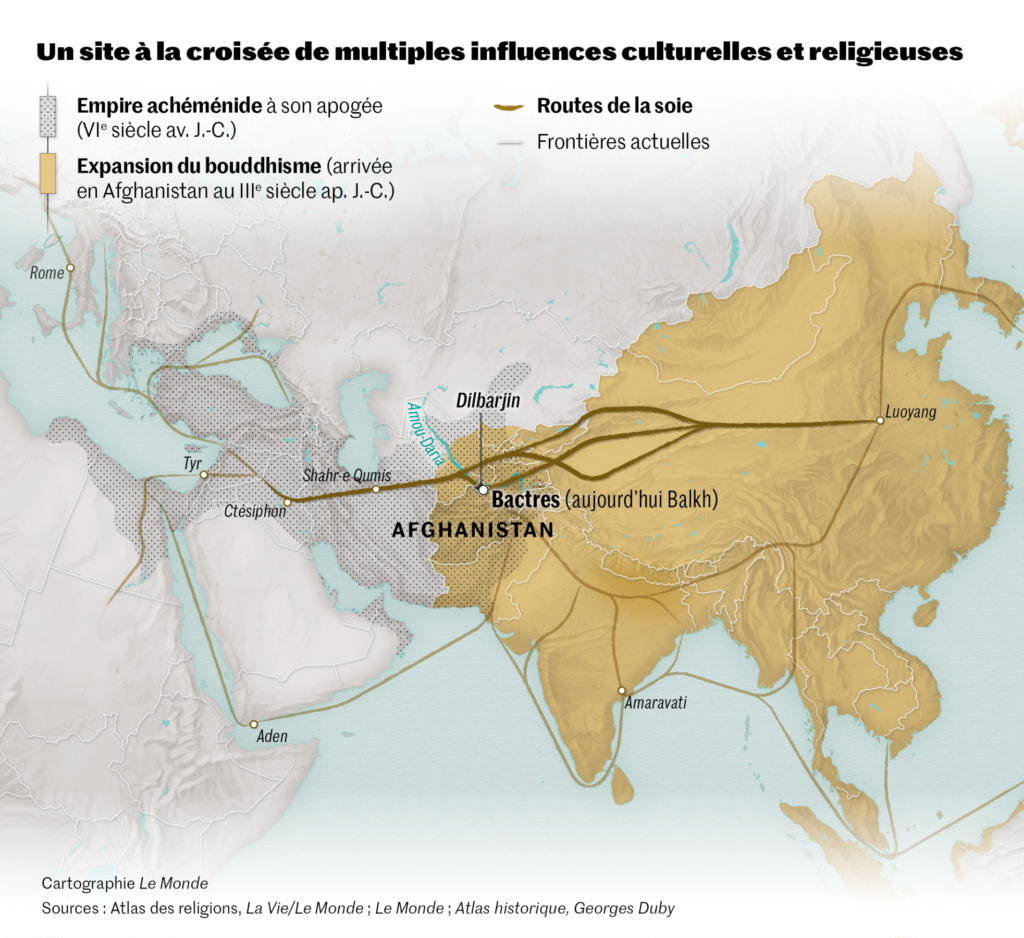
Les Kouchans joueront également un rôle majeur dans la transmission du bouddhisme. Le rayonnement de cette religion venue des rives du Gange favorisera celui des Routes de la soie.
Dans le domaine de la religion, les Kouchans, initialement attirés par l’hindouisme, joueront un rôle majeur dans la transmission du bouddhisme mahayana du Gandhara vers la Chine, l’Asie centrale et même le Sri Lanka, favorisant ainsi l’expansion de la route de la soie.
Tous ces facteurs ont inauguré une période de paix relative de 200 ans, connue comme la « Pax Kouchana ».
À partir du milieu du IIIe siècle après JC, l’Empire kouchan, affaibli, commence à se désintégrer. Dans sa partie occidentale, il passe sous le contrôle des Kushanshahs, c’est-à-dire les Indo-Sassanides (perses), progressivement supplantés au nord par les Hephtalites (appelés également les « Huns blancs » ou « Huns iraniens ») venus de la steppe d’Asie centrale.
Le bouddhisme connaît néanmoins une période de grande prospérité, comme l’illustrent les descriptions du moine chinois Xuanzang du VIIe siècle ainsi que la construction des statues géantes de bouddhas dans la vallée de Bamiyan en Afghanistan.

L’Islam
Après avoir conquis l’Iran, l’islam pénètre l’Afghanistan par le nord. Il n’y a pas de preuve d’un rejet massif de la nouvelle religion, sauf dans des régions isolées. Cependant, la volonté de rester indépendants des gouverneurs nommés par Damas (Omeyyades) puis par Bagdad (Abassides) se manifeste rapidement. C’est même à partir d’une province couvrant une partie du nord de l’Afghanistan, le Khorasan, que se répand initialement une partie de l’insurrection contre les Omeyyades pour les remplacer par le califat abbasside d’Haroun-al-Rachid, plus humaniste, et la création de Bagdad (voir notre article).
À partir de la fin du Xe siècle, une dynastie d’origine turque, les Ghaznévides, bâtit autour de leur capitale Ghazni (Afghanistan) un vaste sultanat qui s’étend jusqu’en Inde et fonde une communauté musulmane durable.

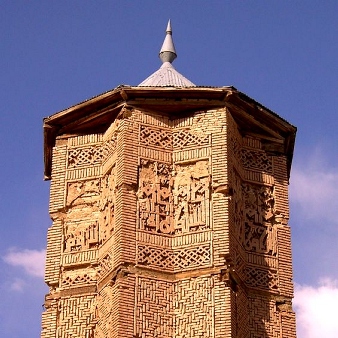
Leur influence culturelle se mesure par la beauté de l’architecture qu’ils nous ont laissée, mais aussi par le patronage qu’ils accordèrent au grand poète épique Ferdowsi (940-1025), à qui l’on doit la grande épopée nationale en langue persane, le Shahnameh : Le livre des rois.
Les Ghaznévides ont été suivis par une nouvelle dynastie, les Ghorides, originaire de la partie centrale de l’Hindou Kouch. C’est à eux que l’on doit l’impressionnant minaret de Jam.
Ce riche patrimoine culturel, qui a jeté les bases de leur identité et qui a donné sa dignité au peuple afghan, a été ignoré, détruit par les guerres successives, pillé et saccagé.
Fortement combattu par les talibans au pouvoir à Kaboul, ISIS, Daech et d’autres groupes terroristes, dont certains encouragés en sous-main par des agences de renseignement occidentales se sont livrés à un pillage à échelle quasi-industrielle du patrimoine culturel afghan. Pour eux, la revente d’objets d’art et d’antiquités est une des principales sources de revenus.
Recommandations
Aujourd’hui, le temps est venu d’un nouveau départ. L’Afghanistan peut changer complètement son image dans le monde, qui a été polluée par des adversaires et des ennemis qui veulent maintenir l’Afghanistan comme une zone de non-développement pour leur propre grand jeu géopolitique.
Ma proposition pour renouveler la contribution de l’Afghanistan à la culture mondiale est simple.
Avec Mes Aynak, qui signifie « petite mine », située à 35 km au sud de Kaboul, l’Afghanistan dispose du deuxième plus grand gisement de cuivre au monde. Alors que la Chine et les autres pays du BRICS ont besoin de ce métal précieux pour leur développement industriel, la mine offrira un revenu substantiel dont l’Afghanistan a un besoin urgent pour reconstruire le pays.
Le 25 mai 2008, Ibrahim Adel, ministre des Mines, et Shen Heting, directeur général de MCC, l’actionnaire majoritaire du consortium MCC-Jiangxi Copper MJAM, ont signé le contrat minier de Mes Aynak.
Ce contrat décrivait les conditions du premier grand projet minier et du plus important investissement étranger en Afghanistan. Cependant, suite à des incidents de sécurité qui ont créé d’importants problèmes d’insécurité, et sous la pression des puissances étrangères, le projet a été bloqué.
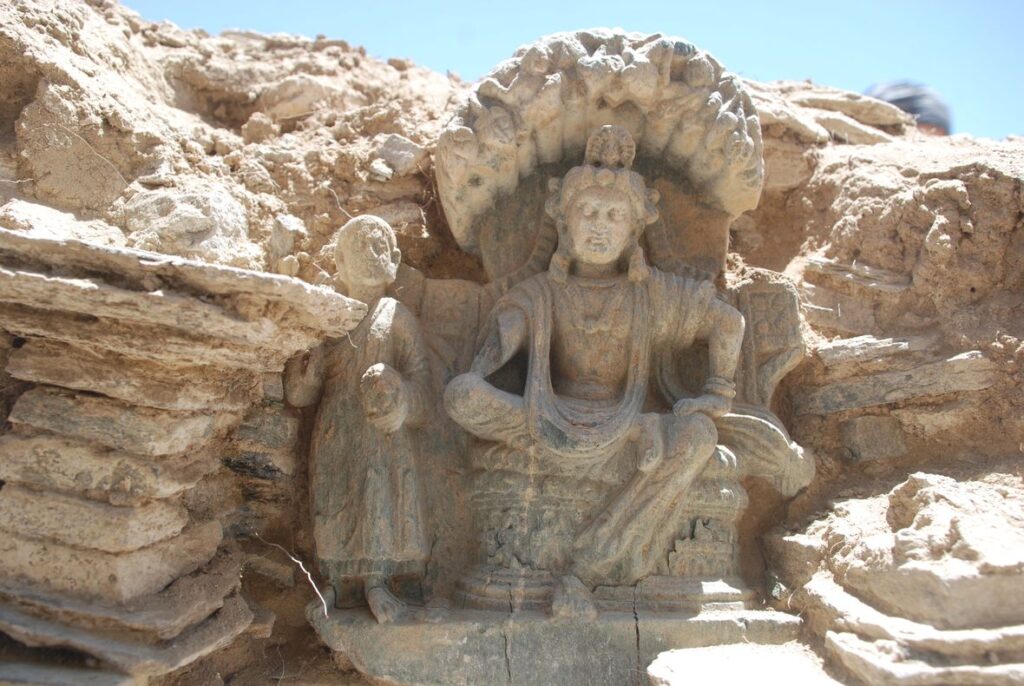
Paradoxalement, cela a donné aux archéologues le temps de mettre au jour sur le site minier une zone de 40 ha d’une valeur culturelle exceptionnelle de classe mondiale, principalement un vaste complexe de monastères bouddhistes, comprenant des stupas (temples), des peintures murales, des sculptures et des centaines d’artefacts archéologiques, etc.
Même si le contrat (fichier pdf) a pu être modifié depuis 2008, on ne peut que constater que le contrat initial contient une série d’aspects potentiellement très intéressants, à la fois pour la Chine mais surtout pour l’Afghanistan lui-même.
- EXPORTER DU MÉTAL, PAS DU MINERAI
De même que la Bolivie ne veut pas exporter du lithium (matière première) mais des batteries (produit fini transformé à haute valeur ajoutée), l’Afghanistan ne veut pas exporter du minerai de cuivre mais du cuivre métal. Pour atteindre cet objectif, le contrat prévoit la construction d’une fonderie sur le site.
Paragraphe IV, 33 : « Afin de respecter son engagement envers le gouvernement de financer, construire et exploiter une fonderie en Afghanistan, la MCC a demandé au gouvernement de lui donner accès à des gisements de phosphates, de calcaire et de quartz qu’elle pourra utiliser dans le cadre du projet Aynak. » - ACHATS LOCAUX
Paragraphe VII, 38 : « MCC s’efforce d’acheter des biens et des services en Afghanistan s’ils sont disponibles. » - MAIN-D’ŒUVRE LOCALE
Paragraphe VIII, 39, a : « MCC emploie du personnel afghan, dans toute la mesure du possible. » - APPROVISIONNEMENT EN EAU
Paragraphe IV, 32 : « MCC s’est engagée auprès du gouvernement à construire des puits d’approvisionnement en eau et des systèmes de canalisation … pour répondre aux besoins en eau douce du projet. La MCC s’est également engagée à réutiliser et à recycler l’eau de traitement dans la mesure du possible. » - CENTRALE AU CHARBON
Paragraphe IV, 31 : « MCC s’est engagée auprès du ministère des Mines à construire … une centrale au charbon d’une capacité de 400 mégawatts pour fournir de l’énergie électrique au projet et à Kaboul. » - CHEMIN DE FER
Paragraphe IV, 30 : « MCC s’est engagée à construire un chemin de fer associé au projet ». - LOGEMENT
Paragraphe IV, 24 : « MCC doit fournir des logements de qualité et en quantité suffisante à ses salariés et à leurs familles immédiates, à un prix de location raisonnable. » - SOINS MÉDICAUX
Paragraphe IV, 25 : « MCC fournira des soins médicaux gratuits à tous ses salariés et à leurs familles… et établira, dotera en personnel et entretiendra des dispensaires, des cliniques et des hôpitaux en nombre suffisant … » - ÉCOLES
Paragraphe IV, 26 : « MCC doit fournir gratuitement un enseignement primaire et secondaire adéquat aux enfants de tous les salariés et résidents de la zone entourant Aynak. » - CADRE DE VIE
Paragraphe IV, 27 : « MCC construira et financera le fonctionnement de centres d’activités récréatives adéquats tels que des gymnases et des terrains de sport. … En outre, il construira un marché/une zone commerciale. » - RELIGION
Paragraphe IV, 28 : « MCC respectera et protégera les convictions religieuses du peuple afghan. »
Le monde serait stupéfait en constatant que l’Afghanistan mobilise ses meilleurs architectes et urbanistes pour construire une nouvelle ville à Mes Aynak qu’il baptisera poétiquement, l’« Aï Khanoum du XXIe siècle ».
A Kaboul, un archéologue de premier plan qui travaille sur le site depuis une décennie, m’a confié avec une joie non-dissimulée que, suite à d’intenses discussions en octobre dernier entre les autorités afghanes et l’entreprise chinoise, une issue heureuse a été trouvée.
A l’heure actuelle, dit-il, les deux parties ont convenu de préserver, non plus une infime partie du site archéologique (la partie centrale avec les temples bouddhistes), mais l’ensemble des vestiges historiques du site en surface. A en croire mon interlocuteur, la décision est prise que l’ensemble du site sera désormais exclusivement exploité par la technique d’exploitation minière souterraine. N’en déplaise à la presse occidentale, le sauvetage de Mes Aynak révèle au monde le vrai visage du nouveau gouvernement afghan.
Il rendra également pensable, d’ici un certain temps, la reconstruction des bouddhas géants de la vallée de Bamiyan, l’un de 55 mètres et l’autre de 38 mètres, détruits en 2001. Plusieurs experts, lors de colloques récents de l’UNESCO, ont précisé que les difficultés techniques ne sont pas insurmontables, les bouddhas étant fabriqué en stuc. Le soi-disant « danger » que les sculptures soient considérées comme « fausses » n’a aucun sens, tant que l’intention d’atteindre un bien supérieur par leur reconstruction est réelle.
La « Proposition technique pour la revitalisation des statues du Bouddha de Bâmiyân » de 2017, élaborée par le département d’architecture de l’université japonaise Mukogawa Women’s University, mérite d’être examinée. Sans doute pourra-t-on faire mieux, mais elle a le mérite d’exister. Des chercheurs chinois se disent également prêts à donner un coup de main.
Rappelons que le monde compte 620 millions de bouddhistes qui considèrent Bamiyan comme une partie de leur culture et pourraient envisager de venir en Afghanistan pour mieux comprendre leur propre histoire.
Si l’Afghanistan indiquait clairement au monde qu’il a décidé de renforcer ses activités économiques et minières tout en protégeant, notamment grâce à l’aide généreuse de la Chine, le patrimoine culturel mondial sur son sol, il apparaîtra aux yeux de tous ce qu’il est désormais aujourd’hui : une force du bien, de la tolérance et de la paix dans le monde, en cohérence avec sa propre identité et son histoire.
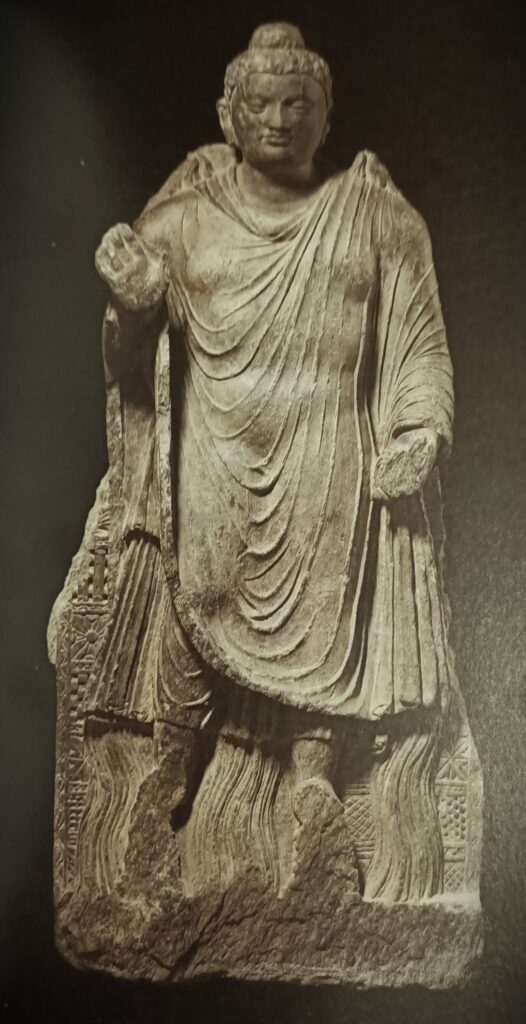
L’Afghanistan apparaîtra comme le « Bouddha de feu » (IIe-IIIe siècle) du Musée national de Kaboul, où l’on voit la réponse donnée par Bouddha à un défi lancé par des hérétiques selon lequel il ne pouvait pas faire de miracles.
Connu sous le nom de « miracles jumeaux », on y voit Bouddha confiant avec des flammes sortant de ses épaules et des cours d’eau de ses pieds ! En altérant ces deux flux, dit la légende, Bouddha a même fait apparaître un arc-en-ciel !
En augmentant sa production d’énergie et en gérant d’une façon plus intelligence ses ressources en eau, l’Afghanistan démontrera, j’en suis convaincu, sa splendide force spirituelle !
Merci à tous et j’ouvre le débat à vos questions.