Étiquette : Cultural heritage
The Light of Dunhuang – Culture and Beauty of the Silk Road
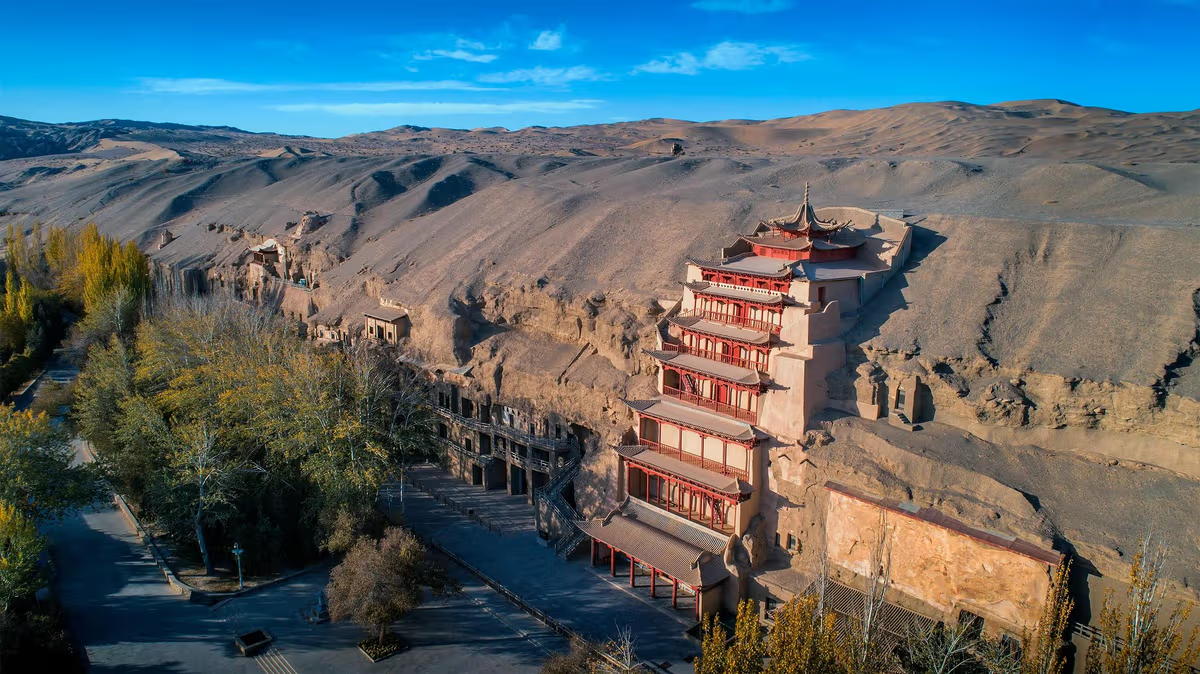
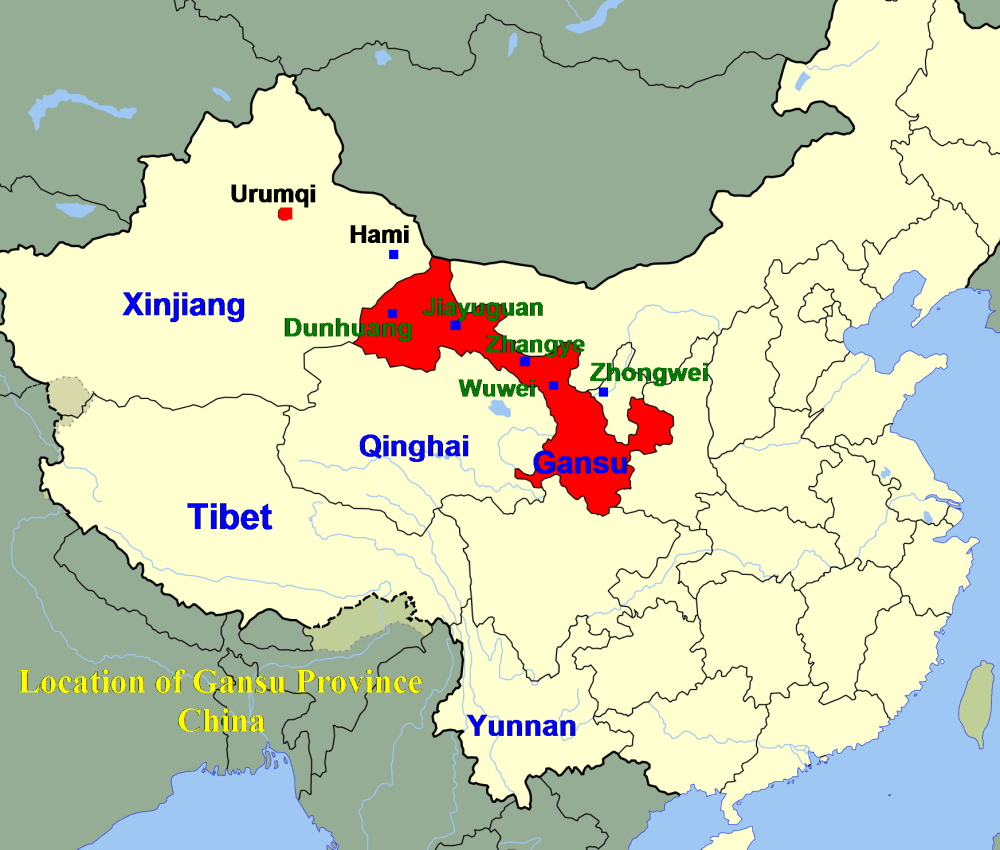
History will remember for a long time the outstanding cultural events that shined early November 2026 in the city of Dunhuang, historically a major hub on the ancient Silk Road in the North-Western Province of Gansu, China.
Dunhuang owes its role to its geography and the relief of its location. The Province of Gansu, about the size of California or 82% of France’s territory, coincides roughly with that of the “Hexi Corridor”, a 40 to 100 km large passage in China over approximately 1,000 kilometers that is dotted with a string of oasis-towns.
Nestled between the inhospitable climates of the Taklamakan desert to the West, the Gobi Desert to the North, and the mountains of the Tibetan Plateau to the south, this corridor, from Lanzhou to Dunhuang, was the only viable overland route from Central Asia into China for over a thousand years.
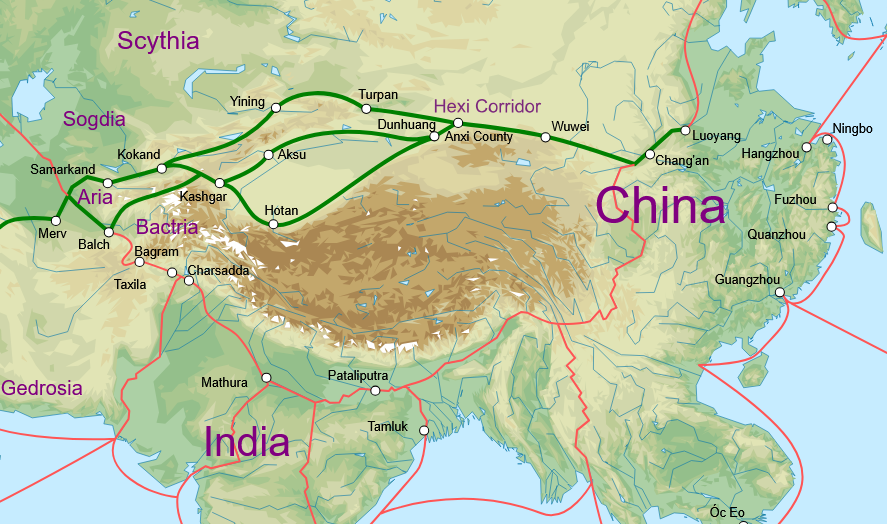
Dunhuang consequently became a gateway between East and West, and a channel through which many different people, as well as goods, ideas, and technology, traveled.
As the Chinese scholar Ji Xianlin has it,
“There are four major cultural systems in the world featuring long-standing history, a vast territory, a self-contained system and far-reaching influence: China, India, Greece and Islam, and there is no fifth. There is only one place where these four cultural systems merge into one, that is China’s Dunhuang.”
Witness a this 1600 year old heritage are the hundreds of painted devotional Buddhist caves in Mogao, carved out in a cliff of “singing” sand dunes and decorated with hundreds of intriguing frescoes and painted sculptures created over a thousand-year period starting in the 4th century.
Cultural Expo
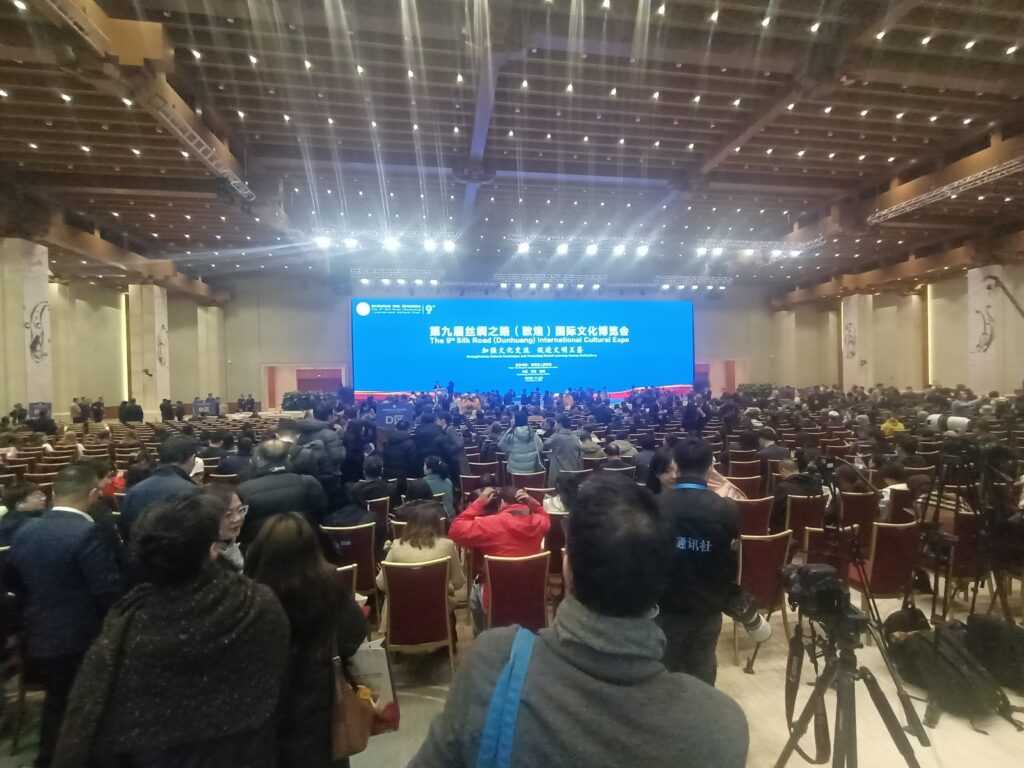
First, from November 2 to 4, took place the “9th Silk Road (Dunhuang) International Cultural Expo” under the theme of « Strengthening Cultural Exchanges and Promoting Mutual Learning Among Civilizations, » hosted by the Gansu Provincial People’s Government.
To foreigners arriving, with the airport and the entire city decorated with festive banners and lampoons, the event nearly appeared as a national holiday. With a total exhibition area of approximately 18,000 square meters, this flagship national-level expo brought together roughly 1,200 delegates, scholars, and officials from 58 countries, regions and organizations, with more than 360 overseas guests in total. Among these where representatives of the Hong Kong and Macao Special Administrative Regions, the Consul General of Malaysia in Xi’an as well as senior representatives from the Asian Infrastructure Investment Bank (AIIB) and the World Bank.
At the opening session on Tuesday morning, several key attendees and high-profile domestic and foreign representatives shortly addressed a giant room packed with over 1,000 people:
- Wu Xiaojun, Secretary of the CPC Gansu Provincial Committee;
- Kong Shaoxun,Governor of Gansu;
- Jiang Hui, Vice Minister of the Publicity Department of the CPC Central Committee;
- Daren Tang, Director General of the World Intellectual Property Organization (WIPO), who addressed the 2026 International Copyright Forum during the expo;
- Shahbaz Khan, Director and Representative of the UNESCO Regional Office for East Asia, who praised China’s leading role on heritage conservation;
- Huot Hak, Cambodia’s Minister of Tourism, emphasizing tourism ties between the Mogao Caves and the Theravada Buddhist site of Angkor Wat;
- Sun Weidong, Secretary-General of the China–Central Asia Mechanism;
In the following days, at the Expo itself, Russian scholar Nadezhda Zamyatina presented urban planning studies in partnership with Tianjin University, while Vietnamese businessman Luong The Vinh showcased regional products as a grassroots exhibitor. American fiddler Kyle Dillingham, who has visited China more than a dozen times, attended the expo with his folk band Horseshoe Road. He said he hoped the event would create new opportunities for people-to-people exchanges between Oklahoma and Gansu, which celebrated the 40th anniversary of their sister-state relationship in 2025.
As China’s premier national-level international cultural exchange event aligned with the Belt and Road Initiative (BRI), the expo was organized under the direct supervision of multiple key government bodies, notably the Ministry of Culture and Tourism of China, the National Radio and Television Administration, the China Council for the Promotion of International Trade, and the local state leadership of the Gansu Provincial People’s Government.
Symposium
Among the sub-forums with international participation was the “International Academic Symposium on Dunhuang Studies,” a high-level scholarly forum convened regularly as part of major international cultural and research gatherings. The Symposium was co-hosted by the Cultural Relics Bureau of the Gansu Province and the “Dunhuang Academy,” a highly respected and very prestigious institution that has been battling for decades to maintain, restore, digitize and research all the various aspects of the Mogao Caves.
Among the 130 scholars, thinkers and experts invited, mostly from China but also from Japan, Germany, the UK, France, Belgium and Afghanistan, a delegation of the Schiller Institute, represented by its founder Helga Zepp-LaRouche and painter-engraver and historian Karel Vereycken from France.
Helga Zepp-LaRouche: Unity in Diversity
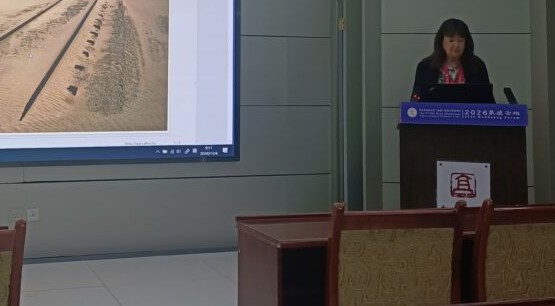
Mrs LaRouche was invited to keynote an important research seminar on the second day. During her intervention, “The Dunhuang Mogao Grottoes: Unity in Diversity” (published in full in the Collected Papers and Abstracts, Volume II, pp. 324-328.), she underscored that the Mogao caves “represent a Rosetta Stone of cultural history.”
In 1900, the Taoist monk Wang Yuanlu discovered behind a wall of Cave 16 a hidden cache, known today as “Cave 17”, that had been sealed for 900 years, with over 50,000 manuscripts, most of them in Chinese but also in dozens of other languages including Tibetan, Sanskrit, Khotanese, Tangut, Kochean (Tokarian B), Mongolian, Uighur, Sogdian, Pakrit and even Hebrew.
“From it, she said, we can gain a scientifically precise conception of the winding paths along which universal history has advanced up to our present. Alongside all diversity and historical specificity, however, we also recognize the universality of the truly great questions that have again and again moved the societies of the various epochs and civilizations.”
From that, she concluded, it “also follows that humanity not only has this common, interconnected past, in which each element occupies, as in a gigantic dynamic puzzle, its necessary place that was decisive for the overall development, but also that these findings help us in the present to understand the cooperation on the New Silk Road as the necessary next step in the evolution of humanity, and above all to understand and welcome President Xi Jinping’s conception of community with a shared future for mankind, as a necessity of universal history.”
Seen the importance of these manuscripts, of which a large number were acquired for a very low price by British and French archaeologists in the years following their discovery, she argued, “it would be time to return the finds back to China as a part of the ‘Major Historical and Cultural Sites Protected at the National Level.’ ”
Karel Vereycken: Dunhang, a “second Gandhara”
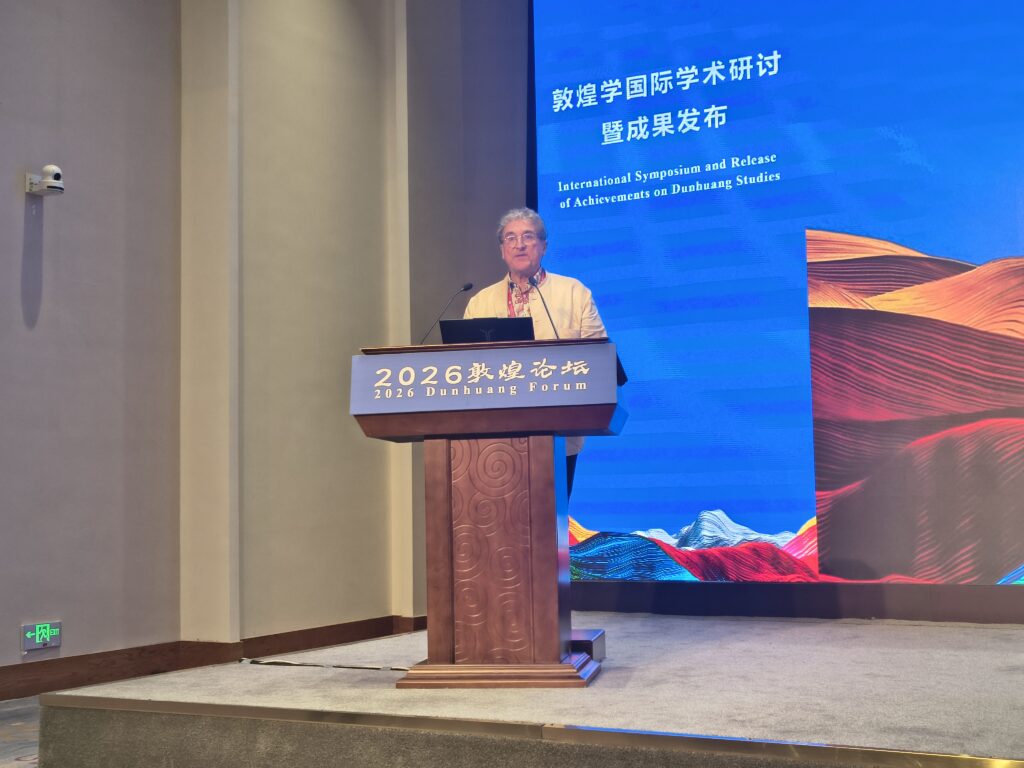
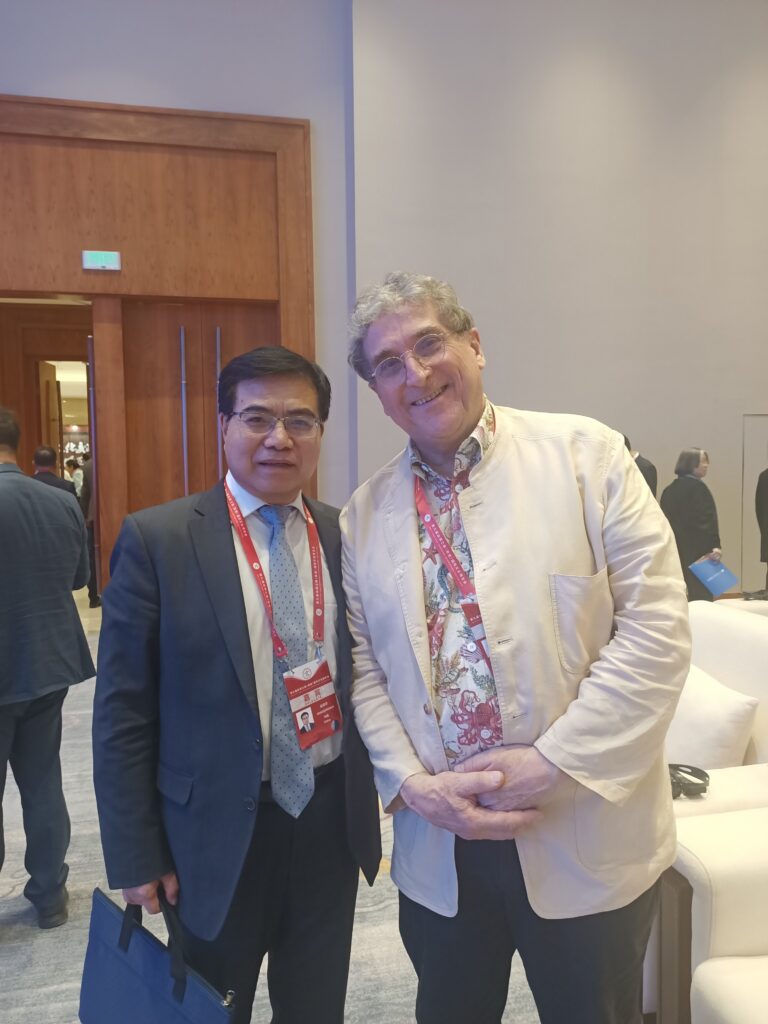
As one of the keynote speakers of the first day, Schiller Institute’s representative Vereycken got offered a seat on the first row on the right hand of Ge Jiantuan, deputy governor of the People’s Government of Gansu Province, who warmly thanked Vereycken for his presence and contribution.
Vereycken’s lecture, titled “From Gandhara to Dunhuang, The Silk Road as a “Living Corridor of World Art” was also selected and published in full in the proceedings (Published in full in the Collected Papers and Abstracts, Vol. II, pp. 149-158).
After a short introduction summarizing the birth and rise of Buddhism during the Mauryan and Kushan Empires, Vereycken, who presented himself as an “archaeologist of ideas,” underscored the importance of the “Miracle of Gandhara” (a region comprising today a large part of Afghanistan and the Western part of Pakistan). While Buddhism was initially an-iconic and symbolic, it
“suddenly morphed into anthropomorphic art taking the shapes of humans using the canons and naturalistic proportions of the classical Greek period.”
Gandhara art not only celebrated Buddha, but also “mass-produced” beautiful sculptures of Bodhisattva, “well intended empathetic humans on the road to Nirvana, but living first their life and totally committed to set others free from suffering,” a key feature of Mahayana Buddhism that emerged precisely during that period. Today, with over 50% of the total, Mahayana Buddhism, while it went through many transformations, remains the largest branch of Buddhism, practiced widely in China, Japan, South Korea, Taiwan, Singapore, and Vietnam.
And from Gandhara, “Buddhist Art with Greek characteristics” spread to Central Asian Oasis Cities like Khotan before reaching the Chinese Oasis city of Dunhuang and spreading over China and beyond.
Several aspects reveal that Gandharan inspiration in the Mogao frescoes:
- Most early caves use the lapis lazuli blue pigments exclusively originating from Afghanistan.
- Cave 275 (4th century) shows a Buddha Maitreya seated with legs crossed and surrounded by two lions, a clear imitation of Kushan iconography.
- The North wall of cave 323 (7th century), visualizes a (mythological) narrative cycle taken from the Collected Record of Miracles Relating to the Three Jewels in China, a 7th-century collection of Buddhist miracle tales compiled by the prominent Tang dynasty scholar-monk Daoxuan in 664 AD. It depicts Emperor Wu (156–87 BC) of the Western Han Dynasty discovering two large gold statues he acquired after a war with the Huns. In order to find out what they represented, Wu sent his best diplomat Zhang Qian (d. 113 BC) to the Western region and Central Asia to find out. On the left upper corner of the fresco, we see Zhang on route to a walled city with at its center a Buddhist temple (stupa).
The accompanying cartouche identifies the city as Da Xia (the kingdom of Bactria, today’s northern Afghanistan). It is there that Zhang discovers that the two “golden men” were statues of the Buddha. Once back home, Zhang told Wu that the Han Empire could prosper greatly by initiating trade relations with the rich Central Asian kingdoms he had visited. And in effect, while some trade relations existed way earlier, it was the Han Dynasty that initiated the Silk Road, a policy that reached its peak during the Tang Dynasty. The fresco’s representation of groups of people interchanging with each shows perspectives and landscapes, nearly as expressive as some of Bruegel’s paintings in the 16th century!
Finally Vereycken also presented the interesting hypothesis presented in 2019 by professor Osmund Bopearchchi, who drew parallels between certain fresco’s of Mogao and the famous “Laocoon Group”, a Greek statue discussed by the German art critic Gotthold Ephraim Lessing showing an agonizing Trojan priest trying to save his children from snakes sent by Zeus to punish their father from disobeying him.
Manuscripts and Books
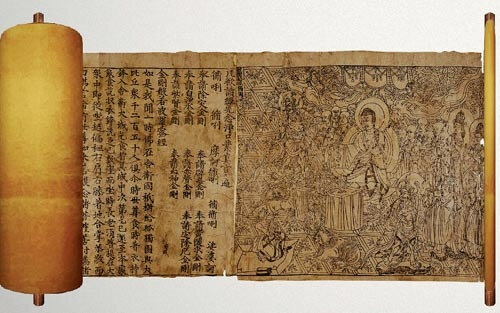
The Mogao caves and Dunhuang itself truly appear as a “Treasure Trove” witnessing the “Living Silk Road of world art”.
Among the marvels discovered in the “Library Cave”, the most remarkable is the “Diamond Sutra”, a 5 meter long horizontal scroll made of seven sheets of yellow-dyed paper, featuring a woodblock printed text and ornate frontispiece. Printed on May 11, 868 AD, it is the world earliest known complete printed book !
The incredible linguistic diversity revealed by the manuscripts, stated Vereycken,
“testifies to centuries of translation efforts and intercultural dialogue. Besides Confucian and Taoist temples, the Tang capital Chang’an (today’s Xi’an) and the major ports, were open to foreign devotional practices, be it christian Nestorians, Muslims or Manicheists and Zoroastrians. That was also the case in Dunhuang.”
A Bodhisattva painted on silk, found in the Library Cave, is depicted with two Nestorian (christian) crosses, indicating the existence of a christian community in Dunhuang.
Another major find, the “Dunhuang Star Atlas”, with over 1,300 stars described, stands out as the earliest known graphical depiction of the night sky in ancient Chinese astronomy dating to the Tang dynasty (618–907).
“Here in Dunhuang,” Vereycken concluded, “we Mankind, inspired by the accomplishments of Gandhara art and other contributions from the Silk Road, as a “living corridor”, explored a little further the creative essence of humanity, after all the real mission of Art ! Many aspects of this cultural cross-fertilization are now duly documented. The cautious underground mining of the copper reserve and the excavation and preservation of the Buddhist monasteries of Mes Aynak in Afghanistan, we hope, will undoubtedly bring even more treasures of cultural finds for all. Let us work together to make this cultural beauty known to the world.”
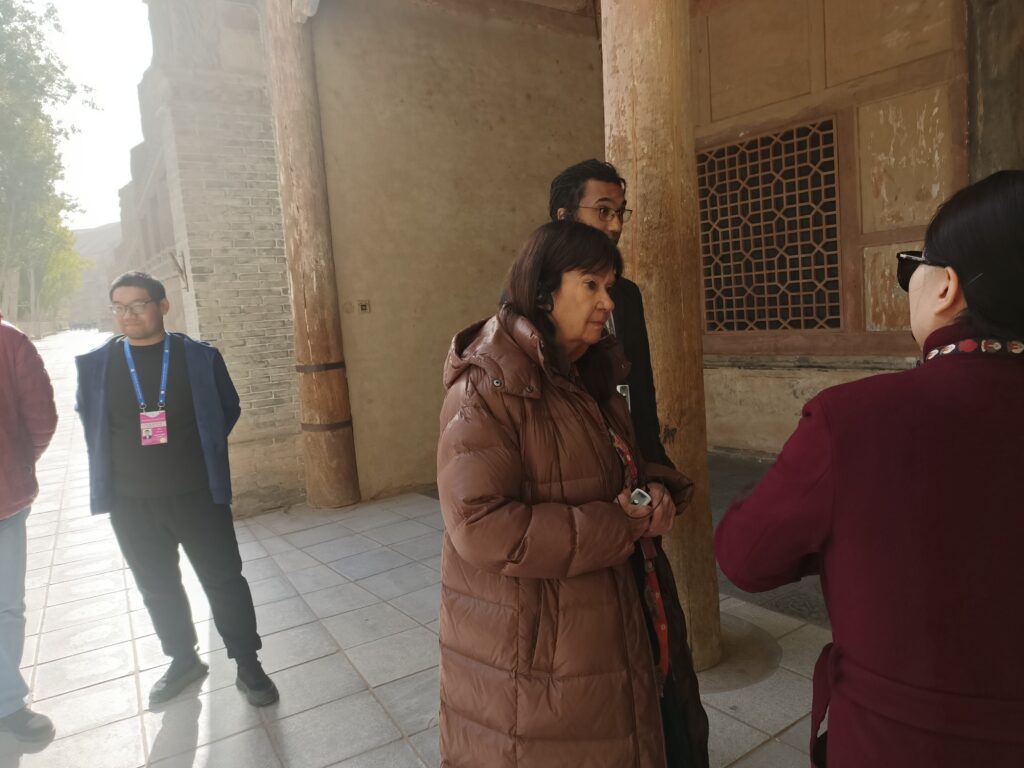
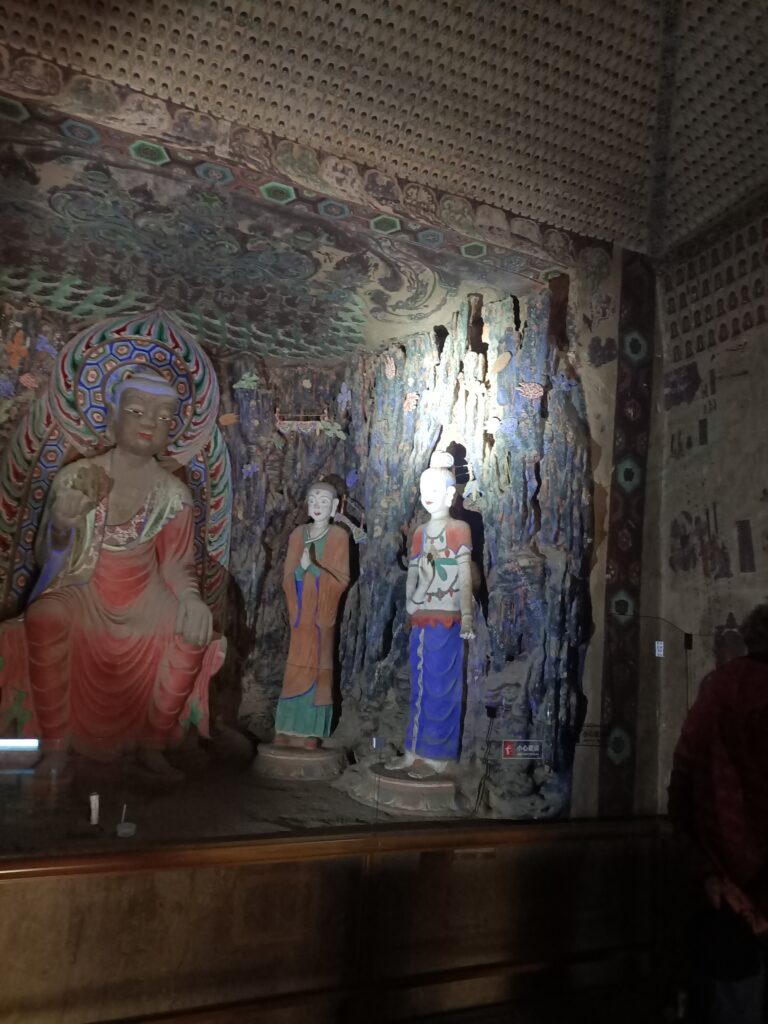
To conclude the Symposium, in the late afternoon of Nov. 4, together with other speakers, Helga Zepp-LaRouche and Karel Vereycken were offered a private guided tour of the Mogao Caves. Preservation conditions obliges the Museum to limit the number of visitors and the number of caves per day.
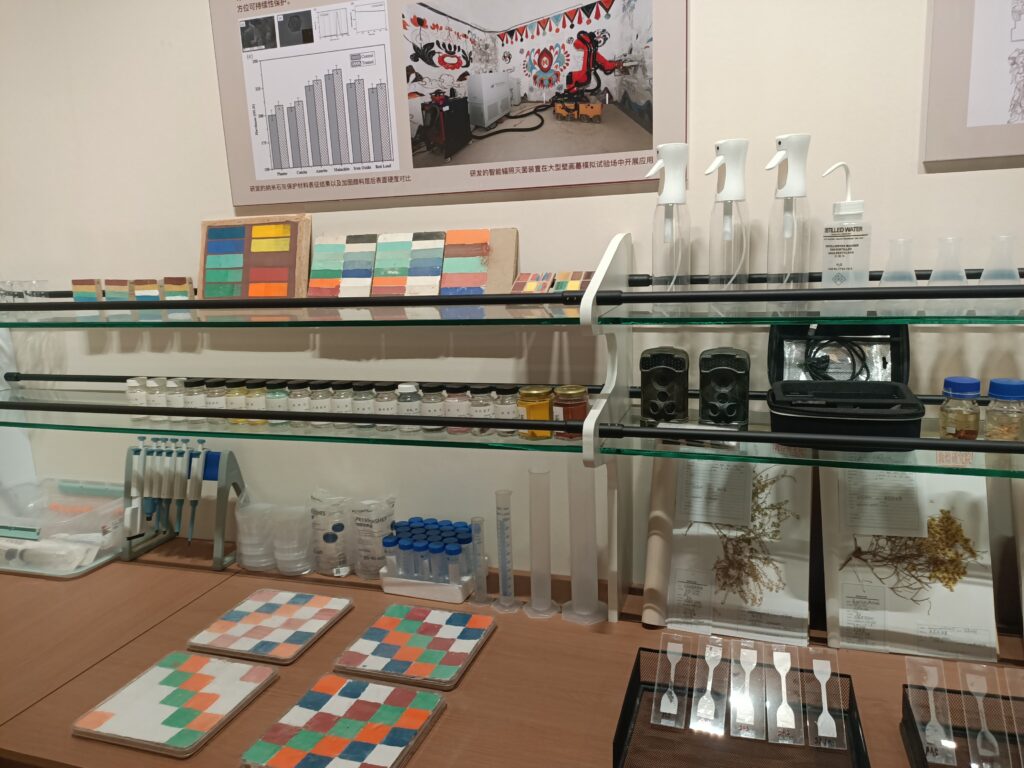
But to get a better picture, a special museum near the site offers visitors, in the form of a virtual reconstruction and physical reconstruction of several caves, to get a better view, both of the caves and their decorations and also the advanced technological methods developed by the Dunhuang Academy to preserve them, be it the frescoes, the statues or the manuscripts.
All of this historical, cultural, scientific and human expertise is ready and waiting to be called on to serve similar undertakings in other countries willing to accept the open hand of China.
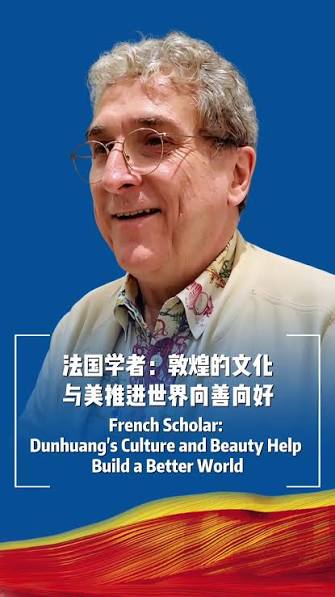
French Scholar:
Dunhuang’s Culture and Beauty Help Build a Better World
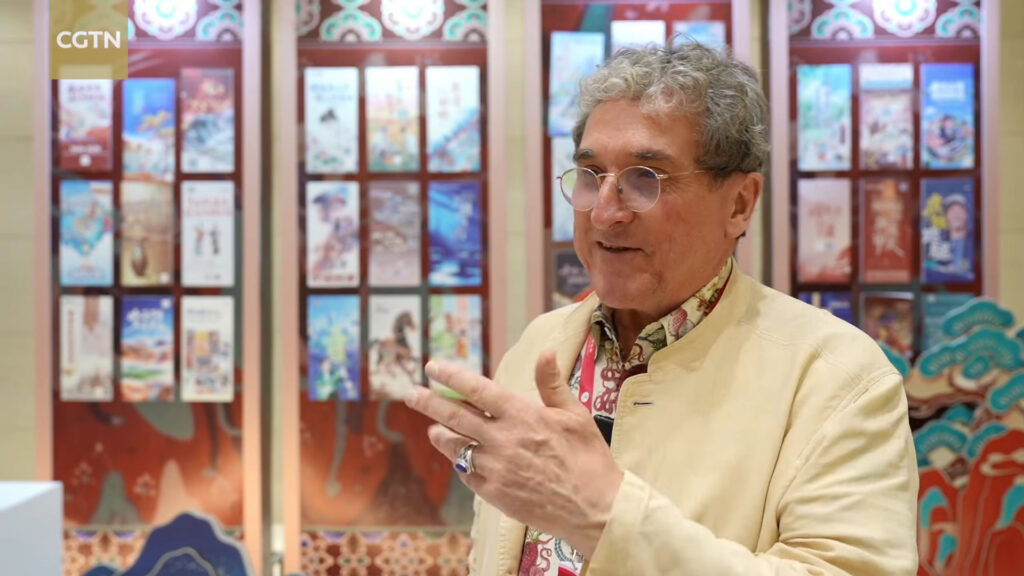
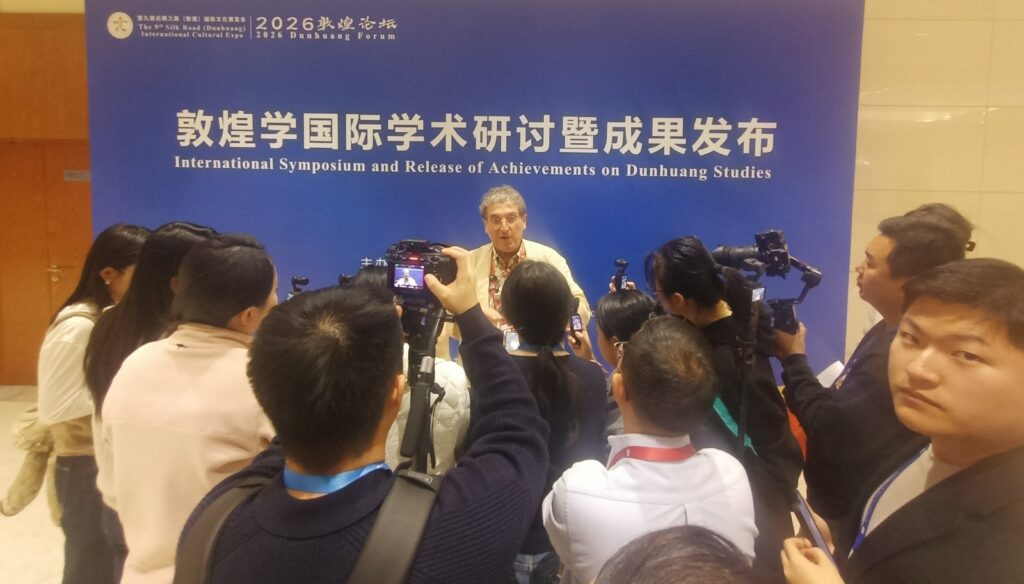
Before as well as after his intervention, Vereycken was overwhelmed by young journalists eager to have a view from abroad on the event. Several Chinese English language media (Hainan Touch, China in Lens, CGTN, CCTV, etc.) prominently aired the Schiller Institute’s delegate statements on the universal importance of Dunhuang and its inspiration.
HAINAN TOUCH
https://www.facebook.com/reel/1092312987200904
CHINA IN LENS:
https://www.youtube.com/shorts/geXSBfivdTU
CCTV,
https://english.cctv.com/2026/11/04/VIDEip5jLovp52OvRR5KIE7R261104.shtml
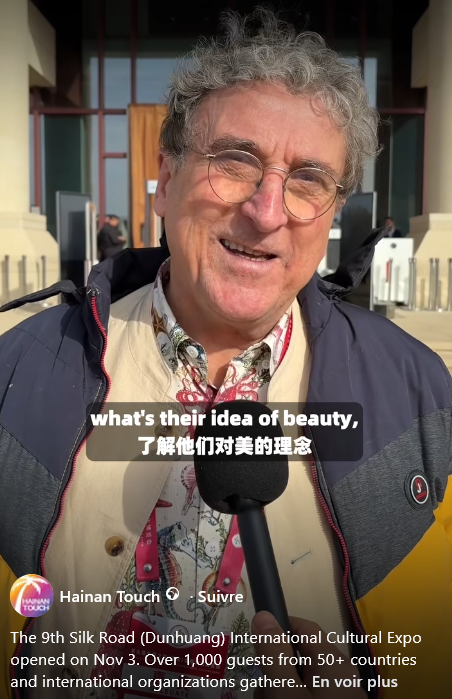
Transcription of Nov. 4 short clip of CCTV:
Vereycken: “You have 1,000 years of international cooperation here in Dunhuang through the grottoes. It can really wake up the people and maybe avoid even a World War, you know. Because right now, the leading powers, they want to divide and rule. They tell the Americans the Chinese are the devil. The divide people. First the division starts in the mind. And culture and beauty is the only thing which can unify, which goes to the essence of human beings. I’m myself a painter, an engraver and an historian. I always say I’m an archaeologist of ideas. I look to the history of ideas and how they transform the world for the better. And that’s the message.”
Gandhara to Dunhuang, the Silk Road as a « Living Corridor » of World Art
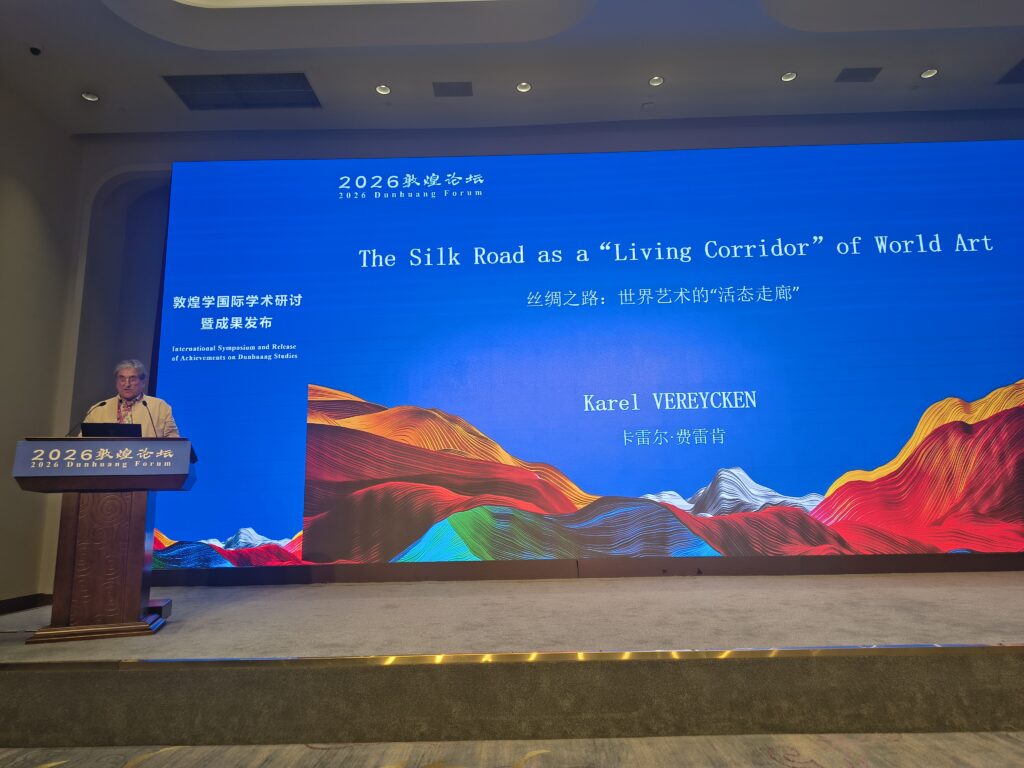
On Tuesday Nov. 3, 2026, painter-engraver and historian Karel Vereycken, as an independant scholar and contributor to the International Schiller Institute, delivered a lecture (text of the integral version below) at the International Academic Symposium “Dunhuang Studies Research in the New Era. »
The symposium, organized by the Dunhang Academy, was organized in the framework of the « 2026 Dunhuang Forum », in the ancient city of Dunhuang in the Gansu Province of China.
The next day, Nov. 4, Helga Zepp-LaRouche, the founder and president of the international Schiller Institute, keynoted another session with her speech « The Dunhuang Mogao Grottoes, Unity in Diversity. »
(A brief report on the event can be found with this LINK.)
The Dunhuang Academy is a highly-esteemed and prestigious institution that has worked hard for decades to preserve the cultural heritage of the « Mogao Caves » close to Dunhuang, a major stop on the ancient Silk Roads and a unique testimony of over a thousand years of dialogue and cooperation.
As one can see by the Conference program, the symposium brought together, besides very high level Chinese dignataries, over 130 scholars, archaelogists, authors and experts (mainly from China, but also from Japan, Russia, Germany and France) who presented their latest research on all possible facets of this outstanding and unique cultural heritage and the latest exploration techniques to explore it.
From Gandhara to Dunhuang,
the Silk Road as a « Living Corridor »
of World Art
By Karel Vereycken, independant scholar, Schiller Institute.
Lecture given on Nov. 3, 2026 at the International Academic Symposium “Dunhuang Studies Research in the New Era” of the 2026 Dunhuang Forum,
Mogao Caves, Dunhuang, China.
Dear organizers, dear colleagues, excellencies,
First, I want to thank you again for this invitation. It is a great honor for me to assist at this high-level event and to be able to share my views on the past, present and future of culture of the Silk Roads.
Most of us actually traveled over parts of these roads to arrive here in Dunhuang, a city that really needs to be honored and recognized as a milestone on the road to the utmost best of what humanity can accomplish when it acts according to its own nature, that of loving each other, celebrate human genius and creativity, and building a common future.
Archaeology is not merely about rediscovering the past in the present. Archaeology also allows us, mankind, to discover “the long shadows” of the future.
However, I’m not a professional archaeologist. I’m only a painter engraver and independent scholar active with the International Schiller Institute. My research concentrates on what one might call the “archaeology of ideas”, that is how ideas and concepts, in the domain of art in particular, travel over time and distance. And that’s where Dunhuang really captured my interest.
The birth and expansion of Buddhism
Of course, those present here know the history of Buddhism and Dunhuang in far greater detail than I can dream achieving. They should pardon me for the rough sketch I present now of that history, but for people living in different continents and from different cultures, I think they will be grateful for this short historical introduction.
I’ll make it short. Buddhism emerged during the 6th to 5th century BCE in the eastern Gangetic plain, near modern-day Nepal. Siddhartha Gautama, known as the Buddha (the « Awakened One »), founded a movement that stood for religious self-perfection and social change. Born a prince, he left his luxurious life to seek an end to human suffering, mostly through introspection. His teaching spread across Asia by three means:
- dedicated and inspiring followers,
- royal and private patronage and
- the trade networks of what has been called in the XIXth century, the “Silk Road.”
Maurya Empire (c. 321 BCE – 185 BCE)
The first breakthrough came about 200 years after the death of Buddha with the founding of the Maurya Empire (c. 321 BCE – 185 BCE).
In 321 BC, Chandragupta Maurya, with help from his clever advisor and Prime Minister Chanakya, founded a vast and powerful kingdom that united most of the Indian subcontinent after Alexander the Great left the region. The kingdom stretched from present day Afghanistan to the present day of Bangladesh, its capital was Pali Putra (present day Patna in the Northeast of India), and it lasted till 185 BC.
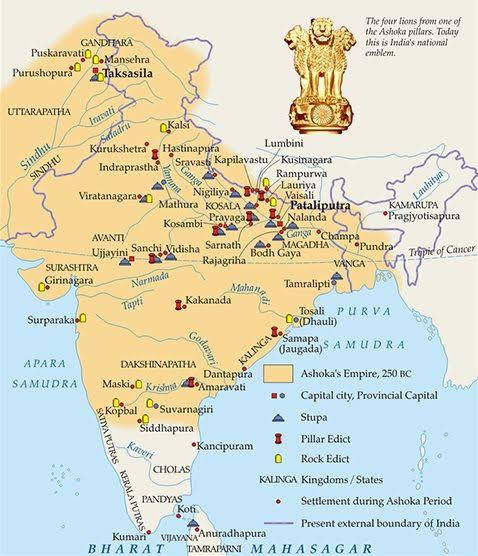
Founded in the 5th century BC, the University of Taxila (today’s Punjab) was a famed seat of Sanskrit and Vedic learning.
Then arrived the nearly forgotten king Ashoka the Great (ruled from 268 BC till 232 BC), the grandson of Maurya, who became the third ruler of the kingdom.
After having conducted unjust and cruel wars, Ashoka got gradually drawn towards peaceful Buddhism. After his conversion, Buddhism gained recognition, strength and go global.
Ashoka made several edicts that were engraved in pillars and rocks installed all over the territory of the kingdom. The edicts were written in the main languages used by the population groups of the kingdom: Greek (Ionian), Aramean and Prakrit. The edicts called for non-violence, respect for all forms of life, moderation and compassion.
Ashoka promoted Buddhism on a scale unseen till then. He ordered and financed the construction of 84,000 Buddhist temples (stupa) for Buddhist devotional practice. And following the Third Buddhist Council (ca 250 BC) that he patronized, Ashoka sent emissaries to spread Buddhist teachings abroad.
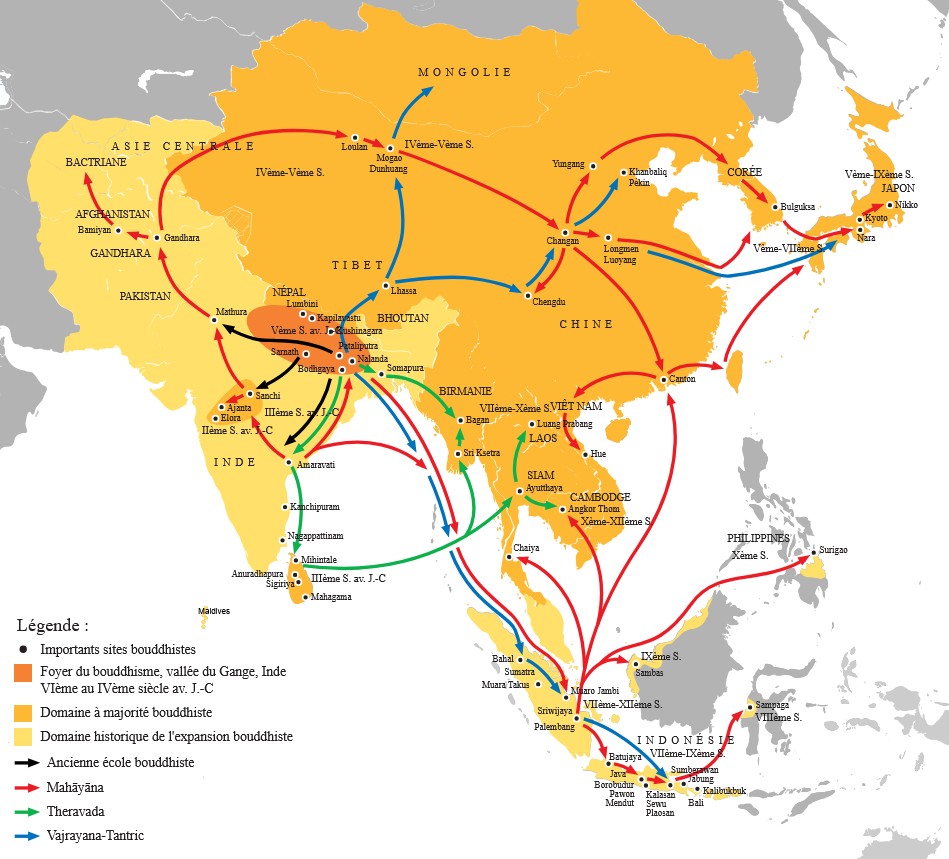
Well known is the fact that he sent his son Mahinda to Sri Lanka, making it the first region outside India to officially adopt Buddhism. From there and along the Indian maritime trade routes, this southern expansion established Theravada Buddhism (“The doctrine of the Elders”) as the dominant tradition in mainland Southeast Asia.
Over centuries, kingdoms in modern-day Myanmar, Thailand, Cambodia and Laos embraced Theravada Buddhism, deeply integrating it into their governance and cultural identities.
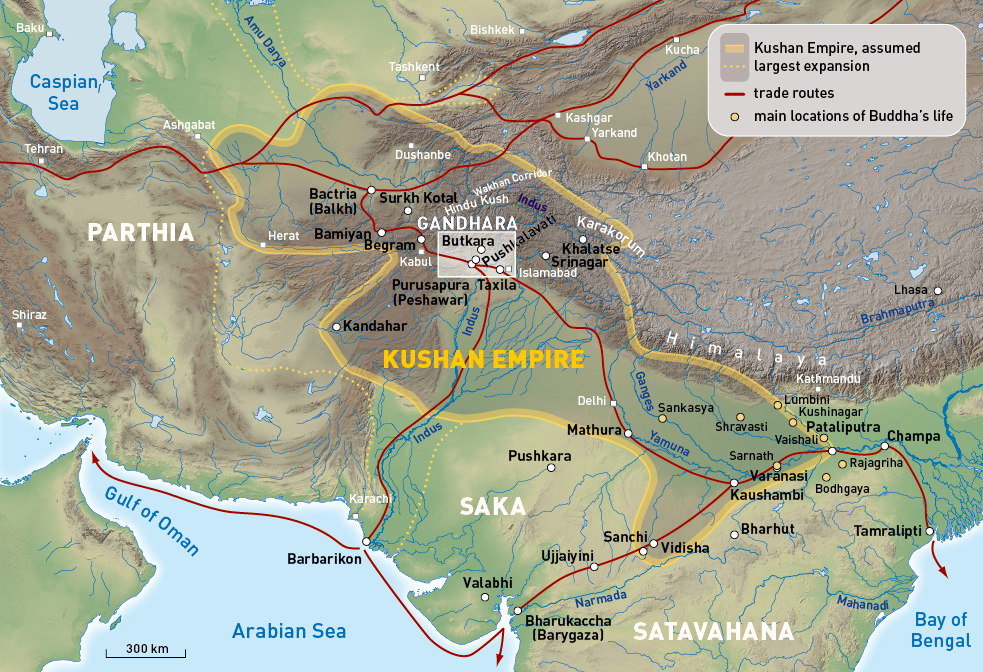
Kushan Empire (1st century BCE – 3rd century CE)
Another group of emissaries traveled to central Asia and developed another interpretation of the teachings of Buddha, Mahayana Buddhism (“The Great Vehicle” in Sanskrit). It really bloomed during the Kushan Empire (1st century BCE – 3rd century CE), an empire founded most probably by elements of the Chinese Yuezhi confederation in the early 1st century CE.
The founder of the dynasty, Kujula Kadphises, followed Iranian and Greek cultural ideas and iconography. Greek (Ionian) was the administrative language.
Initially based in the Bactrian territories, it spread to encompass much of what is now Afghanistan, India, Pakistan, Tajikistan, Turkmenistan and Uzbekistan. Kushan territory in India extended at least as far as Saketa and Sarnath near Varanasi (today’s Benares, India), where inscriptions confirm this reality.
The Kushan dynasty had diplomatic contacts with the Roman Empire, Sassanian Persia, the Aksumite Empire (Ethiopia and the Horn of Africa), and the Han dynasty of China (206 BC –220 AD). It was at the center of trade relations between the Roman Empire and China: according to Alain Daniélou, “for a time, the Kushana Empire was the center point of the major civilizations”.
While much philosophy, art, and science were created within its borders, the only textual record of the empire’s history today comes from inscriptions and accounts in other languages, particularly Chinese.
In 127 A.D., his successor Kanishka the Great, replaced Ionian with Bactrian as official language. His rule ushered in a period of relative peace for 200 years, described as “Pax Kushana.”
The “miracle of Gandhara”
From Gandhara, the cultural and intellectual point of gravity of the Kushan Empire, Kanishka started promoting Buddhism through learning, art and literature.
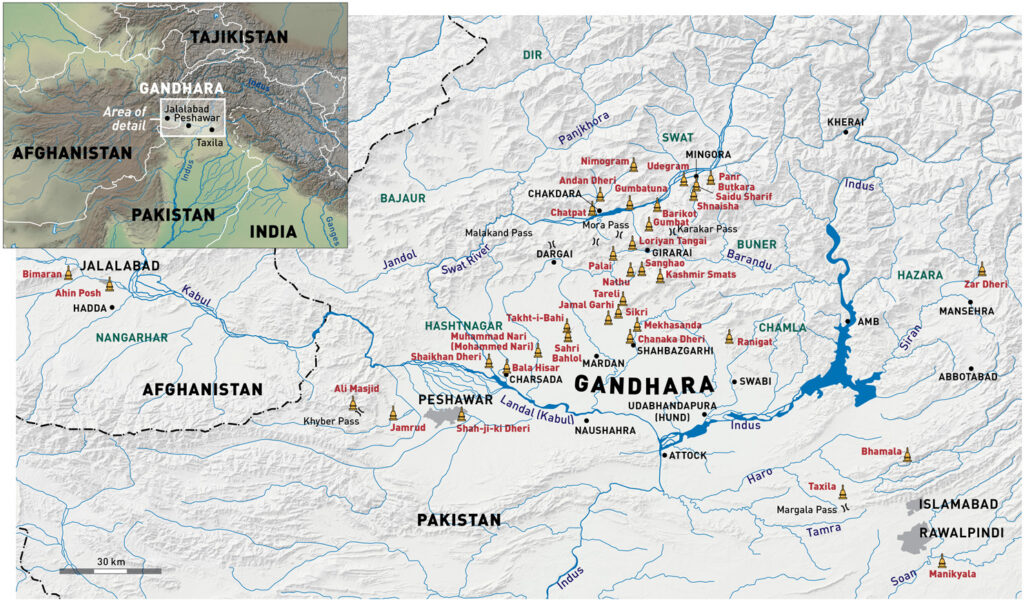
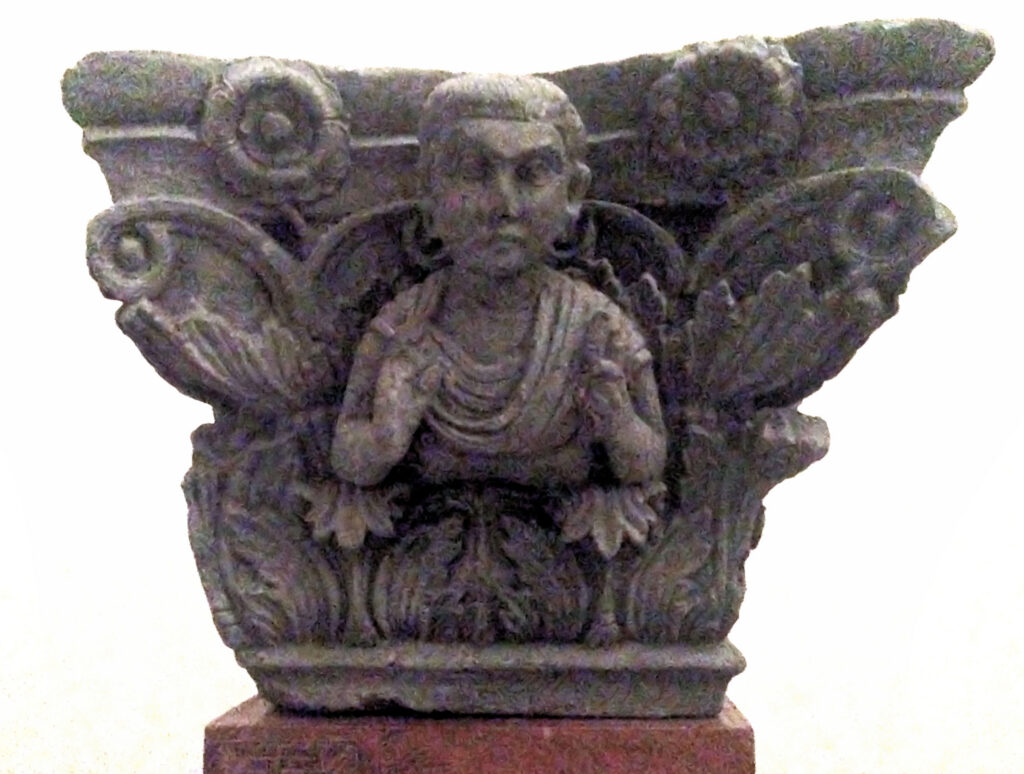
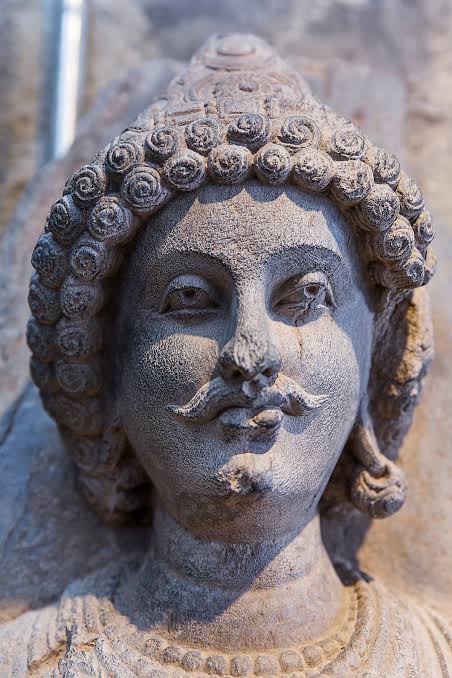
It was under Kanishka that the “miracle of Gandhara” occurred. Buddhist devotional art, which for four centuries was exclusively symbolic and an-iconic, suddenly morphed into anthropomorphic art taking the shapes of humans and using the canons and naturalistic proportions of the classical Greek period.
With human figuration Buddhism now reached out to the heart and the imagination of the common man. Buddha, after all, was not a god, but a human person that was deified for his exceptional qualities. For an ordinary person, attaining nirvana as Buddha did, was an exceptional achievement.
But Gandhara art also celebrated and mass-produced magnificent sculptures of bodhisattvas, well-intentioned human beings already on the path to nirvana, but first living their own lives and entirely devoted to liberating other humans from suffering. What is celebrated by representing them, therefore, is empathy and compassion.
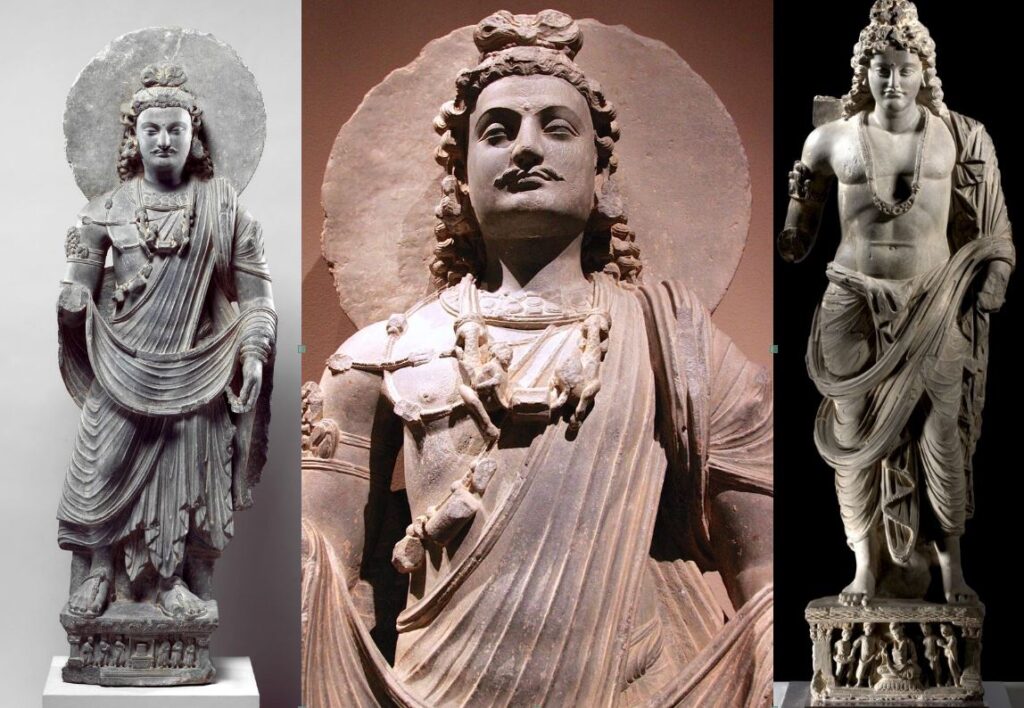
A direct road from Gandhara to China remained under Kushan control for more than a century, encouraged travel across the Karakoram (the second-highest mountain range on Earth), and facilitated the spread of Mahayana Buddhism to China.
To be noted is the fact that Gandhara developed its own language: Gandhari, which became a lingua franca along the Silk Road and a major source language for the earliest Chinese translation of Buddhist sutras during the Han dynasty.
From Gandhara, Buddhism spread eastward into oasis cities like Khotan and Dunhuang and deeper into China during the Han Dynasty. In turn, China transmitted its Mahayana traditions northeast. Korean kingdoms adopted Buddhism in the 4th century, and Korean monks subsequently introduced it to the Japanese imperial court in the 6th century.
Gandhara art also traveled to Dunhuang, China, along the land routes of the ancient Silk Road, carried by traveling monks, merchants, and diplomatic envoys between the 2nd and 7th centuries.
Buddhist monasteries and nunneries on the Silk Road, financed by both the king and the merchants, were more than religious sites and favored an environment of economic well-being. Besides prayer rooms, they offered housing facilities, protection against bandits, education for children and artisans, medical care and even financial facilities. As the archaeological site of Mes Aynak (today’s Afghanistan) suggests, some Buddhist monasteries also engaged in mining and metallurgic industries.
Art and religious objects moved alongside commercial goods across the Kushan Empire and Central Asian oases. Dedicated Buddhist merchants, pilgrims, monks and nuns walked these dangerous desert routes to collect Sanskrit scriptures, bringing along visual iconography and sacred statues. They passed through key hubs like Bamiyan and Mes Anyak in Afghanistan and the Kizil Caves in Kucha (Xinjiang) before reaching Dunhuang. Small portable items—such as gilded bronze figurines, drawings, painted banners, and illuminated manuscripts—served as visual templates that easily fit inside merchant packs.
Dunhuang, as a “second” Gandhara
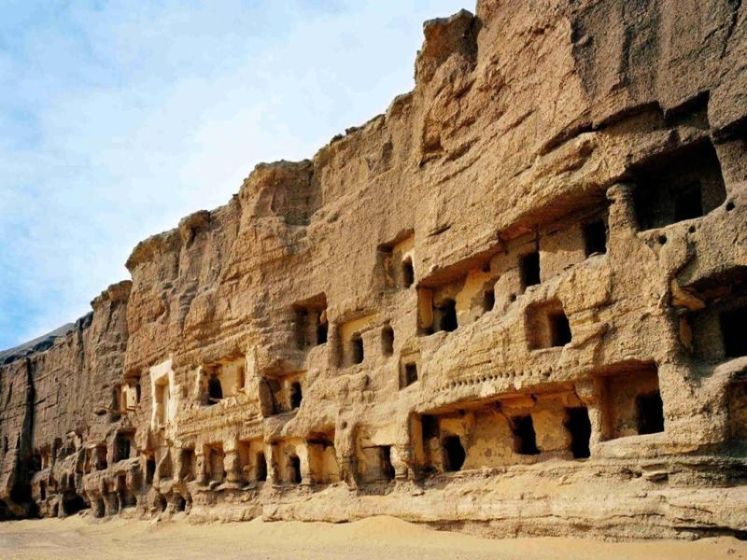
When the art of realistic drapery and naturalistic human anatomy reached the Mogao Caves in Dunhuang, local and foreign artists reinterpreted them. It is over-simplistic to just say the Dunhuang painting school was “influenced” by Gandhara art merely copied what arrived from outside.
In Dunhuang, there are 735 recorded caves of which 492 feature preserved murals and painted sculptures. They survived as repositories of a very precious artistic heritage. Approximately 25,000 square meters of wall paintings and more than 3,000 painted sculptures make of this site, not only one of the largest but one of the most valuable sites of Buddhist art.
Between 400 AD and 1400 AD, Dunhuang brought together many talents in a single melting pot culture. One might want to call it a “second Gandhara”. Just as in Gandhara, as a result of a friendly dialogue, mutual understanding and admiration grew between foreign (Hellenic, Persian, Indian, etc.) and Chinese traditional culture, a new form of art saw the light in Dunhuang.
Architecture
First, Gandharan monastic complexes feature small, plain cells (viharas) for residential monks surrounding a central courtyard. The northern section of the Mogao Grottoes, mirrors this setup perfectly, hosting over 200 plain, bare-walled caves that strictly functioned as living quarters, meditation cells, and work spaces for the site’s traveling artisans.
In Gandhara, monks prayed in chaityas—apsidal, vaulted rock-cut halls built around a freestanding burial mound (stupa) for circumambulation.
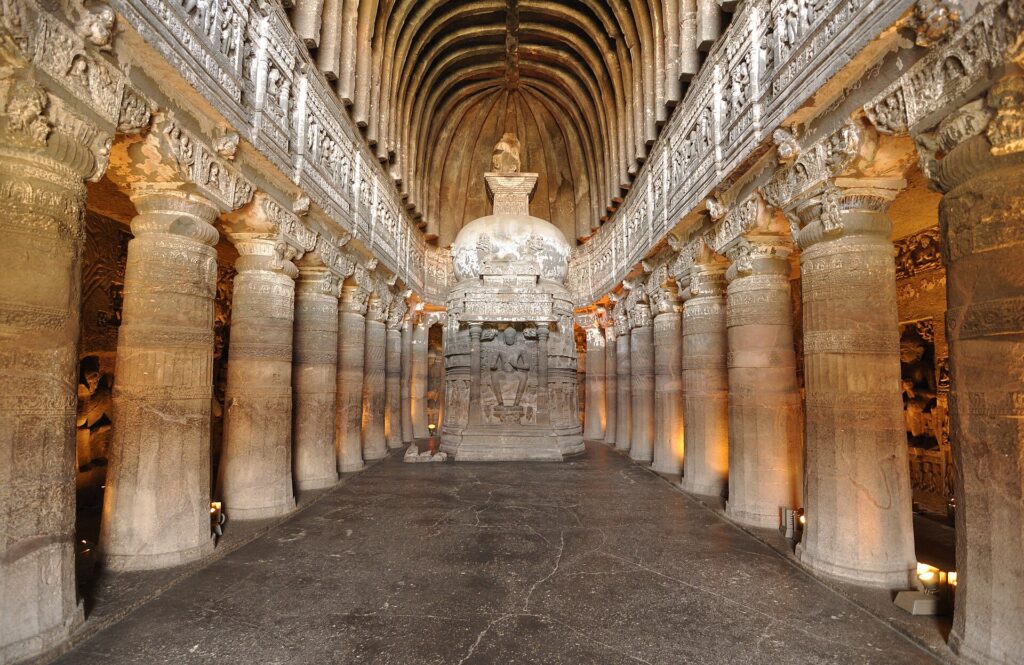
When this design reached Dunhuang, Chinese builders adapted it into “Central Pillar” Caves (e.g., Cave 254). Instead of a round stupa, they carved a solid, square rock column stretching from floor to ceiling, decorating its sides with niches containing painted statues.
Painting and sculpture: cave 275 versus Cave 45
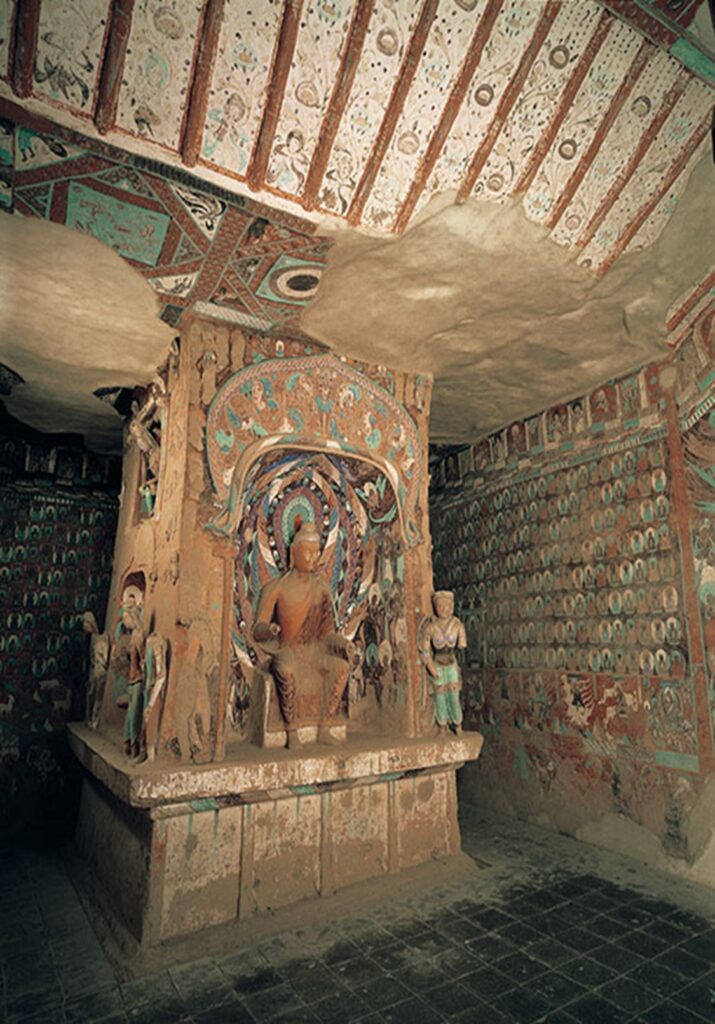
To understand how Gandharan visual art evolved, there is no better way than to look directly at the contrast between Cave 275 and Cave 45, separated in time by three centuries.
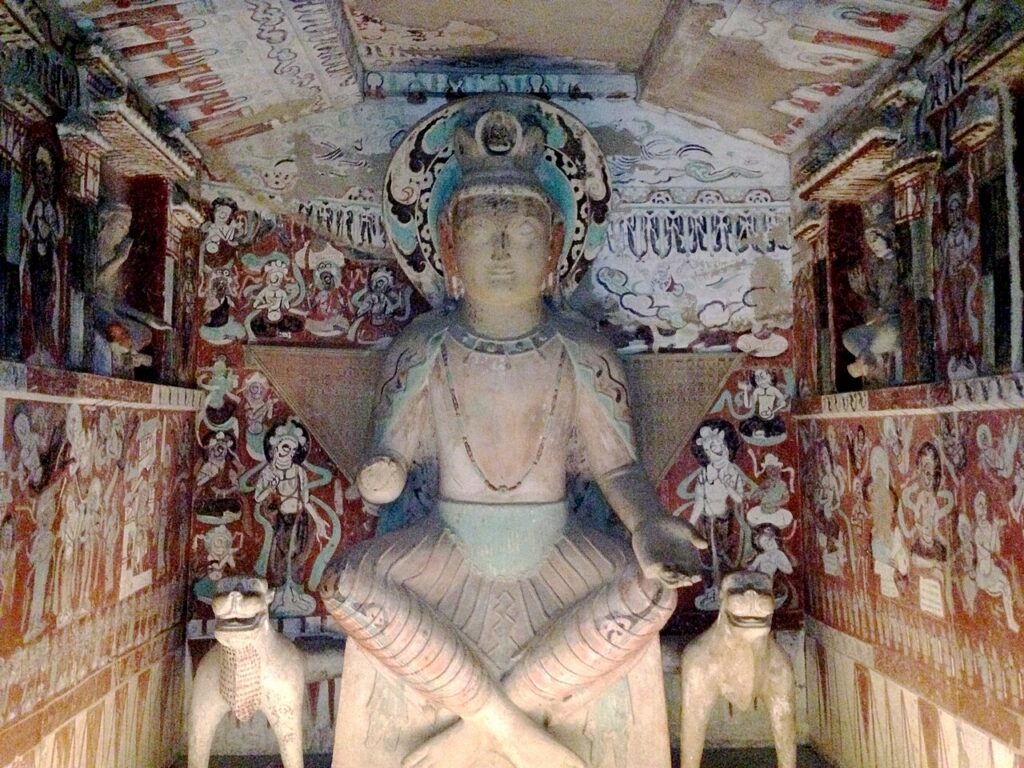
Stepping from one into the other is like walking out of the naiver Kushan-influenced Western frontiers and straight into the peak elegance of a local Chinese imperial court.
Dating back to the Northern Liang period (397–439 CE), Cave 275 is one of the absolute oldest surviving structures at Dunhuang. Its central focus is a 3.34-meter-tall painted clay statue of Maitreya Bodhisattva. 1
He sits with crossed ankles on a throne supported by two lions—a posture and royal motif directly copied from Kushan royal iconography. The statue has a robust, wide-shouldered body, a long prominent nose, and a square chin—traits echoing the Greco-Roman features of early Gandharan art. His upper chest is left bare, wrapped only in a geometric, rigid Western-style scarf.
At that time, Gandharan Greco-Roman realism directly collided with Han Chinese styling. In early caves like Cave 257 or Cave 275, paintings were designed to teach basic Buddhist morality to weary travelers.
Cave 45 was created three centuries later, at the Peak of Tang Dynasty Realism (8th Century). By this era, the foreign, rigid Gandharan foundations had completely dissolved into an incredibly fluid indigenous Chinese classical style.
Tucked into the west wall niche is a flawlessly preserved seven-figure sculpture group containing a central preaching Buddha, two disciples, two bodhisattvas, and two heavenly guardian kings.
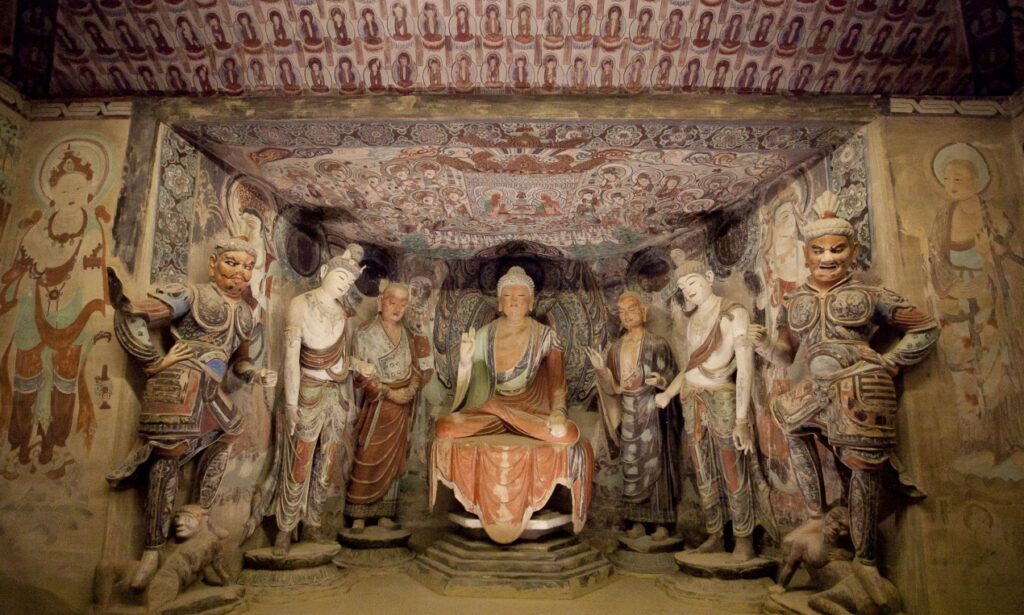
Gandharan relief sculptures were famous for heavy, realistic Roman toga-style drapery with deeply carved folds overlapping the body.
In the early Mogao murals, these robes were flattened into thin, tight-fitting wet-drapery lines. By the time of the Tang Dynasty, the aesthetic shifted completely to “the floating scarves of Dunhuang,” where heavy fabric folds were replaced by light, billowing, and calligraphic ribbons that conveyed rapid motion.
By the time Cave 45 was decorated, the focus shifted from earthly sacrifices to spectacular visions of heavenly salvation. On the south wall of Cave 45, the Western Pure Land Illustration presents Amitabha Buddha (Infinite Light) presiding over a massive celestial court.
Heavenly apsaras (flying celestial beings) dance dynamically overhead while newly reborn souls emerge peacefully out of lotus blossoms in a shimmering central pool. To ground this heavenly scene in human emotion, the sides of the mural contain narrow border panels depicting the tragic earthly story of Queen Vaidehi, who meditates to escape the imprisonment forced upon her by her wicked son.
In terms of elegance, Cave 45 reminds the viewer of the famous Triad of Hadda, a group of statues excavated at Tapa Shotor, a large Sarvastivadin Buddhist monastery near Hadda in Afghanistan, dating from the 2nd century AD and certainly one of the most refined expressions of Gandhara art (now destroyed).
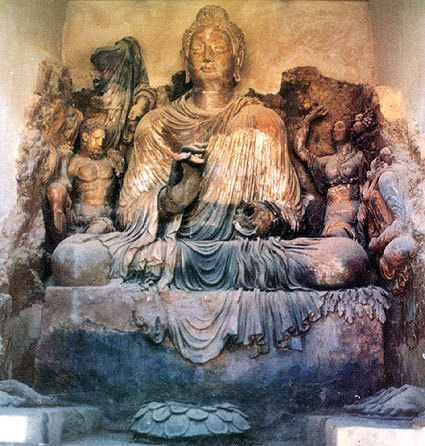
While Gandharan art was realistic in body structure, Tang artists added emotional expression.
Compare the two disciples in Cave 45: Ananda (on Buddha’s right hand) is modeled as a flawless, youthfully smooth and serene young monk, while the older Kashyapa (on Buddha’s left hand) is carved with a lean, wrinkled, and care-worn face reflecting a long ascetic life.
The two flanking Bodhisattvas represent the pinnacle of High Tang elegance. Moving far away from the rigid front-facing posture of Cave 275’s Maitreya, their bodies sway in an exaggerated, fluid S-curve posture, originally from Indian tribhanga but heavily refined by Chinese aesthetics.
Their silk robes and jeweled sashes drape softly like real, moving textiles. On the outer edges stand the “Heavenly Guardian Kings”. Their intense, muscular grimaces and stomping postures showcase the final evolution of defense icons: instead of wearing Roman-influenced armor, they are dressed in accurate, intricate Tang Dynasty military plate armor.
But art is more than technical virtuosity, for technical skills are mobilized to convey elevating concepts. It is the spiritual and cognitive subject matter that pushes artists to innovate their technical mastery.
Relevant here, the process by which specific Gandharan traits—such as the compassionate downward gaze and elaborate royal ornaments—merged with Chinese aesthetics, transforming figures like the Gandharan Avalokiteshvara (the bodhisattva of compassion, goddess of the traders) into the Chinese Guanyin (Goddess of Mercy and compassion in Chinese culture and East Asian Buddhism).
Painting techniques
In their fresco’s Gandharan artists utilized Western, Hellenistic three-dimensional shading to define the human body. Dunhuang painters adopted this technique into a localized style called “convex shading” (ao-tu).
They painted deep, circular rings around eye sockets, muscles, and collarbones to give the flat wall murals a lifelike, three-dimensional depth when seen under candlelight. Over the centuries, the original red lead pigment oxidized, turning these highlighted areas black and creating a distinct “panda-eye” look unique to early Silk Road murals today. 2
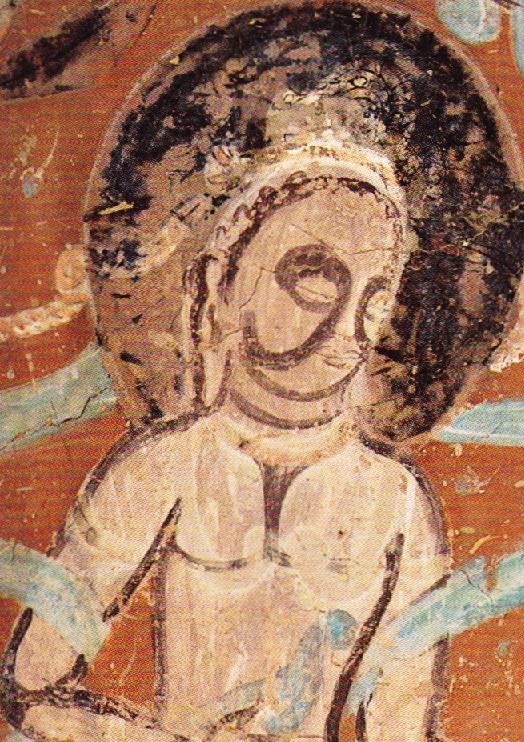
The shifting nature of colors of Dunhuang also reflects changes in trade access along the Silk Road. Artists initially relied heavily on natural mineral pigments mixed with animal glue, but the specific minerals they could source evolved.
Early painters relied on local iron oxides like hematite and ocher for deep reds and warm browns. However, for brilliant blues, they used lapis lazuli (lazurite).
Because lapis lazuli had to be imported over thousands of miles from the Badakhshan mines of modern Afghanistan, its heavy presence in early caves highlights Dunhuang’s immediate, direct economic connection to the Western regions of Central Asia.
As Chinese trade routes shifted and consolidated, artists increasingly replaced imported lapis lazuli with azurite, a deep blue copper mineral widely available within China.
Greens became intensely vibrant due to the heavy application of malachite. And while early artists used simple gold leaf sparingly or substituted it with bright yellow ocher, Tang dynasty artists mastered complex gilding techniques. They applied ultra-thin sheets of gold foil over a red iron-oxide primer to make jewelry, crowns, and celestial halos radiate light inside the dark, candle-lit cave interiors.
The Laocoon
Also in terms of emotional content, in 2019, during a lecture at the University of Hong Kong’s Centre for Buddhist Studies, Professor Osmund Bopearchchi cited several cases of highly recognizable Gandharan motifs in Buddhist iconography.
As an example, he underscored the similarities in expression between a sculpture from “greater Gandhara” depicting the cry of agony of a monk, with the agonizing layman under the Buddha’s bed lamenting the death of the Blessed One as depicted on a relief currently exhibited at the Victoria and Albert Museum (V&A) in London.
The resemblance is not only in the look and feel of the images, but also in the detail of the expressions: in the teeth, tongue, jaw, eyebrows, and staring eyes, all conveying a deep sorrow and cry of despair.
Prof. Bopearachchi hypothesized that that inspiration could have come from the Hellenistic statue Laocoon and His Sons, also known as the Laocoon Group 3, “the prototypical icon of human agony” in Western art whose importance has been underscored in the 18h Century by the German playwriter and art theorist Gotthold Ephraim Lessing.
This type of iconography directly or indirectly traveled to Dunhuang. The most famous depictions come from cave No.158 in Mogao, known as the Nirvana Cave, which features mourners witnessing the passing of the Buddha, depicted in murals along the length of the hall behind.
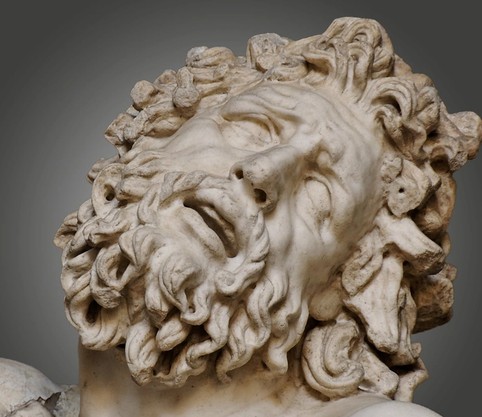
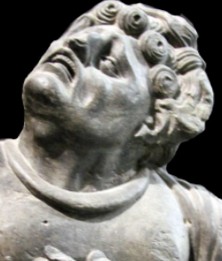
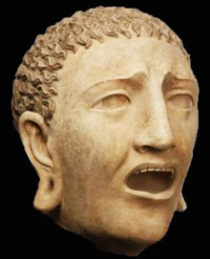
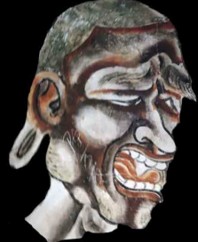
FIG. 14 a, b, c, d
The utter despair of the Trojan priest facing his own death (a) is the precursor to the passionate and emotional expressions of the agonizing Buddhist monk of the stucco sculpture from the Vardak region (b), the pain-stricken layman on the sculpture from the V&A (c), and the arahat (an enlightened person in Buddhism who has destroyed all mental constraints and escaped the cycle of rebirth) from the Mogao cave No.158 grieving the death of their beloved teacher (d).
Manuscripts, translations, paper and printing
Dunhuang was also a dynamic translation hub. Famous Buddhist monks and scripture translators worked in Dunhuang before moving further into mainland China.
For example, the legendary translator Kumarajiva stayed there, and influential local figures, such as the monk Hong Bian of the late Tang dynasty, dedicated their lives to reproducing and translating Buddhist manuscripts. Teams of officials, monks, and ordinary citizens meticulously copied translated religious and secular documents by hand, creating a vast repository of knowledge. It was from this incredible cultural and educational activity that the invention of paper and printing techniques would eventually emerge.
The invention of paper, as we know it today, took place under the Chinese Han Dynasty in AD 105. Ts’ai Lun, a court official, invented a paper making process which primarily used rags (textile waste) as the raw material with which to make paper.
Buddhist devotees, seeking to accumulate spiritual merit, financed both the digging and decoration of caves and the translation and reproduction of sacred sutras and prayers, thus creating a strong commercial and religious demand for inexpensive writing materials. Buddhist monks and pilgrims spread papermaking techniques along the Silk Road during their travels to share these texts. Monks like the Korean Buddhist monk Don Cho introduced these techniques to countries such as Japan around 610 AD.
The Library Cave
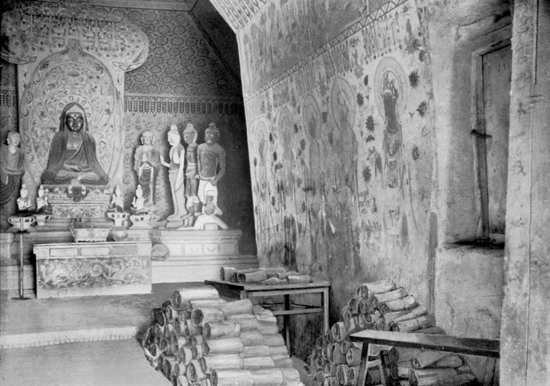
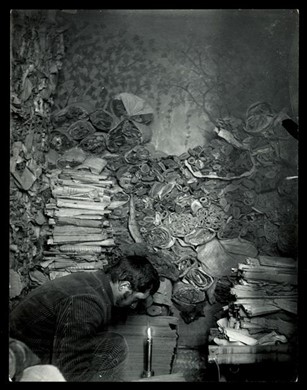
In 1900, a Taoist monk named Wang Yuanlu discovered in Mogao a cache that had been sealed at the 11th century. What is now called the “Library Cave” (Cave 17) contained upwards of 50,000 to 60,000 manuscripts.
While the majority were in Chinese and Tibetan, the cache held texts written in nearly 20 different languages and scripts, including:
- Sanskrit,
- Sogdian,
- Khotanese (Persian),
- Uyghur,
- Tangut (an extinct Tibeto-Burman language),
- Kuchean (also known as Tocharian B or Western Tocharian),
- Uyghour (Old Turkic),
- Mongolian,
- Prakrit,
- Hebrew.
The manuscripts deal with wide-ranging subjects. Among the non-religious texts:
- Social documents, such as contracts, account books and loan receipts;
- Philosophy, notably the Confucian classics;
- Literature, including Chinese folk songs;
- Classical poetry;
- History, both official and local Geography;
- Medicine, including treatments for plagues and illnesses. The medical texts include a fragment of one of the earliest Chinese pharmacological texts;
- Astronomy, including the Dunhuan Star Map that identifies over 1300 stars;
- Mathematics;
- Agriculture and cattle raising;
- Divination;
- Dictionaries;
- Music scores and dance notations, some of them foundational in Japan;
- Recreational games.
By far the largest proportion of manuscripts from the Dunhuang cave contain Buddhist texts. These include Buddhist sutras, commentaries and treatises.
Showing great respect, Li Yuan (Emperor Gaozu), the founder of the Tang dynasty, by declaring himself a descendant of the philosopher Lao Tzu, made Taoism the official state religion, while opening his kingdom to the devotional practices of the many other communities that came via the Silk Road. Chang’an (modern-day Xi’an), the Tang capital, and the major trading ports, in addition to Taoist, Confucian, and Buddhist communities, were home to numerous religious currents from abroad, notably:
- Nestorian Christianity (Jingjiao), officially recognized as early as 635 with the arrival of the monk Alopen and therefore long before the Jesuit missions;
- Zoroastrianism and Manicheanism, practiced by Sogdian merchants and diasporas of Central Asia.
- Islam of Arab and Persian merchants established in the southern ports (such as Guangzhou);
Therefore, among the non-Buddhist religious texts of the Dunhuang manuscripts, one finds:
- Taoist texts;
- Jewish Selihot prayers, as well as a version of the Old Testament in Hebrew;
- Nestorian Christian texts;
- Manichaean texts.
This incredible diversity testifies to centuries of translation efforts and intercultural dialogue.
Christian manuscripts
Among the texts discovered in the Library Cave, western explorers like the Hungarian born British archaeologist Aurel Stein and the Frenchman Paul Pelliot discovered around a dozen Christian texts written in medieval Chinese. These scrolls (such as the Sutra of Jesus Christ and the Book of Great Tensities) reveal that Nestorian scribes worked intensely to translate Christian theology into local languages. To make the concepts understandable, they adopted terminology heavily borrowed from Buddhism and Taoism.
Texts like the Sanwei mengdu zan (a Chinese version of the Gloria in excelsis deo hymn) demonstrate clearly that these manuscripts were actively used for worship by a local Christian Nestorian community in Dunhuang.
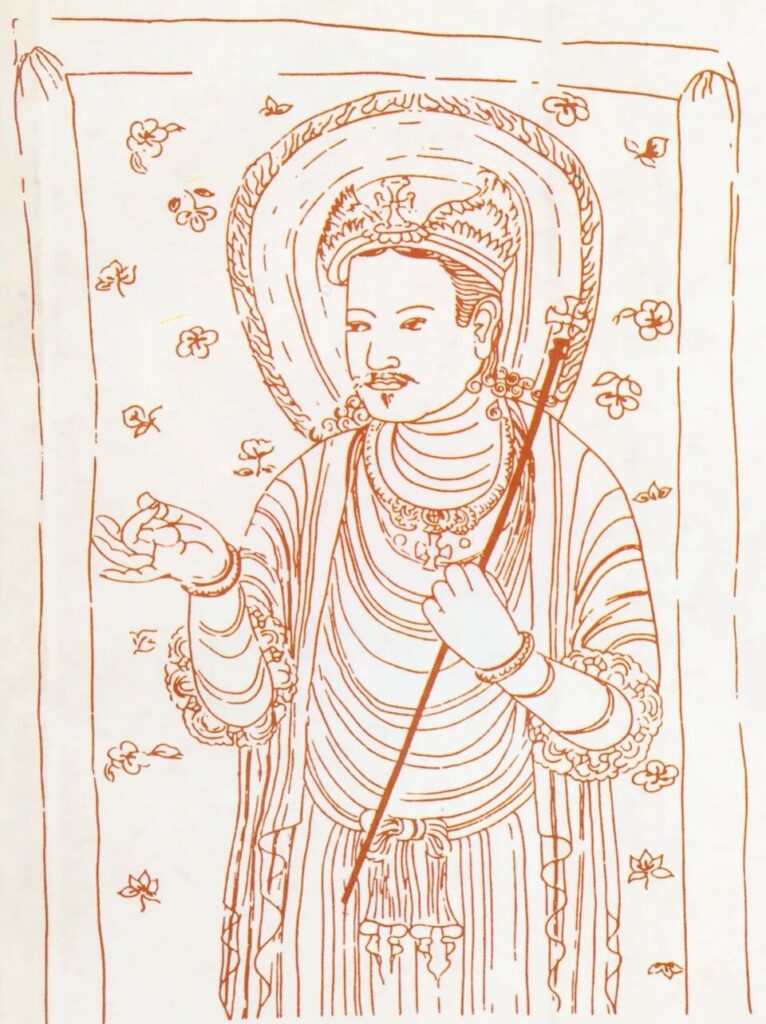
Also discovered in the Mogao Caves, a 9th-century silk painting depicting a holy figure (often identified as Christ or a saint) dressed in traditional Tang dynasty robes but wearing two distinct Nestorian crosses, one on his crown and one on his chest.
The figure is depicted with a mustache and a slight beard, appearing in a three-quarter view similar to traditional Chinese portraits of righteous scholars or divine beings. The right hand is raised to the chest in a gesture of blessing, mimicking the Christian benedictio or a Buddhist mudra.
Additional discoveries from the Mongol (Yuan) period uncovered fragments of the Book of Psalms written in Syriac, confirming that Eastern Christian monks and scholars continued to use the Mogao caves for prayer and textual work up until the 14th century.
Book printing
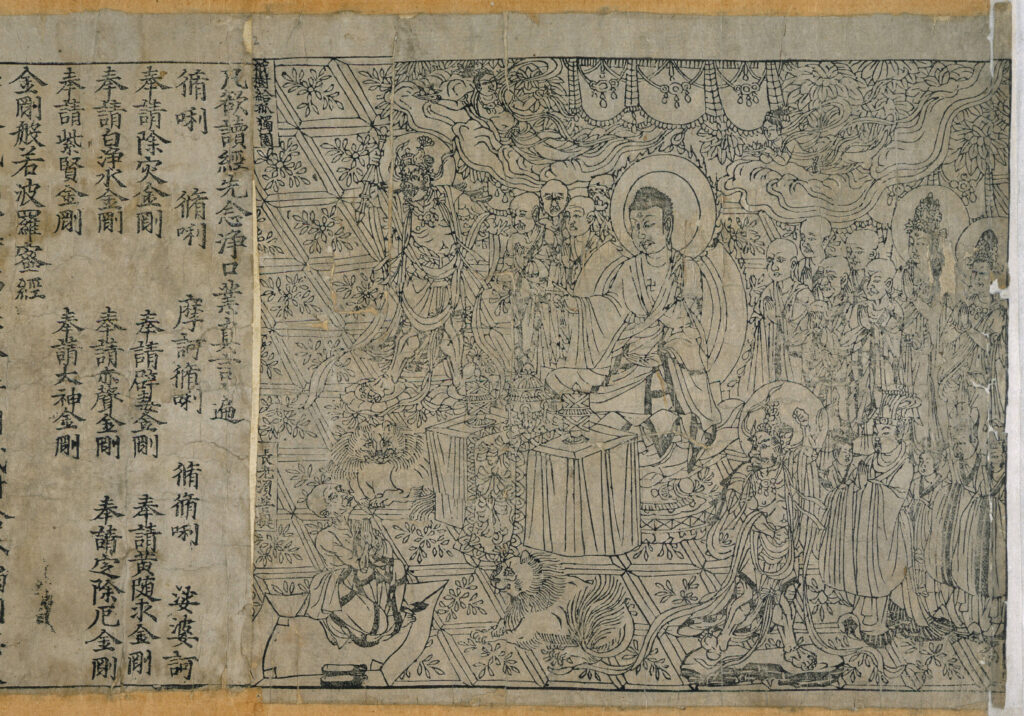
One last marvel among the treasures found, a translation from Sanskrit to Chinese of the Diamond Sutra. This Indian text narrates a dialogue on the nature of reality and illusion between the Buddha and his disciple Subhuti.
The text can be read on a 5-meter (16-foot) long horizontal scroll made of seven sheets of yellow-dyed paper joined together, featuring woodblock-printed text and an ornate frontispiece. Printed on May 11, 868 DC, it is the world earliest known complete printed book.
And in July 1377, that is, 78 years before the famous Gutenberg Bible, it was the Korean Buddhist monk Baegun (Gyeongham) who printed the Jikji (Jikjisimcheyojeol), the oldest book with movable metal types known to date, the second volume of which is kept at the Bibliothèque nationale de France (BnF).
Conclusion
So here, in Dunhuang, mankind, inspired by the accomplishments of Gandhara and other contributions from the Silk Roads, as “a living corridor”, explored a little further the creative essence of humankind and made it an object of celebration, after all the real mission of Art.
Many aspects of this cultural cross-fertilization have been discovered and are now duly documented. The opening of the copper mine and exploration of the Buddhist monasteries of Mes Aynak in Afghanistan will undoubtedly bring another treasure of cultural finds for all.
Let us work together to make this cultural beauty known to the world. As a visual celebration of the highest human qualities, Dunhuang, and the inspiration that gave birth to it, can and should be made as one of those long shadows of the future, a shadow of hope and of a positive future that mankind can decide to construct together.
Thank you for your kind attention.
Selected bibliography:
- Silk Roads: Peoples, Cultures, Landscapes. Susan Whitfield, Thames and Hudson, London, 2019;
- Spatial Dunhuang, Experiencing the Mogao Caves, Wu Hung, University of Washington Press, 2023;
- Buddhist Iconography Along the Silk Road with Prof. Osmund Bopearachchi, Part Two – The Land Route. Wendy Yu, Shantel Wong, Buddhist Global, September 3, 2019. https://www.buddhistdoor.net/features/buddhist-iconography-along-the-silk-road-with-prof-osmund-bopearachchi-part-two-the-land-route/
- Mogao caves reveal powerful India-China Buddhist link, Atul Aneja, The Hindu, Sept. 12, 2016, https://www.thehindu.com/news/international/mogao-caves-reveal-powerful-indiachina-buddhist-link/article8560771.ece
- From Gandhara to Dunhuang: The Evolution of Buddhist Art Along the Silk Road, Irum Malik, Kuiyi Shen, Progressive Research Journal of Arts & Humanities, Vol. 6, Issue 01, February 2026,
https://www.researchgate.net/publication/401971856_From_Gandhara_to_Dunhuang_The_Evolution_of_Buddhist_Art_Along_the_Silk_Road - Mogao Caves, Unesco list of cultural heritage, https://whc.unesco.org/en/list/440/
- Buddhism in Chinese Art (2nd century through 907 C.E.), Smarthistory, https://smarthistory.org/reframing-art-history/buddhism-chinese-art/
- From the Evolution of the “Flying Apsaras” Art in the Mogao Caves, the Influence of Taoism on Dunhuang, Yiran Zhang, Zeus Press; Sociology, Philosophy and Psychology; Vol.2, No.1; 2025, https://journals.zeuspress.org/index.php/SPP/article/download/125/114/524
- Blue pigments in Cave 256, Mogao Grottoes: a systematic analysis of murals and statues in Five dynasties, Song Dynasty and Qing Dynasty, Biwen Shui, Zongren Yu, Qiang Cui, Zhuo Wang, Zhiyuan Yin, Manli Sun & Boming Su, Heritage Science, volume 10, Article #89, 2022. https://www.nature.com/articles/s40494-022-00722-5
- Mogao Cave 45 (High Tang Dynasty), Dunhuang Academy, https://www.dunhuang.ds.lib.uw.edu/mogao-cave-45-high-tang-dynasty/
- The “Miracle of Gandhara”: When Buddha turned himself into man, Karel Vereycken, Artkarel.com, Feb. 28, 2024. https://artkarel.com/the-miracle-of-gandhara-when-buddha-turned-himself-into-man/
NOTES:
- Maitreya, in Buddhist tradition, is the Buddha of the future, currently a bodhisattva residing in the Tushita Heaven, who will descend to earth to preach the Dharma (the « law ») again when the teachings of Gautama Buddha have completely disappeared. Maitreya is the earliest bodhisattva around whom a cult has developed and is mentioned in texts from the 3rd century CE. He has been accepted by all schools of Buddhism and remains the only bodhisattva generally honored by the Theravada tradition. ↩︎
- Minium (or red lead) refers to lead oxide, with the formula Pb₃O₄, historically used as a red-orange pigment and as a rust-preventative paint. It is from this term that the word miniature originated, as medieval artists used it to draw illuminated initials and illustrations in manuscripts. ↩︎
- The « Laocoon Group » is a Roman marble copy of an ancient Greek bronze sculpture depicting the Trojan priest Laocoön and his two sons, punished by Zeus, being attacked by snakes. The statue may date from 40 BC. ↩︎
Paris Schiller Institute stages Afghan civil society protest against UNESCO

This call in russian (pdf)
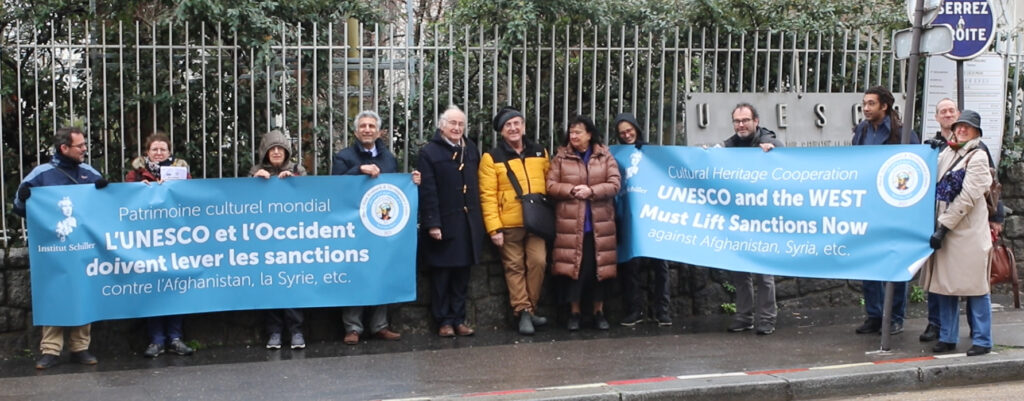
Paris, Feb. 2024 – On Thursday February 22, between 10:00 am and 1:00 pm CET, members and supporters of the International Schiller Institute, founded and presided by Helga Zepp-LaRouche, gathered peacefully in front of one of the main buildings of the headquarters of UNESCO in Paris (1, rue Miollis, Paris 75015). An appeal (see below), endorsed by both Afghans and respected personalities of four continents, was presented to the Secretary General and other officials of UNESCO.
How it started
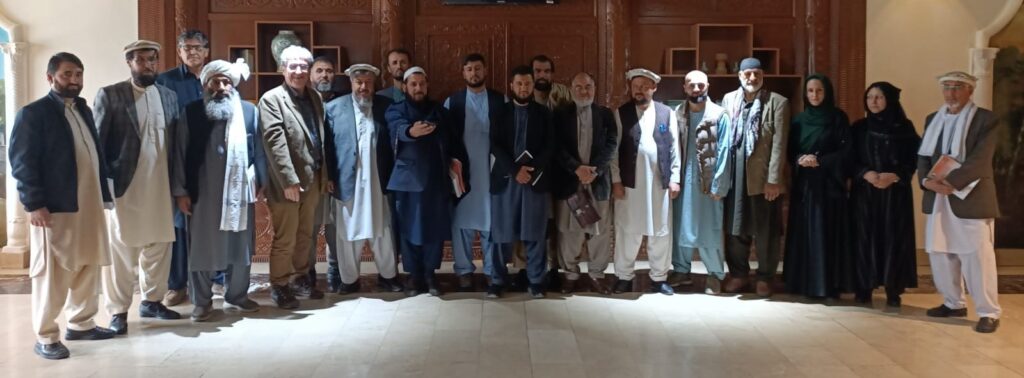
Following a highly successful conference in Kabul last November by the Ibn-e-Sina Research & Development Center on the reconstruction of Afghanistan, a group of senior archaeologists of the Afghan Academy of Sciences (ASA), in discussion with the organizers and the invited experts of the Schiller Institute, suggested to launch a common appeal to UNESCO and Western governments to “lift the sanctions against cultural heritage cooperation.”
The Call
“We regret profoundly, says the call, that the Collective West, while weeping crocodile tears over destruction of the world’s cultural heritage, has imposed a selective ban of scientific cooperation on nations mistakenly considered as “opposed to its rules and values.” The complete freeze of all cooperation in the field of archaeology between France and both Syria and Afghanistan, is just one example of this tragedy.”
“The dramatic neglect of international cultural institutions and donors to Afghanistan, the lack of sufficient funds in the field of cultural heritage protection, and the political treatment of international cultural heritage institutions have seriously endangered Afghanistan,” underscores the petition.
Specifically, “UNESCO, which should raise its voice against any new form of ‘cultural and scientific apartheid,’ has repeatedly worsened the situation by politicizing issues beyond its prerogatives.”
To conclude, the signers call
“on the international community to immediately end this form of ‘collective punishment,’ which creates suffering and injustice, promotes ignorance, and endangers humanity’s capacity for mutual respect and understanding.”
Living Spirit of Afghanistan
To date, over 550 signatures have been collected, mainly from both Afghan male (370) and female (140) citizens, whose socio-professional profiles indicates they truly represent the « living spirit of the nation ».
Among the signatories: 62 university lecturers, 27 doctors, 25 teachers, 25 members of the Afghan Academy of Sciences, 23 merchants, 16 civil and women’s rights activists, 16 engineers, 10 directors and deans of private and public universities, 7 political analysts, 6 journalists, 5 prosecutors, several business leaders and dozens of qualified professionals from various sectors.
International support
On four continents (Europe, Asia, America, Africa), senior archaeologists, scientists, researchers, members of the Academy of Sciences, historians and musicians from over 20 countries have welcomed and signed this appeal.
Italian Professor Pino Arlacchi, a former member of the European Parliament and the former head of United Nations Office on Drugs and Crime (UNODC) was the first to sign. Award-winning American filmmaker Oliver Stone, is a more recent signer.
In France, Syria, Italy, the UK and Russia, among the signers one finds senior researchers suffering the consequences of what some have identified as a « New Cultural Cold War. » Superseding the very different opinions they have on many questions, the signatories stand united on the core issue of this appeal: for science to progress, all players, beyond ideological, political and religious differences, and far from the geopolitical logic of ‘blocs’, must be able to exchange freely and cooperate, in particular to protect mankind’s historical and cultural heritage.
Testifying to the firm commitment of the Afghan authorities, the petition has also been endorsed by the Deputy Minister of Foreign Affairs, the Minister of Culture and Arts, and the Minister of Agriculture, as well as senior officials from the Ministries of Higher Education, Water and Energy, Mines, Finance, and others.
“The 46th session of UNESCO’s World Heritage Committee, to be held in New Delhi in July this year, offers UNESCO the opportunity to announce Afghanistan’s full return into world heritage cooperation, if we can have our voice heard,” says Karel Vereycken of the Paris Schiller Institute. “We certainly will not miss transmitting this appeal to HE Vishal V Sharma, India’s permanent representative to UNESCO, recently nominated to make the Delhi 46th session a success.”
For all information, interview requests in EN, FR and NL:
Karel Vereycken, Schiller Institute Paris
00 33 (0)6 19 26 69 38
Full text of the appeal
International Call to Lift Sanctions Against Cultural Heritage Cooperation
Following the international conference, organized by the Ibn-e-Sina Research & Development Center’s in Kabul in early November 2023, on the reconstruction of Afghanistan, a group of researchers launched the following petition:
We, the undersigned, researchers and experts in the domains of the history of civilizations, cultural heritage, archaeology, anthropology, sociology, and many other fields, and other enlightened citizens of the world, in Afghanistan, Syria, Russia, China, and many other countries, launch the following call.
1) We regret profoundly that the “Collective West”, while weeping crocodile tears over destruction of the world’s cultural heritage, has imposed a selective ban of scientific cooperation on nations mistakenly considered as “opposed to its rules and values.” The complete freeze of all cooperation in the field of archaeology between France and both Syria and Afghanistan, is just one example of this tragedy.
2) We request particular attention to the case of Afghanistan. Its neighboring countries, national and international institutions, and countries involved in international conventions for the protection of cultural and natural heritage are committed to cooperation in the field of guarding cultural heritage sites and artifacts and preventing their smuggling and destruction. Therefore, it is expected that in the current situation, they will fully play their role in the protection of Afghanistan’s cultural heritage in accordance with international laws and conventions. However, the dramatic neglect of international cultural institutions and donors to Afghanistan, the lack of sufficient funds in the field of cultural heritage protection, and the political treatment of international cultural heritage institutions have seriously endangered Afghanistan. Undoubtedly, the non-recognition of the Afghan government has dimmed the attention of cultural institutions. Considering the above, we expect these international institutions to renew their full support to protect both the tangible and the intangible cultural heritage of Afghanistan.
3) We regret that UNESCO, which should raise its voice against any new form of “cultural and scientific apartheid,” has repeatedly worsened the situation by politicizing issues beyond its prerogatives.
4) Therefore, we call on the international community to immediately end this form of “collective punishment,” which creates suffering and injustice, promotes ignorance, and endangers humanity’s capacity for mutual respect and understanding.
The progress of scientific knowledge, in a positive climate permitting all to share it, is by its very nature beneficial to each and to all and to the very foundation of a true peace.
SIGNERS:
A. FROM AFGHAN CIVIL SOCIETY:
– Hussain Burhani, Archaeologist, Numismatist, Afghanistan ;
– Ketab Khan Faizi, Archaeologist, Director of the Academy of Sciences at the International Centre for Kushan Studies in Kabul, Afghanistan;
– Stora Ishams Mayar, Archaeologist, member of the Academy of Sciences at the International Centre for Kushan Studies in Kabul, editor in chief of the journal of this mentioned center, Afghanistan;
– Mahmood Jan Drost, Senior Architect, head of protection of old cities of Afghanistan, Ministry of Urban Development and Housing, Afghanistan;
– Ghulam Haidar Kushkaky, Archaeologist, associate professor, Archaeology Investigation Center, Afghanistan ;
— Laieq Ahmadi, Archeologist, Former head, Archeology department of Bamiyan University, Afghanistan;
– Shawkatullah Abed, Chief of staff, Afghan Science Academy, Afghanistan;
– Sardar Ghulam Ali Balouch, Head of Afghanistan Balochs Union, Afghanistan;
– Daud Azimi Shinwari, Ibn-e-Sina Research & Development Center, Germany;
– Abdul Fatah Raufi, Ibn-e-Sina Research & Development Center, Kabul, Afghanistan;
– Mirwais Popal, Dip, Master, Ibn-e-Sina Research & Development Center, Germany;
B. FROM ABROAD:
(Russia, China, USA, Indonesia, France, Angola, Germany, Turkiye, Italy, UK, Mexico, Sweden, Iran, Belgium, Argentina, Czech Republic, Syria, Congo Brazzaville, Yemen, Venezuela, Pakistan, Spain, Canada, Democratic Republic of Congo.)
– H.E. Mr Mohammad Homayoon Azizi, Afghanistan’s Ambassador to Paris, UNESCO and ICESCO, France;
— Julio Bendezu-Sarmiento, Researcher at the National Scientific Research Centre (CNRS), Archaeologist specializing in Central Asia; Former director of the Delegation of French Archaeologists in Afghanistan (DAFA) (2014-2018), France;
– Inès Safi, CNRS, Researcher in Theoretical Nanophysics, France;
– Pierre Leriche, Archeologist, Director of Research Emeritus at CNRS-AOROC, Scientific Director of the Urban Archaeology of the Hellenized Orient research program, France;
– Nadezhda A. Dubova, Institute of Ethnology and Anthropology, Dr. in Biology, Prof. in History. Head of the Russian-Turkmen Margiana archaeological expedition, Russian Academy of Science (RAS), Russia;
— Alexandra Vanleene, Archaeologist, specialist in Gandhara Buddhist Art, Researcher, Independant Academic Advisor Harvard FAS CAMLab, France;
– Raffaele Biscione, retired, associate Researcher, Consiglio Nazionale delle Recerche (CNR); former first researcher of CNR, former director of the CNR archaeological mission in Eastern Iran (2009-2022), Italy;
— Sandra Jaeggi-Richoz, Professor, Historian and archaeologist of the Antiquity, France;
– Dr. Razia Sultanova, Professor, Cambridge University, UK;
– Dr. Houmam Saad, Archaeologist, Directorate General of Antiquities and Museums, Syria;
– Estelle Ottenwelter, Institute of Archaeology, Czech Academy of Sciences, Natural Sciences and Archaeometry, Post-Doc, Czech Republic;
– Didier Destremau, author, diplomat, former French Ambassador, President of the Franco-Syrian Friendship Association (AFS), France ;
– Wang Feng, Professor, South-West Asia Department of Chinese Academy of Social Sciences (CASS), China;
– Dr. Engin Beksaç, Professor, Trakya University, Department of Art History, Turkiye;-
— Nazanin Khalilipoor, Professor, Alumna, Ancient Languages and Culture, University of Tehran, Iran;
– Bruno Drweski, Professor, National Institute of Oriental Languages and Civilizations (INALCO), France;
– Maurizio Abbate, National President of National Agency of Cultural Activities (ENAC), Italy;
– Patricia Lalonde, Former Member of the European Parliament, vice-president of Geopragma, author of several books on Afghanistan, France;
– Pino Arlacchi, Professor of sociology, Former Member of the European Parliament, former head of United Nations Office on Drugs and Crime (UNODC), Italy;
– Oliver Stone, Academy Award-winning Film director, Producer, and Screenwriter;
– Graham E. Fuller, Author, former Station chief for the CIA in Kabul until 1978, former Vice-Chair of the National Intelligence Council (1986), USA;
– Prof. H.C. Fouad Al Ghaffari, Advisor to Prime Minister of Yemen for BRICS Countries affairs, Yemen;
– Farhat Asif, President of Institute of Peace and Diplomatic Studies (IPDS), Pakistan;
— Dursun Yildiz, Director, Hydropolitics Association, Türkiye;
– Irène Neto, president, Fundacao Dr. Antonio Agostinho Neto (FAAN), Angola;
– Luc Reychler, Professor international politics, University of Leuven, Belgium;
– Pierre-Emmanuel Dupont, Expert and Consultant in public International Law, Senior Lecturer at the Institut Catholique de Vendée, France;
— Irene Rodríguez, Departamento de Historia, Facultad de Filosofía y Letras, Universidad de Buenos Aires, Argentina;
– Dr. Ririn Tri Ratnasari, Professor, Head of Center for Halal Industry and Digitalization, Advisory Board at Journal of Islamic Accounting and Business Research, Faculty of Economics and Business, Universitas Airlangga, Indonesia;
– Dr. Clifford A. Kiracofe, Author, retired Professor of International Relations, USA;
– Bernard Bourdin, Dominican priest, Philosophy and Theology teacher, Institut Catholique de Paris (ICP), France;
– Dr. jur. Wolfgang Bittner, Author, Göttingen, Germany;
– Annie Lacroix-Riz, Professor Emeritus of Contemporary History, Université Paris-Cité, France;
– Mohammad Abdo Al-Ibrahim, Ph.D in Philology and Literature, University Lecturer and former editor in chief of the Syria Times, Syria;
– Jean Bricmont, Author, retired Physics Professor, Belgium;
– Syed Mohsin Abbas, Journalist, Broadcaster, Political Analyst and Political Justice activist, Pakistan;
– Eduardo D. Greaves PhD, Professor of Physics, Universidad Simón Bolívar, Caracas, Venezuela;
– Dora Muanda, Scientific Director, Kinshasa Science and Technology Week, Democratic Republic of Congo;
– Dr. Christian Parenti, Professor of Political Economy, John Jay College CUNY, New York, USA;
– Diogène Senny, President of the Panafrican Ligue UMOJA, Congo Brazzaville;
– Waheed Seyed Hasan, Journalist based in Qatar, former Special correspondent of IRNA in New Delhi, former collaborator of Tehran Times, Iran;
– Alain Corvez, Colonel (retired), Consultant International Strategy consultant, France;
– Stefano Citati, Journalist, Italy;
– Gaston Pardo, Journalist, graduate of the National University of Mexico. Co-founder of the daily Liberacion, Mexico;
– Jan Oberg, PhD, Peace and Future Research, Art Photographer, Lund, Sweden.
– Julie Péréa, City Councilor for the town of Poussan (Hérault), delegate for gender equality and the fight against domestic violence, member of the Sète Agglopole Méditerranée gender equality committee, France;
– Helga Zepp-LaRouche, Founder and International President of the Schiller Institute, Germany;
– Abid Hussein, independent journalist, Pakistan;
– Anne Lettrée, Founder and President of the Garden of Titans, Cultural Relations Ambassador between France and China for the Greater Paris region, France;
– Karel Vereycken, Painter-engraver, amateur Art Historian, Schiller Institute, France;
– Carlo Levi Minzi, Pianist, Musician, Italy;
– Leena Malkki Brobjerg, Opera singer, Sweden;
– Georges Bériachvili, Pianist, Musicologist, France;
– Jacques Pauwels, Historian, Canada;
C. FROM AFGHAN AUTHORITIES
– Sher Mohammad Abbas Stanikzai, Deputy Foreign Minister, Islamic Emirate of Afghanistan (IEA);
– Mawlawi Muhibullah Wasiq, Head of Foreign Minister’s Office, IEA;
– Waliwullah Shahin, Member of Ministry of Foreign Affairs, IEA;
– Sayedull Afghani, Member of Ministry of Foreign Affairs, IEA;
– Hekmatullah Zaland, Member of Ministry of Foreign Affairs, IEA;
– Shafi Azam, Ministry of Foreign Affairs, IEA;
– Atiqullah Azizi, Deputy Minister of Culture and Art, Ministry of Information and Culture, IEA;
– Ghorzang Farhand, Ministry of Information and Culture, IEA;
– Ghulam Dastgir Khawari, Advisor of Ministry of Higher Education, IEA;
– Mawlawi Rahmat Kaka Zadah, Member of ministry of Interior Affairs, IEA;
– Mawlawi Arefullah, Member of Interior Affairs, IEA;
– Ataullah Omari, Acting Agriculture Minister, IEA;
– Mawlawi Hussain Ahmad, Head of office in Ministry of Agriculture, IEA:
– Musa Noorzai, Member of Ministry of Agriculture, IEA;
– Mawlawi Hussain Ahmad, Head of office, Ministry of Agriculture, IEA;
– Mawlawi Shar Aqa, Head of Kunar Agriculture Administration, IEA;
– Matiulah Mujadidi, Head of Communication of Ministry of Finance, IEA;
– Zabiullah Noori, Executive Manager, Ministry of Finance, IEA;
– Akbar Wazizi, Member of Ministry of Finance, IEA;
– Nasrullah Ebrahimi, Auditor, Ministry of Finance, IEA;
– Mir M. Haroon Noori, Representative, Ministry of Economy, IEA;
– Abdul Qahar Mahmodi, Ministry of Commerce, IEA;
– Dr. Ghulam Farooq Azam, Adviser, Ministry of Water & Energy (MoWE), IEA;
– Faisal Mahmoodi, Investment Facilitation Expert, Ministry of Mines and Petroleum, IEA;
– Rustam Hafiz Yar, Ministry of Transportation, IEA;
– Qudratullah Abu Hamza, Governor of Kunar, IEA;
– Mansor Faryabi, Member of Kabul Municipality, IEA;
– Mohammad Sediq Patman, Former Deputy Minister of Education for Academic Affairs, IEA;
COMPLEMENTARY LIST
A. FROM AFGHANS
- Jawad Nikzad, Ibn-e-Sina R&D Centre, Kabul, Afghanistan ;
- Dr. Akram Azimi, Ibn-e-Sina R&D Centre, Kabul, Afghanistan ;
- Najibullah Totakhel, Ibn-e-Sina R&D Centre, Germany
- Ghulam Farooq Ansari, Professor, Ibn-e-Sina R&D Centre, Kabul, Afghanistan ;
- Imran Zakeria, Researcher at Regional Studies Center, Academy of Sciences of Afghanistan, Ibn Sina R&D Centre, Kabul, Afghanistan ;
- Subhanullah Obaidi, Doctor, Ibn-e-Sina R&D Centre, Germany ;
- Ali Shabeez, Ibn-e-Sina R&D Centre, Kabul, Germany ;
- Mawlawi Wahid Ameen, Ibn-e-Sina R&D Centre, Kabul, Afghanistan ;
- Shar M. Amir Zadah, Ibne-eSina R&D Centre, Kabul, Afghanistan ;
- Sayed Rafiullah Halim, Professor, Ibn-e-Sina R&D Centre, Kabul Afghanistan ;
- Nazar Mohmmad Ragheb, Ibn-e-Sina R&D Centre, Kabul, Afghanistan ;
- Ali Sina Masoumi, Ibn-e-Sina R&D Centre Kabul, Afghanistan ;
- Faisal Mahmoodi, Ibn-e-Sina R&D Centre, Kabul, Afghanistan ;
- Fatima Basir, Ibn-e-Sina R&D Centre, Kabul, Afghanistan ;
- Muneera Aman, Ibn-e-Sina R&D Centre, Kabul, Afghanistan ;
- Abdul Shakoor, Ibn-e-Sina R&D Centre, Kabul, Afghanistan ;
- Abdul Waris Ebad, Employee of Ministry of Foreign Affairs, Afghanistan ;
- Waisullah Sediqi, Ibn-e-Sina R&D Centre, Kabul, Afghanistan ;
- Sayed Hakim Aria, Employee of Ministry of Information and Culture, Afghanistan ;
- Nayebuddin Ekrami, Employee of Ministry of information and Culture, Afghanistan ;
- Latifa Azimi, Former Employee of Ministry of Education, Afghanistan ;
- Latifa Noori, Former Employee of Ministry of Education, Afghanistan ;
- Habibullah Haqani, Employee of Kabul Municipality, Afghanistan ;
- Shafiqullah Baburzai, Cultural Heritage, Afghanistan ;
- Abdullah Kamawal, Cultural Heritage, Afghanistan ;
- Abdul Rashid Lodin, Cultural Heritage, Afghanistan ;
- Asef Nang, Cultural Heritage, Afghanistan ;
- Awal Khan Shekib, Member of Afghanistan Regional Studies Center, Afghanistan ;
- Mohammad Anwar Fayaz, Lecturer, Afghanistan Science Academy, Afghanistan ;
- Farhad Ahmadi, Lecturer, Afghanistan Science Academy, Afghanistan ;
- Fayqa Lahza Faizi, Lecturer, Afghanistan Science Academy, Afghanistan ;
- Dr. Hakim Haidar, Lecturer, Afghanistan Science Academy, Afghanistan ;
- Rahimullah Harifal, Lecturer, Afghanistan Science Academy, Afghanistan ;
- Sharifullah Dost, Lecturer, Afghanistan Science Academy, Afghanistan ;
- Eshaq Momand, Lecturer, Afghanistan Science Academy, Afghanistan ;
- Khalil Rahman Barekzal, Lecturer, Afghanistan Science Academy, Afghanistan ;
- Ghulam Haidar Kushkaki, Lecturer, Afghanistan Science Academy, Afghanistan ;
- Ghulam Nabi Hanifi, Lecturer, Afghanistan Science Academy, Afghanistan ;
- Marina Bahar, Lecturer, Afghanistan Science Academy, Afghanistan ;
- Sayed Muhaidin Hashimi, Lecturer, Afghanistan Science Academy, Afghanistan ;
- Abdul Majid Nadim, Lecturer, Afghanistan Science Academy, Afghanistan ;
- Elaha Maqsoodi, Lecturer, Afghanistan Science Academy, Afghanistan ;
- Khadim Ahmad Haqiqi, Lecturer, Afghanistan Science Academy, Afghanistan ;
- Shahidullah Safi, Member, Afghanistan Science Academy, Afghanistan ;
- Abdul Wahab Hamdard, Member, Afghanistan Science Academy, Afghanistan ;
- Burhanullah Niazi, Member, Afghanistan Science Academy, Afghanistan ;
- M. Alam Eshaq Zai, Member, Afghanistan Science Academy, Afghanistan ;
- Ghulam Hasan Farmand, Member, Afghanistan Science Academy, Afghanistan ;
- Zalmai Hewad Mal, Member, Afghanistan Science Academy, Afghanistan ;
- Abdul Rahman Atash, Head of Afghanistan National Development Company (NDC), Afghanistan ;
- Obaidullah, Head of Public Library, Afghanistan ;
- Sayed Abdul Maqdam, Head of Khawar construction company, Afghanistan ;
- Zaki Zarifi, Head of Zarifi company, Afghanistan ;
- Jamshid Faizi, Head of Faizi company, Afghanistan ;
- M. Yasin Farahman, Head of Agriculture Center, Afghanistan ;
- Mawlawi Nik M. Nikmal, Head of Planning in Technical Administration, Afghanistan ;
- Abdul Wahid Rahimi, Member of Bashtani Bank, Afghanistan ;
- M. Daud Mangal, Head of Ariana Afghan Airlines, Afghanistan ;
- Mostafa Yari, entrepreneur, Afghanistan;
- Gharwal Roshan, Head of Kabul International Airfield, Afghanistan ;
- Eqbal Mirzad, Head of New Kabul City Project, Afghanistan ;
- Najibullah Sadiq, Vice-president of Afghan Chamber of Commerce and Indunstry (ACCI), Afghanistan;
- M. Yunis Mohmand, Vice-president of ACCI, Afghanistan;
- Khanjan Alikozai, Member of ACCI, Afghanistan;
- Mawlawi Abdul Rashid, Kabul Municipality, Afghanistan ;
- Atiqullah Safi, Employee of Kabul Municipality, Afghanistan ;
- Abdul Jalil Safi, Employee of Kabul Municipality, Afghanistan ;
- Hujat Fazli, Head of Harakat, Afghanistan Investment Climate Facility Afghanistan ;
- Dr. Mehrab Hamidi, Member of Economical Commission, Afghanistan;
- Hamid Pazhwak, Economist, Afghanistan ;
- M. Awaz Ali Alizai, Economist, Afghanistan ;
- Shamshad Omar, Economist, Afghanistan ;
- Helai Fahang, Economy Specialist, Afghanistan ;
- Maryam Alikozai, Economy Specialist, Afghanistan ;
- Dunya Farooz, Economy Specialist, Afghanistan ;
- Soman Khamoosh, Economy Specialist, Afghanistan ;
- Drs. Shokoria Yousofi, Bachelor of Economy, Afghanistan;
- Sharifa Wardak, Specialist of Agriculture, Afghanistan;
- M. Asef Dawlat Shahi, Specialist of Chemistry, Afghanistan;
- Pashtana Hamami, Specialist of Statistics, Afghanistan;
- Asma Karimi, Master of Management, Afghanistan;
- Dr. Ahmad Zaki Afghanyar, Vice-President of Herat Health committee, Afghanistan ;
- Dr. Hashem Mudaber, Medical Doctor, Afghanistan ;
- Dr. Hekmatullah Arian, Medical Doctor, Afghanistan ;
- Dr. Abdul Wahab Rahmani, Medical Doctor, Afghanistan ;
- Dr. Karima Rahimyar, Medical Doctor, Afghanistan ;
- Dr. Sayeeda Basiri, Medical Doctor, Afghanistan ;
- Dr. Emran Sayeedi, Medical Doctor, Afghanistan ;
- Dr. Abdul Hadi Dawlatzai, Medical Doctor, Afghanistan ;
- Dr. Ghani Naseri, Medical Doctor, Afghanistan ;
- Dr. Nafisa Naseri, Medical Doctor, Afghanistan ;
- Dr. Abdul Ghani Naseri, Medical Doctor, Afghanistan;
- Dr. Mohammad Younis Shouaib, Medical Doctor, Afghanistan ;
- Dr. Halima Akbari, Medical Doctor, Afghanistan;
- Dr. Manizha Emaq, Medical Doctor, Afghanistan;
- Dr. Shafiq Shinwari, Medical Doctor, Afghanistan ;
- Dr. Akbar Jan Foolad, Medical Doctor, Afghanistan ;
- Dr. Haidar Omar, Medical Doctor, Afghanistan ;
- Dr. Ehsanuddin Ehsan, Medical Doctor, Afghanistan ;
- Dr. Abdul Wakil Matin, Medical Doctor, Afghanistan ;
- Dr. Abdul Matalib, Medical Doctor, Afghanistan ;
- Dr. Azizi Amer, Medical Doctor, Afghanistan ;
- Dr. Nasr Sajar, Medical Doctor, Afghanistan ;
- Dr. Humayon Hemat, Medical Doctor, Afghanistan ;
- Dr. Humaira Fayaq, Medical Doctor, Afghanistan ;
- Dr. Sadruddin Tajik, Medical Doctor, Afghanistan ;
- Dr. Abdul Baqi Ahmad Zai, Surgery Specialist, Afghanistan ;
- Dr. Beqis Kohistani, Medical Doctor, Afghanistan;
- Dr. Nafisa Nasiri, Medical Doctor, Afghanistan;
- Dr. Aziza Yousuf, Head of Malalai Hospital, Afghanistan;
- Dr. Yasamin Hashimi, Medical Doctor, Afghanistan;
- Dr. Zuhal Najimi, Medical Doctor, Afghanistan;
- Dr. Ahmad Salem Sedeqi, Medical Doctor, Afghanistan;
- Dr. Fazel Raman, veterinary, Afghanistan;
- Khatera Anwary, Health, Afghanistan;
- Rajina Noori, Member of Afghanistan Journalists Union, Afghanistan ;
- Sajad Nikzad, Journalist, Afghanistan ;
- Ahmad Suhaib Hasrat, Journalist, Afghanistan ;
- Shar Aqa Karimi, Journalist, Afghanistan ;
- Sayed Mohammad Suhrabi , Journalist, Afghanistan ;
- Mohammad Nasir Kuhzad, Journalist and Political Analyst, Afghanistan ;
- Fazel Menallah, Political Analyst, Afghanistan;
- M. Wahid Benish, Political Analyst, Afghanistan ;
- Mahmood Jan Shafizada, Political Analyst, Afghanistan ;
- Fazel Rahman Orya, Political Analyst, Afghanistan ;
- Zarghon Shah Shinwari, Political Analyst, Afghanistan ;
- Abdul Ghafor Shinwari, Political Analyst, Afghanistan ;
- Dr. Ahmad Yousufi, Dean, Kateb University, Afghanistan ;
- Dr. Yayia Balaghat, Scientific Vice-President, Kateb University, Afghanistan ;
- Chaman Shah Etemadi, Head of Gharjistan University, Afghanistan;
- Dr. Mesbah, Head of Salam University, Afghanistan;
- Dr. Pirzad Ahmad Fawad, Kabul University;
- Dr. Nasir Nawidi, Dean of a Private University, Afghanistan;
- Zabiullah Fazli, Dean of a Private University, Afghanistan;
- Ramish Adib, Vice of a Private University, Afghanistan;
- M. Taloot Muahid, Dean of a Private University, Afghanistan;
- Ebrahim Ansari, School Manager, Afghanistan;
- Abas Ali Zimozai, Univ. Lecturer, Afghanistan ;
- Arshad Rahimi, Univ. Lecturer, Afghanistan ;
- Fasihuddin Fasihi, Univ. Lecturer, Afghanistan ;
- Waisuddin Jawad, Univ. Lecturer, Afghanistan ;
- M. Murtaza Sharzoi, Univ. Lecturer, Afghanistan ;
- M. Matin Monis, Univ. Lecturer, Afghanistan ;
- Mohammad Wahid Benish, Univ. Lecturer, Afghanistan ;
- Hussian Iqbal, Univ. Lecturer, Afghanistan ;
- Muhsin Reshad, Univ. Lecturer, Afghanistan ;
- Mohammad Sadiq Baqori, Univ. Lecturer, Afghanistan ;
- Mohammad Zahir Halimi, Univ. Lecturer , Afghanistan ;
- Rohla Qurbani, Univ. Lecturer, Afghanistan ;
- Murtaza Rezaee, Univ. Lecturer, Afghanistan ;
- Ghulam Rasoul Qarluq, Univ. Lecturer, Afghanistan ;
- Najim Wahidi, Univ. Lecturer, Afghanistan ;
- M. Rashid Iqbal, Univ. Lecturer, Afghanistan ;
- Abdul Rahman Matin, Univ. Lecturer, Afghanistan ;
- M. Mujtaba Amin, Univ. Lecturer, Afghanistan ;
- Amanullah Faqiri, Univ. Lecturer, Afghanistan ;
- Abuzar Khpelwak Zazai, Univ. Lecturer, Afghanistan ;
- Belal Tayab, Univ. Lecturer, Afghanistan ;
- M. Adel Hakimi, Univ. Lecturer, Afghanistan ;
- Wasiqullah Ghyas, Univ. Lecturer, Afghanistan ;
- Faridduin Atar, Univ. Lecturer, Afghanistan ;
- Safiullah Jawhar, Univ. Lecturer, Afghanistan ;
- Amir Jan Saqib, Univ. Lecturer, Afghanistan ;
- Ahmad Shekib Rahmani, Univ. Lecturer, Afghanistan ;
- M. Gulzar Hashimi, Univ. Lecturer, Afghanistan ;
- Taj Mohammad, Univ. Lecturer, Afghanistan;
- Hekmatullah Mirzad, Univ. Lecturer, Afghanistan;
- Abdul Haq Atid, Univ. Lecturer, Afghanistan ;
- M. Fahim Momand, Univ. Lecturer, Afghanistan;
- Ahmad Fawad Ehsas, Univ. Lecturer, Afghanistan;
- Naqibullah Sediqi, Univ. Lecturer, Afghanistan;
- Maiwand Wahidi, Univ. Lecturer, Afghanistan;
- M. Nazir Hayati, Univ. Lecturer, Afghanistan;
- Najiba Rahmani, Univ. Lecturer, Afghanistan;
- Abeda Baba Karkhil, Univ. Lecturer, Afghanistan;
- Dr. M. Qayoum Karim, Univ. Lecturer, Afghanistan;
- Sayed Sharif Shabir, Univ. Lecturer, Afghanistan;
- Ahmad Walid Howaida, Univ. Lecturer, Afghanistan;
- Zalmai Rahib, Univ. Lecturer, Afghanistan;
- Dr. Sadiq Baqori, Univ. Lecturer, Afghanistan;
- Mir Zafaruddin Ansari, Univ. Lecturer, Afghanistan;
- Atta Mohammad Alwak, Univ. Lecturer, Afghanistan;
- Dr. Zabiullah Iqbal, Univ. Lecturer, Afghanistan;
- Dr. Hasan Fazaili, Univ. Lecturer, Afghanistan;
- M. Jawad Jalili, Univ. Lecturer, Afghanistan;
- Mukhtar Ali Nasto, Univ. Lecturer, Afghanistan;
- Namatullah Nabawi, Univ. Lecturer, Afghanistan;
- Ghulam Abas Noori, Univ. Lecturer, Afghanistan;
- Mustafa Anwari, Univ. Lecturer, Afghanistan;
- Fakhria Popal, Univ. Lecturer, Afghanistan;
- Shiba Sharzai, Univ. Lecturer, Afghanistan;
- Marya Hashimi, Univ. Lecturer, Afghanistan;
- Nilofar Hashimi, Univ. Lecturer, Afghanistan;
- Munisa Hasan, Univ. Lecturer, Afghanistan;
- Nazifa Azimi, Univ. Lecturer, Afghanistan;
- Sweeta Sharify, Lecturer; Afghanistan;
- Fayaz Gul, Lecturer, Afghanistan;
- Zakia Ahmad Zai, Lecturer, Afghanistan;
- Nigani Barati, Education Specialist, Afghanistan ;
- Azeeta Nazhand, Teacher, Afghanistan ;
- Sughra, Teacher, Afghanistan;
- Nadia Sharif, Teacher, Afghanistan;
- Maryam Omari, Teacher, Afghanistan;
- Masoud, Teacher, Afghanistan;
- Zubair Ahmad, Teacher, Afghanistan;
- Khalil Ahmad, Teacher, Afghanistan;
- Khadija Omid, Teacher, Afghanistan;
- Haida Rasouli, Teacher, Afghanistan;
- Hemat Hamad, Teacher, Afghanistan ;
- Wazir Safi, Teacher, Afghanistan ;
- Mohammad Qasim, Teacher, Afghanistan ;
- Zamin Shah, Teacher, Afghanistan ;
- Sayed Qayas, Teacher, Afghanistan ;
- Mehrabuddin, Teacher, Afghanistan ;
- Zahidullah Zahid, Teacher, Afghanistan ;
- Akmal Mahros, Teacher, Afghanistan ;
- Sadia Mohammadi, Teacher, Afghanistan;
- Mina Amiri, Teacher, Afghanistan;
- M. Sajad Nikzad, Teacher, Afghanistan ;
- Mursal Nikzad, Teacher, Afghanistan ;
- Abdul Qadir Shahab, Teacher, Afghanistan;
- M. Hasan Sahi, Teacher, Afghanistan ;
- Mirwais Haqmal, Teacher, Afghanistan ;
- Leeda Khurasai, Teacher, Afghanistan ;
- Karishma Hashimi, Instructor, Afghanistan;
- Majeed Shams, Architect, Afghanistan;
- Azimullah Esmati, Master of Civil Engineering, Afghanistan;
- Najibullah Hussaini, Engineer, Afghanistan ;
- Burhanuddin Nezami, Engineer, Afghanistan ;
- Abdul Hafiz Hafizi, Engineer, Afghanistan ;
- Bahir, Engineer, Afghanistan;
- Wali Bayan, Engineer, Afghanistan;
- Abdul Khaliq Najir, Engineer, Afghanistan;
- Diana Niazi, Engineer, Afghanistan;
- Imam Jan, Engineer, Afghanistan ;
- Khalil Ahmad Nadem, Engineer, Afghanistan;
- Sayeed Aqa, Engineer, Afghanistan ;
- Edris Rasouli, Engineer, Afghanistan ;
- Raz Mohammad, Engineer of Mines, Afghanistan ;
- Nasrullah Rahimi, Technical Engineer, Afghanistan ;
- Ehsanullah, Helmand, Construction Engineer, Netherlands;
- Ahmad Hamad, Technologist, Afghanistan ;
- Akmal Ahmadi, Technologist, Afghanistan ;
- Ershad Hurmati, Technologist, Afghanistan ;
- M. Akram Shafim, Technologist, Afghanistan ;
- M. Akbar Ehsan, Technologist, Afghanistan ;
- Raziullah, Technologist, Afghanistan ;
- Zaki Khorrami, IT Officer, Afghanistan ;
- Osman Nikzad, Graphic Designer, Afghanistan ;
- Maryam Ayani, Carpet Weaver, Afghanistan ;
- Be be sima Hashimi, Tailor, Afghanistan ;
- Maryam Masoumi, Tailor, Afghanistan ;
- Roya Mohammadi, Craftsman, Afghanistan ;
- Nadia Sayes, Craftsman, Afghanistan ;
- Nazdana Ebad, Craftsman, Afghanistan ;
- Sima Ahmadi , Bachelor of Biology, Afghanistan;
- Sima Rasouli, Merchant, Afghanistan ;
- Khatera Nawabi, Merchant, Afghanistan ;
- Haji Noor Agha Haqyar, Merchant, Afghanstan;
- Husna Anwari, Merchant, Afghanistan ;
- Nargis Hashimi, Merchant, Afghanistan ;
- Shakira Barish, Merchant, Afghanistan ;
- Nasima Darwish, Merchant, Afghanistan ;
- Wajiha Haidari, Merchant of Jawzjan, Afghanistan ;
- Shagul, Merchant, Afghanistan ;
- Fatima Nik Rasoul, Merchant, Afghanistan ;
- Haji Farid Alikozai, Merchant, Afghanistan;
- Nigina Nawabi, Merchant, Afghanistan ;
- Masouda Nazimi, Merchant, Afghanistan ;
- Najla Kohistani, Merchant, Afghanistan ;
- Kerisma Jawhari, Merchant, Afghanistan ;
- Hasina Hashimi, Merchant, Afghanistan ;
- Husna Anwari, Merchant, Afghanistan ;
- Maaz Baburzai, Merchant, Afghanistan ;
- Freshta Safari, Merchant, Afghanistan;
- Yalda Azimi, Merchant, Afghanistan ;
- Azim Jan Baba Karkhil, Merchant, Afghanistan ;
- Akhtar Mohammad, Merchant, Afghanistan ;
- M. Haroon Ahmadzai, Merchant, Afghanistan ;
- Azizullah Faizi, Former head of Afghanistan Cricket Board, Afghanistan ;
- Wakil Akhar, Prosecutor, Afghanistan ;
- Akhtar M. Azimi, Prosecutor, Afghanistan;
- Shabnam Noori, Prosecutor, Afghanistan;
- Be be Abeda Wayar, Prosecutor, Afghanistan;
- Madina Ahmad Zai, Prosecutor, Afghanistan;
- Shakila Joya, Former Employee of Attorney General, Afghanistan;
- Sardar M. Akbar Bashash, Member, Afghanistan Balochs Union, Afghanistan ;
- Eng. Abdul Dayan Balouch, Spokesperson of Afghanistan Balochs Union, Afghanistan ;
- Shah Mahmood Lahoti, Member of Afghanistan Balochs Union, Afghanistan ;
- Abdul Khaliq Barekzai, Advisor, Afghanistan Balochs Union, Afghanistan ;
- Salahuddin Ayoubi Balouch, Advisor, Afghanistan Balochs Union, Afghanistan ;
- Faizuddin Lashkari Balouch, Member, Afghanistan Balochs Union, Afghanistan ;
- Sayed Ishaq Gilani, head of the National Solidarity Movement of Afghanistan, IEA;
- Haji Zalmai Latifi, Representative, Qizilbash tribes, Afghanistan ;
- Gul Nabi Ahmad Zai, Former Commander of Kabul Garrison, Afghanistan ;
- Ghulam Hussain Rezaee, Member, Habitat Organization, Afghanistan ;
- Dr. Amani Adiba, Doctor of Liberal Arts in Architecture and Urban Planning, Afghanistan;
- Ismael Paienda, Afghan Peace Activist, France;
- Mohammad Belal Rahimi, Head of Peace institution, Afghanistan ;
- M. Mushtaq Hanafi, Head of Sayadan council, Afghanistan ;
- Sabira Waizi, Founder of T.W.P.S., Afghanistan ;
- Majabin Sharifi, Member of Women Network Organization, Afghanistan;
- Shekiba Saadat, Former head of women affairs, Afghanistan ;
- Atya Salik, Women rights activist, Afghanistan ;
- Fatima Mahmoodi, Women rights activist, Afghanistan;
- Diana Rohin, Women rights activist , Afghanistan;
- Amena Hashimi, Head of Women Organization, Afghanistan;
- Fatanh Sharif, Former employee of Gender equality, Afghanistan;
- Sediq Mansour Ansari, Civil Activist, Afghanistan ;
- Sebghatullah Najibi, Civil Activist, Afghanistan ;
- Naemullah Nasiri, Civil Activist, Afghanistan;
- Reha Ramazani, Civil Activist, Afghanistan ;
- Lia Jawad, Civil Activist, Afghanistan;
- Arezo Khurasani, Social Activist, Afghanistan ;
- Beheshta Bairn, Social Activist, Afghanistan;
- Samsama Haidari, Social Activist, Afghanistan;
- Shabnam Nikzad, Humans Rights Activist, Afghanistan;
- Mliha Sadiqi, Head of Young Development Organization, Afghanistan;
- Mehria, Sharify, University Student;
- Shiba Azimi, Member of IPSO Organization, Afghanistan;
- Nadira Rashidi, Master of Management, Afghanistan;
- Sefatullah Atayee, Banking, Afghanistan;
- Khatira Yousufi, Employee of RTA, Afghanistan;
- Yalda Mirzad , Employee of Breshna Company, Afghanistan;
- Izzatullah Sherzad, Employee, Afghanistan;
- Erfanullah Salamzai , Afghanistan;
- Naser Abdul Rahim Khil, Afghanistan;
- Ghulam Rasoul Faizi, Afghanistan;
- Dr. Mir Agha Hasan Khil, Afghanistan;
- Abdul Ghafor Muradi, Afghanistan;
- Gul M. Azhir, Afghanistan;
- Gul Ahmad Zahiryan, Afghanistan;
- Shamsul Rahman Shams, Afghanistan;
- Khaliq Stanekzai, Afghanistan;
- M. Daud Haidari, Afghanistan;
- Marhaba Subhani, Afghanistan;
- Maazullah Nasim, Afghanistan;
- Haji Mohammad Tayeb, Afghanistan;
- Ali Sina Masoumi, Afghanistan ;
- Sweeta Sadiqi Hotak, Afghanistan ;
- Khatira Anwari, Afghanistan ;
- Fatima Sharzad, Afghanistan ; Momen Shah Kakar, Afghanistan ;
- Shah Rukh Raufi, Afghanistan ;
- Hanifa Rasouli, Kabul, Afghanistan ;
- Qudsia Ebrahimi, Afghanistan ;
- Mahmood Haqiqat, Afghanistan ;
- Nasir Abdul Rahim Khan, Kabul, Afghanistan ;
- Abdul Hamid Ahmadzai, Afghanistan ;
- Sardar Khan Sirat, Afghanistan ;
- Zurmatullah Ahmadi, Afghanistan ;
- Yasar Khogyani, Afghanistan ;
- Shar Sha Lodi, Afghanistan ;
- Ahmad Shah Omar, Afghanistan ;
- M. Azam Khan Ahmad Zai, Afghanistan;
- Nadia Farooq Sharzoi, Afghanistan;
- Shar Ali Tazari, Afghanistan ;
- Mayel Aqa Hakim, Afghanistan ;
- Khatira Hesar, Afghanistan ;
- Tamim Mehraban, Afghanistan ;
- Lina Noori, Afghanistan ;
- Khubaib Ghufran, Afghanistan ;
- M. Yasin Farahmand, Afghanistan ;
- Dr. Mir M. Ayoubi, Afghanistan ;
- Dr. Namatullah Nabawi, Afghanistan ;
- Abozar Zazai, Afghanistan ;
- Atiqullah Rahimi, Afghanistan ;
- Fahim Ahmad Sultan, Afghanistan ;
- Humaira Farhangyar, Afghanistan ;
- Imam M. Wrimaj, Afghanistan ;
- Masoud Ashna, Afghanistan ;
- Dr. Yahia Baiza, Afghanistan ;
- Dr. Besmila, Afghanistan ;
- Ehsan Shorish, Germany;
- Irshad, Omer, Afghanistan;
- Musa Noorzai, Afghanistan;
- Lida Noori Nazhand, Afghanistan;
- Dr. Abdul Masood Panah, Afghanistan;
- Gholam Sachi Hassanzadah, Afghanistan;
- Dr. Sayed Ali Eqbal, Afghanistan;
- Hashmatullah Atmar, Afghanistan;
- Ahmad Matin Safi, Afghanistan;
- Ahmad Helmand, Afghanistan;
- Ehsanullah Helmand, Afghanistan;
- Izazatullah Sherzad, Afghanistan;
- Hafizullah Omarzai, Afghanistan;
- Hedayatullah Hilal, Afghanistan;
- Edris Ramez, student, Afghanistan;
- Amina Saadaty, Afghanistan;
- Muska Hamidi, Afghanistan;
- Raihana Ahmadi, Afghanistan;
- Zuhal Sherzad, Afghanistan;
- Meelad Ahmad, Afghanistan;
- Devah Kubra Falcone, Germany;
- Maryam Baburi, Germany;
- Suraya Paikan, Afghanistan;
- Abdul Fatah Ahmadzai, Afghanistan ;
- Dr. Mohammad Zalmai, Afghanistan ;
- Hashmatullah Parwarni, Afghanistan ;
- Asadullah, Afghanistan;
- Hedayat ullah Hillal, Afghanistan;
- Najibullah Zazai, Afghanistan;
- M. Yousuf Ahmadi, Afghanistan;
- Ahmad Reshad Reka, Afghanistan;
- Sayed Ahmad Arghandiwal, Afghanistan;
- Nooria Noozai, Afghanistan;
- Eng. Fahim Osmani, Afghanistan;
- Wafiullah Maaraj, Afghanistan;
- Roya Shujaee, Afghanistan;
- Shakira Shujaee, Afghanistan ;
- Adina Ranjbar, Afghanistan;
- Ayesha Shafiq, Afghanistan;
- Hajira Mujadidi, Afghanistan ;
- Abdul Zahir Shekib, Afghanistan;
- Zuhra Mohammad Zai, Afghanistan;
- Razia Ghaws, Afghanistan;
- Abdul Sabor Mubariz, Afghanistan;
- Abdul Khaliq Ferdows, Afghanistan;
- Abdul Shakoor Salangi, Afghanistan;
- Nasir Ahmad Basharyar, Afghanistan;
- Mohammad Mukhtar Sharifi, Afghanistan;
- Mukhtar Ahmad Haqtash, Afghanistan;
- Yousuf Amin Zazai, Afghanistan;
- Zakiri Sahib, Afghanistan;
- Mirwais Ghafori, Afghanistan;
- Nesar Rahmani, Afghanistan;
- Shar M. Amir Zadah, Afghanistan;
- Yasin Farahmand, Afghanistan;
- Faizul Haq Faizan, Afghanistan;
- Khaibar Sarwary, Afghanistan;
- Ali Sina Masoumi, Afghanistan;
- Hamidullah Akhund Zadah, Afghanistan;
- Dr. Benish, Afghanistan;
- Hayatullah Fazel, Afghanistan;
- Faizullah Habibi, Afghanistan;
- Abdul Hamid Lyan, Afghanistan;
- Abdul Qayoum Qayoum Zadah, Afghanistan;
- Qazi Qudratullah Safi, Afghanistan;
- Noor Agha Haqyar, Afghanistan;
- Maryan Aiany, Afghanistan;
B. FROM ABROAD
- Odile Mojon, Schiller Institute, Paris, France ;
- Johanna Clerc, Choir Conductor, Schiller Institute Chorus, France ;
- Sébastien Perimony, Africa Department, Schiller Institute, France ;
- Christine Bierre, Journalist, Chief Editor of Nouvelle Solidarité, monthly, France ;
- Marcia Merry Baker, agriculture expert, EIR, Co-Editor, USA ;
- Bob Van Hee,Redwood County Minnesota Commissioner, USA ;
- Dr. Tarik Vardag, Doctor in Natural Sciences (RER), Business Owner, Germany;
- Richard Freeman, Department of Physical Economy, Schiller Institute, USA ;
- Liliana Gorini, chairwoman of Movisol and singer, Italy;
- Ulrike Lillge,Editor Ibykus Magazine, Berlin, Germany ;
- Michelle Rasmussen, Vice President, Schiller Institute in Denmark, amateur musician;
- Feride Istogu Gillesberg, Vice President, Schiller Institute in Denmark;
- Jason Ross, Science Department, Schiller Institute, USA ;
- Dennis Small, Director of the Economic Department, Schiller Institute, USA ;
- Robert “Bob” Baker, Agriculture Commission, Schiller Institute, USA ;
- Dr. Wolfgang Lillge, Medical Doctor, Editor, Fusion Magazine, Berlin, Germany ;
- Ulf Sandmark, Vice-Chairman of the Belt and Road Institute, Sweden ;
- Mary Jane Freeman, Schiller Institute, USA ;
- Hussein Askary, South West Asia Coordinator, Schiller Institute, Sweden ;
- David Dobrodt, EIR News, USA ;
- Klaus Fimmen, 2nd Vice-Chairman of the Bürgerrechtsbewegung Solidarität (Büso) party, Germany;
- Christophe Lamotte, Consulting Engineer, France ;
- Richard Burden, EIR production staff, USA ;
- Rolf Gerdes, Electronic Engineer, Germany;
- Marcella Skinner, USA ;
- Delaveau Mathieu, Farm Worker, France ;
- Shekeba Jentsch, StayIN, Board, Germany;
- Bernard Carail, retired Postal Worker, France ;
- Etienne Dreyfus, Social Activist, France ;
- Harrison Elfrink, Social Activist, USA ;
- Jason Seidmann,USA ;
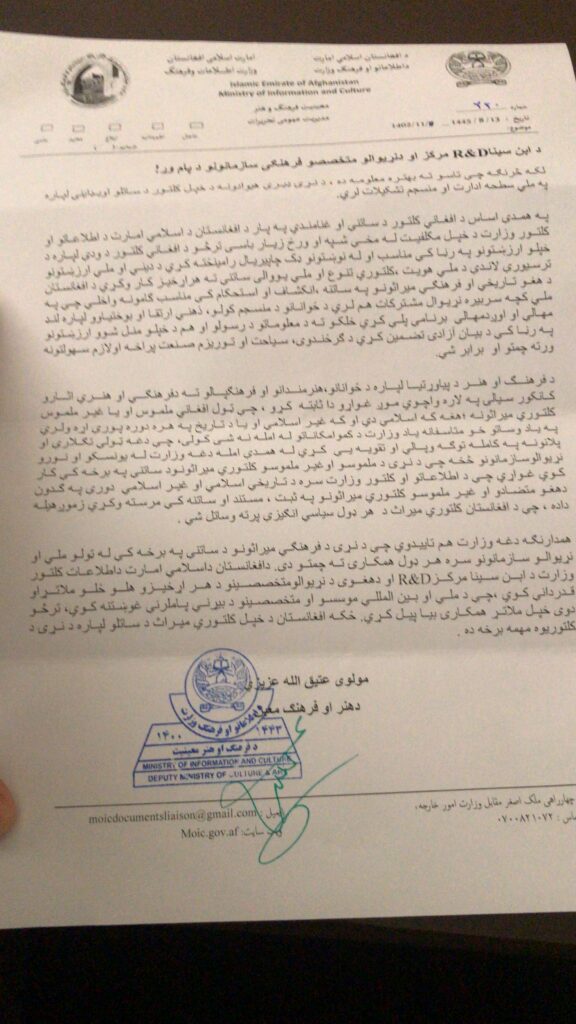
Letter of the minister of Information and Culture
Since Western researchers, based on what happened in the past, wondered about the current Afghan government’s actual policy on the issue of preservation of cultural and historical heritage, the Ibn-e-Sina Research and Development Center questioned the relevant authorities in Kabul.
At the end of January 2024, the Minister of Arts and Culture, in an hand-signed letter, provided them (and the world) with the following response, which completely clarifies the matter.
Transcript below, bold as in the original.
Islamic Emirate of Afghanistan
Ministry of Information and Culture
Letter N° 220, Jan. 31, 2024
To the attention of Ibn-e-Sina R&D Centre, International experts and cultural organizations and to those it concerns:
The ministry of Information and culture of the Emirate of Afghanistan (IEA) has, among others, the following tasks in its portfolio:
–To establish a suitable environment for the growth of genuine Afghan culture;
–To protect national identity, cultural diversity, and national unity;
–To preserve tangible and intangible cultural heritage;
–To support the development of creativities, initiatives and activities of various segments of the society in general and of the Afghan youth in particular;
–To support the freedom of speech;
–Development of tourism industry;
–Introduction and presentation of Afghan culture regionally and internationally, to transform Afghanistan into an important cultural hub and crossroads in the near future.
We would like to confirm that with preservation of tangible and intangible cultural heritage we mean all Afghan cultural heritage belonging to all periods of history, whether it belongs to Islamic or non/pre-Islamic periods of history.
This ministry expresses its concerns that due to insufficient means it is not able to preserve the Afghan cultural heritage sufficiently.
Therefore this ministry asks UNESCO and other international organizations, working on preservation of the world’s tangible and intangible cultural heritage, to support Afghanistan in preservation of its tangible and intangible cultural heritage, including the ones belonging to Islamic and non/pre-Islamic periods of its history. The cultural heritage of Afghanistan does deserve to be preserved without any political motivations.
Besides, this ministry also confirms it is ready for all kind of cooperation with all national and international organizations, working on preservation of world cultural heritage.
The ministry of Information and culture of the Islamic Emirate of Afghanistan (IEA) supports and appreciates all efforts of the Ibn-e-Sina R&D centre and their international experts in appealing for urgent attention of national and international organizations and experts to resume their support and cooperation with Afghanistan to preserve its cultural heritage, an important part of world cultural and historical heritage.
Sincerely,
Mowlavi Atiqullah Azizi
Deputy Minister of Culture and Art
moicdocymentsliaison@gmail.com