Étiquette : Dunhuang Academy
The Light of Dunhuang – Culture and Beauty of the Silk Road
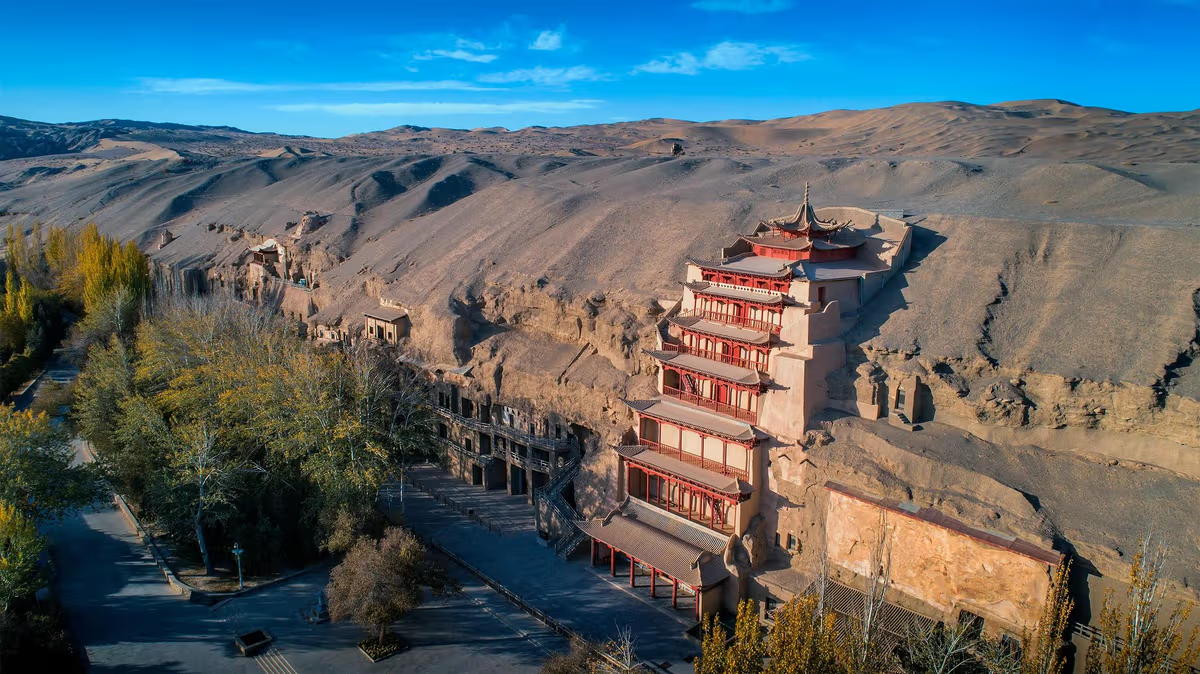
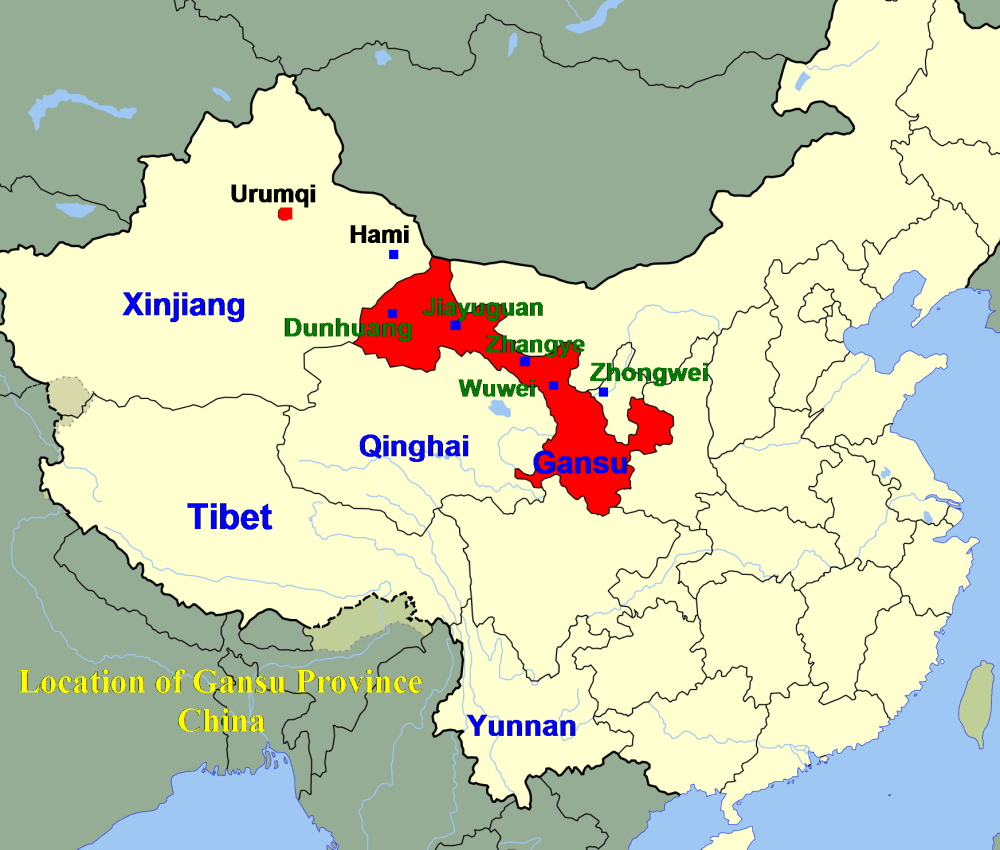
History will remember for a long time the outstanding cultural events that shined early November 2026 in the city of Dunhuang, historically a major hub on the ancient Silk Road in the North-Western Province of Gansu, China.
Dunhuang owes its role to its geography and the relief of its location. The Province of Gansu, about the size of California or 82% of France’s territory, coincides roughly with that of the “Hexi Corridor”, a 40 to 100 km large passage in China over approximately 1,000 kilometers that is dotted with a string of oasis-towns.
Nestled between the inhospitable climates of the Taklamakan desert to the West, the Gobi Desert to the North, and the mountains of the Tibetan Plateau to the south, this corridor, from Lanzhou to Dunhuang, was the only viable overland route from Central Asia into China for over a thousand years.
Dunhuang consequently became a gateway between East and West, and a channel through which many different people, as well as goods, ideas, and technology, traveled.
As the Chinese scholar Ji Xianlin has it,
“There are four major cultural systems in the world featuring long-standing history, a vast territory, a self-contained system and far-reaching influence: China, India, Greece and Islam, and there is no fifth. There is only one place where these four cultural systems merge into one, that is China’s Dunhuang.”
Witness a this 1600 year old heritage are the hundreds of painted devotional Buddhist caves in Mogao, carved out in a cliff of “singing” sand dunes and decorated with hundreds of intriguing frescoes and painted sculptures created over a thousand-year period starting in the 4th century.
Cultural Expo
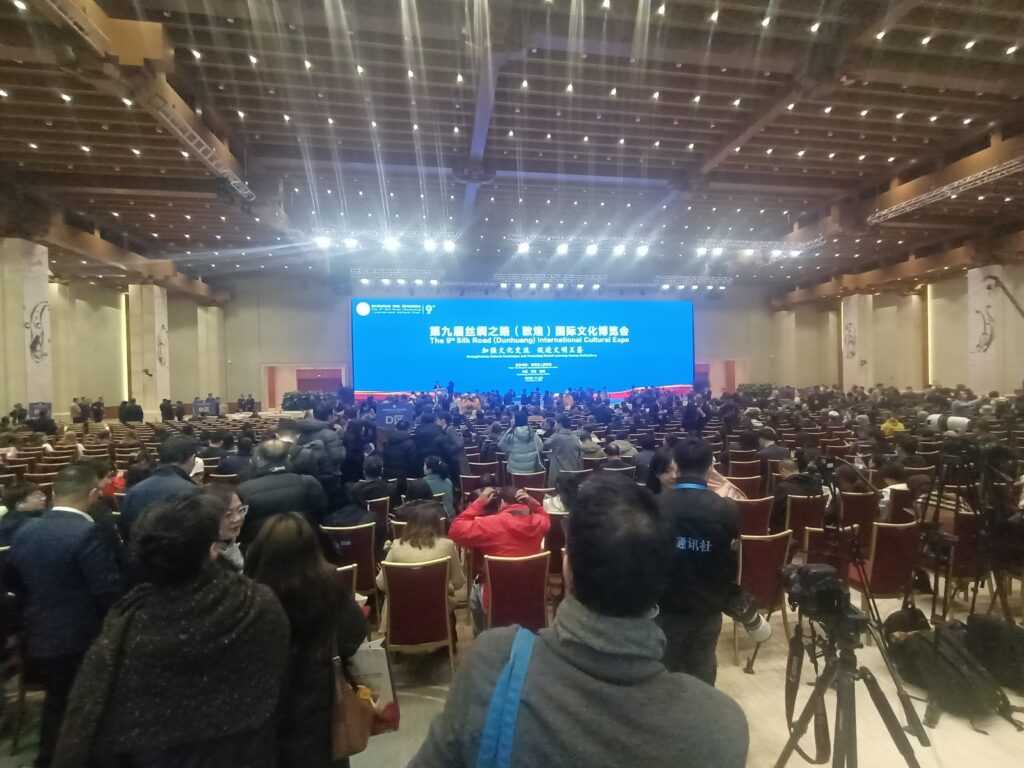
First, from November 2 to 4, took place the “9th Silk Road (Dunhuang) International Cultural Expo” under the theme of « Strengthening Cultural Exchanges and Promoting Mutual Learning Among Civilizations, » hosted by the Gansu Provincial People’s Government.
To foreigners arriving, with the airport and the entire city decorated with festive banners and lampoons, the event nearly appeared as a national holiday. With a total exhibition area of approximately 18,000 square meters, this flagship national-level expo brought together roughly 1,200 delegates, scholars, and officials from 58 countries, regions and organizations, with more than 360 overseas guests in total. Among these where representatives of the Hong Kong and Macao Special Administrative Regions, the Consul General of Malaysia in Xi’an as well as senior representatives from the Asian Infrastructure Investment Bank (AIIB) and the World Bank.
At the opening session on Tuesday morning, several key attendees and high-profile domestic and foreign representatives shortly addressed a giant room packed with over 1,000 people:
- Wu Xiaojun, Secretary of the CPC Gansu Provincial Committee;
- Kong Shaoxun,Governor of Gansu;
- Jiang Hui, Vice Minister of the Publicity Department of the CPC Central Committee;
- Daren Tang, Director General of the World Intellectual Property Organization (WIPO), who addressed the 2026 International Copyright Forum during the expo;
- Shahbaz Khan, Director and Representative of the UNESCO Regional Office for East Asia, who praised China’s leading role on heritage conservation;
- Huot Hak, Cambodia’s Minister of Tourism, emphasizing tourism ties between the Mogao Caves and the Theravada Buddhist site of Angkor Wat;
- Sun Weidong, Secretary-General of the China–Central Asia Mechanism;
In the following days, at the Expo itself, Russian scholar Nadezhda Zamyatina presented urban planning studies in partnership with Tianjin University, while Vietnamese businessman Luong The Vinh showcased regional products as a grassroots exhibitor. American fiddler Kyle Dillingham, who has visited China more than a dozen times, attended the expo with his folk band Horseshoe Road. He said he hoped the event would create new opportunities for people-to-people exchanges between Oklahoma and Gansu, which celebrated the 40th anniversary of their sister-state relationship in 2025.
As China’s premier national-level international cultural exchange event aligned with the Belt and Road Initiative (BRI), the expo was organized under the direct supervision of multiple key government bodies, notably the Ministry of Culture and Tourism of China, the National Radio and Television Administration, the China Council for the Promotion of International Trade, and the local state leadership of the Gansu Provincial People’s Government.
Symposium
Among the sub-forums with international participation was the “International Academic Symposium on Dunhuang Studies,” a high-level scholarly forum convened regularly as part of major international cultural and research gatherings. The Symposium was co-hosted by the Cultural Relics Bureau of the Gansu Province and the “Dunhuang Academy,” a highly respected and very prestigious institution that has been battling for decades to maintain, restore, digitize and research all the various aspects of the Mogao Caves.
Among the 130 scholars, thinkers and experts invited, mostly from China but also from Japan, Germany, the UK, France, Belgium and Afghanistan, a delegation of the Schiller Institute, represented by its founder Helga Zepp-LaRouche and painter-engraver and historian Karel Vereycken from France.
Helga Zepp-LaRouche: Unity in Diversity
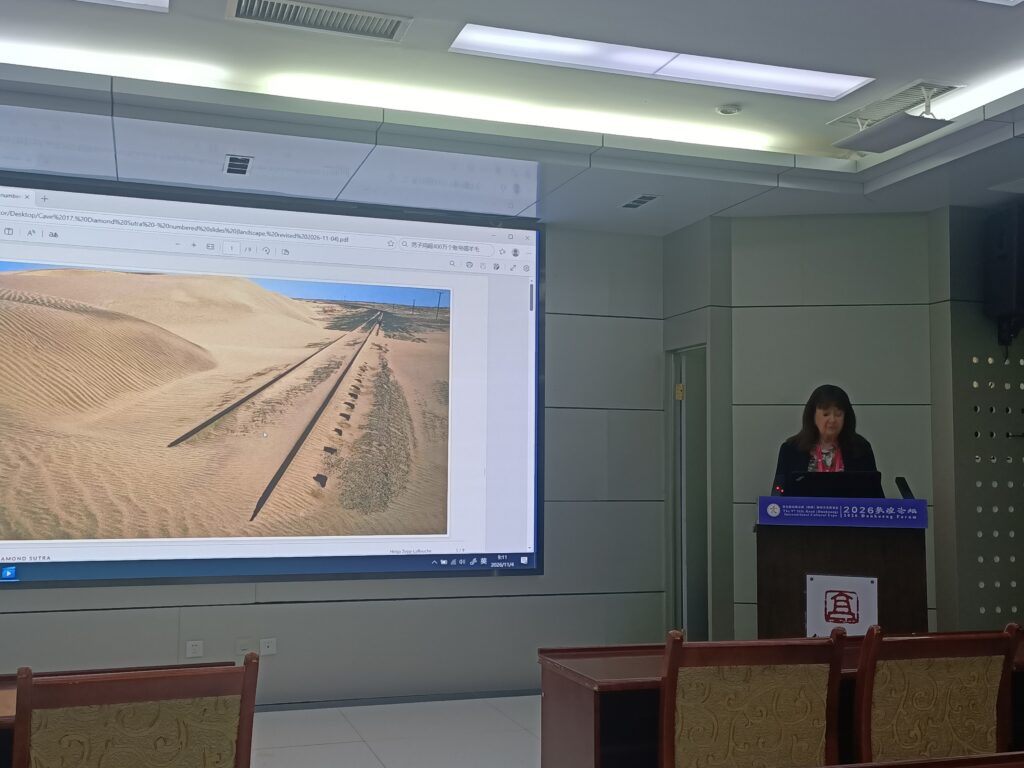
Mrs LaRouche was invited to keynote an important research seminar on the second day. During her intervention, “The Dunhuang Mogao Grottoes: Unity in Diversity” (published in full in the Collected Papers and Abstracts, Volume II, pp. 324-328.), she underscored that the Mogao caves “represent a Rosetta Stone of cultural history.”
In 1900, the Taoist monk Wang Yuanlu discovered behind a wall of Cave 16 a hidden cache, known today as “Cave 17”, that had been sealed for 900 years, with over 50,000 manuscripts, most of them in Chinese but also in dozens of other languages including Tibetan, Sanskrit, Khotanese, Tangut, Kochean (Tokarian B), Mongolian, Uighur, Sogdian, Pakrit and even Hebrew.
“From it, she said, we can gain a scientifically precise conception of the winding paths along which universal history has advanced up to our present. Alongside all diversity and historical specificity, however, we also recognize the universality of the truly great questions that have again and again moved the societies of the various epochs and civilizations.”
From that, she concluded, it “also follows that humanity not only has this common, interconnected past, in which each element occupies, as in a gigantic dynamic puzzle, its necessary place that was decisive for the overall development, but also that these findings help us in the present to understand the cooperation on the New Silk Road as the necessary next step in the evolution of humanity, and above all to understand and welcome President Xi Jinping’s conception of community with a shared future for mankind, as a necessity of universal history.”
Seen the importance of these manuscripts, of which a large number were acquired for a very low price by British and French archaeologists in the years following their discovery, she argued, “it would be time to return the finds back to China as a part of the ‘Major Historical and Cultural Sites Protected at the National Level.’ ”
Karel Vereycken: Dunhang, a “second Gandhara”
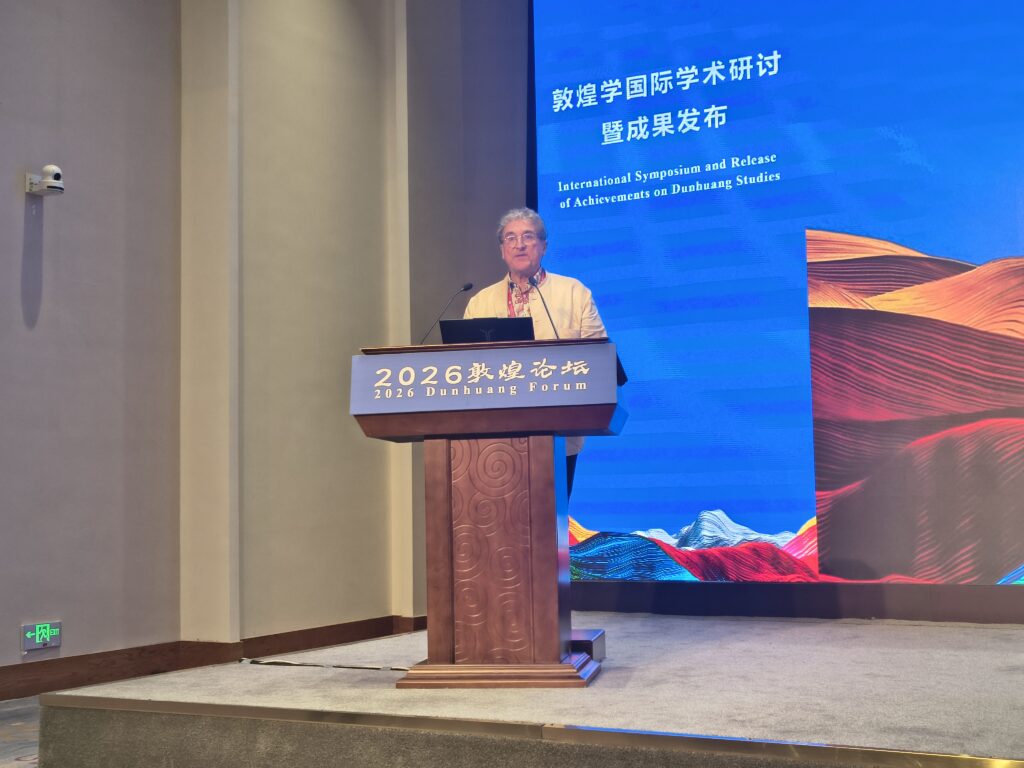
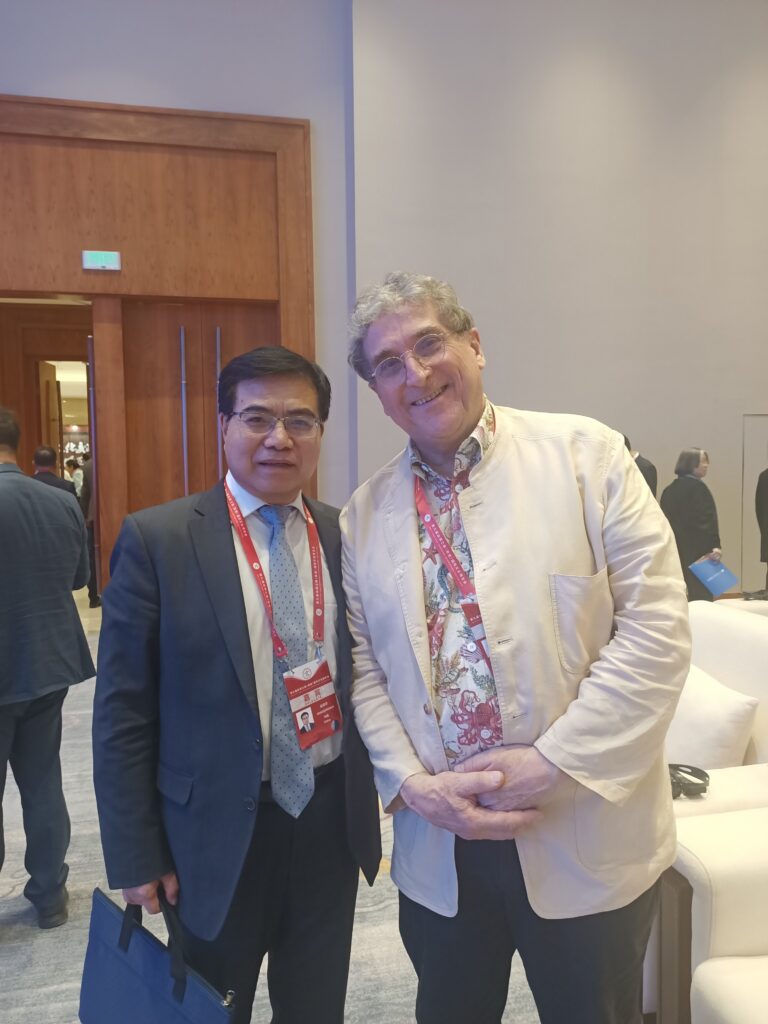
As one of the keynote speakers of the first day, Schiller Institute’s representative Vereycken got offered a seat on the first row on the right hand of Ge Jiantuan, deputy governor of the People’s Government of Gansu Province, who warmly thanked Vereycken for his presence and contribution.
Vereycken’s lecture, titled “From Gandhara to Dunhuang, The Silk Road as a “Living Corridor of World Art” was also selected and published in full in the proceedings (Published in full in the Collected Papers and Abstracts, Vol. II, pp. 149-158).
After a short introduction summarizing the birth and rise of Buddhism during the Mauryan and Kushan Empires, Vereycken, who presented himself as an “archaeologist of ideas,” underscored the importance of the “Miracle of Gandhara” (a region comprising today a large part of Afghanistan and the Western part of Pakistan). While Buddhism was initially an-iconic and symbolic, it
“suddenly morphed into anthropomorphic art taking the shapes of humans using the canons and naturalistic proportions of the classical Greek period.”
Gandhara art not only celebrated Buddha, but also “mass-produced” beautiful sculptures of Bodhisattva, “well intended empathetic humans on the road to Nirvana, but living first their life and totally committed to set others free from suffering,” a key feature of Mahayana Buddhism that emerged precisely during that period. Today, with over 50% of the total, Mahayana Buddhism, while it went through many transformations, remains the largest branch of Buddhism, practiced widely in China, Japan, South Korea, Taiwan, Singapore, and Vietnam.
And from Gandhara, “Buddhist Art with Greek characteristics” spread to Central Asian Oasis Cities like Khotan before reaching the Chinese Oasis city of Dunhuang and spreading over China and beyond.
Several aspects reveal that Gandharan inspiration in the Mogao frescoes:
- Most early caves use the lapis lazuli blue pigments exclusively originating from Afghanistan.
- Cave 275 (4th century) shows a Buddha Maitreya seated with legs crossed and surrounded by two lions, a clear imitation of Kushan iconography.
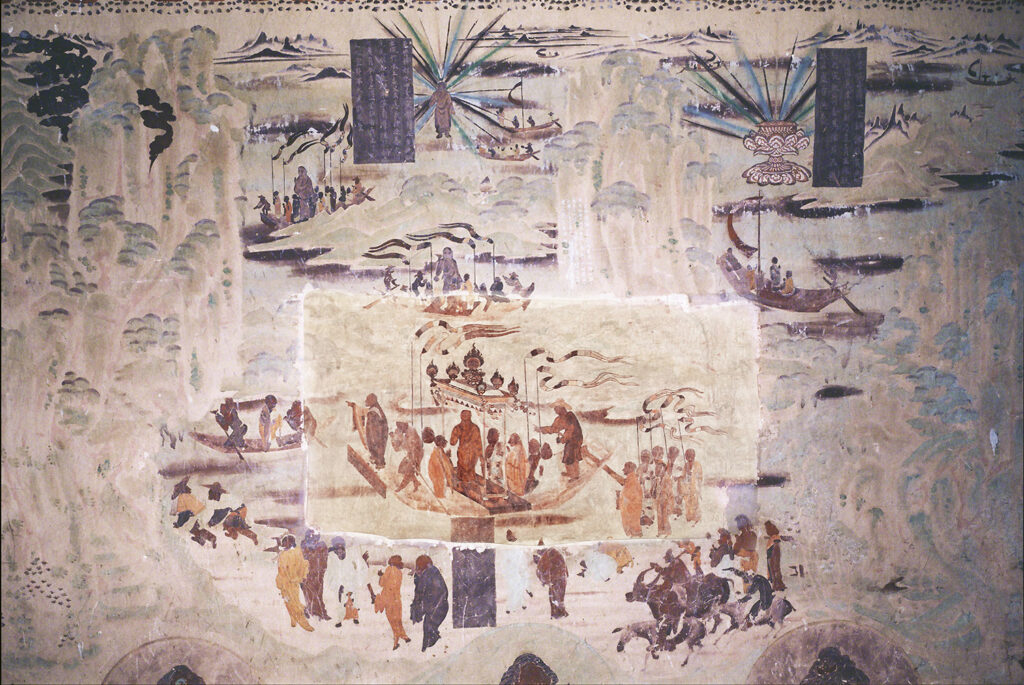
- The North wall of cave 323 (7th century), visualizes a (mythological) narrative cycle taken from the Collected Record of Miracles Relating to the Three Jewels in China, a 7th-century collection of Buddhist miracle tales compiled by the prominent Tang dynasty scholar-monk Daoxuan in 664 AD. It depicts Emperor Wu (156–87 BC) of the Western Han Dynasty discovering two large gold statues he acquired after a war with the Huns. In order to find out what they represented, Wu sent his best diplomat Zhang Qian (d. 113 BC) to the Western region and Central Asia to find out. On the left upper corner of the fresco, we see Zhang on route to a walled city with at its center a Buddhist temple (stupa).
The accompanying cartouche identifies the city as Da Xia (the kingdom of Bactria, today’s northern Afghanistan). It is there that Zhang discovers that the two “golden men” were statues of the Buddha. Once back home, Zhang told Wu that the Han Empire could prosper greatly by initiating trade relations with the rich Central Asian kingdoms he had visited. And in effect, while some trade relations existed way earlier, it was the Han Dynasty that initiated the Silk Road, a policy that reached its peak during the Tang Dynasty. The fresco’s representation of groups of people interchanging with each shows perspectives and landscapes, nearly as expressive as some of Bruegel’s paintings in the 16th century!
Finally Vereycken also presented the interesting hypothesis presented in 2019 by professor Osmund Bopearchchi, who drew parallels between certain fresco’s of Mogao and the famous “Laocoon Group”, a Greek statue discussed by the German art critic Gotthold Ephraim Lessing showing an agonizing Trojan priest trying to save his children from snakes sent by Zeus to punish their father from disobeying him.
Manuscripts and Books
The Mogao caves and Dunhuang itself truly appear as a “Treasure Trove” witnessing the “Living Silk Road of world art”.
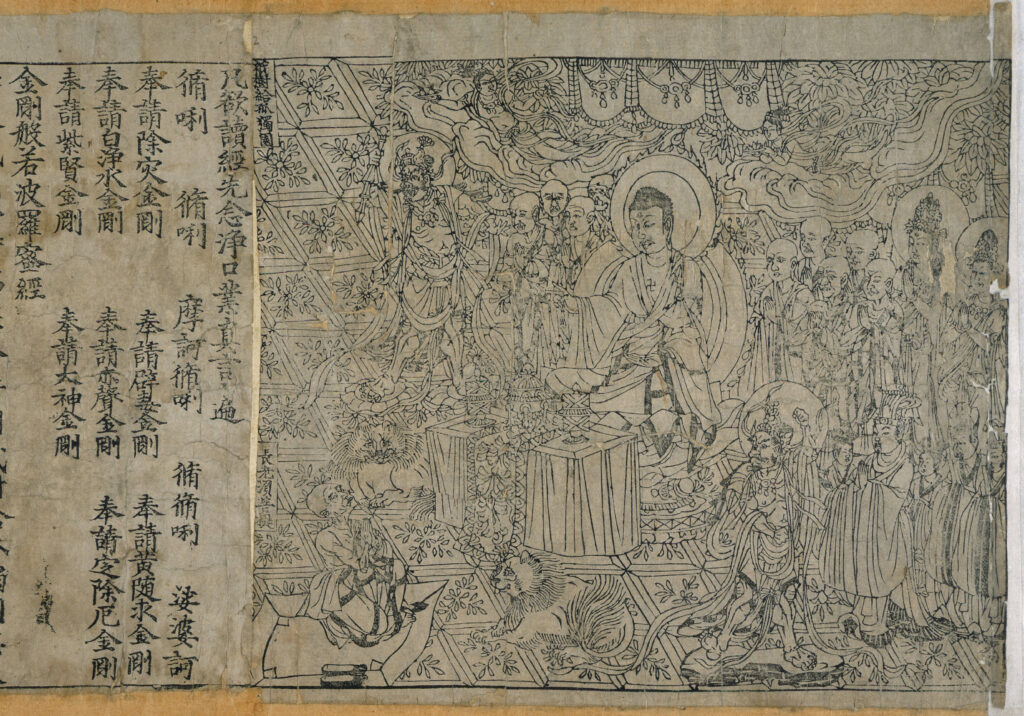
Among the marvels discovered in the “Library Cave”, the most remarkable is the “Diamond Sutra”, a 5 meter long horizontal scroll made of seven sheets of yellow-dyed paper, featuring a woodblock printed text and ornate frontispiece. Printed on May 11, 868 AD, it is the world earliest known complete printed book !
The incredible linguistic diversity revealed by the manuscripts, stated Vereycken,
“testifies to centuries of translation efforts and intercultural dialogue. Besides Confucian and Taoist temples, the Tang capital Chang’an (today’s Xi’an) and the major ports, were open to foreign devotional practices, be it christian Nestorians, Muslims or Manicheists and Zoroastrians. That was also the case in Dunhuang.”
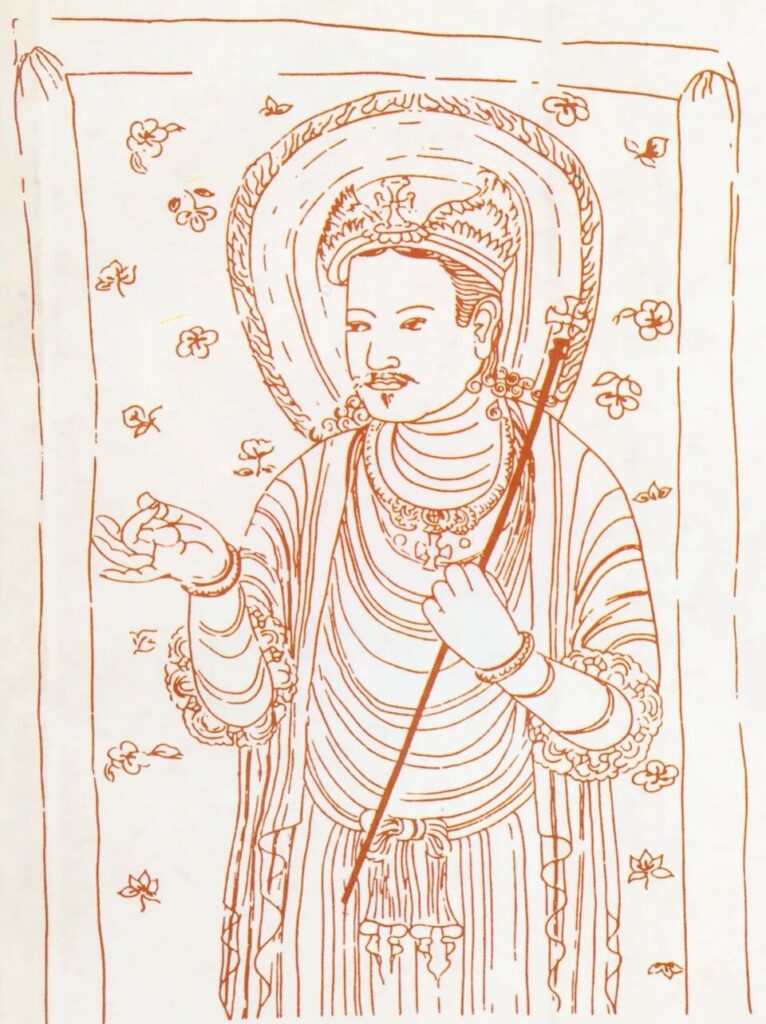
A Bodhisattva painted on silk, found in the Library Cave, is depicted with two Nestorian (christian) crosses, indicating the existence of a christian community in Dunhuang.
Another major find, the “Dunhuang Star Atlas”, with over 1,300 stars described, stands out as the earliest known graphical depiction of the night sky in ancient Chinese astronomy dating to the Tang dynasty (618–907).
“Here in Dunhuang,” Vereycken concluded, “we Mankind, inspired by the accomplishments of Gandhara art and other contributions from the Silk Road, as a “living corridor”, explored a little further the creative essence of humanity, after all the real mission of Art ! Many aspects of this cultural cross-fertilization are now duly documented. The cautious underground mining of the copper reserve and the excavation and preservation of the Buddhist monasteries of Mes Anyak in Afghanistan, we hope, will undoubtedly bring even more treasures of cultural finds for all. Let us work together to make this cultural beauty known to the world.”
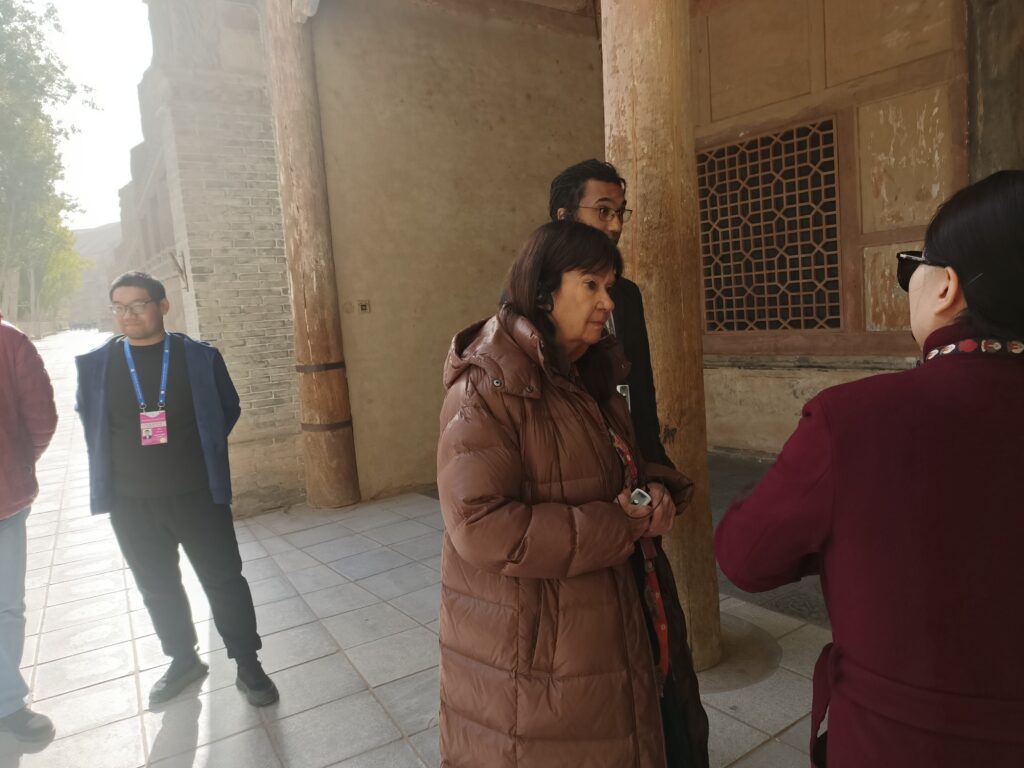
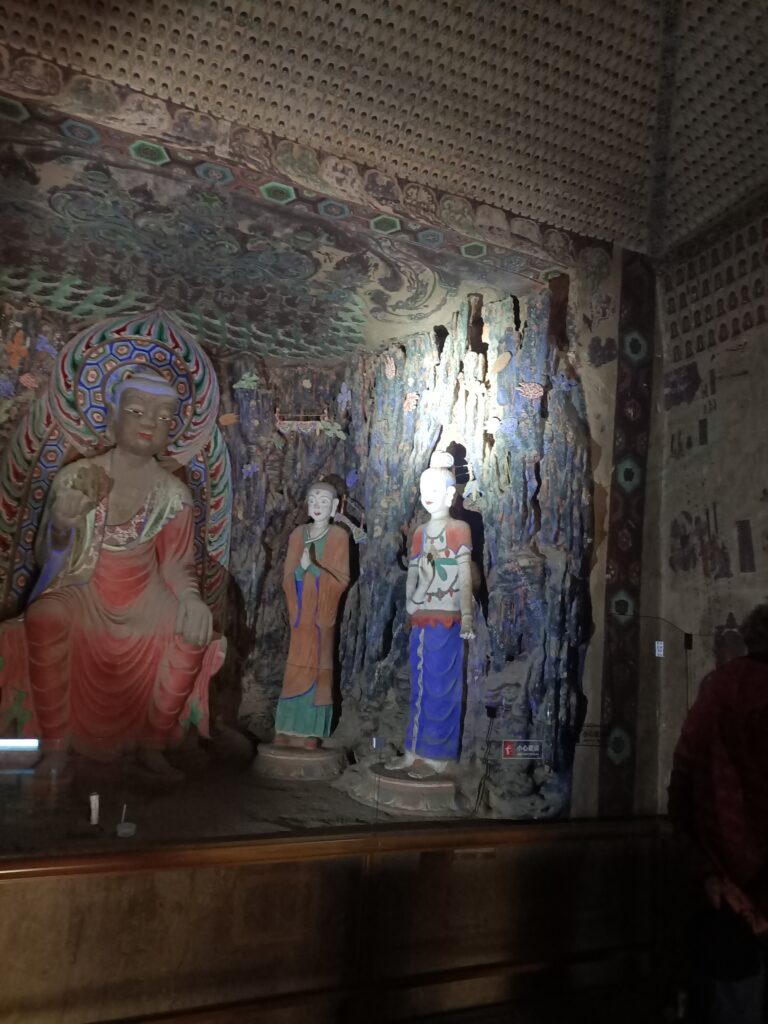
To conclude the Symposium, in the late afternoon of Nov. 4, together with other speakers, Helga Zepp-LaRouche and Karel Vereycken were offered a private guided tour of the Mogao Caves. Preservation conditions obliges the Museum to limit the number of visitors and the number of caves per day.
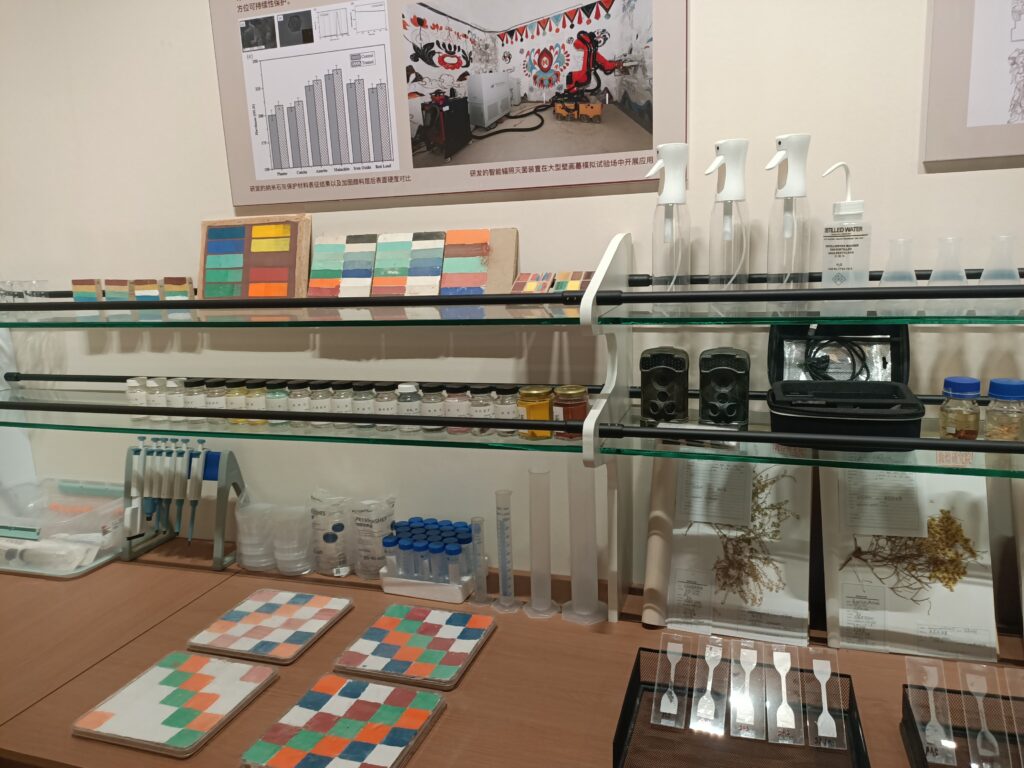
But to get a better picture, a special museum near the site offers visitors, in the form of a virtual reconstruction and physical reconstruction of several caves, to get a better view, both of the caves and their decorations and also the advanced technological methods developed by the Dunhuang Academy to preserve them, be it the frescoes, the statues or the manuscripts.
All of this historical, cultural, scientific and human expertise is ready and waiting to be called on to serve similar undertakings in other countries willing to accept the open hand of China.
French Scholar:
Dunhuang’s Culture and Beauty Help Build a Better World
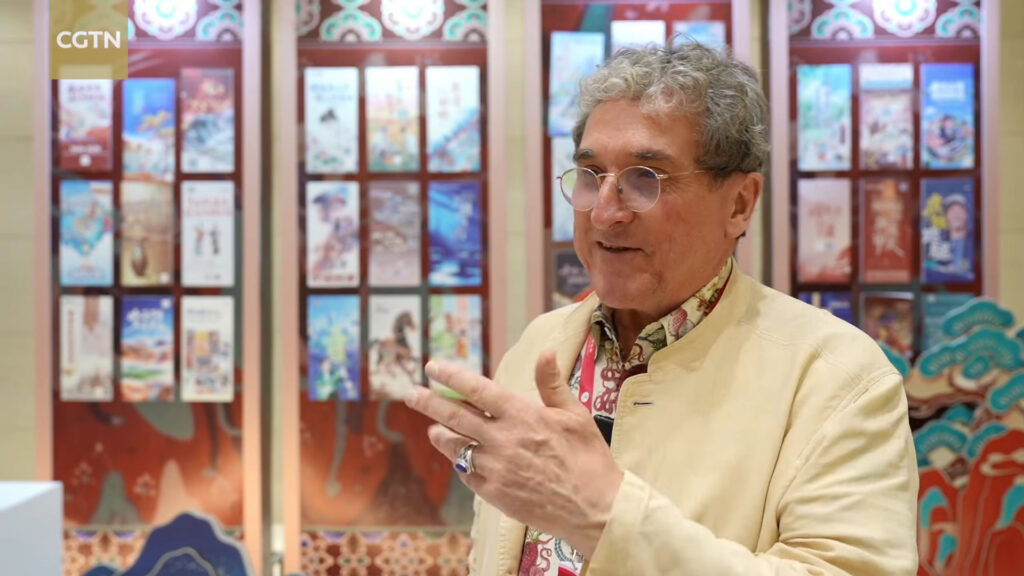
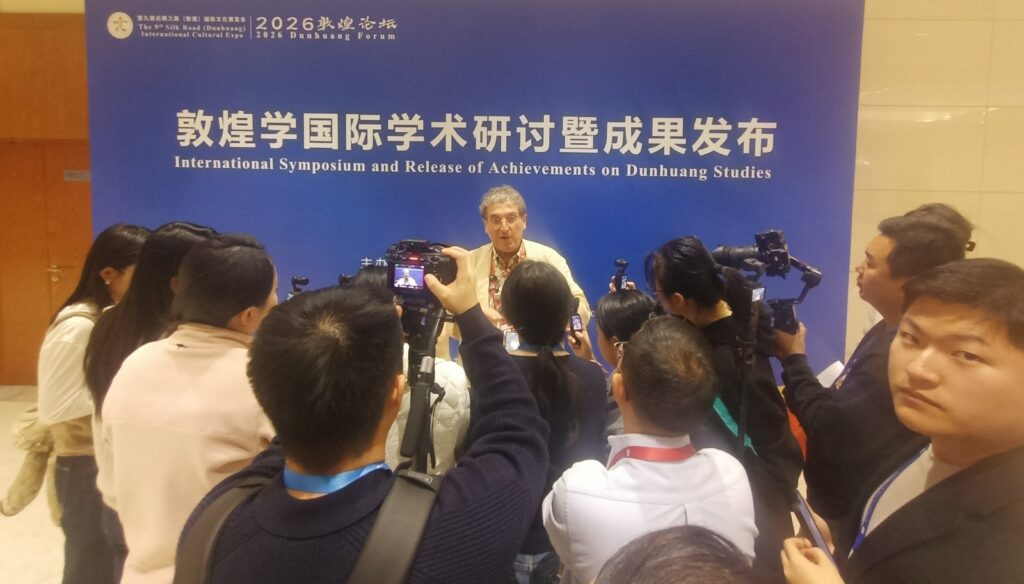
Before as well as after his intervention, Vereycken was overwhelmed by young journalists eager to have a view from abroad on the event. Several Chinese English language media (Hainan Touch, China in Lens, CGTN, CCTV, etc.) prominently aired the Schiller Institute’s delegate statements on the universal importance of Dunhuang and its inspiration.
HAINAN TOUCH
https://www.facebook.com/reel/1092312987200904
CHINA IN LENS:
https://www.youtube.com/shorts/geXSBfivdTU
CCTV,
https://english.cctv.com/2026/11/04/VIDEip5jLovp52OvRR5KIE7R261104.shtml
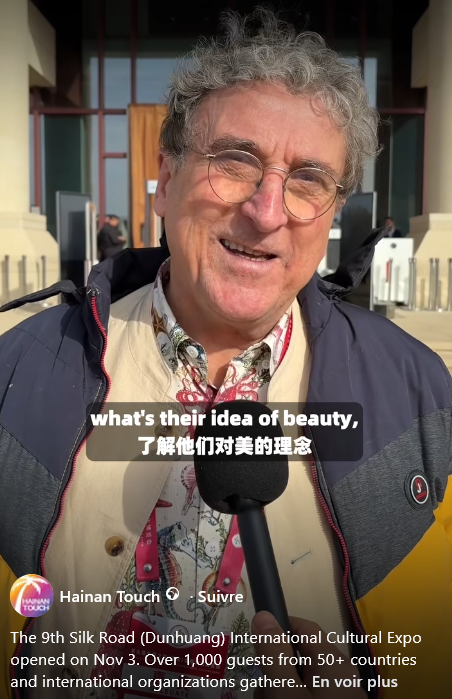
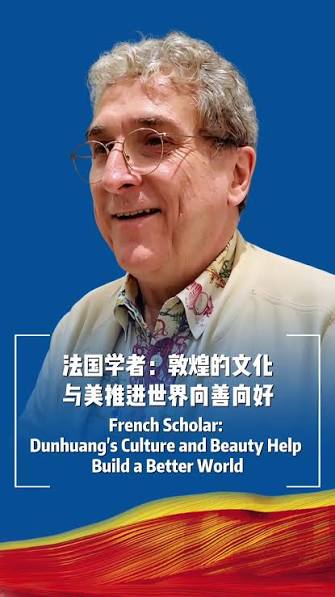
Transcription of Nov. 4 short clip of CCTV:
Vereycken: “You have 1,000 years of international cooperation here in Dunhuang through the grottoes. It can really wake up the people and maybe avoid even a World War, you know. Because right now, the leading powers, they want to divide and rule. They tell the Americans the Chinese are the devil. The divide people. First the division starts in the mind. And culture and beauty is the only thing which can unify, which goes to the essence of human beings. I’m myself a painter, an engraver and an historian. I always say I’m an archaeologist of ideas. I look to the history of ideas and how they transform the world for the better. And that’s the message.”
Gandhara to Dunhuang, the Silk Road as a « Living Corridor » of World Art
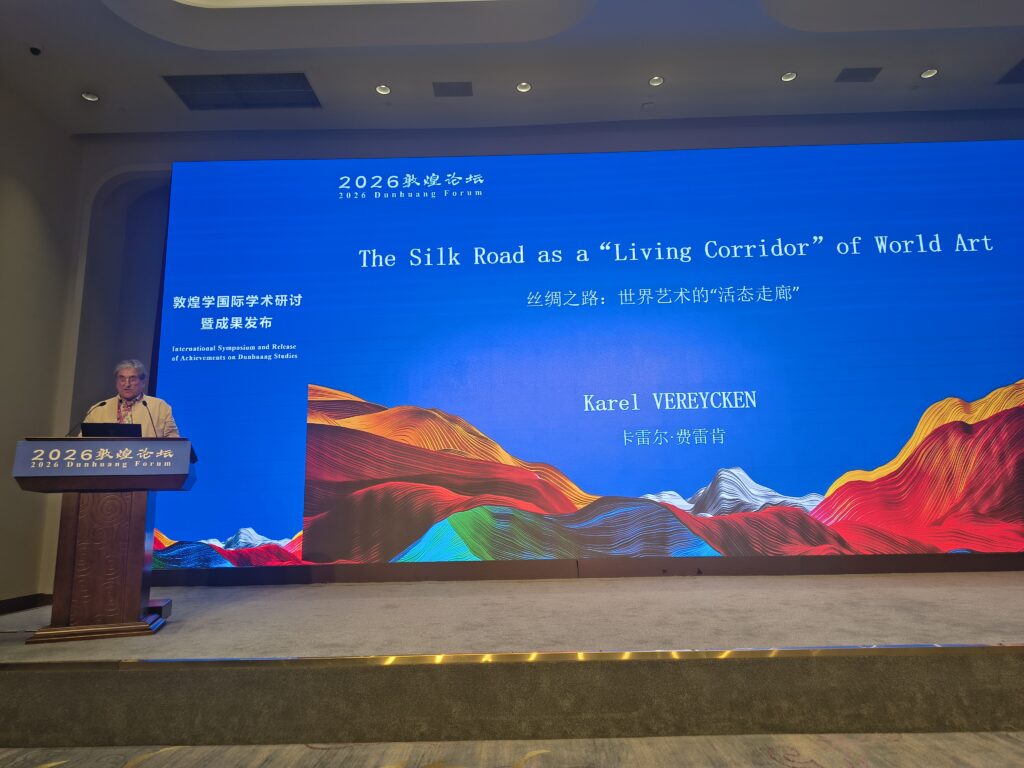

On Tuesday Nov. 3, 2026, painter-engraver and historian Karel Vereycken, as an independant scholar and contributor to the International Schiller Institute, delivered a lecture (text of the integral version below) at the International Academic Symposium “Dunhuang Studies Research in the New Era. »
The symposium, organized by the Dunhang Academy, was organized in the framework of the « 2026 Dunhuang Forum », in the ancient city of Dunhuang in the Gansu Province of China.
The next day, Nov. 4, Helga Zepp-LaRouche, the founder and president of the international Schiller Institute, keynoted another session with her speech « The Dunhuang Mogao Grottoes, Unity in Diversity. »
(A brief report on the event can be found with this LINK.)
The Dunhuang Academy is a highly-esteemed and prestigious institution that has worked hard for decades to preserve the cultural heritage of the « Mogao Caves » close to Dunhuang, a major stop on the ancient Silk Roads and a unique testimony of over a thousand years of dialogue and cooperation.
As one can see by the Conference program, the symposium brought together, besides very high level Chinese dignataries, over 130 scholars, archaelogists, authors and experts (mainly from China, but also from Japan, Russia, Germany and France) who presented their latest research on all possible facets of this outstanding and unique cultural heritage and the latest exploration techniques to explore it.
From Gandhara to Dunhuang,
the Silk Road as a « Living Corridor »
of World Art
By Karel Vereycken, independant scholar, Schiller Institute.
Lecture given on Nov. 3, 2026 at the International Academic Symposium “Dunhuang Studies Research in the New Era” of the 2026 Dunhuang Forum,
Mogao Caves, Dunhuang, China.
Dear organizers, dear colleagues, excellencies,
First, I want to thank you again for this invitation. It is a great honor for me to assist at this high-level event and to be able to share my views on the past, present and future of culture of the Silk Roads.
Most of us actually traveled over parts of these roads to arrive here in Dunhuang, a city that really needs to be honored and recognized as a milestone on the road to the utmost best of what humanity can accomplish when it acts according to its own nature, that of loving each other, celebrate human genius and creativity, and building a common future.
Archaeology is not merely about rediscovering the past in the present. Archaeology also allows us, mankind, to discover “the long shadows” of the future.
However, I’m not a professional archaeologist. I’m only a painter engraver and independent scholar active with the International Schiller Institute. My research concentrates on what one might call the “archaeology of ideas”, that is how ideas and concepts, in the domain of art in particular, travel over time and distance. And that’s where Dunhuang really captured my interest.
The birth and expansion of Buddhism
Of course, those present here know the history of Buddhism and Dunhuang in far greater detail than I can dream achieving. They should pardon me for the rough sketch I present now of that history, but for people living in different continents and from different cultures, I think they will be grateful for this short historical introduction.
I’ll make it short. Buddhism emerged during the 6th to 5th century BCE in the eastern Gangetic plain, near modern-day Nepal. Siddhartha Gautama, known as the Buddha (the « Awakened One »), founded a movement that stood for religious self-perfection and social change. Born a prince, he left his luxurious life to seek an end to human suffering, mostly through introspection. His teaching spread across Asia by three means:
- dedicated and inspiring followers,
- royal and private patronage and
- the trade networks of what has been called in the XIXth century, the “Silk Road.”
Maurya Empire (c. 321 BCE – 185 BCE)
The first breakthrough came about 200 years after the death of Buddha with the founding of the Maurya Empire (c. 321 BCE – 185 BCE).
In 321 BC, Chandragupta Maurya, with help from his clever advisor and Prime Minister Chanakya, founded a vast and powerful kingdom that united most of the Indian subcontinent after Alexander the Great left the region. The kingdom stretched from present day Afghanistan to the present day of Bangladesh, its capital was Pali Putra (present day Patna in the Northeast of India), and it lasted till 185 BC.
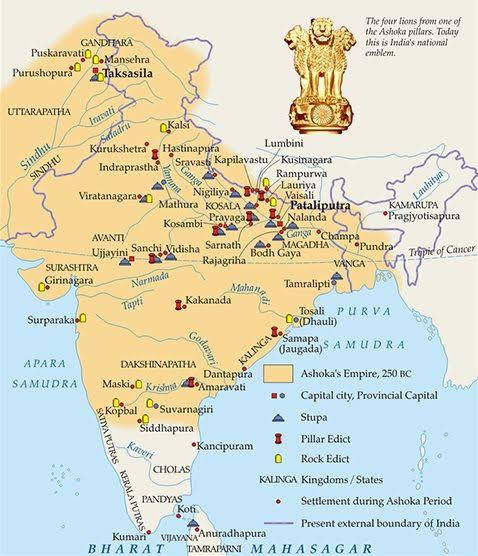
Founded in the 5th century BC, the University of Taxila (today’s Punjab) was a famed seat of Sanskrit and Vedic learning.
Then arrived the nearly forgotten king Ashoka the Great (ruled from 268 BC till 232 BC), the grandson of Maurya, who became the third ruler of the kingdom.
After having conducted unjust and cruel wars, Ashoka got gradually drawn towards peaceful Buddhism. After his conversion, Buddhism gained recognition, strength and go global.
Ashoka made several edicts that were engraved in pillars and rocks installed all over the territory of the kingdom. The edicts were written in the main languages used by the population groups of the kingdom: Greek (Ionian), Aramean and Prakrit. The edicts called for non-violence, respect for all forms of life, moderation and compassion.
Ashoka promoted Buddhism on a scale unseen till then. He ordered and financed the construction of 84,000 Buddhist temples (stupa) for Buddhist devotional practice. And following the Third Buddhist Council (ca 250 BC) that he patronized, Ashoka sent emissaries to spread Buddhist teachings abroad.
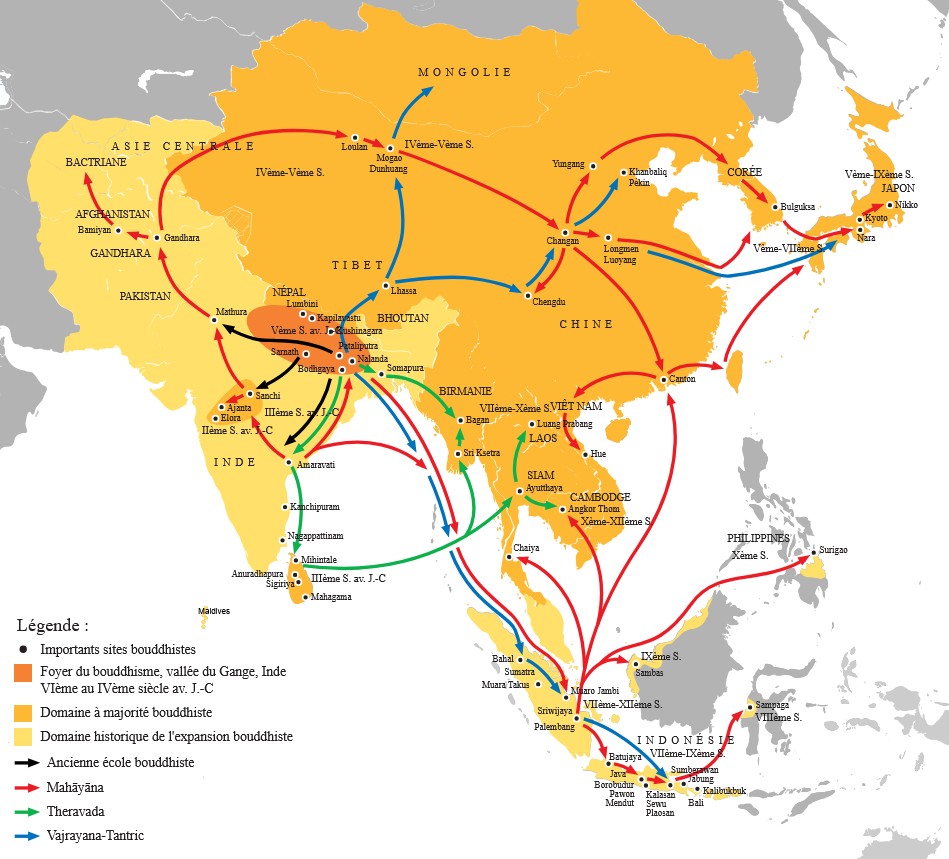
Well known is the fact that he sent his son Mahinda to Sri Lanka, making it the first region outside India to officially adopt Buddhism. From there and along the Indian maritime trade routes, this southern expansion established Theravada Buddhism (“The doctrine of the Elders”) as the dominant tradition in mainland Southeast Asia.
Over centuries, kingdoms in modern-day Myanmar, Thailand, Cambodia and Laos embraced Theravada Buddhism, deeply integrating it into their governance and cultural identities.
Kushan Empire (1st century BCE – 3rd century CE)
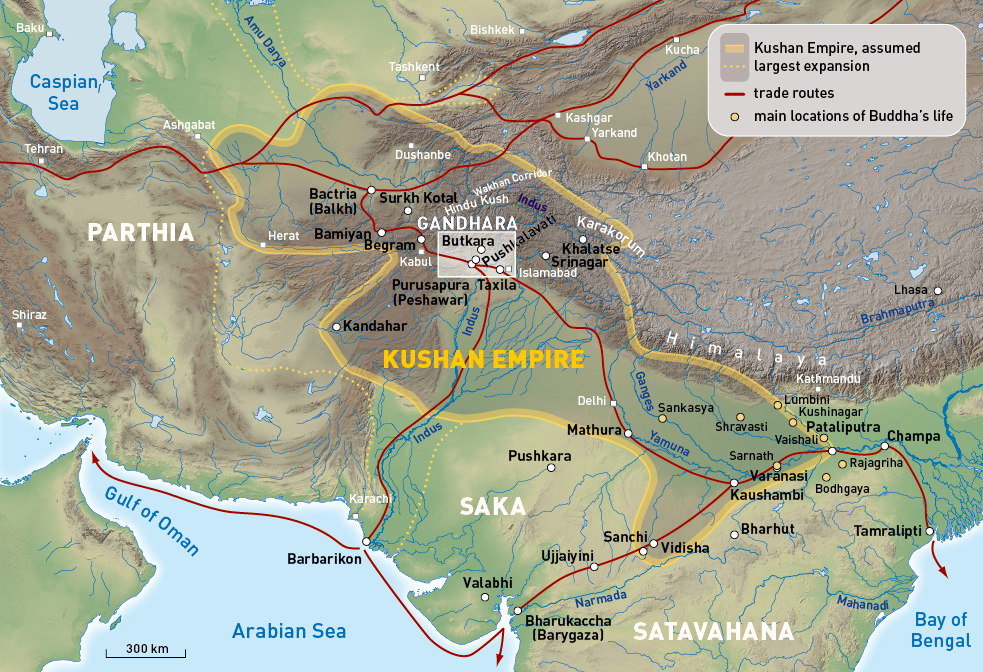
Another group of emissaries traveled to central Asia and developed another interpretation of the teachings of Buddha, Mahayana Buddhism (“The Great Vehicle” in Sanskrit). It really bloomed during the Kushan Empire (1st century BCE – 3rd century CE), an empire founded most probably by elements of the Chinese Yuezhi confederation in the early 1st century CE.
The founder of the dynasty, Kujula Kadphises, followed Iranian and Greek cultural ideas and iconography. Greek (Ionian) was the administrative language.
Initially based in the Bactrian territories, it spread to encompass much of what is now Afghanistan, India, Pakistan, Tajikistan, Turkmenistan and Uzbekistan. Kushan territory in India extended at least as far as Saketa and Sarnath near Varanasi (today’s Benares, India), where inscriptions confirm this reality.
The Kushan dynasty had diplomatic contacts with the Roman Empire, Sassanian Persia, the Aksumite Empire (Ethiopia and the Horn of Africa), and the Han dynasty of China (206 BC –220 AD). It was at the center of trade relations between the Roman Empire and China: according to Alain Daniélou, “for a time, the Kushana Empire was the center point of the major civilizations”.
While much philosophy, art, and science were created within its borders, the only textual record of the empire’s history today comes from inscriptions and accounts in other languages, particularly Chinese.
In 127 A.D., his successor Kanishka the Great, replaced Ionian with Bactrian as official language. His rule ushered in a period of relative peace for 200 years, described as “Pax Kushana.”
The “miracle of Gandhara”
From Gandhara, the cultural and intellectual point of gravity of the Kushan Empire, Kanishka started promoting Buddhism through learning, art and literature.
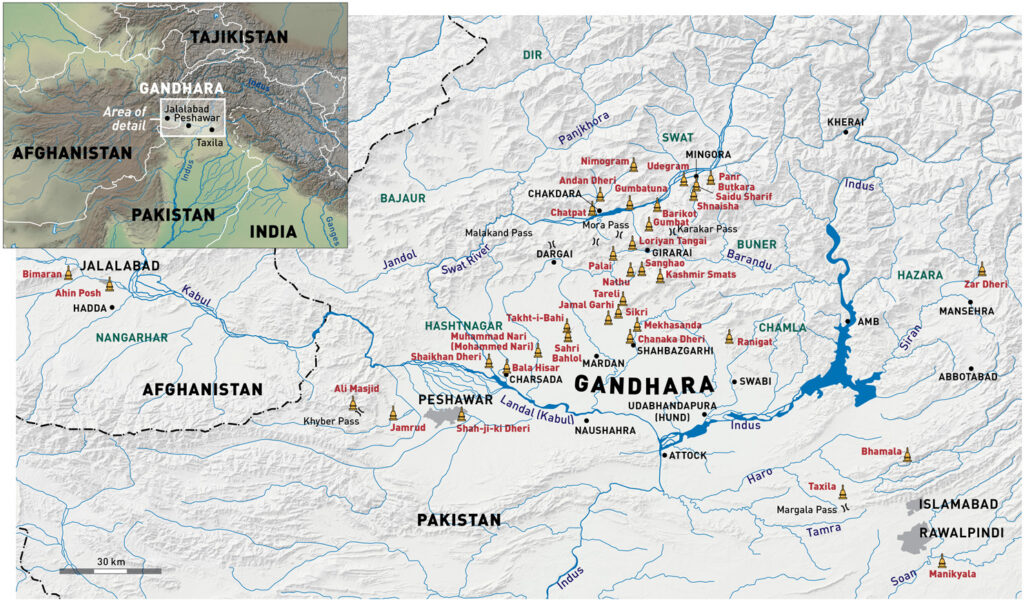
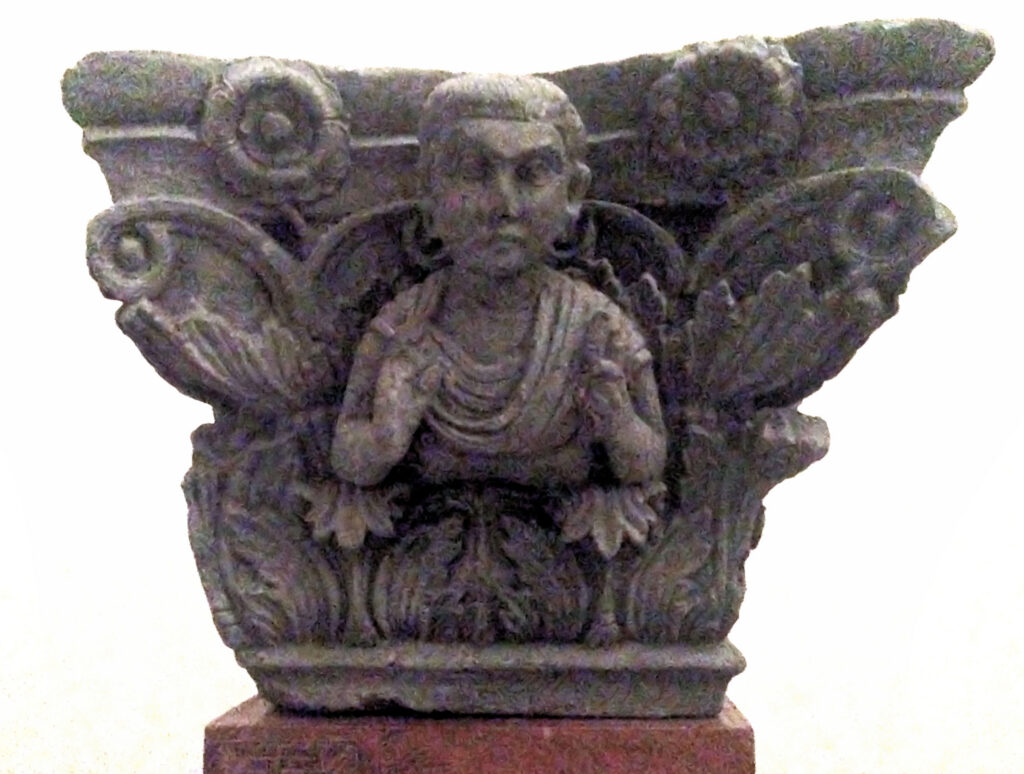
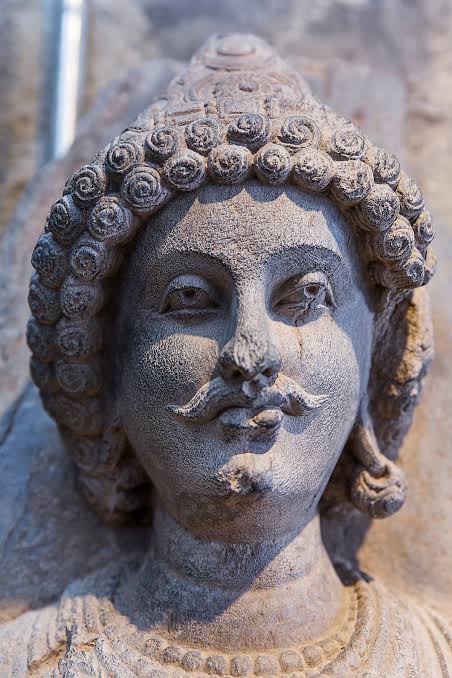
It was under Kanishka that the “miracle of Gandhara” occurred. Buddhist devotional art, which for four centuries was exclusively symbolic and an-iconic, suddenly morphed into anthropomorphic art taking the shapes of humans and using the canons and naturalistic proportions of the classical Greek period.
With human figuration Buddhism now reached out to the heart and the imagination of the common man. Buddha, after all, was not a god, but a human person that was deified for his exceptional qualities. For an ordinary person, attaining nirvana as Buddha did, was an exceptional achievement.
But Gandhara art also celebrated and mass-produced magnificent sculptures of bodhisattvas, well-intentioned human beings already on the path to nirvana, but first living their own lives and entirely devoted to liberating other humans from suffering. What is celebrated by representing them, therefore, is empathy and compassion.
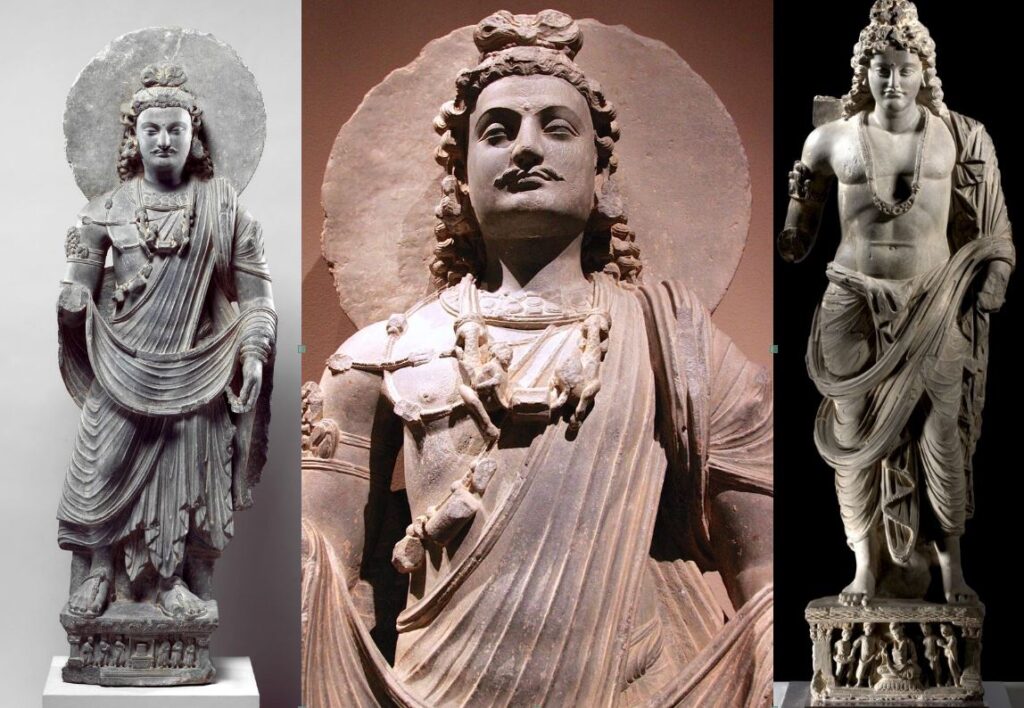
A direct road from Gandhara to China remained under Kushan control for more than a century, encouraged travel across the Karakoram (the second-highest mountain range on Earth), and facilitated the spread of Mahayana Buddhism to China.
To be noted is the fact that Gandhara developed its own language: Gandhari, which became a lingua franca along the Silk Road and a major source language for the earliest Chinese translation of Buddhist sutras during the Han dynasty.
From Gandhara, Buddhism spread eastward into oasis cities like Khotan and Dunhuang and deeper into China during the Han Dynasty. In turn, China transmitted its Mahayana traditions northeast. Korean kingdoms adopted Buddhism in the 4th century, and Korean monks subsequently introduced it to the Japanese imperial court in the 6th century.
Gandhara art also traveled to Dunhuang, China, along the land routes of the ancient Silk Road, carried by traveling monks, merchants, and diplomatic envoys between the 2nd and 7th centuries.
Buddhist monasteries and nunneries on the Silk Road, financed by both the king and the merchants, were more than religious sites and favored an environment of economic well-being. Besides prayer rooms, they offered housing facilities, protection against bandits, education for children and artisans, medical care and even financial facilities. As the archaeological site of Mes Anyak (today’s Afghanistan) suggests, some Buddhist monasteries also engaged in mining and metallurgic industries.
Art and religious objects moved alongside commercial goods across the Kushan Empire and Central Asian oases. Dedicated Buddhist merchants, pilgrims, monks and nuns walked these dangerous desert routes to collect Sanskrit scriptures, bringing along visual iconography and sacred statues. They passed through key hubs like Bamiyan and Mes Anyak in Afghanistan and the Kizil Caves in Kucha (Xinjiang) before reaching Dunhuang. Small portable items—such as gilded bronze figurines, drawings, painted banners, and illuminated manuscripts—served as visual templates that easily fit inside merchant packs.
Dunhuang, as a “second” Gandhara
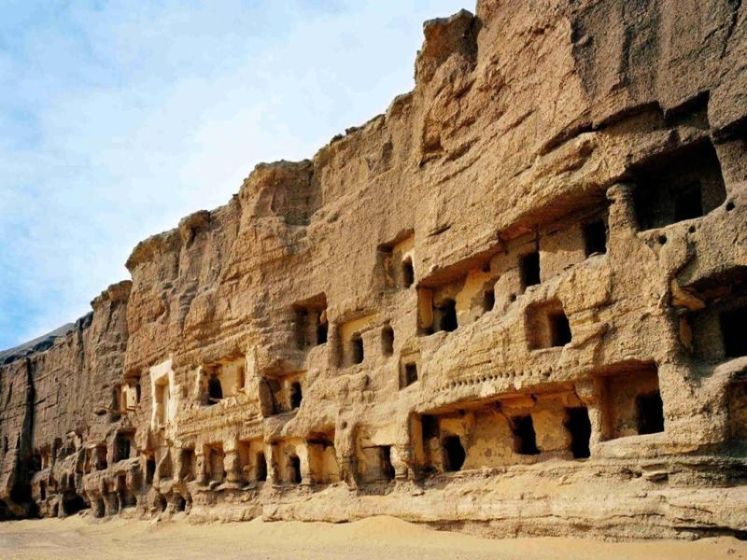
When the art of realistic drapery and naturalistic human anatomy reached the Mogao Caves in Dunhuang, local and foreign artists reinterpreted them. It is over-simplistic to just say the Dunhuang painting school was “influenced” by Gandhara art merely copied what arrived from outside.
In Dunhuang, there are 735 recorded caves of which 492 feature preserved murals and painted sculptures. They survived as repositories of a very precious artistic heritage. Approximately 25,000 square meters of wall paintings and more than 3,000 painted sculptures make of this site, not only one of the largest but one of the most valuable sites of Buddhist art.
Between 400 AD and 1400 AD, Dunhuang brought together many talents in a single melting pot culture. One might want to call it a “second Gandhara”. Just as in Gandhara, as a result of a friendly dialogue, mutual understanding and admiration grew between foreign (Hellenic, Persian, Indian, etc.) and Chinese traditional culture, a new form of art saw the light in Dunhuang.
Architecture
First, Gandharan monastic complexes feature small, plain cells (viharas) for residential monks surrounding a central courtyard. The northern section of the Mogao Grottoes, mirrors this setup perfectly, hosting over 200 plain, bare-walled caves that strictly functioned as living quarters, meditation cells, and work spaces for the site’s traveling artisans.
In Gandhara, monks prayed in chaityas—apsidal, vaulted rock-cut halls built around a freestanding burial mound (stupa) for circumambulation.
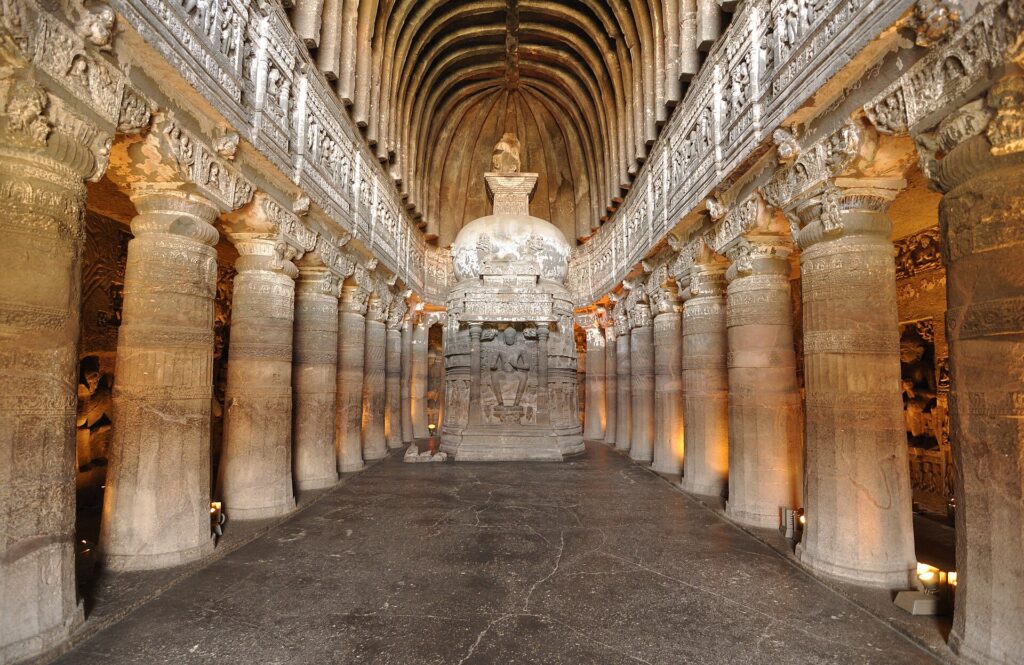
When this design reached Dunhuang, Chinese builders adapted it into “Central Pillar” Caves (e.g., Cave 254). Instead of a round stupa, they carved a solid, square rock column stretching from floor to ceiling, decorating its sides with niches containing painted statues.
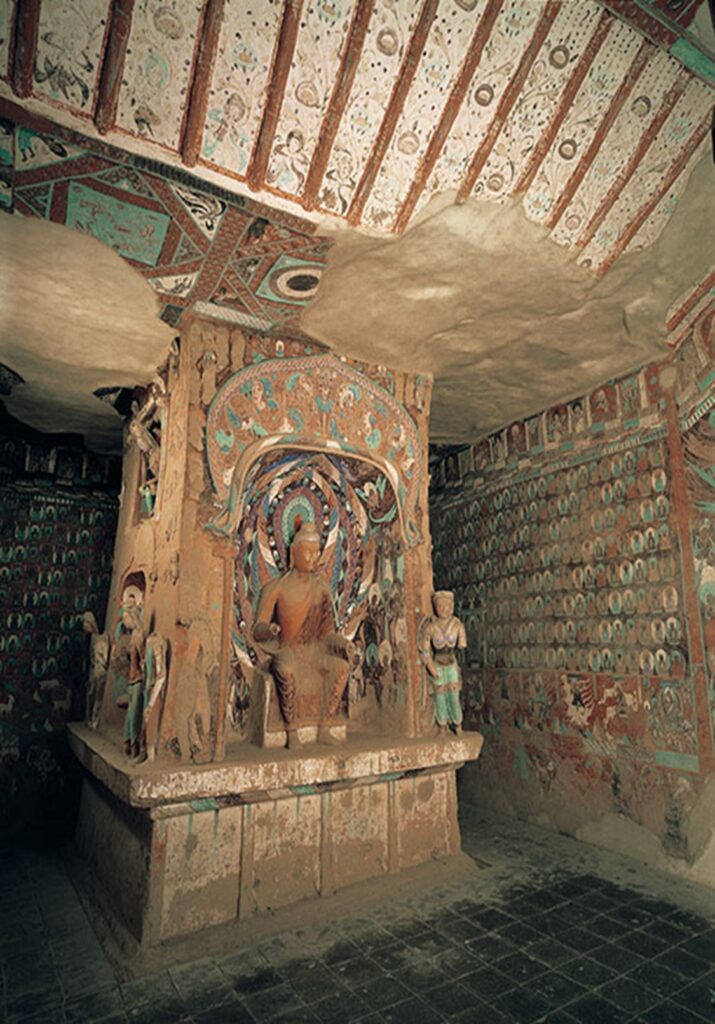
Painting and sculpture: cave 275 versus Cave 45
To understand how Gandharan visual art evolved, there is no better way than to look directly at the contrast between Cave 275 and Cave 45, separated in time by three centuries.
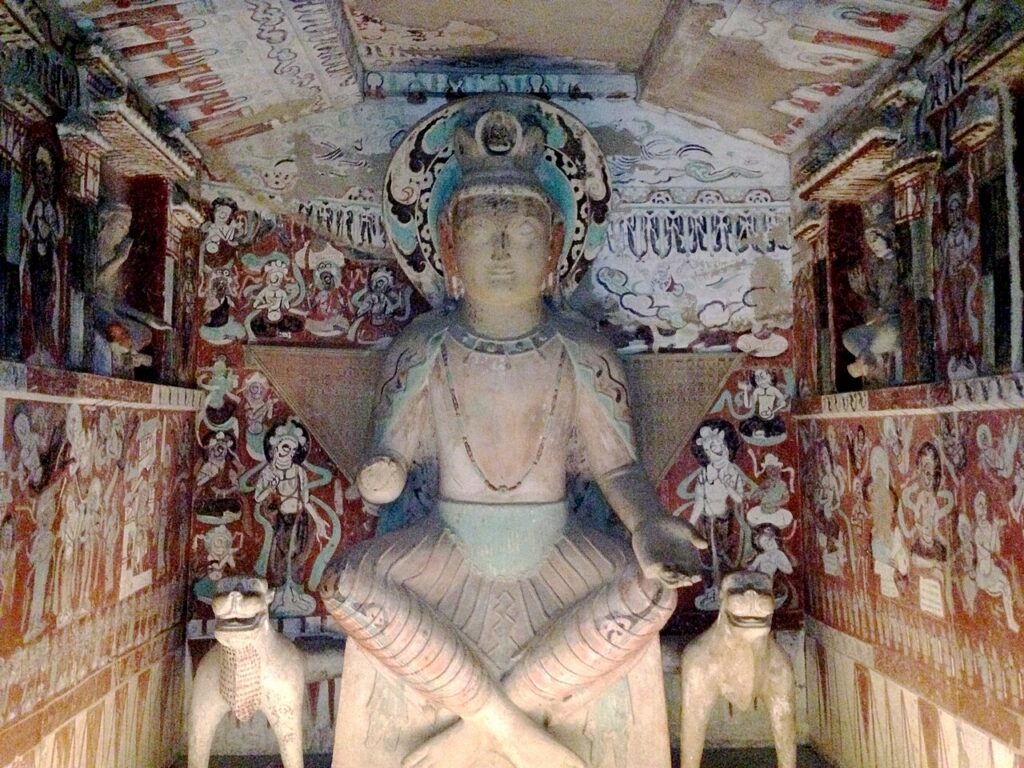
Stepping from one into the other is like walking out of the naiver Kushan-influenced Western frontiers and straight into the peak elegance of a local Chinese imperial court.
Dating back to the Northern Liang period (397–439 CE), Cave 275 is one of the absolute oldest surviving structures at Dunhuang. Its central focus is a 3.34-meter-tall painted clay statue of Maitreya Bodhisattva. 1
He sits with crossed ankles on a throne supported by two lions—a posture and royal motif directly copied from Kushan royal iconography. The statue has a robust, wide-shouldered body, a long prominent nose, and a square chin—traits echoing the Greco-Roman features of early Gandharan art. His upper chest is left bare, wrapped only in a geometric, rigid Western-style scarf.
At that time, Gandharan Greco-Roman realism directly collided with Han Chinese styling. In early caves like Cave 257 or Cave 275, paintings were designed to teach basic Buddhist morality to weary travelers.
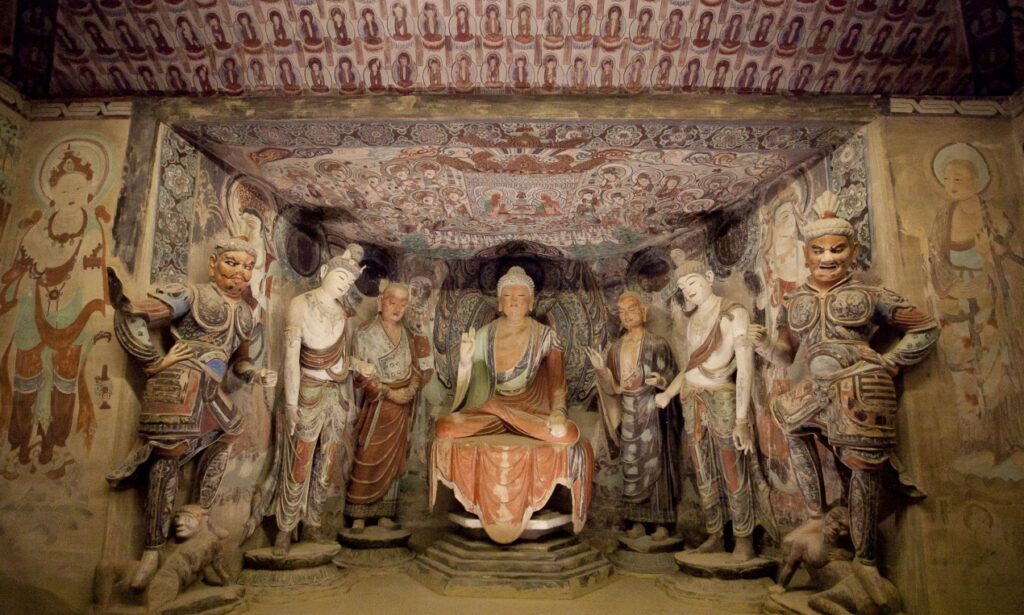
Cave 45 was created three centuries later, at the Peak of Tang Dynasty Realism (8th Century). By this era, the foreign, rigid Gandharan foundations had completely dissolved into an incredibly fluid indigenous Chinese classical style.
Tucked into the west wall niche is a flawlessly preserved seven-figure sculpture group containing a central preaching Buddha, two disciples, two bodhisattvas, and two heavenly guardian kings.
Gandharan relief sculptures were famous for heavy, realistic Roman toga-style drapery with deeply carved folds overlapping the body.
In the early Mogao murals, these robes were flattened into thin, tight-fitting wet-drapery lines. By the time of the Tang Dynasty, the aesthetic shifted completely to “the floating scarves of Dunhuang,” where heavy fabric folds were replaced by light, billowing, and calligraphic ribbons that conveyed rapid motion.
By the time Cave 45 was decorated, the focus shifted from earthly sacrifices to spectacular visions of heavenly salvation. On the south wall of Cave 45, the Western Pure Land Illustration presents Amitabha Buddha (Infinite Light) presiding over a massive celestial court.
Heavenly apsaras (flying celestial beings) dance dynamically overhead while newly reborn souls emerge peacefully out of lotus blossoms in a shimmering central pool. To ground this heavenly scene in human emotion, the sides of the mural contain narrow border panels depicting the tragic earthly story of Queen Vaidehi, who meditates to escape the imprisonment forced upon her by her wicked son.
In terms of elegance, Cave 45 reminds the viewer of the famous Triad of Hadda, a group of statues excavated at Tapa Shotor, a large Sarvastivadin Buddhist monastery near Hadda in Afghanistan, dating from the 2nd century AD and certainly one of the most refined expressions of Gandhara art (now destroyed).
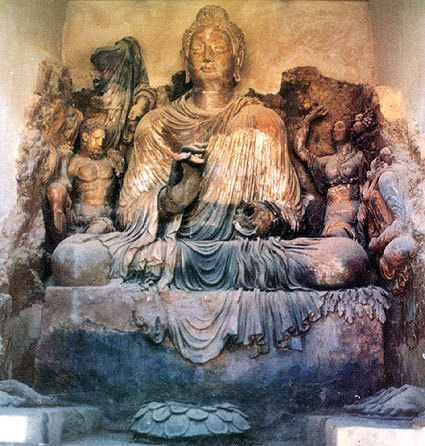
While Gandharan art was realistic in body structure, Tang artists added emotional expression.
Compare the two disciples in Cave 45: Ananda (on Buddha’s right hand) is modeled as a flawless, youthfully smooth and serene young monk, while the older Kashyapa (on Buddha’s left hand) is carved with a lean, wrinkled, and care-worn face reflecting a long ascetic life.
The two flanking Bodhisattvas represent the pinnacle of High Tang elegance. Moving far away from the rigid front-facing posture of Cave 275’s Maitreya, their bodies sway in an exaggerated, fluid S-curve posture, originally from Indian tribhanga but heavily refined by Chinese aesthetics.
Their silk robes and jeweled sashes drape softly like real, moving textiles. On the outer edges stand the “Heavenly Guardian Kings”. Their intense, muscular grimaces and stomping postures showcase the final evolution of defense icons: instead of wearing Roman-influenced armor, they are dressed in accurate, intricate Tang Dynasty military plate armor.
But art is more than technical virtuosity, for technical skills are mobilized to convey elevating concepts. It is the spiritual and cognitive subject matter that pushes artists to innovate their technical mastery.
Relevant here, the process by which specific Gandharan traits—such as the compassionate downward gaze and elaborate royal ornaments—merged with Chinese aesthetics, transforming figures like the Gandharan Avalokiteshvara (the bodhisattva of compassion, goddess of the traders) into the Chinese Guanyin (Goddess of Mercy and compassion in Chinese culture and East Asian Buddhism).
Painting techniques
In their fresco’s Gandharan artists utilized Western, Hellenistic three-dimensional shading to define the human body. Dunhuang painters adopted this technique into a localized style called “convex shading” (ao-tu).
They painted deep, circular rings around eye sockets, muscles, and collarbones to give the flat wall murals a lifelike, three-dimensional depth when seen under candlelight. Over the centuries, the original red lead pigment oxidized, turning these highlighted areas black and creating a distinct “panda-eye” look unique to early Silk Road murals today. 2
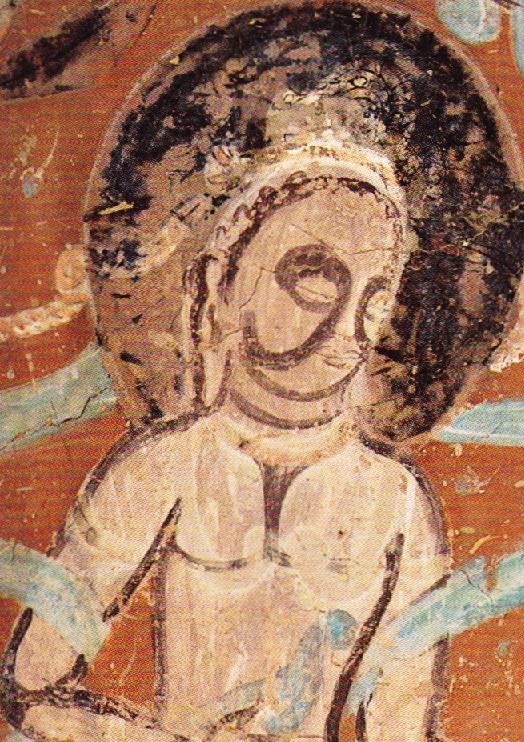
The shifting nature of colors of Dunhuang also reflects changes in trade access along the Silk Road. Artists initially relied heavily on natural mineral pigments mixed with animal glue, but the specific minerals they could source evolved.
Early painters relied on local iron oxides like hematite and ocher for deep reds and warm browns. However, for brilliant blues, they used lapis lazuli (lazurite).
Because lapis lazuli had to be imported over thousands of miles from the Badakhshan mines of modern Afghanistan, its heavy presence in early caves highlights Dunhuang’s immediate, direct economic connection to the Western regions of Central Asia.
As Chinese trade routes shifted and consolidated, artists increasingly replaced imported lapis lazuli with azurite, a deep blue copper mineral widely available within China.
Greens became intensely vibrant due to the heavy application of malachite. And while early artists used simple gold leaf sparingly or substituted it with bright yellow ocher, Tang dynasty artists mastered complex gilding techniques. They applied ultra-thin sheets of gold foil over a red iron-oxide primer to make jewelry, crowns, and celestial halos radiate light inside the dark, candle-lit cave interiors.
The Laocoon
Also in terms of emotional content, in 2019, during a lecture at the University of Hong Kong’s Centre for Buddhist Studies, Professor Osmund Bopearchchi cited several cases of highly recognizable Gandharan motifs in Buddhist iconography.
As an example, he underscored the similarities in expression between a sculpture from “greater Gandhara” depicting the cry of agony of a monk, with the agonizing layman under the Buddha’s bed lamenting the death of the Blessed One as depicted on a relief currently exhibited at the Victoria and Albert Museum (V&A) in London.
The resemblance is not only in the look and feel of the images, but also in the detail of the expressions: in the teeth, tongue, jaw, eyebrows, and staring eyes, all conveying a deep sorrow and cry of despair.
Prof. Bopearachchi hypothesized that that inspiration could have come from the Hellenistic statue Laocoon and His Sons, also known as the Laocoon Group 3, “the prototypical icon of human agony” in Western art whose importance has been underscored in the 18h Century by the German playwriter and art theorist Gotthold Ephraim Lessing.
This type of iconography directly or indirectly traveled to Dunhuang. The most famous depictions come from cave No.158 in Mogao, known as the Nirvana Cave, which features mourners witnessing the passing of the Buddha, depicted in murals along the length of the hall behind.
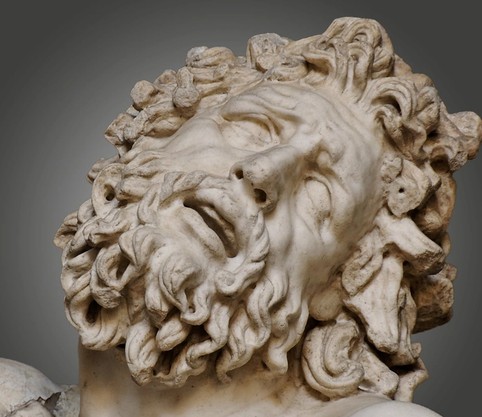
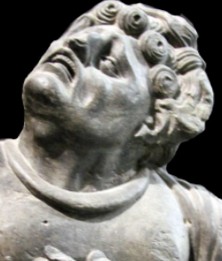
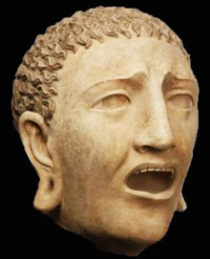
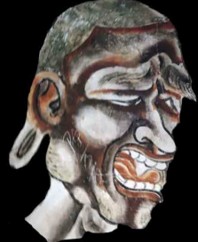
FIG. 14 a, b, c, d
The utter despair of the Trojan priest facing his own death (a) is the precursor to the passionate and emotional expressions of the agonizing Buddhist monk of the stucco sculpture from the Vardak region (b), the pain-stricken layman on the sculpture from the V&A (c), and the arahat (an enlightened person in Buddhism who has destroyed all mental constraints and escaped the cycle of rebirth) from the Mogao cave No.158 grieving the death of their beloved teacher (d).
Manuscripts, translations, paper and printing
Dunhuang was also a dynamic translation hub. Famous Buddhist monks and scripture translators worked in Dunhuang before moving further into mainland China.
For example, the legendary translator Kumarajiva stayed there, and influential local figures, such as the monk Hong Bian of the late Tang dynasty, dedicated their lives to reproducing and translating Buddhist manuscripts. Teams of officials, monks, and ordinary citizens meticulously copied translated religious and secular documents by hand, creating a vast repository of knowledge. It was from this incredible cultural and educational activity that the invention of paper and printing techniques would eventually emerge.
The invention of paper, as we know it today, took place under the Chinese Han Dynasty in AD 105. Ts’ai Lun, a court official, invented a paper making process which primarily used rags (textile waste) as the raw material with which to make paper.
Buddhist devotees, seeking to accumulate spiritual merit, financed both the digging and decoration of caves and the translation and reproduction of sacred sutras and prayers, thus creating a strong commercial and religious demand for inexpensive writing materials. Buddhist monks and pilgrims spread papermaking techniques along the Silk Road during their travels to share these texts. Monks like the Korean Buddhist monk Don Cho introduced these techniques to countries such as Japan around 610 AD.
The Library Cave
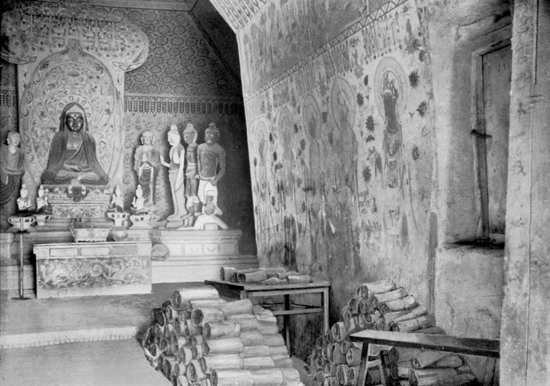
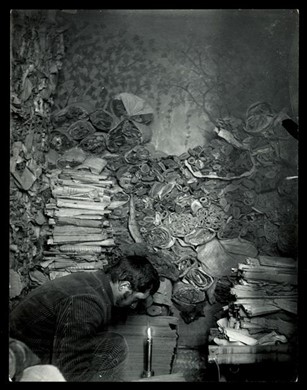
In 1900, a Taoist monk named Wang Yuanlu discovered in Mogao a cache that had been sealed at the 11th century. What is now called the “Library Cave” (Cave 17) contained upwards of 50,000 to 60,000 manuscripts.
While the majority were in Chinese and Tibetan, the cache held texts written in nearly 20 different languages and scripts, including:
- Sanskrit,
- Sogdian,
- Khotanese (Persian),
- Uyghur,
- Tangut (an extinct Tibeto-Burman language),
- Kuchean (also known as Tocharian B or Western Tocharian),
- Uyghour (Old Turkic),
- Mongolian,
- Prakrit,
- Hebrew.
The manuscripts deal with wide-ranging subjects. Among the non-religious texts:
- Social documents, such as contracts, account books and loan receipts;
- Philosophy, notably the Confucian classics;
- Literature, including Chinese folk songs;
- Classical poetry;
- History, both official and local Geography;
- Medicine, including treatments for plagues and illnesses. The medical texts include a fragment of one of the earliest Chinese pharmacological texts;
- Astronomy, including the Dunhuan Star Map that identifies over 1300 stars;
- Mathematics;
- Agriculture and cattle raising;
- Divination;
- Dictionaries;
- Music scores and dance notations, some of them foundational in Japan;
- Recreational games.
By far the largest proportion of manuscripts from the Dunhuang cave contain Buddhist texts. These include Buddhist sutras, commentaries and treatises.
Showing great respect, Li Yuan (Emperor Gaozu), the founder of the Tang dynasty, by declaring himself a descendant of the philosopher Lao Tzu, made Taoism the official state religion, while opening his kingdom to the devotional practices of the many other communities that came via the Silk Road. Chang’an (modern-day Xi’an), the Tang capital, and the major trading ports, in addition to Taoist, Confucian, and Buddhist communities, were home to numerous religious currents from abroad, notably:
- Nestorian Christianity (Jingjiao), officially recognized as early as 635 with the arrival of the monk Alopen and therefore long before the Jesuit missions;
- Zoroastrianism and Manicheanism, practiced by Sogdian merchants and diasporas of Central Asia.
- Islam of Arab and Persian merchants established in the southern ports (such as Guangzhou);
Therefore, among the non-Buddhist religious texts of the Dunhuang manuscripts, one finds:
- Taoist texts;
- Jewish Selihot prayers, as well as a version of the Old Testament in Hebrew;
- Nestorian Christian texts;
- Manichaean texts.
This incredible diversity testifies to centuries of translation efforts and intercultural dialogue.
Christian manuscripts
Among the texts discovered in the Library Cave, western explorers like the Hungarian born British archaeologist Aurel Stein and the Frenchman Paul Pelliot discovered around a dozen Christian texts written in medieval Chinese. These scrolls (such as the Sutra of Jesus Christ and the Book of Great Tensities) reveal that Nestorian scribes worked intensely to translate Christian theology into local languages. To make the concepts understandable, they adopted terminology heavily borrowed from Buddhism and Taoism.
Texts like the Sanwei mengdu zan (a Chinese version of the Gloria in excelsis deo hymn) demonstrate clearly that these manuscripts were actively used for worship by a local Christian Nestorian community in Dunhuang.
Also discovered in the Mogao Caves, a 9th-century silk painting depicting a holy figure (often identified as Christ or a saint) dressed in traditional Tang dynasty robes but wearing two distinct Nestorian crosses, one on his crown and one on his chest.
The figure is depicted with a mustache and a slight beard, appearing in a three-quarter view similar to traditional Chinese portraits of righteous scholars or divine beings. The right hand is raised to the chest in a gesture of blessing, mimicking the Christian benedictio or a Buddhist mudra.
Additional discoveries from the Mongol (Yuan) period uncovered fragments of the Book of Psalms written in Syriac, confirming that Eastern Christian monks and scholars continued to use the Mogao caves for prayer and textual work up until the 14th century.
Book printing
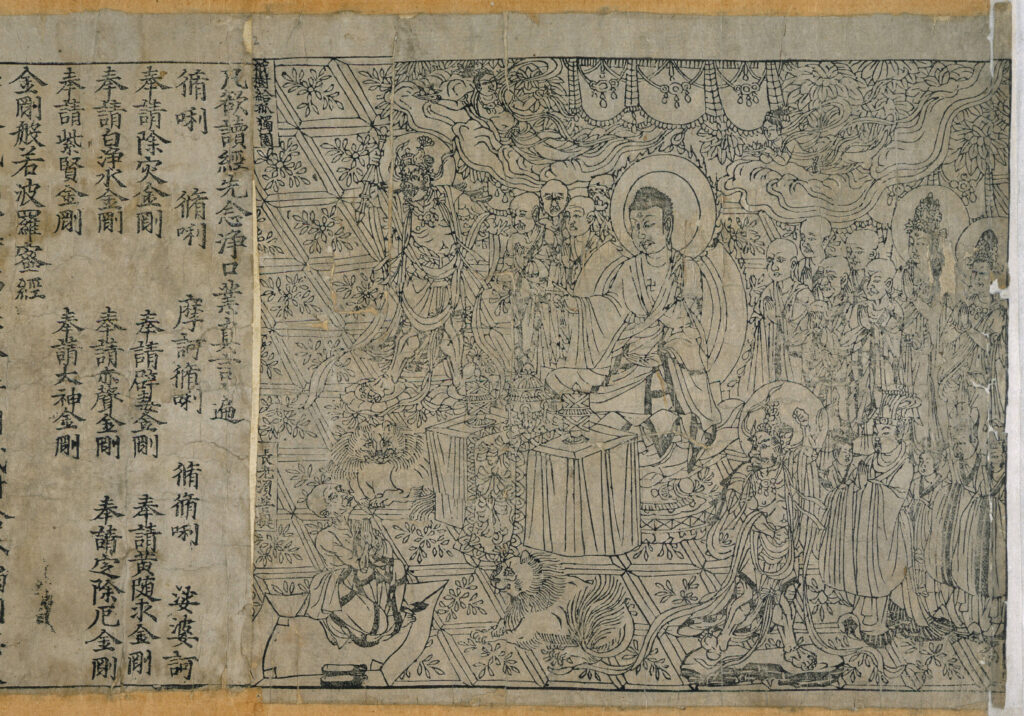
One last marvel among the treasures found, a translation from Sanskrit to Chinese of the Diamond Sutra. This Indian text narrates a dialogue on the nature of reality and illusion between the Buddha and his disciple Subhuti.
The text can be read on a 5-meter (16-foot) long horizontal scroll made of seven sheets of yellow-dyed paper joined together, featuring woodblock-printed text and an ornate frontispiece. Printed on May 11, 868 DC, it is the world earliest known complete printed book.
And in July 1377, that is, 78 years before the famous Gutenberg Bible, it was the Korean Buddhist monk Baegun (Gyeongham) who printed the Jikji (Jikjisimcheyojeol), the oldest book with movable metal types known to date, the second volume of which is kept at the Bibliothèque nationale de France (BnF).
Conclusion
So here, in Dunhuang, mankind, inspired by the accomplishments of Gandhara and other contributions from the Silk Roads, as “a living corridor”, explored a little further the creative essence of humankind and made it an object of celebration, after all the real mission of Art.
Many aspects of this cultural cross-fertilization have been discovered and are now duly documented. The opening of the copper mine and exploration of the Buddhist monasteries of Mes Anyak in Afghanistan will undoubtedly bring another treasure of cultural finds for all.
Let us work together to make this cultural beauty known to the world. As a visual celebration of the highest human qualities, Dunhuang, and the inspiration that gave birth to it, can and should be made as one of those long shadows of the future, a shadow of hope and of a positive future that mankind can decide to construct together.
Thank you for your kind attention.
Selected bibliography:
- Silk Roads: Peoples, Cultures, Landscapes. Susan Whitfield, Thames and Hudson, London, 2019;
- Spatial Dunhuang, Experiencing the Mogao Caves, Wu Hung, University of Washington Press, 2023;
- Buddhist Iconography Along the Silk Road with Prof. Osmund Bopearachchi, Part Two – The Land Route. Wendy Yu, Shantel Wong, Buddhist Global, September 3, 2019. https://www.buddhistdoor.net/features/buddhist-iconography-along-the-silk-road-with-prof-osmund-bopearachchi-part-two-the-land-route/
- Mogao caves reveal powerful India-China Buddhist link, Atul Aneja, The Hindu, Sept. 12, 2016, https://www.thehindu.com/news/international/mogao-caves-reveal-powerful-indiachina-buddhist-link/article8560771.ece
- From Gandhara to Dunhuang: The Evolution of Buddhist Art Along the Silk Road, Irum Malik, Kuiyi Shen, Progressive Research Journal of Arts & Humanities, Vol. 6, Issue 01, February 2026,
https://www.researchgate.net/publication/401971856_From_Gandhara_to_Dunhuang_The_Evolution_of_Buddhist_Art_Along_the_Silk_Road - Mogao Caves, Unesco list of cultural heritage, https://whc.unesco.org/en/list/440/
- Buddhism in Chinese Art (2nd century through 907 C.E.), Smarthistory, https://smarthistory.org/reframing-art-history/buddhism-chinese-art/
- From the Evolution of the “Flying Apsaras” Art in the Mogao Caves, the Influence of Taoism on Dunhuang, Yiran Zhang, Zeus Press; Sociology, Philosophy and Psychology; Vol.2, No.1; 2025, https://journals.zeuspress.org/index.php/SPP/article/download/125/114/524
- Blue pigments in Cave 256, Mogao Grottoes: a systematic analysis of murals and statues in Five dynasties, Song Dynasty and Qing Dynasty, Biwen Shui, Zongren Yu, Qiang Cui, Zhuo Wang, Zhiyuan Yin, Manli Sun & Boming Su, Heritage Science, volume 10, Article #89, 2022. https://www.nature.com/articles/s40494-022-00722-5
- Mogao Cave 45 (High Tang Dynasty), Dunhuang Academy, https://www.dunhuang.ds.lib.uw.edu/mogao-cave-45-high-tang-dynasty/
- The “Miracle of Gandhara”: When Buddha turned himself into man, Karel Vereycken, Artkarel.com, Feb. 28, 2024. https://artkarel.com/the-miracle-of-gandhara-when-buddha-turned-himself-into-man/
NOTES:
- Maitreya, in Buddhist tradition, is the Buddha of the future, currently a bodhisattva residing in the Tushita Heaven, who will descend to earth to preach the Dharma (the « law ») again when the teachings of Gautama Buddha have completely disappeared. Maitreya is the earliest bodhisattva around whom a cult has developed and is mentioned in texts from the 3rd century CE. He has been accepted by all schools of Buddhism and remains the only bodhisattva generally honored by the Theravada tradition. ↩︎
- Minium (or red lead) refers to lead oxide, with the formula Pb₃O₄, historically used as a red-orange pigment and as a rust-preventative paint. It is from this term that the word miniature originated, as medieval artists used it to draw illuminated initials and illustrations in manuscripts. ↩︎
- The « Laocoon Group » is a Roman marble copy of an ancient Greek bronze sculpture depicting the Trojan priest Laocoön and his two sons, punished by Zeus, being attacked by snakes. The statue may date from 40 BC. ↩︎
La lumière de Dunhuang – Culture et beauté de la Route de la Soie
L’histoire se souviendra longtemps des événements culturels exceptionnels qui ont marqué début novembre 2026 la ville de Dunhuang, carrefour stratégique de l’ancienne Route de la soie dans la province du Gansu, au nord-ouest de la Chine.
Cette ville-district doit en grande partie son importance à son emplacement géographique et à sa topologie.
La province du Gansu, d’une superficie équivalant à 82 % du territoire français (la taille de la Californie), coïncide approximativement avec le « corridor du Hexi », un passage de 40 à 100 kilomètres de large traversant la Chine sur environ 1000 kilomètres et parsemé de villes-oasis.
Niché entre les climats inhospitaliers du désert du Taklamakan à l’ouest, du désert de Gobi au nord et des montagnes du plateau tibétain au sud, ce corridor, reliant Lanzhou à Dunhuang, fut pendant plus de mille ans la seule voie terrestre praticable entre l’Asie centrale et la Chine.
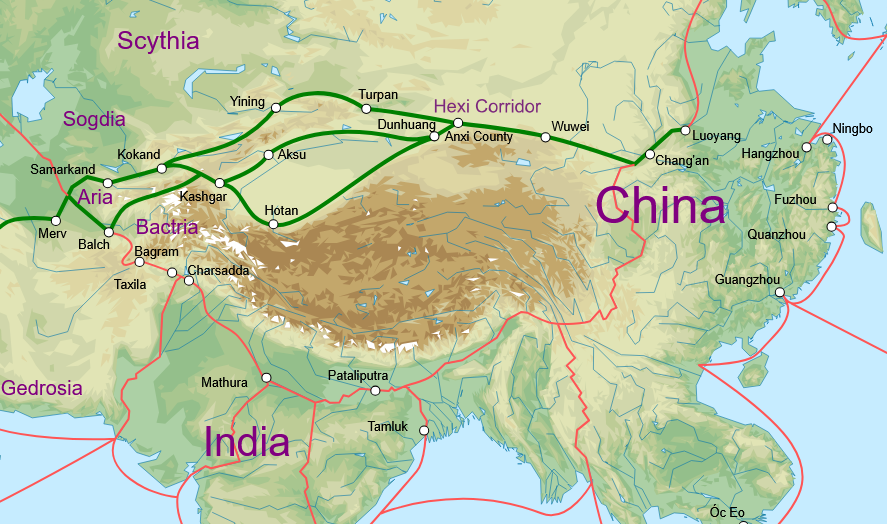
Dunhuang devint ainsi une porte d’entrée entre l’Orient et l’Occident, une ville relais incontournable pour la circulation de populations, de marchandises, d’idées et de technologies.
Comme le note le chercheur chinois Ji Xianlin : « Il existe quatre grands systèmes culturels dans le monde, caractérisés par une longue histoire, un vaste territoire, un système autonome et une influence considérable : la Chine, l’Inde, la Grèce et l’Islam. Il n’y en a pas de cinquième. Il n’existe qu’un seul endroit où ces quatre systèmes culturels fusionnent en un seul : Dunhuang, en Chine. »
Témoin de ce patrimoine vieux de 1600 ans, les centaines de grottes bouddhistes dévotionnelles peintes de Mogao, creusées dans la façade sableuse d’une falaise de dunes « chantantes » et décorées de centaines de fresques et de sculptures peintes, créées à partir du IVe siècle.
Exposition culturelle
L’événement a commencé avec la « 9e Exposition culturelle internationale de la Route de la soie (Dunhuang) » sur le thème « Renforcer les échanges culturels et promouvoir l’apprentissage mutuel entre les civilisations », organisée du 2 au 4 novembre par le gouvernement populaire de la province du Gansu.
Pour les visiteurs étrangers, l’aéroport et de la ville entière, décorés de banderoles, de lampions et de guirlandes festives, avaient tout l’aspect d’un jour férié national. Occupant une surface totale d’environ 18 000 mètres carrés, cette exposition nationale phare a réuni près de 1200 délégués, universitaires et représentants de 58 pays, régions et organisations, dont plus de 360 invités étrangers. Parmi eux des représentants des régions administratives spéciales de Hong Kong et de Macao, le consul général de Malaisie à Xi’an, ainsi que de hauts responsables de la Banque asiatique d’investissement pour les infrastructures (BAII) et de la Banque mondiale.
La séance d’ouverture, mardi matin, a vu des représentants nationaux et étrangers de haut niveau s’adresser brièvement à une salle immense accueillant plus de 1000 personnes :
- Wu Xiaojun, secrétaire du Comité provincial du PCC du Gansu;
- Kong Shaoxun, gouverneur du Gansu;
- Jiang Hui, vice-ministre du Département de la propagande du Comité central du PCC;
- Daren Tang, directeur général de l’Organisation mondiale de la propriété intellectuelle (OMPI). Il est intervenu lors du Forum international sur le droit d’auteur 2026 qui a eu lieu pendant l’exposition;
- Shahbaz Khan, directeur et Représentant du Bureau régional de l’UNESCO pour l’Asie de l’Est, qui a salué le rôle de premier plan de la Chine dans la conservation du patrimoine;
- Huot Hak, ministre du Tourisme du Cambodge, soulignant les liens touristiques entre les grottes de Mogao et le site bouddhiste Theravada d’Angkor Wat;
- Sun Weidong, secrétaire général du Mécanisme Chine-Asie centrale
Les jours suivants, la chercheuse russe Nadezhda Zamyatina présenta des études d’urbanisme réalisées en partenariat avec l’Université de Tianjin, tandis que l’entrepreneur vietnamien Luong The Vinh faisait découvrir des produits régionaux en tant qu’exposant local. Le violoniste américain Kyle Dillingham, qui s’est rendu en Chine plus d’une douzaine de fois, participait à l’exposition avec son groupe de musique folk, Horseshoe Road. Il a exprimé l’espoir que l’événement favorise les échanges entre les populations de l’Oklahoma et du Gansu, qui célébreront en 2025 le 40e anniversaire de leur jumelage.
Alignée sur l’initiative « la Ceinture et la Route » (BRI), l’exposition était placée sous la supervision directe de plusieurs organismes gouvernementaux clefs, notamment le ministère de la Culture et du Tourisme de Chine, l’Administration nationale de la radio et de la télévision, le Conseil chinois pour la promotion du commerce international et les autorités locales du gouvernement populaire de la province du Gansu.
Symposium
Parmi les nombreux sous-forums à participation internationale, on retiendra le « Symposium académique international sur les études de Dunhuang », un forum scientifique de haut niveau, régulièrement convoqué dans le cadre de grands rassemblements culturels et de recherche internationaux.
Ce symposium était organisé conjointement par le Bureau des reliques culturelles de la province du Gansu et l’Académie de Dunhuang (Dunhuang Academy), une institution prestigieuse qui œuvre depuis des décennies à la préservation, la restauration, la numérisation et l’étude des grottes de Mogao sous tous leurs aspects.
Au milieu des 130 universitaires, historiens et experts invités, venus pour la plupart de Chine mais aussi du Japon, d’Allemagne, du Royaume-Uni, de France, de Belgique et d’Afghanistan, la délégation de l’Institut Schiller était représentée par sa fondatrice Helga Zepp-LaRouche et le peintre-graveur et historien français Karel Vereycken.
Helga Zepp-LaRouche : l’unité dans la diversité
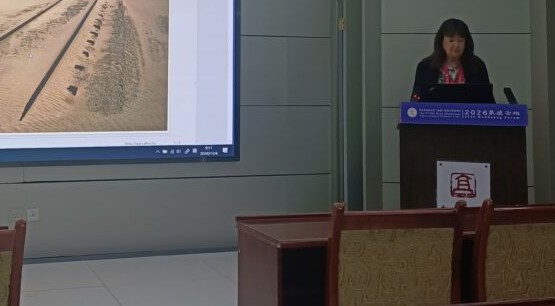
Pour l’ouverture d’un séminaire de recherche, le deuxième jour du symposium, Mme LaRouche avait été invitée à prononcer le discours inaugural. Dans son intervention intitulée « Les grottes de Mogao à Dunhuang : l’unité dans la diversité » (publiée intégralement dans les actes de la conférence Collected Papers and Abstracts, Volume II, pp. 324-328), elle expliqua en quoi les grottes de Mogao « représentent une pierre de Rosette de l’histoire culturelle ».
En 1900, le moine taoïste Wang Yuanlu découvrit derrière un mur de la grotte n°16, une cachette secrète (aujourd’hui répertoriée comme la « grotte 17 »), restée scellée pendant 900 ans, contenant plus de 50 000 manuscrits, la plupart en chinois mais aussi dans des dizaines d’autres langues, telles que tibétain, sanskrit, khotanais, tangoute, koutchéen (ou tokharien B), mongol, ouïghour, sogdien, prâkrit et même l’hébreu.
« Grâce à cette découverte, expliqua Mme LaRouche, nous pouvons nous faire une idée scientifiquement précise des chemins sinueux qu’a empruntés l’histoire universelle jusqu’à nos jours. Mais, parallèlement à toute cette diversité et à cette spécificité historique, nous reconnaissons aussi l’universalité des grandes questions qui, maintes et maintes fois, ont animé les sociétés des différentes époques et civilisations. »
De là, « il s’ensuit également que l’humanité possède non seulement ce passé commun et interconnecté, dans lequel chaque élément occupe, comme dans un gigantesque puzzle dynamique, la place qui s’est avérée décisive pour le développement global, mais aussi que ces découvertes nous aident aujourd’hui à comprendre la coopération sur la Nouvelle Route de la soie comme la prochaine étape nécessaire de l’évolution de l’humanité, et surtout à comprendre et accueillir la conception du président Xi Jinping d’une communauté de destin pour l’humanité, comme une nécessité de l’histoire universelle. »
Et compte tenu de l’importance de ces manuscrits, dont un grand nombre ont été acquis à très bas prix par des archéologues britanniques et français dans les années qui ont suivi leur découverte, « il serait temps de restituer ces découvertes à la Chine en tant que partie intégrante des ‘Sites historiques et culturels majeurs protégés au niveau national’ ».
Karel Vereycken : Dunhuang, un « second Gandhara »
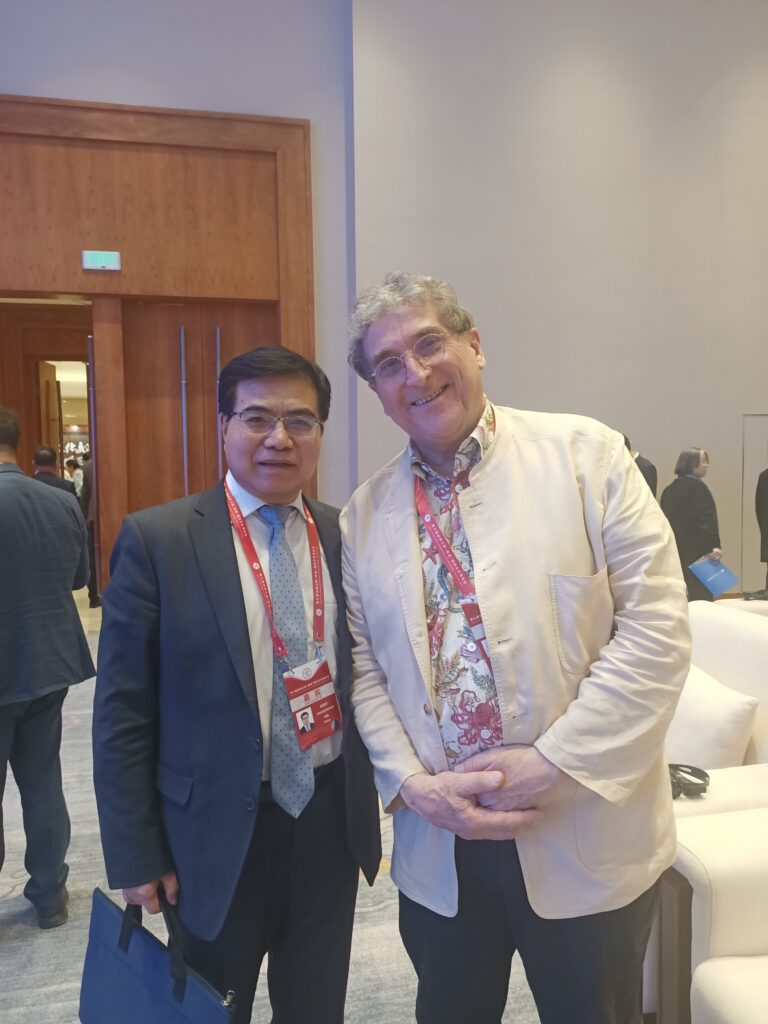
En tant que représentant de l’Institut Schiller, Karel Vereycken, fut invité à prendre place au côté de Ge Jiantuan, vice-gouverneur du gouvernement populaire de la province du Gansu, qui l’a chaleureusement remercié pour sa présence et sa contribution.
Son exposé, intitulé « De Gandhara à Dunhuang : la Route de la soie, ‘corridor vivant’ de l’art mondial », est également publié dans les Actes de la conférence (pp. 149-158).
Après une brève introduction retraçant la naissance et l’essor du bouddhisme sous les empires Maurya et Kushan, Vereycken, se présentant comme un « archéologue des idées », évoqua le « miracle du Gandhara » (région à cheval sur l’Afghanistan et le Pakistan actuels). Si le bouddhisme était initialement aniconique et symbolique, il
« s’est soudainement transformé en un art anthropomorphique, prenant des formes humaines selon les canons et les proportions naturalistes de la Grèce classique ».
L’art du Gandhara célébrait non seulement Bouddha, mais produisait également en série de magnifiques sculptures de bodhisattvas, « des êtres empathiques et bien intentionnés en voie d’atteindre le nirvana, mais vivant d’abord leur propre vie et entièrement dévoués à libérer autrui de la souffrance », une caractéristique typique du bouddhisme mahayana qui a émergé précisément durant cette période.
Aujourd’hui, avec 50 % des pratiquants, le bouddhisme mahayana, malgré ses nombreuses transformations, demeure la branche la plus importante du bouddhisme en Chine, au Japon, en Corée du Sud, à Taïwan, à Singapour et au Vietnam.
Et depuis le Gandhara, « l’art bouddhiste aux caractéristiques grecques » gagna les villes-oasis d’Asie centrale comme Khotan avant d’atteindre la ville-oasis chinoise de Dunhuang et de se répandre dans toute la Chine et au-delà.
Plusieurs aspects iconographiques permettent de confirmer cette inspiration gandharienne dans les fresques de Mogao :
- La plupart des grottes anciennes utilisent exclusivement le pigment bleu obtenu à partir du lapis-lazuli provenant d’Afghanistan;
- La grotte 275 ( IVe siècle) montre un Bouddha Maitreya assis les jambes croisées et entouré de deux lions, une imitation claire de l’iconographie kouchane;
- Le mur nord de la grotte 323 (VIIe siècle ) visualise un cycle narratif (mythologique) tiré du Recueil des miracles liés aux trois joyaux de Chine, un ensemble de contes et de miracles bouddhistes compilé par l’éminent moine-érudit de la dynastie Tang, Daoxuan, en 664 après J.-C. Le narratif représente l’empereur Wu (156-87 av. J.-C.), de la dynastie des Han occidentaux, adorant deux grandes statues en or, une prise de guerre après une campagne militaire contre les Huns. Afin de découvrir ce qu’elles symbolisent, Wu envoie son meilleur diplomate, Zhang Qian (mort en 113 av. J.-C.), en Asie centrale pour enquêter. Dans le coin supérieur gauche de la fresque, on le voit en route vers une ville fortifiée abritant dans ses murs un temple bouddhiste (stupa). Le cartouche qui l’accompagne identifie la ville comme étant Da Xia (royaume de Bactriane, au nord de l’Afghanistan actuel). C’est là que Zhang découvre que ces deux « hommes d’or » sont des statues du Bouddha. De retour chez lui, Zhang explique à Wu que l’empire Han pourrait prospérer considérablement en établissant des relations commerciales avec les riches royaumes d’Asie centrale qu’il avait visités. Et de fait, bien que certaines relations commerciales aient existé bien plus tôt, c’est la dynastie Han qui développa considérablement la Route de la soie, une politique qui atteignit son apogée sous la dynastie Tang. La fresque, représentant des groupes de personnes échangeant entre elles, offre des perspectives et des paysages presque aussi expressifs que certaines peintures de Bruegel au XVIe siècle !
Enfin, Vereycken présenta l’hypothèse intéressante avancée en 2019 par le professeur Osmund Bopearchchi, qui établit des parallèles entre certaines fresques de Mogao et le célèbre « Groupe du Laocoon ».
Cette statue grecque, analysée par le critique d’art allemand Gotthold Ephraim Lessing, représente un prêtre troyen au visage crispé de douleur et d’angoisse, tentant de sauver ses enfants des serpents envoyés par Zeus pour punir leur père de sa désobéissance.
Des manuscrits aux livres
Les grottes de Mogao et la ville Dunhuang, qui apparaissent comme une véritable « malle aux trésors », nous révèlent les Routes de la soie comme une « route vivante de l’art mondial ».
Parmi les merveilles découvertes dans la « grotte-bibliothèque », la plus remarquable est le « Sūtra du Diamant », un rouleau horizontal de 5 mètres de long composé de sept feuilles de papier teintées en jaune, orné d’un texte imprimé à l’aide de planches de bois et d’un frontispice richement décoré. Daté du 11 mai 868, il s’agit du plus ancien livre imprimé complet connu au monde !
Pour Vereycken, l’incroyable diversité linguistique révélée par les manuscrits
« témoigne de siècles d’efforts de traduction et de dialogue interculturel. Outre les temples confucéens et taoïstes, la capitale des Tang, Chang’an (l’actuelle Xi’an), et leurs principaux ports étaient ouverts aux pratiques dévotionnelles étrangères, qu’il s’agisse des nestoriens chrétiens, des musulmans, des manichéens ou des zoroastriens. C’était également le cas à Dunhuang. »
Un bodhisattva peint sur soie, découvert dans la grotte-bibliothèque, est représenté avec deux croix nestoriennes (chrétiennes), témoignant de l’existence d’une communauté chrétienne à Dunhuang.
Une autre découverte majeure, l’« Atlas céleste de Dunhuang », avec plus de 1300 étoiles décrites, se distingue comme la plus ancienne représentation graphique connue du ciel nocturne dans l’astronomie chinoise ancienne datant de la dynastie Tang (618-907).
« Ici, à Dunhuang, conclut Vereycken, inspirée par les réalisations de l’art du Gandhara et d’autres apports de la Route de la soie, véritable corridor de vie, l’humanité est allée explorer au plus profond de son essence créatrice, ce qui est, après tout, la véritable mission de l’art ! De nombreux aspects de ce métissage culturel sont désormais dûment documentés. A Mes Anyak, en Afghanistan, l’ exploitation minière souterraine prudente du gisement de cuivre et les fouilles menées dans le respect de la préservation des monastères bouddhistes, nous feront assurément découvrir, nous l’espérons, d’autres trésors culturels. Œuvrons ensemble pour faire connaître cette beauté culturelle au monde entier. »
Pour conclure ce symposium, le 4 novembre, Helga Zepp-LaRouche et Karel Vereycken ont bénéficié, avec d’autres intervenants, d’une visite guidée des grottes de Mogao. Les impératifs de conservation obligent le musée à limiter le nombre de visiteurs et de grottes ouvertes au public.
Afin d’offrir une perspective plus vaste, un musée temporaire situé à proximité propose, sous forme de reconstitutions virtuelles et physiques, une reproduction de plusieurs grottes, de leurs ornements et des techniques de pointe mises au point par l’Académie de Dunhuang pour leur conservation, qu’il s’agisse des fresques, des statues ou des manuscrits.
Toute cette expertise historique, culturelle, scientifique et humaine est disponible pour être partagée avec d’autres pays prêts à accepter la main tendue de la Chine.
Un chercheur français témoigne:
la culture et la beauté de Dunhuang
contribuent à bâtir un monde meilleur
Avant comme après son intervention, Vereycken fut assailli par de jeunes journalistes désireux de connaître le point de vue d’un étranger. Plusieurs médias chinois (Hainan Touch, China in Lens, CGTN, CCTV, etc.) ont diffusé son commentaire sur l’importance universelle de Dunhuang.
HAINAN TOUCH
https://www.facebook.com/reel/1092312987200904
CHINA IN LENS:
https://www.youtube.com/shorts/geXSBfivdTU
CCTV:
https://english.cctv.com/2026/11/04/VIDEip5jLovp52OvRR5KIE7R261104.shtml
Transcription de l’émission de CCTV du 4 novembre 2026 (53 secondes) :
Vereycken : « Ici, à Dunhuang, avec les grottes, on constate mille ans de coopération internationale. Cela pourrait véritablement éveiller les consciences et peut-être même éviter une guerre mondiale. Car les grandes puissances cherchent à diviser pour mieux régner. Elles font croire aux Américains que les Chinois sont le diable. Elles sèment la division. Or, la division commence dans les esprits. Seules la culture et la beauté peuvent unifier, car elles touchent à l’essence même de l’être humain. Je suis moi-même peintre, graveur et historien. Je me considère comme un archéologue des idées. J’étudie l’histoire des idées et la manière dont elles transforment le monde pour le mieux. Voilà le message. »