Étiquette : Cave 275
Gandhara to Dunhuang, the Silk Road as a « Living Corridor » of World Art
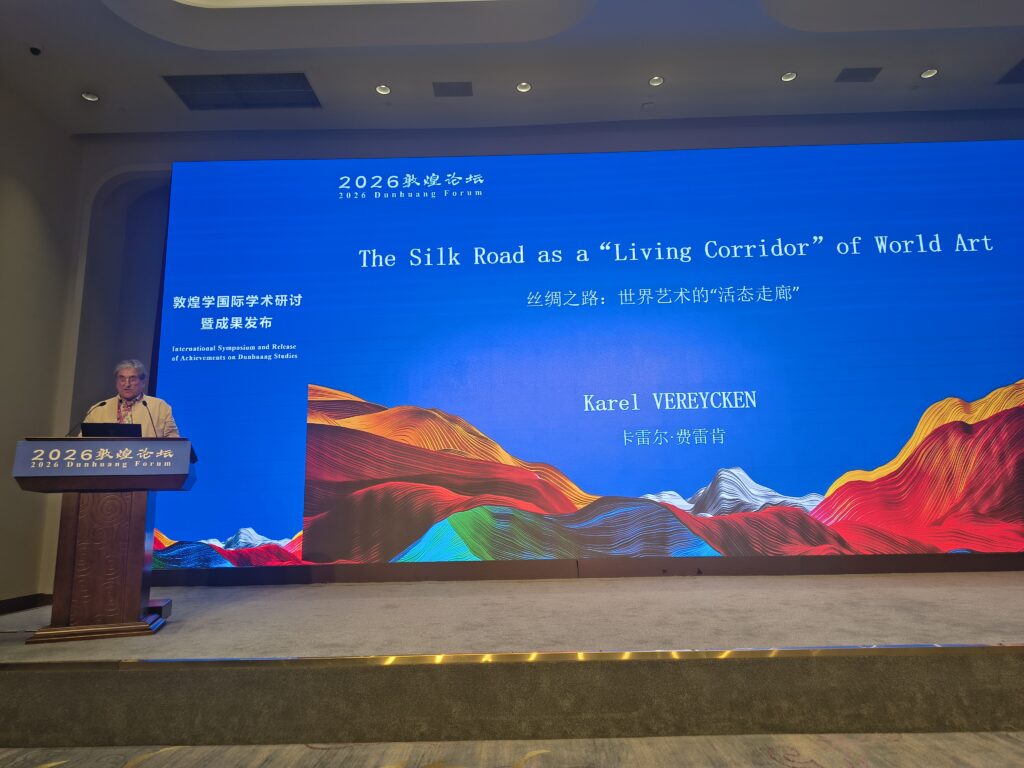

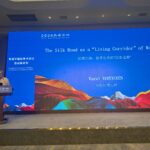
On Tuesday Nov. 3, 2026, painter-engraver and historian Karel Vereycken, as an independant scholar and contributor to the International Schiller Institute, delivered a lecture (text of the integral version below) at the International Academic Symposium “Dunhuang Studies Research in the New Era. »
The symposium, organized by the Dunhang Academy, was organized in the framework of the « 2026 Dunhuang Forum », in the ancient city of Dunhuang in the Gansu Province of China.
The next day, Nov. 4, Helga Zepp-LaRouche, the founder and president of the international Schiller Institute, keynoted another session with her speech « The Dunhuang Mogao Grottoes, Unity in Diversity. »
(A brief report on the event can be found with this LINK.)
The Dunhuang Academy is a highly-esteemed and prestigious institution that has worked hard for decades to preserve the cultural heritage of the « Mogao Caves » close to Dunhuang, a major stop on the ancient Silk Roads and a unique testimony of over a thousand years of dialogue and cooperation.
As one can see by the Conference program, the symposium brought together, besides very high level Chinese dignataries, over 130 scholars, archaelogists, authors and experts (mainly from China, but also from Japan, Russia, Germany and France) who presented their latest research on all possible facets of this outstanding and unique cultural heritage and the latest exploration techniques to explore it.
From Gandhara to Dunhuang,
the Silk Road as a « Living Corridor »
of World Art
By Karel Vereycken, independant scholar, Schiller Institute.
Lecture given on Nov. 3, 2026 at the International Academic Symposium “Dunhuang Studies Research in the New Era” of the 2026 Dunhuang Forum,
Mogao Caves, Dunhuang, China.
Dear organizers, dear colleagues, excellencies,
First, I want to thank you again for this invitation. It is a great honor for me to assist at this high-level event and to be able to share my views on the past, present and future of culture of the Silk Roads.
Most of us actually traveled over parts of these roads to arrive here in Dunhuang, a city that really needs to be honored and recognized as a milestone on the road to the utmost best of what humanity can accomplish when it acts according to its own nature, that of loving each other, celebrate human genius and creativity, and building a common future.
Archaeology is not merely about rediscovering the past in the present. Archaeology also allows us, mankind, to discover “the long shadows” of the future.
However, I’m not a professional archaeologist. I’m only a painter engraver and independent scholar active with the International Schiller Institute. My research concentrates on what one might call the “archaeology of ideas”, that is how ideas and concepts, in the domain of art in particular, travel over time and distance. And that’s where Dunhuang really captured my interest.
The birth and expansion of Buddhism
Of course, those present here know the history of Buddhism and Dunhuang in far greater detail than I can dream achieving. They should pardon me for the rough sketch I present now of that history, but for people living in different continents and from different cultures, I think they will be grateful for this short historical introduction.
I’ll make it short. Buddhism emerged during the 6th to 5th century BCE in the eastern Gangetic plain, near modern-day Nepal. Siddhartha Gautama, known as the Buddha (the « Awakened One »), founded a movement that stood for religious self-perfection and social change. Born a prince, he left his luxurious life to seek an end to human suffering, mostly through introspection. His teaching spread across Asia by three means:
- dedicated and inspiring followers,
- royal and private patronage and
- the trade networks of what has been called in the XIXth century, the “Silk Road.”
Maurya Empire (c. 321 BCE – 185 BCE)
The first breakthrough came about 200 years after the death of Buddha with the founding of the Maurya Empire (c. 321 BCE – 185 BCE).
In 321 BC, Chandragupta Maurya, with help from his clever advisor and Prime Minister Chanakya, founded a vast and powerful kingdom that united most of the Indian subcontinent after Alexander the Great left the region. The kingdom stretched from present day Afghanistan to the present day of Bangladesh, its capital was Pali Putra (present day Patna in the Northeast of India), and it lasted till 185 BC.
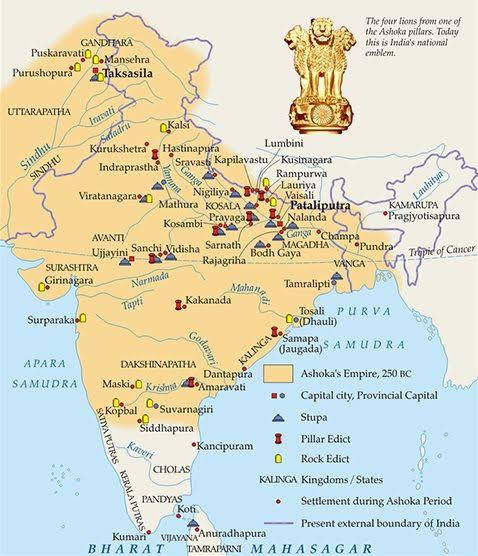
Founded in the 5th century BC, the University of Taxila (today’s Punjab) was a famed seat of Sanskrit and Vedic learning.
Then arrived the nearly forgotten king Ashoka the Great (ruled from 268 BC till 232 BC), the grandson of Maurya, who became the third ruler of the kingdom.
After having conducted unjust and cruel wars, Ashoka got gradually drawn towards peaceful Buddhism. After his conversion, Buddhism gained recognition, strength and go global.
Ashoka made several edicts that were engraved in pillars and rocks installed all over the territory of the kingdom. The edicts were written in the main languages used by the population groups of the kingdom: Greek (Ionian), Aramean and Prakrit. The edicts called for non-violence, respect for all forms of life, moderation and compassion.
Ashoka promoted Buddhism on a scale unseen till then. He ordered and financed the construction of 84,000 Buddhist temples (stupa) for Buddhist devotional practice. And following the Third Buddhist Council (ca 250 BC) that he patronized, Ashoka sent emissaries to spread Buddhist teachings abroad.
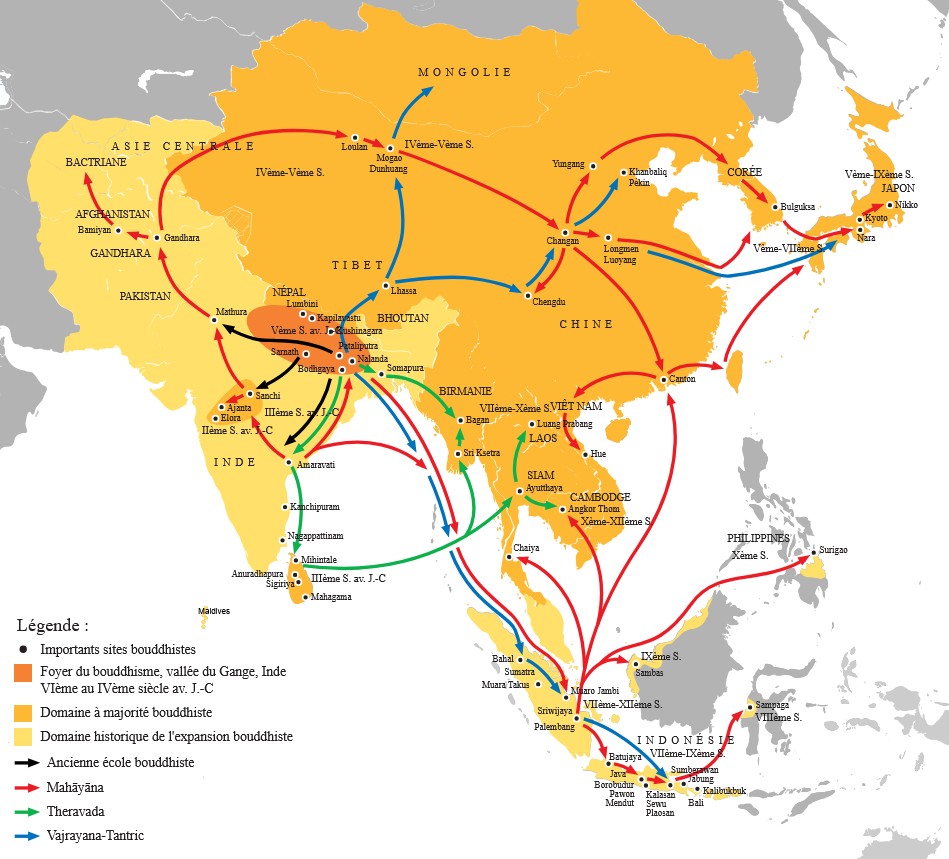
Well known is the fact that he sent his son Mahinda to Sri Lanka, making it the first region outside India to officially adopt Buddhism. From there and along the Indian maritime trade routes, this southern expansion established Theravada Buddhism (“The doctrine of the Elders”) as the dominant tradition in mainland Southeast Asia.
Over centuries, kingdoms in modern-day Myanmar, Thailand, Cambodia and Laos embraced Theravada Buddhism, deeply integrating it into their governance and cultural identities.
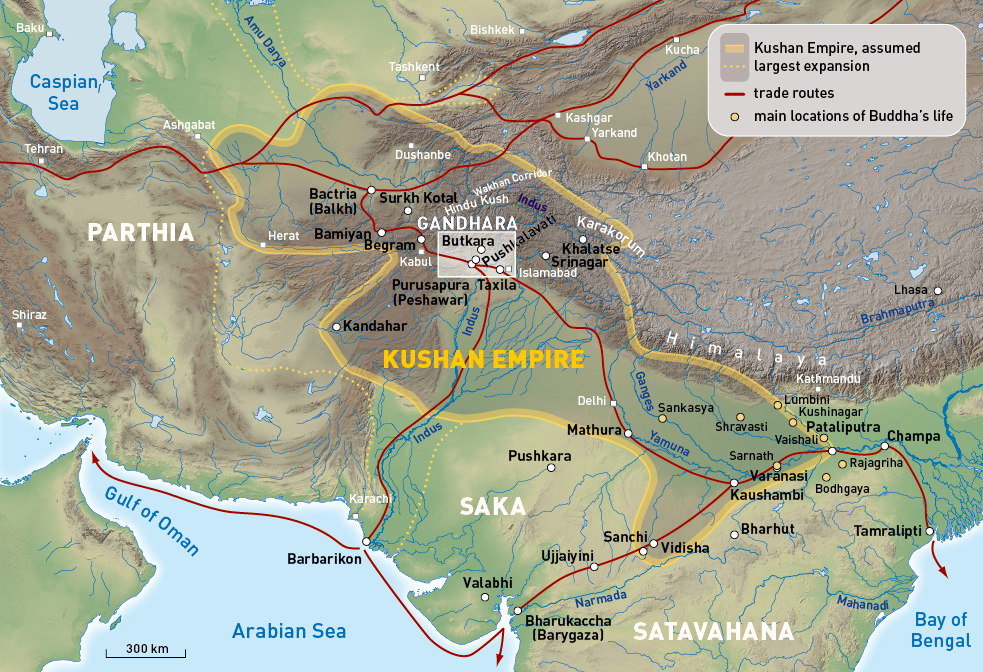
Kushan Empire (1st century BCE – 3rd century CE)
Another group of emissaries traveled to central Asia and developed another interpretation of the teachings of Buddha, Mahayana Buddhism (“The Great Vehicle” in Sanskrit). It really bloomed during the Kushan Empire (1st century BCE – 3rd century CE), an empire founded most probably by elements of the Chinese Yuezhi confederation in the early 1st century CE.
The founder of the dynasty, Kujula Kadphises, followed Iranian and Greek cultural ideas and iconography. Greek (Ionian) was the administrative language.
Initially based in the Bactrian territories, it spread to encompass much of what is now Afghanistan, India, Pakistan, Tajikistan, Turkmenistan and Uzbekistan. Kushan territory in India extended at least as far as Saketa and Sarnath near Varanasi (today’s Benares, India), where inscriptions confirm this reality.
The Kushan dynasty had diplomatic contacts with the Roman Empire, Sassanian Persia, the Aksumite Empire (Ethiopia and the Horn of Africa), and the Han dynasty of China (206 BC –220 AD). It was at the center of trade relations between the Roman Empire and China: according to Alain Daniélou, “for a time, the Kushana Empire was the center point of the major civilizations”.
While much philosophy, art, and science were created within its borders, the only textual record of the empire’s history today comes from inscriptions and accounts in other languages, particularly Chinese.
In 127 A.D., his successor Kanishka the Great, replaced Ionian with Bactrian as official language. His rule ushered in a period of relative peace for 200 years, described as “Pax Kushana.”
The “miracle of Gandhara”
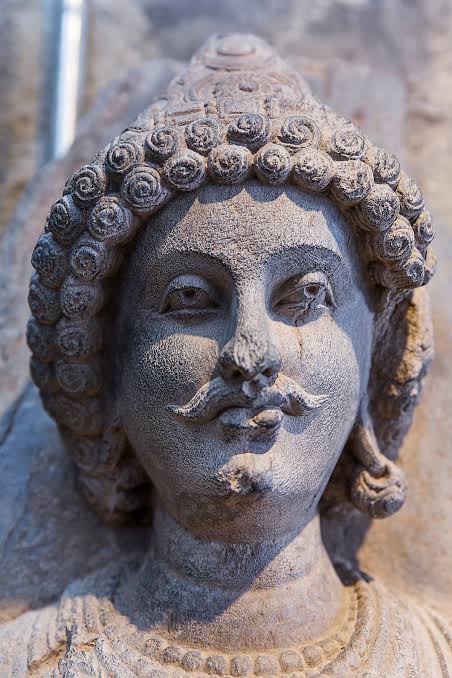
From Gandhara, the cultural and intellectual point of gravity of the Kushan Empire, Kanishka started promoting Buddhism through learning, art and literature.
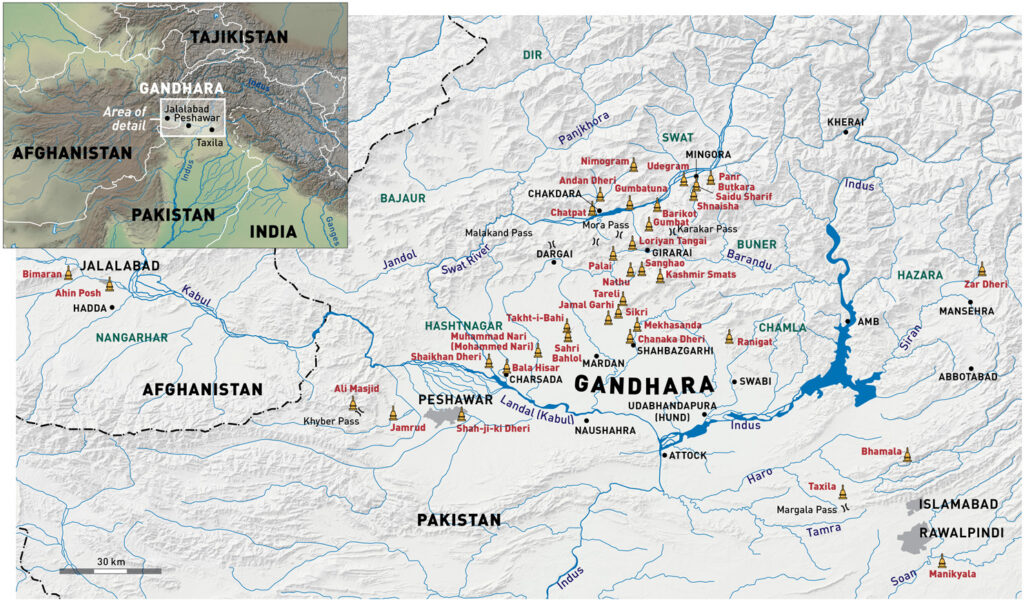
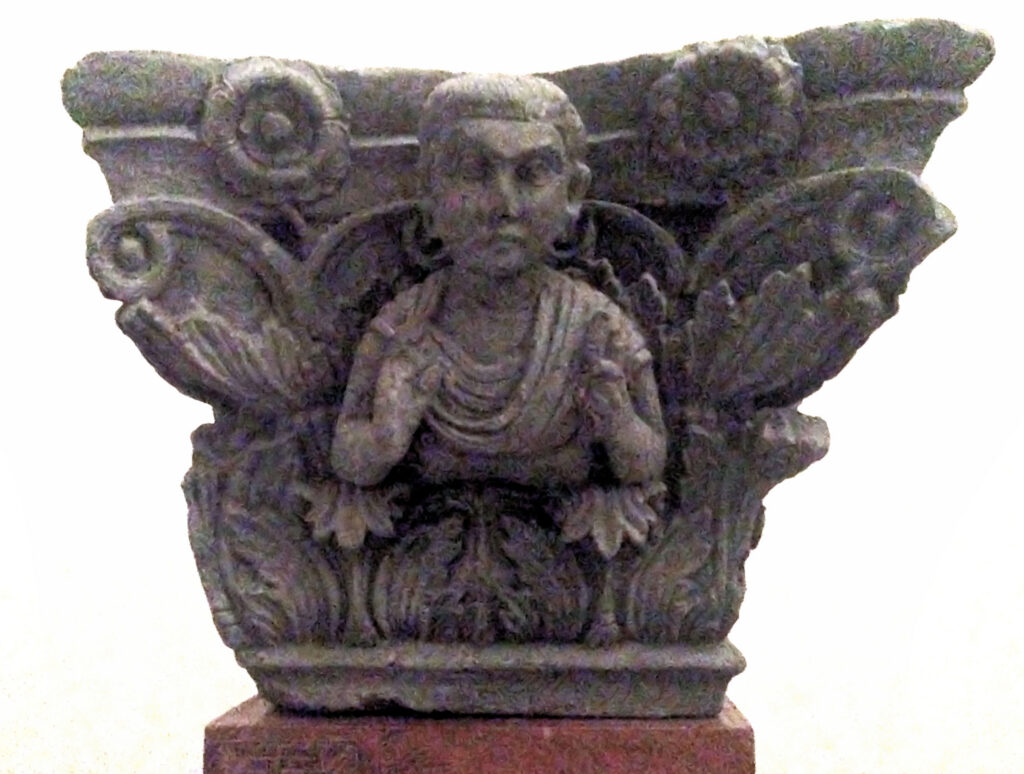
It was under Kanishka that the “miracle of Gandhara” occurred. Buddhist devotional art, which for four centuries was exclusively symbolic and an-iconic, suddenly morphed into anthropomorphic art taking the shapes of humans and using the canons and naturalistic proportions of the classical Greek period.
With human figuration Buddhism now reached out to the heart and the imagination of the common man. Buddha, after all, was not a god, but a human person that was deified for his exceptional qualities. For an ordinary person, attaining nirvana as Buddha did, was an exceptional achievement.
But Gandhara art also celebrated and mass-produced magnificent sculptures of bodhisattvas, well-intentioned human beings already on the path to nirvana, but first living their own lives and entirely devoted to liberating other humans from suffering. What is celebrated by representing them, therefore, is empathy and compassion.
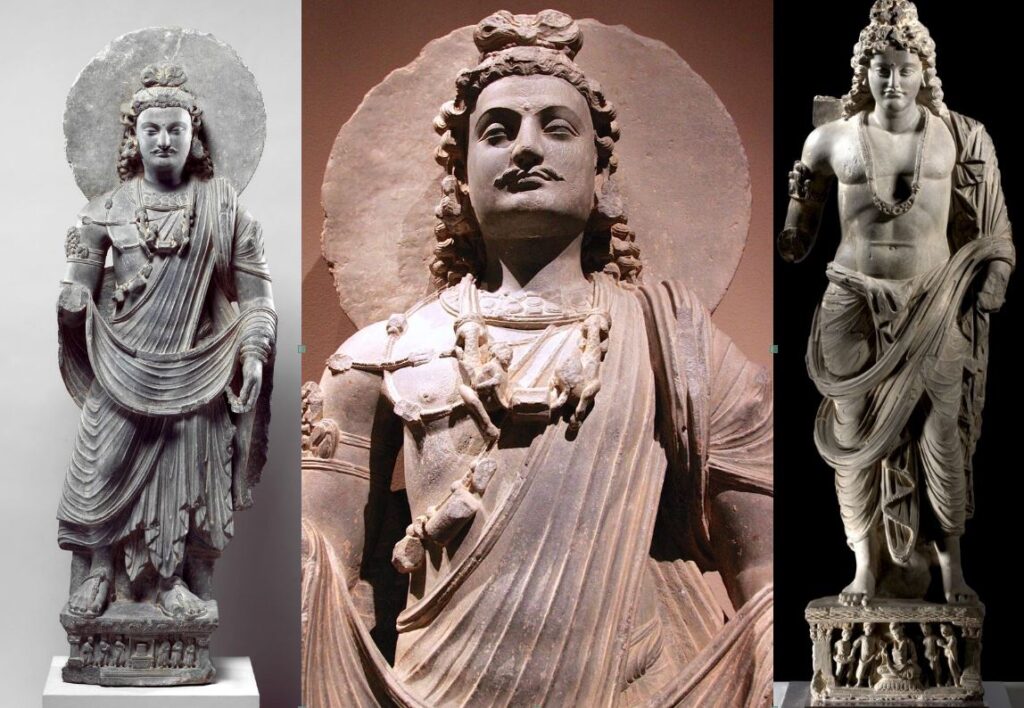
A direct road from Gandhara to China remained under Kushan control for more than a century, encouraged travel across the Karakoram (the second-highest mountain range on Earth), and facilitated the spread of Mahayana Buddhism to China.
To be noted is the fact that Gandhara developed its own language: Gandhari, which became a lingua franca along the Silk Road and a major source language for the earliest Chinese translation of Buddhist sutras during the Han dynasty.
From Gandhara, Buddhism spread eastward into oasis cities like Khotan and Dunhuang and deeper into China during the Han Dynasty. In turn, China transmitted its Mahayana traditions northeast. Korean kingdoms adopted Buddhism in the 4th century, and Korean monks subsequently introduced it to the Japanese imperial court in the 6th century.
Gandhara art also traveled to Dunhuang, China, along the land routes of the ancient Silk Road, carried by traveling monks, merchants, and diplomatic envoys between the 2nd and 7th centuries.
Buddhist monasteries and nunneries on the Silk Road, financed by both the king and the merchants, were more than religious sites and favored an environment of economic well-being. Besides prayer rooms, they offered housing facilities, protection against bandits, education for children and artisans, medical care and even financial facilities. As the archaeological site of Mes Anyak (today’s Afghanistan) suggests, some Buddhist monasteries also engaged in mining and metallurgic industries.
Art and religious objects moved alongside commercial goods across the Kushan Empire and Central Asian oases. Dedicated Buddhist merchants, pilgrims, monks and nuns walked these dangerous desert routes to collect Sanskrit scriptures, bringing along visual iconography and sacred statues. They passed through key hubs like Bamiyan and Mes Anyak in Afghanistan and the Kizil Caves in Kucha (Xinjiang) before reaching Dunhuang. Small portable items—such as gilded bronze figurines, drawings, painted banners, and illuminated manuscripts—served as visual templates that easily fit inside merchant packs.
Dunhuang, as a “second” Gandhara
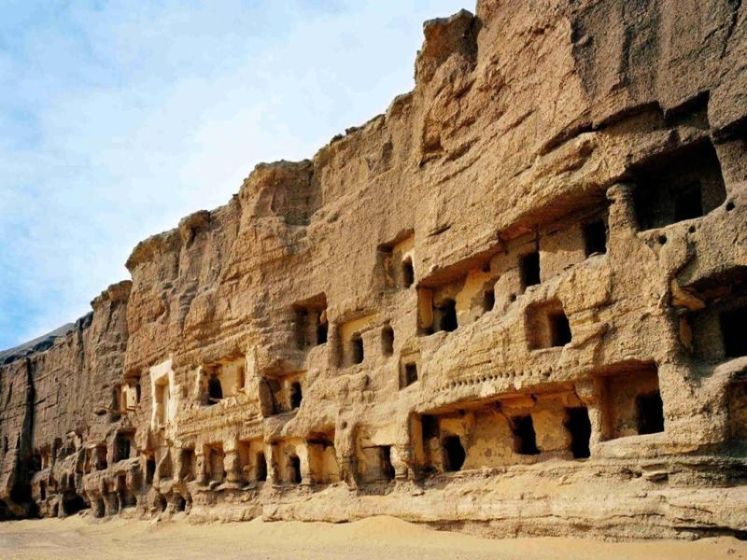
When the art of realistic drapery and naturalistic human anatomy reached the Mogao Caves in Dunhuang, local and foreign artists reinterpreted them. It is over-simplistic to just say the Dunhuang painting school was “influenced” by Gandhara art merely copied what arrived from outside.
In Dunhuang, there are 735 recorded caves of which 492 feature preserved murals and painted sculptures. They survived as repositories of a very precious artistic heritage. Approximately 25,000 square meters of wall paintings and more than 3,000 painted sculptures make of this site, not only one of the largest but one of the most valuable sites of Buddhist art.
Between 400 AD and 1400 AD, Dunhuang brought together many talents in a single melting pot culture. One might want to call it a “second Gandhara”. Just as in Gandhara, as a result of a friendly dialogue, mutual understanding and admiration grew between foreign (Hellenic, Persian, Indian, etc.) and Chinese traditional culture, a new form of art saw the light in Dunhuang.
Architecture
First, Gandharan monastic complexes feature small, plain cells (viharas) for residential monks surrounding a central courtyard. The northern section of the Mogao Grottoes, mirrors this setup perfectly, hosting over 200 plain, bare-walled caves that strictly functioned as living quarters, meditation cells, and work spaces for the site’s traveling artisans.
In Gandhara, monks prayed in chaityas—apsidal, vaulted rock-cut halls built around a freestanding burial mound (stupa) for circumambulation.
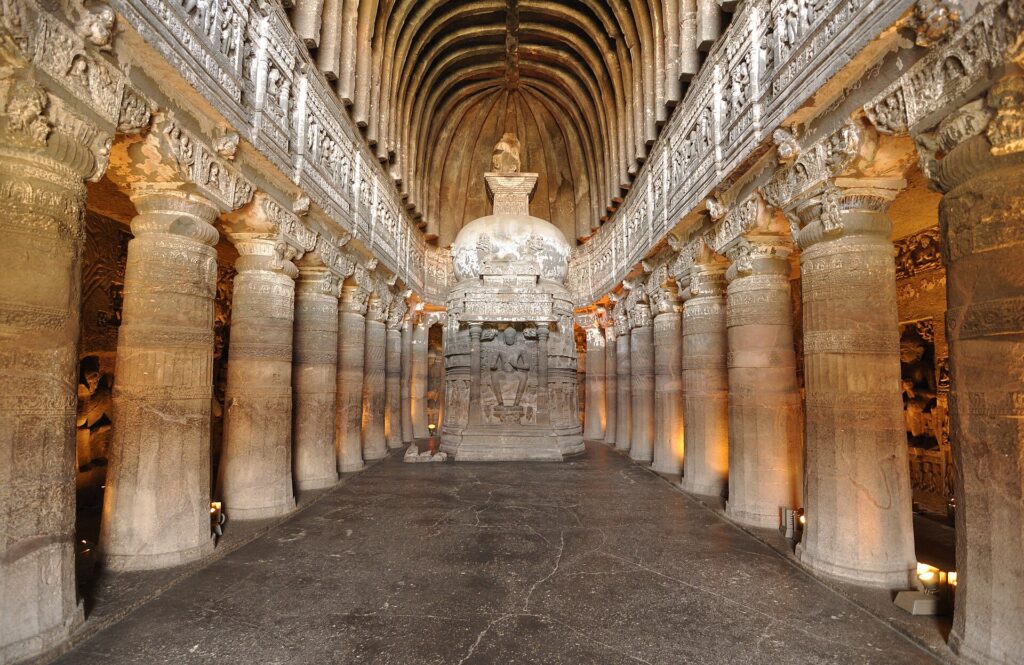
When this design reached Dunhuang, Chinese builders adapted it into “Central Pillar” Caves (e.g., Cave 254). Instead of a round stupa, they carved a solid, square rock column stretching from floor to ceiling, decorating its sides with niches containing painted statues.
Painting and sculpture: cave 275 versus Cave 45
To understand how Gandharan visual art evolved, there is no better way than to look directly at the contrast between Cave 275 and Cave 45, separated in time by three centuries.
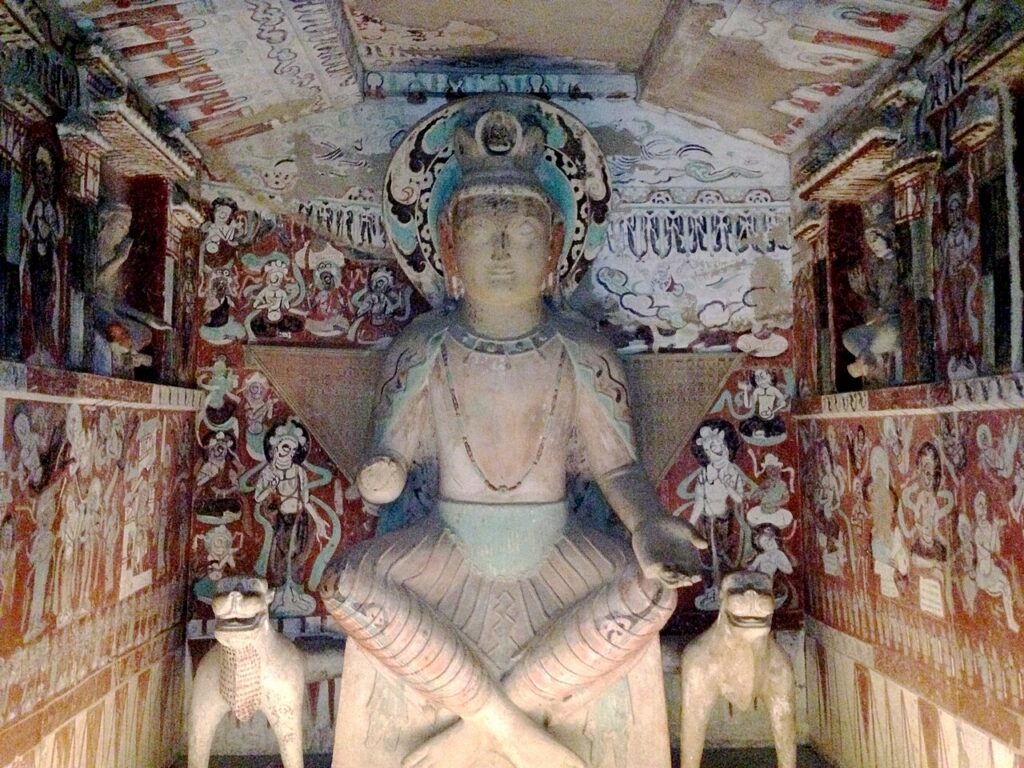
Stepping from one into the other is like walking out of the naiver Kushan-influenced Western frontiers and straight into the peak elegance of a local Chinese imperial court.
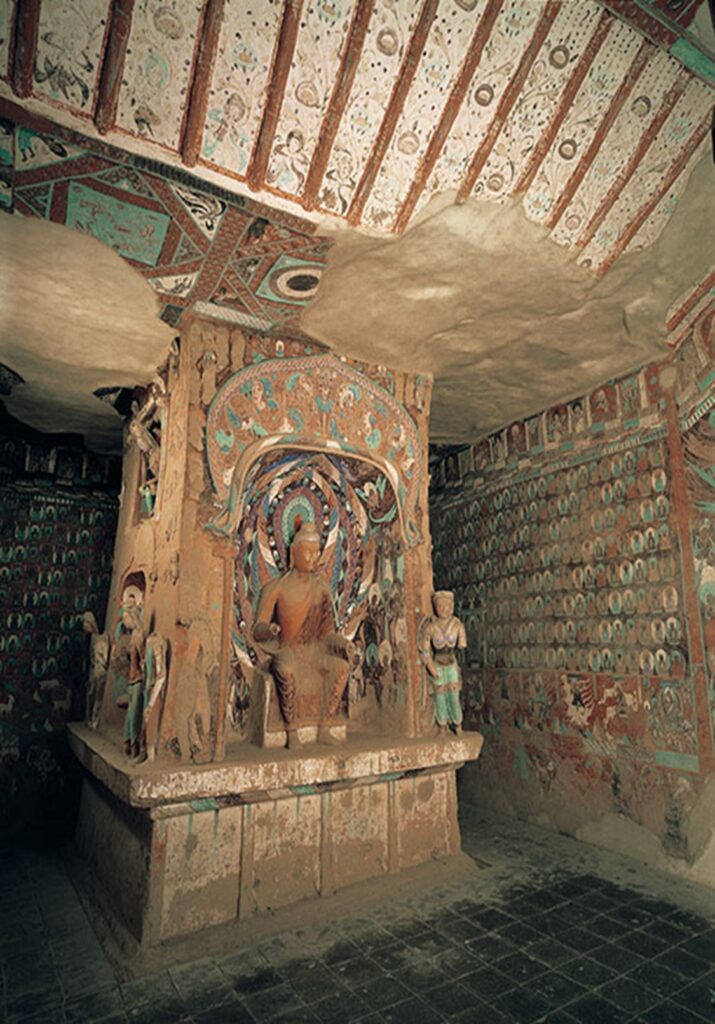
Dating back to the Northern Liang period (397–439 CE), Cave 275 is one of the absolute oldest surviving structures at Dunhuang. Its central focus is a 3.34-meter-tall painted clay statue of Maitreya Bodhisattva. 1
He sits with crossed ankles on a throne supported by two lions—a posture and royal motif directly copied from Kushan royal iconography. The statue has a robust, wide-shouldered body, a long prominent nose, and a square chin—traits echoing the Greco-Roman features of early Gandharan art. His upper chest is left bare, wrapped only in a geometric, rigid Western-style scarf.
At that time, Gandharan Greco-Roman realism directly collided with Han Chinese styling. In early caves like Cave 257 or Cave 275, paintings were designed to teach basic Buddhist morality to weary travelers.
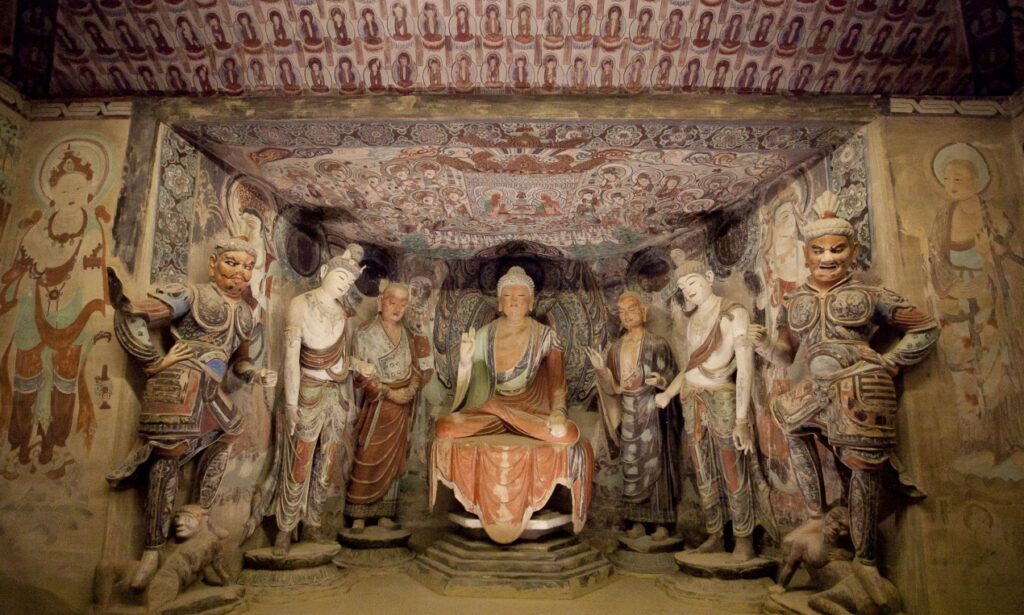
Cave 45 was created three centuries later, at the Peak of Tang Dynasty Realism (8th Century). By this era, the foreign, rigid Gandharan foundations had completely dissolved into an incredibly fluid indigenous Chinese classical style.
Tucked into the west wall niche is a flawlessly preserved seven-figure sculpture group containing a central preaching Buddha, two disciples, two bodhisattvas, and two heavenly guardian kings.
Gandharan relief sculptures were famous for heavy, realistic Roman toga-style drapery with deeply carved folds overlapping the body.
In the early Mogao murals, these robes were flattened into thin, tight-fitting wet-drapery lines. By the time of the Tang Dynasty, the aesthetic shifted completely to “the floating scarves of Dunhuang,” where heavy fabric folds were replaced by light, billowing, and calligraphic ribbons that conveyed rapid motion.
By the time Cave 45 was decorated, the focus shifted from earthly sacrifices to spectacular visions of heavenly salvation. On the south wall of Cave 45, the Western Pure Land Illustration presents Amitabha Buddha (Infinite Light) presiding over a massive celestial court.
Heavenly apsaras (flying celestial beings) dance dynamically overhead while newly reborn souls emerge peacefully out of lotus blossoms in a shimmering central pool. To ground this heavenly scene in human emotion, the sides of the mural contain narrow border panels depicting the tragic earthly story of Queen Vaidehi, who meditates to escape the imprisonment forced upon her by her wicked son.
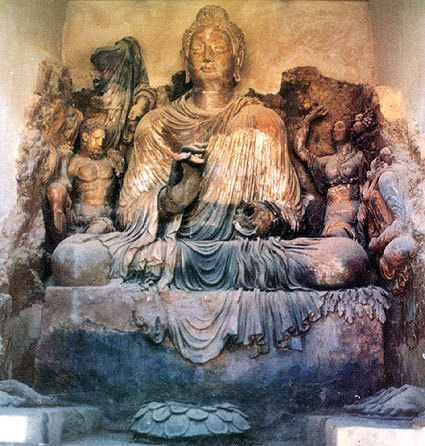
In terms of elegance, Cave 45 reminds the viewer of the famous Triad of Hadda, a group of statues excavated at Tapa Shotor, a large Sarvastivadin Buddhist monastery near Hadda in Afghanistan, dating from the 2nd century AD and certainly one of the most refined expressions of Gandhara art (now destroyed).
While Gandharan art was realistic in body structure, Tang artists added emotional expression.
Compare the two disciples in Cave 45: Ananda (on Buddha’s right hand) is modeled as a flawless, youthfully smooth and serene young monk, while the older Kashyapa (on Buddha’s left hand) is carved with a lean, wrinkled, and care-worn face reflecting a long ascetic life.
The two flanking Bodhisattvas represent the pinnacle of High Tang elegance. Moving far away from the rigid front-facing posture of Cave 275’s Maitreya, their bodies sway in an exaggerated, fluid S-curve posture, originally from Indian tribhanga but heavily refined by Chinese aesthetics.
Their silk robes and jeweled sashes drape softly like real, moving textiles. On the outer edges stand the “Heavenly Guardian Kings”. Their intense, muscular grimaces and stomping postures showcase the final evolution of defense icons: instead of wearing Roman-influenced armor, they are dressed in accurate, intricate Tang Dynasty military plate armor.
But art is more than technical virtuosity, for technical skills are mobilized to convey elevating concepts. It is the spiritual and cognitive subject matter that pushes artists to innovate their technical mastery.
Relevant here, the process by which specific Gandharan traits—such as the compassionate downward gaze and elaborate royal ornaments—merged with Chinese aesthetics, transforming figures like the Gandharan Avalokiteshvara (the bodhisattva of compassion, goddess of the traders) into the Chinese Guanyin (Goddess of Mercy and compassion in Chinese culture and East Asian Buddhism).
Painting techniques
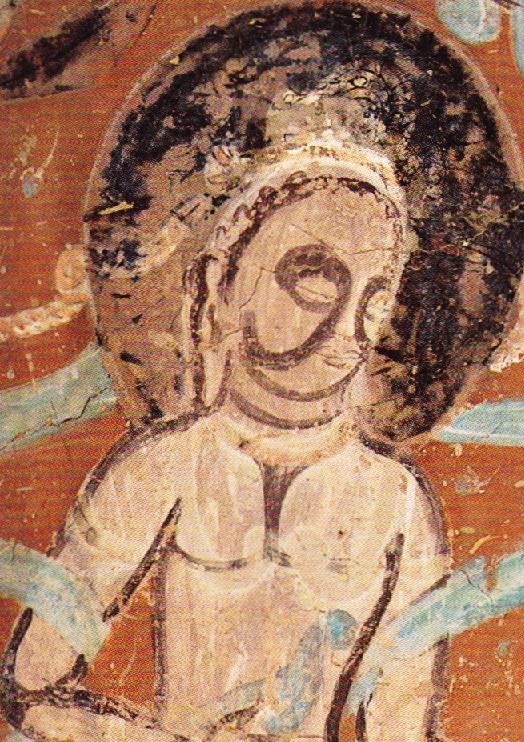
In their fresco’s Gandharan artists utilized Western, Hellenistic three-dimensional shading to define the human body. Dunhuang painters adopted this technique into a localized style called “convex shading” (ao-tu).
They painted deep, circular rings around eye sockets, muscles, and collarbones to give the flat wall murals a lifelike, three-dimensional depth when seen under candlelight. Over the centuries, the original red lead pigment oxidized, turning these highlighted areas black and creating a distinct “panda-eye” look unique to early Silk Road murals today. 2
The shifting nature of colors of Dunhuang also reflects changes in trade access along the Silk Road. Artists initially relied heavily on natural mineral pigments mixed with animal glue, but the specific minerals they could source evolved.
Early painters relied on local iron oxides like hematite and ocher for deep reds and warm browns. However, for brilliant blues, they used lapis lazuli (lazurite).
Because lapis lazuli had to be imported over thousands of miles from the Badakhshan mines of modern Afghanistan, its heavy presence in early caves highlights Dunhuang’s immediate, direct economic connection to the Western regions of Central Asia.
As Chinese trade routes shifted and consolidated, artists increasingly replaced imported lapis lazuli with azurite, a deep blue copper mineral widely available within China.
Greens became intensely vibrant due to the heavy application of malachite. And while early artists used simple gold leaf sparingly or substituted it with bright yellow ocher, Tang dynasty artists mastered complex gilding techniques. They applied ultra-thin sheets of gold foil over a red iron-oxide primer to make jewelry, crowns, and celestial halos radiate light inside the dark, candle-lit cave interiors.
The Laocoon
Also in terms of emotional content, in 2019, during a lecture at the University of Hong Kong’s Centre for Buddhist Studies, Professor Osmund Bopearchchi cited several cases of highly recognizable Gandharan motifs in Buddhist iconography.
As an example, he underscored the similarities in expression between a sculpture from “greater Gandhara” depicting the cry of agony of a monk, with the agonizing layman under the Buddha’s bed lamenting the death of the Blessed One as depicted on a relief currently exhibited at the Victoria and Albert Museum (V&A) in London.
The resemblance is not only in the look and feel of the images, but also in the detail of the expressions: in the teeth, tongue, jaw, eyebrows, and staring eyes, all conveying a deep sorrow and cry of despair.
Prof. Bopearachchi hypothesized that that inspiration could have come from the Hellenistic statue Laocoon and His Sons, also known as the Laocoon Group 3, “the prototypical icon of human agony” in Western art whose importance has been underscored in the 18h Century by the German playwriter and art theorist Gotthold Ephraim Lessing.
This type of iconography directly or indirectly traveled to Dunhuang. The most famous depictions come from cave No.158 in Mogao, known as the Nirvana Cave, which features mourners witnessing the passing of the Buddha, depicted in murals along the length of the hall behind.
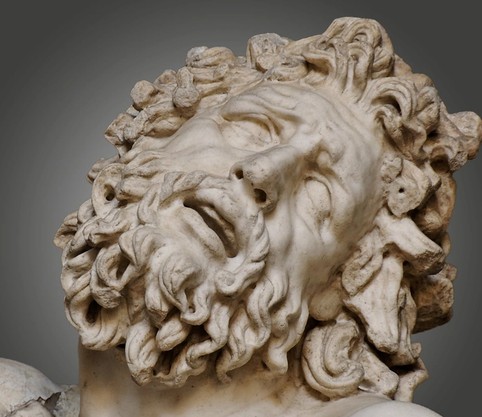
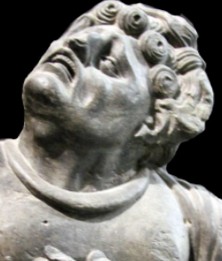
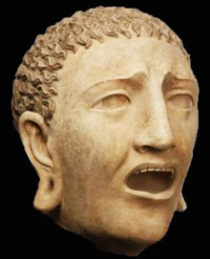
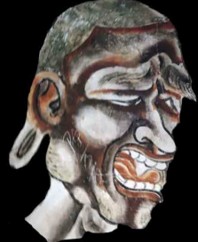
FIG. 14 a, b, c, d
The utter despair of the Trojan priest facing his own death (a) is the precursor to the passionate and emotional expressions of the agonizing Buddhist monk of the stucco sculpture from the Vardak region (b), the pain-stricken layman on the sculpture from the V&A (c), and the arahat (an enlightened person in Buddhism who has destroyed all mental constraints and escaped the cycle of rebirth) from the Mogao cave No.158 grieving the death of their beloved teacher (d).
Manuscripts, translations, paper and printing
Dunhuang was also a dynamic translation hub. Famous Buddhist monks and scripture translators worked in Dunhuang before moving further into mainland China.
For example, the legendary translator Kumarajiva stayed there, and influential local figures, such as the monk Hong Bian of the late Tang dynasty, dedicated their lives to reproducing and translating Buddhist manuscripts. Teams of officials, monks, and ordinary citizens meticulously copied translated religious and secular documents by hand, creating a vast repository of knowledge. It was from this incredible cultural and educational activity that the invention of paper and printing techniques would eventually emerge.
The invention of paper, as we know it today, took place under the Chinese Han Dynasty in AD 105. Ts’ai Lun, a court official, invented a paper making process which primarily used rags (textile waste) as the raw material with which to make paper.
Buddhist devotees, seeking to accumulate spiritual merit, financed both the digging and decoration of caves and the translation and reproduction of sacred sutras and prayers, thus creating a strong commercial and religious demand for inexpensive writing materials. Buddhist monks and pilgrims spread papermaking techniques along the Silk Road during their travels to share these texts. Monks like the Korean Buddhist monk Don Cho introduced these techniques to countries such as Japan around 610 AD.
The Library Cave
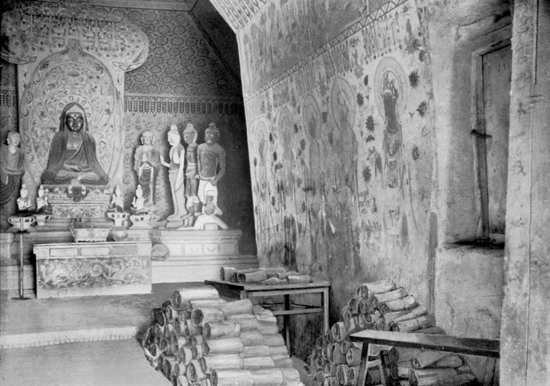
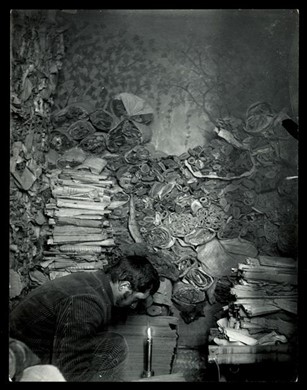
In 1900, a Taoist monk named Wang Yuanlu discovered in Mogao a cache that had been sealed at the 11th century. What is now called the “Library Cave” (Cave 17) contained upwards of 50,000 to 60,000 manuscripts.
While the majority were in Chinese and Tibetan, the cache held texts written in nearly 20 different languages and scripts, including:
- Sanskrit,
- Sogdian,
- Khotanese (Persian),
- Uyghur,
- Tangut (an extinct Tibeto-Burman language),
- Kuchean (also known as Tocharian B or Western Tocharian),
- Uyghour (Old Turkic),
- Mongolian,
- Prakrit,
- Hebrew.
The manuscripts deal with wide-ranging subjects. Among the non-religious texts:
- Social documents, such as contracts, account books and loan receipts;
- Philosophy, notably the Confucian classics;
- Literature, including Chinese folk songs;
- Classical poetry;
- History, both official and local Geography;
- Medicine, including treatments for plagues and illnesses. The medical texts include a fragment of one of the earliest Chinese pharmacological texts;
- Astronomy, including the Dunhuan Star Map that identifies over 1300 stars;
- Mathematics;
- Agriculture and cattle raising;
- Divination;
- Dictionaries;
- Music scores and dance notations, some of them foundational in Japan;
- Recreational games.
By far the largest proportion of manuscripts from the Dunhuang cave contain Buddhist texts. These include Buddhist sutras, commentaries and treatises.
Showing great respect, Li Yuan (Emperor Gaozu), the founder of the Tang dynasty, by declaring himself a descendant of the philosopher Lao Tzu, made Taoism the official state religion, while opening his kingdom to the devotional practices of the many other communities that came via the Silk Road. Chang’an (modern-day Xi’an), the Tang capital, and the major trading ports, in addition to Taoist, Confucian, and Buddhist communities, were home to numerous religious currents from abroad, notably:
- Nestorian Christianity (Jingjiao), officially recognized as early as 635 with the arrival of the monk Alopen and therefore long before the Jesuit missions;
- Zoroastrianism and Manicheanism, practiced by Sogdian merchants and diasporas of Central Asia.
- Islam of Arab and Persian merchants established in the southern ports (such as Guangzhou);
Therefore, among the non-Buddhist religious texts of the Dunhuang manuscripts, one finds:
- Taoist texts;
- Jewish Selihot prayers, as well as a version of the Old Testament in Hebrew;
- Nestorian Christian texts;
- Manichaean texts.
This incredible diversity testifies to centuries of translation efforts and intercultural dialogue.
Christian manuscripts
Among the texts discovered in the Library Cave, western explorers like the Hungarian born British archaeologist Aurel Stein and the Frenchman Paul Pelliot discovered around a dozen Christian texts written in medieval Chinese. These scrolls (such as the Sutra of Jesus Christ and the Book of Great Tensities) reveal that Nestorian scribes worked intensely to translate Christian theology into local languages. To make the concepts understandable, they adopted terminology heavily borrowed from Buddhism and Taoism.
Texts like the Sanwei mengdu zan (a Chinese version of the Gloria in excelsis deo hymn) demonstrate clearly that these manuscripts were actively used for worship by a local Christian Nestorian community in Dunhuang.
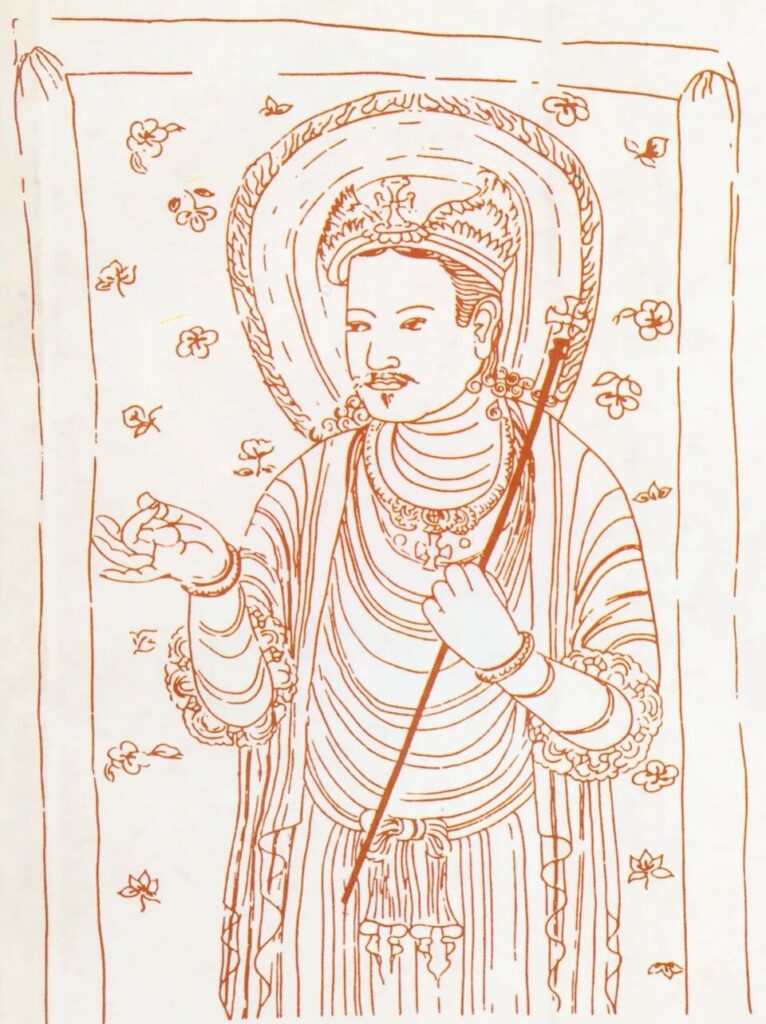
Also discovered in the Mogao Caves, a 9th-century silk painting depicting a holy figure (often identified as Christ or a saint) dressed in traditional Tang dynasty robes but wearing two distinct Nestorian crosses, one on his crown and one on his chest.
The figure is depicted with a mustache and a slight beard, appearing in a three-quarter view similar to traditional Chinese portraits of righteous scholars or divine beings. The right hand is raised to the chest in a gesture of blessing, mimicking the Christian benedictio or a Buddhist mudra.
Additional discoveries from the Mongol (Yuan) period uncovered fragments of the Book of Psalms written in Syriac, confirming that Eastern Christian monks and scholars continued to use the Mogao caves for prayer and textual work up until the 14th century.
Book printing
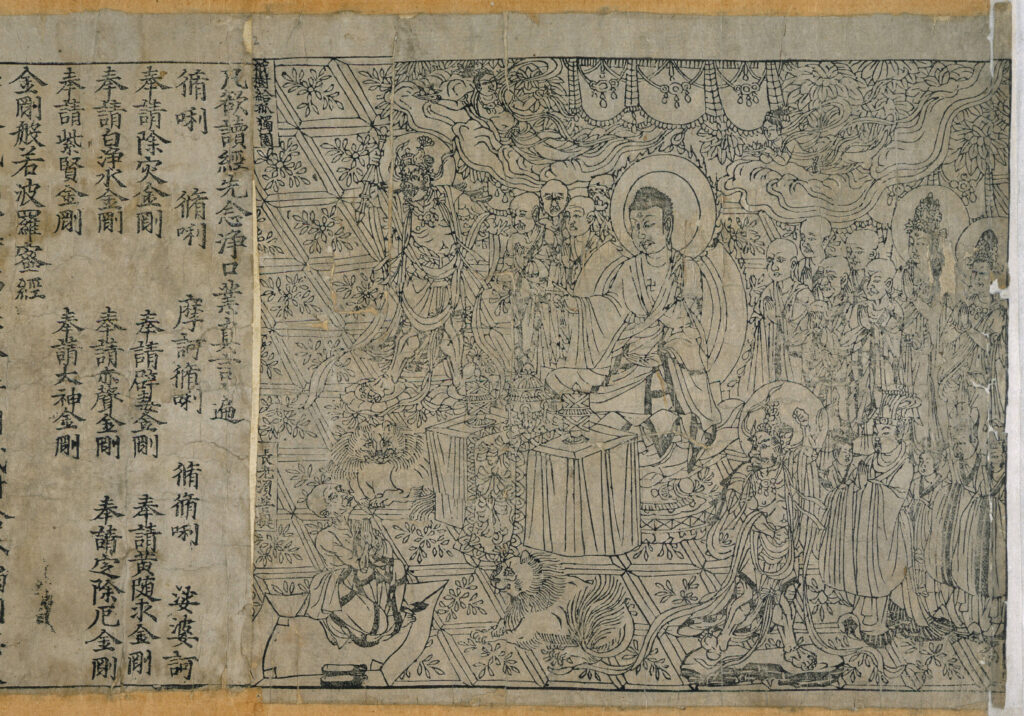
One last marvel among the treasures found, a translation from Sanskrit to Chinese of the Diamond Sutra. This Indian text narrates a dialogue on the nature of reality and illusion between the Buddha and his disciple Subhuti.
The text can be read on a 5-meter (16-foot) long horizontal scroll made of seven sheets of yellow-dyed paper joined together, featuring woodblock-printed text and an ornate frontispiece. Printed on May 11, 868 DC, it is the world earliest known complete printed book.
And in July 1377, that is, 78 years before the famous Gutenberg Bible, it was the Korean Buddhist monk Baegun (Gyeongham) who printed the Jikji (Jikjisimcheyojeol), the oldest book with movable metal types known to date, the second volume of which is kept at the Bibliothèque nationale de France (BnF).
Conclusion
So here, in Dunhuang, mankind, inspired by the accomplishments of Gandhara and other contributions from the Silk Roads, as “a living corridor”, explored a little further the creative essence of humankind and made it an object of celebration, after all the real mission of Art.
Many aspects of this cultural cross-fertilization have been discovered and are now duly documented. The opening of the copper mine and exploration of the Buddhist monasteries of Mes Anyak in Afghanistan will undoubtedly bring another treasure of cultural finds for all.
Let us work together to make this cultural beauty known to the world. As a visual celebration of the highest human qualities, Dunhuang, and the inspiration that gave birth to it, can and should be made as one of those long shadows of the future, a shadow of hope and of a positive future that mankind can decide to construct together.
Thank you for your kind attention.
Selected bibliography:
- Silk Roads: Peoples, Cultures, Landscapes. Susan Whitfield, Thames and Hudson, London, 2019;
- Spatial Dunhuang, Experiencing the Mogao Caves, Wu Hung, University of Washington Press, 2023;
- Buddhist Iconography Along the Silk Road with Prof. Osmund Bopearachchi, Part Two – The Land Route. Wendy Yu, Shantel Wong, Buddhist Global, September 3, 2019. https://www.buddhistdoor.net/features/buddhist-iconography-along-the-silk-road-with-prof-osmund-bopearachchi-part-two-the-land-route/
- Mogao caves reveal powerful India-China Buddhist link, Atul Aneja, The Hindu, Sept. 12, 2016, https://www.thehindu.com/news/international/mogao-caves-reveal-powerful-indiachina-buddhist-link/article8560771.ece
- From Gandhara to Dunhuang: The Evolution of Buddhist Art Along the Silk Road, Irum Malik, Kuiyi Shen, Progressive Research Journal of Arts & Humanities, Vol. 6, Issue 01, February 2026,
https://www.researchgate.net/publication/401971856_From_Gandhara_to_Dunhuang_The_Evolution_of_Buddhist_Art_Along_the_Silk_Road - Mogao Caves, Unesco list of cultural heritage, https://whc.unesco.org/en/list/440/
- Buddhism in Chinese Art (2nd century through 907 C.E.), Smarthistory, https://smarthistory.org/reframing-art-history/buddhism-chinese-art/
- From the Evolution of the “Flying Apsaras” Art in the Mogao Caves, the Influence of Taoism on Dunhuang, Yiran Zhang, Zeus Press; Sociology, Philosophy and Psychology; Vol.2, No.1; 2025, https://journals.zeuspress.org/index.php/SPP/article/download/125/114/524
- Blue pigments in Cave 256, Mogao Grottoes: a systematic analysis of murals and statues in Five dynasties, Song Dynasty and Qing Dynasty, Biwen Shui, Zongren Yu, Qiang Cui, Zhuo Wang, Zhiyuan Yin, Manli Sun & Boming Su, Heritage Science, volume 10, Article #89, 2022. https://www.nature.com/articles/s40494-022-00722-5
- Mogao Cave 45 (High Tang Dynasty), Dunhuang Academy, https://www.dunhuang.ds.lib.uw.edu/mogao-cave-45-high-tang-dynasty/
- The “Miracle of Gandhara”: When Buddha turned himself into man, Karel Vereycken, Artkarel.com, Feb. 28, 2024. https://artkarel.com/the-miracle-of-gandhara-when-buddha-turned-himself-into-man/
NOTES:
- Maitreya, in Buddhist tradition, is the Buddha of the future, currently a bodhisattva residing in the Tushita Heaven, who will descend to earth to preach the Dharma (the « law ») again when the teachings of Gautama Buddha have completely disappeared. Maitreya is the earliest bodhisattva around whom a cult has developed and is mentioned in texts from the 3rd century CE. He has been accepted by all schools of Buddhism and remains the only bodhisattva generally honored by the Theravada tradition. ↩︎
- Minium (or red lead) refers to lead oxide, with the formula Pb₃O₄, historically used as a red-orange pigment and as a rust-preventative paint. It is from this term that the word miniature originated, as medieval artists used it to draw illuminated initials and illustrations in manuscripts. ↩︎
- The « Laocoon Group » is a Roman marble copy of an ancient Greek bronze sculpture depicting the Trojan priest Laocoön and his two sons, punished by Zeus, being attacked by snakes. The statue may date from 40 BC. ↩︎
Du Gandhara à Dunhuang, la Route de la soie, « couloir vivant » de l’art mondial
Le mardi 3 novembre 2026, le peintre-graveur et historien Karel Vereycken, en tant que chercheur indépendant et collaborateur de l’ Institut international Schiller, a donné une présentation (transcription intégrale ci-dessous) au Symposium académique international « La recherche sur les études de Dunhuang à l’ère nouvelle ».
Le symposium, organisé par l’Académie de Dunhuang, s’est déroulé dans le cadre du « Forum de Dunhuang 2026 », dans l’ancienne ville de Dunhuang, dans la province du Gansu en Chine.
Le lendemain, le 4 novembre, Helga Zepp-LaRouche , fondatrice et présidente de l’Institut international Schiller, a prononcé le discours d’ouverture d’une autre session intitulé « Les grottes de Mogao à Dunhuang, l’unité dans la diversité ».
(Un bref compte rendu de l’événement est disponible via ce LIEN.)
L’ Académie de Dunhuang est une institution prestigieuse et très estimée qui œuvre depuis des décennies à la préservation du patrimoine culturel des « grottes de Mogao », près de Dunhuang, étape majeure des anciennes routes de la soie et témoignage unique de plus de mille ans de dialogue et de coopération.
Comme on peut le constater dans le programme de la conférence, le symposium a réuni, outre de très hautes personnalités chinoises, plus de 130 universitaires, archéologues, auteurs et experts (principalement de Chine, mais aussi du Japon, de Russie, d’Allemagne et de France) qui ont présenté leurs dernières recherches sur toutes les facettes possibles de ce patrimoine culturel exceptionnel et unique, ainsi que les techniques d’exploration les plus récentes pour le découvrir.
Karel Vereycken, le 4 novembre 2026 à Dunhuang:
Chers organisateurs, chers collègues, Excellences,
Je tiens tout d’abord à vous remercier encore une fois pour cette invitation. C’est un grand honneur pour moi de participer à cet événement de haut niveau et de pouvoir partager mon point de vue sur le passé, le présent et l’avenir des cultures des Routes de la soie.
La plupart d’entre nous avons emprunté une partie de ces routes pour arriver ici, à Dunhuang, une ville qui mérite d’être honorée et reconnue comme une étape importante sur la voie de ce que l’humanité peut accomplir de mieux lorsqu’elle agit conformément à sa nature profonde, celle de s’aimer les uns les autres, de célébrer le génie et la créativité humaine et de construire un avenir commun.
L’archéologie ne consiste pas seulement à redécouvrir le passé au présent. Elle nous permet aussi, à nous, en tant que fraternité humaine, de découvrir les prémices de l’avenir.
Cependant, je ne suis pas archéologue de profession. Je suis simplement peintre-graveur et chercheur indépendant, collaborateur de l’Institut Schiller. Mes recherches portent sur ce que l’on pourrait appeler « l’archéologie des idées », c’est-à-dire la manière dont les idées et les concepts, notamment dans le domaine de l’art, circulent à travers le temps et l’espace. Et c’est précisément ce qui a suscité mon grand intérêt pour Dunhuang.
La naissance du bouddhisme
Bien sûr, les personnes ici présentes connaissent l’histoire du bouddhisme et de Dunhuang avec une précision bien supérieure à celle que je ne pourrais jamais atteindre. Elles me pardonneront le bref aperçu que je leur présente, mais je pense que les personnes vivant sur d’autres continents et issues de cultures différentes apprécieront cette brève introduction historique.
Pour faire court, le bouddhisme a émergé entre le VIe et le Ve siècle avant notre ère dans la plaine orientale du Gange, près de l’actuel Népal. Siddhartha Gautama, connu sous le nom de Bouddha (« l’Éveillé »), y fonde un mouvement prônant l’auto-perfectionnement spirituel et la transformation sociale. Né prince, il abandonne sa vie luxueuse pour rechercher comment mettre fin à la souffrance humaine, principalement par l’introspection. Son enseignement s’est répandu à travers l’Asie par trois voies :
- des disciples dévoués et inspirants
- le patronage royal et privé
- les réseaux commerciaux de ce qu’on appelait au XIXe siècle la « Route de la soie ».
Empire maurya (324 av. J.C. – 185 av. J.C.)
La première avancée majeure survient environ 200 ans après la mort du Bouddha, avec la fondation de l’Empire maurya (324 av. J.C. – 185 av. J.-C.).
En 321 av. J.-C., avec l’aide de son conseiller avisé et Premier ministre Chanakya, Chandragupta Maurya fonde un vaste et puissant royaume qui unifie la majeure partie du sous-continent indien après le départ d’Alexandre le Grand. Ce royaume s’étendait de l’actuel Afghanistan au Bangladesh actuel, couvrant une grande partie de l’Inde. Il avait pour capitale Pali Putra (l’actuelle Patna, dans le nord-est de l’Inde) et perdura jusqu’en 185 av. J.-C.
L’éducation y était fondamentale. Fondée au Ve siècle avant J.-C., l’université de Taxila (dans l’actuel Pendjab) était un centre renommé d’études sanskrites et védiques.
De 268 av. J.-C. à 232 av. J.-C., c’est le petit-fils de Maurya, le roi presque oublié Ashoka le Grand, qui devient le troisième souverain du royaume. Après avoir mené des guerres injustes et cruelles, Ashoka se tourne progressivement vers le bouddhisme pacifique. Suite à sa conversion, le bouddhisme va gagner en reconnaissance et en force et se répandre à l’échelle mondiale.
Ashoka fit promulguer plusieurs édits gravés sur des rochers et des piliers érigés aux quatre coins du royaume. Rédigés dans les principales langues parlées par les groupes ethniques du royaume, grec ionien, araméen et prakrit, ces édits prônaient la non-violence, le respect de toute forme de vie, la modération et la compassion.
Ashoka a promu le bouddhisme à une échelle sans précédent. Il ordonna et finança la construction de 84 000 temples bouddhistes (stupas) destinés à la pratique dévotionnelle. Après le troisième concile bouddhique (vers 250 av. J.-C.), dont il était le protecteur, il envoya des émissaires pour diffuser les enseignements bouddhistes à l’étranger.
Il est connu qu’il envoya son fils Mahinda au Sri Lanka, faisant de cette région la première, hors d’Inde, à adopter officiellement le bouddhisme. De là, et le long des routes maritimes indiennes, cette expansion vers le sud institua le bouddhisme theravada (« la doctrine des anciens ») comme tradition dominante en Asie du Sud-Est continentale.
Au fil des siècles, les royaumes des actuels Myanmar, Thaïlande, Cambodge et Laos adoptèrent le bouddhisme theravada, l’intégrant profondément à leur gouvernance et à leur identité culturelle.
Empire Kouchan (Ier siècle av. J.C. – IIIe siècle)
Un autre groupe d’émissaires se rendit en Asie centrale et y développa une autre interprétation des enseignements du Bouddha : le bouddhisme mahayana (« Grand véhicule » en sanskrit). Ce dernier connut un véritable essor sous l’Empire kouchan (Ier siècle av. J.-C. – IIIe siècle), un empire fondé très probablement par des éléments de la confédération chinoise Yuezhi au début du Ier siècle de notre ère.
Le fondateur de la dynastie, Kujula Kadphises, s’inspira des idées culturelles et de l’iconographie iraniennes et grecques. Le grec (ionien) était la langue administrative.
Initialement implantée en Bactriane, la civilisation kouchane s’étendit sur une grande partie des territoires qui constituent aujourd’hui l’Afghanistan, l’Inde, le Pakistan, le Tadjikistan, le Turkménistan et l’Ouzbékistan. En Inde, son territoire s’étendait au moins jusqu’à Saketa et Sarnath, près de Varanasi (actuel Bénarès en Inde), comme en témoignent des inscriptions.
La dynastie kouchane entretenait des relations diplomatiques avec l’Empire romain, la Perse sassanide, l’Empire aksumite (Éthiopie et Corne de l’Afrique) et la dynastie Han de Chine (206 av. J.-C. – 220 apr. J.-C.). Elle était au cœur des échanges commerciaux entre l’Empire romain et la Chine : comme l’affirme Alain Daniélou, « l’Empire kouchan fut, pendant un temps, le carrefour des grandes civilisations ». S’il a vu se développer une grande partie de la philosophie, de l’art et des sciences, les seuls témoignages écrits de l’histoire de cet empire proviennent d’inscriptions et de récits en langues étrangères, notamment en chinois.
En 127 apr. J.-C., le roi Kanishka le Grand remplaça l’ionien par le bactrien comme langue officielle. Son règne inaugura une période de paix relative de deux siècles, connue sous le nom de « Pax Kushana ».
Le « miracle du Gandhara »
Depuis le Gandhara, centre culturel et intellectuel de l’Empire kouchan, Kanishka commença à promouvoir le bouddhisme par l’étude, l’art et la littérature.
C’est sous Kanishka que se produisit le « miracle du Gandhara ». L’art dévotionnel bouddhiste, qui pendant quatre siècles avait été exclusivement symbolique et aniconique, se transforma soudainement en un art anthropomorphique prenant les formes humaines et utilisant les canons et les proportions naturalistes de la période grecque classique.
Grâce à la représentation humaine, le bouddhisme touchait désormais le cœur et l’imagination de l’homme ordinaire. Après tout, Bouddha n’était pas un dieu, mais un être humain qui a été divinisé pour ses qualités exceptionnelles. Pour un humain ordinaire, atteindre le nirvana comme Bouddha a réussi à le faire, est un accomplissement hors du commun.
Mais l’art du Gandhara célébrait et produisait également en série de magnifiques sculptures de bodhisattvas, des êtres humains bien intentionnés déjà sur la voie du nirvana, mais vivant d’abord leur propre vie et entièrement dévoués à libérer leurs congénères de la souffrance. Ce qu’on célèbre en les représentant, c’est donc l’empathie et la compassion.
Une route directe reliant le Gandhara à la Chine est restée sous le contrôle des Kouchans pendant plus d’un siècle, favorisant les déplacements à travers le Karakoram (la deuxième plus haute chaîne de montagnes du monde) et facilitant la diffusion du bouddhisme Mahayana en Chine.
Il convient de noter que le Gandhara a développé sa propre langue, le gandhari, qui allait devenir une lingua franca le long de la Route de la soie et une langue source pour les premières traductions chinoises des sutras bouddhistes sous la dynastie Han.
Depuis le Gandhara, le bouddhisme se répandit dans les « villes oasis » d’Asie centrale comme Khotan et Dunhuang, puis dans le reste de la Chine sous la dynastie Han. La Chine transmit ensuite ses traditions mahayana vers le nord-est. Après son adoption par les royaumes coréens au IVe siècle, des moines coréens introduisirent le bouddhisme à la cour impériale japonaise au VIe siècle.
Entre le IIe et le VIIe siècle, l’art du Gandhara se diffusa jusqu’à Dunhuang, en Chine, le long des routes terrestres de l’ancienne Route de la soie, transporté par des moines, des marchands et des envoyés diplomatiques. Les monastères et couvents bouddhistes situés sur la Route de la soie, financés à la fois par les rois et les marchands, étaient bien plus que de simples lieux de culte : ils favorisaient le bien-être économique et culturel. Outre les lieux de dévotion, ils offraient le gîte, une protection contre les bandits, des formations pour les artisans d’art, une éducation pour les enfants et les orphelins, des soins médicaux et même des services financiers. Comme en témoigne le site archéologique de Mes Anyak (actuel Afghanistan), certains monastères bouddhistes étaient également actifs dans les industries minières et métallurgiques.
Les objets d’art et religieux circulaient aux côtés des marchandises à travers l’Empire kouchan et les oasis d’Asie centrale. Marchands bouddhistes, pèlerins, moines et nonnes, fervents défenseurs de la religion, empruntaient ces dangereuses routes désertiques pour collecter des écritures sanskrites, emportant avec eux des objets iconographiques et des statues sacrées. Ils traversaient des centres névralgiques comme Bamiyan et Mes Anyak en Afghanistan, ainsi que les grottes de Kizil à Kucha (Xinjiang), avant d’atteindre Dunhuang. Trouvant facilement place dans les bagages des marchands, des objets de petite taille, tels que des figurines en bronze doré, des dessins, des bannières peintes et des manuscrits enluminés, servirent de modèles.
Dunhuang, un second Gandhara
En parvenant aux grottes de Mogao à Dunhuang, l’art du drapé réaliste et de l’anatomie humaine naturaliste fut réinterprété par des artistes locaux et étrangers. Il serait simpliste de dire que l’école de peinture de Dunhuang fut simplement influencée par l’art du Gandhara et se contenta de copier les influences extérieures.
À Dunhuang, on dénombre 735 grottes, dont 492 abritent des peintures murales et des sculptures peintes. Elles constituent les vestiges d’un patrimoine artistique inestimable. Avec près de 25 000 mètres carrés de peintures murales et plus de 3000 sculptures peintes, ce site est non seulement l’un des plus vastes, mais aussi l’un des plus précieux sites d’art bouddhique.
Entre 400 et 1400 après J.-C., Dunhuang a vu se côtoyer de nombreux talents au sein d’une culture bouillonnante. On pourrait la qualifier de « second Gandhara ». Tout comme au Gandhara, grâce à un dialogue amical, une compréhension et une admiration mutuelles se sont développées entre les cultures étrangères (hellénique, perse, indienne, etc.) et la culture traditionnelle chinoise, donnant ainsi naissance à une nouvelle forme d’art.
Architecture
Tout d’abord, les complexes monastiques du Gandhara se caractérisent par de petites cellules sobres (viharas) destinées aux moines résidents et organisées autour d’une cour centrale. La partie nord des grottes de Mogao reproduit parfaitement cette organisation, abritant plus de 200 grottes aux parois nues qui servaient exclusivement de logements, de cellules de méditation et d’ateliers pour les artisans itinérants du site.
Au Gandhara, les moines priaient dans des chaityas — des salles voûtées creusées dans la roche et construites autour d’un tumulus funéraire indépendant (stupa) pour la circumambulation.
Lorsque ce modèle parvint à Dunhuang, les bâtisseurs chinois l’adaptèrent pour créer des « grottes à pilier central » (par exemple, la grotte 254). Au lieu du stupa rond, ils sculptèrent une colonne rocheuse massive et carrée s’étendant du sol au plafond, ornant ses côtés de niches contenant des statues peintes.
Peinture et sculpture : grotte 275 contre grotte 45
Pour comprendre comment l’art visuel du Gandhara a évolué à Dunhuang, il n’y a pas de meilleure façon que d’examiner directement le contraste entre la grotte 275 et la grotte 45, séparées de trois siècles.
Passer de l’un à l’autre, c’est comme quitter les frontières occidentales naïves, influencées par les Kouchans, pour se retrouver plongé dans l’élégance suprême d’une cour impériale chinoise locale.
Datant de la dynastie des Liang du Nord (397-439 apr. J.-C.), la grotte 275 est l’une des plus anciennes structures encore visibles à Dunhuang. Son élément central est une statue en terre cuite peinte de 3,34 mètres de haut, représentant le bodhisattva Maitreya. 1
Dans les grottes anciennes comme la grotte 257 ou la grotte 275, les peintures sont conçues pour insuffler les principes moraux bouddhistes fondamentaux aux voyageurs venus s’y reposer. Assis, les chevilles croisées, sur un trône soutenu par deux lions (une posture et un motif royal directement inspirés de l’iconographie royale kouchane), le personnage exhibe un corps robuste aux épaules larges, un nez long et proéminent et un menton carré, traits rappelant l’art gréco-romain du début du Gandhara. Son torse est nu, seulement drapé d’une écharpe rigide aux formes géométriques, de style occidental. À cette époque, le réalisme gréco-romain du Gandhara a fortement impacté l’art chinois.
La grotte 45 fut créée trois siècles plus tard, à l’apogée du réalisme de la dynastie Tang (VIIIe siècle). À cette époque, les fondements étrangers et rigides du Gandhara s’étaient complètement dissous au profit d’un style classique chinois indigène d’une incroyable fluidité.
Positionné dans une niche de la paroi occidentale, un groupe sculpté de sept figures parfaitement conservé, comprenant un Bouddha prêchant au centre, deux disciples, deux bodhisattvas et deux rois gardiens célestes.
Les bas-reliefs du Gandhara étaient réputés pour leurs lourds drapés réalistes, inspirés des toges romaines, aux plis profondément sculptés recouvrant le corps. Dans les premières peintures murales de Mogao, ces robes apparaissent aplaties en fines lignes tendues, évoquant des drapés mouillés. Sous la dynastie Tang, l’esthétique évolue radicalement vers les fameuses « écharpes flottantes de Dunhuang », où les lourds plis du tissu sont remplacés par des rubans légers, ondulants et calligraphiques, suggérant un mouvement rapide.
A l’époque de la décoration de la grotte 45, l’attention se détourne des sacrifices terrestres pour se porter sur des visions spectaculaires du salut céleste. Sur la paroi sud de la grotte 45, l’illustration de la « Terre pure occidentale » représente le Bouddha Amitabha présidant à une vaste cour céleste.
Des apsaras (êtres célestes volants) dansent avec grâce au-dessus d’eux tandis que des âmes nouvellement renaissantes émergent paisiblement de fleurs de lotus dans un bassin central scintillant. Pour ancrer cette scène céleste dans l’émotion humaine, les côtés de la fresque présentent d’étroites bordures illustrant l’histoire tragique de la reine Vaidehi, qui pratique la méditation pour échapper à l’emprisonnement que lui impose son fils félon.
En termes d’élégance, la grotte 45 rappelle au spectateur la célèbre Triade de Hadda, un groupe de statues mis au jour à Tapa Shotor, grand monastère bouddhiste Sarvastivadin près de Hadda en Afghanistan (malheureusement détruit entretemps). Datant du IIe siècle après J.-C., c’est certainement l’une des expressions les plus raffinées de l’art du Gandhara.
Alors que cet art privilégiait le réalisme dans la représentation des corps, les artistes Tang y ajoutèrent l’expression des émotions. Comparons les deux disciples de la grotte 45 : Ananda, (à la droite de Bouddha) est représenté comme un jeune moine à la beauté parfaite, au visage lisse et serein, tandis que Kashyapa (à la gauche de Bouddha), plus âgé, arbore un visage maigre, ridé et marqué par les épreuves, reflet d’une longue vie ascétique.
Les deux bodhisattvas qui les encadrent incarnent l’élégance suprême de l’apogée de la période Tang. S’éloignant de la posture rigide et frontale du Maitreya de la grotte 275, leurs corps ondulent dans une courbe en S appuyée et fluide, inspirée du tribhanga indien (déhanché), mais fortement influencée par l’esthétique chinoise. Les plis de leurs robes de soie et leurs ceintures ornées de pierres précieuses tombent avec douceur, à l’image de véritables textiles en mouvement.
Enfin, sur les bords extérieurs du groupe se dressent les Rois-gardiens célestes. Leurs grimaces intenses et musclées, ainsi que leurs postures imposantes, illustrent l’évolution finale des figures de la défense : au lieu de porter une armure d’influence romaine, ils sont vêtus de cuirasses de la dynastie Tang, fidèles à la réalité et finement ciselées.
Mais l’art est plus que la simple virtuosité technique car les compétences techniques sont ici mobilisées pour transmettre des concepts élevés. C’est le sujet spirituel et cognitif qui pousse les artistes à innover dans leur maîtrise technique.
Il serait intéressant d’explorer en profondeur le processus par lequel des traits spécifiques du Gandhara, tels que le regard compatissant baissé et les ornements royaux élaborés, ont fusionné avec l’esthétique chinoise, transformant des figures comme l’Avalokiteshvara du Gandhara (le bodhisattva de la compassion, divinité tutélaire des marchands) en Guanyin chinoise (déesse de la miséricorde et de la compassion dans la culture chinoise et le bouddhisme d’Asie orientale).
Dans leurs fresques, les artistes du Gandhara utilisaient un ombrage tridimensionnel occidental et hellénistique pour définir le corps humain. Les peintres de Dunhuang ont adopté cette technique dans un style local appelé « ombrage convexe » (ao-tu).
Ils peignaient de profonds cercles autour des orbites, des muscles et des clavicules pour donner aux peintures murales un aspect tridimensionnel et réaliste lorsqu’on les observait à la lueur des bougies. Au fil des siècles, le pigment de minium de plomb d’origine s’est oxydé, noircissant ces zones et créant ainsi un effet « œil de panda » caractéristique des premières peintures murales de la Route de la soie. 2
L’évolution des couleurs de Dunhuang reflète également les transformations des échanges commerciaux le long de la Route de la soie. Les artistes utilisaient initialement des pigments minéraux naturels mélangés à de la colle animale, mais les minéraux qu’ils pouvaient se procurer ont évolué.
Les premiers peintres privilégiaient les oxydes de fer locaux, comme l’hématite et l’ocre, pour obtenir des rouges profonds et des bruns chauds.
En revanche, pour les bleus éclatants, ils employaient le lapis-lazuli (lazurite). Ce dernier, importé des mines du Badakhshan (actuel Afghanistan) sur des milliers de kilomètres, est abondamment présent dans les premières grottes, ce qui souligne les liens économiques directs et immédiats qui unissaient Dunhuang aux régions occidentales. Avec le développement et la consolidation des routes commerciales chinoises, les artistes ont progressivement remplacé le lapis-lazuli importé par l’azurite, un minéral de cuivre d’un bleu profond, largement disponible en Chine.
Les verts sont devenus d’une intensité remarquable grâce à l’utilisation généreuse de malachite. Enfin, tandis que les premiers artistes utilisaient la feuille d’or avec parcimonie ou la remplaçaient par de l’ocre jaune vif, les artistes de la dynastie Tang maîtrisaient des techniques de dorure complexes. Ils appliquaient des feuilles d’or ultra-minces sur une sous-couche d’oxyde de fer rouge pour que les bijoux, les couronnes et les halos célestes rayonnent de lumière à l’intérieur des grottes obscures éclairées à la bougie.
Le Laocoon
Sur le plan émotionnel également, comme l’a souligné le professeur Osmund Bopearchchi en 2019, lors d’une conférence au Centre d’études bouddhistes de l’Université de Hong Kong, évoquant plusieurs exemples de motifs gandhariens très reconnaissables dans l’iconographie bouddhiste.
Il a relevé notamment les similitudes d’expression entre une sculpture du « Grand Gandhara » représentant le cri d’agonie d’un moine, et le laïc souffrant sous le lit du Bouddha, déplorant la mort du Bienheureux, tel qu’il est représenté sur un bas-relief actuellement exposé au Victoria and Albert Museum (V&A) de Londres. La ressemblance ne se limite pas à l’aspect général des images, mais s’étend également au détail des expressions : les dents, la langue, la mâchoire, les sourcils et le regard fixe traduisent une profonde tristesse et un cri de désespoir.
Le professeur Bopearachchi a émis l’hypothèse que cette inspiration pourrait provenir de la statue hellénistique du Laocoon et ses fils, également connue sous le nom de Groupe du Laocoon, « l’icône prototypique de la souffrance humaine » dans l’art occidental. 3
Ce type d’iconographie s’est diffusé directement ou indirectement à Dunhuang. Les représentations les plus célèbres proviennent de la grotte n° 158 de Mogao, appelée grotte du Nirvana, qui montre des personnes en deuil assistant au décès du Bouddha, représenté sur des peintures murales le long de la salle située à l’arrière.
Le désespoir absolu du prêtre troyen face à sa propre mort (a) est le précurseur des expressions passionnées et émotionnelles du moine bouddhiste agonisant de la sculpture en stuc de la région de Vardak (b), du laïc souffrant sur la sculpture du V&A (c) et de l’arahat (personne qui a atteint la libération complète du cycle des renaissances et réalisé le Nirvana) de la grotte Mogao n° 158, pleurant la mort de son maître bien-aimé (d).
Jusque-là, dans la peinture et la sculpture classiques chinoises, la douleur physique ou morale est rarement montrée de manière théâtrale. Elle est surtout filtrée par l’idéal d’harmonie, de retenue et d’équilibre. Avec l’arrivée du bouddhisme, les représentations de divinités compatissantes (comme Guanyin) vont permettre d’exprimer la conscience de la souffrance universelle par la sérénité, la méditation ou un regard de compassion.
Manuscrits, traductions, papier et éditions
Dunhuang était également un centre dynamique de traduction. Des moines bouddhistes et traducteurs de textes sacrés y travaillèrent avant de s’installer plus loin en Chine continentale. Par exemple, le légendaire traducteur Kumarajiva y séjourna, et des personnalités locales influentes, comme le moine Hong Bian de la fin de la dynastie Tang, consacrèrent leur vie à la reproduction et à la traduction des manuscrits bouddhistes. Des équipes de fonctionnaires, de moines et de citoyens ordinaires recopiaient méticuleusement à la main des documents religieux et profanes traduits, constituant ainsi un immense fonds de connaissances. C’est de cette incroyable activité culturelle et éducative que naîtront l’invention du papier et des techniques d’impression.
L’invention du papier, tel que nous le connaissons aujourd’hui, remonte à la dynastie Han en Chine, en 105 après J.-C., Ts’ai Lun, un haut fonctionnaire de la cour, inventa un procédé de fabrication utilisant principalement des chiffons (déchets textiles) comme matière première.
Pour accumuler des mérites spirituels, les fidèles bouddhistes vont financer le creusement et la décoration des grottes, mais aussi la traduction et la reproduction des sutras et prières sacrés, suscitant une forte demande commerciale et religieuse de supports d’écriture bon marché. Les moines bouddhistes et les pèlerins diffusèrent les techniques de fabrication du papier le long de la Route de la soie, lors de leurs voyages pour partager les écrits.
A l’exemple du moine bouddhiste coréen Don-Cho, des moines introduisirent ces techniques dans des pays comme le Japon vers 610 après J.-C.
La « grotte-bibliothèque »
En 1900, un moine taoïste nommé Wang Yuanlu découvrit à Mogao une cache scellée au XIe siècle. Ce que l’on appelle aujourd’hui la « Grotte-Bibliothèque » (Grotte 17) contenait entre 50 000 et 60 000 manuscrits.
Si la majorité étaient en chinois et en tibétain, la cache renfermait des textes écrits dans près de 20 langues et écritures différentes, dont:
- le sanskrit,
- le sogdien,
- le khotanais (persan),
- le vieux ouïghour,
- le tangoute (langue tibéto-birmane éteinte),
- le koutchéen (aussi connu sous le nom de tocharien B ou tocharien occidental),
- le mongol,
- le prakrit
- et l’hébreu.
Les manuscrits non-religieux touchent à de nombreux domaines:
- Annales tibétaines;
- Philosophie, notamment des classiques du Confucianisme;
- Littérature;
- Littérature populaire bouddhiste et profane;
- Chansons folkloriques;
- Poésie classique;
- Histoire, officielle et locale;
- Géographie;
- Médecine, dont des traitements contre la peste et autres maladies;
- Astronomie, dont la carte stellaire de Dunhuang avec plus de 1300 étoiles;
- Mathématiques;
- Divination;
- Partitions de musique avec un mode de notation musicale qu’on retrouve aujourd’hui au Japon.
- Notation de danse.
- Documents sociaux, tels que contrats, livres d’acompte et d’emprunt.
- Documents sur l’élevage et la sélection des chevaux.
Si sur le plan spirituel, la plupart des textes sont bouddhistes, on trouve parmi les textes religieux non bouddhistes:
- Des textes taoïstes;
- Les prières juives Selihot, ainsi qu’une version de l’Ancien Testament en hébreu;
- Textes chrétiens nestoriens;
- Textes manichéens.
Cette incroyable diversité témoigne de siècles d’efforts de traduction et de dialogue interculturel. En déclarant descendre du philosophe Lao Tseu, Li Yuan (empereur Gaozu), fondateur de la dynastie Tang, a fait du taoïsme la religion officielle de l’État, tout en ouvrant son royaume aux pratiques dévotionnelles des nombreuses communautés venues par la Route de la soie.
Aussi bien Chang’an (l’actuel ville de Xi’an), la capitale des Tang, que les grands ports de commerce abritaient, à part des communautés taôistes, confucéennes et bouddhistes, de nombreux courants religieux venus d’ailleurs, notamment :
- le christianisme nestorien (Jingjiao), officiellement reconnu dès 635 avec l’arrivée du moine Alopen, donc bien longtemps avant les missions jésuites ;
- l’islam des marchands arabes et persans installés dans les ports du sud (comme Guangzhou) ;
- le zoroastrisme et le manichéisme, pratiqués par les marchands sogdiens et diasporas d’Asie centrale.
Manuscrits chrétiens
Parmi les textes découverts dans la grotte-bibliothèque, des explorateurs occidentaux comme le Britannique d’origine hongroise Aurel Stein et le Français Paul Pelliot, ont mis au jour une douzaine de textes chrétiens écrits en chinois médiéval.
Ces rouleaux (tels que le « Sutra de Jésus-Christ » et le « Livre des Grandes Tensions ») révèlent que des scribes nestoriens s’étaient efforcés de traduire la théologie chrétienne dans les langues locales.
Afin de rendre les concepts compréhensibles, ils avaient adopté une terminologie largement empruntée au bouddhisme et au taoïsme.
Des textes comme le « Sanwei mengdu zan » (version chinoise de l’hymne « Gloria in excelsis deo ») démontrent clairement que ces manuscrits étaient activement utilisés pour le culte par une communauté chrétienne nestorienne locale à Dunhuang.
Découverte également dans les grottes de Mogao, une peinture sur soie du IXe siècle représentant une figure sainte (souvent identifiée comme le Christ ou un saint) vêtue de robes traditionnelles de la dynastie Tang, mais portant deux croix nestoriennes distinctes, l’une sur sa couronne et l’autre sur la poitrine.
Le personnage, portant une fine moustache et une barbiche est représenté de trois quarts face, à la manière des portraits traditionnels chinois de lettrés ou d’êtres divins. Sa main droite est levée vers la poitrine dans un geste de bénédiction, évoquant la bénédiction chrétienne ou une mudra bouddhiste.
Des découvertes supplémentaires datant de la période mongole (Yuan) ont mis au jour des fragments du « Livre des Psaumes » écrits en syriaque, confirmant que les moines et les érudits chrétiens d’Orient ont continué à utiliser les grottes de Mogao pour la prière et le travail textuel jusqu’au XIVe siècle.
Du manuscrit au livre imprimé
Parmi les trésors découverts, une dernière merveille : la traduction du sanskrit en chinois du Sutra du Diamant. Ce texte indien relate un dialogue entre le Bouddha et son disciple Subhuti sur la nature de la réalité et de l’illusion. Il se lit sur un rouleau horizontal de 5 mètres de long, composé de sept feuilles de papier teintées en jaune et assemblées, orné d’un texte imprimé et d’un frontispice richement décoré. Cette œuvre a été entièrement réalisée grâce à la technique de la xylographie, c’est-à-dire l’impression au moyen de blocs de bois gravés. Imprimé le 11 mai 868, il s’agit du plus ancien livre imprimé complet connu au monde.
Et pour couronner le tout, en juillet 1377, c’est-à-dire 78 ans avant la fameuse Bible de Gutenberg, le moine bouddhiste coréen Baegun (Gyeongham) imprima le Jikji (Jikjisimcheyojeol), le plus ancien livre réalisé avec des caractères mobiles en métal connu à ce jour, une œuvre dont la deuxième partie est conservé à la Bibliothèque nationale de France.
Conclusion
Ainsi, à Dunhuang, inspirée par les réalisations du Gandhara et d’autres contributions des Routes de la soie, véritables « corridors vivants », l’humanité a exploré un peu plus profondément le génie humain et en a fait un objet de célébration, ce qui est, au fond, la véritable mission de l’art.
De nombreux aspects de ces échanges culturels ont été mis en lumière et sont désormais dûment documentés. L’ouverture de la mine de cuivre et l’exploration des monastères bouddhistes de Mes Anyak, en Afghanistan, nous apportera sans aucun doute un nouveau trésor de découvertes culturelles.
Œuvrons ensemble pour faire connaître au monde cette beauté culturelle. Témoignage visuel des plus hautes qualités humaines, Dunhuang, et l’inspiration qui lui a donné naissance, peuvent et doivent devenir l’une de ces longues ombres de l’avenir, une ombre d’espoir et d’un avenir positif que l’humanité peut choisir de construire ensemble.
Merci de votre attention.
Bibliographie sommaire :
- Spatial Dunhuang, Experiencing the Mogao Caves, Wu Hung, University of Washington Press, Seattle, 2023;
- Sur les routes de la soie, peuples, cultures, paysages. Sous la direction de Susan Whitfield, Flammarion, Paris, 2019
- L’iconographie bouddhiste le long de la Route de la soie avec le professeur Osmund Bopearachchi, deuxième partie – La Route terrestre, Wendy Yu, Shantel Wong, Buddhist Global , 3 septembre 2019. https://www.buddhistdoor.net/features/buddhist-iconography-along-the-silk-road-with-prof-osmund-bopearachchi-part-two-the-land-route/
- Les grottes de Mogao révèlent un lien bouddhiste puissant entre l’Inde et la Chine, Atul Aneja, The Hindu, 12 septembre 2016, https://www.thehindu.com/news/international/mogao-caves-reveal-powerful-indiachina-buddhist-link/article8560771.ece
- De Gandhara à Dunhuang : l’évolution de l’art bouddhique le long de la Route de la soie, Irum Malik, Kuiyi Shen, Progressive Research Journal of Arts & Humanities, vol. 6, n° 1, février 2026, https://www.researchgate.net/publication/401971856_From_Gandhara_to_Dunhuang_The_Evolution_of_Buddhist_Art_Along_the_Silk_Road
- Grottes de Mogao, inscrites sur la liste du patrimoine culturel immatériel de l’UNESCO, https://whc.unesco.org/en/list/440/
- Le bouddhisme dans l’art chinois (IIe siècle à 907 apr. J.-C.), S marthistory, https://smarthistory.org/reframing-art-history/buddhism-chinese-art/
- L’évolution de l’art des Apsaras volantes dans les grottes de Mogao : l’influence du taoïsme sur Dunhuang, Yiran Zhang, Zeus Press ; Sociologie, Philosophie et Psychologie ; Vol. 2, n° 1 ; 2025, https://journals.zeuspress.org/index.php/SPP/article/download/125/114/524
- Pigments bleus dans la grotte 256, grottes de Mogao : une analyse systématique des peintures murales et des statues des cinq dynasties, dynastie Song et dynastie Qing, Biwen Shui, Zongren Yu, Qiang Cui, Zhuo Wang, Zhiyuan Yin, Manli Sun et Boming Su, Heritage Science, volume 10, article #89, 2022. https://www.nature.com/articles/s40494-022-00722-5
- Grotte de Mogao 45 (Haut Tang), Académie de Dunhuang, https://www.dunhuang.ds.lib.uw.edu/mogao-cave-45-high-tang-dynasty/
- Le miracle du Gandhara : quand Bouddha s’est fait homme, Karel Vereycken, Artkarel.com, 28 février 2024. https://artkarel.com/le-miracle-du-gandhara-quand-bouddha-sest-fait-homme/
NOTES:
- Maitreya, dans la tradition bouddhique, est le bouddha du futur, actuellement un bodhisattva résidant dans le ciel de Tushita, qui descendra sur terre pour prêcher à nouveau le dharma (« la loi ») lorsque les enseignements de Gautama Bouddha auront complètement disparu. Mentionné dans des textes du IIIe siècle de notre ère, Maitreya est le plus ancien bodhisattva autour duquel un culte s’est développé. Il a été accepté par toutes les écoles du bouddhisme et reste le seul bodhisattva généralement honoré par la tradition theravada. ↩︎
- Le « groupe du Laocoon », discuté amplement par le critique d’art Gotthold Ephraim Lessing, est une copie romaine en marbre d’une sculpture grecque antique en bronze représentant le prêtre troyen Laocoon et ses deux fils, punis par Zeus, attaqués par des serpents. La statue pourrait dater de 40 av. J.-C. ↩︎
- Le minium (ou minium de plomb) désigne l’oxyde salin de plomb, de formule Pb₃O₄, utilisé historiquement comme pigment rouge-orangé et comme peinture antirouille. C’est ce terme qui a donné naissance au mot miniature, car les artistes du Moyen Âge l’utilisaient pour dessiner les lettrines et les illustrations des manuscrits. ↩︎