Étiquette : Byzantium
Debunking Renaissance Fakenews — Part I: Fake Platonist Marsilio Ficino
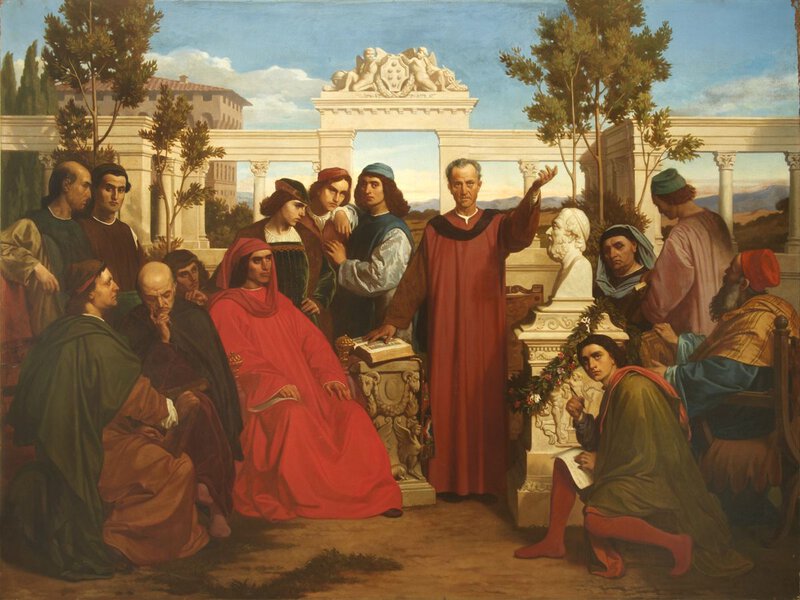
by Karel Vereycken, august 2026
This article is the first of a three-part series:
I. Fake Platonist Marsilio Ficino and his Florentine “Platonic Academy” (below)
II. The Medici dynasty and Cosimo de’ Medici’s (coming)
III. Georgios Gemistos Plethon, his life and ambitions (coming)
As it is well known, I’m a passionate researcher and admirer of what goes under the label of “Renaissance.” I’ve researched quite extensively and over many years, creative artists such as Ghiberti, Verrocchio, Brunelleschi, Donatello, Piero della Francesca, Leonardo da Vinci, Michelangelo and Raphael.
This summer, I read Alma Palmer‘s inspiring book “Inventing the Renaissance, Myths of the Golden Age.” 1 That title is in reality a wake-up call. Yes, there was a splendid unprecedented explosion of Greek and Latin studies combined with painting, sculpture and architecture invented by idealistic humanists that anybody visiting Italy, and Florence more particularly, can admire.
However there are also powerful myths invented (created out of hot air) by powerful factions of the oligarchy out to claim their own legitimacy (it was all me) and play down that of others.
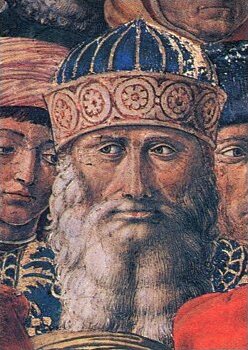
As a starter, let’s examine the very common narrative about the Greek philosopher Georgios Gemistos, who added the name “Plethon” (Plato) to his own name, who traveled in 1438, at the age of at least seventy-eight, to the Council of Ferrara–Florence, the ecumenical gathering that sought to heal the schism between the Orthodox and Latin churches. Plethon, it goes, brought with him the full works of Plato and inspired Cosimo de’ Medici to set up a “Platonic Academy” and have Plato’s works made available to the West.
“This is clearly one of those stories too good to be examined closely, and it has been repeated by nearly every scholar who has written on Florentine culture or Renaissance Platonism,” writes James Hankins who spent years trying to document the case. 2
Here is a rough sketch of the various points of the official narrative followed by my remarks and interrogations:
1) In 1438-39, at the Council of Florence, Cosimo de’ Medici made acquaintance with the “Neoplatonic” philosopher George Gemistos Plethon.
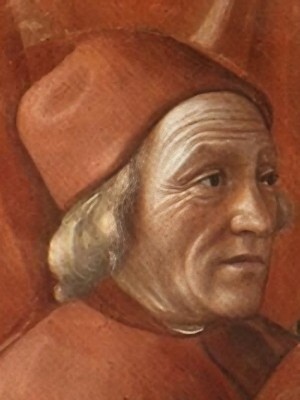
Conclusive proof lacking. The sole and unique source of information for this supposed encounter of 1438-39 is Marsilio Ficino (1433-1499), the son of Cosimo’s physician. Ficino was not an eyewitness to the event. He was born in 1433 and was 5 years old when the Council of Florence started and reports on it only twice, the first time 24 years and the second time 52 years later. Admittedly, he could have gotten the story from his father, who was Cosimo’s medical doctor.
Complicating such an encounter would have arisen from the fact that Plethon spoke nothing but Greek, while Cosimo had zero command over Greek and very poor command over Latin. Cosimo, while reportedly admiring ancient Greek knowledge, never wrote poetry, orations or treatises. The only surviving letters are in Italian.
To understand Plethon, Cosimo would have required a good translator on top of Platonic and Neo-Platonic philosophy. But Bessarion, Plethon’s erudite pupil, was organizing, directing and managing on a day to day basis, together with Traversari and Cusa, the Ecumenical council.
Other than Ficino, not one single source of that period, even among the most ardent defenders and lackey’s of the Medicis, praises or even mentions Cosimo’s encounter with Plethon and his supposed plan to set up a Platonic Academy. Even Bessarion doesn’t spent a line on the subject.
The only rhetorical hints to a supposed encounter between Cosimo and Plethon, as well as his project to create a Platonic Academy appear in two writings of Ficino:
- 24 years after the Council of Florence in a letter to Cosimo de’ Medici written in September 1462;
- 52 years after the Council of Florence in Ficino’s preface to 1490 translation of the Enneads, the main work of the (evil neo-Platonic) Plotinus (who Roman Emperor Julien the Apostate tried to impose as a state religion at the end of the Roman Empire as an alternative to Christianity). The aim of that preface, was to please Cosimo’s grandson, Lorenzo the magnificent (1449-1492), and beg him to continue financing Ficino and his translations of Plotinus, which according to the latter, was nearly as ardently requested by Cosimo as that of the works of Plato.
Here is the critical passage of Ficino’s 1490 introduction to Plotinus’ Enneads :
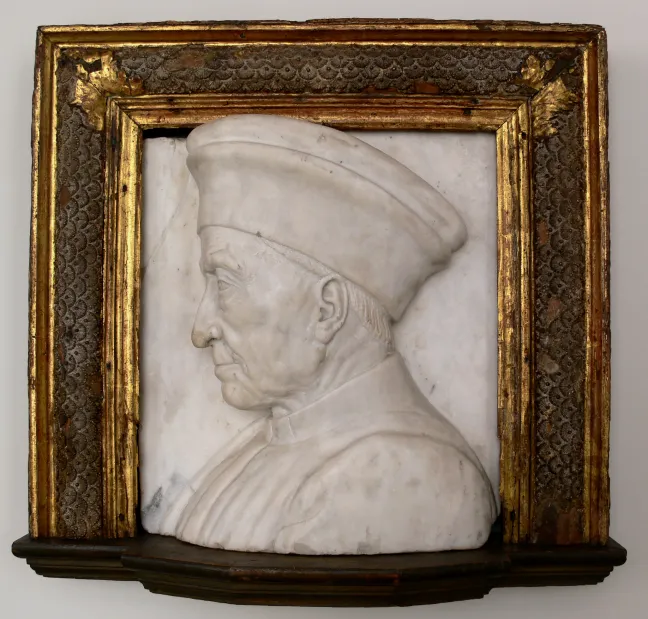
“The Great Cosimo, the Father of his Country by senatorial decree, at the time when a council was being negotiated among the Greeks and Latins in Florence under Eugene IV [1438], frequently heard a Greek philosopher by the name of Gemistus Plethon disputing like another Plato on the Platonic mysteries. From his fervid lips Cosimo was straightway so inspirited, so ensouled, that from that time forth he conceived deep in his mind a kind of Academy, to give birth to it at the first opportune moment. Then, while that great Medici was intending in some sense to give birth to the great thing he had conceived, he destined me, the son of his favorite doctor Ficino, while still a boy, to [undertake] the labor, educating me from that day forth to this very thing.”
“Moreover, he labored that I should not only have all the books of Plato in Greek, but also the books of Plotinus. After this, in the year 1463, in the thirtieth year of my life, he commissioned me to translate, first, Thrice-Great Hermes, and thereafter Plato. Mercury I finished in a few months while Cosimo was still alive; Plato I had also begun at that time [1463]. Although he was also eager for Plotinus, he said nothing to me about translating it, lest he should appear to be weighing me down with too great a burden all at once. Such was the great man’s clemency to his own, such was his modesty towards all. Thus, I never thought, either in the manner of an inspired poet or in my own person, to approach Plotinus. But in the meantime Cosimo at length expressed-or rather impressed from on high-that which he had kept silent about while living on the earth.”
“At the moment when I was giving Plato to the Latin world to read, Cosimo’s heroic soul incited the heroic mind of Giovanni Pico della Mirandola in some unknown way-Pico himself almost did not know how-to come to Florence. Pico, born in the very year [1463] I was starting on Plato, and coming to Florence the same day-almost the same hour-I was publishing him, after greeting me asked me immediately about Plato. To him I said, ‘Our Plato has today emerged onto our thresholds.’ Then he heartily congratulated [me] on this, and straightway-and neither I nor he knows whence the words came-he led, or rather impelled me to translate Plotinus. Surely a divine cause brought it to pass that the hero Pico should be born while Plato was being, as it were, reborn-Saturn being then in the house of Aquarius as it was when I was born thirty years previously-and that he should come to Florence on the very day our Plato was published, and that he should inspire me in a marvelous fashion with Cosimo’s vow about Plotinus which had been quite hidden from me, but which was revealed by heavenly means to him.” 3
What is a proven fact is that Plethon (c. 1355-1452) did meet with Leonardo Bruni (1370-1444), the chancellor of Florence at that time, who had translated himself several Greek manuscripts including Aristotle and Plato. Leonardo Bruni’s translations of the Phaedo, Apology, Crito, and Phaedrus were made only shortly before Gemistos visit. Bruni had studied Greek under the Byzantine scholar Manuel Chrysoloras (1350-1415) who had been invited to teach Greek in Florence by Coluccio Salutati (1341-1406), a friend and admirer of Petrarch (1304-1374) and Boccaccio (1313-1375).
Thanks to Chrysoloras’ activity a number of new Latin of Platonic writings began to appear under the name of his students, Bruni, Umberto Decembrio, and Cencio de’ Rustici, who translated between them ten Platonic dialogues, including the Gorgias, Crito, Apology, Phaedo and the Republic.
According to historian N.G. Wilson, Plethon, during his stay in Florence acquainted the Italian geographer Paolo Toscanelli (1397-1482) with the extensive travels, writings and mapping of the Greek geographer Strabo (1st century BC/AD), hitherto unknown in Italy but crucial for elaborating his famous map that later fell in the hands of Columbus. What is known is that Strabo’s works became an integral part of Bessarion’s library.
2) At the invitation of his humanist friends, including Cosimo, Plethon engaged in private lectures explaining the difference between Plato and Aristotle, arguing that Plato was far more compatible with Christian doctrine.
Conclusive proof lacking. During the Council, Gemistos found that he had free time because much of the counciliar discussion concerned theological minutiae that did not require the presence of a secular sage. Even if Ficino claims Cosimo assisted “frequently” at Plethon’s lectures, there is close to zero evidence they ever took place. What is known is that Plethon wrote a treaty on the difference between Aristotle and Plato, commonly known as De Differentiis. A decade later, Plethon described the circumstances in which he composed his book without ever mentioning it was a follow-up to his lectures:
“That work was not composed as a result of thorough research . . . but at a time when I had been indisposed at Florence and was unable for several days to go out of the house where I was staying; perhaps, too, because I was bored, and was trying at one and the same time to relieve my boredom and to do a favor to those who were interested in Plato. Thus I wrote that work in the briefest form…” 4
C. M. Woodhouse, author of the 416 pages book “George Gemistos Plethon, The Last of the Hellenes” (1986) 5 writes that most claims about this event should be considered as pure speculation. For him:
“The impact of Plethons lectures on the Italians remains hard to assess. Very few of them left any record of their impressions; none of them is more than superficial and secondhand. The case of Cosimo de’ Medici, recorded by Ficino, is the only major exception; an additional but minor one is Grigorio Tifernate. Although De Differentiis was written for the benefit of Italian humanists,‘ none can be named who read it in Plethons life-time. But there is a strong tradition that Plethon impressed many westerners by his personality and learning.” 6
3) Plethon brought with him to Florence a manuscript with all of Plato’s works
Yes. Plethon carried with him many Greek manuscripts. They included the entire works of Plato but also those of the (toxic neoplatonists) Plotinus and Porphyry as well as the Chaldean Oracles (more on that in Part III).
4) Captivated, Cosimo bought the Plato manuscripts from Plethon
No. There is no proof Cosimo was given or bought these manuscripts from Plethon. The latter took many books back with him to Mystras, Greece, after having allowed scribes in Florence to copy them. His most famous student, Cardinal Bessarion, later collected Plethon’s original autographs and manuscripts. Bessarion, not trusting Medici rule over Florence and demanding very precise conditions for conservation, donated his vast collection to the Republic of Venice, forming the foundation of the famous Biblioteca Marciana.
5) Cosimo gave manuscripts of Plato’s works to Marsilio Ficino to have them translated into Latin
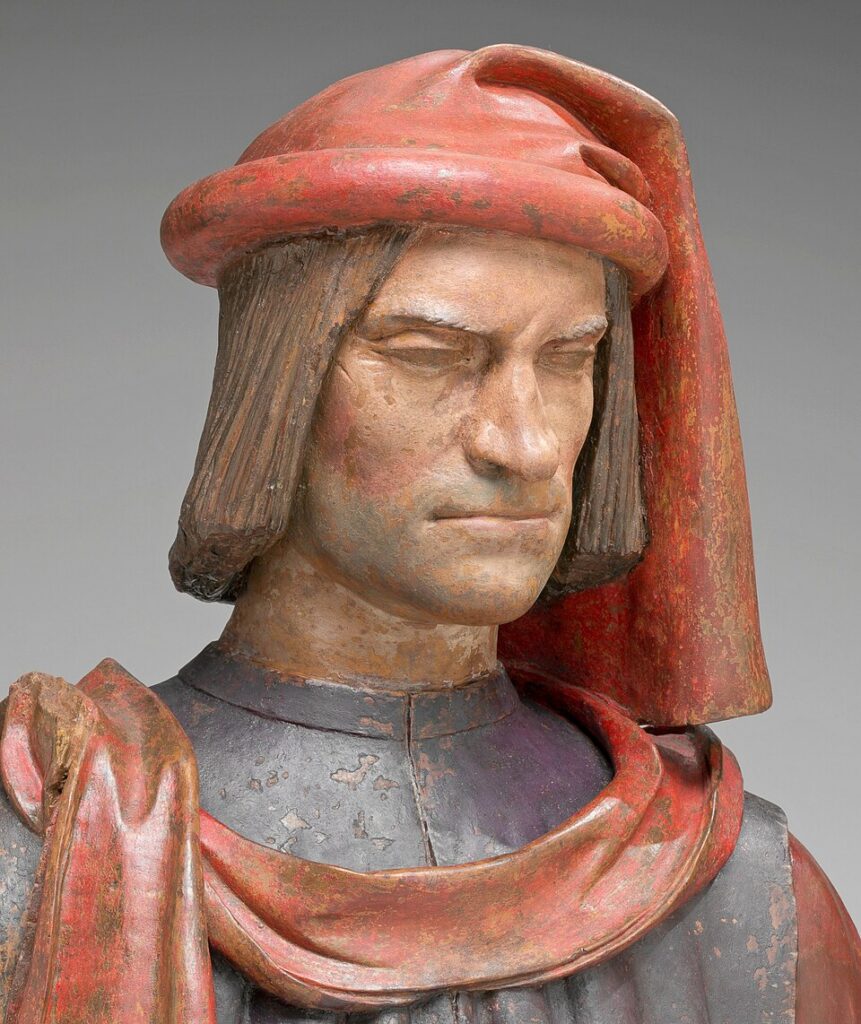
Yes, but. 24 years after the Council of Florence, in 1462, Cosimo, seeing his life coming to an end, supplied the 29 years old Ficino with various Greek manuscripts of Plato’s work, whereupon Ficino started translating the entire corpus into Latin. The draft translation of the entire set of dialogues was finished six to seven years later, around 1468–69. In December 1473, Ficino, age 40, is ordained a priest and gave priority to writing and getting printed his own writings, among which the Platonic Theology and On the Christian Religion.
Plato had to wait and Ficino’s translation of the Complete Works of Plato (Platonis Opera Omnia), thirty-six in all, will only be printed in Florence in 1484 –46 years after the Council of Florence– by the press of the Dominican monastery of San Jacopo di Ripoli, the first printshop to employ women (Dominican nuns) as typesetters. The cost of printing 1,025 copies was not financed by Lorenzo de’ Medici (who passed away in 1492) to whom the translation was dedicated, but by two prominent Florentine patrons and humanists: Filippe Valori and Francesco Berlinghieri. Once produced, Lorenzo did circulate the books in which he appeared prominently. A much-improved second edition was printed in Venice in 1491 by Bernardinus de Choris de Cremona and Simon de Luere for Andreas Torresanus de Asula.
Since the Medici’s wanted to keep the spread of ideas under their control. Therefore they favored handmade codices crafted by professional scribes over mass-produced print. At that time, the price of a manuscript varied wildly—from a few florins for a simple, unadorned text to hundreds of florins or the equivalent of several months to years of wages for an elaborately illuminated luxury volume. With that Medici policy, Florence, the epicenter of the Renaissance, ended up as being one of the last ones in Italy to have modern printing shops !
Paul Oskar Kristeller, who spend years researching on Ficino, gives the following account about why the entire process took so many years:
“Marsilio Ficino, born in 1433, did not begin to learn Greek until 1456 (at age 23 years) and we have no specific information on the content and progress of his studies during the following years. We have a number of Greek manuscripts owned and annotated by Ficino, and a number of translations from the Greek surely or probably made by him, and some of them may belong to this early period, but none of them is dated. At the time when Cosimo de’ Medici gave Ficino a house in Careggi which the latter chose to call his Academy, in September, 1462, he celebrated the event with the translation of an Orphic hymn.” 7
Kristeller confirms that Cosimo asked Ficino to put on hold his translations of Plato, and translate first the writings of Hermes Trismegistus:
“In April, 1463, Ficino completed his translation of the Corpus Hermeticum, after having spent only a few months on it. We know from Ficino’s own words that he began his translation of Plato at that time, after having finished the version of the Hermetica, that he did so at the request of Cosimo de’ Medici, and that he had at his disposal, since 1462, two Greek manuscripts of Plato, a complete one which belonged to Cosimo, and a partial one owned by Amerigo Benci. » 8
As suggested by Kristeller in this paragraph, at the demand of Cosimo, Ficino translated first a collection of Hellenistic Greek documents brought to Pistoia in 1460 by Leonardo da Pistoia later called Hermetica (texts attributed to the legendary Hellenistic figure Hermes Trismegistus). Later, Ficino will also translate the writings of many of the (toxic) Neoplatonists, including Porphyry, Iamblichus, and especially Plotinus.
When Cosimo died on August 1, 1464, Ficino had translated ten Platonic dialogues, nine of them before January 11, and by April 1, 1466, twenty-three dialogues were ready.
After that date, we have no specific information on the progress of the translation, but it is probable that Ficino had completed the first draft of the entire work by 1468 or 1469. However, he wanted to subject the translation to a thorough revision, and hence refused to have it circulate.
Occupied with his Platonic Theology and several other writings, Ficino did not attend to the revision of his Plato translation for several years. He probably began to revise it around 1477, and had finished the revision in 1482 when he allowed it to be copied for others.
In 1483, Ficino sent the entire translation to the printer, apparently after having revised it once more, and finally the first printed edition of Plato appeared in October 1484. Although it had been carefully seen through the press by Ficino, it was necessary to append to it a long list of corrections.
The second edition, printed in Venice 1491, was not supervised by Ficino, but inserted the corrections in the text and hence is considered more accurate. From these two early editions all later ones are derived, although they may have been altered by some of the editors.” 9
The story goes that while other companions at Cosimo’s sickbed read Aristotle’s Nicomachean Ethics (with humanist commentaries) during his prolonged illness, Ficino read some of his newly made Latin translations of Plato’s works to comfort and entertain Cosimo in his final hours. But Cosimo’s Latin, as said before, was poor.
6) Plato’s works were largely unknown till then in the West.
Yes and No. Ficino was far from being the first translator of Platonic dialogues, he rather represents the culminating point of translation activity during the fifteenth century. The Greek text has come down to us in a number of manuscripts, and it was printed for the first time by Aldus Manutius in Venice in 1513.
Before the Renaissance, the Western world was very limited in its access to Plato’s writings. It inherited from Roman antiquity only two partial renderings of the Timaeus made by Cicero and Calcidius, and a number of shorter testimonia in Cicero’s philosophical writings, St. Augustine, and other works of Latin philosophy. During the 12th and 13th centuries, when most works of Aristotle were translated into Latin, the reader acquired only the nearly unintelligible versions of the Phaedo and the Meno, translated by Henricus Aristippus, and a partial version of the Parmenides, translated with Proclus’ commentary by William of Moerbeke. This was all that a Latin student was able to read of Plato up to about 1400, including Petrarch, who owned sixteen Greek manuscripts of Plato that reached the West in modern times, but who was not able to read them.
7) Cosimo asked Ficino to set up a “Platonic Academy”
Conclusive proof lacking. Historian James Hankins is very skeptical about that:
“We may begin by pointing out the general implausibility of the thesis that Cosimo ever founded or wanted to found a new Platonic Academy. It is striking, in the first place, that in none of the numerous works in laudem Cosmi written by humanists during the last decade of his life and after his death is Cosimo ever praised for having re-founded the Platonic Academy in Florence. A volume of ricordanze about Cosimo put together by his son Piero, for instance, though it includes dozens of consolatory letters from various princes, prelates, humanists and fellow citizens praising Cosimo’s magnificence, does not mention even once his project to re-found the Platonic Academy or his collations with Pletho.
Even the letter of Cardinal Bessarion, Plethons student, does not mention the creation of the new Academy. At least four of the poets commonly identified as members of the Florentine Academy wrote poems in praise of Cosimo-indeed, Amerigo Corsini wrote an epic poem in three books of which the third was devoted to praising Cosimo’s cultural patronage-but none of these poets mentions his founding of a Florentine Academy.” 10
Another way to understand Ficino and his « academy » is to examine the various ways he uses the word “academy” and its variants. What one finds is that Plato’s dialogues themselves could be referred to as an “academy,” rich with precious teachings as they were. An “academy” could be a private school organized to teach youths, though not necessarily located in one specific place or devoted to one doctrinal tradition. And the word “academy” could refer to regular meetings of literary men. Ficino’s “academy” seems to have been more associated with the first two meanings of the word. Rather than leading a regular gathering in a specific place, Ficino preferred to teach Florence’s elite youth when he could and, as a Socratic, philosophical friend, to try to draw out of his associates the better part of their natures in conversation.
8) For that purpose, Cosimo offered funding and a part of his private villa in Carregi close to Florence
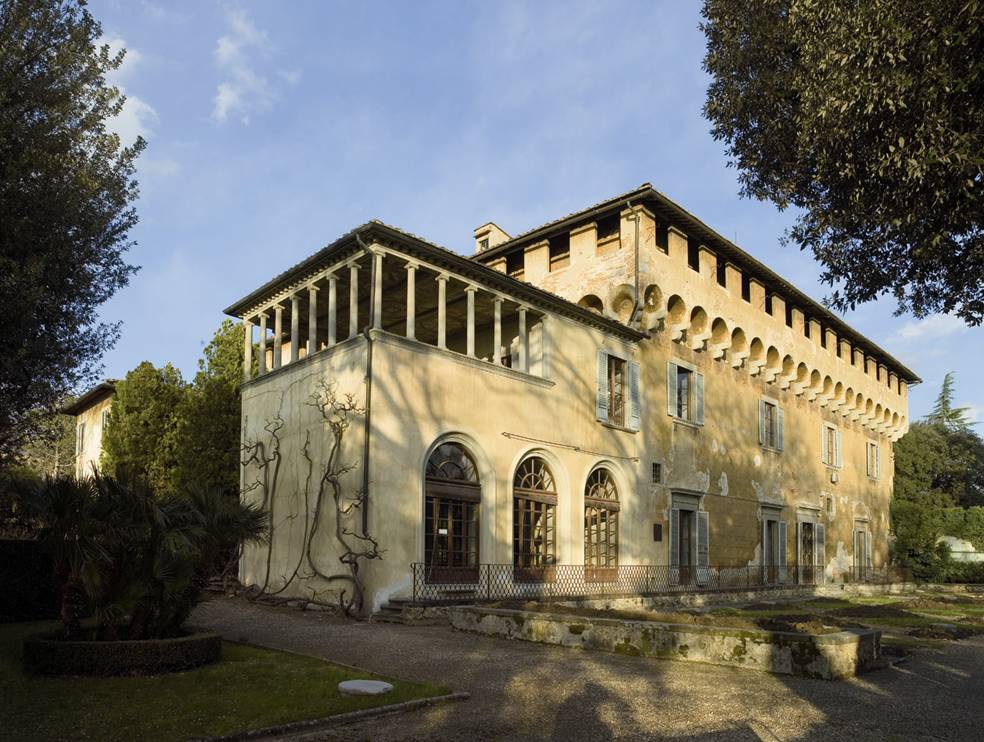
Unclear. Cosimo in 1463 gave Ficino a small property in Careggi with a domicile (“cum domo pro laboratore et hoste et terris laboratis,”) as the document in the State Archive of Florence puts it. There is also a letter from Ficino to Cosimo from September of 1462, in which Ficino writes: “spiritedly do I devote myself to the Academy you arranged for us on the estate in Careggi, as if I worship rightly at a kind of shrine of contemplation”
These two sources allow the inference that, while the specific gift of property did not occur until 1463, Ficino and his cohort met at least once on Medici property in the hills outside Florence. There is another document, again from 1462, which shows that he received a house in the city of Florence as a gift from Cosimo, which was then rented out, so that Ficino received the income from the rent.
9) The activities of Ficino’s “Platonic Academy” promoted Platonism in the West and kicked of the Renaissance.
Not by intention. The fact that the arrival of real Platonic ideas were a key incentive in the birth of the Renaissance, is indisputable. But the Renaissance started three generations BEFORE Ficino publishing his translations. The reason that the Plethon/Cosimo/Ficino narrative became dominant is because the Medici family compound, by history books and intense propaganda called their fake claim pretending that THEY were the fathers, mothers, sons, daughters and authors of the Renaissance.
In reality, what the Medici mafia wants us to forget is the fact that Plato and Classical Greek wisdom were injected in Italy and Europe by Dante, Petrarch and Boccaccio and their immediate followers Salutati, Bruni, Traversari and Nicholas of Cusa. It were the latter who motivated and paid the main collectors of Greek manuscripts, mostly over the entire period leading up to the Council of Florence:
- Manuel Chrysoloras (1350-1415), a greek scholar, humanist, philosopher and translator of ancient Greek texts. Serving as the ambassador for the Byzantine emperor Manuel II Palaiologos, he became a renowned teacher of Greek literature and history in Florence and Venice. In 1396, Coluccio Salutati, the Chancellor of Florence invited Chrysoloras to teach Greek grammar and literature. In a letter to Poggio Bracciolini, quoting the Roman lawyer and statesman Cicero, Salutati wrote: « The verdict of our own Cicero confirms that we Romans either made wiser innovations than theirs by ourselves or improved on what we took from them, but of course, as he himself says elsewhere with reference to his own day: « Italy is invincible in war, Greece in culture. » For our part, and we mean no offence, we firmly believe that both Greeks and Latins have always taken learning to a higher level by extending it to each other’s literature
- Guarino da Verona (1374-1460), a student of Chrysoloras who spent years studying in Constantinople and returned to Italy with numerous Greek codexes, founding a major educational system based on classical Greek and Latin learning.
- Niccolò Niccoli (1364-1437): Niccoli rarely left Florence. Instead, he stayed behind to fund Poggio’s expeditions, receive the recovered texts, and painstakingly transcribe them into his beautiful, efficient handwriting—a style that directly invented modern Italic script. Noteworthy is the fact that when Niccoli had spent so much on books that he was close to bankruptcy, Cosimo de’ Medici bailed him out. In exchange, Cosimo got a hand on Niccoli’s collection of manuscripts which he used for the first public library in Europe, an idea first conceptualized by Pala Strozzi, the richest man of Italy before Cosimo but exiled by the latter.
- Giovanni Aurispa (1376-1459), a Sicilian humanist who traveled to the East and returned to Italy in 1423 with a massive haul of 238 Greek manuscripts, among which all the works of Plato and work of Proclus, and various Greek historians and poets.
- Poggio Bracciolini (1380-1459): As a papal secretary, Poggio used his travels to church councils to gain access to remote monasteries. He famously rediscovered Lucretius’s De rerum natura (On the Nature of Things, which preserved ancient Greek Epicurean philosophy, though written in Latin), as well as lost works by Cicero, Quintilian, and Vitruvius;
- Francesco Filelfo (1398-1481), a diplomat and scholar who collected a substantial library of Greek manuscripts while living in Constantinople before bringing them back to Italy.
- Cardinal Bessarion (1403-1472), a Byzantine scholar who was a close friend of Cusa and who later converted to Catholicism and gathered a vast library of over 500 Greek manuscripts (which eventually formed the core of the Biblioteca Marciana in Venice), saving countless philosophical and scientific texts from destruction.
Conclusion
Finally, looking at what was produced by the “Platonic Academy”, it has to be noted that both Ficino and even more his most important pupil Pico della Mirandola, became fervent supporters of the Dominican priest Savonarola. The latter called the Florentines to burn all their luxury goods leading them to sin. The books of the Plato-loving Boccaccio were thrown into the fire. Renaissance paintings were burned with Sandro Botticelli himself throwing some of his works in the giant fire burning, both as a spiritual catharsis and carnaval. It was Ficino’s favorite pupil Pico della Mirandola which convinced Lorenzo de Medici to allow Savonarola to enter Florence and present his doom day speeches.
Once it became clear that Savonarola was captivating growing anti-Medici sentiment, Ficino, to preserve his financial backing from the Medicis, retracted and felt obliged to criticize Savonarola who was violently attacking Medici rule. Savonarola criticized Ficino’s heavy reliance on magic and astrology.
Ficino only escaped from the Inquisition, who didn’t like Ficino’s mixture of Platonism, magic and Christianity, because Lorenzo de’ Medici’s wife, a scion of the Roman Orsini family and as such a part of the deep state ruling from above, intervened to prevent him getting sentenced. Savonarola was burned at the stake, not for theological heresy, mut for creating political uproar. But the extremism he unleashed was so threatening that Lorenzo’s successor, Piero the unfortunate (1472-1503), according to recent research, most likely poisoned by arsenic Pico della Mirandola and the poet Politiano, another pupil and friend of Ficino, both considered too much related to the wild Dominican.
Main points of argument:
- Yes, real Platonism, together with augustinian christianity, promoted the image of « Renaissance » man, a free creative being as created as a living image of the creator.
- Thanks to Petrarch, Boccaccio, Salutati, Bruni, Traversari and Cusa, studies of Greek and Latin bloomed in Florence and kiscked off a “Renaissance” at the beginning of the 15th century (construction of the gates of the Baptistry by Ghiberti) an elan that culminated with the construction of the Dome and the 1438 Council of Florence.
- Plethon was not the first to bring the full works of Plato to the West, they arrived in 1423 thanks to a collaborator of Nicholas of Cusa, Giovanni Aurispa.
- The translations of Plato’s work by the neo-Platonist (Plotinist) Marsilio Ficino, requested by Cosimo de’ Medici, only arrived at the end of the century (1484), that is AFTER the “Golden” Renaissance. They were not causing what happened before.
- Ficino and his loyal follower Pico della Mirandola ended up backing the Renaissance book and art burning dominican monk Savonarola.
- The Medici family fabricated a fairy tale (storytelling, propaganda, narrative) pretending it was them (Cosimo and Lorenzo de Medici) which initiated the Renaissance whose splendor they mainly wanted to appropriate for their own dynastic glory. But yes, without spending too much money, through various channels, and for their own reasons, the Medicis did keep financially afloat Ghiberti, Uccello, Fra Angelico, Filippo Lippi, Ghirlandaio, Brunelleschi, Donatello, Botticelli and Michelangelo. But one should remember: the amount of money spent for the golden frames of paintings was at least five times higher than that received by the artist. And, Leonardo da Vinci, the archetype of the creative Renaissance genius said: « The Medici created and destroyed me. » (Li medici mi crearono e distrussono) (see part II coming soon)
Works consulted:
- Debolt, Darien C. George Gemistos Plethon on God: Heterodoxy in Defense of Orthodoxy, University of Oklahoma:
- Diller, Aubrey. The autographs of Georgius Gemistus Pletho. Scriptorium, Tome 10 n°1, 1956. pp. 27-41;
- Hankins, James, The Myth of the Florentine Academy, Renaissance Quarterly, Volume 44, Number 3, 1991;
- Hankins, James, Cosimo de’ Medici and the ‘Platonic Academy’, Journal of the Warburg and Courtauld Institutes, Vol. 53 (1990), pp. 144-162. Published by the Warburg Institute;
- Kristeller, Paul Oskar. Marsilio Ficino as a beginning student of Plato. Scriptorium, Tome 20 n°1, 1966. pp. 41-54;
- Palmer, Ada, Inventing The Renaissance, Myths of a Golden Age, Head of Zeus, Bloomsbury Publishing 2025;
- Papacostas A., George, George Gemistos-Plethon, an overview of his life and thought with a comprehensive bibliography, Harrisburg, PA, 1979;
- Stanford Encyclopedia of Philosophy, Marsilio Ficino, 2024
- Vanhaelen Maude. Marsilio Ficino’s translation of Plato’s Eutyphro. In Scriptorium, Tome 56 n°1, 2002. pp. 20-47;
- Vereycken Karel, The Greek language project, Plato and the Renaissance, Artkarel.com, 2021;
- Vereycken Karel, Albrecht Dürer’s Fight Against Neo-Platonic Melancoly, Artkarel.com, 2005;
- Vereycken Karel, How Neo-Platonism gave Plato a Bad Name, Artkarel, 2005;
- Wilson, N. G., From Byzantium to Italy: Greek Studies in the Italian Renaissance. Bloomsbury Publishing.
- Woodhouse, C.M., George Gemistos Plethon, The Last of the Hellenes, Claredon Press, Oxford University Press, Oxford, UK, 1986;
Footnotes:
- Palmer, Ada, Inventing The Renaissance, Myths of a Golden Age, Head of Zeus, Bloomsbury Publishing 2025; ↩︎
- Hankins, James, Cosimo de’ Medici and the ‘Platonic Academy’, Journal of the Warburg and Courtauld Institutes, Vol. 53 (1990), pp. 144-162. Published by the Warburg Institute; ↩︎
- As quoted by James Hankins, Ibid; ↩︎
- Woodhouse, C.M., George Gemistos Plethon, The Last of the Hellenes, Claredon Press, Oxford University Press, Oxford, UK, 1986. ↩︎
- Woodhouse, C.M., Ibid.; ↩︎
- Woodhouse, C.M., Ibid.; ↩︎
- Kristeller, Paul Oskar. Marsilio Ficino as a beginning student of Plato. In: Scriptorium, Tome 20 n°1, 1966. pp. 41-54; ↩︎
- Kristeller, Paul Oskar, Ibid.; ↩︎
- Kristeller, Paul Oskar, Ibid.; ↩︎
- Hankins, James, Ibid.; ↩︎
Shakespeare’s lesson in Economics

Cet article en FR

by Karel Vereycken
As early as 1913, the very year that a handful of major Anglo-American banks set up the Federal Reserve to prevent that any form of national bank in the US fixes the rules for money and credit, Henry Farnam 1 , an economist at Yale University, noted that « if one examines the dramas of Shakespeare, one will notice that quite often in his plays the action turns entirely or partly on economic questions. »
The comedy The Merchant of Venice (circa 1596) is undoubtedly the most striking example. While the plot of the story is generally well known, the deeper meaning of this play, which can be read on different levels, is often overlooked. The sequence of events (the story itself) is one, what they reveal (the principles) is another.
The narrative
To help out his protégé Bassanio and enable him to engage with his beloved Portia, a Catholic Venetian merchant and shipowner named Antonio borrows money from a Jewish moneylender, Shylock.
Shylock hates Antonio, the very archetype of the hypocritical Christian, because the latter treats him with contempt. Antonio, on the other hand, hates Shylock because he is Jewish and because he is a usurer: he lends at interest.
Shakespeare makes us understand that the prosperity of Venice is based on the mutual hatred fueled by the oligarchs between Jews and Christians, according to the famous principle of « Divide and rule. » 2
Double-dealing
The Venetian oligarchy never lacked imagination in circumventing the standards it imposed on its adversaries.
Indeed, among both Jews and Christians, financial usury is condemned and even punished. Interest, which is simply defined as the remuneration of a creditor by his debtor for having lent him capital, is a very ancient concept that probably dates back to the Sumerians and is also found in other ancient civilizations such as the Egyptians or the Romans.
Now, let us recall here that Judaism, which is the first of the Abrahamic religions, clearly prohibits lending at interest. We encounter numerous passages that condemn interest in the Torah, such as the book of Exodus 22:25-27, Leviticus 25:36-37 and Deuteronomy 23:20-21.
However, this prohibition only applies to loans within the Jewish community. In Deuteronomy 23:20-21, it is stated that
« When you lend money, food, or anything else to a fellow countryman, you shall not charge him interest. You may charge interest when you lend to a foreigner, but you shall not lend at interest to your fellow countrymen. »
Initially, the same rule applied among Christians. It was not until the First Council of Nicaea (in 325) that lending at interest was prohibited. At the time, many churches were held by lineages of priests , just as nearby castles were controlled by lineages of lords, the two often being related. While its condemnation had been relatively mild in Christianity before then, interest became a serious sin and was heavily punished from the 1200s onwards.
The exploitation of Jews
Italy has been home to Jews since ancient times. They were dependent on popes, princes, or merchant republics. Rome, Sicily, and the Kingdom of Naples had large communities, and popes sometimes hired Jewish doctors. In the 13th century, some cities granted Jewish bankers, with papal license, a monopoly on pawnbroking.
Venice welcomed Jews but forbade them from practicing any profession other than lending for interest. Initially, the Jews publicly enriched themselves in Venice, drawing the ire of the rest of the population.
To « protect » the Jews, the Doge of Venice created the first ghetto (a Venetian word), offering, it must be said, the most unsanitary district of the lagoon to these Jews whom he detested while cherishing the financing they provided for Venetian colonial expeditions and the slave trade that « Catholic » Venice practiced without any qualms.
The Merchant of Venice
This is the essence of the Venetian system that Shakespeare unmasks in his comedy The Merchant of Venice . 3
So, when Antonio goes to ask Shylock for a loan of 3000 ducats for a period of three months, he first tells him:
« Shylock, I normally don’t lend or borrow money with interest, but in order to help my needy friend, I’ll break my custom. » 4
Shylock then replies:
« Sir Antonio, many times you have criticized me about my money and habit of charging interest in the Rialto. I have endured it all with patience and a shrug, because we Jews are known for our ability to endure. You say I believe in the wrong religion, call me a cut-throat dog, and spit on my Jewish clothing, all because I use my own money to make profit. And now it appears that you need my help. Okay, then!
You come to me and you say, « Shylock, I need money. » You tell me this! You who spat on my beard and kicked me as you’d kick a stray dog away from your threshold! You ask for money. What should I say to you? Shouldn’t I say, « Does a dog have money? Is it possible for a dog to lend you three thousand ducats? » Or should I get bend to my knees and with bated breath humbly whisper, « Fair sir, you spat on me last Wednesday; you spurned me then; another time you called me a dog—and for all this courtesy you’ve shown me, I will gladly lend you this much money? » 5
To which Antonio retorts:
« I am likely to call you such names again, spit on you again, and spurn you, too. If you decide to lend this money, don’t do it as if we are your friends. After all, when have friends ever charged each other interest? Lend me the money as your enemy and if I break my part of the agreement you can more happily punish me. » 6

Offended, Shylock replies:
« Why, look at your temper! I would be friends with you and have your affection, forget about how you have shamed me, lend you what you need and take no interest—but you won’t listen to me! I’m giving you a kind offer. » 7
Shylock, to escape from the mutual hatred, offers to lend him (according to the Jewish and Christian rule), as a friend, without interest.
But the « good » Catholic Antonio refuses to become friends with the Jew. He asserts that in business, one should not have friends , and demands that he lend to him as an enemy because it is easier to sanction in case of non-compliance with the contract.
As Churchill said, an empire has no friends, only interests. This principle would later be theorized by Nazi crown jurist Carl Schmidt to become the rule of today’s oligarchy: to exist, one needs an enemy, and if you lack one, hurry up to invent one!
The Venitian’s double game
As we can see, Shakespeare points out the hypocrisy of this Venetian system which bases its prosperity on a « win-win » policy, not between friends, but as a cynical game between concurring mafias.
Let us recall here that, although it was regularly at war with the Turks, Venice also created a ghetto for Turkish merchants and even a « Foundation », that is to say a functional trade representation in the city.

If a Venetian ambassador was reproached for this trade with the Ottomans which threatened the West, he would reply: « As merchants, we cannot live without them. »
The Ottomans sold wheat, spices, raw silk, cotton, and ash (essential for glassmaking) to the Venetians, while Venice supplied them with finished products such as soap, paper, textiles, and… weapons. Although this was explicitly forbidden by the Pope, countries as France, England, the Low Countries, but especially Venice, Genoa, and Florence sold firearms and gunpowder to the Levant and the Turks. 8
Venice supplied the Turks with cannons and military engineers with its left hand, while renting ships at high prices to Christians who wanted to fight them with its right hand. Added to this was the rivalry with Genoa, which had allied itself with the Palaeologus dynasty but which the Ottomans defeated in favor of the Venetians.
In 1452, a year before the fall of Constantinople, the Hungarian engineer and founder Urban (or Orban), a specialist in large bombards, entered the service of the Ottomans. These cannons, he entrusted to the Sultan, were so powerful that they would bring down « the walls of Babylon. » We know what happened next in 1453.

When the Franks wanted to hire ships in Venice to go on crusade, they lacked money.
No problem: Venice finds the right arrangement. To pay for the ships’ rental, the Franks are invited to make a small detour along the route and begin the crusade by liberating Constantinople, which Venice wants to retake from the Ottomans. And it works! Venice increases its trading posts and military bases in Constantinople to expand its financial and commercial empire.
A Pound of Flesh
Faced with Antonio’s foolish and arrogant response, Shylock pushes his logic to the point of absurdity and, jokingly, suggests that if his debtor does not repay his debt on time, he would have the right to take a pound of flesh from him.
This can be seen as a literal and wacky interpretation of what was written on the « bonds » or « receipts of debt » of the time. Antonio, who is convinced that his ships will return to Venice in time to provide him with enough to repay Shylock, accepts the terms of the contract, almost laughing at their surreal nature.
This is where Shakespeare poses a fundamental question and offers us a beautiful lesson in economics, in the form of a tragic and paradoxical metaphor. In most ancient civilizations, failure to repay a debt could lead you to slavery, cost you your life, or send you to prison for the rest of your life. From monetary slavery, we thus moved on to physical slavery. 9
Later, for example, we find in the archives of the Antwerp courts the text of a trial in 1567 concerning an obligation between Coenraerd Schetz and Jan Spierinck:
« I, Jan Spierinck, confess and declare with my own hand that I owe the honorable Lord Coenraerdt Schetz the sum of four hundred Flemish pounds, and this on the basis of the equal sum that I have received from him to my satisfaction. I promise to pay in full the said Lord Coenraerdt Schetz or the bearer of this present, on the fourth day of the next month of August without any delay, by pledging myself and all my property now and in the future. In the year 1565, on the 11th of June. »
You read that right: « by pledging myself. » Taken literally, the debtor pledges his person as surety to his creditor. Let us also recall that in France, imprisonment for private debts was instituted by a royal ordinance of Philip the Fair in March 1303. Apart from two periods of abolition, from 1793 to 1797 and in 1848, the imprisonment of debtors persisted in France until its abolition in 1867.
During the Renaissance, the Christian humanism of Petrarch, Erasmus, Rabelais, and Thomas More combined Socrates’ notion of justice with that of love for others, and a new principle emerged: the life of each individual is sacred and has a value immeasurably greater than any financial debt.
It is a questioning of this principle that turns Shakespeare’s comedy into a drama. Little by little, the spectator learns that Antonio’s ships have all been swept away by storms and other misfortunes. He therefore does not have the necessary means to repay his debt in time.
The Merchant of Venice must therefore accept that Shylock takes a pound of flesh from him as stipulated in the debt title he signed… a financial claim duely validated by a notary and the laws of the Venetian Republic.

To save Antonio’s life, his friends then offer the lender double the initial sum borrowed, but Shylock, driven by a sense of revenge, will not listen, angry moreover at the fact that his daughter has left his house with a young Christian merchant, taking with her a tidy sum of ducats and family jewels.
Shylock viciously responds to the Doge’s request to show mercy, saying that he is asking for nothing more… than the application of the law. He also reminds the Venetians that they are in no position to give moral lessons, because in Venice one can « buy » people:
« What judgment shall I dread, doing no wrong? You have among you many a purchased slave, Which—like your asses and your dogs and mules— You use in abject and in slavish parts. Because you bought them. Shall I say to you, “Let them be free! Marry them to your heirs! Why sweat they under burdens? Let their beds Be made as soft as yours and let their palates Be seasoned with such viands”? You will answer, “The slaves are ours.” So do I answer you. The pound of flesh which I demand of him Is dearly bought. ‘Tis mine and I will have it. If you deny me, fie upon your law— There is no force in the decrees of Venice. 105 I stand for judgment. Answer, shall I have it? » 10
To this, the impotent Doge offers no counterargument. He himself must obey the laws of the city. The only thing he has the right to do is to allow a doctor of law who has examined the case to deliver his expert opinion.
Turnaround of the situation
Here Shakespeare introduces Portia, who, disguised as a law doctor and acting in the name of a higher principle, love for humanity and good, will succeed in turning the tide. 11
Having acknowledged the validity of Shylock’s claim, she turns the tables with the kind of audacity we lack today. Regarding the claim, she notes an important detail concerning the implementation of the sanction:
« Hold on a second. There’s something else. This agreement doesn’t give you any drop of blood. The literal words are « a pound of flesh. » So take what is yours, take your pound of flesh, but if in cutting it off you shed one drop of Christian blood, your lands and goods will be confiscated by the state of Venice by the city’s laws. » 12

This is another beautiful lesson Shakespeare teaches us. How many excellent laws are worthless simply because their authors didn’t bother to specify their implementation? Do you know the laws that allow you to defend yourself against the injustices the system inflicts on you? Because if the devil is in the details, the good Lord is sometimes not far away. It’s up to you to go and find him.
Shakespeare reminds us that economics is not limited to law and mathematics. Every economic choice remains a societal choice. In reality, only « political economy » should be taught in our universities and theaters.
Presenting the science of economics and finance as an « objective » reality and not as a reality of human choices is the best proof that we are subject to propaganda.
In conclusion, let us emphasize that unlike Christopher Marlowe‘s play, The Jew of Malta (circa 1589), the main actor in Shakespeare’s play is not the evil Jew Shylock (as claimed by anti-Semites who performed distorted versions of the play during the dark periods of our history), but rather the very Catholic merchant of Venice who, as we have seen, uses the Jews for his own interests. Let us recall that in the Jewish ghetto of Venice, the Jews were only allowed to deal with finance but nothing else…
Finally, in The Merchant of Venice , Shakespeare unmasks the workings of a mad and criminal finance which knows how to use formal interpretations of law (the appearance of justice) to satisfy its greed (true injustice).
NOTES:
- Henry Farnam, Shakespeare as an economist, p. 437, Yale Publishing Association, New Haven; ↩︎
- See Sinan Guven, The Conflict Between Interest and Abrahamic Religions , HEConomist, the student newspaper; ↩︎
- All the following quotes from Shakespeare’s The Merchant of Venice are taken from the website Litcharts; ↩︎
- Act 1, Scene 3; ↩︎
- Act 1, Scene 3; ↩︎
- Act 1, Scene 3; ↩︎
- Act 1, Scene 3; ↩︎
- Salim Aydoz, Artillery Trade of the Ottoman Empire, Muslim Heritage website, Sept. 2006; ↩︎
- A case in point is the history of Haiti. See Invade Haiti, Wall Street urged, New York Times, 2022. ↩︎
- Act 4, Scene 1; ↩︎
- The principle of a « Promethean » woman intervening disguised as a man for the good of humanity will be, with the person of Leonore, at the center of Fidelio, Beethoven’s unique opera; ↩︎
- Act 4, Scene 1; ↩︎