Étiquette : Cusa
Debunking Renaissance Fakenews — Part I: Fake Platonist Marsilio Ficino
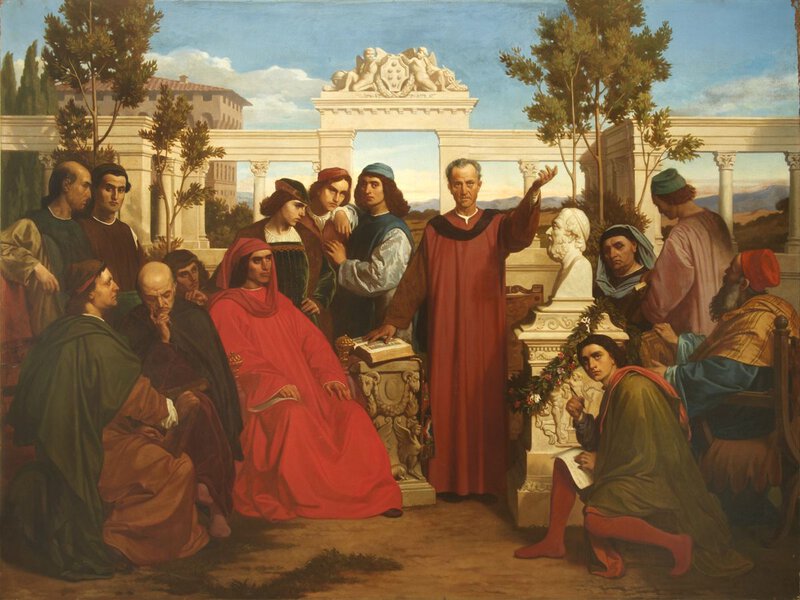
by Karel Vereycken, august 2026
This article is the first of a three-part series:
I. Fake Platonist Marsilio Ficino and his Florentine “Platonic Academy” (below)
II. The Medici dynasty and Cosimo de’ Medici’s (coming)
III. Georgios Gemistos Plethon, his life and ambitions (coming)
As it is well known, I’m a passionate researcher and admirer of what goes under the label of “Renaissance.” I’ve researched quite extensively and over many years, creative artists such as Ghiberti, Verrocchio, Brunelleschi, Donatello, Piero della Francesca, Leonardo da Vinci, Michelangelo and Raphael.
This summer, I read Alma Palmer‘s inspiring book “Inventing the Renaissance, Myths of the Golden Age.” 1 That title is in reality a wake-up call. Yes, there was a splendid unprecedented explosion of Greek and Latin studies combined with painting, sculpture and architecture invented by idealistic humanists that anybody visiting Italy, and Florence more particularly, can admire.
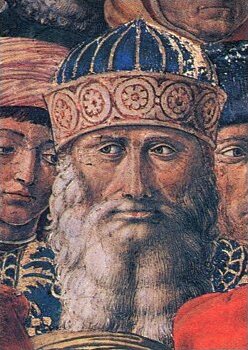
However there are also powerful myths invented (created out of hot air) by powerful factions of the oligarchy out to claim their own legitimacy (it was all me) and play down that of others.
As a starter, let’s examine the very common narrative about the Greek philosopher Georgios Gemistos, who added the name “Plethon” (Plato) to his own name, who traveled in 1438, at the age of at least seventy-eight, to the Council of Ferrara–Florence, the ecumenical gathering that sought to heal the schism between the Orthodox and Latin churches. Plethon, it goes, brought with him the full works of Plato and inspired Cosimo de’ Medici to set up a “Platonic Academy” and have Plato’s works made available to the West.
“This is clearly one of those stories too good to be examined closely, and it has been repeated by nearly every scholar who has written on Florentine culture or Renaissance Platonism,” writes James Hankins who spent years trying to document the case. 2
Here is a rough sketch of the various points of the official narrative followed by my remarks and interrogations:
1) In 1438-39, at the Council of Florence, Cosimo de’ Medici made acquaintance with the “Neoplatonic” philosopher George Gemistos Plethon.
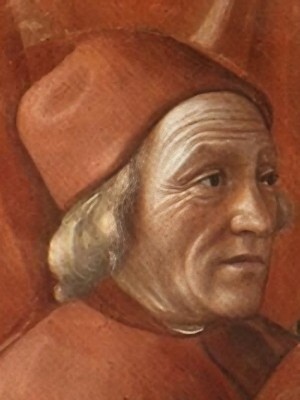
Conclusive proof lacking. The sole and unique source of information for this supposed encounter of 1438-39 is Marsilio Ficino (1433-1499), the son of Cosimo’s physician. Ficino was not an eyewitness to the event. He was born in 1433 and was 5 years old when the Council of Florence started and reports on it only twice, the first time 24 years and the second time 52 years later. Admittedly, he could have gotten the story from his father, who was Cosimo’s medical doctor.
Complicating such an encounter would have arisen from the fact that Plethon spoke nothing but Greek, while Cosimo had zero command over Greek and very poor command over Latin. Cosimo, while reportedly admiring ancient Greek knowledge, never wrote poetry, orations or treatises. The only surviving letters are in Italian.
To understand Plethon, Cosimo would have required a good translator on top of Platonic and Neo-Platonic philosophy. But Bessarion, Plethon’s erudite pupil, was organizing, directing and managing on a day to day basis, together with Traversari and Cusa, the Ecumenical council.
Other than Ficino, not one single source of that period, even among the most ardent defenders and lackey’s of the Medicis, praises or even mentions Cosimo’s encounter with Plethon and his supposed plan to set up a Platonic Academy. Even Bessarion doesn’t spent a line on the subject.
The only rhetorical hints to a supposed encounter between Cosimo and Plethon, as well as his project to create a Platonic Academy appear in two writings of Ficino:
- 24 years after the Council of Florence in a letter to Cosimo de’ Medici written in September 1462;
- 52 years after the Council of Florence in Ficino’s preface to 1490 translation of the Enneads, the main work of the (evil neo-Platonic) Plotinus (who Roman Emperor Julien the Apostate tried to impose as a state religion at the end of the Roman Empire as an alternative to Christianity). The aim of that preface, was to please Cosimo’s grandson, Lorenzo the magnificent (1449-1492), and beg him to continue financing Ficino and his translations of Plotinus, which according to the latter, was nearly as ardently requested by Cosimo as that of the works of Plato.
Here is the critical passage of Ficino’s 1490 introduction to Plotinus’ Enneads :
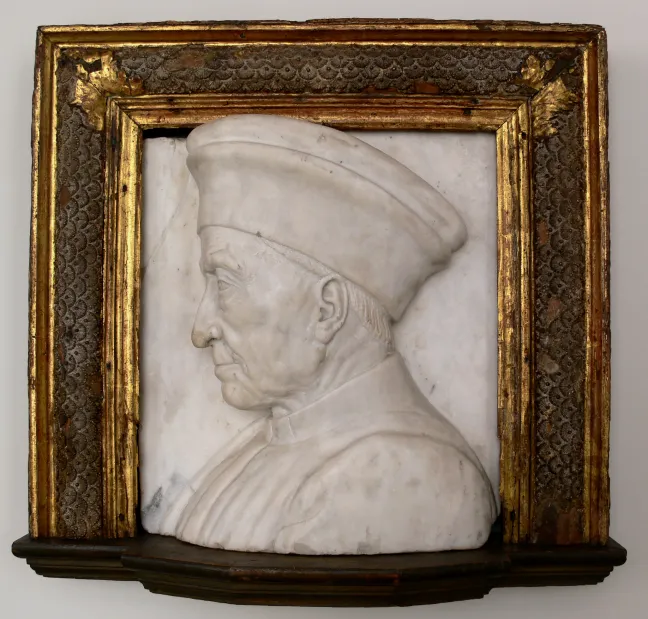
“The Great Cosimo, the Father of his Country by senatorial decree, at the time when a council was being negotiated among the Greeks and Latins in Florence under Eugene IV [1438], frequently heard a Greek philosopher by the name of Gemistus Plethon disputing like another Plato on the Platonic mysteries. From his fervid lips Cosimo was straightway so inspirited, so ensouled, that from that time forth he conceived deep in his mind a kind of Academy, to give birth to it at the first opportune moment. Then, while that great Medici was intending in some sense to give birth to the great thing he had conceived, he destined me, the son of his favorite doctor Ficino, while still a boy, to [undertake] the labor, educating me from that day forth to this very thing.”
“Moreover, he labored that I should not only have all the books of Plato in Greek, but also the books of Plotinus. After this, in the year 1463, in the thirtieth year of my life, he commissioned me to translate, first, Thrice-Great Hermes, and thereafter Plato. Mercury I finished in a few months while Cosimo was still alive; Plato I had also begun at that time [1463]. Although he was also eager for Plotinus, he said nothing to me about translating it, lest he should appear to be weighing me down with too great a burden all at once. Such was the great man’s clemency to his own, such was his modesty towards all. Thus, I never thought, either in the manner of an inspired poet or in my own person, to approach Plotinus. But in the meantime Cosimo at length expressed-or rather impressed from on high-that which he had kept silent about while living on the earth.”
“At the moment when I was giving Plato to the Latin world to read, Cosimo’s heroic soul incited the heroic mind of Giovanni Pico della Mirandola in some unknown way-Pico himself almost did not know how-to come to Florence. Pico, born in the very year [1463] I was starting on Plato, and coming to Florence the same day-almost the same hour-I was publishing him, after greeting me asked me immediately about Plato. To him I said, ‘Our Plato has today emerged onto our thresholds.’ Then he heartily congratulated [me] on this, and straightway-and neither I nor he knows whence the words came-he led, or rather impelled me to translate Plotinus. Surely a divine cause brought it to pass that the hero Pico should be born while Plato was being, as it were, reborn-Saturn being then in the house of Aquarius as it was when I was born thirty years previously-and that he should come to Florence on the very day our Plato was published, and that he should inspire me in a marvelous fashion with Cosimo’s vow about Plotinus which had been quite hidden from me, but which was revealed by heavenly means to him.” 3
What is a proven fact is that Plethon (c. 1355-1452) did meet with Leonardo Bruni (1370-1444), the chancellor of Florence at that time, who had translated himself several Greek manuscripts including Aristotle and Plato. Leonardo Bruni’s translations of the Phaedo, Apology, Crito, and Phaedrus were made only shortly before Gemistos visit. Bruni had studied Greek under the Byzantine scholar Manuel Chrysoloras (1350-1415) who had been invited to teach Greek in Florence by Coluccio Salutati (1341-1406), a friend and admirer of Petrarch (1304-1374) and Boccaccio (1313-1375).
Thanks to Chrysoloras’ activity a number of new Latin of Platonic writings began to appear under the name of his students, Bruni, Umberto Decembrio, and Cencio de’ Rustici, who translated between them ten Platonic dialogues, including the Gorgias, Crito, Apology, Phaedo and the Republic.
According to historian N.G. Wilson, Plethon, during his stay in Florence acquainted the Italian geographer Paolo Toscanelli (1397-1482) with the extensive travels, writings and mapping of the Greek geographer Strabo (1st century BC/AD), hitherto unknown in Italy but crucial for elaborating his famous map that later fell in the hands of Columbus. What is known is that Strabo’s works became an integral part of Bessarion’s library.
2) At the invitation of his humanist friends, including Cosimo, Plethon engaged in private lectures explaining the difference between Plato and Aristotle, arguing that Plato was far more compatible with Christian doctrine.
Conclusive proof lacking. During the Council, Gemistos found that he had free time because much of the counciliar discussion concerned theological minutiae that did not require the presence of a secular sage. Even if Ficino claims Cosimo assisted “frequently” at Plethon’s lectures, there is close to zero evidence they ever took place. What is known is that Plethon wrote a treaty on the difference between Aristotle and Plato, commonly known as De Differentiis. A decade later, Plethon described the circumstances in which he composed his book without ever mentioning it was a follow-up to his lectures:
“That work was not composed as a result of thorough research . . . but at a time when I had been indisposed at Florence and was unable for several days to go out of the house where I was staying; perhaps, too, because I was bored, and was trying at one and the same time to relieve my boredom and to do a favor to those who were interested in Plato. Thus I wrote that work in the briefest form…” 4
C. M. Woodhouse, author of the 416 pages book “George Gemistos Plethon, The Last of the Hellenes” (1986) 5 writes that most claims about this event should be considered as pure speculation. For him:
“The impact of Plethons lectures on the Italians remains hard to assess. Very few of them left any record of their impressions; none of them is more than superficial and secondhand. The case of Cosimo de’ Medici, recorded by Ficino, is the only major exception; an additional but minor one is Grigorio Tifernate. Although De Differentiis was written for the benefit of Italian humanists,‘ none can be named who read it in Plethons life-time. But there is a strong tradition that Plethon impressed many westerners by his personality and learning.” 6
3) Plethon brought with him to Florence a manuscript with all of Plato’s works
Yes. Plethon carried with him many Greek manuscripts. They included the entire works of Plato but also those of the (toxic neoplatonists) Plotinus and Porphyry as well as the Chaldean Oracles (more on that in Part III).
4) Captivated, Cosimo bought the Plato manuscripts from Plethon
No. There is no proof Cosimo was given or bought these manuscripts from Plethon. The latter took many books back with him to Mystras, Greece, after having allowed scribes in Florence to copy them. His most famous student, Cardinal Bessarion, later collected Plethon’s original autographs and manuscripts. Bessarion, not trusting Medici rule over Florence and demanding very precise conditions for conservation, donated his vast collection to the Republic of Venice, forming the foundation of the famous Biblioteca Marciana.
5) Cosimo gave manuscripts of Plato’s works to Marsilio Ficino to have them translated into Latin
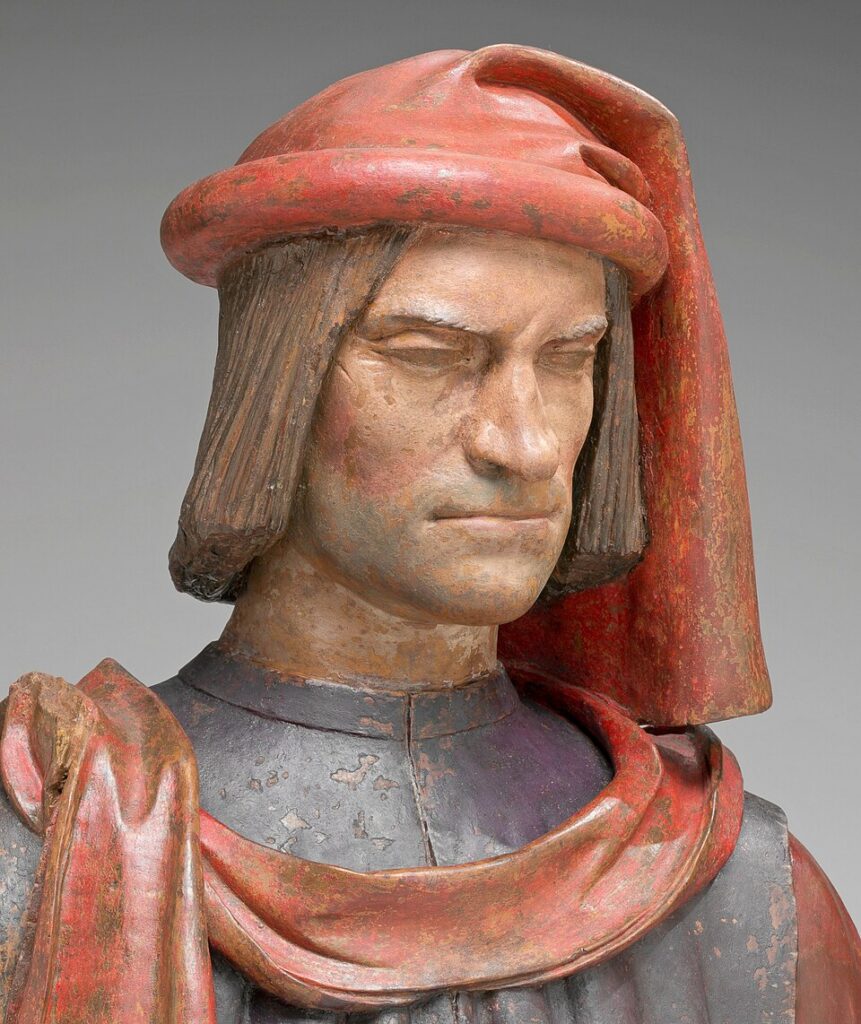
Yes, but. 24 years after the Council of Florence, in 1462, Cosimo, seeing his life coming to an end, supplied the 29 years old Ficino with various Greek manuscripts of Plato’s work, whereupon Ficino started translating the entire corpus into Latin. The draft translation of the entire set of dialogues was finished six to seven years later, around 1468–69. In December 1473, Ficino, age 40, is ordained a priest and gave priority to writing and getting printed his own writings, among which the Platonic Theology and On the Christian Religion.
Plato had to wait and Ficino’s translation of the Complete Works of Plato (Platonis Opera Omnia), thirty-six in all, will only be printed in Florence in 1484 –46 years after the Council of Florence– by the press of the Dominican monastery of San Jacopo di Ripoli, the first printshop to employ women (Dominican nuns) as typesetters. The cost of printing 1,025 copies was not financed by Lorenzo de’ Medici (who passed away in 1492) to whom the translation was dedicated, but by two prominent Florentine patrons and humanists: Filippe Valori and Francesco Berlinghieri. Once produced, Lorenzo did circulate the books in which he appeared prominently. A much-improved second edition was printed in Venice in 1491 by Bernardinus de Choris de Cremona and Simon de Luere for Andreas Torresanus de Asula.
Since the Medici’s wanted to keep the spread of ideas under their control. Therefore they favored handmade codices crafted by professional scribes over mass-produced print. At that time, the price of a manuscript varied wildly—from a few florins for a simple, unadorned text to hundreds of florins or the equivalent of several months to years of wages for an elaborately illuminated luxury volume. With that Medici policy, Florence, the epicenter of the Renaissance, ended up as being one of the last ones in Italy to have modern printing shops !
Paul Oskar Kristeller, who spend years researching on Ficino, gives the following account about why the entire process took so many years:
“Marsilio Ficino, born in 1433, did not begin to learn Greek until 1456 (at age 23 years) and we have no specific information on the content and progress of his studies during the following years. We have a number of Greek manuscripts owned and annotated by Ficino, and a number of translations from the Greek surely or probably made by him, and some of them may belong to this early period, but none of them is dated. At the time when Cosimo de’ Medici gave Ficino a house in Careggi which the latter chose to call his Academy, in September, 1462, he celebrated the event with the translation of an Orphic hymn.” 7
Kristeller confirms that Cosimo asked Ficino to put on hold his translations of Plato, and translate first the writings of Hermes Trismegistus:
“In April, 1463, Ficino completed his translation of the Corpus Hermeticum, after having spent only a few months on it. We know from Ficino’s own words that he began his translation of Plato at that time, after having finished the version of the Hermetica, that he did so at the request of Cosimo de’ Medici, and that he had at his disposal, since 1462, two Greek manuscripts of Plato, a complete one which belonged to Cosimo, and a partial one owned by Amerigo Benci. » 8
As suggested by Kristeller in this paragraph, at the demand of Cosimo, Ficino translated first a collection of Hellenistic Greek documents brought to Pistoia in 1460 by Leonardo da Pistoia later called Hermetica (texts attributed to the legendary Hellenistic figure Hermes Trismegistus). Later, Ficino will also translate the writings of many of the (toxic) Neoplatonists, including Porphyry, Iamblichus, and especially Plotinus.
When Cosimo died on August 1, 1464, Ficino had translated ten Platonic dialogues, nine of them before January 11, and by April 1, 1466, twenty-three dialogues were ready.
After that date, we have no specific information on the progress of the translation, but it is probable that Ficino had completed the first draft of the entire work by 1468 or 1469. However, he wanted to subject the translation to a thorough revision, and hence refused to have it circulate.
Occupied with his Platonic Theology and several other writings, Ficino did not attend to the revision of his Plato translation for several years. He probably began to revise it around 1477, and had finished the revision in 1482 when he allowed it to be copied for others.
In 1483, Ficino sent the entire translation to the printer, apparently after having revised it once more, and finally the first printed edition of Plato appeared in October 1484. Although it had been carefully seen through the press by Ficino, it was necessary to append to it a long list of corrections.
The second edition, printed in Venice 1491, was not supervised by Ficino, but inserted the corrections in the text and hence is considered more accurate. From these two early editions all later ones are derived, although they may have been altered by some of the editors.” 9
The story goes that while other companions at Cosimo’s sickbed read Aristotle’s Nicomachean Ethics (with humanist commentaries) during his prolonged illness, Ficino read some of his newly made Latin translations of Plato’s works to comfort and entertain Cosimo in his final hours. But Cosimo’s Latin, as said before, was poor.
6) Plato’s works were largely unknown till then in the West.
Yes and No. Ficino was far from being the first translator of Platonic dialogues, he rather represents the culminating point of translation activity during the fifteenth century. The Greek text has come down to us in a number of manuscripts, and it was printed for the first time by Aldus Manutius in Venice in 1513.
Before the Renaissance, the Western world was very limited in its access to Plato’s writings. It inherited from Roman antiquity only two partial renderings of the Timaeus made by Cicero and Calcidius, and a number of shorter testimonia in Cicero’s philosophical writings, St. Augustine, and other works of Latin philosophy. During the 12th and 13th centuries, when most works of Aristotle were translated into Latin, the reader acquired only the nearly unintelligible versions of the Phaedo and the Meno, translated by Henricus Aristippus, and a partial version of the Parmenides, translated with Proclus’ commentary by William of Moerbeke. This was all that a Latin student was able to read of Plato up to about 1400, including Petrarch, who owned sixteen Greek manuscripts of Plato that reached the West in modern times, but who was not able to read them.
7) Cosimo asked Ficino to set up a “Platonic Academy”
Conclusive proof lacking. Historian James Hankins is very skeptical about that:
“We may begin by pointing out the general implausibility of the thesis that Cosimo ever founded or wanted to found a new Platonic Academy. It is striking, in the first place, that in none of the numerous works in laudem Cosmi written by humanists during the last decade of his life and after his death is Cosimo ever praised for having re-founded the Platonic Academy in Florence. A volume of ricordanze about Cosimo put together by his son Piero, for instance, though it includes dozens of consolatory letters from various princes, prelates, humanists and fellow citizens praising Cosimo’s magnificence, does not mention even once his project to re-found the Platonic Academy or his collations with Pletho.
Even the letter of Cardinal Bessarion, Plethons student, does not mention the creation of the new Academy. At least four of the poets commonly identified as members of the Florentine Academy wrote poems in praise of Cosimo-indeed, Amerigo Corsini wrote an epic poem in three books of which the third was devoted to praising Cosimo’s cultural patronage-but none of these poets mentions his founding of a Florentine Academy.” 10
Another way to understand Ficino and his « academy » is to examine the various ways he uses the word “academy” and its variants. What one finds is that Plato’s dialogues themselves could be referred to as an “academy,” rich with precious teachings as they were. An “academy” could be a private school organized to teach youths, though not necessarily located in one specific place or devoted to one doctrinal tradition. And the word “academy” could refer to regular meetings of literary men. Ficino’s “academy” seems to have been more associated with the first two meanings of the word. Rather than leading a regular gathering in a specific place, Ficino preferred to teach Florence’s elite youth when he could and, as a Socratic, philosophical friend, to try to draw out of his associates the better part of their natures in conversation.
8) For that purpose, Cosimo offered funding and a part of his private villa in Carregi close to Florence
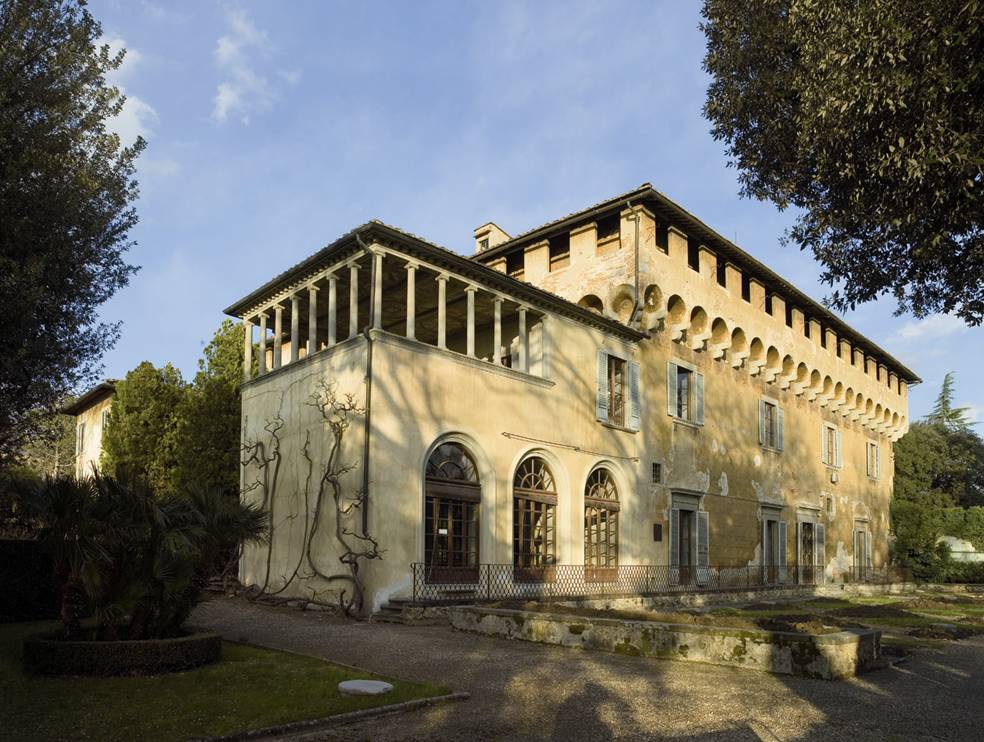
Unclear. Cosimo in 1463 gave Ficino a small property in Careggi with a domicile (“cum domo pro laboratore et hoste et terris laboratis,”) as the document in the State Archive of Florence puts it. There is also a letter from Ficino to Cosimo from September of 1462, in which Ficino writes: “spiritedly do I devote myself to the Academy you arranged for us on the estate in Careggi, as if I worship rightly at a kind of shrine of contemplation”
These two sources allow the inference that, while the specific gift of property did not occur until 1463, Ficino and his cohort met at least once on Medici property in the hills outside Florence. There is another document, again from 1462, which shows that he received a house in the city of Florence as a gift from Cosimo, which was then rented out, so that Ficino received the income from the rent.
9) The activities of Ficino’s “Platonic Academy” promoted Platonism in the West and kicked of the Renaissance.
Not by intention. The fact that the arrival of real Platonic ideas were a key incentive in the birth of the Renaissance, is indisputable. But the Renaissance started three generations BEFORE Ficino publishing his translations. The reason that the Plethon/Cosimo/Ficino narrative became dominant is because the Medici family compound, by history books and intense propaganda called their fake claim pretending that THEY were the fathers, mothers, sons, daughters and authors of the Renaissance.
In reality, what the Medici mafia wants us to forget is the fact that Plato and Classical Greek wisdom were injected in Italy and Europe by Dante, Petrarch and Boccaccio and their immediate followers Salutati, Bruni, Traversari and Nicholas of Cusa. It were the latter who motivated and paid the main collectors of Greek manuscripts, mostly over the entire period leading up to the Council of Florence:
- Manuel Chrysoloras (1350-1415), a greek scholar, humanist, philosopher and translator of ancient Greek texts. Serving as the ambassador for the Byzantine emperor Manuel II Palaiologos, he became a renowned teacher of Greek literature and history in Florence and Venice. In 1396, Coluccio Salutati, the Chancellor of Florence invited Chrysoloras to teach Greek grammar and literature. In a letter to Poggio Bracciolini, quoting the Roman lawyer and statesman Cicero, Salutati wrote: « The verdict of our own Cicero confirms that we Romans either made wiser innovations than theirs by ourselves or improved on what we took from them, but of course, as he himself says elsewhere with reference to his own day: « Italy is invincible in war, Greece in culture. » For our part, and we mean no offence, we firmly believe that both Greeks and Latins have always taken learning to a higher level by extending it to each other’s literature
- Guarino da Verona (1374-1460), a student of Chrysoloras who spent years studying in Constantinople and returned to Italy with numerous Greek codexes, founding a major educational system based on classical Greek and Latin learning.
- Niccolò Niccoli (1364-1437): Niccoli rarely left Florence. Instead, he stayed behind to fund Poggio’s expeditions, receive the recovered texts, and painstakingly transcribe them into his beautiful, efficient handwriting—a style that directly invented modern Italic script. Noteworthy is the fact that when Niccoli had spent so much on books that he was close to bankruptcy, Cosimo de’ Medici bailed him out. In exchange, Cosimo got a hand on Niccoli’s collection of manuscripts which he used for the first public library in Europe, an idea first conceptualized by Pala Strozzi, the richest man of Italy before Cosimo but exiled by the latter.
- Giovanni Aurispa (1376-1459), a Sicilian humanist who traveled to the East and returned to Italy in 1423 with a massive haul of 238 Greek manuscripts, among which all the works of Plato and work of Proclus, and various Greek historians and poets.
- Poggio Bracciolini (1380-1459): As a papal secretary, Poggio used his travels to church councils to gain access to remote monasteries. He famously rediscovered Lucretius’s De rerum natura (On the Nature of Things, which preserved ancient Greek Epicurean philosophy, though written in Latin), as well as lost works by Cicero, Quintilian, and Vitruvius;
- Francesco Filelfo (1398-1481), a diplomat and scholar who collected a substantial library of Greek manuscripts while living in Constantinople before bringing them back to Italy.
- Cardinal Bessarion (1403-1472), a Byzantine scholar who was a close friend of Cusa and who later converted to Catholicism and gathered a vast library of over 500 Greek manuscripts (which eventually formed the core of the Biblioteca Marciana in Venice), saving countless philosophical and scientific texts from destruction.
Conclusion
Finally, looking at what was produced by the “Platonic Academy”, it has to be noted that both Ficino and even more his most important pupil Pico della Mirandola, became fervent supporters of the Dominican priest Savonarola. The latter called the Florentines to burn all their luxury goods leading them to sin. The books of the Plato-loving Boccaccio were thrown into the fire. Renaissance paintings were burned with Sandro Botticelli himself throwing some of his works in the giant fire burning, both as a spiritual catharsis and carnaval. It was Ficino’s favorite pupil Pico della Mirandola which convinced Lorenzo de Medici to allow Savonarola to enter Florence and present his doom day speeches.
Once it became clear that Savonarola was captivating growing anti-Medici sentiment, Ficino, to preserve his financial backing from the Medicis, retracted and felt obliged to criticize Savonarola who was violently attacking Medici rule. Savonarola criticized Ficino’s heavy reliance on magic and astrology.
Ficino only escaped from the Inquisition, who didn’t like Ficino’s mixture of Platonism, magic and Christianity, because Lorenzo de’ Medici’s wife, a scion of the Roman Orsini family and as such a part of the deep state ruling from above, intervened to prevent him getting sentenced. Savonarola was burned at the stake, not for theological heresy, mut for creating political uproar. But the extremism he unleashed was so threatening that Lorenzo’s successor, Piero the unfortunate (1472-1503), according to recent research, most likely poisoned by arsenic Pico della Mirandola and the poet Politiano, another pupil and friend of Ficino, both considered too much related to the wild Dominican.
Main points of argument:
- Yes, real Platonism, together with augustinian christianity, promoted the image of « Renaissance » man, a free creative being as created as a living image of the creator.
- Thanks to Petrarch, Boccaccio, Salutati, Bruni, Traversari and Cusa, studies of Greek and Latin bloomed in Florence and kiscked off a “Renaissance” at the beginning of the 15th century (construction of the gates of the Baptistry by Ghiberti) an elan that culminated with the construction of the Dome and the 1438 Council of Florence.
- Plethon was not the first to bring the full works of Plato to the West, they arrived in 1423 thanks to a collaborator of Nicholas of Cusa, Giovanni Aurispa.
- The translations of Plato’s work by the neo-Platonist (Plotinist) Marsilio Ficino, requested by Cosimo de’ Medici, only arrived at the end of the century (1484), that is AFTER the “Golden” Renaissance. They were not causing what happened before.
- Ficino and his loyal follower Pico della Mirandola ended up backing the Renaissance book and art burning dominican monk Savonarola.
- The Medici family fabricated a fairy tale (storytelling, propaganda, narrative) pretending it was them (Cosimo and Lorenzo de Medici) which initiated the Renaissance whose splendor they mainly wanted to appropriate for their own dynastic glory. But yes, without spending too much money, through various channels, and for their own reasons, the Medicis did keep financially afloat Ghiberti, Uccello, Fra Angelico, Filippo Lippi, Ghirlandaio, Brunelleschi, Donatello, Botticelli and Michelangelo. But one should remember: the amount of money spent for the golden frames of paintings was at least five times higher than that received by the artist. And, Leonardo da Vinci, the archetype of the creative Renaissance genius said: « The Medici created and destroyed me. » (Li medici mi crearono e distrussono) (see part II coming soon)
Works consulted:
- Debolt, Darien C. George Gemistos Plethon on God: Heterodoxy in Defense of Orthodoxy, University of Oklahoma:
- Diller, Aubrey. The autographs of Georgius Gemistus Pletho. Scriptorium, Tome 10 n°1, 1956. pp. 27-41;
- Hankins, James, The Myth of the Florentine Academy, Renaissance Quarterly, Volume 44, Number 3, 1991;
- Hankins, James, Cosimo de’ Medici and the ‘Platonic Academy’, Journal of the Warburg and Courtauld Institutes, Vol. 53 (1990), pp. 144-162. Published by the Warburg Institute;
- Kristeller, Paul Oskar. Marsilio Ficino as a beginning student of Plato. Scriptorium, Tome 20 n°1, 1966. pp. 41-54;
- Palmer, Ada, Inventing The Renaissance, Myths of a Golden Age, Head of Zeus, Bloomsbury Publishing 2025;
- Papacostas A., George, George Gemistos-Plethon, an overview of his life and thought with a comprehensive bibliography, Harrisburg, PA, 1979;
- Stanford Encyclopedia of Philosophy, Marsilio Ficino, 2024
- Vanhaelen Maude. Marsilio Ficino’s translation of Plato’s Eutyphro. In Scriptorium, Tome 56 n°1, 2002. pp. 20-47;
- Vereycken Karel, The Greek language project, Plato and the Renaissance, Artkarel.com, 2021;
- Vereycken Karel, Albrecht Dürer’s Fight Against Neo-Platonic Melancoly, Artkarel.com, 2005;
- Vereycken Karel, How Neo-Platonism gave Plato a Bad Name, Artkarel, 2005;
- Wilson, N. G., From Byzantium to Italy: Greek Studies in the Italian Renaissance. Bloomsbury Publishing.
- Woodhouse, C.M., George Gemistos Plethon, The Last of the Hellenes, Claredon Press, Oxford University Press, Oxford, UK, 1986;
Footnotes:
- Palmer, Ada, Inventing The Renaissance, Myths of a Golden Age, Head of Zeus, Bloomsbury Publishing 2025; ↩︎
- Hankins, James, Cosimo de’ Medici and the ‘Platonic Academy’, Journal of the Warburg and Courtauld Institutes, Vol. 53 (1990), pp. 144-162. Published by the Warburg Institute; ↩︎
- As quoted by James Hankins, Ibid; ↩︎
- Woodhouse, C.M., George Gemistos Plethon, The Last of the Hellenes, Claredon Press, Oxford University Press, Oxford, UK, 1986. ↩︎
- Woodhouse, C.M., Ibid.; ↩︎
- Woodhouse, C.M., Ibid.; ↩︎
- Kristeller, Paul Oskar. Marsilio Ficino as a beginning student of Plato. In: Scriptorium, Tome 20 n°1, 1966. pp. 41-54; ↩︎
- Kristeller, Paul Oskar, Ibid.; ↩︎
- Kristeller, Paul Oskar, Ibid.; ↩︎
- Hankins, James, Ibid.; ↩︎
Karel Vereycken rewarded in Milan, calls for a “New Renaissance”
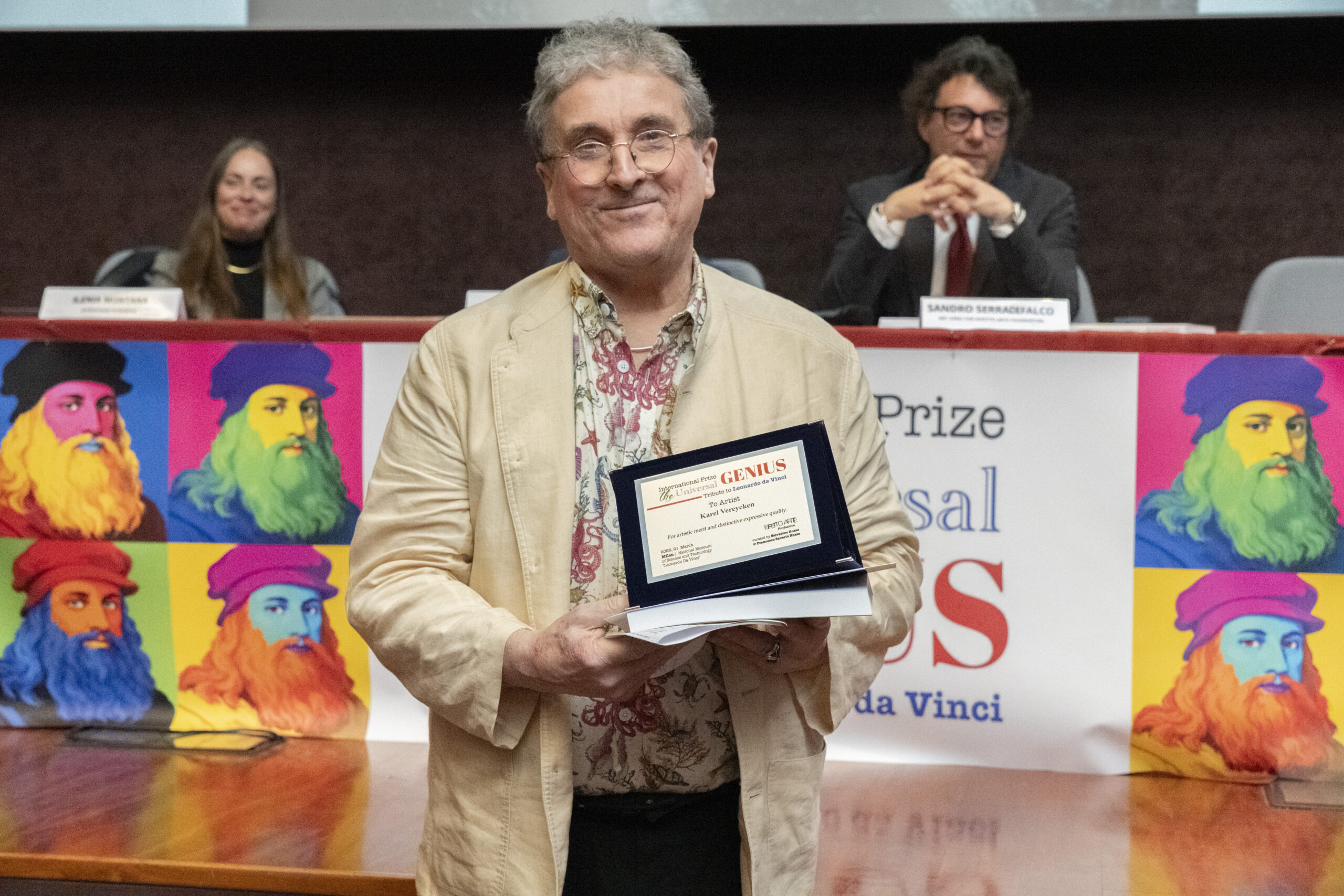
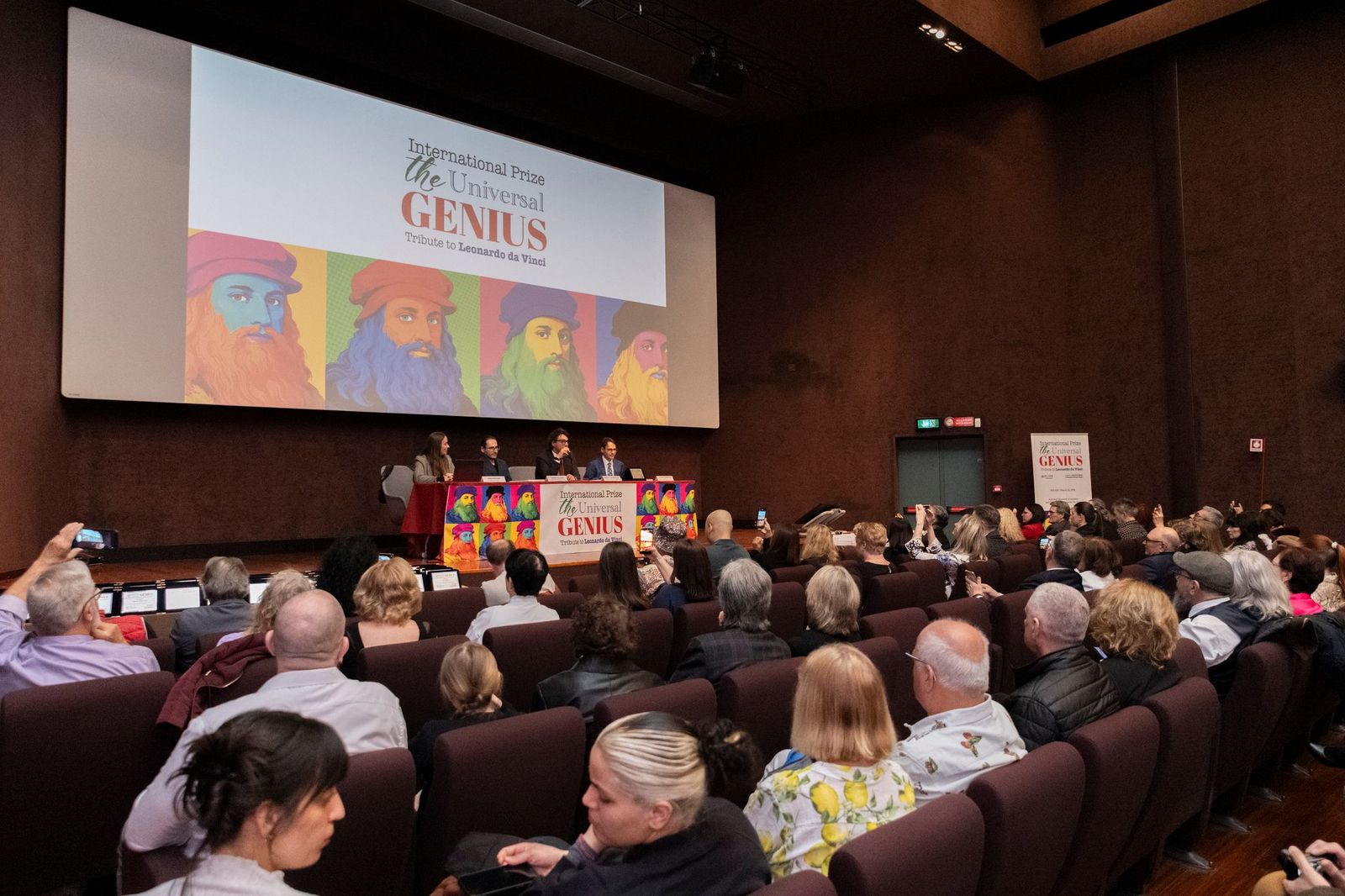
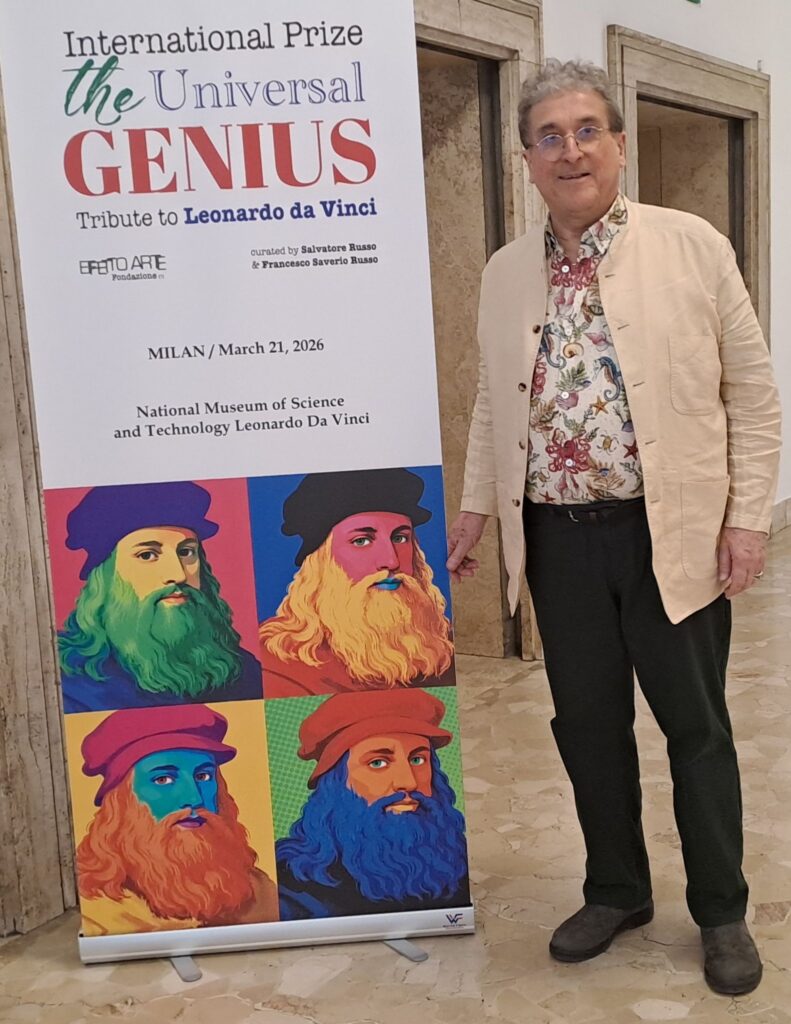
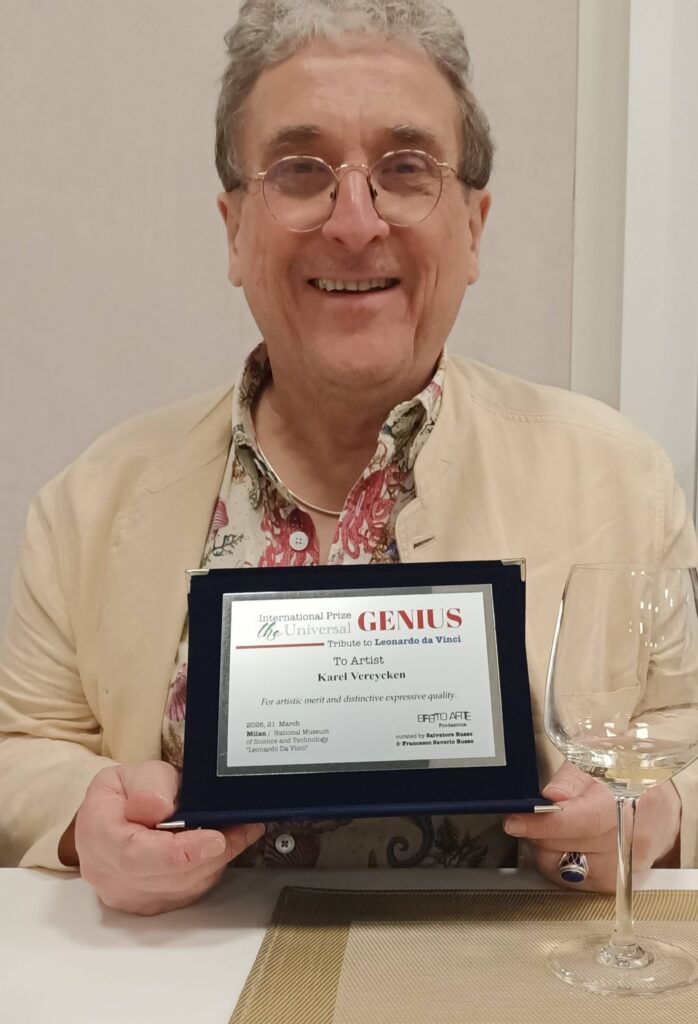
On Sat. March 21, 2026, invited to assist in Milan, Italy, at the Awarding Ceremony of the International Prize “The Universal Genius – Tribute to Leonardo da Vinci” held at the prestigious National Museum for Science and Technology Leonardo da Vinci, painter engraver and historian Karel Vereycken, presented a 3 minute call for a “New Renaissance”.
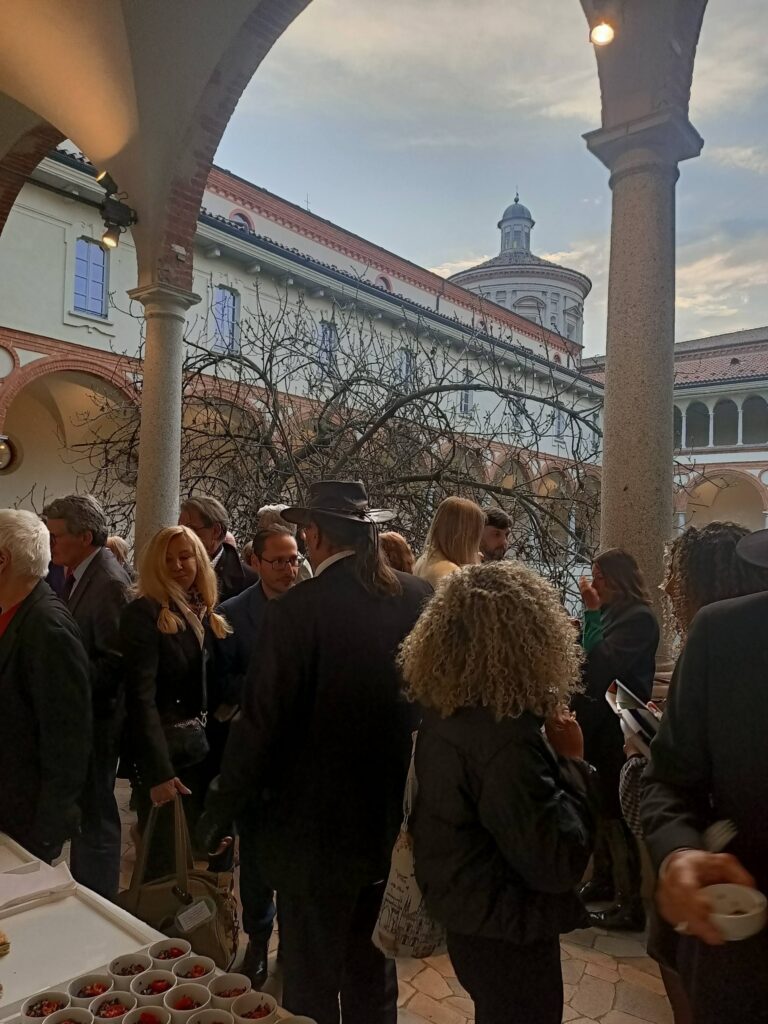
Over a hundred artists and art lovers filled the auditorium and a diplomatic representative of Mexico made one of the concluding statements of the event.
Finalists for the Prize were selected for their consistency by the curators of the “Effeto Arte Foundation” of Palermo. Before becoming a Foundation, the organizers created an art gallery and a publishing group, organizing large international exhibitions every two years in numerous Italian and foreign cities.
Regarding their mission, they write: “We believe that our experiences must be turned into realities to be expanded, to counteract the intellectual flattening of our time. Especially in this historical moment, art needs spaces of maximum participation so that even the general public can take part in it. This is the path we are committed to follow for future events, in order to allow an increasing number of people to get in touch with the dimension of art, in the simplest and most direct way, as a moment of social aggregation with the artistic communities.”
Vereycken was one among the many honored with the Prize. Thanking the organizers for awarding them, several artists explained why Leonardo had been a personal and lifelong source of inspiration.
One artist said: “when I was 28, I could reproduce by memory most of Leonardo’s painting”.
Many were emotional and connected their art, not only as a shield to protect themselves from anxiety, but as a means to change the current situation of looming war.
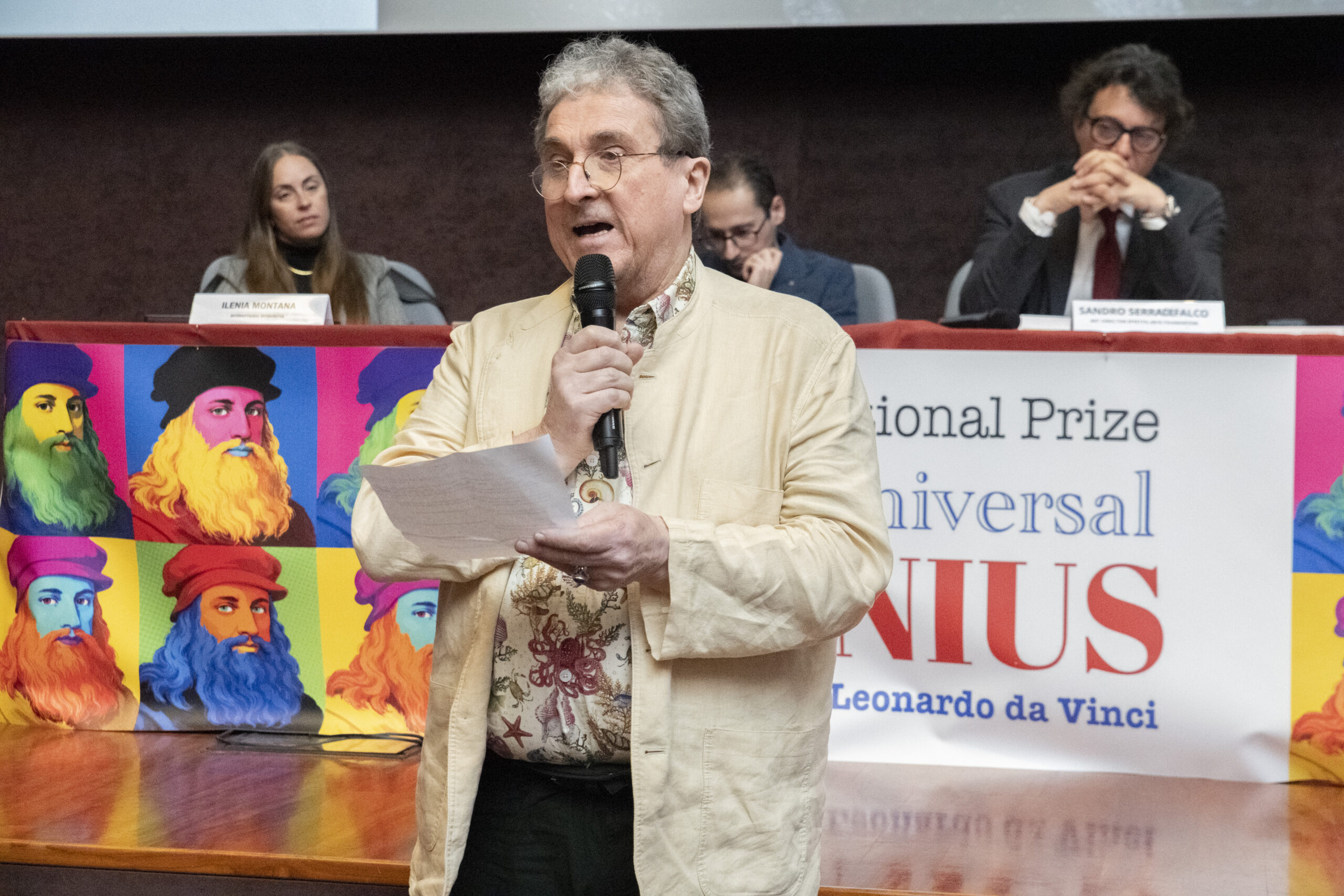
Dear organizers, dear colleagues, honorable guests,
First congratulations to all of you and especially to the print-makers because we are becoming rare. This is my etching on copper the « Flemish Fisherman » (image on a large screen).
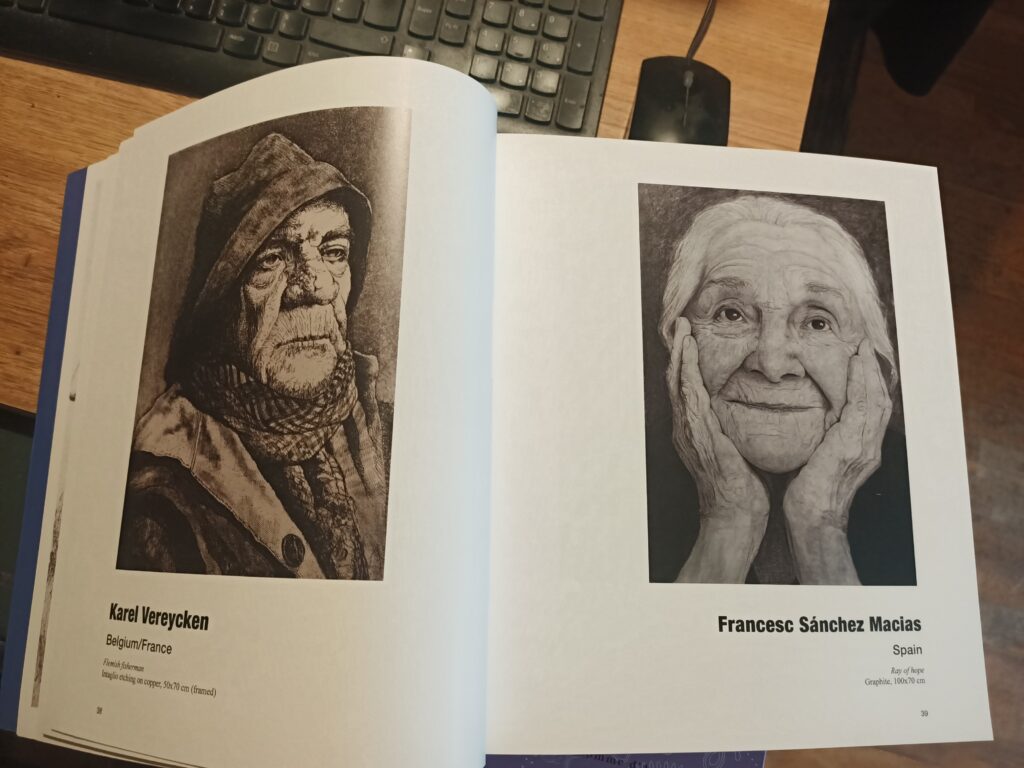
It is with great honor and an immense pleasure that I attend this important event and accept this kind award. Allow me to congratulate the organizers for this initiative.
Never has there been a more appropriate moment to pay tribute to the Renaissance genius Leonardo da Vinci, because today, in these dark times of war, corruption and depredation, it is an absolute urgency that we, the artists and the art-lovers, return to the highest standards.
Where stands the world today? We have entered the century of absolute fakery, with fake news and fake currencies being produced by fake elites using fake intelligence but pushing the real world to real wars against real human beings.
Even worse for the arts, the fact that killing, murder, war and even genocide are promoted on internet as aesthetic artifacts for sale.
Let’s wake up
Already in 1789, while revolutions swept over Europe, the German poet Friedrich Schiller, in a poem, underscored the importance of ART:
“Artists!
“Man’s honor is confided to your hand,—
There, let it well protected be!
It sinks with you! with you it will expand!”
Therefore, a new Renaissance is not just a nice thing to dream about. It has to be undertaken once again, to re-humanize mankind and to recreate the required empathy for dialogue and mutual understanding.
Milan is one of the perfect places to play a major role in such a new Renaissance.
Because it was here, in the palace of Ludovico Sforza, that a brilliant young female poet, Cecilia Gallerani, whose portrait we know from the “Lady with the Ermine”, recruited Leonardo da Vinci to her musical, poetical and philosophical discussions, an encounter that clearly marked da Vinci’s rise as a towering genius. For him, just as for the renaissance thinker Nicholas of Cusa, whose writings were read here, we have to learn how to read the invisible macrocosmos in the microcosmos.
The world needs new Cecilia’s and new Leonardo’s.
Let us end the “Century of Fakery” now by organizing together, with art contests of the best kind, a new Renaissance honoring beauty and inner dignity. That is the challenge for all of us today.
Thank You,
Van Eyck, a Flemish Painter using Arab Optics?

What follows is an edited transcript of a lecture by Karel Vereycken on the subject of “Perspective in XVth-century Flemish religious painting”.
It was delivered at the international colloquium “La recherche du divin à travers l’espace géométrique” (The quest for the divine through geometrical space) at the Paris Sorbonne University on April 26-28, 2006, under the direction of Luc Bergmans, Department of Dutch Studies (Paris IV Sorbonne University).
Introduction
« Perspective in XVth-century Flemish religious painting ». At first glance, this title may seem surprising. While the genius of fifteenth-century Flemish painters is universally attributed to their mastery of drying oil and their intricate sense of detail, their spatial geometry as such is usually identified as the very counter-example of the “right perspective”.
Disdained by Michelangelo and his faithful friend Vasari, the Flemish « primitives » would never have overcome the medieval, archaic and empirical model. For the classical “narritive”, still in force today, stipulates that only « Renaissance » perspective, obeying the canon of « linear », “mathematical” perspective, is the only « right », and the “scientific” one.
According to the same narrative, it was the research carried out around 1415-20 by the Duomo architect Filippo Brunelleschi (1377-1446), superficially mentioned by Antonio Tuccio di Manetti some 60 years later, which supposedly enabled Leon Battista Alberti (1404-1472), proclaiming himself Brunelleschi’s intellectual heir, to invent « perspective ».
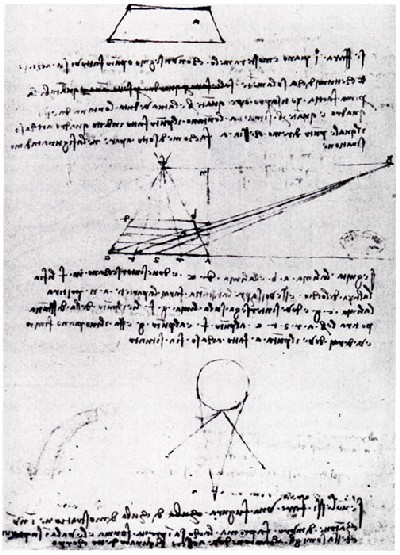
In 1435, in De Pictura, a book entirely devoid of graphic illustration, Alberti is said to have formulated the premises of a perspectivist canon capable of representing, or at least conforming to, our modern notions of Cartesian space-time (NOTE 1), a space-time characterized as « entirely rational, i.e. infinite, continuous and homogeneous », « in one word, a purely mathematical space [dixit Panofsky] » (NOTE 2)
Long afterwards, in a drawing from the Codex Madrid, Leonardo da Vinci (1452-1519) attempted to unravel the workings of this model.
But in the same manuscript, he rigorously demonstrated the inherent limitations of the Albertian Renaissance perspectivist canon.
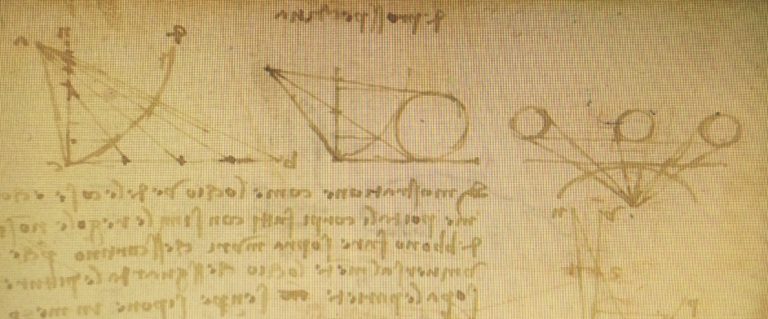
The drawing on f°15, v° clearly shows that the simple projection of visual pyramid cross-sections on a plane paradoxically causes their size to increase the further they are from the point of vision, whereas reality would require exactly the opposite. (NOTE 3)
With this in mind, Leonardo began to question the mobility of the eye and the curvilinear nature of the retina. Refusing to immobilize the viewer on an exclusive point of vision (NOTE 4), Leonardo used curvilinear constructions to correct these lateral deformations. (NOTE 5) In France, Jean Fouquet and others worked along the same lines.
But Leonardo’s powerful arguments were ignored, and he was unable to prevent this rewriting of history.
Despite this official version of art history, it should be noted that at the time, Flemish painters were elevated to pinnacles by Italy’s greatest patrons and art connoisseurs, specifically for their ability to represent space.
Bartolomeo Fazio, around the middle of the 15th century, observed that the paintings of Jan van Eyck, an artist billed as the « principal painter of our time », showed « tiny figures of men, mountains, groves, villages and castles rendered with such skill that one would think them fifty thousand paces apart. » (NOTE 6)
Such was their reputation that some of the great names in Italian painting had no qualms about reproducing Flemish works identically. I’m thinking, for example, of the copy of Hans Memlinc‘s Christ Crowned with Thorns at the Genoa Museum, copied by Domenico Ghirlandajo (Philadelphia Museum).
But post-Michelangelo classicism deemed the non-conformity of Flemish spatial geometry with Descartes’ « extended substance » to be an unforgivable crime, and any deviation from, or insubordination to, the « Renaissance » perspectivist canon relegated them to the category of « primitives », i.e. « empiricists », clearly devoid of any scientific culture.
Today, ironically, it is almost exclusively those artists who explicitly renounce all forms of perspectivist construction in favor of pseudo-naïveté, who earn the label of modernity…
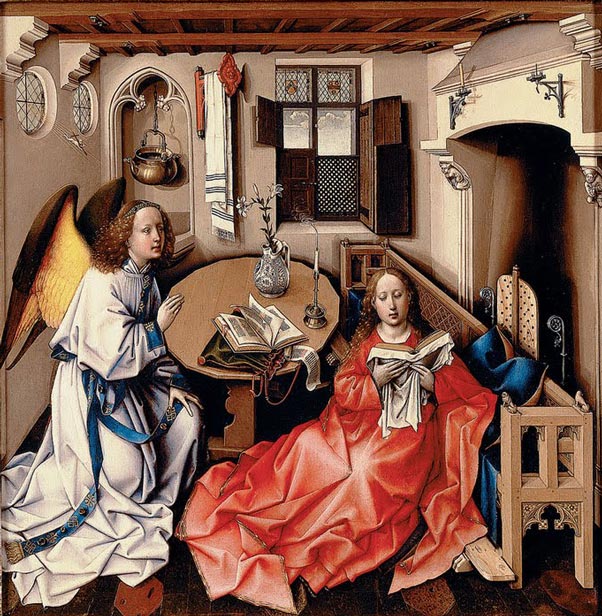
In any case, current prejudices mean that 15th-century Flemish painting is still accused of having ignored perspective.
It’s true, however, that at the end of the XIVth century, certain paintings by Melchior Broederlam (c. 1355-1411) and others by Robert Campin (1375-1444) (Master of Flémalle) show the viewer interiors where plates and cutlery on tables threaten to suddenly slide to the floor.
Nevertheless, it must be admitted that whenever the artist « ignores » or disregards the linear perspective scheme, he seems to do so more by choice than by incapacity. To achieve a limpid composition, the painter prioritizes his didactic mission to the detriment of all other considerations.
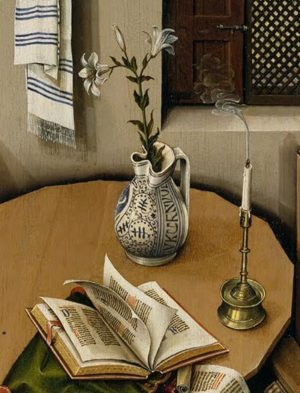
For example, in Campin’s Mérode Altarpiece, the exaggerated perspective of the table clearly shows that the vase is behind the candlestick and book.
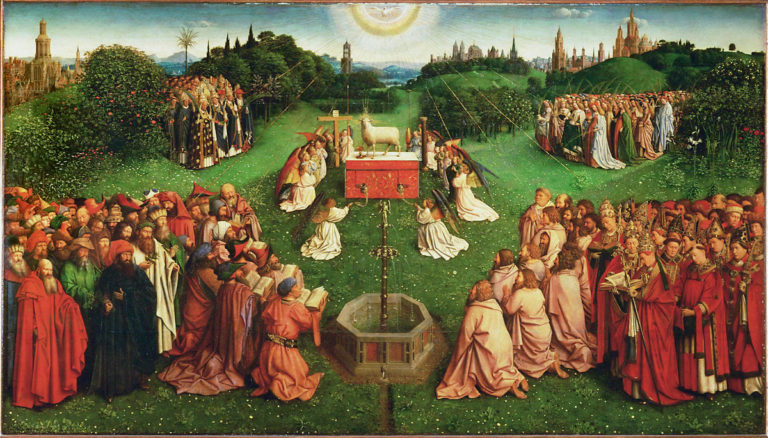
Jan van Eyck’s Lam Gods (Mystic Lamb) in Ghent is another example.
Never could so many figures, with so much detail and presence, be shown with a linear perspective where the figures in the foreground would hide those behind. (NOTE 7)
But the intention to approximate a credible sense of space and depth remains.
If this perspective seems flawed by its linear geometry, Campin imposes an extraordinary sense of space through his revolutionary treatment of shadows. As every painter knows, light is painted by painting shadow.
In Campin’s work, every object and figure is exposed to several sources of light, generating a darker central shadow as the fruit of crossed shadows.
Van Eyck influenced by Arab Optics?
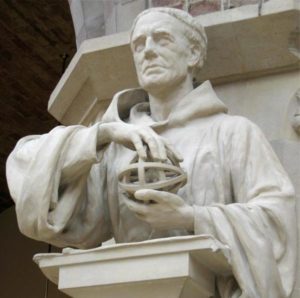
Roger Bacon, statue in Oxord.
This new treatment of light-space has been largely ignored. However, there are several indications that this new conception was partly the result of the influence of « Arab » science, in particular its work on optics.
Translated into Latin and studied from the XIIth century onwards, their work was developed in particular by a network of Franciscans whose epicenter was in Oxford (Robert Grosseteste, Roger Bacon, etc.) and whose influence spread to Chartres, Paris, Cologne and the rest of Europe.
It should be noted that Jan van Eyck (1395-1441), an emblematic figure of Flemish painting, was ambassador to Paris, Prague, Portugal and England.
I’ll briefly mention three elements that support this hypothesis of the influence of Arab science.
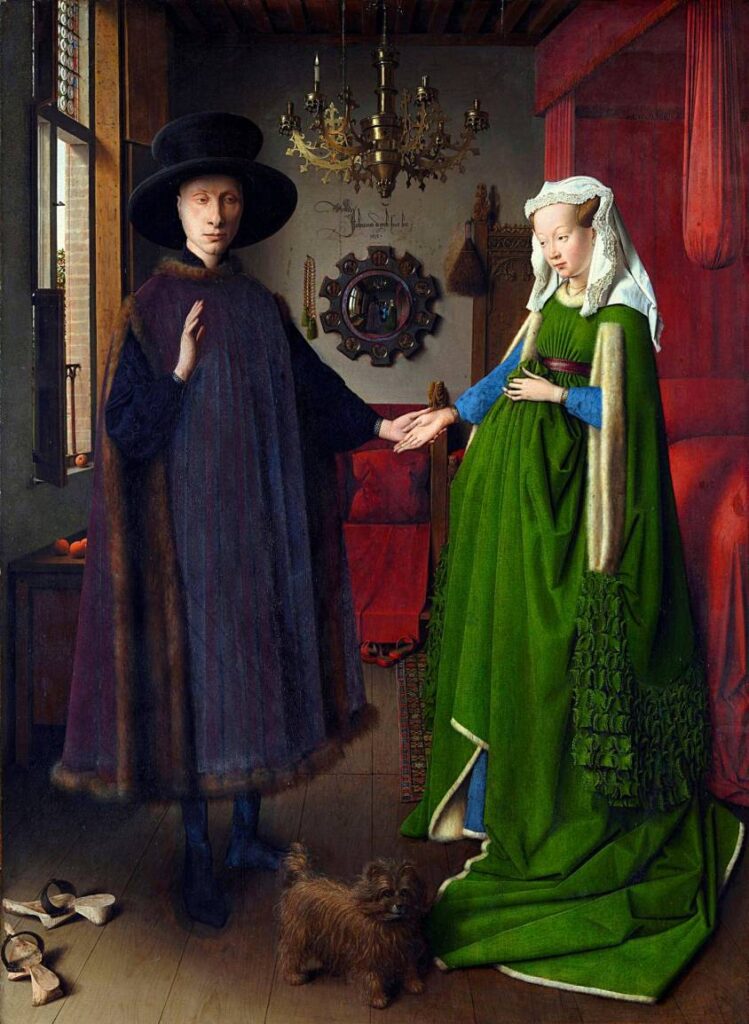
Curved mirrors
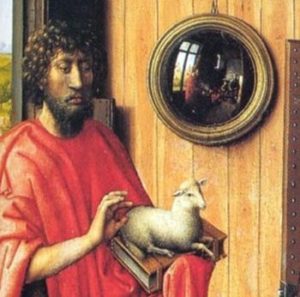
Robert Campin (master of Flémalle) in the Werl Triptych (1438) and Jan van Eyck in the Arnolfini portrait (1434), each feature convex mirrors of considerable size.
It is now certain that glaziers and mirror-makers were full members of the Saint Luc guild, the painters’ guild. (NOTE 8)
But it is relevant to know that Campin, now recognized as having run the workshop in Tournai where the painters Van der Weyden and Jacques Daret were trained, produced paintings for the Franciscans in this city. Heinrich Werl, who commissioned the altarpiece featuring the convex mirror, was an eminent Franciscan theologian who taught at the University of Cologne.
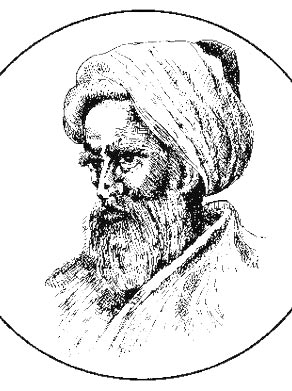
Artistic representation of Ibn Al-Haytam (Alhazen)
These convex and concave (or ardent) mirrors were much studied during the Arab renaissance of the IXth to XIth centuries, in particular by the Arab philosopher Al-Kindi (801-873) in Baghdad at the time of Charlemagne.
Arab scientists were not only in possession of the main body of Hellenic work on optics (Euclid‘s Optics, Ptolemy‘s Optics, the works of Heron of Alexandria, Anthemius of Tralles, etc.), but it was sometimes the rigorous refutation of this heritage that was to give science its wings.
After the decisive work of Ibn Sahl (Xth century), it was that of Ibn Al-Haytam (Latin name : Alhazen) (NOTE 9) on the nature of light, lenses and spherical mirrors that was to have a major influence. (NOTE 10)
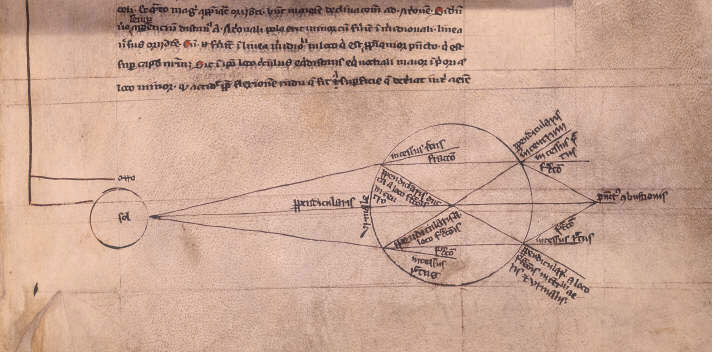
As mentioned above, these studies were taken up by the Oxford Franciscans, starting with the English bishop of Lincoln, Robert Grosseteste (1168-1253).
In De Natura Locorum, for example, Grosseteste shows a diagram of the refraction of light in a spherical glass filled with water. And in his De Iride he marvels at this science which he connexts to perspective :
« This part of optics, so well understood, shows us how to make very distant things appear as if they were situated very near, and how we can make small things situated at a distance appear to the size we desire, so that it becomes possible for us to read the smallest letters from incredible distances, or to count sand, or grains, or any small object.«
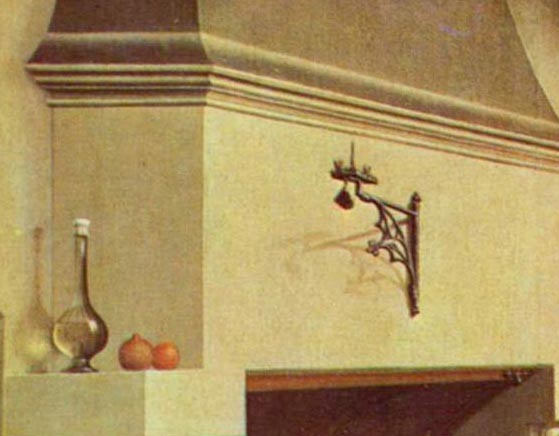
Grosseteste’s pupil Roger Bacon (1212-1292) wrote De Speculis Comburentibus, a specific treatise on « Ardent Mirrors » which elaborates on Ibn Al-Haytam‘s work.
Flemish painters Campin, Van Eyck and Van der Weyden proudly display their knowledge of this new scientific and technological revolution metamorphosed into Christian symbolisms.
Their paintings feature not only curved mirrors but also glass bottles, which they use as a metaphor for the immaculate conception.
A Nativity hymn of that period says:
« As through glass the ray passed without breaking it, so of the Virgin Mother, Virgin she was and virgin she remained… » (NOTE 11)
The Treatment of Light
In his Discourse on Light, Ibn Al-Haytam develops his theory of light propagation in extremely poetic language, setting out requirements that remind us of the « Eyckian revolution ». Indeed, Flemish « realism » and perspective are the result of a new treatment of light and color.
Ibn Al-Haytam:
« The light emitted by a luminous body by itself -substantial light- and the light emitted by an illuminated body -accidental light- propagate on the bodies surrounding them. Opaque bodies can be illuminated and then in turn emit light. »
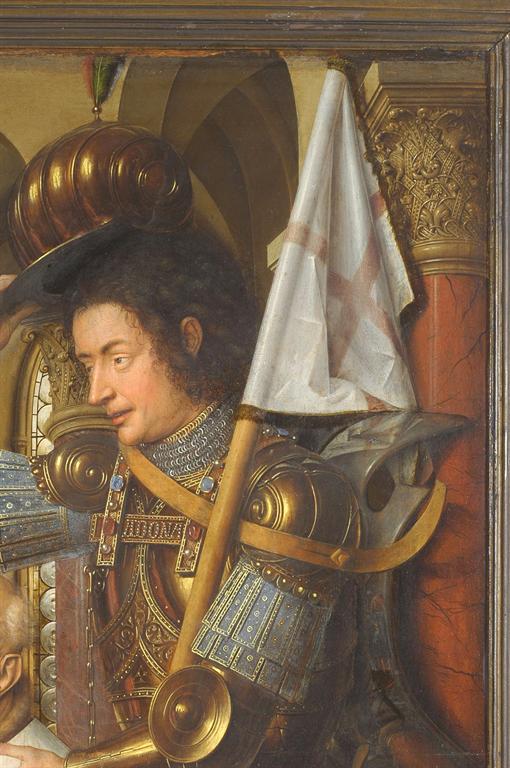
This physical principle, theorized by Leonardo da Vinci, is omnipresent in Flemish painting. Just look at the images reflected in the helmet of St. George in Van Eyck‘s Madonna to Canon van der Paele (NOTE 12).
In each curved surface of Saint George’s helmet, we can identify the reflection of the Virgin and even a window through which light enters the painting.
The shining shield on St. George’s back reflects the base of the adjacent column, and the painter’s portrait appears as a signature. Only a knowledge of the optics of curved surfaces can explain this rendering.
Ibn Al-Haytam:
« Light can penetrate transparent bodies: water, air, crystal and their counterparts. »
And :
« Transparent bodies have, like opaque bodies, a ‘receiving power’ for light, but transparent bodies also have a ‘transmitting power’ for light.«
Isn’t the development of oil mediums and glazes by the Flemish an echo of this research? Alternating opaque and translucent layers on very smooth panels, the specificity of the oil medium alters the angle of light refraction.
In 1559, the painter-poet Lucas d’Heere referred to van Eyck‘s paintings as « mirrors, not painted scenes.«
Binocular perspective
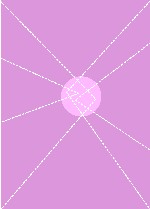
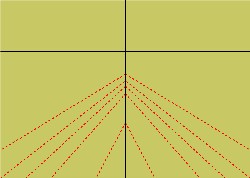
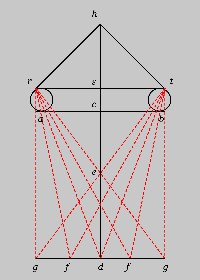
Before the advent of « right » central linear perspective, art historians sought a coherent explanation for its birth in the presence of several seemingly disparate vanishing points by theorizing a so-called central « fishbone » perspective.
In this model, a number of vanishing lines, instead of coinciding in a single central vanishing point on the horizon, either end up in a « vanishing region » (NOTE 13), or align with what some call a vertical « vanishing axis », forming a kind of « fishbone ».
French Professor Dominique Raynaud, who worked for years on this issue, underscores that « all medieval treatises on perspective address the question of binocular vision », notably the Polish scholar Witelo (1230-1280) (NOTE 15) in his Perspectiva (I,27), an insight he also got from the works of Ibn Al-Haytam.
Witelo presents a figure to defend the idea that
« the two forms, which penetrate two homologous points of the surface of the two eyes, arrive at the same point of the concavity of the common nerve, and are superimposed at this point to become one » (Perspectiva, III, 37).
A similar line of reasoning can be found in Roger Bacon‘s Perspectiva Communis, written by John Pecham, Archbishop of Canterbury (1240-1290) for whom:
« the duality of the eyes must be reduced to unity »
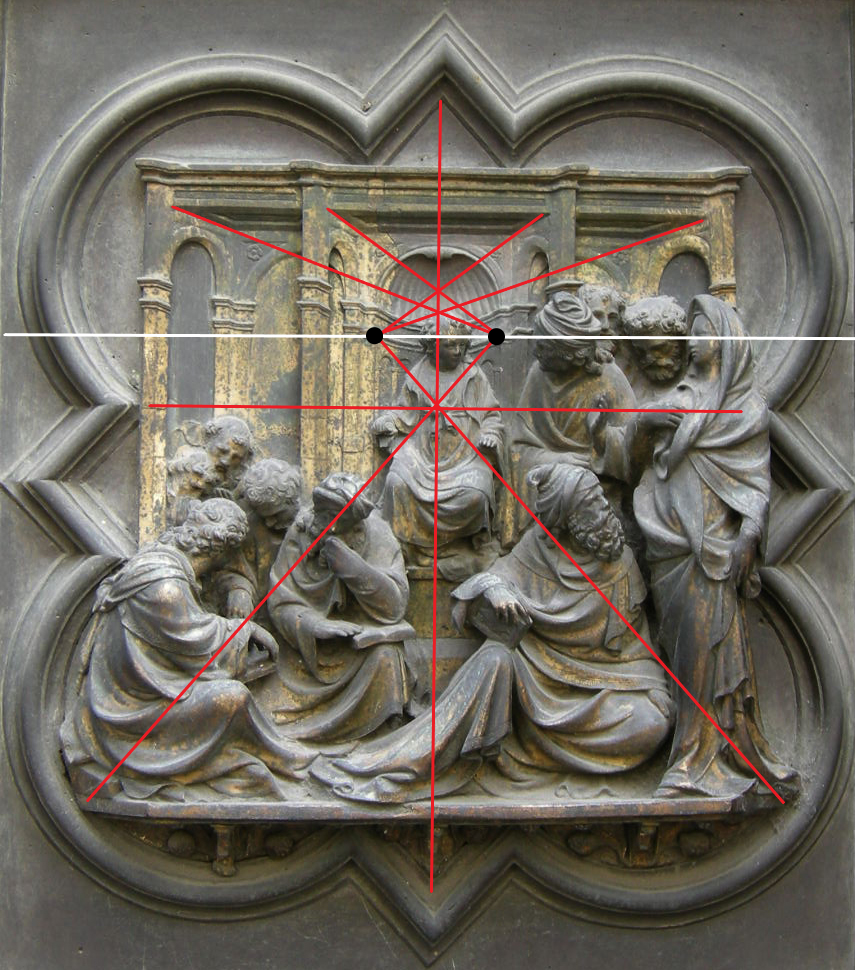
So, as Professor Raynaud proposed, if we extend the famous vanishing lines (i.e., in our case, the « fish bones ») until they intersect, the « vanishing axis » problem disappears, as the vanishing lines meet. Interestingly, the result is a perspective with two vanishing points in the central region!
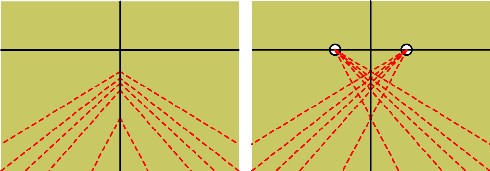
Suddenly, the diagrams drawn up to demonstrate the « empiricism » of the Flemish painters, if viewed from this point of view, reveal a legitimate construction probably based on optics as transmitted by Arab science and rediscovered by Franciscan networks and others.
Two paintings by Jan van Eyck clearly demonstrate that he followed this approach: The Madonna with Canon van der Paele of 1436 and the Dresden Tryptic of 1437.
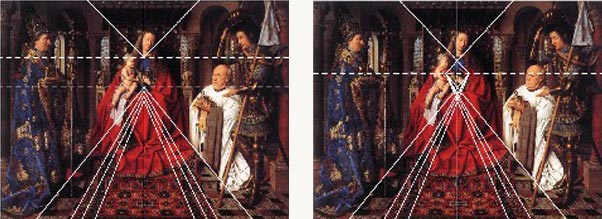
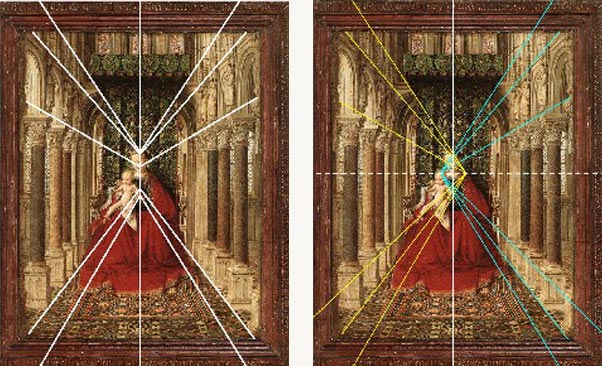
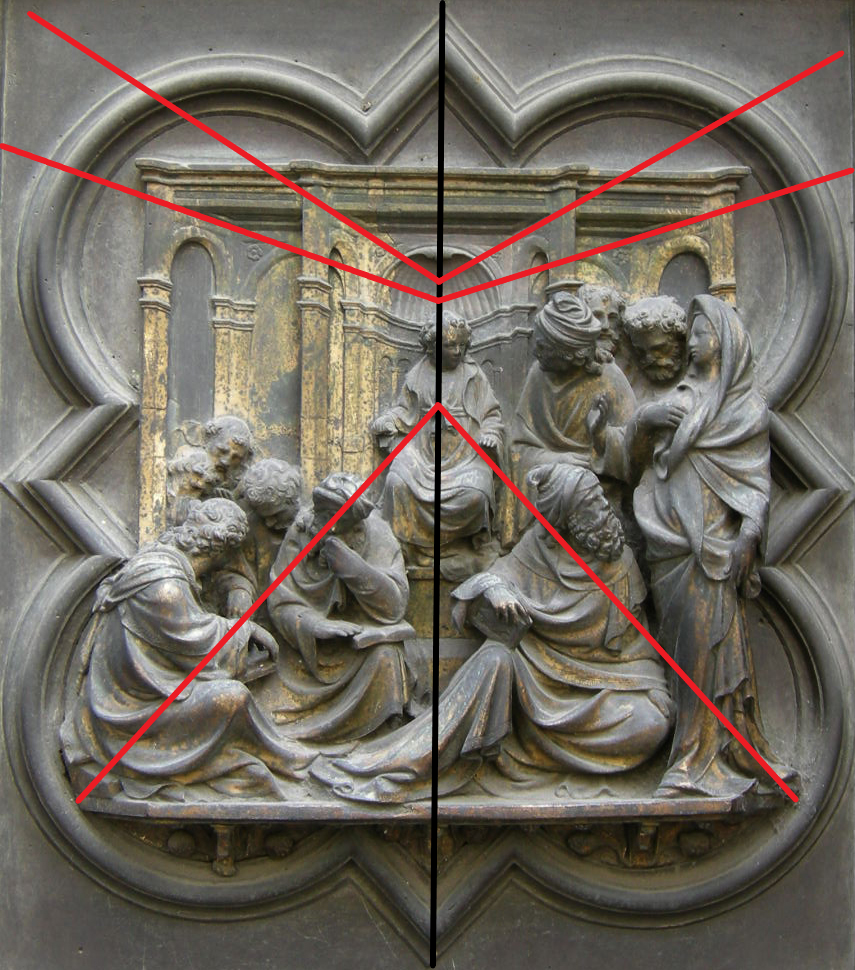
What seemed a clumsy, empirical approach in the form of a « fishbone » perspective (left) turns out to be a binocular perspective construction.
Was this type of perspective specifically Flemish?
A close examination of works by Ghiberti, Donatello and Paolo Uccello, generally dating from the first half of the XVth Century, reveals a mastery of the same principle.
Cusanus
But this whole demonstration is merely a look into the past through the eyes of modern scientific rationality. It would be a grave error not to take into account the immense influence of the Rhenish (Master Eckhart, Johannes Tauler, Heinrich Suso) and Flemish (Hadewijch of Antwerp, Jan van Ruusbroec, etc.) « mystics ».
This trend began to flourish again with the rediscovery of the Christianized neo-Platonism of Dionysius the Areopagite (Vth-VIth century), made accessible… by the new translations of the Franciscan Grosseteste in Oxford.
The spiritual vision of the Aeropagite, expressed in a powerful imagery language, is directly reminiscent of the metaphorical approach of the Flemish painters, for whom a certain type of light is simply the revelation of divine grace.
In On the Heavenly Hierarchy, Dionysius immediately presents light as a manifestation of divine goodness. It ennobles us and enables us to enlighten others:
« Let those who are illuminated be filled with divine clarity, and the eyes of their understanding trained to the work of chaste contemplation; finally, let those who are perfected, once their primitive imperfection has been abolished, share in the sanctifying science of the marvelous teachings that have already been manifested to them; similarly, let the purifier excel in the purity he communicates to others; let the illuminator, gifted with a greater penetration of spirit, equally fit to receive and transmit light, happily flooded with sacred splendor, pour it out in pressing streams on those who are worthy… » [Chap. III, 3]
Let’s think again of the St. George in Van Eyck‘s Madonna to Canon van der Paele, which indeed pours forth the multiple images of the Virgin who enlightens him.
This theo-philosophical trend reached full maturity in the work of Cardinal Nicolas of Cusa (Cusanus) (1401-1464) (NOTE 16), embodying the extremely fruitful encounter of this « negative theology » with Greek science, Socratic knowledge and Christian Humanism.
In contrast to both a science « without a hypothesis of God » and a metaphysics with an esoteric drift, an agapic love leads it to the education of the greatest number, to the defense of the weak and the humiliated.
The Brothers and Sisters of the Common Life, educating Erasmus of Rotterdam and inspiring Cusanus, are the best example of this.
But let’s sketch out some of Cusanus’ key ideas on painting.
In De Icona (The Vision of God) (1453), which he sent to the Benedictine monks of the Tegernsee, Cusanus condenses his fundamental work On Learned Ignorance (1440), in which he develops the concept of the coincidence of opposites. His starting point was a self-portrait of his friend « Roger », the Flemish painter Rogier van der Weyden, which he sent together with his sermon to the monks.
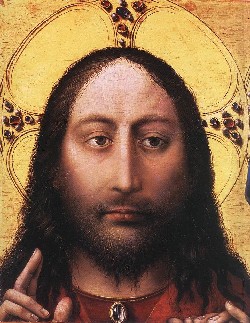
This self-portrait, like the multiple faces of Christ painted in the XVth century, uses an « optical illusion » to create the effect of a gaze that fixes the viewer, regardless of his or her position in front of the altarpiece.
In De Icona, written as a sermon, Cusanus asks monks to stand in a semicircle around the painting and watch this gaze pursue them as they move along the segment of the curve. In fact, he elaborates a pedagogical paradox based on the fact that the Greek name for God, Theos, has its etymological origin in the verb theastai (to see, to look at).
As you can see, he says, God looks at you personally, and his gaze follows you everywhere. He is therefore one and many. And even when you turn away from him, his gaze falls on you. So, miraculously, although he looks at everyone at the same time, he nevertheless establishes a personal relationship with each one. If « seeing » for God is « loving », God’s point of vision is infinite, omniscient and omnipotent love.
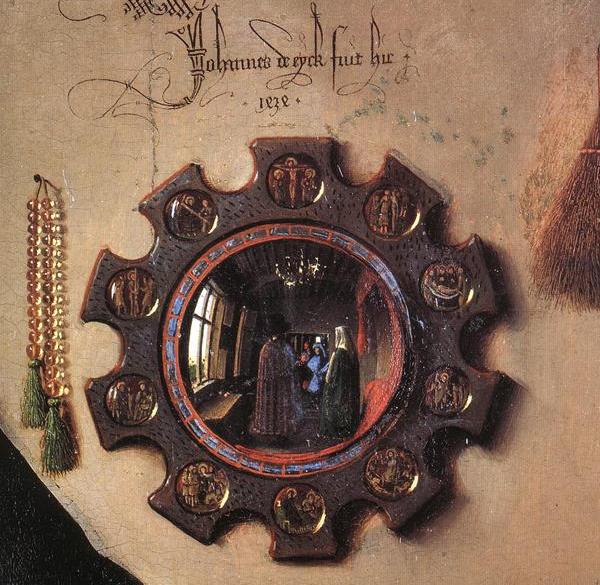
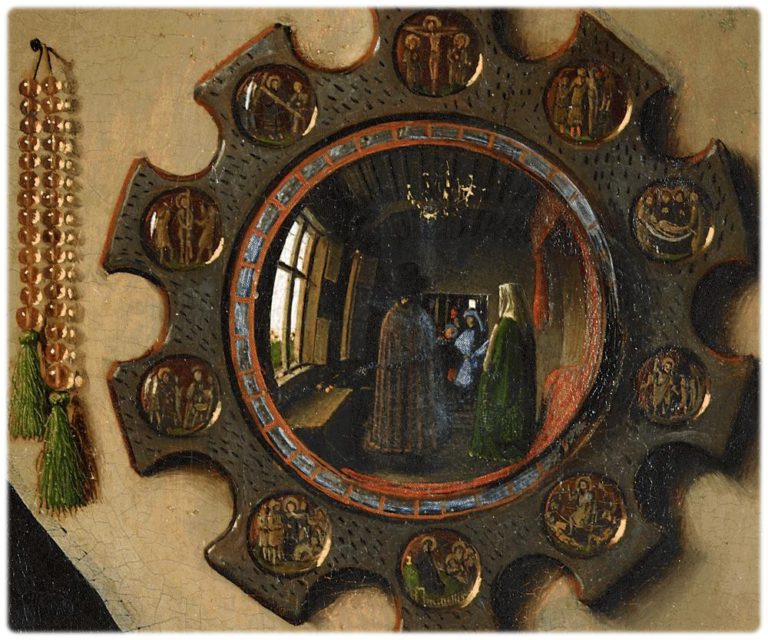
A parallel can be drawn here with the spherical mirror at the center of Jan van Eyck’s painting The Arnolfini portrait, painted in 1434, nineteen years before this sermon.
Firstly, this circular mirror is surrounded by the ten stations of Christ’s Passion, juxtaposed by a rosary, an explicit reference to God.
Secondly, it reveals a view of the entire room, an image that completely escapes the linear perspective of the foreground. A view comparable to the allcompassing « Vision of God » developed by Cusanus.
Finally, we see two figures in the mirror, but not the image of the painter behind his easel. These are undoubtedly the two witnesses to the wedding. Instead of signing his painting with « Van Eyck invent. », the painter signed his painting above the mirror with « Van Eyck was here » (NOTE 17), identifying himself as a witness.
As Dionysius the Aeropagite asserted:
« [the celestial hierarchy] transforms its adepts into so many images of God: pure and splendid mirrors where the eternal and ineffable light can shine, and which, according to the desired order, reflect liberally on inferior things this borrowed brightness with which they shine. » [Chap. III, 2]
The Flemish mystic Jan van Ruusbroec (1293-1381) evokes a very similar image in his Spiegel der eeuwigher salicheit (Mirror of eternal salvation) when he says:
« Ende Hi heeft ieghewelcs mensche ziele gescapen alse eenen levenden spieghel, daer Hi dat Beelde sijnre natueren in gedruct heeft. » (And he created each human soul as a living mirror, in which he imprinted the image of his nature).
And so, like a polished mirror, Van Eyck’s soul, illuminated and living in God’s truth, acts as an illuminating witness to this union. (NOTE 18)
So, although the Flemish painters of the XVth century clearly had a solid scientific foundation, they choose such or such perspective depending on the idea they wanted to convey.
In essence, their paintings remain objects of theo-philosophical speculation or as you like « intellectual prayer », capable of praising the goodness, beauty and magnificence of a Creator who created them in His own image. By the very nature of their approach, their interest lay above all in the geometry of a kind of « paradoxical space-light » capable, through enigma, of opening us up to a participatory transcendence, rather than simply seeking to « represent » a dead space existing outside metaphysical reality.
The only geometry worthy of interest was that which showed itself capable of articulating this non-linearity, a « divine » or « mystical » perspective capable of linking the infinite beauty of our commensurable microcosm with the immeasurable goodness of the macrocosm.
Thank you,
NOTES:
- Recently, Italian scholars have pointed to the role of Biagio Pelacani Da Parma (d. 1416), a professor at the University of Padua near Venice, in imposing such a perspective, which privileged only the « geometrical laws of the act of vision and the rules of mathematical calculation ».
- Erwin Panofsky, Perspective as Symbolic Form, p.41-42, Les Éditions de Minuit, Paris, 1975.
- Institut de France, Manuscrit E, 16 v° « the eye [h] perceives on the plane wall the images of distant objects greater than that of the nearer object. »
- Leonardo understands that Albertian perspective, like anamorphosis, condemns the viewer to a single, immobile point of vision.
- See, for example, the slight enlargement of the apostles at the ends of Leonardo da Vinci’s Last Supper in the Milan refectory.
- Baxandall, Bartholomaeus Facius on painting, Journal of the Warburg and Courtauld Institutes, 27, (1964). Fazio is also enthusiastic about a world map (now lost) by Jan van Eyck, in which all the places and regions of the earth are depicted recognizably and at measurable distances.
- To escape this fate, Pieter Bruegel the Elder used a cavalier perspective, placing his horizon line high up.
- Lionel Simonot, Etude expérimentale et modélisation de la diffusion de la lumière dans une couche de peinture colorée et translucide. Application à l’effet visuel des glacis et des vernis, p.9 (PhD thesis, Nov. 2002).
- Ibn Al-Haytam (Alhazen) (965-1039) wrote some 200 works on mathematics, astronomy, physics, medicine and philosophy. Born in Basra, after working on the development of the Nile in Egypt, he travelled to Spain. He is said to have carried out a series of highly detailed experiments on theoretical and experimental optics, including the camera obscura (darkroom), work that was later to feature in Leonardo da Vinci’s studies. Da Vinci may well have read the lengthy passages by Alhazen that appear in the Commentari of the Florentine sculptor Ghiberti. According to Gerbert d’Aurillac (the future Pope Sylvester II in 999), Bishop of Rheims, brought back from Spain the decimal system with its zero and an astrolabe, it was thanks to Gerard of Cremona (1114-c. 1187) that Europe gained access to Greek, Jewish and Arabic science. This scholar went to Toledo in 1175 to learn Arabic, and translated some 80 scientific works from Arabic into Latin, including Ptolemy’s Almagest, Apollonius’ Conics, several treatises by Aristotle, Avicenna‘s Canon, and the works of Ibn Al-Haytam, Al-Kindi, Thabit ibn Qurra and Al-Razi.
- In the Arab world, this research was taken up a century later by the Persian physicist Al-Farisi (1267-1319). He wrote an important commentary on Alhazen’s Treatise on Optics. Using a drop of water as a model, and based on Alhazen’s theory of double refraction in a sphere, he gave the first correct explanation of the rainbow. He even suggested the wave-like property of light, whereas Alhazen had studied light using solid balls in his reflection and refraction experiments. The question was now: does light propagate by undulation or by particle transport?
- Meiss, M., Light as form and symbol in some fifteenth century paintings, Art Bulletin, XVIII, 1936, p. 434.
- Note also the fact that the canon shows a pair of glasses…
- Brion-Guerry in Jean Pèlerin Viator, sa place dans l’histoire de la perspective, Belles Lettres, 1962, p. 94-96, states in obscure language that « the object of representation behaves most often in Van Eyck as a cubic volume seen from the front and from the inside. Perspectival foreshortening is achieved by constructing a rectangle whose sides form the base of four trapezoids. The orthogonals thus tend towards four distinct points of convergence, forming a ‘vanishing region' ».
- Dominique Raynaud, L’Hypothèse d’Oxford, essai sur les origines de la perpective, PUF, Paris 1998.
- Witelo was a friend of the Flemish Dominican scholar Willem van Moerbeke, a translator of Archimedes in contact with Saint Thomas Aquinas. Moerbeke was also in contact with the mathematician Jean Campanus and the Flemish neo-Platonic astronomer Hendrik Bate van Mechelen. Johannes Kepler‘s own work on human vision builds on that of Witelo.
- Cusanus was above all a man of science and theology. But he was also a political organizer. The painter Jan van Eyck fought for the same goals, as evidenced by the ecumenical theme of the Ghent polyptych. It shows the Mystic Lamb, symbolizing the sacrifice of the Son of God for the redemption of mankind, capable of reuniting a church torn apart by internal differences. Hence the presence of the three popes in the central panel, here united before the lamb. Van Eyck also painted a portrait of Cardinal Niccolo Albergati, one of the instigators of the great Ecumenical Council organized by Cusanus in Ferrara and then moved to Florence. If Cusanus called Van der Weyden « his friend Roger », it is also thought that Robert Campin may have met him, since he would have attended the Council of Basel, as did one of his commissioners, the Franciscan theologian Heinrich Werl.
- Jan Van Eyck was one of the first painters in the history of art to date and sign his paintings with his own name.
- Myriam Greilsammer’s book L’Envers du tableau, Mariage et Maternité en Flandre Médiévale (Editions Armand Colin, 1990) documents Arnolfini’s sexual escapades. Arnolfini was taken to court by one of his victims, a female servant. Van Eyck seems to have understood that the knightly Arnoult Fin, Lucchese financier and commercial representative of the House of Medici in Bruges, required the somewhat peculiar presence of the eye of the lord.
Avicenna and Ghiberti’s role in the invention of perspective during the Renaissance

By Karel Vereycken, Paris, France.
Same article in FR, même article en FR.
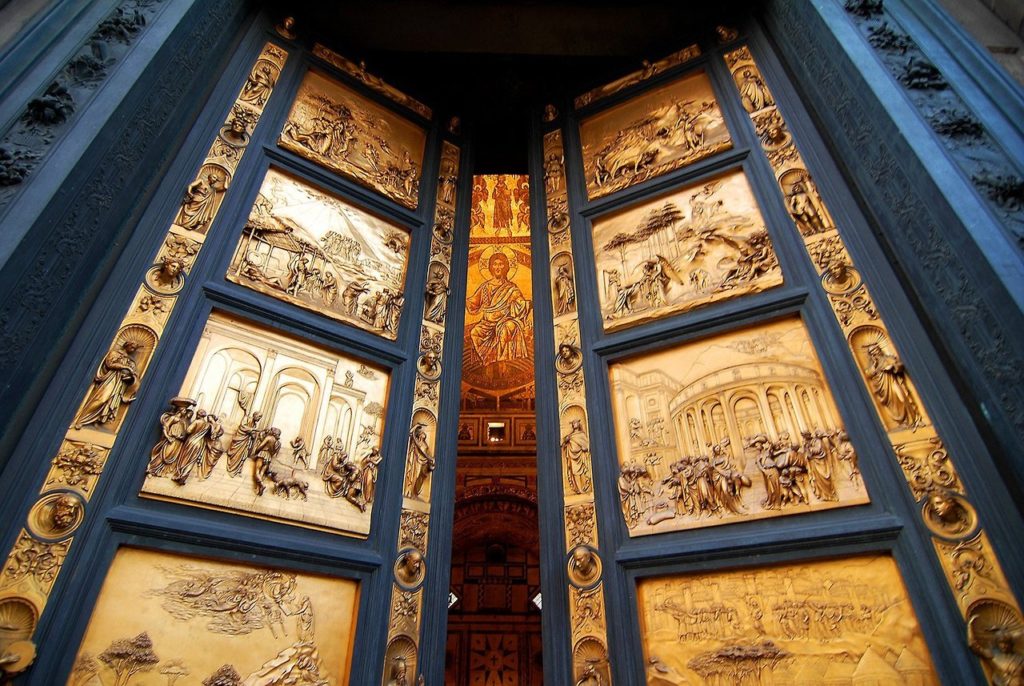
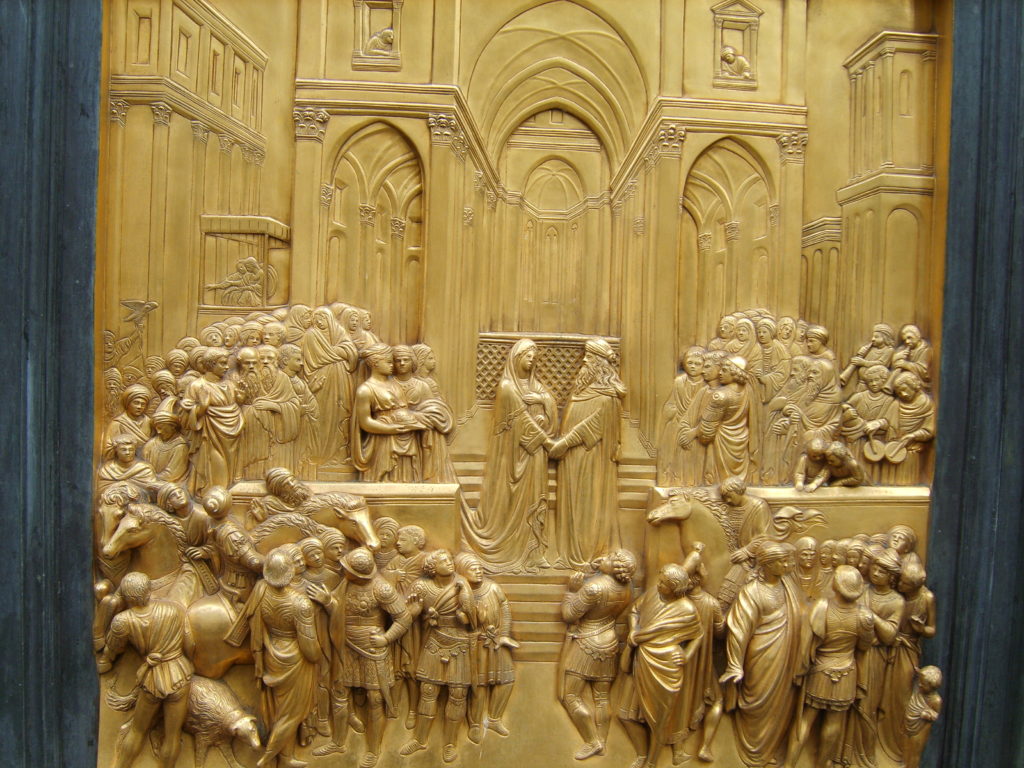
No visitor to Florence can miss the gilded bronze reliefs decorating the Porta del Paradiso (Gates of Paradise), the main gate of the Baptistery of Florence right in front of the Cathedral of Santa Maria del Fiore surmounted by Filippo Brunelleschi’s splendid cupola.

In this article, Karel Vereycken sheds new light on the contribution of Arab science and Ghiberti’s crucial role in giving birth to the Renaissance.
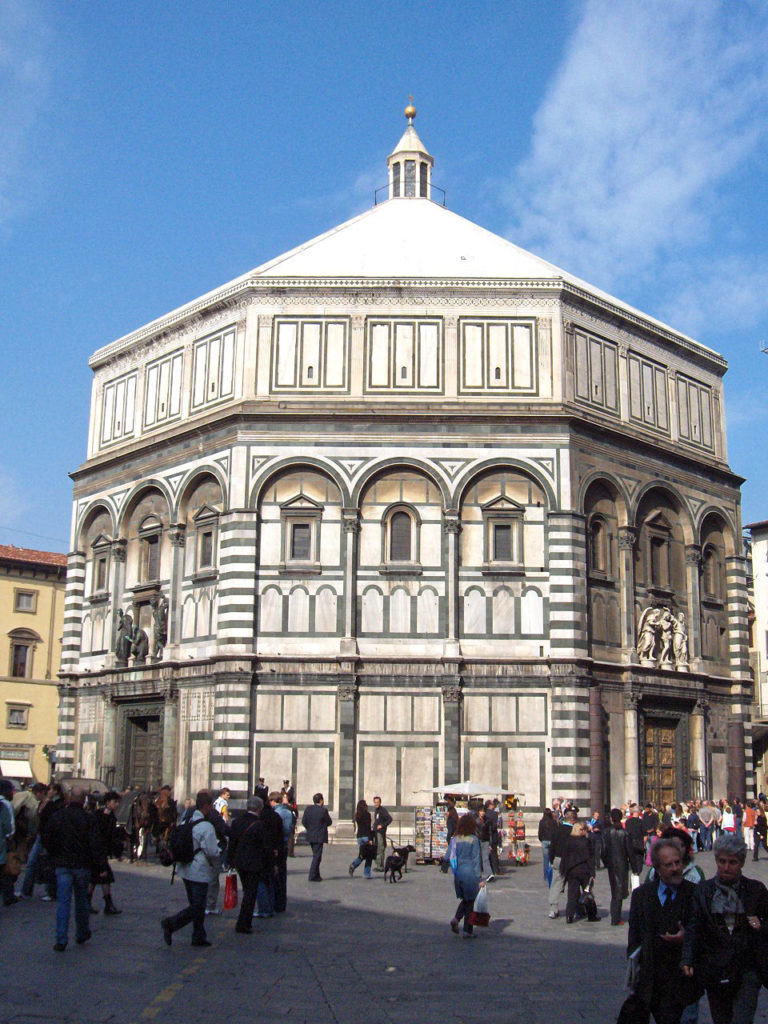
Historical context
The Baptistery, erected on what most Florentines thought to be the site of a Roman temple dedicated to the Roman God of Mars, is one of the oldest buildings in the city, constructed between 1059 and 1128 in the Florentine Romanesque style. The Italian poet Dante Alighieri and many other notable Renaissance figures, including members of the Medici family, were baptized in this baptistery.
During the Renaissance, in Florence, corporations and guilds competed for the leading role in design and construction of great projects with illustrious artistic creations.
While the Arte dei Lana (corporation of wool producers) financed the Works (Opera) of the Duomo and the construction of its cupola, the Arte dei Mercantoni di Calimala (the guild of merchants dealing in buying foreign cloth for finishing and export), took care of the Baptistery and financed the embellishment of its doors.
The Gates of Paradise
The Baptistry, an octagonal building, has four entrances (East, West, North and South) of which only three (South, North and East) have sets of artistically important bronze doors with relief sculptures. Three dates are key : 1329, 1401 and 1424.
- In 1329, the Calimala Guild, on Giotto‘s recommendation, ordered Andrea Pisano (1290-1348) to decorate a first set of doors (initialy installed as the East doors, i.e. seen when one leaves the Cathedral, but today South). These consist of 28 quatrefoil (clover-shaped) panels, with the 20 top panels depicting scenes from the life of St. John the Baptist (the patron of the edifice). The 8 lower panels depict the eight virtues of hope, faith, charity, humility, fortitude, temperance, justice, and prudence, praised by Plato in his Republic and represented during the XVIth century by the Flemish humanist painter and reader of Petrarch, Peter Brueghel the Elder. Construction took 8 years, from 1330 till 1338.
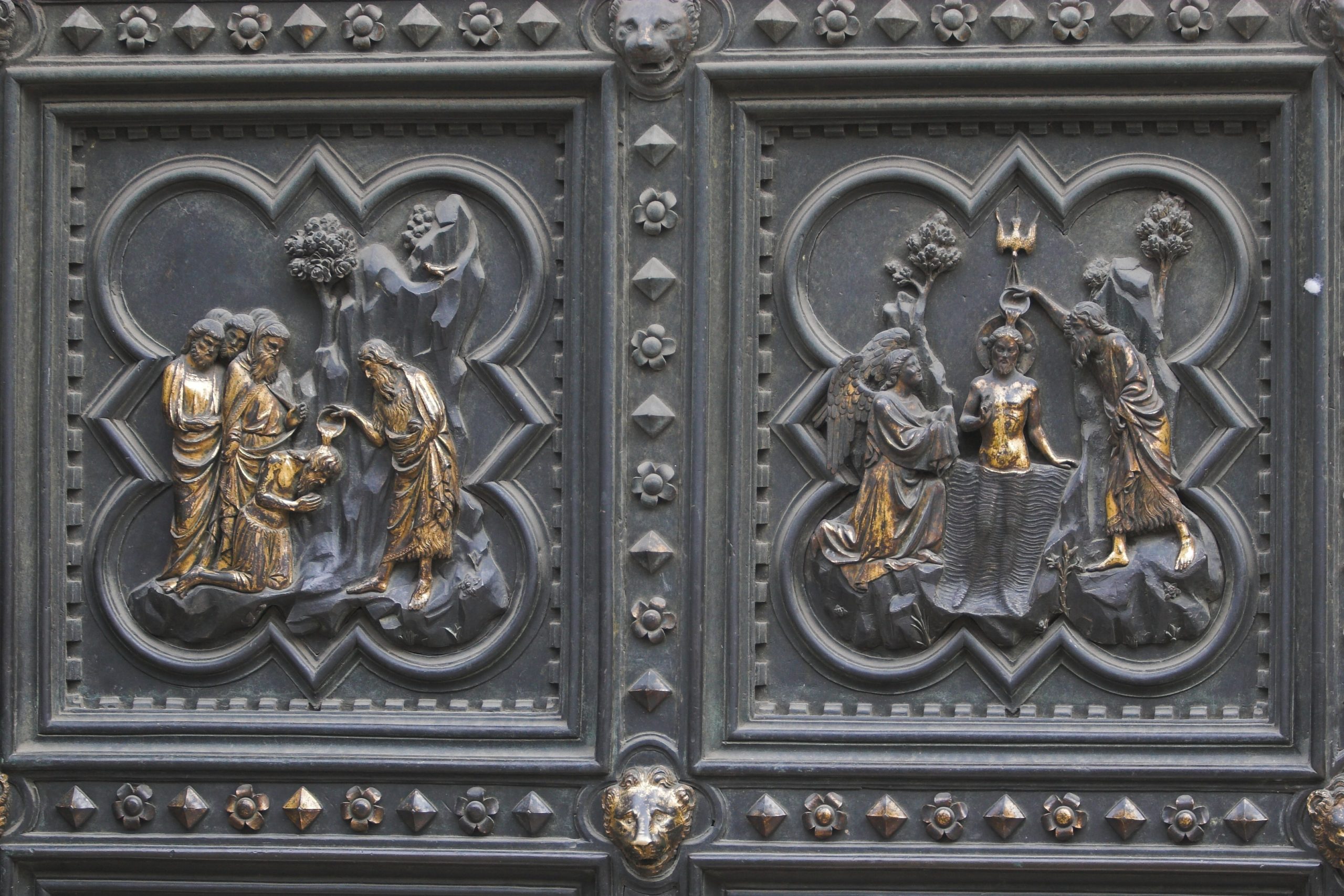
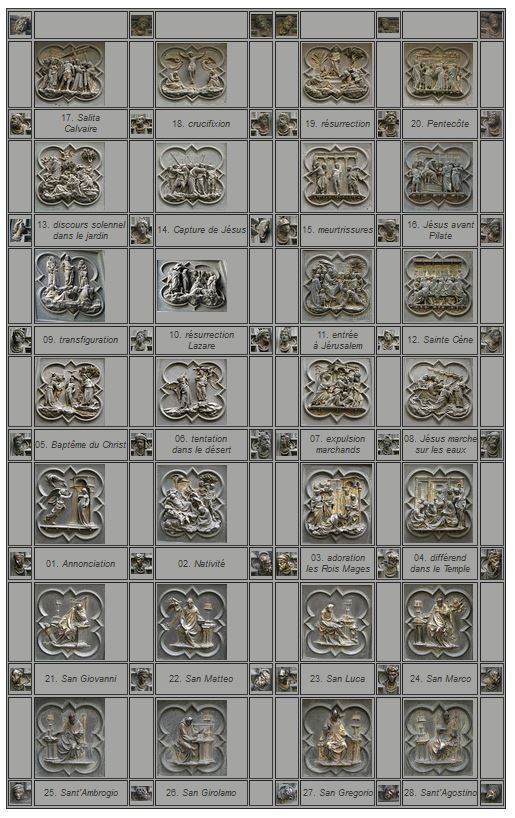
- In 1401, after having narrowly won the competition with Brunelleschi, the 23 year old and inexperienced young goldsmith Lorenzo Ghiberti (1378-1455), is commissioned by the Calima Guild to decorate the doors which are today the North Gate. Ghiberti cast the bronze high reliefs using a method known as lost-wax casting, a technique that he had to reinvent entirely since it was lost since the fall of the Roman Empire. One of the reasons Ghiberti won the contest, was that his technique was so advanced that it required 20 % less (7 kg per panel) bronze than that of his competitors, bronze being a dense material far more costly than marble. His technique, applied to the entire decoration of the North Gate, as compared to his competitors, would save some estimated 100 kg of bronze. And since in 1401, with the plague regularly hitting Florence, economic conditions were poor, even the wealthy Calimala took into account the total costs of the program.
The bronze doors are comprised of 28 panels, with 20 panels depicting the life of Christ from the New Testament. The 8 lower panels show the four Evangelists and the Church Fathers Saint Ambrose, Saint Jerome, Saint Gregory, and Saint Augustine. The construction took 24 years.
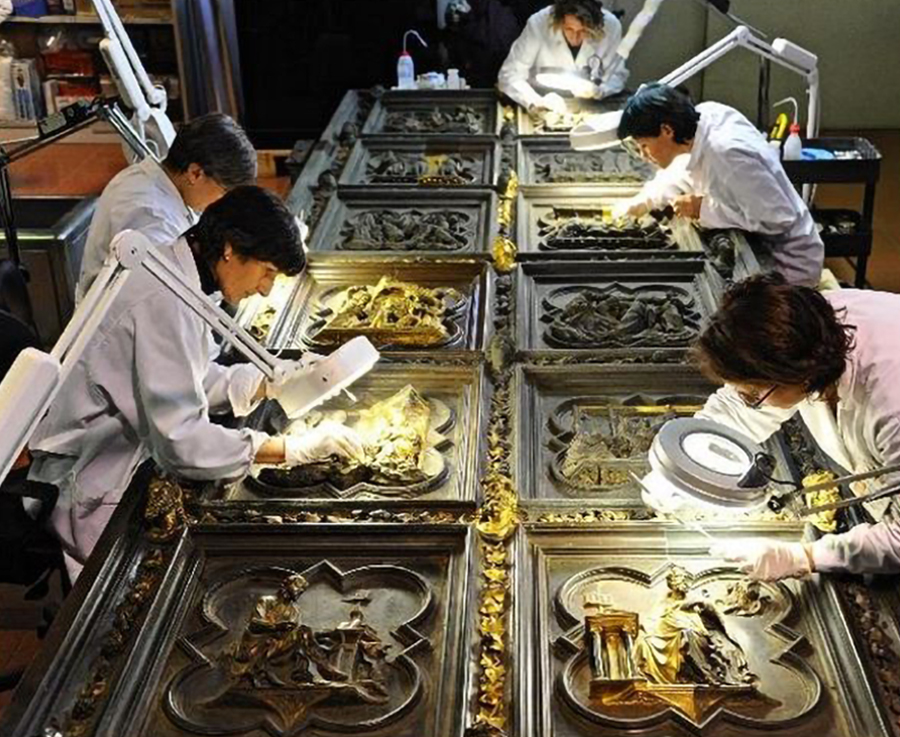
- In 1424, Ghiberti, at age 46, was given—unusually, with no competition—the task of also creating the East Gate. Only in 1452 did Ghiberti, then seventy-four years old, install the last bronze panels, since construction lasted this time 27 years! According to Giorgio Vasari (1511-1574), Michelangelo Buonarroti (1475-1564) later judged them « so beautiful they would grace the entrance to Paradise ».
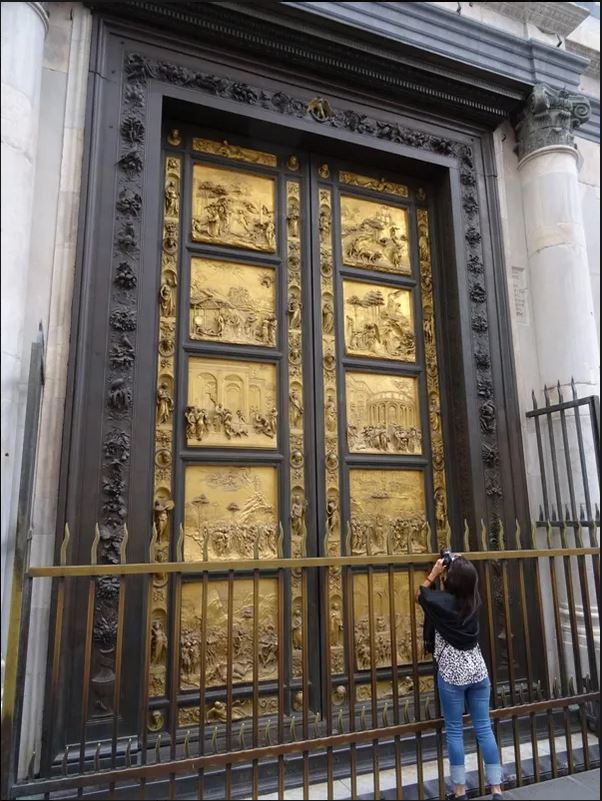
Over two generations, a bevy of well paid assistants and pupils were trained by Ghiberti, including exceptional artists, such as Luca della Robbia, Donatello, Michelozzo, Benozzo Gozzoli, Bernardo Cennini, Paolo Uccello, Andrea del Verrocchio and Ghiberti’s sons, Vittore and Tommaso. And over time, the seventeen-foot-tall, three-ton bronze doors became an icon of the Renaissance, one of the most famous works of art in the world.
In 1880, the French sculptor Auguste Rodin was inspired by it for his own Gates of Hell on which he worked for 38 year
Revolution
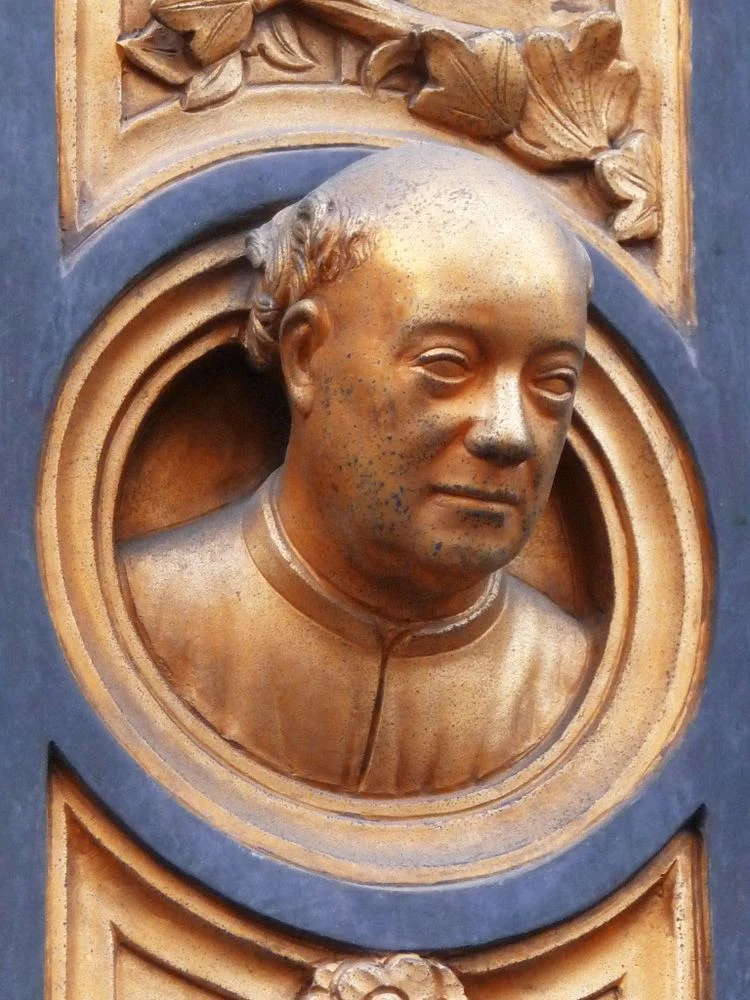
Of utmost interest for our discussion here is the dramatic shift in conception and design of the bronze relief sculptures that occurred between the North and the East Gates, because it reflects how bot the artist as well as his patrons used the occasion to share with the broader public their newest ideas, inventions and exciting discoveries.
The themes of the North Gate of 1401 were inspired by scenes from the New Testament, except for the panel made by Ghiberti, « The Sacrifice of Isaac », which had won him the selection competition the same year. To complete the ensemble, it was therefore only logical that the East Gate of 1424 would take up the themes of the Old Testament.
Originally, it was the scholar and former chancellor of Florence Leonardo Bruni (1369-1444) who planned an iconography quite similar to the two previous doors. But, after heated discussions, his proposal was rejected for something radically new. Instead of realizing 28 panels, it was decided, for aesthetic reasons, to reduce the number of panels to only 10 much larger square reliefs, between borders containing statuettes in niches and medallions with busts.
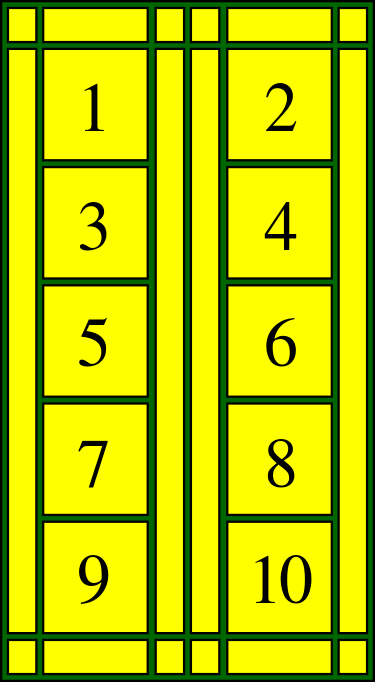
Hence, since each of the 10 chapters of the Old Testament contains several events, the total number of scenes illustrated, within the 10 panels has risen to 37 and all appear in perspective :
- Adam and Eve (The Creation of Man)
- Cain and Abel (Jalousie is the origin of Sin)
- Noah (God’s punishment)
- Abraham and Isaac (God is just)
- Jacob and Esau
- Joseph
- Moses
- Joshua
- David (Good commandor)
- Solomon and the Queen of Sheba
The general theme is that of salvation based on Latin and Greek patristic tradition. Very shocking for the time, Ghiberti places in the center of the first panel the creation of Eve, that of Adam appearing at the bottom left.
After the first three panels, focusing on the theme of sin, Ghiberti began to highlight more clearly the role of God the Savior and the foreshadowing of Christ’s coming. Subsequent panels are easier to understand. One example is the panel with Isaac, Jacob and Esau where the figures are merged with the surrounding landscape so that the eye is led toward the main scene represented in the top right.
Many of the sources for these scenes were written in ancient Greek, and since knowledge of Greek at that time was not so common, it appears that Ghiberti’s “theological advisor” was Ambrogio Traversari (1386-1439), with whom he had many exchanges.
Traversari was a close friend of Nicolas of Cusa (1401-1464), a protector of Piero della Francesca (1412-1492) and a key organizer of the Ecumenical Council of Florence of 1438-1439, which attempted to put an end to the schism separating the Church of the East from that of the West.
Perspective
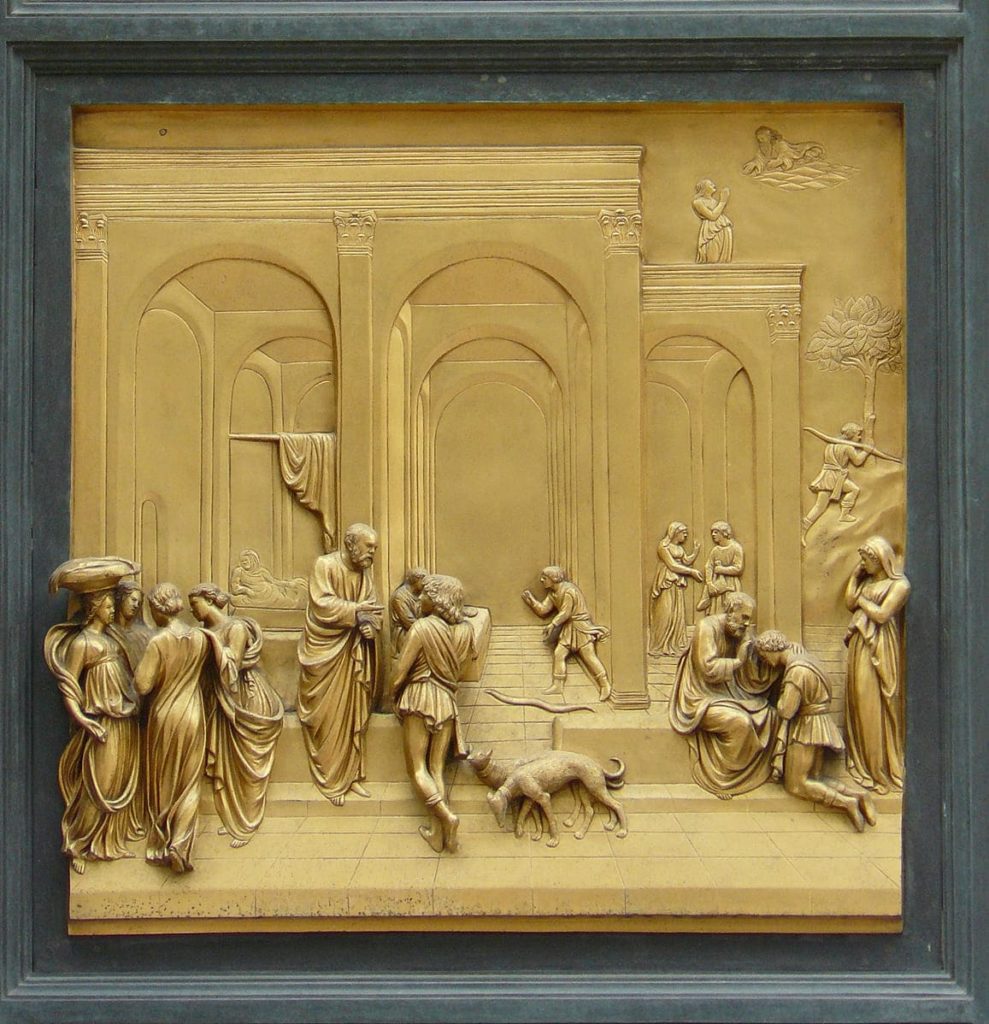
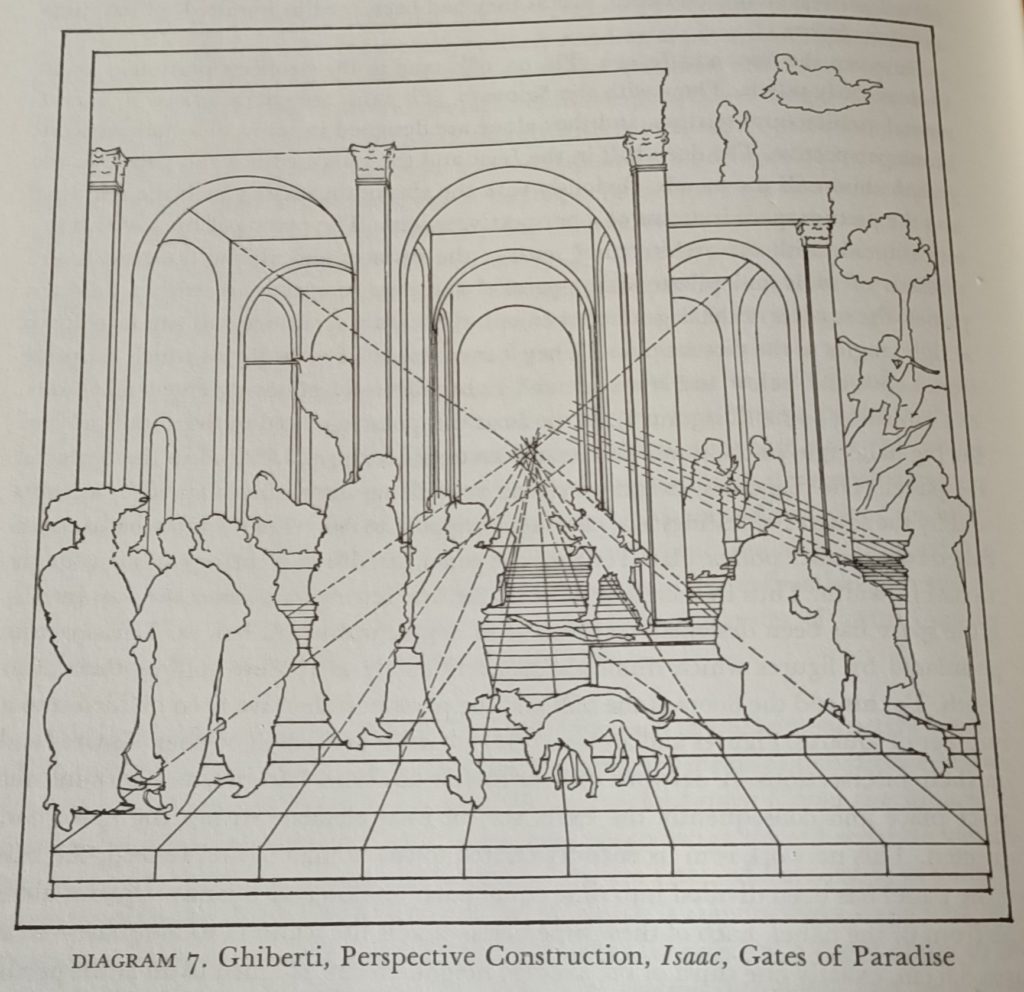
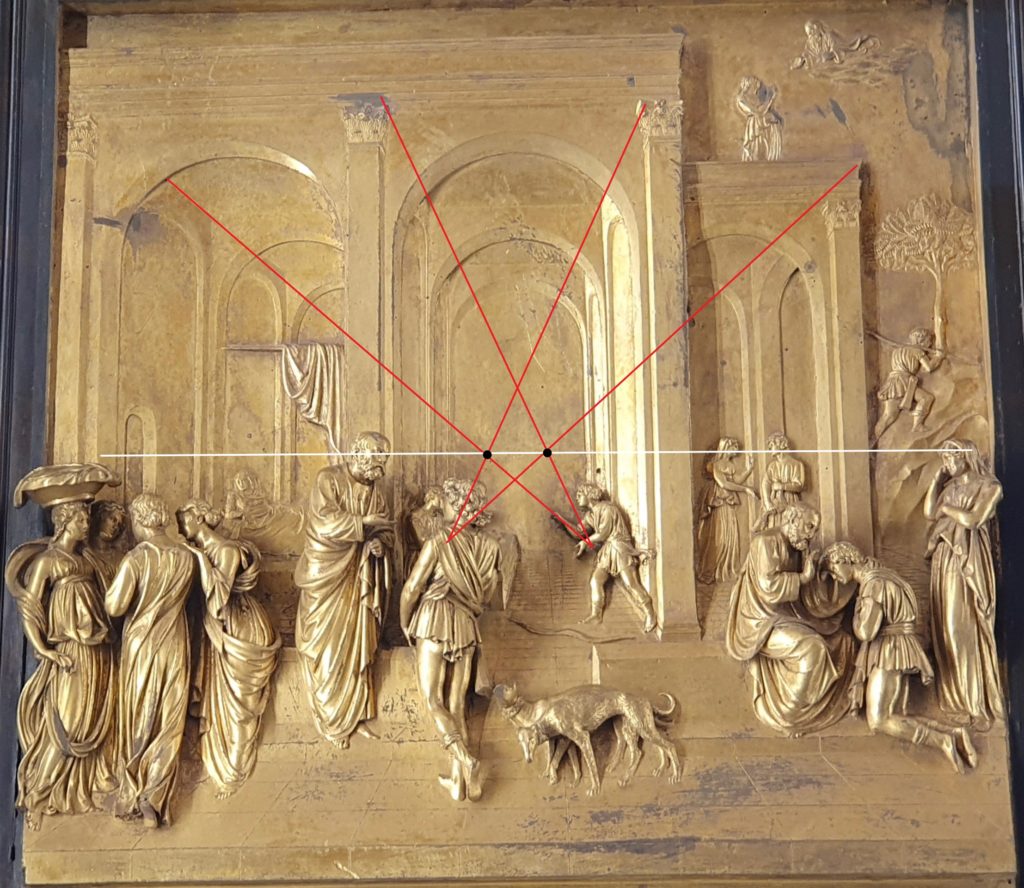
The bronze reliefs, known for their vivid illusion of deep space in relief, are one of the revolutionary events that epitomize the Renaissance. In the foreground are figures in high relief, which gradually become less protruding thereby exploiting the full illusionistic potential of the stiacciato technique later brought to its high point by Donatello. Using this form of “inbetweenness”, they integrate in one single image, what appears both as a painting, a low relief as well as a high relief. Or maybe one has to look at it another way: these are flat images traveling gradually from a surface into the full three dimensions of life, just as Ghiberti, in one of the first self-portraits of art history, reaches his head out of a bronze medal to look down on the viewers. The artist desired much more than perspective, he wanted breathing space!
This new approach will influence Leonardo Da Vinci (1452-1517). As art historian Daniel Arasse points out :
(…) It was in connection with the practice of Florentine bas-relief, that of Ghiberti at the Gate of Paradise (…) that Leonardo invented his way of painting. As Manuscript G (folio 23b) would much later state, ‘the field on which an object is painted is a capital thing in painting. (…) The painter’s aim is to make his figures appear to stand out from the field’ – and not, one might add, to base his art on the alleged transparency of that same field. It is by the science of shadow and light that the painter can obtain an effect of emergence from the field, an effect of relief, and not by that of the linear perspective.
Donatello
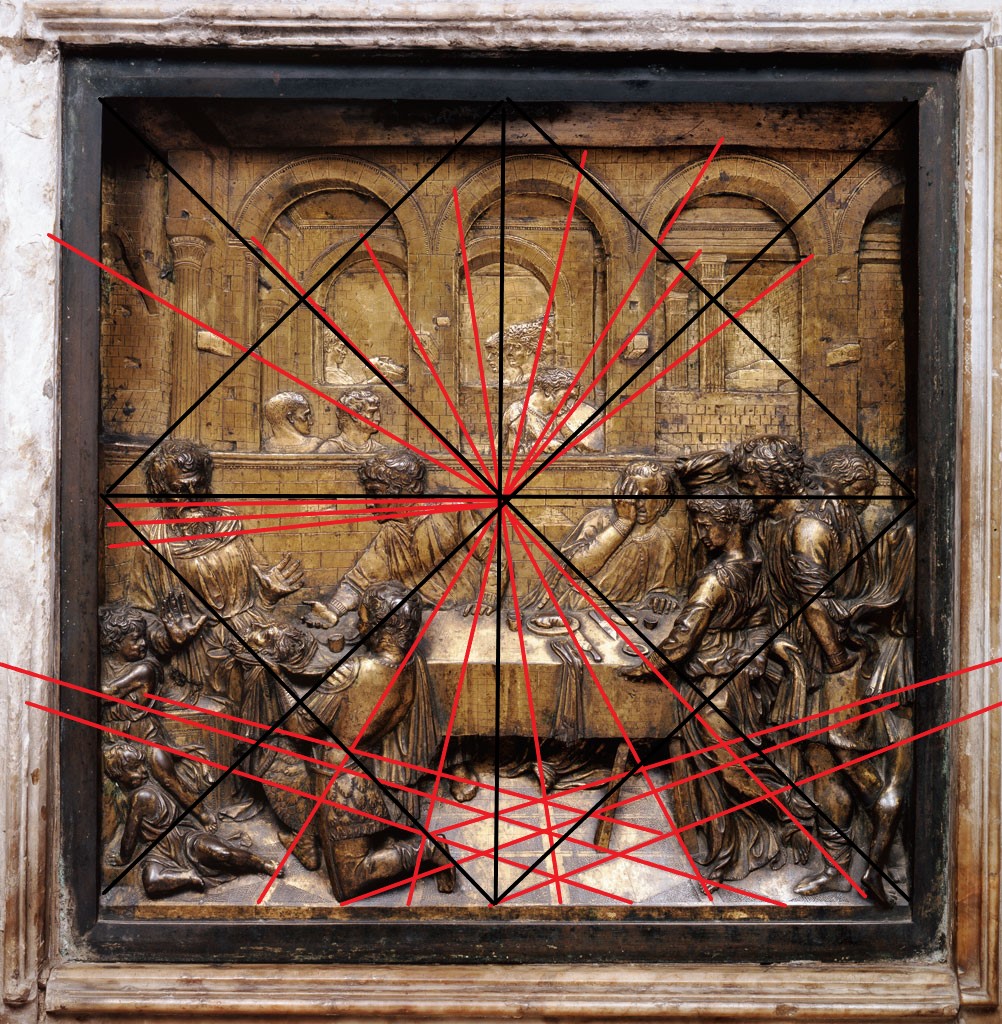
At the beginning of the 15th century, several theoretical approaches existed and eventuall contradicted each other. Around 1423-1427, the talentful sculptor Donatello, a young collaborator of Ghiberti, created his Herod’s Banquet, a bas-relief in the stiacciato technique for the baptismal font of the Siena Baptistery.
In this work, the sculptor deploys a harmonious perspective with a single central vanishing point. Around the same time, in Florence, the painter Massacchio (1401-1428) used a similar construction in his fresco The Trinity.
As we will see, Ghiberti, starting from the anatomy of the eye, opposed such an abstract approach in his works as well as in his writings and explored, as early as 1401, other geometrical models, called « binocular ». (see below).
Christ among the Doctors, Ghiberti, before 1424.
Christ among the Doctors, Ghiberti, before 1424.
Then, as far as our knowledge reaches, in 1407, Brunelleschi had conducted several experiments on this question, most likely based on the ideas presented by another friend of Cusa, the Italian astronomer Paolo dal Pozzo Toscanelli (1397-1482), in the latter’s now lost treaty Della Prospettiva. What we do know is that Brunelleschi sought above all to demonstrate that all perspective is an optical illusion.
Finally, it was in 1435, that the humanist architect Leon Baptista Alberti (1406-1472), in his treatise Della Pictura, attempted, on the basis of Donatello’s approach, to theorize single vanishing point perspective as a representation of a harmonious and unified three-dimensional space on a flat surface. Noteworthy but frustrating for us today is the fact that Alberti’s treatise doesn’t contain any illustrations.
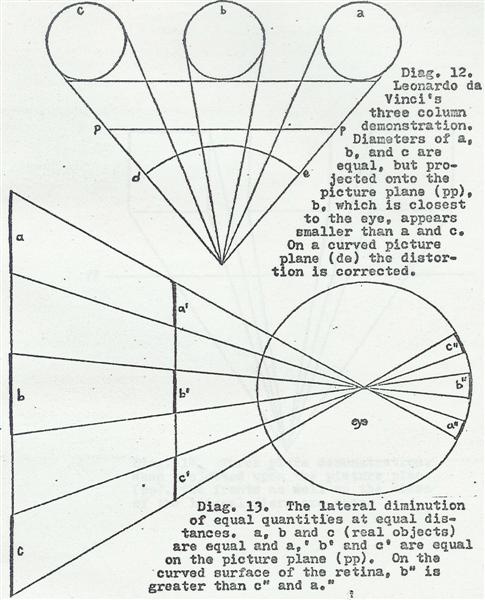
However, Leonardo, who read and studied Ghiberti’s writings on, would use the latter’s arguments to indicate the limits and even demonstrate the dysfunctionality of Alberti’s “perfect” perspective construction especially when one goes beyond a 30 degres angle.
In the Codex Madrid, II, 15 v. da Vinci realizes that « as such, the perspective offered by a rectilinear wall is false unless it is corrected (…) ».
Perspectiva artificialis versus perspectiva naturalis
Alberti’s “perspectiva artificialis” is nothing but an abstraction, necessary and useful to represent a rational organization of space. Without this abstraction, it is fairly impossible to define with mathematical precision the relationships between the appearance of objects and the receding of their various proportions on a flat screen: width, height and depth.
From the moment that a given image on a flat screen was thought about as the intersection of a plane cutting a cone or pyramid, a method emerged for what was mistakenly considered as an “objective” representation of “real” three dimensional space, though it is nothing but an “anamorphosis”, i.e. a tromp-l’oeil or visual illusion.
What has to be underscored, is that this construction does away with the physical reality of human existence since it is based on an abstract construct pretending:
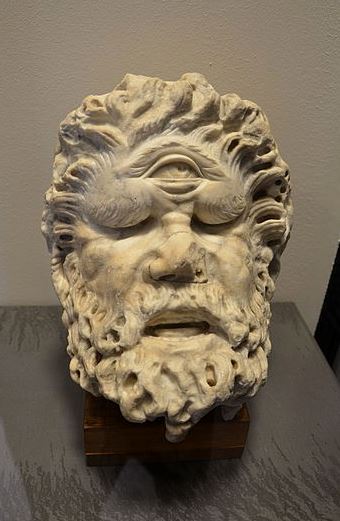
- that man is a single eyed cyclops;
- that vision emanates from one single point, the apex of the visual pyramid;
- that the eye is immobile;
- that the image is projected on a flat screen rather than on a curved retina.
Slanders and gossip
The crucial role of Ghiberti, an artist which “Ghiberti expert” Richard Krautheimer mistakenly presents as a follower of Alberti’s perspectiva artificialis, has been either ignored or downplayed.
Ghiberti’s unique manuscript, the three volumes of the Commentarii, which include his autobiography and which established him as the first modern historian of the fine arts, is not even fully translated into English or French and was only published in Italian in 1998.
Today, because of his attention to minute detail and figures « sculpted » with wavy and elegant lines, as well as the variety of plants and animals depicted, Ghiberti is generally presented as “Gothic-minded”, and therefore “not really” a Renaissance artist!
Giorgio Vasari, often acting as the paid PR man of the Medici clan, slanders Ghiberti by saying he wrote « a work in the vernacular in which he treated many different topics but arranged them in such a fashion that little can be gained from reading it. »
Admittedly, tension among humanists, was not uncommon. Self-educated craftsmen, such as Ghiberti and Brunelleschi on the one side, and heirs of wealthy wool merchants, such as Niccoli on the other side, came from entirely different worlds. For example, according to a story told by Guarino Veronese in 1413, Niccoli greeted Filippo Brunelleschi haughtily: « O philosopher without books, » to which Filippo replied with his legendary irony: « O books without philosopher ».
For sure, the Commentarii, are not written according to the rhetorical rules of those days. Written at the end of Ghiberti’s life, they may have simply been dictated to a poorly trained clerk who made dozens of spelling errors.
The humanists
The Commentarii does reveal a highly educated author and a thinker having profound knowledge of many classical Greek and Arab thinkers. Ghiberti was not just some brilliant handcraft artisan but a typical “Renaissance man”.
In dialogue with Bruni, Traversari and the “manuscript hunter” Niccolo Niccoli, Ghiberti, who couldn’t read Greek but definitely knew Latin, was clearly familiar with the rediscovery of Greek and Arab science, a task undertaken by Boccaccio’s and Salutati’s “San Spirito Circle” whose guests (including Bruni, Traversari, Cusa, Niccoli, Cosimo di Medici, etc.) later would convene every week at the Santa Maria degli Angeli convent. Ghiberti exchanges moreover with Giovanni Aurispa, a collaborator of Traversari who brought back from Byzantium, years before Bessarion, the whole of Plato’s works to the West.
Amy R. Bloch, in her well researched study Lorenzo Ghiberti’s Gates of Paradise, Humanism, History, and Artistic Philosophy in the Italian Renaissance (2016), writes that « Traverari and Niccoli can be tied directly to the origins of the project for the Gates and were clearly interested in sculptural commissions being planned for the Baptistery. On June 21, 1424, after the Calima requested from Bruni his program for the doors, Traversari wrote to Niccoli acknowledging, in only general terms, Niccoli’s ideas for the stories to be included and mentioning, without evident disapproval, that the guild had instead turned to Bruni for advice. »
Palla Strozzi
Ghiberti’s patron, sometimes advisor, and close associate was Palla Strozzi (1372-1462), who, besides being the the richest man in Florence with a gross taxable assets of 162,925 florins in 1427, including 54 farms, 30 houses, a banking firm with a capital of 45,000 florins, and communal bonds, was also a politician, a writer, a philosopher and a philologist whose library contained close to 370 volumes in 1462.
Just as Traversari and Bruni, Strozzi learned Latin and studied Greek under the direction of the Byzantine scholar Manuel Chrysoloras, invited to Florence by Salutati.
Ghiberti’s close relationship with Strozzi, writes Bloch, « gave him access to his manuscripts and, as importantly, to Strozzi’s knowledge of them. »
But there was more. « The relationship between Ghiberti and Palla Strozzi was so close that, when Palla went to Venice in 1424 as one of two Florentine ambassadors charged with negociating an alliance with the Venetians, Ghiberti accompanied him in his retinue. »
Strozzi was known as a real humanist, always looking to preserve peace while strongly opposing oligarchical rule, both in Florence as in Venice.
In fact it was Palla Strozzi, not Cosimo de’ Medici, who first set in motion plans for the first public library in Florence, and he intended for the sacristy of Santa Trinita to serve as its entryway. While Palla’s library was never realized due to the dramatic political conflict knows as the Albizzi Coup that led to his exile in 1434, Cosimo who got a free hand to rule over Florence, would make the library project his own.
A bold statement
Ghiberti begins the Commentarii with a bold and daring statement for a Christian man in a Christian world, about how the art of antiquity came to be lost:
The Christian faith was victorious in the time of Emperor Constantine and Pope Sylvester. Idolatry was persecuted to such an extent that all the statues and pictures of such nobility, antiquity an perfection were destroyed and broken in to pieces. And with the statues and pictures, the theoretical writings, the commentaries, the drawing and the rules for teaching such eminent and noble arts were destroyed.
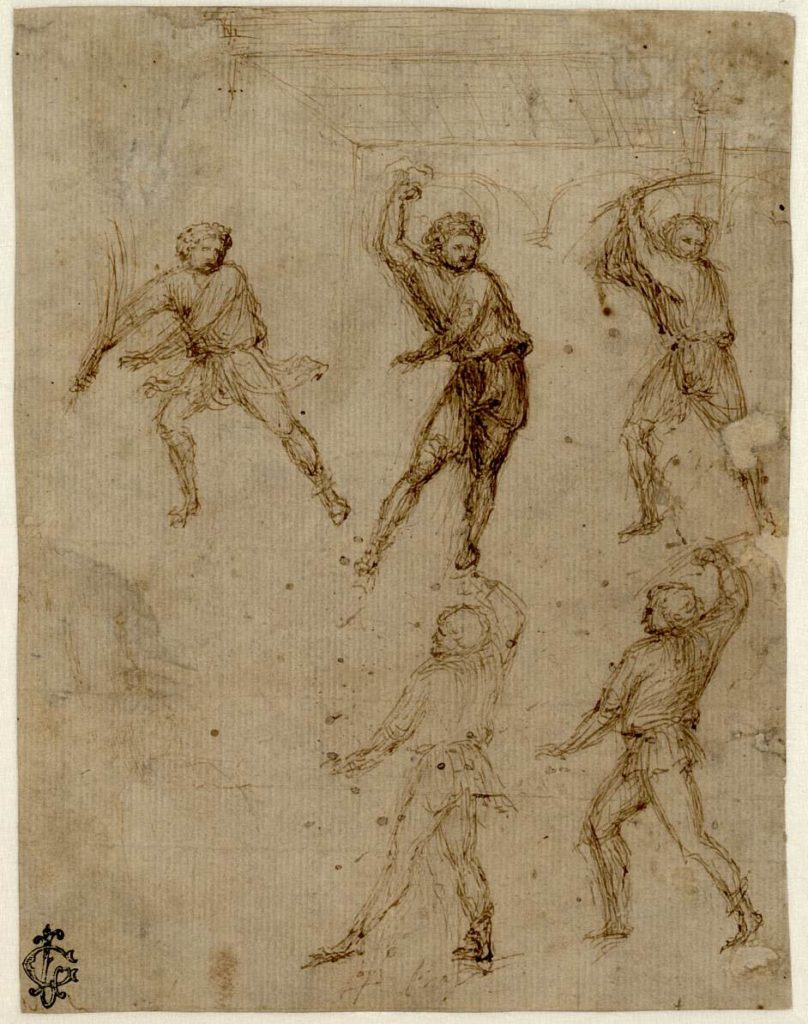
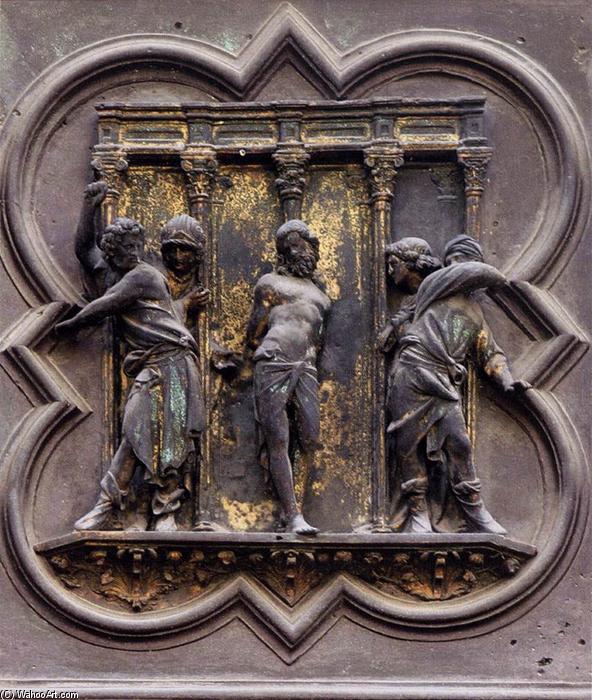
Ghiberti understood the importance of multidisciplinarity for artists. According to him, “sculpture and painting are sciences of several disciplines nourished by different teachings”.
In book I of his Commentarii, Ghiberti gives a list of the 10 liberal arts that the sculptor and the painter should master : philosophy, history, grammar, arithmic, astronomy, geometry, perspective, theory of drawing, anatomy and medecine and underlines that the necessity for an artist to assist at anatomical dissections.
As Amy Bloch underscores, while working on the Gates, in the intense process of visualizing the stories of God’s formation of the world and its living inhabitants, Ghiberti’s engagement « stimulated in him an interest in exploring all types of creativity — not only that of God, but also that of nature and of humans — and led him to present in the opening panel of the Gates of Paradise (The creation of Adam and Eve) a grand vision of the emergence of divine, natural, and artistic creation. »
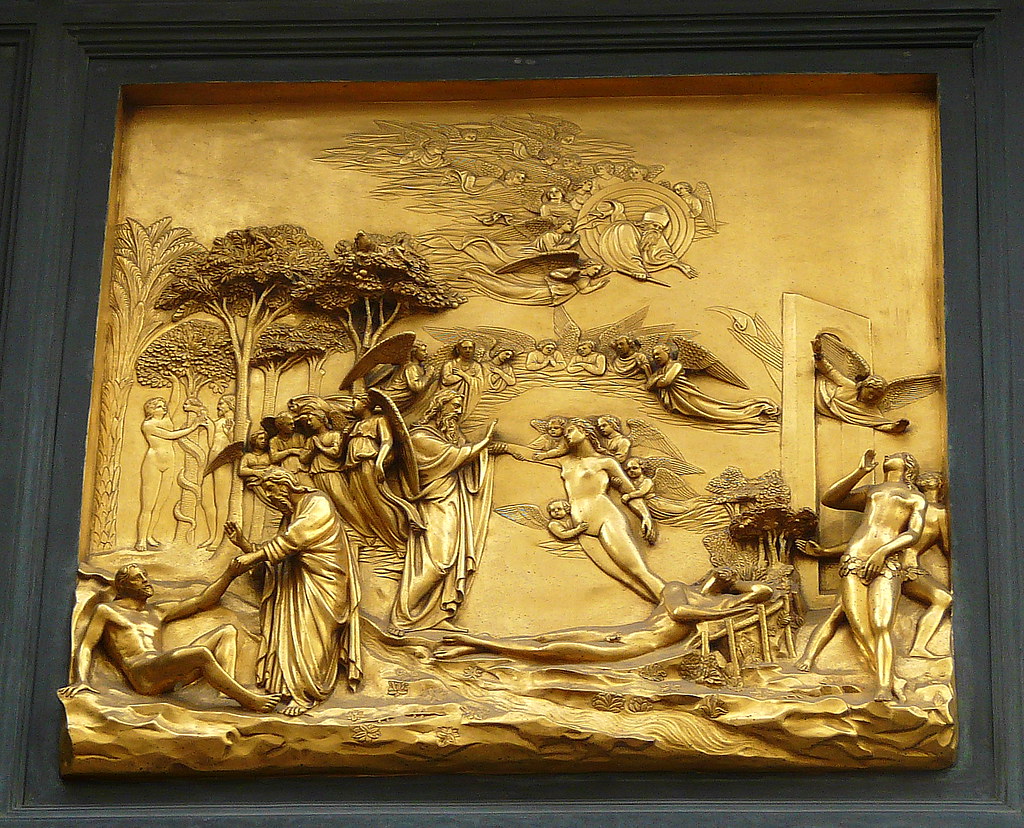
The inclusion of details evoking God’s craftmanship, says Bloch, « recalls similes that liken God, as the maker of the world, to an architect, or, in his role as creator of Adam, to a sculptor or painter. Teh comparison, which ultimately derives from the architect-demiurge who creates the world in Plato’s Timaeus, appears commonly in medieval Jewish and Christian exegesis. »
Philo of Alexandria wrote that man was modeled « as by a potter » and Ambrose metaphorically called God a « craftsman (artifex) and a painter (pictor) ». Consequently, if man is « the image of God » as says Augustine and the model of the « homo faber – man producer of things », then, according to Salutati, « human affairs have a similarity to divine ones ».
The power of vision and the composition of the Eye
Concerning vision, Ghiberti writes:
I, O most excellent reader, did not have to obey to money, but gave myself to the study of art, which since my childhood I have always pursued with great zeal and devotion. In order to master the basic principles I have sought to investigate the way nature functions in art; and in order that I might be able to approach her, how images come to the eye, how the power of vision functions, how visual [images] come, and in what way the theory of sculpture and painting should be established.
Now, any serious scholar, having worked through Leonardo’s Notebooks, who then reads Ghiberti’s I Commentarii, immediately realizes that most of Da Vinci’s writings were basically comments and contributions about things said or answers to issues raised by Ghiberti, especially respecting the nature of light and optics in general. Leonardo’s creative mindset was a direct outgrowth of Ghiberti’s challenging world outlook.
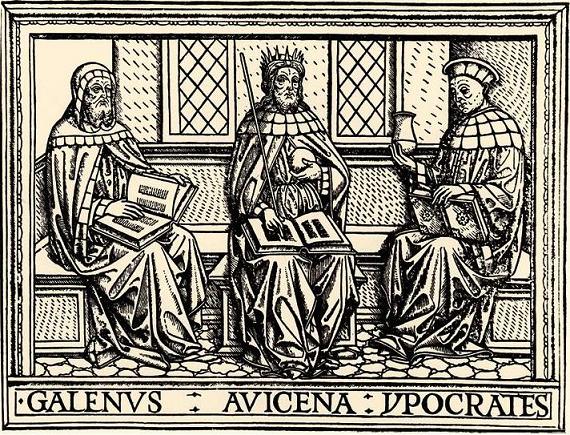
In Commentario 3, 6, which deals with optics, vision and perspective, Ghiberti, opposing those for whom vision can only be explained by a purely mathematical abstraction, writes that “In order that no doubt remains in the things that follow, it is necessary to consider the composition of the eye, because without this one cannot know anything about the way of seeing.” He then says, that those who write about perspective don’t take into account “the eye’s composition”, under the pretext that many authors would disagree.
Ghiberti regrets that despite the fact that many “natural philosophers” such as Thales, Democritus, Anaxagoras and Xenophanes have examined the subject along with others devoted to human health such as “Hippocrates, Galen and Avicenna”, there is still so much confusion.
Indeed, he says, “speaking about this matter is obscure and not understood, if one does not have recourse to the laws of nature, because more fully and more copiously they demonstrate this matter.”
Avicenna, Alhazen and Constantine
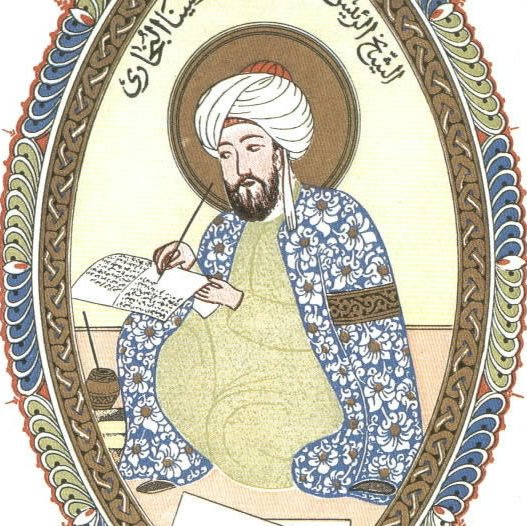
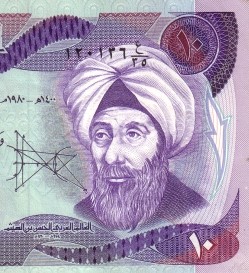
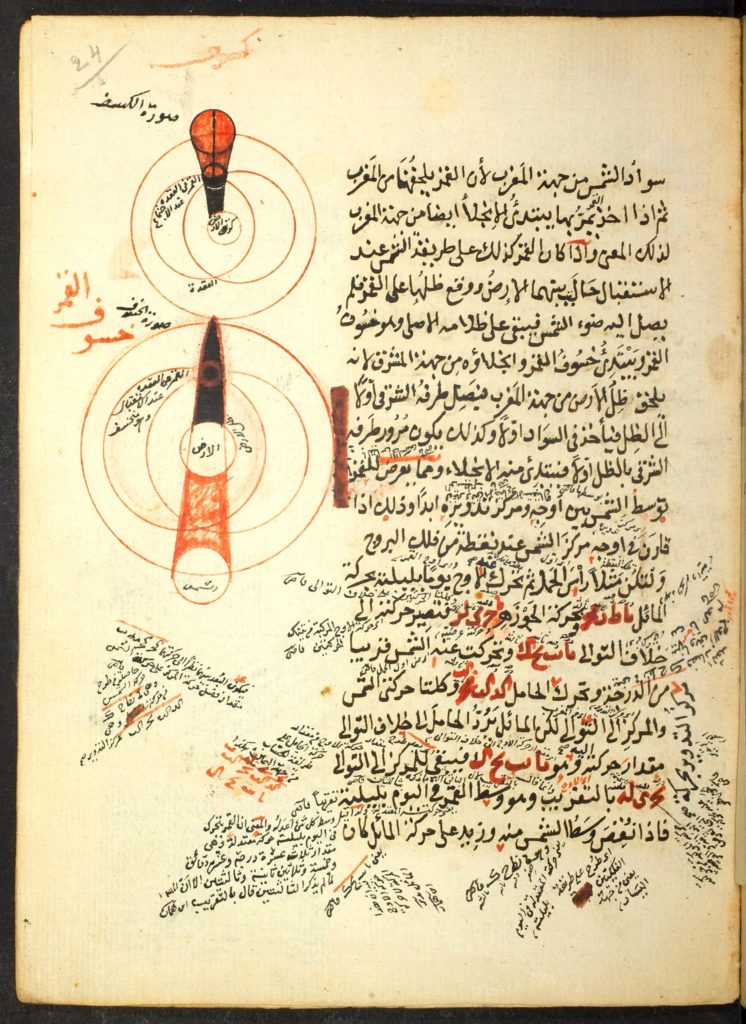
Therefore, says Ghiberti:
it is necessary to affirm some things that are not included in the perspective model, because it is very difficult to ascertain these things but I will try to clarify them. In order not to deal superficially with the principles that underlie all of this, I will deal with the composition of the eye according to the writings of three authors, Avicenna (Ibn Sina), in his books, Alhazen (Ibn al Haytham) in his first volume on perspective (Optics), and Constantine (the Latin name of the Arab scholar and physician Qusta ibn Luqa) in his ‘First book on the Eye’; for these authors suffice and deal with much certainty in these subjects that are of interest to us.
This is quite a statement! Here we have “the” leading, founding figure of the Italian and European Renaissance with its great contribution of perspective, saying that to get any idea about how vision functions, one has to study three Arab scientists: Ibn Sina, Ibn al Haytham and Qusta ibn Luqa ! Cultural Eurocentrism might be one reason why Ghiberti’s writings were kept in the dark.
Ibn al-Haytham (Alhazen) made important contributions to opthalmology and improved upon earlier conceptions of the processes involved in vision and visual perception in his Treatise on Optics (1021), which is known in Europe as the Opticae Thesaurus. Following his work on the camera oscura (darkroom) he was also the first to imagine that the retina (a curved surface), and not the pupil (a point) could be involved in the process of image formation.
Avicenna, in the Canon of Medicine (ca. 1025), describes sight and uses the word retina (from the Latin word rete meaning network) to designate the organ of vision.
Later, in his Colliget (medical encyclopedia), Ibn Rushd (Averroes, 1126-1198) was the first to attribute to the retina the properties of a photoreceptor.
Avicenna’s writings on anatomy and medical science were translated and circulating in Europe since the XIIIth century, Alhazen’s treatise on optics, which Ghiberti quotes extensively, had just been translated into Italian under the title De li Aspecti.
It is now recognized that Andrea del Verrocchio, whose best known pupil was Leonardo da Vinci (1452-1517) was himself one of Ghiberti’s pupils. Unlike Ghiberti, who mastered Latin, neither Verrocchio nor Leonardo mastered a foreign language.
What is known is that while studying Ghiberti’s Commentarii, Leonardo had access in Italian to a series of original quotations from the Roman architect Vitruvius and from Arab scientists such as Avicenna, Alhazen, Averroes and from those European scientists who studied Arab optics, notably the Oxford Fransciscans Roger Bacon (1214-1294), John Pecham (1230-1292) and the Polish monk working in Padua, Erazmus Ciolek Witelo (1230-1275), known by his Latin name Vitellion.
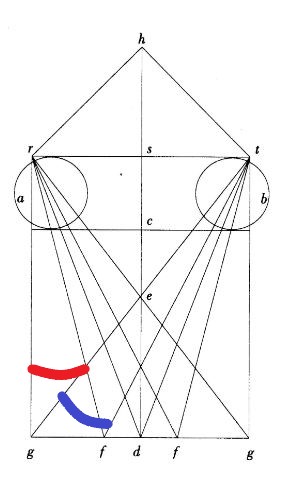
As stressed by Professor Dominque Raynaud, Vitellion introduces the principle of binocular vision for geometric considerations.
He gives a figure where we see the two eyes (a, b) receiving the images of points located at equal distance from the hd axis.
He explains that the images received by the eyes are different, since, taken from the same side, the angle grf (in red) is larger than the angle gtf (in blue). It is necessary that these two images are united at a certain point in one image (Diagram).
Where does this junction occur? Witelo says: « The two forms, which penetrate in two homologous points of the surface of the two eyes, arrive at the same point of the concavity of the common nerve, and are superimposed in this point to become one ».
The fusion of the images is thus a product of the internal mental and nervous activity.
The great astronomer Johannes Kepler (1571-1630) will use Alhazen’s and Witelo’s discoveries to develop his own contribution to optics and perspective. “Although up to now the [visual] image has been [understood as] a construct of reason,” Kepler observes in the fifth chapter of his Ad Vitellionem Paralipomena (1604), “henceforth the representations of objects should be considered as paintings that are actually projected on paper or some other screen.” Kepler was the first to observe that our retina captures an image in an inverted form before our brain turns it right side up.
Out of this Ghiberti, Uccello and also the Flemish painter Jan Van Eyck, in contact with the Italians, will construct as an alternative to one cyclopic single eye perspective revolutionary forms of “binocular” perspective while Leonardo and Louis XI’ court painter Jean Fouquet will attempt to develop curvilinear and spherical space representations.
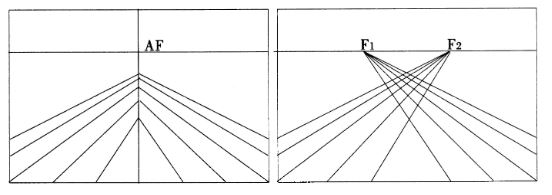
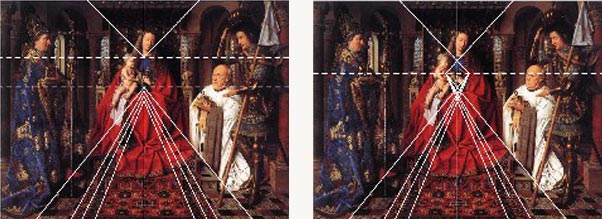
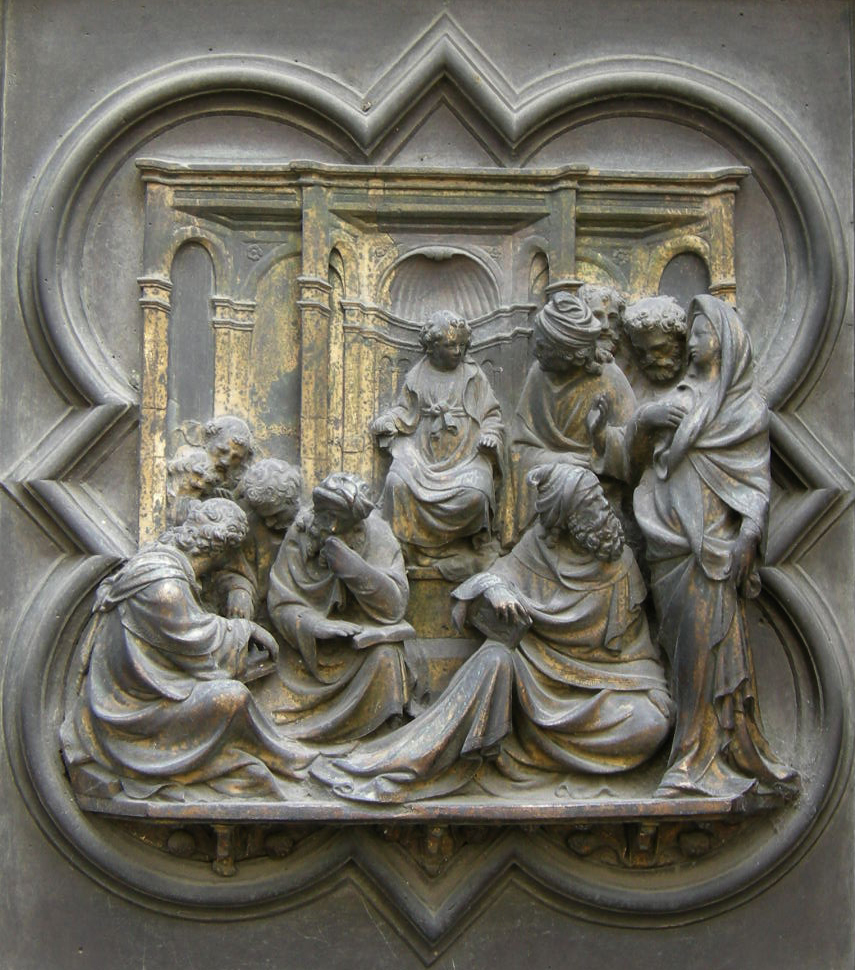

In China, eventually influenced by Arab optical science breakthrough’s, forms of non-linear perspective, that integrate the mobility of the eye, will also make their appearance during the Song Dynasty.
Light
Ghiberti will add another dimension to perspective: light. One major contribution of Alhazen was his affirmation, in his Book of Optics, that opaque objects struck with light become luminous bodies themselves and can radiate secondary light, a theory that Leonardo will exploit in his paintings, including in his portraits.
Already Ghiberti, in the way he treats the subject of Isaac, Jacob and Esau (Figure), gives us an astonishing demonstration of how one can exploit that physical principle theorized by Alhazen. The light reflected by the bronze panel, will strongly differ according to the angle of incidence of the arriving rays of light. Arriving either from the left of from the right side, in both cases, the Ghiberti’s bronze relief has been modeled in such a way that it magnificently strengthens the overall depth effect !
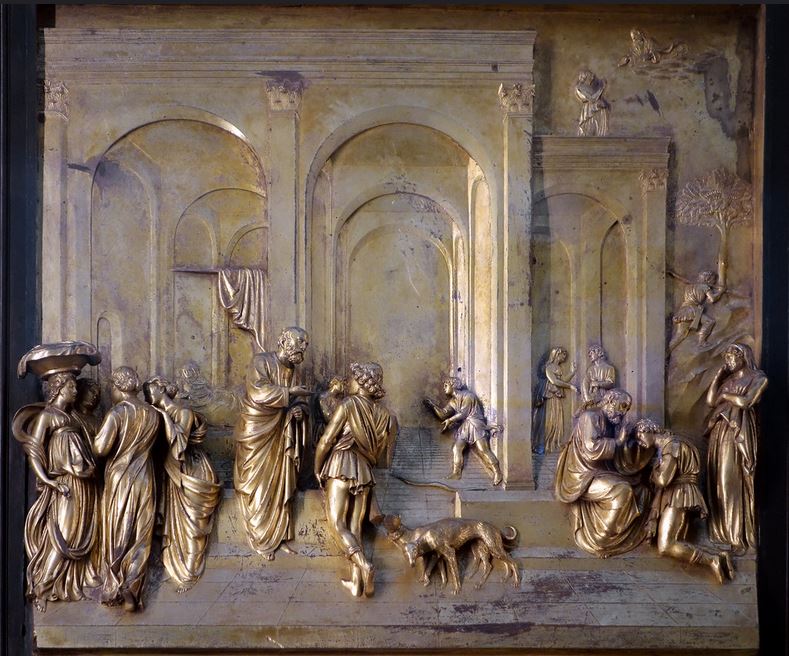
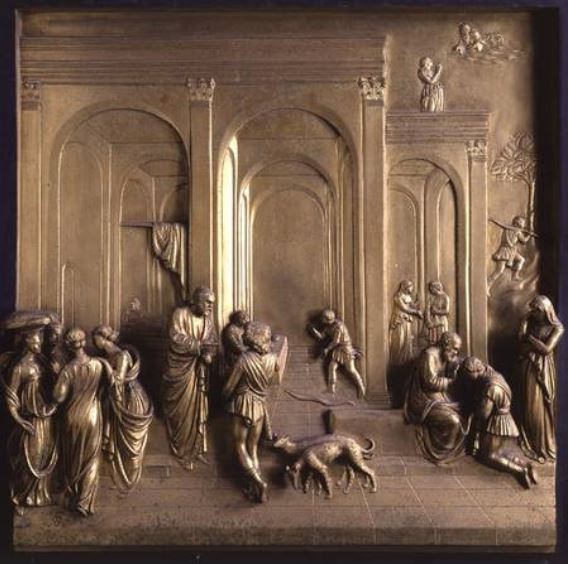
While the experts, especially the neo-Kantians such as Erwin Panofsky or Hans Belting, say that these artists were “primitives” because applying the “wrong” perspective model, they can’t grasp the fact that they were in reality exploring a far “higher domain” than the mere pure mathematical abstraction promoted by the Newton-Galileo cult that became the modern priesthood ruling over “science”.
Much more about all of this can and should be said. Today, the best way to pay off the European debt to “Arab” scientific contributions, is to reward not just the Arab world but all future generations with a better future by opening to them the “Gates of Paradise”.
See all of Ghiberti’s works at the WEB GALLERY OF ART
Short Biography
- Arasse, Daniel, Léonard de Vinci, Hazan, 2011;
- Avery, Charles, La sculpture florentine de la Renaissance, Livre de poche, 1996, Paris;
- Belting, Hans, Florence & Baghdad, Renaissance art and Arab science, Harvard University Press, 2011;
- Bloch, Amy R., Lorenzo Ghiberti’s Gates of Paradise; Humanism, History and Artistic Philosophy in the Italian Renaissance, Cambridge University Press, 2016, New York;
- Borso, Franco et Stefano, Uccello, Hazan, Paris, 2004 ;
- Butterfield, Andrew, Verrocchio, Sculptor and painter of Renaissance Florence, National Gallery, Princeton University Press, 2020 ;
- Butterfield, Andrew, Art and Innovation in Ghiberti’s Gates of Paradise, High Museum of Art, Yale University Press, 2007;
- Kepler, Johannes, Paralipomènes à Vitellion, 1604, Vrin, 1980, Paris;
- Krautheimer, Richard and Trude, Lorenzo Ghiberti, Princeton University Press, New Jersey, 1990;
- Martens, Maximiliaan, La révolution optique de Jan van Eyck, dans Van Eyck, Une révolution optique, Hannibal – MSK Gent, 2020.
- Pope-Hennessy, John, Donatello, Abbeville Press, 1993 ;
- Radke, Gary M., Lorenzo Ghiberti: Master Collaborator; The Gates of Paradise, Lorenzo Ghiberti’s Renaissance Masterpiece, High Museum of Atlanta and Yale University Press, 2007;
- Rashed, Roshi, Geometric Optics, in History of Arab Sciences, edited by Roshdi Rashed, Vol. 2, Mathematics and physics, Seuil, Paris, 1997.
- Raynaud, Dominique, L’hypothèse d’Oxford, essai sur les origines de la perspective, PUF, 1998, Paris.
- Raynaud, Dominique, Ibn al-Haytham on binocular vision: a precursor of physiological optics, Arabic Sciences and Philosophy, Cambridge University Press (CUP), 2003, 13, pp. 79-99.
- Raynaud, Dominique, Perspective curviligne et vision binoculaire. Sciences et techniques en perspective, Université de Nantes, Equipe de recherche: Sciences, Techniques, et Sociétés, 1998, 2 (1), pp.3-23.;
- Vereycken, Karel, interview with People’s Daily: Leonardo Da Vinci’s « Mona Lisa » resonates with time and space with traditional Chinese painting, 2019.
- Vereycken, Karel, Uccello, Donatello, Verrocchio and the art of military command, 2022.
- Vereycken, Karel, The Invention of Perspective, Fidelio, 1998.
- Vereycken, Karel, Van Eyck, un peintre flamand dans l’optique arabe, 1998.
- Vereycken, Karel, Mutazilism and Arab astronomy, two bright stars in our firmament, 2021.
- Walker, Paul Robert, The Feud That Sparked the Renaissance, How Brunelleschi and Ghiberti changed the World, HarperCollins, 2002.
The Greek language project, Plato and the Renaissance

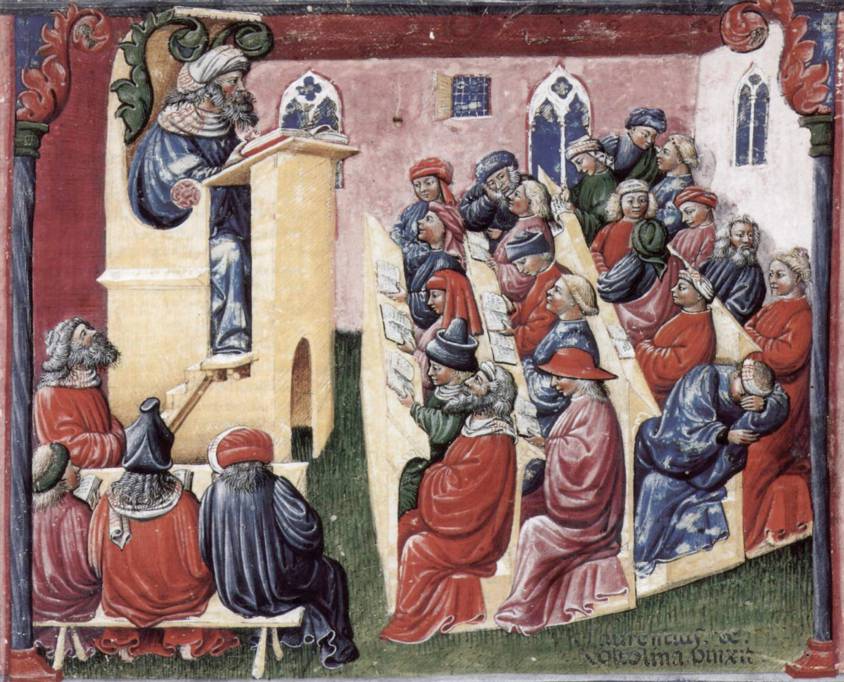
By Karel Vereycken
Some friends asked me to elaborate on the following:
It is sometimes said that the introduction of Plato in the context of the Councils of Ferrara and Florence (1439) “triggered the explosion of the Italian Renaissance”.
And of the great humanist, the German Cardinal-philosopher Cusanus, it is said that he “brought to Florence Bessarion and Plethon, who were both Greek scholars of Plato and brought the entire works of Plato which had been lost in Europe for centuries”.
At the same time, goes the narrative, “the Medicis financed a crash program to translate the works of Plato. This excitement made the Italian Renaissance what it became”.
While Plato’s ideas and the renewal of greek studies did play a major role in triggering the European Renaissance, the preceding affirmations, as we shall document here, require some refinement.
Was the Italian Renaissance “triggered” by the Council of Florence?
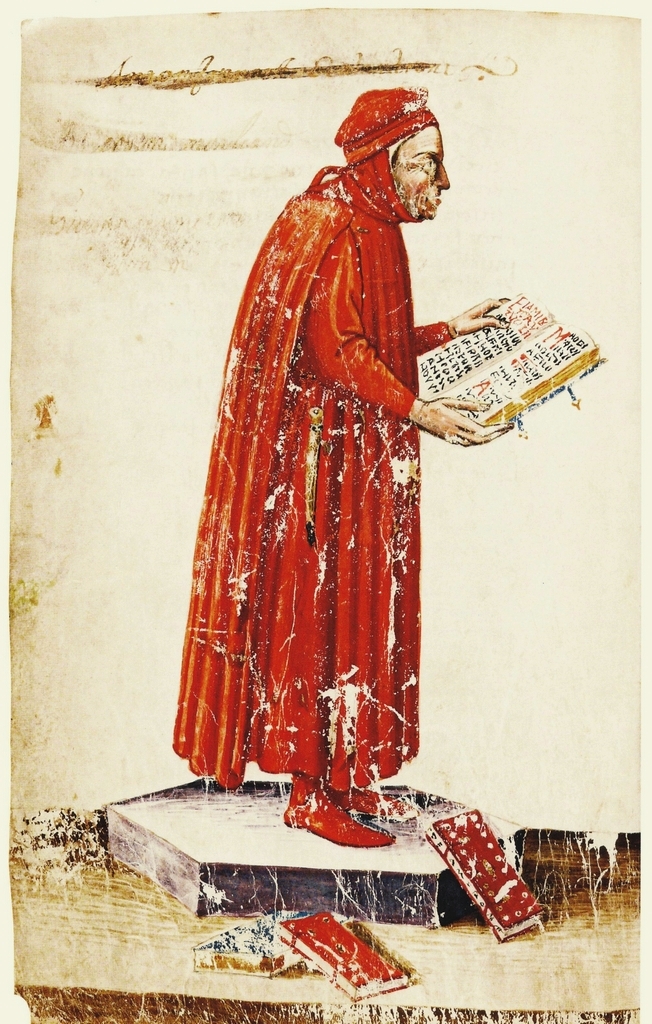
Not really. It was rather –40 years earlier–, the “Greek language revival project” project of Coluccio Salutati (1332-1406), who would become the chancellor of Florence and invite the Greek scholar Manuel Chrysoloras (1355-1415) to his city, that “triggered” a revival of Greek and Hebrew studies, which in return lead to the unification of the churches at the Council of Florence (1439).
The idea had regained interest from Petrarch and Boccaccio, which Salutati admired. Along with Dante Alighieri (1265-1321), it is undoubtedly the Italian poet Petrarch (1304-1374) who best embodies the ideals guiding the humanists of the Renaissance.
All his life, it is said, Petrarch tried to
« rediscover the very rich teaching of classical authors in all disciplines and, starting from this sum of knowledge, most often scattered and forgotten, to revive and pursue the research that these authors had begun. »
After following his parents to Avignon, Petrarch studied in Carpentras where he learned grammar, then in Montpellier, rhetoric, and finally in Bologna, where he spent seven years at the school of jurisconsults.
However, instead of studying law, which in those days paved the way to a brilliant career, Petrarch secretly read all the classics hitherto known, including Cicero and Virgil, despite the fact that his father occasionally burned his books.
Petrarch and Barlaam of Samara
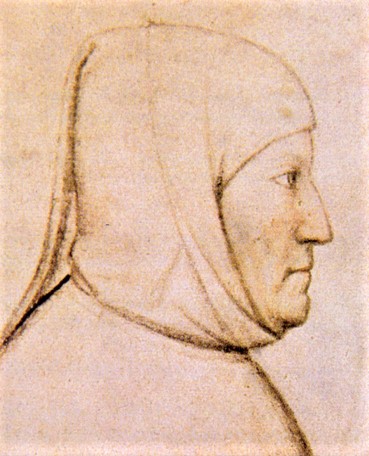
Under the pontificate of Benedict XII, Petrarch tried to learn Greek language with the help of a learned monk of the Order of St. Basil, Barlaam of Seminara (1290-1348), known as Barlaam the Calabrian, who came to Avignon in 1339 as ambassador of Andronic III Paleologus in an unsuccessful attempt to put an end to the schism between the Orthodox and Catholic Churches.
A philosopher, theologian and mathematician, Barlaam, while having limited knowledge of Greek and Latin, was one of the first to wish that the study of the Greek language and philosophy be reborn in Europe.
In his Treatise On my own ignorance and that of many others (1367), Petrarch declared himself proud of his Greek manuscripts – and of his library in general – and expressed his deep admiration for Barlaam:
« I have at home sixteen works of Plato. I don’t know if my friends have ever heard the titles […]. And this is only a small part of Plato’s work, for I have seen, with my own eyes, a large number of them, especially in possession of the Calabrian Barlaam, a modern model of Greek wisdom who began to teach me Greek while I was still ignorant of Latin, and who might have done so successfully if death had not taken him away from me and hindered my honest plans, as usual.«
In 1350, two years after Barlaam’s death, Petrarch met the son of a banker, Giovanni Boccaccio (1313-1375). The latter, like Petrarch, fell in love with the Greek culture and language. In his youth, in Naples, he too had met Barlaam and learned a few words of Greek, meticulously copying alphabets and verses, adding the Latin translation and pronunciation indications.
Boccaccio and Leontius Pilatus
To increase his mastery of Greek, Boccaccio then called from Thessaloniki a disciple of Barlaam, Leontius Pilatus (died in 1366), an austere, ugly and very bad-tempered character. But this Calabrian lectured him on Homer’s Iliad and Odyssey and translated sixteen of Plato’s dialogues. How could one get angry with him?
Boccaccio offered him shelter and food for three years in his home and had a chair of Greek created for him in Florence, the first time ever!
Unfortunately, Pilatus did not really master this language. Although posing as a native Greek, the man had poor knowledge of ancient Greek and his translations never got beyond the level of word-for-word. As for the lessons he gave Petrarch, they were so brutal that he disgusted him forever.
This did not prevent Pilatus, at the insistence of Boccaccio, from translating Homer’s Iliad and Odyssey into Latin from a Greek manuscript sent to Petrarch by Nicolaos Sigeros, the Byzantine ambassador to Avignon.
Hence, history being what it is, it was thanks to this highly imperfect translation that Europe rediscovered one of the great founding works of its culture!
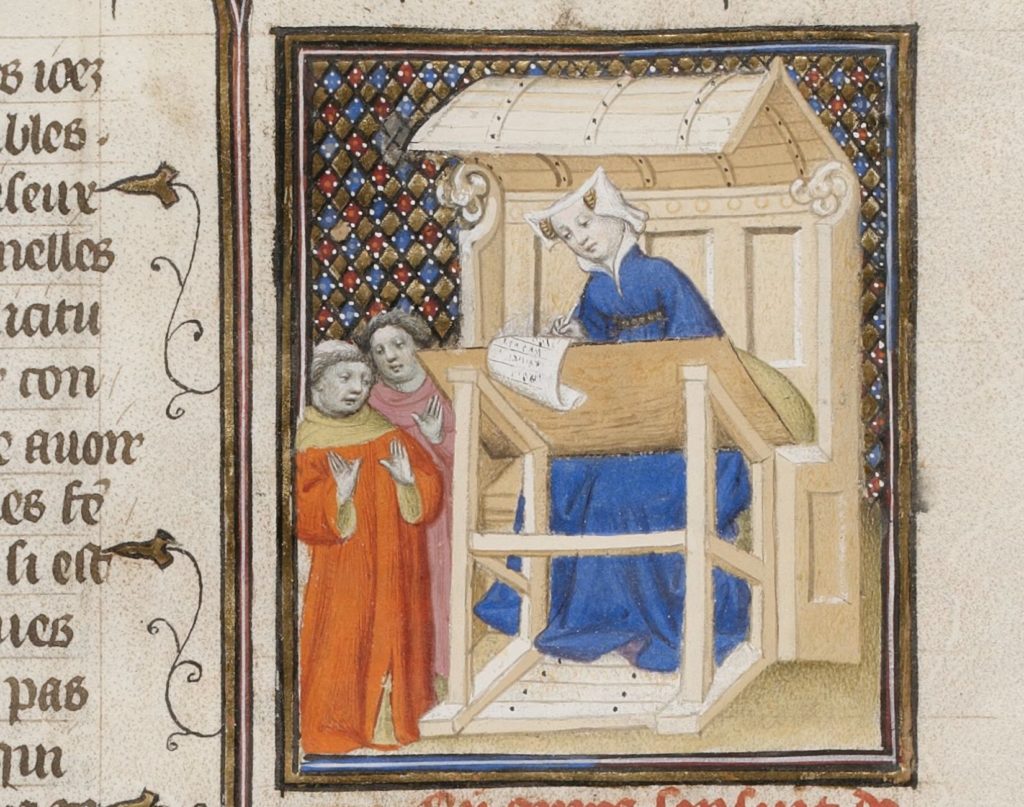
And on this fragile ground will rise a flame that will revolutionize the world.
« Was it not I, » writes Boccaccio in his Genealogy of the Gods, « who had the glory and honor of employing the first Greek verses among the Tuscans? Was it not I who, through my prayers, led Pilatus to settle in Florence and who housed him there? I brought at my own expense copies of Homer and other Greek authors when none existed in Tuscany. I was the first of the Italians to whom Homer, in particular, was explained, and then I had him explained in public.«
The hunt for manuscripts
What is important is that during these encounters Petrarch created a cultural network covering the whole of Europe, a network reaching into the East.
He then asked his relations and friends, who shared his humanist ideals, to help him find in their respective country or province, the Latin texts of the ancients that the libraries of abbeys, individuals or cities might possess. In the course of his own travels, he found several major texts that had fallen into oblivion.
It is in Liege (Belgium) that he discovered the Pro Archia and in Verona, Ad Atticum, Ad Quintum and Ad Brutum, all by Cicero. During a stay in Paris, he got his hands on the elegiac poems of Propertius, then, in 1350, on a work by Quintilian. In a constant concern to restore the most authentic text, he subjected these manuscripts to meticulous philological work and made corrections by comparing them with other manuscripts. This is how he reconstructed the first and fourth decades of the Roman History of Titus Livius from fragments and restored some of Virgil’s texts.
These manuscripts, which he kept in his own library, later came out in the form of copies and thus became accessible to the greatest number of people. While acknowledging that the pagans lacked the « true faith, » Petrarch believed that when one speaks of virtue, the old and new worlds are not at war.
The « Circolo di Santo Spirito »
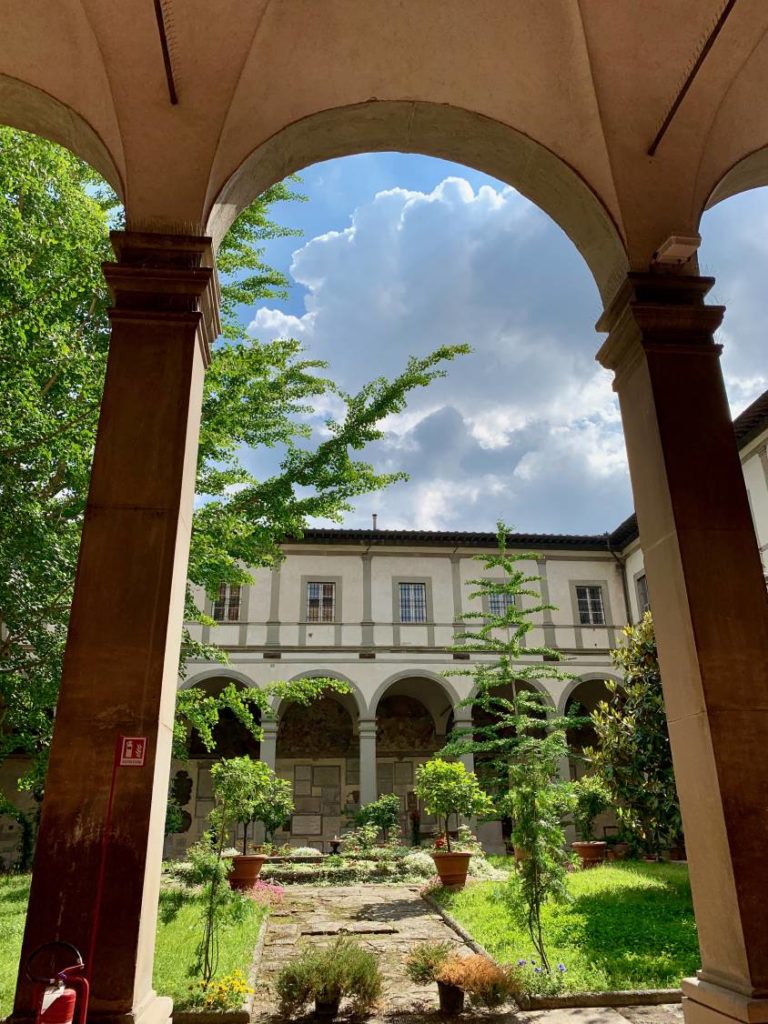
From the 1360s onwards, Boccaccio gathered a first group of humanists known as the « Circolo di Santo Spirito » (Circle of the Holy Spirit), whose name was borrowed from the 13th century Florentine Augustinian convent.
An embryonic form of a university, its Studium Generale (1284) was then at the heart of a vast intellectual center including schools, hospices and refectories for the needy.
Before his death in 1375, Boccaccio, who had recovered part of Petrarch’s library, bequeathed to the convent his entire collection of precious ancient books and manuscripts.
Then, in the 1380s and early 1390s, a second circle of humanists met daily in the cell of the Augustinian monk Luigi Marsili (1342-1394). The latter, who had studied philosophy and theology at the universities of Paris and Padua, where he already established contact with Petrarch in 1370, became friends with Boccaccio. Hence, by attending the Cercle Santo Spirito from 1375 onwards, Coluccio Salutati in turn fell in love with Greek studies.
By inviting the Greek scholar Manuel Chrysoloras (1355-1415) to Florence to teach Ancient Greek, it was Salutati who gave the decisive impulse leading to the end of the schism between East and West and thus to the unification of the Churches, consecrated at the Council of Florence in 1439.
Roger Bacon
A century before Salutati, the English philosopher and scientist Roger Bacon (1214-1294), a Franciscan monk residing in Oxford, author of one of the first Greek grammars, already called for such a « linguistic revolution ».
As wrote Dean P. Lockwood in Roger Bacon’s Vision of the Study of Greek (1919):
« Obviously, Greek was the master-key to the great storehouse of ancient knowledge, Hebrew and Arabic to lesser chambers. Furthermore, we must not forget that in Bacon’s day the superiority of the ancients was an indisputable fact. The modern world has outstripped the Greek and the Romans in countless ways; the medieval thinkers were still climbing toward the Hellenic standard.
« Three things were clear to Roger Bacon: the need of Greek, the contemporary ignorance of Greek, and the feasibility of acquiring Greek. The same may be said of Hebrew, but Bacon rightly put Greek first. Bacon’s program was simple:
« 1. Seek out the native Byzantine Greeks resident in Europe, preferably grammarians. The latter were very few, of course, but might be found in the Greek monasteries of Southern Italy.
« 2. From these and from any other available sources let Greek books be sought. If this program were to be carried out, Bacon confidently prophetized that results would not be long in forthcoming.«
Leonardo Bruni
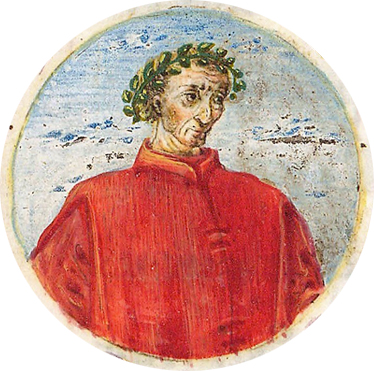
Manuel Chrysoloras, arrived in winter 1397, an event remembered by one of his most famous pupils, the humanist scholar Leonardo Bruni (1369-1444) and later chancellor of Florence at the time of the Council of Florence, as a great new opportunity: there were many teachers of law, but no one had studied Greek in northern Italy for 700 years.
Thanks to Chrysoloras, Bruni and Pier Paolo Vergerio the Elder were able to read Aristotle and especially Plato in the original Greek version.
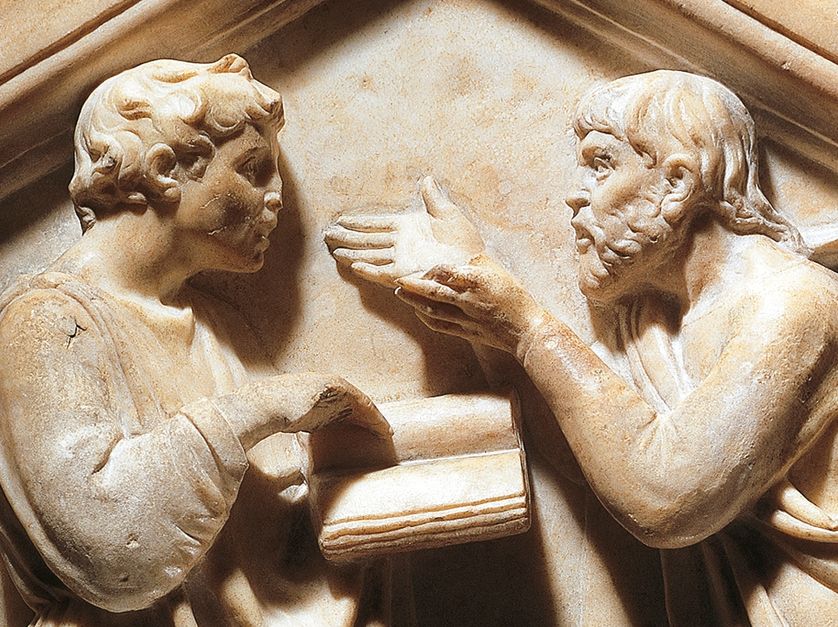
Until then, in Europe, Christians knew the names of Pythagoras, Socrates and Plato by their reading of the church fathers Origen, St. Jerome and St. Augustine.
The latter, in his City of God, did not hesitate to affirm that the « Platonists », that is Plato and those who assimilated his teaching (Plato et qui eum bene intellexerunt), were superior to all other pagan philosophers.
As we have demonstrated elsewhere, in particular in our study on Raphael and the School of Athens, it is to a large extent Plato’s optimistic and Promethean philosophical approach, for whom knowledge comes above all from the capacity for hypothesis and not from the mere testimony of the senses as Aristotle claims, that clearly provided the sap that allowed the Renaissance tree to offer humanity so many wonderful fruits.
Traversari’s humanist circle
The most famous pupil of Chrysoloras was Ambrogio Traversari (1386-1439), who became general of the Camaldolese order. Today honored as a saint by his order, Traversari was one of the first to conceptualize the type of “Christian Humanism” that would be promoted by Nicolaus of Cusa (Cusanus) and later Erasmus of Rotterdam (who framed the concept of “Saint-Socrates”) and the latter’s admirer Rabelais, uniting Plato with the Holy Scriptures, and the fathers of the Church.
Traversari, a key organizer of the Council of Florence, was also the personal protector of the great Renaissance painter Piero della Francesca and of the architect of the Dome Filippo Brunelleschi.
According to Vespasiano de Bisticci, the court historian of the Court of Urbino, Traversari had weekly working sessions on Plato and Greek philosophy at the Santa Maria degli Angeli convent with the crème de la crème of European humanism in the fields of literature, theology, science, politics, architecture, infrastructure, urban planning, education and the fine arts. Among those :
- The German cardinal-philosopher Nicholas of Cusa (Cusanus);
- Paolo dal Pozzo Toscanelli, the great physician and cartographer, also friend and protector of Piero della Francesca and Leonardo da Vinci.
- The erudite manuscript collector Niccolò Niccoli, adviser to Cosimo the Elder, heir to the Medici’s industrial and financial empire. Considered at the time to be the richest man in the West, Cosimo was one of the patrons of the sculptor Donatello;
- Aeneas Sylvius Piccolomini, the future humanist pope Pius II;
- Leonardo Bruni, the apostolic secretary of Pope Innocent VII and his three successors. He succeeded Coluccio Salutati at the chancellery of Florence (1410-1411 and 1427-1444).
- The Italian statesman Carlo Marsuppini, passionate about Greek Antiquity, and successor of Bruni as Chancellor of the Republic of Florence after the latter’s death in 1444.
- The philosopher, antiquarian and writer Poggio Bracciolini. After having advised no less than nine popes (!), he was appointed Chancellor of the Republic of Florence following the death of Marsuppini in 1453;
- The politician and ambassador Gianozzi Manetti. In love with ancient Greek and Hebrew, his circle includes the éducator Francesco Filelfo, the banker Palla Strozzi and the founder of the Vatican library Lorenzo Valla ;
Chrysoloras in Florence
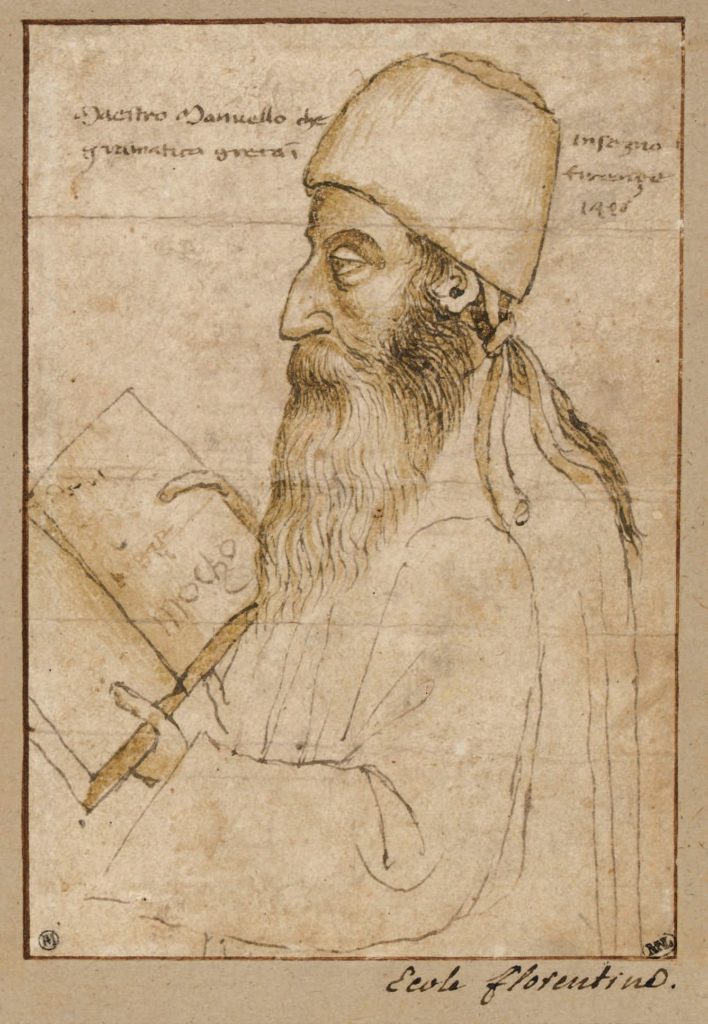
Chrysoloras remained only a few years in Florence, from 1397 to 1400, teaching Greek, starting with the rudiments. He moved on to teach in Bologna and later in Venice and Rome. Though he taught widely, a handful of his chosen students remained a close-knit group, among the first humanists of the Renaissance. As said before, among his pupils one could count some of the foremost figures of the revival of Greek studies in Renaissance Italy.
Aside from Bruni and Ambrogio Traversari, they included Guarino da Verona and the Florentine banker Palla Strozzi (1372-1462), later the friend and protector of the sculptor and translator Lorenzo Ghiberti. It is worth noting that Strozzi paid part of Chrysoloras’ salary and had the books necessary for the new teaching brought from Constantinople and Greece.
Chrysoloras went to Rome on the invitation of Bruni, who was then secretary to Pope Gregory XII. In 1408, he was sent to Paris on an important mission from the emperor Manuel II Palaeologus (1350-1425). In 1413, he went to Germany on an embassy to the emperor Sigismund, the object of which was to decide on the site for the church council that assembled at Constance in 1415. Chrysoloras was on his way there, having been chosen to represent the Greek Church, when he died that year.
Chrysoloras translated the works of Homer and Plato’s Republic from Greek into Latin. His Erotemata (Questions-answers), which was the first basic Greek grammar in use in Western Europe, circulated initially as a manuscript before being published in 1484.
Widely reprinted, it enjoyed considerable success not only among his pupils in Florence, but also among later leading humanists, being immediately studied by Thomas Linacre at Oxford and by Erasmus when he resided at Cambridge. It’s text became the basic manual used by pupils of the Three Language College set up by Erasmus in Leuven (Belgium) in 1515.
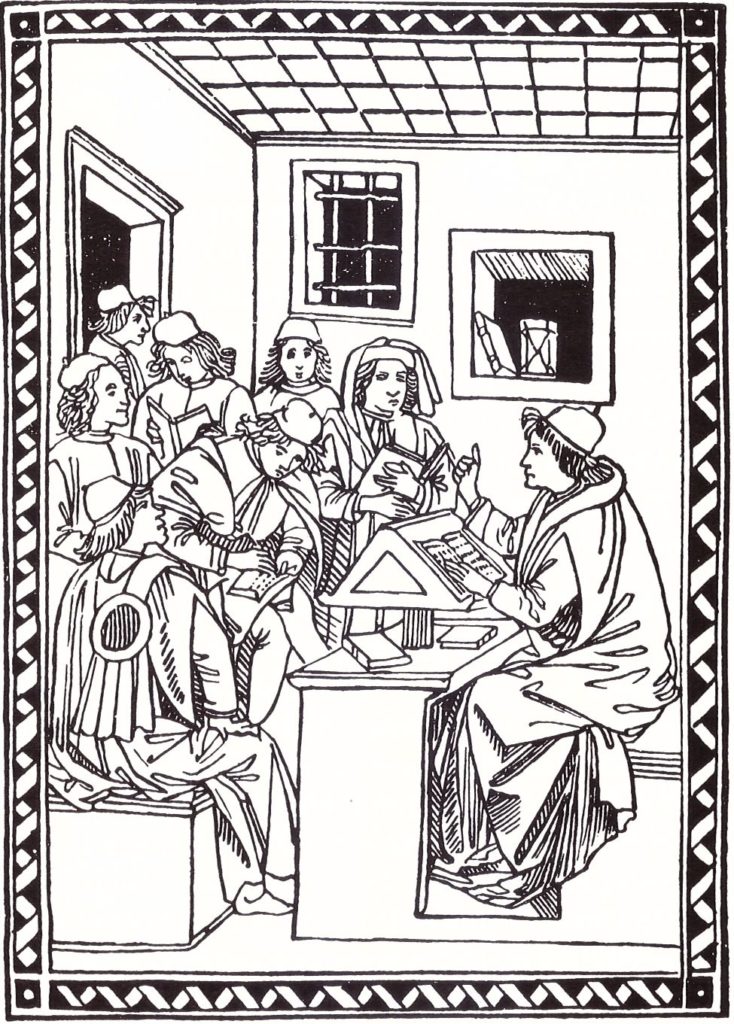
Traversari meets Chrysoloras during his two stays in Florence in the summer of 1413 and in January-February 1414, and the old Byzantine scholar is impressed by the bilingual culture of the young monk; he sends him a long philosophical letter in Greek on the theme of friendship. Ambrogio himself expresses in his letters the highest consideration for Chrysoloras, and emotion for the benevolence he showed him.
It should also be noted that the rich humanist scholar Niccolò Niccoli, a great collector of books, opened his library to Traversari and put him in constant contact with the scholarly circles of Florence (notably Leonardo Bruni, and also Cosimo de Medici, of whom he was advisor), but also of Rome and Venice.
In 1423, Pope Martin V sent two letters, one to the prior of the Convent of Santa Maria degli Angeli, Father Matteo, and the other to Traversari himself, expressing his support for the great development of patristic studies in this establishment, and especially for the work of translation of the Greek Fathers carried out by Traversari.
The Pope had in mind the negotiations he was conducting at the time with the Greek Church: at the beginning of 1423, his legate Antonio de Massa returned from Constantinople and brought back with him several Greek manuscripts which were to be entrusted to Traversari for translation: notably the Adversus Græcos by Manuel Calécas, and for the classics the Lives and Doctrines of the Illustrious Philosophers by Diogenes Laërtius, a text which circulated for a long time only in Traversari’s Latin translation.
It was following these undertakings that Traversari expressed his great interest in seeing the schism between the Latin and Greek Churches resolved. At the end of 1423, Niccolò Niccoli provides Traversari with an old volume containing the entire corpus of the ancient ecclesiastical canons, and the learned monk expresses in his correspondence with the humanist his enthusiasm for being able to immerse himself in the life of the then united ancient Christian Church, and in the process, he translates into Greek a long letter from Pope Gregory the Great to the prelates of the East.
Arrival of Plato’s mind
Were Bessarion and Plethon the first to bring the entire works of Plato to Europe?
Not really. While John Bessarion did indeed bring his own collection of the “complete works of Plato” in 1437 to Florence, they had already been brought to Italy earlier, most notably in 1423 by the Sicilian Giovanni Aurispa (1376-1459), who was the teacher of Lorenzo Valla (another collaborator with whom Cusanus exposed the fraud of the “Donation of Constantine” and a major source of inspiration of Erasmus).
In 1421 Aurispa was sent by Pope Martin V to act as the translator for the Marquis Gianfrancesco Gonzaga on a diplomatic mission to the Byzantine emperor, Manuel II Palaiologos.
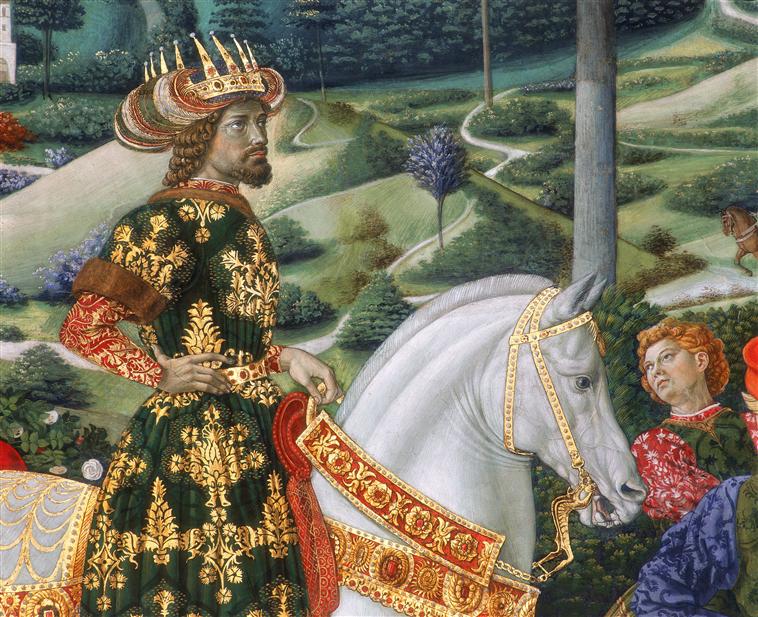
After their arrival, he gained the favor of the emperor’s son and successor, John VIII Paleologus (1392-1448), who took him on as his own secretary. Two years later, he accompanied his Byzantine employer on a mission to the courts of Europe.
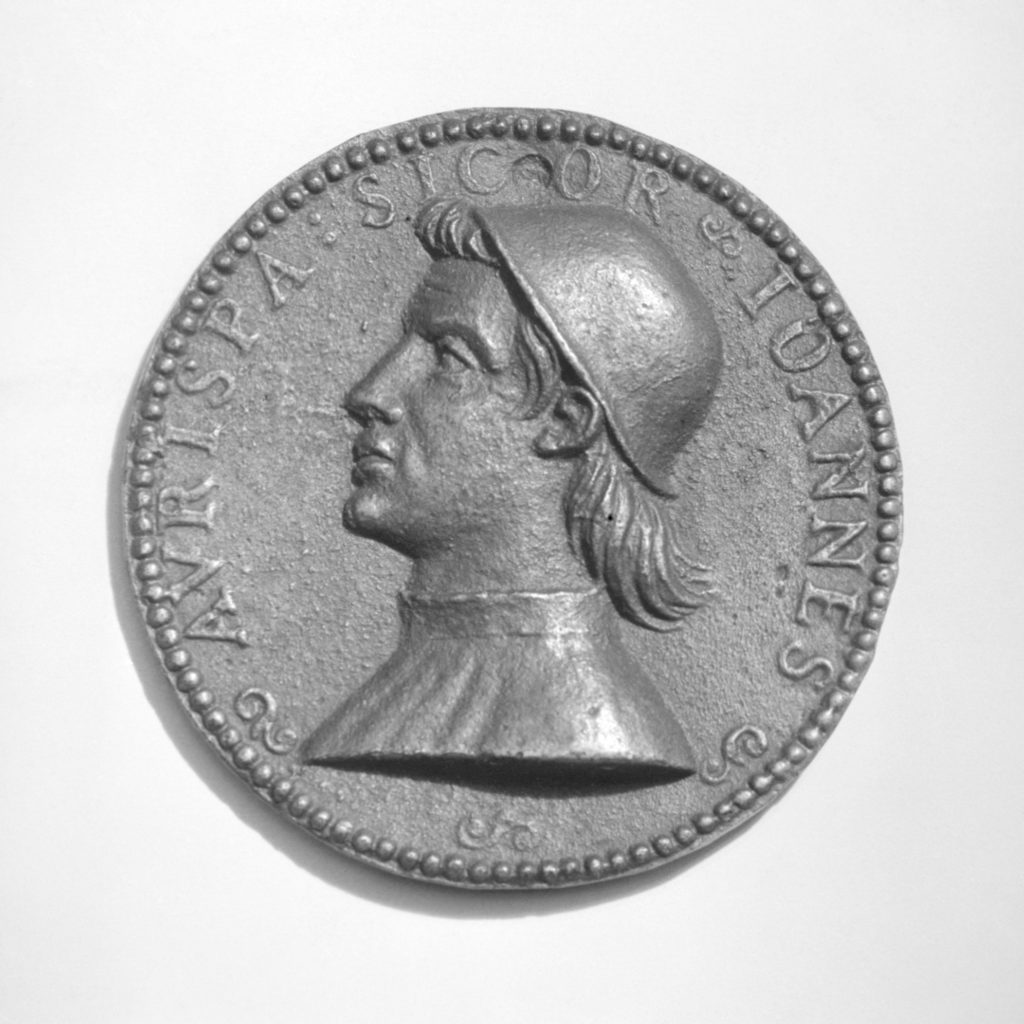
On 15 December 1423, 16 years prior to the Council of Florence of 1439, Aurispa arrived in Venice with the largest and finest collection of Greek texts to reach the west prior to those brought by Bessarion. In reply to a letter from Traversari, he says that he brought back 238 manuscripts.
These contained all of Plato’s works, most of them hitherto unknown in the West.
Plato’s works so far were only known very partially. In Sicily, Henry Aristippus of Calabria (1105-1162) had translated into Latin Plato’s Phaedo and Meno dialogues as early as 1160.
Evil neo-Platonist
Platonists (such as Petrarch, Traversari, Cusanus or Erasmus), have nothing to do and even violently opposed “Neo-platonist” (such as Plotinus, Proclus, Iamblicus, Marsilio Ficino and Pico della Mirandola) whose influence would create what could and should be called a “counter-Renaissance”.
Already Leibniz strongly warned against the “neo-Platonists” and demanded Plato be studied in his original writings rather than through his commentators, however brilliant they might be:
“non ex Plotino aut Marsilio Ficino, qui mira semper et mystica affectantes diceren tanti uiri doctrinam corrupere.”
[In English: Plato should be studied, but “Not from Plotinus nor Marsilio Ficino, who, by always striving to speak wonderfully and mystically, corrupt the doctrine of so great a man. »]
George Gemisthos « Plethon »

Now, let us enter Plethon, who thought Plato and Aristotle could each one play their own role. George Gemistos « Plethon » (1355-1452), was a follower of the radical “neo-Platonist” Michael Psellos (1018-1080). Around 1410 Gemistos created a “neo-Platonic” academy in Mistra (near the site of ancient Sparta) and added “Plethon” to his name to make it resemble to « Plato ». He was also an admirer of Pythagoras, Plato, and the “Chaldean Oracles”, which he ascribed to Zoroaster.
Gemistos came for the first time to Florence when he was fifteen years old and became an authority in Mistra. So at the time of the Council, the Emperor, John VIII Paleologus, knew they were going to face some of the finest minds in the Roman Church on their own soil; he therefore wanted the best minds available in support of the Byzantine cause to accompany him. Consequently, the Emperor appointed George Gemistos as part of the delegation. Despite the fact that he was a secular philosopher — a rare creature at this time in the West — Gemistos was renowned both for his wisdom and his moral rectitude. Among the clerical lights in the delegation were John Bessarion, Metropolitan of Nicaea, and Mark Eugenikos, Metropolitan of Ephesus. Both had been students of Gemistos in their youth. Another non-clerical member of the delegation was George Scholarios: both a future adversary of Gemistos and a future Patriarch of Constantinople as Gennadios II. Initially, Gemistos was opposed to the unity of the western and eastern churches.
Not assisting at every theological debate during the Council of Florence of 1439, he went in town to give lectures to intellectuals and nobles on the essence of Plato and Neo-platonic philosophy. Plethon also brought with him the text of the “Chaldean Oracles” attributed to Zoroaster.
While most of Plethon’s writing were burned, since he was suspected of heresy, a large number of Plethon’s autograph manuscripts ended up in the hands of his former student Cardinal Bessarion. On Bessarion’s death, he willed his personal library to the library of San Marco in Venice (where over 4000 Greeks resided). Among these books and manuscripts was Plethon’s Summary of the Doctrines of Zoroaster and Plato. This Summary was a summary of the Book of Laws, which Plethon wrote inspired by Plato’s laws. The Summary is a mixture of polytheistic beliefs with neo-Platonist elements.
While John Bessarion (1403-1472), a real humanist, took part in the Council in Ferrara (1437) and Florence (1439), and as the representative of the Greek, signed the decree of the Florentine Union, he held nevertheless to the principle: “I honor and respect Aristotle, I love Plato” (colo et veneror Aristotelem, amo Platonem). For him Platonic thought would have the right of citizenship equal to Aristotelian thought in the Latin world only when it appeared in an irenic interpretation to Aristotelianism and as not in contradiction with Christianity, since only such an interpretation of Platonism could succeed at that time.
Cosimo di Medici and Ficino
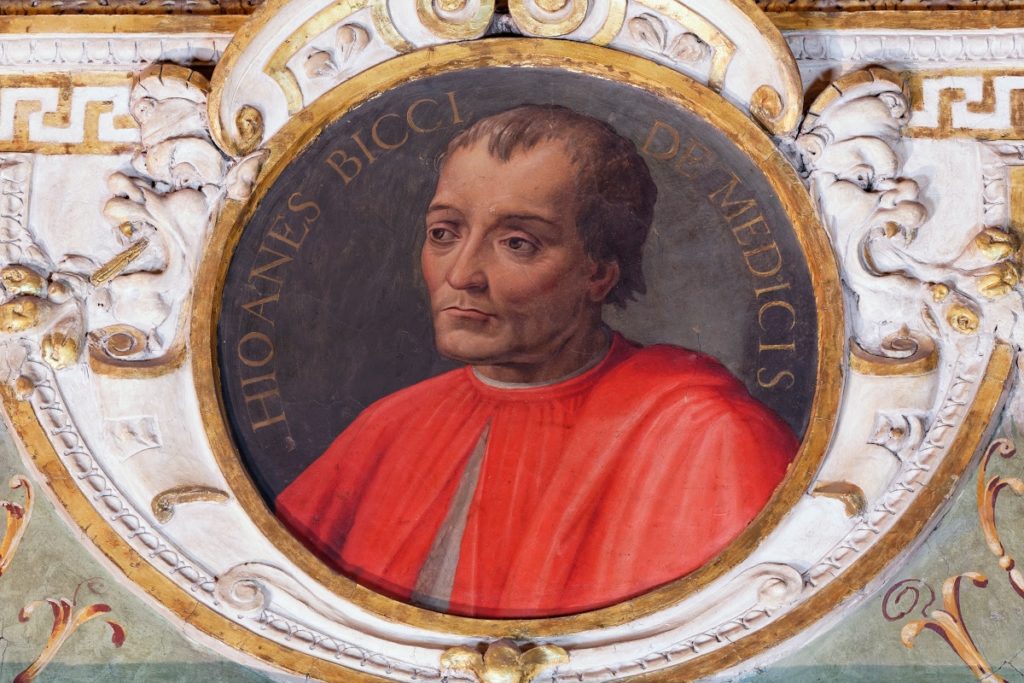
Did the Medicis finance a crash program to translate the works of Plato?
In 1397, Giovannni « di Bicci » de’ Medici (1360-1429) set up the Medici Bank. Giovanni owned two wool factories in Florence and was a member of two guilds: the Arte della Lana and the Arte del Cambio.
In 1402, he was one of the judges on the jury that selected Lorenzo Ghiberti’s design for the bronzes for the doors of the Baptistery of Florence.
In 1418, Giovanni di Bicci, wishing to endow his family with their own church, entrusted Filippo Brunelleschi, future architect of the famous dome of the Cathedral of Santa Maria del Fioro, the Duomo, with the task of radically transforming the basilica church of San Lorenzo and ordered Donatello to execute the sculptures.
Politically, the Medici family did not come to power until 1434, three years before the Council of Florence and at a time when the Renaissance was already in full swing.
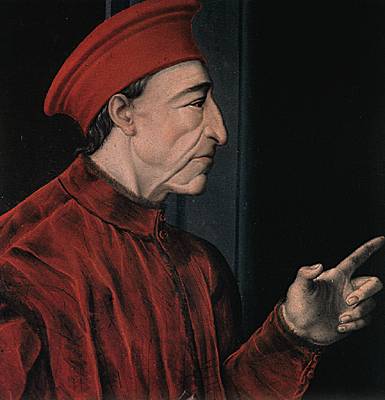
Admittedly, Giovanni’s son and inheritor of his financial empire, Cosimo di Medici (1389-1464), known as the richest man of his epoch, became so inspired by Plethon that he acquired a complete library of Greek manuscripts. He bought a copy of the Platonic Corpus (24 dialogues) from Plethon, and a copy of the Corpus Hermeticum of Hermes Trismegistus, acquired in Macedonia by an Italian monk, Lionardo of Pistoia. Cosimo also decided to initiate a project to translate from the Greek into Latin, the totality of Plato’s works.
However, as said before, Leonardo Bruni (1369-1444), who after having been papal secretary became chancellor of the Florentine republic from 1427 till 1444, had already translated close to all of Plato’s works from Greek into Latin.
It should be underlined that the translator chosen by Cosimo was Marsilio Ficino (1433-99), the son of his personal physician and only five years old at the time of the Council of Florence in 1439. Cosimo had some severe doubts concerning Ficino’s capacities as translator. When the latter offers in 1456 his first translation, The Platonic Institutions, Cosimo asks him kindly not to publish this work and to learn first the Greek language… which Ficino learns then from Byzantine scholar John Argyropoulos (1415-1487), an Aristotelian pupil of Bessarion who rejected the Council of Florence’s epistemological revolution.
But seeing his age advancing and despite his unfortunate descent into corruption, Cosimo finally gave him the post. He allocates him an annual stipend, the required manuscripts and a villa at Careggi, close to Florence, where Ficino would set up his “Platonic Academy” with a handful of followers, among which Angelo Poliziano (1454-94), Giovanni Pico della Mirandola (1463-1494) and Cristoforo Landino (1424-1498).
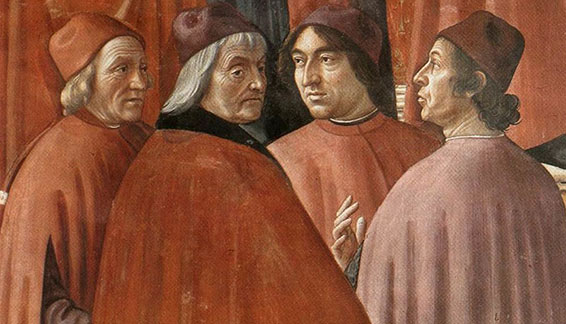
Ficino’s “Academy”, taking up the ancient neo-platonic tradition of Plotinus and Porphyry (as Ficino states himself) would organize each year a ceremonial banquet “neglected since one thousand two hundred years” on November 7, thought to be simultaneously the birthday of Plato and the day of his death.
After the dinner, the attendants would read Plato’s Symposium and then each of them would comment on one of the speeches. The comments are demonstrations, without any real dialogue and void of the essence of real platonic thinking: irony. On top of that it is remarkable that most gatherings of Ficino’s academy were attended by the ambassador of Venice in Florence, notably the powerful oligarch Bernardo Bembo (1433-1519), father of “poet” cardinal Pietro Bembo, later special advisor to the evil Genovese “Warrior Pope” Julius II.
It was this alliance of the increasingly more degenerated Medici family, the Venetian Empire’s maritime slave trade and the anti-Platonic neo-Platonists that gained dominant influence over the Curia of the Roman Catholic Church. The Medici’s clearly disliked Da Vinci (who never got an order from the Vatican and subsequently left Italy), and through their propaganda man Vasari made the world belief that the Renaissance was exclusively their baby.
But before translating Plato, and at the specific demand of Cosimo, Ficino translated first (in 1462) the Orphic Hymns, the Sayings of Zoroaster, and the Corpus Hermeticum of Hermes Trismegistus the Egyptian (between 100 and 300 after BC).
It will be only in 1469 that Ficino will finish his translations of Plato after a nervous breakdown in 1468, described by his contemporaries as a crisis of “profound melancholy”.
In 1470, and with a title plagiarized from Proclus, Ficino wrote his “Platonic Theology or on the immortality of the Soul.” While completely taken in by esoteric neo-Platonism, he became a priest in 1473 and wrote “The Christian Religion” without changing his neo-platonic pagan outlook, producing an entire new series of translations of the neo-Platonists of Alexandria: he translated the fifty-four books of Plotinus “Enneads”, Porphyry and Proclus.
Ficino, in his “Five Questions Concerning the Mind” explicitly attacks the Promethean conception of man:
« Nothing indeed can be imagined more unreasonable than that man, who through reason is the most perfect of all animals, nay, of all things underheaven, most perfect, I say, with regard to that formal perfection that is bestowed upon us from the beginning, that man, also through reason, should be the least perfect of all with regard to that final perfection for the sake of which the first perfection is given. This seems to be that of the most unfortunate Prometheus. Instructed by the divine wisdom of Pallas, he gained possession of the heavenly fire, that is, reason. Because of this very possession, on the highest peak of the mountain, that is, at the very height of contemplation, he is rightly judged most miserable of all, for he is made wretched by the continual gnawing of the most ravenous of vultures, that is, by the torment of inquiry…” (…) “What do the philosophers say to these things? Certainly, the Magi, followers of Zoroaster and Hostanes, assert something similar. They say that, because of a certain old disease of the human mind, everything that is very unhealthy and difficult befalls us…«
The Florentine Neo-Platonic Academy, backed by the libido-driven Lorenzo de Medici (1449-1492) “The Magnificent”, will serve as a “Delphic” operation: defend Plato to better destroy him; praise him in such terms that he becomes discredited. And especially destroying Plato’s influence by opposing religion to science, at a point where Cusanus and his followers are succeeding to do exactly the opposite. Isn’t it bizarre that Cusa’s name doesn’t appear a single time in the works of Ficino or Pico della Mirandola, so overfed with all-encompassing knowledge?
Lorenzo did protect artists such as Sandro Botticelli, whose Birth of Venus exemplifies Lorenzo’s neo-platonic symbolism.
Infected with this evil neo-Platonism, Thomaso Inghirami (1470-1516), the chief librarian of pope Julius II, will accomplish nothing but this when dictating to the painter Raphaël the content of the Stanza in the Vatican some decades later.
Neo-platonic “melancholy”, which Albrecht Dürer went after in his famous engraving, will become the matrix for the romantics, the destructive virus affecting the symbolists and the so-called modern school. As for the revolution that Greek studies will bring about in the sciences, I refer you to our article on this website: 1512-2012: From Cosmography to Cosmonauts, Gerard Mercator and Gemma Frisius.
To conclude, here is a short list of translators, and I certainly forgot some of them, and their mastery of foreign languages. Even if some of them can’t be called « humanists », let’s thank them for everything they allowed us to discover. I’m profoundly convinced that without them, man would certainly not have set foot on the Moon!
- Marcus Tullius Cicero 106-43 BC: Italian, Latin and Greek;
- Philo of Alexandria 20 BC – 40 AD: hebrew, Greek;
- Origen of Alexandria 184 – 253: Greek and Latin;
- Jerome of Stridon 342-420: Italian, Latin and Greek;
- Boethius 477-524: Italian, Latin and Greek;
- Bede the Venerable 672-735: English, Latin, Greek and Hebrew;
- Charlemagne 742-814, spoke Latin and understood Greek, Hebrew and Slavonic;
- John Scotus Eriugena 800-876: Irish, Greek, Arab and Hebrew;
- Ḥunayn ibn Isḥaq 809-873: Arabic, Syriac, Persian and Greek;
- Thābit ibn Qurra 826-901: Syriac, Arabic and Greek;
- Al-Fârâbi 872-950: Farsi, Sogdian and Greek;
- Al–Biruni, 973-1048: Chorasmian, Farsi, Frabic, Syriac, Sanskrit, Hindi, Hebrew and Greek ;
- Adelard of Bath 1080-1152: English, Latin and Arabic;
- Héloïse 1092-1141: French, Latin, Greek and Hebrew;
- Hugh of Saint Victor 1096-1141: French, Latin, Greek;
- Constantine the African XIth Cent: Arabic, Latin, Greek and Italian;
- John Sarrazin XIIth Cent: Latin and Greek;
- Henricus Aristippus 1105-1162: Italian, Latin and Greek;
- Gerard of Cremona 1114-1187: Italian, Latin and Arabic;
- Robert Grosseteste 1168-1253: English, Latin and Greek;
- Michael Scot 1175-1232: Scottish, Latin, Greek, Arab and Hebrew;
- Moses of Bergamo (XIIth Century): Italian, Latin and Greek;
- Burgundio of Pisa (XIIth Century): Italian, Latin and Greek;
- James of Venice (second half IIth Century, dies after 1147): Italian, Latin and Greek ;
- Roger Bacon 1214-1294: English, Latin, Greek, Hebrew, Arabic and Chaldean ;
- William of Moerbeke 1215-1286: Dutch, Latin and Greek;
- Raymond Lull 1232-1315: Catalan, Latin and Arabic;
- Arnaldus de Villa Nova 1240-1311: Catalan, Latin, Greek and Arabic;
- Dante Alighieri 1265-1321: Italian and Latin;
- Francesco Petrarch 1304-1375: Italian and Latin;
- Giovanni Boccaccio 1313-1375: Italian and Latin;
- Coluccio Salutati 1331-1406: Italian and Latin;
- Geert Groote 1340-1384: Dutch, Latin, Greek and Hebrew;
- Florens Radewijns 1350-1400: Dutch and Latin;
- Manuel Chrysoloras 1355-1415: Greek, Latin and Italian;
- Georgius Gemistus « Pletho » 1360-1452: Greek;
- Jacopo d’Angelo 1360-1410, Italian, Latin and Greek;
- Pier Paolo Vergerio (the Elder) 1370-1445: Italian, Latin and Greek;
- Leonardo Bruni 1370-1441: Italian, Latin, Greek, Hebrew and Arabic;
- Guarino Guarini 1370-1460: Italian, Latin and Greek;
- Palla di Onofrio Strozzi 1372-1462: Italian, Latin and Greek;
- Giovanni Aurispa 1376-1459: Italian, Latin and Greek;
- Vittorino da Feltre 1378-1446: Italian, Latin and Greek;
- Poggio Bracciolini 1380-1459: Italian, Latin and Greek;
- Ambrogio Traversari 1386-1439: Italian, Latin and Greek;
- Gianozzo Manetti 1396-1459: Italian, Latin, Greek and Hebrew;
- Georges of Trebizond 1396-1472: Greek, Latin and Italian;
- Tommaso Perentucelli (Pope Nicolas V) 1397-1494: Italian and Latin;
- Francesco Filelfo 1398-1481: Italian, Latin and Greek;
- Carlo Marsuppini 1399-1453: Italian, Latin and Greek;
- Theodorus Gaza 1400-1478: Greek and Latin;
- John Bessarion 1403-1472: Greek, Latin and Italian;
- Lorenzo Valla 1407-1457: Italian, Latin and Greek;
- Nicolas of Cusa 1401-1464: German and Latin;
- John Wessel Gansfoort 1419-1489: Dutch, Latin, Greek and Hebrew;
- Georg von Peuerbach 1423-1461: German, Latin and Greek;
- Demetrios Chalkokondyles 1423-1511: Greek and Latin;
- Marcilio Ficino 1433-1499: Italian, Latin and Greek;
- Constantine Lascaris 1434-1501: Greek, Latin and Italian;
- Regiomontanus 1436-1476: German, Latin and Greek;
- Alexander Hegius 1440-1498: Dutch, Latin and Greek;
- Rudolf Agricola 1444-1485: Dutch, Latin, Greek and Hebrew;
- Janus Lascaris 1445-1535: Greek and Latin;
- William Grocyn 1446-1519,: English, Latin and Greek;
- Poliziano 1454-1494: Italian, Latin and Greek;
- Johannes Reuchlin 1455-1522: German, Latin, Greek and Hebrew;
- Thomas Linacre 1460-1524: English, Latin and Greek;
- Erasmus of Rotterdam 1467-1536: Dutch, Latin and Greek;
- William Latimer 1467-1545 : English, Latin and Greek;
- Guillaume Budé 1467-1540: French, Latin and Greek;
- Marcus Musurus 1470-1517: Italian, Latin and Greek;
- Willibald Pirckheimer 1470-1530: German, Latin and Greek;
- Pietro Bembo 1470-1547: Italian, Latin and Greek;
- Thomas More 1478-1535: English, Latin and Greek;
- Girolamo Aleandro, 1480-1542: Italian, Latin and Greek;
- Germain de Brie 1490-1538: French, Latin and Greek;
- Juan Luis Vivès 1492-1540: Spanish, Latin, Greek and Hebrew;
On Leonardo da Vinci’s « Vitruvian Man »

By Karel Vereycken
Leonardo da Vinci’s « Viruvian Man ». Since we’re commemorating this year (2019) Leonardo Da Vinci, who died 500 years ago, many silly things are presented by fake scholars trying to make a real living.
Since I was introduced into the canon of proportions of the human body during my training as a professional painter and engraver, I want offer you some hints on how to look at what is called Da Vinci’s « Vitruvian man », a drawing currently on exhibit at the Da Vinci show at the Louvre in Paris.
Hence, as Leonardo underlines himself in his notebooks, adopting Cusanus wordings, it is only with the « eyes of the mind » that art becomes visible, because the « eyes of the flesh » are intrensically blind to it.
Canons of proportions
Europe, and Classical Greece, as everybody should know, emerged largely by absorbing several major discoveries accomplished much earlier by other civilizations. Much of it came from Asia, but African and especially Egypt, were key.
The very practice of mummification, a process which takes at least 60 days of work, made Egypt the key area of anatomical research.
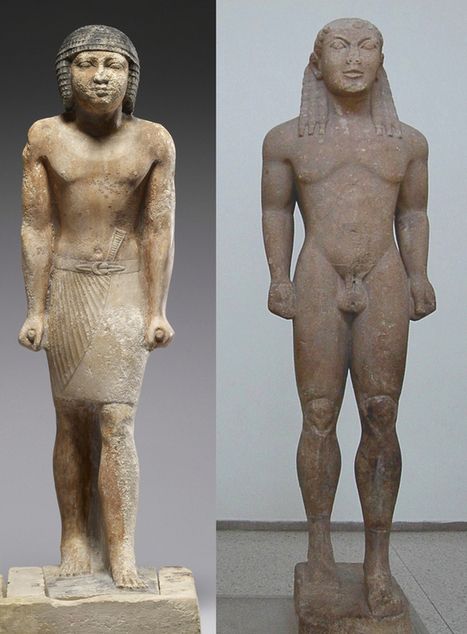
As demonstrated by early Egyptian sculpture, the exact size of the entire adult human body is 7,5 times the size of the head. The size of a newborn is only four heads, that of a seven year old, six heads and that of a 17 years old adolescent, 7 heads.
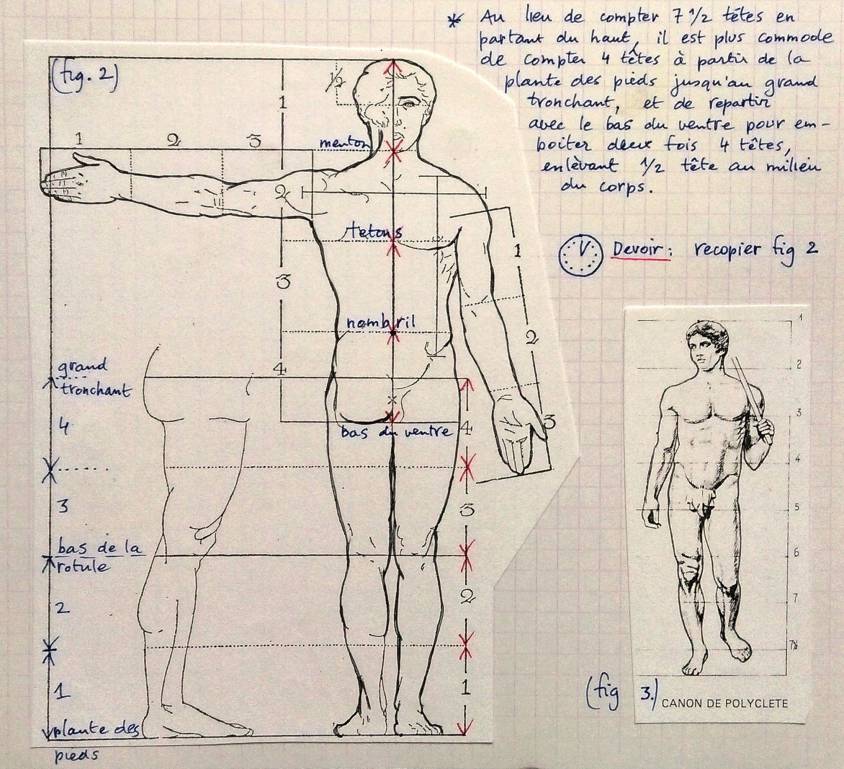
If one subdivides the overall 7.5 proportion, for an adult, from the top of the head till the lowest part of the torso, one measures four heads, one till the nipples, one till the belly button and a fourth one till the lowest part of the pubis. Going up from the sole till the middle of the pelvis, one measures 3.5 heads: 2 heads till the knee and 1.5 till the middle of the pelvis. That brings the total till 7.5 heads for the entire length of the adult human body and it is proportional in the sense that people with smaller heads also have small bodies.
Polikleitos versus Lysippus
In the Vth Century BC, the Greek sculptor Polikleitos’ spear bearer (The “Doryphoros”) of Naples National Archeological Museum applied this most beautiful canon of proportions, known as the “Polikleitos canon”.
During the Renaissance, the nostalgics of the Roman Empire preferred another Greek canon, that of Greek sculptor Lysippus (4th Century BC), formalized by the Roman author, architect and civil engineer, Vitrivius (1st century BC).
Vitruvius only transcribed the prevalent taste of his epoch. Roman sculptors, in order to give an athletic and heroic look to the Emperors which they were portraying, adopting the canon of Lysippus, could reduce the head of their models to only an eight of the total length of the body. The trick was that by reducing the relative size of the head, the body looked more preeminent and powerful, something most emperors, who were often physical failures, appreciated and secured their popularity. Even extreme cases of 12 to 15 heads of body length appeared. In short, Public relations ruled at the detriment of science and truth.
Today’s comic strip drawers chose proportions according to purpose:
–For real life, 7.5 or “normal canon”
–For a movie star, 8 heads, with the “idealistic canon”;
–For a fashion magazine: 8.5 heads;
–For a comic book hero: 9 heads for the “heroic canon”
Vitruvian man
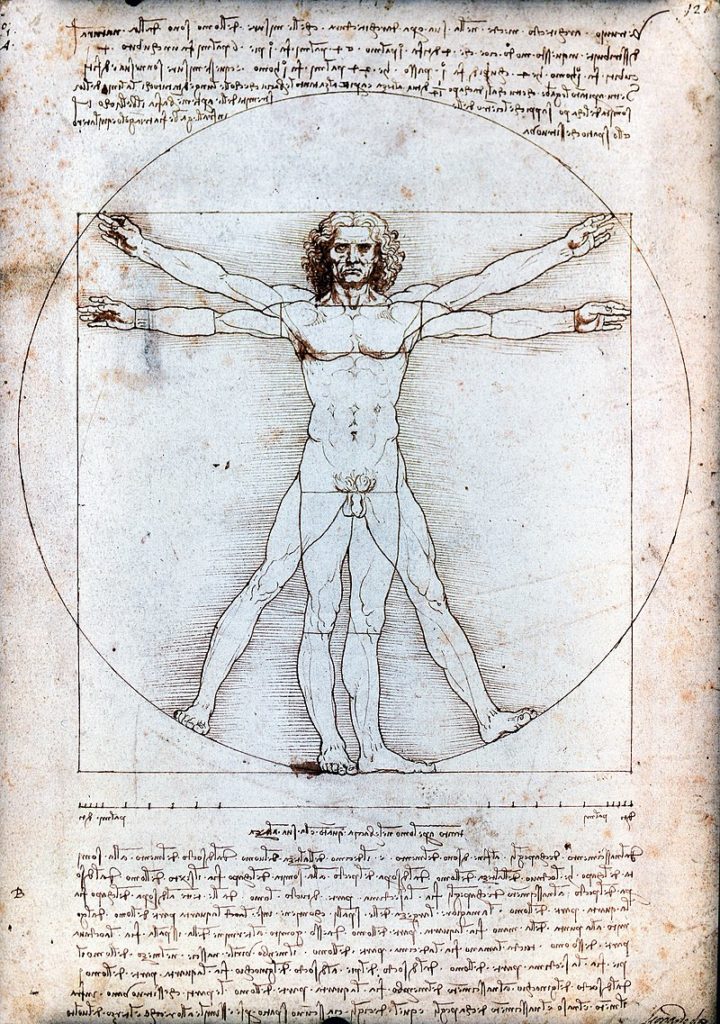
Text accompanying Leonardo DaVinci’s Vitruvian Man:
Vitruvius, the architect, says in his work on architecture that the measurements of the human body are distributed by Nature as follows that is that 4 fingers make 1 palm, and 4 palms make 1 foot, 6 palms make 1 cubit; 4 cubits make a man’s height. And 4 cubits make one pace and 24 palms make a man; and these measures he used in his buildings. If you open your legs so much as to decrease your height 1/14 and spread and raise your arms till your middle fingers touch the level of the top of your head you must know that the centre of the outspread limbs will be in the navel and the space between the legs will be an equilateral triangle.
The length of a man’s outspread arms is equal to his height.
From the roots of the hair to the bottom of the chin is the tenth of a man’s height; from the bottom of the chin to the top of his head is one eighth of his height; from the top of the breast to the top of his head will be one sixth of a man. From the top of the breast to the roots of the hair will be the seventh part of the whole man. From the nipples to the top of the head will be the fourth part of a man. The greatest width of the shoulders contains in itself the fourth part of the man. From the elbow to the tip of the hand will be the fifth part of a man; and from the elbow to the angle of the armpit will be the eighth part of the man. The whole hand will be the tenth part of the man; the beginning of the genitals marks the middle of the man. The foot is the seventh part of the man. From the sole of the foot to below the knee will be the fourth part of the man. From below the knee to the beginning of the genitals will be the fourth part of the man. The distance from the bottom of the chin to the nose and from the roots of the hair to the eyebrows is, in each case the same, and like the ear, a third of the face.
Of course, Da Vinci’s exploration of the Vitruvian man doesn’t mean he approves or disapproves the stated fakery in proportions.
Soul or muscle?
It should be known that in Italy, the pure Roman taste has become trendy again following the discovery in 1506 of the statue of the Laocoon on the site of Nero’s villa in Rome. From that moment, artist will feel obliged to increase the volume of the muscular masses in order to appear as working « in Antique style ».
Although Leonardo never openly criticized this trend, it is hard not to think of Michelangelo’s frescoes in the Sistine Chapel, when the artist, seeking to raise the spirit to unequalled philosophical heights, advised painters: « do not give all the muscles of the figures an exaggerated volume » and « if you act differently, it is more a sort of representation of a sack of nuts that you will have achieved than to that of a human figure » (Codex Madrid II, 128r).
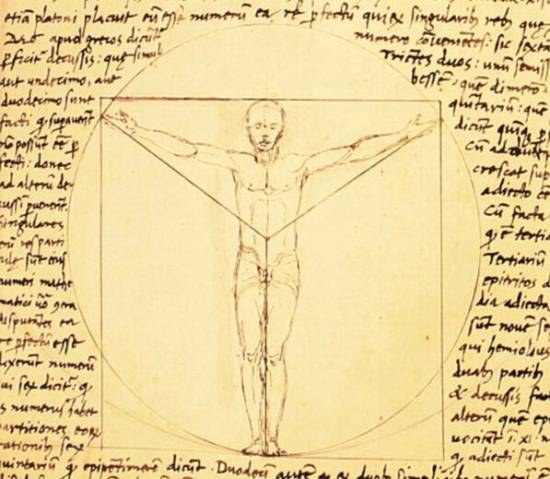
No doubt inspired by his friend, the architect Giacomo Andrea, in « The Vitruvian Man », Leonardo is above all interested by other harmonies: if a person extends his arms in a direction parallel to the ground, one obtains the same length as one’s entire height. This equality is inscribed by Leonardo in a square (symbol of the earthly realm). But if one stretches his arms and legs in a star shape, they are inscribed in a circle whose center is the navel. The location of the navel divides the body according to the golden ratio (in this example 5 heads out of a total of 8 heads, 5+3 being part of the Fibonnacci series: 1+2 = 3; 3+2 = 5; 5+3 = 8; 8+5 = 13; 13+8 = 21, etc.).
Leonardo clearly understood what the golden section really means: not a “magical” number in itself, but the reflexion of the dynamic of least action, the very principle uniting man (the square) with the creator and the universe (the circle).
So if you take a look, beware of what you see and especially what you don’t !