Étiquette : Karel Vereycken
Cyrus the Great, Iran and the Dialogue of Civilizations
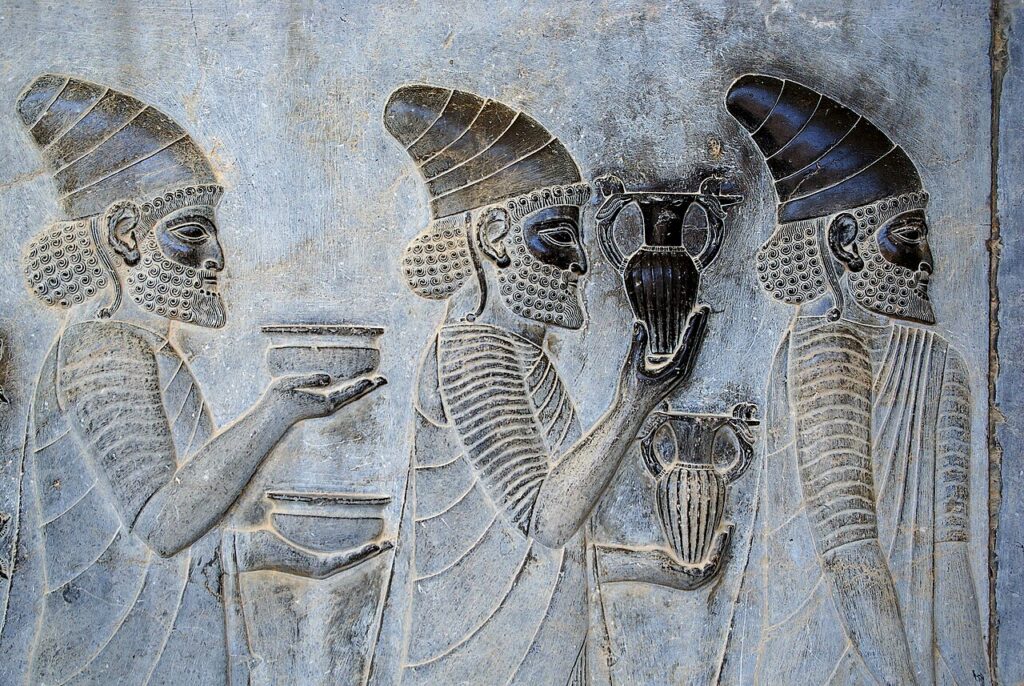
Responding to a tweet posted in early April by Pete Hegseth, the US « Secretary of War », threatening to send Iran « back to the Stone Age, » the Iranian embassy in South Africa replied with this short but firm comment, rich in potential diplomatic solutions:
“At a time when you where still in caves searching for fire, we were inscribing human rights on the Cyrus Cylinder. We endured the storm of Alexander the Great and the Mongol invasions and remained; because Iran is not just a country, it is a civilization.«
History
Cyrus II (the Great) was the founder of the Achaemenid Persian Empire in 552 BC. It was his capture of Babylon in 539 BC that inaugurated the imperial era of Persia. By ending the Babylonian empire, which had until then ruled Western Asia, Cyrus founded an empire stretching from India in the East to Carthage in the West, and from the Caucasus and the Danube in the North to Ethiopia in the South.
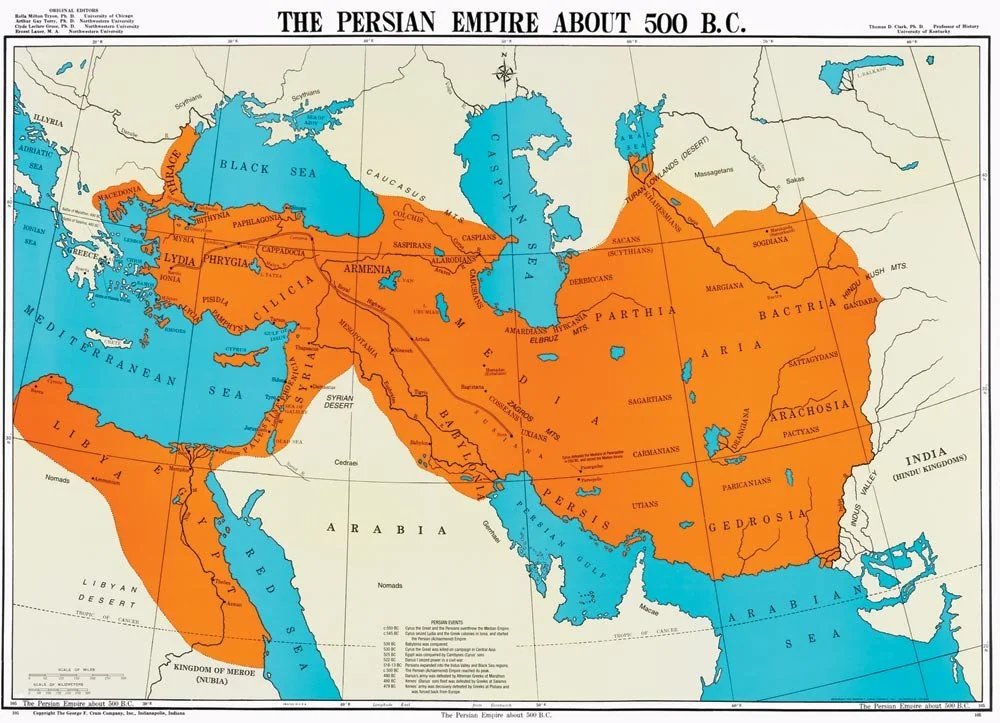
With 5.5 million km² of territory, the Persian Empire had approximately 50 million inhabitants, representing 40% of the world’s population. The Persian Empire is the earliest of the Indo-European empires.
With its 20 provincial governors (satraps), its decentralized mode of organization sometimes served as a model for the Greek and Roman empires, and obviously for those of the Anglo-Saxons, the French, the Spanish, etc.
The founding act of the Persian Empire was the publication of the famous « edict » of King Cyrus, a copy of which, engraved in cuneiform characters on a terracotta cylinder, was found in Babylon in 1879. It is kept in the British Museum in London.
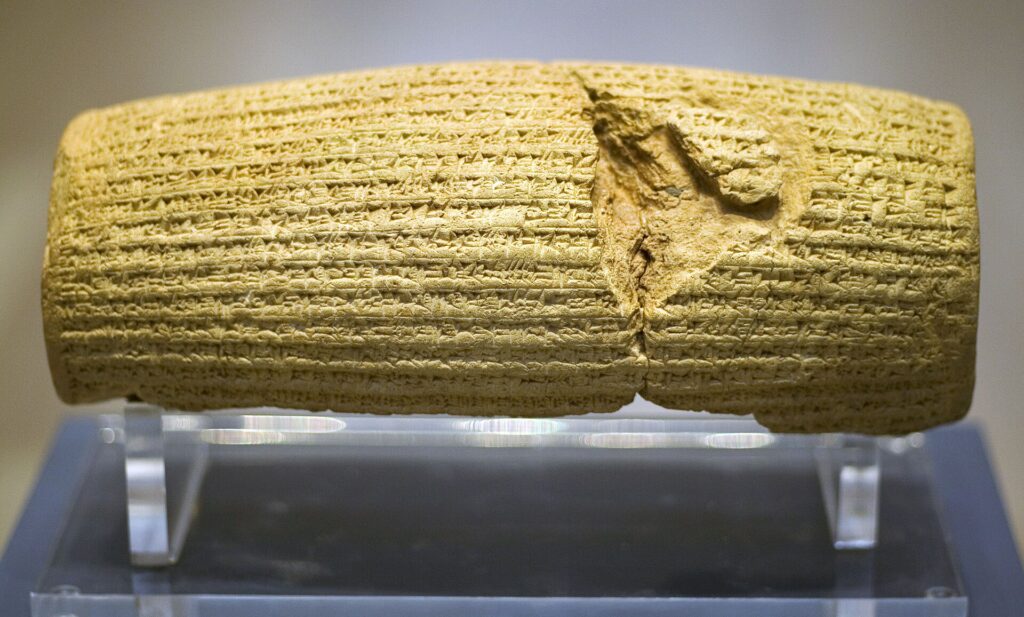
This edict is of unparalleled value, as it constitutes the first declaration of human rights in human history. Through this edict, Cyrus the Great abolished forced labor and solemnly proclaimed equal rights for all members of the empire, as well as freedom of worship and belief for all individuals. The fact that the Iranian embassy responded in this way is therefore very interesting. Of course, the honor of Iran’s great civilization scoffs at the Trump administration’s blatant ignorance.
But at the same time, by invoking the Cyrus cylinder, Iran, drawing on a higher concept, extends an olive branch for a negotiated solution and, implicitly, for the possibility of a shared future once again.
Let’s see why
- Although archaeologists and historians specializing in the Near East generally reject these interpretations as anachronistic, the cylinder was adopted as a symbol by Shah Mohammad Reza Pahlavi, who presented it as the « first charter of human rights, » and then exhibited in Tehran in 1971 to celebrate the 2500th anniversary of the Iranian Empire.
- That same year, the UN translated it into all its official languages and recognized it as a precursor to the Universal Declaration of Human Rights. Its return to Iran in 2010 was a major event commemorated in the Islamic Republic of Iran, where then-President Mahmoud Ahmadinejad cited it as a source of inspiration guiding the struggle for the oppressed. Three years later, the cylinder was presented and praised in the United States as a symbol of freedom. More recently, on November 6, 2025, the 43rd UNESCO General Conference unanimously recognized the Cyrus Cylinder (still considered the world’s first declaration of human rights) as a global symbol of freedom, justice, and respect for cultural diversity.
- Relations between Iranians and Jews date back to antiquity. One of the episodes most celebrated in Iranian identity is the liberation of the Jews from Babylon by Cyrus the Great, an act recorded and engraved on the famous cylinder seal, a testament to openness and tolerance. The Bible, moreover, offers a very favorable interpretation of Cyrus’s reign, which the Book of Ezra presents as the one that enabled the Jewish people’s « return to Zion » after their captivity in Babylon. The Jewish community in Iran is estimated today to number between 8,000 and 12,000 people, making it the largest in the Middle East after Israel, although its numbers have declined sharply since 1979 (around 100,000 before the revolution). In early April, guided by AI without human verification, Israel bombed the Tehran synagogue. The Israeli army expressed its « regret » for the damage caused by this nighttime strike, which it claimed targeted a « senior Iranian military commander. »
Dialogue of Civilizations
To evoke the Cyrus cylinder is therefore to extend, from a higher standpoint, an olive branch: the prospect of an intercultural, inter-religious and inter-civilizational dialogue, laying the foundations for a peaceful solution to many otherwise insoluble conflicts, both within the country (with the supporters of a return of the Pahlavi dynasty) and outside (with Israel, Christians and the West in general).
For millennia at the crossroads of the Silk Roads, the DNA of Iranian civilization has not been terrorism and destabilization, but rather a fight for justice, respect and openness to others.
One year after the Iranian celebrations of the Cyrus Cylinder, in 1971, the Austrian professor Hans Köchler, president of the International Progress Organization (IPO), a close friend and collaborator of the Schiller Institute and its founder Helga Zepp-LaRouche, took up his pen to propose to UNESCO the organization of
« an international congress on the subject of the problems arising from the dialogue between different civilizations. »
For years, Hans Köchler, through countless presentations, lectures, and symposia worldwide, particularly in Iran, did exceptional work to popularize the concept, before it was taken up and supported by the Schiller Institute.
Under the auspices of the Austrian and Senegalese presidencies, a major symposium was held in 1974 in Innsbruck, Austria. In 1997, in opposition to the « Clash of Civilizations » theory, the thesis of geopolitician Bernard Lewis popularized by Samuel P. Huntington, Iranian President Mohammad Khatami placed dialogue between civilizations at the heart of his mandate. It was at his suggestion that the UN, in 1998, declared 2001 the « Year of Dialogue Among Civilizations. »
The concept is back on the table today. Will we be able to adapt to the Iranian DNA or will we remain in the moral « Stone Age »?
Karel Vereycken wins Megalopolitan Art Gallery’s Talent Prize
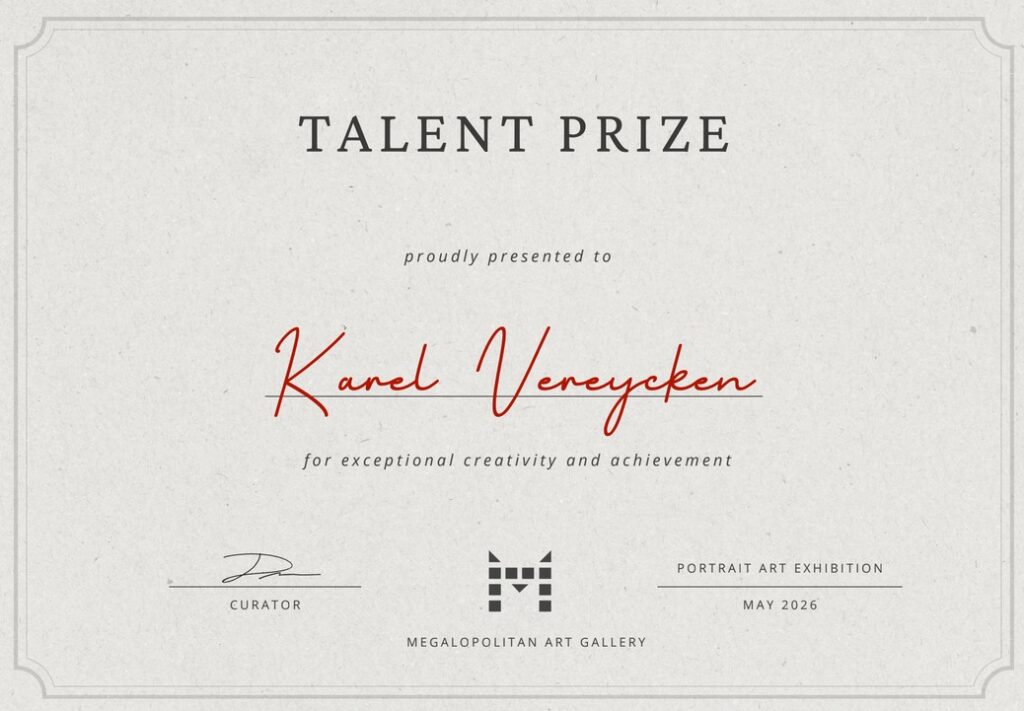
On May 1st, franco-belgian painter and engraver Karel Vereycken received the following news from the Megalopolitan Art Gallery:
« Congratulations! It is our privilege to announce that your artworks have been selected for Portrait, 2026 International Online Exhibition. The jury has recognized your exceptional work with the Talent Prize award. »
The exhibition is now live at: https://megalopolitanart.com/current
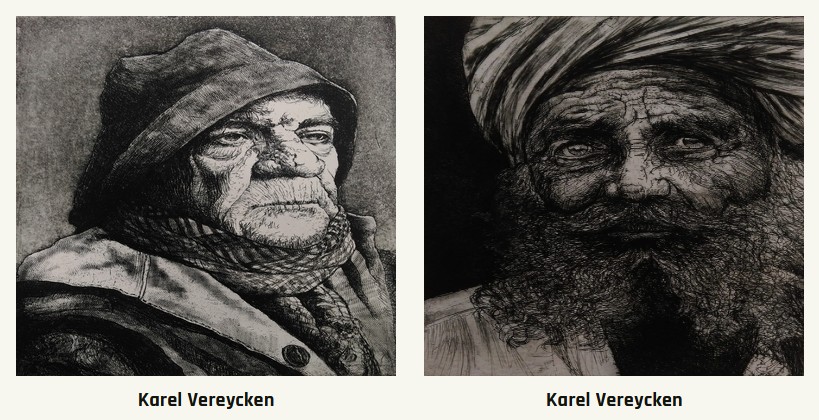
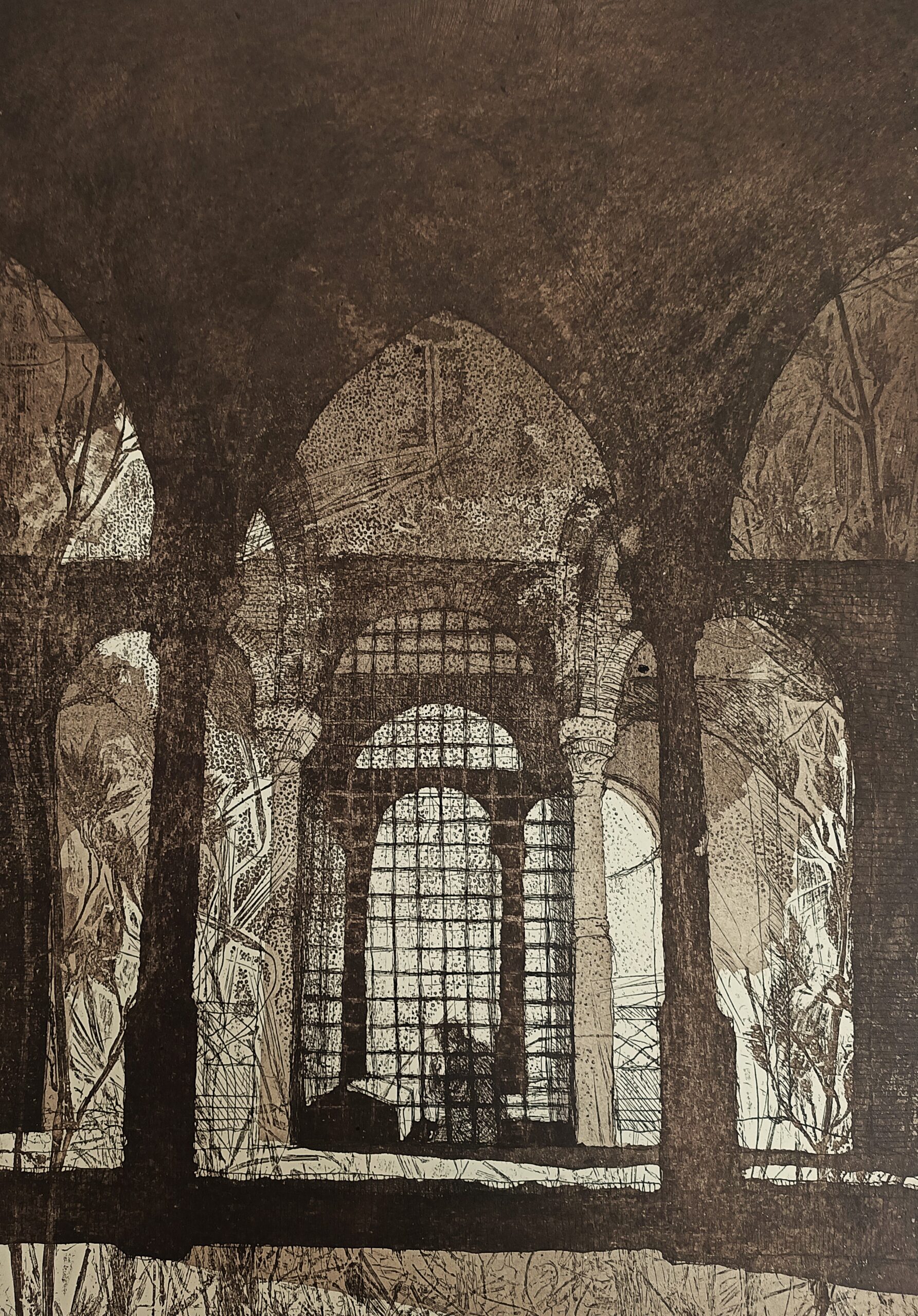
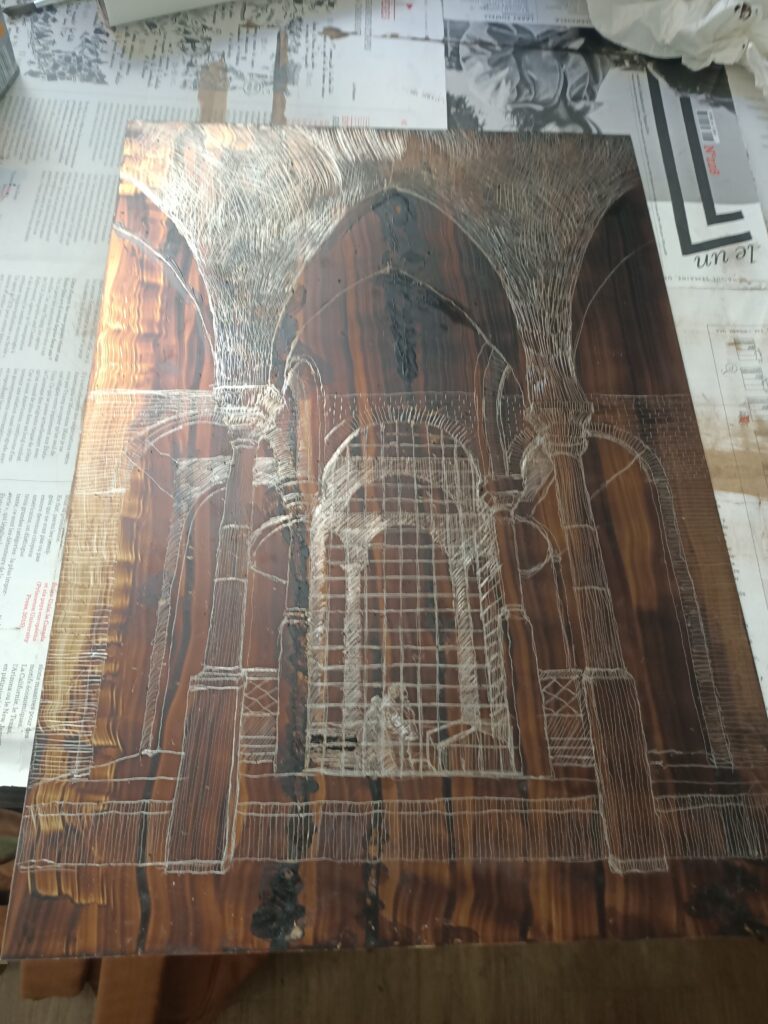
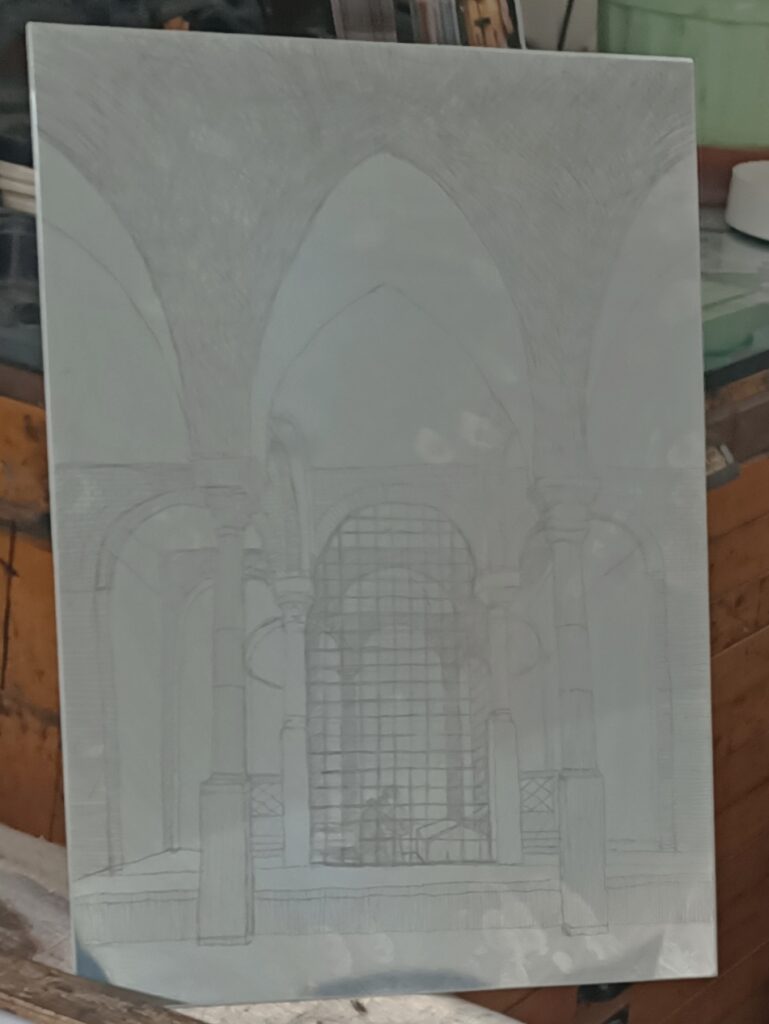
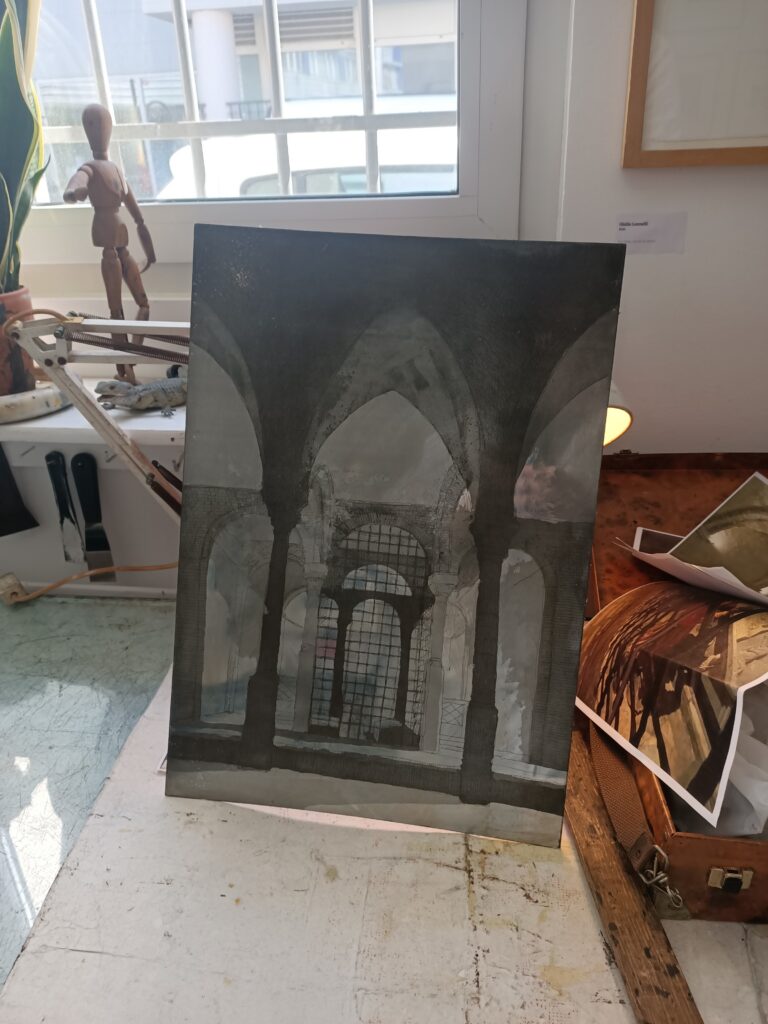
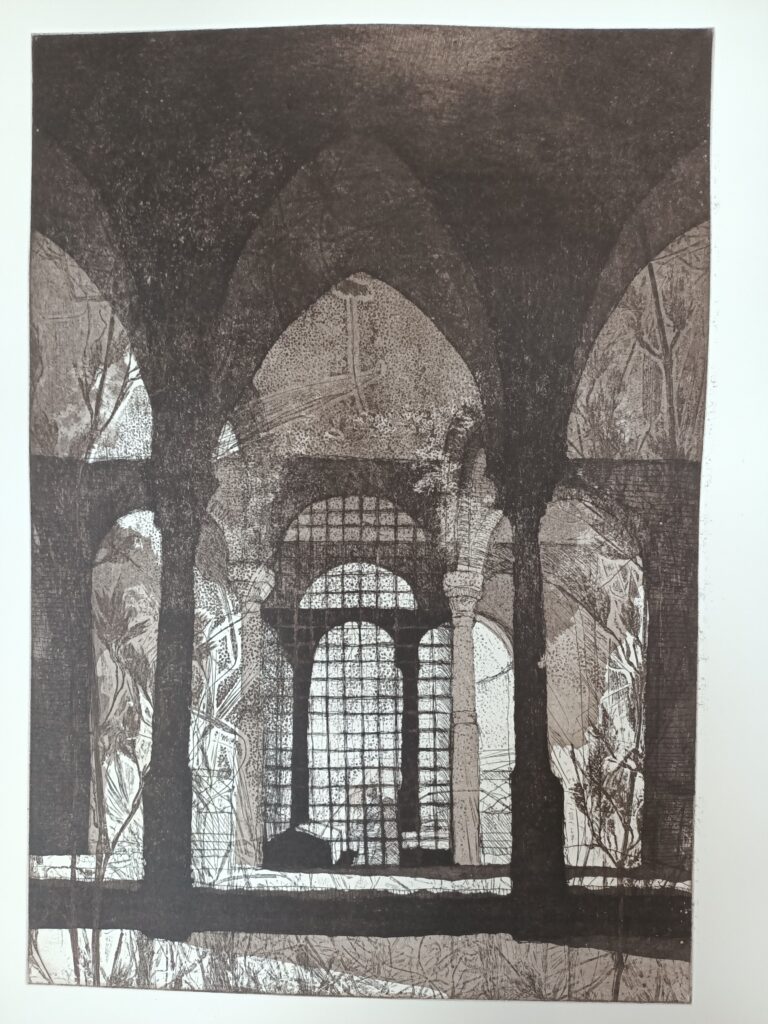
La coïncidence des opposés
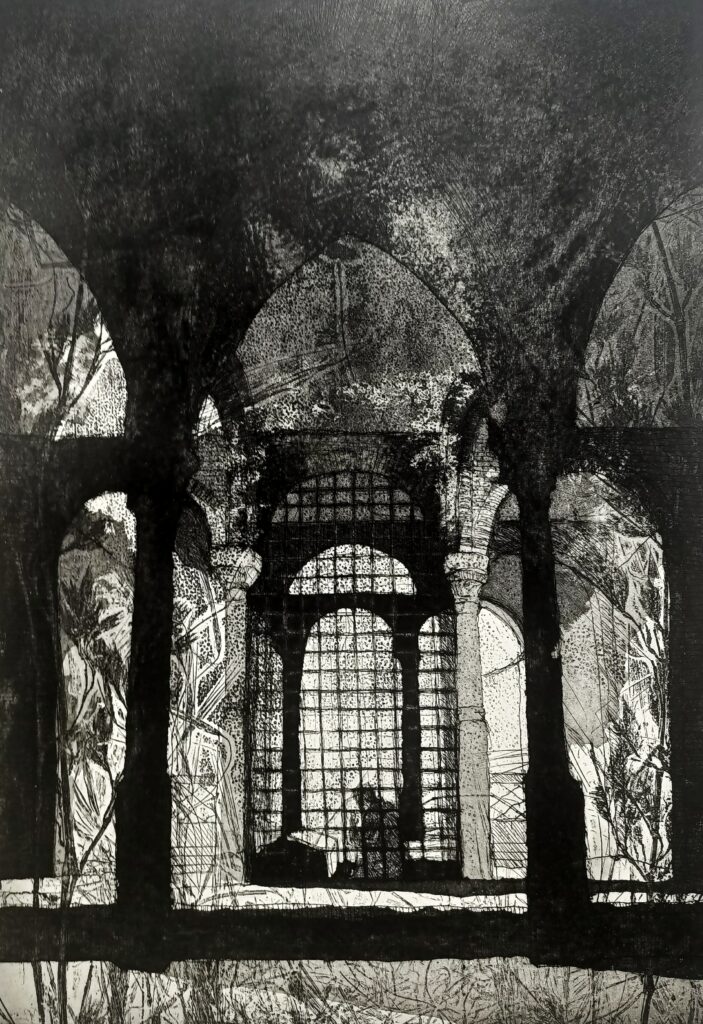
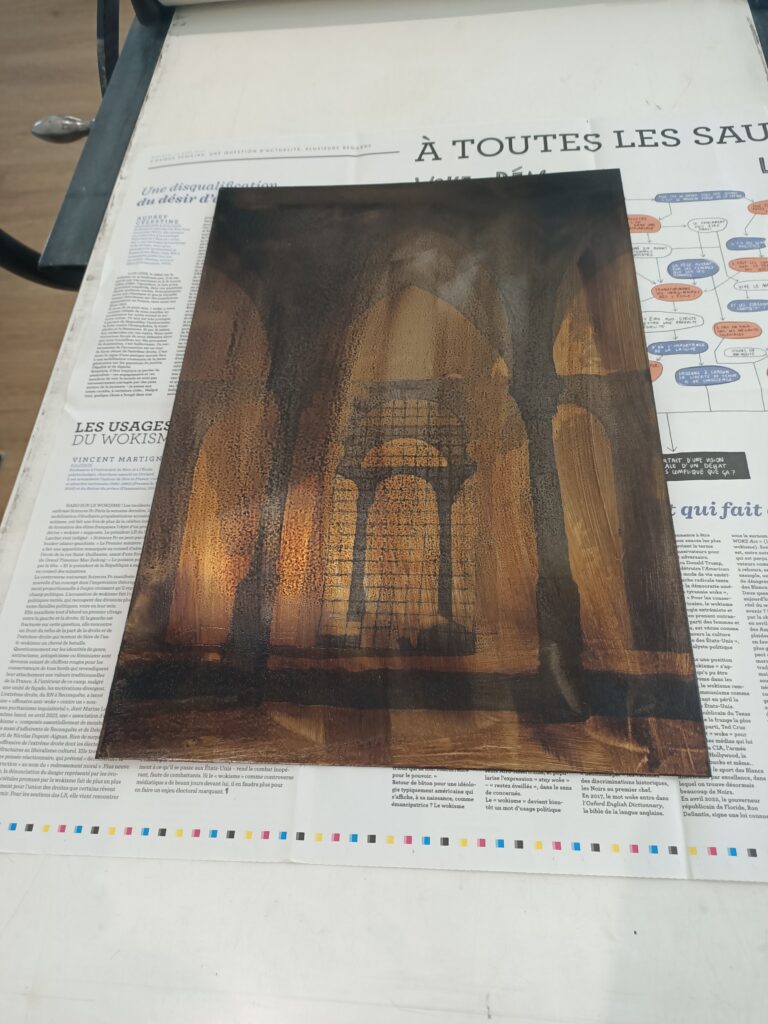
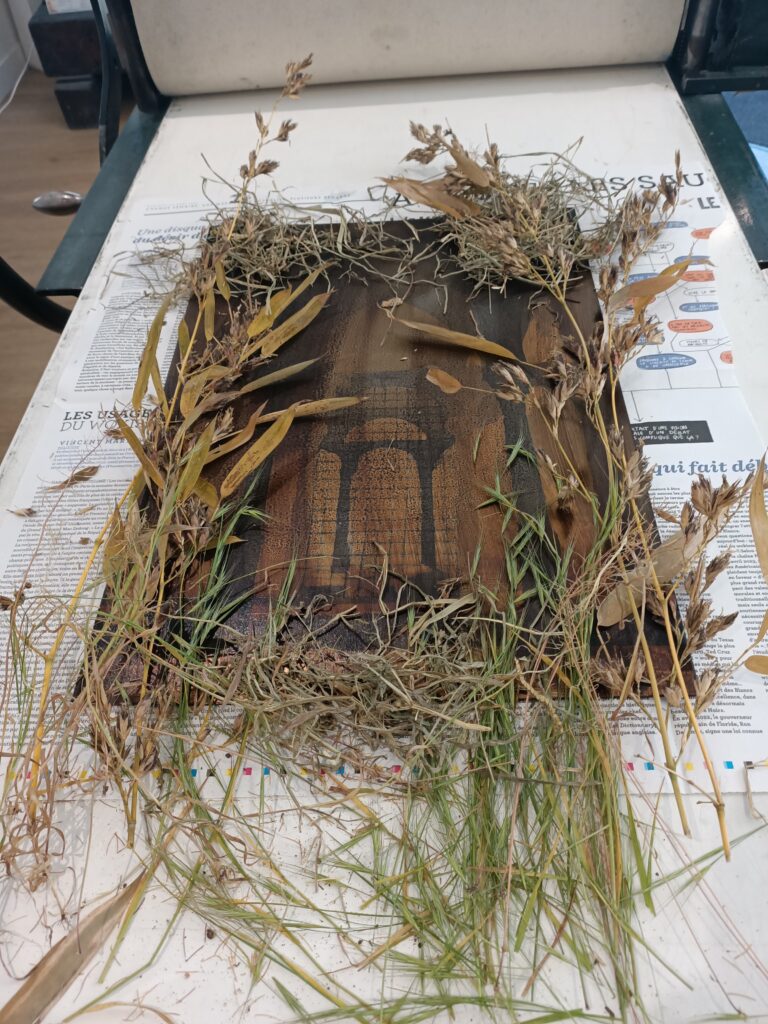
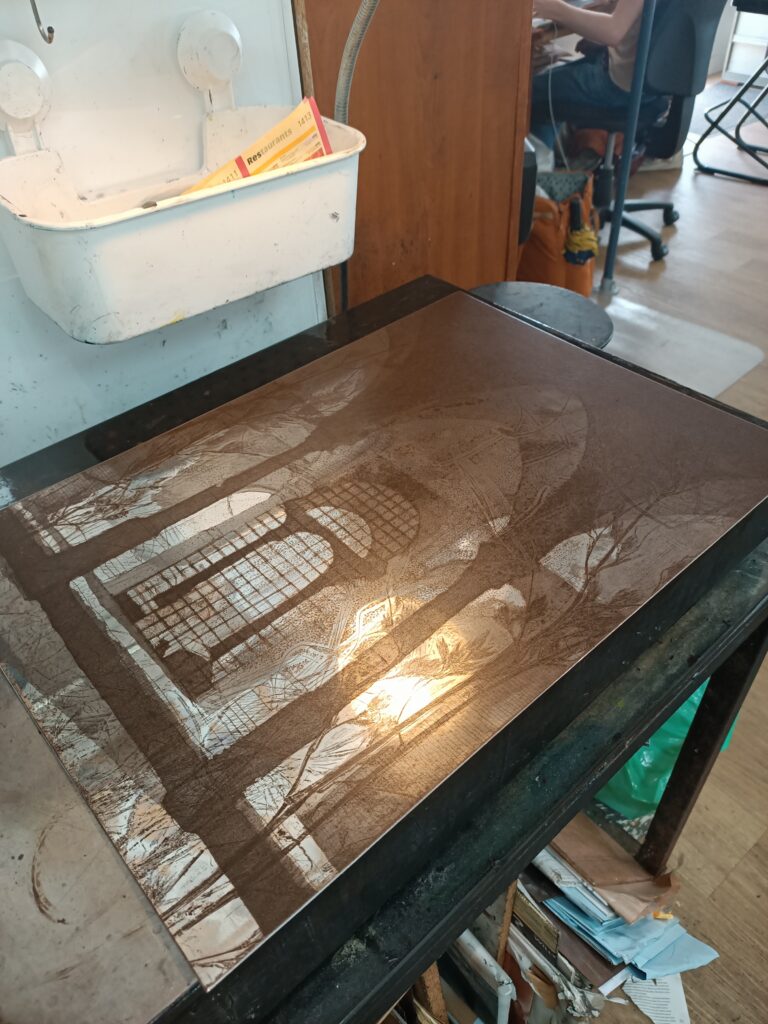
What inspired me for this engraving :
« Recently, when in Milan to receive an award, I visited the Pinacoteca Ambrosiana. There are beautiful paintings there, and the library is a leading repository for Da Vinci’s codices.
But I was deeply impressed by the crypt, a Paleo-Christian monument.
Inside the crypte, I discovered the iron bars of a dreadful cage reminiscent of Piranesi’s depictions of torture and prisons. Inside that cage rises today a painted plaster statue of the bishop of Milan who was made a cardinal in 1560. He went to pray in that cage every wednesday in front of a tombstone that is a replica of Christ’s in Jerusalem.
What puzzled me is how a clergyman, praying in a sort of double prison (cage + crypt), apparently was spiritually completely free in God. A divine (and human) paradox. »
Karel Vereycken.
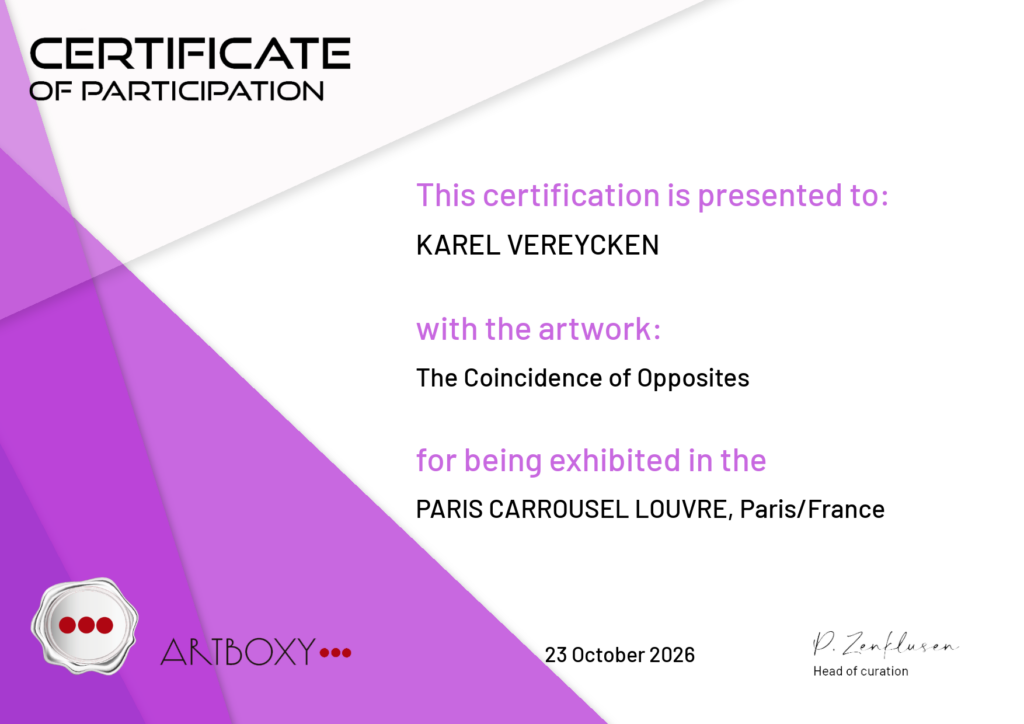
Oeuvre primée:
- 1er prix au 7e édition du « Festival 4 Arts » en Roumanie (Août 2026);
- Oeuvre permettant à l’artiste d’être sélectionné parmi les 30 finalistes (sur 182) pour la Foire d’art de Chicago au MART du 7 au 10 octobre (Août 2026);
- Distinguée « pour sa qualité esthétique et technique » lors du concours pour la couverture du livre Art IDEAL (Juin 2026);
- Mention honorable, concours « Artiste du mois » de la Circle Foundation for the Arts, Los Angeles, Californie (Juin 2026).
- Publié dans Contemporary Art Curator Magazine (16 juin 2026);
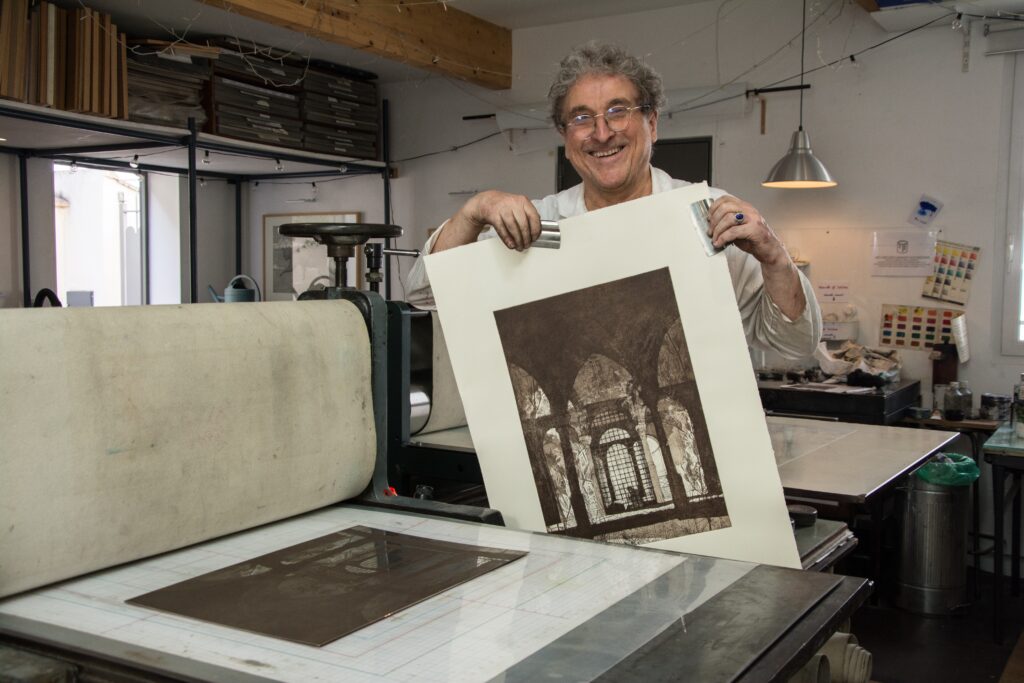
Genèse
Karel Vereycken featured on FineArtsNews.com

Karel Vereycken: Crafting Paradoxical Metaphors to Reveal the Invisible
Franco-Belgian painter engraver Karel Vereycken is now featured on FineArtsNews.com!
This amazing opportunity was made possible through Culturale Lab (@culturalelab @culturalelab_art), a platform dedicated to supporting and promoting contemporary artists worldwide.
His story has been published on FineArtsNews.com, a respected international publication covering fine arts, museum exhibitions, and the global art scene.
« It’s an incredible honor to have my work and artistic journey showcased to art collectors, gallery professionals, museum curators, and fine art lovers worldwide, » said Vereycken. « This feature explores my creative process, inspirations, and recent works. I’m grateful for this opportunity to connect with art lovers and collectors around the world. »
Read the full article:
https://fineartsnews.com/2026/04/karel-vereycken-crafting-paradoxical-metaphors-to-reveal-the-invisible/
Karel Vereycken: Crafting Paradoxical Metaphors to Reveal the Invisible
Posted on by Jonathan Hale

Also available in: ES FR DE IT ZH
In a world often saturated with the immediate and the obvious, there exists an artist dedicated to excavating deeper truths, coaxing the intangible into the realm of the visible. Karel Vereycken, an engraver whose journey began in the storied city of Antwerp, Belgium, and now flourishes in Argenteuil, France, is such an artist. His work transcends mere representation, delving into the complex tapestry of human experience through meticulously crafted paradoxical metaphors. Vereycken’s art is not simply to be observed; it is an invitation to a profound dialogue, a contemplation of the unseen forces that shape our lives.
A Foundation Forged in Curiosity and Discipline

Born in Antwerp in 1957, Karel Vereycken’s artistic path was not a straight line but a rich exploration shaped by both circumstance and innate drive. His parents, who navigated the challenges of a port and ship repair industry background, recognized the importance of cultural enrichment for their children. While an early foray into music, cut short by a rigid teaching method, led him to a communal drawing school, it was here that the seeds of his artistic future were sown. Under the tutelage of Herman Cornelis, a sculptor with a hands-on, intuitive approach, Vereycken learned the power of observation and replication. A pivotal moment arrived at the age of twelve when he secured his first art prize. This recognition, coupled with his teacher’s conviction of his “precious talent,” propelled him towards more formal training. His mother’s encouragement led him to the Institut Saint-Luc in Brussels, where he immersed himself in Plastic Arts. Here, the rigorous study of anatomy and the works of masters like Leonardo da Vinci and Albrecht Dürer provided a foundational understanding of form and expression. His dedication to mastery further solidified at the Académie Royale des Beaux-Arts, where he earned a certificate of passage in copper engraving “with distinction.”
The subsequent move to Paris marked a period of diverse engagement. Vereycken initially pursued journalism and editing for a non-commercial publication, but the call of art remained insistent. He returned to his artistic roots, initially exploring ancient painting techniques, recreating the works of old masters using hand-made egg tempera and traditional oil methods. This period, while enriching in its technical discovery, proved challenging in terms of exhibition, as the works found new homes before he could present them. This led to a renewed focus on watercolors and the meticulous craft of etching, mediums that would become central to his practice.
His ongoing commitment to honing his skills is evident in his continued engagement with the etching community in France. As a member of the Fédération nationale de l’estampe, Vereycken refined his technical prowess at Atelier63 and further perfected his craft at the Montreuil printing workshop founded by the Danish engraver Bo Halbirk. This journey, from the vibrant streets of Antwerp to the artistic hubs of Brussels and Paris, underscores a lifelong pursuit of excellence and a deep-seated passion for the enduring power of artistic creation.
“Sublimart”: The Art of Paradoxical Metaphor

Vereycken’s artistic output is best described by his coined term, “sublimart”—a fusion of “sublime” and “art.” This neologism encapsulates his unique approach: figurative art that employs paradoxical metaphors to elevate the soul to a sublime level. His work is not about superficial beauty or direct narrative, but about constructing visual paradoxes that act as gateways to deeper understanding. “Making visible the invisible,” as he succinctly puts it, is the driving force behind his creations. He achieves this not through conventional symbolism or straightforward depiction, but by weaving together disparate elements in a way that challenges perception and sparks contemplation.
The materials and techniques he primarily utilizes – etching, painting, oil, and watercolor – are employed with a discerning hand. Etching, with its inherent precision and the intricate lines it allows, is particularly suited to his exploration of layered meaning. The process of etching demands patience and deliberate action, mirroring the thoughtful construction of his conceptual metaphors. His dedication to classical techniques, combined with a modern sensibility, allows him to imbue his figurative works with a profound emotional and intellectual resonance. Each piece is a carefully orchestrated dialogue between form and concept, inviting the viewer to embark on a personal journey of discovery.
The thematic underpinnings of Vereycken’s work are not consciously pursued but rather emerge organically from his engagement with the world and his artistic explorations. He seeks to “shock people by showing them that nothing is more ‘modern’ and ‘revolutionary’ than ‘classical’ art.” However, his definition of classical art is far from rigid or academic. For Vereycken, it represents a “science of composition based on non-cynical, liberating, ironical, poetical metaphors.” These metaphors, he believes, are the fundamental keys to all forms of art, whether visual or musical. His approach is rooted in the understanding that art is a profound “gift” from the artist to the viewer, an act of love that fosters connection and shared experience.
A Vision of Artistic Enlightenment

Karel Vereycken’s artistic endeavors are imbued with a profound sense of purpose, extending beyond the creation of aesthetically pleasing objects. He views his work as a form of “teaching activity,” a “humanistic intellectual guerrilla warfare” aimed at awakening viewers to new dimensions of perception. While he acknowledges the importance of sales for furthering his artistic endeavors, his ultimate motivation lies not in pandering to popular taste but in facilitating a deeper connection with the viewer. He strives to make art a “window” to realms that people intuitively recognize as significant but have often been denied access to.
His commitment to this vision is exemplified by his efforts to share his knowledge and passion. He has led numerous guided tours of major art institutions like the Louvre in Paris, the Museums of Antwerp, Brussels or Frankfurt, the Brera in Milan, the Gemäldegalerie in Berlin and the Metropolitan Museum in New York. These immersive experiences have been documented, with some audio recordings available on his website, allowing a wider audience to benefit from his insights. The heartfelt gratitude he has received, with individuals expressing their astonishment at how deeply ideas can be conveyed through paintings, underscores the impact of his pedagogical approach.
Looking ahead, Vereycken’s trajectory continues to be marked by active participation and a desire to broaden his reach. Having been digitally showcased at ARTEXPO in New York and ARTSHOPPING at the Carrousel du Louvre in Paris, he remains engaged with contemporary art platforms. Following his “Mona Lisa Prize” win and subsequent exhibition at Galerie Mona Lisa in Paris, his focus remains on sharing his transformative art. The prospect of an exhibition in El Salvador for SUMARTE 2026 signals his international aspirations and a continued commitment to making his unique perspective accessible to a global audience. His ongoing work, such as the conceptually rich “Stairway to Heaven,” demonstrates his continued exploration of marrying diverse visual inspirations—in this instance, the landscapes of China’s Yellow Mountains with Flemish landscape traditions—to craft potent metaphors for the human journey.
Karel Vereycken’s art is a testament to the enduring power of intellectual curiosity, technical mastery, and a profound belief in the capacity of art to illuminate the human spirit. Through his creation of paradoxical metaphors, he invites us to look beyond the surface, to engage with the invisible currents of meaning that shape our existence. His work is a vital reminder that true artistry lies not just in what is seen, but in what is felt, understood, and ultimately, revealed.
To connect with Karel Vereycken and explore his captivating work, please visit his website and social media platforms:
- Website: https://artkarel.com/
- Instagram: https://www.instagram.com/karelvereycken/
- Facebook: https://www.facebook.com/karel.vereycken/
- Manifestampe Profile: https://www.manifestampe.org/utilisateur/karel-vereycken/profil
- Contemporary Art Curator Magazine Interview: https://www.contemporaryartcuratormagazine.com/home-2/karel-vereycken-interview
Karel Vereycken webpage at Circle Foundation for the Arts
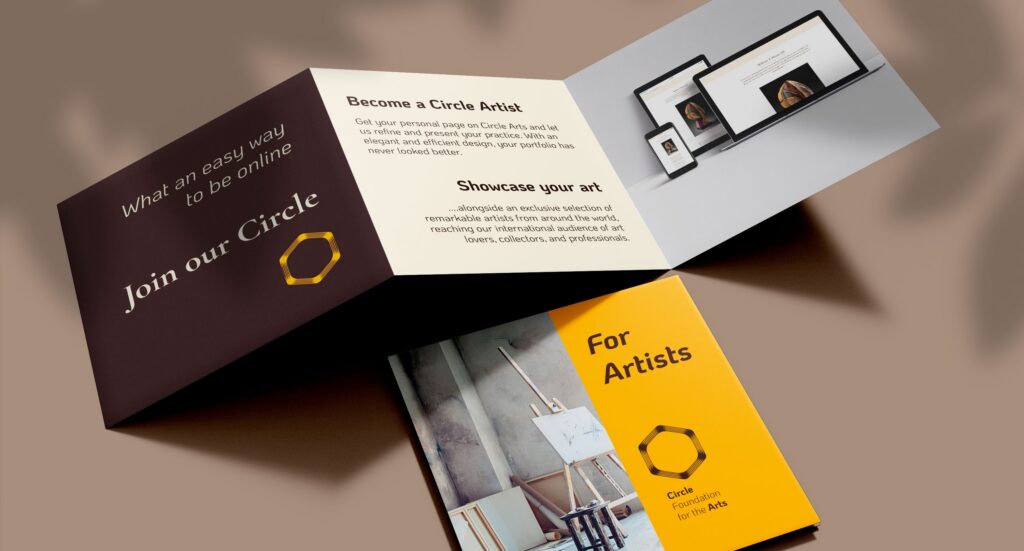
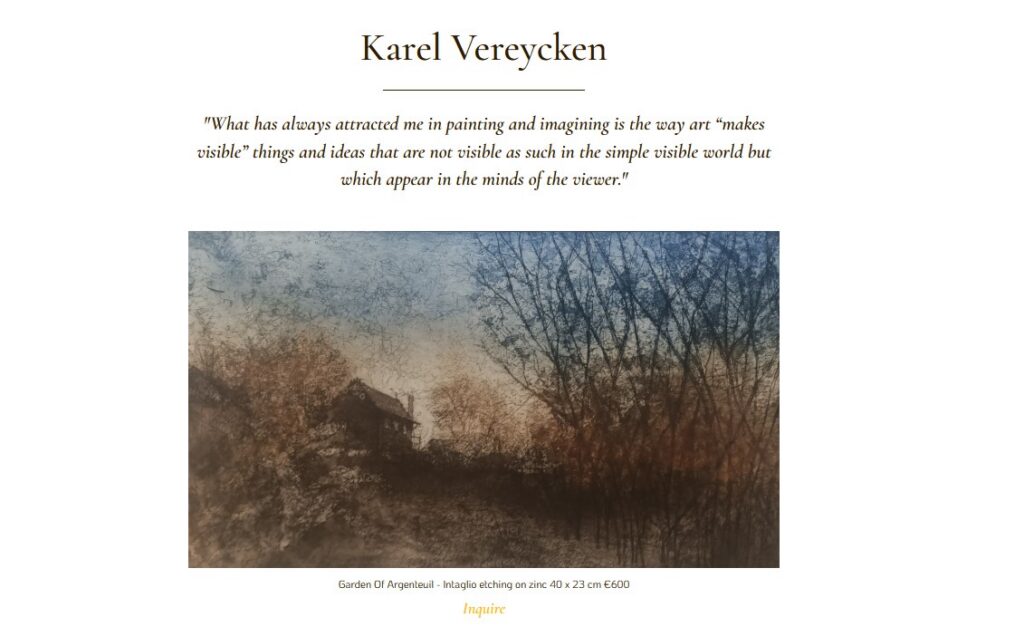
On April 20, 2026, Franco-Belgian painter engraver Karel Vereycken became a member of the Circle Foundation for the Arts (CFA).
In this new capacity of a « Circle Artist » he could open a permanent dedicated webpage on the CFA website, an additional window increasing the artists overall visibility and reach-out.
https://circle-arts.com/member/karel-vereycken/
Thanks for that !
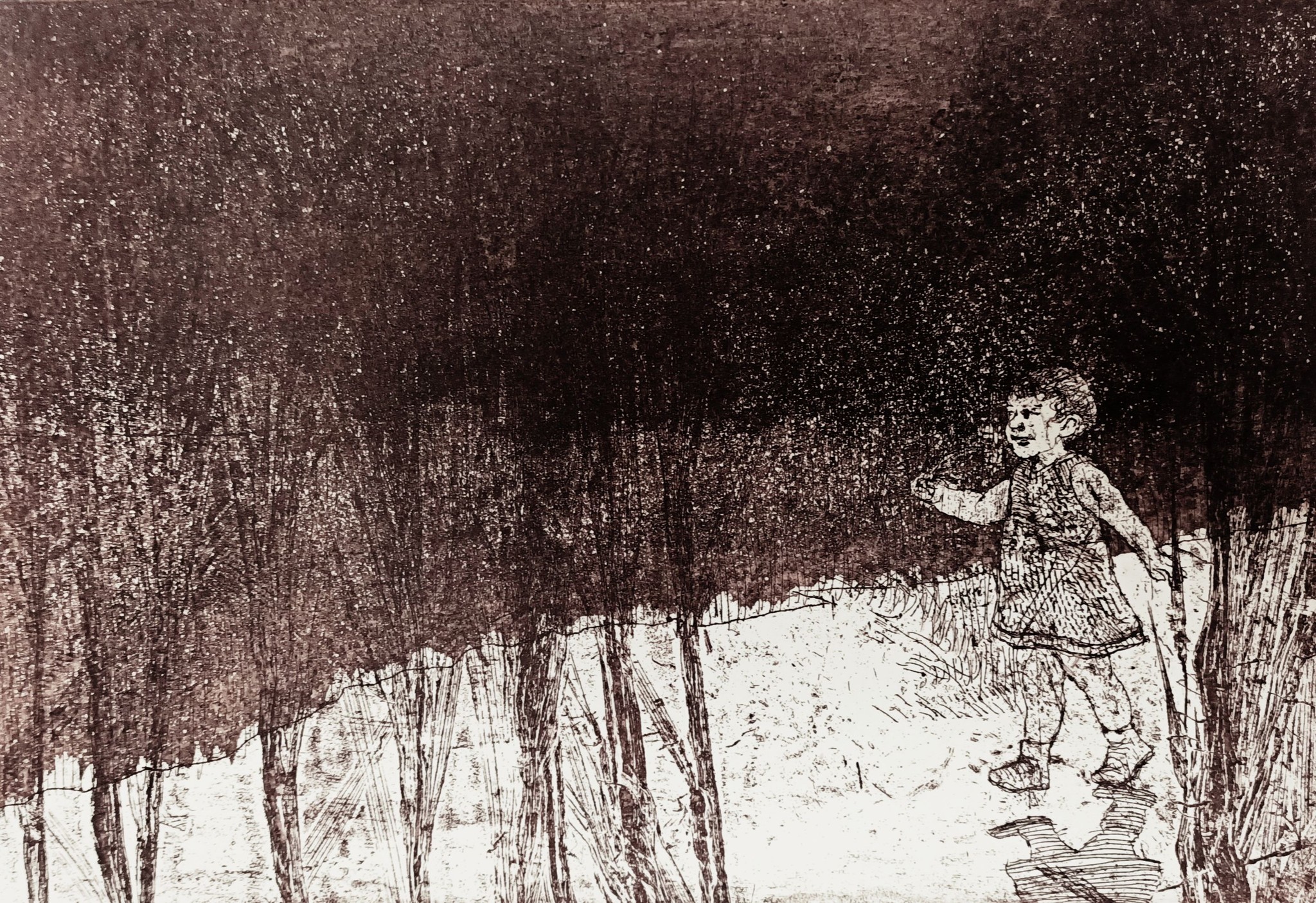
Innocence
Karel Vereycken featured in « Art to Hearts » Magazine

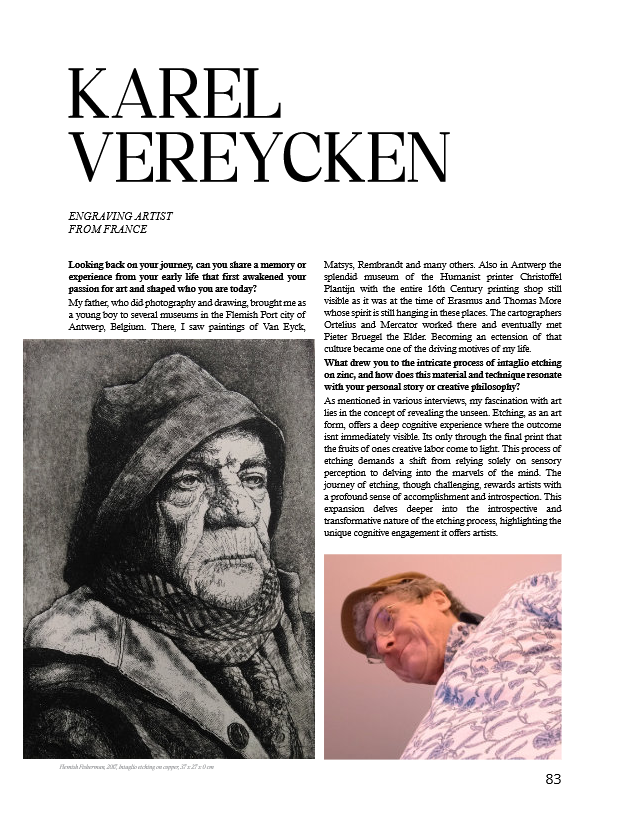
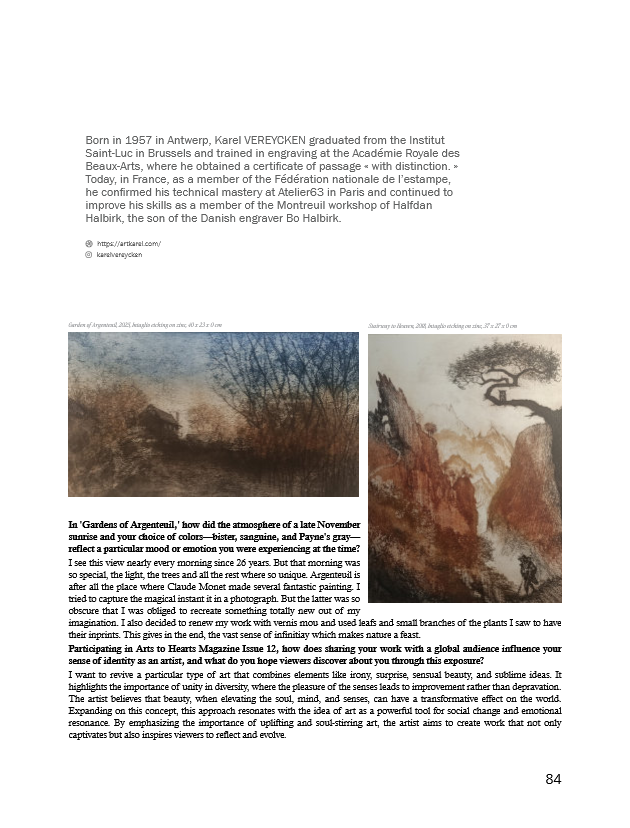
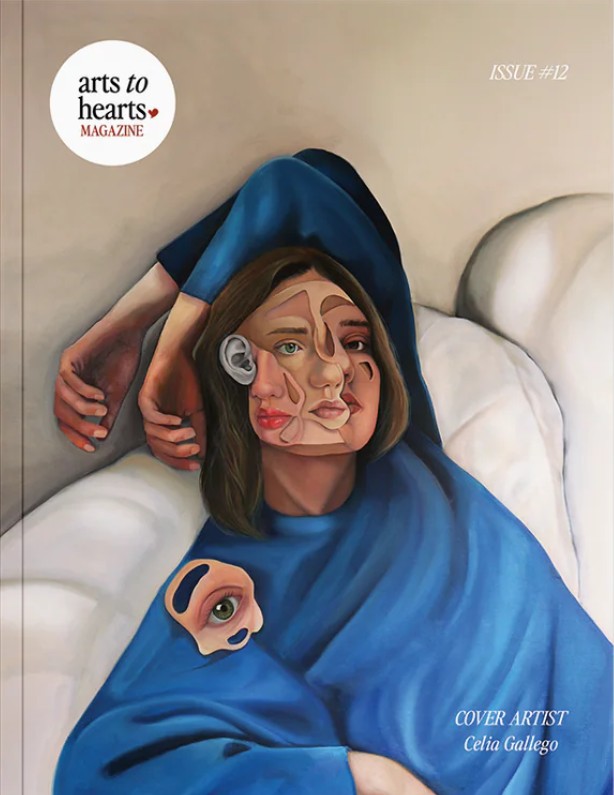
The international art magazine Art to Hearts, in its edition #12 appearing in April 2026, took two pages (p. 83-84) to feature the artistic statement and three engravings of Franco-Belgian painter engraver Karel Vereycken.
Big thanks for that !
« Arts to Hearts Magazine, a key initiative of the Arts to Hearts Project, highlights and amplifies the voices of artists worldwide. This international art publication offers a platform to showcase their diverse talents, perspectives, and stories. Widely available through retailers like Barnes & Noble and Amazon, the magazine connects artists to a global audience of galleries, curators, collectors, and art lovers, bringing their work into the spotlight. »
Karel Vereycken art work on show in New York
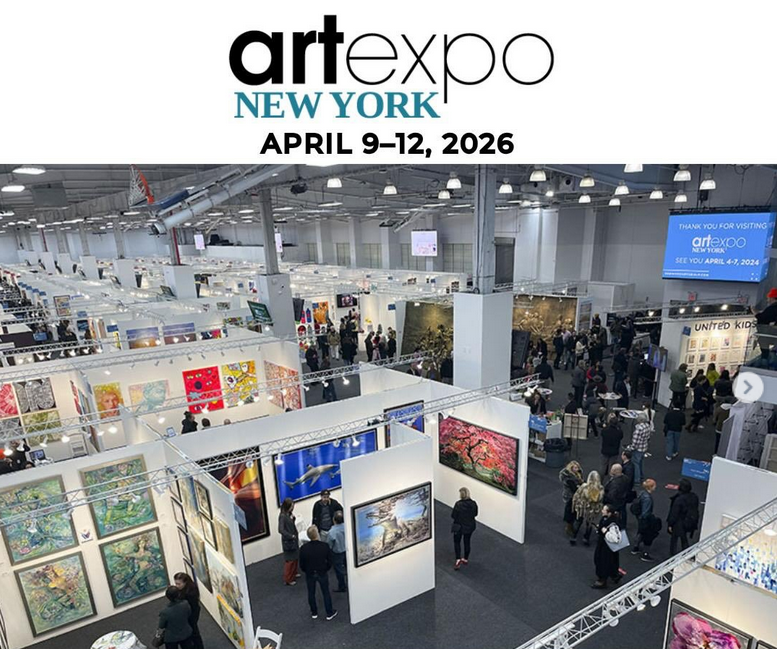
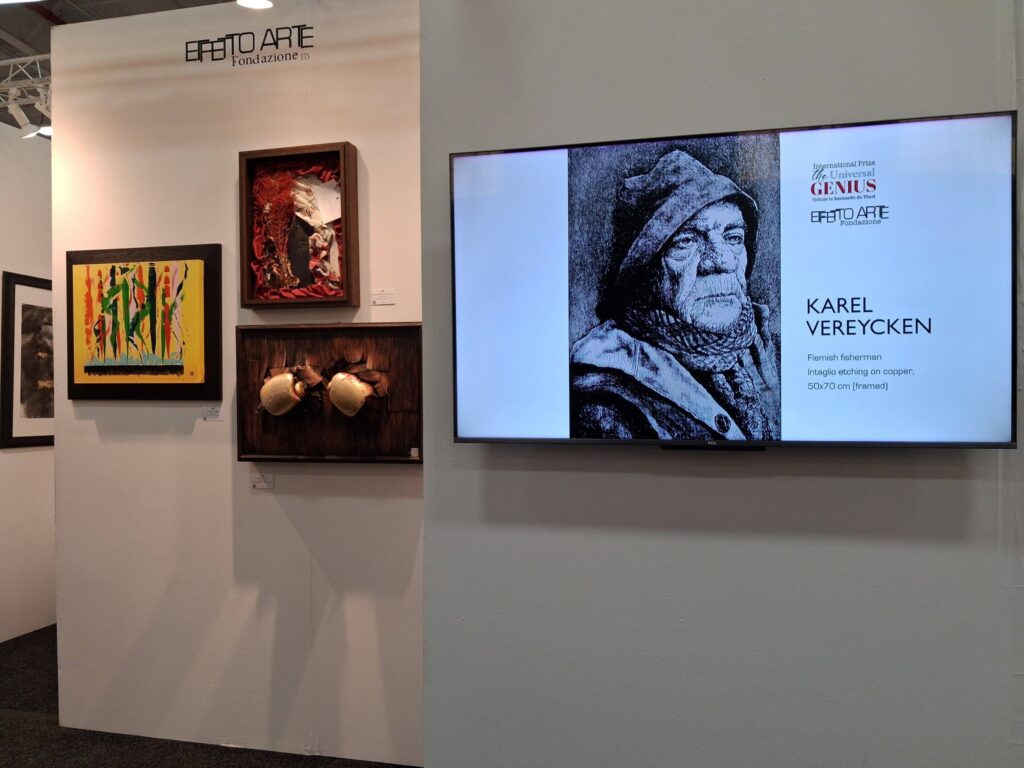
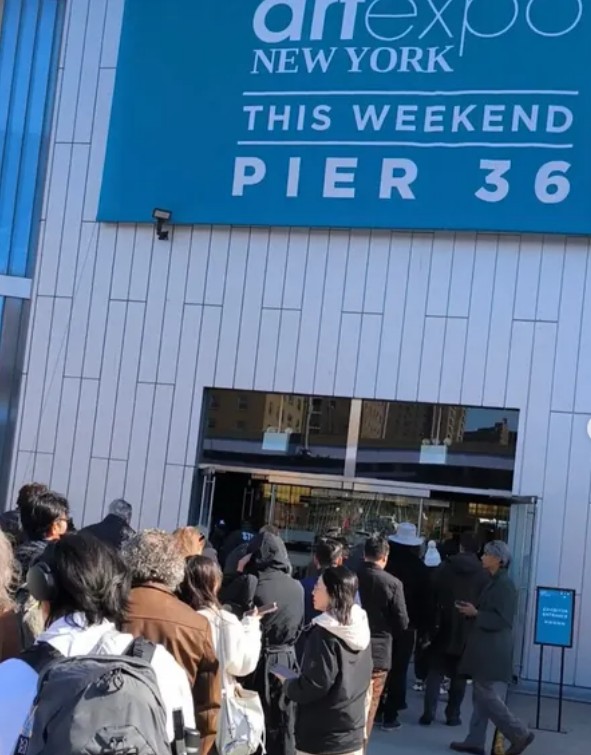
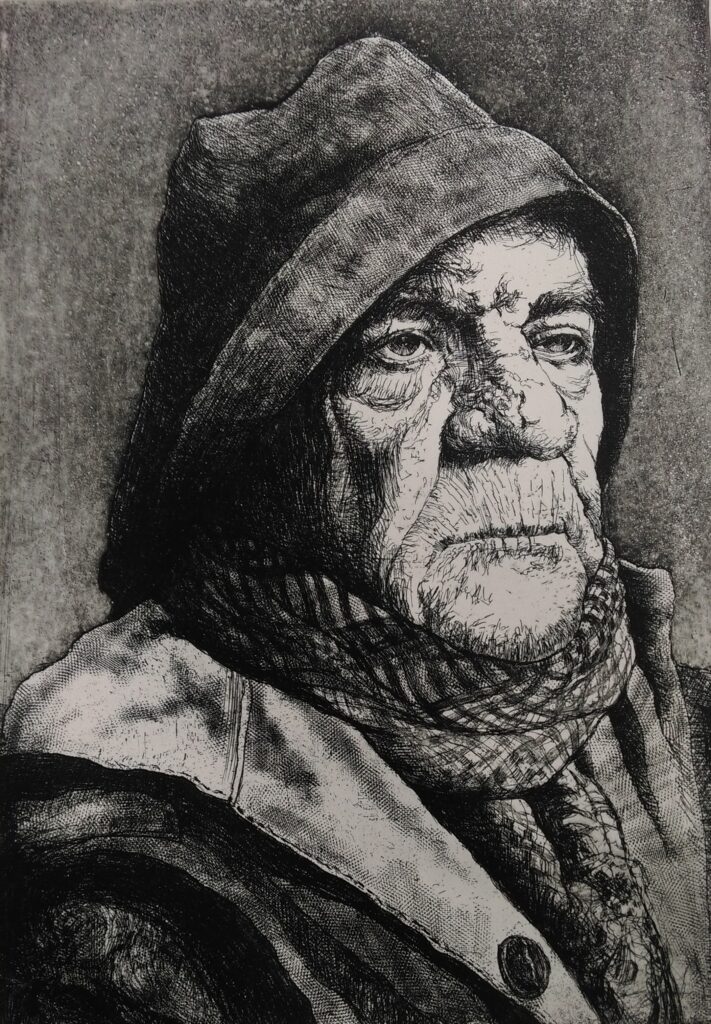
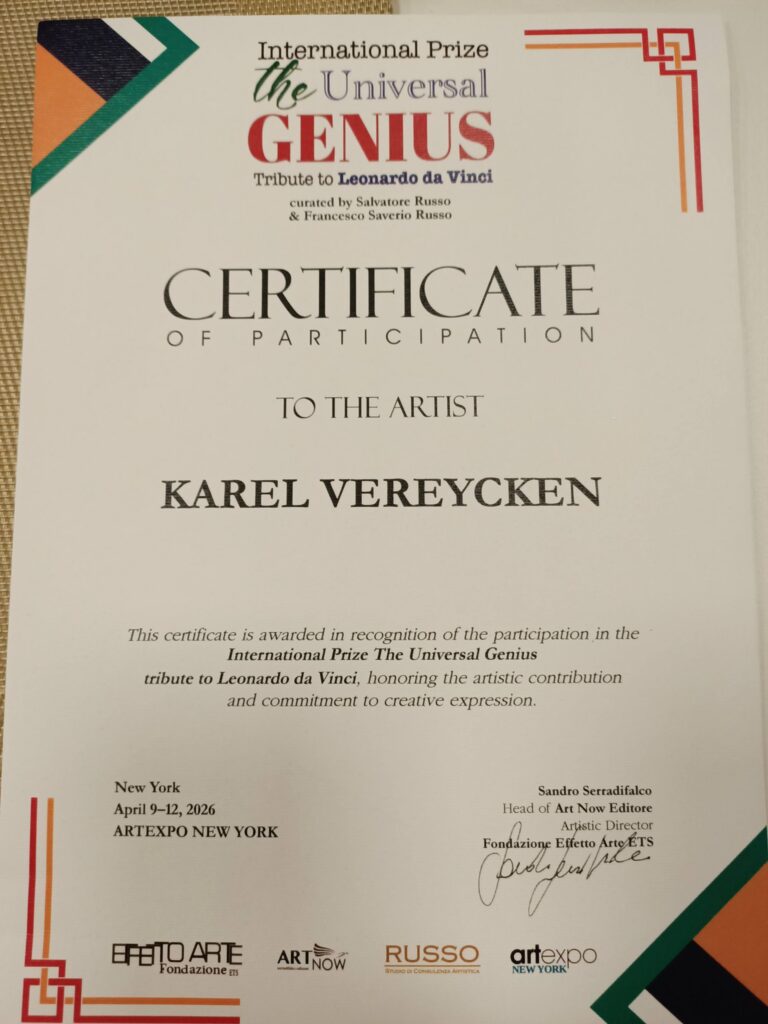
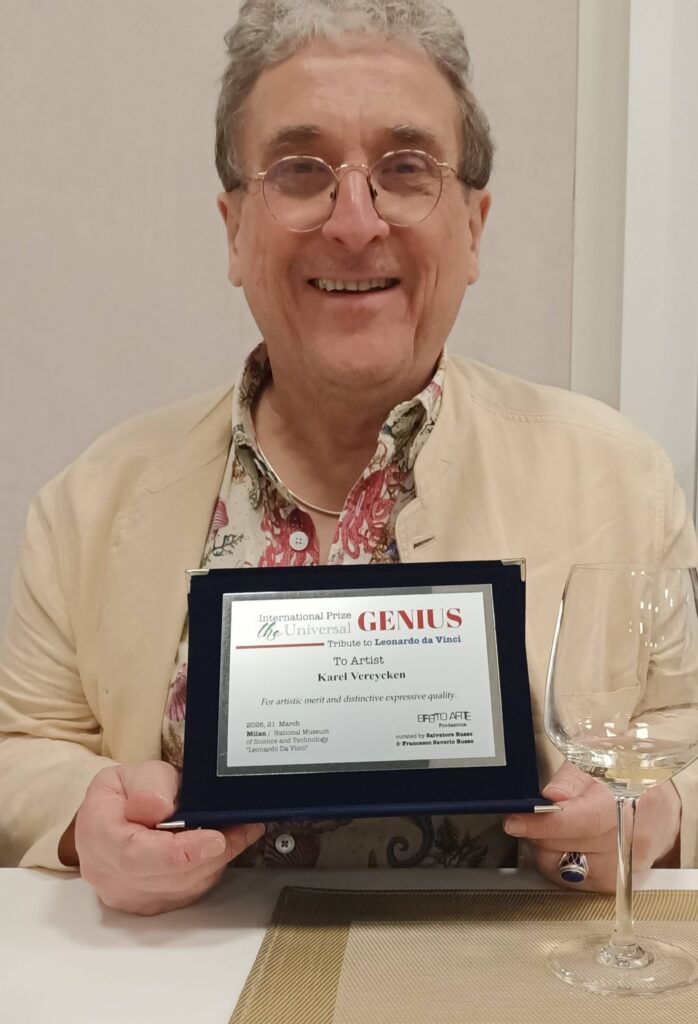
Karel Vereycken’s engraving « Flemish Fisherman » will be digitally on show at ARTEXPO (Pier 36) in New York, on April 9–12, 2026 at the booth of the Effetto Arte Foundation of Palermo who awarded the artist recently in Milan, Italy, with the international Prize « Universal Genius, Tribute to Leonardo da Vinci ».
Big thanks to them !
Karel Vereycken awarded Honorable Mention in 14th Open Art Competition
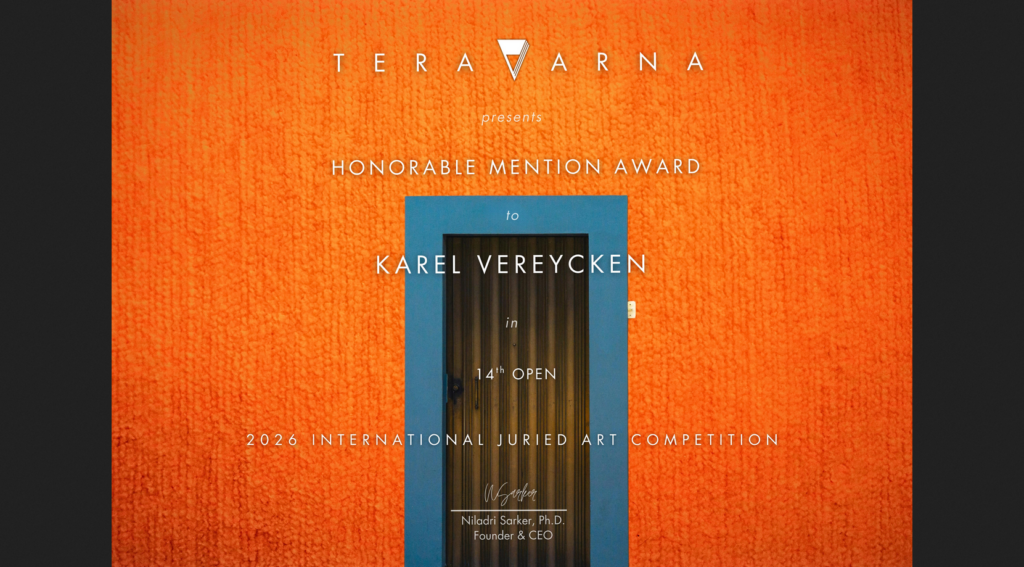
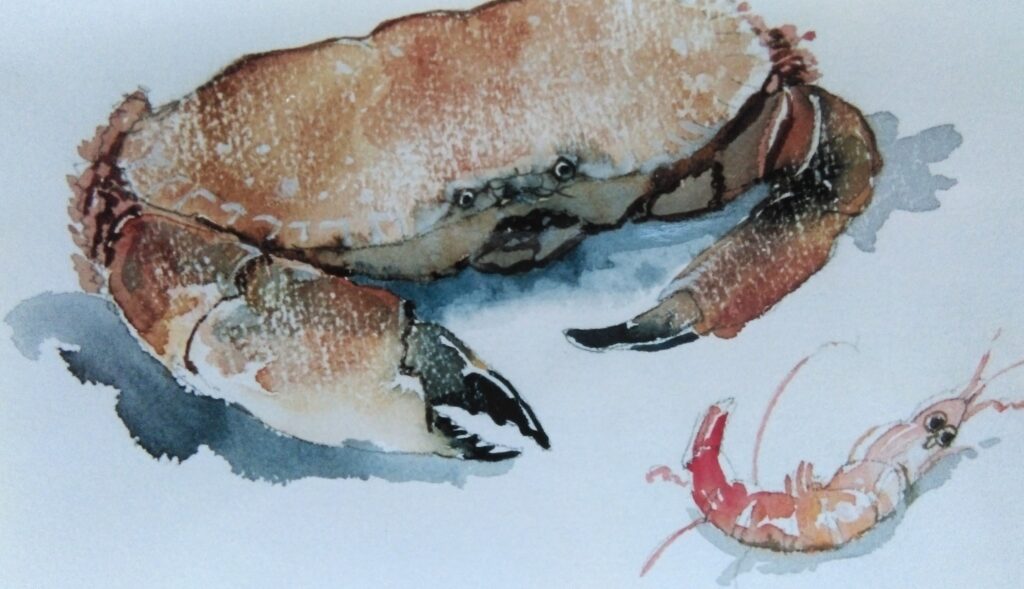
In April 2026, Karel Vereycken‘s watercolor « The Crab » obtained an « Honorable Mention » at 14th « Open » International Juried Art Contest of Teravarna.
Karel Vereycken featured in ARTIO Magazine
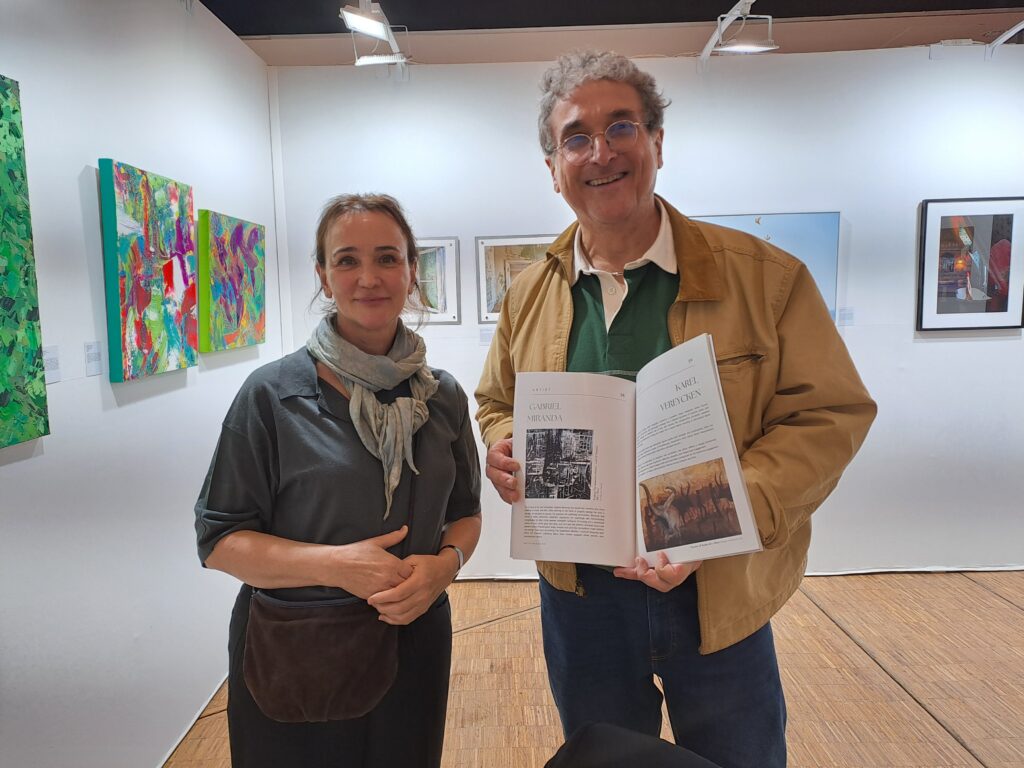
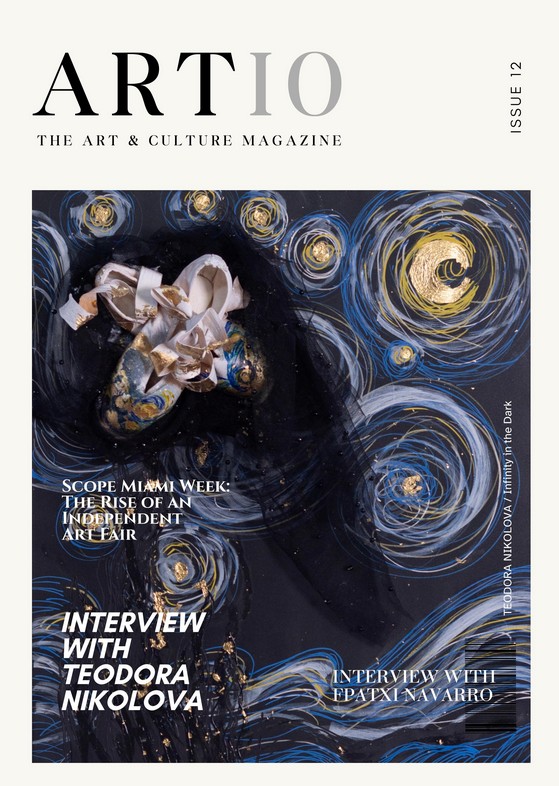
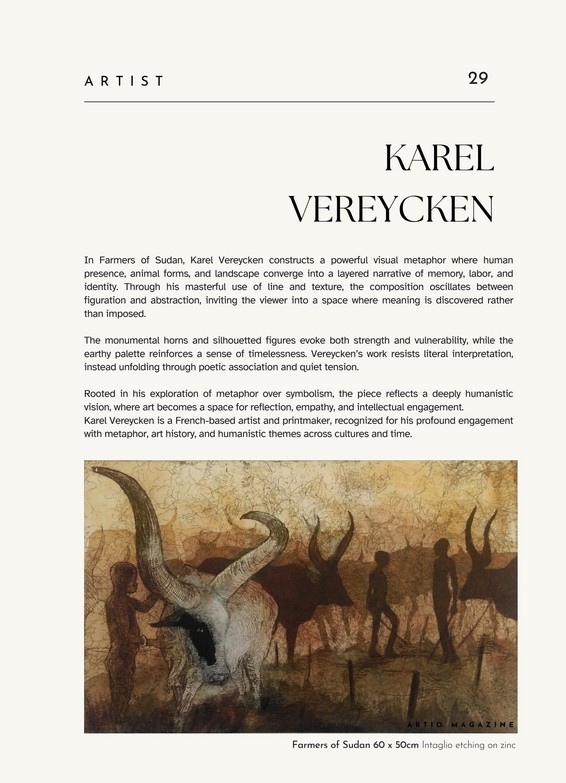
In its March-April issue (N° 12), the Art & Culture Magazine ARTIO published by ARTIO Galery, published a one page feature showing Karel Vereycken‘s etching « Farmers of Sudan ». Big thanks for that to artist Bisa Bennett, its director and curator in chief.
Karel Vereycken finalist for Cover Contest Art Magazine
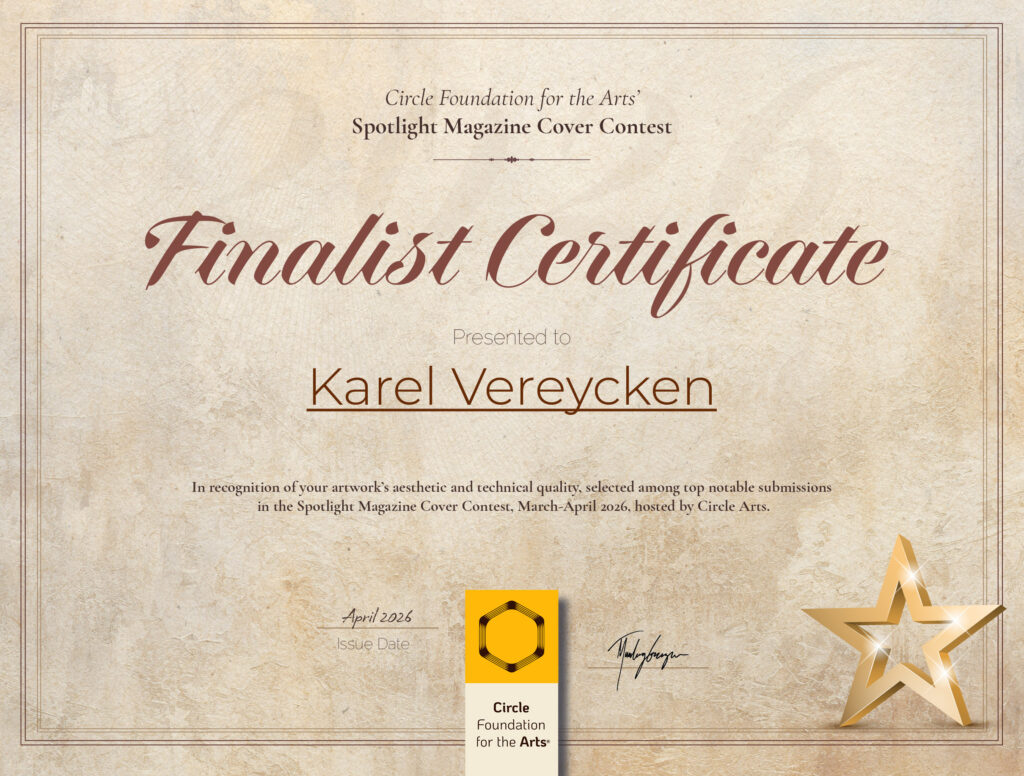
On March 10, Franco-Belgian painter engraver Karel Vereycken was informed that he was selected as one of the 30 finalist of the cover contest for Spotlight Magazine.
« With over 280 participating artists from 40 countries submitting work across a wide range of styles and media, selecting only a few pieces was not an easy task. While your work was not selected for the magazine cover, I am very pleased to inform you that you have been chosen as one of 30 Contest Finalists. This distinction reflects the strength and quality of your work among a highly competitive international selection. »
Karel Vereycken Finalist for Santa Fe Art Show
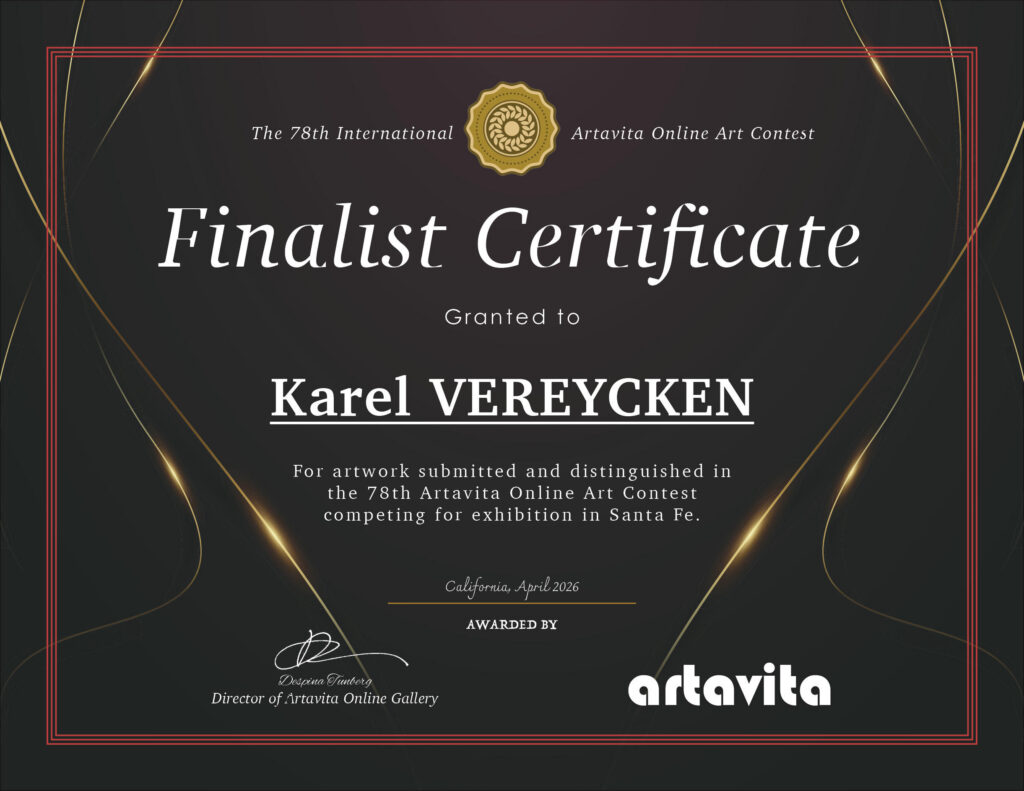
On April 7, 2026, Franco-Belgian painter engraver Karel Vereycken received a Finalist Certificate « for artwork submitted and distinguised in the 78th Artavita Online Art Contest competing for exhibition in Santa Fe ».
A Milan, Karel Vereycken appelle à une « nouvelle Renaissance »
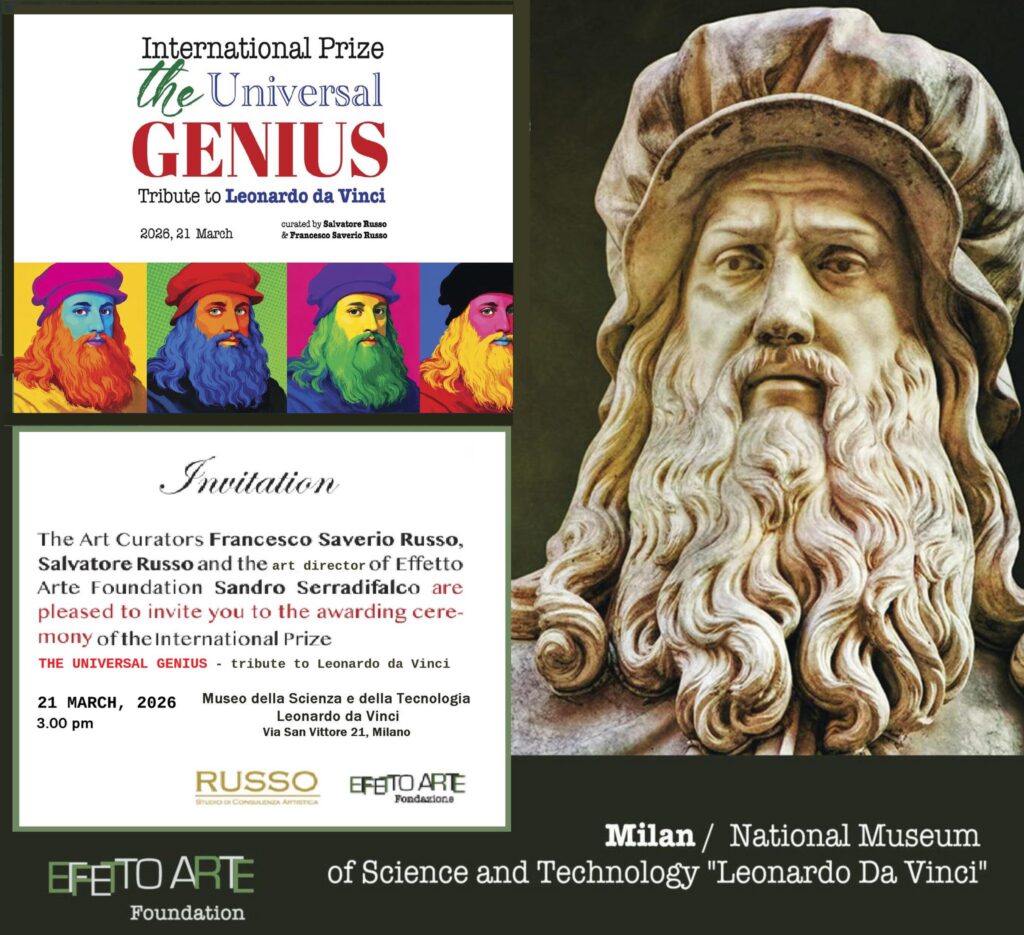
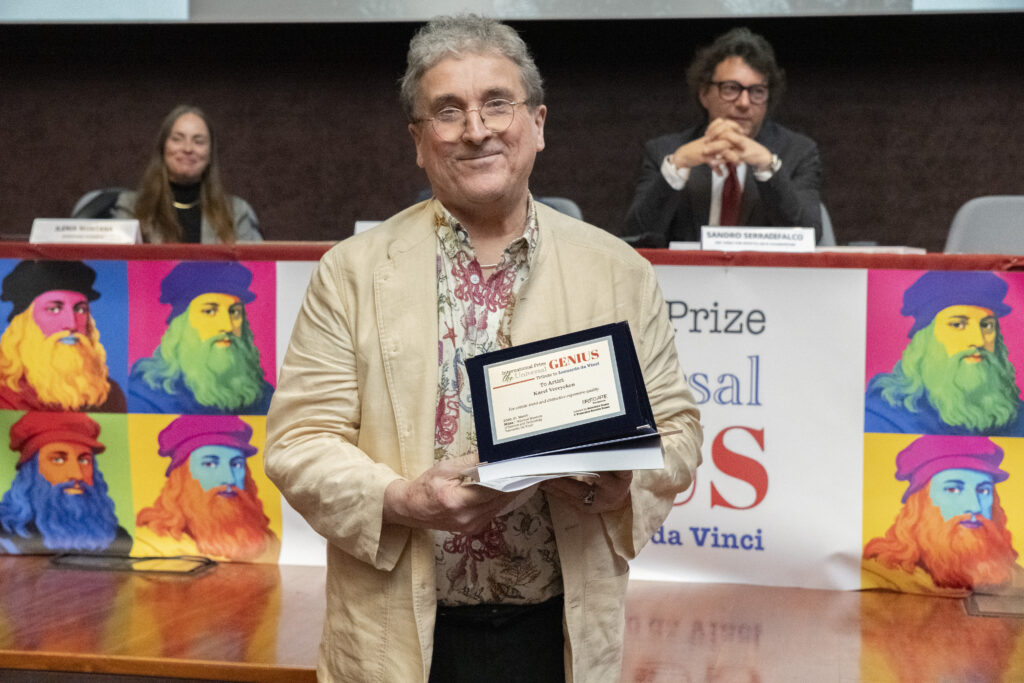
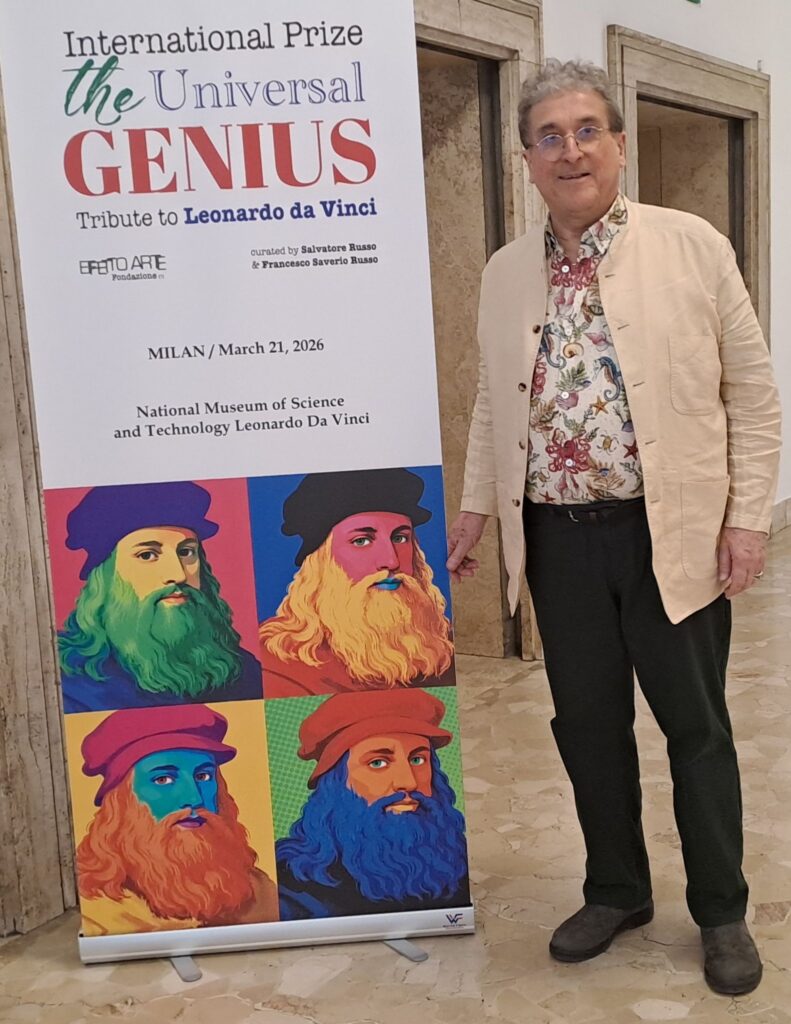
Le 21 mars, lors de la remise du Prix international « Le Génie universel – Hommage à Léonard de Vinci », dans l’auditorium du prestigieux Musée national des sciences et des techniques Léonard de Vinci, à Milan, le peintre graveur Karel Vereycken a lancé un appel en faveur d’une « Nouvelle Renaissance ».
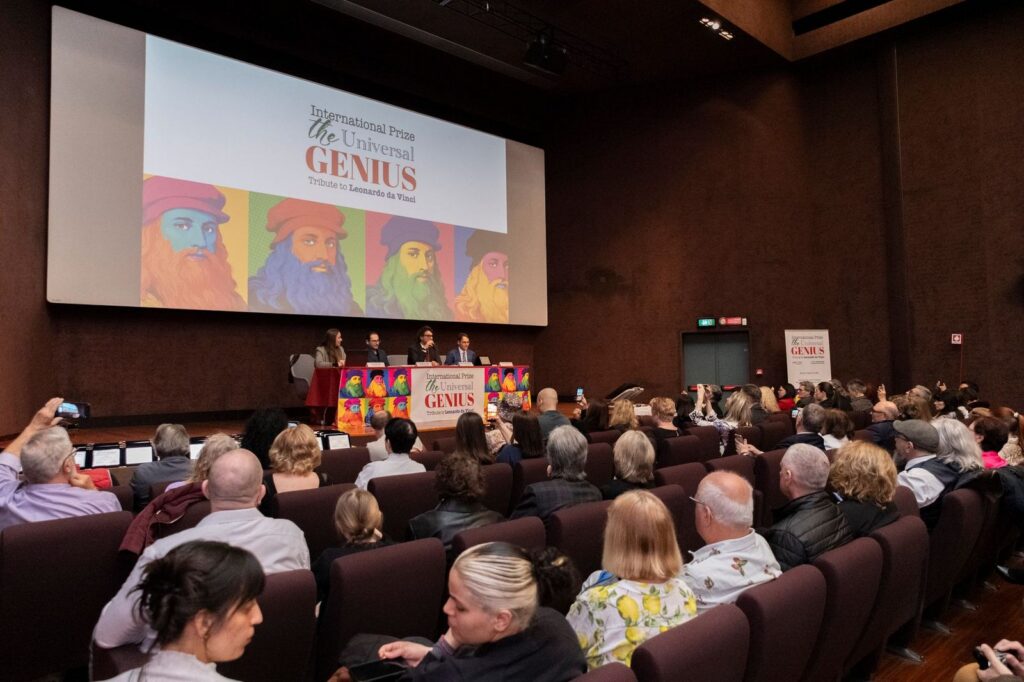
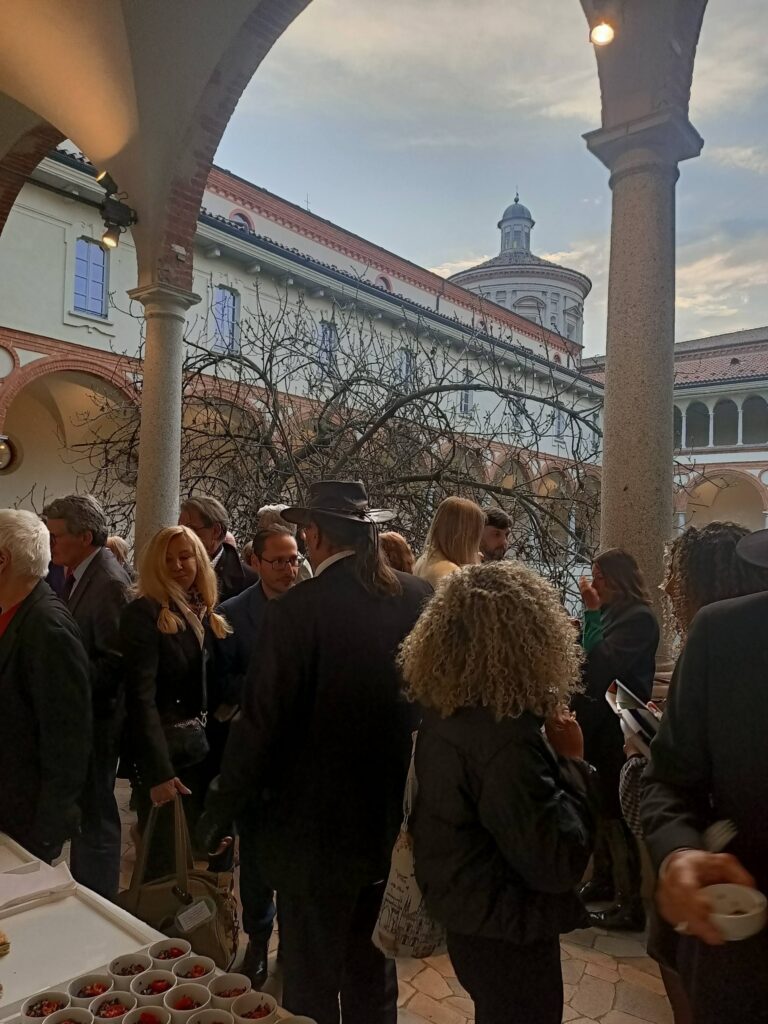
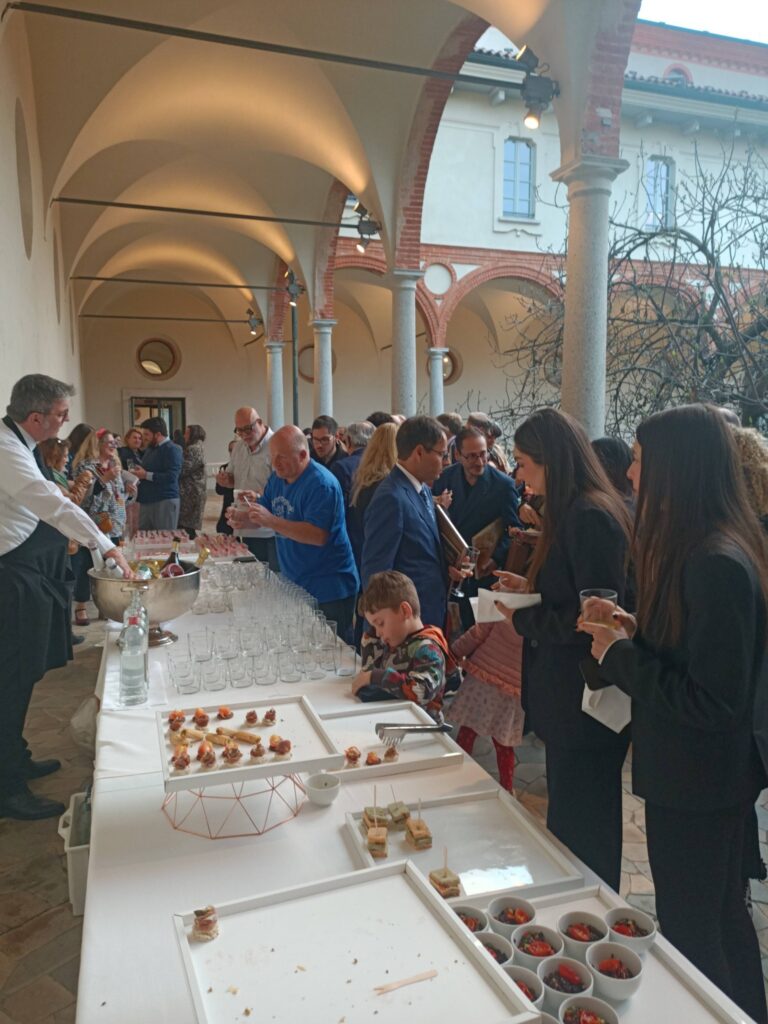
Venus de soixante pays, une bonne centaine d’artistes et d’amateurs d’art assistaient à la cérémonie.
En guise de clôture, un représentant diplomatique du Mexique a félicité organisateurs et artistes présents.
Avant de se métamorphoser en fondation, c’était une association destinée à promouvoir les artistes débutants et confirmés. Galerie d’art et éditeur, la Fondation organise régulièrement des expositions internationales dans de nombreuses villes italiennes et étrangères.
Les finalistes avaient été sélectionnés pour la consistance artistique de leur démarche par les conservateurs de la « Fondazione Effetto Arte » de Palerme.
Concernant leur mission, les organisateurs écrivent sur leur site :
« Nous sommes convaincus que nos expériences doivent se concrétiser et s’étendre, afin de contrer l’aplatissement intellectuel de notre époque. Plus que jamais, en ce moment historique, l’art a besoin d’espaces de participation maximale pour que le grand public puisse y prendre part. C’est la voie que nous nous engageons à suivre pour les événements futurs, afin de permettre à un nombre croissant de personnes d’entrer en contact avec la dimension artistique, de la manière la plus simple et la plus directe, comme un moment de partage social avec les communautés artistiques. »
Vereycken n’était que l’un des nombreux lauréats primés. Remerciant les organisateurs pour cette distinction, plusieurs artistes ont expliqué en quoi Léonard de Vinci avait été pour eux une source d’inspiration personnelle et constante.
L’un d’eux a déclaré :
« À 28 ans, je pouvais reproduire de mémoire la plupart des tableaux de Léonard. »
Nombre d’entre eux, très émus, ont évoqué leur art, non seulement comme un refuge face à l’anxiété envahissante du moment présent, mais aussi comme un moyen pour combattre et réduire la menace d’une guerre imminente.
Discours
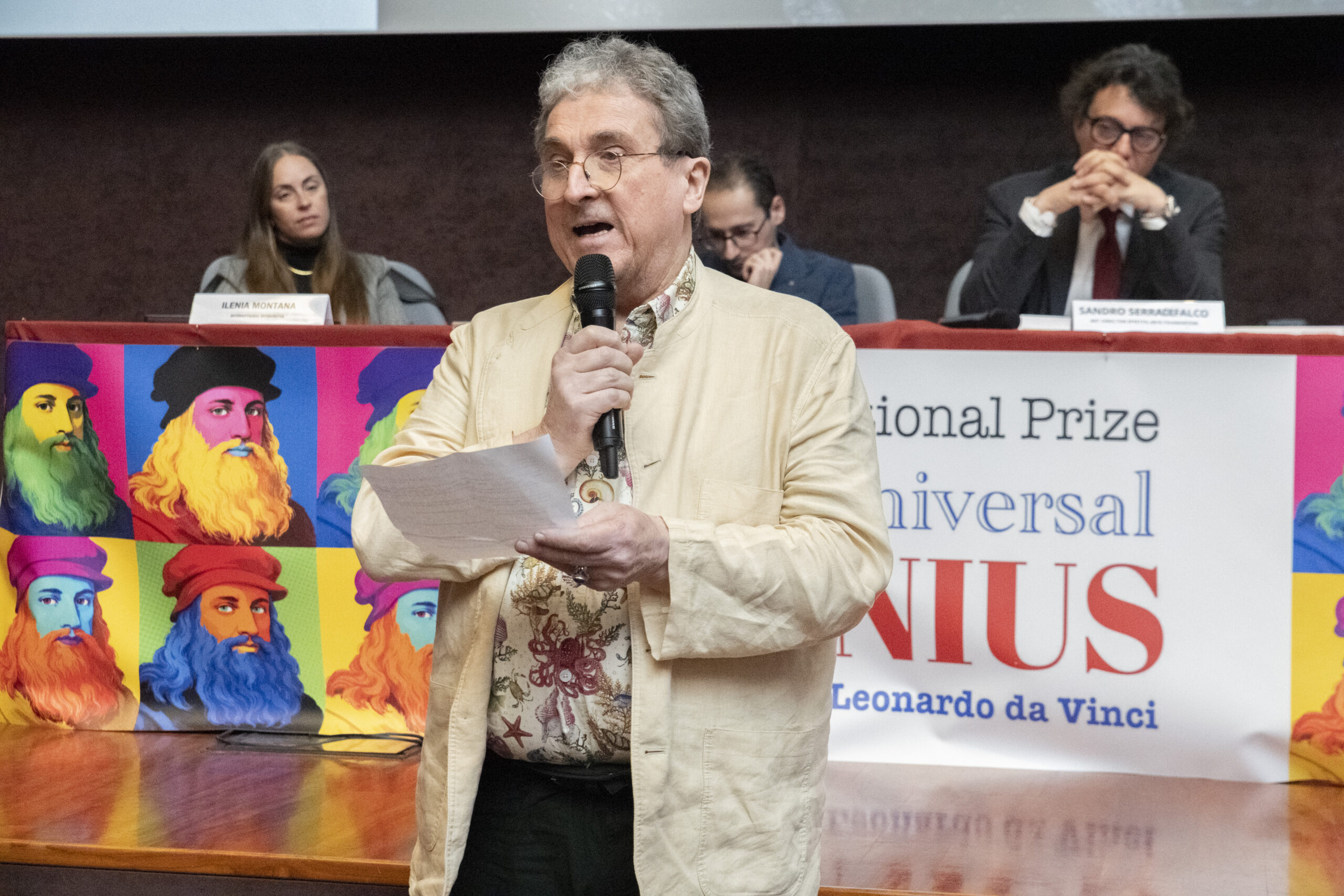
Chers organisateurs, chers collègues, honorables invités,
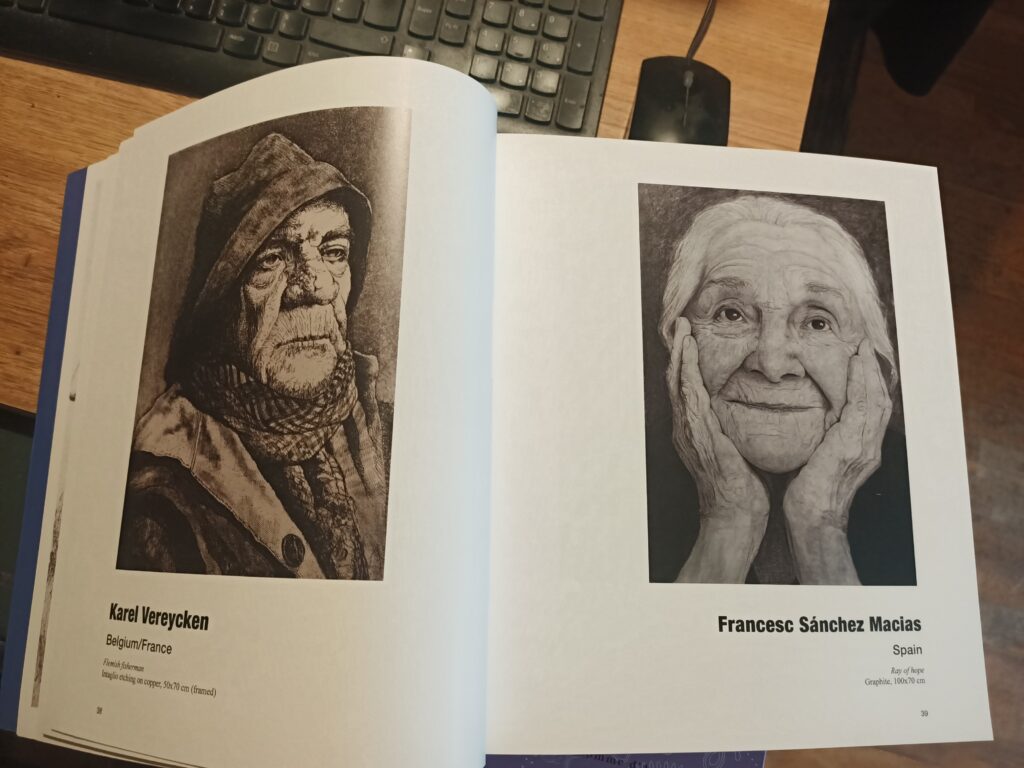
Tout d’abord, félicitations à vous tous, et plus particulièrement aux graveurs, car nous nous faisons rares. Voici ma gravure sur cuivre. (Apparaît sur grand écran « Le pêcheur flamand », à gauche sur la photo du catalogue.)
C’est avec un grand honneur et un immense plaisir que j’assiste à cet événement important et que j’accepte cette distinction.
Je tiens à féliciter les organisateurs pour cette initiative. Jamais le moment n’a été plus opportun pour rendre hommage au génie de la Renaissance, Léonard de Vinci, car aujourd’hui, en ces temps sombres de guerre, de corruption et de déprévation, il est absolument urgent que nous, artistes et amateurs d’art, renouions avec les plus hautes exigences.
Où en est le monde aujourd’hui ? Nous sommes entrés dans le siècle de la supercherie absolue, où de fausses informations et de fausses monnaies sont produites par de fausses élites se servant de l’intelligence fausse pour manipuler l’information, tout en poussant le monde réel à de véritables guerres contre de véritables êtres humains.
Pire encore pour les arts : le meurtre, la guerre et même le génocide sont promus sur internet comme des œuvres d’art à vendre.
Réveillons-nous ! Déjà en 1789, alors que les révolutions balayaient l’Europe, le poète allemand Friedrich Schiller, dans un poème, soulignait l’importance de l’ART :
« Artistes ! La dignité de l’homme est remise en vos mains : gardez-la ! Elle tombe avec vous ! Avec vous elle s’élèvera ! »
Par conséquent, une nouvelle Renaissance n’est pas un simple rêve. Il faut la concrétiser à nouveau, afin de réhumaniser l’humanité et de recréer l’empathie nécessaire au dialogue et à la compréhension mutuelle.
Milan est un lieu idéal pour jouer un rôle majeur dans cette nouvelle Renaissance. C’est ici, au palais de Ludovic Sforza, qu’une jeune et brillante poétesse, Cecilia Gallerani, dont le portrait nous est familier grâce à la « Dame à l’hermine », initia Léonard de Vinci à ses discussions musicales, poétiques et philosophiques – une rencontre qui marqua sans conteste l’ascension de Léonard de Vinci au rang de génie.
Pour lui, comme pour le penseur de la Renaissance Nicolas de Cues, dont les écrits furent lus ici, il nous faut apprendre à déchiffrer le macrocosme invisible à travers le microcosme. Le monde a besoin de nouvelles Cecilia et de nouveaux Léonard.
Mettons fin dès maintenant au « siècle de la supercherie » en organisant ensemble, grâce à des concours artistiques de grande qualité, une nouvelle Renaissance qui célèbre la beauté et la dignité intérieure.
Tel est le défi que nous devons relever aujourd’hui.
Merci.
Karel Vereycken featured in ART LOVERS Magazine
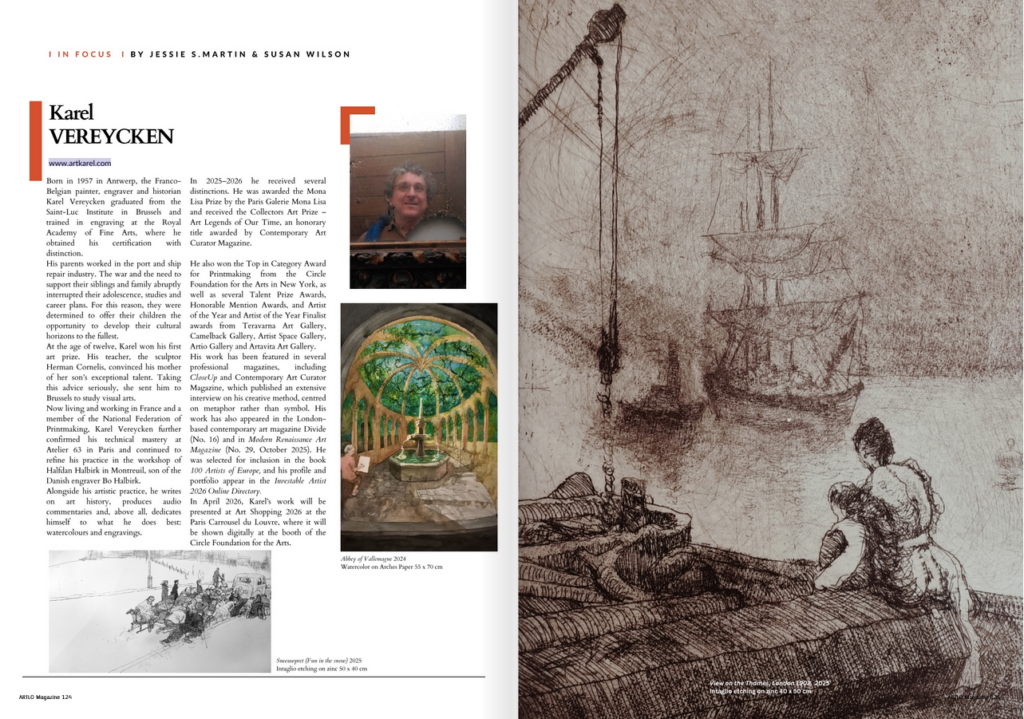
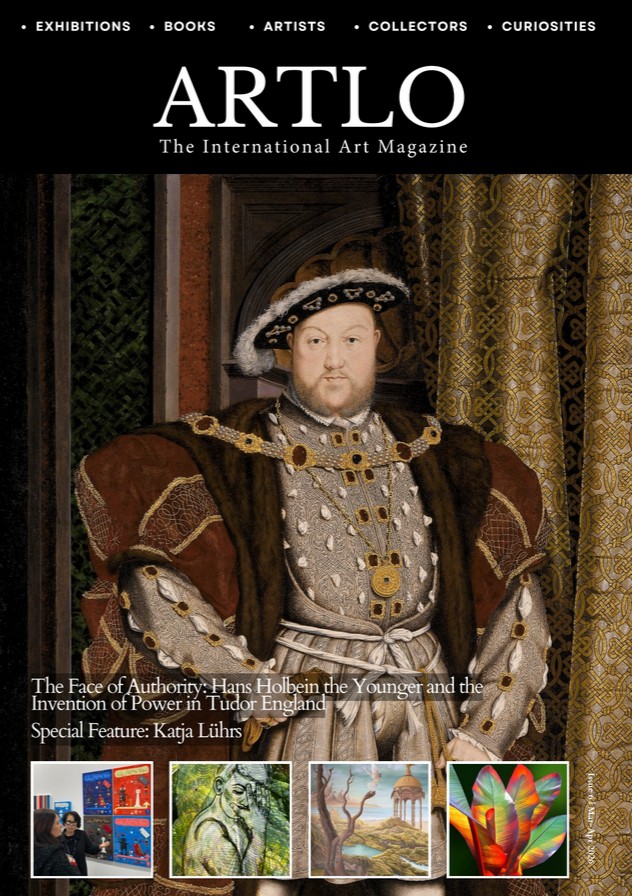
The outstanding and beautiful International Art Lovers Magazine (ARTLO), published in Spain, in its March-April issue N° 6, 2026, offers a two page feature article on Franco Belgian painter engraver and historian Karel Vereycken.
ARTLO identifies itself as « a group of people who are passionate about art – true art lovers who are enthusiastic about everything we do in the creative world. We love discovering emerging artists and being part of a community where art is a way of life ».
ARTLO Magazine clearly offers rich in depth articles allowing a remarkably high level and much needed debate on both « classical » and « modern » art.
You can order, in the coming days, your own print copy, via this link.
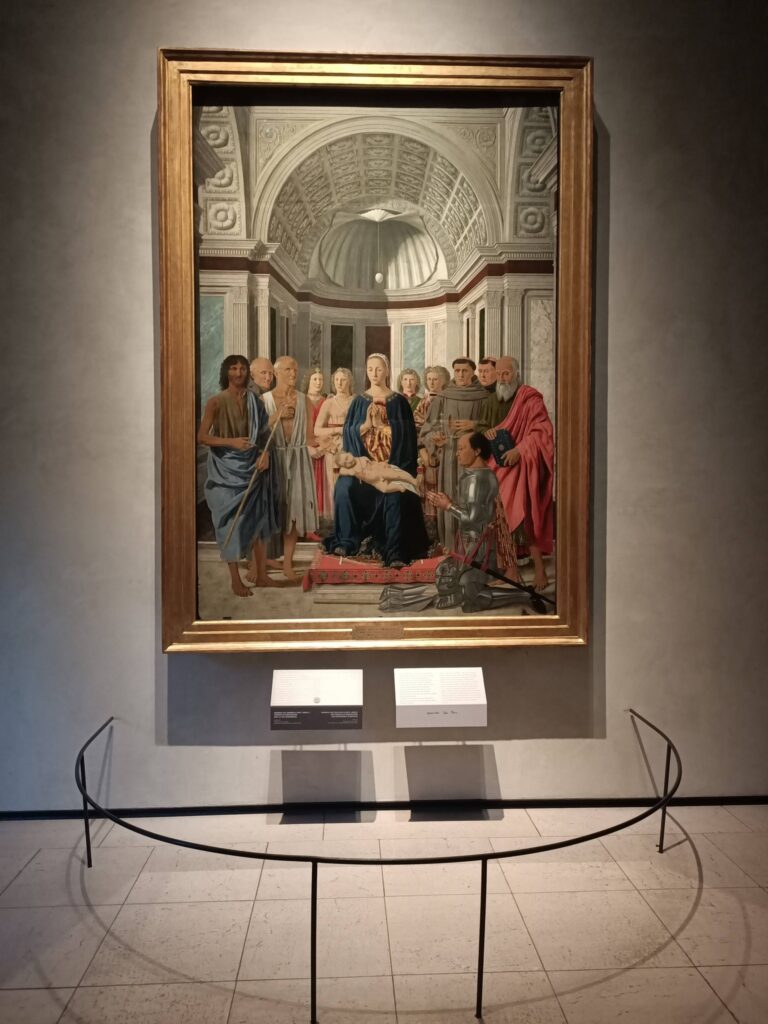
AUDIO: Piero della Francesca at Milan Brera Pinacoteca
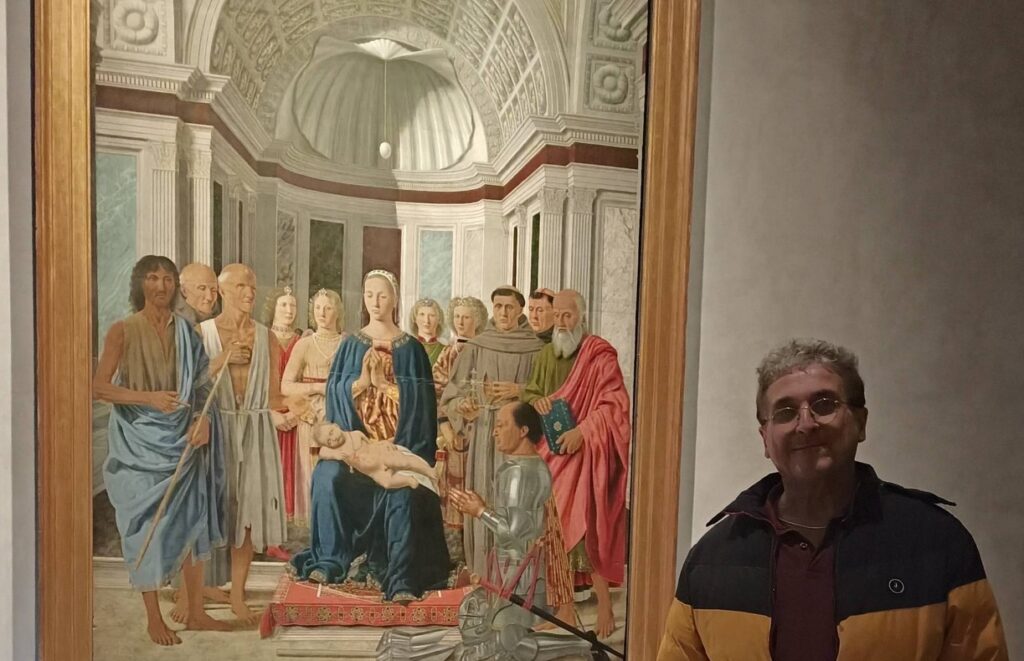
Access AUDIO from pdf: click here.
Audio recorded on Sunday March 22, 2026, during my visit to the Brera Pinacoteca of Milan.
For the historical context and an indepth analysis, see my article « The Egg without a Shadow of Piero della Francesca » (Fidelio, 2000)
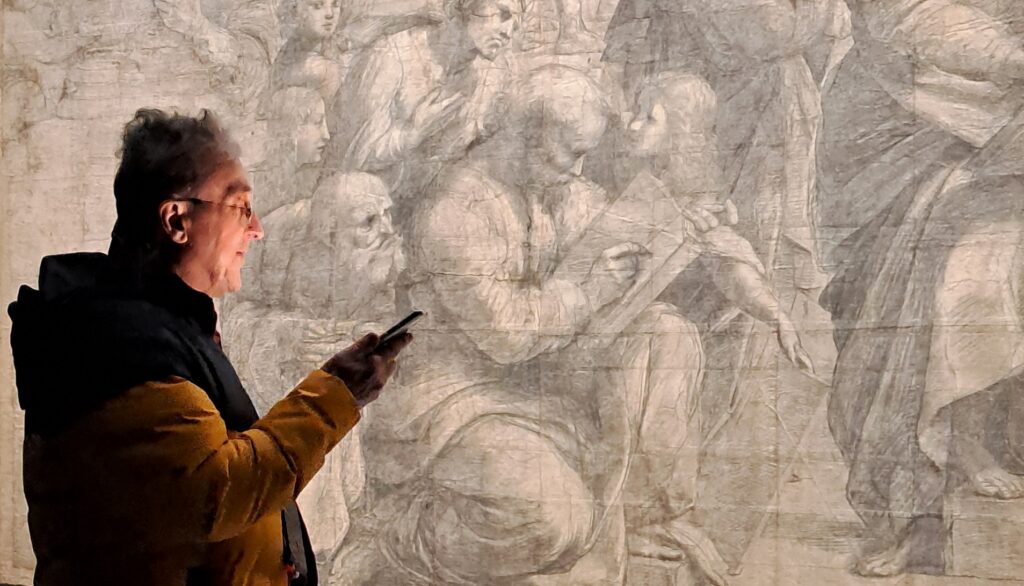
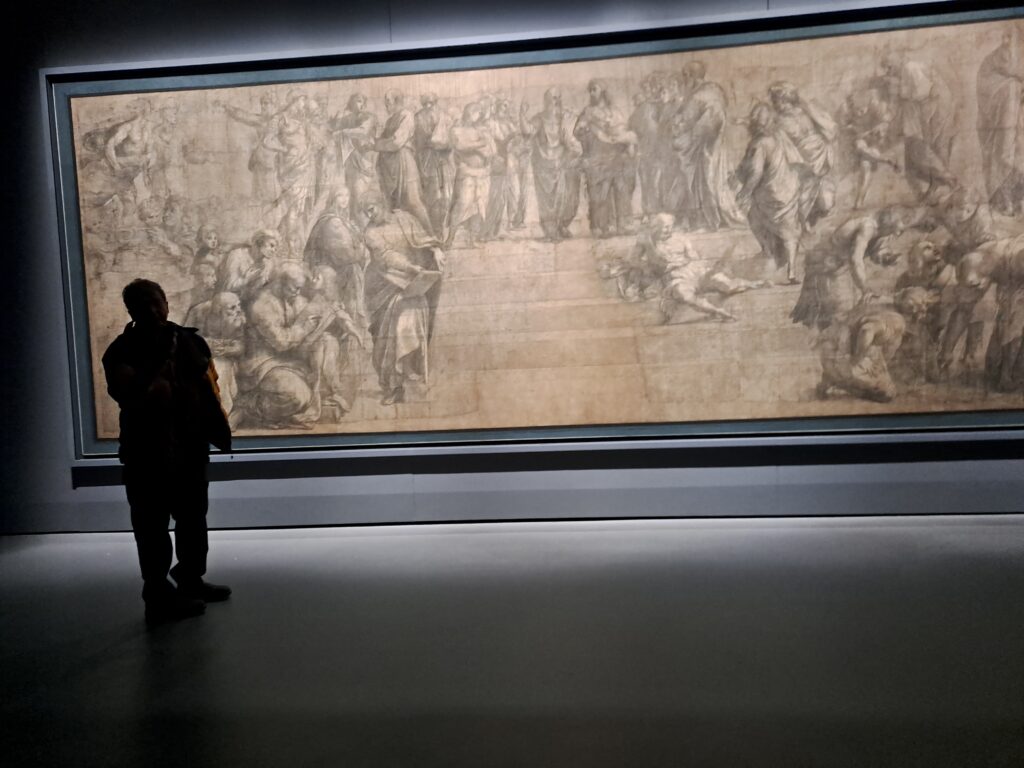
AUDIO : Raphael’s cartoon for « The School of Athens » in Milan
AUDIO:
from the pdf file, click on this LINK
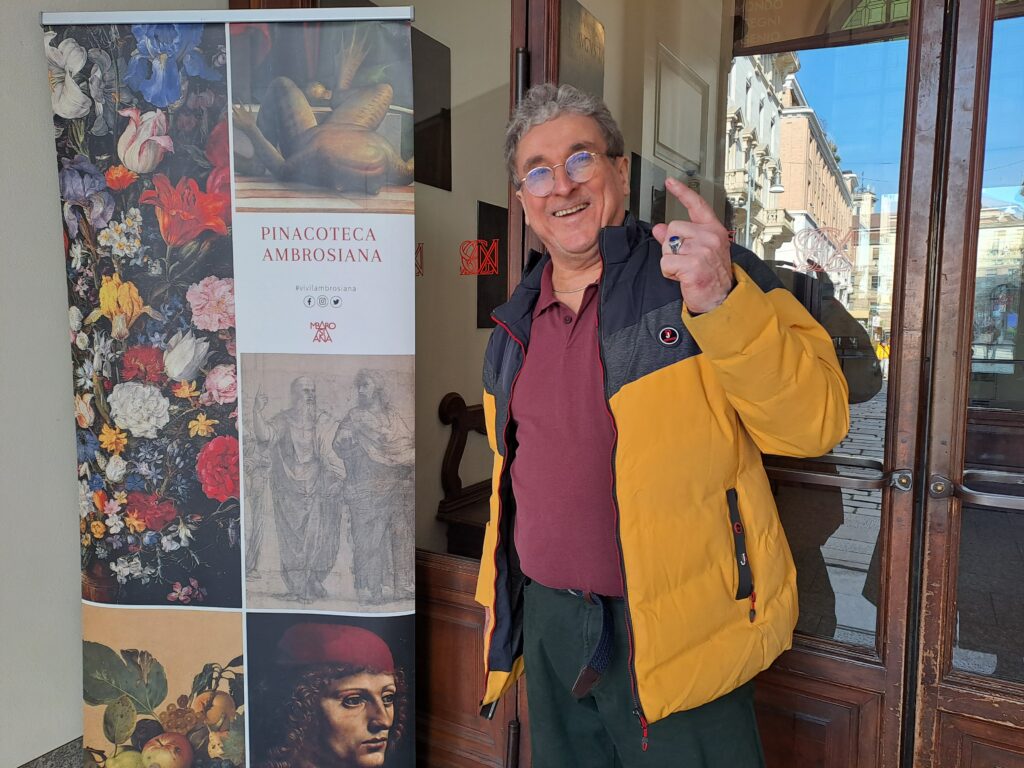
Audio recorded during my visit at the Pinacoteca Ambrosiana in Milan, on March 20, 2026. For my full, in depth analysis of Raphael and his « School of Athens », see my article.
Karel Vereycken featured in Art Star Magazine
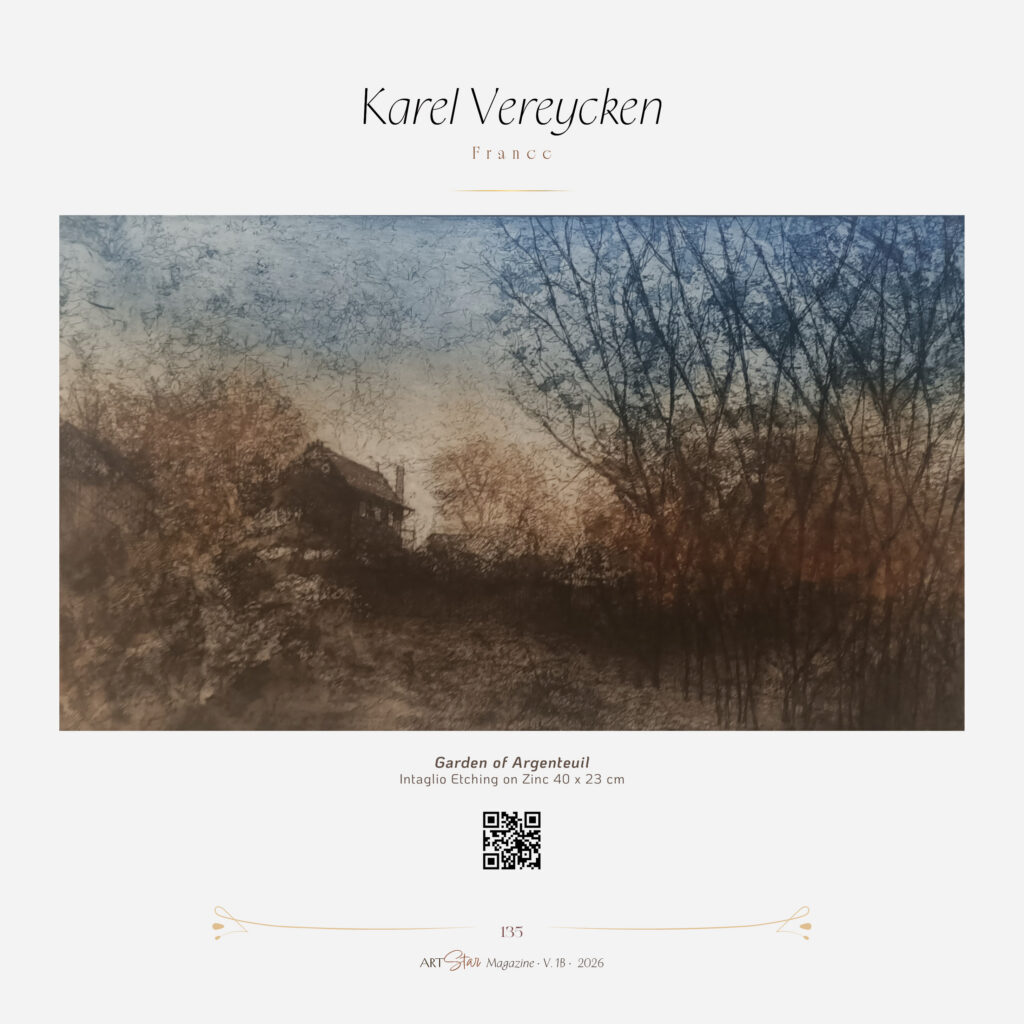
Garden of Argenteuil, a color engraving of Karel Vereycken, is featured in the March issue of ART STAR Magazine, The 2026 Guide to Remarkable Art (V. 1B, 2026).
Karel Vereycken rewarded in Milan, calls for a “New Renaissance”
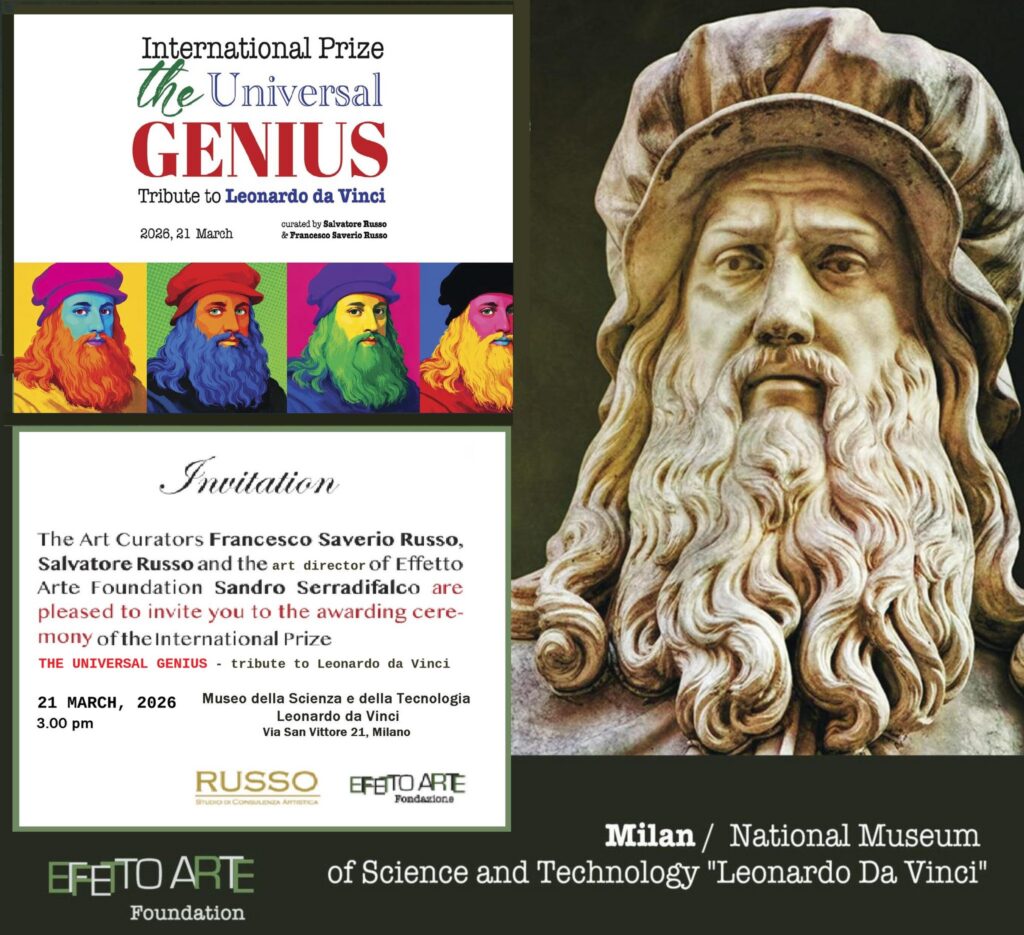
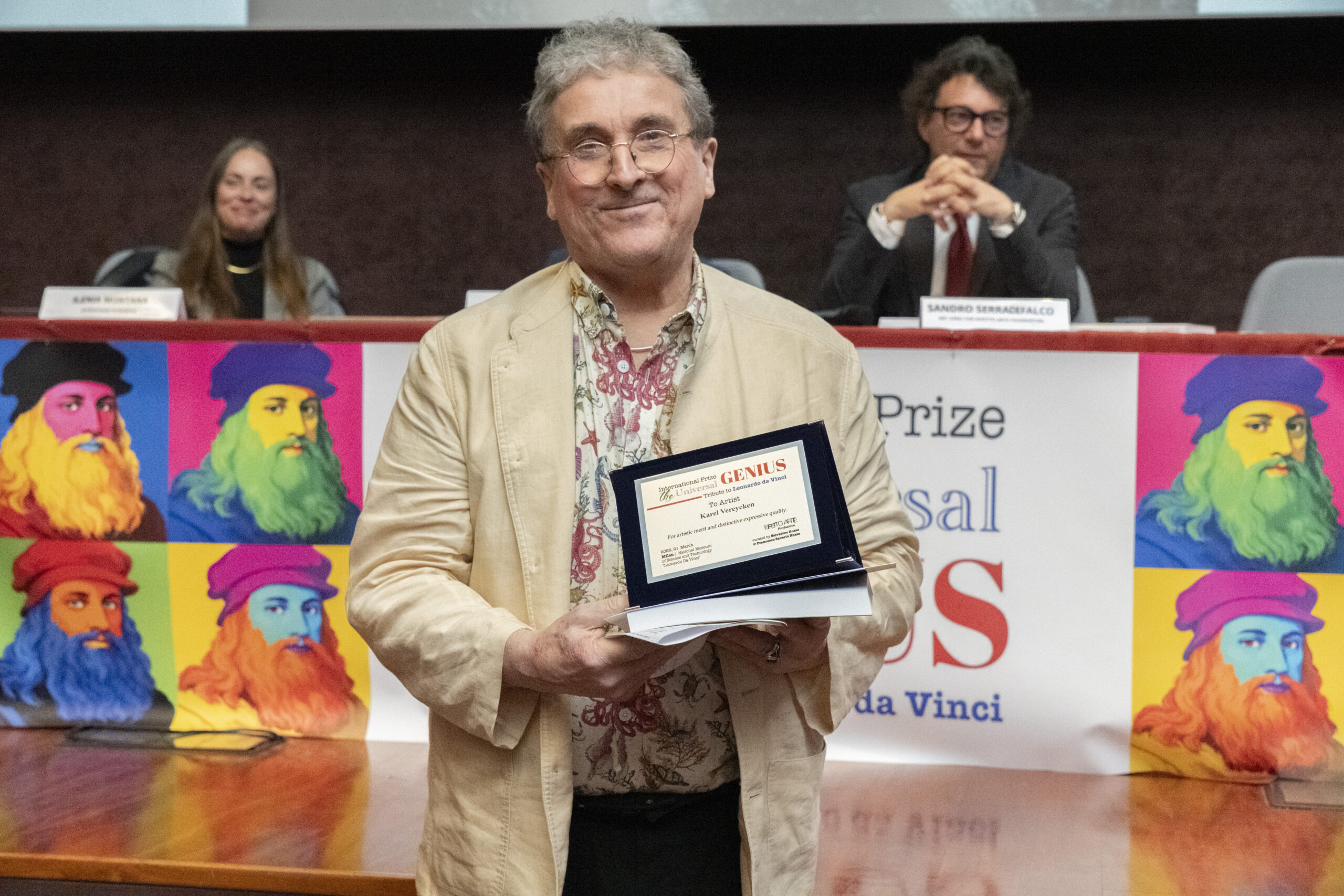
On Sat. March 21, 2026, invited to assist in Milan, Italy, at the Awarding Ceremony of the International Prize “The Universal Genius – Tribute to Leonardo da Vinci” held at the prestigious National Museum for Science and Technology Leonardo da Vinci, painter engraver and historian Karel Vereycken, presented a 3 minute call for a “New Renaissance”.
Over a hundred artists and art lovers filled the auditorium and a diplomatic representative of Mexico made one of the concluding statements of the event.
Finalists for the Prize were selected for their consistency by the curators of the “Effeto Arte Foundation” of Palermo. Before becoming a Foundation, the organizers created an art gallery and a publishing group, organizing large international exhibitions every two years in numerous Italian and foreign cities.
Regarding their mission, they write: “We believe that our experiences must be turned into realities to be expanded, to counteract the intellectual flattening of our time. Especially in this historical moment, art needs spaces of maximum participation so that even the general public can take part in it. This is the path we are committed to follow for future events, in order to allow an increasing number of people to get in touch with the dimension of art, in the simplest and most direct way, as a moment of social aggregation with the artistic communities.”
Vereycken was one among the many honored with the Prize. Thanking the organizers for awarding them, several artists explained why Leonardo had been a personal and lifelong source of inspiration.
One artist said: “when I was 28, I could reproduce by memory most of Leonardo’s painting”.
Many were emotional and connected their art, not only as a shield to protect themselves from anxiety, but as a means to change the current situation of looming war.
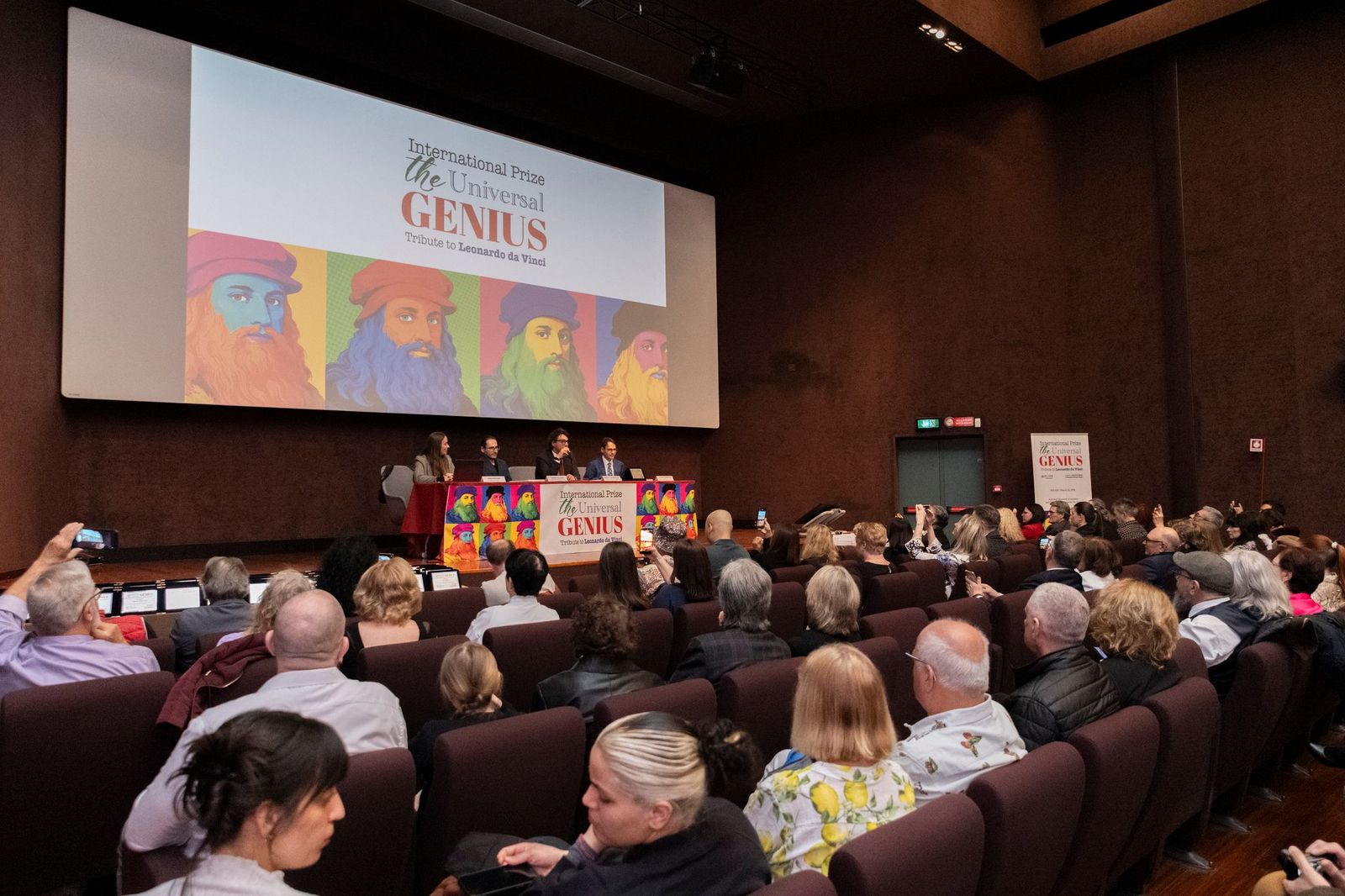
Dear organizers, dear colleagues, honorable guests,
First congratulations to all of you and especially to the print-makers because we are becoming rare. This is my etching on copper the « Flemish Fisherman » (image on a large screen).
It is with great honor and an immense pleasure that I attend this important event and accept this kind award. Allow me to congratulate the organizers for this initiative.
Never has there been a more appropriate moment to pay tribute to the Renaissance genius Leonardo da Vinci, because today, in these dark times of war, corruption and depredation, it is an absolute urgency that we, the artists and the art-lovers, return to the highest standards.
Where stands the world today? We have entered the century of absolute fakery, with fake news and fake currencies being produced by fake elites using fake intelligence but pushing the real world to real wars against real human beings.
Even worse for the arts, the fact that killing, murder, war and even genocide are promoted on internet as aesthetic artifacts for sale.
Let’s wake up
Already in 1789, while revolutions swept over Europe, the German poet Friedrich Schiller, in a poem, underscored the importance of ART:
“Artists!
“Man’s honor is confided to your hand,—
There, let it well protected be!
It sinks with you! with you it will expand!”
Therefore, a new Renaissance is not just a nice thing to dream about. It has to be undertaken once again, to re-humanize mankind and to recreate the required empathy for dialogue and mutual understanding.
Milan is one of the perfect places to play a major role in such a new Renaissance.
Because it was here, in the palace of Ludovico Sforza, that a brilliant young female poet, Cecilia Gallerani, whose portrait we know from the “Lady with the Ermine”, recruited Leonardo da Vinci to her musical, poetical and philosophical discussions, an encounter that clearly marked da Vinci’s rise as a towering genius. For him, just as for the renaissance thinker Nicholas of Cusa, whose writings were read here, we have to learn how to read the invisible macrocosmos in the microcosmos.
The world needs new Cecilia’s and new Leonardo’s.
Let us end the “Century of Fakery” now by organizing together, with art contests of the best kind, a new Renaissance honoring beauty and inner dignity. That is the challenge for all of us today.
Thank You,
Karel Vereycken shortlisted for award by Art&Color365


On March 19, 2026, franco-belgian painter engraver Karel Vereycken was informed that his « artwork has been shortlisted » for the 2026 Realism Competition of Art&Color365.
His work « will be included in both the print and digital versions » of the Early Spring issue of the bi-monthly print and digital art magazine Art&Colors365 as well as « featured in the online exhibition on our website for a full year. »