Étiquette : Humboldt
L’ombra di Vernadsky nella Sant’Anna di Leonardo da Vinci
Di Karel Vereycken
(First published in Italian on the italian Movisol website)
Nel marzo del 1821, il poeta inglese Percy Bysshe Shelley concluse il suo scritto « Difesa della poesia » con questo concetto visionario:
«I poeti sono i gerofanti di un’ispirazione non percepita, gli specchi delle ombre gigantesche che il futuro getta sul presente, le parole che esprimono ciò che non capiscono, le trombe che chiamano a battaglia e non sentono ciò che ispirano, l’influenza che non è mossa, ma muove. I poeti sono i legislatori non riconosciuti del mondo.»
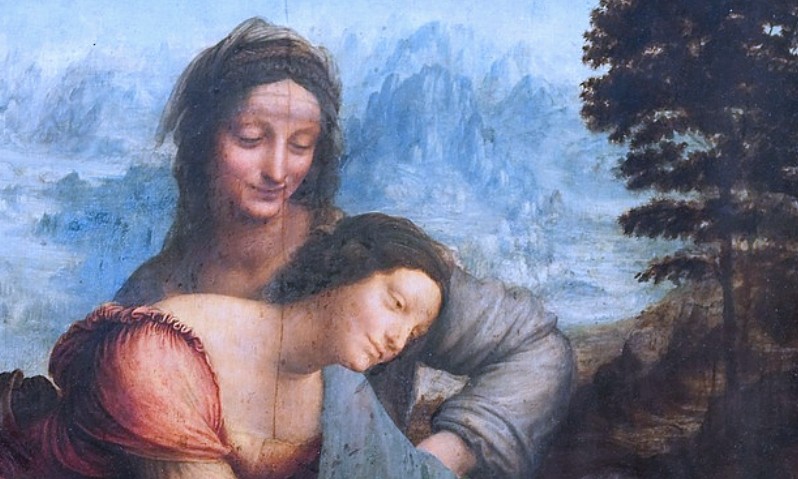
Ci proponiamo di esaminare qui, da questo punto di vista, il capolavoro di Leonardo da Vinci (1452-1519, « La Vergine con Bambino e Sant’Anna », attualmente al Louvre).
Non ci si stanca mai di contemplare questo capolavoro. Il dipinto raffigura Sant’Anna, sua figlia Maria e Gesù Bambino che abbracciano un agnello sacrificale, simbolo della sua missione: liberare l’umanità dal peccato originale.
Leonardo da Vinci non creò questo dipinto per un principe, un duca, un cardinale o un papa, ma per se stesso, e come tale lo lasciò in eredità all’umanità.
Dopo aver esaminato le ricerche più recenti, Vincent Delieuvin , lo storico francese del Louvre, giunse nel 2000 a questa sorprendente conclusione: Leonardo accolse con favore il ritorno del regime repubblicano a Firenze, di cui Sant’Anna era la protettrice.1
Benché l’opera sia rimasta praticamente incompiuta alla sua morte nel 1519, sappiamo che Leonardo da Vinci iniziò a lavorarci nel 1503 (all’età di 51 anni), mentre viveva a Firenze. Re Francesco I non rubò il dipinto, ma rubò il suo creatore, che lo portò con sé in Francia per completarlo.
Lo spettatore è immediatamente colpito da un potente, quasi inquietante, senso di movimento, da una sensazione di amore supremo e di grande bellezza. Pur raffigurando delle figure delle Sacre Scritture (Sant’Anna, la Vergine Maria, Cristo) anziché illustrare una particolare sequenza liturgica (che, peraltro, non esiste), l’opera scaturisce chiaramente da una profonda concezione filosofica.
Cercherò di convincervi che esiste un « lungo arco storico » , una coerenza intellettuale tra persone e menti che non si sono mai incrociate e non si sono mai parlate, ma le cui intuizioni e i cui progressi epistemologici coincidono.
Il capolavoro di Leonardo da Vinci appare, a mio avviso, come una sorta di anello mancante tra la visione di Dio e della creazione di Niccolò Cusano e il concetto di « noosfera » di Vladimir Vernadsky, passando per l’idea di « cosmo » di Alexander von Humboldt. A prima vista, questo potrebbe sembrare azzardato, ma permettetemi di approfondire.
Un’unità
Cosa si può mai unire questi quattro brillanti intellettuali, Cusano, Leonardo da Vinci, Alexander von Humboldt e Vernadsky? Tutti e quattro erano convinti che l’universo fosse un tutto vivente, unificato e armonioso.
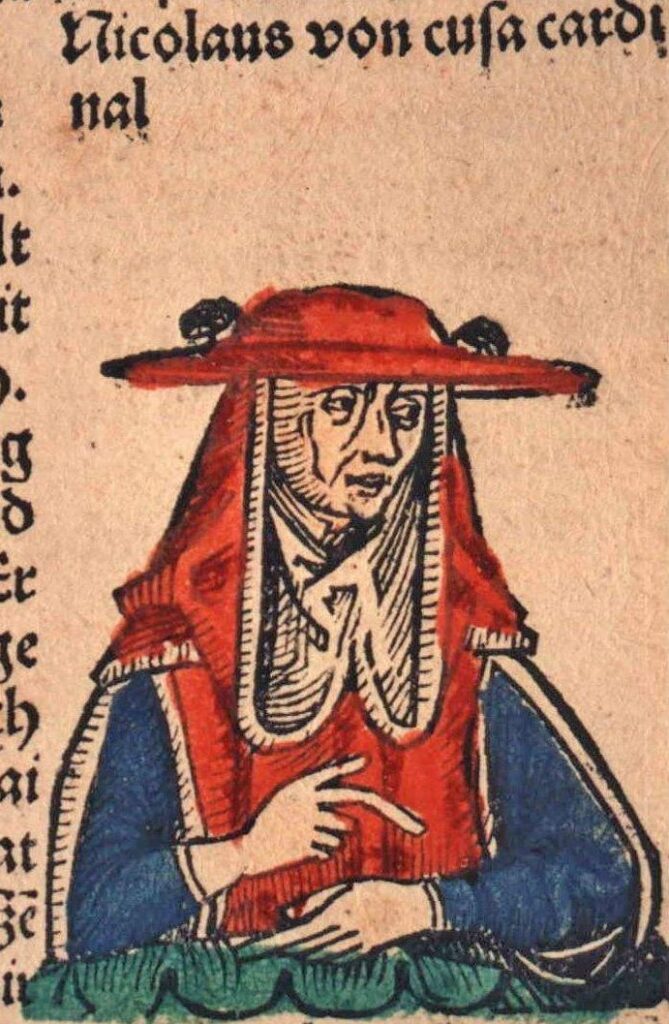
Nel suo trattato *Sulla dotta ignoranza* (1440), il cardinale tedesco Niccolò Cusano (1401-1464) , pensatore di spicco e figura di riferimento nei grandi concili ecumenici, nonché nel Rinascimento italiano ed europeo, inizia con questo simbolo: Dio è il « massimo assoluto » e l’unità perfetta ( unio ). In quest’unità, tutte le distanze, le divisioni e le contraddizioni si trasformano e si fondono nell’unione. L’Universo è l’immagine contratta di quest’unità e di questo massimo assoluto. Come uno specchio, è il massimo « contratto » perché non comprende tutte le cose, ma solo tutte le cose al di fuori di Dio, tutte le cose create. Il filosofo usa i termini *complicatio * (avvolgimento) ed *explicatio* (svolgimento) per spiegare che tutte le cose sono avvolte in Dio (la fonte) e dispiegate nel mondo. Il mondo, il cosmo e il tempo geologico sono lo svolgimento dell’unità di Dio.
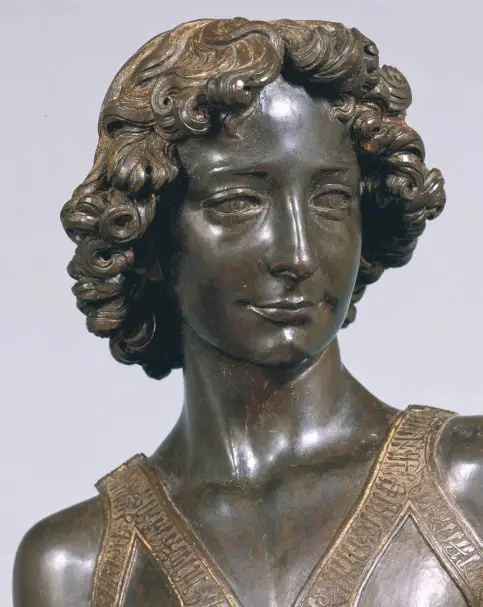
Sulle orme di Cusano, Leonardo da Vinci (1452-1519) affermò con forza: « Comprendete che ogni cosa è connessa a ogni altra ». Per lui, il progresso significava unificare campi diversi come l’arte, l’anatomia e l’ingegneria in una comprensione completa e coerente. L’artista-ingegnere incoraggiò i suoi contemporanei a imparare a percepire i legami che uniscono la natura, l’arte, la scienza e l’anima umana. L’osservazione permise a Leonardo di scoprire le cause invisibili dietro gli effetti visibili e di immaginare e verificare ipotesi creative. In particolare, postulò che il corpo umano potesse essere una versione in miniatura (microcosmo) della Terra (macrocosmo), osservando che la ramificazione dei vasi sanguigni nell’uomo rispecchia gli affluenti dei fiumi, così come i movimenti del corpo imitano le maree. A suo avviso, la Terra è un organismo vivente con « carne » (il suolo), « ossa » (gli strati rocciosi) e « sangue » (le vene d’acqua). Studiò il volo degli uccelli e il movimento dell’acqua, convinto che entrambi obbedissero alle stesse leggi della fisica dei fluidi. L’arte è una scienza e la scienza è un’arte, entrambe strumenti per comprendere le leggi fondamentali del mondo. Per Leonardo da Vinci, i pittori dovevano possedere l’intero cosmo nella mente e nelle mani per riflettere veramente la bellezza, l’armonia e la complessità della natura. Per lui, il movimento è l’essenza stessa di un universo vivo e in continua espansione. Studiò i motivi a spirale presenti in ogni cosa, dai fiori ai riccioli dei capelli ai vortici dell’acqua, nel tentativo di comprendere come la forza vitale generi forme diverse. Infine, considerava la stagnazione una forma di declino, osservando che « il ferro arrugginisce per mancanza di utilizzo » e che « l’inazione prosciuga il vigore della mente ».
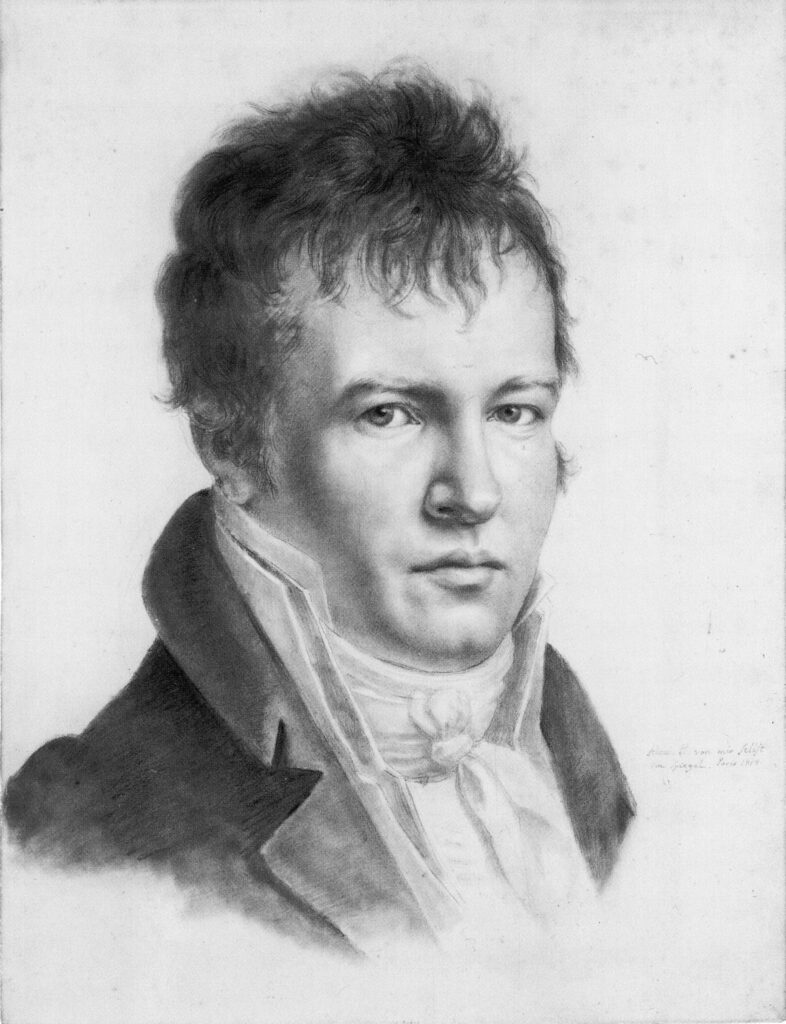
Anche il naturalista e rivoluzionario tedesco Alexander von Humboldt (1769-1859) si sforzò di comprendere come i vari fenomeni naturali, nonostante la loro apparente indipendenza, formino un sistema armonioso e unificato. Parlò di un « sistema terrestre » in cui clima, flora, fauna e vita umana sono interdipendenti. Humboldt credeva che esistesse un « legame intrinseco » tra il generale e il particolare, che gli permetteva di percepire l’interconnessione tra diverse regioni e climi. Nella sua ultima opera in cinque volumi, Cosmos (1845-1858), descrisse la natura come un « soffio di vita » e un « tutto organico », e vide l’intero universo – fisico e celeste – come un « sistema magnificamente ordinato e armonioso ». Come Cusano e Leonardo da Vinci, sostenne che una comprensione scientifica dei processi naturali accresce il nostro apprezzamento per la loro bellezza.
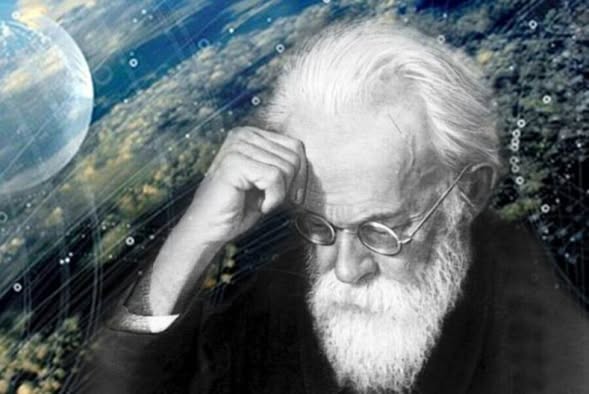
Per il geofisico russo-ucraino Vladimir Vernadsky (1863-1945) , la vita è eterna e inseparabile dal cosmo, non solo dalla Terra. Considerava la materia vivente come un « fenomeno cosmico » sorto altrove o da sempre esistente, che plasma l’ambiente chimico dei pianeti. La biosfera circonda la Terra come un « involucro saturo di vita », dove organismi viventi e materia inerte interagiscono costantemente, inseparabilmente e dinamicamente. La fase successiva dell’evoluzione è descritta come la transizione dalla biosfera alla « noosfera », dove l’attività umana razionale, la scienza e la tecnologia diventano la principale forza geologica che modella il pianeta. Vernadsky era convinto che il futuro dell’umanità dipendesse dal riconoscimento di questa unità, suggerendo che il pensiero umano fosse una naturale estensione dei processi geologici e cosmici.
Ora diamo un’occhiata al dipinto
È tenendo presente questo « lungo arco di storia » che l’osservatore attento può scorgere l’ombra di Vernadsky nella Sant’Anna di Leonardo.
Decifrare:
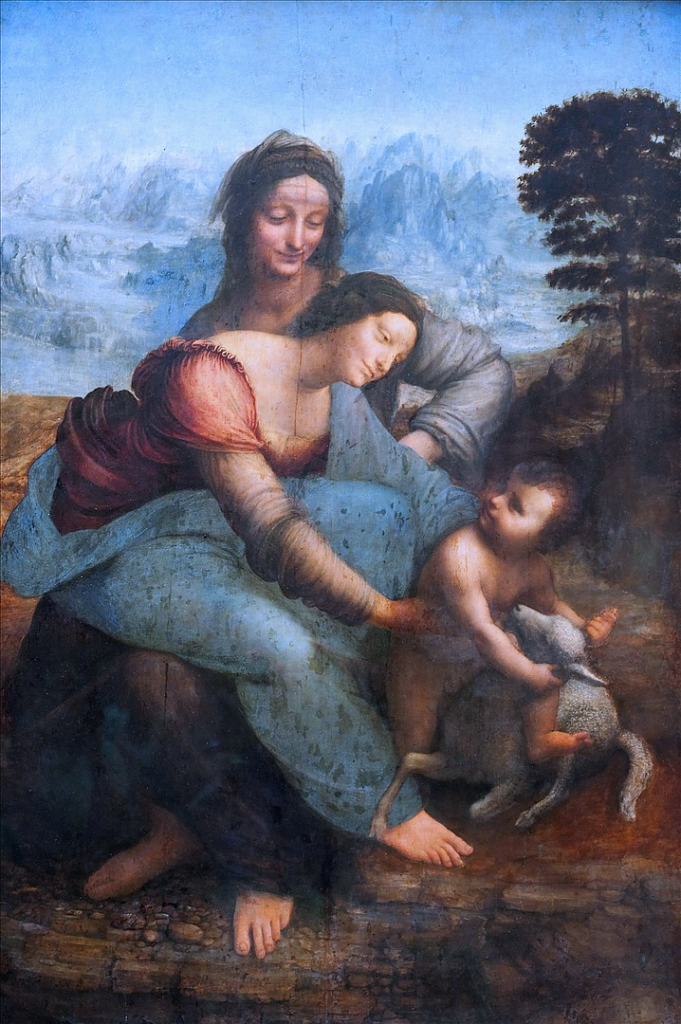
- Lo sfondo del dipinto raffigura creste scoscese dall’aspetto preistorico, ispirate agli studi di Leonardo sulle Dolomiti e sulle Alpi. Questo paesaggio arido, roccioso, quasi lunare, è stato descritto dagli storici come « fantastico » o « metafisico ». Come testimoniano i suoi taccuini, Leonardo era interessato a rappresentare i movimenti « invisibili » , non solo delle anime, ma anche di fenomeni fisici come il tempo, e più specificamente, il tempo geologico. Come si sono formate le montagne, ad esempio? Per altri, questo paesaggio « morto » o lunare dello sfondo – ciò che Vernadsky chiamerebbe « litosfera » – serve solo a mettere in risalto gli altri elementi della composizione.
- Di fronte a questo paesaggio, sulla destra, si erge un albero, la prima indicazione della biosfera, ma una semplice tappa in un processo evolutivo di sviluppo accelerato del cosmo.
- Di seguito, l’agnello (simbolo religioso del sacrificio di Cristo) rappresenterebbe una forma superiore di coscienza di questa biosfera.
- Poi appare Gesù, che, nella sua incarnazione come bambino, rappresenta solo una sorta di coscienza ingenua, una mera potenzialità per il suo sviluppo futuro.
- La Vergine Maria è raffigurata in una posa paradossale, che illustra perfettamente ciò che il pensatore americano Lyndon LaRouche definì un « cambiamento a metà movimento » , ovvero un momento ambiguo di indecisione tra movimenti apparentemente opposti. Il gesto maestoso, amorevole e protettivo di Maria, e il suo abbraccio a Gesù, coincidono con il suo profondo desiderio di concedergli tutta la libertà di movimento necessaria per compiere la sua sacra missione.
- Sant’Anna, sulla vetta, colma di gioia divina, sorride mentre contempla il gesto aggraziato di sua figlia Maria e l’amore che ella nutre per Cristo. Gioisce di essere, in un certo senso, l’anima « noosferica » consapevole di un Cosmo divino e vivente, dove il Creatore concepisce incessantemente nuove forme per la Sua creazione e gradi sempre più elevati di consapevolezza della Sua stessa natura creativa. Gli allineamenti circolari delle catene montuose lunari risuonano visivamente con gli anelli armoniosi formati da braccia e vesti in una spirale a cascata.
Anche scrittrici come Viviane Forrester , il cui lavoro2 è contaminato da perniciose interpretazioni moderniste e freudiane, e che affermano erroneamente che siamo ingannati dalla « sciocca » gentilezza di Maria (p. 19), riconoscono tuttavia intuitivamente che c’è qualcosa di molto speciale in quest’opera, una sorta di unità che la scrittrice descrive, in mancanza di una parola migliore, come « organica ».
Quando scopriamo queste figure, scrive, « percepiamo chiaramente che si tratta di organismi viventi all’interno di un paesaggio, un organismo vivente. L’organico nell’organico » (p. 12).
Questo momento organico, osserva, appare allo spettatore come un « momento congelato » di un « movimento transitorio » .
«Il loro respiro successivo, quello che segue, sembra più importante, più vitale, più sospeso di qualsiasi trama, di qualsiasi storia. E la loro presenza tangibile e fragile è simile a quella delle montagne, che respirano anch’esse.» (p. 13)
La nascita di un fungo
L’eccessiva enfasi posta sul fatto che Leonardo da Vinci fosse un genio « autodidatta » ha in qualche modo trascurato la ricerca sulle influenze intellettuali di cui ha beneficiato.
La sua prima esperienza fu l’apprendistato presso Andrea del Verrocchio (1435-1488) , la cui bottega fiorentina era modellata su quella del suo precettore, il dotto scultore Lorenzo Ghiberti (1378-1455) , dove gli studenti studiavano astronomia, poesia, architettura, scultura, pittura, fusione del bronzo, metallurgia, chimica, anatomia e leggevano i classici.
In seguito, a Milano, come pittore di corte, Leonardo fu « adottato » dalla giovane Cecilia Gallerani (1473-1536) , amante prediletta (ma non l’ultima) del duca Ludovico Sforza , detto Ludovico il Moro, duca di Milano.
Nacque a Siena in una famiglia numerosa, il cui padre, Fazio Gallerani, non era un nobile ma ricoprì diverse posizioni importanti alla corte di Milano, in particolare quella di ambasciatore presso le repubbliche di Firenze e Lucca.
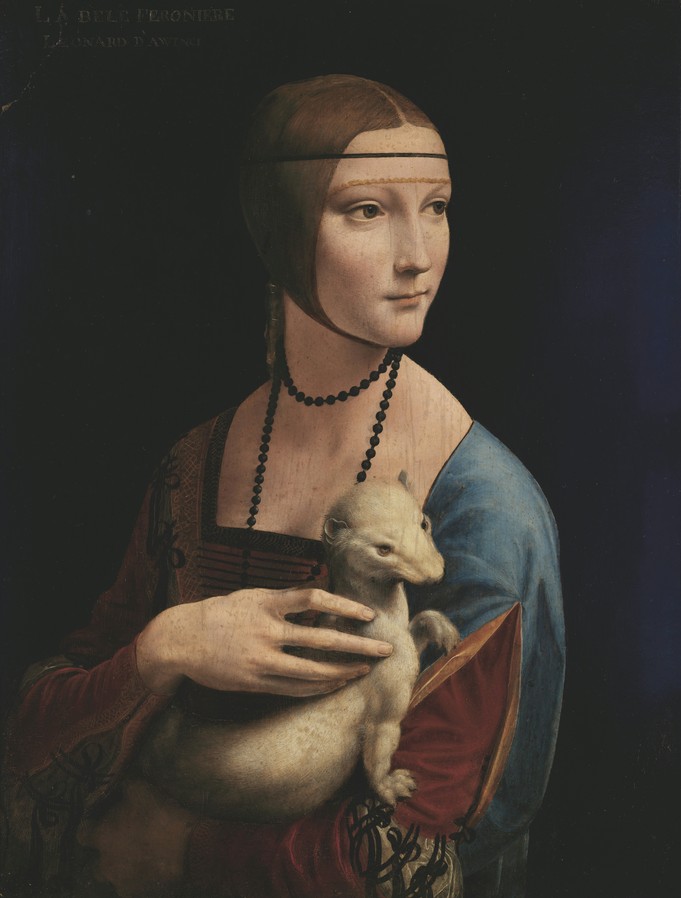
Cecilia, insieme ai suoi sei fratelli, ricevette un’istruzione in latino e letteratura. È nota soprattutto per aver ispirato il dipinto di Leonardo da Vinci « Dama con l’ermellino » (circa 1489), un’opera in cui il senso del movimento prevale già sulla rappresentazione statica. Si narra che, durante una seduta, invitò Leonardo a unirsi al circolo letterario che ospitava a Palazzo Carmagnola, dove presiedeva dibattiti intellettuali con filosofi, poeti e musicisti.
Compositrice di opere musicali e poetiche, oratrice in latino e italiano fin dall’età di 16 anni, rinomata per il suo spirito e la sua erudizione, è considerata una delle donne più colte del Rinascimento italiano.
Benché quasi tutta la sua opera sia andata perduta, rimane nella nostra memoria come una figura di spicco della lingua italiana, grazie alla sua maestria nella letteratura e nella poesia.
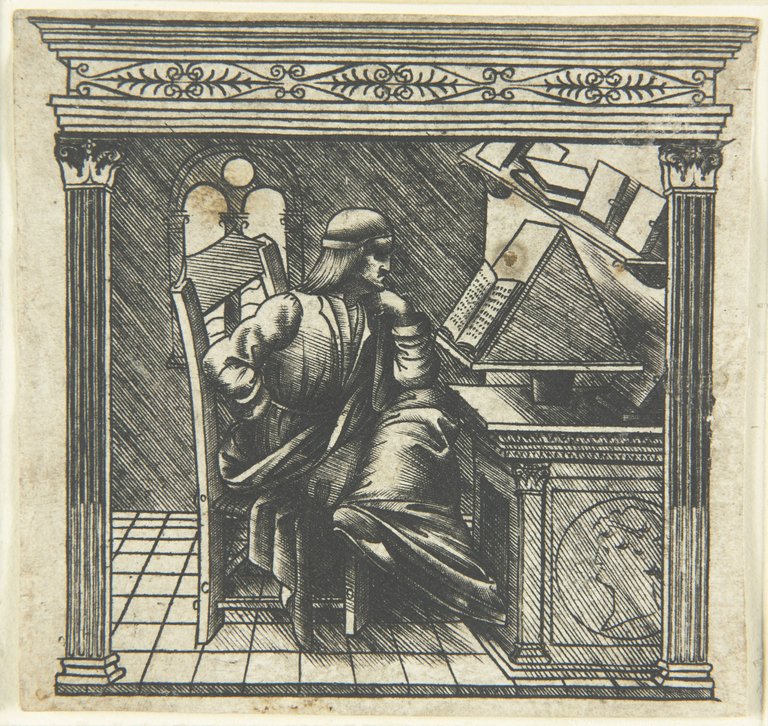
Il poeta di corte Bernardo Bellincioni (1452-1492) , amico di Leonardo, ne elogiò il talento letterario, arrivando a paragonarla alla celebre poetessa greca Saffo, che si dice abbia ispirato Platone.
La Corte di Milano e i suoi mecenati attrassero e incoraggiarono anche altri artisti e scienziati, tra cui l’architetto Donato Bramante, il matematico e amico di Leonardo da Vinci, Luca Pacioli, la dotta duchessa Beatrice d’Este, il poeta Bernardo Bellincioni e l’umanista e pedagogista Francesco Filelfo.
Cecilia Gallerani fece conoscere a Leonardo da Vinci le idee di Cusano? Non lo sappiamo, ma senza dubbio aveva sia la capacità che l’opportunità di farlo.
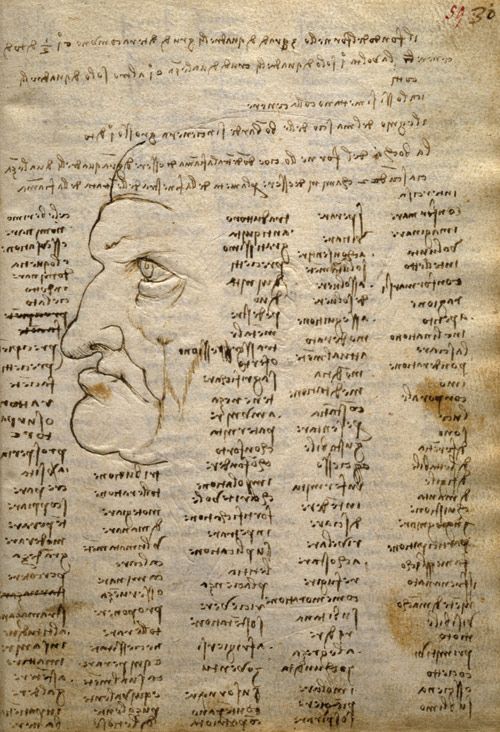
Il Codice Trivulziano di Leonardo (1487-1490), compilato a Milano in questo periodo, segna una svolta. Fino ad allora, l’artista aveva spesso sostenuto con veemenza la superiorità della pittura rispetto alla poesia. Tuttavia, dopo la sua frequentazione con Cecilia, il Codice Trivulziano rivela il suo desiderio di migliorare drasticamente le sue capacità letterarie, fino ad allora piuttosto modeste, compilando lunghe liste di parole erudite, inclusi termini latini, tratti da autorevoli fonti lessicali e grammaticali. A quanto pare, considerava questo un prerequisito che gli avrebbe permesso di descrivere con precisione scientifica i fenomeni che avrebbe scoperto in seguito.
Circa vent’anni dopo la morte di Leonardo da Vinci, si narra che l’orafo e scultore Benvenuto Cellini (1500-1571) abbia dichiarato:
«Non mancherò di riferire le parole che ho sentito pronunciare dal re a proposito di lui. Il re disse che non pensava ci fosse mai stato un uomo che sapesse tanto quanto Leonardo, non solo di scultura, di pittura e di architettura, ma anche di filosofia, dove eccelleva.»3
Come ha concluso un ricercatore:
«L’unità epistemologica di Leonardo da Vinci consente di accedere a una prospettiva più elevata. Non solo accresce la nostra propensione all’empatia autentica e alla profonda comprensione (essenziali nella società pluralistica odierna), ma ci consente anche di accedere a una forma di libertà sociale e intellettuale. È un metodo per acquisire una comprensione più completa della condizione umana; in breve, per ricevere una vera istruzione.»
Il mondo ha bisogno di nuove Cecilia Gallerani e nuovi Leonardo da Vinci. Sei pronto ad accettare questa sfida?
- Vincent Delieuvin, La Vergine, il Bambino Gesù e Sant’Anna, nota come Sant’Anna, sito web del Louvre.
https://collections.louvre.fr/ark:/53355/cl010066107 ↩︎ - Al Louvre con Viviane Forrester, La Vergine con Bambino e Sant’Anna , dossier preparato da Cécile Scailliérez, Servizio Culturale del Louvre, Symogy, Editions d’Art, Parigi, 2000. ↩︎
- Marianne Tregouët , Cellini alla corte di Francesco I (1540-1545): I meccanismi di una disgrazia , dicembre 2024, HAL Id: dumas-04797814 https://dumas.ccsd.cnrs.fr/dumas-04797814v1 ↩︎
The Shadow of Vernadsky in Leonardo’s Virgin and Child with Saint Anne
In march 1821, the English poet Percy Bysshe Shelley, concluded his poem « A defense of Poetry » with a visionary concept:
« Poets are the hierophants of an unapprehended inspiration; the mirrors of the gigantic shadows which futurity casts upon the present; the words which express what they understand not; the trumpets which sing to battle, and feel not what they inspire; the influence which is moved not, but moves. Poets are the unacknowledged legislators of the world. »
We examine here, from that standpoint, Leonardo da Vinci‘s masterwork The Virgin and Child with Saint Anne.
One never gets tired of looking at “The Virgin and Child with Saint Anne”, Leonardo’s superb masterpiece in the Louvre. Formally, the painting depicts Saint Anne, her daughter the Virgin Mary and the infant Jesus. Christ is shown embracing a sacrificial lamb symbolizing the mission he took on to liberate mankind from the original sin.
Remarkably, Leonardo didn’t make this painting for a Prince, not for a Duke, not for a Cardinal, nor for a Pope, but for himself, and as such, as a legacy for humanity.
Vincent Delieuvin, the French historian of the Louvre who cross-checked all the available documentation and hypothesis, arrives at the interesting but paradoxical conclusion that with this painting Leonardo wanted to give tribute to the return of the Florentine Republic:
« Since the Florentines rose up against Gautier de Brienne, Duke of Athens, on July 26, 1343, the feast day of Saint Anne, the city had devoted particular worship to the mother of the Virgin Mary, who was considered the protector of the Republic.
After the Medici were exiled in 1494, the honors bestowed upon the saint increased once again. Leonardo’s work fits perfectly into this context of the restoration of republican government, in which the artist participated with the execution of The Battle of Anghiari in 1503. »1
When the painting was finished is not known. In general, it is thought that Leonardo da Vinci (1454-1519) started working on it in 1503 when he lived in Florence at the age of 51. The French King Frances I, who bought the panel in 1518, didn’t steal the panel, just its author who brought it with him to France to finish it.
The viewer is immediately overwhelmed by a powerful and nearly disturbing sense of motion, supreme love and beauty. The scene itself, if it shows figures from the Holy scriptures (Anne, the Virgin Mary, Christ), rather than illustrating a given liturgical sequence, manifestly springs from a well of profound philosophical reflections.
I will try to convince you here there exists a “Long arch of History” of thinking and coherence between persons and minds that never met or spoke to each other, but whose intuitions and mindsets where congruent and oriented in the same directions. Leonardo’s masterpiece appears (in my view), as a sort of “missing link” between Nicolaus Cusanus’ vision of God and nature and Vladimir Vernadsky’s concept of the Noosphere, eventually via Alexander von Humboldt’s idea of the “Cosmos”. That might look wild and even silly at first glance, but please allow me to elaborate.
A Single Harmonic One
What unites the four towering intellectuals named Cusanus, Leonardo, Alexander von Humboldt and Vernadsky? All four were convinced that the universe is a single harmonic one.
The German cardinal Nicolas of Cusa (1401-1464), a thinker and major figure in the great ecumenical councils and the Italian and European Renaissance, begins his treatise On Learned Ignorance (1440) with a symbol. God is the “absolute maximum” and perfect unity (unio); in this unity, all distances, all divisions, all contradictions are transformed and merge into union. The universe is the contracted image of this absolute maximum and this absolute unity; it is not the absolute maximum, but, as in a mirror, the “contracted” maximum, for it does not comprise all things, but only all things outside of God, all created things. The thinker uses the terms complicatio (envelopment) and explicatio (unfolding) to explain that all things are enveloped in God (the source) and unfolded in the world. The world, the cosmos, and geological time are the unfolding of God’s unity.
Leonardo da Vinci (1452-1519), following in the footsteps of Cues, emphatically stated: “Understand that everything is connected to everything else.” For him, progress meant unifying different fields such as art, anatomy, and engineering into a comprehensive and coherent understanding. The artist-engineer invited his contemporaries to learn to perceive the links that unite nature, art, science, and the human soul. Observation allowed Leonardo to discover invisible causes rather than visible effects, and to imagine and test creative hypotheses. In particular, he postulated that the human body could be a miniature version (microcosm) of the Earth (macrocosm), observing that the branching of blood vessels in humans mirrors the tributaries of rivers, just as the movements of the body mimic the tides. In his view, the Earth is a living organism with “flesh” (the soil), ‘bones’ (rock strata), and “blood” (water veins). He studied the flight of birds and the movement of water, convinced that both obeyed the same fluid physics. Art is science, and science is art; both are tools for understanding the fundamental laws of the world. For Leonardo da Vinci, painters must possess the entire cosmos in their minds and hands in order to truly reflect the beauty, harmony, and complexity of nature. For the artist, movement is the very essence of a living, expanding universe. He studied the spiral patterns found in everything from flowers to curls of hair to whirlpools in water in order to understand how the life force generates different forms. Finally, he considered stagnation to be a form of decline, writing that “iron rusts from lack of use” and “inaction saps the vigor of the mind.”
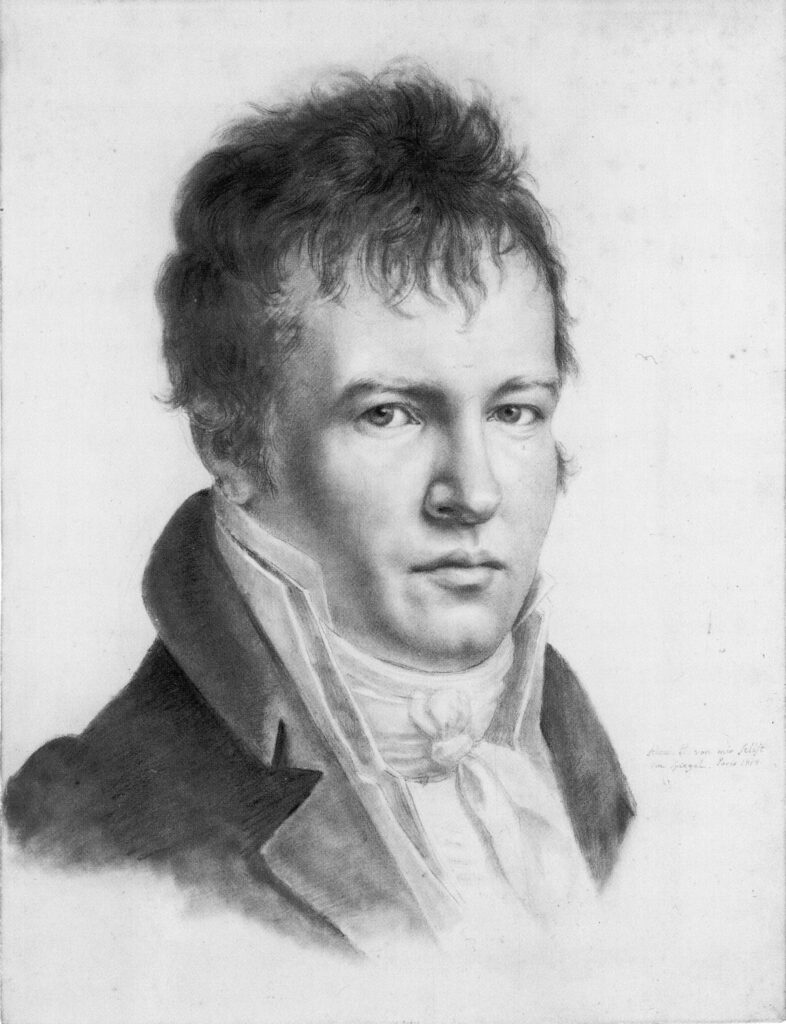
The German naturalist and revolutionary Alexander von Humboldt (1769-1859) also sought to understand how various natural phenomena, despite their apparent independence, form a harmonious and unified system. He refers to an “earth system” in which climate, flora, fauna, and human life are interdependent. Humboldt believed in studying the “intrinsic link” between the general and the particular, which allowed him to perceive the interconnectedness of different regions and climates. In his ultimate multi-volume work, Cosmos (1845-1858), he described nature as a “breath of life” and an “organic whole,” and sought to describe the entire universe—physical and celestial—as a “magnificently ordered and harmonious system.” Like Cusanus and Leonardo da Vinci, he argued that a scientific understanding of natural processes increases our appreciation of their beauty.
Ukrainian-Russian geophysicist Vladimir Vernadsky (1863–1945) viewed life as eternal and inseparable from the cosmos, not just from Earth. He proposed that living matter was a “cosmic phenomenon” that had appeared elsewhere or had always existed, shaping the chemical environment of planets. He defined the “Biosphere” as a “life-saturated envelope” around the Earth, where living organisms and inert matter interact constantly, inseparably, and dynamically. Vernadsky described the transition from the biosphere to the “Noosphere” as the next stage of evolution, where rational human activity, science, and technology become the main geological force shaping the planet. He was convinced that the future of humanity depended on recognizing this unity, suggesting that human thought was a natural extension of geological and cosmic processes.
What do we see?
It is with this “Long arch of History” in mind, that the viewer can discover the “Shadow of Vernadsky » in Leonardo’s Saint Anne. Because, what does the viewer see?
- The background of the painting features sharp, prehistoric-looking crags inspired by Leonardo’s studies of the Dolomites and the Alps. This barren, rocky terrain, nearly lunar, has been described by historians as “fantastical” or “metaphysical”. As we know from his notebooks, Leonardo was interested in painting “invisible” movements, not only those of the souls, but also universal phenomena such as “time”, especially “geological” time. How did mountains arise, etc.? Others, correctly argue that the « dead » or lunar landscape of the background, what Vernadsky would call the “Lithosphere” serves to highlight the other elements of the composition.
- On the right, one could see the tree (the “biosphere”) as representing a step in an evolutionary process of the development of the cosmos.
- Beneath the tree, the lamb (in religious terms a symbol of Christ’s sacrifice to free mankind) also represents a higher form of conscience of that same “biosphere”
- Then appears Jesus, who, represented in his human incarnation, that of a child, represents only a sort of naive conscience, merely the potential for his further development.
- The Virgin Mary, is represented in a paradoxical position which is a perfect example of what the late Lyndon LaRouche identified as “mid-motion-change”, meaning an ambiguous instant of indecision between two or more contrary movements. Her majestic, loving and protecting gesture and embrace of Jesus coincides with her vivid desire to induce the boy all the freedom of movement he needs to fulfill his sacred mission.
- Saint Anne, on top, as a sort of self-conscious form of agapic love, looks down and smiles seeing the majestic gesture and love for Christ of her daughter Mary. She is happy to be the self-conscious “noospheric” soul of a divine and living Cosmos, where the creator permanently creates ever higher forms of creation and of consciousness of its own creative nature. The rings of lunar mountain chains resemble and resonate visually with the harmonic rings formed by arms and clothes in a cascade of aesthetic spiral action.
Even authors polluted by nasty modernist and Freudian misinterpretations such as Viviane Forrester2 who wrongly pretend we are mislead by an overwhelming sentiment of mildness of Mary, nevertheless acknowledge intuitively there is something very special in this work, a sort of unity Forrester brands, not finding a better name, “organic”. When we discover these figures, she writes:
“one clearly sees they are living organisms in the midst of a landscape, a living organism. Organic inside Organic.” (p. 12)
That organic moment, she observes, appears here to the viewer as a “frozen moment” of a “transitory movement”.
Their “next respiration, the one that will follow, seems more important, vital, more suspended than any intrigue, any narrative. And their [the figures] tangible presence, fragile, matches that of the mountains, who respire as well.” (p. 13)
The making of a genius
By over-emphasizing that Leonardo was a “self-taught” genius, research on the intellectual influences he underwent was somehow neglected.
The first chance he had, was to be an apprentice of Andrea del Verrocchio (1435-1488), whose Florence workshop was modeled on that of his tutor, the Florentine erudite sculptor Lorenzo Ghiberti (1378-1455) where pupils studied astronomy, poetry, architecture, sculpture, painting, bronze-casting, metal-works, chemistry, anatomy and read the Classics.
Then, in Milan, as a court painter, Leonardo was “adopted” by the young Cecilia Gallerani (1473 – 1536), the favorite (but not the last) mistress of the Duke Ludovico Sforza, known as Lodovico Il Moro, Duke of Milan.
She was born into a large family from Siena. Her father’s name was Fazio Gallerani. He was not a member of the nobility, but he occupied several important posts at the Milanese court, including the position of ambassador to the Republic of Florence and Republic of Lucca. Cecilia was educated alongside her six brothers in Latin and literature.
She is best known as the subject of Leonardo da Vinci’s painting Lady with an Ermine (c. 1489), already a painting where movement prevails over static representation. It is said that while posing for the painting, she invited Leonardo to be part of the literary circle she hosted at her residence in the Palazzo Carmagnola, where she engaged in intellectual debates with philosophers, poets, and musicians. Gallerani herself presided over these discussions.
Composing music, poetry and delivering orations in both Latin and Italian at the age of 16, renowned for her wit and scholarship, she was considered one of the most cultured women of the Italian Renaissance.
While nearly all of her works were lost, she is remembered as a “great light of the Italian language” due to her mastery of literature and verse. The court poet Bernardo Bellincioni (1452-1492) highly praised her literary talents, even comparing her to the famous Ancient Greek poetess Sappho which allegedly inspired Plato.
The Court of Milan and its patrons also attracted and protected other artists and scientists, among which the architect Donato Bramante, the mathematician and friend of Leonardo, Luca Pacioli, the duchess Beatrice d’Este, the poet Bernardo Bellincioni and the humanist educator Francesco Filelfo.
Did Cecilia Gallerani introduce Leonardo to the ideas of Cusanus? We don’t know, but she certainly had both the knowledge and ability to do so.
Leonardo’s Codex Trivulzianus (1487-1490), shows he was working hard to improve his modest literary education, through long lists of learned words, including Latin words, copied from authoritative lexical and grammatical sources.
The scientist reportedly saw this as a precondition that was going to allow him to describe with scientific precision the phenomena he was going to discover in the future.
About twenty years after Leonardo da Vinci’s death, the goldsmith and sculptor Benvenuto Cellini (1500–1571) is said to have remarked:
“I would not want to fail to repeat the words I heard the king say about him. The king said that he did not believe there had ever been a man who knew as much as Leonardo, not only in sculpture, painting, and architecture, but also in philosophy, in which he excelled.”
As one scholar concludes:
Leonardo’s “epistemological unity allows one to be elevated to a higher perspective. It not only increases our propensity for genuine empathy and understanding (much needed in today’s pluralistic society), but also for a kind of social and intellectual freedom. It is a method of acquiring a more holistic understanding of the human condition; or in short, of getting a real education.”
The world needs new Cecilia Gallerani’s and new Leonardo da Vinci’s. Are you ready to go there?
NOTES:
- Vincent Delievin, La Vierge, l’Enfant Jésus et sainte Anne, dit La Sainte Anne, website of the Louvre; ↩︎
- Au Louvre avec Viviane Forrester, La Vierge et l’Enfant avec sainte Anne, Léonard de Vinci, dossier établi par Cécile Scailliérez, Service Culturel du Louvre, Symogy, Editions d’Art, Paris, 2000. ↩︎
The republican struggle of David d’Angers and the statue of Gutenberg in Strasbourg

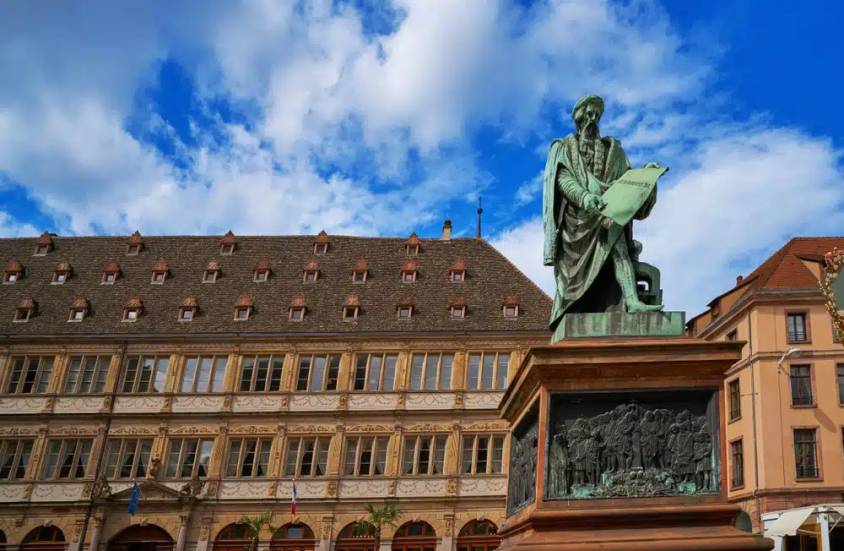
In the heart of downtown Strasbourg, a stone’s throw from the cathedral and with its back to the 1585 Chamber of Commerce, stands the beautiful bronze statue of the German printer Johannes Gutenberg, holding a barely-printed page from his Bible, which reads: « And there was light » (NOTE 1).
Evoking the emancipation of peoples thanks to the spread of knowledge through the development of printing, the statue, erected in 1840, came at a time when supporters of the Republic were up in arms against the press censorship imposed by Louis-Philippe under the July Monarchy.
Strasbourg, Mainz and China
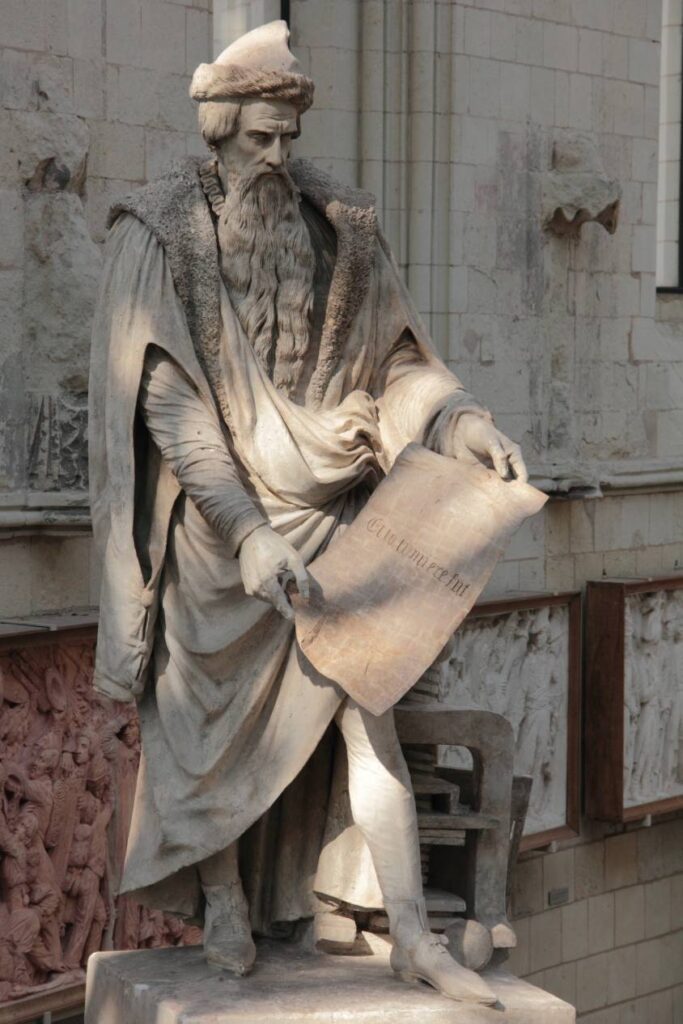
Born around 1400 in Mainz, Johannes Gutenberg, with money lent to him by the merchant and banker Johann Fust, carried out his first experiments with movable metal type in Strasbourg between 1434 and 1445, before perfecting his process in Mainz, notably by printing his famous 42-line Bible from 1452.
On his death (in Mainz) in 1468, Gutenberg bequeathed his process to humanity, enabling printing to take off in Europe. Chroniclers also mention the work of Laurens Janszoon Coster in Harlem, and the Italian printer Panfilo Castaldi, who is said to have brought Chinese know-how to Europe. It should be noted that the « civilized » world of the time refused to acknowledge that printing had originated in Asia with the famous « movable type » (made of porcelain and metal) developed several centuries earlier in China and Korea (NOTE 2).
In Europe, Mainz and Strasbourg vie for pride of place. On August 14, 1837, to celebrate the 400th anniversary of the « invention » of printing, Mainz inaugurated its statue of Gutenberg, erected by sculptor Bertel Thorvaldsenalors, while in Strasbourg, a local committee had already commissioned sculptor David d’Angers to create a similar monument in 1835.
This little-known sculptor was both a great sculptor and close friend of Victor Hugo, and a fervent republican in personal contact with the finest humanist elite of his time in France, Germany and the United States. He was also a tireless campaigner for the abolition of the slave trade and slavery.
The sculptor’s life
French sculptor Pierre-Jean David, known as « David d’Angers » (1788-1856) was the son of master sculptor Pierre Louis David. Pierre-Jean was influenced by the republican spirit of his father, who trained him in sculpture from an early age. At the age of twelve, his father enrolled him in the drawing class at the École Centrale de Nantes. In Paris, he was commissioned to create the ornamentation for the Arc de Triomphe du Carrousel and the south facade of the Louvre Palace. Finally, he entered the Beaux-arts.
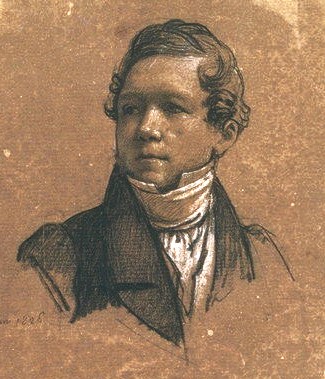
David d’Angers possessed a keen sense of interpretation of the human figure and an ability to penetrate the secrets of his models. He excelled in portraiture, whether in bust or medallion form. He is the author of at least sixty-eight statues and statuettes, some fifty bas-reliefs, a hundred busts and over five hundred medallions. Victor Hugo told his friend David: « This is the bronze coin by which you pay your toll to posterity. »
He traveled all over Europe, painting busts in Berlin, London, Dresden and Munich.
Around 1825, when he was commissioned to paint the funeral monument that the Nation was raising by public subscription in honor of General Foy, a tribune of the parliamentary opposition, he underwent an ideological and artistic transformation. He frequented the progressive intellectual circles of the « 1820 generation » and joined the international republican movement. He then turned his attention to the political and social problems of France and Europe. In later years, he remained faithful to his convictions, refusing, for example, the prestigious commission to design Napoleon’s tomb.
Artistic production
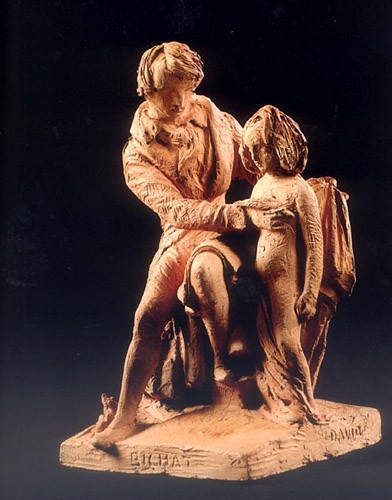
David’s art was thus influenced by a naturalism whose iconography and expression are in stark contrast to that of his academic colleagues and the dissident sculptors known as « romantics » at the time. For David, no mythological sensualism, obscure allegories or historical picturesqueness. On the contrary, sculpture, according to David, must generalize and transpose what the artist observes, so as to ensure the survival of ideas and destinies in a timeless posterity.
David adhered to this particular, limited conception of sculpture, adopting the Enlightenment view that the art of sculpture is « the lasting repository of the virtues of men », perpetuating the memory of the exploits of exceptional beings.
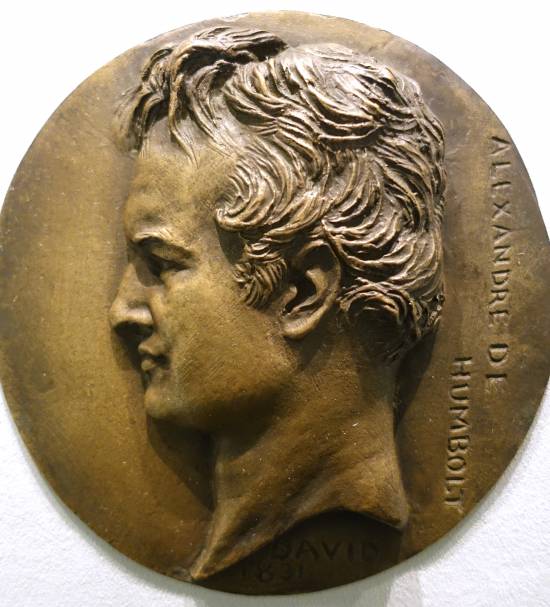
The somewhat austere image of « great men » prevailed, best known thanks to some 600 medallions depicting famous men and women from several countries, most of them contemporaries. Added to this are some one hundred busts, mostly of his friends, poets, writers, musicians, songwriters, scientists and politicians with whom he shared the republican ideal.
Among the most enlightened of his time were: Victor Hugo, Marquis de Lafayette, Wolfgang Goethe, Alfred de Vigny, Alphonse Lamartine, Pierre-Jean de Béranger, Alfred de Musset, François Arago, Alexander von Humboldt, Honoré de Balzac, Lady Morgan, James Fenimore Cooper, Armand Carrel, François Chateaubriand, Ennius Quirinus Visconti and Niccolo Paganini.
To magnify his models and visually render the qualities of each one’s genius, David d’Angers invented a mode of idealization no longer based on antique-style classicism, but on a grammar of forms derived from a new science, the phrenology of Doctor Gall, who believed that the cranial « humps » of an individual reflected his intellectual aptitudes and passions. For the sculptor, it was a matter of transcending the model’s physiognomy, so that the greatness of the soul radiated from his forehead.
In 1826, he was elected member of the Institut de France and, the same year, professor at the Beaux-Arts. In 1828, David d’Angers was the victim of his first unsolved assassination attempt. Wounded in the head, he was confined to bed for three months. However, in 1830, still loyal to republican ideas, he took part in the revolutionary days and fought on the barricades.
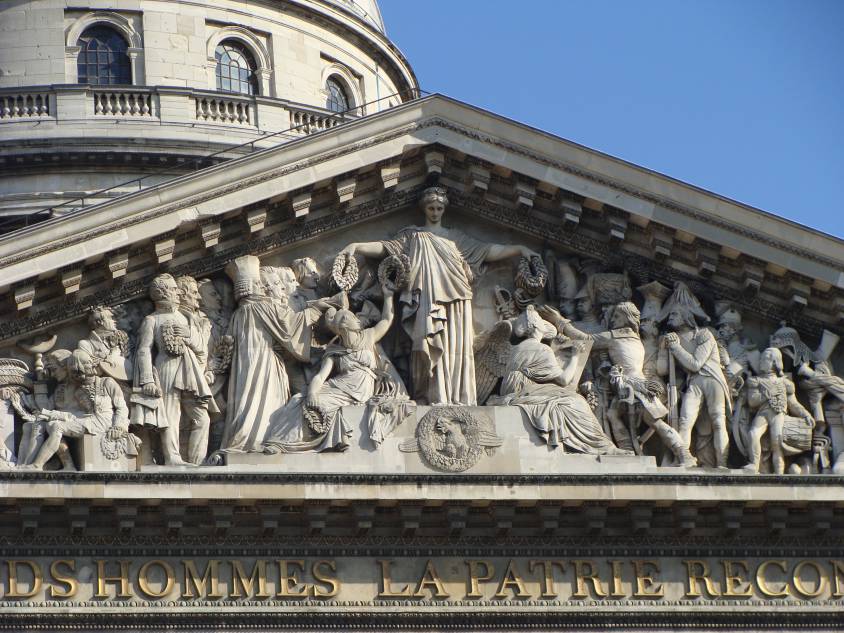
In 1830, David d’Angers found himself ideally placed to carry out the most significant political sculpture commission of the July monarchy and perhaps of 19th century France: the new decoration of the pediment of the church of Sainte-Geneviève, which had been converted into the Pantheon in July.
As a historiographer, he wanted to depict the civilians and men of war who built Republican France. In 1837, the execution of the figures he had chosen and arranged in a sketch that was first approved, then suspended, was bound to lead to conflict with the high clergy and the government. On the left, we see Bichat, Voltaire and Jean-Jacques Rousseau, David, Cuvier, Lafayette, Manuel, Carnot, Berthollet, Laplace, Malesherbes, Mirabeau, Monge and Fénelon. While the government tried to have Lafayette’s effigy removed, which David d’Angers stubbornly refused, with the support of the liberal press, the pediment was unveiled without official ceremony in September 1837, without the presence of the artist, who had not been invited.
Entering politics
During the 1848 Revolution, he was appointed mayor of the 11th arrondissement of Paris, entered the National Constituent Assembly and then the National Legislative Assembly, where he voted with the Montagne (revolutionary left). He defended the existence of the Ecole des Beaux-arts and the Académie de France in Rome. He opposed the destruction of the Chapelle Expiatoire and the removal of two statues from the Arc de Triomphe (Resistance and Peace by sculptor Antoine Etex).
He also voted against the prosecution of Louis Blanc (1811-1882) (another republican statesman and intellectual condemned to exile), against the credits for Napoleon III’s Roman expedition, for the abolition of the death penalty, for the right to work, and for a general amnesty.
Exile

He was not re-elected deputy in 1849 and withdrew from political life. In 1851, with the advent of Napoleon III, David d’Angers was arrested and also sentenced to exile. He chose Belgium, then traveled to Greece (his old project). He wanted to revisit his Greek Maiden on the tomb of the Greek republican patriot Markos Botzaris (1788-1823), which he found mutilated and abandoned (he had it repatriated to France and restored).
Disappointed by Greece, he returned to France in 1852. With the help of his friend de Béranger, he was allowed to stay in Paris, where he resumed his work. In September 1855, he suffered a stroke which forced him to cease his activities. He died in January 1856.
Friendships with Lafayette, Abbé Grégoire and Pierre-Jean de Béranger
David d’Angers was a real link between 18th and 19th century republicans, and a living bridge between those of Europe and America.
Born in 1788, he had the good fortune to associate at an early age with some of the great revolutionary figures of the time, before becoming personally involved in the revolutions of 1830 and 1848.
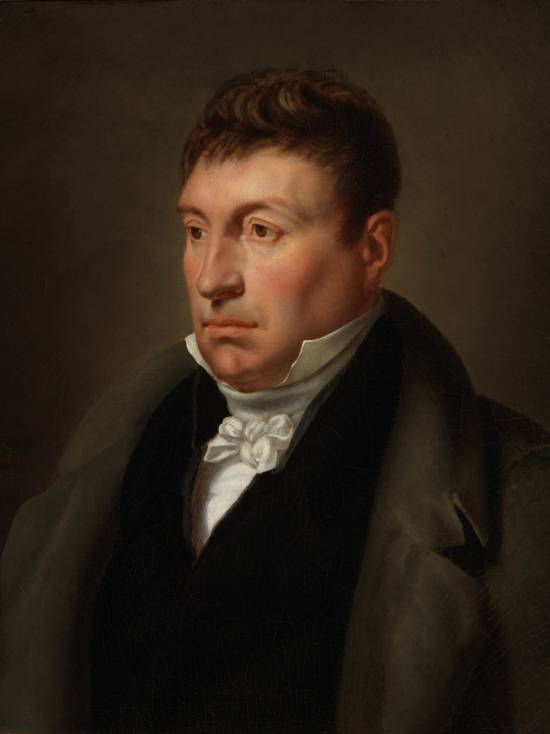
Towards the end of the 1820s, David attended the Tuesday salon meetings of Madame de Lafayette, wife of Gilbert du Motier, Marquis de La Fayette (1757-1834).
While General Lafayette stood upright like « a venerable oak », this salon, notes the sculptor,
« has a clear-cut physiognomy, » he writes. The men talk about serious matters, especially politics, and even the young men look serious: there’s something decided, energetic and courageous in their eyes and in their posture (…) All the ladies and also the demoiselles look calm and thoughtful; they look as if they’ve come to see or attend important deliberations, rather than to be seen. »
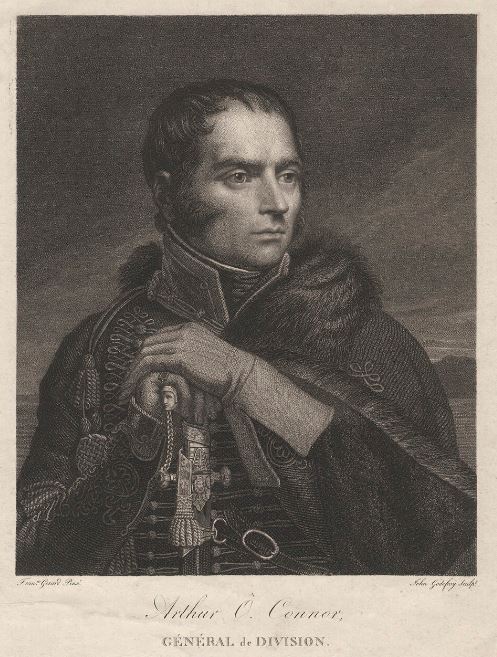
David met Lafayette’s comrade-in-arms, General Arthur O’Connor (1763-1852), a former Irish republican MP of the United Irishmen who had joined Lafayette’s volunteer General Staff in 1792.
Accused of stirring up trouble against the British Empire and in contact with General Lazare Hoche (1768-1797), O’Connor fled to France in 1796 and took part in the Irish Expedition. In 1807, O’Connor married the daughter of philosopher and mathematician Nicolas de Condorcet (1743-1794) and became a naturalized French citizen in 1818.
Lafayette and David d’Angers often got together with a small group of friends, a few « brothers » who were members of Masonic lodges: such as the chansonnier Pierre-Jean de Béranger, François Chateaubriand, Benjamin Constant, Alexandre Dumas (who corresponded with Edgar Allan Poe), Alphonse Lamartine, Henri Beyle dit Stendhal and the painters François Gérard and Horace Vernet.
In these same circles, David also became acquainted with Henri (Abbé) Grégoire (1750-1831), and the issue of the abolition of slavery, which Grégoire had pushed through on February 4, 1794, was often raised. In their exchanges, Lafayette liked to recall the words of his youthful friend Nicolas de Condorcet:
« Slavery is a horrible barbarism, if we can only eat sugar at this price, we must know how to renounce a commodity stained with the blood of our brothers. »
For Abbé Gregoire, the problem went much deeper:
« As long as men are thirsty for blood, or rather, as long as most governments have no morals, as long as politics is the art of deceit, as long as people, unaware of their true interests, attach silly importance to the job of spadassin, and will allow themselves to be led blindly to the slaughter with sheep-like resignation, almost always to serve as a pedestal for vanity, almost never to avenge the rights of humanity, and to take a step towards happiness and virtue, the most flourishing nation will be the one that has the greatest facility for slitting the throats of others. »
(Essay on the physical, moral and political regeneration of the Jews)
Napoleon and slavery
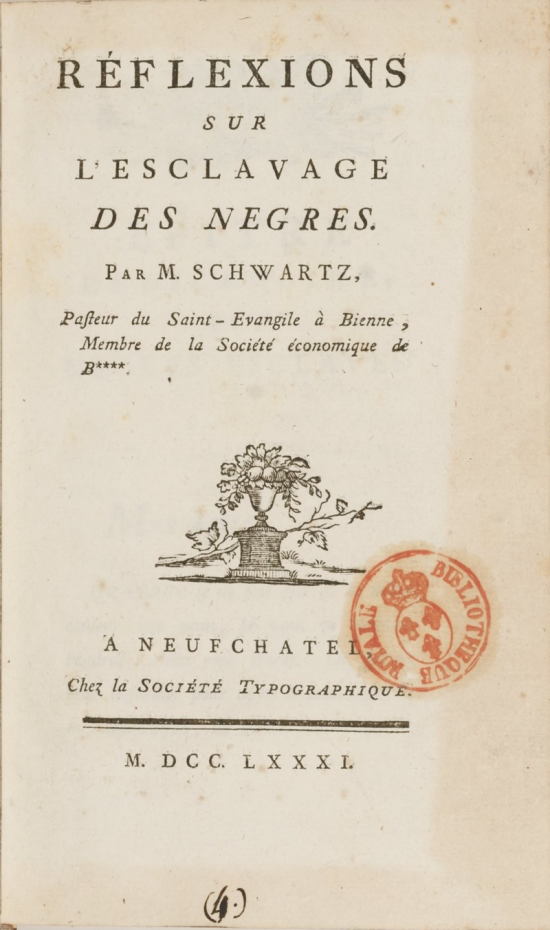
The first abolition of slavery was, alas, short-lived. In 1802, Napoleon Bonaparte, short of the money needed to finance his wars, reintroduced slavery, and nine days later excluded colored officers from the French army.
Finally, he outlawed marriages between « fiancés whose skin color is different ». David d’Angers remained very sensitive to this issue, having as a comrade a very young writer, Alexandre Dumas, whose father had been born a slave in Haiti.
As early as 1781, under the pseudonym Schwarz (black in German), Condorcet had published a manifesto advocating the gradual disappearance of slavery over a period of 60 to 70 years, a view quickly shared by Lafayette. A fervent supporter of the abolitionist cause, Condorcet condemned slavery as a crime, but also denounced its economic uselessness: slave labor, with its low productivity, was an obstacle to the establishment of a market economy.
And even before the signing of the peace treaty between France and the United States, Lafayette wrote to his friend George Washington on February 3, 1783, proposing to join him in setting in motion a process of gradual emancipation of the slaves. He suggested a plan that would « frankly become beneficial to the black portion of mankind ».
The idea was to buy a small state in which to experiment with freeing slaves and putting them to work as farmers. Such an example, he explained, « could become a school and thus a general practice ». (NOTE 3)
Washington replied that he personally would have liked to support such a step, but that the American Congress (already) was totally hostile.
From the Society of Black Friends to the French Society for the Abolition of Slavery
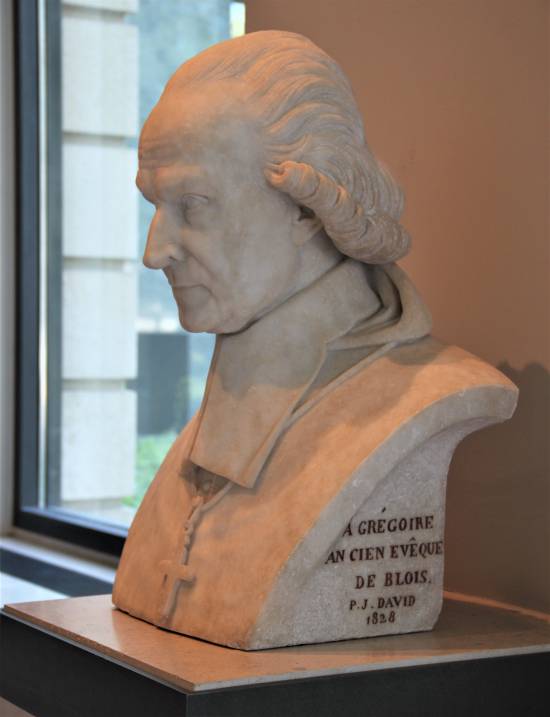
In Paris, on February 19, 1788, Abbé Grégoire and Jacques Pierre Brissot (1754-1793) founded « La Société des amis des Noirs », whose rules were drawn up by Condorcet, and of which the Lafayette couple were also members.
The society’s aim was the equality of free whites and blacks in the colonies, the immediate prohibition of the black slave trade and the gradual abolition of slavery; on the one hand, to maintain the economy of the French colonies, and on the other, in the belief that before blacks could achieve freedom, they had to be prepared for it, and therefore educated.
After the virtual disappearance of the « Amis des Noirs », the offensive was renewed, with the founding in 1821 of the « Société de la Morale chrétienne », which in 1822 set up a « Comité pour l’abolition de la traite des Noirs », some of whose members went on to found the « Société française pour l’abolition de l’esclavage (SFAE) » in 1834.
Initially in favor of gradual abolition, the SFAE later favored immediate abolition. Prohibited from holding meetings, the SFAE decided to create abolitionist committees throughout the country to relay the desire to put an end to slavery, both locally and nationally.
Goethe and Schiller
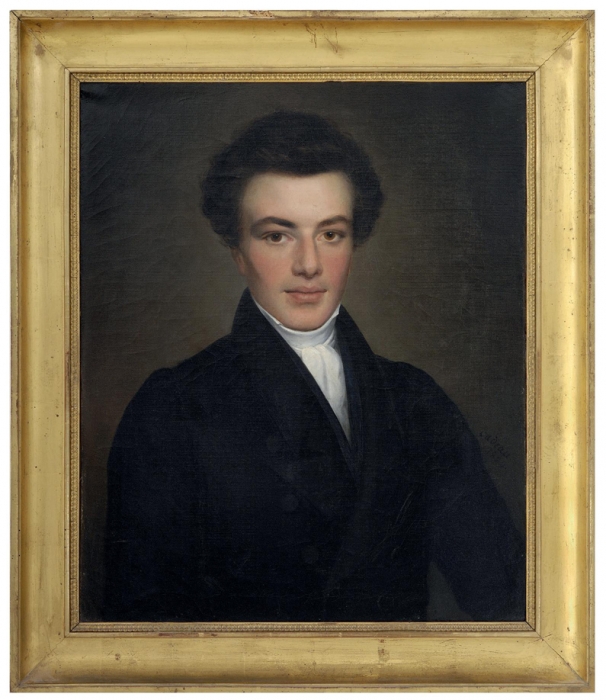
In the summer of 1829, David d’Angers made his first trip to Germany and met Goethe (1749-1832), the poet and philosopher who had retired to Weimar. Several posing sessions enabled the sculptor to complete his portrait.
Writer and poet Victor Pavie (1808-1886), a friend of Victor Hugo and one of the founders of the « Cercles catholiques ouvriers » (Catholic Workers Circle), accompagnied him on the trip and recounts some of the pictoresques anecdotes of their travel in his « Goethe and David, memories of a voyage to Weimar » (1874).
In 1827, the French newspaper Globe published two letters recounting two visits to Goethe, in 1817 and 1825, by an anonymous « friend » (Victor Cousin), as well as a letter from Ampère on his return from the « Athens of Germany ». In these letters, the young scientist expressed his admiration, and gave numerous details that whetted the interest of his compatriots. During his stay in Weimar, Ampère added to his host’s knowledge of Romantic authors, particularly Mérimée, Vigny, Deschamps and Delphine Gay. Goethe already had a (positive) opinion of Victor Hugo, Lamartine and Casimir Delavigne, and of all they owed to Chateaubriand.
A subscriber to the Globe since its foundation in 1824, Goethe had at his disposal a marvellous instrument of French information. In any case, he had little left to learn about France when David and Pavie visited him in August 1829. On the strength of his unhappy experience with Walter Scott in London, David d’Angers had taken precautions this time, and had a number of letters of recommendation for the people of Weimar, as well as two letters of introduction to Goethe, signed by Abbé Grégoire and Victor Cousin. To show the illustrious writer what he could do, he had placed some of his finest medallions in a crate.
Once in Weimar, David d’Angers and Victor Pavie encountered great difficulties in their quest, especially as the recipients of the letters of recommendation were all absent. Stricken with despair and fearing failure, David blamed his young friend Victor Pavie:
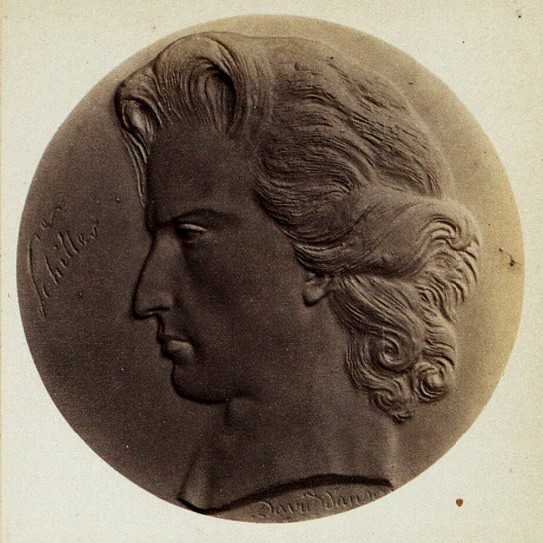
« Yes, you jumped in with the optimism of a young man, without giving me time to think and get out of the way. It wasn’t as a coward or under the patronage of an adventurer, it was head-on and resolutely that we had to tackle the character. (…) You’re only as good as what you are, it’s a yes or no question. You know me, on my knees before genius, and imployable before power. Ah! court poets, great or small, everywhere the same!
(…) And with a leap from the chair where he had insensitively let himself fall: Where’s Schiller? I’d like to kiss him! His grave, where I will strike, will not remain sealed for me; I will take him there, and bring him back glorious. What does it matter? Have I seen Corneille, have I seen Racine? The bust I’m planning for him will look all the better for it; the flash of his genius will gleam on his forehead. I’ll make him as I love and admire him, not with the pinched nose that Dannecker (image below) gave him, but with nostrils swollen with patriotism and freedom.
Victor Pavie’s account reveals the republican fervor animating the sculptor who, faithful to the ideals of Abbé Grégoire, was already thinking about the great anti-slavery sculpture he planned to create:
« At that moment, the half-open window of our bedroom, yielding to the evening breeze, opened wide. The sky was superb; the Milky Way unfurled with such brilliance that one could have counted the stars. He (David) remained silent for some time, dazzled; then, with that suddenness of impression that incessantly renewed the realm of feelings and ideas around him:
‘What a work, what a masterpiece! How poor we are compared to this!Would all your geniuses in one, writers, artists, poets, ever reach this incomparable poem whose tasks are splendors? Yet God knows your insatiable pretensions; we flay you in praise… And light! Remember this (and his presentiments in this regard were nothing less than a chimera), that such a one as received a marble bust from me as a token of my admiration, will one day literally lose the memory of it. – No, there is nothing more noble and great in humanity than that which suffers. I still have in my head, or rather in my heart, this protest of the human conscience against the most execrable iniquity of our times, the slave trade: after ten years of silence and suffering, it must burst forth with the voice of brass. You can see the group from here: the garroted slave, his eye on the sky, protector and avenger of the weak; next to him, lying broken, his wife, in whose bosom a frail creature is sucking blood instead of milk; at their feet, detached from the negro’s broken collar, the crucifix, the Man-God who died for his brothers, black or white. Yes, the monument will be made of bronze, and when the wind blows, you will hear the chain beating, and the rings ringing' ».
Finally, Goethe met the two Frenchmen, and David d’Angers succeeded in making his bust of the German poet. Victor Pavie:
« Goethe bowed politely to us, spoke the French language with ease from the start, and made us sit down with that calm, resigned air that astonished me, as if it were a simple thing to find oneself standing at eighty, face to face with a third generation, to which he had passed on through the second, like a living tradition.
(…) David carried with him, as the saying goes, a sample of his skills.He presented the old man with a few of his lively profiles, so morally expressive, so nervously and intimately executed, part of a great whole that is becoming more complete with our age, and which reserves for the centuries to come the monumental physiognomy of the 19th century. Goethe took them in his hand, considered them mute, with scrupulous attention, as if to extract some hidden harmony, and let out a muffled, equivocal exclamation that I later recognized as a mark of genuine satisfaction.Then, by a more intelligible and flattering transition, of which he was perhaps unaware, walking to his library, he charmingly showed us a rich collection of medals from the Middle Ages, rare and precious relics of an art that could be said to have been lost, and of which our great sculptor David has nowadays been able to recover and re-immerse the secret.
(…) The bust project did not have to languish for long: the very next day, one of the apartments in the poet’s immense house was transformed into a workshop, and a shapeless mound lay on the parquet floor, awaiting the first breath of existence. As soon as it slowly shifted into a human form, Goethe’s hitherto calm and impassive figure moved with it. Gradually, as if a secret, sympathetic alliance had developed between portrait and model, as the one moved towards life, the other blossomed into confidence and abandonment: we soon came to those artist’s confidences, that confluence of poetry, where the ideas of the poet and the sculptor come together in a common mold. He would come and go, prowling around this growing mass, (to use a trivial comparison) with the anxious solicitude of a landowner building a house. He asked us many questions about France, whose progress he was following with a youthful and active curiosity; and frolicking at leisure about modern literature, he reviewed Chateaubriand, Lamartine, Nodier, Alfred de Vigny, Victor Hugo, whose manner he had seriously pondered in Cromwell.
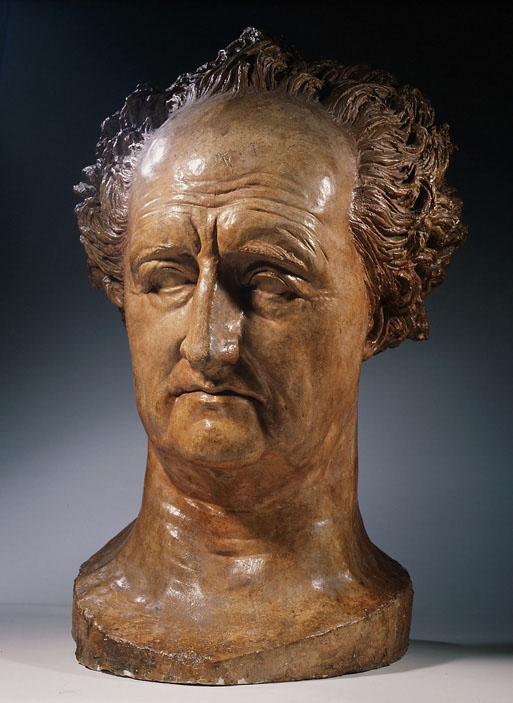

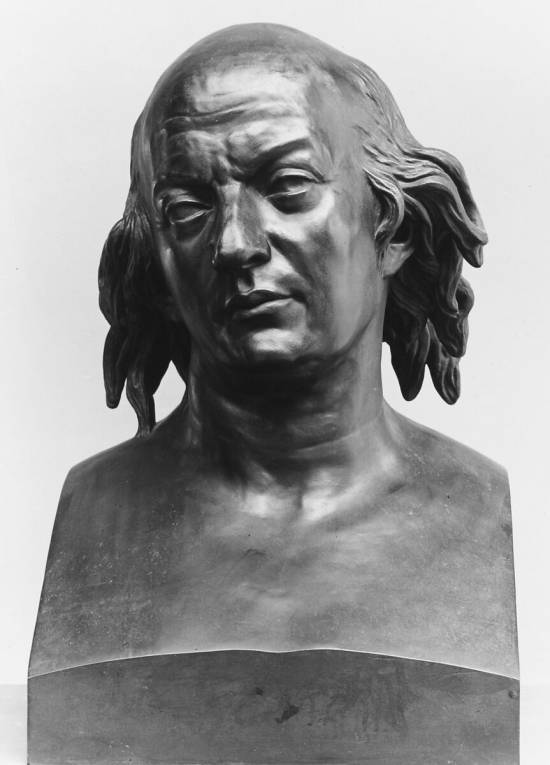
(…) David’s bust, writes Pavie, was as beautiful as Chateaubriand’s, Lamartine’s, Cooper’s, as any application of genius to genius, as the work of a chisel fit and powerful to reproduce one of those types created expressly by nature for the habitation of a great thought. Of all the likenesses attempted, with greater or lesser success, in all the ages of this long glory, from his youth of twenty to Rauch’s bust, the last and best understood of all, it is no prevention to say that David’s is the best, or, to put it even more bluntly, the only realization of that ideal likeness which is not the thing, but is more than the thing, nature taken within and turned inside out, the outward manifestation of a divine intelligence passed into human bark. And there are few occasions like this one, when colossal execution seems no more than a powerless indication of real effect. An immense forehead, on which rises, like clouds, a thick tuft of silver hair; a downward gaze, hollow and motionless, a look of Olympian Jupiter; a nose of broad proportion and antique style, in the line of the forehead ; then that singular mouth we were talking about earlier, with the lower lip a little forward, that mouth, all examination, questioning and finesse, completing the top with the bottom, genius with reason; with no other pedestal than its muscular neck, this head leans as if veiled, towards the earth:it’s the hour when the setting genius lowers his gaze to this world, which he still lights with a farewell ray. Such is David’s crude description of Goethe’s statue.- What a pity that in his bust of Schiller, so famous and so praised, the sculptor Dannecker prepared such a miserable counterpart!
When Goethe received his bust, he warmly thanked David for the exchange of letters, books and medallions… but made no mention of the bust ! For one simple reason: he didn’t recognize himself at all in the work, which he didn’t even keep at home… The German poet was depicted with an oversized forehead, to reflect his great intelligence. And his tousled hair symbolized the torments of his soul…
David d’Angers and Hippolyte Carnot
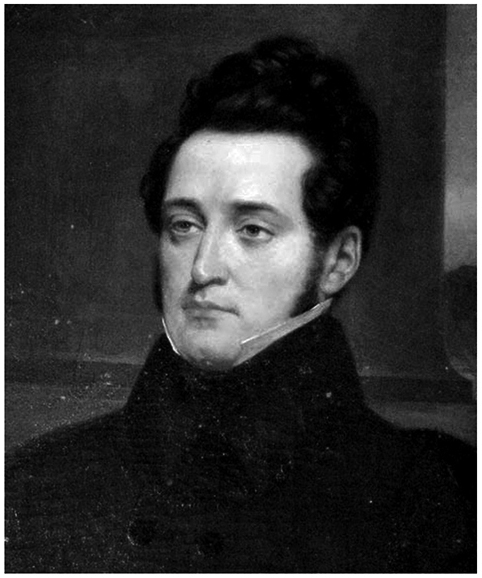
Among the founders of the SFAE (see earlier chapter on Abbé Grégoire) was Hippolyte Carnot (1801-1888), younger brother of Nicolas Sadi Carnot (1796-1832), pioneer of thermodynamics and son of « the organizer of victory », the military and scientific genius Lazare Carnot (1753-1823), whose work and struggle he recounted in his 1869 biography Mémoires sur Lazare Carnot 1753-1823 by his son Hippolyte.
In 1888, with the title Henri Grégoire, évêque (bishop) républicain, Hippolyte published the Mémoires of Grégoire the defender of all the oppressed of the time (negroes and Jews alike), a great friend of his father’s who had retained this friendship.
For the former bishop of Blois, « we must enlighten the ignorance that does not know and the poverty that does not have the means to know. »
Grégoire had been one of the Convention’s great « educators », and it was on his report that the Conservatoire des Arts-et-Métiers was founded on September 29, 1794, notably for the instruction of craftsmen. Grégoire also contributed to the creation of the Bureau des Longitudes on June 25, 1795 and the Institut de France on October 25, 1795.
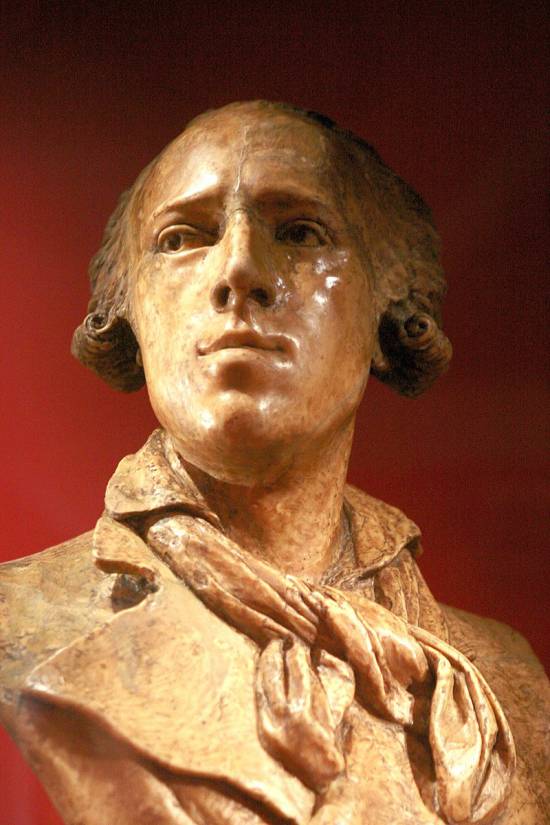
Hippolyte Carnot and David d’Angers, who were friends, co-authored the Memoirs of Bertrand Barère de Vieuzac (1755-1841), who acted as a sort of Minister of Information on the Comité de Salut Public, responsible for announcing the victories of the Republican armies to the Convention as soon as they arrived.
It was also Abbé Grégoire who, in 1826, commissioned David d’Angers, with the help of his friend Béranger, to bring some material and financial comfort to Rouget de Lisle (1860-1836), the legendary author of La Marseillaise, composed in Strasbourg when, in his old age, the composer was languishing in prison for debt.
Overcoming the sectarianism of their time, here are three fervent republicans full of compassion and gratitude for a musical genius who never wanted to renounce his royalist convictions, but whose patriotic creation would become the national anthem of the young French Republic.
Provisional Government
of the Second Republic
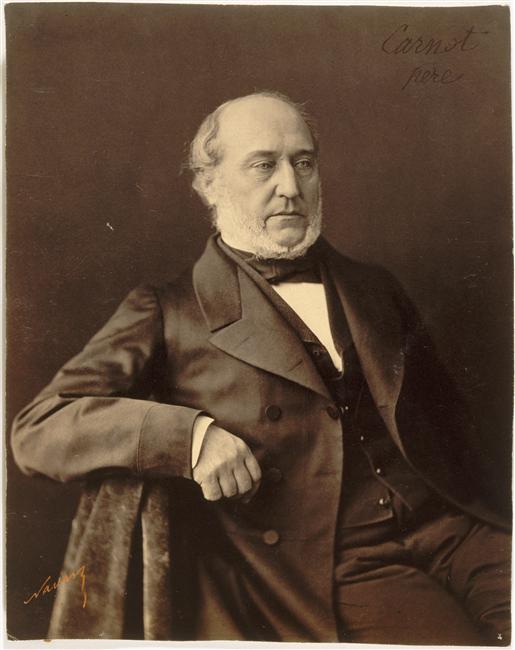
All these battles, initiatives and mobilizations culminated in 1848, when, for two months and 15 days (from February 24 to May 9), a handful of genuine republicans became part of the « provisional government » of the Second Republic.
In such a short space of time, so many good measures were taken or launched! Hippolyte Carnot was the Minister of Public Instruction, determined to create a high level of education for all, including women, following the models set by his father for Polytechnique and Grégoire for Arts et Métiers.
Article 13 of the 1848 Constitution « guarantees citizens (…) free primary education ».
On June 30, 1848, the Minister of Public Instruction, Lazare Hippolyte Carnot, submitted a bill to the Assembly that fully anticipated the Ferry laws, by providing for compulsory elementary education for both sexes, free and secular, while guaranteeing freedom of teaching. It also provided for three years’ free training at a teacher training college, in return for an obligation to teach for at least ten years, a system that was to remain in force for a long time. He proposed a clear improvement in their salaries. He also urged teachers « to teach a republican catechism ».
A member of the provisional government, the great astronomer and scientist François Arago (1886-1853) was Minister for the Colonies, having been appointed by Gaspard Monge to succeed him at the Ecole Polytechnique, where he taught projective geometry. His closest friend was none other than Alexander von Humboldt, friend of Johann Wolfgang Goethe and Friedrich Schiller.
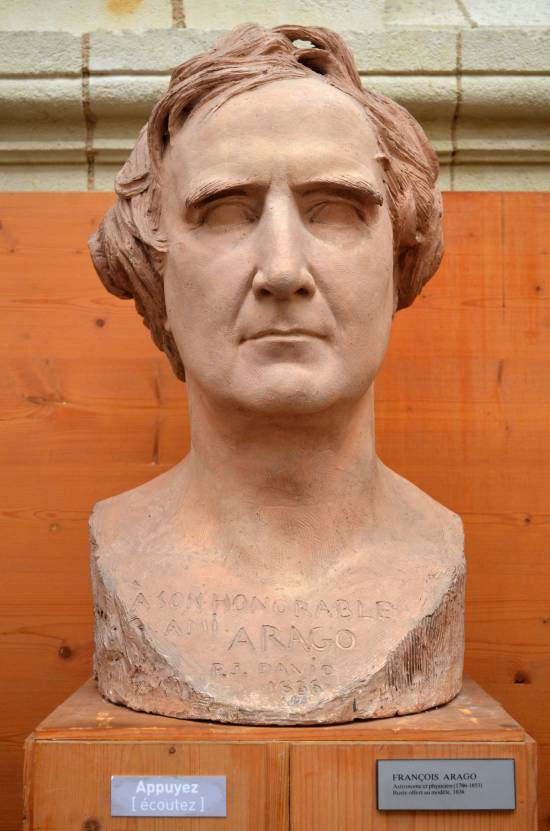
He was another abolitionist activist who spent much of his adult life in Paris. Humboldt was a member of the Société d’Arcueil, formed around the chemist Claude-Louis Berthollet, where he also met, besides François Arago, Jean-Baptiste Biot and Louis-Joseph Gay-Lussac, with whom Humboldt became friends. They published several scientific articles together.
Humboldt and Gay-Lussac conducted joint experiments on the composition of the atmosphere, terrestrial magnetism and light diffraction, research that would later bear fruit for the great Louis Pasteur.
Napoleon, who initially wanted to expel Humboldt, eventually tolerated his presence. The Paris Geographical Society, founded in 1821, chose him as its president.
Humboldt, Arago, Schoelcher, David d’Angers and Hugo
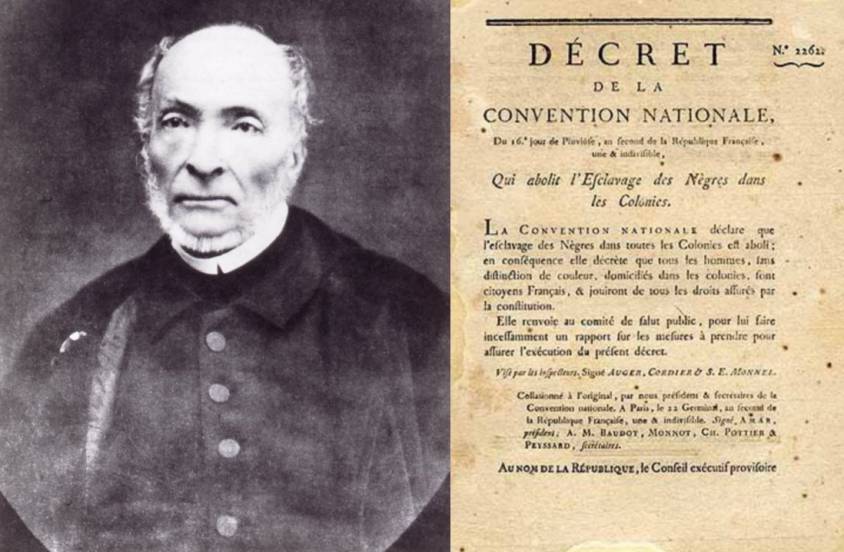
Humboldt made no secret of his republican ideals. His Political Essay on the Island of Cuba (1825) was a bombshell. Too hostile to slavery practices, the work was banned from publication in Spain. London went so far as to refuse him access to its Empire.
Even more deplorably, John S. Trasher, who published an English-language version in 1856, removed the chapter devoted to slaves and the slave trade altogether! Humboldt protested vigorously against this politically motivated mutilation. Trasher was a slaveholder, and his redacted translation was intended to counter the arguments of North American abolitionists, who subsequently published the retracted chapter in the New York Herald and the US Courrier. Victor Schoelcher and the decree abolishing slavery in the French colonies.
In France, under Arago, the Under-Secretary of State for the Navy and the Colonies was Victor Schoelcher. He didn’t need much convincing to convince the astronomer that all the planets were aligned for him to act.
A Freemason, Schoelcher was a brother of David d’Angers’s lodge, « Les amis de la Vérité » (The Friends of Truth), also known as the Cercle social, in reality « a mixture of revolutionary political club, Masonic lodge and literary salon ».
On March 4, a commission was set up to resolve the problem of slavery in the French colonies. It was chaired by Victor de Broglie, president of the SFAE, to which five of the commission’s twelve members belonged. Thanks to the efforts of François Arago, Henri Wallon and above all Victor Schoelcher, its work led to the abolition of slavery on April 27.
Victor Hugo the abolitionist
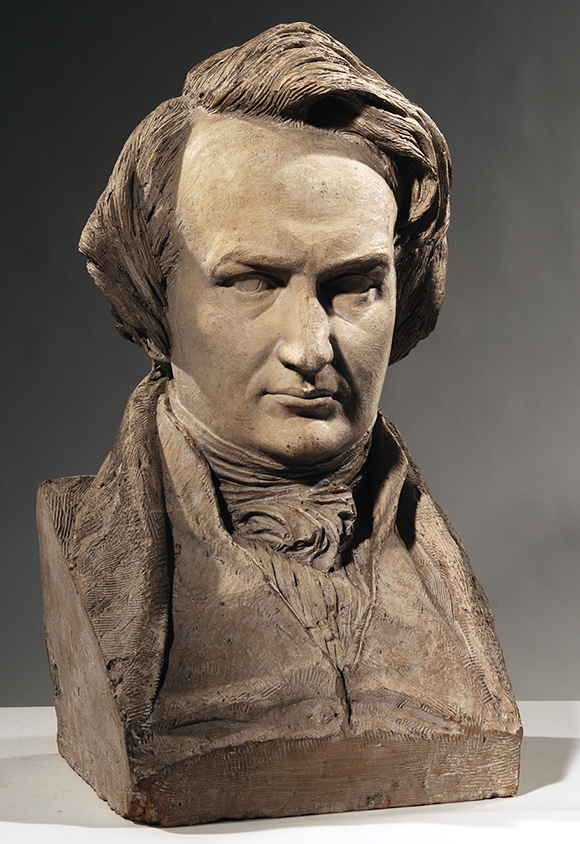
Victor Hugo was one of the advocates of the abolition of slavery in France, but also of equality between what were still referred to as « the races » in the 19th century. « The white republic and the black republic are sisters, just as the black man and the white man are brothers », Hugo asserted as early as 1859. For him, as all men were creations of God, brotherhood was the order of the day.
When Maria Chapman, an anti-slavery campaigner, wrote to Hugo on April 27, 1851, asking him to support the abolitionist cause, Hugo replied: « Slavery in the United States! » he exclaimed on May 12, « is there any more monstrous misinterpretation? » How could a republic with such a fine constitution preserve such a barbaric practice?
Eight years later, on December 2, 1859, he wrote an open letter to the United States of America, published by the free newspapers of Europe, in defense of the abolitionist John Brown, condemned to death.
Starting from the fact that « there are slaves in the Southern states, which indignifies, like the most monstrous counter-sense, the logical and pure conscience of the Northern states », he recounts Brown’s struggle, his trial and his announced execution, and concludes: « there is something more frightening than Cain killing Abel, it is Washington killing Spartacus ».
A journalist from Port-au-Prince, Exilien Heurtelou, thanked him on February 4, 1860. Hugo replied on March 31:
« Hauteville-House, March 31, 1860.
You are, sir, a noble sample of this black humanity so long oppressed and misunderstood.
From one end of the earth to the other, the same flame is in man; and blacks like you prove it. Was there more than one Adam? Naturalists can debate the question, but what is certain is that there is only one God.
Since there is only one Father, we are brothers.
It is for this truth that John Brown died; it is for this truth that I fight. You thank me for this, and I can’t tell you how much your beautiful words touch me.
There are neither whites nor blacks on earth, there are spirits; you are one of them. Before God, all souls are white.
I love your country, your race, your freedom, your revolution, your republic. Your magnificent, gentle island pleases free souls at this hour; it has just set a great example; it has broken despotism. It will help us break slavery. »
Also in 1860, the American Abolitionist Society, mobilized behind Lincoln, published a collection of speeches. The booklet opens with three texts by Hugo, followed by those by Carnot, Humboldt and Lafayette.
On May 18, 1879, Hugo agreed to preside over a commemoration of the abolition of slavery in the presence of Victor Schoelcher, principal author of the 1848 emancipation decree, who hailed Hugo as « the powerful defender of all the underprivileged, all the weak, all the oppressed of this world » and declared:
« The cause of the Negroes whom we support, and towards whom the Christian nations have so much to reproach, must have had your sympathy; we are grateful to you for attesting to it by your presence in our midst. »
A start for the better
Another measure taken by the provisional government of this short-lived Second Republic was the abolition of the death penalty in the political sphere, and the abolition of corporal punishment on March 12, as well as imprisonment for debt on March 19.
In the political sphere, freedom of the press and freedom of assembly were proclaimed on March 4. On March 5, the government instituted universal male suffrage, replacing the censal suffrage in force since 1815. At a stroke, the electorate grew from 250,000 to 9 million. This democratic measure placed the rural world, home to three quarters of the population, at the heart of political life for many decades to come. This mass of new voters, lacking any real civic training, saw in him a protector, and voted en masse for Napoleon III in 1851, 1860 and 1870.
Victor Hugo
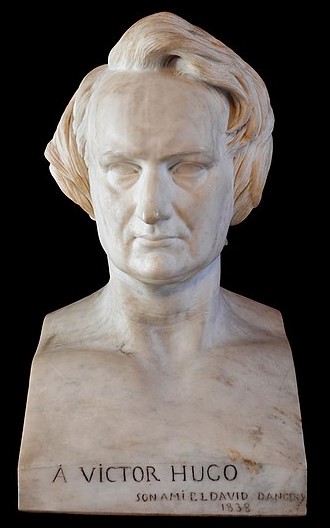
To return to David d’Angers, a lasting friendship united him with Victor Hugo (1802-1885). Recently married, Hugo and David would meet to draw. The poet and the sculptor enjoyed drawing together, making caricatures, painting landscapes or « architectures » that inspired them.
A shared ideal united them, and with the arrival of Napoleon III, both men went into political exile.
Out of friendship, David d’Angers made several busts of his friend. Hugo is shown wearing an elegant contemporary suit.
His broad forehead and slightly frowning eyebrows express the poet’s greatness, yet to come. Refraining from detailing the pupils, David lends this gaze an inward, pensive dimension that prompted Hugo to write: « my friend, you are sending me immortality. »
In 1842, David d’Angers produced another bust of Victor Hugo, crowned with laurel, where this time it was not Hugo the close friend who was evoked, but rather the genius and great man.
Finally, for Hugo’s funeral in 1885, the Republic of Haiti wished to show its gratitude to the poet by sending a delegation to represent it. Emmanuel-Edouard, a Haitian writer, presided over the delegation, and made the following statement at the Pantheon:
The Republic of Haiti has the right to speak on behalf of the black race; the black race, through me, thanks Victor Hugo for having loved and honored it so much, for having strengthened and comforted it.
The four bas-reliefs
of the Gutenberg statue
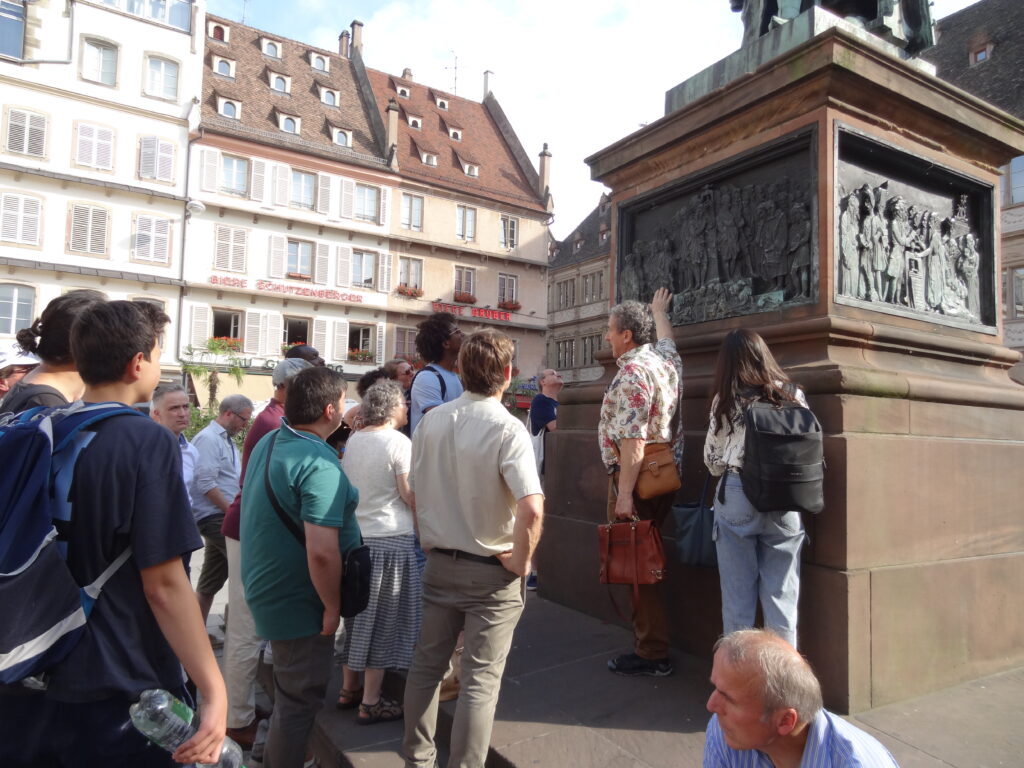
Once the reader has identified this « great arch » that runs through history, and the ideas and convictions that inspired David d’Angers, he will grasp the beautiful unity underlying the four bas-reliefs on the base of the statue commemorating Gutenberg in Strasbourg.
What stands out is the very optimistic idea that the human race, in all its great and magnificent diversity, is one and fraternal. Once freed from all forms of oppression (ignorance, slavery, etc.), they can live together in peace and harmony.
These bronze bas-reliefs were added in 1844. After bitter debate and contestation, they replaced the original 1840 painted plaster models affixed at the inauguration. They represent the benefits of printing in America, Africa, Asia and Europe. At the center of each relief is a printing press surrounded by characters identified by inscriptions, as well as schoolteachers, teachers and children.
To conclude, here’s an extract from the inauguration report describing the bas-reliefs. Without falling into wokism (for whom any idea of a « great man » is necessarily to be fought), let’s point out that it is written in the terms of the time and therefore open to discussion:

Plaster model for the base of the statue of Gutenberg, David d’Angers.
« Europe
is represented by a bas-relief featuring René Descartes in a meditative attitude, beneath Francis Bacon and Herman Boerhaave. On the left are William Shakespeare, Pierre Corneille, Molière and Racine. One row below, Voltaire, Buffon, Albrecht Dürer, John Milton and Cimarosa, Poussin, Calderone, Camoëns and Puget. On the right, Martin Luther, Wilhelm Gottfried Leibniz, Immanuel Kant, Copernicus, Wolfgang Goethe, Friedrich Schiller, Hegel, Richter, Klopstock. Rejected on the side are Linné and Ambroise Parée. Near the press, above the figure of Martin Luther, Erasmus of Rotterdam, Rousseau and Lessing. Below the tier, Volta, Galileo, Isaac Newton, James Watt, Denis Papin and Raphaël. A small group of children study, including one African and one Asian.«
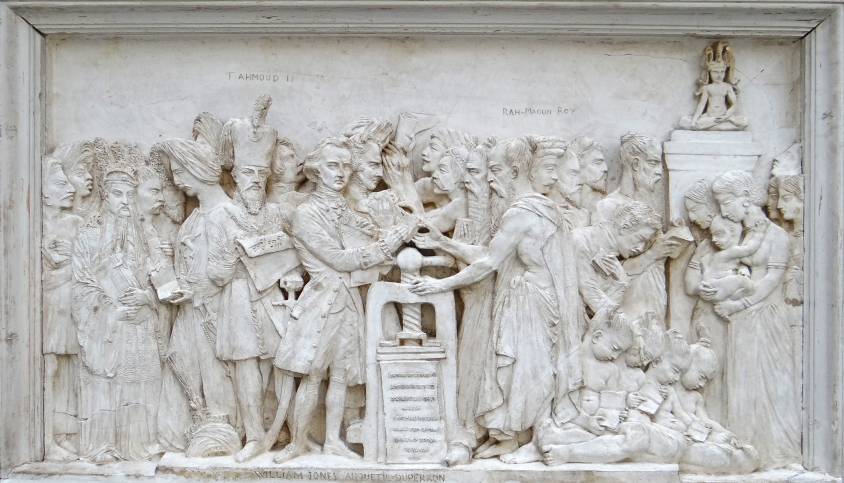
Plaster model for the base of the statue of Gutenberg, David d’Angers.
« Asia.
A printing press is shown again, with William Jones and Abraham Hyacinthe Anquetil-Duperron offering books to Brahmins, who give them manuscripts in return. Near Jones, Sultan Mahmoud II is reading the Monitor in modern clothes, his old turban lies at his feet, and nearby a Turk is reading a book. One step below, a Chinese emperor surrounded by a Persian and a Chinese man is reading the Book of Confucius. A European instructs children, while a group of Indian women stand by an idol and the Indian philosopher Rammonhun-Roy.«
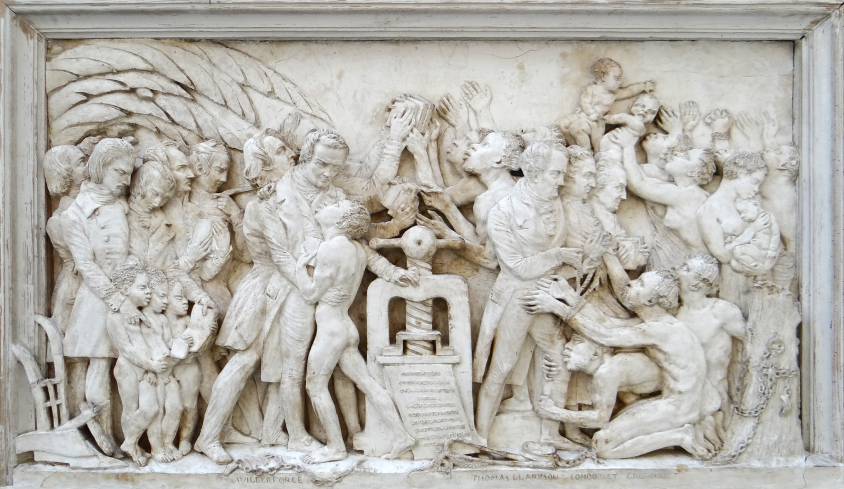
« Africa.
Leaning on a press, William Wilberforce hugs an African holding a book, while Europeans distribute books to other Africans and are busy teaching children. On the right, Thomas Clarkson can be seen breaking the shackles of a slave. Behind him, Abbé Grégoire helps a black man to his feet and holds his hand over his heart. A group of women raise their recovered children to the sky, which will now see only free men, while on the ground lie broken whips and irons. This is the end of slavery.«
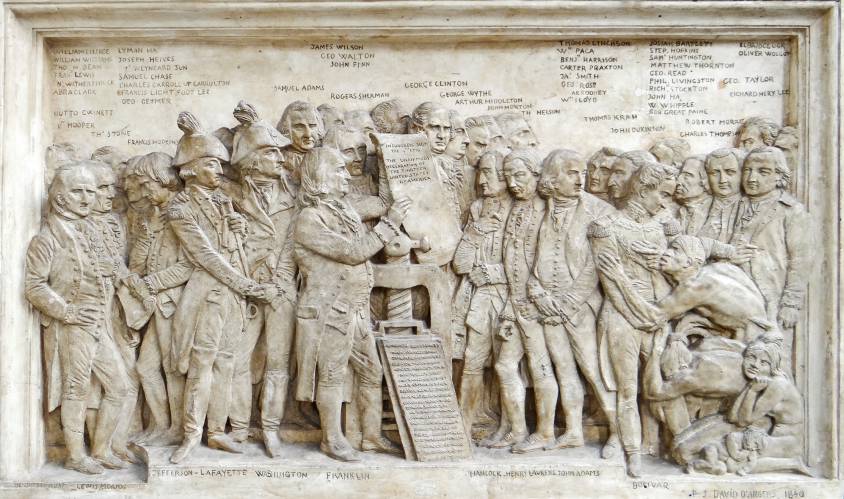
« America.
The Act of Independence of the United States, fresh from the press, is in the hands of Benjamin Franklin. Next to him stand Washington and Lafayette, who holds the sword given to him by his adopted homeland to his chest. Jefferson and all the signatories of the Act of Independence are assembled. On the right, Bolivar shakes hands with an Indian. »
America
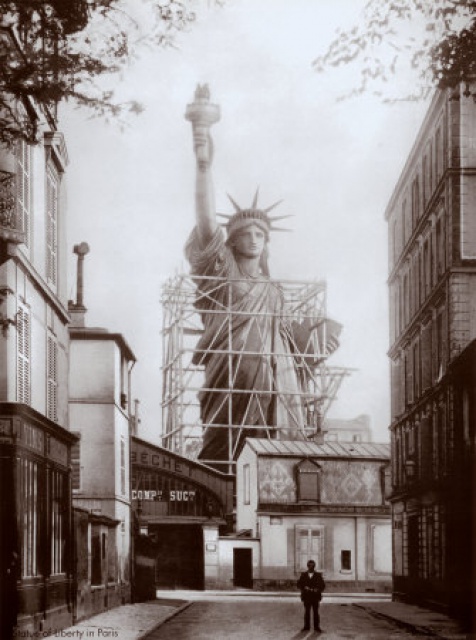
We can better understand the words spoken by Victor Hugo on November 29, 1884, shortly before his death, during his visit to the workshop of sculptor Frédéric-Auguste Bartholdi, where the poet was invited to admire the giant statue bearing the symbolic name « Liberty Enlightening the World », built with the help of Gustave Eiffel and ready to leave for the United States by ship. A gift from France to America, it will commemorate the active part played by Lafayette’s country in the Revolutionary War.
Initially, Hugo was most interested in American heroes and statesmen: William Penn, Benjamin Franklin, John Brown and Abraham Lincoln. Role models, according to Hugo, who enabled the people to progress. For the French politician who became a Republican in 1847, America was the example to follow. Even if he was very disappointed by the American position on the death penalty and slavery.
After 1830, the writer abandoned this somewhat idyllic vision of the New World and attacked the white « civilizers » who hunted down Indians:
« You think you civilize a world, when you inflame it with some foul fever [4], when you disturb its lakes, mirrors of a secret god, when you rape its virgin, the forest. When you drive out of the wood, out of the den, out of the shore, your naive and dark brother, the savage… And when throwing out this useless Adam, you populate the desert with a man more reptilian… Idolater of the dollar god, madman who palpitates, no longer for a sun, but for a nugget, who calls himself free and shows the appalled world the astonished slavery serving freedom!«
(NOTE 5)
Overcoming his fatigue, in front of the Statue of Liberty, Hugo improvised what he knew would be his last speech:
« This beautiful work tends towards what I have always loved, called: peace between America and France – France which is Europe – This pledge of peace will remain permanent. It was good that it was done!«
NOTES:
1. If the phrase appears in the Book of Genesis, it could also refer to Notre-Dame de Paris (1831) a novel by Victor Hugo, a great friend of the statue’s sculptor, David d’Angers. We know from a letter Hugo wrote in August 1832 that the poet brought David d’Angers the eighth edition of the book. The scene most directly embodied in the statue is the one in which the character of Frollo converses with two scholars (one being Louis XI in disguise) while pointing with one finger to a book and with the other to the cathedral, remarking: « Ceci tuera cela » (This will kill that), i.e. that one power (the printed press), democracy, will supplant the other (the Church), theocracy, a historical evolution Hugo thought ineluctable.
2. It was the encounter with Asia that brought countless technical know-how and scientific discoveries from the East to Europe, the best-known being the compass and gunpowder. Just as essential to printing as movable type was paper, the manufacture of which was perfected in China at the end of the Eastern Han Dynasty (around the year 185). As for printing, the oldest printed book we have to date is the Diamond Sutra, a Chinese Buddhist scripture dating from 868. Finally, it was in the mid-11th century, under the Song dynasty, that Bi Sheng (990-1051) invented movable type. Engraved in porcelain, a viscous clay ceramic, hardened in fire and assembled in resin, they revolutionized printing. As documented by the Gutenberg Museum in Mainz, it was the Korean Choe Yun-ui (1102-1162) who improved this technique in the 12th century by using metal (less fragile), a process later adopted by Gutenberg and his associates. The Anthology of Zen Teachings of Buddhist High Priests (1377), also known as the Jikji, was printed in Korea 78 years before the Gutenberg Bible, and is recognized as the world’s oldest book with movable metal type.
3. Etienne Taillemite, Lafayette and the abolition of slavery.
4. Victor Hugo undoubtedly wanted to rebound on the news that reached him from America. The Pacific Northwest smallpox epidemic of 1862, which was brought from San Francisco to Victoria, devastated the indigenous peoples of the Pacific Northwest coast, with a mortality rate of over 50% along the entire coast from Puget Sound to southeast Alaska. Some historians have described the epidemic as a deliberate genocide, as the colony of Vancouver Island and the colony of British Columbia could have prevented it, but chose not to, and in a way facilitated it.
5. Victor Hugo, La civilisation from Toute la lyre (1888 and 1893).
Le combat républicain de David d’Angers, statue de Gutenberg à Strasbourg

En plein centre-ville de Strasbourg, à deux pas de la cathédrale, tournant le dos à la Chambre de commerce qui date de 1585, la belle statue en bronze représentant l’imprimeur allemand Johannes Gutenberg tenant une page à peine imprimée de sa Bible sur laquelle on peut lire : « Et la lumière fut ! » (NOTE 1)
Évoquant l’émancipation des peuples grâce à la diffusion de la connaissance par le développement de l’imprimerie, la statue, érigée en 1840, arrive à un moment où les partisans de la République sont vent debout contre la censure de la presse imposée par Louis-Philippe sous la Monarchie de Juillet.
Strasbourg, Mayence et la Chine
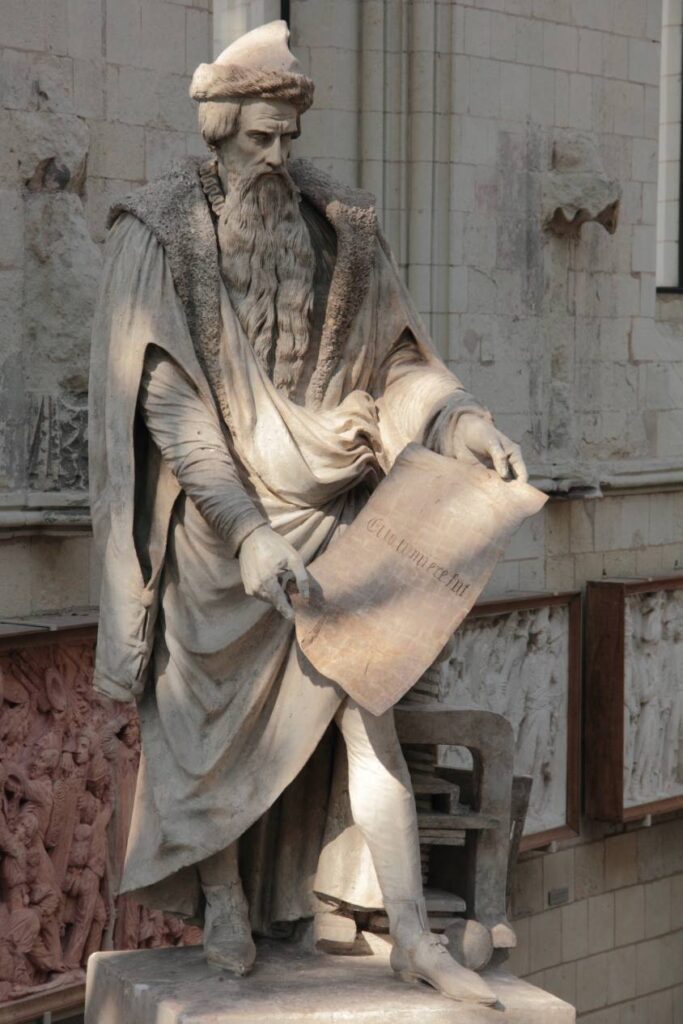
Né vers 1400 à Mayence, Johannes Gutenberg, avec l’argent que lui prête le marchand et banquier Johann Fust, réalise à Strasbourg, entre 1434 et 1445, ses premiers essais avec des caractères d’imprimerie mobiles en métal, avant de perfectionner son procédé à Mayence, notamment en imprimant à partir de 1452 sa fameuse Bible dite à 42 lignes.
A sa mort (à Mayence) en 1468, Gutenberg lègue son procédé à l’humanité permettant l’envol de l’imprimerie en Europe. Des chroniqueurs évoquent également le travail de Laurens Janszoon Coster à Harlem ou encore ceux de l’imprimeur italien Panfilo Castaldi qui aurait ramené le savoir-faire chinois en Europe. Soulignons que le monde « civilisé » d’alors refusait de reconnaître que l’imprimerie avait vu le jour en Asie avec les fameux « caractères mobiles » (en porcelaine et en métal) mis au point plusieurs siècles plus tôt en Chine et en Corée. (NOTE 2)
En Europe, Mayence et Strasbourg se disputent la place d’honneur. Ainsi, pour célébrer le 400e anniversaire de « l’invention » de l’imprimerie, Mayence inaugure, le 14 août 1837, sa statue de Gutenberg érigée par le sculpteur Bertel Thorvaldsenalors, alors qu’à Strasbourg, dès 1835, un comité local avait confié la réalisation d’un monument du même type au sculpteur David d’Angers.
Ce dernier, assez peu connu, fut aussi bien un grand sculpteur ami proche de Victor Hugo, qu’un républicain fervent en contact personnel avec la fine fleur de l’élite humaniste de son époque en France, en Allemagne et aux Etats-Unis. Il fut également un combattant inlassable de l’abolition de la traite négrière et de l’esclavage.
La vie du sculpteur
Sculpteur français Pierre-Jean David, dit « David d’Angers » (1788-1856) est le fils du maître sculpteur Pierre Louis David. Pierre-Jean sera marqué par l’esprit républicain de son père qui le forme à la sculpture dès son jeune âge. A douze ans, son père l’inscrit au cours de dessin de l’École centrale de Nantes. A Paris, il est sollicité pour réaliser les ornementations de l’Arc de Triomphe du Carrousel et la façade sud du palais du Louvre. Enfin il entre aux Beaux-arts.

David d’Angers possède un sens aigu de l’interprétation de la figure humaine et une aptitude à pénétrer les secrets de ses modèles. Il excelle dans le portrait que ce soit en buste ou en médaillon. Il est l’auteur d’au moins soixante huit statues et statuettes, d’une cinquantaine de bas-reliefs, d’une centaine de bustes et plus de cinq cents médaillons. Victor Hugo avait dit à son ami David: « C’est la monnaie de bronze avec laquelle vous payez votre péage à la postérité. »
Il voyage en Europe : Berlin, Londres, Dresde, Munich où partout, il exécute des bustes.
Vers 1825, alors qu’il obtient la commande du monument funéraire que la Nation élève par souscription publique en l’honneur du général Foy, un tribun de l’opposition parlementaire, une mutation idéologique et artistique s’opère en lui. Il fréquente les milieux progressistes des intellectuels de la « génération de 1820 » et rejoint le courant républicain international. Il s’interroge alors sur les problèmes politiques et sociaux de la France et de l’Europe. Plus tard, il resta toujours fidèle à ses convictions, refusant par exemple la commande prestigieuse du tombeau de Napoléon.
Production artistique
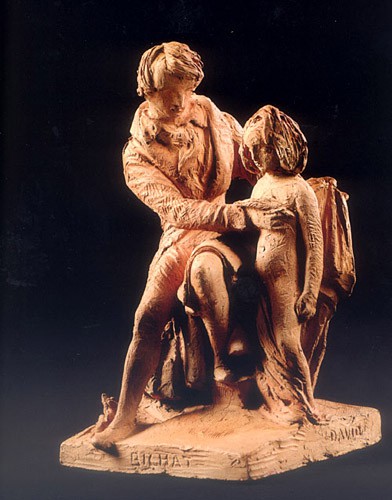
Son art s’infléchit donc dans le sens d’un naturalisme dont l’iconographie et l’expression détonnent si on le compare à l’art que pratiquent ses collègues académiciens et à celui des sculpteurs dissidents dits alors « romantiques ». Pour David, point de sensualisme mythologique, d’allégories obscures ni de pittoresque historique. La sculpture, selon David, doit au contraire généraliser et transposer ce que l’artiste observe, de façon à assurer la survie des idées et des destinées dans une postérité intemporelle. David s’attacha à cette conception particulière, limitée de la sculpture, adoptant ainsi les réflexions de l’âge des Lumières selon lesquelles cet art se fait « le dépôt durable des vertus des hommes » en perpétuant le souvenir des exploits des êtres d’exception.

Prévaut alors l’image, un peu austère, des « grands hommes » que l’on connaît surtout grâce à quelque 600 médaillons représentant les hommes et femmes célèbres, de plusieurs pays, la plupart étant ses contemporains. A cela, s’ajoute une centaine de bustes, avant tout représentant ses amis, des poètes, des écrivains, des musiciens, des chansonniers, des scientifiques et des hommes politiques avec lesquels il partage l’idéal républicain.
Parmi les plus éclairés de son époque, on compte : Victor Hugo, Lafayette, Wolfgang Goethe, Alfred de Vigny, Alphonse Lamartine, Pierre-Jean de Béranger, Alfred de Musset, François Arago, Alexandre de Humboldt, Honoré de Balzac, Lady Morgan, James Fennimore Cooper, Armand Carrel, François Chateaubriand, Ennius Quirinus Visconti et autres Niccolo Paganini.
Pour magnifier ses modèles et rendre visuellement les qualités du génie propre à chacun, David d’Angers invente un mode d’idéalisation non plus fondé sur le classicisme à l’antique, mais sur une grammaire des formes issue d’une science nouvelle, la phrénologie du Docteur Gall, qui voulait que les « bosses » crâniennes d’un individu traduisent ses aptitudes intellectuelles et ses passions. Pour le sculpteur il s’agissait de transcender la physionomie du modèle pour que la grandeur de l’âme rayonne à son front.
En 1826, il est élu membre de l’Institut de France et, la même année, professeur aux Beaux-Arts. En 1828, David d’Angers est victime d’un premier attentat jamais élucidé. Blessé à la tête, il est obligé de garder le lit pendant trois mois. Ce qui ne l’empêche pas, en 1830, toujours fidèle aux idées républicaines, de participer aux journées révolutionnaires et combats sur les barricades. Fronton du Panthéon, David d’Angers.

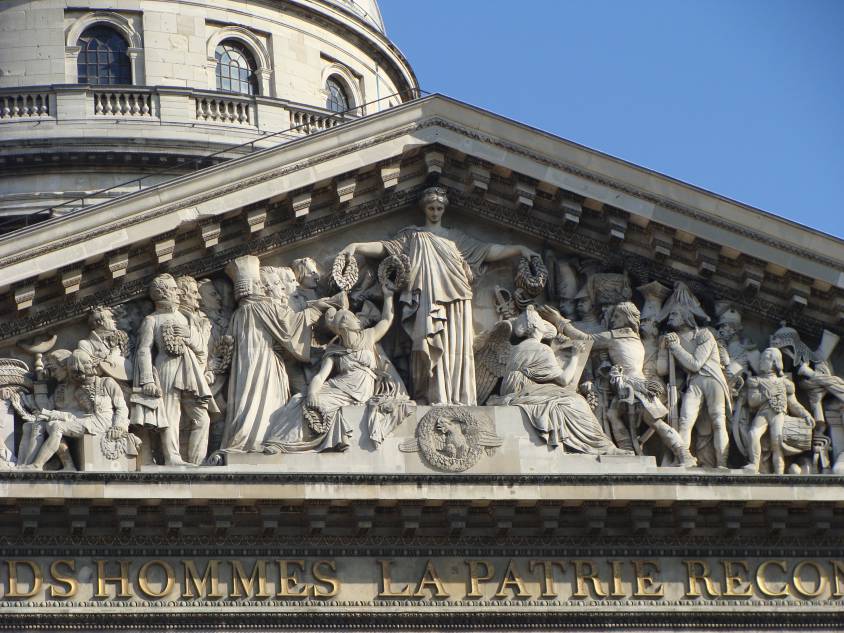
Le sculpteur se trouva ainsi tout désigné, en 1830, pour exécuter la commande du programme de sculpture politique le plus chargé de sens de la monarchie de Juillet et, peut-être, du XIXe siècle en France, la nouvelle décoration du fronton de l’église Sainte-Geneviève reconvertie, dès juillet, en Panthéon.
Il s’agit pour lui, historiographe, de représenter les civils et hommes de guerre qui édifièrent la France républicaine. L’exécution des personnages qu’il avait choisis et disposés dans une esquisse d’abord approuvée puis suspendue, devait nécessairement conduire, en 1837, à un conflit avec le haut-clergé et le gouvernement. À gauche, nous voyons Bichat, Voltaire et Jean-Jacques Rousseau, David, Cuvier, Lafayette, Manuel, Carnot, Berthollet, Laplace, Malesherbes, Mirabeau, Monge et Fénelon. Alors que le gouvernement tente de faire supprimer l’effigie de Lafayette, ce que David d’Angers refuse avec obstination, appuyé en cela par la presse libérale, le fronton est dévoilé sans cérémonie officielle en septembre 1837, sans la présence de l’artiste, non invité.
Entrée en politique
Lors de la Révolution de 1848, il est nommé maire du XIe arrondissement de Paris, entre à l’Assemblée nationale constituante puis à l’Assemblée nationale législative où il vote avec la Montagne (gauche révolutionnaire). Il défend l’existence de l’Ecole des Beaux-arts et de l’Académie de France à Rome. Il s’oppose à la destruction de la Chapelle Expiatoire et au retrait de deux statues de l’Arc de Triomphe, (Résistance et Paix d’Antoine Etex).
Il vote aussi contre les poursuites à l’encontre de Louis Blanc (autre homme d’Etat républicain condamné à l’exil), contre les crédits de l’expédition romaine de Napoléon III, pour l’abolition de la peine de mort, pour le droit au travail, pour l’amnistie générale.
Exil
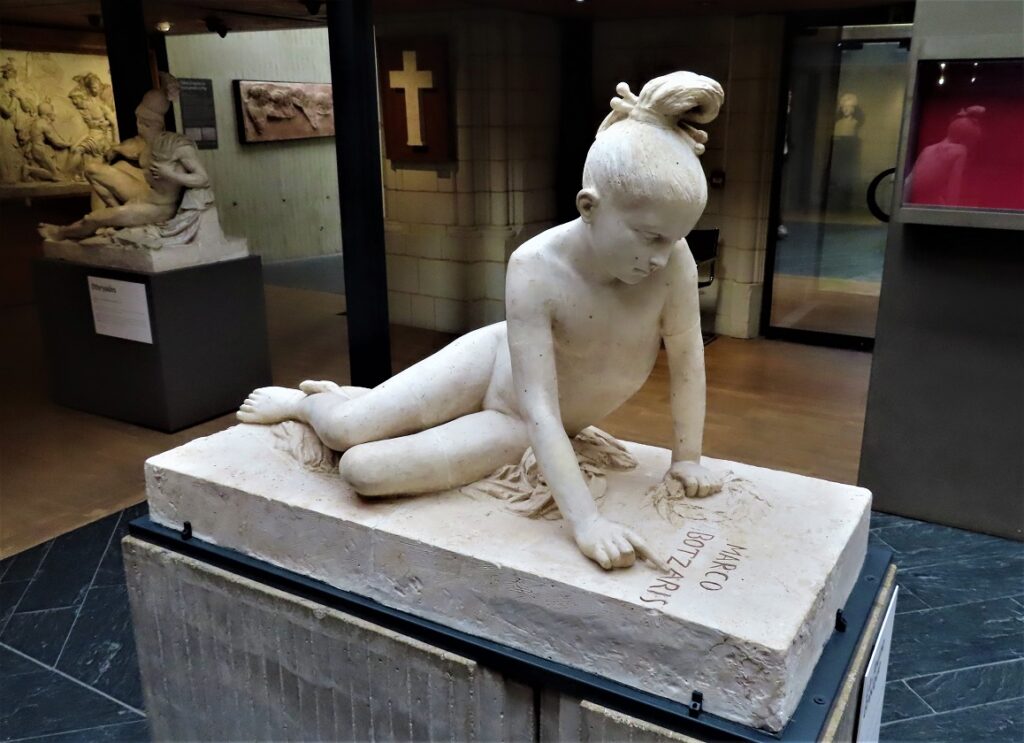
Il n’est pas réélu député en 1849 et se retire de la vie politique. En 1851, à l’avènement de Napoléon III, David d’Angers est arrêté et également condamné à l’exil. Il choisit la Belgique puis voyage en Grèce (son vieux projet). Il veut revoir sa Jeune grecque sur le tombeau du républicain patriote grec Markos Botzaris, qu’il trouve mutilée et à l’abandon (il la fera rapatrier en France et restaurer).
Déçu par la Grèce, il revient en France, en 1852. Aidé par son ami de Béranger, il est autorisé à séjourner à Paris où il reprend ses travaux. En septembre 1855, il est terrassé par une attaque d’apoplexie qui l’oblige à cesser ses activités. Il décède en janvier 1856.
Amitiés avec Lafayette, l’abbé Grégoire et Pierre-Jean de Béranger
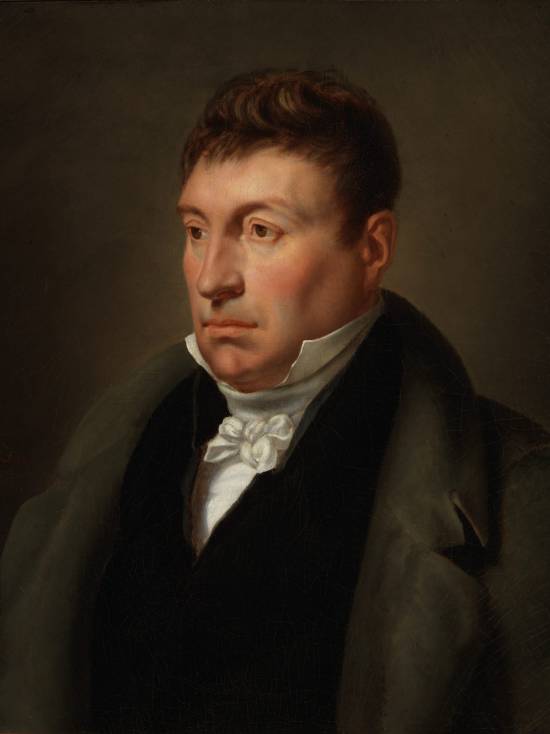
David d’Angers apparaît comme un véritable trait-d’union entre les républicains du XVIII et ceux du XIXe siècle et une passerelle vivante entre ceux d’Europe et d’Amérique.
Né en 1788, il aura la chance de fréquenter dans son jeune âge certaines grandes figures révolutionnaires de l’époque avant de s’impliquer personnellement dans les révolutions de 1830 et 1848.
Vers la fin des années 1820, David participe aux réunions chaque mardi du salon de Madame de Lafayette épouse de Gilbert du Motier, marquis de La Fayette (1757-1834).
Alors que le général Lafayette s’y tenait droit comme « un chêne vénérable », ce salon, note le sculpteur,
« a une physionomie bien tranchée, écrit-il. Là les hommes causent de choses sérieuses, surtout politiques, les jeunes gens mêmes ont l’air grave : il y a quelque chose de décidé, d’énergique et de courageux dans leur regard et dans leur maintien (…) Toutes les dames et aussi les demoiselles ont l’air calme et réfléchi ; elles ont plutôt l’air d’être venues pour voir ou assister à des délibérations importantes, que pour se faire voir. »
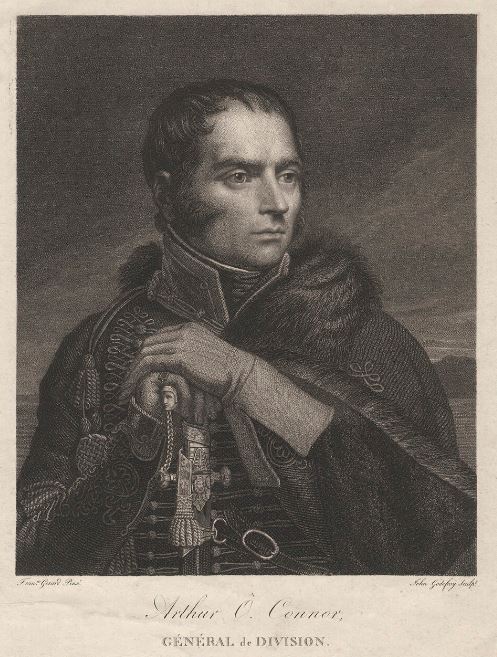
David y rencontre un compagnon d’armes de Lafayette, le général Arthur O’Connor (1763-1852), ancien député irlandais acquis à la cause républicaine ayant rejoint les volontaires de l’Etat-Major de Lafayette en 1792.
Accusé d’avoir suscité des troubles contre l’Empire britannique et en contact avec le général Lazare Hoche, O’Connor se réfugia en France en 1796 et participa à l’expédition d’Irlande. O’Connor, épousa en 1807 la fille de Condorcet et sera naturalisé Français en 1818.

Lafayette et David d’Angers se retrouvaient souvent avec un petit groupe d’amis, quelques « frères », membres de loges maçonniques : tels le chansonnier Pierre-Jean de Béranger, François Chateaubriand, Benjamin Constant, Alexandre Dumas (qui correspondait avec Edgar Allan Poe), Alphonse Lamartine, Henri Beyle dit Stendhal ou encore les peintres François Gérard et Horace Vernet.
Dans ces mêmes cercles, David fera également connaissance avec l’Abbé Grégoire (1750-1831) et on y évoquait souvent le problème de l’abolition de l’esclavage que Grégoire avait fait voter le 4 février 1794.
Dans leurs échanges, Lafayette aimait rappeler ce que disait son ami de jeunesse Nicolas de Condorcet :
« L’esclavage, c’est une horrible barbarie, si nous ne pouvons manger du sucre qu’à ce prix, il faut savoir renoncer à une denrée souillée du sang de nos frères.«
Pour Grégoire, le problème était bien plus profond :
« Tant que les hommes seront altérés de sang, ou plutôt, tant que la plupart des gouvernements n’auront pas de morale, que la politique sera l’art de fourber, que les peuples, méconnaissant leurs vrais intérêts, attacheront une sotte importance au métier de spadassin, et se laisseront conduire aveuglément à la boucherie avec une résignation moutonnière, presque toujours pour servir de piédestal à la vanité, presque jamais pour venger les droits de l’humanité, et faire un pas vers le bonheur et la vertu, la nation la plus florissante sera celle qui aura plus de facilité pour égorger les autres.«
(Essai sur la régénération physique, morale et politique des juifs)
Napoléon et l’esclavage
La première abolition de l’esclavage avait été, hélas de courte durée. En 1802, Napoléon Bonaparte, à court d’argent pour financer ses guerres, rétablit l’esclavage et neuf jours plus tard, il exclut de l’armée française les officiers de couleur. Enfin, il proscrit les mariages entre « fiancés dont la couleur de peau est différente ». David d’Angers restait très sensible à cette question, ayant comme camarade, un tout jeune écrivain, Alexandre Dumas, dont le père était né esclave à Haïti.
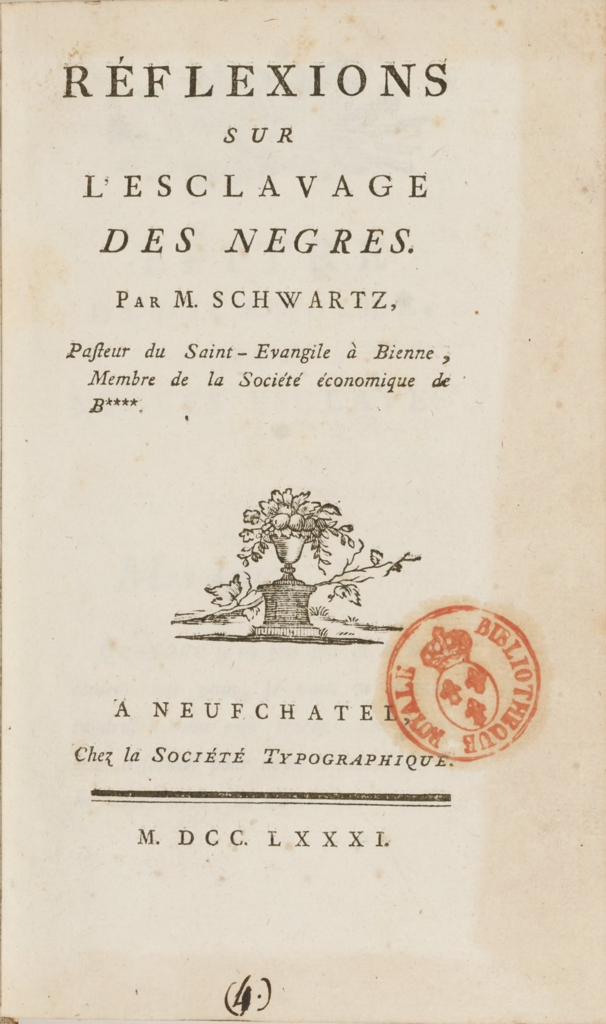
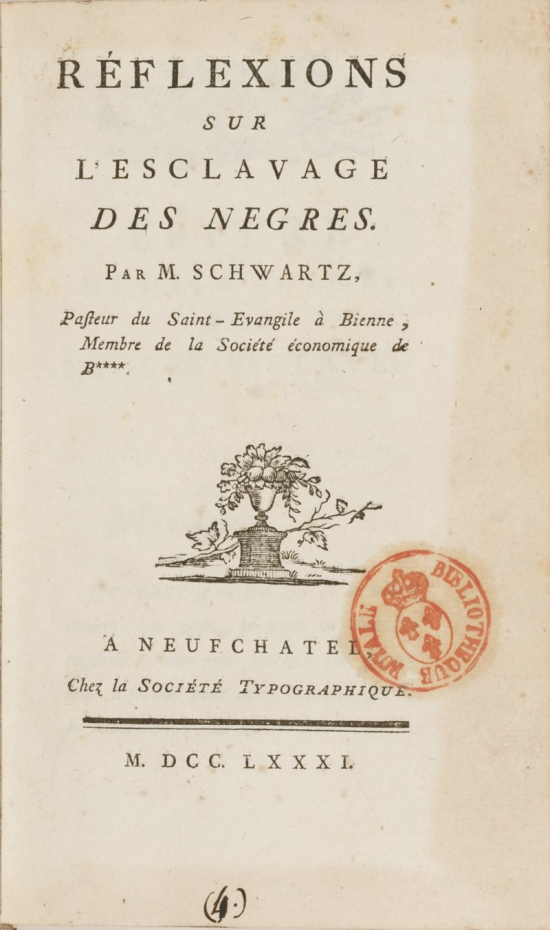
Dès 1781, sous le pseudonyme de Schwarz (noir en Allemand), Nicolas de Condorcet avait fait paraître un manifeste plaidant pour la disparition graduelle de l’esclavage sur une période de 60 à70 ans, un point de vue rapidement partagé par Lafayette. Fervent militant de la cause abolitionniste, Condorcet condamne l’esclavage comme un crime mais dénonce aussi son inutilité économique : le travail servile, dont la productivité est faible, est un frein à l’établissement de l’économie de marché.
Et avant même la signature du traité de paix entre la France et les Etats-Unis, Lafayette écrivit à son ami George Washington le 3 février 1783 pour lui proposer de s’associer à lui afin de mettre en route un processus d’émancipation progressif des esclaves. Il lui suggérait un plan qui « deviendrait franchement bénéfique pour la portion noire de l’humanité ».
Il s’agissait d’acheter un petit État dans lequel on ferait l’expérience de libérer les esclaves et de les faire travailler comme fermiers. Un tel exemple, expliquait-il, « pourrait faire école et ainsi devenir une pratique générale ». (NOTE 3)
Washington lui répond qu’à titre personnel il aurait plutôt envie d’appuyer une telle démarche mais que le Congrès américain (déjà) y était totalement hostile.
De la Société des amis des Noirs à la Société française pour l’abolition de l’esclavage
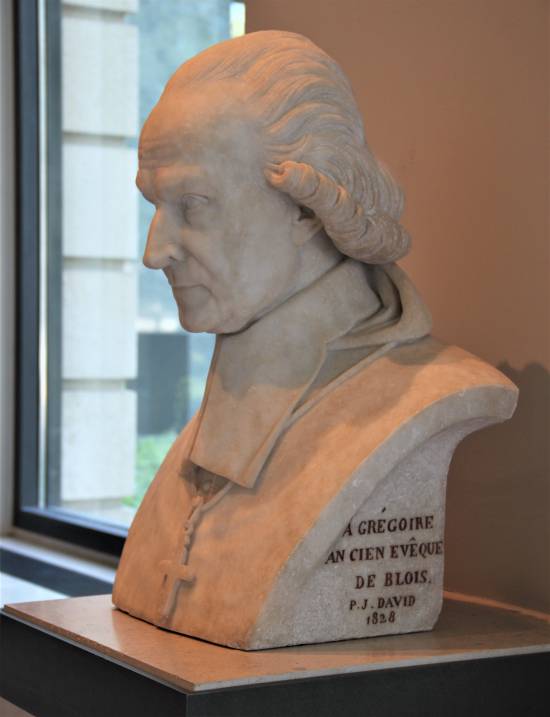
A Paris, l’abbé Grégoire et Jacques Pierre Brissot créent le 19 février 1788 « La Société des amis des Noirs » dont le règlement fut rédigé par Condorcet et dont les époux Lafayette furent également membres.
La société avait pour but l’égalité des Blancs et des Noirs libres dans les colonies, l’interdiction immédiate de la traite des Noirs et progressive de l’esclavage ; d’une part dans le souci de maintenir l’économie des colonies françaises, et d’autre part dans l’idée qu’avant d’accéder à la liberté, les Noirs devaient y être préparés, et donc éduqués.
Après la quasi disparition des « Amis des Noirs », l’offensive fut renouvelée avec d’abord, en 1821, la fondation de la « Société de la morale chrétienne » constituant en 1822 un « Comité pour l’abolition de la traite des Noirs », dont une partie des membres ira fonder en 1834 la « Société française pour l’abolition de l’esclavage (SFAE) ».
D’abord favorable à une abolition progressive, la SFAE sera ensuite favorable à une abolition immédiate. Interdit de réunion, elle décide de créer des comités abolitionnistes dans l’ensemble du pays pour que ceux-ci relaient tant au plan local qu’au plan national la volonté de faire cesser l’esclavage.
Goethe et Schiller
À l’été 1829, David d’Angers effectue son premier voyage en Allemagne et rencontre Goethe (1749-1832), le poète et philosophe qui s’était retiré à Weimar. Plusieurs séances de pose ont permis au sculpteur de réaliser son portrait.

L’écrivain et poète Victor Pavie (1808-1886), ami de Victor Hugo et un des fondateurs des « Cercles catholiques ouvriers », nous relate un épisode pittoresque du sculpteur dans son « Goethe et David, souvenirs d’un voyage à Weimar » (1874).
En 1827, le journal français Globe avait fait paraître deux lettres racontant deux visites rendues à Goethe, en 1817 et 1825, par Victor Cousin (1792-1887), ainsi qu’un courrier d’André-Marie Ampère (1775-1867), de retour de l’« Athènes de l’Allemagne ». Le tout jeune savant y faisait part de son admiration, et donnait de nombreux détails qui aiguisèrent l’intérêt de ses compatriotes. Lors de son séjour à Weimar, Ampère compléta les connaissances de son hôte au sujet des auteurs romantiques, et notamment en ce qui concerne Mérimée, Vigny, Deschamps et Delphine Gay. Goethe avait déjà une opinion (positive) sur Victor Hugo, Lamartine et Casimir Delavigne, et sur tout ce qu’ils devaient à Chateaubriand.
Abonné au Globe depuis sa fondation en 1824 Goethe disposait d’un merveilleux instrument d’information française. En tous cas, il ne lui restait pas grand chose à apprendre sur la France, quand David et Pavie se présentèrent chez lui, au mois d’août 1829. Fort de son expérience malheureuse avec Walter Scott à Londres, David d’Angers avait, cette fois, pris ses précautions, se munissant d’un certain nombre de lettres de recommandation pour les habitants de Weimar, ainsi que de deux lettres d’introduction auprès de Goethe, signées par l’abbé Grégoire et Victor Cousin. Afin de montrer à l’illustre écrivain ce qu’il savait faire, il avait mis dans une caisse quelques uns de ses plus beaux médaillons.
Arrivés à Weimar, David d’Angers et Victor Pavie rencontreront de grandes difficultés dans leur quête, d’autant que les destinataires des lettres de recommandation étaient tous absents. Frappé de désespoir, craignant l’échec, David accuse alors son jeune ami Victor Pavie :
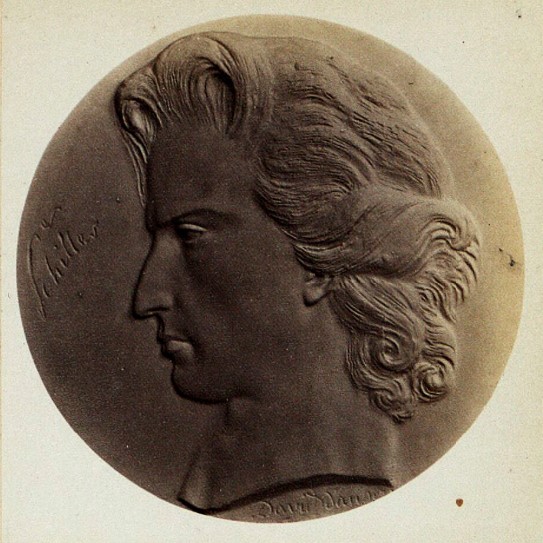
c« Oui, tu t’es lancé avec ton optimisme de jeune homme sans me laisser le temps de réfléchir et de me dégager. Ce n’est point en poltron et sous le patronage interlope d’un aventurier, c’est de front et résolument qu’il nous fallait aborder le personnage. (…) On vaut par ce qu’on est, c’est oui ou non. Tu me connais, à genoux devant le génie, et, devant le pouvoir, imployable.
Ah ! les poètes de cour, grands ou petits, partout les mêmes !
(…) Et d’un bond s’élançant de la chaise où il s’était insensiblement laissé choir : Où est Schiller (1759-1805) que je l’embrasse ! Celui-là était peuple, on ne disait point Monsieur de Schiller ; sa tombe, où je frapperai, ne me restera point scellée ; j’irai l’y prendre, et l’en ramènerai glorieux. Je ne l’ai point vu, qu’importe ? ai-je vu Corneille, ai-je vu Racine ? Le buste que je lui destine n’en ressemblera que mieux ; sur son front reluira l’éclair de son génie. Je le ferai tel que je l’aime et l’admire, non point avec ce nez pincé dont l’a gratifié Dannecker, mais les narines gonflées de patriotisme et de liberté ».
Le récit de Victor Pavie révèle la ferveur républicaine animant le sculpteur qui, fidèle aux idéaux de l’abbé Grégoire, réfléchissait déjà à la grande sculpture contre l’esclavage qu’il projetait de réaliser :
« En ce moment, la fenêtre entrebâillée de notre chambre, cédant à la brise du soir, s’ouvrit à deux battants. Le ciel était superbe ; la voie lactée s’y déroulait avec un tel éclat qu’on en eût compté les étoiles. Il (David) resta quelque temps silencieux, ébloui ; puis, avec cette soudaineté d’impression qui renouvelait incessamment autour de lui le domaine des sentiments et des idées : ‘Quelle œuvre, et quel chef-d’œuvre ! Sommes-nous pauvres près de cela ! Tous vos génies en un, écrivains, artistes, poètes, atteindraient-ils jamais à ce poème incomparable dont les tâches sont des splendeurs ? Dieu sait pourtant vos prétentions insatiables ; on vous écorche en vous louant… Et légers ! Retiens bien ceci (et ses pressentiments à cet égard n’étaient rien moins qu’une chimère), c’est que tel d’entre eux qui a reçu de moi pour gage de mon admiration un buste en marbre, en aura quelque jour littéralement perdu le souvenir. – Non, il n’y a rien de noble et de grand dans l’humanité que ce qui souffre. J’ai toujours dans la tête, ou plutôt dans le cœur, cette protestation de la conscience humaine contre la plus exécrable iniquité de nos temps, la traite des nègres : après dix ans de silence et de souffrance il faut qu’elle éclate par la voix de l’airain. Tu vois d’ici le groupe : l’esclave garrotté, l’œil au ciel protecteur et vengeur du faible ; près de lui, gisante et brisée, sa femme, au sein de laquelle une frêle créature suce du sang au lieu de lait ; à leurs pieds, détaché du collier rompu de la négresse, le crucifix, l’Homme-Dieu mort pour ses frères, noirs ou blancs. Oui, le monument sera de bronze, et quand soufflera le vent, l’on entendra battre la chaîne, et les anneaux résonneront’ ».
Enfin, Goethe finit par rencontrer les deux Français et David d’Angers réussit à faire son buste. Victor Pavie : « Goethe s’inclina avec politesse devant nous, attaqua dès l’abord le français avec aisance, et nous fit asseoir de cet air calme et résigné qui m’étonnait, comme si c’était une chose toute simple de se trouver debout à quatre-vingts ans, face à face avec une troisième génération, à laquelle il se trouve transmis à travers la seconde, ainsi qu’une vivante tradition.
« (…) David portait sur lui, comme l’on dit vulgairement, un échantillon de son savoir-faire. Il présenta au vieillard quelques uns de ses profils vivants, d’une expression si morale, d’une exécution si nerveuse et si intime, fragment d’un grand tout qui va se complétant avec notre âge, et qui réserve aux siècles d’après la physionomie monumentale du XIXe. Goethe les prit dans sa main, les considéra muet, avec une scrupuleuse attention, comme pour en soutirer une harmonie cachée, et fit entendre une exclamation sourde et équivoque que je reconnus plus tard pour une marque de satisfaction authentique. Puis à ce propos, par une transition plus intelligible et bien flatteuse, dont il ne se douta peut-être pas, marchant à sa bibliothèque, il nous étala avec charme une riche collection de médailles du moyen âge, rares et précieuses reliques d’un art que l’on pourrait dire perdu, et dont notre grand sculpteur David a su de nos jours retrouver et retremper le secret.
« (…) Le projet de buste n’eut pas à languir longtemps : et dès le lendemain un des appartements de l’immense maison du poète était transformé en atelier, et un tertre informe gisait sur le parquet, attendant le premier souffle de l’existence. Sitôt qu’il se fut remué lentement vers une apparence humaine, on vit se mouvoir en même temps la figure jusque-là calme et impassible de Goethe. Peu-à-peu, comme s’il se fut déterminé une secrète et sympathique alliance entre le portrait et le modèle, à mesure que l’un s’acheminait à la vie, l’autre s’épanouissait à la confiance et à l’abandon : on en vint bientôt à ces confidences d’artiste, à ce confluent de poésie, où réunies de part et d’autre, les idées du poète et du sculpteur se précipitent dans un moule commun. Il allait, venait, rôdant autour de cette masse croissante, (pour me servir d’une comparaison triviale) avec l’inquiète sollicitude d’un propriétaire qui fait bâtir. Il nous adressait de nombreuses questions sur la France dont il suivait la marche avec une jeune et active curiosité ; et s’ébattant à loisir sur la littérature moderne, il passait tour-à-tour en revue Chateaubriand, Lamartine, Nodier, Alfred de Vigny, Victor Hugo, dont il avait médité sérieusement la manière dans Cromwell.
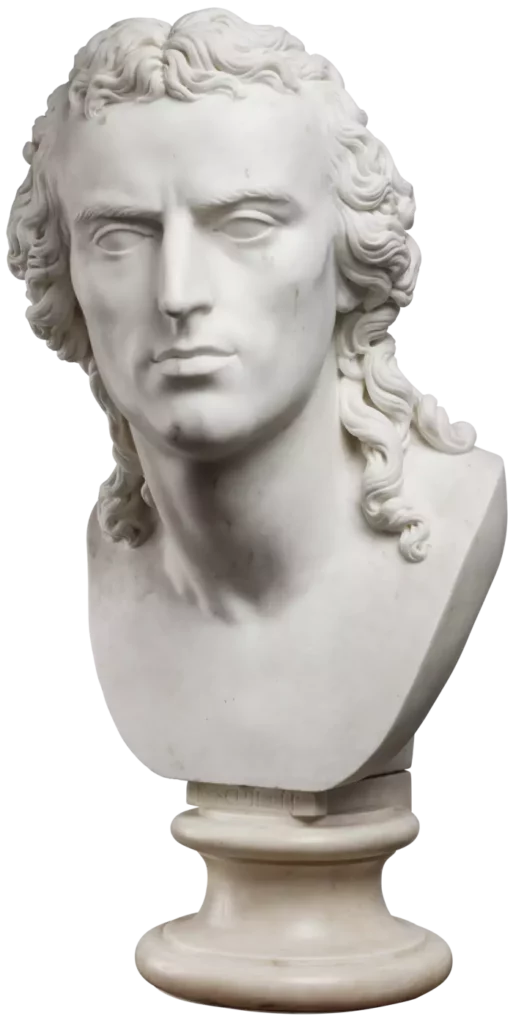
« (…) Le buste de David sera beau comme celui de Chateaubriand, de Lamartine, de Cooper, comme toute application de génie à génie, comme l’œuvre d’un ciseau apte et puissant à la reproduction d’un de ces types créés tout exprès par la nature pour l’habitation d’une grande pensée. De toutes les ressemblances tentées avec plus ou moins de bonheur, dans tous les âges de cette longue gloire, depuis sa jeunesse de vingt ans jusqu’au buste de Rauch, le dernier et le mieux entendu de tous, ce n’est pas une prévention de dire que celui de David est le meilleur, ou pour parler plus franchement encore, la seule réalisation de cette ressemblance idéale qui n’est pas la chose, mais qui est plus que la chose, la nature prise au-dedans et retournée au-dehors, la manifestation extérieure d’une intelligence divine passée à l’état d’écorce humaine. Et il est peu d’occasion comme celle-ci, où l’exécution colossale ne semble que l’indication impuissante d’un effet réel. Un front immense, sur lequel se dresse, comme des nuages, une épaisse touffe de cheveux argentés ; un regard de haut en bas, creux et immobile, un regard de Jupiter olympien, un nez de proportion large et de style antique, dans la ligne du front ; puis cette bouche singulière dont nous parlions tout-à-l’heure, avec la lèvre inférieure un peu avancée, cette bouche, tout examen, interrogation et finesse, complétant le haut par le bas, le génie par la raison ; sans autre piédestal que son cou musculeux, cette tête se penche comme voilée, vers la terre : c’est l’heure où le génie couchant abaisse son regard vers ce monde qu’il éclaire encore d’un rayon d’adieu. Telle est la description grossière de la statue de Goethe par David. – Quel malheur que dans son buste de Schiller, si célèbre et si prôné, le sculpteur Dannecker lui ait préparé un si misérable pendant ! »
Quand Goethe reçoit son buste, il remercie chaleureusement l’Angevin pour les échanges épistolaires, les livres et les médaillons… mais ne fait aucune mention du buste ! Pour une raison simple : il ne se reconnaît pas du tout dans l’œuvre, qu’il ne garde d’ailleurs pas chez lui… Le poète allemand est représenté avec un front démesuré, pour refléter sa grande intelligence. Et ses cheveux ébouriffés symbolisent les tourments de son âme…
David d’Angers et Hippolyte Carnot
Parmi les fondateurs de la Société française pour l’abolition de l’esclavage (SFAE), Hippolyte Carnot (1801-1888), frère cadet de Nicolas Sadi Carnot (1796-1832), pionnier de la thermodynamique et fils de « l’organisateur de la victoire », le génie militaire et scientifique Lazare Carnot dont il va, en 1869, relater l’œuvre et le combat dans sa biographie Mémoires sur Lazare Carnot 1753-1823 par son fils Hippolyte.
Hippolyte publiera en 1888, sous le titre Henri Grégoire, évêque républicain, les Mémoires de ce défenseur de tous les opprimés d’alors (des nègres comme des juifs), grand ami de son père et qui lui avait gardé cette amitié.
Pour l’ancien évêque de Blois,
« il faut éclairer l’ignorance qui ne connait pas et la pauvreté qui n’a pas les moyens de connaitre.«
Grégoire avait été un des grands « éducateurs de la Convention » et c’est sur son rapport que fut fondé, 29 septembre 1794, notamment, pour l’instruction des artisans, le Conservatoire des Arts-et-Métiers. Grégoire contribua également à la création du Bureau des longitudes le 25 juin 1795 et de l’Institut de France le 25 octobre 1795.

Hippolyte Carnot et David d’Angers publièrent ensemble les Mémoires de Bertrand Barère de Vieuzac (1755-1841) qui, au Comité de Salut Public, avait en quelque sorte le rôle de Ministre de l’Information, chargé d’annoncer à la Convention, dès leur arrivée, les victoires des Armées Républicaines.
C’est également l’abbé Grégoire qui chargea David d’Angers, avec l’aide de son ami Béranger, d’apporter en 1826 un peu de confort matériel et financier à Rouget de Lisle (1860-1836), l’auteur légendaire de La Marseillaise composée à Strasbourg, lorsque dans ses vieux jours, le compositeur croupillait en prison pour dette.
Dépassant les sectarismes de leur époque, voilà trois fervents républicains plein de compassion et de reconnaissance pour un génie musical qui n’a jamais voulu accepter de renoncer à ses convictions royalistes mais dont la création patriotique deviendra l’hymne national de la jeune République française.
Gouvernement provisoire de la IIe République
Tous ces combats, démarches et mobilisations aboutiront en 1848, lorsque, pendant deux mois et 15 jours (du 24 février au 9 mai), une poignée d’authentiques républicains firent partie du « gouvernement provisoire » de la IIe république.
En si peu de temps, que de bonnes mesures furent prises ou mises en chantier ! Hippolyte Carnot y est un ministre de l’Instruction publique déterminé à créer une éducation de haut niveau pour tous, et femmes incluses, suivant les modèles fixés par son père pour Polytechnique et de Grégoire pour les Arts et Métiers.
L’article 13 de la Constitution de 1848, « garantit aux citoyens (…) l’enseignement primaire gratuit ». Le ministre de l’Instruction publique, toujours Lazare Hippolyte Carnot, soumet à l’Assemblée le 30 juin 1848 un projet de loi qui anticipe totalement sur les lois Ferry, en prévoyant un enseignement élémentaire obligatoire pour les deux sexes, gratuit et laïc, tout en garantissant la liberté d’enseignement. Il prévoit également pour les instituteurs une formation gratuite de trois ans dans une école normale, avec en contrepartie une obligation d’enseigner pendant au moins dix ans, système qui sera longtemps en vigueur. Il propose une nette amélioration de leurs salaires. Il exhorte, déjà, les instituteurs « à dispenser un catéchisme républicain ».
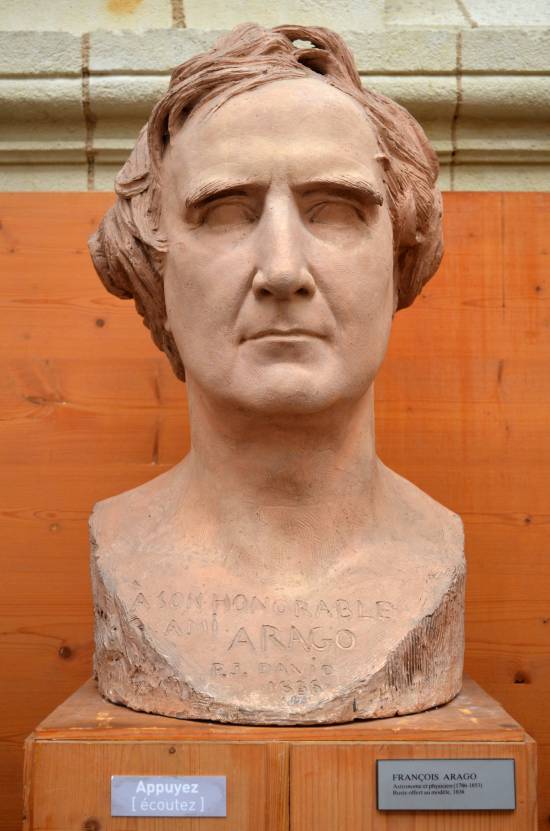
Membre du gouvernement provisoire, le grand astronome et scientifique François Arago est ministre des colonies, après avoir été désigné par Gaspard Monge à lui succéder à l’Ecole polytechnique pour y enseigner la géométrie projective. Son ami le plus proche n’est autre qu’Alexandre de Humboldt, ami de Johann Wolfgang Goethe et de Friedrich Schiller.
Il est un autre militant abolitionniste ayant passé une bonne partie de sa vie d’adulte à Paris. Humboldt fait partie de la Société d’Arcueil formée autour du chimiste Claude-Louis Berthollet où se rencontrent également François Arago, Jean-Baptiste Biot, Louis-Joseph Gay-Lussac avec lesquels Humboldt se lie d’amitié. Ils publient ensemble plusieurs articles scientifiques.
Humboldt et Gay-Lussac mènent des expériences communes sur la composition de l’atmosphère, sur le magnétisme terrestre et la diffraction de la lumière, recherches dont le grand Louis Pasteur cueillera par la suite les fruits.
Napoléon, qui voulait initialement expulser Humboldt, finit par tolérer sa présence. La Société de géographie de Paris, fondée en 1821, le choisit comme président.
Humboldt, Arago, Schoelcher, David d’Angers et Hugo

Humboldt ne cache pas ses idéaux républicains. Son Essai Politique sur l’Ile de Cuba (1825), a l’effet d’une bombe. Trop hostile aux pratiques esclavagistes, l’ouvrage fut interdit de publication en Espagne. Londres va jusqu’à lui refuser tout accès à son Empire.
Bien plus déplorable, John S. Trasher, qui en publia, en 1856, une version en langue anglaise, supprima carrément le chapitre consacré aux esclaves et à la traite ! Humboldt protestera énergiquement contre cette mutilation, opérée à des fins politiques. Trasher était esclavagiste, Sa traduction expurgée fut destinée à combattre les arguments des abolitionnistes nord-américains, qui par la suite publièrent le chapitre escamoté dans le New-York Herald et le Courrier des États-Unis. Victor Schoelcher et le décret abolissant l’esclavage dans les colonies françaises.

En France, sous Arago, le sous-secrétaire d’État à la Marine et aux colonies se nomme Victor Schoelcher. Il n’a pas besoin d’argumenter beaucoup pour convaincre l’astronome que toutes les planètes sont alignés pour passer à l’acte.
Franc-maçon, Schoelcher est un frère de loge de David d’Angers, « Les amis de la Vérité » aussi connu sous le nom de Cercle social, en réalité « un mélange de club politique révolutionnaire, de loge maçonnique et de salon littéraire ».
Le 4 mars une commission est mise en place pour résoudre le problème de l’esclavage dans les colonies françaises. Elle est présidée par Victor de Broglie, président de la SFAE à laquelle adhèrent cinq des douze membres de la commission. Grâce aux efforts de François Arago, Henri Wallon et surtout Victor Schoelcher, ses travaux permettent l’abolition de l’esclavage le 27 avril.
Hugo abolitionniste
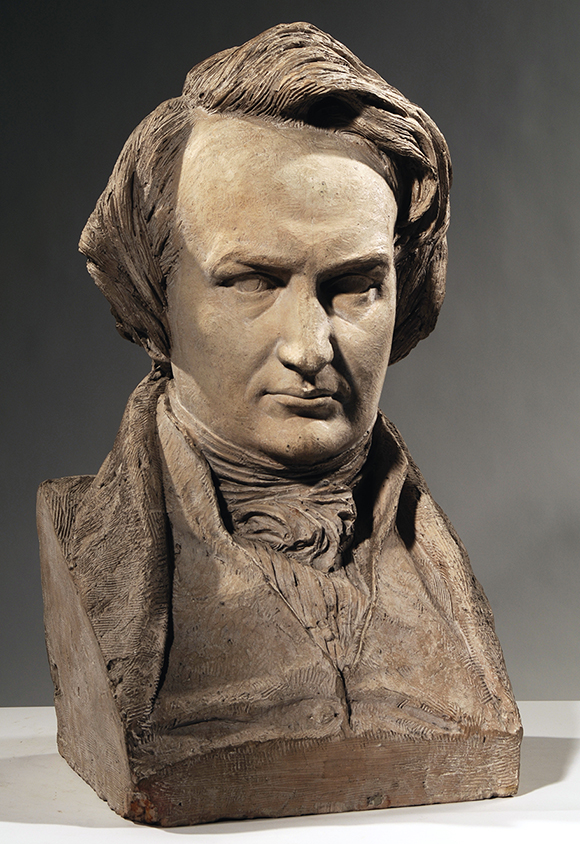
Victor Hugo fut un des partisans de l’abolition de l’esclavage, en France, mais aussi d’une égalité entre ce que l’on désignait encore comme « les races » au XIXe siècle. « République blanche et république noire sont sœurs, de même que l’homme noir et l’homme blanc sont frères », affirmait déjà Hugo en 1859. Pour lui, tous les hommes étant des créations de Dieu, la fraternité était de mise.
Lorsque le 27 avril 1851, une anti-esclavagiste, Maria Chapman, écrit à Hugo pour lui demander de soutenir la cause abolitionniste, Hugo lui répond : « L’esclavage aux États-Unis ! s’exclame-t-il le 12 mai, y a-t-il un contresens plus monstrueux ? ». Comment, en effet, une république dotée d’une aussi belle constitution est capable de préserver une pratique aussi barbare ?
Huit ans plus tard, le 2 décembre 1859, il écrit une lettre ouverte aux États-Unis d’Amérique, publiée par les journaux libres d’Europe, pour défendre l’abolitionniste John Brown condamné à mort.
Partant du fait qu’« il y a des esclaves dans les états du Sud, ce qui indigne, comme le plus monstrueux des contre-sens, la conscience logique et pure des états du Nord », il relate le combat de Brown, son procès et son exécution annoncée, et conclut : « il y a quelque chose de plus effrayant que Caïn tuant Abel, c’est Washington tuant Spartacus ».
Un journaliste de Port-au-Prince, Exilien Heurtelou, le remercie le 4 février 1860. Hugo lui répond le 31 mars :
« Vous êtes, monsieur, un noble échantillon de cette humanité noire si longtemps opprimée et méconnue. D’un bout à l’autre de la terre, la même flamme est dans l’homme ; et les noirs comme vous le prouvent. Y a-t-il eu plusieurs Adam ? Les naturalistes peuvent discuter la question ; mais ce qui est certain, c’est qu’il n’y a qu’un Dieu. Puisqu’il n’y a qu’un père, nous sommes frères.
C’est pour cette vérité que John Brown est mort ; c’est pour cette vérité que je lutte. Vous m’en remerciez, et je ne saurais vous dire combien vos belles paroles me touchent. Il n’y a sur la terre ni blancs ni noirs, il y a des esprits ; vous en êtes un. Devant Dieu, toutes les âmes sont blanches.
J’aime votre pays, votre race, votre liberté, votre révolution, votre république. Votre île magnifique et douce plaît à cette heure aux âmes libres ; elle vient de donner un grand exemple ; elle a brisé le despotisme. Elle nous aidera à briser l’esclavage. »
En 1860 également, la Société abolitionniste américaine, mobilisée derrière Lincoln publiera un recueil de discours. La brochure s’ouvre sur trois textes de Hugo, suivis par ceux de Carnot, Humboldt et Lafayette.
Hugo accepte de présider, le 18 mai 1879, une commémoration de l’abolition de l’esclavage en présence de Victor Schoelcher, auteur principal du décret d’émancipation de 1848, qui salue en Hugo « le défenseur puissant de tous les déshérités, de tous les faibles, de tous les opprimés de ce monde » et déclare ceci :
« La cause des nègres que nous soutenons, et envers lesquels les nations chrétiennes ont tant à se reprocher, devait avoir votre sympathie ; nous vous sommes reconnaissants de l’attester par votre présence au milieu de nous.«
Un début de mieux
Autre mesure prise par le gouvernement provisoire de cette éphémère IIe République : l’abolition de la peine de mort dans le domaine politique et la suppression, le 12 mars, des châtiments corporels, tout comme la contrainte par corps (prison pour dette) le 19 mars.
Dans le domaine politique, la liberté de la presse et celle de réunion sont proclamées le 4 mars. Le 5 mars le gouvernement institue le suffrage universel masculin, en remplacement du suffrage censitaire en vigueur depuis 1815. D’un coup le corps électoral passe de 250 000 à 9 millions d’électeurs. Cette mesure démocratique place le monde rural, qui regroupe les trois quarts des habitants, au cœur de la vie politique, et ce, pour de nombreuses décennies. Cette masse de nouveaux électeurs, faute de véritable formation citoyenne, voyant en lui un protecteur, plébiscitera en masse Napoléon III, aussi bien en 1851, en 1860 qu’en 1870.
Victor Hugo
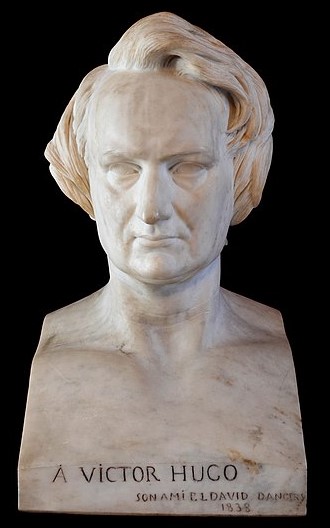
Pour revenir à David d’Angers, une amitié durable l’unit à Victor Hugo (1802-1885). Fraîchement mariés, Hugo et David se retrouvaient pour dessiner. Le poète et le sculpteur aimaient dessiner ensemble, faire des caricatures, peindre des paysages ou des « architectures » qui les inspiraient.
Un même idéal les unissait et avec l’arrivée de Napoléon III, les deux hommes connurent l’exil politique.
Par amitié, David d’Angers a fait plusieurs bustes de son ami. Hugo est représenté portant un costume élégant contemporain.
Son large front et ses sourcils légèrement froncés expriment la grandeur, encore à venir, du poète. Renonçant à détailler les pupilles, David confère à ce regard une dimension intérieure et pensive qui fit écrire à Hugo :
« Mon ami, c’est l’immortalité que vous m’envoyez.«
En 1842, David d’Angers réalise un autre buste de Victor Hugo, couronné de laurier, où cette fois ce n’est pas Hugo l’ami intime qui est évoqué mais davantage le génie et le grand homme.
Enfin, pour les funérailles de Hugo, en 1885, la République d’Haïti tint à manifester au poète sa reconnaissance en se faisant représenter par une délégation. Emmanuel-Edouard, écrivain haïtien, la présidait et déclara notamment au Panthéon :
« La République d’Haïti a le droit de parler au nom de la race noire ; la race noire, par mon organe, remercie Victor Hugo de l’avoir beaucoup aimée et honorée, de l’avoir raffermie et consolée.«
Les quatre bas-reliefs de la statue de Gutenberg
Une fois que le lecteur identifie ce « grand arche » qui traverse l’histoire et, les idées et convictions, qui animaient David d’Angers, il saisira la belle unité qui sous-tend les quatre bas-reliefs du socle de la statue commémorant Gutenberg à Strasbourg.
Ce qui ressort c’est l’idée très optimiste que le genre humain, dans sa grande et magnifique diversité, est un et fraternel . Une fois libéré de toutes les formes d’oppressions (l’ignorance, esclavage, etc.), il peut vivre ensemble dans la paix et l’harmonie.
Ces bas-reliefs en bronze ont été ajoutés en 1844. Après d’âpres débats et contestations, , ils ont remplacé les modèles en plâtre peints originaux de 1840 apposés lors de l’inauguration. Ils représentent les bienfaits de l’imprimerie en Amérique, en Afrique, en Asie et en Europe. Au centre de chaque relief, une presse d’imprimerie entourée de personnages identifiés par des inscriptions ainsi que des instituteurs, des enseignants et des enfants.
Pour conclure, voici un extrait du compte-rendu de l’inauguration décrivant les bas-reliefs. Sans tomber dans le wokisme (pour qui toute idée de « grand homme » est forcément à combattre), soulignons qu’il est écrit dans les termes de l’époque et donc sujet à discussion :

L’EUROPE
« L’Europe est représentée par un bas-relief sur lequel se côtoient René Descartes dans une attitude méditative, placé sous Francis Bacon et Herman Boerhaave. A gauche, l’on voit successivement William Shakespeare, Pierre Corneille, Molière et Racine. Un rang en dessous se succèdent Voltaire, Buffon,Albrecht Dürer, John Milton et Cimarosa, Poussin, Calderone, Camoëns et Puget. A droite du tableau, se pressent Martin Luther, Wilhelm Gottfried Leibniz, Emmanuel Kant, Copernic, Wolfgang Goethe, Friedrich Schiller, Hegel, Richter, Klopstock. Rejetés sur le coté Linné et Ambroise Parée. Près de la presse, on peut voir au-dessus de la figure de Martin Luther, Erasme de Rotterdam, Rousseau et Lessing. Sous le gradin se voient Volta, Galilée, Isaac Newton, James Watt, Denis Papin et Raphaël. Un petit groupe d’enfants étudient parmi lesquels un Africain et un Asiatique « .
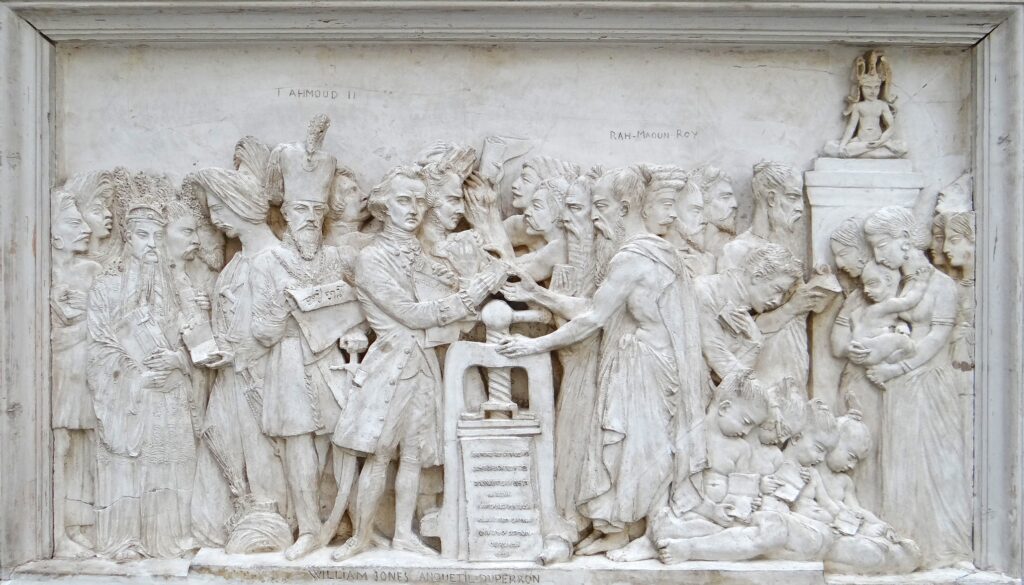
L’ASIE
« Une presse est de nouveau représentée à côté de laquelle William Jones et Abraham Hyacinthe Anquetil-Duperron offrent des livres aux brahmanes qui leur donnent en retour des manuscrits. Près de Jones, le sultan Mahmoud II est en train de lire le Moniteur revêtu de vêtements modernes, son ancien turban gît à ses pieds et tout près un Turc lit un livre. Un degré en dessous un empereur chinois entouré d’un Persan et d’un Chinois lit le livre de Confucius. Un Européen instruit des enfants tandis qu’un groupe de femmes indiennes se tient près d’une idole et du philosophe indien Rammonhun-Roy. «
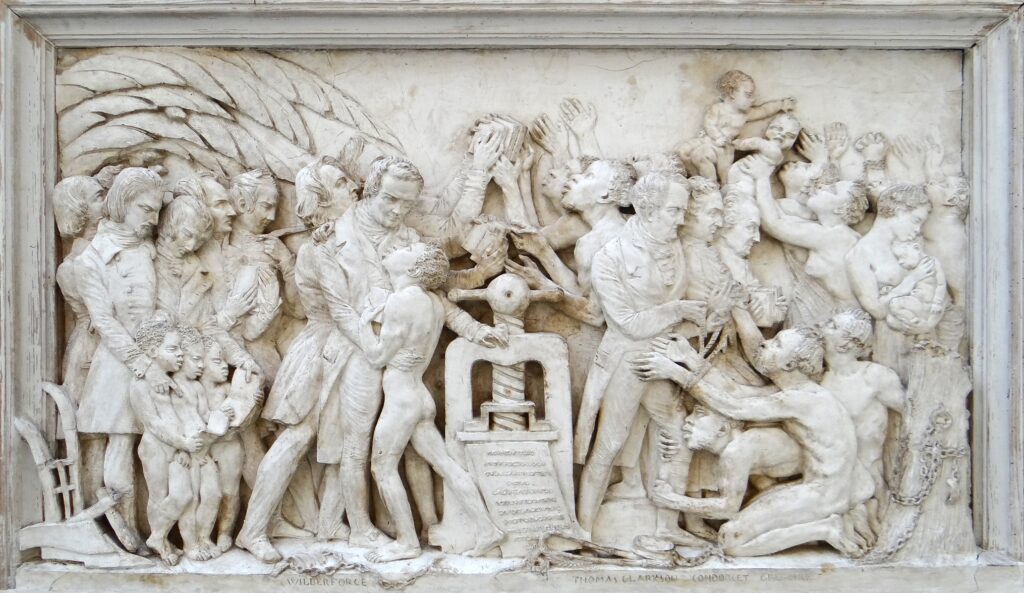
L’AFRIQUE
« Appuyé sur une presse, William Wilberforce étreint un Africain possédant un livre, alors que des Européens distribuent à d’autres Africains des livres et s’occupent à instruire les enfants. A droite, on peut voir Thomas Clarkson brisant les fers d’un esclave. Derrière lui, l’abbé Grégoire aide un noir à se relever et tient sa main sur son cœur. Un groupe de femmes élève leurs enfants retrouvés vers les ciel, qui ne verra désormais plus que des hommes libres, tandis qu’à terre gisent des fouets et des fers brisés. C’est la fin de l’esclavage. »
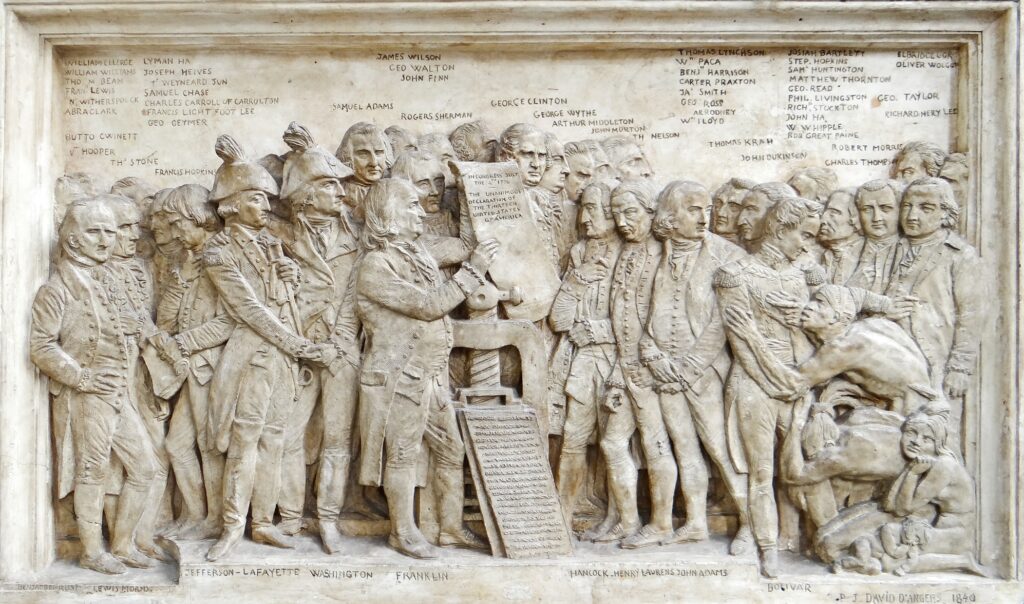
L’AMERIQUE
« L’acte de l’indépendance des Etats-Unis qui a fraîchement été tiré de sous la presse figure dans les mains de Benjamin Franklin. Près de lui se tiennent Washington et Lafayette qui tient sur sa poitrine l’épée que lui donne sa patrie adoptive. Jefferson et tous les signataires de l’acte d’indépendance sont rassemblés. A droite, Bolivar serre la main d’un Indien. «
L’Amérique
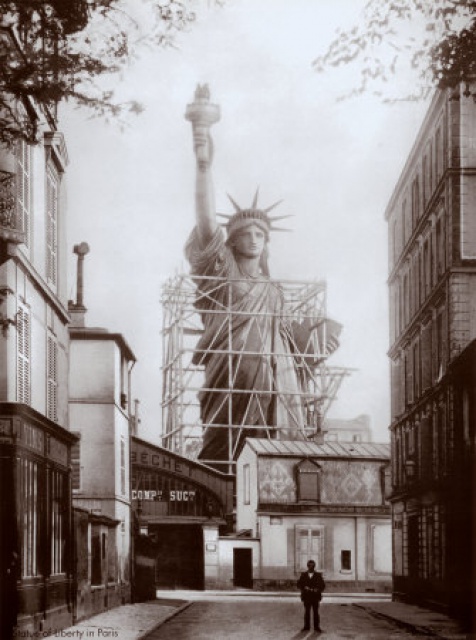
L’on comprend mieux les paroles prononcées par Victor Hugo, le 29 novembre 1884, c’est-à-dire peu avant sa mort, lors de sa visite de l’atelier du sculpteur Frédéric-Auguste Bartholdi où le poète est invité à admirer la statue géante portant le nom symbolique « La Liberté éclairant le monde », fabriquée avec le concours de Gustave Eiffel et prête à partir aux Etats-Unis par bateau. Don de la France à l’Amérique, elle consacrera le souvenir de la part active que le pays de Lafayette a prise pendant la guerre d’Indépendance.
Initialement, Hugo s’est surtout intéressé aux héros et grands hommes d’Etat américains : William Penn, Benjamin Franklin, John Brown ou encore Abraham Lincoln. Des modèles, selon Hugo qui permettaient au peuple de progresser. Aussi l’Amérique est-elle, pour l’homme politique français devenu républicain en 1847, l’exemple à suivre. Même s’il est très déçu par la position des américains sur la peine de mort et l’esclavage.
Après 1830, l’écrivain abandonne cette vision un peu idyllique du Nouveau Monde et s’en prend aux « civilisateurs » blancs, pourchasseurs d’indiens :
« Vous croyez civiliser un monde, lorsque vous l’enfiévrez de quelque fièvre immonde [4], quand vous troublez ses lacs, miroirs d’un dieu secret, lorsque vous violez sa vierge, la forêt. Quand vous chassez du bois, de l’antre, du rivage, votre frère naïf et sombre, le sauvage… Et quand jetant dehors cet Adam inutile, vous peuplez le désert d’un homme plus reptile… Idolâtre du dieu dollar, fou qui palpite, non plus pour un soleil, mais pour une pépite, qui se dit libre et montre au monde épouvanté l’esclavage étonné servant la liberté ! «
(NOTE 5)
Surmontant sa fatigue, devant la statue de la Liberté, Hugo improvise ce qu’il sait être sa dernière allocution :
« Cette belle œuvre tend à ce que j’ai toujours aimé, appelé : la paix entre l’Amérique et la France – La France qui est l’Europe – Ce gage de paix demeurera permanent. Il était bon que cela fût fait ! «
NOTES:
- Si la phrase figure dans le livre de la Genèse, il pourrait également se référer à Notre-Dame de Paris (1831) un roman de Victor Hugo, grand ami du sculpteur de la statue, David d’Angers. On sait par une lettre d’Hugo d’août 1832 que le poète porta à David d’Angers la huitième édition du livre. La scène la plus directement incarnée dans la statue est celle durant laquelle le personnage de Frollo converse avec deux érudits (l’un étant Louis XI déguisé) tout en désignant d’un doigt un livre et de l’autre la cathédrale en remarquant : « Ceci tuera cela », c’est-à-dire qu’un pouvoir (la presse imprimée), la démocratie, supplantera l’autre (l’Église), la théocratie, une évolution historique qu’Hugo pensait inéluctable.
- C’est la rencontre avec l’Asie qui va amener en Europe d’innombrables savoirs-faire techniques et découvertes scientifiques d’Orient, les plus connus étant la boussole et la poudre à canons. Tout aussi essentiel pour l’imprimerie que les caractères mobiles, le papier dont la fabrication fut mis au point en Chine à la fin de la Dynastie des Han de l’Est (vers l’année 185). Quant à l’imprimerie, à ce jour, le plus vieux livre imprimé que nous possédons est le Sûtra du Diamant, un écrit bouddhique chinois datant de 868. Enfin, c’est au milieu du XIe siècle, sous la dynastie des Song, que Bi Sheng (990-1051) inventa les caractères mobiles. Gravés dans de la porcelaine, céramique d’argile visqueuse, durcis dans le feu et assemblés dans la résine, ils révolutionnent l’imprimerie. Comme le documente le musée Gutenberg de Mayence, c’est le Coréen Choe Yun-ui (1102-1162) qui va améliorer cette technique au XIIe siècle en utilisant du métal (moins fragile), procédé que reprendra Gutenberg et ses associés. L’Anthologie des enseignements zen des grands prêtres bouddhistes (1377), également connue sous le nom de Jikji, a été imprimée en Corée, 78 ans avant la Bible de Gutenberg, et est reconnue comme le plus ancien livre à caractères métalliques mobiles existant au monde.
- Etienne Taillemite, Lafayette et l’abolition de l’esclavage.
- Victor Hugo a sans doute voulu rebondir sur les nouvelles qui lui arrivèrent d’Amérique. L’épidémie de variole du Pacifique Nord-Ouest de 1862, qui a été apportée de San Francisco à Victoria, a dévasté les peuples indigènes de la côte du Pacifique Nord-Ouest, avec un taux de mortalité de plus de 50 % sur toute la côte, de Puget Sound au sud-est de l’Alaska. Certains historiens ont décrit l’épidémie comme un génocide délibéré, car la colonie de l’île de Vancouver et la colonie de la Colombie-Britannique auraient pu la prévenir, mais ont choisi de ne pas le faire, et l’ont en quelque sorte facilitée.
- Victor Hugo, La civilisation extrait de Toute la lyre (1888 et 1893).