Étiquette : Brussels
Pieter Bruegel the Elder, political commentator and pacifist
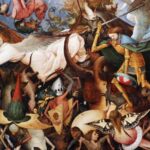
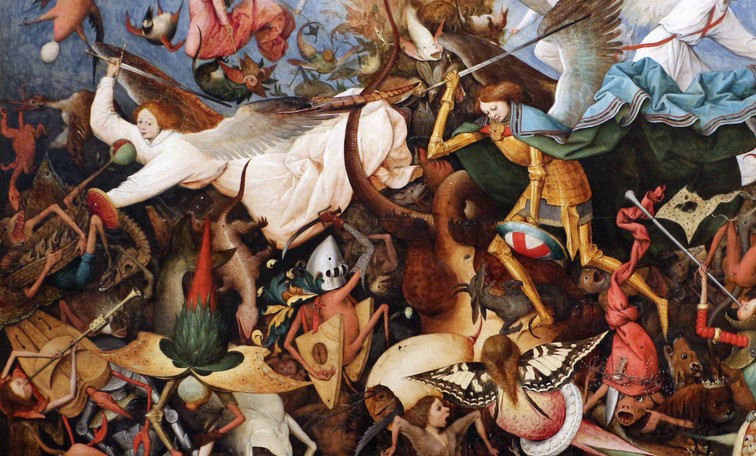
Five centuries after his birth, the publication of new research seems (finally) to do justice to the great Flemish painter « Pieter Bruegel the Jolly » , known as the Elder (1525-1569).
Until now, it was all too common to hear him described as « an unclassifiable figure. » In 2024, art historian Mónica Ann Walker Vadillo did not hesitate to write in the History section of the newspaper Le Monde that, since Bruegel painted peasant feasts and weddings, art critics « came to regard him as an unrefined man and disdainfully nicknamed him ‘Bruegel the Peasant,' » while expressing surprise that so many « academics, humanists, and wealthy businessmen—who appreciated his work and collected his paintings » associated with him.
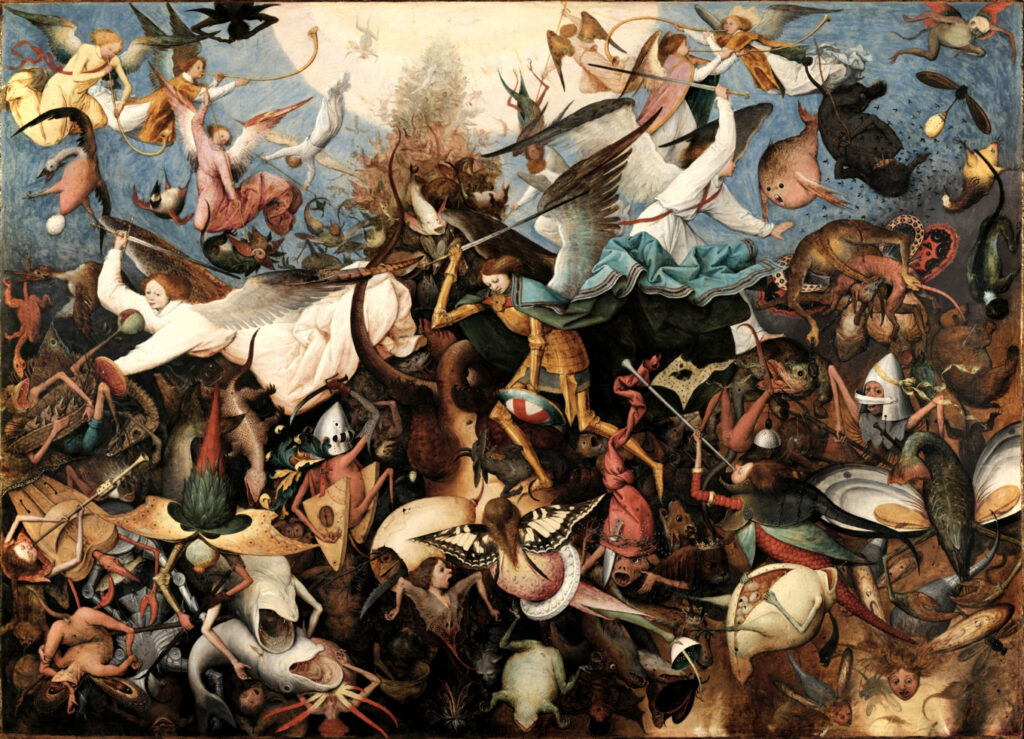
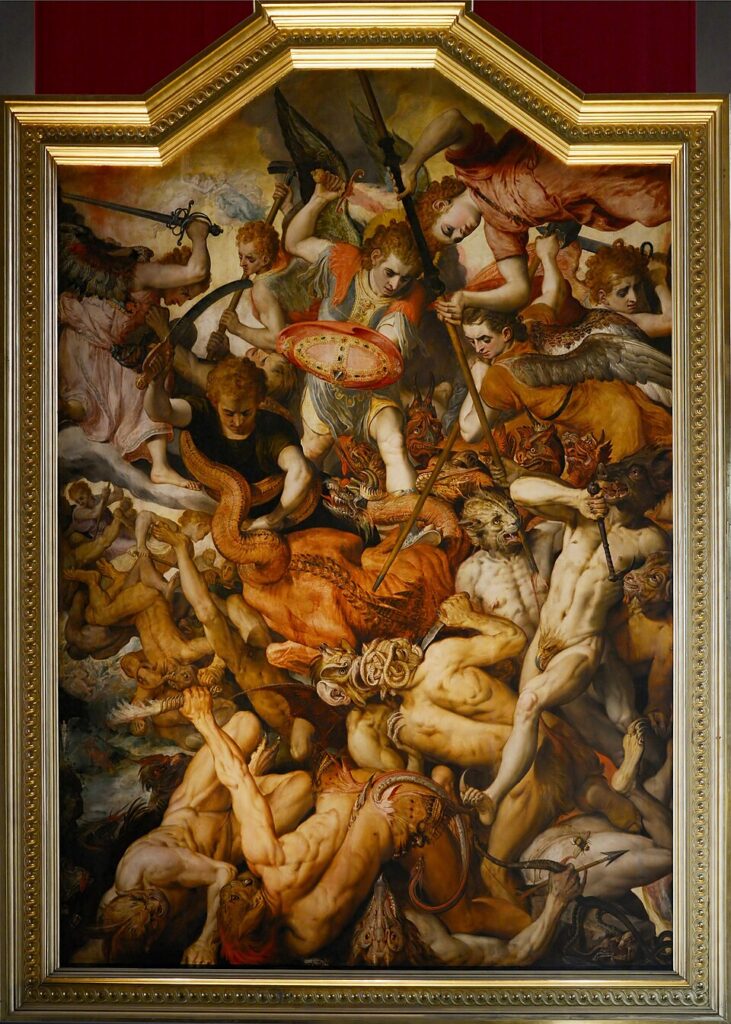
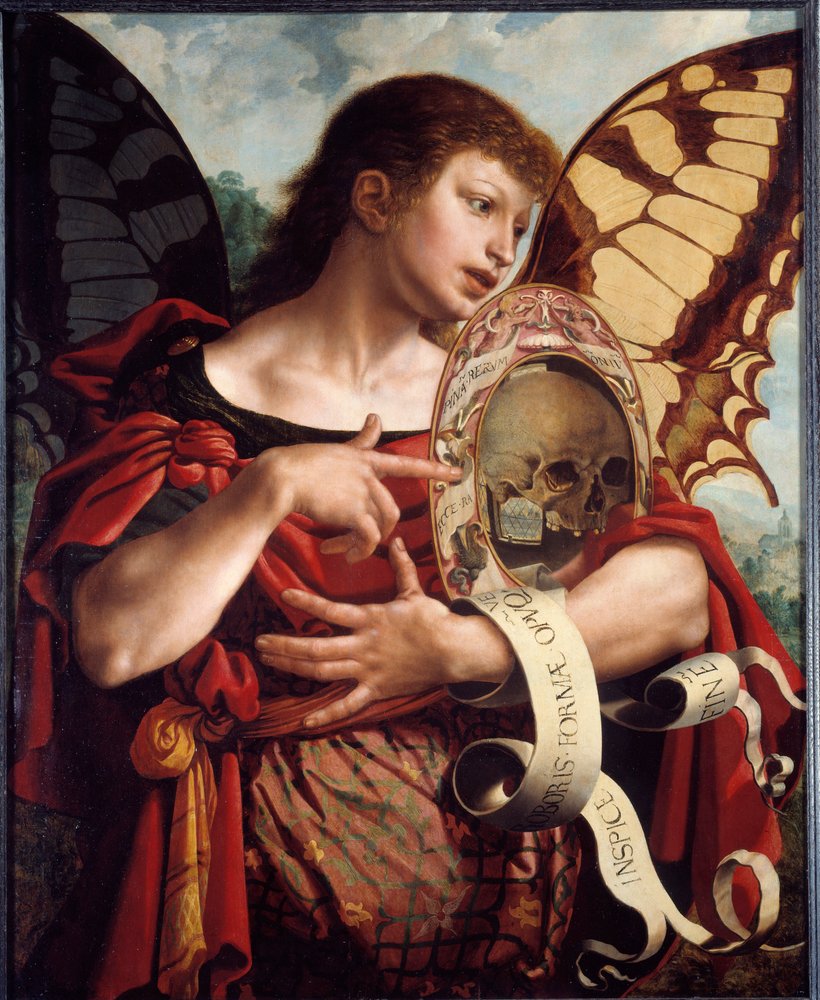
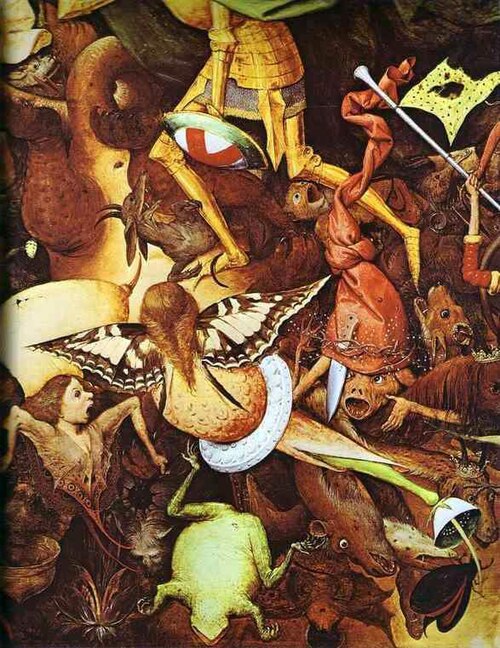
Fall of the Rebel Angels
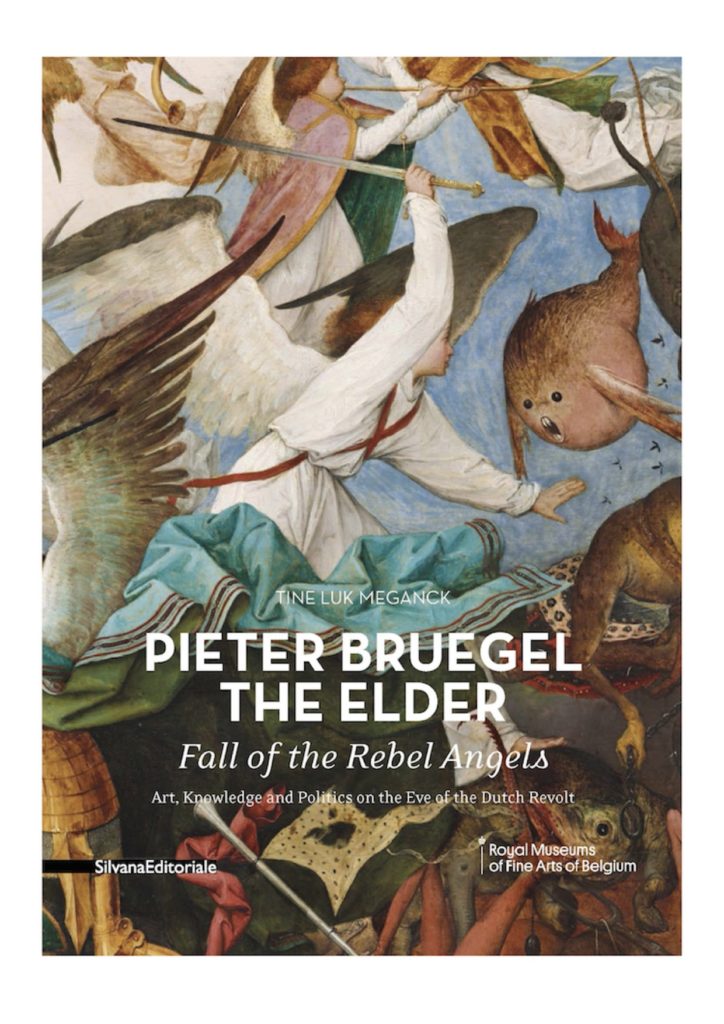
In 2014, Tine Luk Meganck ‘s book, « Pieter Bruegel the Elder. Fall of the Rebel Angels. Art, knowledge and Politics on the Eve of the Dutch Revolt », especially with the last sentence of her title, had nevertheless reopened the debate on the political dimension of his work.
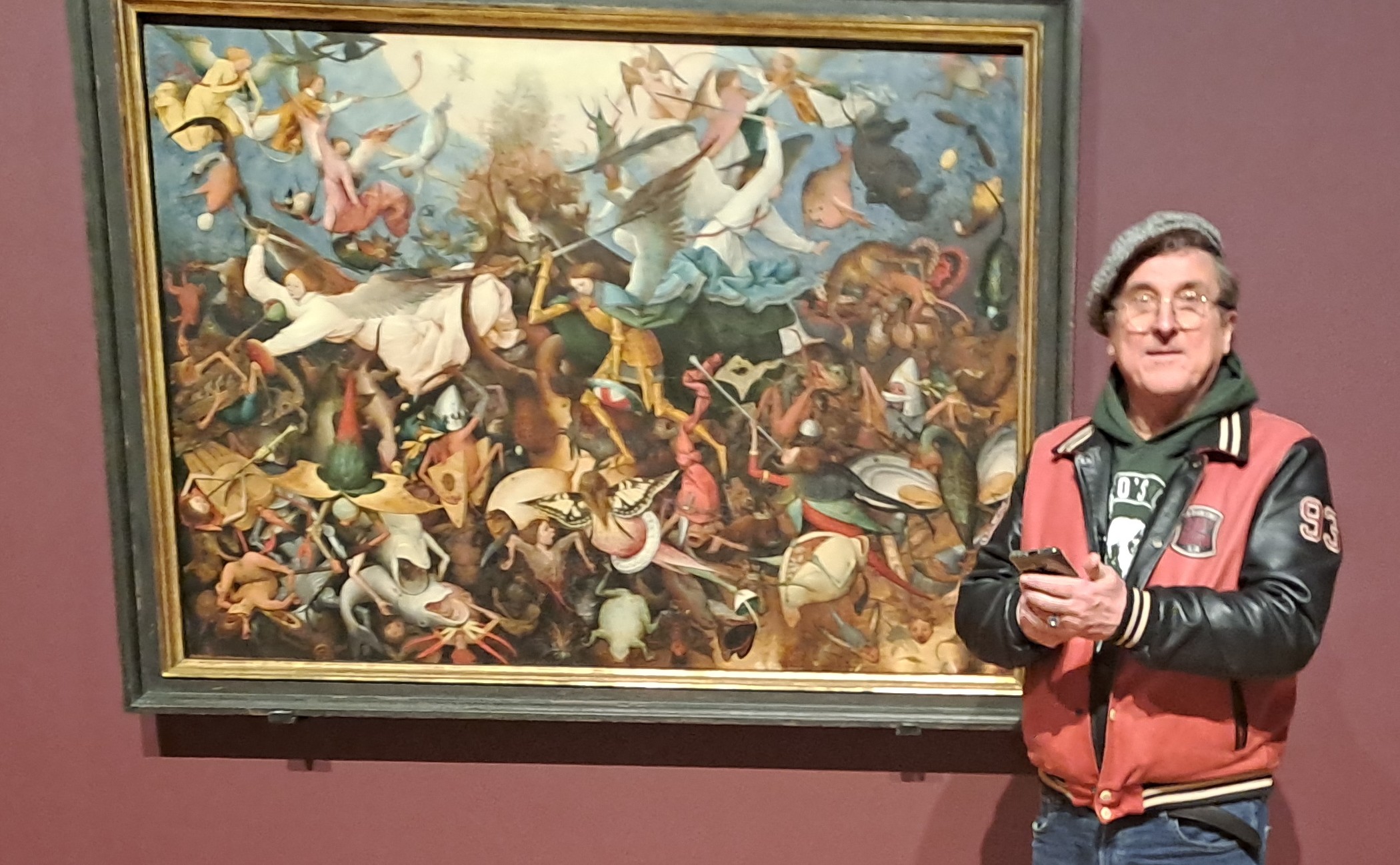
Meganck ventured a highly improbable hypothesis regarding the painting The Fall of the Rebel Angels (1562, Brussels Museum): the jealous angels, whom God punishes for conspiring against him, are supposed to represent the alliance of nobles, the middle classes, and the common people, led by William the Silent against the rule of the Spanish Empire. Consequently, the commissioner of the work, according to the expert, was most likely the famous Cardinal Antoine Perrenot de Granvelle, one of the advisors to the regent Margaret of Parma and a fervent supporter of the persecution of heretics.
We have documented in an article why this interpretation seems unacceptable to us, as Cardinal Granvelle, a member of the « secret government, » was universally hated by the humanists of the time for his blind zeal in endorsing all the crimes of his masters.
Furthermore, no tangible proof exists that he commissioned any work from Bruegel. Certainly, he owned some, but apart from a « Flight into Egypt » (1563), a work devoid of any controversy, and a « View of the Bay of Naples, » a beautiful study inspired by drawings made during Bruegel’s trip to Italy, Granvelle was far from being « one of the greatest collectors » of Bruegel’s works, as is often repeated.
Landjuweel
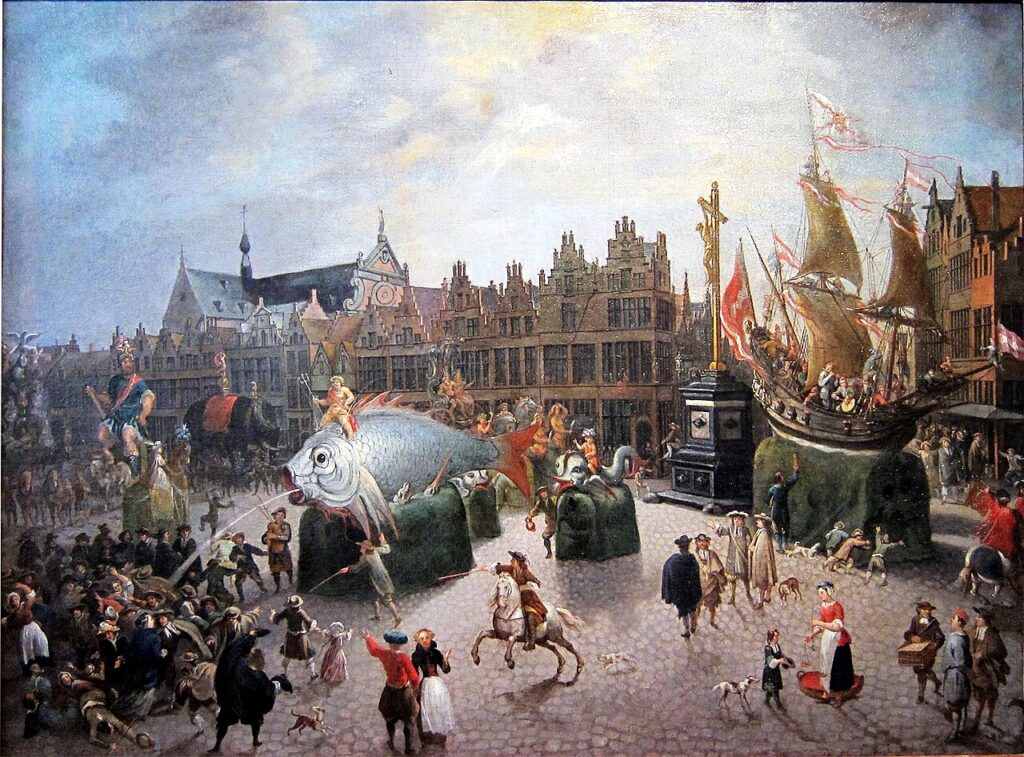
That being said, the important contribution of Meganck’s book, let’s acknowledge it, was the recognition of the decisive influence of the Chambers of Rhetoric and the Antwerp Landjuweel of 1561, for understanding Bruegel’s visual language.
My friend, the late American art critic Michael Frances Gibson, had mentioned this possibility to me during an interview this author conducted with him.
He discusses this in his book The Carrying of the Cross (Editions Noêsis, Paris 1996), which was used in 2011 for the quite innovative film « Bruegel, the Mill and the Cross ».
In August 1561, Antwerp, where Bruegel resided, hosted an exceptional celebration, the Landjuweel, or national competition of the Chambers of Rhetoric.
In practice, the Antwerp Chamber « De Violieren« , in charge of organizing a festival that cost the city one hundred thousand crowns, operated as the literary division of the Guild of Saint Luke, the corporation that brought together painters, engravers, illustrators, architects, sculptors, cartographers, goldsmiths and printers.
It was there that people read in Flemish as well as in Latin or French, Plato, Homer, Petrarch, Erasmus and Rabelais, both during private gatherings and often, in public.
The first Bible in French? Printed in Antwerp in 1535 by the French humanist Jacques Lefèvre d’Etaples (1450-1536), who published the first translations of the complete works of Nicholas of Cusa in Paris in 1514, three years before the publication, in the French capital, of the first edition of Erasmus‘s In Praise of Folly.
The Landjuweel of Antwerp stands historically as one of the most remarkable cultural renaissance events in European history. 2000 rhetoricians on horseback, from 10 cities, passed under 40 triumphal arches to the strident sounds of fifes, entering a city in full celebration. For a whole month, orators and poets, songwriters and actors competed without pausing for breath. Citizen’s were invited on every streetcorner to participate in polyphonic madrigals and chorusses. 5000 artists entertained close to a 100,000 viewers !
Bruegel had to follow them all the more since his dear friend Hans Frankaert (1520-1584), his friend and master Peeter Baltens (1527-1584), very well connected with the great local financiers who preferred commerce to war, as well as his first patron, the engraver Hieronymus Cock (1518-1570), were all involved in the organization of this event whose theme was peace and, two centuries before Kant and Schiller, this burning philosophical question: « What leads man most towards the arts? » This, then, was the bubbling cauldron of urban culture in which Bruegel was immersed from his beginnings.
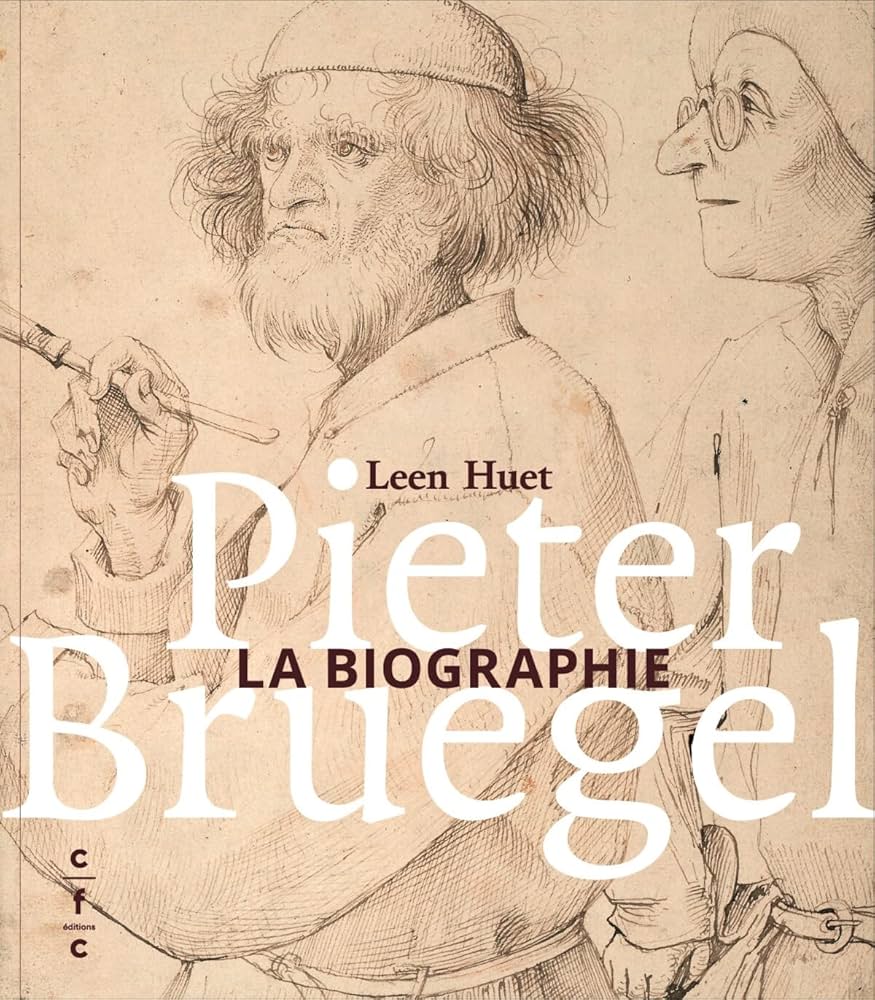
Moreover, as Belgian historian Leen Huet details in her sumptuous biography of the artist (first published in Dutch in 2016 by Polis, then in French by CFC in Brussels in 2021), when he crossed the Alps, Bruegel was probably accompanied by the painter Maarten de Vos (1532-1603) and the cartographer Abraham Ortelius (1527-1598), a close friend of Christophe Plantin, the head of the largest printing house in Antwerp, the team having thousands of addresses of collectors in connection with the printing house Les Quatre Vents of Jérôme Cock, in Antwerp.
The « Bruegel Code »
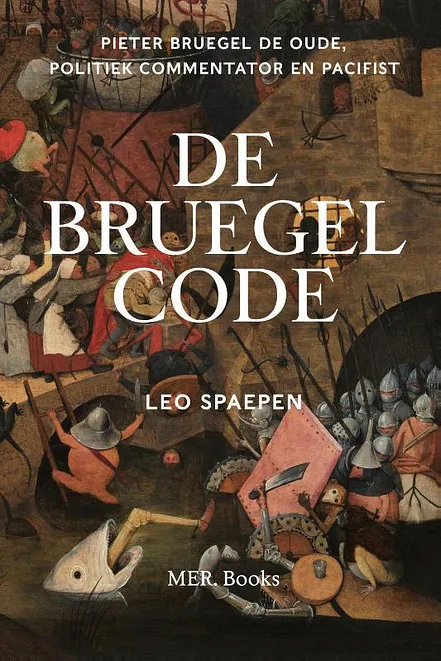
The image of Bruegel as a political commentator, deliberately obfuscating his message to thwart the regime’s Gestapo agents who were lying in wait for him, and embracing the Erasmian philosophy of the Landjuweel to defend peace and mutual understanding, is further developed by the classical historian Leo Spaepen, whose recent book, Pieter Bruegel de oude, politiek commentator en pacifist. De Bruegel Code (published in Dutch by MER Books, 2025), has stirred enthusiasm.
A good pedagogue, Spaepen establishes a kind of code for deciphering, or at least fruitfully approaching, Bruegel’s visual language. Escaping the Aristotelian confines, the aim is to immediately discard formal and symbolic representations in favor of what I would call a metaphorical approach.
Narrative A and B
Each painting contains a « narrative A » and a « narrative B. » The former typically reflects a concern shared by the humanist and Erasmian community regarding the socio-political events of the time, where corruption and violent Spanish repression brought the Hispano-Burgundian Netherlands to the brink of revolt. The « narrative B » often depicts a scene from the Bible or scripture.
As with any metaphor, the paradox arising from the analogy between narrative A and B brings forth, not on the canvas but in the viewer’s mind, a range of clues allowing them to grasp where the painter intends to lead them.
Spaepen, whose courage, rigor, and audacity deserve high praise, has sufficiently delved into the political and cultural history of Bruegel’s era to formulate compelling hypotheses that illuminate his major works. By testing this cognitive approach, painting by painting, the author generates not a scholarly compendium of facts or evidence, but an extremely interesting « gestalt » of the painter, whose true genius has often been denied recognition. It is therefore impossible, in a simple article like this, to reproduce the full richness of this approach.
« Mad Meg »
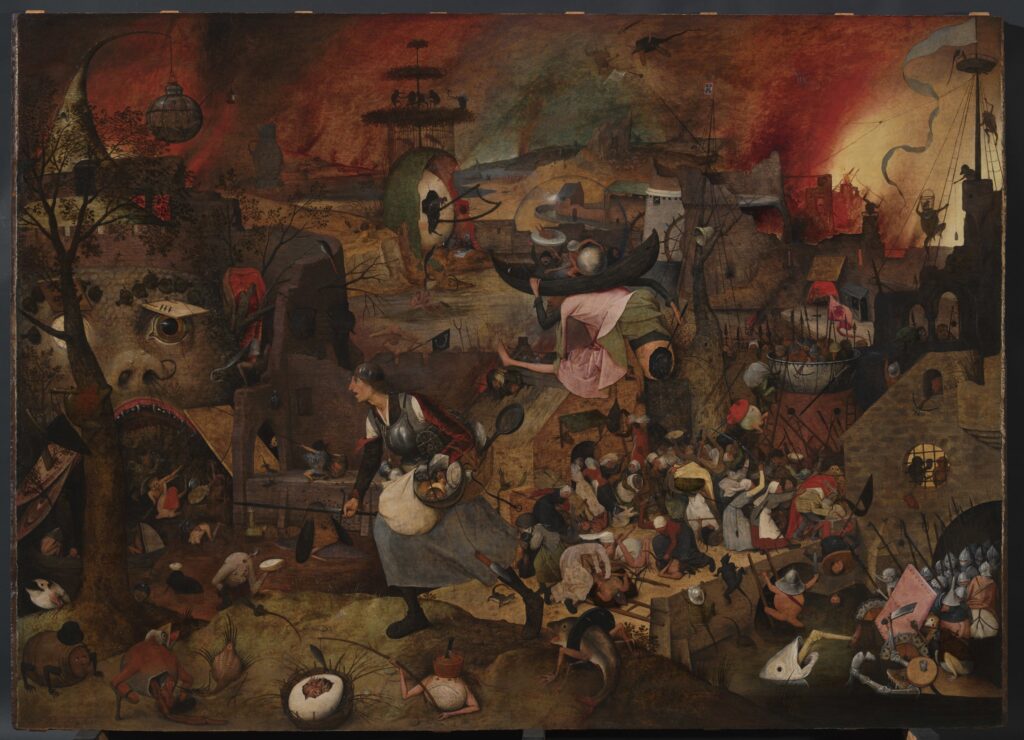
Let us nevertheless look at an emblematic work by Bruegel, known by its nickname, Dulle Griet (« Margot the Enraged » or « Mad Meg » ), a work painted in 1563, not to please a patron, but to provoke discussions with his relatives during meals at his home, as was the custom at the time.
The painting is striking in its contradictions. In the foreground, against a backdrop of burning cityscapes, a woman, mad with rage, sword in hand, carries a basket filled with jewels and precious metalwork. Behind her, a cohort of unarmed women bravely strives to subdue and repel an army of monsters and devils.
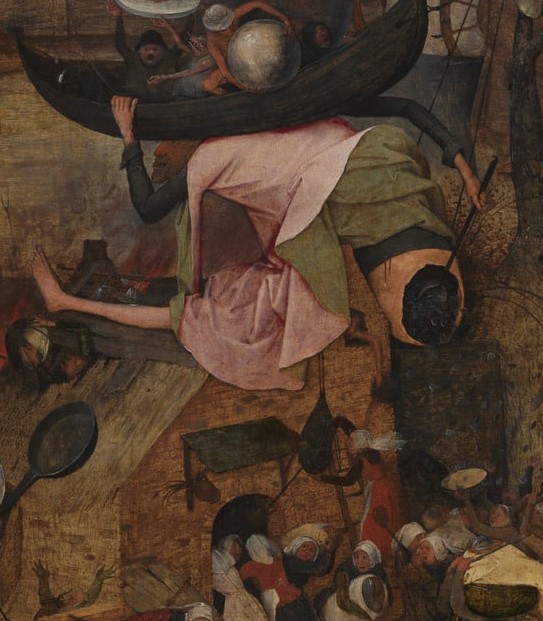
Finally, at the intersection of the painting’s diagonals, a strange creature appears, reminiscent of Hieronymus Bosch ‘s Garden of Earthly Delights. A man carrying a large bubble on his back shakes his backside, from which silver coins fall, which some women hastily gather up.
As for narrative B, we find roughly the image that Bruegel had developed in a drawing used for a 1557 engraving representing one of the deadly sins, here rage ( Ira in Latin), again represented by a giant woman, with the subtitle: « Rage swells the lips and sours the character. It troubles the mind and blackens the blood. »
Spaepen also picks up on (p. 131) a great find by Leen Huet. The historian discovered that during the Landjuweel of Antwerp in 1561, the chamber of rhetoric of Mechelen had mentioned a « Griete die den roof haelt voor den helle » (a girl who goes to plunder hell), a figure perhaps taken from a play that is now lost.
Huet also mentions (p. 35) the Flemish proverb that says of an old harpy that she « could go and plunder hell and come back safe and sound. » At the same time, Huet notes (p. 48), the author Sartorius , in a collection of adages inspired by Erasmus, states a saying similar in spirit to the Dulle Griet sign:
« One woman alone makes a racket, two women cause much trouble, three women gather only to trade for an annual market, four women lead to strife, five women form an army, and against six women, Satan himself has no weapon to fight them. »
In reality, the status of urban women from the 15th century onwards in Flanders, with the beguinages, and especially in Brabant in the 16th century, was one of the most advanced in Europe1, probably explaining in part the concerns of some members of the male gender in the face of the growing power of women.
Granvelle
But Spaepen, a good observer, exonerates Bruegel from this kind of masculinist reaction by bringing back the reality of narrative A, the current political situation.
The painter, Spaepen believes, is denouncing here Cardinal Granvelle , zealous advisor to the regent Margaret of Parma, a woman torn between the general interest and submission to the tyranny of the Catholic Church, whose dogmas were instrumentalized by Madrid to plunder the country in order to repay the colossal debt of Charles V and Philip II to the Fugger bankers.
Personally, I thought for a moment that Bruegel had invented for the occasion an 8th deadly sin, « incitement to war » (Oorlogstokerij), but I am probably too much in the present.
In August 1561, disregarding Granvelle’s advice, Margaret had authorized the Guild of Saint Luke and the Violieren to organize the Antwerp Landjuweel to promote peace and mutual understanding. But immediately afterward, she yielded to pressure from Madrid by forbidding the publication of the proceedings of the Chambers of Rhetoric, which were accused of having united the entire country against the Emperor.
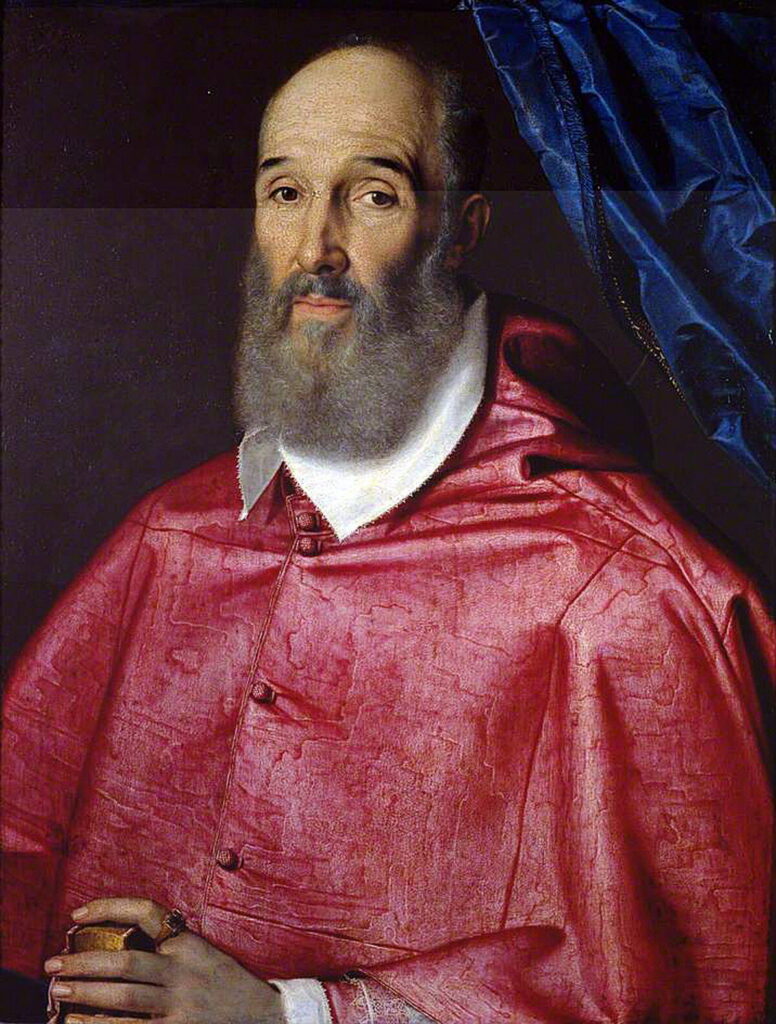
In 1563, the year Bruegel painted his Dulle Griet, the Council of Trent decided to curb polyphonic art by restoring the primacy of the sung text in music and prohibiting any ambiguity in a painting, linked to a role of propaganda, exactly as Granvelle wished.
In the painting « Mad Meg, » the strange creature in the center, draped in a red cloak, could very well be Cardinal Granvelle himself.
As Spaepen reminds us, Granvelle had just established a vast network of informants to hunt down heretics « even in the toilets. »
This targeted all those—Lutherans, Calvinists, Erasmians, or Anabaptists—who challenged the predatory grip of the regime. And yet, the money « shat out » by Granvelle is being recovered by women ready to plunder hell! Bruegel, not exactly kind to Mad Meg (Marguerite of Parma), could therefore be expressing his horror at this regent who has lost her mind, and especially at the idea that Flemish women, who had become so free and educated, could end up as informers for a totalitarian regime!
Familia Caritatis
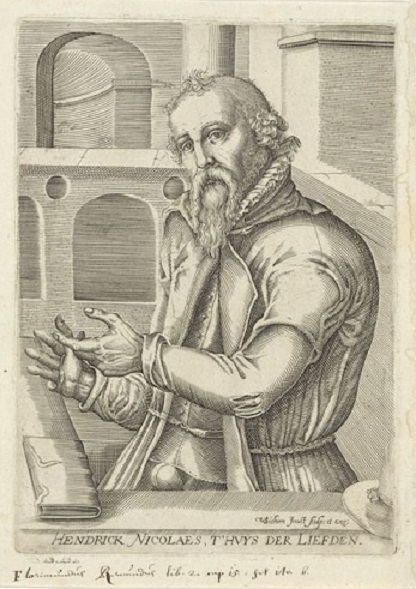
Spaepen (p. 194) documents the strong influence exerted on Bruegel (who was not necessarily a member of the group) by the Familia Caritatis (Family of Charity), a philosophical and religious movement founded and led by Hendrik Niclaes (1502-1570), a prophetic and charismatic figure advocating peace and tolerance about whom little is known but who undoubtedly appeared to many, without reaching his wisdom and erudition, as a kind of successor to Erasmus.
Many humanists and a number of Bruegel’s acquaintances were in contact with this movement which, passing through England, would dissolve into the Quaker revolt against the Anglican Church.2
Plantin, considered the official printer of the Spanish regime, had the Familia Caritatis booklets (deemed heretical by the regime) printed (at night), with initial financial assistance for his printing press from Niclaes, himself a merchant. Niclaes’s major work, Terra Pacis, denounces the « Blind leading the Blind, » a theme also found in the work of Quinten Matsys‘s son (who fled the persecution), and later in Bruegel.
Niclaes draws upon Socrates and the philosophy of the Brethren of the Common Life , for whom selfless love (agape or caritas) should be the driving force of humankind. Another conviction he holds is that life is « a pilgrimage of the soul. »
As in the landscapes of Joachim Patinir, Homo Viator must constantly detach himself from earthly matters and move on. Through his free he must seek union with God by resisting earthly temptations. Inner peace—with oneself, with one’s conscience, and with the divine will—is the foundation of peace on Earth, an ideal that also clearly inspired the painter.
This is the true story, that of a great political commentator and resistance fighter of his time, a painter intellectually and spiritually committed to peace.
NOTES:
- See on this subject Myriam Greilsammer, L’envers du tableau : Mariage et maternité en Flandre médiévale , Armand Colin, 1990, as well as this author’s article on the Landjuweel. ↩︎
- These included the printers Christoffel Plantin and John Gailliart; the humanists Abraham Ortelius, Justus Lipsius, Andreas Masius, Goropius Becanus, and Benito Arias Montano; the poets Peeter Heyns, Jan van der Noot, Lucas d’Heere, Filips Galle, and Joris Hoefnagel; the theologian Hubert Duifhuis; the writer Dirck Volkertsz; Coornhert (right-hand man of William the Silent); the « familists » Daniel van Bombergen, Emanuel van Meteren, and Johan Radermacher; and the Antwerp merchants Marcus Perez and Ferdinando Ximines. ↩︎
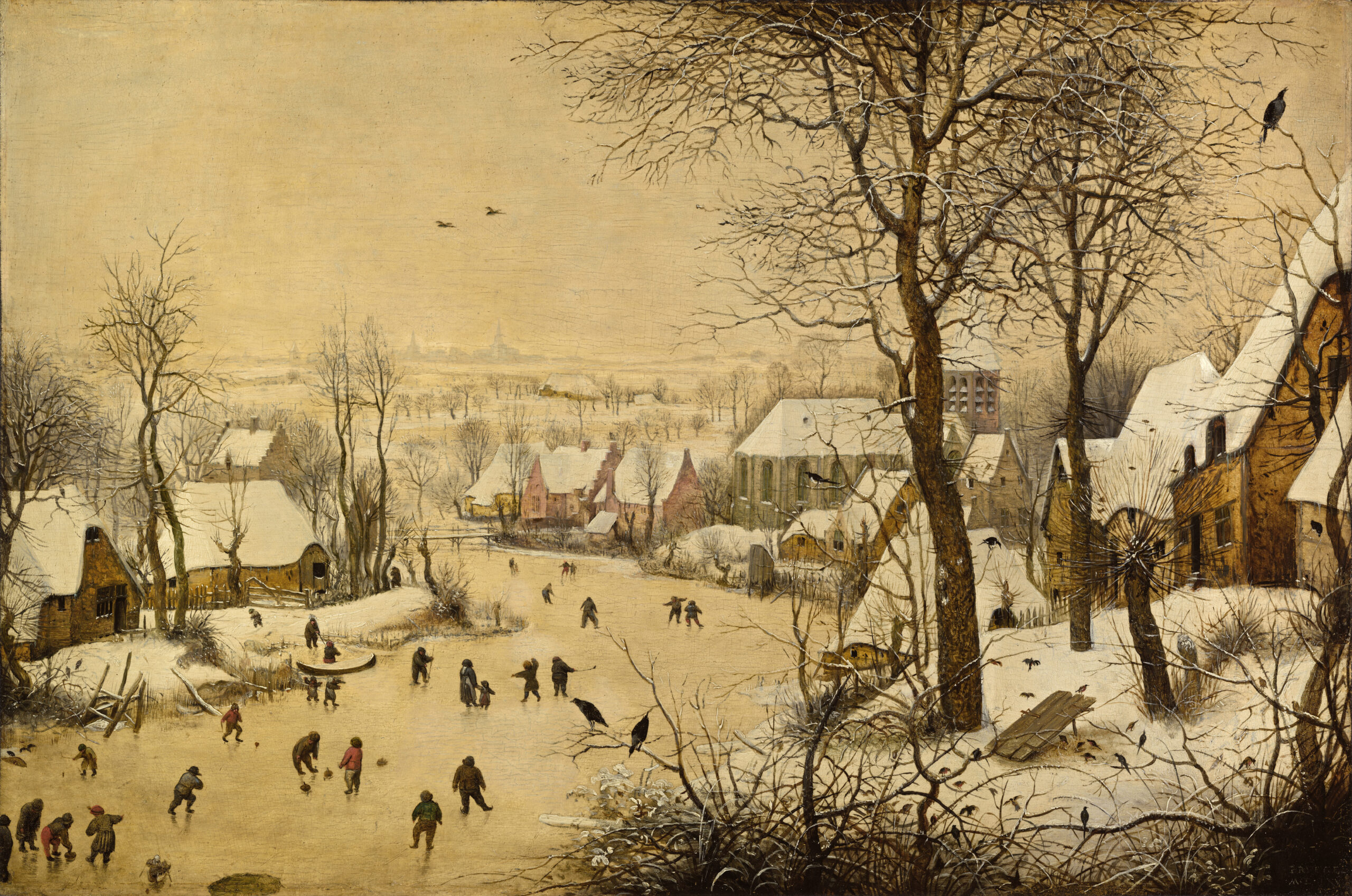
AUDIO: What Bruegel’s snow landscape teaches us about human fragility
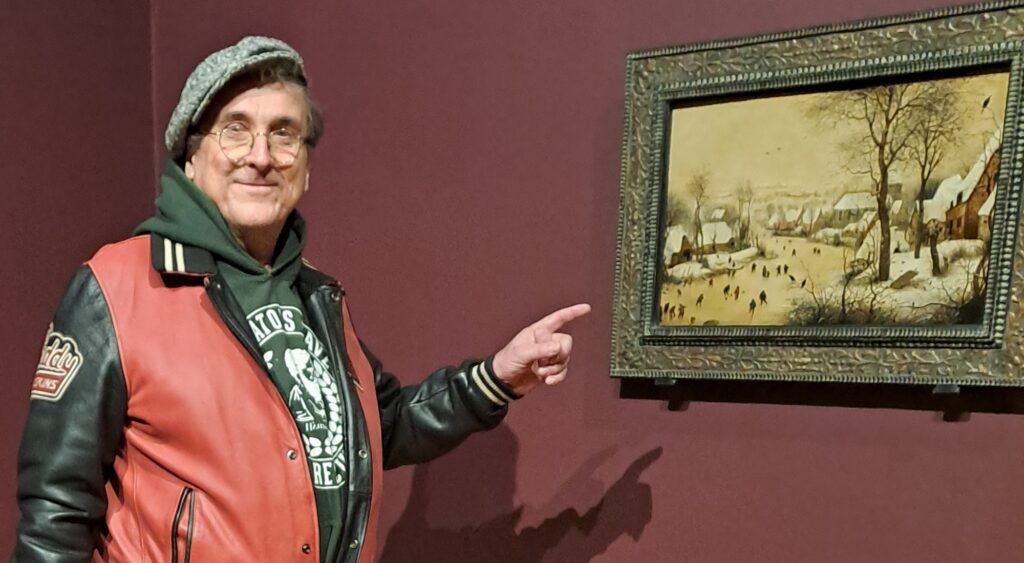
OPEN WEBPAGE TO LISTEN TO AUDIO: CLICK HERE
Further information on Bruegel:
- Portement de croix: redécouvrir Bruegel grâce au livre de Michael Gibson (FR en ligne) + EN pdf (Fidelio).
- ENTRETIEN Michael Gibson: Pour Bruegel, le monde est vaste (FR en ligne) + EN pdf (Fidelio)
- Pierre Bruegel l’ancien, Pétrarque et le Triomphe de la Mort (FR en ligne) + EN online.
- A propos du film « Bruegel, le moulin et la croix » (FR en ligne).
- L’ange Bruegel et la chute du cardinal Granvelle (FR en ligne).
- AUDIO: Bruegel’s « Dulle Griet » (Mad Meg): we see her madness, but do we see ours? (EN)
- AUDIO: Bruegel’s Theodicy: The Fall of the Rebel Angels. (EN)
- AUDIO: Bruegel’s Fall of Empire (Icarus) (EN)
- AUDIO: What Bruegel’s snow landscape teaches us about human fragility (EN)
AUDIO – Bruegel’s Theodicy: The Fall of the Rebel Angels
Further information on Bruegel:
- Portement de croix: redécouvrir Bruegel grâce au livre de Michael Gibson (FR en ligne) + EN pdf (Fidelio).
- ENTRETIEN Michael Gibson: Pour Bruegel, le monde est vaste (FR en ligne) + EN pdf (Fidelio)
- Pierre Bruegel l’ancien, Pétrarque et le Triomphe de la Mort (FR en ligne) + EN online.
- A propos du film « Bruegel, le moulin et la croix » (FR en ligne).
- L’ange Bruegel et la chute du cardinal Granvelle (FR en ligne).
- AUDIO: Bruegel’s « Dulle Griet » (Mad Meg): we see her madness, but do we see ours? (EN)
- AUDIO: Bruegel’s Theodicy: The Fall of the Rebel Angels. (EN)
- AUDIO: Bruegel’s Fall of Empire (Icarus) (EN)
- AUDIO: What Bruegel’s snow landscape teaches us about human fragility (EN)
Contemporary Art Curator Magazine interviews Karel Vereycken on what went wrong with Modern Art

On December 1, the United Arab Emirates based Contemporary Art Curator Magazine published a long, in depth interview with Karel Vereycken, his creative methods and his view on what went wrong with Modern and Contemporary Art.
Contemporary Art Curator Magazine is a leading contemporary art magazine, available in both online and print formats, dedicated to promoting and supporting contemporary artists. It has built a reputation for curating exceptional contemporary art from around the globe.
Founded in 2014, the magazine has consistently supported emerging and established artists, highlighting their work and contributions to the art world.
Devotio Moderna, Brothers of the Common Life: the cradle of humanism in the North

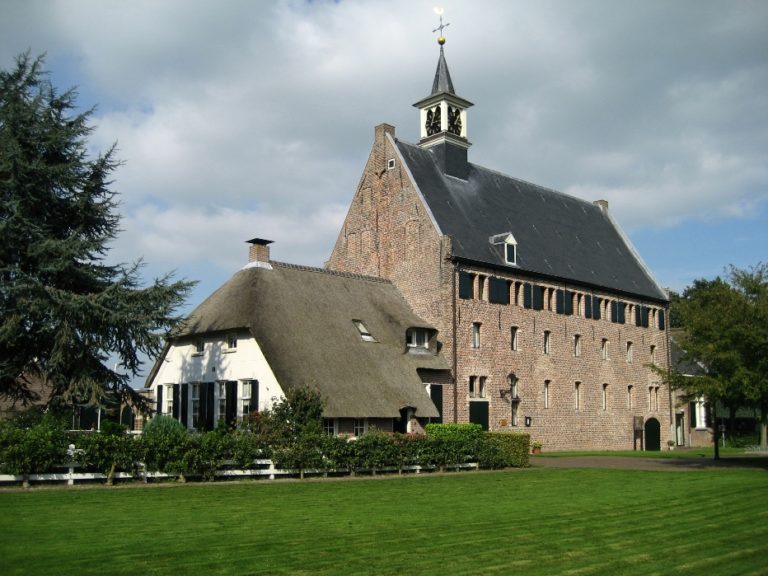
Presentation of Karel Vereycken, founder of Agora Erasmus, at a meeting with friends in the Netherlands on September 10, 2011.
The current financial system is bankrupt and will collapse in the coming days, weeks, months or years if nothing is done to end the paradigm of financial globalization, monetarism and free trade.
To exit this crisis implies organizing a break-up of the banks according to principles of the Glass-Steagall Act, an indispensable lever to recreate a true credit system in opposition to the current monetarist system. The objective is to guarantee real investments generating physical and human wealth, thanks to large infrastructure projects and highly qualified and well-paid jobs.
Can this be done? Yes, we can! However, the true challenge is neither economic, nor political, but cultural and educational: how to lay the foundations of a new Renaissance, how to effect a civilizational shift away from green and Malthusian pessimism towards a culture that sets itself the sacred mission of fully developing the creative powers of each individual, whether here, in Africa, or elsewhere.
Is there a historical precedent? Yes, and especially here, from where I am speaking to you this morning (Naarden, Netherlands) with a certain emotion. It probably overwhelms me because I have a rather well informed and precise sense of the role that several key individuals from the region where we are gathered this morning have played and how, in the fourteenth century, they made Deventer, Zwolle and Windesheim an intellectual hotbed and the cradle of the Renaissance of the North which inspired so many worldwide.
Let me summarize for you the history of this movement of lay clerics and teachers: the Brothers and Sisters of the Common Life, a movement that nurished our beloved Erasmus of Rotterdam, the humanist giant from whom we borrowed the name to create our political movement in Belgium.
As very often, it all begins with an individual decision of someone to overcome his shortcomings and give up those « little compromises » that end up making most of us slaves. In doing so, this individual quickly appears as a « natural » leader. Do you want to become a leader? Start by cleaning up your own mess before giving lessons to others!
Geert Groote, the founder
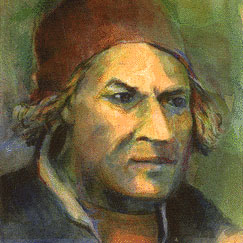
The spiritual father of the Brothers is Geert Groote, born in 1340 and son of a wealthy textile merchant in Deventer, which at that time, like Zwolle, Kampen and Roermond, were prosperous cities of the Hanseatic League.
In 1345, as a result of the international financial crash, the Black Death spread throughout Europe and arrived in the Netherlands around 1449-50. Between a third and a half of the population died and, according to some sources, Groote lost both parents. He abhorred the hypocrisy of the hordes of flagellants who invaded the streets and later advocated a less conspicuous, more interior spirituality.
Groote had talent for intellectual matters and was soon sent to study in Paris. In 1358, at the age of eighteen, he obtained the title of Master of Arts, even though the statutes of the University stipulated that the minimum age required was twenty-one.
He stayed eight years in Paris where he taught, while making a few excursions to Cologne and Prague. During this time, he assimilated all that could be known about philosophy, theology, medicine, canon law and astronomy. He also learned Latin, Greek and Hebrew and was considered one of the greatest scholars of the time.
Around 1362 he became canon of Aachen Cathedral and in 1371 of that of Utrecht. At the age of 27, he was sent as a diplomat to Cologne and to the Court of Avignon to settle the dispute between the city of Deventer and the bishop of Utrecht with Pope Urban V. In principle, he could have met the Italian humanist Petrarch who was there at that time.
Full of knowledge and success, Groote got a big head. His best friends, conscious of his talents, kindly suggested him to detach himself from his obsession with « Earthly Paradise ». The first one was his friend Guillaume de Salvarvilla, the choirmaster of Notre-Dame of Paris. The second was Henri Eger of Kalkar (1328-1408) with whom Groote shared the benches of the Sorbonne.
In 1374, Groote got seriously ill. However, the priest of Deventer refused to administer the last sacraments to him as long as he refused to burn some of the books in his possession. Fearing for his life (after death), he decided to burn his collection of books on black magic. Finally, he felt better and healed. He also gave up living in comfort and lucre through fictitious jobs that allowed him to get rich without working too hard.
After this radical conversion, Groote decides to selfperfect. In his Conclusions and Resolutions he wrote:
« It is to the glory, honor and service of God that I propose to order my life and the salvation of my soul. (…) In the first place, not to desire any other benefit and not to put my hope and expectation from now on in any temporal profit. The more goods I have, the more I will probably want more. For according to the primitive Church, you cannot have several benefits. Of all the sciences of the Gentiles, the moral sciences are the least detestable: many of them are often useful and profitable both for oneself and for teaching others. The wisest, like Socrates and Plato, brought all philosophy back to ethics. And if they spoke of high things, they transmitted them (according to St. Augustine and my own experience) by moralizing them lightly and figuratively, so that morality always shines through in knowledge… ».
Groote then undertakes a spiritual retreat at the Carthusian monastery of Monnikshuizen near Arnhem where he devotes himself to prayer and study.
However, after a three-year stay in isolation, the prior, his Parisian friend Eger of Kalkar, told him to go out and teach :
« Instead of remaining cloistered here, you will be able to do greater good by going out into the world to preach, an activity for which God has given you a great talent. »
Ruusbroec, the inspirer
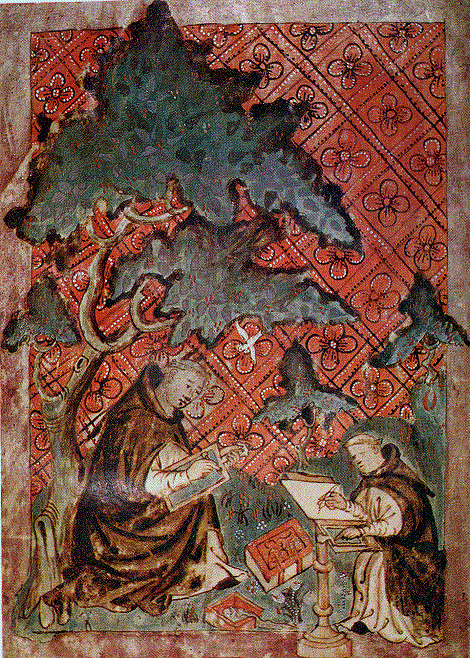
Groote accepted the challenge. However, before taking action, he decided to make a last trip to Paris in 1378 to obtain the books he needed.
According to Pomerius, prior of Groenendael between 1431 and 1432, he undertook this trip with his friend from Zwolle, the teacher Joan Cele (around 1350-1417), the historical founder of the excellent Dutch public education system, the Latin School.
On their way to Paris, they visit Jan van Ruusbroec (1293-1381), a Flemish “mystic” who lived in the Groenendael Priory on the edge of the Soignes Forest near Brussels.
Groote, still living in fear of God and the authorities, initially tries to make « more acceptable » some of the old sage’s writings while recognizing Ruusbroec as closer to the Lord than he is. In a letter to the community of Groenendael, he requested the prayer of the prior:
« I would like to recommend myself to the prayer of your provost and prior. For the time of eternity, I would like to be ‘the prior’s stepladder’, as long as my soul is united to him in love and respect.” (Note 1)
Back in Deventer, Groote concentrated on study and preaching. First he presented himself to the bishop to be ordained a deacon. In this function, he obtained the right to preach in the entire bishopric of Utrecht (basically the whole part of today’s Netherlands north of the great rivers, except for the area around Groningen).
First he preached in Deventer, then in Zwolle, Kampen, Zutphen and later in Amsterdam, Haarlem, Gouda and Delft. His success is so great that jealousy is felt in the church. Moreover, with the chaos caused by the great schism (1378 to 1417) installing two popes at the head of the church, the believers are looking for a new generation of leaders.
As early as 1374, Groote offered part of his parents’ house to accommodate a group of pious women. Endowed with a by-law, the first house of sisters was born in Deventer. He named them « Sisters of the Common Life », a concept developed in several works of Ruusbroec, notably in the final paragraph Of the Shining Stone (Van den blinckende Steen)
« The man who is sent from this height to the world below, is full of truth, and rich in all virtues. And he does not seek his own, but the honor of the one who sent him. And that is why he is upright and truthful in all things. And he has a rich and benevolent foundation grounded in the riches of God. And so he must always convey the spirit of God to those who need it; for the living fountain of the Holy Spirit is not a wealth that can be wasted. And he is a willing instrument of God with whom the Lord works as He wills, and how He wills. And it is not for sale, but leaves the honor to God. And for this reason he remains ready to do whatever God commands; and to do and tolerate with strength whatever God entrusts to him. And so he has a common life; for to him seeing [via contemplativa] and working [via activa] are equal, for in both things he is perfect.”
Radewijns, the organizer
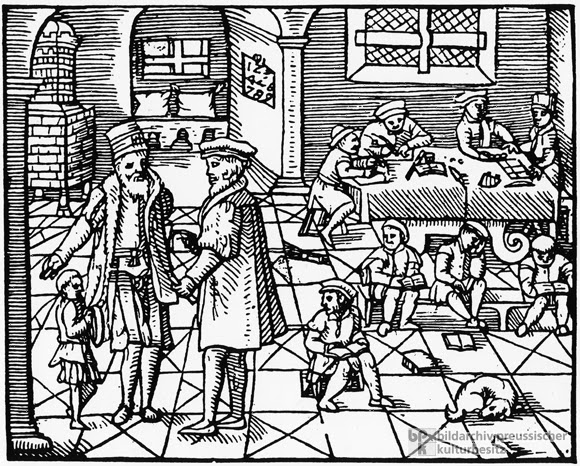
Following one of his first sermons, Groote recruited Florens Radewijns (1350-1400). Born in Utrecht, the latter received his training in Prague where, also at the early age of 18, he was awarded the title of Magister Artium.
Groote then sent him to the German city of Worms to be consecrated priest there. In 1380 Groote moved with about ten pupils to the house of Radewijns in Deventer; it would later be known as the « Sir Florens House” (Heer Florenshuis), the first house of the Brothers and above all its base of operation?
When Groote died of the plague in 1384, Radewijns decided to expand the movement which became the Brothers and Sisters of the Common Life. Soon it will be branded the Devotio Moderna (Modern Devotion).
Books and beguinages
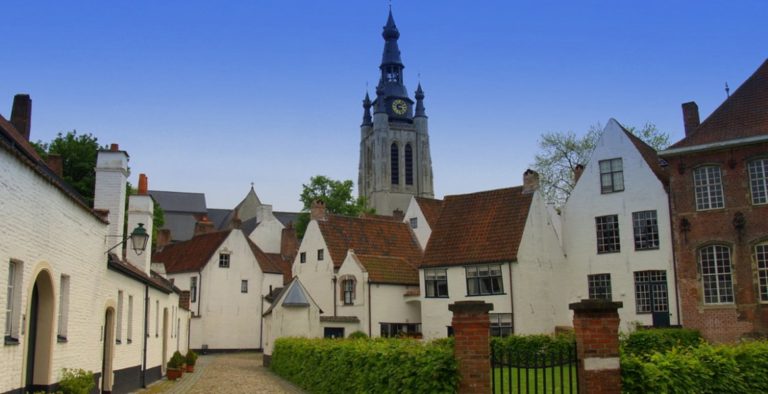
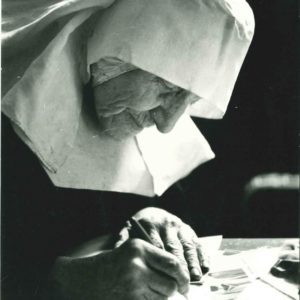
A number of parallels can be drawn with the phenomenon of the Beguines which flourished from the 13th century onward. (Note 2)
The first beguines were independent women, living alone (without a man or a rule), animated by a deep spirituality and daring to venture into the enormous adventure of a personal relationship with God. (Note 3)
Operating outside the official religious hierarchy, they didn’t beg but worked various jobs to earn their daily bread. The same goes for the Brothers of the Common Life, except that for them, books were at the center of all activities. Thus, apart from teaching, the copying and production of books represented a major source of income while allowing spreading the word to the many.
Lay Brothers and Sisters focused on education and their priests on preaching. Thanks to the scriptorium and printing houses, their literature and music will spread everywhere.
Windesheim
To protect the movement from unfair attacks and criticism, Radewijns founded a congregation of canons regular obeying the Augustinian rule.
In Windesheim, between Zwolle and Deventer, on land belonging to Berthold ten Hove, one of the members, a first cloister is erected. A second one, for women this time, is built in Diepenveen near Arnhem. The construction of Windesheim took several years and a group of brothers lived temporarily on the building site, in huts.
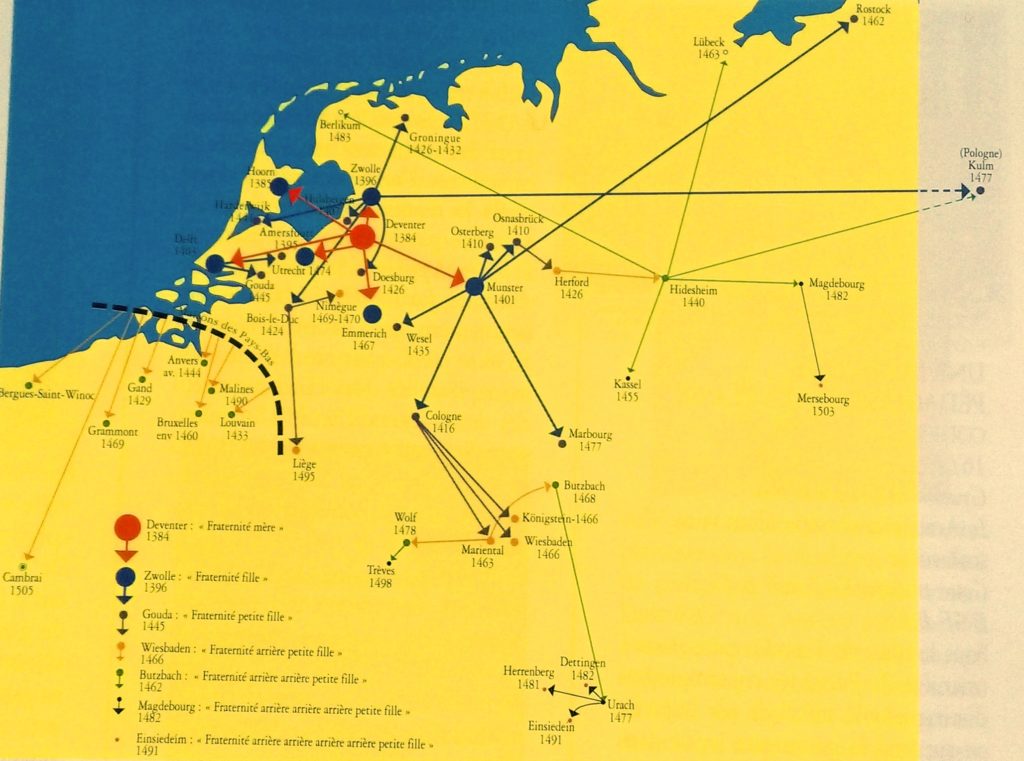
In 1399 Johannes van Kempen, who had stayed at Groote’s house in Deventer, became the first prior of the cloister of Mont Saint-Agnès near Zwolle and gave the movement new momentum. From Zwolle, Deventer and Windesheim, the new recruits spread all over the Netherlands and Northern Europe to found new branches of the movement.
In 1412, the congregation had 16 cloisters and their number reached 97 in 1500: 84 priories for men and 13 for women. To this must be added a large number of cloisters for canonesses which, although not formally associated with the Windesheim Congregation, were run by rectors trained by them.
Windesheim was not recognized by the Bishop of Utrecht until 1423 and in Belgium, Groenendael, associated with the Red Cloister and Korsendonc, wanted to be part of it as early as 1402.
Thomas a Kempis, Cusanus and Erasmus
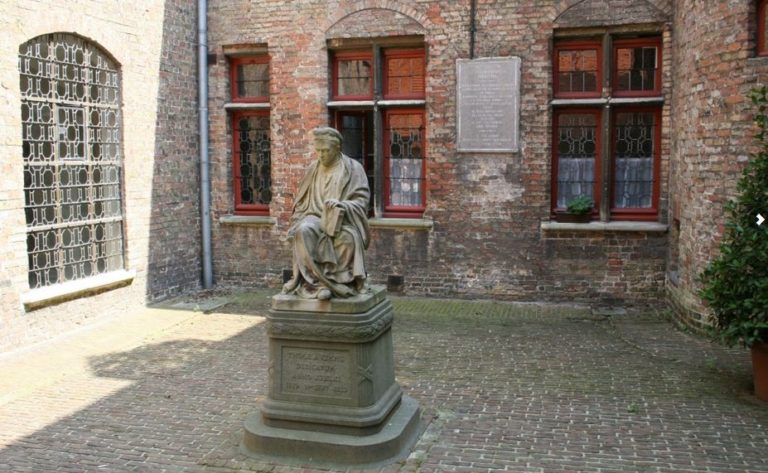
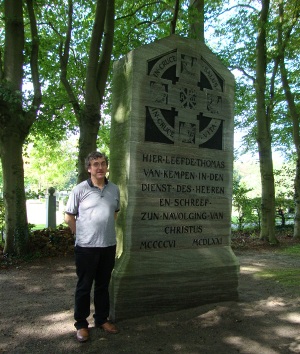
Johannes van Kempen was the brother of the famous Thomas a Kempis (1379-1471). The latter, trained in Windesheim, animated the cloister of Mont Saint-Agnès near Zwolle and was one of the towering figures of the movement for seventy years. In addition to a biography he wrote of Groote and his account of the movement, his Imitatione Christi (The Imitation of Christ) became the most widely read work in history after the Bible.
Both Rudolf Agricola (1444-1485) and Alexander Hegius (1433-1498), two of Erasmus’ tutors during his training in Deventer, were direct pupils of Thomas a Kempis. The Latin School of Deventer, of which Hegius was rector, was the first school in Northern Europe to teach the ancient Greek language to children.
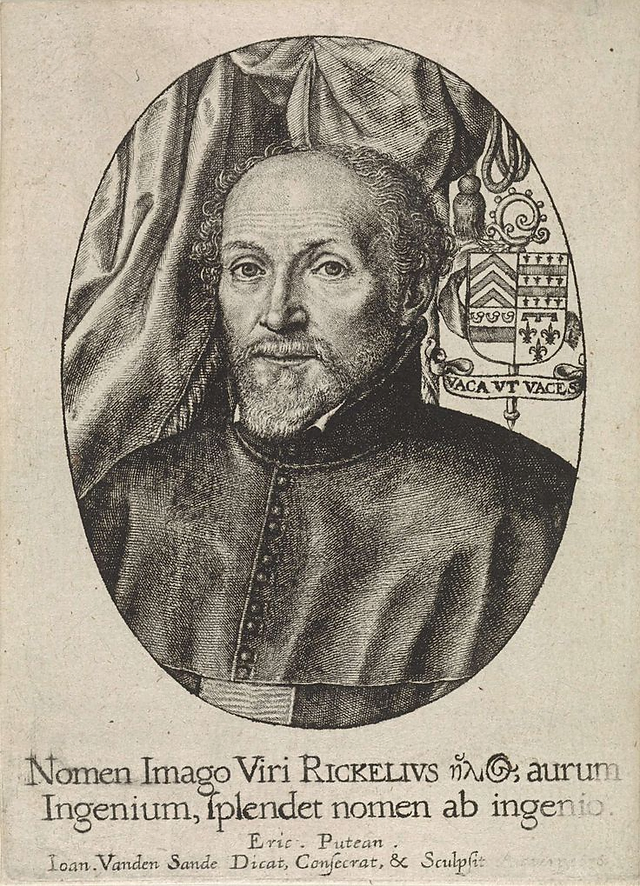
While no formal prove exists, it is tempting to believe that Cusanus (1401-1464), who protected Agricola and, in his last will, via his Bursa Cusanus, offered a scholarship for the training of orphans and poor students of the Brothers of the Common Life in Deventer, was also trained by this humanist network.
What is known is that when Cusanus came in 1451 to the Netherlands to put the affairs of the Church in order, he traveled with his friend Denis the Carthusian (van Rijkel) (1402-1471), a disciple of Ruusbroec, whom he commissioned to carry on this task.
A native of Limburg, trained at the famous Cele school in Zwolle, Dionysius the Carthusian also became the confessor of the Duke of Burgundy and is thought to be the “theological advisor” of the Duke’s ambassador and court painter, Jan Van Eyck. (Note 4)
Gansfort
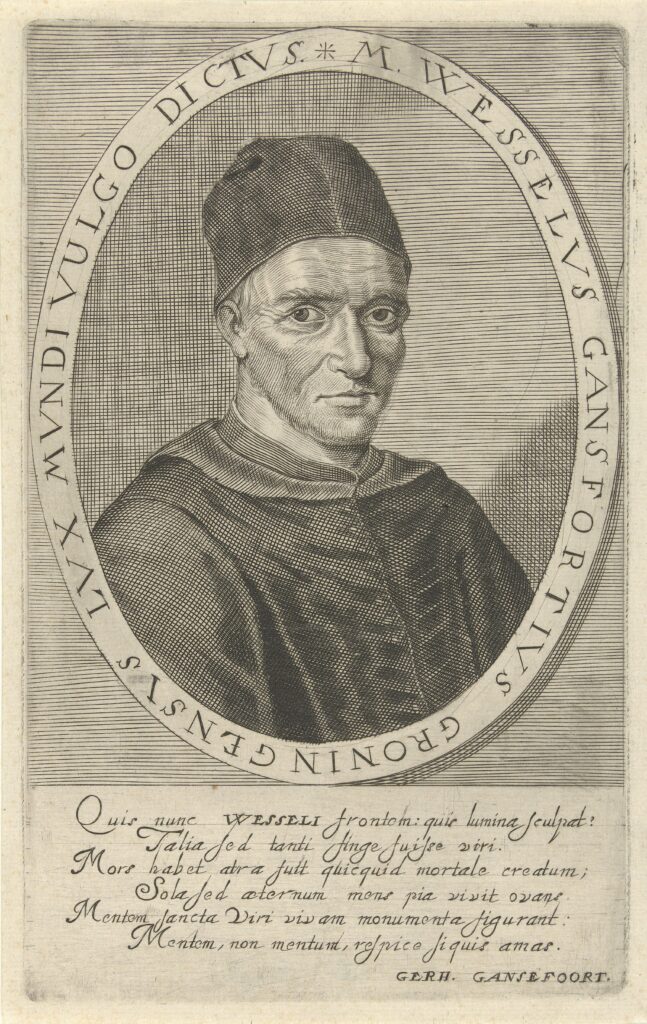
Wessel Gansfort (1419-1489), another exceptional figure of this movement was at the service of the Greek Cardinal Bessarion, the main collaborator of Nicolas of Cusa (Cusanus) at the Council of Ferrara-Florence of 1437. Gansfort, after attending the Brothers’ school in Groningen, was also trained by Joan Cele‘s Latin school in Zwolle.
The same goes for the first and only Dutch pope, Adrianus VI, who was trained in the same school before completing his training with Hegius in Deventer. This pope was very open to Erasmus’ reformist ideas… before arriving in Rome.
Hegius, in a letter to Gansfort, which he calls Lux Mundi (Light of the World), wrote:
« I send you, most honorable lord, the homilies of John Chrysostom. I hope that you will enjoy reading them, since the golden words have always been more pleasing to you than the pieces of this metal. As you know, I went to the library of Cusanus. There I found some books that I didn’t know existed (…) Farewell, and if I can do you a favor, let me know and consider it done.”
Rembrandt
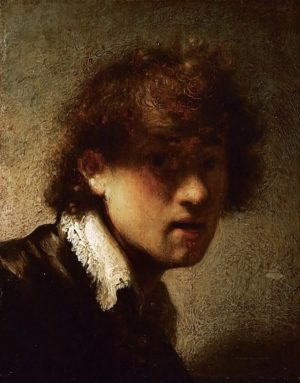
A quick look on Rembrandt’s intellectual training indicates that he too was a late product of this educational epic. In 1609, Rembrandt, barely three years old, entered elementary school where, like other boys and girls of his generation, he learned to read, write and… draw.
The school opened at 6 in the morning, at 7 in the winter, and closes at 7 in the evening. Classes begin with prayer, reading and discussion of a passage from the Bible followed by the singing of psalms. Here Rembrandt acquired an elegant writing style and much more than a rudimentary knowledge of the Gospels.
The Netherlands wanted to survive. Its leaders take advantage of the twelve-year truce (1608-1618) to fulfill their commitment to the public interest.
In doing so, the Netherlands at the beginning of the XVIIth century became the first country in the world where everyone had the chance to learn to read, write, calculate, sing and draw.
This universal educational system, no matter what its shortcomings, available to both rich and poor, boys and girls alike, stands as the secret behind the Dutch « Golden Century ». This high level of education also created those generations of active Dutch emigrants a century later in the American Revolution.
While others started secondary school at the age of twelve, Rembrandt entered the Leyden Latin School at the age of 7. There, the students, apart from rhetoric, logic and calligraphy, learn not only Greek and Latin, but also foreign languages such as English, French, Spanish or Portuguese. Then, in 1620, at the age of 14, with no laws restricting young talents, Rembrandt enrolled in University. The subject he chose was not Theology, Law, Science or Medicine, but… Literature.
Did he want to add to his knowledge of Latin the mastery of Greek or Hebrew philology, or possibly Chaldean, Coptic or Arabic? After all, Arabic/Latin dictionaries were already being published in Leiden at a time the city was becoming a major printing center in the world.
Thus, one realizes that the Netherlands and Belgium, first with Ruusbroec and Groote and later with Erasmus and Rembrandt, made an essential contribution in the not so distant past to the kind of humanism that can raise today humanity to its true dignity.
Hence, failing to extend our influence here, clearly seems to me something in the realm of the impossible.
Footnotes:
- Geert Groote, who discovered Ruusbroec’s work during his spiritual retreat at the Carthusian monastery of Monnikshuizen, near Arnhem, has translated at least three of his works into Latin. He sent The Book of the Spiritual Tabernacle to the Cistercian Cloister of Altencamp and his friends in Amsterdam. The Spiritual Marriage of Ruusbroec being under attack, Groote personally defends it. Thus, thanks to his authority, Ruusbroec’s works are copied in number and carefully preserved. Ruusbroec’s teaching became popularized by the writings of the Modern Devotion and especially by the Imitation of Christ.
- At the beginning of the 13th century the Beguines were accused of heresy and persecuted, except… in the Burgundian Netherlands. In Flanders, they are cleared and obtain official status. In reality, they benefit from the protection of two important women: Jeanne and Margaret of Constantinople, Countess of Flanders. They organized the foundation of the Beguinages of Louvain (1232), Gent (1234), Antwerp (1234), Kortrijk (1238), Ypres (1240), Lille (1240), Zoutleeuw (1240), Bruges (1243), Douai (1245), Geraardsbergen (1245), Hasselt (1245), Diest (1253), Mechelen (1258) and in 1271 it was Jan I, Count of Flanders, in person, who deposited the statutes of the great Beguinage of Brussels. In 1321, the Pope estimated the number of Beguines at 200,000.
- The platonic poetry of the Beguine, Hadewijch of Antwerp (XIIIth Century) has a decisive influence on Jan van Ruusbroec.
- It is significant that the first book printed in Flanders in 1473, by Erasmus’ friend and printer Dirk Martens, is precisely a work of Denis the Carthusian.