Catégorie : Comprendre
 Articles, analyses et conférences pédagogiques.
L’histoire de l’art avec le regard d’un amoureux de toutes les renaissances.
FR/EN/NE/GE/IT/ES
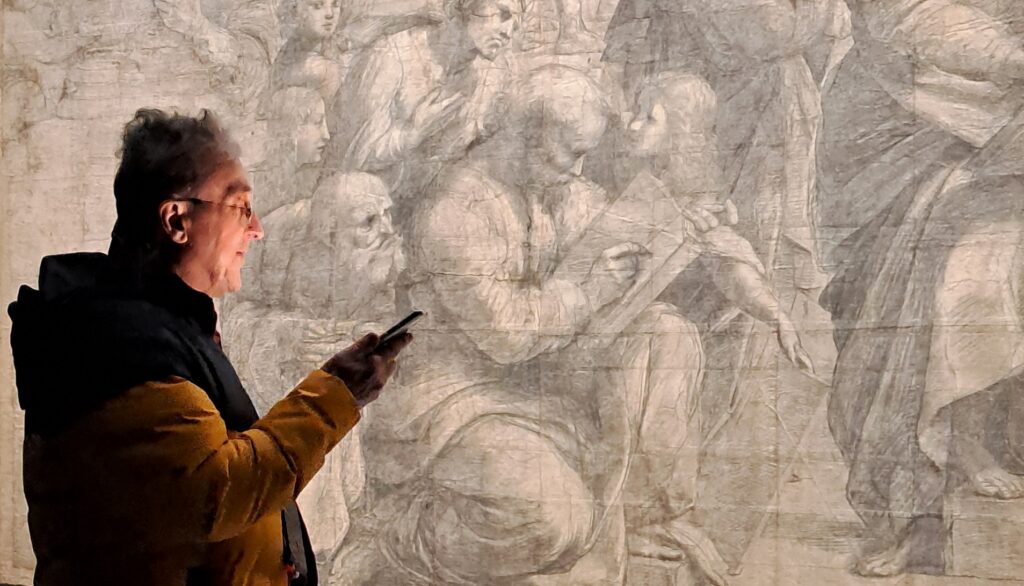
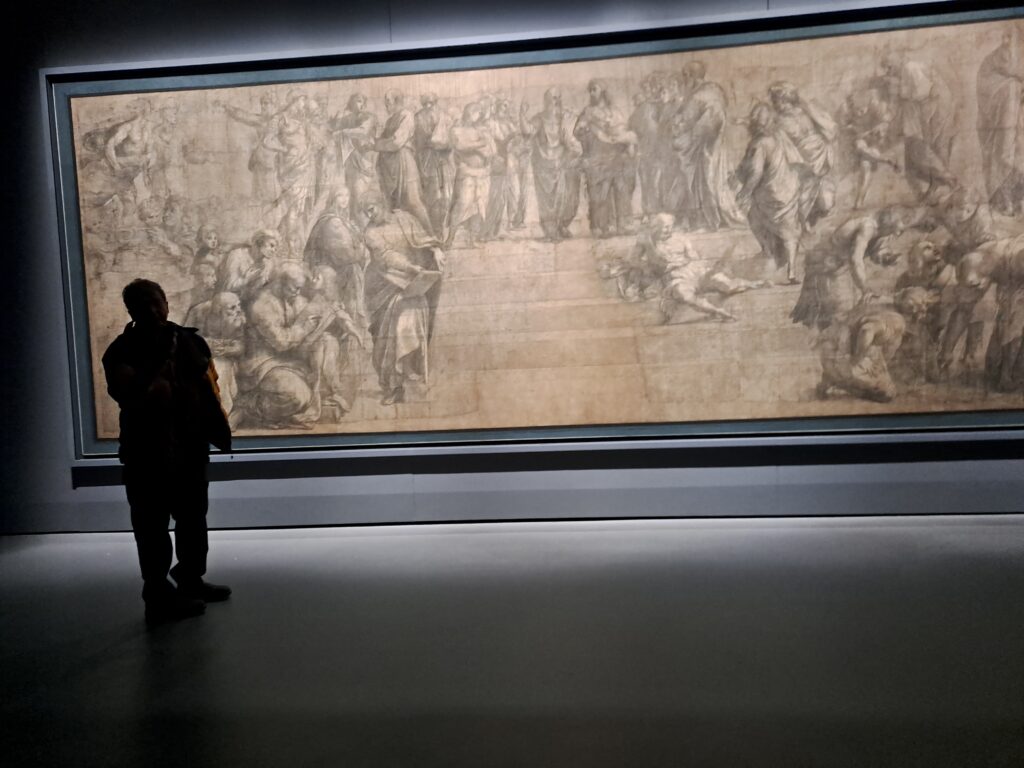
AUDIO : Raphael’s cartoon for « The School of Athens » in Milan
AUDIO:
from the pdf file, click on this LINK
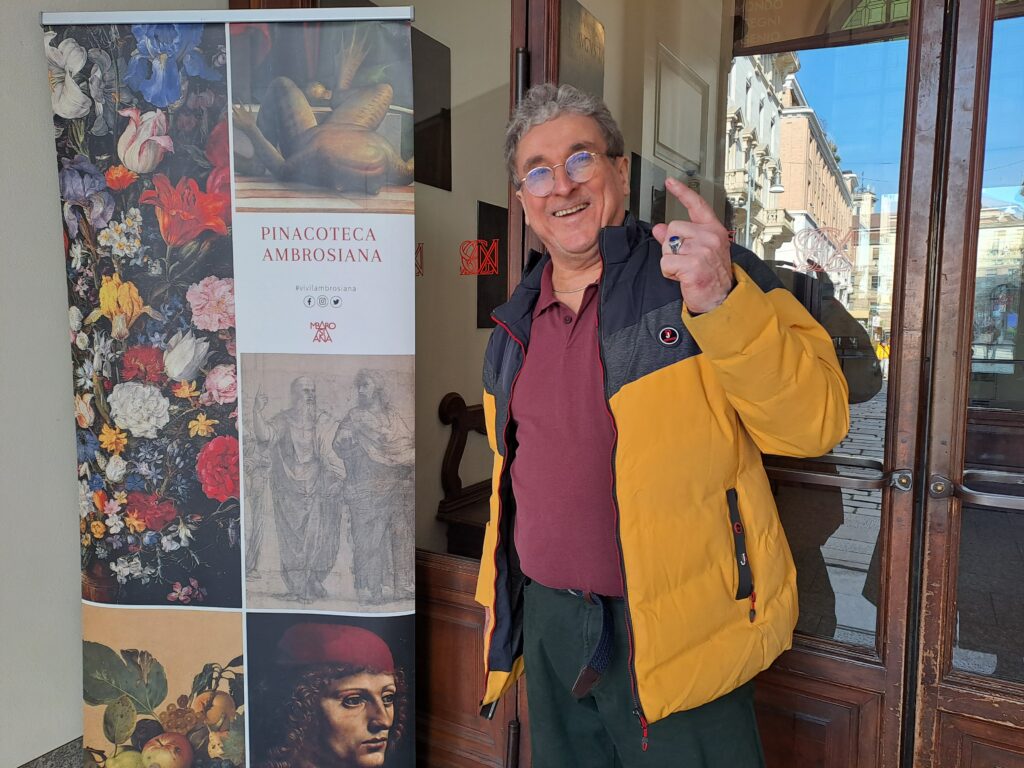
Audio recorded during my visit at the Pinacoteca Ambrosiana in Milan, on March 20, 2026. For my full, in depth analysis of Raphael and his « School of Athens », see my article.
L’ombre de Vernadski dans la Sainte Anne de Léonard de Vinci
Par Karel Vereycken
En mars 1821, le poète anglais Percy Bysshe Shelley concluait son poème « Défense de la poésie » par ce concept visionnaire :
« Les poètes sont les hiérophantes d’une inspiration insoupçonnée, les miroirs des ombres gigantesques que l’avenir projette sur le présent, les mots qui expriment ce qu’ils ne comprennent pas, les trompettes qui sonnent pour la bataille, sans ressentir ce qu’elles inspirent, l’influence qui ne se laisse pas émouvoir, mais qui émeut. Les poètes sont les législateurs méconnus du monde. »
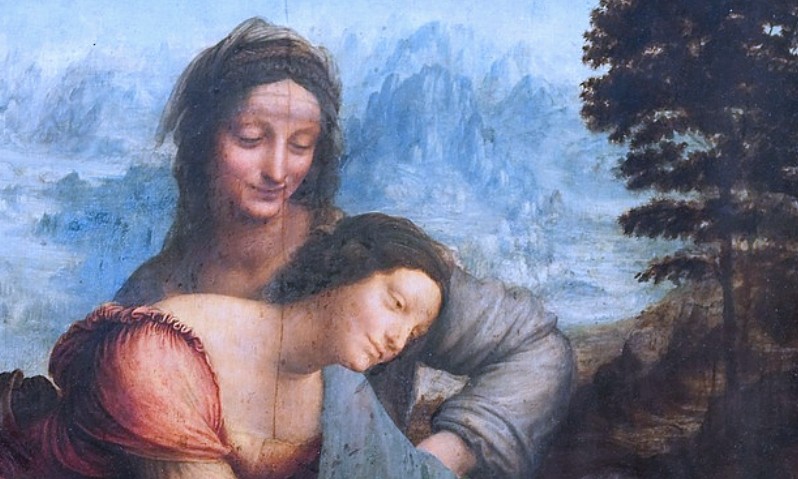
Nous vous proposons d’examiner ici, de ce point de vue, le chef-d’œuvre de Léonard de Vinci (1452-1519), « La Vierge à l’Enfant avec sainte Anne », actuellement au Louvre.
On ne se lasse jamais de contempler ce chef-d’œuvre. Le tableau représente sainte Anne, sa fille Marie et l’Enfant Jésus enlaçant un agneau sacrificiel, symbole de sa mission : libérer l’humanité du péché originel.
Léonard de Vinci n’a pas réalisé ce tableau pour un prince, un duc, un cardinal ou un pape, mais pour lui-même, et à ce titre, l’a légué en héritage à l’humanité.
Après avoir passé en revue les dernières recherches, Vincent Delieuvin, l’historien français du Louvre, est arrivé en 2000 à cette conclusion étonnante : Léonard salue le retour du régime républicain à Florence, dont Sainte-Anne était la protectrice.1
Si l’œuvre resta quasiment inachevée à sa mort, en 1519, on sait que Léonard de Vinci commença à y travailler en 1503 (il avait 51 ans), alors qu’il vivait à Florence. Le roi François Ier ne vola pas le tableau, mais en vola l’auteur, qui l’emporta avec lui en France pour le terminer.
Le spectateur est immédiatement saisi par un sens puissant de mouvement presque troublant, un sentiment d’amour suprême et de grande beauté. Si elle met en scène des figures des Saintes Écritures (sainte Anne, la Vierge Marie, le Christ) plutôt que d’illustrer une séquence liturgique particulière (par ailleurs inexistante), l’œuvre elle-même jaillit manifestement d’une profonde conception philosophique.
Je vais tenter de vous convaincre qu’il existe un « long arc de l’histoire », une cohérence intellectuelle entre des personnes et des esprits qui ne se sont jamais croisés et ne se sont jamais parlé, mais dont les intuitions et les avancées épistémologiques s’accordent.
Le chef-d’œuvre de Léonard de Vinci apparaît, à mon sens, comme une sorte de chaînon manquant entre la vision de Dieu et de la création de Nicolas de Cues (Cusanus) et le concept de « noosphère » de Vladimir Vernadski, en passant par l’idée de « cosmos » d’Alexander von Humboldt. De prime abord, cela peut paraître farfelu, mais permettez-moi de développer.
Une unité
Qu’est-ce qui peut donc unir ces quatre intellectuels de génie, Cusanus, Léonard de Vinci, Alexander von Humboldt et Vernadski ? Tous quatre étaient convaincus que l’univers est un ensemble vivant, un et harmonieux.
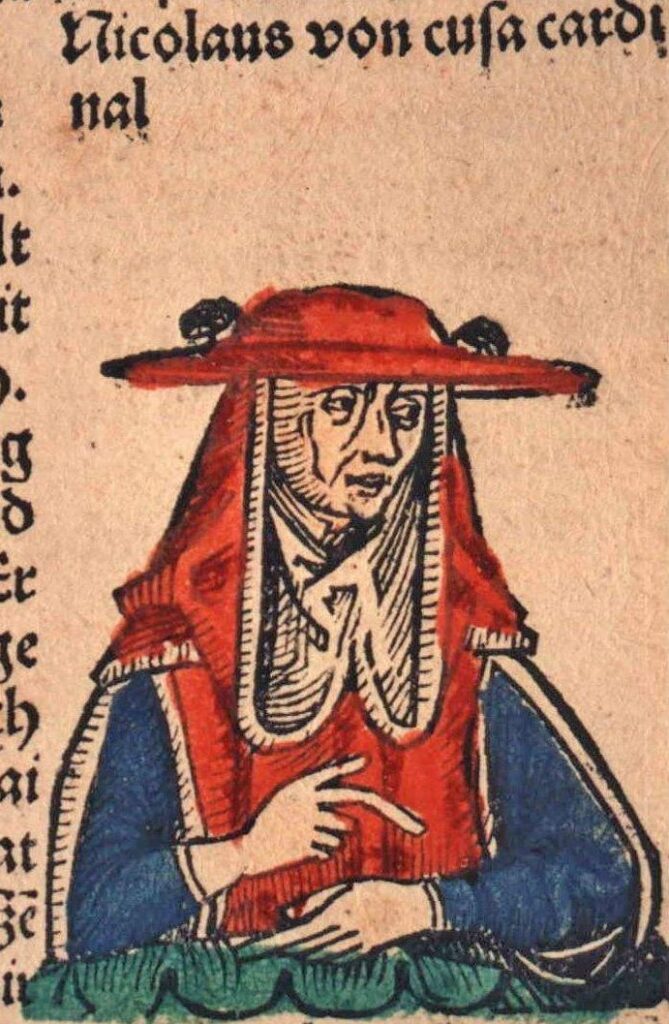
Dans son traité De la docte ignorance (1440), le cardinal allemand Nicolas de Cues (1401-1464), penseur et acteur majeur des grands conciles œcuméniques ainsi que de la Renaissance italienne et européenne, part de ce symbole : Dieu est le « maximum absolu » et l’unité parfaite (unio). Dans cette unité, toutes les distances, divisions et contradictions se changent et se fondent en union. L’Univers est l’image contractée de cette unité et de ce maximum absolu. Comme un miroir, il est le maximum « contracté » car il ne comprend pas toutes choses, mais seulement toutes choses hors de Dieu, toutes choses créées. Le philosophe emploie les termes complicatio (enveloppement) et explicatio (déploiement) pour expliquer que toutes choses sont enveloppées en Dieu (la source) et déployées dans le monde. Le monde, le cosmos et le temps géologique sont le déploiement de l’unité de Dieu.
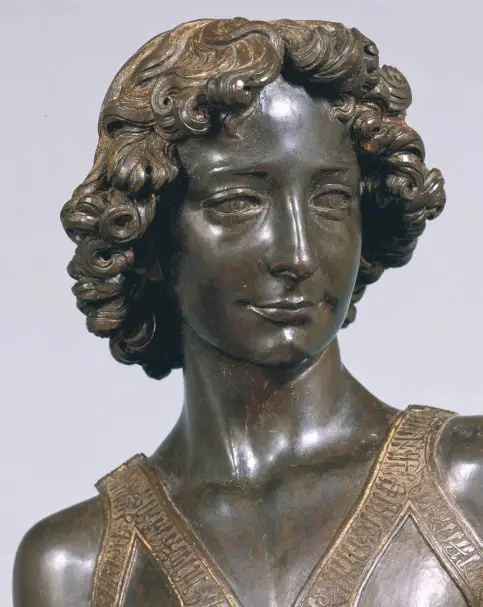
S’engageant sur la voie ouverte par Cues, Léonard de Vinci (1452-1519) affirme avec force : « Comprenez que tout est lié à tout. » Pour lui, progresser signifie unifier différents domaines comme l’art, l’anatomie et l’ingénierie en une compréhension globale et cohérente. L’artiste-ingénieur invite ses contemporains à apprendre à percevoir les liens qui unissent la nature, l’art, la science et l’âme humaine. L’observation permet à Léonard de découvrir les causes invisibles au-delà des effets visibles, et d’imaginer et tester des hypothèses créatives. Il postule notamment que le corps humain pourrait être une version miniature (microcosme) de la Terre (macrocosme), en observant que la ramification des vaisseaux sanguins chez l’homme reflète les affluents des rivières, tout comme les mouvements du corps imitent les marées. À ses yeux, la Terre est un organisme vivant doté d’une « chair » (le sol), d’« os » (les strates rocheuses) et de « sang » (les veines d’eau). Il étudie le vol des oiseaux et les mouvements de l’eau, convaincu que les deux obéissent à une même physique des fluides. L’art est une science et la science est un art, tous deux étant des outils pour comprendre les lois fondamentales du monde. Pour Léonard de Vinci, les peintres doivent posséder le cosmos tout entier dans leur esprit et leurs mains pour refléter véritablement la beauté, l’harmonie et la complexité de la nature. Pour lui, le mouvement est l’essence même d’un univers vivant en pleine expansion. Il étudie les motifs en spirale présents dans toute chose, des fleurs aux boucles des cheveux en passant par les tourbillons de l’eau, pour tenter de comprendre comment la force vitale engendre les différentes formes. Enfin, il considère la stagnation comme une forme de déclin, notant que « le fer rouille par manque d’usage » et que « l’inaction sape la vigueur de l’esprit ».
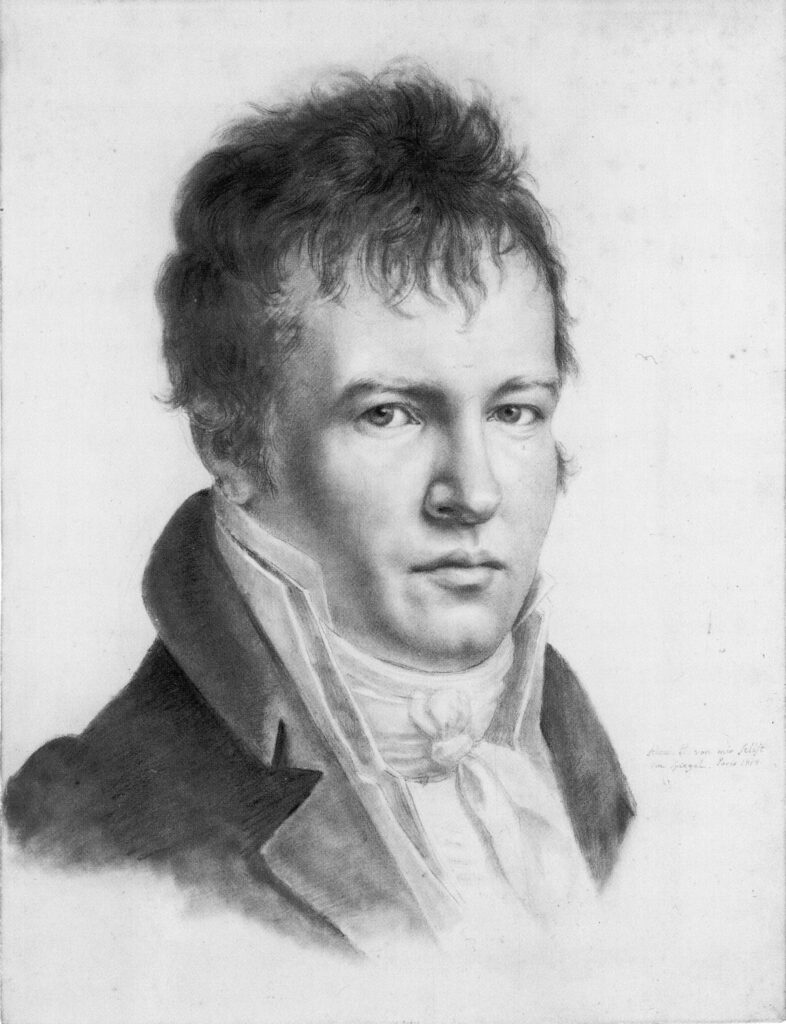
Le naturaliste et révolutionnaire allemand Alexander von Humboldt (1769-1859) s’est lui aussi efforcé de comprendre comment divers phénomènes naturels, malgré leur apparente indépendance, forment un système harmonieux et unifié. Il évoque un « système terrestre » où le climat, la flore, la faune et la vie humaine sont interdépendants. Humboldt croit qu’il existe un « lien intrinsèque » entre le général et le particulier, ce qui lui permet de percevoir l’interconnexion entre les différentes régions et les climats. Dans son œuvre ultime en cinq volumes, Cosmos (1845-1858), il décrit la nature comme un « souffle de vie » et un « tout organique », et voit l’univers entier – physique et céleste – comme un « système magnifiquement ordonné et harmonieux ». À l’instar de Cusanus et de Léonard de Vinci, il soutient qu’une compréhension scientifique des processus naturels accroît notre appréciation de leur beauté.
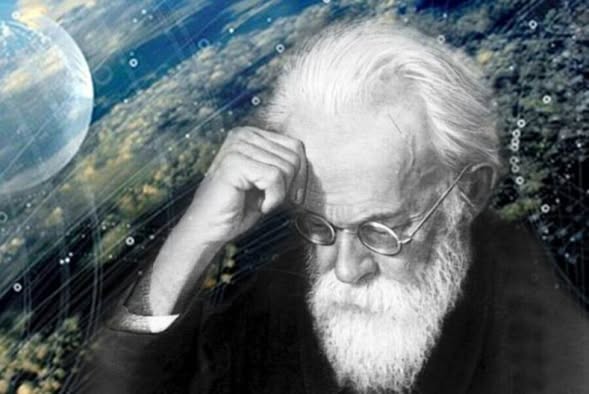
Pour le géophysicien russo-ukrainien Vladimir Vernadski (1863-1945), la vie est éternelle et indissociable du cosmos, et non de la seule Terre. Il voit la matière vivante comme un « phénomène cosmique » apparu ailleurs ou ayant toujours existé, façonnant l’environnement chimique des planètes. La biosphère entoure la Terre comme une « enveloppe saturée de vie », où organismes vivants et matière inerte interagissent constamment, indissociablement et de manière dynamique. L’étape suivante de l’évolution est décrite comme la transition de la biosphère à la « noosphère », où l’activité rationnelle humaine, la science et la technologie deviennent la principale force géologique qui façonne la planète. Vernadski était convaincu que l’avenir de l’humanité dépendait de la reconnaissance de cette unité, suggérant que la pensée humaine était un prolongement naturel des processus géologiques et cosmiques.
Regardons maintenant le tableau
C’est avec ce « long arc de l’histoire » à l’esprit que le spectateur attentif peut déceler l’ombre de Vernadski dans la Sainte Anne de Léonard.
Décryptage
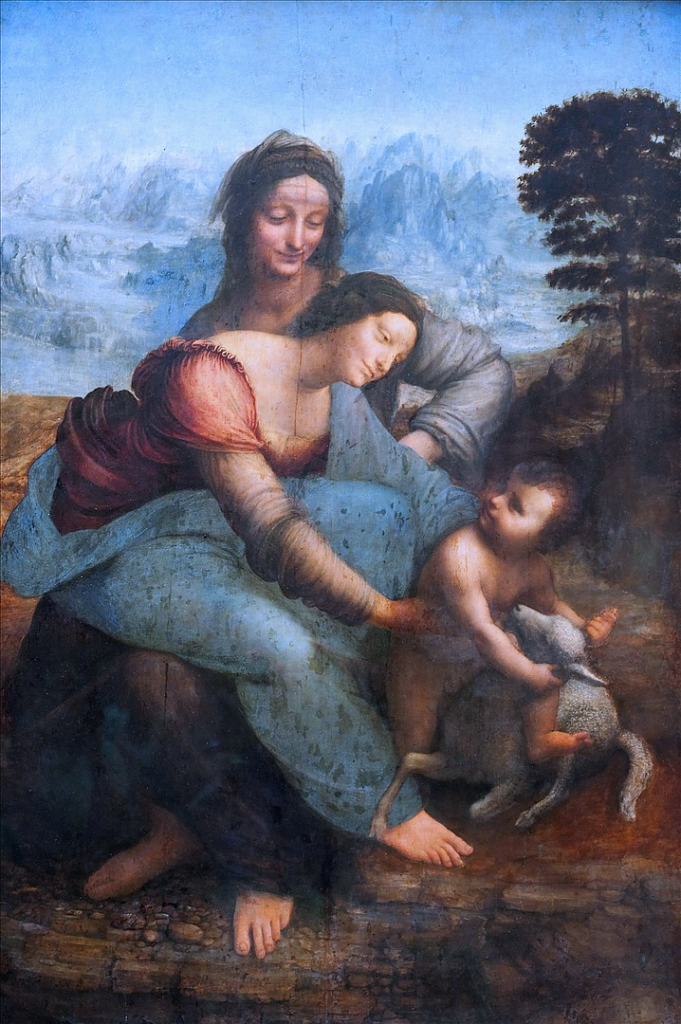
- L’arrière-plan du tableau montre des crêtes abruptes à l’aspect préhistorique, inspirées des études de Léonard sur les Dolomites et les Alpes. Ce paysage aride et rocailleux, presque lunaire, a été qualifié par les historiens de « fantastique » ou de « métaphysique ». Comme en témoignent ses carnets, Léonard s’attachait à représenter les mouvements « invisibles », non seulement des âmes, mais aussi des phénomènes physiques tels que le temps, et plus particulièrement le temps géologique. Comment les montagnes se sont-elles formées, par exemple ? Pour d’autres, ce paysage « mort », ou lunaire, de l’arrière-plan – ce que Vernadski appellerait la « lithosphère » – servirait uniquement à mettre en valeur les autres éléments de la composition.
- Devant ce paysage, à droite, se dresse un arbre, premier indice de la biosphère mais simple étape d’un processus évolutif de développement accéléré du cosmos.
- En-dessous, l’agneau (symbole religieux du sacrifice du Christ) représenterait une forme supérieure de conscience de cette biosphère.
- Apparaît alors Jésus qui, dans son incarnation d’enfant humain, ne représente qu’une sorte de conscience naïve, simple potentiel de son développement ultérieur.
- La Vierge Marie est peinte dans une position paradoxale, illustrant parfaitement ce que le penseur américain Lyndon LaRouche appelait « mid-motion-change », c’est-à-dire un instant ambigu d’indécision entre des mouvements d’apparence contraires. Le geste majestueux, aimant et protecteur de Marie, et son étreinte de Jésus coïncident avec son désir profond de lui accorder toute la liberté de mouvement nécessaire à l’accomplissement de sa mission sacrée.
- Sainte Anne, au sommet, animée d’une joie divine, contemple en souriant le geste gracieux de sa fille Marie et l’amour qu’elle porte au Christ. Elle se réjouit d’être en quelque sorte l’âme « noosphérique » consciente d’un Cosmos divin et vivant, où le créateur conçoit sans cesse des formes nouvelles pour sa création et des degrés de conscience toujours plus élevés de sa propre nature créatrice. Les alignements circulaires des chaînes de montagne lunaires résonnent visuellement avec les anneaux harmonieux dessinés par les bras et les vêtements dans une spirale en cascade.
Même des auteurs comme Viviane Forrester, dont l’œuvre2 est polluée par de pernicieuses interprétations modernistes et freudiennes, et qui prétendent à tort que nous sommes leurrés par la mansuétude « bébête » de Marie (p. 19), reconnaissent néanmoins intuitivement qu’il y a quelque chose de très particulier dans cette œuvre, une sorte d’unité que l’écrivaine qualifie, faute de trouver un mot plus adéquat, d’« organique ».
Lorsqu’on découvre ces figures, écrit-elle, « on perçoit bien qu’il s’agit d’organismes vivants au sein d’un paysage, organisme vivant. Dee l’organique dans de l’organique. » (p. 12)
Ce moment organique, observe-t-elle, apparaît ici au spectateur comme un « moment figé » d’un « mouvement transitoire ».
« Leur prochaine respiration, celle qui suivre, semble plus importante, vitale, plus en suspens que toute intrigue, tout récit. Et leur présence tangible, fragile, s’apparente à celle des montagnes, qui respirent aussi. » (p. 13)
La naissance d’un génie
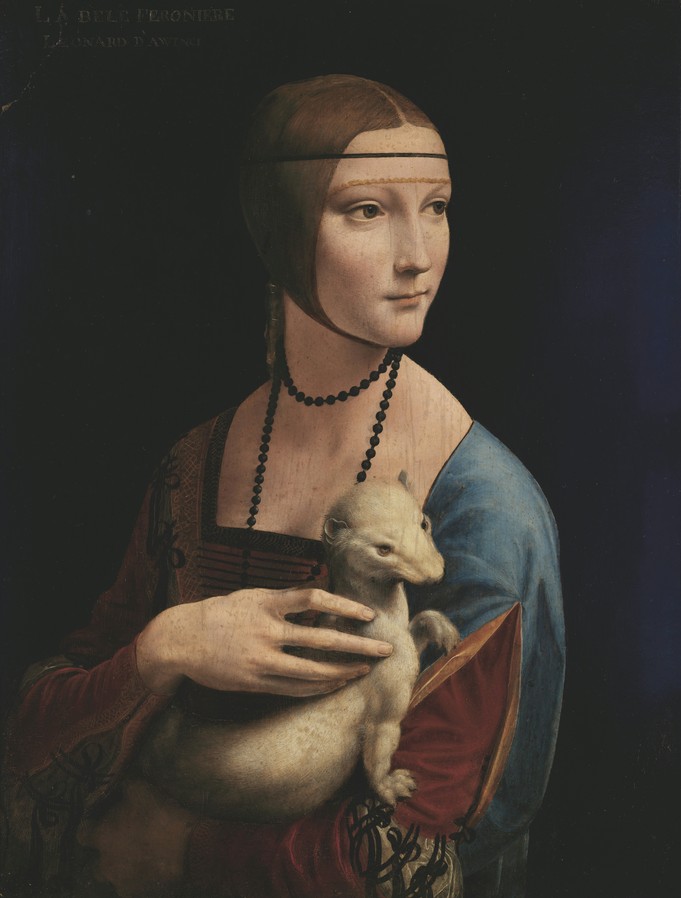
dite La Dame à l’hermine (1489).
En insistant excessivement sur le fait que Léonard de Vinci était un génie « autodidacte », on a en quelque sorte négligé les recherches sur les influences intellectuelles qu’il a subies.
Sa première expérience fut son apprentissage chez Andrea del Verrocchio (1435-1488), dont l’atelier florentin était calqué sur celui de son tuteur, le sculpteur érudit Lorenzo Ghiberti (1378-1455), où les élèves étudiaient l’astronomie, la poésie, l’architecture, la sculpture, la peinture, la fonte du bronze, la métallurgie, la chimie, l’anatomie et lisaient les classiques.
Puis, à Milan, en tant que peintre de cour, Léonard fut « adopté » par la jeune Cecilia Gallerani (1473-1536), maîtresse favorite (mais non la dernière) du duc Ludovico Sforza, connu sous le nom de Lodovico Il Moro, duc de Milan.
Elle naquit dans une famille nombreuse de Sienne, dont le père, Fazio Gallerani, n’était pas noble mais occupa plusieurs postes importants à la cour de Milan, notamment celui d’ambassadeur auprès des républiques de Florence et de Lucques.
Cécilia reçut, avec ses six frères, une éducation en latin et en littérature. Elle est surtout connue pour avoir inspiré à Léonard de Vinci le tableau « La Dame à l’hermine » (vers 1489), une œuvre où le sens de mouvement prime déjà sur la représentation statique. On raconte que, lors d’une séance de pose, elle invita Léonard à rejoindre le cercle littéraire qu’elle animait au Palazzo Carmagnola, où elle présidait des débats intellectuels avec des philosophes, des poètes et des musiciens.
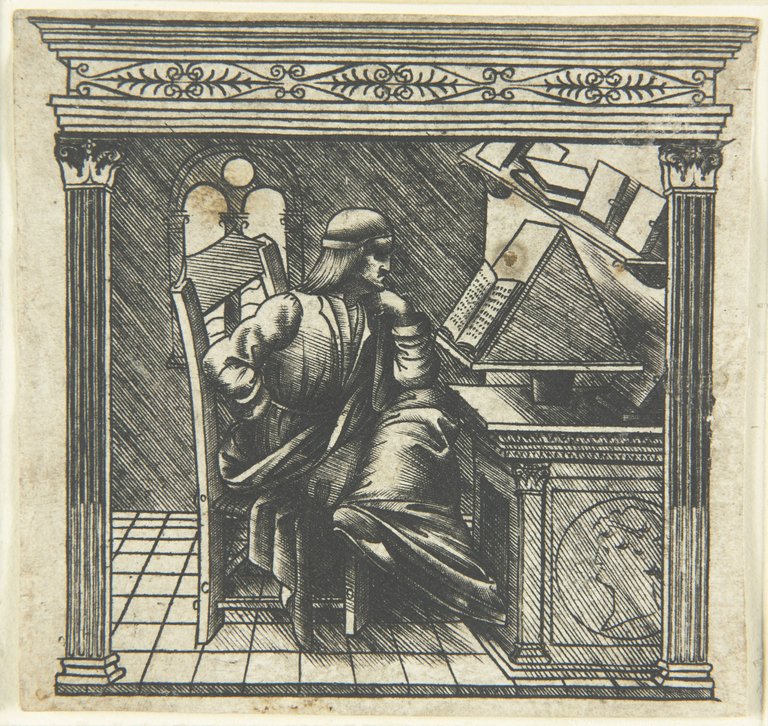
supposé être un portrait de Bernardo Bellincioni.
Composant elle-même des œuvres musicales et poétiques, prononçant des discours en latin et en italien dès l’âge de 16 ans, réputée pour son esprit et son érudition, elle est considérée comme l’une des femmes les plus cultivées de la Renaissance italienne.
Bien que la quasi-totalité de son œuvre ait disparu, elle reste dans les mémoires comme une figure majeure de la langue italienne, grâce à sa maîtrise de la littérature et de la poésie. Le poète de cour Bernardo Bellincioni (1452-1492), ami de Léonard, loua son talent littéraire, allant jusqu’à la comparer à la célèbre poétesse grecque antique Sappho, qui aurait inspiré Platon.
La Cour de Milan et ses mécènes ont également attiré et favorisé d’autres artistes et scientifiques, parmi lesquels l’architecte Donato Bramante, le mathématicien et ami de Léonard de Vinci, Luca Pacioli, la duchesse lettrée Béatrice d’Este, le poète Bernardo Bellincioni et l’éducateur humaniste Francesco Filelfo.
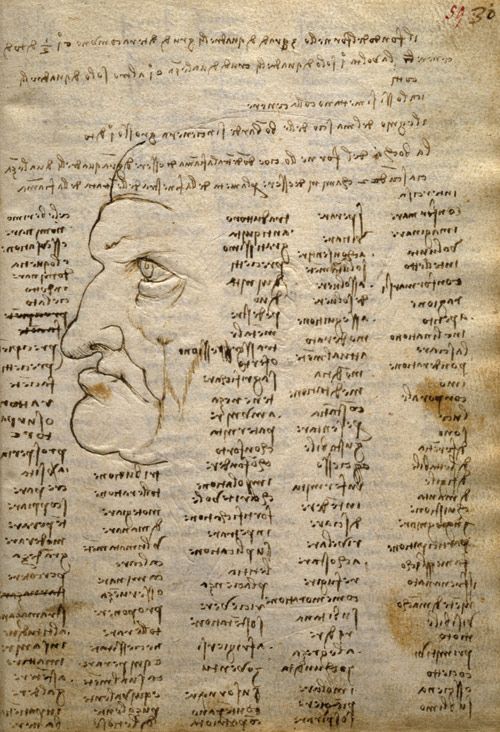
Cecilia Gallerani a-t-elle initié Léonard de Vinci aux idées de Cusanus ? Nous l’ignorons, mais elle en avait indubitablement aussi bien les capacités que l’opportunité.
Le {Codex Trivulzianus} de Léonard (1487-1490), compilé à Milan à cette époque, marque un tournant. Jusqu’à là, l’artiste avait souvent soutenu avec véhémence que l’art de la peinture était supérieur à la celui de la poésie. Or, après avoir fréquenté Cecilia, le {Codex Trivulzianus} témoigne du fait qu’il souhaitait améliorer drastiquement sa capacité littéraire, jusqu’à là plutôt modeste, en dressant de longues listes de mots savants, y compris de termes latins, tirés de sources lexicales et grammaticales faisant autorité. Il aurait considéré cela comme une condition préalable qui lui permettrait de décrire avec une précision scientifique les phénomènes qu’il allait découvrir par la suite.
Une vingtaine d’années après la mort de Léonard de Vinci, l’orfèvre et sculpteur Benvenuto Cellini (1500-1571) aurait déclaré :
« Je ne voudrais manquer de rapporter les paroles que j’entendis dire au roi à son propos. Le roi dit qu’il ne pensait pas qu’il eût existé un homme qui en sût tant que Léonard, non seulement en sculpture, peinture et architecture, mais aussi en philosophie où il excellait. »3
Comme le conclut un chercheur :
« L’unité épistémologique de Léonard de Vinci permet d’accéder à une perspective supérieure. Elle accroît non seulement notre propension à une véritable empathie et à une compréhension profonde (essentielles dans la société pluraliste actuelle), mais aussi notre accès à une forme de liberté sociale et intellectuelle. C’est une méthode pour acquérir une compréhension plus globale de la condition humaine ; en bref, pour recevoir une véritable éducation. »
Le monde a besoin de nouvelles Cécilia Gallerani et de nouveaux Léonard de Vinci. Êtes-vous prêt à relever ce défi ?
- Vincent Delieuvin, La Vierge, l’Enfant Jésus et sainte Anne, dit La Sainte Anne, site internet du Louvre.
https://collections.louvre.fr/ark:/53355/cl010066107 ↩︎ - Au Louvre avec Viviane Forrester, La Vierge et l’Enfant avec sainte Anne, dossier établi par Cécile Scailliérez, Service culturel du Louvre, Symogy, Editions d’Art, Paris, 2000. ↩︎
- Marianne Tregouët, {Cellini à la cour de François Ier (1540-1545) : les mécanismes d’une disgrâce}, Déc. 2024, HAL Id: dumas-04797814 https://dumas.ccsd.cnrs.fr/dumas-04797814v1 ↩︎
The Shadow of Vernadsky in Leonardo’s Virgin and Child with Saint Anne
In march 1821, the English poet Percy Bysshe Shelley, concluded his poem « A defense of Poetry » with a visionary concept:
« Poets are the hierophants of an unapprehended inspiration; the mirrors of the gigantic shadows which futurity casts upon the present; the words which express what they understand not; the trumpets which sing to battle, and feel not what they inspire; the influence which is moved not, but moves. Poets are the unacknowledged legislators of the world. »
We examine here, from that standpoint, Leonardo da Vinci‘s masterwork The Virgin and Child with Saint Anne.
One never gets tired of looking at “The Virgin and Child with Saint Anne”, Leonardo’s superb masterpiece in the Louvre. Formally, the painting depicts Saint Anne, her daughter the Virgin Mary and the infant Jesus. Christ is shown embracing a sacrificial lamb symbolizing the mission he took on to liberate mankind from the original sin.
Remarkably, Leonardo didn’t make this painting for a Prince, not for a Duke, not for a Cardinal, nor for a Pope, but for himself, and as such, as a legacy for humanity.
Vincent Delieuvin, the French historian of the Louvre who cross-checked all the available documentation and hypothesis, arrives at the interesting but paradoxical conclusion that with this painting Leonardo wanted to give tribute to the return of the Florentine Republic:
« Since the Florentines rose up against Gautier de Brienne, Duke of Athens, on July 26, 1343, the feast day of Saint Anne, the city had devoted particular worship to the mother of the Virgin Mary, who was considered the protector of the Republic.
After the Medici were exiled in 1494, the honors bestowed upon the saint increased once again. Leonardo’s work fits perfectly into this context of the restoration of republican government, in which the artist participated with the execution of The Battle of Anghiari in 1503. »1
When the painting was finished is not known. In general, it is thought that Leonardo da Vinci (1454-1519) started working on it in 1503 when he lived in Florence at the age of 51. The French King Frances I, who bought the panel in 1518, didn’t steal the panel, just its author who brought it with him to France to finish it.
The viewer is immediately overwhelmed by a powerful and nearly disturbing sense of motion, supreme love and beauty. The scene itself, if it shows figures from the Holy scriptures (Anne, the Virgin Mary, Christ), rather than illustrating a given liturgical sequence, manifestly springs from a well of profound philosophical reflections.
I will try to convince you here there exists a “Long arch of History” of thinking and coherence between persons and minds that never met or spoke to each other, but whose intuitions and mindsets where congruent and oriented in the same directions. Leonardo’s masterpiece appears (in my view), as a sort of “missing link” between Nicolaus Cusanus’ vision of God and nature and Vladimir Vernadsky’s concept of the Noosphere, eventually via Alexander von Humboldt’s idea of the “Cosmos”. That might look wild and even silly at first glance, but please allow me to elaborate.
A Single Harmonic One
What unites the four towering intellectuals named Cusanus, Leonardo, Alexander von Humboldt and Vernadsky? All four were convinced that the universe is a single harmonic one.
The German cardinal Nicolas of Cusa (1401-1464), a thinker and major figure in the great ecumenical councils and the Italian and European Renaissance, begins his treatise On Learned Ignorance (1440) with a symbol. God is the “absolute maximum” and perfect unity (unio); in this unity, all distances, all divisions, all contradictions are transformed and merge into union. The universe is the contracted image of this absolute maximum and this absolute unity; it is not the absolute maximum, but, as in a mirror, the “contracted” maximum, for it does not comprise all things, but only all things outside of God, all created things. The thinker uses the terms complicatio (envelopment) and explicatio (unfolding) to explain that all things are enveloped in God (the source) and unfolded in the world. The world, the cosmos, and geological time are the unfolding of God’s unity.
Leonardo da Vinci (1452-1519), following in the footsteps of Cues, emphatically stated: “Understand that everything is connected to everything else.” For him, progress meant unifying different fields such as art, anatomy, and engineering into a comprehensive and coherent understanding. The artist-engineer invited his contemporaries to learn to perceive the links that unite nature, art, science, and the human soul. Observation allowed Leonardo to discover invisible causes rather than visible effects, and to imagine and test creative hypotheses. In particular, he postulated that the human body could be a miniature version (microcosm) of the Earth (macrocosm), observing that the branching of blood vessels in humans mirrors the tributaries of rivers, just as the movements of the body mimic the tides. In his view, the Earth is a living organism with “flesh” (the soil), ‘bones’ (rock strata), and “blood” (water veins). He studied the flight of birds and the movement of water, convinced that both obeyed the same fluid physics. Art is science, and science is art; both are tools for understanding the fundamental laws of the world. For Leonardo da Vinci, painters must possess the entire cosmos in their minds and hands in order to truly reflect the beauty, harmony, and complexity of nature. For the artist, movement is the very essence of a living, expanding universe. He studied the spiral patterns found in everything from flowers to curls of hair to whirlpools in water in order to understand how the life force generates different forms. Finally, he considered stagnation to be a form of decline, writing that “iron rusts from lack of use” and “inaction saps the vigor of the mind.”
The German naturalist and revolutionary Alexander von Humboldt (1769-1859) also sought to understand how various natural phenomena, despite their apparent independence, form a harmonious and unified system. He refers to an “earth system” in which climate, flora, fauna, and human life are interdependent. Humboldt believed in studying the “intrinsic link” between the general and the particular, which allowed him to perceive the interconnectedness of different regions and climates. In his ultimate multi-volume work, Cosmos (1845-1858), he described nature as a “breath of life” and an “organic whole,” and sought to describe the entire universe—physical and celestial—as a “magnificently ordered and harmonious system.” Like Cusanus and Leonardo da Vinci, he argued that a scientific understanding of natural processes increases our appreciation of their beauty.
Ukrainian-Russian geophysicist Vladimir Vernadsky (1863–1945) viewed life as eternal and inseparable from the cosmos, not just from Earth. He proposed that living matter was a “cosmic phenomenon” that had appeared elsewhere or had always existed, shaping the chemical environment of planets. He defined the “Biosphere” as a “life-saturated envelope” around the Earth, where living organisms and inert matter interact constantly, inseparably, and dynamically. Vernadsky described the transition from the biosphere to the “Noosphere” as the next stage of evolution, where rational human activity, science, and technology become the main geological force shaping the planet. He was convinced that the future of humanity depended on recognizing this unity, suggesting that human thought was a natural extension of geological and cosmic processes.
What do we see?
It is with this “Long arch of History” in mind, that the viewer can discover the “Shadow of Vernadsky » in Leonardo’s Saint Anne. Because, what does the viewer see?
- The background of the painting features sharp, prehistoric-looking crags inspired by Leonardo’s studies of the Dolomites and the Alps. This barren, rocky terrain, nearly lunar, has been described by historians as “fantastical” or “metaphysical”. As we know from his notebooks, Leonardo was interested in painting “invisible” movements, not only those of the souls, but also universal phenomena such as “time”, especially “geological” time. How did mountains arise, etc.? Others, correctly argue that the « dead » or lunar landscape of the background, what Vernadsky would call the “Lithosphere” serves to highlight the other elements of the composition.
- On the right, one could see the tree (the “biosphere”) as representing a step in an evolutionary process of the development of the cosmos.
- Beneath the tree, the lamb (in religious terms a symbol of Christ’s sacrifice to free mankind) also represents a higher form of conscience of that same “biosphere”
- Then appears Jesus, who, represented in his human incarnation, that of a child, represents only a sort of naive conscience, merely the potential for his further development.
- The Virgin Mary, is represented in a paradoxical position which is a perfect example of what the late Lyndon LaRouche identified as “mid-motion-change”, meaning an ambiguous instant of indecision between two or more contrary movements. Her majestic, loving and protecting gesture and embrace of Jesus coincides with her vivid desire to induce the boy all the freedom of movement he needs to fulfill his sacred mission.
- Saint Anne, on top, as a sort of self-conscious form of agapic love, looks down and smiles seeing the majestic gesture and love for Christ of her daughter Mary. She is happy to be the self-conscious “noospheric” soul of a divine and living Cosmos, where the creator permanently creates ever higher forms of creation and of consciousness of its own creative nature. The rings of lunar mountain chains resemble and resonate visually with the harmonic rings formed by arms and clothes in a cascade of aesthetic spiral action.
Even authors polluted by nasty modernist and Freudian misinterpretations such as Viviane Forrester2 who wrongly pretend we are mislead by an overwhelming sentiment of mildness of Mary, nevertheless acknowledge intuitively there is something very special in this work, a sort of unity Forrester brands, not finding a better name, “organic”. When we discover these figures, she writes:
“one clearly sees they are living organisms in the midst of a landscape, a living organism. Organic inside Organic.” (p. 12)
That organic moment, she observes, appears here to the viewer as a “frozen moment” of a “transitory movement”.
Their “next respiration, the one that will follow, seems more important, vital, more suspended than any intrigue, any narrative. And their [the figures] tangible presence, fragile, matches that of the mountains, who respire as well.” (p. 13)
The making of a genius
By over-emphasizing that Leonardo was a “self-taught” genius, research on the intellectual influences he underwent was somehow neglected.
The first chance he had, was to be an apprentice of Andrea del Verrocchio (1435-1488), whose Florence workshop was modeled on that of his tutor, the Florentine erudite sculptor Lorenzo Ghiberti (1378-1455) where pupils studied astronomy, poetry, architecture, sculpture, painting, bronze-casting, metal-works, chemistry, anatomy and read the Classics.
Then, in Milan, as a court painter, Leonardo was “adopted” by the young Cecilia Gallerani (1473 – 1536), the favorite (but not the last) mistress of the Duke Ludovico Sforza, known as Lodovico Il Moro, Duke of Milan.
She was born into a large family from Siena. Her father’s name was Fazio Gallerani. He was not a member of the nobility, but he occupied several important posts at the Milanese court, including the position of ambassador to the Republic of Florence and Republic of Lucca. Cecilia was educated alongside her six brothers in Latin and literature.
She is best known as the subject of Leonardo da Vinci’s painting Lady with an Ermine (c. 1489), already a painting where movement prevails over static representation. It is said that while posing for the painting, she invited Leonardo to be part of the literary circle she hosted at her residence in the Palazzo Carmagnola, where she engaged in intellectual debates with philosophers, poets, and musicians. Gallerani herself presided over these discussions.
Composing music, poetry and delivering orations in both Latin and Italian at the age of 16, renowned for her wit and scholarship, she was considered one of the most cultured women of the Italian Renaissance.
While nearly all of her works were lost, she is remembered as a “great light of the Italian language” due to her mastery of literature and verse. The court poet Bernardo Bellincioni (1452-1492) highly praised her literary talents, even comparing her to the famous Ancient Greek poetess Sappho which allegedly inspired Plato.
The Court of Milan and its patrons also attracted and protected other artists and scientists, among which the architect Donato Bramante, the mathematician and friend of Leonardo, Luca Pacioli, the duchess Beatrice d’Este, the poet Bernardo Bellincioni and the humanist educator Francesco Filelfo.
Did Cecilia Gallerani introduce Leonardo to the ideas of Cusanus? We don’t know, but she certainly had both the knowledge and ability to do so.
Leonardo’s Codex Trivulzianus (1487-1490), shows he was working hard to improve his modest literary education, through long lists of learned words, including Latin words, copied from authoritative lexical and grammatical sources.
The scientist reportedly saw this as a precondition that was going to allow him to describe with scientific precision the phenomena he was going to discover in the future.
About twenty years after Leonardo da Vinci’s death, the goldsmith and sculptor Benvenuto Cellini (1500–1571) is said to have remarked:
“I would not want to fail to repeat the words I heard the king say about him. The king said that he did not believe there had ever been a man who knew as much as Leonardo, not only in sculpture, painting, and architecture, but also in philosophy, in which he excelled.”
As one scholar concludes:
Leonardo’s “epistemological unity allows one to be elevated to a higher perspective. It not only increases our propensity for genuine empathy and understanding (much needed in today’s pluralistic society), but also for a kind of social and intellectual freedom. It is a method of acquiring a more holistic understanding of the human condition; or in short, of getting a real education.”
The world needs new Cecilia Gallerani’s and new Leonardo da Vinci’s. Are you ready to go there?
NOTES:
- Vincent Delievin, La Vierge, l’Enfant Jésus et sainte Anne, dit La Sainte Anne, website of the Louvre; ↩︎
- Au Louvre avec Viviane Forrester, La Vierge et l’Enfant avec sainte Anne, Léonard de Vinci, dossier établi par Cécile Scailliérez, Service Culturel du Louvre, Symogy, Editions d’Art, Paris, 2000. ↩︎