Étiquette : Pacioli
The Shadow of Vernadsky in Leonardo’s Virgin and Child with Saint Anne
In march 1821, the English poet Percy Bysshe Shelley, concluded his poem « A defense of Poetry » with a visionary concept:
« Poets are the hierophants of an unapprehended inspiration; the mirrors of the gigantic shadows which futurity casts upon the present; the words which express what they understand not; the trumpets which sing to battle, and feel not what they inspire; the influence which is moved not, but moves. Poets are the unacknowledged legislators of the world. »
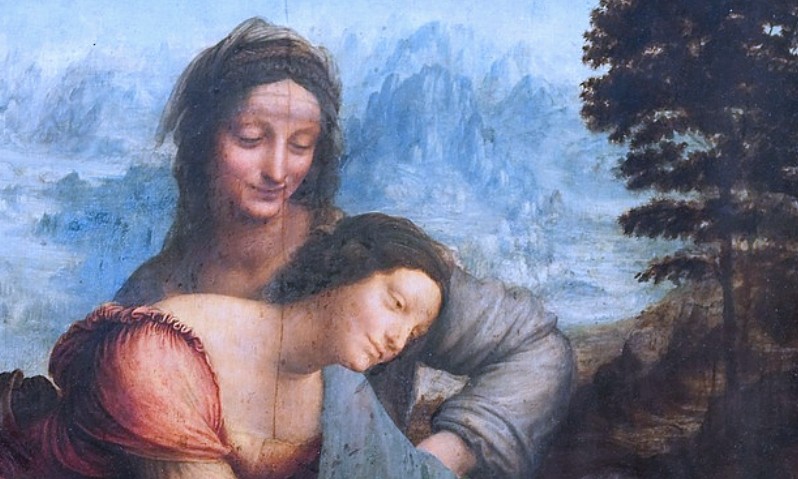
We examine here, from that standpoint, Leonardo da Vinci‘s masterwork The Virgin and Child with Saint Anne.
One never gets tired of looking at “The Virgin and Child with Saint Anne”, Leonardo’s superb masterpiece in the Louvre. Formally, the painting depicts Saint Anne, her daughter the Virgin Mary and the infant Jesus. Christ is shown embracing a sacrificial lamb symbolizing the mission he took on to liberate mankind from the original sin.
Remarkably, Leonardo didn’t make this painting for a Prince, not for a Duke, not for a Cardinal, nor for a Pope, but for himself, and as such, as a legacy for humanity.
Vincent Delieuvin, the French historian of the Louvre who cross-checked all the available documentation and hypothesis, arrives at the interesting but paradoxical conclusion that with this painting Leonardo wanted to give tribute to the return of the Florentine Republic:
« Since the Florentines rose up against Gautier de Brienne, Duke of Athens, on July 26, 1343, the feast day of Saint Anne, the city had devoted particular worship to the mother of the Virgin Mary, who was considered the protector of the Republic.
After the Medici were exiled in 1494, the honors bestowed upon the saint increased once again. Leonardo’s work fits perfectly into this context of the restoration of republican government, in which the artist participated with the execution of The Battle of Anghiari in 1503. »1
When the painting was finished is not known. In general, it is thought that Leonardo da Vinci (1454-1519) started working on it in 1503 when he lived in Florence at the age of 51. The French King Frances I, who bought the panel in 1518, didn’t steal the panel, just its author who brought it with him to France to finish it.
The viewer is immediately overwhelmed by a powerful and nearly disturbing sense of motion, supreme love and beauty. The scene itself, if it shows figures from the Holy scriptures (Anne, the Virgin Mary, Christ), rather than illustrating a given liturgical sequence, manifestly springs from a well of profound philosophical reflections.
I will try to convince you here there exists a “Long arch of History” of thinking and coherence between persons and minds that never met or spoke to each other, but whose intuitions and mindsets where congruent and oriented in the same directions. Leonardo’s masterpiece appears (in my view), as a sort of “missing link” between Nicolaus Cusanus’ vision of God and nature and Vladimir Vernadsky’s concept of the Noosphere, eventually via Alexander von Humboldt’s idea of the “Cosmos”. That might look wild and even silly at first glance, but please allow me to elaborate.
A Single Harmonic One
What unites the four towering intellectuals named Cusanus, Leonardo, Alexander von Humboldt and Vernadsky? All four were convinced that the universe is a single harmonic one.
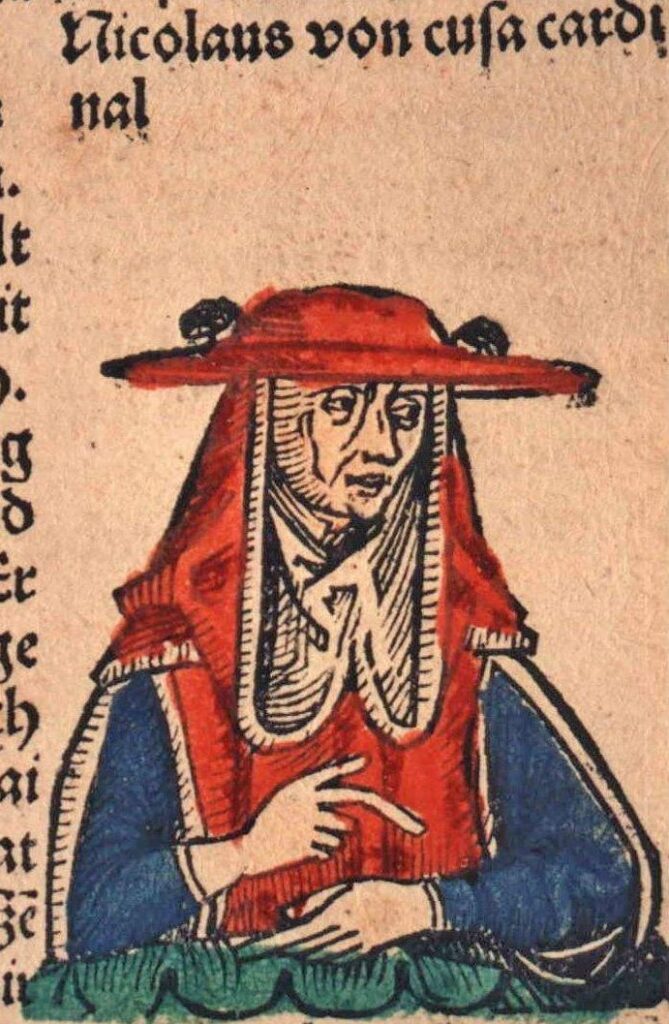
The German cardinal Nicolas of Cusa (1401-1464), a thinker and major figure in the great ecumenical councils and the Italian and European Renaissance, begins his treatise On Learned Ignorance (1440) with a symbol. God is the “absolute maximum” and perfect unity (unio); in this unity, all distances, all divisions, all contradictions are transformed and merge into union. The universe is the contracted image of this absolute maximum and this absolute unity; it is not the absolute maximum, but, as in a mirror, the “contracted” maximum, for it does not comprise all things, but only all things outside of God, all created things. The thinker uses the terms complicatio (envelopment) and explicatio (unfolding) to explain that all things are enveloped in God (the source) and unfolded in the world. The world, the cosmos, and geological time are the unfolding of God’s unity.
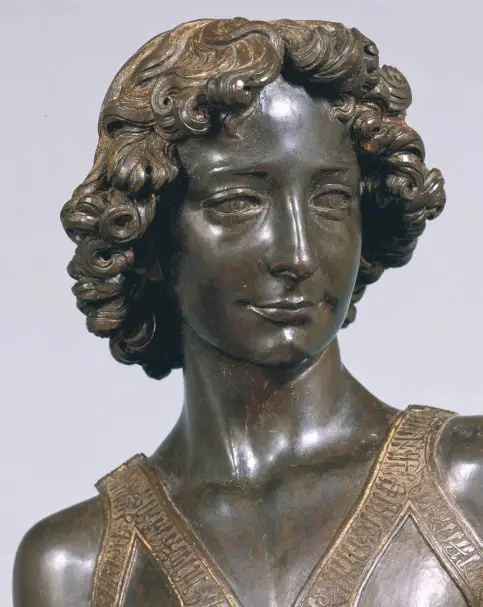
Leonardo da Vinci (1452-1519), following in the footsteps of Cues, emphatically stated: “Understand that everything is connected to everything else.” For him, progress meant unifying different fields such as art, anatomy, and engineering into a comprehensive and coherent understanding. The artist-engineer invited his contemporaries to learn to perceive the links that unite nature, art, science, and the human soul. Observation allowed Leonardo to discover invisible causes rather than visible effects, and to imagine and test creative hypotheses. In particular, he postulated that the human body could be a miniature version (microcosm) of the Earth (macrocosm), observing that the branching of blood vessels in humans mirrors the tributaries of rivers, just as the movements of the body mimic the tides. In his view, the Earth is a living organism with “flesh” (the soil), ‘bones’ (rock strata), and “blood” (water veins). He studied the flight of birds and the movement of water, convinced that both obeyed the same fluid physics. Art is science, and science is art; both are tools for understanding the fundamental laws of the world. For Leonardo da Vinci, painters must possess the entire cosmos in their minds and hands in order to truly reflect the beauty, harmony, and complexity of nature. For the artist, movement is the very essence of a living, expanding universe. He studied the spiral patterns found in everything from flowers to curls of hair to whirlpools in water in order to understand how the life force generates different forms. Finally, he considered stagnation to be a form of decline, writing that “iron rusts from lack of use” and “inaction saps the vigor of the mind.”
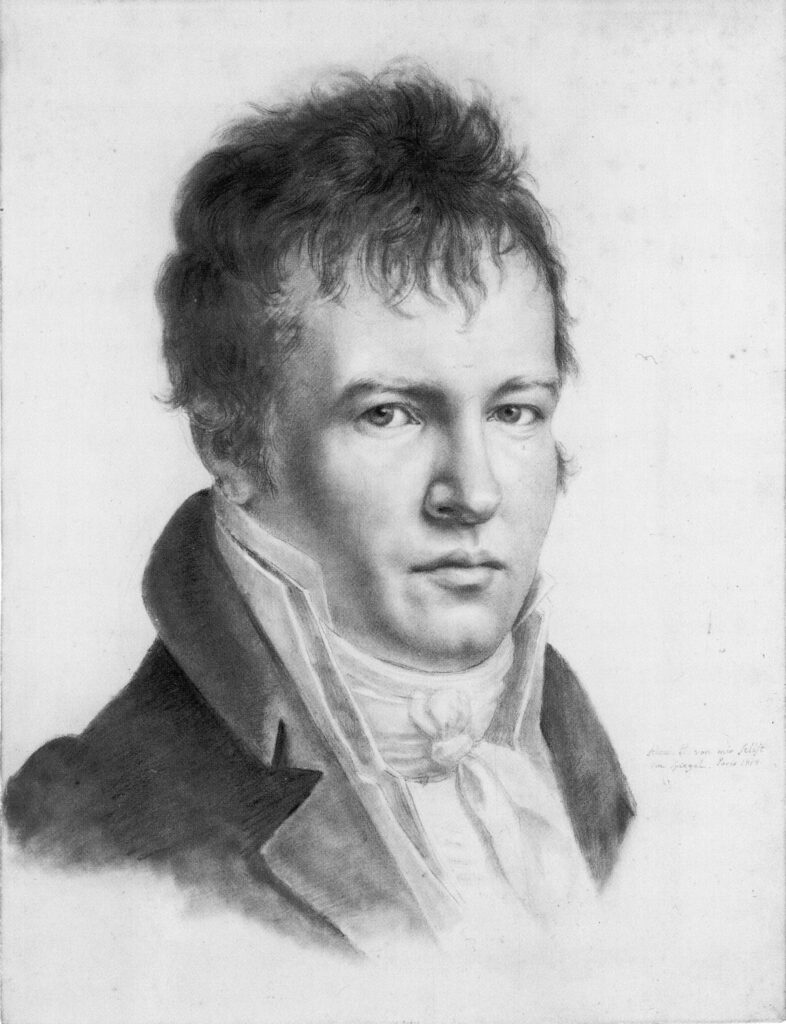
The German naturalist and revolutionary Alexander von Humboldt (1769-1859) also sought to understand how various natural phenomena, despite their apparent independence, form a harmonious and unified system. He refers to an “earth system” in which climate, flora, fauna, and human life are interdependent. Humboldt believed in studying the “intrinsic link” between the general and the particular, which allowed him to perceive the interconnectedness of different regions and climates. In his ultimate multi-volume work, Cosmos (1845-1858), he described nature as a “breath of life” and an “organic whole,” and sought to describe the entire universe—physical and celestial—as a “magnificently ordered and harmonious system.” Like Cusanus and Leonardo da Vinci, he argued that a scientific understanding of natural processes increases our appreciation of their beauty.
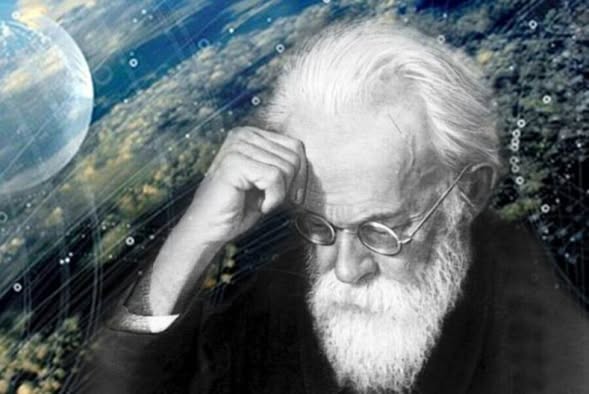
Ukrainian-Russian geophysicist Vladimir Vernadsky (1863–1945) viewed life as eternal and inseparable from the cosmos, not just from Earth. He proposed that living matter was a “cosmic phenomenon” that had appeared elsewhere or had always existed, shaping the chemical environment of planets. He defined the “Biosphere” as a “life-saturated envelope” around the Earth, where living organisms and inert matter interact constantly, inseparably, and dynamically. Vernadsky described the transition from the biosphere to the “Noosphere” as the next stage of evolution, where rational human activity, science, and technology become the main geological force shaping the planet. He was convinced that the future of humanity depended on recognizing this unity, suggesting that human thought was a natural extension of geological and cosmic processes.
What do we see?
It is with this “Long arch of History” in mind, that the viewer can discover the “Shadow of Vernadsky » in Leonardo’s Saint Anne. Because, what does the viewer see?
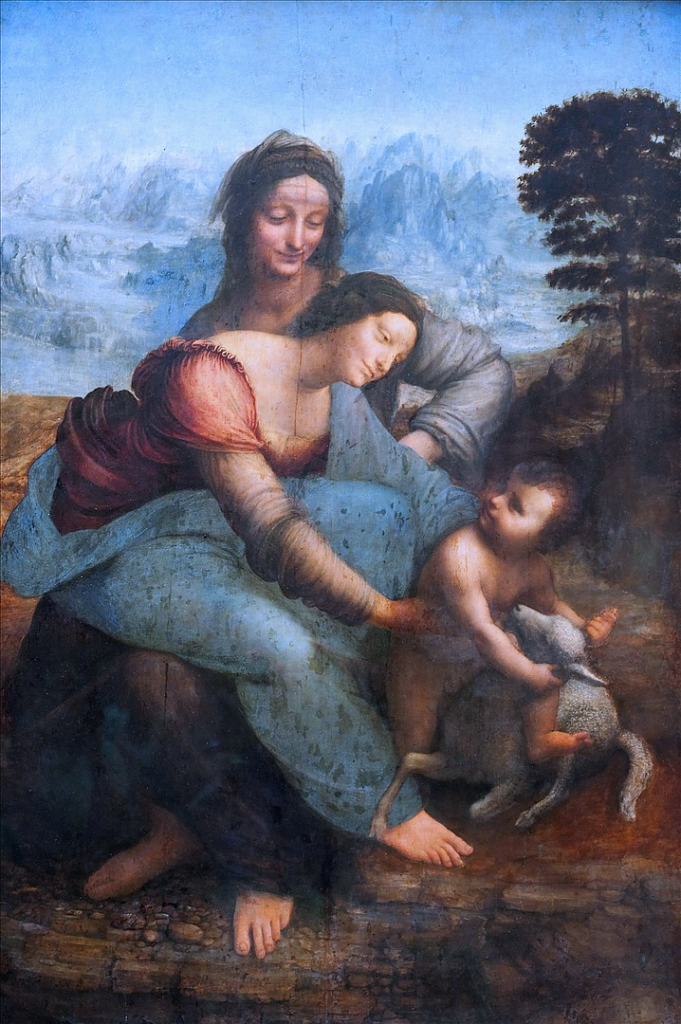
- The background of the painting features sharp, prehistoric-looking crags inspired by Leonardo’s studies of the Dolomites and the Alps. This barren, rocky terrain, nearly lunar, has been described by historians as “fantastical” or “metaphysical”. As we know from his notebooks, Leonardo was interested in painting “invisible” movements, not only those of the souls, but also universal phenomena such as “time”, especially “geological” time. How did mountains arise, etc.? Others, correctly argue that the « dead » or lunar landscape of the background, what Vernadsky would call the “Lithosphere” serves to highlight the other elements of the composition.
- On the right, one could see the tree (the “biosphere”) as representing a step in an evolutionary process of the development of the cosmos.
- Beneath the tree, the lamb (in religious terms a symbol of Christ’s sacrifice to free mankind) also represents a higher form of conscience of that same “biosphere”
- Then appears Jesus, who, represented in his human incarnation, that of a child, represents only a sort of naive conscience, merely the potential for his further development.
- The Virgin Mary, is represented in a paradoxical position which is a perfect example of what the late Lyndon LaRouche identified as “mid-motion-change”, meaning an ambiguous instant of indecision between two or more contrary movements. Her majestic, loving and protecting gesture and embrace of Jesus coincides with her vivid desire to induce the boy all the freedom of movement he needs to fulfill his sacred mission.
- Saint Anne, on top, as a sort of self-conscious form of agapic love, looks down and smiles seeing the majestic gesture and love for Christ of her daughter Mary. She is happy to be the self-conscious “noospheric” soul of a divine and living Cosmos, where the creator permanently creates ever higher forms of creation and of consciousness of its own creative nature. The rings of lunar mountain chains resemble and resonate visually with the harmonic rings formed by arms and clothes in a cascade of aesthetic spiral action.
Even authors polluted by nasty modernist and Freudian misinterpretations such as Viviane Forrester2 who wrongly pretend we are mislead by an overwhelming sentiment of mildness of Mary, nevertheless acknowledge intuitively there is something very special in this work, a sort of unity Forrester brands, not finding a better name, “organic”. When we discover these figures, she writes:
“one clearly sees they are living organisms in the midst of a landscape, a living organism. Organic inside Organic.” (p. 12)
That organic moment, she observes, appears here to the viewer as a “frozen moment” of a “transitory movement”.
Their “next respiration, the one that will follow, seems more important, vital, more suspended than any intrigue, any narrative. And their [the figures] tangible presence, fragile, matches that of the mountains, who respire as well.” (p. 13)
The making of a genius
By over-emphasizing that Leonardo was a “self-taught” genius, research on the intellectual influences he underwent was somehow neglected.
The first chance he had, was to be an apprentice of Andrea del Verrocchio (1435-1488), whose Florence workshop was modeled on that of his tutor, the Florentine erudite sculptor Lorenzo Ghiberti (1378-1455) where pupils studied astronomy, poetry, architecture, sculpture, painting, bronze-casting, metal-works, chemistry, anatomy and read the Classics.
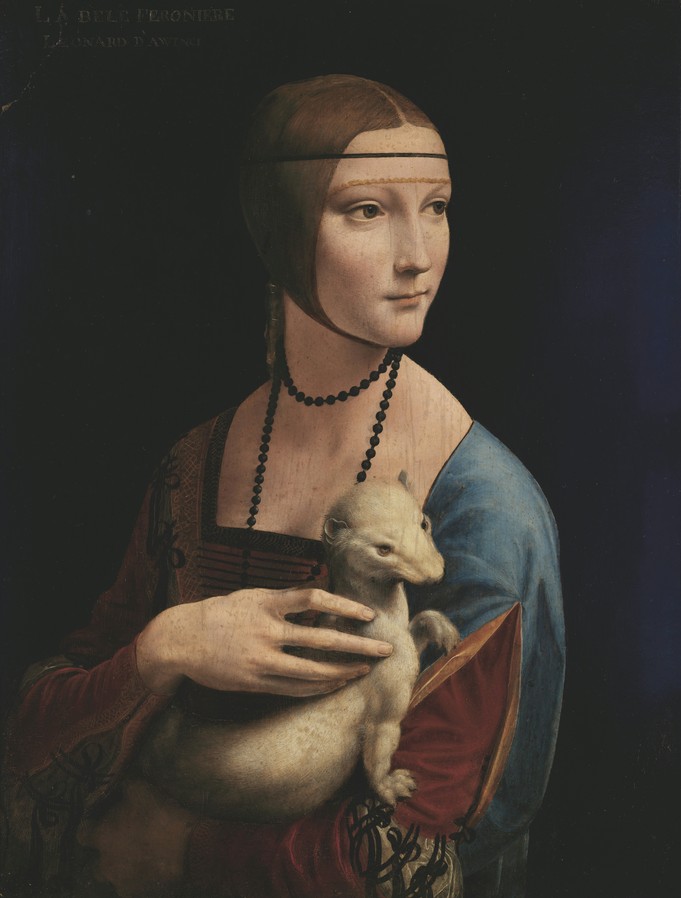
Then, in Milan, as a court painter, Leonardo was “adopted” by the young Cecilia Gallerani (1473 – 1536), the favorite (but not the last) mistress of the Duke Ludovico Sforza, known as Lodovico Il Moro, Duke of Milan.
She was born into a large family from Siena. Her father’s name was Fazio Gallerani. He was not a member of the nobility, but he occupied several important posts at the Milanese court, including the position of ambassador to the Republic of Florence and Republic of Lucca. Cecilia was educated alongside her six brothers in Latin and literature.
She is best known as the subject of Leonardo da Vinci’s painting Lady with an Ermine (c. 1489), already a painting where movement prevails over static representation. It is said that while posing for the painting, she invited Leonardo to be part of the literary circle she hosted at her residence in the Palazzo Carmagnola, where she engaged in intellectual debates with philosophers, poets, and musicians. Gallerani herself presided over these discussions.
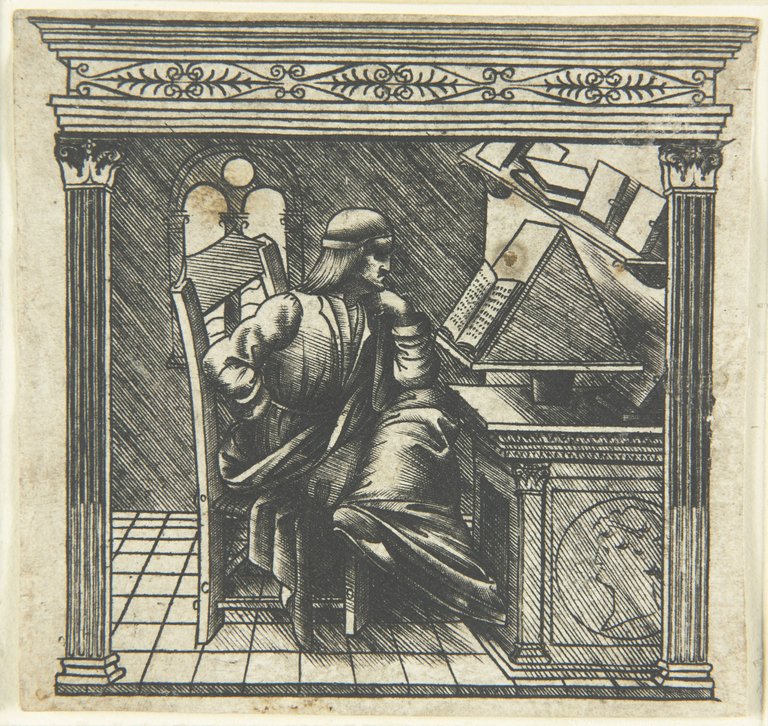
Composing music, poetry and delivering orations in both Latin and Italian at the age of 16, renowned for her wit and scholarship, she was considered one of the most cultured women of the Italian Renaissance.
While nearly all of her works were lost, she is remembered as a “great light of the Italian language” due to her mastery of literature and verse. The court poet Bernardo Bellincioni (1452-1492) highly praised her literary talents, even comparing her to the famous Ancient Greek poetess Sappho which allegedly inspired Plato.
The Court of Milan and its patrons also attracted and protected other artists and scientists, among which the architect Donato Bramante, the mathematician and friend of Leonardo, Luca Pacioli, the duchess Beatrice d’Este, the poet Bernardo Bellincioni and the humanist educator Francesco Filelfo.
Did Cecilia Gallerani introduce Leonardo to the ideas of Cusanus? We don’t know, but she certainly had both the knowledge and ability to do so.
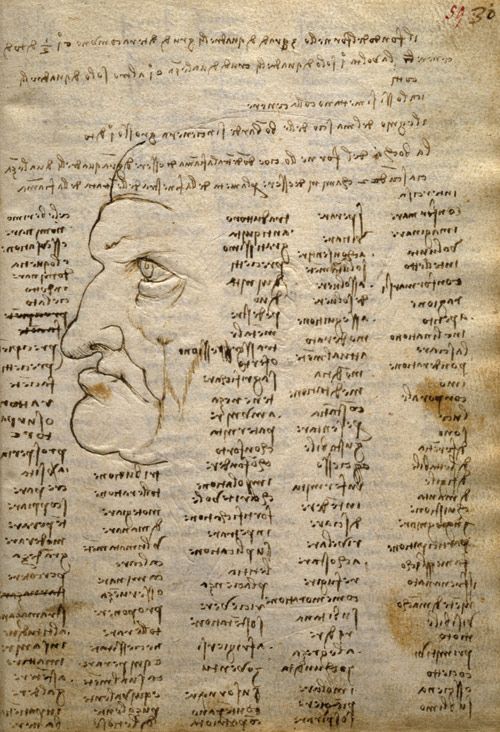
Leonardo’s Codex Trivulzianus (1487-1490), shows he was working hard to improve his modest literary education, through long lists of learned words, including Latin words, copied from authoritative lexical and grammatical sources.
The scientist reportedly saw this as a precondition that was going to allow him to describe with scientific precision the phenomena he was going to discover in the future.
About twenty years after Leonardo da Vinci’s death, the goldsmith and sculptor Benvenuto Cellini (1500–1571) is said to have remarked:
“I would not want to fail to repeat the words I heard the king say about him. The king said that he did not believe there had ever been a man who knew as much as Leonardo, not only in sculpture, painting, and architecture, but also in philosophy, in which he excelled.”
As one scholar concludes:
Leonardo’s “epistemological unity allows one to be elevated to a higher perspective. It not only increases our propensity for genuine empathy and understanding (much needed in today’s pluralistic society), but also for a kind of social and intellectual freedom. It is a method of acquiring a more holistic understanding of the human condition; or in short, of getting a real education.”
The world needs new Cecilia Gallerani’s and new Leonardo da Vinci’s. Are you ready to go there?
NOTES:
- Vincent Delievin, La Vierge, l’Enfant Jésus et sainte Anne, dit La Sainte Anne, website of the Louvre; ↩︎
- Au Louvre avec Viviane Forrester, La Vierge et l’Enfant avec sainte Anne, Léonard de Vinci, dossier établi par Cécile Scailliérez, Service Culturel du Louvre, Symogy, Editions d’Art, Paris, 2000. ↩︎
Index, Études Renaissance
INDEX, Etudes Renaissance
- FR en ligne — Mohenjo-Daro, Harappa: Le défi que nous lance la modernité de la Civilisation de l’Indus;
- EN online — Mohenjo-Daro, Harappa :The challenging modernity of the Indus Valley Civilization;
- FR en ligne — La Route de la soie maritime, une histoire de 1001 coopérations;
- EN online — The Maritime Silk Road, a History of 1001 cooperations;
- FR en ligne — Afghanistan, le pays des 1000 cités d’or et l’histoire d’Aï Khanoum;
- EN online — Afghanistan: the Land of a 1000 Golden Cities and Aï-Khanoun;
- FR en ligne — Le miracle du Gandhara, quand Bouddha s’est fait homme;
- EN online — The miracle of Gandhara: when Buddha turned himself into man;
- FR en ligne — Derrière les chevaux célestes chinois, la science terrestre;
- EN online — The Earthly Science behind China’s Heavenly Horses;
- FR en ligne — Et l’Homme créa l’acier…;
- FR en ligne — Portraits du Fayoum: un regard de l’au-delà (FR en ligne);
- EN pdf online — A Gaze from the Beyond — The Extraordinary Faiyûm Portaits;
- EN AUDIO PARIS: The Greek tradition behind the Fayum Mummy Portraits;
- FR en ligne — La pratique ancestrale d’annulation des dettes;
- EN online — The Ancient Practice of Debt Cancelation;
- RU pdf online — The Ancient Practice of Debt Cancelation (Russian translation) ;
- FR en ligne — Bagdad, Damas, Cordoue, creuset d’une civilisation universelle;
- FR en ligne — Mutazilisme et astronomie arabe, deux étoiles brillantes au firmament de la civilisation;
- EN online — Mutazilism and Astronomy, two brilliant stars at the firmament of civilization;
- FR en ligne — Qanâts perses et Civilisation des eaux cachées;
- EN online — Persian Qanâts and the Civilization of Hidden Waters;
- FR en ligne — Renaissance africaine: la splendeurs des royaumes d’Ifè et du Bénin;
- EN online — The splendors of the kingdoms of Ife and Benin;
- FR en ligne — Sur la peinture chinoise et son influence en Occident;
- EN pdf online — On Chinese painting and its influence on the West (Fidelio);
- FR en ligne — L’invention de la perspective (Magazine Fusion);
- EN pdf online — The Invention of Perspective (Fidelio);
- FR en ligne — La révolution du grec ancien, Platon et la Renaissance;
- EN online — The Greek language project, Plato and the Renaissance;
- FR en ligne — Les Frères de la vie commune et la Renaissance du nord;
- NL online — Moderne Devotie en Broeders van het Gemene Leven, bakermat van het humanisme;
- EN online — Devotio Moderna, Brothers of the Common Life, the cradle of humanism in the North;
- FR en ligne — 1405: l’amiral Zheng et les expéditions maritimes chinoises;
- EN online — Zhang He and the Chinese Maritime Expeditions;
- FR en ligne — Jan van Eyck, la beauté comme prégustation de la sagesse divine;
- EN online — Jan van Eyck, beauty as foretaste of divine wisdom;
- EN AUDIO BERLIN: AUDIO – Van Eyck’s theological metaphor in his Madonna in the Cathedral;
- FR en ligne — Jan Van Eyck, un peintre flamand dans l’optique arabe;
- EN online — Jan Van Eyck, a Flemish Painter using Arab Optics;
- FR pdf en ligne — Rogier Van der Weyden, maître de la compassion;
- EN AUDIO PARIS: Van der Weyden and Cusanus;
- FR en ligne — Comment Jacques Cœur a mis fin à la Guerre de Cent Ans;
- EN online — How Jacques Cœur put an end to the Hundred Years’ War;
- EN AUDIO PARIS: Who whispered in the Ear of Joan of Arc?;
- FR en ligne — Hugo van der Goes et la Dévotion moderne;
- EN pdf online — Hugo van der Goes and the Devotio Moderna;
- FR en ligne — A la découverte d’un tableau;
- EN AUDIO PARIS — Ghirlandaio’s immortality;
- FR en ligne — Avicenne, Ghiberti, leur rôle dans l’invention de la perspective à la Renaissance;
- EN on line — Avicenna, Ghiberti, their role in the invention of perspective at the Renaissance;
- FR en ligne — ENTRETIEN Omar Merzoug: Avicenne ou l’islam des lumières;
- EN pdf online — INTERVIEW Omar Merzoug: New Biography of Ibn Sina;
- FR en ligne — Les secrets du dôme de Florence;
- EN pdf online — The Secrets of the Florentine Dome (Schiller Institute Archives);
- DE pdf online — Die Geheimnisse des Florentiner Domes lüften (Neue Solidarität);
- FR pdf en ligne — Le Dome de Brunelleschi, un défi, un scandale, un exploit (Hors Série Beaux Arts Magazine, 2013)
- EN AUDIO PARIS — Cimabue, Giotto, Fra Angelico; Wonders of the Italian Trecento;
- FR en ligne — L’œuf sans ombre de Piero della Francesca;
- EN pdf online — The Egg Without a Shadow of Piero della Francesca;
- RU pdf online — The Egg Without a Shadow of Piero della Francesca (Russian translation);
- EN AUDIO PARIS — Antonello de Messina in the Image of Christ;
- FR en ligne — Uccello, Donatello, Verrocchio et l’art du commandement militaire;
- EN online — Uccello, Donatello, Verrocchio and the Art of Military Command;
- EN AUDIO PARIS: Leonardo and Verrochio’s workshop;
- FR en ligne — La Cène de Léonard, une leçon de métaphysique;
- EN pdf online — Leonardo‘s Last Supper, A lesson of Metaphics (Fidelio);
- FR en ligne — L’ombre de Vernadski dans la Sainte Anne de Léonard de Vinci;
- EN online — The Shadow of Vernadsky in Leonardo’s Virgin and Child with Saint Anne;
- IT online — L’ombra de Vernadsky nella Santa Anna di Leonardo da Vinci;
- FR en ligne — Léonard de Vinci : peintre de mouvement;
- EN pdf online — Leonardo, painter of movement (Fidelio);
- EN AUDIO PARIS — Mona Lisa made in China?;
- FR en ligne — La Vierge aux rochers, l’erreur fantastique de Léonard;
- FR en ligne — Romorantin et Léonard ou l’invention de la ville moderne;
- EN pdf online — Leonardo da Vinci Imagines the First Modern City (Executive Intelligence Review);
- DE online — Leonardos großes Infrastrukturprojekt für Frankreich (Neue Solidarität);
- IT online — Leonardo da Vinci, Romorantin e lo spirito del progetto NAWAPA (Movisol website);
- FR en ligne — L’Homme de Vitruve de Léonard de Vinci;
- EN online — Leonardo’s « Vitruvian Man »;
- FR en ligne — Léonard en résonance avec la peinture traditionnelle chinoise — entretien en français de Karel Vereycken avec Le Quotidien du Peuple;
- CH online — Leonardo resonates with traditionnal Chinese Painting, interview in Chinese language of Karel Vereycken in People’s Daily;
- EN online — Leonardo resonates with traditionnal chinese painting, interview in English of Karel Vereycken in People’s Daily;
- EN AUDIO PARIS — Why Leonardo didn’t like painting;
- FR pdf en ligne — Raphaël, entre mythe et réalité;
- EN pdf online — Raphael, between Myth and Reality;
- FR en ligne — Raphaël 1520-2020 : ce que nous apprend « L’Ecole d’Athènes »;
- EN online — Raphael 1520-2020: What Humanity can learn from the « School of Athens »;
- EN AUDIO MILAN: Raphael’s cartoon of « The School of Athens »;
- EN online — Jacob Fugger « The Rich », father of financial fascism;
- FR en ligne — Jacob Fugger « Le Riche », père du fascisme financier;
- FR en ligne — Comment la folie d’Erasme sauva notre civilisation;
- EN pdf online — How Erasmus’ Folly saved our Civilization (Schiller Institute Archive Website)
- DE pdf online — Wie Erasmus‘ Torheit unser civilisation rettete (Neue Solidarität);
- NL pdf online — Hoe Erasmus zotheid onze beschaving redde (Agora Erasmus);
- FR en ligne — Le rêve d’Erasme: le Collège des Trois Langues de Louvain;
- EN online — Erasmus‘ dream: the Leuven Three Language College;
- EN AUDIO PARIS — Why Erasmus had no time to pause for portraits;
- FR en ligne — ENTRETIEN: Jan Papy: Erasme, le grec et la Renaissance des sciences;
- FR en ligne — Dirk Martens, l’imprimeur d’Erasme qui diffusa le livre de poche;
- FR en ligne — 1512-2012 : Mercator et Frisius, des cosmographes aux cosmonautes
- NL pdf online — 1512-2012 : Van kosmograaf tot kosmonaut, Mercator en Frisius (Agora Erasmus);
- EN pdf online — 1512-2012: Mercator and Frisius, from cosmographers to cosmonauts (Schiller Institute Archive Website).
- FR en ligne — La nef des fous de Sébastian Brant;
- FR en ligne — Avec Jérôme Bosch sur la trace du Sublime;
- EN pdf online — With Hieronymus Bosch, On the Track of the Sublime;
- EN AUDIO PARIS: How Bosch’s Ship of Fools drove the Jester out of business;
- NL online — Quinten Matsys en Da Vinci: dageraad van louterend gelach en creativiteit;
- FR en ligne — Quinten Matsys et Léonard — L’aube d’une ère du rire et de la créativité;
- EN online — Quinten Matsys and Leonardo — The Dawn of the Age of Laugher and Creativity;
- RU pdf online — Quinten Matsys and Leonardo — The Dawn of the Age of Laughter and Creativity (Russian translation);
- EN AUDIO BERLIN: Matsys and the Art of « The Deal »;
- FR en ligne — Joachim Patinir et l’invention du paysage en peinture;
- EN AUDIO BERLIN: Joachim Patinir and the Homo Viator;
- EN online — Joachim Patinir and the invention of landscape painting;
- FR en ligne — Le Landjuweel d’Anvers de 1561 — Faire de l’art une arme pour la paix;
- EN online — The 1561 Landjuweel of Antwerp that made art a weapon for Peace;
- FR en ligne — Exposition de Lille : ce que nous apprennent les fabuleux paysages flamands;
- FR en ligne — « Le portement de croix » : redécouvrir Bruegel grâce au livre de Michael Gibson;
- EN pdf online — Book review: Michael Gibson on Bruegel’s « Carrying of the Cross. » (Fidelio);
- FR en ligne — ENTRETIEN Michael Gibson: Pour Bruegel, le monde est vaste;
- EN pdf online: INTERVIEW — Michael Gibson: ‘For Bruegel, his world is vast’;
- FR en ligne — Pierre Bruegel l’ancien, Pétrarque et le Triomphe de la Mort;
- EN online — Pieter Bruegel the Elder, Petrarch and the Triomph of Death;
- FR en ligne — A propos du film « Bruegel, le moulin et la croix »;
- FR en ligne — L’ange Bruegel et la chute du cardinal Granvelle (FR en ligne).
- FR en ligne — Pieter Bruegel l’ancien, commentateur politique et pacifist;.
- EN online — Pieter Breugel The Elder, political commentator and pacifist;
- EN AUDIO BERLIN — Bruegel’s Two Apes;
- EN AUDIO ANTWERP — Bruegel’s « Dulle Griet » (Mad Meg): we see her madness, but do we see ours?
- EN AUDIO BRUSSELS — Bruegel’s Theodicy: The Fall of the Rebel Angels.
- EN AUDIO BRUSSELS — Bruegel’s Fall of Empire (Icarus)
- EN AUDIO BRUSSELS — What Bruegel’s snow landscape teaches us about human fragility;
- EN AUDIO BERLIN — The Culture behind Brueghel’s Proverbs;
- FR en ligne — Albrecht Dürer contre la mélancolie néo-platonicienne
- EN pdf online — Albrecht Dürer’s fight against neo-Platonic Melancholy;
- EN pdf online — How neo-Platonism gave Plato a bad name;
- EN online — Shakespeare‘s lesson in economics;
- FR en ligne — La leçon d’économie de Shakespeare;
- RU pdf online — Shakespeare’s lesson in economics (Russian translation);
- FR en ligne — Le combat inspirant d’Henri IV et de Sully;
- EN pdf online — The Inspiring Example of Henri IV and Sully (Schiller Institute Archives Website);
- FR en ligne — La paix de Westphalie, une réorganisation financière mondiale
- EN online — The Peace of Westphalia, a worldwide Financial Reorganisation;
- FR pdf en ligne — Rembrandt, un bâtisseur de nations (Nouvelle Solidarité).
- FR en ligne — Rembrandt et la lumière d’Agapè;
- EN online — Rembrandt and the Light of Agapè;
- FR en ligne — Rembrandt : 400 ans et toujours jeune!;
- EN online — Rembrandt: 400 years old and still young!;
- FR en ligne — Rembrandt et la figure du Christ;
- EN pdf online — Rembrandt and the Face of Jesus;
- DE online — Rembrandt and das Gesicht Jesu;
- FR en ligne — Le portrait d’Anslo de Rembrandt, la science de « peindre l’invisible »;
- EN online — Rembrandt’s Anslo, the science of « painting the invisible »;
- RU online — Rembrandt’s Anslo, the science of « painting the invisible » (Russian translation);
- EN AUDIO BERLIN: Rembrandt painting the voice of Anslo;
- FR pdf en ligne — Metsu, Ter Borch, Hals, l’éloge du quotidien;
- EN AUDIO PARIS — Why Vermeer was hiding his convictions;
- EN AUDIO BERLIN — Vermeer’s Young Woman with a Pearl Necklace;
- FR en ligne — Entre l’Europe et la Chine: le rôle du jésuite flamand Ferdinand Verbiest;.
- FR en ligne — Avec Leibniz et Kondiaronk, re-créer un monde sans oligarchie;
- EN online — With Leibniz and Kondiaronk, re-inventing a world without oligarchy;
- FR en ligne — Francisco Goya et la révolution américaine (FR en ligne)
- EN pdf online — Francisco Goya and the American Revolution (Fidelio)
- ES pdf online — Francisco Goya y la revolucion Americano (Fidelio);
- EN AUDIO BRUSSELS — Goya asks us to make sure Truth raises again;
- EN AUDIO BRUSSELS — Goya’s Simpleton not simple;
- EN AUDIO BRUSSELS — Goya’s portrait of Bayeu;
- ES BOOK — Karel Vereycken et Karl Lestar : El Degüello de Goya;
- FR en ligne — Beethoven et le Meeresstille: initiation à une culture de la découverte
- EN pdf online — Beethoven’s Meeresstille: initiation into a culture of discovery (Schiller Institute Archive Website);
- DE pdf online — Beethovens Meeresstille: Reise in eine Kultur des Entdeckens (Neue Solidarität);
- FR en ligne — Enseignement mutuel: curiosité historique ou piste d’avenir?;
- EN online — Mutual Tuition: historical curiosity or promise for a better future?;
- FR en ligne — Le combat républicain de David d’Angers, la statue de Gutenberg à Strasbourg;
- EN online — The republican struggle of David d’Angers and the Gutenberg statue in Strasbourg;
- FR en ligne — Hippolyte Carnot, père de l’éducation républicaine moderne;
- EN online — Hippolyte Carnot, father of modern republican education;
- FR en ligne — Victor Hugo et le colosse;
- EN online — Victor Hugo and the awakening of the colossus;
- FR en ligne — Avec le peintre James Ensor, arrachons le masque de l’oligarchie ;
- EN online — How James Ensor ripped off the mask of the oligarchy;
- FR en ligne — Enquête sur les origines de l’art moderne, la question du symbolisme;
- EN online — On the Origins of Modern Art, the Question of Symbolism;
- FR en ligne — Les racines symbolistes des killer games:
- EN online — Neo-Platonism and Huxley’s Doors of Perception;
- FR en ligne — L’art moderne de la CIA pour combattre le communisme;
- EN online — The Congress for Cultural Freedom (CCF) – How the CIA « weaponized » Modern Art;
- FR pdf en ligne — M. Hockney, le génie artistique n’est pas une illusion optique ! (Fusion);
- DE pdf online — Herr Hockney ! Kunst is keine rein technische fertigheit (Neue Solidarität);
- EN pdf online — Mr Hockney! Great Art Requires More Than Optcal Technology (21st Science & Technology).
- FR en ligne — Gérard Garouste et La Source (FR en ligne).
- EN online — Rembrandt’s oil painting is back… in China !
- FR en ligne — Ce que nous apprend l’expérience Trou-dans-le-Mur de Sugata Mitra;
- EN online — The hidden lesson behing Sugata Mitra‘s Hole-in-the-Wall experience;
- FR en ligne — La défense du patrimoine culturel de l’Humanité, clé d’une paix mondiale;
- EN online — Empathy, Sympathy, Compassion: Cultural Heritage Key to World Peace