Catégorie : Etudes Renaissance
 

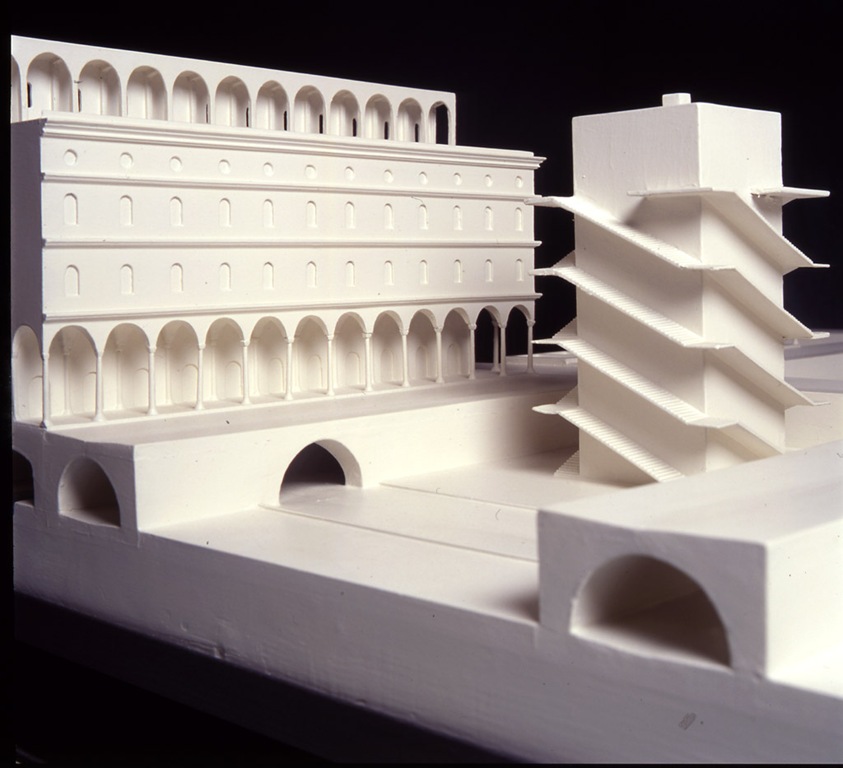
Leonardo da Vinci imagines the First Modern City

Merci de partager !

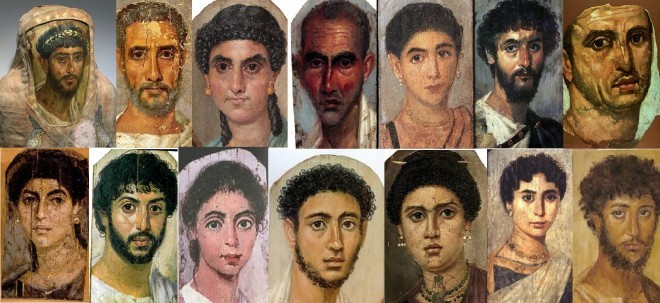
A Gaze from the Beyond — The Extraordinary Faiyûm Portaits

Merci de partager !

Pieter Bruegel the Elder, political commentator and pacifist
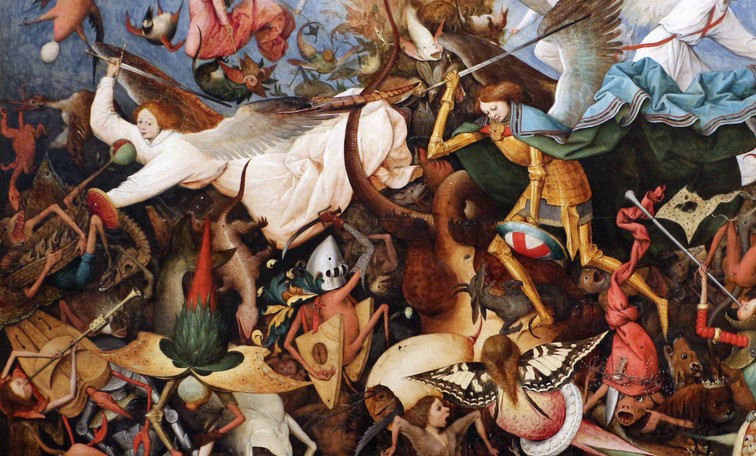
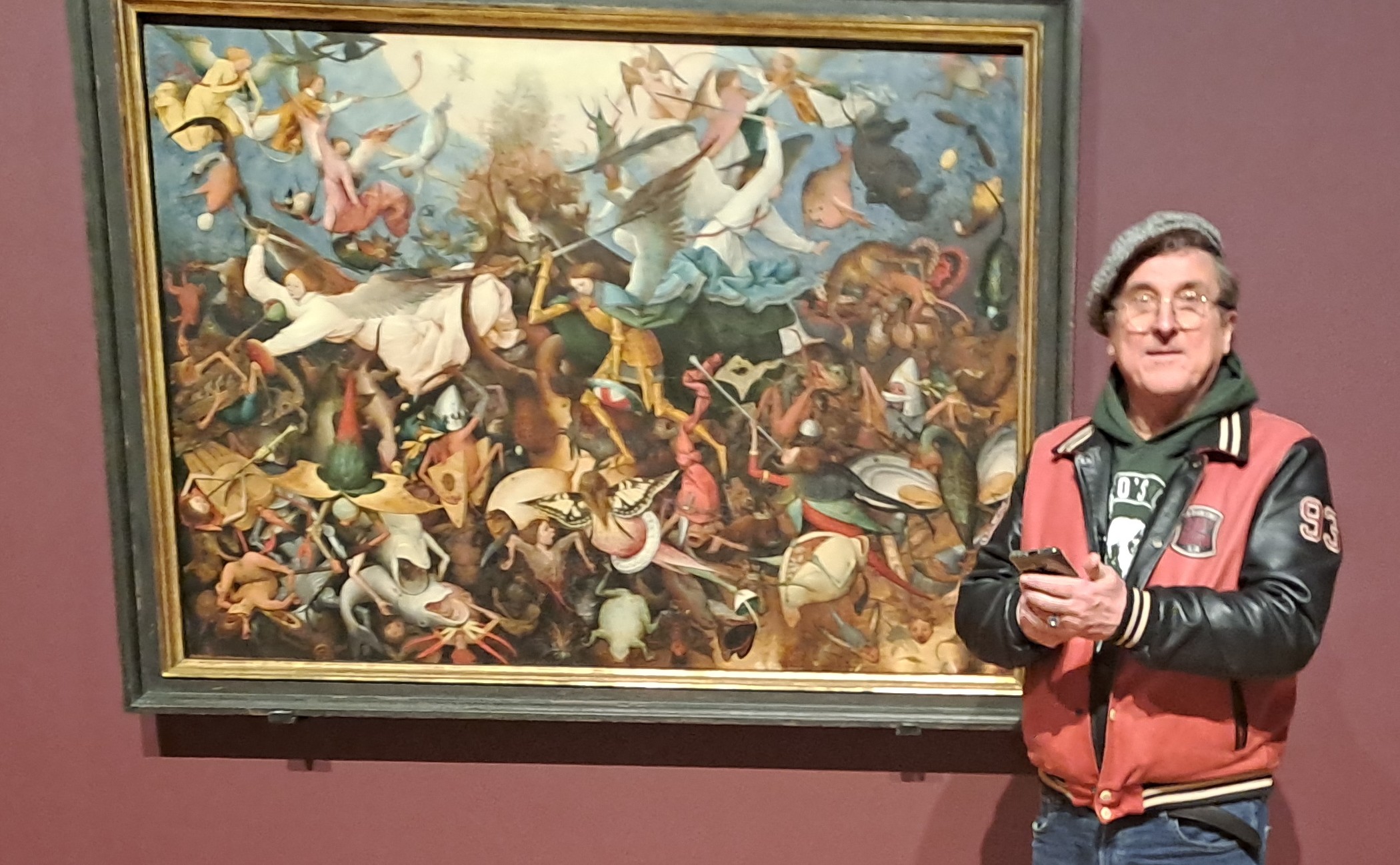
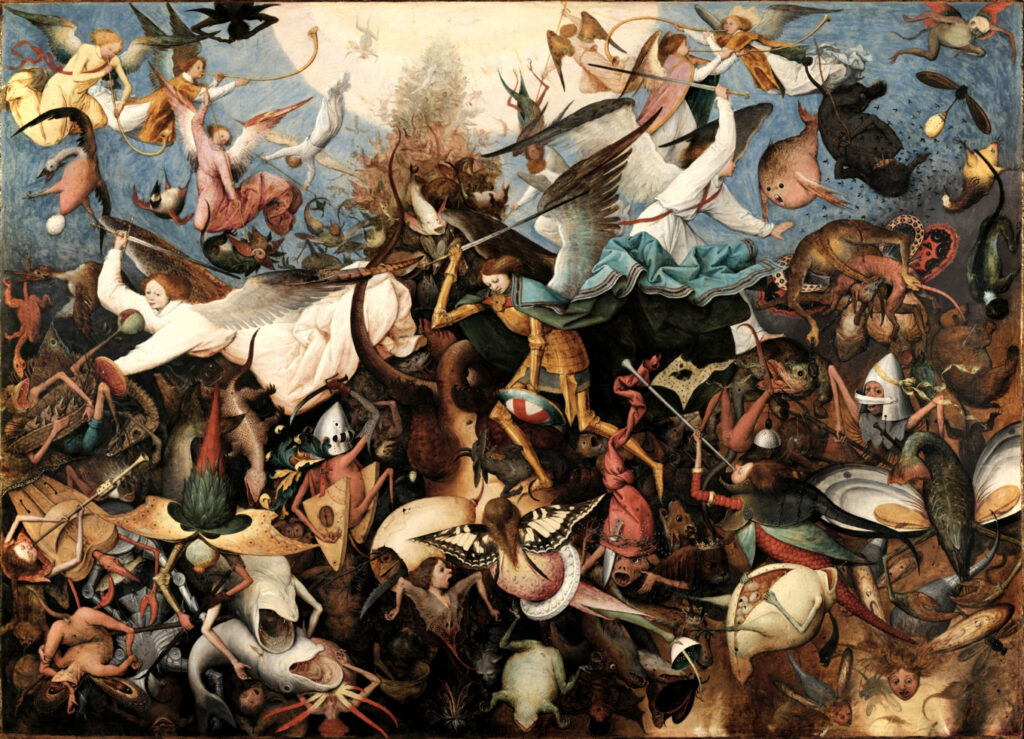
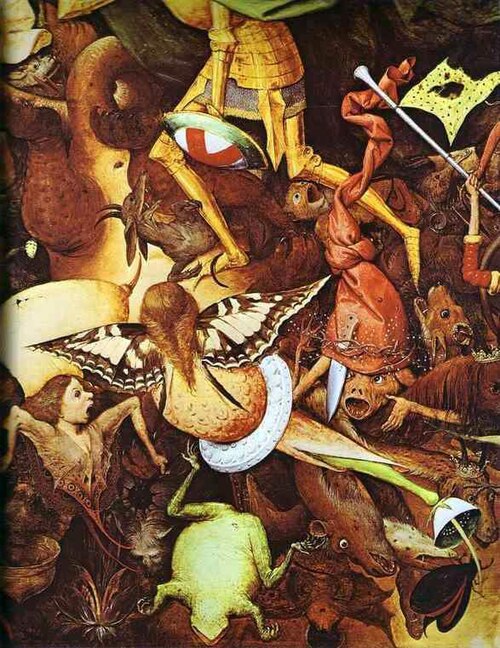
Pieter Bruegel, The Fall of the Rebelling Angels, 1563, Brussels.

Until now, it was all too common to hear him described as « an unclassifiable figure. » In 2024, art historian Mónica Ann Walker Vadillo did not hesitate to write in the History section of the newspaper Le Monde that, since Bruegel painted peasant feasts and weddings, art critics « came to regard him as an unrefined man and disdainfully nicknamed him ‘Bruegel the Peasant,' » while expressing surprise that so many « academics, humanists, and wealthy businessmen—who appreciated his work and collected his paintings » associated with him.

Fall of the Rebel Angels
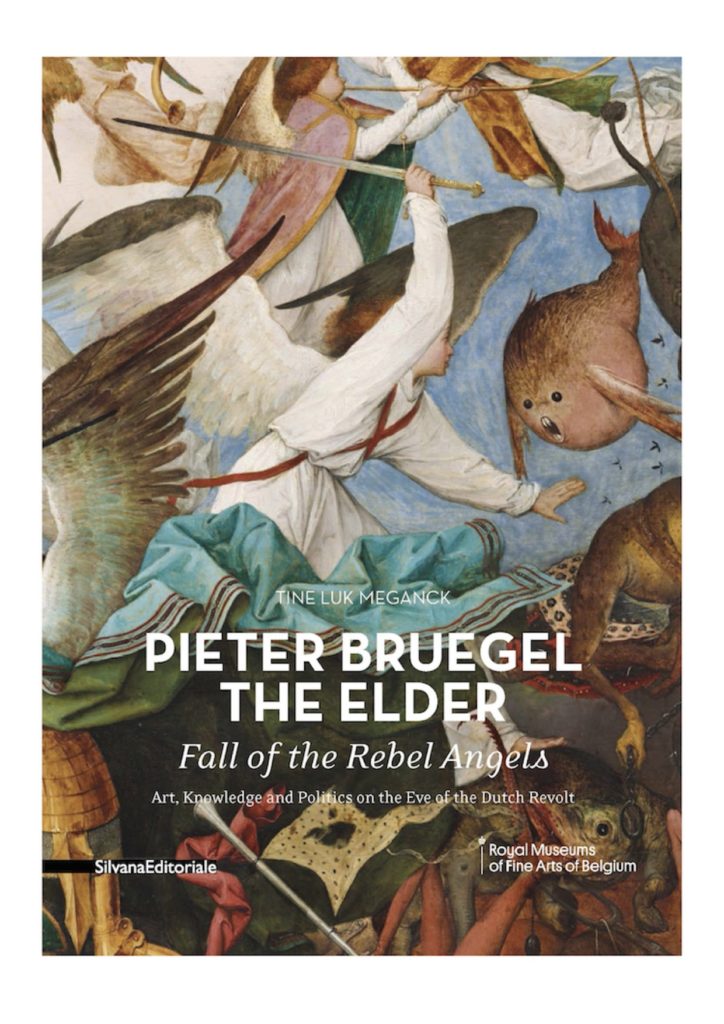
In 2014, Tine Luk Meganck ‘s book, « Pieter Bruegel the Elder. Fall of the Rebel Angels. Art, knowledge and Politics on the Eve of the Dutch Revolt », especially with the last sentence of her title, had nevertheless reopened the debate on the political dimension of his work.

Meganck ventured a highly improbable hypothesis regarding the painting The Fall of the Rebel Angels (1562, Brussels Museum): the jealous angels, whom God punishes for conspiring against him, are supposed to represent the alliance of nobles, the middle classes, and the common people, led by William the Silent against the rule of the Spanish Empire. Consequently, the commissioner of the work, according to the expert, was most likely the famous Cardinal Antoine Perrenot de Granvelle, one of the advisors to the regent Margaret of Parma and a fervent supporter of the persecution of heretics.

We have documented in an article why this interpretation seems unacceptable to us, as Cardinal Granvelle, a member of the « secret government, » was universally hated by the humanists of the time for his blind zeal in endorsing all the crimes of his masters.

Furthermore, no tangible proof exists that he commissioned any work from Bruegel. Certainly, he owned some, but apart from a « Flight into Egypt » (1563), a work devoid of any controversy, and a « View of the Bay of Naples, » a beautiful study inspired by drawings made during Bruegel’s trip to Italy, Granvelle was far from being « one of the greatest collectors » of Bruegel’s works, as is often repeated.

Landjuweel
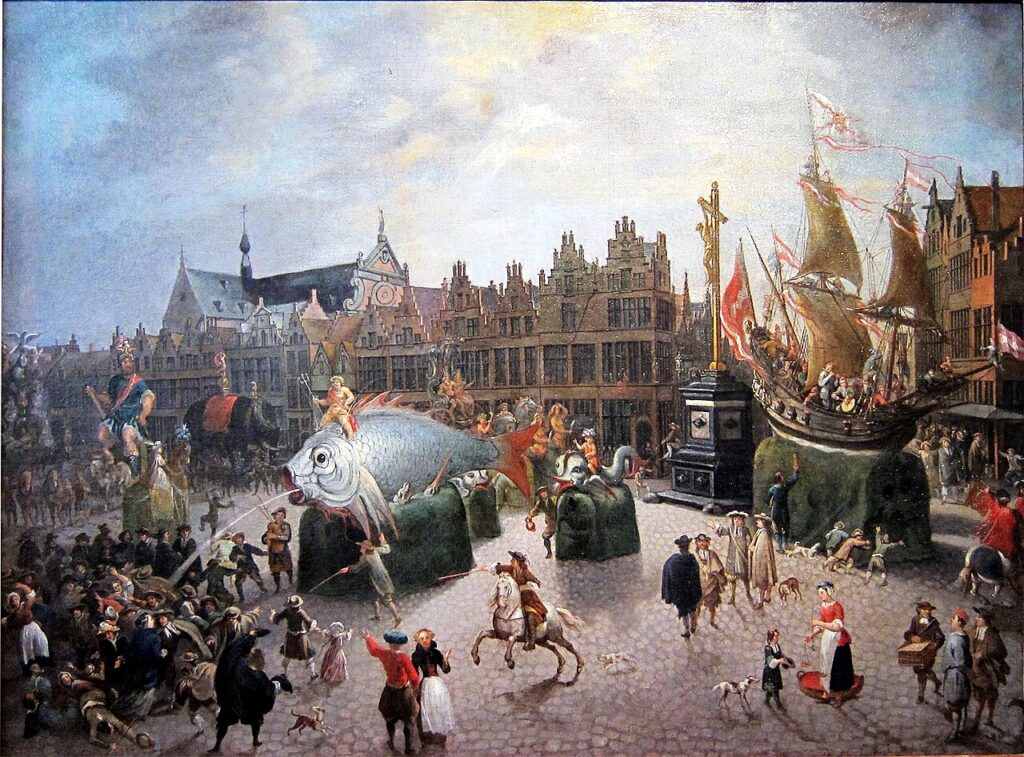
Erasmus de Bie, Procession of floats on the Meir in Antwerp, 1670, Museum of Cassel, France.

That being said, the important contribution of Meganck’s book, let’s acknowledge it, was the recognition of the decisive influence of the Chambers of Rhetoric and the Antwerp Landjuweel of 1561, for understanding Bruegel’s visual language.

My friend, the late American art critic Michael Frances Gibson, had mentioned this possibility to me during an interview this author conducted with him.

He discusses this in his book The Carrying of the Cross (Editions Noêsis, Paris 1996), which was used in 2011 for the quite innovative film « Bruegel, the Mill and the Cross ».

In August 1561, Antwerp, where Bruegel resided, hosted an exceptional celebration, the Landjuweel, or national competition of the Chambers of Rhetoric.

In practice, the Antwerp Chamber « De Violieren« , in charge of organizing a festival that cost the city one hundred thousand crowns, operated as the literary division of the Guild of Saint Luke, the corporation that brought together painters, engravers, illustrators, architects, sculptors, cartographers, goldsmiths and printers.

It was there that people read in Flemish as well as in Latin or French, Plato, Homer, Petrarch, Erasmus and Rabelais, both during private gatherings and often, in public.

The first Bible in French? Printed in Antwerp in 1535 by the French humanist Jacques Lefèvre d’Etaples (1450-1536), who published the first translations of the complete works of Nicholas of Cusa in Paris in 1514, three years before the publication, in the French capital, of the first edition of Erasmus‘s In Praise of Folly.

The Landjuweel of Antwerp stands historically as one of the most remarkable cultural renaissance events in European history. 2000 rhetoricians on horseback, from 10 cities, passed under 40 triumphal arches to the strident sounds of fifes, entering a city in full celebration. For a whole month, orators and poets, songwriters and actors competed without pausing for breath. Citizen’s were invited on every streetcorner to participate in polyphonic madrigals and chorusses. 5000 artists entertained close to a 100,000 viewers !
Bruegel had to follow them all the more since his dear friend Hans Frankaert (1520-1584), his friend and master Peeter Baltens (1527-1584), very well connected with the great local financiers who preferred commerce to war, as well as his first patron, the engraver Hieronymus Cock (1518-1570), were all involved in the organization of this event whose theme was peace and, two centuries before Kant and Schiller, this burning philosophical question: « What leads man most towards the arts? » This, then, was the bubbling cauldron of urban culture in which Bruegel was immersed from his beginnings.

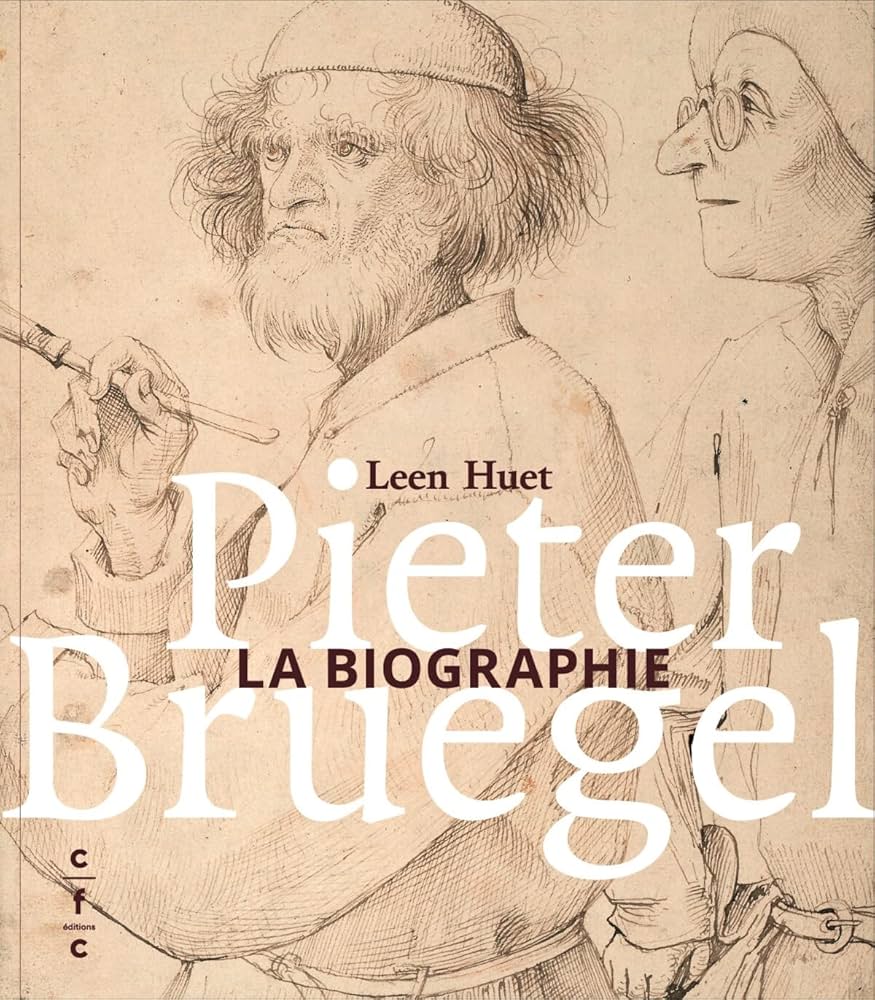
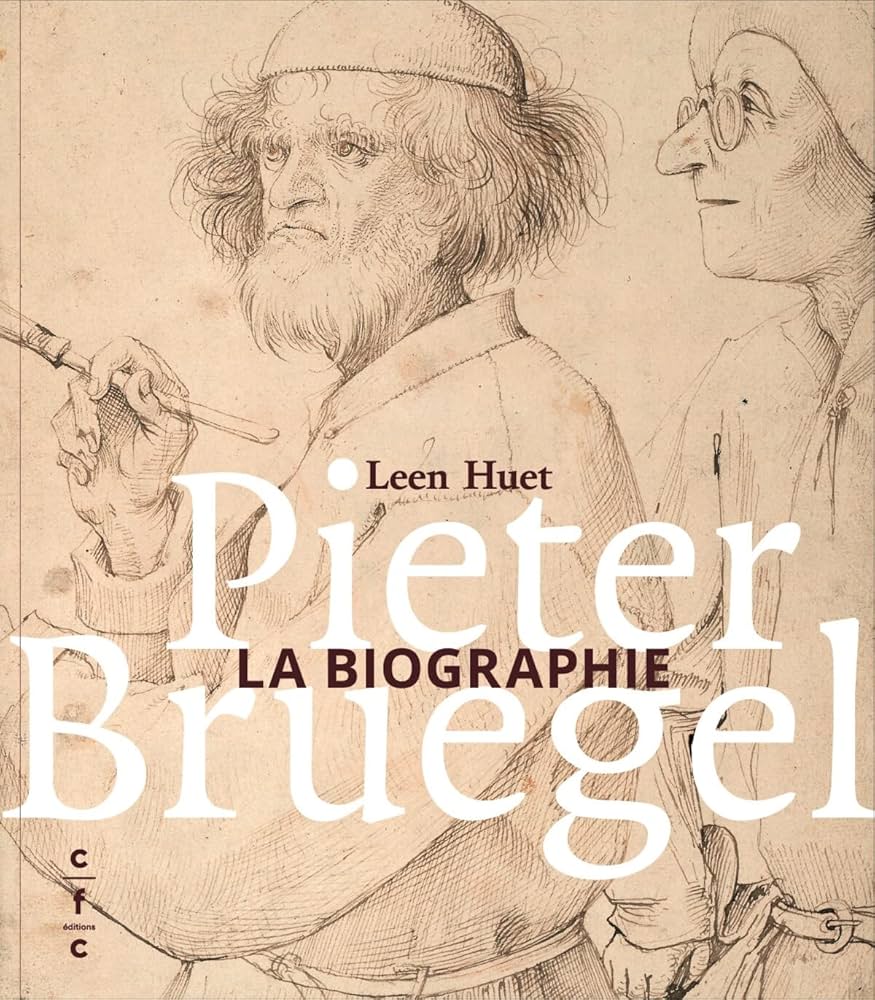
Moreover, as Belgian historian Leen Huet details in her sumptuous biography of the artist (first published in Dutch in 2016 by Polis, then in French by CFC in Brussels in 2021), when he crossed the Alps, Bruegel was probably accompanied by the painter Maarten de Vos (1532-1603) and the cartographer Abraham Ortelius (1527-1598), a close friend of Christophe Plantin, the head of the largest printing house in Antwerp, the team having thousands of addresses of collectors in connection with the printing house Les Quatre Vents of Jérôme Cock, in Antwerp.

The « Bruegel Code »
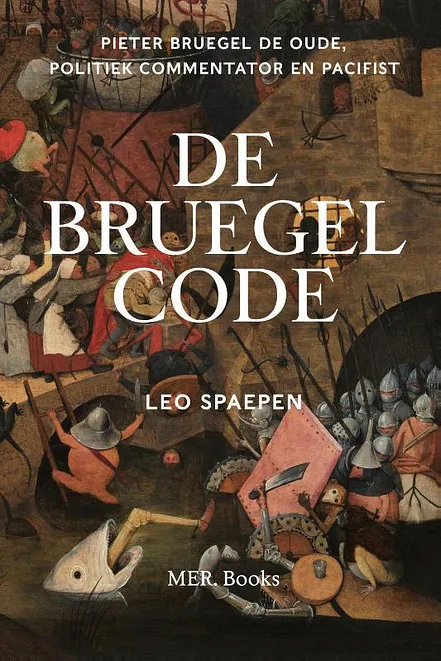
The image of Bruegel as a political commentator, deliberately obfuscating his message to thwart the regime’s Gestapo agents who were lying in wait for him, and embracing the Erasmian philosophy of the Landjuweel to defend peace and mutual understanding, is further developed by the classical historian Leo Spaepen, whose recent book, Pieter Bruegel de oude, politiek commentator en pacifist. De Bruegel Code (published in Dutch by MER Books, 2025), has stirred enthusiasm.

A good pedagogue, Spaepen establishes a kind of code for deciphering, or at least fruitfully approaching, Bruegel’s visual language. Escaping the Aristotelian confines, the aim is to immediately discard formal and symbolic representations in favor of what I would call a metaphorical approach.

Narrative A and B

Each painting contains a « narrative A » and a « narrative B. » The former typically reflects a concern shared by the humanist and Erasmian community regarding the socio-political events of the time, where corruption and violent Spanish repression brought the Hispano-Burgundian Netherlands to the brink of revolt. The « narrative B » often depicts a scene from the Bible or scripture.

As with any metaphor, the paradox arising from the analogy between narrative A and B brings forth, not on the canvas but in the viewer’s mind, a range of clues allowing them to grasp where the painter intends to lead them.

Spaepen, whose courage, rigor, and audacity deserve high praise, has sufficiently delved into the political and cultural history of Bruegel’s era to formulate compelling hypotheses that illuminate his major works. By testing this cognitive approach, painting by painting, the author generates not a scholarly compendium of facts or evidence, but an extremely interesting « gestalt » of the painter, whose true genius has often been denied recognition. It is therefore impossible, in a simple article like this, to reproduce the full richness of this approach.

« Mad Meg »
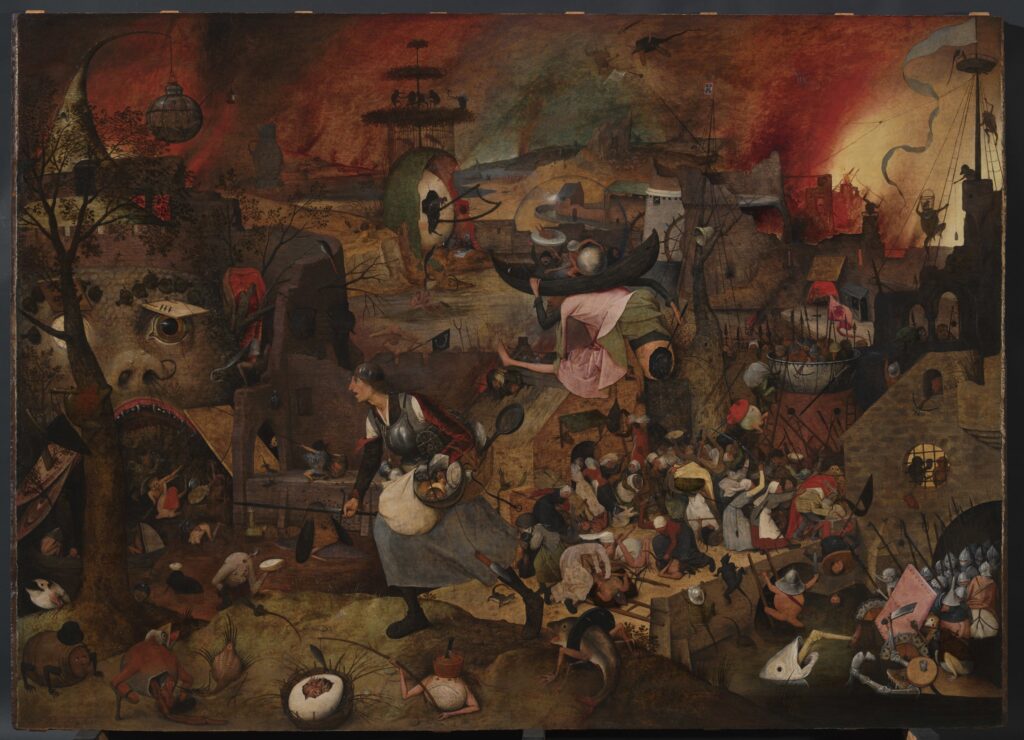
Pieter Bruegel the Elder, Dulle Griet (1563). Mayer van den Bergh Museum, Antwerp.

Let us nevertheless look at an emblematic work by Bruegel, known by its nickname, Dulle Griet (« Margot the Enraged » or « Mad Meg » ), a work painted in 1563, not to please a patron, but to provoke discussions with his relatives during meals at his home, as was the custom at the time.

The painting is striking in its contradictions. In the foreground, against a backdrop of burning cityscapes, a woman, mad with rage, sword in hand, carries a basket filled with jewels and precious metalwork. Behind her, a cohort of unarmed women bravely strives to subdue and repel an army of monsters and devils.

Finally, at the intersection of the painting’s diagonals, a strange creature appears, reminiscent of Hieronymus Bosch ‘s Garden of Earthly Delights. A man carrying a large bubble on his back shakes his backside, from which silver coins fall, which some women hastily gather up.

As for narrative B, we find roughly the image that Bruegel had developed in a drawing used for a 1557 engraving representing one of the deadly sins, here rage ( Ira in Latin), again represented by a giant woman, with the subtitle: « Rage swells the lips and sours the character. It troubles the mind and blackens the blood. »

Spaepen also picks up on (p. 131) a great find by Leen Huet. The historian discovered that during the Landjuweel of Antwerp in 1561, the chamber of rhetoric of Mechelen had mentioned a « Griete die den roof haelt voor den helle » (a girl who goes to plunder hell), a figure perhaps taken from a play that is now lost.

Huet also mentions (p. 35) the Flemish proverb that says of an old harpy that she « could go and plunder hell and come back safe and sound. » At the same time, Huet notes (p. 48), the author Sartorius , in a collection of adages inspired by Erasmus, states a saying similar in spirit to the Dulle Griet sign:

In reality, the status of urban women from the 15th century onwards in Flanders, with the beguinages, and especially in Brabant in the 16th century, was one of the most advanced in Europe1, probably explaining in part the concerns of some members of the male gender in the face of the growing power of women.

Granvelle
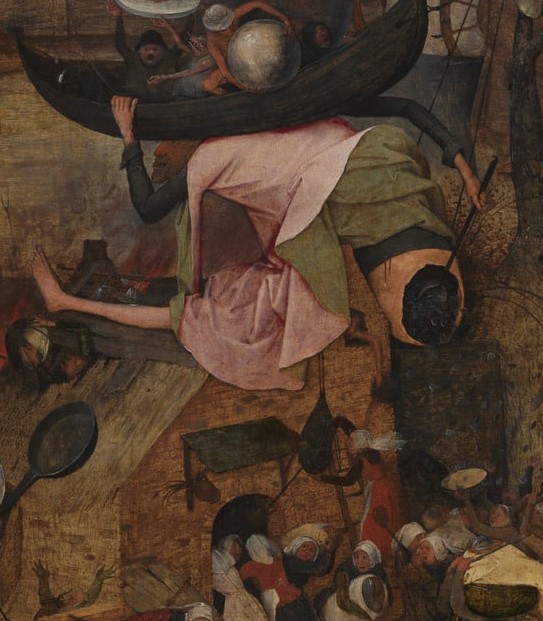
Pieter Bruegel the Elder, Dulle Griet (1563). Cardinal Granvelle smothering informants in the service of the regime? Perhaps fearing he would end up at the stake for heresy, Bruegel chose not to depict him in his cardinal’s red robes. Mayer van den Bergh Museum, Antwerp.

But Spaepen, a good observer, exonerates Bruegel from this kind of masculinist reaction by bringing back the reality of narrative A, the current political situation.

The painter, Spaepen believes, is denouncing here Cardinal Granvelle , zealous advisor to the regent Margaret of Parma, a woman torn between the general interest and submission to the tyranny of the Catholic Church, whose dogmas were instrumentalized by Madrid to plunder the country in order to repay the colossal debt of Charles V and Philip II to the Fugger bankers.

Personally, I thought for a moment that Bruegel had invented for the occasion an 8th deadly sin, « incitement to war » (Oorlogstokerij), but I am probably too much in the present.

In August 1561, disregarding Granvelle’s advice, Margaret had authorized the Guild of Saint Luke and the Violieren to organize the Antwerp Landjuweel to promote peace and mutual understanding. But immediately afterward, she yielded to pressure from Madrid by forbidding the publication of the proceedings of the Chambers of Rhetoric, which were accused of having united the entire country against the Emperor.
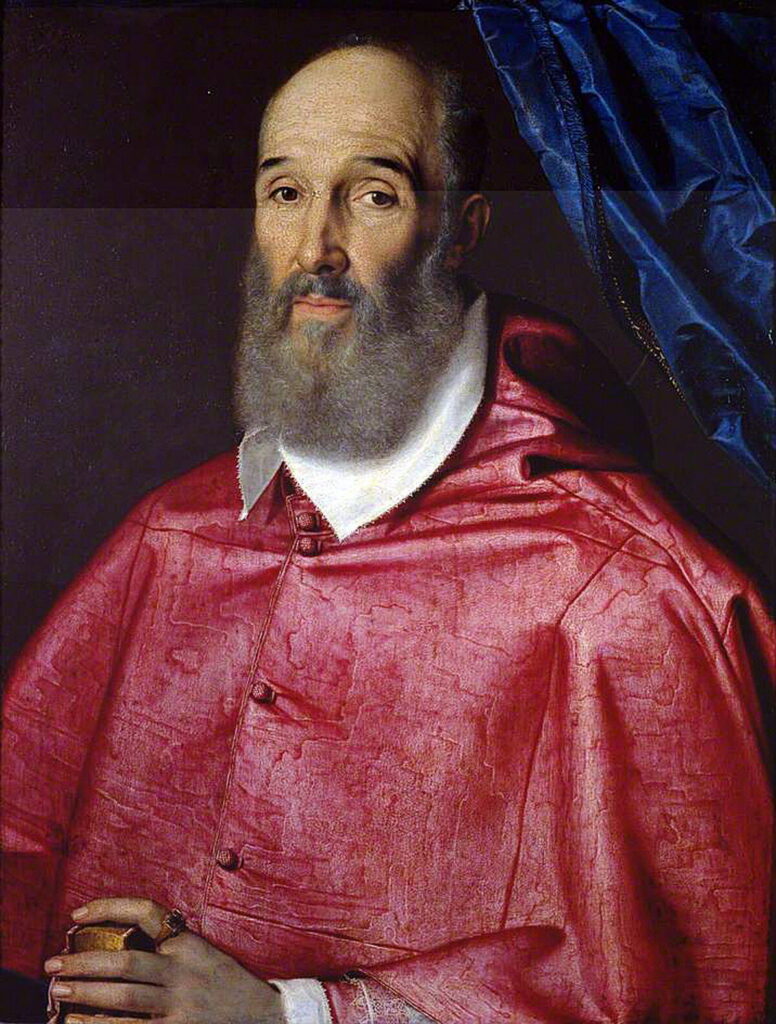
Cardinal Antoine Perrenot de Granvelle. Painting by Scipione Pulzone, 1576.

In 1563, the year Bruegel painted his Dulle Griet, the Council of Trent decided to curb polyphonic art by restoring the primacy of the sung text in music and prohibiting any ambiguity in a painting, linked to a role of propaganda, exactly as Granvelle wished.

In the painting « Mad Meg, » the strange creature in the center, draped in a red cloak, could very well be Cardinal Granvelle himself.

As Spaepen reminds us, Granvelle had just established a vast network of informants to hunt down heretics « even in the toilets. »

This targeted all those—Lutherans, Calvinists, Erasmians, or Anabaptists—who challenged the predatory grip of the regime. And yet, the money « shat out » by Granvelle is being recovered by women ready to plunder hell! Bruegel, not exactly kind to Mad Meg (Marguerite of Parma), could therefore be expressing his horror at this regent who has lost her mind, and especially at the idea that Flemish women, who had become so free and educated, could end up as informers for a totalitarian regime!

Familia Caritatis
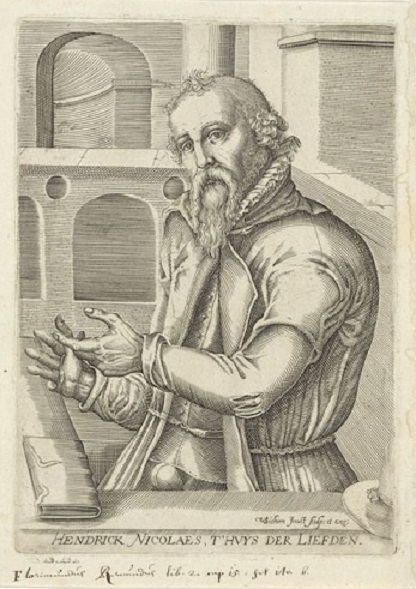
Hendrick Niclaes.

Spaepen (p. 194) documents the strong influence exerted on Bruegel (who was not necessarily a member of the group) by the Familia Caritatis (Family of Charity), a philosophical and religious movement founded and led by Hendrik Niclaes (1502-1570), a prophetic and charismatic figure advocating peace and tolerance about whom little is known but who undoubtedly appeared to many, without reaching his wisdom and erudition, as a kind of successor to Erasmus.

Many humanists and a number of Bruegel’s acquaintances were in contact with this movement which, passing through England, would dissolve into the Quaker revolt against the Anglican Church.2

Plantin, considered the official printer of the Spanish regime, had the Familia Caritatis booklets (deemed heretical by the regime) printed (at night), with initial financial assistance for his printing press from Niclaes, himself a merchant. Niclaes’s major work, Terra Pacis, denounces the « Blind leading the Blind, » a theme also found in the work of Quinten Matsys‘s son (who fled the persecution), and later in Bruegel.

Niclaes draws upon Socrates and the philosophy of the Brethren of the Common Life , for whom selfless love (agape or caritas) should be the driving force of humankind. Another conviction he holds is that life is « a pilgrimage of the soul. »

As in the landscapes of Joachim Patinir, Homo Viator must constantly detach himself from earthly matters and move on. Through his free he must seek union with God by resisting earthly temptations. Inner peace—with oneself, with one’s conscience, and with the divine will—is the foundation of peace on Earth, an ideal that also clearly inspired the painter.

This is the true story, that of a great political commentator and resistance fighter of his time, a painter intellectually and spiritually committed to peace.

NOTES:

  1. See on this subject Myriam Greilsammer, L’envers du tableau : Mariage et maternité en Flandre médiévale , Armand Colin, 1990, as well as this author’s article on the Landjuweel. ↩︎
  2. These included the printers Christoffel Plantin and John Gailliart; the humanists Abraham Ortelius, Justus Lipsius, Andreas Masius, Goropius Becanus, and Benito Arias Montano; the poets Peeter Heyns, Jan van der Noot, Lucas d’Heere, Filips Galle, and Joris Hoefnagel; the theologian Hubert Duifhuis; the writer Dirck Volkertsz; Coornhert (right-hand man of William the Silent); the « familists » Daniel van Bombergen, Emanuel van Meteren, and Johan Radermacher; and the Antwerp merchants Marcus Perez and Ferdinando Ximines. ↩︎
Merci de partager !

Pieter Bruegel l’ancien, commentateur politique et pacifiste
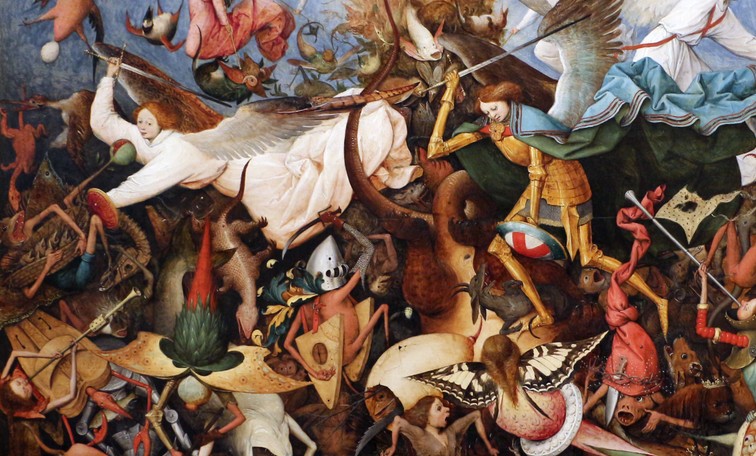
Pieter Bruegel, Chute des anges rebelles, détail, 1562.

Cinq siècles après sa naissance, la publication de nouvelles recherches semblent (enfin) rendre justice au grand peintre flamand « Pierre Bruegel le drôle », dit l’ancien (1525-1569).

Jusqu’ici, on entendait trop souvent dire de lui qu’il « apparaît comme une figure inclassable ». En 2024, l’historienne de l’art Mónica Ann Walker Vadillo n’hésite pas à écrire dans les pages Histoire du quotidien Le Monde que, vu que Bruegel a peint des fêtes paysannes, les critiques d’art « en sont arrivés à le considérer comme un homme peu raffiné et l’ont surnommé avec dédain ‘Bruegel le Paysan’ », tout en s’étonnant qu’il ait fréquenté bon nombre « d’universitaires, d’humanistes et des hommes d’affaires fortunés – qui appréciaient son œuvre et collectionnaient ses tableaux ».

Chute des anges rebelles
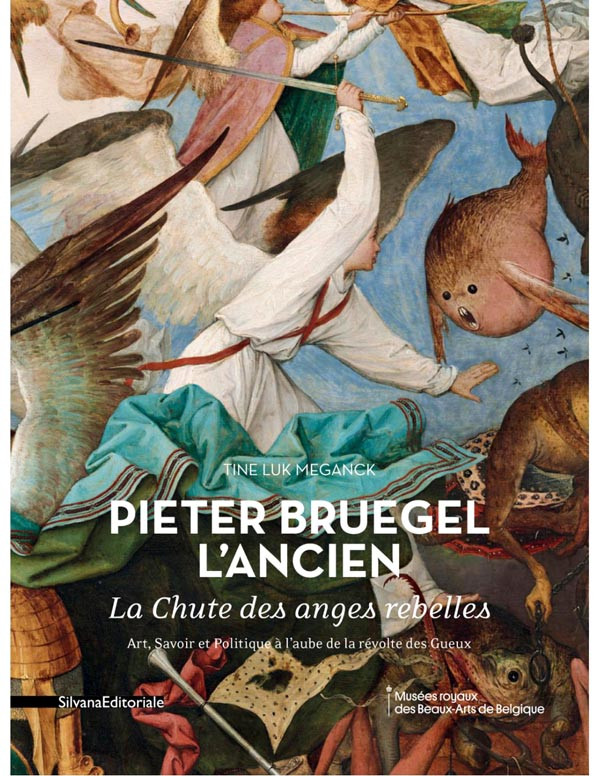
En 2014, le livre de Tine Luk Meganck, « Pieter Bruegel, la chute des anges rebelles. Art, savoir et politique à l’aube de la révolte des Gueux », surtout avec la dernière phrase de son titre, avait néanmoins rouvert le débat sur la dimension politique de son œuvre.

Meganck s’y risquait à une hypothèse hautement improbable à propos du tableau La chute des anges rebelles (1562, Musée de Bruxelles) : les anges jaloux, que Dieu punit pour avoir conspiré contre lui, représenteraient l’alliance des nobles, des classes moyennes et du peuple, menée par Guillaume le Taciturne contre la férule de l’Empire espagnol.

Du coup, le commanditaire de l’œuvre, toujours selon l’experte, serait probablement le fameux cardinal Antoine Perrenot de Granvelle, un des conseillers de la régente Marguerite de Parme et fervent partisan de la chasse aux hérétiques.

Nous avons documenté dans un autre article pourquoi cette interprétation nous semble irrecevable, le cardinal de Granvelle, un des membres du « gouvernement secret », étant universellement détesté par les humanistes de l’époque pour son zèle aveugle endossant tous les crimes de ses maîtres.

De plus, aucune preuve tangible n’existe qu’il ait commandité une quelconque œuvre à Bruegel. Certes il en possédait, mais, à part une « Fuite en Egypte » (1563), œuvre dépourvue de la moindre polémique, et une « Vue sur la baie de Naples », belle étude inspirée des dessins réalisés lors de son voyage en Italie, Granvelle était loin d’être « un des plus grands collectionneurs » d’œuvres de Bruegel, comme on le répète un peu partout.

Landjuweel
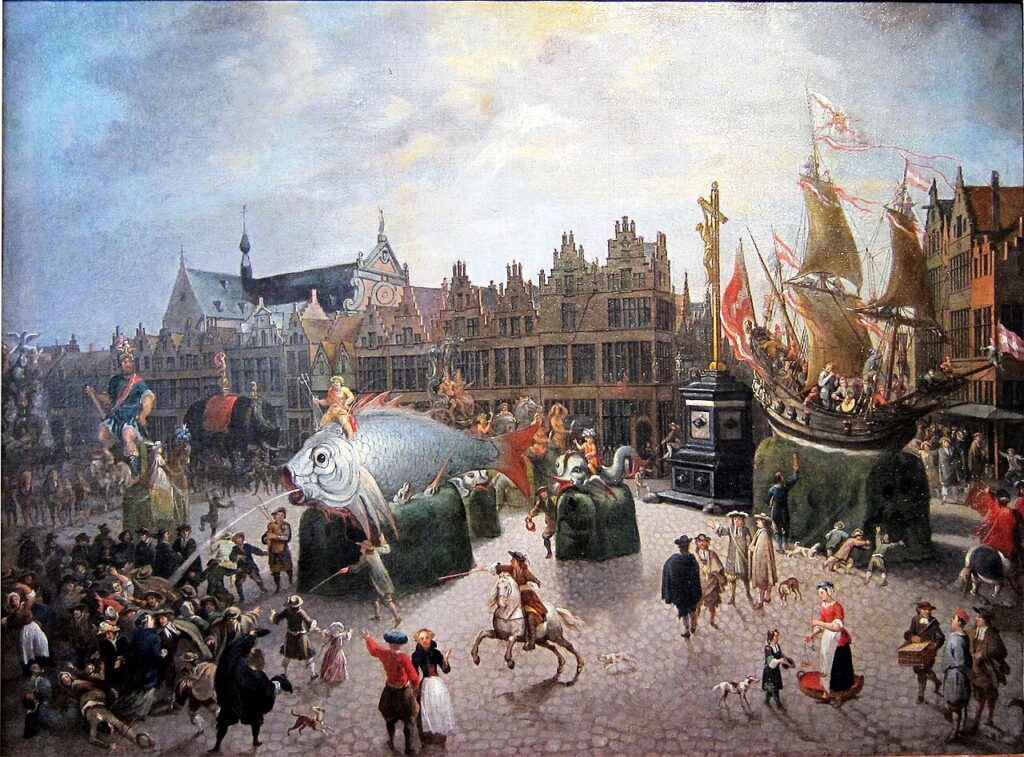
Erasmus de Bie, Procession de chars sur la Place du Meir à Anvers, 1670, Musée de Cassel.

Ceci étant dit, l’apport nouveau et important du livre de Meganck, c’est (on l’avait oublié) la reconnaissance de l’influence déterminante, pour comprendre le langage visuel de Bruegel, des Chambres de rhétorique et du Landjuweel d’Anvers de 1561.

Mon ami le regretté critique d’art américain Michael Gibson m’avait parlé de cette piste lors d’un entretien que j’avais réalisé avec lui. Il l’évoque dans son livre Le portement de croix (Editions Noêsis, Paris 1996), qui servira en 2011 à la réalisation du film « Bruegel, le moulin et la croix ».

En 1561, Anvers, où Bruegel résidait, se fit le siège d’une réjouissance exceptionnelle, le Landjuweel, ou concours national des Chambres de rhétorique.

Or, la Chambre anversoise « La Giroflée » (De Violieren), chargée de l’organisation d’une fête qui coûta cent mille couronnes à la ville, était en quelque sorte la division littéraire de la Guilde de Saint-Luc, qui regroupait les peintres, graveurs, sculpteurs, cartographes, orfèvres et imprimeurs.

C’est là qu’on lisait en flamand aussi bien qu’en latin ou en français, Platon, Homère, Pétrarque, Erasme et Rabelais. La première Bible en français ? Imprimée à Anvers en 1535 par Jacques Lefèvre d’Etaples, qui publia les premières traductions de l’œuvre complète de Nicolas de Cues à Paris en 1514, trois ans avant la parution, dans la même ville, de la première édition de L’éloge de la folie d’Erasme.

Le Landjuweel d’Anvers fut une fête grandiose. Venus de dix cités, deux mille rhétoriciens à cheval, passant par quarante arcs de triomphe, aux stridences des fifres, pénétrèrent dans une ville en fête. Tout un mois durant, orateurs et poètes, chansonniers et acteurs concoururent sans reprendre haleine.

Bruegel dut les suivre d’autant plus que son cher ami Hans Frankert, son ami et maître Peeter Baltens, très introduit auprès des grands financiers locaux qui préféraient le commerce à la guerre, ainsi que son premier patron, le graveur Jérôme Cock, furent tous impliqués dans l’organisation de cet événement dont le thème était la paix et, deux siècles avant Kant et Schiller, cette brûlante interrogation philosophique : « Qu’est-ce qui conduit le plus l’homme vers les arts ? » Voilà donc la marmite bouillonnante de culture citadine dans laquelle Bruegel fut plongé dès ses débuts.

Par ailleurs, comme le détaille l’historienne Leen Huet, dans sa somptueuse biographie de l’artiste (parue d’abord en néerlandais en 2016 chez Polis, puis en français chez CFC à Bruxelles en 2021), lorsqu’il traversa les Alpes, Bruegel était probablement accompagné par le peintre Maarten de Vos et le cartographe Abraham Ortelius, ami proche de Christophe Plantin, le patron de la plus grande imprimerie d’Anvers, l’équipe disposant de milliers d’adresses de collectionneurs en relation avec l’imprimerie Les Quatre Vents de Jérôme Cock, à Anvers.

Le « Bruegel code »

L’image d’un Bruegel commentateur politique, brouillant volontairement son message pour déjouer les gestapistes du régime qui le guettaient, s’inscrivant dans la philosophie toute érasmienne du Landjuweel pour défendre la paix et la compréhension mutuelle, est encore plus étoffée par l’historien Leo Spaepen, dont le livre récent, Pieter Bruegel de oude, politiek commentator en pacifist. De Bruegel Code (publié en néerlandais chez MER Books, 2025), fait sensation.

Bon pédagogue, Spaepen y établit une sorte de code permettant de déchiffrer, ou du moins d’aborder fructueusement, le langage visuel bruegélien. S’échappant du bocal aristotélicien, il s’agit d’écarter d’emblée les représentations formelles et symboliques au bénéfice d’une approche que je qualifierais de métaphorique.

Narratif A et B

Dans chaque tableau, il y a un « narratif A » et un « narratif B ». Le premier traduit généralement une préoccupation partagée par la communauté humaniste et érasmienne face aux événements socio-politiques de l’époque, où la corruption et la violente répression espagnole conduisent les Pays-Bas hispano-bourguignons au bord de la révolte. Le « narratif B » évoque souvent une scène tirée de la Bible ou des écritures.

Comme dans toute métaphore, le paradoxe résultant de la mise en analogie du narratif A avec le B fait émerger, non pas sur le tableau mais dans l’esprit du spectateur, une palette d’indications lui permettant de saisir vers quoi le peintre veut le conduire.

Spaepen, dont il faut saluer le courage, la rigueur et la témérité, a suffisamment approfondi l’histoire politique et culturelle de l’époque de Bruegel pour émettre des hypothèses probantes éclairant ses principales œuvres. En mettant à l’épreuve, dans un tableau après l’autre, cette approche cognitive, l’auteur génère non pas une somme savante de faits ou de preuves, mais une « gestalt » extrêmement intéressante du peintre, dont on a souvent refusé d’identifier le vrai génie. Impossible donc dans un simple article comme celui-ci de reproduire toute la richesse de la démarche.

Margot l’enragée

Pieter Bruegel d’ancien, Dulle Griet (1563). Musée Mayer van den Bergh, Anvers.

Regardons tout de même une œuvre emblématique de Bruegel, connue par son surnom, Dulle Griet (« Margot l’enragée » ou « Margot la folle »), une œuvre peinte en 1563, non pas pour satisfaire un commanditaire, mais pour susciter des discussions avec ses proches lors de repas chez lui, comme cela se faisait à l’époque.

Le tableau frappe par ses contradictions. Au premier plan, devant un paysage urbain en flammes, une femme folle de rage, l’épée à la main, emportant avec elle un panier rempli de bijoux et d’orfèvrerie. Derrière elle, une cohorte de femmes sans armes s’acharne courageusement à maîtriser et repousser une armée de monstres et de diables.
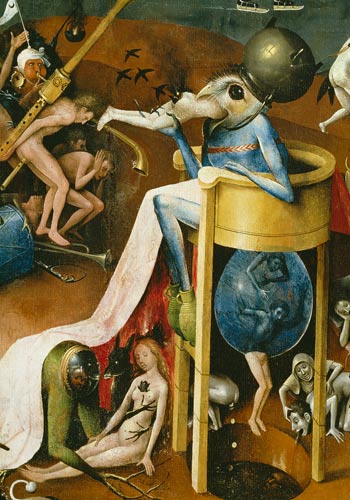
Jérôme Bosch, Tuin des Lusten, détail de l’Enfer.

Enfin, à l’intersection des diagonales de l’œuvre, une étrange créature reprise du Jardin des délices de Jérôme Bosch. Un homme portant sur le dos une vaste bulle, touille son derrière d’où tombent des pièces d’argent que certaines femmes s’empressent de ramasser.

Pour ce qui est du narratif B, on retrouve en gros l’image que Bruegel avait élaborée dans un dessin ayant servi à une gravure de 1557 représentant l’un des péchés capitaux, ici la rage (Ira en latin), représentée là encore par une femme géante, avec pour sous-titre : « La rage bouffit les lèvres et aigrit le caractère. Elle trouble l’esprit et noircit le sang. »

Spaepen rebondit également (p. 131) sur une belle trouvaille de Leen Huet. L’historienne a découvert que lors du Landjuweel d’Anvers de 1561, la chambre de rhétorique de Malines avait évoqué une « Griete die den roof haelt voor den helle » (une fille qui va piller l’enfer), figure peut-être tirée d’une pièce de théâtre aujourd’hui perdue.

Huet évoque également (p. 35) le proverbe flamand disant d’une vieille harpie qu’elle « pourrait aller piller l’enfer et en revenir saine et sauve ». A la même époque, constate Huet (p. 48), l’auteur Sartorius, dans un recueil d’adages inspiré d’Erasme, énonce un dicton proche, dans son esprit, du panneau Dulle Griet :

En réalité, le statut des femmes citadines dès le XVe siècle en Flandres, avec les béguinages, et surtout au Brabant au XVIe siècle, était l’un des plus avancés d’Europe1, expliquant sans doute en partie les inquiétudes de certains membres de la gent masculine face au pouvoir grandissant des femmes.

Granvelle petit esprit
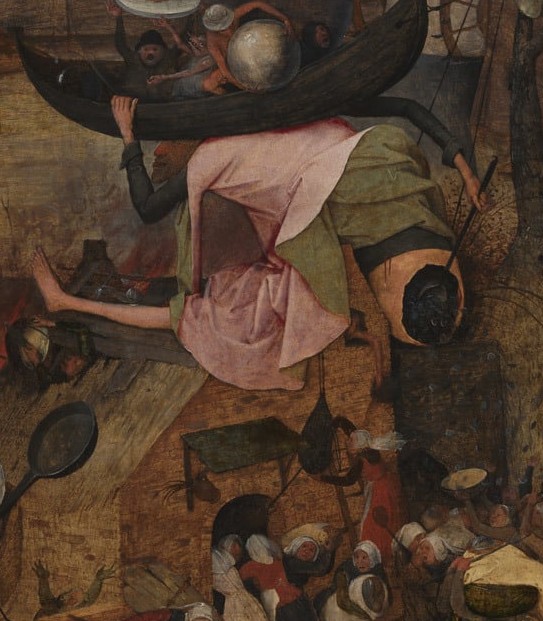
Pieter Bruegel d’ancien, Dulle Griet (1563). Le cardinal Granvelle arrosant les informateurs au service du régime ? Craignant sans doute de finir sur le bûcher pour hérésie, Bruegel a choisi de ne pas le représenter avec son habit rouge cardinal. Musée Mayer van den Bergh, Anvers.

Mais Spaepen, bon observateur, dédouane Bruegel de ce genre de réaction masculiniste en ramenant la réalité du narratif A, l’actualité politique du moment.

Le peintre, pense Spaepen, dénonce ici le cardinal de Granvelle, zélé conseiller de la régente Marguerite de Parme, une femme tiraillée entre l’intérêt général et la soumission à la tyrannie de l’Église catholique, dont les dogmes furent instrumentalisés par Madrid pour piller le pays afin de rembourser la dette colossale de Charles V et Philippe II envers les banquiers Fugger.

Personnellement, j’ai pensé un moment que Bruegel avait inventé pour l’occasion un 8e péché capital, « l’incitation à la guerre » (Oorlogstokerij), mais je suis sans doute trop dans le présent.

En août 1561, faisant fi de l’avis de Granvelle, Marguerite avait autorisé la Guilde de Saint-Luc et les Violieren à organiser le Landjuweel d’Anvers pour promouvoir la paix et la compréhension mutuelle. Mais immédiatement après, elle céda à la pression de Madrid en interdisant la publication des comptes-rendus des Chambres de rhétorique, accusées d’avoir coalisé tout le pays contre l’Empereur.

Le cardinal Antoine Perrenot de Granvelle. Tableau de Scipione Pulzone, 1576. Domaine public.

En 1563, année où Bruegel peint sa Margot, le Concile de Trente décide de brider l’art polyphonique en rétablissant dans la musique la primauté du texte chanté et en interdisant toute ambiguïté dans une peinture, reliée à un rôle de propagande, exactement comme le souhaitait Granvelle.

Dans le tableau « Margot l’enragée », l’étrange créature au centre, drapée d’un manteau rouge, pourrait donc bien être le cardinal de Granvelle en personne.

Comme le rappelle Spaepen, ce dernier venait d’instaurer un vaste système d’informateurs afin de traquer les hérétiques « jusque dans les toilettes ».

Cela visait tous ceux, luthériens, calvinistes, érasmiens ou anabaptistes, qui contestaient la mainmise prédatrice du régime.

Or, l’argent « chié » par Granvelle est récupéré par des femmes prêtes à aller piller l’enfer ! Pas tendre pour Margot l’enragée (Marguerite de Parme), Bruegel pourrait donc exprimer ici son effroi devant cette régente ayant perdu la tête, et surtout à l’idée que les Flamandes, devenues si libres et éduquées, puissent finir comme indics d’un régime totalitaire !

Familia Caritatis

Spaepen (p. 194) rend plausible, s’il n’y adhère pas explicitement, la forte influence exercée sur Bruegel par la Familia Caritatis (Famille de la charité), un courant philosophique et religieux fondé et dirigé par Hendrik Niclaes (1502-1570), figure prophétique et charismatique prônant la paix et la tolérance dont on sait assez peu mais apparaissant sans doute pour beaucoup, sans atteindre sa sagessse et son érudition, comme une sorte de successeur d’Erasme.

De nombreux humanistes et bon nombre des fréquentations de Bruegel étaient en contact avec ce courant qui, en passant par l’Angleterre, se dissoudra dans la révolte Quaker contre l’Église anglicane.2

Plantin, considéré comme l’imprimeur officiel du régime espagnol, faisait imprimer (de nuit) les livrets (qualifiés d’hérétiques par le régime) de la Familia Caritatis, moyennant une aide financière pour son imprimerie de la part de Niclaes. L’œuvre majeure de Niclaes, la Terra Pacis, dénonce les « aveugles guidant les aveugles », thème que l’on retrouve chez le fils de Quinten Matsys, puis chez Bruegel.

Niclaes reprend Socrate et la philosophie des Frères de la vie commune, pour qui c’est l’amour désintéressé (agape ou caritas) qui doit animer les hommes. Autre conviction : la vie est « un pèlerinage de l’âme ». Comme dans les paysages de Joachim Patinir, l’Homo Viator doit constamment, par son libre arbitre, pérégriner et chercher à s’unir à Dieu en se soustrayant aux tentations terrestres. La paix intérieure, avec soi-même, avec sa conscience et avec la volonté divine, est le fondement de la paix sur Terre, un idéal qui animait aussi très clairement le peintre.

Voici donc la véritable histoire, celle d’un grand commentateur politique et résistant de son temps, un peintre engagé intellectuellement et spirituellement pour la paix.

NOTES:

  1. Voir à ce sujet Myriam Greilsammer, L’envers du tableau : Mariage et maternité en Flandre médiévale, Armand Colin, 1990. ↩︎
  2. Il s’agit notamment des imprimeurs Christoffel Plantin, John Gailliart, des humanistes Abraham Ortelius, Justus Lipsius, Andreas Masius, Goropius Becanus, Benito Arias Montano, des poètes Peeter Heyns, Jan van der Noot, Lucas d’Heere, Filips Galle, Joris Hoefnagel, du théologien Hubert Duifhuis, de l’écrivain Dirck Volkertsz. Coornhert (bras droit de Guillaume le Taciturne), des « familistes » Daniel van Bombergen, Emanuel van Meteren, Johan Radermacher et des marchands anversois Marcus Perez et Ferdinando Ximines. ↩︎
Merci de partager !

The Egg Without A Shadow of Piero della Francesca (RU)

Merci de partager !

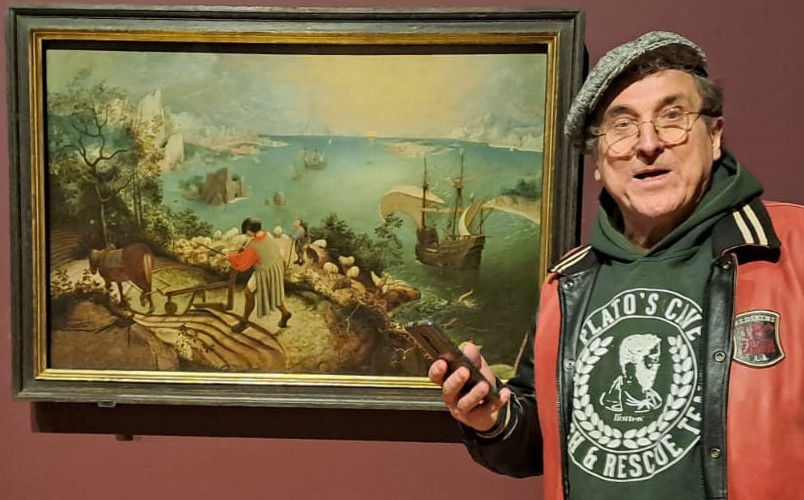
AUDIO: Bruegel’s Fall of Empire (Icarus)
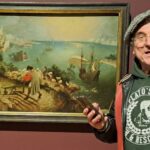
Brussels, Dec. 2025 – Karel Vereycken commenting the Fall of Icarus, a 16th Century painting on a theme familiar to Bruegel.

TO LISTEN TO THIS AUDIO, CLICK HERE TO OPEN WEBPAGE

Further information on Bruegel:

Merci de partager !

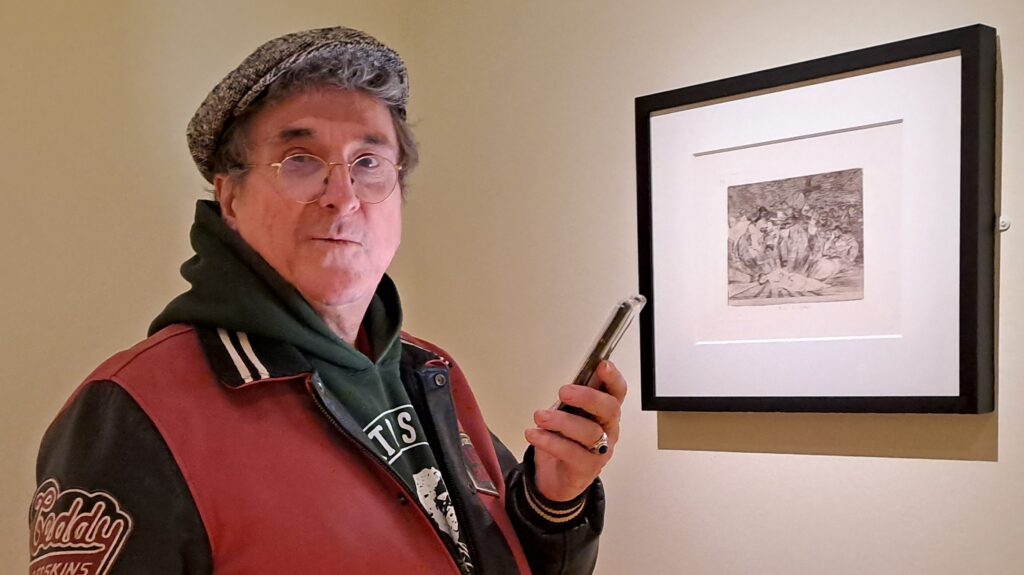
AUDIO: Goya asks us to make sure Truth raises again
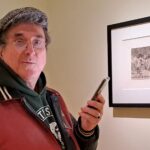
Goya
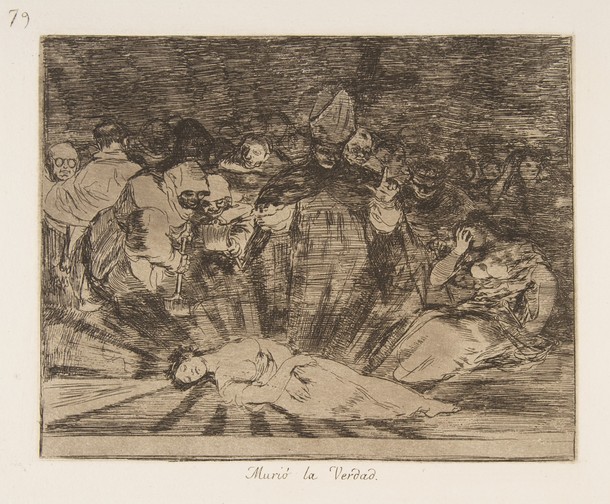
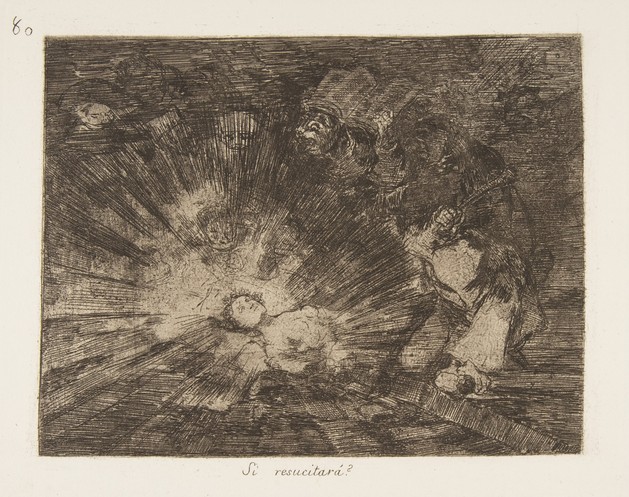
Brussels, Dec. 2025 – Karel Vereycken commenting two engravings of Goya’s Disasters of War.
Plate 79 from « The Disasters of War » (Los Desastres de la Guerra): ‘Truth has died’ (Murió la verdad).
Plate 80 from « The Disasters of War » (Los Desastres de la Guerra): ‘Will she rise again?’ (Si resucitará?).

Merci de partager !

AUDIO: What Bruegel’s snow landscape teaches us about human fragility
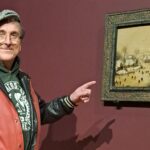
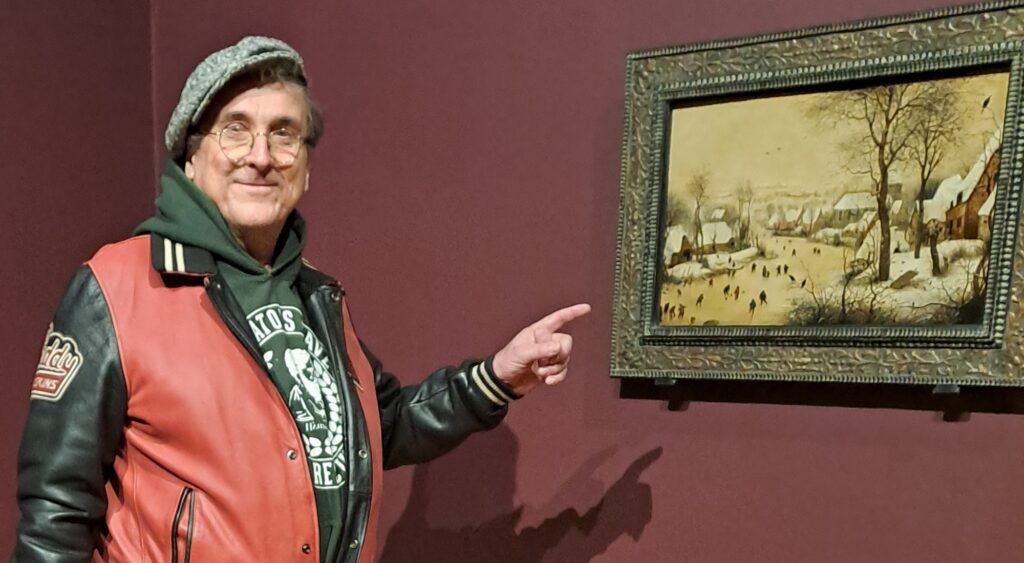
Brussels, Dec. 2025 – Karel Vereycken commenting Bruegel’s « Winter Landscape with a Bird Trap » (1565).

OPEN WEBPAGE TO LISTEN TO AUDIO: CLICK HERE
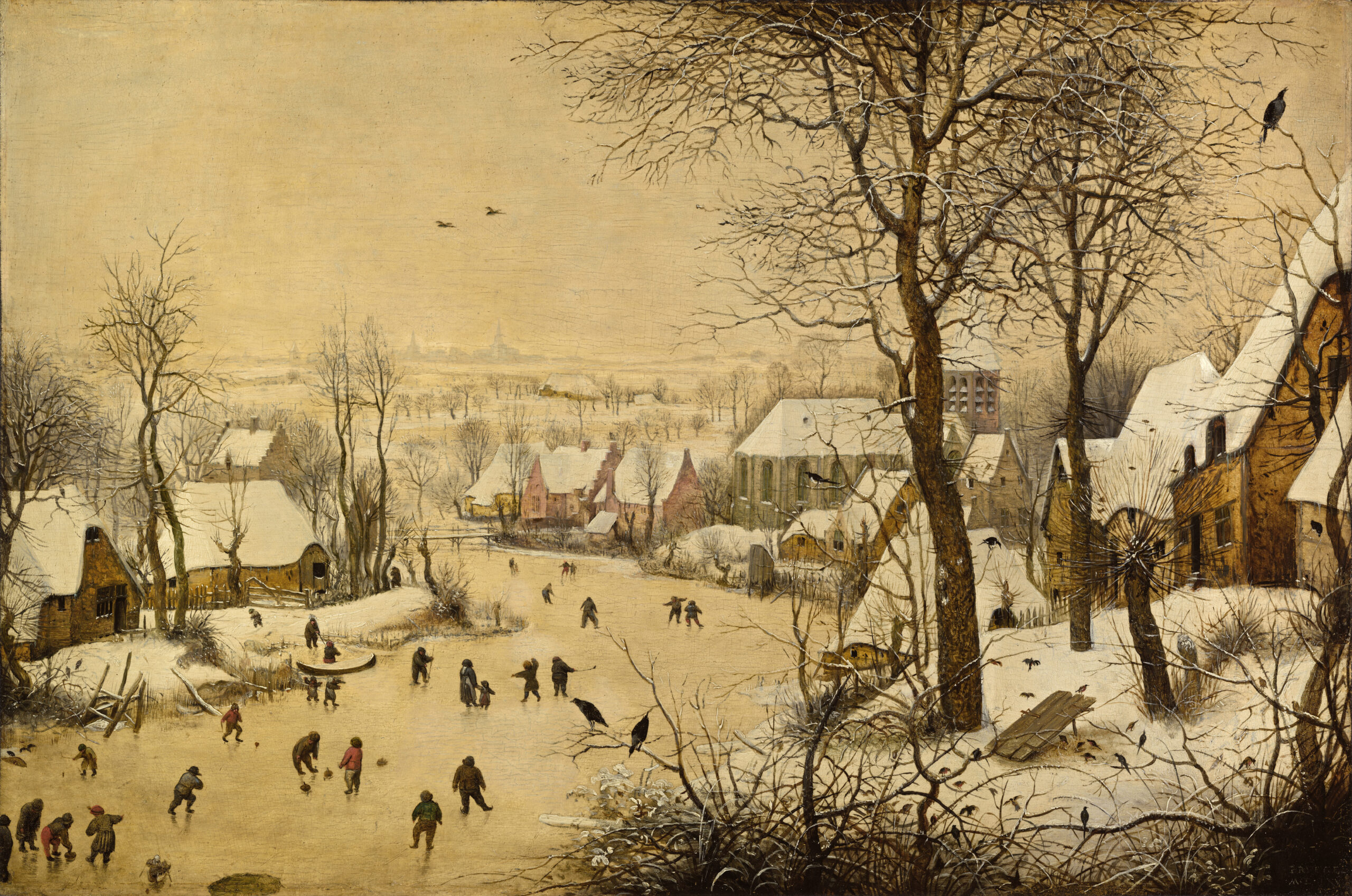
Pieter Bruegel the Elder, « Winterlandscape with Bird Trap« , 1565.

Further information on Bruegel:

Merci de partager !

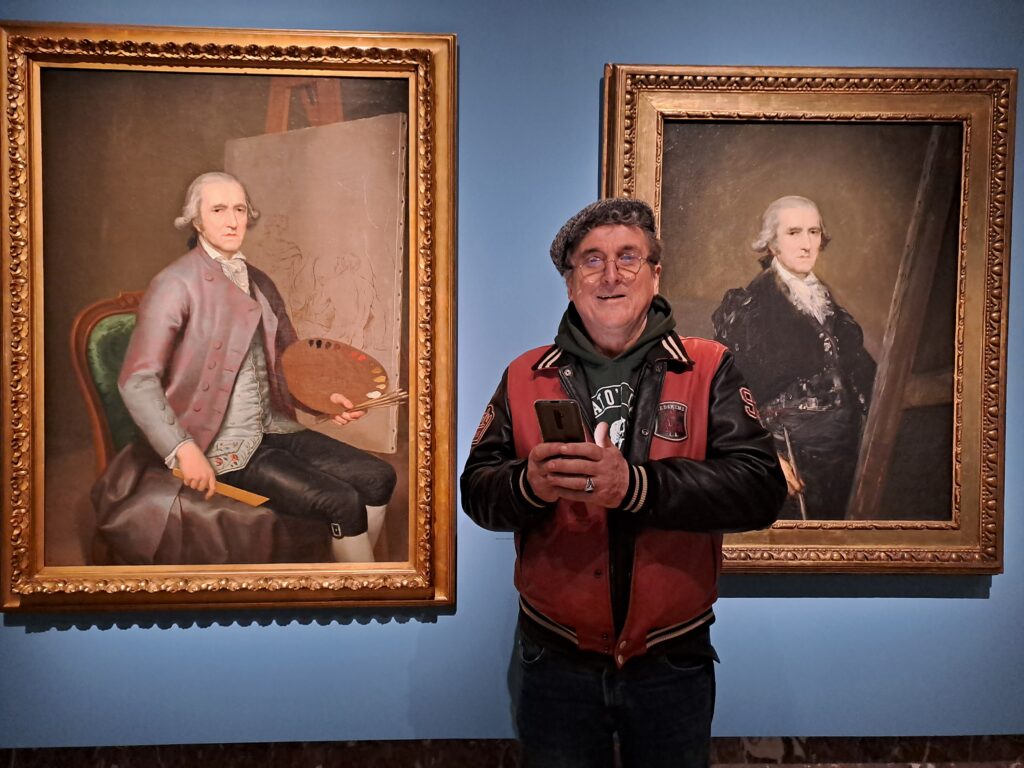
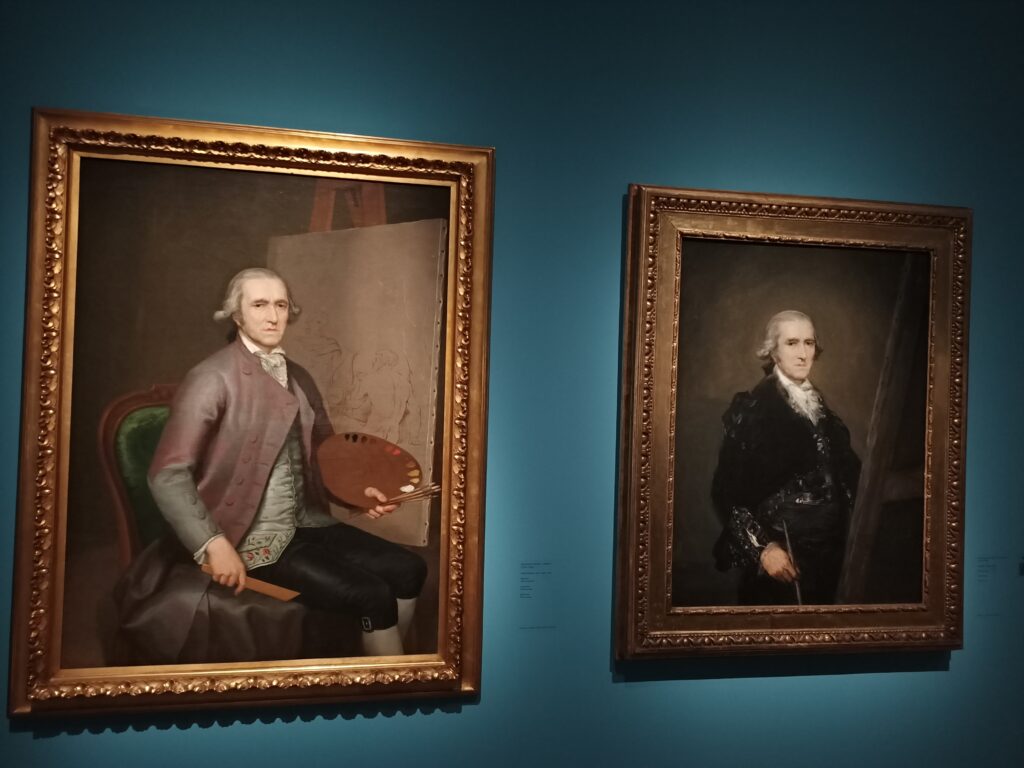
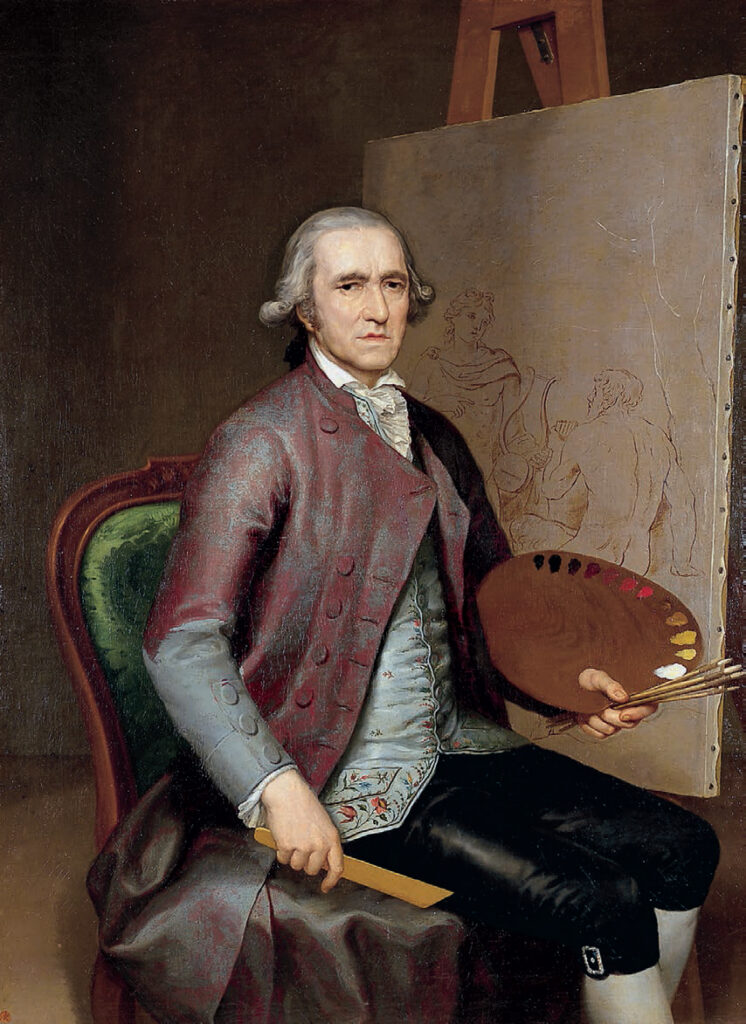
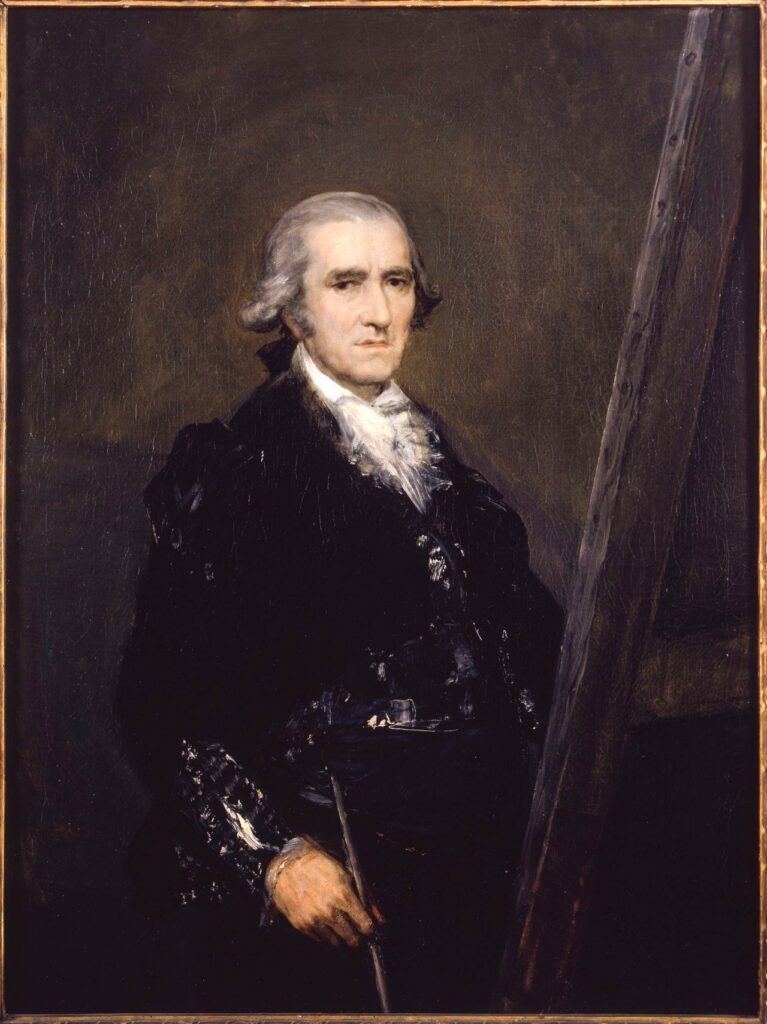
AUDIO: Goya’s portrait of Bayeu

Karel Vereycken, at the Goya exhibition in Brussels on Dec. 2025.
Francisco Bayeu’s 1792 selfportrait (left). Goya’s portrait of Bayeu (right).
Merci de partager !

AUDIO – Bruegel’s Theodicy: The Fall of the Rebel Angels
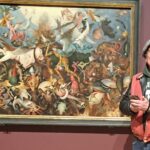
Angels
Karel Vereycken in Brussels, commenting Bruegel’s 1562 painting The Fall of The Rebel Angels.
Pieter Bruegel the Elder, The Fall of the Rebel Angels, 1562, Brussels.

Further information on Bruegel:

Merci de partager !

AUDIO: Bruegel’s Mad Meg: we see her madness, but do we see ours ?

Karel Vereycken in Antwerp’s Museum Mayer Van den Bergh, commenting Bruegel’s « Dulle Griet » (Mad Meg) on Dec. 2025.
Unarmed women binding the devil on a cushion. If they can, so can we?

More information on Bruegel:

Merci de partager !

Rembrandt’s Anslo, the science of painting the « invisible »
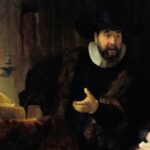
Cet article en FR
this article in RU see bottom of this page
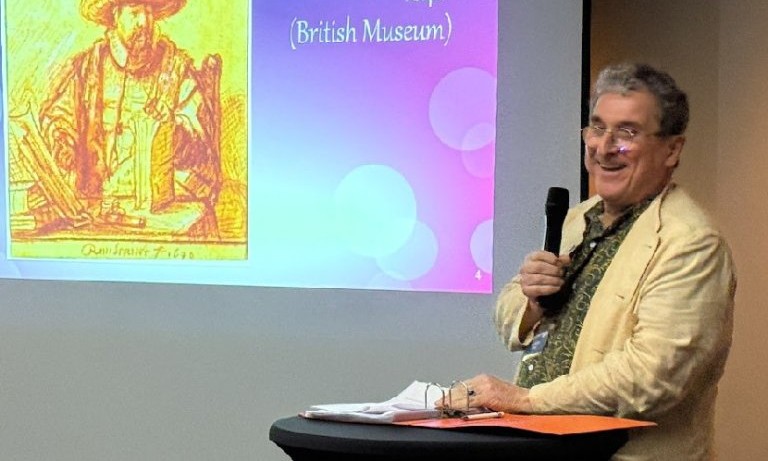
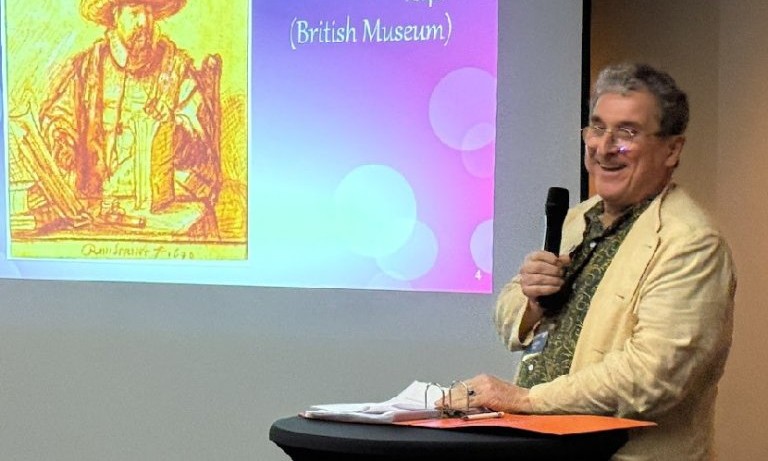
I want this presentation to be more like a kind of « workshop ». Therefore I ask people who “know” not to immediately jump in with their answers to my questions but allow people not yet familiar with this domain to have the opportunity to express themselves and bring up their hypothesis.

In commercial contemporary art, the only science involved is to give up any form of rationality and to flap out any emotion which takes over the artist, often more “down-lifting” than “up-lifting”. But in well composed works of art, based on metaphorical paradoxes, there is a “science of composition”, elevating ideas and emotions, by a combination of invention and the skills of representation.

Very few artists allowed us to enter the back stage of their creative mind. One of them was the great American poet Edgar Allan Poe who, in 1846, in his “Philosophy of Composition” explained the genesis of his famous poem The Raven composed one year earlier.
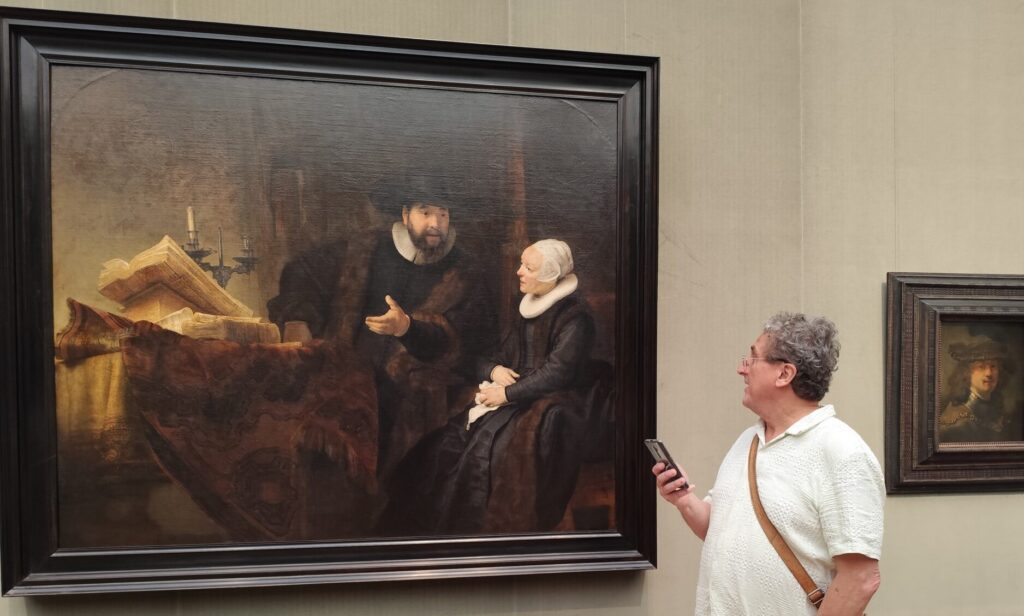
Karel Vereycken commenting the Rembrandt painting to a group of friends during a visit at the Berlin Gemäldegalerie.

Humanity is very lucky to have Rembrandt’s “Cornelis Anslo and his wife”, a the large oil painting on canvas done by Rembrandt in 1641, currently in the Gemäldegalerie of Berlin.

By examining the preparatory drawings and how they were changed during the creation process, we can in part read the footsteps of the creative process and lift a bit the curtain on Rembrandt’s creative genius.

Anslo and the Mennonites
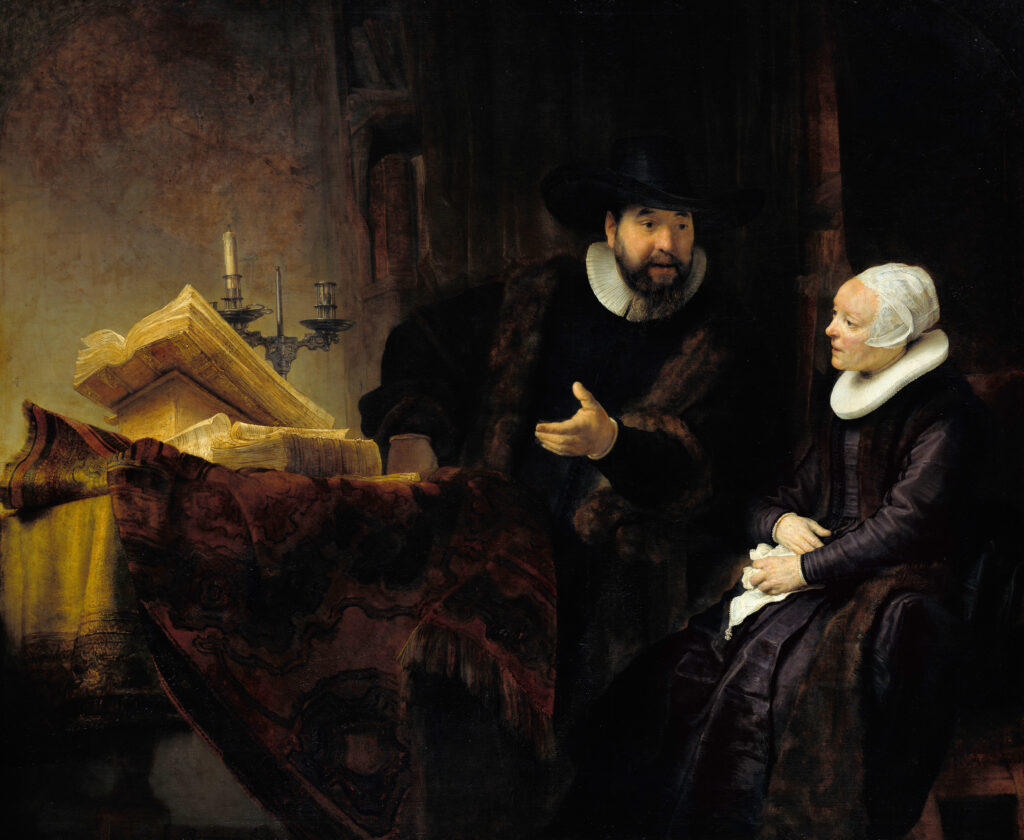
Rembrandt, The Mennonite preacher Cornelis Anslo and his wife, 1641, Gemäldegalerie, Berlin.

On the painting, we see the Mennonite preacher Cornelis Anslo sitting at a table with some large books on his right and seemingly uttering words of consolation to a woman, most probably his wife.1

The composition is highly asymmetrical, quite unusual at that time. The low viewpoint from which the table with the books is seen, determines to a great extent the effect the painting makes. It is as if Anslo delivers a sermon from a pulpit.

The painting is quite large: 1m73 high and 207 cm large. The man with the black hat is Cornelis Claesz Anslo (1592-1646), a rich shipowner and cloth merchant. He was born in Amsterdam as the fourth son of the Norwegian-born Dutch cloth merchant Claes Claesz. « Anslo » (meaning “from Oslo”). Some pretend he has a fur coat because the painting was executed in winter, but the fur here is nothing but a sign of wealth, success and status. Anslo’s brothers were big names of the drapers guild that ran Amsterdam’s cloth industry. They made big money by selling the sort of carpets here on the table.

But Cornelis was also a deeply religious person for which religion means action rather than words alone. After getting married he created an almshouse for destitute old women. Well educated, he became then a preacher at the Grote Spijker, the church of the Waterlanders, the Mennonites of Amsterdam.
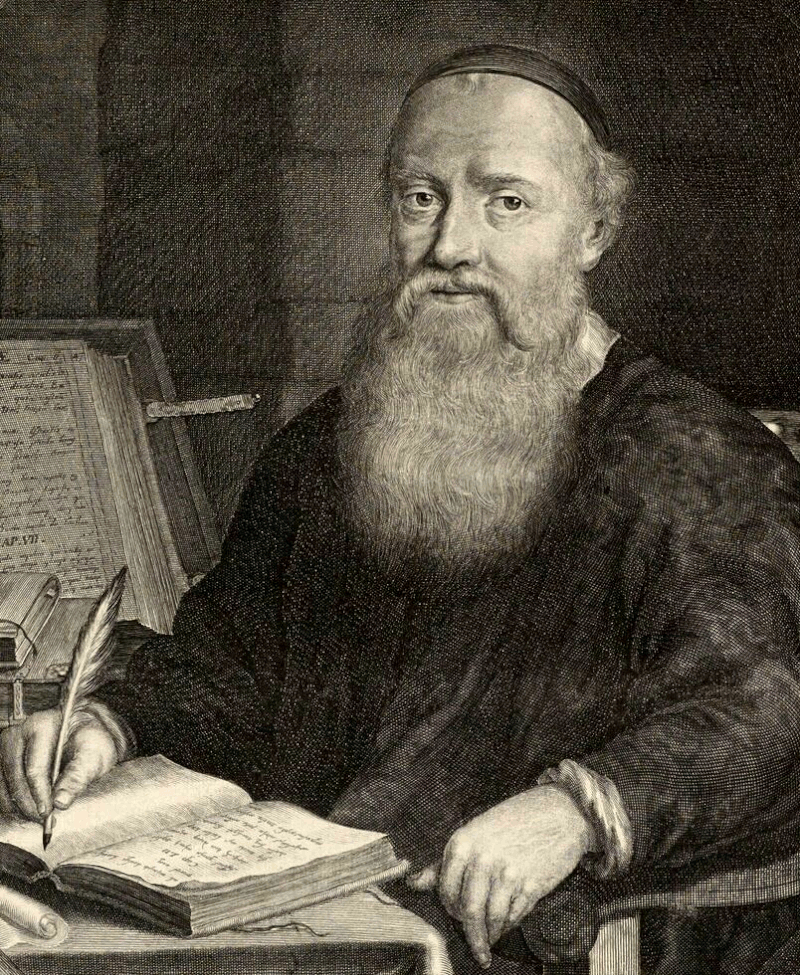
Simon Menno (1496-1561).

The Mennonites were a Dutch religious grouping originally founded by Simon Menno (1496-1561), a priest who left the Catholic faith and added his own branch to the protestant reformation. Some of the Amish people in the US are descendants of the Dutch and Flemish Mennonites.

It would be too long here to go into their history. In short they saw themselves as a gathering of Christians willing to live in the image of God. They didn’t want an official church. They just got together, read the Bible and tried to transform its message in concrete deeds. For example, the Mennonites took the scripture seriously when it said that Jesus told us to“Love our enemies and pray for those who persecute us”. As a result, the Mennonites decided they never would participate in war or go to war. So they were not exactly appreciated by the other religious faiths of that time, most of them engaged in battles. While many of his acquaintances were, Rembrandt never was a formal member of the Mennonites but he clearly identified with some aspects of their peace-loving worldview.2
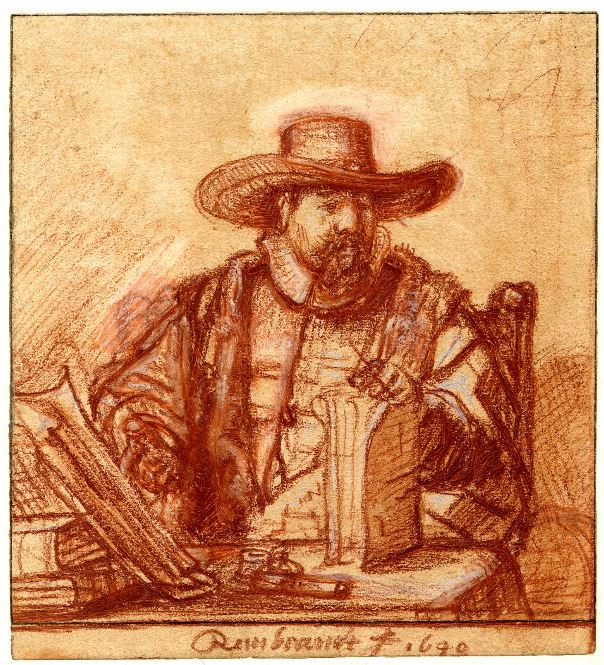
Rembrandt, Anslo, drawing with red chalk, 1640, British Museum.

Getting to work

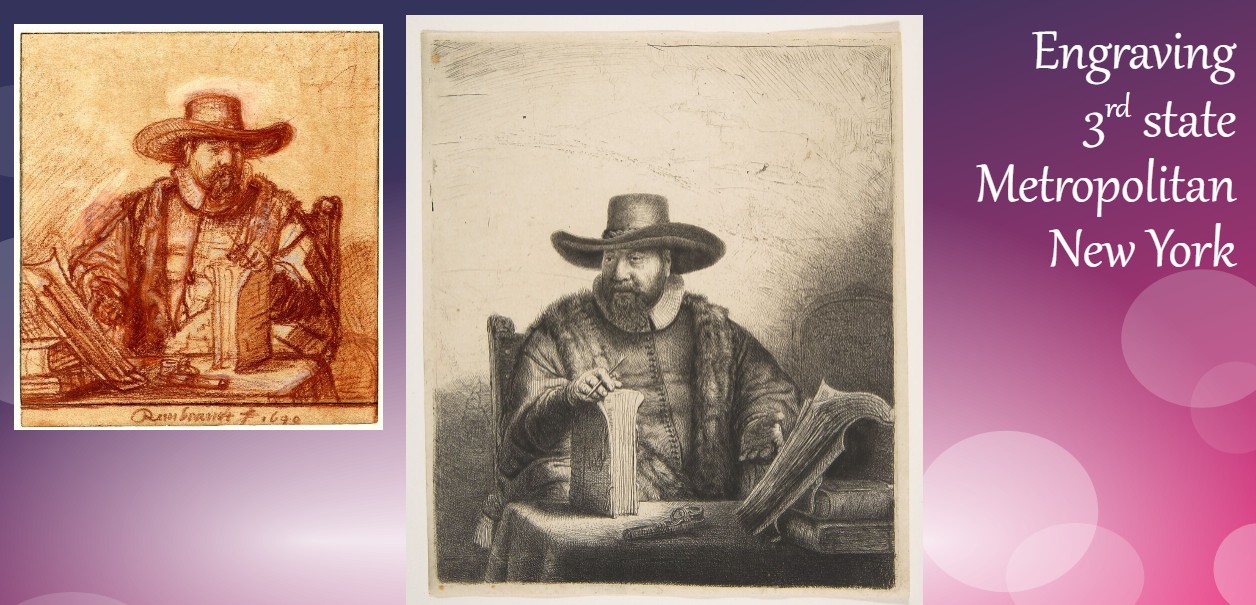
So in 1640-41, Anslo turned to Rembrandt to have his portrait done. The preacher probably asked the painter to do a sketch to get an idea of how the final portrait would look like. In the first drawing with red chalk in the British Museum, one sees the preacher.

QUESTION: What is special about this drawing ?

AUDIENCE: ….

KAREL: he holds his pen in his left hand, because the drawing is done to prepare for an etching. If you copy the image on a copper or zinc plate and then print it, you get a mirror image, which means that in the printed etching, Anslo appears as having a pen in his right hand, since the mirror image inverses the directionality. You have to plan that from the start.

Then we have the etching of 1641 in the Met.
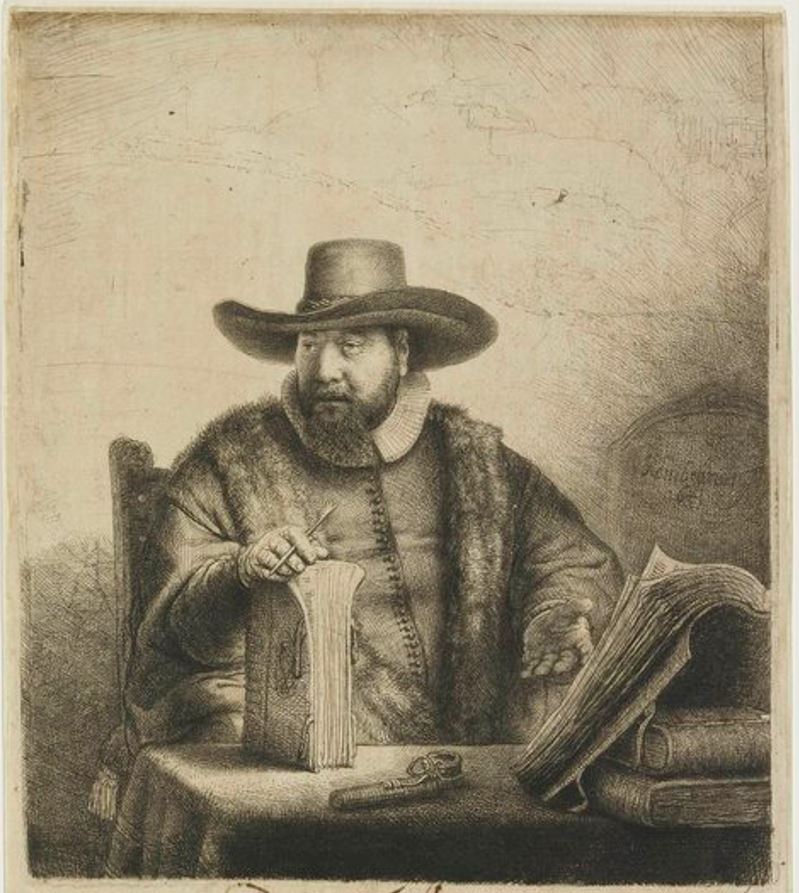
Rembrandt, Anslo, etching, 1641, Metropolitan Museum, New York.

QUESTION: What is special about the etching as compared to the drawing?

AUDIENCE: ….

KAREL: He added empty space. Why?

AUDIENCE: …

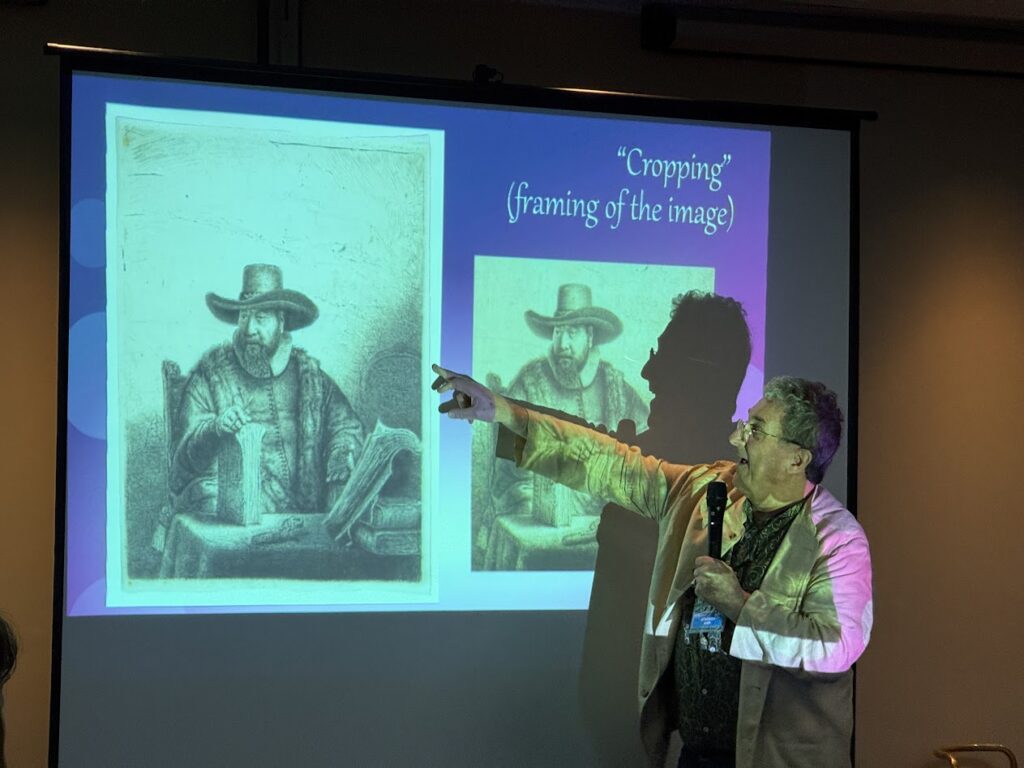
KAREL: In a good art school, you learn how to do “cropping” (re-framing) the image
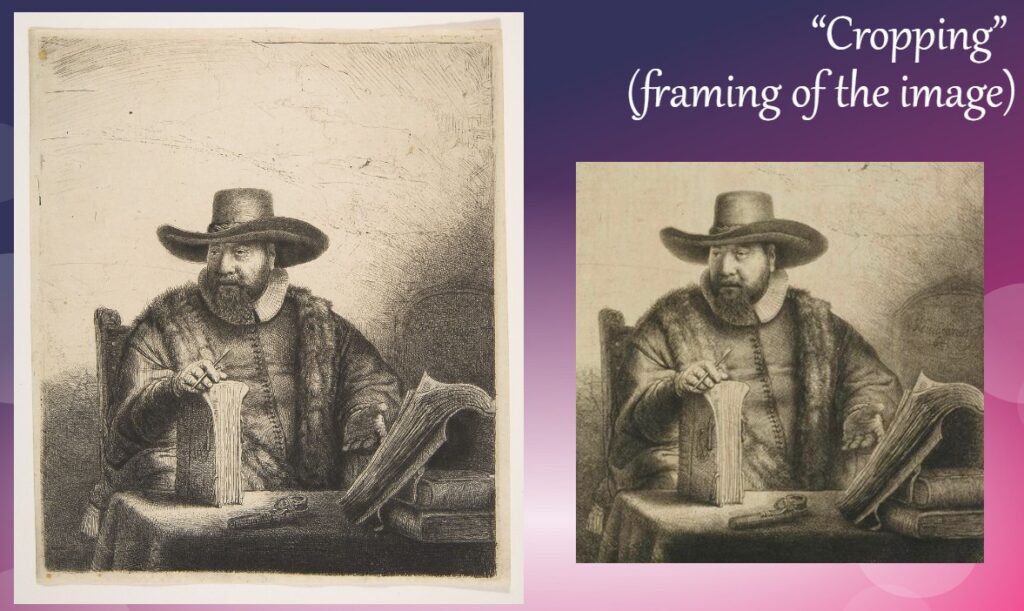
Etching with cropping: left full size; right, cropped.

KAREL: But, wait a minute, was the added space really empty?

AUDIENCE: …

KAREL: In fact, he added two things:

–one, a nail in the wall behind him (very aesthetic!);

–two: a painting put down on the floor with the image turned towards the wall (also very esthetic).

Vondel and Poetry

Strange? Not really. To come to an answer we need to go around it. What is hardly known, is that underneath the printed etching one finds a short poem of Joost van der Vondel, considered the greatest poet of the Dutch language:
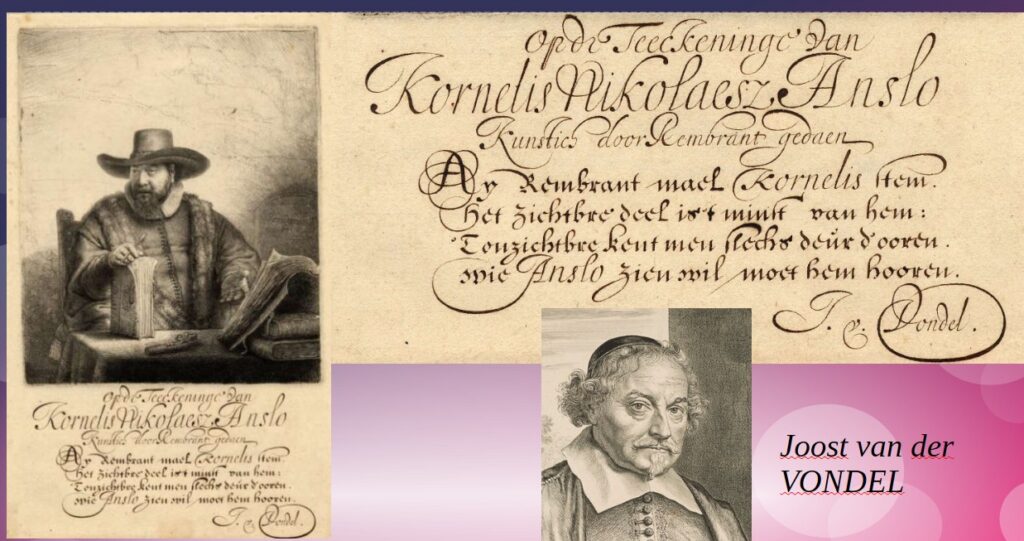
Etching with poem and portrait of Joost van der Vondel.

It reads in Flemish:

Translated to English:

Now, till 1641, Vondel was the dean of the Waterlanders, the Mennonite grouping of Amsterdam of which Anslo was a leading preacher.

In fact the poem mentions a “tekening” (drawing), and the poem can be found already on the back of the initial sketch. It is fair to think that Anslo showed Rembrandt’s preparatory sketch to Vondel, the dean of the congregation. Reacting with his poem, Vondel accomplishes three things:

  1. He restates the “party line”, i.e. the core belief of the Mennonites, namely that the WORD (and even more the VOICE, that is the spoken word) was superior to the image to evangelize humanity. Transforming others with your voice had a higher value then just learning.3
  2. Vondel gently makes it clear that his own art, poetry, is superior to that of Rembrandt, painting…
  3. Vondel says Rembrandt might even do better.

It is clear that Rembrandt felt challenged by the poet remarks. The etching might be a first answer of the painter since it tries to state that point with the nail showing the image taken down and placed with its front side against the wall.

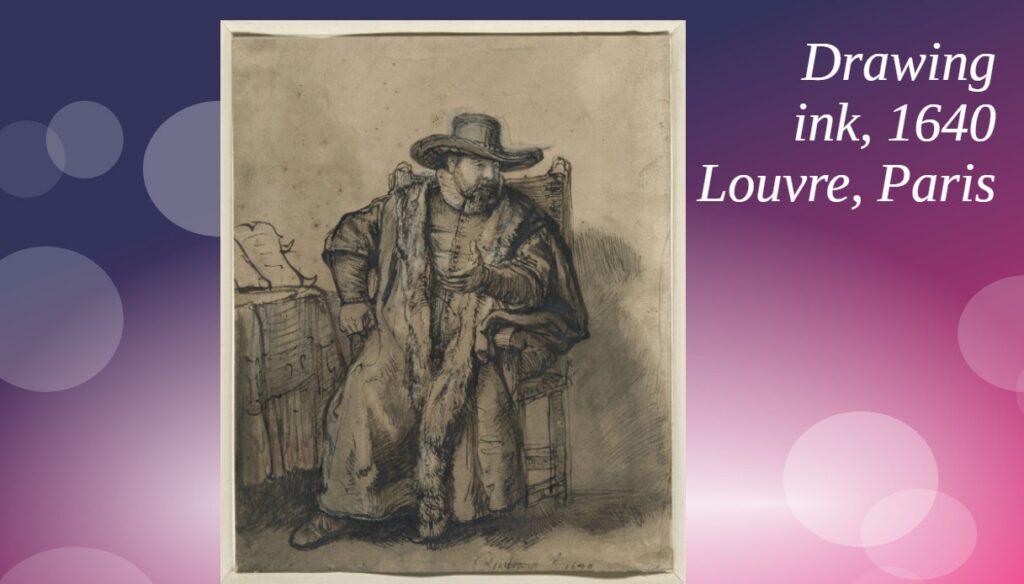
But to prepare the painting, Rembrandt, did a new sketch, now in the Louvre.
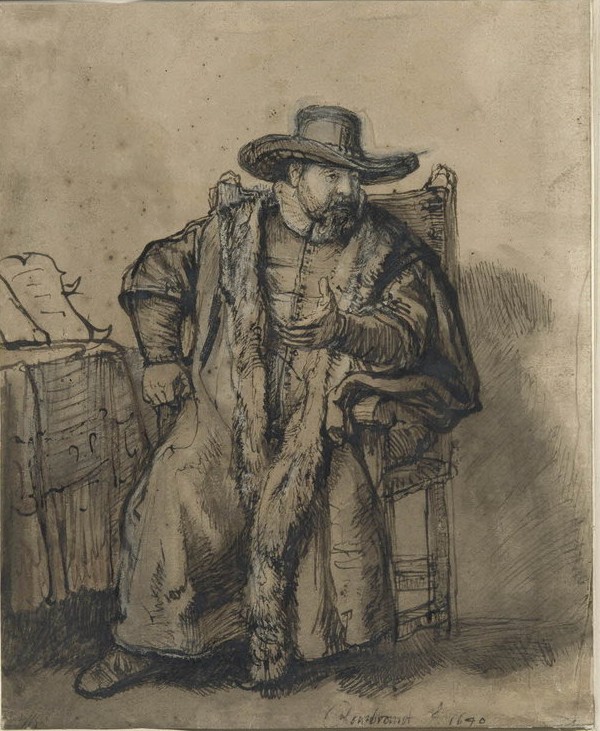
Rembrandt, Anslo, ink drawing, Louvre, Paris.

The image of the etching with the nail was certainly understood by the Mennonites of the Grote Spijker (meaning in Dutch both the « big storehouse », the nickname given to their temple, and the « big nail »…), but insufficient to reach out to a larger public like over time.

Painting the invisible

Something else had to be invented visually to present on a higher level the same argument and overcome the challenge of “painting the invisible”.
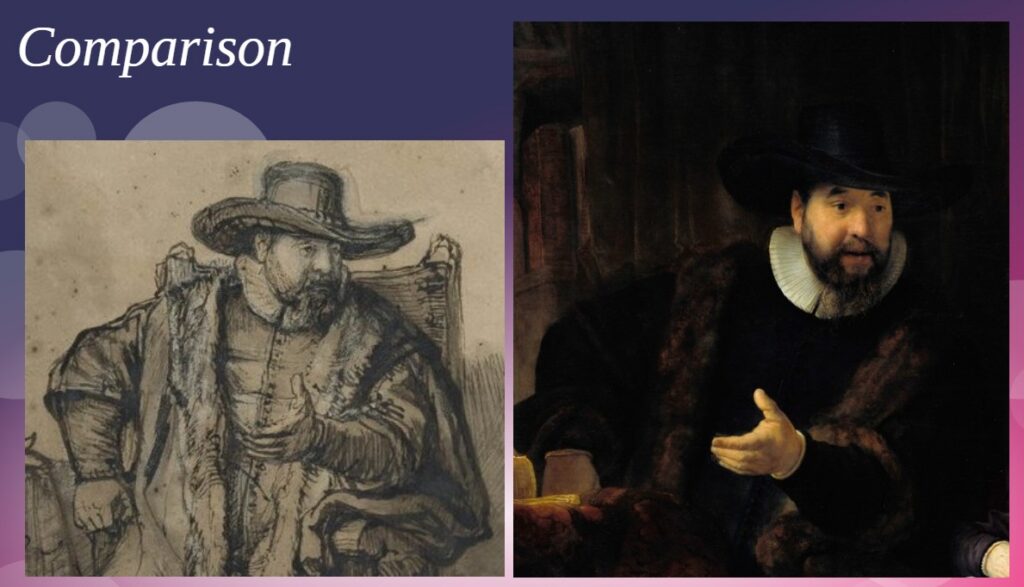
Comparison between sketch in the Louvre and final painting.

Already in the Louvre drawing, Anslo’s hand is moving to the left, or rather his head is moving to the right, leaning towards the person to which he is speaking. But in the drawing if he is not yet speaking, but “at the point” of speaking, that is a position of mid-motion-change as discussed by Lyndon LaRouche. The speaking will be absolutely manifest in the final painting. Anslo’s mouth is open and his eyebrows are raised.
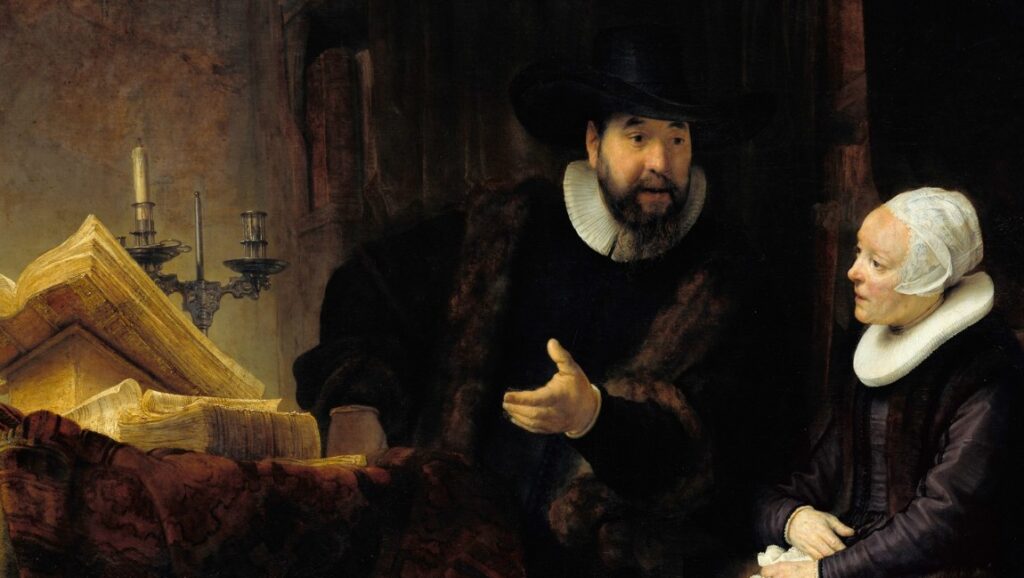
Anslo, final painting, detail.

Going beyond the portrait of Anslo per se, Rembrandt invents something totally new: he adds a person listening with great attention. So, in order to paint the “voice” (sound), he paints another invisible phenomenon, this one being the opposite of sound, namely silence. A voice resonating without somebody listening is as dead as the word in a book.

With this, Rembrandt overcomes the Vondel paradox and states the superiority of his own art, painting, and the fact that through, and by the image, the apparent opposites of sound and silence, can be overcome and make visible the word of God, acting through the voice of Anslo and the listening of his wife.

Now, the heavenly light of God arrives in the room, and extinguishes the earthly light of the candles to make place for the heavenly.

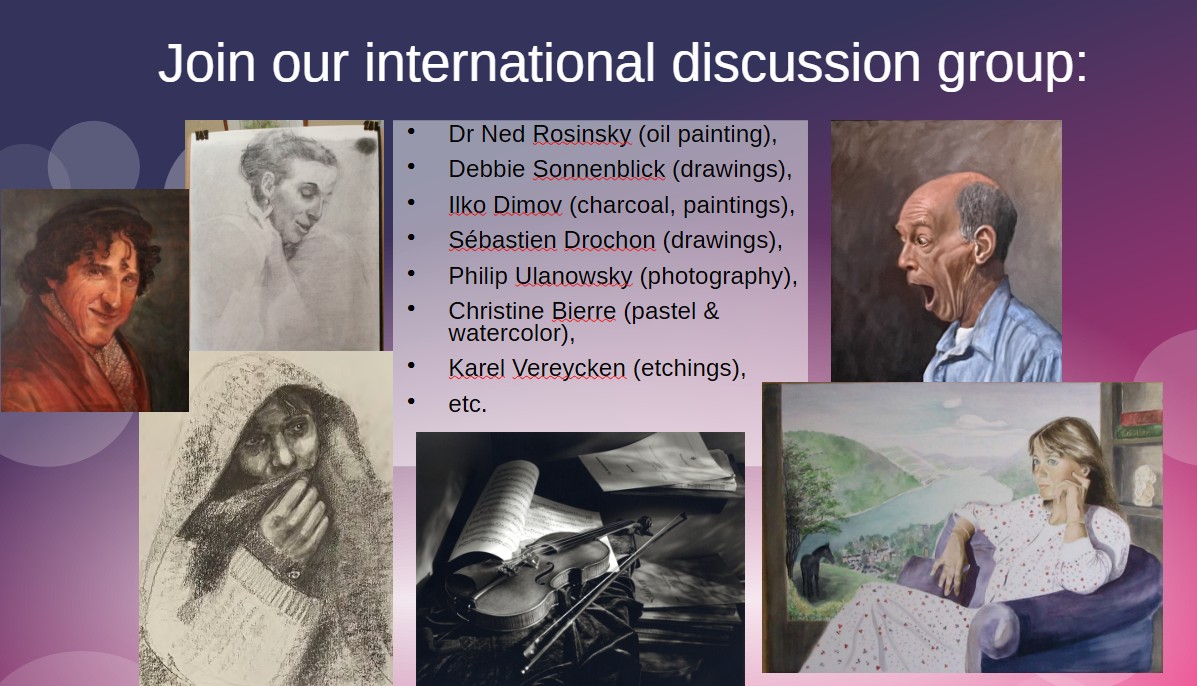
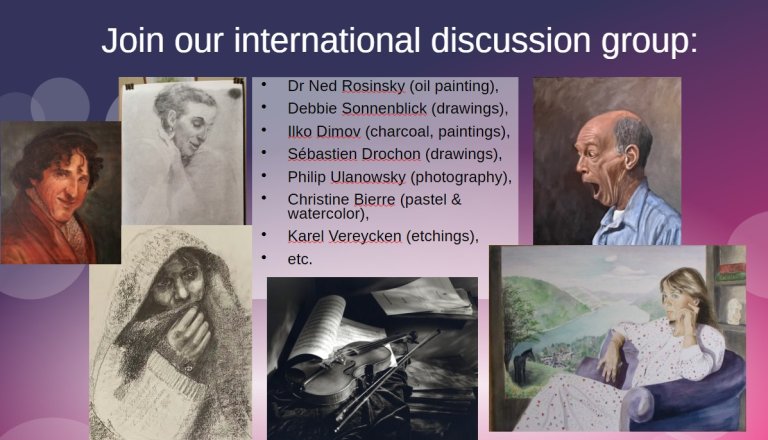
To conclude, if you want to continue this type of discussion, I invite all of you all join the international working group on art among practicing artists, initiated by Dr Ned Rosinsky. So far, it mainly includes Debbie Sonnenblick, Ilko Dimov, Dean Clark, eventually Sébastien Drochon, Agnès Farkas and Remi Lebrun, Philip Ulanowsky, Christine Bierre and myself. You see some works here (shows folder). Please get in touch with me for that.

Thanks,

SUMMARY BIOGRAPHY:

  • Corpus of Rembrandt Paintings, database
    https://rembrandtdatabase.org/literature/corpus.html
  • Filippi, Elena, Weisheit zwischen Bild und Word in Fall Rembrandt, Coincidentia, Band 2/1, 2011;
  • Haak, Bob, Rembrandt, Rembrandt: his life, work and times, Thames & Hudson, 1969;
  • Kauffman, Ivan J. , Seeing the Light, Essays on Rembrandt’s religious images, Academia.edu, 2015;
  • Schama, Simon, Rembrandt’s Eyes, Alfred A. Knopf, 1999;
  • Schwartz, Gary, Rembrandt, Flammarion, Mercatorfonds, 2006;
  • Tümpel, Christian, Rembrandt, Albin Michel, Mercatorfonds, 1986;
  • Vereycken, Karel, Rembrandt the nationbuilder, Nouvelle Solidarité, 1985;
  • Vereycken, Karel, Rembrandt and the Light of Agapè, Artkarel.com, 2001;
  • Wright, Christopher, Rembrandt, Citadelles & Mazenot, 2000.
  1. Experts have often disagreed about the identity of the woman. Is it his mother, his wife, or a servant of the almshouse founded by Anslo. In 1767, Camelis van der Vliet, the governor of the almshouse, reported about a passage of the archives showing that Anslo preached the gospel not only in public but also “to’zijn vrouw en kinderen; gelijk hij ook dus wonderbaarlijk fraai verbeeld word in voorgemelde schilderij, sprekende tegen zijn vrouw over den bijbel, welke op een tafel bij zig open legt, en waama zijn vrouw, op eene onnavolgelijke wijze konstig verbeeld word aandagtig en ingespannen te horen’” (He preached “to his wife and children; just as he is most wonderfully portrayed in the aforementioned painting, speaking to his wife about the bible which lies open before him, to which his wife, depicted in an inimitably artful fashion, listens with devout attention”). Furthermore this woman is not dressed like a destitute inhabitant of an almshouse, but wholly inline with her position as the wife of a wealthy merchant. The painting, done for Anslo’s private house, only became property of the almshouse many years after his lifetime. ↩︎
  2. In 1686, the Italian art critic Filippo Baldinucci stated that “The artist professed in those days the religion of the Menists (Mennonites).” Recent research proves that Rembrandt had close ties with Amsterdam’s Waterlander Mennonite Community, particularly through Hendrick Uylenburgh, a Mennonite art dealer who ran an artists’ studio in which Rembrandt worked from 1631 to 1635. Rembrandt became chief painter of the studio and in 1634 married Van Uylenburgh’s first cousin Saskia van Uylenburgh, who wasn’t a Mennonite. ↩︎
  3. The conflict between VOICE, WORD and IMAGE, had sparked in 1625 had a violent dispute among the Amsterdam Waterlanders with a one faction saying that the written word “was dead” and that what was important, was the living word, that is Jesus, who was alive as the “inner word” of Christians. Anslo intervened by publishing an anonymous pamphlet aimed to prevent a schism. ↩︎
Merci de partager !

Rembrandt, la science de « peindre l’invisible »
article in EN online on this website
article in RU at the bottom of this page

Je souhaite que cette présentation prenne la forme d’un atelier. C’est pourquoi je demande à ceux qui « savent déjà » ne pas répondre immédiatement à mes questions, mais de laisser la parole à ceux qui ne sont pas encore familiarisés avec ce domaine afin qu’ils puissent s’exprimer et formuler leurs hypothèses.

Dans l’art contemporain commercial, la seule science dont il est question consiste à renoncer à toute forme de rationalité et à laisser libre cours à une émotion quelconque qui s’empare de l’artiste, souvent plus dégradante qu’élévatrice. Cependant, dans les œuvres fondées sur des paradoxes métaphoriques, il existe une véritable « science de la composition », qui élève les idées et les émotions en mobilisant une combinaison de l’invention et de la maîtrise de la représentation.

Peu d’artistes nous ont permis de pénétrer dans les coulisses de leur processus créatif. L’un d’eux fut le grand poète américain Edgar Allan Poe qui, en 1846, dans sa Philosophie de la composition, expliqua la genèse de son célèbre poème Le Corbeau, composé un an auparavant.
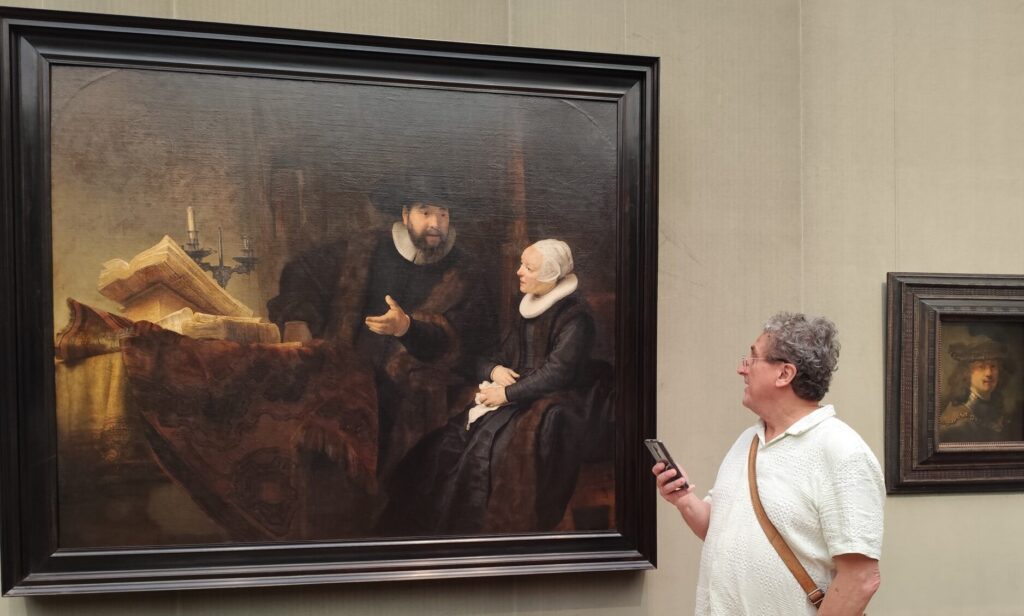
Karel Vereycken devant le tableau de Rembrandt à Berlin.

L’humanité a la chance de pouvoir admirer « Cornelis Anslo et sa femme » de Rembrandt, une grande peinture à l’huile sur toile réalisée en 1641 et conservée à la Gemäldegalerie de Berlin. L’étude des dessins préparatoires et de leurs modifications au cours du processus de création nous permet de lever en partie le voile sur les étapes de ce processus et d’entrevoir le génie créatif de Rembrandt.

Anslo et les mennonites

Rembrandt, Le prédicateur mennonite Cornelis Anslo et sa femme, 1641, Gemäldegalerie, Berlin. (Domaine public, Creative Commons).

Sur le tableau, on voit le prédicateur mennonite Cornelis Anslo assis à une table couverte de gros livres, s’adressant à une femme, très probablement son épouse.1

La composition est très asymétrique, ce qui était assez inhabituel pour l’époque. Le point de vue en contre-plongée, d’où l’on observe la table avec les livres, détermine en grande partie l’effet produit par le tableau. L’impression prévaut qu’Anslo, inspiré des saintes écritures, prononce un sermon du haut d’une chaire.

Le tableau est assez grand : 1,73 m de haut sur 2,07 m de large. L’homme au chapeau noir est Cornelis Claesz Anslo (1592-1646), un riche armateur et marchand de tissus. Il est né à Amsterdam, quatrième fils du marchand de tissus néerlandais d’origine norvégienne Claes Claeszoon Anslo. Anslo signifie « d’Oslo ». Certains prétendent qu’il porte un manteau de fourrure car le tableau a été réalisé en hiver, mais la fourrure ici n’est autre qu’un signe de richesse, de réussite et de statut social. Les frères d’Anslo étaient des figures majeures de la guilde des drapiers qui contrôlait l’industrie textile d’Amsterdam. Ils ont fait fortune en vendant des tapis comme celui-ci, posé sur la table.

Mais Cornelis était aussi un homme profondément religieux, pour qui la religion se traduisait par des actes et non par de simples paroles. Après son mariage, il fonda un hospice pour femmes âgées démunies. Instruit, il devint ensuite prédicateur à la Grote Spijker, l’église des Waterlanders, les mennonites d’Amsterdam.

Les mennonites étaient un groupe religieux néerlandais fondé à l’origine par Simon Menno (1496-1561), un prêtre qui quitta l’Église catholique pour créer sa propre branche au sein de la Réforme protestante. Certains Amish, aux États-Unis, descendent des mennonites néerlandais et flamands.

Il serait trop fastidieux de retracer leur histoire ici. En bref, ils se considéraient comme une communauté de chrétiens désireux de vivre à l’image de Dieu. Ils ne souhaitaient pas d’Église officielle. Ils se réunissaient simplement, lisaient la Bible et s’efforçaient de traduire son message en actes concrets. Par exemple, ils prenaient très au sérieux le passage des Écritures où Jésus nous invite à « aimer nos ennemis et à prier pour ceux qui nous persécutent ». De ce fait, les mennonites décidèrent de ne jamais faire la guerre à quiconque ni d’y prendre part. Ils n’étaient donc pas vraiment appréciés des autres confessions religieuses de l’époque, souvent engagées dans divers conflits armés. Contrairement à bon nombre de ses connaissances, Rembrandt n’a jamais été officiellement membre des mennonites. Il partageait néanmoins certains aspects de leur vision pacifique du monde.2

Rembrandt, Anslo, dessin à la sanguine, 1640, British Museum. Le flou du dessin est sans doute le résultat du fait qu’il a servi à décalquer l’image sur la plaque de cuivre pour élaborer la gravure.
(Crédit: domaine public, British Museum.)

En 1640-1641, Anslo fit appel à Rembrandt pour son portrait. Le prédicateur demanda probablement au peintre de réaliser une esquisse afin de se faire une idée du résultat final. Le prédicateur apparaît sur le premier dessin à la sanguine conservé au British Museum.

QUESTION : Qu’y a-t-il de particulier dans ce dessin ?

PUBLIC : ….

KAREL : Alors qu’il était droitier, il tient sa plume de la main gauche, car le dessin est préparatoire à une gravure. Si l’on transfère l’image telle quelle sur une plaque de cuivre ou de zinc, puis qu’on l’imprime, on obtient une image en miroir. Ainsi, dans la gravure imprimée, Anslo apparaîtra avec une plume dans la main droite, puisque l’effet miroir inverse le sens de l’image. Il faut le prévoir dès le départ.

Nous avons ensuite la gravure de 1641, au Metropolitan Museum de New York.
QUESTION : Qu’est-ce qui différencie l’eau-forte du dessin ?

PUBLIC : ….

KAREL : Il a ajouté de l’espace vide. Pourquoi ?

PUBLIC : …

KAREL : Dans une bonne école d’art, on apprend à recadrer l’image.

Comparaison de la gravure avec recadrage :
à gauche, format intégral ; à droite, recadrée Metropolitan Museum, New York.
L’orateur pointant vers le clou dans le mur derrière le prédicateur.

KAREL : Mais attendez une minute, cet espace supplémentaire est-il vraiment vide ?

PUBLIC : …

KAREL : En fait, il a ajouté deux choses :

  1. un clou dans le mur derrière lui (très esthétique !)
  2. un tableau posé au sol, l’image tournée vers le mur (également très esthétique).

Étrange ? Pas tant que ça, puisque la congrégation s’appelait De grote spijker (« Le grand clou », clou signifiant également le « grand magasin » ou la « grange » leur servant de temple).

Vondel et la poésie

Pas vraiment. Pour trouver une réponse, il faut faire un petit détour. Ce que l’on sait peu, c’est qu’en dessous des tirages de la gravure apparaît souvent, ajouté à la main, un court poème de Joost van der Vondel, considéré comme le plus grand poète de langue néerlandaise :

Gravure avec poème.

On peut y lire en néerlandais/flamand :

Traduction française :

ou, la version rimée que m’a offerte mon amie russe:

Jusqu’en 1641, Vondel fut le doyen des Waterlanders, le groupe mennonite d’Amsterdam dont Anslo était un prédicateur de premier plan.

Son poème mentionne un « tekening » (dessin) et, en effet, on peut déjà trouver le poème au verso de l’esquisse initiale. On peut penser qu’Anslo a montré, pour avis, l’esquisse préparatoire de Rembrandt à Vondel, le doyen de sa congrégation.

En réagissant par son poème, Vondel met en lumière trois points :

  1. Il affirme haut et fort la position officielle de la congrégation des mennonites, à savoir que la parole (et plus encore la voix, c’est-à-dire la parole prononcée) est supérieure à l’image pour évangéliser l’humanité. Transformer les autres par sa voix a plus de valeur que le simple apprentissage, et enfin, que pour connaître il faut enseigner.3
  2. Vondel fait subtilement comprendre que son propre art, la poésie, est supérieur à celui de Rembrandt, la peinture…
  3. Il dit que Rembrandt pourrait même faire mieux.

Il est clair que Rembrandt s’est senti interpellé par les remarques plutôt amicales du poète. La gravure pourrait constituer une première réponse du peintre, puisqu’elle souligne l’importance de la parole par cette idée du clou, symbolisant l’image décrochée et placée face contre le mur.

Mais pour préparer le grand tableau à l’huile, Rembrandt réalisa une nouvelle esquisse, aujourd’hui conservée au Louvre.
Dessin préparatoire du Louvre. Musée du Louvre, Paris.

L’iconographie de la gravure était certainement comprise des mennonites, mais cela ne suffisait pas à toucher un public plus large au fil du temps. Il fallait donc inventer autre chose, visuellement parlant, pour présenter à un niveau supérieur le même argument et surmonter le défi de « peindre l’invisible ».

Comparaison du dessin avec le tableau final.

Déjà dans le dessin du Louvre, la main d’Anslo se déplace vers la gauche, ou plutôt sa tête vers la droite, donnant l’impression que le prédicateur se penche vers son interlocuteur. Dans ce deuxième dessin, si Anslo ne parle pas encore, bien qu’il soit « sur le point » de parler, il se trouve dans une position instable, disons de transition, entre deux mouvements, c’est-à-dire en « point de changement de mouvement » (mid-motion-change, comme l’a formulé Lyndon LaRouche).

La parole sera pleinement manifeste dans le tableau final : la bouche d’Anslo est ouverte et ses sourcils sont levés.

Détail de la peinture finale.

Mais au-delà du simple portrait d’Anslo, Rembrandt ajoute un élément totalement inédit : une personne qui écoute avec une attention extrême.

Ainsi, pour peindre la « voix » (le son), il peint un autre phénomène invisible, son contraire : le silence. Une voix qui résonne sans auditeur est aussi morte qu’un mot dans un livre.

Par là, Rembrandt surmonte le paradoxe de Vondel et affirme la supériorité de son art, la peinture, et le fait que, par l’image, les apparents opposés du son et du silence peuvent être dépassés et rendre visible la parole de Dieu, agissant à travers la voix d’Anslo et surtout l’écoute de sa femme.

Alors, la lumière céleste de Dieu pénètre dans la pièce et éteint la lumière terrestre des bougies pour faire place à la lumière céleste.

Pour conclure, si vous souhaitez poursuivre ce type de discussion, je vous invite à rejoindre le groupe de travail international sur l’art, parmi les artistes amateurs de notre mouvement. Ce groupe fut lancé par le Dr Ned Rosinsky. À ce jour, il comprend principalement son initiateur, Debbie Sonnenblick, Ilko Dimov, peut-être Sébastien Drochon, Philip Ulanowsky, Christine Bierre et moi-même. Vous pouvez voir quelques-unes de leurs œuvres ici. N’hésitez pas à me contacter à ce sujet.

Merci

BIOGRAPHIE SOMMAIRE :

  • Corpus des peintures de Rembrandt, base de données
    https://rembrandtdatabase.org/literature/corpus.html
  • Filippi, Elena, Weisheit zwischen Bild und Word in Fall Rembrandt, Coincidentia, groupe 2/1, 2011
  • Haak, Bob, Rembrandt : sa vie, son œuvre et son époque, Thames & Hudson, 1969
  • Kauffman, Ivan J., Voir la lumière, Essais sur les images religieuses de Rembrandt, Academia.edu, 2015
  • Schama, Simon, Les yeux de Rembrandt, Alfred A. Knopf, 1999
  • Schwartz, Gary, Rembrandt, Flammarion, Mercatorfonds, 2006
  • Tümpel, Christian, Rembrandt, Albin Michel, Mercatorfonds, 1986
  • Vereycken, Karel, Rembrandt, bâtisseur de nation, Nouvelle Solidarité, 1985
  • Vereycken, Karel, Rembrandt et la lumière d’Agapè, Artkarel.com, 2001
  • Wright, Christopher, Rembrandt, Citadelles et Mazenot, 2000.

  1. Les experts ont souvent divergé quant à l’identité de la femme. S’agit-il de sa mère, de son épouse ou d’une servante de l’hospice fondé par Anslo ? En 1767, Camelis van der Vliet, la gouvernante de l’hospice, rapporta un passage des archives indiquant qu’Anslo prêchait l’Évangile non seulement en public mais aussi « à sa femme et à ses enfants ; tout comme il est merveilleusement représenté dans le tableau susmentionné, parlant à sa femme de la Bible qui est ouverte devant lui, et que sa femme, représentée d’une manière inimitable et artistique, écoute avec une attention dévote ». A cela s’ajoute que la femme n’est pas vêtue comme une indigente pensionnaire d’un hospice, mais conformément à son statut d’épouse d’un riche marchand. Ce n’est que bien plus tard que le tableau, réalisé pour la demeure privée d’Anslo, deviendra propriété de l’hospice. ↩︎
  2. En 1686, le critique d’art italien Filippo Baldinucci déclara que « l’artiste professait à cette époque la religion des ménistes (mennonites) ». Des recherches récentes confirment que Rembrandt avait des liens étroits avec la communauté mennonite Waterlander d’Amsterdam, notamment par l’intermédiaire d’Hendrick Uylenburgh, un marchand d’art mennonite qui dirigeait un atelier d’artistes où Rembrandt travailla de 1631 à 1635. Rembrandt devint le peintre en chef de l’atelier et épousa en 1634 la cousine germaine de Van Uylenburgh, Saskia van Uylenburgh, qui n’était pas mennonite. ↩︎
  3. Le débat sur le rôle exact de la voix, de la parole et de l’image pour les prêcheurs, dégénéra en 1625 en une violente dispute entre les membres de la communauté des Waterlanders d’Amsterdam et d’ailleurs. Une faction affirmait que la parole écrite n’était qu’une voix « morte » et que seul importait la parole vivante, c’est-à-dire Jésus, qui était vivant en chacun en tant que « parole intérieure » des chrétiens. En publiant un pamphlet anonyme, Anslo a pu calmer le débat et réconcilier les croyants, évitant ainsi un schisme. ↩︎
Merci de partager !

With Hieronymus Bosch, On the Track of the Sublime

By Karel Vereycken, 2002.

Merci de partager !

Hoe Erasmus’ zotheid onze beschaving redde

door Karel Vereycken, 2004

Merci de partager !

The Egg Without A Shadow of Piero della Francesca

by Karel Vereycken, 2000.

Merci de partager !

Zheng He and the Chinese Maritime Expeditions

Cet article en FR

By Karel Vereycken

By the Han period (1st to 3rd century CE), China was already familiar with naval techniques, including a primitive form of compass and the famous junks capable of reaching the coasts of Africa.

Zheng He
15th century porcelain and celadon from Hormuz. Credit: Williamson Collection. Durham University (UK) © Ran Zhang

An activity, undoubtedly carried out by Chinese, Indian and Arab navigators, which developed, notably from the great Indian port of Calicut, over a thousand-year period, in particular under the Tang (618-907) and the Song (960-1279).

« The annual import into China of ivory, rhinoceros horn, pearls, incense and other products found specifically along the coasts of Yemen and East Africa, amounted (around 1053) to 53,000 units of account, » according to the chroniclers of the dynasty of the time.

Two gold bracelets, from the tomb of Wei Fei (1413-1451), the wife of Prince Ming Liang Zhuang.

In exchange for imperial silk, ceramics and porcelain, Chinese sailors also bought large quantities of pearls and precious objects. Many Song and Tang Chinese coins have been found, as well as porcelain, in the coastal regions of Somalia, Kenya and Tanganyika as well as the island of Zanzibar.

The XVth Century

Zhu Di, Emperor Ming Yongle.

However, the expeditions of Admiral Zheng He (1371-1433) under the Ming dynasty, at the beginning of the XVth century, are something exceptional because they were strongly oriented towards scientific exchanges.

Zheng was born a Muslim. Grandson of the governor of Yunnan Province, he became a eunuch at the court of Zhu Di, the future Yongle Emperor (1402-1424).

The latter made history by launching a series of (very) major works:

  • It reinvigorates the Silk Roads;
  • He restored the astronomical observatory to its former functions;
  • He moved the Chinese capital from Nanking to Beijing;
  • In the heart of the capital, he had the Forbidden City built by 1 million workers and craftsmen;
  • It modernizes the Grand Canal to guarantee the food security of the capital;
  • He expanded the system of imperial examinations for the selection of scholars;
  • He had 2,180 scholars write the largest encyclopedia ever written, comprising more than 11,000 volumes;
  • He appointed Admiral Zheng He as commander-in-chief of a high seas fleet tasked with publicizing and recognizing the achievements of China and its Emperor throughout the world.
Map of Admiral Zheng He’s expeditions during the Ming Dynasty.

Thus, between 1405 and 1433, Admiral Zheng will lead seven expeditions which will land in almost all the countries, ports and sites that count in the Indian Ocean:

  • Vietnam: the kingdom of Champa, city of Cochinchina;
  • Indonesia: the island of Java and Sumatra, Aru Islands, city of Palembang;
  • Thailand: Siam;
  • Malaysia: port of Malacca, islands of Pahang and state of Kelantan (Malaysia);
  • Sri Lanka: the island of Ceylon;
  • India: Kozhikode (or Calicut), capital of the state of Kerala in India;
  • The Maldives Islands;
  • Iran: Hormuz Island in the Persian Gulf
  • Yemen: Aden;
  • Somalia: Mogadishu;
  • Kenya: Kingdom of Malindi (Melinde);
  • Sultanate of Oman: Muscat and Dhofar;
  • Saudi Arabia: Jeddah and Mecca.
Two ship models: in the background, a Chinese « treasure ship » from 1405; in front, one of the caravels used by Christopher Columbus in 1492.

The Science of Navigation

Admiral Zheng He.

His fleet, during the first expedition between 1405 and 1407, had no fewer than 27,800 men on board 317 vessels, including 62 « treasure ships », XXL ships capable of carrying 500 people.

The largest junk is 122 metres long and 52 metres wide, it has nine masts and 3000 tonnes, while Christopher Columbus’ caravels of 1492 are only 25 metres long and 5 metres wide, its sails hoisted on only two masts and carrying only 450 tonnes!

Imitating the partitioned stems of bamboo, these ships are composed of watertight compartments which make them less vulnerable to shipwrecks and fires. The ancestral technique of watertight compartments, taken up by Western shipbuilding in the 19th century, was registered in November 2010 by UNESCO as an intangible cultural heritage of humanity.

Historians note that in Europe, shipbuilding drew its inspiration from the swimming of fish. Throughout history, our ships have sought to cut through the waves and the bow remains one of the fundamental points of our shipbuilding.

Chinese ships (junks) are designed according to the shape of a duck.

However, the Chinese note that the fish that swims underwater cannot be an example for evolving on the water. Their reference animal is the duck. No bow when it is enough to fly over the surface. The junk was therefore designed according to the shape of this sea bird. From this one, it takes its elongation, its very low draft on the front of the hull and its great width.

According to some historians, on February 2, 1421, the Yongle Emperor gathered 28 leaders and dignitaries from Asia, Arabia, the Indian Ocean and Africa.

This summit, according to Serge Michel and Michel Beuret, was

In France, in 1431, Joan of Arc was burned at the stake in Rouen…

A civilizational chasm

A page from the 11,000-volume Yongle Encyclopedia.

At the end of the 14th century, a gulf separated the level of development of China from that of a Europe ruined by the Hundred Years’ War, an unprecedented financial crash, famine and the Black Death.

For example, the library of the English king Henry V (1387-1422) consisted of only six manuscript volumes, three of which were loaned by a convent. The Vatican, for its part, possessed only about a hundred books before 1417.

While for the inauguration of the Forbidden City in Beijing in 1421, some 26,000 guests feasted on a banquet consisting of ten courses served on plates of the finest porcelain, in Europe, a few weeks later, at the wedding of Henry V to Catherine of Valois, it was salted cod on slices of stale bread that was served to the six hundred guests!

While the Chinese army could field a million men armed with firearms, the same Henry V of England, when he went to war against France the same year, had barely 5,000 fighters armed with bows, swords and pikes. And the English monarch, lacking a powerful navy, was forced to use fishing boats to cross the Channel…

Diplomacy and Prestige

Gold bar found in the tomb of Ming prince Liang Zhuang (1411-1441), with the inscription: « …April day of the 17th year of the reign of Yongle, purchased in the Western Oceans », « Western Oceans » being an ancient Chinese term for the Persian Gulf.

Contrary to what has been said, the Ming dynasty was not concerned with seeking new trade routes, systematically supplying itself with slaves or finding land to colonize.

The sea routes used by Zheng’s fleet were already known and had been frequented by Arab merchants since the 7th century.

That this was a demonstration of Chinese prestige is demonstrated by the fact that in 1407 Zheng founded a language school in Nanking.

Sixteen translators would travel with the Chinese fleets, allowing the admiral to converse, from India to Africa, in Arabic, Persian, or even in Swahili, Hindi, Tamil and other languages.

Since religious freedom was one of the Emperor’s great virtues, Muslim, Hindu and Buddhist scholars were included in the journey.

Equally remarkable was the presence of scientists on ships so large that they allowed scientific experiments to be conducted there.

The metallurgists who had embarked for the occasion prospected in the countries where the fleet stopped. The doctors could collect plants, remedies and treatments for diseases and epidemics.

Botanists tried to acclimatize useful plants or food crops. The ships also brought seeds that the Chinese hoped to cultivate abroad.

A giraffe brought back by Admiral Zheng He, painted by Shen Du, a Ming court painter.

It was during these expeditions that China established diplomatic relations with around thirty countries. The story of these exchanges has come down to us thanks to the remarkable work of his traveling companion Ma Huan.

Also a Muslim, his writings are available in a book entitled Ying-yai Sheng-lan ( The Wonders of the Oceans ).

During their last voyage, the two friends were granted the right to go as far as Mecca with a view to establishing commercial exchanges.

On his fourth expedition, National Geographic claims, Zheng met with representatives of the Sultanate of Malindi (present-day Kenya), with whom China had established diplomatic relations in 1414.

As tribute, African dignitaries offered Zheng He zebras and a giraffe, an animal the Romans called the cameleopard (half-camel, half-leopard).

In China, the Emperor hoped to one day possess a qilin , that is to say an animal as mythical as the unicorn in the West, a cross between a deer or a horse with hooves, and a lion or a dragon with a brightly colored skin.

The emperor also wanted a painting of the giraffe, a copy of which was found in 1515 in a painting by the Flemish painter Hieronymus Bosch, who had copied it from a book by Cyriacus of Ancome (1391-1452), a great Italian traveller.

Left: manuscript of Cyriaque d’Ancora.
Right: détail of Hieronymus Bosch’s Garden of Earthly Delights, left panel, Madrid.

Unfortunately, in May 1421, two months after the departure of the great fleet, the Forbidden City, struck by lightning, was reduced to ashes.

Interpreted as a sign from heaven, this will be the beginning of a period of national withdrawal which will lead China to abandon its projects, to even destroy, in 1479, all the documents relating to these expeditions and to interrupt its foreign trade until 1567.

Faced with the Mongol threat, China will then concentrate on the construction of the Great Wall, agriculture and education.

Today

It was not until 1963 that Zhou Enlai, during his tour of Africa, rehabilitated Admiral Zheng. In 2005, China celebrated the 600th anniversary of his first expedition and evoked his memory at the opening ceremony of the 2008 Olympic Games.

For China, Zheng’s expeditions are emblematic of its ability to promote harmonious commercial development that broke with the Western and Japanese colonial practices from which China suffered during the « 150 years of humiliation. »

President Xi rightly said in 2014:

NOTE:

  1. In his book 1421, the Year China Discovered America , the amateur historian Gavin Menzies, a former commander of the British Royal Navy, claims, on the basis of copies of old maps whose authenticity is more than questionable, that Zheng We’s men were able to reach America, even Australia, and this well before the Europeans. His publisher, who had his text completely rewritten by 130 communicators to make it a bestseller, granted him 500,000 English pounds to acquire the copyright worldwide. The Chinese, knowing full well that you have to be wary of the English especially when they flatter you, without closing the doors to further research, have so far resisted any idea of crediting his thesis. ↩︎
Merci de partager !

Les racines symbolistes des « Killer Games »

Par Karel Vereycken, décembre 2007.

Le nombre croissant de massacres commis par des adolescents et jeunes adultes « happés » par les univers persistant véhiculés par des jeux vidéo et les killer games dont la violence et la perversion ne cessent de croître nous porte à regarder de plus prêt les origines de cette cyberculture.

La plus grande tromperie des Killer Games c’est précisément qu’ils font croire aux joueurs et aux parents des joueurs, qu’il ne s’agit que d’un simple jeu. Une fois établi ce « fait », notre cerveau tend à renoncer à toute enquête sérieuse sur le sens explicite ou non, et encore moins des « valeurs », véhiculées par le jeu. Beaucoup d’adeptes des jeux, y compris les plus violents, nous ont confiés qu’en réalité, il ne s’intéressaient qu’à « l’environnement graphique » de leur jouet.

Si nous sommes loin d’avoir tous les éléments en main, voici quelques pistes intéressantes pour mieux comprendre la genèse des images qui finissent par créer une telle fascination dans les esprits qu’on estime que le nombre cyberdrogués a dépassé les 10 000 en France.

Les racines symbolistes

Derrière la pseudo dérision de cette « culture de la mort », tout enquêteur honnête, ayant une connaissance rudimentaire de l’histoire de l’art, reconnaît sans grande peine un remake du courant culturel qui ruina la fin du XIXe siècle : ce symbolisme dont la démarche se résumait souvent au culte de la mort et du plaisir, incarné par l’image de la femme fatale, l’évasion dans l’érotisme ou l’exaltation de l’ailleurs onirique et oriental.

Ce motif symboliste du couple eros (sexe) et thanatos (mort) provient directement des doctrines ésotériques et anti-chrétiennes n’excluant pas les sacrifices humains. Si Mme Blavatsky et ses théosophes prônaient la mise à mort du judéo-christianisme en faveur des vertus « femelles » de religions anti-prométhéennes, la montée du fascisme nécessitait la valorisation de symboles hautement plus virils et plus guerriers.

Aujourd’hui, l’on reconnaît volontiers l’influence de la Théosophie sur un des pères fondateurs de l’abstrait lyrique, le peintre russe Wassily Kandinsky ou le cubiste hollandais Piet Mondrian.

Si l’on admet aussi sans problème l’influence des Rose-croix sur le cercle post-impressionniste des « Nabis » (Paul Sérusier, Pierre Bonnard, Maurice Denis et même Aristide Maillol) et autres précurseurs de l’art moderne, l’influence du symbolisme sur l’art réaliste fantastique digital reste largement ignoré.

De la science-fiction au Killer games en passant par les films d’horreurs

Avant l’apparition du business des jeux électroniques, tout cette imagination saugrenue se donnait rendez-vous dans la littérature de science-fiction et les films d’horreur avec des résultats parfois tout aussi dévastateur.

Rappelons que le 3 juin 2002, en Loire Atlantique, un adolescent de 17 ans portant le masque du tueur anonyme du film d’horreur de Wes Craven Scream de 1996 a massacré une jeune fille de 15 ans.

Le masque du film reprend en détail la tête peinte par le peintre symboliste norvégien Edvard Munch dans son œuvre Le cri de 1893. Un texte du journal de Munch à l’époque décrit la genèse de l’œuvre :

Au-delà de l’anecdote, constatons que Munch n’était pas une victime innocente. Affirmant que «  l’ironie est la politesse du désespoir  », il nous montre dans sa lithographie Madone de 1902, la puissance séductrice de la femme fatale entourée d’une frise où courent en vain de frétillants spermatozoïdes tandis que dans le coin gauche un avorton lève un regard suppliant vers sa déesse, variation du motif d’eros/thanatos.

Kill Bill

Ce motif fait toujours recette. Pour rester dans le domaine cinématographique, il est à noter que le rôle attribué à Uma Thurman dans le film de Quentin Tarantino Kill Bill sorti en 2003 est également construit sur un scénario permettant de faire passer ces valeurs du symbolisme fascisant.

Dans ce film, des assassins surgissent et tirent impitoyablement et sans raison sur toutes les personnes présentes lors de la répétition d’une cérémonie de mariage à El Paso au Texas. La mariée (Uma Thurman), qui est enceinte lors de la tuerie survit.

Ancienne tueuse à gages, elle se fixe comme seul but de se venger en tuant ses anciens complices y compris le père de son enfant. Résultat : un film « d’actions » (arts martiaux à gogo) où se mélange le sang des méchants à la beauté de l’actrice grâce à des mises à mort à coups de sabre.

La vengeance est une valeur moderne et la formule eut un tel résultat commercial que Kill Bill 2 et Kill Bill 3 furent rapidement commercialisés.

Jacek Malszewski, Thanatos I, 1898.

Si le symboliste français Gustave Moreau (précepteur de Matisse) habillait sa fascination pour la mort de mystères plus énigmatiques, comme dans son œuvre Jupiter et Sémélé, ce thème de la femme fatale fut largement développé par des artistes symbolistes, tel que le munichois Franz von Stück (Le péché, 1893 ; Le baiser du sphinx, 1895) ou le belge Ferdinand Khnopf (Le sphinx,1896).

Mais c’est sans doute le peintre polonais Jacek Malszewski, qui nous rapproche peut-être le plus du style en vogue dans l’art digital aujourd’hui.

Dans son Thanatos I de 1898, la mort ailée (une jeune femme) affûte sa faux. Le vieil homme qui demeure dans le manoir visible sur l’arrière plan accourt au bruit.

Enthousiasmé, il va vers une mort certaine.

Heavenly Sword

Regardons maintenant le scénario de Heavenly Sword, un jeu vidéo d’action, développé par Ninja Theory et édité par Sony pour sa PlayStation 3, lancé en septembre 2007 et affichant des profits fulgurants 941 % en un an.

Le joueur s’y identifie avec Nariko, une jolie femme à la longue crinière rouge qui part elle aussi en quête de vengeance contre un roi et son armée pour avoir malmené son clan.

Equipée d’une énorme épée divine, « une lame aussi puissante que divine », Nariko n’a que quelques heures pour accomplir sa tâche.

Car l’arme, forgé il y a des siècles, fut conçue pour un dieu. Mais, n’étant qu’humaine, l’énergie vitale de Nariko est aspirée par l’épée, l’affaiblissant à chaque coup porté.

Une fois de plus, la valeur centrale est la vengeance et le besoin de faire couler le sang à temps avant que s’impose le destin fatal de sa propre mort. La psychologie du terroriste kamikaze, celui de tuer un maximum avant de périr, est omniprésente.

La figure apparaît comme un mélange entre Lara Croft de Tomb Raider, Uma Thurman dans Kill Bill, arrosé de scènes ennuyeuses et banales de Kung Fu. La ressemblance entre les cheveux rouges de Nariki et les fleuves de sang rouge visent à esthétiser la violence.

L’artiste digital à l’origine de cette imagerie maladive est le jeune génois Alessandri Taini qui signe Talexi. Il semble, selon ses productions et sa page MySpace, un fervent admirateur de l’écrivain pervers italien et femme fatale Isabella Santacroce qui exhibe sa fesse droite sur sa page MySpace.

On ne connaît rien de cette personne, à part son association avec les Giovani Cannibali (jeunes cannibales), un mouvement littéraire des années 90 qui donna naissance en Italie à un mouvement philosophique et littéraire, le Nevroromanticismo, qui vise à exprimer le désarroi de l’existence.

Son œuvre se concentre sur l’amour dans tous ses états, y compris celui qui conduit inexorablement à la mort. Dans un livre, elle affirme que la famille n’est qu’un « carnaval horrible » qui ne mérite que la mort. Une série d’œuvres « personnelles » de Talexi, Dark Demonia et Frost Flower, inspiré par des écrits névroromantiques de Santacroce, ne montrent que désolation, bains de sang et avortons métastasés.

Le triangle d’or

Le triangle d’or : de gauche à droite, Dali, Fuchs et le sculpteur personnel d’Hitler Arno Breker.

La figure clef qui forme un pont reliant les symbolistes du début du siècle, l’art nazi, le modernisme et le réalisme fantastique qui domine l’environnement graphique des jeux vidéo d’aujourd’hui est le peintre mystique Ernst Fuchs.

Ernst Fuchs, Dédale et la nymphe, 1978.

Né en 1930, cette « artiste visionnaire » est aussi graphiste, graveur, architecte, concepteur de décors, poète et compositeur. Il fut un des fondateurs, avec d’autres élèves de Albert Paris Gütersloh, de l’école viennoise du réalisme fantastique inspiré par le symboliste Gustav Klimt et autres symbolistes.

Fuchs est le dernier survivant de ce qu’on a appelé « le triangle d’or », c’est-à-dire les trois artistes dont l’œuvre domine le siècle présent : Salvador Dali, Arno Breker et Ernst Fuchs. En réalité, ce triangle d’or n’est rien d’autre que l’extension du « cercle intime » d’Adolf Hitler.

Etudiant les techniques classiques des grands maîtres, Fuchs fut adopté après la guerre par le sculpteur personnel d’Adolf Hitler, Arno Breker.

Dans son Journal (1942/1945) qui couvre la période d’occupation, Jean Cocteau se laisse dire en juin 42 par Arno Breker, parlant de Hitler : « Vous n’aurez jamais en face de vous un homme aussi sensible ».

Arno Breker, ancien élève du symboliste proche des « Nabis », Maillol, est le sculpteur fétiche du régime nazi et le confident artistique de Hitler.

Bien que cubiste en 1922, Breker fut l’auteur des statues hyperréalistes représentant la race supérieure germanique pour le stade de Berlin lors des jeux olympiques en 1936. On lui doit des statues monumentales représentant à merveille la boursouflure et le goût de vespasienne des dignitaires nazis.

Breker, intime d’Hitler et de Albert Speer, était la coqueluche des élites parisiennes dans l’entre deux guerres et fut aussi, à part son amitié avec Jean Cocteau, l’ami de Salvador Dali et plus tard le protecteur d’Ernst Fuchs.

Fuchs déclarait lors des funérailles de Breker en 1991 que « Breker était un vrai prophète du beau dans l’art » et Breker affirmait que Fuchs s’était

Aujourd’hui, Fuchs est la référence principale pour tous ceux engagés dans le réalisme fantastique qui domine « l’art digital ».

En Angleterre, la peintre Brigid Marlin a fondé en 1961 The Society for Art of Imagination, dont Fuchs et son adepte, le peintre suisse Hans Ruedi Giger, sont des membres honoraires.

H.R. Giger s’est fait connaître au grand public pour avoir obtenu l’oscar des meilleurs effets spéciaux sur le film culte de SF et d’horreur de Ridley Scott en 1980 Alien, le huitième passager.

Avec 80 millions de dollars de recette aux Etats-Unis (pour un budget de 11 millions seulement), 3 millions d’entrées en France, oscar des meilleurs effets spéciaux en 1980… Alien, le huitième passager connut un succès considérable.

Comme nous avons commencé à le documenter ici, en bâtissant sur l’héritage de Breker, Fuchs et Giger, l’industrie du jeu vidéo s’est érigée sur l’imaginaire malade qui a échoué à imposer le fascisme il y a trois générations et travaille durement pour sa victoire aujourd’hui, notamment à travers l’Ordre d’Alexandre le Grand.

“Le festin d’Alexandre le Grand”, peinture délirante de Pierre Peyrolle (France), 1990. Sur la droite du tableau sont représentés les “artistes du Triangle d’or” : Arno Breker, Salvador Dalí et Ernst Fuchs. Sur sa gauche (au centre): Roger Peyrefitte (grand-maître de l’ordre d’Alexandre pour le Mérite scientifique et artistique) ainsi que les chevaliers Alexandre de Villiers (à l’extrême gauche) et J. F. Bodenstein. L’arrière-plan représente le plafond du Panthéon de Rome.
Merci de partager !

Le Landjuweel d’Anvers de 1561 — Faire de l’art une arme pour la paix

This article in EN

Sommaire

  • Introduction
  • Alphabétisation précoce (encadré)
  • Les Chambres de rhétorique
  • Réhabilitation
  • Joutes, compétitions et autres festivals
  • Landjuweel
  • Contexte politique et économique
  • Gand, 1539
  • L’influence d’Érasme
  • De Violieren et la Guilde de Saint-Luc
  • Anvers, 1561
  • Organisation du Landjuweel
  • Philosophie
  • Une journée mémorable
  • Paix et art, unis pour la célébration
  • Censure, répression et révolte dans les Pays-Bas bourguignons

Introduction

Comme chacun le sait, ce sont les vainqueurs qui écrivent l’histoire. Non pas celle de l’humanité, mais la leur. Celle des « perdants » est laissée de côté. C’est pourquoi, en Belgique comme aux Pays-Bas, les églises officielles, catholiques, luthériennes ou calvinistes, et les élites dirigeantes, choisies par l’Espagne et les Britanniques, ont soigneusement effacé des livres la vérité sur le rôle révolutionnaire d’Érasme et son impact. 1

Comme nous le documentons ici, Érasme a réussi, grâce à sa bonté et son esprit noble et ironique, à mobiliser un assez large public, non seulement dans les sections instruites des élites européennes, mais également dans une large partie de la classe moyenne montante des travailleurs, une section sociale que l’on pourrait identifier aux Gilets jaunes d’aujourd’hui.

Denis van Alsloot – Détail, L’Ommeganck du 31 mai 1615 à Bruxelles, peinture, Victoria and Albert Museum.

À notre époque, les processions religieuses, les défilés de géants et les carnavals masqués de Venise, Rio de Janeiro ou encore de Dunkerque paraissent fort sympathiques, mais tellement loin de la « vraie culture » !

Qualifier ces événements et traditions de simple « folklore » résulte principalement d’une méconnaissance de l’histoire. Si l’on considère l’intention et le contenu de certaines de ces fêtes, comme le Landjuweel de Gand en 1539 et celui d’Anvers en 1561, avec 5000 participants et encore bien plus de spectateurs, fêtes populaires plaçant l’art, la poésie et la musique comme véritables sources de paix et d’harmonie durables entre les nations, les États et les peuples, on peut dire qu’en termes de raffinement et de beauté, elles rivalisent, et je dirais même surpassent, bien des événements prétendument « culturels » d’aujourd’hui.

Les Chambres de rhétorique

Pays-Bas bourguignons vers 1500.

A l’origine de ces festivals et concours de poésie du type Landjuweel, des sociétés littéraires et dramatiques appelées Kamers van rhetorike (chambres de rhétorique), qui apparaissent à partir de la fin du XIVe siècle dans le nord-ouest de la France et dans les anciens Pays-Bas, surtout dans le comté de Flandre et le duché du Brabant.

Alors qu’aux XVIIe et XVIIIe siècles ces chambres allaient devenir des clubs littéraires pour une bourgeoisie avide d’exercices d’éloquence et de rimes, à cette époque la culture rhétorique n’est pas socialement une culture d’élite, car la plupart des rhétoriciens étaient des commerçants et n’appartenaient pas à l’élite dirigeante de leur ville.

Des recherches récentes ont confirmé que les chambres de rhétorique de Flandre et du Brabant recrutaient principalement leurs membres dans les classes moyennes urbaines, plus précisément dans les cercles d’artisans (maçons, menuisiers, charpentiers, teinturiers, imprimeurs, peintres, etc.), de commerçants, de commis, d’exerçant des professions intellectuelles et de commerçants. 15

En 1530, parmi les 42 membres de la chambre bruxelloise De Corenbloem (Le Bleuet), on dénombre 32 artisans (bouchers, brasseurs, meuniers, charpentiers, tuiliers, peigneurs, pêcheurs, carrossiers, tailleurs de pierre, etc., soit 76,2 %). 16

Dans les professions artistiques, on compte un vitrier et deux peintres (7,1 %), et dans le commerce, un marchand de fruits, un aubergiste, un patron de bateau et un chiffonnier (9,5 %). Les autres membres sont un haut fonctionnaire, un harpiste et un annonceur.

Composition des membres de De Corenbloem, par profession.

Pour la période 1400-1650, on a recensé 227 chambres de rhétorique néerlandophones dans les Pays-Bas méridionaux et la Principauté de Liège, ce qui signifie que pratiquement chaque ville en possède au moins une. En 1561, le duché de Brabant compte environ 40 chambres de rhétorique reconnues, tandis qu’on en dénombre 125 dans le comté de Flandre. 17

Leur organisation est semblable à celle des corporations : à la tête de chacune se trouve le doyen, généralement un ecclésiastique (ces chambres conservaient un aspect religieux). Depuis leur création, elles sont de deux sortes : les libres (vrye), bénéficiant d’une subvention communale, et les soumises (onvrye ou vrywillige), n’ayant pas de subvention, mais rendant compte à une chambre suprême (hoofdkamer). Parmi les rhétoriciens se trouvent les fondateurs (ouders) et les membres (broeders ou gezellen) ; à la tête de toutes se trouvent un empereur, un prince, souvent un prince héréditaire (opperprins ou erfprins) ; viennent ensuite un président honoraire (hoofdman), un grand doyen, un doyen, un auditeur (fiscael), un porte-étendard (vaendraeger ou Alpherus) et un garçon (knaep), qui s’adonne parfois à la poésie.

Les plus importants sont les « facteurs », c’est-à-dire les poètes chargés de la « factie » (composition) des poèmes, des pièces de théâtre, des farces et de l’organisation des festivités. Initialement d’appartenance ecclésiastique, les chambres prirent leur indépendance pour s’établir, concrètement, comme un comité des fêtes, chargé par les autorités municipales d’égayer de poésie et de splendeur les événements politiques et culturels tout au long de l’année.

Réhabilitation

Des recherches plus poussées, principalement aux Pays-Bas, ont conduit les chercheurs à « réhabiliter » les chambres de rhétorique, désormais considérées comme des institutions ayant joué un rôle majeur dans le développement du néerlandais vernaculaire au cours de la période 1450-1620. 18

Certes, composées pour la plupart sous forme de dialogues entre personnages allégoriques, héritage du Moyen Âge et de la tradition des troubadours, artistiquement parlant, la plupart de ces pièces, à quelques exceptions près, n’ont jamais atteint le niveau ou la qualité d’intensité dramatique ou de raffinement de Shakespeare ou de Schiller.

Mais comme nous le verrons, le désir et l’intention d’émanciper le peuple à travers une forme d’art littéraire et musical qui élève par son contenu moral et libère par un rire cathartique (purificateur) étaient clairement au cœur de leurs objectifs admirables.

L’archiviste néerlandais Jeroen Vandommele suggère que les experts devraient repenser leur point de vue :

L’historien néerlandais respecté Herman Pleij a contribué à une meilleure compréhension du phénomène et a donné une impulsion majeure à cette approche en démontrant, à partir des années 1970, le potentiel de la littérature des XVe et XVIe siècles à générer ce qu’il appelle la « culture urbaine de la fin du Moyen Âge », véritable expression d’une culture civique et urbaine autonome. 20

Selon lui, leurs œuvres visaient à déclencher une « offensive civilisatrice » qui encouragerait les élites urbaines et les classes moyennes à se développer intellectuellement et moralement et à se distinguer (et se dissocier) de leurs homologues urbains moins civilisés.

Joutes, compétitions et autres festivals

Mystère de la Passion, tableau vivant sur le parvis des cathédrales.

Les chambres cultivent l’art de la poésie en s’affrontant lors de concours qui comptent parmi les événements majeurs qu’elles organisent entre elles ou pour le public. Chaque chambre fixe elle-même la fréquence des concours et la valeur des prix, souvent symboliques, à gagner. Si certaines chambres se contentent de quatre concours par an, la chambre anversoise De Violieren (La Giroflée) en fait une compétition hebdomadaire !

Très vite, ces activités donnent naissance à des festivités publiques, célébrées successivement dans toutes les grandes villes. Le Landjuweel combine habilement plusieurs genres théâtraux et musicaux, auparavant distincts, en une seule grande fête urbaine :

  • Les « Mystères » et « Miracles » (Mirakel-spelen, passie-spelen) sont des spectacles de rue ou de grands tableaux vivants, parfois sur des chars (wagen-spelen). Vers 1450, le Mystère de la Passion d’Arnoul Gréban, joué des milliers de fois dans toute la France, est une pièce de 34 000 vers, nécessitant 394 acteurs qui retracent la vie du Christ cinq jours durant.
  • La « Fête des Fous » ou « Fête des Innocents », mascarades et déguisements organisés par des « sociétés joyeuses » auxquelles le clergé participe activement depuis le XIIe siècle. On assiste alors à un renversement total de la société : la femme devient l’homme, l’enfant l’évêque, le professeur l’élève… On élit un pape, un évêque et un abbé des fous, on brûle de vieilles chaussures dans des encensoirs, on danse dans les églises en marmonnant du latin de manière à provoquer de nombreux éclats de rire. On danse et chante, accompagnés par des musiciens jouant d’instruments à vent (flûte, trompette ou cornemuse) ou à cordes (vielle à roue, harpe, luth). Il n’est pas rare de constater une grave confusion au sein des couvents : relations nocturnes entre l’abbé des fous et les abbesses mineures, voire simulacres de mariage entre un évêque et une supérieure. Pour la fête des fous, le bas clergé se déguise, porte des masques hideux et s’enduit de suie. Le costume et les attributs des fous furent consacrés au XVe siècle. Papes, conciles et diverses autorités publièrent des textes visant à supprimer cette fête dès le XIIe siècle.
  • Les Ommegang (littéralement « tourner autour » de l’église) sont des processions religieuses, organisées par l’Église et les corporations d’arbalétriers en l’honneur des saints, dont ils portent les statues sur leurs épaules. Si à Bruxelles, l’Ommegang devient l’occasion pour les nobles de déambuler en ville (comme en 1549 pour témoigner de leur loyauté à l’occupant espagnol), à Anvers, deux Ommegang se succèdent : le premier, religieux, à la Pentecôte, le second, apparu plus tard, à l’Assomption, avec une forte participation laïque des corporations, des métiers et des chambres de rhétorique, chacun d’eux fournissant un char à une procession dans les rues de la ville.
  • Carnaval, nouveau nom donné par l’Église aux « Saturnales », grandes fêtes romaines de huit jours en l’honneur de Saturne, dieu de l’agriculture et du temps, lors du solstice d’hiver. Cette période de célébrations costumées et de libertés, notamment à Venise, qui se développe entre les XIe et XIIIe siècles, est encadrée par l’Église, qui juge nécessaire d’éviter les révoltes populaires. Elle se caractérise par une inversion des rôles et l’élection d’un faux roi. Les esclaves sont alors libres de parler et d’agir à leur guise et se font servir par leur maître. Ces festivités sont accompagnées de grands repas.

Les rhétoriciens estiment à juste titre que ces genres se complètent parfaitement. Les festivals alternent donc, sans mépriser la hiérarchie qu’impose la nature des sujets, pièces à contenu spirituel et religieux (mystères, passions) et pièces à contenu philosophique, didactique et moralisateur (zinne-spelen), sans oublier la satire, la farce et autres éléments humoristiques (sotties, esbattements, etc.).

Fête des fous. (après 1550). Maison du Roi, Réserves. Musée de la ville de Bruxelles.

Historiquement, la scène où se déroulent ces événements s’est déplacée, de la nef des églises vers le parvis des cathédrales, puis vers l’espace public au sens large, d’abord en plein air (sur la grand-place, dans le cimetière, sur un char) avant d’être obligée par les autorités de se tenir exclusivement dans des lieux fermés.

Parmi les concours organisés par les chambres de rhétorique, le plus ancien connu serait celui de Bruxelles en 1394. Celui d’Audenarde, en 1413, est mieux documenté. Suivront ceux de Furnes en 1419, de Dunkerque en 1426, de Bruges en 1427 et 1441, de Malines en 1427 et de Damme en 1431.

Landjuweel

A l’origine, les Landjuwelen étaient un cycle de sept compétitions entre milices communales pratiquant le maniement des armes, les Schutterijen du duché de Brabant. Les plus hautes personnalités du pays assistent à ces tournois, qui sont même honorés par les souverains.

L’idée est d’organiser un Landjuweel tous les trois ans, le vainqueur de la première compétition étant chargé d’organiser la suivante, et ainsi de suite. A l’issue du septième Landjuweel, les vainqueurs inaugurent un nouveau cycle. Le vainqueur du premier tournoi, qui a remporté une coupe d’argent, doit confectionner deux plats d’argent pour le vainqueur du deuxième Landjuweel d’un cycle, qui en confectionne à son tour trois pour le vainqueur de la compétition suivante, et ainsi de suite jusqu’au septième tournoi du cycle.

Il existait une étroite collaboration entre les sociétés chevaleresques des villes de Bruges et de Lille en Flandre, ainsi qu’entre Bruges et Bruxelles. Comme Bruges, Lille organisait un tournoi annuel, « L’Espinette ».

En février de chaque année, une délégation brugeoise se rend à Lille pour participer au tournoi, et en retour, les Lillois participent au concours annuel de l’Ours Blanc à Bruges, qui se déroule en mai. Ce spectacle donne lieu à des festivités auxquelles les poètes brugeois contribuent également. Ils écrivent les scénarios des esbattements, récitent des louanges et rapportent ces activités dans leurs chroniques.

Les divergences de langues ne suscitent aucune querelle. Des prix sont institués pour récompenser les œuvres rédigées en français ou en néerlandais, selon la langue véhiculaire de la ville où se tient le concours. Mais il arrive parfois que lors d’un même concours, un prix soit décerné pour des œuvres dans les deux langues. Ce fut notamment le cas à Gand en 1439. Des prix sont également décernés pour la plus belle œuvre.

Des thèmes sous forme de questions sont proposés, auxquelles seules les chambres autorisées peuvent répondre en vers, rédigés par les « facteurs ». Ces questions ont généralement un but moral ou politique.

Ainsi, en 1431, en pleine guerre entre la France et la Flandre alliée à l’Angleterre, la chambre de rhétorique d’Arras (l’ancienne Atrecht, dans les Pays-Bas bourguignons), pose la question : « Pourquoi la paix, si ardemment désirée, tarde-t-elle si longtemps à venir ? »

Rappelons qu’en 1435, la paix d’Arras, organisée par les amis du Cardinal Nicolas de Cues, Jacques Cœur et Yolande d’Aragon, scellait la fin de la guerre de Cent Ans. 21

Contexte politique et économique

Au fil des alliances et mariages, les Pays-Bas bourguignons tombent sous le contrôle de la famille des Habsbourg, entièrement à la merci de la banque des Fugger d’Augsbourg. 22

C’est ainsi qu’à sa mort, en 1519, l’empereur du Saint-Empire romain germanique, Maximilien Ier (de la famille des Habsbourg), devait environ 350 000 florins à Jacob Fugger. Pour éviter tout défaut de paiement sur cet investissement, Fugger rassemble un cartel de banquiers afin de réunir les pots-de-vin nécessaires pour permettre à Charles Quint, le petit-fils de Maximilien, d’acheter les votes et de lui succéder sur le trône.

En collaboration directe avec Marguerite d’Autriche, qui a rejoint le projet par crainte pour la paix en Europe, Jacob Fugger centralise ainsi les fonds nécessaires pour corrompre chaque « grand électeur » du Saint Empire germanique, profitant de l’occasion pour renforcer considérablement ses positions monopolistiques, notamment face à des concurrents comme les Welser et le port d’Anvers en pleine expansion. 23

Dans les années 1520, Charles Quint devra emprunter à un taux de 18 %, et jusqu’à 49 % entre 1553 et 1556. Pour maintenir les dépenses colossales nécessaires à la gestion de son vaste empire, il n’a d’autre choix que de mener une politique prédatrice. Il vend ses mines pour apaiser les banquiers, leur donne carte blanche pour coloniser le Nouveau Monde et consent au pillage des régions les plus prospères de son empire, la Flandre et le Brabant, les écrasant d’impôts et de dîmes pour financer l’« économie de guerre ». 24

L’essor assez spectaculaire de la Renaissance du Nord, qui accède, à travers l’apprentissage du grec, du latin et de l’hébreu, notamment grâce au Collège trilingue fondé par Érasme à Louvain en 1515 25, aux sciences et à toutes les richesses de l’époque classique, subit de plein fouet les coups de bélier d’une finance féodale devenue ogre.

Charles Quint ordonne de dresser une liste des auteurs à proscrire dans ses États, préfigurant ainsi la création de l’Index quelques années plus tard. De 1520 à 1550, il promulgue treize édits répressifs contre l’hérésie, introduisant une inquisition moderne inspirée du modèle espagnol.

Marie de Hongrie, portrait par Hans Knell.

La portée de ces « placards » reste assez limitée jusqu’à l’arrivée de Philippe II, en raison du manque d’enthousiasme de la reine régente Marie de Hongrie (1505-1558) et des élites locales à leur égard. Leur application est confiée aux autorités judiciaires urbaines et provinciales, ainsi qu’au Grand Conseil de Malines, sous la supervision d’un tribunal spécifique, établi en 1522 dans les Pays-Bas bourguignons sur le modèle de l’Inquisition espagnole.

En 1540 est fondé l’ordre des Jésuites, initialement chargé d’obtenir par la parole ce qui ne pouvait l’être par l’épée et le feu. Il se tourne rapidement vers son propre théâtre ! De 1545 à 1563, le Concile de Trente se réunit pour imposer des réformes et tenter d’éradiquer l’hérésie protestante. La lecture de la Bible était désormais interdite au commun des mortels, tout comme sa discussion et son illustration. Albrecht Dürer, le grand graveur et géomètre allemand établi à Anvers, fit ses valises en 1521 pour retourner à Nuremberg, et Érasme s’exila à Bâle la même année. Le grand cartographe flamand Gérard Mercator, formé par les érasmiens et soupçonné d’hérésie, fut emprisonné en 1544. Libéré de prison, il s’exila en Allemagne en 1552. En raison de leurs convictions religieuses, Jan et Cornelis, les deux fils du peintre Quinten Matsys 26 ami d’Erasme, quittèrent Anvers et s’exilèrent en 1544.

Charles Quint abdiqua en 1555 pour laisser la place à son fils Philippe II. Ce dernier retourna en Espagne et confia la régence des Pays-Bas bourguignons à sa demi-sœur Marguerite de Parme (1522-1586).

Alors que l’administration des Pays-Bas bourguignons était officiellement assurée par le Conseil d’État, composé des stathouders et de la haute noblesse, un conseil secret (la consulta ) créé par Philippe II et composé de Charles de Berlaymont (1510-1578), Antoine Perrenot de Granvelle (1517-1582) et Viglius van Aytta (1507-1577) prenait toutes les décisions importantes, notamment en matière de fiscalité, d’ordre, d’administration et de religion, et transformait ainsi le Conseil d’État en une simple chambre consultative.

Trois conflits surgirent rapidement : la présence de troupes espagnoles, l’établissement de nouveaux diocèses et la lutte contre le protestantisme. Les troupes espagnoles survivantes des guerres d’Italie, fortes d’environ 3000 hommes, ne recevaient pas de solde et pillaient le pays. Après de nombreuses hésitations de la part de Philippe II, et sous la menace de la démission simultanée d’Orange et d’Egmont, les troupes partirent finalement en janvier 1561.

1523, Exécution des luthériens Hendrik Vos et Jan Van Essen.

Les premières victimes des persécutions, exécutés à Bruxelles le 1er juillet 1523, furent Hendrik Vos et Jan Van Essen, deux moines augustiniens d’Anvers qui avaient embrassé les idées de Luther, qu’ils avaient fréquenté à Wittenberg. 27 La première victime wallonne fut le théologien tournaisien Jean Castellain, exécuté à Vic, en Lorraine, le 12 janvier 1525. 28

De nombreuses victimes étaient des membres du clergé catholique convertis à la Réforme, mais aussi de nombreuses femmes. À partir de 1529, les persécutions prirent une tournure dramatique suite à l’adoption du placard impérial généralisant la peine de mort. 40 % des exécutions pour hérésie en Occident entre 1523 et 1565 eurent lieu dans les Pays-Bas bourguignons. Les XVII Provinces furent l’une des régions qui connurent le plus fort taux de condamnations à mort par rapport à l’ensemble de sa population. Environ 1500 personnes furent exécutées, soit une intensité trente fois supérieure à celle de la France. 29

Ils ne feront que renforcer l’opposition à la tyrannie qui conduira en 1576 Guillaume d’Orange (dit « Le Taciturne ») à prendre la tête de la révolte des Pays-Bas bourguignons, aboutissant 80 ans plus tard à la scission entre le nord (les Pays-Bas, majoritairement protestants) et le sud (la Belgique, exclusivement catholique).

Gand, 1539

Podium du Landjuweel de Gand de 1539.

En juin 1539, la Chambre De Fonteine (La Fontaine) de Gand convoqua les sociétés dramatiques et littéraires du pays à un grand landjuweel en l’honneur de la Sainte Trinité, pour lequel l’empereur Charles Quint accorda une permission et un sauf-conduit d’un mois à ceux qui souhaitaient y participer.

Une charte d’invitation fut publiée à ce sujet. Elle posait, pour la pièce de moralité, une question ainsi formulée : « Quelle est la plus grande consolation du mourant ? »

Ce sujet fait clairement écho à l’un des écrits populaires d’Érasme, traduit en néerlandais l’année de sa publication en 1534, de De preparatione ad Mortem. 30

Dix-neuf sociétés de rhétoriciennes répondirent à l’appel : il s’agissait de chambres établies à Anvers, Audenarde, Axel, Bergues, Bruges, Bruxelles, Courtrai, Deinze, Enghien, Kaprijke, Leffinge, Lo (dans le commerce de Furnes), Menin, Messines, Neuve-Église, Nieuport, Tielt, Tirlemont et Ypres.

La chambre anversoise De Violieren remporta le premier prix. Pieter Huys de Bergues remporta le deuxième prix, composé de trois vases en argent pesant sept marcs sur lesquels était gravée l’entrée d’une académie. Son poème, composé d’environ cinq cents vers en néerlandais, met en scène cinq figures allégoriques : la Bienveillance, l’Observance des Lois, le Cœur Consolé, la Consolation et le Cœur Contrit. Chacune d’elles énumère les biens dans lesquels l’homme trouve le bonheur à l’heure de la mort. Pour De Violieren, la plus grande consolation était « la résurrection de la chair », un dogme purement catholique.

Mais c’était sans compter sur la partie « off » du concours. Car les trois autres questions, auxquelles il fallait répondre en chœur, étaient :

  • « Quel animal au monde acquiert le plus de force ? »
  • « Quelle nation au monde fait preuve du plus de folie ? »
  • « Serais-je soulagé si je pouvais lui parler ? »

En conséquence, la majorité des pièces allégoriques jouées étaient des satires sanglantes contre le pape, les moines, les indulgences, les pèlerinages, le cardinal Granvelle, etc. Les compositions des lauréats gantois furent publiées d’abord en format in-quarto, puis en in-duo.

Dès leur parution, ces pièces furent interdites, et ce n’est pas sans raison que, plus tard, ce landjuweel fut cité comme le premier à avoir mobilisé le pays littéraire en faveur de la Réforme protestante. Ces œuvres étant loin d’être favorables au régime espagnol, le duc d’Albe ordonna leur suppression par l’Index de 1571 et, plus tard, le gouvernement des Pays-Bas bourguignons interdit même les représentations théâtrales des Chambres de Rhétorique. 31

L’influence d’Érasme

Érasme dans l’atelier de Matsys à Anvers, tableau d’Eugène Siberdt (1851-1931). À droite, le célèbre tableau de Matsys représentant les collecteurs d’impôts cupides.

À Anvers, l’influence d’Érasme était notable et sa présence recherchée. On connaît son amitié avec le secrétaire de la ville, Pieter Gillis 32, un humaniste érudit anversois très apprécié de Thomas More 33 qui intégra certains de ses poèmes dans son œuvre majeure, L’Utopie. Pour plaire à More, Pieter Gillis et Érasme lui offrent leur double portrait réalisé par Quentin Matsys 34. La maison de Gillis à Anvers était également un lieu de rencontre régulier pour tous les grands humanistes de l’époque.

De 1523 à 1584, 21 éditeurs ne publient pas moins de 47 éditions des œuvres de l’humaniste, et le rhéteur Cornelis Crul traduit, avant 1550, les Colloques et d’autres œuvres majeures en néerlandais.

La plupart des rhétoriciens maîtrisaient le latin et pouvaient donc lire Érasme dans l’original. Certaines écoles latines, comme celle de Gouda en 1521, incluaient dans leur programme des écrits choisis de lui pour chaque niveau de classes. 35

Le prestige de l’humaniste se répand dans toute l’Europe.

Ferdinand Colomb (1488-1539), fils très bibliophile du navigateur génois Christophe Colomb, non seulement acquit une vaste série de ses œuvres, mais se rendit aussi à Louvain en octobre 1520 pour y rencontrer leur auteur. 36

Dans une lettre datée de 1521, Jérôme Aléandre (1480-1542), légat du pape Léon X, mettait en garde contre les « éléments de mauvais aloi » qui prospéraient à Anvers. « Ils [les rhétoriciens] se présentaient comme les défenseurs de la bonne littérature et étaient tous de l’école de notre ami devenu un grand nom [Érasme]. » Aléandre ajoutait : « Il [Érasme] a pourri toute la Flandre ! » 37

De Violieren et la Guilde de Saint-Luc

Le blason de De Violieren (La Giroflée) d’Anvers pour le Landjuweel. Au centre, le boeuf ailé, symbole de Saint-Luc.

A Anvers également, une Chambre de rhétorique, De Violieren (Les Giroflées), est officiellement créée en 1480 comme une sorte de division littéraire au sein de la Guilde de Saint-Luc, la guilde des artistes datant de 1382. 38

La devise des rhéteurs était « Uyt ionsten versaemt » (Unis par l’affection. Mais « ionsten » est aussi proche de « consten », le mot flamand pour les arts).

Cette symbiose produisit des résultats fructueux. Pour la plupart des historiens, les Violieren constituaient en quelque sorte la branche littéraire de la Guilde de Saint-Luc. Jusqu’en 1664, la guilde avait son siège sur le côté nord de la Grand-Place d’Anvers, la maison Spaengien ou Pand van Spanje. La guilde était composée de tous les métiers liés aux beaux-arts, notamment les peintres, les sculpteurs, les enlumineurs, les graveurs et les imprimeurs.

L’Eglise, entre 1460 et 1560, pour se financer, louait aux artistes l’Onze-Lieve-Vrouwepand, un claustrum avec de galeries entourant une cour ouverte. Dans ce bâtiment, les peintres d’art, les sculpteurs, les ébénistes et les libraires pouvaient louer un stand où ils pouvaient exposer leurs produits à la vente. Il s’agissait de la plus grande foire d’art de ce qui était alors l’Europe. Après 1560, le marché s’organisait au premier étage de la Bourse du Commerce.

La Guilde de Saint-Luc :

Les Liggeren, registre de la guilde des peintres de Saint-Luc d’Anvers.
  • En 1491, l’ami d’Érasme, le peintre Quinten Matsys 39, y fut inscrit comme maître. L’une de ses commandes majeures, le Triptyque de la Déploration du Christ, provenait de la guilde des charpentiers. Selon l’archiviste en chef de la ville d’Anvers, Van den Branden, Matsys lui-même était membre des Violieren et écrivait des poèmes pour leurs concours ;
  • En 1515, Matsys fut rejoint à la Guilde de Saint-Luc par deux autres grands artistes inspirés eux aussi par l’esprit d’Érasme, Joachim Patinir (1480-1524) et Gérard David (1460-1523) ;
  • En 1519, les registres de la guilde (The Liggeren 40) mentionnent l’inscription de Jan Sanders van Hemessen (1500-1566), dont la fille Catharina (1528-1565) deviendra en 1548 la première femme peintre – et professeur de peinture aux hommes – à être admise à la guilde des peintres ;
  • En 1527, celle de Pieter Coecke van Aelst (1502-1550), maître de Bruegel ;
  • en 1531, ceux des deux enfants de Matsys, Jan et Cornelis ;
  • en 1540, celle de Peter Baltens (1527-1584) ;
  • en 1545, celle du graveur et imprimeur Hieronymous Cock (1510-1570) dont l’atelier produisit des estampes de Bruegel et du poète et traducteur révolutionnaire hollandais Dirk Coornhert (1522-1590), ami proche et conseiller de Guillaume le Taciturne (1533-1583) ;
  • en 1550, celle du grand imprimeur Christophe Plantin (1520-1589) ;
  • et en 1551, celle de Pieter Bruegel l’Ancien (1525-1569). 41

En bref, plusieurs personnalités culturelles éminentes des Pays-Bas ont participé ou auraient certainement pu participer au Landjuweel d’Anvers en 1561 : Jan Sanders van Hemissen et sa fille Catherina ; Jan et Cornelis Matsys, les deux fils de Quinten Matsys ; Peter Baltens, Hieronymous Cock, Dirk Coornhert, Guillaume le Taciturne, Christophe Plantin et Pieter Breugel l’Ancien. 42

Les échanges quotidiens au sein des Violieren entre les poètes et les artistes les plus importants de l’époque eurent une influence bénéfique sur leurs activités et en firent, après quelques années, l’une des sociétés les plus prospères du Brabant.

Les correcteurs de l’imprimerie Plantin.

Dans les concours les plus importants, De Violieren remporta des lauriers : premier prix en 1493 à Bruxelles, en 1515 à Malines et en 1539 à Gand, dans une lutte mémorable à laquelle participèrent 19 chambres de différentes régions du pays.

En août 1541, un concours fut organisé à Diest par la Chambre locale De Lelie (Le lys), auquel participèrent dix autres chambres du Brabant. Le grand prix fut décerné à la Chambre anversoise De Violieren, pour la présentation d’un esbattement (farce).

Anvers, 1561

Comme de coutume, la Chambre ayant remporté le meilleur prix devait à son tour organiser un Landjuweel. C’était également l’avis de De Violieren, après son exploit à Diest ; cependant, les circonstances de l’époque ont fait que le sujet a été reporté. Vingt ans se sont écoulés avant que quiconque puisse songer à organiser un tel concours artistique.

Trois dirigeants de De Violieren, avec beaucoup de courage, s’engageront pleinement dans l’initiative, au péril de leur réputation, leur honneur, leur fortune, leur patrimoine et même de leur vie :

Anthonis van Stralen.
  • Anthonis van Stralen (1521-1568) était le chef des Violieren. Echevin d’Anvers, Van Stralen avait été étroitement associé à l’obtention du permis pour le Landjuweel. En mai 1561, il fut promu bourgmestre (buitenburgemeester) d’Anvers, peut-être en récompense de ses services. Le succès du Landjuweel était dû en grande partie à la coopération entre le magistrat anversois et le conseil des Violieren.
  • Melchior Schetz (vers 1513-1583) était prince de Violieren. Il était le beau-frère de Van Stralen et également échevin. Il était l’un des trois enfants du grand marchand anversois Érasme Schetz (mort en 1550), surnommé le « banquier d’Érasme ». 43 Avec ses trois fils, il a créé une importante société bancaire et commerciale. 44 Son amitié avec Érasme est symptomatique de la popularité dont Érasme jouissait à Anvers. Il lui offrit sa résidence hospitalière : la Huis van Aken, un palais où il avait reçu Charles Quint en personne.

    Dans une lettre, il lui fit, entre autres, cette proposition alléchante : « Mon cœur et l’âme de tant de personnes aspirent à votre présence parmi nous. Je me suis souvent demandé quel enchantement vous retenait ici plutôt que parmi nous. Pieter Gillis [secrétaire de la ville et leur ami commun] m’a donné une raison : nous n’avons pas de vin de Bourgogne, qui convient le mieux à votre tempérament, ne craignez rien, et si c’est le seul obstacle qui vous retient, n’hésitez pas à revenir ; nous veillerons à ce que vous soyez approvisionné en vin, et non seulement en vin de Bourgogne, mais aussi en vin de Perse et d’Inde si vous en avez envie et besoin. »

    En tant que prince de Violieren, son fils Melchior représentait la Chambre le plus souvent en public. Il devait également être responsable de l’organisation financière de la Chambre. Schetz était l’un des plus importants prêteurs d’argent d’Anvers. Il ne fait aucun doute que la ville a facilité financièrement l’organisation du festival.
  • Willem van Haecht (1530-1585) : Issu d’une famille de peintres et de graveurs, il était dessinateur et, vraisemblablement, libraire de profession. Sa devise était Behaegt Gods wille (conforme-toi à la volonté de Dieu). Van Haecht était un ami de l’humaniste et écrivain bruxellois Johan Baptista Houwaert (1533-1599). Il compare Houwaert à Cicéron dans l’éloge introductif du Lusthof der Maechden de Houwaert, publié vers 1582. Dans son éloge, Van Haecht affirme que tout homme sensé devrait reconnaître que Houwaert écrit avec éloquence et excellence.

    Van Haecht a également écrit les paroles de diverses chansons, généralement d’inspiration chrétienne. C’est le cas des paroles d’une chanson polyphonique à cinq voix, Ghelijc den dach hem baert, diet al verclaert, probablement composée par Hubert Waelrant (1517-1595) pour l’ouverture de la pièce des Violieren au landjuweel de 1561. Le poème a également été imprimé sur une feuille volante avec notation musicale, distribué à l’assistance.


    Dès 1552, Van Haecht était affilié à De Violieren, dont les membres comprenaient Cornelis Floris de Vriendt (1514-1575), le principal architecte de l’hôtel de ville de style Renaissance d’Anvers, ainsi que son frère, le peintre Frans Floris de Vriendt (vers 1519-1570) et le peintre Maerten de Vos (1532-1603). Van Haecht devint le « facteur » (poète titulaire) de De Violieren en 1558.
La résidence style Renaissance du rhétoricien et peintre Frans Floris Devriendt dans l’Arenbergstraat d’Anvers, conçue par son frère Cornelis en 1563. Entre les croisées de l’étage Frans peignit les niches dans lesquelles étaient représentés les emblèmes du véritable artiste, à savoir : La Diligence, la Pratique, la Poésie, l’Architecture, le Travail, l’Expérience et l’Industrie. (Estampe d’après un dessin de Joseph Linning, avant 1868)

D’autres personnalités de premier plan impliquées dans l’organisation du Landjuweel comprenaient des imprimeurs tels que Jan de Laet (1524-1566), le graveur et éditeur Hieronymus Cock (vers 1510-1570) (fondateur de l’imprimerie Aux Quatre Vents qui publia les gravures de Bruegel) et le peintre Jacob Grimmer (1510-1590).

L’autre figure majeure était Peeter Baltens (1527-1584), peintre, rhéteur, graveur et éditeur anversois. 45 Baltens était membre de la Guilde de Saint-Luc et des Violieren. Ayant en partie formé Bruegel, son rôle s’avéra particulièrement important. Il noua des amitiés étroites (notamment avec les veuves de Hieronymus Cock (vers 1510-1570) et de Pieter Coecke van Aelst (1502-1550), cette dernière étant également la belle-mère de Bruegel) et collabora avec les plus grands noms anversois de son temps. Il s’associa avec des patriciens anversois tels que le poète Jonker Jan van der Noot (1539-1595), la riche famille de marchands Schetz et de riches marchands tels que Nicolaes Jonghelinck (1517-1570), banquier d’affaires, mécène et bailleur de fonds de Bruegel.

Selon Lode Goukens,

Herman Pleij note que les Rhétoriciens ont comme consigne de redorer le blason des marchands d’Anvers en faisant la distinction entre le bon grain et l’ivraie. 47

De Groote Robijn, résidence d’Anthonis van Stralen, maire d’Anvers.

Cependant, les recherches sur les relations entre peintres, poètes (ou rederijkers) et marchands montrent que ces trois groupes développent un style de vie culturel commun au XVIe siècle, dans lequel l’amour de la science et de l’art occupe une place centrale.

Pour lancer un concours de rhétorique, il fallait obtenir l’autorisation du gouvernement du pays, ce qui n’était plus chose aisée à l’époque. C’était une conséquence du concours de Gand de 1539, où les idées de nouvelles doctrines contre les institutions de la religion catholique furent présentées et défendues sans la moindre hésitation.

Cependant, De Violieren et les élus d’Anvers (Van Stralen et Schetz) étaient farouchement déterminés à organiser leur Landjuweel. Celui qui fit le plus pour retarder l’obtention de l’autorisation fut le cardinal Perrenot de Granvelle (1517-1582), archevêque de Malines et conseiller de Marguerite de Parme (1522-1586), après l’abdication de l’empereur, son frère Charles Quint, régente des Pays-Bas bourguignons.

Organisation du Landjuweel

En février 1561, les délégués de la ville d’Anvers s’adressèrent à Granvelle avec une requête adressée à la régente, dans laquelle ils soutenaient que De Violieren, par rapport aux autres Chambres, était statutairement obligée d’organiser un concours.

Antoine Perrenot de Granvelle.

Granvelle espérait torpiller l’initiative, mais, conscient qu’un rejet brutal aurait enflammé l’opposition, il chercha divers prétextes. Il fit poliment comprendre aux délégués qu’il souhaitait reporter un tel événement, prétextant que, grâce à l’accord de paix entre la France et les Habsbourg, la guerre venait d’être suspendue et que de telles fêtes représentaient des dépenses importantes, que le pays ne pouvait ou ne voulait pas assumer.

Cela ne dissuada guère les Anversois. Ils répondirent que l’année précédente, l’autorisation avait été accordée à la Chambre de Vilvorde et qu’un report était inconcevable. Sentant qu’ils n’y renonceraient qu’avec un profond dégoût, Granvelle accepta à contrecœur de présenter leur demande à Marguerite, tout en affirmant que l’État s’arrogeait le droit de prélever des impôts sur tous ceux qui participaient au concours.

Craignant surtout que la fête ne devienne une caisse de résonance pour tous ceux qui critiquaient l’occupation espagnole et les abus de l’Église, Granvelle les somma aussi d’informer les chambres participantes que ne pouvait apparaître dans leurs pièces, leurs esbattements ou leurs poèmes, le moindre mot, phrase ou allusion contre la religion, le clergé ou le gouvernement, sinon elles perdraient non seulement le prix qu’elles auraient pu gagner, mais seraient punies et privées de leurs privilèges et de leurs droits ; et que la Chambre d’Anvers avait à veiller à ce que la ville soit bien gardée pendant les festivités et qu’aucun trouble ne puisse survenir.

Marguerite de Parme.

Marguerite de Parme, souvent en désaccord avec Madrid, se montra plus ouverte et moins craintive que Granvelle. Après avoir consulté le rapport fourni par le Conseil de Brabant, qui savait pertinemment que trop de répression encourageait la protestation, elle apposa l’apostille le 22 mars 1561, invitant le chancelier du duché à fournir à Anvers les lettres cachetées nécessaires à l’organisation du Landjuweel.

Ces lettres furent émises le même jour au nom du roi et accordèrent un sauf-conduit de quatorze jours avant le début jusqu’à quatorze jours après la fin du Landjuweel à tous ceux qui souhaitaient y assister, à l’exception de,

La chambre de rhétorique d’Anvers avait soumis 24 thèmes potentiels pour le Landjuweel (voir liste ci-dessous). Marguerite de Parme leur offrait le choix entre les trois sujets qu’elle avait sélectionné 49:

  • « L’expérience ou l’apprentissage apporte-t-il plus de sagesse ? »
  • « Qu’est-ce qui conduit le plus l’homme vers les arts ? »
  • « Pourquoi un homme riche et avide désire-t-il davantage de richesses ? »

Philosophie

Pour montrer combien nos rhétoriciens, sous la direction de Van Straelen et de Schetz, traitèrent de questions philosophiques et politiques de toutes sortes, voici l’ensemble des vingt-quatre sujets qu’ils avaient soumis 50:

  1. Wat sake dat Roomen dede triumpheren? (Qu’est-ce qui a permis à Rome de triompher ?)
  2. Wat dat Roomen meest dede declineren? (Qu’est-ce qui a fait le plus décliner Rome ?)
  3. Weder experientie oft geleertheyt meer wijsheyt bybrengt? (Est-ce que c’est l’expérience ou le savoir qui apporte le plus de sagesse ?)
  4. Hetwelck den mensche meer verwect tot cunsten? (Qu’est ce qui peut conduire le plus l’homme vers l’Art ?)
  5. Dwelk ‘t voetsel der cunsten is? (De quoi l’art se nourrit-il ?)
  6. Waeromme den mensche van tydelycke dinghen zoo begheerlijk is? (Pourquoi l’Homme est-il tellement désireux des choses temporelles ?)
  7. Waer deur des menschen dagen meest vercort worden? (Qu’est-ce qui raccourci les jours des hommes ?)
  8. Waer deur des menschen dagen verlengt worden? (Qu’est-ce qui rallonge les jours des hommes ?)
  9. Waerom dat matige rijckdom ‘t meeste geluck der waerelt genaemt wordt ? (Pourquoi c’est la richesse moyenne qui apporte le plus de bonheur au monde ?)
  10. Dwelck den meesten voorspoed in deser waerelt is? (Quelle est la plus grande prospérité dans ce monde ?)
  11. Dwelck den meesten tegenspoed in deser werelt is? (Quel est le plus grand contre-temps dans ce monde ?)
  12. Hoe compt dat dagelix alle dingen verdieren? (Comment se fait-il que toutes les choses se consument chaque jour ?)
  13. Oft een ghierich mensch kan versaegt worden? (Si un homme avare peut être découragé ?)
  14. Waerom een ryck ghierich mensch meer rykdom begeert? (Pourquoi un riche avare désire encore plus de richesse ?)
  15. Waerom dat ryckdom egeen giericheyt en blust? (Pourquoi la richesse n’étéint pas l’avarice?)
  16. Waerom dat d’eynde der blysschappen ongenucht volcht? (Pourquoi l’amusement est suivi de mécontement ?)
  17. Waerom dat wellust berouw voortbrenght? (Pourquoi la luxure engendre des remords?)
  18. Waerom dat wellust hare straffinghe medebrengt? (Pourquoi la luxure apporte sa propre punition ?)
  19. Waar deur dat Roomen tot zoe groote prosperiteyt quam? (Comment les Romains ont atteint une si grande prospérité ?)
  20. Dwelk de monarchie van Roomen in voorspoed hiel? (Quel gouvernement a maintenu les Romains dans la prospérité ?)
  21. Wat cunste eldernootelykste in een stad is? (Quel art est de la plus haute nécessité dans une ville ?)
  22. Wat der wereld meer rust inbrenct? (Qu’est-ce qui peut amener le monde vers plus de paix ?)
  23. Waer deur de mensche meest compt tot hoocheyt der werelt? (Qu’est-ce qui conduit le plus les gens vers l’orgueil du monde ?)
  24. Waer deur men den woeker best zoude mogen extirperen? (Quel serait le meilleur moyen pour éradiquer l’usure ?)

À première vue, on pourrait dire qu’en choisissant la question « Qu’est-ce qui peut le plus conduire l’homme vers l’art ? » 51, Van Stralen et Schetz choisissent le sujet le moins « politique ». C’est méconnaître Érasme et la pensée platonicienne pour qui beauté et bonté forment une unité et pour qui tout gouvernement qui ne promeut pas la beauté, la néglige ou, pire encore, la méprise, se condamne à l’échec ! En pratique, les poètes, partant de ce principe supérieur, ont fini par fustiger, sans les nommer explicitement, tous les criminels et bellicistes de cette époque.

D’ailleurs, Willem van Haecht, le « facteur » (poète officiel) de De Violieren, dans la pièce qu’il composa spécialement pour le Landjuweel d’Anvers en 1561, montrait que ce qui conduisit les Empires à leur déclin fut, comme c’est encore le cas aujourd’hui, leur manque d’estime pour les Arts, y compris évidemment la Rhétorique.

Du coup, c’est sur ce thème que les 5000 participants (!) au Landjuweel, ont commencé à réfléchir, composer des chants, des pièces de théâtre, des refrains, des allégories, des rébus, des tableaux et des farces, le tout présenté ensuite, par le Landjuweel, à presque tout le pays.

On se frotte les yeux pour y croire : deux siècles avant (!) Friedrich Schiller, le poète allemand surnommé « poète de la liberté » et inspirateur de nombreuses révolutions à la fin du XVIIIe siècle, une élite humaniste éclairée par Érasme aux Pays-Bas a conduit une partie substantielle du pays à s’élever vers une paix durable en s’émancipant du servage et de l’ignorance par la beauté morale ! Le Landjuweel d’Anvers de 1561 fut bien plus qu’une simple fête, ce fut un changement de paradigme et un véritable tournant. Chapeau !

Après avoir reçu l’autorisation, la Chambre de rhétorique et le Conseil municipal d’Anvers s’attelèrent aussitôt à donner à ce grand festival littéraire toute sa splendeur et sa magnificience. Un carton d’invitation en vers fut rédigé, précisant le sujet du concours et les prix à gagner.

Melchior Schetz, prince de De Violieren, défilant dans les rues d’Anvers au Landjuweel de 1561.

Le 23 avril, ce carton d’invitation fut remis par le bourgmestre Nicolaas Rockox, en présence de Melchior Schetz et d’Anthonis van Stralen, à l’hôtel de ville d’Anvers, à quatre messagers assermentés, chargés de le transmettre à toutes les chambres de rhétorique du Brabant et de les inviter également au Landjuweel. Ces messagers voyagèrent aux frais de la ville et se rendirent d’abord à Louvain, la plus ancienne ville du Brabant. Partout, la nouvelle d’un Landjuweel à Anvers fut accueillie avec une joie extraordinaire, et les messagers furent accueillis avec une grande générosité.

Alors que dans la plupart des villes du Brabant les rhétoriciens s’occupaient à composer et à enseigner des pièces de théâtre et des poèmes, à fabriquer des chars de triomphe et à peindre des armoiries, à Anvers ils ne restaient pas inactifs.

De Violieren fait alors confectionner de magnifiques vêtements neufs pour ses membres, à la suggestion de Melchior Schetz, pour la cérémonie d’accueil offerte aux participants.

Podium du Landjuweel d’Anvers 1561.

Une élégante scène de théâtre fut érigée sur la Grand-Place d’Anvers, conçue par Cornelis Floris. Ironie de l’histoire, elle fut installée à l’endroit même où l’Inquisition décapitait les « hérétiques ». Le public assistait aux représentations debout, à l’exception du jury et des hauts fonctionnaires, pour lesquels des bancs étaient prévus.

Partout, l’effervescence et l’animation régnaient ; chaque citoyen souhaitait apporter sa contribution pour accueillir les invités étrangers avec la solennité requise et beaucoup de faste.

Le conseil municipal, pour sa part, avait pris les mesures nécessaires pour que tout se passe bien. Tous les habitants des rues où devaient passer les rhéteurs ont reçu l’ordre de dégager les rues et de retirer tout échafaudage ou obstacle qui pourrait gêner leur passage.

Tout le monde attendait avec impatience le 3 août, jour où l’entrée officielle aurait lieu et où les jeux de Landjuweel commenceraient.

Une journée mémorable

Hôtel de ville d’Anvers (à gauche) conçu par Cornelis Floris Devriendt.

Le 3 août 1561 est un jour mémorable dans l’histoire d’Anvers. La ville était parée de ses habits de fête : sur les façades des maisons, drapeaux, fanions et festons ; sur les places publiques, d’élégantes arches de style Renaissance.

Ce n’est un secret pour personne : les Anversois aiment gagner beaucoup d’argent. Mais ils aiment aussi le dépenser sans compter ! Au cours de ce merveilleux XVIe siècle, ils prenaient plaisir à afficher, lors de ces occasions, une splendeur qui dépasse, pour ainsi dire, notre imagination.

Juerken, le bouffon ou imbécile de De Violieren au Landjuweel d’Anvers de 1561.

Partout régnait la joie et la vie. De nombreux étrangers traversaient les rues ; tous, étrangers comme locaux, s’engageaient à maintenir le meilleur ordre possible au milieu de cette agitation et de ce tumulte. 52

À 14 heures, les « frères » de la guilde De Violieren se rassemblèrent pour se rendre ensemble à la Keizerspoort afin de rencontrer les chambres participantes. Ils étaient 65, montés sur des chevaux magnifiquement parés, vêtus de précieux uniformes. Ceux-ci se composaient de tabards de soie violette rayés de satin blanc ou de drap argenté, de pourpoints blancs rayés de rouge, de bas et de bottes blancs, et de chapeaux violets ornés de plumes rouges, blanches et violettes.

À la Keizerspoort, les chambres étrangères participantes furent solennellement reçues. Elles étaient quatorze et, au son des clairons et sous les acclamations de la foule, elles entrèrent dans Anvers, suivant la Huidevetterstraat, l’Eiermarkt et le Melkmarkt jusqu’à la Grote Markt, devant l’Hôtel de Ville.

Représentation artistique du Landjuweel d’Anvers de 1561, peint en 1899 par Edgard Farasyn pour l’hôtel de ville d’Anvers.

Le cortège était grandiose et impressionnant ; on n’avait jamais rien vu de tel dans ces régions. Sans les frères de la Guilde sur les chars, les porteurs d’armoiries, les écuyers, les valets de pied, les trompettistes, les tambours et autres musiciens à pied, le nombre de rhétoriciens à cheval de toutes les villes s’élevait à 1393, celui des chars à 23 et celui des autres chars à 197. 53

L’Ommegang de 1685 (supposé être une procession religieuse sans concours de poésie ou de théâtre) donne néanmoins une idée de ce à quoi ressemblaient les événements culturels de masse à Anvers.

Après quinze jours de compétition entre les villes de grande et moyenne taille pendant le Landjuweel, une semaine supplémentaire de « Hagespelen », des compétitions moins fastueuses et moins coûteuses entre les cantons, villages et communes, a suivi. Les organisateurs ne voulaient pas de perdants. Les formats étaient si variés qu’à la fin du mois, pas une seule ville, village ou commune n’était sans prix.

Pièce de théâtre dans un village flamand.

Et de retour dans leurs villes, tous ces acteurs culturels, comédiens, chanteurs, poètes, farceurs et comiques, dynamisés comme jamais par la rencontre avec une nation entière, rejouèrent chez eux la pièce ou le spectacle qui leur avait valu un prix. Dans la mesure où chaque chambre primée fut obligée d’organiser un nouveau concours, un véritable effet de diffusion et de contamination culturelle se répandit dans le pays.

Bateaux de mer entrant à Bruxelles par le canal Bruxelles-Escaut. Peinture d’Andreas Martin (1699-1763).

La joie et la fierté étaient telles que la Chambre de Vilvorde a donné une représentation spéciale pour l’ouverture du nouveau canal Bruxelles-Willebroek en octobre 1561. Le projet d’un canal de 28 km de long, reliant Bruxelles à l’Escaut (et donc à Anvers et à la mer) était évoqué depuis 1415, mais c’est Marie de Hongrie qui, en 1550, a ouvert le chantier. Le canal a vu le jour après 11 ans de travaux.

Le Landjuweel d’Anvers impressionna les spectateurs venus de l’étranger, parmi lesquels Richard Clough 54, représentant du financier anglais Thomas Gresham. Le marchand ne cacha pas son admiration et ne tarit pas d’éloges sur les festivités, les comparant à l’entrée de Philippe II et de Charles Quint à Anvers en 1549. Il ne pouvait que constater que l’organisation du Landjuweel était plus vaste et le spectacle plus impressionnant :

Paix et art, unis pour la célébration

Le mardi 5 août, deux jours après la grande réception des chambres participantes, les rhétoriciens en visite, ainsi que le reste des spectateurs, sont solennellement accueillis sur la Grand-Place d’Anvers.

Les Violieren proposent ensuite une zinnespel (morale) de bienvenue : Den Wellecomme (La Bienvenue), écrite par Willem van Haecht. Au cœur de la pièce se trouve la paix relative qui permet l’organisation du Landjuweel, une rencontre symbolisant le renouveau de la rhétorique (l’art de la rhétorique) rendue possible grâce à la tranquillité retrouvée. Le duché avait beaucoup souffert dans les années 1550, mais s’était lentement relevé après la paix du Cateau-Cambrésis (1559) marquant une pause dans le conflit entre les Habsbourg et la France. L’espoir de jours meilleurs était permis. Les réactions littéraires à la paix furent donc particulièrement optimistes. L’aube d’un nouvel âge d’or était dans tous les esprits.

La pièce met en scène trois nymphes, des fleurs – sœurs – qui, ensemble, représentent De Violieren. Après des années de guerre, la Chambre a eu l’opportunité d’organiser le Landjuweel. Pour cela, les nymphes ont une grande dette de gratitude envers le peuple brabançon. Malgré les temps difficiles et les divisions croissantes entre les différents groupes sociaux, le peuple est resté uni.

C’est la Concordia, le sentiment d’unité et de solidarité, qui unit désormais les défenseurs du bien public. Par amour pour l’art de la rhétorique, tous sont venus de tous horizons à Anvers pour célébrer ensemble le Landjuweel. Selon les nymphes, il est grand temps que Rethorica reprenne la place qui lui revient dans la société. Maintenant que le dieu guerrier Mars et la détestée Discordia ont été chassés, elle seule peut apporter joie et paix au pays. Seule la semence de la rhétorique (« Rethorices saet ») peut porter des fruits de joie.

Les fleurs se mirent donc en quête de Rethorica. Autrement dit, De Violieren décrit principalement le Landjuweel comme une fête de la joie, organisée par les Chambres de Rhétorique pour renforcer le sentiment d’appartenance et les liens d’amitié entre les villes et les peuples de la région.

Illustration du drame de Van Haecht « La Bienvenue ». Trois nymphes viennent réveiller Rethorica, endormie, mais protégée par Antwerpia. A gauche sur l’avant-plan, les outils d’invention et de travail que Rhetorica a abandonné en s’endormant.

Finalement, les nymphes trouvent Rhetorica, endormie dans les bras d’une jeune fille (Anwerpia), qui l’a toujours protégée. Alors que les déesses de la vengeance (« Érinnies ») ont ravagé le pays pendant vingt ans, la rhétorique a toujours été protégée et chérie à Anvers. Il est temps de la réveiller de son long sommeil hivernal.

Frans Floris, L’éveil des arts (vers 1560), Musée des arts de Porto Rico, USA.

Une fois réveillée, Rhetorica et le Landjuweel marqueront le début d’une période de prospérité et d’un reveil des arts, pour Anvers et pour le monde, un thème allégorique développé par Frans Floris, le rhétoricien ami de Van Haecht, dans son oeuvre L’éveil des arts (vers 1560). Cette œuvre allégorique commémore la signature du traité du Cateau-Cambrésis, l’accord de paix le plus important du XVIe siècle, marqué par la guerre. siècle, marqué par la guerre. Dans un paysage ravagé par la guerre, Philippe II d’Espagne assume le rôle d’Apollon, représenté par le personnage barbu au centre. Le dieu du soleil éveille les arts libéraux, représentés par des femmes dotées d’attributs (le berceau des sculpteurs, la plume des poètes, les partitions des musiciens, les globes des cartographes, etc.) De sa main gauche, Philippe II montre quatre femmes qui éloignent un Mars abject. Mars, le dieu de la guerre, dépouillé de son épée et ses trophées de bataille. Cette scène symbolise une nouvelle ère de prospérité culturelle rendue possible par la paix.

Den Wellecomme de Van Haecht ne se contente pas de dégager une atmosphère de joie et d’euphorie, il lance aussi quelques piques aux oppresseurs. Les Chambres conservèrent un arrière-goût amer. Au cours des années précédentes, plusieurs rhétoriciens avaient été frappés par le destin. Le « facteur » précédent, le très estimé Jan van den Berghe (mort en 1559), était décédé de vieillesse. De plus, deux membres éminents avaient été victimes de persécutions religieuses.

Les imprimeurs Frans Fraet (1505-1558) et Willem Touwaert Cassererie (vers 1478-1558) furent condamnés et exécutés en 1558, malgré les protestations vigoureuses de leur guilde, pour avoir imprimé et été trouvés en possession de livres interdits (des Bibles néerlandaises).

Gravure d’après Jan van der Straet (Johannes Stradanus).

Anvers était le centre nord-européen de l’édition hétérodoxe dans la première moitié du XVIe siècle. C’est d’Anvers que les livres étaient expédiés dans toute l’Europe. Alastair Duke, qui a étudié les méthodes de l’Inquisition à cette époque, a suggéré que sur quatre mille livres publiés en Europe entre 1500 et 1540, la moitié a été imprimée à Anvers 56 ; presque la moitié de ces publications contenaient des influences protestantes. 57

Ces persécutions renforcèrent la méfiance du gouvernement central envers les rhéteurs. Les temps n’étaient pas faciles pour eux.

L’art de la rhétorique « n’a pas beaucoup d’amis », comme le regrette Van Haecht. 58

Bien que le Landjuweel ait été conçu pour célébrer la paix et non pour exprimer le mécontentement, l’horreur des années de guerre passées et les divisions qui en ont résulté étaient clairement palpables.

La rencontre se déroula sous le signe de l’amitié et de la solidarité – ce qui n’était pas sans raison la devise de De Violieren. Faisant référence au miracle de la Pentecôte, le carton d’invitation comparait les rhétoriciens aux apôtres, qui reçurent le Saint-Esprit en se rassemblant dans l’unité, sans désaccord ni conflit. Ce motif était courant chez les rhétoriciens.

Déjà dans les poèmes du brugeois Anthonis de Roovere (vers 1430-1482), les pièces de théâtre gantoises de 1539 et dans Const van Rhetoriken de Matthijs de Castelein (1485-1550), l’inspiration du rhétoricien est comparée à l’enthousiasme religieux des apôtres à la Pentecôte. Les rhétoriciens considéraient leur poésie comme un don du Saint-Esprit. Cela rappelle fortement la thématique d’Érasme dans sa Querela Pacis (La Complainte de la paix, 1517). Dans ce célèbre pamphlet pour la paix, le miracle de la Pentecôte est également utilisé pour souligner l’importance de l’unité et de l’amour dans la société. Seule la religion chrétienne, selon Érasme, avait la force de se défendre contre la tyrannie et la guerre. Le bien-être de la société tout entière a toujours eu la priorité sur toute forme d’intérêt personnel.

Un carton d’invitation rimé fut envoyé à toutes les chambres du Brabant, accompagnée d’une gravure sur bois (probablement réalisée par Willem van Haecht). Cette gravure allégorique souligne l’importance de la rhétorique pour parvenir à la paix.

Estampe sur bois illustrant l’invitation adressée aux autres chambres de rhétorique par les Violieren d’Anvers pour le Landjuweel de 1561.

Rhetorica trône au centre, ses attributs étant un parchemin et un lys, symboles respectivement des vertus de promotion du savoir et d’harmonisation de l’art rhétorique. De chaque côté d’elle se trouvent Prudentia (à gauche) et Inventio (à droite). Prudentia, la Providence, est représentée tenant un miroir (la perspicacité) et un serpent (la prudence). Inventio, l’Invention, possède les attributs d’un compas et d’un livre. Ces deux personnifications font référence aux qualités de conception soignée et d’érudition. Elles sont toutes deux destinées à soutenir Rhetorica. Elles se tiennent sur une marche surélevée, sur laquelle pousse la fleur de violette. Sous la fleur, le bœuf de la guilde de Saint-Luc soutient les armoiries de la guilde des peintres d’Anvers. Les personnifications Pax, Charitas et Ratio se placent à gauche du trône pour rendre hommage à Rhetorica. Une lumière divine (Lux) les illumine.

À droite, Ira, Invidia et Discordia sont poursuivies dans une profondeur brûlante (tenebrae). Les ténèbres du passé cèdent ainsi la place à un avenir illuminé où règne la rhétorique. Contrairement au texte du carton d’invitation, l’art de la rhétorique assure ici la paix. Il y a donc une interaction constante entre rhétorique et paix.

Dans le carton d’invitation et la pièce de bienvenue de De Violieren, la paix crée les conditions propices à l’épanouissement de la rhétorique. Dans la gravure sur bois, c’est précisément l’art de la rhétorique qui, grâce à ses qualités de perspicacité et d’invention, chasse la colère, l’envie et la discorde vers le ravin des ténèbres. Sa lumière divine crée les conditions propices à l’épanouissement de la paix, de l’amour et de la raison.

Les trois allégories positives à gauche de la Rhétorique contrastent délibérément avec les trois figures à sa droite. Ratio est opposée à Ira, Charitas à Invidia et Pax à Discordia. Dans sa conception, Van Haecht a choisi la discorde (Discordia) plutôt que la guerre (Bellum) comme opposé à la paix (Pax).

Le concept de paix était profondément ancré dans le système des valeurs collectives. Dans ce discours, la paix, avec la justice, l’ordre et l’esprit collectif, constitue l’un des piliers de la cohésion sociale interne. La paix protège la ville du monde extérieur et maintient l’équilibre entre les différents segments de la société, notamment par l’exercice de la cohésion et de la solidarité. De plus, la paix, tant spirituelle que matérielle, apporte bien-être et prospérité. Mais cela ne peut être atteint que si tous les groupes urbains travaillent ensemble à l’unisson.

La discorde, qu’elle soit entre les guildes, entre les sections du patriciat urbain, entre les riches et les pauvres, ou entre les factions religieuses, constitue la plus grande menace pour la paix intérieure et doit être évitée par-dessus tout. 59

Le discours des rhétoriciens sur la paix repose sur l’idée que Dieu avait créé le monde comme un tout harmonieux, ordonné et parfait. Discordia personnifie la rupture de cette création, de la relation entre Dieu et l’homme, et de celle entre l’homme et la nature.

La discorde perturbe également l’équilibre entre les citadins, entre la ville et la campagne, et entre le prince et ses sujets. De plus, elle provoque des troubles dans l’esprit humain. Ce concept implique une perte individuelle de maîtrise de soi et de raison.

Vandommele écrit que selon eux,

Tout comme la musique, la poésie était, à leurs yeux, un don du ciel. Toutes deux utilisaient la théorie de l’harmonie pour refléter l’ordre du cosmos et servaient également à communiquer avec Dieu. De plus, le mot « discorde » dans la littérature des rhétoriciens désigne également un manque d’harmonie dans les vers et les rimes, une offense impardonnable en poésie.

Pour toutes ces raisons, la discorde était considérée comme la principale cause de malheur. Il fallait à tout prix la bannir au plus profond de l’enfer. Les rhétoriciens, grâce à leur maîtrise de la poésie et de la rhétorique, étaient ceux qui pouvaient y parvenir. Ils assumaient le rôle de gardiens de la paix, responsables de la sociabilité urbaine.

Le Landjuweel d’Anvers de 1561, gigantesque événement culturel de masse rappelant ces nobles qualités humaines qui unissent le bien et le beau dans un contexte ou la survie de la société était loin d’être certaine, fut un véritable « cri du peuple », un peu semblable à ce que la France connaîtra ultérieurement avec la Fête de la Fédération avant la Révolution française. 61

Au Landjuweel, une entente entre commerçants, artisans, poètes et artistes, éclairés par les lumières d’Erasme, ont appelé les gouvernements du monde à renoncer à l’usure, au pillage et à la guerre et à organiser une paix durable fondée sur l’harmonie des intérêts mutuellement bénéfiques.

Anvers, bourse du commerce, reconstruction datant de 1872 de l’original construite en 1531.

Censure, répression et révolte

À partir de 1521, des décrets répriment la lecture et la possession de livres interdits, tant les écrits luthériens que les Bibles. En 1525, la justice anversoise mit en garde les imprimeurs et les libraires. À partir de 1528, les rhétoriciens sont tenus de faire examiner et valider au préalable leurs œuvres avant toute production ou publication.

En 1533, la réforme gagna du terrain. Pas un jour ne se passait sans une joute satirique contre le clergé. Cinq rhéteurs d’Amsterdam sont condamnés à effectuer un pèlerinage à Rome à leurs frais. En 1536, un imprimeur ayant enfreint la réglementation est décapité sur la Grand-Place d’Anvers. L’Eloge de la folie et les Colloques d’Erasme sont mises à l’Index des livres interdits en 1559, avant même la date du Landjuweel, pour y rester jusqu’en 1900.

Sans autorisation préalable, les Chambres de rhétorique ne peuvent plus présenter de pièces de théâtre en public. C’est la conséquence du Landjuweel de Gand en 1539, où, nous l’avons vu, la liberté prévaut. Le 6 octobre de la même année, le chancelier de Brabant écrivit au régent que la vente du recueil imprimé des pièces peut avoir de très graves conséquences. D’emblée, la collection est placée sur l’index des livres interdits. Un décret stipule également qu’il est désormais interdit de faire référence aux Saintes Écritures et aux sacrements. L’interdiction de vente des recueils provoqua une réaction contraire et attira de nombreux lecteurs. Ces œuvres de 1536 furent réimprimées trois fois, la dernière édition datant de 1564, deux ans avant le déclenchement du Beeldenstorm (Fureur iconoclaste).

En 1566, les peintures et sculptures des églises et des monastères, les reliques et tout ce qui était associé au culte des images furent brisés et détruits par les calvinistes, la branche la plus radicale du protestantisme. On soupçonne et accuse immédiatement les Chambres de Rhétorique d’inspiration érasmienne, d’être responsables des destructions de la « Furie iconoclaste » !

3 millions de florins d’or pour acheter la Paix religieuse

Une fois de plus, les milieux d’affaires autour de la famille Schetz tentent de calmer les troubles. Une figure importante mais peu connu du grand public est Jan Vleminck, latiniste instruit et seigneur de Wijnigem. Actif dans le commerce international il épousa, le 21 juillet 1561, Isabelle Schetz, fille du banquier Gaspar Schetz (1513-1580), baron de Wezemaal, seigneur de Grobbendonk, Heist et Hingene, et trésorier général de Philippe II. Gaspar Schetz était lui-même le fils d’Érasme Schetz, banquier anversois d’Érasme plus haut, et frère de Melchior Schetz, grand organisateur du Landjuweel.

C’est Jan Vleminck qui aurait commandité chez Breugel le tableau Le dénombrement de Béthléhem, oeuvre actuellement au Musée de Bruxelles.62 Au centre figure en effet l’auberge De Swaen (Le cygne) à Wijnegem, bâtiment où Vleminck, qui avait pas mal prêté au Roi, avait le droit de collecter des impôts pour récuperer sa mise.

Dans leur étude, Het leven en de tijd van Jan Vleminck, heer van Wijnegem (1526-1568), les auteurs63 offrent un passage confirmant amplement notre hypothèse d’un milieu d’affaires cherchant à obtenir la paix par la diplomatie, la tolérance et même… par l’argent:

Un an plus tard, avec l’arrivée du sanguinaire duc d’Albe dans les Pays-Bas bourguignons en 1567, l’intolérance religieuse se transforme en persécution violente de tout ceux qui critiquent la foi catholique.

Anthonis van Stralen, chef des Violieren et, comme nous l’avons vu, l’un des principaux organisateurs du Landjuweel d’Anvers et ami personnel de Guillaume le Taciturne, tente de partir en exil en Allemagne. Mais le 9 septembre, sur ordre du duc d’Albe, il est intercepté par le comte Lodron entre Anvers et Lierre. Le 25 septembre, il est transféré à la prison de Treurenberg à Bruxelles. En février 1568, il est transféré au château de Vilvorde pour comparaître devant le nouveau Conseil des Troubles.

Après avoir été soumis pendant plusieurs jours à la torture, Van Stralen est porté au bourreau. Peinture d’Emile Godding (1841-1898), Hôtel de ville d’Anvers.

Après avoir été torturé, ses biens sont confisqués et il est condamné à mort par l’épée. La sentence est exécutée au château de Vilvorde le 24 septembre 1568. 66

Cette décision suscita une vive indignation à Anvers. De nombreux marchands et citoyens importants quittent alors définitivement la ville.

Les pièces du Landjuweel d’Anvers de 1561, dont celles de Willem Van Haecht, qui respirent l’esprit d’Érasme, sont interdites. Leur représentation du 21 juin 1565, bien accueillie par le public, fait grincer des dents le clergé, selon Godevaert van Haecht, un proche parent de l’auteur.

Van Haecht s’enfuit à Aix-la-Chapelle, puis aux Pays-Bas. Son poème « Hoe salich zijn die landen », écrit pour De Violieren, fut mis en musique par Jacobus Flori et inclus dans le Geuzenliedboek, recueil de chants de ceux qui s’étaient révoltés contre la domination espagnole dans les Pays-Bas bourguignons.

Eclate alors la « Furie espagnole » (ou Terreur espagnole), une série de saccages violents de villes (Malines, Anvers, Naarden, etc.) des Pays-Bas bourguignons. La principale cause en était le retard de paiement dû aux soldats et aux mercenaires par Philippe II. L’Espagne vient de déclarer faillite. Les banquiers refusent d’effectuer les transactions que leur demande le roi d’Espagne tant qu’ils n’ont pas trouvé de compromis. A titre d’exemple, le transfert depuis l’Espagne du salaire des troupes ne pouvait être effectué par lettre de change (l’équivalent au XVIe siècle d’un mandat postal). Le gouvernement espagnol a donc dû transférer l’argent réel par voie maritime – une opération beaucoup plus coûteuse, lente et périlleuse. Malheureusement pour Philippe, 400 000 florins destinés à payer les troupes ont été saisis par le gouvernement anglais d’Elizabeth I lorsque des navires contenant les florins se sont mis à l’abri d’une tempête dans les ports anglais. 67

La furie espagnole la plus célèbre fut le sac et l’incendie d’Anvers, qui durèrent trois jours en novembre 1576. Au moins 7000 personnes furent tuées et de nombreux biens furent détruits. Un écrivain anglais, témoin de l’événement, estima à 17 000 le nombre de morts.

Sac d’Anvers pendant la furie espagnole de 1576.

Peu après, sous la direction du grand érasmien Guillaume le Taciturne, soutenu par les Chambres de Rhétorique, la nation entière se soulève contre l’oppression et en faveur d’une République.

Le Plakkaat ou Akte van Verlatinghe (traduit par Acte d’abjuration), signé le 26 juillet 1581, est considéré comme la « déclaration d’indépendance » de nombreuses provinces des Pays-Bas qui considéraient que le roi avait failli dans ses obligations envers son peuple.

Le texte a été rédigée par le législateur et greffier anversois Jan van Asseliers (1530-1587), un ami proche aussi bien de Melchior Schetz que d’autres organisateurs clés du Landjuweel anversois de 1561. 68 Le texte a été imprimé à Leyden par Charles Silvius, le fils de Willem Silvius (1521-1580) 69 , l’humaniste anversois qui a imprimé et publié l’intégralité des actes du même Landjuweel en 1562. 70

Ce n’est qu’après 80 ans de guerre (1568-1648), lors du traité de Westphalie, que la République des Pays-Bas a été reconnue, laissant le sud sous le contrôle des Habsbourg.

Les citoyens instruits s’exilent. Entre 150.000 et 200.000 réfugiés se seraient établis dans les Provinces-Unies et en Allemagne. Certaines villes, comme Francfort, Hambourg, Londres et Amsterdam, doivent leur prospérité à l’arrivée des réfugiés des Pays-Bas méridionaux. Après 1581, les autorités espagnoles ne tentent plus d’empêcher ces départs qui répondent à leur volonté de vider le pays de ses habitants protestants. 71

Biographie choisie

(En ordre chronologique)

NOTES :

  1. VEREYCKEN, Karel, Comment la folie d’Erasme sauva notre civilisation, Schiller Institute, Washington; ↩︎
  2. Les taux d’alphabétisation à Venise et Florence étaient supérieurs à 15 %. Cependant, ils n’étaient pas de 70 % comme l’affirme Ross King dans son livre The Bookseller of Florence. King cite deux sources distinctes. Sur l’alphabétisation florentine, l’article de Robert Black Literacy in Florence, 1427, dans Florence and Beyond: Culture, Society and Politics in Renaissance Italy… ainsi que le premier chapitre de Education and Society in Florentine Tuscany de Black (qui traitent tous deux du même sujet). Pour l’estimation générale de l’alphabétisation, King cite R.C. Allen, Progress and Poverty in Early Modern Europe, Economic History Review 56 (2003), p. 415. Nous trouvons ici un taux d’alphabétisation urbain de 23 %, qui est lui-même basé essentiellement sur l’estimation pour Venise en 1587 de Paul Grendler, Schooling in Renaissance Italy: Literacy and Learning, 1300-1600. King induit le lecteur en erreur dans la manière dont il présente ces données. Il affirme que sept adultes florentins sur dix savaient lire et écrire, mais la base de son chiffre (Black) concerne exclusivement l’alphabétisation des hommes (en particulier les chefs de famille adultes et valides). En revanche, le chiffre de King de moins de 25 % (pour les autres villes européennes) est une estimation de l’alphabétisation des hommes et des femmes combinée. (Les chiffres réels donnés par Grendler sont de 33 % d’alphabétisation des hommes et de 12 à 13 % d’alphabétisation des femmes.) Il faut noter que les chiffres de Grendler sont basés sur ses estimations de la scolarisation. Plus précisément, en 1587, Venise a enregistré une profession de foi pour chaque enseignant (256 au total) de la République, ce qui fournit des informations sur des éléments tels que le nombre d’élèves qu’ils ont enseignés. Sur cette base, Grendler estime le nombre d’élèves dans l’enseignement formel à environ 4625. (4595 garçons et 30 filles, soit 26% et 0,2% des populations respectives.) Gendler ajoute à ce chiffre celui de l’enseignement informel ou du soutien scolaire, dont le nombre est estimé en supposant que la majorité des nobles et des citoyens (9,4 % de la population) auraient soit instruit leurs filles, soit les auraient envoyées dans un couvent. (Il semble que ce soit les estimations de 2 % de tutorat informel et de 3-4 % de couvents d’internat pour filles, bien que ces chiffres spécifiques ne soient pas précisés dans le texte.) Enfin, il y a aussi les écoles de doctrine chrétienne (fonctionnellement l’école du dimanche), pour lesquelles, sur la base des chiffres d’autres villes, Grendler estime un effectif d’environ 2000 garçons et 3000 filles, parmi lesquels Grendler estime que peut-être 1000 de chaque (soit 6 % de garçons et 7 % de filles) auraient atteint un niveau d’alphabétisation rudimentaire. Voici donc la base des estimations de 33 % (hommes) et de 12-13 % (femmes). ↩︎
  3. DERVILLE, Alain, L’alphabétisation du peuple à la fin du Moyen Age, La Revue du Nord, 1984. ↩︎
  4. DERVILLE, Alain, Ibid. ↩︎
  5. STOUTEN, Hanna, GOEDGEBUURE, Jaap, VERBIJ-SCHILLINGS, Jeanne, Histoire de la littérature néerlandaise (Pays-Bas et Flandres), Fayard, Paris, 1999. ↩︎
  6. AKCILAK, İ. Semih Akçomak, WEBBINK Dinand, TER WEEL Bas, Why Did the Netherlands Develop so Early? The Legacy of the Brethren of the Common Life, IZA DP No. 7167, Forschungsinstitut zur Zukunft der Arbeit Institute for the Study of Labor (IZA), 2013 ; ↩︎
  7. Open Universiteit Nederland, Orientatiecursus cultuurwetenschappen, Van Bourgondische Nederlanden tot Republiek, Deel 2, 2009. ↩︎
  8. PYE, Mychael, The Babylon of Europe, Editions Nevetica, Brussels, 2024 ; ↩︎
  9. PYE, Mychael Pye, Ibid. ; ↩︎
  10. CIPOLLA, C., Literacy and Development in the West, Penguin Books: London, 1969, p. 47 ; ↩︎
  11. PYE, Michael, Ibid., p. 105 ; ↩︎
  12. PARKER, G., The Dutch Revolt, Cornell University Press: Ithaca, NY., notes of Philip’s visit to the Netherlands in 1549, 1977, p. 21 ; ↩︎
  13. PYE, Michael, Ibid., p. 124 ; ↩︎
  14. HUET, Leen, Guiciardini cité dans Pieter Bruegel, la biographie, CFC Editions, Bruxelles, 2021, p. 55 ; ↩︎
  15. VANDOMMELE, Jeroen, Als in een spiegel, Vrede, kennis en gemeenschap op het Antwerpse Landjuweel van 1561, Uitgeverij Verloren, Hilversum, 2011. ↩︎
  16. REMCO, Sleiderink, De schandaleuze spelen van 1559 en de leden van De Corenbloem. Het socioprofessionele, literaire en religieuze profiel van de Brusselse rederijkerskamer, Belgian Review of Philology and History, volume 92, fascic. 3, 2014. Modern languages and literatures, pp. 847-875; ↩︎
  17. VANDOMMELE, Jeroen, Ibid. ; ↩︎
  18. VANDOMMELE, Jeroen, Ibid. ; ↩︎
  19. VANDOMMELE, Jeroen, Ibid. ; ↩︎
  20. PLEIJ, Herman, Het gevleugelde woord. Geschiedenis van de Nederlandse literatuur 1400-1560, Bert Bakker, Amsterdam, 2007 : ↩︎
  21. VEREYCKEN, Karel, Comment Jacques Coeur a mis fin à la guerre de cent ans, Artkarel.com, 2018; ↩︎
  22. VEREYCKEN, Karel, Jacob Fugger le riche, père du fascisme financier, Artkarel.com, 2024: ↩︎
  23. VEREYCKEN, Karel, Fugger, Ibid. ↩︎
  24. VEREYCKEN, Karel, Fugger, Ibid. ↩︎
  25. VEREYCKEN, Karel, Le rêve d’Erasme, le collège des trois langues de Louvain, Artkarel, 2019; ↩︎
  26. VEREYCKEN, Karel, Quinten Matsys et Léonard. L’aube de l’ère du rire et de la créativité, Artkarel, 2024; ↩︎
  27. NIJENHUIS, Andreas, Les Pays-Bas au prisme des Réformes (1500-1650), L’Europe en conflits, p. 101-136, Presses universitaires de Rennes, 2019. ↩︎
  28. CHARLES, Pierre-Yves, Chercheur invité à l’Université Libre d’Amsterdam, La Réformation des Réfugiés, site internet de l’Eglise protestante unie de Belgique; ↩︎
  29. CHARLES, Pierre-Yves, Ibid. ; ↩︎
  30. DEGROOTE, Dr. Gilbert, In Erasmus’ Lichtkring, Koninklijke Nederlandse Maatschappij, 1962; ↩︎
  31. DE BAECKER, Louis, Les Flamands de France, Messager des sciences historiques et archives des arts de Belgique, Gand, Vanderhaeghen, 1850, p. 181; ↩︎
  32. VEREYCKEN, Karel, Comment la folie d’Erasme sauva notre civilisation, Schiller Institute, Washington ; ↩︎
  33. VEREYCKEN, Karel, Ibid. ↩︎
  34. VEREYCKEN, Karel, Quinten Matsys, Ibid. ; ↩︎
  35. DEGROOTE, Dr. Gilbert, Ibid. ; ↩︎
  36. DEGROOTE, Dr. Gilbert, Ibid. ; ↩︎
  37. DEGROOTE, Dr. Gilbert, Ibid. ; ↩︎
  38. PEETERS, Natacha, The painter’s apprentice in fifteenth and sixteenth century Antwerp. An analysis of the archival sources, Apprentissages, États et sociétés dans l’Europe moderne, Mélanges de l’Ecole française de Rome, 131-2, p. 221-227, 2019 ;
    ↩︎
  39. VEREYCKEN, Karel, Quinten Matsys, Ibid. ; ↩︎
  40. ISRAEL, N. , De Liggeren en andere historische archieven der Antwerpsche Sint Lucasgilde, Amsterdam, 1961; ↩︎
  41. MEGANCK, Tine Luk Meganck (Op. cit.) underscores that « Bruegel’s visual language is closely related to the poetic imaginary of the rhetoricians. Like the rhymesters, Bruegel often presented a serious message with a dash of mockery, as an inversion of the established order, as the world upside down. » ↩︎
  42. HUET, Leen, Ibid. ↩︎
  43. GODIN, André. Érasme et son banquier. In: Revue d’histoire moderne et contemporaine, tome 34 N°4, pp. 529-552, Octobre-décembre 1987. ↩︎
  44. SOLY, Hugo Soly, Capital at Work in Antwerp’s Golden Age, Studies in European Urban History (SEUH)(1100-1800), Volume 55, Ghent University, Brepols, 2021. ↩︎
  45. GOUKENS, Lode, Peeter Baltens, een “grafisch diplomaat” tijdens de troebelen (Antwerpen 1572-1584), VUB, 2018 ; ↩︎
  46. GOUKENS, Lode, Ibid.; ↩︎
  47. PLEIJ, Herman, Het gevleugelde woord. Geschiedenis van de Nederlandse literatuur 1400-1560, Bert Bakker, Amsterdam, 2007 ; ↩︎
  48. KRUYSKAMP, Dr. C. , Het Antwerpse Landjuweel van 1561, De Nederlandse Boekhandel, Antwerpen, 1962 ; ↩︎
  49. ROOSES, Max, De feesten van het Landjuweel in 1892, De Vlaamse School, Nieuwe Reeks, jaargang 5, 1892 ; ↩︎
  50. CLAES, Henri, Het Landjuweel van Antwerpen in 1561, De Vlaamsche Kunstbode, 1890; ↩︎
  51. VAN DIXHOORN, Arjan, (Op. cit.), s’appuyant sur Vandommele, soutient que le mot « Art » (consten) se réfère ici seulement aux arts libéraux et aux arts mécaniques et non aux arts ”supérieurs ». Cet argument ne tient pas, car le leitmotiv de l’ensemble du Landjuweel, comme Vandommele lui-même le démontre avec force, était que l’harmonie de la poésie et de la musique, un don du ciel, était la seule base viable d’une paix et d’une concorde durables. Le thème du Réveil des arts « supérieurs » est d’ailleurs le thème d’un tableau peint par Frans Floris en 1560, un peintre et un intellectuel influent appartenant aux organisateurs du Landjuweel. Parmis les arts endormis de Floris, la musique, la sculpture, la cartographie, etc. ↩︎
  52. GRAPHEUS, Abraham; VAN STRALEN, Anthonis; VAN EVEN, Edward; Het Landjuweel van Antwerpen in 1561, Eene verhandeling Over Dezen Beroemden Wedstrijd Tusschen De Rederijkerskamers van Braband, Bewerkt naar Eventijdige Oorkonden En Versierd met 35 platen, naar tekeningen van Frans Floris en andere meesters, CJ Fontayn, Leuven, 1861 ; ↩︎
  53. GRAPHEUS, Abraham; VAN STRALEN, Anthonis; VAN EVEN, Edward; Ibid. ; ↩︎
  54. CLOUGH, Richard, Brief over het Landjuweel van 1561, DBNL; ↩︎
  55. CLOUGH, Richard, Ibid. ; ↩︎
  56. DUKE, Alastair C., Dissident Identities in the Early Modern Low Countries, ed. Judith Pollmann and Andrew Spicer, Aldershot, Ashgate, 2009 ; ↩︎
  57. CHRISTMAN, Victoria, The Coverture of Widowhood: Heterodox Female Publishers in Antwerp, 1530-1580. The Sixteenth Century Journal, 2011 ; ↩︎
  58. VANDOMMELE, Jeroen, Ibid. ; ↩︎
  59. VANDOMMELE, Jeroen, Ibid. ; ↩︎
  60. VANDOMMELE, Jeroen, Ibid. ; ↩︎
  61. La Fête de la Fédération était une célébration qui se déroula au Champ-de-Mars le 14 juillet 1790, premier anniversaire de la prise de la Bastille. Avec plus de 300 000 personnes présentes, l’événement célébrait les réalisations de la Révolution française (1789-1799) et l’unité du peuple français. La fête elle-même fut un accomplissement monumental : des dizaines de milliers de citoyens français se portèrent volontaires pour travailler dans la boue et la pluie à la construction d’un amphithéâtre sur le Champ-de-Mars, avec un autel de la Patrie colossal en son centre. Cet événement marqua la naissance du patriotisme français, du moins au sens où on l’entend aujourd’hui, et fut la première célébration du 14 juillet, fête nationale française, toujours célébrée chaque année. Parallèlement, cette fête marqua l’apogée de l’unité pendant la Révolution française, car par la suite, les révolutionnaires sombrèrent dans des luttes entre factieux et une politique fondée sur la terreur. ↩︎
  62. Tine Luk MEGANK, « Volkstelling te Bethlehem. Winter van een gouden tijdperk » in: Bruegels wintertaferelen. Historici en kunsthistorici in dialoog, eds. Tine Luk Meganck en Sabine van Sprang, 2018, p. 85-127; ↩︎
  63. R. CORRENS, H. RAU en M. VAN DE CRUYS, Het leven en de tijd van Jan Vleminck, heer van Wijnegem (1526-1568), uitg. Homunculus, Wijnegem 2014, p.124-126; ↩︎
  64. A.A. van Schelven, Het verzoekschrift der drie miljoen goudgulden (okt. 1566), in: Bulletin voor Geschiedenisonderricht, 6e reeks, deel 9, s.l., 1929, p. 1-42. ↩︎
  65. ARAB (Algemeen Rijksarchief van België), versch. Man., nr. 182, stukken uit de XVIe eeuw, deel 1, f° 184. ↩︎
  66. VAN CAPPELLE, Johannes Pieter, Anthonis van Stralen. National Library of the Netherlands (original from the University of Amsterdam), 1827; ↩︎
  67. Le sac d’Anvers, connu comme la Furie Espagnole, Gifex.com; ↩︎
  68. GENARD, P. , Jean van Asseliers, Biographie nationale de Belgique, Wikisource; ↩︎
  69. Portail Biblissima, Willem Silvius (1521-1580); ↩︎
  70. SILVIUS, Willem, Spelen van sinne vol scoone moralisacien uutleggingen ende bediedenissen op alle loeflijcke consten … Ghespeelt … binnen der stadt van Andtwerpen op dLant-juweel … den derden dach augusti … M.D.LXI., Erfgoedbibliotheek Hendrik Conscience, Antwerpen, 1562; ↩︎
  71. CHARLES, Pierre-Yves, Ibid. ↩︎

Merci de partager !

The 1561 Landjuweel of Antwerp made Art a Weapon for Peace

Cet article, en FR

Antwerp

By Karel Vereycken, April 2025

Summary

Introduction

Of course, as it is well known, it is the victors who write history. Not that of humanity, but their own. The history of the « losers » falls by the wayside. Therefore, in the Low Countries, be it Belgium or the Netherlands, the official churches, be they Catholic, Lutheran or Calvinist, and ruling elites, chosen by Spain and the British, have carefully erased from the books the truth about the revolutionary role and impact of Erasmus. 1

As we document here, Erasmus succeded, through his noble spirit and delicious wit, to mobilize quite a large following, not only in educated layers of the European elites, but in a broad part of the rising middle-class working people, a social layer which might resemble today’s « Yellow Vests ».

1616 Ommegang of Brussels.

For modern people, of course, the religious processions, parades of giants, and masked carnivals of Venice, Rio de Janeiro, or Dunkirk in France appear as sympathetic as mere folkloric manifestations on UNESCO’s list of the intangible cultural heritage of France and Belgium. Appealing, no doubt, but without any connection to « true culture »!

Qualifying these events and traditions as « folkloric » results mostly from a lack of knowledge and understanding of real history. Regarding both the intent and the content of some of these festivals, such as the « Landjuweel » of Ghent in 1539 and the one in Antwerp in 1561, with five thousand participants and many more spectators, placing art, poetry and music as the true source of durable peace and harmony among nations, states and peoples, in terms of refinement and beauty, it can be said that they rival, and I would even say surpass many supposedly « cultural » events of today.

The Chambers of Rhetoric

Burgundian Low Countries around 1500.

At the origin of these poetry festivals and competitions of the Landjuweel type, literary and drama societies called Kamers van rhetorike (Chambers of Rhetoric) which emerged from the end of the XIVth century in the northwest of France and in the former Low Countries, above all in the County of Flanders and the Duchy of Brabant.

While in the XVIIth and XVIIIth centuries these chambers became literary clubs for a bourgeoisie enjoying exercises in eloquence and rhyme, in these early days rhetorical culture was not socially an elite culture, as most rhetoricians were tradespeople and did not belong to the ruling elite of their city.

Recent research has confirmed that the rhetorical chambers of Flanders and Brabant primarily recruited their members from the urban middle classes, more specifically from the circles of artisans (masons, joiners, carpenters, dyers, printers, painters, etc.), merchants, clerks, practitioners of intellectual professions, and merchants. 15

In 1530, among the 42 members of the Brussels Chamber of De Corenbloem, there were 32 craftsmen (butchers, brewers, millers, carpenters, tile layers, comb makers, fishermen, coachbuilders, stonemasons, etc. = 76.2%). 16

In the artistic professions, there was a glazier and two painters (7.1%), in commerce, a fruit seller, an innkeeper, a skipper and a rag seller (9.5%). The remaining members were a civil servant, a harp-player and an announcer.

Composition of the membership of De Corenbloem, by profession.

For the period 1400-1650, records were found of 227 Dutch-speaking chambers of rhetoric in the Southern Low Countries and the Principality of Liège, meaning that virtually every town had at least one. In 1561, the Duchy of Brabant had about 40 recognized chambers of rhetoric, while the County of Flanders had 125. 17

Their organization was similar to that of the corporations: at the head of each chamber was the dean, usually a clergyman (the chambers retained a religious aspect). Since their creation, the chambers were of two kinds: the free (vrye), enjoying a communal grant, and the subject (onvrye or vrywillige), having no grant, but reporting to a supreme chamber (hoofdkamer). Among the rhetoricians were the founders (ouders), and the members (broeders or gezellen); at the head of all were an emperor, a prince, often a hereditary prince (opperprins or erfprins); then came an honorary president (hoofdman), a grand dean, a dean, an auditor (fiscael), a standard-bearer (vaendraeger or Alpherus), and a boy (knaep), who sometimes dabbled in poetry.

The most important of all were the « factors » or « factors », that is to say the poets who were in charge of the « factie » (composition), poems, plays, farces and the organization of festivities. Initially in the bosom of the ecclesiastics, the Chambers took their independence and established themselves, in practical terms, as a « Festival Committee », charged by the municipal authorities with brightening up with poetry and splendor the joyous entries and cultural events throughout the year.

Rehabilitation

Further research, primarily in the Netherlands, has led scholars to « rehabilitate » the Chambers of Rhetoric, now considered of having been institutions that played a major role in the development of vernacular Dutch during the period 1450-1620. 18

Admittedly, mostly composed as dialogues among allegorical figures, a legacy of the Middle Ages and the troubadour tradition, artistically speaking, with some exceptions, most of these plays never reached the level or quality of dramatic intensity or refinement of Shakespeare or Schiller.

But as we shall see, the desire and intent to emancipate the people through a form of literary and musical art that uplifts by its moral content and liberates through ironical « cathartic » laughter was clearly central to their admirable objectives.

Jeroen Vandommele suggests that experts should rethink their views:

The respected Dutch historian Herman Pleij, who has contributed to a better understanding of the phenomenon and gave a major boost to this approach by demonstrating, from the 1970s onwards, the potential of XVth- and XVIth-century literature to generate what he calls « late medieval urban culture, » a true expression of an autonomous civic and urban culture. 20

According to him, their works were intended to unleash a « civilizing offensive » that would encourage the urban elite and middle classes to develop intellectually and morally and to distinguish (and dissociate) themselves from their less civilized urban counterparts.

Jousts, competitions and other festivals

Mystery Play.

The Chambers cultivated the art of poetry by competing against each other in competitions that were among the major events they organized for themselves or for the public. Each chamber itself set the frequency of the competitions and the value of the prizes, often quite symbolic, that could be won. While for some chambers, four competitions per year were enough, for the Antwerp chamber, De Violieren, it was a weekly competition!

Very quickly, these activities gave rise to public festivities, celebrated successively in all the major cities. The Landjuweel skillfully combined several genres of theatrical and musical dramaturgy, which had previously been separate, into a single large city festival:

  • The “Mystery Plays » and « Miracle Plays » (Mirakel-spelen, passie-spelen) street theater or large tableaux vivants, sometimes on floats (wagen-spelen). The Mystère de la Passion by Arnoul de Gréban, performed thousands of times throughout France, was a play of 34,000 verses requiring 394 actors reenacting the last five days of the life of Christ.
  • The « Feast of Fools » or « Feast of the Innocents », masquerades and disguises organized by « joyous societies » in which the clergy had actively participated since the XIIth century. We were then witnessing a total reversal of society: the woman became the boy, the child the bishop, the teacher the student, … The pope was elected, the bishop of fools, the abbot of fools, old shoes were burned in censers, people danced in churches while mumbling Latin in such a way as to trigger many fits of laughter. People danced and sang, accompanied for this by musicians who played wind instruments (flute, trumpet or bagpipes) or string instruments (hurdy-gurdy, harp, lute). It was not uncommon to find serious confusion reigning within convents: nocturnal relations between the abbot of fools and the minor abbesses or even mock weddings between a bishop and a superior. For the Feast of Fools, the lower clergy disguised themselves, wore hideous masks and smeared themselves with soot. The costume and attributes of fools became established in the XVth century. Popes, councils and various authorities published texts aimed at suppressing the said festival from the XIIth century onwards.
  • The Ommegang (literally « going around » the church and the city) were religious processions, organized by the church and the crossbowmen’s guilds in honor of the saints whose statues were carried on their shoulders. If in Brussels, the Ommegang became an opportunity for nobles to exhibit themselves in the city (as in 1549 to show their loyalty to the Spanish occupier), in Antwerp, two Ommegangs followed one another: the first, religious, at Pentecost, the second, on the feast of the Assumption, with a strong secular participation of the guilds, trades and chambers of rhetoric, each of them contributing a float to a procession in the streets of the city.
  • Carnival, the new name given by the Church to the « Saturnalia, » the great eight-day Roman festivities in honor of Saturn, god of agriculture and time, during the winter solstice. This period of costumed celebrations and freedoms, particularly in Venice, which developed between the XIth and XIIIth centuries, was supervised by the Church, which considered it necessary to avoid popular revolts. It featured a reversal of roles and the election of a false king. Slaves were then free to speak and act as they wished and were served by their masters. The festivities were accompanied by large meals.

The Rhetoricians rightly believed that these genres complemented each other perfectly. The festivals therefore alternated, without losing the hierarchy of the depth of the meaning that one wanted to convey, both pieces with spiritual and religious content (mysteries, passions) and pieces with philosophical, didactic and moralizing content (zinne-spelen), without forgetting satire, farce and other humorous things (sotties, esbattements, etc.).

Feast of fools (after 1550). Brussels city museum.

Historically, the stage where such events took place moved from the nave of churches, first to the forecourt of cathedrals and finally to the public space in the wider sense, first in the open air (in the Great Square, in the cemetery, on a chariot) before being forced by the authorities to occur exclusively in closed halls.

Among the competitions organized by the Chambers of Rhetoric, the oldest known was that of Brussels in 1394. The one in Oudenaarde, which took place in 1413, is better documented. These were followed by those of Furnes in 1419, Dunkirk in 1426, Bruges in 1427 and 1441, Mechelen in 1427 and Damme in 1431.

Landjuweel

The Landjuwelen were originally a cycle of seven competitions between communal militias practicing their skills in the use of weapons: the Schutterijen of the Duchy of Brabant. The highest luminaries of the country attended such shootings; they were even honored by sovereigns.

The idea was to organize a Landjuweel every three years. The winner of the first competition would organize the next competition and so on; the winners of the seventh Landjuweel would start a new cycle. The winner of the first tournament, having obtained a silver cup, would make two silver dishes for the winner of the second Landjuweel in a cycle, and the latter would in turn make three for the winner of the next competition, and so on until the seventh tournament in the cycle.

There was close cooperation between the knightly societies of the cities of Bruges and Lille in Flanders, as well as between Bruges and Brussels. Like Bruges, Lille organized an annual tournament, « L’Espinette. »

Every February, a delegation from Bruges came to Lille to compete in the tournament, just as the inhabitants of Lille participated in the annual competition of the White Bear in Bruges, which took place in May. This spectacle gave rise to festivities to which the poets of Bruges also contributed. They wrote the scenarios for the esbattements, recited praises, and reported on these activities in their chronicles.

There were no quarrels about differences of languages. Prizes were established to reward works in either French or Dutch, depending on the lingua franca of the city where the competition was held. But sometimes, at the same competition, a prize was awarded for works in both languages. This was notably the case in Ghent in 1439. Prizes were also awarded for the most beautiful entry.

Themes in the form of questions were suggested, which only authorized chambers could answer in verse. These questions were resolved by the « factors » and generally had a moral or political purpose. Thus, in 1431, in the midst of the wars between France and Flanders allied to Britain, the Chamber of Rhetoric of Arras, formerly a city named Atrecht in the Burgundian Low Countries, posed the question « Why is peace, so eagerly desired, so slow in coming »? Note that in 1435, the Peace of Arras, organized by the friends of Nicolas Cusanus, Jacques Coeur and Yolande d’Aragon, sealed the end of the Hundred Years’ War. 21

Political and economic context

Through alliances and marriages, the Burgundian Low Countries fell under the control of the Habsburg family, who were completely at the mercy of the famous Augsburg bank, the evil Fuggers, known as the fathers of « financial fascism ». 22

Hence, when Maximilian I, of the Habsburg family and Holy Roman Emperor, died in 1519, he owed Jacob Fugger approximately 350,000 florins. To prevent default on this investment, Fugger assembled a cartel of bankers to gather all the necessary bribe money to enable Maximilian’s grandson, Charles V, to buy the vote and succeed him to the throne. Thus, Jacob Fugger, in direct liaison with Margaret of Austria, who joined the project because of her fears for peace in Europe, centrally gathered the money to bribe each Elector, taking advantage of the opportunity to dramatically strengthen his monopolistic positions, particularly over competitors such as the Welsers and the rapidly expanding port of Antwerp. 23

Charles V, in the 1520s, had to borrow at 18% and even 49% between 1553 and 1556. To maintain the enormous expenditures to oversee his vast Empire, Charles V had no choice but to pursue a predatory policy. He sold his mines to appease the bankers, gave them carte blanche to colonize the New World, and consented to the pillaging of the most prosperous region of his Empire, Flanders and Brabant, which were subject to taxes and tithes to pay for the « war economy. » 24

The rather spectacular rise of the Northern Renaissance, which gained access, thanks to the learning of Greek, Latin and Hebrew, notably thanks to the Three Language College founded by Erasmus in Louvain in 1515 25, to science and all the wealth of the classical period, was to collide head-on with the battering rams of feudal finance which had become an ogre.

Charles V ordered that a list of authors to be proscribed be drawn up in his states, thus foreshadowing the establishment of the Index a few years later. From 1520 to 1550, he promulgated thirteen repressive edicts against heresy, introducing a modern inquisition based on the Spanish model.

Mary of Hungary, portrait by Hans Knell.

The application of these « placards » remained rather weak until the arrival of Philip II due to the lukewarm attitude of Queen Regent Mary of Hungary (1505-1558) and local elites towards them. Their application was entrusted to the urban and provincial judicial authorities, as well as to the Grand Council of Mechelen, with the supervision of a specific tribunal, established in 1522 in the Burgundian Low Countries based on the model of the Spanish Inquisition.

In 1540, the Jesuit order was founded, initially tasked with obtaining by word what could not be obtained by the sword. It quickly turned to the use of theater! From 1545 to 1563, the Council of Trent met to impose reforms and seek to eradicate Protestant heresy. Reading the Bible was now forbidden to ordinary mortals, as was discussing and illustrating it. Albrecht Dürer, the great German engraver and geometer based in Antwerp, packed his bags in 1521 to return to Nuremberg, and Erasmus went into exile in Basel the same year. The great Flemish cartographer Gerard Mercator, educated by the Erasmians and suspected of heresy, was imprisoned in 1544. Released from prison, he went into exile in Germany in 1552. Because of their religious beliefs, Jan and Cornelis, the two sons of Quinten Matsys 26, left Antwerp and went into exile in 1544.

Charles V abdicated in 1555 to leave his place to his son Philip II. The latter returned to Spain and entrusted the regency of the Burgundian Low Countries to his half-sister Margaret of Parma (1522-1586).

While the administration of the Burgundian Low Countries was officially carried out through the Council of State, composed of the stadholders and the high nobility, a secret council (the consulta) created by Philip II and composed of Charles de Berlaymont (1510-1578), Antoine Perrenot de Granvelle (1517-1582) and Viglius van Aytta (1507-1577) was responsible for making the most important decisions, particularly concerning taxation, order, administration and religion, and thus transformed the Council of State into a simple consultative chamber.

Three disputes quickly arose: the presence of Spanish troops in the Seventeen Provinces, the establishment of new dioceses in the Burgundian Low Countries, and the fight against Protestantism. Spanish troops remaining from the Italian Wars, approximately 3,000 strong, were not paid and were pillaging the country. After much hesitation by Philip II, and under threat of the simultaneous resignation of Orange and Egmont, the troops finally left in January 1561.

1523, execution of heretics in Brussels.

The first victims of persecution in Europe were Antwerp’s Hendrik Vos and Jan Van Essen, two augustinian monks who had become friends of Luther, executed in Brussels on July 1, 1523. 27 The first Walloon victim was the Tournai theologian Jean Castellain, executed in Vic, Lorraine, on January 12, 1525. 28

Many victims were Catholic clergy who had converted to the Reformation, but also many women. From 1529, the persecutions took a dramatic turn following the adoption of the imperial placard generalizing the death penalty. 40% of executions for heresy in the West between 1523 and 1565 occurred in the Burgundian Low Countries. The 17 Provinces were one of the regions that suffered the highest rate of death sentences relative to its entire population. Approximately 1,500 people were executed, an intensity thirty times higher than in France. 29

They will only strengthen the opposition to the tyranny which will lead in 1576 William of Orange (known as « The Silent ») to take the lead in the revolt of the Burgundian Low Countries, ending 80 years later with the split between the north (the Netherlands, predominantly Protestant) and the south (Belgium, exclusively Catholic).

Ghent, 1539

Stage of the Ghent Landjuweel of 1539.

In June 1539, the De Fonteine (The Fountain) Chamber of Ghent summoned the dramatic and literary societies of the country to a great landjuweel in honor of the Holy Trinity, for which Emperor Charles V granted permission and a month’s safe conduct to those wishing to participate.

An invitation charter was published on this subject. It posed, for the morality play, a question thus formulated: « What is the greatest consolation of the dying man? »

This subject clearly echoes one of Erasmus‘s popular writings, quickly translated into Dutch in the year of its publication in 1534, De preparatione ad Mortem. 30

Nineteen rhetorician societies responded to the call: these were chambers established in Antwerp, Oudenaarde, Axel, Bergues, Bruges, Brussels, Courtrai, Deinze, Enghien, Kaprijke, Leffinge, Lo (in the Furnes Trade), Menin, Messines, Neuve-Église, Nieuwpoort, Tielt, Tirlemont, and Ypres.

The chamber known as « De Violieren » from Antwerp won first prize. Pieter Huys de Bergues won second prize, consisting of three silver vases weighing seven marks on which the entrance to an academy was engraved. His poem comprises about five hundred verses in Dutch, and it features five allegorical figures under the names of Benevolence, Observance of the Laws, the Consoled Heart, Consolation, and the Contrite Heart. Each of them lists the goods in which man finds happiness at the hour of death. For De Violieren, the greatest consolation was « the resurrection of the body, » a purely Catholic dogma.

But that was without counting on the « off » part of the competition. Because the three other questions, to be answered in chorus, were:

  • « Which animal in the world gains the most strength? »
  • « Which nation in the world shows the most madness? »
  • « Would I be relieved if I could talk to him? »

As a result, the majority of allegorical plays performed were bloody satires against the Pope, monks, indulgences, pilgrimages, Cardinal Granvelle, etc. The compositions of the Ghent laureates were published first in quarto format, then in duodecimo.

From the moment they appeared, these plays were banned, and it was not without reason that, later, this landjuweel was cited as the first to have stirred the literary country in favor of the Protestant Reformation. These works being far from favorable to the Spanish regime, the Duke of Alba ordered their suppression by the Index of 1571 and, later, the government of the Burgundian Low Countries even banned theatrical performances of the Chambers of Rhetoric.

The influence of Erasmus

Erasmus in Matsys’ studio in Antwerp, painting by Eugène Siberdt (1851-1931). On the right, Matsys’ famous painting of the avaricious taxcollectors.

In Antwerp, Erasmus‘s influence was notable, and his presence was sought after. Well-known was his friendship to the city’s secretary Pieter Gilles 31, an Antwerp erudite humanist dearly appreciated by Thomas More 32 who integrated Gillis poems in his opus majus, Utopia. To please More, Pieter Gillis and Erasmus got their portraits done by Quinten Matsys33 to whom they offered their double portrait. Gillis house in Antwerp was also a regular meeting point for all the leading humanists of that time.

Den Grooten Spiegel, Gillis’ house in Antwerp.

Between 1523 and 1584, 21 publishers published no fewer than 47 editions of the humanist’s works, and the rhetorician Cornelis Crul, before 1550, translated the Colloquies and other major works into Dutch.

Most rhetoricians mastered Latin and could therefore read Erasmus in the original. Some Latin schools, as documented in the case of Gouda for the year 152134, included selected writings for each grade in their curriculum. The humanist’s prestige spread throughout Europe.

Ferdinand Columbus (1488-1539), the very bibliophile son of Christopher Columbus, not only acquired a vast series of his works, but also traveled to Louvain in October 1520 to meet their author. 35

In a letter dated 1521, Hieronymus Aleander (1480-1542), the legate of Pope Leo X, warned of « elements having bad reputation » who were thriving in Antwerp. They presented themselves « as the defenders of good literature and were all from the school of our friend who became a great name [Erasmus]. » Aleander added that « He [Erasmus] has spoiled all of Flanders! » 36

Erasmus in 1532, by Hans Holbein the Younger.

De Violieren and the Guild of Saint Luke

The emblem of De Violieren of Antwerp for the Landjuweel.

Also in Antwerp, a Chamber of Rhetoric, De Violieren (The Gillyflowers), was officially created in 1480 within the Guild of Saint Luke, the artists’ guild dating back from 1382. 37

The rhetoricians’ motto was « Uyt ionsten versaemt » (United by affection. But « ionsten » is also close to « consten », the Flemish word for arts).

This symbiosis produced fruitful results. For most historians, De Violieren were, in a way, the literary branch of the Guild of Saint Luke.

The latter was composed of all trades related to the fine arts, including painters, sculptors, illuminators, engravers, and printers. Until 1664, the guild had its headquarters on the north side of Antwerp’s Grote Markt, in the Spaengien or Spanish House.

Between 1460 and 1560, to finance its activities, the Church rented out to artists the Onze-Lieve-Vrouwepand, a claustrum with galleries surrounding an open courtyard. In this building, art painters, sculptors, cabinetmakers and booksellers could rent a stand where they could display their wares for sale. It was the largest art fair in what was then Europe. After 1560, the market moved to the second floor of the new Handelsbeurs (Trade Exchange).

The Saint-Luke artist guild:

The Liggeren, archives of Antwerp’s Saint-Luke painters guild.
  • In 1491, Erasmus’s friend, the painter Quinten Matsys 38, was listed as a master. One of his major commissions, the Triptych of the Lamentation of Christ, came from the carpenters’ guild. According to the Antwerp chief city archivist Van den Branden, Matsys himself was a member of De Violieren and wrote poems for their contests.
  • In 1515, Matsys was joined in the Guild of Saint Luke by two other great artists equally inspired by the spirit of Erasmus, Joachim Patinir (1480-1524) and Gerard David (1460-1523).
  • In 1519, the guild registers (The Liggeren 39) mention the registration of Jan Sanders van Hemessen (1500-1566), whose daughter Catharina (1528-1565) would become the first female painter in 1548 – and teacher of painting to men – to be admitted to the painters’ guild;
  • In 1527, that of Pieter Coecke van Aelst (1502-1550), Bruegel’s master;
  • in 1531, those of Matsys’s two children, Jan and Cornelis;
  • in 1540, that of Peter Baltens (1527-1584);
  • in 1545, that of the engraver and printer Hieronymous Cock (1510-1570) whose workshop produced prints of Bruegel and Dutch revolutionary poet and translator Dirk Coornhert (1522-1590), close friend and collaborator of William the Silent (1533-1583);
  • in 1550, that of the great printer Christophe Plantin (1520-1589);
  • and in 1551, that of Pieter Bruegel the Elder (1525-1569). 40

In short, several of the Low Countries towering cultural personalities, assisted or certainly could have asisted at the Antwerp 1561 Landjuweel: Jan Sanders van Hemissen and his daughter Catherina; Jan and Cornelis Matsys, sons of Quinten Matsys; Peter Baltens, Hieronymous Cock, Dirk Coornehert, William the Silent, Christophe Plantin and Pieter Breugel the Elder. 41

The daily exchanges between the rhetoricians and the most important artists of the day united in the Violieren had a beneficial influence on their activities and, after a few years, made them one of the most successful societies in Brabant.

Proofreaders at the Plantin printingshop.

In the most important competitions, De Violieren won laurels: first prize in 1493 in Brussels, in 1515 in Mechelen and in 1539 in Ghent, in a memorable fight in which 19 chambers from different regions of the country participated.

In August 1541, a competition was held in Diest, organized by the local Chamber De Lelie in which ten other chambers from Brabant participated. The grand prize was awarded to the Antwerp Chamber, De Violieren, for the presentation of an esbattement (farce).

Antwerp, 1561

As was customary, the Chamber that won the best prize was in turn to organize a Landjuweel. This was also the opinion of De Violieren, after his feat in Diest; however, the circumstances of the time meant that the subject was postponed. 20 years passed before anyone could think of organizing such an artistic competition.

Three leaders of De Violieren, with great courage, will fully commit to the initiative, risking their reputation, honor, life and heritage:

Anthonis van Stralen.
  • Anthonis van Stralen (1521-1568) was the leader of De Violieren. As a member of the Antwerp city council, Van Stralen had been closely involved in obtaining the patent. His appointment as city leader, two months before the first attempt at rapprochement with the Council of Brabant, must have been a strategic move on the part of De Violieren. In May 1561, he was promoted to mayor of Antwerp, perhaps as a reward for his services. The success of the Landjuweel was largely due to the cooperation between the Antwerp magistrate and De Violieren’s board.
  • Melchior Schetz (c. 1513-1583) was the Prince of De Violieren. He was Van Stralen’s brother-in-law and also an alderman.

    He was one of the three children (Gaspard, Balthasar and Melchior) of the leading Antwerp merchant Erasmus Schetz (died in 1550), known as the « banker of Erasmus ». 42 With his three sons, he set up a major banking and merchant firm. 43 His friendship with Erasmus is symptomatic of the popularity Erasmus enjoyed in Antwerp. He provided him with his hospitable residence: the Huis van Aken, a palace where he had received Charles V himself. In a letter, he made him, among other things, this tempting proposition:

    « My heart and the souls of so many people long for your presence among us. I have often wondered what enchantment it was that kept you there rather than among us. Peter Gillis [city secretary and their mutual friend] gave me a reason: we do not have Burgundy wine, which best suits your temperament, do not fear this, and if this is the only obstacle holding you back, do not hesitate to come back; we will see to it that you are supplied with wine, and not only Burgundy wine, but also Persian and Indian wine if you desire and need it . »

    As Prince of De Violieren, his son Melchior represented the chamber most often publicly. He must also have been responsible for the financial organization of the Chamber. Schetz was one of the largest moneylenders in Antwerp. There is no doubt that the city financially facilitated the organization of the festival.
  • Willem van Haecht (1530-1585) : Born into a family of painters and engravers, he was a draughtsman and, presumably, also a bookseller by profession. His motto was Behaegt Gods wille (translated as « conform to the will of God »). Van Haecht was a friend of the Brussels humanist and author Johan Baptista Houwaert (1533-1599). He compares Houwaert to Cicero in the introductory eulogy to Houwaert’s The Lusthof der Maechden, written by him and published in 1582 or 1583. In his eulogy, Van Haecht states that every sensible man should recognize that Houwaert writes with eloquence and excellence. Van Haecht wrote lyrics for various songs, usually of Christian inspiration. This is the case for the lyrics of a five-part polyphonic song, Ghelijc den dach hem baert, diet al verclaert, probably composed by Hubert Waelrant (1517-1595) for the overture to the play De Violieren at the landjuweel of 1561. The poem was also printed on a loose leaf with musical notation. As early as 1552, Van Haecht was affiliated with De Violieren, whose members included Cornelis Floris de Vriendt (1514-1575), the main architect of the Renaissance-style Town Hall in Antwerp, as well as painters Frans Floris de Vriendt (c. 1519-1570) and Maerten de Vos (1532-1603). Van Haecht became the « factor » (title poet) of De Violieren in 1558.
The Renaissance residence of rhetorician and painter Frans Floris Devriendt in Antwerp’s Arenbergstraat, designed by his brother Cornelis in 1563. Between the crosspieces on the first floor, Frans painted the niches depicting the true artist’s emblems, namely: Diligence, Practice, Poetry, Architecture, Labor, Experience and Industry. (Print after a drawing of Joseph Linnig, before 1868)

Other people involved in the organization of the Landjuweel included printers such as Jan de Laet (1524-1566) and renowned artists such as Hieronymus Cock (c. 1510-1570) (founder of the In de Vier Winden printing house which published Bruegel’s engravings) and Jacob Grimmer (1510-1590).

The other major figure was Peeter Baltens (1527-1584) 44 an Antwerp painter, rhetorician, engraver and publisher. Baltens was a member of the Guild of Saint Luke and De Violieren. Having partly trained Bruegel, Baltens’ role proved particularly important.

He formed close friendships (notably with the widows of both Hieronymus Cock (c. 1510-1570) and Pieter Coecke van Aelst (1502-1550), the latter also being Bruegel’s stepmother) and collaborated with the greatest names in Antwerp of his time.

He associated with Antwerp patricians such as Jonker Jan van der Noot (1539-1595), the wealthy Schetz merchant family, and wealthy merchants such as Nicolaes Jonghelinck (1517-1570), merchant banker and Bruegel’s financial backer.

According to Lode Goukens,

Den Grooten Robijn, residence of Antwerp mayor Anthony van Stralen.

Herman Pleij notes that the Rhetoricians have as consignment to repolish the reputation of the Antwerp merchant by making the distinction between the honest ones and the sharks. 46

Research into the relationships between painters, poets (or rederijkers), and merchants has shown that these three groups developed a common cultural lifestyle in the XVIth century, in which the love of science and art occupied a central place.

To launch a rhetoric competition, permission had to be obtained from the country’s government, which was no longer easily done at that time. This was a consequence of the Ghent competition of 1539, when the ideas of new doctrines against the institutions of the Catholic religion were presented and defended without the slightest qualm.

However, De Violieren and the elected representatives of Antwerp (Van Stralen and Schetz) were fiercely determined to be able to organize their Landjuweel. The man who did the most to delay obtaining authorization was the hated Cardinal Perrenot de Granvelle (1517-1582), Archbishop of Mechelen and advisor to Margaret of Parma (1522-1586), following the abdication of the Emperor, her brother Charles V, the regent of the Burgundian Low Countries.

Organization of the Landjuweel

In February 1561, the delegates of the city of Antwerp approached Granvelle with a petition to the regent, in which they argued that De Violieren, compared to the other Chambers, were statutorily obliged to organize a competition.

Antoine Perrenot de Granvelle.

Granvelle hoped to torpedo the initiative, but realizing that a brutal rejection would have inflamed the opposition, he sought various pretexts to postpone the event indefinitely. He politely made it clear to the delegates that he wished to postpone such an event for a while longer, using the pretext that, thanks to the peace agreement between France and the Habsburgs, the war had just been suspended, and that such festivals represented significant expenses, while the country could not or would not bear the costs. This did little to deter the people of Antwerp. They replied that the previous year, permission had been granted to the Chamber of Vilvoorde and that a postponement could not reasonably be imagined. Sensing that they would only renounce it with immense disgust, Granvelle reluctantly agreed to present their request to Marguerite, while asserting that the government had given itself the right to levy taxes on all those who came to the competition.

Fearing above all that the festival would become a sounding board for all those criticizing the Spanish occupation and the abuses of the Church, Granvelle also summoned them to inform the participating chambers that they would not intervene in their plays, their esbattements or their poems with a single word against religion, the clergy or the government, otherwise they would not only lose the prize they might have won, but would also be punished and deprived of their privileges and rights; and that the Chamber of Antwerp should ensure that the city was well guarded during the festivities and that no disturbances could arise.

Margaret of Parma.

Margaret of Parma, often at odds with Madrid, was less fearful and more open.

After consulting the report provided by the Council of Brabant, which was well aware that too much repression encouraged protest, she placed the apostille on March 22, 1561, inviting the Chancellor of the Duchy to provide Antwerp with the sealed letters required to organize the Landjuweel.

These letters were issued the same day in the name of the king and granted safe conduct from fourteen days before the start until fourteen days after the end of the Landjuweel to all those who wished to attend, with the exception of

The Antwerp Chamber submitted 24 themes as potential topics for the Landjuweel competition (seen below). Among those, Margaret of Parma approved three topics among which the Chamber was free to pick one. 48

  • Does experience or learning bring more wisdom? »
  • « What most leads man towards the arts? »
  • « Why does a rich and greedy man desire more wealth? »

Philosophy

To show how much our rhetoricians, under the direction of Van Straelen and Schertz, dealt with philosophical and political questions of all kinds, here are the whole of the twenty-four subjects which they had submitted 49:

  1. What made Rome triumph?
  2. What caused Rome to decline the most?
  3. Is it experience or knowledge that brings more wisdom?
  4. What can lead man most towards Art?
  5. What feeds art?
  6. Why is man so desirous of temporal things?
  7. What shortens the days of men?
  8. What lengthens the days of men?
  9. Why is average wealth the most happiness in the world?
  10. What is the greatest prosperity in this world ?
  11. What is the biggest setback in this world?
  12. How is it that all things are consumed every day?
  13. If a miserly man can be discouraged?
  14. Why does a rich miser desires even more wealth?
  15. Why does wealth not extinguish greed?
  16. Why is amusement followed by displeasure?
  17. Why does lust breed remorse?
  18. Why does lust bring its own punishment?
  19. How did the Romans achieve such a great prosperity?
  20. What sort of government kept the Romans prosperous ?
  21. What art is most necessary for a city?
  22. What can bring the world more rest [peace] ?
  23. What most drives people to worldly pride?
  24. What would be the best way to eradicate usery?

At first glance, one could say that by choosing the question « What can lead man most towards Art? »50, Van Stralen and Schetz choose the least « political » subject. This is to misunderstand Erasmus and Platonic thought for whom beauty and goodness form a unity and for whom any government that does not promote beauty, neglects it or worse still, despises it, condemns itself to failure! In practice, poets starting from this higher principle, ended blasting, without explicitly naming them, all the criminals and warmongereres of those days.

Moreover, Willem van Haecht, the « factor » (official poet) of De Violieren, in the play he composed especially for the Landjuweel of Antwerp in 1561, would say that what led Empires to their decline was, as it still is today, their lack of esteem for the Arts, including obviously Rhetoric.

So, it was on this theme that the 5000 participants (!) of the Landjuweel, and beyond a large part of the country, began to reflect, to compose songs, dramas, refrains, allegories, rebuses, pintings and farces and presented them to thousands of fellow citizens.

Amazingly, two centuries before (!) Friedrich Schiller, the German poet that earned the name of « poet of freedom » and who inspired many revolutions at the end of the XVIIIth century, a humanist elite enlightened by Erasmus in the Low Countries led a substantial part of the country to rise up to the conditions of a durable peace by emancipating itself from serfdom and ignorance through moral beauty! The Antwerp Landjuweel of 1561 was much more than a feast, it was a shift of paradigm and a real game changer. Hats off!

After receiving permission, the Chamber of Rhetoric and the City Council immediately set about giving the great literary festival as much pomp as possible. A rhymed invitation card was drawn up, stating the subject of the competition and the prizes to be won.

Melchior Schetz, prince of De Violieren, parading in the streets of Antwerp at the Landjuweel of 1561.

On April 23, this invitation card was presented by Mayor Nicolaas Rockox, in the presence of Melchior Schetz and Anthonis van Stralen, at the Antwerp City Hall to four sworn messengers, who were instructed to convey it to all the Chambers of Rhetoric in Brabant and to invite them to the Landjuweel as well. These messengers traveled at the city’s expense and first went to Leuven, the oldest city in Brabant. Everywhere, the news of a Landjuweel in Antwerp was greeted with extraordinary joy, and the messengers were very generously received.

While in most cities of Brabant the rhetoricians were busy composing and teaching plays and poems, making triumphal chariots and painting coats of arms, in Antwerp they were not inactive.

De Violieren had beautiful new clothes made for its members, at the suggestion of Melchior Schetz, for the welcoming ceremony offered to the participants.

Stage of the Antwerp 1561 Landjuweel.

An elegant theatre stage was erected on Antwerp’s Grote Markt (Great Square), designed by Cornelis Floris. Coincidentally, it was installed on the exact spot where the Inquisition had been beheading « heretics. » The audience watched the performances standing, with the exception of the jury and high-ranking officials, for whom benches were provided.

There was excitement and liveliness everywhere; every citizen wanted to do their part to welcome the foreign guests with all possible pomp and wealth. The city council, for its part, had taken the necessary measures.

All residents of the streets where the rhetoricians were to pass were ordered to clear the streets and remove any scaffolding or obstacles that might hinder their passage.

Everyone was eagerly awaiting August 3rd, the day when the formal entry would take place and the Landjuweel games would begin.

A memorable day

Antwerp City Hall (left) designed by Cornelis Floris Devriendt.

August 3, 1561, is indeed a memorable day in the history of Antwerp. The city was dressed in its festive attire; on the facades of houses, flags, pennants, and festoons; in public places, graceful arches in the opulent Renaissance style.

It’s no secret that the people of Antwerp like to make a lot of money. But they also like to spend it lavishly! In that marvelous XVIth century, they took pleasure in displaying a splendor on such occasions that, so to speak, surpasses our imagination.

Juerken, the jester or fool of De Violieren at the 1561 Antwerp Landjuweel.

Everywhere there was joy and life. Many strangers passed through the streets; all, foreigners and locals alike, agreed to maintain the best possible order amidst this agitation and commotion. 51

At 2:00 p.m., the « brothers » of De Violieren guild gathered to ride together to the Keizerspoort to meet the participating chambers. There were 65 of them, mounted on magnificently adorned horses, in their precious uniforms. These consisted of tabards of purple silk, striped with white satin or silver cloth, white doublets striped with red, white stockings and boots, and purple hats with red, white, and purple plumes.

At the Keizerspoort, the participating foreign chambers were solemnly received. There were 14 of them, and to the sound of bugles and the cheers of the crowd, they entered Antwerp, following the Huidevetterstraat, the Eiermarkt, and the Melkmarkt to the Grote Markt in front of the City Hall (at that time under construction).

Artistic representation of the Antwerp 1561 Landjuweel, painted in 1899 by Edgard Farasyn for the Antwerp City Hall.

The procession was grandiose and impressive; nothing like it had ever been seen before in these parts. Without the Guild brothers on the chariots, the coat-of-arms bearers, the squires, the footmen, the trumpeters, the drummers, and other musicians on foot, the number of mounted rhetoricians from all the towns amounted to 1,393, that of the chariots to 23, and that of the other chariots to 197. 52

The Ommegang of 1685 (supposedly a religious procession without poetry contest of drama) gives nevertheless an idea about how cultural mass events in Antwerp looked like.

After weeks of competition between the large and medium-sized towns during the Landjuweel, followed an additional week of « Hagespelen, » that is, the less lavish but less expensive competitions between the townships, villages, and municipalities. The formats were so varied that by the end of the month, not a single town, village, or municipality was without a prize.

Theater play in a Flemish village.

And once back in their cities, all these cultural actors, actors, singers, poets, jokers, and comical fools, energized like never before by the encounter with an entire nation, reenacted at home the piece or play that had won them a prize. To the extent that each chamber that won a prize was obliged to organize a new competition, a true effect of cultural diffusion and contamination was infused into the country.

Seaships entering Brussels via the Brussels-Scheldt canal. Painting of Andreas Martin (1699-1763).

The joy and proudness was such that the Chamber of Vilvorde did a special performance for the opening of the newly built Brussels-Willebroek canal in octobre 1561. The project for a 28 km long canal, connecting Brussels to the Scheldt (and therefore to Antwerp and the Sea) had been discussed since 1415 but it was Mary of Hungary in 1550 who kickstarted its actual construction.

The splendid Landjuweel of Antwerp impressed the spectators, among them Richard Clough53, the representative of the English financier Thomas Gresham. The merchant did not hide his admiration and was full of praise for the festivities, drawing a comparison with the entry of Philip II and Charles V into Antwerp in 1549.

He could only note that the organization of the Landjuweel was larger and the spectacle more impressive:

Peace and art, united for celebration

On Tuesday, August 5, two days after the grand reception of the participating chambers, the visiting rhetoricians, along with the rest of the spectators, were solemnly welcomed on the Grand Place in Antwerp.

De Violieren then offer a welcoming zinnespel (morality): Den Wellecomme (The Welcome), written by Willem van Haecht. At the heart of the play is the proclaimed peace of 1559, which made possible the organization of the Landjuweel, a national gathering symbolizing the renewed awakening of the Art of Rhetoric, for which peace was a necessary condition. The duchy had suffered greatly in the 1550s, but had slowly recovered after the Peace of Cateau-Cambrésis (1559). There was hope for better times. Literary reactions to the peace were therefore particularly optimistic. The dawn of a new golden age was on everyone’s mind.

The play features three flower nymphs—sisters—who together represent De Violieren. After years of war, the Chamber was given the opportunity to organize the Landjuweel. For this, the nymphs owe a great debt of gratitude to the people of Brabant. Despite the difficult times and growing divisions between the different social groups, the people remained united.

It is « Concordia, » the feeling of unity and solidarity, that now unites the defenders of the public good. Out of love for the art of rhetoric, everyone has come from far and wide to Antwerp to celebrate the Landjuweel together. According to the nymphs, it is high time that the character of Rethorica resumes her rightful place in society. Now that the war god Mars and the hated Discordia have been driven out, she alone can bring joy and peace to the country. Only the seed of rhetoric (« Rethorices saet ») can bear fruit of joy.

So the flowers set out in search of Rethorica. In other words: De Violieren primarily describes the Landjuweel as a festival of joy, organized by the Chambers of Rhetoric to strengthen the sense of community and bonds of friendship between the region’s cities.

Illustration of the Van Haechts drama The Welcome. Three nymps come to wake Rtetorica, sleeping, but protected by Antwerpia.

Eventually, the nymphs find Rhetorica, asleep in the arms of a young girl (Antwerp), who has always protected her. While the goddesses of vengeance (« Erinniae ») ravaged the country for twenty years, rhetoric was always protected and cherished in Antwerp. Now it is time to awaken her from her long winter sleep.

Once awakened, Rhetorica and the Landjuweel will mark the beginning of a period of prosperity and an awakening of the arts, for Antwerp and for the world, an allegorical theme developed by Frans Floris, the rhetorician and friend of Van Haecht, in his work The Awakening of the Arts (circa 1560).

Frans Floris, The Awakening of the Arts (circa 1560).

This allegorical work commemorates the signing of the Treaty of Cateau-Cambrésis, the most important peace agreement of the war-torn 16th century.

In a landscape ravaged by war, Philip II of Spain (it was hoped) assumes the role of Apollo, represented by the bearded figure in the center. The sun god awakens the liberal arts, represented by women endowed with attributes (sculptors’ cradles, poets’ feather, musicians’ scores, cartographers’ globes, etc.). With his left hand, Philip II shows four women warding off an abject Mars, the god of war, stripped of his sword and battle trophies. The scene symbolizes a new era of cultural prosperity made possible by peace.

The play Den Wellecomme not only exudes an atmosphere of joy and euphoria, but also launches a few barbs at the oppressors. The Chambers retained a bitter aftertaste. In the preceding years, several rhetoricians had been struck by fate. The previous factor, the highly praised Jan van den Berghe (died in 1559) , had died of old age. In addition, two prominent members had fallen victim to religious persecution. The printers Frans Fraet (1505-1558) and Willem Touwaert Cassererie (c. 1478-1558) were condemned and executed in 1558, despite the vigorous protests of their guild, for printing and being found in possession of forbidden books (Dutch Bibles).

Engraving after Jan van der Straet (Johannes Stradanus).

Antwerp was the Northern European centre of heterodox publishing in the first half of the sixteenth century. From Antwerp the books were shipped all over Europe. Alastair Duke, who studied the methods of the Inquisition in this period, has suggested that of four thousand books published in Europe between 1500 and 1540, half were printed in Antwerp 55 almost half of those publications contained Protestant influences. 56

These persecutions increased the central government’s distrust of the rhetoricians. These were not easy times for them. The art of rhetoric « doesn’t have many friends, » as Van Haecht puts it. 57 Although the Landjuweel was designed to celebrate peace and not to express discontent, the horror of the past war years and the resulting divisions were clearly palpable.

The contest was to be held under the banner of friendship and solidarity – not without reason the motto of De Violieren. Referring to the miracle of Pentecost, the invitation card compares the Brabant rhetoricians to the apostles, who received the Holy Spirit by gathering together in unity, without disagreement or conflict. This motif was common among rhetoricians.

Already in the poems of Anthonis de Roovere (c. 1430-1482), the Ghent plays of 1539, and in Matthijs de Castelein ‘s Const van Rhetoriken (c. 1485-1550), the rhetorician’s inspiration were compared to the religious enthusiasm of the apostles at Pentecost. Rhetoricians saw their poetry as a gift from the Holy Spirit.

This is strongly reminiscent of the discourse Erasmus presents in his Querella pacis (The Complaint for Peace, 1517). In this famous pamphlet for peace, the miracle of Pentecost is also used to emphasize the importance of unity and love in society. Only the Christian religion, according to Erasmus, had the strength to defend itself against tyranny and war. The well-being of the whole society has always taken priority over any form of personal interest.

An « invitation card » was personnaly transmitted by messagers to all the chambers in Brabant, accompanied by a woodcut (probably also designed by Willem van Haecht). The print emphasizes the importance of rhetoric in achieving peace.

Printed invitation to other chambers of rhetoric by the Antwerp Violieren for the 1561 Landjuweel.

Rhetoric sits enthroned in the center, her attributes being a scroll and a lily, symbols respectively of the qualities of promoting knowledge and harmonizing the art of rhetoric. On either side of Rhetoric are Prudentia (left) and Inventio (right). Prudentia —Providence—is depicted holding a mirror (insight) and a serpent (prudence) in her hands. Inventio —Invention—has the attributes of a compass and a book. These two personifications refer to the qualities of careful design and erudition. Both personifications are intended to support Rhetoric. They stand on a raised step, on which grows the violet flower. Beneath the flower, the ox of the Guild of Saint Luke supports the coat of arms of the Antwerp painters’ guild. The personifications Pax, Charitas, and Ratio come to the left of the throne to pay homage to Rhetoric.

Divine light (Lux) illuminates them. On the right, Ira, Invidia, and Discordia are pursued into a burning depth (tenebrae). The darkness of the past thus gives way to an illuminated future in which rhetoric reigns. In contrast to the text on the invitation card, here the art of rhetoric ensures peace. There was thus a constant interaction between rhetoric and peace.

In De Violieren’s « invitation » and welcome piece, peace created the conditions in which rhetoric could flourish. In the woodcut, it is precisely the art of rhetoric that drives anger, envy, and discord into the darkness, making use of its qualities of insight and invention. Its divine light creates the conditions in which peace, love, and reason can flourish.

The three positive allegories on the left of the Rhetoric are deliberately contrasted with the three figures on its right. Ratio is placed against Ira, Charitas against Invidia, and Pax against Discordia. In his design, Van Haecht chose discord (Discordia) rather than war (Bellum) as the opposite of peace (Pax).

The concept of peace was deeply rooted in the urban community’s value system. In this discourse, peace, along with justice, order, and community spirit, constituted one of the pillars of internal social cohesion. Peace protected the city from the outside world and maintained balance between the different urban segments, particularly through the exercise of cohesion and solidarity. Moreover, peace, both spiritual and material, brought well-being and prosperity. But this could only be achieved if all urban groups worked together in unison.

Discord, whether between guilds, between sections of the urban patriciate, between rich and poor, or between religious factions, posed the greatest threat to internal peace and was to be avoided above all else. 58

The urban discourse on peace followed the idea that God had created the world as a harmonious, orderly, and perfect whole. Discordia personified the breakdown of this creation, of the relationship between God and man, and that between man and nature.

Discord also disrupted the balance between city dwellers, between city and countryside, and between the prince and his subjects. Furthermore, it caused unrest in the human spirit. This concept implied an individual loss of self-control and reason.

Vandommele writes that according to them,

Along with music, poetry was, in their eyes, of celestial origin. Both used the theory of harmony to reflect the order of the cosmos and were also used to communicate with God. Moreover, the word « discord » in the literature of the rhetoricians also refers to a lack of harmony in verse and rhyme, an unforgivable offense in poetry.

For all these reasons, discord was considered the main cause of unhappiness. It had to be banished to the depths of hell at all costs. Rhetoricians, thanks to their mastery of poetry and rhetoric, were the ones who could achieve this. They assumed the role of guardians of the peace, responsible for urban sociability.

The Antwerp Landjuweel of 1561, a gigantic cultural mass event recalling the noblest human qualities that unite the good and the beautiful, was a true « cry of the people, » somewhat similar to what France would later experience with the Fête de la Fédération60 before the French Revolution.

At the Landjuweel, enlightened artisans and artists called on the governments of the world to renounce usury, plunder, and war and to organize a lasting peace based on the harmony of mutually beneficial interests.

Antwerp trade and later stock market. 1872 reconstruction of the 1531 original.

Censorship, repression and revolt

From 1521, decrees repressed the reading and possession of forbidden books, both Lutheran writings and Bibles. In 1525, the Antwerp judiciary warned printers and booksellers. From 1528, Rhetoricians were required to have their works validated before any production or publication. In 1533, the reform gained ground. Not a day went by without a satirical joust against the clergy. Five rhetoricians from Amsterdam were sentenced to make a pilgrimage to Rome at their own expense. In 1536, a printer who had violated the regulations was beheaded at Antwerp’s Grote Markt. Without a prior permit, the Chambers of Rhetoric could no longer present plays in public. This didn’t prevent the Landjuweel in Ghent in 1939, where freedom prevailed. On October 6 of the same year, the Chancellor of Brabant wrote to the Regent that the sale of the printed collection of plays could have very serious consequences. Consequently, the collection was placed on the index of prohibited books. In 1559, two years before the Landjuweel, Erasmus’ In Praise of Folly and Colloquia were put on the index of forbidden books where they remained till 1900.

A decree also stipulated that it was henceforth forbidden to make references to the Holy Scriptures and the sacraments. The ban on the sale of the collections provoked a counter-reaction and attracted many readers. These works were reprinted three times, the last edition being in 1564, two years before the outbreak of the Beeldenstorm (Iconoclastic Fury). 61

In 1566, the paintings and sculptures in churches and monasteries, relics, and everything associated with the cult of images, were broken and destroyed by the Calvinists, the most radical branch of the Protestants. Immediately suspected of being responsible for this destruction: the erasmian spirited Chambers of Rhetoric!

3 million gold florins to buy religious peace

Once again, the business circles surrounding the Schetz family are attempting to quell the unrest. An important but little-known figure is Jan Vleminck , a erudite Latinist and lord of Wijnigem. Active in international trade, he married Isabelle Schetz on July 21, 1561. She was the daughter of the banker Gaspar Schetz (1513-1580), Baron of Wezemaal, Lord of Grobbendonk, Heist, and Hingene, and Treasurer General to Philip II. Gaspar Schetz himself was the son of Erasmus Schetz, the Antwerp banker mentioned above that supported Erasmus of Rotterdam, and the brother of Melchior Schetz, the instigator and organizer of the Landjuweel.

It was Jan Vleminck who is believed to have commissioned the painting The Census at Bethlehem from Pieter Breugel the Elder, a work now in the Brussels. At the center of the painting stands the De Swaen (The Swan) inn in Wijnegem, a building where Vleminck, who had lent a considerable amount to the King, had the right to collect himsmelf taxes to recoup his investment.62

In their study, Het leven en de tijd van Jan Vleminck, heer van Wijnegem (1526-1568), the authors63offer a passage amply confirming our hypothesis of a business community seeking to obtain peace through diplomacy, tolerance and even… through a large sum of money:

A year later, with the arrival of the bloodthirsty Duke of Alba in the Burgundian Netherlands in 1567, rampant intolerance was replaced by violent persecution of those who criticized the Catholic faith.

Anthonis van Stralen, the masthead of De Violieren, and as we have seen, one of the main organizers of the Antwerp Landjuweel, and a personal friend of William the Silent, went into exile in Germany. But on September 9, on the orders of the Duke of Alva, he got intercepted by Count Lodron between Antwerp and Lier. On September 25 he was transferred to the Brussels Treurenberg prison. In February 1568, he was transferred to Vilvoorde Castle to appear before the new Council of Troubles.

After having been subjected for several days to torture, Van Stralen is carried to the executioner. Painting of Emile Godding (1841-1898), Antwerp City Hall.

After being tortured, his property was confiscated, and he was sentenced to death by the sword. The sentence was carried out at Vilvoorde Castle on September 24, 1568. 66

This decision sparked great indignation in Antwerp. Many important merchants and citizens left the city permanently.

The plays of the Antwerp Landjuweel of 1561, including those by Willem Van Haecht, which exuded the spirit of Erasmus, were banned. Their performance on 21 June 1565, which was well received by the public, is said to have made the clergy grind their teeth, according to Godevaert van Haecht, a close relative of the author.

Van Haecht fled to Aachen, and then to the northern Burgundian Low Countries. His poem Hoe salich zijn die landen, written for De Violieren, was set to music by Jacob Florius and was included in the Geuzenliedboek, a collection of songs by those who revolted against Spanish rule in the Burgundian Low Countries.

Then broke out the Spanish Fury, a number of violent sackings of cities (Mechelen, Antwerp, Naarden, etc.) of the Burgundian Low Countries. The main cause was Philip II’s delay in paying soldiers and mercenaries. Spain had just declared bankruptcy. The bankers refused to carry out the transactions demanded of them by the King of Spain until they had found a compromise. For example, the transfer of troops’ wages from Spain could not be carried out by bill of exchange (the 16th century equivalent of a postal order). The Spanish government therefore had to transfer the real money by sea – a much more costly, slow and perilous operation. Unfortunately for Philip, 400,000 florins intended to pay the troops were seized by the English government of Elizabeth I when ships containing the florins were sheltered from a storm in English ports. 67

The most notorious Spanish Fury was the three-day long sack and burning of Antwerp in November 1576. At least 7,000 lives and a great deal of property were lost. The deaths were assessed at 17,000 by an English writer who was a witness.

Sack of Antwerp during the Spanish Fury of 1576.

Soon after, under the leadership of the great Erasmian William the Silent, supported by the Chambers of Rhetoric, the entire nation rose up against oppression and in favor of a Republic.

The Plakkaat van Verlatinghe (translated as the Act of Abjuration), signed on July 26, 1581, is considered the « declaration of independence » of many of the provinces of the Low Countries who considered that the King had betrayed his obligations towards his own people.

It was written by the Antwerp lawmaker and Registrar Jan van Asseliers (1530-1587), a close friend of Melchior Schetz and other key organizers of the Antwerp 1561 Landjuweel. 68 It was printed in Leyden by Charles Silvius, the son of Willem Silvius (1521-1580) 69 , the Antwerp humanist that printed and published the full proceedings of the same Landjuweel. 70

It was only after 80 years of war (1568-1648), at the Treaty of Westphalia, that the Republic of the Netherlands was recognized, leaving the south under Habsburg control.

Educated citizens went into exile. Between 150,000 and 200,000 refugees settled in the United Provinces and Germany. Cities such as Frankfurt, Hamburg, London and Amsterdam owed their prosperity to the arrival of refugees from the Southern Low Countries. After 1581, the Spanish authorities made no attempt to prevent these departures, which were in line with their desire to empty the country of its Protestant inhabitants. 71

Selected biography

(chronological order)

NOTES:

  1. Karel Vereycken, How Erasmus folly saved our civilization, Schiller Institute; ↩︎
  2. Literacy rates were above 15% in Venice and Florence. However, they were not 70% as claimed by Ross King in his book The Bookseller of Florence. King cites two separate sources. On Florentine literacy Robert Black’s article Literacy in Florence, 1427, in Peterson and Bornstein (eds), Florence and Beyond: Culture, Society and Politics in Renaissance Italy… as well as the first chapter of Black’s Education and Society in Florentine Tuscany (both of which cover the same material). For the general literacy estimate, King cites R. C. Allen, Progress and Poverty in Early Modern Europe, Economic History Review 56 (2003), p. 415. Here we find an urban literacy rate of 23% given, which is itself based centrally on the estimate for Venice in 1587 from Paul Grendler, Schooling in Renaissance Italy: Literacy and Learning, 1300-1600. King misleads the reader in the way he presents this data. He claims that seven in ten Florentine adults could read and write, but the basis for his number (Black) is exclusively addressing male literacy (specifically adult and able-bodied male heads of household). By contrast, King’s figure of less than 25% (for other european cities) is an estimate of male and female literacy combined. (The actual numbers given by Grendler are 33% male literacy and 12-13% female literacy.) One must note that Grendler’s numbers are based on his estimates of schooling. Specifically, in 1587 Venice recorded a profession of faith for every teacher (256 in total) in the Republic, which provide information about things like the number of students they taught. On this basis Grendler estimates the number of students in formal education at around 4625. (4595 boys and 30 girls, i.e. 26% and 0.2% of the respective populations.) Gendler adds to this figure that of informal schooling or tutoring, whose number is estimated on the assumption that the majority of nobles and citizens (9.4% of the population) would have either educated their daughters or sent them to a convent. (This appears to be the estimates of 2% informal tutoring and 3-4% boarding convents for girls are coming from, though these specific numbers aren’t spelled out in the text.) Finally there are also Schools of Christian Doctrine (functionally sunday school), for which, on the basis of numbers from other cities, Grendler estimates an enrolment of around 2000 boys and 3000 girls, out of which Grendler guestimates that maybe 1000 of each (i.e. 6% of boys and 7% of girls) would have achieved rudimentary literacy. So here is the basis for the 33% (male) and 12-13% (female) estimates. ↩︎
  3. Alain Derville, L’alphabétisation du peuple à la fin du Moyen Age, La Revue du Nord, 1984. ↩︎
  4. Alain Derville, Op. cit. ↩︎
  5. Hanna Stouten, Jaap Goedgebuure, Jeanne Verbij-Schillings, History of Dutch Literature (Netherlands and Flanders), Fayard, Paris, 1999. ↩︎
  6. İ. Semih Akçomak, Dinand Webbink, Bas ter Weel, Why Did the Netherlands Develop so Early? The Legacy of the Brethren of the Common Life, IZA DP No. 7167, Forschungsinstitut zur Zukunft der Arbeit Institute for the Study of Labor (IZA), 2013; ↩︎
  7. Open Universiteit Nederland, Orientatiecursus cultuurwetenschappen, Van Bourgondische Nederlanden tot Republiek, Deel 2, 2009. ↩︎
  8. Mychael Pye, La Babylone d’Europe, Anvers, les années de gloire, Editions Nevetica, Brussels, 2024, p. 21. ↩︎
  9. Mychael Pye, Ibid, p. 33. ↩︎
  10. Cipolla, C., Literacy and Development in the West, Penguin Books: London, 1969, p. 47 ↩︎
  11. Michael Pye, Ibid., p. 105; ↩︎
  12. Parker, G., The Dutch Revolt, Cornell University Press: Ithaca, NY., notes of Philip’s visit to the Low Countries in 1549, 1977, p. 21. ↩︎
  13. Michale Pye, Ibid., p. 124; ↩︎
  14. Leen Huet, quoted in Pieter Bruegel, la biographie, CFC Editions, Brussels, 2021, p. 55; ↩︎
  15. Jeroen Vandommele, Als in een spiegel, Vrede, kennis en gemeenschap op het Antwerpse Landjuweel van 1561, Uitgeverij Verloren, Hilversum, 2011. ↩︎
  16. Sleiderink Remco, De schandaleuze spelen van 1559 en de leden van De Corenbloem. Het socioprofessionele, literaire en religieuze profiel van de Brusselse rederijkerskamer, Belgian Review of Philology and History, volume 92, fascic. 3, 2014. Modern languages and literatures, pp. 847-875; ↩︎
  17. Jeroen Vandommele, Op. cit. ↩︎
  18. Jeroen Vandommele, Op. cit. ↩︎
  19. Jeroen Vandommele, Op. cit. ↩︎
  20. Herman Pleij, Het gevleugelde woord. Geschiedenis van de Nederlandse literatuur 1400-1560, Bert Bakker, Amsterdam, 2007. ↩︎
  21. Karel Vereycken, How Jacques Cœur put an end to the Hundred Years’ War, Artkarel.com, 2018; ↩︎
  22. Karel Vereycken, Jacob Fugger « The Rich », father of financial fascism, Artkarel.com, 2024; ↩︎
  23. Karel Vereycken, Fugger, Op. cit. ↩︎
  24. Karel Vereycken, Fugger, Op. cit. ↩︎
  25. Karel Vereycken, Erasmus Dream, the Leuven Three Language College, Artkarel, 2019; ↩︎
  26. Karel Vereycken, Quinten Matsys and Leonardo, the dawn of an age of laughter and creativity, Artkarel, 2024; ↩︎
  27. Andreas Nijenhuis, Les Pays-Bas au prisme des Réformes (1500-1650), L’Europe en conflits, p. 101-136, Presses universitaires de Rennes, 2019. ↩︎
  28. Pierre-Yves Charles, Chercheur invité à l’Université Libre d’Amsterdam, La Réformation des Réfugiés, site internet de l’Eglise protestante unie de Belgique; ↩︎
  29. Pierre-Yves Charles, Op. cit. ; ↩︎
  30. Dr. Gilbert Degroote, In Erasmus’ Lichtkring, Koninklijke Nederlandse Maatschappij, 1962. ↩︎
  31. Karel Vereycken, How Erasmus folly saved our civilization, Schiller Institute; ↩︎
  32. Karel Vereycken, Erasmus, Op. cit. ↩︎
  33. Karel Vereycken, Quinten Matsys and Leonardo, the Dawn of an Age of Laughter and Creativity, Artkarel, 2024. ↩︎
  34. Dr. Gilbert Degroote, Op. cit. ↩︎
  35. Dr. Gilbert Degroote, Op. cit. ↩︎
  36. Dr. Gilbert Degroote, Op. cit. ↩︎
  37. Natacha Peeters, The painter’s apprentice in fifteenth and sixteenth century Antwerp. An analysis of the archival sources, Apprentissages, États et sociétés dans l’Europe moderne, Mélanges de l’Ecole française de Rome, 131-2, p. 221-227, 2019; ↩︎
  38. Karel Vereycken, Quinten Matsys and Leonardo, the dawn of an age of laughter and creativity, Artkarel, 2024; ↩︎
  39. N. Israel, De Liggeren en andere historische archieven der Antwerpsche Sint Lucasgilde, Amsterdam, 1961; ↩︎
  40. Tine Luk Meganck (Op. cit.) underscores that « Bruegel’s visual language is closely related to the poetic imaginary of the rhetoricians. Like the rhymesters, Bruegel often presented a serious message with a dash of mockery, as an inversion of the established order, as the world upside down. » ↩︎
  41. Leen Huet, Pieter Bruegel, la biographie, 2023; ↩︎
  42. André Godin. Érasme et son banquier. In: Revue d’histoire moderne et contemporaine, tome 34 N°4, pp. 529-552, Octobre-décembre 1987. ↩︎
  43. Hugo Soly, Capital at Work in Antwerp’s Golden Age, Studies in European Urban History (SEUH)(1100-1800), Volume 55, Ghent University, Brepols, 2021. ↩︎
  44. Lode Goukens, Peeter Baltens, een “grafisch diplomaat” tijdens de troebelen (Antwerpen 1572-1584), VUB, 2018; ↩︎
  45. Lode Goukens, Op. cit. ↩︎
  46. Herman Pleij, Het gevleugelde woord. Geschiedenis van de Nederlandse literatuur 1400-1560, Uitgeverij Bert Bakker, Amsterdam, 2007; ↩︎
  47. Dr. C. Kruyskamp, Het Antwerpse Landjuweel van 1561, De Nederlandse Boekhandel, Antwerpen, 1962. ↩︎
  48. Max Rooses, De feesten van het Landjuweel in 1892, De Vlaamse School, Nieuwe Reeks, jaargang 5, 1892; ↩︎
  49. Henri Claes, Het Landjuweel van Antwerpen in 1561, De Vlaamsche Kunstbode, 1890; ↩︎
  50. Arjan van Dixhoorn (Op. cit.), building on Vandommele, argues that the word « Art » (consten) refers here to the 7 liberal arts and mechanical arts and not the « higher » arts. That is unconvincing since the leitmotiv of the entire Landjuweel, as Vandommele himself keenly demonstrates, was that it was the harmony of poetry and music, a gift from heaven, that was the only viable basis for durable peace and concord. The Awakening of the Arts is in fact the theme of a painting by Frans Floris in 1560, an influential painter and an intellectual belonging to the Landjuweel organizers. Among Floris’s dormant arts are music, sculpture, cartography and other « higher » arts. ↩︎
  51. Abraham Grapheus, Anthonis van Stralen, Edward van Even, Het Landjuweel van Antwerpen in 1561, Eene verhandeling Over Dezen Beroemden Wedstrijd Tusschen De Rederijkerskamers van Braband, Bewerkt naar Eventijdige Oorkonden En Versierd met 35 platen, naar tekeningen van Frans Floris en andere meesters, CJ Fontayn, Leuven, 1861; ↩︎
  52. Abraham Grapheus, Anthonis van Stralen, Edward van Even, Op. cit.; ↩︎
  53. Richard Clough, Brief over het Landjuweel van 1561, DBNL; ↩︎
  54. Richard Clough, Op. cit.; ↩︎
  55. Alastair C. Duke, Dissident Identities in the Early Modern Low Countries, ed. Judith Pollmann and Andrew Spicer, Aldershot, Ashgate, 2009; ↩︎
  56. Victoria Christman, The Coverture of Widowhood: Heterodox Female Publishers in Antwerp, 1530-1580. The Sixteenth Century Journal, 2011; ↩︎
  57. Jeroen Vandommele, Op. cit. ↩︎
  58. Jeroen Vandommele, Op. cit. ↩︎
  59. Jeroen Vandommele, Op. cit. ↩︎
  60. The Festival of the Federation (Fête de la Fédération) was a celebration that occurred on the Champ de Mars on 14 July 1790, the first anniversary of the Storming of the Bastille. With over 300,000 people in attendance, the event honored the achievements of the French Revolution (1789-99) and the unity of the French people. The festival itself was a monumental accomplishment, as tens of thousands of French citizens volunteered to labor in the mud and rain to build an amphitheater on the Champ de Mars with a colossal Altar of the Fatherland at its center. The event marked the birth of French patriotism, at least in the sense that such a term is understood today, and was the first celebration of 14 July, France’s national holiday, which is still annually celebrated. At the same time, the festival was the high watermark of unity during the French Revolution itself, since afterward the revolutionaries devolved into factionalism and politics based on terror. ↩︎
  61. Louis de Baecker, Les Flamands de France, Messager des sciences historiques et archives des arts de Belgique, Gand, Vanderhaeghen, 1850, p. 181; ↩︎
  62. Tine Luk MEGANK, « Volkstelling te Bethlehem. Winter van een gouden tijdperk » in: Bruegels wintertaferelen. Historici en kunsthistorici in dialoog, eds. Tine Luk Meganck en Sabine van Sprang, 2018, p. 85-127; ↩︎
  63. R. CORRENS, H. RAU en M. VAN DE CRUYS, Het leven en de tijd van Jan Vleminck, heer van Wijnegem (1526-1568), uitg. Homunculus, Wijnegem 2014, p.124-126; ↩︎
  64. A.A. van Schelven, Het verzoekschrift der drie miljoen goudgulden (okt. 1566), in: Bulletin voor Geschiedenisonderricht, 6e reeks, deel 9, s.l., 1929, p. 1-42. ↩︎
  65. ARAB (Algemeen Rijksarchief van België), versch. Man., nr. 182, stukken uit de XVIe eeuw, deel 1, f° 184 ↩︎
  66. Johannes Pieter van Cappelle, Anthonis van Stralen. National Library of the Netherlands (original from the University of Amsterdam), 1827; ↩︎
  67. Le sac d’Anvers, connu comme la Furie Espagnole, Gifex.com ; ↩︎
  68. P. Génard, Jean van Asseliers, Biographie nationale de Belgique, Wikisource. ↩︎
  69. Portail Biblissima, Willem Silvius (1521-1580). ↩︎
  70. Willem Silvius, Spelen van sinne vol scoone moralisacien uutleggingen ende bediedenissen op alle loeflijcke consten … Ghespeelt … binnen der stadt van Andtwerpen op dLant-juweel … den derden dach augusti … M.D.LXI., Erfgoedbibliotheek Hendrik Conscience, Antwerpen, 1562; ↩︎
  71. Pierre-Yves Charles, Op. cit. ↩︎
Merci de partager !