Étiquette : Vereycken
How James Ensor ripped off the mask off the oligarchy
Lire cet article en FR en ligne


By Karel Vereycken,
December 2022.
James Ensor was born on April 13, 1860 into a petty-bourgeois family in Ostend, Belgium. His father, James Frederic Ensor, a failed English engineer and anti-conformist, sank into alcoholism and heroin addiction.
His mother, Maria Catherina Haegheman, a Flemish-Belgian who did little to encourage his artistic vocation, ran a store selling souvenirs, shells, chinoiserie, glassware, stuffed animals and carnival masks – artifacts that were to populate the painter’s imagination.
A bubbly spirit, Ensor was passionate about politics, literature and poetry. Commenting on his birth at a banquet held in his honor, he once said:
« I was born in Ostend on a Friday, the day of Venus [goddess of peace]. Well, dear friends, as soon as I was born, Venus came to me smiling, and we looked into each other’s eyes for a long time. Ah! the beautiful green persian eyes, the long sandy hair. Venus was blonde and beautiful, all smeared with foam, smelling of the salty sea. I soon painted her, for she bit my brushes, ate my colors, coveted my painted shells, ran over my mother-of-pearl, forgot herself in my conch shells, salivated over my brushes ».
After an initial introduction to artistic techniques at the Ostend Academy, he moved to Brussels to live with his half-brother Théo Hannon, where he continued his studies at the Académie des Beaux Arts. In Théo’s company, he was introduced to the bourgeois circles of left-wing liberals that flourished on the outskirts of the Université libre de Bruxelles (ULB).
With Ernest Rousseau, a professor at the Université libre de Bruxelles (ULB), of which he was to become rector, Ensor discovered the stakes of the political struggle. Madame Rousseau was a microbiologist with a passion for insects, mushrooms and… art.
The Rousseaus held their salon on rue Vautier in Brussels, near Antoine Wiertz‘s studio and the Royal Belgian Institute of Natural Sciences. A privileged meeting place for artists, freethinkers and other influential minds.
Back in Ostend, Ensor set up his studio in the family home, where he produced his first masterpieces, portraits imbued with realism and landscapes inspired by Impressionism.
The Realm of Colors
« Life is but a palpitation« , exclaimed Ensor. His clouds are masses of gray, gold and azure above a line of roofs. His Lady at the Breakwater (1880) is caught in a glaze of gray and mother-of-pearl, at the end of the pier. Ensor is an orchestral conductor, using knives and brushes to spread paint in thin or thick layers, adding pasty accents here and there.

His genius takes full flight in his painting The Oyster Eater (1882). Although the picture seems to exude a certain tranquility, in reality he is painting a gigantic still life that seems to have swallowed his younger sister Mitche.
The artist initially called his work “In the Realm of Colors”, more abstract than La Mangeuse d’huîtres, since colors play the main role in the composition.
The mother-of-pearl of the shells, the bluish-white of the tablecloth, the reflections of the glasses and bottles – it’s all about variation, both in the elaboration and in the tonalities of color. Ensor retained the classical approach: he always used undercoats, whereas the Impressionists applied paint directly to the white canvas.
The pigments he uses are also very traditional: vermilion red, lead white, brown earth, cobalt blue, Prussian blue and synthetic ultramarine. The chrome yellow of La Mangeuse d’huîtres is an exception. The intensity of this pigment is much higher than that of the paler Naples yellow he had previously used.
The writer Emile Verhaeren, who later wrote the painter’s first monograph, contemplated La Mangeuse d’huîtres and exclaimed: « This is the first truly luminous canvas ».
Stunned, he wanted to highlight Ensor as the great innovator of Belgian art. But opinion was not unanimous. The critics were not kind: the colors were too garish and the work was painted in a sloppy manner. What’s more, it’s immoral to paint « a subject of second rank » (in monarchy, there are no citizens, only « subjects », a woman not being part of the aristocracy) in such dimensions – 207 cm by 150 cm.
In 1882, the Salon d’Anvers, which exhibited the best of contemporary art, rejected the work. Even his former Brussels colleagues at L’Essor rejected La Mangeuse d’huîtres a year later.
The XX group

In Belgium, for example, the artistic revolution of 1884 began with a phrase uttered by a member of the official jury: « Let them exhibit at home! » he proclaimed, rejecting the canvases of two or three painters; and so they did, exhibiting at home, in « citizens’ salons », or creating their own cultural associations.
It was against this backdrop that Octave Maus and Ensor founded the « Groupe des XX », an avant-garde artistic circle in Brussels. Among the early « vingtists », in addition to Ensor, were Fernand Khnopff, Jef Lambeaux, Paul Signac, George Minne and Théo Van Rysselberghe, whose artists included Ferdinand Rops, Auguste Rodin, Camille Pissarro, Claude Monet, Georges Seurat, Gustave Caillebotte and Henri de Toulouse-Lautrec.
It wasn’t until 1886, therefore, that Ensor was able to exhibit his innovative work La mangeuse d’huîtres for the first time at the Groupe des XX. But this was not the end of his ordeal. In 1907, the Liège municipal council decided not to buy the work for the city’s Musée des Beaux-Arts.
Fortunately, Ensor’s friend Emma Lambotte did not give up on the painter. She bought the painting and exhibited it in her salon citoyen.
Social and political commitment

The social unrest that coincided with his rise as a painter, and which culminated in tragedy with the deadly clashes between workers and civic guards in 1886, prompted him to find in the masses, as a collective actor, a powerful companion in misfortune. At the end of the 19th century, the Belgian capital was a bubbling cauldron of revolutionary, creative and innovative ideas. Karl Marx, Victor Hugo and many others found exile here, sometimes briefly. Symbolism, Impressionism, Pointillism and Art Nouveau all vied for glory.
While Marx was wrong on many points, he did understand that, at a time when finance derived its wealth from production, the modernization of the means of production bore the seeds of the transformation of social relations. Sooner or later, and at all levels, those who produce wealth will claim their rightful place in the decision-making process.
Ensor’s fight for freer art reflects and coincides with the epochal change taking place at the time.
Originating in Vienna, Austria, the banking crisis of May 1873 triggered a stock market crash that marked the beginning of a crisis known as the Great Depression, which lasted throughout the last quarter of the 19th century.
On September 18, 1873, Wall Street was panic-stricken and closed for 10 days. In Belgium, after a period marked by rapid industrialization, the Le Chapelier law, which had been in force since 1791, i.e. forty years before the birth of Belgium, and which prohibited the slightest form of workers’ organization, was repealed in 1867, but strikes were still a crime punishable by the State.
It was against this backdrop that a hundred delegates representing Belgian trade unions founded the Belgian Workers’ Party (POB) in 1885. Reformist and cautious, in 1894 they called not for the « dictatorship of the proletariat », but for a strong « socialization of the means of production ». That same year, the POB won 20% of the votes cast in the parliamentary elections and had 28 deputies. It participated in several governments until it was dissolved by the German invasion of May 1940.
Victor Horta, Jean Jaurès and the Maison du Peuple in Brussels

The architect Victor Horta, a great innovator of Art Nouveau whose early houses symbolized a new art of living, was commissioned by the POB to build the magnificent « Maison du Peuple » in Brussels, a remarkable building made mainly of steel, housing a maximum of functionalities: offices, meeting room, stores, café, auditorium…
The building was inaugurated in 1899 in the presence of Jean Jaurès. In 1903, Lenin took part in the congress of the Russian Social-Democratic Workers’ Party.
Jean Jaurès gave his last speech on July 29, 1914, at the Cirque Royal in Brussels, during a major meeting of the Socialist International to save peace. Speaking of the threat of war, Jaurès said: « Attila is on the brink of the abyss, but his horse is still stumbling and hesitating ».
Opposing, as he did all his life, France’s submission to a subordinate role, he said:
« If we appeal to a secret treaty with Russia, we will appeal to a public treaty with Humanity ». And he ended his speech, the best of his life, with these prophetic words, written almost literally: « At the beginning of the war, everyone will be drawn in. But when the consequences and disasters unfold, the people will say to those responsible: ‘Go away and may God forgive you' ».
According to eyewitness accounts, Jaurès’ speech in Brussels aroused thousands of people from all classes of society. Two days later, on July 31, 1914, Jaurès was assassinated on his return to Paris, and the Maison du Peuple in Brussels was demolished in 1965 and replaced by a model of ugliness.
Doctrinary Food

Ensor’s art, especially his etchings, echoed this upheaval. His social and political criticism permeates his best work, none of which is perhaps as virulent as his etching Doctrinary Food (1889/1895) showing figures embodying the powers that be (the King of the Belgians, the clergy, etc.) literally defecating on the masses, a nasty habit that remains entrenched among our French « elites », if we review the treatment meted out, without the slightest discrimination, to our « yellow vests ».
In these engravings, Ensor presents the major demands of the POB: universal suffrage (passed in 1893, albeit imperfectly, at least for men), « personal » military service (i.e. for all, passed in 1913) and compulsory universal education (passed in 1914).
Revenge
Faced with injustice and incomprehension, Ensor can no longer suppress his righteous anger. For his own amusement – and, let’s face it, revenge – he set out to « get even » with those who ignored, despised and sabotaged him, above all the Belgian aristocracy, who clung to their privileges like mussels to rocks.
Deconstructing the straitjacket of academic rules, and drawing inspiration from Goya, Ensor forged a powerful language of metaphor and symbol. Between 1888 and 1892, Ensor began to deal with religious themes. Like Gauguin and Van Gogh, he identified with the persecuted Christ.

In 1889, at the age of 28, he painted L’Entrée du Christ à Bruxelles, a vast satirical canvas that made his name. Even those closest to him, eager for recognition in order to exist, didn’t want it. The painting was rejected at the Salon des XX, where there was talk of excluding him from the Cercle, of which he was a founding member! Against Ensor’s wishes, the « vingtistes », racing towards success, split up four years later to re-create themselves under the name of La Libre Esthétique.
In this work, a large red banner reads « Vive la sociale », not « Vive le Christ ». Only a small panel on the side applauds Jesus, King of Brussels. But what on earth is the prophet, with the painter’s features and almost lost in the crowd, doing in Brussels? Has socialism replaced Christianity to such an extent that if Jesus were to return today, he would do so under the banner « For Ensor’s friends, he had lost his mind.
The Belgian lawyer and art critic Octave Maus, co-founder with Ensor of Les XX, famously summed up the reaction of contemporary art critics to Ensor’s « pictorial outburst »:
« Ensor is the leader of a clan. Ensor is in the limelight. Ensor summarizes and concentrates certain principles that are considered anarchist. In short, Ensor is a dangerous person who has initiated great changes (…) He is therefore marked for blows. All the harquebuses are aimed at him. It is on his head that the most aromatic containers of the so-called serious critics are poured ».
In 1894, he was invited to exhibit in Paris, but his work, more intellectual than aesthetic, aroused little interest. Desperate for success, Ensor persisted with his wild, saturated and violently variegated painting.
Skeletons and masks

Skulls, skeletons and masks burst into his work very early on. This is not the morbid imagination of a sick mind, as his slanderers claim. Radical? Insolent? Certainly; sarcastic, often; pessimistic? Never; anarchist? let’s rather say « yellow vest spirit », i.e. strongly contesting an established order that has lost all legitimacy and, absorbed in immense geopolitical maneuvers, is marching like a horde of sleepwalkers towards the « Great War » and the Second World War that’s coming behind!
Dead heads, symbols of truth

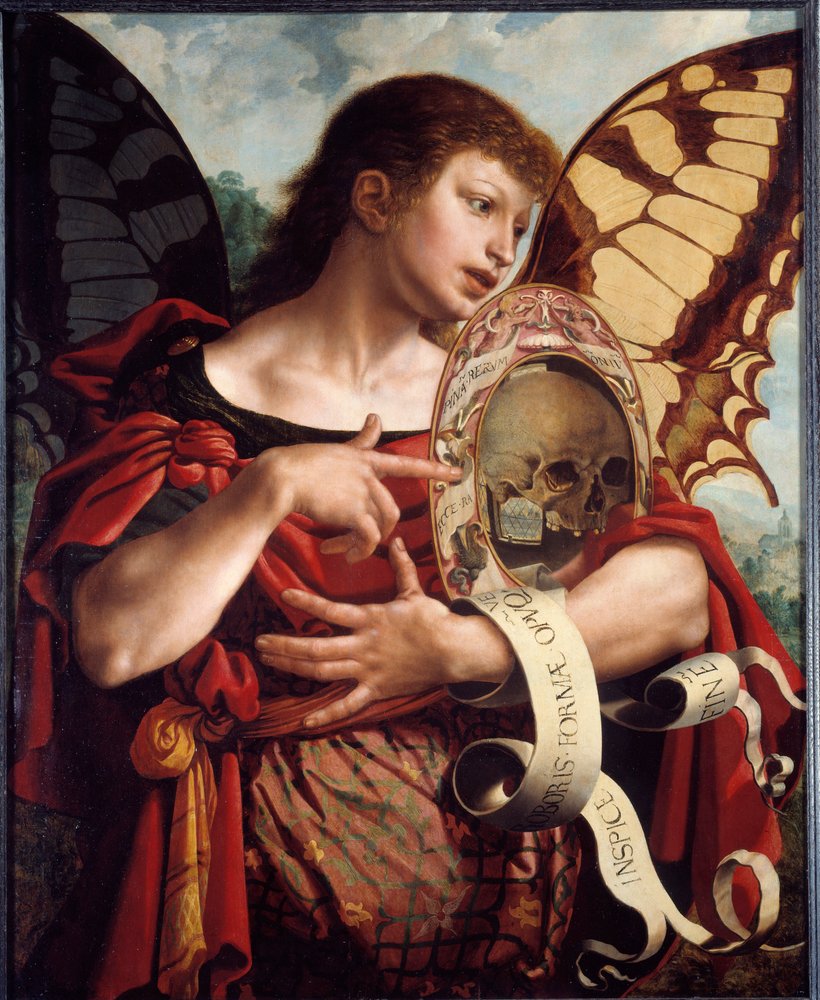
Poetically, Ensor resurrected the ultra-classical Renaissance metaphor of the « Vanities« , a very Christian theme that already appeared in « The Triumph of Death », the poem by Petrarch that inspired the Flemish painter Pieter Bruegel the Elder, and Holbein’s series of woodcuts, « The Dance of Death ».
A skull juxtaposed with an hourglass were the basic elements for visualizing the ephemeral nature of human existence on earth. As humans, this metaphor reminds us, we constantly try not to think about it, but inevitably, we all end up dying, at least on a physical level. Our « vanity » is our constant desire to believe ourselves eternal.
Ensor did not hesitate to use symbols. To penetrate his work, you need to know how to read the meaning behind them. Visually, in the face of the triumph of lies and hypocrisy, Ensor, like a good Christian, sets up death as the only truth capable of giving meaning to our existence. Death triumphs over our physical existence.
Masks, symbols of lies

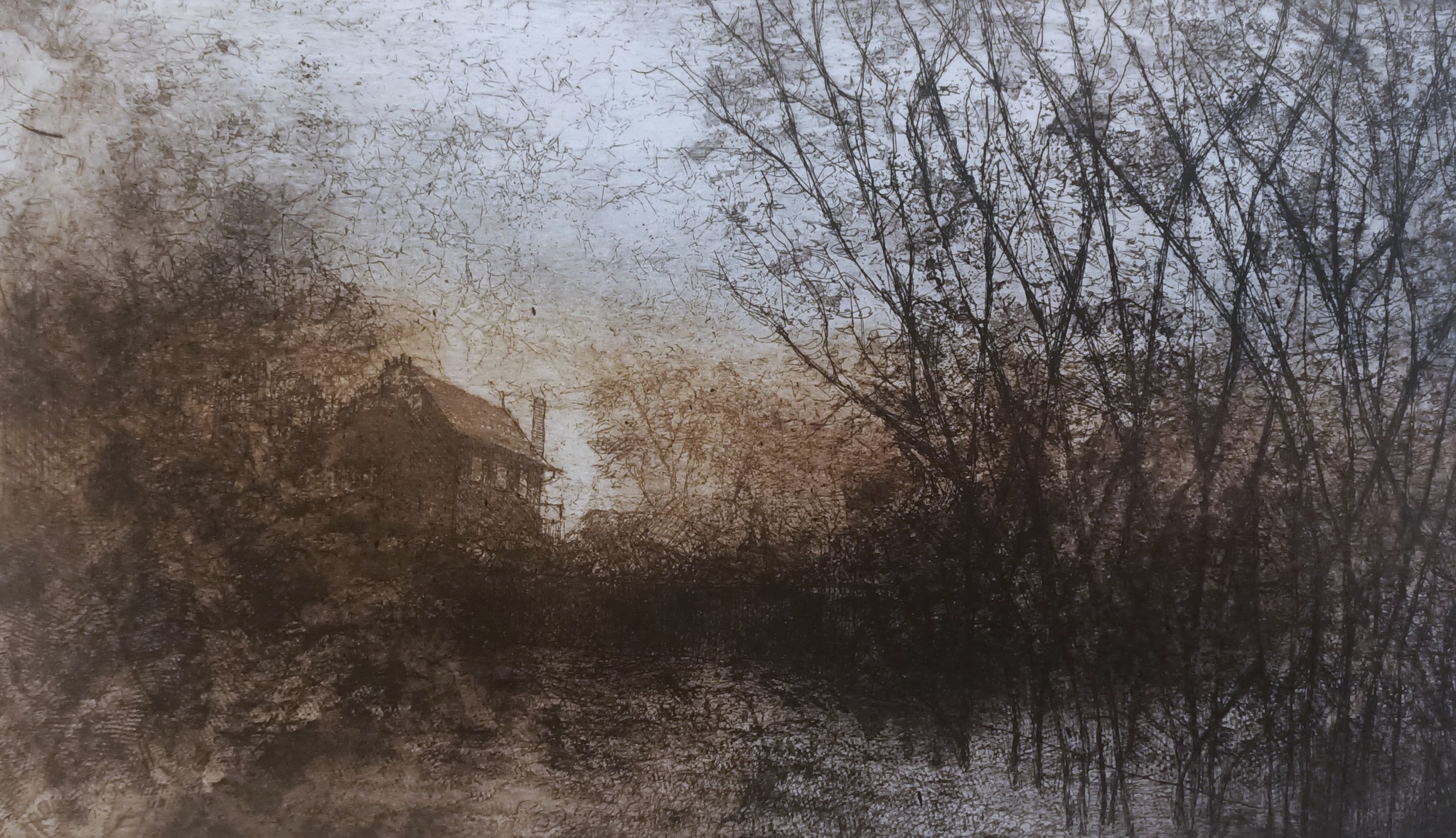
Gradually, as in Death and Masks (1897) (image at the top of this article), the artist dramatized this theme even further, pitting death against grotesque masks, symbols of human lies and hypocrisy.1
Often in his works, in a sublime reversal of roles, it is death who laughs and it is the masks who howl and weep, never the other way around.
It may sound grotesque and appalling, but in reality it’s only normal: truth laughs when it triumphs, and lies weep when they see their end coming! What’s more, when death returns to the living and shows the trembling flame of the candlestick, the latter howl, whereas the former has a big advantage: it’s already dead and therefore appears to live without fear!
No doubt thinking of the Brussels aristocracy who flocked to Ostend for a dip, Ensor wrote:
« Ah, you have to see the masks, under our great opal skies, and when, daubed in cruel colors, they evolve, miserable, their spines bent, pitiful under the rains, what a pitiful rout. Terrified characters, at once insolent and timid, snarling and yelping, voices in falsetto or like unleashed bugles ».
The same Ensor also castigated bad doctors pulling a huge tapeworm out of a patient’s belly, kings and priests whom he painted literally « shitting » on the people. He criticized the fishwives in the bars, the art critics who failed to see his genius and whom he painted in the form of skulls fighting over a kipper (a pun on « Art Ensor »).
The King’s Notebooks
In 1903, a scandal of unprecedented proportions shook Belgium, France and neighboring countries. Les Carnets du Roi (The King’s Notebooks), a work published anonymously in Paris and quickly banned in Brussels, portrayed a white-bearded autocrat: Leopold II, King of the Belgians, without naming him. Arrogant, pretentious and cunning, he was more concerned with enriching himself and collecting mistresses than ensuring the common good of his citizens and respect for the laws of a democratic state. The book, published by a Belgian publisher based in Paris, was the brainchild of a Belgian writer from the Liège region, Paul Gérardy (1870-1933), who happened to be a friend of Ensor.
The story of the Carnets du Roi is first and foremost that of a monarch who was not only mocked in writing and drawing throughout his reign, but also criticized extremely harshly for the methods used to govern his personal estate in the Congo. Divided into some thirty short chapters, the work is presented as a series of letters and advice from the aging king to his soon-to-be successor on the throne, his nephew Albert, who went on to become Ensor’s patron and, along with his friend Albert Einstein, whom he welcomed to Belgium, was deeply involved in preventing the outbreak of the Second World War.
In Les Carnets, a veritable satire, the monarch explains how hypocrisy, lies, treachery and double standards are necessary for the exercise of power: not to ensure the good of the « common people » or the stability of the monarchical state, but quite simply to shamelessly enrich himself.
The pages devoted to the exploitation of the people of the Congo and the « re-establishment of slavery » (sic) by a king who, via the explorer Stanley, was said to have been one of its eradicators, are ruthlessly lucid, and echo the most authoritative denunciations of the white-bearded monarch, to whom Gérardy lends these words:
« I took care to have it published that I was only concerned with civilizing the negroes, and as this nonsense was asserted with sincerity by a few convinced people, it was quickly believed and saved me some trouble ».
Meeting Albert Einstein
After 1900, the first exhibitions were devoted to him. Verhaeren wrote his first monograph. But, curiously, this success defused his strength as a painter. He contented himself with repeating his favorite themes or portraying himself, including as a skeleton. In 1903, he was awarded the Order of Leopold.
The whole world flocked to Ostend to see him. In early 1933, Ensor met Albert Einstein, who was visiting Belgium after fleeing Germany. Einstein, who resided for several months in Den Haan, not far from Ostend, was protected by the Belgian King, Albert I, with whom he coordinated his efforts to prevent another world war.
If it is claimed that Ensor and Einstein had little understanding of each other, the following quotation rather indicates the opposite.

Ensor, always lyrical, is quoted as saying:
« Let us all promptly praise the great Einstein and his relative orders, but let us condemn algebraism and its square roots, geometers and their cubic reasons. I say the world is round.… »
In 1929, King Albert I conferred the title of Baron on James Ensor. In 1934, listening to all that Franklin Roosevelt had to offer and seeing Belgium caught up in the turmoil of the 1929 crash, the King of the Belgians commissioned his Prime Minister De Broqueville to reorganize credit and the banking system along the lines of the Glass-Steagall Act model adopted in the United States in 1933.
On February 17, 1934, during a climb at Marche-les-Dames, Albert I died under conditions that have never been clarified. On March 6, De Broqueville made a speech to the Belgian Senate on the need to mourn the Treaty of Versailles and to reach an agreement with Germany on disarmament between the Allies of 1914-1918, failing which we would be heading for another war…
De Broqueville then energetically embarked on banking reform. On August 22, 1934, several Royal Decrees were promulgated, in particular Decree no. 2 of August 22, 1934, on the protection of savings and banking activities, imposing a split into separate companies, between deposit banks and business and market banks.
Pictorial bombs
From 1929 onwards, Ensor was dubbed the « Prince of Painters ». The artist had an unexpected reaction to this long-awaited recognition, which came too late for his liking: he gave up painting and devoted the last years of his life exclusively to contemporary music, before dying in 1949, covered in honors.

In 2016, a painting by Ensor from 1891, dubbed « Skeleton stopping masks », which had remained in the same family for almost a century and was unknown to historians, sold for 7.4 million euros, a world record for this artist. In the center, death (here a skull wearing the bearskin cap typical of the 1st Grenadier Regiment) is caught by the throat by strange masks that could represent the rulers of countries preparing for future conflicts.
Are the masks (the lie) about to strangle the truth (the skull and crossbones) without success? And so, over a hundred years later, Ensor’s pictorial bombs are still happily exploding in the heads of the narrow-minded, the floured bourgeois and the piss-poor, as he himself would have put it.
Notes:
- In 1819, another artist, the English poet Percy Bysshe Shelley, composed his political poem The Mask of Anarchy in reaction to the Peterloo massacre (18 dead, 700 wounded), when cavalry charged a peaceful demonstration of 60,000-80,000 people gathered to demand reform of parliamentary representation. In this call for liberty, he denounces an oligarchy that kills as it pleases (anarchy). Far from a call for anarchic counter-violence, it is perhaps the first modern declaration of the principle of non-violent resistance. ↩︎
ARTKAREL AUDIO GUIDE: Van Eyck, Rolin and the Peace of Arras (Paris)


Listen:
Audio on this website
Other audios of the Louvre Audio Guide collection:
- Short note about the building;
- The Greek tradition behind the Fayum Mummy Portraits;
- Cimabue, Giotto, Fra Angelico, the Wonders of the Italian Trecento;
- Who was whispering in the Ear of Joan of Arc;
- Van der Weyden and Cusanus;
- Antonello de Messina and Man in the image of Christ;
- Ghirlandaio’s immortality;
- The Rigor of Mantegna’s crucifixion;
- Leonardo and Verrocchio’s workshop;
- Why Leonardo didn’t like painting;
- Mona Lisa made in China?;
- How Bosch’s Ship of Fools drove the Jester out of business;
- Why Erasmus had no time to pause for portraits;
- Rembrandt, sculptor of Light;
- Why Vermeer was hiding his convictions;
- Van Eyck, Nicolas Rolin and the Peace of Arras.
Read:
- Jan van Eyck, la beauté comme prégustation de la sagesse divine (FR en ligne) + EN on line.
- Jan Van Eyck, un peintre flamand dans l’optique arabe (FR en ligne)
- Jan Van Eyck, a Flemish Painter using Arab Optics (EN online)
- Rogier Van der Weyden, maître de la compassion (FR pdf)
- Comment Jacques Cœur a mis fin à la Guerre de Cent Ans (FR en ligne)
- How Jacques Coeur put an end to the Hundred Years War (EN online);
Le Bac (d’après Pierre Billet)


LOUVRE AUDIO GUIDE: Mona Lisa made in China?

Listen?
Audio on this website
Read?
- La Cène de Léonard, une leçon de métaphysique (FR en ligne) + EN pdf (Fidelio).
- Léonard de Vinci : peintre de mouvement (FR en ligne) + EN pdf (Fidelio).
- La Vierge aux rochers, l’erreur fantastique de Léonard (FR en ligne).
- Romorantin et Léonard ou l’invention de la ville moderne (FR en ligne) + EN pdf (Executive Intelligence Review) + DE pdf (Neue Solidarität) + IT pdf (Movisol website).
- L’Homme de Vitruve de Léonard de Vinci (FR en ligne) + EN online.
- Léonard en résonance avec la peinture traditionnelle chinoise — entretien avec Le Quotidien du Peuple. (en ligne: texte chinois suivi des traductions FR + EN).
ARTKAREL AUDIO GUIDE: short note before starting your visit at the Louvre

Listen:
- To the audio on this website
Read:
- Index of articles dealing with art history and Renaissance studies on this website.

——————————
ARTKAREL AUDIO GUIDE: The rigor of Mantegna’s crucifixion (Paris)

Listen:
To the audio on this website.
Read:
- Avicenne, Ghiberti, leur rôle dans l’invention de la perspective à la Renaissance (FR en ligne) et EN online.
- Les secrets du dôme de Florence (FR en ligne) + EN pdf (Schiller Institute archive website) + DE pdf (Neue Solidarität).
- L’œuf sans ombre de Piero della Francesca (FR en ligne) + EN pdf (Fidelio).
- Uccello, Donatello, Verrocchio et l’art du commandement militaire (FR en ligne) et EN online.
LOUVRE AUDIO GUIDE: Rembrandt, sculptor of light


Listen:
To the audio on this website.
Read:
- Rembrandt, un bâtisseur de nations FR pdf (Nouvelle Solidarité).
- Rembrandt et la lumière d’Agapè (FR en ligne) : Rembrandt et Comenius pendant la guerre de trente ans.
- Rembrandt and the Light of Agapè (EN online)
- Rembrandt : 400 ans et toujours jeune ! (FR en ligne).
- Rembrandt: 400 years old and still young ! (EN online).
- Rembrandt et la figure du Christ (FR en ligne) + EN pdf + DE pdf.
ARTKAREL AUDIO GUIDE: Cimabue, Giotto, Fra Angelico; Wonders of the Italian Trecento (Paris)


Listen
To the audio on this website.
Read:
- L’invention de la perspective FR pdf (Fusion) + EN pdf (Fidelio)
- La révolution du grec ancien, Platon et la Renaissance (FR en ligne)
- The Greek language project, Plato and the Renaissance (EN online).
- Les Frères de la vie commune et la Renaissance du nord (FR en ligne)
- Moderne Devotie en Broeders van het Gemene Leven, bakermat van het humanisme (NL online)
- Devotio Moderna, Brothers of the Common Life, the cradle of humanism in the North (EN online)
ARTKAREL AUDIO GUIDE: Why Vermeer was hiding his convictions (Paris)

Listen:
To the audio on this website
Read:
ARTKAREL AUDIO GUIDE: Why Leonardo didn’t like painting (Paris)


Listen:
To the audio on this website.
Read:
- La Cène de Léonard, une leçon de métaphysique (FR en ligne) + EN pdf (Fidelio).
- Léonard de Vinci : peintre de mouvement (FR en ligne) + EN pdf (Fidelio).
- La Vierge aux rochers, l’erreur fantastique de Léonard (FR en ligne).
- Romorantin et Léonard ou l’invention de la ville moderne (FR en ligne) + EN pdf (Executive Intelligence Review) + DE pdf (Neue Solidarität) + IT pdf (Movisol website).
- L’Homme de Vitruve de Léonard de Vinci (FR en ligne) + EN online.
- Léonard en résonance avec la peinture traditionnelle chinoise — entretien avec Le Quotidien du Peuple. (en ligne: texte chinois suivi des traductions FR + EN).
ARTKAREL AUDIO GUIDE: How Bosch’s Ship of Fools drove the Jester out of business (Paris)

Liste:
To the audio on this website;
Read:
- With Hieronymous Bosh on the track of the Sublime;
- Comment la folie d’Erasme sauva notre civilisation (FR en ligne) + NL pdf (Agora Erasmus) + EN pdf (Schiller Institute Archive Website) + DE pdf (Neue Solidarität).
- Le rêve d’Erasme: le Collège des Trois Langues de Louvain (FR en ligne)
- Erasmus‘ dream: the Leuven Three Language College (EN online)
- ENTRETIEN: Jan Papy: Erasme, le grec et la Renaissance des sciences (FR en ligne)
- Dirk Martens, l’imprimeur d’Erasme qui diffusa le livre de poche (FR en ligne).
- 1512-2012 : Mercator et Frisius, des cosmographes aux cosmonautes + NL pdf (Agora Erasmus) + EN pdf (Schiller Institute Archive Website).
- La nef des fous de Sébastian Brant (FR en ligne), un livre d’une grande actualité !
- Avec Jérôme Bosch sur la trace du Sublime (FR en ligne) + EN pdf.
- Joachim Patinir et l’invention du paysage en peinture (FR en ligne).
- Joachim Patinir and the invention of landscape painting (EN online)
- Exposition de Lille : ce que nous apprennent les fabuleux paysages flamands (FR en ligne).
- Portement de croix: redécouvrir Bruegel grâce au livre de Michael Gibson (FR en ligne) + EN pdf (Fidelio).
- ENTRETIEN Michael Gibson: Pour Bruegel, le monde est vaste (FR en ligne) + EN pdf (Fidelio)
- Pierre Bruegel l’ancien, Pétrarque et le Triomphe de la Mort (FR en ligne) + EN online.
- A propos du film « Bruegel, le moulin et la croix » (FR en ligne).
- L’ange Bruegel et la chute du cardinal Granvelle (FR en ligne).
- Albrecht Dürer contre la mélancolie néo-platonicienne + EN pdf.
ARTKAREL AUDIO GUIDE: Why Erasmus had no time to pause for portraits (Paris)
ARTKAREL AUDIO GUIDE : Van der Weyden and Cusanus

Listen:
To the audio on the website
Read :
- Rogier Van der Weyden, le maître de la compassion;
- The Greek language project, Plato and the Renaissance (EN online).
- Devotio Moderna, Brothers of the Common Life, the cradle of humanism in the North (EN online)
- Jan van Eyck, la beauté comme prégustation de la sagesse divine (FR en ligne) + EN on line.
- Jan Van Eyck, a Flemish Painter using Arab Optics (EN online)
ARTKAREL AUDIO GUIDE: The Greek tradition behind the Fayum Mummy Portraits (Paris)
Karel Vereycken comments the Louvre’s Fayum Mummy Portraits.


Listen:
To the audio on this website
Read:
LOUVRE AUDIO GUIDE: Who whispered in the Ear of Joan of Arc?

Listen:
To the audio on this website.
Read :
LOUVRE AUDIO GUIDE: Leonardo and Verrochio’s workshop

Listen:
to the audio on this website
Read:
Israel-Palestine: Time to Make Water a Weapon for Peace

« If we solve all the problems in the Middle East,
but not the problem of sharing water, our region will explode.
Peace will not be possible »
(Yitzhak Rabin, former Israeli Prime Minister, 1992).
« You only make peace with your enemies. »
(Yitzhak Rabin.)
Contents:
Introduction
1. Geography of the Middle East
2. Rainfall and Water resources
3. Hydrography of the Jordan basin
A. Source
B. Tributaries
C. Lake of Tiberias
D. Yarmouk river
4. Water sources for Israel-Palestine
A. Surface water
B. Groundwater
C. Desalination
D. Reuse of Waste water
5. Water Infrastructure Projects
A. National Water Carrier (NWC)
B. Johnston Plan
C. Ghor Canal
D. Med – Dead Sea aqueduct
E. Red Sea – Dead Sea Water Conveyance
F. Turkish projects
G. Hidden defects and non-application of the Oslo agreements
H. Ben-Gurion Canal
I. Oasis Plan
J. Alvin Weinberg, Yitzhak Rabin and Lyndon LaRouche
Introduction
This article provides readers with the keys. To understand the history of the water wars that continue to ravage the Middle East, it is essential to understand the geological, hydrographical, geographical and political issues at stake. In the second part, we examine the various options for developing water resources as part of a strategy to overcome the crisis. We will deal with the gas issue, another subject of potential conflict or cooperation, in a later article.
1. Geography

The Jordan River basin is shared by four countries: Lebanon, Syria, Jordan and Israel, plus the Palestinian territories of the West Bank and Gaza.
Situated in the hollow of a tectonic depression on the great fault that runs from Aqaba to Turkey, the Jordan Valley is one of the lowest-lying basins in the world, flowing into the Dead Sea at an altitude of 421 meters below sea level.
See interactive topographic map.
Added to this is the fact that this is an endorheic basin, i.e. a river that flows neither into the sea nor the ocean. As in the Aral Sea basin in Central Asia, this means that any water drawn or diverted upstream reduces the level of its ultimate receptacle, the Dead Sea (see below), and can even potentially make it disappear.

While remaining a fundamental artery for the entire region, the Jordan River has a number of drawbacks: its course is not navigable, its flow remains low and its waters, which are highly saline, are polluted.
As one of the key factors in the « Water, Energy, Food nexus » – three factors whose interdependence is such that we can’t deal with one without dealing with the other two – water resource management remains a key issue, and holds a primordial place for any future shared between Israel and its Arab neighbors. To grow food, one needs water. But to desalinate sea water, Israel spends 10 % of its electricity generated by consuming gas and oil.
2. Rainfall and water resources

The Middle East forms a long, arid strip, only accidentally interrupted by areas of abundant rainfall (around 500-700 mm/year), such as the mountains of Lebanon, Palestine and Yemen.
Geographically, much of the Middle East lies south of the isohyet (imaginary line connecting points of equal rainfall) indicating 300 mm/year.
However, precipitation has only a limited effect due to its seasonality (October-February).
As a result, river flow and flooding are irregular throughout the year, as well as between years. The same applies to groundwater recharge.

On a state-by-state basis, total water resources are very unevenly distributed in the region:
—Turkey and Iraq have over 4,000 cubic meters per person per year, and Lebanon around 3000 m³/person/year, which is above the regional average (1,800 m³/person/year).
—Syria and Egypt have around 1200 m³/person/year, one third lower.
On the other hand, some countries are below the critical 500 m³/year/capita bracket:
—Israel and Jordan have 300 m³/year/capita, and the Palestinian Territories (West Bank-Gaza) less than 200 m³/year/capita. They are in what the World Health Organization (WHO) calls a situation of « water stress ».
The Middle East enjoys plenty of water on a regional scale, but has many areas in chronic shortage, on a local scale.
3. Hydrography of the Jordan basin

A. Source
360 km long, the Jordan River rises from water flowing down the slopes of Jabal el-Sheikh (Mount Hermon) in southern Lebanon on the border with Syria.
B. Tributaries
Once over the Israeli border, three tributaries join the Jordan about 6 kilometers upstream from the former Lake Hula (now reclaimed):
1. The Hasbani, with a flow of 140 million cubic meters (MCM) per year, rises in Lebanon, a country it crosses over 21 kilometers. The upper reaches of the Hasbani vary greatly with the seasons, while the lower reaches are more regular.
2. The Banias, currently under Israeli control and 30 kilometers long, has an annual flow close to that of the Hasbani (140 MCM). It rises in Syria in the Golan Heights, and flows into Israel for around 12 kilometers before emptying into the Upper Jordan.
3. The Nahr Leddan (or Dan) forms in Israel when the waters of the Golan Heights come together. Although restricted, its course remains stable and its annual flow is greater than that of the other two tributaries of the Upper Jordan, exceeding 250 MCM per year.
C. Lake Tiberias or Kinneret (aka Sea of Galilee)
The Jordan then flows through 17 km of narrow gorges to reach Lake Tiberias, where the salinity is high, especially as the freshwater streams flowing into it have been diverted. Lake Tiberias, however, receives water from the many small streams running through the Golan Heights.
D. Yarmouk River
Next, the Jordan meets the Yarmouk River (bringing in water from Syria), then meanders for 320 km (109 km as the crow flies) to reach the Dead Sea. These 320 km are occupied by a humid plain (the humid zor), with subtropical vegetation, dominated on both sides (West Bank and Jordanian) by dry, gullied terraces.

4. Water sources for Israel
The Hebrew state has four main sources of water supply:
A. Surface Water
Israel benefits first and foremost from the freshwater reserves of Lake Tiberias in Galilee, in the north of the country. Crossed by the Jordan River, this small inland sea accounts for 25% of Israel’s water needs. The annexation of the Golan Heights and the occupation of southern Lebanon have made this source of water a sanctuary.
B. Groundwater
In addition to surface water (lakes and rivers), the country can rely on its coastal aquifers, from Haifa to Ashkelon.
Located between Israel and the occupied West Bank, the main aquifer, the Yarkon-Taninim mountain aquifer, has a capacity of 350 MCM per year. In the northeast and east of the West Bank are two other aquifers with capacities of 140 and 120 MCM per year respectively.
C. Seawater desalination


Five desalination plants built along the country’s coastline — in Ashkelon (2005), Palmachin (2007), Hadera (2010), Sorek (2013) and Ashdod (2015) — currently operate and two more are under construction. Collectively, these plants are projected to account for 85-90 per cent of Israel’s annual water consumption, marking a remarkable turnaround.
The Sorek desalination plant, located about 15 km south of Tel Aviv, became operational in October 2013 with a seawater treatment capacity of 624,000m³/day, which makes it world’s biggest seawater desalination plant. The desalination facility uses seawater reverse osmosis (SWRO) process providing water to Israel’s National Water Carrier system (NWC, see below). A dozen more units of this type are considered for construction.
Israel, which has been facing severe droughts since 2013, even began pumping desalinated seawater from the Mediterranean into Lake Tiberias, a unique performance worldwide. While Israel faced water scarcity two decades ago, it now exports water to its neighbors (not too much to Palestine). Israel currently supplies Jordan with 100 MCM and fulfills 20 % of Jordan’s water needs.

From 100 liters of seawater, 52 liters of drinking water and 48 liters of brine (brackish water) can be obtained. Although highly efficient and useful, desalination technology has still to be perfected, as it currently discharges brine into the sea, disrupting the marine ecosystem. To reduce this pollution and transform it into solid waste, we need to increase treatment and therefore energy consumption.
D. Wastewater
The country prides itself on reusing between 80% and 90% of its wastewater for agriculture. Treated wastewater used for irrigation is known as effluent. Israel’s effluent utilization rate is one of the highest in the world. Reclamation is carried out by 87 large wastewater treatment plants (WWTPs) that supply over 660 MCM per year. This represents around 50% of total water demand for agriculture and around 25% of the country’s total water demand. Israel aims to more than double the amount of effluent produced for the agricultural sector by 2050.
5. Water infrastructure projects

For Israel, acquiring water resources in a desert region, through technology, military conquest and/or diplomacy, was from the outset an imperative to meet the needs of a rapidly growing population and, in the eyes of the rest of the world, a demonstration of its sovereign power and its superiority.
This symbolism is particularly evident in the figure of the father of the Hebrew state, David Ben-Gurion (1886-1973), whose aim was to make the Negev desert in the south of the country « blossom ».
In his book Southwards (1956), Ben Gourion described his ambition:
« It is absolutely vital for the State of Israel, both for economic and security reasons, to go south: we must direct the water and rain to there, send the young pioneers there […] as well as the bulk of our budget resources to development. »
A. National Water Carrier of Israel (NWC)
OBJECTIVE: provide fresh water for Israel’s agriculture and growing population.
From 1959 to 1964, the Israelis built the National Water Carrier of Israel (NWC), the largest water project in Israel to date.
The first ideas appeared in Theodor Herzl‘s book Altneuland (1902), in which he spoke of using the springs of the Jordan for irrigation purposes and channeling seawater to generate electricity from the Mediterranean Sea near Haifa through the Beit She’an and Jordan valleys to a canal running parallel to the Jordan and Dead Sea.
In 1919, Chaïm Waizmann, leader of the World Zionist Organization, declared: « The whole economic future of Palestine depends on its water supply ».
However, he advocated incorporating the Litani Valley (in today’s southern Lebanon) into the Palestinian state.

The NWC project was conceived as early as 1937, although detailed planning began after the recognition of Israel in 1948. In practice, the natural flow of the Jordan River is prevented by the construction of a dam, built south of Lake Tiberias. From there, water is diverted to the NWC, a 130 km-long system combining giant pipes, open channels, tunnels, reservoirs and large-scale pumping stations. The aim is to transfer water from Lake Tiberias to the densely populated center and the arid south, including the Negev desert.
When it was inaugurated in 1964, 80% of its water was allocated to agriculture and 20% to drinking water. By 1990, the NWC supplied half of Israel’s drinking water. With the addition of water from seawater desalination plants, it now supplies Tel Aviv, a city of 3.5 million inhabitants, Jerusalem (1 million inhabitants) and (outside wartime) Gaza and the occupied territories of the West Bank.
Since 1948, the area of irrigated farmland has increased from 30,000 to 186,000 hectares. Thanks to micro-irrigation (drip irrigation, including subsurface irrigation), Israeli agricultural production increased by 26% between 1999 and 2009, although the number of farmers fell from 23,500 to 17,000.
The Water War
In launching its NWC, Israel went it alone, while for the rest of the world, it was clear that diverting the waters of the Jordan River would give rise to sharp tensions with neighboring countries, particularly with Jordan and Syria, not to mention the Palestinians who have been largely excluded from the project’s economic benefits.

As early as 1953, Israel began the unilateral draining of Lake Hula (or Huleh), north of Lake Tiberias, leading to skirmishes with Syria.
In 1959, Israel kickstarted the NWC. The project was initially interrupted by a halt in American funding, as the Americans did not want to see violence escalate in the context of the Cold War.
It should be noted that, following the Suez crisis of 1956, the Soviet Union established itself in Syria as the protecting power of Arab countries against the « Israeli threat ». As part of the deployment of its naval presence in the Mediterranean, it obtained facilities for its fleet at Latakia in Syria.
However, Israel managed to quietly resume and continue the work on the NWC. Filling the system by pumping of Lake Tiberias began in June 1964 in utmost secrecy. When the Arab countries learned of this, their anger was great. In November 1964, the Syrian army fired on Israeli patrols around the NWC pumping station, provoking Israeli counter-attacks. In January 1965, the NWC was the target of the first attack by the Fatah (organization fighting for the liberation of Palestine) led by Yasser Arafat.
The Arab states finally recognized that they would never be able to stop the project through direct military action.
They therefore adopted a plan, the Headwater Diversion Plan immediately implemented in 1965, to divert water upstream from the tributaries of the Jordan River into the Yarmouk River (in Syria). The project was technically complicated and costly, but if successful would have diverted 35% of the water Israel intended to withdraw from the upper Jordan…
Israel declared that it considered this deviation of the water as an infringement of its sovereign rights. Relations degenerated completely and border clashes followed, with Syrian forces firing on Israeli army farmers and patrols. In July 1966, the Israeli air force bombed a concentration of earth-moving equipment and shot down a Syrian MiG-21. The Arab states abandoned their counter plan, but the conflict continued along the Israel-Syria border, including an Israeli air attack on Syrian territory in April 1967.


For many analysts, this was a prelude to the Six-Day War in 1967, when Israel occupied the Golan Heights to protect its water supply. The Six-Day War profoundly altered the geopolitical situation in the basin, with Israel now occupying not only the Gaza Strip and Sinai, but also the West Bank and the Golan Heights.
As French researcher Hervé Amiot explains:
« Israel went from being a downstream country to an upstream one, enabling it to gain control of vast resources. Israel now controlled 20% of the northern bank of the Yarmouk and occupied the Golan Heights, controlling all the small rivers flowing into Lake Tiberias. What’s more, total occupation of the West Bank gives them control over the important water tables ».
In fact, as early as 1955, between a quarter and a third of the water came from the groundwater in the south-western part of the West Bank. Today, the West Bank aquifers supply Israel with 475 million m³ of water, i.e. 25-30% of the country’s water consumption (and 50% of its drinking water).
Two months after the seizure of the occupied territories, Israel issued “Military Decree 92”, transferring authority over all water resources in the occupied territories to the Israeli army and conferring « absolute power to control all water-related matters to the Water Resources Officer, appointed by the Israeli courts ». This decree revoked all drilling licenses issued by the Jordanian government and designated the Jordan region a military zone, thus depriving Palestinians of all access to water while granting Israel total control over water resources, including those used to support its settlement projects.
Today, returning the Golan to Syria and recognizing the sovereignty of the Palestinian Authority over the West Bank seems impossible for Israel, given the Hebrew state’s increasing dependence on the water resources of these occupied territories. The exploitation of these resources will therefore continue, despite Article 55 of the Regulations of the IVth Hague Convention, which stipulates that an occupying power does not become the owner of water resources and cannot exploit them for the needs of its civilians…
B. Johnston Plan
OBJECTIVE: In the context of the Cold War, counter Nasser’s growing influence in the region. Offer regional stability by building dams and canals allowing a just sharing of water resources and providing water and energy for both Israel and Arab states welcoming « unfortunate » Palestinian refugees.

One might think that the United States tried very early on to prevent the situation from degenerating in such a predictable way. They tried to take into account Israel’s legitimate interest in securing access to water, the absolute key to its survival and development, while at the same time offering neighboring countries (Jordan, Syria and Lebanon) sufficient resources to accommodate the millions of Palestinians exiled from their homes following the Nakba.
Faced with the risk of conflict, as early as 1953 – years before Israel launched its NWC plan – the American government proposed its mediation to resolve disputes over the Jordan basin. The result was the « Jordan Valley Unified Water Plan » (known as the « Johnston Plan »), named after Eric Allen Johnston, president of the United States Chamber of Commerce and US President Dwight Eisenhower‘s water envoy.
More concretely, “The Unified Development of the Water Resources of the Jordan Valley Region,” was prepared at the request of the United Nations Relief and Works Agency for Palestine Refugees under the direction of the Tennessee Valley Authority.
On Oct. 13, 1953, Eisenhower’s Secretary of State John Foster Dulles, in a top secret letter instructed Johnston what his mission was all about and on Oct. 16, in a public statement Eisenhower explained:
« One of the major causes of disquiet in the Near East is the fact that some hundreds of thousands of Arab refugees are living without adequate means of support in the Arab states. The material wants of these people have been cared for through the United Nations Relief and Works Agency (UNRWA) … It has been evident from the start, however, that every effort must be made by the countries concerned, with the help of the international community, to find a means of giving these unfortunate people an opportunity to regain personal self-sufficiency.
« One of the major purposes of Mr. Johnston’s mission will be to undertake discussions with certain of the Arab states and Israel, looking to the mutual development of the water resources of the Jordan River Valley on a regional basis for the benefit of all the people of the area. …
« Such a regional approach holds a promise of extensive economic improvement in the countries concerned through the development of much needed irrigation and hydroelectric power and through the creation of an economic base on the land for a substantial proportion of the Arab refugees. It is my conviction that acceptance of a comprehensive plan for the development of the Jordan Valley would contribute greatly to stability in the Near East and to general economic progress of the region.«
This plan established the transboundary nature of the Jordan basin and proposed an equitable sharing of the resource, giving 52% of the water to Jordan, 31% to Israel, 10% to Syria and 3% to Lebanon.

The plan, just as the Tennessee Valley Authority during FDR’s New Deal, was essentially based on building dams for irrigation and hydropower. The water was there and correctly managed, sufficient for the needs of the population at that time. Its main features were:
- a dam on the Hasbani River to provide power and irrigate the Galilee area;
- dams on the Dan and Banias Rivers to irrigate Galilee;
- drainage of the Huleh swamps;
- a dam at Maqarin on the Yarmouk River for water storage (capacity of 175 million m³) and power generation;
- a small dam at Addassiyah on the Yarmouk to divert its water toward both the Lake Tiberias and south along the eastern Ghor;
- a small dam at the outlet of Lake Tiberias to increase its storage capacity;
- gravity-flow canals along the east and west sides of the Jordan valley to irrigate the area between the Yarmouk’s confluence with the Jordan and the Dead Sea;
- control works and canals to utilize perennial flows from the wadis that the canals cross.
See details of the Johnston plan in this comprehensive article.
The project was validated by the technical committees of Israel and the Arab League, and did not require Israel to abandon its ambition to green the Negev desert. Unfortunately, however, the presentation of the plan to the Knesset in July 1955 did not result in a vote.
The Arab Committee approved the plan in September 1955 and forwarded it to the Council of the Arab League for final approval. Tragically, this institution also chose not to ratify it on October 11, because of its opposition to an act implying an implicit act of recognition of Israel that would prevent the return of the Palestinian refugees to their home… The mistake here was to isolate the water issue from a broader agreement on peace and justice as the foundation of mutual development.
Then, after the Suez Canal crisis in 1956, the Arab countries, with the exception of Jordan, hardened their stance towards Israel considerably, and henceforth opposed the Johnston plan head-on, arguing that it would amplify the threat posed by that country by enabling it to strengthen its economy. They also claim that increasing Israel’s water resources could only increase Jewish migration to the Hebrew state, thereby reducing the possibility of the return of Palestinian refugees from the 1948 war…
History cannot be rewritten, but the adoption of the Johnston Plan could well have prevented conflicts, such as that of 1967, which cost the lives of 15,000 Egyptians, 6,000 Jordanians, 2,500 Syrians and at least 1,000 Israelis.
C. Jordan’s response: the Ghor irrigation Canal
OBJECTIVE: construct the Jordanian section of the Johnston Plan to have water for irrigation and the capital of Jordan.

At almost the same time as Israel was completing its NWC, Jordan was digging the East Ghor irrigation canal between 1955 and 1964, starting at the confluence of the Yarmouk and Jordan rivers and running parallel to the latter all the way to the Dead Sea on Jordanian territory.
Originally, this was part of a larger project – the « Greater Yarmouk » project – which included two storage dams on the Yarmouk and a future “Western Ghor Canal” on the west bank of the Jordan. The latter was never built, as Israel took the West Bank from Jordan in the 1967 Six-Day War.
In effect, by diverting the waters of the Yarmouk to fill up its own canal, Jordan secured water for its capital Amman and its agriculture, but of course, contributed reducing the waters of the Jordan River.
In Jordan, the Jordan’s river watershed is a region of vital importance to the country. It is home to 83% of the population, the main industries and 80% of irrigated agriculture. It is also home to 80% of the country’s total water resources.
Overall, the Hashemite kingdom is one of the world’s most water-poor countries, with 92% of its territory desert. While Israel has 276 m³ of natural freshwater available per capita per year, Jordan has just 179 m³, more than half of which comes from groundwater.
The UN considers that a country with less than 500 m³ of freshwater per capita per year suffers from « absolute water stress ». Added to this is the fact that since the start of the Syrian civil war, Jordan has welcomed nearly 1.4 million refugees onto its soil, in addition to its 10 million inhabitants.
The East Ghor Canal was designed in 1957 and built between 1959 and 1961 competing with Israel’s NWC. In 1966, the upstream section as far as Wadi Zarqa was completed. The canal was then 70 km long and was extended three times between 1969 and 1987.
The United States, through the U.S. Agency for International Development (USAID), financed the initial phase of the project, after obtaining explicit assurances from the Jordanian government that Jordan would not withdraw more water from the Yarmouk than had been allocated to it under the Johnston Plan. They were also involved in the subsequent phases.
Waterworks in the region are often named after great political figures. The East Ghor Canal was named « King Abdallah Canal (KAC) » by Abdalla II after his great-grandfather, the founder of Jordan. At the time of the peace treaty with Israel in 1994, the two countries shared the flow of the Jordan, and Jordan agreed to sell its water from Lake Tiberias.
D. Mediterranean – Dead Sea Aqueduct
OBJECTIVE: generate hydro-electricity and make Israel independant from Arab oil and gas supplies.

A: Crossing solely Israelian territory;
B and C: Crossing Israel and West Bank (shortest, 70 km);
D. Crossing Gaza and Israel;
E. Crossing only Jordan (longest, 200 km).
The idea of a Dead Sea-Mediterranean Canal was first proposed by William Allen in 1855 in a book entitled The Dead Sea – A new route to India. At the time, it was not known that the level of the Dead Sea was far below that of the Mediterranean, and Allen proposed the canal as an alternative to the Suez navigation Canal.
Later, several engineers and politicians took up the idea, including Theodor Herzl in his 1902 short story Altneuland. Most early projects were based on the left bank of the Jordan, but a modified form, using the right bank (West bank), was proposed after 1967.
After extensive research, German engineers Herbert Wendt and Wieland Kelm proposed not a navigable canal, but an aqueduct consisting essentially of an overhead gallery running West-East, linking the Mediterranean to the Dead Sea.
Their 1975 detailed project study Depressionskraftwerk am Toten Meer – Eine Projektstudie, on how to use the difference of water levels between the Mediterranean sea (level 0) and the Dead Sea (- 400 m) for power generation was the subject of a first publication in the German journal Wasserwirtschaft (1975,3).

The diagram indicates the system operates as follows:
- The seawater intake is at Ashdod.
- An open channel allows the water to flow by gravity for 7 km.
- From there, the pressurized water travels through a 65 km-long hydraulic gallery;
- The water arrives in a 3km-long reservoir created by a dam on the edge of the steep descent to the Dead Sea. At that point, the water can be used to cool a thermal or nuclear power plant, the heat from which can be used for industrial or agricultural purposes.
- Through a shaft running from the bottom of the reservoir, the water descends a steep 400 metres.
- There, it powers three turbines, each producing 100 MWe.
- Finally, via an evacuation gallery, the seawater reaches the Dead Sea.

However, since the project was elaborated exclusively by Israel and without any consultation with its Jordanian, Egyptian and Palestinian neighbors, the project ran against a wall of political opposition.
Of course, as with any large scale infrastructure projects, many things needed to be adapted, including tourist equipment, roads, hotels, Jordanian potash exploitation, Palestinian farmland, etc.
Questions were also raised about (very infrequent) potential earthquakes and the difference of salinity of water from the Mediterranean and the Dead Sea.
On Dec. 16, 1981, the UN General Assembly, arguing the canal project « will violate the principle of international law » adopted Resolution 36-150.
That resolution requested the UN Security Council « to consider initiating measures to halt the execution of this project » and calling « upon all States not to assist, either directly or indirectly, in the preparation for and the execution of this project. »
The request, in article 3, to submit a study was fulfilled. The report, not really convincing, details various objections but doesn’t call into question the technical feasability of the project.
E. Red Sea – Dead Sea Water Conveyance

OBJECTIVES: Build a desalination plant close to the Dead Sea to provide fresh water to Jordan, Israel and Palestine by desalinating seawater arriving via a pipeline from the Red Sea. Use the brine to refill the Dead Sea. Use the watersharing as a model for peaceful mutual beneficial cooperation. Make the project the heart of a development corridor.
In the framework of the peace treaty between Israel and the Hashemite Kingdom of Jordan the integrated development Master Plan for the Jordan Rift Valley (JRV) was studied in the mid 1990’s.
The Red Sea – Dead Sea Canal (RSDSC) was considered to be one of the most important potential elements for implementing this Master Plan. The principal development objective of the RSDSC was to provide desalinated drinking water for the people of the area.
On October 17, 1994, then Israeli Prime Minister Yitzhak Rabin and King Hussein of Jordan validated the draft peace treaty between their two countries in Amman, after reaching agreement on the last two points in dispute – the water issue and border demarcation.

On November 26, the Israeli-Jordanian peace treaty was signed with great fanfare in the Arava Valley, between the Red Sea and the Dead Sea, by the prime ministers of the two countries, in the presence of US President Bill Clinton, whose country had helped bring the negotiations between Jerusalem and Amman to a successful conclusion.
This created the condition where the old idea of linking the Red Sea with the Dead Sea, a project renamed and supported by Shimon Peres as the « Peace Canal », could come back on the table.
Former Israeli water commissioner Professor Dan Zaslavsky, who opposed the project on cost grounds, wrote in the Jerusalem Post in 2006 about Peres’ obstinacy. To listen to the scientists, Peres summoned five of them. Each had to present his objections in a few minutes.
« At one point, Peres got up and said, ‘Excuse me. Don’t you remember that I built the nuclear reactor in Dimona? Do you remember that everyone was against it? Well I was right in the end. And this will prove to be the same thing! » And with that, Zaslavsky said with a flourish, « he left! »
The Dead Sea
For millennia, the Dead Sea was filled with fresh water from the Jordan River, via Lake Tiberias. Over the last fifty years, however, it has lost 28% of its depth and a third of its surface area. Its water level is falling inexorably, at an average rate of 1.45 meters per year. Its high salinity – over 27%, compared with the average for oceans and seas of 2-4% – and a level 430 meters below sea level, has always fascinated visitors and provided therapeutic benefits. Stretching 51 kilometers long and 18 kilometers wide, it is shared by Israel, Jordan and the West Bank.
The over-exploitation of upstream water resources (the National Aqueduct in Israel, the Ghor Canal in Jordan), together with potassium mining, is the cause of the sand desert which, if nothing is done, will continue to replace the Dead Sea.
If the Dead Sea needs the Jordan River, the Jordan River needs Lake Tiberias, from which it takes its source. However, the lake too has been affected by drastic drops in its water level in recent years, triggering a vicious circle between the three systems (Lake Tiberias, Jordan River and Dead Sea).
Aqueduct
In response, at the end of 2006, the World Bank and Agence Française de Développement (AFD) assisted Israel and Jordan in the design of a colossal project to link the Dead Sea to the Red Sea via a 180-kilometer mainly underground pipeline.
In the end, the project for an aqueduct starting from the Red Sea and built entirely on Jordanian territory was chosen, with the signing of a tripartite agreement between Israelis, Jordanians and Palestinians in December 2013.


- Sea intake and pumping station
The seawater is pumped to +125 m above sea level at the Red Sea. - Pressure pipeline
The first part of the conveyance system transmits the seawater to the planned elevation. The length is 5 km from Aqaba (3% of the whole alignment). - A tunnel and canal conveyance system
Seawater is transmitted to the regulating and pretreatment reservoirs with a design flow of 60 m3 /s. A 121 km tunnel with 7 m diameter and 39 km canal were designed. - Regulating and pre-treatment reservoirs
Several reservoirs were designed at +107 m at Wadi G’mal at the southeastern margin of the Dead Sea. - Desalination plants
The 2 desalination plants are designed to operate by using the process of hydrostatically supported reverse osmosis to provide desalinated seawater. The main plant will be located at Safi at 365 m below the sea level with a water column of 475 m. - Fresh water
The project will produce around 850 MMC of fresh water per year, to be shared between Jordan, Israel and Palestine, the three countries that manage the Dead Sea. For the transmission of the water to Amman a double pipeline of 200 km with 2.75 m diameter was designed with nine pumping stations for the uplift of 1,500 m. For the transmission to Hebron a double pipeline of 125 km with an elevation difference of 1,415 m was designed. - The brine
The brine reject water will be conveyed from the desalination plant via a 7 km canal to the Dead Sea. 1,100 MMC per year of brine reject water will enter the Dead Sea. - Electricity generation
As the brine runs through the tunnel and canal, the turbines of one or more hydroelectric power plants will generate around 800 megawatts of electricity to partially offset the electricity consumed by pumping; - Three new cities will be built: North Aqaba city in northern Aqaba, South Dead Sea City, close to the desalination plant south of the Dead Sea, and South Amman City (see map at the beginning of this section).
In terms of environmental impact, scientists have expressed concern that mixing the brine (rich in sulfate) from the desalination plants with the Dead Sea water (rich in calcium) could cause the latter to turn white. It would therefore be necessary to proceed with a gradual water transfer to observe the effects of water transfer in this particular ecosystem.
Not enough to stabilize the level of the Dead Sea, but a first step to start slowing down its drying up, emphasized Frédéric Maurel, in charge of this project for AFD, in 2018. « We also need to use water more sparingly, both in agriculture and in the potash industry, » he stressed.
Political will?

In 2015, as a supplement to the program, agreements had been reached on reciprocal water sales: Jordan would supply drinking water to Israel in the south, which in return would increase its sales of water from Lake Tiberias to supply northern Jordan. And the Palestinians would also receive additional water supplies from Israel. By the end of 2016, five consortia of companies had been shortlisted.
In 2017, the European Investment Bank produced a 264 page detailed study to support the plan.
On the Israeli side, saving the Dead Sea is a necessity to maintain seaside tourism and thermalism. It is also a lever to guarantee its hydraulic control over the West Bank, as Israel does not trust the Palestinian Authority to manage water. Honest elements of the Hebrew state are aware of the peacemaking potential of this project, and need a stable partner in the region. Jordan, for its part, was by far the most interested in this project, given its critical situation.
In 2021, Jordan decided to put an end to the joint water pipeline project, believing that there was « no real desire on the part of the Israelis » for the plan, which had stagnated for several years, to go ahead.
To face its growing needs, Jordan has decided to build its own desalination plant directly on the Red Sea. The Aqaba-Amman Water Desalination and Conveyance Project will take water from the Red Sea at the Gulf of Aqaba in the south, desalinate it, and channel it 450 kilometres north to the capital Amman and its surrounding area, supplying a desperately needed 300 million cubic metres of water a year. Studies are complete and construction will start on July 2024. The plant will be powered with solar energy.
In 2022, Jordan, the UAE and Israel signed a memorandum of understanding (MoU) to continue feasibility studies for two interconnected projects: establishing the water desalination station at the Red Sea (Prosperity Blue) and establishing a solar power plant in Jordan (Prosperity Green). However, due to the ongoing war against Gaza and the rejection of the Jordanian public regarding the agreement’s signing, the Jordan government announced the suspension of the agreement.
The Dead Sea might slowly reappear

With huge desalinization capacities in hand, Israel adopted in 2023 the National Carrier Flow Reversal Project to return water to its natural resources, in particular to Lake Tiberias, the very source of freshwater for its entire national water system.
Lake Tiberias, as we have seen, is therefore a national treasure, a centerpiece of tourism, agriculture and, as we have seen, geopolitics.
According to Dodi Belser, Director of Innovation at water state giant Mekorot, if Israel wants to increase the water it sends to its Jordanian neighbors and to protect its reservoir, it’s vital to retain the lake’s water level. Currently Israel taps 100 million cubic meters of water from Lake Tiberias to send to Jordan, and did so even during the drought years of 2013 to 2018.
Increase resilience to climate chaos and preparing eventual futur water sharing, gave birth to the idea to pump desalinated water into the Lake Tiberias, up to 120 million cubic meters a year until 2026. That is happening right now.
It can partly increase the level of the Jordan river and therefore the water arriving into the Dead Sea. But the salt in the Dead Sea comes from the waters of the Jordan River. Every year, the famous river brings it some 850,000 tonnes of salt.
F. Turkish water sales

Turkye, a veritable « water tower » in the region, has long dreamed of exporting its water to Israel, Palestine, Cyprus and other Middle Eastern countries at a premium.
The most ambitious of these projects was President Turgut Ozal‘s « Peace Water Pipeline » in 1986, a $21 billion project to pipe water from the Seyhan and Ceyhan rivers to cities in Syria, Jordan and the Arab states of the Gulf.
In 2000, Israel was strongly considering purchasing 50 million m3 per year for 20 years from the Manavgat river near Antalya, but since November 2006, the deal has been put on hold.

The Manavgat project, technically completed in mid-March 2000, was a pilot project.
The complex on the Manavgat river – which rises in the Taurus mountains and flows into the Mediterranean between Antalya and Alanya – includes a pumping station, a refining center and a ten-kilometer-long canal. The aim was then to transport this fresh water by 250,000-ton tankers to the Israeli port of Ashkelon for injection into the Israeli NWC.
Eventually, Jordan was also interested in Turkey’s aquatic manna. A second customer downstream of its network would enable Israel to share costs. Another possibility would be to transport the water via a water pipeline linking Turkey to Syria and Jordan, and ultimately to Israel and Palestine if the latter could reach an agreement with its partners. The Palestinians, for their part, have been looking for a donor country to subsidize freshwater imports by tanker to Gaza.
The Manavgat project is not the only one through which Ankara hopes to sell its water. In 1992, Suleyman Demirel, then Prime Minister, expressed a credo that went viral: « Turkey can use the waters of the Tigris and Euphrates rivers as it sees fit: Turkey’s water resources belong to Turkey, just as oil belongs to Arab countries.”
The countries downstream of the two rivers – Iraq and above all Syria – immediately protested. For them, the multiple dams that Ankara plans to build on the region’s main freshwater sources for irrigation or power generation are simply a way for the heir to the Ottoman Empire to assert its authority over the region.
Whatever Ankara’s real ambitions, the country has a real treasure trove at its disposal, especially given the dwindling resources of neighboring countries.
In the end, since November 2006, Israeli supporters of desalination have objected to the price of Turkish water and questioned the wisdom of relying on Ankara, whose government is critical of Israeli policies. Desalination or importation? The choice is a Cornelian one for Israel. And an eminently political one, since it comes down to knowing whether to stick to positions based on self-sufficiency or whether to play the regional cooperation card, which amounts to betting on trust…
G. Hidden defects and non-implementation of Oslo
The recognition of Israel by Yasser Arafat – leader of the Palestinian Liberation Organisation –, and the election of Yitzhak Rabin as Israel’s Prime minister in 1992 opened new opportunities for peace and cooperation. The Oslo accords they signed established the Palestinian Authority and determined temporary groundwater allocations from the West Bank to Israel and Palestine. In the declaration, both parties agreed on the principle of “equitable utilisation” between Palestinians and Israelis.
The collapse of mutual trust following the assassination of Rabin in November 1995 and the subsequent election of Benjamin Netanyahu, who had been highly critical of Oslo, negatively affected cooperation on water.
In 2000, during the first six months of the second Intifada, there was hardly any contact between both sides regarding water issues. But with reason coming back, despite the conflict, Israeli and Palestinian leaders committed themselves to separating the water issue from violence and reactivated cooperation over water.
In 2004, Israel reportedly proposed a plan to build a desalination plant in order to increase the quantity of freshwater available and to channel desalinated water to the West Bank. Fearing that this might in effect imply a renunciation to Palestinian water claims on the Mountain aquifer (75% of which is allocated to Israel even though the Aquifer is on Palestinian land), the Palestinians rejected this solution.
The Oslo Accords, signed by Israel and the Palestine Liberation Organization (PLO) in 1993, although stipulating that « Israel recognizes the water rights of Palestine », in reality allowed Israel to continue controlling the region’s water sources… while awaiting a resolution to the conflict. Oslo II provided for the postponement of negotiations on water rights until those on permanent status, as well as on the status of Jerusalem, refugees’ right of return, illegal settlements, security arrangements and other issues.
But final status talks, scheduled to take place five years after the implementation of the Oslo Accords (in 1999, as planned), have not yet taken place.
The Oslo Accords also provided for the creation of a water management authority, and their « Declaration of Principles » stressed the need to ensure « the equitable use of common water resources, for application during the interim period [of the Oslo Accords] and thereafter ».
Hence, for decades, Israel has perpetuated a principle of water distribution that existed before the Oslo Accords were signed, allowing Israelis to consume water at will while limiting Palestinians to a predetermined 15% share.

The Oslo agreements did not take into account the division of the West Bank into zones A, B and C when it came to organizing water distribution between Israel and the Palestinians.
Israel was finally granted the right to control water sources, even in PA-controlled areas A and B.
Most water sources were already located in Area C, which is entirely controlled by Israel and comprises almost 61% of the West Bank.
On the ground, Israel has connected all the settlements built in the West Bank, with the exception of the Jordan Valley, to the Israeli water network. The water supply to Israeli communities on both sides of the Green Line is managed as a single system, under the responsibility of Israel’s national water company, Mekorot.
While the Oslo Accords allowed Israel to pump water from areas under its control to supply settlements in the occupied West Bank, they also prevent the PA from transferring water from one area to another in those it administers in the West Bank. Israel has disavowed most of the provisions of the Oslo Accords, but remains committed to those relating to water.
A member of the Palestinian delegation that signed the Oslo Accords, wishing to remain anonymous, tells Middle East Eye magazine that the delegation’s lack of expertise at the time resulted in the signing of an agreement that
« placed the fate of Palestinian access to water in Israel’s hands (…) Most Palestinian water experts withdrew from the negotiations at the outset of the Oslo process, as they were not satisfied with the way the negotiations were being conducted », he stressed. « As for the political leaders, their main objective was to reach an agreement. »

In practice, this means that Palestinians in the occupied West Bank are at the mercy of the Israeli occupation when it comes to their water supply.
Inequalities in terms of access to water in the West Bank are glaring, as shown by the Israeli NGO B’Tselem in a report entitled Parched, published in May 2023.

In 2020, each Palestinian in the West Bank consumed an average of 82.4 liters of water per day, compared with 247 liters per person in Israel and the settlements.
This figure drops to 26 liters per day for Palestinian communities in the West Bank that are not connected to the water distribution network. 36% of West Bank Palestinians have year-round access to running water, compared with 100% of Israelis, including settlers.
The Palestinian Authority, which claims more water, points out that Palestinian agriculture plays a major role in the economy of the Occupied Territories (15% of GDP, 14% of the working population in 2000). In comparison, Israeli agriculture, while far more productive, employs 2.5% of the working population and produces 3% of GDP.

Added to this the fact that the arable land recognized by Israel under the Oslo Accords as totally or partially autonomous to the Palestinians is located in the limestone uplands, where access to water is difficult, since it is necessary to dig deep to reach the water table.
What’s more, in Israel and the settlements, 47% of land is irrigated, compared with only 6% of Palestinian land. The Palestinian Authority is currently demanding rights to 80% of the mountain aquifer, which Israel cannot conceive of.
Myth of Thirsty Palestinian
Israeli spokespeople, such as Akiva Bigman in his article titled « The Myth of the Thirsty Palestinian » have three answers ready to pull out when they are confronted with the water shortages in West Bank Palestinian towns:
1) “Because the PA does not properly maintain its water system, it suffers from a 33 percent rate of water loss, mostly due to leakage; in contrast to an 11 percent loss from the Israeli system.”
Answer: leakage varies from 20 to 50% in the USA, far above the rate of poor Palestine.
2) “40 potential drilling sites in the Hebron area were identified and approved by the Israeli-Palestinian Joint Water Committee; but in the two decades since then, drilling has taken place in only three places, and this is in spite of substantial funding provided to the PA by donor nations.”
One can ask where the money went. And yes, in reality, at the end of the day, for various technical reasons and unexpected drilling failures in the eastern basin of the aquifer (the only place the agreement allows the Palestinians to drill), the Palestinians ended up producing less water than the agreements set.
3) Israel has in its great generosity “doubled the amount of water it supplies to the Palestinians, compared to what was called for in the Oslo Accords.”

True. However, Oslo didn’t set a limit to the amount of water Israel can take, but limited the Palestinians to 118 MCM from the wells that existed prior to the accords, and another 70-80 MCM from new drilling. According to the Israeli NGO B’Tselem, as of 2014 the Palestinians are only getting 14 percent of the aquifer’s water. That is why the Israeli state company Mekorot (obeying to government directives) is selling the Palestinians the double of water stipulated in the Oslo Agreement – 64 MCM, as opposed to 31 MCM. 64 + 31 = 95 MCM in total, to be compated with current consumption by Palestinians in the West Bank: 239 MCM of water in 2020 of which 77.1 of them purchased from Israel.
A final detail that speaks volumes: Palestinians are charged the price of drinking water for their agricultural water while Jewish settlers benefit from agricultural tariffs and subsidies. The justification being that the Jewish settlers have invested in expensive irrigation techniques such as desalination
H. Ben Gurion Navigation Canal

At the end of 2023, the idea of the Ben-Gurion navigation Canal project was revived in the media. The canal would link the Gulf of Aqaba (Eilat) in the Red Sea to the Mediterranean Sea, passing through Israel to terminate in or near the Gaza Strip (Ashkelon). This is an Israeli alternative to the Suez Canal, which became topical in the 1960s following Nasser’s nationalization of Suez.
The first ideas for a connection between the Red Sea and the Mediterranean appeared in the mid-19th century, on the initiative of the British, who wanted to link the three seas: the Red, the Dead and the Mediterranean. As the Dead Sea lies 430.5 meters below sea level, such an idea was not feasible, but it could be realized in another direction. Frightened by Nasser’s nationalization of Suez, the Americans considered the option of the Israeli canal, their loyal ally in the Middle East.
In July 1963, H. D. Maccabee of Lawrence Livermore National Laboratory, under contract to the U.S. Department of Energy, wrote a memorandum exploring the possibility of using 520 underground nuclear explosions to help dig some 250 kilometers of canals across the Negev desert. The document was classified until 1993. « Such a canal would constitute a strategically valuable alternative to the present Suez Canal and would probably contribute greatly to the economic development of the surrounding region, » says the declassified document.
The idea of the Ben Gurion Canal resurfaced at the same time as the signing of the so-called « Abraham Agreements » between Israel and the United Arab Emirates, Bahrain, Morocco and Sudan.
On October 20, 2020, the unthinkable happened: Israel’s state-owned Europe Asia Pipeline Company (EAPC) and the UAE’s MED-RED Land Bridge signed an agreement to use the Eilat-Ashkelon pipeline to transport oil from the Red Sea to the Mediterranean, avoiding de facto the Suez Canal.
On April 2, 2021, Israel announced that work on the Ben Gurion Canal was due to start in June of the same year. But this has not been the case. Some analysts interpret the current Israeli reoccupation of the Gaza Strip as an event that many Israeli politicians were waiting for to revive an old project.

A closer look at the planned route shows that the canal starts at the southern edge of the Gulf of Aqaba, from the port city of Eilat, close to the Israeli-Palestinian border, and continues through the Arabah valley for around 100 km, between the Negev mountains and the Jordanian highlands. It then turns west before the Dead Sea, continues through a valley in the Negev mountain range, then turns north again to bypass the Gaza Strip and reach the Mediterranean Sea in the Ashkelon region.
The project’s promoters argue that their canal would be more efficient than the Suez Canal because, in addition to being able to accommodate a greater number of ships, it would allow the simultaneous two-way navigation of large vessels thanks to the design of two canal arms.
Unlike the Suez Canal, which runs along sandy banks, the Israeli canal would have hard walls that require almost no maintenance. Israel plans to build small towns, hotels, restaurants and cafés along the canal.
Each proposed branch of the canal would be 50 meters deep and around 200 meters wide. It would be 10 meters deeper than the Suez Canal. Ships 300 meters long and 110 meters wide could pass through the canal, corresponding to the size of the world’s largest ships.
If completed, the Ben-Gurion Canal would be almost a third longer than the Suez Canal, which measures 193.3 km, or 292.9 km. Construction of the canal would take 5 years and involve 300,000 engineers and technicians from all over the world. Construction costs are estimated at between $16 and $55 billion. Israel stands to gain $6 billion a year.
Whoever controls the canal, and apparently it can only be Israel and its allies (mainly the USA and Great Britain), will have enormous influence over international supply chains for oil, gas and grain, as well as world trade in general.
Israel argues that such a project would undermine the power of Egypt, a country strongly allied with Russia, China and the BRICS and therefore « a threat » to the West! With the depopulation of Gaza and the prospect of total Israeli control over this tiny territory, some Israeli politicians, including Netanyahu, are once again salivating over the prospect of such a project.
As Croatian analyst Matia Seric pointed out in Asia Review in November 2023:
« If realized, the Ben Gurion Canal would bring about a tectonic change as it would overshadow the Suez Canal. The project would launch Israel into the center of world shipping and world trade. Egypt would lose its monopoly on the shortest route between Africa, Asia and Europe. The emergence of an alternative Israeli channel would have a devastating impact on the Egyptian economy. President el-Sisi may regret putting his trust in Israel and Western governments above the well-being of the two million Palestinians in Gaza. Egypt, apart from formally condemning the mass crimes committed by Israeli forces against the civilian Palestinian population, has done little to prevent Israeli wrongdoing, which some call genocide. Israeli Prime Minister Benjamin Netanyahu has repeatedly expressed support for the idea of the canal along with the idea of building a high-speed railway from Eilat to Beersheba. Realizing, or at least starting, this project could redeem Netanyahu from his many mistakes during his long reign, including the intelligence and military failures that facilitated the October 7 attack by Hamas. »
I. Oasis Plan

It is in the light of all these failures that the fundamental contribution of the « Oasis Plan » proposed by the American economist Lyndon LaRouche (1922-2019) becomes apparent.
In 1975, following talks with the leaders of the Iraqi Baath Party and sane elements of the Israeli Labor Party, the American economist LaRouche saw his Oasis Plan as the basis for mutual development to the benefit of the entire region.
Instead of waiting for « stability » and « lasting peace » to arrive magically, LaRouche proposed and even launched projects in the interests of all, and « recruited » all partners to participate fully, first and foremost in their own interests, but in reality in the interests of all.


LaRouche’s « Blue Peace » Oasis plan, to be put on the table of diplomatic negotiations as the « spine » of a durable peace agreement », includes:
- Israel’s relinquishment of exclusive control over water resources in favor of a fair resource-sharing agreement between all the countries in the region;
- The reconstruction and economic development of the Gaza Strip, including the Yasser Arafat International Airport (inaugurated in 1998 and bulldozered by Israeli in 2002), a major seaport backed up by a hinterland equipped with industrial and agricultural infrastructure.
- A floating, underwater or off-shore desalination plant will be stationed in front of Gaza.
- The construction of a fast rail network reconnecting Palestine (including Gaza) and Israel to its neighbors;
- The construction, for less than 20 billion US dollars of both the Red-Dead and the Med-Dead water conveyance system composed of tunnels, pipelines, water galeries, pumping stations, hydro-power units and nuclear powered desalination plants.
- Salted sea water, arriving at the Dead Sea, before desalination, will « fall » through a 400 meter deep shaft and generate hydro-electricity.
- Following desalination, the fresh water will go to Jordan, Palestine and Israel; the brine will refill and save the Dead Sea.
- The nuclear powered desalination plant will produce heat and electricity with « hybrid desalination » combining evaporation and Reverse Osmosis (RO) ;
- The industrial heat of the Molten Salt (MSR) high temperature reactors (HTR), will also be tapped for industrial and agricultural purposes;
- The reservoirs of the water conveyance systems will also function as a Pumped Storage Power Plant (PSPP), essential for regulating the region’s power grids;
- Part of the seawater going through the Med-Dead Water conveyance system will be desalinated in Beersheba, the « capital of the Negev » whose population, with new fresh water supplies, can be doubled.
- New cities and « development corridors » will grow around the new water conveyance systems.
- Israel’s Dimona nuclear center and power plant (currently a military reactor and medical nuclear waste treatment center) can form the basis to create a civilian nuclear program and contribute to the construction of nuclear desalination plants. Jordan can supply the uranium.
- US and Israeli plans to prepare the housing of 500,000/1 million people in the Negev exist but should be entirely reconfigured in terms of both scope and intent. They cannot be a mere extension of exclusively Jewish settlements, but should offer the opportunity to all Israeli citizens, in peaceful cooperation with the Bedouins who live there, the Palestinians and others, to roll back a common enemy: the desert.
- The policy of illegal settlements in the West Bank shall be halted. Settlers will be encouraged (through taxation, etc.) to relocate to the Negev, where they, in a shared effort with the Bedouins, Palestinians and others, can take up productive jobs and make the desert bloom (62% of Israeli territory).
PS: The Oasis Plan plan aims to bring peace to all through mutual development. It has nothing to do with Netanyahu’s Ben-Gurion canal project, a megalomaniac plan for a navigation canal connecting the Red Sea with the Mediterranean aimed to compete with the Suez Canal.

Alvin Weinberg, Yitzhak Rabin and Lyndon LaRouche
LaRouche proposed coupling hydrological, energy, agricultural and industrial infrastructures. These agro-industrial complexes, built around small high-temperature nuclear reactors, were called « nuplexes », a concept put forward in the post-war period by the American scientist Alvin Weinberg, head of the Oak Ridge Laboratories in Tennessee (ORNL) and co-inventor of several types of nuclear reactor, notably the molten-salt line using thorium as fuel (and therefore without the production of weapons-grade plutonium).
In chapter 8 of his autobiography, Weinberg recounts how ORNL, « embarked on a great enterprise: desalinating the sea with cheap nuclear power », with « multi-purpose » plants, « producing water, electricity and process heat at the same time ». The assertion that this was possible, Weinberg reports, « caused a stir within the Atomic Energy Commission ».

In the end, it was President John F. Kennedy who reacted most enthusiastically, speaking on September 25, 1963:
“We are now examining in the United States today the mixed economic-technical question of whether the very large scale nuclear reactors can produce unexpected savings in the simultaneous desalination of water and the generation of electricity? We will have before this decade is out or sooner a tremendous nuclear reactor which makes electricity and at the same time gets fresh water from salt water at a competitive price. What a difference this can make to the United States. And indeed, not only the US but all around the globe where there are so many deserts on the ocean’s edge.”
The idea reached later the ear of AEC’s patron Lewis Strauss.
“The time was 1967, just after the Six-Day War, and the Middle East was much on our minds. The ultimate problem of the Middle East is water – a point that is now perhaps more fully recognized than it was in 1967. Why not build dual-purpose nuclear and electric desalting plants in Egypt, Israel and Jordan – literally make the deserts bloom– and thereby create a major new possibility for a settlement in the Israeli-Arab conflict?”
Lewis conveyed this idea to Eisenhower and Ike published in Life magazine an outline of what became known as the Eisenhower plan, based “on what Lewis and I had discussed”, writes Weinberg.
ORNL then sent a team to visit Egypt, Israel and Lebanon where they were warmly received. The visit brought to Tennessee Israeli and Egyptian engineers who were integrated in the Middle East Study Project,
“which studied what we called ‘nuclear-powered agro-industrial complexes,’ something already studied in 1966. Such complexes would use nuclear reactors to produce electricity and water; the electricity would be used for both domestic and industrial purposes; the water would be used to grow high-value crops.”
“The Middle East project adapted these earlier results to the Israeli-Egyptian situation. A multi-volume report of the Middle East project was issued in which we examined the feasibility of nuclear agro-industrial complexes to be built as national projects in the El-Hamman area near Alexandria in Egypt, and the western Negev area of Israel, and as an international project near the Gaza strip. The implication was that the complexes would be subsidized by the United States.”
“I met with then-ambassador Yitzhak Rabin of Israel for about an hour at the Knoxville airport to tell him about our results. Rabin, who became prime minister of Israel, was skeptical – both as to the political feasibility of a project conducted jointly by Israelis and Arabs, and the economic feasibility of such a huge undertaking. But most of all he suggested that we had extraordinary chutzpah, sitting in Tennessee and figuring out a scheme to resolve a bitter ethnic dispute some six thousand miles away! Of course Rabin had a point on both scores; but I couldn’t refrain from saying, ‘But Mr. Ambassador, is our drawing up plans in Tennessee for agro-industrial complexes for the Middle East is any sillier than Theodore Herzl’s drawing up plans for Israel, in a Vienna café in 1896?’”
Weinberg, clearly unaware of the Dulles brothers‘ operations sabotaging anything good Ike wanted to accomplish regretted: “The Eisenhower-Baker plan was never implemented: the political will needed to support building large reactors in the strife-riven Middle East was lacking…”
The LaRouche Oasis plan, like any other proposal along the same lines, has so far been blocked by the Israeli, American and British sides, and we know only too well what happened to Yitzhak Rabin, assassinated after signing the Oslo Accords, to Shimon Peres, ousted, and to a demonized Yasser Arafat. In addition, LaRouche has been slandered and called an anti-Semite.
On April 13, 2034, LaRouche’s Oasis Plan and its relevance for today was discussed and debated during an international zoom conference and endorsed by several high level ambassadors and diplomats from Palestine, South Africa, Russia and Guyana.
Similar events are being prepared to continue the discussion and turn this dream into reality.
The « Miracle of Gandhara » : When Buddha turned himself into man
Cet article en FR en ligne
This article in RU as pdf

It was during my trip to Afghanistan in November 2023 that I realized how little I knew about this part of the world. Although Islam prevails in Afghanistan and Pakistan today, we often forget that a region shared by these two countries, historically known as Gandhara, played a major role in the epic of Buddhism from the 1st to the 3rd century AD, a spirituality which, by rejecting any idea of caste, was to shake up the world order.
A crossroads on the Silk Roads linking Europe to India and China, Gandhara was the site of a genuine dialogue between Eurasian, Persian, Turkish, Greek, Chinese and Indian cultures.
Buddhism. It was through the voluntarism of two Central Asian kings (Ashoka and the Kuchan ruler Kanishka) that Buddhism, born in Nepal, found the energy and determination to win over the minds and hearts of the world.
Finally, it was in Gandhara that Buddhist art, breaking with the master’s instructions, appropriated the most beautiful forms of various Greek, Indian, Persian and other artistic cultures, to present Buddha in human form to the faithful, an enlightened man, full of wisdom and animated by compassion.
By offering freshness, poetry and a spectacularly modern sense of movement, the early Buddhist artists of Gandhara invite us to identify within ourselves a leap towards self-perfection. In this respect, they are the precursors of classical humanism and of many a Renaissance.
Isn’t it time we recognize the just place that merits their contribution to universal civilization?
Finally, seen the current situation, I’d like to quote Indian Prime Minister Nehru, who on October 3, 1960, addressed the United Nations General Assembly with words that have become ever more relevant: « In the distant past, a great son of India, the Buddha, said that the only true victory was one in which all were equally victorious and no one was defeated. In today’s world, this is the only concrete victory; any other path leads to disaster. »
SUMMARY
- Introduction
- The life of the Buddha
- The Four Truths and the Eightfold Path
- Reincarnation
- Aryans and Vedism
- Brahmins and the caste system
- India before Buddhism
- The great Buddhist councils
- The arrival of the Greeks
- The Maurya Empire
- The reign of Ashoka the Great
- Edicts of Ashoka
- Content of the edicts
- The Kushan Empire
- The miracle of Gandhara
a) Poetry
b) Literature
c) Urbanisation
d) Architecture, the invention of the stupa
e) Sculpture
— Aniconism
— End of aniconism
— Difference in form, difference in content
1) Gandhara Greco-Buddhist school
2) Mathura school
3) Andrah Pradesh school
4) School of the Gupta period. - When Asia meets Greece
a) Kushan coins
b) Bimaran reliquary
c) Harra Triad
d) Taking the earth as witness
e) All Bodhisattvas? - Buddhism today
- Science and religion, Albert Einstein and Buddha.
Introduction
The 5th and 4th centuries BC were a period of global intellectual ferment. It was a time of great thinkers, such as Socrates, Plato, and Confucius, but also Panini and Buddha.
In northern India, it was the age of Buddha, after whose death a « non-theistic » faith (Buddha was only a man…) emerged and spread far beyond its region of origin.
With between 500 million and 1 billion believers today, Buddhism has established itself as one of the world’s leading religious and philosophical beliefs.
The life of the Buddha

The Buddha » (the enlightened one) is the name given to a man called Siddhartha Gautama Shakyamuni (the wise man of the Shakya clan). He reached the age of eighty.
Traditions differ on the exact dates of his life, which modern research tends to place increasingly later: around 623-543 BC according to Theravada tradition, around 563-483 BC according to most specialists of the early 20th century, while others today place him between 420 and 380 BC (his life would not have exceeded 40 years).

According to tradition, Siddhartha Gautama was born in Lumbini (in present-day Nepal) as a Prince of the royal family of Kapilavastu, a small kingdom in the foothills of the Himalayas in present-day Nepal.
An astrologer is said to have warned the boy’s father, King Suddhodana, that when growing up, the child would either become a brilliant ruler or an influential monk, depending on how he viewed the world.

Fiercely determined to make him his successor, Siddhartha’s father never let him see anything outside the palace walls.
While offering him every distraction and pleasure, he made him a virtual prisoner until the age of 29.
When the young man finally escapes his gilded cage, he discovers the existence of people affected by old age, illness, and death.
Moved by the suffering of the ordinary people he met, Siddhartha abandoned the ephemeral pleasures of the palace to seek a higher purpose.
He first tried ultra-severe asceticism, which he abandoned six years later, realizing it was an exercise in futility.
He then sat down to meditate under a large bodhi (fig tree), where he experienced nirvana (« liberation » or, in Sanskrit, « extinction » of the ego). He became known as « The Buddha » (“the enlightened one”).
The « Four Truths » and the « Eight-fold Path »
Buddha taught his young disciples the « Middle Path », between the two extremes of mortification and lavishness. He enunciates the « Four Noble Truths »:
- The noble truth of suffering;
- The noble truth of the origin of suffering;
- The noble truth of the cessation of suffering;
- The noble truth of the path leading to the cessation of suffering, that of the “Noble Eightfold Path”.
Somewhat similar to what Augustine and even more so the Brothers of the Common Life argued in the Christian world, Buddhism insists on the fact that our attachment to earthly existence (both the good and the evil) inflicts suffering. Among Christians, it is said that attachment to “Earthly Paradise” leads us inexorably to “sin”, a concept non-existent in Buddhism for which all errors come from ignorance of the right path.
For Buddha, it is necessary to combat, even extinguish, any sense of the excessive “I” (Today we could say “ego”). It is possible to end our suffering by transcending this strong sense of “I” to enter into greater harmony with things in general.
The means to achieve this are summarized in the « Noble Eightfold Path », sometimes represented by the eight spokes of a « Wheel of the Law » that Buddha will set in motion, the Dharma, a word one cannot translate with one word of western languages, but akin to “the law, or rather a set of moral and philosophical precepts to work on.
These eight points of the “Noble Eightfold Path” are:
- Right view.
- Right thought.
- Right speech.
- Right action.
- Right livelihood.
- Right effort.
- Mindfulness.
- Right concentration.
- Right view is important right from the start because if we can’t see the truth of the four noble truths, we can’t begin.
- Right thinking follows naturally from this. The term « right » here means « in accordance with the facts », i.e. with the way things are – which may be different from the way I would like them to be.
- Right thinking, right speech, right action, and right livelihood imply moral restraint – refraining from lying, stealing, committing violent acts, and earning a living in a way that is not detrimental to others. Moral restraint not only contributes to general social harmony but also helps us to control and diminish the inordinate sense of « self ». Like a spoiled child, the « I » grows wide and unruly the longer we let it have its way.
- Finally, right effort is important, because the « I » thrives on idleness and wrong effort; some of the greatest criminals are the most energetic people, so effort must be appropriate to the diminution of the « I » (today we’d say ego), and in any case, if we’re not prepared to make an effort, we can’t hope to achieve anything, either in the spiritual sense, or in life. The last two stages of the path, mindfulness and concentration or enthralment , represent the first step towards liberation from suffering.
The ascetics who had listened to the Buddha’s first discourse became the nucleus of a « sangha » (a community, a movement) of men (women were to join later) who followed the path described by the Buddha in his Fourth Noble Truth, the one specifying the “Noble Eightfold Path”.
To make Buddhist nirvana completely accessible to ordinary people during their individual lifetime, the Buddhist imagination invented the intriguing concept of « Bodhisattva », a word whose meaning varies according to context. It can refer to the state Buddha himself was in before his « awakening », or to an ordinary person who has resolved to become a Buddha in the future and has received confirmation or prediction from a living Buddha that this will be so.
In Theravada (“old school”) Buddhism, only a select few can become Bodhisattva, such as Maitreya, presented as the « Buddha of the future ». But in Mahayana Buddhism (“Great Vehicle”), a Bodhisattva refers to anyone who has generated “bodhicitta”, a spontaneous wish and compassionate spirit aimed at attaining Buddhahood for the benefit of “all sentient beings”, including humans and animals. Given that a person may, in a future life, be reincarnated as a mere animal, respect for animals is essential.
Reincarnation
If Siddhartha would build his own vision on certain foundations of Hinduism, one of the world’s oldest religions, he would introduce revolutionary changes with large political implications.
In most beliefs involving reincarnation (Hinduism, Jainism, Sikhism), the soul of a human being is immortal and does not disperse after the physical body disappears. After death, the soul simply transmigrates (metempsychosis) into a newborn baby or animal to continue its immortality. The belief in the rebirth of the soul was expressed by ancient Greek thinkers, beginning with Pythagoras, Socrates, and Plato.

Buddhism aims to bring lasting, unconditional happiness. Hinduism aims to free oneself from the cycle of births and rebirths and, ultimately, to attain moksha or liberation from births and rebirths.
Buddhism and Hinduism agree on karma, dharma, moksha, and samsara (reincarnation). But they strongly differ politically in that Buddhism sees personal commitment as more important than formal rituals and refuses the caste system. Buddhism therefore advocates a more egalitarian society.
Whereas Hinduism holds that the attainment of nirvana is only possible in future lives, the more voluntarist and optimistic Buddhism holds that once you’ve realized that life is suffering, you can put an end to that suffering in your present life.
Buddhists describe their rebirth as a flickering candle lighting another candle, rather than an « immortal » soul or « self » passing from one body to another, as Hindus do. For Buddhists, it’s a rebirth without a « self », and they regard the realization of non-self or emptiness as nirvana (extinction), whereas for Hindus, the soul, once freed from the cycle of rebirths, doesn’t become extinct, but unites with the Supreme Being and enters an eternal state of divine bliss.
Aryans and Vedism

One of the great traditions that shaped Hinduism was the Vedic religion (« Vedism »), which flourished among the Indo-Aryan peoples of the north-western Indian subcontinent (Punjab and the western Gangetic plain) during the Vedic period (1500-500 BC).
During this period, nomadic peoples from the Caucasus, calling themselves « Aryans » (« noble », « civilized » and « honorable »), entered India via the northwest frontier.
The term “Aryan” has a very bad historical connotation, especially in the 19th Century, once several virulent anti-Semites, such as Arthur de Gobineau, Richard Wagner, and Houston Chamberlain started promoting the obsolete historical “Aryan race” concept supporting the white supremacist ideology of Aryanism that portrayed the Aryan race as a “master race”, with non-Aryans regarded as racially inferior (Untermensch) and an existential threat to be exterminated.

From a purely scientific standpoint, in his book The Arctic Home (1903), the Indian teacher Bal Gangadhar Tilak (1856-1920), based on his analysis of astronomical observations contained in the Vedic hymns, formulates the hypothesis that the North Pole was the original home of the Aryans during the pre-glacial period. They supposedly left this region due to climatic changes around 8000 BC, migrating to the northern parts of Europe and Asia. Mahatma Gandhi called Tilak, who led the country’s early independence movement,« the architect of modern India ».
The Aryans arriving from the North were probably less barbaric than has been so far suggested. Thanks to their military superiority and cultural sophistication, they took over the entire Gangetic plain, eventually extending to the Deccan plateau in the South. This conquest has left its mark to the present day, as the regions occupied by these invaders speak Indo-Aryan languages derived from Sanskrit. (*1)

The Sanskrit philologist, grammarian, and scholar Panini, believed to be a contemporary of Buddha, is best known for his treatise on Sanskrit grammar, which has attracted much comment from scholars of other Indian religions, notably Buddhism.
In fact, according to the best archaeological research available today, Vedic culture has deep roots in the Eurasian culture of the Sintashta steppes (2200-1800 BC) south of the Urals, in the Andronovo culture of Central Asia (2000-900 BC) stretching from the southern Urals to the headwaters of the Yenisei in Central Siberia, and ultimately in the Indus Valley (Harappan) civilization (7000-1900 BC).
At the heart of this Vedic culture are the famous “Vedas” (knowledge), four religious texts recording the liturgy of rituals and sacrifices, and the oldest scriptures in Hinduism. The oldest part of the Rigveda was composed orally in north-western India (Punjab) between around 1500 and 1200 BC, i.e. 700 years before Plato but shortly after the collapse of the Indus Valley Civilization.
Scholars trace the origin of “Brahmanism” to Vedic times. The concept of “Brahman” was that of a pure essence that not only diffused itself everywhere but constituted everything. Men, gods, and the visible world were merely its manifestations. Such was the fundamental doctrine of Brahmanism, another name for Hinduism.
Brahmins and the caste system
To teach that to all of humanity, an all-powerful cast of high priests was created, the Brahmins whose social rank would rise to the top of a caste system. This makes it all a little bit complicated because while “Brahmâ” designates a God in Indian religions, “Brahman” designates Ultimate Reality and “Brahmin” the priest.
However, with the emergence of this Aryan culture came what is known as « Brahmanism », i.e. the birth of an all-powerful caste of high priests.
According to Gajendran Ayyathurai, an Indian anthropologist at the University of Göttingen in Germany:
« Numerous linguistic and historical studies point to socio-cultural disturbances resulting from this migration and the penetration of Brahman culture in various regions, from western South Asia to North India, South India, and South-East Asia ».
Although the term « Brahmin », literally a « superior » member of the highest priestly caste, does appear in the Vedas, modern scholars temper this fact and point out that « there is no evidence in the Rigveda of an elaborate, highly subdivided and very important caste system ».

But with the emergence of a ruling class of Brahmins, who became bankers and landowners, particularly during the, initially very promising, Gupta period (319 to 515 A.D.), a dehumanizing caste system was established. The feudal ruling class, as well as the priests, emphasized local gods, which they gradually integrated with Brahmanism to appeal to the masses. Even among the rulers, the choice of deities indicated divergent positions: part of the Gupta dynasty traditionally supported the god Vishnu, while its rivals supported the god Shiva.
The destructive caste system was then amplified and used to the full by the British East India Company, a private enterprise steering the British Empire, to impose its aristocratic and colonial power over India – a policy that still persists, especially in people’s minds.
The Hindu caste system revolves around two key concepts that categorize members of society: varna and jati. The varna (colors) divide first the Hindus and then the entire Indian society into a hierarchy of four major social classes:
- Brahmins (priestly class);
- Kshatriyas (warriors and rulers);
- Vaishyas (merchants);
- Shudras (manual workers).
In addition, jati refers to at least 3,000 hierarchical classifications, within the four varnas, between social groups according to profession, social status, common ancestry, and locality.
The justification for this “social stratification” is intimately linked to the Hindu vision of karma. Each person’s birth is directly linked to karma, the balance sheet of his or her previous life. Thus, mechanically, birth into the Brahmin varna is the result of good karma.
“Those whose conduct here has been good will quickly have a good birth – birth as a Brahmin, birth as a Kshatriya, or birth as a Vaishya. But those whose conduct here has been bad will quickly get a bad birth – birth as a dog, pig or chandala (bandit)”
(Chandogya Upanishad 5.10.7).
According to this theory, karma determines birth into a class, which in turn defines a person’s social and religious status, which in turn describes a person’s duties and obligations towards that specific status.
In 2021, a survey revealed that three out of ten Indians (30%) identify themselves as members of the four varnas. Only 4.3% of today’s 60.5 million Indians identify themselves as Brahmins. Only some members are priests, while others exercise professions such as educators, legislators, scholars, doctors, writers, poets, landowners, and politicians. As the caste system evolved, Brahmins became an influential varna in India, discriminating against other lower castes.
The vast remainder of Indians (70 percent), including Hindus, declare themselves as being « Dalits« , also known as « Untouchables », who are individuals considered, from the point of view of the caste system, to be out of the castes and assigned to functions or occupations deemed ‘impure’.

Present in India, but also throughout South Asia, the Dalits are victims of numerous forms of discrimination. In India, the overwhelming majority of Buddhists declare themselves as being Dalits.
As early as the 1st century, the Indian Buddhist philosopher, playwright, poet, musician, and orator Asvaghosa (c. 80 – c. 150 a. DC), vocally condemned this caste system with two kinds of argument. Some are borrowed from the most revered texts of the Brahmins themselves; others are based on the principle of the natural equality of all men.
The author underscores that
« the quality of Brahmin is inherent neither in the principle that lives within us, nor in the body in which this principle resides, and it results neither from birth, nor from science, nor from religious practices, nor from the observance of moral duties, nor from knowledge of the Vedas. Since this quality is neither inherent, nor acquired, it does not exist, or rather all men can possess it ».
A Buddhist allegory clearly rejects and mocks the very idea of the caste system:
« Just as sand doesn’t become food just because a child says so, when young children playing on a main road build sand blocks and give them names, saying ‘This one is milk, this one meat and this one curdled milk’, so it is with the four varnas, as you Brahmins describe them. »
India before Buddhism
The time of the Buddha was that of India’s second urbanization and great social protest. The rise of the sramanas, wandering philosophers who had rejected the authority of the Vedas and Brahmins, was new. Buddha was not alone in exploring ways of achieving liberation (moksha) from the eternal cycle of rebirths (punarjanman).
The realization that Vedic rituals did not lead to eternal liberation led to the search for other means. Primitive Buddhism and yoga but also Jainism, Ajivika, Ajnana, and Carvaka were the most important sramanas. Despite their success in disseminating ideas and concepts that were soon to be accepted by all the religions of India, the orthodox schools of Hindu philosophy (astika) opposed the sramanic schools of thought and refuted their doctrines as « heterodox » (nastika), because they refused to accept the epistemic authority of the Vedas.
For over forty years, the Buddha crisscrossed India on foot to spread his Dharma, a set of precepts and laws governing the behavior of his disciples.
When he died, his body was cremated, as was the custom in India. The Buddha’s ashes were divided, and several reliquaries were buried in large hemispherical mounds known as stupas (dome-shaped funeral temples). By the time of his death, his religion was already widespread throughout central India and in major Indian cities such as Vaishali, Shravasti, and Rajagriha.
The Great Buddhist Councils

Four great Buddhist councils were organized, at the instigation of various kings seeking to escape the clutches of the Brahmin caste.
In 483 BC, just after the Buddha’s death, the first council was held under the patronage of King Ajatasatru (492-460 BC) of the Haryanka dynasty to preserve the Buddha’s teachings and reach a consensus on how his teachings could be disseminated.
The second Buddhist Council took place in 383 BC, one hundred years after the Buddha’s death, under the reign of King Kalasoka of the Sisunaga dynasty. Differences of interpretation arose on points of discipline as followers drifted further apart. A schism threatened to divide those who wished to preserve the original spirit and those who defended a broader interpretation.
The first group, called Thera (meaning « ancient » in Pâli), is at the origin of Theravada Buddhism. They aimed to preserve the Buddha’s teachings in their original spirit.
The other group was called Mahasanghika (Great Community). They interpreted the Buddha’s teachings more liberally and gave us Mahayana Buddhism.
The participants in the council tried to iron out their differences, with little unity but no animosity either. One of the main difficulties stemmed from the fact that the Buddha’s teachings, before being recorded in texts, had been transmitted only orally for three to four centuries. (*2)
The Arrival of the Greeks


The Greeks began to settle in the north-western part of the Indian subcontinent during the time of the Achaemenid Persian Empire.
Darius the Great (550 – 486 BC) conquered the region, but he and his successors also conquered much of the Greek world, which at the time included the entire peninsula of western Anatolia.
When Greek villages rebelled under the Persian yoke, they were sometimes ethnically cleansed. Their populations were forcibly deported to the other side of the empire.
As a result, numerous Greek communities sprang up in the remotest Indian regions of the Persian Empire.

In the 4th century BC, Alexander the Great defeated and conquered the Persian Empire.
By 326 BC, this empire encompassed the north-western part of the Indian subcontinent as far as the River Beas (which the Greeks called the Hyphasis). Alexander established satrapies and established several colonies. He turned south when his troops, aware of the immensity of India, refused to advance further east.
From 180 BC to around 10 AD, more than thirty Hellenistic kings succeeded one another, often in conflict with one another. This period is known in history as the « Indo-Greek Kingdoms ». One of these kingdoms was founded when the Greco-Bactrian king Demetrius invaded India in 180 BC, creating an entity that seceded from the powerful Greco-Bactrian kingdom, Bactria (including northern Afghanistan, part of Uzbekistan, etc.).
During the two centuries of their reign, these Indo-Greek kings integrated Greek and Indian languages and symbols into a single culture, as evidenced by their coins, and blended ancient Greek, Hindu, and Buddhist religious practices, as evidenced by the archaeological remains of their cities and signs of their support for Buddhism.
The Maurya Empire and Ashoka the Great

Around 322 BC, Greeks called Yona (Ionians) or Yavana in Indian sources, took part, along with other populations, in the uprising of Chandragupta Maurya, the founder of the Maurya Empire.
Chandragupta’s reign ushered in an era of economic prosperity, reform, infrastructure expansion, and tolerance. Many religions flourished in his kingdom and the empire of his descendants. Buddhism, Jainism, and Ajivika grew in importance alongside the Vedic and Brahmanic traditions, and minority religions such as Zoroastrianism and the Greek pantheon were respected.
Ashoka the Great

The Maurya Empire reached its apogee under the reign of Chandragupta’s grandson, Ashoka the Great, from 268 to 231 BC. Eight years after taking power, Ashoka led a military campaign to conquer Kalinga, a vast coastal kingdom in east-central India. His victory enabled him to conquer a larger territory than any of his predecessors.
Thanks to Ashoka‘s conquests, the Maurya Empire became a centralized power covering a large part of the Indian subcontinent, stretching from present-day Afghanistan in the west to present-day Bangladesh in the east, with its capital at Pataliputra (present-day Patna in India).
Before this, the Maurya Empire had existed in some disarray until 185 BC. It was Ashoka who transformed the kingdom with the extreme violence that characterized the early part of his reign. Between 100,000 and 300,000 people were killed in the Kalinga conquest alone!
But the weight of such destruction plunged the king into a serious personal crisis. Ashoka was deeply shocked by the number of people slaughtered by his armies.
Ashoka‘s Edict No. 13 reflects the great remorse felt by the king after observing the destruction of Kalinga:
« His Majesty felt remorse because of the conquest of Kalinga, for in the subjugation of a country not previously conquered, there are necessarily massacres, deaths, and captives, and His Majesty feels deep sorrow and regret. »
Ashoka subsequently renounced military displays of force and other forms of violence, including cruelty to animals. Deeply convinced by Buddhism, he devoted himself to spreading his vision of dharma, just and moral conduct. He encouraged the spread of Buddhism throughout India.
According to French archaeologist and scholar François Foucher, even if cases of animal abuse did not disappear overnight, belief in the brotherhood of all living beings still flourished in India more than anywhere else.
In 250 BC, Ashoka convened the third Buddhist council. Theravada sources mention that, in addition to settling internal disputes, the council’s main function was to plan the dispatch of Buddhist missionaries to various countries to spread Buddhism.

These reached as far as the Hellenistic kingdoms to the west, starting with neighboring Bactria. Missionaries were also sent to South India, Sri Lanka, and Southeast Asia (possibly Burma). The fact that these missions were deeply involved in the flourishing of Buddhism in Asia during Ashoka‘s time is well supported by archaeological evidence. Buddhism was not spread by pure chance but as part of a creative, stimulating, and well-planned political operation along the Silk Roads.
According to the « Mahavamsa » (“Great Chronicle” XII, 1st paragraph), relating the history of the Sinhalese and Tamil kings of Ceylon (today Sri Lanka), the Council and Ashoka sent the following Buddhist missionaries:
- Elder Majjhantika led the mission to Kashmir and Gandhara (today’s northwest Pakistan and Afghanistan);
- Elder Mahadeva led the mission in southwest India (Mysore, Karnataka);
Rakkhita led the mission in southeast India (Tamil Nadu); - Elder Yona (Ionian, Greek) Dharmaraksita led the mission in Aparantaka (« the western frontier ») comprising northern Gujarat, Kathiawar, Kutch, and Sindh, which were all parts of India at the time);
- The elder Mahadharmaraksita led the mission to Maharattha (the western peninsular region of India);
- Maharakkhita (Maharaksita Thera) led the mission to the land of the Yona (Ionians), which probably refers to Bactria and possibly to the Seleucid kingdom;
- Majjhima Thera conducted the mission to the Himavat region (northern Nepal, Himalayan foothills);
- Sona Thera and Uttara Thera led missions to Suvarnabhumi (somewhere in Southeast Asia, perhaps Myanmar or Thailand); and
- Mahinda, Ashoka‘s eldest son and therefore Prince of his kingdom, accompanied by his disciples, went to Lankadeepa (Sri Lanka).
Some of these missions were successful, such as those that established Buddhism in Afghanistan, Gandhara, and Sri Lanka.
Gandharan Buddhism, Greco-Buddhism, and Sinhalese Buddhism have for generations been a powerful inspiration for the development of Buddhism in the rest of Asia, particularly China.
While missions to the Hellenistic Mediterranean kingdoms seem to have been less successful, it is possible that Buddhist communities were established for a limited period in Egyptian Alexandria, which may have been the origin of the so-called Therapeutae sect mentioned in some ancient sources such as Philo of Alexandria (c. 20 BC – 50 AD).
The Jewish Essenes and the Therapeutae of Alexandria are said to be communities founded on the model of Buddhist monasticism.
According to French historian André Dupont-Sommer (1900-1983), « India is believed to have been the source of this vast monastic movement, which shone brightly within Judaism itself for around three centuries ». According to him, this influence contributed to the emergence of Christianity.
Ashoka’s Edicts


King Ashoka presented his messages through edicts engraved on pillars and rocks in various parts of the kingdom, close to stupas on pilgrimage sites and along busy trade routes.
Some thirty of them have been preserved. They were not written in Sanskrit, but:
- in Greek (the language of the neighboring Greco-Bactrian kingdom and the Greek communities of Ashoka‘s kingdom),
- in Aramaic (the official language of the ancient Achaemenid Empire); and
in various dialects of Prâkrit (*3), including ancient Gândhârî, the language spoken in Gandhara. The edicts were engraved in the language relevant to the region. For example, in Bactria, where the Greeks dominated, an edict near present-day Kandahar was written solely in Greek and Aramaic.
Content of Edicts

Some edicts reflect Ashoka‘s deep adherence to the precepts of Buddhism and his close relationship with the sangha, the Buddhist monastic order. He also uses the specifically Buddhist term dharma to designate the qualities of the heart that underpin moral action.
In the Minor Rock Edict N° 1, the King declares himself « a lay follower of the Buddha’s teaching for more than two and a half years », but admits that so far, he has « not made much progress ». He adds that « for a little over a year now, I’ve been getting closer to the Order ».
In the Minor Rock Edict N° 3 from Calcutta-Bairat, Ashoka emphasized that « what has been said by the Buddha has been said well » and described the Buddha’s teachings as the true dharma.
Ashoka recognized the close links between the individual, society, the king, and the state. His dharma can be understood as morality, goodness, or virtue, and the imperative to pursue it gave him a sense of duty. The inscriptions explain that dharma includes self-control, purity of thought, liberality, gratitude, firm devotion, truthfulness, protection of speech, and moderation in spending and possessions. Dharma also has a social aspect. It includes obedience to parents, respect for elders, courtesy and liberality towards Brahma worshipers, courtesy towards slaves and servants, and liberality towards friends, acquaintances, and relatives.
Non-violence, which means refraining from harming or killing any living being, was an important aspect of Ashoka‘s dharma. Not killing living beings is described as part of the good (Minor Rock Edict N° 11), as is gentleness towards them (Minor Rock Edict N° 9). The emphasis on non-violence is accompanied by the promotion of a positive attitude of care, gentleness, and compassion.
Ashoka adopts and advocates a policy based on respect and tolerance of other religions. One of his edicts reads as follows:
« All men are my children. To my children, I wish prosperity and happiness in this world and the next; my wishes are the same for all men ».
Far from being sectarian, Ashoka, based on the conviction that all religions share a common, positive essence, encourages tolerance and understanding of other religions:
« The beloved of the gods, King Piyadassi (name Ashoka gave himself after converting to Buddhism), wishes that all sects may dwell in all places, for all seek self-mastery and purity of spirit. (Major Rock Edict N° 7)
And he adds:
« For whoever praises his own sect or blames other sects, – all out of pure devotion to his own sect, i.e. intending to glorify his own sect, – if he does so, he is rather seriously harming his own sect. But concord is meritorious, (i.e.) they must both listen to and obey each other’s morals. » (Major Rock Edict N° 12)
Ashoka had the idea of a political empire and a moral empire, the latter encompassing the former. His conception of his constituency extended beyond his political subjects to include all living beings, human and animal, living within and outside his political domain.
His inscriptions express his fatherlike conception of kingship and describe his welfare measures, including the provision of medical treatment, the planting of herbs, trees, and roots for people and animals, and the digging of wells along roads (Major Rock Edict N° 2).
The emperor had become a sage. He ran a centralized government from the capital of the Maurya empire: Pataliputra.
Guided by the Arthashastra, the Mauryan state became the central land clearing agency with the objective of extending settled agriculture and breaking up the disintegrating remnants of the frontier hill tribes. Members of such tribes cultivated on these newly cleared forest lands. Agriculture developed thanks to irrigation, and good roads were built to link strategic points and political centers. Centuries before our great Duke de Sully in France, Ashoka demanded that these roads be lined with shade trees, wells, and inns. His administration collected taxes. He made his inspectors accountable to him. The king’s dhamma-propagating activities were not limited to his own political domain but extended to the kingdoms of other rulers.
Hence, Ashoka‘s very existence as a historical figure was close to being forgotten! But since the deciphering of sources in Brahmi script in the 19th century, Ashoka has come to be regarded as one of India’s greatest emperors. Today, Ashoka‘s Buddhist wheel is featured on the Indian flag.
As already mentioned, Ashoka and his descendants used their power to build monasteries and spread Buddhist influence in Afghanistan, large parts of Central Asia, Sri Lanka, and beyond to Thailand, Burma, Indonesia, China, Korea, and Japan.
Bronze statues from his time have been unearthed in the jungles of Annam, Borneo, and Sulawesi. Buddhist culture was superimposed on the whole of Southeast Asia, although each region, happily enough, kept some of its own personality, touch and character.
The Kushan Empire

The Maurya Empire, which ruled Bactria and other ancient Greek satrapies, collapsed in 185 BC, hardly five decades after the death of Ashoka, accused of spending too much on infrastructure and Buddhist missions and not enough on national defense. Some academics argue that Pushyamitra Sunga, who assassinated the last Mauryan monarch, Brihadratha, signalled a strong Brahmanical response against Ashoka’s pro-Buddhist policies and Dhamma. Others argue that Ashoka’s ahimsa (non-violence) philosophy was a contributing factor to the decline of the Mauryan Empire. The king’s non-violence also meant that he stopped exercising control over officials, particularly those in the provinces, who had become tyrannical and required control.
These were turbulent times. In the first century AD, the Kushans, one of the five branches of the Chinese Yuezhi confederation, emigrated from northwest China (Xinjiang and Gansu) and, following in the footsteps of the Iranian Saka nomads, seized control of ancient Bactria. They formed the Kushan empire in the Bactrian territories at the beginning of the 1st century. This empire soon extended to include much of what is now Uzbekistan, Afghanistan, Pakistan and northern India, at least as far as Saketa and Sarnath, near Varanasi (Benares).

The founder of the Kushan dynasty, Kujula Kadphises, followed Greek cultural ideas and iconography after the Greco-Bactrian tradition and was a follower of the Shivaite sect of Hinduism. Two later Kushan kings, Vima Kadphises and Vasudeva II, were also patrons of Hinduism and Buddhism.
The homeland of their empire was in Bactria, where Greek was initially the administrative language before being replaced by « Bactrian » a language written in Greek characters until the 8th century, when Islam replaced it with Arabic.

The Kushans also became great patrons of Buddhism, particularly Emperor Kanishka the Great, who played an important role in its spread via the Silk Roads to Central Asia and China, ushering in a 200-year period of relative peace, rightly described as the « Pax Kushana ».
It also seems that, from the very beginning, Buddhism flourished among the merchant class, whose birth barred access to the religious orders of India and the Himalayas.
Buddhist thought and art developed along trade routes between India, the Himalayas, Central Asia, China, Persia, Southeast Asia, and the West. Travelers sought the protection of Buddhist images and made offerings to shrines along the way, collecting portable objects and shrines for personal use.
The term 4th Buddhist Council refers to two different events, one in the Theravada and the other in the Mahayana schools.
- According to Theravada tradition: to prevent the Buddha’s teachings, which had hitherto been transmitted orally, from being lost, five hundred monks led by the Venerable Maharakkhita gathered at Tambapanni, Sri Lanka in 72 AD, under the patronage of King Vattagamani (r. 103 — 77 BC) to write down the “Pâli Canon” on palm leaves. (*4) The work, which is said to have lasted three years, took place in the Aloka Lena cave near present-day Matale;
- However, according to Mahayana tradition, it was 400 years after the Buddha’s extinction that five hundred Sarvastivadin monks gathered in Kashmir in 72 AD to compile and clarify their doctrines under the direction of Vasumitra and the patronage of Emperor Kanishka. They produced the Mahavibhasa (Great Exegesis) in Sanskrit.
According to several sources, the Indian Buddhist monk Asvaghosa considered the first classical Sanskrit playwright whose attacks on the caste system we have presented, served as King Kanishka‘s spiritual adviser during the last years of his life.

Note that the oldest Buddhist manuscripts discovered to date, such as the 27 birch-bark scrolls acquired by the British Library in 1994 and dating from the 1st century, were found not in « India », but buried in the ancient monasteries of Gandhara, the central region of the Maurya and Kushan empire, which includes the Peshawar and Swat valleys (Pakistan), and extends westwards to the Kabul valley in Afghanistan and northwards to the Karakorum range.
Thus, after a first great impetus given by King Ashoka the Great, Gandhara culture was given a second wind under the reign of the Kushan king Kanishka. The cities of Begram, Taxila, Purushapura (now Peshawar), and Surkh Kotal reached new heights of development and prosperity.
The Miracle of Gandhara

It cannot be overemphasized that Gandhara, especially in the Kushan period, was at the heart of a veritable renaissance of civilization, with an enormous concentration of artistic production and unparalleled inventiveness. While Buddhist art was mainly focused on temples and monasteries, objects for personal devotion were very common.
Thanks to Gandhara’s art, Buddhism became an immense force for beauty, harmony, and peace, and has conquered the world.
Buddhism favored the creation of numerous artistic works that elevate thought and morality by using metaphorical paradoxes. The prevailing mediums and supports were silk paintings, frescoes, illustrated books and engravings, embroidery and other textile arts, sculpture (wood, metal, ivory, stone, jade), and architecture.
Here are a few examples:
A. Poetry
For most Westerners, Buddhism is a « typical » emanation of Asian culture, generally associated with India, Tibet, and Nepal, but also with China and Indonesia. Few of them know that the oldest Buddhist manuscripts known to date (1st century AD) were discovered, not in Asia, but rather in Central Asia, in ancient Buddhist monasteries of Gandhara.
Originally, before their transcription into Sanskrit (for long years the language of the elite), they were written in Gândhârî, an Indo-Aryan language of the Prâkrit group, transcribed with the “kharosthi alphabet” (an ancient Indo-Iranian script).
Gandhârî was the lingua franca of early Buddhist thought. Proof of this is the Buddhist manuscripts written in Gândhârî that traveled as far away as eastern China, where they can be found in the Luoyang and An-yang inscriptions.
To preserve their writings, the Buddhists were at the forefront of adopting Chinese book-making technologies, notably paper and xylography (single-sheet woodcut). This printing technique consists of reproducing the text to be printed on a transparent sheet of paper, which is turned over and engraved on a soft wooden board. The inking of the protruding parts then allows multiple print runs. This explains why the first fully printed book is the Buddhist Diamond Sutra (circa 868), produced using this process.
The Khaggavisana Suttra, literally « The Horn of the Rhinoceros », is a wonderful example of authentic Buddhist religious poetry. Known as the « Rhinoceros Sutra », this poetic work is part of the Pali collection of short texts known as the Kuddhhaka Nikava, the fifth part of the Pitaka Sutta, written in the 1st century CE.
Since tradition grants the Asian rhinoceros a solitary life in the forest – the animal dislikes herds – this sutra (teaching) bears the apt title « On the value of the solitary and wandering life ». The allegory of the rhinoceros helps communicate to devotees the keen sense of individual sovereignty required by the moral commitments prescribed by the Buddha to end suffering by disconnecting from earthly pleasures and pains. Excerpt:

Shunning violence towards all beings,
never harming a single one of them,
compassionately helping with a loving heart,
wander alone like a rhinoceros.
One keeping company nurtures affection,
and from affection suffering arises.
Realizing the danger arising from affection,
wander alone like a rhinoceros.
In sympathizing with friends and companions,
the mind gets fixed on them and loses its way.
Perceiving this danger is familiarity,
wander alone like a rhinoceros.
Concerns that one has for one’s sons and wives,
are like a thick and tangled bamboo tree.
Remaining untangled like a young bamboo,
wander alone like a rhinoceros.
Just like a deer, wandering free in the forest,
goes wherever he wishes as he grazes,
so a wise man, treasuring his freedom,
wanders alone like the rhinoceros.
Leave behind your sons and wives and money,
all your possessions, relatives, and friends.
Abandoning all desires whatsoever,
wander alone like the rhinoceros (…)
B. Literature
Two other masterpieces from the same oeuvre are the famous Jataka, or « Birth stories of the Buddha’s previous lives », and the Milindapanha, or « King Milinda’s questions”.
The Jataka, which features numerous animals, shows how, before the last human incarnation in which he attained nirvana, the Buddha himself was reincarnated countless times as an animal – as various kinds of fish, as a crab, a rooster, a woodpecker, a partridge, a francolin, a quail, a goose, a pigeon, a crow, a zebra, a buffalo, several times as a monkey or an elephant, an antelope, a deer and a horse. One story describes how the Bodhisattva was born as a Great Monkey who dwelled in a beautiful Himalayan forest among a large troop of monkeys. And since it’s Buddha who’s incarnated in the animal, the monkey suddenly speaks words of great wisdom.
But on other occasions, the characters are animals, while our Bodhisattva appears in human form. These tales are often peppered with piquant humor. They are known to have inspired La Fontaine, who must have heard them from Dr. François Bernier, who learned them from him while working as a physician in India for eight years.

The Questions of King Milinda is an imaginative account, a veritable Platonic dialogue between the Greek king of Bactria Milinda (the Greek, Menander), who ruled the Punjab, and the Buddhist sage Bhante Nagasena.
Their lively dialogue, dramatic and witty, eloquent, and inspired, explores the various problems of Buddhist thought and practice from the point of view of a perceptive Greek intellectual, both perplexed and fascinated by the strangely rational religion he discovers on the Indian subcontinent.
Through a series of paradoxes, Nagasena leads the Greek « rationalist » to ascend to the spiritual and therefore transcendental dimension, beyond logic and simple rationality, of nirvana, which, like space, has « no formal cause » and can therefore occur, but « cannot be caused ». So how do we get there?
And to one of his disciples, who once asked him whether the universe was finite or infinite, eternal or not, whether the soul was distinct from the body, what became of man after death, the Buddha replied with a parable:
« Suppose a man is seriously wounded by an arrow, and is taken to a doctor, and the man says: « I will not let this arrow be removed, until I know who wounded me, what caste he is, what village he was born in, what bow he used, what material the arrow was made of, from what direction it was shot. .. » Then this man would surely die before he got the answers. »
C. Urban Planning

One of the great urban and cultural centers and, for a time, the capital of Gandhara, was Taxila or Takshashila (present-day Punjab), founded around 1000 BC on the ruins of a city dating from the Harappan period and located on the eastern bank of the Indus, the junction points between the Indian subcontinent and Central Asia.
Some ruins of Taxila date to the time of the Achaemenid Persian Empire, followed successively by the Mauryan Empire, the Indo-Greek Kingdom, the Indo-Scythians, and the Kushan Empire.

According to some accounts, the University of Ancient Taxila (centuries before the residential bouddhist University of Nalanda founded in 427 AD) can be considered one of the earliest centers of learning in South Asia.
As early as 300 BC, Taxila functioned largely as a “University” offering higher education. Students had to complete their primary and secondary education elsewhere before being admitted to Taxila.
The minimum age requirement was sixteen. Not only Indians but also students from neighboring countries like China, Greece, and Arabia flocked to this city of learning.

Around 321 BC, it was the great philosopher, teacher, and economist of Gandhara, Chanakya, who helped the first Mauryan emperor, Chandragupta, to seize power.
Under the tutelage of Chanakya, Chandragupta received a comprehensive education at Taxila, encompassing the various arts of the time, including the art of war, for a duration of 7–8 years.
In 303 BC, Taxila fell into their hands, and under Ashoka the Great, the grandson of Chandragupta, the city became a great center of Buddhist learning and art.
Chanakya, whose writings were only rediscovered in the early 20th century and who served as the principal advisor to both emperors Chandragupta and his son Bindusara, is widely considered to have played an important role in establishing the Mauryan Empire.
Also known as Kauṭilya and Vishnugupta, Chanakya is the author of The Arthashastra, a Sanskrit political treatise on statecraft, political science, economic policy, and military strategy. The Arthashastra also addresses the question of collective ethics which ensures the cohesion of a society. He advised the king to launch major public works projects, such as the creation of irrigation routes and the construction of forts around the main production centers and strategic towns in regions devastated by famine, epidemics, and other natural disasters, or by war, and to exempt from taxes those affected by these disasters.

In the 2nd century BC, Taxila was annexed by the Indo-Greek kingdom of Bactria which built a new capital there named Sirkap, where Buddhist temples were contiguous with Hindu and Greek temples, a sign of religious tolerance and syncretism.
Sirkap was built according to the “Hippodamian” grid plan characteristic of Greek cities. (*5)
It is organized around a main avenue and fifteen perpendicular streets, covering an area of approximately 1,200 meters by 400, with a surrounding wall 5 to 7 meters wide and 4.8 kilometers long.
After its construction by the Greeks, the city was rebuilt during the incursions of the Indo-Scythians, then by the Indo-Parthians after an earthquake in the year 30 AD. Gondophares, the first king of the Indo-Parthian kingdom, built parts of the city, including the Buddhist stupa (funerary monument) of the double-headed eagle and the temple of the Sun god. Finally, inscriptions dating from 76 AD demonstrate that the city had already come under Kushan domination. The Kushan ruler Kanishka erected Sirsukh, about 1.5 km northeast of ancient Taxila.
Buddhist sutras from the Gandhara region were studied in China when the Kushan monk Lokaksema (born 147) began translating some of the earliest Buddhist sutras into Chinese. The oldest of these translations show that they were translated from the Gândhârî language.
D. Architecture, the invention of Stupas


The construction of religious buildings in the form of a Buddhist stupa (reliquary) – a domed monument – began in India as memorials associated with the preservation of the sacred relics of the Buddha.
The stupas are surrounded by a balustrade which serves as a ramp for ritual circumambulation. The sacred area is accessed through doors located at the four cardinal points. Stupas were often built near much older prehistoric burial sites, notably those associated with the Indus Valley Civilization.

Stone gates and gates covered with sculptures were added to the stupas. The favorite themes are the events of the historical life of the Buddha, as well as his previous lives numbering 550 and described with much irony in the Jatakas. (See B)

The bas-reliefs of the stupas are like comic strips that tell us about the daily and religious life of Gandhara: wine amphorae, wine goblets (kantaros), bacchanalia, musical instruments, Greek or Indian clothing, ornaments, hairstyles arranged in style. Greek, artisans, their tools, etc. On a vase found inside a stupa, is the inscription of a Greek, Theodore, civil governor of a province in the 1st century BC, explaining in Kharosthi script how the relics were deposited in the stupa.
Many stupas are believed to date from Ashoka‘s time, such as that of Sanchi (Central India) or Kesariya (East India), where he also erected pillars with his edicts and perhaps the stupa of Bharhut (Central India), Amaravati (South-East India) or Dharmarajika (Taxila) in Gandhara (Pakistan). According to Buddhist tradition, Emperor Ashoka recovered the relics of the Buddha in older stupas and erected 84,000 stupas to distribute all these relics throughout Indian territory.
Following in the footsteps of Ashoka, Kanishka ordered the construction of the 400-foot grand stupa at Purushapura (Peshawar), which is among the tallest buildings of the ancient world.
Archaeologists who rediscovered its base in 1908-1909 estimated that this stupa had a diameter of 87 meters. Reports from Chinese pilgrims such as Xuanzang indicate that its height was around 200 meters and that it was covered in precious stones. Also, under the Kushans, huge statues of the Buddha were erected in monasteries and carved into hillsides.
Sculpture: when Buddha became man
ANICONIC PERIOD
It is important to know that in early times Buddha was never depicted in human form. For more than four centuries, his presence is simply indicated by symbolic elements such as a pair of footprints, a lotus (indicating the purity of his birth), an empty throne, an unoccupied space under a parasol, a horse without a rider or the Bodhi fig tree under which he reached nirvana. Scholars do not agree on whether these symbols represent the Buddha himself or whether they simply allude to anecdotes from his life.

END OF ANICONISM
What led Buddhists to abandon aniconic representations remains a vast mystery. Such a development is quite unique in the history of religions. Imagine Muslims suddenly promoting statues of the prophet Mohammed!
The explanations put forward so far leave us wanting more.
For some, the Buddhists wanted to appeal to a Greek clientele, but both the Greek population and Buddhism were in Gandhara long before the iconographic revolution in question. The timing doesn’t fit.
For others, practitioners, in the absence of Buddha himself, would have been desperate to find a visual focal point, be it a statue, a painting or even a few hairs… But for that purpose, the symbols they adopted (wheel, fig tree, empty chair, footprint, etc.), were sufficient.
“The Jataka of Kalingabodhi (a key script on the multiple lives of Buddha) relates the frustration of the inhabitants of Sravasti who, one day, discover that they have no one to worship when they go to the Jetavana and find the Buddha gone away on a trip. To remedy this situation, upon his return, the Buddha allowed (his disciple) Ananda to plant a bodhi fig tree in front of the (monastery of) Jetavana […] which serves as a substitute center for people’s devotions, each time that the Buddha is not in residence,”
(John Strong, Relics of the Buddha.)
Buddha, it is reported, refused to be represented in any way, fearing that idolatry would flourish.
But over time, Buddhism evolved. In Gandhara, Mahayana Buddhism flourished.
While for the old school, Siddhartha Gautama was only an enlightened man setting an example, for the new school of Mahayana Buddhism, Buddha was a (successful) attempt to personify (the omnipresent spiritual force, the ultimate and supreme principle of life) in the conception of the first Buddha of all. In short, a kind of Jesus. Consequently, just like Christ from the 5th century on, Buddha could be represented in human form and express elevated states of the soul, such as tenderness and compassion. Added to this is the fact that for Mahayana Buddhism, the objective of helping all living beings to attain nirvana and liberate them from suffering has priority over reaching nirvana on a purely personal level.
Unlike many Christian artists in the West, who, following the doxa, represented Christ suffering on the Cross (the founding event of the Christian faith and Church), the artists of Gandhara present the Buddha as a being totally detached from human pain, looking with compassion to all of humanity.
More importantly, the goal is the elimination of suffering in all humans, compassion is not a passive notion for Buddhists. It is not just empathy but rather an empathetic altruism that actively strives to free others from suffering, an act of kindness imbued with both wisdom and love.
DIFFERENCES IN FORM, DIFFERENCES IN CONTENT

Before discussing their differences, let’s simply distinguish four types of Buddha representations, among many others:
- The « Greco-Buddhist » Gandhara school, produced in the region between Hadda (Afghanistan) and Taxila (Punjab), via Peshawar (Pakistan);
- The « Indo-Buddhist » school of Mathura;
- The Andra Pradesh school in southern India;
- The school of the Gupta period (3rd to 5th centuries).
1. Greco-Buddhist in Gandhara

The term « Greco-Buddhist » refers to archaeologist Alfred Foucher’s (1865-1952) 1905 Sorbonne thesis on Gandhara art.
As André Malraux (1901-1976) wrote in Les Voix du silence in 1951, Greco-Buddhist art is the encounter between Hellenism and Buddhism. Instead of saying that art from Greece had metamorphosed into Buddhist art, as Malraux put it, I think that in Gandhara, it was Buddhist art that appropriated the best of Indian, Greek and steppe aesthetics.
However, Foucher was right to insist, against his English friends, that the influence was Hellenic and not Roman. For their part, with India emancipating itself from the British Empire, Indian scholars tried to validate the thesis of an indigenous creation of the Buddha image, contrasting the Gandhara style, which Foucher wanted to be Greco-Buddhist, with the style of Mathura, in the Delhi region, also part of the Kushan empire, and seen by some as contemporary, even if it is far less prolix than Gandhara art.

Gandhara art really took off during the Kushan period, particularly under the reign of King Kanishka.
Thousands of images were produced and spread throughout the region, from portable Buddhas to monumental statues in sacred places of worship.
In Gandhara, Buddha is depicted very realistically as a beautiful person, often a young man or even a woman. The spiritual charge is such that gender is no longer essential. We don’t know whether these are beautiful portraits taken from life, or pure figments of the artist’s imagination.
Buddha is often shown in meditative posture to evoke the moment when he reaches nirvana.


Crowned with a halo, his face serious or smiling, his eyes half-closed, he radiates light. Full of serenity, he embodies detachment, concentration, wisdom and benevolence.
His hair in a bun (the ushnisha) at the top of his head indicates that he is gifted with supramundane knowledge. The black dot between his eyes symbolizes the third eye, the eye of enlightenment.
In some sculptures, this cavity contains a crystal pearl, symbolizing radiant light. The earlobes are elongated to accommodate the heavy jewelry once worn by the young prince Siddhartha during his princely youth.
The positioning of the hands, as in the rest of Indian art, responds to codes. These include the « abhayamudra », the gesture of reassurance, with the palm facing outwards; the « varamudra », symbolizing giving, with the hand hanging open and the arm half-bent; or the « vitarkamudra », symbolizing argumentation, with the hand raised to chest height, half-closed, palm forward, index finger curved towards the thumb.
At Gandhara, Buddha is dressed in a monastic cloak covering both shoulders. The fabric is neither cut nor sewn, but simply draped in a Greek style around the body. The barely stylized folds follow natural volumes.
2. The School of Mathura
King Kanishka, while supporting all religions he found worthy, did not hide his preference for Buddhism. In practice, he encouraged both the Gandhara school of Greco-Buddhist art (in Taxila and Hadda) and the Indo-Buddhist school (in Mathura, closer to South Asia).


As one can see, in Mathura, local artists produced a very different type of Buddha. His body is dilated by the sacred breath (prana) and his monastic robe is draped in the Indian style in a way that bares the right shoulder.
Mathura artists used the image of statues of the pre-Buddhist yaksha cults of nature as models for their productions. The body position is often more static and without contrapposto. Clothing can be so thin that the lower parts of the anatomy make a showing and detract the viewers’ concentration on Buddha’s spiritual nature.
3. School of Andhra Pradesh

A third type of influential Buddha type developed in Andhra Pradesh in southern India, where images of large proportions, with serious, unsmiling faces, are dressed in robes that also reveal the left shoulder. These southern sites served as artistic inspiration for the Buddhist land of Sri Lanka, at the southern tip of India, and Sri Lankan monks visited them regularly. Many statues in this style spread from there throughout Southeast Asia.
4. The Gupta period

The Gupta period, from the 4th to 6th centuries AD, in northern India, often referred to as the Golden Age, is believed to have synthesized the three schools. In seeking an “ideal” image for mass production, mannerism took over.
The Gupta Buddhas have their hair arranged in small individual curls, and the robes have a network of strings to suggest the folds of the draperies (as at Mathura).
With their downward gaze and spiritual aura, the Gupta Buddhas became the model for future generations of artists, whether in post-Gupta and Pala India or Nepal, Thailand, and Indonesia.
Metal Gupta statues of the Buddha were also carried by pilgrims along the Silk Road to China and Korea where Confucius literati sometimes felt threatened by the rise of Buddhism.
But the Buddhas of Gandhara are very special and truly unique. They are distinct examples escaping any codification and standards. They were made by artists with a high spirituality, exploring new frontiers of beauty, movement, and freedom, and not objects produced to satisfy an emerging market.
As early as the first century BC, local artists, who had worked with perishable materials such as brick, wood, thatch, and bamboo, adopted stone on a very large scale. The new material used was mainly a light to dark colour gray shale stone (in the Kabul River valley and Peshawar region). Later periods are characterized by the use of stucco and clay (a specialty of Hadda).
The origin of Buddha’s beautiful image is a subject Pakistanis, Indians, Afghans, and Europeans like to wrangle about today. All claim to have been the main sponsors and authors of the « Miracle of Gandhara », but few ask how it came about. The techniques used for the sculptures and coins of Gandhara are very close to those of Greece. Questions about whether they were created by traveling Greek sculptors or by the local artists they trained are up for discussion. Who did what and when remains an open question, but does it really matter?
When Asia meets Greece
Let’s take a look at some of the artistic expressions that testify to the beautiful encounter between Hellenic culture and Central Asian and Indian local cultures.
A. Kushan Coins

A gold coin dating from 120 AD shows the king dressed in a heavy Kushan cloak and long boots, with flames emanating from the shoulders, holding a standard in his left hand and making a sacrifice on an altar with the legend in Greek characters: “King of kings, Kanishka the Kushan”.
The reverse of the same coin represents a standing Buddha, in Greek costume, making the “fear nothing” (abhaya mudra) gesture with his right hand and holding a fold of his robe in his left hand. The legend in Greek characters now reads ΒΟΔΔΟ (Boddo), for the Buddha.
B. Bimaran Reliquary
A truly classical theme in the repertoire of any artist of the time consists of showing Buddha surrounded, welcomed, and protected by the deities of other beliefs and more ancient religions.

The oldest such representation known to date appears on a reliquary found in the Bimaran stupa in northwestern Gandhara. On this small gold urn, known as the Bimaran casket, generally dated 50-60 AD, there appears, inside vaulted niches of Greco-Roman architecture, a “Hellenistic” representation of the Buddha (hairstyle, contrapposto, prestigeous wrap, etc.), surrounded by the Indian deities Brahma and Shakra.
Just like Ashoka, the almost secular Kanishka, did not intend to reign against but with all and “above” all religions.
Thus, on occasion, the Greek deities, represented on coins (Zeus, Apollo, Heracles, Athena…), rub shoulders with the deities of Vedism, Zoroastrianism, and Buddhism.
Another example of this form of inclusiveness, is the cave and the temple carved into the rock in Ellora, in central India, with representatives of the three religions (Buddhism, Hinduism, and Jainism) rubbing shoulders in the center.
C. The Hadda Triad


Another exquisite example of this Gandharan art is a sculptural group known as the Triad of Hadda, excavated at Tapa Shotor, a large Sarvastivadin monastery near Hadda in Afghanistan, dating from the 2nd century AD.

To give an idea of its vast artistic production, it is worthy of note that some 23,000 Greco-Buddhist sculptures, in clay and plaster, were unearthed in Hadda alone between the 1930s and 1970s.
The site, heavily damaged during recent wars, had beautiful statues, including a seated Buddha (image above), dressed in a Greek chlamys (white coat), with curly hair, accompanied by Heracles and Tyche (Greek goddess of fortune and of prosperity), dressed in a chiton (Greek dress), holding a cornucopia.
Here, the only adaptation to local traditions of Greek iconography is the fact that Heracles no longer holds in his hand his usual club but the thunderbolt of Vajrapani (from the Sanskrit word which means “thunderbolt” (vajra) and « in the hand » (pani), one of the first three protective deities surrounding the Buddha.

Another statue recalls the portrait of Alexander the Great. Unfortunately, only photographs remain of this sculptural ensemble, .
According to Afghan archaeologist Zemaryalai Tarzi, the Tapa Shotor Monastery, with its clay sculptures dating back to the 2nd century AD, represents the « missing link » between the Hellenistic art of Bactria and the later stucco sculptures found at Hadda, generally dating back to between the 3rd – 4th century AD. Traditionally, the influx of master artists of Hellenistic art has been attributed to the migration of Greek populations from the Greco-Bactrian cities of Ai-Khanoum and Takht-I-Sangin (Northern Afghanistan).

Tarzi suggests that Greek populations settled in the plains of Jalalabad, which included Hadda, around the Hellenistic city of Dionysopolis (Nagara), and were responsible for the Buddhist creations of Tapa Shotor in the 2nd century AD.
The Greek colonists who remained in Gandhara (the “Yavanas” or Ionians) after the departure of Alexander, either by choice or as populations condemned to exile by Athens, greatly embellished the artistic expressions of their new spirituality.
Offering freshness, poetry, and a spectacularly modern sense of movement, the first Buddhist artists of Gandhara, capturing instants of « motion-change » allowing the human mind to apprehend a potential leap towards perfection, are an invaluable contribution to all human culture. Isn’t it high time that this magnificent work be recognized?
D. Take the Earth as your Witness

A magnificent sculpture, now on exhibition at the Cleveland Museum, depicts one of the narratives of the Buddha’s struggle to achieve nirvana. The bodhi fig tree under which the Buddha achieved enlightenment is at the center of the composition. It has been revered since ancient times by local villagers, as it is known to be the residence of a deity of nature. The altar itself is covered with kusha grass used as part of sacrificial offerings.
After sitting in meditation for seven days under his tree, approximately 2,500 years ago, the Buddha was challenged by nightmarish demons (Maras) who questioned the authenticity of his accomplishment.
Mara, who stands on the right in an arrogant swaying position among his beautiful daughters, tries everything to prevent Buddha from succeeding. He threatens him and encourages his daughters to seduce him. Innocently, he asks Buddha if he is sure he can find someone to testify that he has truly reached nirvana. In response to the challenge launched by Mara, the Buddha then touches the earth and calls it to witness.
According to mythology, when he touched the ground, the young Earth Goddess rose out of the ground and started to wring the cool waters of detachment out of her hair to drown Mara. On the sculpture, one can see the Earth goddess, very small, at the base of the altar, kneeling before Buddha in reverence. She also took a human form when rising from the ground. The old religions intervened here to defend and protect the new one, that of Buddha.
The Indians who converted to Buddhism also seem to have missed the old gods and goddesses of their pantheon; hence, they too include their deities above the head of Buddha or next to it, such as the Vedic god Indra, for example.
E. All Bodhisattvas?


Finally, to conclude this section on sculpture, a few words about the bodhisattva, a very interesting figure that has emerged from the Buddhist imagination to make Buddhist spirituality accessible to ordinary people.
Animated by altruism and obeying the disciplines intended for bodhisattvas, a bodhisattva must compassionately first help all other sentient beings to awaken, even by delaying his own nirwana!

Bodhisattvas are distinguished by great spiritual qualities such as the « four divine abodes »:
- loving-kindness (Maitri);
- compassion (karuna);
- empathic joy (mudita);
- equanimity (upekṣa).
The other various perfections (paramitas) of the Bodhisattva include prajnaparamita (« transcendent knowledge » or the « perfection of wisdom ») and skillful means (upaya).
Spiritually advanced Bodhisattva such as Avalokiteshvara, Maitreya, and Manjushri were widely revered in the Mahayana Buddhist world and are believed to possess great power which they use to help all living beings.

A wonderful example of the Bodhisattva concept can be seen at the Dallas Museum of Art (above). This terracotta sculpture represents a “thinking Bodhisattva” from the Hadda region in Afghanistan and is a typical production from Gandhara.
With very few visual elements, the artist produces here a huge effect.
The pillars of his large Bodhisattva chair are lions with slightly outlandish eyes, an allegorical representation of those passions that make us suffer and which are kept under sagacious control by the highly reflective effort of the heroic Bodhisattva on the chair at the center of the piece.
Buddhism today

Paradoxically, since the 12th century AD Buddhism, as a religion, has almost ceased to exist in its own birthplace of India.
A fine example of the incessant struggle of the best Indian minds for emancipation was in 1956 when nearly half a million « untouchables » converted to Buddhism under the leadership of the political leader who headed the committee responsible for drafting the Constitution of India, the social reformer B. R. Ambedkar (1891-1956), and the Indian Prime Minister and leader of the Congress Party Jawaharlal Nehru (1889-1964), himself from a Brahmin family.
In June of the same year, the UNESCO Courier dedicated its edition to “25 centuries of Buddhist art and culture”.
In India, the two statesmen orchestrated a year-long celebration honoring “2,500 years of Buddhism« , not to resurrect an ancient faith per se, but to claim status as the birthplace of Buddhism: this ancient religion that restores to the world an image advocating non-violence and pacifism.

Later, on November 9, 1961, during his state visit to the White House, Indian Prime Minister Nehru presented a Buddhist sculpture to President John F. Kennedy.
The West’s gaping ignorance about the real nature of Buddhism and Nehru’s “non-alignment” would eventually turn decolonization into bloody conflicts, such as in Vietnam, where close to 80 percent of the population was Buddhist, but where 80 percent of the land was owned by Catholic interests considered more robust to resist communist expansionism.
Mahatma Gandhi, like many Hindus, listened to Buddha’s message. For Hindus, Buddhism was just “another form of Hinduism”, and its justified social criticism, therefore, came “from within Hinduism”.
A point of view that Indian Prime Minister Jawaharlal Nehru did not share. Deeply troubled by certain intrinsic features of Hinduism, such as ritualism and the caste system, Nehru could not place Buddhism, which abhorred these institutions, in the same category. Nehru was profoundly influenced by Buddhism. He even named his daughter Indira Priyadashini (the future Prime Minister Indira Gandhi), because « Priyadarshi » was the name adopted by the great emperor Ashoka after he became a Buddhist prince of peace!

Nehru was instrumental in making the Ashoka Chakra (the Buddhist wheel incorporated into the national flag) the symbol of India. Every time he visited Sri Lanka, he visited the Buddha statue at Anuradhapura.
Nehru, who continually urged superstitious and ritualistic Indians to cultivate a « scientific temperament » and bring India into the era of the atomic age, was naturally attracted to the rationalism advocated by the Buddha.
Nehru argued:
“Buddha did not ask anyone to believe in anything other than what could be proven by experience and test. All he wanted was for men to seek the truth and not accept anything on the faith of another man, even if it was the Buddha himself. It seems to me that this is the essence of his message” … adding, “Buddha dared to accept the truth and not to accept anything on the faith of another (…) Buddha had the courage to condemn popular religion, from superstition, ritual and priesthood, to all interests connected with them. He also condemned metaphysical and theological perspectives, miracles, revelations, and relationships with the supernatural. It appeals to logic, reason, and experience; he emphasizes ethics (…) His whole approach is like the breath of fresh mountain air after the stale air of metaphysical speculation (…) Buddha did not condemn castes directly, but in his own order, he did not recognize them, and there is no doubt that his whole attitude and activity weakened the caste system.”
The influence of the Buddha was manifested in Nehru’s foreign policy. This policy was motivated by a desire for peace, international harmony, and mutual respect. It aimed to resolve conflicts by peaceful methods.
On November 28, 1956, Nehru stated:
“It is mainly because of the Buddha’s message that we can view our problems in the right perspective and move away from conflicts and competition in the field of strife, violence and hatred « .
Visibly inspired by Buddhist precepts, the concepts of « non-alignment » and Nehru’s « Treaty of Panchsheel », commonly referred to as the « Treaty of the Five Principles of Peaceful Coexistence », were formally enunciated for the first time in the agreement on trade and relations between the Tibetan region of China and India, signed on 29th April 1954.
This agreement stipulated, in its preamble, that the two governments,
“…have decided to conclude this Agreement based on the following principles: Mutual respect for each other’s territorial integrity and sovereignty, Mutual non-aggression, mutual non-interference, equality and mutual benefit, and peaceful coexistence”.
Nehru, at the International Buddhist Cultural Conference held on 29th November 1952, in Sanchi, the very city where Kanishka had started building the highest stupa of antiquity, specified:
“The message that Buddha conveyed 2,500 years ago enlightened not only India and Asia but the whole world. The question that inevitably arises is: To what extent can the Buddha’s great message be applied to today’s world? Maybe yes, maybe no, but I know that if we follow the principles set forth by the Buddha, we will gain peace and tranquility for the world.”
On 3rd October 1960, Nehru addressed the United Nations General Assembly when he said,
“In the distant past, a great son of India, the Buddha, said that the only true victory was when all were equally victorious, and no one was defeated. In today’s world, this is the only concrete victory; any other path leads to disaster.”
Nehru tried his best to apply the teachings of the Buddha in managing India’s internal affairs. His belief is that social change can only be achieved through the broadest social consensus that stems from the influence of the Buddha, Ashoka, and Gandhi.
In his speech of 15th August 15, 1956, on the occasion of Independence Day, Nehru sets out the challenges to be met: “We are proud that the soil on which we were born has produced great souls like Gautama Buddha and Gandhi. Let us refresh our memory once again and pay homage to Gautama Buddha and Gandhi, and to the great souls who, like them, shaped this country. Let us follow the path they showed us with strength, determination, and cooperation.”
Science and religion, Albert Einstein and Buddha
To conclude, here are some quotes of Albert Einstein discussing the relation between science and religion where he underlines the importance of Buddha:

Cosmic religious feeling
« There is a third state of religious experience…which I will call cosmic religious feeling. It is very difficult to elucidate this feeling to anyone who is entirely without it, especially as there is no anthropomorphic conception of God corresponding to it. The individual feels the nothingness of human desires and aims and the sublimity and marvellous order which reveal themselves both in nature and in the world of thought. He looks upon individual existence as a sort of prison and wants to experience the universe as a single significant whole.
The beginnings of cosmic religious feeling already appear at an early stage of development—e.g., in many of the Psalms of David and in some of the Prophets.
Buddhism, as we have learnt from the wonderful writings of Schopenhauer especially, contains a much stronger element of it. The religious geniuses of all ages have been distinguished by this kind of religious feeling, which knows no dogma and no God conceived in man’s image; so that there can be no Church whose central teachings are based on it.
Hence it is precisely among the heretics of every age that we find men who were filled with the highest kind of religious feeling and were in many cases regarded by their contemporaries as Atheists, sometimes also as saints. Looked at in this light, men like Democritus, Francis of Assisi, and Spinoza are closely akin to one another. How can cosmic religious feeling be communicated from one person to another, if it can give rise to no definite notion of a God and no theology? In my view, it is the most important function of art and science to awaken this feeling and keep it alive in those who are capable of it. »
—Einstein, Albert. The World As I See It. (Secaucus, NJ: Carol Publishing Group, 1999). p. 26.
Liberated from the the fetters of selfish desires
« A person who is religiously enlightened appears to me to be one who has, to the best of his ability, liberated himself from the fetters of his selfish desires and is preoccupied with thoughts, feelings, and aspirations to which he clings because of their super-personal value. It seems to me that what is important is the force of this super-personal content and the depth of the conviction concerning its overpowering meaningfulness, regardless of whether any attempt is made to unite this content with a divine Being, for otherwise it would not be possible to count Buddha and Spinoza as religious personalities.
Accordingly, a religious person is devout in the sense that he has no doubt of the significance and loftiness of those super-personal objects and goals which neither require nor are capable of rational foundation. They exist with the same necessity and matter-of-factness as he himself. In this sense religion is the age-old endeavor of mankind to become clearly and completely conscious of these values and goals and constantly to strengthen and extend their effect. »
—Einstein, Albert. Einstein, Science, Philosophy and Religion, A Symposium, published by the Conference on Science, Philosophy and Religion in Their Relation to the Democratic Way of Life, Inc., New York, 1941.
Buddha, Moses and Jesus
« What humanity owes to personalities like Buddha, Moses, and Jesus ranks for me higher than all the achievements of the enquiring and constructive mind. What these blessed men have given us we must guard and try to keep alive with all our strength if humanity is not to lose its dignity, the security of its existence, and its joy in living. »
—Einstein, Albert. Written statement (September 1937), p. 70
We must begin with the heart of man
« If we want to improve the world we cannot do it with scientific knowledge but with ideals. Confucius, Buddha, Jesus and Gandhi have done more for humanity than science has done. We must begin with the heart of man—with his conscience—and the values of conscience can only be manifested by selfless service to mankind. »
—Einstein, Albert. Einstein and the Poet (1983), p. 92
Optical delusion of consciousness
One of the most poignant exchanges in his role as a philosopher came when he was 70 and living in Princeton. An ordained rabbi had written ex plaining that he had sought in vain to comfort his 19‐year‐old daughter over the death of her sister, “a sinless, beautiful, 16‐year‐old child.”
“A human being,” wrote Einstein in reply, “is a part of the whole, called by us “Universe,’ a part limited in time and space. He experiences himself, his thoughts and feelings as something separated from the rest — a kind of optical delusion of his consciousness. This delusion is a kind of prison for us, restricting us to our personal desires and to affection for a few persons near est to us. Our task must be to free ourselves from this prison by widening our circle of compassion to embrace all living creatures and the whole nature in its beauty. Nobody is able to achieve this completely, but the striving for such achievement is in itself a part of the liberation and a foundation for inner security.”
— Walter Sullivan, “The Einstein Papers: A Man of Many Parts,” New York Times Archives, March 29, 1972.
NOTES:
(*1) Indo-Aryan languages. There are over 200 known Indo-Aryan languages spoken by about 1 billion people. Modern Indo-Aryan languages descend from Old Indo-Aryan languages such as early Vedic Sanskrit, through Middle Indo-Aryan languages (or Prakrits). The largest such languages in terms of first-speakers are Hindi–Urdu (c. 330 million), Bengali (242 million), Punjabi (about 120 million), Marathi (112 million), Gujarati (60 million), Rajasthani (58 million), Bhojpuri (51 million), Odia (35 million), Maithili (about 34 million), Sindhi (25 million), Nepali (16 million), Assamese (15 million), Chhattisgarhi (18 million), Sinhala (17 million), and Romani (c. 3.5 million). Southern India has Dravidian languages (Telugu, Tamil, Kannada and Malayalam). In Europe, the main Indo-European languages are English, French, Portuguese, Russian, Dutch and Spanish.
(*2) Discords. As early as the 3rd century BC, no fewer than eighteen distinct Buddhist schools were at work in India, but all recognized each other as followers of the Buddha’s philosophy. Finally, Diamond Vehicle Buddhism, known as Vajrayana, whose complex texts and rituals were developed in the universities of northeast India around the 7th and 8th centuries.
(*3) Prakrit is a term that designates an Indo-Aryan language derived from classical Sanskrit. The word itself has a fairly flexible definition, because it sometimes has the meaning of “original, natural, without artifice, normal, ordinary, usual, or even local”, thus contrasting with the literary and religious form of Sanskrit; but sometimes, we can also understand Prakrit as meaning “derived from an original language”, that is to say, derived from Sanskrit. We can therefore say that Prakrit, like any vulgar and vernacular language of India, comes from Sanskrit. In a way, we can compare Prakrits to vulgar Latin, while Sanskrit would be classical Latin. The oldest known use of prâkrit is formed by the set of inscriptions of the Indian emperor Ashoka (3rd century BC). One of the most famous Prakrits is Pali, which achieved the status of a literary and intellectual language by becoming that of the texts of Theravada Buddhism.
(*4) Pâli is an Indo-European language of the Indo-Aryan family. It is a Middle Indian Prakrit close to Sanskrit and probably dates back to the 3rd century BC. Pâḷi is used as a Buddhist liturgical language in Sri Lanka, Burma, Laos, Thailand, and Cambodia. Its status as a liturgical language has made it, like Sanskrit, fixed and standardized.
(*5) Hippodamos of Miletus (born 498 BC – died 408 BC) was a surveyor and engineer from the 5th century BC. BC was also an urban architect, physicist, mathematician, meteorologist, and Pythagorean philosopher. Tradition has remembered his great works of urban planning. Although these works are characterized by the systematic use of the checkerboard plan, he is not its inventor, very ancient Greek colonies already providing us with examples of this urban structure.
Translations:
Russian