Étiquette : peinture
Rembrandt and the Light of Agapè

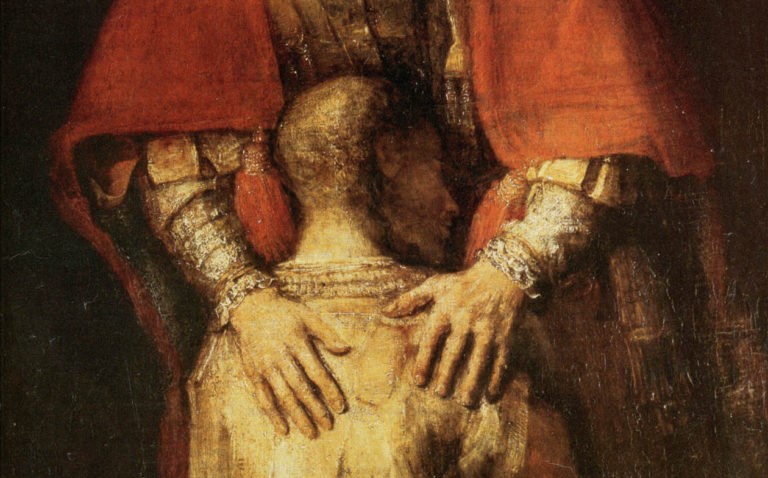
Rembrandt Harmenszoon van Rijn. Don’t count on me here to tell his story in a few lines! (*1) In any case, since the romantics, all, and nearly to much has been said and written about the rediscovered Dutch master of light inelegantly thrown into darkness by the barbarians of neo-classicism.
By Karel Vereycken, June 2001.
The uneasy task that imparts me here is like that of Apelles of Cos, the Greek painter who, when challenged, painted a line evermore thinner than the abysmal line painted by his rival. In order to draw that line, tracing the horizons of the political and philosophical battles who raged that epoch will unveil new and surprising angles throwing unusual light on the genius of our painter-philosopher.
First, we will show that Rembrandt (1606-1669) was « the painter of the Thirty years War » (1618-1648), a terrible continental conflict unfolding during a major part of his life, challenging his philosophical, religious and political commitment in favor of peace and unity of mankind.
Secondly, we will inquire into the origin of that commitment and worldview. Did Rembrandt met the person and ideas of the Czech humanist Jan Amos Komensky (« Comenius ») (1592-1670), one of the organizers of the revolt of Bohemia? This militant for peace, predecessor of Leibniz in the domain of pansophia (universal wisdom), traveled regularly to the Netherlands where he settled definitively in 1656. A strong communion of ideas seems to unite the painter with the great Moravian pedagogue.
Also, isn’t it astonishing that the treaties of Westphalia, who put an end to the atrocious war, are precisely based on the notions of repentance and pardon so dear to Comenius and sublimely evoked in Rembrandt’s art?
Finally, we will dramatize the subject matter by sketching the stark contrast opposing Rembrandt’s oeuvre with that of one of the major war propagandist: (Sir) Peter Paul Rubens (1577-1640).
Rembrandt, who finished rejecting any quest for earthly glory could not but paint his work away from that of the fashion-styled Flemish courtier painter. Moreover, Rubens was in high gear mobilizing all his virtuoso energy in support of the oligarchy whose Counter Reformation crusades and Jesuitical fanaticism were engulfing the continent with gallows, fire and innocent blood.
What Rembrandt advises us for his painting also applies to his life: if you stick your head to close to the canvass, the toxic odors will sharply irritate your nose and eyes. But taking some distance will permit you to discover sublime and unforgettable beauty.
What Art?
Since the triumph of Immanuel Kant‘s modernist thesis, the Critique of the Faculty of Judgment, it has not been « politically correct » to assert that art has a political dimension. And with good reason! If art can influence the course of history and shape it through its power, it is because it is a vector of ideas! An impossibility, according to the Kantian thesis, because art is a gratuitous act, free of everything, including meaning. The ultimate freedom! You either like it or you don’t, it’s all a matter of taste.
Following in the footsteps of the German poet Friedrich Schiller, we’re here to convince you otherwise, and abolish the tyranny of taste. For us, art is an eminently political act, although the work of art has nothing in common with a mere political manifesto, and the artist can in no way be reduced to an ordinary « activist ».
His domain, that of the poet, the musician or the visual artist, is to be a guide for mankind. To enable people to identify within themselves what makes them human, i.e. to strengthen that part of their soul, of their divine creativity, which places them entirely at the zenith of their responsibility for the whole of creation.
To achieve this, and we’ll develop this here, what counts in art is the type of conception of love it communicates. By making this « universal » sensitive, sublime art makes the most elevated conception of love accessible.
Such art, which forces us think, employs enigmas, ambiguities, metaphores and ironies to give us access to the idea beyond the visible. For art that limits itself to theatricality and the beauty of form fatally sinks into erotic, romantic love, depriving man of his humanity and therefore of his revolutionary power.
Rubens will be the ambassador of the great un-powers of his time: the glory of the empire and the magnificent financial strength of those days « new economy », the « tulip bubble ». In short, the oligarchy.
Rembrandt, in turn, will be the ambassador of the have-nots: the weak, the sick, the humiliated, the refugees; he will live in the image of the living Christ as the ambassador of humanity. It might seem strange to you to call such a man the « the painter of the thirty years war. »
Paradoxically, his historical period underscores the fact that very often mankind only wakes up and mobilizes its best resources for genius when confronted with the terrible menace of extinction. Today, when the Cheney’s, the Rumsfeld’s and the Kissinger’s want to plunge the world into a « post-Westphalian epoch », in reality a new dark age of « perpetual war », Rembrandt will be one of our powerful weapons of mass education.
Historical context and the origins of the war
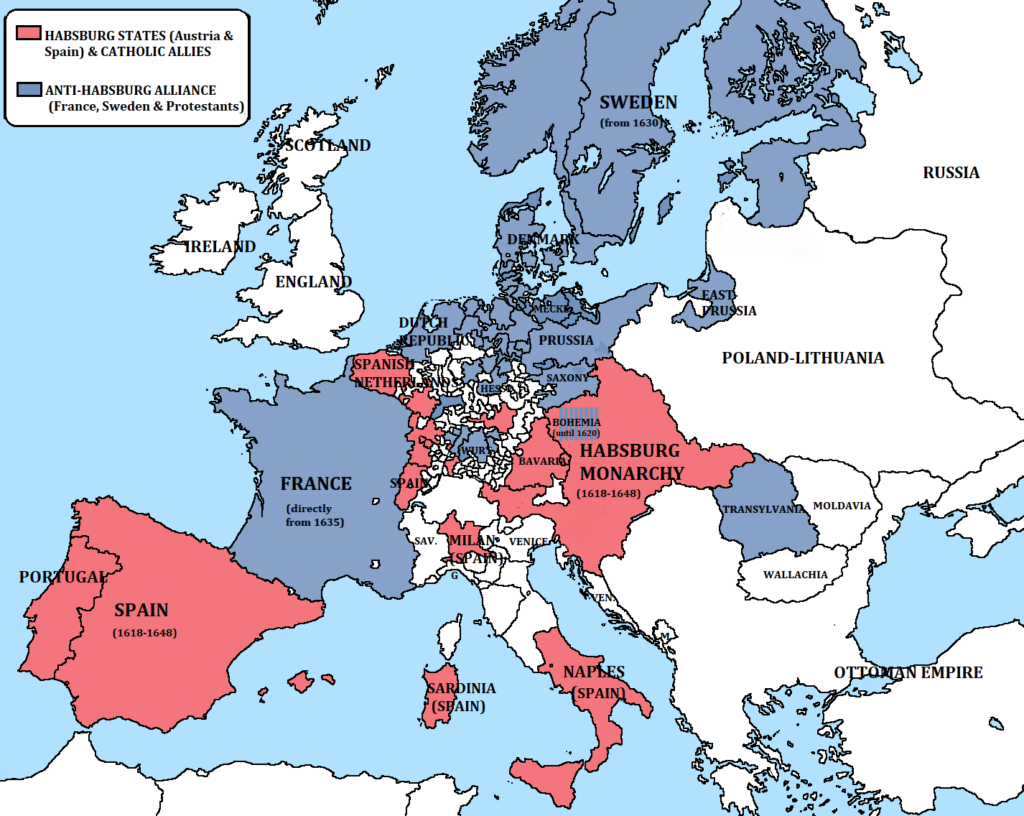
Before entering Rembrandt, it is indispensable to know what was at stake those days. The academic name « Thirty Years War » indicates only the last period of a far longer period of « religious » conflict which was taking place around the globe during the sixteenth century, mainly centered in central Europe, on the territory of today’s Germany.
While 1618 refers to the revolt of Bohemia, the 1648 peace of Westphalia defines a reality far beyond the apparent religious pretext: the utter ruin of the utopian imperial dream of Habsburg and the birth of modern Europe composed of nation-states (*2)
On the reasons for « religious » warfare, let us look at the first half of the sixteenth century. At the eighteen years long Council of Trent (1545-1563), the Roman Catholic Church discarded stubbornly all the wise advise given earlier to avoid all conflict by one of its most ardent, but most critical supporters: Erasmus of Rotterdam.
As Erasmus forewarned, by choosing as main adversary the radical anti-semite demagogue Martin Luther, the church degraded itself to sterile and intolerant dogmatism, opening each day new highways for « the Reformation ».
The religious power-sharing of the « Peace of Augsburg » of 1555, between Rome and the protestant princes, temporarily calmed down the situation, but the ambiguous terms of that treaty incorporated all the germs of the new conflicts to come. Note that « freedom of religion » meant above all « freedom of possession ». The « peace » solely applied to Catholics and Lutherans, authorizing both to possess churches and territories, while ostracizing all the others, very often abusively labeled « Calvinists ».
Playing diabolically on internal divisions, some evil Jesuits of those days set up Calvinists and Lutherans to combat each other bitterly, by claiming, for example in Germany, that Calvinism was illegal since not explicitly mentioned in the treaty. Furthermore, the citizen obtained no real freedom of religion; he was simply authorized to leave the country or adopt the confessions of his respective lord or prince, which in turn could freely choose.
As a result of a general climate of suspicion, the protestant princes created in 1608 the « Evangelical Union » under the direction of the palatine elector Frederic V. Their eyes and hopes were turned on King Henri IV‘s France, where the Edit of Nantes and other treaties had ended a far long era of religious wars. After Henry IV‘s assassination in 1610, the Evangelical Union forged an alliance with Sweden and England.
The answer of the Catholic side, was the formation in 1609 of a « Holy League » allied with Habsburg’s Spain by Maximilian of Bavaria. Beyond all the religious and political labels, a real war party is created on both sides and the heavy clouds carrying the coming tempest threw their menacing shadows on a sharply divided Europe.
1618: The Revolt of Bohemia
Hence, after the never-ending revolt of the Netherlands, the very idea of an insurrection of Bohemia drove the Habsburgs (and the slave trading Fugger and Welser banking empires controlling them) into total hysteria, since they felt the heath on their plans. If Bohemia would become « a new, but larger Holland », then many other nations, such as Poland, could join the Reformation camp and destabilize the imperial geopolitical power balance forever.
As from 1576, the crown of Bohemia was in the hands of the Catholic Rudolphe II, Holy Roman Emperor. Despite a far-fetched passion for esotericism, Rudolphe II will be the protector of astronomers Tycho Brahe and Johannes Kepler in Prague.
In 1609, the Protestants of Bohemia obtain from him a « Letter of Majesty » offering them certain rights in terms of religion. After his death in 1612, his brother Matthias, Holy Roman Emperor, became his successor and left the direction of the country to cardinal Melchior Klesl, a radical Counter Reformation militant refusing any application of the « letter of majesty ».
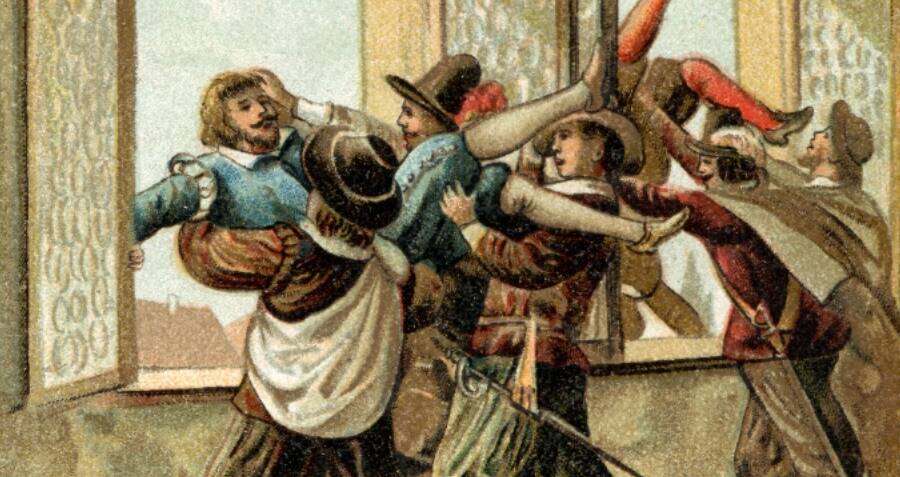
This set the conditions for the famous « defenestration of Prague », when two representatives of the imperial power were thrown out of the window and fall on a manure heap, at the end of hot diplomatic negotiations. That highly symbolical act was in reality the first signal for a general uprising, and following the early death of Matthias, the rebels made Frederic V their sovereign instead of accepting Habsburg’s choice.
Charles Zerotina, a protestant nobleman and Comenius, (see box below), a Moravian reverend and respected community leader, masterminded that revolt. Frederic V, for example was crowned in 1619 by Jan Cyrill, who was Zerotina’s confessor, and whose daughter will become Comenius wife.
The insurgents were defeated at the battle of White Mountain, close to Prague, in 1620 by a Catholic coalition, composed of Spanish troops pulled out of Flanders together with Maximilian’s Bavarians. On the scene: French philosopher René Descartes, who paid his own trip and who was part of the war coalition and joined in entering defeated Prague in search for Kepler’s astronomical instruments… (*3)
An arrest warrant immediately targeted Comenius, who escaped with Zerotina from bloody repression. Protestantism was forbidden and the Czech language replaced by German.
Most resistance leaders were arrested and 27 beheaded in public. Their heads were put up on pins and shown on the roof of Prague’s Saint-Charles bridge.
One of them was the famous Jan Jessenius, head of the University of Prague who performed one of Europe’s early public anatomical dissections in 1600 and was a close friend of Tycho Brahe. To warn those who used their speech to encourage « heresy », his tongue was pulled out before he was beheaded, quartered and impaled.
Thirty thousand people went into exile while Frederic V and his court took refuge in Den Haag in the Netherlands. There, but years before, Comenius had a personal encouter with the future « Winterkönig » and his wife Elisabeth Stuart, on their way back from their wedding in England for which Shakespeare had arranged a representation of « The Tempest ».
A World War
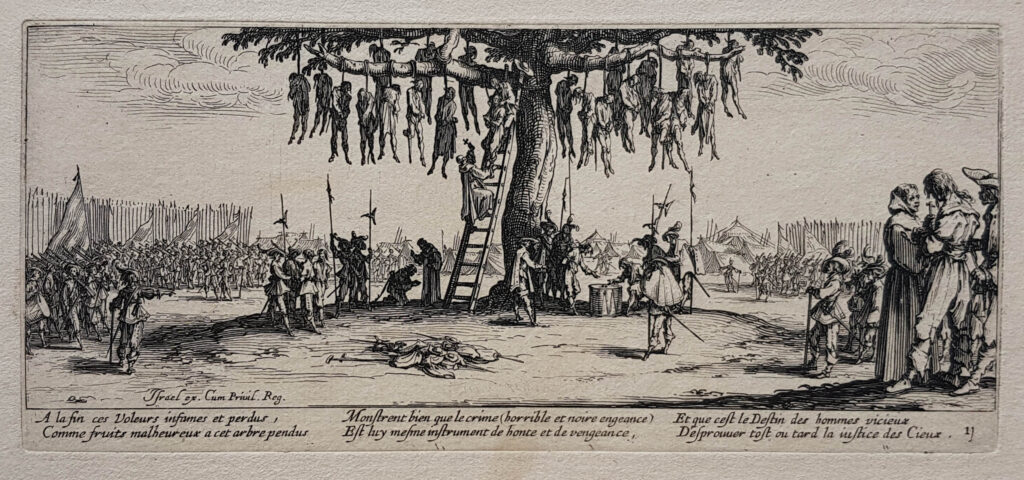
1618 marked the outbreak of an all-out war across Europe, provoked by the imperial drive of Habsburg to reunify all of the continent behind one unique emperor and one single religion.
As of 1625, aided by French and English financial facilities, Christian IV of Denmark and Gustave Adolphus of Sweden intervened on the northern flank against Habsburg descending from the north as far as up till Munich.
Then, France opened another flank on the western front in 1635. Catholic cardinal Richelieu, who defeated the Huguenots at LaRochelle in 1628 (since he « fought their political rights but not their religious ones », will heavily aid the Protestant camp. His fears were that,
« if the protestant party is completely in shambles, the offensive of the house of Austria will come down on France ».
The famous etchings of the Lorraine engraver Jacques Callot, « Misery and calamities of war » of 1633, give an idea how this savage war swept Europe with its cortège of misery, famine, epidemics and desolation.
The estimated population loss on the territory of present day Germany indicates a downturn from 15 to less than 10 million. Hundreds of cities were turned back into simple villages and thousands of communities simply disappeared from the map.
War affected all the colonies of those powers involved in the conflict. Dutch and English pirates would sink any Spanish or Portuguese ships encountered at the other edge of the Earth’s curve. For Spain, loyal pillar of Habsburg, 250 million ducats were spent for the war effort (between 1568 and 1654), despite the state bankruptcy of 1575. That amount represents more than the double of the revenue from the loot of the new world (gold, spices, slaves, etc.) which scarcely amounted only to 121 million ducats…
Rembrandt and Comenius
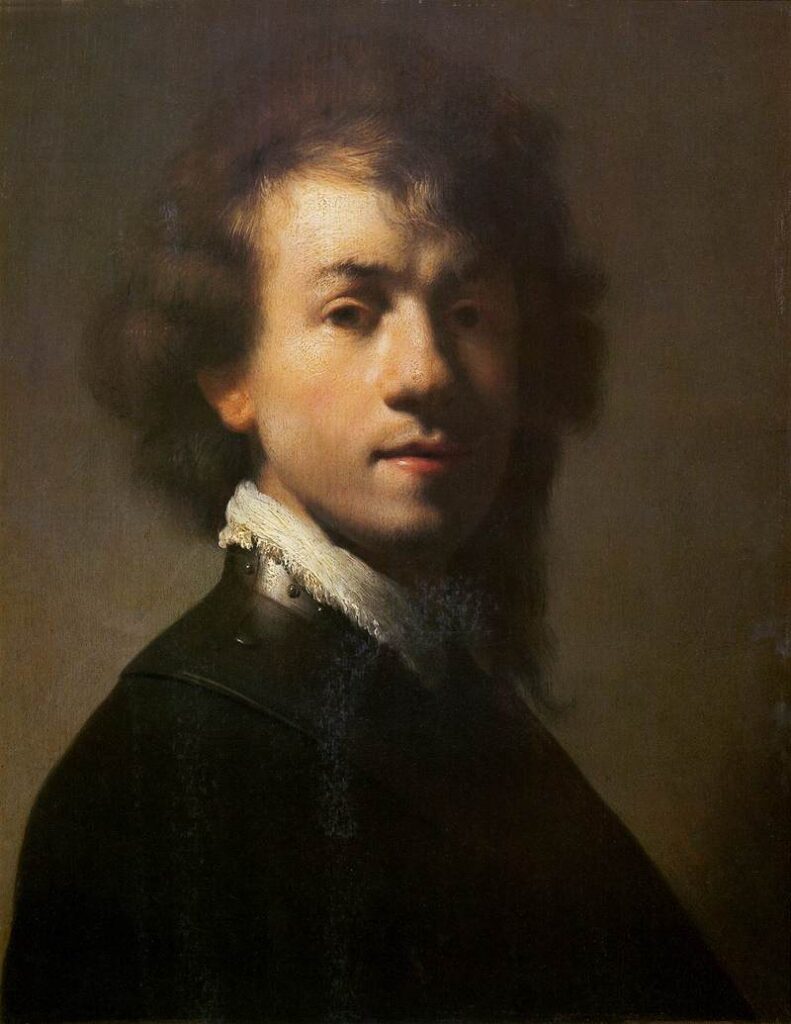
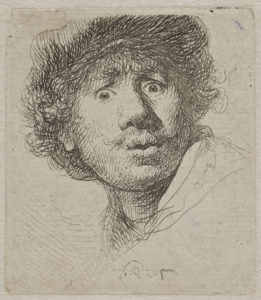
That the young Rembrandt was totally heckled by the situation of general war which was shaking up Europe is easily visible in the early self-portrait of Nuremberg.
Here he portrays himself divided between two choices. One shoulder reveals the gorget, a piece of armor that invokes the patriotic call for serving the nation calling on every young Dutchman of his generation in age of serving the military, especially after the surprise attack of the Spanish troops on Amersfoort of august 1629.
The other shoulder is nonchalantly caressed by a « liefdelok », the French « cadenette » or lovelock exhibited by amorous adolescents. What to choose? Love the nation, or the beloved?
More and more irritated by the ambitions of Constantijn Huygens, the powerful secretary of the stadholder which got him well-paid orders for the government and made him move from Leiden to Amsterdam, Rembrandt’s thinking and activity gets ever more concentrated and powerful.
Ten years later, the dying away of his wife Saskia in 1642, year of the « Night watch », plunges the painter into a deep personnal existential crisis. Gone, the self-portraits where he paints himself as an Italian courtier, with a glove in one hand carrying a heavy golden chain around his neck fronting for his social status and competing with the court. Suddenly he seems to realize that the totality of the world’s gold will never buy back the lost lives of those once loved.
When interrogated on the matter, Rembrandt would bluntly state he didn’t need to go to Italy, as the tradition used to be, since everything Italy ever produced came to him anyway as it was available in one form or another on the Amsterdam art market. But traveler he was, as drawings of the gates of London indicate, done in the early forties, maybe the year Comenius crossed the channel?
In 1644, the neo-Platonist rabbi and teacher of Spinoza, Menasseh Ben Israel, for which Rembrandt illustrated books, received a letter from Comenius agent John Dury, chaplain of Mary Princess of Orange, starting a discussion on the reintegration of the Jews in England, and Menasseh finally went for negotiations to meet Cromwell in 1655.
The Nightly Conspiracy
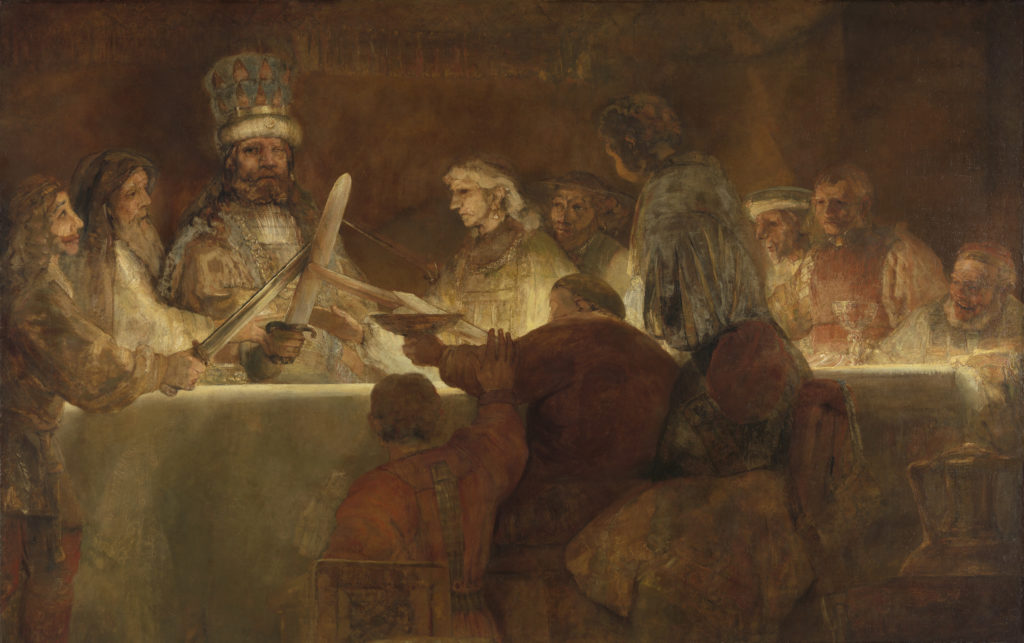
Although some timid hypothesis’ exists concerning Comenius‘ influence on Rembrandt, a rigorous historian’s research could certainly bring more light on this matter.
Although Rembrandt’s worldview evolved in an environment of the Mennonite community, peace-loving Anabaptists miles away from any political commitment, Rembrandt’s passion for the « cause of Bohemia » seems particularly striking in « The nightly conspiracy of Claudius Civilus at the Schakerbos ».
The large painting figured as one in a series planned to decorate the new Amsterdam city hall to celebrate the revolt of the Batavians against the Romans. Starting from historical elements of Tacitus, the story had been cooked up to warm up Dutch patriotism since the reference to Spanish tyranny was clear to all. For reasons unknown today, Rembrandt’s painting was taken down after a couple of months. To mock the cowardice of the ruling elites, Rembrandt seems to have transposed the historical scene into his present timeframe.
One Swedish historian thinks that the leader of the conspiracy here is not Claudius Civilis (the Batavian general who lost an eye in battle), but another general who equally lost an eye in battle and which was non-other than the Hussite general Jan Zizka! (*4).
Remember that Comenius and the revolt of Bohemia strongly identified with John Huss. Looking closely makes you discover that Rembrandt’s Claudius Civilis is indeed dressed up in central European costume. From left to right one sees first a Dutch patrician. Is this a portrait of the then rising republican Jan De Wit?
Next, one sees a monk, without weapons, who poses his hand on Civilus’ arm in a conspiratorial gesture. Is this Comenius resistance movement, the Unity of the Brethren?
According to the historians, the two chalices, one wide, the other narrow, could signify the « Eucharist under the two species », namely that bread and wine be shared with all, which happened to be one of the demands of the Jan Hus tradition.
One also can identify a Jew or rabbi taking place in the conspiracy. Looks pretty weird for a simple Batavian conspiracy! That the establishment was unhappy to see their hero painted as an ugly Cyclops seems probable.
But to be challenged in their flight forward into pompous fantasy in stead of taking up the urgent tasks of their time was another one.
King of Swedish Steel, Louis De Geer
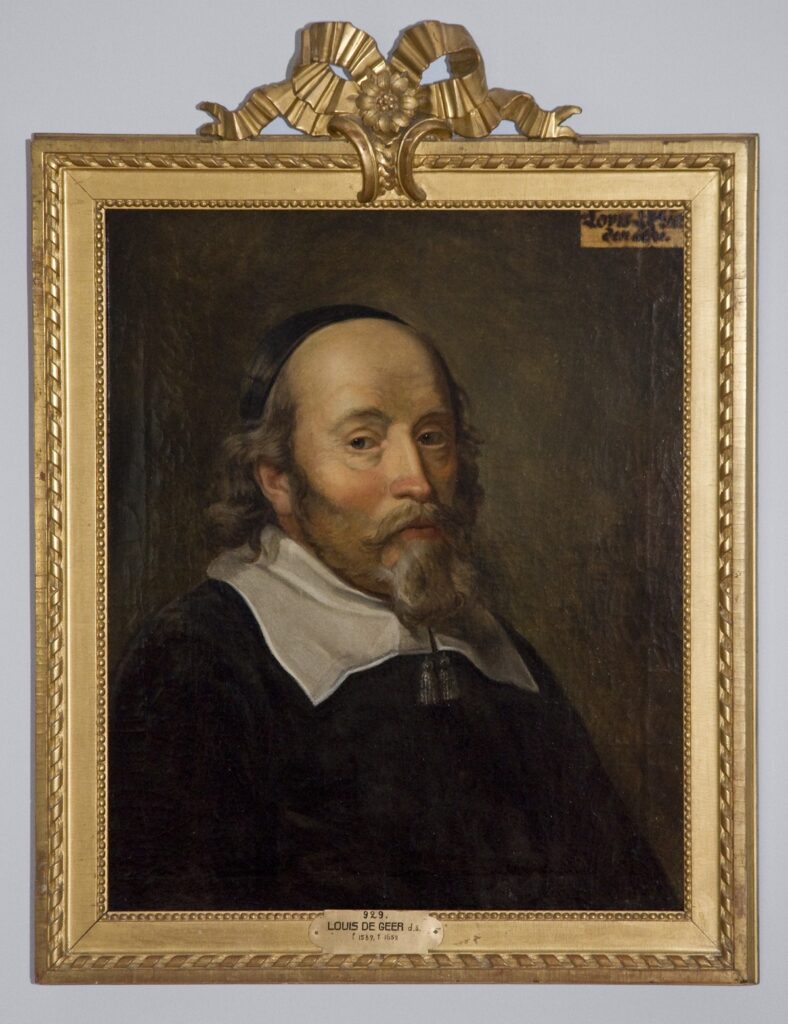
Comenius arrives in Amsterdam on invitation of the de Geer family in 1656, the year of Rembrandt’s bankruptcy (*5).
Louis de Geer, alias « the Steel King » and his son Laurent were the life-long protectors of Comenius for whom they paid the funeral and even build a chapel in the city of Naarden, some miles outside Amsterdam.
Originally from Luik (Liège) in today’s Belgium, that uncompromising Calvinist family settled in Amsterdam. It was the de Geer family who led the foundations of Sweden’s industrial flowering of iron, steel and copper . To do this, de Geer brought three hundred families of Walloon steelworkers to Sweden, and for whom he build hospitals, schools, housing projects and commercial facilities.
De Geer also financed the scottish preacher John Dury and the « intelligencer » Samuel Hartlib, two active friends of Comenius in England. At war with the Royal Society and Francis Bacon, they wanted to render scientific knowledge available to all of the population.
John Milton’s treatise On Education was dedicated to the same Samuel Hartlib. Louis de Geer and Sweden’s prime Minister Johan Skytte, realized Comenius education projects were the best of all possible investment to foster the physical economy. His educational reforms created a labor force of such an exceptional quality and astonishing productivity, that they warmly invited him to Sweden and asked him to reform the nation’s educational system.
That relationship of Comenius with the de Geer family leads us to Rembrandt, since Louis de Geer’s sister, Marghareta, and her husband Jacob Trip, one of the major shareholders of the Swedish copper mines, had their portrait done by Rembrandt, offering him a well paid order during very difficult years.
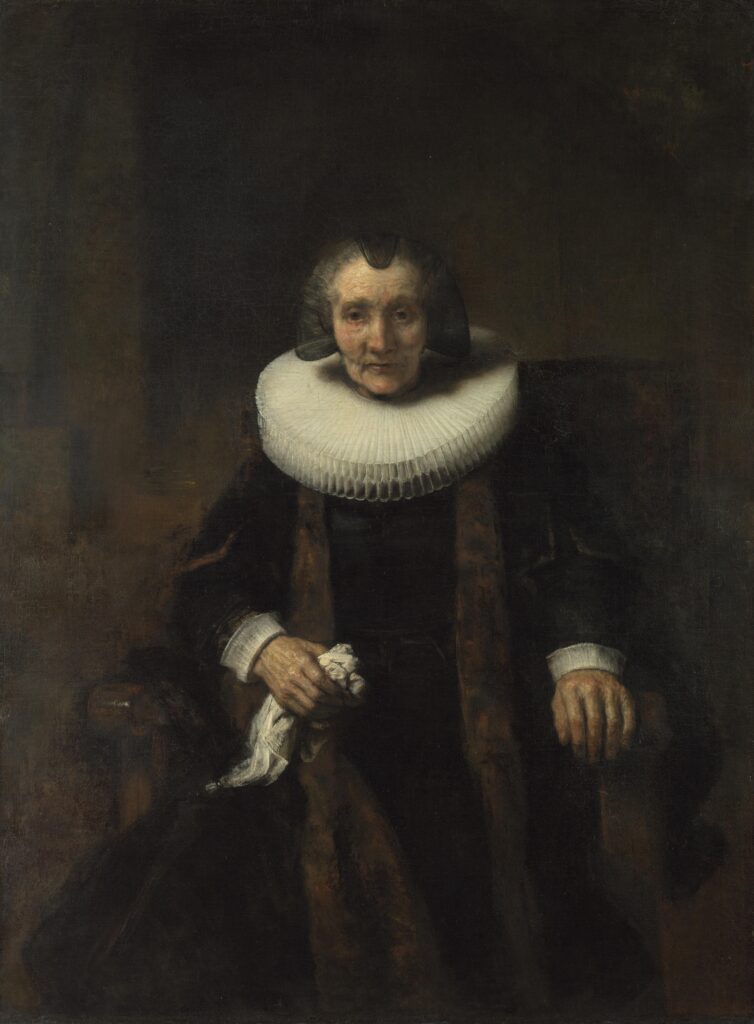
The City of Amsterdam allotted Comenius a yearly pension, encouraged him to publish his complete works on pedagogy and offered him the keys of the city library. Comenius brought over his family and assistants and installed a library and a printing shop behind the Westerkerk where Rembrandt will be buried.
Comenius, when going every day from his house to his printing shop crossed the street where Rembrandt lived his last days. Since early this century, Czech curators got convinced that Rembrandt’s Portrait of an old man at the Uffizi Gallery in Florence, is in reality a portrait of Comenius (*6).

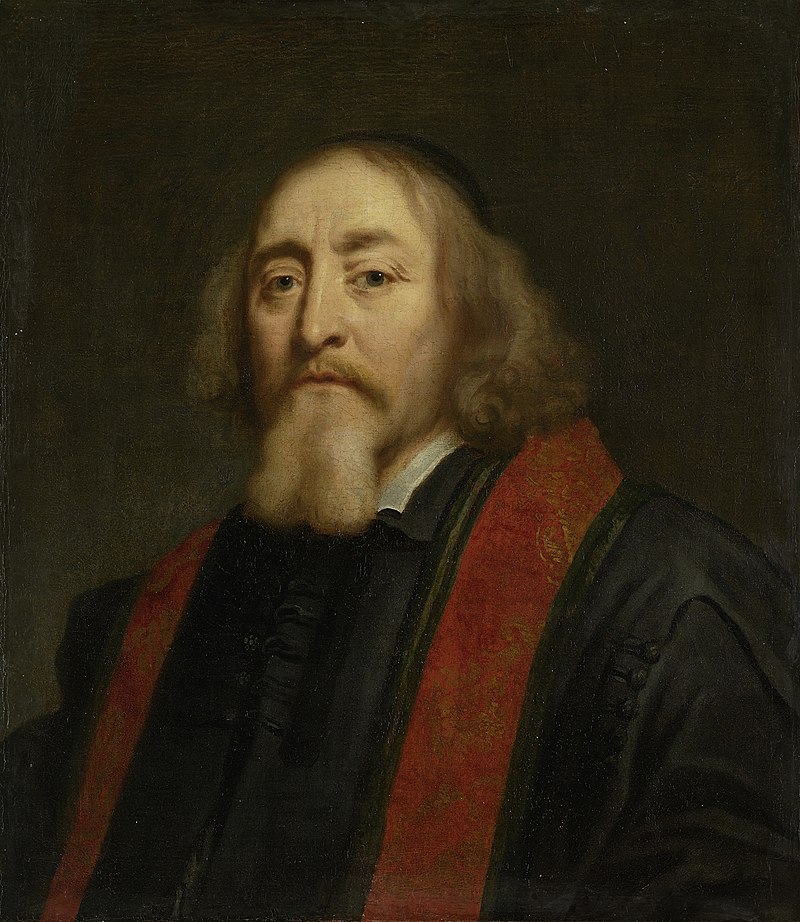
True or not, one has to realize that Rembrandt demanded to each of his models to sit each day for four hours over a period of three months to paint their portrait, a thing maybe not so evident for the aging Comenius.
But what is known with certainty is the fact that one of Rembrandt’s pupils, Juriaen Ovens, painted Comenius portrait during that period.
The Peace of Westphalia and the « Via Lucis »
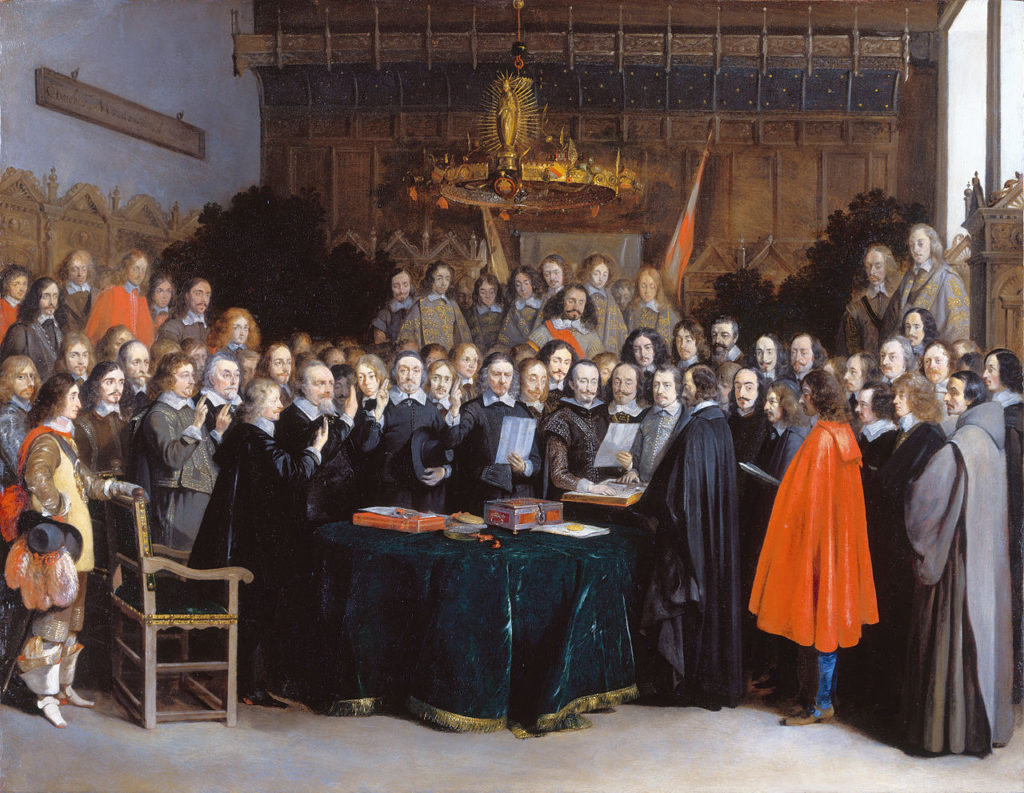
Although Bohemia did not gain its long-desired independence at the peace of Westphalia, one cannot underestimate Comenius influence on the negotiations leading to the establishment of the peace-treaty. His work, Cesta Pokoje (Road to peace) of 1630, written in Czech is described as,
« an ethical-religious writing in which love, faith and mutual comprehension are established as the single ethical foundations of a possible peace ».
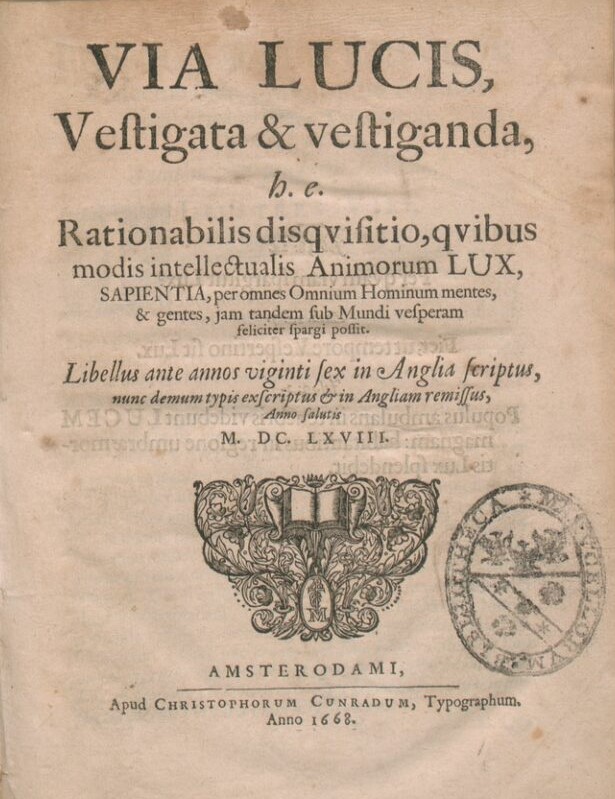
From 1641 to 1642, right before the start of the first peace negotiations, Comenius wrote the Via Lucis (The path of light), which could have been used as a guiding memorandum for the negotiators.
At the question if this Via Lucis was a millenarist mystical vision, as has been often pretended, we can consider the following.
Asked what could be hoped for and when a major change could take place, Comenius answered that the hope would come with the arrival of a time where the Gospel of the Kingdom would be preached all over the world and universal peace established.
That change could arise as the result of the emergence of a light to which will turn not only the Christian, but all the people of the world.
That light will come, « from the combination of the lanterns of human conscience, of a rational consideration of the works of God or of nature, and from the law or divine will ».
For him, « human enterprise can, through prayer and considerations of pious men imagine the possible ways to unite these rays of light, to irradiate them on the entirety of the human species and to spill similar thoughts in the minds of others » (*7).
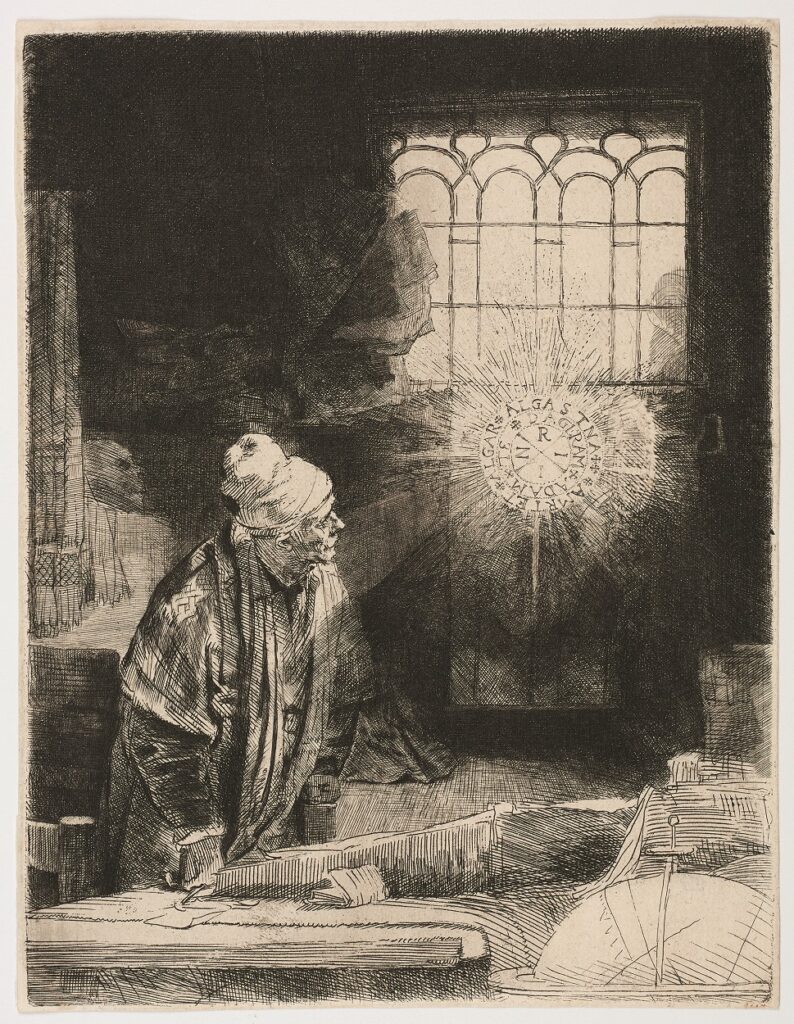
One identifies exactly that concept in an etching of Rembrandt that Goethe awkwardly used by having it copied as frontispiece for his Faust in 1790 (*8).
The subject here is not at all a man going along to get along with the devil, but light (mirror of Christ) enlightening the life and the mind of the mortals. Way before Voltaire and opposed to the Venetian illuminati, Comenius and Rembrandt made own the metaphor of light.
To get an even more precise idea of Comenius demands for peace, one can read another memorandum called Angelus Pacis (The peace-angel),
« send to the English and Dutch peace Ambassadors at Breda, a writing designated to be sent afterwards to all the Christians of Europe and then to all the nations of the world in order to stop them, that they cease fighting each other ».
Comenius first remarks laconically that England and Holland are morally so degraded that they even don’t need some spiritual difference as a pretext, but fight each other for purely material possessions! As a way out, he proposes a new friendship:
« But how do you conceive that new friendship (or rather reestablishment of your friendship)? Will it be not by the general pardon that you will allow each other? The wise men have always seen the oblivion of received injuries as the surest road leading to peace. Touching too rudely the wounds, is to revivify the pains and to furnish the wounds an occasion for irritation.
« When this is true, it would be to be wished that the river Aa, whose tranquil waters irrigate Breda, would turn for this hour into the river Lethe of which the poets tell us that whoever drinks their water forgets everything of the past.
« The one who is guilty of trouble, God will find him, even when men, for love of peace, spare him. That the just one starts accusing himself; that means that the one whose conscience accuses him of having broken the friendship and witnessed enmity, should, according to justice, be the first one and the most ardent to reestablish friendship. If the offended party neglects that duty of justice, it will be the honor of the offended party to assume that honorable role, according to the word of the philosopher. » (*9)
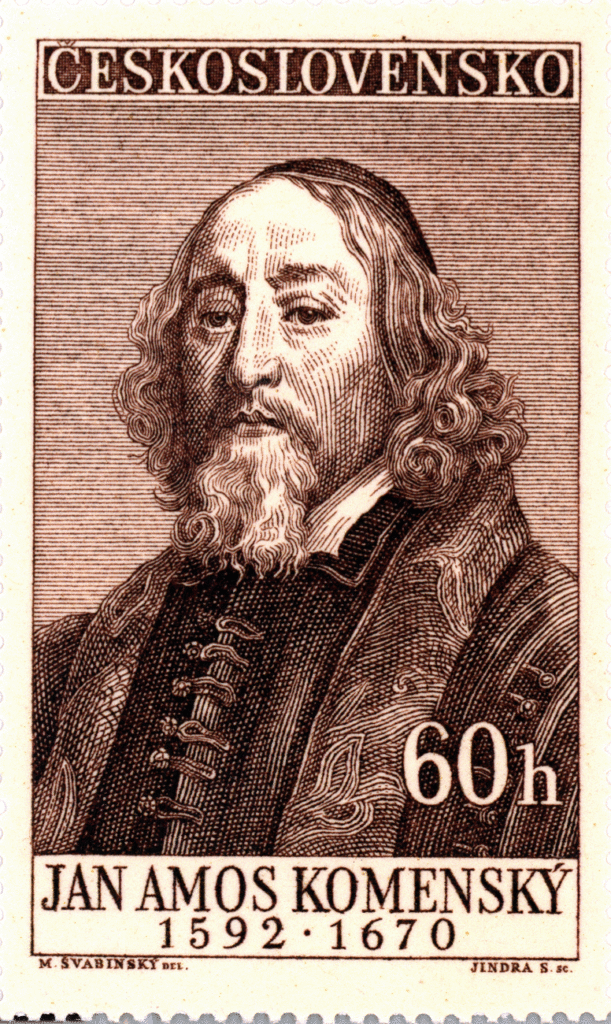
COMENIUS: TEACH EVERYTHING TO ALL AND EVERYONE
Jan Amos Komensky (« Comenius ») (1592-1670) was above all a militant teacher, practicing « the universal art of teaching everything to everybody » (pan-sophia) and reckless source of inspiring enthusiasm.
One year after his death in 1670, Leibniz wrote of him: « time will come, Comenius, that honors will be offered to your works, to your hopes and even to the objects of your desires ».
In some domains, indeed, Comenius was Leibniz‘s precursor. First, he fought the fossilization of thought resulting from the dominant Aristotelianism: « Little time after that unification between Christ and Aristotle, the church fell into a pitiable state and became filled with the uproar of theological dispute ».
Strong defender of the free will that he didn’t see entirely in contradiction with an Augustinianconcept of predestination, he felt closer to John Huss than to Calvin, while generally labeled a « Calvinist » by historians.
In 1608, Comenius enters the Latin School of Prérov (Moravia), a school reorganized at the demand of Charles Zerotina on the model of the Calvinist school of Sankt-Gall in Switzerland. Zerotina was one of the key figures of the Bohemian nobility, promoter of the Church of Unity of Brethren, organizer of popular education and key leader of the international anti-Habsburg resistance. For example, in 1589 he lends a considerable amount of money to the French King Henri IV, which he meets in Rouen, France, in 1593 in support of ending the religious wars with the the Spanish.
Henri IV’s conversion to Catholicism (« Paris is worth a mass ») ruined Zerotina’s hope to reproach the Unity of Brethren with the French Huguenots. Befriended with Theodore de Bèze, which he met regularly when studying in Basel and Geneva, Zerotina sent Comenius to study at the Herborn University in Nassau. That University was founded in 1584 by Louis of Nassau, brother of William the Silent, the leader of the revolt of the Netherlands against Habsburg’s Spain. Louis of Nassau, a key international coordinator of the revolt was in permanent contact with the humanist Huguenot leader Gaspard de Coligny in France and with Walsingham, the chancellor of England’s Queen Elisabeth Ist.
Together with Zerotina, Comenius unleashed the revolt of Bohemia of 1618. After spending some time with the guerrilla forces for which he drew a map of Moravia, Comenius went into exile, as bishop of his church, the « Unity Brethren of Bohemia ».
Till his death, he was the soul of the Bohemian resistance, the gray eminence of the Diaspora and the guardian that prevented the Czech language from disappearing, since it was replaced by German in Bohemia. Since wars are only possible if large parts of the population remain uneducated, for Comenius education became the leading edge to fight for Peace.
Opposed to the Jesuit educators who consolidated their own power by education the elites only, Comenius, starting from his conviction that every individual is made in the living image of God, elaborated with great passion a very high level curriculum, which he wanted accessible to all, as he develops this in his « The Great Didactic » (1638).
Following the advice of Erasmus and Vivès, Comenius abolishes corporal punishment and decides to bring boys and girls in the same class. With him, a school needs to be available in every village, free of cost and open to everybody.
Breaking the division between intellectual and manual work, the schools were part-time technical workshops, anticipating France’s Ecole Polytechnique and the Arts et Metiers (technical school to perfect working people), completely oriented towards the joy of discovery. Leibniz idea of academies originated in Comenius’ schools and societies of friends.
For him, as for Leibniz, the body of physics couldn’t walk without the legs of metaphysics. Integrating that transcendence, he strongly rejected the very idea that nature was reducible to a mere aggregate defined by formal laws, and he adamantly lambasted Bacon, Galileo and Descartes for doing so. In stead, nature has to be looked to as a dynamic process defined by the becoming. That becoming is not repetitive, but permanent progression and potentialization: nature has a quality of development, tending towards self-accomplishment and harmony.
He was severely attacked by Descartes’ « Judgment of the Pansophical works » and mocked by Voltaire, who made him appear as Candide‘s naive philosophy teacher « Pangloss ».
Founder of modern pedagogy, he realized children are beings of affection, before becoming beings of reason. Up till those days, ignorant children were often seen as possessed by the devil, a devil which had to be beaten out of them. The French cardinal Pierre de Bérulle, founder of the Oratorians, reflected that mindset when he wrote that « infancy is the most vile and abject state of man’s nature after that of death ».
To make knowledge accessible to all, Comenius revolutionized the dogmas of that educational approach. In well-ordered classrooms, beautifully decorated with maps, classes would last only one hour covering all the domains one fiends in an engraving of Comenius: theology, manual works, music, astronomy, geometry, botany, printing, construction, painting and sculpture.
Comenius taught Latin, but was strongly convinced that every pupil had to master first his mother tongue. That was a total revolution, since up till then, Latin was taught in Latin, and to bad for those who didn’t understand already !
He also will also re-introduce illustrated textbooks (« The sensible world in images »)(1653), which had been stupidly banned from schools to « not invite the senses to disturb the intellect ». For Comenius, images have the same role as a telescope, displacing the field of perception beyond immediate limits.
His ideas, and especially the rapid successes of schools adopting his pedagogy attracted all of Europe and beyond. In 1642, Comenius was hired by Johan Skytte, the influential chancellor of the University of Uppsala, to reorganize the Swedish education system according to his principles. Skytte, an erudite Platonist inspired by Erasmus, will be Gustaphe Adolph’s preceptor and his son Bengt Skytte will be an influential teacher of Leibniz.
Before that job, Comenius discarded a similar offer originating from Richelieu of France and the offer that came from John Winthrop Junior from the United States who offered Comenius to preside Harvard University, newly founded in the Massachussetts Bay Colony of America.
Rembrandt and Forgiveness
To express in art that precise moment where love gives birth to pardon and repentance will be precisely one of Rembrandt’s favorite subjects. The fact that he choose the name Titus for his son, after the roman emperor who supposedly had showed great clemency toward the early Christians, demonstrates that point. But Titus was also the name of a bishop of Creta who was a close collaborator of Apostle Paul.
Rembrandt was fascinated by the figure of Saint-Paul, who used to be after all a roman officer who, through his conversion, showed the possible transformation of each individual for the better, capable of becoming a militant for the good.
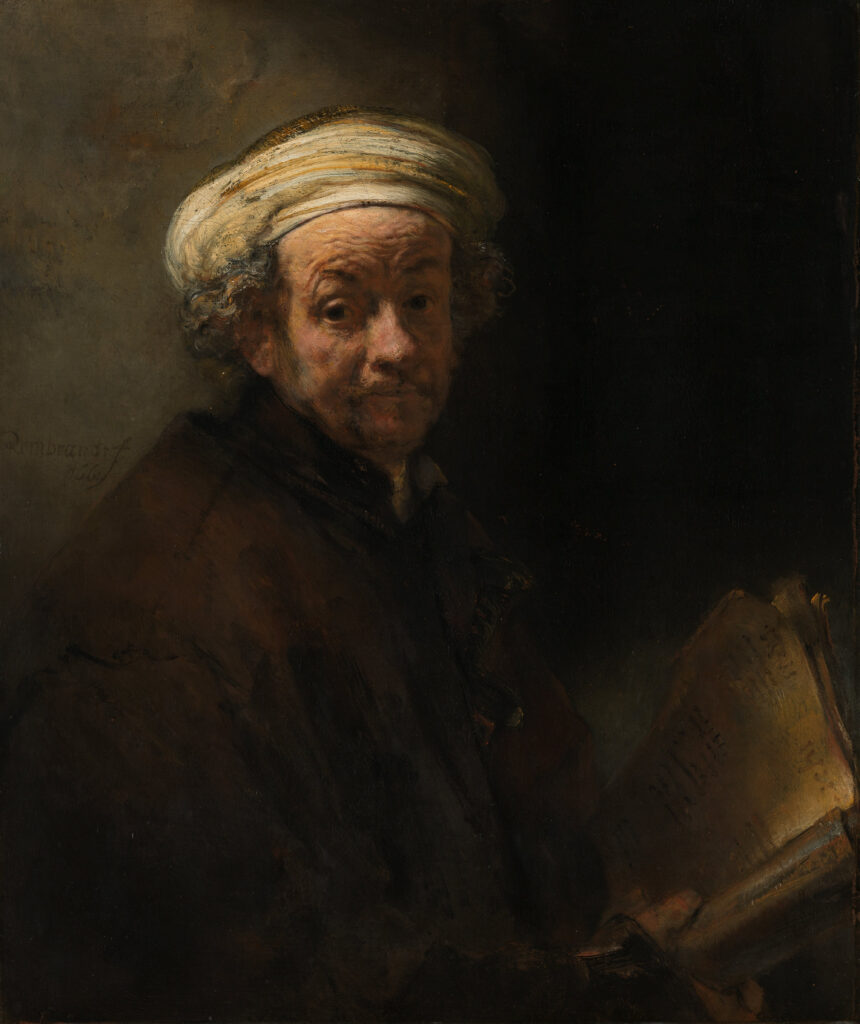
Rembrandt’s self-portrait of the Rijksmuseum, with the famous « ghost-image » of a badly lit dagger nearly planted his breast supposedly represent him as Saint-Paul, traditionally represented defending Christian faith with the scripture in one hand and the sword in the other.
The bible in the armored hand do appear in that painting, but the sword here seems more as a dagger, suggesting an eventual reference to the name given by Erasmus to his Christian’s manual, the « Enchiridion » after the Greek word egkheiridion (dagger).
The Prodigal Son
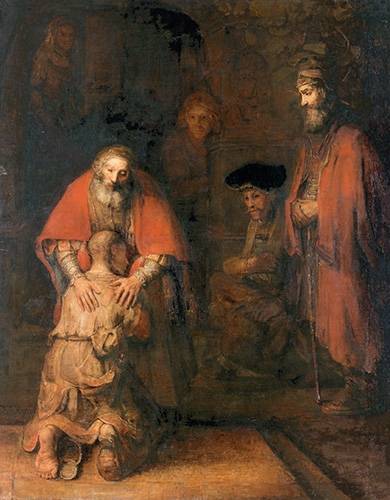
In one of Rembrandt’s late works, the « Return of the prodigal son », despite the fact that the work was completed by a pupil, we see how profoundly he dealt with precisely that subject. The expressiveness of the figures is amplified by the nearly life-size representation on the wide canvas (262 x 205 cm).
The father’s eyes, plunged in interior vision, look yonder the small passage by which the son hasarrived, as doubting of the happiness that overwhelms him, since his son « who was dead », « came back to life ».
The son, who installs his convicts head on the father’s abdomen, engages in the act of total repentance. The naked foot who leaves behind the rotten shoe, communicates in a metaphorical way that sinners deed of repentance, offering what he has inside. The father embraces his son by putting his pardoning hands on his shoulders, while the jealous brothers stand by wondering and enraged why so much love is given to the son « who had spoiled the fathers good with prostitutes ».
Three observations indicate Comenius person and thought might have inspired this work.
First, according to all available portraits, the face of the father shows heavy resemblance with the treats of Comenius himself, a well known militant for peace based on repentance and pardon which Rembrandt probably met frequently during that period.
Second, and after a second look, the son doesn’t look European at all, but actually Negroid, which would add to the painting some critical thoughts on the widely practiced slavery of the European powers of those days.
To conclude, one could interpret the parable of the prodigal son in a much larger sense: is this not man itself, son of God, who returns to his father after having wandered on the roads of sin? Comenius, after a moment of nearly total desperation uses that same image in his book The labyrinth of the world and the paradise of the hearth (1623).
Similar to the image employed by the Dutch painter Hieronymous Bosch, in his « ambulant salesman », man gets lost in the multiplicity of the world that leads him to self-destruction, but after a crisis decides to regain divine unity.
In order to add still another dimension to the discussion on the quality of love involved in art, it is useful to contrast our master with the works of the most talented belonging to the tradition of his detractors: Peter-Paul Rubens.
Rembrandt, Rubens and other Philistines
But before investigating Rubens, it is appropriate to consider the following. Despite the fact that Rembrandt came out of the immense intellectual ferment of the late sixteenth century University of Leiden, one of the cradle’s of humanism, one cannot escape the fact that his lashing career would have infatuated many.
Remember, Constantijn Huygens « discovered Rembrandt » in 1629, while still a young millers son running a small boutique with Jan Lievens, asking them to come to Amsterdam and work for the government. (*10).
Rembrandt’s « patron » nevertheless would write without blushing in his diary Mijn Jeugd (my youth) that Peter Paul Rubens, the Flemish baroque painter was « one of the seven marvels of the world ».
Rubens was, before everything else, the talented standard bearer of the « enemy » Counterreformation and its Jesuits army, whose admiration made Rembrandt totally uncomfortable. How could this virtuoso painter be seen as the brightest star on the firmament of painting? According to some, Huygens was looking for « a Dutch Rubens », capable of making shine the « elites » of the nation.
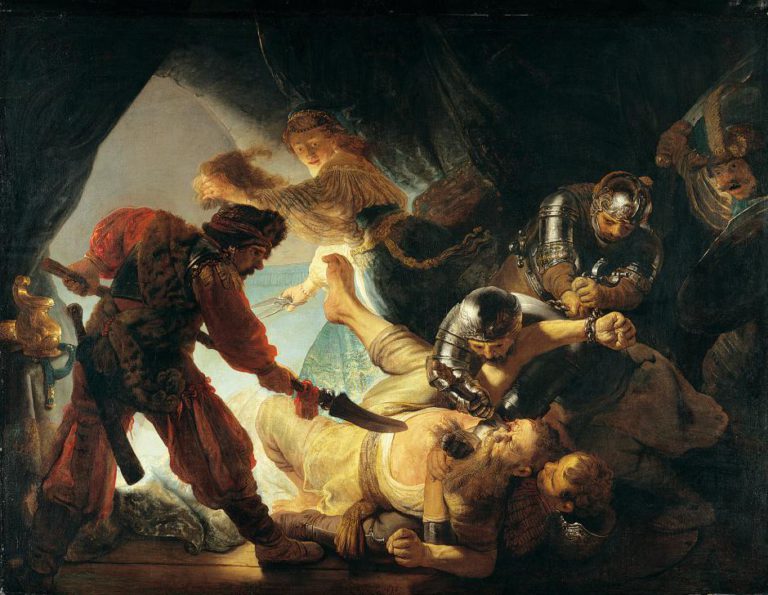
Rembrandt at one point got so irritated with Huygens’ shortsightedness that he
offered him a large painting called Samson blinded by the Philistines. The work, a pastiche of the violent style, painted « à la Rubens », shows roman soldiers gouging out Samson’s eye with a dagger. Did Rembrandt suggest that his Republic (the strong giant) and its representatives were blinded by their own philistinism?
When a little Page becomes a great Leporello
Rembrandt perfectly translates the feeling of revulsion any honest Dutch patriot would have felt in front of Rubens. Had the Dutch elites already forgotten that Peter Paul’s father, Jan Rubens, once a Calvinist city councilor of Antwerp close to the leadership of the revolt of the Netherlands, had severely damaged the integrity of the father of the fatherland by engaging in an extra-conjugal relationship with Anna of Saxen, the unstable spouse of William the Silent?
Humiliated, but with courage and determination, Rubens mother fought as a lioness to free her husband from an uncertain jail. Her son Peter Paul, could not but become the calculated instrument of vengeance against the protestants and an indispensable tool to do away the blame hanging over the family. Hence, at the age of twelve, Peter Paul was sent to the special college of Romualdus Verdonck, a private school specifically designed to train the shock troops of the Counterreformation.
From there on, Rubens becomes a pageboy at the little court of Marguerite de Ligne, countess de Lalaing at Oudenaarde, whose descendants still form the Royal blood of today’s Belgium. As a kid, Rubens copied the biblical images of the woodprints of Holbein and the Swiss engraver Tobias Stimmer. After two waves of iconoclasm (1566 and 1581), the Counterreformation was very eager to recruit image-makers of all kinds, but under strict regulations specified by the final session of the Council of Trent in 1563. (*12).
After a short training by Abraham van Noort, Rubens career was boosted by his entering of the workshop of Otto van Veen. Born in Leiden in 1556 and trained by the Jesuits, « Venius » was the pupil of the master-courtier Federico Zuccari in Rome. Zuccari was the court painter of Habsburg’s Philippe II of Spain and the founder of the « Accademia di San Luca ». Traveling from court to court, Venius succeeded in getting the favors of Alexander Farnèse, the malign Spanish governor in charge of occupying Flanders.
Farnèse, who actually organized the successful assassination of the father of the Netherlands, the erasmian humanist William the Silent in 1584, nominated Venius as his court painter and as engineer of the Royal armies.
Furthermore, Venius will be the man who opened Rubens mind on Antiquity and together they will read and comment classical authors in Latin. Especially, he will show Rubens that an artist, if he wants to attain glory during his lifetime, must appeal a little bit to his talent and a very much to the powerful.
In Italia
In may 1600, Rubens rides his horse to Venice. In June, during Carnival he encounters the Duke of Mantua, Vincent of Gonzague, who is the cousin of archduke Albert who is ruling then Flanders with Isabella since 1598.
The duke of Mantua, the oligarchic type Mozart portrays in his « Don Giovanni » and Verdi explicitly in « Rigoletto », was very fond at the idea to add a « fiamminghi » to his stable.
The court of Mantua, in a competition of magnificence with other courts, notably those of Milan, Florence or Ferrare, employed once the painter Mantegna, the architect Leon Battista Alberti and the codifier of courtly manners Baldassare Castiglione. At the times of Rubens, the court paid the living of poet Torquato Tasso and the composer Monteverdi which wrote in Mantua his « Orpheus » and « Ariane » in 1601.
Galileo was also one of the guests for a short period in 1606. But especially, the Duke had in his possession one of the largest collections of works of art of that period, and his agents in Italy and all over the world were in charge of identifying new works worth becoming part of the collection.
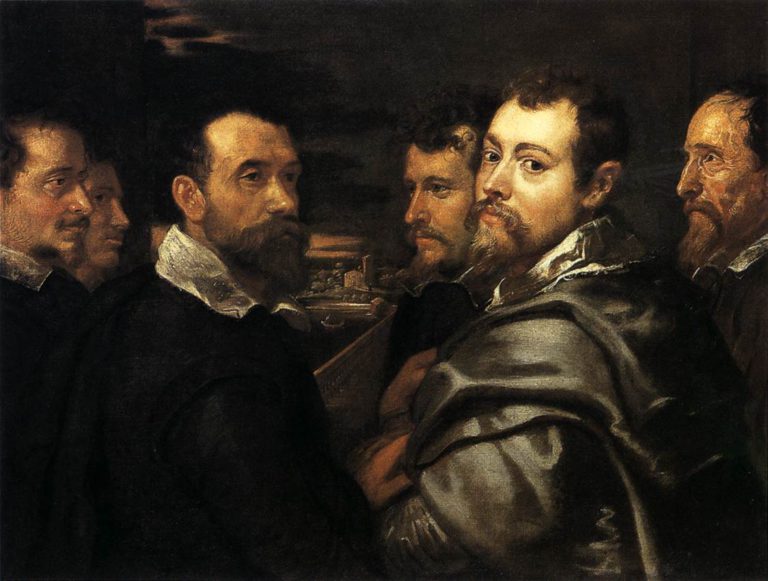
An inventory of 1629 lists three Titian’s, two Raphael’s, one Veronese, one Tintoretto, eleven Giulio Romano’s, three Mantegna’s, two Corregia’s and one Andrea del Sarto amidst others. Similar to Giulio Romano who became the mere instrument of the « scourge of the princes » Pietro Aretino, our Flemish painter became just another Leporello, an obligingly « valet » enslaved by the Duke.
When we look to his self-portrait with his Circle of friends in Mantua, we see a fearful man, who « became somebody » because surrounded by « people who made it » and recognized by the powerful.
In Espagna
Immediately the Duke gave Rubens a truly Herculean task: transport a quite sophisticated present to Philippe III and his prime minister the Duke of Lerma from Mantua to Madrid. On top of a little chariot specially designed for hunting and several boxes of perfume, the core of the present consisted of not less then forty copies of the best paintings of the Duke’s private collection, notably some Raphael‘s and Titians. On top, Rubens’ mission was « to paint the fanciest women of Spain » during his trip. While his patron in Mantua whines for his return, Rubens will deploy his seductive capabilities at the Spanish court which looked far more promising to his career.
Back in Italy, his immediate going to Rome seems an opportune move, since in these days Barocci was held for to old, Guido Reni for to young. Also, Annibale Carracci appeared out of order since suffering from melancholic apoplexies while Caravagio, accused of murder, was hiding on the properties of his patrons, the Colonna’s.
But essentially, Rubens goes to the holy city because he’s enthusiastically promoted there by the Genovese cardinal Giacoma Serra, very impressed by the « splendid portraits » of women Rubens painted for the Spinola-Doria dynasty in Genoa.
Nevertheless, hearing about the imminent death of his mother, Rubens rushes to Antwerp, and after much a hesitation settles his workshop there, far at a distance from the centers of power, but close to the fabulous privileges he obtains from the Spanish regents over the Netherlands, Albrecht and Isabella.
In Antwerpia
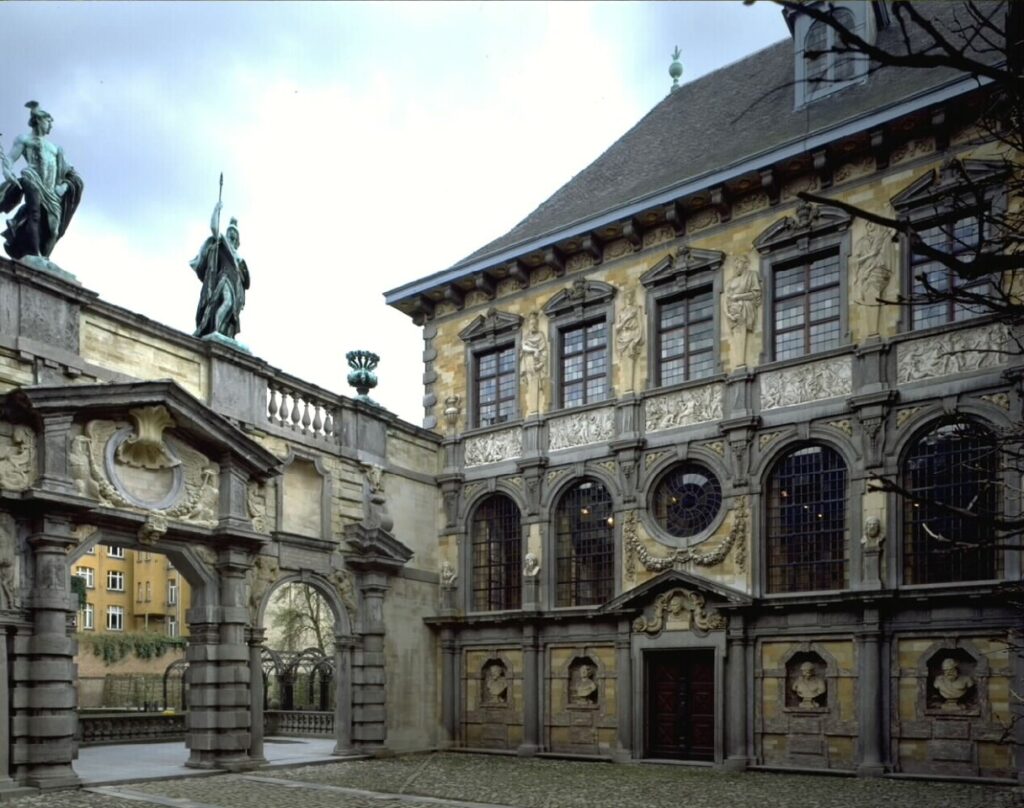
These advantages were such that conspiracy-theorist see them as sufficient proof that there was a blueprint to kill the soul of the Erasmian spirit in Christian painting in the region.
First, Rubens will receive 500 guilders per year without any obligation concerning his artistic output except the double portrait of the rulers, any supplementary order necessitating separate payment.
Next, Rubens obtains a status permitting him to bypass the regulations and obligations of the Saint-Luc painters guild, particularly the rule that limits the number of pupils and the amount of their salary. And since a lot is never enough, Rubens obtains a tax-exemption status in Antwerp! As a real patrician he orders the building of his palace.
Broken down long time ago, and for whatever reasons, one has to observe that it was during the times of Flemish collaboration with Hitler’s Germany (from 1938 to 1946) that his Genovese modeled resort, temporarily recreated in 1910 for the Universal Exposition in Brussels, will be entirely rebuild after the engravings of Jacobus Harrewijn of 1692, decorated as the original and the interior filled with fitting old furniture (*14).
It is true that his enthusiasm for opulent blondes and violent action was interpreted by Nazi historians as the expression of profound sympathy for the Nordic races, while his visual energy was seen as the antithesis of « degenerated » art. The Rubens cult in Antwerp might tell us something interesting about the recurrent rise of rightwing extremism in that city.
Propaganda Genius
Rubens feat was to « merchandize » the ruling taste of the oligarchy of his time. Similar to the German filmmaker Leni Riefenstahl under Hitler, Rubens became the genial producer of their propaganda. Precocious child and brilliant draughtsman, he had spent hours and hours working after Italian collections and bas-reliefs in the ruins of Rome.
Since the « Warrior-pope » Julius II and Leo X took over the Vatican, art had to submit to the dictatorship of the degenerated taste of imperial Rome. Eight years of work, from 1600 to 1608, in Genoa, Mantua, Florence, Rome, without forgetting Madrid, with free access to nearly all the great collections of antiquities and paintings of the old families, enabled Rubens to constitute a « data-base », whose fructification will generate the bulk of his fortune.
Specialists do point easily to the unending stream of visual quotes identified in his works. A group of Michelangelo in « The Baptism of Christ » (Koninklijk Museum voor Schone Kunsten, Antwerp); a pose of Raphael’s Aristotle in the School of Athens in his « St-Gregory with St-Domitilla, St-Maurus and Papianus » (Gemäldegalerie, Berlin) or one of his Madonna’s in « The fall of man » (Rubenshuis, Antwerp), without forgetting a head of the Laocone in the « Elevation of the Cross » (Cathedral, Antwerp) or the « contraposto » of a Venus coming straight away from a roman statuary in « The union of Earth and Water » (Hermitage, Saint-Petersburg). (*11).
The Tulip, Seneca plus Ultra
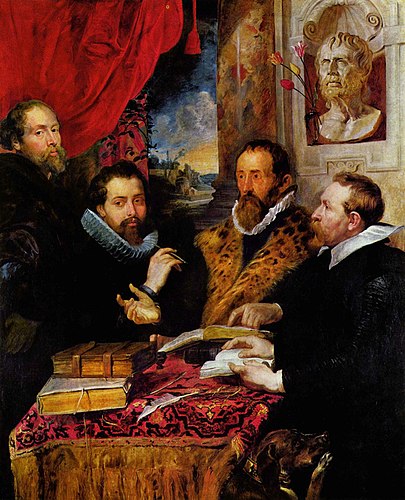
The desire to be accepted by the ruling oligarchs becomes even clearer when we discover his admiration for Seneca.
Through his education and under the influence of his brother Philippe, Peter Paul Rubens will become a fanatical follower of the Roman neo-stoic Seneca (4 BC – 65 AC). In his painting The four philosophers, Rubens paints himself standing, once again « on the map » with those who got a chair at the table.
With a view on the palatine hill in the background, site of the Apollo cult considered the authentic Rome, we see his brother Philippe, a renowned jurist, sitting across the leading stoic ideologue of those days, Justus Lipsius and his pupil Wowerius, all situated beneath a niche filled with a bust of Seneca honored by a vase with four tulips, two of them closed, and the other two opened.
Originally from Persia, the tulip bulb was brought from Turkey to Europe by an Antwerp diplomat in 1560. Its culture degenerated rapidly from a hobby for gentleman-botanist into the immense collective folly known as the Tulip Mania and « tulip-bubble » or « Windhandel » (wind-trade).

That gigantic speculative bubble bursted in Haarlem on February 2, 1637, while some days earlier, a tulip with the name of « vice-roy » went for 2500 guilders, paid in real goods being two units of wheat and four of rye, four fat calves, eight pigs, a dozen of sheep, two barrels of wine, four tons of butter, a thousand pounds of cheese, a bed and a silver kettle drum (*14).
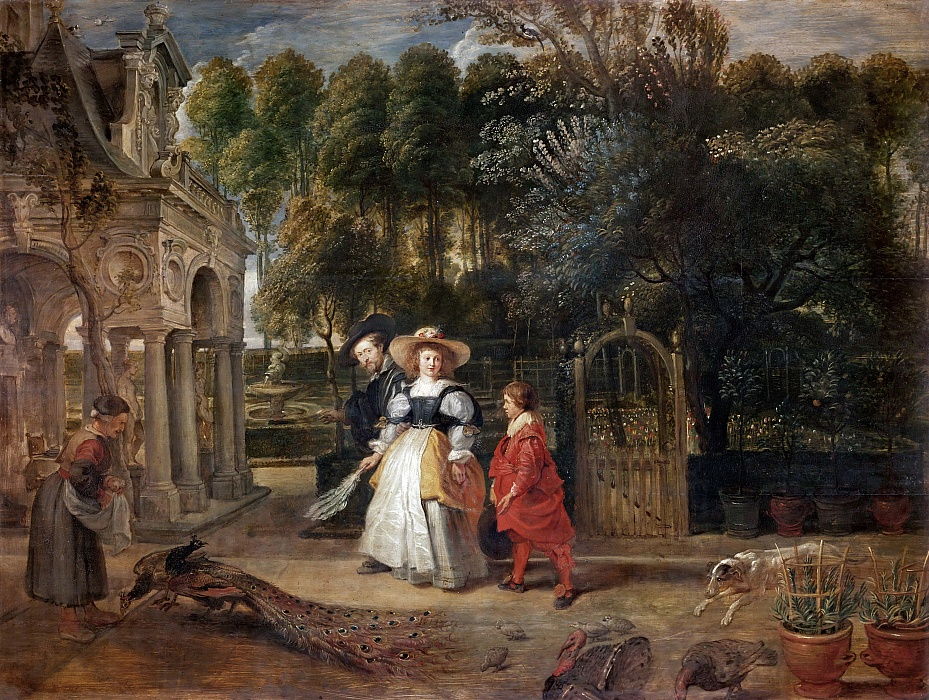
As can be seen in his painting Rubens in his garden with Helena Fourment, Rubens was not indifferent to that highly profitable business. Behind the master and his spouse, appears discretely behind a tree in Rubens garden a rich field of tulips!
But in the « Four philosophers », the tulip is nothing else than a metaphor of the « Brevity of life », an essay of Seneca.
The latter, tutor of Nero, preached a Roman form of sharp cynicism known under the label of fatum (fatality): to rise to (Roman) grandeur, man must cultivate absolute resignation. By an active retreat of oneself on oneself and by a obstinate denegation of a threatening and absurd world, man discovers his over-powerful self. That power even increases, if the self decides that death means nothing.
At the opposite of Socrates, who accepted to die for giving birth to the truth, Seneca makes his suicide his main existential deed. Waiting for his hour, his job is to steer his boredom by managing alternating pleasures and pains in a world where good and bad have no more sense.
As all cases of radical Aristotelianism, that philosophy, or « art of life » steers us in the hell of dualism, separating « reason », cleaned from any emotion, from the unbridled horses driving our senses. These two ways of being unfree makes us a double fool. Rubens fronts for that philosophy in his work Drunk Silenus.
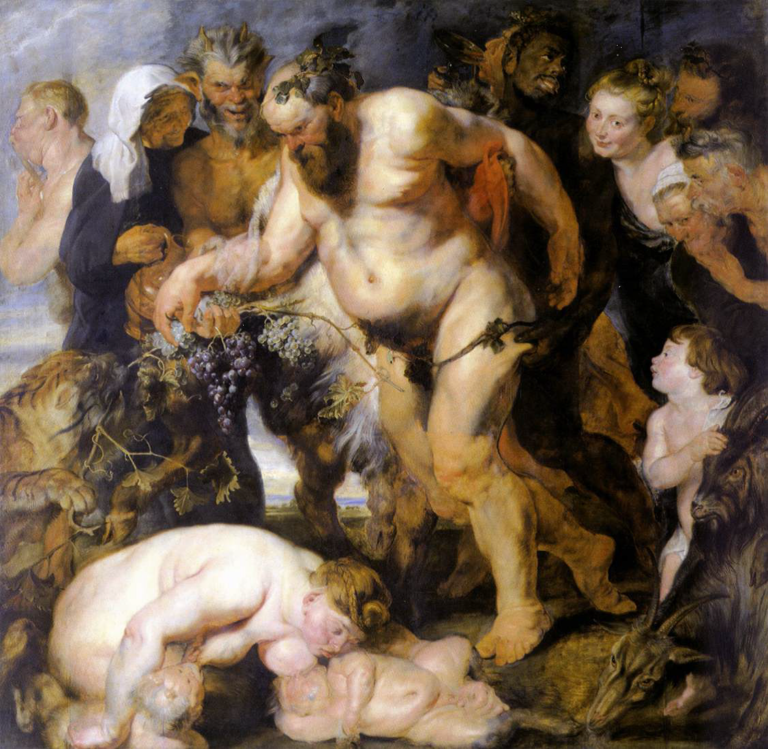
The excess of alcohol evacuates all reason and brings man back to his bestial state, a state which Rubens considers natural. Instead of being a polemic, the painting reveals all the complacency of the painter-courtier with the concept of man being enslaved by blind passion. Instead of fighting it, as Friedrich Schiller outlines the case repeatedly and most explicitly in his « On the Esthetical Education of Mankind », Rubens cultivates that dualism and takes pleasure in it. And sincerely tries to recruit the viewer to that obscene and degrading worldview.
Peace IS war
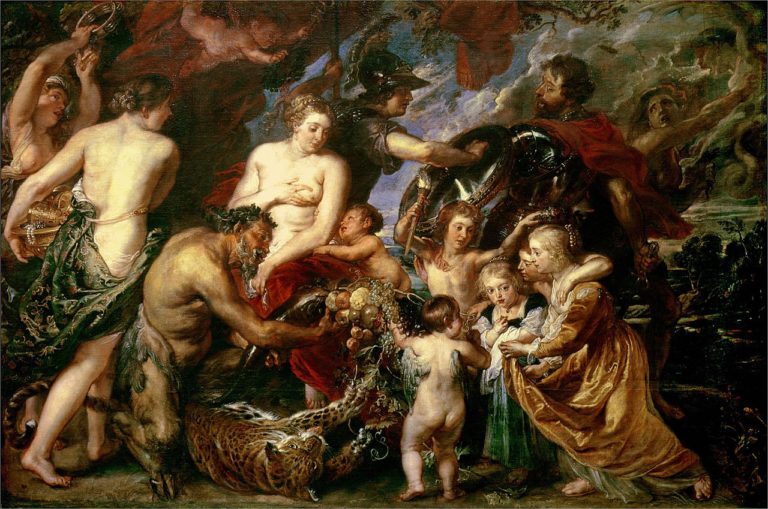
As an example of « allegories », let us look for a moment at Rubens canvas Peace and War.
Above all, that painting is nothing but a glittering « business-card » as one understands knowing the history of the painting. At one point, Rubens, who had become a diplomat thanks to his international relations, organized successfully the conclusion of a peace-treaty between Spain and England (which collapsed fairly soon).
Repeating that for him « peace » was based on the unilateral capitulation of the Netherlands (reunification of the Catholic south with the North ordered to abandon Protestantism), he succeeded entering the Spanish diplomatic servicesomething pretty unusual for a Flemish subject, in particular during the revolt of the Netherlands.
Following this diplomatic success, the painter is threefold knighted: by the Court of Madrid to which he presents a demand to obtain Spanish nationality; by the Court of Brussels and also by the King of England!
Before leaving that country, he offers his painting « Peace and War » to King Charles. The canvas goes as follows: Mars is repelled by wisdom, represented as Minerva, the goddess protecting Rome. Peace is symbolized by a woman directing the flow of milk spouting out of her breast towards the mouth of a little Pluto. In the mean time a satyr with goat hooves displays the corn of abundance…
On the far left, a blue sky enters on stage while on the right the clouds glide away as carton accessories of a theatre. Rubens main argument here for peace is not a desire for justice, but the increase of pleasures and gratifications resulting from the material objects which men could accumulate under peace arrangements! Ironically, seen the cupidity of the ruling Dutch elites, which Rembrandt would lambaste uncompromisingly, it seems that Rubens might have succeeded in convincing these elites to sell the Republic for a handful of tulips. If only his art would have been something else then self-glorification! Here, his style is purely didactical, copied from the Italian mannerism Leonardo despised so much.
Instead of using metaphors capable to make people think and discover ideas, the art of Rubens is to illustrate symbolized allegories. The beauty of an invisible idea has never, and can not be brought to light by this insane iconographical approach. His « style » will be so impersonal that dozens of assistants, real slave laborers, will be generously used for the expansion of his enterprise.
King Christian IV’s physician, Otto Sperling, who visits Rubens in 1621 reported:
« While still painting he was hearing Tacitus read aloud to him and at the same time was dictating a letter. When we kept silent so as not to disturb him with our talk, he himself began to talk to us while still continuing to work, to listen to the reading and to dictate his letter, answering our questions and then displaying his astonishing power. »
« Then he charged a servant to lead us through his magnificent palace and to show us his antiquities and Greek and Roman statues which he possessed in considerable number. We then saw a broad studio without windows, but which captured the light of the day through an aperture in the ceiling. There, were united a considerable amount of young painters occupied each with a different work of which M. Rubens had produced the design by his pencil, heightened with colors at certain points. These models had to be executed completely in paint by the young people till finally, M. Rubens administered with his own hand the final touch.
« All these works came along as painted by Rubens himself, and the man, not satisfied to merely accumulate an immense fortune by operating in this manner, has been overwhelmed with honors and presents by kings and princes ». (*15).
We know, for example, that between 1609 and 1620, not less than sixty three altars were fabricated by « Rubens, Inc. ». In 1635, in a letter to his friend Pereisc, when the thirty years war is ravaging Europe, Rubens states cynically « let us leave the charge of public affairs to those who’s job it is ».
The painter asks and obtains a total discharge of his public responsibilities the same year while retiring to enjoy a private life with his new young partner.
Painter of Agapè, versus painter of Eros
Being a human, Rembrandt correctly had thousand reasons to be allergic to Rubens. The latter was not simply « on the wrong side » politically, but produced an art inspiring nothing but lowness: portraits designated to flatter the pride of the mighty by making shine and glitter some shabby gentry; history scenes being permanent apologies of Roman fascism where, under the varnish of pseudo-Catholicism, the alliance of the violent forces of nature and iron-cold reason dominated. Behind the « art of living » of Seneca, there stood the brutal methods of manipulation of the perfect courtier described by Baldassare Castiglione in his « Courtier ». For courtly ethics, everything stands with balance (sprezzatura) and appearance, and behind the mask of nice epithets operates the savage passions of seduction, possession, rape and power-games.
On the opposite, Rembrandt is the pioneer of interiority, of the creative sovereignty of each individual. To show the beauty of that interiority, why not underline paradoxically exterior ugliness?
In the « Old man and young boy » of Domenico Ghirlandajo, an imperfect appearance unveils a splendid beauty. The old man has a terribly looking nose, but the visual exchange between him and the boy shows a quality of love which transcends both of them. At the opposite of Seneca, they don’t contemplate the « brevity of life », but the longevity or « immortality of the soul ».
Martin Luther King, in a sermon tries equally to define these different species of love. After defining Eros (carnal love), and Philia (brotherly love), he says:
« And then the Greek language comes out with another word. It’s the word agape. Agape is more than Eros; it’s more than an aesthetic or romantic love; it is more than friendship. Agape is understanding, creative, redemptive goodwill for all men. It is an overflowing love which seeks nothing in return. Theologians would say that it is the love of God operating in the human heart. And so when one rises to love on this level, he loves every man, not because he likes him, not because his ways appeal to him, but he loves every man because God loves him, and he rises to the level of loving the person who does an evil deed, while hating the deed that the person does. » (*17)
Then, King shows how that love intervenes into the political domain:
« If I hit you and you hit me and I hit you back and you hit me back and go on, you see, that goes on ad infinitum. It just never ends. Somewhere somebody must have a little sense, and that’s the strong person.
The strongperson is the person who can cut off the chain of hate, the chain of evil. And that is the tragedy of hate, that it doesn’t cut it off. It only intensifies the existence of hate and evil in the universe. Somebody must have religion enough and morality enough to cut it off and inject within the very structure of the universe that strong and powerful element of love. »
You probably understood our point here. Martin Luther King, in his battle for justice, was living in the same « temporal eternity » as Rembrandt and Comenius opposing the thirty years war. Isn’t that a most astonishing truth: that the most powerful political weapon at man’s disposal is nothing but transforming universal love, over more available to everyone on simple demand? But to become a political weapon, that universal love cannot remain a vague sentiment or fancy romantic concept. Strengthened by reason, Agapè can only reach height with the wings of philosophy.
Rembrandt and Comenius knew that « secret », which will remain a secret for the oligarchs, if they remain what they are. »
The Little Fur
Another comparison between two paintings will make the difference even more clearer between Eros and Agapè: Het pelsken (the little fur) of Rubens (left) and Hendrickje bathing in a river of Rembrandt (right).
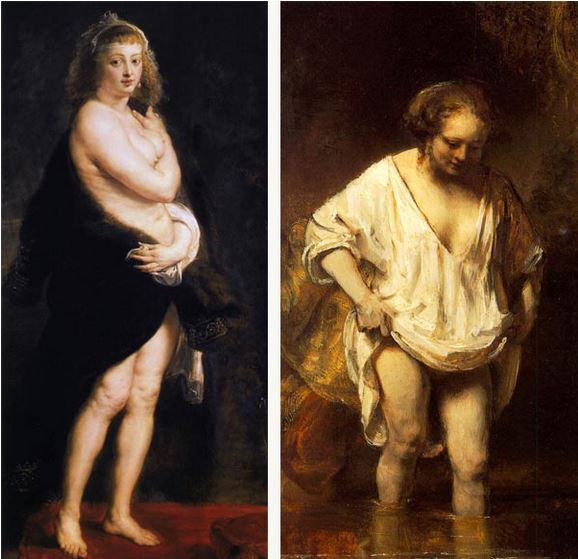
That comparison has a particular significance since the two paintings show the young wives of both painters. At the age of fifty-three Rubens remarried the sixteen year old Helena Fourment, while Rembrandt settled at the age of forty-three with the twenty-two year old Hendrickje Stoffels.
The naked Helena Fourment, with staring eyes, and while effecting an hopeless gesture of pseudo-chastity, pulls a black fur coat over her shoulders. The stark color contrast between the pale body skin and the deep dark fur, a typical baroque dramatic touch of Rubens, unavoidably evokes basic instincts. No wonder that this canvas was baptized the « little fur » by those who composed the catalogues.
However, paradoxically, Hendrickje is lifting her skirt to walk in the water, but entirely free from any erotic innuendo! Her hesitating, tender steps in the refreshing water seem dominated by her confident smile. Here, the viewer is not some « Peeping Tom » intruding into somebody’s private life, but another human being invited to share a moment of beauty and happiness.
Suzanne and the Elderly
Another excellent example is the way the two painters paint the story of Suzanne and the elderly. Comenius, was so impassioned by this story that in 1643 he called his daughter Zuzanna in 1646 his son Daniel. This Biblical parable (Daniel 13) deals with a strong notion of justice, quite similar to the one already developed in Greece by Sophocles Antigone. In both cases, in the name of a higher law, a young woman defies the laws of the city.
In her private garden, far from intruding viewers, the beautiful Suzanne gets watched on by two judges which will try to blackmail her: or you submit to our sexual requests, or we will accuse you of adultery with a young man which just escaped from here! Suzanne starts shouting and refuses to submit to their demands. The next day, Suzanne gets accused publicly by the judges (the strongest) in front of her family, but Daniel, a young man convinced of her innocence, takes her defense and unmasks the false proofs forged by the judges. At the end, the judges receive the sentence initially slated for Suzanne.
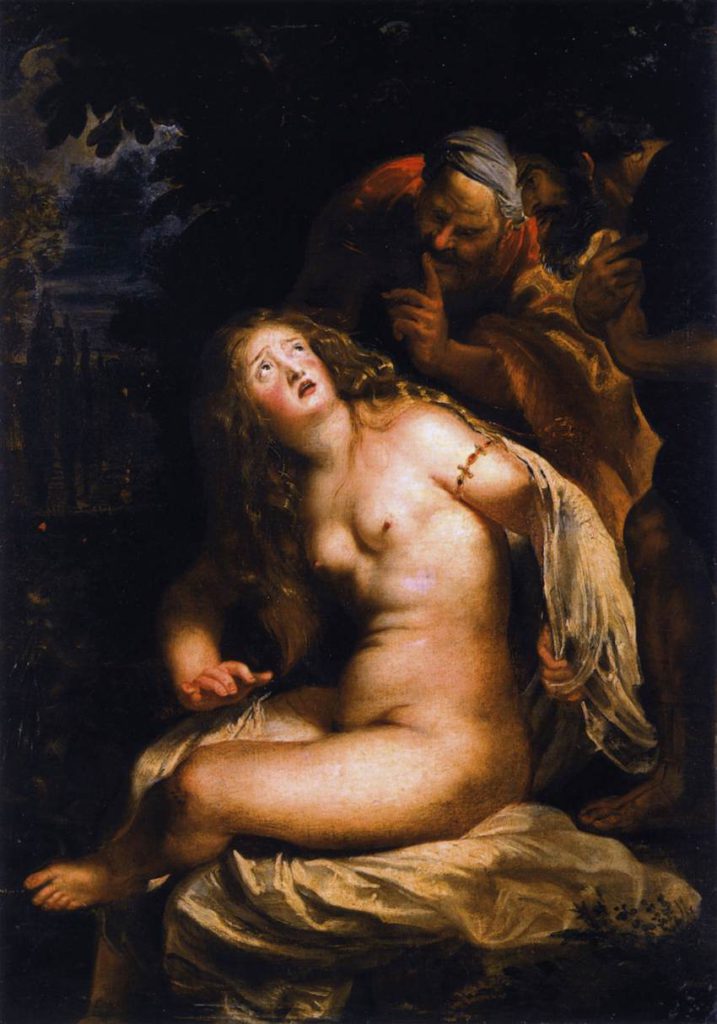
In the Rubens painting, a voluptuous Suzanne lifts her desperate eyes imploring divine help from heaven. The image incarnates the dominant but
insane ideology of both Counterreformation Catholicism and radical Protestantism: the denial of the free will, and thus of the incapacity to obtain divine grace through one’s acting for the good. For the Calvinist/protestant ideologues, the soul was predestinated for good or evil. Reacting by a simple inversion to the crazy indulgences, it was « logical » that no earthly action could « buy » divine grace. So whatever one did, whatever our commitment for doing the good on earth, nothing could derail God’s original design. The Counterreformation Catholics thought pretty much the same, except that one could claim God’s indulgence in the context of the rites of the Roman Catholic Church, especially by paying the indulgences: « No salvation outside the church ».
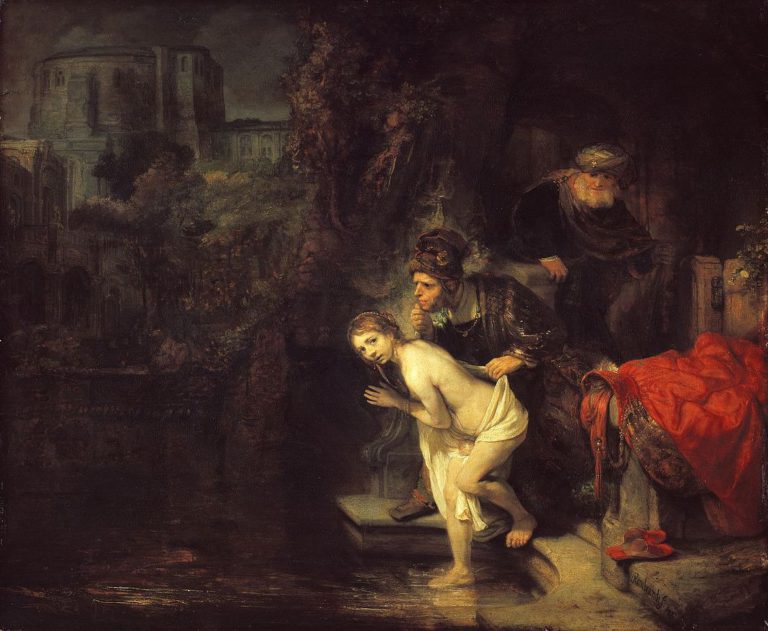
In a spectacular way, Rembrandt’s Suzanne and the elderly reinstates the real evangelical Christian humanist standpoint: a chaste Suzanne looks straight in the eyes of the viewer which is witnessing the terrible injustice happening right under his nos. So, will you be the new Daniel? Will you find the courage to intervene against the laws of the State to defend a « Divine » justice? Hence, agapè is that infinite love for justice and truth, that leads you to courageous action and makes you a sublime personality capable of changing history, in the same way Antigone, Jeanne d’Arc, or Suzanne did before.
Plato versus Aristotle
The fact that Rembrandt was a philosopher is regularly put into question, even denied. The inventory of his goods, established when his enemies forced him into bankruptcy in 1654, doesn’t mention any book outside a huge bible, supposedly establishing a legitimate suspicion of him being near to illiteracy. While romanticized biographies portray him as an accursed poet, a narcissistic genius or the simple-minded mystical visionary son of a miller, a comment in 1641 from the artist Philips Angel underscores, not his painting, but Rembrandt’s « elevated and profound reflection ».
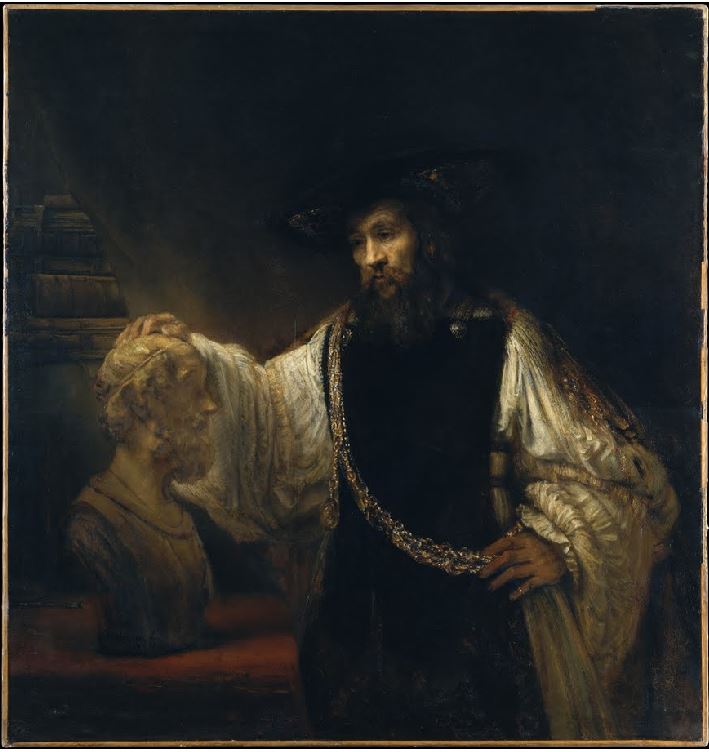
It is Aristotle contemplating Homer’s bust, which demonstrates once and for ever how stupid the Romantics can be. Ordered by an Italian nobleman, the painting shows Aristotle as a Venetian aristocrat, as a perfect courtier: with a wide white shirt, a large black hat and especially carrying a heavy golden chain.
In short, clothed as Castiglione, Aretino, Titian and Rubens… Rembrandt shows here his intimate knowledge of the species nature of Plato’s enemies of the Republic, that oligarchy to whom Aristotelianism became a quasi-religion.
With great irony, the canvas completely mocks knowledge derived from the « blind » submittal to sense perception. Here Rembrandt seems to join Erasmus of Rotterdam saying « experience is the school of fools! ».
Equipped with empty eyes, incapable of perception, Aristotle is groping with an uncertain hand Homer’s head of which he was supposedly a knowledgeable commentator. Homer, the Greek poet who turned blind, stares worriedly to Aristotle with the open eyes of mind.
That inversion of the respective roles of Aristotle and Homer is dramatized by situating the source enlightening the scene as a tangent behind the bust of the poet.
Light reflections illuminating Aristotle’s hat underneath make appear the ironical « ghost image » of donkey ears, the conventional attribute widely used since the Renaissance to designate the stubbornness of scholastic Aristotelianism.
To this Aristotelian blindness, Rembrandt, whose own father became blind, opposes the other clear-sightedness of Simeon, as seen in his last painting, found on Rembrandt’s easel after his death.
All during his life, Simeon had wished to see the Christ with his own eyes. But, growing old, that hope quitted him with along with his sight. As he did every day, Simeon went one day to the temple. There, Maria asked him to keep her child in his arms. Suddenly, an infinite joy
overwhelmed Simeon, who, without seeing Christ with his mortal eyes, saw him much more clearly with his mind than all the healthy seers. Rembrandt wanted us to reflect on that conviction: don’t believe what you see, but act coherently with God’s design and you might see him. On Simeon’s hands, a series of dashes of paint suggest some kind of crystal ball, an image which only « appears » when our minds dares to see it, underlining Simeon’s prophetic nature.
Jesus Christ healing the sick
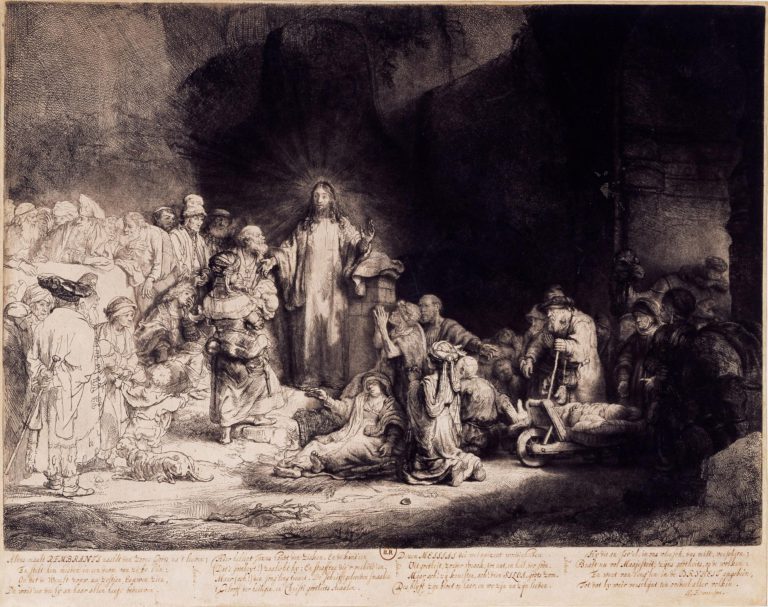
Rembrandt’s anti-Aristotelian philosophy is also explicitly manifest in an engraving known as Christ healing the sick, an exceptionally large etching on which he worked passionately over a six year period. In order to « sculpt » the ambiguous image of the Christ, son of both God and mankind, Rembrandt executed six oil portraits featuring young rabbi’s of Amsterdam. But it was Leonardo’s fresco, the Last Supper, which Rembrandt extensively studied as shown by drawings done after reproductions, that seems to have been his starting point.
Scientific analysis of his still existing copperplate indicate that the Christ’s hands were originally drawn as an exact imitation of Leonardo’s « Last Supper » fresco.
Completely different from the kind of « spotlight theatrics » that go from Caravagio to Hitchcock, the work reminds the description of the myth of the cavern in Plato’s Republic. But here stands the Christ blessing the sick.
Transfigured, and akin to the prisoners in Beethoven’s opera Fidelio, the sick people walk from right to left towards Christ. Encountering the light transforms them into philosophers!
One generally identifies easily, amidst others, Homer and Aristotle (who’s turning his head away from Christ), but also Erasmus and Saint-Peter, which according to some possesses here the traits of Socrates.
The etching brings together in a single instant eternal several sequences of Chapter XIX of Saint Mathew:
“Let the little children come to me, and do not hinder them, for the kingdom of heaven belongs to such as these.”
In a powerful gesture, Christ brushes aside even the best of all wise wisdom to make his love the priority, where Peter desperately tries to prevent the children from being presented to Jesus.
Sitting close to him we observe the image of an undecided young wealthy man plunged in profound doubts, since he desired eternal life but hesitated to sell his possessions and give it all to the poor.
When he left, Jesus commented that it was certainly easier for a camel to get through the eye of a needle, than for a rich man to enter the his kingdom.
Above simple earthly space situated in clock-ticking time, the action takes place in « the time of all times », an instantaneous eternity where human minds are measured with universality, some kind of « last judgment » of divine and philosophical consciousness.
The healing of the sick souls and bodies is the central breaking point which articulates the two universes, the one of sin and suffering, with the one of the good and happiness. Christ’s love, metaphorized as light, heals the « sick » and makes philosopher-kings out of them. They appear nearly as apostles and figure exactly on the same level as the apostles of Leonardo‘s milan fresco The last Supper. Brought out of darkness into the light, they become themselves sources of light capable of illuminating many others.
That « light of Agapè » is the single philosophical basis of Rembrandt’s revolution in the techniques of oil-painting: in stead of starting drawing and paint on a white gesso underground or lightly colored under-paint (the so-called priming, eventually adding imprimatura), all the later works are painted on a dark, even black under-paint!
The « modern » thick impasto, possible through the use of Venetian turpentine and the integration of bee wax, are revived by Rembrandt from the ancient « encaustic » techniques described by Pliny the Elder. They were employed by the School of Sycione three hundred years before Christ and gave us Alexander the Great‘s court painter Apelles, and the Fayoum mommy paintings in Alexandria, Egypt (*17).
Building the color-scale inversely permitted Rembrandt to reduce his late palette to only six colors and made him into a « sculptor of light ». His indirect pupil, Johannes Vermeer, systemized Rembrandt’s revolutionary discovery (*18).
Deprived of much earthly glory during their lives, Rembrandt and Comenius were immediately scrapped from official history by the oligarchic monsters that survived them. But their lives represent important victories for humanity. Their political, philosophical, esthetical and pedagogical battles against the oligarchy and its « valets » as Rubens, makes them eternal.
They are and will remain inexhaustible sources of inspiration for today’s and tomorrows combat.
NOTES:
- Karel Vereycken, « Rembrandt, bâtisseur de nation« , Nouvelle Solidarité, June 1985.
- The treatises of Westphalia (Munster and Osnabruck) of 1648, and the ensuing separate peace accords between France and the Netherlands with Spain, finally shred into pieces every political, philosophical and juridical argument serving as basis of the notion of empire, and by doing so put an end to Habsburg’s imperial fantasy, the « Thirty years war ». As some had outlined before, notably French King Henry IV’s great advisor Sully in his concept of « Grand Design », making the sovereign nation-state the highest authority for international law was, and remains today, the only safe road to guaranty durable peace. Empires, by definition, mean nothing but perpetual wars. If you want perpetual war, create an empire! Hence, through this revolution, small countries obtained the same rights as those held by large ones and the notions of big= strong, and small=weak, went out of the window. The Hobbesian idea that « might makes right » was abolished and replaced by mutual cooperation as the sole basis of international relations between sovereign nation-states. Hence, tiny Republics, as Switzerland or the Netherlands,the latter at war with Spain for nearly eighty years, finally obtained peace and international recognition. Second, and that’s undoubtedly the most revolutionary part of the agreements, mutual pardon became the core of the peace accords. For example paragraph II stipulated explicitly « that there shall be on the one side and the other a perpetual Oblivion, Amnesty or Pardon of all that has been committed since the beginning of these Troubles, in what place, or what manner soever the Hostilitys have been practis’d, in such a manner, that no body, under any pretext whatsoever, shall practice any Acts of Hostility, entertain any Enmity, or cause any Trouble to each other; » (translation: Foreign Office, London). Moreover, several paragraphs (XIII, XXXV, XXXVII, etc.) stipulate (with some exceptions) that there will be a general debt forgiveness concerning financial obligations susceptible of maintaining a dynamic of perpetual vengeance. In reality, the Peace of Westphalia was the birth of new political order, based on the creation of a new international economic and monetary system necessary to build peace on the ruins of the bankrupt imperial order.
- Footnote, p. 77 in Comenius by Olivier Cauly, Editions du Félin, Paris, 1995.
- Brochure dealing with that painting published by the Nationalmuseum of Stockholm.
- To put to an end to the politically motivated financial harassment which was organized by the family of his deceased wife, Saskia van Uylenburgh, Rembrandt submits on July 14, 1656 to the Dutch High Court a cessio bonorum (Cessation of goods to the profit of the creditors), accepting the sale of his goods. In 1660, Rembrandt abandons the official management of his art trading society to his wife Hendrickje Stoffels and his son Titus.
- p. 105, Henriette L.T.de Beaufort, in Rembrandt, HDT Willinck & Zoon, Harlem, 1957.
- p. 358, Samuel Hartlib and Universal Reformation, Cambridge University Press, 1994.
- p. 12-13, Bob van den Bogaert, in « Goethe & Rembrandt », Amsterdam University Press, Amsterdam 1999.
- p. 25, Marcelle Denis in Comenius, pédagogies & pédagogues, Presse Universitaire de France, 1994.
- Constantijn Huygens (1596-1687), was an exceptional precocious erudite. Politician, scientist, moralist, music composer, he played the violin at the age of six, wrote poems in Dutch, Latin, French, Spanish, English and Greek. His satire, « ‘t Kostelick Mal » (expensive folly), opposed to the « Profijtelijk Vermaak » (profitable amusement) makes great fun of courtly manners and the then rampant beaumondism. His son, Christiaan Huygens was a brilliant scientist and collaborator of Leibniz at the Paris Academy of sciences.
- One has to outline shortly here that contrary to the rule of the Greek canon of proportions (height of man = seven heads and a half), the Romans, as Leonardo seems to observe sourly in his drawing reworking Vitrivius, increase the body size up to eight and sometimes many more heads. It was the Greek canon established after the « Doryphore » of Polycletius, which settled the matter much earlier after many Egyptian inquiries on these matters. Leonardo, who wasn’t a fool, realized Vitruvius proportions (8 heads) are wrong, as can be seen by the two belly-buttons appearing in the famous man bounded by square and circle. Hence, the proportional « reduction » of the head was an easy trick to create the illusion of a stronger, more powerful musculature. That image of a biological man displaying « small head, big muscles » supposedly stood as the ultimate expression of Roman heroism. Foreknowledge of this arrangement permits the viewer to identify accurately what philosophy the painter is adhering to: Greek humanist or Roman oligarch? That Rubens chose Rome rather than Athens, leaves no doubt, as proven by his love for Seneca.
- « The holy Council states that it isn’t permitted to anybody, in any place or church, to install or let be installed an unusual image, unless it has been approved so by the bishop »; « finally any indecency shall be avoided, of that sort that the images will not be painted or possess ornaments of provoking beauty… » P. 1575-77, t. II-2, in G. Alberigo, « The ecumenical Councils », quoted by Alain Taton (p. 132) in « The Council of Trent », editions du CERF, Paris, 2000.
- p. 172, Simon Schama, in his magnificent Rembrandt’s eyes, Knopf, New York, 1999.
- For a more elaborate description of the tulip-bubble, Simon Schama, p. 471, « L’embarras de richesses, La culture hollandaise au Siècle d’Or », Gallimard, Paris, 1991.
- p. 117, Otto Sperling, Christian IV’s doctor, quoted by Marie-Anne Lescouret in her biography Pierre-Paul Rubens, J.C. Lattès, Paris, 1990.
- « Love your enemies », sermon of Martin Luther King, November 17, 1957, Dexter Avenue Baptist Church, Montgomery, Alabama. Quoted in Martin Luther King, Minuit, quelqu’un frappe à la porte, p.63, Bayard, Paris 1990.
- p. 87-88, Karel Vereycken, in The gaze from beyond, Fidelio, Vol. VIII, n°2, summer 1999.
- Johannes Vermeer of Delft was a close friend of Karel Fabritius, the most outstanding pupil of Rembrandt, who died at the age of thirty-four when the powderkeg of Delft exploded. Vermeer became the executor of his last will, a role generally reserved for the closest friend or relative. Anthonie van Leeuwenhoek, the inventor of the microscope and Leibniz correspondent, will become in turn the executor of Vermeer’s last will. That filiation does nothing more than prove the constant cross-fertilization of the artistic and scientific milieu. The Dutch « intimist » school, of which Vermeer is the most accomplished representative, is the most explicit expression of a « metaphysical » transcendence, transposed for political reasons, from the domain of religion, into the beauty of daily life scenes.
SELECTED BIBLIOGRAPHY:
- Baudiquey, Paul, Le retour du prodigue, Editions Mame, 1995, Paris.
- Bély, Lucien, L’Europe des Traités de Westphalie, esprit de la diplomatie et diplomatie de l’esprit, Presses Universitaires de France, Paris, 2000.
- Callot, Jacques, etchings, Dover, New York, 1974.
- Castiglione, Baldassare, Le Livre du Courtisan, GF-Flammarion, 1991.
- Cauly, Olvier, Comenius, Editions du Félin, Paris, 1995.
- Clark, Kenneth, An introduction to Rembrandt, Readers Union, Devon, 1978.
- Comenius, La Grande Didactique, Editions Klincksieck, Paris, 1992.
- Denis, Marcelle, Comenius, Presses Universitaires de France, Paris 1994.
- Descargues, Pierre, Rembrandt, JC Lattès, 1990.
- Goethe Rembrandt, Tekeningen uit Weimar, Amsterdam University Press, 1999.
- Grimberg, Carl, Histoire Universelle, Marabout Université, Verviers, 1964.
- Haak, B., Rembrandt, zijn leven, zijn werk, zijn tijd, De Centaur, Amsterdam.
- Hobbes, Thomas, Le Citoyen ou les fondements de la politique, Garnier Flammarion, Paris, 1982.
- Jerlerup, Törbjorn, Sweden und der Westphalische Friede, Neue Solidarität, mai 2000.
- King, Martin Luther, Minuit, quelqu’un frappe à la porte, Bayard, Paris, 2000.
- Komensky, Jan Amos, Le labyrinthe du monde et le paradis du cœur, Desclée, Paris, 1991.
- Lescourret, Marie Anne, Pierre-Paul Rubens, JC Lattès, Paris, 1990.
- Marienfeld Barbara, Johann Amos Comenius : Die Kunst, alle Menschen alles zu lehren. Neue Solidarität.
- Rembrandt and his pupils, Nationalmuseum, Stockholm, 1993.
- Sénèque, Entretiens, Editions Bouquins, Paris, 1993.
- Schama Simon, Rembrandt’s Eyes, Knopf, New York 1999.
- Schama, Simon, L’embarras de richesses, La culture hollandaise au Siècle d’Or, Gallimard, 1991.
- Schiller, Friedrich, traduction de Regnier, Vol. 6, Histoire de la Guerre de Trente ans, Paris, 1860.
- Sutton, Peter C., Le Siècle de Rubens, Mercatorfonds, Albin Michel, Paris, 1994.
- Tallon, Alain, Le Concile de Trente, CERF, Paris, 2000.
- Tümpel, Christian, Rembrandt, Fonds Mercator-Albin Michel, 1986.
- Van Lil, Kira, La peinture du XVIIème siècle aux Pays-Bas, en Allemagne et en Angleterre, dans l’art du Baroque, Editions Köneman, 1998, Cologne.
The Congress for Cultural Freedom: How the CIA « weaponized » Modern Art

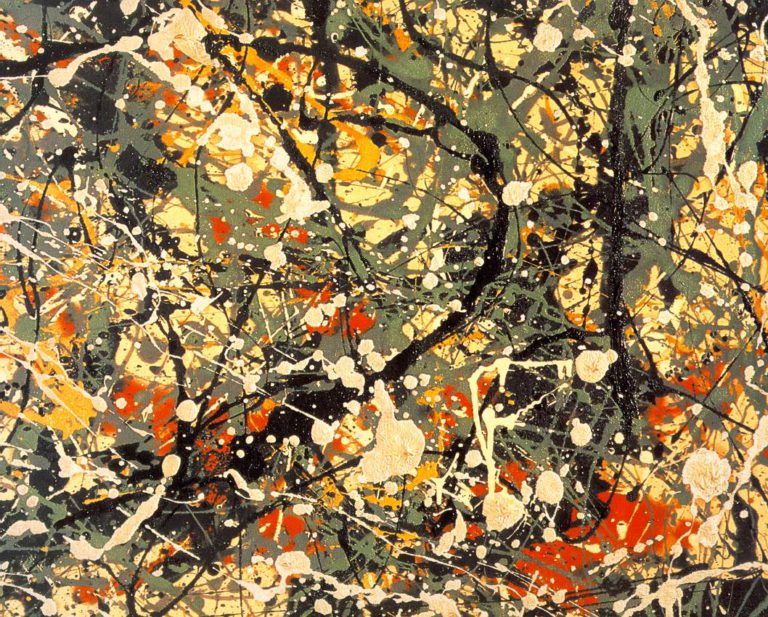
This article, first published in 2006, came as a book review of the book Who Paid the Piper of British researcher Frances Stonor Saunder, published in French Article under the title Qui mène la danse? La CIA et la guerre froide culturelle, 506 pages, Editions Denoël, Paris, 2003.
This book, which caused a stir in Germany, England and the Hispanic world, is literally appalling. Not only for what it reveals, but above all for what it leaves unsaid.
After years of meticulous research, interviews and archival work, the young writer Frances Stonor Saunders, producer of historical documentaries for the BBC, delivers an uncompromising account of the Anglo-American cultural Cold War against the Soviet Union from 1947 onwards.
Congress for Cultural Freedom
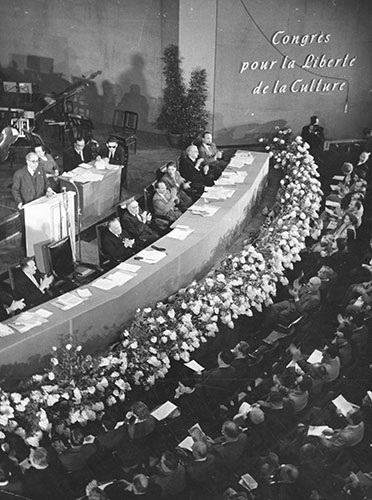
At the heart of this secret « Kulturkampf », a veritable cultural Cold War, was the Paris-based Congress for Cultural Freedom (CCF), headed from 1950 to 1967 by CIA agent Michael Josselson.
Josselson, who spoke four languages, along with music composer Nicholas Nabokov, was a former member of the psychological warfare division of the Office for Strategic Services (OSS), which US President Harry Truman replaced with the CIA in 1945.
The first thing that strikes the reader is the analogy between the language of the Cold War and the narrative of today’s war hawks to justify a new crusade « against terrorism. »
Back then, under the guise of a merciless struggle against the horrors of Stalinism, the Anglo-American imperial faction deployed whole swathes of the CIA in an attempt to impose Bertrand Russell‘s utopian vision of « world government. »
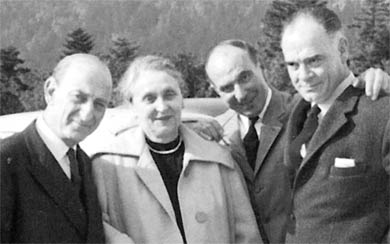
The CIA described itself as an « Order of Knights Templar » charged with « saving Western freedom from Communist darkness ». Its principal theoretician was George Kennan, Director of the Policy Planning Staff at the State Department.
Like the « Noble Lies » employed today by the neo-conservatives, followers of Leo Strauss, Kennan asserted in 1947 that the Communists had gained a position of prominence in Europe,
« through the shameless and skillful use of lies. They fought us with the weapon of unreality and irrationalism. Can we triumph over this unreality with rationalism, truth, honest and well-intentioned economic assistance? »
Obviously not! And the most formidable weapon for world domination will be, as always: the soft power of « culture ».
Indeed, « you can’t be a great power if you don’t have the art to go with it, it’s like Venice without Tintoretto or Florence without Giotto ».
So, ironically, while American public opinion was held hostage by the McCarthyite psychosis for whom « all modern art is communist », to the point of suspecting certain abstract paintings of indicating the exact location of American military bases (sic), the oligarchs saw in « lyrical abstract » expressionism the virtues of a specifically anti-communist ideology.
By a simple logic of inversion, everything that Nazis and Stalinists considered « degenerate art » automatically became emblematic of the values of freedom and free enterprise, and therefore got massively financed… in the greatest secrecy.
With a wealth of detail, the author documents the mesh of this operation over some five hundred pages. It is, of course, impossible to summarize here the descriptions of the lives of dozens of men, women, musicians, authors, magazines, networks and foundations, each page of which delivers a few pearls.
Some of the details shed a special light on contemporary French history.
The CIA in Paris
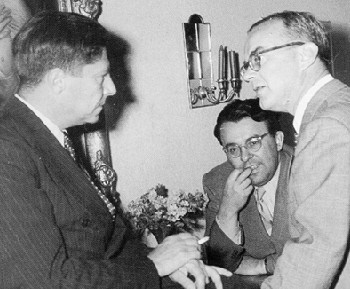
In Paris, it was Irving Brown (1911-1989), a representative of the powerful AFL-CIO union (with free access to secret Marshall Plan funds), who offered the CCF in Paris a suite in the Hôtel Baltimore on Avenue Kléber to set up its temporary headquarters, before paying the rent for a permanent office on Boulevard Haussmann.
On behalf of his boss Jay Lovestone (1897-1990), himself a helper of the CIA’s James Jesus Angleton, Irving Brown financed anything that might weaken France’s resistance to the utopia of world government, i.e. anything that might harm Gaullism and, to a certain extent, Communism.
Josselson and his wife met him quite often in a gay bar, « L’Indifférent ». One evening, they find him handing over a large sum of money to a Marseille mobster. A fan of the big boys, Brown was heavily involved in anything that could reduce the influence of the Communists.
It was from that perspective that he helped former members of the Vichy government, as well as Trotskyites. He controlled French ports, broke strikes and financed the new Force Ouvrière union to split the CGT communist union, all the while promoting modern art!*
Alongside Irving Brown, the CCF board included Michael Josselson, Lawrence de Neufville (his CIA recruiter, later appointed to Radio Free Europe), Arthur Koestler, Melvin Lasky, former Trotskyist James Burnham, as well as Carlo Schmid of the German SPD, Haakon Lie, leader of the Norwegian Labour Party, and David Rousset of the French Parti Socialiste.
In his book The Machiavellians, Burnham used Machiavelli to « challenge egalitarian political theory and show the persistence and inescapability of the elite, even in an age of equality ».
In 1953, Burnham played a crucial role in the CIA’s Operation AJAX, which overthrew Dr. Mossadegh in Teheran and replaced him with the Shah.
Later, « more presentable » funding sources than Irving Brown came into play: CIA front organizations such as the Farfield Foundation, headed by Julius Fleischman, or the Hoblitzelle Foundation, but also classics like the Ford, Carnegie or Rockefeller brothers’ foundations.
Thanks to these generous donors, the CCF made millions of dollars available to literary magazines such as
- Encounter, edited by former Trotskyite Irving Kristol (father of current neo-conservative William Kristol) in London;
- Preuves, edited in Paris by François Bondy of the European Union of Federalists;
- Der Monat, edited by Melvin Lasky in Berlin;
- Tempo Presente, edited by Ignazio Silone in Rome;
- Soviet Survey, edited in Israel by historian Walter Laqueur.
After the OSS’s (reciprocal) expressions of sympathy for Hemingway or Antoine de Saint-Exupéry, these magazines opened their columns to authors such as Jorge-Louis Borges, Raymond Aron, Arnold Toynbee, Bertrand Russell, Arthur Schlesinger Jr., Herbert Read or Hugh Trevor-Roper, or contributed to the publication of their writings.
In 1950, the CIA commissioned the production of a cartoon based on George Orwell’s Animal Farm (real name Eric Blair).
Also in Paris, CIA man Peter Matthiessen helped found the Paris Review run by John Train, a far-right liberal New York billionaire.
CIA Culture
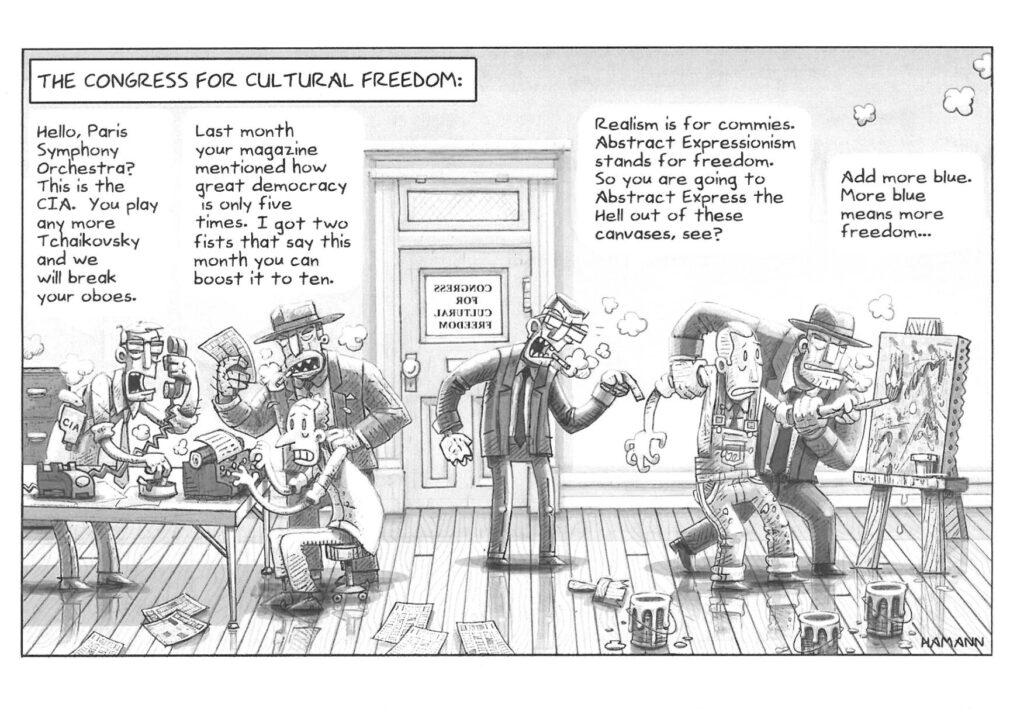
Destruction of the well tempered music
The CCF also financed major musical events to promote « modern » twelve-tone serialism (dodecaphony), such as the April 1952 festival organized by Nicolas Nabokov in Paris.
Nabokov believed that « dodecaphony abolishes natural hierarchies » and allows us to free ourselves from the internal logic of music.
Anne C. Shreffler argues that the « compositional avant-garde » was politicized more by its advocacy of personal freedom than by political influence. Shreffler goes on to argue that both the Soviet Union and the United States sent out messages that dealt with « freedom. » However, Western Europe and the United States claimed a « moral high ground » in the struggle for individual freedom, a high ground that made certain artistic aesthetics (e.g., cubism, surrealism, dodecaphony, and existentialism) almost « obligatory » for artists.
The promotion of « liberated » music as a counterpoint to « Social Realism« , which essentially « marginalized » the populist Soviet musical aesthetic, was explicitly a politically calculated move by the Congress for Cultural Freedom.
The festival opened with « The Rite of Spring » of Igor Stravinsky, new convert to twelve-tone dodecaphonic system.
Among the participants from the USA: Leontyne Price, Aaron Copland, Samuel Barber, the New York City Ballet (Balanchine‘s troupe), the Boston Symphony Orchestra, the New York Museum of Modern Art (MoMA), James T. Farrell, W.H. Auden and Gertrude Stein.
European participants included Jean Cocteau, William Walton, Laurence Olivier, Benjamin Britten, the Vienna Opera, Covent Garden Opera, Czeslaw Milosz, Denis de Rougemont and Guido Piovene, to name but a few.
Appointed Eisenhower’s special advisor on Cold War strategy, American Vice-President Nelson Rockefeller played a fundamental role in promoting the CIA’s modernist painting. Supporting left-wing artists practicing abstract expressionism was commonplace for the Rockefellers.
Nelson’s mother, Abby Aldrich Rockefeller, had founded the Museum of Modern Art in New York – the Modern Art Museum (MoMA) – asserting that reds would stop being reds « if we gave them artistic recognition ». Several MoMA trustees were also trustees of the Farfield Foundation, as indicated, a CIA front.
As Donald Jameson of the CIA put it:
« We understood that this was the kind of art that has nothing to do with social realism and makes it even more stylized, rigid and confined than it was. »
MoMA bought works by Diego Riviera, Jackson Pollock, Arshile Gorky, Alexander Calder, Robert Motherwell, Stuart Davis, Edward Hopper and others.
By attributing the « success » of an impressive number of contemporary cultural actors to the will of an imperial elite, motivated by a more than suspect ideological blindness and endowed, what’s more, with unparalleled financial resources and communication strategies, Stonor Saunders’ book immediately casts deep discredit on all post-war artistic creation.
Most of these « artists » were chosen because they conveyed an ideology deemed compatible with the totalitarian designs of the high priests of world order.
Only the reactionary Peregrine Worsthorne titles his book review of Saunders’ Who Paid the Piper, « How Western Culture was saved by the CIA », nostalgically lamenting the Machiavellian genius of the Anglo-American elite in its heyday.
Of course, some artists weren’t necessarily aware of the source of the funds, but they all expected them to fill their pockets… And perhaps most shockingly of all, the CIA took art more seriously than many citizens or critics of the time.
So, perhaps this survey does posthumous justice to all those talents sacrificed on the altar of illusory power. Think of all those crushed hopes, sabotaged careers and stifled seeds of genius. For in this delirious tournament of the Cold War, the great priesthood ruling over the art world would only saddle those willing to bend the knee, while with a wave of the hand, send others to the deadly silence of oblivion.
NOTE:
*In his book Les Trotskistes (Fayard, 2002), Christophe Nick states, with regard to the non-communist student union UNEF, that at one time, « thanks to Irwing Brown‘s good offices, the U.S. Embassy was able to cover the student union’s end-of-month budgets ».
In Secrets de famille (Fayard, Paris 2001), Serge Raffy reveals that « Lionel Jospin, then First Secretary of the Socialist Party, met in Washington on April 14, 1982 with leaders of the American AFL-CIO union to reassure them that the Mauroy government would include Communist ministers. The man who organized the meeting was a CIA agent, Irving Brown, the same man who founded and financed the French trade union Force Ouvrière to combat the Communist CGT financed by Soviet Russia. Irving Brown is also said to have constantly maintained links between the Trotskyites, and in particular the OCI, and FO. »
On the right, the student union, Union Inter-Universitaire (UNI), which made the career of so many politicians on the right, was also backed by CIA agent of influence Irving Brown and received $575,000 between April 1984 and April 1985 from the government of the United States through the National Endowment for Democracy.
Van Eyck, a Flemish Painter using Arab Optics?

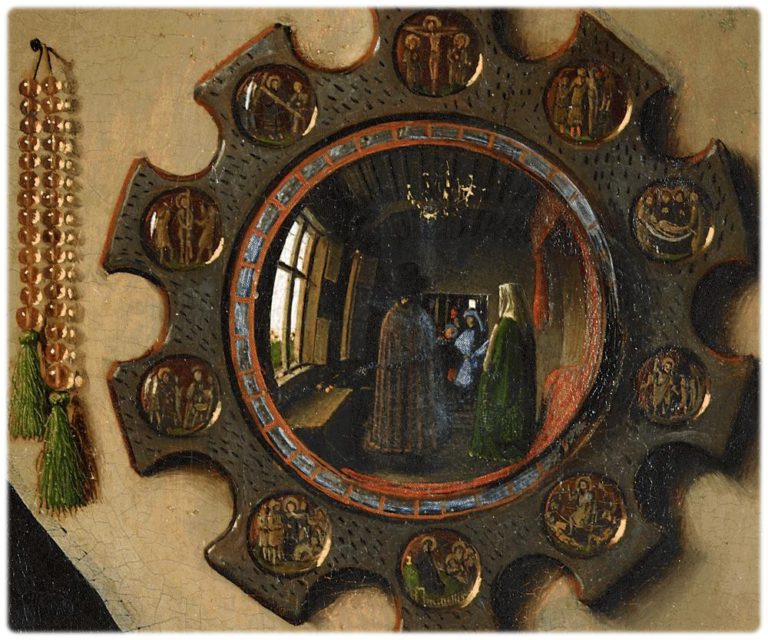
What follows is an edited transcript of a lecture by Karel Vereycken on the subject of “Perspective in XVth-century Flemish religious painting”.
It was delivered at the international colloquium “La recherche du divin à travers l’espace géométrique” (The quest for the divine through geometrical space) at the Paris Sorbonne University on April 26-28, 2006, under the direction of Luc Bergmans, Department of Dutch Studies (Paris IV Sorbonne University).
Introduction
« Perspective in XVth-century Flemish religious painting ». At first glance, this title may seem surprising. While the genius of fifteenth-century Flemish painters is universally attributed to their mastery of drying oil and their intricate sense of detail, their spatial geometry as such is usually identified as the very counter-example of the “right perspective”.
Disdained by Michelangelo and his faithful friend Vasari, the Flemish « primitives » would never have overcome the medieval, archaic and empirical model. For the classical “narritive”, still in force today, stipulates that only « Renaissance » perspective, obeying the canon of « linear », “mathematical” perspective, is the only « right », and the “scientific” one.
According to the same narrative, it was the research carried out around 1415-20 by the Duomo architect Filippo Brunelleschi (1377-1446), superficially mentioned by Antonio Tuccio di Manetti some 60 years later, which supposedly enabled Leon Battista Alberti (1404-1472), proclaiming himself Brunelleschi’s intellectual heir, to invent « perspective ».
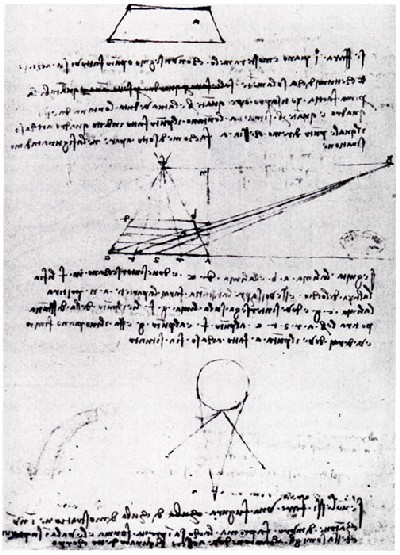
In 1435, in De Pictura, a book entirely devoid of graphic illustration, Alberti is said to have formulated the premises of a perspectivist canon capable of representing, or at least conforming to, our modern notions of Cartesian space-time (NOTE 1), a space-time characterized as « entirely rational, i.e. infinite, continuous and homogeneous », « in one word, a purely mathematical space [dixit Panofsky] » (NOTE 2)
Long afterwards, in a drawing from the Codex Madrid, Leonardo da Vinci (1452-1519) attempted to unravel the workings of this model.
But in the same manuscript, he rigorously demonstrated the inherent limitations of the Albertian Renaissance perspectivist canon.
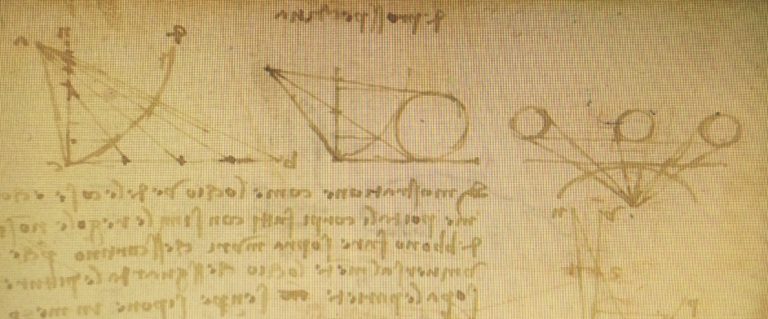
The drawing on f°15, v° clearly shows that the simple projection of visual pyramid cross-sections on a plane paradoxically causes their size to increase the further they are from the point of vision, whereas reality would require exactly the opposite. (NOTE 3)
With this in mind, Leonardo began to question the mobility of the eye and the curvilinear nature of the retina. Refusing to immobilize the viewer on an exclusive point of vision (NOTE 4), Leonardo used curvilinear constructions to correct these lateral deformations. (NOTE 5) In France, Jean Fouquet and others worked along the same lines.
But Leonardo’s powerful arguments were ignored, and he was unable to prevent this rewriting of history.
Despite this official version of art history, it should be noted that at the time, Flemish painters were elevated to pinnacles by Italy’s greatest patrons and art connoisseurs, specifically for their ability to represent space.
Bartolomeo Fazio, around the middle of the 15th century, observed that the paintings of Jan van Eyck, an artist billed as the « principal painter of our time », showed « tiny figures of men, mountains, groves, villages and castles rendered with such skill that one would think them fifty thousand paces apart. » (NOTE 6)
Such was their reputation that some of the great names in Italian painting had no qualms about reproducing Flemish works identically. I’m thinking, for example, of the copy of Hans Memlinc‘s Christ Crowned with Thorns at the Genoa Museum, copied by Domenico Ghirlandajo (Philadelphia Museum).
But post-Michelangelo classicism deemed the non-conformity of Flemish spatial geometry with Descartes’ « extended substance » to be an unforgivable crime, and any deviation from, or insubordination to, the « Renaissance » perspectivist canon relegated them to the category of « primitives », i.e. « empiricists », clearly devoid of any scientific culture.
Today, ironically, it is almost exclusively those artists who explicitly renounce all forms of perspectivist construction in favor of pseudo-naïveté, who earn the label of modernity…
In any case, current prejudices mean that 15th-century Flemish painting is still accused of having ignored perspective.
It’s true, however, that at the end of the XIVth century, certain paintings by Melchior Broederlam (c. 1355-1411) and others by Robert Campin (1375-1444) (Master of Flémalle) show the viewer interiors where plates and cutlery on tables threaten to suddenly slide to the floor.
Nevertheless, it must be admitted that whenever the artist « ignores » or disregards the linear perspective scheme, he seems to do so more by choice than by incapacity. To achieve a limpid composition, the painter prioritizes his didactic mission to the detriment of all other considerations.
For example, in Campin’s Mérode Altarpiece, the exaggerated perspective of the table clearly shows that the vase is behind the candlestick and book.
Jan van Eyck’s Lam Gods (Mystic Lamb) in Ghent is another example.
Never could so many figures, with so much detail and presence, be shown with a linear perspective where the figures in the foreground would hide those behind. (NOTE 7)
But the intention to approximate a credible sense of space and depth remains.
If this perspective seems flawed by its linear geometry, Campin imposes an extraordinary sense of space through his revolutionary treatment of shadows. As every painter knows, light is painted by painting shadow.
In Campin’s work, every object and figure is exposed to several sources of light, generating a darker central shadow as the fruit of crossed shadows.
Van Eyck influenced by Arab Optics?
Roger Bacon, statue in Oxord.
This new treatment of light-space has been largely ignored. However, there are several indications that this new conception was partly the result of the influence of « Arab » science, in particular its work on optics.
Translated into Latin and studied from the XIIth century onwards, their work was developed in particular by a network of Franciscans whose epicenter was in Oxford (Robert Grosseteste, Roger Bacon, etc.) and whose influence spread to Chartres, Paris, Cologne and the rest of Europe.
It should be noted that Jan van Eyck (1395-1441), an emblematic figure of Flemish painting, was ambassador to Paris, Prague, Portugal and England.
I’ll briefly mention three elements that support this hypothesis of the influence of Arab science.
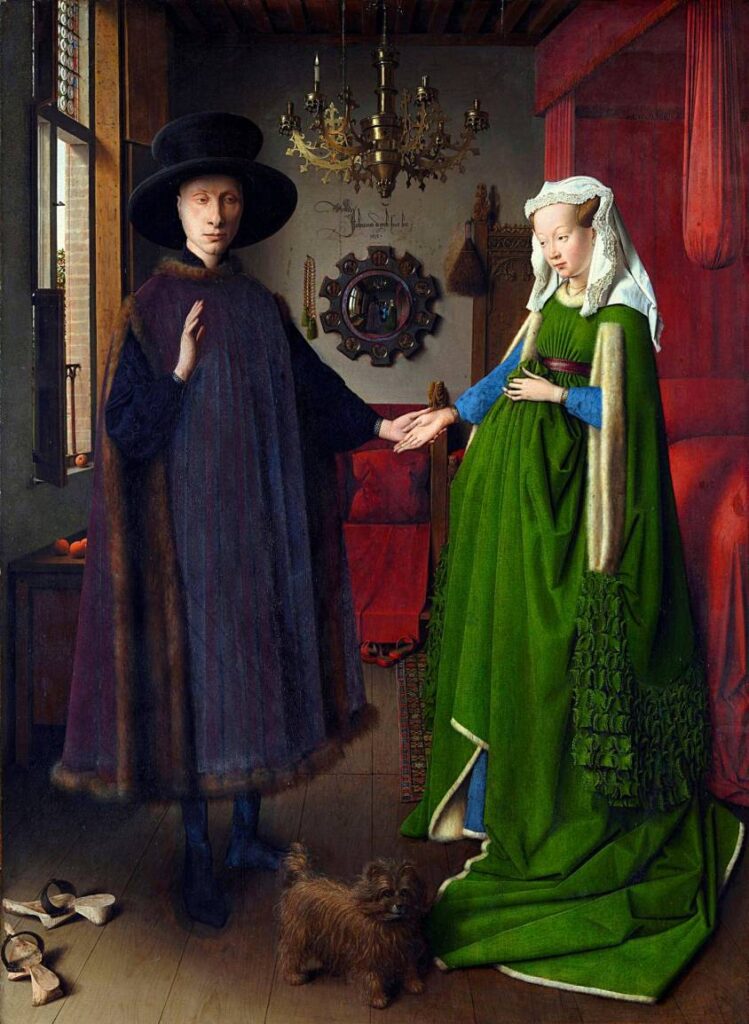
Curved mirrors
Robert Campin (master of Flémalle) in the Werl Triptych (1438) and Jan van Eyck in the Arnolfini portrait (1434), each feature convex mirrors of considerable size.
It is now certain that glaziers and mirror-makers were full members of the Saint Luc guild, the painters’ guild. (NOTE 8)
But it is relevant to know that Campin, now recognized as having run the workshop in Tournai where the painters Van der Weyden and Jacques Daret were trained, produced paintings for the Franciscans in this city. Heinrich Werl, who commissioned the altarpiece featuring the convex mirror, was an eminent Franciscan theologian who taught at the University of Cologne.
Artistic representation of Ibn Al-Haytam (Alhazen)
These convex and concave (or ardent) mirrors were much studied during the Arab renaissance of the IXth to XIth centuries, in particular by the Arab philosopher Al-Kindi (801-873) in Baghdad at the time of Charlemagne.
Arab scientists were not only in possession of the main body of Hellenic work on optics (Euclid‘s Optics, Ptolemy‘s Optics, the works of Heron of Alexandria, Anthemius of Tralles, etc.), but it was sometimes the rigorous refutation of this heritage that was to give science its wings.
After the decisive work of Ibn Sahl (Xth century), it was that of Ibn Al-Haytam (Latin name : Alhazen) (NOTE 9) on the nature of light, lenses and spherical mirrors that was to have a major influence. (NOTE 10)
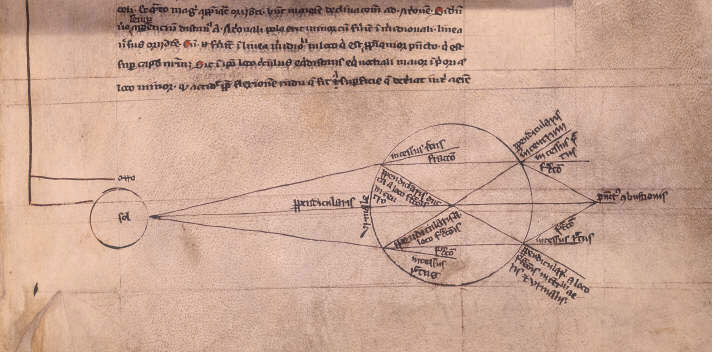
As mentioned above, these studies were taken up by the Oxford Franciscans, starting with the English bishop of Lincoln, Robert Grosseteste (1168-1253).
In De Natura Locorum, for example, Grosseteste shows a diagram of the refraction of light in a spherical glass filled with water. And in his De Iride he marvels at this science which he connexts to perspective :
« This part of optics, so well understood, shows us how to make very distant things appear as if they were situated very near, and how we can make small things situated at a distance appear to the size we desire, so that it becomes possible for us to read the smallest letters from incredible distances, or to count sand, or grains, or any small object.«
Grosseteste’s pupil Roger Bacon (1212-1292) wrote De Speculis Comburentibus, a specific treatise on « Ardent Mirrors » which elaborates on Ibn Al-Haytam‘s work.
Flemish painters Campin, Van Eyck and Van der Weyden proudly display their knowledge of this new scientific and technological revolution metamorphosed into Christian symbolisms.
Their paintings feature not only curved mirrors but also glass bottles, which they use as a metaphor for the immaculate conception.
A Nativity hymn of that period says:
« As through glass the ray passed without breaking it, so of the Virgin Mother, Virgin she was and virgin she remained… » (NOTE 11)
The Treatment of Light
In his Discourse on Light, Ibn Al-Haytam develops his theory of light propagation in extremely poetic language, setting out requirements that remind us of the « Eyckian revolution ». Indeed, Flemish « realism » and perspective are the result of a new treatment of light and color.
Ibn Al-Haytam:
« The light emitted by a luminous body by itself -substantial light- and the light emitted by an illuminated body -accidental light- propagate on the bodies surrounding them. Opaque bodies can be illuminated and then in turn emit light. »
This physical principle, theorized by Leonardo da Vinci, is omnipresent in Flemish painting. Just look at the images reflected in the helmet of St. George in Van Eyck‘s Madonna to Canon van der Paele (NOTE 12).
In each curved surface of Saint George’s helmet, we can identify the reflection of the Virgin and even a window through which light enters the painting.
The shining shield on St. George’s back reflects the base of the adjacent column, and the painter’s portrait appears as a signature. Only a knowledge of the optics of curved surfaces can explain this rendering.
Ibn Al-Haytam:
« Light can penetrate transparent bodies: water, air, crystal and their counterparts. »
And :
« Transparent bodies have, like opaque bodies, a ‘receiving power’ for light, but transparent bodies also have a ‘transmitting power’ for light.«
Isn’t the development of oil mediums and glazes by the Flemish an echo of this research? Alternating opaque and translucent layers on very smooth panels, the specificity of the oil medium alters the angle of light refraction.
In 1559, the painter-poet Lucas d’Heere referred to van Eyck‘s paintings as « mirrors, not painted scenes.«
Binocular perspective
Before the advent of « right » central linear perspective, art historians sought a coherent explanation for its birth in the presence of several seemingly disparate vanishing points by theorizing a so-called central « fishbone » perspective.
In this model, a number of vanishing lines, instead of coinciding in a single central vanishing point on the horizon, either end up in a « vanishing region » (NOTE 13), or align with what some call a vertical « vanishing axis », forming a kind of « fishbone ».
French Professor Dominique Raynaud, who worked for years on this issue, underscores that « all medieval treatises on perspective address the question of binocular vision », notably the Polish scholar Witelo (1230-1280) (NOTE 15) in his Perspectiva (I,27), an insight he also got from the works of Ibn Al-Haytam.
Witelo presents a figure to defend the idea that
« the two forms, which penetrate two homologous points of the surface of the two eyes, arrive at the same point of the concavity of the common nerve, and are superimposed at this point to become one » (Perspectiva, III, 37).
A similar line of reasoning can be found in Roger Bacon‘s Perspectiva Communis, written by John Pecham, Archbishop of Canterbury (1240-1290) for whom:
« the duality of the eyes must be reduced to unity »
So, as Professor Raynaud proposed, if we extend the famous vanishing lines (i.e., in our case, the « fish bones ») until they intersect, the « vanishing axis » problem disappears, as the vanishing lines meet. Interestingly, the result is a perspective with two vanishing points in the central region!
Suddenly, the diagrams drawn up to demonstrate the « empiricism » of the Flemish painters, if viewed from this point of view, reveal a legitimate construction probably based on optics as transmitted by Arab science and rediscovered by Franciscan networks and others.
Two paintings by Jan van Eyck clearly demonstrate that he followed this approach: The Madonna with Canon van der Paele of 1436 and the Dresden Tryptic of 1437.
What seemed a clumsy, empirical approach in the form of a « fishbone » perspective (left) turns out to be a binocular perspective construction.
Was this type of perspective specifically Flemish?
A close examination of works by Ghiberti, Donatello and Paolo Uccello, generally dating from the first half of the XVth Century, reveals a mastery of the same principle.
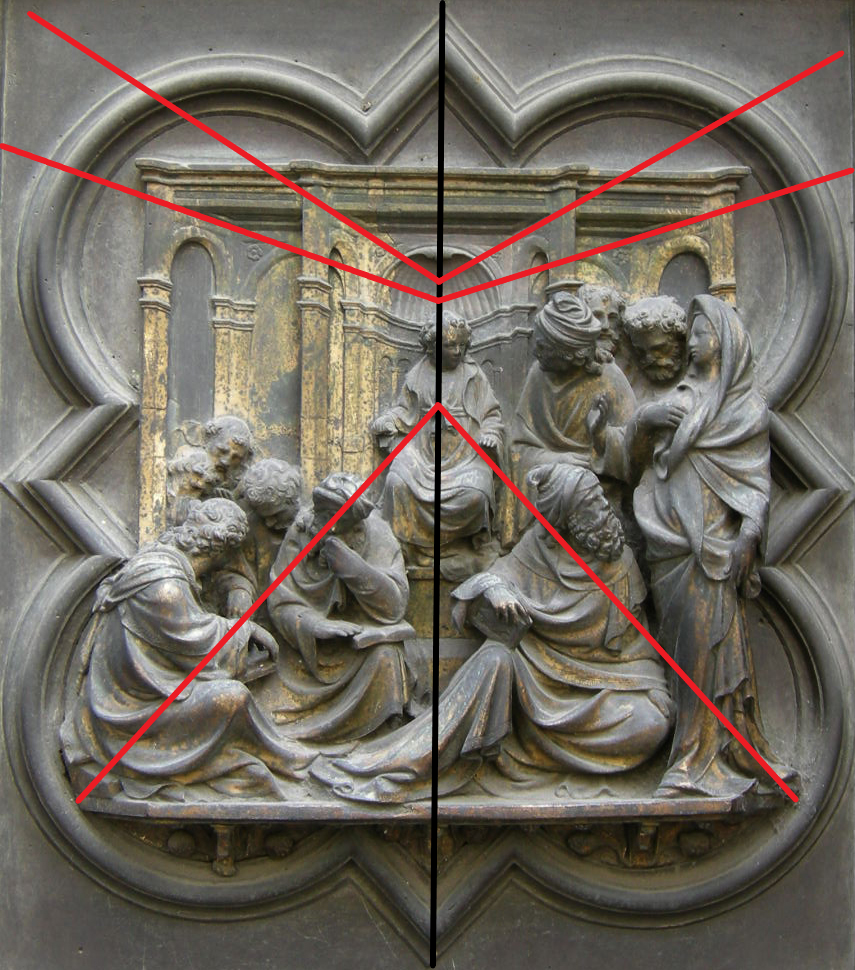
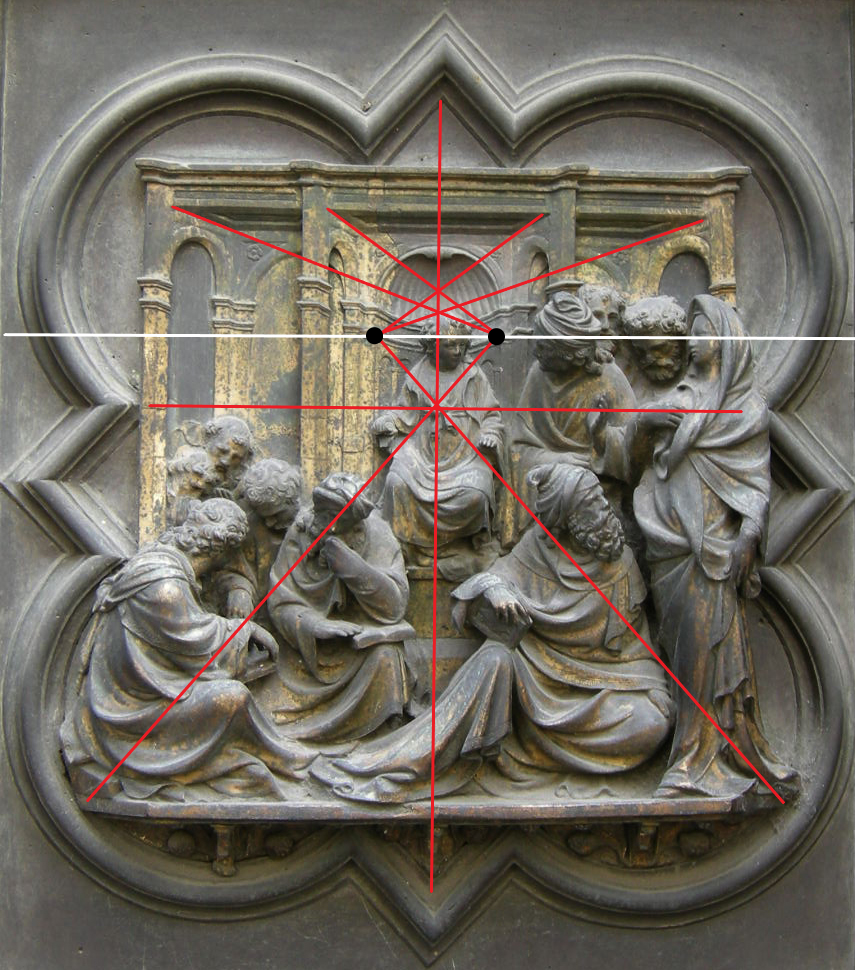
Cusanus
But this whole demonstration is merely a look into the past through the eyes of modern scientific rationality. It would be a grave error not to take into account the immense influence of the Rhenish (Master Eckhart, Johannes Tauler, Heinrich Suso) and Flemish (Hadewijch of Antwerp, Jan van Ruusbroec, etc.) « mystics ».
This trend began to flourish again with the rediscovery of the Christianized neo-Platonism of Dionysius the Areopagite (Vth-VIth century), made accessible… by the new translations of the Franciscan Grosseteste in Oxford.
The spiritual vision of the Aeropagite, expressed in a powerful imagery language, is directly reminiscent of the metaphorical approach of the Flemish painters, for whom a certain type of light is simply the revelation of divine grace.
In On the Heavenly Hierarchy, Dionysius immediately presents light as a manifestation of divine goodness. It ennobles us and enables us to enlighten others:
« Let those who are illuminated be filled with divine clarity, and the eyes of their understanding trained to the work of chaste contemplation; finally, let those who are perfected, once their primitive imperfection has been abolished, share in the sanctifying science of the marvelous teachings that have already been manifested to them; similarly, let the purifier excel in the purity he communicates to others; let the illuminator, gifted with a greater penetration of spirit, equally fit to receive and transmit light, happily flooded with sacred splendor, pour it out in pressing streams on those who are worthy… » [Chap. III, 3]
Let’s think again of the St. George in Van Eyck‘s Madonna to Canon van der Paele, which indeed pours forth the multiple images of the Virgin who enlightens him.
This theo-philosophical trend reached full maturity in the work of Cardinal Nicolas of Cusa (Cusanus) (1401-1464) (NOTE 16), embodying the extremely fruitful encounter of this « negative theology » with Greek science, Socratic knowledge and Christian Humanism.
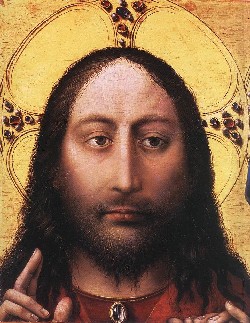
In contrast to both a science « without a hypothesis of God » and a metaphysics with an esoteric drift, an agapic love leads it to the education of the greatest number, to the defense of the weak and the humiliated.
The Brothers and Sisters of the Common Life, educating Erasmus of Rotterdam and inspiring Cusanus, are the best example of this.
But let’s sketch out some of Cusanus’ key ideas on painting.
In De Icona (The Vision of God) (1453), which he sent to the Benedictine monks of the Tegernsee, Cusanus condenses his fundamental work On Learned Ignorance (1440), in which he develops the concept of the coincidence of opposites. His starting point was a self-portrait of his friend « Roger », the Flemish painter Rogier van der Weyden, which he sent together with his sermon to the monks.
This self-portrait, like the multiple faces of Christ painted in the XVth century, uses an « optical illusion » to create the effect of a gaze that fixes the viewer, regardless of his or her position in front of the altarpiece.
In De Icona, written as a sermon, Cusanus asks monks to stand in a semicircle around the painting and watch this gaze pursue them as they move along the segment of the curve. In fact, he elaborates a pedagogical paradox based on the fact that the Greek name for God, Theos, has its etymological origin in the verb theastai (to see, to look at).
As you can see, he says, God looks at you personally, and his gaze follows you everywhere. He is therefore one and many. And even when you turn away from him, his gaze falls on you. So, miraculously, although he looks at everyone at the same time, he nevertheless establishes a personal relationship with each one. If « seeing » for God is « loving », God’s point of vision is infinite, omniscient and omnipotent love.
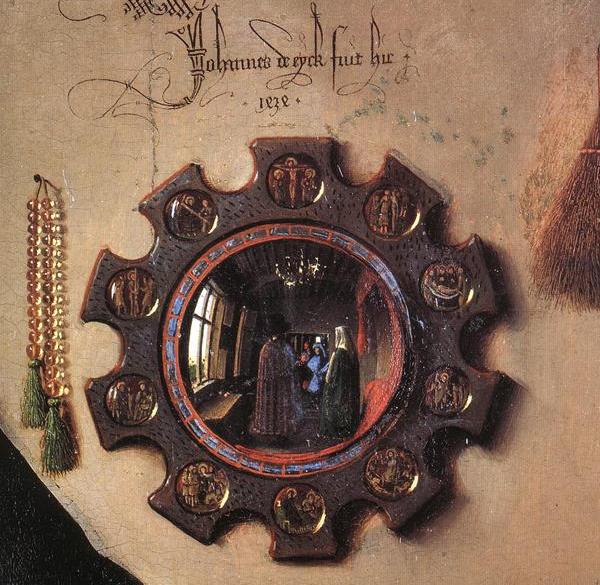
A parallel can be drawn here with the spherical mirror at the center of Jan van Eyck’s painting The Arnolfini portrait, painted in 1434, nineteen years before this sermon.
Firstly, this circular mirror is surrounded by the ten stations of Christ’s Passion, juxtaposed by a rosary, an explicit reference to God.
Secondly, it reveals a view of the entire room, an image that completely escapes the linear perspective of the foreground. A view comparable to the allcompassing « Vision of God » developed by Cusanus.
Finally, we see two figures in the mirror, but not the image of the painter behind his easel. These are undoubtedly the two witnesses to the wedding. Instead of signing his painting with « Van Eyck invent. », the painter signed his painting above the mirror with « Van Eyck was here » (NOTE 17), identifying himself as a witness.
As Dionysius the Aeropagite asserted:
« [the celestial hierarchy] transforms its adepts into so many images of God: pure and splendid mirrors where the eternal and ineffable light can shine, and which, according to the desired order, reflect liberally on inferior things this borrowed brightness with which they shine. » [Chap. III, 2]
The Flemish mystic Jan van Ruusbroec (1293-1381) evokes a very similar image in his Spiegel der eeuwigher salicheit (Mirror of eternal salvation) when he says:
« Ende Hi heeft ieghewelcs mensche ziele gescapen alse eenen levenden spieghel, daer Hi dat Beelde sijnre natueren in gedruct heeft. » (And he created each human soul as a living mirror, in which he imprinted the image of his nature).
And so, like a polished mirror, Van Eyck’s soul, illuminated and living in God’s truth, acts as an illuminating witness to this union. (NOTE 18)
So, although the Flemish painters of the XVth century clearly had a solid scientific foundation, they choose such or such perspective depending on the idea they wanted to convey.
In essence, their paintings remain objects of theo-philosophical speculation or as you like « intellectual prayer », capable of praising the goodness, beauty and magnificence of a Creator who created them in His own image. By the very nature of their approach, their interest lay above all in the geometry of a kind of « paradoxical space-light » capable, through enigma, of opening us up to a participatory transcendence, rather than simply seeking to « represent » a dead space existing outside metaphysical reality.
The only geometry worthy of interest was that which showed itself capable of articulating this non-linearity, a « divine » or « mystical » perspective capable of linking the infinite beauty of our commensurable microcosm with the immeasurable goodness of the macrocosm.
Thank you,
NOTES:
- Recently, Italian scholars have pointed to the role of Biagio Pelacani Da Parma (d. 1416), a professor at the University of Padua near Venice, in imposing such a perspective, which privileged only the « geometrical laws of the act of vision and the rules of mathematical calculation ».
- Erwin Panofsky, Perspective as Symbolic Form, p.41-42, Les Éditions de Minuit, Paris, 1975.
- Institut de France, Manuscrit E, 16 v° « the eye [h] perceives on the plane wall the images of distant objects greater than that of the nearer object. »
- Leonardo understands that Albertian perspective, like anamorphosis, condemns the viewer to a single, immobile point of vision.
- See, for example, the slight enlargement of the apostles at the ends of Leonardo da Vinci’s Last Supper in the Milan refectory.
- Baxandall, Bartholomaeus Facius on painting, Journal of the Warburg and Courtauld Institutes, 27, (1964). Fazio is also enthusiastic about a world map (now lost) by Jan van Eyck, in which all the places and regions of the earth are depicted recognizably and at measurable distances.
- To escape this fate, Pieter Bruegel the Elder used a cavalier perspective, placing his horizon line high up.
- Lionel Simonot, Etude expérimentale et modélisation de la diffusion de la lumière dans une couche de peinture colorée et translucide. Application à l’effet visuel des glacis et des vernis, p.9 (PhD thesis, Nov. 2002).
- Ibn Al-Haytam (Alhazen) (965-1039) wrote some 200 works on mathematics, astronomy, physics, medicine and philosophy. Born in Basra, after working on the development of the Nile in Egypt, he travelled to Spain. He is said to have carried out a series of highly detailed experiments on theoretical and experimental optics, including the camera obscura (darkroom), work that was later to feature in Leonardo da Vinci’s studies. Da Vinci may well have read the lengthy passages by Alhazen that appear in the Commentari of the Florentine sculptor Ghiberti. According to Gerbert d’Aurillac (the future Pope Sylvester II in 999), Bishop of Rheims, brought back from Spain the decimal system with its zero and an astrolabe, it was thanks to Gerard of Cremona (1114-c. 1187) that Europe gained access to Greek, Jewish and Arabic science. This scholar went to Toledo in 1175 to learn Arabic, and translated some 80 scientific works from Arabic into Latin, including Ptolemy’s Almagest, Apollonius’ Conics, several treatises by Aristotle, Avicenna‘s Canon, and the works of Ibn Al-Haytam, Al-Kindi, Thabit ibn Qurra and Al-Razi.
- In the Arab world, this research was taken up a century later by the Persian physicist Al-Farisi (1267-1319). He wrote an important commentary on Alhazen’s Treatise on Optics. Using a drop of water as a model, and based on Alhazen’s theory of double refraction in a sphere, he gave the first correct explanation of the rainbow. He even suggested the wave-like property of light, whereas Alhazen had studied light using solid balls in his reflection and refraction experiments. The question was now: does light propagate by undulation or by particle transport?
- Meiss, M., Light as form and symbol in some fifteenth century paintings, Art Bulletin, XVIII, 1936, p. 434.
- Note also the fact that the canon shows a pair of glasses…
- Brion-Guerry in Jean Pèlerin Viator, sa place dans l’histoire de la perspective, Belles Lettres, 1962, p. 94-96, states in obscure language that « the object of representation behaves most often in Van Eyck as a cubic volume seen from the front and from the inside. Perspectival foreshortening is achieved by constructing a rectangle whose sides form the base of four trapezoids. The orthogonals thus tend towards four distinct points of convergence, forming a ‘vanishing region' ».
- Dominique Raynaud, L’Hypothèse d’Oxford, essai sur les origines de la perpective, PUF, Paris 1998.
- Witelo was a friend of the Flemish Dominican scholar Willem van Moerbeke, a translator of Archimedes in contact with Saint Thomas Aquinas. Moerbeke was also in contact with the mathematician Jean Campanus and the Flemish neo-Platonic astronomer Hendrik Bate van Mechelen. Johannes Kepler‘s own work on human vision builds on that of Witelo.
- Cusanus was above all a man of science and theology. But he was also a political organizer. The painter Jan van Eyck fought for the same goals, as evidenced by the ecumenical theme of the Ghent polyptych. It shows the Mystic Lamb, symbolizing the sacrifice of the Son of God for the redemption of mankind, capable of reuniting a church torn apart by internal differences. Hence the presence of the three popes in the central panel, here united before the lamb. Van Eyck also painted a portrait of Cardinal Niccolo Albergati, one of the instigators of the great Ecumenical Council organized by Cusanus in Ferrara and then moved to Florence. If Cusanus called Van der Weyden « his friend Roger », it is also thought that Robert Campin may have met him, since he would have attended the Council of Basel, as did one of his commissioners, the Franciscan theologian Heinrich Werl.
- Jan Van Eyck was one of the first painters in the history of art to date and sign his paintings with his own name.
- Myriam Greilsammer’s book L’Envers du tableau, Mariage et Maternité en Flandre Médiévale (Editions Armand Colin, 1990) documents Arnolfini’s sexual escapades. Arnolfini was taken to court by one of his victims, a female servant. Van Eyck seems to have understood that the knightly Arnoult Fin, Lucchese financier and commercial representative of the House of Medici in Bruges, required the somewhat peculiar presence of the eye of the lord.
On the origins of Modern Art, the problem of Symbolism


“At the turn of this century, painting is in bad shape. And for those who love the fatherland of paintings, very soon there will only remain the closed spaces of museums, in the same way there remains parcs for the amateurs of nature, to cultivate the nostalgia of that what doesn’t exist any longer…”
Jean Clair, Harvard graduate, director of the Musée Picasso
and of the centenary of the Venice Biennale of Contemporary Art in 1995.
Karel Vereycken, April 1998
Something is fairly rotten in the kingdom of Art, and if today (1998), finally some kind of debate breaks out, it is, halas, for quite bad reasons. Since it is uniquely in the context of budget cuts imposed on Europe by the Maastricht treaty that some questions are raised to challenge public opinion on a question carefully avoided till now: can we go on indefinitely subsidizing “modern artistic creation”, or what pretends to be so, with the tax-payers money, without any demand and outside any criteria?
Abusively legitimated by its status as a victim of the totalitarian regimes of Hitler, Stalin and Mao, Modern Art’s value as an act of resistance to totalitarianism watered away with the collapse of these regimes.
While we oppose the current budgetary cuts, since it would finish off the sick patient, we nevertheless propose to examine truthfully the illness and the potential remedies to be administered.
In France, the slightest critique immediately provoked the traditional hysterical fits. Raising a question, formulating an interrogation or even simply expressing a doubt on the holiness of Modern Art continues to be considered tantamount to starting an Inquisition. Even well integrated critiques such as the « left » leaning author Jean Baudrillard, or the director of the Paris Picasso museum Jean Clair and even the modern painter Ben, immediately bombarded by acid counter-attacks from the french and international Art nomenclature, accusing them of being “reactionaries”, “obscurantist” and, to crown it all, of being “fascists”, “nazis” and even “anti-Semites”.
For seasoned observers these attacks remind the simplicity of Stalinist rhetoric: “Anybody discussing the revolution is a fascist”. Modernist musical composer Pierre Boulez even accused a journalist of being a “Vichy collaborator” because unconvinced of the utility of the computers of his musical research foundation IRCAM.
That spark of debate, if any, became rapidly poisoned by the possessive defense of the scarce budget allocations. Why all this noise? Jean Clair already exposed his views fourteen years ago in his book “Considérations sur l’Etat des Beaux-Arts, Critique de la Modernité” (1983) without provoking such a hullabaloo.
But in times of crisis, funds seem to provoke more passion than fundamentals. In any case, we welcome Clair’s courage. His ironical critique of the rampant snobbism of the tiny, incestuous world of contemporary Art makers is totally uncompromising. His defense of the necessary rebirth of the basic skills of drawing and pastel is on the mark.
Clair rightly makes a distinction between « Contemporary » art on one side and « Modern » art on the other side. Contemporary Art, broke with Modern Art from the point it became a systemic apology of “non-sense [absence of meaning] that was elected a system. » Reality, writes Clair, leads him to demand that we return to “meaning” (deliberately banned by « contempory » art) which was the very power of « Modern » Art.
To understand this difference, inspired by the insights and works of my friend, american art historian Michael Gibson, we shall document here that the birth of « Modern » art was nothing but a mutation from figaritive « Symbolism » to non-figurative (abstract) Symbolism, both accepting their role of expressing a symbolic meaning. « Contemporary art », profiting from the confusion of the idea of a « secret » meaning inherent in symbolic artistry, then sneaked in and tried to pretend that any sort of meaning should and could be eliminated from artistic expression.
QUESTION:
« So if I understood you correctly, you claim there exist criteria that are universal, enabling rational man to distinguish with reason between beauty and ugliness which would free art from the arbitrary caprices of taste?”
ANSWER:
« Uh, yes, and even if one cannot establish a catalogue filled with models and instructions enforceable till the end of all times, we firmly think there exists a way of looking at things, a mental attitude which we can prove to have been fruitful since the early cave paintings, as those of Chauvet in southern France dating from 50.000 years B.C., till today. »
To say it differently, there is no such thing as the aesthetics of form, but some kind of aesthetics of the soul.
Any attempt to frame aesthetics, as a set of formal rules of the visible forms is the shortest road to finish in a sterile academic dead end.
By analogy, we could say that such an attempt in the domain of language would make linguistics the science of poetry…
Leonardo da Vinci defined the mission of the painter as the one who has to « make visible the invisible ». So it is up to us to define the aesthetics of the invisible and how they manifest themselves in the visible realm.
How to represent the world
Let’s look at ways of representing phenomena by starting from what appears to be the « most simple ».
A. “Bounded objects” of an inorganic or organic nature: for example stones, a glass bottle, but also a flower or the body of an animal or a man. Their relative finiteness makes their representation easier. But to “make them alive”, one has to show their participation to something infinite: the infinite variations of the color or a stone, the numerous reflections of light shattered by the glass bottle, the relative infinite number of leaves of a tree, the huge number of successive gestures which dictate spirit and life to the bodies of living beings. As you can see now, these so-called “simple” phenomena oblige us to choose, beyond simple sense perception, perceptions that enable us to express the idea of the object rather than its mere form.
B. “Openly unbounded objects”: for example a wave of the ocean, a forest, the clouds in the sky, or the expression of the eyes of a human being. Even more than in A., the Chinese principle of the “li” has to be considered. Instead of imitating their exterior form, and since their sometimes turbulent shapes escape in any case from our limited sense-perceptions, the exterior form has to be regarded as the expression of the idea that was the generating principle and we have to concentrate on choosing elements in the visible realm that indicate that “higher reality”. That makes the difference between the portrait of a living being and the portrait of a wax model…
C. “Ideas free from an object”: for example Love, Justice, Fidelity, Laziness, Cold, etc. How can we build gangways to the visible capable of representing these “higher ideas”?
ANSWER:
- Instead of representing the idea, I can try to substitute it with the object of the idea (one of Plato’s favorite subjects). For example I can try to represent the idea of Love by representing a woman. However, she cannot be but the object or the subject of love (She is loved or loves), but she is not Love itself.
- Since I’m in trouble having a representation in the visible realm of an idea of a “superior” nature, I decide to designate it by symbol. For example, a little heart to symbolize Love. For a Martian visiting Earth in the context of interplanetary tourism, the little heart has no meaning. By logical deduction, he could arrive at the conclusion the heart indicates heart patients, or cardiologists or eventually the designed victims of an Aztec sacrificial cult. In order to understand what is involved, some earthling has to initiate him into the pre-convened meaning of the symbol to which the inhabitants of earth agreed to. If not, it might take some time before he understands the “secret” meaning of the symbol.
- That symbol can be a simple visible element but also a little story we call allegorical. Illustrating an allegory will always remain a simple didactical exercise far underneath the sublime mission of art.
- The notion of a parable, as those one finds in the Bible, brings us closer to the wanted solution by its metaphorical character (Meta-poros in Greek meaning: that which carries beyond). The isochronical presence of several paradoxes, provoking surprise and irony by the ambiguities of the painting shakes up the sense certainty of our empirical perceptions that darken so much our natural predisposition for beauty.
SYMBOL and METAPHOR, What’s the difference?
Symbol: designates a thing
Metaphor: carries beyond the thing
Symbol: its only value is expressed by itself
Metaphor: its only value is given to it by implicit analogy.
Symbol: its secret meaning can only be learnt by convention
Metaphor: its meaning can be discovered by sovereign cognition.
Rembrandt’s Saskia
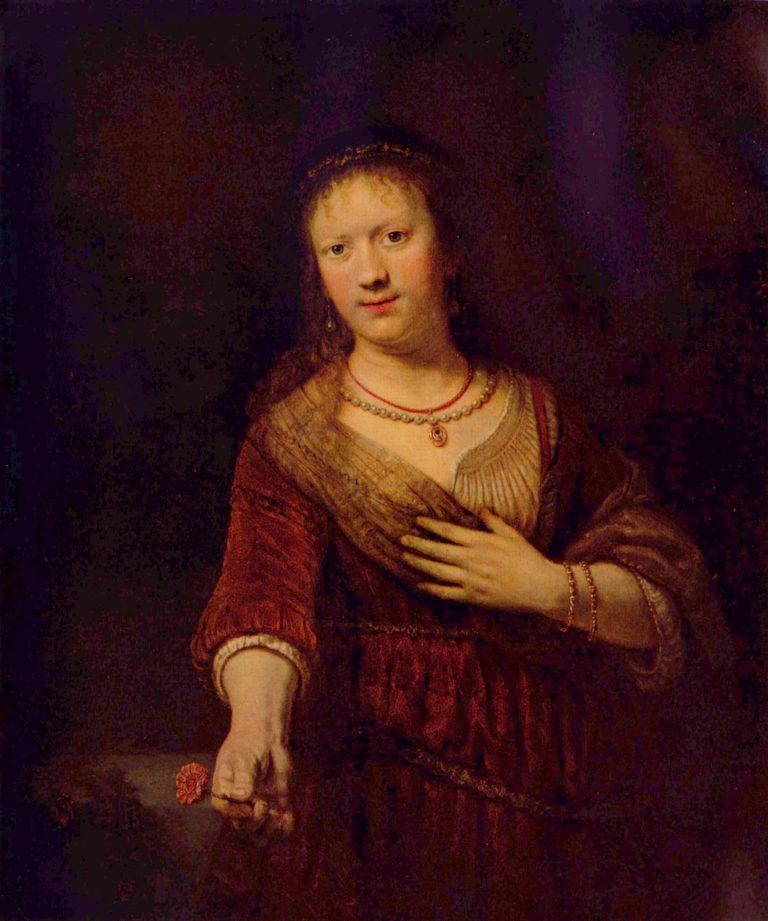
Let us examine together Rembrandt’s painting “Saskia as Flora” (1641), where she offers a flower to the viewer. Is this a portrait of Rembrandt’s wife along with the portrait of a flower? Or is there a new concept involved that arises in our mind as a result of this juxtaposition that could be called Love or Fidelity (to you I offer my beauty, as I offer you this flower…) The putting into visual analogy of two quite different things make appear a third one, which is in fact the real subject.
The easiest example of a real metaphorical paradox can be seen at work in wordplay or a cartoon drawing. For example if I draw a young couple in love and replace the head of the young man with the head of a dog, a completely different meaning is given to the image. The viewer, intrigued by the love relationship is surprised by the possessive (or submissive) character suggested by the dog head. Variations of the type of dog and his expression will vary the very meaning of the image. Once again, it is by the use of an implicit analogy that an unexpected arrangement gives us the means to grapple an idea beyond the object represented.
The little light bulb that goes on in our heads when we solve a metaphorical paradox gives us a threefold happiness. First the joy to think, since our thought process is precisely based on that unique process. Second to live in harmony with our world, which being a creative process itself “condemns” us to be free. And finally the joy that derives from the sharing of that happiness of discovery with other human beings who get even more creative in turn. Hence, every scientific or artistic discovery becomes a ray of light enlightening the path for humanity to go. The glowing enders of yesterday give us the fire to illuminate tomorrow.
But to do so, one cannot represent in a formal way the solution found. One is obliged to recreate the context which obliges the viewer to walk the same road we did till the precise point where he discovers himself the poetical concept.
The science of enigmas of Leonardo da Vinci

Renaissance genius Leonardo da Vinci was a specialist of this kind of « organized » enigmas, conspiracies to have us think. Let’s have a look at his painting “Saint John the Baptist”, his last painting and somehow his last will resuming all the best science of his creative mind. The ambiguous character of the person has been often used as “proof” of Leonardo’s alleged homosexuality.
One can indeed ask the question if represented here we see a man or a woman? The strong muscles of the arms plead for male while the gracious face argues for female. Desperate, our mind asks if this is devil or angel? While one finger points to heaven, similar to Raphael’s Plato in the « School of Athens », the other hand rests on the heart, and in the same time a coquette smile meets intelligent eyes…
Of course, Saint-John the Baptist, patron saint of Florence served as the symbol of a humanist Platonic current that realized the fact that the « little lights » of classical Greece announced the coming of the « great light » of Christianity.
Scholastical Catholicism of those days pretended that anybody living before Christ could be nothing more than a pagan. So what about Saint John the Baptist? The compositional method here employed is not of a symbolical nature, but that of paradoxical metaphor, i.e. build by enigmas that guide us, if we accept the challenge, to reflect in a philosophical way about the nature of mankind: how is it possible we are finite in some parts and infinite in others? That we are mind, life and matter? Of divine and human nature?
That is in some words what we mean by the method of paradoxical metaphors, the only method which gives sense to the word « classic », since conceived in a universal way for all men in the time of all times.
The opposite approach is the symbolist one, officially named after an artistic current that swept over Europe at the end of the XIXth century.
Together with impressionism that capitulated to positivism, symbolism was the mother of Modern Art and its bastard son Contemporary Art.
The symbol, erected as a method of artistic expression, is characteristic of a society that is incapable of change. It celebrates the banishing of the movement of progress but masks that self-denial with the never-ending multiplication of images and objects, always equal to themselves. Symbolism is nothing but the transformation into an object of a strong emotion or a mystical thought. The increase of its effect through incantation, fetishism, repetition, etc., agitating the symbol for its magical value as such, evokes the same obsessive fixation as pornography. As the American thinker Lyndon LaRouche ironically underscored the point:
“the difference between Beethoven (method of metaphor) and Wagner (method of symbolism) is defined by the level at which emotions are provoked in the audience. In the case of Beethoven, the beauty evoked brings us to tears. In the case of Wagner, it is the chairs that get wet…”
From there on, as we will document in due course, the arising of “Modern Art” reveals itself to be nothing more than a mere linear transposition of “figurative” symbolism to “abstract” symbolism.
These terms are obviously empty shells, since all figuration is figurative, and all figuration is the expression of what could be called an “abstract” concept or idea, conscious or not.
So, contrary to Contemporary Art, whose aggressive meaning is that nothing has, can or has the right to have any meaning, Modern Art claims to possess a sense of meaning, but that meaning is mystical-symbolical and hermetic by nature. We are not saying that symbols should be banned from Art, but we cannot but underline that symbolistical though as a compositional method is incompatible with Art’s nature.
Real Art concentrates on communicating a unique human quality, the Sublime, that expresses freedom and not that of a man enslaved either to his sentiments neither to his principles.
Contemporary Art, as all large scale swindles, needs quite some rhetoric and literature to convince it’s public of its pure absolute relativity. It is said that each of us sees it differently; that we all possess our own criteria and that formulating any judgment is by itself already an act of a totalitarian fascist in germ. It is somehow like the thief who accuses his victim of cupidity and lack of brotherly love when the victim refuses to hand over his purse. But if one claims the right to create something without meaning, one equally revindicates the right to no critique, and therefore ends any form of real debate beyond « it gives me a kick » or « no kick ».
That Art, when it is sincere, by claiming it cannot be apprehended by human cognition, defines itself as egoistical and asocial. It cannot but harvest what it sows: indifference.
Before entering two personalities considered being the godfathers of Modern Art, Wassily Kandinsky (1866-1944) and Piet Mondrian (1872-1944), it is necessary to situate the historical context in which they operated. Then we will investigate a high level political operation: the Theosophical Society whose malefic theories exerted great influence on both godfathers of Modern Art.
Symbolism, the final stage of Romanticism
To crush the republican spirit that emerged at the end of the eighteenth century, which saw the American and French revolution, the European oligarchy deployed initially Napoleon Bonaparte.
Then, on the ruins of the Napoleonic wars, they promoted the iron corset of the Holy Alliance and the impotent ideology of regretting: the privilege of the suffering heart. Romanticism, often described as a “movement for the liberation of the me, as a reaction against the regularity of classicism and the rationality of the preceding centuries” became the official culture of the Restoration before being adopted by the Monarchy of July.
Even the talented French poet Baudelaire, prisoner of the zeitgeist stated shamelessly: “What is there more absurd than progress?” or, premonitory:
“Who says romanticism says Modern Art, i.e. intimacy, spirituality, color, aspiration towards the infinite”.
In a way this was the expression of a certain revolt against positivism, a “scientific” materialism which some tried to impose top down and for which the hearts of men were not mobilized.
We are light-years away from the “science for all” approach which radiated Gaspard Monge at the early Ecole Polytechnique, or Lazare Carnot’s “Ode to enthusiasm”. It was the same Holy alliance that forced Carnot into exile and outrooted Monge´s influence at the Ecole, crushing France’s scientific and industrial progress.
In 1871, Louis Pasteur, in a beautiful article “Why France did not find a superior man in the moment of peril” analyzed the dramatic events of those days.
But also Germany was living under a real cultural dictatorship. Prince Metternich, by the Carlsbad decrees forbade any representation of Friedrich Schiller‘s theatre plays. Also, the “sulfurous” poet Heinrich Heine, mocking the Salons of Mme de Stael and all the other nostalgics of the lost glory of the past, became the permanent target of the Holy Alliance’s police operations.
Francesco Goya, who strongly lambasted the massacres of Bonaparte’s Spanish expedition (1810-1814) in his series “The disasters of War”, characterized this particular historic moment in his engraving “The sleep of Reason generates monsters”.
The Great Upheaval
On the economic front, it was only after Abraham Lincoln defeated the British backed pro-slavery Confederacy and the then ensuing industrial buildup (1861-1876), that a little progress was tolerated in Europe.
The oligarchy had to solve the following paradox: How can we counterbalance the rising American power while in the same time prevent the emergence of Republics in Europe, inspired by the American System, on the ruins of the European empires?
What some have called the « Great Upheaval » was nothing less than a profound transformation of daily life in Europe. It was precisely at that time that the Symbolist current got so dominant.
In the “industrial polygon of the Europe of steam” which connected Glasgow, Stockholm, Gdansk, Lodz, Trieste, Florence and Barcelona, it is estimated that of 7 persons from the country side, 1 stayed working the land, another went to the new world or the colonies, and the remaining 5 went working in the cities. The same estimate says that close to 60 million people left Europe. One can imagine the cultural choc for those who quit the magical world of pastoral backwardness.
In that sense, Symbolism was also a means for the oligarchy to deprive these incoming populations from the benefits of urban culture by keeping them in a state of irrationality.
The fear of political takeover by sovereign Nation-States dedicated to industrial and scientific progress was so great that the British Prime Minister, Lord Palmerston (1784-1865), activated through his agent Guiseppe Mazzini (1805-1872), the “Young Europe” movement, uniting most revolutionary currents of those days. Under the auspices of the Foreign Office’s Arab Bureau, the east saw the sudden birth of a whole series of Arab countries, eventually localized on this or that oilfield.
The Theosophical Society
It is in that context that one has to situate the extraordinary offensive of the Theosophical Society (TS), one of these pseudo-religions rising out of the esoterical swamp of the second half of the nineteenth century. It is useful to zoom in on the life of Helena Petrowna Blavatsky (HPB) (1831-1891), the main front figure of the TS.
Granddaughter of the Prussian General Alexis von Rottenstern-Hahn, HPB was born in 1831 in Ukraine.
At the age of sixteen, her parents married her to an old General with the name of Nicéphore Blavatsky, vice-governor ofprovince of Erivan, which she quitted nearly immediately.
In 1848, she meets a Copt with the name of Paulos Metamon and as early as 1851 she turns up in London, where she meets the “spiritualists” and meets the “revolutionary” Mazzini. In 1856 she affiliates with the Young Europe’s Carbonarist association.
Then, she travels across different continents having become a toy in the hands of her British promoters which she refers to as her “Spiritual masters”, as she called one of her controlling agents “Master Morya”.
As soon as 1851 she travels to the US and Mexico, crossing Texas and Louisiana. After numerous trips in the Caucasus, Syria and Lebanon, we find her on November 3, 1867, riding a horse siding Garibaldi. Severely wounded at the battle of Mentana, she’s left for dead.
While recuperating in Paris, she meets a journalist with the name of Michal, and the founder of French spiritism, Allan Kardec. The former claim they discovered and developed HPB’s faculties as a medium. Deployed in that capacity to Cairo, and in the USA, she’s accused of being a fraudster. It is relevant to situate Edgar Allan Poe’s literary production as the effort of the pro American system faction to ridicule the British offensive in favor of esoteric irrationality.
Colonel Henry Steel Olcott
Around 1874, Blavatsky receives the order to enter into contact with a lawyer and insurance expert: Henry Steel Olcott.
Former officer of the Military Police, he became colonel during the civil war and shared his life in between Masonic lodges and spiritism. Active as a journalist, he was in charge of covering paranormal phenomena for the New York Sun and the New York Graphic.

Olcott got many inroads into the American esoterical scene of those days: John King, William Stainton Moses, Leadbeater, the Miracle Club of Philadelphia and a secret society called The Hermetic Brotherhood of Luxor whose members signed their writings with a swastika, symbol of the divinity of Tibet, the immense mountain plateau where supposedly the Aryan race found refuge at the time of the great deluge…
Then, on October 20, 1875 was founded in New York a “Society for Spiritualist investigations”. Its president was Olcott; the two vice-presidents were Felt and Pancoast, while Blavatsky figured as a mere secretary. Without willing to downplay her personal role, it looks she was brought in more for propagandistical reasons than in regard of her proper leadership qualities. As prominent members one can mention William Q. Judge and Charles Sotheran, both high dignitaries of Anglo-American masonry.
It is also remarkable that the Confederate General Albert Pike, Grand Master of the Scottish Rite of the Southern district based in Charleston, and one of the founders of the Ku Klux Klan met Blavatsky in those days, but seems to have dropped her, considering her to low level. Pike’s spiritual reputation is largely overdone and he has been accused of having extensively plagiarized the French occultist Elipha Levi.
Less than a month later, on November 17, 1875, the Society’s named was changed into “Theosophical Society”. Olcott and Blavatsky immediately started a great project to conquer the minds of India.
Officially, they pretended to establish “The Great Contact”, a bridge between the initiated of the East with those of the West and to fusion them together.
HPB gets without any difficulty the American nationality while Olcott obtains from the president of the United States, Rutherford Hayes, a handwritten clearance, a document requesting American diplomats all over the world to provide them their aid. Also, the US Secretary of State provided Olcott a diplomatic passport, something relatively rare for a non-career diplomat. When they reached ground in India, all this American help will give them the means to establish the “British Theosophical Society” (sic).
The British oligarchy seemed to have preferred Hinduism and its great toleration of the cast system where individuals’ desires for a better life are hoped for in the next one, as a preferential partner for the British oligarchy and its imperial class society.
The fundamental choice of the cultural matrix that defines the particular beliefs, transcending any particular form of regime, has always been the “secret weapon” guaranteeing the survival of the oligarchical system. In this way, it is not any longer necessary to police people’s minds on issues, since you control the underlying axioms shaping their thought process itself.
What the Theosophical Society claims today in regard to its role in the birth of a national consciousness of India is an ugly lie, and maybe without Theosophy India might have gained independence a century earlier!
While it is true that Gandhi, who encountered the TS in a vegetarian club in London, studied their works, he never really adopted their convictions. After having started the TS in India, Olcott, in the same geopolitical strategy, will explore Buddhism going through Asia and settle in Japan to wake up the “sleeping masses”.
Olcott composed a Buddhist catechism, created a multicolor Buddhist flag and a General Committee of Buddhist Affairs that functioned as a kind of Vatican for Buddhism. He also held an extraordinary conference in Japan’s military center, Hiroshima. There he distributes swastikas to the audience to which he predicts the coming of terrible wars will strike humanity and that Hiroshima will become one of the symbols for peace and fraternity in the world (sic)!
Swipe Christianity of the Earth!
Olcott and Blavatsky seemed to be quite effective in performing funny magical tricks. Some of them were described by one of their victims, Mme de Jelihowsky:
- Clear and direct answers, of telepathic nature.
- Formulas pronounced in Latin, by way of hits, for remedies which resulted always in healing.
- Divulgation in public of secrets concerning persons that were present but that hurted Blavatsky by their doubts.
- Change of the weight of furniture or persons at will.
- Letters written by unknown correspondents with a writing that was not hers. Often, when somebody asked a question she would say: go in your room, and in such or such a place you will find a letter answering your question.
- Appearance and disappearance of objects without a plausible explanation.
- Faculty to let music be heard at will, wherever and whenever desired.
When depressed, Blavatsky admitted she swindled her admirers.
In their magazine, “The Blue Lotus”, Olcott wrote on November 27, 1895, p. 418:
“Certain days, she was in such a state of mind that she denied the powers by which she had given us carefully controlled demonstrations and pretended to have deceived her public”.
Behind all this cheap mumbo-jumbo reserved for the naïve members of the TS, there was small initiated elite aware of their real geo-strategical imperialism of the mind.
“Our aim”, said Blavatsky, in line with British geopolitics, “is not to restore Hinduism, but to swipe Christianity of the Earth”.
After the cremation of Baron of Palm, a rich donator of the TS, the first one in the history of the United States against which over three thousand people demonstrated, and who’s only aim was to introduce Hinduism to the U.S. population, Olcott and HPB exposed confusedly their doctrine in 1878 in “Isis unveiled”, a 1300 pages book that she called “the work of her life”, available in a more popular version under the name of “The Secret Doctrine”.
From the standpoint of Theosophy (which some called Theosophistry), and in a pure remake of manicheanism, religious beliefs could be classified between male and female religions.
The latter gave preponderance to peace, tranquility, sensuality, fertility and adaptation to the environment, while the male religions gave extensive privilege to the spirit of conquest and undertaking, to proselytism and to the superiority of male virtues.
Of course, Abraham and Moses, founders of the great monotheistic religions in which man does not adapt but intervenes and even discovers his specific harmony by transforming nature and highering its order, were targeted as the animal to be hunted. It was indeed these religions that largely overruled the ancient cult of mother goddess Gaia that became the Isis cult.
Isis cult

ISIS
Isis is the most illustrious of the Egyptian goddesses, in charge of the home, marriage and fertility. Her power spread throughout the universe after she discovered the secret name of the supreme God, Ra.
She embodied the feminine principle, the magical source of all transformation, and was considered by all esotericists to be the Initiatrix, the one who held the secret of life, death and resurrection.
According to legend, she put back together her husband Osiris, whom the serpent Set had cut into fourteen pieces and scattered across Egypt. Only one piece was missing: the penis. Isis made one in silver. Her marriage to Osiris gave birth to Horus, who triumphed in the battle against the evil spirit, Set, but Isis asked him to spare her in order to maintain the cosmic battle between good and evil…
Often designated by the annealed cross, symbol of millions of years of future life, which is confused with the « Isis knot », symbol of immortality, Isis is also represented by the Ouroboros, or the snake that bites its own tail: sexual union with oneself, permanent self-fertilization, perpetual transformation from death to life.
To dominate the battlefield of the mind, a Machiavellian strategy was conceived:
1. Since the adoration of the mother goddess and the practice of female virtues nearly remained exclusively existent in India and Tibet, archaic Hinduism had to be revived. That is the reason why the Theosophists ran to India in order to prevent the nearby extinction of Hinduism. In France, Blavatsky’s main sponsor in that effort was the wealthy Duchesse de Pomar, a Spanish aristocrat descending from the Marquis of Northampton. For that aim, Orientalism and the practice of Yoga had to be encouraged and popularized.
2. Since the TS on its own was too tiny to weaken Christianity, Judaism and Islam, the TS combined its efforts with anti-progress Fabian Socialism. The just battle for republican secularism, founded on the mutual respect of religious freedom was distorted into a virulent denunciation of the Judeo-Christian philosophical outlook. The socialist inspiration of Jean Jaurès, while criticizing the inherent materialism of financial capitalism and Marxism passionately defended, in the name of a sense of transcendence, the right of entire growth and the pursuit of happiness for every human individual.
3. To fight “male supremacy”, it was decided by speech and action to defend anything that supposedly opposed it. Defend universal peace, to fight for the end of sexual discrimination, to make women free from their body, to make love become stronger than violence. For that reason, the TS always took a woman as its front figure. Annie Besant, an attractive Irish protestant and a member of the Fabian Society took the leadership of the TS after having directed the “Malthusian League” of England in 1877.
Such a project obviously didn’t rally much enthusiasm in those days, especially not in Catholic countries. The opposition was so strong that the TS adapted its outlook into some form of esoteric Christianity designed to penetrate the Christian strata. But for HPB, Judeo-Christian monotheism remained nothing else but a barbaric schism of Buddhism:
“What some called with despise paganism was the ancient wisdom full of divinity; and Judaism with its offshoots, Christianity and Islam took all their inspiration of their ethnic father…”
According to HPB, Jesus the Essenian was persecuted by the Jews because “the Essenian were converts, Buddhist missionaries that had come to Egypt, Greece and even Judea”
So, for her, Christianity had to be “de-judaizised” to make it again compatible with the female principle. The basic postulate behind all this was her fascination for the Aryan civilization whose symbol, the Swastika, of notorious nazi reputation, figures still today in the emblem of the ST.

THE SWASTIKA
A widespread symbol in all ancient civilizations (Asia, Central America, Mongolia, India, Northern Europe, Celts, Basques, Etruscans, etc.), it represents the vortex of creation.
The swastika, which often replaces the wheel, is made of a cross, each branch of which is quadrupled, as in vectorial orientations that define a gyratory direction and then return to the center. Its numerical value is therefore four times four = sixteen. This is the powerful development of reality or the Universe, an expression of extreme secular power. Its appropriation by Hitler was no accident.
The rise of the Nazi movement has been associated with the rise of the famous Thule Society, another esoteric society in the theosophical style, in which we find Karl Haushofer, Adolf Hitler’s real master thinker.
The anthroposophists of Rudolf Steiner, a great admirer of Nietzsche and the eugenicist Haeckel, are a dissident branch of the Theosophical Society, omnipresent today among the German « Grünen » (Greens).
The Nabis (the Prophets)
That gives us some elements to situate the historical context into which arrived Modern Art. Esotericism was so much an invading fashion that many painters tried to explore pre-Christian religions to discover “forgotten symbols”.
That was certainly the case of the French symbolist Gustave Moreau when he painted the Gnostic myth of Jupiter and Sémélé. His pupils were the “moderns” Henri Matisse, Georges Rouault and Albert Marquet.
Another young symbolist, Emile Bernard inspired Gauguin, which in turn inspired Paul Sérusier.
Art historian Michael Gibson keenly pointed out the fact that a great number of the founding figures of Modern Art (Kandinsky, Mondrian, Malevitch, Picasso, etc.) have ALL been figurative symbolists at their start.
We are convinced they remained so, but that they deconstructed, i.e. downscaled, the complexity of their symbolic language to more primitive elements of the visual field (a color, a line, a number, a geometry, etc.).
Gibson accurately identified the precise moment of that historical turning point towards modernism with the shift provoked by the group of the “Nabis”.
In 1888, close to Pont-Aven in Brittany France, Paul Sérusier painted one day in the presence of Gauguin a landscape composed of vibrating primitive flat surfaces of colors on the top of his box of cigars.
That work was nicknamed “The Talisman” by his comrades who considered it a revelation of a new approach in painting, the absolute destruction of any reference to physical space by the use of light or perspective. Welcome to the mystical flat space of color and its “interior light”.
Paul Sérusier, Emile Bernard, Paul Gauguin and some friends rapidly called themselves the “Nabis”, which meant prophets in Hebrew.
They regularly met in a house they called “The Temple” on 22, Boulevard Montparnasse in Paris. The phrasing alone already indicates the messianic mindset of these converts. Hoaxer Sar Joséphin Péladan united in 1892 all these young talents to the Salon of the Rosicrucians.
In the « Amendments of the Esthetical Rosicrucians », Peladan explicitly prescribed history painting, the painting of patriotic or military scenes and also,
« any representation of contemporary life, portraits, rustic scenes, seascapes, oriental scenes, domestic animals, flowers, fruits, accessories and other exercises painters insolently dare to expose ».
On the contrary « and to privilege the ideal of Catholicism and mysticism, the Rosicrucian order will welcome any work founded on legend, myth, allegory, dream, etc. »
One sees here, how Catholicism, as much as its opponents, if stripped from its content and reduced to its bare symbols could coexist peacefully with these insanities.
One ends up wondering why a World War didn’t break out earlier with elites espousing such follies! And when it did break out in 1914, Jacques Emile Blanche declared,
« Very often during this chemical and scientific ‘cubist’ war, in the night damaged by the air raids, I dreamt about Stravinsky’s Sacre du Printemps ».
Peladan’s Salon brought together symbolists from Belgium, Holland, Germany, such as Ferdinand Hodler, Carlos Swabe, Jan Toorop, Ferdinand Knopff, Jean Delville, Georges Minne and Xavier Mellery, with « Nabis » like Emile Bernard, Félix Valloton and Charles Fillinger.
A great part of this came into France from across the Channel where a real revolt was going on against the Academicism of Sir Joshua Reynolds.
Under the auspices and protection of the very popular John Ruskin, a real nostalgic fanatic willing to bring humanity back to a pre-Renaissance mystical feudal order, appeared the Pre-Raphaelite Brotherhood, the PRB, that one of it’s degenerate founders, Dante Gabriel Rosetta, with sincere self irony called « Penis Rather Better »...
Kandinsky: from positivism to mysticism
The life path of the Russian painter Wassily Kandinsky, universally identified as the official godfather of Modern Art, gives us even more insight in the subject matter.
Kandinsky was born on December 4, 1866 amidst a wealthy orthodox family of aristocrats that made it as tea merchants. As Henri Matisse, he enters the University to study law and political economy.
In 1889 he’s sent on a mission by the Imperial Society of Natural Sciences and Ethnography to study the criminal law of the Finish community, the syrjaenen, a non-christianized tribe living in the province of Vologda, five hundred kilometers north of Moscow.
Kandinsky admitted in 1937:
« To be honest, the origin of my abstract painting has to be looked for in the popular Russian painting which I discovered for the first time during my trip to Northern Russia. »
Obtaining the post of law professor in 1896, another event that takes place the same year will completely “blow” his mind and decide him to quit his academic career entering a profound
mystical crisis.
That event was the discovery of radioactivity by the French physician Antoine-Henri Becquerel:
« For me, the disintegration of the atom, was the same thing as the disintegration of the entire world. The most solid walls suddenly collapsed. Everything became precarious, unstable and floppy. I wouldn’t any longer be astonished to see a stone melt in the air in front of me and become invisible. Science seemed to be annihilated: its most solid bases were a delusion, an error of scientists who were not building in a transfigurated light their work with a solid hand stone by stone, but grappling in the darkness. There, looking for truths by chance, and in their blindness, they confounded one object for the other. »
Kandinsky’s transition from “materialistic positivism” to “mystical spiritualism” is a clinical study case of the point we want to demonstrate.
Ecstatic after the discovery of a Wagner opera performance in Moscow, he leaves Russia to go live in Munich. He gives the following description of that experience:
« Lohengrin seemed a perfect realization of Moscow. The violins, the profound bases and particularly the wind instruments personify for me the splendid power of the twilight hours. »
In 1900, after a first refusal, he is admitted, together with Paul Klee, to enter the Academy of Franz von Stück, a well-referenced symbolist of Munich.
Von Stück’s painting, the « Kiss of the Sphinx » takes up the same theme as Moreau’s « Jupiter and Sémélé. » Attracted by (female) beauty, man in reality embraces death (a woman), a remake of the classical Eros/Thanatos theme.
Der Blaue Reiter to defeat materialism
One year later, the pupil becomes himself a teacher and creates the group “Phalanx”, symbol of the fight against Academicism.
Kandinsky reveals himself as an able organizer of art exhibits, throwing in his personal fortune and capable of convincing other sponsors.
Very rapidly he gives the exhibits an international dimension and the presence of foreign artists reinforces the illusion that the new tendency in art possesses a universal character. In the theosophist tradition, he rightly opens his academy to women, excluded till then from art academies!
His admiration for Blavatsky is limitless.
« Blavatsky was certainly the first to establish, after living for years in India, a solid link between these so-called « savages » and our culture. At that point, there came into being one of the greatest spiritual movements uniting a great number of people, materializing that union under the form of a « Theosophical Society ». That society is composed of lodges, who try to approach the questions of the spirit by the way of interior knowledge. »
Uniting the group of « Die Brücke » with his own efforts and those of Franz Marc and Paul Klee, he called into being the almanac of the “Blaue Reiter” (Blue Cavalier), in reality a reworked image of a Byzantine icon of Saint-Georges defeating the dragon of evil transposed into a bleu cavalier defeating materialism.
In his ground text of 1909, Concerning Spiritual in Art and painting in particular, Kandinsky builds up a theoretical system where every color possesses its own separate identity:
« Red, as one imagines oneself, as a color without border, typically warm, acts interiorly as a very living color, vivid and agitated, which does not possess the thoughtless character or yellow that gets dispersed to all sides, but gives the effect, despite all its energy and intensity, of the powerful note of immense force nearly conscious of its aim.
« There is in that effervescence and that eagerness, principally in itself and scarcely turned towards the exterior, some sort of male maturity. »
« When it is medium, as cinnabar, the red gets more permanent and increases its sharp sensibility: it is like a passion that burns with regularity, a force certain of itself, which is not easy to overlay, but which can be extinguished by the blue as red iron by water. That red tolerates nothing cold that makes it lose its resonance and its meaning. Or more exactly, that tragic, brutal cooling down produces a tone that painters, especially today, avoid and outlaw as « dirty ». They are wrong. Dirt, through its material form, represents materially, as a material being, possesses its interior resonance as any other material being. That why the attempt to avoid dirtiness in painting is as unjust and arbitrary as yesterday’s fear in front of « pure » color.
« One does not have to forget that all the means derived from the interior necessity are pure. Said differently, that what is dirty from the outside is pure from the inside. If not, what is pure from the outside is dirty inside. »
« The six colors, who, by couples, form three major contrasts, present themselves to us as a great circle, as a snake which bites its tail (symbol of infinity and eternity). And on the right and on the left we find the two great possibilities for silence; the one of death and the one of birth. »
One sees here the splendid rigor of a law professor, charmed by the “sense of construction of Roman law”, applying his science zealously to mysticism. Kandinsky’s writings are always inhabited with references to music, such as resonance, harmony, rhythm, etc.
In the same way musical ideas got freed of the presence of text and words, Kandinsky and argue that the same thing can be done in the visual domain using merely color, rhythm, form, etc. taken as entities on themselves.
But what music is he talking about, beneath Wagner? In Kandinsky’s immediate entourage we find the atonal composer Arnold Schönberg, who exploded the well-tempered system according to the same mystical principles, making it as such incapable of transmitting ideas.
From Mondrian to Breker
The famous Dutch cubist, Piet Mondrian, was another original product resulting from the mixture of Theosophy and Calvinist rigorism.
At that time, the TS launched a recruitment drive calling on those desiring to “have a place amidst the pioneers of the coming thinking”.
The unique picture decorating the wall of Mondrian’s studio in Laren was a large picture of Blavatsky. The artist was in frequent discussion with the Dutch theosophist writer Schoenmakers whose books Mondrian was distributing.
In 1892, he starts studying Theosophy and joins the TS in 1909.
His triptych, “Evolution” expresses the three stages of spiritual evolution: on the left, the mother goddess with triangles pointing down, the lowest level. In the middle, a female figure, with triangles pointing up, stage of activity and awakening. On the right the synthesis of both, the crossing triangles forming a David star.
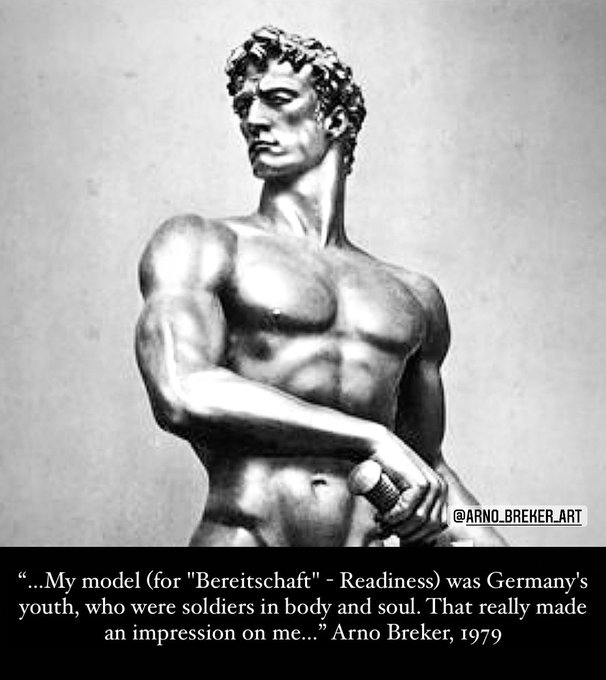
Let us not forget talking about the official art of the Third Reich, with the figurative symbolism of the outright pagan sculptor Arno Breker.
Breker was Hitler’s personal pet sculptor and realized in 1936 the infamous incarnations of the Ubermensch (superior man) for the Nazi’s Olympic Stadium in Berlin.
As proven by interviews after the war, the so-called “apolitical” Breker was very well aware for what kind of power he was working.
His work “Bereitschaft” (readiness) of 1939 proves the case.
Mascot of the Parisian elites, since trained by a Frenchman, his personal exhibit at the Orangerie in Paris in 1942 drew over 80.000 visitors. He shared the fascist ethics of filmmaker Leni Riefenstahl, always ready to popularize nazi symbology.
Breker was befriended with Jean Cocteau, Vlaminck and Derain, and turned down Stalin’s offer to work for the USSR after the war.
A cubist in his early days (1922), he was disappointed by the meeting he had with Paul Klee and the Bauhaus, and invested himself in the total deification of the human body. Breker confirmed: “I always tried to give a meaning with symbols”.
In all his spirituality, Breker did not hesitate in his “Vision of Europe” to transpose an eagle’s heads on human bodies, making them into Horus, son of Isis.
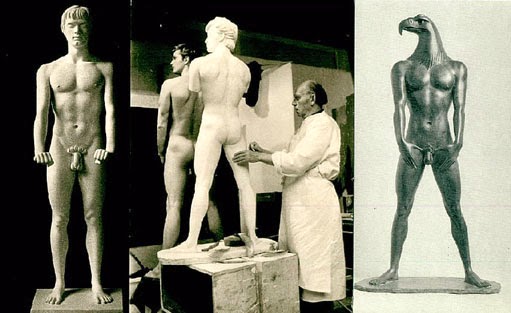
The inversion of these symbolisms, restating the supremacy of male values over female values was nothing less than the creation of esthetics of war.
In 1980, Breker explained in an interview how he saved the life of Picasso and that of Aristide Maillol’s Jewish companion, Dina Vierny using his direct position as an intimate of Adolph Hitler.
The Italian futurists are another obscene example. Many proudly joined the fascist movements and some were really chocked Hitler condemned their modernism at a Nuremberg rally.
Marinetti, who published his “Futurist Manifesto” in Le Figaro in 1909 claimed proudly:
« Point 3: Literature being up till now an apology of contemplating immobility, ecstasy and sleep, we want to exalt the aggressive movement, the fevery insomnia, the gymnastic step, the dangerous jump, the slap in the face and the punching.
« Point 7: There is no beauty outside struggle. There are no masterpieces without aggressive character. Poetry must be a violent assault on unknown forces, to summate them to lie down before man…
« Point 9: We want to glorify war –the unique hygiene of the world, militarism, and patriotism, the destructive gesture of the anarchists, the nice ideas that kill, and the disdain of women…
« Point 10: We want to demolish the Museums and Libraries, fight moralism, feminism and all of opportunistic and utilitarian cowardness. »
As we have demonstrated, this modernism is nothing less than the restoration of the most backward values of ancient civilizations, deprived of their dynamic and reduced to caricatures of their worst defaults.
What we defend here is on the contrary a Renaissance, that is a universal but authentic process of artistic creation fertilized by the best contributions of all cultures, be them Indian, African, Asiatic, American or European.
Our critique of Modernism is not based on any nostalgic longing for a supposedly perfect Golden Age that is no more, but on the commitment to valorize mans dignity and mind.
If you really want to use the word modern, talk about the Mummy portraits of the Fayoum of the second and third century after DC.
Theosophy today
Even if there still exists today an international network of Blavatsky lodges from Antwerp to Philadelphia or Saint Petersburg, it has been in the recent days mainly the radical green current who is leading the fight to destroy the humanist cultural paradigm.
As the Theosophists yesterday, the Greens which have replaced the mother goddess (sounds too religious) with Mother earth (Gaia) express the same messianic zeal in their commitment to sweep the earth and often rally de facto the forces of race, soil and blood.
As yesterday, the green current gets supported by the highest spheres of Anglo-American aristocratic gangsterism.
Deceased financial angel of French archconservative Philippe de Villiers, Jimmy Goldsmith, has a brother, Teddy, who happens to be one of the main funders of Greenpeace!
Documents and articles consulted:
- Chaitkin, Anton, Tarpley, Webster, The Palmerston Zoo, Executive Intelligence Review, Vol. 21, nr.16, Apr.15, 1994.
- Cheminade, Jacques, Time to destroy the myth of Napoleon Bonaparte, Executive Intelligence Review, Vol. 23, 42, Oct.18, 1996.
- Clair, Jean, Considérations sur l’Etat des Beaux Arts – Critique de la Modernité, Gallimard, Paris 1983.
- Gibson, Michael, Le Symbolisme, Editions Taschen, Paris, 1994.
- Kandinsky, Nina, Kandinsky et moi, Flammarion, Paris 1978.
- Kandinsky, Wassily, Concerning the Spiritual in Art, and painting in particular, Dover Editions, New York, 1977.
- Lantier, Jacques, La Théosophie, Editions Culture, Art, Loisirs, Paris.
- LaRouche, Lyndon, How Cauchy ruined France, EIR, Vol.24, nr. 24, June 20, 1997.
- Noël, Bernard, Arno Breker et l’Art officiel, Jacques Damase Editeur, Paris 1981.
- Prampolino, Enrico, Stile Futuristica, nr. 3, Turin 1933.
- Parmelin, Hélène, Peinture, pierre de touche de la liberté, L’Unité nr. 416, 1978.
Rembrandt: 400 years old and still young!

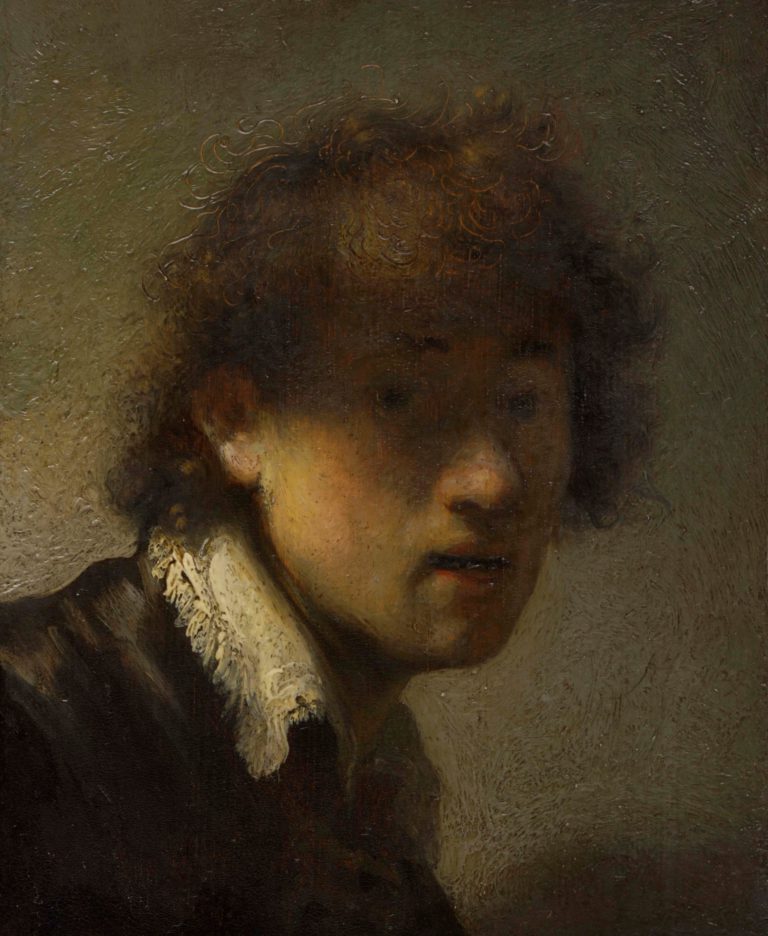
Rembrandt H. van Ryn, was born on July 15, 1606, as the son of a not so poor miller living in the revolutionary city of Leyden in the Netherlands.
Today (2006), four hundred years later, even without any knowledge of the specific historical context, few are those that remain indifferent to his artistic message and skill. Why Rembrandt? What particular quality of his paintings, engravings and drawings gave him the power to reach over centuries of time?
As we will document here, Rembrandt, a precocious intellectual, became already quite « universal » as a young adult. But let’s try to find out what « universal » means.
The Revolt of the Netherlands
The revolt of the Burgundian Netherlands (Note 1) against the tyranny the Fuggers, bankers at the helm of the Spanish and Austrian Habsburg empire, resulted in the tragic break-up of this « nation-state in the making » between the north (today’s Netherlands) and the south (the territory that today includes Belgium and part of northern France).
The Habsburg empire, while brutally sticking to the rich southern part (Flanders), cynically offered the « insurgents » that, if they wished to have a country, they could settle in the malaria-infested swamps of the North, where 75% of the territory lies below sea level, but nevertheless an area slowly domesticated by generations of hardworking farmers thanks to a vast system of canals, dikes and locks, patiently erected since the end of the thirteenth century.
But Charles V, and even worse, his son Philip II of Spain, didn’t believe in the power of mind or that of work. Instead, they believed in the power of the sword and the terror of the Inquisition. After a long war and much unnecessary bloodshed, their policies had reached an impasse, and on April 9, 1609, the semi-bankrupt Habsburgs were forced to sign a twelve-year truce with the new Republic of the Netherlands.
Education
That same year, Rembrandt, hardly 3 years old, entered basic school, where girls and boys learn to read, to write and to calculate. School opens at 6 a.m. in the summer, at 7 a.m. in winter, and finishes only at 7 p.m. Classes start with prayer, the reading and discussion of passages of the Bible and the singing of psalms. Here Rembrandt develops an elegant handwriting and more than rudiments of the Bible.
The Netherlands want to survive. Its leaders wisely used the 12 year truce (1609-1621) to fulfill their commitment to the general welfare. This way, early XVIIth century Holland became maybe the first country of the world where everybody got the chance to learn how to read, write and calculate.
That universal school system, whatever its inadequacies, offered to both poor and rich alike, was the secret of the Dutch « Golden Century ». It’s schooling will also create the generations of Dutch immigrants that will participate a hundred years afterwards in the American Revolution
Others would enter the secondary school at the age of 12, but Rembrandt precociously enters Leyden’s Latin School at the age of 7. There, pupils generally, besides rhetoric, logic and calligraphy, learn, not only Greek and Latin, but English, French, Spanish or Portuguese. Then, in 1620, at the age of 14, since no age limit in the Netherlands bridled young talents, Rembrandt inscribed at the Leyden University. His choice is not Theology, Law, Science, nor Medicine, but Literature.
Did Rembrandt want to add to his knowledge of Latin, the mastery of Greek and Hebrew philology and perhaps Chaldean, Coptic or Arabic? After all, Leyden was already publishing Arabic-Latin dictionaries, while the Netherlands were increasingly growing to become the book printing centre of the world.
From its foundation in 1585, after a historic battle for the city’s freedom, Leyden University became a rallying point for humanists worldwide and a center for new discoveries in optics, physics, anatomy and cartography, offering the world such famous scientists as Christian Huygens (1629-1695) and Antonie van Leeuwenhoek (1632-1723), both correspondents of Leibniz.
People flocked in from Flanders, Germany, Denmark, Sweden, England and even Hungary. By 1621, over fifty Frenchmen were teaching in Leyden. In a desperate effort to pollute this source of creativity, in 1630, René Descartes registered as a « mathematician » at the University of Leyden. (Note 2)
But the big trouble had already started way before. A disastrous theological « debate » degenerated into a conflict akin to civil war. On the one side, Jacob Arminius, founder of the « Remonstrant » current upholding the Erasmian-Rabelaisian concept of man endowed with a free will although that free will remained to be fine-tuned with the grace of God. This view was also held by the elder general and capable national leader, Johan van Oldenbarnevelt (1547-1619).
On the opposing side, one Franciscus Gomarus, defender of the fatalist Calvinist doctrine of « predestination », a doctrine adhered to by Prince Maurits, the young incoming son of the founder of the nation, William the Silent. While leaders were strongly divided, the 1619 « Dordrecht Synod » installed the radical Calvinist doctrine as the law.
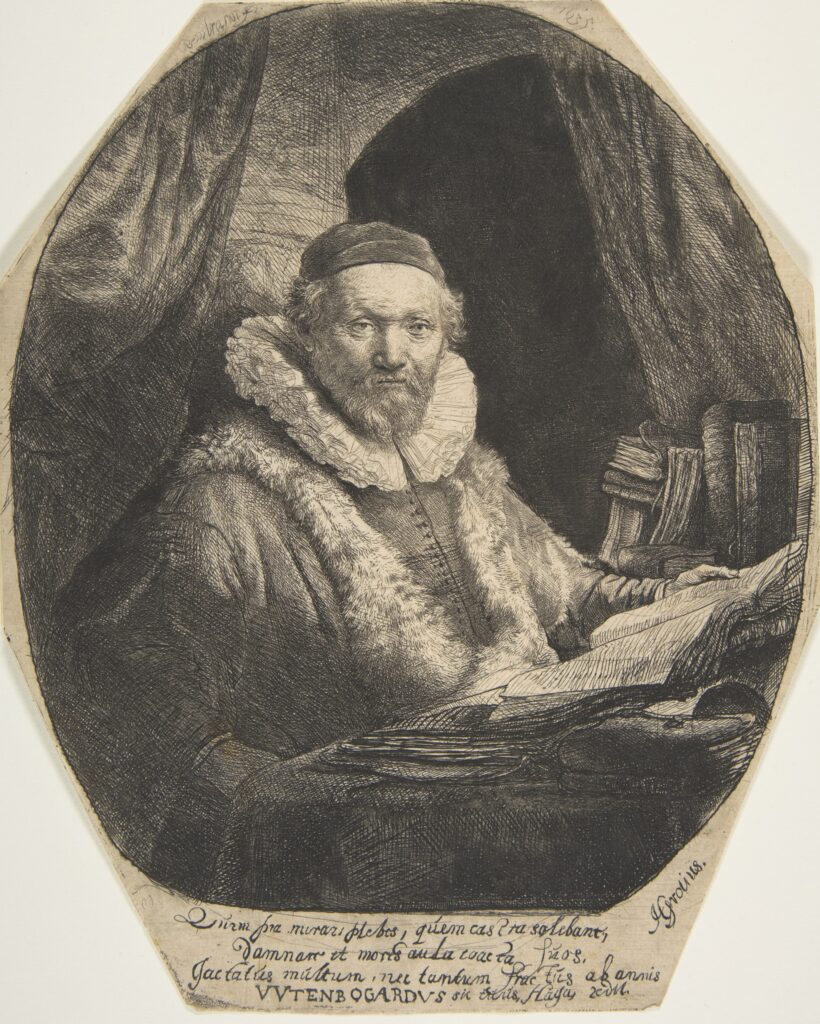
But Leyden was mostly « Arminian » and so was Rembrandt. Rembrandt’s 1633 and 1635 portraits of Johannes Uytenbogaert, the main reverend leading the Arminians who was obliged to spent several years of his life in exile to escape from persecution, show how closely Rembrandt was connected to this movement.
So, when Rembrandt entered University, the situation was very hot. Arminian-minded teachers are on the leave and often forced to do so. So was Rembrandt, and after two months, at age 14, he quitted University and went full time into painting and set up his own workshop.
By 1621, the truce had come to an end, and the Spanish army was once again conducting an all-out war against the Netherlands, which was accused, not without reason, of supporting the Bohemian revolt and harboring the leaders of its resistance. (Note 3)
As a young intellectual confronted with injustice and political and religious madness, Rembrandt entered the studio of Jacob Isaaczoon van Swanenburg, a learned Dutch painter who lived in Venice and Naples, where he worked from 1600 to 1617 before running into trouble with the Inquisition, which accused him of « painting on Sundays ».
Few works have survived from this master, renowned for his city views and portraits. But his subjects and style resemble those of the great humanist Hieronymus Bosch. For three long years, Rembrandt learned how to grind pigments, master essences, varnishes, brushes, canvases and panels.
But above all, Swanenburgh made his pupil a master in the art of engraving and etching.
Pelgrims of Emmaus
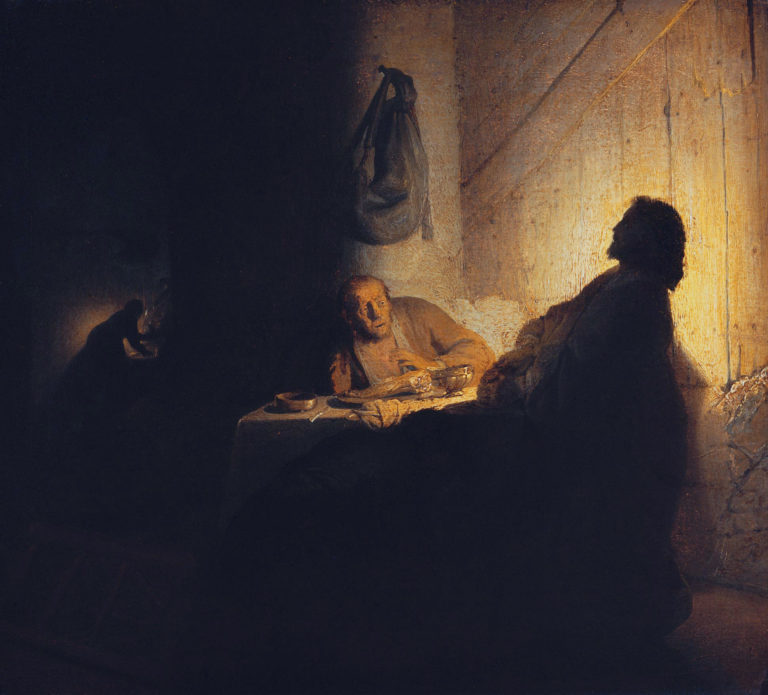
Rembrandt’s interest in the power of ideas clearly appears in the « Pilgrims at Emmaus », where an atmosphere of astonishment and horror break out when Christ reveals himself to the disbelievers.
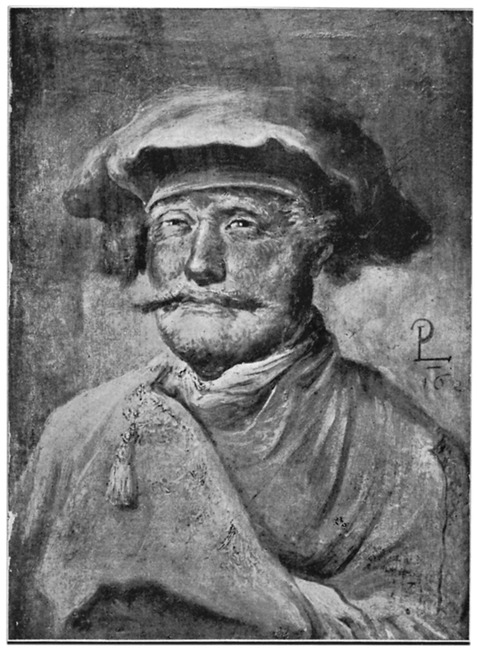
Then, before setting up his studio, Rembrandt will spend six months in the workshop of Pieter Lastman in Amsterdam. With Lastman, Rembrandt finally finds a master that departs from the traditional Dutch landscapes, still-lives and boring group portraits.
Building on the theatrical settings of Caravaggio, Lastman paints biblical, Greek and Roman mythology. He paints history! And Rembrandt always desired to become a historieschilder. Now, Rembrandt finally found in painting the literature he was looking for when inscribing in the University.
Also, in Lastman’s workshop, he meets the talented Jan Lievens, with whom he will work for a while.
Knowing how to know thyself
Rembrandts reputation is largely the fruit of the near to one hundred multiform self-portraits, including about twenty engravings, covering the walls of numerous museums around the world. Some pragmatists tell us Rembrandt did that many self-portraits because he just was the cheapest model in town, and probably the most patient one. Others claim he was simply noting down his unending grimaces, the famous tronies, to prepare future dramatic historical paintings.
We think there is more to it and we approve Simon Schama who wrote that, « The reason for the multiplication of his self-image was not a relentless, almost monomaniacal assertion of the artistic ego but something like the exact opposite. »
The self-portrait, an art expression that has nearly disappeared from today’s practice, always throws an extremely daring challenge to the painter looking into the mirror. Is this me? I didn’t realize I look that way. I’ve changed again! What is wrong? The a priori ideas in the mind of the perceiver or the sense perceptions he’s confronted with? Real thinking, in essence, comes down to confronting not just those burning paradoxes, but the joy of overcoming them with self reflexive irony, and a truthful commitment to the permanent discovery and communication of that increasing irony through a Socratic dialogue.
Rembrandt, at the age of 22 starts training his first pupil, Gerrit Dou, only fifteen years old. Samuel van Hoogstraten, who was another young pupil, reported Rembrandt advising him:
« Try to learn introducing in your work what you know already. Then, very soon, you will discover what escapes you and want to discover. »
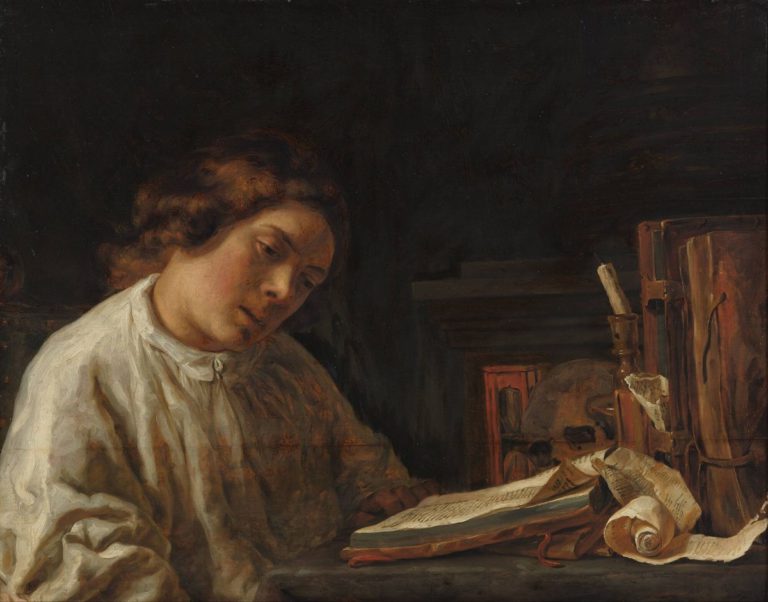
Hoogstraten’s self-portrait at age 17 demonstrates what a contagious genius Rembrandt became rapidly as a teacher.
But Rembrandt’s main problem was to show movement. Anima means soul and for Rembrandt animating the mind of the viewer was the art of making that viewer conscious of his own quality of moving the soul, i.e. moving the mover. Through this process of teaching and self-teaching Rembrandt works out various ways to tell his-stories.
One funny way to put faces into motion is to wrap them into clothing, put on jewelry, and choose a specific light setting that generates interesting eye-attracting shadows bringing into light the plastic volumes. Explore facial expressions evoking anger, fear, happiness, self-doubt, laughter, etc.
The real subject is not Rembrandt, but the discovery of human consciousness through self-consciousness. The mirror image permits oneself to look over one’s shoulder down on oneself. Leonardo and others advised artists to view their own work in a mirror, since the « fresh » mirror image offered the artist another « viewpoint », revealing those remaining imperfections that had escaped from his attention.

Also, the compassion and self esteem one is forced to develop in that process becomes a basic ingredient for promethean and agapic character formation. Then, Rembrandt’s joyful process of self-discovery spills naturally over into the portraits done of others.
Look how funny Saskia smiles, when she dresses up « as Rembrandt » with a feathered reddish hat, carrying a golden chain and with her little hand lost in Rembrandt’s large glove.
Then, there are also the self-portraits in assistenza, where the painter’s face pops up uninvited in a larger painting, such as in Velazquez‘ « Las Meninas ».
The Stoning of Saint-Stephen
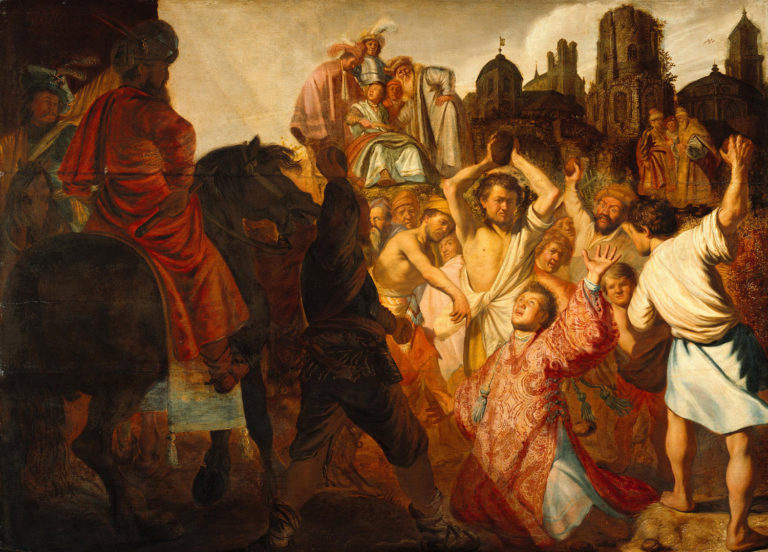
One of Rembrandt’s grimacing faces appears behind the martyr in the first known painting by the young Rembrandt, The Stoning of Saint-Stephen. Executed at the age of 19, the work powerfully expresses the basis of Rembrandt’s ideas. Loaded with some twenty figures, the subject had previously been treated by Lastman and Adam Elsheimer, a young German Mannerist living in Rome, whose works Rembrandt had admired while contemplating reproductions in Swanenburgh’s studio.
But why Saint-Stephen? Rembrandt’s choice stems directly from the subject. This Greek-speaking Jewish convert, the first Christian martyr, was tried by a court of law for blasphemy. He unabashedly told the Sanhedrin judges that they were « stiff-necked and uncircumcised in heart and ears » and that they were people who had « received the law by the disposition of angels, and have not kept it… »
Stephen also told them that God could not be kept « locked up in a temple ». At one point, Stephen,
« being full of the Holy Spirit, and having his eyes fixed on heaven, saw the glory of God, and Jesus standing at the right hand of God, and he said: ‘Behold, I see the heavens opened, and the Son of Man standing at the right hand of God’.
« And crying aloud, they stopped their ears, and with one accord rushed upon him; and having pushed him out of the city, they stoned him; and the witnesses laid their garments at the feet of a young man called Saul. And they stoned Stephen, who prayed and said: Lord Jesus, receive my spirit. And kneeling down, he cried aloud: Lord, do not impute this sin to them. »
The painting leaves the left side entirely in shadow, in a partially failed attempt to evoke the idea of Stephen seeing the « open heavens. » Saul is in the shadows because he is the one encouraging the execution. Later, on the road to Damascus, he would have his own vision of the « heavens opening » and in turn convert to Christianity, since Saul is none other than the future St. Paul.
In short, as we have said, at the age of 19, Rembrandt powerfully asserts the principles for which he wants to live and for which he is prepared to die, ideas that he must have discovered at the age of fourteen during the great Sophist event, the great « theological debate » that was the beginning of the end of the Republic.
Ideas
Historians might scream there is no space here for political manifestos. They are right. Rembrandt’s ideas go far beyond simple minded militantism, and their political impact is much more profound.
In 1641, an artist, Philips Angel, adressing the painting guild, honored Rembrandt and underscored the artist’s « elevated and profound reflection ». What were these « elevated and profound » ideas all about?
- Truth. Somebody must mobilize the courage to stand up and tell the truth in front of established authorities or misleading public opinion. That theme comes regularly back, notably with « Suzanna and the Elders ». Daniel, a witness of injustice will speak up and saves Suzanna from the death sentence.
- Reason. Faith and religion do not always coincide with religious rites. Look to the angry angel preventing Abraham from killing his own son in « The sacrifice of Isaac ». Think before acting! Reason, love of God and love for mankind must guide any religious practice and on the basis of reason, a dialogue of cultures can enrich humanity.
- Self-perfection. Change, yes. People can find in themselves the means to identify their errors and change for the better. The example of Saint-Paul will stand as a permanent reference for Rembrandt, who painted him several times and even represented himself as the Church father.
- Love, Repentance, Pardon. In a period of permanent danger of « religious wars », Rembrandt strongly identifies with Saint Stephen’s demand « Lord, lay not this sin to their charge. » Rembrandt will paint several times « The return of the prodigal son ». The father gives a great feast for the returning son because he « who was dead came back to life ». The notion of pardon, and acting in the advantage of the other, will become the key concept for the success of the world Peace of Westphalia concluded in 1648 ending the thirty years war, including the recognition of the Netherlands as a sovereign state.
The Night Watch
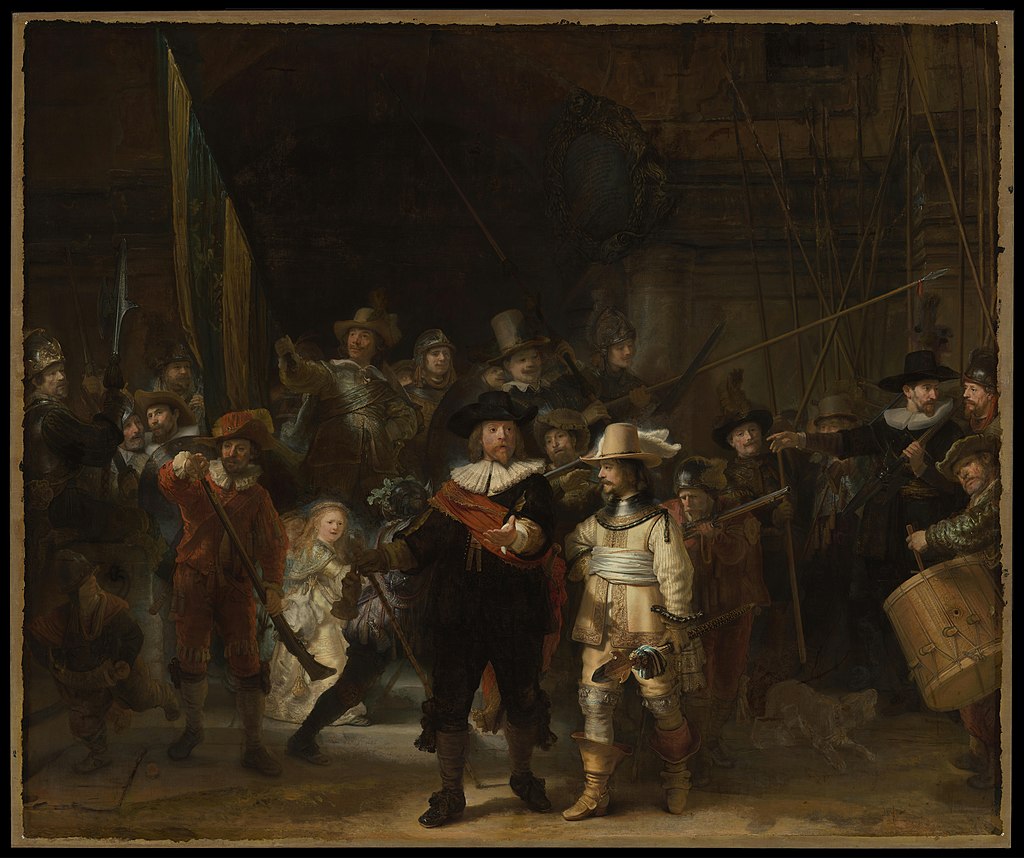
Misrepresented as a nocturnal scene, the Night Watch is probably one of the greatest intellectual provocations against cold Aristotelian classicism.
The Netherlands was at war. Amsterdam, like most major cities, maintained a considerable militia of archers, crossbowmen and harquebusiers. These small citizen armies had a firing range and a meeting hall, the Kloveniersdoelen, where soldiers could rest after training.
Obviously, such glorious gatherings deserved to be immortalized in vast group portraits, where all the members of the company was presented in such a way that, as van Hoogstraten put it, « you could, as it were, behead them all with a single cannon shot. »
Rembrandt completely overturned this traditional representation. Firstly, apart from the 2 captains and their 16 companions (who each paid for their presence on the canvas), Rembrandt added another third of figures to the original number.
Secondly, the revolutionary concept implemented is the idea of depicting the whole group as « on the march », not just advancing, but raising flags and weapons after passing under a circular arch seen just behind them.
Thirdly, a spectacular sense of movement emanates from the rapid oscillation of a chiaro-oscura, illuminating one part, casting another into shadow.
Finally, the show seems formally a confused, chaotic scene. People enter from all sides. In infinite heteronomy, one loads his rifle, another beats the drum, another raises his spear while another stares at his rifle.
Beyond this apparent hectic confusion, what remains is the spirit of a republican citizenry called to arms and moving from chaos to unity, a subject Rembrandt represented the same year in an allegorical oil sketch, Concord of the State.
Against narrow academic rigor, the spirit of inclusion of the multitude so common to Flemish painters like Bruegel was once again manifesting itself.
Van Hoogstraten, defending Rembrandt against these critics (as usual, those who were jealous of his brilliant performance) commented:
« Rembrandt observed this requirement [of unity] very well… and although in the opinion of many he went too far, making the painting more according to his personal taste than according to the individual portraits he had been commissioned to paint.
Nevertheless, the painting, no matter how harsh the critics, will stand, in my judgment, against all these rivals because it is so picturesque in its conception and because it is so powerful that, according to some, all the other doelen works look like playing cards in comparison. »
Immortality
We took here just a few examples to demonstrate that Rembrandts universal character derives directly from his ruthless commitment, directed to make us conscious of the creative potential given to all human beings, men and women, old and young, Christians, Jews, Muslims or others, a creative and creating human nature called the soul.
This commitment is once again available in today’s new generation and can therefore be mobilized for great achievements.
From this point of view, Rembrandt is in a good position to become a reference individual capable of leading us out of the current cultural « dark age », where video games teach our children to take perverse pleasure in gratuitous violence and push them to become « naturally born killers ».
In contrast, a Rembrandt who catches life and loves mankind will trace the divine in the slightest spark of light. As some sort of 5th apostel, without ever painting God directly, Rembrandt reveals the harmony of his creation.
Those who took time studying his paintings can tell themselves: « God exists, I just met Rembrandt », since through Rembrandt’s art God’s tender love and blessing power are revealed to us in our human reality.
That « immortal » nature of Rembrandt’s soul will doubtlessly nourish the « immortality » of the creative geniuses he will inspire. Let us not wait another four hundred years to celebrate such a genius, for what he brings us is living and not to be buried in the history of art
Notes:
- Friedrich Schiller, The revolt of the Netherlands; Karel Vereycken, How Erasmus Folly saved our Civilization; Karel Vereycken, « Rembrandt, bâtisseur de nations » in Nouvelle Solidarité, June 10 and 17, 1985.
- Years earlier, René Descartes, using his own funds, made a trip to Bohemia and in 1620 took part in the battle of Montagne Blanche, leading to the massacre of Prague, the capital of Bohemia. One biographer reports that Descartes, entering Prague, immediately appropriated Kepler’s Brahe scientific instruments.
- For a detailed report on the links between Rembrandt and Comenius and the Bohemian revolt, see Karel Vereycken, The light of Agapê, Rembrandt and Comenius versus Rubens, Ibykus N°85, 2003.
- Ernst van Wetering, director of the Rembrandt Research Project (RRP), on the basis of scientific examinations of Rembrandt’s works, estimates that the master required his models to pose for three hours a day for at least three months.
- Karel Vereycken, Leonardo, painter of movement, Fusion N°108, 2006.
Sète, vue sur le Golfe du Lion

Moulin de Fourges (27)

Le retour de Poséidon

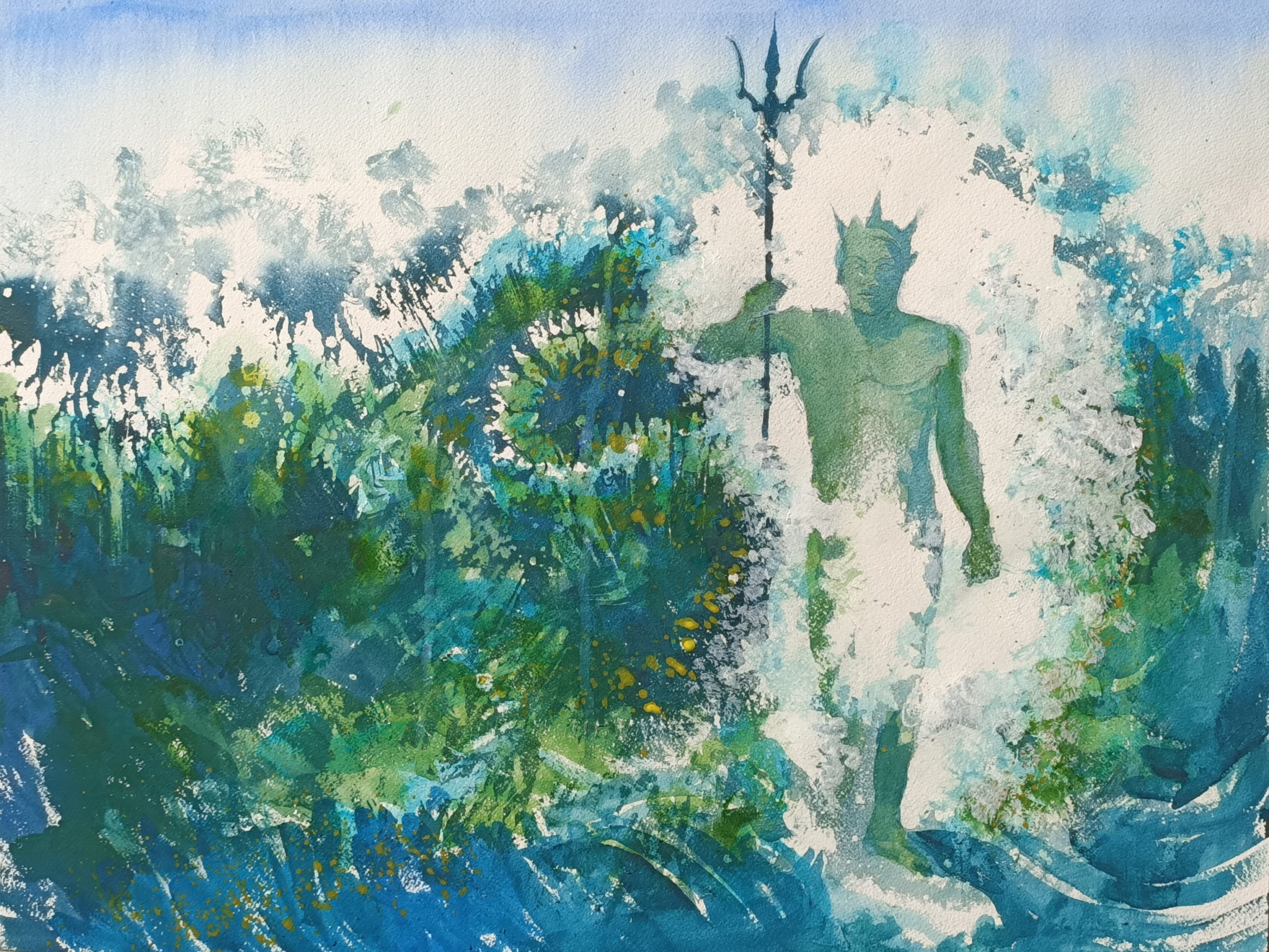
Avicenna and Ghiberti’s role in the invention of perspective during the Renaissance

By Karel Vereycken, Paris, France.
Same article in FR, même article en FR.
No visitor to Florence can miss the gilded bronze reliefs decorating the Porta del Paradiso (Gates of Paradise), the main gate of the Baptistery of Florence right in front of the Cathedral of Santa Maria del Fiore surmounted by Filippo Brunelleschi’s splendid cupola.

In this article, Karel Vereycken sheds new light on the contribution of Arab science and Ghiberti’s crucial role in giving birth to the Renaissance.
Historical context
The Baptistery, erected on what most Florentines thought to be the site of a Roman temple dedicated to the Roman God of Mars, is one of the oldest buildings in the city, constructed between 1059 and 1128 in the Florentine Romanesque style. The Italian poet Dante Alighieri and many other notable Renaissance figures, including members of the Medici family, were baptized in this baptistery.
During the Renaissance, in Florence, corporations and guilds competed for the leading role in design and construction of great projects with illustrious artistic creations.
While the Arte dei Lana (corporation of wool producers) financed the Works (Opera) of the Duomo and the construction of its cupola, the Arte dei Mercantoni di Calimala (the guild of merchants dealing in buying foreign cloth for finishing and export), took care of the Baptistery and financed the embellishment of its doors.
The Gates of Paradise
The Baptistry, an octagonal building, has four entrances (East, West, North and South) of which only three (South, North and East) have sets of artistically important bronze doors with relief sculptures. Three dates are key : 1329, 1401 and 1424.
- In 1329, the Calimala Guild, on Giotto‘s recommendation, ordered Andrea Pisano (1290-1348) to decorate a first set of doors (initialy installed as the East doors, i.e. seen when one leaves the Cathedral, but today South). These consist of 28 quatrefoil (clover-shaped) panels, with the 20 top panels depicting scenes from the life of St. John the Baptist (the patron of the edifice). The 8 lower panels depict the eight virtues of hope, faith, charity, humility, fortitude, temperance, justice, and prudence, praised by Plato in his Republic and represented during the XVIth century by the Flemish humanist painter and reader of Petrarch, Peter Brueghel the Elder. Construction took 8 years, from 1330 till 1338.
- In 1401, after having narrowly won the competition with Brunelleschi, the 23 year old and inexperienced young goldsmith Lorenzo Ghiberti (1378-1455), is commissioned by the Calima Guild to decorate the doors which are today the North Gate. Ghiberti cast the bronze high reliefs using a method known as lost-wax casting, a technique that he had to reinvent entirely since it was lost since the fall of the Roman Empire. One of the reasons Ghiberti won the contest, was that his technique was so advanced that it required 20 % less (7 kg per panel) bronze than that of his competitors, bronze being a dense material far more costly than marble. His technique, applied to the entire decoration of the North Gate, as compared to his competitors, would save some estimated 100 kg of bronze. And since in 1401, with the plague regularly hitting Florence, economic conditions were poor, even the wealthy Calimala took into account the total costs of the program.
The bronze doors are comprised of 28 panels, with 20 panels depicting the life of Christ from the New Testament. The 8 lower panels show the four Evangelists and the Church Fathers Saint Ambrose, Saint Jerome, Saint Gregory, and Saint Augustine. The construction took 24 years.
- In 1424, Ghiberti, at age 46, was given—unusually, with no competition—the task of also creating the East Gate. Only in 1452 did Ghiberti, then seventy-four years old, install the last bronze panels, since construction lasted this time 27 years! According to Giorgio Vasari (1511-1574), Michelangelo Buonarroti (1475-1564) later judged them « so beautiful they would grace the entrance to Paradise ».
Over two generations, a bevy of well paid assistants and pupils were trained by Ghiberti, including exceptional artists, such as Luca della Robbia, Donatello, Michelozzo, Benozzo Gozzoli, Bernardo Cennini, Paolo Uccello, Andrea del Verrocchio and Ghiberti’s sons, Vittore and Tommaso. And over time, the seventeen-foot-tall, three-ton bronze doors became an icon of the Renaissance, one of the most famous works of art in the world.
In 1880, the French sculptor Auguste Rodin was inspired by it for his own Gates of Hell on which he worked for 38 year
Revolution
Of utmost interest for our discussion here is the dramatic shift in conception and design of the bronze relief sculptures that occurred between the North and the East Gates, because it reflects how bot the artist as well as his patrons used the occasion to share with the broader public their newest ideas, inventions and exciting discoveries.
The themes of the North Gate of 1401 were inspired by scenes from the New Testament, except for the panel made by Ghiberti, « The Sacrifice of Isaac », which had won him the selection competition the same year. To complete the ensemble, it was therefore only logical that the East Gate of 1424 would take up the themes of the Old Testament.
Originally, it was the scholar and former chancellor of Florence Leonardo Bruni (1369-1444) who planned an iconography quite similar to the two previous doors. But, after heated discussions, his proposal was rejected for something radically new. Instead of realizing 28 panels, it was decided, for aesthetic reasons, to reduce the number of panels to only 10 much larger square reliefs, between borders containing statuettes in niches and medallions with busts.
Hence, since each of the 10 chapters of the Old Testament contains several events, the total number of scenes illustrated, within the 10 panels has risen to 37 and all appear in perspective :
- Adam and Eve (The Creation of Man)
- Cain and Abel (Jalousie is the origin of Sin)
- Noah (God’s punishment)
- Abraham and Isaac (God is just)
- Jacob and Esau
- Joseph
- Moses
- Joshua
- David (Good commandor)
- Solomon and the Queen of Sheba
The general theme is that of salvation based on Latin and Greek patristic tradition. Very shocking for the time, Ghiberti places in the center of the first panel the creation of Eve, that of Adam appearing at the bottom left.
After the first three panels, focusing on the theme of sin, Ghiberti began to highlight more clearly the role of God the Savior and the foreshadowing of Christ’s coming. Subsequent panels are easier to understand. One example is the panel with Isaac, Jacob and Esau where the figures are merged with the surrounding landscape so that the eye is led toward the main scene represented in the top right.
Many of the sources for these scenes were written in ancient Greek, and since knowledge of Greek at that time was not so common, it appears that Ghiberti’s “theological advisor” was Ambrogio Traversari (1386-1439), with whom he had many exchanges.
Traversari was a close friend of Nicolas of Cusa (1401-1464), a protector of Piero della Francesca (1412-1492) and a key organizer of the Ecumenical Council of Florence of 1438-1439, which attempted to put an end to the schism separating the Church of the East from that of the West.
Perspective
The bronze reliefs, known for their vivid illusion of deep space in relief, are one of the revolutionary events that epitomize the Renaissance. In the foreground are figures in high relief, which gradually become less protruding thereby exploiting the full illusionistic potential of the stiacciato technique later brought to its high point by Donatello. Using this form of “inbetweenness”, they integrate in one single image, what appears both as a painting, a low relief as well as a high relief. Or maybe one has to look at it another way: these are flat images traveling gradually from a surface into the full three dimensions of life, just as Ghiberti, in one of the first self-portraits of art history, reaches his head out of a bronze medal to look down on the viewers. The artist desired much more than perspective, he wanted breathing space!
This new approach will influence Leonardo Da Vinci (1452-1517). As art historian Daniel Arasse points out :
(…) It was in connection with the practice of Florentine bas-relief, that of Ghiberti at the Gate of Paradise (…) that Leonardo invented his way of painting. As Manuscript G (folio 23b) would much later state, ‘the field on which an object is painted is a capital thing in painting. (…) The painter’s aim is to make his figures appear to stand out from the field’ – and not, one might add, to base his art on the alleged transparency of that same field. It is by the science of shadow and light that the painter can obtain an effect of emergence from the field, an effect of relief, and not by that of the linear perspective.
Donatello
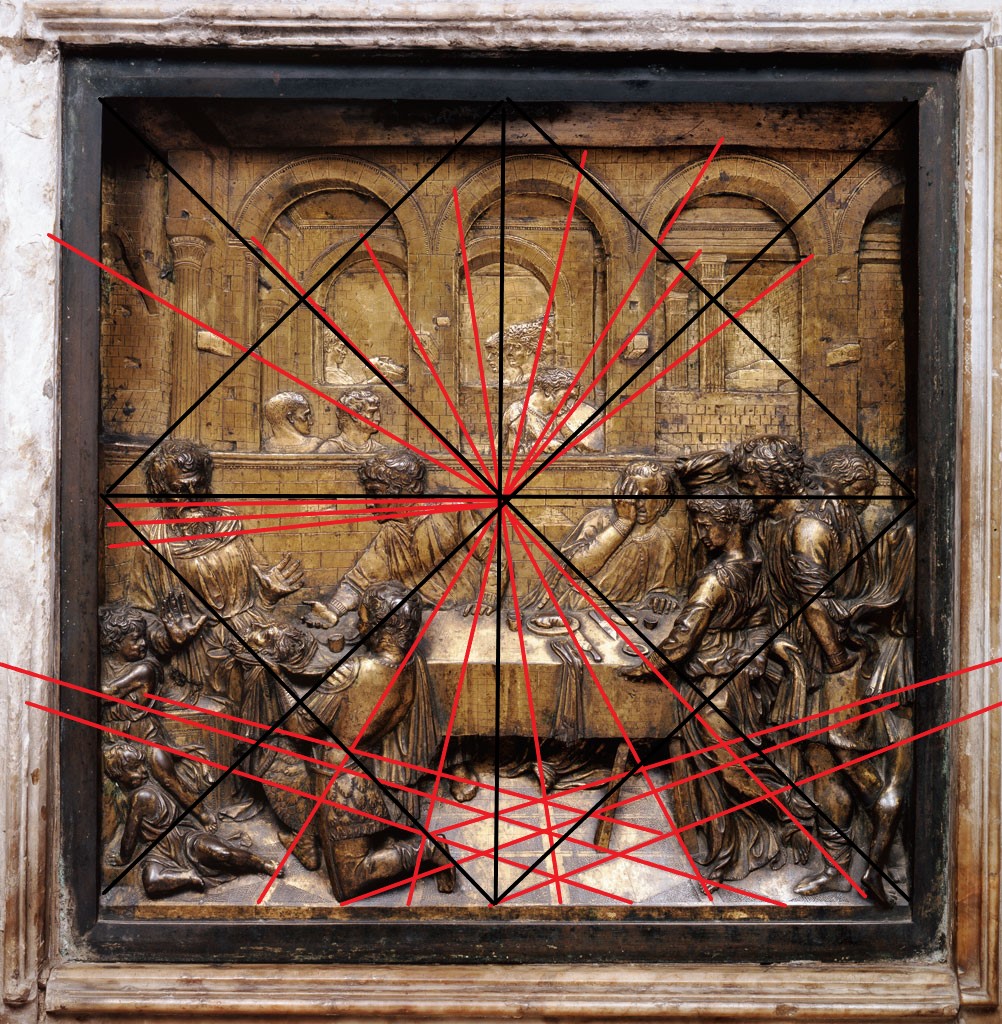
At the beginning of the 15th century, several theoretical approaches existed and eventuall contradicted each other. Around 1423-1427, the talentful sculptor Donatello, a young collaborator of Ghiberti, created his Herod’s Banquet, a bas-relief in the stiacciato technique for the baptismal font of the Siena Baptistery.
In this work, the sculptor deploys a harmonious perspective with a single central vanishing point. Around the same time, in Florence, the painter Massacchio (1401-1428) used a similar construction in his fresco The Trinity.
As we will see, Ghiberti, starting from the anatomy of the eye, opposed such an abstract approach in his works as well as in his writings and explored, as early as 1401, other geometrical models, called « binocular ». (see below).
Christ among the Doctors, Ghiberti, before 1424.
Christ among the Doctors, Ghiberti, before 1424.
Then, as far as our knowledge reaches, in 1407, Brunelleschi had conducted several experiments on this question, most likely based on the ideas presented by another friend of Cusa, the Italian astronomer Paolo dal Pozzo Toscanelli (1397-1482), in the latter’s now lost treaty Della Prospettiva. What we do know is that Brunelleschi sought above all to demonstrate that all perspective is an optical illusion.
Finally, it was in 1435, that the humanist architect Leon Baptista Alberti (1406-1472), in his treatise Della Pictura, attempted, on the basis of Donatello’s approach, to theorize single vanishing point perspective as a representation of a harmonious and unified three-dimensional space on a flat surface. Noteworthy but frustrating for us today is the fact that Alberti’s treatise doesn’t contain any illustrations.
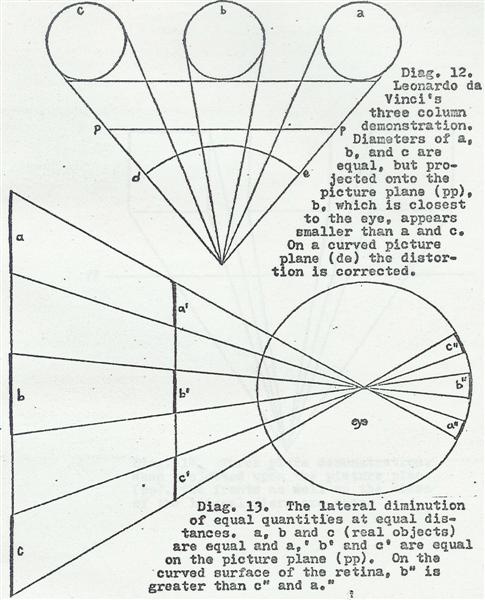
However, Leonardo, who read and studied Ghiberti’s writings on, would use the latter’s arguments to indicate the limits and even demonstrate the dysfunctionality of Alberti’s “perfect” perspective construction especially when one goes beyond a 30 degres angle.
In the Codex Madrid, II, 15 v. da Vinci realizes that « as such, the perspective offered by a rectilinear wall is false unless it is corrected (…) ».
Perspectiva artificialis versus perspectiva naturalis
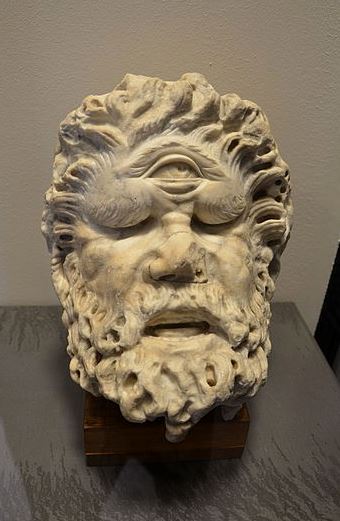
Alberti’s “perspectiva artificialis” is nothing but an abstraction, necessary and useful to represent a rational organization of space. Without this abstraction, it is fairly impossible to define with mathematical precision the relationships between the appearance of objects and the receding of their various proportions on a flat screen: width, height and depth.
From the moment that a given image on a flat screen was thought about as the intersection of a plane cutting a cone or pyramid, a method emerged for what was mistakenly considered as an “objective” representation of “real” three dimensional space, though it is nothing but an “anamorphosis”, i.e. a tromp-l’oeil or visual illusion.
What has to be underscored, is that this construction does away with the physical reality of human existence since it is based on an abstract construct pretending:
- that man is a single eyed cyclops;
- that vision emanates from one single point, the apex of the visual pyramid;
- that the eye is immobile;
- that the image is projected on a flat screen rather than on a curved retina.
Slanders and gossip
The crucial role of Ghiberti, an artist which “Ghiberti expert” Richard Krautheimer mistakenly presents as a follower of Alberti’s perspectiva artificialis, has been either ignored or downplayed.
Ghiberti’s unique manuscript, the three volumes of the Commentarii, which include his autobiography and which established him as the first modern historian of the fine arts, is not even fully translated into English or French and was only published in Italian in 1998.
Today, because of his attention to minute detail and figures « sculpted » with wavy and elegant lines, as well as the variety of plants and animals depicted, Ghiberti is generally presented as “Gothic-minded”, and therefore “not really” a Renaissance artist!
Giorgio Vasari, often acting as the paid PR man of the Medici clan, slanders Ghiberti by saying he wrote « a work in the vernacular in which he treated many different topics but arranged them in such a fashion that little can be gained from reading it. »
Admittedly, tension among humanists, was not uncommon. Self-educated craftsmen, such as Ghiberti and Brunelleschi on the one side, and heirs of wealthy wool merchants, such as Niccoli on the other side, came from entirely different worlds. For example, according to a story told by Guarino Veronese in 1413, Niccoli greeted Filippo Brunelleschi haughtily: « O philosopher without books, » to which Filippo replied with his legendary irony: « O books without philosopher ».
For sure, the Commentarii, are not written according to the rhetorical rules of those days. Written at the end of Ghiberti’s life, they may have simply been dictated to a poorly trained clerk who made dozens of spelling errors.
The humanists
The Commentarii does reveal a highly educated author and a thinker having profound knowledge of many classical Greek and Arab thinkers. Ghiberti was not just some brilliant handcraft artisan but a typical “Renaissance man”.
In dialogue with Bruni, Traversari and the “manuscript hunter” Niccolo Niccoli, Ghiberti, who couldn’t read Greek but definitely knew Latin, was clearly familiar with the rediscovery of Greek and Arab science, a task undertaken by Boccaccio’s and Salutati’s “San Spirito Circle” whose guests (including Bruni, Traversari, Cusa, Niccoli, Cosimo di Medici, etc.) later would convene every week at the Santa Maria degli Angeli convent. Ghiberti exchanges moreover with Giovanni Aurispa, a collaborator of Traversari who brought back from Byzantium, years before Bessarion, the whole of Plato’s works to the West.
Amy R. Bloch, in her well researched study Lorenzo Ghiberti’s Gates of Paradise, Humanism, History, and Artistic Philosophy in the Italian Renaissance (2016), writes that « Traverari and Niccoli can be tied directly to the origins of the project for the Gates and were clearly interested in sculptural commissions being planned for the Baptistery. On June 21, 1424, after the Calima requested from Bruni his program for the doors, Traversari wrote to Niccoli acknowledging, in only general terms, Niccoli’s ideas for the stories to be included and mentioning, without evident disapproval, that the guild had instead turned to Bruni for advice. »
Palla Strozzi
Ghiberti’s patron, sometimes advisor, and close associate was Palla Strozzi (1372-1462), who, besides being the the richest man in Florence with a gross taxable assets of 162,925 florins in 1427, including 54 farms, 30 houses, a banking firm with a capital of 45,000 florins, and communal bonds, was also a politician, a writer, a philosopher and a philologist whose library contained close to 370 volumes in 1462.
Just as Traversari and Bruni, Strozzi learned Latin and studied Greek under the direction of the Byzantine scholar Manuel Chrysoloras, invited to Florence by Salutati.
Ghiberti’s close relationship with Strozzi, writes Bloch, « gave him access to his manuscripts and, as importantly, to Strozzi’s knowledge of them. »
But there was more. « The relationship between Ghiberti and Palla Strozzi was so close that, when Palla went to Venice in 1424 as one of two Florentine ambassadors charged with negociating an alliance with the Venetians, Ghiberti accompanied him in his retinue. »
Strozzi was known as a real humanist, always looking to preserve peace while strongly opposing oligarchical rule, both in Florence as in Venice.
In fact it was Palla Strozzi, not Cosimo de’ Medici, who first set in motion plans for the first public library in Florence, and he intended for the sacristy of Santa Trinita to serve as its entryway. While Palla’s library was never realized due to the dramatic political conflict knows as the Albizzi Coup that led to his exile in 1434, Cosimo who got a free hand to rule over Florence, would make the library project his own.
A bold statement
Ghiberti begins the Commentarii with a bold and daring statement for a Christian man in a Christian world, about how the art of antiquity came to be lost:
The Christian faith was victorious in the time of Emperor Constantine and Pope Sylvester. Idolatry was persecuted to such an extent that all the statues and pictures of such nobility, antiquity an perfection were destroyed and broken in to pieces. And with the statues and pictures, the theoretical writings, the commentaries, the drawing and the rules for teaching such eminent and noble arts were destroyed.
Ghiberti understood the importance of multidisciplinarity for artists. According to him, “sculpture and painting are sciences of several disciplines nourished by different teachings”.
In book I of his Commentarii, Ghiberti gives a list of the 10 liberal arts that the sculptor and the painter should master : philosophy, history, grammar, arithmic, astronomy, geometry, perspective, theory of drawing, anatomy and medecine and underlines that the necessity for an artist to assist at anatomical dissections.
As Amy Bloch underscores, while working on the Gates, in the intense process of visualizing the stories of God’s formation of the world and its living inhabitants, Ghiberti’s engagement « stimulated in him an interest in exploring all types of creativity — not only that of God, but also that of nature and of humans — and led him to present in the opening panel of the Gates of Paradise (The creation of Adam and Eve) a grand vision of the emergence of divine, natural, and artistic creation. »
The inclusion of details evoking God’s craftmanship, says Bloch, « recalls similes that liken God, as the maker of the world, to an architect, or, in his role as creator of Adam, to a sculptor or painter. Teh comparison, which ultimately derives from the architect-demiurge who creates the world in Plato’s Timaeus, appears commonly in medieval Jewish and Christian exegesis. »
Philo of Alexandria wrote that man was modeled « as by a potter » and Ambrose metaphorically called God a « craftsman (artifex) and a painter (pictor) ». Consequently, if man is « the image of God » as says Augustine and the model of the « homo faber – man producer of things », then, according to Salutati, « human affairs have a similarity to divine ones ».
The power of vision and the composition of the Eye
Concerning vision, Ghiberti writes:
I, O most excellent reader, did not have to obey to money, but gave myself to the study of art, which since my childhood I have always pursued with great zeal and devotion. In order to master the basic principles I have sought to investigate the way nature functions in art; and in order that I might be able to approach her, how images come to the eye, how the power of vision functions, how visual [images] come, and in what way the theory of sculpture and painting should be established.
Now, any serious scholar, having worked through Leonardo’s Notebooks, who then reads Ghiberti’s I Commentarii, immediately realizes that most of Da Vinci’s writings were basically comments and contributions about things said or answers to issues raised by Ghiberti, especially respecting the nature of light and optics in general. Leonardo’s creative mindset was a direct outgrowth of Ghiberti’s challenging world outlook.
In Commentario 3, 6, which deals with optics, vision and perspective, Ghiberti, opposing those for whom vision can only be explained by a purely mathematical abstraction, writes that “In order that no doubt remains in the things that follow, it is necessary to consider the composition of the eye, because without this one cannot know anything about the way of seeing.” He then says, that those who write about perspective don’t take into account “the eye’s composition”, under the pretext that many authors would disagree.
Ghiberti regrets that despite the fact that many “natural philosophers” such as Thales, Democritus, Anaxagoras and Xenophanes have examined the subject along with others devoted to human health such as “Hippocrates, Galen and Avicenna”, there is still so much confusion.
Indeed, he says, “speaking about this matter is obscure and not understood, if one does not have recourse to the laws of nature, because more fully and more copiously they demonstrate this matter.”
Avicenna, Alhazen and Constantine
Therefore, says Ghiberti:
it is necessary to affirm some things that are not included in the perspective model, because it is very difficult to ascertain these things but I will try to clarify them. In order not to deal superficially with the principles that underlie all of this, I will deal with the composition of the eye according to the writings of three authors, Avicenna (Ibn Sina), in his books, Alhazen (Ibn al Haytham) in his first volume on perspective (Optics), and Constantine (the Latin name of the Arab scholar and physician Qusta ibn Luqa) in his ‘First book on the Eye’; for these authors suffice and deal with much certainty in these subjects that are of interest to us.
This is quite a statement! Here we have “the” leading, founding figure of the Italian and European Renaissance with its great contribution of perspective, saying that to get any idea about how vision functions, one has to study three Arab scientists: Ibn Sina, Ibn al Haytham and Qusta ibn Luqa ! Cultural Eurocentrism might be one reason why Ghiberti’s writings were kept in the dark.
Ibn al-Haytham (Alhazen) made important contributions to opthalmology and improved upon earlier conceptions of the processes involved in vision and visual perception in his Treatise on Optics (1021), which is known in Europe as the Opticae Thesaurus. Following his work on the camera oscura (darkroom) he was also the first to imagine that the retina (a curved surface), and not the pupil (a point) could be involved in the process of image formation.
Avicenna, in the Canon of Medicine (ca. 1025), describes sight and uses the word retina (from the Latin word rete meaning network) to designate the organ of vision.
Later, in his Colliget (medical encyclopedia), Ibn Rushd (Averroes, 1126-1198) was the first to attribute to the retina the properties of a photoreceptor.
Avicenna’s writings on anatomy and medical science were translated and circulating in Europe since the XIIIth century, Alhazen’s treatise on optics, which Ghiberti quotes extensively, had just been translated into Italian under the title De li Aspecti.
It is now recognized that Andrea del Verrocchio, whose best known pupil was Leonardo da Vinci (1452-1517) was himself one of Ghiberti’s pupils. Unlike Ghiberti, who mastered Latin, neither Verrocchio nor Leonardo mastered a foreign language.
What is known is that while studying Ghiberti’s Commentarii, Leonardo had access in Italian to a series of original quotations from the Roman architect Vitruvius and from Arab scientists such as Avicenna, Alhazen, Averroes and from those European scientists who studied Arab optics, notably the Oxford Fransciscans Roger Bacon (1214-1294), John Pecham (1230-1292) and the Polish monk working in Padua, Erazmus Ciolek Witelo (1230-1275), known by his Latin name Vitellion.
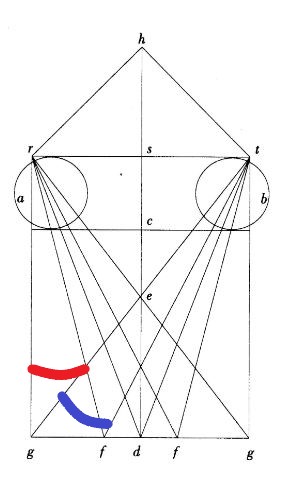
As stressed by Professor Dominque Raynaud, Vitellion introduces the principle of binocular vision for geometric considerations.
He gives a figure where we see the two eyes (a, b) receiving the images of points located at equal distance from the hd axis.
He explains that the images received by the eyes are different, since, taken from the same side, the angle grf (in red) is larger than the angle gtf (in blue). It is necessary that these two images are united at a certain point in one image (Diagram).
Where does this junction occur? Witelo says: « The two forms, which penetrate in two homologous points of the surface of the two eyes, arrive at the same point of the concavity of the common nerve, and are superimposed in this point to become one ».
The fusion of the images is thus a product of the internal mental and nervous activity.
The great astronomer Johannes Kepler (1571-1630) will use Alhazen’s and Witelo’s discoveries to develop his own contribution to optics and perspective. “Although up to now the [visual] image has been [understood as] a construct of reason,” Kepler observes in the fifth chapter of his Ad Vitellionem Paralipomena (1604), “henceforth the representations of objects should be considered as paintings that are actually projected on paper or some other screen.” Kepler was the first to observe that our retina captures an image in an inverted form before our brain turns it right side up.
Out of this Ghiberti, Uccello and also the Flemish painter Jan Van Eyck, in contact with the Italians, will construct as an alternative to one cyclopic single eye perspective revolutionary forms of “binocular” perspective while Leonardo and Louis XI’ court painter Jean Fouquet will attempt to develop curvilinear and spherical space representations.
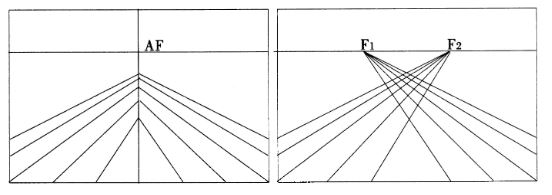
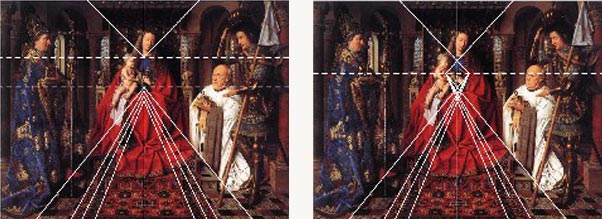
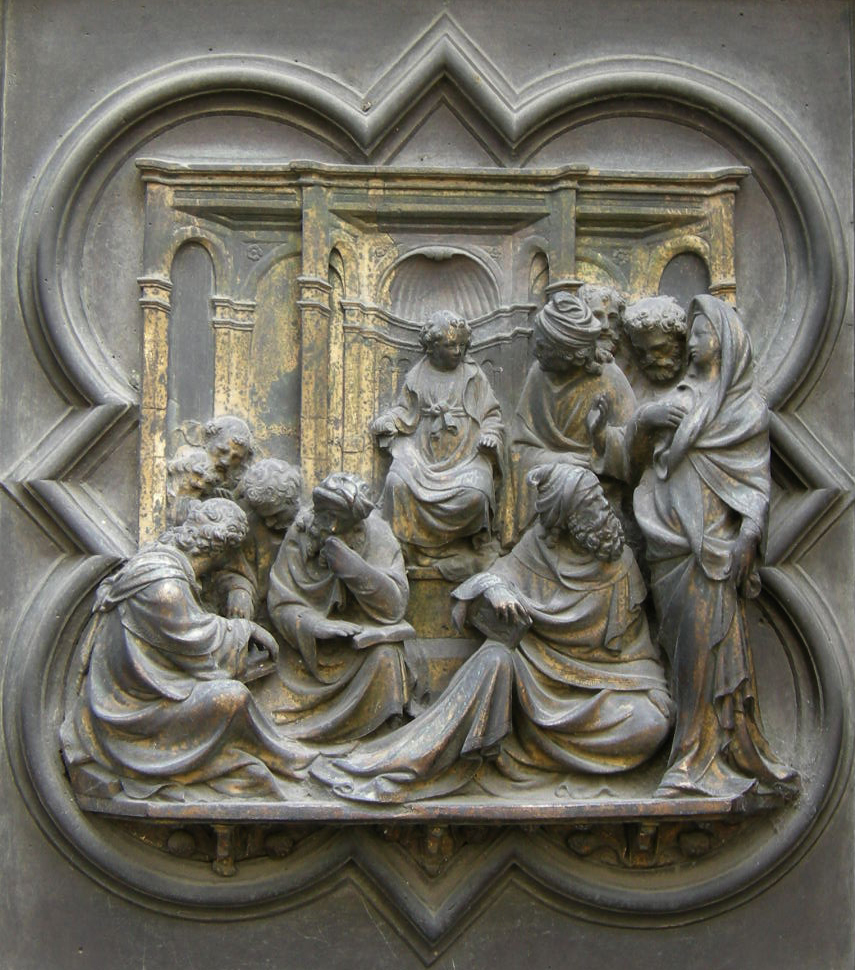

In China, eventually influenced by Arab optical science breakthrough’s, forms of non-linear perspective, that integrate the mobility of the eye, will also make their appearance during the Song Dynasty.
Light
Ghiberti will add another dimension to perspective: light. One major contribution of Alhazen was his affirmation, in his Book of Optics, that opaque objects struck with light become luminous bodies themselves and can radiate secondary light, a theory that Leonardo will exploit in his paintings, including in his portraits.
Already Ghiberti, in the way he treats the subject of Isaac, Jacob and Esau (Figure), gives us an astonishing demonstration of how one can exploit that physical principle theorized by Alhazen. The light reflected by the bronze panel, will strongly differ according to the angle of incidence of the arriving rays of light. Arriving either from the left of from the right side, in both cases, the Ghiberti’s bronze relief has been modeled in such a way that it magnificently strengthens the overall depth effect !
While the experts, especially the neo-Kantians such as Erwin Panofsky or Hans Belting, say that these artists were “primitives” because applying the “wrong” perspective model, they can’t grasp the fact that they were in reality exploring a far “higher domain” than the mere pure mathematical abstraction promoted by the Newton-Galileo cult that became the modern priesthood ruling over “science”.
Much more about all of this can and should be said. Today, the best way to pay off the European debt to “Arab” scientific contributions, is to reward not just the Arab world but all future generations with a better future by opening to them the “Gates of Paradise”.
See all of Ghiberti’s works at the WEB GALLERY OF ART
Short Biography
- Arasse, Daniel, Léonard de Vinci, Hazan, 2011;
- Avery, Charles, La sculpture florentine de la Renaissance, Livre de poche, 1996, Paris;
- Belting, Hans, Florence & Baghdad, Renaissance art and Arab science, Harvard University Press, 2011;
- Bloch, Amy R., Lorenzo Ghiberti’s Gates of Paradise; Humanism, History and Artistic Philosophy in the Italian Renaissance, Cambridge University Press, 2016, New York;
- Borso, Franco et Stefano, Uccello, Hazan, Paris, 2004 ;
- Butterfield, Andrew, Verrocchio, Sculptor and painter of Renaissance Florence, National Gallery, Princeton University Press, 2020 ;
- Butterfield, Andrew, Art and Innovation in Ghiberti’s Gates of Paradise, High Museum of Art, Yale University Press, 2007;
- Kepler, Johannes, Paralipomènes à Vitellion, 1604, Vrin, 1980, Paris;
- Krautheimer, Richard and Trude, Lorenzo Ghiberti, Princeton University Press, New Jersey, 1990;
- Martens, Maximiliaan, La révolution optique de Jan van Eyck, dans Van Eyck, Une révolution optique, Hannibal – MSK Gent, 2020.
- Pope-Hennessy, John, Donatello, Abbeville Press, 1993 ;
- Radke, Gary M., Lorenzo Ghiberti: Master Collaborator; The Gates of Paradise, Lorenzo Ghiberti’s Renaissance Masterpiece, High Museum of Atlanta and Yale University Press, 2007;
- Rashed, Roshi, Geometric Optics, in History of Arab Sciences, edited by Roshdi Rashed, Vol. 2, Mathematics and physics, Seuil, Paris, 1997.
- Raynaud, Dominique, L’hypothèse d’Oxford, essai sur les origines de la perspective, PUF, 1998, Paris.
- Raynaud, Dominique, Ibn al-Haytham on binocular vision: a precursor of physiological optics, Arabic Sciences and Philosophy, Cambridge University Press (CUP), 2003, 13, pp. 79-99.
- Raynaud, Dominique, Perspective curviligne et vision binoculaire. Sciences et techniques en perspective, Université de Nantes, Equipe de recherche: Sciences, Techniques, et Sociétés, 1998, 2 (1), pp.3-23.;
- Vereycken, Karel, interview with People’s Daily: Leonardo Da Vinci’s « Mona Lisa » resonates with time and space with traditional Chinese painting, 2019.
- Vereycken, Karel, Uccello, Donatello, Verrocchio and the art of military command, 2022.
- Vereycken, Karel, The Invention of Perspective, Fidelio, 1998.
- Vereycken, Karel, Van Eyck, un peintre flamand dans l’optique arabe, 1998.
- Vereycken, Karel, Mutazilism and Arab astronomy, two bright stars in our firmament, 2021.
- Walker, Paul Robert, The Feud That Sparked the Renaissance, How Brunelleschi and Ghiberti changed the World, HarperCollins, 2002.
Mutazilisme et astronomie arabe, deux astres brillants au firmament de la civilisation

Par Karel Vereycken
(Same article in English)
PROLOGUE
« L’encre du savant est préférable au sang du martyr »
« Demandez la science du berceau jusqu’à la tombe. »
« Cherchez le savoir serait-ce jusqu’en Chine, s’il le faut. »
(Paroles généralement attribuées au Prophète)
Nous vivons une époque d’une stupidité cruelle. Alors que l’histoire de la civilisation se caractérise par des apports culturels multiples permettant un infini et magnifique enrichissement mutuel, tout est fait pour nous déshumaniser.
A force de médiatiser les dérives les plus extrêmes, notamment en prétendant que tel ou tel acte abject ou barbare a été commis « au nom de » telle ou telle croyance ou religion, tout est fait pour nous monter les uns contre les autres. Sans réaction de notre part, le fameux « choc des civilisations », conçu par l’islamologue britannique Bernard Lewis (le maître à penser d’Henry Kissinger, de Zbigniew Brzezinski et de Samuel Huntington) comme un outil maléfique de manipulation géopolitique, deviendra alors une prophétie auto-réalisatrice.
INTRODUCTION
Afin de combattre les préjugés et les raccourcis dangereux sur « l’islam » (avec 1,6 milliard de croyants une part non-négligeable de la population mondiale), voici un bref aperçu des apports majeurs de la civilisation arabo-musulmane.
En rappelant l’apport de l’âge d’or de l’Islam, notamment l’astronomie arabe et la philosophie mutaziliste, il s’agit de pleinement reconnaître que —tout comme Memphis, Thèbes, Alexandrie, Athènes et Rome— Bagdad, Damas et Cordoue furent des creusets majeurs d’une civilisation universelle, aujourd’hui la nôtre.
Si, en Europe, on a fini par reconnaître que l’invention de l’imprimerie avait vu le jour en Chine bien avant Gutenberg, et que l’Amérique avait été fréquentée bien avant l’arrivée de Christophe Colomb, certains persistent à affirmer que les Arabes n’ont contribué en rien aux progrès de la science.
Pendant les 1300 ans séparant l’astronome romain, le grec d’Alexandrie Claude Ptolémée (env. 100-178 apr. JC), du Polonais Nicolas Copernic (1473-1543), ce fut, nous dit-on, « un trou noir » en Europe.
Poussant la caricature de l’arrogance occidentale, Alfred Koestler, écrira dans son livre Les Somnanbules (1958) :
Les Arabes n’avaient guère été que des intermédiaires : les légataires universels de cet héritage (des Grecs). Ils avaient fait preuve d’assez peu d’originalité scientifique (…) aux mains des Arabes et des Juifs qui le conservèrent deux ou trois siècles, ce vaste ensemble de connaissances demeura stérile.
Définitivement, il faut être né au bon endroit pour pouvoir entrer dans l’histoire… Etude d’Al-Biruni sur les phases de la Lune.
Or, contrairement à Koestler, Copernic était parfaitement familiarisé avec l’astronomie arabe puisqu’en 1543, dans son De Revolutionibus, il cite toute une série de scientifiques du monde arabo-musulman, plus précisément Al-Battani, al-Bitruji, al-Zarqallu, Ibn Rushd (Averroès) et Thabit ibn Qurra. Copernic se réfère également à al-Battani dans son Commentariolus, un manuscrit publié à titre posthume.
Si Nicolas de Cues (1401-1464) cite Ibn Sina, Johannes Kepler (1571-1630), se réfère à Ibn Al-Haytam pour ses travaux sur l’optique.
En vérité, Copernic et Kepler, dont il ne s’agit pas de nier le génie, ont formulé leurs réponses à partir des questions posées par plusieurs générations d’astronomes arabes dont l’apport reste largement inexploré. A ce jour, avec environ 10 000 manuscrits conservés à travers le monde, dont une grande partie n’a toujours pas fait l’objet d’un inventaire bibliographique, le corpus astronomique arabe constitue l’une des composantes les mieux préservées de la littérature scientifique médiévale.
Science et religion contre esclavage
Avant d’examiner les apports de l’astronomie arabe, quelques réflexions sur le lien entre l’islam et le développent des sciences.
Selon la tradition, c’est en 622 de notre ère que le prophète Mahomet et ses compagnons quittent La Mecque pour se mettre en route vers une simple oasis qui deviendra la ville de Médine. Si cet événement est connu sous le nom de « l’Hégire », mot arabe pour émigration, rupture ou exil, c’est également parce que Mahomet vient de rompre avec un modèle sociétal établi sur les liens du sang (organisation clanique), en faveur d’un modèle de communauté de destin fondé sur la croyance.
Dans ce nouveau modèle religieux et sociétal, où tous sont censés être « frères », il n’est plus permis d’abandonner le démuni ou le faible comme c’était le cas auparavant.
Les clans puissants de La Mecque vont tout faire pour éliminer cette nouvelle forme de société qui diminue leur influence, car l’égalité entre tous les croyants est proclamée lors de la rédaction de la Constitution de Médine, qu’ils soient libres ou esclaves, arabes ou non-arabes.
Le Coran prône d’ailleurs la stricte égalité entre Arabes et non-Arabes en conformité avec la parole du Prophète :
L’Arabe n’est pas meilleur que le non-Arabe, ou le non-Arabe que l’Arabe, le blanc au-dessus du Noir ou le Noir au-dessus du Blanc, excepté par la piété.
(Rapporté par Al Bayhaqi et authentifié par Cheikh Albani dans Silsila Sahiha n°2700).
Si par la suite, l’esclavage et la traite négrière ont pu être, hélas, une pratique courante dans presque tous les pays musulmans, on ne peut pas accuser le prophète. Zayd Ibn Harithah, nous dit la tradition, après avoir été l’esclave de Khadija, la femme de Mahomet, aurait été affranchi et adopté par ce dernier comme son propre fils.
Pour sa part, Abou Bakr, le compagnon et successeur de Mahomet qui sera le premier calife, affranchira également Bilal ibn-Raba, le fils d’une ancienne princesse abyssine réduite en esclavage. Bilal, qui possédait une voix magnifique, sera même nommé premier muezzin, c’est-à-dire celui qui lance, cinq fois par jour, l’appel à la prière depuis le sommet d’un des minarets de la mosquée.

La mosquée est bien plus qu’un lieu de culte. Elle sert d’institution sociale et éducative : elle peut le cas échéant s’adjoindre une madrassa (école coranique), une bibliothèque, un centre de formation, voire une université.
Les premiers versets révélés au prophète Mahomet disent :
« Lis ! Au nom de ton Seigneur qui a créé, qui a créé l’homme d’une adhérence. Lis ! Ton Seigneur est le Plus Noble, qui a enseigné par la plume (le calame), a enseigné à l’homme ce qu’il ne savait pas. » (Sourate 96).
Le prophète indique également :
« Le meilleur d’entre vous est celui qui a appris le Coran et l’aura fait apprendre ».
Dans un autre hadith, le Messager d’Allah aurait enseigne l’amour de la science et du savoir aux musulmans en ces termes :
« L’encre du savant est préférable au sang du martyr »
« Demandez la science du berceau jusqu’à la tombe. »
« Cherchez la science, serait-ce jusqu’en Chine s’il le faut. ».
La mosquée se veut donc l’école de toutes les sciences, où vont se former les savants.

Comme dans la plupart des religions, les fêtes religieuses, les pratiques et les rituels musulmans sont rythmés par des événements astronomiques (années, saisons, mois, jours, heures).
Tout fidèle doit prier cinq fois par jour à des heures qui varieront en fonction de l’endroit où il se trouve : au lever du soleil (Ajr), quand il est au zénith (Dhohr), dans l’après-midi (Asr), lors du coucher du soleil (Magrib) et au début de la nuit (Icha). L’astronomie est omniprésente.
Par ailleurs, pour marquer son importance, le premier jour de l’année lunaire de l’Hégire, correspondant au 16 juillet 622, a été décrété comme le premier jour du calendrier hégirien. Enfin, lors de l’éclipse du soleil, les mosquées accueillent une prière spéciale.
L’islam encourage les musulmans à rechercher leur chemin grâce aux astres. Le Coran énonce en effet :
« C’est lui qui a placé pour vous les étoiles (dans le ciel) afin que vous soyez dirigés dans les ténèbres sur la terre et sur les mers. »
Avec une telle incitation, les premiers musulmans ne tardèrent pas à perfectionner les instruments astronomiques et de navigation, d’où vient qu’aujourd’hui encore, la plupart des étoiles naguère utilisées par les marins portent des noms arabes.
Il était donc naturel que les fidèles essaient constamment d’améliorer les calculs et observations astronomiques.
Le premier motif est le fait que lors de la prière musulmane, le fidèle doit se prosterner en direction de la Kaaba à La Mecque : il doit donc savoir trouver cette direction où qu’il se trouve sur Terre. Et la construction d’une mosquée se décidera en fonction des mêmes données.
Le deuxième motif résulte du calendrier musulman. Le Coran édicte :
Le nombre des mois est de douze devant Dieu, tel il est dans le livre de Dieu, depuis le jour où il créa les cieux et la terre. Quatre de ces mois sont sacrés ; c’est la croyance constante.
En clair, le calendrier musulman se base sur les mois lunaires, d’une durée d’environ 29,5 jours. Or 12 x 29,5 ne fait que 345 jours dans l’année. On est loin des 365 jours, 6 heures, 9 minutes et 4 secondes qui mesurent la durée de la rotation de la Terre autour du Soleil…
Enfin, un dernier défi se posait par l’interprétation du mouvement lunaire. Les mois, dans la religion musulmane, ne commencent pas avec la nouvelle lune astronomique, définie comme l’instant où la lune a la même longitude écliptique que le Soleil (elle est donc invisible, noyée dans l’albédo solaire) ; ils commencent lorsque le croissant lunaire commence à apparaître au crépuscule.
Le Coran dit précisément : « Ils t’interrogeront sur les nouvelles lunes. Dis-leur : Ce sont les époques fixées pour l’utilité de tous les hommes et pour marquer le pèlerinage de la Mecque. » Pour toutes ces raisons, les musulmans ne pouvaient se contenter ni du calendrier chrétien ni du calendrier hébreu, et devaient en créer un nouveau.
Géométrie sphérique

Pour connaître à l’avance les phases de la Lune, il fallut développer de nouvelles méthodes de calcul et mettre au point des instruments aptes à les observer. Le calcul du jour où le croissant lunaire recommence à devenir visible constituait un redoutable défi pour les savants arabes. Pour prédire ce jour, il fallait pouvoir décrire son mouvement par rapport à l’horizon, un problème dont la résolution appartient à une géométrie sphérique assez sophistiquée.
Ce sont la détermination de la direction de la Mecque depuis un lieu donné et l’heure des prières qui ont poussé les musulmans à élaborer une telle géométrie. La résolution de ces problèmes suppose en effet que l’on sache calculer le côté d’un triangle sphérique de la sphère céleste à partir de ses trois angles et des deux autres côtés ; pour trouver l’heure exacte, par exemple, il faut savoir construire le triangle dont les sommets sont le zénith, le pôle nord et la position du Soleil.
Le domaine de l’astronomie a fortement stimulé la naissance d’autres sciences, en particulier la géométrie, les mathématiques, la géographie et la cartographie. Certains aiment rappeler que platoniciens et aristotéliciens se disputaient des concepts assez abstraits, chaque courant estimant que la raison suffisait pour comprendre la nature.
Pour sa part, l’astronomie arabe, en vérifiant les différentes hypothèses grâce à la construction d’instruments de mesure et d’observatoires astronomiques, ainsi qu’à l’enregistrement rigoureux des observations pendant de longues années, a joué un rôle décisif dans l’émergence d’une vraie méthode scientifique.
LE MUTAZILISME
Se pose alors la question de savoir d’où a pu venir, dans une culture qui se concentre sur le fait religieux, cet engouement pour les sciences et l’astronomie ?
Une première réponse vient du fait qu’au VIIIe siècle, peu après l’apparition du sunnisme (656), du kharidjisme (657) et du chiisme (660), mais indépendamment de ces courants, apparaît une école de pensée théologique musulmane fondée par le théologien révolutionnaire Wasil ibn Ata (700-748) ? Surnommé « mutazilisme » (ou motazilisme), se courant est identifié en Occident comme « les rationalistes » de l’Islam.
L’origine de ce nom viendrait du fait que les mutazili ont refusé de prendre part aux conflits internes de l’islam, menés par des factions qui utilisaient des interprétations théologiques pour asseoir leur propre pouvoir, le mot arabe i’tazala signifiant « se retirer ».
Wasil est né à Médine dans la péninsule arabique, et s’installe à Bassorah, actuellement en Irak. De là, il forme un mouvement intellectuel qui se répand dans le monde arabo-musulman. Parmi ses disciples, beaucoup auraient été des marchands et des non-Arabes (mawâlî), issus de familles iraniennes ou araméennes « converties », sujettes à une certaine discrimination faite par les Omeyyades entre les Arabes et les non-Arabes. Hypothèse suffisante pour accréditer la thèse d’une participation mutazilite dans le renversement des Omeyyades.
En nette rupture avec les cosmologies dualistes (mazdéisme, zoroastrisme, manichéisme, etc.), le mutazilisme insiste sur l’unité absolue de Dieu, conçue comme une entité hors du temps et de l’espace. Il y a un rapport étroit entre l’unité de la communauté musulmane (Oumma) et le culte d’adoration du Seigneur. Les mutazilites s’inspirent étroitement du Coran, et il est assez erroné d’en faire « les libres penseurs de l’islam ».
Cependant, « nous rejetons la foi comme seule voie vers la religion si elle rejette la raison », précise l’adage mutazilite. S’appuyant sur la raison (le logos cher aux penseurs grecs Socrate et Platon) qu’il estime compatible avec les doctrines islamiques, le mutazilisme affirme que l’homme peut, en dehors de toute révélation divine, accéder à la connaissance.
Tout comme l’avait souligné Augustin chez les chrétiens, l’homme peut avancer sur le chemin de la vérité, non seulement grâce à l’Evangile (la révélation), mais en lisant « le Livre de la Nature », reflet et avant-goût de la sagesse divine. Déjà, dans la Bible, dans le Livre de la Sagesse (Sg. 13:5) , on peut lire :
Car à travers la grandeur et la beauté des créatures,
on peut contempler, par analogie, leur Auteur.
Les Mutazilites se distinguaient de leurs adversaires par leur enseignement selon lequel Dieu a doté l’homme de la raison spécifiquement pour qu’il puisse connaître l’ordre moral de la création et son Créateur ; c’est à cela que sert la raison. La raison est au cœur de la relation de l’homme à Dieu.
Dans les Principes fondamentaux, le grand théologien mutazilite Abdel al Jabbar Ibn Ahmad (935-1025), dont les textes n’ont été découverts que dans les années 1950 par des chercheurs égyptiens dans une mosquée du Yémen, commence par poser le premier devoir de la raison : « Si on pose la question : Quel est le premier devoir que Dieu t’impose ? Dis-lui : le raisonnement spéculatif qui mène à la connaissance de Dieu, car Dieu n’est pas connaissable par l’intuition ou par les sens. Ainsi, Il doit être connu par la réflexion et la spéculation ».
Par conséquent, pour les Mutazilistes, la raison précède logiquement la révélation. La raison doit d’abord établir l’existence de Dieu avant d’entreprendre la question de savoir si Dieu a parlé à l’homme. La théologie naturelle doit être antérieure à la théologie.
Al Jabbar dit : « Les stipulations de la révélation concernant ce que nous devons dire et faire ne sont pas bonnes tant qu’il n’y a pas de connaissance de Dieu », laquelle connaissance provient de la raison. « Par conséquent, conclut-il, il m’incombe d’établir son existence et de le connaître afin de pouvoir l’adorer, le remercier, faire ce qui le satisfait et éviter la désobéissance à son égard ».
Comment la raison permet-elle alors l’homme de conclure que Dieu existe ? C’est par l’observation d’un univers ordonné que l’homme arrive à savoir que Dieu existe, dit Al Jabbar. En voyant que rien dans le monde n’est sa propre cause, mais est causé par quelque chose d’autre, l’homme arrive à la nature contingente de la création. De là, l’homme raisonne jusqu’à la nécessité d’un Créateur, une cause non causée.
Le concept d’une nature inhérente aux choses (tab’) signifie que Dieu, bien qu’il soit la cause première, agit indirectement par le biais de causes secondaires, telles que la loi physique de la gravité. En d’autres termes, Dieu ne fait pas tout immédiatement ou directement. Il ne fait pas tomber une pierre, c’est la gravité qui s’en charge. Dieu laisse une certaine autonomie à sa création, qui a son propre ensemble de règles, selon la façon dont elle a été créée.
Comme le précise l’auteur et théologien mutazilite Uthman al-Jahiz (765-869), chaque élément matériel a sa propre nature. Dieu a créé chaque chose avec une nature selon laquelle elle se comporte de manière cohérente. Un rocher sans appui tombera toujours là où il y a une force gravitationnelle. Ces lois de la nature ne sont donc pas l’imposition d’un l’ordre de l’extérieur par un commandant-en-chef, mais une expression de celui-ci à partir de l’essence même des choses, qui ont leur propre intégrité. La création est dotée d’une rationalité intrinsèque provenant du Créateur. C’est pourquoi et comment l’homme est capable de comprendre la raison de Dieu telle qu’elle se manifeste dans sa création (Ceci n’exclut pas la capacité de Dieu à supplanter les lois naturelles dans le cas d’un miracle). Du coup, pour l’homme, découvrir la nature de chaque chose ne fait que le rapprocher de Dieu.
Ainsi, le muzatilisme donne à la raison (la faculté de penser) et à la liberté (la faculté d’agir) humaines une place et une importance non seulement inconnues dans les autres tendances de l’Islam mais même dans la plupart des courants philosophiques et religieux de l’époque.
A l’opposé du fatalisme (« mektoub ! » = c’était écrit !), qui fut la tendance dominante dans l’islam, le mutazilisme affirme que l’être humain est responsable de ses actes.
D’une modernité quasi-érasmienne (qui avait bien du mal à se faire entendre en Europe au XVIe siècle), voici les cinq principes de la foi mutazilite décrits par le théologien mutazilite Abdel al Jabbar Ibn Ahmad (935-1025), résumés en 2015 par l’économiste Nadim Michel Kalife :
- Le monothéisme (Al Tawhïd), dont le concept de Dieu dépasse les capacités de réflexion de l’esprit humain. C’est pourquoi les versets du Coran décrivant Dieu assis sur un trône, ne doivent être interprétés que de façon allégorique et non à la lettre. D’où les mutazilites traitèrent leurs adversaires d’anthropomorphistes cherchant à ramener Dieu l’inconnaissable à une forme humaine. Et ils conclurent que ce seul détail (!) du Coran suffit à prouver que le livre n’est pas « incréé » mais « créé » par l’homme pour le mettre à la portée du croyant, et qu’il doit, par conséquent, pouvoir évoluer et s’adapter aux temps ;
- La justice divine (Adl) concerne la responsabilité du mal dans ce monde où Dieu est tout-puissant. Le mutazilisme proclame le libre arbitre, le mal étant le fait de l’homme et non de la volonté de Dieu, car Dieu est parfait et ne peut donc pas faire le mal ni déterminer l’homme à le faire. Et, si l’erreur humaine relevait de la volonté de Dieu, la punition perdrait tout son sens puisque l’homme ne ferait que respecter la volonté divine. Cette logique incontestable permit au mutazilisme de réfuter la prédestination et le « mektoub » des écoles sunnites ;
- Promesse et menace (al-Wa’d wa al-Wa’id) : ce principe concerne le jugement de l’homme à sa mort et celui du jugement dernier où Dieu récompensera les obéissants au paradis céleste, et punira ceux qui lui ont désobéi en les damnant éternellement aux feux de l’enfer ;
- Le degré intermédiaire (al-manzilatu bayn al-manzilatayn), premier principe opposant le mutazilisme aux écoles sunnites. Un grand pécheur (meurtre, vol, fornication, fausse accusation de fornication, consommation d’alcool, ….) ne doit être considéré ni comme musulman (comme l’établit le sunnisme) ni comme mécréant ou kâfir (comme le pensent les Kharidjites), mais dans un degré intermédiaire d’où il ira en enfer s’il n’est pas racheté par la miséricorde de Dieu ;
- Ordonner le bien et blâmer le blâmable (al-amr bil ma’ruf wa al-nahy ‘an al munkar) : ce principe autorise la rébellion contre l’autorité quand elle est injuste et illégitime, pour empêcher la victoire du mal sur tous. Ce principe leur attira la haine des oulémas et imams qui y trouvaient un moyen d’affaiblir leur autorité sur les fidèles. Et les Turcs Seldjoukides y virent un grave danger de contestation de leur pouvoir… sur les Arabes.
Le mutazilisme sous les Abbassides
A Bagdad, c’est avec la prise de pouvoir des Abbassides en 749, que le mutazilisme gagnera en influence, d’abord sous le calife Hâroun al-Rachîd (765-809) (Aaron le bien guidé) et ensuite sous son fils, Al-Ma’mûn (786-833) (Celui en qui on a confiance). Peu avant sa mort en 833, ce dernier fera du mutazilisme la doctrine officielle de l’Empire des Abbassides.
C’en fut trop pour les oulémas (théologiens) et les imams (prédicateurs) conservateurs qui se rebellèrent contre cette vision éclairée ouvrant un espace de laïcité et limitant leur autorité. Face à la révolte, l’administration abbasside (constituée en grande partie de Perses), acquise au mutazilisme, mènera pendant quinze ans, de 833 à 848, une répression impitoyable contre les religieux sunnites (arabes). Cette persécution sanguinaire laissera un goût de plus en plus amer dans les consciences populaires, en particulier lorsque le pouvoir abbasside refuse de faire libérer les prisonniers musulmans aux mains des Byzantins s’ils ne renonçaient pas au dogme de l’« incréation » du Coran…
Enfin, en 848, le calife Jafar al-Mutawakkil (847-861), change totalement de cap et demande aux traditionalistes de prêcher des hadiths selon lesquels Mahomet aurait condamné les mutazilites et leurs soutiens.
La théologie dialectique (Kalâm) fut interdite et les mutazilites écartés de la cour de Bagdad. Ce fut également la fin de l’esprit de tolérance et le retour des persécutions contre les chrétiens et les juifs. Si l’engouement pour les sciences perdura, le mutazilisme disparut avec la chute des Abbassides et la destruction de Bagdad par les Mongols au XIIIe siècle.
Le mutazilisme influencera également le judaïsme. Le Kitab Al-Amanat Wa’l-I’tiqadat – c’est-à-dire le Livre des croyances et des opinions – du savant juif rabbinique du Xe siècle Saadia Gaon (882-942), qui vécut à Bagdad, tire son inspiration de la littérature théologique chrétienne ainsi que de modèles islamiques. Le Kitab al-Tawhid, le Livre de l’unité divine, du contemporain karaïte de Saadia, Jacob Qirqisani (m. 930), est malheureusement perdu.
Ce qui fait dire à l’islamologue allemande Sabine Schmidtke que :
La nouvelle tradition de la pensée rationnelle juive qui a surgi au cours du neuvième siècle était, dans sa phase initiale, principalement informée par la littérature théologique chrétienne, tant dans son contenu que dans sa méthodologie. De plus en plus, des idées islamiques spécifiquement Mutazilites, telles que la théodicée (*1) et le libre arbitre humain, ainsi que l’accent mis sur l’unicité de Dieu (tawhïd) ont résonné parmi les penseurs juifs, dont beaucoup ont finalement adopté l’ensemble du système doctrinal de la Mutazila. La ’Mutazila juive’ désormais émergente domina la pensée théologique juive pour les siècles à venir.
Frères de la Pureté
A signaler également, les Epitres des Frères en Pureté (Ikwân al-Safâ), une encyclopédie de 52 épitres (mathémathiques, sciences naturelles, sciences rationnelles et sciences théologiques), composée entre le début du IXe et la fin du Xe siècle contenant le savoir commun, que vont s’approprier les Ismaéliens, courant contestataire de l’époque. Réalisé à Bassorah, dans l’actuel Irak, ce livre, d’essence néo-platonicienne, est une œuvre collective. Quant aux auteurs, désignés sous le nom mystérieux de Frères de la Pureté, ils appartenaient à une confrérie de sages et d’intellectuels qui se réunissait régulièrement pour organiser des séances de discussion, de lectures et de récitation. Ses adeptes considéraient que la connaissance du savoir et du monde était une condition indispensable à toute élévation spirituelle et mystique. Souvent brûlée par les oulémas sunnites, le caractère d’avant-garde de l’œuvre se découvre en particulier dans son hymne à la tolérance préconisant une pluralité de voies pour accéder au salut. Certains experts estiment que les Epîtres des Frères en Pureté sont l’œuvre d’un philosophe pythagoricien de haut niveau, disciple du mutaziliste platonicien al-Kindî.
Abstraction faite d’égarements qui ont été bien réels, reconnaissons tout de même que la vision philosophique optimiste du mutazilisme (raison, libre arbitre, responsabilité, perfectibilité de l’homme) a fortement contribué à l’émergence d’un véritable « âge d’or » des sciences arabes.
Enfin, il n’est pas inintéressant de constater qu’aujourd’hui, des courants « néo-mutazilites » apparaissent en réaction aux doctrines obscurantistes et aux actes barbares qu’elles suscitent.
Pour le penseur réformiste égyptien Ahmad Amin,
la mort du mutazilisme a été le plus grand malheur qui a frappé les musulmans ; ils ont commis un crime envers eux-mêmes.
Bagdad
En 762, le second calife abbasside Al-Mansur (714-775) (« le victorieux ») entreprend la construction d’une nouvelle capitale, Bagdad. Appelée Madinat-As-Salam (cité de la paix), elle abrite le palais de la Cour, la mosquée et les bâtiments administratifs. Construite sur un plan circulaire, elle s’inspire des traditions antérieures, notamment celle qui avait donné naissance à la ville iranienne de Gur (nom actuel : Firouzabad).
Nous sommes au cœur de la fertile Mésopotamie, le « pays entre les fleuves », essentiellement l’Euphrate et le Tigre qui prennent chacun leur source en Turquie. C’est ici que les Sumériens inventèrent, à partir du dixième millénaire av. JC, aussi bien l’irrigation, l’agriculture (céréales et élevage) (*2), que l’écriture (-3400 ans av. JC).
Ville puissante et raffinée, Bagdad régnera sur tout l’Orient et devient la capitale du monde arabe. Traversée par le Tigre, peuplée aujourd’hui de quelque 10 millions d’habitants, elle reste la plus grande ville d’Irak ainsi que la deuxième ville la plus peuplée du monde arabe (après le Caire, en Egypte).
Les villes abbassides sont aménagées sur des sites immenses. Les palais et les mosquées de Samarra, nouvelle capitale à partir de 836, s’étendent sur 40 kilomètres le long des rives du Tigre. Pour correspondre à l’échelle des sites, des bâtiments monumentaux furent érigés, tels que la mosquée Abu Dulaf ou la Grande Mosquée de Samarra, sans équivalent à l’époque. Son curieux minaret hélicoïdal (52 mètres de haut) a inspiré dans les siècles suivants les représentations occidentales de la tour de Babel.
De plus, en se reposant sur une armée originaire du Khorassan (région du nord-est iranien) (*3) extrêmement disciplinée et obéissante, mais aussi sur un système élaboré de diligences et de distribution de courrier, les chefs abbassides parviennent à augmenter leur emprise sur les gouverneurs de province. Ces derniers, qui, du temps des califes omeyyades ne payaient que peu d’impôts sous prétexte qu’ils devaient assurer à leurs frais la défense des frontières du califat, devaient dès lors payer les taxes imposées par le souverain.
La Route du papier
Après la victoire militaire contre les Chinois lors de la bataille de Talas (ville de l’actuel Kirghizistan), en 751, année qui marqua l’avancée la plus orientale des armées abbassides, Bagdad s’ouvre aux cultures chinoise et indienne.
Les Abbassides assimileront rapidement un certain nombre de techniques chinoises, en particulier la fabrication du papier, un art développée à Samarcande (capitale de la Sogdiane, aujourd’hui en Ouzbékistan), autre ville étape des Routes de la soie.
Les artisans de cette ville lissaient le papier à l’aide d’une pierre d’agate. La surface extrêmement lisse et brillante obtenue absorbait moins d’encre et les deux faces d’une même feuille étaient donc utilisables. Les Chinois, qui avaient inventé le papier de soie, n’avaient pas besoin de lisser leur papier parce qu’ils écrivaient avec des pinceaux et non avec des plumes.
Hâroun al-Rachîd s’intéresse fortement à la production industrielle du papier. Il ordonnera l’usage du papier dans toutes les administrations de l’Empire, plus facile à transporter que les tablettes en argile et plus intéressant que la soie, car on peut difficilement effacer ce qui y est écrit. Il développe des manufactures de papier à Samarcande et en fera construire du même type à Bagdad, Damas et à Tibériade vers 1046 (on parle alors de papier de Tripoli ou de Damas, dont la qualité est considérée comme supérieure à celle du papier de Samarcande), et au Caire avant 1199, où il est utilisé pour emballer des marchandises, et au Yémen au début du XIIIe siècle.
Dans le même temps, plusieurs fabriques de papier s’installent à leur tour en Afrique du Nord. On recense ainsi à Fès, au Maroc, 104 fabriques de papier avant 1106, et 400 meules à fabriquer du papier entre 1221 et 1240. Elles apparaîtront en Andalousie, en Espagne, à Jativa, près de Valence, en 1054 et à Tolède en 1085.
Révolution agro-industrielle
Du modèle omeyyade reposant sur le tribut, le butin ou la vente d’esclaves, les premiers califes abbassides mènent la transition économique vers une économie basée sur l’agriculture, les manufactures, le commerce et les impôts.
L’introduction de technologies et de formes d’énergie plus denses (pour l’époque), vont révolutionner l’irrigation et l’agriculture :
- Construction de canaux assurant l’irrigation et limitant les inondations ;
- Construction de barrages et l’exploitation de l’énergie mécanique qu’ils produisent ;
- Construction de moulins à eau ;
- Utilisation de l’énergie marémotrice ;
- Construction de moulins à vents ;
- Distillation du kérosène. Connu en Occident comme le « pétrole lampant », il s’agit de la « première source de lumière efficace, abondante et pas chère dont ait jamais disposé l’humanité » (*4) ;
Les utilisations industrielles des moulins à eau dans le monde islamique remontent au VIIe siècle. À l’époque des croisades, toutes les provinces du monde islamique avaient des moulins en activité, d’al-Andalus et de l’Afrique du Nord au Moyen-Orient et à l’Asie centrale.
Lorsque Cervantès nous dépeint son Don Quichote s’attaquant aux moulins à vents, il se moque du culte de la chevalerie, mais également des croisades.
L’irrigation, héritée du monde antique —crues du Nil en Égypte, canaux en Mésopotamie, puits à balancier (chadouf), roue mue par des animaux (noria), barrages en Transoxiane, au Khuzistan et au Yémen, galeries souterraines au pied des montagnes en Iran (qanat) ou au Maghreb (khettaras) — se met en place grâce à une solide organisation communautaire et l’intervention de l’État.
Les artisans et ingénieurs abbassides développent des machines (telles que des pompes) incorporant des vilebrequins et utiliseront des engrenages dans des moulins et des mécanismes d’élévation de l’eau. Ils se serviront également des barrages pour fournir une puissance supplémentaire à ces moulins et machines.
Ces avancées permettront la mécanisation de nombreuses tâches agricoles et industrielles et libéreront la main d’œuvre pour un travail plus créateur.

La production agricole se diversifie : céréales (blé, riz), fruits (abricots, agrumes), légumes, huile d’olive (Syrie et Palestine), de sésame (Irak), de rave, de colza, de lin ou de ricin (Égypte), viticulture (Syrie, Palestine, Égypte), dattes, bananes (Égypte), canne à sucre.
L’élevage reste important pour la nourriture, la fourniture de matières premières (laine, cuir) et pour le transport (chameaux, dromadaires, chevaux). Le mouton est présent partout mais l’élevage du buffle se développe (marais du bas Irak ou de l’Oronte). Les petits élevages de volailles, de pigeons et d’abeilles correspondent à une demande importante. La nourriture du peuple est essentiellement végétarienne (galette de riz, bouillie de blé, légumes et fruits).
Un certain nombre d’industries émergeront de cette révolution agro-industrielle, y compris les premières brasseries de bière, les manufactures de textile, la fabrication de cordes, de soie et, comme indiqué précédemment, de papier. Enfin, le travail des métaux, la verrerie, les céramiques, l’outillage et l’artisanat connaîtront des niveaux élevés de croissance au cours de cette période.
Charlemagne, Bagdad et la Chine

Au VIIIe et IXe siècle, cherchant à contrer les Omeyyades et l’Empire byzantin, Abbassides et Francs carolingiens nouent à plusieurs reprises des ententes et des coopérations.
Trois ambassades sont envoyées par Charlemagne à la cour d’Hâroun al-Rachîd et ce dernier lui en envoie au moins deux. Le calife lui fait parvenir de nombreux présents, comme des aromates, des tissus, un éléphant et une horloge automatique, décrite dans les Annales royales franques de 807. Les heures sont marquées par des boules de cuivre tombant sur une plaque à chaque heure, tandis que douze cavaliers apparaissent chacun à leur tour.
Le calife enverra également une mission diplomatique à Chang’an (appelé aujourd’hui Xi’an), capitale chinoise sous la dynastie des Tang. Etant aussi le terminus de la Route de la soie, son marché ouest devient centre du commerce mondial. Selon le registre de l’Autorité Six des Tang, Chang’an avait des relations commerciales avec plus de 300 nations et régions.
Route de la soie maritime
Ces relations diplomatiques avec la Chine sont contemporaines de l’expansion maritime du monde musulman dans l’océan Indien, et jusqu’en Extrême-Orient. En dehors du Nil, du Tigre et de l’Euphrate, les fleuves navigables sont rares, le transport par mer est donc très important.
Les navires du califat ont commencé à naviguer de Siraf, le port de Bassorah, vers l’Inde, le détroit de Malacca et l’Asie du Sud-Est. Les marchands arabes domineront le commerce dans l’océan Indien jusqu’à l’arrivée des Portugais au XVIe siècle. Ormuz était un centre important pour ce commerce. Il existait également un réseau dense de routes commerciales en Méditerranée, permettant aux pays musulmans de commercer entre eux et avec des puissances européennes telles que Venise et Gênes.
À cette époque, Canton (Khanfu en arabe), un port de 200 000 habitants du sud de la Chine, compte une forte communauté de commerçants venant des pays musulmans.
Et lorsque l’Empereur chinois Yongle décide à envoyer une flottille de navires en Afrique, il choisit l’amiral Zheng He (1371-1433), eunuque à la cour et d’origine musulmane. Et lorsqu’en 1497 le capitaine portugais Vasco de Gama atteint la ville kényane de Malindi, il s’y procure un pilote arabe qui le conduit directement à Kozhikode (Calicut) en Inde. En clair, un navigateur sachant naviguer sur les étoiles.
Renaissance scientifique et culturelle
Sous le califat d’Hâroun al-Rachîd et de son fils Al-Ma’mûn, Bagdad et les Abbassides connaîtront un véritable âge d’or, aussi bien dans les sciences (philosophie, astronomie, mathématiques, médecine, etc.) que dans les arts (architecture, poésie, musique, peinture, etc.).
Pour l’écrivain britannique Jim Al-Khalili,
la fusion du rationalisme grec et l’islam mutazilite fera naître un mouvement humaniste d’un type qu’on ne verra guère avant l’Italie du XVe siècle.
Dans le domaine des sciences s’opère très tôt une assimilation des doctrines astronomiques hellénistiques, indiennes et perses antérieures. On vit la traduction de plusieurs écrits sanskrits (*5) et pehlevis (*6) en arabe.
Des ouvrages indiens de l’astronome Aryabhata (476-560), savant de premier plan de la Renaissance Gupta en Inde, et du mathématicien Brahmagupta (590-668) sont cités très tôt par leurs homologues arabes. Une célèbre traduction en arabe paraîtra vers 777 sous le titre de Zij al-Sindhind (ou Tables astronomiques indiennes).
Les sources disponibles révèlent que ce texte fut traduit après la visite d’un astronome indien à la cour du calife abbasside Al-Mansur en 770. Les Arabes adopteront également les tables de sinus (héritées des mathématiques indiennes) qu’ils préfèrent aux tables des cordes employées par les astronomes grecs. De la même époque date un recueil de chroniques astronomiques compilées sur deux siècles dans la Perse des Sassanides et connu en arabe sous le nom de Zij al-Shah (ou Tables Royales).
Dans le domaine de la musique, on peut citer entre autres le musicien arabe d’origine perse Ishaq al-Mawsili (767-850). Compositeur d’environ deux cents chansons, ce chanteur fut également un virtuose du oud (sorte de luth à manche court mais dépourvu de frettes). On lui attribue le premier système de codification de la musique arabe savante.
Dans le domaine de la peinture, précisons d’abord que, contrairement à l’opinion dominante, le Coran n’interdit pas les images figuratives. Il n’existe aucune « interdiction » expressément déclarée et universellement acceptée, des images dans les textes légaux islamiques. Par contre, tout comme d’autres grandes religions, l’Islam condamne l’adoration d’idoles.
Du VIIIe au XVe siècle, de nombreux textes historiques et poétiques, sunnites autant que chiites, dont bon nombre ont été conçus dans des contextes turcs et persans, incluent d’admirables représentations du prophète Mahomet.
L’objectif de ces images n’était pas seulement de louer et rendre hommage au Prophète, elles représentaient aussi des occasions et des éléments centraux pour la pratique de la foi musulmane.
A ce titre, le livre de l’historien d’art allemand Hans Belting, au titre accrocheur Florence & Bagdad, l’art de la Renaissance et la science arabe (2011) est non seulement mensonger mais proprement scandaleux. Belting y présente « l’islam » comme une foi aniconique (bannissant toute représentation humaine ou animale) alors que les images figuratives représentent une partie essentielle de l’expression artistique islamique, à coté d’une calligraphie exquise et de motifs géométriques en quête d’infini.
A cela s’ajoute que d’autres religions ont connu de fortes poussées d’iconoclasme. Par exemple, et c’est une des raisons pour laquelle on sait si peu de la peinture grecque ancienne, entre 726 et 843, l’Empire byzantin a ordonné la destruction systématique des images représentant le Christ ou les saints, qu’il s’agisse de mosaïques ornant les murs des églises, d’images peintes ou d’enluminures de livres.
Dès lors, Belting, pour qui l’islam est par essence une civilisation aniconique, a bien du mal à démontrer ce qu’il annonce dans le titre : l’influence des recherches arabes (notamment Ibn al-Haytam sur la vision humaine) sur la Renaissance à Florence (en particulier sa théorisation de « la » perspective géométrique).
Dans les faits, se présentant comme un érudit, Belting conforte la thèse belliqueuse d’un supposé « choc » des civilisations, tout en prétendant le contraire.
Les premières manifestations de l’art pictural dans le monde arabo-musulman remontent à l’époque omeyyade (660-750). C’est de cette époque que datent les célèbres « châteaux du désert », comme celui de Qusair Amra, dans le désert de l’Est jordanien.
Couverts de peintures murales, ces palais reflètent un apport des modes de représentation byzantins, mais également perses sassanides. Ainsi, dans le palais de Qusair Amra, utilisé comme lieu de villégiature par le calife ou ses princes pour le sport et le plaisir, les fresques décrivent des constellations du zodiaque, des scènes de chasse, des fruits et des femmes au bain.
Dans le domaine des lettres, Al-Rachîd constitue une vaste bibliothèque comprenant une collection de livres rares ainsi que des milliers de livres que les rois et les princes de l’ancien monde lui ont offerts. Ces livres sont traduits et illustrés.
Par exemple, Kalila et Dimna, également connu sous le nom de Fables indiennes de Bidpaï, une des œuvres les plus populaires de la littérature mondiale. Compilées en sanskrit il y a près de deux mille ans, ces fables animalières, dont Esope et La Fontaine puiseront, ont été traduites de la Chine à l’Ethiopie.
Traduites en arabe vers 750 par Ibn al-Muqaffa, elles seront richement illustrées dans le monde arabe, persan et turc. La plus ancienne copie arabe illustrée a sans doute été produite en Syrie dans les années 1200. Le paysage est symbolisé par quelques éléments : une bande d’herbe, des arbustes aux feuilles et aux fleurs stylisés. Hommes et bêtes sont représentés avec des couleurs vives et des traits simplifiés.
Véritable manuel d’éducation pour les rois, une des fables évoque l’idée
de créer une université affectée à l’étude des langues, anciennes et modernes, et à la préservation, sous des formes renouvelées, du patrimoine du genre humain…
Et à la fin de son récit, le sage Bidpaï met en garde le jeune roi Dabschelim :
Je dois insister sur ce dernier point : mes histoires ne demandent, à ce stade, aucun commentaire, aucune élucubration, aucune analyse de votre part, de la mienne ou de quiconque. De toutes les habitudes, la pire serait d’en gaspiller la substance active en recettes de comportement. Il faut résister obstinément à la tentation de les assortir de gentilles petites rationalisations, de formules percutantes, de résumés analytiques, de marques symboliques ou toute autre commodité de classement. L’encapsulage mental pervertit le remède et le rend inopérant. Il revient en fait à court-circuiter le véritable but du conte, car expliquer, c’est oublier. C’est aussi une forme d’hypocrisie – quelque chose de toxique, un antidote à la vérité. Ainsi, laissez les histoires dont vous vous souviendrez agir d’elles-mêmes par leur diversité même. Familiarisez-vous avec elles, mais n’en faites pas un jouet…
A noter également, Les séances du poète et homme de lettres Al-Hariri (1054-1122 (*7), rédigé à la fin du Xe siècle et qui connaît une formidable diffusion à travers tout le monde arabe. Le texte, qui raconte les aventures du brigand Abu Zayd, se prête tout particulièrement à l’illustration.
Al-Ma’mûn et les Maisons de la Sagesse (Bayt al-Hikma)

Après une violente dispute avec son frère qui cherchait à l’écarter du pouvoir, Al-Ma’mûn, le fils cadet d’al-Rachîd, devient en 813 le huitième calife abbasside. Il s’intéresse particulièrement aux travaux des savants, surtout ceux qui connaissent le grec. Il réunit à Bagdad des penseurs de toutes croyances, qu’il traite somptueusement et avec la plus grande tolérance. Tous écrivent en arabe, langue qui leur permet de se comprendre mutuellement. Il fit venir de Byzance des manuscrits pour enrichir la vaste bibliothèque de son père.
Ouverte aux savants, traducteurs, poètes, historiens, médecins, astronomes, scientifiques et philosophes, ce qui deviendra la première bibliothèque publique sera la base des Bayt Al-Hikma (les « Maisons de la Sagesse ») associant des activités de traduction, d’enseignement, de recherche et même de santé publique, et ceci bien avant les universités occidentales. C’est là que furent regroupés pour l’étude tous les manuscrits scientifiques connus de l’époque, en particulier les écrits grecs.
A Bagdad, ce bouillonnement culturel ne restera pas confiné à la Cour mais descendra dans la rue comme en témoigne cette description de Bagdad d’Ibn Aqul (mort en 1119) :
Il y a d’abord le grand espace nommé place du Pont. Puis le marché des Oiseaux, un marché où l’on peut trouver toutes les sortes de fleurs et sur les côtés duquel se trouvent les boutiques élégantes des changeurs. (…) Puis celui des traiteurs, celui des boulangers, celui des bouchers, celui des orfèvres, sans égal pour la beauté de son architecture : de hauts bâtiments avec des poutres de teck, supportant des pièces en encorbellement. Puis il y a le marché des libraires, immense, qui est aussi le lieu de rassemblement des savants et des poètes, puis le marché de Rusafa. Sur les marchés de Karkh et de la porte de l’Arche, les parfumeurs ne se mélangent pas avec les marchands de graisse et de produits aux odeurs désagréables ; de même les marchands d’objets neufs ne se mélangent pas avec les brocanteurs.
La Perse, les nestoriens et la médecine
Comme modèle de ces Maisons de la Sagesse, on évoque souvent l’influence et les précédents perses. Il est vrai que les Barmécides, famille d’origine perse (*8), avaient une grande influence auprès des premiers califes abbassides. D’ailleurs, le précepteur d’Al-Ma’mûn était Jafar ben Yahya Barmaki (767-803), un membre de cette famille et le fils du vizir persan de son père al-Rachîd. L’élite perse qui conseillait les califes abbassides portait un vif intérêt aux œuvres des Grecs, dont la traduction avait commencé lors du règne du roi sassanide Khosrô Ier Anushirvan (531-579). Ce dernier fonda l’Académie de médecine de Gondichapour (aujourd’hui en Iran). De nombreux scribes et savants nestoriens (chrétiens) (*9) s’y étaient réfugiés après le Concile d’Éphèse de 431. La langue liturgique des nestoriens était le syriaque, un dialecte sémitique (*10).
Comme les juifs, ces chrétiens nestoriens possédaient une culture cosmopolite et une connaissance des langues (le syriaque et le persan) qui leur permit d’agir en tant qu’intermédiaires entre l’Iran et ses voisins. Et grâce à leur accès à la sagesse de la Grèce ancienne, ils furent souvent employés comme médecins. (*11)
L’Académie de médecine de Gondichapour (*12) avait connu son apogée au Ve siècle grâce aux savants syriaques chassés de la ville d’Edesse. Dans cette école, on enseignait la médecine à partir des traductions du savant et médecin grec vivant à Alexandrie, Claude Galien. Ces enseignements étaient mis en pratique dans un grand hôpital, tradition reprise dans le monde musulman.
Cette école était un lieu de rencontre entre savants grecs, syriaques, perses et indiens, dont l’influence scientifique était réciproque. Héritière du savoir médical grec d’Alexandrie, l’école de Gondichapour forma plusieurs générations de médecins à la cour des Sassanides et plus tard à celle des Abbassides musulmans.
Dès 765, le calife abbasside Al-Mansur, qui règne de 754 à 775, consulte le chef de l’hôpital de Gondichapour, Georgios ben Bakhtichou, en l’invitant à Bagdad. Ses descendants travailleront et y enseigneront la médecine. Bien après l’implantation de l’islam, les élites arabes continueront à envoyer leurs fils à cette école nestorienne chrétienne.
En arabe, la médecine s’appelle al-tibb et un médecin tabib. Le mot « toubib » s’est introduit très tôt en français grâce aux voyageurs.
La première décision du Patriarche nestorien Timothée Ier fut le transfert du siège catholicosal de Séleucie-Ctésiphon à Bagdad, où il devait rester jusqu’à la fin du XIIIe siècle, nouant ainsi des liens privilégiés entre les catholicos nestoriens et les califes abbassides.
Timothée Ier (727-823) fut le patriarche chrétien de l’Église d’Orient (« nestorienne ») entre 780 et 823. Sa première décision fut d’installer le siège de son église à Bagdad, où elle devait rester jusqu’à la fin du XIIIe siècle, nouant ainsi des liens privilégiés entre les nestoriens et les califes abbassides.
Ayant une bonne maîtrise du syriaque, de l’arabe, du grec et éventuellement du pehlevi, Timothée jouit de la considération des califes abbassides Al-Mahdi, Al-Rachîd et Al-Ma’mûn.
Durant ses quarante-trois ans de pontificat, l’Église d’Orient vécut en paix. Par ailleurs, les nestoriens ont joué un rôle majeur dans la diffusion du christianisme en Asie centrale jusqu’en Chine par la Route de la soie.
En Asie centrale, avant l’arrivée de l’islam, c’était le sogdien, (langue iranienne de la Sogdiane et sa capitale Samarcande) qui servait de lingua franca sur la Route de la soie. (*13)
Traduire, comprendre, enseigner, perfectionner
A Bagdad et Bassorah, dans les Maisons de la Sagesse, furent traduits et mis à la disposition des savants, les histoires et les textes recueillis après l’effondrement de l’empire d’Alexandre le Grand, textes collationnés et traduits du syriaque en persan sous l’égide des empereurs sassanides.
L’historien et économiste arabe Ibn Khaldoun (1332-1406), issue d’une grande famille andalouse d’origine yéménite, rendra hommage à cet effort de préservation et de diffusion du patrimoine grec :
Que sont devenues les sciences des Perses dont les écrits, à l’époque de la conquête, furent anéantis par ordre d’Omar ? Où sont les sciences des Chaldéens, des Assyriens, des habitants de Babylone ?… Où sont les sciences qui, plus anciennement, ont régné chez les Coptes ? Il est une seule nation, celle des Grecs, dont nous possédons exclusivement les productions scientifiques, et cela grâce aux soins que prit Al-Ma’mûn de faire traduire ces ouvrages.
Ces premières traductions rendent alors accessibles au monde arabo-musulman des centaines de textes de philosophie, de médecine, de logique, de mathématiques, d’astronomie, de musique grecs, pehlevis, syriaques, hébreux, sanskrits, etc., dont ceux d’Aristote, de Platon, de Pythagore, de Sushruta, d’Hippocrate, d’Euclide, de Charaka, de Ptolémée, de Claude Galien, de Plotin, d’Aryabhata et de Brahmagupta.
Elles s’accompagnaient de réflexions, de commentaires, et ont donné lieu à une nouvelle forme de littérature. Selon le patriarche nestorien Timothée Ier, c’est à la demande du calife al-Mahdi, qu’il traduisit Les Topiques d’Aristote du syriaque en arabe. Il écrivit aussi un traité d’astronomie intitulé le Livre des étoiles, aujourd’hui perdu.
Féru d’astrologie et d’astronomie, Al-Ma’mûn posa un jour comme condition de paix avec l’Empire byzantin la remise d’une copie de l’Almageste, l’œuvre principale de Ptolémée supposée résumer tout le savoir grec en astronomie.
En 829, dans le quartier le plus élevé de Bagdad, il fait construire le premier observatoire permanent au monde, l’Observatoire de Bagdad, permettant à ses astronomes, qui avaient traduit le Traité d’astronomie du grec Hipparque de Nicée (190-120 av. JC.), ainsi que son registre d’étoiles, de surveiller méthodiquement le mouvement des planètes.
Voici ce que nous dit Sâ’id al-Andalusî (1029-1070) au sujet de l’intérêt pour l’astronomie d’al-Ma’mûn et de ses efforts pour la faire progresser :
Dès que Al-Ma’mûn devint calife, sa noble âme fit tout pour accéder à la sagesse et pour ce faire il s’occupa en particulier de philosophie ; par ailleurs, les savants de son temps étudièrent en profondeur un livre de Ptolémée et comprirent les schémas d’un télescope qui y était dessiné. C’est ainsi qu’Al-Ma’mûn rassembla tous les grands savants présents à travers les régions du califat, et il leur demanda de construire le même genre d’instrument afin qu’ils observent les planètes à la manière dont Ptolémée l’avait fait et ceux qui l’avait précédé. L’objet vit donc le jour, et les savants l’amenèrent dans la ville d’al-Chamâsiyya qui se trouvait dans la région de Damas dans le Châm, et ce, en 214 de l’Hégire (829) ; à travers leurs observations ils déterminèrent la durée précise d’une année solaire ainsi que l’inclinaison du soleil, la sortie de son centre et la situation de ses diverses faces, ce qui leur permit de connaître l’état et les positions des autres planètes. Puis la mort du calife al-Ma’mûn en 218 de l’Hégire (833) mit fin à ce projet, mais ils achevèrent néanmoins la lunette astronomique et la nommèrent ’le télescope ma’mûnique’
Voici quelques astronomes, mathématiciens, penseurs, lettrés, savants et traducteurs ayant fréquenté les Maisons de la Sagesse :
- Al-Jahiz (776-867). La démarche encyclopédique de ce mutazilite est conçue comme « un collier réunissant des perles » ou encore comme un jardin qui, avec ses plantes, son organisation harmonieuse et ses fontaines, représente en miniature l’univers entier. Il anticipe le principe d’une évolution des espèces ;
- Al-Khwârizmî (780-850), (en latin Algoritmi). Ce mathématicien et astronome perse, zoroastrien converti à l’islam selon certains, aurait été un adepte du mutazilisme. Il est surtout connu pour avoir inventé la méthode de résolution des problèmes mathématiques, appelée algorithme, laquelle est toujours utilisée de nos jours. Il a étudié pendant un certain temps à Bagdad mais il est également rapporté qu’il fit un voyage en Inde. Al Khawârizmî inventa le mot algèbre (signifiant, en arabe « réduction d’une fracture », « réunion (des morceaux) », « reconstruction », « connexion », ou encore « restauration »), présenta le système numérique indien au monde musulman, institutionnalisa le système décimal en mathématiques et formalisa la vérification des hypothèses scientifiques à partir d’observations ;
- Sahl Rabban al-Tabari (786-845), astronome et médecin juif dont le nom veut dire « Le fils du rabbin du Tabaristan ». Son fils Ali sera le précepteur d’Al-Razi (865-925) (francisé en Rhazès). Alchimiste devenu médecin, il aurait isolé l’acide sulfurique et l’éthanol dont il fut parmi les premiers à prôner l’utilisation médicale. Il a largement influencé la conception de l’organisation hospitalière en lien avec la formation des futurs médecins. Il fut l’objet de nombreuses critiques pour son opposition à l’aristotélisme ;
- Al-Hajjaj (786-823) rédigea la première traduction arabe des Éléments d’Euclide depuis le grec. Il traduisit également l’Almageste de Ptolémée ;
- Al-Kindi (801-873) (Alkindus), considéré le père de la philosophie arabe était un mutaziliste. Auteur prolifique (environ 260 livres), il explore tous les domaines : géométrie, philosophie, médecine, astronomie, physique, arithmétique, logique, musique et psychologie. Avec ses collègues, Al-Kindi est chargé de la traduction des manuscrits de savants grecs. Après la mort d’Al-Ma’mun en 833, il est considéré comme trop mutaziliste, tombe en disgrâce et sa bibliothèque est confisquée ;
- Les frères Banou Moussa (« enfants de Moïse »), trois jeunes fils d’un astrologue décédé, ami du calife. Mohammed travaillera sur l’astronomie ; Ahmed et Hassan sur les canaux reliant l’Euphrate au Tigre, gage de la maîtrise et de l’optimisation de leurs crues respectives. Ils publieront le Livre des mécanismes ingénieux, un inventaire des nouvelles techniques et machines (*14) ;
- Hunayn ibn Ishâk (808-873) (dit Iohannitius). Ce chrétien nestorien fut chargé par Al-Ma’mun de veiller à la qualité des traductions ; lui-même médecin, il traduisit certaines œuvres du médecin grec Claude Galien ;
- Thabit ibn Qurra (836-901), un astronome, mathématicien, philosophe et musicologue syrien ;
- Qusta ibn Luqa (820-912), un médecin byzantin grec, également philosophe, mathématicien, astronome, naturaliste et traducteur. Chrétien de l’Église melkite, il parlait aussi bien le grec (sa langue maternelle) que l’arabe, et aussi le syriaque. Considéré avec Hunayn ibn Ishâq, comme l’un des personnages-clefs de la transmission du savoir grec de l’Antiquité au monde arabo-musulman. Traducteur d’Aristarque de Samos pour qui la Terre tournait autour du Soleil et auteur d’un traité sur l’astrolabe ;
- Ibn Sahl (940-1000), dans les pas d’Al-Kindi, écrit vers 984 un traité sur les miroirs ardents et les lentilles, en exposant comment ils peuvent focaliser la lumière en un point. Ses travaux furent perfectionnés par Ibn Al-Haytam (965-1040) (nom latin : Alhazen), dont les écrits arrivèrent jusqu’à Léonard de Vinci, en passant par les Commentaires de Lorenzo Ghiberti. Chez Ibn-Sahl, on trouve la première mention de la loi de la réfraction redécouverte plus tard en Europe sous le nom de loi de Snell-Descartes.
Ces savants travailleront souvent en équipe dans un esprit totalement interdisciplinaire. Al-Ma’mûn, constatant les contradictions apparues suite aux traductions des sources grecques, perses et indiennes, fixera avec les savants les grands défis scientifiques à relever :
- obtenir, grâce à des observatoires astronomiques plus performants, des tables d’éphémérides astronomiques (*15) plus précises que celles de Ptolémée ;
- calculer avec précision la circonférence de la Terre avec des méthodes plus avancées que celle de l’astronome grec Ératosthène ;
- produire une mappemonde intégrant les dernières connaissances géographiques concernant les distances entre les villes et la taille des continents ;
- déchiffrer les hiéroglyphes égyptiens qu’Al-Ma’mûn avait entrevus lors de son voyage dans ce pays.
Traduction de Platon

En affirmant que c’est la redécouverte d’Aristote et sa méthode purement empiriste qui a fait avancer la science à cette époque, on oublie l’apport majeur que fut la redécouverte de Platon, dont la méthode dialectique et d’hypothétisation est bien plus essentielle.
L’implication intense d’Al-Kindi dans la tradition platonicienne se traduit par la rédaction de résumés de l’Apologie et du Criton, et par ses propres œuvres qui paraphrasent le Phédon ou s’inspirent du Ménon et du Banquet. Pour sa part, Ibn al-Bitriq, un Syrien membre du cercle d’Al-Kindi, a traduit le Timée.
Le médecin Hunayn ibn Ishaq et son cercle traduisirent surtout des commentaires du médecin grec Claude Galien sur le Timée, notamment Sur ce que Platon a dit dans le Timée de manière médicale ainsi que Sur les doctrines d’Hippocrate et de Platon. Et d’après les propres œuvres de Hunayn, nous savons que certains de ses élèves ont traduit les résumés perdus de Galien sur le Cratyle, le Sophiste, le Parménide, l’Euthydème, La République et Les Lois. Enfin, le médecin al-Razi a présenté et commenté le traité de Plutarque Sur la génération de l’âme dans le Timée.
Dialogue interreligieux :
possible pour les uns, compliqué pour les autres
En Occident, le nom d’Al-Kindi est surtout connu en association avec L’Apologie d’Al-Kindi, un texte anonyme de l’époque. Il s’agit sans doute d’un dialogue fictif entre deux fidèles, l’un musulman (Abdallah Al-Hashimi), l’autre chrétien (Al-Kindi), chacun faisant l’apologie de sa religion et invitant l’autre à le rejoindre ! Ce dialogue aurait eu lieu à l’époque du calife Al-Ma’mûn. Ce que l’on sait de l’ouverture d’esprit du Calife ne vient pas contredire cette assertion. Le plus ancien commentaire sur cette Apologie appartient à Al-Biruni (973-1048).
Le manuscrit de L’Apologie d’Al-Kindi fut traduite en latin en 1142 à la demande de Pierre le Vénérable (1092-1156), abbé de l’abbaye de Cluny, la plus puissante et la plus importante de l’Europe latine. La même année, après avoir visité Tolède, il conçoit l’idée d’une réfutation systématique de la religion musulmane qu’il considère comme hérétique et errante.
Voici comment il explique la traduction qu’il vient d’ordonner du Coran (la Lex Mahumet pseudoprophete) par une équipe de traducteurs (dont un Arabe) constituée à l’occasion :
Qu’on donne à l’erreur mahométane le nom honteux d’hérésie ou celui, infâme, de paganisme, il faut agir contre elle, c’est-à-dire écrire. Mais les latins et surtout les modernes, l’antique culture périssant, suivant le mot des Juifs qui admiraient jadis les apôtres polyglottes, ne savent pas d’autre langue que celle de leur pays natal. Aussi n’ont-ils pu ni reconnaître l’énormité de cette erreur ni lui barrer la route. Aussi mon cœur s’est enflammé et un feu m’a brûlé dans ma méditation. Je me suis indigné de voir les Latins ignorer la cause d’une telle perdition et leur ignorance leur ôter le pouvoir d’y résister ; car personne ne répondait, car personne ne savait. Je suis donc allé trouver des spécialistes de la langue arabe qui a permis à ce poison mortel d’infester plus de la moitié du globe. Je les ai persuadés à force de prières et d’argent de traduire d’arabe en latin l’histoire et la doctrine de ce malheureux et sa loi même qu’on appelle Coran.
Accusée donc « la langue arabe qui a permis à ce poison mortel (l’islam) d’infester plus de la moitié du globe »…
Cette déclaration de guerre était sans doute essentielle pour motiver les troupes. Rappelons que Eudes de Châtillon, le grand prieur de l’abbaye de Cluny, qui deviendra le pape Urbain II en 1088, sera, en 1095, à l’origine de la première croisade, conduisant les bandits qui ravageaient la France à aller guerroyer ailleurs.
Le déclin et Al-Ghazali
Ms Ahmed III N° 3206, Bibliothèque Topkapi, Istanbul. Le philosophe semble plus regarder son doigt que l’astrolabe dont il est supposé expliquer l’emploi aux élèves, situation qui inquiète ces derniers.
Revenons aux Abbassides. Comme nous l’avons dit, avec l’arrivée au pouvoir d’Al-Mutawakkil en 847, le mutazilisme est écarté du pouvoir et les Maisons de la Sagesse réduites en simples bibliothèques. Ce que n’empêcha pas un voyageur, décrivant sa visite à Bagdad en 891, de rapporter que la ville renfermait plus de cent bibliothèques publiques. Suivant le modèle Bayt Al-Hikma, des petites bibliothèques furent fondées à chaque coin de rue de la cité…
Empêtrée dans des débats théologiques sans fin entre experts et gagné par le sectarisme, l’élite mutaziliste se coupe d’un peuple qui perd confiance et finira par accueillir avec un sentiment de soulagement la doctrine obscurantiste acharite d’Al-Ghazâlî (1058-1111) (nom latin : Algazel), le pire ennemi des mutazilites.
Al-Ghazâlî propose une solution radicale : la philosophie n’est dans le vrai que lorsqu’elle s’accorde avec la religion – ce qui, d’après lui, est rare. Cela le conduit donc à radicaliser sa position, et à attaquer de plus en plus la philosophie gréco-arabe, coupable, à ses yeux, de blasphème.
Là où quelqu’un comme le perse Ibn Sina (980-1037) (nom latin : Avicenne), auteur des Canons ou Préceptes de médecine (vers 1020), croisait philosophie grecque et religion musulmane, Al-Ghazâlî veut désormais filtrer la première par la seconde.
D’où son ouvrage le plus célèbre et le plus important, L’incohérence des philosophes, rédigé en 1095. Il y dénonce « l’orgueil » des philosophes qui prétendent « réécrire le Coran » à travers Platon et Aristote. Leur erreur est avant tout une erreur logique, comme l’indique le titre même de l’ouvrage qui souligne leur « incohérence » : ils veulent compléter le Coran par la philosophie grecque alors que, venant après elle dans l’histoire, le Coran n’a nul besoin d’être complété. Il promeut ainsi une approche beaucoup plus littérale du texte coranique, alors que Ibn Sina en défendait, prudemment il est vrai, une approche métaphorique. En vérité, c’est l’aristotélisme et le nominalisme qui triomphent. La doctrine s’opposant au mutazilisme sera l’Acharisme.
Pour les Ascharites, parler de la justice et de la rationalité de Dieu est un double blasphème, parce que cela revient à limiter sa toute-puissance. Si Dieu était, comme le disent les mutazilites, contraint de vouloir ce qui est bon, alors il serait … contraint, ce que les Ascharites trouvent théologiquement inacceptable. Par conséquent, les croyants ne doivent pas admettre l’idée que Dieu veut le bien, mais se soumettre au principe que tout ce qu’Il veut est bien parce qu’Il le veut.
De même, il est blasphématoire de chercher dans la nature des « causes secondes », c’est-à- dire des lois scientifiques. Le monde existe parce que Dieu, à chaque instant, veut qu’il existe. Toute recherche scientifique, toute tentative d’appliquer la raison et l’analyse, est une offense à la toute-puissance divine.
Pour Sébastien Castellion, le rejet de la raison par l’école ascharite – et à sa suite par une grande partie de la civilisation musulmane – ne fut pas un processus implicite et souterrain, mais une décision explicite fondée sur des principes théologiques. Le grand juriste Ibn Hanbal, dont l’école est prédominante aujourd’hui en Arabie Saoudite, disait ainsi que « tous ceux qui se livrent à des raisonnements par analogie et à des opinions personnelles sont des hérétiques (…). Acceptez seulement, sans demander pourquoi et sans faire de comparaisons ».
La chute de Bagdad
A partir du XIe siècle, les Abbassides, dont l’Empire se morcelle, feront appel aux princes turcs seldjoukides pour les protéger contre les Chiites, soutenus par le califat fatimide du Caire.
Progressivement, les troupes turques et mongoles, venues d’Asie centrale, finissent par régenter la sécurité du calife abbasside, tout en le laissant exercer son pouvoir religieux.
Puis, en 1258, ils destitueront le dernier calife et confisqueront son titre de successeur du Prophète, ce qui leur donnera le pouvoir religieux sur les quatre écoles du sunnisme. Pour soumettre les populations arabes et perses, les Turcs seldjoukides créeront la madrasa (école coranique) où l’on enseigne la doctrine conservatrice du sunnisme acharite, à l’exclusion de la théologie dialectique mutazilite, considérée comme une menace idéologique pour l’autorité turque sur les Arabes.
L’empire abbasside déclinera sous l’effet de l’incurie administrative, de l’abandon de la maintenance des canaux, des disettes provoquées par les inondations, des injustices sociales, des révoltes d’esclaves et des tensions religieuses entre chiites et sunnites. A la fin du IXe siècle, les Zendj, esclaves noirs (de Zanzibar) qui travaillent dans les marais du bas-Irak, se révoltent à plusieurs reprises, jusqu’à occuper Bassorah et menacer Bagdad. Le calife rétablira l’ordre au prix d’une répression d’une violence inouïe. Les révoltés ne seront écrasés qu’en 883 au prix de très nombreuses victimes, mais l’empire ne s’en remettra pas.
En 1019, le calife interdit toute nouvelle interprétation du Coran, s’opposant radicalement à l’école mutazilite. C’est un coup d’arrêt brutal au développement de l’esprit critique et aux innovations intellectuelles et scientifiques dans l’empire arabe dont les conséquences se font sentir jusqu’à nos jours.
ASTRONOMIE
Depuis la nuit des temps (c’est le cas de le dire), l’homme a essayé de comprendre l’organisation des astres dans l’environnement proche de la Terre.
Des installations comme Stonehenge (2800 av. JC) en Angleterre permettaient aux premiers observateurs d’identifier les cycles qui déterminent l’endroit et le jour exact où se lèvent certains astres. Toutes ces observations posaient des paradoxes : autour de nous, la terre apparaît relativement plate, mais la Lune ou le Soleil que nous percevons avec les mêmes yeux nous semblent sphériques. Le Soleil « se lève » et « se couche », nous disent nos sens, mais où est la réalité ?
Il semblerait que Thalès de Milet (625-547 av. JC) ait été le premier à s’être réellement posé la question de la forme de la Terre. Il pense alors qu’elle a la forme d’un disque plat sur une vaste étendue d’eau. Ce sont ensuite Pythagore et Platon qui imaginent une forme sphérique jugée plus belle et plus rationnelle. Enfin Aristote rapporte quelques preuves observationnelles comme la forme arrondie de l’ombre de la Terre sur la Lune lors des éclipses.
Le scientifique grec Ératosthène, libraire-en-chef de la bibliothèque d’Alexandrie, calcule ensuite la circonférence terrestre. Il avait remarqué qu’à midi, le jour du solstice d’été, il n’y avait aucune ombre du côté d’Assouan. En mesurant l’ombre d’un bâton planté à Alexandrie au même moment et en connaissant la distance qui sépare les deux cités, il déduit la circonférence de la Terre avec une précision assez étonnante : 39 375 kilomètres contre quelque 40 000 kilomètres pour les estimations actuelles.
Entre l’Almageste de Ptolémée et le De Revolutionibus de Copernic, nous l’avons dit, l’astronomie arabe constitue « le chaînon manquant ».
Le titre original de l’œuvre de Ptolémée est « La composition mathématique ». Les Arabes, très impressionnés par cet ouvrage, le qualifièrent de « megiste », du grec signifiant « très grand », auquel ils ajoutèrent l’article arabe « al », pour donner « al megiste » qui devint Almageste.
Il est important de savoir que Ptolémée n’a jamais eu l’occasion de relire son traité comme un tout. Après avoir écrit le premier des treize livres de son œuvre, celui sur « Les postulats fondamentaux de l’astronomie », Ptolémée le passe aux copistes qui le reproduisent et le diffusent largement sans attendre l’achèvement des autres douze livres…
Après l’Almageste, Ptolémée, confronté à des observations remettant en cause ses propres observations et afin de rectifier ses erreurs, écrira une autre œuvre intitulée les « Hypothèses planétaires ». Astrolabe d’al-Shali (Tolède-1067) – Musée archéologique national de Madrid.

L’auteur y revient sur les modèles présentés dans son précédent ouvrage tout en apportant des modifications concernant les mouvements moyens (des planètes) pour tenir compte de nouvelles observations.
Pour autant, ses Hypothèses planétaires allaient au-delà du modèle mathématique de l’Almageste pour présenter une réalisation physique de l’univers comme un ensemble de sphères imbriquées, dans lesquelles il utilisait les épicycles de son modèle planétaire pour calculer les dimensions de l’univers.
Enfin, l’Almageste contient également une description de 1022 étoiles regroupées en 48 constellations. Ptolémée y présente la projection stéréographique inventée par Hipparque, la base théorique dont se serviront ensuite les astronomes arabes pour construire l’astrolabe.
Au IXe siècle, lorsque les Arabes s’ intéressent à l’astronomie, la connaissance repose sur les principes suivants résumés dans l’œuvre de Ptolémée :
- Ignorant les affirmations d’Aristarque de Samos (310-230 av. JC) pour qui la Terre tournait autour du Soleil, Ptolémée reprend au IIe siècle de notre ère la thèse d’Eudoxe de Cnide (env. 400-355 av. JC) et surtout d’Hipparque (180 à 125 av. JC) affirmant que la Terre est une sphère immobile placée au centre de l’univers (géocentrisme) ;
- Ptolémée s’accorde avec Platon, qui s’inspirait de Pythagore, pour affirmer que le cercle étant la seule forme parfaite, les autres corps tournant autour de la Terre le font selon des trajectoires circulaires et uniformes (sans accélération ni ralentissement) ;
- Tous savent pourtant que certaines planètes ne suivent pas ces règles parfaites. Au VIe siècle, le philosophe néo-platonicien Simplicius, écrit dans son Commentaire à la Physique d’Aristote : « Platon pose alors ce problème aux mathématiciens : quels sont les mouvements circulaires uniformes et parfaitement réguliers qu’il convient de prendre pour hypothèses, afin que l’on puisse sauver les apparences que les astres errants présentent ? » ;
- Afin de rendre compte de la rétrogradation apparente de Mars, Hipparque introduira d’autres figures parfaites secondaires, encore des cercles. L’articulation et l’interaction de ces « épicycles » donnaient l’apparence de coller avec les faits observés. Ptolémée reprend cette démarche ;
- Cependant, plus la précision des mesures astronomiques s’améliore, plus on découvre des anomalies et plus il faut multiplier ces épicycles imbriqués, ce qui devient vite très compliqué et inextricable ;
- L’Univers se divise en une région sublunaire où tout est créé et donc périssable, et le reste de l’univers, supra-lunaire, qui est impérissable et éternel.
Hipparque de Nicée
Les astronomes arabes, pour les raisons aussi bien religieuses qu’intellectuelles que nous avons évoquées en début d’article, vont initialement découvrir et ensuite, sur la base d’observations de plus en plus poussées, contester les hypothèses d’Hipparque à la base du modèle ptoléméen.
Hipparque, dont Ptolémée est l’exécuteur testamentaire, imagine un système de coordonnées des astres basé sur les longitudes et les latitudes. On lui doit également l’usage des parallèles et des méridiens pour le repérage sur la Terre ainsi que la division de la circonférence en 360° héritée du calcul sexagésimal (qui a pour base le nombre 60) des Babyloniens.
En astronomie, ses travaux sur la rotation de la Terre et des planètes sont nombreux. Hipparque explique le mécanisme des saisons en constatant l’obliquité de l’écliptique : inclinaison de l’axe de rotation de la Terre. En comparant ses observations avec d’autres plus anciennes, il découvre la précession des équinoxes due à cette inclinaison : l’axe de rotation de la Terre effectue un mouvement conique de l’Orient vers l’Occident et de révolution complète tous les 26 000 ans. Ainsi dans quelques millénaires, le pôle Nord ne pointera plus vers l’étoile polaire mais vers une autre étoile, Véga.
D’Hipparque, les Arabes reprennent, en l’améliorant, un instrument de mesure de positions important : l’astrolabe. Ce « joyau mathématique » permet de mesurer la position des étoiles, des planètes, de connaître l’heure sur Terre. Plus tard, l’astrolabe sera remplacé par des instruments plus précis et plus simples d’emploi, comme le quadrant, le sextant ou l’octant.
Avec les manuscrits dont ils disposaient dans les Maisons de la Sagesse et les observatoires de Bagdad et de Damas, les astronomes arabes eurent des textes d’une incroyable richesse mais souvent en contradiction flagrante avec leurs propres observations des mouvements de la Lune et du Soleil. C’est de cette confrontation que naîtront les découvertes ultérieures. Les Arabes introduiront abondamment les mathématiques pour résoudre les problèmes, en particulier la trigonométrie et l’algèbre.
Les astronomes arabes
Afin de présenter les principaux astronomes arabes et leurs contributions, voici un extrait de l’article remarquable de J. P. Maratray L’astronomie arabe.
- Al-Khwârizmî (783-850) dit Algoritmi
Mathématicien, géographe et astronome d’origine perse, il est membre des « Maison de la Sagesse ». C’est l’un des fondateurs des mathématiques arabes, en s’inspirant des connaissances indiennes, en particulier du système décimal, des fractions, des racines carrées… On lui doit le terme « algorithme ». Les algorithmes sont connus depuis l’antiquité, et le nom d’Al-Khwârizmî (Algoritmi en latin) sera donné à ces suites d’opérations élémentaires répétées. Il est aussi l’auteur du terme « algèbre », qui est le titre de l’un de ses ouvrages traitant du sujet. Il est aussi le premier à utiliser la lettre x pour désigner une inconnue dans une équation. Il est surnommé « le père de l’algèbre ». Il écrit le premier livre d’algèbre (al-jabr) dans lequel il décrit une méthode systématique de résolution d’équations du second degré et propose un classement de ces équations. Il introduit l’usage des chiffres que nous utilisons encore aujourd’hui. Ces chiffres « arabes » sont en fait d’origine indienne, mais furent utilisés mathématiquement par Al-Khwârizmî. Il adopte l’utilisation du zéro, inventé par les Indiens au Ve siècle, et repris par les Arabes par son intermédiaire. Les Arabes traduiront le mot indien « sunya » par « as-sifr », qui devient « ziffer » et « zephiro ». Ziffer donnera « chiffre », et zephiro, « zéro ». Al-Khwârizmî établit des tables astronomiques (position des cinq planètes, du Soleil et de la Lune) basées sur l’astronomie hindoue et grecque. Il étudie la position et la visibilité de la Lune et ses éclipses, du Soleil et des planètes. C’est le premier ouvrage astronomique totalement arabe. Un cratère de la Lune porte son nom. - Al-Farghani (805-880) dit Alfraganus.
Né à Ferghana dans l’actuel Ouzbékistan, il écrit en 833 les Eléments d’astronomie, basés sur les connaissances grecques de Ptolémée. Il est l’un des plus remarquables astronomes au service de Al-Ma’mûn, et membre de la Maison de la Sagesse. Il introduit des idées nouvelles, comme le fait que la précession des équinoxes doit affecter la position des planètes, et pas seulement celle des étoiles. Son ouvrage sera traduit en latin au XIIe siècle, et aura un grand retentissement dans les milieux très fermés des astronomes d’Europe occidentale. Il détermine le diamètre de la Terre qu’il estime à 10500 km. On lui doit également un ouvrage sur les cadrans solaires et un autre sur l’astrolabe. - Al-Battani (850-929) dit Albatenius.
Il observe le ciel depuis la Syrie. On le surnomme parfois « le Ptolémée des Arabes ». Ses mesures sont remarquables de précision. Il détermine la durée de l’année solaire, la valeur de la précession des équinoxes, l’inclinaison de l’écliptique. Il constate que l’excentricité du Soleil est variable, sans aller jusqu’à interpréter ce phénomène comme une trajectoire elliptique. Il rédige un catalogue de 489 étoiles. On lui doit la première utilisation de la trigonométrie dans l’étude du ciel. C’est une méthode beaucoup plus puissante que celle, géométrique, de Ptolémée. Son œuvre principale est Le livre des tables. Il est composé de 57 chapitres. Traduit en latin au XIIe siècle par Platon de Tivoli (en 1116), il influencera beaucoup les astronomes européens de la Renaissance. - Al-Soufi (903-986) dit Azophi.
Astronome perse, il traduit des ouvrages grecs dont l’Almageste et améliore les estimations des magnitudes d’étoiles. En 964, il publie Le livre des étoiles fixes, où il dessine des constellations. Il semble avoir été le premier à rapporter une observation du grand nuage de Magellan (une nébuleuse), visible au Yémen, mais pas à Ispahan. De même, on lui doit une première représentation de la galaxie d’Andromède, probablement déjà observée avant lui. Il la décrit comme « un petit nuage » dans la bouche de la constellation arabe du Grand Poisson. Son nom (Azophi) a été donné à un cratère de la Lune. - Al-Khujandi (vers 940- vers 1000).
Il est astronome et mathématicien perse. Il construit un observatoire à Ray, près de Téhéran, comportant un énorme sextant, fabriqué en 994. C’est le premier instrument apte à mesurer des angles plus précis que la minute d’angle. Il mesure avec cet instrument l’obliquité de l’écliptique, en observant les passages au méridien du Soleil. Il trouve 23° 32’ 19’’. Ptolémée trouvait 23° 51’, et les indiens, bien plus tôt, 24°. Jamais l’idée de la variation naturelle de cet angle ne vint aux Arabes. Ils dissertèrent longtemps sur la précision des mesures, ce qui fit avancer leur science. - Ibn Al-Haytam (965-1039) dit Alhazen.
Mathématicien et opticien né à Bassorah dans l’Irak actuel, il est sollicité par les autorités égyptiennes pour résoudre le problème des crues du Nil. Sa solution était la construction d’un barrage vers Assouan. Il renonça devant l’énormité de la tâche (le barrage fut construit en 1970 !). Devant cet échec, il feignit la folie jusqu’à la mort de son patron. Il fait un bilan critique des thèses de Ptolémée et de ses prédécesseurs, et écrit Doutes sur Ptolémée. Il dresse un catalogue des incohérences, sans toutefois proposer de solution alternative. Parmi les incohérences qu’il relève, on peut citer la variation du diamètre apparent de la Lune et du Soleil, la non uniformité des mouvements prétendument circulaires, la variation de la position des planètes en latitude, l’organisation des sphères grecques … et, observant que la Voie Lactée n’a pas de parallaxe, il place cette dernière très éloignée de la Terre, en tous cas plus loin que la sphère sublunaire d’Aristote. Malgré ses doutes, il conserve la place centrale de la Terre dans l’univers. Ibn Al-Haytam reprend les travaux des savants grecs, d’Euclide à Ptolémée, pour lesquels la notion de lumière est étroitement liée à la notion de vision : la principale question étant de savoir si l’œil a un rôle passif dans ce processus ou s’il envoie une sorte de fluide pour « interroger » l’objet. Par ses études du mécanisme de la vision, Ibn Al-Haytam montra que les deux yeux étaient un instrument d’optique, et qu’ils voyaient effectivement deux images séparées. Si l’œil envoyait ce fluide, on pourrait voir la nuit. Il comprit que la lumière du soleil se reflétait sur les objets et ensuite entrait dans l’œil. Mais pour lui, l’image se forme sur le cristallin… Il reprend les idées de Ptolémée sur la propagation rectiligne de la lumière, accepte les lois de réflexion sur un miroir, et pressent que la lumière a une vitesse finie, mais très grande. Il étudie la réfraction, déviation d’un rayon lumineux au passage d’un milieu à un autre, et prévoit une modification de la vitesse de la lumière à ce passage. Mais il ne put jamais calculer l’angle de réfraction. Il trouve que le phénomène du crépuscule est lié à la réfraction de la lumière solaire dans l’atmosphère, dont il tente de mesurer la hauteur, sans y parvenir. Déjà connue dans l’antiquité, on lui doit une description très précise et l’utilisation à des fins d’expériences, de la chambre noire (camera obscura), pièce noire qui projette une image sur un mur en passant par un petit trou percé sur le mur d’en face. Le résultat de toutes ces recherches optiques est consigné dans son Traité d’optique qu’il mit six ans à écrire et qui fut traduit en latin en 1270. (*16) En mécanique, il affirme qu’un objet en mouvement continue de bouger aussi longtemps qu’aucune force ne l’arrête. C’est le principe d’inertie avant la lettre. Un astéroïde porte son nom : 59239 Alhazen. - Al-Biruni (973-1048).
Certainement l’un des plus grands savants de l’islam médiéval, originaire de Perse ; il s’intéresse à l’astronomie, à la géographie, à l’histoire, à la médecine et aux mathématiques, et à la philosophie en général. Il rédige plus de 100 ouvrages. Il sera aussi percepteur des impôts, et un grand voyageur, en particulier en Inde, où il étudie la langue, la religion et la science. A l’âge de 17 ans, il calcule la latitude de sa ville natale de Kath (en Perse, actuellement en Ouzbékistan). A 22 ans, il a déjà écrit plusieurs ouvrages courts, dont un sur la cartographie. En astronomie, il observe les éclipses de Lune et de Soleil. Il est l’un des premiers à évaluer les erreurs sur ses mesures et celles de ses prédécesseurs. Il constate une différence entre la vitesse moyenne et la vitesse apparente d’un astre. Il mesure le rayon de la Terre à 6339,6 km (le bon chiffre est 6378 km), résultat utilisé en Europe au XVIe siècle. Lors de ses voyages, il rencontre des astronomes indiens partisans de l’héliocentrisme et de la rotation de la Terre sur son axe. Il sera toujours sceptique, car cette théorie implique le mouvement de la Terre. Mais il se posera la question : « Voilà un problème difficile à résoudre et à réfuter ». Il estime que cette théorie n’entraîne aucun problème sur le plan mathématique. Il réfute l’astrologie, arguant que cette discipline est plus conjecturale qu’expérimentale. En mathématiques, il développe le calcul des proportions (règle de trois), démontre que le rapport de la circonférence d’un cercle à son diamètre est irrationnel (futur nombre Pi), calcule des tables trigonométriques, et met au point des méthodes de triangulations géodésiques. - Ali Ibn Ridwan (988-1061).
Astronome et astrologue égyptien, il écrit plusieurs ouvrages astronomiques et astrologiques, dont un commentaire d’un autre livre de Claude Ptolémée, la Tetrabible. Il observe et commente une supernova (SN 1006), sans doute la plus brillante de l’histoire. On estime aujourd’hui sa magnitude, d’après les témoignages qui nous sont parvenus, à -7,5 ! Elle est restée visible plus d’un an. Il explique que cette nouvelle étoile avait deux à trois fois le diamètre apparent de Vénus, un quart de la luminosité de la Lune, et qu’elle se trouvait bas sur l’horizon sud. D’autres observations occidentales corroborent cette description, et la place dans la constellation du Loup. - Du XIe au XVIe siècle.
Après une première phase, des observatoires plus importants sont construits. Le premier d’entre eux, modèle des suivants, est celui de Marâgha, dans l’Iran actuel. Leur but est d’établir des modèles planétaires, et de comprendre le mouvement des astres. (…) L’école ainsi constituée aura son apogée avec Ibn Al-Shâtir (1304-1375). D’autres observatoires suivront, comme celui de Samarcande au XVe siècle, Istanbul au début du XVIe siècle, et, en Occident, celui de Tycho Brahé à Uraniborg (Danemark d’alors) à la fin du XVIe. Les nouveaux modèles ne sont plus d’inspiration ptoléméenne, mais restent géocentriques. La physique de l’époque refuse toujours de mettre la Terre en mouvement et de l’enlever du centre du monde. Ces modèles s’inspirent des épicycles grecs, en conservant les cercles, mais en les simplifiant. Par exemple, Al-Tûsî propose un système comprenant un cercle roulant à l’intérieur d’un autre cercle de rayon double. Ce système transforme deux mouvements circulaires en un mouvement rectiligne alternatif, et explique les variations de la latitude des planètes. En outre, il rend compte des variations des diamètres apparents des astres. Mais pour aller plus loin, il faudra changer de système de référence, ce que les Arabes se sont refusés de faire. Ce changement interviendra avec la révolution copernicienne, à la Renaissance, dans laquelle la Terre perd son statut de centre du monde. - Al-Zarqali (1029-1087) dit Arzachel.
Mathématicien, astronome et géographe né à Tolède en Espagne, il discute la possibilité du mouvement de la Terre. Comme d’autres, ses écrits seront connus des Européens du XVIe et XVIIe siècle. Il conçoit des astrolabes, et établit les Tables de Tolède, qui furent utilisées par les grands navigateurs occidentaux comme Christophe Colomb, et serviront de base aux Tables alphonsines. Il établit que l’excentricité du Soleil varie, plus exactement que le centre du cercle sur lequel tourne le Soleil s’éloigne ou se rapproche périodiquement de la Terre. Un cratère de la Lune porte son nom, ainsi qu’un pont de Tolède sur le Tage. - Omar Al-Khayyam (1048-1131).
Connu pour sa poésie, il s’intéresse aussi à l’astronomie et aux mathématiques. Il devient directeur de l’observatoire d’Ispahan en 1074. Il crée de nouvelles tables astronomiques encore plus précises, et détermine la durée de l’année solaire avec une grande précision, au vu des instruments utilisés. Elle est plus exacte que l’année grégorienne, créée cinq siècles plus tard en Europe. Il réforme le calendrier persan en y introduisant une année bissextile (réforme Djelaléenne). En mathématiques, il s’intéresse aux équations du troisième degré en démontrant qu’elles peuvent avoir plusieurs solutions (il en trouve certaines géométriquement). Il écrit plusieurs textes sur l’extraction des racines cubiques, et un traité d’algèbre. - Al-Tûsî (1201-1274).
Astronome et mathématicien, né à Tus dans l’Iran actuel, il fit construire et dirigea l’observatoire de Maragha. Il étudie les travaux de Al-Khayyam sur les proportions, s’intéresse à la géométrie.Côté astronomie, il commente l’Almageste et le complète, comme plusieurs astronomes (Al-Battani…) avant lui. Il estime l’obliquité de l’écliptique à 23°30’. - Al-Kashi (1380-1439).
Mathématicien et astronome perse, il assiste à une éclipse de Lune en 1406 et rédige plusieurs ouvrages astronomiques par la suite. C’est à Samarcande qu’il passe le reste de sa vie, sous la protection du prince Ulugh Beg (1394-1449) qui y a fondé une université. Il devient le premier directeur du nouvel observatoire de Samarcande. Ses tables astronomiques proposent des valeurs à 4 (5 selon les sources) chiffres en notation sexagésimale de la fonction sinus. Il donne la manière de passer d’un système de coordonnées à un autre. Son catalogue contient 1018 étoiles. Il améliore les tables des éclipses et de visibilité de la Lune. Dans son traité sur le cercle, il obtient une valeur approchée de Pi avec 9 positions exactes en notation sexagésimale, soit 16 décimales exactes ! Un record, puisque la prochaine amélioration de l’estimation de Pi date du XVIe siècle avec 20 décimales. Il laisse son nom à une généralisation du théorème de Pythagore aux triangles quelconques. C’est le théorème d’Al-Kashi. Il introduit les fractions décimales, et acquiert une grande renommée qui fait de lui le dernier grand mathématicien astronome arabe, avant que l’occident ne prenne le relai. - Ulugh Beg (1394-1449).
Petit fils de Tamerlan, prince des Timourides (descendants de Tamerlan). Vice-roi dès 1410, il accède au trône en 1447. C’est un remarquable savant et un piètre politicien, charge qu’il délègue pour s’adonner à la science. Son professeur est Qadi-zadeh Roumi (1364-1436) qui développe chez lui le goût pour les mathématiques et l’astronomie. Il fait bâtir plusieurs écoles dont une à Samarcande en 1420 où il enseigne, et un observatoire en 1429. Il y travaille avec quelque 70 mathématiciens et astronomes (dont Al-Kashi) pour rédiger les Tables sultaniennes parues en 1437 et améliorées par Ulugh Beg lui-même peu avant sa mort en 1449. La précision de ces tables restera inégalée pendant plus de 200 ans, et elles furent utilisées en occident. Elles contiennent les positions de plus de 1000 étoiles. Leur première traduction date d’environ l’an 1500, et fut réalisée à Venise. - Taqi Al-Din (1526-1585).
Après une période où il est théologien, il devient astronome officiel du sultan à Istanbul. Il y construit un observatoire dont le but est de concurrencer ceux des pays européens, dont celui de Tycho Brahé. L’observatoire est ouvert en 1577. Il dresse les tables « Zij » (La perle intacte). Il est le premier à utiliser la notation à virgule, plutôt que les traditionnelles fractions sexagésimales en usage. Il observe et décrit une comète, et prévoit qu’elle est le signe de la victoire de l’armée ottomane. Cette vision se révèle fausse, et l’observatoire est détruit en 1580… Il se consacre ensuite à la mécanique, et décrit le fonctionnement d’un moteur à vapeur rudimentaire, invente une pompe à eau, et se passionne pour les horloges et l’optique.
La destruction de l’observatoire d’Istanbul marque la fin de l’activité astronomique arabe du moyen-âge. Il faudra attendre la révolution copernicienne pour voir de nouveaux progrès, et quels progrès ! Copernic et ses successeurs se sont certainement fortement inspirés des résultats des Arabes par l’entremise de leurs ouvrages. Les voyages et les contacts directs entre scientifiques de l’époque étaient rares.
Les occidentaux ne comprenant pas l’arabe, ce sont les traductions en latin qui ont probablement influencé l’Occident, avec, il faut le reconnaître, les ouvrages de certains philosophes grecs qui avaient remis en cause la position centrale de la Terre, comme Aristarque de Samos l’avait proposé vers -280.
Les observatoires arabes
L’observatoire moderne, dans sa conception, est un digne successeur des observatoires arabes de la fin du moyen-âge.
A l’inverse de l’observatoire privé des philosophes grecs, l’observatoire islamique est une institution astronomique spécialisée, avec ses propres locaux, du personnel scientifique, un travail d’équipes avec observateurs et théoriciens, un directeur et des programmes d’études.
Ils ont recours, comme aujourd’hui, à des instruments de plus en plus grands, afin d’améliorer constamment la précision des mesures.
Le premier de ces observatoires est construit à sous le règne d’Al-Ma’mûn (la Maison de la Sagesse) en Irak actuel au IXe siècle. Nous avons déjà parlé de l’observatoire de Ray, proche de Téhéran et deuxième ville de l’Empire abbasside après Bagdad, avec son monumental sextant mural datant de 994. Il faut y ajouter les observatoires de Tolède et Cordoue en Espagne, de Bagdad, d’Ispahan.
Enfin, celui de Marâgha au nord de l’Iran actuel, construit en 1259 avec les fonds prélevés pour entretenir les hôpitaux et les mosquées. Al-Tusi y travailla. Vint ensuite l’ère de l’observatoire de Samarcande, construit en 1420 par l’astronome Ulugh Beg (1394-1449), dont les vestiges ont été retrouvés en 1908 par une équipe russe.
Conclusion
Bien plus que les croisades, ce seront les offensives mongoles qui ravageront des pans entiers de la civilisation arabo-musulmane.
A la grande satisfaction de certains Occidentaux, Gengis Khan (1155-1227, détruira les royaumes musulmans du Khwarezm (1218) et de la Sogdiane avec Boukhara et Samarcande (1220). La grande ville de Merv en 1221. En 1238, son fils s’emparera de Moscou, puis de Kiev. En 1240, la Pologne et la Hongrie seront envahies. En 1241, Vienne sera menacée. Avant de provoquer la chute de la Dynastie des Song du Sud en Chine (1273), les Mongols s’en prendront aux Abbassides. Ainsi, les Maisons de la Sagesse connurent une fin brutale le 12 février 1258 avec l’invasion des Mongols à Bagdad conduite par Hulagu (le petit fils de Gengis Khan), qui tua le dernier calife abbasside Al Mu’tassim (malgré sa capitulation) et détruisit la ville de Bagdad et son héritage culturel. Hulagu ordonna aussi de massacrer toute la famille du calife et tout son entourage.
Le mutazilisme fut interdit et la magnifique collection de livres et de manuscrits de la Maison de la Sagesse de Bagdad fut jetée dans l’eau boueuse du Tigre, qui devint noire pendant plusieurs jours à cause de l’encre des livres et manuscrits.
Les Mongols exterminèrent 24 000 savants et un nombre incalculable de livres furent perdus. Du mutazilisme, on ne connaissait plus sa doctrine que par les textes des théologiens traditionalistes qui l’avaient attaqué. Au XIXe siècle, la découverte des volumineux ouvrages d’Abdel al Jabbar Ibn Ahmad permirent de mieux comprendre l’importance de ce courant de pensée dans la formation de la théologie musulmane actuelle, qu’elle soit sunnite ou chiite.
Plus proche de nous, la guerre d’Irak de 2003 : jusqu’à cette date, ce pays était le plus grand éditeur mondial de publications scientifiques en langue arabe. A la suite du chaos provoqué par une guerre menée « pour la démocratie » et « contre le terrorisme », la Bibliothèque comme les Archives nationales furent pillées et incendiées.
Idem pour la Bibliothèque centrale des legs pieux, la Bibliothèque de l’université irakienne des Sciences, ainsi que de nombreuses bibliothèques publiques à Bagdad, Mossoul et Bassorah. Il en fut de même pour les trésors archéologiques du Musée irakien et sa bibliothèque.
Il faut croire que certains ont déclaré la guerre à la civilisation.
Chronologie sommaire :
- 310-230 av. JC., vie de l’astronome grec Aristarque de Samos ;
- 190-120 av. JC., vie de l’astronome grec Hipparque de Nicée ;
- v. 100-160 après J.-C. : vie de l’astronome romain Claude Ptolémée ;
- 700-748 : vie de Wasil ibn Ata, fondateur du mutazilisme ;
- 750 : début de la dynastie des Abbassides ;
- 751 : victoire abbasside contre les Chinois à la bataille de Talas (Kirghistan) ;
- 763 : fondation de Bagdad par le calife Al-Mansur ;
- 780 : Timothée Ier, patriarche de l’église nestorienne chrétienne à Bagdad ;
- 780-850 : vie du mathématicien arabe al-Kwarizmi ;
- 786 à 809 : califat pendant 23 ans d’Haroun al-Rachîd, héros légendaire des contes des Mille et Une Nuits. Développement du mutazilisme ;
- 801-873 : vie du philosophe mutaziliste et platonicien Al-Kindi ;
- 805-880 : vie d’Al-Farghani , traité sur l’Astrolabe ;
- 813-833 : califat d’Al-Ma’mûn (20 ans) ;
- 829 : création du premier observatoire astronomique permanent à Bagdad suivi par celui de Damas ;
- 832 : création de la bibliothèque publique et création des Maisons de la Sagesse ;
- 833 : peu avant sa mort, Al-Ma’mûn décrète le Coran créé et fait adopter le mutazilisme comme doctrine officielle des Abbassides ;
- 836 : transfert de la capitale à Samarra ;
- 848 : les mutazilites écartés de la cour de Bagdad ;
- 858-930 : vie d’Al-Battani, dit Albatenius ;
- 865-925 : vie du traducteur et médecin Sahl Rabban al-Tabari ;
- 869-883 : révolte des Zanj (esclaves noirs de Zanzibar) ;
- 892 : retour de la capitale des Abbassides à Bagdad ;
- 965-1039 : vie d’Ibn Al-Haytam, dit Alhazen ;
- 973-1048 : vie d’Al-Biruni ;
- 1095 : première croisade ;
- 1258 : Bagdad saccagée par les Mongoles ;
- 1259 : création de l’Observatoire astronomique de Marâgha (Iran) ;
- 1304-1375 : vie d’Ibn Al-Shâtir ;
- 1422 : création de l’Observatoire astronomique de Samarcande, capitale de la Sogdiane ;
- 1543 : l’astronome polonais Nicolas Copernic publie son De Revolutionibus ;
- 1917 : entrée des troupes britanniques à Bagdad ;
- 2003 : pillage et destruction par des incendies systématiques des bibliothèques et musées lors de la guerre d’Irak.
Bibliographie :
- Mutazilisme, site de l’Association pour la renaissance de l’islam mutazilite (ARIM) ;
- Antoine Le Bail, Qui sont les mutazilites, parfois appelés les « rationalistes » de l’islam ?, site de l’Institut du Monde Arabe (IMA), Paris ;
- Richard C. Martin, Mark R. Woodward with Dwi S. Atmaja, Defenders of Reason in Islam, Mu’tazilism from Medieval School to Modern Symbol, Oneworld, Oxford, 1997 ;
- Robert R. Reilly, The Closing of the Muslim Mind, How Intellectual Suicide Created the Modern Islamist Crisis, ISI, Deleware, 2011;
- Nadim Michel Kalife, Les lumières des premiers siècles de l’islam, sur le site de financialafrik.com, 2019 ;
- Mahmoud Azab, Une vision de l’universalité de la civilisation arabo-islamique, Université Oberta de Catalunya, www.uoc.edu ;
- Sabine Schmidke, The People of Monotheism and Justice : Mutazilism in Islam and Judaism, Institute for Advanced Study, 2017 ;
- Malek Chebel, L’esclavage en terre d’Islam, Fayard, Paris 2012 ;
- Jacques Cheminade, Sublimes paroles et idioties de Nasr Eddin Hodja ;
- Jacques Cheminade, Propositions pour un dialogue inter-religieux ;
- Hussein Askary : Baghdad 767-1258 A.D., Melting Pot for a Universal Renaissance, Executive Intelligence Review, 2013 ;
- Hussein Askary : La beauté de la Renaissance islamique, l’horloge éléphant, site de S&P;
- Dr Subhi Al-Azzawi, La Maison de la Sagesse des Abbassides à Bagdad ou les débuts de l’Université, pdf sur internet ;
- Dimitri Gutas, Pensée grecque, culture arabe. Le mouvement de traduction gréco-arabe à Bagdad et la société abbasside primitive (IIe-IV/VIIIe-Xe siècles), Aubier, Paris 2005 ;
- Jim Al-Khalili, The House of Wisdom, How Arab Science Saved Ancient Knowledge and Gave Us the Renaissance, Pinguin, Londres 2010 ;
- Jonathan Lyons, The House of Wisdom, How the Arabs Transformed Western Civilization, Bloomsbury, Londres 2009 ;
- Pasteur Georges Tartar, Dialogue islamo-chrétien sous le calife Al-Ma’mûn, Les épitres d’Al-Hashimi et d’Al-Kindî, Nouvelles Editions Latines, Paris, 1985 ;
- Al-Kindî, On First Philosophy, State University of New York Press, Albany, 1974 ;
- Marie Thérèse d’Alverny, La transmission des textes philosophique et scientifiques au Moyen Âge, Variorum, Aldershot 1994 ;
- Danielle Jacquart, Françoise Micheau, La médecine arabe et l’Occident médiéval, Maisonneuve, Paris 1990 ;
- Juan Vernet Gines, Ce que la culture doit aux Arabes d’Espagne, Sindbad, Actes Sud, Paris, 2000 ;
- Karen Armstrong, Islam, A Short History, Phoenix, London, 2002 ;
- Muriel Mirak Weisbach, Andalousie, une porte vers la Renaissance ;
- Régis Morelon, L’astronomie arabe orientale entre le VIIIe et le XIe siècle, dans Histoire des sciences arabes, sous la direction de Roshdi Rashed, Vol. 1, Astronomie, théorique et appliqué, Seuil, Paris, 1997 ;
- George Saliba, Les théories planétaires en astronomie arabe après le XIe siècle, dans Histoire des sciences arabes, sous la direction de Roshdi Rashed, Vol. 1, Astronomie, théorique et appliqué, Seuil, Paris, 1997 ;
- Roshi Rashed, L’optique géométrique, dans Histoire des sciences arabes, sous la direction de Roshdi Rashed, Vol. 2, Mathématiques et physique, Seuil, Paris, 1997 ;
- Jean-Pierre Verdet, Une histoire de l’astronomie, Seuil, Paris, 1990 ;
- J. P. Maratray, L’astronomie arabe, sur le site Astrosurf.com ;
- Jean-Pierre Luminet, Ulugh Beg – L’astronome de Samarcande, 2018 ;
- Kitty Ferguson, Pythagoras, His Lives and the Legacy of a Rational Universe, Walker publishing Company, New York, 2008 ;
- Sir Thomas Heath, Aristarchus of Samos, The Ancient Copernicus, Dover, New York, 1981 :
- A. Papadopoulo, L’Islam et l’art musulman, L’art des grandes civilisations, Mazenod, Paris, 1976 ;
- Olag Grabar, Art et culture dans le monde islamique, Arts & Civilisations de l’Islam, Köneman, Cologne, 2000 ;
- Christiane Gruber, Les images de Mahomet dans l’Islam, Afkar/Idées, Printemps 2015 ;
- Hans Belting, Florence & Baghdad, Renaissance art and Arab science, Harvard University Press, 2011 ;
- Dominique Raynaud, Ibn al-Haytham sur la vision binoculaire : un précurseur de l’optique physiologique, Arabic Sciences and Philosophy, Cambridge University Press (CUP), 2003, 13, pp.79-99 ;
- Jonathan M. Bloom, Paper Before Print : The History and Impact of Paper in the Islamic World, Yale University Press, 2001 ;
- Karel Vereycken, Jan Van Eyck, un peintre flamand dans l’optique arabe, site de S&P ;
NOTES:
- Une théodicée ou « justice de Dieu ») est une explication de l’apparente contradiction entre l’existence du mal et deux caractéristiques propres à Dieu : sa toute-puissance et sa bonté.
- Sumer. Le milieu naturel du pays sumérien n’était pas vraiment favorable au développement d’une agriculture productive : des sols pauvres avec une teneur élevée en sels néfastes à la croissance des plantes, des températures moyennes très élevées, des précipitations insignifiantes, et des crues des fleuves venant à l’automne, au moment des moissons, et non pas au printemps quand les graines en auraient besoin pour germer, comme c’est le cas en Égypte. Ce sont donc l’ingéniosité et l’incessant labeur des agriculteurs mésopotamiens qui permirent à ce pays de devenir l’un des greniers à céréales du Moyen-Orient antique. Dès le VIe millénaire, les communautés paysannes élaborèrent un système d’irrigation qui progressivement se ramifia jusqu’à couvrir un grand espace, profitant par là de l’avantage que leur offrait le relief extrêmement plat du delta mésopotamien, où il n’y avait aucun obstacle naturel à l’extension des canaux d’irrigation sur des dizaines de kilomètres. En régulant le niveau des eaux dérivées des cours d’eau naturels pour l’adapter aux besoins des cultures, et en mettant au point des techniques visant à limiter la salinisation des sols (lessivage des champs, pratique de la jachère), il fut possible d’obtenir des rendements céréaliers très élevés.
- Le Khorassan est une région située dans le nord-est de l’Iran. Le nom vient du persan et signifie « d’où vient le soleil ». Il a été donné à la partie orientale de l’empire sassanide. Le Khorassan est également considéré comme le nom médiéval de l’Afghanistan par les Afghans. En effet, ce territoire englobait l’Afghanistan actuel, ainsi que le sud du Turkménistan, de l’Ouzbékistan et du Tadjikistan.
- Au Xe siècle, dans son Livre des secrets, le savant perse Mohammad Al-Razi décrit la distillation du pétrole permettant d’obtenir du pétrole d’éclairage.
- Le sanskrit est une langue de l’Inde, parmi les plus anciennes langues indo-européennes connues (plus ancienne même que le latin et le grec). C’est notamment la langue des textes religieux hindous et, à ce titre, elle continue d’être utilisée comme langue culturelle, à la manière du latin aux siècles passés en Occident.
- Le pehlevi ou moyen-perse est une langue iranienne qui était parlée à l’époque sassanide. Elle descend du vieux perse. Le moyen perse était habituellement écrit en utilisant l’écriture pehlevi. La langue était aussi écrite à l’aide du script manichéen par les manichéens de Perse.
- Abu Muhammad al–Qasim ibn ’Ali al–Hariri (1054–1122), homme de lettres, poète et philologue arabe, naquit près de Bassora, en Irak actuel. Il est connu pour ses Serments et ses maqâmât (littéralement modes, souvent traduits par assemblées ou séances), recueil de 50 courts récits mêlant le commentaire social et moral aux expressions éclatantes de la langue arabe. Si le genre de la maqâmat fut créé par Badi’al–Zaman al–Hamadhani (969–1008), ce sont les séances d’al–Hariri qui le définissent le mieux. Écrites dans un style de prose rimée appelée saj’ et entrelacées de vers raffinés, les histoires se veulent divertissantes et éducatives. Chacune des anecdotes se déroule dans une ville différente du monde musulman à l’époque d’Al-Hariri. Elles racontent une rencontre, généralement lors d’un rassemblement de citadins, entre deux personnages fictifs : le narrateur al-Harith ibn Hammam et le protagoniste Abu Zayd al-Saruji. Au fil des siècles, l’ouvrage fut copié et commenté à de nombreuses reprises, mais seuls 13 exemplaires existant encore aujourd’hui possèdent des enluminures illustrant des scènes des histoires. Les miniatures, reconnues pour leur représentation saisissante de la vie musulmane au XIIIe siècle, sont considérées comme les peintures arabes les plus anciennes créées par un artiste dont l’identité est connue. La popularité quasi immédiate des maqâmât parvint jusqu’à l’Espagne arabe, où le rabbin Juda al-Harizi (1165-vers 1225) traduisit les séances en hébreu sous le titre Mahberoth Itiel et composa par la suite ses propres Tahkemoni, ou séances hébraïques.
- Les Barmécides ou Barmakides sont les membres d’une famille de la noblesse persane originaire de Balkh en Bactriane (au nord de l’Afghanistan). Cette famille de religieux bouddhistes (paramaka désigne en sanskrit le supérieur d’un monastère bouddhiste) devenus zoroastriens puis convertis à l’islam a fourni de nombreux vizirs aux califes abbassides. Les Barmécides avaient acquis une réputation remarquable de mécènes et sont considérés comme les principaux instigateurs de la brillante culture qui se développa alors à Bagdad.
- La thèse christologique de Nestorius (né vers 381 — mort en 451), patriarche de Constantinople (428-431), a été déclaré hérétique et condamnée par le concile d’Éphèse. Pour Nestorius, deux hypostases, l’une divine, l’autre humaine, coexistent en Jésus-Christ. A partir de l’Église d’Orient, le nestorianisme est une des formes historiquement les plus influentes du christianisme dans le monde durant toute la fin de l’Antiquité et au Moyen Âge, jusqu’en Inde, en Chine et en Mongolie.
- Le syriaque (une forme d’araméen, la langue du Christ) est à côté du latin et du grec la troisième composante du christianisme ancien, ancrée dans l’hellénisme mais également descendante de l’antiquité proche-orientale et sémitique. Dès les premiers siècles, dans un mouvement symétrique à celui de la tradition chrétienne gréco-latine vers l’ouest, le christianisme syriaque s’est développé vers l’est, jusqu’en Inde et en Chine. Le syriaque est toujours aujourd’hui, la langue liturgique et classique (un peu comme le latin en Europe) des Églises syriaque orthodoxe, syriaque catholique, assyrienne, chaldéenne et maronite, au Liban, en Syrie, en Irak et en Inde du sud-ouest. Enfin, c’est la branche du christianisme la plus en contact avec l’islam au sein duquel il a continué à vivre.
- En Asie du Sud-Ouest, l’influence grecque restait vivace dans plusieurs villes sous influence chrétienne : Edesse (devenue Urfa en Turquie), à l’époque capitale du comté d’Edesse, l’un des premiers Etats latins d’Orient, le plus avancé dans le monde islamique ; Antioche (devenue Antakya en Turquie) ; Nisibe (aujourd’hui Nusaybin en Turquie) ; Al-Mada’in (c’est-à-dire « Les villes »), une métropole irakienne sur le Tigre, entre les villes royales Ctesiphon et Séleucie du Tigre ; Gondichapour (aujourd’hui en Iran) dont restent les ruines. A cela il faut ajouter les villes de Lattaquié (en Syrie) et d’Amed (aujourd’hui Diyarbakir en Turquie) où existaient des centres jacobites (chrétiens d’Orient, mais membres de l’Église syriaque orthodoxe, à ne pas confondre avec les Nestoriens).
- L’Académie de Gondischapour était située dans l’actuelle province du Khuzestan, dans le sud-ouest de l’Iran, près de la rivière Karoun. Elle proposait l’enseignement de la médecine, de la philosophie, de la théologie et des sciences. Le corps professoral était versé non seulement dans les traditions zoroastriennes et perses, mais enseignait aussi les langues grecques et indiennes. L’Académie comprenait une bibliothèque, un observatoire, et le plus ancien hôpital d’enseignement connu. Selon les historiens le Cambridge de l’Iran, c’était le centre médical le plus important de l’ancien monde (défini comme le territoire de l’Europe, de la Méditerranée et du Proche-Orient) au cours des VIe et VIIe siècles.
- Le sogdien est une langue moyenne iranienne parlée au Moyen Âge par les Sogdiens, peuple commerçant qui résidait en Sogdiane, la région historique englobant Samarcande et Boukhara et recouvrant plus ou moins les actuels Ouzbékistan, Tadjikistan et nord de l’Afghanistan. Avant l’arrivée de l’arabe, le sogdien fut la lingua franca de la Route de la Soie. Les commerçants sogdiens s’installent en Chine et les moines sogdiens sont parmi les premiers à y diffuser le Bouddhisme. Dès le VIe siècle, les dirigeants chinois ont fait appel à l’élite sogdienne pour résoudre les problèmes diplomatiques, commerciaux, militaires et même culturels, ce qui a incité de nombreux Sogdiens à migrer d’Asie centrale et des régions frontalières de la Chine vers les grands centres politiques chinois.
- Le Livre des machines ingénieux contient une centaine de machines ou d’objets, la plupart dus aux frères Banou Moussa ou adaptés par eux : entonnoir, vilebrequin, vannes à boisseau conique, robinet à flotteur et autres systèmes de régulation hydraulique, masque à gaz et soufflet de ventilation pour les mines ; drague, fontaines à jet variable, lampe-tempête, lampe à arrêt automatique, à alimentation automatique ; instruments de musique automatiques dont une flûte programmable.
- Ephémérides astronomiques : registres de positions d’astres à intervalles réguliers.
- Ibn Al-Haytam. En 2007, lors d’une conférence à la Sorbonne, j’ai exploré l’emploi, par le peintre flamand Jan Van Eyck (début du XVe siècle), d’une perspective géométrique bifocale, qualifiée à tort de « primitive », d’erronée et d’intuitive, en réalité inspirée des travaux et des expériences binoculaires du savant arabe Ibn Al-Haytam (Alhazen). Ce dernier s’appuya sur les travaux de ses prédécesseurs Al-Kindi, Ibn Luca et Ibn Sahl. Alhazen fut largement connus en Occident grâce aux traductions des franciscains de l’Université d’Oxford (Grosseteste, Bacon, etc.). Voir biographie sommaire.
Pierre Bruegel l’ancien, Pétrarque et le « Triomphe de la Mort »

Par Karel Vereycken, avril 2020.

Le Triomphe de la Mort. Le simple fait que le Premier ministre britannique Boris Johnson, et même Charles, Prince de Galles et héritier du Royaume-Uni, s’avèrent infectés par le coronavirus, nous renvoie un message. Certains commentateurs ont pu dire (sans ironie) que cette réalité « a donné un visage au virus ». Il est vrai que jusque là, lorsqu’une personne âgée ou une infirmière décédaient de cette terrible maladie, ce n’était pas « vraiment » réel…
Cette prise de conscience, que même les « gens d’en haut » n’échappent pas au même verdict de la mort, car ils n’ont rien de commun avec les Dieux de l’Olympe, a fait resurgir dans mon esprit l’image du fameux tableau. Souvent interprété de travers, il est connu sous le titre « Le Triomphe de la Mort » (Musée du Prado, Madrid). C’est une œuvre assez grande, exécutée par Pierre Bruegel l’ancien (1525-1569) quelques années avant sa disparition précoce.
Au-delà de l’objet esthétique, afin de « lire » l’intention de l’esprit du peintre, il est toujours utile, pour ne pas se précipiter dans des interprétations hasardeuses, de résumer brièvement ce que l’on voit.
Or, que voyons-nous dans le Triomphe de la Mort ? Sur l’avant-plan, totalement à gauche, un squelette, symbolisant la mort elle-même, un sablier à la main, emporte le cadavre d’un Roi. Un autre squelette s’empare, autant que possible, des pièces d’or que tous ces morts n’ont pas réussi à emporter avec eux au tombeau. Derrière, la mort conduit un chariot sous lequel quelques personnes avancent à genoux, espérant ne pas se faire remarquer… Triomphe de la Mort, Bruegel, 1562, détail.
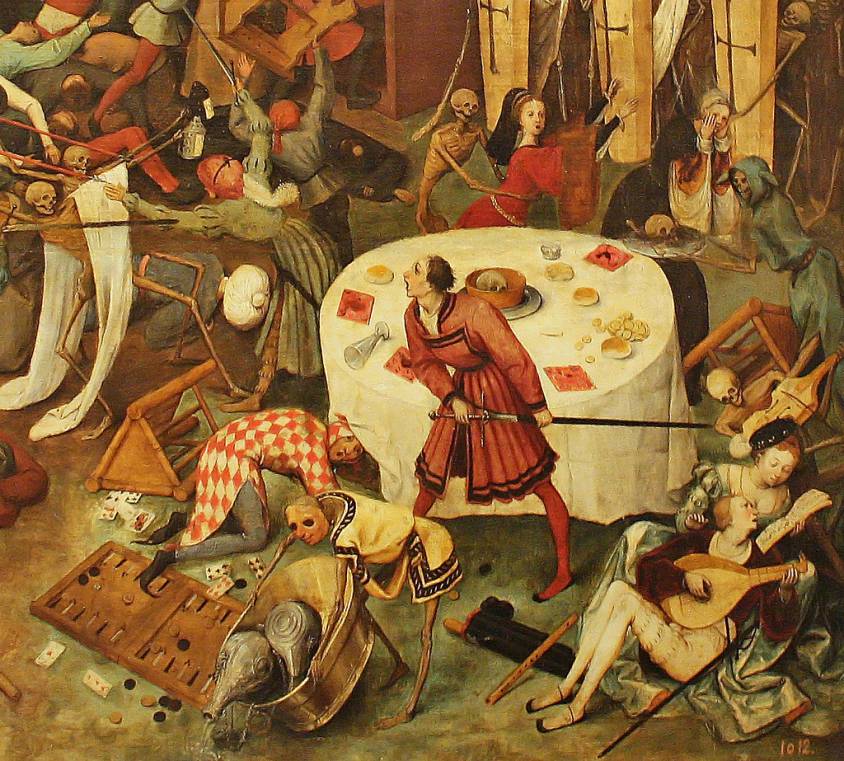
Toujours sur l’avant-plan, mais à droite, des gens de la bonne société jouent aux cartes, dînent et s’amusent. Un squelette, jouant de la vièle à roue, rejoint un jeune qui accompagne à la luth le chant de sa bien-aimée. Typique des amoureux, se regardant eux-mêmes, ils ne s’aperçoivent aucunement que la mort prend le contrôle de leur monde.
Le message est clair et simple : personne n’échappe à la mort, que l’on soit riche ou pauvre, roi ou paysan, malade ou en bonne santé. Lorsque l’heure est venue, ou à la fin des temps, tous les mortels retournent au créateur car la mort « physique » triomphe.
Immortalité
Le penseur américain Lyndon LaRouche (1922-2019), dans ses discours et écrits, nous avertissait souvent, avec son amour impatient qui le caractérisait : la sagesse humaine commence par une décision personnelle consistant à intégrer un fait prouvé et incontestable : nous sommes tous nés, et chacun ou chacune de nous, tôt ou tard, mourrons. Et jusqu’ici, il n’y pas eu d’exception. Sur la montre cosmique, la durée de notre existence éphémère, rappelait LaRouche, ne dépasse même pas la nanoseconde.
Ainsi, sachant les conditions limitées de notre existence mortelle (le temps et la mort), chacun de nous doit faire appel à son libre arbitre pour formuler un choix souverain : comment vais-je dépenser « le talent » de ma vie ? Vais-je passer ma vie à courir derrières les plaisirs terrestres que peuvent me procurer le pouvoir, l’argent et les plaisirs de la chair ? Ou vais-je dédier ma vie à défendre la vérité, le beau et le juste, au bénéfice de l’humanité comme un tout, vivant dans le passé, le présent et le futur ?
En 2011, interrogé, LaRouche précisa ce qu’il entendait par l’idée que potentiellement, l’humanité pourrait devenir une espèce « immortelle » :
J’existe, et tant que je vis, je peux générer des idées.
Ces idées donnent à l’humanité les moyens d’aller de l’avant.
Cependant, le moment viendra où je mourrais.
A partir de là, deux choses se produiront.
D’abord, si ces principes créateurs développés par les générations antérieures
se réalisent dans le futur,
cela implique que l’humanité est une espèce immortelle.
Nous ne sommes pas immortels à titre personnel ;
mais dans la mesure où nous sommes des êtres créateurs,
nous sommes une espèce immortelle.
Et les idées que nous développons sont
des contributions permanentes à la société humaine.
De cette façon, nous sommes une espèce immortelle,
basée sur des êtres mortels.
Et la clé de l’existence, c’est d’appréhender ce lien.
Dire que nous sommes créateurs et mourront, n’est pas toute l’histoire.
Bien que nous soyons sur le point de mourir,
si nous contribuons à quelque chose de durable,
qui vivra au-delà de notre mort et puisse être quelque chose de bénéfique à l’humanité dans des temps futurs,
alors nous atteignons le but de l’immortalité.
Et c’est cela la chose importante.
Si les gens arrivent,
avec un esprit ouvert, à faire face à l’idée que chacun d’entre nous va mourir, tout en regardant cela de la bonne façon, alors une grande passion les animera à faire des contributions, à découvrir des principes,
à accomplir un travail qui sera immortel.
Des découvertes de principe sont immortelles car elles se transmettent d’une génération à une autre.
Et de cette façon, les morts vivent parmi les vivants ;
car les morts, s’ils ont agit ainsi pendant leur vivant,
seront vivants, pas dans leur chair,
mais ils seront vivants dans les principes.
Ils constitueront une partie active de la société humaine.
L’humanisme chrétien
La vision de LaRouche est celle de l’obligation « morale » de vivre une existence « créative » sur Terre à l’image du Créateur. Elle a été nourrie aussi bien par la philosophie platonicienne que par la tradition judéo-chrétienne, dont le mariage heureux, au début du XIVe siècle donna naissance à « l’humanisme chrétien ». Il fut la source inestimable d’une explosion, à grande échelle et d’une densité inégalée, de contributions économiques, scientifiques, artistiques et culturelles, qualifiée ultérieurement de « Renaissance ».
Dans le Phédon de Platon, Socrate développe l’idée que notre « enveloppe » mortelle, pour les philosophes à la recherche de la vérité, constitue un obstacle constant qui « nous remplit de besoins, de désirs, de craintes, de toutes sortes d’illusions et de beaucoup d’inepties, à tel point que, comme on le dit, dans les faits, aucune pensée d’aucune sorte ne dérive du corps » (66c).
Ainsi, pour accéder à la pure connaissance, les philosophes doivent s’affranchir autant que se peut de l’influence du corps dans cette vie. La philosophie (en grec ‘l’amour de la sagesse’), en tant que telle, n’est, en réalité, qu’une sorte de « préparation à la mort » (67e), une purification de l’âme du philosophe lui permettant de se détacher de son corps.
La Bible (Dans L’Ecclésiaste) souligne que « Quoi que tu fasses, souviens-toi que ta vie a une fin, et jamais tu ne pécheras ». Ce passage trouve son expression dans le rite chrétien du « Mercredi des cendres », ce jour de pénitence marquant le début du Carême. Dans une évocation symbolique de la mort, on appose alors des cendres au front du pénitent en récitant le verset de la Genèse (Gn 3:19) disant : « Souviens-toi que tu es poussière et que tu retourneras en poussière. »
S’agit-il d’un rituel morbide ? Pas du tout. Il s’agit plutôt d’une leçon de philosophie. Le christianisme lui-même place en son centre le sacrifice de Jésus, le fils de Dieu devenu homme parmi les hommes, donnant sa vie pour le bien de l’humanité. Au début du XIVe siècle, Thomas à Kempis (1380-1471), un des dirigeants et fondateurs des Sœurs et Frères de la Vie Commune, un ordre de clercs laïques se concentrant sur l’éducation, affirmait que tout chrétien doit vivre en imitant la vie du Christ. Aussi bien Nicolas de Cues (1401-1464) qu’Erasme de Rotterdam (1466-1536) ont reçut l’éducation intellectuelle de ce courant.
Concedo Nulli
On comprend donc mieux pourquoi Erasme avait choisi comme armoiries un crâne et des os, juxtaposés avec un sablier, double référence à la mort et le temps comme deux conditions limites de l’existence humaine.
En 1519, son ami, le peintre flamand Quentin Matsys (1466-1530), a frappé une médaille de bronze en l’honneur à l’humaniste.
Au recto, on trouve l’effigie d’Erasme. En latin on peut lire : « Image pris sur le vif » et en grec, on lit : « Ses écrits le feront mieux connaître ».
Au verso de la médaille, une image inhabituelle également entourée d’inscriptions. En haut d’un pilier posé sur une terre instable, émerge la tête d’un jeune homme mal rasé, chevelure au vent. Tout comme l’effigie d’Erasme du verso, le visage de la figure au recto arbore un vague sourire. Autour d’elle, les mots Concedo Nulli (je ne recule devant personne).
Sur le pilier on peut lire « Terminus », le nom du dieu Romain des limites. Une fois de plus, en grec à gauche, on lit : « Gardez à l’esprit la fin d’une longue vie » et à droite, en latin : « La mort est la limite ultime des choses ».
En faisant de « Je ne recule devant personne » sa devise personnelle, Erasme prenait le risque de faire appel à une métaphore très osée que « les gens » auraient sans doute du mal à comprendre. Rapidement accusé « d’intolérant » par ses sycophantes, Erasme soulignait que Concedo Nulli devait se comprendre, non pas comme une phrase prononcé par Erasme, mais comme sortant de la bouche de la Mort elle-même. Une fois souligné ce point, les gens auraient forcément du mal à contredire l’auteur…
Enfin, dans son traité La préparation à la mort (1534), Erasme souligne:
Il faut considérer que chacun de nos jours peut être le dernier,
que nous ne savons pas si un autre le suivra.
Tandis que nous sommes en vie et en santé,
délivrons-nous autant qu’il nous est possible de l’embarras,
des affaires et, sans attendre que la maladie nous cloue au lit,
mettons ordre à notre maison.}
Mozart, Brahms et Gandhi
Plusieurs siècles après Erasme, le grand compositeur humaniste Wolfgang Amadeus Mozart (1756-1791), n’avait rien d’un cynique morbide. Révélant son état d’esprit joueur, Mozart disait un jour que le secret de tout génie était son amour pour l’humanité : « Le vrai génie sans cœur est un non-sens. Car ni intelligence élevée, ni imagination, ni toutes deux ensembles ne font le génie. Amour ! Amour ! Amour ! Voilà l’âme du génie ».
Cependant, le 4 avril 1787, Mozart, gravement malade, écrit à son père Léopold :
Inutile de te préciser à quel point j’aimerais
recevoir des nouvelles réconfortantes sur toi.
Et je continue à les attendre,
bien que je me suis désormais fait une habitude,
dans toutes les affaires de la vie, d’être préparé au pire.
Je me suis depuis quelques années tellement familiarisé avec cette sincère et très chère amie de l’homme (la mort) que non seulement son image n’a plus rien d’effrayant pour moi,
mais au contraire elle m’est très apaisante, et réconfortante !
Je remercie mon Dieu de m’avoir accordé la fortune de pouvoir reconnaître en elle la clef de notre bonheur.
Je ne me couche jamais sans penser que le lendemain peut-être,
je ne serai plus là.
Et pourtant personne dans ma fréquentation ne peut dire que je suis chagrin ou triste.
Et de cette fortune je remercie chaque jour mon Créateur,
et le souhaite de tout cœur à chacun de mes semblables.
Johannes Brahms (1833-1897), dans son Requiem allemand de 1865 brode sur le thème d’un verset de Pierre (1:24-25) disant :
Car Toute chair est comme l’herbe,
Et toute sa gloire comme la fleur de l’herbe.
L’herbe sèche, et la fleur tombe ;
Mais la parole du Seigneur demeure éternellement.
Et cette parole est celle qui vous a été annoncée par l’Evangile. *
A sa propre façon, Mahatma Gandhi (1869-1948), ne disait rien d’autre concernant la difficulté de faire coexister dans une même vie la mortalité et l’immortalité :
Vivez comme si vous deviez mourir demain. Apprenez comme si vous deviez vivre pour toujours.
Memento Mori et Vanitas
Dans son tableau Le jardin des délices terrestres (Prado, Madrid), le peintre Jérôme Bosch (1450-1516), met en scène des humains dénudés et des animaux courant frénétiquement derrière des petits fruits.
Pour l’artiste, il s’agit, par le rire et la métaphore, de susciter dans l’esprit du spectateur sa volonté de rompre avec ce comportement parfaitement ridicule. Or, Bruegel utilise un procédé semblable dans son Triomphe de la Mort, un tableau, qui en essence, n’est rien d’autre qu’un Memento Mori (en latin : rappelles-toi que tu dois mourir), très élaboré.
Avec ce tableau, Bruegel rend honneur à son « parrain » intellectuel dont la divise, on l’a dit, était Concedo Nulli. Comme Erasme le faisait sans cesse dans ses écrits, Bruegel peint ici le caractère inéluctable de la mort, non pas pour montrer sa force, mais pour inspirer ses concitoyens à prendre le chemin de l’immortalité.
De la même façon que L’Eloge de la Folie d’Erasme était une inversion satirique, car il s’agit en réalité d’un l’éloge de la raison humaine, le Triomphe de la Mort de Bruegel est conçu pour nous faire apercevoir le triomphe de la vie (immortelle).
Dans la foi catholique, le but des Memento Mori était de rappeler (voire de terroriser) constamment le croyant pour qu’il n’oublie pas qu’après sa mort, lui ou elle pourrait finir au Purgatoire, ou pire, en Enfer faute d’avoir respecté les rites de son Église.
L’apparition de la peinture à l’huile en Europe au début du XVe siècle, a vu émerger la production de ce type d’œuvres de chevalet destinées à des chapelles ou des résidences privées. Il s’agissait avant tout d’objets esthétiques au service de la contemplation religieuse et philosophique.
Ensuite, à partir de la Renaissance, les Memento Mori deviendront un genre très demandé, requalifié dans les siècles ultérieurs de Vanitas, du latin pour « Vanité » ou « Etat de vide ». Très populaire au Pays-Bas mais également ailleurs en Europe, ces vanités se présentent souvent comme des assemblages d’objets symboliques tels qu’un crâne humain, une bougie finissante, des fleurs fanées, une bulle de savon, un papillon ou encore un sablier.
Iconographie
gravure sur bois extrait de la Danse Macabre paru en 1523.
Le Triomphe de la Mort de Bruegel semble presque réunir, dans une seule image, la longue série d’illustrations que Holbein avait gravé pour sa Danse macabre parue en 1523.
Rompant avec la tradition malsaine du genre, promue par les flagellants lors de la Peste noire et ne visant qu’à désensibiliser les gens devant la mort pour la rendre acceptable, Holbein, inspiré par l’approche satirique d’Erasme, posera les bases de la dimension philosophique que Bruegel développera par la suite.
Pour élaborer l’iconographie de son tableau, Bruegel a su puiser dans le travail d’artistes le précédent, en particulier Hans Holbein le Jeune (1497-1543), ce jeune dessinateur brillant à qui Erasme avait confié la tâche d’illustrer son Eloge de la Folie.
La présence envahissante, presque gênante, d’un crâne sous un angle anamorphique, dans le tableau Les Ambassadeurs (1533) d’Holbein, démontre sans conteste l’extrême maîtrise du concept du Memento Mori chez cet artiste.
Un autre ami d’Erasme, Albrecht Dürer (1471-1528), était également un maître dans cet art comme le montrent ses gravures Le chevalier, la mort et le diable (1513) ainsi que son Saint-Jérôme dans son étude (1514) où figure ce père de l’église, auquel Erasme aimait s’identifier, en présence d’un crâne et d’un sablier.
Bruegel et l’Italie

Ironiquement, Pierre Bruegel l’ancien a été souvent présenté, à tort, comme un « peintre du Nord », hermétique à tout ce que pouvait apporter la Renaissance italienne. La réalité est toute autre. Si Bruegel a refusé de boire l’eau putride du maniérisme « italianisant », très en vogue chez les aristocrates pendant la deuxième moitié du XVIe, il n’a pas hésité à chercher à se rafraîchir aux premières eaux pures de la Renaissance du début du XIVe.
En ce qui concerne son Triomphe de la Mort, les « emprunts » et similitudes avec la fresque de 1446 décorant alors le Palazzo Sclafini de Palerme, en Sicile, sautent aux yeux.
La fresque montre notamment la mort sur un cheval livide ainsi qu’un jeune musicien, images reprises et enrichis par ce peintre flamand dont le voyage en Italie du Sud a été amplement documenté.
La deuxième source est sans doute la série de poèmes allégoriques connus comme I Trionfi (« Les triomphes » : le triomphe de l’Amour, de la Chasteté, de la Mort, de la Gloire, du Temps et de l’Eternité), composés par le grand poète italien Francesco Pétrarca (Pétrarque – 1304-1374) suite à la Peste noire, une horrible pandémie qui, suite à la faillite des banquiers de la papauté en 1345, selon la région, a décimé entre un tiers et la moitié de la population européenne.
Le génie de Pétrarque c’était précisément, aux gens terrifiés par l’idée qu’ils allaient y perdre leur vie mortelle, d’offrir une réponse philosophique à leur angoisse, leur fournissant du coup la force nécessaire pour mener le combat.
Comme résultat, les Trionfi devinrent immensément populaires, non seulement en Italie, mais dans l’Europe toute entière. A tel point, que pour la plupart des peintres, Les Triomphes de Pétrarque, ont rapidement trouvés une place parmi les grands classiques de leur répertoire.
Pour conclure, voici un extrait du poème, un passage où Pétrarque dénonce la quête folle des Rois et des Papes —aveuglés par leur attachement aux biens terrestres— pour la richesse, le plaisir, le pouvoir et la gloire qu’on puisse en tirer. Face à la mort, souligne le poème, tout cela n’est que vanité. Et les mots choisis par Pétrarque collent à merveille aux images utilisées par Bruegel pour son Triomphe de la Mort :
(…) Et voici que toute la campagne apparut pleine de tant de morts,
que prose ni vers ne pourraient le rendre.
De l’Inde, du Cathay [Chine], du Maroc et de l’Espagne,
cette immense multitude de gens morts
dans la longue succession des temps,
avait déjà rempli le milieu et les côtés de la plaine.
Là étaient ceux qui furent appelés les heureux : pontifes, rois et empereurs. Maintenant ils sont nus, pauvres et misérables.
Où sont maintenant leurs richesses ?
Où sont les honneurs, et les pierreries, et les sceptres,
et les couronnes, et les mitres, et les vêtements de pourpre ?
Malheureux qui place son espoir sur les choses mortelles !
— Et qui donc ne l’y place pas ? —
S’il se trouve à la fin trompé, c’est bien juste.
Ô aveugles ! à quoi sert de tant vous donner de peine ?
Vous retournez tous à la grande mère antique,
et c’est à peine si on retrouve la trace de votre nom !
Cependant, des mille peines que vous vous donnez,
y en a-t-il une qui soit utile ?
Ne sont elles pas toutes d’évidentes vanités ?
Que celui qui connaît vos préoccupations me le dise.
À quoi sert de subjuguer tant de pays,
et de rendre tributaires les nations étrangères,
pour que les esprits soient toujours embrasés de haine ?
Après les entreprises périlleuses et vaines,
après avoir conquis, en versant le sang, terres et trésors,
trouve-t-on l’eau et le pain plus doux ?
Trouve-t-on le verre et le bois plus doux que les pierreries et que l’or ?
Mais pour ne pas poursuivre davantage un si long thème,
il est temps que je revienne à mon premier sujet.
Je dis qu’était arrivée la dernière heure de cette courte vie glorieuse,
et le moment du pas douloureux que le monde redoute.
La Scola Caritatis
Si Bruegel, qui a pu admirer la fresque à Palerme lors de son voyage dans les années 1550, a pu lire lui-même le poème de Pétrarque, reste une question ouverte.
Ce que l’on sait, c’est que plusieurs de ses amis proches étaient familiers avec l’œuvre du poète italien. A Anvers, le peintre fut l’hôte régulier de la Scola Caritatis, un cercle humaniste animé par un certain Hendrick Nicolaes.
Là, Bruegel a pu échanger avec des poètes, des traducteurs, des peintres, des graveurs (Jérôme Cock, Hendrik Goltzius), des cartographes (Gérard Mercator), des cosmographes (Abraham Ortelius) et des imprimeurs tels que l’imprimeur Christophe Plantin, dont l’officine allait imprimer des belles pages de Pétrarque.
C’est aussi dans cette belle ville, indiquant à quel point la poésie de Pétrarque y était appréciée, que le compositeur Orlando Lassus (1532-1594) publia ses premières compositions musicales, notamment des madrigaux sur chacun des six Triomphes de Pétrarque dont le fameux Triomphe de la Mort.
Conclusion
Un grand mal, espérait Gottfried Wilhelm Leibniz, peut éventuellement susciter un bien d’une amplitude supérieure à celle du mal qui l’a engendré. Nous espérons que la crise pandémique actuelle conduira nos décideurs, avec notre assistance, à réfléchir sur le sens et le but de leur existence. Car le pire serait de revenir à la situation « normale » d’hier, c’est-à-dire à la même normalité qui a conduit l’humanité au bord de l’extinction.
Enfin, soulignons que de la même façon que Lyndon LaRouche, par son approche Concedo Nulli pour défendre la nature sacré de la créativité qui anime chaque être humain, a contribué à l’immortalité de Platon, Pétrarque, Erasme, Rabelais et Bruegel, il est à chacun de nous aujourd’hui, de reprendre le flambeau pour emporter la bataille.
NOTE:
- On retrouve le thème de l’herbe au centre du tableau de Jérôme Bosch, Le char de foin, métaphore de la vaine gloire qui fait courir tant de vaniteux.
Léonard en résonance avec la peinture traditionnelle chinoise


Mon entretien avec le Quotidien du Peuple: (People’s Daily)
Version chinoise (mandarin) suivie de la version française (FR) et anglaise (EN):
2019年12月18日17:03 来源:人民网-国际频道 分享到:
人民网巴黎12月17日电(记者 葛文博)今年是达芬奇逝世500周年,长居法国的比利时版画家、艺术史学家、美术评论家雷尔·维希肯(Karel Vereycken)近日接受人民网记者采访,阐述其多年研究达芬奇绘画技法的心得,认为《蒙娜丽莎》一画同中国古代绘画技法异曲同工。
在他看来,许多人采用“欧洲中心”的视角将透视法归于西方独创和所有,这是错误的。维希肯通过观察中国古代尤其是宋代的绘画作品,提出中国才是透视法的先驱,后世包括达芬奇在内的许多欧洲艺术家的作品都能同中国古代绘画理论和技法产生共鸣。
人民网:您认为中国绘画如何启发了透视法?
维希肯:中国从公元6世纪开始,一些艺术著作不仅记录了文艺实践,也启发了更为活跃的绘画艺术。中国南北朝著名的画家、文艺理论家谢赫提出的“六法”,既要“气韵生动”又要“应物象形” 。宋代画家与书画鉴赏家郭若虚在其《图画见闻志》中写道:“人品既已高矣,气韵不得不高;气韵既已高矣,生动不得不至”。这显然超脱了绘画的“技术”层面,升华进入了精神和道德领域。它突破单纯形制而追求由内而外的生命力,成为透视法的重要理论基础。
人民网:这与达芬奇绘画技法有何契合之处?
维希肯:我在2007年发表的文章《达芬奇,捕捉运动的画家》中就指出,这位画家渴望绘制运动、转变的场景。达芬奇非常认同希腊哲学家赫拉克利特斯的名言“世上唯有‘变化’才是永恒的”。然而,要掌握的不是物体的形式或它们所处的时空,而是要掌握它们在变化过程中在给定时刻的外观,这就有必要深入了解产生变化的原因。
宋代苏轼在其《净因院画记》中提出,人类、家禽、宫殿、居室、器物、使用的东西,都有其经常所处的形态。至于山川、岩石、竹子、柴木,流水、海波、烟雾、云朵,虽没有经常所处的形态,但有其存在的本质。我发现,苏轼追求本质、重视变化的观念同达芬奇寻求运动的思路不谋而合。
唐代诗人王维在其《山水论》中更为详尽地阐述其对透视的理解:“远人无目,远树无枝。远山无石,隐隐如眉;远水无波,高与云齐”。 对画面的空间、层次、疏密、清晰度等做出细致描述。这与达芬奇采用的“空气透视法”也完全契合。
人民网:这种契合如何表现在达芬奇的《蒙娜丽莎》画作中?
韦雷肯:除了形体的运动以外,达芬奇还试图表达一种“非物质的运动”,他将其分为五类。第一个是时间,因为它“包容了所有其他事物”,其他分别还有光、声音和气味的传播。在他看来,这些并非实体的运动恰恰使事物充满生机。
但是,如何描绘这种生机呢?仅凭借固定的形式是不可能的,因为死死抓住形式不放,就如同费心捕捉美丽的蝴蝶却将其用钉子钉住制成标本,生命力就消逝了。雕塑家、诗人和画家必须在作品中制造讽刺、矛盾和模糊,就像伟大的思想家林登·拉鲁什(Lyndon LaRouche)所说的“中间状态”,以揭示潜在的运动和变化。
蒙娜丽莎的脸上就充满了神秘的“矛盾”:嘴巴的一侧微笑,另一侧微笑的程度略小;一只眼睛透出认真的眼神,另一只眼睛则透出愉悦;一只眼睛看着你,另一只眼睛则越过了你,等等。蒙娜丽莎的微笑难下定义,因为它恰好在“中间状态”。她是真的微笑还是哭泣?她的微笑能拥有这样迷人的力量,是因为她身后的风景更为迷人。这副画风景的透视更接近之前我们所述的中国画的规则,而不是彼时欧洲的死板规定。
在中国画中,水与山之间的相互作用是普遍转变的象征,可以将不同层次的山、水、雾等联系起来。从公元10世纪开始,中国画寻求与人类视觉经验相符的构造,不仅采用焦点透视,反而创造运用随着视线投射变化产生的散点透视。这种透视恰恰存在于达芬奇的《蒙娜丽莎》之中,在人物的左侧,视线位于鼻孔的高度,在人物右侧,水平线则升至眼角。这样打破常规的透视法,令我们感受到蒙娜丽莎鲜活的生命和活泼的灵魂,聆听着到画作与中国传统绘画穿越时空的共鸣。 (责编:李婷(实习生)、燕勐)
Cet article a été repris par les sites chinois suivants:
- People’s Daily: http://world.people.com.cn/n1/2019/1218/c1002-31512405.html
- Eastday.com: http://news.eastday.com/w/20191218/u1ai20237205.html
- Chinese Academy of Social Sciences (CASS): http://www.cssn.cn/hqxx/hqwx/hqwxnews/201912/t20191219_5061586.shtml
- art-ville.com: http://www.art-ville.com/zixun/vQBpc.html
- themusicalhacker.com: http://www.themusicalhacker.com/guoji/16.html
- beanstalky.com: http://www.beanstalky.com/guoji/14.html
- Foro-avdi.com: http://www.foro-avdi.com/guoji/2164.html
- Qz123.com : http://www.qz123.com/html/298/20191219/news_show_244384.html
- Myweb.wang: http://www.myweb.wang/news/details/bb529d5833e8650ab25f9220121a125e
- kknews.cc: https://kknews.cc/culture/y5l42og.html
- haxw.net: http://www.haxw.net/guoji/8377.html
- fjshuchi.com: https://www.fjshuchi.com/news/j8jhjdjlh9jmhl8.html
- xw.qq.com: https://xw.qq.com/cmsid/20191218A0KSC300
- news.66wz.com: http://news.66wz.com/system/2019/12/18/105218123.shtml
- zutiyu.com : http://www.zutiyu.com/content/20191219/4037144.htm
- mini.eastday.com: https://mini.eastday.com/a/191218172310279.html
- sapuc.ch: http://www.sapuc.ch/php/indexi_5.php
- dzwww.com: http://www.dzwww.com/xinwen/guojixinwen/201912/t20191218_19480201.htm
- m.regulatingsenses.com: http://m.regulatingsenses.com/guoji/6.html
- Zolix: http://www.loginesia.com/guoji/2196.html
- ncaip.com: http://ncaip.com/guoji/3.html
- pentouweixiu.com: http://www.pentouweixiu.com/guoji/44.html
- mariobahamon.com: http://www.mariobahamon.com/guoji/31.html
- kidsslay.com: http://kidsslay.com/guoji/461.html
- lunarizada.com: http://lunarizada.com/guoji/26.html
- abonhand.com: http://m.adonhand.com/guoji/12.html
- makedesignone.com: http://www.makedesignone.com/guoji/1.html
- monavisadoors.com: http://www.monavisadoors.com/guoji/44.html
- happybreadwinner.com: http://happybreadwinner.com/guoji/3.html
- m2.people.cn: http://m2.people.cn/r/MV8xXzMxNTEyNDA1XzEwMDJfMTU3NjY1OTgyMA==
- indopakgrocerystore.com: http://www.indopakgrocerystore.com/guoji/11.html
- shygit.com: http://www.shygit.com/guoji/57646.html
- bollywoodtonite.com: http://m.bollywoodtonite.com/guoji/8.html
- mesopecia.com: http://www.mesopecia.com/guoji/418.html
- ufitit.com: http://ufitit.com/guoji/3016.html
- codgerconsulting: http://www.codgerconsulting.com/guoji/15.html
- ggmsolutions.net: http://ggmsolutions.net/guoji/13.html
- h.miniu2.com: http://m.miniu2.com/guoji/16.html
- zangkailinguistics.com: http://zhangkailinguistics.com/guoji/13.html
- abcq481.top: http://abcq481.top/guoji/655.html
Version française:
Léonard en résonance avec la peinture traditionnelle chinoise
Karel Vereycken, un peintre-graveur et historien d’art amateur d’origine belge vivant en France, travaille depuis longtemps sur la perspective. En 1996, dans une étude approfondie publiée dans Ibykus, le magazine allemand de l’Institut Schiller, il résuma ses recherches sous le titre « L’invention de la perspective ». Selon lui, par une lecture euro-centrique étriquée, la majorité des « experts » attribuent la paternité de cette découverte (la représentation de l’espace sur un plan) de façon exclusive à l’Occident.
Or, en examinant, non seulement les œuvres mais tout autant les écrits des peintres chinois, notamment ceux de la Dynastie Song (960-1279 après JC), Vereycken s’est rendu à l’évidence que la Chine a été pionnière dans ce domaine et a pu influencer certains artistes européens, dont Léonard de Vinci. Il a développée cette question dès 1996 dans son article intitulé « Sur la peinture chinoise et son influence en Occident ».
Etant donné qu’en 2019-2020 le Musée du Louvre, consacre une belle exposition à ce peintre extra-ordinaire, dans le cadre du 200e anniversaire de sa disparation, nous avons demandé à Karel Vereycken de présenter l’influence chinoise sur son œuvre.
Quotidien du Peuple : M. Vereycken, quel a été l’apport de la Chine à l’invention de la perspective ?
VEREYCKEN: L’avantage de la Chine, et mes confrères chinois me corrigeront le cas échéant, c’est que l’on y trouve, dès le VIe siècle, des écrits témoignant, non seulement de la pratique artistique dans le pays, mais évoquant l’état d’esprit qui doit animer les peintres. Je pense notamment aux six règles de base de la peinture chinoise détaillées par Xie He (500-535) pour qui « la résonance intérieure » doit « donner vie et mouvement » mais exige aussi la « fidélité à l’objet en représentant les formes ». L’on constate tout de suite, que ce qui prime, ce n’est pas la performance « technique » du peintre, mais sa valeur spirituelle et morale. Le peintre des Song, Guo Ruoxo, écrit par exemple en 1074, que « Si la valeur spirituelle (renpin) d’une personne est élevée, il s’ensuit que la résonance intérieure est nécessairement élevée, alors sa peinture est forcément pleine de vie et de mouvement (shendong). On peut dire que, dans les hauteurs les plus élevées du spirituel, il peut rivaliser avec la quintessence ».
Quotidien du Peuple : En quoi cela a un rapport avec Léonard de Vinci ?
VEREYCKEN: Comme j’ai tenté de le développer dans mon article « Léonard, peintre de mouvement » de 2007, ce qui rapproche ce peintre de la philosophie chinoise, c’est sa volonté de peindre les transformations. Léonard se reconnaissait pleinement dans la phrase du philosophe grec Héraclite pour qui « Il n’y a que de permanent que le changement ». Or, pour saisir, non pas la forme des objets ou de l’espace-temps dans lequel ils se situent, mais leur apparition à un moment donné dans un processus de transformation, il faut savoir pénétrer les causes qui les engendrent.
Or, les « Notices sur les peintures du Jingyinuan » de Su Shi (1036-1101), révèlent une approche si semblable à Léonard qu’on risque de les confondre avec ses « carnets » ! Su Shi écrit « Au sujet de la peinture, j’estime que si les figures humaines, les animaux, les bâtiments ou les ustensiles ont une forme constante, par contre, les montagne et rochers, les arbres et bambous, eaux courantes et vagues, comme les brumes et les nuages, n’ont pas de forme constante, mais gardent un principe interne constant. Lorsque la forme constante est défectueuse dans sa représentation, tout le monde s’en aperçoit ; cependant, même un connaisseur peut ne pas s’apercevoir que le principe constant n’est pas respecté. C’est pourquoi tant de peintres médiocres, afin de tromper le monde, peignent ce qui n’a pas une forme constante. Or un défaut dans la représentation d’une forme ne touche qu’une partie de la peinture, alors qu’une erreur dans le principe constant en ruine la totalité. Car lorsqu’il agit de la représentation des choses qui n’ont pas de forme constante, il faut respecter son principe interne (li). Certains artisans sont capables de dessiner les formes exhaustivement ; par contre, pour leur principe, seuls y parviennent les esprits élevés et les talents éminents… »
Quotidien du Peuple : et au niveau de la perspective ?
VEREYCKEN : Léonard, qui décrit la « perspective d’effacement » aurait pu adhérer sans problème à ce qu’écrit l’érudit Wang Wei (701-761) pour qui : « d’un homme à distance, on ne voit pas les yeux ; d’un arbre à distance, on ne distingue pas les branches ; d’une montagne lointaine aux contours doux comme un sourcil, nul rocher est visible ; de même nulle onde sur une eau lointaine, laquelle touche l’horizon des nuages. ». Et pour qui, il est impératif de « distinguer le clair et l’obscur, le net et le flou. Établir la hiérarchie entre les figures ; fixer leurs attitudes, leur démarche, leurs saluts réciproques. Trop d’éléments, c’est le danger de l’encombrement ; trop peu, c’est celui du relâchement. Saisir donc l’exacte mesure et la juste distance. Qu’il y ait du vide entre le lointain et le proche, cela aussi bien pour les montagnes que pour les cours d’eau. »
Quotidien du Peuple : comment voyez-vous cette influence sur La Joconde ?
VEREYCKEN : Il faut bien comprendre, qu’au-delà du mouvement du corps, Léonard chercha à exprimer les « mouvements immatériels » qu’il classe en cinq catégories. La première est le temps car il « embrasse toutes les autres ». Les autres sont la diffusion des images par la lumière, celle des sons et des odeurs, le mouvement « mental » est celui qui anime « la vie des choses » (Codex Atlanticus, 203v-a).
Mais alors, comment peindre ce souffle de la vie ? Formellement c’est totalement impossible car dès qu’on attrape une forme, la vie s’en échappe comme celle d’un papillon qu’on épingle ! Pour y parvenir, sculpteurs, poètes et peintres doivent créer une ironie, une ambiguïté que le grand penseur Lyndon LaRouche (1922-2019) a exprimée en anglais comme mid-motion (un « moment d’entre-deux »), révélant le potentiel d’une transformation potentielle à un moment donné, pour ceux qui veulent bien le voir.
Or, regardez le visage de la Joconde, rempli de paradoxes énigmatiques : un coté de la bouche sourit, l’autre, moins ; un œil est sérieux, l’autre amusé, un œil vous regarde, l’autre regarde au-delà, etc. Ce sourire est indéfinissable car précisément « entre deux ». Va-t-elle sourire réellement ou éclater en pleurs ? L’énigme de son sourire n’aura jamais cette force sans le paysage encore plus énigmatique sur l’arrière plan. Or, la perspective de ce paysage obéit plutôt aux préceptes chinois qu’aux règles rigides de la perspective européenne.
Dans la peinture chinoise, l’interaction entre l’eau et la montagne étant symbole de transformation universelle, différents niveaux peuvent s’enchaîner du type : eau, petite brume, montagne, grande brume, nuage, eau, petite brume, montagne et ainsi de suite. Cherchant à se conformer à la vue humaine, les peintres chinois, dès le Xe siècle, feront appel, non pas à une seule ligne d’horizon, mais à une succession d’horizons accompagnant notre vue là où elle se projette. Or, c’est précisément le procédé mis en œuvre par Léonard dans La Joconde où les horizons se succèdent. A gauche de la figure, la ligne d’horizon s’établit à la hauteur des narines ; à droite, au niveau des yeux, le tout perturbant suffisamment nos habitudes visuelles pour que notre esprit s’ouvre à ce que Léonard jugeait essentiel : l’âme vivante de La Joconde.
English version (via google translate)
Leonardo Da Vinci’s « Mona Lisa » resonates with time and space with traditional Chinese painting
People’s Daily, Paris, December 17 (Reporter Ge Wenbo) This year marks the 500th anniversary of the death of Da Vinci. Belgian printmaker, art historian and art critic Karel Vereycken, who has lived in France, recently accepted an interview with a reporter on the Internet explaining his experience in studying Da Vinci’s painting techniques for many years, and he believed that the painting of « Mona Lisa » is similar to the ancient Chinese painting technique.
In his view, many people use a « European-centric » standpoint to attribute perspective to Western originality and ownership, which is wrong. Through observing the paintings of ancient China, especially the Song Dynasty, Vereycken proposed that China was the pioneer of perspective. The works of many European artists including Da Vinci in later generations could resonate with ancient Chinese painting theories and techniques.
People’s Daily: How do you think Chinese painting inspired perspective?
VEREYCKEN: From the 6th century onwards in China, some art works not only recorded literary practice, but also inspired more active painting art. The « six methods » proposed by Xie He, a well-known painter and literary theorist in the Southern and Northern Dynasties of China, need to be both « spiritual and vivid » and « appropriate ». Song Dynasty painter and calligraphy connoisseur Guo Ruoxu wrote in his « Pictures and Wenwenzhi »: « The character has become high, and the charm must be high« ; This obviously transcends the « technical » level of painting and sublimates into the spiritual and moral realm. It broke through the simplex system and pursued the vitality from the inside to the outside, and became an important theoretical basis of perspective.
People’s Daily: How does this relates to Da Vinci’s painting techniques?
VEREYCKEN: In my 2007 article « Da Vinci, the painter who captures movement, » I pointed out that the artist was eager to paint scenes of movement and change. Da Vinci agreed with the famous quote of the Greek philosopher Heraclitus, « Only ‘change’ in the world is eternal. » However, it is not the form of the objects or their time and space that must be grasped, but the appearance of them at a given moment in the process of change, which requires a deep understanding of the reasons for the change.
In his Song of Jingyinyuan in the Song Dynasty, Su Shi proposed that human beings, poultry, palaces, houses, utensils, and things used often have their forms. As for mountains and rivers, rocks, bamboo, firewood, flowing water, waves, smoke, and clouds, although they don’t often exist, they have their essence. I found that Su Shi’s concept of pursuing essence and value change coincided with Da Vinci’s idea of seeking movement.
The Tang Dynasty poet Wang Wei expounded his understanding of perspective in his « Landscapes and Landscapes » in more detail: « A distant man has no eyes, a distant tree has no branches. A distant mountain has no stones, faint like eyebrows; Yun Qi. » Make a detailed description of the space, layer, density, and sharpness of the picture« . This also fits perfectly with the « air perspective » adopted by Da Vinci.
People’s Daily Online: How does this appears in Da Vinci’s Mona Lisa painting?
VEREYCKEN: In addition to physical movement, Da Vinci also tried to express a « non-material movement », which he divided into five categories. The first is time, because it « contains everything else, » and the other is the spread of light, sound, and smell. In his view, these non-substantial movements just made things full of life.
But how to portray this vitality? It is impossible to rely only on the fixed form, because holding on to the form is like trying to catch a beautiful butterfly but nailing it to make a specimen, and vitality is lost. Sculptors, poets, and painters must create irony, contradiction, and ambiguity in their works, as the great thinker Lyndon LaRouche called « intermediate states » to reveal potential movements and changes.
The face of Mona Lisa is full of mysterious « contradictions »: one side of the mouth smiles, and the other side smiles slightly; one eye reveals a serious look and the other eye expresses pleasure; One eye is looking at you, the other eye is over you, and so on. Mona Lisa’s smile is difficult to define because it happens to be in the « middle state ». Does she really smile or cry? Her smile has such a charming power because the scenery behind her is more charming. The perspective of this landscape is closer to the rules of Chinese painting we described earlier than to the rigid rules of Europe at that time.
In Chinese painting, the interaction between water and mountains is a symbol of universal transformation, which can link different levels of mountains, water, and fog. Starting from the 10th century AD, Chinese painting seeks a structure consistent with human visual experience. Instead of using focal perspective, it has created and used scatter perspective produced by changes in line of sight projection. This perspective exists precisely in Da Vinci’s Mona Lisa. On the left side of the character, the line of sight is at the height of the nostril, and on the right side of the character, the horizontal line rises to the corner of the eye. This way of breaking the conventional perspective allows us to feel the lively life and lively soul of Mona Lisa, listening to the resonance between the painting and traditional Chinese painting through time and space.
Livre: Karel Vereycken, peintre-graveur


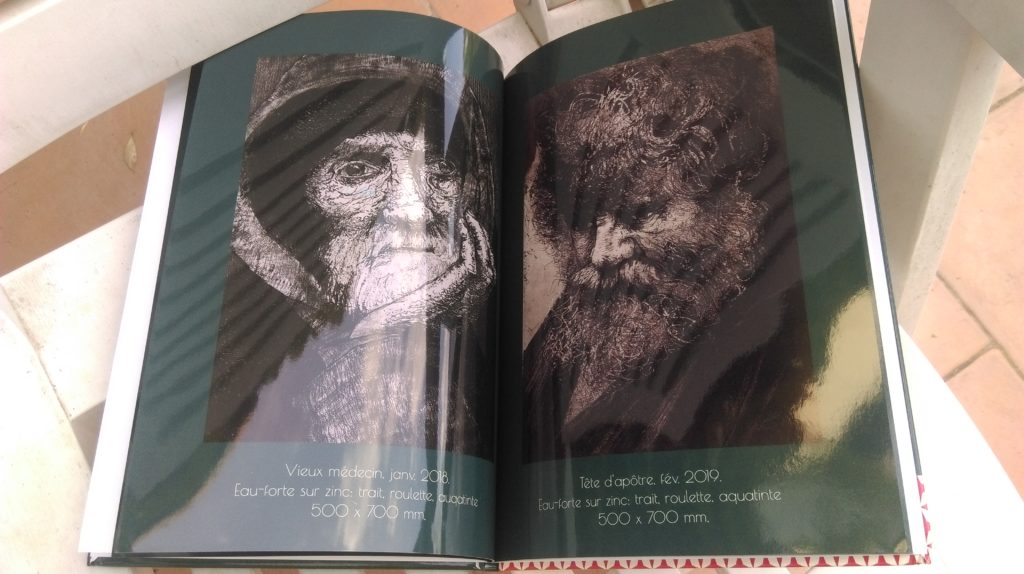

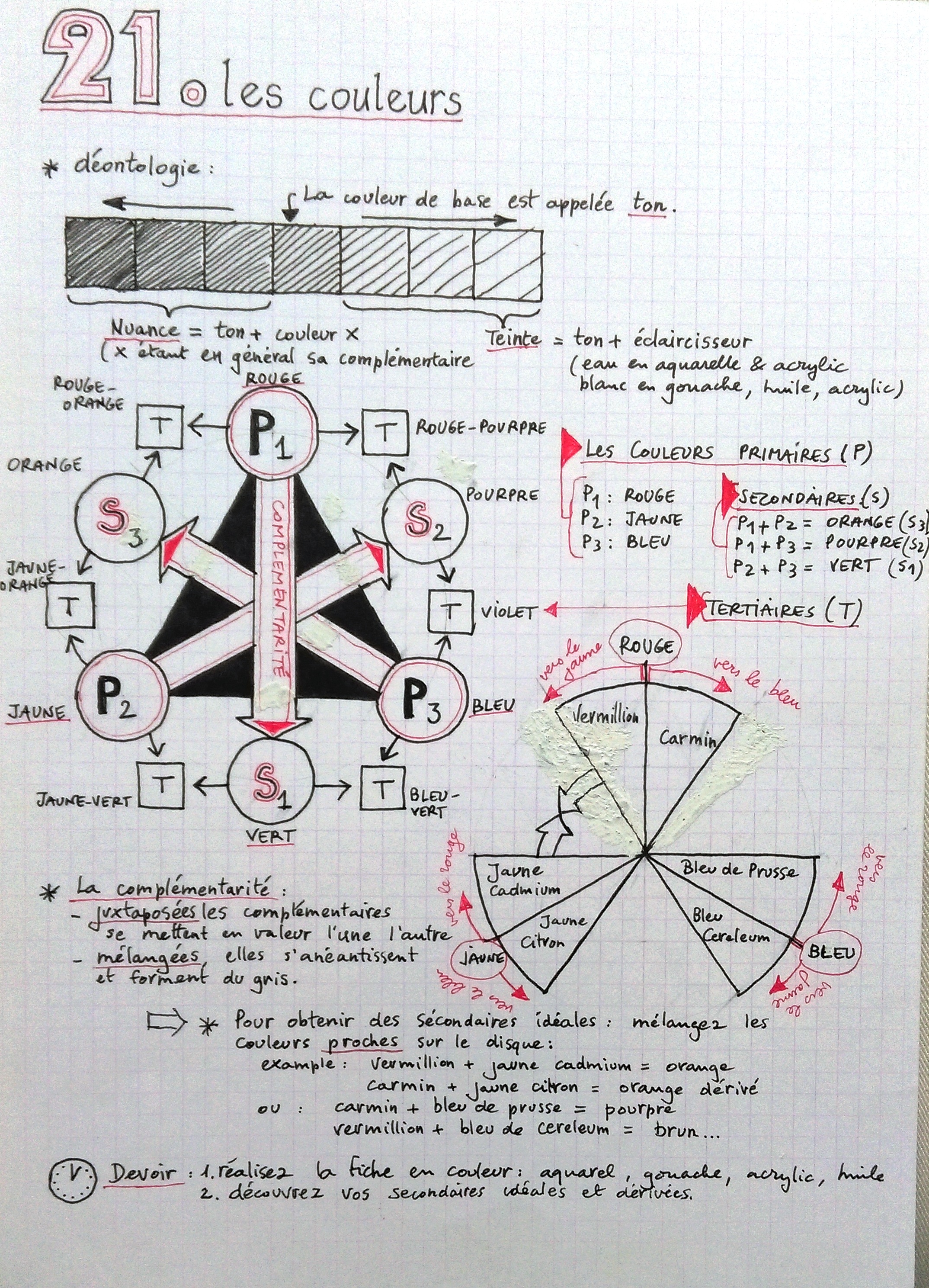




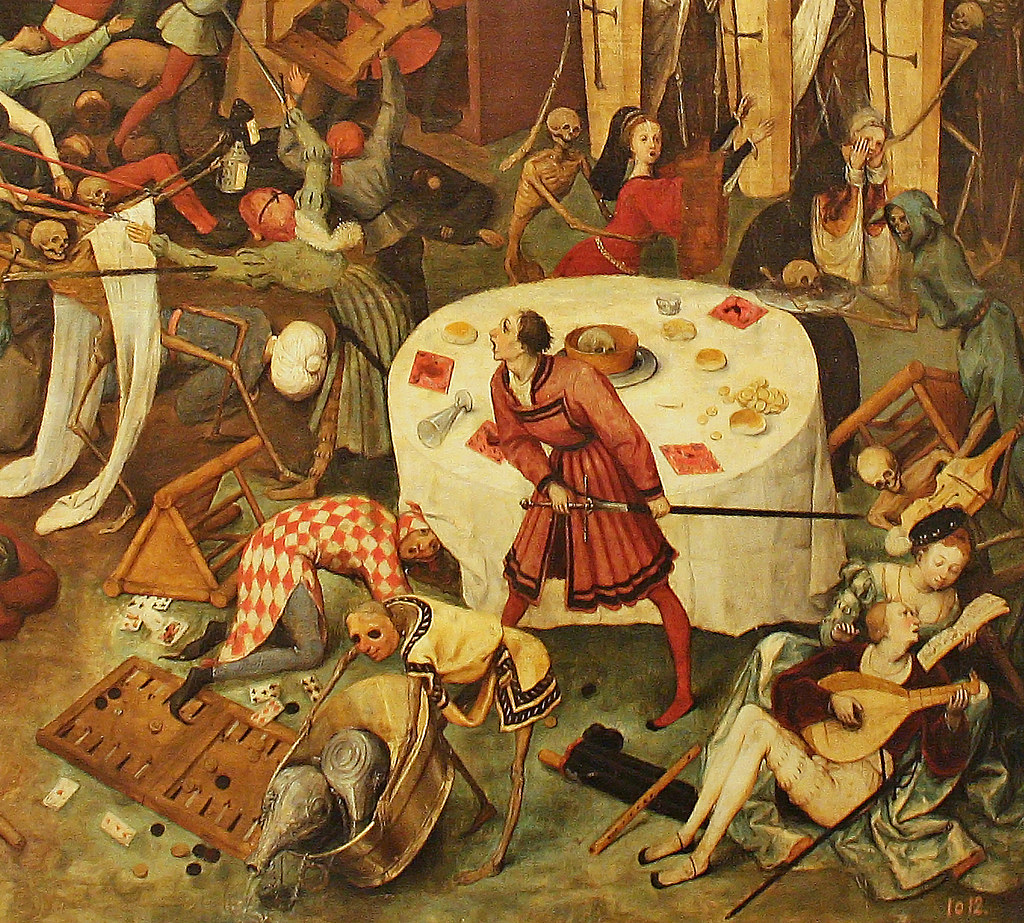

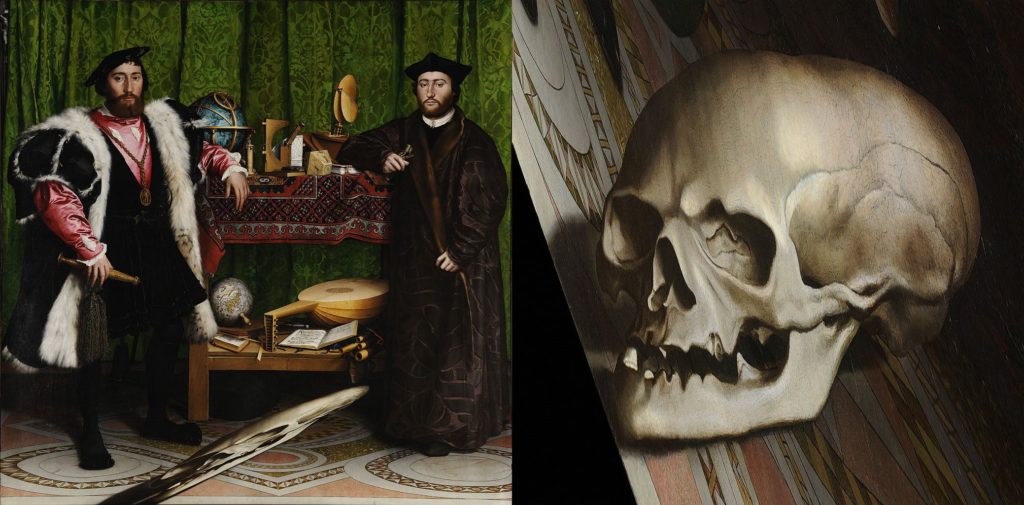
La Compagnie des ocres


Mines d’ocres à Roussillon.

Une adresse incontournable pour toutes celles et tous ceux qui fabriquent leurs propres couleurs:
La Compagnie des ocres
Sentier des Ocres
Roussillon (84220)
Tél.: 04 90 04 56 90
Courriel: contact@lacompagniedesocres.fr
Site internet:
www.lacompagniedesocres.fr
Index, Études Renaissance
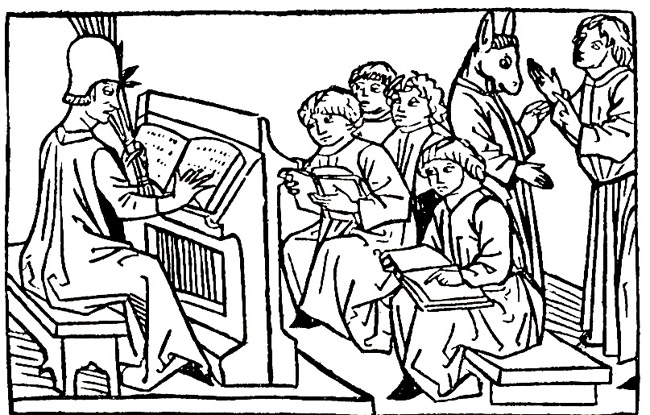
INDEX, Etudes Renaissance
- FR en ligne — Mohenjo-Daro, Harappa: Le défi que nous lance la modernité de la Civilisation de l’Indus;
- EN online — Mohenjo-Daro, Harappa :The challenging modernity of the Indus Valley Civilization;
- FR en ligne — La Route de la soie maritime, une histoire de 1001 coopérations;
- EN online — The Maritime Silk Road, a History of 1001 cooperations;
- FR en ligne — Afghanistan, le pays des 1000 cités d’or et l’histoire d’Aï Khanoum;
- EN online — Afghanistan: the Land of a 1000 Golden Cities and Aï-Khanoun;
- FR en ligne — Le miracle du Gandhara, quand Bouddha s’est fait homme;
- EN online — The miracle of Gandhara: when Buddha turned himself into man;
- FR en ligne — Derrière les chevaux célestes chinois, la science terrestre;
- EN online — The Earthly Science behind China’s Heavenly Horses;
- FR en ligne — Et l’Homme créa l’acier…;
- FR en ligne — Portraits du Fayoum: un regard de l’au-delà (FR en ligne);
- EN pdf online — A Gaze from the Beyond — The Extraordinary Faiyûm Portaits;
- EN AUDIO PARIS: The Greek tradition behind the Fayum Mummy Portraits;
- FR en ligne — La pratique ancestrale d’annulation des dettes;
- EN online — The Ancient Practice of Debt Cancelation;
- RU pdf online — The Ancient Practice of Debt Cancelation (Russian translation) ;
- FR en ligne — Bagdad, Damas, Cordoue, creuset d’une civilisation universelle;
- FR en ligne — Mutazilisme et astronomie arabe, deux étoiles brillantes au firmament de la civilisation;
- EN online — Mutazilism and Astronomy, two brilliant stars at the firmament of civilization;
- FR en ligne — Qanâts perses et Civilisation des eaux cachées;
- EN online — Persian Qanâts and the Civilization of Hidden Waters;
- FR en ligne — Renaissance africaine: la splendeurs des royaumes d’Ifè et du Bénin;
- EN online — The splendors of the kingdoms of Ife and Benin;
- FR en ligne — Sur la peinture chinoise et son influence en Occident;
- EN pdf online — On Chinese painting and its influence on the West (Fidelio);
- FR en ligne — L’invention de la perspective (Magazine Fusion);
- EN pdf online — The Invention of Perspective (Fidelio);
- FR en ligne — La révolution du grec ancien, Platon et la Renaissance;
- EN online — The Greek language project, Plato and the Renaissance;
- FR en ligne — Les Frères de la vie commune et la Renaissance du nord;
- NL online — Moderne Devotie en Broeders van het Gemene Leven, bakermat van het humanisme;
- EN online — Devotio Moderna, Brothers of the Common Life, the cradle of humanism in the North;
- FR en ligne — 1405: l’amiral Zheng et les expéditions maritimes chinoises;
- EN online — Zhang He and the Chinese Maritime Expeditions;
- FR en ligne — Jan van Eyck, la beauté comme prégustation de la sagesse divine;
- EN online — Jan van Eyck, beauty as foretaste of divine wisdom;
- EN AUDIO BERLIN: AUDIO – Van Eyck’s theological metaphor in his Madonna in the Cathedral;
- FR en ligne — Jan Van Eyck, un peintre flamand dans l’optique arabe;
- EN online — Jan Van Eyck, a Flemish Painter using Arab Optics;
- FR pdf en ligne — Rogier Van der Weyden, maître de la compassion;
- EN AUDIO PARIS: Van der Weyden and Cusanus;
- FR en ligne — Comment Jacques Cœur a mis fin à la Guerre de Cent Ans;
- EN online — How Jacques Cœur put an end to the Hundred Years’ War;
- EN AUDIO PARIS: Who whispered in the Ear of Joan of Arc?;
- FR en ligne — Hugo van der Goes et la Dévotion moderne;
- EN pdf online — Hugo van der Goes and the Devotio Moderna;
- FR en ligne — A la découverte d’un tableau;
- EN AUDIO PARIS — Ghirlandaio’s immortality;
- FR en ligne — Avicenne, Ghiberti, leur rôle dans l’invention de la perspective à la Renaissance;
- EN on line — Avicenna, Ghiberti, their role in the invention of perspective at the Renaissance;
- FR en ligne — ENTRETIEN Omar Merzoug: Avicenne ou l’islam des lumières;
- EN pdf online — INTERVIEW Omar Merzoug: New Biography of Ibn Sina;
- FR en ligne — Les secrets du dôme de Florence;
- EN pdf online — The Secrets of the Florentine Dome (Schiller Institute Archives);
- DE pdf online — Die Geheimnisse des Florentiner Domes lüften (Neue Solidarität);
- FR pdf en ligne — Le Dome de Brunelleschi, un défi, un scandale, un exploit (Hors Série Beaux Arts Magazine, 2013)
- EN AUDIO PARIS — Cimabue, Giotto, Fra Angelico; Wonders of the Italian Trecento;
- FR en ligne — L’œuf sans ombre de Piero della Francesca;
- EN pdf online — The Egg Without a Shadow of Piero della Francesca;
- RU pdf online — The Egg Without a Shadow of Piero della Francesca (Russian translation);
- EN AUDIO MILAN — Piero della Francesca at Milan Brera Pinacoteca;
- EN AUDIO PARIS — Antonello de Messina in the Image of Christ;
- FR en ligne — Uccello, Donatello, Verrocchio et l’art du commandement militaire;
- EN online — Uccello, Donatello, Verrocchio and the Art of Military Command;
- EN AUDIO PARIS: Leonardo and Verrochio’s workshop;
- FR en ligne — La Cène de Léonard, une leçon de métaphysique;
- EN pdf online — Leonardo‘s Last Supper, A lesson of Metaphics (Fidelio);
- FR en ligne — L’ombre de Vernadski dans la Sainte Anne de Léonard de Vinci;
- EN online — The Shadow of Vernadsky in Leonardo’s Virgin and Child with Saint Anne;
- IT online — L’ombra de Vernadsky nella Santa Anna di Leonardo da Vinci;
- FR en ligne — Léonard de Vinci : peintre de mouvement;
- EN pdf online — Leonardo, painter of movement (Fidelio);
- EN AUDIO PARIS — Mona Lisa made in China?;
- FR en ligne — La Vierge aux rochers, l’erreur fantastique de Léonard;
- FR en ligne — Romorantin et Léonard ou l’invention de la ville moderne;
- EN pdf online — Leonardo da Vinci Imagines the First Modern City (Executive Intelligence Review);
- DE online — Leonardos großes Infrastrukturprojekt für Frankreich (Neue Solidarität);
- IT online — Leonardo da Vinci, Romorantin e lo spirito del progetto NAWAPA (Movisol website);
- FR en ligne — L’Homme de Vitruve de Léonard de Vinci;
- EN online — Leonardo’s « Vitruvian Man »;
- FR en ligne — Léonard en résonance avec la peinture traditionnelle chinoise — entretien en français de Karel Vereycken avec Le Quotidien du Peuple;
- CH online — Leonardo resonates with traditionnal Chinese Painting, interview in Chinese language of Karel Vereycken in People’s Daily;
- EN online — Leonardo resonates with traditionnal chinese painting, interview in English of Karel Vereycken in People’s Daily;
- EN AUDIO PARIS — Why Leonardo didn’t like painting;
- FR pdf en ligne — Raphaël, entre mythe et réalité;
- EN pdf online — Raphael, between Myth and Reality;
- FR en ligne — Raphaël 1520-2020 : ce que nous apprend « L’Ecole d’Athènes »;
- EN online — Raphael 1520-2020: What Humanity can learn from the « School of Athens »;
- EN AUDIO MILAN: Raphael’s cartoon of « The School of Athens »;
- EN online — Jacob Fugger « The Rich », father of financial fascism;
- FR en ligne — Jacob Fugger « Le Riche », père du fascisme financier;
- FR en ligne — Comment la folie d’Erasme sauva notre civilisation;
- EN pdf online — How Erasmus’ Folly saved our Civilization (Schiller Institute Archive Website)
- DE pdf online — Wie Erasmus‘ Torheit unser civilisation rettete (Neue Solidarität);
- NL pdf online — Hoe Erasmus zotheid onze beschaving redde (Agora Erasmus);
- FR en ligne — Le rêve d’Erasme: le Collège des Trois Langues de Louvain;
- EN online — Erasmus‘ dream: the Leuven Three Language College;
- EN AUDIO PARIS — Why Erasmus had no time to pause for portraits;
- FR en ligne — ENTRETIEN: Jan Papy: Erasme, le grec et la Renaissance des sciences;
- FR en ligne — Dirk Martens, l’imprimeur d’Erasme qui diffusa le livre de poche;
- FR en ligne — 1512-2012 : Mercator et Frisius, des cosmographes aux cosmonautes
- NL pdf online — 1512-2012 : Van kosmograaf tot kosmonaut, Mercator en Frisius (Agora Erasmus);
- EN pdf online — 1512-2012: Mercator and Frisius, from cosmographers to cosmonauts (Schiller Institute Archive Website).
- FR en ligne — La nef des fous de Sébastian Brant;
- FR en ligne — Avec Jérôme Bosch sur la trace du Sublime;
- EN pdf online — With Hieronymus Bosch, On the Track of the Sublime;
- EN AUDIO PARIS: How Bosch’s Ship of Fools drove the Jester out of business;
- NL online — Quinten Matsys en Da Vinci: dageraad van louterend gelach en creativiteit;
- FR en ligne — Quinten Matsys et Léonard — L’aube d’une ère du rire et de la créativité;
- EN online — Quinten Matsys and Leonardo — The Dawn of the Age of Laugher and Creativity;
- RU pdf online — Quinten Matsys and Leonardo — The Dawn of the Age of Laughter and Creativity (Russian translation);
- EN AUDIO BERLIN: Matsys and the Art of « The Deal »;
- FR en ligne — Joachim Patinir et l’invention du paysage en peinture;
- EN AUDIO BERLIN: Joachim Patinir and the Homo Viator;
- EN online — Joachim Patinir and the invention of landscape painting;
- FR en ligne — Le Landjuweel d’Anvers de 1561 — Faire de l’art une arme pour la paix;
- EN online — The 1561 Landjuweel of Antwerp that made art a weapon for Peace;
- FR en ligne — Exposition de Lille : ce que nous apprennent les fabuleux paysages flamands;
- FR en ligne — « Le portement de croix » : redécouvrir Bruegel grâce au livre de Michael Gibson;
- EN pdf online — Book review: Michael Gibson on Bruegel’s « Carrying of the Cross. » (Fidelio);
- FR en ligne — ENTRETIEN Michael Gibson: Pour Bruegel, le monde est vaste;
- EN pdf online: INTERVIEW — Michael Gibson: ‘For Bruegel, his world is vast’;
- FR en ligne — Pierre Bruegel l’ancien, Pétrarque et le Triomphe de la Mort;
- EN online — Pieter Bruegel the Elder, Petrarch and the Triomph of Death;
- FR en ligne — A propos du film « Bruegel, le moulin et la croix »;
- FR en ligne — L’ange Bruegel et la chute du cardinal Granvelle (FR en ligne).
- FR en ligne — Pieter Bruegel l’ancien, commentateur politique et pacifist;.
- EN online — Pieter Breugel The Elder, political commentator and pacifist;
- EN AUDIO BERLIN — Bruegel’s Two Apes;
- EN AUDIO ANTWERP — Bruegel’s « Dulle Griet » (Mad Meg): we see her madness, but do we see ours?
- EN AUDIO BRUSSELS — Bruegel’s Theodicy: The Fall of the Rebel Angels.
- EN AUDIO BRUSSELS — Bruegel’s Fall of Empire (Icarus)
- EN AUDIO BRUSSELS — What Bruegel’s snow landscape teaches us about human fragility;
- EN AUDIO BERLIN — The Culture behind Brueghel’s Proverbs;
- FR en ligne — Albrecht Dürer contre la mélancolie néo-platonicienne
- EN pdf online — Albrecht Dürer’s fight against neo-Platonic Melancholy;
- EN pdf online — How neo-Platonism gave Plato a bad name;
- EN online — Shakespeare‘s lesson in economics;
- FR en ligne — La leçon d’économie de Shakespeare;
- RU pdf online — Shakespeare’s lesson in economics (Russian translation);
- FR en ligne — Le combat inspirant d’Henri IV et de Sully;
- EN pdf online — The Inspiring Example of Henri IV and Sully (Schiller Institute Archives Website);
- FR en ligne — La paix de Westphalie, une réorganisation financière mondiale
- EN online — The Peace of Westphalia, a worldwide Financial Reorganisation;
- FR pdf en ligne — Rembrandt, un bâtisseur de nations (Nouvelle Solidarité).
- FR en ligne — Rembrandt et la lumière d’Agapè;
- EN online — Rembrandt and the Light of Agapè;
- FR en ligne — Rembrandt : 400 ans et toujours jeune!;
- EN online — Rembrandt: 400 years old and still young!;
- FR en ligne — Rembrandt et la figure du Christ;
- EN pdf online — Rembrandt and the Face of Jesus;
- DE online — Rembrandt and das Gesicht Jesu;
- FR en ligne — Le portrait d’Anslo de Rembrandt, la science de « peindre l’invisible »;
- EN online — Rembrandt’s Anslo, the science of « painting the invisible »;
- RU online — Rembrandt’s Anslo, the science of « painting the invisible » (Russian translation);
- EN AUDIO BERLIN: Rembrandt painting the voice of Anslo;
- FR pdf en ligne — Metsu, Ter Borch, Hals, l’éloge du quotidien;
- EN AUDIO PARIS — Why Vermeer was hiding his convictions;
- EN AUDIO BERLIN — Vermeer’s Young Woman with a Pearl Necklace;
- FR en ligne — Entre l’Europe et la Chine: le rôle du jésuite flamand Ferdinand Verbiest;.
- FR en ligne — Avec Leibniz et Kondiaronk, re-créer un monde sans oligarchie;
- EN online — With Leibniz and Kondiaronk, re-inventing a world without oligarchy;
- FR en ligne — Francisco Goya et la révolution américaine (FR en ligne)
- EN pdf online — Francisco Goya and the American Revolution (Fidelio)
- ES pdf online — Francisco Goya y la revolucion Americano (Fidelio);
- EN AUDIO BRUSSELS — Goya asks us to make sure Truth raises again;
- EN AUDIO BRUSSELS — Goya’s Simpleton not simple;
- EN AUDIO BRUSSELS — Goya’s portrait of Bayeu;
- ES BOOK — Karel Vereycken et Karl Lestar : El Degüello de Goya;
- FR en ligne — Beethoven et le Meeresstille: initiation à une culture de la découverte
- EN pdf online — Beethoven’s Meeresstille: initiation into a culture of discovery (Schiller Institute Archive Website);
- DE pdf online — Beethovens Meeresstille: Reise in eine Kultur des Entdeckens (Neue Solidarität);
- FR en ligne — Enseignement mutuel: curiosité historique ou piste d’avenir?;
- EN online — Mutual Tuition: historical curiosity or promise for a better future?;
- FR en ligne — Le combat républicain de David d’Angers, la statue de Gutenberg à Strasbourg;
- EN online — The republican struggle of David d’Angers and the Gutenberg statue in Strasbourg;
- FR en ligne — Hippolyte Carnot, père de l’éducation républicaine moderne;
- EN online — Hippolyte Carnot, father of modern republican education;
- FR en ligne — Victor Hugo et le colosse;
- EN online — Victor Hugo and the awakening of the colossus;
- FR en ligne — Avec le peintre James Ensor, arrachons le masque de l’oligarchie ;
- EN online — How James Ensor ripped off the mask of the oligarchy;
- FR en ligne — Enquête sur les origines de l’art moderne, la question du symbolisme;
- EN online — On the Origins of Modern Art, the Question of Symbolism;
- FR en ligne — Les racines symbolistes des killer games:
- EN online — Neo-Platonism and Huxley’s Doors of Perception;
- FR en ligne — L’art moderne de la CIA pour combattre le communisme;
- EN online — The Congress for Cultural Freedom (CCF) – How the CIA « weaponized » Modern Art;
- FR pdf en ligne — M. Hockney, le génie artistique n’est pas une illusion optique ! (Fusion);
- DE pdf online — Herr Hockney ! Kunst is keine rein technische fertigheit (Neue Solidarität);
- EN pdf online — Mr Hockney! Great Art Requires More Than Optcal Technology (21st Science & Technology).
- FR en ligne — Gérard Garouste et La Source (FR en ligne).
- EN online — Rembrandt’s oil painting is back… in China !
- FR en ligne — Ce que nous apprend l’expérience Trou-dans-le-Mur de Sugata Mitra;
- EN online — The hidden lesson behing Sugata Mitra‘s Hole-in-the-Wall experience;
- FR en ligne — La défense du patrimoine culturel de l’Humanité, clé d’une paix mondiale;
- EN online — Empathy, Sympathy, Compassion: Cultural Heritage Key to World Peace
Posted by: Karel Vereycken | on mars 13, 2022
Uccello, Donatello, Verrocchio et l’art du commandement militaire
Uccello, Donatello, Verrocchio et l’art du commandement militaire. Enquête et réflexions sur les événements clés et les réalisations artistiques qui ont fait la Renaissance. Par Karel Vereycken, Paris.
Prologue
S’il y a encore beaucoup à dire, à écrire et à apprendre sur les grands génies de la Renaissance européenne, il est temps aussi de s’intéresser à ceux que l’historien Georgio Vasari appela avec condescendance des « figures de transition ».
Comment mesurer l’apport de Pieter Bruegel l’Ancien sans connaître Pieter Coecke van Aelst ? Comment apprécier l’œuvre de Rembrandt sans connaître Pieter Lastman ? En quoi Raphaello Sanzio a-t-il innové par rapport à son maître Le Pérugin ?
En 2019, une exposition remarquable consacrée à Andrea del Verrocchio (1435-1488), à la National Gallery de Washington, a mis en lumière ses grandes réalisations, fulgurances étonnantes d’une beauté inouïe que son élève Léonard de Vinci (1452-1519) a su théoriser et mettre à profit.
Le sfumato de Léonard ? Verrocchio en est le pionnier, notamment dans ses portraits de femmes, exécutés aux traits estompés combinant le crayon, la craie et la gouache.
Une découverte
En feuilletant le catalogue de cette exposition, ma joie fut grande en découvrant (et à ma connaissance, personne avant moi ne semble l’avoir remarqué) que l’image de l’ange énigmatique qui rencontre l’œil du spectateur dans le tableau de Léonard intitulé La Vierge aux rochers (1483-1486) (Louvre, Paris), à part sa posture plus posée, n’est grosso modo qu’une « citation visuelle » d’un haut-relief en terre cuite (Louvre, Paris) réalisé, nous dit-on, par « Verrocchio et un assistant ».
L’hypothèse qu’il s’agisse de Léonard en personne est plus que tentante, étant donné sa présence comme apprenti auprès du maître !
Bien d’autres ont fait leurs débuts dans l’atelier de Verrocchio, notamment Lorenzo de Credi, Sandro Botticelli, Piero Perugino (maître de Raphaël) et Domenico Ghirlandaio (maître de Michel-Ange).
S’inscrivant dans la tradition des grands chantiers lancés à Florence par le grand mécène de la Renaissance Côme de Medicis pour la réalisation des « portes du Baptistère » et l’achèvement de la coupole de Florence par Philippo Brunelleschi (1377-1446), Verrocchio conçoit son atelier comme une véritable école « polytechnique ».
A Florence, pour les artistes, les commandes affluent. Afin de pouvoir répondre à toutes les demandes, Verrocchio, ayant lui-même reçu une formation d’orfèvre, forme ses élèves comme artisans-ingénieurs-artistes : dessin, anatomie, perspective, géologie, sculpture, travail des métaux, de la pierre et du bois, architecture, décoration intérieure, poésie, musique et enfin, peinture. Un niveau de liberté et une exigence de créativité malheureusement disparus depuis longtemps.
En peinture, Verrocchio aurait fait ses débuts chez le peintre Fra Filippo Lippi (1406-1469). Quant au métier de fondeur de bronze, il aurait été, comme Donatello, Masolino, Michelozzo, Uccello et Pollaiuolo, l’un des apprentis recrutés par Lorenzo Ghiberti (1378-1455) dont l’atelier, à partir de 1401 et pendant plus de quarante ans, est chargé de concevoir et de réaliser les bas-reliefs en bronze de deux des immenses portes du Baptistère de Florence.
D’autres suggèrent que Verrocchio aurait été formé par Michelozzo, l’ancien compagnon de Ghiberti devenu par la suite l’associé en affaires de Donatello. Adolescent, ce dernier avait accompagné Brunelleschi lorsqu’il se rendait à Rome pour y étudier l’héritage de l’art grec et romain, et pas seulement au niveau architectural.
L’héritage humaniste de Ghiberti
En réalité, Verrocchio n’a fait que faire sienne l’approche de l’atelier « polytechnique » de Ghiberti, avec qui il avait appris le métier.
Excellent artisan qu’on accuse à tort d’être resté accroché au « style gothique », lui aussi est orfèvre, collectionneur d’art, musicien, lettré humaniste et historien.
Son génie, c’est d’avoir compris l’importance de la pluridisciplinarité pour les artistes. Selon lui « la sculpture et la peinture sont des sciences de plusieurs disciplines agrémentées de différents enseignements. »
Les dix disciplines qu’il juge important pour former les artistes sont la grammaire, la philosophie, l’histoire. Suivent ensuite la perspective, la géométrie, le dessin, l’astronomie, l’arithmétique, la médecine et l’anatomie.
On ne peut découvrir, pense Ghiberti, que lorsqu’on est parvenu à isoler l’objet de sa recherche de facteurs interférant, et on ne peut trouver qu’en se détachant d’un système dogmatique ;
Anticipant le type de biomimétisme qui va caractériser Léonard par la suite, Ghiberti affirme qu’il a cherché
Ghiberti, qui fréquente le cercle des humanistes animé par Ambrogio Traversari, a le souci de s’appuyer sur l’autorité des textes anciens, en particulier arabes :
Bien que volontairement ignoré et calomnié par Vasari, le livre des Commentaires de Ghiberti constitue un véritable manuel pour les artistes, écrit par un artiste. C’est d’ailleurs en lisant ce manuscrit que Léonard de Vinci se familiarise avec d’importantes contributions arabes à la science, en particulier l’œuvre remarquable d’Alhazen, dont le traité d’optique venait d’être traduit du latin en italien sous le titre De li Aspecti, œuvre longuement citée par Ghiberti dans son Commentario terzo. Saint Jean-Baptiste, bronze réalisé par Ghiberti, Orsanmichele, Florence.
Dans ce manuscrit, les apports de Ghiberti sont modestes. Cependant, pour les élèves de son élève Verrocchio, comme Léonard, qui ne maîtrisaient aucune langue étrangère, le livre de Ghiberti mettait à leur disposition en italien une série de citations originales de l’architecte romain Vitruve, de scientifiques et de polymathes arabes comme Alhazen, Avicenne, Averroès et de scientifiques européens ayant étudié l’optique arabe, tels que les franciscains d’Oxford Roger Bacon et John Pecham ou encore le moine polonais Witelo (Vitellion) à Padou.
Ce qui fait dire à l’historien A. Mark Smith que, par l’intermédiaire de Ghiberti, le Livre d’optique d’Alhazen
Enfin, en 1412, tout en coordonnant les travaux de la porte du Baptistère, Ghiberti est aussi, avec son Saint Jean-Baptiste, le premier sculpteur de la Renaissance à couler une statue en bronze d’une hauteur de 255 cm pour décorer Orsanmichele, la maison des Corporations à Florence.
La fonte « à la cire perdue »
Pour réaliser des bronzes d’une telle taille, vu le prix du métal, les artistes font appel à la technique dite de « fonte à la cire perdue ».
Elle consiste à confectionner d’abord un modèle en terre réfractaire (A), recouvert d’une épaisseur de cire correspondant à l’épaisseur de bronze recherchée (B). Ce modèle est ensuite recouvert d’une épaisse couche de plâtre qui, en se solidifiant, forme un moule extérieur. En pénétrant dans ce moule par des tiges prévues à cet effet (J), le bronze en fusion va se substituer à la cire. Enfin, une fois le métal solidifié, on brise le revêtement (K). Reste alors à affûter les détails et polir l’ensemble selon le choix de l’artiste (L).
Cette technique s’avérera par la suite fort utile pour fabriquer des canons et des cloches. Si elle semble avoir été parfaitement maîtrisée en Afrique, notamment à Ifé dès le XIIe siècle, en Europe, ce n’est qu’à la Renaissance, avec les commandes reçues par Ghiberti et Donatello, qu’elle sera entièrement réinventée.
En 1466, à la mort de Donatello, c’est Verrocchio qui devient à son tour le sculpteur en titre des Médicis pour lesquels il réalise une série d’œuvres, notamment, après Donatello, son propre David en bronze (musée national du Bargello, Florence).
Si, avec cette promotion, son ascendance sociale est certaine, Verrocchio se trouve devant le plus grand défi qu’un artiste de la Renaissance ait pu imaginer : comment égaler, voire dépasser Donatello, un artiste dont on n’a jamais assez loué le génie ?
L’art équestre
Le décor ainsi planté, abordons maintenant le sujet de l’art du commandement militaire en comparant quatre monuments équestres :
A) l’empereur romain Marc-Aurèle, sur la place du Capitole à Rome (175 après J.-C.) ;
B) la fresque de John Hawkwood par Paolo Uccello, dans l’église de Santa Maria del Fiore à Florence (1436) ;
C) Erasmo da Narni, dit « Gattamelata » (1446-1450), réalisé par Donatello à Padoue ;
D) Bartolomeo Colleoni par Andrea del Verrocchio à Venise (1480-1488).
Les statues équestres sont apparues en Grèce au milieu du VIe siècle avant J.-C. pour honorer les cavaliers victorieux d’une course. À partir de l’époque hellénistique, elles sont réservées aux plus hauts personnages de l’État, souverains, généraux victorieux et magistrats. À Rome, sur le forum, elles constituaient un honneur suprême, soumis à l’approbation du Sénat. Réalisées en bronze, ces statues équestres se dressent le plus souvent à l’endroit où les troupes ont combattu. Si chaque statue rappelle l’importance du commandement militaire et politique, la manière d’exercer cette responsabilité est bien différente.
A. Marc Aurèle à Rome
Marc Aurèle est né à Rome en 121 après J.-C., dans une famille noble d’origine espagnole. A la mort de son père, son oncle l’empereur Hadrien confie l’enfant à son successeur Antonin. Ce dernier l’adopte et lui donne une excellente éducation. Il est initié très tôt à la philosophie par son maître Diognetus. Intéressé par les stoïciens, il adopte un temps leur mode de vie, dormant à même le sol, portant une tunique rêche, avant d’en être dissuadé par sa mère.
En 175, il se rend à Athènes où il se met à encourager la philosophie. Il aide financièrement les philosophes et les rhétoriciens en leur accordant un salaire fixe. Partisan du pluralisme, il soutient l’Académie platonicienne, le Lycée d’Aristote, le Jardin d’Épicure et le Portique stoïcien.
En revanche, sous son règne, les persécutions contre les chrétiens sont nombreuses. Il les considère comme des fauteurs de troubles, du fait qu’ils refusent de reconnaître les dieux romains, et comme des fanatiques.
Érigée en 175 après J.-C., la statue était entièrement dorée. Si on ignore son emplacement dans l’Antiquité, au Moyen Âge, elle se trouvait devant la basilique Saint-Jean-de-Latran, érigée par Constantin, et le palais du Latran, alors résidence papale. En 1538, le pape Paul III fait transférer le monument de Marc Aurèle au Capitole, siège du gouvernement de la ville. Michel-Ange restaure la statue et redessine la place qui l’entoure.
C’est sans doute la statue équestre la plus célèbre, et surtout la seule datant de la Rome antique qui ait survécu, les autres ayant été fondues pour fabriquer des pièces de monnaie ou des armes… Si la statue a survécu, c’est grâce à un malentendu : on pensait qu’elle représentait Constantin, le premier empereur romain à s’être converti au christianisme au début du IVe siècle, et il était hors de question de détruire l’image d’un souverain chrétien.
Mais la présence d’un ennemi vaincu sous la jambe avant droite du cheval (présence attestée par des témoignages médiévaux, et disparue depuis), le geste de l’empereur et la forme du tapis de selle, inhabituelle dans le monde romain, suggèrent que la statue commémorait les victoires de Marc Aurèle, peut-être à l’occasion de son triomphe à Rome en 176, ou même après sa mort. En effet, son règne (161-180) a été marqué par des guerres incessantes pour contrer les incursions de peuples germaniques ou orientaux aux frontières d’un Empire désormais menacé et sur la défensive.
Le cheval, qui n’est pas très grand mais semble puissant, a été sculpté très soigneusement et avec réalisme. Ses naseaux sont fortement dilatés, ses lèvres tirées par le mors laissent apparaître ses dents et sa langue. La jambe levée, il vient d’être arrêté par son cavalier, qui tient les rênes de la main gauche. Comme lui, le cheval tourne légèrement la tête vers la droite, signe que la statue a été conçue pour être vue de ce côté. Une partie de son harnais est conservée, mais les rênes ont disparu.
L’athlétique cavalier domine néanmoins par sa taille celle de ce puissant cheval, qu’il monte sans étriers (accessoires inconnus des Romains). Il est vêtu d’une tunique courte ceinturée à la taille et d’un manteau d’apparat agrafé sur l’épaule droite. Il s’agit d’un vêtement civil et non militaire, adapté à un contexte pacifique. Il porte des chaussures en cuir maintenues par des lanières entrelacées.
La statue frappe par sa taille (424 cm de haut incluant le socle) et la majesté qu’elle dégage. Sans armure ni arme, les yeux grands ouverts et sans émotion, l’empereur lève le bras droit. Son autorité découle avant tout de la fonction qu’il incarne : il est l’Empereur qui protège son Empire et son peuple en punissant ses ennemis sans pitié.
B. La fresque de Paolo Uccello à Florence
En 1436, à la demande de Côme de Médicis, Paolo Uccello (1397-1475) est chargé de réaliser une fresque (732 × 404 cm) représentant John Hawkwood (1323-1394), fils d’un tanneur anglais devenu chef de guerre pendant la guerre de Cent Ans en France et dont le nom sera italianisé en Giovanno Acuto. Au service du plus offrant, notamment de villes italiennes rivales, la compagnie de mercenaires de Hawkwood, sanguinaires, inspire la terreur car elle ne fait pas de quartiers.
A Florence, même si cela peut paraître paradoxal, c’est le chancelier humaniste Coluccio Salutati (1331-1406) qui met Hawkwood à la tête d’une armée régulière au service de la Signoria.
Cette démarche n’est pas sans rappeler celle du roi Louis XI qui, pour contrôler les écorcheurs et autres égorgeurs qui ravageaient alors la France, parvint à les discipliner en les incorporant dans une armée permanente, la nouvelle armée royale.
Les humanistes de la Renaissance, notamment Leonardo Bruni (1370-1440) dans son De Militia (1420), sont conscients du fléau que représente l’utilisation de mercenaires dans les conflits. Seule une armée permanente, pensent-ils, formée de professionnels et mieux encore, de citoyens, et entretenue par un Etat ou une ville, peut garantir une paix durable.
Bien que Hawkwood ait fidèlement protégé la ville pendant 18 ans, son « professionnalisme » de mercenaire était loin de faire l’unanimité, au point d’inspirer le proverbe « Inglese italianato è un diavolo Incarnato » (« Un Anglais italianisé est un diable incarné »). Pétrarque le dénonce, Boccace tente en vain de monter une offensive diplomatique contre lui, sainte Catherine de Sienne le supplie de quitter l’Italie, Chaucer le rencontre et, sans doute, l’utilise comme modèle pour The Knight’s Tale (Les Canterbury Tales).
Tout cela n’empêchera pas Côme, membre de la conspiration humaniste et grand mécène, de vouloir l’honorer lorsqu’il rentre d’exil. Mais à défaut d’une statue équestre en bronze, Florence n’offrira au mercenaire qu’une fresque dans la nef de Santa Maria del Fiore, c’est-à-dire sous la coupole du Duomo.
Dès le début, la fresque de Paolo Uccello a clairement suscité la controverse. Un dessin préparatoire conservé dans les collections du musée des Offices de Florence le montre casqué, plus armé, plus grand et, avec son cheval, dans une position plus militaire. Uccello avait initialement représenté Hawkwood comme « plus menaçant », avec son bâton levé et son cheval « prêt à foncer ».
Une étude récente aux ultraviolets confirme que le peintre avait initialement représenté le condottiere armé de la tête aux pieds. Dans la version définitive, il porte une veste sans manches, la giornea, et un manteau ; seuls ses jambes et ses pieds sont protégés par une pièce d’armure. Enfin, la version finale présente un cavalier moins imposant, moins guerrier, plus humain et plus individualisé.
Dans la dispute, ce n’est pas Uccello qui est blâmé mais ses commanditaires. D’ailleurs, le peintre est rapidement chargé de refaire la fresque d’une façon jugée « plus appropriée ».
Malheureusement, il n’existe aucune trace des débats qui ont dû faire rage au sein du conseil de fabrique de la cathédrale (Opera Del Duomo). Ce qui est certain, c’est que dans la version actuelle, le condottiere est passé du statut de chef de guerre dirigeant une bande de mercenaires, à l’image d’un « roi-philosophe » dont la seule arme est son bâton de commandement. Au bas de la fresque, on peut lire en latin : « Giovanno Acuto, chevalier britannique, qui fut en son temps tenu pour un général très prudent et très expert en affaires militaires. »
Par ailleurs, la position du cheval et la perspective du sarcophage ont été modifiées, passant d’un simple profil à une vue di sotto in su.
Si cette perspective est quelque peu surréaliste et la pose du cheval, levant les deux jambes du même côté, tout simplement impossible, il n’en demeure pas moins que la fresque d’Uccello va fixer les normes de l’image idéale et impassible de la vertu et du commandement que doit incarner le héros de la Renaissance : son but n’est plus de « gagner » la guerre (objectif du mercenaire), mais de préserver la paix en prévenant tout conflit (objectif d’un roi-philosophe ou simplement d’un chef d’État avisé, pour qui la prospérité du royaume se mesure en termes du nombre de ses sujets et de leur prospérité).
Changement de paradigme
A ce titre, loin d’être une simple curiosité artistique, la fresque d’Uccello est le marqueur d’un nouveau paradigme, instituant la fin de l’ère des guerres féodales perpétuelles et donc le début de la Renaissance, où s’organise la concorde entre Etats-nations souverains dont la sécurité est indivisible, la sécurité de l’un garantissant celle de l’autre, paradigme encore plus rigoureusement défini lors de la Paix de Westphalie de 1648, lorsqu’elle fait de la notion du respect de « l’avantage d’autrui » la condition même de son succès.
Un historien suggère que les modifications imposées à la fresque d’Uccello faisaient partie de la rénovation de la cathédrale Santa Maria del Fiore voulue en 1436, date de la commande de la fresque, par le pape humaniste Eugène IV, déterminé à convaincre les Églises d’Orient et d’Occident de surmonter pacifiquement leur schisme et de se réunifier, comme cela fut tenté lors du Concile de Florence de 1437-1438 et pour lequel le Duomo était central.
Il est intéressant de noter que la fresque d’Uccello apparaît à peu près à la même époque où, en France, Yolande d’Aragon et Jacques Cœur, dont les relations avec l’Italie sont documentées, ont convaincu le roi Charles VII de mettre fin à la guerre de Cent Ans en créant une armée permanente. En 1445, par ordonnance, il se résout à discipliner et rationaliser l’armée sous la forme d’unités de cavalerie regroupées en Compagnies d’Ordonnances, la première armée permanente à la disposition du Roi de France plutôt que de la noblesse.
C. Le Gattamelata de Donatello (1447-1453) à Padoue
Ce n’est que quelques années plus tard, à Padoue, entre 1447 et 1453, que Donatello (1386-1466) travaillera à la statue d’Erasmo da Narni (1370-1443), un condottiere de la Renaissance, c’est-à-dire le chef d’une armée de métier au service de la République de Venise, qui régnait alors sur la ville de Padoue.
Détail important, Erasmo était surnommé « il Gattamelata ». En français, « faire la chattemite » signifie affecter un faux air de douceur pour tromper ou séduire… qualité qui peut s’avérer fort utile en temps de guerre. D’autres avancent que son surnom de « chat miellé » lui vient de sa mère, Melania Gattelli, ou du cimier (casque) en forme de chat couleur miel qu’il portait au combat…
Né en Ombrie vers 1370, l’homme est d’origine modeste, fils de boulanger. Il apprend le maniement des armes auprès de Ceccolo Broglio, seigneur d’Assise, puis, à l’âge de trente ans, auprès du capitaine Braccio da Montone, connu pour recruter les meilleurs combattants.
En 1427, Erasmo, qui a la confiance de Côme de Médicis, signe un contrat de sept ans avec le pape humaniste Martin V, qui souhaite renforcer un corps d’armée fidèle à sa cause dans le but de mettre au pas les seigneurs d’Émilie, de Romagne et d’Ombrie rebelles à l’autorité papale. Il a acheté une solide armure pour renforcer sa haute stature.
Gattamelata n’était pas un combattant impétueux, mais un maître de la guerre de siège, ce qui l’obligeait à agir lentement, de manière réfléchie et progressive. Il épie longuement sa proie avant de la piéger. En 1432, il s’empare de la forteresse de Villafranca près d’Imola par la seule ruse et sans combat. L’année suivante, il fait de même pour s’emparer de la ville fortifiée de Castelfranco, épargnant ainsi ses soldats et son trésor. Incapables de comprendre sa tactique, certains l’accusaient de lâcheté pour avoir « fui » la ligne de front, sans se rendre compte que cela faisait partie de sa stratégie gagnante.
C’était un capitaine prudent, à la tête d’une troupe parfaitement disciplinée, et soucieux d’entretenir de bonnes relations avec les magistrats des villes qui l’employaient. Il obtient le grade de capitaine général de l’armée de la République de Venise lors de la quatrième guerre contre le duc de Milan en 1438 et meurt à Padoue en 1443.
A sa mort, la République de Venise lui rend les honneurs et Giacoma della Leonessa, sa veuve, passe commande d’une sculpture en l’honneur de son défunt mari pour 1650 ducats. La statue, qui représente le condottiere grandeur nature, sur son cheval, en armure de style antique et tête nue, tenant son bâton de commandement dans sa main droite levée, a été réalisée selon la méthode de la fonte « à la cire perdue ».
Dès 1447, Donatello réalise les modèles pour le moulage du cheval et du condottiere. Les travaux avançant très rapidement, l’œuvre est achevée en 1453 et placée sur son piédestal, dans le cimetière qui jouxte la basilique de Padoue.
Brillant par sa ruse et son astuce, Gattamelata était un combattant réfléchi et efficace dans l’action, le type de chef recommandé par Machiavel dans Le Prince, et qui apparaît au XVIe siècle chez François Rabelais dans son récit des « guerres picrocholines ». Non pas la puissance brute des armes, mais la ruse et l’intelligence seront les qualités majeures que Donatello fera apparaître avec force dans son œuvre.
Contrairement à Marc Aurèle, ce n’est pas son statut social qui confère au commandant son autorité, mais son intelligence et sa créativité dans le gouvernement de la cité et l’art de la guerre. Donatello avait le sens du détail. En regardant le cheval, nous voyons que c’est un animal massif mais loin d’être statique. Il a une démarche lente et déterminée, sans la moindre hésitation.
Mais ce n’est pas tout. Une analyse rigoureuse montre que les proportions du cheval sont d’un ordre supérieur à celles du condottiere. Donatello s’est-il trompé en faisant Erasmo trop petit et son cheval trop grand ? Non, le sculpteur a fait ce choix pour souligner la valeur de Gattamelata qui, grâce à ses compétences, est capable de dompter des animaux d’une taille impressionnante. En outre, les yeux du cheval le suggèrent sauvage et indomptable.
En le regardant, on pourrait penser qu’il est impossible de le monter, mais Gattamelata y parvient sans effort, car en regardant les rênes dans les mains du protagoniste, on remarque qu’il les tient en toute tranquillité. C’est un autre détail qui met en évidence la ruse puissante et l’ingéniosité d’Erasmo.
En outre, avez-vous remarqué que l’un des sabots du cheval est délicatement posé sur une sphère ? Si cette sphère (qui pourrait aussi être un boulet de canon, puisqu’Erasmo était un guerrier) sert à donner de la stabilité à l’ensemble de la composition, elle indique aussi comment cet animal à la force gigantesque (symbolisant ici la violence guerrière), une fois apprivoisé et habilement utilisé, permet de tenir le globe (le règne terrestre) en équilibre.
La ruse
Après le cheval, venons-en maintenant au condottiere. Son expression est fière et déterminée. Il tient en main le bâton de commandement. Il ne s’agit pas seulement d’un objet symbolique ; il pourrait l’avoir reçu en 1438 de la République de Venise.
Contrairement à la fresque d’Uccello, Gattamelata n’est pas habillé comme un prince de son époque, mais bien comme une figure au-delà du temps incarnant le passé, le présent et le futur. Pour capter cela, attentif à chaque détail, Donatello a repris un modèle ancien et l’a modernisé avec un résultat incroyable. Les détails de l’armure du protagoniste comprennent des motifs purement classiques tels que la tête de Méduse (reprise du Marc Aurèle), l’une des trois gorgones de la mythologie grecque, dont les yeux ont le pouvoir de pétrifier tout mortel qui croise son regard.
Bien que le casque de Gattamelata aurait permis de l’identifier immédiatement, Donatello a écarté cette option. Ainsi casqué, il aurait symbolisé un guerrier assoiffé de sang plutôt qu’un homme rusé. En revanche, l’absence de casque permet à l’artiste de nous montrer le regard fixe d’Erasmo, et donc la détermination gravée sur son visage.
En le représentant le visage légèrement incliné et les jambes tendues, l’épée au fourreau placée de biais à son côté, Donatello donne l’illusion d’un déséquilibre, qui renforce dans l’esprit du spectateur l’idée que le cheval avance avec force.
L’historien d’art John Pope-Hennessy est formel :
Ainsi, Gattamelata n’est pas la sculpture classique, grecque ou romaine, d’un héros au physique sculpté, mais une sorte d’homme nouveau qui réussit par la raison.
Le fait que la statue ait un piédestal aussi haut a aussi sa raison d’être. A cette hauteur, le Gattamelata ne partage pas notre propre espace. Il est dans une autre dimension, éternelle et hors du temps.
D. Le Bartolomeo Colleoni de Verrocchio à Venise
Une trentaine d’années plus tard, entre 1480 et 1488, à l’issue d’un concours, Andrea del Verrocchio est sélectionné pour réaliser une grande statue équestre (400 × 380 cm) en bronze d’un autre condottiere italien, Bartolomeo Colleoni (1400-1475).
Mercenaire impitoyable, travaillant tel jour pour un mécène et pour son rival le lendemain, à partir de 1454, il sert la République de Venise avec le titre de général en chef (capitano generale). Il meurt en 1475 en laissant un testament dans lequel il lègue une partie de sa fortune à Venise en échange de l’engagement d’ériger une statue de bronze en son honneur sur la place Saint-Marc.
Le Sénat vénitien accepte d’élever un monument équestre à sa mémoire, tout en mettant les frais à la charge de la veuve du défunt…
En outre, le Sénat refuse de l’ériger sur la place Saint-Marc, qui constitue, avec la basilique consacrée, le cœur vivant de la ville. Le Sénat décide donc d’interpréter les conditions posées par Colleoni dans son testament sans les contredire, en choisissant d’ériger sa statue en 1479, non pas sur la place Saint-Marc, mais dans une zone plus éloignée du centre de la ville, devant la Scuola San Marco, sur le campo dei Santi Giovanni e Paolo.
Bien que Verrocchio ait commencé à y travailler dès 1482, ce projet reste inachevé à sa mort, en 1488. Et c’est, non pas comme le souhaitait Verrocchio, son héritier Lorenzo di Credi qui coulera la statue, mais le vénitien Alessandro Leopardi (qui avait perdu le concours face à Verrocchio), qui n’hésitera pas à la signer de son nom !
Si le cheval est conforme à la typologie des magnifiques chevaux composant le quadrige dominant la basilique Saint-Marc de Venise (statuaire grecque du IVe siècle avant J.-C., ramenée par les croisés de Constantinople à Venise en 1204) et du cheval de Marc Aurèle, sa musculature est plus nerveusement soulignée et tracée. Objectivement, cette statue est idéalement plus proportionnée. Les détails sont également plus fins, grâce aux nouvelles techniques de pré-sculpture, ce qui rend l’œuvre captivante et réaliste.
La sculpture déborde de son piédestal. Selon André Suarès (cité dans La majesté des centaures) :
Son bâton de commandement se retrouve même métamorphosé en matraque ! Mais vu que ce n’est pas Verrocchio qui a fondu cette œuvre, ne le blâmons pas pour la fureur guerrière qui en émane.
Il est clair qu’ici, Venise, ce vicieux empire financier et maritime esclavagiste se présentant, à l’instar de Gènes, comme une « République », s’est vengée de la belle conception développée à la Renaissance d’un roi philosophe défendant l’Etat-nation. Andrea dell Verrocchio, détail du visage, statue équestre de Bartolomeo Colleoni, Venise.
Sur le plan esthétique, ce mercenaire sent l’animal. En bon observateur, Léonard nous avait prévenus : lorsqu’un artiste représente un personnage prisonnier d’une seule émotion (joie, rage, tristesse, etc.), il finit par peindre quelque chose qui nous éloigne de l’âme véritablement humaine. C’est ce que nous voyons dans cette statue équestre.
S’il montre, au contraire, un visage animé de différentes émotions, l’aspect humain sera mis en valeur. C’est le cas, comme nous l’avons vu, du Gattamelata de Donatello, incarnant ruse, détermination et prudence pour vaincre la peur face à la menace.
Le projet de Léonard de Vinci d’un gigantesque cheval en bronze, auquel il travailla pendant des années, élaborant de nouvelles techniques de fonte du bronze, ne fut malheureusement jamais construit, vu le contexte particulièrement mouvementé de l’époque.
Enfin, au-delà de toutes les interprétations, admirons le savoir-faire de ces artistes. En termes d’artisanat et d’habileté, il fallait généralement toute une vie pour être capable de réaliser des œuvres aussi monumentales, sans parler de la patience infinie et surtout de la passion requise.
A nous de les faire revivre !
Bibliographie :
Posted in Comprendre, Etudes Renaissance | Commentaires fermés sur Uccello, Donatello, Verrocchio et l’art du commandement militaire
Tags: Afrique, Alhazen, anatomie, anges, arabe, Armée, artkarel, avicenne, Baptistère, Bargello, bronze, Bruni, Charles VIII, cire perdue, Colleoni, Commentaires, Dôme de Florence, Donatello, équestre, Florence, fresque, Gattamelata, Ghiberti, grec, Guerre de Cent Ans, Hawkwood, ifè, Jacques Coeur, John Pecham, Karel, Karel Vereycken, Lastman, Léonard, Lippi, Masolino, mercenaires, Michelozzo, Orsanmichele, peinture, perspective, Portes du Paradis, renaissance, Roger Bacon, science, sculpture, sfumato, terre cuite, Traversari, Uccello, Vereycken, Verrocchio, Vierge aux Rochers, vinci, Vitruve, Witelo, Yolande d'Aragon