Étiquette : renaissance
The 1561 Landjuweel of Antwerp made Art a Weapon for Peace

Cet article, en FR

By Karel Vereycken, April 2025
Summary
- Introduction
- Early literacy (box)
- The Chambers of Rhetoric
- Rehabilitation
- Jousts, competitions and other festivals
- Landjuweel
- Political and economic context
- Ghent, 1539
- The influence of Erasmus
- De Violieren and the Guild of Saint Luke
- Antwerp, 1561
- Organization of the Landjuweel
- Philosophy
- A memorable day
- Peace and art, united for celebration
- Censorship, repression and revolt in the Burgundian Low Countries
Introduction
For foreigners it’s not always easy to accept that the countries of Northern Europe represented a peak of Renaissance culture in the XVIth century. However, those day’s Landjuweel (literally « jewel of the country ») poetry contests, mass-events with parades of allegorical floats, fireworks, drama, poetic recitations, farces, dances, refrains, songs and gastronomic feasts which thrilled the « Burgundian Low Countries » (a region including the present-day Netherlands, Belgium and northern France) should clearly become a source of inspiration for today.
Huge is my joy at discovering these treasures, but vast is my anger when I measure to what extent their true history was ignored and even hidden from all of us.
We focus here on the moral greatness of the zinne-spelen (allegorical drama’s) and intend to discuss the farces and the polyphonic musical contributions in some future writings.
Of course, as it is well known, it is the victors who write history. Not that of humanity, but their own. The history of the « losers » falls by the wayside. Therefore, in the Low Countries, be it Belgium or the Netherlands, the official churches, be they Catholic, Lutheran or Calvinist, and ruling elites, chosen by Spain and the British, have carefully erased from the books the truth about the revolutionary role and impact of Erasmus. 1
As we document here, Erasmus succeded, through his noble spirit and delicious wit, to mobilize quite a large following, not only in educated layers of the European elites, but in a broad part of the rising middle-class working people, a social layer which might resemble today’s « Yellow Vests ».

For modern people, of course, the religious processions, parades of giants, and masked carnivals of Venice, Rio de Janeiro, or Dunkirk in France appear as sympathetic as mere folkloric manifestations on UNESCO’s list of the intangible cultural heritage of France and Belgium. Appealing, no doubt, but without any connection to « true culture »!
Qualifying these events and traditions as « folkloric » results mostly from a lack of knowledge and understanding of real history. Regarding both the intent and the content of some of these festivals, such as the « Landjuweel » of Ghent in 1539 and the one in Antwerp in 1561, with five thousand participants and many more spectators, placing art, poetry and music as the true source of durable peace and harmony among nations, states and peoples, in terms of refinement and beauty, it can be said that they rival, and I would even say surpass many supposedly « cultural » events of today.

Precociously high literacy rates
There’s a persistent idea that needs to be fought, i.e. the belief that before the XIXth century, the century of Hippolyte Carnot and Jules Ferry, the literacy rate barely exceeded 15%, whether in Renaissance Italy, France, or the Nordic countries. Cultural festivals for scholars could therefore be nothing other than events organized by a small elite with substantial means looking to indulge themselves…
Regarding the literacy rate, researchers believe the figures need to be revised. The absence of statistics does not necessarily mean the absence of schools. In fact, from the time of Charlemagne onward, most villages, towns, and villages in Europe had « small schools. » And with urbanization and the increase in trade, the learning of languages and arithmetic came to complement the learning of reading and writing.2
Let us take the case of the city Douai (Today’s northern France, but formerly the Low Countries), which Alain Derville mentions in his article The Literacy of the People at the End of the Middle Ages, published in 1984 in Revue du Nord 3:
« Around 1204-1208 there were at least 7 schoolmasters in Douai in the jurisdiction of Saint-Pierre, therefore not counting that of Saint-Amé, and the school fees were unknown (…) A fee of 18 deniers is cited in 1316-1318; it had risen in 1450 to 4 sous (of Flanders). At that date 5 masters and one mistress refused to pay it, saying, among other things, that many schoolchildren were poor, so much so that, sometimes, they were educated for free: a precious admission. In short, according to B. Delmaire, the case of Douai should rather be compared to that of Valenciennes: for this town, P. Pierrard found at least 20 masters in 1337, 49 masters and mistresses in 1388, 18 masters and 10 mistresses running 24 schools in 1497. In 1386, 516 children were in school, including 145 girls, in 1497, 791, including 161 girls.
In a town which, after the misfortunes of 1477-1493, must have had 10,000 inhabitants rather than 15,000, the children aged 7 to 10 must have been 12 to 1300, that is to say that, if the school lasted three years, the boys would have been educated at 100%, the girls at 25%, at least around 1500. (…) The interest of the laity was therefore very keen for the education of children, at least primary but also, as in Saint-Omer, secondary and even higher (foundations in the XIVth century of colleges and scholarships), and this from the beginning of the XIIIth, as [the Belgian historian Henri] Pirenne had clearly seen. We certainly did not wait until the XVIIth century to ‘invest in education’ « . 4
It was the same in Brabant and Flanders. As proof, a small conversation book, the Boec van de ambachten (Book of Trades), published in Bruges in 1347, with the help of which one could, with pedagogical examples, learn Dutch or French. 5
In 2013, an international team of researchers of the Forschungsinstitut zur Zukunft der Arbeit Institute for the Study of Labor (IZA) documented that the advanced degree of literacy and educated workforce at the end of the XVth and XVIth Century has to be attributed to the influence of the Brothers of the Common Life. 6
In 1567, the Florentine merchant Francesco Guicciardini, in his very comprehensive description of the region, noted that « Here, in the Burgundian Low Countries, learned people have lived and still live, highly educated in all sciences and arts. The common people generally possess rudiments of grammar, the country people at least know how to read and write. Their knowledge of languages is astonishing. For there are people here who have never set foot anywhere but their own country and who know, in addition to their mother tongue, foreign languages, especially French, which is in common use. Many of them also speak German, English, Italian and other foreign languages. » 7
Another source reports that in Antwerp, a major crossroads of world trade, language schools were plentiful. If you want to learn French, he told his interlocutor, go to Antwerp, you’ll find what you need to learn the language there. 8
Another indication of Antwerp’s high cultural level is the account of Andreas Franciscanus, most likely secretary of a diplomatic mission from Venice, who wrote in 1497 that in Antwerp, where the cathedral has a carillon of 49 bells, « everyone is keen on music, and is so expert that even bells are played harmoniously and with such a full sound that they seem to sing (…) all the desired tunes. » 9
Desiderius Erasmus himself stated that “Nowhere else does one find a greater number of people of average education.” 10
In Antwerp, for every 200 workers, there was one teacher, compared with the proportion found in Lyon, an equally rich, busy and important city, where it was one teacher for every 4,000 workers… 11
WOMEN
Also, “Spanish visitors … noted the widespread literacy in the Low Countries. One of Prince Philip’s entourage, Vicente Alvarez, noted in his journal that ‘almost everyone’ knew how to read and write, even women …” 12
Niccolo Nettoli, an Italian passing through, is surprised that women in Antwerp enjoy a certain freedom unhampered by child marriage like young Italian women. Young women, single and living under the parental roof, could go out with young men. The parents approved, sent the couple out to eat during the day, drink, and dance « without any supervision, » and welcomed them back in the evening, thanking the lover for the honor they had done their family. In Antwerp, « Hugging is allowed for everyone, everywhere, and at all times, » the Italian worries. 13
A finding shared by Guicciardini, an Italian merchant living in Antwerp but still astonished:
« As for the women of this country, besides being beautiful, clean, and very pleasant, they are also very kind, courteous, and gracious in their actions: since they begin from their childhood to converse (according to the custom of the Country) freely with everyone, by this company they become bolder in practicing company, and quick to speak, and in all things; but with this great freedom and license, they strictly keep the duty of their honesty, going not only to the city for the housekeeping, and affairs of their houses; so also to the fields, with little retinue, without thereby incurring blame, nor giving occasion for suspicion. They are sober, and very active and careful, interfering not only in domestic affairs (of which the men here do not hesitate and do not worry much) and do everything that in other countries is common for slaves and servants. Thus they also go and buy and sell merchandise and goods; and if they put their hands and tongues to the affairs proper to men (…) » 14
The Chambers of Rhetoric

At the origin of these poetry festivals and competitions of the Landjuweel type, literary and drama societies called Kamers van rhetorike (Chambers of Rhetoric) which emerged from the end of the XIVth century in the northwest of France and in the former Low Countries, above all in the County of Flanders and the Duchy of Brabant.
While in the XVIIth and XVIIIth centuries these chambers became literary clubs for a bourgeoisie enjoying exercises in eloquence and rhyme, in these early days rhetorical culture was not socially an elite culture, as most rhetoricians were tradespeople and did not belong to the ruling elite of their city.
Recent research has confirmed that the rhetorical chambers of Flanders and Brabant primarily recruited their members from the urban middle classes, more specifically from the circles of artisans (masons, joiners, carpenters, dyers, printers, painters, etc.), merchants, clerks, practitioners of intellectual professions, and merchants. 15
In 1530, among the 42 members of the Brussels Chamber of De Corenbloem, there were 32 craftsmen (butchers, brewers, millers, carpenters, tile layers, comb makers, fishermen, coachbuilders, stonemasons, etc. = 76.2%). 16
In the artistic professions, there was a glazier and two painters (7.1%), in commerce, a fruit seller, an innkeeper, a skipper and a rag seller (9.5%). The remaining members were a civil servant, a harp-player and an announcer.

For the period 1400-1650, records were found of 227 Dutch-speaking chambers of rhetoric in the Southern Low Countries and the Principality of Liège, meaning that virtually every town had at least one. In 1561, the Duchy of Brabant had about 40 recognized chambers of rhetoric, while the County of Flanders had 125. 17
Their organization was similar to that of the corporations: at the head of each chamber was the dean, usually a clergyman (the chambers retained a religious aspect). Since their creation, the chambers were of two kinds: the free (vrye), enjoying a communal grant, and the subject (onvrye or vrywillige), having no grant, but reporting to a supreme chamber (hoofdkamer). Among the rhetoricians were the founders (ouders), and the members (broeders or gezellen); at the head of all were an emperor, a prince, often a hereditary prince (opperprins or erfprins); then came an honorary president (hoofdman), a grand dean, a dean, an auditor (fiscael), a standard-bearer (vaendraeger or Alpherus), and a boy (knaep), who sometimes dabbled in poetry.
The most important of all were the « factors » or « factors », that is to say the poets who were in charge of the « factie » (composition), poems, plays, farces and the organization of festivities. Initially in the bosom of the ecclesiastics, the Chambers took their independence and established themselves, in practical terms, as a « Festival Committee », charged by the municipal authorities with brightening up with poetry and splendor the joyous entries and cultural events throughout the year.


Rehabilitation
Further research, primarily in the Netherlands, has led scholars to « rehabilitate » the Chambers of Rhetoric, now considered of having been institutions that played a major role in the development of vernacular Dutch during the period 1450-1620. 18
Admittedly, mostly composed as dialogues among allegorical figures, a legacy of the Middle Ages and the troubadour tradition, artistically speaking, with some exceptions, most of these plays never reached the level or quality of dramatic intensity or refinement of Shakespeare or Schiller.
But as we shall see, the desire and intent to emancipate the people through a form of literary and musical art that uplifts by its moral content and liberates through ironical « cathartic » laughter was clearly central to their admirable objectives.
Jeroen Vandommele suggests that experts should rethink their views:
« Until the end of the XXth century, the poetry and theater that emerged from these circles were mostly perceived negatively. Rhetoricians were seen as amateurs, low-level word artists, novice craftsmen who met weekly to entertain themselves with rhymes while drinking a lot of alcohol. They were seen as representatives of a second-rate literary and intellectual culture. Sixteenth-century humanism and the literary renaissance would have been manifested mainly in (neo)Latin texts and, as far as the vernacular is concerned, in texts written from the second half of the sixteenth century onwards, mainly outside the rhetorician circles. It is only in the last three decades that these qualifications and visions have been distanced from the literature and culture of the rhetoricians and an attempt has been made to give them meaning in relation to the urban context in which they emerged. » 19
The respected Dutch historian Herman Pleij, who has contributed to a better understanding of the phenomenon and gave a major boost to this approach by demonstrating, from the 1970s onwards, the potential of XVth- and XVIth-century literature to generate what he calls « late medieval urban culture, » a true expression of an autonomous civic and urban culture. 20
According to him, their works were intended to unleash a « civilizing offensive » that would encourage the urban elite and middle classes to develop intellectually and morally and to distinguish (and dissociate) themselves from their less civilized urban counterparts.
Jousts, competitions and other festivals

The Chambers cultivated the art of poetry by competing against each other in competitions that were among the major events they organized for themselves or for the public. Each chamber itself set the frequency of the competitions and the value of the prizes, often quite symbolic, that could be won. While for some chambers, four competitions per year were enough, for the Antwerp chamber, De Violieren, it was a weekly competition!
Very quickly, these activities gave rise to public festivities, celebrated successively in all the major cities. The Landjuweel skillfully combined several genres of theatrical and musical dramaturgy, which had previously been separate, into a single large city festival:
- The “Mystery Plays » and « Miracle Plays » (Mirakel-spelen, passie-spelen) street theater or large tableaux vivants, sometimes on floats (wagen-spelen). The Mystère de la Passion by Arnoul de Gréban, performed thousands of times throughout France, was a play of 34,000 verses requiring 394 actors reenacting the last five days of the life of Christ.
- The « Feast of Fools » or « Feast of the Innocents », masquerades and disguises organized by « joyous societies » in which the clergy had actively participated since the XIIth century. We were then witnessing a total reversal of society: the woman became the boy, the child the bishop, the teacher the student, … The pope was elected, the bishop of fools, the abbot of fools, old shoes were burned in censers, people danced in churches while mumbling Latin in such a way as to trigger many fits of laughter. People danced and sang, accompanied for this by musicians who played wind instruments (flute, trumpet or bagpipes) or string instruments (hurdy-gurdy, harp, lute). It was not uncommon to find serious confusion reigning within convents: nocturnal relations between the abbot of fools and the minor abbesses or even mock weddings between a bishop and a superior. For the Feast of Fools, the lower clergy disguised themselves, wore hideous masks and smeared themselves with soot. The costume and attributes of fools became established in the XVth century. Popes, councils and various authorities published texts aimed at suppressing the said festival from the XIIth century onwards.
- The Ommegang (literally « going around » the church and the city) were religious processions, organized by the church and the crossbowmen’s guilds in honor of the saints whose statues were carried on their shoulders. If in Brussels, the Ommegang became an opportunity for nobles to exhibit themselves in the city (as in 1549 to show their loyalty to the Spanish occupier), in Antwerp, two Ommegangs followed one another: the first, religious, at Pentecost, the second, on the feast of the Assumption, with a strong secular participation of the guilds, trades and chambers of rhetoric, each of them contributing a float to a procession in the streets of the city.
- Carnival, the new name given by the Church to the « Saturnalia, » the great eight-day Roman festivities in honor of Saturn, god of agriculture and time, during the winter solstice. This period of costumed celebrations and freedoms, particularly in Venice, which developed between the XIth and XIIIth centuries, was supervised by the Church, which considered it necessary to avoid popular revolts. It featured a reversal of roles and the election of a false king. Slaves were then free to speak and act as they wished and were served by their masters. The festivities were accompanied by large meals.
The Rhetoricians rightly believed that these genres complemented each other perfectly. The festivals therefore alternated, without losing the hierarchy of the depth of the meaning that one wanted to convey, both pieces with spiritual and religious content (mysteries, passions) and pieces with philosophical, didactic and moralizing content (zinne-spelen), without forgetting satire, farce and other humorous things (sotties, esbattements, etc.).

Historically, the stage where such events took place moved from the nave of churches, first to the forecourt of cathedrals and finally to the public space in the wider sense, first in the open air (in the Great Square, in the cemetery, on a chariot) before being forced by the authorities to occur exclusively in closed halls.
Among the competitions organized by the Chambers of Rhetoric, the oldest known was that of Brussels in 1394. The one in Oudenaarde, which took place in 1413, is better documented. These were followed by those of Furnes in 1419, Dunkirk in 1426, Bruges in 1427 and 1441, Mechelen in 1427 and Damme in 1431.
Landjuweel

The Landjuwelen were originally a cycle of seven competitions between communal militias practicing their skills in the use of weapons: the Schutterijen of the Duchy of Brabant. The highest luminaries of the country attended such shootings; they were even honored by sovereigns.
The idea was to organize a Landjuweel every three years. The winner of the first competition would organize the next competition and so on; the winners of the seventh Landjuweel would start a new cycle. The winner of the first tournament, having obtained a silver cup, would make two silver dishes for the winner of the second Landjuweel in a cycle, and the latter would in turn make three for the winner of the next competition, and so on until the seventh tournament in the cycle.
There was close cooperation between the knightly societies of the cities of Bruges and Lille in Flanders, as well as between Bruges and Brussels. Like Bruges, Lille organized an annual tournament, « L’Espinette. »
Every February, a delegation from Bruges came to Lille to compete in the tournament, just as the inhabitants of Lille participated in the annual competition of the White Bear in Bruges, which took place in May. This spectacle gave rise to festivities to which the poets of Bruges also contributed. They wrote the scenarios for the esbattements, recited praises, and reported on these activities in their chronicles.
There were no quarrels about differences of languages. Prizes were established to reward works in either French or Dutch, depending on the lingua franca of the city where the competition was held. But sometimes, at the same competition, a prize was awarded for works in both languages. This was notably the case in Ghent in 1439. Prizes were also awarded for the most beautiful entry.
Themes in the form of questions were suggested, which only authorized chambers could answer in verse. These questions were resolved by the « factors » and generally had a moral or political purpose. Thus, in 1431, in the midst of the wars between France and Flanders allied to Britain, the Chamber of Rhetoric of Arras, formerly a city named Atrecht in the Burgundian Low Countries, posed the question « Why is peace, so eagerly desired, so slow in coming »? Note that in 1435, the Peace of Arras, organized by the friends of Nicolas Cusanus, Jacques Coeur and Yolande d’Aragon, sealed the end of the Hundred Years’ War. 21
Political and economic context

Through alliances and marriages, the Burgundian Low Countries fell under the control of the Habsburg family, who were completely at the mercy of the famous Augsburg bank, the evil Fuggers, known as the fathers of « financial fascism ». 22
Hence, when Maximilian I, of the Habsburg family and Holy Roman Emperor, died in 1519, he owed Jacob Fugger approximately 350,000 florins. To prevent default on this investment, Fugger assembled a cartel of bankers to gather all the necessary bribe money to enable Maximilian’s grandson, Charles V, to buy the vote and succeed him to the throne. Thus, Jacob Fugger, in direct liaison with Margaret of Austria, who joined the project because of her fears for peace in Europe, centrally gathered the money to bribe each Elector, taking advantage of the opportunity to dramatically strengthen his monopolistic positions, particularly over competitors such as the Welsers and the rapidly expanding port of Antwerp. 23
Charles V, in the 1520s, had to borrow at 18% and even 49% between 1553 and 1556. To maintain the enormous expenditures to oversee his vast Empire, Charles V had no choice but to pursue a predatory policy. He sold his mines to appease the bankers, gave them carte blanche to colonize the New World, and consented to the pillaging of the most prosperous region of his Empire, Flanders and Brabant, which were subject to taxes and tithes to pay for the « war economy. » 24
The rather spectacular rise of the Northern Renaissance, which gained access, thanks to the learning of Greek, Latin and Hebrew, notably thanks to the Three Language College founded by Erasmus in Louvain in 1515 25, to science and all the wealth of the classical period, was to collide head-on with the battering rams of feudal finance which had become an ogre.
Charles V ordered that a list of authors to be proscribed be drawn up in his states, thus foreshadowing the establishment of the Index a few years later. From 1520 to 1550, he promulgated thirteen repressive edicts against heresy, introducing a modern inquisition based on the Spanish model.

The application of these « placards » remained rather weak until the arrival of Philip II due to the lukewarm attitude of Queen Regent Mary of Hungary (1505-1558) and local elites towards them. Their application was entrusted to the urban and provincial judicial authorities, as well as to the Grand Council of Mechelen, with the supervision of a specific tribunal, established in 1522 in the Burgundian Low Countries based on the model of the Spanish Inquisition.
In 1540, the Jesuit order was founded, initially tasked with obtaining by word what could not be obtained by the sword. It quickly turned to the use of theater! From 1545 to 1563, the Council of Trent met to impose reforms and seek to eradicate Protestant heresy. Reading the Bible was now forbidden to ordinary mortals, as was discussing and illustrating it. Albrecht Dürer, the great German engraver and geometer based in Antwerp, packed his bags in 1521 to return to Nuremberg, and Erasmus went into exile in Basel the same year. The great Flemish cartographer Gerard Mercator, educated by the Erasmians and suspected of heresy, was imprisoned in 1544. Released from prison, he went into exile in Germany in 1552. Because of their religious beliefs, Jan and Cornelis, the two sons of Quinten Matsys 26, left Antwerp and went into exile in 1544.
Charles V abdicated in 1555 to leave his place to his son Philip II. The latter returned to Spain and entrusted the regency of the Burgundian Low Countries to his half-sister Margaret of Parma (1522-1586).
While the administration of the Burgundian Low Countries was officially carried out through the Council of State, composed of the stadholders and the high nobility, a secret council (the consulta) created by Philip II and composed of Charles de Berlaymont (1510-1578), Antoine Perrenot de Granvelle (1517-1582) and Viglius van Aytta (1507-1577) was responsible for making the most important decisions, particularly concerning taxation, order, administration and religion, and thus transformed the Council of State into a simple consultative chamber.


Three disputes quickly arose: the presence of Spanish troops in the Seventeen Provinces, the establishment of new dioceses in the Burgundian Low Countries, and the fight against Protestantism. Spanish troops remaining from the Italian Wars, approximately 3,000 strong, were not paid and were pillaging the country. After much hesitation by Philip II, and under threat of the simultaneous resignation of Orange and Egmont, the troops finally left in January 1561.

The first victims of persecution in Europe were Antwerp’s Hendrik Vos and Jan Van Essen, two augustinian monks who had become friends of Luther, executed in Brussels on July 1, 1523. 27 The first Walloon victim was the Tournai theologian Jean Castellain, executed in Vic, Lorraine, on January 12, 1525. 28
Many victims were Catholic clergy who had converted to the Reformation, but also many women. From 1529, the persecutions took a dramatic turn following the adoption of the imperial placard generalizing the death penalty. 40% of executions for heresy in the West between 1523 and 1565 occurred in the Burgundian Low Countries. The 17 Provinces were one of the regions that suffered the highest rate of death sentences relative to its entire population. Approximately 1,500 people were executed, an intensity thirty times higher than in France. 29
They will only strengthen the opposition to the tyranny which will lead in 1576 William of Orange (known as « The Silent ») to take the lead in the revolt of the Burgundian Low Countries, ending 80 years later with the split between the north (the Netherlands, predominantly Protestant) and the south (Belgium, exclusively Catholic).
Ghent, 1539

In June 1539, the De Fonteine (The Fountain) Chamber of Ghent summoned the dramatic and literary societies of the country to a great landjuweel in honor of the Holy Trinity, for which Emperor Charles V granted permission and a month’s safe conduct to those wishing to participate.
An invitation charter was published on this subject. It posed, for the morality play, a question thus formulated: « What is the greatest consolation of the dying man? »
This subject clearly echoes one of Erasmus‘s popular writings, quickly translated into Dutch in the year of its publication in 1534, De preparatione ad Mortem. 30
Nineteen rhetorician societies responded to the call: these were chambers established in Antwerp, Oudenaarde, Axel, Bergues, Bruges, Brussels, Courtrai, Deinze, Enghien, Kaprijke, Leffinge, Lo (in the Furnes Trade), Menin, Messines, Neuve-Église, Nieuwpoort, Tielt, Tirlemont, and Ypres.
The chamber known as « De Violieren » from Antwerp won first prize. Pieter Huys de Bergues won second prize, consisting of three silver vases weighing seven marks on which the entrance to an academy was engraved. His poem comprises about five hundred verses in Dutch, and it features five allegorical figures under the names of Benevolence, Observance of the Laws, the Consoled Heart, Consolation, and the Contrite Heart. Each of them lists the goods in which man finds happiness at the hour of death. For De Violieren, the greatest consolation was « the resurrection of the body, » a purely Catholic dogma.
But that was without counting on the « off » part of the competition. Because the three other questions, to be answered in chorus, were:
- « Which animal in the world gains the most strength? »
- « Which nation in the world shows the most madness? »
- « Would I be relieved if I could talk to him? »
As a result, the majority of allegorical plays performed were bloody satires against the Pope, monks, indulgences, pilgrimages, Cardinal Granvelle, etc. The compositions of the Ghent laureates were published first in quarto format, then in duodecimo.
From the moment they appeared, these plays were banned, and it was not without reason that, later, this landjuweel was cited as the first to have stirred the literary country in favor of the Protestant Reformation. These works being far from favorable to the Spanish regime, the Duke of Alba ordered their suppression by the Index of 1571 and, later, the government of the Burgundian Low Countries even banned theatrical performances of the Chambers of Rhetoric.
The influence of Erasmus
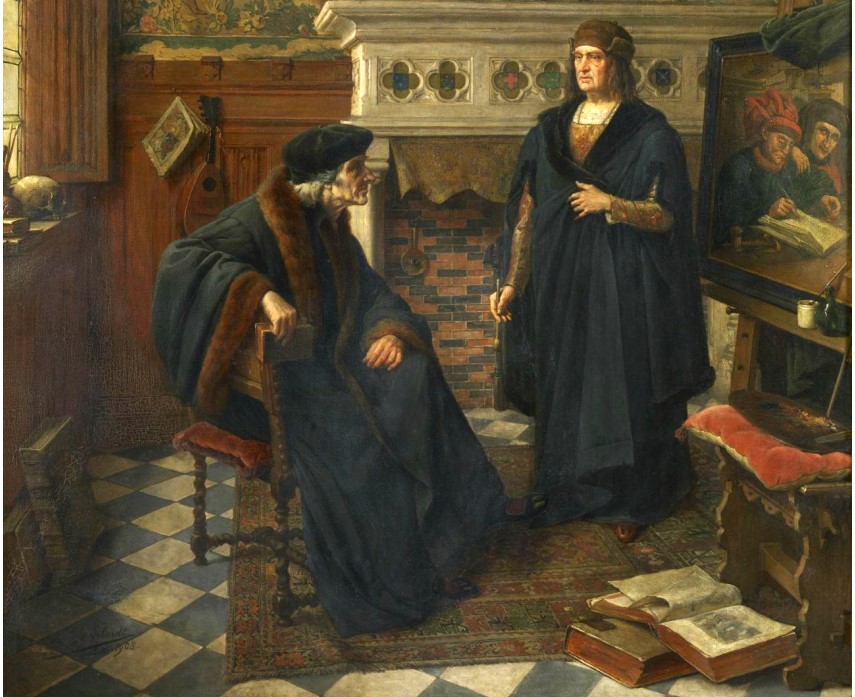
In Antwerp, Erasmus‘s influence was notable, and his presence was sought after. Well-known was his friendship to the city’s secretary Pieter Gilles 31, an Antwerp erudite humanist dearly appreciated by Thomas More 32 who integrated Gillis poems in his opus majus, Utopia. To please More, Pieter Gillis and Erasmus got their portraits done by Quinten Matsys33 to whom they offered their double portrait. Gillis house in Antwerp was also a regular meeting point for all the leading humanists of that time.

Between 1523 and 1584, 21 publishers published no fewer than 47 editions of the humanist’s works, and the rhetorician Cornelis Crul, before 1550, translated the Colloquies and other major works into Dutch.
Most rhetoricians mastered Latin and could therefore read Erasmus in the original. Some Latin schools, as documented in the case of Gouda for the year 152134, included selected writings for each grade in their curriculum. The humanist’s prestige spread throughout Europe.
Ferdinand Columbus (1488-1539), the very bibliophile son of Christopher Columbus, not only acquired a vast series of his works, but also traveled to Louvain in October 1520 to meet their author. 35
In a letter dated 1521, Hieronymus Aleander (1480-1542), the legate of Pope Leo X, warned of « elements having bad reputation » who were thriving in Antwerp. They presented themselves « as the defenders of good literature and were all from the school of our friend who became a great name [Erasmus]. » Aleander added that « He [Erasmus] has spoiled all of Flanders! » 36

De Violieren and the Guild of Saint Luke

Also in Antwerp, a Chamber of Rhetoric, De Violieren (The Gillyflowers), was officially created in 1480 within the Guild of Saint Luke, the artists’ guild dating back from 1382. 37
The rhetoricians’ motto was « Uyt ionsten versaemt » (United by affection. But « ionsten » is also close to « consten », the Flemish word for arts).
This symbiosis produced fruitful results. For most historians, De Violieren were, in a way, the literary branch of the Guild of Saint Luke.
The latter was composed of all trades related to the fine arts, including painters, sculptors, illuminators, engravers, and printers. Until 1664, the guild had its headquarters on the north side of Antwerp’s Grote Markt, in the Spaengien or Spanish House.
Between 1460 and 1560, to finance its activities, the Church rented out to artists the Onze-Lieve-Vrouwepand, a claustrum with galleries surrounding an open courtyard. In this building, art painters, sculptors, cabinetmakers and booksellers could rent a stand where they could display their wares for sale. It was the largest art fair in what was then Europe. After 1560, the market moved to the second floor of the new Handelsbeurs (Trade Exchange).
The Saint-Luke artist guild:

- In 1491, Erasmus’s friend, the painter Quinten Matsys 38, was listed as a master. One of his major commissions, the Triptych of the Lamentation of Christ, came from the carpenters’ guild. According to the Antwerp chief city archivist Van den Branden, Matsys himself was a member of De Violieren and wrote poems for their contests.
- In 1515, Matsys was joined in the Guild of Saint Luke by two other great artists equally inspired by the spirit of Erasmus, Joachim Patinir (1480-1524) and Gerard David (1460-1523).
- In 1519, the guild registers (The Liggeren 39) mention the registration of Jan Sanders van Hemessen (1500-1566), whose daughter Catharina (1528-1565) would become the first female painter in 1548 – and teacher of painting to men – to be admitted to the painters’ guild;
- In 1527, that of Pieter Coecke van Aelst (1502-1550), Bruegel’s master;
- in 1531, those of Matsys’s two children, Jan and Cornelis;
- in 1540, that of Peter Baltens (1527-1584);
- in 1545, that of the engraver and printer Hieronymous Cock (1510-1570) whose workshop produced prints of Bruegel and Dutch revolutionary poet and translator Dirk Coornhert (1522-1590), close friend and collaborator of William the Silent (1533-1583);
- in 1550, that of the great printer Christophe Plantin (1520-1589);
- and in 1551, that of Pieter Bruegel the Elder (1525-1569). 40
In short, several of the Low Countries towering cultural personalities, assisted or certainly could have asisted at the Antwerp 1561 Landjuweel: Jan Sanders van Hemissen and his daughter Catherina; Jan and Cornelis Matsys, sons of Quinten Matsys; Peter Baltens, Hieronymous Cock, Dirk Coornehert, William the Silent, Christophe Plantin and Pieter Breugel the Elder. 41
The daily exchanges between the rhetoricians and the most important artists of the day united in the Violieren had a beneficial influence on their activities and, after a few years, made them one of the most successful societies in Brabant.

In the most important competitions, De Violieren won laurels: first prize in 1493 in Brussels, in 1515 in Mechelen and in 1539 in Ghent, in a memorable fight in which 19 chambers from different regions of the country participated.
In August 1541, a competition was held in Diest, organized by the local Chamber De Lelie in which ten other chambers from Brabant participated. The grand prize was awarded to the Antwerp Chamber, De Violieren, for the presentation of an esbattement (farce).
Antwerp, 1561
As was customary, the Chamber that won the best prize was in turn to organize a Landjuweel. This was also the opinion of De Violieren, after his feat in Diest; however, the circumstances of the time meant that the subject was postponed. 20 years passed before anyone could think of organizing such an artistic competition.
Three leaders of De Violieren, with great courage, will fully commit to the initiative, risking their reputation, honor, life and heritage:

- Anthonis van Stralen (1521-1568) was the leader of De Violieren. As a member of the Antwerp city council, Van Stralen had been closely involved in obtaining the patent. His appointment as city leader, two months before the first attempt at rapprochement with the Council of Brabant, must have been a strategic move on the part of De Violieren. In May 1561, he was promoted to mayor of Antwerp, perhaps as a reward for his services. The success of the Landjuweel was largely due to the cooperation between the Antwerp magistrate and De Violieren’s board.
- Melchior Schetz (c. 1513-1583) was the Prince of De Violieren. He was Van Stralen’s brother-in-law and also an alderman.
He was one of the three children (Gaspard, Balthasar and Melchior) of the leading Antwerp merchant Erasmus Schetz (died in 1550), known as the « banker of Erasmus ». 42 With his three sons, he set up a major banking and merchant firm. 43 His friendship with Erasmus is symptomatic of the popularity Erasmus enjoyed in Antwerp. He provided him with his hospitable residence: the Huis van Aken, a palace where he had received Charles V himself. In a letter, he made him, among other things, this tempting proposition:
« My heart and the souls of so many people long for your presence among us. I have often wondered what enchantment it was that kept you there rather than among us. Peter Gillis [city secretary and their mutual friend] gave me a reason: we do not have Burgundy wine, which best suits your temperament, do not fear this, and if this is the only obstacle holding you back, do not hesitate to come back; we will see to it that you are supplied with wine, and not only Burgundy wine, but also Persian and Indian wine if you desire and need it . »
As Prince of De Violieren, his son Melchior represented the chamber most often publicly. He must also have been responsible for the financial organization of the Chamber. Schetz was one of the largest moneylenders in Antwerp. There is no doubt that the city financially facilitated the organization of the festival. - Willem van Haecht (1530-1585) : Born into a family of painters and engravers, he was a draughtsman and, presumably, also a bookseller by profession. His motto was Behaegt Gods wille (translated as « conform to the will of God »). Van Haecht was a friend of the Brussels humanist and author Johan Baptista Houwaert (1533-1599). He compares Houwaert to Cicero in the introductory eulogy to Houwaert’s The Lusthof der Maechden, written by him and published in 1582 or 1583. In his eulogy, Van Haecht states that every sensible man should recognize that Houwaert writes with eloquence and excellence. Van Haecht wrote lyrics for various songs, usually of Christian inspiration. This is the case for the lyrics of a five-part polyphonic song, Ghelijc den dach hem baert, diet al verclaert, probably composed by Hubert Waelrant (1517-1595) for the overture to the play De Violieren at the landjuweel of 1561. The poem was also printed on a loose leaf with musical notation. As early as 1552, Van Haecht was affiliated with De Violieren, whose members included Cornelis Floris de Vriendt (1514-1575), the main architect of the Renaissance-style Town Hall in Antwerp, as well as painters Frans Floris de Vriendt (c. 1519-1570) and Maerten de Vos (1532-1603). Van Haecht became the « factor » (title poet) of De Violieren in 1558.


Other people involved in the organization of the Landjuweel included printers such as Jan de Laet (1524-1566) and renowned artists such as Hieronymus Cock (c. 1510-1570) (founder of the In de Vier Winden printing house which published Bruegel’s engravings) and Jacob Grimmer (1510-1590).
The other major figure was Peeter Baltens (1527-1584) 44 an Antwerp painter, rhetorician, engraver and publisher. Baltens was a member of the Guild of Saint Luke and De Violieren. Having partly trained Bruegel, Baltens’ role proved particularly important.
He formed close friendships (notably with the widows of both Hieronymus Cock (c. 1510-1570) and Pieter Coecke van Aelst (1502-1550), the latter also being Bruegel’s stepmother) and collaborated with the greatest names in Antwerp of his time.
He associated with Antwerp patricians such as Jonker Jan van der Noot (1539-1595), the wealthy Schetz merchant family, and wealthy merchants such as Nicolaes Jonghelinck (1517-1570), merchant banker and Bruegel’s financial backer.
According to Lode Goukens,
« Baltens was instrumental to the lobbying of a group of powerbrokers belonging to the moderate party. A moderate party that valued peace, harmony and good business more than religion, extremism or state terror. A party that wanted to return to a status quo from before the troubles. »45

Herman Pleij notes that the Rhetoricians have as consignment to repolish the reputation of the Antwerp merchant by making the distinction between the honest ones and the sharks. 46
Research into the relationships between painters, poets (or rederijkers), and merchants has shown that these three groups developed a common cultural lifestyle in the XVIth century, in which the love of science and art occupied a central place.
To launch a rhetoric competition, permission had to be obtained from the country’s government, which was no longer easily done at that time. This was a consequence of the Ghent competition of 1539, when the ideas of new doctrines against the institutions of the Catholic religion were presented and defended without the slightest qualm.
However, De Violieren and the elected representatives of Antwerp (Van Stralen and Schetz) were fiercely determined to be able to organize their Landjuweel. The man who did the most to delay obtaining authorization was the hated Cardinal Perrenot de Granvelle (1517-1582), Archbishop of Mechelen and advisor to Margaret of Parma (1522-1586), following the abdication of the Emperor, her brother Charles V, the regent of the Burgundian Low Countries.
Organization of the Landjuweel
In February 1561, the delegates of the city of Antwerp approached Granvelle with a petition to the regent, in which they argued that De Violieren, compared to the other Chambers, were statutorily obliged to organize a competition.

Granvelle hoped to torpedo the initiative, but realizing that a brutal rejection would have inflamed the opposition, he sought various pretexts to postpone the event indefinitely. He politely made it clear to the delegates that he wished to postpone such an event for a while longer, using the pretext that, thanks to the peace agreement between France and the Habsburgs, the war had just been suspended, and that such festivals represented significant expenses, while the country could not or would not bear the costs. This did little to deter the people of Antwerp. They replied that the previous year, permission had been granted to the Chamber of Vilvoorde and that a postponement could not reasonably be imagined. Sensing that they would only renounce it with immense disgust, Granvelle reluctantly agreed to present their request to Marguerite, while asserting that the government had given itself the right to levy taxes on all those who came to the competition.
Fearing above all that the festival would become a sounding board for all those criticizing the Spanish occupation and the abuses of the Church, Granvelle also summoned them to inform the participating chambers that they would not intervene in their plays, their esbattements or their poems with a single word against religion, the clergy or the government, otherwise they would not only lose the prize they might have won, but would also be punished and deprived of their privileges and rights; and that the Chamber of Antwerp should ensure that the city was well guarded during the festivities and that no disturbances could arise.

Margaret of Parma, often at odds with Madrid, was less fearful and more open.
After consulting the report provided by the Council of Brabant, which was well aware that too much repression encouraged protest, she placed the apostille on March 22, 1561, inviting the Chancellor of the Duchy to provide Antwerp with the sealed letters required to organize the Landjuweel.
These letters were issued the same day in the name of the king and granted safe conduct from fourteen days before the start until fourteen days after the end of the Landjuweel to all those who wished to attend, with the exception of
« all murderers, thieves and other criminals, as well as declared enemies of the king, rebels and those banned from the Holy Roman Empire. »47
The Antwerp Chamber submitted 24 themes as potential topics for the Landjuweel competition (seen below). Among those, Margaret of Parma approved three topics among which the Chamber was free to pick one. 48
- Does experience or learning bring more wisdom? »
- « What most leads man towards the arts? »
- « Why does a rich and greedy man desire more wealth? »
Philosophy
To show how much our rhetoricians, under the direction of Van Straelen and Schertz, dealt with philosophical and political questions of all kinds, here are the whole of the twenty-four subjects which they had submitted 49:
- What made Rome triumph?
- What caused Rome to decline the most?
- Is it experience or knowledge that brings more wisdom?
- What can lead man most towards Art?
- What feeds art?
- Why is man so desirous of temporal things?
- What shortens the days of men?
- What lengthens the days of men?
- Why is average wealth the most happiness in the world?
- What is the greatest prosperity in this world ?
- What is the biggest setback in this world?
- How is it that all things are consumed every day?
- If a miserly man can be discouraged?
- Why does a rich miser desires even more wealth?
- Why does wealth not extinguish greed?
- Why is amusement followed by displeasure?
- Why does lust breed remorse?
- Why does lust bring its own punishment?
- How did the Romans achieve such a great prosperity?
- What sort of government kept the Romans prosperous ?
- What art is most necessary for a city?
- What can bring the world more rest [peace] ?
- What most drives people to worldly pride?
- What would be the best way to eradicate usery?
At first glance, one could say that by choosing the question « What can lead man most towards Art? »50, Van Stralen and Schetz choose the least « political » subject. This is to misunderstand Erasmus and Platonic thought for whom beauty and goodness form a unity and for whom any government that does not promote beauty, neglects it or worse still, despises it, condemns itself to failure! In practice, poets starting from this higher principle, ended blasting, without explicitly naming them, all the criminals and warmongereres of those days.
Moreover, Willem van Haecht, the « factor » (official poet) of De Violieren, in the play he composed especially for the Landjuweel of Antwerp in 1561, would say that what led Empires to their decline was, as it still is today, their lack of esteem for the Arts, including obviously Rhetoric.
So, it was on this theme that the 5000 participants (!) of the Landjuweel, and beyond a large part of the country, began to reflect, to compose songs, dramas, refrains, allegories, rebuses, pintings and farces and presented them to thousands of fellow citizens.
Amazingly, two centuries before (!) Friedrich Schiller, the German poet that earned the name of « poet of freedom » and who inspired many revolutions at the end of the XVIIIth century, a humanist elite enlightened by Erasmus in the Low Countries led a substantial part of the country to rise up to the conditions of a durable peace by emancipating itself from serfdom and ignorance through moral beauty! The Antwerp Landjuweel of 1561 was much more than a feast, it was a shift of paradigm and a real game changer. Hats off!
After receiving permission, the Chamber of Rhetoric and the City Council immediately set about giving the great literary festival as much pomp as possible. A rhymed invitation card was drawn up, stating the subject of the competition and the prizes to be won.

On April 23, this invitation card was presented by Mayor Nicolaas Rockox, in the presence of Melchior Schetz and Anthonis van Stralen, at the Antwerp City Hall to four sworn messengers, who were instructed to convey it to all the Chambers of Rhetoric in Brabant and to invite them to the Landjuweel as well. These messengers traveled at the city’s expense and first went to Leuven, the oldest city in Brabant. Everywhere, the news of a Landjuweel in Antwerp was greeted with extraordinary joy, and the messengers were very generously received.
While in most cities of Brabant the rhetoricians were busy composing and teaching plays and poems, making triumphal chariots and painting coats of arms, in Antwerp they were not inactive.
De Violieren had beautiful new clothes made for its members, at the suggestion of Melchior Schetz, for the welcoming ceremony offered to the participants.

An elegant theatre stage was erected on Antwerp’s Grote Markt (Great Square), designed by Cornelis Floris. Coincidentally, it was installed on the exact spot where the Inquisition had been beheading « heretics. » The audience watched the performances standing, with the exception of the jury and high-ranking officials, for whom benches were provided.
There was excitement and liveliness everywhere; every citizen wanted to do their part to welcome the foreign guests with all possible pomp and wealth. The city council, for its part, had taken the necessary measures.
All residents of the streets where the rhetoricians were to pass were ordered to clear the streets and remove any scaffolding or obstacles that might hinder their passage.
Everyone was eagerly awaiting August 3rd, the day when the formal entry would take place and the Landjuweel games would begin.
A memorable day

August 3, 1561, is indeed a memorable day in the history of Antwerp. The city was dressed in its festive attire; on the facades of houses, flags, pennants, and festoons; in public places, graceful arches in the opulent Renaissance style.
It’s no secret that the people of Antwerp like to make a lot of money. But they also like to spend it lavishly! In that marvelous XVIth century, they took pleasure in displaying a splendor on such occasions that, so to speak, surpasses our imagination.


Everywhere there was joy and life. Many strangers passed through the streets; all, foreigners and locals alike, agreed to maintain the best possible order amidst this agitation and commotion. 51
At 2:00 p.m., the « brothers » of De Violieren guild gathered to ride together to the Keizerspoort to meet the participating chambers. There were 65 of them, mounted on magnificently adorned horses, in their precious uniforms. These consisted of tabards of purple silk, striped with white satin or silver cloth, white doublets striped with red, white stockings and boots, and purple hats with red, white, and purple plumes.
At the Keizerspoort, the participating foreign chambers were solemnly received. There were 14 of them, and to the sound of bugles and the cheers of the crowd, they entered Antwerp, following the Huidevetterstraat, the Eiermarkt, and the Melkmarkt to the Grote Markt in front of the City Hall (at that time under construction).

The procession was grandiose and impressive; nothing like it had ever been seen before in these parts. Without the Guild brothers on the chariots, the coat-of-arms bearers, the squires, the footmen, the trumpeters, the drummers, and other musicians on foot, the number of mounted rhetoricians from all the towns amounted to 1,393, that of the chariots to 23, and that of the other chariots to 197. 52

After weeks of competition between the large and medium-sized towns during the Landjuweel, followed an additional week of « Hagespelen, » that is, the less lavish but less expensive competitions between the townships, villages, and municipalities. The formats were so varied that by the end of the month, not a single town, village, or municipality was without a prize.

And once back in their cities, all these cultural actors, actors, singers, poets, jokers, and comical fools, energized like never before by the encounter with an entire nation, reenacted at home the piece or play that had won them a prize. To the extent that each chamber that won a prize was obliged to organize a new competition, a true effect of cultural diffusion and contamination was infused into the country.

The joy and proudness was such that the Chamber of Vilvorde did a special performance for the opening of the newly built Brussels-Willebroek canal in octobre 1561. The project for a 28 km long canal, connecting Brussels to the Scheldt (and therefore to Antwerp and the Sea) had been discussed since 1415 but it was Mary of Hungary in 1550 who kickstarted its actual construction.
The splendid Landjuweel of Antwerp impressed the spectators, among them Richard Clough53, the representative of the English financier Thomas Gresham. The merchant did not hide his admiration and was full of praise for the festivities, drawing a comparison with the entry of Philip II and Charles V into Antwerp in 1549.
He could only note that the organization of the Landjuweel was larger and the spectacle more impressive:
« the arrival of King Philip II in Antwerp, with the cost of all the rhetoricians gathered in their robes, is not comparable to what the city of Brussels has done. (…) I wish to God that some of our great and noble men of England had seen this, (…) and it would make them think that there are others like us, and thus foresee the time to come; for those who can do this, can do more. »54
Peace and art, united for celebration
On Tuesday, August 5, two days after the grand reception of the participating chambers, the visiting rhetoricians, along with the rest of the spectators, were solemnly welcomed on the Grand Place in Antwerp.
De Violieren then offer a welcoming zinnespel (morality): Den Wellecomme (The Welcome), written by Willem van Haecht. At the heart of the play is the proclaimed peace of 1559, which made possible the organization of the Landjuweel, a national gathering symbolizing the renewed awakening of the Art of Rhetoric, for which peace was a necessary condition. The duchy had suffered greatly in the 1550s, but had slowly recovered after the Peace of Cateau-Cambrésis (1559). There was hope for better times. Literary reactions to the peace were therefore particularly optimistic. The dawn of a new golden age was on everyone’s mind.
The play features three flower nymphs—sisters—who together represent De Violieren. After years of war, the Chamber was given the opportunity to organize the Landjuweel. For this, the nymphs owe a great debt of gratitude to the people of Brabant. Despite the difficult times and growing divisions between the different social groups, the people remained united.
It is « Concordia, » the feeling of unity and solidarity, that now unites the defenders of the public good. Out of love for the art of rhetoric, everyone has come from far and wide to Antwerp to celebrate the Landjuweel together. According to the nymphs, it is high time that the character of Rethorica resumes her rightful place in society. Now that the war god Mars and the hated Discordia have been driven out, she alone can bring joy and peace to the country. Only the seed of rhetoric (« Rethorices saet ») can bear fruit of joy.
So the flowers set out in search of Rethorica. In other words: De Violieren primarily describes the Landjuweel as a festival of joy, organized by the Chambers of Rhetoric to strengthen the sense of community and bonds of friendship between the region’s cities.

Eventually, the nymphs find Rhetorica, asleep in the arms of a young girl (Antwerp), who has always protected her. While the goddesses of vengeance (« Erinniae ») ravaged the country for twenty years, rhetoric was always protected and cherished in Antwerp. Now it is time to awaken her from her long winter sleep.
Once awakened, Rhetorica and the Landjuweel will mark the beginning of a period of prosperity and an awakening of the arts, for Antwerp and for the world, an allegorical theme developed by Frans Floris, the rhetorician and friend of Van Haecht, in his work The Awakening of the Arts (circa 1560).

This allegorical work commemorates the signing of the Treaty of Cateau-Cambrésis, the most important peace agreement of the war-torn 16th century.
In a landscape ravaged by war, Philip II of Spain (it was hoped) assumes the role of Apollo, represented by the bearded figure in the center. The sun god awakens the liberal arts, represented by women endowed with attributes (sculptors’ cradles, poets’ feather, musicians’ scores, cartographers’ globes, etc.). With his left hand, Philip II shows four women warding off an abject Mars, the god of war, stripped of his sword and battle trophies. The scene symbolizes a new era of cultural prosperity made possible by peace.
The play Den Wellecomme not only exudes an atmosphere of joy and euphoria, but also launches a few barbs at the oppressors. The Chambers retained a bitter aftertaste. In the preceding years, several rhetoricians had been struck by fate. The previous factor, the highly praised Jan van den Berghe (died in 1559) , had died of old age. In addition, two prominent members had fallen victim to religious persecution. The printers Frans Fraet (1505-1558) and Willem Touwaert Cassererie (c. 1478-1558) were condemned and executed in 1558, despite the vigorous protests of their guild, for printing and being found in possession of forbidden books (Dutch Bibles).

Antwerp was the Northern European centre of heterodox publishing in the first half of the sixteenth century. From Antwerp the books were shipped all over Europe. Alastair Duke, who studied the methods of the Inquisition in this period, has suggested that of four thousand books published in Europe between 1500 and 1540, half were printed in Antwerp 55 almost half of those publications contained Protestant influences. 56
These persecutions increased the central government’s distrust of the rhetoricians. These were not easy times for them. The art of rhetoric « doesn’t have many friends, » as Van Haecht puts it. 57 Although the Landjuweel was designed to celebrate peace and not to express discontent, the horror of the past war years and the resulting divisions were clearly palpable.
The contest was to be held under the banner of friendship and solidarity – not without reason the motto of De Violieren. Referring to the miracle of Pentecost, the invitation card compares the Brabant rhetoricians to the apostles, who received the Holy Spirit by gathering together in unity, without disagreement or conflict. This motif was common among rhetoricians.
Already in the poems of Anthonis de Roovere (c. 1430-1482), the Ghent plays of 1539, and in Matthijs de Castelein ‘s Const van Rhetoriken (c. 1485-1550), the rhetorician’s inspiration were compared to the religious enthusiasm of the apostles at Pentecost. Rhetoricians saw their poetry as a gift from the Holy Spirit.
This is strongly reminiscent of the discourse Erasmus presents in his Querella pacis (The Complaint for Peace, 1517). In this famous pamphlet for peace, the miracle of Pentecost is also used to emphasize the importance of unity and love in society. Only the Christian religion, according to Erasmus, had the strength to defend itself against tyranny and war. The well-being of the whole society has always taken priority over any form of personal interest.
An « invitation card » was personnaly transmitted by messagers to all the chambers in Brabant, accompanied by a woodcut (probably also designed by Willem van Haecht). The print emphasizes the importance of rhetoric in achieving peace.

Rhetoric sits enthroned in the center, her attributes being a scroll and a lily, symbols respectively of the qualities of promoting knowledge and harmonizing the art of rhetoric. On either side of Rhetoric are Prudentia (left) and Inventio (right). Prudentia —Providence—is depicted holding a mirror (insight) and a serpent (prudence) in her hands. Inventio —Invention—has the attributes of a compass and a book. These two personifications refer to the qualities of careful design and erudition. Both personifications are intended to support Rhetoric. They stand on a raised step, on which grows the violet flower. Beneath the flower, the ox of the Guild of Saint Luke supports the coat of arms of the Antwerp painters’ guild. The personifications Pax, Charitas, and Ratio come to the left of the throne to pay homage to Rhetoric.
Divine light (Lux) illuminates them. On the right, Ira, Invidia, and Discordia are pursued into a burning depth (tenebrae). The darkness of the past thus gives way to an illuminated future in which rhetoric reigns. In contrast to the text on the invitation card, here the art of rhetoric ensures peace. There was thus a constant interaction between rhetoric and peace.
In De Violieren’s « invitation » and welcome piece, peace created the conditions in which rhetoric could flourish. In the woodcut, it is precisely the art of rhetoric that drives anger, envy, and discord into the darkness, making use of its qualities of insight and invention. Its divine light creates the conditions in which peace, love, and reason can flourish.
The three positive allegories on the left of the Rhetoric are deliberately contrasted with the three figures on its right. Ratio is placed against Ira, Charitas against Invidia, and Pax against Discordia. In his design, Van Haecht chose discord (Discordia) rather than war (Bellum) as the opposite of peace (Pax).
The concept of peace was deeply rooted in the urban community’s value system. In this discourse, peace, along with justice, order, and community spirit, constituted one of the pillars of internal social cohesion. Peace protected the city from the outside world and maintained balance between the different urban segments, particularly through the exercise of cohesion and solidarity. Moreover, peace, both spiritual and material, brought well-being and prosperity. But this could only be achieved if all urban groups worked together in unison.
Discord, whether between guilds, between sections of the urban patriciate, between rich and poor, or between religious factions, posed the greatest threat to internal peace and was to be avoided above all else. 58
The urban discourse on peace followed the idea that God had created the world as a harmonious, orderly, and perfect whole. Discordia personified the breakdown of this creation, of the relationship between God and man, and that between man and nature.
Discord also disrupted the balance between city dwellers, between city and countryside, and between the prince and his subjects. Furthermore, it caused unrest in the human spirit. This concept implied an individual loss of self-control and reason.
Vandommele writes that according to them,
« Every human being is made up of the union of body and soul, which are only in balance when all parts work together harmoniously. Rhetoricians believed their poetry could contribute to this. » 59
Along with music, poetry was, in their eyes, of celestial origin. Both used the theory of harmony to reflect the order of the cosmos and were also used to communicate with God. Moreover, the word « discord » in the literature of the rhetoricians also refers to a lack of harmony in verse and rhyme, an unforgivable offense in poetry.
For all these reasons, discord was considered the main cause of unhappiness. It had to be banished to the depths of hell at all costs. Rhetoricians, thanks to their mastery of poetry and rhetoric, were the ones who could achieve this. They assumed the role of guardians of the peace, responsible for urban sociability.
The Antwerp Landjuweel of 1561, a gigantic cultural mass event recalling the noblest human qualities that unite the good and the beautiful, was a true « cry of the people, » somewhat similar to what France would later experience with the Fête de la Fédération60 before the French Revolution.
At the Landjuweel, enlightened artisans and artists called on the governments of the world to renounce usury, plunder, and war and to organize a lasting peace based on the harmony of mutually beneficial interests.

Censorship, repression and revolt
From 1521, decrees repressed the reading and possession of forbidden books, both Lutheran writings and Bibles. In 1525, the Antwerp judiciary warned printers and booksellers. From 1528, Rhetoricians were required to have their works validated before any production or publication. In 1533, the reform gained ground. Not a day went by without a satirical joust against the clergy. Five rhetoricians from Amsterdam were sentenced to make a pilgrimage to Rome at their own expense. In 1536, a printer who had violated the regulations was beheaded at Antwerp’s Grote Markt. Without a prior permit, the Chambers of Rhetoric could no longer present plays in public. This didn’t prevent the Landjuweel in Ghent in 1939, where freedom prevailed. On October 6 of the same year, the Chancellor of Brabant wrote to the Regent that the sale of the printed collection of plays could have very serious consequences. Consequently, the collection was placed on the index of prohibited books. In 1559, two years before the Landjuweel, Erasmus’ In Praise of Folly and Colloquia were put on the index of forbidden books where they remained till 1900.
A decree also stipulated that it was henceforth forbidden to make references to the Holy Scriptures and the sacraments. The ban on the sale of the collections provoked a counter-reaction and attracted many readers. These works were reprinted three times, the last edition being in 1564, two years before the outbreak of the Beeldenstorm (Iconoclastic Fury). 61
In 1566, the paintings and sculptures in churches and monasteries, relics, and everything associated with the cult of images, were broken and destroyed by the Calvinists, the most radical branch of the Protestants. Immediately suspected of being responsible for this destruction: the erasmian spirited Chambers of Rhetoric!
With the arrival of the Duke of Alva in the Burgundian Low Countries in 1567, the relatively tolerant religious climate was replaced by persecution of those who no longer adhered to the Catholic faith.
Anthonis van Stralen, the masthead of De Violieren, and as we have seen, one of the main organizers of the Antwerp Landjuweel, and a personal friend of William the Silent, went into exile in Germany. But on September 9, on the orders of the Duke of Alva, he got intercepted by Count Lodron between Antwerp and Lier. On September 25 he was transferred to the Brussels Treurenberg prison. In February 1568, he was transferred to Vilvoorde Castle to appear before the new Council of Troubles.

After being tortured, his property was confiscated, and he was sentenced to death by the sword. The sentence was carried out at Vilvoorde Castle on September 24, 1568. 62
This decision sparked great indignation in Antwerp. Many important merchants and citizens left the city permanently.
The plays of the Antwerp Landjuweel of 1561, including those by Willem Van Haecht, which exuded the spirit of Erasmus, were banned. Their performance on 21 June 1565, which was well received by the public, is said to have made the clergy grind their teeth, according to Godevaert van Haecht, a close relative of the author.
Van Haecht fled to Aachen, and then to the northern Burgundian Low Countries. His poem Hoe salich zijn die landen, written for De Violieren, was set to music by Jacob Florius and was included in the Geuzenliedboek, a collection of songs by those who revolted against Spanish rule in the Burgundian Low Countries.
Then broke out the Spanish Fury, a number of violent sackings of cities (Mechelen, Antwerp, Naarden, etc.) of the Burgundian Low Countries. The main cause was Philip II’s delay in paying soldiers and mercenaries. Spain had just declared bankruptcy. The bankers refused to carry out the transactions demanded of them by the King of Spain until they had found a compromise. For example, the transfer of troops’ wages from Spain could not be carried out by bill of exchange (the 16th century equivalent of a postal order). The Spanish government therefore had to transfer the real money by sea – a much more costly, slow and perilous operation. Unfortunately for Philip, 400,000 florins intended to pay the troops were seized by the English government of Elizabeth I when ships containing the florins were sheltered from a storm in English ports. 63
The most notorious Spanish Fury was the three-day long sack and burning of Antwerp in November 1576. At least 7,000 lives and a great deal of property were lost. The deaths were assessed at 17,000 by an English writer who was a witness.

Soon after, under the leadership of the great Erasmian William the Silent, supported by the Chambers of Rhetoric, the entire nation rose up against oppression and in favor of a Republic.
The Plakkaat van Verlatinghe (translated as the Act of Abjuration), signed on July 26, 1581, is considered the « declaration of independence » of many of the provinces of the Low Countries who considered that the King had betrayed his obligations towards his own people.
It was written by the Antwerp lawmaker and Registrar Jan van Asseliers (1530-1587), a close friend of Melchior Schetz and other key organizers of the Antwerp 1561 Landjuweel. 64 It was printed in Leyden by Charles Silvius, the son of Willem Silvius (1521-1580) 65 , the Antwerp humanist that printed and published the full proceedings of the same Landjuweel. 66
It was only after 80 years of war (1568-1648), at the Treaty of Westphalia, that the Republic of the Netherlands was recognized, leaving the south under Habsburg control.
Educated citizens went into exile. Between 150,000 and 200,000 refugees settled in the United Provinces and Germany. Cities such as Frankfurt, Hamburg, London and Amsterdam owed their prosperity to the arrival of refugees from the Southern Low Countries. After 1581, the Spanish authorities made no attempt to prevent these departures, which were in line with their desire to empty the country of its Protestant inhabitants. 67
Selected biography
(chronological order)
- CLOUGH, Richard, Brief over het Landjuweel van 1561, DBNL;
- SILVIUS, Willem, Spelen van sinne vol scoone moralisacien uutleggingen ende bediedenissen op alle loeflijcke consten … Ghespeelt … binnen der stadt van Andtwerpen op dLant-juweel … den derden dach augusti … M.D.LXI., Erfgoedbibliotheek Hendrik Conscience, Antwerpen, 1562;
- CAPPELLE, Johannes Pieter van, Anthonis van Stralen. National Library of the Netherlands (original from the University of Amsterdam), 1827;
- DE BAECKER, Louis, Les Flamands de France, Messager des sciences historiques et archives des arts de Belgique, Gand, Vanderhaeghen, 1850;
- GRAPHEUS, Abraham, STRALEN, Anthonis van, EVEN, Edward van, Het Landjuweel van Antwerpen in 1561, Eene verhandeling Over Dezen Beroemden Wedstrijd Tusschen De Rederijkerskamers van Braband, Bewerkt naar Eventijdige Oorkonden En Versierd met 35 platen, naar tekeningen van Frans Floris en andere meesters, CJ Fontayn, Leuven, 1861;
- SCHILLER, Friedrich, Histoire de la révolte qui détacha les Pays-Bas de la domination espagnole ; traduction française, par Adolphe Regnier, Hachette, 1883;
- CLAES, Henri, Het Landjuweel van Antwerpen in 1561, De Vlaamsche Kunstbode, 1890;
- ROOSES, Max, De feesten van het Landjuweel in 1892, De Vlaamse School, Nieuwe Reeks, jaargang 5, 1892;
- COSEMANS, Dr. A. , Antoon Van Stralen, Burgemeester van Antwerpen; Commissaris der Staten-Generaal bij den aanvang der regeering van Philips II (1521-1568), Verslagen en mededelingen van de Koninklijke Vlaamse Academie voor Taal- en Letterkunde, 1933;
- RANKE, Bert, Rederijkers in de Branding , Uitgeverij AJG Strengholt, Amsterdam, 1942;
- STEENBERGEN, Dr. G. Jo, Het Landjuweel van de rederijkers, Davidsfonds, Leuven, 1950;
- MULS, Josef, Erasmus en Quinten Matsijs, Standaard Boekhandel, 1953;
- GELDER, Dr. H. A. Enno van, Erasmus, schilders en rederijkers, P. Noordhoff N.V., Groningen, 1959;
- ISRAEL, N., De Liggeren en andere historische archieven der Antwerpsche Sint Lucasgilde, Amsterdam, 1961;
- KRUYSKAMP, Dr. C. , Het Antwerpse Landjuweel van 1561, De Nederlandse Boekhandel, Antwerpen, 1962;
- DEGROOTE, Dr. Gilbert, In Erasmus’ Lichtkring, Koninklijke Nederlandse Maatschappij, 1962;
- DEGROOTE, Dr. Gilbert, ‘Zotheid’ bij Erasmus en rederijkers, Dietse Warande en Belfort, 1974;
- VOET, Léon, De gouden eeuw van Antwerpen, Mercatorfonds, Antwerp, 1976;
- GIBSON, Walter S. , Artists and Rederijkers in the Age of Bruegel, The Art Bulletin, 63/3, 1981;
- DERVILLE, Alain, L’alphabétisation du peuple à la fin du Moyen Age, La Revue du Nord, 1984;
- ISACKER, Karel van, UYTEVEN, Raymond van, Antwerpen, twaalf eeuwen geschiedenis en culture, Mercatorfonds, Mercatorfonds, Antwerpen, 1986;
- GODIN, André. Érasme et son banquier. In: Revue d’histoire moderne et contemporaine, tome 34 N°4, pp. 529-552, Octobre-décembre 1987;
- COIGNEAU, Dirk, COCKX-INDESTEGE, Elly, WATERSCHOOT, Werner, DE SCHEPPER, Marcus, PECKSTADT, Ann, WATTEEUW, Lieve, Uyt Ionsten Versaemt, Het Landjuweel van 1561 te Antwerpen, Bibliothèque royale Albert Ier, Bruxelles, 1994 ;
- HÜSKEN, Wim, ‘Elck om het costelycxte’: het Antwerps Landjuweel van 1561, Queeste, 1995;
- STOUTEN, Hanna, GOEDGEBUURE, Jaap, VERBIJ-SCHILLINGS, Jeanne, Histoire de la littérature néerlandaise (Pays-Bas et Flandres), Fayard, Paris, 1999;
- VANDEN BRANDEN, Jean-Pierre, Erasme, sur les traces d’un humaniste, Editions Labor, Bruxelles, 2000.
- PLEIJ, Herman, Het gevleugelde woord. Geschiedenis van de Nederlandse literatuur 1400-1560, Uitgeverij Bert Bakker, Amsterdam, 2007;
- PLEIJ, Herman, De eeuw van de zotheid. Over de nar als maatschappelijke houvast in de vroegmoderne tijd, Uitgeverij Bert Bakker, Amsterdam, 2007;
- BRUAENE, Anne-Laure van, Om beters wille Rederijkerskamers en de stedelijke cultuur in de Zuidelijke Nederlanden (1400-1650), Amsterdam University Press, 2008;
- Open Universiteit Nederland, Orientatiecursus cultuurwetenschappen, Van Bourgondische Nederlanden tot Republiek, Deel 2, 2009;
- VANDOMMELE, Jeroen, Als in een spiegel, Vrede, kennis en gemeenschap op het Antwerpse Landjuweel van 1561, Uitgeverij Verloren, Hilversum, 2011;
- CHRISTMAN, Victoria, The Coverture of Widowhood: Heterodox Female Publishers in Antwerp, 1530-1580. The Sixteenth Century Journal, 2011;
- DIXHOORN, Arjan van, Monumentalizering van een festival. Het Antwerpse landjuweel van 1561 als historische gebeurtenis. Jaarboek de Fonteine (2011-2012), 15-42. ;
- PUTTEVILS, Jeroen, The Ascent of Merchants from the Southern Low Countries, From Antwerp to Europe 1480-1585, Dissertation for the Degree of Doctor in History, Faculty of Arts, History Department, University of Antwerp, 2012 ;
- REMCO, Sleiderink, De schandaleuze spelen van 1559 en de leden van De Corenbloem. Het socioprofessionele, literaire en religieuze profiel van de Brusselse rederijkerskamer, Belgian Review of Philology and History, volume 92, fascic. 3, 2014. Modern languages and literatures, pp. 847-875;
- MEGANCK, Tine Luk, Pieter Bruegel The Elder, Fall of the Rebel Angels, Art, Knowledge and Politics on the Eve of the Dutch Revolt, SilvanaEditoriale, Milano, 2014;
- LAMPO, Jan, Blog over literatuur, geschiedenis en Antwerpen;
- GOUKENS, Lode, Peeter Baltens, een “grafisch diplomaat” tijdens de troebelen (Antwerpen 1572-1584), VUB, 2018;
- NIJENHUIS, Andreas, Les Pays-Bas au prisme des Réformes (1500-1650), L’Europe en conflits, p. 101-136, Presses universitaires de Rennes, 2019;
- BRUAENE, Anne-Laure van, A Counterfeit Community. Rederijkers, Festive Culture and Print in Renaissance Antwerp, Antwerp in the Renaissance, Brepols, 2020.
- SOLY, Hugo, Capital at Work in Antwerp’s Golden Age, Studies in European Urban History (SEUH)(1100-1800), Volume 55, Ghent University, Brepols, 2021;
- PYE, Mychael, Europe’s Babylon: The Rise and Fall of Antwerp’s Golden Age, Pegasus Books, 2021.
NOTES:
- Karel Vereycken, How Erasmus folly saved our civilization, Schiller Institute; ↩︎
- Literacy rates were above 15% in Venice and Florence. However, they were not 70% as claimed by Ross King in his book The Bookseller of Florence. King cites two separate sources. On Florentine literacy Robert Black’s article Literacy in Florence, 1427, in Peterson and Bornstein (eds), Florence and Beyond: Culture, Society and Politics in Renaissance Italy… as well as the first chapter of Black’s Education and Society in Florentine Tuscany (both of which cover the same material). For the general literacy estimate, King cites R. C. Allen, Progress and Poverty in Early Modern Europe, Economic History Review 56 (2003), p. 415. Here we find an urban literacy rate of 23% given, which is itself based centrally on the estimate for Venice in 1587 from Paul Grendler, Schooling in Renaissance Italy: Literacy and Learning, 1300-1600. King misleads the reader in the way he presents this data. He claims that seven in ten Florentine adults could read and write, but the basis for his number (Black) is exclusively addressing male literacy (specifically adult and able-bodied male heads of household). By contrast, King’s figure of less than 25% (for other european cities) is an estimate of male and female literacy combined. (The actual numbers given by Grendler are 33% male literacy and 12-13% female literacy.) One must note that Grendler’s numbers are based on his estimates of schooling. Specifically, in 1587 Venice recorded a profession of faith for every teacher (256 in total) in the Republic, which provide information about things like the number of students they taught. On this basis Grendler estimates the number of students in formal education at around 4625. (4595 boys and 30 girls, i.e. 26% and 0.2% of the respective populations.) Gendler adds to this figure that of informal schooling or tutoring, whose number is estimated on the assumption that the majority of nobles and citizens (9.4% of the population) would have either educated their daughters or sent them to a convent. (This appears to be the estimates of 2% informal tutoring and 3-4% boarding convents for girls are coming from, though these specific numbers aren’t spelled out in the text.) Finally there are also Schools of Christian Doctrine (functionally sunday school), for which, on the basis of numbers from other cities, Grendler estimates an enrolment of around 2000 boys and 3000 girls, out of which Grendler guestimates that maybe 1000 of each (i.e. 6% of boys and 7% of girls) would have achieved rudimentary literacy. So here is the basis for the 33% (male) and 12-13% (female) estimates. ↩︎
- Alain Derville, L’alphabétisation du peuple à la fin du Moyen Age, La Revue du Nord, 1984. ↩︎
- Alain Derville, Op. cit. ↩︎
- Hanna Stouten, Jaap Goedgebuure, Jeanne Verbij-Schillings, History of Dutch Literature (Netherlands and Flanders), Fayard, Paris, 1999. ↩︎
- İ. Semih Akçomak, Dinand Webbink, Bas ter Weel, Why Did the Netherlands Develop so Early? The Legacy of the Brethren of the Common Life, IZA DP No. 7167, Forschungsinstitut zur Zukunft der Arbeit Institute for the Study of Labor (IZA), 2013; ↩︎
- Open Universiteit Nederland, Orientatiecursus cultuurwetenschappen, Van Bourgondische Nederlanden tot Republiek, Deel 2, 2009. ↩︎
- Mychael Pye, La Babylone d’Europe, Anvers, les années de gloire, Editions Nevetica, Brussels, 2024, p. 21. ↩︎
- Mychael Pye, Ibid, p. 33. ↩︎
- Cipolla, C., Literacy and Development in the West, Penguin Books: London, 1969, p. 47 ↩︎
- Michael Pye, Ibid., p. 105; ↩︎
- Parker, G., The Dutch Revolt, Cornell University Press: Ithaca, NY., notes of Philip’s visit to the Low Countries in 1549, 1977, p. 21. ↩︎
- Michale Pye, Ibid., p. 124; ↩︎
- Leen Huet, quoted in Pieter Bruegel, la biographie, CFC Editions, Brussels, 2021, p. 55; ↩︎
- Jeroen Vandommele, Als in een spiegel, Vrede, kennis en gemeenschap op het Antwerpse Landjuweel van 1561, Uitgeverij Verloren, Hilversum, 2011. ↩︎
- Sleiderink Remco, De schandaleuze spelen van 1559 en de leden van De Corenbloem. Het socioprofessionele, literaire en religieuze profiel van de Brusselse rederijkerskamer, Belgian Review of Philology and History, volume 92, fascic. 3, 2014. Modern languages and literatures, pp. 847-875; ↩︎
- Jeroen Vandommele, Op. cit. ↩︎
- Jeroen Vandommele, Op. cit. ↩︎
- Jeroen Vandommele, Op. cit. ↩︎
- Herman Pleij, Het gevleugelde woord. Geschiedenis van de Nederlandse literatuur 1400-1560, Bert Bakker, Amsterdam, 2007. ↩︎
- Karel Vereycken, How Jacques Cœur put an end to the Hundred Years’ War, Artkarel.com, 2018; ↩︎
- Karel Vereycken, Jacob Fugger « The Rich », father of financial fascism, Artkarel.com, 2024; ↩︎
- Karel Vereycken, Fugger, Op. cit. ↩︎
- Karel Vereycken, Fugger, Op. cit. ↩︎
- Karel Vereycken, Erasmus Dream, the Leuven Three Language College, Artkarel, 2019; ↩︎
- Karel Vereycken, Quinten Matsys and Leonardo, the dawn of an age of laughter and creativity, Artkarel, 2024; ↩︎
- Andreas Nijenhuis, Les Pays-Bas au prisme des Réformes (1500-1650), L’Europe en conflits, p. 101-136, Presses universitaires de Rennes, 2019. ↩︎
- Pierre-Yves Charles, Chercheur invité à l’Université Libre d’Amsterdam, La Réformation des Réfugiés, site internet de l’Eglise protestante unie de Belgique; ↩︎
- Pierre-Yves Charles, Op. cit. ; ↩︎
- Dr. Gilbert Degroote, In Erasmus’ Lichtkring, Koninklijke Nederlandse Maatschappij, 1962. ↩︎
- Karel Vereycken, How Erasmus folly saved our civilization, Schiller Institute; ↩︎
- Karel Vereycken, Erasmus, Op. cit. ↩︎
- Karel Vereycken, Quinten Matsys and Leonardo, the Dawn of an Age of Laughter and Creativity, Artkarel, 2024. ↩︎
- Dr. Gilbert Degroote, Op. cit. ↩︎
- Dr. Gilbert Degroote, Op. cit. ↩︎
- Dr. Gilbert Degroote, Op. cit. ↩︎
- Natacha Peeters, The painter’s apprentice in fifteenth and sixteenth century Antwerp. An analysis of the archival sources, Apprentissages, États et sociétés dans l’Europe moderne, Mélanges de l’Ecole française de Rome, 131-2, p. 221-227, 2019; ↩︎
- Karel Vereycken, Quinten Matsys and Leonardo, the dawn of an age of laughter and creativity, Artkarel, 2024; ↩︎
- N. Israel, De Liggeren en andere historische archieven der Antwerpsche Sint Lucasgilde, Amsterdam, 1961; ↩︎
- Tine Luk Meganck (Op. cit.) underscores that « Bruegel’s visual language is closely related to the poetic imaginary of the rhetoricians. Like the rhymesters, Bruegel often presented a serious message with a dash of mockery, as an inversion of the established order, as the world upside down. » ↩︎
- Leen Huet, Pieter Bruegel, la biographie, 2023; ↩︎
- André Godin. Érasme et son banquier. In: Revue d’histoire moderne et contemporaine, tome 34 N°4, pp. 529-552, Octobre-décembre 1987. ↩︎
- Hugo Soly, Capital at Work in Antwerp’s Golden Age, Studies in European Urban History (SEUH)(1100-1800), Volume 55, Ghent University, Brepols, 2021. ↩︎
- Lode Goukens, Peeter Baltens, een “grafisch diplomaat” tijdens de troebelen (Antwerpen 1572-1584), VUB, 2018; ↩︎
- Lode Goukens, Op. cit. ↩︎
- Herman Pleij, Het gevleugelde woord. Geschiedenis van de Nederlandse literatuur 1400-1560, Uitgeverij Bert Bakker, Amsterdam, 2007; ↩︎
- Dr. C. Kruyskamp, Het Antwerpse Landjuweel van 1561, De Nederlandse Boekhandel, Antwerpen, 1962. ↩︎
- Max Rooses, De feesten van het Landjuweel in 1892, De Vlaamse School, Nieuwe Reeks, jaargang 5, 1892; ↩︎
- Henri Claes, Het Landjuweel van Antwerpen in 1561, De Vlaamsche Kunstbode, 1890; ↩︎
- Arjan van Dixhoorn (Op. cit.), building on Vandommele, argues that the word « Art » (consten) refers here to the 7 liberal arts and mechanical arts and not the « higher » arts. That is unconvincing since the leitmotiv of the entire Landjuweel, as Vandommele himself keenly demonstrates, was that it was the harmony of poetry and music, a gift from heaven, that was the only viable basis for durable peace and concord. The Awakening of the Arts is in fact the theme of a painting by Frans Floris in 1560, an influential painter and an intellectual belonging to the Landjuweel organizers. Among Floris’s dormant arts are music, sculpture, cartography and other « higher » arts. ↩︎
- Abraham Grapheus, Anthonis van Stralen, Edward van Even, Het Landjuweel van Antwerpen in 1561, Eene verhandeling Over Dezen Beroemden Wedstrijd Tusschen De Rederijkerskamers van Braband, Bewerkt naar Eventijdige Oorkonden En Versierd met 35 platen, naar tekeningen van Frans Floris en andere meesters, CJ Fontayn, Leuven, 1861; ↩︎
- Abraham Grapheus, Anthonis van Stralen, Edward van Even, Op. cit.; ↩︎
- Richard Clough, Brief over het Landjuweel van 1561, DBNL; ↩︎
- Richard Clough, Op. cit.; ↩︎
- Alastair C. Duke, Dissident Identities in the Early Modern Low Countries, ed. Judith Pollmann and Andrew Spicer, Aldershot, Ashgate, 2009; ↩︎
- Victoria Christman, The Coverture of Widowhood: Heterodox Female Publishers in Antwerp, 1530-1580. The Sixteenth Century Journal, 2011; ↩︎
- Jeroen Vandommele, Op. cit. ↩︎
- Jeroen Vandommele, Op. cit. ↩︎
- Jeroen Vandommele, Op. cit. ↩︎
- The Festival of the Federation (Fête de la Fédération) was a celebration that occurred on the Champ de Mars on 14 July 1790, the first anniversary of the Storming of the Bastille. With over 300,000 people in attendance, the event honored the achievements of the French Revolution (1789-99) and the unity of the French people. The festival itself was a monumental accomplishment, as tens of thousands of French citizens volunteered to labor in the mud and rain to build an amphitheater on the Champ de Mars with a colossal Altar of the Fatherland at its center. The event marked the birth of French patriotism, at least in the sense that such a term is understood today, and was the first celebration of 14 July, France’s national holiday, which is still annually celebrated. At the same time, the festival was the high watermark of unity during the French Revolution itself, since afterward the revolutionaries devolved into factionalism and politics based on terror. ↩︎
- Louis de Baecker, Les Flamands de France, Messager des sciences historiques et archives des arts de Belgique, Gand, Vanderhaeghen, 1850, p. 181; ↩︎
- Johannes Pieter van Cappelle, Anthonis van Stralen. National Library of the Netherlands (original from the University of Amsterdam), 1827; ↩︎
- Le sac d’Anvers, connu comme la Furie Espagnole, Gifex.com ; ↩︎
- P. Génard, Jean van Asseliers, Biographie nationale de Belgique, Wikisource. ↩︎
- Portail Biblissima, Willem Silvius (1521-1580). ↩︎
- Willem Silvius, Spelen van sinne vol scoone moralisacien uutleggingen ende bediedenissen op alle loeflijcke consten … Ghespeelt … binnen der stadt van Andtwerpen op dLant-juweel … den derden dach augusti … M.D.LXI., Erfgoedbibliotheek Hendrik Conscience, Antwerpen, 1562; ↩︎
- Pierre-Yves Charles, Op. cit. ↩︎
Quinten Matsys en Da Vinci – Dageraad van louterend gelach en creativiteit

DEZE TEKST
en français
in English
in Russian (pdf)

Inhoud
Inleiding
A. Culturele en filosofische kwesties van een context
- Cynische grappen of socratische dialogen?
- Wat is « Christelijk humanisme?«
- Petrarca en de “Triomf van de Dood«
- Dageraad van louterend gelach
- Sebastian Brant, Jheronimus Bosch en Het Narrenschip
- Rederijkers en Landjuweel
B. Quinten Matsys
- Biografische elementen
- Van smid tot schilder
- Hertogdom Brabant
- Opleiding: Bouts, Memling en/of Van der Goes?
- Debuten in Antwerpen en in het buitenland
C. Enkele werken, analyses en interpretaties
- De Maagd en het Kind, Gratie Gods en Vrije Wilskeuze
- Het altaarstuk van Sint-Anna
- Een nieuw perspectief
- Samenwerking met Joachim Patinir en Albrecht Dürer
- In de ban van Erasmus
- Utopia en Thomas More
- Pieter Gillis en het « Tweeluik der vriendschap«
- De « Da Vinci-connection » (I)
D. Erasmiaanse kunst van het groteske
- In religieuze schilderijen
- Bankiers, tollenaars en woekeraars
- De da Vinci-connection (II)
- De kunst van het groteske per se
- De metafoor van « Het ongepast koppel«
- Matsys, Da Vinci, wie schilderde de « De groteske oude vrouw »?
- Hans Liefrinck en Hieronymus Cock
- Dood gaan van het lachen, Zeuxis, Matsys en Rembrandt
E. Slotbeschouwing
Bibliografie
Begin 16e eeuw vestigde Quentin Matsys (1466-1530) 1 zich als een vooraanstaand schilder in Antwerpen. Hij werkte er meer dan 20 jaar. Via het werk van Matsys beïnvloedde Erasmus een hele generatie kunstenaars. Bidden en lachen waren de twee kanten van dezelfde munt, die van de « Filosofie van Christus. » Matsys schilderde diepreligieuze drieluiken, verbazingwekkend gedetailleerde portretten en enkele van de meest hilarische satirische werken uit de geschiedenis van de schilderkunst.
Matsys blijft een grote naam, maar zijn werk is bijna vergeten. Om deze grote kunstenaar recht te doen, zullen we hier zijn enthousiasme en zijn Erasmiaanse geest doorlichten. Ook bespreken we enkele van zijn meest originele artistieke bijdragen.

In 1550 was Antwerpen 2 met bijna 100.000 inwoners de grootste stad van het Westen. In het Oosten had Istanboel er al 200.000 in 1500…
Antwerpen was een belangrijke havenstad en het kloppend hart van een bloeiende internationale handel die op het einde van de 15de eeuw het oude Brugge 3 van de Medici overtrof. Antwerpen was een trekpleister voor talenten uit vele streken en landen. 4
Het was in die economische en culturele smeltkroes dat Quinten Matsys meerdere van de briljantste christelijke humanisten van zijn tijd kon ontmoeten, of het nu ging om geleerden en vredesactivisten als Erasmus van Rotterdam 5, Thomas More 6 en Pieter Gillis 7, innovatieve drukkers als Dirk Martens 8 van Aalst, hervormers als Gerard Geldenhouwer 9 en Cornelius Grapheus 10, Vlaamse kunstschilders als Gerard David 11 en Joachim Patinir 12 of buitenlandse schilder-graveurs en boekverluchters als Albrecht Dürer 13, Lucas van Leyden 14 en Hans Holbein de Jongere 15. Antwerpen was the place to be!
Boeken over Quinten Matsys en zijn milieu zijn vandaag moeilijk te vinden en meestal duur. De grote internationale uitgeversbedrijven, om tot zover onbekende redenen, schijnen hem tot eeuwige vergetelheid te hebben veroordeeld. Soms verschijnt zijn naam, maar slechts sporadisch en in de marge en dan nog alleen wanneer er sprake is van het « manierisme » van de « Antwerpse School » 16
Erger nog, er wordt niet naar zijn werken verwezen en zijn naam wordt slechts twee keer vermeld in L’art flamand et hollandais, le siècles des primitifs (1380-1520), een referentienaslagwerk over deze periode. 17
Het goede nieuws is dat het Interdisciplinair Centrum voor Kunst en Wetenschap in Gent, 18 België, sinds 2007 sleutelt aan een nieuwe « Catalogue raisonné » van zijn werk. Maar dat is nog even wachten.
De laatste uitgave van het volledig werk, verzorgd door de Amerikaanse kunsthistoricus Larry Silver, dateert van 1984 19 en wordt vandaag voor hoge prijzen op Amazon aan de man gebracht.
Er bestaat nog de mooie, zeldzame monografie van Andrée de Bosque 20, waarvan helaas de meeste afbeeldingen in zwart-wit zijn. Als troostprijs hebben de lezers nog het proefschrift 21 van Harald Brising uit 1908, herdrukt in 2019.
Om Quinten Matsys te eren en recht te doen, zullen we hier proberen een aantal vragen te beantwoorden die tot nu toe onbeantwoord zijn.
In hoeverre was het werk van Erasmus een directe inspiratiebron voor Matsys, Patinir en hun omgeving? Wat weten we over de uitwisselingen tussen deze kring in Antwerpen en vooraanstaande renaissancekunstenaars als Leonardo da Vinci en Albrecht Dürer? Welke invloed had de Erasmiaanse kunstenaar op zijn buitenlandse correspondenten?
Dit onderwerp roept meteen vragen op, aangezien Erasmus niet echt een liefhebber was van de « religieuze schilderkunst » van zijn eeuw. Hij gaf de voorkeur aan daadwerkelijke inzet en handelingen voor het algemeen belang, boven passieve bewondering en onderwerping aan religieuze rituelen en heiligenbeeldjes.
Zoals de Belgische kunstcriticus Georges Marlier (1898-1968) 22 in zijn gedocumenteerd boek benadrukt, was Erasmus geen amateur van kerkpropaganda, maar als een werk een authentiek gevoel van geloof, liefde en tederheid opriep, bracht hij daar eerbied voor op. Voor onze humanist was de innerlijke strijd van de mens veel belangrijker, gezien
« de ware navolging van Christus en zijn lijden bestaat in het uitdoven van de impulsen die tegenstrijdig zijn met de rede, en niet in het bewenen van Christus als een zielig object. » 23
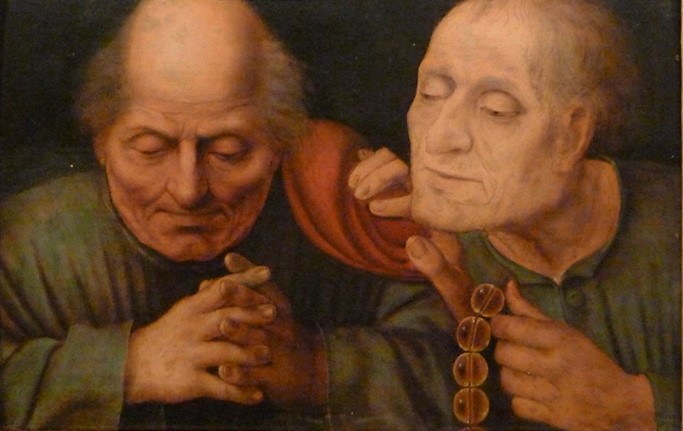
Dankzij eerder onderzoek naar de Italiaanse Renaissance, het levenswerk van Erasmus 24 en de kunst van Dürer 25 hebben we ons verdiept in de tijd van Matsys. We kunnen daar niet hier uitgebreid op terugkomen, maar het biedt ons wel een sterke basis om de buitengewone waarde van deze kunstenaar in te schatten.
A. Culturele en filosofische kwesties van een context
1. Cynische grappen of socratische dialogen?
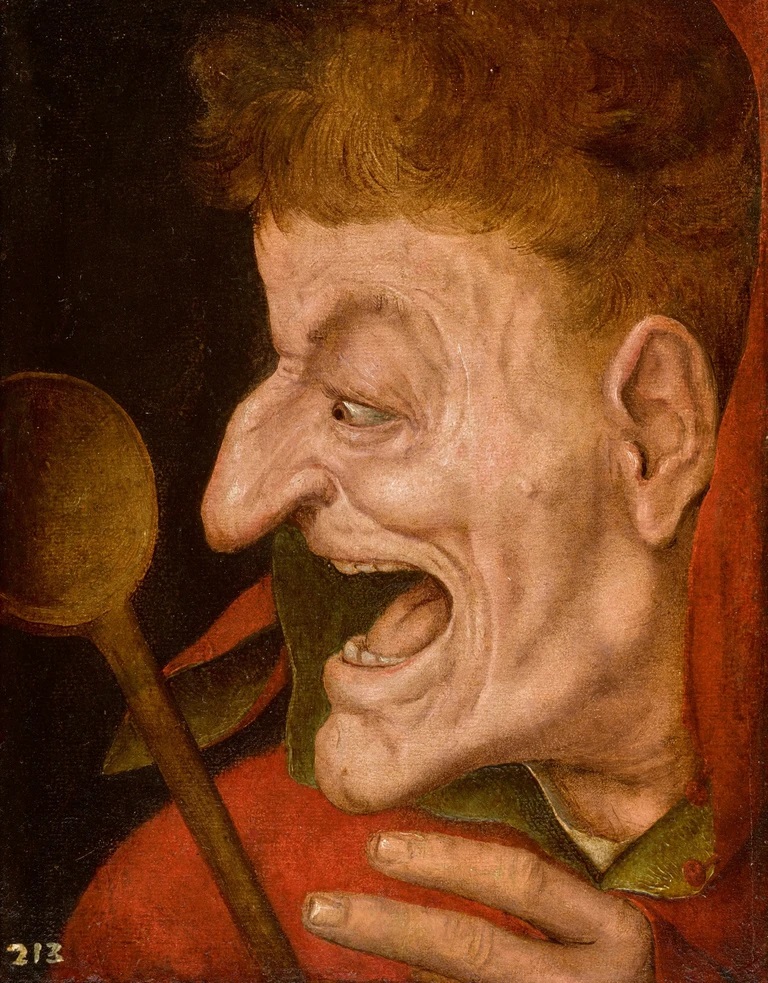
Voor de huidige « trash-cultuur », gebaseerd op emotionele effecten in een soort gevangenis van grenzeloos pessimisme, is het erg moeilijk om de culturele verfijndheid van een Matsys ten volle te waarderen.
Wat ontbreekt, is de morele en intellectuele integriteit die nodig is om de grappen, 26 ironie en metaforen 27 te begrijpen die de essentie vormden van het culturele leven in de Lage Landen van zijn tijd. 28
Veel mensen zien de wereld niet zoals hij is. Wel geven ze uitgebreid commentaar over de kleur van hun bril. Beknot door hun culturele vooroordelen, wanneer ze naar een geschilderd aangezicht kijken, zien ze niet de intentie, de ironisch knipoog of het idee dat de kunstenaar wil overbrengen. Een echte kunstenaar, schildert niet op doek of paneel, maar roept een beeld op in de geest van de toeschouwer. Moderne kijkers vluchten snel weg van het hogere domein van de metafoor. Ze klampen zich vast aan de veelvuldige details wiens symbolische interpretaties ze aan elkaar rijgen, in de hoop dat dit snoer de betekenis zal leveren voor het werk.
Wanneer ze een « grotesk » gezicht zien, houden ze vast aan het idee dat het over een portret gaat van een bepaalde persoon die echt heeft bestaan, in plaats van hardop te lachen! Omdat zij deze « onzichtbare » dimensie niet willen zien en het beeld « letterlijk » opvatten, zijn voor hen de « grotesken » van Erasmus, Matsys en Da Vinci slechts « cynische grappen » die getuigen van sluiks misprijzen en vermoedelijk van een sterk « gebrek van verdraagzaamheid » jegens « lelijke », « zieke », « abnormale », of gewoon « andere », mensen!
Laten we het hier luid en duidelijk herhalen: Erasmus en zijn drie belangrijkste geestelijke volgelingen, François Rabelais, 29 Miguel de Cervantes 30 en William Shakespeare 31, zijn de incarnaties, hoewel zelden erkend, van het « Christelijk humanisme » en de louterend gelach, een machtig politiek wapen en een instrument dat het mogelijk maakt « alle leden van het menselijk genre tot de waardigheid van het menszijn te verheffen », zoals de Franse generaal, medeoprichter van de Ecole Polytechnique, Lazare Carnot, dat formuleerde.
2. Wat is « Christelijk humanisme »?
De kern van Erasmus’ onderwijs- en politiek programma was het bevorderen van docta pietas, geleerde vroomheid, of wat hij de « Filosofie van Christus » noemde. Het is méér dan een overtuiging, een manier van zijn. 32
Deze filosofie kan worden samengevat als een « eedverbond » tussen de humanistische principes samengevat in Plato‘s Republiek 33 en het agape-mensbeeld 34 van het Evangelie en de geschriften van eerste kerkvaders zoals Hiëronymus 35 en Augustinus 36, die Plato en Socrates beschouwden als een van hun onvolmaakte voorlopers.
Het christelijk humanisme was een breuk met het zich onderwerpen aan een ‘blind’ en feodaal geloof, dat de redding van de mens, via de onsterfelijkheid van de ziel, uitsluitend zag in een bestaan na de dood.
Voor het christelijk humanisme is het de essentie van de menselijke natuur naar het hoogste goed te streven. « Hell is empty and all the devils are here » (De Hel is leeg en al de duivels staan hier), schreef William Shakespeare in 1610 in The Tempest.
De oorsprong van het kwaad is niet de mens op zichzelf of een externe « duivel », maar de ondeugden en morele kwalen die Plato al eeuwen vroeger had geïdentificeerd voordat de christenen ze de « zeven hoofdzonden » (ondeugden) noemden, kwalen die men kan beperken, bestrijden en zelfs overwinnen dankzij de « zeven hoofddeugden ». 37

Ter herinnering, deze hoofdzonden en hun tegengif zijn:
- Superbia (hoogmoed, hovaardigheid, ijdelheid, trots, hubris) tegenover Humilitas (nederigheid);
- Avaritia (hebzucht, gierigheid) tegenover Caritas, Agapè (naastenliefde);
- Luxuria (onkuisheid, lust, wellust, hoererij) tegenover Castitas (kuisheid);
- Invidia (nijd, jaloezie, afgunst) tegen Humanitas (goedheid);
- Gula (onmatigheid, gulzigheid, vraatzucht) tegenover Temperantia (matigheid);
- Ira (woede, toorn, wraak, gramschap) tegenover Patientia (geduld);
- Acedia (gemakzucht, traagheid, luiheid, vadsigheid, spleen, melancholie) tegenover Diligentia (ijver);
Het is veelzeggend voor onze tijd dat deze “zonden” (ondeugden of kwalen die ons ervan weerhouden het goede te doen), en niet hun tegengestelde deugden, op tragische wijze zijn geprezen als de « basiswaarden” die het goede functioneren van het huidige “neoliberale” financiële systeem en zijn “op regels gebaseerde” wereldorde garanderen!
“Particuliere ondeugden zorgen voor publieke voordelen,” betoogde Bernard Mandeville in 1705 in De Fabel van de bijen. Het is de dynamiek van particuliere belangen die de welvaart van een samenleving stimuleert, meende deze Nederlandse theoreticus die Adam Smith inspireerde en voor wie « moraliteit » alleen maar lusteloosheid uitlokt en de wereld ongelukkig maakt.
Het zijn hebzucht en het voortdurende nastreven van genot, en niet het algemeen belang, die zijn uitgeroepen tot de essentiële drijfveren van de mens, volgens de filosofische school die dominant werd: het Britse empirisme, verkondigd door Locke, Hume, Smith en hun soortgenoten. De zintuigen, en niet de menselijke rede, zijn de piloot van het menselijke vliegtuig!
Menselijke basiswaarden, zoals liefde voor de medemens en « humanitaire » hulp, worden aldus beperkt tot kortstondige activiteiten. Niet van de overheid, maar van liefdadigheidsinstellingen. Voor de oligarchie blijven ze instrumenten om het juk van het criminele systeem wat draagbaarder te maken voor het te onderwerpen « menselijk vee. » Meer en meer liefdadigheidsinstellingen zijn in de handen van grote patriciërsfamilies en belangrijke NGO’s. Alhoewel hun werk vaak uiterst nuttig is, blijven zij helaas instrumenten van overheersing, een betreurenswaardige realiteit.
3. Petrarca en de “Triomf van de Dood”
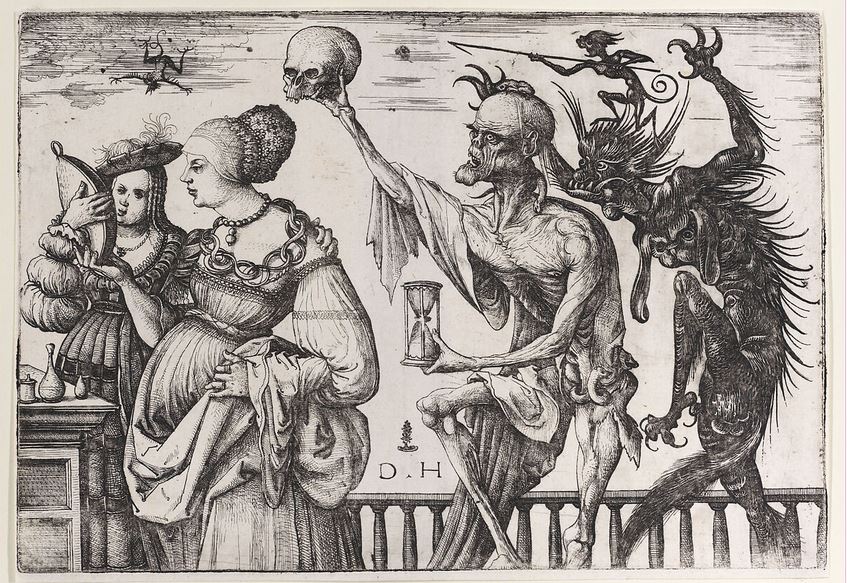
Het ware christendom, net als alle grote humanistische religies, streeft er onvermoeibaar naar om degenen die hun leven in zonde verspillen ertoe te brengen deze ondeugden van zich af te schudden. Dat kan door hen te laten inzien dat hun gedrag niet alleen tragisch, maar totaal lachwaardig is in het licht van de uiterste kortstondigheid van het menselijke fysieke bestaan.
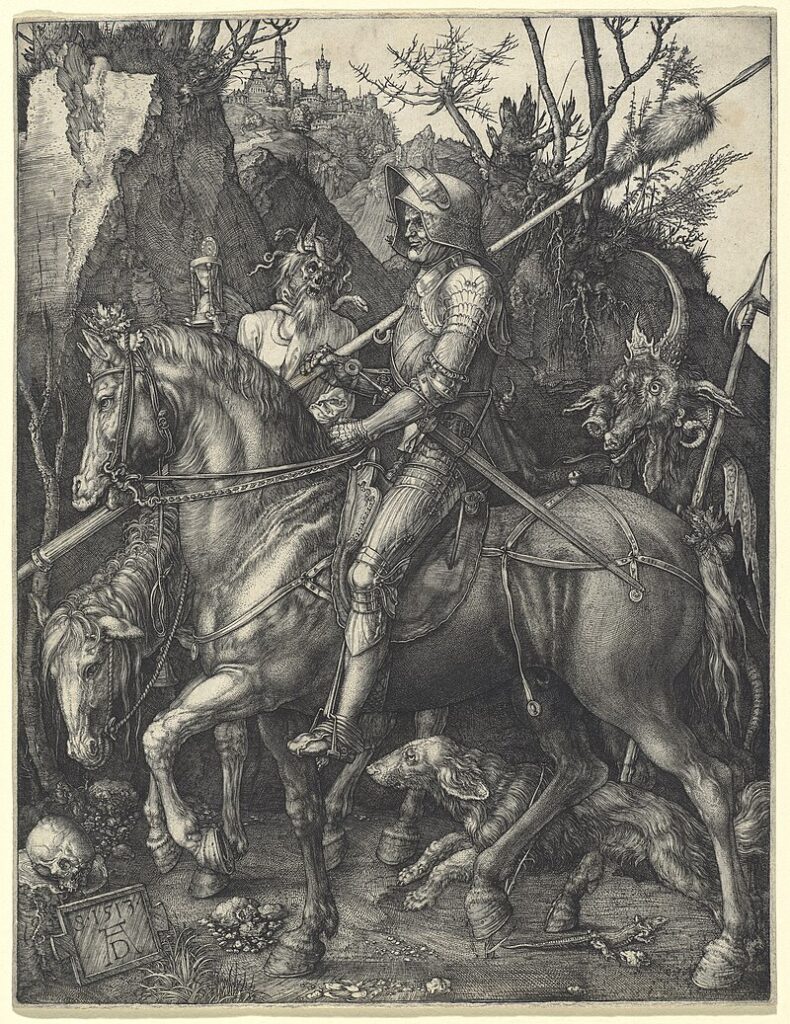
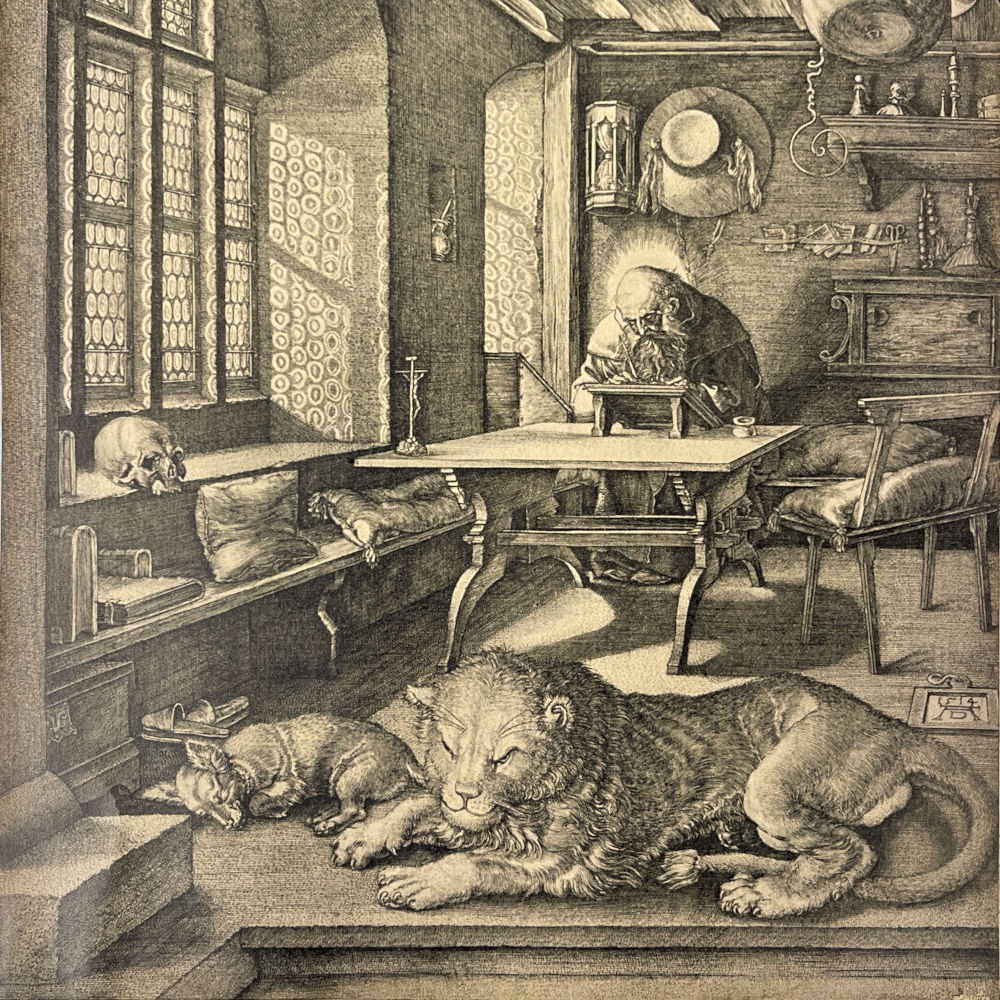

De Duitse kunstenaar Albrecht Dürer, in harmonie met dit Renaissanceparadigma, maakte het tot het centrale thema van zijn drie beroemde Meisterstiche (meestergravures), die als één geheel moeten worden begrepen: De ridder, de dood en de duivel (1513); Hiëronymus in zijn studeervertrek (1514) en Melencolia I (1514). 38
Op elk van deze gravures is een zandloper afgebeeld, een metafoor voor de onstuitbare stroom van de tijd. Door de zandloper (tijd) naast een schedel (dood), een kaars die uitgaat (laatste adem), een verwelkende bloem (de leegte van de passies) enz. te plaatsen, slagen de kunstenaars erin de metafoor van de « ijdelheid » (Vanitas) voor te stellen. 39
Erasmus, die het zandloper/schedelbeeld tot zijn persoonlijk embleem maakte, voegde er het motto aan toe: Concedi Nulli (Ik wijk voor niets, de dood zal niemand sparen, rijk of arm.) In die zin was het christelijk humanisme in de Renaissance een massabeweging die beoogde mensen te onderwijzen over geestelijke « onsterfelijkheid », tegen zowel religieus bijgeloof als tegen een sluipende terugkeer naar het Grieks-Romeinse heidendom.

Met deze filosofische eis treedt Erasmus hier direct in de voetsporen van Petrarca 40 en diens I Trionfi (1351-1374) 41, een gedichtencyclus die is opgebouwd uit zes elkaar opvolgende allegorische triomfen. De « Triomf der Liefde » wordt er overtroffen door de « Triomf der Kuisheid. » Op haar beurt wordt Kuisheid verslagen door de Dood; de Dood wordt overwonnen door Roem; Roem wordt veroverd door de Tijd; en zelfs de Tijd wordt uiteindelijk overwonnen door de Eeuwigheid en uiteindelijk staan we voor de « Triomf van God » over al deze louter aardse aangelegenheden.
Omdat de dood aan het einde van ons vluchtige fysieke bestaan zal « triomferen », is het in de pre-Renaissance visie de angst voor de dood en de vrees voor God die de mens moet helpen zich te richten op het bijdragen van iets onsterfelijks aan toekomstige generaties. Dat is veel beter dan te verdwalen in het labyrint van aardse genoegens en pijnen dat Jheronimus Bosch (1450-1516) 42 met zoveel ironie afbeeldt in zijn Tuin der Wereldse Lusten (1503-1515). 43
Leonardo da Vinci, wiens filosofisch-religieuze opvattingen door velen in het Vaticaan als ketters werden beschouwd, 44 schreef in zijn aantekeningen dat veel mannen en vrouwen, gezien hun gedrag, het prachtige lichaam dat God hen had gegeven niet eens verdienden:
“Zie, er zijn velen die zichzelf louter spijsverteringsstelsels, mestproducenten en latrine-vullers zouden kunnen noemen, want ze hebben geen andere bezigheid in deze wereld; Ze beoefenen geen enkele deugd, er blijft niets van hen over dan volle latrines [toiletten]. » 45
4. De dageraad van louterend gelach
Volgens woordenboeken spreekt men van « good laughter » wanneer we een situatie, die eerst vervelend en moeilijk blijkt, plotseling grappig vinden. Meestal is de oplossing zo eenvoudig, dat we ze niet zien! We lachen dan eigenlijk met de ironie van de situatie, met onszelf en met onze gebreken. Kortom, een goede lach is de beloning voor een authentiek creatief proces, wanneer de agonie van het uitputten van hypothesen in de zoektocht naar oplossingen, zowel voor wetenschappelijke als persoonlijke problemen, eindigt met een vreugdevol Eureka! De gure storm en de donkere wolken zijn door de creatieve winden weggeblazen en een helder licht toont ons plotseling een wijde horizon en een nieuw perspectief.
Op haar blog Angeles Earth, benadrukt de visuele kunstenares Angeles Nieto de innige verbondenheid tussen humor en creativiteit, twee basisingrediënten van de Renaissance:
« Humor volgt niet de lineaire, traditionele, gebruikelijke processen; humor stimuleert flexibel denken en creativiteit. De lach, kun je vergelijken als een schakelaar van jouw cognitieve gedachte, zodat je rationele kant op een bepaalde manier wordt verlamd. We lachen meestal als onze hersenen een verkeerd model herkennen, dat niet op zijn plaats is. Humor toont een nieuw standpunt dat de conventionele discussie ontwricht en bespot. De plotselinge mentale veranderingen die de humor veroorzaakt, zijn ook aanwezig in de creativiteit, we spelen met ideeën, op zoek naar verrassende ideeën. Humor is gebouwd op dissociatie, de mogelijkheid dat twee denkbeelden zich kruisen, zodat de tweede de betekenis van de eerste verandert. Creativiteit werkt onder dezelfde mechanismen als een grap. In beide gevallen gaat het om het verbinden van twee schijnbaar onverbonden ideeën. » 46
Volgens christelijke humanisten kan men de mens vleugels geven door hem te bevrijden van de ondeugd die hem verlaagt.
Een middel daarvoor is hem een spiegel voor te houden, een proces inherent aan de « socratische dialoog ». Ken uzelf! Als hij de moed heeft zichzelf te zien zoals hij is, zal hij misschien zijn onwetendheid aanvaarden. Dat is een eerste vorm van het soort wijsheid dat Cusanus De docta ignorantia 47 of « wetende onwetendheid » noemde.
Via zijn « vrije wilskeuze » kan ieder mens beslissen te handelen (of niet te handelen) in overeenstemming met zijn ware (goede) aard. Een totale toewijding aan het algemeen belang wordt dan een bron van immens plezier, zowel in onze persoonlijke relaties als in onze economische activiteiten. Het is dit doel, namelijk de vorming en de veredeling of verheffing van het persoonlijk karakter, dat de fundamentele doelstelling werd van zowel het christelijk als het republikeins onderwijs. Hoofden vullen met kennis en feiten, is geen doel op zichzelf. Gewetensvolle burgers met eigen kennis en oordeelsvermogen vormen is de echte uitdaging.
Maar door te beweren dat het leven van de mens volledig door God was voorbestemd, ontkende Luther het bestaan van de vrije wilskeuze en maakte hij de mens onverantwoordelijk voor zijn daden. 48
Deze opvatting was het tegenovergestelde van die van Erasmus, die de Kerk al lang vóór Luther had opgeroepen een einde te maken aan haar financiële uitbuiting van geloof, zoals de beroemde « aflaten » (indulgentia). 49
Christelijke humanisten beogen onze zielen te verheffen tot de hoogste graden van morele en intellectuele schoonheid. Ze trachten ons te bevrijden van onze overdreven gehechtheid aan aards plezier en aardse goederen – niet door doempreken, schuldgevoelens of de erg lucratieve handel van « aflaten », maar… dankzij de « louterende werking » (catharsis) van een bevrijdende lach! Keihard tegen de zonden, maar vol liefde en mededogen voor de zondaar die zich inzet voor zelfverbetering.
Oef, we kunnen ademen! Laten we even afstand nemen. Terwijl we serieus bezig zijn met onszelf te verbeteren, laat ons goedhartig lachen om onze onvolkomenheden. God heeft ons het leven gegeven en het is prachtig, zolang we maar weten hoe we het moeten benutten!
De Franse humanist, de socialist Jean Jaurès, vermoedelijk een lezer van Erasmus, zei zelfs:
« De vooruitgang van de mensheid wordt gemeten aan de toegevingen die de zotheid van de wijzen doet aan de wijsheid van de zotten. »
5. Sebastian Brant, Jheronimus Bosch en Het Narrenschip


« Genre-schilderkunst », welke gewone mensen afbeeldt in hun alledaagse activiteiten, ziet de dag met Quinten Matsys (men zou eerder moeten zeggen met het Erasmiaanse paradigma dat we zojuist hebben geïdentificeerd), benadrukt Larry Silver 50, die alzo bevestigt wat Georges Marlier 51 al in 1954 had geschreven.
Enkele jaren voordat Erasmus zijn Lof der Zotheid publiceerde (geschreven in 1509 en al in 1511 in Parijs uitgegeven) 52, opende de humanistische dichter en sociaal hervormer Sebastian Brant (1558-1921) uit Straatsburg het bal van de Socratische lach met zijn Narrenschiff (Het Narrenschip, uitgegeven in 1494 in Bazel, Straatsburg, Parijs en Antwerpen) 53, een hilarisch satirisch werk geïllustreerd door Holbein de Jongere (1497-1543) en Albrecht Dürer (1471-1528), die 73 van de 105 illustraties in de oorspronkelijke uitgave verzorgde.
Het Narrenschip werd een bestseller in heel Europa. De auteur was niet zomaar een simpele satiricus, maar een érudiet humanist wiens vertaling van de gedichten van Petrarca bekend is. 54
Brant was een sleutelfiguur en vriend van Johann Froben (1460-1529) en Johann Amerbach (1441-1513), afkomstig uit Zwitserse drukkersfamilies. Zij verwelkomden later Erasmus, toen de humanist, vervolgd in Leuven en de Lage Landen, gedwongen werd in ballingschap te gaan in Bazel.
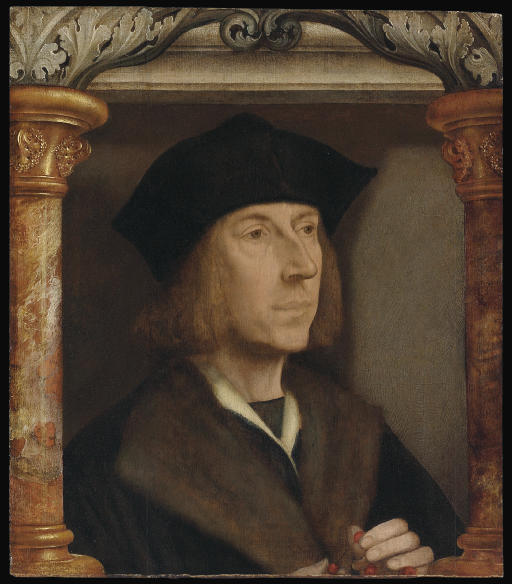
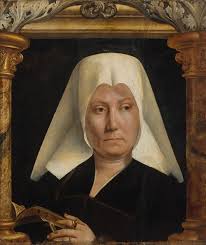
Na de heiligen en de vorsten zijn het opeens gewone vrouwen, mannen en kinderen die in de werken verschijnen. Niet meer als « schenkers » die als getuigen aanwezig zijn bij een Bijbels of hemels tafereel, maar vanwege hun eigen kwaliteiten als verdienstelijke menselijke wezens.
Dürer maakte bijvoorbeeld een gravure, zij het enigszins ironisch, van « een kok en zijn vrouw ». 55 In het begin van de 15e eeuw duikt de klassieke Griekse taal terug op in West-Europa; in het begin van de 16de eeuw is het « de man van de straat » die opduikt in kunstwerken.
Met de opkomst van de kleine man, de ambachten en de burgerij verandert fundamenteel de klantenkring van de schilders. De opdrachten komen minder van religieuze orden en rijke kardinalen, meer van welvarende handelaars, burgers, gilden, gemeentes, steden, corporaties, broederschappen en ambachten die hun kapellen en huizen willen verfraaien en hun portretten aan vrienden willen schenken.
De uitbreiding van de Antwerpse markt, waarbij schilderkunst een luxeproduct voor de middenklasse werd, is een goed gedocumenteerd fenomeen. Onderzoek heeft de bewering van Lodovico Guicciardini (1521-1589) 56 bevestigd dat er in de jaren 1560 minstens 300 schilderateliers actief waren in Antwerpen.
Het Narrenschip van Brant was een mijlpaal en een keerpunt, het begin van een nieuw paradigma, van creativiteit, rede en opvoeding door middel van een oprechte, louterende en bevrijdende lach, waarvan de echo nog zeer luid zal weerklinken tot aan de dood van Pieter Bruegel de Oude in 1569. 57
Deze dynamiek kwam in gevaar toen Karel V in 1521 de Inquisitie nieuw leven inblies. Hij voerde de « plakkaten » in om zijn gezag en dat van de kerk te vrijwaren. Dat waren decreten die iedere burger die de Bijbel durfde te lezen en er commentaar op uitbracht, met de dood bestraften.

Het Narrenschip bestaat uit 113 delen. Elk deel, met uitzondering van een korte inleiding en twee afsluitende delen, handelt onafhankelijk van elkaar over een bepaalde klasse zotten, imbecielen of wrede mensen. Slechts af en toe wordt herinnerd aan het basisidee van het schip.
Geen enkele zotheid van de eeuw wordt vergeten. De auteur valt met nobele ijver de fouten en de buitensporigheden van de mens aan.
Het boek begint met de veroordeling van de allergrootste dwaas, degene die weigert de prachtige boeken te lezen die in zijn kas staan. Hij wil zijn hersenpan niet overladen met wijsheid. « Ik heb alles verkregen, » zegt de nar, « van een groot heer die de vermoeidheid van hen die in zijn plaats leren, in baar geld kan betalen. » 58
De derde zotheid (van de 113), die zich aansluit bij de eerste, is hebzucht en gierigheid:
« Het is absurde zotheid om rijkdommen te hamsteren en niet te genieten van de ware vreugde van het leven, de waanzin van de zot die niet weet, wie het goud dat hij opzij heeft gelegd, zal gebruiken op de dag dat hij in het graf zal afdalen. » 59

Deze visie is ook het thema van een drieluik van Jheronimus Bosch dat gedeeltelijk verloren is gegaan. Recentelijk onderzoek heeft aangetoond dat het huidige schilderij van Bosch, Het Narrenschip (Louvre, Parijs), dat mogelijk zelfs werd geschilderd voordat Brant 60 zijn satire schreef, mogelijkerwijs het linkerpaneel is van een drieluik waarvan het rechterpaneel De dood van de vrek (National Gallery, Washington) was. 61
Het interessante aan dit laatste paneel is dat niets fataal is! Zelfs de gierigaard kan tot zijn laatste ademtocht kiezen tussen het opslaan van zijn ogen naar Christus of het neerslaan van zijn ogen naar de duivel!
Dat de mens eeuwig vervolmaakbaar is en dat zijn lot ook afhangt van zijn persoonlijke, vrije wilskeuze, vormde de kern van de leer van de Zusters en Broeders des Gemene Leven, 62 een lekenbeweging van christelijke devotie waarmee Bosch, zonder er lid van te zijn, belangrijke affiniteiten had. Tot op heden blijft her raden naar het onderwerp et de titel van het middenpaneel. Voor het gesloten retabel, denkt men aan een afbeelding van een marskramer die wegloopt van slechte oorden.
Dat is reeds het thema van de buitenpanelen van Boschs drieluik De Hooiwagen. Op het centrale middenpaneel van dit werk ziet men koningen, prinsen en pausen die een kar achtervolgen die geladen is met een gigantische berg hooi (een metafoor voor geld) en door duivels naar de hel worden getrokken.
Het thema van de rondtrekkende marskramer 63 was zeer populair bij de Broeders van het Gemene Leven en de Devotio Moderna. 64 Voor hen, net als voor Augustinus, wordt de mens voortdurend geconfronteerd met een existentiële keuze. Hij bevindt zich voortdurend voor een tweesprong (het bivium). Ofwel kiest hij het moeilijke, rotsige pad dat naar boven loopt en hem dichter bij God brengt, ofwel kiest hij de gemakkelijke weg die naar beneden loopt naar aardse hartstochten, genegenheden, zonde en ondeugd.
Augustinus en later Dionysius de Kartuizer (1403-1471) verwierpen niet de schoonheid van mens en natuur. Ze waarschuwden wel dat we ervan moeten genieten als « een voorproef van de goddelijke wijsheid ». 65
De « marskramer » van Bosch en Patinir is daarom een metafoor voor de mens, die zich permanent onthecht en verder zoekt naar het juiste pad. Bosch schilderde verdwaasde mannen en vrouwen als hersenloze dieren die zich passioneel trachten te verzadigen met kleine vruchtjes zoals kersen, aardbeien en bessen, metaforen voor geld en aardse genoegens. Het bekomen plezier was intens, maar zo vluchtig en onvoldoende, dat men alleen maar dacht, bijna als drugverslaafden, deze ervaring zo snel mogelijk te hernieuwen. Alzo werd de ganse levensloop niets anders dan een permanente wedloop naar plezier dat nooit eindigde in waar geluk.
De marskramer gaat « op een slof en een schoen », dat wil zeggen dat hij zijn huis verlaat en de geschapen wereld van zonde (we zien een bordeel, dronkaards, enz.) en alle materiële goederen achter zich laat.
Met zijn « stok » (symbool van geloof) weet hij de « helse honden » (het kwaad) af te weren die hem in de kuiten bijten en hem trachten te weerhouden.
Een illustratie uit een Engels psalmenboek uit de 14e eeuw, het Luttrell Psalter, toont precies dezelfde allegorische voorstelling.
Deze metaforische beelden zijn dus niet het resultaat van een « zieke geest » of een losbandige verbeelding van Jheronimus Bosch, maar citaten van een gemeenschappelijke beeldentaal die we al aantreffen in de marges van verluchte boeken, maar die met Bosch een eigen leven kregen en op de voorgrond kwamen.
Hetzelfde thema, dat van de Homo Viator, de mens die zich onthecht van aardse goederen, komt ook steeds terug in de kunst en literatuur van deze periode, met name sinds de Nederlandse vertaling van De pelgrimstocht van de menselijke ziel, geschreven in 1358 door de Normandische cisterciënzer monnik Guillaume de Degulleville (1295-na 1358).
Christus verandert ons in pelgrims over de hele wereld. Samen met Hem doorkruisen wij de « aardse stad » met als enig doel de « hemelse stad. » Niet langer alleen homo sapiens, maar homo viator, een man op weg naar de hemel.
Hoewel de drie overgebleven delen van Bosch’ drieluik (Het Narrenschip, De dood van de Vrek en De Marskramer) op het eerste gezicht totaal los van elkaar lijken te staan, wordt hun samenhang duidelijk zodra de toeschouwer dit overkoepelende concept identificeert. 66
Voor een hedendaagse kunstenaar, met talent, techniek, humor, ironie en verbeelding, zou het wel eens leuk zijn om het verloren middenpaneel te trachten te schilderen op een passende manier. Het thema is mijns inziens noodzakelijkerwijs de val van de mens die zich niet kan onthechten van aardse goederen, de weg die de toeschouwer leidt van het Narrenschip naar De dood van de vrek.
6. Rederijkers en Landjuweel
De lach van sommigen maakt niet iedereen blij. Spitsige humor en ironie ondermijnen het onrechtmatig gezag van keizers, pausen, bankiers, hertogen en tirannen. Ironie, satire en humor zijn inderdaad de machtigste politieke wapens ooit bedacht. Vervolging, censuur, intimidatie, terreur en bestraffing moeten gedaan maken met humor en ironie.

De golf van culturele emancipatie in de Lage Landen, waar Erasmus en Matsys zelf deel van uitmaakten met hun eigen bijdragen, bereikte een hoogtepunt in de tweede helft van de 16de eeuw en lokte een brutale reactie uit.
Het « begin van het einde » van de Spaanse bezetting in de Lage Landen, aldus de historici, kondigde zich aan toen het Landjuweel 67 werd beknot. Al in de 13de en 14de eeuw waren Landjuwelen wedstrijden in de dichtkunst tussen schuttersgilden in het hertogdom Brabant. In de 15de en de 16de eeuw organiseerden de Rederijkers naar dit voorbeeld wedstrijden tussen de kamers.
Elke wedstrijd werd georganiseerd rond een centrale filosofische vraag, een zinne, bijvoorbeeld: “Wat de mens het meest tot de kunst aanzet » (Antwerpen, 1561) of « “wat de mens in het uur van zijn dood de meeste troost biedt” (Gent, 1539). De kamers moesten dan met een toneelstuk, een spel van zinne (waarbij de zinne de gestelde vraag is) een antwoord geven.
Andere wedstrijdcategorieën waren de vermakelijke, kluchtige toneelstukken, esbattementen, liederen en het rebusblazoen. Dat was een soort wapenschild met daarop een rebus. De oplossing van die rebus was een spreuk of een leus.
De louterende werking van catharsis (zuivering) in komedie en satire is algemeen bekend. Geconfronteerd met de angsten van het dagelijks leven of politieke onderdrukking, zorgt humor voor een onmiddellijke emotionele ontlading, terwijl het tegelijkertijd een kritische afstand biedt die zelfverbetering mogelijk maakt.
Louterend lachen, spot en satire werken bevrijdend, hoewel het gevaar bestaat dat ze ons demobiliseren als ze niet worden gevolgd door een oproep tot actie.

Een absoluut hoogtepunt van volkscultuur in de Lage Landen was het schitterende Landjuweel van 1561 in Antwerpen, op touw gezet door de Antwerpse rederijkerskamer De Violieren. Deze kamer was in feite niets anders dan de letterkundige afdeling van het Sint-Lucasgilde, dat wil zeggen het schildersgilde waarvan Matsys, Patinir, David en andere vrienden van Erasmus leden waren. 68
Veertien kamers van Brabant namen deel. Zo’n 1400 rederijkers te paard, in feestelijk kostuum, met muziek en zang, deden hun intrede in de stad. In de stoet reden 23 praalwagens en 200 andere rijtuigen.
Toneel, dichtkunst, muziek en schilderkunst hadden eenzelfde beeldentaal. Een van deze « punten » (sierlijk opgetuigde praalwagens met allegorisch-moralizerende voorstellingen) gedurende de Onze-Lieve-Vrouwe-ommegang van Antwerpen in 1563 werd omschreven als het soort hooiwagen dat Bosch centraal stelde in zijn schilderij De Hooiwagen (1501, Madrid), een allegorie voor het ziekelijk streven naar « aards gewin » :
« Eene Hoywaghen daer op sittende eene Sater,
ghenaempt Bedrieghelijck aen locken,
achter volghende alle Natie van volck, treckende aen het Hoy,
als Woekeners, Cassiers, Creemers &c. midts dat ertsch ghewin al hoy is »
(Een hooiwagen met daarop een sater met de naam « de Bedrieglijke Verleiding » en daarachter allerlei soorten volk, zoals woekeraars, bankiers en marskramers, die aan het hooi trekken, terwijl aards gewin allemaal hooi is). 69

Hetzelfde thema staat ook centraal in een gravure van Frans Hogenberg van 1559. Op deze prent is het volk rondom de hooiwagen in groepjes verdeeld en voorzien van bijschriften. Zo staat bij een van deze groepjes te lezen:
« Geestelyck weerlijck het sij in wat staten
Vint men ghebreck tot allen stonden
Daer om doeghet goet en willet quaet laten
Want anders (Ilaes) eest al hoy bevonden. »
(Geestelijke en wereldlijke personen van alle rangen blijken voortdurend gebreken te vertonen. Doe daarom het goede en vermijd het kwaad. Want anders zal het (helaas) allemaal hooi blijken te zijn). 70

De toneelvoorstellingen vinden plaats op een fraai versierd houten podium op de Grote Markt, voor de werf van het nieuwe stadhuis. Het is ontworpen door Cornelis II Floris de Vriendt (1514-1575). De inleidende spelen zijn geschreven door de « factor » van de Violieren, Willem van Haecht (c. 1530-1585).
Het spel van zinnen moet een antwoord geven op de vraag “wat de mens het meest tot de kunst aanzet”. Twee honderd jaar voor Immanuel Kant en Friedrich Schiller, beschouwde men de opwaardering van kunst als belangrijk instrument voor humanisering en politieke ontvoogding.
Het Landjuweel en de Ommegang waren volksfeesten waar « alles mocht », waar de « kleine man » met satires, vermommingen en spotliederen de verdrukker mocht beschimpen en voor de zot houden en alzo, al was het voor een héél kort moment, het juk van Spanje wat draagbaarder werd.
De meeste allegorische toneelstukken die werden opgevoerd, waren bijtende satires tegen de paus, monniken, aflaten, pelgrimstochten, enzovoort.
Zodra ze verschenen, werden ze verboden, en het was niet zonder reden dat het landjuweel van 1561 later werd aangehaald als het eerste (en het laatste) dat de literaire wereld ophitste ten gunste van de protestantse reformatie. Omdat deze werken verre van gunstig waren voor het Spaanse regime, beval de hertog van Alba hun afschaffing door de Index van 1571 en later verbood de regering zelfs theatervoorstellingen van retorische genootschappen.
B. Quinten Matsys, biografische elementen
Nu we vertrouwd zijn met de belangrijkste filosofische en culturele problematiek van zijn tijd, kunnen we met een gerust hart het leven 71 van Matsys en enkele van zijn werken onderzoeken.
1. Van smid tot schilder
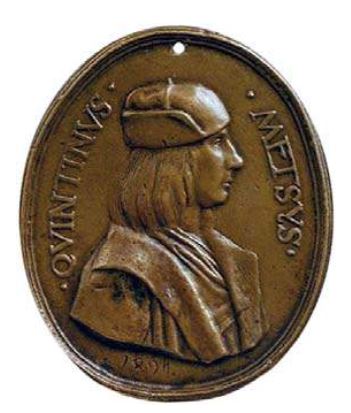
Volgens de Historiae Lovaniensium van Joannes Molanus (1533-1585) werd Matsys geboren in Leuven tussen 4 april en 10 september 1466, als een van de vier kinderen van Joost Matsys (overleden 1483) en Catherine van Kincken.
De meeste verslagen over zijn leven vervlechten feiten en fabels. 72 De archieven zijn gierig aan sporen van zijn activiteiten of karakter.
In Leuven zou Quinten bescheiden zijn begonnen als kunstsmid. Volgens de legende werd hij verliefd op een mooi meisje, dat ook het hof werd gemaakt door een schilder. Het meisje gaf de voorkeur aan schilders boven smeden. Quinten zou het aambeeld al snel hebben ingeruild voor het penseel, aldus de legende.
De kroniekschrijver Karel Van Mander geeft een ander verhaal. Hij schreef in 1604 dat Quinten, die al sinds zijn twintigste jaar zwak en ziek was, in werkelijkheid « niet in staat was zijn brood te verdienen » als kunstsmid. Van Mander herinnert zich dat, op het moment van de feestvieringen van Vastenavond (Mardi Gras),
« De broeders die voor de zieken zorgden, gingen door de stad met grote, gesneden en beschilderde houten beelden en deelden gegraveerde en gekleurde afbeeldingen van heiligen uit aan de kinderen; Ze hadden er dus heel veel nodig. Toen een van de collega’s Quinten bezocht, vroeg hij aan hem deze afbeeldingen in te kleuren. Uiteindelijk probeerde Quinten zelf afbeeldingen te maken. Vanaf dit kleine begin kwam zijn voorkeur tot uiting en vanaf dat moment stortte hij zich met groot enthousiasme op het schilderen. In korte tijd boekte hij buitengewone vooruitgang en werd hij een volleerd meester. » 73
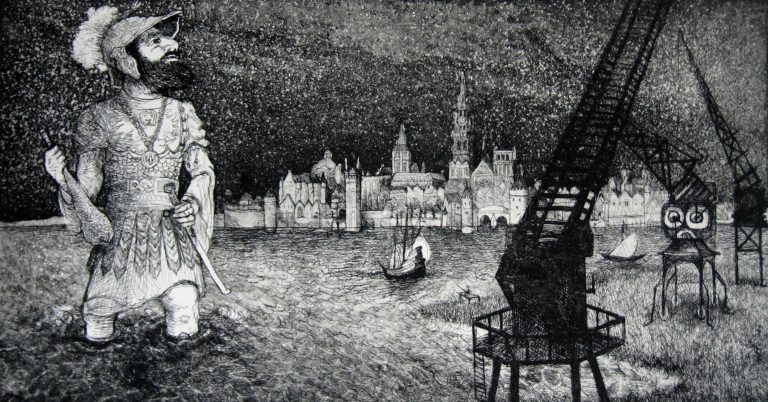

In Antwerpen, voor de Onze-Lieve-Vrouwekathedraal, op de Handschoenmarkt, kan men nog steeds de « putkevie » (versierd smeedijzeren hek op een waterput) vinden. Deze zou door Quinten Matsys zelf zijn gemaakt en stelt de legende van Silvius Brabo en Druon Antigoon voor. Dit zijn respectievelijk de namen van een mythische Romeinse officier die Antwerpen bevrijdde van de onderdrukking door een reus genaamd Antigoon. De reus Antigoon schaadde de handel in de stad door de toegang tot de rivier te blokkeren. Brabo kapte Antigoons hand af en wierp het in de Schelde.
Het opschrift op de waterput luidt: “Dese putkevie werd gesmeed door Quinten Matsijs. De liefde maeckte van den smidt eenen schilder.”
De archieven betreffende de bezittingen van Joost Matsys, de vader van Quinten, die smid en klokkenmaker was in de stad, tonen aan dat het gezin over een behoorlijk inkomen beschikte en dat financiële noodzaak niet de meest waarschijnlijke reden was waarom Matsys zich tot het schilderen wendde.
In 1897 schreef Edward van Even 74, zonder enig bewijs te leveren, dat Matsys ook muziek componeerde, gedichten schreef en gravures maakte.

Hoewel er geen bewijs is van een opleiding die Quinten Metsys heeft gehad vóór zijn inschrijving als vrij meester bij het Antwerpse schildersgilde in 1491, doen de bouwplannen van zijn broer Joos Matsys II in Leuven en de activiteiten van hun vader vermoeden dat de jonge kunstenaar binnen eigen familie leerde tekenen en zijn ideeën op papier zetten. Deze zou hem ook voor het eerst in aanraking hebben gebracht met architecturale vormen 75 en hun creatief gebruik.
Vooral uit zijn vroege werken blijkt duidelijk dat hij is opgeleid als bouwkundig tekenaar. Op zijn schilderij Madonna en kind op troon met vier engelen (1505, National Gallery, Londen) zitten de goddelijke figuren op een vergulde troon, waarvan de gotische omkadering lijkt op die van het raam op de tekening op perkament en het kalkstenen model van het Sint-Pietersproject, waaraan zijn broer ongeveer in dezelfde tijd heeft gewerkt.

Wat wel zeker is, is dat de kunstenaar prachtige bronzen medaillons heeft gemaakt waarop Erasmus, zijn zus Catarina en hijzelf zijn afgebeeld.
Rond 1492 trouwde onze schilder met Alyt van Tuylt die hem drie kinderen gaf: twee zonen, Quinten en Pawel, en een dochter, Katelijne. Alyt stierf in 1507 en Quinten hertrouwde een jaar later.
Nadien, met zijn nieuwe vrouw Catherina Heyns kreeg hij nog tien kinderen, vijf zonen en vijf dochters.
Kort na de dood van hun vader werden twee van zijn zonen, Jan (1509-1575) en Cornelis (1510-1556) 76 op hun beurt schilder en lid van het Antwerpse Gilde.
2. Het Hertogdom Brabant

Leuven was destijds de hoofdstad van het hertogdom Brabant, dat zich uitstrekte van Luttre, ten zuiden van Nijvel, tot ‘s-Hertogenbosch (het huidige Nederland). Tot deze regio behoorden de steden Aalst, Antwerpen, Mechelen, Brussel en Leuven, waar in 1425 een van de eerste universiteiten van Europa werd gesticht. Vijf jaar later, in 1430, erfde Filips de Goede van Bourgondië samen met de hertogdommen Neder-Lotharingen en Limburg, Brabant, dat deel uitmaakte van de Bourgondische Nederlanden. 77
In 1477, toen Matsys ongeveer 11 jaar oud was, viel het hertogdom Brabant onder Habsburgse heerschappij als deel van de bruidsschat van Maria van Bourgondië toen ze trouwde met Maximiliaan van Oostenrijk.
De latere geschiedenis van Brabant maakt deel uit van de geschiedenis van de Habsburgse « Zeventien Provinciën », die steeds meer onder controle kwamen van Augsburgse bankiersfamilies zoals de Fuggers 78 en de Welsers.


Als het tijdperk van Erasmus en Matsys een voorspoedige periode van de « Noordelijke Renaissance » was, dan werd het ook gekenmerkt door steeds grotere inspanningen van bankiersfamilies om het pausschap te « kopen » om zo de wereld te kunnen domineren.
De geopolitieke verdeling van de hele wereld (en haar grondstoffen) tussen het Spaanse Rijk (geregeerd door Venetiaanse bankiers) en het Portugese Rijk (onder leiding van Genuese bankiers) werd bezegeld door het Verdrag van Tordesillas, een akkoord dat in 1494 in het Vaticaan werd bekrachtigd door paus Alexander VI Borgia. Dit verdrag opende de deur voor de koloniale onderwerping van vele volkeren en landen, allemaal in naam van een zeer twijfelachtig gevoel van culturele en religieuze superioriteit.
Na herhaaldelijke staatsbankroeten werden de bewoners van de Lage Landen het doelwit van brutale economische en financiële plundering. De Fuggers leenden heel veel geld, zowel aan de keizer als de paus. Maar om nieuwe financieringen te verkrijgen, moesten de oudere worden terugbetaald. Door Luther, die steeds meer pleitte voor een breuk met Rome, overmatig te demoniseren, ontweek de heersende macht de prangende vragen die Erasmus en Thomas More stelden. Zij eisten dringende hervormingen om misbruik en corruptie binnen de katholieke kerk en de staat uit te roeien.
Het is niet ondenkbaar dat de abrupte weigering van paus Clemens VII om de eisen van Hendrik VIII voor een echtscheiding te honoreren, deel uitmaakte van een algehele strategie om het hele Europese continent in godsdienstoorlogen te storten, waaraan pas in 1648 een einde kwam met de Vrede van Westfalen ook wel Vrede van Münster genoemd.
3. Formatie: Memling, Bouts of Van der Goes?
De vroege, grote drieluiken die Matsys schilderde, leverden hem veel lof. Historici beschrijven hem als « een van de laatste Vlaamse primitieven ». Maar dat was in die tijd eigenlijk een spotnaam, gebruikt door Michelangelo 79 om alle niet-Italiaanse kunst, die hij als « gotisch » (barbaars) of « primitief » beschouwde, in wezen in diskrediet te brengen in vergelijking met de Italiaanse kunst die de ware antieke stijl imiteerde.
Omdat Matsys in Leuven werd geboren, is gesuggereerd dat hij zijn opleiding heeft genoten bij Aelbrecht Bouts (1452-1549), de zoon van de destijds dominante schilder in Leuven, Dieric Bouts de Oude (ca. 1415-1475). 80
In 1476, een jaar na de dood van zijn vader, zou Aelbrecht Leuven hebben verlaten om zijn opleiding te vervolgen bij een meester buiten de stad, hoogstwaarschijnlijk Hugo van der Goes (1440-1482), 81 wiens invloed op Aelbrecht Bouts, maar ook op Quinten Matsys, aannemelijk lijkt.
Van der Goes, die in 1474 deken werd van het schildersgilde van Gent en in 1482 overleed in het Rood Klooster bij Brussel, was een vurig aanhanger van de Broeders van het Gemene Leven en hun principes. 82
Als jonge assistent van Aelbrecht Bouts, zelf een leerling van Van der Goes, had Matsys de bakermat van het christelijk humanisme kunnen ontdekken.
Het bekendste werk van Van der Goes is het Portinari-drieluik (Uffizi, Florence), een altaarstuk dat Tommaso Portinari, hoofd van het Brugse filiaal van de Medici-bank, in opdracht van de kerk van Sant’Egidio in het ziekenhuis Santa Maria Nuova in Florence maakte.
De ruwe trekken van de drie herders (die elk een van de door de Broeders des Gemene Levens voorgeschreven stadia van spirituele verheffing uitdrukten 83) in de compositie van Van der Goes maakten diepe indruk op de schilders die in Florence werkten.

Matsys wordt ook beschouwd als een mogelijke leerling van Hans Memling (1430-1494), zelf een leerling was van Van der Weyden (1400-1464) 84 en een vooraanstaand schilder in Brugge.
De stijl van Memling en die van Matsys lijken zo veel op elkaar dat het moeilijk is om ze te onderscheiden.
Terwijl de Vlaamse kunsthistoricus Dirk de Vos in zijn catalogus van het werk van Hans Memling uit 1994 het portret van de musicus en componist Jacob Obrecht 85 (1496, Kimbell Art Museum, Fort Worth) beschreef als een zeer laat werk van Hans Memling, konden hedendaagse experts, waaronder Larry Silver 86, in 2018 vaststellen dat het veel waarschijnlijker is dat het portret het vroegst bekende werk van Quinten Matsys is.
Obrecht, die een grote invloed had op de Vlaamse polyfone (meerstemmige) en contrapuntische muziek uit de Renaissance, werd in 1492 benoemd tot koorleider van de Onze-Lieve-Vrouwekathedraal in Antwerpen. Rond 1476 was Erasmus toevallig een van Obrechts koorknapen.
Obrecht bezocht Italië minstens twee keer, in 1487 op uitnodiging van hertog Ercole d’Este I van Ferrara 87 en nadien, in 1504. Ercole had Obrechts muziek gehoord, waarvan bekend is dat deze tussen 1484 en 1487 in Italië circuleerde, en had verklaard dat hij deze meer waardeerde dan de muziek van alle andere componisten van zijn tijd; Daarom nodigde hij Obrecht uit. De componist overleed later in Italië aan de pest.
Al in de jaren 1460 reisde Erasmus’ leraar in Deventer, de componist en organist Rudolph Agricola (1443-1483), 88 naar Italië. Nadat hij burgerlijk recht had gestudeerd in Pavia en lessen had gevolgd bij de Italiaanse pedagoog Battista Guarino (1434-1505), vertrok hij naar Ferrara, waar hij een protegé werd van het hof van Este.


Rond 1499 maakte Leonardo een tekening van Ercole’s dochter, Isabella d’Este. Op de basis van die tekening, denken sommigen dat zij dezelfde persoon is als de Mona Lisa.
4. Debuten in Antwerpen en in het buitenland
Matsys werd in 1491 in Leuven ingeschreven, maar werd datzelfde jaar ook als meester-schilder toegelaten tot het Sint-Lucasgilde van Antwerpen. Op vijfentwintigjarige leeftijd besloot hij zich in de havenstad te vestigen. Hij schilderde er, zoals gezegd, in 1496 de kapelmeester Jacob Obrecht, zijn eerste bekende werk, en verschillende devotionele schilderijen met als onderwerp de Maagd Maria en het Kind.
Omdat de Liggeren (registers van de schildersgilden) geen informatie bevatten over Matsys’ activiteiten in de Lage Landen over een periode van meerdere jaren, is het verleidelijk om te veronderstellen dat Matsys een reis ondernam naar Italië. 89
Daar had hij grote meesters kunnen ontmoeten. Da Vinci woonde tussen 1482 en 1499 in Milaan en keerde daar in 1506 terug. Het is in Milaan waar Da Vinci zijn leerling Francesco Melzi (1491-1567) ontmoette, die hem vervolgens naar Frankrijk vergezelde. Matsys kan ook Colmar of Straatsburg hebben bezocht, steden die ook bezocht werden door Albrecht Dürer, een kunstenaar met wie hij blijkbaar vertrouwd was voor zijn komst in 1520 in onze gewesten.
Voor de Belgische kunsthistoricus Dirk de Vos (1943-2024), oud-conservator van het Groeningemuseum, was een reis naar Italië niet alleen mogelijk maar hoogstwaarschijnlijk:
« De vroege en de volwassen stijlen van Metsys contrasteren zo sterk dat we het verschil alleen kunnen verklaren door een beroep te doen op de hypothese van het ijverig bezoeken van de werken van de Italiaanse Renaissance, en meer bepaald die van Leonardo da Vinci en zijn discipelen uit de late 15e eeuw. We zien namelijk dat Metsys directe ontleningen aan Leonardo da Vinci heeft gedaan, zozeer zelfs dat een andere inspiratiebron uitgesloten lijkt. Hoewel er geen tastbaar bewijs is van een reis naar Italië, vertoont Metsys’ aanwezigheid in Antwerpen toch hiaten in de continuïteit die verenigbaar zijn met een langdurige afwezigheid, bijvoorbeeld tussen 1491 en 1507. Een reis naar Italië is dus helemaal niet onwaarschijnlijk. » 90
Dürer werd door zijn ouders naar Colmar in de Elzas gestuurd om daar een opleiding in de graveerkunst te volgen bij Martin Schongauer (1450-1491), veruit de meest bekwame graveur van zijn tijd. 91
Maar toen Dürer in de zomer van 1492 in Colmar aankwam, was Schongauer al overleden. Vanuit Colmar vertrok de kunstenaar naar Bazel, waar hij houtsneden maakte om boeken te illustreren en de indrukwekkende gravures van Jacob Burgkmair (1473-1531) en Hans Holbein de Oude (1460-1524) ontdekte. 92
Vervolgens ging hij naar Straatsburg, waar hij de hierboven genoemde erudiete dichter en humanist Sebastian Brant ontmoette en een portret van hem tekende.
C. Geselecteerde werken
1. De Maagd en het Kind, goddelijke genade en vrije wilskeuze


In 1495 schilderde Matsys Maria met Kind (Brussel). Hoewel het werk nog steeds zeer normatief is, verrijkt Matsys de devotionele beeldentaal met minder formele scènes uit het dagelijks leven. Het Kind, dat op speelse wijze nieuwe natuurkundige principes verkent, probeert onhandig de bladzijden van een boek om te slaan, terwijl een zeer ernstige Maagd Maria in een nis in gotische stijl zit, die ongetwijfeld is gekozen om aan te sluiten bij de architectuur en stijl van de zaal of kapel waar het schilderij geplaatst moest worden.
In een andere Maria met Kind (Rotterdam) gaat Matsys nog verder in deze richting. Men ziet er een zorgzame en gelukkige jonge moeder met een speels kind, zoon van God, maar ook zoon van de Mens. In een opstelling vlakbij de toeschouwer bemerkt men een brood en een kom melksoep met een lepel. Dit is ongetwijfeld een alledaags tafereel voor de meeste mensen van die tijd. God is niet alleen aanwezig in de kerk, maar in ons dagelijks bestaan.

In zijn Madonna met kind en melksoep (Brussel), dat Matsys’ vriend Gerard David (1460-1523) schilderde in 1520, toont hij met grote tederheid een jonge moeder die haar kind aanleert dat de achterkant van een lepel niet de beste manier is om de soep vanuit de kom in de mond te brengen!
Veel schilderijen over dit thema, zowel van Quinten Matsys (Maria met Kind, Louvre, 1529, Parijs) als van Gerard David (Rust tijdens de vlucht naar Egypte, National Gallery, Washington), tonen een kind dat met enorme inspanning doet om enkele druiven, kersen of ander fruit te bemachtigen.


In 1534 gebruikt Erasmus in zijn De libero arbitrio sive collatio (Gesprek of verzameling uitspraken over de vrije wilskeuze) dezelfde metafoor voor het fragiele evenwicht dat centraal staat in de verhouding tussen de vrije wil (die, los van een hoger doel, op zichzelf pure arrogantie kan worden) en de goddelijke genade (die als loutere voorbestemming kan worden geïnterpreteerd).
Om dit onderwerp, dat men zou denken dat alleen voor theologen is bestemd, voor zoveel mogelijk mensen toegankelijk te maken, gebruikt Erasmus een heel eenvoudige metafoor, vol tederheid en schoonheid:

“Een vader heeft een kind dat nog niet kan lopen; het valt; de vader tilt het op terwijl het kind haastige bewegingen maakt en moeite heeft om zijn evenwicht te bewaren; hij laat hem een vrucht zien die voor hem staat; het kind probeert het vast te pakken, maar door de zwakte van zijn ledematen zal het snel vallen als de vader zijn hand niet uitstrekt om het kind te ondersteunen en te begeleiden.
« Zo komt het kind, onder leiding van zijn vader, bij de vrucht die de vader bereidwillig in zijn handen legt als beloning voor zijn inspanning. Het kind zou nooit zijn opgestaan als de vader hem niet had opgetild; hij zou de vrucht nooit hebben gezien als de vader hem die niet had laten zien; hij had niet vooruit kunnen komen als zijn vader zijn zwakke stappen niet had gesteund; en hij zou de vrucht nooit hebben kunnen bereiken als zijn vader hem die niet in handen had gegeven.
« Wat zal het kind in dit geval als zijn eigen daden bestempelen? We kunnen niet zeggen dat hij niets gedaan heeft. Maar er is geen reden om zijn kracht te verheerlijken, aangezien hij alles wat hij is, aan zijn vader te danken heeft. » 93
Kortom, de vrije wilskeuze van de mens, welke Erasmus verdedigt, is essentieel, maar zonder God gaat de mens niet ver.
2. Altaarstuk van Sint-Anna


In Antwerpen beleefde Matsys’ activiteit een grote doorbraak met de eerste grote publieke bestellingen voor twee grote drieluik-altaarstukken:
- Het Drieluik van de Broederschap van Sint-Anna (1507-1509, Museum van Brussel), gesigneerd “Quinten Metsys screef dit”;
- Het Altaarstuk van het schrijnwerkersambacht (ook wel Nood Gods of Bewening van Christus genoemd, naam van het middenpaneel) (1507-1508, Museum van Antwerpen), geschilderd voor de kapel van het timmermansgilde in de kathedraal van Antwerpen, een werk dat grotendeels is geïnspireerd op de Kruisafname van Rogier Van der Weyden (Prado, Madrid). Johannes de Doper en Johannes de Evangelist, die verschijnen wanneer het drieluik gesloten is, zijn de patroonheiligen van de kerk.
Sint-Anna drieluik
Het thema en de iconografie van het Sint-Anna-drieluik werden, zoals gebruikelijk, volledig aan de schilder gedicteerd door de broederschap van Sint-Anna van Leuven, die hem deze opdracht gaf voor hun kapel in de Sint-Pieterskerk in dezelfde stad.
Het middenpaneel toont het verhaal van de familie van Sint-Anna, in een monumentaal gebouw met een afgeknotte koepel en een marmeren booggewelf die een breed uitzicht bieden op een bergachtig landschap. Het altaarstuk vertelt in vijf scènes het leven van Anna, de moeder van Maria, en haar man Joachim. Op het middenpaneel zijn de verschillende familieleden van de heilige afgebeeld.
De belangrijkste gebeurtenis in het leven van Anna en haar man Joachim, namelijk dat zij de ouders zouden worden van de Maagd Maria, terwijl zij zelf dachten dat zij geen kinderen konden krijgen, wordt afgebeeld op het linker- en rechterpaneel van het drieluik.
De kuise kus
De « onbevlekte ontvangenis » van Sint-Anna, moeder van Maria, uitgebeeld door de afbeelding van een « kuise kus » tussen de twee echtelieden (Anna en Joachim) voor de Gouden Poort van de muur van Jeruzalem, is een immens populair onderwerp in de geschiedenis van de schilderkunst, van Giotto tot Dürer.


Daarom werd het al snel getransformeerd naar de « onbevlekte ontvangenis » van Christus zelf. Vandaar dat er plotseling schilderijen verschenen waarop Maria « kuis » (maar toch op de lippen) haar kindje Jezus kuste.

De altaarstukkencyclus eindigt met de dood van Anna, die op het rechterbinnenpaneel is afgebeeld, omringd door haar kinderen en waar Christus zijn zegen geeft.
Ondanks de indrukwekkende omvang van dit werk en de conventionele verhaallijn, slaagt Matsys erin een vrijer en intiemer gevoel van contemplatie te creëren. Een voorbeeld hiervan is het neefje van Jezus in de linkerhoek, die plezier heeft in het verzamelen van heiligenbeeldjes en die, volledig geconcentreerd, probeert ze te lezen.
3. Een nieuw perspectief
In twee andere geschriften 94 heb ik aangetoond dat, in hun werk, zowel de Vlaamse schilder Jan Van Eyck 95 als de Italiaanse beeldhouwer en bronsgieter Lorenzo Ghiberti 96 zich vertrouwd hebben gemaakt met de « Arabische optica », in het bijzonder de wetenschappelijke werken van Ibn al-Haytham 97 (bekend onder zijn Latijnse naam Alhazen).
Tijdens de Renaissance probeerden verschillende scholen, met verschillende en soms tegenstrijdige benaderingen, de beste manier te vinden om drie dimensionele ruimte weer te geven door middel van perspectief.
Vanaf het begin van de 15e eeuw, voortbouwend op het werk van de Franciscanen van Oxford (Roger Bacon, Grosseteste, enz.), was er een school die uitging van de menselijke fysiognomie (twee ogen die een beeld creëren in de geest van de toeschouwer). In plaats van een mono-focaal (cyclopisch) model, hebben zijn, gebaseerd of Alhazen, een perspectief bedacht met twee centrale vluchtpunten (bi-focaal perspectief).
Dit perspectief is duidelijk herkenbaar in zekere werken van Van Eyck en Lorenzo Ghiberti, waarbij laatstgenoemde zelf wetenschappelijke teksten van Alhazen vertaalde in het Italiaans en opnam in zijn handboek voor schilders, de Commentarii, welke door Da Vinci werden geraadpleegd tijdens zijn opleiding in het atelier van Verrocchio, zelf een leerling van Ghiberti.
Een andere school, die verbonden is met Leon Battista Alberti, 98 beweerde dat « juist » perspectief, dat puur geometrisch en wiskundig is, een beroep doet op een uniek « centraal vluchtpunt ».
Ten slotte probeerde een derde school, die van Jean Fouquet in Frankrijk en Leonardo da Vinci, een curvilineair (kromlijnig) perspectief te hanteren, waarbij de beperkingen van het Albertiaanse model worden overkomen en de vervormingen vermeden.
In de moderne tijd wilden de volgelingen van Descartes en Galileo absoluut aantonen dat hun model van de lege ruimte geboren was in de Renaissance, met het Albertiaanse model. Zij beweerden dus dat alle andere benaderingen het werk was van boerse en onwetende « primitieven ».
Een onschatbare ontdekking
Zoals eerder vermeld, werkt het Gentse Interdisciplinair Centrum voor Kunst en Wetenschap (GICAS) sinds 2007 aan een nieuwe « Catalogue raisonné » van het werk van Quinten Matsys. In dit kader onderzochten Jochen Ketels en Maximiliaan Martens 99 in 2010 het Anna-altaarstuk van Matsys en de indrukwekkende Italiaanse portiek van het middenpaneel.
Laten we niet vergeten dat het geschilderde deel (in twee dimensies) op het centrale luik door de kunstenaar zo was ontworpen dat het harmonieus aansloot op een grote houten constructie (in drie dimensies) die als kader diende. Deze constructie is helaas verloren gegaan, maar we weten van zijn bestaan dankzij tekeningen.
« Toen we onze fotolampen op het centrale paneel richtten, » schrijven de twee onderzoekers, « liet het strijklicht iets zien wat in de literatuur helemaal niet was vermeld: in de gewelven van de architectuur aangebrachte constructielijnen. » 100
Infrarood benadrukte ook het bestaan,
« van een complexe reeks constructielijnen, getekend met de hand of met behulp van verschillende gereedschappen en technieken. Niet alleen was een dergelijk complex constructiesysteem niet te zien in de noordelijke schilderijen uit die tijd, maar Matsys moest ook een wiskundige procedure hebben gebruikt om de complexe loggia te construeren. » 101
Nog interessanter,
« Om de contouren van de afgeknotte koepel en de versiering ervan te tekenen, gebruikte Matsys nauwelijks lijnen, maar gaf hij de voorkeur aan stippen (…) onderaan het kapiteel voegde Matsys enkele losse letters toe, waarschijnlijk een ‘z’, een ‘e’ of een ‘c’ (…) Vanwege hun positie dicht bij het element en het feit dat Piero della Francesca bijvoorbeeld al een soortgelijk systeem met cijfers en letters had gebruikt in zijn tekeningen van De Prospectiva Pingendi (Over het perspectief van schilderijen, ca. 1480), is er reden om aan te nemen dat er een verband is met de omtrek of compositie van de zuil. » 102

In dit verband is het interessant om op te merken dat een van de weinige personen die op enig moment contact heeft gehad met Matsys en die Piero della Francesca‘s verhandeling103 over perspectief heeft gelezen en bestudeerd, niemand minder is dan Albrecht Dürer, wiens Vier boeken over de menselijke verhoudingen (1528) voortbouwt op Piero’s revolutionaire benadering.
Wat Dürer de « transfer-methode » van Piero noemt, zou later de basis vormen voor de projectieve meetkunde, met name aan de École Polytechnique onder leiding van Gaspard Monge, de belangrijkste wetenschap die de Industriële Revolutie mogelijk maakte.
De onderzoekers controleerden ook Matsys’ gebruik van het centrale vluchtpunt-perspectief met behulp van de « kruisverhouding-methode ».
Verbaasd, omdat het volgens de leer van de beste scholen onmogelijk zou zijn, stellen ze het volgende vast:
« Matsys toont zijn vaardigheid in perspectief, overeenkomend met de normen van de Italiaanse Renaissance, » een perspectief dat « inderdaad zeer correct is. » 104
Tot nu toe werd aangenomen dat de perspectiefwetenschap pas in de Lage Landen doordrong na de reis van Jan Gossaert naar Rome in 1508. Matsys, die blijk gaf van een meesterlijke en uitgebreide kennis van de perspectiefwetenschap, begon echter al in 1507 met de opbouw van dit werk.
4. Matsys’ samenwerking met Joachim Patinir en Albrecht Dürer


Een laatste opmerking over dit schilderij: het bergachtige landschap achter de figuren doet denken aan de typische en verontrustende landschappen van Matsys’ vriend Joachim Patinir (1480-1524), een andere weinig bekende maar grote kunstenaar in de geschiedenis van de schilderkunst.
In zijn tijd was Patinir’s vermaardheid niet klein. Felipe de Guevara, vriend en artistiek adviseur van Karel V en Filips II, noemt Patinir in zijn Commentaren op de schilderkunst (1540) als één van de drie grootste schilders van de regio, samen met Rogier van der Weyden en Jan van Eyck.
Patinir leidde een grote werkplaats met assistenten in Antwerpen. Onder degenen die onderhevig zijn aan de drievoudige invloed van Bosch, Matsys en Patinir, de volgende namen:
- Cornelis Matsys (1508-1556), zoon van Quinten, die trouwde met de dochter van Patinir;
- Herri met de Bles (1490-1566), actief in Antwerpen, mogelijke neef van Patinir;
- Lucas Gassel (1485-1568), actief in Brussel en Antwerpen;
- Jan Provoost (1465-1529), actief in Brugge en Antwerpen;
- Jan Mostaert (1475-1552), schilder werkzaam in Haarlem;
- Frans Mostaert (1528-1560), schilder actief in Antwerpen;
- Jan Wellens de Cock (1460-1521), schilder actief in Antwerpen;
- Matthijs Wellens de Cock (1509-1548), schilder-graveur werkzaam in Antwerpen;
- Hieronymus (Wellens de) Cock (1510-1570), schilder-graveur, die samen met zijn vrouw de Antwerpse uitgeversbedrijf In de Vier Winden oprichtte, destijds waarschijnlijk de grootste ten noorden van de Alpen, waar Pieter Bruegel de Oude werkzaam was.

Het is algemeen aanvaard dat Quinten Matsys de figuren in enkele van Patinir’s landschappen heeft geschilderd. Volgens de inventaris van het Escorial uit 1574 was dit het geval voor De verzoekingen van de Heilige Antonius (1520, Prado, Madrid).
Maar deze samenwerking kwam beide vrienden tegoed: Patinir ontwierp landschappen voor de werken van Matsys op diens verzoek. Deze realiteit ondermijnt enigszins de hardnekkige mythe van een Renaissance die wordt geprezen als het begin van competitief individualisme.
Dat Matsys en Patinir een hechte band hadden, blijkt wel uit het feit dat Matsys, na Patinirs vroege dood, de voogd werd van zijn twee dochters. Interessant is ook dat Gerard David, die na Memling de belangrijkste schilder in Brugge werd, in 1515 samen met Patinir lid werd van het Sint-Lucasgilde in Antwerpen, wat hem het recht gaf zijn werk te verkopen, niet alleen in Brugge, maar tevens op bloeiende Antwerpse kunstmarkt.
Moderne kunsthistorici beschouwen Patinir vaak als de vader en « uitvinder » van de landschapsschilderkunst. Ze beweren dat religieuze onderwerpen voor hem slechts een voorwendsel waren om te laten zien wat hem werkelijk interesseerde: landschappen. Men legt ook uit dat Rubens Adam en Eva schilderde alleen maar omdat hij graag naakten schilderde (en verkocht). Voor Rubens was dat misschien zo, maar voor Patinir ligt het duidelijk anders. Zoals de kunsthistoricus Reindert L. Falkenberg heeft aangetoond, 105 waren zijn « prachtige » landschappen niets meer zijn dan een soort geraffineerde, heel aantrekkelijke duivelse valstrik. De schoonheid van de wereld, een duivelse schepping volgens Patinir, bestaat enkel om mensen te verleiden en hen te laten bezwijken voor de zonde…
Ontmoeting met Albrecht Dürer

Dürers reisdagboek 106 van zijn bezoek in de Lage Landen is een trouwe bron van informatie.
Waarom kwam Dürer naar Brabant? Een mogelijke verklaring is dat de kunstenaar, na de dood van zijn belangrijkste opdrachtgever, keizer Maximiliaan I, zijn pensioen wou laten uitbetalen door Karel V.
Dürer kwam op 3 augustus 1520 in Antwerpen aan en bezocht Brussel en Mechelen, waar hij werd ontvangen door Margaretha van Oostenrijk (1480-1530), de tante van Karel V. Ze was verantwoordelijk voor het bestuur van de Bourgondische Nederlanden zolang Karel nog te jong was. Soms luisterde ze naar Erasmus, maar ze hield ook afstand.


In Mechelen bezocht Dürer zeker het prachtige paleis van Hieronymus (Jeroen) van Busleyden (1470-1517), de beschermheer die Erasmus de financiële steun gaf om in 1517 in Leuven het “Dry Tonghen College” op te richten. 107 Een grondige kennis van Latijn, Grieks en Hebreeuws, zou zowel misverstanden die het resultaat waren van slechte vertalingen, als religieuze conflicten kunnen vermijden, dacht Erasmus. Busleyden was een vriend van de bisschop van Londen, Cuthbert Tunstall (1475-1559), die hem voorstelde aan Thomas More (1478-1535).
Tijdens zijn verblijf bij Margaretha kon Dürer een prachtig schilderij uit haar collectie bewonderen: Het Arnolfini-echtpaar (1434) van Jan van Eyck.
Margaretha had net een pensioen toegekend aan de Venetiaanse schilder Jacopo de’ Barbari (1440-1515), 108 een diplomaat en politieke balling in Mechelen die een portret schilderde van Luca Pacioli (1445-1514), de Franciscaan die de Griekse teksten van Euclides aan Leonardo da Vince verklaarde. Pacioli was ook de auteur van De Divina Proportione (1509) (De Gulden Snede), een werk dat Da Vinci rijkelijk illustreerde.
De’ Barbari wordt door verschillende van zijn tijdgenoten vermeld, namelijk Dürer, Marcantonio Michiel (1584-1552) en Gerard Geldenhauer (1482-1542).
In 1504 ontmoette De’ Barbari Dürer in Neurenberg en ze bespraken de canon van de menselijke proporties, een centraal thema in het onderzoek van laatstgenoemde. 109 Uit een ongepubliceerd manuscript van Dürers verhandeling blijkt dat de Italiaan niet bereid was zijn bevindingen te delen:
« Ik heb niemand gevonden die iets heeft geschreven over de toepassing van de canon van menselijke proporties, behalve een man genaamd Jacob, geboren in Venetië en een charmante schilder. Hij liet mij [zijn gravure van] een man en een vrouw zien die hij met zijn systeem had gemaakt, zodat nu zou ik liever zien wat hij bedoelde dan van een nieuw koninkrijk te dromen… Jacobus wilde mij zijn principes niet duidelijk laten zien, dat zag ik duidelijk » 110
Volgens de archieven was de’ Barbari in maart 1510 in dienst van aartshertogin Margeretha in Brussel en Mechelen. In januari 1511 werd hij ziek en schreef een testament. In maart kende de aartshertogin hem een levenslang pensioen toe. Hij stierf in 1516 en liet de aartshertogin een serie van 23 gravureplaten na. Maar wanneer Dürer haar vroeg om hem een aantal van De’ Barbari’s geschriften over menselijke proporties te overhandigen, wijst ze zijn verzoek beleefd af. 111
De duitse historicus Matthias Mende is van mening dat:
“Dürers theoretische werken ondenkbaar zijn zonder directe of indirecte kennis van Leonardo da Vinci’s ideeën. Er zijn zelfs tekeningen van Leonardo’s anatomische platen gevonden in Dürers nalatenschap.” 112
Uit het reisdagboek van Dürer blijkt hoe hartelijk hij door zijn lokale collega’s werd ontvangen. 113


In Antwerpen schreef hij in zijn reisdagboek: « Ik ging Quinten Matsys in zijn huis opzoeken. » In dezelfde stad schetste hij een portret van Lucas van Leyden (1489-1533) 114 en vervaardigde hij het beroemde portret van de 93-jarige man die later als model zou dienen voor zijn Sint-Hiëronymus.
Hij ontmoet Erasmus minstens drie keer en tekent, schildert of graveert portretten die wederzijdse medeplichtigheid uitstralen. Erasmus gaf Dürer de opdracht omdat hij een groot aantal portretten nodig had om naar zijn correspondenten over heel Europa te sturen. Zoals hij in zijn dagboek aangeeft, schetste Dürer Erasmus tijdens deze ontmoetingen meerdere malen met houtskool. Zes jaar later zou hij er een wat onhandig gegraveerd portret van maken.

Ter gelegenheid van zijn tweede huwelijk, op 5 mei 1521, nodigde Patinir Dürer uit. Het is niet bekend wanneer en hoe hun vriendschap ontstond, of dat het gewoon toevallig was. De Meester van Neurenberg schetste een portret van Patinir en noemde hem « der gute Landschaftsmaler » (de goede landschapsschilder). Daarmee bedacht hij een nieuw woord voor wat een nieuw genre zou worden.
Tijdens het huwelijksfeest maakte hij kennis met Jan Provoost (1465-1529), Jan Gossaert (de Mabuse) (1462-1533) en Bernard van Orley (1491-1542), de twee laatste, populaire schilders aan het hof van Mechelen.
Maar Provoosts De vrek en de dood. (1515, Brugge) is duidelijk geïnspireerd door Erasmus.

De dichter, hoogleraar Latijn en filoloog Cornelis de Schryver (Grapheus) (1482-1558), medewerker van Erasmus’ drukker in Leuven en Antwerpen, Dirk Martens, is een figuur die Dürer in contact kon brengen met de schilders van Antwerpen, een stad waarvan hij in 1520 secretaris was.
Drukkers en uitgevers speelden een belangrijke rol in de Renaissance. Ze fungeerden als bemiddelaars tussen intellectuelen en geleerden enerzijds en illustratoren, graveurs, schilders en ambachtslieden anderzijds. Net als Dürer zelf voelde Grapheus zich aangetrokken tot de ideeën van de Reformatie, waarvan Luther en Erasmus de leiders waren. Grapheus heeft Dürer een exemplaar bezorgt van Luthers De Captivitate (Over de Babylonische gevangenschap van de kerk), een must-read voor iedereen die geïnteresseerd is in de toekomst van het christendom.
Net als Erasmus en vele andere humanisten was Dürer te gast bij Quinten Matsys in diens prachtige huis aan de Schuttershofstraat, versierd met Italiaanse ornamenten (guirlandes van bladeren, bloemen of vruchten) en decoratieve en symmetrische motieven van lijnen en figuren).

Een geïdealiseerde weergave van de ontmoeting tussen Dürer en Matsys (onder toeziend oog van Thomas More en Erasmus) is te zien op een schilderij van Nicaise de Keyser (1813-1887) in het Koninklijk Museum voor Schone Kunsten in Antwerpen.
Een ander tafereel, een tekening van Godfried Guffens (1823-1901) uit 1889, toont hoe de Antwerpse schepen Gérard van de Werve Albrecht Dürer ontvangt, die door Quinten Matsys aan hem wordt voorgesteld.

Toen Karel V uit Spanje terugkeerde en Antwerpen bezocht, schreef Grapheus een lofrede om zijn terugkomst te vieren. Maar in 1522 werd hij gearresteerd wegens ketterij, meegenomen naar Brussel voor verhoor en gevangengezet. Hij verloor toen zijn functie als secretaris. In 1523 werd hij vrijgelaten en keerde terug naar Antwerpen, waar hij hoogleraar Latijn werd. In 1540 werd hij opnieuw stadssecretaris van Antwerpen.
De zuster van Quinten Matsys, Catharina, en haar man werden in 1543 in Leuven ter dood veroordeeld. Hun misdaad? Het lezen van de Bijbel. Hij werd onthoofd en zij werd levend begraven op het plein voor de kerk.
Vanwege hun religieuze overtuigingen verlieten Matsys’ kinderen Antwerpen en gingen in 1544 in ballingschap. Cornelis bracht zijn laatste dagen door in het buitenland.
5. In de ban van Erasmus


In 1499 ontmoetten Thomas More en Erasmus elkaar in Londen. Hun eerste ontmoeting groeide uit tot een levenslange vriendschap en ze bleven regelmatig met elkaar corresponderen. In deze tijd werkten ze samen aan de vertaling in het Latijn en het drukken van enkele werken van de satiricus Lucianus van Samosata (ca. 125-180 n.Chr.), die ten onrechte de bijnaam « de Cynicus » kreeg.
Erasmus vertaalde Lucianus’ satirische tekst, Over hen die door de groten worden betaald,115 en liet deze naar zijn vriend Jean Desmarais sturen, hoogleraar Latijn aan de Universiteit Leuven en kanunnik van de Sint-Pieterskerk in die stad.
Lucien valt in zijn tekst de denkwijze aan van geleerden die hun ziel, hun geest en hun lichaam verkopen aan de dominante macht:
« Wat een vreugde om de eerste burgers van Rome tot je vrienden te mogen rekenen, om heerlijke diners te hebben, zonder dat het je iets kost, om te overnachten in een prachtig huis, om op je gemak te reizen, zachtjes liggend op een wagen getrokken door witte paarden, om bovendien een prachtige beloning te ontvangen voor deze vriendschap en het welzijn dat je mag genieten! Wat een goed werk, waar alles zo ontstaat zonder zaad of teelt. » 116
In een waar manifest tegen vrijwillige onderwerping, vooruitlopend op de soumission volontaire van La Boétie, valt Lucien hun perverse fantasie aan als de oorzaak van hun capitulatie:
« Er blijft slechts één motief over waarvan ik geloof dat het waar is, maar dat zij niet toegeven: de hoop om van duizend genoegens te genieten, jaagt hen naar deze huizen, getroffen door de schittering van het goud en zilver waarmee ze glimmen, volkomen gelukkig met de feesten en de luxe die ze zichzelf beloven; wanneer zij het goud uit de volle beker drinken, zonder belemmering.
Dit is wat hen drijft; Daarom ruilen ze hun vrijheid in voor slavernij. Het is niet, zoals ze zeggen, de behoefte aan het noodzakelijke, maar het verlangen naar het overbodige en al die pracht en praal.
Maar net als ongelukkige geliefden, net als ongelukkige aanbidders, worden ze door de rijken behandeld met de sluwe trots van een geliefd object, die de hartstocht van zijn achtervolgers in stand houdt, maar zich nauwelijks laat beroven van de amoureuze gunst van een kus, omdat hij weet dat genot de liefde vernietigt: hij weigert daarom dit genot, hij beschermt zich er met de grootste zorg tegen.
Om de geliefde echter een sprankje hoop te geven, uit angst dat buitensporige strengheid hem tot wanhoop zou drijven en hij zou kunnen ophouden met liefhebben, schenken we hem een glimlach, beloven we hem op een dag te doen wat hij wil, aardig te zijn en hem met alle mogelijke consideratie te behandelen; dan komt de leeftijd, en al snel zijn de liefde van de een en de gunsten van de ander niet meer op hun tijd. Hun hele leven bestaat dus uit hopen. » 117
Het was in 1515 dat Thomas More door de Engelse koning Hendrik VIII op een diplomatieke missie werd gestuurd om belangrijke internationale handelsgeschillen in Brugge te beslechten. In Antwerpen, ontmoette hij Erasmus’ vriend Pieter Gillis (1486-1533) (gelatiniseerd als Petrus Ægidius), een collega-humanist en secretaris (burgemeester) van de stad Antwerpen. Gillis, die op zeventienjarige leeftijd als proeflezer was begonnen in de drukkerij van Dirk Martens in Leuven en Antwerpen, kende Erasmus al sinds 1504. De humanist raadde hem aan om verder te studeren en ze hielden contact.
In Leuven gaf drukker Martens diverse boeken van humanisten uit, waaronder die van Dionysius de Kartuizer (1401-1471) en De inventione dialectica (1515) van Rudolphus Agricola, het meest gekochte en gebruikte handboek voor hoger onderwijs op scholen en universiteiten in heel Europa.
Net als Erasmus was Gillis een leerling en bewonderaar van Agricola, een emblematische figuur van de school van de Broeders van het Gemene Leven in Deventer. Agicola, Erasmus’ favoriete leraar, was een uitmuntend pedagoog, muzikant, orgelbouwer, dichter in het Latijn en de volkstaal, diplomaat, bokser en tegen het einde van zijn leven een Hebreeuws kenner. Hij was een inspiratiebron voor een hele generatie. Gillis’ huis in Antwerpen was ook een belangrijke ontmoetingsplaats voor humanisten, diplomaten en internationaal gerenommeerde kunstenaars.
Ook Quinten Matsys was daar altijd welkom. Ten slotte was het Gillis die de schilder Hans Holbein de Jongere aan het Engelse hof aanbeval, de jonge tekenaar die het Lof der Zotheid van Erasmus had geïllustreerd. Hierdoor werd hij in Engeland met groot enthousiasme ontvangen door Thomas More. Zijn broer Ambrosius Holbein (1494-1519) zou later More’s Utopia illustreren.
6. De utopie van Thomas More

Gillis deelt met More en Erasmus een sterk gevoel voor rechtvaardigheid, en ook een typisch humanistische bezorgdheid die zich toelegt op het zoeken naar betrouwbaardere bronnen van wijsheid. Hij is vooral bekend als een personage dat verschijnt in de openingspagina’s van Utopia, wanneer Thomas More hem presenteert als een toonbeeld van beleefdheid en een humanist die zowel aangenaam als serieus is:
« Tijdens dit verblijf [in Brugge] ontving ik, naast andere bezoekers en welkome gasten, vaak Pieter Gillis. Hij werd geboren in Antwerpen en geniet grote verdienste en een vooraanstaande positie onder zijn medeburgers, die de allergrootsten waardig is. De kennis en het karakter van deze jongeman zijn immers opmerkelijk. Hij is inderdaad vol vriendelijkheid en eruditie en verwelkomt iedereen met vrijgevigheid, maar als het om zijn vrienden gaat, doet hij dat met zoveel enthousiasme, genegenheid, trouw en oprechte toewijding, dat er maar weinig mensen zijn die qua vriendschap met hem te vergelijken zijn. Weinig mannen hebben zo’n bescheidenheid, zo’n gebrek aan gekunsteldheid, zo’n natuurlijk gezond verstand, zo’n charmante conversatie, zo’n scherpzinnigheid met zo weinig kwaadaardigheid. »

Het bekendste werk van Thomas More is natuurlijk Utopia, gecomponeerd in twee delen.
Het is een beschrijving van een fictief eiland dat niet werd geregeerd door aristocraten of een oligarchie zoals de meeste Europese staten, maar dat werd bestuurd op basis van de ideeën die Plato formuleerde in zijn dialoog De Republiek.
Terwijl Erasmus in Lof der Zotheid opriep tot hervorming van de kerk, riep More in Utopia (deels door Erasmus afgewerkt), een andere satire op de corruptie, hebzucht, hebberigheid en mislukkingen die zij om zich heen zagen, op tot hervorming van de staat en de economie.
Thomas More kreeg het idee voor het boek toen hij in 1515 in Gillis’ Antwerpse residentie Den Spieghel verbleef.


Het eerste deel van Utopia begint met briefwisseling tussen More en zijn vrienden, waaronder Pieter Gillis. Toen de Engelse humanist in 1516 naar Engeland terugkeerde, schreef hij het grootste deel van het werk.
Tussen december 1516 en november 1518 werden vier edities van Utopia samengesteld door Erasmus en Thomas More en in december 1516 gepubliceerd bij uitgever Dirk Martens in Leuven.
Bij de tekst is er een kaart van het eiland Utopia, verzen van Gillis en het « utopische alfabet » dat hij voor deze gelegenheid had bedacht. Verder vinden we verzen van Geldenhouwer, een geschiedschrijver en hervormer die eveneens een opleiding had genoten bij de Broeders van het Gemene Levens te Deventer, verzen van Grapheus en de brief van Thomas More waarin hij het boek aan Gillis opdroeg.
Enkele jaren na de dood van More en Erasmus, publiceerde Grapheus samen met Pieter Gillis zijn Enchiridio Principis Ac Magistratus Christiani (1541).
7. Pieter Gillis en het “Tweeluik der Vriendschap”

Naast drieluiken en religieuze schilderijen muntte Matsys uit in het schilderen van portretten. Een van Matsys’ mooiste werken is het dubbelportret van Erasmus en zijn vriend Gillis, geschilderd in 1517. 118
Dit vriendschapstweeluik zou dienen als een « virtueel » bezoek aan hun Engelse vriend Thomas More in Londen. Ze vroegen aan hun vriend Quinten Matsys om de twee portretten te maken, omdat hij in Antwerpen de beste schilder was. Het portret van Erasmus was het eerste dat voltooid werd. Het portret van Gillis vroeg meer tijd omdat het model tussen de poseer-sessies ziek werd. De twee humanisten hadden in hun correspondentie met Thomas More over dit dubbelportret gesproken, wat misschien geen goed idee was, omdat More voortdurend naar de evolutie van de werkzaamheden informeerde en erg ongeduldig werd om dit geschenk te ontvangen. Beide werken werden uiteindelijk voltooid en naar More gestuurd toen hij in Calais was. Hoewel de twee geleerde mannen op afzonderlijke panelen zijn afgebeeld, worden ze in een doorlopende studieruimte gepresenteerd. Als we de twee schilderijen naast elkaar zetten, zien we hoe Matsys de boekenkast achter de twee figuren heeft geplaatst. Hierdoor ontstaat de indruk dat de twee personen die op de twee afzonderlijke panelen zijn afgebeeld, zich in dezelfde ruimte bevinden en elkaar aankijken.
Erasmus is druk aan het schrijven en Pieter Gillis toont de Antibarbari, een boek dat Erasmus voorbereidde voor publicatie, terwijl hij in zijn linkerhand een brief van More vasthoudt. De voorstelling van Erasmus in zijn studeervertrek doet denken aan de voorstellingen van Sint-Hiëronymus, die met zijn vertaling van de Bijbel een voorbeeld was voor alle humanisten en wiens werk Erasmus net had gepubliceerd. Het is interessant om naar de boeken in de planken op de achtergrond te kijken.
Op de bovenste plank van het schilderij van Erasmus staat een boek met de tekst Novum Testamentum Graece, de eerste editie van het Nieuwe Testament in het Grieks, uitgegeven door Erasmus in 1516.
Op de onderste plank staat een stapel met drie boeken.
- Het onderste boek draagt het opschrift Hieronymus, dat verwijst naar de humanistische edities van de werken van deze kerkvader;
- Het middelste boek draagt het opschrift Lucianus, verwijzend naar de samenwerking tussen Erasmus en Thomas More bij de vertaling van Lucianus’ Dialogen.
- Het opschrift op het boek bovenaan de drie is het woord Hor, dat oorspronkelijk werd gelezen als Mor. De eerste letter werd waarschijnlijk veranderd tijdens een vroege restauratie, want naast het feit dat Mor de eerste letters zijn van de achternaam van Thomas More, verwijzen ze zeker naar de satirische essays die Erasmus schreef toen hij in 1509 bij Thomas More in Londen verbleef en die de titel Encomium Moriae (Lof der zotheid) droegen.
We zien Erasmus een boek schrijven. Aan deze weergave is speciale aandacht besteed, omdat de woorden op het papier een parafrase zijn van de brief van Paulus aan de Romeinen, het handschrift een nauwkeurige weergave is van dat van Erasmus en de rietpen die hij vasthoudt bekend stond als Erasmus’ favoriete schrijfmedium.
Als we beter kijken, zien we in de schaduwen een beurs in de plooien van Erasmus’ mantel. Erasmus wilde wellicht dat de kunstenaar dit verbeelde om zijn vrijgevigheid te illustreren. Erasmus en Gillis lieten Thomas More weten dat ze samen de kosten van het schilderij deelden, omdat ze wilden dat het een geschenk van hen beiden zou zijn.
Thomas More gaf in talloze brieven uiting aan zijn grote tevredenheid over deze portretten. Volgens hem schilderde Matsys de schilderijen met « zo’n grote virtuositeit dat alle schilders uit de oudheid erbij in het niet vallen ». Maar hij gaf toe dat hij zijn beeltenis liever in steen had zien gehouwen (in een vorm die hij minder vergankelijk achtte…).
8. De Da Vinci-connection (I)


Verschillende schilderijen tonen onomstotelijk aan dat Matsys en zijn gevolg over meer dan oppervlakkige kennis beschikten en zich deels lieten inspireren door de schilderijen en tekeningen van Leonardo da Vinci, zonder dat ze noodzakelijkerwijs de wetenschappelijke en filosofische bedoelingen en diepte van de auteur volledig begrepen.
Dat is duidelijk het geval bij Madonna met Kind in het Museum van Poznan (1513, Polen). Hier wordt, in de stijl van Patinir, de sierlijke en liefdevolle houding van Maria met Christus in haar armen afgebeeld, waarbij Christus het lam omhelst. Het is bijna een kopie van Leonardo da Vinci’s Sint-Anna en de Maagd Maria, een werk dat hij in 1503 begon en in 1517 naar Amboise in Frankrijk bracht. Zoals reeds vermeld, is het niet bekend hoe dit beeld de meester heeft bereikt, via prenten, tekeningen of persoonlijke contacten.

Een tweede voorbeeld vinden we in het Altaarstuk van het schrijnwerkersambacht (1508-1511).
Het centrale tafereel van het open drieluik doet denken aan De Kruisafname van Rogier van der Weyden (1435, Museo del Prado, Madrid). Op de achtergrond, een landschap. Het religieuze drama wordt tot in detail bestudeerd en op harmonieuze wijze opgevoerd.
Tegelijkertijd heeft Matsys eerbied voor de gelovigen die veel waarde hechten aan het verhaal van het religieus gebeuren zelf. Hoewel de scène aanzet tot nadenken en gebed, maakt Matsys ook gebruik van contrast. Hoewel sommige van de meer rustieke personages, met name de oosterse hoofden, mogelijk geïnspireerd zijn door de gezichten van zeelieden en kooplui die hij in de haven tegenkwam, zijn de gelaatstrekken van degenen die getroffen zijn door pijn en verdriet, vol gratie. Zoals van der Weyden, schildert ook Matsys ogen vol tranen.

Op het middelste paneel zien we niet het lijden, maar de klaagzang na het lijden. Het toont het moment waarop Jozef van Arimathea 119 de Maagd Maria om toestemming komt vragen om het lichaam van Christus te begraven. Achter de centrale handeling ligt de heuvel Golgotha, met zijn paar bomen, het kruis en de gekruisigde dieven.
Op het linkerpaneel is te zien hoe Salome het hoofd van Johannes de Doper aanbiedt aan Herodes de Grote 120 , koning van Judea, een vazalstaat van Rome.
Het rechterpaneel is een scène van buitengewone wreedheid. Het toont Johannes de Doper, wiens lichaam in een ketel met kokende olie wordt gedompeld. De heilige, naakt vanaf zijn middel, lijkt bijna engelachtig, alsof hij niet lijdt. Om hem heen een menigte sadistische gezichten, lelijke boeren in schreeuwerige kleding. De enige uitzondering op deze regel is de figuur van een jonge man, mogelijk een afbeelding van de schilder zelf, die het tafereel vanaf de kruin van een boom bekijkt.
De gezichten van de figuren die Johannes de Doper omringen, net als de gezichten van de figuren die de ketel verwarmen, zijn rechtstreeks overgenomen van een tekening van Leonardo da Vinci, Man misleid door zigeuners (vroegere titel: De vijf groteske koppen, circa 1494, Windsor Castle, Engeland).
Vlaamse ironie en humor verwelkomden die van Da Vinci!

Bij Da Vinci lijken de gezichten zelfs in lachen uit te barsten als ze naar elkaar en naar de gekroonde figuur in het midden kijken. De bladeren van deze kroon zijn niet die van de laurierbomen ter ere van dichters en helden, maar die van… een eik. De antihumanistische en oorlogszuchtige paus die in die tijd in Rome zegevierde, was Julius II, 121 die door Rabelais in de hel werd opgesloten omdat hij kleine pasteitjes verkocht. Giulio was een lid van een machtige Italiaanse adellijke familie, het Huis Della Rovere, letterlijk « van de eik »…
C. Erasmiaanse wetenschap van het groteske
1. In religieuze schilderkunst
Het gebruik van groteske koppen (tronies), die de lage passies uitdrukken die slechte mensen overweldigen en domineren, was een gangbare praktijk in religieuze schilderijen om de werken levendiger en contrastrijker te maken.
In 1505 reisde Dürer naar Venetië en de universiteitsstad Bologna om perspectief te leren. Vervolgens reisde hij verder naar het zuiden, naar Florence, waar hij, volgens de experten, de werken van Leonardo da Vinci en van de jonge Raphael ontdekte. Vervolgens reisde hij naar Rome.

Christus tussen de Schriftgeleerden (1506, Collectie Thyssen Bornemisza, Madrid) werd in vijf dagen in Rome geschilderd en weerspiegelt ook de mogelijke invloed van Da Vinci’s grotesken.
Dürer was begin 1507 terug in Venetië, alvorens hij datzelfde jaar naar Neurenberg terugkeerde.
Een ander sprekend voorbeeld is het schilderij De kruisdraging van Jheronimus Bosch (na 1510, Gent). Het hoofd van Christus wordt omgeven door een dynamische groep « tronies » of groteske gezichten.

Werd Bosch geïnspireerd door Da Vinci en Matsys, of was het andersom? Hoewel de compositie op het eerste gezicht chaotisch lijkt, is de structuur heel doordacht.
Het hoofd van Christus, in Bosch’s oeuvre, bevindt zich precies op het snijpunt van twee diagonalen. De balk van het kruis vormt een diagonaal, met linksboven de figuur van Simon van Cyrene die Christus helpt het kruis te dragen, en rechtsonder de « slechte » moordenaar.
De andere diagonaal verbindt de afdruk van het gezicht van Christus op de lijkwade van Veronica (linksonder) met de afdruk van de berouwvolle dief (rechtsboven). Hij wordt agressief bedreigt door een slechte charlatan of Farizeeër en een slechte monnik. Bosch verwijst hiermee duidelijk naar het religieuze fanatisme van zijn tijd.
De groteske koppen doen denken aan de maskers die vaak in de Passiespelen worden gebruikt en aan de karikaturen van Leonardo da Vinci. Het gezicht van Christus daarentegen is sereen en vol zachtheid. Hij is de lijdende Christus, door iedereen verlaten, die over alle kwaad in de wereld zal zegevieren. Deze voorstelling past perfect bij de ideeën van de Devotio Moderna. 122


Quinten Matsys, in zowel zijn Kruisdraging als zijn Ecce Homo (1526, Venetië, Italië) is duidelijk vertrouwd met de Bosch-traditie.
2. Bankiers, tollenaars en woekeraars

Matsys’ satirische veroordeling van woeker en hebzucht houdt rechtstreeks verband met de religieuze, filosofische, sociale en politieke kritiek van Erasmus en More.
Marlier beschrijft op meesterlijke wijze hoe woekeraars en speculanten de dominante spelers werden in het economische leven van die tijd in Antwerpen, een situatie die doet denken aan de huidige wereldwijde situatie:
« In de 16e eeuw ging de geleidelijke vervanging van het oude corporatieve regime door de nieuwe kapitalistische economie gepaard met een opeenvolging van crisissen, waaronder vooral de gewone mensen leden. Speculatie op de aandelenmarkt, monetaire manipulatie en geldhandel bevorderen de opbouw van aanzienlijke fortuinen, maar leiden ook tot verarming en vaak de ondergang van ambachtslieden en boeren. Rijke handelaren en financiers nemen de industrie over en verlagen de arbeider tot de rang van proletariër. Werknemers moeten zich nu onderwerpen aan de condities van de werkgevers. Lonen worden niet langer gerespecteerd en er is vaak sprake van grote werkloosheid, waardoor gezinnen in armoede terechtkomen.
De economische omwenteling ging gepaard met financiële problemen, veroorzaakt door de toestroom van edele metalen (goud en zilver) uit Amerika naar Spanje. In Antwerpen vonden gigantische banktransacties plaats. Onder Karel V groeide de stad uit tot de grootste geldmarkt van Europa. Vanaf het derde decennium van de eeuw begon de koopkracht van valuta te dalen [inflatie], wat leidde tot een voortdurende prijsstijging. De lonen blijven daarentegen gelijk. De financiers monopoliseren de goederen, houden de monopolies in handen en nemen zelfs het land in beslag, terwijl ze de pachters genadeloos uitknijpen. Dit zijn de nouveau riches, tegen wie de armen en de zwakken morren, maar die de keizer beschermt, omdat zij de enigen zijn die hem de fondsen kunnen voorschieten die hij nodig heeft voor zijn Europese politiek.
Karel V moest gehoor geven aan de draconische eisen van zijn bankiers en de exorbitante rente die hij moest betalen, dwong hem tot een belastingverhoging. Hij verdisconteert de opbrengsten van toekomstige belastingen en veilt bepaalde schatkistkantoren. We kunnen ons voorstellen welke misstanden hieruit voortkomen. Belastingen worden niet rechtstreeks door de overheid geheven, maar worden verpacht aan accijnsbetalers, die zichzelf door hun hoge belastingen haten. Ze zijn genadeloos tegenover de kleine mensen, die ze het weinige dat ze bezitten afpakken. »
« In zo’n situatie », concludeert Marlier, « waar crisissen zich vermenigvuldigen, waar van de ene op de andere dag een vals voorspoedige ondergang volgt, waar de handel wordt overspoeld door een groot aantal oneerlijke praktijken, moet woeker wel floreren. Van hoog tot laag op de maatschappelijke ladder worden veel mensen gedwongen om geld te lenen, tegen torenhoge rentetarieven. Op alle niveaus van de samenleving is de woekeraar actief op zoek naar winst. De slachtoffers vallen zowel onder de aristocratie als onder de boeren en arbeiders. In de steden is er nu een klasse mannen en vrouwen die alleen van woeker leven. » 123


Daarbij komt nog dat de Fuggers en vooral de Welsers 124 nauw betrokken waren bij de vroege slavenhandel van Afrika naar Amerika.
De Fuggers gebruikten hun mijnen in Oost-Europa en Duitsland om manillas te produceren. Dit waren koperen en bronzen armbanden die de geschiedenis ingingen als ruilobjecten en « handelsgeld » aan de kusten van West-Afrika.
De Welsers, die zich toelegden op de handel in specerijen en textiel, probeerden een kolonie te stichten in het huidige Venezuela (de Spaanse naam is afgeleid van het Italiaanse Venezziola, « Klein Venetië », dat later Welserland werd) en verscheepten meer dan 1.000 Afrikaanse slaven naar Amerika.
Ondertussen werden in de huizen van de welvarende burgers van Augsburg slaven van Indië gedwongen om voor hun « meesters » te werken.

Volgens de officiële website van de familie Fugger is het verhaal dat Anton Fugger in 1530 zijn schuldbewijzen in het vuur gooide, voor het oog van Karel V, om zo ruimhartig de terugbetaling van leningen kwijt te schelden, puur uitvindsel en propaganda.
Maar hij verleende de nieuwe keizer een kleine schuldvermindering (haircut). In ruil daarvoor zag Karel V af van de door hem voorgestelde « Keizerlijke Monopoliewet », die de macht van de banken en handelshuizen van het Heilige Roomse Rijk aanzienlijk zou hebben beperkt.
Volgens Fugger-onderzoeker Richard Ehrenberg ontstond het verhaal over Anton pas aan het einde van de 17e eeuw, alleen maar om aan te tonen hoe trouw zij waren aan de keizer. 125
Thomas More en Erasmus veroordelen de brutale opkomst van aasgier-kapitalisme, uitbuiting en criminele financiële praktijken in Utopia.
Zonder de opkomst van het moderne ondernemerskapitalisme te ontkennen, veroordeelt Erasmus botweg de misstanden van ongebreideld financieel winstbejag:
« Christus », zo verklaart hij, « verbiedt niet vindingrijke activiteiten, maar de tirannieke drang naar profijt. » 126
Ambtenaren, zo betoogde hij in zijn Opvoeding van een christelijke prins (1516), geschreven ter lering van de jonge Karel V die het boek nooit zal lezen, moesten worden gerekruteerd op basis van hun bekwaamheid en verdiensten, niet vanwege hun roemruchte naam of maatschappelijke status.
Voor Erasmus (satirisch sprekend door de mond van Zotheid):
« De meest dwaze en verachtelijke van alle menselijke klassen zijn de handelaren. Ze zijn voortdurend bezig met hun walgelijke liefde voor winst en gebruiken de meest doeltreffende middelen om die te bevredigen: liegen, meineed, diefstal, fraude en bedrog vullen hun hele leven. Ze beschouwen zichzelf echter wel een belangrijk persoon, want hun vingers zitten vol met gouden ringen en er zijn genoeg vleiende monniken die niet blozen om hen in het openbaar de meest eervolle titels te geven om zo een deel van hun oneerlijk verkregen rijkdom in te palmen. » 127

Volgens Larry Silver, op basis van de registers van de boekhouding die in dit werk zijn afgebeeld en het feit dat de belastinginning in die tijd aan privé agenten was toevertrouwd, zou men de naam van dit werk, De woekeraars moeten veranderen in De tollenaars.
Dat verandert niets aan het feit dat het centraal onderwerp van dit werk overeenkomt met de inhoud van een oud spreekwoord uit die tijd:
« Een woekeraar, een molenaar, een geldwisselaar en een tollenaar zijn de vier evangelisten van Lucifer. »
De man rechts (de woekeraar met een groteske uitdrukking) geeft hier een deel van de buit aan de gemeentesecretaris (de tollenaar, met een « normale » uitdrukking). De woekeraar, die zijn eigen leren beurs beschermd, toont hier het groteske en lelijke gezicht van hebzucht, gerechtvaardigd door de wet en wat in de officiële registers werd vastgelegd.
De actieve/passieve medeplichtigheid tussen de twee mannen is de ware lelijkheid van het verhaal. Silver geeft toe dat geldwisselaars vaak dezelfde rol speelden als bankiers, waarbij hij economisch historicus Raymond de Roover citeert.
Bovendien werd de vierde beschuldigde, de molenaar (doelwit van de schilderijen van Bosch en Bruegel), vaak gehekeld omdat de graanprijs een steeds terugkerend pijnpunt werd in tijden van schommelende prijzen voor basisproducten, zoals in deze periode het geval was.
Aangezien de verarming van de bevolking, in het bijzonder vanaf de jaren 1520, werden dergelijke satirische veroordelingen van financiële hebzucht natuurlijk heel populair. Het onderwerp werd vrijwel onmiddellijk overgenomen door de zoon van de schilder, Jan Matsys (1510-1575), die het vrijwel identiek kopieerde, Marinus van Reymerswaele (1490-1546) en Jan Sanders van Hemessen (1500-1566).
De bankier en zijn vrouw


In een meer « beschaafde » versie van deze metafoor, op hetzelfde thema, vinden we de beroemde Bankier en zijn vrouw van Quinten Matsys (1514, Louvre, Parijs). 128
In een hoofdstuk van zijn boek De Vlaamse Primitieven getiteld De erfgenamen van de grondleggers beschouwt kunsthistoricus Erwin Panofsky 129 dit werk als een « reconstructie » van een « verloren werk van Jan van Eyck (een « schilderij met halffiguren, voorstellende een baas die zijn rekeningen vereffent met zijn werknemer »), dat Marcantonio Michiel beweert te hebben gezien in de Casa Lampugnano in Milaan. »
Laten we nogmaals benadrukken dat dit geen dubbelportret is van een bankier en zijn vrouw, maar één metafoor.
Terwijl de bankier (in hetzelfde gebaar als Jacob Fugger op het schilderij van Lorenzo Lotto) controleert of het gewicht van het metaal van de munten overeenkomt met hun nominale waarde, werpt zijn vrouw, die de bladzijden van een getijdenboek omslaat, een trieste blik op de hebzuchtige activiteiten van haar zichtbaar ongelukkige echtgenoot.
In 1963 schreef Georges Marlier:
« Het schilderij van het Louvre heeft geen satirische toon, maar weerspiegelt een morele bekommering (…) De stichtelijke bedoeling wordt onderstreept door een inscriptie die op de lijst verscheen toen het schilderij zich in de collectie Stevens in Antwerpen bevond, rond het midden van de 17e eeuw: “Stature justa et aequa sint podere” (laat de weegschaal rechtvaardig zijn en de gewichten gelijk) 130
In Leviticus XIX, 35-36 kunnen we lezen:
« 35. Doe niets dat in strijd is met de billijkheid, noch in oordelen, noch in normen, noch in gewichten, noch in maten.
« 36. Laat de weegschaal rechtvaardig zijn en de gewichten zoals ze horen te zijn; Laat de korenmaat rechtvaardig zijn, en laat de bekerhouder zijn maat hebben. »
De bankier heeft, naast de weegschaal die hij gebruikt, ook een weegschaal aan de muur hangen achter zich. Voor christelijke humanisten is het gewicht van materiële rijkdom het tegenovergestelde van dat van geestelijke rijkdom. In Van der Weydens Laatste Oordeel in Beaune toont de schilder ironisch genoeg een engel die de herrezen zielen weegt en de zwaarste onder hen… naar de hel stuurt.
Anderen beweren dat de vrouw van de bankier niet helemaal ongevoelig is voor de geldstukken, maar dat haar ogen meer op de handen van haar man gericht zijn dan op de voorwerpen die op tafel liggen. Vroomheid of het genot van rijkdom? Een stuk fruit op de plank (een appel of sinaasappel), net boven haar man, zou kunnen verwijzen naar de verboden vrucht, maar de kaars die niet brandt op de plank achter haar, herinnert aan de kortstondigheid van aardse genoegens.

Wanneer Marinus van Reymerswaele dit thema (hierboven) opneemt, lijkt de verleiding voor de vrouw om geld op tafel te leggen nog wat groter.

We kunnen aannemen dat de bolle (convexe) spiegel, 131 die op de voorgrond op de tafel van het echtpaar is geplaatst, functioneert als een « mise en abyme » (een « kamer in een kamer » of « een schilderij in een schilderij »). We zien een man (de bankier?) die zelf een boek (religieus?) leest.
De bolle spiegel toont niet noodzakelijkerwijs een bestaande, reële ruimte, maar kan ook een denkbeeldige plaats buiten de ruimte-tijd van de hoofdscène weergeven. Het kan eventueel de bankier in zijn toekomstige leven laten zien, vrij van hebzucht, die met grote passie een religieus boek leest?
Terwijl het gebruik van bolle spiegels (waarvan de optische wetten werden beschreven door Arabische wetenschappers zoals Alhazen en bestudeerd door Franciscanen uit Oxford, zoals Roger Bacon). 132 doet Matsys’ werk denken aan Van Eycks’ Echtpaar Arnolfini (1434, National Gallery, Londen) 133 en Petrus Christus’ (1410-1475) Goudsmid in zijn atelier of Sint-Eligius 134 (1449, Metropolitan Museum of Art, New York) en is een oprecht en zeer geslaagd eerbetoon aan Van Eyck.
Het goede nieuws is dat de tot nu toe meest aanvaarde hypothese over de betekenis van dit schilderij is dat het een religieus en moraliserend werk is, met als thema de ijdelheid van aardse goederen in tegenstelling tot tijdloze christelijke waarden, en een veroordeling van hebzucht als een doodzonde.
De roeping van Mattheüs.
Inhoudelijk gezien kan het schilderij ook in verband worden gebracht met een gemeenschappelijk en populair thema uit die tijd, namelijk De roeping van Mattheüs.135
« 9. Toen Jezus daar wegging, zag Hij een man, Mattheüs genaamd, in het huisje van de tollenaar zitten. Hij zei tegen hem: ‘Volg Mij’, en Mattheüs stond op en volgde hem.
« 10. Terwijl Jezus in het huis van Mattheüs zat te eten, kwamen er veel tollenaars en zondaars bij Hem en zijn discipelen eten.
« 11. Toen de Farizeeën dit zagen, vroegen ze zijn leerlingen: ‘Waarom eet uw Meester met tollenaars en zondaars?’
« 12 Toen Jezus dit hoorde, zei hij: ‘Gezonde mensen hebben geen dokter nodig, maar zieke mensen wel.’
« 13. ‘Ga daarom op weg en leer wat dit betekent: Barmhartigheid wil Ik en geen offers’[a]; want Ik ben niet gekomen om rechtvaardigen te roepen, maar zondaars.‘ «
(Mattheüs 9, 9-13)
De bovenstaande passage is waarschijnlijk autobiografisch, omdat het de roeping beschrijft van Matteüs om Jezus te volgen als apostel. Zoals bekend, reageerde Mattheüs positief op de roeping van Jezus en werd hij een van de twaalf apostelen.
Volgens het Evangelie heette Mattheüs oorspronkelijk Levi. Hij was een belastinginner (tollenaar) in dienst van Herodes en was daarom niet erg geliefd. De Romeinen dwongen het Joodse volk om belasting te betalen. Het was bekend dat tollenaars de bevolking oplichtten door meer te vragen dan vereist en het verschil in eigen zak stoken. Toen Levi eenmaal de roeping om Jezus te volgen had aanvaard, werd hij vergeven en kreeg hij de naam Mattheüs, wat « geschenk van Jahweh » betekent.
Dit thema kon Erasmus alleen maar bevallen, sinds het niet de nadruk legde op straf of zonde zelf, maar op positieve transformatie en verandering als resultaat van vrije wilskeuze.


Zowel Marinus van Reymerswaele (in 1530) als Jan van Hemessen (in 1536), die Matsys na diens dood kopieerden en door hem werden geïnspireerd, namen het onderwerp over. Op het schilderij van Van Hemessen, net als op het werk van Matsys, zien we ook de vrouw van de belastinginner vooraan staan, eveneens met haar hand op een open boek.
3. De Da Vinci-connection (II)


Samengevat kunnen we zeggen dat er tot nu toe drie elementen in Matsys’ werk zijn die ons in staat stellen zijn nauwe banden met Italië en Da Vinci vast te stellen.
- Zijn goede kennis van perspectief, in het bijzonder die van Piero della Francesca, zoals blijkt uit het marmeren gewelf in Italiaanse stijl dat voorkomt in het Triptiek van Sint-Anna (Antwerpen); 136
- Zijn overname van Da Vinci’s vijf groteske koppen, in de sadisten aan het werk in het zijluik van het Sint-Anna retabel (Antwerpen)
- De overname van de houding van de Maria met kind en Sint-Anna van Da Vinci (Louvre) in Matsys’ Madonna met Kind (Poznan, Polen).
Hoe deze invloed tot stand kwam, blijft een raadsel. Er zijn meerdere hypothesen toegestaan, die elkaar kunnen aanvullen:
- Hij kon met andere kunstenaars die dergelijke reizen hadden gemaakt, van gedachten wisselen en in Italië contacten leggen. Een andere hypothese die onderzocht moet worden, is de vraag of Dürer, die zelf contacten in Italië had, mogelijk als tussenpersoon heeft gehandeld. Er wordt gezegd dat sommige anatomische tekeningen van Dürer naar Leonardo zijn gemaakt. Jacopo de’ Barbari schilderde een portret van Luca Pacioli, de franciscaan die Leonardo had geholpen Euclides in het Grieks te lezen. Dürer had Barbari in Neurenberg ontmoet, maar zoals we hierboven hebben gezien, was hun relatie niet erg coöperatief.
- Op vrij jonge leeftijd ging hij naar Italië (Milaan, Venetië, enz.) waar hij direct contact kon leggen met Leonardo of met een of meerdere van diens studenten. Volgens Philippe d’Aarschot werd Matsys, « zonder ooit een voet in Italië te hebben gezet, beïnvloed door Leonardo da Vinci. Is zijn Maria Magdalena (Museum Antwerpen) niet een replica van de Mona Lisa? « 137 Er wordt ook gezegd dat ook Holbein de Jongere beïnvloed werd door Leonardo, zoals blijkt uit enkele van zijn composities.138
- Matsys kreeg gravures te zien die door Italiaanse en Noord-Italiaanse kunstenaars waren gemaakt en verspreid. Hoewel de originele tekeningen en manuscripten na de dood van Leonardo’s meester in 1519 in Amboise werden gekopieerd en later verkocht door Melzi’s zoon, is Leonardo’s invloed op Matsys al vanaf 1507 merkbaar.

Het werk van Leonardo wekte de interesse van heel Europa. Zo werd in 1545 een levensgrote replica van het fresco Het Laatste Avondmaal van Leonardo da Vinci aangekocht door de Norbertijnerabdij van Tongerlo. Andrea Solario (1460-1524), een leerling van Leonardo da Vinci, zou het werk samen met andere kunstenaars hebben gemaakt. Uit recentelijk wetenschappelijk onderzoek blijkt echter dat Leonardo delen van deze replica zelf heeft geschilderd.

Professor Jean-Pierre Isbouts 139 en een team wetenschappers van onderzoeksinstituut IMEC onderzochten het doek met multispectrale camera’s. Daarmee kunnen de verschillende lagen van een schilderij worden gereconstrueerd en kunnen restauraties worden onderscheiden van het origineel.
Volgens de onderzoekers trekt één personage in het bijzonder de aandacht. Johannes, de apostel links van Jezus, is geschilderd met de speciale « sfumato »-techniek. Het is dezelfde techniek die werd gebruikt om de Mona Lisa te schilderen, en die alleen Leonardo beheerste, meent Isbouts.

Op vergelijkbare wijze neemt Joos Van Cleve in het onderste luik van zijn Bewening (1520-1525) de compositie van Leonardo da Vinci’s Laatste Avondmaal over, wat duidelijk aantoont dat dit schilderij bij de meeste schilders in het Noorden bekend was.
Tenslotte, zoals Silver opmerkt, verschijnt één van Leonardo’s Vijf groteske koppen, in spiegelbeeld ten opzichte van het origineel, opnieuw voor de oude man in Matsys’ later schilderij, het Ongepast koppel!
Dat het in spiegelbeeld verschijnt, zou verklaard kunnen worden als Matsys het in een gravure zag. Bij het afdrukken van de plaat verschijnt het afgedrukte beeld daadwerkelijk negatief ten opzichte van het origineel.


Ook een studie van Leonardo da Vinci van een (niet-grotesk) hoofd van een apostel voor het Laatste Avondmaal, vertoont kenmerken die dicht bij die van Matsys liggen.

4. De kunst van het groteske per se

Leonardo da Vinci’s werk betreffende visi monstruosi (monsterlijke gezichten), dateert in ieder geval uit de vroege Milanese periode (jaren 1490), toen hij op zoek ging naar een model om « Judas » op het fresco van het Laatste Avondmaal (1495-1498) te schilderen.
Er wordt gezegd dat Da Vinci zich bij de schepping van de personages in het schilderij liet inspireren door echte mensen in en rond Milaan. Toen het schilderij bijna klaar was, had de meester nog steeds geen model voor Judas. Er wordt gezegd dat hij rondhing in de gevangenissen van Milaan en bij criminelen op zoek naar een passend gezicht en een passende uitdrukking voor Judas, de vierde figuur van links en de apostel die uiteindelijk Jezus verraadde.
Da Vinci adviseerde kunstenaars om altijd een notaboekje bij de hand te hebben en mensen te tekenen die « ruziemakend, lachend of vechtend » waren. Hij lette op de vreemde gezichten op het plein. In een briefje waarin hij uitlegt hoe je vreemden kunt tekenen, voegt hij toe:
« Ik zal niets zeggen over monsterlijke gezichten, omdat die van nature in het geheugen blijven hangen. »
Wanneer de prior van het klooster bij Ludovico Sforza klaagt over Da Vinci’s « luiheid » bij het ronddwalen door de straten op zoek naar een crimineel die Judas kan voorstellen, antwoordt de kunstenaar dat als hij niemand anders kan vinden, de prior zelf een ideaalmodel kan worden… Tijdens de uitvoering van het schilderij is Da Vinci’s vriend, de Franciscaanse wiskundige Luca Pacioli, in de stad en heeft contact met de meester.
Voor de laatstgenoemde, die altijd gretig was om de dynamiek van de contrasten in de natuur te verkennen en vast te leggen, is lelijkheid niet zomaar een spel, maar inherent aan de rol van de kunstenaar:
« Als de schilder schoonheden wil zien die hem betoveren », schrijft hij in zijn notitieboek, « dan is hij is de meester van hun productie, en als hij monsterlijke dingen wil zien die hem bang zouden kunnen maken of die belachelijk en lachwekkend of werkelijk zielig zouden zijn, dan is hij hun Heer en God. »
Da Vinci en anderen humanisten vroegen zich af wat de relatie was tussen innerlijke schoonheid (deugdzaamheid) en uiterlijke, lichamelijke schoonheid. Op de achterkant van Da Vinci’s portret van Genivra de Benci (Washington DC), ziet men een vaandel met daarop de Latijnse tekst: « Virtutem forma decorat » (Schoonheid siert de deugd). En dus ook omgekeerd, vroeg men zich af hoe iemands lelijk uiterlijk de uitdrukking was van zijn ondeugdzaamheid.
De Italiaanse experte Sara Taglialagamba meent dat het groteske, dat abnormaal of « buiten de normen » is, niet door Leonardo werd bedoeld « om zich tegen schoonheid te verzetten », maar als een contrast, als « het tegenovergestelde van evenwicht en harmonie ». 140
De misvormingen die kenmerkend zijn voor de figuren van Da Vinci, komen zowel bij mannen als vrouwen voor. Ze komen voor bij zowel jonge als oude mensen (hoewel ze zich vooral op oudere mensen concentreren). Geen enkel lichaamsdeel wordt gespaard en ze worden vaak gecombineerd om de geportretteerden een nog dierlijker uiterlijk te geven.

Dürer, die vandaag de dag wordt beschuldigd van racial profiling, nam de studie van de canon van de menselijke proporties zeer ernstig. Deze studie werd, met name door de ontdekking van Vitruvius’ boek De Architectura, beschouwd als de sleutel tot harmonieuze verhoudingen voor zowel de schilderkunst als de architectuur en de stedenbouw.
« Schoonheid, schreef Vitruvius, wordt geproduceerd door het aangename uiterlijk en de goede smaak van het geheel, en door de afmetingen van alle onderdelen die op de juiste wijze in verhouding tot elkaar staan. » 141
Dürer heeft alle delen van het menselijk lichaam systematisch gemeten om harmonische relaties tussen de delen vast te stellen. Hij concludeert dat de variaties in de verhoudingen van gezichten en lichamen overeenkomen met de variaties die door geometrische projecties worden gegenereerd. Ze veranderen niet qua harmonie, maar ze zien er anders uit, zelfs grotesk, als ze vanuit een bepaalde hoek worden geprojecteerd.
Da Vinci en Dürer, en later Holbein de Jongere in zijn schilderij De ambassadeurs (1533, National Gallery, Londen), waren meesters in de wetenschap van de « anamorfosen », dat wil zeggen geometrische projecties vanuit raaklijnen waardoor een afbeelding zo vervormd wordt dat ze moeilijk te herkennen is voor de toeschouwer die rechtstreeks naar het platte oppervlak kijkt, terwijl de afbeelding alleen te begrijpen is wanneer deze vanuit deze verrassende hoek wordt bekeken.

Het feit dat meesters die geraffineerd mooie figuren creëren, zoals Da Vinci of Matsys, zich plotseling uitten met gekke karikaturen en bizarre tronies, lijkt misschien verontrustend, maar dat hoeft niet. Elke karikatuur is gebaseerd op metaforische gedachten, net als alle grote kunst. Renaissancekunst wordt vaak gezien als ordelijk en geruststellend, maar de grotesken zijn slechts een voortzetting van de spuiers van de kathedraalbouwers. En de « monsters » in de marge van zoveel verluchte manuscripten die Bosch uitlicht, zijn een voorbode van die van François Rabelais, Francesco Goya en James Ensor. 142
Zijn tronies zijn zo misvormd en afwijkend van de gebruikelijke normen dat ze als « grotesk » worden beschreven. Ze kunnen ons doen huiveren maar ze kunnen ons ook aan het lachen krijgen als we met tegenzin instemmen om neer de kijken op onze eigen onvolkomenheden of die van onze dierbaren die we liever niet willen zien. Laten we eerlijk zijn. Ons uiterlijk staat heel ver van de beelden die we in tijdschriften en op schermen zien en die we voor de werkelijkheid aanzien.
In de Lof der Zotheid van Erasmus prijst de verteller (de personificatie van de Zotheid) voor het eerst, naast vele andere prestaties, zijn eigen leidende rol bij het bereiken van dingen die met pure logica, menselijke rede, formele wijsheid en intellect zouden mislukken, zoals de belachelijke handelingen die nodig zijn om de menselijke voortplanting te bewerkstelligen.
Pas op, waarschuwt de Zotheid, als iedereen wijs en vrij van zotheid zou zijn, zou de wereld snel ontvolkt worden!
5. De metafoor van « Het ongepast koppel »
Als Erasmus met bijtende ironie de corruptie en zotheid van koningen, pausen, hertogen en prinsen aan de kaak stelt, legt hij ook dezelfde corruptie bloot die de gewone man treft, bijvoorbeeld oudere mannen die hun vrouw verlaten om bij jongere vrouwen in te trekken, een praktijk die zo wijdverbreid was, betreurde de Zotheid, « dat het bijna een onderwerp van lof is. »
De Zotheid feliciteert zichzelf met satirische ironie voor het uitstekende werk dat het doet door senioren, zowel mannen als vrouwen, enkele flinke korrels zotheid te geven:
« Het is werkelijk mijn edelmoedigheid als je overal oude mannen ziet, zo oud als Nestor, die zelfs geen menselijk gezicht meer hebben, trillend, warrig, tandeloos, grijs, kaal, of liever, om de beschrijving van Aristophanes te gebruiken: smerig, krom, ellendig, verwelkt, zonder haar of tanden of seks, die zoveel plezier in het leven hebben, zo vol jeugdige hartstocht dat de een zijn haar wit verft, de ander zijn kaalheid verbergt onder een pruik, weer een ander tanden gebruikt die hij misschien van een varken heeft geleend, weer een ander sterft van liefde voor een jong meisje en elke jongere overtreft in amoureuze onzin. We zien stervende lijken die trouwen met een jong meisje, zelfs zonder bruidsschat, die van nut zal zijn voor anderen; Het is zo wijdverbreid dat het bijna een onderwerp van lof is.
« Maar het is nog veel aangenamer om oude vrouwen te zien die al dood zijn van aftakeling, zo lijkbleek dat je zou denken dat ze uit de hel zijn teruggekeerd, en die ondanks alles maar blijven herhalen: Wat is het licht van de dag toch mooi! ze zijn nog steeds loops en zelfs, zoals de Grieken zeggen, in de bronsttijd nodigen ze een goedbetaald hertenkalf uit in hun huis, maken zich ijverig op, bergen nooit hun spiegel op, plukken hun schaamhaar, tonen hun zachte en stinkende borsten, ontlokken een trillende kreet uit een kwijnend verlangen, stoppen nooit met drinken, mengen zich onder de dansen van jonge meisjes en schrijven slechte liefdesbrieven. Dit zorgt ervoor dat iedereen moet lachen; wij vinden ze volkomen zot en dat zijn ze ook; maar ze zijn tevreden met zichzelf, voor het moment ondergedompeld in de grootste genoegens, badend in honing en, dankzij mij [Zotheid], gelukkig. » 143
De vorming van ongelijke paren in de literatuurgeschiedenis gaat terug tot de oudheid, toen Plautus, een Romeinse komische dichter uit de 3e eeuw voor Christus, oudere mannen afraadde om jongere vrouwen het hof te maken. Erasmus neemt slechts één thema uit de satirische literatuur over, met name Het Narrenschip, dat in hoofdstuk 52, waarin afgunst en hebzucht worden gecombineerd, het thema « huwelijk om geld » aansnijdt.
Naast de Lof der Zotheid wijdde Erasmus in 1529, in dialogen die hij schreef om Latijn aan kinderen te leren, een Colloquium getiteld Het ongepast koppel. (Uittreksel, hieronder)
« Het ongepast koppel »
Gabriel: Ken jij Lampride Eubule?
Petronius: Er is geen betere of meer fortuinlijke burger in deze stad.
Gabriel: En zijn dochter Iphigenia?
Petronius: Je gaf de bloem een naam aan jonge dames van haar leeftijd.
Gabriel: Dat klopt. Goed! Weet je met wie ze getrouwd is?
Petronius: Ik weet het als je het mij vertelt.
Gabriel: Aan Pompilius Blenus.
Petronius: Deze opschepper, die met zijn opschepperij voortdurend iedereen irriteert?
Gabriel: Zelf.
Petronius: Maar hij is hier al lang beroemd, vooral om twee redenen: zijn leugens en zijn ziekte, die nog steeds geen echte naam heeft, ondanks het grote aantal mensen dat eraan lijdt!
Gabriel: Dit is een zeer trotse jeuk, die niet zou wijken voor lepra, elefantiasis, impetigo, jicht of jicht van de kin, als er een conflict was om de eerste rang.
Petronius: Dat is wat de stam van de artsen verkondigt.
Gabriel: Wat heeft het nu voor zin om het jonge meisje aan u te beschrijven, aangezien u haar kent, en dit ondanks het feit dat haar opsmuk veel plezier heeft toegevoegd aan haar natuurlijke charmes? Beste Petronius, je zou haar voor een godin aanzien: haar kleding stond haar wonderwel. Intussen kwam de gelukkige verloofde bij ons aan, met een gebroken neus, slepend met zijn been – maar met minder gratie dan Zwitserse huurlingen doorgaans doen – met vuile handen, een vieze adem, doffe ogen, een verbonden hoofd en pus uit zijn neus en oren. Sommige mensen dragen ringen aan hun vingers, hij heeft ze zelfs aan zijn benen.
Petronius: Wat is er met de ouders gebeurd dat ze zo’n kind aan zo’n monster toevertrouwen?
Gabriel: Ik weet het niet, behalve dat de meeste mensen tegenwoordig hun verstand lijken te zijn verloren.
Petronius: Misschien is hij wel heel rijk?
Gabriel: Hij is extreem rijk, maar vooral aan schulden.
Petronius: Als het meisje haar vier grootouders van vaders- en moederskant had vergiftigd, welke wredere martelingen had ze dan kunnen ondergaan?
Gabriel: Als ze op de as van haar vader had gepist, zou ze gestraft zijn door gedwongen te worden om zo’n monster maar één keer te kussen.
Petronius: Ik ben het er helemaal mee eens.
Gabriel: Naar mijn mening is deze behandeling veel wreder dan haar bloot te stellen aan beren, leeuwen of krokodillen. Want deze wilde beesten zouden haar zo’n opmerkelijke schoonheid hebben gespaard, of een snelle dood zou een einde hebben gemaakt aan haar martelingen.
Petronius: Je hebt gelijk. Deze daad lijkt mij absoluut Mezentius waardig, die volgens Vergilius de levenden aan de doden koppelde, handen op handen en mond op mond. Maar zelfs deze tiran zou, tenzij ik in de war was, niet zo barbaars zijn geweest om zo’n mooi jong meisje met een lijk te verenigen. Bovendien is er geen lijk waaraan men niet liever gehecht zou willen zijn dan aan dit stinkende karkas: want zijn adem is een waar gif, zijn spraak een wond en zijn aanraking brengt de dood.144
Dit Erasmiaanse thema van « niet bij elkaar passende geliefden » is erg populair geworden. Volgens kunsthistoricus Max J. Friedlander 145 was Matsys de eerste die dit thema in onze gewesten propageerde. Matsys beeldt dit thema uit door een oudere man af te beelden die verliefd wordt op een jongere, mooiere vrouw. Hij kijkt haar vol bewondering aan, maar merkt niet dat ze zijn beurs steelt. In werkelijkheid komt de groteske lelijkheid van de man, verblind door zijn verlangen naar de jonge vrouw, overeen met de lelijkheid van zijn ziel. De jonge vrouw, verblind door haar hebzucht, lijkt oppervlakkig gezien een tof meisje, maar in werkelijkheid misbruikt ze de naïeve dwaas.
Van buitenaf ziet de toeschouwer al snel dat het geld dat ze van de oude gek steelt, direct in de handen van de nar terechtkomt die achter haar staat, wiens gezicht zowel lust als hebzucht uitdrukt. De moraal dit werk is dat alle winst noch naar hem noch naar haar gaat, maar naar de zotheid zelf (De Nar)! Een situatie die doet denken aan Bosch’ schilderij uit 1502, De Goochelaar (1475, St Germain-en-Laye).
Véél meer dan « ongelijke » liefde (een oude man met een jonge vrouw), benadrukt het schilderij van Matsys een soort van « wederzijdse corruptie » sinds elkeen alleen maar denkt aan zijn eigenbelang. Net als in de geopolitiek, denken beide partijen dat ze ten koste van elkaar winnen, maar in werkelijkheid verliezen ze beiden. Vanuit dit oogpunt gaat de « moraal » van het gebeuren veel verder dan vreemdgaan tussen partners.
Zoals we al zeiden, werden de kwalen (zoals wellust en hebzucht), die tot dan toe door de Kerk waren beschouwd als « zonden », voor de christelijke humanisten een onderwerp van hartelijk gelach, waarbij het schilderij fungeerde als een « spiegel », waardoor de toeschouwer over zichzelf kon nadenken en zijn eigen karakter kon verbeteren.
In de folklore van Saksen en later voornamelijk in Vlaanderen is Tyl Uylenspieghel een belangrijke figuur. In het woord Uyl-en-spieghel betekent Uyl de wijsheid en spieghel de weerkaatsing. Zijn fratsen zijn in werkelijkheid een afspiegeling van volkswijsheid. Zijn fratsen zijn in werkelijkheid een afspiegeling van volkswijsheid.


Het thema van het ongepast koppel komt al voor in een kopergravure van Dürer uit 1495, waarop een jong meisje haar hand opent om geld uit de beurs van de oude man naar haar eigen hand over te hevelen. In 1503 pakte Jacopo de’ Barbari het onderwerp opnieuw op met De oude man en de jonge vrouw (Philadelphia).
Cranach de Oudere, 146 die Antwerpen in 1508 bezocht en duidelijk werd geïnspireerd door de grotesken van Matsys, maakte ontelbare variaties op dit thema (inclusief het gebruik van de grotesken van Da Vinci die door Matsys waren overgenomen!). Cranach reageerde op de groeiende vraag in het protestantse Duitsland, een productie die werd voortgezet door zijn zoon Cranach de Jongere. 147


Cranach zou zijn eigen variaties op het thema schilderen, waarbij hij het vaak alleen tot « wellust » beperkte en de geldkwestie wegliet. Hoe lelijker en ouder de man, en hoe mooier en jonger de vrouw, hoe meer het resulterende contrast een emotionele impact heeft die het storende karakter van de gebeurtenis benadrukt. Cranach vindt het leuk om de rollen om te draaien en laat een rijke oude vrouw zien, vergezeld door haar bediende, die een verleidelijke jongeman verleidt…

Jan Matsys, een van de zonen van Quinten Matsys, die ook met Erasmus bevriend was, heeft ons een interessante interpretatie van het thema nagelaten. Hij heeft er een sociale dimensie aan toegevoegd: arme gezinnen gebruiken hun dochters als lokaas om oudere, rijke heren te lokken, die met hun rijkdom en geld in staat zijn om de familie te voeden. Dit thema van « koppelaarsters » is ook door Goya aangesproken.
In een van Cranachs versies heeft de rijke man al een brood op tafel voor zich staan, een waar symbool van voedselchantage. Wat opvalt in de versie van Jan is de moeder, die achter de gekke oude man staat en naar het brood en het fruit op tafel staart. Hoewel hebzucht en lust nog steeds reëel zijn, dramatiseert Jan een gegeven context die niet zomaar belachelijk gemaakt kan worden.
Tot de vele andere kunstenaars die dit thema opnamen, behoren onder meer Hans Baldung Grien (1485-1545), Christian Richter (1587-1667) en Wolfgang Krodel de Oude (1500-1561). Geen van hen slaagde erin de metafoor van Matsys, die het meest trouw bleef aan de geest van Erasmus, volledig weer te geven: de zotheid die het spel wint. Een werkelijk lachwekkende situatie! De triomf van de zotheid! Ook hier baseert Matsys zich, zoals we al zeiden, voor het gezicht van de oude zot op Da Vinci’s schetsen van groteske koppen.
6. De “groteske oude vrouw”, auteurschap van Da Vinci

De oude man (rechts), Quinten Matsys, Musée Jacquemart André, Paris.
Op dit punt kunnen we de bespreking aandurven van wat misschien het meest schandalige schilderij ooit is, afwisselend genoemd de « groteske oude vrouw » of de « lelijke hertogin ».
Er is veel inkt gevloeid om te speculeren over zijn identiteit, zijn « ziekte » (de ziekte van Paget, volgens een dokter), zijn « geslacht », vooral om de blik van de toeschouwer te richten op een letterlijke, « op feiten gebaseerde » interpretatie, in plaats van om de hilarische metafoor te waarderen en te ontdekken die de kunstenaar schildert, niet op het paneel, maar zoals gezegd in het hoofd van de toeschouwer.
Het schilderij moet worden geanalyseerd en begrepen in samenhang met zijn tegenhanger – een begeleidend schilderij – waarop een oude man is afgebeeld, wiens aandacht deze oude vrouw wil afdwingen. Verrassend genoeg kan men op het eerste gezicht zeggen dat Matsys, lang vóór Cranach, hier de gebruikelijke genderrollen omdraait. We zien immers niet een oude man die een jong meisje probeert te verleiden, maar een oude vrouw die een rijke oude man probeert te versieren.
Ten eerste is er de oude dame, die in een staat van ultieme aftakeling verkeert en wanhopig probeert een rijke oude man te verleiden. Het uiterlijk van de persoon roept, net als bij Domenico Ghirlandaio‘s Oude man en jongen (1490, Louvre, Parijs), bij de toeschouwer meteen vragen op over de relatie tussen innerlijke en uiterlijke schoonheid.
« Vanuit een uiterlijk standpunt », schrijft een waarnemer, « is deze vrouw theoretisch gezien mooi, gezien haar prachtige jurk, met juwelen versierde accessoires en ontluikende bloem. Haar innerlijke schoonheid wordt echter weerspiegeld in haar overdreven en onaangename fysieke verschijning. » 148
Opnieuw is de literaire invloed duidelijk te zien in Lof der Zotheid (1511), dat vrouwen op de hak neemt die « nog steeds de coquette spelen », die « zich niet los kunnen maken van hun spiegels » en welke « niet aarzelen hun afstotelijke verschrompelde borsten te tonen ». 149

De kleding van de vrouw is duur. Ze is gekleed om indruk te maken, met onder andere een bolvormig hoofddeksel dat haar bijzondere gelaatstrekken accentueert. Ze tart de bescheidenheid die van oudere vrouwen tijdens de Renaissance werd verwacht en draagt een strak geregen lijfje dat haar gerimpelde decolleté benadrukt.
Haar haar is verborgen in de horens van een hartvormig kapje, waarover ze een witte sluier heeft geplaatst, vastgehouden door een grote broche versierd met juwelen.
Hoe goed ze ook gekleed was, toen dit paneel begin 16e eeuw werd geschilderd, waren haar kleren waarschijnlijk al tientallen jaren verouderd. Ze deden denken aan de kleren op het portret dat Van Eyck een eeuw eerder van zijn vrouw Margaret had gemaakt. Ze wekten eerder gelach dan bewondering op.
In De Ciceronianus, een fictieve dialoog gepubliceerd in 1528, stelt Erasmus dat literaire stijl, net als mode, van de ene op de andere dag verandert. Een van zijn personages, Nosophon, wordt geciteerd als hij zegt:
“Kijk maar naar beelden die niet zo oud zijn, geschilderd, laten we zeggen, zestig jaar geleden en zie wat gedragen werd door mensen van het schone geslacht die tot vooraanstaande families behoorden of aan het hof leefden. Als een vrouw nu zo gekleed in het openbaar kwam, zouden de dorpsgekken en straatjongens haar bekogelen met rot fruit.”
Hypologus, zijn gesprekspartner antwoordt dan:
“Wie zou het nu pikken als een fatsoenlijke getrouwde vrouw van die enorme hoorns en piramides en kegels boven op haar hoofd zou dragen en haar wenkbrauwen en slapen zou laten plukken zodat bijna haar halve hoofd kaal is.” 150
Deze hoofdtooi was een iconografisch symbool geworden van vrouwelijke ijdelheid. De horens werden vergeleken met die van de duivel of, in het beste geval, met de horens die aangaven dat zij door haar minnaars was bedrogen (cornuto). Het lijkt erop dat ze zichzelf verkoopt op basis van haar uiterlijk, want ze biedt een bloem aan. In de Renaissance-kunst staat deze bloem vaak symbool voor seksualiteit.
Het tragische lot van de afgesneden roos illustreert op de meest verontrustende manier het verstrijken van de tijd en daarmee ook het fysieke verval. Fris of kwetsbaar, de roos roept op tot onmiddellijk genot, maar lijkt tegelijkertijd te protesteren tegen de dood die haar wacht.

Er zijn verschillende namen genoemd om de vrouw te identificeren. In de 17e eeuw werd het schilderij verward met het portret van Margarete Maultasch (1318-1369) die, gescheiden van haar eerste echtgenoot Jean Henri van Luxemburg, hertrouwde met Lodewijk I, markgraaf van Brandenburg, na duizend-en-een verwikkelingen die resulteerden in de excommunicatie van het echtpaar door Clemens VI.
Een ingewikkeld verhaal in roerige tijden, waaraan Margarete de bijnaam « muil-tas’ (grote mond) of « hoer » in het Beierse dialect overhield. Het probleem is dat we andere portretten van Margarete kennen waarop ze op haar mooist is… Ze werd niettemin omschreven als « de lelijkste vrouw uit de geschiedenis » en kreeg de bijnaam « de lelijke hertogin ».
In de Victoriaanse tijd inspireerde deze afbeelding (of een van de vele versies ervan) John Tenniels afbeelding van de hertogin in zijn illustraties voor Lewis Carrolls Alice’s Adventures in Wonderland (1865). Dit hielp om de bijnaam te bevestigen en het personage tot een icoon te maken voor generaties lezers.

Ten tweede is er de oude man, wiens met bont afgezette gewaad en gouden ringen, hoewel niet zo duidelijk ouderwets of absurd als het kostuum van de vrouw, toch opzichtig rijkdom suggereren.
Zijn opvallende profiel doet denken aan het bekende profiel van de belangrijkste Europese zakenbankier in de 15e eeuw, de overleden Cosimo de’ Medici van Florence. Deze laatste, die een belangrijke rol had gespeeld als beschermheer van de kunsten en als voorstander van het Oecumenisch Concilie van Florence, verloor op latere leeftijd zowel zijn verstand als zijn waardigheid.
Het is opmerkelijk dat in 1513, het jaar dat het schilderij werd voltooid, de oorlogslustige paus Julius II, de grote vijand van Erasmus, stierf en Giovanni di Lorenzo de’ Medici de nieuwe paus werd onder de naam Leo X.

De figuur van de oude man doet ook denken aan de verloren gegane portretten uit het begin van de 15e eeuw van hertog Filips de Stoute van Bourgondië.
Als je nog een keer kijkt en de borsten van de vrouw vergeet, zie je dat haar gezicht, een gezicht is van… een vreselijke man.
Het zou een gehate politicus of theoloog uit die tijd kunnen zijn, die de een aan de ander verkoopt in een vlaag van hebzucht en lust.
Is de lelijke oude hoer misschien een verwijzing naar de bankier Jacob de Rijke, de perverse bankier van het Vaticaan? Laten we voor nu accepteren dat we het niet weten.
De Boheemse kunstenaar Wenceslaus Hollar (1607-1677) zag het dubbelportret van Matsys en maakte er in 1645 een gravure van. Hij voegde er de titel « Koning en koningin van Tunis, bedacht door Leonardo da Vinci, uitgevoerd door Hollar » aan toe.

Da Vinci’s « vaderschap » van dit werk was dus blijkbaar een publiek geheim.
In de carnavalsperiode, waarin mensen zich een paar dagen mochten onttrekken aan de regels van de maatschappij, althans in de Lage landen en de regio Noordrijn-Westfalen, werd er met veel plezier van rolwisselingen genoten. Arme boeren konden zich voordoen als rijke kooplieden, leken als geestelijken, dieven als politieagenten, mannen als vrouwen, enzovoort.

Het oorspronkelijke idee voor deze metafoor komt duidelijk van Da Vinci, die een klein schetsje maakte van een lelijke vrouw, mogelijk een oude hoer, opvallend genoeg met horens, een kapje en een klein bloemetje tussen haar borsten. Precies dezelfde attributen, metaforen en symbolen die Matsys later in zijn werk gebruikte!

Melzi, de leerling van Da Vinci, maar ook andere leerlingen of discipelen hebben hoogst waarschijnlijk het werk van hun meester gekopieerd of gebruikt. Het plaatsen van de oude geile vrouw tegenover een rijke Florentijnse koopman is dus misschien een originele grap van Melzi of Salai (« kleine duivel »), een lievelingsleerling van Da Vinci vooral bekend als een grapjas. Werden er onder de mantel tekeningen verkocht? Het blijft maar gissen.


Er zijn over de hele wereld verschillende grappige versies van het thema te vinden in zowel particuliere als openbare collecties.
Een andere schets, gemaakt door Da Vinci zelf of door zijn discipelen, toont een groteske wildeman, met overeind staand haar, vergezeld door een reeks grotesk ogende geleerden, van wie er één op Dante lijkt!

Da Vinci, die zijn geschriften altijd ondertekende met de woorden « man zonder letteren » (omo sanza lettere) 151, voelde zich verdrukt in zijn statuut als ambachtsman en werd nooit ernstig genomen door de boekgeleerden die Lucianus veroordeelde omdat zij hun ziel hadden verkocht aan de gevestigde orde.
Dit alles laat zien dat er niets « ziekelijk » was aan wat Matsys schilderde, maar dat hij deel uitmaakte van een « cultuur » van groteske gezichten waarvan variaties werden gebruikt om de metaforische inhoud en verbeelding van de humanistische cultuur te verrijken.
De impact van Matsys behandeling van dit kluchtig onderwerp was en blijft explosief. Van vluchtige schetsen van Da Vinci, maakte hij levensgrote en adembenemend hyperrealistische voorstellingen!
In de Windsor-collectie van de koningin bevindt zich een tekening met rood krijt waarop de vrouw vrijwel exact hetzelfde is afgebeeld als in het werk van Matsys.

Tot voor kort waren historici ervan overtuigd dat Quentin Matsys deze tekening, toegeschreven aan da Vinci, had « gekopieerd » en had vergroot als onderwerp van zijn olieverfschilderij.
« Da Vinci tekende dit unieke karakter, tot aan de gerimpelde borst die uit haar jurk tevoorschijn komt. Matsys heeft het alleen vergroot in olieverf. » 152
Recentelijk onderzoek suggereert echter dat het anders ging!
In werkelijkheid zou Melzi, of Da Vinci zelf, de rode krijt tekening naar het schilderij van Matsys hebben kunnen gemaakt, hetzij door er direct naar te kijken, hetzij op basis van reproducties. Kunt u zich voorstellen dat een Italiaan een Vlaamse schilder kopieert?
Susan Foister, adjunct-directeur en conservator van Oudhollandse, Duitse en Britse schilderijen bij de National Gallery in Londen, die ook de tentoonstelling Renaissance Faces: Van Eyck tot Titiaan uit 2008 cureerde, vertelde destijds aan The Guardian:
« We kunnen nu met zekerheid zeggen dat Leonardo – of in ieder geval een van zijn leerlingen – het prachtige schilderij van Matsys heeft gekopieerd, en niet andersom. Dit is een zeer opwindende ontdekking. » 153
Volgens Foister ontdekten ze dat Matsys tijdens het proces wijzigingen aanbracht aan zijn schilderij. Dit suggereert dat de Vlaming het zelf maakte in plaats van een sjabloon te kopiëren. Bovendien zijn in de rode krijt tekening de vormen van het lichaam en de kleding te simplistisch afgebeeld en ontbreekt het linkeroog van de vrouw in de oogkas.
« Er werd altijd aangenomen dat een minder bekende kunstenaar uit Noord-Europa Leonardo zou hebben gekopieerd, en er werd niet echt rekening mee gehouden dat het andersom zou kunnen zijn », vat Foister samen. 154
Ze voegde toe dat beide kunstenaars bekend stonden om hun interesse in grotesken en dat ze tekeningen uitwisselden, « maar de eer voor dit meesterlijke werk gaat naar Matsys. » 155
Emma Capron, Associate Curator of Renaissance Painting in de National Gallery in Londen, schreef in 2023:
“Door grappige figuren te behandelen met de serieuze attributen van een portret, parodieerde Massys het genre en stak hij misschien impliciet de draak met de zelfoverschatting die inherent is aan het zitten voor een portret. De spanning tussen een waardige vorm en een obscene inhoud was een fundamenteel komisch element dat werd uitgelegd door de Romeinse redenaar Cicero en satiricus Lucianus. Het was gebaseerd op een retorische methode die bekend staat als ‘paradoxaal encomium’ (paradoxale lofzang), die bestond uit de verheerlijking van een onderwerp dat voor de grap werd verheerlijkt. Deze methode werd tijdens de Renaissance opnieuw toegepast in spottende odes aan vergane schoonheden en, het beroemdst, in Erasmus’ Lof der Zotheid.” 156
7. Liefrinck en Cock
In een commentaar157 geeft Jan Muylle enkele interessante gegevens over het werk van de Antwerpse houtsnijder-graveur en prentenuitgever Hans Liefrinck (ca. 1518-1573).
Liefrinck maakte onder meer de tweede staat van Pieter Bruegels ontwerpen De Vette Keuken en De Magere Keuken, en hij werkte samen met meester drukker Christoffel Plantijn.
Hij publiceerde ook, gedrukt op twee vellen, vier nauwelijks bekende kopergravuren met groteske koppen ontleend aan tekeningen van of naar Leonardo da Vinci.

“We zijn ervan overtuigd dat hun belang deze terloopse vermeldingen ver overstijgt,” schrijft Muylle. Deze gravuren “vertonen soms – en dit is nergens gesignaleerd – sterke overeenkomsten met enkele groteske koppen in schilderijen van Quinten Metsijs (1465-1530) –van wie men sinds geruime tijd weet dat hij schatplichtig was aan Da Vinci — en met een prent van Liefrincks befaamde collega-uitgever Hieronymus Cock (ca. 1510-1570), tevens de opdrachtgever van Bruegel. De groteske koppen van Metsijs, Cock en Liefrinck tonen namelijk aan hoe snel Da Vinci’s voorbeelden – de meester overleed op 2 mei 1519 in Amboise – door Zuidnederlandse meesters, allen werkzaam in Antwerpen, zijn opgenomen in hun artistieke traditie.”
De bijschriften en epigrammen van Liefrinck’s en Cock’s gravures geven ook “een hoogstnoodzakelijke houvast bij het formuleren van een interpretatie. Dit is welkom, omdat het hier een representatief corpus van werken betreft.”

In de cartouche van Liefrincks tweede onderschrift leest men iets wat Da Vinci ook bijna zegde : “Deformes, bone spectator, ne despice vultus. Sic natura homines sic variare solet.” (Waarde kijker, veracht deze misvormde gezichten niet. Zo zorgt de natuur er gewoonlijk voor dat de mensen onderling verschillen.)


Hieronymus Cock (ca. 1510-1570) neemt ook de groteske verbeelding over van “Het ongepast koppel” (Ongelijke Liefde) in een gravure. Er wordt gezegd dat hij ze kopieerde van de Italiaan Agostino Veniziano (1490-1550). Het epigram van Veniziano is typische Venitiaanse “humor” : “Chi non ci vol veder si cavi gli occhi“ (Wie ons niet wil zien, trek zijn ogen uit). Welke versie er eerst is gemaakt blijft voorlopig onduidelijk. In de epigrammen maken beide kunstenaars eigenlijk geen referentie meer naar het oorspronkelijk thema.
Wat duidelijk is, is het feit dat het epigram onderaan Cocks prent, veel humanistischer is :
“Al ben ick leelyck, ick ben sier plesant, Wilt ghij wel doen houet u aen mijnen kant.”
De onderschriften bij de gravures van Liefrinck en Cock sluiten goed aan met het humanisme van Erasmus en de visie van Da Vinci.
8. Dood gaan van het lachen, Zeuxis, Matsys en Rembrandt
Tot slot trok het lezen van Daniel Ménagers boek De Renaissance en de Lach 158 onze aandacht op het relaas van het leven van de Griekse schilder Zeuxis. Deze historische anekdote biedt naar onze mening een belangrijke sleutel tot het begrijpen van Matsys’ schilderij « De lelijke oude vrouw ».
Zeuxis van Heraclea (464-398 v. Chr.) was een van de beroemdste Griekse schilders uit de oudheid. Hij was geboren in Heraclea en zijn kunst overtrof die van bijna alle andere schilders uit zijn tijd.
Volgens de legende schilderde Zeuxis tijdens een kunstenaarswedstrijd druiven zo waarheidsgetrouw dat vogels eraan kwamen pikken. Een concurrerende schilder, Parrhasios van Efeze , presenteerde echter een gordijnschilderij dat zo levensecht was dat Zeuxis, trots op het oordeel van de vogels, vroeg of het gordijn dichtgetrokken kon worden zodat hij het schilderij kon zien. Hij erkende zijn waan en gaf met openhartige bescheidenheid zijn nederlaag toe, aangezien hij alleen dieren had misleid, terwijl Parrhasios mensen had misleid.

Zoals zowel Plinius de Oudere als Cicero vertellen, werd Zeuxis, wiens werk niet bewaard is gebleven, gevraagd om de Tempel van Hera in Crotona te decoreren. De schilder stelde voor om daar het ideaal van vrouwelijke schoonheid te schilderen: een voorstelling van Helena van Troje, de kanunnik van die tijd. Om dit ideaal van schoonheid te creëren, zou Zeuxis de meest sublieme aspecten van vijf vrouwen hebben geëxtraheerd en in één figuur hebben verenigd.
De scène verscheen in 1525 in een verluchting van een manuscript van de Roman de la Rose, uitgevoerd voor Koning Frans I.
In de tweede eeuw berichtte Sextus Pompeius Festus dat Zeuxis ooit Aphrodite schilderde, de Griekse godin van de voortplanting, het genot, de liefde en de schoonheid. Het schilderij was in opdracht van een oude vrouw die erop stond dat zij zelf model zou staan voor de jonge, mooie en rondingen hebbende Aphrodite.
Zeuxis stemde toe, maar toen ze het eindresultaat zag, een Aphrodite, afgebeeld als een gerimpelde oude vrouw, barstte hij in lachen uit en stierf. Het was de koppigheid van oude vrouwen om te geloven dat ze eeuwig waren in hun uiterlijk, een thema dat Goya in zijn tijd opnieuw zou oppakken, die zo’n heftige lach opriep dat het levensgevaarlijk werd!
Het verhaal ontging ook Erasmus niet. Hij vermeldt het in zijn Lof der Zotheid (uitgegeven in 1511) in een passage die in verband kan worden gebracht met het schilderij van Matsijs, dat dateert van omstreeks 1513.
Erasmus speelt de bal terug in het mannenveld:
« Een vrouw die zo lelijk is dat haar man er bang voor is, lijkt net zo mooi als Venus; zou hij nog mooier zijn als ze echt zo mooi was? Een man bezit een bepaald verdorven schilderij en houdt het voor een Zeuxis of een Apelles aan; hij blijft ernaar kijken en het bewonderen; is hij niet net zo tevreden als de kenner die zijn gewicht in goud heeft betaald voor een authentiek schilderij van deze meesters, en die er misschien minder plezier in heeft? » 159
De man, de tegenhanger van Matsys’ dubbelportret met de « lelijke oude vrouw », is duidelijk het type man dat door waanzin is getroffen en gelooft dat zijn geliefde de godin Venus is, terwijl zij in werkelijkheid een « angstaanjagend lelijke vrouw » is. De man, net als veel toeschouwers, realiseert zich niet eens dat dit lichaam van zijn geliefde bekroond is met een mannenhoofd! De waanzin is dus dubbelzinnig en breed gedeeld, ook onder de toeschouwers.
De humanist is niet onkundig van de oorzaken van de dood van Zeuxis, die hij terloops vermeldt in Adagium 2401 over ‘Het sardonisch lachen’:
« De schilder Zeuxis stierf omdat hij niet kon stoppen met lachen om de oude vrouw die hij schilderde, net als Chrysippus toen hij een ezel vijgen zag eten. »

Matsys, lid van het Sint-Lucasgilde en volgens sommigen van de literaire afdeling daarvan, de Rederijkerskamer De Violieren, heeft mogelijk inspiratie gehaald uit dit verhaal.
Door de « lelijke oude vrouw » te schilderen, zoals Zeuxis vóór hem had gedaan, wilde Matsys ons doen sterven van het lachen (om ijdelheid)! Een lofzang op de waanzin, omgezet in schilderkunst!
Het onderwerp heeft veel interesse gewekt.
In 1662, Rembrandt, op ongeveer 56-jarige leeftijd, beeldde zichzelf op een werk slechts zeven jaar voor zijn dood in 1669 af als Zeuxis terwijl hij zichzelf doodlacht. Rembrandt schilderde een oude vrouw van wie de neus en juwelen zichtbaar zijn. 160
Het thema werd in 1685 overgenomen door Rembrandt’s laatste leerling, Aert de Gelder. Hoewel Rembrandt het profiel van de oude vrouw in de schaduw tekende, is De Gelders onderwerp onomstotelijk helder.

E. Slotbeschouwing
Het werk van Quinten Matsys en zijn visuele dialoog met dat van Leonard da Vinci levert ons een duidelijk bewijs dat de Lage Landen zich niet hermetisch afsloten tegen de invloed van de Italiaanse Renaissance. In deze gewesten koos men eerder wat men zag als een meerwaarde voor onze nationale cultuur: de liefde voor God, schoonheid en de mens van Petrarca, de wetenschap van perspectief van Piero della Francesca, de hilarische tronies van Leonardo da Vinci. Dat alles vond in de Lage Landen veel aandacht en bewondering. Dit was niet het land van achterlijke boeren zonder cultuur zoals dat weleens beweerd werd in aristocratische kringen die helemaal niets begrepen hebben van Bruegels diepere boodschap.
Op cultureel gebied moet men helaas vaststellen dat de « Zeven hoofdzonden » die More en Erasmus vijf eeuwen geleden probeerden in te dijken, zijn verheven tot de axiomatische « waarden » van de hedendaagse « westerse » samenleving!
Totaal het tegenovergestelde van de universele mensenwaarden die de kern vormen van de filosofische, religieuze of agnostische overtuigingen van de grote meerderheid.
« Vrijheid » werd losgekoppeld van « noodzakelijkheid », « rechten » van « plichten. » Alles mag. Lust, afgunst, hebzucht, luiheid, vraatzucht, hebzucht, woede, geweld, wreedheid, verslaafdheid, enz. worden dagelijks in een positief licht gezet op televisie en internet, met inbegrip voor laagjarige kinderen. Het mag allemaal en wordt zelfs aangemoedigd, zolang het niet indruist tegen de dominante machtsstructuur.
Erasmus zou zich in zijn graf omdraaien als hij wist dat zijn naam in 2024 vooral verbonden is aan een studiebeurs die de EU aanbiedt aan jongeren die in andere EU-lidstaten willen gaan studeren. Zoals een Belgische professor voorstelde, zouden deze beurzen een periode van verplichte training in het gedachtegoed van Erasmus moeten bevatten, en in het bijzonder in zijn vergevorderde concepten van vredesopbouw. 161
Kortom, om een nieuwe renaissance te realiseren, moeten we onze medeburgers bevrijden van Angst. Ze negeren reële gevaren, zoals een kernoorlog, en leven in angst voor denkbeeldige bedreigingen.
Redelijkheid alleen is niet genoeg. Zonder humor zou de Renaissance, met zijn ongeëvenaarde bloei van ontdekkingen en uitvindingen in wetenschap, kunst en maatschappij, nooit hebben plaatsgevonden. Humor is een katalysator voor creativiteit. Zoals sommige hedendaagse Chinese wetenschappers zeggen: “Effectief Ha-ha [lachen] helpt mensen naar A-Ha [ontdekken]”. 162
Door ons gevoel voor humor te ontwikkelen, ontwikkelen we een nieuw vermogen om problemen vanuit verschillende invalshoeken te begrijpen, en dit type denken leidt tot meer creativiteit. Problemen op een lineaire, traditionele manier benaderen leidt tot conventionele, zelfs triviale oplossingen. Maar, zoals Albert Einstein suggereerde: “Om creativiteit te stimuleren, moeten we een kinderlijke liefde voor spel ontwikkelen”.
Humor is een creatieve daad omdat creativiteit, net als humor, verrassing uitlokt door bepaalde kaders te doorbreken. In beide gevallen is het doel om niet voor de hand liggende verbanden te leggen tussen ongerijmde elementen. En wat is een grap anders dan een combinatie van verschillende en/of contrasterende ideeën die ironie creëren, een verschuiving, een ongehoorzaamheid aan conventionele verwachtingen. Humor maakt ons bewust van de ongerijmdheid tussen twee elementen. En het vermogen om van het ene element naar het andere te gaan is een cognitief proces dat creativiteit bevordert. Met andere woorden, humor verandert de manier waarop we denken en vergemakkelijkt onverwachte manieren van denken, zoals het “gedachte-experiment” dat Einstein ertoe bracht zich voor te stellen dat hij “op een lichtstraal” reed.
En het “spelinstinct” van de mens, zoals Friedrich Schiller aangeeft in zijn werk Over de esthetische opvoeding van de mens in een reeks brieven (1795), als een eerste ontmoeting met een afwezigheid van beperkingen, dient een breder project van menselijke vooruitgang, waarin de vrijheid die nodig is voor de mens om zichzelf adequaat te besturen wordt uitgeoefend door de interactie van de vermogens die zich manifesteren in de loop van de esthetische ervaring. Kortom, de ontwikkeling van zowel “spelinstinct” als humor zijn essentieel voor creativiteit en kunst, inclusief de kunst van zelfbestuur.
De Nederlandse historicus Herman Pleij zegt het goed: « Eigenlijk zou men de huidige wereld meer zotheid toewensen. Niet voor niets biedt de nar op het vroegmoderne toneel de medespelers en toeschouwers graag de spiegel aan die hij in de hand houdt. Ken uzelf. En toon u bewust van de betrekkelijkheid der dingen. Al is het maar voor even. » 163
Laten we stoppen met onder onze adem lachen en hartelijk lachen. De meeste wetenschappelijke studies zijn het erover eens dat lachen goed is voor je gezondheid en dat plotselinge sterfgevallen door lachaanvallen zeldzaam zijn.
Voor hen die, net als wij, streven naar vrede door de ontwikkeling van ieder individu en iedere staat, is het tijd om de visie van Erasmus, Rabelais, Da Vinci en Matsys over de « hartelijke lach » heel, heel, heel serieus te nemen. Dat is de weg naar ontvoogding !

Tot slot, een visuele rebus van Jan Matsys.
Oplossing:
- De “D” is een afkorting van “de »;
- De wereldbol betekent “wereld”;
- De voet, in het Nederlands, is de naam van het lichaamsdeel “voet”, maar het woord ligt dicht bij het woord “voedt” (voedsel geven);
- De vedel (snaarinstrument), waarvan de betekenis dicht bij het woord “vele” ligt;
- Hieronder… de twee narren of zotten die wijzen naar wat er gebeurt « tussen neus en lepel » (tussendoor, en passant).
De oplossing van de reubus is dus: « De wereld voedt veel zotten. »
En jij, toeschouwer, jij bent één van ons, vertellen ons de zotten. Ze weten het en adviseren ons om het aan niemand te vertellen! Mondeke Toe!
Bibliografie
- ACCATINO, (datum ?)
Sandra Accatino, Quentin Massys, Anciana grotesca o La duquesa fea, in « El Arte del Mirar », Academia.edu. - AGRICOLA, 2016
Rudolf Agricola, Brieven, Levens en Lof, Uitgeverij Wereldbibliotheek, Amsterdam. - AINSWORTH, MARTENS, 1995
Maryan W. Ainsworth, Maximiliaan P. J. Martens, Petrus Christus, Ludion and Metropolitan Museum of Art, Gent-New York. - ALBERTI, 1435
Leon Baptitta Alberti, De Pictura, Macula Dédale, 1992, Paris. - ANOUILH, 1987
Jean Anouilh, Thomas More ou l’Homme libre, Editions de la Table ronde, Paris. - ANTOINE-KÖNIG, POGAM, 2024
Elisabeth Antoine-König, Pierre-Yves Le Pogam. Figures du Fou. Du Moyen Âge aux Romantiques, Musée du Louvre, Gallimard, Paris. - ARASSE, 1997
Daniel Arasse, Léonard de Vinci, Hazan, Paris. - BAKKER, 2004
Boudewijn Bakker, Landschap en Wereldbeeld, van Van Eyck tot Rembrandt, Uitgeverij Thoth, Bussem. - BATAILLON, 1998
Marcel Bataillon, Erasme et l’Espagne, Droz, Genève. - BAX, 1978
Dirk Bax, Bosch, his picture-writing deciphered, A.A.Balkema, Rotterdam. - BIALOSTOCKI, 1993
Jan Bialostocki, L’Art du XVe siècle des Parler à Dürer, Librairie générale française, Paris. - BLOCH, 2016
Amy R. Bloch, Lorenzo Ghiberti’s Gates of Paradise: Humanism, History, and Artistic Philosophy in the Italian Renaissance, Cambridge University Press. - BORCHERT, 2010
Till-Holger Borchert, Cranach der Ältere und die Niederlande, in DIe Welt von Lucas Cranach, editions G. Messling. - BOSQUE, 1975
Andrée de Bosque, Quinten Metsys, Arcade Press, Brussels. - BRANT, 1494
Sébastien Brant, La Nef des Fous, Editions Seghers et Nuée Bleue, Paris, 1979. - BRISING, 1908
Harald Brising, Quinten Matsys; essai sur l’origine de l’italianisme dans l’art des Pays-Bas, Brising, Harald, 1908, Leopold Classic Library, reprint 2015. - BROWN, 2008
Mark Brown, Solved: mystery of The Ugly Duchess – and the Da Vinci connection, The Guardian, Oct. 11, 2008, London. - BRUCKER, 1993
Gene Adam Brucker, Florence, six siècles de splendeur et de gloire, Editions de la Martinière, Paris. - BRUYN, 2001
Eric de Bruyn, De vergeten beeldentaal van Jheronimus Bosch, Heinen, ‘s-Hertogenbosch. - BRUYN, BEECK, 2003
Eric de Bruyn and Jan Op de Beeck, De Zotte Schilders, ‘t Vliegend Peerd, Mechelen. - BRUYN, 2013
Yanice de Bruyn, Masterthesis ‘Gebaar en wereldbeeld: Een onderzoek naar de herkomst en betekenis van het gebaar van de Man met bril van Quinten Metsys, Universiteit van Gent. - BUCK, 1999
Stéphanie Buck, Hans Holbein, Maîtres de l’Art allemande, Könemann, Cologne. - BUTTERFIELD, 2019
Andrew Butterfield, Verrochio, Sculptor and Painter of Renaissance Florence, National Gallery of Art and Princeton University Press, Washington. - CAUTEREN, HUTS, 2016
Katherina Van Cauteren and Fernand Huts, Voor God & Geld, Gouden tijd van de zuidelijke Nederlanden, Lannoo. - CAMPBELL, STOCK, 2009
Lorne Campbell, Jan van der Stock, Rogier van der Weyden 1400-1464, Maître des passions, Davidsfonds. - CAPRON, 2023
Emma Capron, Quinten Massys and the Art of Satire, in The Ugly Duchess, Beauty & Satire in the Renaissance, published by the National Galery Global, Yale University Press to accompagny the exhibition of the same name; - CHASTEL, KLEIN, 1995
André Chastel, Robert Klein, L’Humanisme, l’Europe de la Renaissance, Skira, Genève. - CHATELET, 1988
Albert Châtelet, Early Dutch Painting, Painting in the Northern Netherlands in the Fifteenth Century, Montreux Fine Art Publications, Lausanne. - CHATELET, 1994
Albert Châtelet, Le beau Martin – études et mises au point, Actes du colloque, Musée d’Unterlinden, Berlin. - CHAUNU, 1975
Pierre Chaunu, Le temps des réformes, Histoire religieuse et système de civilisation, La Crise de la chrétienté, L’éclatement, Pluriel, Fayard, Paris. - CLARK, PEDRETTI, 1969
Kenneth Clark and Carlo Pedretti, Leonardo da Vinci drawings at Windsor Castle, Phaidon Press. - CLAYTON, 2003
Martin Clayton, Leonardo da Vinci, the Divine and the Grotesque, The Royal Collection, London. - CLELAND, 2014
Elisabeth Cleland, Pieter Coecke van Aelst, Fonds Mercator, The Metropolitan Museum of Art. - CLOULAS, 1990
Iva Cloulas, Jules II, Fayard, Paris. - COLE, 1894
Timothy Cole, Quinten Massys, Century Magazine, Volume 48, Issue 4, Old Dutch Masters. - COOLS, 2016
Hans Cools, Europa-Amerika-Utopia: visioenen van een ideale wereld in de zestiende eeuw, in Op zoek naar Utopia, Jan Van der Stock, Davidsfonds, Leuven. - CUSANUS, 1543
Nicolaas of Cusa (Cusanus), Het Zien van God, vertaald door Inigo Bocken, Uitgeverij De Kok, Pelckmans. - CUSANUS, 2008
Nicolas de Cues, La Docte Ignorance, traduction d’Hervé Pasqua, Bibliothèque Rivages. - CUSANUS, 2012
Nicolas de Cues, Anthologie, Marie-Anne Vannier, Editions du CERF, Paris. - CUSANUS, 2023
Nicolaas van Cusa, Cusanus, Over de wetende onwetendheid, vertaald door Gert den Hertogh, voorwoord Inigo Bocken, Damon. - DEGUILEVILLE, LYDGATE, 1426
Guillaume De Deguileville, The Pilgrimage of Man (the Soul), Kessinger Reprints. - DELCOURT, 1986
Marie Delcourt, Erasme, Editions Labor, Bruxelles. - DHANENS, 1980
Elisabeth Dhanens, Van Eyck, Mercatorfonds, Albin Michel, Antwerpen. - DHANENS, 1998
Elisabeth Dhanens, Hugo van der Goes, Mercatorfonds, Antwerpen. - D’IETEREN, 2005
Catheline Périer D’Ieteren, Thierry Bouts, Fonds Mercator, Bruxelles. - DLABACOVA, HOFMAN, BOER, HOGESTIJN, HORST, 2018
Anna Dlabacova, Rijcklof Hofman, Erik de Boer, Clemens Hogestijn, Ewout van der Horst, De Moderne Devotie, Spiritualiteit en cultuur vanaf de late Middeleeuwen, WBooks, Zwolle. - DOMINICI, 2013
Tamara Dominici, Erasmo da Rotterdam e Quintin Metsys, ipotesi per un incontro, doctoral thesis, Università degli Studi di Urbino « Carlo Bo ». - DOMINICI, 2016
Tamara Dominici, Quentin Metsys e l’Italia: immagini di un viaggio, Studiolo. - DOMINICI, 2019
Tamara, Dominici, Erasmus of Rotterdam and Quentin Metsys: a Reassessment, P. FORESTA, F. MELONI (a cura), Arts, Portraits and Representation in the Reformation Era. Proceedings of the Fourth Reformation Research Consortium Conference. - DRIFT, 2023
Lucia Van der Drift, A mindfull Look at the Ugly Duchess, video, National Gallery of Art, London. - DÜRER, 1613
Albrecht Dürer, Les Quatre Livres d’Albert Dürer, Peintre & Géometricien tres excellent, De la proportion des parties & pourtraicts des corps humains, chez Jan Janszoon, Arnhem, reprint Roger Dacosta, Paris, 1975. - DÜRER, 1995
Albrecht Dürer, Géométrie, Presented and translated by Jeanne Peiffer, Sources du savoir, Editions du Seuil, Paris. - EICHLER, 1999
Anja-Franziska Eichler, Albrecht Dürer, Könemann, Cologne. - ENENKEL, PAPY, 2006
Karl A. E. Enenkel, Jan Papy, Petrarch and His Readers in the Renaissance, Brill. - ERASMUS, 1900
Desiderius Erasmus, The Colloquies of Erasmus, Translated by N. Bailey, Gibbing & Company, London. - ERASMUS, 1964
Desiderius Erasmus, Eloge de la Folie, Garnier-Flammarion, Paris. - ERASMUS, 1967
Desiderius Erasmus, La Correspondance d’Érasme (XII volumes), translation and notes after Opus Epistolarum of P.S. Allen, H.M. Allen and H.W. Garrod; french translation under the direction of Alois Gerlo and Paul Foriers, Bruxelles, Presses académiques européennes, Bruxelles - ERASMUS, 1991
Desiderius Erasmus, Oeuvres choisies, annotations by Jacques Chomarat, Livre de Poche, Paris. - ERASMUS, 1992
Desiderius Erasmus, Erasme, Collection Bouquins, Robert Laffont, Paris. - ERASMUS, 1992
Desiderius Erasmus, Erasme, Colloques (II volumes), Imprimerie nationale éditions, Paris. - ERASMUS, 1997
Desiderius Erasmus, The Education of a Christian Prince, Cambridge Texts in the History of Political Thought, Cambridge University Press. - ERASMUS, LUTHER, 2000
Erasmus-Luther, Discours on Free Will, The Continuing Publishing Company, New York. - ERASMUS, 2013
Desiderius Erasmus, Les Adages, sous la direction de Jean-Christophe Saladin, Le Miroir des Humanistes, Les Belles Lettres, Paris. - ESTAMPES, 1977
Cabinet des Estampes, Diables et diableries, La représentation du diable dans la gravure des XVe et XVIe siècle, Genève. - EWING, 1990
Dan Ewing, Marketing Art in Antwerp, 1460-1560: Our Lady’s Pand, The Art Bulletin, Vol. 72, N° 4, pp. 558-584. - FALKENBURG, 1985
Reindert L. Falkenburg, Joachim Patinir, Het landschap als beeld van de levenspelgrimage, Nijmegen. - FALKENBURG, 2015
Reindert Falkenburg, Bosch, le jardin des délices, Hazan, Paris. - FERRETTI-BOCQUILLON, 2003
Marina Ferretti-Bocquillon, L’horrible et l’exquis, les portraits, in Léonard de Vinci, dessins et manuscrits, Connaissance des Arts, Louvre, Paris. - FLORENKI, 2021
Pavel Florenski, La Perspective inversée, Editions Allia, Paris. - FOLL, 2012
Joséphine Le Foll, Raphaël, sa vie, son oeuvre, son temps, Editions Hazan, Paris. - FRANCESCA, 1998
Piero della Francesca, De la Perspective en Peinture, In Medias Res, Paris. - FRAENGER, 1997
Wilhelm Fraenger, Hieronymus Bosch, new edition, G&B Arts International. - FRIEDLANDER, 1971
Max J. Friedländer, Early Netherlandish Painting. volume 7, Quentin Massys, Editions de la Connaissance, Bruxelles. - GALASSI, 2024
Maria Clelia Galassi, Jan Massys (c. 1510-1573): Renaissance Painter of Flemish Female Beauty, Brepols. - GASSIER, WILSON, 1970
Pierre Gassier and Juliette Wilson, Goya, Office du Livre, Editions Vilo, Paris. - GEERTS, 1987
Katelijne Geerts, De spelende mens in de Boergondische Nederlanden, Genootschap van de geschiedenis, Brugge. - GERARD, 1978
Jo Gérard, Bruegel l’ancien et son époque, Editions Paul Legrain, Bruxelles. - GERLO, 1969
Alois Gerlo, Erasme et Ses Portraitistes: Metsijs, Durer, Holbein, Hes & de Graaf Publishers bv. - GIBSON, 1980
Michael Gibson, Bruegel, Nouvelles Editions française, Paris. - GILBERT, 1905
Felix Gilbert, The Pope, His Banker and Venice, A vivid account of men, money, and states in the High Renaissance, Harvard University Press, Cambridge, Massasuchusetts, London, England. - GONDINET-WALLSTEIN, 1990
Eliane Gondinet-Wallstein, Un retable pour l’Au-delà, Editions Mame. - GREILSAMMER, 1990
Myriam Greilsammer, L’Envers du tableau. Mariage et maternité en Flandre médiévale, Armand Colin, Paris. - GRIEKEN, LUIJTEN, STOCK, 2013
Joris van Grieken, Ger Luijten and Jan Van der Stock, Hieronymus Cock, De Renaissance in prent, Mercatorfonds. - GROOTE, MALAISE
Gerard Groote, Joseph Malaise, The Following of Christ, the Spiritual Diary of Gerard Groote (1340-1384), Kessinger Reprints. - GROTE, 1998
Lettres et traités. Aux origines de la Devotio Moderna, Gérard Grote, fondateur de la Dévotion Moderne, Brepols. - HALE, 1993
John Hale, The Civilisation of Europe in the Renaissance, Fontana Press/HarperCollins Publishers, London. - HALKIN, 1987
Léon E. Halkin, Erasme parmi nous, Fayard, Paris. - HAY, 1967
Denys Hay, The Age of the Renaissance, Thames & Hudson. - HECK, 2003
Christian Heck, L’art flamand et hollandais, Le siècle des primitifs (1380-1520), Citadelles & Mazenod, Paris. - HEYDEN, 1968
Dr. M. C. A. Van der Heijden, O Muze kom nu voort, Ontluiking van de Renaissance, Uitgeverij Spectrum, Utrecht/Antwerpen. - HERRE, 1985
Franz Herre, The Age of the Fuggers, Presse-Druck- und Verlag-GmbH Augsburg. - HILLS, 1980
Paul Hills, Leonardo & Flemish Painting, Burlington Magazine. - HUET, 2021
Leen Huet, Pieter Bruegel, la biographie, CFC, Bruxelles. - HUIZINGA, 1955
Johan Huizinga, Erasme, Gallimard, Paris. - JADRANKA, 2003
Bentini Jadranka, Une Renaissance Singulière – La Cour Des Este À Ferrare – Bentini Jadranka, Quo Vadis. - JANSSEN, KOK, MAESSCHALK, ROEY, SCHEPPER, 1996
Paul Janssen, Harry de Kok, Edward De Maesschalk, Jan Van Roey and Hugo De Schepper, Le Delta d’Or des Plats Pays, Vingt siècles de civilisation entre Seine et Rhin, Fonds Mercator. - JENSMA, BLOCKMANS, WEILAND, DRESDEN, NUCHELMANS, KOLDEWEIJ, FRIJHOFF, 1996
G. Th. Jensma, W.P.Blockmans, J.Sperna Weiland, S. Dresden, J. Nuchelmans, A.M. Koldeweij and W.Th.M.Frijhoff, Erasmus. De actualiteit van zijn denken, Walburg Pers, Zuthphen. - KEMP, 2019
Martin Kemp, Léonard de Vinci, Citadelles & Mazenod, Paris. - KEMPIS, 1905
Thomas A. Kempis, The Founders of The New Devotion: Being The Lives of Gerard Groote, Florentius Radewin and Their Followers, Kessinger reprints. - KETELS, MARTENS, 2014
Jochen Ketels and Maximiliaan Martens, Foundations of Renaissance, Architecture and Treatises in Quentin Matsys’ S. Anne Altarpiece (1509). European Architectural Historians Network, EAHN: Investigating and Writing architectural history : subjects, Methodologies and Frontiers. pp. 1072-1083. - KLIBANSKY, PANOFSKY, SAHL, 1989
Raymond Klibansky, Erwin Panofsky and Fritz Sahl. Saturne et la Mélancolie, Bibliothèque illustrée des histoires, Gallimard, Paris. - KOLDEWIJ, VANDENBROECK, VERMET
Jos Koldewij, Paul Vandenbroeck and Bernard Vermet, Jérôme Bosch, l’oeuvre complet, Ludion/Flammarion, Gand, Amsterdam. - KWAKKELSTEIN, 2023
Michael W. Kwakkelstein, Heads in Histories. From Likeness to Type in Verrocchio, Leonardo, Durer, Massys and a Follower of Bosch, Academia.edu. - LEVENSON, OBERHUBER, SHEEHAN, 1971
Jay A. Levenson, Konrad Oberhuber, Jacquelyn L. Sheehan, Italian Engravings from the National Gallery of Art, National Gallery of Art. - LAUR, 1872
H. Durand de Laur, Erasme, précurseur de l’esprit moderne (II volumes), Didier et Cie, Libraires-éditeurs, Paris. - LUCCO, 2011
Mauro Lucco, Antonello de Messine, Editions Hazan, Paris. - LUTHER, ERASME, 1526, 1525
Martin Luther, Du serf arbitre; Desiderius Erasmus, Diatribe du Libre Arbitre, Folio Essais, Gallimard, Paris - MAKOWSKI, 1999
Claude Makowski, Albrecht Dürer, Le songe du Docteur et La Sorcière, Editions Jacqueline Chambon/Slatkine, Genève. - MARGOLIN, 1995
Jean-Claude Margolin, Erasme, précepteur de l’Europe, Editions Julliard, Paris. - MANDER, 1604
Karel van Mander, Le Livre des peintres, Vies des plus illustres peintres des Pays-Bas et d’Allemagne, Les Belles Lettres, 2001. - MANDEVILLE, 1732
Bernard Mandeville, The Fable of the Bees, Penguin classics, Reprint Edition. - MANN, 1984
Nicolas Mann, Petrarch, Oxford University Press. - MARIJNISSEN, SEIDEL, 1984
Roger H. Marijnissen and Max Seidel, Bruegel, Artabas Book, Crown Publishers. - MARIJNISSEN, 1987
Roger H. Marijnissen, Bosch, The Complete Works, Mercatorfonds, Antwerp. - MARIJNISSEN, 1988
Roger H. Marijnissen, Bruegel, Fonds Mercator, Albin Michel, Anvers. - MARLIER, 1954
Georges Marlier, Erasme et la peinture flamande de son temps, Editions van Maerlant, Damme. - MARTENS, 1998
Maximiliaan P.J. Martens, Bruges et la Renaissance: De Memling à Pourbus, Stichting Kunstboek, Ludion, Flammarion. - MARTENS, BORCHERT, DUMOLYN, SMET, DAM, 2020
Maximiliaan Martens, Till-Holger Borchert, Jan Dumolyn, Johan De Smet, Frederica Van Dam, Van Eyck, une révolution optique, Hannibal, MSK Gent. - MELCHIOR-BONNET
Sabine Melchior-Bonnet, Histoire du miroir, Imago, Paris. - MEGANCK, 2014
Tine Luk Meganck, Pieter Bruegel the Elder, Fall of the Rebel Angels, Art, Knowledge and Politics on the Eve of the Dutch Revolt, SilvanaEditoriale, Royal Museums of Fine Arts of Belgium. - MENAGER, Daniel, 1995
Daniel Ménager, La Renaissance et le rire, Perspectives littérairer, PUF. - MESSLING, SANDER, 2023
Guido Messling, Jochen Sander. Renaissance in the North. Holbein, Burgkmair, and the Age of the Fuggers, Hirmer. - MICHELET, 1982
Jules Michelet, Renaissance et Réforme, Histoire de la France au XVIe siècle, Bouquins, Robert Laffont, Paris. - MIEGROET, 1989
Hans J. Van Miegroet, Gerard David, Fonds Mercator, Anvers. - MILLNER KAHR, 1973
Madlyn Milner Kahr, La peinture hollandaise du siècle d’or, Livre de Poche, Librairie générale française. - MORE, 2012
Thomas More, Utopia, Penguin Classics. - MULS, 1953
Jozef Muls, Erasmus en Quinten Matsijs, Uitgeverij NV Standaard Boekhandel. - OBERHUBER, 1999
Konrad Oberhuber, Raphaël, Editions du Regard, Paris. - PANOFSKY, 1971
Erwin Panofsky, Early Netherlandish Painting, Harvard University Press. - PAPY, 2016
Jan Papy, Thomas More, Utopia en Leuven: sporen naar de intellectuele en culturele contextn, Het boek Utopia in Leuven en in de Nederlanden and Utopia en het Europees humanisme, in Op zoek naar Utopia, Jan Van der Stock, Davidsfonds, Leuven. - PAPY, 2018
Jan Papy, Le Collège des Trois langues de Louvain (1517-1797), Editions Peeters, Louvain. - PANOFSKY, 1971
Erwin Panofsky, The Life and Art of Albrecht Durer, Princeton University Press. - PATOUL, SCHOUTE, 1994
Brigitte de Patoul and Roger Van Schoute, Les Primitifs flamands et leur temps, La Renaissance du livre. - PETRARCA, 2001
De mooiste van Petrarca, Uitgeverij Lannoo/Atlas. - PETRARCH, 2022
Francis Petrarch (Francesco Petrarca), The Triumphs of Petrarch, Legare Street Press. - PHILIPPOT, 1994
Paul Philippot, La peinture dans les anciens Pays-Bas, XVe-XVIe siècles, Flammarion, Paris. - PINELLI, 1996
Antonio Pinelli, La Belle Manière, Anticlassicisme et maniérisme dans l’art du XVIe siècle, Livre de Poche, Librairie générale française. - PIRENNE, 1932
Henri Pirenne, Histoire de Belgique, Vol. II, La Renaissance du Livre, Bruxelles. - PLEIJ, 2007
Herman Pleij, De Eeuw van de Zotheid, over de nar als maatschappelijke houvast in de vroegmoderne tijd, Uitgeverij Bert Bakker, Amsterdam. - PREVENIER, BLOCKMANS, 1983
Walter Prevenier en Wim Blockmans, Les Pays-bas bourguignons, Fonds Mercator et Albin Michel. - PONS, BARRET, 1980
Maurice Pons and André Barret, Patinir ou l’harmonie du monde, Robert Laffont, Paris. - RAYAUD, 1988
Dominque Raynaud, L’hypothèse d’Oxford, Presses Universitaires de France, Paris. - RAYNAUD, 2003
Dominique Raynaud, Ibn al-Haytham on binocular vision: a precursor of physiological optics, Arabic Sciences and Philosophy, Raynaud, Cambridge University Press (CUP). - RENAUDET, 1998
Augustin Renaudet, Erasme et l’Italie, Droz, Genève. - REVEL, 1995
Emmanuelle Revel, Le prêteur et sa femme de Quinten Metsys, Collection Arrêt sur œuvre, Service culturel, Action éducative, Louvre, Paris. - RETI, 1974
Ladislao Reti, Léonard de Vinci, L’Humaniste, l’artiste, l’inventeur, Mc Graw Hill et Robert Laffont, Paris. - RIDDERBOS, 2014
Berhard Ridderbos, Schilderkunst in de Bourgondische Nederlanden, Davidsfonds, Leuven. - ROBERTS-JONES, 1997
Philippe and Françoise Roberts-Jones, Bruegel, Flammarion, Paris. - RUUSBROEC, 2010
Jan van Ruusbroec, La Pierre brilliante, Ornement des Noces spirituelles, Sources mystiques, Centre Saint-Jean-de-la-Croix, Editions du Carmel. - SAMOSATE, 1905
Lucian of Samosata, De Mercene Conductis (The Dependant Scholar). Translated by Fowler, H W and F G. Oxford: The Clarendon Press. 1905. - SCHNEIDER, 1995
Norbert Schneider, Portretschilderkunst, Taschen/Librero. - SCHOUTE, VERBOOMEN, 2000
Roger Van Schoute and Monique Verboomen, Jérôme Bosch, La Renaissance du Livre, Tournai. - SHAFFER, 2015
Katie Shaffer, The Ugly Duchess by Quinten Massys, An Analyses, Academia.edu. - SILVER, 1978
Larry Silver, « Prayer and Laughter: Erasmian Elements in Two Late Massys Panels, » Erasmus in English 9, pp. 17-23. - SILVER, 1984
Larry Silver, The Paintings of Quinten Massys : With Catalogue Raisonné, Montclair, Allanheld & Schram. - SILVER, 2006
Larry Silver, Hieronymous Bosch, Abbeville Press Inc. - SILVER, 2011
Larry Silver, Bruegel, Citadelles & Mazenod, Paris. - SILVER, 2015
Larry Silver, Massys and Money, The Tax Collectors Rediscovered, Journal of Historians of Netherlandish Art (JHNA) Volume 7, Issue 2, Summer. - SILVER, 2018
Larry Silver, Metsys’s Musician: A Newly Recognized Early Work, Journal of Historians of Netherlandish Art (JHNA), Volume 10, Issue 2, Summer. - SILVER, 2021
Larry Silver, Keep Your Mouth Shut – Quinten Metsys (c. 1465–1530) and the Fool in the Sixteenth Century, Hannibal Editions, Antwerp. - STOCK, 1985
Jan Van der Stock, Cornelis Matsys 1510/11-1556/57: Grafisch werk. Tentoonstellingscatalogus. - STOCK, 2016
Jan Van der Stock, Op zoek naar Utopia, Davidsfonds, Leuven. - STOUTEN, GOEDEGEBUURE, OOSTROM, 1999
Hanna Stouten, Jaap Goedegebuure and Frits Van Oostrom, Le bas Moyen Âge et le temps de la rhétorique, in Histoire de la littérature néerlandaise, Fayard, Paris. - STRIEDER, 1990
Peter Strieder, Dürer, Fonds Mercator, Albin Michel. - TAGLIALAGAMBA, 2014
Sara Taglialagamba, Leonardo, Metsys e le teste grottesche. Rinascenza antigraziosa, in “Art Dossier”, N° 309, pp. 72-77. - TOMAN, 1995
Rolf Toman, Renaissance italienne, Architecture, Sculpture, Peinture, Dessin, Editions de la Martinière, Paris, Könemann, Cologne. - TRACY, 1996
James D. Tracy, Erasmus of the Low Countries, University of California Press, Berkely. - VANDENBROECK, 1987
Paul Vandenbroeck, Jheronimus Bosch, tussent volksleven en stadscultuur, EPO, Berchem. - VANDENBROECK, 2002
Paul Vandenbroeck, Jheronimus Bosch, de verlossing van de wereld, Ludion Gent-Amsterdam. - VANDENBROECK, 2016
Paul Vandenbroeck, Erotische utopie: de ‘Tuin der Lusten’ in context, in Op zoek naar Utopia, Jan Van der Stock, Davidsfonds, Leuven. - VANNIER, EULER, REINHARDT, SCHWAETZER, 2010
Marie-Anne Vannier, Walter Euler, Klaus Reinhardt and Harald Schwaetzer, Les mystiques rhénans, Eckhart, Tauler, Suso, Anthologie, Editions du CERF, Paris. - VANNIER, EULER, REINHARDT, SCHWAETZER, 2011
Marie-Anne Vannier, Walter Euler, Klaus Reinhardt and Harald Schwaetzer, Encyclopédie des mystiques rhénans, d’Eckhart à Nicolas de Cues et leur réception, Editions de CERF, Paris. - VASARI, 1549
Giorgio Vasari, The Lives of the Artists, Oxford University Press. - VERDEYEN, 1997
Paul Verdeyen, Jan van Ruusbroec, Mystiek licht uit de Middeleeuwen, Davidsfonds, Leuven. - VEREYCKEN, 2002
Karel Vereycken, Leonardo da Vinci, painter of movement, Fidelio, Schiller Institute, Washington; - VEREYCKEN, 2005
Karel Vereycken, How Erasmus Folly Saved Our Civilization, website Schiller Institute, Washington. - VEREYCKEN, 2007
Karel Vereycken, Albrecht Dürers fight against Neo-Platonic Melancholia, Academia.edu. - VEREYCKEN, 2019
Karel Vereycken, Dirk Martens, L’imprimeur d’Erasme qui diffusa les livres de poche, Academia.edu. - VERMEERSCH, 1981
Valentin Vermeersch, Brugge, duizend jaar kunst, Mercatorfonds, Antwerpen. - VINCI, RICHTER, 1970
Leonardo da Vinci, Notebooks, two volumes, compiled and edited by Jean-Paul Richter, Dover Editions - VINCI, 1987
Léonard de Vinci, Traité de la Peinture, traduit par André Chastel, Editions Berger-Levrault, Paris. - VLIEGHE, 1986
Hans Vlieghe, Centrum van de nieuwe kunst, in Antwerpen, Twaalf eeuwen geschiedenis en cultuur, p. 133-162, Mercatorfonds, Antwerp. - VOET, 1976
Léon Voet, L’âge d’or d’Anvers, Fonds Mercator, Anvers. - VOS, 1985
Dirk de Vos, L’Art flamand, Peinture, p. 95-138, Fonds Mercator, Antwerp. - VOS, 1994
Dirk de Vos, Hans Memling, Fonds Mercator, Albin Michel. - VOS, 1999,
Dirk de Vos, Rogier van der Weyden, Mercatorfonds, Antwerpen. - WEEMANS, 2013
Michel Weemans, Herri met de Bles, Les ruses du paysage au temps de Bruegel et d’Erasme, Hazan, Paris. - WANGERMEE, 1968
Robert Wangermée, Flemish Music, Arcade, Brussels. - ZWEIG, 1935
Stephan Zweig, Erasme, Grandeur et décadence d’une idée, Editions Bernard Grasset, Paris.
VERKLARENDE VOETNOTEN:
- De spelling van de naam van de kunstenaar verschilt in de loop van de tijd en per taalcultuur. In het Frans heet hij Quentin Metsys, in het Engels Quinten Massys en in het Nederlands Quinten (Kwinten) Matsijs. In Grobbendonk heet hij Matsys. Omdat de « ij » aan het einde van de 15e eeuw nog niet bestond, koos de auteur voor deze tekst « Quinten Matsys », identiek aan de spelling die Harald Brising in 1908 gebruikte en die Matsys zelf gebruikte om zijn schilderij De bankier en zijn vrouw (1514, Louvre) te signeren. ↩︎
- Antwerpen, Twaalf eeuwen geschiedenis en cultuur, Karel Van Isacker en Raymond van Uytven, Mercatorfonds, Antwerpen, 1986. ↩︎
- Brugge, duizend jaar kunst, Valentin Vermeersch, Mercatorfonds, Antwerpen, 1981. ↩︎
- L’âge d’or d’Anvers, Léon Voet, Fonds Mercator, Antwerpen, 1976. ↩︎
- Erasmus (1466-1536) is een van de grootste denkers uit de geschiedenis van de Lage landen. Hij was priester, theoloog, filosoof, schrijver en humanist. Twee centrale motieven bepalen Erasmus’ denken: de vrijheid van mensen en vrede. In 1517 schreef hij Querela Pacis, “De Klacht van de Vrede”, waarin hij de vredesengel aan het woord laat. De engel spreekt zich uit tegen strikt nationalisme, vooral wanneer dit misbruikt wordt om oorlog te voeren, en ten gunste van internationale samenwerking. ↩︎
- Jean Anouilh, Thomas More of de vrije man, Editions de la Table ronde, Parijs, 1987. ↩︎
- Pieter Gillis (1486-1533), beter bekend onder zijn Latijnse naam Petrus Ægidius, was een humanist, jurist, proeflezer en redacteur die werkte voor Dirk Martens. Hij is een vriend van Erasmus en komt voor in de Utopia van Thomas More. Hij beveelde de schilder Holbein de Jongere aan bij Thomas More en werd stadssecretaris (burgemeester) van de stad Antwerpen. ↩︎
- Dirk Martens (1446-1534) van Aalst was een geleerde, humanist, uitgever en boekdrukker in Vlaanderen, gevestigd in Leuven en Antwerpen. Hij publiceerde de eerste brief van Christoffel Columbus, waarin hij verslag doet van zijn reis, en een vijftigtal werken van Erasmus, evenals de eerste druk van Utopia van Thomas More. Om studenten gemakkelijk toegang te geven tot kennis, liet Martens veel klassiekers drukken in zakformaat. Zie Dirk Martens, de drukker van Erasmus die de paperback verspreidde, Karel Vereycken, Artkarel, 2019. ↩︎
- Gerard Geldenhouwer (1482-1442), ook bekend als Gerhardus Noviomagus, was een humanist en satiricus met erasmiaanse inspiratie. Net als Erasmus kreeg hij onderwijs aan de beroemde Latijnse school van de Broeders van het Gemene Leven in Deventer. In Leuven schreef hij zijn eerste publicaties, waaronder een bundel Satires in de traditie van Erasmus’ Lof der Zotheid. Hij hield toezicht op het drukken van diverse werken van Erasmus en Thomas More. Later sloot Geldenhouwer zich aan bij de protestantse Reformatie, meer bepaald bij de tolerante stroming van Philipp Melanchthon in Maagdenburg. ↩︎
- De Nederlandse historicus Cornelius de Schryver (1482-1558), beter bekend als Cornelius Grapheaus, was een humanist, dichter, filoloog en hoogleraar Latijn. Oorspronkelijk afkomstig uit Nijmegen, vestigde hij zich in Antwerpen. Toen hij jong was, ging hij naar Italië. Als vriend van Erasmus, Gillis en Geldenhouwer leverde hij zes elegische verzen voor de uitgave van Thomas More’s Utopia, uitgegeven door Dirk Martens. Hij was meermaals stadssecretaris (burgemeester) van Antwerpen. ↩︎
- Na de dood van Hans Memling in 1494 werd Gerard David (1460-1523) de belangrijkste schilder van Brugge. In 1501 werd hij deken van het gilde. Ondanks zijn succes in Brugge, liet hij zich samen met Patinir inschrijven als meester in Antwerpen, waardoor hij zijn werken ook op de bloeiende kunstmarkt van die stad kon verkopen. Zie Gerard David, Hans J. Van Miegroet, Mercator Fonds, Antwerpen, 1989. ↩︎
- De Antwerpse schilder Joachim Patinir (1483-1524), afkomstig van Dinant, was een goede vriend van Quinten Matsys. Zie Patinir ou l’harmonie du monde, Maurice Pons en André Barret, Robert Laffont, Parijs, 1980. ↩︎
- De Neurenbergse schilder-graveur en meetkundige Albrecht Dürer (1471-1528) woonde elf maanden in Antwerpen: van 2 augustus 1520 tot 2 juli 1521. In zijn reisdagboek lezen we over de mensen die hij in Antwerpen ontmoette, onder wie de beroemde kunstenaars Quinten Matsys, Bernard van Orley en Lucas van Leyden. Zijn terugkeer naar Neurenberg viel samen met de aankondiging van de ‘plakkaten’ (decreten) van Karel V, die katholieken verboden de Bijbel te lezen. Omdat Dürers inkomsten grotendeels afkomstig waren van het illustreren van Bijbelteksten, waren de vooruitzichten om er zijn brood mee te verdienen vrijwel nihil. ↩︎
- In 1510 produceerde de in Leiden geboren en door Dürer beïnvloede Lucas van Leyden (1489-1533) twee meesterlijke gravures, Het melkmeisje en Ecce Homo. Laatstgenoemde werd door Rembrandt zeer bewonderd. Lucas ontmoette Dürer in 1521 in Antwerpen en profiteerde opnieuw van zijn invloed, zoals blijkt uit de Passieserie uit datzelfde jaar. Het is mogelijk dat Lucas zijn graveervaardigheden met de hulp van Dürer heeft verbeterd, aangezien hij na hun ontmoeting een aantal etsen heeft gemaakt. ↩︎
- Holbein de Jongere (1497-1543) was een schilder uit Bazel. Als tiener werd hem gevraagd om een exemplaar van Erasmus’ Lof der Zotheid te voorzien van tekeningen, wat hem zeer goed lukte. Holbein schilderde meerdere olieverfportretten van de humanist en kwam naar Antwerpen om Pieter Gillis te ontmoeten. Later sloot hij zich aan bij Thomas More in Engeland. ↩︎
- De stijl van de Antwerpse maniëristen wordt bekritiseerd vanwege het gebrek aan karakter en individuele expressie. Er wordt gezegd dat het ‘gemanierd’ is en, erger nog, dat het gekenmerkt wordt door een kunstmatige elegantie. Zie Les Primitifs flamands et leur temps, pages 621-622-623-624, Editions Renaissance du Livre, 1994. ↩︎
- L’art flamand et hollandais, le siècles des primitifs (1380-1520), Christian Heck, Citadelles & Mazenod, Parijs. ↩︎
- De onderzoeksgroep Ghent Interdisciplinary Centre for Art and Science (GICAS) is een samenwerking tussen leden van de faculteiten Letteren en Wijsbegeerte (Kunstgeschiedenis, Archeologie, Geschiedenis), Wetenschappen (Analytische Chemie) en Architectuur en Ingenieurswetenschappen (Beeldverwerking). Het onderzoek richt zich op de materiële aspecten van kunstwerken, met een bijzondere nadruk op de Nederlandse schilderkunst (15e-17e eeuw). Het centrum past zowel beeldvorming als beeldverwerkingstechniek toe, als ook materiaalanalyse in relatie tot kunsthistorische kwesties en toepassingen in conservering en restauratie. ↩︎
- The Paintings of Quinten Massys: With Catalogue Raisonne, Larry Silver, Allanheld & Schram, 1984. ↩︎
- Quentin Metsys, Andrée de Bosque, Arcade Press, Brussel, 1975. ↩︎
- Quinten Matsys; essai sur l’origine de l’italianisme dans l’art des Pays-Bas, Harald Brising, proefschrift van 1908, Leopold Classic Library, herdrukt in 2015. ↩︎
- Erasme et la peinture flamande de son temps, Georges Marlier, Editions van Maerlant, Damme, 1954. ↩︎
- Georges Marlier, ibid. p. 163. ↩︎
- Hoe Erasmus’ zotheid onze beschaving redde, Karel Vereycken, Artkarel, 2005. ↩︎
- Albrecht Dürers strijd tegen neoplatoonse melancholie, Karel Vereycken, Solidarité & Progrès webpagina, 2007. ↩︎
- De Eeuw van de Zotheid, over de nar als maatschappelijke houvast in de vroegmoderne tijd, Herman Pleij, Uitgeverij Bert Bakker, Amsterdam, 2007. ↩︎
- Le bas Moyen Âge et le temps de la rhétorique, Hanna Stouten, Jaap Goedegebuure, Frits Van Oostrom, in Histoire de la littérature néerlandaise, Fayard, 1999. ↩︎
- De vergeten beeldentaal van Jheronimus Bosch, Dr Eric de Bruyn, Heinen, ‘s-Hertogenbosch, 2001; Bosch, his picture-writing deciphered, Dirk Bax, A.A.Balkema, Rotterdam, 1978. ↩︎
- De Franse schrijver en christelijk humanist François Rabelais (1483-1553) in zijn brief aan Salignac (in werkelijkheid Erasmus) zijn « vader » en zelfs zijn « moeder » en vergelijkt zichzelf liefdevol met een soort baby die in zijn baarmoeder groeide, Rabelais, Oeuvres complètes, p. 947, Editions du Seuil, Parijs, 1973. ↩︎
- Het Spaanse literaire genie Miguel de Cervantes (1546-1616) kreeg zijn opleiding van zijn schoolmeester Juan Lopez de Hoyos (1511-1583), een fervent volgeling van Erasmus, wiens visie hij overbracht op zijn meest geliefde leerling.
↩︎ - Het is overtuigend aangetoond dat de Engelse toneelschrijver en dichter William Shakespeare (1564-1616) het toneelstuk Sir Thomas More uit 1595 schreef, of er in ieder geval een substantiële bijdrage aan leverde. Hij beschouwde zich, in geest en daad, als de « tweelingbroer » van Erasmus. ↩︎
- Erasmus of the Low Countries, James D. Tracy, p. 104, Erasmus begon rond 1515 in zijn werken te spreken over « de filosofie van Christus ». Al in Julius Exclusus (Paus Julius II uitgesloten van de hemel, 1514) introduceert hij het idee wanneer Sint-Petrus de goddelijke eenvoud van Christus’ leer contrasteert met de wereldse arrogantie van de krijger-Paus Julius II. « Dit soort filosofie » (van Christus) komt « meer tot uitdrukking in emoties [affectibus] dan in syllogismen », het gaat « meer over inspiratie dan over leren, meer over transformatie dan over redeneren. » ↩︎
- Over Plato‘s humanisme: Bierre, Christine, Platon contre Aristote, la République contre l’oligarchie, webpage Solidarité & Progrès, 2004.
↩︎ - Martin Luther King, in een sermoen, herinnert er ons aan dat in het oude Griekenland onderscheidde men drie verschillende vormen van liefde: eros, voor geslachtelijke liefd, philia voor (broederlijke) vriendschap en agape, vertaald in het latijn als caritas voor grenzeloze naastenliefde. Agape kiest ervoor de ander te beschouwen zoals in 1 Korintiërs 13 gebeurt: altijd bereid het beste van de ander te denken, klaar om te vergeven, bereid het beste voor de ander te zoeken. Een belangrijke eigenschap van agape, is dat ze niet gebaseerd is op de eigen behoeften. ↩︎
- Tussen 339 en 397 n. Chr. studeerde en schreef kerkvader Hiëronymus van Stridon, waarbij hij gebruikmaakte van veel historische en filosofische werken uit zijn eigen bibliotheek. Hieronymus bleef zijn klassieke geleerdheid inzetten in dienst van het christendom, en de intellectuele discipline die daarbij kwam kijken werd gewaardeerd zolang deze het christelijke doel kon dienen – en zonder de nieuwe christelijke samenleving in gevaar te brengen. ↩︎
- De epistemologie van Augustinus van Hippo was duidelijk Platonisch. Volgens hem is God, ondanks het feit dat Hij buiten de mens staat, zich van Hem bewust vanwege zijn directe handelen op hen (wat tot uiting komt in de straling van zijn licht op de geest of soms in zijn onderricht) en niet vanwege redeneringen of het leren uit louter empirische zintuiglijke ervaringen. ↩︎
- Tot de grootste successen van Pieter Bruegel de Oude behoren De zeven hoofdzonden en De deugden, twee series tekeningen, gegraveerd en gedrukt door zijn vrienden en medewerkers in drukkerij In de Vier Winden van Hieronymus Cock in Antwerpen, in een beeldtaal die hij overnam van zijn inspiratiebron, de schilder Hieronymus Bosch. ↩︎
- Het leven en de kunst van Albrecht Dürer, Erwin Panofsky, Princeton University Press, 1971. ↩︎
- Vanitas (van het Latijnse ‘ijdelheid’, wat in deze context nutteloosheid of zinloosheid betekent) is een soort memento mori of symbolische metafoor die herinnert aan de onvermijdelijkheid van de dood. Het symboliseert de vergankelijkheid van het leven, de zinloosheid van genot en daarmee de ijdelheid van een bestaan dat wordt gedefinieerd door de permanente zoektocht naar aards genot. ↩︎
- Over de strijd van Petrarca en zijn boezemvriend Boccaccio voor de introductie van het klassieke Grieks in Europa: De revolutie van het antieke Grieks, Plato en de Renaissance, Karel Vereycken, Artkarel, 2021. ↩︎
- De immense populariteit en daarmee het historische belang van deze cycli, vooral in Frankrijk, mag niet worden onderschat. In Nederland is de vaak verkeerd begrepen beeldtaal van Pieter Brueghel de Oude voor zijn schilderij De triomf van de dood (Prado, Madrid) vrijwel rechtstreeks ontleend aan de dichtbundel van Petrarca. ↩︎
- Met Hieronymus Bosch op het spoor van het Sublieme, Karel Vereycken, Archiefwebpagina, Schiller Instituut, Washington. ↩︎
- Bosch, De Tuin der Lusten, Reindert Falkenburg, Hazan, Parijs, 2015. ↩︎
- In zijn magnum opus, Il Cortegiano (De hoveling), Boek XXXIX, bespot de pauselijke nuntius Baldassar Castiglione (1478-1519) Leonardo da Vinci en betreurt « dat een van de eerste schilders ter wereld de kunst waarin hij uniek is, verachtte en filosofie begon te studeren, waarin hij concepten en hersenschimmen smeedde die zo vreemd waren dat hij ze nooit in zijn werk kon schilderen. » ↩︎
- Leonardo da Vinci’s notitieboeken, Richter, 1888, XIX filosofische stelregels. Moraal. Controverses en speculaties, nr. 1178, Dover Editions, Vol. II., 1970. ↩︎
- Het geheim om creatief te zijn: lachen, Angeles Nieto, Angeles Earth; ↩︎
- De Docta Ignorantia (Over aangeleerde onwetendheid), Nicolaas van Cusa, 1440. Cusanus volgt hier Socrates, die volgens Plato zei: « Ik weet dat ik niets weet » (Plato, Apologie, 22d). ↩︎
- Met zijn De servo arbitrio (De Verslaafde Wil) reageerde Maarten Luther in 1525 op Erasmus’ De libero arbitrio (Over de Vrije Wil) die een jaar eerder, in 1524, werd gepubliceerd. ↩︎
- Op 31 oktober 1517 schreef Luther een brief aan zijn bisschop, Albert van Brandenburg, om te protesteren tegen de verkoop van aflaten. Bij zijn brief voegde hij een kopie van zijn Dispuut over de kracht en doeltreffendheid van aflaten, beter bekend als de 95 stellingen. Erasmus en anderen hadden deze oplichterij al uitgebreid veroordeeld, met name in zijn Lof der Zotheid uit 1509. ↩︎
- Massys and Money: Tax Collectors Rediscovered, Larry Silver, JHNA, Volume 7, Number 2 (zomer 2015), Silver schrijft: « Toch wordt de invloed van Massys’ schilderkunst op de geschiedenis van de genreschilderkunst al enige tijd erkend. Het onderwerp werd vrijwel onmiddellijk opgenomen door de zoon van de schilder, Jan Massys, door Marinus van Reymerswaele en door Jan van Hemessen. » ↩︎
- Ibid, noot nr. 22. ↩︎
- Het werk werd in een paar dagen geschreven in de residentie van Thomas More in Bucklersbury bij Londen en drukt de diepe schok van Erasmus uit toen hij ontdekte in welke erbarmelijke staat hij « zijn » Kerk en « zijn » Italië aantrof toen hij in 1506 naar Rome kwam. Voor Erasmus, in tegenstelling tot de scholastici, moest emotie niet genegeerd of onderdrukt worden, maar verheven en opgeleid, een thema dat later door Friedrich Schiller werd ontwikkeld in zijn Brieven over de esthetische opvoeding van de mens (1795). Stultitia (de Latijnse naam voor Zotheid) is de personificatie van Waanzin die voortdurend heen en weer slingert tussen schijnbare zotheid = echte wijsheid en schijnbare wijsheid = echte zotheid, zichzelf uitdrukt en stellig aanspraak maakt op haar vaderschap en op haar vaderschap van alles. Van de « zachte » zotheid van de zwakken, van vrouwen en kinderen, van mannen die door hun zonde de rede hebben verlaten, gaat Erasmus over tot het mobiliseren van al zijn ironie en vernuft om de « harde » criminele zotheid van de machtigen, van de « philo-sofisten », van kooplieden, bankiers, prinsen, koningen, pausen, theologen en monniken te kastijden. ↩︎
- La Nef des Fous, Sebastian Brant, Editions Seghers en Nuée Bleue, herdruk, 1979, Straatsburg. ↩︎
- Sebastian Brant, Forschungsbeiträge zu seinem Leben, zum Narrenschiff und zum übrigen Werk, Thomas Wilhelmi, Schwabe Verlag, p. 34, 2002, Basel. ↩︎
- Dürer maakte deze gravure ter illustratie van een populaire bundel met de titel Het Boek van de Torenridder, een handleiding voor goed gedrag voor jonge meisjes. Volgens het verhaal at de vrouw van de kok een paling die bedoeld was voor een speciale gast, maar in plaats van het aan haar man te vertellen, loog ze. Er wordt gezegd dat een ekster het geheim van de vrouw aan haar man vertelde en dat de wraakzuchtige vrouw hem als straf zijn veren liet uitplukken. De kok, afgebeeld met alle attributen van zijn vak: mes, pan en lepel, luistert naar de vogel met een uitdrukking van toenemende verbazing op zijn gezicht, terwijl zijn vrouw haar blik opzij richt in afwachting die grenst aan een oplossing. ↩︎
- Het feit dat de Florentijnse schrijver en koopman Lodovico Guicciardini (1521-1589) het grootste deel van zijn leven in Antwerpen woonde, zij het na 1542, maakt hem een waardevolle bron van informatie. ↩︎
- For Bruegel, his World is Vast, Interview van de auteur met Bruegel expert Michael Gibson, kunstcriticus voor de International Herald Tribune, Fidelio, Vol. 8, N° 4, Winter 1998. ↩︎
- Sebastian Brant, Ibid., p. 23. ↩︎
- Sebastian Brant, Ibid., p. 27. ↩︎
- Dendrochronologisch onderzoek van Peter Klein heeft het hout gedateerd op 1491, dus voor de publicatie van Brants Narrenschip. Meestal ziet men Bosch’s oeuvre als een illustratie van de eerste editie van 1493. Een andere mogelijke bron voor de allegorie van het schip is de Bedevaart van de ziel, een werk van de 14e-eeuwse cisterciënzer Guillaume de Deguileville, gedrukt in het Nederlands in 1486. ↩︎
- Dendrochronological Analysis of Works by Hieronymus Bosch and His Followers, Peter Klein, Museum Boijmans Van Beuningen-NAi Publishers-Ludion, Rotterdam, 2001; ↩︎
- See Moderne Devotie et Broeders en van het Gemene Leven, bakermat van het Humanisme, lezing van Karel Vereycken, 2011, Artkarel.com. ↩︎
- Dit thema, verder ontwikkeld door Joachim Patinir, Herri met de Bles en anderen, staat centraal in De Bedevaart van de ziel, Guillaume De Deguileville, 14de eeuw. ↩︎
- De Moderne Devotie, Spiritualiteit en cultuur vanaf de late Middeleeuwen, collectief werk, WBooks, Zwolle, 2018. ↩︎
- Dionysus de Kartuizer (1401-1471) ging op 13-jarige leeftijd naar Zwolle om les te volgens aan de Latijnse school van de Broeders van het Gemene Leven, die werd geleid door Johannes Cele. Hij vergezelde Cusanus op zijn reis door de Nederlanden in 1451. Hij was bechtvader en raadsman van Hertog Filips de Goede. Hij was waarschijnlijk de theologische adviseur van Jan van Eyck voor de compositie van het Lam Gods. Dionysus schreef De Venustate Mundi et Pulchritudine Dei (Over de aantrekkingskracht van de wereld en de schoonheid van God). Een ander bekend traktaat van hem is Speculum amatorum mundi, vertaald als Spieghel der liefhebbers deser werelt (verschenen in 1535). Het is een moralistisch-didactisch werk dat de dwaasheid van aardse genietingen uitlegt. Wie de wereld liefheeft is verdoemd, want de weg naar de hemel is smal. Een zuiver hart kan geen vreugde vinden op aarde en begrijpt dat de eeuwige vreugde alleen is weggelegd voor wie tijdens het leven godvruchtig lijdt. ↩︎
- Hier moeten we het baanbrekende werk van Prof. Eric de Bruyn erkennen in zijn opmerkelijke boek De vergeten beeldentaal van Jheronimus Bosch, Heinen, ‘s-Hertogenbosch, 2001, waarin hij onomstotelijk aantoonde dat het onderwerp van de achterkant van Bosch’ schilderij « De hooiwagen » niet de « Terugkeer van de verloren zoon » was, zoals jarenlang werd gedacht, maar eerder « De marskramer » ↩︎
- Les Flamands de France, Louis de Baecker, Messager des sciences historiques et archives des arts de Belgique, p. 181, Gent, Vanderhaeghen, 1850. ↩︎
- Le Landjuweel d’Anvers de 1561 — Faire de l’art une arme pour la paix, Karel Vereycken, Artkarel.com, 2025; ↩︎
- Eigentijdse beschrijving, in De vergeten beeldentaal van Jheronimus Bosch, p. 23. Dr. Eric de Bruyn, Adriaan Heinen Uitgevers, s’Hertogenbosch, 2001 ↩︎
- De Bruyn, Ibid. p. 23; ↩︎
- Voor een gedetailleerd relaas van Matsys’ jeugd, zie Quinten Metsys, Andrée de Bosque, p. 33, Arcade Press, Brussel, 1975. ↩︎
- De legende begon met Dominicus Lampsonius (1536-1599), die in zijn Gelijkenissen van enige bekende schilders uit Neder-Duitsland, uitgegeven in 1572 door de weduwe van Hieronymus Cock in Antwerpen, een gegraveerd portret van Matsys opnam, gemaakt door Jan Wierix, vergezeld van een gedicht over hoe Matsys’ vriendin de voorkeur gaf aan het geluid van het stille penseel boven het zware geluid van de hamerslagen van een smid. Het verhaal wordt in 1604 opgenomen door Karel van Mander in zijn Schilder-Boeck en later door Alexander van Fornenberg (1621-1663) in zijn enthousiaste presentatie van Matsys, Den Antwerpschen Protheus, vaak Cyclopshen Apelles; dat wil zeggen; Het leven, het einde van de koninklijke familie, het einde van het land, het einde van het hoge land, de heer Quinten Matsys: Van Grof-Smidt, in Fyn-Schilder, Antwerpen, uitgegeven door Hendrick van Soest, 1658. ↩︎
- Het schildersboek, Karel Van Mander, 1604. ↩︎
- Quinten Metsys, Edward van Even, in Het Belfort, Jaargang 12, 1897, Digitale Bibliotheek voor Nederlandse Letteren, webpagina. ↩︎
- Architectuurtekeningen uit Nederland: 15e-16e eeuw, Oliver Kik, CODART eZine, nr. 8, herfst 2016. ↩︎
- Voor meer: Cornelis Matsys 1510/11-1556/57: Grafisch werk, Jan Van der Stock, Tentoonstellingscatalogus. ↩︎
- De Bourgondische Nederlanden, Walter Prevenier en Wim Blockmans, Mercator en Albin Michel Fonds, 1983. ↩︎
- Zie The Age of the Fuggers, Franz Herre, Presse-Druck- und Verlag-GmbH Augsburg, 1985. ↩︎
- In 1548 vermeld Francisco de Hollanda (1517-1585), in zijn De Pinture Antigua (1548), het gesprek tussen Vittoria Colonna en de beroemde schilder Michelangelo waarin ze de kunst van het noorden bespraken. Michelangelo: « Over het algemeen, mevrouw, zal de Vlaamse schilderkunst de liefhebber beter bevallen dan welke schilderkunst uit Italië dan ook, die hem nooit een traan zal doen laten, terwijl die uit Vlaanderen hem er vele zal doen laten; en dit niet vanwege de levendigheid en de vaardigheid van het schilderen, maar vanwege de goedheid van de vrome persoon. In Vlaanderen schildert men omwille van de uiterlijke precisie of van dingen die je blij kunnen maken en waarover niemand kwaad mag spreken, zoals heiligen en profeten. Zij schilderen voorwerpen en metselwerk, het groene gras van de velden, de schaduwen van bomen, rivieren en bruggen. Dit noemen zij landschappen, met veel figuren aan de ene kant en veel figuren aan de andere kant. En dit alles, hoewel het sommigen bevalt, gebeurt zonder enige vakkundige keuze van stoutmoedigheid en, in laatste analyse, zonder inhoud of kracht. » ↩︎
- Over deze kunstenaar: zie Dieric Bouts, Catheline Périer D’Ieteren, Mercator Fonds, Brussel, 2005. ↩︎
- Over deze kunstenaar: zie Hugo van der Goes, Elisabeth Dhanens, Mercatorfonds, Antwerpen, 1998. Ook Hugo van der Goes en de Moderne Devotie, Karel Vereycken, Artkarel.com. ↩︎
- Zie Schilderijen in de Bourgondische Nederlanden, Bernhard Ridderbos, Davidsfonds, Leuven, 2014. ↩︎
- De drie graden van visie volgens Ruusbroec de Wonderbare en de herders in Van der Goes’ Portinari Triptiek, Delphine Rabier, Studies in Spirituality, nr. 27, pp. 163-179, 2017. In zijn tweede Brusselse werk, Die geestelike brulocht (ca. 1335/40) legt Ruusbroec uit dat het geestelijke leven in drie stadia verloopt waarin de liefde tot God zich telkens verdiept: het werkende leven, het innige leven en het Godschouwende leven. Ruusbroec beklemtoont dat de mysticus die het hoogste stadium heeft bereikt de vorige twee nooit achterlaat, maar ze beoefent vanuit de vereniging met God. Dit noemt Ruusbroec het ‘gemene’ leven. ↩︎
- Over deze kunstenaar: zie Rogier van der Weyden, Dirk De Vos, Mercatorfonds, Antwerpen, 1999. ↩︎
- Over de muziekcomposities van Jacob Obrecht (1457-1505), zie Vlaamse Muziek, Robert Wangermée, Arcade, Brussel, 1968. ↩︎
- Metsys’s Musician: A Newly Recognized Early Work, Larry Silver, Journal of Historians of Netherlandish Art (JHNA), Volume 10, N° 2, Zomer 2018. ↩︎
- Over de Renaissance en het hof van Ferrara: Een unieke Renaissance, Het Este-hof in Ferrara, Bentini Jadranka, Quo Vadis, 2003. ↩︎
- De Latijnse school van de Broeders des Gemene Leven in Deventer werd ten tijde van Erasmus geleid door Alexander Hegius (1433-1498), een leerling van de beroemde Rudolf Agricola (Huisman) (1442-1485), een leerling van Cusa en een vurig verdediger van de Italiaanse Renaissance en de klassieke literatuur. Erasmus noemde het een ‘goddelijk intellect’. Op 24-jarige leeftijd reisde Agricola door Italië om orgelconcerten te geven en ontmoette daar Ercole d’Este I (1431-1505), heerser van het hof van Ferrara. Aan de Universiteit van Pavia ontdekte hij ook de verschrikkingen van de aristotelische scholastiek. Toen Agricola in Deventer doceerde, begon hij zijn lezing met de woorden: « Vertrouw niets van wat je tot op heden hebt geleerd. Wijs alles af! Begin met het standpunt dat alles moet worden afgeleerd, behalve datgene wat u opnieuw kunt ontdekken op basis van uw eigen autoriteit of op basis van decreten van hogere auteurs. » ↩︎
- De hypothese dat Quentin Matsys een reis naar Italië heeft gemaakt, is met name geopperd door de Italiaanse auteur Limentani Virdis. Hij schrijft de schilder zelfs het vaderschap toe van een fresco in het Milanese oratorium van de abdij van Santa Maria di Rovegnano. ↩︎
- Vlaamse Kunst, p. 261, Dirk de Vos, Mercatorfonds, 1985. ↩︎
- Le Beau Martin, Gravures et dessins, Musée d’Unterlinden, Colmar, 1991; ↩︎
- Renaissance in the North, Holbein, Burgkmair, and the Age of the Fuggers, Guido Messling, Jochen Sanders (eds), Hirmer, 2023; ↩︎
- Over de vrije wilskeuze, Erasmus. ↩︎
- Van Eyck, Vlaams schilder die de Arabische optica gebruikte, Karel Vereycken, lezing over het thema « Perspectief in de Vlaamse religieuze schilderkunst van de 15e eeuw » aan de Sorbonne Universiteit van Parijs, 26-28 april 2006. ↩︎
- Van Eyck, een optische revolutie, Maximiliaan Martens, Till-Holger Borchert, Jan Dumolyn, Johan De Smet en Frederica Van Dam, Hannibal, MSK Gent, 2020. ↩︎
- De rol van Avicenna en Ghiberti bij de uitvinding van het perspectief in de Renaissance, Karel Vereycken, Artkarel, 2022. ↩︎
- Ibn al-Haytham over binoculaire visie: een voorloper van de fysiologische optica, Arabische Wetenschappen en Filosofie, pp. 79-99, Raynaud, Dominique, Cambridge University Press, 2003. ↩︎
- Leon Battista Alberti (1404-1472) publiceerde zijn De Pictura in 1435. Hoewel het werk belangrijke geometrische concepten uitwerkt die gebruikt worden in perspectiefweergave, ontbreekt elke vorm van illustratie of beeldspraak en gaat het niet in op de vorming van beelden in de geest van de toeschouwer. Leonardo nam de tijd om de beperkingen van het Albertiaanse systeem te demonstreren en presenteerde enkele alternatieven. ↩︎
- Grondslagen van de Renaissance, architectuur en verhandelingen in het altaarstuk van Anna van Quentin Matsys (1509), Jochen Ketels en Maximiliaan Martens, European Architectural Historians Network, EAHN: Onderzoeken en schrijven van architectuurgeschiedenis: onderwerpen, methodologieën en grenzen. blz. 1072-1083. ↩︎
- Ketels, Martens, Ibid.; ↩︎
- Ketels, Martens, Ibid.; ↩︎
- Ketels, Martens, Ibid.; ↩︎
- De prospectiva pingendi (Over het perspectief van de schilderkunst), geschreven door Piero della Francesca (1415-1492), is het eerste Italiaanse Renaissance-traktaat dat aan het onderwerp perspectief is gewijd. Zie Het ei zonder schaduw van Piero della Francesca, Karel Vereycken, Fidelio, Vol. 9, nr. 1, voorjaar 2000, Schiller Institute, Washington. ↩︎
- Ketels, Martens, Ibid.; ↩︎
- Joachim Patinir, Het landschap als beeld van de levende wereld, Reindert L. Falkenburg, Nijmegen, 1985. ↩︎
- In Albrecht Dürer, Anja-Franziska Eichler, Könemann, 1999, Keulen, p. 112. ↩︎
- Zie Erasmus’ droom, het « Drietalen college » van Leuven (1517-1797), Pr. Jan Papy, Editions Peeters, Leuven, 2018. ↩︎
- Jacopo de’ Barbari en de vroege zestiende-eeuwse noordelijke kunst, Jay A. Levenson, New York University, 1978. ↩︎
- Vier boeken over menselijke verhoudingen, Albrecht Dürer, 1528. Het is de moeite waard om op te merken, voor ons onderwerp hier, dat de kunstenaar in het derde boek principes geeft waarmee de verhoudingen van figuren kunnen worden veranderd, inclusief de wiskundige simulatie van convexe (bolle) en concave (holle) spiegels. ↩︎
- Citaat uit Italiaanse prenten uit de National Gallery of Art, Jay A. Levenson, Konrad Oberhuber, Jacquelyn L. Sheehan, National Gallery of Art, 1971. ↩︎
- Les premières gravures italiennes, Quattrocento-début du cinquecento. Venise, Vicence, Padoue : Jacopo de Barbari, Girolamo Mocetto, p. 312-348, Inventaire de la collection du département des Estampes et de la Photographie, Éditions de la Bibliothèque nationale de France, 2015. ↩︎
- Albert Dürer et ses rencontres avec les artistes des Pays-Bas, Matthias Mende, Stadtgeschiedliches Museum-Nürnberg, in Albert Dürer aux Pays-Bas, son voyage (1520-1521), son influence, Paleis voor Schone Kunsten, Brussel, 1977, p. 149. ↩︎
- Albrecht Dürer, Dagboek van zijn reis naar de Lage landen, 1520-1521. Vergezeld van het zilverstift schetsboek en de schilderijen en tekeningen gemaakt tijdens zijn reis, New York Graphic Society, Greenwich, 1996. ↩︎
- Ibid, Noot nr. 14. ↩︎
- Over hen die in dienst staan van de groten, Lucianus van Samosata, vertaald door Eugène Talbot, Hachette, Parijs, 1866. ↩︎
- Lucianus van Samosata, Ibid. ;
↩︎ - Lucianus van Samosata, Ibid. ; ↩︎
- Erasme parmi nous, p. 72-73, Léon E. Halkin, Fayard, Parijs, 1987. ↩︎
- Jozef van Arimathea is een Bijbelse figuur die verantwoordelijk was voor de begrafenis van Jezus na zijn kruisiging.
↩︎ - Herodes de Grote (ca. 72 – ca. 4 v.Chr.) was een Romeins-Joodse ‘cliëntkoning’ (satraap) van het koninkrijk Judea. Hij staat bekend om zijn kolossale bouwprojecten, waaronder de herbouw van de Tweede Tempel in Jeruzalem. ↩︎
- Over de rol van Julius II bij de wederopbouw van Rome, zie What Humanity Can Learn from Raphael’s School of Athens, Karel Vereycken, Artkarel.com, 2022. ↩︎
- Ibid, noot nr. 88 betreffende Moderne Devotie. ↩︎
- Marlier, Ibid, p. 252.. ↩︎
- Over de rol van de Fuggers en de Welsers in de financiële en fysieke slavernij in die tijd, zie Jacob the Rich, father of financial fascism, Karel Vereycken, Artkarel, 2024. ↩︎
- Ehrenberg, Richard, Capital et finance à l’âge de la Renaissance : A Study of the Fuggers, and Their Connections, 1923 ; ↩︎
- Marlier, Ibid., p. 252 ↩︎
- Geciteerd door Marlier, Ibid. ↩︎
- Le prêteur et sa femme de Quinten Metsys, Emmanuelle Revel, Collection Arrêt sur œuvre, Service culturel, Action éducative, Louvre, Paris, 1995. ↩︎
- Les primitifs flamands, Erwin Panofsky, Harvard University Press, 1971, vertaald van het Engels door Dominique Le Bourg, Hazan, collection « 35/37 », Parijs, 1992, pp. 280-282. ↩︎
- Le siècle de Bruegel. La Peinture en Belgique qu XVIe siècle, catalogue d’exposition 27 septembre – 24 novembre 1963, Musées royaux des Beaux-Arts de Belgique, Bruxelles, nota van Georges Marlier. ↩︎
- Voor een bespreking van dit onderwerp en tegenstrijdige interpretaties: voor de duivelse aard van spiegels, zie Histoire du miroir, Sabine Melchior-Bonnet, Imago, Paris, 1994; voor spiegels als bemiddeling van het goddelijke, zie Cusanus, Het zien van God, 1453. ↩︎
- L’hypothèse d’Oxford, Dominque Raynaud, Presses Universitaires de France, Paris, 1988. ↩︎
- Jan van Eyck, a Flemish painter using Arab Optics, Karel Vereycken, lezing, 2006 Sorbonne Universiteit, Parijs, Artkarel, France. ↩︎
- Zie Petrus Christus, Maryan W. Ainsworth and Maximiliaan P. J. Martens, p. 96. ↩︎
- Iconographie de l’art chrétien, Louis Réau, Presses Universitaires de France, 1958, tome III, Iconographie des saints, pp. 927-928. ↩︎
- Ketels, Martens, Ibid. ↩︎
- Gids voor de Kunst in België, Philippe d’Aarschot, p. 105, Spectrum, 1965. ↩︎
- Holbeins De Lais van Corintië uit 1526 toont de invloed van Leonardo da Vinci. Pierre Vays, hoogleraar kunstgeschiedenis aan de faculteit van Genève, benadrukt ook de “Leonardesque toets van sommige van zijn composities”, in Holbein de Jongere, op https://www.clio.fr ↩︎
- Da Vinci likely painted part of Belgium’s ‘The Last Supper’ replica, Maïthé Chini, The Brussels Times, May 2, 2019. ↩︎
- In Les grotesques et mouvements de l’âme, Léonard de Vinci conçu par Wenceslaus Hollar à la Fondation Pedretti, Federico Giannini, Finstre Sull’Arte, 26 mars 2019. ↩︎
- De Tien Boeken over Architectuur, Vitruvius. ↩︎
- Figures du fou, Du Moyen Âge aux Romantiques, Elisabeth Antoine-König, Pierre-Yves Le Pogam, Musée du Louvre, Gallimard, 2024; ↩︎
- Erasmus, Lof der zotheid, hoofdstuk. XXXI. ↩︎
- The Colloquies of Erasmus, door de auteur vertaald van het engels, Gibbing & Company, London, 1900. ↩︎
- Early Netherlandish Painting. volume 7, Quentin Massys, Max J. Friedländer, Editions de la Connaissance, Bruxelles, 1971. ↩︎
- Cranach der Ältere und die Niederlande, Till-Holger Borchert, in DIe Welt von Lucas Cranach, editions G. Messling, 2010. ↩︎
- Les couples mal assortis – Lucas Cranach, Perceval, eve-adam.over-blog.com, 2016 ↩︎
- The Ugly Duchess by Quinten Massys, An Analysis, Katie Shaffer, Academia.edu, 2015. ↩︎
- In Picturing women in late Medieval and Renaissance art, Christa Grössinger, Manchester University Press, 1997. p. 136. ↩︎
- Quinten Massys and the Art of Satire, Emma Capron, in The Ugly Duchess, Beauty & Satire in the Renaissance, p. 20-21, uitgegeven in 2023 door National Galery Global en Yale University Press ter gelegenheid van de eponieme tentoonstelling; ↩︎
- Léonard de Vinci, Daniel Arasse, p. 36, Hazan, Paris, 1997. ↩︎
- De Larousse Encyclopedie merkt op dat « de invloed van Leonardo zichtbaar is in een Maria met kind (Museum van Poznań), geïnspireerd op de Maagd Maria en Sint-Anna, en ook te zien is in het vakmanschap van de Maagd van Rattier (1529, Louvre) of de Madeleine (Museum van Antwerpen). Het kan de karikaturale tendens hebben geïnspireerd van De oude man (1514, Parijs, Jacquemart-André Museum), van De lelijke vrouw (kopie in Londen, NG) en misschien zelfs genretaferelen zoals De oude Galant (Washington, NG) of De woekeraar (Rome, Gal. Doria-Pamphili). » ↩︎
- Opgelost: Het mysterie van de boze hertogin – en de Da Vinci-connectie, Mark Brown, The Guardian, 11 oktober 2008. ↩︎
- Mark Brown, Ibid. ; ↩︎
- Mark Brown, Ibid. ; ↩︎
- Emma Capron, Ibid. ; ↩︎
- Groteske koppen van Quinten Metsijs, Hieronymus Cock en Hans Liefrinck naar Leonardo da Vinci, De Zeventiende Eeuw, Jaargang 10, 1994. ↩︎
- Daniel Ménager, La Renaissance et le rire, PUF, 1995, Paris; ↩︎
- Erasmus, Lof der Zotheid; ↩︎
- Rembrandt database, IV 25, Self-portrait as Zeuxis laughing, p. 551, Ernst van de Wetering, Rembrandt Research Project. ↩︎
- Erasmus, De Klacht van de Vrede, Ibid. ↩︎
- Creativity and Humor, Chapter 4 – Why Humor Enhances Creativity From Theoretical Explanations to an Empirical Humor Training Program: Effective “Ha-Ha” Helps People to “A-Ha”, Ching-Hui Chen, Hsueh-Chih Chen, Anne M. Roberts, pages 83-108, Explorations in Creativity Research, 2019; ↩︎
- De Eeuw van de Zotheid, over de nar als maatschappelijke houvast in de vroegmoderne tijd, Herman Pleij, p. 11, Uitgeverij Bert Bakker, Amsterdam. ↩︎
La défense du patrimoine culturel de l’humanité, clé d’une paix mondiale

Dieses artikel in Deutsch PDF
This article in English online
Empathie, sympathie, compassion – La défense du patrimoine culturel de l’humanité, clé d’une paix mondiale.
Intervention de Karel Vereycken, peintre-graveur, chercheur de l’Institut Schiller, lors de la conférence internationale de l’Institut Schiller, le 15 et 16 juin 2024.
Avant de parler du patrimoine culturel mondial, quelques mots sur les notions de « sympathie », d’« empathie » et de « compassion », trois mots construits à partir du mot pathos, qui signifie en grec « souffrance » ou « affection ».
Aujourd’hui, on emploie souvent « empathie » à la place de « sympathie » et de « compassion », mais il ne s’agit pas vraiment de la même chose, bien que tous trois renvoient à une réponse bienveillante à la détresse d’autrui (pathos).
- La sympathie est un sentiment de préoccupation sincère et de partage des sentiments de quelqu’un qui vit un épisode difficile ou douloureux.
- Le terme empathie a été inventé au début du XXe siècle pour traduire l’allemand Einfühlung, qui signifiere sentir avec les gens, et pas seulement pour eux. Lorsque vous faites preuve d’empathie à l’égard d’autrui, vous ressentez ce qu’il ressent car vous vous mettez, en quelque sorte, « à la place de l’autre ».
- La compassion va au-delà de l’empathie et se traduit par une action. Elle va de pair avec l’altruisme, ou « le désir d’agir en faveur de l’autre ». En d’autres termes, on se sent concerné par sa souffrance et poussé à y remédier.
L’empathie est particulièrement importante pour notre sujet, à savoir comment construire la paix et une culture de paix, car elle permet de jeter un pont entre des personnes qui se considèrent mutuellement comme des ennemis. On peut faire preuve d’empathie à l’égard de quelqu’un que l’on ne considère pas du tout comme sympathique. Sans partager ses sentiments, nous nous engageons néanmoins dans ce que l’on appelle l’« empathie cognitive » : nous en savons suffisamment sur le passé et la culture de l’autre pour comprendre ses motivations. En conséquence, l’empathie peut nous aider à pardonner, comme le stipulait le traité de Westphalie qui mit fin à la Guerre de Trente ans en 1648.
Aujourd’hui, si nous voulons faire de la paix une réalité, nous devons nous mobiliser pour promouvoir et élever le niveau d’empathie parmi nos concitoyens.
L’empathie fait l’objet d’attaques massives :
- par la promotion de la notion de compétition brutale (c’est pourquoi le sport professionnel est promue au détriment du sport amateur) ;
- par les écrans qui promeuvent la recherche du plaisir immédiat et la violence gratuite ;
- par l’effondrement du dialogue de personne à personne.
Après les terribles guerres entre la France et l’Allemagne, une campagne a été menée pour accroître l’empathie en Europe, avec l’ouverture de l’Institut Goethe en France et de l’Alliance française en Allemagne. On a également organisé un mouvement de jumelage entre villes, permettant aux habitants de visiter leur commune « sœur » dans l’autre pays. Ils discutaient, fraternisaient, riaient de leurs préjugés et faisaient la fête ensemble, ils cultivaient un dialogue interpersonnel et apprenaient à lire sur les visages les émotions cachées derrière les mots.
Or, la connaissance que l’on peut acquérir de la culture, de la langue et de l’histoire de l’autre est bien sûr un outil fondamental pour développer cette « empathie cognitive » qui permet de voir les personnes comme issus d’une histoire, d’une culture et d’une civilisation, plutôt que comme de petites entités atomisées.
C’est ainsi qu’après avoir découvert la philosophie du mutazilisme des Abbassides de Bagdad, toute ma vision de l’Islam a changé. J’ai appris ce qui était arrivé à leur civilisation, leurs frustrations et leurs espoirs.
Aujourd’hui, la Chine est fortement impliquée et mobilisée pour protéger notamment le patrimoine culturel pré-islamique de l’Afghanistan et d’autres pays d’Asie centrale, qu’elle considère comme dans son propre intérêt. Un éminent archéologue chinois m’a déclaré à juste titre que la beauté et le défi intellectuel de cet art étaient « le meilleur moyen de lutter contre le terrorisme » — non pas les armes et les drones, mais la culture !
C’est en Afghanistan que se sont rencontrés les acteurs de la Route de la soie, lorsque la culture grecque faisait route vers l’Est et la culture chinoise vers l’Ouest.
Les bouddhistes qui ont prospéré dans cette région furent très actifs sur les Routes de la soie maritimes et terrestres, atteignant le Pakistan, l’Inde, le Sri Lanka, le Xinjiang et la Chine. Ils accordaient une grande attention à la métallurgie, l’architecture, la peinture, la sculpture, la poésie et la littérature. Le plus ancien livre imprimé connu est un texte bouddhiste datant de 868 après JC.
A cela s’ajoute l’apparition d’une forme très agapique du bouddhisme Mahayana dans la région du Gandhara (aujourd’hui situé principalement au Pakistan et en Afghanistan). Ses adeptes, au lieu de poursuivre un but purement personnel de nirvana (illumination), se réjouissaient avant tout de libérer l’humanité entière de la souffrance.
Dans l’art du Gandhara, l’empathie, la compassion et la miséricorde étaient les qualités suprêmes à glorifier, en particulier pour les « Bodhisattvas », ces individus ayant fait le vœu d’atteindre l’état d’éveil, ou illumination, mais préférant retarder leur propre « libération » et soulager d’abord la souffrance des autres pour les aider à l’atteindre à leur tour.
Celui qui comprit comment cette forme révolutionnaire de bouddhisme pouvait pacifier la région fut le Premier ministre indien Nehru, qui nomma sa fille Indira (la future Première ministre Indira Gandhi) « Priyadarshini », le nom adopté par l’empereur Ashoka le Grand (304-232 av. J.-C.) après sa conversion, faisant de lui un prince bouddhiste de la paix.
En 1956, juste avant la création du mouvement des non-alignés et la conférence de Bandung, Nehru orchestra toute une année de célébration honorant « 2500 ans de bouddhisme », non pas pour ressusciter une croyance ancienne en tant que telle, mais pour revendiquer pour l’Inde le statut de berceau du bouddhisme : une religion-philosophie prônant la non-violence et la paix, tout en appelant à mettre fin au honteux système de castes que les Britanniques avaient encouragé et cherché à maintenir dans le monde entier.
Mes Aynak
Aujourd’hui, l’Institut Schiller, avec le Centre de recherche et de développement Ibn Sina à Kaboul, travaille sans relâche pour sauver le site archéologique de Mes Aynak, que nous souhaitons inscrire sur la liste de l’UNESCO comme patrimoine mondial à préserver.
La mine de Mes Aynak est le deuxième gisement mondial de cuivre, et l’Afghanistan a grand besoin des revenus de cette activité minière pour mener à bien sa reconstruction urgente.
Or, au-dessus de ce site se trouvent les ruines d’un vaste complexe monastique bouddhiste, qui fut un comptoir commercial clé de la Route de la soie entre le Ier et le VIIIe siècle.
Grâce à notre campagne, et à l’issue d’intenses discussions entre le gouvernement afghan, la Chine et la compagnie minière chinoise, un accord fut trouvé pour préserver l’intégrité du patrimoine culturel situé en surface, en ne recourant qu’à des techniques souterraines pour l’exploitation minière.
Nous avons gagné une bataille, il nous reste maintenant à gagner la paix.
PS: N’hésitez pas à me contacter si vous désirer prendre part à ce combat.
Jacob Fugger « The Rich », father of financial fascism

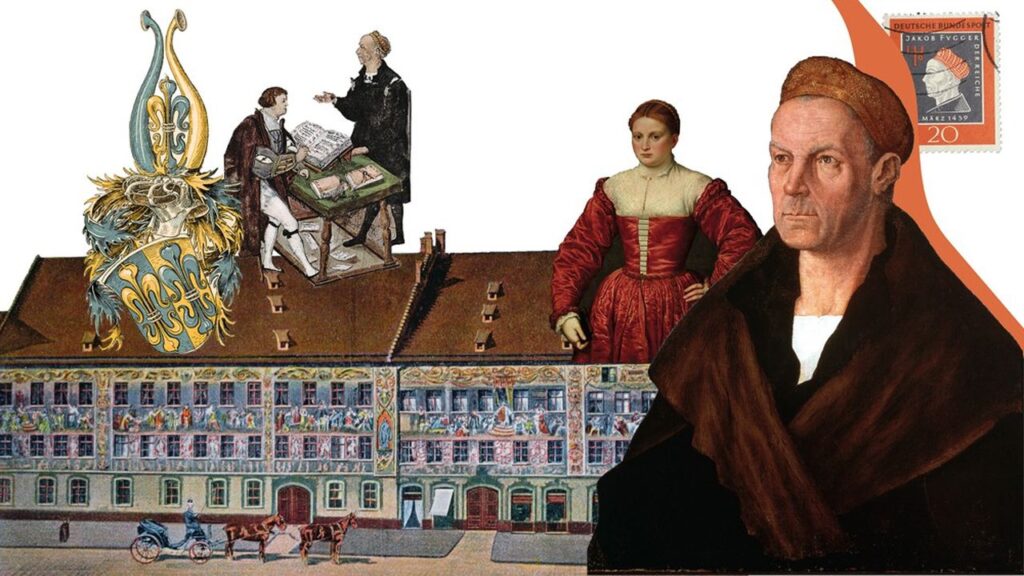
By Karel Vereycken, September 2024.
Lire cet article en FR
Investigation the Fugger and Welser banking houses?
In 1999, a dumb Bill Clinton, in front of an audience of hilarious American bankers, repealed the famous Glass-Steagall Act, the law adopted by Franklin Roosevelt to pull the world out of the economic depression by imposing a strict separation between investment (speculative) banks and the “normal” banks responsible for providing credit to the real economy.
In Orwellian fashion, the 1999 law sealing this repeal is called the Gramm-Leach-Bliley “Financial Services Modernization Act”. However, as you will discover in this article, this law, which opened the floodgates to the current predatory and criminal financial globalization, merely re-established feudal practices that had been pushed back with the dawn of modern times.
In France, the program of the Conseil national de la Résistance (CNR) explicitly called for “the establishment of a genuine social and economic and democracy, involving the removal of the great economic and financial feudal powers from the direction of the economy”, a demand echoed, in part, in the 9th paragraph of the preamble to the French 1946 Constitution, which states that “All property and all enterprises –the operation of which has or acquires the characteristics of a national public service or a monopoly in practice– must become the property of the collectivity”.
In this sense, the urgent “modernization” of finance for which we are fighting, aims to recreate not just a block of public banks, but real sovereign “national banks” (as opposed to “independent” central banks) under government control, each serving its own country but working in concert with others around the world to invest in physical and human infrastructure to the greatest benefit of all. By creating a productive credit system and “organized markets,” we can escape the hell of a feudal “monetarist” blackmail system.
To assert today that an international cartel of counterfeiters is seeking to take control of democratic societies, to engage in colonial plunder, to create fratricidal dissensions and the conditions for a new world war, will immediately be branded as conspiracy theory, Putinophilia or concealed anti-Semitism, or all three at once.
Yet the historical facts of the rise and fall of the German Fugger and Welser families (who were ardent Catholics), amply demonstrate that this is precisely what happened in the early XVIth century. Their rise and power was a veritable stab in the back of the Renaissance. Today, it’s up to us to “modernize” finance to make sure that such a situation never arises again!
Bribery and elections
In the « good old days » of the Roman Empire, things were so much simpler! Already in Athens but on a much larger scale in Rome, electoral bribery was big business. In the late Republic, lobbies coordinated schemes of bribery and extortion. Large-scale borrowing to raise money for bribes is even said to have created so much financial instability that it contributed to the 49–45 BC civil war. Roman generals, once they had systematically massacred and looted some distant colony and sold for hard cash their colonial loot, could simply buy the required number of votes, always decisive to elect an emperor or endorse a tyrant after a coup d’Etat. Legitimacy was always post-factum those days.
In Rome, the “elections” became an obscene farce to the point that they were eliminated. “A blessing from heaven”, said the statesman Quintus Aurelius Symmachus, rejoicing that “the hideous voting tablet, the crooked distribution of the seating places in the theater among the clients, the venal run, all of these are no more!”
The Holy Roman German Empire
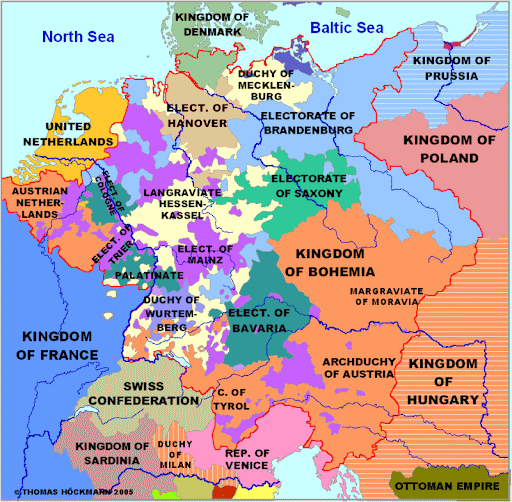
Reviving such a degenerate and corrupt imperial system wasn’t a bright idea. On 25 December 800, Pope Leo III crowned Charlemagne as Roman emperor, reviving the title in Western Europe more than three centuries after the collapse of the ancient Western Roman Empire in 476 DC.
In 962 DC, when Otto I was crowned emperor by Pope John XII, he fashioned himself as Charlemagne’s successor, and inaugurated a continuous existence of the empire for over eight centuries. In theory the emperors were considered the primus inter pares (“first among equals”) of all Europe’s Catholic monarchs. In practice, the imperial office was traditionally elective by the mostly German prince-electors.
Just as the vote of the Roman Senate was necessary to “elect” a Roman Emperor, in the Middle Ages, a tiny group of prince-electors had the privilege of “electing” the “King of the Romans.” Once elected in that capacity, this elected king would then be crowned Emperor by the pope.
The status of prince-elector had great prestige. It was considered to be behind only the emperor, kings, and the highest dukes. The prince-electors held exclusive privileges that were not shared with other princes of the Empire, and they continued to hold their original titles alongside that of prince-electors.
In 1356, the Golden Bull, a decree carrying a golden seal, issued by the Imperial Diet at Nuremberg and Metz headed by the Emperor of that time, Charles IV, fixed the protocols and rules of the imperial power system. While limiting their power, the Golden Bull granted the great-electors the Privilegium de non appellando (“privilege of not appealing”), preventing their subjects from lodging an appeal to a higher Imperial court, and turning their territorial courts into courts of last resort.
However, imposing such a superstructure everywhere was no mean feat. With Jacques Cœur, Yolande d’Aragon and Louis XI, France increasingly asserted itself as a sovereign, anti-imperial nation-state.
Therefore, the Holy Roman Empire, by a decree adopted at the Diet of Cologne in 1512, became the “Holy Roman Empire of the Germanic Nation,” a name first used in a document in 1474. The adoption of this new name coincided with the loss of imperial territories in Italy and Burgundy to the south and west by the late XVth century, but also aimed to emphasize the new importance of the German Imperial Estates in ruling the Empire. Napoleon was supposedly the one who said the Holy Roman German Empire was triply misnamed and none of the three. It was “too debauched” to be holy, “too German” to be Roman and “too weak” to be an Empire.
In light of the object of this article, we will not expand here on this subject. Noteworthy nevertheless, the fact that German Nazi Party propaganda, as early as 1923, would identify the Holy Roman Empire of the Germanic Nation as the « First » Reich (Reich meaning empire), with the German Empire as the « Second » Reich and what would eventually become Nazi Germany as the « Third » Reich.
Hitler had a soft spot for Fugger’s hometown Augsburg and wanted to make it the “City of German Businessmen”. To honor the Fugger family, he wanted to convert their Palace into a huge trade museum. To break the Fuhrer’s moral, the building got severely bombed in February 1942.
The Prince Electors
By the XVIth Century, the Holy Roman Empire consisted of 1,800 semi-independent states spread across Central Europe and Northern Italy. In a nod to the ancient Germanic tradition of electing kings, the medieval emperors of this sprawling patchwork of disparate territories were elected
What we do know is that, from the Golden Bull of 1356 onward, the emperor was elected in Frankfurt by an “electoral college” of seven “Prince-electors” (Kurfürst in German):
- the archbishop of Mainz, arch-chancellor of Germany;
- the archbishop of Trier, arch-chancellor of Gallia (France);
- the archbishop of Cologne, arch-chancellor of Italy;
- the duke of Saxony;
- the count palatine of the Rhine;
- the margrave of Brandenburg;
- and the king of Bohemia.
Of course, to obtain the vote of these great electors, candidates had to deliver oral and in advance written promises and engagements, and especially, on (and under) the table, offer privileges, power, money and more.
Hence, the most difficult endeavor for any aspiring candidate, was to raise the bribery money to buy the votes. As a result, the very existence and survival of the Holy Roman German Empire, depended nearly entirely on the existence, survival and especially goodwill of a financial oligarchy of wealthy merchant banking families willing to lend the money to the bribers. Just as a handful of giant banks are controlling western nations today by buying their emissions of state bonds required to bail-out and refinance permanent but growing debt bubbles, the banking monopolies of those days became very rapidly too-big-to-fail and too-big-to-jail.
The financial power and influence of the Bardi, Peruzzi and other Medici bankers, who, by ruining the European farmers plunged Europe in great famine creating the conditions for the XIVth Century’s “Black Death” wiping out between 30 and 50 percent of the European population, is no secret and has been aptly documented by a friend of mine, the American financial analyst, Paul Gallagher.
Fucker Advenit
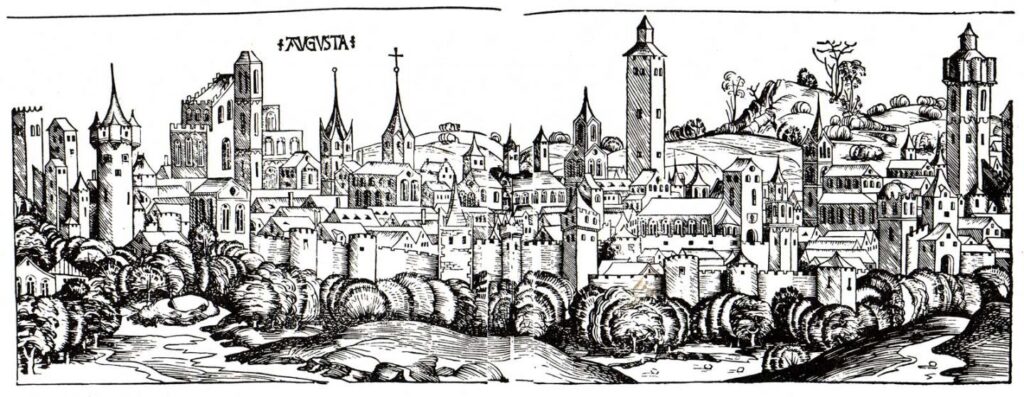
Here, we’ll focus on the activities of two German banking families who dominated the world in the early XVIth century: the Fuggers and the Welsers of Augsburg.
Unlike the Welsers, and old patrician family about we will say more later, the Fugger’s’ success story begins in 1367, when “master weaver” Hans Fugger (1348-1409) moved from his village of Graben to the “free imperial city” of Augsburg, a four-hour walk away. The Augsburg tax register reads “Fucker Advenit” (Fugger has arrived). In 1385, Hans was elected to the leadership of the weavers’ guild, which gave him a seat on the city’s Grand Council.
Augsburg, like other free and imperial cities, was not subject to the authority of any prince, but only to that of the emperor himself. The city was represented at the Imperial Diet, controlled its own trade and allowed little outside interference.
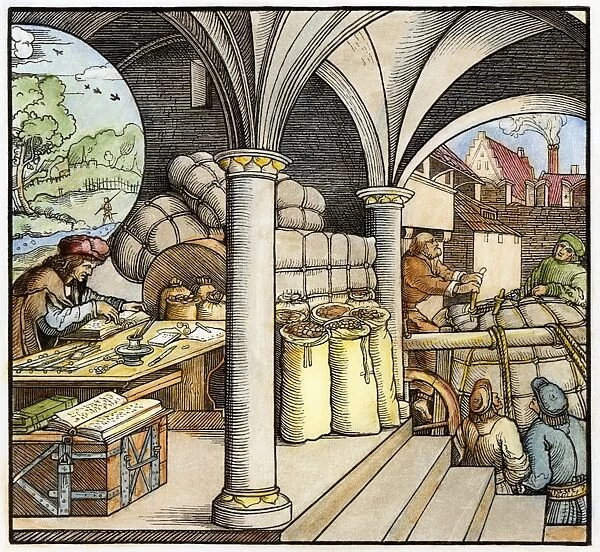
In Renaissance Germany, few cities matched Augsburg’s energy and effervescence. Markets overflowed with everything from ostrich eggs to saints’ skulls. Ladies brought falcons to church. Hungarian cow-boys drove cattle through the streets. If the emperor came to town, knights jousted in the squares. If a murderer was arrested in the morning, he was hanged in the afternoon for all to see. Beer flowed as freely in the public baths as it did in the taverns. The city not only authorized prostitution, it also maintained brothels
Initially, the Fugger’s commercial profile was very traditional: fabrics made by local weavers were bought and sold at fairs in Frankfurt, Cologne and, over the Alps, Venice. For a weaver like Hans Fugger, this was the “ideal time” to come to Augsburg. An exciting innovation was taking hold throughout Europe: fustian, a new type of fabric perhaps named after the Egyptian town of Fustat, near Cairo, which manufactured this material before its production spread to Italy, southern Germany and France.
Medieval fustian was a sturdy canvas or twill fabric with a cotton weft and a linen, silk or hemp warp, one side of which was lightly woolen. Lighter than wool, it became very much in demand, particularly for a new invention: underwear. While linen and hemp could be grown almost anywhere, in the late Middle Ages, cotton came from the Mediterranean region, from Syria, Egypt, Anatolia and Cyprus, and entered Europe via Venice.
From Jacob the Elder to « Fugger Bros »
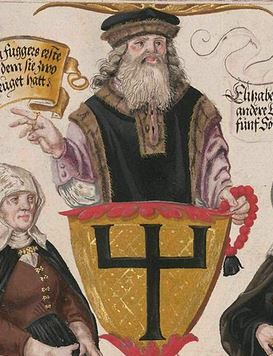
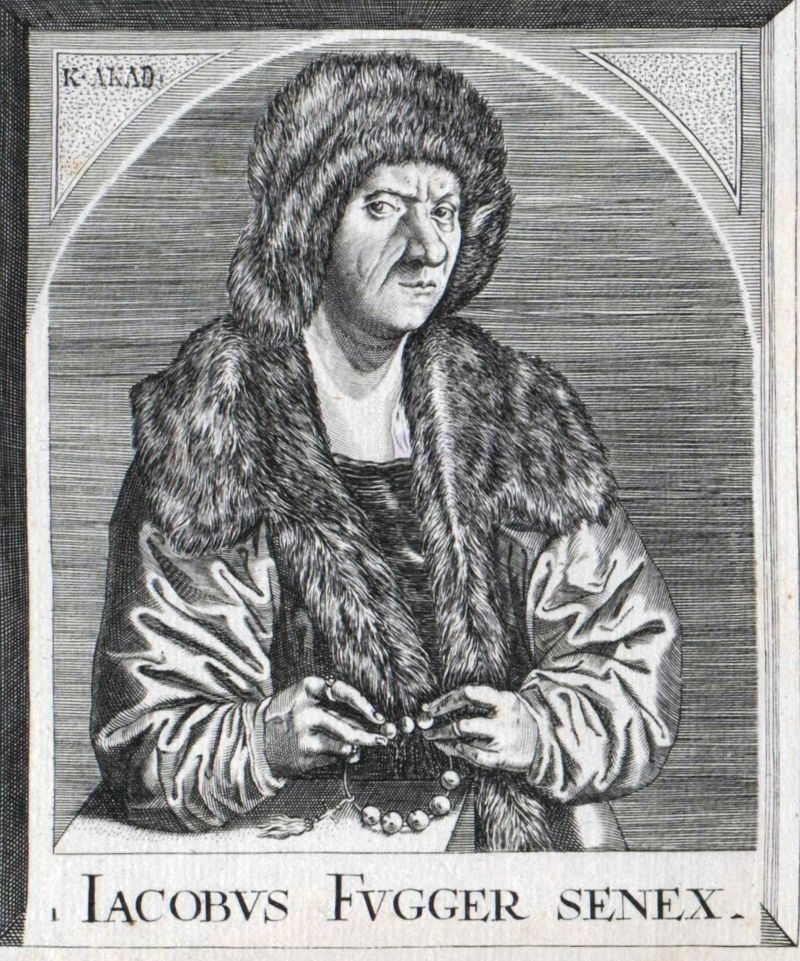
In Augsburg, Hans had two children: Jacob, known as “Jacob the Elder” (1398-1469) and Andreas Fugger (1394-1457). The two sons had different and opposing investment strategies. While Andreas went bankrupt, Jacob the Elder cautiously expanded his business.
After Jacob the Elder’s death in 1469, his eldest son Ulrich Fugger (1441-1510), with the help of his younger brother Georg Fugger (1453-1506), took over the management of the company.
Gradually, profits were invested in far more profitable activities: precious stones, goldsmithery, jewelry and religious relics such as martyrs’ bones and fragments of the cross; spices (sugar, salt, pepper, saffron, cinnamon, alum); medicinal plants and herbs and, above all, metals and mines (gold, silver, copper, tin, lead, mercury) which, as collateral enabled the expansion of credit and monetary issuance.
The Fugger forged close personal and professional ties with the aristocracy. They married into some of the most powerful families in Europe – in particular, the Thurzos of Austria. Their activities spread throughout central and northern Europe, Italy and Spain, with branches in Nuremberg, Leipzig, Hamburg, Lübeck, Frankfurt, Mainz and Cologne, Krakow, Danzig, Breslau and Budapest, Venice, Milan, Rome and Naples, Antwerp and Amsterdam, Madrid, Seville and Lisbon.
Jacob Fugger « The Rich »
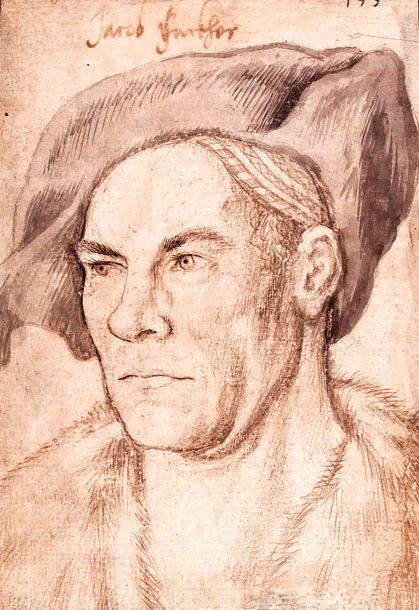
In 1473, another brother, the youngest of the three, Jacob Fugger (later known as “the Rich”) (1459-1525), aged 14 and originally destined for an ecclesiastical career, was sent to Venice, then “the world’s most trading city”. There, he was trained in commerce and book accounting. Jacob returned to Augsburg in 1486 with such admiration for Venice that he liked to be called “Jacobo” and never let go of his Venetian gold beret. Later, with a certain sense of irony, he called the accounting techniques he learned in Venice “The art of enrichment”. The humanist Erasmus of Rotterdam seems to have wanted to respond to him in his colloquium “The friend of lies and the friend of truth”.

The Banker and his wife
In 1515, Erasmus’ friend in Antwerp, the Flemish painter Quinten Matsys, painted a panel entitled “The Banker and his Wife”, a veritable cultural response from the humanists to the Fuggers. While the banker, who has hung his rosary on the wall behind him, checks whether the metal weight of the coins corresponds to their face value, his wife, turning the pages of a religious book of hours, casts a sad glance at the greedy obsessions of her visibly unhappy husband. The inscription on the frame has disappeared. It read: “Stature justa et aequa sint podere “ (” Let the scales be just and the weights equal”, a phrase taken from the Bible, Leviticus, XIX, 35).
The painter calls out to lawless finance, seeming to say to them: “Which will get you into heaven: the weight of your gold or the weight of your golden deeds, reflection of your love for God?”
The importance of information
In Venice, Jacob assimilated Venetian (Roman Empire) methods to succeed:
- organize a private intelligence service;
- impose a monopoly on strategic goods and products;
- alternate between intelligent corruption and blackmail;
- push the world to the brink of bankruptcy to make bankers such as Fugger indispensable.
Jacob Fugger recognized the importance of information. To be successful, he has to know what’s going on in the seaports and trading centers. Eager to gain every possible business advantage, Fugger set up a private mail courier designed to transmit news — such as “deaths and results of battles” — exclusively to him, so that he would have it before anyone else, especially before the emperor.
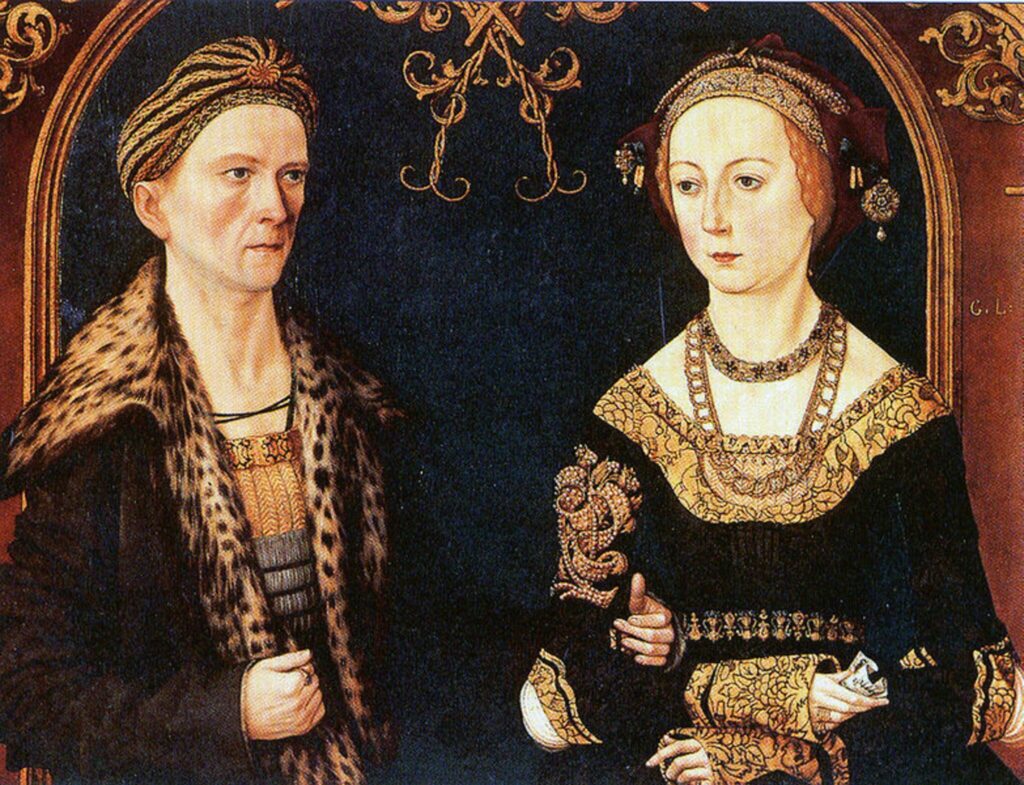

Jacob Fugger financed any project, person or operation that meets his long-term objectives. But always under strict conditions set by him, and always to impose himself on others. The prevailing principle was do ut des, in other words, “I give, I can receive”. In exchange for every loan, collateral such as metal production, mining concessions, state financial inflows, commercial and social privileges, tax and customs exemptions, and high positions in key institutions, were demanded. And with the increase in the sums advanced, the increase in the quid pro quos demanded by Fugger.
If “modern” capitalism is the dictatorship of private monopolies at the expense of free competition, it’s safe to say that he truly is its founder.
The most important thing he learned in Venice? To always be prepared to sacrifice short-term financial gains, and even to offer financial profits to his victims, in order to demonstrate his solvency and ensure his long-term political control. In the absence of national or public banks, popes, princes, dukes and emperors depended heavily, if not entirely, on an oligopoly of private bankers. When an Austrian emperor, whose banker he was, wanted to impose a universal tax, Fugger sank the project because it reduced his dependence on bankers!
A Venetian ambassador, discovering that Jacob had learned his trade in Venice, confessed:
“If Augsburg is the daughter of Venice, then the daughter has surpassed her mother”.
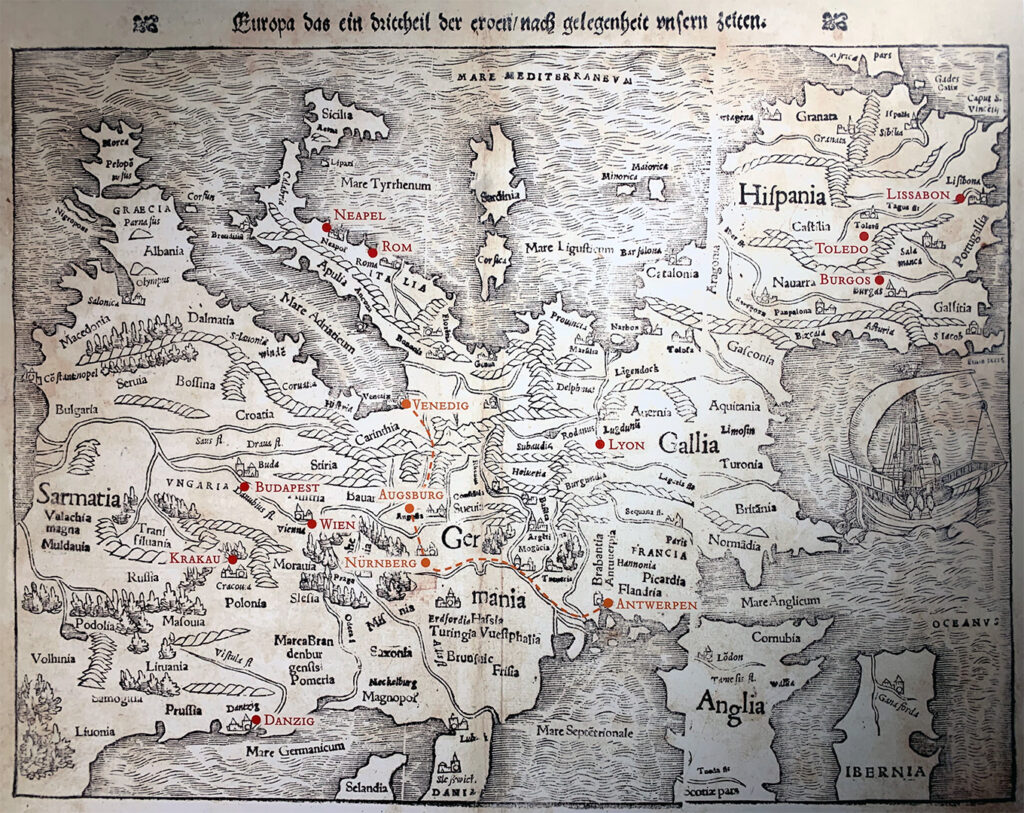
Antwerp and Venice
The three Fugger brothers were aware of the key role played by Venice and Antwerp in the copper trade, with Augsburg, along with Nuremberg, right in the middle of the trade corridor connecting them.
Antwerp
1503 marked the beginning of the Portuguese activities of the House of Fugger in Antwerp, and in 1508 the Portuguese made Antwerp the base of their colonial trade.
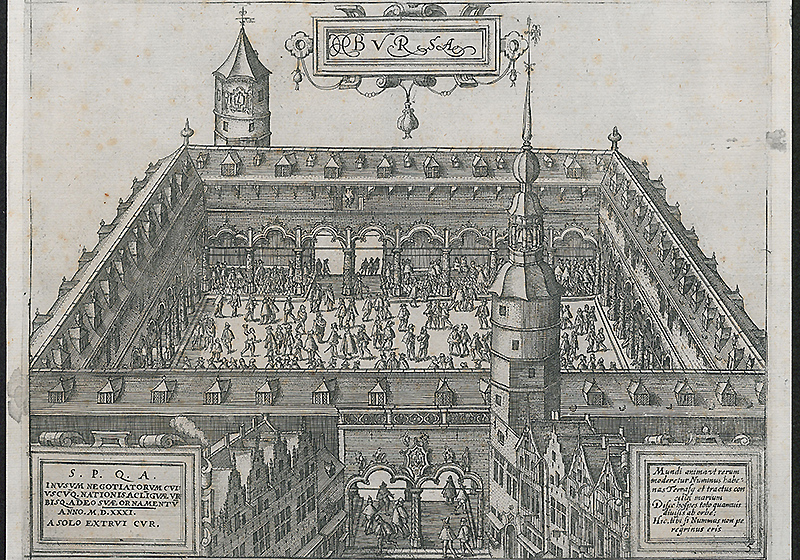
In 1515, Antwerp established Europe’s first stock exchange, a model for London (1571) and Amsterdam (1611). Copper, pepper and debts were traded. The purchase of a cargo of pepper was settled ¾ in gold, ¼ in copper. First Venice, then Portugal and Spain, depended on Fugger for silver and copper.
Venice
The firm exported copper and silver from Tyrol to Venice, and imported luxury goods, fine textiles, cotton and, above all, Indian and Oriental spices from Venice. After much effort, on November 30, 1489, the Venetian Council of State confirmed the Fugger’s permanent possession of their room in the “Fondaco dei Tedeschi”, the German merchants’ warehouse on the Grand Canal, on whose upkeep and decoration they spent considerable sums.
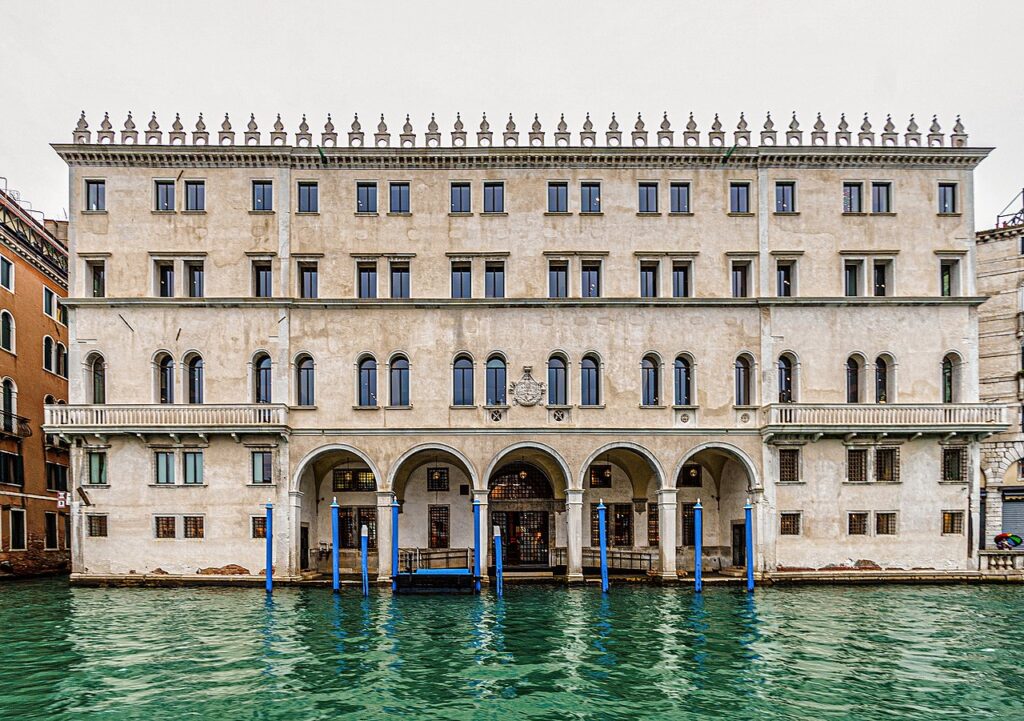
At the beginning of the XVIth century, Nuremberg merchants shared with Augsburg merchants the monopoly of what was the most important German trading post. During the meals taken in common, required by the rules, they officially presided over the table with their colleagues from Cologne, Basel, Strasbourg, Frankfurt and Lübeck.
Well-known merchant families traded in the Fondaco dei Tedeschi, including the Imhoff, Koler, Kref, Mendel and Paumgartner families from Nuremberg, and the Fugger and Höchstetter families from Augsburg. Merchants mainly imported spices from Venice: saffron, pepper, ginger, nutmeg, cloves, cinnamon and sugar.

The Nuremberg stock exchange served as a commercial link between Italy and other European economic centers. Foods known and appreciated in the Mediterranean region, such as olive oil, almonds, figs, lemons and oranges, jams and wines like Malvasia and Chierchel found their way from the Adriatic Sea to Nuremberg.
Other valuable products included corals, pearls, precious stones, Murano glassware and textiles such as silk fabrics, cotton and damask sheets, velvet, brocade, gold thread, camelot and bocassin. Paper and books completed the list.
In the years that followed, “Ulrich Fugger & Brothers” dealt in Venetian bills of exchange with the Frankfurt company Blum, and sources frequently mention the company’s branch on the Rialto as an outlet for copper and silver, a center for the purchase of luxury goods and a clearing station for transfers to the Roman curia.
The World changes

In 1498, six years after Christopher Columbus’s voyage to America, Vasco da Gama (1460-1524) was the first European to find the route to India, bypassing Africa. This enabled him to set up Calicut, the first Portuguese trading post in India. The opening of this sea route to the East Indies by the Portuguese deprived the Mediterranean trade routes, and thus South Germany, of much of their importance. Geographically, Spain, Portugal and the Netherlands gained the upper hand.
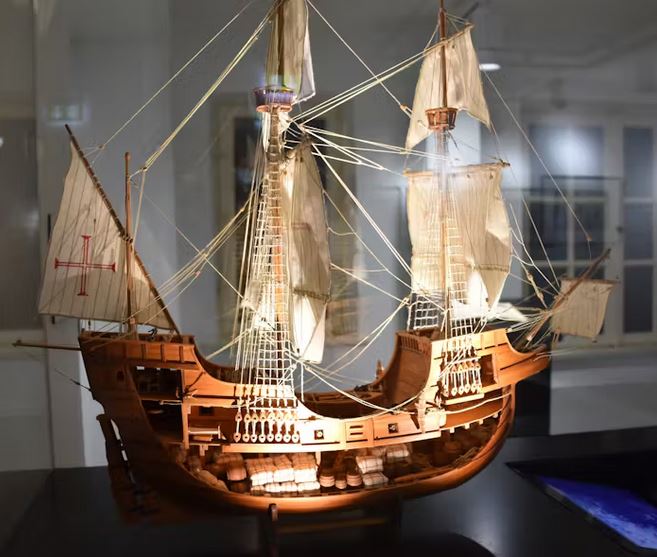
Jacob Fugger, always in the know before anyone else, decided to adapt to the new realities and relocated his colonial business from Venice to Lisbon and Antwerp. He took advantage of the opportunity to open up new markets such as England, without abandoning markets such as Italy. He took part in the spice trade and opened a factory in Lisbon in 1503. He was authorized to ship pepper, other spices and luxury goods such as pearls and precious stones via Lisbon.
Along with other German and Italian trading houses, Fugger contributed to a fleet of 22 Portuguese ships led by the Portuguese Francisco de Almeida (1450-1510), which sailed to India in 1505 and returned in 1506. Although a third of the imported goods had to be sold to the King of Portugal, the operation remained profitable. Impressed by the financial returns, the King of Portugal made the spice trade a royal monopoly, excluding all foreign participation, in order to reap the full benefits. However, the Portuguese still depended heavily on the copper supplied by Fugger, a key product for trade with India.
Fugger, tricks and tactics
Let’s summarize the “genius” and some of the tricks that enabled Jacob Fugger to become “the rich” at the expense of the rest of humanity.
1. Bail me out, baby
In 1494, the Fugger brothers founded a trading company with a capital of 54,385 florins, a sum that doubled two years later when, in 1496, Jacob persuaded Cardinal Melchior von Meckau (1440-1509), Prince-Bishop of Brixen (today’s Bressanone in the Italian Tyrol), to join the company as a “silent partner” in the expansion of mining activities in Upper Hungary. In total secrecy, and without the knowledge of his ecclesiastical chapter, the prince-Bishop invested 150,000 florins in the Fugger company in exchange for a 5% annual dividend. While such “discreet transactions” were quite common among the Medici, profiting from interest rates remained a sin for the church. When the prince-bishop died in Rome in 1509, this investment scheme was discovered. The pope, the bishopric of Brixen and the Meckau family, all claiming the inheritance, demanded immediate repayment of the sum, which would have led to Jacob Fugger’s insolvency. It was this situation that prompted Emperor Maximilian I to intervene and help his banker. Fugger came up with the formula.
Provided he helped Pope Julius II in a small war against the Republic of Venice, only the Hapsburg monarch was recognized as Cardinal Melchior von Meckau’s legitimate heir. The inheritance could now be settled by paying off outstanding debts. Fugger was also required to deliver jewels as compensation to the Pope. In exchange for his support, however, Maximilian I demanded continued financial backing for his ongoing military and political campaigns. A way of telling the Fugger: “I’m saving you today, but I’m counting on you to save me tomorrow…”.
2. Buy me a pope and the Vatican, baby
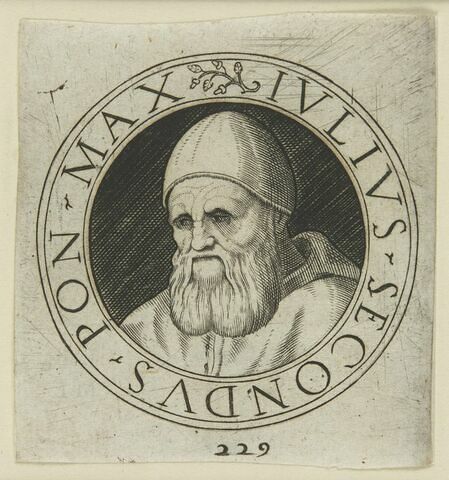
In 1503, Jacob Fugger contributed 4,000 ducats (5,600 florins) to the papal campaign of Julius II and greased the cardinals’ palms to get this “warrior pope” elected. To protect himself and the Vatican, Julius II requested 200 Swiss mercenaries. In September 1505, the first contingent of Swiss Guards set out for Rome. On foot and in the harshness of winter, they marched south, crossed the St. Gotthard Pass and received their pay from the banker… Jacob Fugger.
Julius showed his gratitude by awarding Fugger the contract to mint the papal currency. Between 1508 and 1524, the Fugger leased the Roman mint, the Zecca, manufacturing 66 types of coins for four different popes.
3. Business first, baby
In 1509, Venice was attacked by the armies of the League of Cambrai, an alliance of powerful European forces determined to break Venice’s monopoly over European trade. The conflict disrupted the Fuggers’ land and sea trade. The loans granted by the Fugger to Maximilian (a member of the League of Cambrai) were guaranteed by the copper from the Tyrol exported via Venice… The Fugger’s sided with Venice without falling out with a happy Maximilian.
4. Buy me a hitman, baby
Fugger had rivals who hated him. Among them, the Gossembrot brothers. Sigmund Gossembrot was the mayor of Augsburg. His brother and business partner, George, was Maximilian’s treasury secretary. They wanted mining revenues to be invested in the real economy, and advised the emperor to break with the Fugger. Both brothers died in 1502 after eating black pudding. The great Fugger historian Gotried von Pölnitz, who has spent more time in the archives than anyone else, wonders whether the Fugger ordered the assassination. Let’s just say that absence of proof is not proof of absence.
5. Your mine is mine, baby
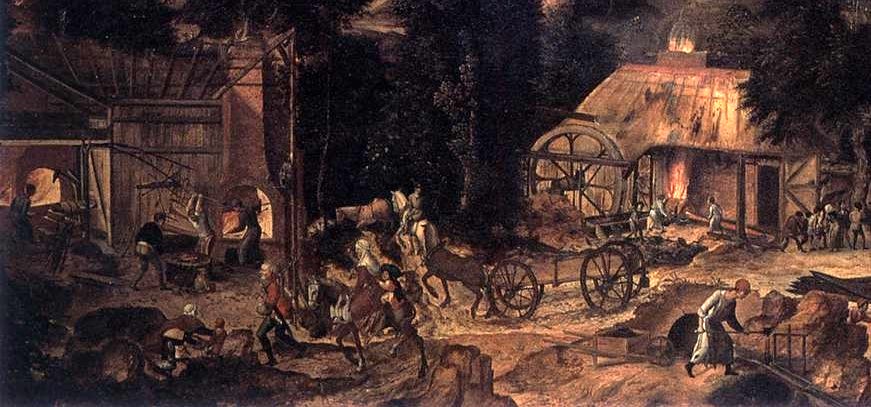
The time between 1480 and 1560 was the “century of the metallurgical process.” Gold, silver and copper could now be separated economically. Demand for the necessary mercury for the separation process grew rapidly. Jacob, aware of the potential financial gains it offered, went from textile trade to spice trade and then into mining.

Therefore, he headed to Innsbruck, currently Austria. But the mines were owned by Sigismund Archduke of Austria (1427-1496), a member of the Habsburg family and cousin of the emperor Frederick.
The good news for Jacob Fugger is that Sigismund was a big spender. Not for his subjects, but for his own amusement. One lavish party sees a dwarf emerge from a cake to wrestle a giant.
As a result, Sigismund was constantly in debt. When he ran out of money, Sigismund sold the production from his silver mine at knock-down prices to a group of bankers. To the Genoese banking family Antonio de Cavallis, for example. To get into the game, Fugger lends the Archduke 3,000 florins and receives 1,000 pounds of silver metal at 8 florins per pound, which he later sells for 12. A paltry sum compared with those lent by others, but a key move that opened his relations with Sigismund and above all with the nascent Habsburg dynasty.
In 1487, after a military skirmish with the more powerful Venice for control of the Tyrolean silver mines, Sigismund’s financial irresponsibility made him persona non grata with the big bankers. In despair, he turned to Fugger. Fugger mobilized the family fortune to raise the money the archduke demanded. An ideal situation for the banker. Of course, the loan was secured and subject to strict conditions. Sigismund was forbidden to repay it with silver metal from his mines, and had to cede control of his treasury to Fugger. If Sigmund repays him, Fugger walks away with a fortune. But, given Sigmund’s track record, the chance of him repaying is nil. Ignoring the terms of the loan, most of the other bankers are convinced that Fugger will go bankrupt. And indeed, Sigismund defaulted, just as Fugger… had predicted. However, as stipulated in the contract, Fugger seized “the mother of all silver mines”, the one in the Tyrol. By advancing a little cash, he gets his hands on a giant silver mine.
6. Buy my « Fugger Bonds », baby
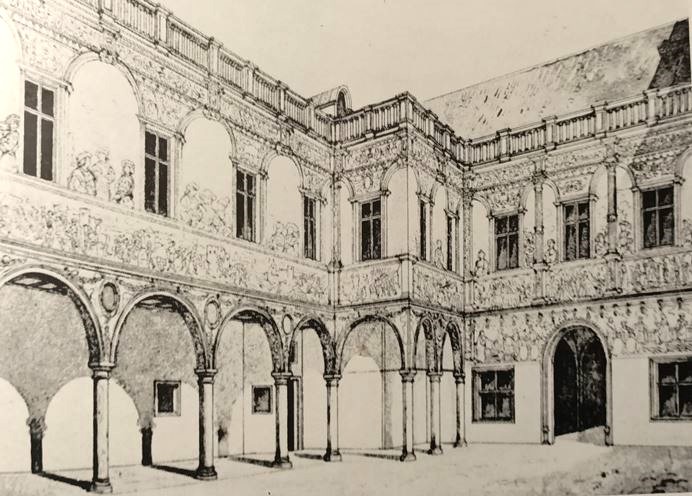
The way Fugger banking worked was that Fugger lent to the emperor (or another customer) and re-financed the loan on the market (at lower interest rates) by selling so-called “Fugger bonds” to other investors. The Fugger bonds were much sought after investments as the Fugger were regarded as “safe debtors”. Thus, the Fugger used their own superior credit standing in the market to secure financing for their customers whose credit rating was not as well regarded. The idea was – provided the emperor and the other customers honored their commitments – they would make a profit from the difference in interest between the loans the Fugger extended and the interest payable on the Fugger bonds.
7. Buy me an Emperor, baby

Sigismund was soon eclipsed by emperor Frederick IIIrd’s son, Maximilian of Austria (1459-1519), who had arranged to take power if Sigismund did not pay back money he owed him. (Fugger could have lent Sigismund the money to keep him in power but decided he’d prefer Maximilian in the position.)
Maximilian was elected “King of the Romans” in 1486 and ruled as the Holy Roman Emperor from 1508 till his death in 1519. Jacob Fugger supported Maximilian I of Habsburg in his accession to the throne by paying 800,000 florins. Laying the foundation for the family’s widely distributed landholdings, this time Fugger, as collateral, didn’t want silver, but land. So he acquired the countships of Kirchberg and Weissenhorn from Maximilian I in 1507 and in 1514, the emperor made him a count.
Unsurprisingly, Maximilian’s military conquests coincided with Jacob’s plans for mining expansion. Fugger purchased valuable land with the profits from the silver mines he had obtained from Sigismund, and then financed Maximilian’s army to retake Vienna in 1490. The emperor also seized Hungary, a region rich in copper.
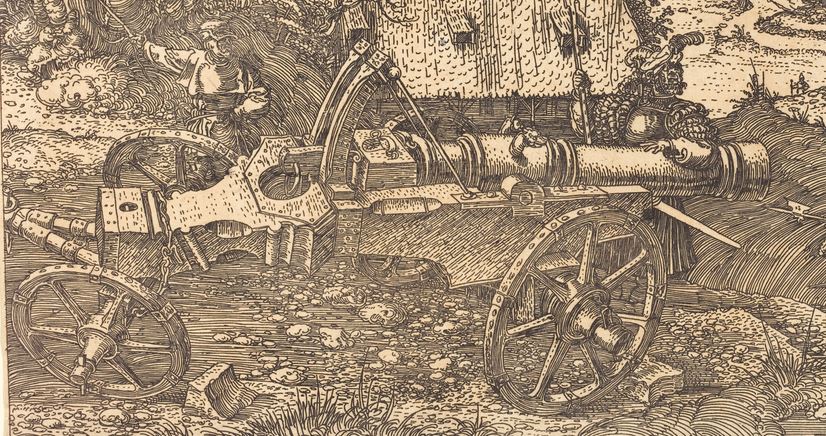
A “copper belt” stretched along the Carpathian Mountains through Slovakia, Hungary and Romania. Fugger modernizes the country’s mines by introducing hydraulic power and tunnels. Jacob’s aim was to establish a monopoly on this strategic raw material, copper ore. Along with tin, copper is used in the manufacture of bronze, a strategic metal for weapons production. Fugger opened foundries in Hohenkirchen and Fuggerau (the family’s namesake in Carinthia, today in Austria), where he produced cannons directly.
8. Sell me indulgences, baby
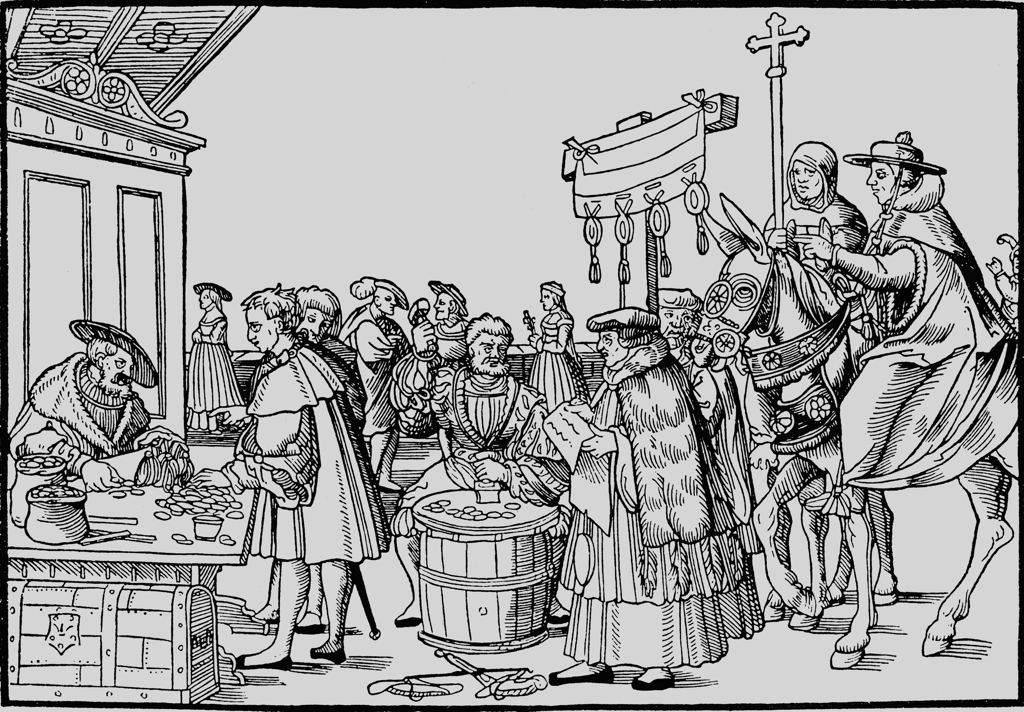
In 1514, the position of Archbishop of Mainz became available. As we have seen, this was the most powerful position in Germany, with the exception of that of the emperor. Such positions require remuneration. Albrecht of Brandenburg (1490-1545), whose family, the Hohenzollerns, ruled a large part of the country, wanted the post. Albrecht was already a powerful man: he held several other ecclesiastical offices. But even he couldn’t afford to pay such high fees. So, he borrowed the necessary sum from the Fugger, in return for interest, which the convention of the time described as a fee for “trouble, danger and expense”.
Pope Leo X, having squandered the papal treasury on his coronation and organized parties where prostitutes looked after the cardinals, asked for 34,000 florins to grant Albrecht the title – roughly equivalent to $4.8 million today – and Fugger deposited the money directly into the pope’s personal account.
All that remained was to pay back the Fugger. Albrecht had a plan. He obtained from Pope Leo X the right to administer the recently announced “jubilee indulgences”. Indulgences were contracts sold by the Church to forgive sins, allowing believers to buy their way out of purgatory and into heaven.
But to fleece the sheep, as with any good scam, a “cover” or “narrative” was required. The motive, concocted by Julius II, was credible, claiming that St. Peter’s Basilica needed urgent and costly renovation.
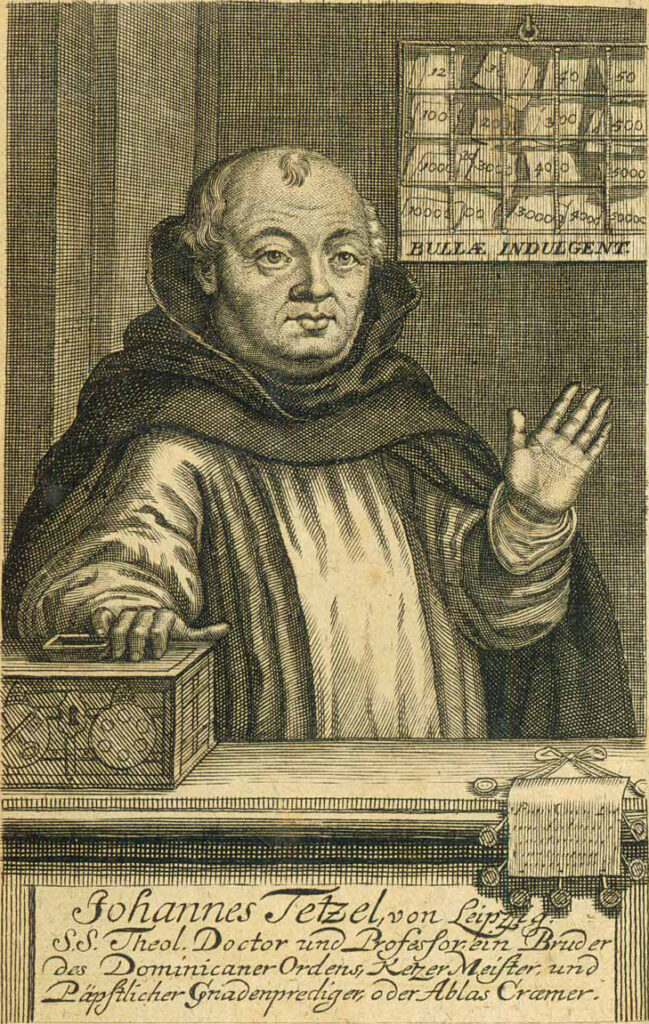
In charge of the sale was a “peddler of indulgences”, the Dominican Johann Tetzel, who “carried Bibles, crosses and a large wooden box with […] an image of Satan on top”, and told the faithful that his indulgences “canceled all sins”. He even proposed a “progressive scale”, with the wealthy believers paying 25 florins and ordinary workers just one. Tetzel is quoted as saying: “When the money rattles in the box, the soul jumps out of purgatory”.
On the ground, in every church, Fugger clerks worked on site to collect the money, half of which went to the Pope and half to Fugger. At the same time, Fugger obtained a monopoly on the transfer of the funds obtained from the sale of indulgences between Germany and Rome.
If the archbishop was at the mercy of the Fugger, so too was Pope Leo X, who, to repay his debt, collected money through “simonies”, i.e. selling high ecclesiastical offices to princes. Between 1495 and 1520, 88 of the 110 bishoprics in Germany, Hungary, Poland and Scandinavia were appointed by Rome in exchange for money transfers centralized by Fugger. In this way, Fugger became “God’s banker, Rome’s chief financier”.
9. Buy me Martin Luther, baby
Since the IIIrd century, the Catholic Church asserted that God can be indulgent, granting total or partial remission of the penalty incurred following forgiveness of a sin. However, the indulgence obtained in return for an act of piety (pilgrimage, prayer, mortification, donation), notably in order to shorten a deceased person’s passage through purgatory, over time, turned into a lucrative business, used by Urban II to recruit enthusiastic faithful to the First Crusade.
In the XVIth century, it was this trade in indulgences that led to serious unrest and turmoil within the Church. Described as superstition by Erasmus in his “In Praise of Folly”, the denunciation of the indulgence trade was the very subject of Luther’s ninety-five arguments, the manifesto he nailed on the door of the Castle Church of Wittenberg and would lead the Church to division and to the Protestant Reformation. Refusing to travel to Rome to answer charges of heresy and of challenging the Pope’s authority, Luther agreed to present himself in Augsburg in 1518 to the papal legate, Cardinal Cajetan. The latter urged Luther to retract or reconsider his statements (“revoca!”).

Although Luther had denounced Fugger by name for his central role in the indulgence swindle, he agreed to be interrogated in the central office of the bank that organized the crime he denounced!
Luther seems to have been aware that, verbal accusations aside, the Fuggers would protect and promote him rather than face a much more reasonable call for reform from Erasmus and his followers. While he could have been arrested and burned at the stake as some demanded, Luther showed up, refused to backtrack on his statements and left unscathed.
10. Buy them poverty, baby
In the XVIth century, prices increased consistently throughout Western Europe, and by the end of the century prices reached levels three to four times higher than at the beginning. Recently historians have grown dissatisfied with monetary explanations of the sixteenth-century price rise. They have realized that prices in many countries began to rise before much New World gold and silver entered Spain, let alone left it, and that probable treasure-flows bear little relation to price movements, including in Spain itself.
In reality, in the late fifteenth and early sixteenth century European populations began to expand again, recovering from that long era of contraction initiated by the Black Death of 1348. Growing populations produced rising demands for food, drink, cheap clothing, shelter, firewood, etc., all ultimately products of the land. Farmers found it difficult to increase their output of these things: food prices, land values, industrial costs, all rose. Such pressures are now seen as an important underlying cause of this inflation, though few would deny that it was stimulated at times by governments manipulating the currency, borrowing heavily, and fighting wars.
The “Age of the Fuggers” was an age where money was invested in more money and financial speculation. The real economy was looted by taxes and wars.
The dynamic created by the collapse of the living standards, taxes and price inflation for most of the people and the public exposure of corruption of both the Church and the aristocracy, set the scene for riots in many cities, the German “Peasant war,” an insurrection of weavers, craftsmen and even miners, ending with the “Revolt of the Netherlands” and centuries of bloody “religious” wars that only terminated with the “funeral” of the Empire by the Peace of Westphalia in 1648.
11. Buy them social housing, baby

Jacob Fugger’s initiative, in 1516, to start building the Fuggerei, a social housing project for a hundred working families in Augsburg, rather unique for the day, came as “too little and too late,” when the firm’s image became under increasing attacks. The Fuggerei survived as a monument to honor the Fugger. The rent remained unchanged, it still is one Rhenish gulden per year (equivalent to 0.88 euros), three daily prayers for the current owners of the Fuggerei, and the obligation to work a part-time job in the community. The conditions to live there, akin to the Harz4 measures, remain the same as they were 500 years ago: one must have lived at least two years in Augsburg, be of the Catholic faith and have become indigent without debt. The five gates are still locked every day at 10 PM.
12. Buy me rates worth an interest, baby

“You shall not charge interest.” In 1215 Pope Innocent III explicitly confirmed the prohibition on interest and usury decreed in the Bible. The line from Luke 6:35, “Lend and expect nothing in return,” was taken by the Church to mean an outright ban on usury, defined as the demand for any interest at all. Even savings accounts were considered sinful. Not Jacob Fugger’s ideal scenario. To change this, Fugger hired a renowned theologian Johannes Eck (1494-1554) of Ingolstadt to argue his case. Fugger conducted a full-on public relations campaign, including setting up debates on the issue, and wrote an impassioned letter to Pope Leo.
As a result, Leo issued a decree proclaiming that charging interest was usury only if the loan was made “without labor, cost or risk” — which of course no loan ever really is. More than a millennium after Aristotle, Pope Leo X found that risk and labor involved with safeguarding capital made money lending “a living thing.” As long as a loan involved labor, cost, or risk, it was in the clear. This opened a flood of church-legal lending: Fugger’s lobbying paid off with a fortune. Fugger persuaded the Church to permit an interest of 5% – and he was reasonably successful: charging interest was not allowed, but it wasn’t punished either.
Thanks to Leon X, Fugger was now able to attract cash by offering depositors a 5% return. As for loans, according to the Tyrolean Council’s report, while other bankers were lending Maximilian at a rate of 10%, the rate charged by Fugger, justified by “the risk”, was over 50%! Charles V, in the 1520s, had to borrow at 18%, and even at 49% between 1553 and 1556. Meanwhile, Fugger’s equity, which in 1511 amounted to 196,791 florins, rose in 1527, two years after Jacob’s death, to 2,021,202 florins, for a total profit of 1,824,411 florins, or 927% increase, which represents, on average, an annual increase of 54.5%.

All this is presented today, not as usury, but as a “great advance” anticipating modern wealth and asset management practices…
Fugger “broke the back of the Hanseatic Ligue” and “roused commerce from its medieval slumber by persuading the pope to lift the ban on moneylending. He helped save free enterprise from an early grave by financing the army that won the German Peasants War, the first great clash between capitalism and communism,” writes Greg Steinmetz, historian and former Wall Street Journal correspondent.

Why Venice created the ghetto for Jewish bankers
Of course, for a long time, the Venetians ignored these rules as they preferred making money to pleasing God, entombed in the motto, we are “First Venetians, then Christians.”
In 1382, Jews were allowed to enter Venice. In 1385 the first “Condotta” was granted, an agreement between the Republic of Venice and Jewish bankers, which gave them permission to settle in Venice to lend money at interest. The 10-year agreement detailed the rules that these bankers had to follow. Among others, it established the high annual tax to be paid, the number of banks that could open and the interest rates they could charge.
In 1385, Venice signed another agreement with Jewish bankers who lived in Mestre, located on dry land opposite the islands of Venice, so that they could grant loans at favorable rates to the poorest sections of the city. With this agreement, Serenissima managed to alleviate the poverty of the population and, at the same time, if people got angry against the Doge, could direct the hostility of the masses against Jewish moneylenders.
The Condotta of 1385, was not renewed in 1394 under the pretext that the Jews were not following the rules imposed on their activities. Jewish bankers received permission to stay for a period of 15 days a month and those who lived in Mestre used this concession to work in Venice. But to be recognized as Jews, they were already obliged to wear a yellow circle on their clothing…
To make a long story short, Venice resolved the “dilemma” by opting for mass segregation. On March 20, 1516, one of the members of the Council, after violently attacking the Jews verbally, asked that they be confined in the “Ghetto” a Venetian dialect word, used at the time to refer to the foundries in the area. The Doge and Council approved the solution. If they wanted to continue to live in Venice, Jews would have to live together in a certain area, separated from the rest of the population. On March 29, a decree created the Venice Ghetto.
You can read here the full story of the Venice ghetto
13. Buy me an Austro-Hungarian empire, baby
When Turkey invaded Hungary in 1514, Fugger was gravely concerned about the value of his Hungarian copper mines, his most profitable properties. After diplomatic efforts failed, Fugger gave Maximilian an ultimatum — either strike a deal with Hungary or forget about more loans. The threat worked. Maximilian negotiated a marriage alliance that left Hungary in Hapsburg hands, leading to “redrawing the map of Europe by creating the giant political tinderbox known as the Austro-Hungarian Empire. Fugger needed a Hapsburg seizure of Hungary to protect his holdings.
14. Buy me a second emperor, baby
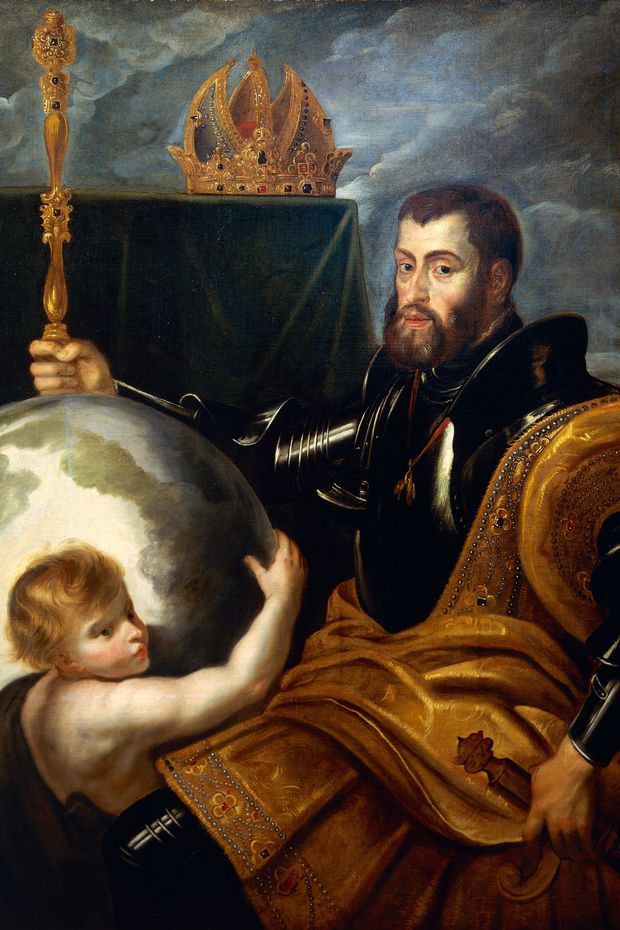
When Maximilian I, Holy Roman Emperor, died in 1519, he owed Jacob Fugger around 350,000 guilders. To avoid a default on this investment, Fugger organized a banker’s rally to gather all the bribery money allowing Maximilian’s grandson, Charles V, buying the throne.
If another candidate had been elected emperor, like King Francis I of France who suddenly tried to enter the scene, and would certainly have been reluctant to pay Maximilian’s debts to Fugger, the latter would have sunk into bankruptcy.
This situation reminds the modus operandi of JP Morgan, after the 1897 US banking crash and the banking panic of 1907. The “Napoleon of Wall Street,” afraid of a revival of a real national bank in the tradition of Alexander Hamilton, first gathered all the funds required to bail out his failing competitors, and then set up the Federal Reserve system in 1913, a private syndicate of bankers in charge of preventing the government of interfering in their lucrative business
Hence, Jacob Fugger, in direct liaison with Margaret of Austria, who bought into the scheme because of her worries about peace in Europe, in a totally centralized way, gathered the money for each elector, using the occasion to bolster dramatically his monopolistic positions, especially over his competitors such as the Welsers and the rising port of Antwerp.
According to the French historian Jules Michelet (1798-1874), Jacob Fugger energetically imposed three preconditions:
- “The Garibaldi of Genoa, the Welsers of Germany and other bankers, could only partake in this scheme by making down-payments to Fugger and could only lend money [to Charles] through his intermediary;
- “Fugger obtained promissory notes from the cities of Antwerp and Mechelen as collateral, paid for out of Zeeland tolls;
- “Fugger got the city of Augsburg to forbid lending to the French. He requested Marguerite of Austria (the regent) to forbid the people of Antwerp from exchanging money in Germany for anyone.” (handing over de facto that lucrative business to the Augsburg bankers only…)
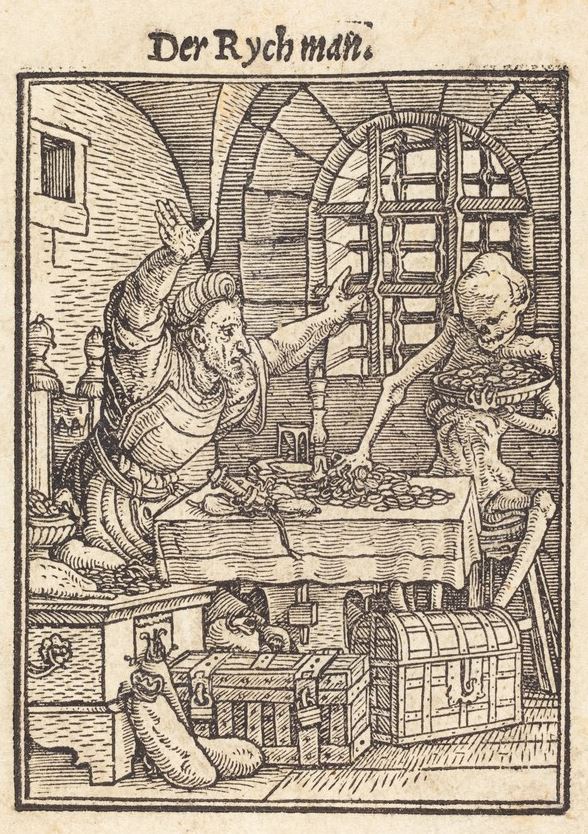
Now, as said before, people mistakenly think that Jacob “the Rich”, was “very rich.” Of course he was: today, he is considered to be one of the wealthiest people ever to have lived, with a GDP-adjusted net worth of over $400 billion, and approximately 2% of the entire GDP of Europe at the time, more than twice the fortune of Bill Gates.
If this was true or not and how wealthy he really was we will never know. But if you look at the capital declared by the Fugger brothers to the Augsburg tax authorities, it dwarfs by far the giant amounts being lent.
According to Fugger historian Mark Häberlein, Jacob anticipated modern day tax avoidance tricks by striking a deal with the Augsburg tax authorities in 1516. In exchange for an annual lump sum, the family’s true wealth… would not be disclosed. One of the reasons of course is that, just as BlackRock today, Fugger was a “wealth manager”, promising a return on investment of 5 percent while pocketing 14.5 percent himself… Cardinals and other fortunes would secretly invest in Fugger for his juicy returns.
Hence, it is safe to say that Fugger was very rich… of debts. And just as the IMF and a handful of mammoth banks today, by bailing out their clients with fictitious money, the Fuggers were doing nothing else than bailing out themselves and increasing their capacity to keep doing so. No structural reform on the table, only a liquidity crisis? Sounds familiar!
Charles’ unanimous selection by the Electors required exorbitant bribes, to the tune of 851,585 guilders, to smooth the way. Jacob Fugger put in 543,385 guilders, around two thirds of the sum. For the first time, the only collateral was Charles himself, ruling over most of the world and America.
It would take an entire book or a documentary to detail the amazing scope of bribes deployed for Charles’ imperial election, a well-documented event.
Just some excerpts from a detailed account:
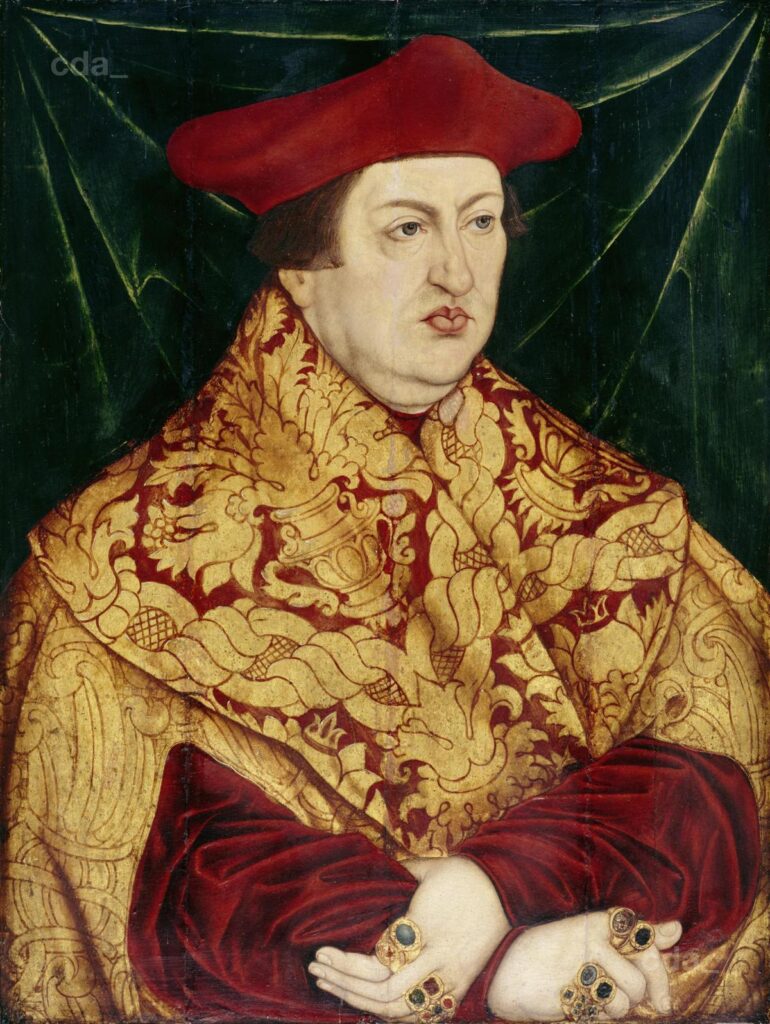
“Cardinal Albert of Brandenburg, Elector of Mainz, received 4,200 gold florins for his attendance at the Diet of Augsburg. In addition, Maximilian undertook to pay him 30,000 florins, as soon as the other electors had also committed themselves to give their votes to the Catholic King (Charles V). This was a bonus granted to the cardinal of Mainz for being the first to pledge his vote; to this gift was to be added a gold credence and a tapestry from the Netherlands. The greedy elector would also receive a life pension of 10,000 Rhine florins, payable annually in Leipzig at the Fugger bankers’ counter, and guaranteed by [the cash flow of taxes raised on maritime trade by] the cities of Antwerp and Mechelen. Finally, the Catholic King (Charles V) had to protect him to against the resentment of the King of France and against any other aggressor, while insisting that Rome grant him the title and prerogatives of ‘legate a latere’ in Germany, with the appointment benefits.”
“Hermann de Wied, archbishop-elector of Cologne, had received 20,000 florins in cash for himself and 9,000 florins to be shared between his principal officers. He was also promised a life pension of 6,000 florins, a life pension of 600 florins for his brother, a perpetual pension of 500 florins for his other brother, Count Jean, and brother, Count Jean, as well as other pensions amounting to 700 florins, to be among his principal officers.”
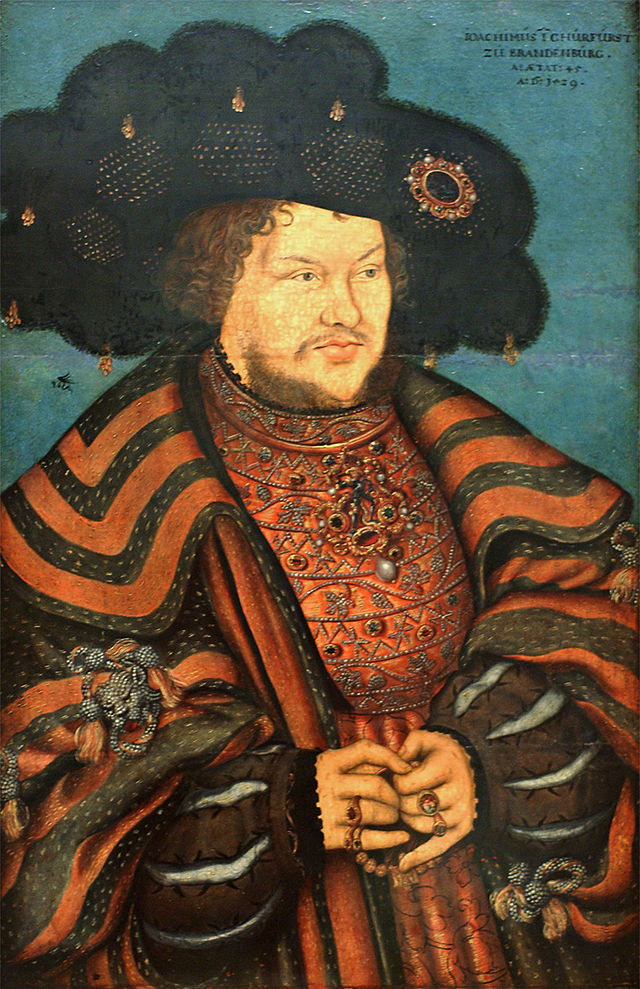
“For his part, Joachim I Nestor, Elector and Margrave of Brandenburg (another Hohenzollern and brother of Albert of Brandenburg), demanded substantial compensation for the advantages he was losing by abandoning the French king. The latter had promised him a princess of royal blood for his son and a large sum of money. Joachim was therefore keen to replace Renée de France with Princess Catherine, Charles’s sister, and demanded 8,000 florins for himself and 600 for his advisors. And that wasn’t all. He was to be paid in cash on the day of the election: 70,000 florins to deduct from Princess Catherine’s dowry; 50,000 florins for the election; 1,000 florins for his chancellor and 500 florins for his advisor, Dean Thomas Krul.”
15. Buy me zero regulation, baby
In 1523, under pressure from public opinion growing angry against the merchant houses of Augsburg, foremost of them the Fugger, the fiscal arm of the imperial Council of Regency brought an indictment against them. Some even brought up the idea of restricting trading capital of individual firms to 50,000 florins and limiting the number or their branches to three.
Acutely aware that such regulations would ruin him, Jacob Fugger, in panic, on April 24, 1523, wrote a short message to the Emperor Charles V, remembering his Majesty of his dependence on the good health of the Fugger bank accounts:
“It is furthermore no secret that Your Imperial Majesty would not have obtained the crown of Rome without my help, as I can prove from letters written in their own hand by all Your Majesty’s commissioners (…) Your Majesty still owes me 152,000 ducats, etc.”
Charles Vth realized that the debt was not the issue of the message and immediately wrote to his brother Ferdinand, asking him to take measures to prevent the anti-monopoly trial. The imperial fiscal authorities were ordered to drop the proceedings. For Fugger and the other great merchants, the storm had passed.
16. Buy me Spain, baby

Of course, Charles V didn’t had a dime to pay back the giant Fugger loan that got him elected! Little by little, Fugger obtained his rights to continue mining metals – silver and copper – in the Tyrol, validated. But he got more, first in Spain itself and, quite logically, in the territories newly conquered by Spain in America.
17. Buy me America, baby
Firstly, to raise funds, Charles leased the income of the main territories of the three great Spanish orders of chivalry, known as Maestrazgos, for which the Fugger paid 135,000 ducats a year but got much more than what he spent for the lease.
Between 1528 and 1537, the Maestrazgos were administered by the Welsers of Augsburg and a group of merchants led by the Spanish head of the postal service Maffeo de Taxis and the Genoese banker Giovanni Battista Grimaldi. But after 1537, the Fugger took over again. The lease contract was very attractive for two reasons: first it allowed the leaseholders to export grain surpluses from these estates and second, it included the mercury mines of Alamadén, a crucial element both for the production of mirror glass, the processing of gold and medical applications.
Now, as the Fugger depended on gold and silver shipments from America to recover their loans to the Spanish crown, it appeared logical for them to set their eyes on the New World, as well.
18. Buy me Venezuela, baby

Let us now enter the Welsers whose history can be traced back to the XIIIth century, when its members held official positions in the city of Augsburg. Later, the family became widely known as prominent merchants. During the XVth century, when the brothers Bartholomew and Lucas Welser carried on an extensive trade with the Levant and elsewhere, they had branches in the principal trading centers of southern Germany and Italy, and also in Antwerp, London, and Lisbon. In the XVth and XVIth centuries, branches of the family settled at Nuremberg and in Austria.
As a reward for their financial contributions to his election in 1519, second in importance to Fugger but quite massive, King Charles V, unable to reimburse, provided the Welsers with privileges within the African slave trade and conquests of the Americas.
The Welser Family was offered the opportunity to participate in the conquest of the Americas in the early to mid-1500s. As fixed in the Contract of Madrid (1528), also known as the “Welser Contracts”, the merchants were guaranteed the privilege to carry out so-called “entradas” (expeditions) to conquer and exploit large parts of the territories that now belong to Venezuela and Colombia. The Welsers nourished fantasies about fabulous riches fueled by the discovery of golden treasures and are said to have created the myth of “El Dorado” (the city of gold).
The Welsers started their operations by opening an office on the Portuguese island of Madeira and acquiring a sugar plantation on the Canary Islands. Then they expanded to San Domingo, today’s Haiti. The Welser’s hold of the slave trade in the Caribbean began in 1523, five years before the Contract of Madrid, as they had begun their own sugar production on the Island.
Included in the Contract of Madrid, the right to exploit a huge part of the territory of today’s Venezuela (Klein Venedig, Little Venice), a country they themselves called “Welserland”. They also obtained the right to ship 4,000 African slaves to work in the sugar plantations. While Spain would grant capital, horses and arms to Spanish conquistadors, the Welser would only lend them the money that allowed them to buy, exclusively from them, the means of running their operations.
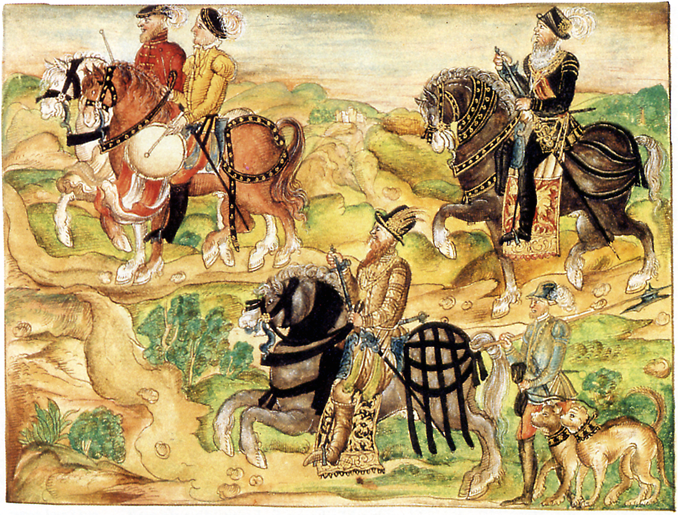
Poor German miners went to Venezuela and got rapidly into huge debt, a situation which exacerbated their rapacity and worsened the way they treated the slaves. From 1528 to 1556, seven expeditions led to the plunder and destruction of local civilizations. Things became so ugly that in 1546, Spain revoked the contract, also because they knew the Welsers also served Lutheran clients in Germany.
Bartholomeus Welser’s son, Bartholomeus VI Welser, together with Philipp von Hutten were arrested and beheaded in El Tocuyo by local Spanish Governor Juan de Carvajal in 1546. Some years later, the abdication of Charles V in 1556 meant the definitive end of the Welser’s attempt to re-assert their concession by legal means.
19. Buy me Peru and Chile, baby
Unlike the Welser family, Jacob Fugger’s participation in overseas trade was cautious and conservative, and the only other operation of this kind he invested in, was a failed 1525 trade expedition to the Maluku Islands led by the Spaniard Garcia de Loaisa (1490-1526).
For Spain, the idea was to gain access to Indonesia via America, escaping Portuguese control over the spice road. Jacob the Rich died in December of that year and his nephew Anton Fugger (1493-1560) took over the strategic management of the firm.
And the did go on. The Fugger’s relations with the Spanish Crown reached a climax in 1530 with the loan of 1.5 million ducats from the Fugger for the election of Ferdinand as “Roman King”. It was in this context that the Fugger agent Veit Hörl obtained as collateral from Spain the right to conquer and colonize the western coastal region of South America, from Chincha to the Straits of Magellan. This region included present-day southern Peru and all of Chile. Things however got foggy and for unknown reasons, Charles V, who in principle agreed with the deal failed to ratify the agreement. Considering that the Welser’s Venezuela project degenerated into a mere slave-raiding and booty enterprise and ended in substantial losses, Anton Fugger, who thought financial returns were too low, abandoned the undertaking.
20. By me a couple of slaves, baby

Copper from the Fugger mines was used for cannons on ships but also ended up in the production of horse-shoe shaped “manillas”. Manillas, derived from the Latin for hand or bracelet, were a means of exchange used by Britain, Portugal, Spain, the Netherlands, France and Denmark to trade with west Africa in gold and ivory, as well as enslaved people. The metals preferred were originally copper, then brass at about the end of the XVth century and finally bronze in about 1630.
In 1505, in Nigeria, a slave could be bought for 8–10 manillas, and an elephant’s ivory tooth for one copper manila. Impressive figures are available: between 1504 and 1507, Portuguese traders imported 287,813 manillas from Portugal into Guinea, Africa, via the trading station of São Jorge da Mina. The Portuguese trade increased over the following decades, with 150,000 manillas a year being exported to the like of their trading fort at Elmina, on the Gold Coast. An order for 1.4 million manillas was placed, in 1548, with a German merchant of the Fugger family, to support the trade.
In clear: without the copper of the Fugger’s, the slave-trade would not never have become what it became.
In 2023, a group of scientists discovered that some of the Benin bronzes, now reclaimed by African nations, were made with metal mined thousands of miles away… in the German Rhineland. The Edo people in the Kingdom of Benin, created their extraordinary sculptures with melted down brass manilla bracelets, Fugger’s grim currency of the transatlantic slave trade between the XVIth and XIXth centuries…
Endgame
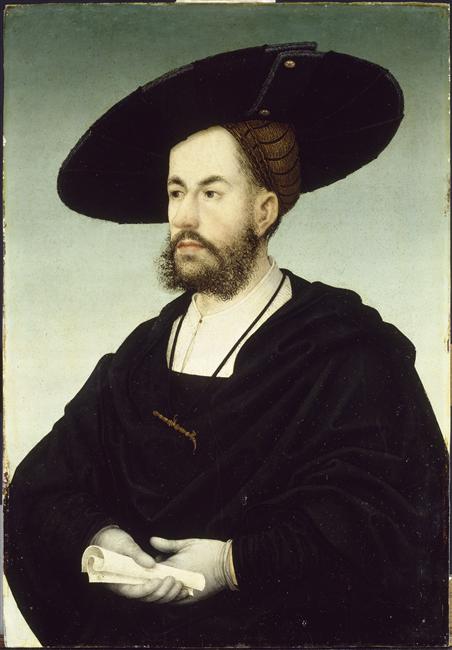
Anton Fugger tried to maintain the position of a house that, however, continued to weaken. Sovereigns were not as solvent as had been hoped. Charles V had serious financial worries and the looming bankruptcy was one of the causes he stepped down leaving the rule of the empire to his son, King Philip II of Spain. Despite all the gold and silver arriving, the Empire went bankrupt. On three occasions (1557, 1575, 1598), Philip II was unable to pay his debts, as were his successors, Philip III and Philip IV, in 1607, 1627 and 1647.
But the political grip of the Fugger over Spanish finances was so strong, writes Jeannette Graulau, that “when Philip II declared a suspension of payment in 1557, the bankruptcy did not include the accounts of the Fugger family. The Fugger offered Philip II a 50 % reduction in the interest of the loans if the firm was omitted from the bankruptcy. Despite intense lobbying by his powerful secretary, Francisco de Eraso, and Spanish bankers who were rivals of the Fugger, Philip did not include the Fugger in the bankruptcy.”
In 1563, the Fugger’s’ claims on the Spanish Crown amounted to 4.445 million florins, far more than their assets in Antwerp (783,000 florins), Augsburg (164,000 florins), Nuremberg and Vienna (28,600 florins), while their total assets amounted to 5.661 million florins.
But in the end, having tied their fate too closely to that of the Spanish sovereigns, the Fugger banking Empire collapsed with the collapse of the Spanish Hapsburg Empire. The Welser went belly up in 1614.
French professor Pierre Bezbakh, writing in Le Monde in Sept. 2021 noted:
“So when the coffers were empty, the Spanish kingdom issued loans, a practice that was not very original, but which became recurrent and on a large scale. These loans were underwritten by foreign lenders, such as the German Fugger and Genoese bankers, who accumulated but continued to lend, knowing they would lose everything if they stopped doing so, just as today’s big banks continue to lend to over-indebted states. The difference is that lenders were waiting for the promised arrival of American metals, whereas today, lenders are waiting for other countries or central banks to support countries in difficulty.”
Today, a handful of international banks called “Prime Brokers” are allowed to buy and resell on the secondary market French State Bonds, issued at regular dates by the French Treasury Agency to refinance French public debt (€3,150 billion) and most importantly to refinance debt repayments (€41 billion in 2023).
The names of today’s Fugger are: HSBC, BNP Paribas, Crédit Agricole, J.P. Morgan, Société Générale, Citigroup, Deutsche Bank, Barclays, Bank of America Securities and Natixis.
Conclusion
Beyond the story of the Fugger and Welser dynasties who, after colonizing Europeans, extended their colonial crimes to America, there’s something deeper to understand.
Today, it is said that the world financial system is “hopelessly” bankrupt. Technically, that is true, but politically it is successfully kept on the border of total collapse in order to keep the entire world dependent on a stateless financier predator class. A bankrupt system, paradoxically, despairs us, but gives them hope to remain in charge and maintain their privileges. Only bankers can save the world from bankruptcy!
Historically, we, as one humanity, have created “Nation States” duly equipped with government controlled “National Banks,” to protect us from such systemic financial blackmail. National Banks, if correctly operated, can generate productive credit generation for our long-term interest in developing our physical and human economy rather than the financial bubbles of the financial blackmailers. Unfortunately, such a positive system has rarely existed and when it existed it was shot down by the money-traders Roosevelt wanted to chase from the temple of the Republic.
As we have demonstrated, the severe mental dissociation called “monetarism” is the essence of (financial) fascism. Criminal financial and banking syndicates “print” and “create” money. If that money is not “domesticated” and used as an instrument for increasing the creative powers of mankind and nature, everything cannot, but go wrong.
Willing to “convert”, at all cost, including by the destruction of mankind and his creative powers, a nominal “value” that only exists as an agreement among men, into a form of “real” physical wealth, was the very essence of the Nazi war machine.
In order to save the outstanding debts of the UK and France to the US weapon industry owned by JP Morgan and consorts, Germany had to be forced to pay. When it turned out that was impossible, Anglo-French-American banking interests set up the “Bank for International Settlements”.
The BIS, under London’s and Wall Street’s direct supervision, allowed Hitler to obtain the Swiss currency he required to go shopping worldwide for his war machine, a war machine considered potentially useful as long as it was set to march East, towards Moscow. As a collateral for getting cash from the BIS, the German central bank would deposit as collateral tons of gold, stolen from countries it invaded (Austria, Netherlands, Belgium, Luxembourg, Czechoslovakia, Poland, Albania, etc.). The dental gold of the Jews, the communists, the homosexuals and the Gypsies being exterminated in the concentration camps, was deposited on a secret account of the Reichsbank to finance the SS.
The Bank of England’s and Hitler’s finance minister Hjalmar Schacht, who escaped the gallows of the Nuremberg trials thanks to his international protections, was undoubtedly the best pupil ever of Jacob Fugger the Rich, not the father of German or “modern” banking, but the father of financial fascism, inherited from Rome, Venice and Genoa. Never again.
Summary biography
- Steinmetz, Greg, The Richest Man Who Ever Lived, The Life and Times of Jacob Fugger, Simon and Shuster, 2016 ;
- Cohn, Henry J., Did Bribes Induce the German Electors to Choose Charles V as Emperor in 1519?
- Herre, Franz, The Age of the Fuggers, Augsbourg, 1985 ;
- Montenegro, Giovanna, German Conquistadors in Venezuela: The Welsers’ Colony, Racialized Capitalism, and Cultural Memory,
- Ehrenberg, Richard, Capital et finance à l’âge de la Renaissance : A Study of the Fuggers, and Their Connections, 1923,
- Roth, Julia, The First Global Players’ : Les Welser d’Augsbourg dans le commerce de l’esclavage et la culture de la mémoire de la ville, 2023
- Häberlein, Mark, Connected Histories : South German Merchants and Portuguese Expansion in the Sixteenth Century, RiMe, décembre 2021 ;
- Konrad, Sabine, Case Study : Spain Defaults on State Bonds, How the Fugger fared the Financial Crisis of 1557, Université de Francfort, 2021,
- Sanchez, Jean-Noël, Un projet colonial des Fugger (1530-1531) ;
- Lang, Stefan, Problems of a Credit Colony : the Welser in Sixteenth Century Venezuela, juin 2015 ;
- Graulau, Jeannette, Finance, Industry and Globalization in the Early Modern Period : the Example of the Metallic Business of the House of Fugger, 2003 ;
- Gallagher, Paul, How Venice Rigged The First, and Worst, Global Financial Collapse, Fidelio, hiver 1995
- Hale, John, La civilisation de l’Europe à la Renaissance, Perrin, 1993 ;
- Vereycken, Karel, Renaissance Studies, index.
Jacob Fugger « le riche », père du fascisme financier

Par Karel Vereycken, septembre 2024.
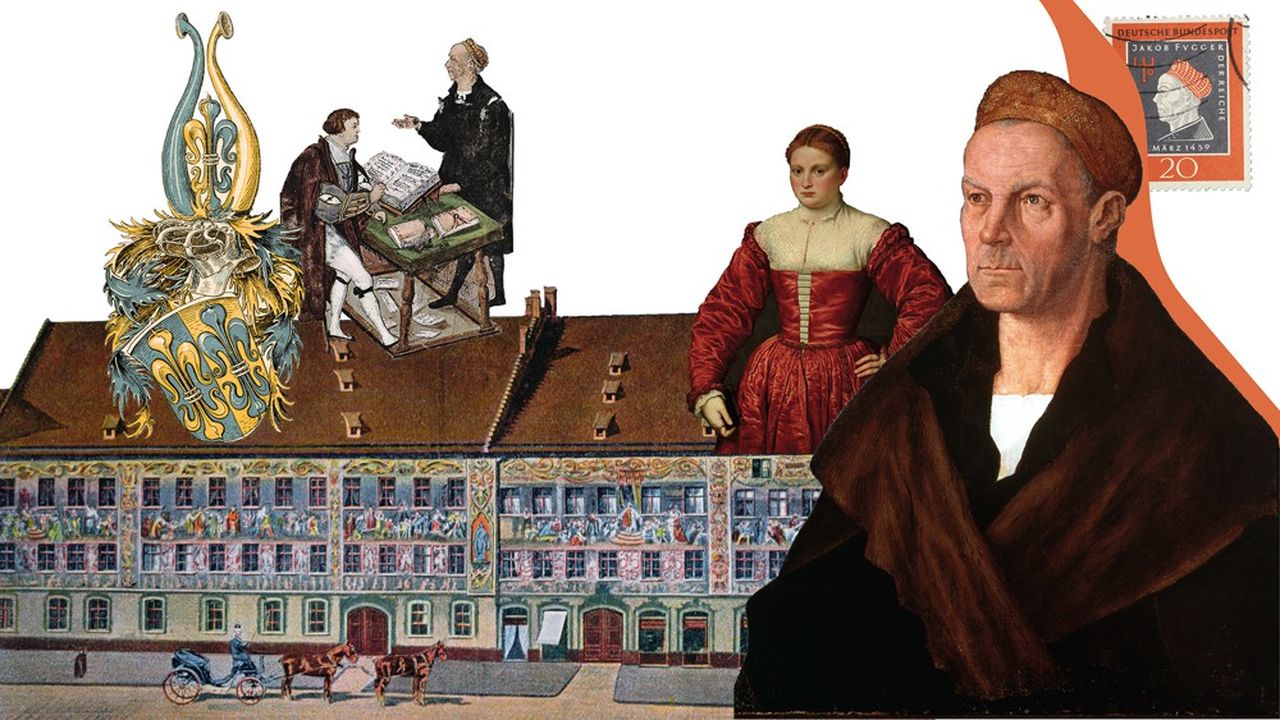
Pourquoi une enquête sur les Fuggers?
En 1999, un Bill Clinton niais, devant un parterre de banquiers américains hilares, abroge le fameux Glass-Steagall Act ; cette loi adoptée par Franklin Roosevelt pour sortir le monde de la dépression économique par une séparation stricte entre les banques d’affaires (spéculatives) et les banques « normales » chargées de fournir du crédit à l’économie réel
D’une façon orwellienne, la loi de 1999 scellant cette abrogation s’appelle la loi Gramm-Leach-Bliley « de modernisations des services financiers ». Or, comme vous allez le découvrir dans cet article, cette loi, qui a ouvert toutes grandes les portes à une mondialisation financière prédatrice et criminelle, n’a fait que rétablir des pratiques féodales qu’on avait su repousser à l’aube des temps modernes.
En France, le programme du Conseil national de la Résistance (CNR) appela explicitement à « l’instauration d’une véritable démocratie économique et sociale, impliquant l’éviction des grandes féodalités économiques et financières de la direction de l’économie », une revendication reprise, en partie, au 9e alinéa du préambule de la Constitution de 1946 pour qui, « Tout bien, toute entreprise, dont l’exploitation a ou acquiert les caractères d’un service public national ou d’un monopole de fait, doit devenir la propriété de la collectivité ». Sont créés alors, après SNCF en 1938, Électricité et Gaz de France (1946).
Dans ce sens, la « modernisation » urgentissime de la finance pour laquelle nous nous battons, entend faire renaître non seulement un pôle de banques publiques, mais des banques nationales souveraines sous contrôle des États, chacune au service de son pays mais œuvrant d’un commun accord avec d’autres dans le monde pour investir dans l’équipement de l’homme et de la nature au plus grand bénéfice de tous. Il s’agit, par la création d’un système de crédit productif et de marchés organisés, de sortir de l’enfer d’un système de chantage « monétariste ».
Affirmer aujourd’hui qu’un cartel international de faux-monnayeurs cherche à prendre le contrôle des sociétés démocratiques, à se livrer au pillage colonial, à créer des dissensions fratricides et les conditions d’une nouvelle guerre mondiale, sera immédiatement qualifié de complotisme, de Poutinophilie ou d’anti-sémitisme dissimulé, ou les trois à la fois.
Pourtant, les faits historiques de l’ascension et de la chute des familles allemandes Fugger et Welser (qui, soit dit en passant, n’étaient pas juives mais d’ardents catholiques), démontrent amplement que c’est précisément ce qui s’est passé au début du XVIe siècle, véritable poignard dans le dos de la Renaissance. A nous de « moderniser » la finance pour que plus jamais une telle situation ne se représente !
Corruption et élections
Au « bon » vieux temps de l’Empire romain, tout était tellement plus simple ! Déjà à Athènes, mais à plus grande échelle à Rome, la corruption électorale est une pratique rodée. À la fin de la République romaine, des « lobbies » puissants coordonnent des systèmes de corruption et d’extorsion. On dit même que les emprunts à grande échelle destinés à financer les pots-de-vin ont créé l’instabilité financière qui a conduit à la guerre civile de 49-45 av. JC. Les généraux romains, une fois qu’ils avaient ravagé et pillé une colonie lointaine et transformé en espèces sonnantes et trébuchantes leur butin, achetaient directement les voix des sénateurs, toujours utiles pour élire tel ou tel empereur ou légitimer un tyran après son énième coup d’État. A Rome, les « élections » deviendront une telle farce obscène qu’elles furent éliminées. « Une bénédiction du ciel », se réjouit l’homme d’État Quintus Aurelius Symmachus, heureux que « l’affreux bulletin de vote, la répartition des places au spectacle entre copains, la course vénale, tout cela n’existe plus ! ».
Le « Saint-Empire romain germanique »
Faire revivre un système impérial aussi dégénéré et corrompu n’était donc pas forcément une idée brillante, à part pour les lobbies corrupteurs. Le 25 décembre 800, le pape Léon III a couronné Charlemagne « Empereur romain », faisant revivre le titre en Europe occidentale plus de trois siècles après l’effondrement de l’ancien Empire romain d’Occident en 476.
En 962, Otton Ier est couronné empereur par le pape Jean XII. Il se présente comme le successeur de Charlemagne et inaugure l’existence continue de l’Empire pendant plus de huit siècles…
En théorie, les empereurs étaient considérés comme les « premiers parmi leurs pairs », les monarques catholiques d’Europe. Mais, tout comme le vote du Sénat romain était nécessaire pour « élire » un empereur romain, au Moyen Âge, dans la pratique, un petit groupe de « Princes-électeurs », principalement allemands, s’arroge le privilège d’élire le « Roi des Romains ». Une fois élu à ce titre, ce roi est ensuite couronné « Empereur » par le pape.
Le statut d’Électeur jouit d’un grand prestige et est considéré comme juste inférieur à celui de l’empereur, des rois et des plus grands ducs. Les Électeurs bénéficient de privilèges exclusifs qui ne sont pas partagés avec les autres princes de l’Empire, et ils continuent à porter leur titre d’origine en même temps que celui d’Électeur.
En 1356, la « Bulle d’or », un décret portant un sceau d’or émis par la Diète impériale de Nuremberg et de Metz dirigée par l’empereur de l’époque, Charles IV, fixe les règles et les protocoles du système de pouvoir impérial. Tout en limitant quelque peu leur pouvoir, la Bulle d’or accorde aux Grands Électeurs le « Privilegium de non appellando » (privilège de non-appel), empêchant leurs sujets de faire appel à une juridiction impériale supérieure et transforme leurs tribunaux territoriaux en juridictions de dernier ressort.
Cependant, imposer partout une telle superstructure n’est pas mince affaire. Avec Jacques Cœur, Yolande d’Aragon et Louis XI, la France s’affirme de plus en plus comme un État-nation souverain et anti-impérial.
C’est ainsi que le Saint-Empire romain, par un décret adopté à la Diète de Cologne en 1512, devient le « Saint Empire romain germanique », nom utilisé pour la première fois dans un document de 1474. L’adoption de ce nouveau nom coïncide avec la perte des territoires impériaux en Italie et en Bourgogne au sud et à l’ouest à la fin du XVe siècle, tout en visant à souligner la nouvelle importance des États impériaux allemands dans la direction de l’Empire. Napoléon est supposé avoir déclaré que le terme « Saint-Empire romain germanique » était trois fois erroné. Car il était trop débauché pour être saint, trop allemand pour être romain et trop faible pour être un empire.
Vu l’objet de cet article, nous ne nous étendrons pas sur ce vaste sujet. Il convient néanmoins de noter que la propagande du parti nazi, dès 1923, désignait le « Saint-Empire romain de la nation germanique » comme le « premier » Reich (Reich signifiant empire), l’Empire allemand comme le « deuxième » Reich et ce qui allait devenir l’Allemagne nazie comme le « troisième » Reich.
Adolphe Hitler, fier de l’héritage des Fugger, voulait faire d’Augsbourg la « cité des marchands allemands » et transformer la grande résidence des Fugger en « musée du commerce ». Pour briser le morale du führer, le bâtiment fut sévèrement bombardé en février 1942.
Les Princes électeurs
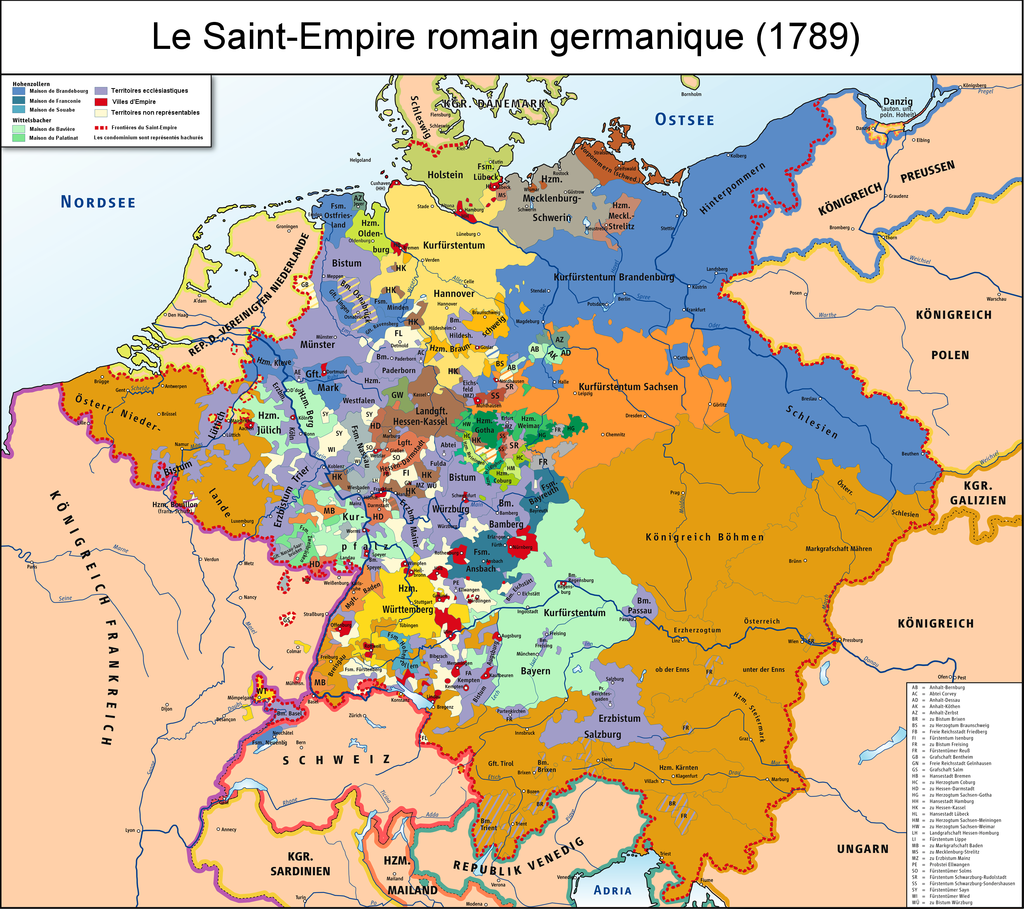
Au XVIe siècle, le Saint-Empire romain germanique se compose d’une myriade de quelque 1800 entités semi-indépendantes réparties en Europe centrale et en Italie du Nord. En clin d’œil à l’ancienne tradition germanique d’élection des rois, les empereurs médiévaux de ce patchwork tentaculaire de territoires disparates sont élus.
A partir de la Bulle d’or de 1356, l’empereur est élu à Francfort (futur siège de la Banque centrale européenne) par un « collège électoral » composé de sept « Princes-électeurs » (en allemand Kurfürst) :
- l’archevêque de Mayence, archichancelier d’Allemagne ;
- l’archevêque de Trêves, archichancelier de Gallia (France) ;
- l’archevêque de Cologne, archichancelier d’Italie ;
- le duc de Saxe ;
- le comte palatin du Rhin ;
- le margrave de Brandebourg ;
- le roi de Bohême.
Bien entendu, pour obtenir le vote de ces messieurs, les aspirants formulent des engagements oraux et écrits, et surtout, aussi bien sur que sous la table, offrent des privilèges, du pouvoir, de l’argent et bien d’autres choses encore.
Ainsi, la tâche la plus difficile pour tout candidat en herbe consiste à réunir les fonds nécessaires à l’achat des votes. En conséquence, l’existence et la survie même du Saint-Empire romain germanique est aux mains d’une oligarchie financière de riches familles de banquiers marchands.
Tout comme une poignée de banques géantes contrôlent aujourd’hui les nations occidentales en leur achetant leurs émissions de bons du Trésor indispensables au refinancement des intérêts de leurs dettes, les banquiers du début du XVIe siècle, se constituant en oligopole, s’imposent comme « trop grands pour faire faillite », et par conséquent, « trop grands pour aller en prison ».
Le rôle néfaste des Bardi, Peruzzi et autres banquiers Médicis, qui, en ruinant les agriculteurs européens, avaient plongé l’Europe dans une grande famine invitant la « Peste Noire » à décimer entre 30 et 50 % de la population européenne, est un fait historique bien documenté, notamment par mon ami, l’analyste financier américain Paul Gallagher.
Fucker Advenit
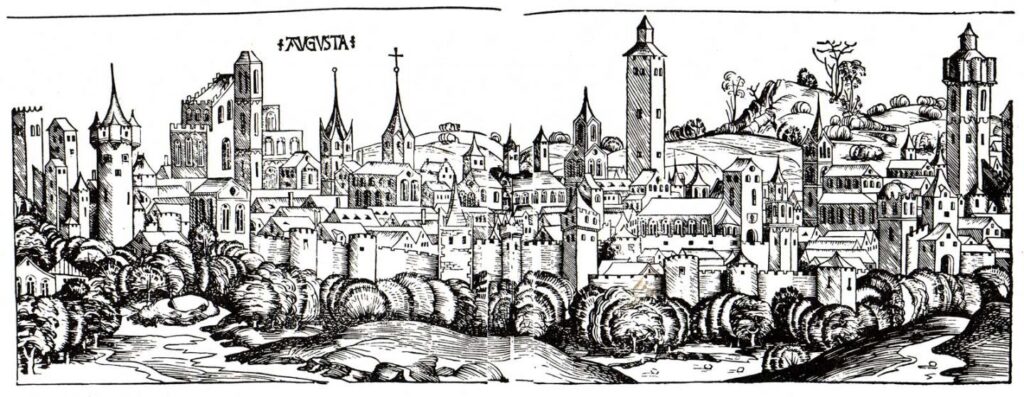
Nous nous intéresserons ici aux activités de deux familles de banquiers allemands qui dominent le monde au début du XVIe siècle : les Fugger et les Welser d’Augsbourg (Bavière).
Contrairement aux Welser, une vieille famille patricienne dont nous parlerons à la fin, l’histoire de la réussite des Fugger commence en 1367, lorsque qu’un simple artisan, le « maître tisserand » Hans Fugger (1348-1409), quitte son village de Graben pour s’installer dans la « ville impériale libre » d’Augsbourg, à quatre heures de marche. Le registre des impôts d’Augsbourg indique « Fucker Advenit » (Fugger est arrivé). En 1385, Hans est élu à la direction de la guilde des tisserands, ce qui lui permet de siéger au Grand Conseil de la ville.
Augsbourg, comme les autres villes libres et impériales, n’est soumise à l’autorité d’aucun prince, mais seulement à celle de l’empereur. La ville est représentée à la Diète impériale, contrôle son propre commerce et ne permet que peu d’interférences extérieures.
Dans l’Allemagne de la Renaissance, peu de villes ont égalé l’énergie et l’effervescence d’Augsbourg. Les marchés débordent de tout, des œufs d’autruche aux crânes de saints. Les dames apportent des faucons à l’église. Des éleveurs hongrois conduisent du bétail dans les rues. Si l’empereur vient en ville, les chevaliers joutent sur les places. Si un meurtrier est arrêté le matin, il est pendu l’après-midi pour être vu de tous. La bière coule dans les bains publics aussi librement que dans les tavernes. La ville ne se contente pas d’autoriser la prostitution, elle entretient les maisons closes.

Au départ, le profil commercial des Fugger est fort traditionnel : on achète des tissus fabriqués par des tisserands locaux et on les vend lors de foires à Francfort, à Cologne et, au-delà des Alpes, à Venise.
Pour un tisserand comme Hans Fugger, c’était le « bon moment » pour venir à Augsbourg. Une innovation passionnante s’installe dans toute l’Europe : la futaine, un nouveau type de tissu qui tire peut-être son nom de la ville égyptienne de Fustat, près du Caire, qui fabriquait ce matériau avant que sa production ne s’étende à l’Italie, à l’Allemagne du Sud et à la France.
La futaine médiévale était un tissu robuste type toile ou sergé avec une trame de coton et une chaîne de lin, de soie ou de chanvre et dont l’un des côtés a subi un léger lainage. Plus légère que la laine, elle deviendra très demandée, notamment pour une nouvelle invention : les sous-vêtements. Alors que le lin et le chanvre pouvaient être cultivés presque partout, à la fin du Moyen Âge, le coton provient de la région méditerranéenne, de Syrie, d’Égypte, d’Anatolie et de Chypre, et entre en Europe par Venise.
De Jacob l’Ancien à « Fugger Brothers »

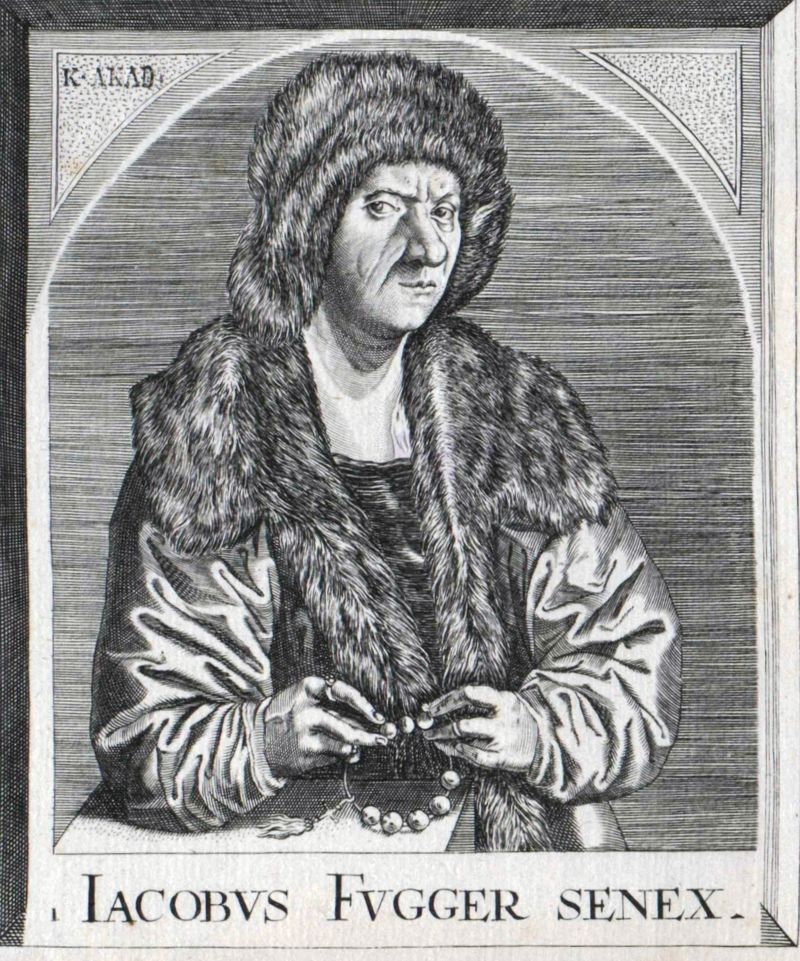
À Augsbourg, Hans a deux enfants : Jacob, connu sous le nom de « Jacob l’Ancien » (1398-1469) et Andreas Fugger (1394-1457). Les deux fils ont des stratégies d’investissement différentes et opposées. Alors qu’Andreas fait faillite, Jacob l’Ancien développe prudemment ses activités.
Après le décès de Jacob l’Ancien en 1469, son fils aîné Ulrich Fugger (1441-1510), avec l’aide de son frère cadet Georg Fugger (1453-1506), prend la direction de l’entreprise jusqu’à sa mort.
Petit à petit, les profits sont investis dans des activités nettement plus rentables : pierres précieuses, orfèvrerie, bijoux et reliques religieuses telles que les os des martyrs et les fragments de croix ; épices (sucre, sel, poivre, safran, cannelle, alun) ; plantes et herbes médicinales et surtout métaux et mines (or, argent, cuivre, étain, plomb, mercure) qui, comme collatéral, permettront l’expansion des émissions monétaires, tout en fournissant les matières premières stratégiques pour l’armement.
Les Fugger nouent alors d’étroites relations personnelles et professionnelles avec l’aristocratie. Ils se marient avec les familles les plus puissantes d’Europe – en particulier les Thurzo d’Autriche. Leurs activités s’étendent à toute l’Europe centrale et septentrionale, à l’Italie et à l’Espagne, avec des succursales à Nuremberg, Leipzig, Hambourg, Lübeck, Francfort, Mayence et Cologne, à Cracovie, Danzig, Breslau et Budapest, à Venise, Milan, Rome et Naples, à Anvers et Amsterdam, à Madrid, Séville et Lisbonne.
Jacob Fugger « le Riche »
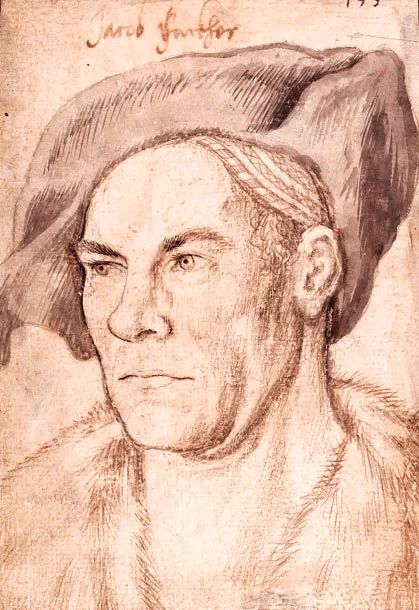
En 1473, le plus jeune des trois frères, Jacob Fugger (ultérieurement connu comme « le Riche ») (1459-1525), âgé de 14 ans et destiné à l’origine à une carrière ecclésiastique, est envoyé à Venise, à l’époque « la ville la plus commerçante du monde. Il y est formé au commerce et à la comptabilité. Jeune, Jacob rappelle qu’il s’y est trouvé dormant « à côté de ses compatriotes sur un plancher couvert de paille dans le grenier ».
Jacob retourne à Augsbourg en 1486 avec une immense admiration pour Venise au point qu’il aimait se faire appeler « Jacobo » et ne lâche jamais son béret d’or vénitien. Plus tard, avec un certain sens de l’ironie, il appelle la comptabilité apprise à Venise « l’art de l’enrichissement ».
L’humaniste Érasme de Rotterdam semble avoir voulu lui répondre dans son Colloque « L’ami du mensonge et l’ami de la vérité ».

Le banquier et sa femme
L’ami d’Érasme à Anvers, le peintre flamand Quinten Matsys, a peint en 1515 un panneau intitulé « Le banquier et sa femme », véritable réponse culturelle des humanistes aux Fugger.
Tandis que le banquier, qui a accroché son chapelet au mur derrière lui, vérifie si le poids du métal des pièces correspond à leur valeur nominale, sa femme, qui tourne les pages d’un livre d’heures religieux, jette un regard triste sur les obsessions cupides de son mari visiblement malheureux. L’inscription sur le cadre a disparu.
Elle se lisait ainsi : « Stature justa et aequa sint podere » ( « que la balance soit juste et les poids égaux », phrase tirée de la Bible, Lévitique, XIX, 35).
Le peintre interpelle une finance sans foi ni loi et semble leur dire : « Qu’est-ce qui vous fera entrer au paradis : le poids de votre or ou le poids de vos bonnes actions ? »
L’importance de l’information
A Venise, Jacob a assimilé les méthodes vénitiennes (de l’Empire romain) pour réussir :
- organiser un service de renseignement privé ;
- imposer un monopole sur les produits stratégiques ;
- alternance entre la corruption intelligente et le chantage ;
- pousser le monde au bord de la faillite pour se rendre indispensable.
Jacob Fugger reconnaît l’importance de l’information. Pour réussir, il doit être informé de ce qui se passe dans les ports maritimes et les centres de commerce. Désireux d’obtenir tous les avantages possibles en affaires, Fugger met en place un système de courrier privé destiné à lui transmettre exclusivement les nouvelles, telles que les « décès et les résultats des batailles », afin qu’il les ait avant tout le monde, surtout avant l’empereur.
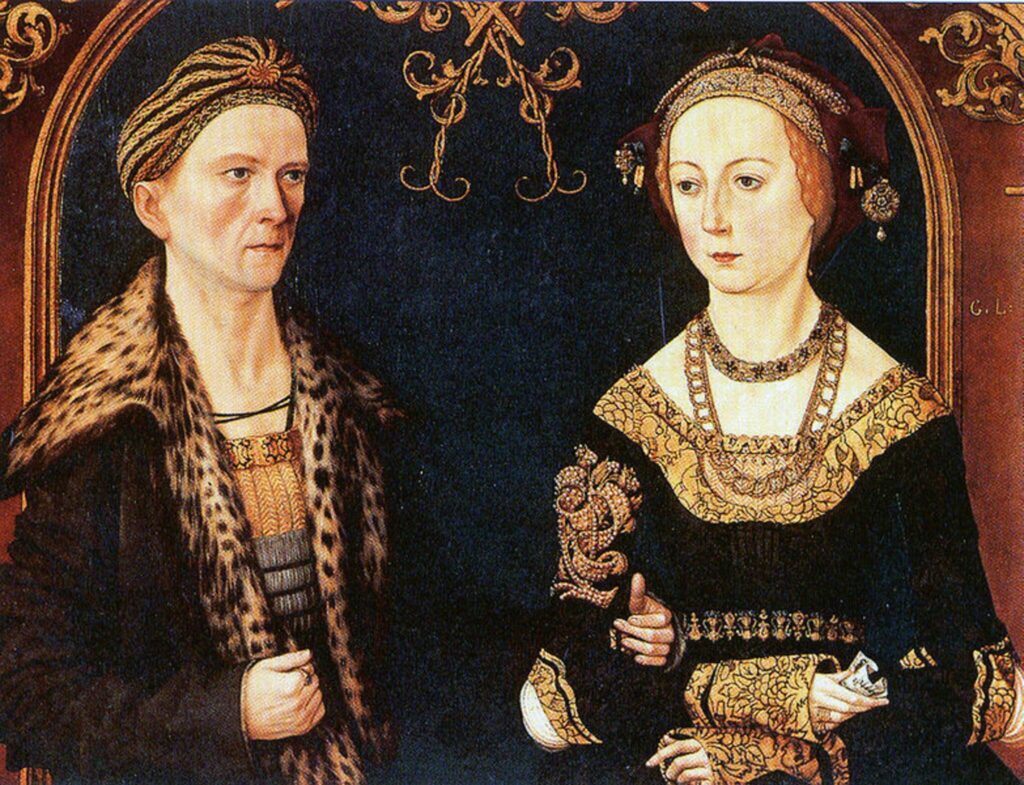
Jacob Fugger finance tout projet, personne ou opération, correspondant à son objectif à long terme. Mais toujours à des conditions sévères fixées par lui et toujours pour s’imposer aux autres. Le principe en vigueur était le « do ut des », en d’autres termes, « je donne, je peux recevoir ».
En échange de tout prêt, des garanties et des hypothèques étaient exigées : des productions de métaux, des concessions minières, des entrées financières des États, des privilèges commerciaux et sociaux, des exemptions fiscales et douanières et de hautes fonctions pour les proches de Fugger dans la vie des Etats. Et avec la hausse des sommes avancées, la hausse des contreparties exigées par Fugger.

Si le capitalisme « moderne » est la dictature de monopoles privés au détriment d’une libre concurrence non-faussé, c’est sûr qu’il en est le fondateur.
La chose la plus importante qu’il ait apprise à Venise ? Être toujours prêt à sacrifier des gains financiers à court terme et même à offrir des profits financiers à ses victimes pour démontrer sa solvabilité et assurer son contrôle politique à long terme. En l’absence de banques nationales ou de banques publiques, les papes, les princes, les ducs et les empereurs dépendent fortement, voire entièrement, d’un oligopole de banquiers privés.
Lorsqu’un empereur autrichien, dont il est le banquier, envisage de lever un impôt universel, Fugger sabote le projet car cela réduisait sa dépendance des banquiers !
Un ambassadeur vénitien, découvrant que Jacob avait appris son métier à Venise, confesse:
« Si Augsbourg est la fille de Venise, alors la fille a surpassé sa mère »
Anvers et Venise
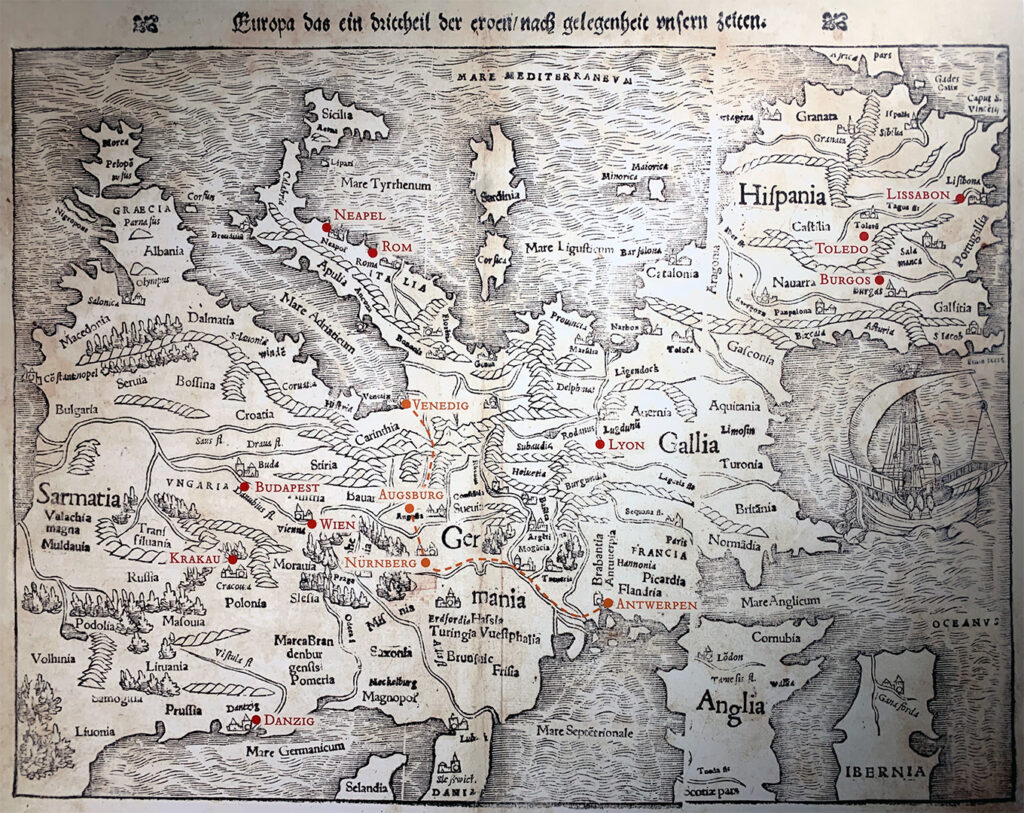
Les trois Fugger sont bien conscients du rôle clé de Venise et d’Anvers pour le commerce du cuivre, Augsbourg se trouvant, avec Nuremberg, au beau milieu du corridor commercial les reliant. (voir carte)
Anvers
L’année 1503 marque le début des activités portugaises de la maison Fugger à Anvers et, en 1508, les Portugais font d’Anvers la maison de base du commerce colonial.
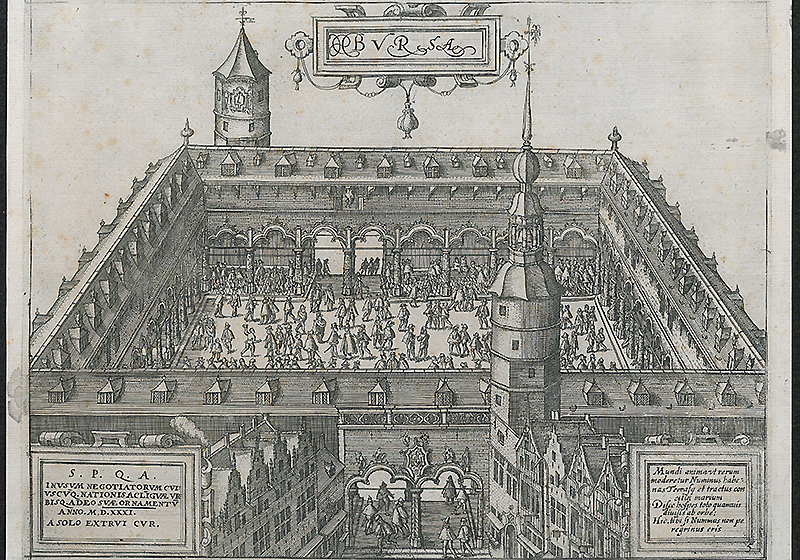
En 1515, Anvers se dote de la première bourse de commerce d’Europe qui servira de modèle pour Londres (1571) et Amsterdam (1611).
On y négocie le cuivre, le poivre et les dettes. L’achat d’une cargaison de poivre se réglait pour les ¾ en or, pour ¼ en cuivre. Venise d’abord, Portugal et Espagne par la suite, dépendent de Fugger pour l’argent (métal) et le cuivre.
Venise
La firme exporte du cuivre et de l’argent du Tyrol vers Venise, et importe par Venise des produits de luxe, des textiles fins, du coton et, surtout, des épices indiennes et orientales. Après de grands efforts, c’est le 30 novembre 1489 que le Conseil d’État de Venise confirme aux Fugger la possession permanente de leur chambre au Fondaco dei Tedeschi (Maison des Allemands), l’entrepôt des marchands allemands de poivre sur le Grand Canal, pour l’entretien et la décoration duquel Fugger a dépensé des sommes importantes.

Au début du XVIe siècle, les marchands de Nuremberg partagent avec ceux d’Augsbourg, le monopole de ce qui constitue le plus important comptoir commercial germanique. Au cours des repas pris en commun que le règlement leur impose, ils président alors officiellement la table réunissant leurs confrères de Cologne, de Bâle, de Strasbourg, de Francfort et de Lübeck.
Des familles de commerçants bien connues font du commerce dans la Fondaco dei Tedeschi dont les Imhoff, Koler, Kreß, Mendel et Paumgartner de Nuremberg, et les Fugger et Höchstetter de Augsbourg. Les marchands importent principalement des épices de Venise : safran, poivre, gingembre, muscade, clous de girofle, cannelle et sucre.

La bourse de Nuremberg sert de lien commercial entre l’Italie et d’autres centres économiques européens. Des aliments connus et appréciés dans la région méditerranéenne, tels que l’huile d’olive, les amandes, les figues, les citrons et les oranges, les confitures et des vins trouvent leur chemin de la mer Adriatique à Nuremberg.
A cela s’ajoutent d’autres produits de valeur tels que les coraux, les perles, les pierres précieuses, les produits de la verrerie de Murano et de l’industrie textile, comme les tissus de soie, draps de coton et de damas, velours, brocart, fil d’or, camelot et bocassin. Du papier et des livres complètent la liste.
Au cours des années suivantes, la firme « Ulrich Fugger et frères » traite des lettres de change vénitiennes avec la société Blum de Francfort et les sources mentionnent fréquemment la succursale de la société sur le Rialto comme un débouché pour le cuivre et l’argent, un centre pour l’achat de produits de luxe et une station de compensation pour les transferts à la curie romaine.
Le basculement du monde

En 1498, six ans après le voyage de Christophe Colomb vers l’Amérique, Vasco de Gama (1460-1524) fut le premier Européen à trouver la route de l’Inde en contournant l’Afrique. Il put ainsi fonder Calicut, le premier comptoir portugais en Inde. L’ouverture de la route maritime vers les Indes orientales par les Portugais prive alors les routes commerciales de la Méditerranée, et donc de l’Allemagne du Sud, d’une grande partie de leur importance. Géographiquement, c’est l’Espagne, le Portugal et les Pays-Bas qui prennent l’avantage.
Jacob Fugger, toujours au courant de tout avant tout le monde, décide alors de relocaliser son marché colonial de Venise vers Lisbonne et Anvers. Il profite de l’occasion pour ouvrir de nouveaux marchés tels que l’Angleterre, sans pour autant délaisser ses marchés tels que l’Italie. Il participe au commerce des épices et ouvre une factorerie à Lisbonne en 1503.
Il reçoit l’autorisation de faire transiter par Lisbonne le poivre, d’autres épices et des produits de luxe tels que les perles et les pierres précieuses.
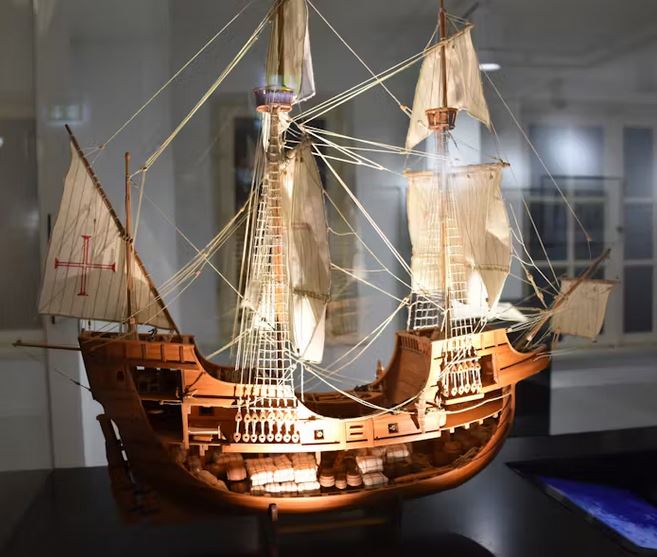
Avec d’autres maisons de commerce d’Allemagne et d’Italie, Fugger contribue à une flotte de 22 navires portugais dirigée par le portugais Francisco de Almeida (1450-1510), qui se rend en Inde en 1505 et en revient en 1506. Bien qu’un tiers des marchandises importées doive être cédé au roi du Portugal, l’opération reste rentable. Obnubilé par les gains énormes de l’expédition, le roi du Portugal, pour pleinement pouvoir en profiter, fait du commerce des épices un monopole royal excluant toute participation étrangère. Cependant, les Portugais restent dépendant du cuivre livré par Fugger, un produit d’exportation essentiel pour le commerce avec l’Inde.
Fugger, ruses et astuces
1. Renfloue-moi, chérie
En 1494, les frères Fugger fondent une entreprise commerciale avec un capital de 54 385 florins, somme qui sera doublée deux ans plus tard lorsque Jacob persuade, en 1496, le cardinal Melchior von Meckau (1440-1509), prince-évêque de Brixen (aujourd’hui Bressanone dans le Tyrol italien), de rejoindre l’entreprise en tant qu’« associé silencieux » dans le cadre de l’expansion des activités minières en Haute-Hongrie. Dans le plus grand secret et à l’insu de son chapitre ecclésiastique, le prince-évêque place 150 000 florins dans la société Fugger en échange d’un dividende annuel de 5 %. Si de telles « transactions discrètes » étaient tout à fait habituelles chez les Médicis, profiter de taux d’intérêts reste un péché pour l’Eglise.
Lorsque le prince-évêque meurt à Rome en 1509, cet investissement est découvert. Le pape, l’évêché de Brixen et la famille de Meckau, qui revendiquent tous l’héritage, exigent alors le remboursement immédiat de la somme, ce qui aurait entraîné l’insolvabilité de Jacob Fugger.
C’est cette situation qui incite l’empereur Maximilien Ier à intervenir et à aider son banquier. Fugger lui trouve la formule. À condition d’aider le pape Jules II dans une petite guerre contre la République de Venise, le monarque des Habsbourg est reconnu comme l’héritier légitime du cardinal Melchior von Meckau. L’héritage peut désormais être réglé par l’amortissement des dettes en cours. Fugger doit également livrer des bijoux en guise de dédommagement au pape. En échange de son soutien, Maximilien Ier exige toutefois un appui financier soutenu pour ses campagnes militaires et politiques en cours. Une façon de dire aux Fugger : « Je vous sauve aujourd’hui mais je compte sur vous pour me sauver demain… ».
2. Achète-moi un pape et le Vatican, chérie

En 1503, Jacob Fugger donne 4000 ducats (5600 florins) pour graisser la patte des cardinaux afin de faire élire « le pape guerrier » Jules II, ennemi des humanistes.
Une fois élu, pour sa protection, Jules II réclame 200 mercenaires suisses. En septembre 1505, le premier contingent de gardes suisses se met en route pour Rome. À pied et dans les rigueurs de l’hiver, ils marchent vers le sud, franchissent le col du Saint-Gothard et reçoivent leur solde du banquier… Jacob Fugger.
Jules II montre sa gratitude en confiant à Fugger la frappe de la monnaie papale. Entre 1508 et 1524, les Fugger occupent à Rome l’hôtel des monnaies, la Zecca, et fabriquent 66 types de pièces pour quatre papes différents.
3. Les affaires d’abord, chérie
En 1509, Venise est attaquée par les armées de la Ligue de Cambrai, une alliance de puissantes forces européennes qui décide de briser le monopole de Venise sur le commerce européen.
Le conflit désorganise les échanges terrestres et maritimes des Fugger. Les prêts accordés par les Fugger à Maximilien (membre de la Ligue de Cambrai) sont garantis par le cuivre du Tyrol exporté via Venise… Les Fuggers se rangent du côté de Venise sans se brouiller avec un Maximilien bien content.
4. Achète-moi un tueur à gages, chérie
Fugger a des rivaux qui le détestent. Parmi eux, les frères Gossembrot. Sigmund Gossembrot est le maire d’Augsbourg. Son frère et associé en affaires George, est le secrétaire au trésor de Maximilien. Ils souhaitent que les revenus des mines soient investis dans l’économie réelle et conseillent à l’empereur de rompre avec les Fugger. Les deux frères moururent en 1502 après avoir mangé du boudin noir. Le grand historien des Fugger, Gotried von Pölnitz, qui a passé plus de temps que quiconque dans les archives, s’est demandé si les Fugger avaient ordonné cet assassinat. Disons qu’une absence de preuve n’est pas une preuve d’absence.
5. Ta belle mine est mienne, chérie
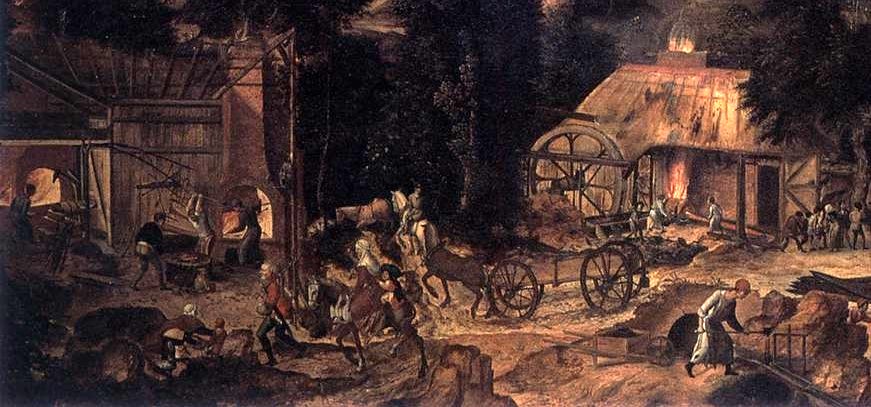
La période comprise entre 1480 et 1560 a été le siècle de la révolution métallurgique. L’or, l’argent et le cuivre peuvent désormais être séparés de manière économique. La demande de mercure nécessaire au processus augmente rapidement.
Jacob, conscient des gains financiers potentiels qu’il offre, passa du commerce des textiles à celui des épices, puis à l’exploitation minière. Il se rend donc à Innsbruck, dans l’actuelle Autriche, où les mines appartiennent à Sigismond, archiduc d’Autriche (1427-1496), membre de la famille Habsbourg et cousin de l’empereur Frédéric.

La bonne nouvelle pour Jacob Fugger, c’est que Sigismond est très dépensier. Non pas pour ses sujets mais pour se divertir. Lors d’une fête somptueuse on voit sortir un nain d’un gâteau pour lutter contre un géant. Résultat, Sigismond est constamment obligé de s’endetter. Lorsque l’argent manque, Sigismond vend la production de sa mine d’argent à des prix cassés à un groupe de banquiers. Par exemple à la famille de banquiers génois Antonio de Cavallis.
Pour entrer dans le jeu, Fugger prête à l’archiduc 3000 florins et reçoit 1000 livres d’argent métal à 8 florins la livre, qu’il revend plus tard à 12. Une somme dérisoire comparée à celles prêtées par d’autres, mais ouvrant ses relations avec Sigismond et surtout avec la dynastie naissante des Habsbourg.
En 1487, après une escarmouche militaire avec Venise, plus puissante, pour le contrôle des mines d’argent du Tyrol, l’irresponsabilité financière de Sigismond le rend persona non grata auprès des grands banquiers. Désespéré, il se tourne alors vers Fugger. Ce dernier mobilise la fortune familiale pour réunir l’argent que réclame le monarque. Une situation idéale pour le banquier. Bien entendu, il s’agit d’un prêt garanti et assorti de conditions très strictes. Sigismond ne peut pas le rembourser avec de l’argent métal de ses mines et il doit céder à Fugger le contrôle de son trésor public. Si Sigismond le rembourse, Fugger repart avec une fortune. Mais, compte tenu des antécédents de Sigismond, la chance qu’il rembourse est nulle. Ignorant les conditions du prêt, la plupart des autres banquiers sont convaincus que Fugger fera faillite. Et en effet, Sigismond a fait défaut, exactement comme Fugger… l’avait prévu. Cependant, comme stipule le contrat, Fugger s’empare de « la mère de toutes les mines d’argent », celle du Tyrol. En avançant un peu d’argent comptant, il met la main sur une mine d’argent.
6. Achète mes « obligations Fugger », chérie
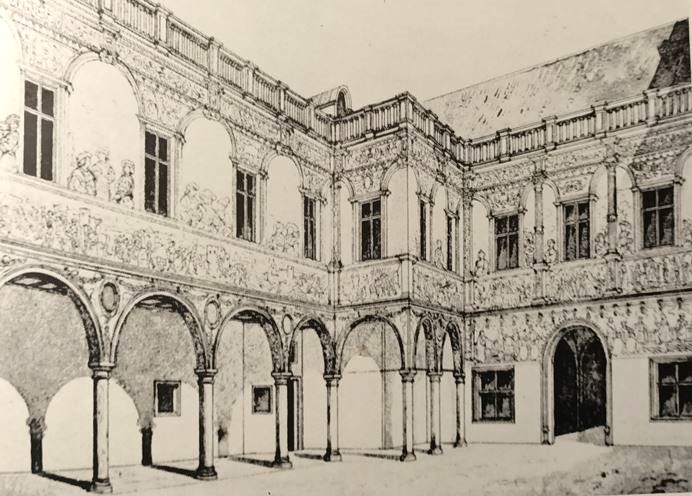
Le fonctionnement de la banque Fugger est « moderne » : Fugger prête à l’Empereur (ou à un autre client) et refinance le prêt sur le marché (à des taux d’intérêt plus bas) en vendant des « obligations Fugger » à d’autres investisseurs. Les obligations Fugger étaient des investissements très recherchés car les Fugger sont considérés comme « débiteurs sûrs ». Ainsi, les Fugger ont utilisé leur solvabilité supérieure sur le marché pour garantir le financement de leurs clients dont la solidité n’était pas aussi bien notée. Tant que l’Empereur et les autres clients honorent leurs engagements, les Fugger font un profit sur la différence d’intérêt entre les prêts accordés à taux élevé et l’argent levé à taux bas. Moderne, non ?
7. Achète-moi un empereur, chérie
Sigismond est bientôt éclipsé par le fils de l’Empereur Frédéric III, Maximilien d’Autriche (1459-1519), qui s’est arrangé pour prendre le pouvoir si Sigismond ne rembourse pas l’argent qu’il lui devait. (Fugger aurait pu prêter à Sigismond l’argent nécessaire pour le maintenir au pouvoir, mais il préfère que Maximilien occupe ce poste).
Maximilien est élu « Roi des Romains » en 1486 et régne en tant qu’empereur du Saint-Empire romain germanique de 1508 jusqu’à sa mort en 1519. Jacob Fugger a soutenu Maximilien Ier de Habsbourg lors de son accession au trône en versant 800 000 florins pour soudoyer les grands Électeurs. Cette fois, Fugger, en tant que caution, ne réclame pas de l’argent, mais des terres. C’est ainsi qu’il acquiert les comtés de Kirchberg et de Weissenhorn auprès de Maximilien Ier en 1507. En 1514, l’empereur le nomme comte.
Sans surprise, les conquêtes militaires de Maximilien coïncident avec les projets d’expansion minière de Jacob. Fugger achète de précieuses terres avec les bénéfices qu’il tire des mines d’argent obtenues de Sigismond et finance ensuite l’armée de Maximilien pour reprendre Vienne en 1490. L’empereur s’empare également de la Hongrie, une région riche en cuivre.

Une « ceinture du cuivre » s’étend tout le long des Carpates comprenant la Slovaquie, la Hongrie et la Roumanie. Fugger modernise les mines du pays grâce à l’introduction de l’énergie hydraulique et de galeries.
L’objectif de Jacob est d’établir un monopole sur le cuivre, matière première stratégique. Avec l’étain, le cuivre entre dans la fabrication du bronze, métal stratégique pour la production de l’armement.
Fugger ouvre des fonderies à Hohenkirchen et dans une usine fortifiée située à Villach, en Carinthie, la Fuggerau (aujourd’hui en Autriche), qui est en même temps un arsenal où l’on fond des canons, où l’on fabrique des mousquets et des arquebuses.
8. Vend des indulgences, chérie
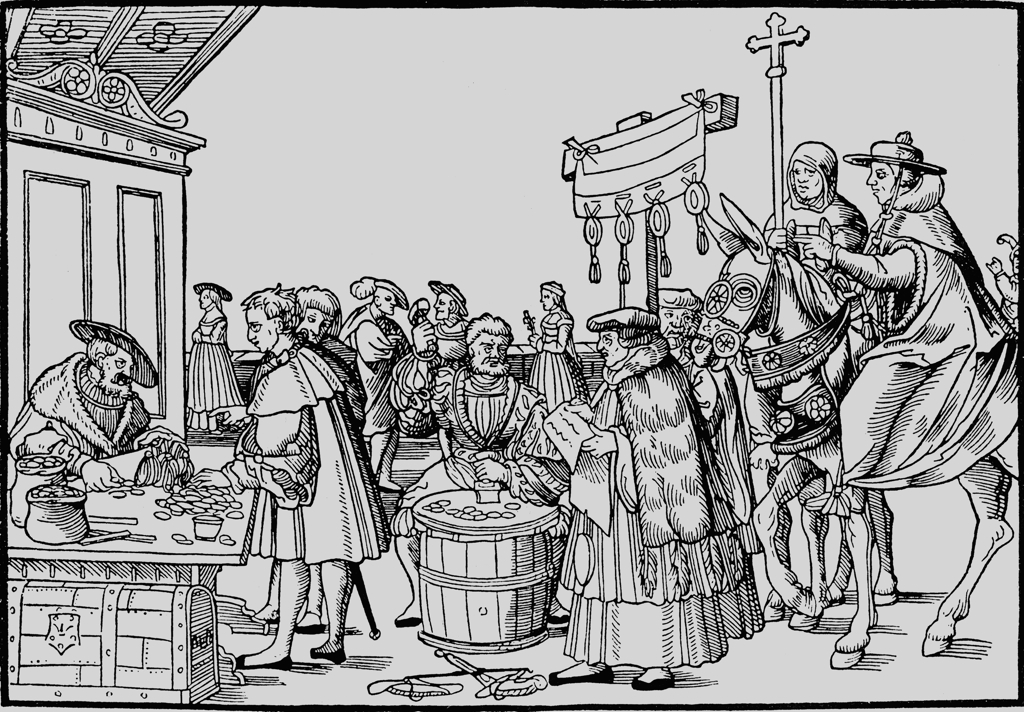
En 1514, le poste d’archevêque de Mayence se libère. Comme nous l’avons vu, il s’agit du poste le plus puissant d’Allemagne, à l’exception de celui de l’Empereur. De tels postes requièrent des rétributions. Albrecht de Brandebourg (1490-1545), dont la famille, les Hohenzollern, régnait sur une grande partie du pays, voulait le poste. Albrecht est déjà un homme puissant : il occupe plusieurs autres fonctions ecclésiastiques. Mais même lui n’a pas les moyens de payer des honoraires aussi élevés. Il emprunte donc la somme nécessaire aux Fugger, moyennant un intérêt, que la convention de l’époque qualifie d’honoraire pour « peine, danger et dépense ».
Le pape Léon X, après avoir dilapidé le trésor papal pour son couronnement et organisé des fêtes où des prostituées s’occupaient des cardinaux, demande 34 000 florins pour accorder le titre à Albrecht – ce qui équivaut à peu près à 4,8 millions de dollars d’aujourd’hui – et Fugger dépose l’argent directement sur le compte personnel du pape.
Reste maintenant à rembourser les Fugger. Albrecht a un plan. Il obtient du pape Léon X le droit d’administrer les « indulgences du jubilé » récemment annoncées. Les indulgences étaient des contrats vendus par l’Église pour pardonner les péchés, permettant aux croyants d’acheter leur sortie du purgatoire et leur entrée au paradis.
Mais pour « tondre les moutons », comme pour toute bonne escroquerie, il fallait une « couverture » ou un « narratif ». Le motif à invoquer, concocté par Jules II, était crédible : il affirmait que la basilique Saint-Pierre avait besoin d’une rénovation urgente et coûteuse.
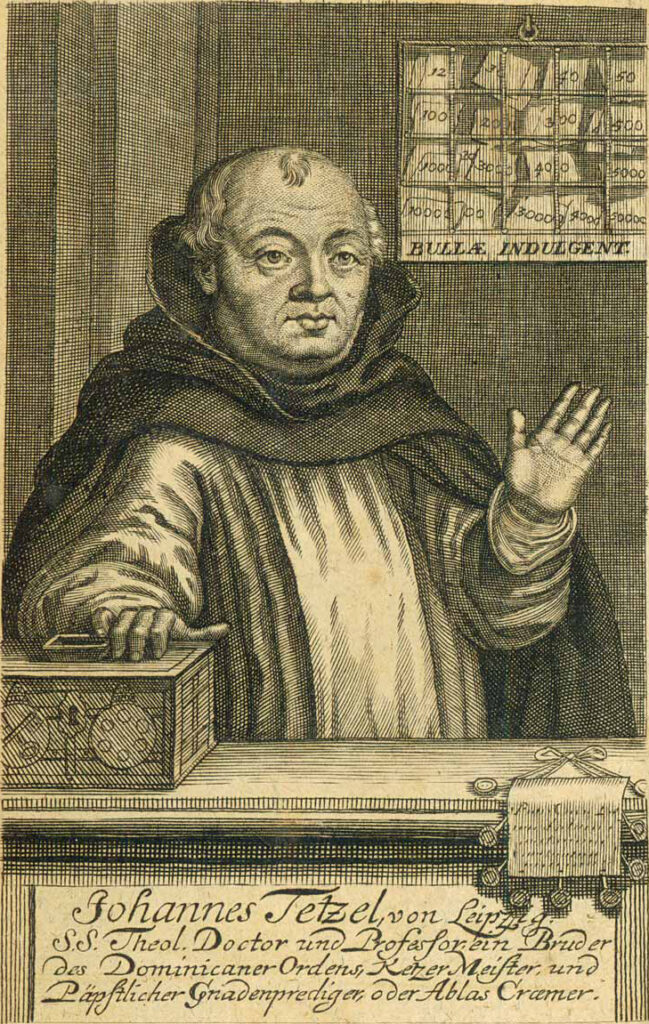
Chargé de la vente, un « colporteur d’indulgences », le dominicain Johann Tetzel, « portait des bibles, des croix et une grande boîte en bois avec […] une image de Satan sur le dessus », et disait aux fidèles que ses indulgences « annulaient tous les péchés ». Il propose même un « barème progressif », les riches payant 25 florins et les travailleurs ordinaires un seul. Tetzel aurait dit : « lorsque l’argent s’entrechoque dans la boîte, l’âme saute du purgatoire ».
Sur le terrain, dans chaque église, des commis des Fugger assistent directement à la collecte de l’argent dont la moitié allait au pape et l’autre à Fugger. Fugger obtient du même coup le monopole des transferts de l’argent obtenu par la vente des indulgences entre l’Allemagne et Rome.
Si l’archevêque est à la merci des Fugger, le pape Léon X l’est tout autant, car, pour rembourser sa dette, il collecte de l’argent par des « simonies », c’est-à-dire qu’il vend de hautes fonctions ecclésiastiques aux princes. Entre 1495 et 1520, 88 des 110 évêques d’Allemagne, de Hongrie, de Pologne et de Scandinavie ont été nommés par Rome en échange de transferts d’argent centralisés par Fugger. C’est comme cela que Fugger devient « le banquier de Dieu, le principal financier de Rome ».
9. Achète-moi Luther, chérie
Depuis le IIIe siècle, l’Église catholique affirme que Dieu peut se montrer indulgent et accorder une rémission totale ou partielle de la peine encourue suite au pardon d’un péché. Cependant, l’indulgence obtenue en contrepartie d’un acte de piété (pèlerinage, prière, mortification, don), notamment dans le but de raccourcir le passage par le purgatoire d’un défunt, au cours du temps s’est transformée en un commerce lucratif. Urbain II s’en servira pour recruter des croyants à la première croisade.
Au XVIe siècle, c’est ce trafic des indulgences qui créera de graves troubles et un tumulte au sein de l’Église. Pratique qualifiée par Erasme de superstition dans son Éloge de la folie, la dénonciation du commerce des indulgences est le sujet même des quatre-vingt-quinze arguments de Luther, dont la thèse conduira l’Église à la division et à la Réforme protestante.
Refusant de se rendre à Rome pour répondre aux accusations d’hérésie et de mise en cause de l’autorité du Pape, Luther accepte de se présenter en 1518 à Augsbourg au légat du pape, le cardinal Cajetan. Ce dernier exhorta Luther à se rétracter ou à revenir sur ses déclarations (« revoca ! »).
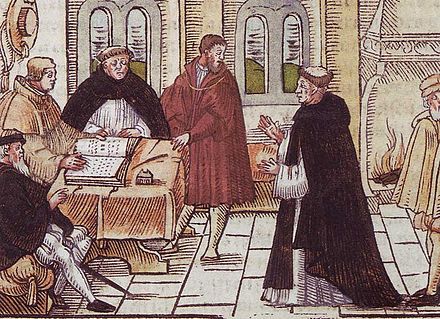
Alors que Luther avait dénoncé nommément Fugger pour son rôle central dans l’escroquerie des indulgences, il accepta d’être interrogé dans le bureau central de la banque qui organisait le crime qu’il dénonce !
Luther semble avoir été conscient que, accusations verbales à part, les Fugger allaient le protéger et le promouvoir afin de discréditer à un appel à la réforme beaucoup plus raisonnable émanant d’Érasme et de ses disciples à l’intérieur de l’Eglise. Alors qu’il aurait pu être arrêté et brûlé sur le bûcher comme certains le demandaient, Luther est venu, a refusé pendant trois jours de revenir sur ses déclarations et est reparti indemne.
10. Achète-moi de la pauvreté, chérie
Au XVIe siècle, les prix augmentent de façon constante dans toute l’Europe occidentale. A la fin du siècle, ils sont trois à quatre fois plus élevés qu’au début. Récemment, les historiens se sont montrés insatisfaits des explications monétaires de la hausse des prix au XVIe siècle. Ils se sont rendus compte que les prix dans de nombreux pays ont commencé à augmenter avant que la majeure partie de l’or et de l’argent du Nouveau Monde n’arrive en Espagne, et a fortiori ne la quitte, et que les flux monétaires qui leur sont associés n’ont que peu de rapport avec des mouvements de prix, y compris en Espagne.
En réalité, à la fin du XVe et au début du XVIe siècle, la population européenne a recommencé à croître, après la longue période de contraction amorcée par la peste noire de 1348. L’accroissement de la population a entraîné une augmentation de la demande de nourriture, de boissons, de vêtements bon marché, d’abris, de bois de chauffage, etc. Les agriculteurs ont du mal à augmenter leur production : les prix des denrées alimentaires, la valeur des terres, les coûts industriels, tout augmente. Ces pressions sont aujourd’hui considérées comme une cause sous-jacente importante de cette inflation, même si peu de gens nieraient qu’elle a été exacerbée à certains moments par les gouvernements qui manipulent la monnaie, empruntent massivement et mènent des guerres.
« L’ère des Fuggers » est une ère où l’argent est investi dans l’argent et la spéculation financière. L’économie réelle est pillée par les impôts et les guerres. La dynamique créée par l’effondrement du niveau de vie, les impôts et l’inflation des prix pour la plupart des gens et la révélation publique de la corruption de l’Église et de l’aristocratie ouvrent la voie à des émeutes dans de nombreuses villes, à la Guerre des paysans, à une insurrection des tisserands, des artisans et même des mineurs. La « Révolte des Pays-Bas » et des siècles de guerres « religieuses » sanglantes ne prendront fin qu’avec l’« enterrement » de l’Empire par la paix de Westphalie en 1648.
11. Achète-moi des logements sociaux, chérie
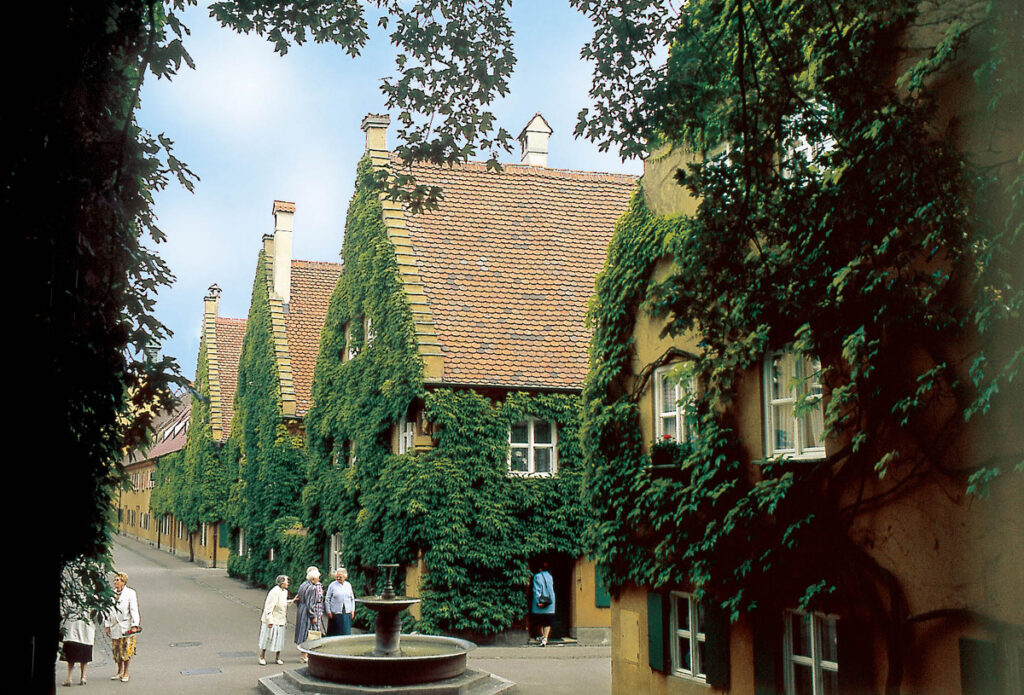
L’initiative de Jacob Fugger, en 1516, de construire la Fuggerei, un projet de logement sociaux pour une centaine de familles de travailleurs à Augsbourg, plutôt unique dans son genre pour l’époque, s’avère trop peu et arrive trop tard. La Fuggerei a survécu en tant que monument en l’honneur des Fugger. Le loyer n’a pas changé, il est toujours d’un gulden rhénan par an (équivalent à 0,88 euros). Mais les locataires doivent prier trois fois par jour pour les Fugger et exercer un emploi à temps partiel. Les conditions pour y vivre restent les mêmes qu’il y a 500 ans : il faut avoir vécu au moins deux ans à Augsbourg, être de confession catholique et indigent sans dettes. Un précurseur des mesures Harz-4? Chaque jour, les cinq portes ferment à 22 heures.
12. Achète-moi des taux dignes d’intérêt, chérie
« Tu ne percevras pas d’intérêts ». En 1215, le pape Innocent III a explicitement confirmé l’interdiction de l’intérêt et de l’usure décrétée par la Bible. La phrase de Luc 6:35, « Prêtez et n’attendez rien en retour », est interprétée par l’Église comme une interdiction pure et simple de l’usure, définie comme la demande d’un quelconque intérêt. Même les comptes d’épargne étaient considérés comme un péché. Ce n’était pas le scénario idéal de Jacob Fugger.
Pour changer cette situation, Fugger embauche un théologien renommé, Johannes Eck (1494-1554) d’Ingolstadt, pour plaider sa cause. Fugger mène une véritable campagne de relations publiques, notamment en organisant des débats sur la question entre orateurs de son choix, et écrit une lettre passionnée au pape Léon X.
En conséquence, Léon X publie un décret proclamant que la perception d’intérêts n’est de l’usure que si le prêt était consenti « sans travail, coût ou risque » – ce qui n’a jamais été le cas pour aucun prêt.
Plus d’un millénaire après Aristote, le pape Léon X a constaté que le risque et le travail liés à la protection du capital faisaient du prêt d’argent une chose vivante. Tant qu’un prêt implique un travail, un coût ou un risque, il est en règle. Le tour est joué. Fugger persuade l’Église d’autoriser un taux d’intérêt de 5 % – et il réussit assez bien : la perception d’intérêts n’est pas autorisée, mais elle n’est pas punie non plus.
Ainsi, grâce à Léon X, Fugger peut désormais attirer des dépôts en offrant à ses clients un rendement de 5 %. Au niveau des prêts, selon le rapport du Conseil du Tyrol, alors que les autres banquiers prêtaient à un taux de 10 % à Maximilien, le taux appliqué par Fugger, justifié par « le risque » dépassait les 50 % !
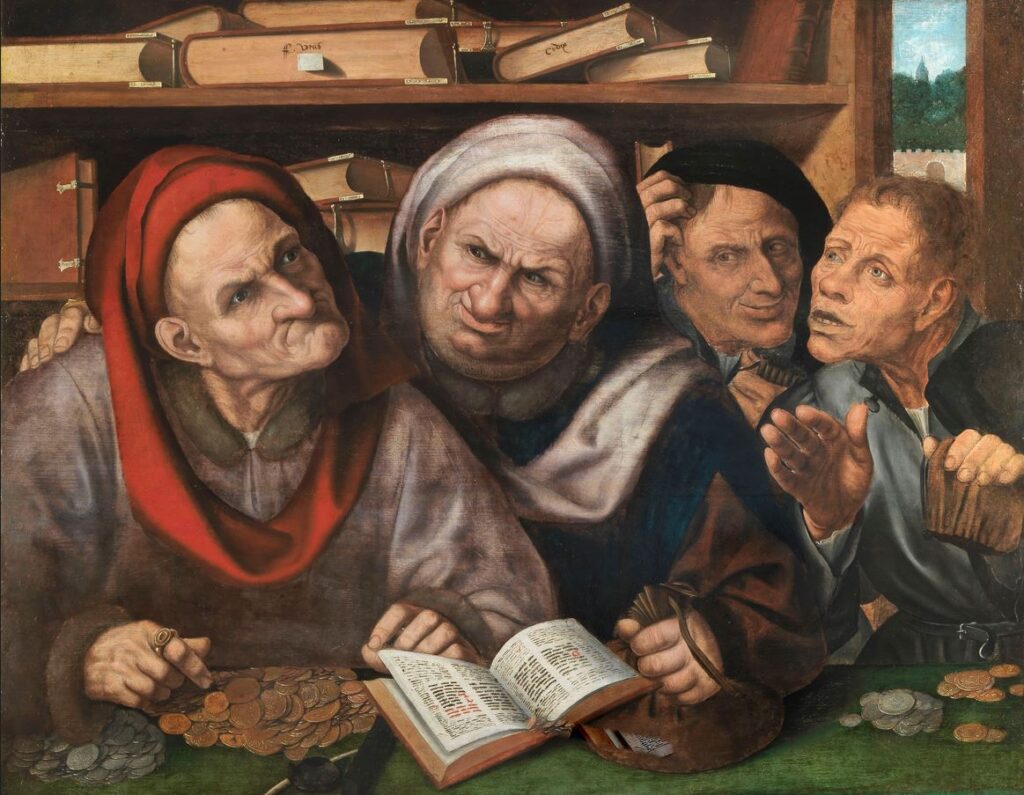
Charles Quint, dans les années 1520, a dû emprunter à 18 % et même à 49 % entre 1553 et 1556. Entre-temps, les biens de Fugger, qui s’élèvent en 1511 à 196 791 florins, passent en 1527, deux ans après la mort de Jacob, à 2 021 202 florins, soit un bénéfice total de 1 824 411 florins, ou 927 % d’augmentation, ce qui représente, en moyenne, une augmentation annuelle de 54,5 %. Tout cela est aujourd’hui présenté, non pas comme de l’usure, mais comme une « grande avancée » anticipant les pratiques modernes de gestion de fortunes et d’actifs…
Fugger « a brisé les reins de la Ligue hanséatique » et « a sorti le commerce de son sommeil médiéval en persuadant le pape de lever l’interdiction de prêter de l’argent. Il a contribué à sauver la libre entreprise d’une mort prématurée en finançant l’armée qui a remporté la guerre des paysans allemands, le premier grand affrontement entre le capitalisme et le communisme », souligne Greg Steinmetz, historien et ancien correspondant du Wall Street Journal.

Comment Venise a créé le premier ghetto juif d’Europe
Bien entendu, les Vénitiens ont longtemps ignoré ces règles, préférant gagner de l’argent plutôt que de plaire à Dieu, comme en témoigne la devise « D’abord les Vénitiens, ensuite les Chrétiens ».
En 1382, les juifs sont autorisés à entrer à Venise. En 1385, la première « Condotta » a été accordée, un accord entre la République de Venise et les banquiers juifs, qui leur donnait la permission de s’installer à Venise pour prêter de l’argent avec intérêt. L’accord, d’une durée de dix ans, détaillait les règles que ces banquiers devaient respecter. Il fixait notamment la taxe annuelle élevée à payer, le nombre de banques autorisées à ouvrir et les taux d’intérêt qu’elles pouvaient appliquer.
En 1385, Venise a signé un autre accord avec les banquiers juifs qui vivaient à Mestre, situé sur la terre ferme en face des îles de Venise, afin qu’ils puissent accorder des prêts à des taux favorables aux quartiers les plus pauvres de la ville. Grâce à cet accord, la Sérénissime parvient à soulager la pauvreté de la population et, en même temps, si les gens se fâchent contre le Doge, à diriger l’hostilité des masses contre… les prêteurs juifs.
La Condotta de 1385 n’est pas renouvelée en 1394 sous prétexte que les Juifs ne respectent pas les règles imposées à leurs activités. Les banquiers juifs reçoivent l’autorisation de séjourner pendant une période de 15 jours par mois et ceux qui vivent à Mestre profitent de cette concession pour travailler à Venise. Mais pour être reconnus comme juifs, ils devaient déjà porter un cercle jaune sur leurs vêtements…
Pour faire court, Venise a résolu le « dilemme » en optant pour la ségrégation de masse. Le 20 mars 1516, l’un des membres du Conseil, après avoir violemment agressé verbalement les Juifs, demande qu’ils soient enfermés dans le « Ghetto », mot dialectal vénitien utilisé à l’époque pour désigner les fonderies du quartier. Le Doge et le Conseil approuvent cette solution. S’ils voulaient continuer à vivre à Venise, les Juifs devraient vivre ensemble dans une certaine zone, séparés du reste de la population. Le 29 mars, un décret crée le ghetto de Venise.
Vous pouvez lire ici l’histoire complète du ghetto de Venise.
13. Achète-moi un Empire austro-hongrois, chérie
Lorsque la Turquie envahit la Hongrie en 1514, Fugger s’inquiète vivement de la valeur de ses mines de cuivre hongroises, ses propriétés les plus rentables. Après l’échec des efforts diplomatiques, Fugger lance un ultimatum à Maximilien : soit il conclut un accord avec la Hongrie, soit Fugger renonce à d’autres prêts. La menace fonctionne.
Fidèle à la devise qui prétend expliquer l’origine de la prospérité de la famille de Habsbourg. « Bella gerant alii, tu, felix Austria, nube » (les autres font la guerre; toi, heureuse Autriche, tu fais des mariages), Maximilien négocie une alliance matrimoniale qui laisse la Hongrie aux mains des Habsbourg, ce qui conduit à redessiner la carte de l’Europe en créant la gigantesque poudrière politique connue sous le nom d’Empire austro-hongrois. Fugger avait besoin que les Habsbourg s’emparent de la Hongrie pour protéger ses possessions.
14. Achète-moi un deuxième empereur, chérie
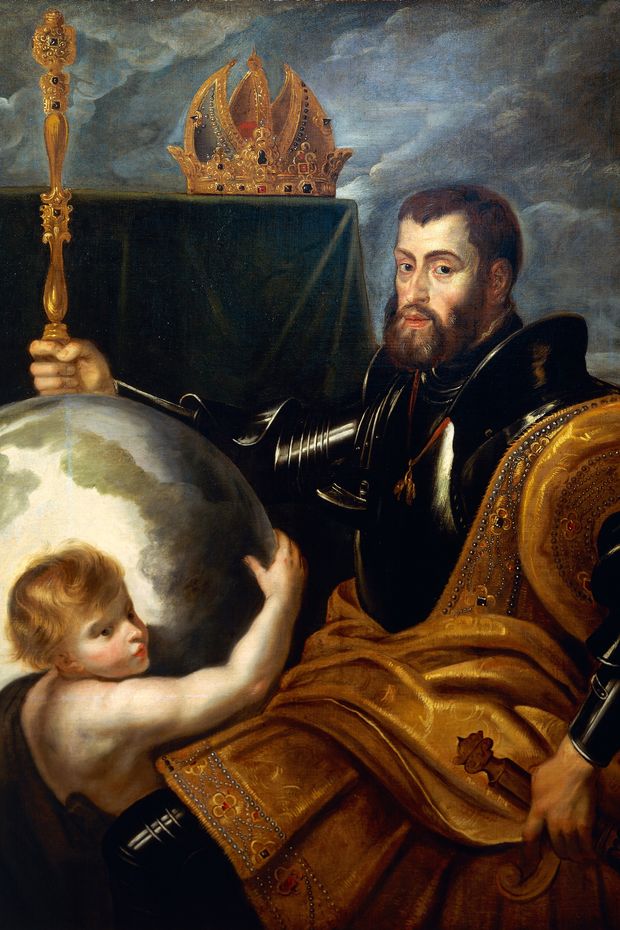
Lorsque Maximilien Ier, empereur du Saint-Empire romain germanique, meurt en 1519, il doit à Jacob Fugger environ 350 000 florins. Pour éviter un défaut de paiement sur cet investissement, Fugger a réuni un cartel de banquiers afin de réunir tout l’argent de la corruption permettant au petit-fils de Maximilien, Charles Quint, d’acheter le trône.
Si un autre candidat avait été élu empereur, comme le roi de France François qui a soudainement tenté d’entrer en scène, et aurait certainement été réticent à payer les dettes de Maximilien à Fugger, ce dernier aurait sombré dans la faillite.
Cette situation rappelle le modus operandi de JP Morgan, après le krach bancaire américain de 1897 et la panique bancaire de 1907. Le « Napoléon de Wall Street », craignant la renaissance d’une véritable banque nationale dans la tradition d’Alexander Hamilton, réunit d’abord les fonds nécessaires pour renflouer ses concurrents défaillants, puis crée, en 1913, le système de la Réserve fédérale, un syndicat privé de banquiers chargé d’empêcher le gouvernement de s’immiscer dans leurs affaires lucratives.
Ainsi, Jacob Fugger, en liaison directe avec Marguerite d’Autriche, qui a adhéré au projet en raison de ses craintes pour la paix en Europe, a rassemblé de manière totalement centralisée l’argent pour chaque Électeur, profitant de l’occasion pour renforcer de manière spectaculaire ses positions monopolistiques, en particulier sur ses concurrents tels que les Welser et le port d’Anvers, en pleine expansion.
Selon l’historien français Jules Michelet (1798-1874), Jacob Fugger posa énergiquement trois conditions :
- « Les Garibaldi de Gênes, les Welser d’Allemagne et d’autres banquiers ne pouvaient participer à ce projet qu’en versant des acomptes à Fugger et ne pouvaient prêter de l’argent [à Charles] que par son intermédiaire ;
- « Fugger obtient des billets à ordre des villes d’Anvers et de Malines comme garantie, payés par les péages de Zélande ;
- « Fugger obtient de la ville d’Augsbourg qu’elle interdise de prêter aux Français. Il demande à Marguerite d’Autriche (la régente) d’interdire aux Anversois d’échanger de l’argent en Allemagne pour qui que ce soit ». (remettant de facto cette activité lucrative aux seuls banquiers d’Augsbourg…)

Comme nous l’avons déjà dit, les gens pensent à tort que Jacob « le Riche » était « très riche ». Bien sûr qu’il l’était : aujourd’hui, il est considéré comme l’une des personnes les plus riches de l’Histoire, avec une fortune de plus de 400 milliards de dollars (actuels), soit environ 2 % du PIB total de l’Europe à l’époque, plus de deux fois la fortune de Bill Gates.
Nous ne saurons jamais si cela est vrai ou non et quelle était sa richesse réelle. Mais si l’on examine le capital propre déclaré par les frères Fugger aux autorités fiscales d’Augsbourg, on s’aperçoit qu’il éclipse de loin les sommes colossales prêtées.
Selon l’historien Mark Häberlein, Jacob a anticipé les astuces modernes d’évasion fiscale en concluant un accord avec les autorités fiscales d’Augsbourg en 1516. En échange d’une somme forfaitaire annuelle, la véritable richesse de la famille… n’est pas divulguée. L’une des raisons en est bien sûr que, tout comme BlackRock aujourd’hui, Fugger était un « gestionnaire de fortune », promettant un retour sur investissement de 5 % tout en empochant lui-même 14,5 %… Les cardinaux et autres fortunes investissaient secrètement dans Fugger pour ses rendements juteux.
On peut donc dire que Fugger était très riche… de dettes. Et tout comme le FMI et une poignée de banques géantes aujourd’hui, en renflouant leurs clients avec de l’argent fictif, les Fugger ne faisaient rien d’autre que de se renflouer eux-mêmes et d’augmenter leur capacité à continuer de le faire. Pas de réforme structurelle sur la table, seulement une crise de liquidité ? Cela me rappelle quelque chose !
Le choix unanime de Charles Quint par les Électeurs a nécessité des pots-de-vin exorbitants, d’un montant de 851 585 florins, pour faciliter les choses. Jacob Fugger a versé 543 385 florins, soit environ les deux tiers de la somme, les Welser et quelques banquiers génois ont avancé le reste.
Il faudrait un gros livre ou un documentaire pour détailler l’ampleur des pots-de-vin payés pour l’élection impériale de Charles Quint.
Voici un extrait d’un compte rendu détaillé :
« Le cardinal Albert de Brandebourg, électeur de Mayence, a reçu 4 200 florins d’or pour sa participation à la Diète d’Augsbourg. En outre, Maximilien s’engagea à lui verser 30 000 florins, dès que les autres électeurs se seraient également engagés à donner leur voix au roi catholique (Charles Quint). Il s’agit d’une prime accordée au cardinal de Mayence pour avoir été le premier à s’engager ; à ce cadeau s’ajoutent une crédence en or et une tapisserie des Pays-Bas. L’électeur avide recevra également une pension viagère de 10 000 florins rhénans, payable annuellement à Leipzig au comptoir des banquiers Fugger, et garantie par [les rentrées d’argent des taxes prélevées sur le commerce maritime par] les villes d’Anvers et de Malines. Enfin, le roi catholique (Charles Quint) devait le protéger contre le ressentiment du roi de France et contre tout autre agresseur, tout en insistant pour que Rome lui accorde le titre et les prérogatives de ‘legate a latere’ en Allemagne, avec les avantages de la nomination ».
« Hermann V de Wied, archevêque-électeur de Cologne, avait reçu 20 000 florins en espèces pour lui-même et 9 000 florins à partager entre ses principaux officiers. On lui avait également promis une pension viagère de 6 000 florins, une pension viagère de 600 florins pour son frère, une pension perpétuelle de 500 florins pour son autre frère, le comte Jean, ainsi que d’autres pensions s’élevant à 700 florins, à répartir entre ses principaux officiers. »
« De son côté, Joachim Ier Nestor, électeur et margrave de Brandebourg (un autre Hohenzollern et frère d’Albert de Brandebourg), exige une compensation substantielle pour les avantages qu’il perd en abandonnant le roi de France.
Ce dernier lui avait promis une princesse de sang royal pour son fils et une forte somme d’argent. Joachim tient donc à remplacer Renée de France par la princesse Catherine, sœur de Charles, et réclame 8 000 florins pour lui-même et 600 pour ses conseillers. Et ce n’est pas tout. Il doit être payé en espèces le jour de l’élection : 70 000 florins à déduire de la dot de la princesse Catherine ; 50 000 florins pour l’élection ; 1 000 florins pour son chancelier et 500 florins pour son conseiller, le doyen Thomas Krul ».
C’est ainsi qu’il a véritablement gagné sa réputation de « père de toutes les cupidités ».
15. Achète-moi un monde sans régulation bancaire, chérie
En 1523, sous la pression d’une opinion publique de plus en plus remontée contre les maisons de commerce d’Augsbourg, au premier rang celles des Fugger, le bras fiscal du Conseil impérial de régence les met en accusation. Certains évoquent même l’idée de limiter le capital commercial des entreprises individuelles à 50 000 florins et le nombre de leurs succursales à trois. La mort pour Fugger.
Conscient qu’une telle réglementation le ruinerait, Jacob Fugger, pris de panique, écrit le 24 avril 1523 un court message à l’empereur Charles Quint, rappelant à sa Majesté sa dépendance à l’égard de la bonne santé des comptes bancaires de Fugger :
« Ce n’est d’ailleurs un secret pour personne que Votre Majesté Impériale n’aurait pas obtenu la couronne de Rome sans mon aide, comme je peux le prouver par des lettres écrites de leur propre main par tous les commissaires de Votre Majesté (…) Votre Majesté me doit encore 152 000 ducats, etc. »
Charles Quint se rend bien compte que la dette n’est pas l’objet du message. Il écrit immédiatement à son frère Ferdinand pour lui demander de prendre des mesures afin d’empêcher le procès anti-monopole. Les autorités fiscales impériales reçoivent l’ordre d’abandonner les poursuites. Pour Fugger et les autres grands marchands, l’orage est passé.
16. Achète-moi l’Espagne, chérie
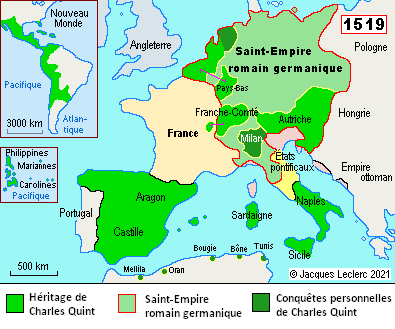
Bien sûr, Charles Quint n’a pas un kopeck pour rembourser le prêt géant de Fugger qui l’avait fait élire ! Petit à petit, Fugger fait valider son droit de poursuivre l’exploitation des métaux – argent et cuivre – dans le Tyrol pour faire fructifier l’argent. Mais il en obtint davantage, d’abord en Espagne même et, tout à fait logiquement, dans les territoires nouvellement conquis par l’Espagne en Amérique.
17. Achète-moi l’Amérique, chérie
Tout d’abord, pour rembourser sa dette, Charles propose l’usufruit des principaux territoires des ordres de chevalerie espagnols, appelés Maestrazgos, pour lesquels les Fugger paient 135 000 ducats par an. Entre 1528 et 1537, le Maestrazgos est administré par les Welser d’Augsbourg et un groupe de marchands dirigé par le chef espagnol du service postal Maffeo de Taxis et le banquier génois Giovanni Battista Grimaldi. Mais après 1537, les Fugger reprennent le flambeau. Le contrat de bail est très intéressant pour deux raisons : d’une part, il permet aux preneurs à bail d’exporter les excédents de céréales de ces domaines et, d’autre part, il inclut les mines de mercure d’Alamadén, un élément crucial à la fois pour la production de verre à miroir, le traitement de l’or et les applications médicales.
Comme les Fugger dépendent des livraisons d’or et d’argent en provenance d’Amérique pour recouvrer leurs prêts à la couronne espagnole, il semblait logique qu’ils se tournent également vers le Nouveau Monde.
18. Achète-moi le Venezuela, chérie

Passons maintenant aux Welser. L’histoire des Welser remonte au XIIIe siècle, lorsque ses membres occupaient des postes officiels dans la ville d’Augsbourg. Plus tard, la famille s’est fait connaître en tant que patriciens et marchands de premier plan. Au XVe siècle, alors que les frères Bartolomé et Lucas Welser pratiquent un vaste commerce avec le Levant et d’autres pays, ils ont des succursales dans les principaux centres commerciaux du sud de l’Allemagne et de l’Italie, ainsi qu’à Anvers, Londres et Lisbonne. Aux XVe et XVIe siècles, des branches de la famille s’installent à Nuremberg et en Autriche.
En récompense de leur contribution financière à son élection en 1519, le roi Charles Quint, incapable de rembourser, accorde aux Welser des privilèges dans la traite des esclaves africains et la conquête des Amériques.
La famille Welser se voit donc offrir la possibilité de participer à la conquête des Amériques au début et au milieu du XVe siècle. Comme le stipule le contrat de Madrid (1528), également connu sous le nom de « contrats Welser », les marchands se sont vus garantir le privilège de mener des « entradas » (expéditions) pour conquérir et exploiter de grandes parties des territoires qui appartiennent aujourd’hui au Venezuela et à la Colombie. Les commerçants allemands cultivent des fantasmes de richesses fabuleuses, alimentés par la découverte de trésors d’or : on dit que les Welser ont créé le mythe de l’El Dorado (la cité de l’or).

Les Welser commencent leurs activités en ouvrant un bureau sur l’île portugaise de Madère et en acquérant une plantation de sucre aux îles Canaries.
Ils se sont ensuite étendus à Saint-Domingue, l’actuelle Haïti. La main-mise des Welser sur la traite des esclaves dans les Caraïbes a commencé en 1523, cinq ans avant le contrat de Madrid, puisqu’ils avaient commencé leur propre production de sucre sur l’île.
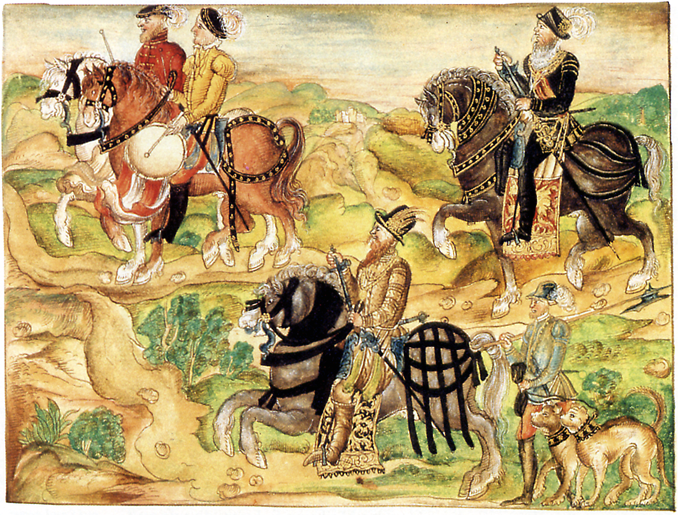
Le contrat de Madrid comprend le droit d’exploiter une grande partie du territoire de l’actuel Venezuela (en espagnol « Petite Venise »), un pays qu’ils appelaient eux-mêmes « Welserland ». Ils obtiennent également le droit d’expédier 4 000 esclaves africains pour travailler dans les plantations de sucre. Alors que l’Espagne accorde des capitaux, des chevaux et des armes aux conquistadors espagnols, les Welsers ne leur prêtent qu’au prix fort et les obligent à acheter, exclusivement auprès d’eux, les moyens de faire tourner leurs activités. Des Allemands pauvres se rendent au Venezuela et s’endettent rapidement, ce qui exacerbe leur rapacité et aggrave la façon dont ils traitent les esclaves. De 1528 à 1556, sept entradas (expéditions) conduisent au pillage et à l’exploitation des cultures locales.
La situation devient si grave qu’en 1546, l’Espagne révoque le contrat, notamment parce qu’elle sait que les Welser servent également des clients luthériens en Allemagne. Le fils de Bartholomeus Welser, Bartholomeus VI Welser et Philipp von Hutten sont arrêtés et décapités à El Tocuyo par le gouverneur espagnol local Juan de Carvajal en 1546. Enfin, l’abdication de Charles Quint en 1556 met un terme à la tentative des Welser de rétablir par la loi leur concession.
19. Achète-moi le Pérou et le Chili, chérie
Contrairement à la famille Welser, la participation de Jacob Fugger au commerce colonial reste prudente et conservatrice, et la seule autre opération de ce type dans laquelle il investit est une expédition commerciale ratée de 1525 vers les Moluques, menée par l’Espagnol Garcia de Loaisa (1490-1526). Pour l’Espagne, l’idée était d’accéder à l’Indonésie en passant par l’Amérique, ce qui aurait permis d’échapper au contrôle portugais. Cela n’ira pas plus loin parce que Jacob le Riche meurt en décembre de la même année et son neveu Anton Fugger prend la direction de l’entreprise.
Cependant, la fête continue. Les relations des Fugger avec la Couronne espagnole atteignent leur apogée en 1530 avec le prêt de 1,5 million de ducats des Fugger pour l’élection de Ferdinand comme « roi romain ». C’est dans ce contexte que l’agent des Fugger, Veit Hörl, obtient en garantie de l’Espagne le droit de conquérir et de coloniser la région côtière occidentale de l’Amérique du Sud, de Chincha au Pérou jusqu’au détroit de Magellan. Cette région comprend l’actuel sud du Pérou et tout le Chili. Les choses se sont cependant embrouillées et, pour des raisons inconnues, Charles Quint, qui était d’accord avec l’accord, ne le ratifie pas. Considérant que le projet vénézuélien des Welser a dégénéré en entreprise brutale de pillage et s’est soldé par des pertes substantielles. Anton Fugger, qui estime que les retombées financières sont trop faibles, abandonne ce type d’entreprise.
20. Achète moi des esclaves, chérie
Le cuivre des mines de Fugger était utilisé pour les canons des navires, mais il servait également à la production de « manillas » en forme de fer à cheval. Les manillas, dérivées du latin signifiant main ou bracelet, étaient une « monnaie » utilisée par la Grande-Bretagne, le Portugal, l’Espagne, les Pays-Bas, la France et le Danemark pour échanger avec l’Afrique de l’Ouest de l’or et de l’ivoire, ainsi que des personnes réduites à l’état d’esclaves. Les métaux privilégiés étaient à l’origine le cuivre, puis le laiton vers la fin du XVe siècle et enfin le bronze vers 1630.
En 1505, au Nigeria, un esclave se vend pour 8 à 10 manilles, et une dent d’éléphant pour une manille de cuivre. On dispose désormais de chiffres : entre 1504 et 1507, les commerçants portugais importent 287 813 manilles du Portugal vers la Guinée, en Afrique, via la station commerciale de São Jorge da Mina. Le commerce portugais s’intensifie au cours des décennies suivantes. 150 000 manilles sont exportées chaque année vers le fort commercial d’Elmina, sur la Côte d’Or. En 1548, une commande de 1,4 million de manilles est passée à un marchand allemand de la famille Fugger pour soutenir le commerce.
En 2023, un groupe de scientifiques a découvert que certains des bronzes du Bénin, aujourd’hui restitués aux nations africaines, ont été fabriqués avec du métal extrait à des milliers de kilomètres de là, en Rhénanie allemande. Le peuple Edo du Royaume du Bénin, a créé ses extraordinaires sculptures avec des bracelets en laiton fondus, la sinistre monnaie de la traite transatlantique des esclaves entre le 16e et le 19e siècle…
Fin de partie
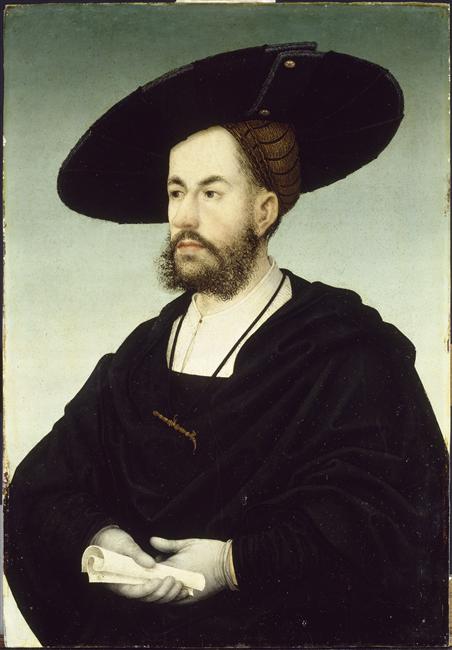
Après la mort de Jacob, son neveu Anton Fugger (1493-1560) tente de maintenir la position d’une maison qui s’affaiblit.
Les souverains captifs ne sont pas aussi solvables qu’on l’espérait. Charles Quint a de sérieux soucis financiers et la faillite qui s’annonce est l’une des raisons pour lesquelles il se retire, laissant la direction de l’empire à son fils, le roi Philippe II d’Espagne. Malgré l’arrivée de l’or et de l’argent, l’Empire fait faillite. À trois reprises (1557, 1575, 1598), Philippe II est incapable de payer ses dettes, tout comme ses successeurs, Philippe III et Philippe IV, en 1607, 1627 et 1647.
Mais l’emprise politique des Fugger sur les finances espagnoles est si forte, écrit Jeannette Graulau, que « lorsque Philippe II déclara une suspension de paiement en 1557, la faillite n’incluait pas les comptes de la famille Fugger. Les Fugger proposent à Philippe II une réduction de 50 % des intérêts des prêts si l’entreprise est exclue de la faillite. Malgré le lobbying intense de son puissant secrétaire, Francisco de Eraso, et des banquiers espagnols rivaux des Fugger, Philippe n’inclut pas les Fugger dans la faillite ». Bravo les artistes !
En 1563, les créances des Fugger sur la Couronne espagnole s’élevaient à 4,445 millions de florins, soit bien plus que leurs avoirs à Anvers (783 000 florins), Augsbourg (164 000 florins), Nuremberg et Vienne (28 600 florins).
Mais en fin de compte, en unissant leur destin trop étroitement à celui des souverains espagnols, l’empire bancaire des Fugger s’est effondré avec l’effondrement de l’empire espagnol des Habsbourg.
Le professeur français Pierre Bezbakh, écrivant dans Le Monde en septembre 2021, a noté :
« Alors, quand les caisses sont vides, le royaume d’Espagne émet des emprunts, une pratique qui n’est pas très originale, mais qui devient récurrente et à grande échelle. Ces emprunts étaient souscrits par des prêteurs étrangers, comme les Fugger allemands et les banquiers génois, qui accumulaient mais continuaient à prêter, sachant qu’ils perdraient tout s’ils cessaient de le faire, tout comme les grandes banques d’aujourd’hui continuent à prêter aux États surendettés. La différence est que les prêteurs attendaient l’arrivée promise des métaux américains, alors qu’aujourd’hui, les prêteurs attendent que d’autres pays ou des banques centrales soutiennent les pays en difficulté ».
Aujourd’hui, uniquement dix méga-banques (dont 4 françaises) appelées « Prime Brokers » sont autorisées à acheter et à revendre sur le marché secondaire les bons d’État français, émis à dates régulières par l’Agence française du Trésor pour refinancer la dette publique française (3228 milliards d’euros) et surtout pour refinancer les remboursements de la dette (51 milliards d’euros en 2024). Les noms des Fuggers d’aujourd’hui sont : HSBC, BNP Paribas, Crédit Agricole, J.P. Morgan, Société Générale, Citi, Deutsche Bank, Barclays, Bank of America Securities et Natixis.
Conclusion
Au-delà de l’histoire des dynasties Fugger et Welser qui, après avoir colonisé les Européens, ont étendu leurs crimes coloniaux à l’Amérique, il y a quelque chose de plus profond à comprendre.
Aujourd’hui, on dit que le système financier mondial est « désespérément » en faillite. Techniquement, c’est vrai, mais politiquement, il est maintenu avec succès au bord de l’effondrement total afin de garder le monde entier dépendant d’une classe de prédateurs financiers apatrides. Un système en faillite, paradoxalement, nous désespère, mais leur donne l’espoir de rester aux commandes et de maintenir leurs privilèges jusqu’à la fin des temps. Seuls les banquiers peuvent sauver le monde de la faillite !
Historiquement, nous, en tant qu’humanité, avons créé des « États-nations » dûment équipés de « banques nationales » contrôlées par le gouvernement, afin de nous protéger de ce chantage financier systémique et abject. Les banques nationales, si elles sont correctement gérées, peuvent générer des crédits productifs dans notre intérêt à long terme en développant notre économie physique et humaine plutôt que les bulles financières des maîtres-chanteurs financiers.
Malheureusement, un tel système positif a rarement existé et lorsqu’il a existé, il a été saboté par les marchands d’argent que Roosevelt voulait chasser du temple de la République.
Comme nous l’avons démontré, la grave dissociation mentale appelée « monétarisme » est l’essence même du fascisme (financier). Les syndicats financiers et bancaires criminels « impriment » et « créent » de l’argent. Si cet argent n’est pas « domestiqué » et utilisé comme instrument pour accroître les pouvoirs créatifs de l’homme et de la nature, les ressources s’épuisent et les conflits deviennent insolubles.
La volonté de « convertir » à tout prix, y compris par la destruction de l’humanité et de ses pouvoirs créateurs, une « valeur » nominale qui n’existe qu’en tant qu’accord entre les hommes, en une forme de richesse physique « réelle », est l’essence même de la machine de guerre nazie.
Pour sauver les dettes du Royaume-Uni et de la France envers l’industrie américaine de l’armement détenue par JP Morgan et consorts, il fallait forcer, par le Traité de Versailles, l’Allemagne à payer. Lorsqu’il s’est avéré que c’était impossible, les intérêts bancaires anglo-franco-américains ont créé la « Banque des règlements internationaux ».
La BRI, sous la supervision directe de Londres et de Wall Street, a permis à Hitler d’obtenir les liquidités et devises suisses dont il avait besoin pour construire sa machine de guerre, une machine de guerre considérée comme potentiellement utile pour les Occidentaux tant qu’elle annonçait vouloir marcher vers l’Est, en direction de Moscou.
Pour obtenir des liquidités de la BRI, la banque centrale allemande déposait en garantie des tonnes d’or volées aux pays qu’elle envahissait (Autriche, Pays-Bas, Belgique, Luxembourg, Tchécoslovaquie, Pologne, Albanie, etc.). L’or dentaire des Juifs, des communistes, des homosexuels et des Tziganes exterminés dans les camps de concentration est déposé sur un compte secret de la Reichsbank pour financer les SS.
Le ministre des finances de la Banque d’Angleterre et d’Hitler, Hjalmar Schacht, qui a échappé à la potence du procès de Nuremberg grâce à ses protections internationales, fut sans doute le meilleur élève de Jacob Fugger le Riche, non pas le père de la banque allemande ou « moderne », mais le père du fascisme financier, héritier de Rome, de Venise et de Gênes. Plus jamais ça !
Biographie sommaire:
- Steinmetz, Greg, L’homme le plus riche qui ait jamais vécu, La vie et l’époque de Jacob Fugger, Simon and Shuster, 2016 ;
- Cohn, Henry J., Did Bribes Induce the German Electors to Choose Charles V as Emperor in 1519?
- Herre, Franz, The Age of the Fuggers, Augsbourg, 1985 ;
- Montenegro, Giovanna, German Conquistadors in Venezuela: The Welsers’ Colony, Racialized Capitalism, and Cultural Memory,
- Ehrenberg, Richard, Capital et finance à l’âge de la Renaissance : A Study of the Fuggers, and Their Connections, 1923,
- Roth, Julia, The First Global Players’ : Les Welser d’Augsbourg dans le commerce de l’esclavage et la culture de la mémoire de la ville, 2023
- Häberlein, Mark, Connected Histories : South German Merchants and Portuguese Expansion in the Sixteenth Century, RiMe, décembre 2021 ;
- Konrad, Sabine, Case Study : Spain Defaults on State Bonds, How the Fugger fared the Financial Crisis of 1557, Université de Francfort, 2021,
- Sanchez, Jean-Noël, Un projet colonial des Fugger (1530-1531) ;
- Lang, Stefan, Problems of a Credit Colony : the Welser in Sixteenth Century Venezuela, juin 2015 ;
- Graulau, Jeannette, Finance, Industry and Globalization in the Early Modern Period : the Example of the Metallic Business of the House of Fugger, 2003 ;
- Gallagher, Paul, How Venice Rigged The First, and Worst, Global Financial Collapse, Fidelio, hiver 1995
- Hale, John, La civilisation de l’Europe à la Renaissance, Perrin, 1993 ;
- Vereycken, Karel, Renaissance Studies, index.
ArtistCloseUp interviews Karel Vereycken on the creative method

In its september 2024 issue #22, the Contemporary Art Magazine ArtistCloseUp, widely read among professionnals, presented some works of the French-Belgian Painter-engraver Karel Vereycken.
On July 23, the magazine published an online interview with Karel on what motivates him and his creative method.
Karel Vereycken
Born in 1957 in Antwerp, Karel graduated from the Institut Saint-Luc in Brussels and trained in engraving at the Académie Royale des Beaux-Arts, where he obtained a certificate of passage « with distinction. » In France, as a member of the Fédération nationale de l’estampe, he confirmed his technical mastery at Atelier63 and continued to perfect his skills in the Paris workshop of Danish engraver Bo Halbirk.
Complete biography
Written By Editorial Team
What is your background and how did you start your journey in the art world?
“I was born in 1957 in Antwerp. My parents worked in the port and the ship repair industry. Their adolescence, studies and careers were reduced to zero by the war period and the need to bring an income and feed their brothers, parents and family. So for their children, my parents thought we should have the occasion to fully enjoy and explore the cultural dimensions.
My mother, who was prevented by the war to become an opera singer, got me into a music school. But at that time, the teaching methods, basically learning to read scores for two years before ever being allowed to sing, were so repugnant that I ran away from that. As an alternative, my mother sent me to a communal drawing school directed by a talented sculptor named Herman Cornelis. The bearded cigar-smoking giant would rip pages out of old books and stick them in my hands saying “copy this!”
At the same time, my father would take me every weekend to visit the numerous museums of Antwerp where paintings of Bruegel, Rembrandt, Bosch, Rubens, Van Eyck and many other Flemish masters were on show. Father couldn’t really explain why but knew this was somehow very important.
Antwerp has also a well preserved XVIth century print shop of Christopher Plantin, a French humanist who worked in that city in the 16th century with many cartographers such as Mercator and Ortelius, whose engraved globes and printed maps impressed me deeply.
Then, at age 12, I won my first art prize and my teacher convinced my mother “there was precious talent” in me. With that advice, my mother sent me to Brussels to attend the Saint Luke Art School and study Plastic Arts. Some teachers were quite annoying but others got us into deep study of anatomy, examining Leonardo da Vinci and Albrecht Dürer’s groundbreaking studies. I continued another two years at the Ecole Royale des Beaux Arts of Brussels to study copper engraving and got graduated “with distinction.”
I then moved to Paris and worked as a journalist and editor of a non-commercial militant paper. But after some years, I found out art was really lacking in my life so I returned to it. First by producing copies of old masters painting on wooden oak panels with hand-made egg tempera, venitian turpentine and various other ancient oil techniques I rediscovered with a friend of mine.
Since the people that ordered these painting took them home, at the end, I had nothing to put on show. Therefore, I returned to watercolors and etching. I also gave a three year course of drawing for some of my friends, mainly amateurs and beginners.”
What inspires you?
“What always attracted me in painting and imagining is the way art “makes visible” things and ideas that are “not visible” as such in the simple visible world but which “appear” in the minds of the viewer.
It took me over twenty years to sort out the difference between “symbols” (a “convention” accepted among a group or a code system designed to communicate a secret meaning), and “metaphor” which by assembling things unusual, by irony and paradox, allows the individual mind to “discover” the meaning the painter intended to transmit.
Such an approach offers the joy of discovery and surprise, a deep human quality. Modern art started as a non-figurative form of symbolism till “contemporary” art brought many artists to put an axe into the very idea of poetical meaning.
In 1957, the CIA sponsored, under various covers and often without the artists even knowing about it, many “abstract” artists to promote a form of art that it considered coherent with its ideology of “free enterprise.”
So what inspires me is true human culture, be it Chinese painting of the Song dynasty, the Buddhist sculptures of Gandhara, the early Flemish masters or the magnificent bronze heads of Ifé in current Nigeria. Bridging the distances in space and time, religion and philosophy, stands the celebration of unique human capacities, that of compassion, empathy and love.”
What themes do you pursue? Is there an underlying message in your work?
“I don’t pursue themes, they pursue me! My aim is to shock people by showing them that nothing is more “modern” and “revolutionary” than “classical” art, not understood as annoying academic formalism, but as a science of composition based on non-cynical, liberating ironical poetical metaphors, who are the key to all forms of art be it in the domain of the visual arts or music. Art is always a “gift” from the artist to the viewers and the act of giving is an act of love. That is the message.”
How would you describe your work?
“I consider my work as part of a teaching activity, as a sort of humanistic intellectual guerrilla “warfare.” Even if I appreciate selling my works, and get more resources available for my art work, I’m definitely not out to please a given public or to market an aesthetic object. What counts for me is to get viewers to reflect on how “art” can be a “window” to a dimension people intuitively know as important but were never given access to.
I also took dozens and dozens of friends on guided tours at the Louvre in Paris, to the Frankfurt Museum or to the Metropolitan in New York. Some of these guided visits have been audio-taped and are available on my website. After these tours, most of those I guided thanked me warmly saying “I never even suspected to what degree ideas are transmittable through paintings.””
Which artists influence you most?
“I have studied in depth the European renaissance in the works of Ghiberti, Van Eyck, Leonardo, followed by Piero della Francesca and Dürer, arab optical science gave us the science of perspective representation. I wrote several book-length articles on Rembrandt whose tenderness and profoundness moved me to tears. But if one looks to his life, he’s main quality was not his natural talent alone but the fact that he was such a hard worker. For example, to have your portrait done by Rembrandt, you had to pause for some time every day in his studio during at least three months! Having natural talents makes artists lazy! But having good results after much hard work is the trait of genius.
Deciphering Hieronymus Bosch images in his paintings brought me to explore all the ironies of the 15th Century’s Dutch language brought up by Erasmus and his circles. Viewing all of Goya’s work on show in Madrid was another shock to the degree that his painting is so political while remaining beautiful visual poetry in its own right. Emotionally, I identify mostly with him who saw, just as me, both Rembrandt, Erasmus and Bosch as the sources of his elan. Today, Gandhara Buddhist art is adding new dimensions I ignored and helps me to add the required nuances to my views mostly centered on European art.”
What is your creative process like?
“It takes a lot of courage to overcome the fear to be “completely alone” while you walk a road nobody ever walked on. Everything starts by having a “spark” of imagination and forge it into paradoxical metaphors. As an example, the way I created my work Stairway to Heaven (color etching on zinc, image 3). It started with my examination of the fantastic Chinese landscape paintings. Going through pictures of Chinese landscapes, I realized some of these paintings were not pure imagination but based on landscapes that really existed. The most fascinating of them are certainly those of an area called “Yellow mountains.”
Now at that time, I was also unraveling the way the Flemish painter Joachim Patinir painted his landscapes, as objects for religious contemplation. In the latter’s painting, man is seen, as in Augustinian philosophy, as a pilgrim, who has to learn how to detach himself from earthly possessions, that attachment considered a source of evil. The pilgrim is at the crossroads. By his free will he has to decide, either to take the easy road downhill or the difficult road uphill where he will reach out by going through a small gate.
So in my etching, I “married” a landscape from this Flemish school (on the left) with a view of China’s Yellow mountain. Initially, I had left out the pilgrim, but by working on the landscape, the idea came back to my mind. To accentuate that the road downhill was the road to evil, I added an owl, in Flemish folk art a symbol of evil since able to see in the dark and to grab you in your weakness. So, as one of my friends says, “behind Karel’s works, there’s always a story,” but it is up to you to discover it !”
What is an artist’s role in society and how do you see that evolving?
“I see on the internet dozens of very talented artists, the world is full of them! But what is required is a turn. What we need are political and financial elites willing to promote a culture that give these talents the chance and the means to shape the public and urban living space. We need a “culture of art” that makes people more and not less human.
As the German poet Friedrich Schiller said in his poem “The artists,” it is them that have the dignity of mankind in their hands, with them humanity rises or falls. Today, a much required turn is desirable. The despicable dictatorship of a handful of greedy gallerist sitting in London, Zurich, Venice and Geneva and deciding who is or is not a valuable artist should be brought to an end and I’m not even mentioning the laundering of criminal money it involves.”
Have you had any noteworthy exhibitions you’d like to share?
“With my colleagues from the workshop of Bo Halbirk in Montreuil, it was really nice in June 2024, to present my works at the 6th Exhibit of Contemporary Prints at the Paris Saint-Sulpice market. Going public, meeting art lovers and fellow artists is always a pleasure and a way to open new avenues. I need more of that!”
Website: artkarel.com
Instagram: @karelvereycken
Other links: www.facebook.com/karel.vereycken
Quinten Matsys et Léonard – L’aube d’une ère du rire et de la créativité

par Karel Vereycken, août 2024.
Deze tekst online in het Nederlands
Read an online EN version of this article
Lire une traduction en russe au format PDF
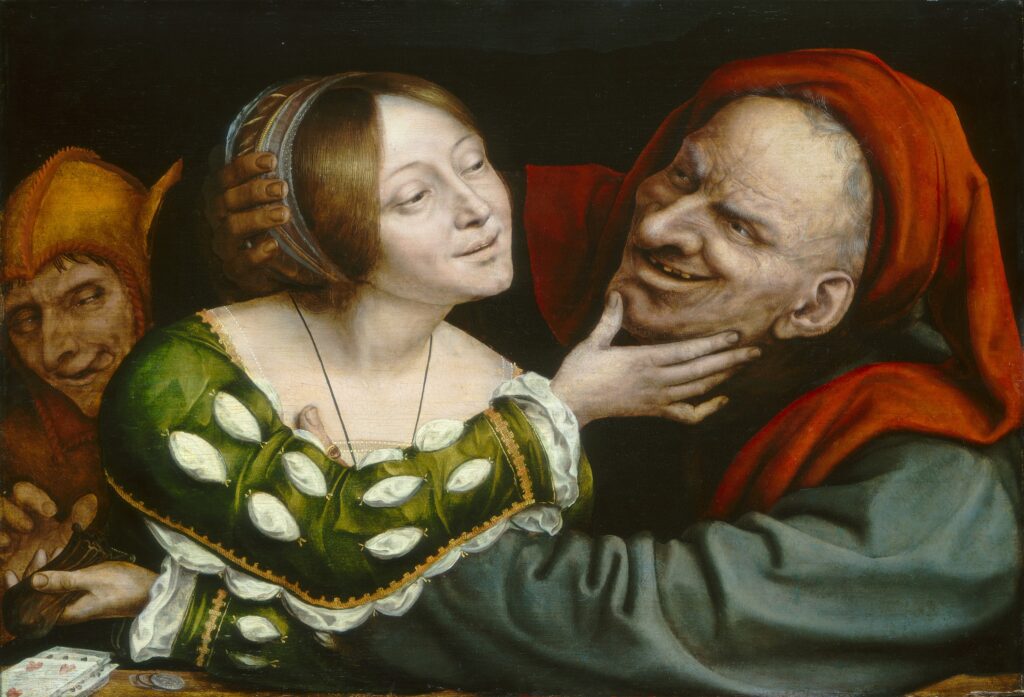
Matsys et Léonard, sommaire
Introduction
A. Les enjeux culturels et philosophiques d’un contexte
- Blagues cyniques ou dialogue socratique ?
- Qu’est-ce que l’humanisme chrétien ?
- Pétrarque et le « Triomphe » de la mort
- L’ère du « rire cathartique »
- Sebastian Brant, Jérôme Bosch et la Nef des fous
- Chambres de Rhétorique et Landjuweel
B. Quinten Matsys
- Éléments biographiques
- De forgeron à peintre
- Duché de Brabant
- Formation : Bouts, Memling et Van der Goes
- Débuts à Anvers et à l’étranger
C. Œuvres choisies, décryptage et nouvelles interprétations
- La Vierge et l’Enfant, « Grâce divine » et « Libre arbitre »
- Le retable de Sainte-Anne
- Une nouvelle perspective
- Coopération avec Patinir et Dürer
- Le lien avec Érasme
- L’Utopie de Thomas More
- Pieter Gillis et le « diptyque de l’amitié »
- La connexion Léonard de Vinci (I)
D. L’art érasmien du grotesque
- Dans les peintures religieuses
- Avares, banquiers, receveurs d’impôt et agents de change, la lutte contre l’usure
- La connexion Léonard de Vinci (II)
- L’art du grotesque per se
- La métaphore du « couple mal assorti ».
- « La vieille femme hideuse », la paternité de Léonard
- Liefrick et Cock
- A mourir de rire, Zeuxis, Matsys et Rembrandt
E. Conclusion
Bibliographie choisie
Au début du XVIe siècle, Quentin Matsys (1466-1530) 1 s’impose comme peintre majeur à Anvers où il travaille pendant plus de 20 ans, créant de nombreuses œuvres, parmi lesquelles des triptyques profondément religieux, des portraits étonnamment détaillés et certaines des œuvres satiriques les plus hilarantes de l’histoire de la peinture.
Pour rendre hommage et justice à cet artiste mal connu, nous explorerons et mettrons en lumière sa verve et son esprit érasmien et présenterons certains de ses apports artistiques les plus originaux.
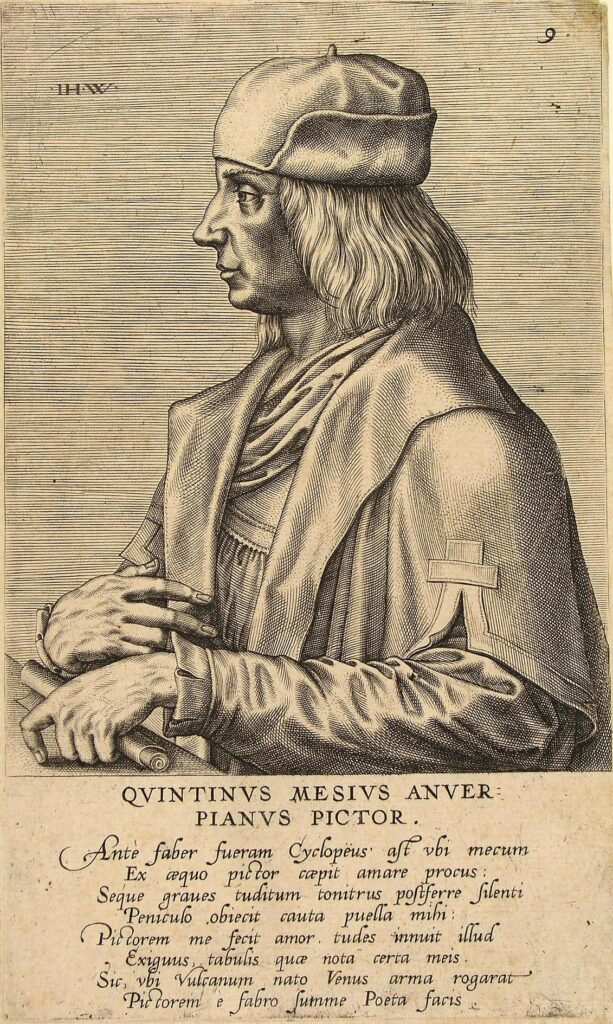
En 1500, Anvers 2, avec quelque 90 000 habitants, est la plus grande ville (précisons-le) d’Occident. Grand port et cœur battant d’un florissant commerce international qui dépasse alors la vieille Bruges 3 des Médicis, Anvers est un aimant qui attire tous les talents de toutes les nations 4.
C’est dans ce contexte de brassage culturel que Quinten Matsys croise et collabore avec les plus brillants des grands humanistes chrétiens de son époque, qu’il s’agisse d’érudits militants pour la paix tels qu’Érasme de Rotterdam 5, Thomas More 6 et Pieter Gillis 7, d’imprimeurs novateurs comme Dirk Martens 8 d’Alost, de réformateurs exigeants comme Gérard Geldenhouwer 9 et Cornelius Grapheus 10, de peintres flamands comme Gérard David 11 et Joachim Patinir 12 ou de peintres-graveurs et illustrateurs étrangers comme Albrecht Dürer 13, Lucas van Leyden 14 et Hans Holbein le Jeune 15.
Malheureusement, aujourd’hui, les grandes maisons d’édition internationales, pour des raisons qui restent à élucider, semblent l’avoir condamné à l’oubli éternel. Ailleurs, son nom n’apparaît que sporadiquement. 16 Pire encore, aucune de ses œuvres n’est référencée et seules deux mentions de son nom figurent dans L’art flamand et hollandais, les siècles des Primitifs, œuvre de référence sur cette période. 17
La bonne nouvelle est que depuis 2007, le Centre interdisciplinaire pour l’art et la science de Gand, 18 en Belgique, prépare un nouveau « catalogue raisonné » de son œuvre. Celui de Larry Silver 19 se vend hors de prix. Reste celui d’Andrée de Bosque, 20 avec la majorité des images en noir et blanc. En guise de consolation, les lecteurs se contenteront de la thèse de doctorat de Harald Brising 21 de 1908, dans une version réimprimée en 2019.
Afin d’honorer et de rendre justice à cet artiste, nous tenterons d’explorer dans cet article certaines questions restées sans réponse jusqu’à présent. Dans quelle mesure l’œuvre d’Érasme a-t-elle directement inspiré Matsys, Patinir et leur cercle ? Que savons-nous des échanges entre ce cercle à Anvers et d’éminents artistes de la Renaissance tels que Léonard de Vinci et Albrecht Dürer ? Quelle influence l’artiste érasmien a-t-il exercée sur ses correspondants étrangers ?
La question interroge d’emblée puisqu’Érasme n’était pas vraiment amateur de ce qui était la « peinture religieuse » à l’époque, préférant une véritable action agapique 22 pour le bien commun, à la prosternation passive devant des rites religieux et des images saintes. Comme le note le critique d’art belge Georges Marlier (1898-1968) 23 en 1954, dans son livre bien documenté, si Érasme respectait et honorait les peintures saintes si elles évoquaient un véritable sentiment religieux, de l’amour et de la tendresse, cela ne l’empêchait pas de penser que…
« la véritable imitation du Christ et sa Passion, consiste à mortifier les entraînements qui guerroient contre l’esprit et non pas à pleurer sur le Christ comme un objet pitoyable » 24
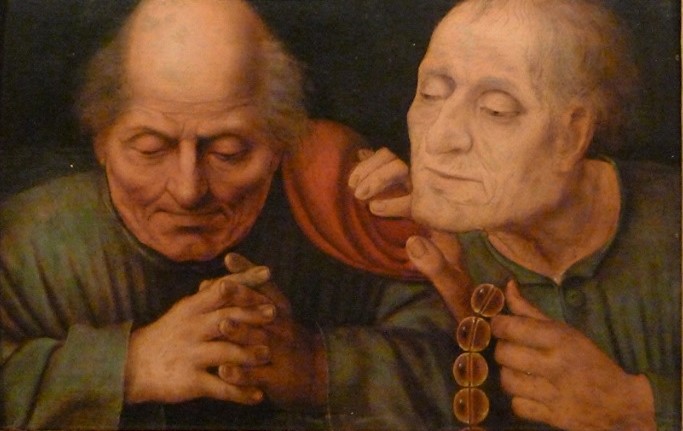
Nos recherches antérieures sur la Renaissance italienne, la vie d’Érasme 25 et l’art de Dürer 26 nous ont familiarisés avec l’époque de Matsys et ses défis, un sujet que nous ne pouvons pas redévelopper ici de façon exhaustive, mais qui nous donne quelques bases pour appréhender la valeur extraordinaire de cet artiste.
A. Les enjeux culturels et philosophiques d’un contexte
1. Blagues cyniques ou dialogue socratique ?
De nombreux spectateurs contemporains, pénalisés par un regard non entraîné et pollués par un wokisme et un pessimisme abusif, passent à côté du sujet. Il leur manque l’intégrité morale et intellectuelle nécessaire pour comprendre les plaisanteries 27, l’ironie et les métaphores qui constituaient l’essence même de la vie culturelle 28 des Pays-Bas de l’époque. 29
Beaucoup contemplent et commentent la couleur de leurs lunettes en croyant livrer leur vision du monde. Perdus dans leurs préjugés culturels, en regardant un visage peint, ils ne voient pas l’intention ou l’idée que l’artiste a voulu faire apparaître, non pas sur le tableau, mais dans l’esprit du spectateur. Fuyant ce domaine supérieur de la métaphore, ils se ruent sur les détails en enchaînant des interprétations symboliques dont la somme est supposée expliquer le sens de l’œuvre.
Ainsi, devant un visage « grotesque », ils s’obstinent à croire qu’il s’agit d’un portrait plutôt que de rire à pleins poumons ! Du coup, ne voulant pas voir cette dimension « invisible », prenant l’image « à la lettre », pour eux, les « grotesques » d’Érasme, de Matsys et de Léonard, ne sont et ne peuvent être que des « plaisanteries cyniques » témoignant d’un « manque de tolérance » à l’égard des personnes « laides », « malades », « anormales » ou, tout simplement, « différentes » !
Répétons-le donc haut et fort : Erasme et ses trois principaux disciples, François Rabelais 30 , Miguel de Cervantès 31 et William Shakespeare 32, sont les incarnations, quoique rarement reconnues, de l’« humanisme chrétien » et l’ironie, en tant qu’arme politique puissante pour « élever à la dignité d’homme, tous les membres du genre humain ».
2. Qu’est-ce que l’humanisme chrétien ?
L’idée maîtresse du programme éducatif et politique d’Érasme était de promouvoir la docta pietas, la piété savante, ou ce qu’il appelait la « philosophie du Christ ». 33 Cette philosophie peut être résumée comme un « mariage » entre les principes humanistes résumés dans La République de Platon 34 et la notion d’amour pour son prochain transmise par les Saintes Écritures et les écrits des premiers Pères de l’Église comme Jérôme 35 et Augustin 36, qui considéraient Platon comme un de leurs précurseurs imparfaits.
En rupture totale avec la soumission à une foi « aveugle » et féodale, qui plaçait le salut de l’homme uniquement dans une existence après la mort, l’humanisme chrétien considère que la nature humaine est bonne. L’origine du mal n’est donc pas l’homme lui-même ou un « diable » extérieur, mais les vices et les afflictions morales que Platon avait déjà largement identifiés des siècles avant qu’elles deviennent chez les Chrétiens les « sept péchés capitaux » qui peuvent être surmontés par les « sept vertus capitales ». 37
Pour rappel, ces péchés capitaux et leurs antidotes sont :
- L’orgueil (Superbia, hubris) par opposition à l’humilité (Humilitas) ;
- L’avarice (Avaricia) par opposition à la charité (Caritas, Agapè) ;
- La colère (Ira, rage) opposée à la patience (Patientia) ;
- L’envie (Invidia, jalousie) opposée à la bonté (Humanitas) ;
- La luxure (Luxuria, fornication) opposée à la chasteté (Castitas) ;
- La gourmandise (Gula) opposée à la tempérance (Temperantia) ;
- La paresse (Acedia, mélancolie, spleen, paresse morale) opposée à la diligence (Diligentia).
Il est assez révélateur pour notre époque que ces « péchés » (affections qui nous empêchent de faire le bien), et non leurs vertus opposées, aient été tragiquement sacralisés comme les « valeurs » de base garantissant le bon fonctionnement du système financier « néolibéral » actuel et de son ordre mondial « fondé sur les règles » !
« Les vices privés font la vertu publique », arguait Bernard Mandeville en 1705 dans La fable des abeilles. C’est la dynamique des intérêts particuliers qui stimule la prospérité d’une société, estimait ce théoricien néerlandais qui a inspiré Adam Smith et pour qui « la morale » ne fait qu’inviter à la léthargie et provoque le malheur de la cité.
C’est la cupidité et la recherche perpétuelle du plaisir, et non le bien commun, qui ont été proclamées motivations essentielles de l’homme, selon l’école philosophique devenue dominante, celle de l’empirisme britannique proféré par Locke, Hume, Smith et consorts.
De ce fait, la « charité », le « Care » et l’aide « humanitaire » ont été réduits à une activité souvent éphémère de dames de charité, permettant au système criminel actuel de faire accepter au plus grand nombre son existence perpétuelle. Ainsi, et c’est tout à fait regrettable, les « organisations humanitaires », les « fondations charitables » aux mains de grandes familles patriciennes et certaines ONG, dont le travail est souvent essentiel, sont malheureusement devenues des outils de domination.
3. Pétrarque et le « Triomphe de la mort »
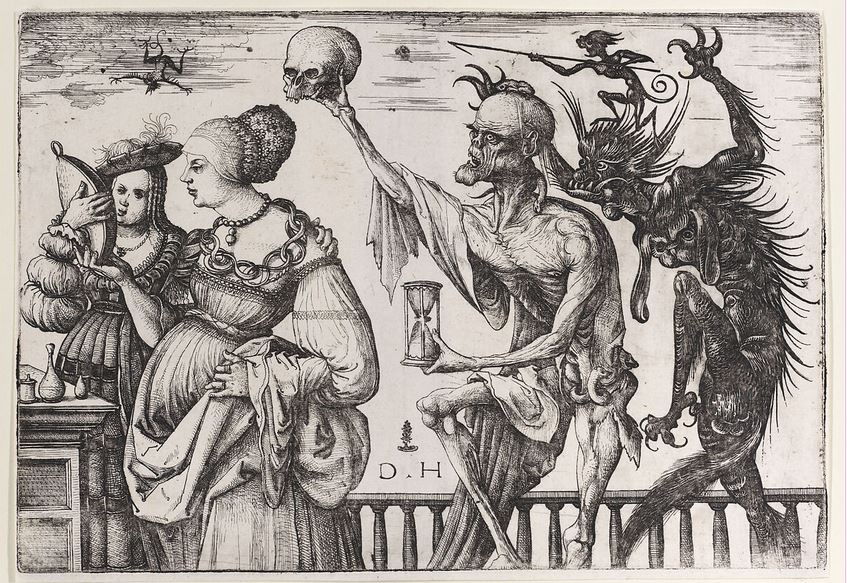
Le vrai christianisme, comme toutes les grandes religions humanistes, s’efforce sans relâche de secouer ceux qui gaspillent leur vie dans le péché en leur montrant que leur comportement est à la fois dramatique et surtout ridicule à la lumière de l’extrême brièveté de l’existence physique humaine.
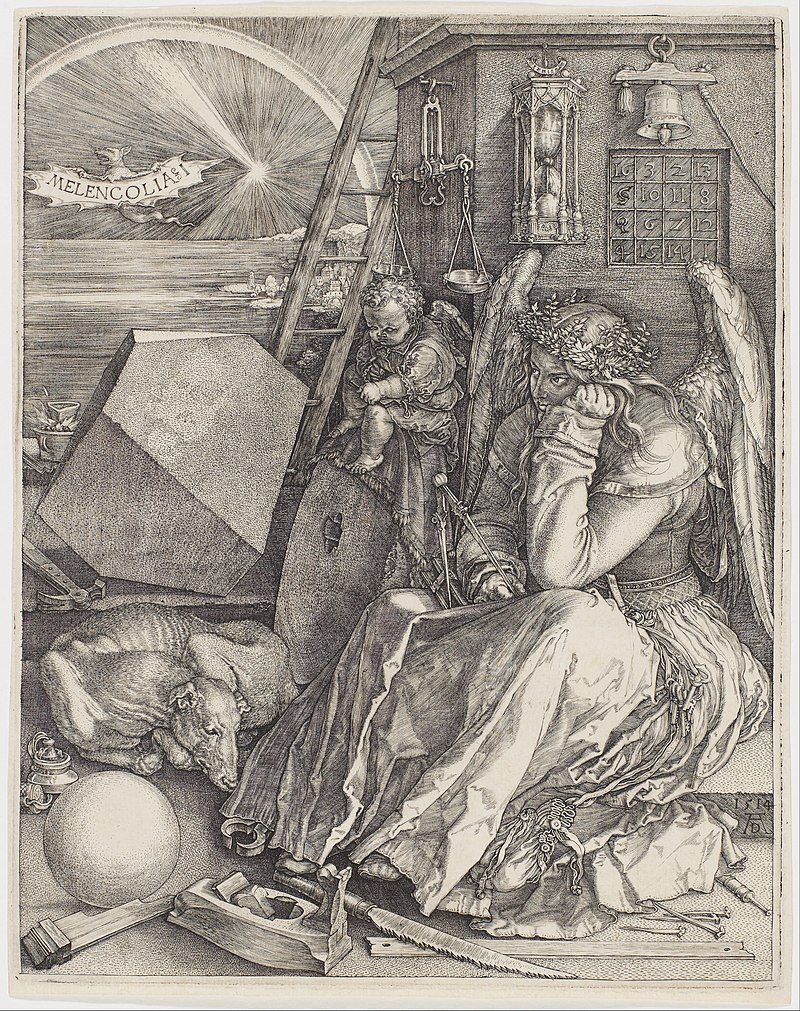
Dürer en fait le thème central de ses trois célèbres Meisterstiche (gravures de maître) qui ne peuvent être comprises que comme une seule et même unité : Le chevalier, la mort et le diable (1513) ; Saint Jérôme dans son étude (1514) et Melencolia I (1514).38
Dans chacune de ces gravures figure un sablier, métaphore de l’écoulement inexorable du temps qui passe. En juxtaposant au sablier (le temps) un crâne (la mort), une bougie qui s’éteint (dernier souffle), une fleur qui flétrie (la vacuité des passions) etc., les artistes arrivent à faire émerger la métaphore de la « vanité ».39
Érasme, qui fait du couple sablier-crâne son emblème, y ajoute sa devise : Concedi Nulli (Signifiant que la mort n’épargnera personne et que tous, riches ou pauvres, mourront un jour). En ce sens, à la Renaissance, l’humanisme chrétien était un mouvement de masse visant à éduquer les gens à « l’immortalité » spirituelle, à la fois contre les superstitions religieuses et contre un retour sournois du paganisme gréco-romain.
Avec cette exigence philosophique, Erasme marche ici directement dans les pas de Pétrarque40 et ses I Trionfi (1351-1374)41, un cycle poétique structuré en six triomphes allégoriques qui s’enchaînent les uns aux autres. Par exemple, le Triomphe de l’amour est lui-même surpassé par le Triomphe de la chasteté. À son tour, la Chasteté est vaincue par la Mort ; la Mort est vaincue par la Renommée ; la Renommée est conquise par le Temps ; et même le Temps est finalement vaincu par l’Éternité et enfin par le Triomphe de Dieu sur toutes ces préoccupations terrestres.
Puisque la mort « triomphera » à la fin de notre existence physique éphémère, dans la vision pré-Renaissance, c’est la peur de la mort et la peur de Dieu qui doivent aider l’homme à se concentrer pour apporter quelque chose d’immortel aux générations futures plutôt que de se perdre dans le labyrinthe des plaisirs et des douleurs terrestres que Jérôme Bosch (1450-1516)42 dépeint avec tant d’ironie dans son Jardin des délices terrestres (1503-1515).43
Léonard de Vinci, dont le sentiment théo-philosophique était considéré comme une hérésie44 par bon nombre au Vatican, notait amèrement dans ses carnets que, vu leur comportement, beaucoup d’hommes et de femmes ne méritaient même pas le beau corps que Dieu leur avait offert :
« Vois, nombreux sont ceux qui pourraient s’intituler de simples tubes digestifs, des producteurs de fumier, des remplisseurs de latrines, car ils n’ont point d’autre emploi en ce monde ; ils ne mettent en pratique aucune vertu, rien ne reste d’eux que des latrines pleines ».45
4. L’ère du « rire cathartique »
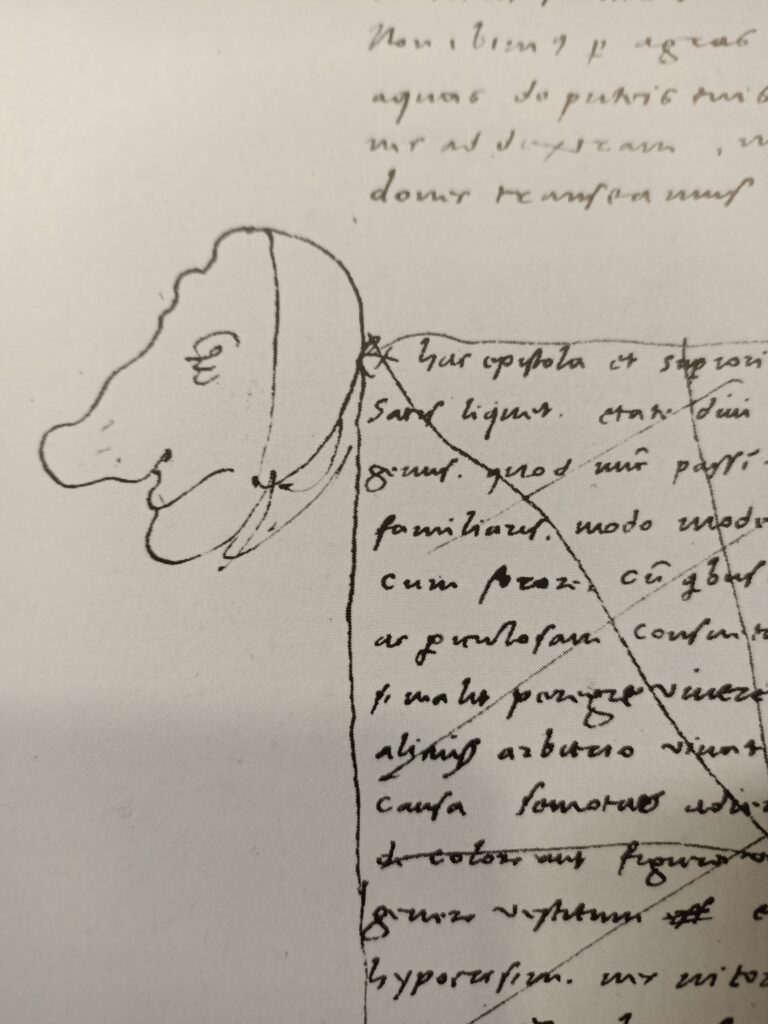
Selon les dictionnaires, on rit bien lorsqu’on trouve amusante et drôle une situation qui est, au départ, contrariante. En bref, le bon rire est la récompense d’un véritable processus créatif lorsque « l’agonie » de l’épuisement des hypothèses lors d’une recherche de solutions se dissipe par un joyeux Eurêka !
Cela peut être le cas pour des problématiques scientifiques et purement matérielles, mais aussi dans le processus de développement de l’identité personnelle. La tempête et les nuages ont disparu et la pleine lumière ouvre des horizons qui apportent des nouvelles perspectives.
Sur son blog Angeles Earth, l’artiste visuelle et historienne d’art Angeles Nieto souligne le lien intime entre humour et créativité :
« L’humour ne suit pas les processus linéaires, traditionnels et habituels ; l’humour stimule la flexibilité de la pensée et la créativité. On peut comparer le rire à un interrupteur de la pensée cognitive, de sorte que le côté rationnel est en quelque sorte paralysé. Nous rions généralement lorsque notre cerveau reconnaît un modèle erroné qui n’est pas à sa place. L’humour présente un nouveau point de vue qui perturbe et se moque des discussions conventionnelles. Les changements mentaux soudains provoqués par l’humour sont également présents dans la créativité : nous jouons avec les idées, à la recherche d’idées surprenantes. L’humour est fondé sur la dissociation, la possibilité que deux mentalités se croisent de sorte que la seconde modifie le sens de la première. La créativité fonctionne selon les mêmes mécanismes qu’une blague. Dans les deux cas, il s’agit de relier deux idées apparemment sans rapport. » 46
Traduit avec DeepL.com (version gratuite)
Pour les humanistes chrétiens, grâce à « l’effet miroir » intrinsèquement inhérent au « dialogue socratique » (qui commence par accepter que l’on ne sait pas – appelé docta ignorantia 47 par Nicolas de Cues), l’homme peut être libéré de ces afflictions « pécheresses » qui le plombent et lui coupent les ailes.
Son libre arbitre peut être mobilisé pour l’amener à agir conformément à sa vraie (bonne) nature, celle de se consacrer et de trouver son ultime plaisir dans l’accomplissement du bien commun au service d’autrui, aussi bien dans ses relations personnelles que dans ses activités économiques. C’est cet objectif, celui de former et d’ennoblir le caractère de chacun, qui deviendra le but fondamental de l’éducation républicaine. On ne remplit pas les têtes mais on forme des citoyens.
Or, en affirmant que la vie de l’homme est entièrement prédéterminée par Dieu, Luther niait l’existence du libre arbitre et rendait l’homme totalement irresponsable de ses actes. 48 Ce point de vue était à l’opposé de celui d’Érasme, qui avait commencé par demander à l’Église d’éradiquer ses propres abus financiers, tels que les fameuses « indulgences » 49, et ceci bien avant que Luther n’entre en scène.
Les humanistes chrétiens se sont fermement engagés à élever nos âmes au plus haut niveau de beauté morale et intellectuelle en nous libérant de notre attachement excessif aux biens terrestres – non pas en nous infligeant des sentiments de culpabilité et des injonctions morales ou par le commerce lucratif de la peur de l’enfer, mais… par l’effet « cathartique » (moralement purificateur) du rire libérateur ! Ouf, on respire ! Prenons un peu de recul et, tout en nous engageant sérieusement à nous améliorer, rions de nos imperfections. Dieu nous a donné la vie et elle est belle, pourvu qu’on sache comment s’en servir !
Dur comme fer contre le péché, mais plein d’amour et de compassion pour le pécheur engagé avec sincérité dans une démarche d’amélioration de soi.
L’humaniste français, Jean Jaurès, lecteur probable d’Érasme disait même que :
« Les progrès de l’humanité se mesurent aux concessions que la folie des sages fait à la sagesse des fous. »
5. Sebastian Brant, Jérôme Bosch et La nef des fous
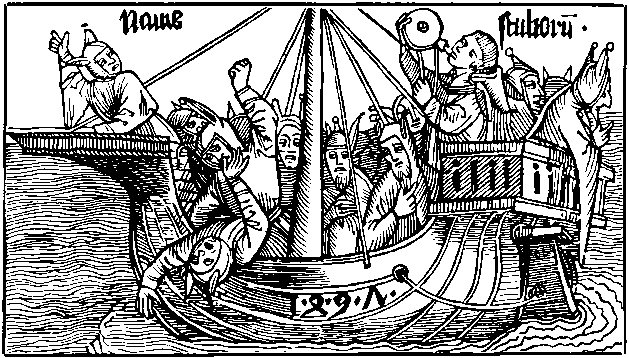
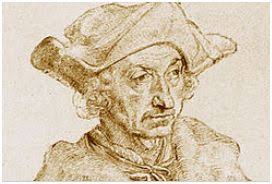
La « peinture de genre », qui dépeint des aspects de la vie quotidienne de gens ordinaires, est née avec Quinten Matsys (on devrait plutôt dire avec le paradigme érasmien que nous venons d’identifier), souligne Larry Silver 50 en reprenant ce qu’affirmait déjà Georges Marlier 51 en 1954.
Plusieurs années avant qu’Erasme ne publie son Eloge de la folie (écrit en 1509 et publié à Paris dès 1511) 52, le poète humaniste et réformateur social strasbourgeois Sébastien Brant (1558-1921) ouvre le bal du rire socratique avec son Narrenshiff (La Nef des fous, publiée en 1494 à Bâle, Strasbourg, Paris et Anvers) 53, une œuvre satirique hilarante illustrée par Holbein le Jeune (1497-1543) et Albrecht Dürer (1471-1528) qui exécute 73 des 105 illustrations de l’édition originale.
La Nef des fous s’imprime, se copie, se diffuse et se vend comme des petits pains dans toute l’Europe. Son auteur n’était pas seulement un simple satiriste, mais un humaniste cultivé dont on retient la traduction de poèmes de Pétrarque. 54
Brant était une figure clé et un allié de Johann Froben (1460-1529) et Johann Amerbach (1441-1513) issus de familles d’imprimeurs suisses qui accueillirent plus tard Érasme lorsque, persécuté aux Pays-Bas, il dut s’exiler à Bâle.
Après les saints et les princes, soudainement, ce sont des femmes, des hommes et des enfants ordinaires, des marchands certes encore souvent aisés, qui apparaissent dans les œuvres, non plus comme des « donateurs » assistants comme témoin à une scène biblique, mais pour leur qualités propres d’humains méritoires.
Dürer fait, par exemple, une gravure certes un peu ironique, d’« un cuisinier et sa femme ». 55 Si au XVe siècle, la philosophie grecque pénètre en Europe, en ce début du XVIe, c’est le peuple qui fait irruption.
Bien sûr, les temps ont changé et la clientèle des peintres aussi. Les commandes proviennent beaucoup moins d’ordres religieux et de riches cardinaux de Rome et de plus en plus de bourgeois prospères ou de guildes, corporations, confréries et communautés des métiers désirant embellir leurs chapelles et demeures et offrir leurs portraits à leurs amis.
L’expansion du marché anversois, qui a fait de la peinture un produit de luxe pour la classe moyenne, est un phénomène bien documenté, et les recherches ont confirmé l’affirmation de Lodovico Guicciardini (1521-1589) 56 selon laquelle il y avait au moins 300 ateliers de peintres actifs à Anvers dans les années 1560.
La Nef des fous de Brant marque un véritable tournant, prélude à un nouveau paradigme. Elle marque le début d’un long arc de créativité, de raison et d’éducation par le rire vérace et libérateur, dont l’écho résonnera très fort jusqu’à la mort de Pieter Bruegel l’Aîné en 1569. 57
Cet élan ne sera interrompu que lorsque le roi Charles Quint, croyant faire peur, ressuscite, en 1521, l’Inquisition et adopte les « placards », c’est-à-dire des décrets punissant par la mort tout citoyen osant lire, commenter ou discuter de la Bible.

La Nef des fous s’organise en 113 sections, dont chacune, à l’exception d’une courte introduction et de deux pièces finales, traite indépendamment d’une certaine classe de fous, d’imbéciles ou de vicieux. L’idée fondamentale de la nef n’étant rappelée qu’occasionnellement.
Aucune folie du siècle n’est censurée. Le poète s’attaque avec noble zèle aux défauts et aux extravagances de l’homme.
Le livre s’ouvre sur la dénonciation du plus grand fou de tous, celui qui se détourne de l’étude de tous les livres merveilleux qui l’entourent. Il ne veut pas « se casser la tête » et « encombrer » son crâne. « J’ai tout, dit le sot, d’un grand seigneur qui peut payer comptant la fatigue de ceux qui apprennent pour moi ». 58
La troisième folie (sur les 113), donc tout près de la première, est la cupidité et l’avarice:
« C’est absurde folie d’entasser des richesses et de ne pas jouir de la vraie joie de vivre, le fou ne sachant pas à qui servira l’or qu’il a mis de côté, le jour où il devra descendre dans la tombe ».59
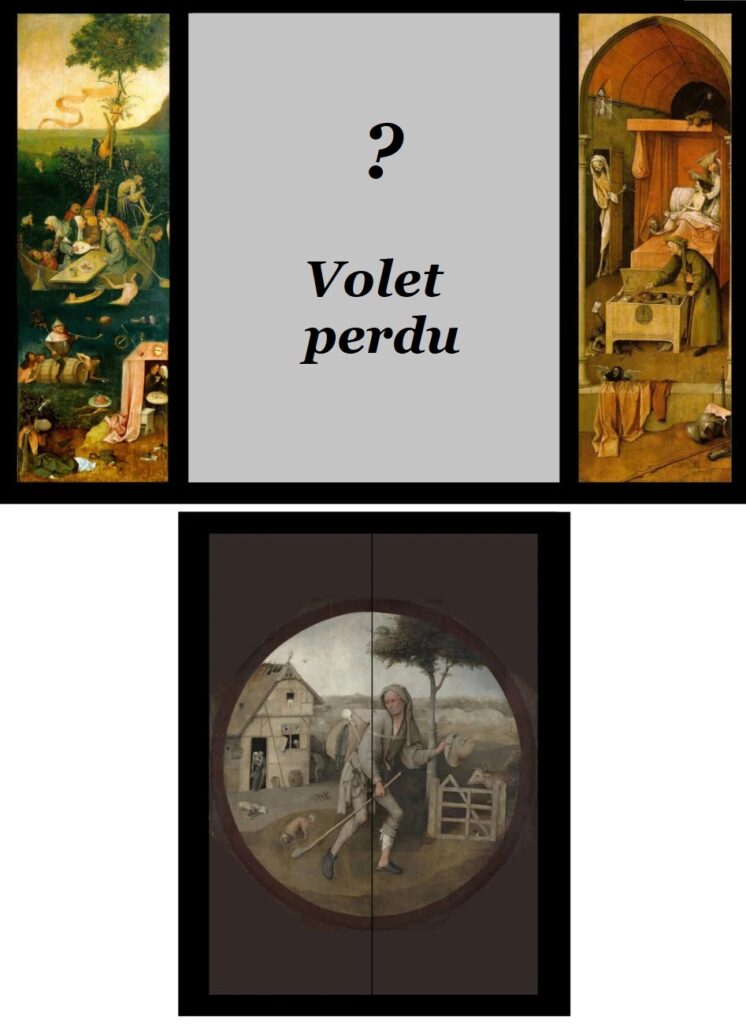
Un triptyque de Jérôme Bosch, en partie perdu, s’inscrit dans cette lignée. Des recherches relativement récentes ont établi que le tableau actuel La Nef des fous (Louvre, Paris) de Bosch, possiblement exécuté avant même 60 que Brant n’écrive sa satire, n’est que le volet gauche d’un triptyque dont le panneau droit était La Mort de l’avare (National Gallery, Washington). 61
Ce qui est intéressant avec ce dernier panneau, c’est qu’il n’y a pas de fatalité ! Même l’avare, jusqu’à son dernier souffle, peut choisir entre lever les yeux vers le Christ ou les abaisser vers le diable ! Que l’homme soit éternellement perfectible et que son sort dépende de sa volonté, était au cœur de la doctrine des Frères de la Vie commune 62, un mouvement laïc de dévotion chrétienne avec lequel Bosch, sans en être membre, avait d’importantes affinités. Cependant, personne ne connaît à ce jour l’image et le nom du panneau central qui a été perdu. Mais ce qui apparaît lorsqu’on referme les deux volets latéraux, c’est l’image d’un colporteur (autrefois appelé à tort Le retour de l’enfant prodigue) fuyant des mauvais lieux.
Ce thème figure également sur les panneaux extérieurs du triptyque de Bosch le Chariot de foin, montrant des rois, des princes et des papes courant après un chariot chargé d’une gigantesque botte de foin (une métaphore de l’argent) et que les diables tirent vers l’Enfer.
Le thème du colporteur qui pérégrine 63 était très populaire parmi les Frères de la Vie commune et la Devotio Moderna. 64
Pour eux, comme pour Saint Augustin, l’homme est en permanence confronté à un choix existentiel. Il est en permanence à la croisée du chemin (le bivium). Soit il emprunte le chemin rocailleux et difficile qui le mène à une position spirituellement plus élevée et plus proche de Dieu, soit il emprunte la voie de la facilité vers le bas en s’abaissant aux passions et aux affections terrestres.
La beauté de l’homme et de la nature, prévient Augustin et par la suite Denis le Chartreux 65, peut et doit être pleinement appréciée et célébrée sous condition qu’elle soit vécue comme « l’avant-goût de la sagesse divine », et non pas comme un simple plaisir des sens.
Le colporteur que l’on retrouve chez Bosch et Patinir est donc une métaphore de l’humanité qui s’efforce d’avancer sur le bon chemin et dans la bonne direction. Bosch peuplera ses tableaux d’hommes et de femmes ressemblant à des animaux décervelés se précipitant avec grande frénésie sur de petits fruits comme des cerises, des fraises et des baies, métaphores de plaisirs terrestres tellement éphémères qu’ils doivent éternellement renouveler l’expérience pour en tirer le moindre plaisir.
Le colporteur avance « op een slof en een schoen » (sur une pantoufle et une chaussure), c’est-à-dire qu’il abandonne sa maison et quitte le monde créé du péché (on voit un bordel, des ivrognes, etc.), et tous les biens matériels. Avec son « bâton » (symbole de la foi), il réussit à repousser les « chiens infernaux » (le mal) qui tentent de le retenir. Une enluminure d’un livre de psaumes anglais du XIVe siècle, le Luttrell Psalter, présente exactement la même représentation allégorique.
Ces images métaphoriques ne sont donc pas les fruits d’un « esprit malade » ou d’une imagination exubérante de Bosch, mais un langage courant qu’on retrouve assez souvent dans les marges des livres enluminés.
Le même thème, celui de l’Homo Viator, l’homme qui se détache des biens terrestres, est également récurrent dans l’art et la littérature de cette époque, notamment depuis la traduction néerlandaise du Pèlerinage de la vie et de l’âme humaine, écrit en 1358 par le moine cistercien normand Guillaume de Digulleville (1295-après 1358). Le Christ nous transforme en pèlerins à travers le monde. Unis à Lui nous traversons la Cité terrestre n’ayant comme véritable but que la Cité Céleste. Non plus seulement homo sapiens, mais homo viator, homme en route vers le Ciel.
Si les trois volets qui subsistent du triptyque de Bosch (la Nef des fous, La mort de l’Avare et le Colporteur) semblent de prime abord sans aucun lien, leur cohérence saute aux yeux une fois que le spectateur identifie ce concept primordial. 66
Il serait amusant, pour un peintre imaginatif et créatif vivant aujourd’hui, de recréer et de réinventer une image digne du volet perdu de Bosch, le thème étant forcément la chute de l’homme qui n’arrive pas à se détacher des biens terrestres, passant de la Nef des fous à La Mort de l’Avare.
6. Chambres de Rhétorique et Landjuweel
La vague d’émancipation culturelle qui marque nos contrées à cette époque atteint son apogée à la deuxième moitié du 16e siècle et provoque une réaction brutale du pouvoir en place. Le rire vérace des uns, on s’en doute, ne fait pas le bonheur des autres, car il ruine l’autorité illégitime des puissants et des tyrans. Il s’agit bien de l’arme politique la plus dévastatrice jamais conçue. Par conséquent, pour les forces du mal, le rire vérace, cathartique et libérateur, tel qu’il est promu par Érasme et ses disciples, doit être ignoré, calomnié et autant que possible éradiqué et remplacé par la mélancolie, l’obéissance et la soumission à des doctrines et des « narratifs » écrits d’avance par et pour les élites dominantes grâce à une constipation scolastique douloureuse.

Le « début de la fin » de l’occupation espagnole dans les Pays-Bas fût l’interdiction du Landjuweel 67. Dès les 13e et 14e siècles, les Landjuwelen étaient des concours de poésie entre les guildes d’archers du duché de Brabant. Aux 15e et 16e siècles, les Rederijkers (Rhétoriciens) organisaient des concours entre Chambres de rhétorique sur le même modèle.
Chaque concours était organisé autour d’une question hautement philosophique ou morale, une zinne, par exemple « Qu’est-ce qui incite le plus l’homme à l’art » (Anvers, 1561) ou « Qu’est-ce qui réconforte le plus l’homme à l’heure de sa mort » (Gand, 1539). Chaque chambre de rhétorique devait ensuite répondre par une pièce de théâtre, un zinne-spel (où le zinne est la question posée).
Les autres catégories de concours comprenaient les divertissements, les pièces farfelues, les esbattements, les chansons et le blason du rebus. Il s’agit d’une sorte de blason sur lequel figure un rébus. La solution de ce rébus était un sort ou un slogan.

Les autres épreuves comprenaient des pièces drolatiques et farfelues, des esbattements, des chansons et des « blasons du rebus. » Il s’agissait d’une sorte de blason sur lequel figurait un rébus.
Plus personne n’ignore le rôle du « rire cathartique » (catharsis = purification) propre à la comédie et la satire. Face aux angoisses du quotidien ou aux oppressions politiques, l’humour permet une décharge émotionnelle immédiate, tout en apportant une distance critique. La dérision et le rire cathartique nous sont bénéfiques, bien que le danger existe, lorsqu’ils ne sont pas suivis d’un appel à l’action, qu’en nous réconfortant, ils nous démobilisent.
Le Landjuweel organisé en août 1561 à Anvers par la Chambre des rhétoriciens De Violieren reste dans l’histoire comme le plus éclatant. Cette chambre était en réalité la branche littéraire de la Guilde de Saint-Luc, c’est-à-dire la guilde des peintres dont firent parti Matsys, Patinir, David et tant d’autres artistes associés avec Erasme. 68
Quatorze chambres y participèrent. Quelque 1 400 rhétoriciens à cheval, en costume de fête, avec musique et chants, firent leur entrée dans la ville. Le cortège comprenait 23 chars et 200 autres voitures.
Le théâtre, la poésie, la musique et la peinture partageaient un même langage visuel. L’un de ces « points » (chars ornés de représentations allégoriques et moralisatrices) de la procession du Onze-Lieve-Vrouwe-ommegang de 1563 a été décrit comme le type de chariot de foin que Bosch a placé au centre de son tableau Le chariot de foin (1501, Madrid), une allégorie de la poursuite morbide du « gain terrestre » :
« Eene Hoywaghen daer op zittentende eene Sater,
ghenaempt Bedrieghelijck aen locken,
achter volghende alle Natie van volck,
treckende aen het Hoy, als Woekeners, Cassiers, Creemers &c.
midts dat ertsch ghewin al hoy is ».
(Une charrette de foin sur laquelle se trouve un satyre nommé « la Tentation trompeuse » et derrière laquelle toutes sortes de personnes, telles que des usuriers, des banquiers et des colporteurs, tirent sur le foin, alors que le gain terrestre n’est que du foin). 69

Le même thème figure également au centre d’une gravure de Frans Hogenberg datant de 1559. Sur cette estampe, les personnes entourant la charrette de foin sont divisées en groupes et accompagnées de légendes, comme celle-ci :
« Geestelyck weerlijck het sij in wat staten
Vint men ghebreck tot allen stonden
Daer om doeghet goet en willet quaet laten
Want anders (Ilaes) eest al hoy bevonden. »
(Les personnes spirituelles et laïques de tous rangs sont constamment défectueuses. Faites donc le bien et évitez le mal. Car sinon, hélas, tout se prouvera [n’être que du] foin). 70

Les représentations scéniques ont lieu sur une scène en bois magnifiquement décorée sur la Grand-Place, devant le quai du nouvel hôtel de ville. Elle a été conçue par Cornelis II Floris. Les pièces introductives sont écrites par Willem van Haecht.
Comme déjà dit, les participants doivent répondre à la question « qu’est-ce qui pousse le plus l’homme à l’art ». Trois cents ans avant Kant et Schiller, les gens considéraient l’élévation de l’art comme un outil important pour l’humanisation et l’émancipation politique !
Le Landjuweel et l’Ommegang étaient des fêtes populaires où tout était permis, où le « l’homme de la rue », avec ses satires, ses déguisements et ses chansons moqueuses, pouvait narguer et interpeler l’oppresseur, le ridiculiser et rendre ainsi, ne serait-ce que pour un très court instant, le joug de l’Espagne un peu plus supportable.
La plupart des pièces allégoriques jouées étaient des satires mordantes contre le pape, les moines, les indulgences, les pèlerinages, etc.
Dès leur parution, elles irritent les pouvoirs en place. Ce n’est pas sans raison que le Landjuweel de 1561 fut cité plus tard comme le premier évènement culturel à inciter aussi bien le monde lettré que le peuple en faveur de la Réforme protestante. Comme ces œuvres étaient loin d’être favorables au régime espagnol, le duc d’Albe ordonna en 1571 leur bannissement en les inscrivant sur l’Index (des livres interdits). Le gouvernement finira par interdire toutes les représentations théâtrales des Chambres de rhétorique, véritable pôle d’opposition culturelle à l’oppression.
B. Quinten Matsys, éléments biographiques
Connaissant maintenant les enjeux philosophiques et culturels majeurs de l’époque, nous pouvons examiner avec sérénité la vie 71 de Matsys et quelques-unes de ses œuvres.
1. De forgeron à peintre
Selon l’Historiae Lovaniensium de Joannes Molanus (1533-1585), Matsys est né à Louvain entre le 4 avril et le 10 septembre 1466, comme un des quatre enfants de Joost Matsys (mort en 1483) et de Catherine van Kincken.
La plupart des récits de sa vie mêlent à cœur joie des faits et des légendes. 72 En réalité, on dispose de très peu d’indices concernant son activité ou son caractère.
A Louvain, Quinten aurait eu des débuts modestes en tant que ferronnier d’art. La légende veut qu’il se soit épris d’une belle fille que courtisait également un peintre. La fille préférant de loin les peintres aux forgerons, Quinten aurait aussi vite abandonné l’enclume pour le pinceau.
An 1604, le chroniqueur Karel Van Mander affirme que Quinten, frappé d’une maladie depuis l’âge de vingt ans, « se trouvait dans l’impossibilité de gagner son pain » en tant que forgeron.
Van Mander rappelle que lors des fêtes du mardi gras,
« les confrères qui soignent les malades allaient de par la ville, portant une grande torche de bois sculptée et peinte, distribuant aux enfants des images de saints gravées et coloriées ; il leur en fallait donc un grand nombre. Il se trouva que l’un des confrères, allant voir Quinten lui conseilla de colorier de ces images, et il en résulta que celui-ci s’essaya au travail. Par ce début infime, ses dispositions se manifestèrent, et, à dater de ce temps, il se mit à la peinture avec une vive ardeur. En peu de temps il fit des progrès extraordinaires et devint un maître accompli. » 73
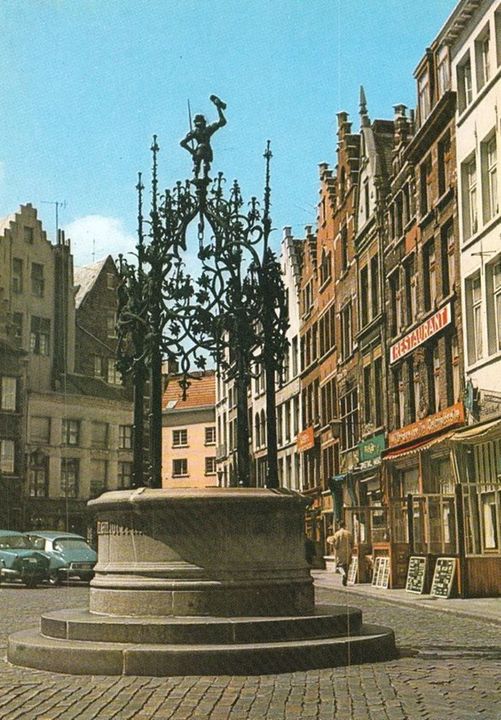
A Anvers, devant la cathédrale Notre-Dame, au Handschoenmarkt (marché aux gants), on trouve encore la « putkevie » (porte en fer forgé décorée sur un puits) qui aurait été réalisée par Quinten Matsys lui-même et qui représente la légende de Silvius Brabo et Druon Antigoon, respectivement les noms d’un officier romain mythique qui libéra Anvers de l’oppression d’un géant appelé Antigoon qui nuisait au commerce de la ville en bloquant l’entrée de la rivière.
L’inscription sur le puits se lit comme suit : « Dese putkevie werd gesmeed door Quinten Matsijs. De liefde maeckte van den smidt eenen schilder. » (La ferronnerie de ce puits a été forgée par Quinten Matsys. L’amour a fait du forgeron un peintre.)
Les dons documentés et les possessions de Joost Matsys, le père de Quinten, forgeron et horloger de la ville, indiquent que la famille disposait d’un revenu respectable et que le besoin financier n’était pas la raison la plus probable pour laquelle Matsys s’est tourné vers la peinture.
En 1897, Edward van Even 74 a écrit, sans présenter la moindre preuve, que Matsys composait également de la musique, écrivait des poèmes et réalisait des gravures.

Bien qu’il n’existe aucune preuve de la formation de Quinten Metsys avant son inscription en tant que maître libre à la guilde des peintres d’Anvers en 1491, le projet de dessin de son frère Joos Matsys II à Louvain et les activités de leur père suggèrent que le jeune artiste a d’abord appris à dessiner et à transposer ses idées sur le papier auprès de sa famille et qu’ils l’ont exposé pour la première fois aux formes architecturales 75 et à leur déploiement créatif.
Ses premières œuvres, en particulier, suggèrent clairement qu’il a reçu une formation de dessinateur d’architecture. Dans sa Vierge à l’enfant trônant avec quatre anges de 1505 (National Gallery, Londres), les personnages divins sont assis sur un trône doré dont le tracé gothique fait écho à celui de la fenêtre du dessin sur parchemin et à la maquette en calcaire du projet de Saint-Pierre auquel son frère était affecté à peu près à la même époque.
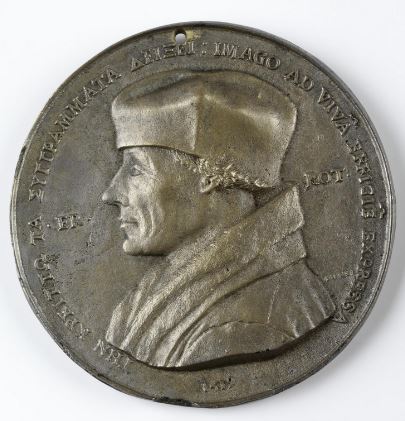
Ce qui est sûr, c’est que l’artiste a réalisé de magnifiques médaillons en bronze représentant Érasme, sa sœur Catarina et lui-même.
Vers 1492, il épouse Alyt van Tuylt qui lui donne trois enfants : deux fils, Quinten et Pawel, et une fille, Katelijne. Alyt meurt en 1507 et Quinten se remarie un an plus tard.
Avec sa nouvelle épouse Catherina Heyns, il a dix autres enfants, cinq fils et cinq filles. Peu après la mort de leur père, deux de ses fils, Jan (1509-1575) et Cornelis (1510-1556) 76 deviennent à leur tour peintres et membres de la Guilde d’Anvers.

2. Le Duché de Brabant

Louvain était alors la capitale du Duché de Brabant qui s’étendait de Luttre, au sud de Nivelles, à ‘s Hertogenbosch (Pays-Bas actuel). Il comprenait les villes d’Alost, Anvers, Malines, Bruxelles et Louvain, où, en 1425, l’une des premières universités d’Europe vit le jour. Cinq ans plus tard, en 1430, avec les duchés de Basse-Lotharingie et de Limbourg, Philippe le Bon (1396-1567) de Bourgogne hérite du Brabant qui fait partie des Pays-Bas bourguignons. 77
En 1477, alors que Matsys avait environ 11 ans, le duché de Brabant tomba sous la domination des Habsbourg en tant que partie de la dot de Marie de Bourgogne lors de son mariage avec Maximilien d’Autriche.
L’histoire ultérieure du Brabant fait partie de l’histoire des « dix-sept provinces » des Habsbourg, de plus en plus sous le contrôle de familles de banquiers d’Augsbourg, telles que les Fugger 78 et les Welser.
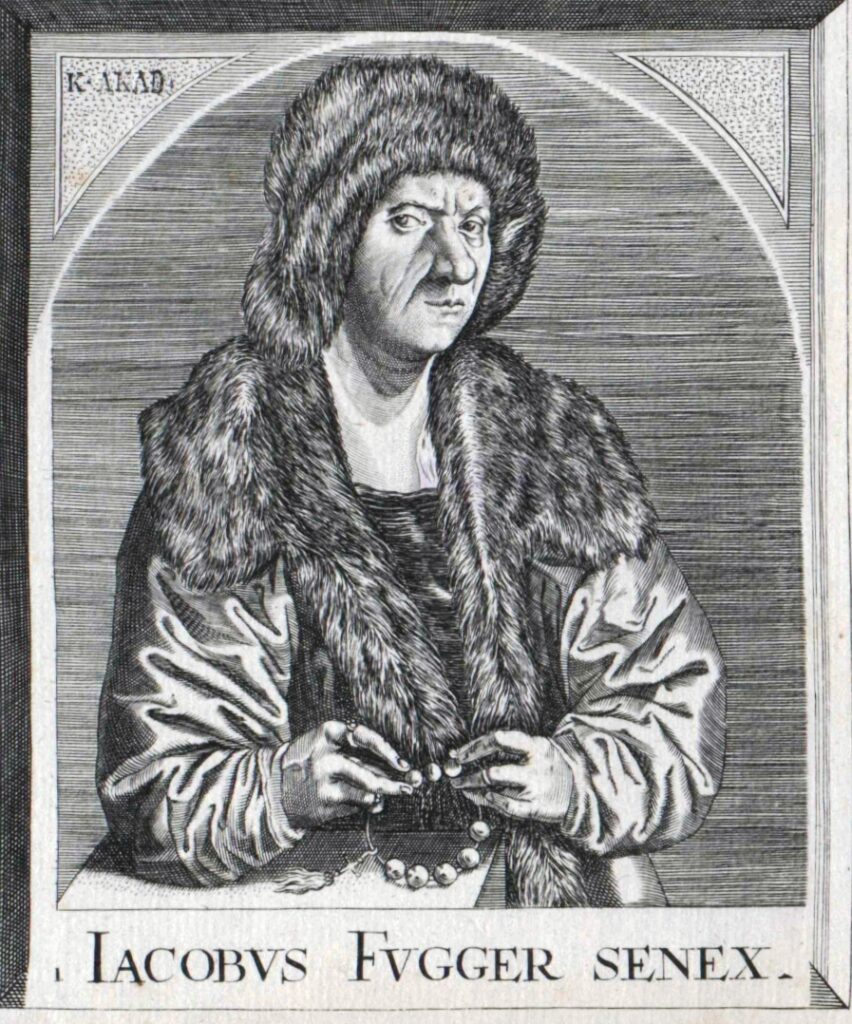
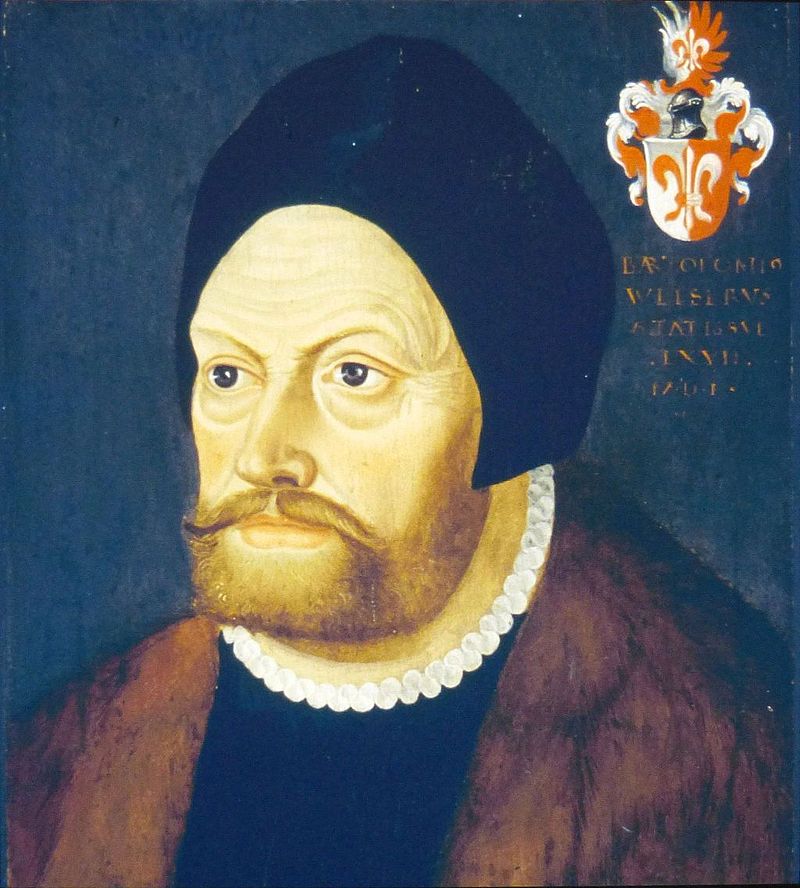
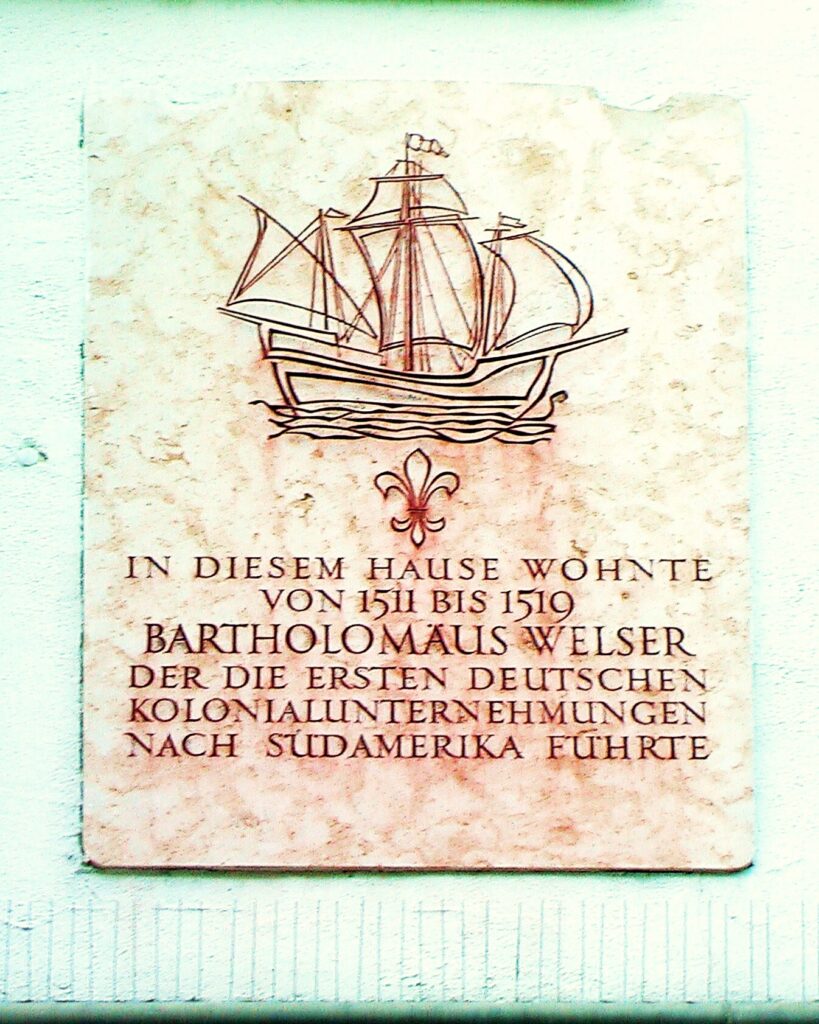
Si l’époque d’Érasme et de Matsys est une période faste de la « Renaissance du Nord », elle marque aussi des efforts toujours plus grands des familles de banquiers pour « acheter » la papauté afin de dominer le monde.
Le partage géopolitique du monde entier (et de ses ressources) entre l’Empire espagnol (dirigé par des banquiers vénitiens) et l’Empire portugais (sous la houlette des banquiers génois), fut scellé en 1494 par le traité de Tordesillas, une combine entérinée au Vatican par le pape Alexandre VI (Borgia) (1331-1503). Ce traité a ouvert les portes à l’asservissement colonial de nombreux peuples et pays, le tout au nom d’un sentiment très discutable de supériorité culturelle et religieuse.
Suite à des banqueroutes d’État à répétition, les Pays-Bas bourguignons deviennent alors la cible d’un intense pillage économique et financier, imposé aux populations par l’alliance du sabre et de goupillon. En diabolisant à outrance Martin Luther, de plus en plus déterminé à créer une opposition en dehors de l’Église catholique, le pouvoir en place esquive les questions pressantes formulées par Erasme et Thomas More exigeant des réformes urgentes pour éradiquer les abus et la corruption à l’intérieur de l’Église catholique.
Tout laisse à penser que le refus du Pape Clément VII d’accepter les demandes de divorce d’Henri VIII faisait partie d’une stratégie globale visant à plonger l’ensemble du continent européen dans des « guerres de religion », qui n’ont pris fin qu’avec la paix de Westphalie en 1648.
3. Formation : Bouts, Van der Goes et Memling
Les premiers triptyques peints par Matsys lui valent de nombreux éloges et amènent les historiens à le présenter comme « l’un des derniers primitifs flamands », le quolibet utilisé par Michel-Ange 79 pour discréditer intrinsèquement tout art non-italien considéré comme « gothique » (barbare) ou « primitif » par rapport à l’art italien imitant le style antique.
Comme Matsys est né à Louvain, on a pensé qu’il a pu être formé par Aelbrecht Bouts (1452-1549), le fils du peintre dominant de Louvain à l’époque, Dieric Bouts l’Ancien (v. 1415-1475). 80
En 1476, un an après la mort de son père, Aelbrecht aurait quitté Louvain afin de compléter sa formation auprès d’un maître en dehors de la ville, très probablement Hugo van der Goes (1440-1482), 81 dont l’influence sur Aelbrecht Bouts, mais aussi sur Quinten Matsys, semble plausible. Van der Goes, qui devint en 1474 le doyen de la guilde des peintres de Gand et mourut en 1482 à Rouge Cloître près de Bruxelles, était un fervent des Frères de la Vie commune et de leurs principes. 82
En tant que jeune assistant d’Aelbrecht Bouts, lui-même en cours de formation chez Van der Goes, Matsys aurait pu découvrir ce qui était alors le berceau de l’humanisme chrétien.
L’œuvre la plus célèbre de Van der Goes est le Triptyque Portinari (Uffizi, Florence), un retable commandité pour l’église Sant’Egidio de l’hôpital Santa Maria Nuova de Florence par Tommaso Portinari, directeur de la succursale brugeoise de la banque Médicis.
Les traits rudes de trois bergers (exprimant chacun un des états d’élévation spirituelle stipulés par les Frères de la Vie commune 83) dans la composition de van der Goes ont profondément impressionné les peintres travaillant à Florence.
Matsys est également considéré comme un possible élève de Hans Memling (1430-1494), ce dernier étant un disciple de Van der Weyden 84 et un peintre de premier plan à Bruges.
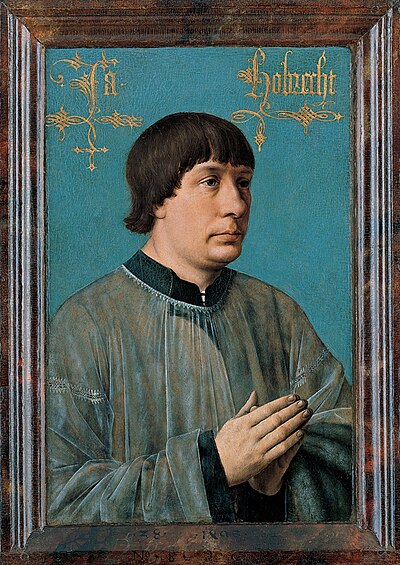
Le style de Memling et celui de Matsys sont si proches qu’il est difficile de les distinguer.
Alors que l’historien de l’art flamand Dirk de Vos a qualifié, dans son catalogue de 1994 sur l’oeuvre de Hans Memling, le portrait du musicien et compositeur Jacob Obrecht85 (1496, Kimbell Art Museum, Fort Worth) d’œuvre très tardive de Hans Memling, les experts actuels, parmi lesquels Larry Silver86, ont pu établir en 2018 qu’en réalité, il est beaucoup plus probable que le portrait soit la première œuvre connue de Quinten Matsys.
Obrecht, qui a exercé une influence majeure sur la musique flamande polyphonique et contrapuntique de la Renaissance, avait été nommé maître de chapelle de la cathédrale Notre-Dame d’Anvers en 1492. Vers 1476, Érasme est l’un des enfants de chœur d’Obrecht.
Obrecht se rendit au moins deux fois en Italie, en 1487 à l’invitation du duc Ercole d’Este Ier de Ferrare87 et en 1504. Ercole avait entendu la musique d’Obrecht, dont on sait qu’elle a circulé en Italie entre 1484 et 1487, et avait déclaré qu’il l’appréciait plus que la musique de tous les autres compositeurs contemporains ; il invita donc Obrecht, qui mourut de la peste en Italie.
Dès les années 1460, le professeur d’Érasme à Deventer, le compositeur et organiste Rudolph Agricola,88 s’était rendu en Italie. Après avoir étudié le droit civil à Pavie et suivi les cours de Battista Guarino, il se rendit à Ferrare où il devint un protégé de la cour des Este.
Vers 1499, Léonard réalise un dessin de la fille d’Ercole, Isabella d’Este, qui, selon certains, serait la personne peinte dans la Joconde.
4. Débuts à Anvers et à l’étranger
Matsys est enregistré à Louvain en 1491, mais la même année, il est également admis comme maître peintre à la Guilde de Saint-Luc à Anvers où, à l’âge de vingt-cinq ans, il décide de s’installer. A Anvers, comme nous l’avons déjà dit, il a représenté le maître de chapelle Jacob Obrecht en 1496, sa première œuvre connue, et plusieurs tableaux de dévotion à la Vierge et à l’Enfant.
Ensuite, comme les Liggeren (registres des guildes de peintres) ne rapportent aucune information sur l’activité de Matsys dans les Pays-Bas pendant une période de plusieurs années, il est très tentant d’imaginer que Matsys s’est rendu en Italie89 où il aurait pu rencontrer de grands maîtres (Léonard a vécu à Milan entre 1482 et 1499 et y est retourné en 1506 où il a rencontré son élève Francesco Melzi (1491-1567) qui l’a ensuite accompagné en France) ou à Colmar ou Strasbourg où il aurait pu rencontrer Albrecht Dürer qu’il semble avoir connu longtemps avant que ce dernier ne vienne aux Pays-Bas en 1520.
Pour l’historien d’art belge Dirk de Vos, il s’agit d’une hypothèse très plausible, car
« Les styles précoces et mur de Metsys contrastent si forts que l’on ne saurait les expliquer ce qui les sépare qu’en faisant appel à l’hypothèse d’une fréquentation assidue des œuvres de la Renaissance italienne, et plus précisément celles de Léonard de Vinci et de ses disciples du XVe siècle finissant. Car on note chez Metsys des emprunts immédiats à Léonard, si bien qu’une autre source d’inspiration semble exclusive. S’il n’existe aucune preuve tangible d’un voyage en Italie, la présence à Anvers de Metsys présente néanmoins des solutions de continuité compatibles avec une absence prolongée, par exemple entre 1491 et 1507. Un voyage en Italie n’est par conséquent nullement improbable. » 90
Dürer est envoyé par ses parents à Colmar en Alsace pour être formé à l’art de la gravure par Martin Schongauer (1450-1491) de loin le plus grand graveur de son époque. 91
Mais lorsque Dürer arrive à Colmar à l’été 1492, Schongauer a rendu l’âme. De Colmar, l’artiste se rend à Bâle, où il produit des gravures sur bois pour illustrer des livres et découvre les impressionnantes gravures de Jacob Burgkmair (1473-1531) et de Hans Holbein l’Ancien (1460-1524). 92
Il se rend ensuite à Strasbourg où il rencontre et réalise le portrait de l’érudit poète et écrivain humaniste Sébastien Brant, évoqué précédemment.
C. Œuvres choisies
1. La Vierge à l’Enfant, la grâce divine et le libre arbitre
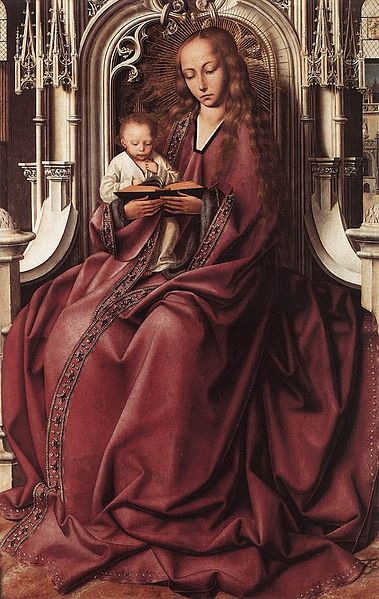

En 1495, Matsys peint une Vierge à l’Enfant (Bruxelles). Même si l’œuvre reste encore très normative, Matsys enrichit déjà la dévotion avec des scènes moins formelles de la vie quotidienne. L’Enfant, explorant de manière ludique de nouveaux principes physiques, tente maladroitement de tourner les pages d’un livre alors qu’une Vierge très sérieuse est assise dans une niche de style gothique, sans doute choisie pour s’intégrer à l’architecture et au style du lieu qui accueillera le tableau.
Dans une autre Vierge à l’Enfant (Rotterdam) Matsys va plus loin dans cette direction. On y voit une jeune maman bienveillante et heureuse avec un enfant enjoué, ce qui souligne le fait que le Christ était le fils de Dieu, mais aussi celui des Hommes. Sur un présentoir proche du spectateur, on remarque la présence d’une miche de pain et un bol de soupe au lait avec une cuillère, sans doute une scène quotidienne pour la plupart des habitants des Pays-Bas essayant de nourrir leurs enfants à l’époque.

Dans sa Vierge à l’Enfant avec la soupe au lait (Bruxelles), peinte en 1520 par l’ami de Matsys, le peintre Gérard David (1460-1523), montre avec une immense tendresse une jeune maman apprenant à son enfant que le dos d’une cuillère n’est pas vraiment l’idéal pour amener la soupe du bol à sa bouche.
De nombreux tableaux sur ce thème, qu’ils soient de Quinten Matsys (Vierge à l’Enfant, Louvre, 1529, Paris) ou de Gérard David (Repos lors de la fuite en Égypte, National Gallery, Washington), montrent un enfant qui tente, avec d’énormes difficultés, de saisir quelques raisins, des cerises ou d’autres fruits.

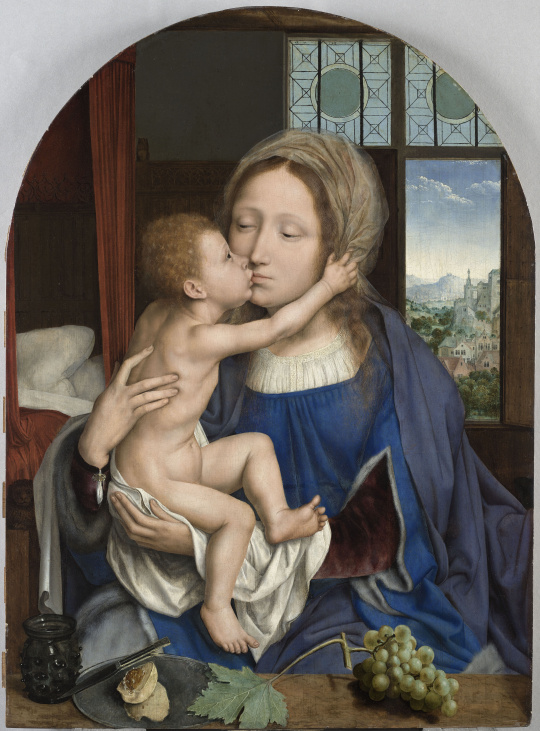
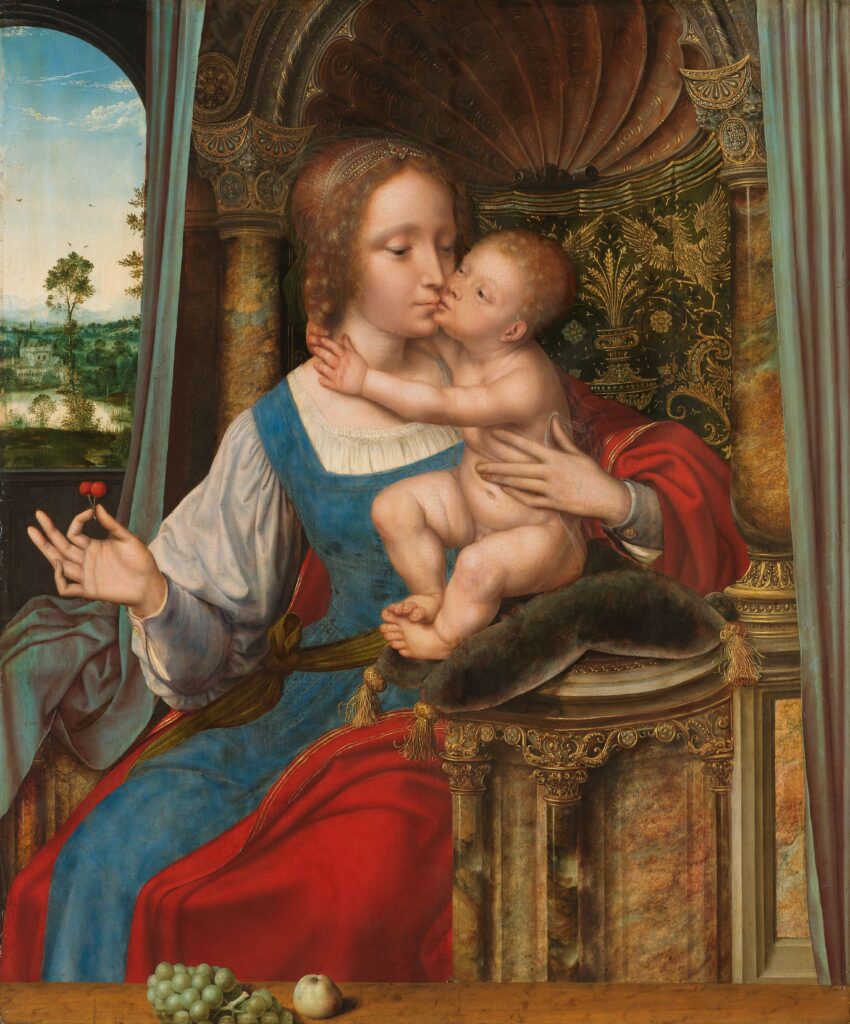
En 1534, dans sa Diatribe sur le libre arbitre, Érasme utilise également cette métaphore sur l’équilibre fragile à considérer dans la proportion entre les opérations du libre arbitre (qui, seul, séparé d’un but supérieur, peut devenir pure arrogance) et celles de la grâce divine (qui, seule, peut être interprétée comme une forme de prédestination).
Pour rendre accessible au plus grand nombre, un sujet qu’on croirait réservé aux théologiens, Érasme emploie une métaphore très simple, mais d’une tendresse et d’une beauté extrêmes :

« Un père a un enfant encore incapable de marcher ; il tombe ; le père le relève tandis que l’enfant fait des mouvements précipités et lutte pour garder l’équilibre ; il lui montre un fruit devant lui ; l’enfant s’efforce de le saisir, mais à cause de la faiblesse de ses membres, il tomberait rapidement si le père n’étendait pas la main pour soutenir et guider sa marche.
« Ainsi, guidé par son père, l’enfant arrive au fruit que le père lui met volontiers dans les mains pour le récompenser de son effort. L’enfant ne se serait jamais levé si le père ne l’avait pas soulevé ; il n’aurait jamais vu le fruit si le père ne le lui avait pas montré ; il n’aurait pas pu avancer si le père n’avait pas soutenu ses faibles pas ; et il n’aurait pas atteint le fruit si son père ne l’avait pas mis dans ses mains.
« Qu’est-ce que l’enfant revendiquera comme ses propres actes dans ce cas ? On ne peut donc pas dire qu’il n’a rien fait. Mais il n’y a pas lieu de glorifier sa force, puisqu’il doit à son père tout ce qu’il est ». 93
Bref, le libre arbitre, certes, Erasme le défendra, car il en faut, mais sans prétendre que l’homme peut y arriver tout seul…
2. Retable de Sainte-Anne
A Anvers, l’activité de Matsys connaît une avancée majeure avec les premières commandes publiques importantes de deux grands retables en triptyque :
- le Triptyque de la Confrérie de Sainte-Anne (1507-1509, Musée de Bruxelles), signé « Quinten Metsys screef dit ». (Quinten Metsys a écrit ceci).;
- le Triptyque de la Déploration du Christ (1507-1508, Musée d’Anvers), peint pour la chapelle de la guilde des charpentiers à la cathédrale d’Anvers, œuvre largement inspirée de la Déposition de croix de Roger Van der Weyden (Prado, Madrid). Jean-Baptiste et Jean l’Évangéliste, qui apparaissent lorsque le triptyque est fermé, sont les saints patrons de la corporation.
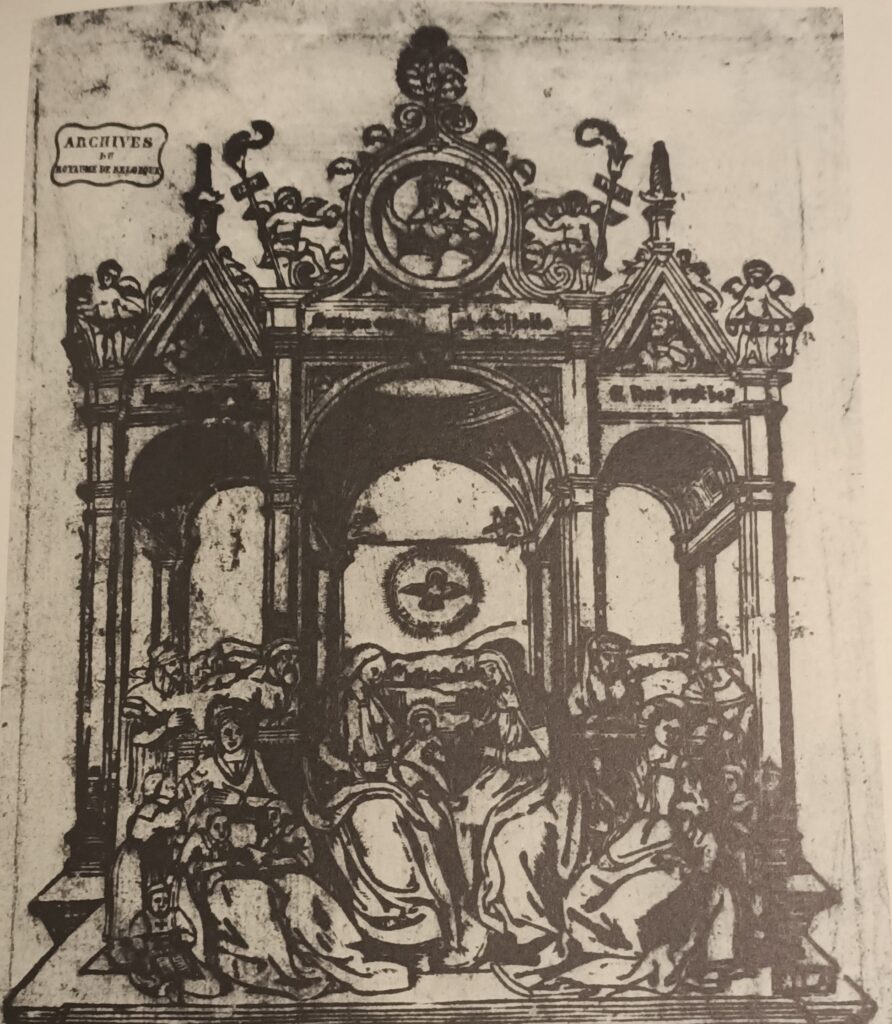
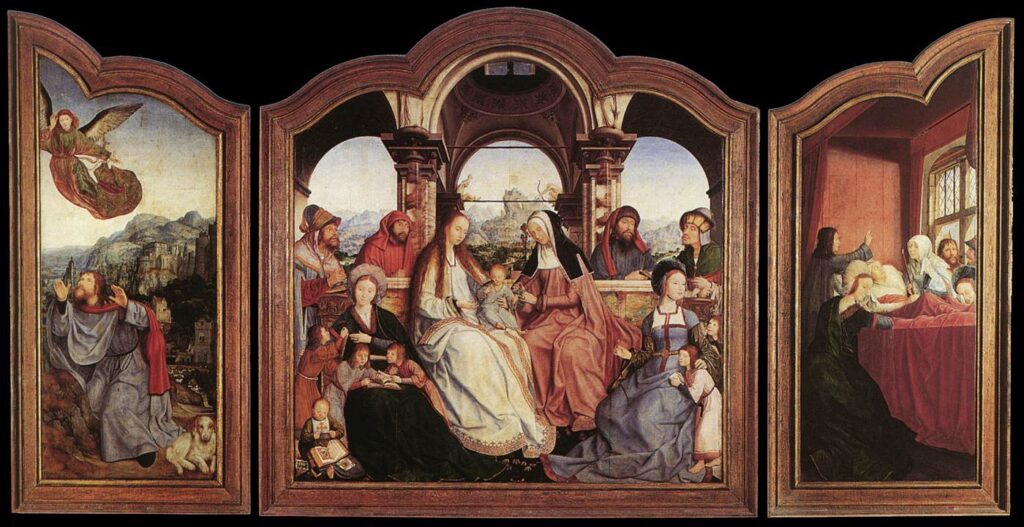
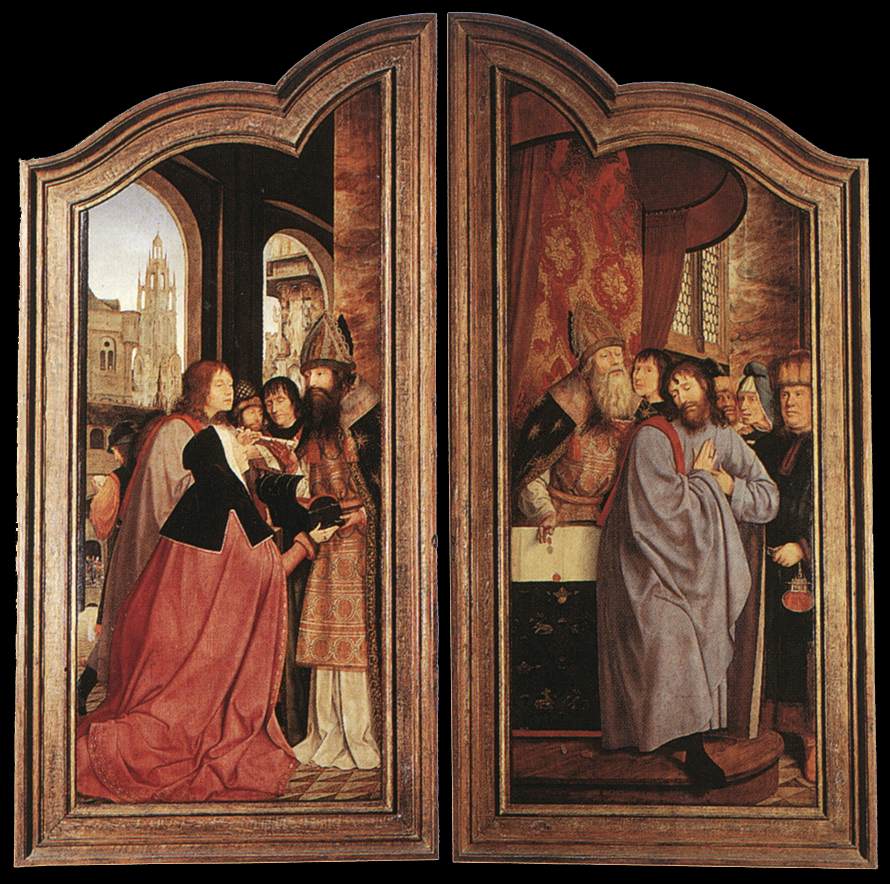
Le thème et l’iconographie du Triptyque Saint-Anne ont bien sûr été entièrement dictés au peintre par la confrérie de Sainte-Anne de Louvain qui lui a passé cette commande pour leur chapelle dans l’église Saint-Pierre de la même ville.
Le panneau central dépeint l’histoire de la famille de sainte Anne – la Sainte Parenté – à l’intérieur d’un édifice monumental couronné d’une coupole tronquée et d’arcades qui offrent une large vue sur un paysage montagneux. En cinq scènes, le retable raconte la vie d’Anne, mère de la Vierge, et de son époux Joachim. Les différents membres de la famille de la sainte apparaissent sur le panneau central.
L’événement clé de la vie d’Anne et de son mari Joachim, à savoir qu’ils deviendront les parents de la Vierge Marie alors qu’ils se croyaient incapables d’avoir des enfants, est représenté sur les panneaux gauche et droit du triptyque.
Le baiser chaste
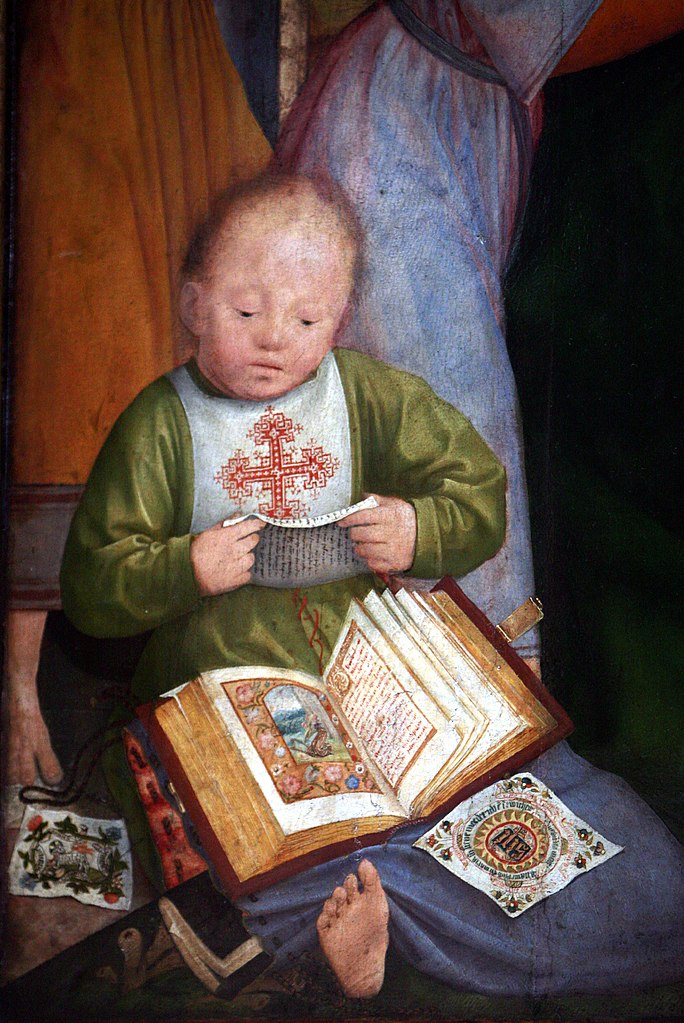
La « conception immaculée » de la Vierge, représentée par l’image d’un « chaste baiser » entre les deux époux devant la Porte d’Or de la muraille de Jérusalem, a été un sujet immensément populaire dans l’histoire de la peinture, de Giotto à Dürer.
Il a donc été rapidement transposé à l’Immaculée conception du Christ lui-même. D’où l’apparition soudaine de tableaux montrant Marie embrassant « chastement » (mais chaleureusement et parfois sur les lèvres) son enfant Jésus.
Le cycle du retable se termine par la mort d’Anne, représentée sur le panneau intérieur droit où elle est entourée de ses enfants et où le Christ donne sa bénédiction.
Malgré l’échelle impressionnante de cette œuvre et son récit conventionnel, Matsys réussit à créer un sentiment de contemplation plus libre et plus intime. Un exemple en est la figure du petit cousin de Jésus dans le coin gauche, qui s’amuse à rassembler de belles enluminures autour de lui et, maintenant pleinement concentré, tente de les lire.
3. Une nouvelle perspective
Dans deux autres occasions, 94 j’ai pu documenter qu’aussi bien le peintre flamand Jan Van Eyck 95 que le bronzier italien Lorenzo Ghiberti 96ont pu se familiariser avec « l’optique arabe », en particulier les travaux scientifiques d’Ibn al-Haytham 97 (connu sous son nom latin Alhazen).
A la Renaissance, plusieurs « écoles », avec des approches différentes et parfois opposés, ont tenté d’établir la meilleure façon de représenter l’« espace » dans l’art grâce à « la perspective ».
D’abord, dès le début du XVe siècle, une école, profitant des travaux des Franciscains d’Oxford (Roger Bacon, Grosseteste, etc.) sur Alhazen, tente de partir de la physionomie humaine (deux yeux fabriquant une image dans l’esprit du spectateur) et à la place d’un modèle monofocal (cyclopique) invente une perspective avec deux points de fuite centraux (perspective bi-focale).
Cette perspective est bien identifiable dans certaines œuvres de Van Eyck et de Lorenzo Ghiberti ce dernier ayant traduit certains textes d’Alhazen. Ensuite, une autre école, celle associée à Alberti, 98 affirme que la « bonne » perspective, purement géométrique et mathématique, fait appel à un « point de fuite central ». Enfin, une troisième école, celle de Jean Fouquet en France et Léonard de Vinci, constatant les limites du modèle albertien, tente une perspective curviligne.
A l’époque moderne, les partisans de Descartes et de Galilée ont absolument voulu démontrer que leur modèle d’un espace vide était né à la Renaissance avec le modèle albertien. Du coup, toute autre démarche ne peut être que tâtonnement et bidouillage de « primitifs » égarés ou ignares.
Une découverte inestimable
Comme nous l’avons l’évoqué précédemment, le Centre interdisciplinaire d’art et de science de Gand (GICAS) en Belgique travaille depuis 2007 à un nouveau « catalogue raisonné » de l’œuvre de Quinten Matsys. Dans ce cadre, en 2010, Jochen Ketels et Maximiliaan Martens 99 ont examiné le Retable Sainte Anne de Matsys et l’impressionnant portique italianisant du panneau central.
Rappelons que la partie peinte (en deux dimensions) sur le volet central a été conçue par l’artiste pour se prolonger et s’intégrer harmonieusement dans une vaste construction en bois (en trois dimensions) servant d’encadrement, structure malheureusement perdue mais dont on connaît l’existence grâce à des dessins.
« Lorsque nous avons dirigé nos lampes photographiques vers le panneau central, écrivent les deux chercheurs, la lumière rasante a révélé quelque chose qui n’avait pas du tout été mentionné dans la littérature : des lignes de construction incisées dans les voûtes à caissons de l’architecture ». 100
L’infrarouge a également mis en lumière l’existence d’un
« ensemble complexe de lignes de construction dessinées, à main levée ou assistées, créées à l’aide de plusieurs outils et techniques. Non seulement un système de construction aussi complexe n’a pas été observé dans les peintures nordiques de cette période, mais Matsys a dû utiliser une procédure mathématique pour construire la loggia complexe ». 101
Encore plus intéressant,
« pour dessiner les contours de la coupole tronquée et sa décoration, Matsys n’a pratiquement pas utilisé de lignes, mais a préféré les points (…) au bas du chapiteau, Matsys a ajouté quelques lettres séparées, probablement un ‘z’, un ‘e’ ou un ‘c’ (…) En raison de leur position proche de l’élément et du fait que Piero della Francesca, par exemple, avait déjà utilisé un système similaire avec des chiffres et des lettres dans ses dessins du De Prospectiva Pingendi (Sur la perspective des tableaux, vers 1480), on a des raisons de supposer un lien avec le tracé ou la composition de la colonne. » 102
A cet égard, il est intéressant de noter que l’une des rares personnes, en contact avec Matsys à un moment ou à un autre, à avoir lu et étudié le traité de Piero della Francesca 103 sur la perspective n’est autre qu’Albrecht Dürer, dont les Quatre livres sur la proportion humaine (1528) s’appuie sur l’approche révolutionnaire de Piero.
Ce que Dürer appelle la méthode du « transfert » de Piero deviendra par la suite la base de la géométrie projective, notamment à l’Ecole polytechnique sous Gaspard Monge, la science clé qui a rendu possible la révolution industrielle.
Les chercheurs ont également vérifié l’utilisation par Matsys de la perspective du point de fuite central en employant la méthode du « birapport » (cross-ratio en anglais).
Étonnés, car supposément impossible selon ce qu’ils ont appris dans les meilleures écoles, ils constatent que :
« Matsys montre sa compétence en matière de perspective, à la hauteur des normes de la Renaissance italienne », une perspective « très correct, en effet ». 104
Jusqu’à présent, on tenait pour acquis que la science de la perspective n’avait atteint les Pays-Bas qu’après le voyage de Jan Gossaert à Rome en 1508, alors que Matsys, qui fait preuve d’une connaissance magistrale et étendue de la science de la perspective, a commencé à composer cette œuvre dès 1507.
4. La collaboration de Matsys avec Patinir et Dürer
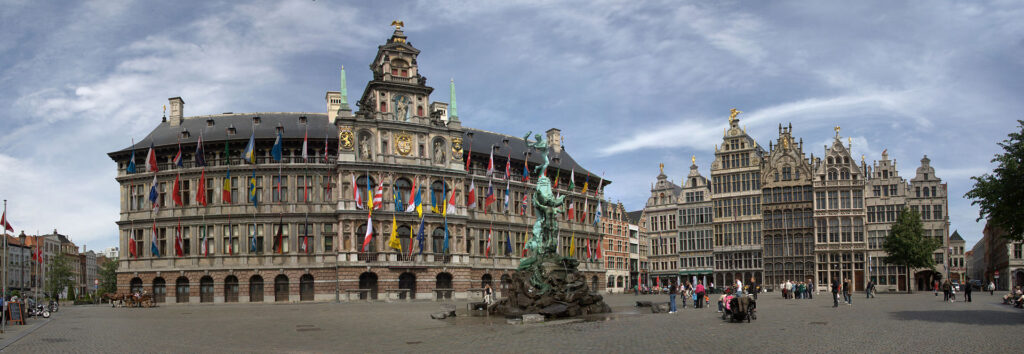
Une dernière remarque concernant ce tableau, le paysage montagneux derrière les personnages, qui s’apparente déjà aux paysages typiques et inquiétants produits par l’ami de Matsys, Joachim Patinir (1480-1524), un autre géant mal connu de l’histoire de la peinture.
Pourtant l’autorité de Patinir n’était pas des moindres. Felipe de Guevara, ami et conseiller artistique de Charles Quint et de Philippe II, mentionne Patinir dans ses Commentaires sur la peinture (1540) comme l’un des trois plus grands peintres de la région, aux côtés de Rogier van der Weyden et de Jan van Eyck.
Patinir dirigeait un grand atelier avec des assistants à Anvers. Parmi ceux qui subissent la triple influence de Bosch, Matsys et Patinir, on note :
- Cornelis Matsys (1508-1556), fils de Quinten, qui se mariera avec la fille de Patinir ;
- Herri met de Bles (1490-1566), actif à Anvers, possible neveu de Patinir ;
- Lucas Gassel (1485-1568), actif à Bruxelles et à Anvers p;
- Jan Provoost (1465-1529), actif à Bruges et Anvers ;
- Jan Mostaert (1475-1552), peintre actif à Haarlem ;
- Frans Mostaert (1528-1560), peintre actif à Anvers ;
- Jan Wellens de Cock (1460-1521), peintre actif à Anvers ;
- Matthijs Wellens de Cock (1509-1548), peintre-graveur actif à Anvers ;
- Jérôme Wellens de Cock (1510-1570), peintre-graveur, qui fonda, avec sa femme, l’entreprise Aux Quatre Vents, probablement le plus grand atelier de gravure au nord des Alpes de l’époque, qui employait Pieter Brueghel l’Aîné.
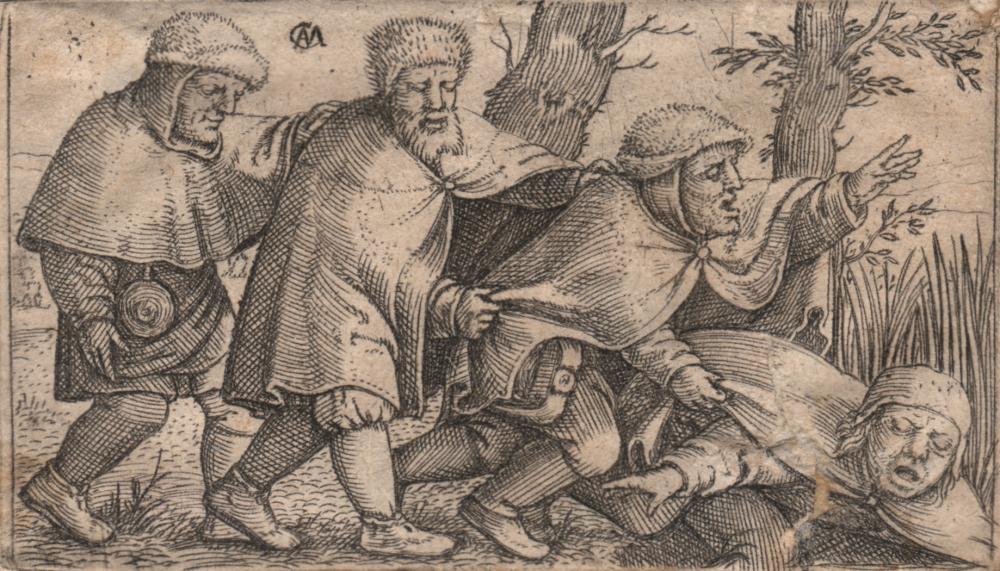
Il est généralement admis que Matsys a peint les figures de certains paysages de Patinir. D’après l’inventaire de 1574 de l’Escorial, ce fut le cas pour Les tentations de saint Antoine (1520, Prado, Madrid). On est tenté de penser que cette collaboration entre amis a fonctionné dans les deux sens, à savoir que Patinir a réalisé des paysages pour des œuvres de Matsys et à sa demande, une réalité qui met quelque peu à mal le mythe persistant d’une Renaissance présentée comme le berceau de l’individualisme moderne.
Le fait que Matsys et Patinir étaient très proches est confirmé par le fait qu’après la mort prématurée de Patinir, Matsys devient le tuteur de ses deux filles. Il est également intéressant de noter que Gérard David, qui est devenu le principal peintre de Bruges après Memling, est devenu membre de la guilde St. Lucas d’Anvers en 1515 conjointement avec Patinir, ce qui lui a permis d’accéder légalement au marché de l’art anversois, en pleine expansion.
Les historiens de l’art moderne ont tendance à présenter Patinir comme l’« inventeur » de la peinture de paysage, affirmant que pour lui, les sujets religieux n’étaient que des prétextes pour présenter ce qui l’intéressait vraiment, les paysages, tout comme Rubens a peint Adam et Eve uniquement parce qu’il aimait peindre (et vendre) des nus.
C’est plausible pour Rubens, mais assez faux pour Patinir, dont les « beaux » paysages, comme l’a démontré l’historien de l’art Reindert L. Falkenberg,105 n’auraient été qu’une sorte de tromperie sophistiquée du diable. La beauté du monde, création satanique chez Patinir, n’existe que pour tenter les humains et les faire succomber au péché.
Rencontre avec Albrecht Dürer

Une source unique d’information, c’est le journal106 de Dürer sur sa visite aux Pays-Bas.
Pourquoi Dürer est-il venu dans les Pays-Bas ? L’une des explications est qu’après la mort de son principal mécène et donneur d’ordre, l’empereur Maximilien Ier, l’artiste serait venu pour faire confirmer sa pension par Charles Quint.
Dürer arrive à Anvers le 3 août 1520 et visite Bruxelles et Malines où il est reçu par Marguerite d’Autriche (1480-1530), tante de Charles Quint. Chargée d’administrer les Pays-Bas bourguignons tant que Charles est trop jeune, elle prête parfois à Érasme une oreille attentive tout en gardant ses distances.
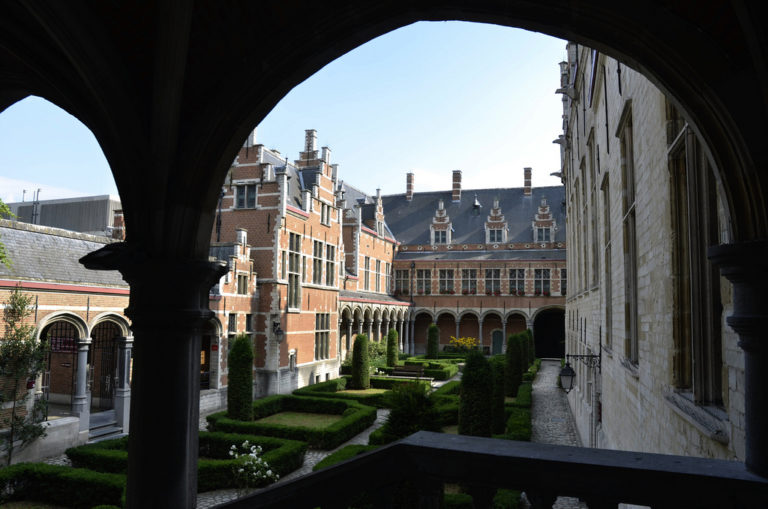
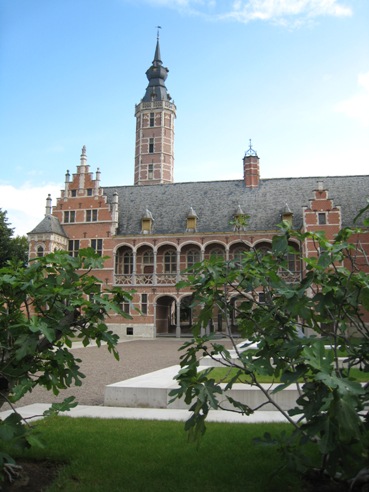
A Malines, Dürer a certainement visité la belle demeure de Jérôme de Busleyden (1470-1517), le mécène qui permettra à Erasme de démarrer en 1517 le « Collège trilingue ». 107
Busleyden était l’ami de l’évêque de Londres, Cuthbert Tunstall (1475-1559), qui le présente à Thomas More (1478-1535).
Lors de son séjour chez Margaret, Dürer a pu admirer un incroyable tableau de sa collection, Le couple Arnolfini (1434) de Jan van Eyck. Marguerite venait d’accorder une pension au peintre vénitien, Jacopo de’ Barbari (1440-1515), 108 diplomate et exilé politique à Malines, qui réalisa un portrait de Luca Pacioli (1445-1514), le franciscain qui fit découvrir Euclide à Léonard et écrivit De Divina Proportione (1509) que Léonard illustra.
De’ Barbari est mentionné par plusieurs de ses contemporains, notamment Dürer, Marcantonio Michiel (1584-1552) et Gérard Geldenhauer (1482-1542). En 1504, de’ Barbari a rencontré Dürer à Nuremberg et ils ont discuté du canon des proportions humaines, un sujet central des recherches 109 de ce dernier. Un manuscrit non publié du traité de Dürer révèle que l’Italien n’était pas disposé à partager ses découvertes :
« Je ne trouve personne qui ait écrit quoi que ce soit sur la façon d’élaborer le canon de proportions humaines, à l’exception d’un homme nommé Jacob, né à Venise et peintre charmant. Il me montra [sa gravure d’] un homme et une femme qu’il avait faits sur mesure, de sorte que je préférais maintenant voir ce qu’il voulait dire plutôt que de contempler un nouveau royaume… Jacobus n’a pas voulu me montrer clairement ses principes, ça, je l’ai bien vu. » 110
En mars 1510, selon les archives, de’ Barbari est au service de l’archiduchesse Marguerite à Bruxelles et à Malines. En janvier 1511, il tombe malade et rédige un testament. En mars, l’archiduchesse lui accorde une pension à vie en raison de son âge et de sa faiblesse. Il meurt en 1516, laissant à l’archiduchesse une série de 23 planches à graver. Mais lorsque Dürer lui demande de lui fournir certains des écrits de de’ Barbari sur les proportions humaines, elle décline poliment sa demande. 111
Pour sa part, Matthias Mende estime que :
« Les ouvrages théoriques de Dürer sont impensables sans une connaissance directe ou indirecte des idées de Léonard de Vinci. On a même trouvé dans la succession de Dürer des calques de planches anatomiques de Léonard. » 112
Le journal de Dürer révèle qu’il était souvent reçu par ses collègues locaux. 113 A Anvers, « je suis allé voir Quinten Matsys dans sa maison », écrit-il dans son journal. Dans la même ville, il esquisse un portrait de Lucas van Leyden (1489-1533) 114, et réalise le célèbre portrait du vieillard barbu de 93 ans qui servira de modèle à son Saint Jérôme.
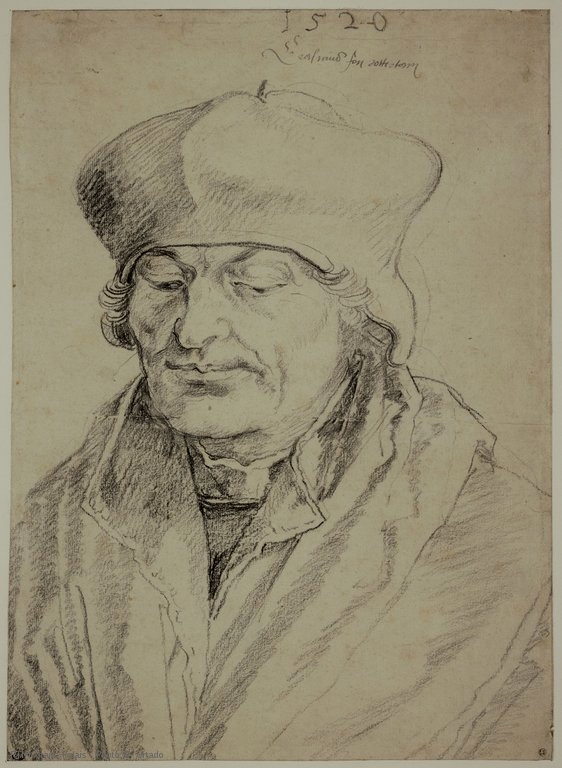
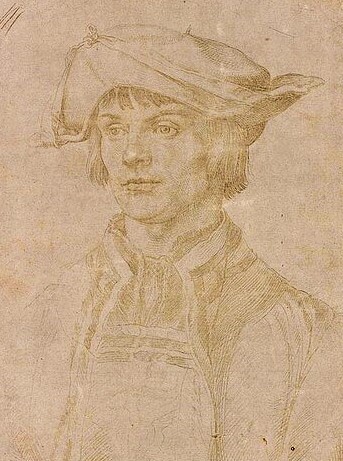

Il rencontre au moins trois fois Érasme dont il fait un portrait respirant une complicité mutuelle. Érasme lui passe commande car il a besoin d’un grand nombre de portraits pour les envoyer à ses correspondants dans toute l’Europe. Comme il l’indique dans son journal, Dürer esquisse plusieurs fois Érasme au fusain lors de ces rencontres. Il en tirera un portrait gravé un peu maladroit, réalisé six ans plus tard.
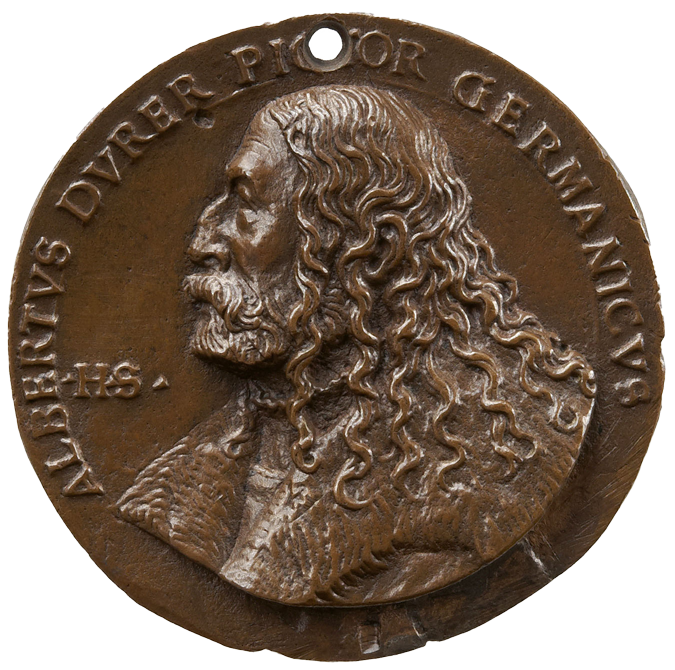
A l’occasion de son deuxième mariage, le 5 mai 1521, Patinir invite Dürer. On ne sait pas quand et comment cette amitié a commencé, ou si elle était simplement de circonstance. Le maître de Nuremberg esquisse le portrait de Patinir et l’appelle « der gute Landschaftsmaler » (le bon peintre de paysages), créant ce mot nouveau pour ce qui devient un nouveau genre.
Lors du mariage, il rencontre Jan Provoost (1465-1529), Jan Gossaert (de Mabuse) (1462-1533) et Bernard van Orley (1491-1542), des peintres en vogue à la cour de Malines.
Mais la Mort et l’Avare (1515, Bruges) de Provoost est clairement d’inspiration erasmienne.
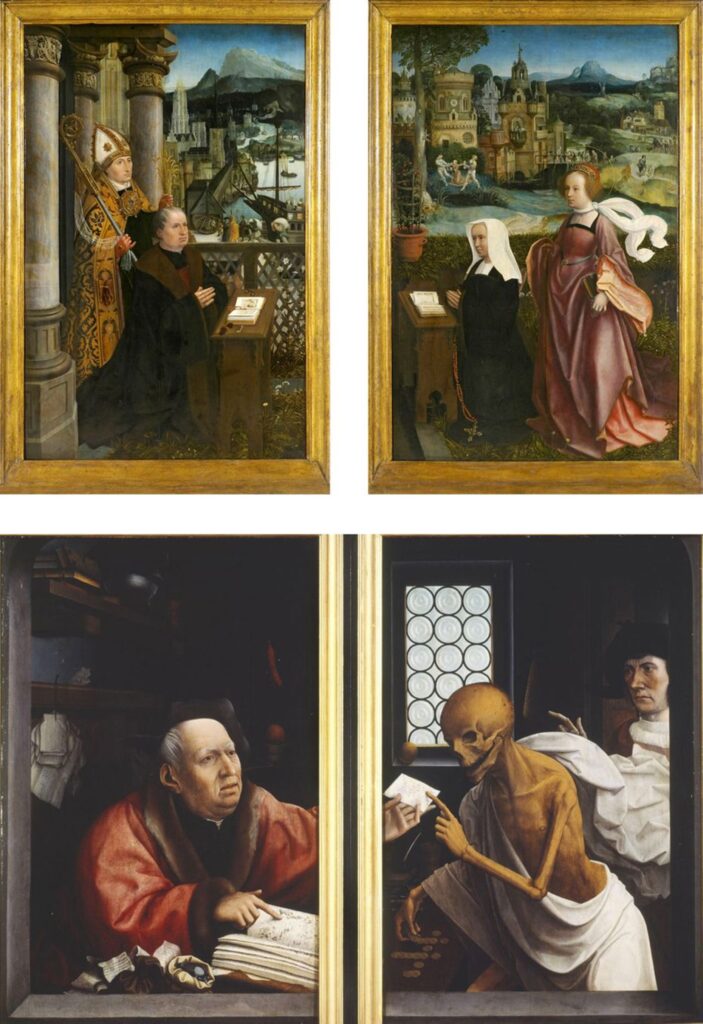
Le poète, professeur de latin et philologue Cornelis de Schryver (Grapheus) (1482-1558), collaborateur de l’imprimeur d’Érasme à Louvain et Anvers, Dirk Martens, est une figure qui a pu mettre Dürer en lien avec les peintres d’Anvers, ville dont il est le secrétaire en 1520.
Les imprimeurs et les éditeurs ont joué un rôle clé à la Renaissance, car ils serviront d’intermédiaires entre, d’une part, les intellectuels, les érudits et les savants, et d’autre part, les illustrateurs, les graveurs, les peintres et les artisans. Comme Dürer lui-même, Grapheus était attiré par les idées de la Réforme, dont Luther et Érasme étaient les chefs de file. On sait que Grapheus a acheté à Dürer un exemplaire du De Captivitate (De la captivité babylonienne de l’Église) de Luther, un ouvrage incontournable pour quiconque s’intéressait à l’avenir de la chrétienté.
Comme Érasme et bien d’autres humanistes, Dürer a été l’hôte de Quinten Matsys dans sa fabuleuse maison de la Schuttershofstraat, ornée de décorations italiennes (festons de feuilles, de fleurs ou de fruits) et de grotesques (réseaux décoratifs et symétriques de lignes et de figures).

Une représentation idéalisée de la rencontre Dürer-Matsys (sous le regard de Thomas More et d’Érasme) figure dans un tableau de Nicaise de Keyser (1813-1887) conservé au Musée royal des arts d’Anvers. Une autre scène, un dessin de Godfried Guffens (1823-1901) datant de 1889, montre l’échevin anversois Gérard van de Werve recevant Albrecht Dürer qui lui est présenté par Quinten Matsys.
Lorsque Charles Quint revint d’Espagne et visita Anvers, Grapheus écrivit un panégyrique pour saluer son retour. Mais en 1522, il est arrêté pour hérésie, emmené à Bruxelles pour y être interrogé et emprisonné. Il perd alors son poste de secrétaire. En 1523, il est libéré et retourne à Anvers, où il devient professeur de latin. En 1540, il redevient secrétaire de la ville d’Anvers. La propre sœur de Quentin Matsys, Catherine, et son mari ont été condamnés à mort à Louvain en 1543 pour ce qui était devenu le délit capital de lecture de la Bible depuis 1521 : il a été décapité, elle aurait été enterrée vivante sur la place devant l’église.
A cause de leurs convictions religieuses, les enfants de Matsys quittent Anvers et partent en exil en 1544. Cornelis finira ses jours à l’étranger.
5. Le lien avec Erasme

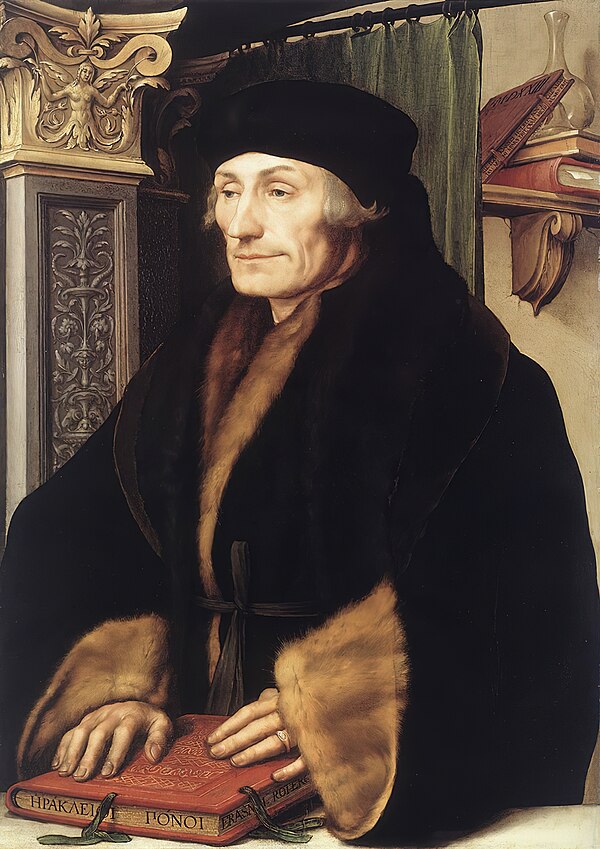
En 1499, Thomas More et Érasme se rencontrent à Londres. Leur rencontre initiale s’est transformée en une amitié à vie, puisqu’ils ont continué à correspondre régulièrement. A cette époque, ils ont collaboré à la traduction en latin et à l’impression de certaines œuvres du satiriste assyrien Lucien de Samosate (vers 125-180 après J.-C.), surnommé à tort « le Cynique ».
Érasme a traduit le texte satirique de Lucien, Sur ceux qui sont aux gages des grands,115 et l’a fait envoyer à son ami Jean Desmarais, professeur de latin à l’Université de Louvain et chanoine à l’église Saint-Pierre de cette ville.
Lucien, dans son texte, attaque l’état d’esprit des érudits qui vendent leur âme, leur esprit et leur corps au pouvoir dominant. Il en cite, fier de lui, disant :
« Quel bonheur de compter au nombre de ses amis les premiers citoyens de Rome, de faire des dîners splendides, sans qu’il n’en coûte rien, de loger dans une belle maison, de voyager à son aise, mollement couché sur un char attelé de chevaux blancs de recevoir, en outre, une magnifique récompense de cette amitié et du bien-être dont il vous est donné de jouir ! Quel bon métier, où tout vient de la sorte sans semence ni culture ». 116
Dans un véritable manifeste contre la servitude volontaire, anticipant celui de La Boétie, Lucien, qui pardonne d’abord ceux qui se soumettent par pure nécessité alimentaire, s’en prend à leur fantasme pervers comme cause de leur capitulation :
« Il ne reste plus qu’un motif que je crois vrai, mais qu’ils n’avouent pas : c’est que l’espoir de jouir de mille plaisirs les précipite vers ces maisons, frappés de l’éclat de l’or et de l’argent dont elles brillent, tout heureux des festins et du luxe qu’ils se promettent ; quand ils boiront l’or à pleine coupe et sans obstacle. Voilà ce qui les entraîne ; voilà pourquoi ils échangent leur liberté contre l’esclavage. Ce n’est pas, comme ils le disent, le besoin du nécessaire, c’est le désir du superflu et de toutes ces magnificences. Mais, semblables à des amants infortunés, à des soupirants malheureux, ils sont traités par les riches avec la fierté rusée d’un objet aimé, qui entretient la passion de ses poursuivants, mais qui se laisse à peine dérober la faveur amoureuse d’un baiser, parce qu’il sait que la jouissance anéantit l’amour : il se refuse donc à cette jouissance, il s’en garde avec le plus grand soin. Cependant, pour laisser à l’amant quelque ombre d’espoir, dans la crainte que l’excès des rigueurs ne le désespère et qu’il ne cesse d’aimer, on lui accorde un sourire, on lui promet de faire un jour ce qu’il voudra, de se montrer aimable, de le traiter avec toutes sortes d’égards ; puis insensiblement l’âge arrive, et bientôt l’amour de l’un et les faveurs de l’autre ne sont plus de saison. Ainsi pour eux, la vie tout entière se passe à espérer. »117
C’est en 1515 à Anvers, lorsque Thomas More est envoyé en mission diplomatique par le roi Henri VIII pour régler d’importants litiges commerciaux internationaux à Bruges, qu’Erasme lui présente son ami Pieter Gillis (1486-1533) (latinisé en Petrus Ægidius), compagnon humaniste et secrétaire de la ville d’Anvers. Gillis, qui avait débuté à dix-sept ans comme correcteur d’épreuves dans l’imprimerie de Dirk Martens à Louvain et Anvers, connaît Érasme depuis 1504. L’humaniste lui conseille de poursuivre ses études et ils restent en contact. L’imprimeur Martens a édité à Louvain plusieurs livres d’humanistes, notamment ceux de Denis le Chartreux (1401-1471) et De inventione dialectica (1515) de Rudolphus Agricola, le manuel d’enseignement supérieur le plus largement acheté et utilisé dans les écoles et les universités de toute l’Europe.
Tout comme More et Érasme, Gilles était un admirateur et disciple d’Agricola, une figure emblématique de l’école des Frères de la Vie commune de Deventer. Grand pédagogue, musicien, facteur d’orgues d’églises, poète en latin et en langue vernaculaire, diplomate, boxeur et, vers la fin de sa vie, érudit en hébreu, Agicola, l’enseignant préféré d’Erasme, était la source d’inspiration de toute une génération. La maison de Gillis à Anvers était également un lieu de rencontre important pour les humanistes, les diplomates et les artistes de renommée internationale.
Quinten Matsys y est également un invité de marque. Enfin, c’est Gillis qui recommande à la cour d’Angleterre le peintre Hans Holbein le Jeune, le jeune prodige qui avait illustré l’Éloge de la folie d’Érasme. Du coup il sera reçu outre-manche par Thomas More avec grand enthousiasme. Son frère Ambrosius Holbein (1494-1519) illustrera plus tard l’Utopie de More.
6. L’Utopie de Thomas More
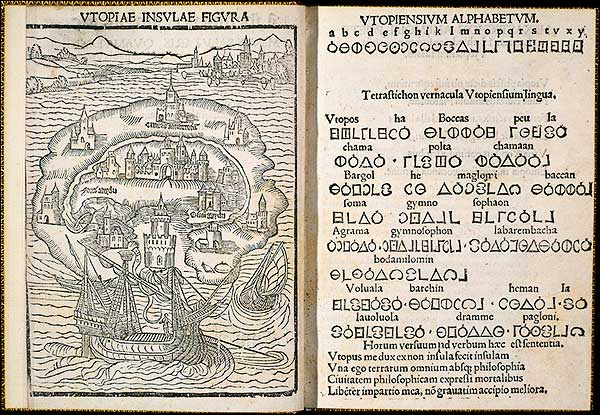
Gillis partage avec More et Érasme une grande sensibilité à la justice, ainsi qu’une sensibilité typiquement humaniste vouée à la recherche de sources de sagesse plus fiables. Il est avant tout connu comme un personnage apparaissant dans les premières pages de l’Utopie, lorsque Thomas More le présente comme un modèle de civilité et un humaniste à la fois plaisant et sérieux :
« J’ai souvent reçu pendant ce séjour [à Bruges], entre autres visiteurs et bienvenus entre tous, Pieter Gillis. Né à Anvers, il jouit d’un grand crédit et d’une position éminente parmi ses concitoyens, digne des plus grands, car le savoir et le caractère de ce jeune homme sont également remarquables. Il est en effet plein de bonté et d’érudition, accueillant tout le monde avec libéralité, mais, quand il s’agit de ses amis, avec un tel élan, une telle affection, une telle fidélité et un tel dévouement sincère, qu’on trouverait peu d’hommes qui lui soient comparables dans les choses de l’amitié. Peu d’hommes ont aussi sa modestie, son manque d’affectation, son bon sens naturel, tant de charme dans la conversation, tant d’esprit avec si peu de malice ».
L’oeuvre la plus célèbre de Thomas More est bien sûr l’Utopie, composée en deux volumes.
Il s’agit de la description d’une île fictive qui n’était pas gouvernée par une oligarchie comme la plupart des États et empires occidentaux, mais qui était gouvernée sur la base des idées du bien et du juste que Platon a formulées dans son dialogue, La République.
Alors que l’Éloge de la folie d’Érasme appelait à une réforme de l’Église, l’Utopie de More (écrit en partie par Erasme), une autre satire de la corruption, de l’avidité, de la cupidité et des échecs qu’ils voyaient autour d’eux, appelait à une réforme de l’État et de l’économie.
L’idée du livre est venue à Thomas More alors qu’il séjournait dans la résidence anversoise de Gillis, Den Spieghel, en 1515.


Le premier volume, commence par une correspondance entre More et d’autres personnes, dont Pieter Gillis. De retour en Angleterre en 1516, l’humaniste anglais rédige l’essentiel de l’ouvrage.
Entre décembre 1516 et novembre 1518, quatre éditions de l’Utopie furent composées par Erasme et Thomas More et paraissent en décembre 1516 chez l’éditeur Dirk Martens à Louvain. Avec le texte, une carte gravée sur bois de l’île d’Utopie, des vers de Gillis et l’« alphabet utopique » que ce dernier invente pour l’occasion, des vers de Geldenhouwer, historien et réformateur lui aussi éduqué par les Frères de la Vie commune de Deventer, des vers de Grapheus ainsi que l’épître de Thomas More dédicaçant l’ouvrage à Gillis. Plusieurs années après la mort de More et d’Érasme, en 1541, Grapheus, avec Pieter Gillis, publia son Enchiridio Principis Ac Magistratus Christiani.
7. Pieter Gillis et le « Diptyque de l’amitié »
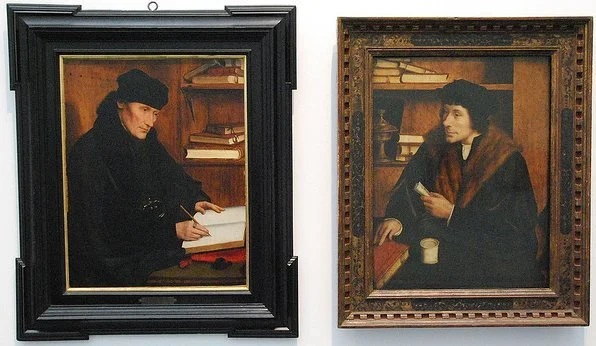
Outre les triptyques et les peintures religieuses, Matsys excellait dans les portraits. L’une des plus belles oeuvres de Matsys est le double portrait d’Érasme et de son ami Gillis, peint en 1517.118
Ce diptyque de l’amitié devait servir de visite « virtuelle » à leur ami anglais Thomas More à Londres et ils ont demandé à Quinten Matsys de réaliser les deux tableaux, car il était le meilleur peintre de la place. Le portrait d’Érasme fut le premier à être achevé. Celui de Gillis était constamment retardé parce qu’il tombait malade entre les séances de pose. Les deux hommes, dans leur correspondance, avaient parlé de ce double portrait à Thomas More, ce qui n’était peut-être pas une bonne idée, car More les interrogeait constamment sur l’état d’avancement des oeuvres et devenait très impatient de recevoir ce cadeau. Les deux oeuvres furent finalement achevées et envoyées à More alors qu’il se trouvait à Calais. Bien qu’ils soient représentés sur des panneaux distincts, les deux hommes érudits et cultivés sont présentés dans un espace d’étude continu. Si l’on regarde les deux tableaux côte à côte, on constate que Matsys a astucieusement maintenu la bibliothèque derrière les deux personnages, ce qui donne l’impression que les deux hommes représentés dans les deux panneaux distincts occupent la même pièce et se font face.
Érasme est occupé à écrire et Pieter Gillis montre les Antibarbari, un livre qu’Erasme préparait pour publication, tandis qu’il tient une lettre de More dans sa main gauche. La présentation d’Erasme dans son étude fait écho aux représentations de Saint Jérôme qui, avec sa traduction de la Bible, est un exemple pour tous les humanistes et dont Erasme venait de publier l’oeuvre. Il est intéressant de regarder les livres sur les étagères à l’arrière-plan.
- Sur l’étagère supérieure du tableau d’Érasme se trouve un livre portant l’inscription Novum Testamentum Graece, la première édition du Nouveau Testament en grec publiée par Érasme en 1516.
- L’étagère inférieure contient un tas de trois livres.
–Le livre du bas porte l’inscription Jérôme, qui fait référence aux éditions de l’humaniste des oeuvres de ce Père de l’Eglise ;
–le livre du milieu porte l’inscription Lucien, en référence à la collaboration entre Érasme et Thomas More dans la traduction des Dialogues de Lucien.
–L’inscription sur le livre au sommet des trois est le mot Hor, qui se lisait à l’origine Mor. La première lettre a probablement été modifiée lors d’une restauration ancienne, car outre le fait que Mor soit les premières lettres du nom de famille de Thomas More, elles font certainement référence aux essais satiriques écrits par Érasme alors qu’il séjournait chez Thomas More à Londres en 1509 et intitulés Encomium Moriae (Éloge de la folie).
Nous voyons Érasme en train d’écrire un livre. Cette représentation a fait l’objet d’une attention particulière, car les mots que l’on voit sur le papier sont une paraphrase de l’Épître aux Romains de saint Paul, l’écriture étant une reproduction soignée de celle d’Érasme, et la plume de roseau qu’il tient est connue pour être le moyen d’écriture favori d’Érasme.
En y regardant de plus près, dans l’ombre, on distingue une bourse dans les plis de la cape d’Érasme. Il se peut qu’Érasme ait voulu que l’artiste l’inclue pour illustrer sa générosité. Erasmus et Gillis ont tenu à informer Thomas More qu’ils avaient partagé le coût du tableau parce qu’ils voulaient qu’il s’agisse d’un cadeau de tous les deux.
Thomas More a fait part de sa grande satisfaction à propos de ces portraits dans de nombreuses lettres, les peintures étant exécutées « avec une si grande virtuosité que tous les peintres de l’Antiquité pâlissent en comparaison », tout en avouant une fois un peu après qu’il aurait préféré son image taillée dans la pierre (dans une incarnation qu’il estimait moins périssable).
8. Le lien avec Léonard de Vinci (I)
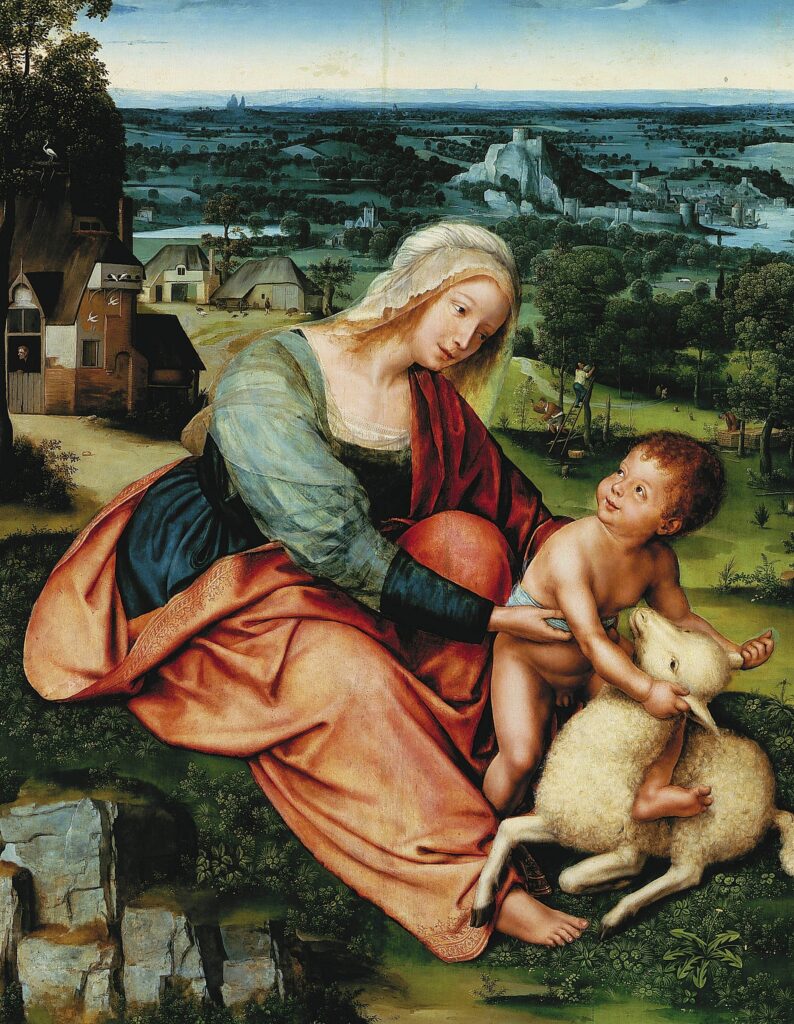
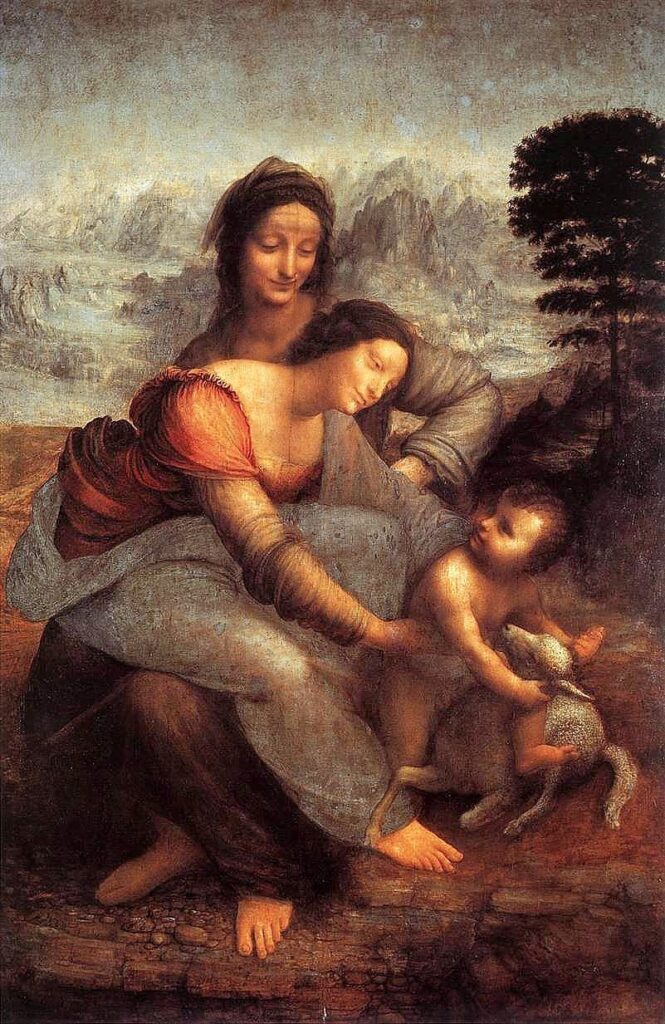

Plusieurs tableaux indiquent de façon incontestable que Matsys et son entourage avaient des connaissances approfondies et s’inspiraient en partie des peintures et dessins de Léonard de Vinci, sans nécessairement saisir pleinement l’intention scientifique et philosophique de l’auteur. C’est clairement le cas de la Vierge à l’Enfant du musée de Poznan (1513, Pologne), qui présente littéralement, devant un paysage de montagne de style Patinir, la pose gracieuse et aimante de Marie tenant le Christ dans ses bras, ce dernier embrassant l’agneau, presqu’une une copie de Sainte Anne et la Vierge de Léonard de Vinci, une oeuvre qu’il commence en 1503 et qu’il apporte à Amboise en France en 1517. Comme nous l’avons déjà dit, on ne sait pas comment cette image a pu atteindre le maître, qu’il s’agisse d’estampes, de dessins ou de contacts plus personnels.

Un deuxième exemple se trouve dans le Triptyque de la Déploration du Christ (1508-1511).
La scène centrale du triptyque ouvert, qui rappelle La descente de croix de Rogier van der Weyden (1435, Prado, Madrid), est soutenue par le paysage. Le drame religieux est étudié en détail et mis en scène de manière harmonieuse. En même temps, Matsys respecte la grande importance des croyants pour la narration et la description. Si la scène est propice à la réflexion et à la prière, Matsys déploie également la science du contraste. Si certains personnages plus rustres, notamment les têtes orientales, ont pu être inspirés par des visages de marins et de marchands qu’il a pu croiser dans le port, les traits de ceux qui sont frappés par la douleur et le chagrin sont plein de grâce.
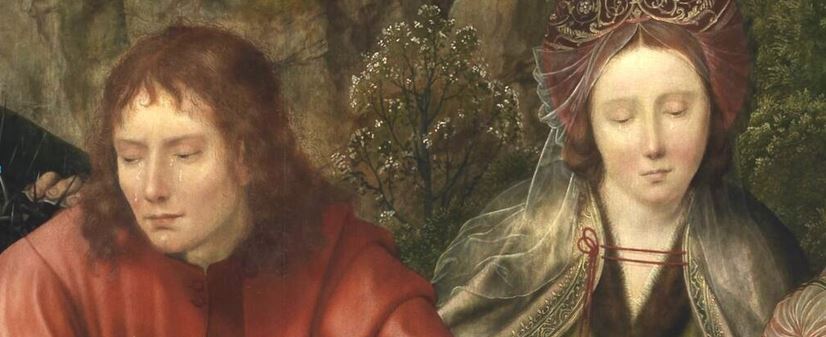
Dans le panneau du milieu, nous ne voyons pas la souffrance, mais la lamentation après la souffrance. Il dépeint le moment où Joseph d’Arimathie119 vient demander à la Vierge la permission d’enterrer le corps du Christ. Derrière l’action centrale se trouve la colline du Golgotha, avec ses quelques arbres, la croix et les voleurs crucifiés.
Le panneau de gauche montre Salomé présentant la tête de Jean-Baptiste à Hérode le Grand,120 roi de Judée, Etat client de Rome.
Le panneau de droite est une scène d’une extraordinaire cruauté, représentant saint Jean, dont le corps est plongé dans un chaudron d’huile bouillante. Le saint, nu jusqu’à la taille, semble presque angélique, comme s’il ne souffrait pas. Autour de lui, une foule de visages sadiques, de vilains rustres aux vêtements criards. La seule exception à cette règle est la figure d’un jeune Flamand, peut-être une représentation du peintre lui-même, qui observe la scène du haut d’un arbre.
Quant aux visages des personnages qui entourent Saint Jean Baptise, tout comme ceux qui chauffent le chaudron, ils proviennent directement du dessin de Léonard de Vinci intitulé Un homme trompé par des gitans (anciennement Les cinq têtes grotesques) (vers 1494, Chateau de Windsor, Angleterre). L’ironie et l’humour flamands ont fait bon accueil à ceux de Léonard !
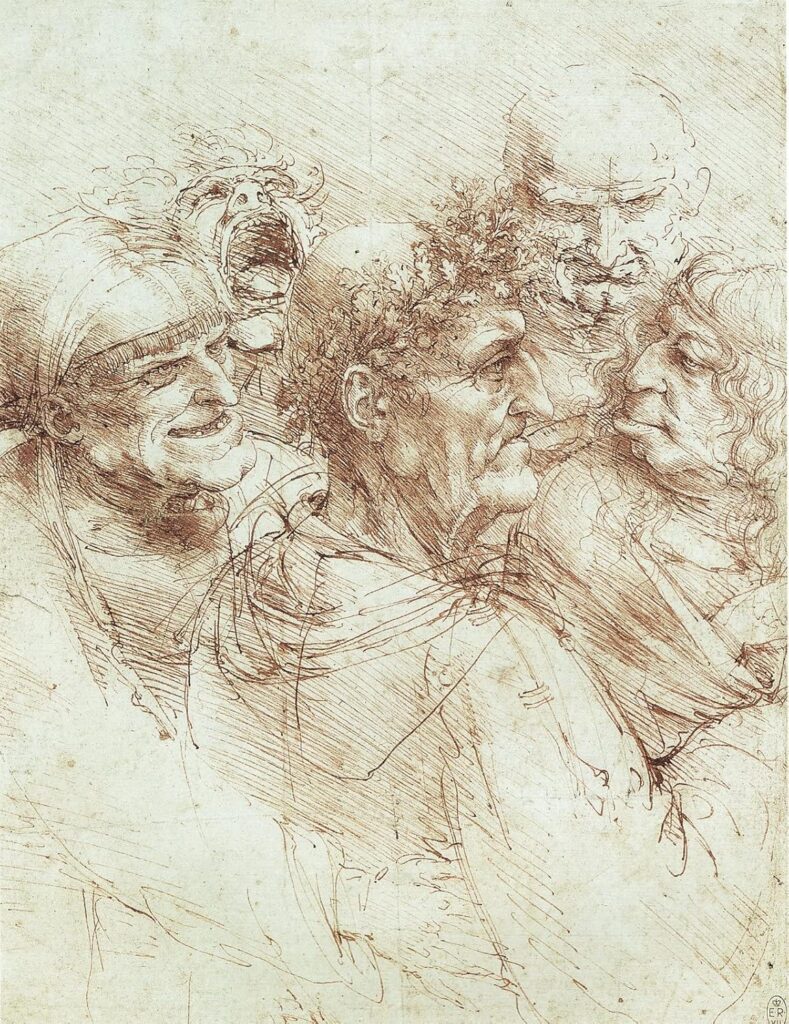
Chez Léonard, les visages semblent même éclater dans un rire hilarant, en se regardant les uns les autres et en regardant la figure couronnée au centre. Les feuilles de cette couronne ne sont pas celles des lauriers qui célèbrent les poètes et les héros, mais celles… d’un chêne.
A cette époque, le pape anti-humaniste et belliciste qui triomphait à Rome était Jules II,121 que Rabelais a mis en enfer en train de vendre des petits pâtés. Jules était membre d’une puissante famille de la noblesse italienne, la maison Della Rovere, littéralement « du chêne »…
C. La science erasmienne du grotesque
1. Dans la peinture religieuse
L’utilisation de têtes grotesques, exprimant les basses passions qui submergent et dominent les personnes malveillantes, était une pratique courante dans les peintures religieuses pour donner vie et contraste dans les oeuvres. En 1505, Dürer se rend à Venise et dans la ville universitaire de Bologne pour s’initier à la perspective. Il se rend ensuite plus au sud, à Florence, où il découvre les oeuvres de Léonard de Vinci et du jeune Raphaël, puis à Rome.
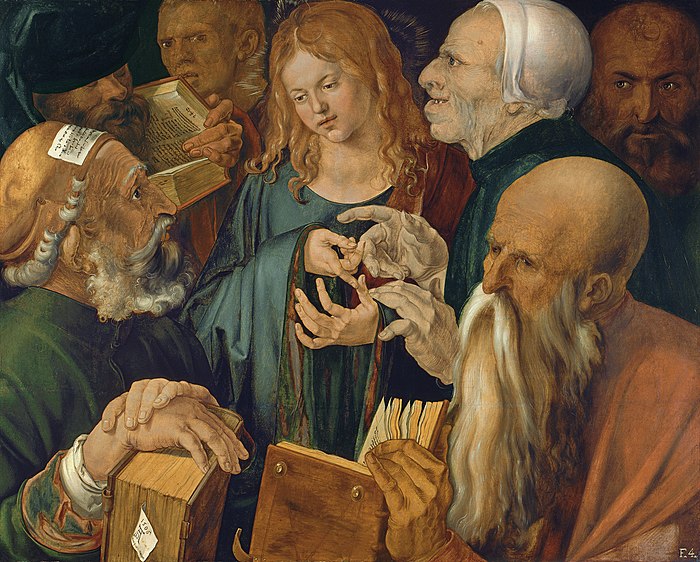
Le Christ parmi les docteurs (1506, Collection Thyssen Bornemisza, Madrid), a été peint à Rome en cinq jours et reflète l’influence éventuelle des grotesques de Léonard.
Dürer était de retour à Venise au début de l’année 1507 avant de retourner à Nuremberg la même année. Le Christ portant la croix de Jérôme Bosch (après 1510, Gand) est un autre exemple célèbre. La tête du Christ est entourée d’un groupe dynamique de « tronies » ou visages grotesques.
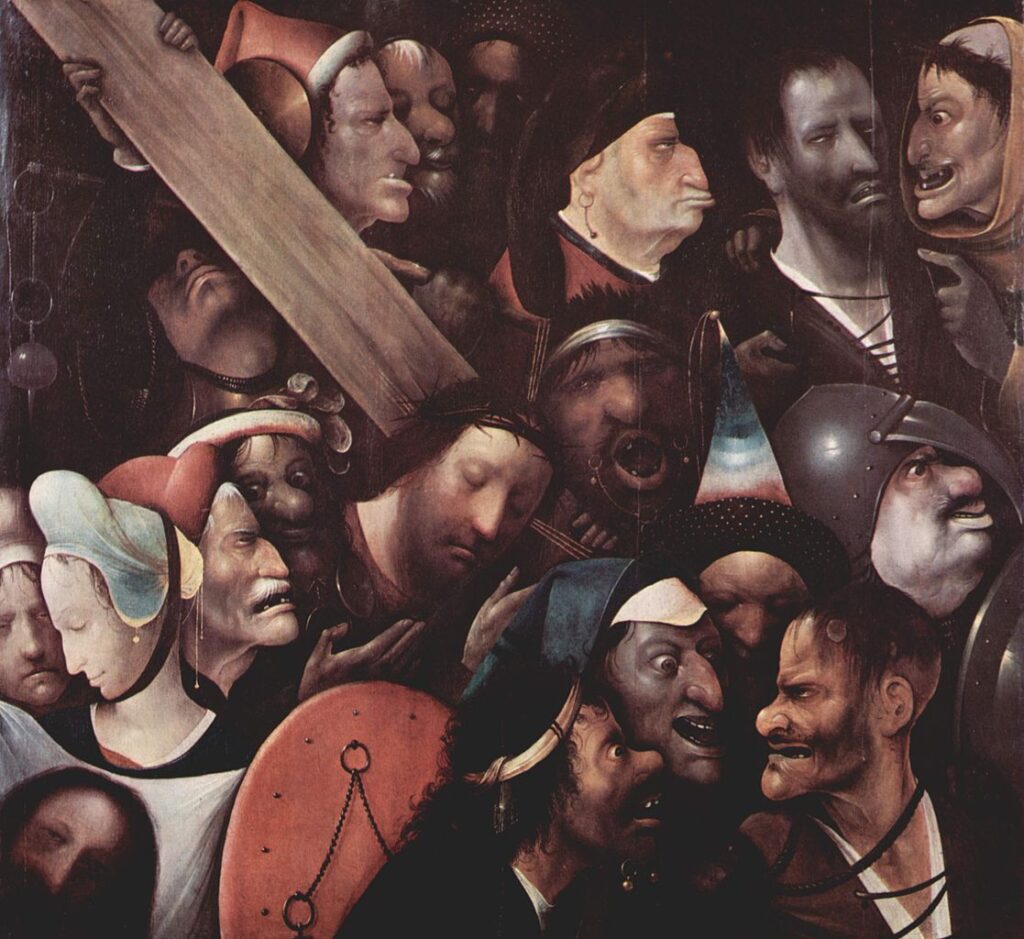
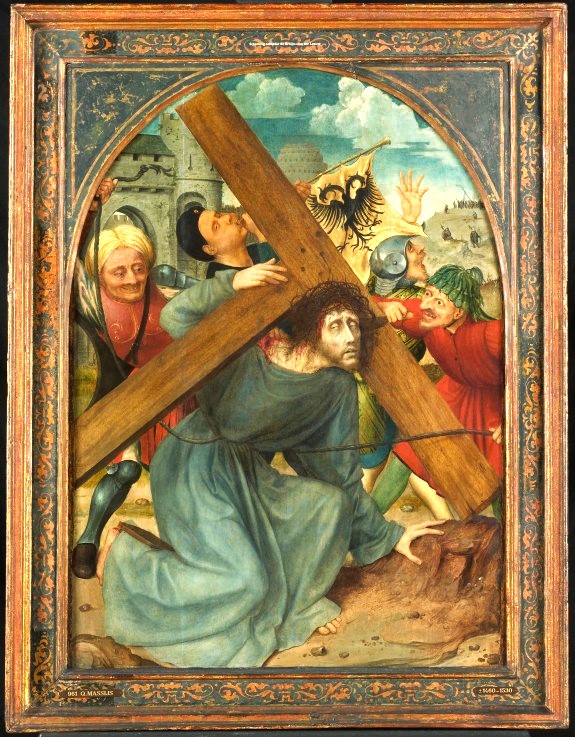
Bosch s’est-il inspiré de Léonard et de Matsys, ou est-ce l’inverse ? Si la composition peut sembler chaotique à première vue, sa structure est en réalité très rigide et formelle. La tête du Christ est placée précisément à l’intersection de deux diagonales. La poutre de la croix forme une diagonale, avec la figure de Simon de Cyrène aidant à porter la croix en haut à gauche, et avec le « mauvais » meurtrier en bas à droite.
L’autre diagonale relie l’empreinte du visage du Christ sur le suaire de Véronique, en bas à gauche, au voleur pénitent, en haut à droite.
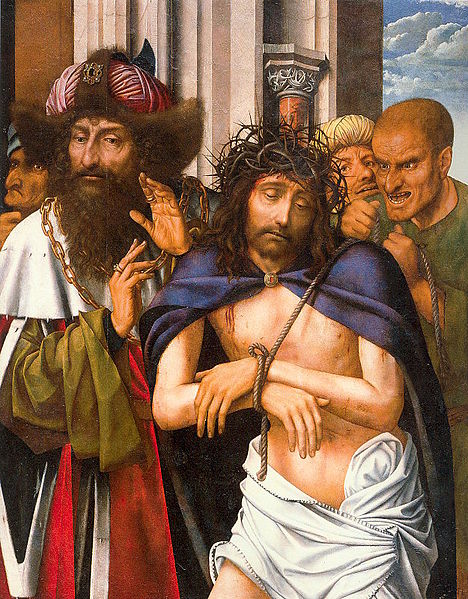
Il est attaqué par un charlatan diabolique ou un pharisien et un moine diabolique, allusion évidente de Bosch au fanatisme religieux de son époque.
Les têtes grotesques rappellent les masques souvent utilisés dans les jeux de la passion ainsi que les caricatures de Léonard de Vinci.
En revanche, le visage du Christ, modelé avec douceur, est serein. Il est le Christ souffrant, abandonné de tous et qui triomphera de tous les maux du monde. Cette représentation s’inscrit parfaitement dans les idées de la Devotio Moderna.122
Quinten Matsys, dans son Ecce Homo’s (1526, Venise, Italie), se base clairement sur la tradition de Bosch.
2. Les avares, les banquiers, les receveurs d’impôts et les agents de change, la lutte contre l’usure

La dénonciation satirique par Matsys de l’usure et de la cupidité est directement liée à la critique religieuse, philosophique, sociale et politique d’Érasme et de More.
Marlier, dans une description magistrale, met en lumière comment les usuriers et les spéculateurs sont devenus à Anvers les acteurs dominants de la vie économique de l’époque, une situation qui n’est pas sans rappeler la situation mondiale actuelle :
« C’est qu’au XVIe siècle la substitution progressive de la nouvelle économie capitaliste à l’ancien régime corporatif est allée de pair avec une succession de crises, dont pâtissent surtout les petites gens. Si la spéculation boursière, les manipulations monétaires et le commerce de l’argent favorisent l’édification de fortunes considérables, ils entraînent par contre l’appauvrissement et souvent la ruine des artisans et des paysans. Des marchands enrichis, des financiers mettent la main sur l’industrie et réduisent l’ouvrier au rang de prolétaire. Les travailleurs doivent passer désormais par toutes les conditions de ceux qui les emploient. Les salaires ne sont plus respectés et bien souvent le chômage sévit et plonge les familles dans la misère.
« Le bouleversement économique s’accompagne de troubles financiers provoqués par l’afflux des métaux précieux de l’Amérique en l’Espagne. De gigantesques opérations de banque s’effectuent à Anvers, qui devient, sous le règne de Charles Quint, le grand marché monétaire de l’Europe. A partir de la troisième décade du siècle, le pouvoir d’achat des devises commence à fléchir et il en résulte une hausse continue des prix. Les salaires, par contre, restent stationnaires. Les hommes de finance accaparent les marchandises, détiennent les monopoles et s’emparent même des terres, dont ils pressurent sans pitié les tenanciers. Voilà les nouveaux riches, contre lesquels les pauvres et les faibles murmurent, mais que l’empereur protège, parce qu’ils sont les seuls capables de lui avancer les fonds nécessités par sa politique européenne.
« Charles Quint doit se soumettre aux exigences draconiennes de ses banquiers et le service des intérêts exorbitants le pousse à multiplier les impôts. Il escompte le produit des taxes futures et met à l’encan certains offices de trésorerie. On devine les abus qui en résultent. Les taxes ne sont pas levées directement par le gouvernement, mais affermées à des accisiens, qui se rendent odieux par leurs exactions. Ils sont sans pitié pour les petites gens, auxquels ils enlèvent le peu qu’ils possèdent ».
« Dans une telle conjoncture, conclut Marlier, où les crises se multiplient, où la ruine succède du jour au lendemain à une prospérité fallacieuse, où le commerce est envahi par une foule de pratiques malhonnêtes, l’usure devait nécessairement prospérer. Du haut en bas de l’échelle sociale, quantité de personnes sont contraintes d’emprunter, moyennant un intérêt abusif. A tous les étages de la société, l’usurier se livre à son activité rémunératrice. Il trouve ses victimes aussi bien dans les milieux de l’aristocratie que parmi les paysans et les ouvriers. Dans les villes, il y a maintenant une classe d’hommes et de femmes qui ne vivent que de l’usure ». 123

A cela ajoutez le fait que les Fugger et les Welser 124 s’impliquent massivement dans le commerce d’esclaves en provenance d’Afrique.
Les Fugger utilisent leurs mines d’Europe de l’Est et d’Allemagne pour produire des manillas (bracelets), des objets d’échange en métal qui sont entrés dans l’histoire comme « monnaie de traite » en raison de leur utilisation sur les côtes de l’Afrique de l’Ouest.
Les Welser, qui se concentrent sur les épices et le commerce de textile, ont tenté de leur côté d’établir une colonie dans ce qui est aujourd’hui le Venezuela (Nom espagnol dérivé de l’italien Venezziola, « petite Venise », devenue Welserland) et ont expédié plus de 1 000 Africains réduits en esclavage vers l’Amérique.
Pendant ce temps, dans les maisons des citoyens prospères d’Augsbourg, des esclaves indiens étaient forcés de travailler pour leurs « maîtres ».
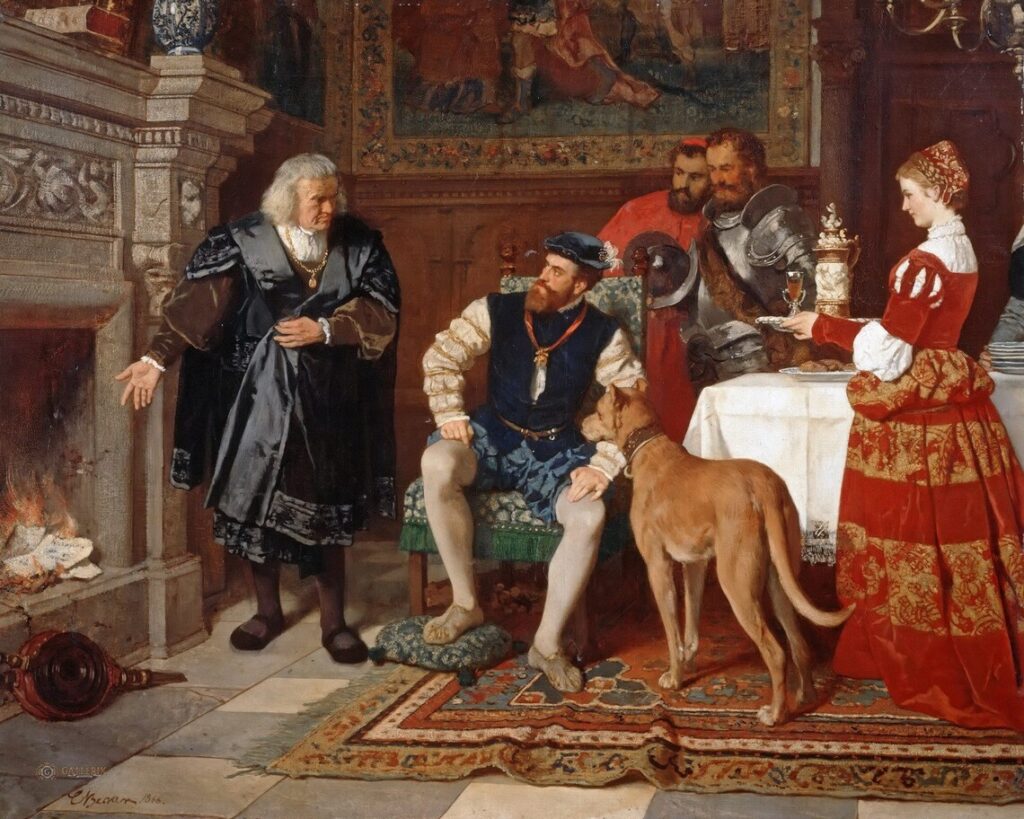
D’après le site officiel de la famille Fugger, l’histoire selon laquelle Anton Fugger aurait jeté les reconnaissances de dettes de ce dernier dans le feu en 1530, sous les yeux de Charles Quint, afin de renoncer généreusement au remboursement de crédits, est une pure fiction.
Mais il a accordé au nouvel empereur une petite réduction de dette (haircut). En échange, Charles Quint renonce à son projet de « loi impériale sur les monopoles », qui aurait considérablement réduit le champ d’action des banques et des maisons de commerce du Saint Empire romain germanique.
Selon Richard Ehrenberg, chercheur sur les Fugger, l’histoire concernant Anton n’est apparue qu’à la fin du XVIIe siècle, sans doute pour attester de sa loyauté envers l’empereur. 125
Thomas More et Érasme dénoncent et condamnent cette montée brutale des abus financiers prédateurs et criminels dans l’Utopie.
Sans refuser l’essor du capitalisme entrepreneurial moderne, Érasme condamne sans façons les abus d’un capitalisme financier totalement débridé :
« Le Christ, déclare-t-il, n’a pas interdit l’activité ingénieuse, mais le souci tyrannique du gain. » 126
Les fonctionnaires, plaide-t-il dans son Éducation d’un prince chrétien (1516), écrit pour éclairer le jeune Charles Quint qui ne l’a jamais lu, doivent être recrutés sur la base de leur compétence et de leur mérite, et non en raison de leur nom glorieux ou de leur statut social. Pour Érasme, (s’exprimant de façon satirique par la bouche de la Folie) :
« La plus folle et la plus méprisable de toutes les classes humaines, c’est celle des marchands. Occupés sans cesse du vil amour du gain, ils emploient pour le satisfaire, les moyens les plus infâmes : le mensonge, le parjure, le vol, la fraude, l’imposture remplissant leur vie entière. Cependant ils se croient de grands personnages, parce que leurs doigts sont chargés d’anneaux d’or et il se trouve assez de moinillons flatteurs qui ne rougissent pas de leur donner en public les titres les plus honorables pour attraper quelque parcelle d’un bien si mal acquis ». 127
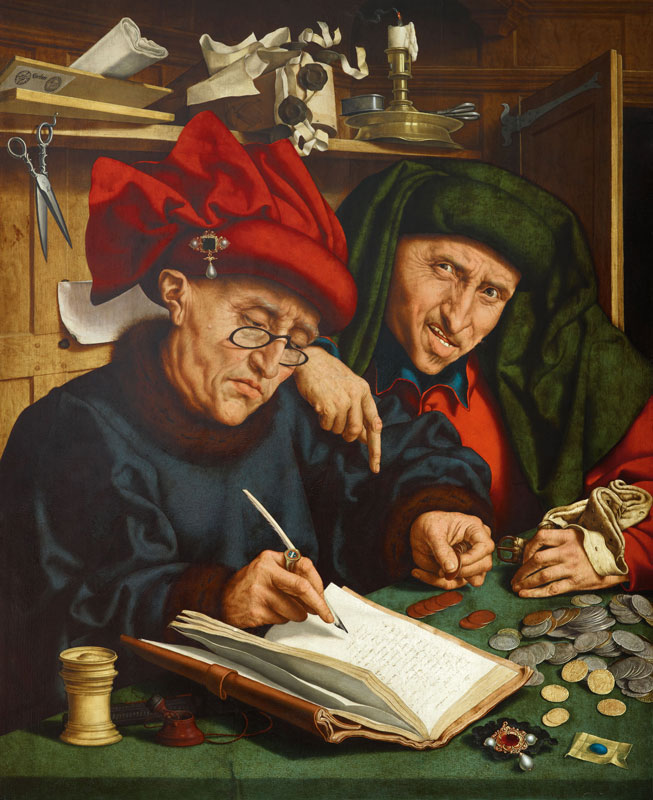
On peut, comme l’affirme Silver, sur la base de ce qui est écrit dans les registres représentés dans cette oeuvre et du fait que la collecte des impôts était confiée à des particuliers, réattribuer au tableau de Matsys, désigné jusqu’à récemment comme Les usuriers, la description plus « factuellement exacte » de Les receveurs d’impôts.
Cependant, force est de constater que cela ne change rien au fait que le sujet de cette oeuvre semble correspondre à ce que dénonce un vieux proverbe de l’époque :
« Un usurier, un meunier, un changeur de monnaie et un collecteur d’impôts sont les quatre évangélistes de Lucifer ».
Alors que le clerc municipal, à gauche, semble « raisonnable », puisque son visage n’est pas « grotesque », l’homme assis derrière, celui qui a extorqué l’impôt au peuple en s’engraissant au passage, dans une étrange rotation de son bras protégeant une bourse en cuir, montre la face grotesque et laide de la cupidité, justifiée par ce qu’il a déclaré et qui a été consigné dans les registres officiels.
La complaisance entre les deux hommes, l’un faisant le mal, l’autre fermant les yeux devant des pratiques innommables, est la véritable laideur de l’histoire. Les agents de change ou changeurs de monnaie, admet Silver, ont souvent joué le même rôle que les banquiers, citant l’historien de l’économie Raymond de Roover.
De plus, la quatrième canaille non représentée, le meunier (cible des peintures de Bosch et de Brueghel), était souvent fustigée parce que le prix des céréales devenait un point sensible à répétition dans les époques de fluctuation des prix des matières premières, comme c’était le cas à cette période.
Étant donné que le pillage financier prévalait après les années 1520, de telles dénonciations satiriques de la cupidité financière ne pouvaient que devenir très populaires. Le sujet est repris presque immédiatement par le fils du peintre, Jan Matsys (1510-1575), copié presque à l’identique par Marinus van Reymerswaele (1490-1546) et par Jan Sanders van Hemessen (1500-1566).
Le Banquier et sa femme
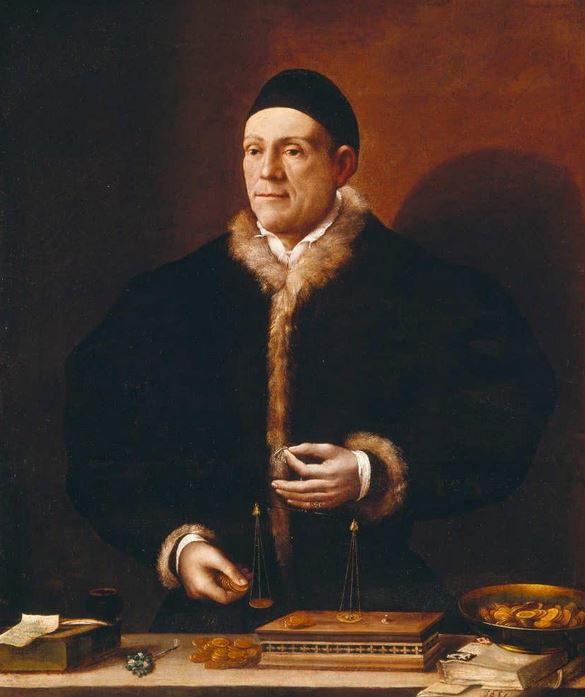
Dans une version plus « civilisée » de cette métaphore, sur le même thème, on trouve le célèbre Banquier (changeur ou prêteur) et sa femme de Matsys (1514, Louvre, Paris).128
Dans un chapitre de son livre Les primitifs flamands intitulé Les héritiers des fondateurs, l’historien d’art Erwin Panofsky 129 considère cette oeuvre comme une « reconstruction » d’une « oeuvre perdue de Jan van Eyck (un ‘tableau avec des figures à mi-corps, représentant un patron faisant ses comptes avec son employé’), que Marcantonio Michiel prétend avoir vue à la Casa Lampugnano de Milan ».
Soulignons de nouveau qu’il ne s’agit pas ici d’un double portrait d’un banquier et sa femme, mais d’une seule métaphore.
Tandis que le banquier (dans le même geste que Jacob Fugger sur le tableau de Lorenzo Lotto) vérifie si le poids du métal des pièces correspond bien à leur valeur nominale, sa femme, qui tourne les pages d’un livre d’heures, jette un regard triste sur les activités cupides de son mari visiblement malheureux.
En 1963, Georges Marlier écrivait :
« Le tableau du Louvre n’a pas d’accent satirique, mais reflète une préoccupation morale (…) L’intention édifiante est soulignée par une inscription qui figurait sur le cadre à l’époque, vers le milieu du XVIIe siècle, où le tableau se trouvait dans la collection Stevens à Anvers : “Stature justa et aequa sint podere” (que la balance soit juste et les poids égaux) 130
En effet, dans le Lévitique, XIX, 35-36, on peut lire :
35. « Ne faites rien contre l’équité, ni dans les jugements, ni dans ce qui sert de règle, ni dans les poids, ni dans les mesures.
36. « Que la balance soit juste, et les poids tels qu’ils doivent être ; que le boisseau soit juste, et que le setier ait sa mesure. »
Le banquier a, en plus de la balance qu’il utilise, fixé une paire de balances au mur derrière lui. Pour les humanistes chrétiens, le poids de la richesse matérielle est à l’opposé de celui de la richesse spirituelle. Dans le Jugement dernier de Van der Weyden à Beaune, le peintre montre ironiquement un ange pesant les âmes ressuscitées, envoyant les plus lourdes d’entre elles… en enfer.
D’autres supposent que la femme du banquier n’est pas complètement insensible à toutes les pièces de monnaie sur la table, mais que l’attention de ses yeux se porte davantage sur les mains de son mari que sur les objets posés sur la table. Piété ou plaisir de la richesse ? Un fruit sur l’étagère (pomme ou orange), juste au-dessus de son mari, pourrait être une référence au fruit défendu mais la bougie éteinte sur l’étagère derrière elle rappelle la brièveté des plaisirs terrestres.
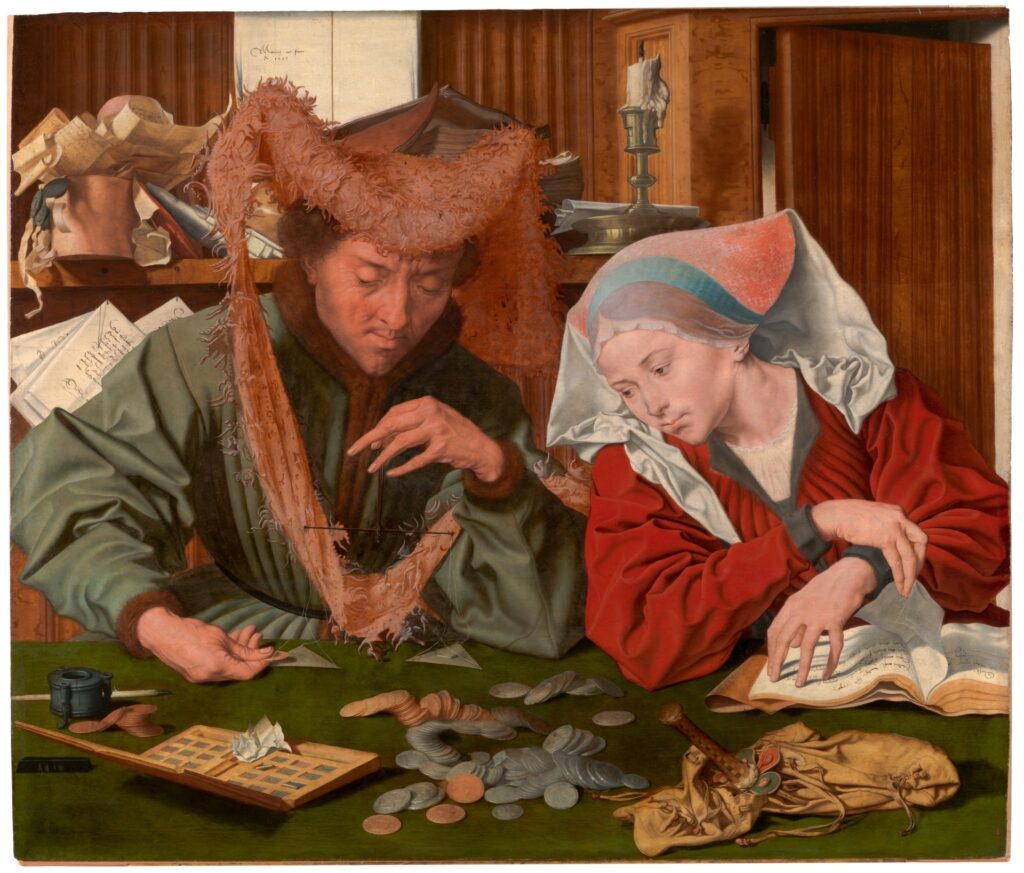
Lorsque Marinus van Reymerswaele reprend ce thème (ci-dessus), la tentation de la femme pour l’argent sur la table semble encore plus grande.
Miroir bombé
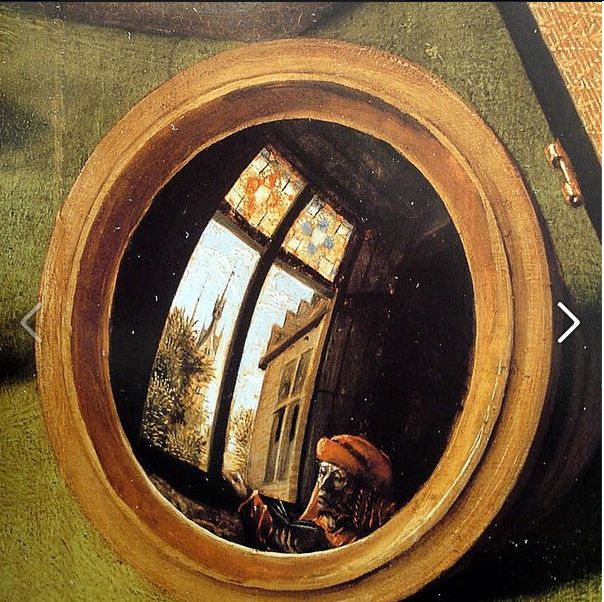
On peut supposer que le miroir convexe (bombé), 131 posé au premier plan de la table du couple, opère comme une « mise en abîme » (une « pièce dans la pièce » ou « un tableau dans le tableau »). On y voit un homme (le banquier ?), lisant lui-même un livre (religieux ?).
Le miroir ne montre pas nécessairement un espace réel existant mais peut très bien représenter une séquence temporelle imaginaire en dehors de l’espace-temps de la scène principale. Il peut montrer le banquier dans sa vie future, libéré de la cupidité, lisant un livre religieux avec une grande ferveur.
Si l’utilisation d’images de miroirs convexes (dont les lois optiques ont été décrites par des scientifiques arabes comme Alhazen et étudiées par des franciscains d’Oxford 132 comme Roger Bacon) rappelle à la fois le tableau représentant le couple Arnolfini de Van Eyck (1434, National Gallery, Londres) 133 et celui de Petrus Christus (1410-1475) Orfèvre dans son atelier ou Saint Eligius 134 (1449, Metropolitan Museum of Art, New York), la peinture de Matsys, qui cherche à rendre hommage au grand Van Eyck, est une création très réussie en son genre.
La bonne nouvelle est que, jusqu’à présent, l’hypothèse la plus généralement retenue quant à la signification de cette peinture est qu’il s’agit d’une œuvre religieuse et moralisante, sur le thème de la vanité des biens terrestres en opposition aux valeurs chrétiennes intemporelles, et d’une dénonciation de l’avarice en tant que péché capital.
Sur le plan du contenu, le tableau pourrait également être lié à un thème courant à l’époque, à savoir La vocation de saint Matthieu.135
9. En partant de là, Jésus vit un homme du nom de Matthieu, assis dans la cabane d’un collecteur d’impôts. Il lui dit : « Suis-moi », et Matthieu se leva et le suivit.
10. Pendant que Jésus dînait dans la maison de Matthieu, beaucoup de publicains (collecteur d’impôts) et de pécheurs vinrent manger avec lui et ses disciples.
11. Voyant cela, les pharisiens demandèrent à ses disciples : « Pourquoi votre maître mange-t-il avec les publicains et les pécheurs ? »
12. Après avoir entendu cela, Jésus dit : Ce ne sont pas les gens en bonne santé qui ont besoin d’un médecin, mais les malades.
13. Allez donc apprendre ce que signifie : ‘Je désire la miséricorde et non les sacrifices'[a] ; car je ne suis pas venu appeler les justes, mais les pécheurs. »
(Mt 9, 9-13)
Le passage ci-dessus est probablement autobiographique en ce sens qu’il décrit l’appel de Matthieu à suivre Jésus en tant qu’apôtre. Comme nous le savons, saint Matthieu a répondu positivement à l’appel de Jésus et est devenu l’un des douze apôtres.
Selon l’Évangile, le nom de Matthieu était à l’origine Lévi, un collecteur d’impôts au service d’Hérode et donc peu populaire. Les Romains obligeaient le peuple juif à payer des impôts. Les collecteurs d’impôts étaient connus pour tromper le peuple en demandant plus que ce qui était exigé et en empochant la différence. Bien sûr, une fois que Lévi a accepté l’appel à suivre Jésus, il a été gracié et a reçu le nom de Matthieu, qui signifie « don de Yahvé ».
Ce thème ne pouvait évidemment que plaire à Érasme, puisqu’il n’insiste pas sur la punition, mais sur la transformation positive pour le mieux.
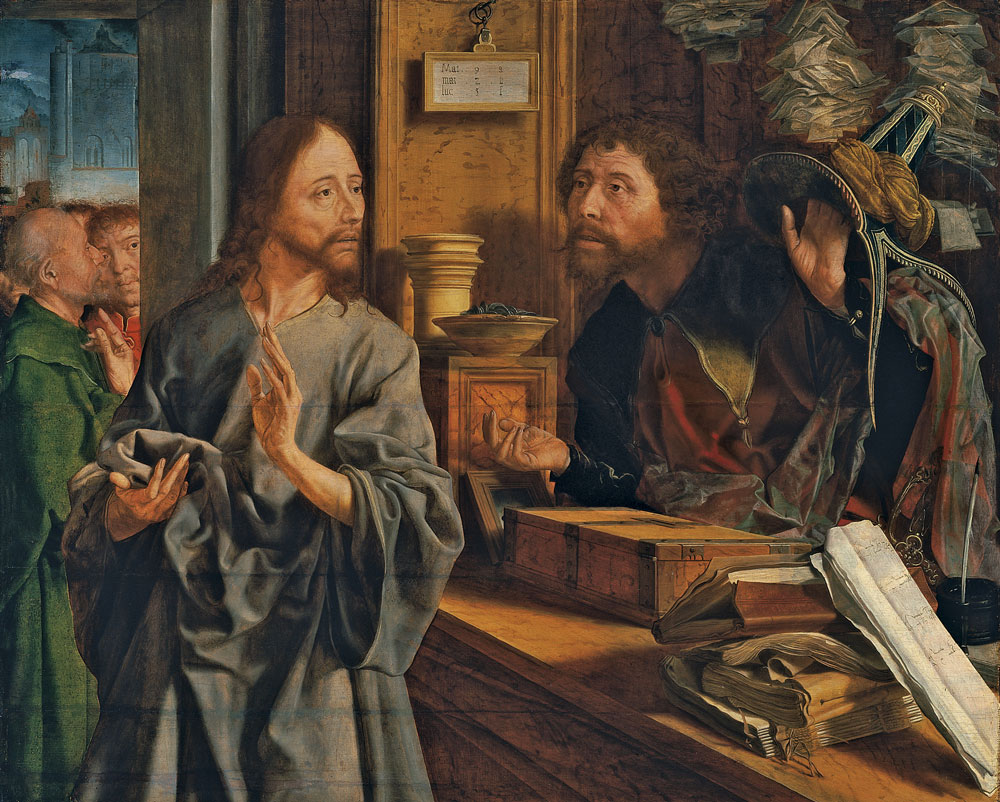

Tant Marinus van Reymerswaele (en 1530) que Jan van Hemessen (en 1536), qui ont copié Matsys après sa mort et s’en sont inspirés, ont repris le sujet dans La vocation de Saint-Matthieu. Dans le tableau de Van Hemessen, on voit également, comme dans l’œuvre de Matsys, la femme du collecteur d’impôts qui se tient devant, elle aussi la main sur un livre ouvert.
3. Le lien avec Da Vinci (II)
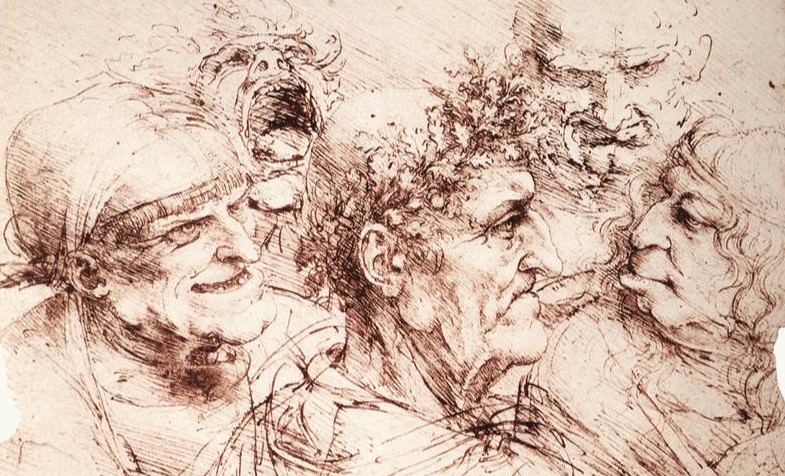
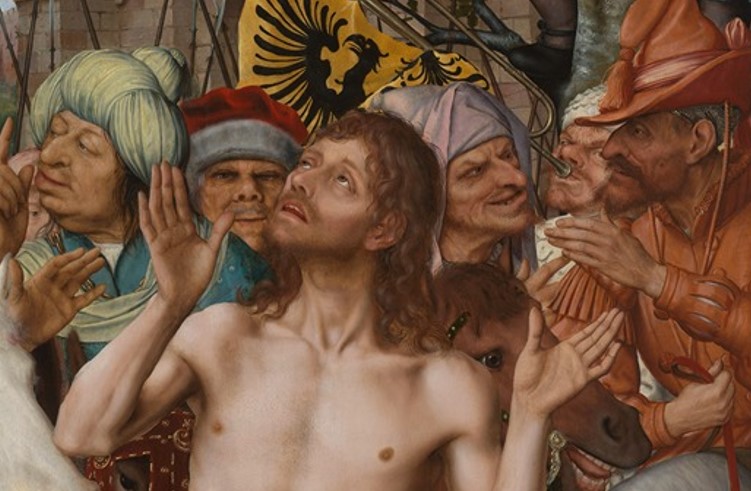
Pour résumer, jusqu’ici, trois éléments de l’oeuvre de Matsys nous ont permis d’établir ses liens approfondis avec l’Italie et Léonard.
- Sa bonne connaissance de la perspective, en particulier de celle de Piero della Francesca, comme le démontre la voûte en marbre de style italien apparaissant dans le Triptyque de Saint Anne (Anvers) 136 ;
- Sa reprise des têtes grotesques de Léonard, dans les sadiques à l’oeuvre dans le même Triptyque de Saint-Anne (Anvers) ;
- Sa reprise de la pose de la Vierge de la Sainte Anne, la Vierge et l’Enfant Jésus jouant avec un agneau de Léonard (Louvre, Parijs), dans sa Vierge et l’enfant (Poznan, Pologne).
Comment cette influence a pu s’établir reste entièrement à élucider. Plusieurs hypothèses, qui peuvent d’ailleurs se compléter, sont permises :
- Il a pu échanger avec d’autres artistes qui eux avaient effectué de tels voyages et avaient pu établir des contacts en Italie. La question de savoir si Dürer, qui avait ses propres contacts en Italie, aurait servi d’intermédiaire est une autre hypothèse à explorer. Certains dessins anatomiques de Dürer auraient été réalisés d’après Léonard. Jacopo de’ Barbari avait réalisé un portrait de Luca Pacioli, le frère franciscain qui avait aidé Léonard à lire Euclide en grec. Dürer avait rencontré Barbari à Nuremberg, mais, comme nous l’avons vu plus haut, leurs relations se sont dégradées.
- Assez jeune, il s’est rendu, soit en Italie (Milan, Venise, etc.) où il a pu établir, soit un contact direct avec Léonard, soit avec un ou plusieurs de ses élèves. Pour Philippe d’Aarschot, Matsys, « sans jamais avoir mis un pied en Italie, subit l’influence de Léonard de Vinci. Sa Marie-Madeleine (musée d’Anvers) n’est-elle pas une réplique à la Joconde? »137
- Holbein le jeune, dit-on, a également été influencé par Léonard comme le suggèrent certains de ses compositions.138
- Matsys a pu voir des gravures réalisées et diffusées par des artistes italiens et du Nord. Si les dessins et manuscrits originaux ont été copiés et vendus par Melzi, l’élève de Léonard, après la mort de son maître à Amboise en 1519, l’influence de Léonard sur Matsys apparaît dès 1507.

L’oeuvre de Léonard intéressait toute l’Europe. Par exemple, une réplique grandeur nature de la fresque de la Cène de Léonard est achetée en 1545 par l’abbaye des Norbertins de Tongerlo. Andrea Solario (1460-1524), élève de Léonard de Vinci, aurait créé l’oeuvre avec d’autres artistes. Selon des recherches récentes, il semble que Léonard ait peint lui-même certaines parties de cette réplique.
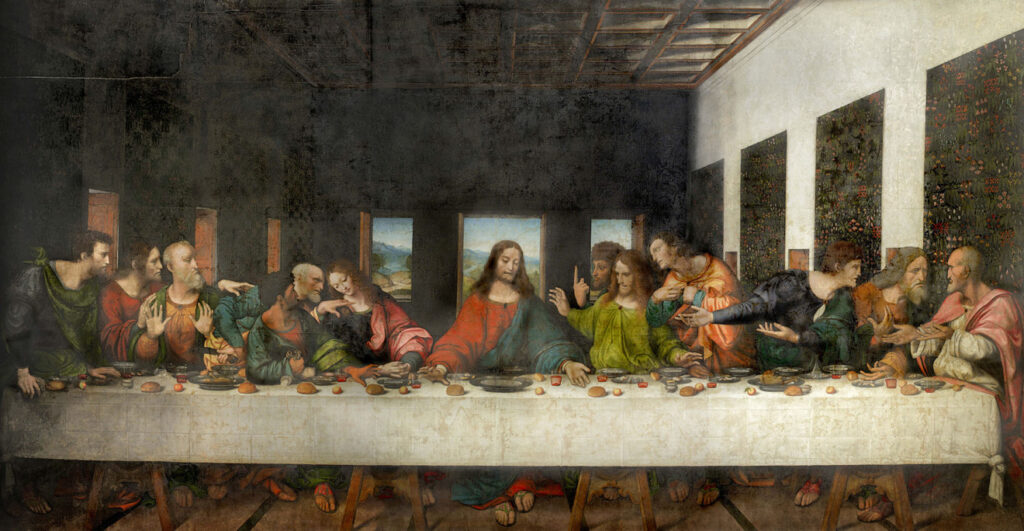
Le professeur Jean-Pierre Isbouts139 et une équipe de scientifiques de l’institut de recherche IMEC ont examiné la toile à l’aide de caméras multispectrales, qui permettent de reconstituer les différentes couches d’une peinture et de distinguer les restaurations de l’original. Selon les chercheurs, un personnage attire particulièrement l’attention. Jean, l’apôtre à la gauche de Jésus, est peint avec la technique spéciale du « sfumato ». Il s’agit de la même technique que celle utilisée pour peindre la Joconde, et que seul Léonard maîtrisait, affirme Isbouts.

De même, Joos Van Cleve, dans la partie inférieure de sa Déploration (1520-1525), reprend la composition de la Cène de Léonard, ce qui montre bien que l’image était connue de la plupart des peintres du Nord.
Enfin, comme le souligne Silver, l’une des cinq têtes grotesques de Léonard, inversée par rapport à l’original, réapparaît pour le vieillard dans le Couple mal assorti de Matsys, plus tard ! Le fait qu’elle apparaît en image miroir s’expliquerait si Matsys l’a vue en gravure. En imprimant sa plaque, l’image gravée apparaît en effet en négatif par rapport à l’original.
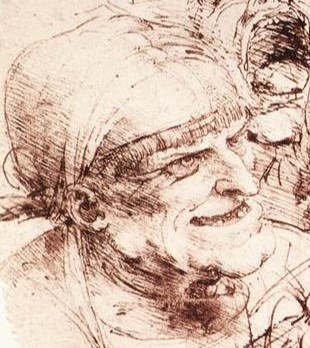
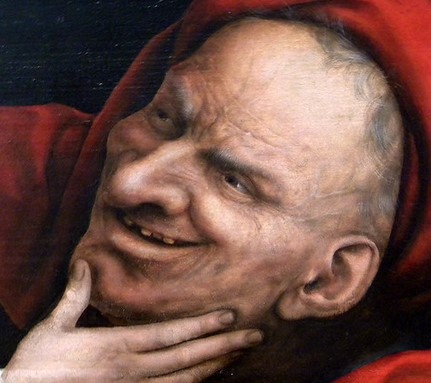
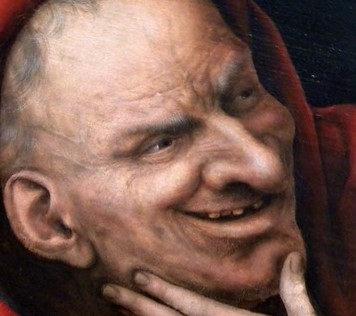
Mais aussi une étude de Léonard de Vinci d’une tête (non grotesque) d’apôtre pour la Cène, présente des caractéristiques proches de celles utilisées par Matsys.
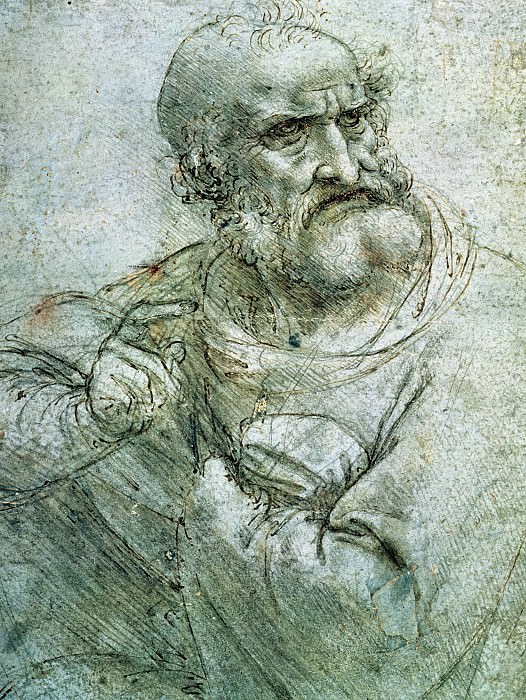
4. L’art du grotesque per se
Le travail de Léonard de Vinci sur les visi monstruosi, (visages monstrueux) date au moins du début de la période milanaise (années 1490), lorsqu’il a commencé à chercher un modèle pour peindre « Judas » dans la fresque de la Cène (1495-1498).
Léonard se serait inspiré de vraies personnes de Milan et des environs pour créer les personnages du tableau. Lorsque le tableau est presque terminé, Léonard n’a toujours pas de modèle pour Judas. On dit qu’il a traîné dans les prisons et avec les criminels milanais pour trouver un visage et une expression appropriés pour Judas, le quatrième personnage en partant de la gauche et l’apôtre qui a fini par trahir Jésus.
Léonard conseillait aux artistes d’avoir toujours un carnet de notes pour dessiner les gens « se disputant, riant ou se battant ». Il prenait note des visages bizarres sur la piazza. Dans une note où il explique comment dessiner des inconnus, il ajoute,
« je ne dirai rien des visages monstrueux, car ils restent naturellement dans l’esprit ».
Lorsque le prieur du couvent se plaint à Ludovic Sforza de la « paresse » de Léonard qui erre dans les rues à la recherche d’un criminel pour représenter Judas, Léonard répond que s’il ne trouve personne d’autre, le prieur sera un modèle idéal… Pendant l’exécution du tableau, l’ami de Léonard, le mathématicien franciscain Luca Pacioli, est dans les parages et en contact avec le maître.
Pour ce dernier, toujours désireux d’explorer et de capter la dynamique des contrastes de la nature, l’exploration de la laideur n’est pas seulement un jeu, mais inhérente au rôle de l’artiste : « Si le peintre souhaite voir des beautés qui l’enchanteraient », écrit-il dans son carnet,
« il est maître de leur production, et s’il souhaite voir des choses monstrueuses qui pourraient le terrifier ou qui seraient bouffonnes et risibles ou vraiment pitoyables, il en est le seigneur et le dieu ».
Léonard et d’autres humanistes s’interrogeaient sur la relation entre la beauté intérieure (la vertu) et la beauté extérieure, physique. Au dos du portrait de Genivra de’ Benci (Washington DC), on peut voir une bannière avec le texte latin Virtutem forma decorat (La beauté orne la vertu). Et donc, à l’inverse, ils se sont demandés comment la laideur de quelqu’un pouvait être l’expression de son vice.
La chercheuse italienne Sara Taglialagamba note que le grotesque, ce qui est anormal ou « hors norme », n’est pas conçu par Léonard « pour s’opposer à la beauté », mais comme un contraste, comme « l’opposé de l’équilibre et de l’harmonie ». 140
Les difformités qui caractérisent les figures de Léonard touchent aussi bien les hommes que les femmes, sont présentes chez les jeunes et les vieux (bien qu’elles se concentrent surtout sur ces derniers), n’épargnent aucune partie du corps et sont souvent combinées pour donner aux sujets des apparences encore plus bestiales.
Géométrie des proportions humaines
De son côté, Dürer, aujourd’hui accusé de « profilage racial », a pris très au sérieux l’étude du canon des proportions humaines, considérées, notamment avec la découverte du livre De Architectura de Vitruve, comme offrant la clé des bonnes proportions pour aussi bien la peinture que l’architecture et l’urbanisme.
« La beauté est produite par l’aspect agréable et le bon goût de l’ensemble, et par les dimensions de toutes les parties dûment proportionnées les unes aux autres. » 141
Dürer a mesuré de façon systématique toutes les parties du corps humain afin d’établir des relations harmoniques entre elles. Les variations des proportions des visages et des corps, conclut-il, obéissent aux variations générées par des projections géométriques. Elles ne changent pas en termes d’harmonie mais apparaîtront différentes, voire grotesques, lorsqu’elles seront projetées sous un angle particulier.
Léonard et Dürer, et plus tard Holbein le Jeune dans son tableau Les Ambassadeurs (1533, National Gallery, Londres), sont passés maîtres dans la science des « anamorphoses », c’est-à-dire des projections géométriques à partir d’angles tangents qui rendent une image difficilement reconnaissable pour le spectateur qui regarde directement la surface plane, alors que l’image peut être comprise lorsqu’elle est regardée sous cet angle surprenant.

Le fait que des maîtres produisant de belles formes agréables comme Léonard ou Matsys se lancent soudainement dans des caricatures délirantes peut sembler troublant, alors qu’il ne devrait pas en être ainsi.
Toute caricature est basée sur une pensée métaphorique, comme tout grand art.
L’art de la Renaissance est souvent considéré comme ordonné et rassurant, mais les grotesques ne font que perpétuer l’art des gargouilles des bâtisseurs de cathédrales et les « monstres » en marge de tant de manuscrits enluminés que Bosch invitait à mettre en avant, anticipent ceux de François Rabelais, de Francesco Goya et de James Ensor. 142
Ses têtes sont tellement déformées et hors des normes habituelles qu’elles sont qualifiées de « grotesques ». Elles peuvent nous faire frémir et faire grincer des dents, mais également nous faire sourire lorsque nous acceptons, à contrecoeur et retenant notre irritation, de regarder de haut nos propres imperfections ou celles de nos bien-aimés que nous préférons ne pas voir. Soyons honnêtes. Nous sommes si loin des images que nous voyons dans les magazines et sur les écrans et que nous prenons pour la réalité.
Dans l’Eloge de la Folie d’Érasme, le narrateur (la Folie personnifiée) identifie d’abord, parmi de nombreux autres accomplissements, son propre rôle de premier plan dans la réalisation de choses qui, avec la logique, la raison, la sagesse formelle et l’intellect purs, échoueraient, comme les actes ridicules requis pour parvenir à la reproduction humaine.
Attention, avertit la Folie, si tout le monde était sage et dépourvu de folie, le monde serait bientôt dépeuplé !
5. La métaphore du « Couple mal assorti »
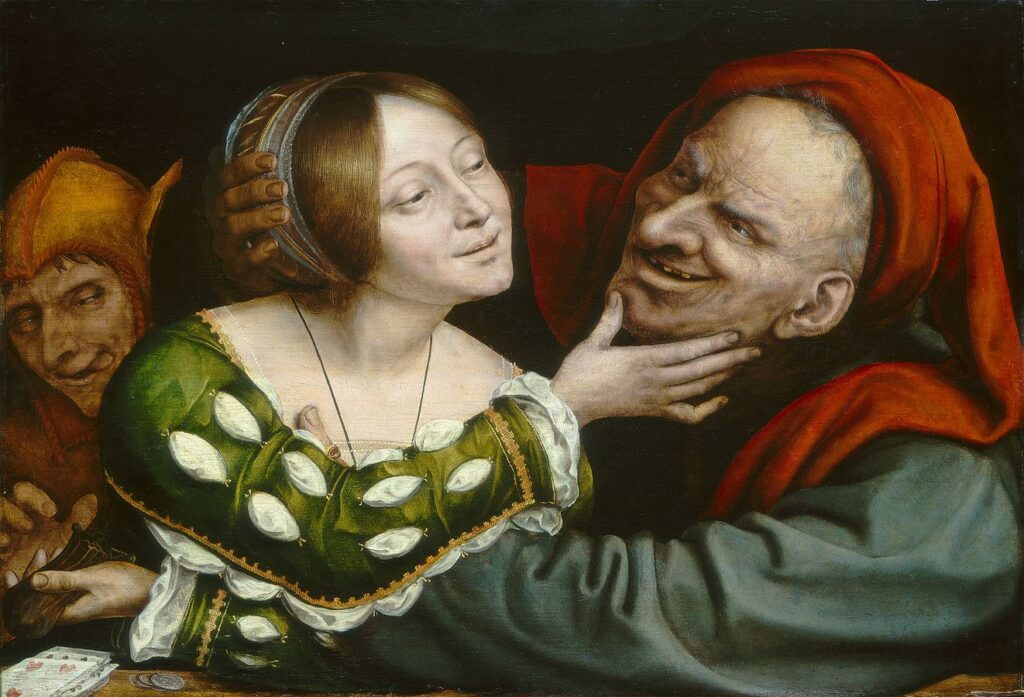
Si Erasme dénonce avec une ironie mordante la corruption et la folie des rois, des papes, des ducs et des princes, il expose également avec une ironie sans concession la corruption qui touche l’homme de la rue, par exemple les hommes plus âgés qui abandonnent leur épouse pour se mettre en ménage avec des femmes plus jeunes, « une chose si répandue, regrette la Folie, qu’elle est presque un sujet de louange ». La folie, avec une ironie satirique, se félicite de l’excellent travail qu’elle accomplit en offrant quelques gros grains aux seniors aussi bien homme que femme :
« … C’est en effet de ma générosité si vous voyez partout des vieillards aussi âgés que Nestor, qui n’ont même plus figure humaine, chevrotants, radotants, édentés, chenus, chauves, ou plutôt, pour reprendre la description d’Aristophane : crasseux, courbés, misérables, flétris, sans cheveux ni dents ni sexe prendre un tel plaisir de vivre, être si plein d’ardeur juvénile que l’un teint ses cheveux blancs, l’autre cache sa calvitie sous une perruque, un autre se sert de dents empruntées peut-être à quelque pourceau, tel autre se meurt d’amour pour une jeune fille et surpasse en inepties amoureuses n’importe quel jouvenceau. On voit des moribonds cadavres épouser un tendron et même sans dot et qui servira à d’autres ; la chose est si répandue qu’elle est presque un sujet de louange.
« Mais il est encore plus plaisant de voir des vieilles déjà mortes de décrépitude, si cadavériques qu’on pourrait les croire de retour des Enfers, et qui malgré cela ne cessent de répéter : Que la lumière est belle ! elles sont encore en chaleur et même, comme disent les Grecs, en rut, elles font entrer chez elles un Phaon grassement payé, se fardent assidûment, ne quittent jamais leur miroir, épilent leur toison au bas du pubis, exhibent leurs mamelles molasses et putrides, sollicitent un jappement tremblotant un désir qui languit, ne cessent de boire, se mêlent aux danses des jeunes filles, écrivent de pauvres lettres d’amour. Cela fait rire tout le monde ; on les trouve complètement folles et elles le sont ; mais elles sont contentes d’elles-mêmes, plongées pour l’instant dans les plus grands délices, baignant dans le miel et, grâce à moi [la Folie], heureuses. » 143
La formation de couples inégaux dans l’histoire littéraire remonte à l’Antiquité, lorsque Plaute, poète comique romain du IIIe siècle avant J.-C., déconseillait aux hommes âgés de faire la cour à des femmes plus jeunes. Erasme ne fait que reprendre un thème de la littérature satirique, notamment La Nef des fous, qui dans son 52e chapitre, combinant l’envie et la cupidité, aborde le thème du « mariage pour l’argent ».
Outre l’Eloge de la folie, Érasme consacre en 1529, dans des dialogues qu’il écrivait pour enseigner le latin aux enfants, un Colloque intitulé Le mariage qui n’en est pas un, ou l’union mal assortie.144 (Extrait, voir encadré)
Le mariage qui n’en est pas un, ou l’union mal assortie
Gabriel : Tu connais Lampride Eubule ?
Pétronius : Il n’y a pas dans cette ville de meilleur citoyen ni de plus fortuné.
Ga. Et sa fille Iphigénie ?
Pét. Tu as nommé la fleur des demoiselles de son âge.
Ga. C’est vrai. Eh bien ! Sais-tu à qui on l’a mariée ?
Pét. Je le saurai quand tu me l’auras dit.
Ga. A Pompilius Blenus.
Pét. Ce fanfaron, qui ne cesse d’assommer tout le monde avec ses rodomontades ?
Ga. Lui-même.
Pét. Mais il est depuis longtemps célèbre ici principalement à deux titres, ses mensonges et son mal qui n’a pas encore de nom propre, malgré le nombre de ceux qui en sont atteints !
Ga. Il s’agit d’une gale très orgueilleuse, qui ne le céderait ni à la lèpre, ni à l’éléphantiasis, ni à l’impétigo, à la podagre ou à la goutte du menton, s’il y avait conflit pour le premier rang.
Pét. C’est ce que proclame la tribu des médecins.
Ga. A quoi bon à présent te décrire la jeune fille puisque tu la connais, et cela bien que sa parure ait ajouté beaucoup d’agrément à ses charmes naturels ? Mon cher Pétrone, tu l’aurais prise pour quelque déesse : sa toilette lui allait à merveille. Sur ces entrefaits s’est présenté à nous l’heureux fiancé, le nez cassé, traînant la jambe – mais avec moins de grâce que ne font habituellement les mercenaires suisses–, les mains sales, l’haleine nauséabonde, l’oeil éteint, la tête bandée, et rendant du pus par le nez et les oreilles. Certains portent des anneaux aux doigts, lui en a jusque sur les jambes.
Pét. Qu’est-il arrivé aux parents pour qu’ils confient une telle enfant à un monstre semblable ?
Ga. Je l’ignore, si ce n’est qu’aujourd’hui la plupart des gens semblent avoir perdu l’esprit.
Pét. Peut-être est-il très riche ?
Ga. Il l’est extrêmement, mais de dettes.
Pét. Si la jeune fille avait empoisonné ses quatre grands-parents paternels et maternels, quel supplice plus cruel pouvait-on lui infliger ?
Ga. Eut-elle pissé sur les cendres de son père, on l’en aurait punie en la forçant à embrasser ne serait qu’une fois un pareil monstre.
Pét. Je suis bien d’accord.
Ga. Selon moi ce traitement est beaucoup plus cruel que de l’avoir exposée à des ours, des lions ou des crocodiles. Car ces bêtes féroces auraient épargné une beauté si remarquable, ou une prompte mort aurait mis fin à ses supplices.
Pét. Tu dis vrai. Cet acte me paraît absolument digne de Mézence qui, d’après Virgile, accouplait les vivants aux morts, les mains appliquées sur les mains et la bouche sur la bouche. Cependant même ce tyran, sauf illusion de ma part, n’aurait pas eu la barbarie d’unir une si aimable jeune fille à un cadavre. Du reste il n’y a pas de cadavre auquel on ne préférerait être attaché plutôt qu’à cette charogne puante : car son haleine est un véritable poison, ses discours une plaie, et son contact donne la mort. 145
Ce thème érasmien des « amants mal assortis » est devenu très populaire. Selon l’historien de l’art Max J. Friedlander,146 Matsys a été le premier à propager ce thème dans les Pays-Bas. Matsys dépeint ce thème en montrant un homme plus âgé qui s’éprend d’une femme plus jeune et plus belle. Il la regarde avec adoration, sans s’apercevoir qu’elle lui vole sa bourse. En réalité, la laideur grotesque de l’homme, aveuglé par son désir pour la jeune femme, correspond à la laideur de son âme. Celle-ci, aveuglée par sa cupidité, apparaît superficiellement comme une « gentille » fille, mais abuse en réalité de l’imbécile naïf.
De dehors, le spectateur s’aperçoit rapidement que l’argent qu’elle vole au vieux fou va directement dans les mains du bouffon qui se tient derrière elle et dont le visage exprime à la fois la luxure et la cupidité. La morale de la fin, c’est que tout le gain ne va ni à lui ni à elle, mais à la folie elle-même (Le Bouffon) !
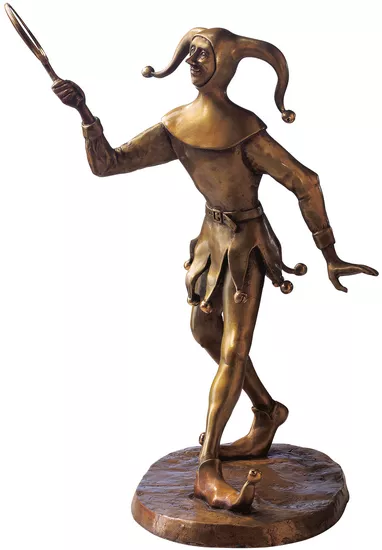
Une situation qui n’est pas sans rappeler le tableau de Bosch de 1502, L’escamoteur (1475, St Germain-en-Laye). Le tableau de Matsys pose la question de la « corruption mutuelle assurée », où, comme en géopolitique, les deux parties pensent gagner aux dépens de l’autre dans un jeu à somme nulle mais en réalité chacune d’elles finissent par perdre. De ce point de vue, la leçon « moralisatrice » va bien au-delà de la simple tricherie entre partenaires.
Comme nous l’avons déjà dit, ce qui était considéré jusqu’à présent comme des « péchés » (la luxure et la cupidité) par l’Église, devient avec les humanistes chrétiens un sujet de rire, le tableau offrant un « miroir » permettant aux spectateurs de réfléchir sur eux-mêmes et d’améliorer leur propre caractère. Dans le folklore de la Saxe et ensuite des Flandres, Tyl Uylenspieghel est une grande figure. Uyl signifiant la chouette (sagesse), spieghel signifiant miroir.

Le thème du couple mal assorti apparaît déjà dans une gravure sur cuivre de Dürer datant de 1495, où une jeune fille ouvre sa main pour siphonner de l’argent de la bourse du vieux vers la sienne.
En 1503, Jacopo de’ Barbari reprend le sujet avec Vieillard et jeune femme (Philadelphie).
Cranach l’Ancien,147 qui s’est rendu à Anvers en 1508 et a été visiblement inspiré par les grotesques de Matsys, a commencé à produire en série des peintures sur ce thème (y compris l’utilisation des grotesques de Léonard retravaillés par Matsys !), répondant clairement à la demande croissante de l’Allemagne protestante, une production continuée par son fils Cranach le Jeune.148
Cranach peindra ses propres variations sur le thème, le réduisant souvent à la seule « luxure », laissant de côté la « cupidité » et donc l’accaparement de l’argent. Bien entendu, plus l’homme est laid et âgé, et plus la femme est belle et jeune, plus le contraste qui en résulte crée un impact émotionnel mettant en valeur le caractère choquant de l’événement. Cranach s’amuse à inverser les rôles et à montrer une vieille femme riche accompagnée de sa servante, attirant un séduisant jeune homme…

Le fils de Quinten Matsys, Jan Matsys, nous a laissé une interprétation intéressante du thème, en y ajoutant une dimension sociale, celle des familles pauvres se servant de leurs filles comme appât pour piéger des messieurs riches et plus âgés dont la richesse et l’argent permettront à la famille de se nourrir, un thème également repris par Goya.
Dans l’une des versions de Cranach, l’homme riche a déjà devant lui une miche de pain sur la table, véritable symbole du chantage alimentaire. Mais ce qui frappe dans la version de Jan, c’est la mère, debout derrière le vieil homme fou, qui fixe de son regard le pain et les fruits sur la table. Si l’avidité et la luxure restent réelles, Jan dramatise un contexte donné dont on ne peut pas simplement se moquer.
Parmi les nombreux autres artistes qui ont peint ce thème, citons Hans Baldung Grien (1485-1545), Christian Richter (1587-1667) et Wolfgang Krodel l’Ancien (1500-1561). Aucun d’entre eux n’a réussi à reproduire au complet la métaphore de Matsys, le plus fidèle à l’esprit d’Érasme, celui de la folie qui gagne la partie, une situation vraiment risible ! Le triomphe de la folie ! Ici aussi, pour le visage du vieux fou, comme nous l’avons déjà mentionné, Matsys se fonde sur les esquisses de têtes grotesques de Léonard.
6. « La vieille femme hideuse », la paternité de Léonard
Cela nous permet maintenant de présenter la peinture peut-être la plus scandaleuse jamais réalisée, appelée alternativement la « Vieille femme hideuse » ou « La Duchesse laide ».
Des océans d’encre ont été jetés sur le papier pour spéculer sur son identité, sa « maladie » (la maladie de Paget dit un médecin), son « genre », la plupart du temps pour orienter le regard du spectateur vers une interprétation littérale, « basée sur des faits », plutôt que d’apprécier et de découvrir l’hilarante métaphore que l’artiste peint, non pas sur le panneau, mais dans l’esprit du spectateur.
Le tableau doit être analysé et compris avec son pendant – un tableau d’accompagnement – qui représente un vieil homme dont elle sollicite l’attention. De manière surprenante, en première approche, on peut dire que Matsys, bien avant Cranach, inverse ici les rôles habituels des genres, puisque ce que nous voyons n’est pas un vieil homme essayant de séduire la jeune fille, mais une vieille femme essayant d’attirer un vieil homme riche.
Tout d’abord, il y a la vieille dame, dont l’état physique est la décrépitude ultime, qui tente désespérément de séduire un vieil homme riche. Immédiatement, comme le Vieil homme et le jeune garçon (1490, Louvre, Paris) de Domenico Ghirlandaio, l’apparence extérieure de la personne incite le public à s’interroger sur la relation entre la beauté intérieure et la beauté extérieure.
« D’un point de vue extérieur, écrit un observateur, sur la base de sa robe exquise, de ses accessoires ornés de bijoux et de sa fleur en herbe, cette femme est théoriquement belle. Cependant, sa beauté intérieure se reflète dans son apparence physique exagérée et déplaisante ».149
Une fois encore, l’influence littéraire évidente est l’Eloge de la folie (1511), qui fait la satire des femmes qui « jouent encore aux coquettes », « ne peuvent s’arracher à leur miroir » et « n’hésitent pas à exhiber leurs repoussants seins flétris ».150
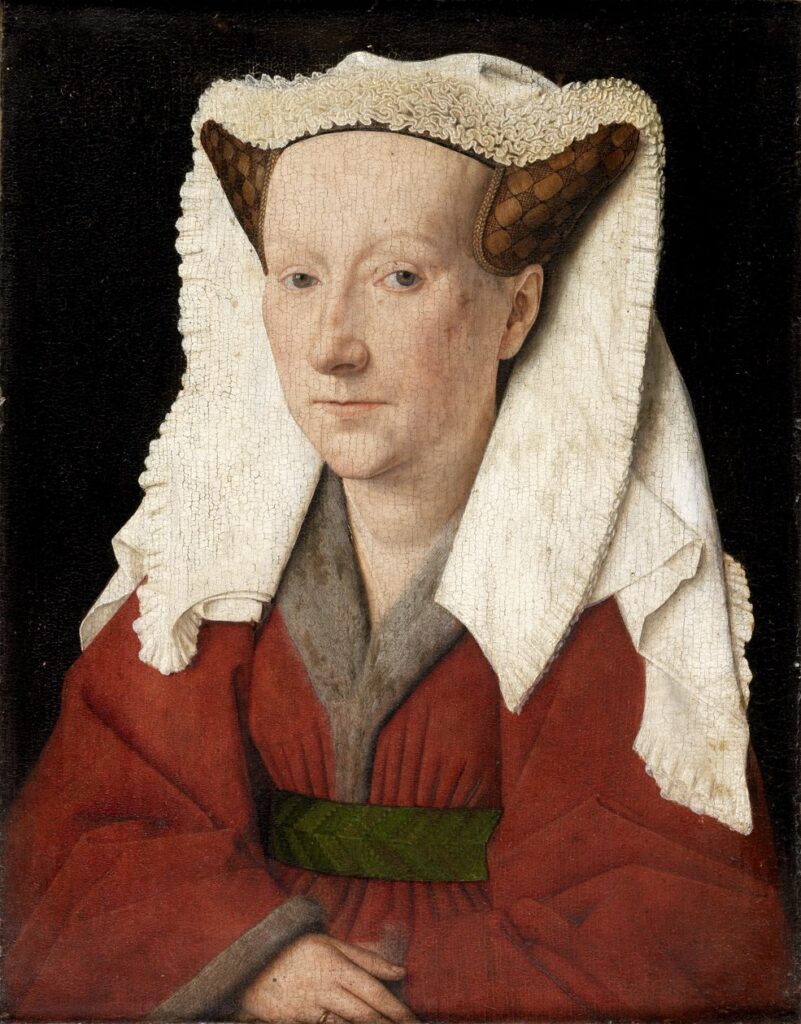
Les vêtements de la femme sont riches. Elle est habillée pour impressionner, y compris avec un couvre-chef bulbeux qui rehausse ses traits inhabituels. Défiant la modestie attendue des femmes âgées à la Renaissance, elle porte un corsage serré, découvert et étroitement lacé qui met en valeur son décolleté ridé.
Ses cheveux sont dissimulés dans les cornes d’un bonnet en forme de coeur, sur lequel elle a posé un voile blanc, fixé par une grande broche ornée de pierreries.
Quelle que soit la qualité de sa tenue, à l’époque où ce panneau a été peint, au début du XVIe siècle, ses vêtements devaient être dépassés de plusieurs décennies, rappelant ceux du portrait que Van Eyck avait fait de sa femme Margaret un siècle plus tôt, et suscitant le rire plutôt que l’admiration.
Dans le Cicéronien, publié en 1528, Erasme, par la bouche de ses caractères, souligne que le style littéraire évolue aussi vite que les goûts vestimentaires de chaque époque. S’habiller comme on le faisait plusieurs décennies avant, y affirme Nosophon, risque
« de provoquer les huées générales et la risée universelle. Regarde sur des images qui ne sont pas tellement vieilles –datant de soixante ans à peine — les vêtements des dames appartenant à la cour d’un prince ou d’un grand personnage. Si une femme se promenait maintenant en public dans cet apparat, elle serait pourchassé par les enfants et par les fous à coups de pommes pourries«
Hypologue lui retorque alors:
« C’est très vrai ce que tu dis-là ! Quelle femme de bien à l’heure actuelle s’aviserait à porter ces hennins, ces pyramides, ces longs cônes, suspendus au-dessus du dos, le front et les tempes glabres soigneusement dégarnis de leus cheveux jusqu’au milieu du crâne (…) » 151
Cette coiffe était donc devenue un symbole iconographique de la vanité féminine, ses cornes étant comparées à celles du diable ou, au mieux, à celles qui indiquent qu’elle a été fait cocue par ses amants (cornuto). Elle semble se vendre pour son apparence, car elle offre une fleur, souvent symbole de la sexualité dans l’art de la Renaissance.
C’est dans le destin tragique de la rose coupée que la fuite du temps, et avec elle la déchéance physique, trouve son illustration la plus inquiétante. Fraîche ou fragile, la rose, tout en appelant au plaisir immédiat, semble protester contre la mort qui la guette.

Pour identifier la femme, plusieurs noms sont avancés. Au XVIIe siècle, le tableau a été confondu avec le portrait de Margarete Maultasch (1318-1369) qui, séparée de son premier mari Jean Henri de Luxembourg, s’est remariée avec Louis 1er, margrave de Brandebourg, après mille et un rebondissements qui ont abouti à l’excommunication du couple par Clément VI.
Une histoire compliquée dans une époque troublée, qui a valu à Margarete le surnom de « gueule-sac » (grande gueule), ou « prostituée » en dialecte bavarois. Le problème est que l’on connaît d’autres portraits de Margarete, sur lesquels elle apparaît sous son meilleur jour… Qualifiée de « femme la plus laide de l’histoire », elle a reçu le surnom de « Duchesse laide ».
A l’époque victorienne, cette image (ou l’une de ses nombreuses versions) a inspiré à John Tenniel la représentation de la duchesse dans ses illustrations des Aventures d’Alice au pays des merveilles de Lewis Carroll (1865). Cela a permis d’ancrer le surnom et de faire de ce personnage une icône pour des générations de lecteurs.
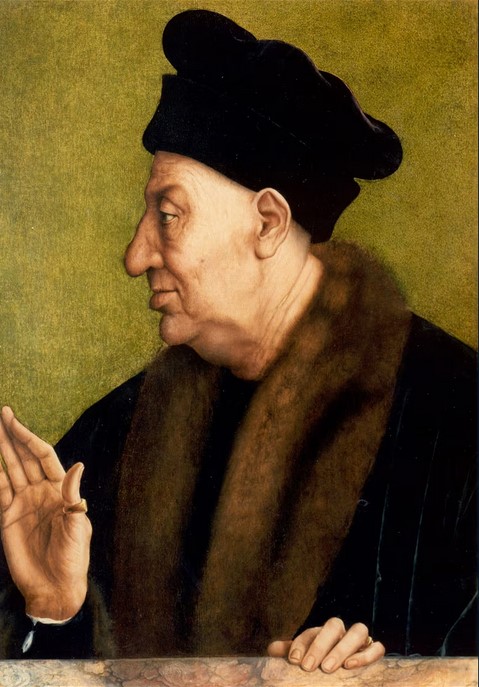
Deuxièmement, le vieil homme, dont la robe bordée de fourrure et les bagues en or, sans être aussi manifestement archaïques ou absurdes que le costume de la femme, suggèrent néanmoins une richesse ostentatoire, et son profil distinctif fait écho au profil familier du principal marchand-banquier d’Europe au XVe siècle, feu Cosimo de’ Medici de Florence. Ce dernier, après avoir joué un rôle clé en tant que mécène des arts et soutien au Conseil oecuménique de Florence, semblait avoir perdu aussi bien sa raison que sa dignité.
Il convient de noter qu’en 1513, année de la réalisation du tableau, le pape guerrier Jules II, grand ennemi d’Érasme, rend l’âme et que Giovanni di Lorenzo de’ Medici devient le nouveau pape sous le nom de Léon X.
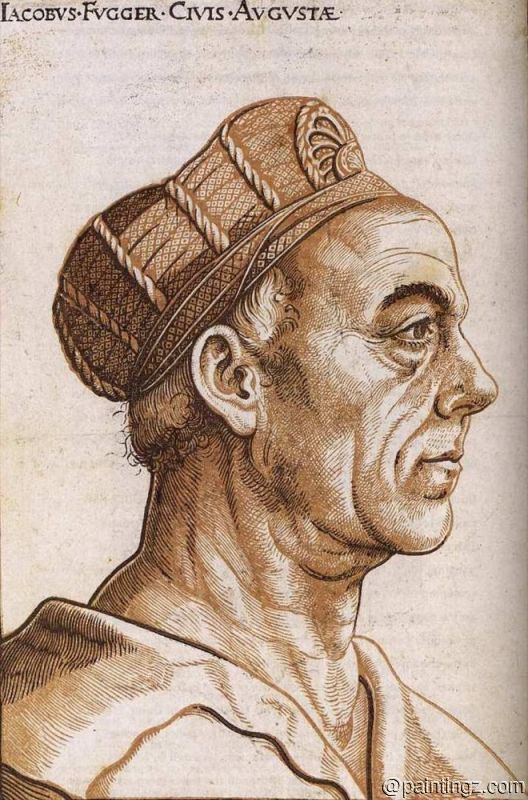
La figure du vieillard évoque également les portraits perdus du début du XVe siècle du duc Philippe le Hardi de Bourgogne.
Maintenant, si l’on y regarde à deux fois et que l’on oublie les seins de la femme, on s’aperçoit que son visage est celui… d’un homme affreux.
Il pourrait s’agir d’une figure politique ou d’un théologien détesté de l’époque, se vendant l’un à l’autre dans un élan de cupidité et de luxure.
Peut-être que la vieille prostituée laide est une référence au banquier Jacob le Riche, l’éternel banquier du Vatican ? Acceptons pour l’instant le fait qu’on ne sait pas.
L’artiste bohémien Wenceslaus Hollar (1607-1677) a vu le double portrait de Matsys et en a fait une gravure en 1645, en y ajoutant le titre « Roi et reine de Tunis, inventé par Léonard de Vinci, exécuté par Hollar ».
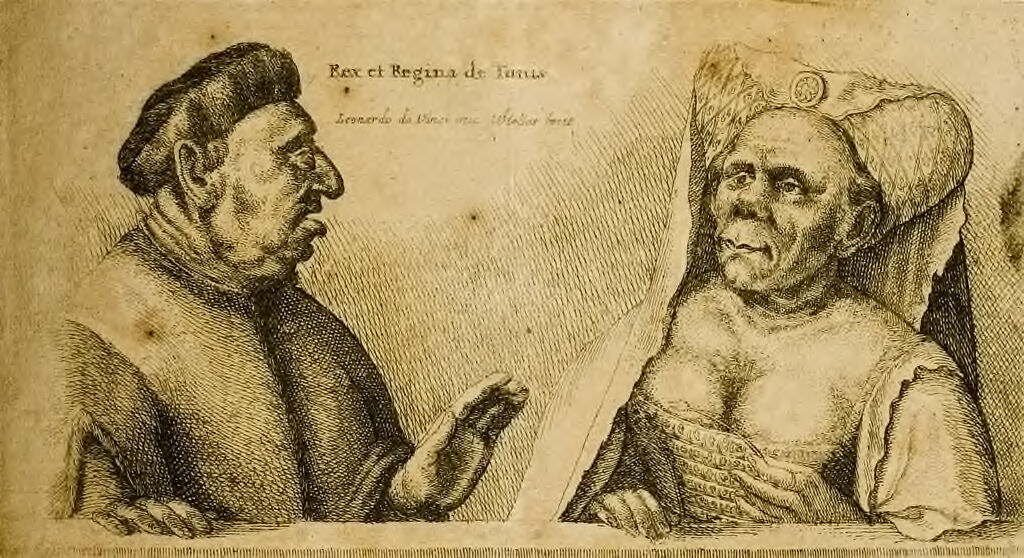
La « paternité » de Léonard de cette oeuvre fut donc un secret de polichinelle.
Pendant les périodes de carnaval, où les gens étaient autorisés à s’affranchir des règles de la société pendant quelques jours, du moins dans les Pays-Bas et dans la région du Rhin du Nord, les gens s’amusaient beaucoup en changeant les rôles. Les paysans pauvres pouvaient se déguiser en riches marchands, les laïcs en ecclésiastiques, les voleurs en policiers, les hommes en femmes et ainsi de suite.
Le concept original de cette métaphore vient clairement de Léonard, qui a fait un minuscule croquis d’une femme laide, éventuellement une prostituée, remarquablement avec le bonnet à cornes et une petite fleur plantée entre ses seins, exactement les mêmes attributs, métaphores et symboles employés plus tard par Matsys dans son œuvre !
Melzi, l’élève de Léonard, et d’autres élèves ou disciples, comme ils l’ont fait pour de nombreuses autres esquisses de Léonard, semblent avoir copié le travail de Léonard et, amusés, ont contre-posé la vieille en chaleur avec un riche marchand florentin avide. Melzi a-t-il partagé ou vendu ses esquisses à d’autres ?
Diverses versions amusantes du thème sont disséminées dans le monde entier et figurent dans des collections privées et publiques.
Une autre esquisse, réalisée par Léonard lui-même ou par ses disciples, montre un homme grotesque et sauvage, dont les cheveux se dressent sur la tête, accompagné d’une série de savants à l’allure grotesque, dont l’un ressemble à Dante !
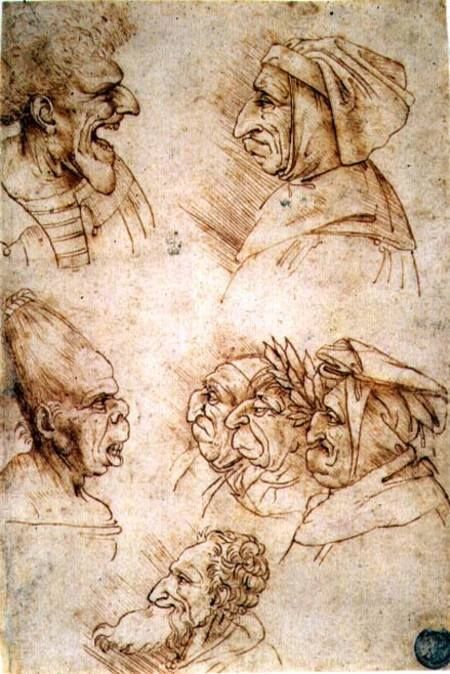
Léonard, bien sûr, qui signait toujours ses écrits par les mots « homme sans lettres » (omo sanza lettere) 152, n’était qu’un simple artisan et n’a jamais été pris au sérieux par ces érudits que Lucien dénonçait pour s’être vendus à l’establishment.
Tous ces éléments montrent que ce que faisait Matsys n’avait rien de « bizarre » ou d’« extravagant », mais qu’il partageait une « culture » de visages grotesques dont les variations pouvaient être utilisées pour enrichir les jeux de mots métaphoriques de la culture humaniste.
Mais bien sûr, ce qui a rendu l’impact de cette oeuvre si dévastateur, c’est le fait que ce qui n’était pour Léonard que de rapides esquisses dans un carnet, est devenu chez Matsys des représentations grandeur nature, d’un hyperréalisme effrayant !
Dans la collection Windsor de la Reine, il existe un dessin à la craie rouge de la femme presque exactement telle qu’elle apparaît dans l’oeuvre de Matsys.
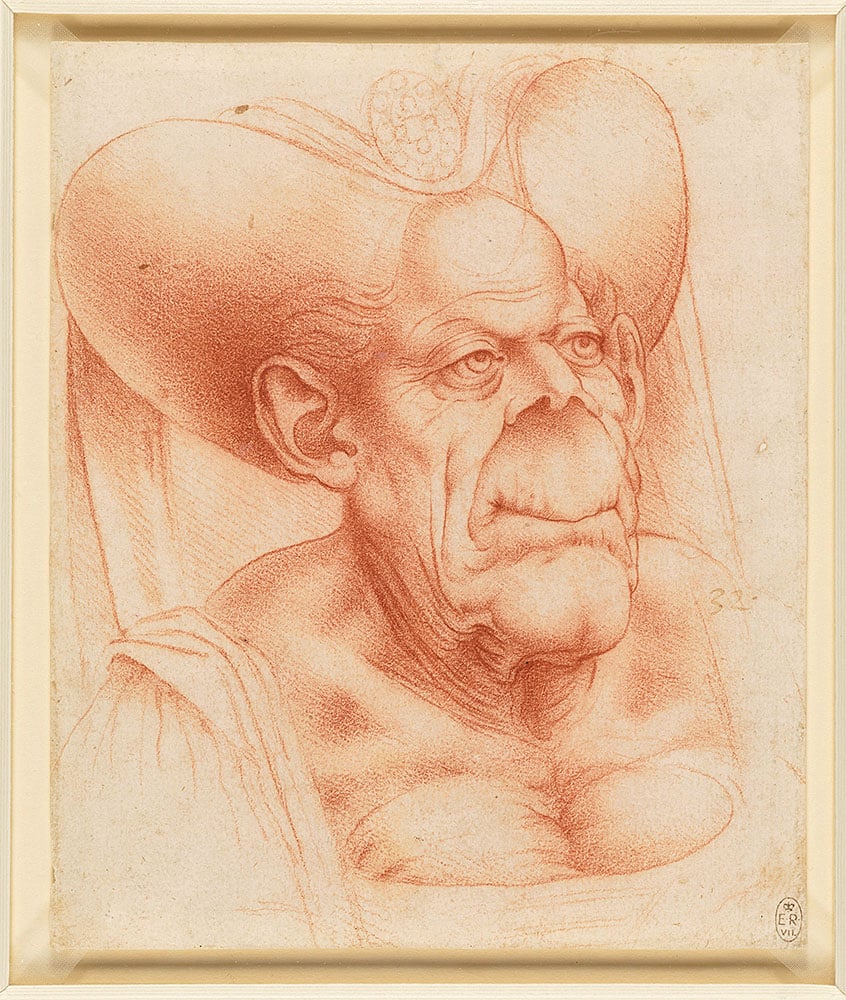
Jusqu’à très récemment, les historiens étaient convaincus que Quentin Matsys avait « copié » 153 ce dessin attribué à Léonard et l’avait agrandi pour réaliser sa peinture à l’huile.
« Léonard a donc dessiné ce personnage unique, jusqu’à la poitrine ridée qui émerge de sa robe. Matsys n’a fait que l’agrandir dans la peinture à l’huile ». 154
Cependant, des recherches récentes suggèrent que cela ne s’est pas passé ainsi !
En réalité, Melzi, ou Léonard lui-même, a pu réaliser le dessin à la craie rouge à partir de la peinture de Matsys, que ce soit à partir d’une vue directe ou des reproductions. Un Italien copiant un peintre flamand, vous imaginez ?
L’experte Susan Foister, directrice adjointe et conservatrice de la peinture ancienne néerlandaise, allemande et britannique à la National Gallery de Londres, qui était également en 2008 la commissaire de l’exposition Renaissance Faces : Van Eyck to Titian, a déclaré à l’époque au Guardian :
« Nous pouvons désormais affirmer avec certitude que Léonard – ou, du moins, l’un de ses disciples – a copié la merveilleuse peinture de Matsys, et non l’inverse. C’est une découverte très excitante ».155
Foister a précisé qu’ils avaient découvert que Matsys apportait des modifications au fur et à mesure, ce qui suggère qu’il créait l’image tout seul plutôt que de copier un modèle. De plus, dans les deux copies de Léonard, les formes du corps et des vêtements sont trop simplifiées et l’oeil gauche de la femme n’est pas dans son orbite.
« On a toujours supposé qu’un artiste moins connu d’Europe du Nord aurait copié Léonard et on n’a pas vraiment pensé que cela aurait pu être l’inverse », résume Foister.
Elle ajoute que les deux artistes sont connus pour s’intéresser à la laideur et qu’ils ont échangé des dessins « mais le mérite de cette œuvre magistrale revient à Matsys ». 156
Emma Capron, conservatrice associée de la peinture de la Renaissance à la National Gallery de Londres, a écrit en 2023 :
« En traitant des personnages amusants avec les attributs sérieux du portrait, Massys a donc parodié le genre, peut-être en se moquant implicitement de la prétention inhérente à la réalisation d’un portrait. La tension entre la dignité de la forme et l’obscénité du contenu est un procédé comique fondamental mis en évidence par l’orateur romain Cicéron et le satiriste Lucien. Elle s’inspire d’un mode rhétorique connu sous le nom d’« encomium paradoxal » (éloge paradoxal), qui consiste à glorifier un sujet de plaisanterie. Elle a été revisitée à la Renaissance dans des odes moqueuses à des beautés fanées et, plus célèbre encore, dans l’Éloge de la folie d’Érasme ». 157
8. Liefrinck et Cock
Le tableau de Matsys captiva l’imagination de son siècle et suscita une série de reprises et de reproductions. Voici ce qu’en fût le sculpteur-graveur sur bois et éditeur d’estampes anversois Hans Liefrinck (c. 1518-1573) sur laquelle Jan Muylle. 158 nous fournit des informations intéressantes.
Liefrinck a réalisé le deuxième état des dessins de Pieter Bruegel La cuisine maigre et La cuisine grasse, entre autres, et il a collaboré à Anvers avec le maître imprimeur Christophe Plantin.
Il a également réalisé quatre gravures sur cuivre à peine connues représentant des têtes grotesques empruntées à des dessins de ou d’après Léonard de Vinci.
« Nous sommes convaincus que leur importance dépasse de loin ces mentions occasionnelles », estime Muylle. Ces gravures « présentent parfois – et cela n’a été signalé nulle part – de fortes similitudes avec certaines têtes grotesques de tableaux de Quinten Metsijs (1465-1530), dont on sait depuis longtemps qu’il était redevable à Léonard de Vinci, ainsi qu’avec une estampe du célèbre éditeur de Liefrinck, Hieronymus Cock (vers 1510-1570), également mécène de Bruegel. (…) Les têtes grotesques de Metsijs, Cock et Liefrinck montrent en effet avec quelle rapidité les exemples de De Vinci – le maître est mort à Amboise le 2 mai 1519 – ont été adoptés dans leur tradition artistique par les maîtres des Pays-Bas méridionaux, tous travaillant à Anvers ».
Les légendes et épigrammes des gravures de Liefrinck et de Cock, poursuit Muylle, « fournissent également une aide précieuse pour formuler une interprétation. Il s’agit là d’un corpus d’œuvres représentatif, ce qui est bienvenu. »

Dans le cartouche de la deuxième légende de Liefrinck, on lit quelque chose que Léonard n’était pas loin de penser : Deformes, bone spectator, ne despice vultus. Sic natura homines sic variare solet. (Cher spectateur, ne méprisez pas ces visages déformés. C’est ainsi que la nature fait habituellement en sorte que les hommes diffèrent les uns des autres).
Hieronymus (Jérôme) Cock (c. 1510-1570) reprend également l’imagerie grotesque du « Couple inapproprié » (Amour inégal). On estime que la planche de Cock est la copie d’une oeuvre du graveur italien Agostino Veniziano (1490-1550). L’épigramme de Veniziano est typique de l’« humour » vénitien. On passe du grotesque au burlesque : « Chi non ci vol veder si cavi gli occhi » (Celui qui ne veut pas nous voir, arrache-lui les yeux.). Ce n’est pas évident quelle version a été réalisée en premier. Les deux artistes abandonnent le thème original, mais le fou qui triomphe derrière est un héritage de Matsys et d’Erasme.
Ce qui est clair, c’est que l’épigramme au bas de la gravure de Cock est beaucoup plus dans l’esprit humaniste :
« Al ben ick leelyck, ick ben sier plesant, Wilt ghij wel doen houet u aen mijnen kant. » (Même si je suis moche, je suis très amusante, Si tu veux te porter bien, tiens-toi de mon côté).
Les légendes des gravures de Liefrinck et de Cock s’accordent donc bien plus avec l’humanisme d’Érasme et avec la vision de De Vinci.
8. A mourir de rire, Zeuxis, Matsys et Rembrandt
Enfin, la lecture du livre La Renaissance et le rire de Daniel Ménager 159 a attiré notre attention sur les récits relatant la vie du peintre grec Zeuxis. Cette anecdote historique fournit, c’est notre avis, une clé majeure permettant de comprendre le tableau « la vieille femme hideuse » de Matsys.
Zeuxis d’Héraclée (464 à 398 av. J.-C.) est un peintre grec parmi les plus célèbres de l’Antiquité. Originaire d’Héraclée, son art surpassa tous les peintres de son temps, ou presque.
Lors d’un concours d’artistes, dit la légende, Zeuxis peint des raisins avec tant de vérité que des oiseaux vinrent les picorer. Cependant, un peintre rival, Parrhasios d’Ephèse, présente une peinture de rideau d’un rendu si naturel que Zeuxis, tout fier de la sentence des oiseaux, demande qu’on tire enfin le rideau pour voir le tableau. Reconnaissant son illusion, il s’avoua vaincu avec une franche modestie, étant donné que lui n’avait trompé que des animaux, alors que Parrhasios avait trompé les humains.
Comme le racontent aussi bien Pline l’ancien que Cicéron, Zeuxis, dont aucune œuvre nous est parvenue, fut appelé à décorer le temple d’Héra de Crotone. Le peintre propose d’y peindre l’idéal de la beauté féminine : une représentation d’Hélène de Troie, le canon de l’époque. Pour élaborer cette beauté idéale, Zeuxis aurait extrait de cinq femmes les aspects les plus sublimes qu’il réunit dans un seul personnage. La scène paraît en 1525 dans une enluminure d’un manuscrit du Roman de la Rose exécuté pour François Ier.
Au 2e siècle, Sextus Pompeius Festus rapporte qu’un jour Zeuxis avait peint Aphrodite, la déesse grecque de la procréation, du plaisir, de l’amour et de la beauté, un tableau commandé par une vieille femme qui insistait pour qu’elle soit elle-même le modèle de la jeune, belle et pulpeuse Aphrodite.
Zeuxis accepta, mais en voyant le résultat final, Aphrodite représentée comme une vieille femme ridée, éclata de rire et s’étouffa et mourut. C’est cette folle obstination des vieilles femmes de se croire éternelles dans leurs apparences physiques, thème que Goya reprendra en son temps, qui suscita un rire tellement puissant qu’il devenait dangereux !
L’histoire n’avait pas échappé à Erasme qui l’évoque dans son Eloge de la folie (publié en 1511) dans un passage à mettre en relation avec le tableau de Matsys qu’on date d’autour de 1513.
Erasme y renvoie la balle dans le camps masculin :
« Une femme laide à faire peur paraît à son mari aussi belle que Vénus, en aurait-il plus si elle était véritablement belle à ce point ? Un quidam possède certain méchant tableau et le prend pour un Zeuxis ou un Appelle ; il ne cesse de le regarder, de l’admirer ; ne voilà-t-il pas un homme tout aussi content que le connaisseur qui aura payé au poids de l’or un tableau véritable de ces maîtres, et qui peut-être y trouvera moins de plaisir ? » 160
L’homme, le pendant du double portrait de Matsys avec la « vieille femme laide », est clairement ce type d’homme frappé de folie qui croit que sa belle est la déesse Vénus alors qu’il s’agit d’une « femme laide à faire peur ». L’homme, comme de nombreux spectateurs, ne réalise même pas que ce corps de sa chérie est couronné d’une tête d’homme ! La folie est donc double et largement partagée, y compris avec les spectateurs.
L’humaniste n’ignore pas les causes de la mort de Zeuxis qu’il évoque au passage dans l’Adage 2401 sur le « Rire sardonique » :
« Le peintre Zeuxis est mort de ne pouvoir s’arrêter de rire d’une vieille femme qu’il peignait, ainsi que Chrysippe, lui, en voyant un âne qui se régalait de figues ». 161
Matsys, membre de la guilde de Saint-Luc et, selon certains, de sa division littéraire, la chambre de rhétorique De Violieren (Les giroflées), a pu trouver inspiration dans ce récit.
En peignant la « vieille femme laide », comme l’avait fait Zeuxis avant lui, Matsys visait donc à nous faire mourir de rire (de la vanité) ! Une éloge de la folie transposée en peinture !
Le sujet a connu un certain engouement.
En 1662, Rembrandt, à l’âge d’environ 56 ans, dans une œuvre seulement sept ans avant sa mort en 1669, se représente en Zeuxis qui rit à en mourir peignant une vieille femme dont on parçoit le nez et les bijoux. 162
Le thème fut repris en 1685 par le dernier élève de Rembrandt, Aert de Gelder. Si chez Rembrandt on a mis du temps pour identifier le profil de la vieille femme à gauche dans l’ombre, chez de Gelder, le sujet ne fait pas de doute.
E. Conclusion
Le travail de Quinten Matsys et son dialogue visuel avec l’œuvre de Léonard de Vinci nous montrent clairement que les Pays-Bas bourguignons ne se sont pas fermés hermétiquement à l’influence de la Renaissance italienne.
Au contraire, ces contrées ont choisi ce qu’elles considéraient comme une valeur ajoutée à leur propre culture nationale : l’amour de Pétrarque pour Dieu, la beauté et l’Homme, la science de la perspective de Piero della Francesca, les tronies hilarantes de Léonard de Vinci.
Tous ces éléments ont suscité beaucoup d’attention et d’admiration. Il ne s’agissait pas d’un pays de paysans arriérés et sans culture, comme on l’a parfois prétendu dans certains cercles aristocratiques qui n’ont jamais rien compris au message profond de Bruegel.
Sur le plan culturel, force est de constater que, hélas, les « sept péchés capitaux » que Thomas More et Érasme conseillaient d’endiguer il y a cinq siècles sont devenus les « valeurs » axiomatiques du système « occidental » d’aujourd’hui ! Pourtant, elles sont à l’opposé même des valeurs humaines universelles que partagent une vaste majorité de l’humanité, que ce soit du point de vue philosophique, religieux, agnostique, progressiste ou conservateur.
La « liberté » a été découplée de la « nécessité », les « droits individuels » des « devoirs collectifs. » Tout va. La luxure, l’envie, l’avidité, la paresse, la gloutonnerie, la gourmandise, la colère, la violence, la cruauté, etc. sont présentées quotidiennement sous un jour positif à la télévision et sur internet, y compris pour les enfants en bas âge. Tout cela est permis et même promu, tant que cela ne remet en cause les privilèges exubérants des pouvoirs dominants.
Erasme se retournerait dans sa tombe s’il savait qu’en 2025 son nom est principalement associé à une bourse offerte par l’UE aux élèves désireux d’étudier dans d’autres Etats membres de l’UE. Comme l’a suggéré un professeur belge, ces bourses devraient inclure une période de formation obligatoire à la pensée d’Erasme et en particulier à ses concepts avancés d’empathie et de construction de la paix.163
Cependant, la « raison » seule ne suffit pas. Sans l’humour, la Renaissance, avec son extra-ordinaire explosion de découvertes et d’inventions dans les domaines de la science, de l’art et de la société, n’aurait jamais eu lieu. L’humour est un catalyseur de créativité. Comme le disent certains scientifiques chinois contemporains : « Un Ha-ha [rire] efficace aide les gens à A-Ha [découverte] ».164
L’humour lui-même est un acte créatif. Comme l’humour, la créativité suscite la surprise en brisant certains cadres. Dans les deux cas, il s’agit d’établir des liens non évidents entre des éléments incongrus. Et qu’est-ce qu’une blague, si ce n’est une combinaison d’idées différentes et/ou contrastées qui créent une ironie, un décalage, une désobéissance aux attentes conventionnelles. L’humour permet de prendre conscience de l’incongruité entre deux éléments. Et la capacité de passer d’un élément à l’autre est un processus cognitif identifié comme favorisant la créativité. En d’autres termes, l’humour modifie notre façon de penser et facilite un mode de pensée inattendu, comme l’« expérience de pensée » (gedankenexperiment) qui a poussé Einstein à s’imaginer « chevauchant un faisceau » de lumière.
En développant notre sens de l’humour, nous développons une nouvelle capacité à comprendre les problèmes sous des angles différents, et ce type de pensée conduit à une plus grande créativité. Aborder les problèmes de manière linéaire et traditionnelle permet de trouver des solutions conventionnelles, voire triviales.
Or, comme le suggère Albert Einstein : « Pour stimuler la créativité, il faut développer un penchant enfantin pour le jeu ». Et l’« instinct de jeu » de l’homme, comme le souligne Friedrich Schiller dans ses Lettres sur l’éducation esthétique de l’homme (1795), en tant que première rencontre avec une absence de contraintes, sert un projet plus large de progrès humain, dans lequel la liberté nécessaire aux hommes pour se gouverner de manière adéquate s’exerce par le biais de l’interaction des facultés qui se manifestent au cours de l’expérience esthétique. En somme, le développement, aussi bien de l’« instinct de jeu » que de l’humour sont essentiels à la créativité et à l’art, y compris « l’art de gouverner. »
En somme, pour qu’une nouvelle renaissance devienne réalité, il faut libérer nos concitoyens de l’« Angst » (la peur). Ignorant des dangers réels comme la guerre nucléaire, ils vivent dans la crainte de menaces qu’on leur a fait imaginer.
L’historien néerlandais Herman Pleij le formule ainsi : « En fait on souhaiterait au monde actuel plus de folie. Ce n’est pas pour rien que le bouffon, sur la scène du début des temps modernes, aime à tendre à ses compagnons de jeu et aux spectateurs le miroir qu’il tient à la main : « Connais-toi toi-même. Connais-toi toi-même. Et prenez conscience de la relativité des choses. Ne serait-ce qu’un instant. » 165
Cessons de rire sous cape et rions de bon coeur. La plupart des études scientifiques s’accordent sur le fait que le rire est bon pour la santé et les morts subites liées à une crise de rire se font rares.
Pour ceux qui, comme nous, aspirent à la paix par le développement de chaque individu et de chaque Etat, il est temps de prendre très, très, très au sérieux la vision d’Érasme, de Rabelais, de Léonard et de Matsys sur l’art de rire « de bon coeur », vérace et émancipateur.
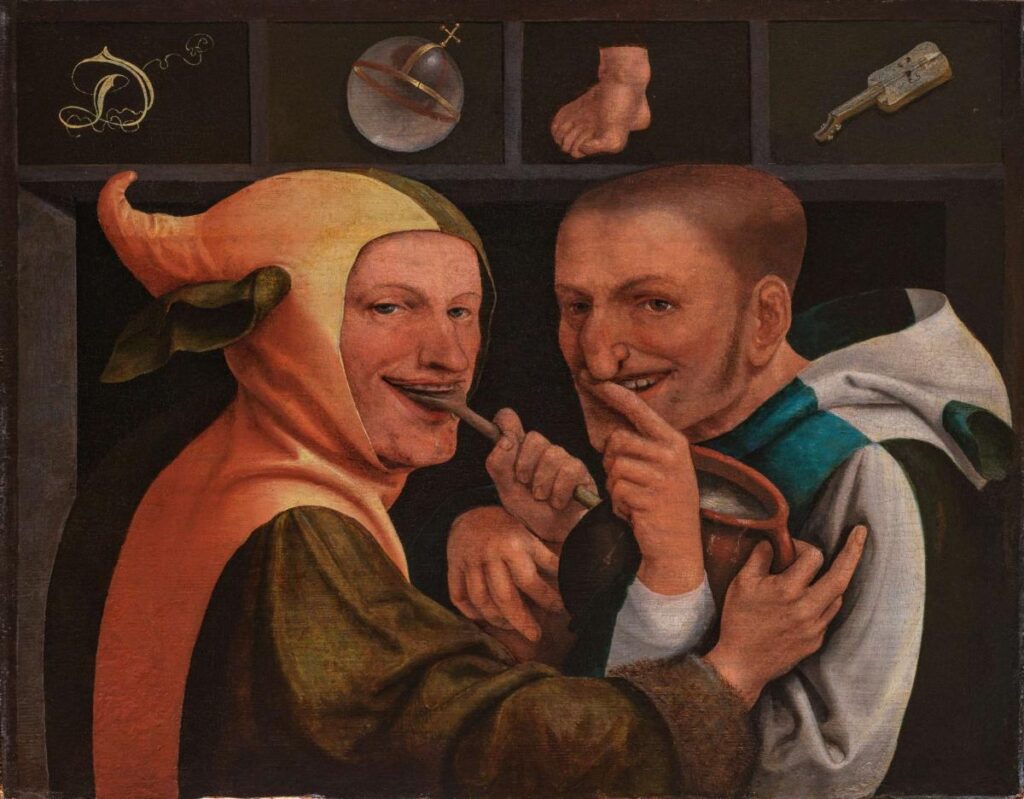
Je termine par une peinture du fils de Quinten Matsys, Jan, qui présente le rébus visuel suivant :
Solution:
1) Le « D » est abréviation de « le » ;
2) Le globe signifie « monde » ;
3) Le pied, en flamand « voet » est proche du mot « voedt », c’est-à-dire « nourrit » ;
4) La vièle (violon d’époque), en flamand s’écrit en flamand vedel, dont le sens est proche de « vele », c’est-à-dire « nombreux ».
5) En dessous… les deux sots.
La phrase se lit donc: « Le monde nourrit de nombreux sots ».
Et vous, spectateur, vous en êtes un, nous lancent les fous. Eux le savent et nous conseillent de n’en parler à personne ! Mondeken Toe ! (Fermons la bouche !)
Bibliographie
- ACCATINO, (date ?)
Sandra Accatino, Quentin Massys, Anciana grotesca o La duquesa fea, in « El Arte del Mirar », Academia.edu. - AGRICOLA, 2016
Rudolf Agricola, Brieven, Levens en Lof, Uitgeverij Wereldbibliotheek, Amsterdam. - AINSWORTH, MARTENS, 1995
Maryan W. Ainsworth, Maximiliaan P. J. Martens, Petrus Christus: Renaissance Master of Bruges, Ludion and Metropolitan Museum of Art, Gent-New York. - ALBERTI, 1435
Leon Battista Alberti, De Pictura, Macula Dédale, 1992, Paris. - ANTOINE-KÖNIG, POGAM, 2024
Elisabeth Antoine-König, Pierre-Yves Le Pogam. Figures du Fou. Du Moyen Âge aux Romantiques, Musée du Louvre, Gallimard, Paris. - ANOUILH, 1987
Jean Anouilh, Thomas More ou l’Homme libre, Editions de la Table ronde, Paris. - ARASSE, 1997
Daniel Arasse, Léonard de Vinci, Hazan, Paris. - BAKKER, 2004
Boudewijn Bakker, Landschap en Wereldbeeld, van Van Eyck tot Rembrandt, Uitgeverij Thoth, Bussem. - BATAILLON, 1998
Marcel Bataillon, Erasme et l’Espagne, Droz, Genève. - BAX, 1978
Dirk Bax, Bosch, his picture-writing deciphered, A.A.Balkema, Rotterdam. - BIALOSTOCKI, 1993
Jan Bialostocki, L’Art du XVe siècle des Parler à Dürer, Librairie générale française, Paris. - BLOCH, 2016
Amy R. Bloch, Lorenzo Ghiberti’s Gates of Paradise: Humanism, History, and Artistic Philosophy in the Italian Renaissance, Cambridge University Press. - BORCHERT, 2010
Till-Holger Borchert, Cranach der Ältere und die Niederlande, in DIe Welt von Lucas Cranach, editions G. Messling. - BOSQUE, 1975
Andrée de Bosque, Quinten Metsys, Arcade Press, Brussels. - BRANT, 1494
Sébastien Brant, La Nef des Fous, Editions Seghers et Nuée Bleue, Paris, 1979. - BRISING, 1908
Harald Brising, Quinten Matsys; essai sur l’origine de l’italianisme dans l’art des Pays-Bas, Brising, Harald, 1908, Leopold Classic Library, reprint 2015. - BROWN, 2008
Mark Brown, Solved: mystery of The Ugly Duchess – and the Da Vinci connection, The Guardian, Oct. 11, 2008, London. - BRUCKER, 1993
Gene Adam Brucker, Florence, six siècles de splendeur et de gloire, Editions de la Martinière, Paris. - BRUYN, 2001
Eric de Bruyn, De vergeten beeldentaal van Jheronimus Bosch, Heinen, ‘s-Hertogenbosch. - BRUYN, BEECK, 2003
Eric de Bruyn and Jan Op de Beeck, De Zotte Schilders, ‘t Vliegend Peerd, Mechelen. - BRUYN, 2013
Yanice de Bruyn, Masterthesis ‘Gebaar en wereldbeeld: Een onderzoek naar de herkomst en betekenis van het gebaar van de Man met bril van Quinten Metsys, Universiteit van Gent. - BUCK, 1999
Stéphanie Buck, Hans Holbein, Maîtres de l’Art allemande, Könemann, Cologne. - BUTTERFIELD, 2019
Andrew Butterfield, Verrochio, Sculptor and Painter of Renaissance Florence, National Gallery of Art and Princeton University Press, Washington. - CAUTEREN, HUTS, 2016
Katherina Van Cauteren and Fernand Huts, Voor God & Geld, Gouden tijd van de zuidelijke Nederlanden, Lannoo. - CAMPBELL, STOCK, 2009
Lorne Campbell and Jan van der Stock, Rogier van der Weyden 1400-1464, Maître des passions, Davidsfonds. - CAPRON, 2023
Emma Capron, Quinten Massys and the Art of Satire, in The Ugly Duchess, Beauty & Satire in the Renaissance, livret publié par National Galery Global et Yale University Press à l’occasion d’une exposition éponyme; - CHASTEL, KLEIN, 1995
André Chastel, Robert Klein, L’Humanisme, l’Europe de la Renaissance, Skira, Genève. - CHATELET, 1988
Albert Châtelet, Early Dutch Painting, Painting in the Northern Netherlands in the Fifteenth Century, Montreux Fine Art Publications, Lausanne. - CHATELET, 1994
Albert Châtelet, Le beau Martin – études et mises au point, Actes du colloque, Musée d’Unterlinden, Berlin. - CHAUNU, 1975
Pierre Chaunu, Le temps des réformes, Histoire religieuse et système de civilisation, La Crise de la chrétienté, L’éclatement, Pluriel, Fayard, Paris. - CLARK, PEDRETTI, 1969
Kenneth Clark and Carlo Pedretti, Leonardo da Vinci drawings at Windsor Castle, Phaidon Press. - CLAYTON, 2003
Martin Glayton, Leonardo da Vinci, the Divine and the Grotesque, The Royal Collection, Londres. - CLELAND, 2014
Elisabeth Cleland, Pieter Coecke van Aelst, Fonds Mercator, The Metropolitan Museum of Art. - CLOULAS, 1990
Iva Cloulas, Jules II, Fayard, Paris. - COLE, 1894
Timothy Cole, Quinten Massys, Century Magazine, Volume 48, Issue 4, Old Dutch Masters. - COOLS, 2016
Hans Cools, Europa-Amerika-Utopia: visioenen van een ideale wereld in de zestiende eeuw, in Op zoek naar Utopia, Jan Van der Stock, Davidsfonds, Leuven. - CUSANUS, 1543
Nicolaas of Cusa (Cusanus), Het Zien van God, vertaald door Inigo Bocken, Uitgeverij De Kok, Pelckmans. - CUSANUS, 2008
Nicolas de Cues, La Docte Ignorance, traduction d’Hervé Pasqua, Bibliothèque Rivages. - CUSANUS, 2012
Nicolas de Cues, Anthologie, Marie-Anne Vannier, Editions du CERF, Paris. - DEGUILEVILLE, LYDGATE, 1426
Guillaume De Deguileville, The Pilgrimage of Man (the Soul), Kessinger Reprints. - DELCOURT, 1986
Marie Delcourt, Erasme, Editions Labor, Bruxelles. - DHANENS, 1980
Elisabeth Dhanens, Van Eyck, Mercatorfonds, Albin Michel, Antwerpen. - DHANENS, 1998
Elisabeth Dhanens, Hugo van der Goes, Mercatorfonds, Antwerpen. - D’IETEREN, 2005
Catheline Périer D’Ieteren, Thierry Bouts, Fonds Mercator, Bruxelles. - DLABACOVA, HOFMAN, BOER, HOGESTIJN, HORST, 2018
Anna Dlabacova, Rijcklof Hofman, Erik de Boer, Clemens Hogestijn, Ewout van der Horst, De Moderne Devotie, Spiritualiteit en cultuur vanaf de late Middeleeuwen, WBooks, Zwolle. - DOMINICI, 2013
Tamara Dominici, Erasmo da Rotterdam e Quintin Metsys, ipotesi per un incontro, doctoral thesis, Università degli Studi di Urbino « Carlo Bo ». - DOMINICI, 2016
Tamara Dominici, Quentin Metsys e l’Italia: immagini di un viaggio, Studiolo. - DOMINICI, 2019
Tamara, Dominici, Erasmus of Rotterdam and Quentin Metsys: a Reassessment, P. FORESTA, F. MELONI (a cura), Arts, Portraits and Representation in the Reformation Era. Proceedings of the Fourth Reformation Research Consortium Conference. - DRIFT, 2023
Lucia Van der Drift, A mindful Look at the Ugly Duchess, video, National Gallery of Art, London. - DÜRER, 1613
Albrecht Dürer, Les Quatre Livres d’Albert Dürer, Peintre & Géometricien tres excellent, De la proportion des parties & pourtraicts des corps humains, chez Jan Janszoon, Arnhem, reprint Roger Dacosta, Paris, 1975. - DÜRER, 1995
Albrecht Dürer, Géométrie, Presented and translated by Jeanne Peiffer, Sources du savoir, Editions du Seuil, Paris. - EICHLER, 1999
Anja-Franziska Eichler, Albrecht Dürer, Könemann, Cologne. - ENENKEL, PAPY, 2006
Karl A. E. Enenkel, Jan Papy, Petrarch and His Readers in the Renaissance, Brill. - ERASMUS, 1900
Desiderius Erasmus, The Colloquies of Erasmus, Translated by N. Bailey, Gibbing & Company, London. - ERASMUS, 1964
Desiderius Erasmus, Eloge de la Folie, Garnier-Flammarion, Paris. - ERASMUS, 1967
Desiderius Erasmus, La Correspondance d’Érasme (XII volumes), translation and notes after Opus Epistolarum of P.S. Allen, H.M. Allen and H.W. Garrod; french translation under the direction of Alois Gerlo and Paul Foriers, Bruxelles, Presses académiques européennes, Bruxelles - ERASMUS, 1991
Desiderius Erasmus, Oeuvres choisies, annotations by Jacques Chomarat, Livre de Poche, Paris. - ERASMUS, 1992
Desiderius Erasmus, Erasme, Collection Bouquins, Robert Laffont, Paris. - ERASMUS, 1992
Desiderius Erasmus, Erasme, Colloques (II volumes), Imprimerie nationale éditions, Paris. - ERASMUS, 1997
Desiderius Erasmus, The Education of a Christian Prince, Cambridge Texts in the History of Political Thought, Cambridge University Press. - ERASMUS, LUTHER, 2000
Erasmus-Luther, Discours on Free Will, The Continuing Publishing Company, New York. - ERASMUS, 2013
Desiderius Erasmus, Les Adages, sous la direction de Jean-Christophe Saladin, Le Miroir des Humanistes, Les Belles Lettres, Paris. - ESTAMPES, 1977
Cabinet des Estampes, Diables et diableries, La représentation du diable dans la gravure des XVe et XVIe siècle, Genève. - EWING, 1990
Dan Ewing, Marketing Art in Antwerp, 1460-1560: Our Lady’s Pand, The Art Bulletin, Vol. 72, N° 4, pp. 558-584. - FALKENBURG, 1985
Reindert L. Falkenburg, Joachim Patinir, Het landschap als beeld van de levenspelgrimage, Nijmegen. - FALKENBURG, 2015
Reindert Falkenburg, Bosch, le jardin des délices, Hazan, Paris. - FERRETTI-BOCQUILLON, 2003
Marina Ferretti-Bocquillon, L’horrible et l’exquis, les portraits, in Léonard de Vinci, dessins et manuscrits, Connaissance des Arts, Louvre, Paris. - FLORENKI, 2021
Pavel Florenski, La Perspective inversée, Editions Allia, Paris. - FOLL, 2012
Joséphine Le Foll, Raphaël, sa vie, son oeuvre, son temps, Editions Hazan, Paris. - FRANCESCA, 1998
Piero della Francesca, De la Perspective en Peinture, In Medias Res, Paris. - FRAENGER, 1997
Wilhelm Fraenger, Hieronymus Bosch, new edition, G&B Arts International. - FRIEDLANDER, 1971
Max J. Friedländer, Early Netherlandish Painting. volume 7, Quentin Massys, Editions de la Connaissance, Bruxelles. - GALASSI, 2024
Maria Clelia Galassi, Jan Massys (c. 1510-1573): Renaissance Painter of Flemish Female Beauty, Brepols. - GASSIER, WILSON, 1970
Pierre Gassier and Juliette Wilson, Goya, Office du Livre, Editions Vilo, Paris. - GEERTS, 1987
Katelijne Geerts, De spelende mens in de Bourgondische Nederlanden, Genootschap van de geschiedenis, Brugge. - GERARD, 1978
Jo Gérard, Bruegel l’ancien et son époque, Editions Paul Legrain, Bruxelles. - GERLO, 1969
Alois Gerlo, Erasme et Ses Portraitistes: Metsijs, Dürer, Holbein, Hes & de Graaf Publishers bv. - GIBSON, 1980
Michael Gibson, Bruegel, Nouvelles Editions française, Paris. - GILBERT, 1905
Felix Gilbert, The Pope, His Banker and Venice, A vivid account of men, money, and states in the High Renaissance, Harvard University Press, Cambridge, Massasuchusetts, London, England. - GONDINET-WALLSTEIN, 1990
Eliane Gondinet-Wallstein, Un retable pour l’Au-delà, Editions Mame. - GREILSAMMER, 1990
Myriam Greilsammer, L’Envers du tableau. Mariage et maternité en Flandre médiévale, Armand Colin, Paris. - GRIEKEN, LUIJTEN, STOCK, 2013
Joris van Grieken, Ger Luijten and Jan Van der Stock, Hieronymus Cock, De Renaissance in prent, Mercatorfonds. - GROOTE, MALAISE
Gerard Groote and Joseph Malaise, The Following of Christ, the Spiritual Diary of Gerard Groote (1340-1384), Kessinger Reprints. - GROTE, 1998
Gérard Grote, Lettres et traités. Aux origines de la Devotio Moderna, Gérard Grote, fondateur de la Dévotion Moderne, Brepols. - HALE, 1993
John Hale, The Civilisation of Europe in the Renaissance, Fontana Press/HarperCollins Publishers, London. - HALKIN, 1987
Léon E. Halkin, Erasme parmi nous, Fayard, Paris. - HAY, 1967
Denys Hay, The Age of the Renaissance, Thames & Hudson. - HECK, 2003
Christian Heck, L’art flamand et hollandais, Le siècle des primitifs (1380-1520), Citadelles & Mazenod, Paris. - HEYDEN, 1968
Dr. M. C. A. Van der Heijden, O Muze kom nu voort, Ontluiking van de Renaissance, Uitgeverij Spectrum, Utrecht/Antwerpen. - HERRE, 1985
Franz Herre, The Age of the Fuggers, Presse-Druck- und Verlag-GmbH Augsburg. - HILLS, 1980
Paul Hills, Leonardo & Flemish Painting, Burlington Magazine. - HUIZINGA, 1955
Johan Huizinga, Erasme, Gallimard, Paris. - JADRANKA, 2003
Bentini Jadranka, Une Renaissance Singulière – La Cour Des Este À Ferrare – Bentini Jadranka, Quo Vadis. - JANSSEN, KOK, MAESSCHALK, ROEY, SCHEPPER, 1996
Paul Janssen, Harry de Kok, Edward De Maesschalk, Jan Van Roey and Hugo De Schepper, Le Delta d’Or des Plats Pays, Vingt siècles de civilisation entre Seine et Rhin, Fonds Mercator. - JENSMA, BLOCKMANS, WEILAND, DRESDEN, NUCHELMANS, KOLDEWEIJ, FRIJHOFF, 1996
G. Th. Jensma, W.P.Blockmans, J.Sperna Weiland, S. Dresden, J. Nuchelmans, A.M. Koldeweij and W.Th.M.Frijhoff, Erasmus. De actualiteit van zijn denken, Walburg Pers, Zuthphen. - KEMP, 2019
Martin Kemp, Léonard de Vinci, Citadelles & Mazenod, Paris. - KEMPIS, 1905
Thomas A. Kempis, The Founders of The New Devotion: Being The Lives of Gerard Groote, Florentius Radewin and Their Followers, Kessinger reprints. - KETELS, MARTENS, 2014
Jochen Ketels and Maximiliaan Martens, Foundations of Renaissance, Architecture and Treatises in Quentin Matsys’ S. Anne Altarpiece (1509). European Architectural Historians Network, EAHN: Investigating and Writing architectural history : subjects, Methodologies and Frontiers. pp. 1072-1083. - KLIBANSKY, PANOFSKY, SAHL
Raymond Klibansky, Erwin Panofsky and Fritz Sahl. Saturne et la Mélancolie, Bibliothèque illustrée des histoires, Gallimard, 1989, Paris. - KOLDEWEIJ, VANDENBROECK, VERMET
Jos Koldeweij, Paul Vandenbroeck and Bernard Vermet, Jérôme Bosch, l’oeuvre complète, Ludion/Flammarion, Gand, Amsterdam. - KWAKKELSTEIN, 2023
Michael W. Kwakkelstein, Heads in Histories. From Likeness to Type in Verrocchio, Leonardo, Dürer, Massys and a Follower of Bosch, Academia.edu. - LEVENSON, OBERHUBER, SHEEHAN, 1971
Jay A. Levenson, Konrad Oberhuber, Jacquelyn L. Sheehan, Italian Engravings from the National Gallery of Art, National Gallery of Art. - LAUR, 1872
H. Durand de Laur, Erasme, précurseur de l’esprit moderne (II volumes), Didier et Cie, Libraires-éditeurs, Paris. - LUCCO, 2011
Mauro Lucco, Antonello de Messine, Editions Hazan, Paris. - LUTHER, ERASME, 1526, 1525
Martin Luther, Du serf arbitre; Desiderius Erasmus, Diatribe du Libre Arbitre, Folio Essais, Gallimard, Paris. - MAKOWSKI, 1999
Claude Makowski, Albrecht Dürer, Le songe du Docteur et La Sorcière, Editions Jacqueline Chambon/Slatkine, Genève. - MARGOLIN, 1995
Jean-Claude Margolin, Erasme, précepteur de l’Europe, Editions Julliard, Paris. - MANDER, 1604
Karel van Mander, Le Livre des peintres, Vies des plus illustres peintres des Pays-Bas et d’Allemagne, Les Belles Lettres, 2001. - MANDEVILLE, 1732
Bernard Mandeville, The Fable of the Bees, Penguin classics, Reprint Edition. - MANN, 1984
Nicolas Mann, Petrarch, Oxford University Press. - MARIJNISSEN, SEIDEL, 1984
Roger H. Marijnissen and Max Seidel, Bruegel, Artabas Book, Crown Publishers. - MARIJNISSEN, 1987
Roger H. Marijnissen, Bosch, The Complete Works, Mercatorfonds, Antwerp. - MARIJNISSEN, 1988
Roger H. Marijnissen, Bruegel, Fonds Mercator, Albin Michel, Anvers. - MARLIER, 1954
Georges Marlier, Erasme et la peinture flamande de son temps, Editions van Maerlant, Damme. - MARTENS, 1998
Maximiliaan P.J. Martens, Bruges et la Renaissance: De Memling à Pourbus, Stichting Kunstboek, Ludion, Flammarion. - MARTENS, BORCHERT, DUMOLYN, SMET, DAM, 2020
Maximiliaan Martens, Till-Holger Borchert, Jan Dumolyn, Johan De Smet, Frederica Van Dam, Van Eyck, une révolution optique, Hannibal, MSK Gent. - MELCHIOR-BONNET
Sabine Melchior-Bonnet, Histoire du miroir, Imago, Paris. - MEGANCK, 2014
Tine Luk Meganck, Pieter Bruegel the Elder, Fall of the Rebel Angels, Art, Knowledge and Politics on the Eve of the Dutch Revolt, SilvanaEditoriale, Royal Museums of Fine Arts of Belgium. - MENAGER, Daniel, 1995
Daniel Ménager, La Renaissance et le rire, Perspectives littérairer, PUF. - MESSLING, SANDER, 2023
Guido Messling, Jochen Sander. Renaissance in the North. Holbein, Burgkmair, and the Age of the Fuggers, Hirmer. - MICHELET, 1982
Jules Michelet, Renaissance et Réforme, Histoire de la France au XVIe siècle, Bouquins, Robert Laffont, Paris. - MIEGROET, 1989
Hans J. Van Miegroet, Gerard David, Fonds Mercator, Anvers. - MILLNER KAHR, 1973
Madlyn Milner Kahr, La peinture hollandaise du siècle d’or, Livre de Poche, Librairie générale française. - MORE, 2012
Thomas More, Utopia, Penguin Classics. - MULS, 1953
Jozef Muls, Erasmus en Quinten Matsijs, Uitgeverij NV Standaard Boekhandel, Antwerpen. - OBERHUBER, 1999
Konrad Oberhuber, Raphaël, Editions du Regard, Paris. - PANOFSKY, 1971
Erwin Panofsky, Early Netherlandish Painting, Harvard University Press. - PAPY, 2016
Jan Papy, Thomas More, Utopia en Leuven: sporen naar de intellectuele en culturele contextn, Het boek Utopia in Leuven en in de Nederlanden and Utopia en het Europees humanisme, in Op zoek naar Utopia, Jan Van der Stock, Davidsfonds, Leuven. - PAPY, 2018
Jan Papy, Le Collège des Trois langues de Louvain (1517-1797), Editions Peeters, Louvain. - PANOFSKY, 1971
Erwin Panofsky, The Life and Art of Albrecht Dürer, Princeton University Press. - PATOUL, SCHOUTE, 1994
Brigitte de Patoul and Roger Van Schoute, Les Primitifs flamands et leur temps, La Renaissance du livre. - PETRARCA, 2001
De mooiste van Petrarca, Uitgeverij Lannoo/Atlas. - PETRARCH, 2022
Francis Petrarch (Francesco Petrarca), The Triumphs of Petrarch, Legare Street Press. - PHILIPPOT, 1994
Paul Philippot, La peinture dans les anciens Pays-Bas, XVe-XVIe siècles, Flammarion, Paris. - PINELLI, 1996
Antonio Pinelli, La Belle Manière, Anticlassicisme et maniérisme dans l’art du XVIe siècle, Livre de Poche, Librairie générale française. - PIRENNE, 1932
Henri Pirenne, Histoire de Belgique, Vol. II, La Renaissance du Livre, Bruxelles. - PLEIJ, 2007
Herman Pleij, De Eeuw van de Zotheid, over de nar als maatschappelijke houvast in de vroegmoderne tijd, Uitgeverij Bert Bakker, Amsterdam. - PREVENIER, BLOCKMANS, 1983
Walter Prevenier en Wim Blockmans, Les Pays-bas bourguignons, Fonds Mercator et Albin Michel. - PONS, BARRET, 1980
Maurice Pons and André Barret, Patinir ou l’harmonie du monde, Robert Laffont, Paris. - PYE, 2024
Michael Pye, La Babylone de l’Europe, Anvers les années de gloire, Editions Neviata, Bruxelles. - RAYNAUD, 1988
Dominique Raynaud, L’hypothèse d’Oxford, Presses Universitaires de France, Paris. - RAYNAUD, 2003
Dominique Raynaud, Ibn al-Haytham on binocular vision: a precursor of physiological optics, Arabic Sciences and Philosophy, Raynaud, Cambridge University Press (CUP). - RENAUDET, 1998
Augustin Renaudet, Erasme et l’Italie, Droz, Genève. - REVEL, 1995
Emmanuelle Revel, Le prêteur et sa femme de Quinten Metsys, Collection Arrêt sur œuvre, Service culturel, Action éducative, Louvre, Paris. - RETI, 1974
Ladislao Reti, Léonard de Vinci, L’Humaniste, l’artiste, l’inventeur, Mc Graw Hill et Robert Laffont, Paris. - RIDDERBOS, 2014
Bernhard Ridderbos, Schilderkunst in de Bourgondische Nederlanden, Davidsfonds, Leuven. - ROBERTS-JONES, 1997
Philippe et Françoise Roberts-Jones, Bruegel, Flammarion, Paris. - RUUSBROEC, 2010
Jan van Ruusbroec, La Pierre brillante, Ornement des Noces spirituelles, Sources mystiques, Centre Saint-Jean-de-la-Croix, Editions du Carmel. - SAMOSATE, 1905
Lucian of Samosata, De Mercene Conductis (The Dependant Scholar). Translated by Fowler, H W and F G. Oxford: The Clarendon Press. 1905. - SCHNEIDER, 1995
Norbert Schneider, Portretschilderkunst, Taschen/Librero. - SCHOUTE, VERBOOMEN, 2000
Roger Van Schoute and Monique Verboomen, Jérôme Bosch, La Renaissance du Livre, Tournai. - SHAFFER, 2015
Katie Shaffer, The Ugly Duchess by Quinten Massys, An Analyses, Academia.edu. - SILVER, 1984
Larry Silver, The Paintings of Quinten Massys : With Catalogue Raisonné, Montclair, Allanheld & Schram. - SILVER, 2006
Larry Silver, Hieronymous Bosch, Abbeville Press Inc. - SILVER, 2011
Larry Silver, Bruegel, Citadelles & Mazenod, Paris. - SILVER, 2015
Larry Silver, Massys and Money, The Tax Collectors Rediscovered, Journal of Historians of Netherlandish Art (JHNA) Volume 7, Issue 2, Summer. - SILVER, 2018
Larry Silver, Metsys’s Musician: A Newly Recognized Early Work, Journal of Historians of Netherlandish Art (JHNA), Volume 10, Issue 2, Summer. - SILVER, 2021
Larry Silver, Keep Your Mouth Shut – Quinten Metsys (c. 1465–1530) and the Fool in the Sixteenth Century, Hannibal Editions, Antwerp. - STOCK, 1985
Jan Van der Stock, Cornelis Matsys 1510/11-1556/57: Grafisch werk. Tentoonstellingscatalogus. - STOCK, 2016
Jan Van der Stock, Op zoek naar Utopia, Davidsfonds, Leuven. - STOUTEN, GOEDEGEBUURE, OOSTROM, 1999
Hanna Stouten, Jaap Goedegebuure and Frits Van Oostrom, Le bas Moyen Âge et le temps de la rhétorique, in Histoire de la littérature néerlandaise, Fayard, Paris. - STRIEDER, 1990
Peter Strieder, Dürer, Fonds Mercator, Albin Michel. - TAGLIALAGAMBA, 2014
Sara Taglialagamba, Leonardo, Metsys e le teste grottesche. Rinascenza antigraziosa, in “Art Dossier”, N° 309, pp. 72-77. - TOMAN, 1995
Rolf Toman, Renaissance italienne, Architecture, Sculpture, Peinture, Dessin, Editions de la Martinière, Paris, Könemann, Cologne. - TRACY, 1996
James D. Tracy, Erasmus of the Low Countries, University of California Press, Berkely. - VANDENBROECK, 1987
Paul Vandenbroeck, Jheronimus Bosch, tussen volksleven en stadscultuur, EPO, Berchem. - VANDENBROECK, 2002
Paul Vandenbroeck, Jheronimus Bosch, de verlossing van de wereld, Ludion Gent-Amsterdam. - VANDENBROECK, 2016
Paul Vandenbroeck, Erotische utopie: de ‘Tuin der Lusten’ in context, in Op zoek naar Utopia, Jan Van der Stock, Davidsfonds, Leuven. - VANNIER, EULER, REINHARDT, SCHWAETZER, 2010
Marie-Anne Vannier, Walter Euler, Klaus Reinhardt and Harald Schwaetzer, Les mystiques rhénans, Eckhart, Tauler, Suso, Anthologie, Editions du CERF, Paris. - VANNIER, EULER, REINHARDT, SCHWAETZER, 2011
Marie-Anne Vannier, Walter Euler, Klaus Reinhardt and Harald Schwaetzer, Encyclopédie des mystiques rhénans, d’Eckhart à Nicolas de Cues et leur réception, Editions de CERF, Paris. - VASARI, 1549
Giorgio Vasari, The Lives of the Artists, Oxford University Press. - VERDEYEN, 1997
Paul Verdeyen, Jan van Ruusbroec, Mystiek licht uit de Middeleeuwen, Davidsfonds, Leuven. - VEREYCKEN, 2002
Karel Vereycken, Leonardo da Vinci, painter of movement, Fidelio, Schiller Institute, Washington; - VEREYCKEN, 2005
Karel Vereycken, How Erasmus Folly Saved Our Civilization, website Schiller Institute, Washington. - VEREYCKEN, 2007
Karel Vereycken, Albrecht Dürers fight against Neo-Platonic Melancholia, Academia.edu. - VEREYCKEN, 2019
Karel Vereycken, Dirk Martens, L’imprimeur d’Erasme qui diffusa les livres de poche, Academia.edu. - VERMEERSCH, 1981
Valentin Vermeersch, Brugge, duizend jaar kunst, Mercatorfonds, Antwerpen. - VINCI, RICHTER, 1970
Leonardo da Vinci, Notebooks, two volumes, compiled and edited by Jean-Paul Richter, Dover Editions - VINCI, 1987
Léonard de Vinci, Traité de la Peinture, traduit par André Chastel, Editions Berger-Levrault, Paris. - VLIEGHE, 1986
Hans Vlieghe, Centrum van de nieuwe kunst, in Antwerpen, Twaalf eeuwen geschiedenis en cultuur, p. 133-162, Mercatorfonds, Antwerp. - VOET, 1976
Léon Voet, L’âge d’or d’Anvers, Fonds Mercator, Anvers. - VOS, 1985
Dirk de Vos, L’Art flamand, Peinture, p. 95-138, Fonds Mercator, Antwerp. - VOS, 1994
Dirk de Vos, Hans Memling, Fonds Mercator, Albin Michel. - VOS, 1999,
Dirk de Vos, Rogier van der Weyden, Mercatorfonds, Antwerpen. - WEEMANS, 2013
Michel Weemans, Herri met de Bles, Les ruses du paysage au temps de Bruegel et d’Erasme, Hazan, Paris. - WANGERMEE, 1968
Robert Wangermée, Flemish Music, Arcade, Brussels. - ZWEIG, 1935
Stephan Zweig, Erasme, Grandeur et décadence d’une idée, Editions Bernard Grasset, Paris.
NOTES EXPLICATIVES ET REFERENCES :
- L’orthographe du nom de l’artiste diffère au fil du temps et selon les cultures linguistiques. En français, il s’appelle Quentin Metsys, en anglais Quinten Massys et en néerlandais Quinten (Kwinten) Matsijs. À Grobbendonk, il s’appelle Matsys. Le « ij » n’existant pas à la fin du XVe siècle, l’auteur a choisi pour ce texte « Quinten Matsys », identique à l’orthographe utilisée par Harald Brising en 1908 et par Matsys lui-même pour signer son tableau de 1514, Le banquier et sa femme, Louvre ; ↩︎
- Anvers, Twaalf eeuwen geschiedenis en cultuur , Karel Van Isacker et Raymond van Uytven, Mercatorfonds, Anvers, 1986 ; ↩︎
- Brugge, duizend jaar kunst , Valentin Vermeersch, Mercatorfonds, Anvers, 1981 ; ↩︎
- L’âge d’or d’Anvers , Léon Voet, Fonds Mercator, Anvers, 1976 ; ↩︎
- Complainte de la Paix, dans Erasme, guerre et Paix , citations choisies annotées par Jean-Claude Margolin, Bibliothèque sociale, Aubier Montaigne, 1973, Paris ; ↩︎
- Jean Anouilh, Thomas More ou l’Homme libre, Editions de la Table ronde, Paris, 1987 ; ↩︎
- Pieter Gillis (1486-1533), connu sous le nom latinisé de Petrus Ægidius, est un humaniste, juriste, correcteur et éditeur travailland chez Dirk Martens. Ami d’Erasme, il apparaît dans l’Utopie de Thomas More. Il recommande le peintre Holbein le jeune à Thomas More et sera secrétaire (maire) de la ville d’Anvers ; ↩︎
- Dirk Martens (1446-1534) d’Alost est un humanistse érudit, éditeur et imprimeur de livres en Flandres installé à Louvain et Anvers. Il a publié la première lettre de Christophe Colomb relatant son voyage et une cinquantaine d’oeuvres d’Erasme ainsi que la première édition de l’Utopie de Thomas More. Pour permettre aux étudiants de l’Université de Louvain d’accéder facilement au savoir, Martens a imprimé de nombreux classiques en format de poche. Voir, Dirk Martens, l’imprimeur d’Erasme qui diffusa le livre de poche, Karel Vereycken, Artkarel, 2019 ; ↩︎
- Gerard Geldenhouer (1482-1442), connu également sous le nom de Gerhardus Noviomagus est un humaniste et satiriste d’inspiration érasmienne. Tout comme Érasme, il fut formé à la célèbre école latine créée par les Frères de la Vie Commune à Deventer. À Louvain, il écrivit ses premières publications, parmi lesquelles un recueil de Satires dans la lignée de l’ Éloge de la Folie d’ Érasme. Il supervisa l’impression de plusieurs œuvres d’Érasme et de Thomas More. Ultérieurement, Geldenhouer joindra la réforme protestante, plus précisément le courant modér de Philipp Mélanchthon à Magdebourg ; ↩︎
- L’historien néerlandais Cornélus de Schryver (1482-1558), mieux connu comme Cornelius Grapheaus, fut un humaniste, poète, philologue et professeur de latin. Originaire de Nijmegen, il s’installe à Anvers. Jeune, il se rend en Italie. Ami d’Erasme, de Gillis et de Geldenhouer, il contribue six vers élégiaques à l’édition de l’Utopie de Thomas More publié par Dirk Martens. Il sera plusieurs fois secrétaire (maire) de la Ville d’Anvers ; ↩︎
- À la mort de Hans Memling en 1494, Gérard David (1460-1523) devient le peintre le plus important de Bruges. Il devient doyen de la guilde en 1501. Malgré son succès à Bruges, il s’inscrit conjointement avec Patinir comme maître à Anvers, ce qui lui permet de vendre ses œuvres également sur le marché de l’art en plein essor de cette ville. Voir Gerard David, Hans J. Van Miegroet, Fonds Mercator, Anvers, 1989 ; ↩︎
- Le peintre anversois Joachim Patinir (1483-1524) fut un ami très proche de Quinten Matsys. Voir Patinir ou l’harmonie du monde, Maurice Pons and André Barret, Robert Laffont, Paris, 1980. ↩︎
- Le peintre-graveur et géomètre nurembergeois Albrecht Dürer (1471-1528) a vécu onze mois à Anvers : du 2 août 1520 au 2 juillet 1521. Son journal de voyage nous informe sur les personnes qu’il a rencontrées à Anvers, parmi lesquelles les célèbres artistes Quinten Matsys, Bernard van Orley et Lucas van Leyden. Son retour à Nuremberg coïncide avec l’annonce des « placards » (décrets) de Charles Quint, interdisant aux catholiques de lire la Bible. Comme les revenus de Dürer provenaient en grande partie de l’illustration de la Bible, les perspectives de vivre de cette profession devenaient proches de zéro ; ↩︎
- En 1510, Lucas van Leyden (1489-1533), né à Leyde et influencé par Dürer, réalise deux chefs-d’œuvre de la gravure, La Laitière et Ecce Homo, ce dernier étant très admiré par Rembrandt. Lukas rencontre Dürer à Anvers en 1521 et profite à nouveau de son influence, comme en témoigne la série de la Passion de la même année. Lucas a peut-être amélioré ses compétences en gravure avec l’aide de Dürer, car il a réalisé quelques eaux-fortes après leur rencontre ; ↩︎
- Holbein le Jeune (1497-1543) est un peintre bâlois. Adolescent, on lui demande, et il réussit avec grand succès, d’annoter de dessins une copie de l’Éloge de la folie d’ Érasme. Ils se rencontrent en personne, lorsque Érasme part en exil à Bâle. Holbein réalise plusieurs portraits à l’huile de l’humaniste et vint à Anvers pour rencontrer Pieter Gillis et ensuite rejoindre Thomas More en Angleterre ; ↩︎
- On reproche au style des maniéristes anversois de manquer de caractère et d’expression individuelle. On le dit « maniéré », et, pire, caractérisé par une élégance artificielle. Voir Les Primitifs flamands et leur temps, pp. 621-622-623-624, Editions Renaissance du Livre, 1994. ↩︎
- L’art flamand et hollandais, Le siècle des primitifs (1380-1520), Christian Heck, Citadelles & Mazenod, Paris ; ↩︎
- Le groupe de recherche Gent Interdisciplinary Centre for Art and Science (GICAS) est une collaboration entre des membres des Facultés des Lettres et de Philosophie (Histoire de l’art, Archéologie, Histoire), des Sciences (Chimie analytique) et d’Architecture et d’Ingénierie (Traitement d’images). La recherche se concentre sur les aspects matériels des œuvres d’art, avec un accent particulier sur la peinture des Pays-Bas (XVe-XVIIe siècles). Le Centre applique à la fois l’imagerie comme technique de traitement d’images, ainsi que l’analyse matérielle en relation avec les questions d’histoire de l’art et les applications en conservation et restauration ; ↩︎
- Les peintures de Quinten Massys avec catalogue raisonné , Larry Silver, Allanheld & Schram, 1984. ↩︎
- Quentin Metsys , Andrée de Bosque, Arcade Press, Bruxelles, 1975 ; ↩︎
- Quinten Matsys ; essai sur l’origine de l’italianisme dans l’art des Pays-Bas , Brising, Harald, 1908, Leopold Classic Library, réimpression 2015 ; ↩︎
- Martin Luther King, dans un sermon, nous rappelle que dans la Grèce antique, on distinguait trois formes différentes d’amour : éros, pour l’amour charnelle, philia pour l’amitié (fraternelle et filiale) et agapè, traduit en latin par caritas pour un amour désintéresé pour autrui. L’agapè choisit de considérer l’autre comme il est dit dans 1 Corinthiens 13 : toujours prêt à penser le meilleur de l’autre, prêt à pardonner, prêt à chercher le meilleur pour l’autre ;
↩︎ - Erasme et la peinture flamande de son temps, Georges Marlier, Editions van Maerlant, Damme, 1954 ; ↩︎
- Georges Marlier, Ibid. p. 163 ; ↩︎
- Comment la folie d’Érasme a sauvé notre civilisation, Karel Vereycken, page web, archives de l’Institut Schiller, Washington, 2005 ; ↩︎
- Le combat d’Albrecht Dürer contre la mélancolie néo-platonicienne, Karel Vereycken, page Solidarité & Progrès, 2007 ; ↩︎
- De Eeuw van de Zotheid, over de nar als maatschappelijke houvast in de vroegmoderne tijd , Herman Pleij, Uitgeverij Bert Bakker, Amsterdam, 2007 ; ↩︎
- Le bas Moyen Âge et le temps de la Rhétorique, Hanna Stouten, Jaap Goedegebuure et Frits Van Oostrom, dans Histoire de la littérature néerlandaise, Fayard, 1999 ; ↩︎
- De vergeten beeldentaal van Jheronimus Bosch, Dr Eric de Bruyn, Heinen, ‘s-Hertogenbosch, 2001; Bosch, son écriture picturale déchiffrée, Dirk Bax, AABalkema, Rotterdam, 1978 ; ↩︎
- L’écrivain et humaniste chrétien français François Rabelais (1483-1553), dans sa lettre à Salignac (en réalité Érasme), l’appelle son « père » et même sa « mère » et se compare affectueusement à une sorte de bébé qui aurait grandi dans son ventre, Rabelais, Oeuvres complètes , p. 947, Editions du Seuil, 1973 ; ↩︎
- Le génie littéraire espagnol Miguel de Cervantès (1546-1616) a été formé par son maître d’école Juan Lopez de Hoyos (1511-1583), un fervent disciple d’Érasme de Rotterdam, dont il a insufflé l’esprit à son disciple le plus aimé ; ↩︎
- Il a été démontré de manière convaincante que le dramaturge et poète anglais William Shakespeare (1564-1616) a écrit, ou du moins a largement contribué à la pièce de théâtre de 1595 Sir Thomas More, le « frère jumeau » d’Érasme dans l’esprit et l’action ; ↩︎
- Érasme des Pays-Bas, James D. Tracy, p. 104. Érasme commença à parler de « la philosophie du Christ » dans ses œuvres vers 1515. Déjà dans Julius Exclusus (Le pape Jules II exclu du ciel, 1514) il introduit l’idée lorsque saint Pierre oppose la simplicité divine de l’enseignement du Christ à l’arrogance mondaine du pape « guerrier » Jules II. « Ce genre de philosophie » s’exprimait « plus dans les émotions [affectibus] que dans les syllogismes », il s’agissait « d’inspiration plus que d’apprentissage, de transformation plus que de raisonnement » ; ↩︎
- Sur l’humanisme de Platon : Bierre, Christine, Platon contre Aristote, la République contre l’oligarchie . Page Web de Solidarité & Progrès, 2004 ; ↩︎
- Entre 339 et 397 après J.-C., le père de l’Église Jérôme de Stridon a étudié et écrit, en utilisant de nombreux ouvrages d’histoire et de philosophie de sa propre bibliothèque. Jérôme a continué à utiliser son érudition classique au service du christianisme et la discipline intellectuelle impliquée a été valorisée tant qu’elle pouvait servir l’objectif chrétien – et sans mettre en danger la nouvelle Société chrétienne ; ↩︎
- L’épistémologie de saint Augustin d’Hippone était clairement platonicienne. Pour lui, malgré le fait que Dieu soit extérieur aux humains, les esprits humains ont conscience de lui en raison de son action directe sur eux (exprimée en termes de rayonnement de sa lumière sur l’esprit, ou parfois d’enseignement) et non en raison d’un raisonnement ou d’un apprentissage à partir d’une simple expérience sensorielle empirique ; ↩︎
- Parmi les plus grands succès de Pieter Brueghel l’Ancien figurent Les Sept péchés capitaux et Les Vertus, deux séries de dessins, gravées et imprimées par ses amis et collaborateurs travaillant à l’imprimerie In de Vier Winden de Jérôme Cock à Anvers, dans un langage visuel adopté de son inspirateur, le peintre Jérôme Bosch ; ↩︎
- La vie et l’art d’Albrecht Dürer, Erwin Panofsky, Princeton University Press, 1971 ; ↩︎
- Vanitas (du latin « vanité », signifiant dans ce contexte inutilité ou futilité) est un genre de memento mori ou trope symbolique rappelant l’inévitabilité de la mort, symbolisant la fugacité de la vie, la futilité du plaisir et donc la vanité d’une existence définie par la quête permanente du plaisir terrestre ; ↩︎
- Sur le combat de Pétrarque et de Boccace pour l’introduction du grec classique en Europe : La révolution du grec ancien, Platon et la Renaissance, Karel Vereycken, Artkarel, 2021. ↩︎
- On ne peut sous-estimer l’immense popularité, et donc l’importance historique, de ces cycles, notamment en France. Aux Pays-Bas, les imaginaires de Pieter Brueghel l’Ancien pour son tableau Le Triomphe de la Mort, souvent mal compris, sont presque directement tirés du cycle poétique de Pétrarque. Des traductions en anglais existent comme The Triumphs of Petrarch, Francis Petrarch (Francesco Petrarca), Legare Street Press, 2022 ; ↩︎
- Avec Jérôme Bosch sur les traces du Sublime, Karel Vereycken, Page web des archives, Schiller Institute, Washington ; ↩︎
- Bosch, le jardin des délices, Reindert Falkenburg, Hazan, Paris, 2015 ; ↩︎
- Dans son œuvre principale, Il Cortegiano (Le Courtisan), Livre XXXIX, Baldassar Castiglione (1478-1519) se moque de Léonard de Vinci, regrettant « qu’un des premiers peintres du monde méprise l’art dans lequel il est unique et ait commencé à apprendre la philosophie, dans laquelle il a forgé des conceptions et des chimères si étranges qu’il n’a jamais pu les peindre dans son œuvre » . ↩︎
- Cahiers de Léonard de Vinci , Richter, 1888, XIX Maximes philosophiques. Morale. Polémiques et spéculations , N° 1178, Éditions Dover, Vol. II., 1970 ; ↩︎
- Het geheim om creatief te zijn: lachen, Angeles Nieto, Angeles Earth ; ↩︎
- De Docta Ignorantia (De la Docte Ignorance), Nicolas de Cues, 1440. Le cusain était un disciple de Socrate qui, selon Platon, disait « Je sais que je ne sais rien » (Platon, Apologie, 22d) ; ↩︎
- Avec son De Servo Arbitrio (La volonté asservie), Martin Luther répond largement en 1525 à la diatribe sive collation (Du libre arbitre) d’Érasme publiée un an plus tôt, en 1524 ; ↩︎
- Le 31 octobre 1517, Luther écrit à son évêque, Albert de Brandebourg, pour protester contre la vente des indulgences. Il joint à sa lettre une copie de sa Dispute sur la force et l’efficacité des indulgences, connue sous le nom des 95 Thèses. Érasme, entre autres, avait déjà largement dénoncé cette escroquerie, notamment dans son Éloge de la folie de 1509. ↩︎
- Massys et l’argent : les collecteurs d’impôts redécouverts, Larry Silver, JHNA, Volume 7, numéro 2 (été 2015), Silver écrit : « Pourtant, l’influence du tableau de Massys dans l’histoire de la peinture de genre – le sujet a été repris presque immédiatement par le fils du peintre Jan Massys, par Marinus van Reymerswaele et par Jan van Hemessen – est reconnue depuis un certain temps. » ↩︎
- Marlier, Ibid. ; ↩︎
- Écrite en quelques jours dans la résidence de Thomas More à Bucklersbury près de Londres, l’œuvre exprime le choc profond qu’éprouve Érasme en découvrant l’état pitoyable dans lequel il a trouvé « son » Église et « son » Italie, lorsqu’il est venu à Rome en 1506. Pour Érasme, à l’opposé des scolastiques, l’émotion ne doit pas être ignorée ou supprimée, mais élevée et éduquée, un thème développé plus tard par Friedrich Schiller dans ses Lettres sur l’éducation esthétique de l’homme (1795). La Stultitia (le nom latin de la Folie) est la personnification de la Folie qui oscille en permanence entre folie apparente=sagesse réelle et sagesse apparente=folie réelle, s’exprime et revendique fermement sa paternité et sa paternité de tout. De la folie « douce » des faibles, des femmes et des enfants, des hommes qui par le péché ont abandonné la raison, Érasme passe à mobiliser toute son ironie et son esprit pour fustiger la folie criminelle « dure » des puissants, des « sophistes de la folie », des marchands, des banquiers, des princes, des rois, des papes, des théologiens et des moines ; ↩︎
- La Nef des Fous , Sébastien Brant, Editions Seghers et Nuée Bleue, réimpression, 1979, Strasbourg ; ↩︎
- Sebastian Brant, Forschungsbeiträge zu seinem Leben, zum Narrenschiff und zum übrigen Werk , Thomas Wilhelmi, Schwabe Verlag, p. 34, 2002, Bâle ; ↩︎
- Dürer a réalisé cette gravure pour illustrer un recueil populaire intitulé Le Livre du chevalier de la tour, un manuel de bonne conduite pour les jeunes filles. Selon l’histoire, la femme du cuisinier aurait mangé une anguille destinée à un invité spécial, mais plutôt que de l’avouer à son mari, elle aurait menti. Une pie aurait révélé le secret de la femme à son mari, et aurait été punie en se faisant arracher les plumes par l’épouse vengeresse. Le cuisinier, représenté avec tous les attributs de son métier : couteau, poêle et cuillère, écoute l’oiseau avec une expression de surprise grandissante sur le visage, tandis que sa femme tourne son regard sur le côté dans une anticipation qui frise la résolution ; ↩︎
- Le fait que l’écrivain et marchand italien Lodovico Guicciardini (1521-1589) ait vécu la majeure partie de sa vie à Anvers, même si c’est après 1542, fait de lui une source précieuse d’informations. ↩︎
- Pour Bruegel, son monde est vaste, entretien de l’auteur avec Michael Gibson, spécialiste de Bruegel et critique d’art à l’International Herald Tribune, Fidelio , Vol. 8, N° 4, Hiver 1998. ↩︎
- Brant, Ibid., p. 23 ; ↩︎
- Brant, Ibid., p. 27 ; ↩︎
- L’étude dendrochronologique de Peter Klein a permis de dater le bois de 1491, et il est tentant de voir le tableau comme une réponse au Nef des fous de Brant ou même aux illustrations de la première édition de 1493. Une autre source possible de l’allégorie du navire est le Pèlerinage de l’âme, oeuvre du cistercien Guillaume de Digulleville du XIVe siècle, imprimé en néerlandais en 1486 ; ↩︎
- Dendrochronological Analysis of Works by Hieronymus Bosch and His Followers, Peter Klein, Museum Boijmans Van Beuningen-NAi Publishers-Ludion, Rotterdam, 2001 ; ↩︎
- Voir Moderne Devotie et Broeders en van het Gemene Leven, bakermat van het Humanisme , présentation de Karel Vereycken, 2011, Artkarel.com ; ↩︎
- Ce thème, celui d’un détachement constant de l’univers des choses créées, puissamment développé par Joachim Patinir, Herri met de Bles et d’autres, est le thème central du Pèlerinage de l’Homme (L’Âme), Guillaume De Deguileville, XIVe siècle ; ↩︎
- De Moderne Devotie, Spiritualiteit en cultuur vanaf de late Middeleeuwen, ouvrage collectif, WBooks, Zwolle, 2018 ; ↩︎
- C’est la vision de Denis le Chartreux (1401-1471), qui a écrit un traité d’esthétique théologique sous le titre De Venustate Mundi et Pulchritudine Dei (De l’attrait du monde et de la beauté de Dieu). ↩︎
- Il faut ici saluer le travail pionnier du Pr. Eric de Bruyn dans son remarquable livre De vergeten beeldentaal van Jheronimus Bosch, Heinen, ‘s-Hertogenbosch, 2001, où il a démontré de manière concluante que le sujet du verso du tableau de Bosch « Le chariot à foin » n’était pas le « Retour du fils prodigue », comme on l’a pensé pendant des années, mais bien « Le colporteur » ; ↩︎
- Les Flamands de France, Louis de Baecker, Messager des sciences historiques et archives des arts de Belgique, p. 181, Gand, Vanderhaeghen, 1850 ; ↩︎
- Le Landjuweel d’Anvers de 1561 — Faire de l’art une arme pour la paix, Karel Vereycken, Artkarel.com, 2025 ; ↩︎
- Description d’époque, cité dans De vergeten beeldentaal van Jheronimus Bosch, p. 23. Dr. Eric de Bruyn, Adriaan Heinen Uitgevers, s’Hertogenbosch, 2001 ; ↩︎
- De Bruyn, Ibid. p. 23 ; ↩︎
- Pour un récit détaillé de la jeunesse de Matsys, voir Quinten Metsys, Andrée de Bosque, p. 33, Arcade Press, Bruxelles, 1975 ; ↩︎
- La légende commence avec Dominicus Lampsonius (1536-1599) qui inclut, dans ses Effigies de quelques peintres célèbres de Basse-Allemagne, publiées en 1572 par la veuve de Hieronymus Cock à Anvers, un portrait gravé de Matsys réalisé par Wierix, accompagné d’un poème sur la façon dont la petite amie de Matsys préférait le pinceau silencieux au bruit lourd des coups de marteau d’un forgeron. L’histoire est reprise en 1604 par Karel van Mander dans son Schilder-Boeck et plus tard par Alexander van Fornenberg (1621-1663) dans sa présentation enthousiaste de Matsys, Den Antwerpschen Protheus, souvent Cyclopshen Apelles ; c’est-à-dire ; Het Leven, ende Konst-rijcke Daden, des Uyt-nemenden, ende Hoogh-beroemden, M. Quinten Matsys : Van Grof-Smidt, in Fyn-Schilder verandert, Anvers, publié par Hendrick van Soest, 1658 ; ↩︎
- Le Livre des peintres , Karel Van Mander, 1604 ; ↩︎
- Quinten Metsys, Edward van Even, dans Het Belfort, Jaargang 12, 1897, Digitale Bibliotheek voor de Nederlands letteren ; ↩︎
- Dessins d’architecture des Pays-Bas : XVe-XVIe siècles , Oliver Kik, CODART eZine, no. 8, automne 2016 ; ↩︎
- Cornelis Matsys 1510/11-1556/57 : Grafisch werk, Jan Van der Stock, Tentoonstellingscatalogus ; ↩︎
- Les Pays-bas bourguignons , Walter Prevenier et Wim Blockmans, Fonds Mercator et Albin Michel, 1983 ; ↩︎
- Pour un compte rendu détaillé, voir The Age of the Fuggers, Franz Herre, Presse-Druck- und Verlag-GmbH Augsburg, 1985 ; ↩︎
- En 1548, Francisco de Hollanda (1517-1585) a enregistré dans son De Pinture Antigua (1548) une conversation entre Vittoria Colonna et le célèbre peintre Michel-Ange au cours de laquelle ils discutaient de l’art du Nord. Michel-Ange exprimait ainsi son point de vue sur la peinture flamande : « En général, Madame, la peinture flamande plaira mieux au dévot que n’importe quelle peinture d’Italie, qui ne lui fera jamais verser une larme, tandis que celle de Flandre lui en fera verser beaucoup ; et cela non pas à cause de la vigueur et de la bonté de la peinture, mais à cause de la bonté de la personne dévote. En Flandre, on peint en vue de la précision extérieure ou de choses qui peuvent vous réjouir et dont on ne peut pas dire du mal, comme par exemple les saints et les prophètes. On peint des objets et des maçonneries, l’herbe verte des champs, les ombres des arbres, des rivières et des ponts, qu’on appelle des paysages, avec beaucoup de figures d’un côté et beaucoup de figures de l’autre. » Et tout cela, bien que cela plaise à certains, se fait sans choix habile d’audace et, finalement, sans substance ni vigueur. » ; ↩︎
- Sur cet artiste : voir Thierry Bouts, Catheline Périer D’Ieteren, Fonds Mercator, Bruxelles, 2005 ; ↩︎
- Sur cet artiste : voir Hugo van der Goes, Elisabeth Dhanens, Mercatorfonds, Anvers, 1998. Aussi Hugo van der Goes et la Devotio Moderna, Karel Vereycken, Artkarel.com ; ↩︎
- Voir Schilderkunst in de Bourgondische Nederlanden, Berhard Ridderbos, Davidsfonds, Louvain, 2014 ; ↩︎
- Les trois degrés de la vision selon Ruysbroeck l’Admirable et les Bergers du triptyque Portinari de Hugo van der Goes , Delphine Rabier dans Études en Spiritualité , N° 27, pp. 163-179, 2017. Dans son deuxième ouvrage bruxellois, Die geestelike brulocht (Le Mariage Spirituel — vers 1335/40), Ruusbroec explique que la vie spirituelle passe par trois étapes au cours desquelles l’amour de Dieu s’approfondit à chaque fois : la vie de travail, la vie intérieure et la vie de réflexion sur Dieu. Ruusbroec souligne que le mystique qui a atteint le stade le plus élevé n’abandonne jamais les deux précédents, mais les pratique à partir de l’union avec Dieu. C’est ce que Ruusbroec appelle la vie « commune » ;
↩︎ - Sur cet artiste : voir Rogier van der Weyden, Dirk De Vos, Mercatorfonds, Anvers, 1999. ↩︎
- Sur les compositions musicales de Jacob Obrecht (1457-1505), voir Musique flamande, Robert Wangermée, Arcade, Bruxelles, 1968 ; ↩︎
- Le musicien de Metsys : une œuvre de jeunesse récemment reconnue, Larry Silver, Journal of Historians of Netherlandish Art (JHNA), volume 10, numéro 2, été 2018 ; ↩︎
- De la Renaissance à Ferrare : Une Renaissance Singulière – La Cour Des Este À Ferrare – Bentini Jadranka, Quo Vadis, 2003 ; ↩︎
- L’école latine des Frères de la Vie Commune de Deventer fut dirigée à l’époque d’Érasme par Alexandre Hégius (1433-1498), élève du célèbre Rodolphe Agricola (Huisman) (1442-1485), disciple de Cues et fervent défenseur de la Renaissance italienne et de la littérature classique. Érasme le qualifia d’« intellect divin ». À 24 ans, Agricola fit un tour d’Italie pour donner des concerts d’orgue et rencontra Ercole d’Este I (1431-1505), souverain de la cour de Ferrare. À l’université de Pavie, il découvrit également les horreurs de la scolastique aristotélicienne. Lorsqu’il enseignait à Deventer, Agricola commençait son cours en disant : « Ne vous fiez à rien de ce que vous avez appris jusqu’à ce jour. Rejetez tout ! Partez du point de vue qu’il faut tout désapprendre, sauf ce que vous pouvez redécouvrir en vous basant sur votre propre autorité ou sur des décrets d’auteurs supérieurs. » ↩︎
- L’hypothèse d’un voyage de Quentin Matsys en Italie a notamment été suggérée par l’auteur italien Limentani Virdis, qui attribue même au peintre la paternité d’une fresque de l’oratoire milanais de l’abbaye Santa Maria di Rovegnano ; ↩︎
- L’Art flamand, p. 261, Dirk de Vos, Fonds Mercator, 1985 ; ↩︎
- Le Beau Martin, Gravures et dessins, Musée d’Unterlinden, Colmar, 1991 ; ↩︎
- Renaissance in the North, Holbein, Burgkmair, and the Age of the Fuggers, Guido Messling, Jochen Sanders (eds), Hirmer, 2023 ; ↩︎
- Discours sur le libre arbitre, Érasme, Bloomsbury Revelations, 2013 ; ↩︎
- Van Eyck, peintre flamand utilisant l’optique arabe, Karel Vereycken, conférence sur le thème « La perspective dans la peinture religieuse flamande du XVe siècle » à l’Université Paris Sorbonne du 26 au 28 avril 2006 ; ↩︎
- Van Eyck, une révolution optique, Maximiliaan Martens, Till-Holger Borchert, Jan Dumolyn, Johan De Smet et Frederica Van Dam, Hannibal, MSK Gent, 2020 ; ↩︎
- Le rôle d’Avicenne et de Ghiberti dans l’invention de la perspective à la Renaissance , Karel Vereycken, Artkarel, 2022 ; ↩︎
- Ibn al-Haytham sur la vision binoculaire : un précurseur de l’optique physiologique, Sciences et philosophie arabes, pp. 79-99, Raynaud, Dominique, Cambridge University Press, 2003 ; ↩︎
- Léon Battista Alberti (1404-1472) publie en 1435 son De Pictura . Bien que l’ouvrage développe d’importants concepts géométriques utilisés dans la représentation en perspective, il manque de toute forme d’illustration ou d’image et ne s’intéresse pas à la formation des images dans l’esprit des spectateurs. Léonard a pris le temps de démontrer les limites du système albertien et a présenté quelques alternatives ; ↩︎
- Fondements de la Renaissance, architecture et traités dans le retable de Sainte-Anne de Quentin Matsys (1509), Jochen Ketels et Maximiliaan Martens, European Architectural Historians Network, EAHN : Enquête et écriture de l’histoire de l’architecture : sujets, méthodologies et frontières. p.1072-1083 ; ↩︎
- Ketels, Martens, Ibid. ; ↩︎
- Ketels, Martens, Ibid. ; ↩︎
- Ketels, Martens, Ibid. ; ↩︎
- De prospectiva pingendi ( De la perspective de la peinture ), écrit par Piero della Francesca (1415-1492) est le premier traité de la Renaissance en italien consacré au sujet de la perspective. Voir L’Œuf sans ombre de Piero della Francesca , Karel Vereycken, Fidelio , Vol. 9, N° 1, printemps 2000, Schiller Institute, Washington ; ↩︎
- Ketels, Martens, Ibid, ; ↩︎
- Joachim Patinir, Het landschap als beeld van de levenspelgrimage, Reindert L. Falkenburg, Nimègue, 1985 ; ↩︎
- Plus d’informations à ce sujet dans Albrecht Dürer, Anja-Franziska Eichler, Könemann, 1999, Cologne, p. 112 ; ↩︎
- A ce sujet, voir Le rêve d’Erasme, le Collège des Trois langues de Louvain (1517-1797), Pr. Jan Papy, Editions Peeters, Louvain, 2018. ↩︎
- Jacopo de’ Barbari et l’art du Nord du début du XVIe siècle, Jay A. Levenson, Université de New York, 1978 ; ↩︎
- Quatre livres sur les proportions humaines, Albrecht Dürer, 1528. Il convient de noter, pour notre sujet ici, que l’artiste, dans le troisième livre, donne des principes par lesquels les proportions des figures peuvent être modifiées, y compris la simulation mathématique de miroirs convexes et concaves ; ↩︎
- Citation de Gravures italiennes de la National Gallery of Art, Jay A. Levenson, Konrad Oberhuber, Jacquelyn L. Sheehan, National Gallery of Art, 1971 ; ↩︎
- Les premières gravures italiennes, Quattrocento-début du cinquecento. Venise, Vicence, Padoue : Jacopo de Barbari, Girolamo Mocetto, p. 312-348, Inventaire de la collection du département des Estampes et de la Photographie, Éditions de la Bibliothèque nationale de France, 2015 ; ↩︎
- Albert Dürer et ses rencontres avec les artistes des Pays-Bas, Matthias Mende, Stadtgeschiedliches Museum-Nuremberg, dans Albert Dürer aux Pays-Bas, son voyage (1520-1521), son influence, Palais des Beaux Arts, Bruxelles, 1977, p. 149 ; ↩︎
- Albrecht Dürer, Journal de son voyage aux Pays-Bas, 1520-1521. Accompagné du carnet de croquis à la pointe d’argent et des peintures et dessins réalisés pendant son voyage, New York Graphic Society, Greenwich, 1996 ; ↩︎
- Ibid, Note N° 14 ; ↩︎
- Sur ceux qui sont aux gages des grands, Lucien de Samosate, traduit par Eugène Talbot, Hachette, Paris, 1866 ; ↩︎
- Lucien de Samosate, Ibid. ; ↩︎
- Lucien de Samosate, Ibid. ; ↩︎
- Erasme parmi nous, p. 72-73, Léon E. Halkin, Fayard, Paris, 1987 ; ↩︎
- Joseph d’Arimathie est un personnage biblique qui a assumé la responsabilité de l’enterrement de Jésus après sa crucifixion ; ↩︎
- Hérode le Grand (vers 72 – vers 4 av. J.-C.) était un « roi client » (satrape) juif romain du royaume de Judée. Il est connu pour ses projets de construction colossaux, notamment la reconstruction du Second Temple de Jérusalem ; ↩︎
- Sur le rôle de Jules II dans la reconstruction de Rome, voir Ce que l’humanité peut apprendre de l’école d’Athènes de Raphaël, Karel Vereycken, Artkarel.com, 2022 ; ↩︎
- Ibid, note N° 88 sur la Dévotion moderne ; ↩︎
- Marlier, Ibid., p. 252 ; ↩︎
- Sur le rôle des Fugger et des Welser dans l’esclavage financier et physique au XVIe siècle, voir Jacob le Riche, père du fascisme financier, Karel Vereycken, Artkarel, 2024 ; ↩︎
- Ehrenberg, Richard, Capital et finance à l’âge de la Renaissance : A Study of the Fuggers, and Their Connections, 1923 ↩︎
- Georges Marlier, Ibid., p. 252 ; ↩︎
- Georges Marlier, Ibid, p. 270 ; ↩︎
- Pour une analyse détaillée : Le prêteur et sa femme de Quinten Metsys , Emmanuelle Revel, Collection Arrêt sur œuvre, Service culturel, Action éducative, Louvre, Paris, 1995 ; ↩︎
- Les primitifs flamands, Erwin Panofsky, Harvard University Press, 1971, traduit de l’anglais par Dominique Le Bourg, Hazan, collection « 35/37 », Paris, 1992, pp. 280-282 ; ↩︎
- Le siècle de Bruegel. La Peinture en Belgique qu XVIe siècle , catalogue d’exposition 27 septembre – 24 novembre 1963, Musées royaux des Beaux-Arts de Belgique, Bruxelles, notice dirigée par Georges Marlier ; ↩︎
- Pour une analyse approfondie, voir les points de vue opposés : d’un côté, la nature diabolique des miroirs, dans Histoire du miroir , Sabine Melchior-Bonnet, Imago, Paris, 1994, et sur leur rôle de médiateur du divin, De Visione Dei , de Nicolas de Cues, 1453 ; ↩︎
- L’hypothèse d’Oxford , Dominique Raynaud, Presses Universitaires de France, Paris, 1988 ; ↩︎
- Jan van Eyck, peintre flamand utilisant l’optique arabe , conférence de Karel Vereycken en 2006 à l’Université de la Sorbonne, Artkarel, France ; ↩︎
- Pour une analyse complète : Petrus Christus , Maryan W. Ainsworth et Maximiliaan PJ Martens, p. 96 ; ↩︎
- Iconographie de l’art chrétien, Louis Réau, Presses Universitaires de France, 1958, tome III, Iconographie des saints ; ↩︎
- Ketels, Martens, Ibid. ; ↩︎
- Philippe d’Aarschot, dans Gids voor de Kunst in België, p. 105, Spectrum, 1965 ; ↩︎
- Les Lais de Corinthe de Holbein, 1526, témoignent de l’influence de Léonard de Vinci. Pierre Vays, professeur honoraire d’histoire de l’art à la Faculté de Genève, souligne également la « touche léonardesque de certaines de ses compositions », dans Holbein le Jeune , sur https://www.clio.fr . ↩︎
- Léonard de Vinci a probablement peint une partie de la réplique belge de « La Cène », Maïthé Chini , The Brussels Times, 2 mai 2019 ; ↩︎
- Dans Les grotesques et mouvements de l’âme, Léonard de Vinci conçu par Wenceslaus Hollar à la Fondation Pedretti, Federico Giannini, Finstre Sull’Arte, 26 mars 2019 ; ↩︎
- Les dix livres de l’architecture, Vitruve ; ↩︎
- Figures du fou, Du Moyen Âge aux Romantiques, Elisabeth Antoine-König, Pierre-Yves Le Pogam, Musée du Louvre, Gallimard, 2024 ; ↩︎
- Erasme, Eloge de la folie, Chap. XXXI ; ↩︎
- Erasme, Colloques, traduit par Etienne Wolff, Editions Imprimerie nationale, 1992 ; ↩︎
- Erasme, Colloques, Vol. II, traduit par Etienne Wolff, Editions Imprimerie nationale, 1992 ; ↩︎
- Peinture néerlandaise ancienne, tome 7, Quentin Massys , Max J. Friedländer, Editions de la Connaissance, Bruxelles, 1971 ; ↩︎
- Cranach der Ältere und die Niederlande , Till-Holger Borchert, dans Die Welt von Lucas Cranach , éditions G. Messling, 2010. ↩︎
- Les couples mal assortis – Lucas Cranach, Perceval, eve-adam.over-blog.com , 2016 ; ↩︎
- La duchesse laide de Quinten Massys, Une analyse , Katie Shaffer, Academia.edu, 2015 ; ↩︎
- Citation dans La représentation des femmes dans l’art de la fin du Moyen Âge et de la Renaissance , Christa Grössinger, Manchester University Press, 1997. p. 136 ; ↩︎
- Passage cité par Emma Capron, dans Quinten Massys and the Art of Satire, p. 20-21; ↩︎
- Léonard de Vinci, Daniel Arasse , p. 36, Hazan, Paris, 1997 ; ↩︎
- L’Encyclopédie Larousse note que « L’influence de Léonard apparaît dans une Vierge à l’Enfant (musée de Poznań), inspirée de la Vierge et sainte Anne, et se lit également dans la facture de la Vierge Rattier (1529, Louvre) ou de la Madeleine (musée d’Anvers). Elle a peut-être inspiré la tendance caricaturale du Vieillard (1514, Paris, musée Jacquemart-André), de la Femme laide (copie à Londres, N. G.) et peut-être même manifestée des scènes de genre comme le Vieux galant (Washington, N. G.) ou l’Usurier (Rome, Gal. Doria-Pamphili). » ; ↩︎
- Résolu : le mystère de la vilaine duchesse – et le lien avec Da Vinci, Mark Brown, The Guardian , 11 octobre 2008 ; ↩︎
- Mark Brown, Ibid. ; ↩︎
- Mark Brown, Ibid. ; ↩︎
- Emma Capron, Ibid.; ↩︎
- Groteske koppen van Quinten Metsijs, Hieronymus Cock en Hans Liefrinck naar Leonardo da Vinci, Jan Muylle, De Zeventiende Eeuw, 10e Année, 1994 ; ↩︎
- La Renaissance et le rire, Daniel Ménager, Presse universitaire de France, 1995 ; ↩︎
- Eloge de la folie, Erasme, p. 84 ; ↩︎
- Adage 2401 sur le rire sardonique, Erasme ; ↩︎
- Rembrandt database, IV 25, Self-portrait as Zeuxis laughing, p. 551, Ernst van de Wetering, Rembrandt Research Project ; ↩︎
- Erasme, La complainte de la paix, Ibid. ; ↩︎
- Creativity and Humor, Chapter 4 – Why Humor Enhances Creativity From Theoretical Explanations to an Empirical Humor Training Program: Effective “Ha-Ha” Helps People to “A-Ha”, Ching-Hui Chen, Hsueh-Chih Chen, Anne M. Roberts, pages 83-108, Explorations in Creativity Research, 2019 ; ↩︎
- De Eeuw van de Zotheid, over de nar als maatschappelijke houvast in de vroegmoderne tijd, Herman Pleij, p. 11, Uitgeverij Bert Bakker, Amsterdam. ↩︎
Traductions:
En russe (version sans les mises à jour):
Quinten Matsys and Leonardo — The Dawn of Laughter and Creativity

Par Karel Vereycken, August 2024.
Deze tekst online in het nederlands
Lire cet article en ligne en FR
Read russian translation in PDF format
By Karel Vereycken, August 2024.
Summary
Introduction
A. Making our values great again
- Cynical jokes or Socratic dialogue?
- What is Christian humanism?
- Petrarch and the “Triumph” of Death
- The Age of Good Laughter
- Sebastian Brant, Hieronymus Bosch and The Ship of Fools
- Chambers of Rhetoric and Landjuweel
B. Quinten Matsys’ Early Life and biography
- From blacksmith to painter
- Duchy of Brabant
- Training: Bouts, Memling and Van der Goes
- Getting started in Antwerp and abroad
C. Selected Works and thematics
- The Virgin and the Child, « Divine Grace » and « Free Will«
- The Saint Anne Altarpiece
- A New Perspective
- Cooperation with Patinir and Dürer
- The Erasmus Connection
- Thomas More’s Utopia
- Pieter Gillis and « The Friendship diptych«
- The Da Vinci Connection (I)
D. The Art of Erasmian Grotesque
- In religious paintings
- Misers, Bankers and Money-changers, the Fight against Usury
- The Da Vinci Connection (II)
- The Art of Grotesque per se
- The metaphor of the “Ill-matched Lovers”
- Leonardo’s baby: “The Ugly Duchess”
- Liefrinck and Cock
- Dying of laughter, Zeuxis, Matsys and Rembrandt
E. Conclusion
Selected Bibliography
In the early XVIth Century, Quinten Matsys (1466–1530)1, emerged as a major painter in Antwerp where he worked for over 20 years creating numerous works, among which profound religious triptychs, amazingly detailed portraits and some of the most hilarious satirical works in the history of painting.
To do honor and do justice to this badly well-known artist, we will explore and highlight here his Erasmian spirit and some of his most mind-provoking artistic contributions.

At the turn of the century, attracting talents from all over the continent as a magnet, Antwerp2, and with some 90,000 inhabitants, had become a growing port and trade center3, outdoing the Medici’s dominated Brugge4 in importance.
It was in this environment of a boiling cultural melting-pot that Quinten Matsys met, discussed and collaborated with some of the brightest of the great christian humanists of his time, be it erudite peace activists such as Erasmus of Rotterdam5 , Thomas More6 and Pieter Gillis7, innovative printers such as Dirk Martens8 from Aalst, demanding reformers such as Gerard Geldenhouwer9 and Cornélius Grapheus10, Flemish painters such as Gerard David11 and Joachim Patinir12, or foreign engravers that lived in the city or paid a visit to Antwerp, such as Albrecht Dürer,13 Lucas van Leyden14 and Hans Holbein the Younger15.
Unfortunately, today, large international publishing houses, for reasons yet unclear, seem to have condemned this highly remarkable artist to oblivion. For all those reasons, one finds hardly mention of Matsys’ name. It only appears in chapters dealing with the “Antwerp school” . 16
Even worse, not a single of his works is presented and only two mentions of his name appear in L’art flamand et hollandais, le siècles des primitifs17.
The good news is that since 2007, the Ghent Interdisciplinary Centre for Art and Science (GICAS)18 is working on a new « catalogue raisonné » of his work. The one of Larry Silver19 is hard to find and became largely unaffordable. What remains is the one of Andrée de Bosque20, with very few color prints. As a consolation, readers can access Harald Brising’s 1908 doctoral thesis, in a reprint version of 201521.
To honor and do some justice to this artist, we will attempt to explore in this article some questions left unanswered so far. To what extent did Erasmus’ work directly inspired Matsys, Patinir and their circle? What do we know about the exchanges between this group and prominent Renaissance artists such as Leonardo da Vinci and Albrecht Dürer? What influence did the Erasmian artist exert on his foreign correspondents?
Erasmus wasn’t really a fan of what was called “religious” paintings in those days, preferring agapic22 action for the common good to passive devotion of holy images. As Belgian art critic Georges Marlier (1898-1968) pointed out in 1954, in his well documented book23, while Erasmus respected and honored holy paintings if they evoked real religious sentiment, love and tenderness, that didn’t prevent him from thinking that:
“the real imitation of Christ and his Passion consists in mortifying the leanings that are warring against the mind rather than whining about the Christ as if it were an object of pity.” 24
Our previous inquiries into the works of both Erasmus25 and Dürer26 have familiarized us with Matsys’ age and its challenges, a subject we can not redevelop here at full length, but which gives the author some solid grounds to accomplish this task.
A. Getting our values straight
1. Cynical jokes or Socratic dialogue?
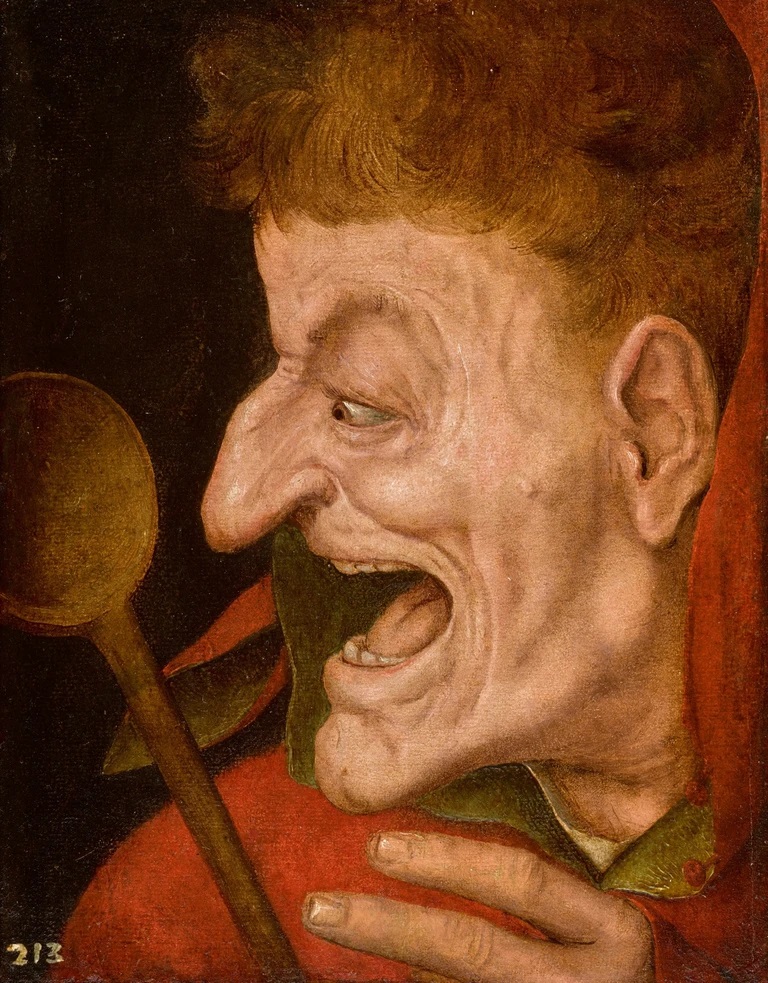
Many modern viewers, with untrained eyes and minds steeped in a culture of abusive wokism and pessimism, lack the moral and intellectual integrity to understand the jokes27, irony and metaphors which were the very essence of cultural life28 in the Low Countries of that time.29
Lost in their own cultural prejudices, in looking at a painted face, they miss the visual puns the artist is making, trying instead to establish its identity as if the subject was a portrait. They pay obsessive (eventually useful) attention to “secret” and symbolic meanings of iconographic details hoping that their sum will somehow allow them to arrive at a sort of meaning.
We will look here afresh at Erasmus’, Matsys’ and Leonardo’s “grotesques,” which are not “cynical jokes” showing a “lack of tolerance” towards “ugly”, “sick”, “abnormal” or “different” people, as the accusation goes, but caricatures and jokes aimed to free our minds!
Erasmus and his three most prominent followers François Rabelais 30, Miguel de Cervantes 31 and William Shakespeare 32, are the real if rarely recognized incarnations of “Christian humanism” and good laughter as a powerful political weapon to educate people’s characters, was not yet outlawed at their time.
2. What is Christian Humanism?
The thrust of Erasmus‘ educational and political programme was the promotion of docta pietas, learned piety, or what he termed the “Philosophy of Christ.”33 It can be summarized as a “wedding” between the humanist principles summarized in Plato’s Republic 34 and the agapic notion of man transmitted by the Holy scriptures and the writing’s of those early fathers of the Church as Jerome 35 and Augustine 36 who saw Plato as their imperfect precursor.
In a complete phase shift and break with feudal “blind” faith putting man’s hope uniquely in his salvation by Christ in a putative existence after death, for christian humanism, man’s nature is good and therefore the origin of evil is not man himself or some outside “Devil”, but those vices and moral afflictions Plato basically identified in his Republic centuries before being turned by the christian humanists into the famous “Seven Capital Sins”37 that had to be overcome by the “Seven Capital Virtues.”

As a reminder, these deadly sins are:
- Pride, (Superbia, hubris) as opposed to Humility (Humilitas);
- Greed (Avaricia) as opposed to Charity (Caritas, Agapè);
- Wrath (Ira, rage) as opposed to Patience (Patientia);
- Envy (Invidia, jealousy) as opposed to Kindness (Humanitas);
- Lust (Luxuria, fornication) as opposed to Chastity (Castitas);
- Gluttony (Gula) as opposed to Temperance (Temperantia);
- Sloth (Acedia, melancholy, spleen, moral laziness) as opposed to Diligence (Diligentia).
Isn’t it quite telling for our own times that these sins (affections preventing us from doing the good), and not their opposing virtues, have tragically been consecrated as the very basic values guaranteeing the well-functioning of the current “Neo-liberal” financial system and its « rules-based » world order!
“Private vices make public virtue”, argued Bernard Mandeville in his 1705’s The Fable of the Bees. It is the dynamics of particular interests that stimulate the prosperity of a society, according to this Dutch theorist who inspired Adam Smith, and for whom “morality” only invites lethargy and provokes the misfortune of the city.
It is greed and perpetual pleasure-seeking and not the Common Good that have been proclaimed to be man’s essential motives, according to the dominant school of British Empiricism: Locke, Hume, Smith and consorts.
“Charity,” “Care” and “Humanitarianism” have been scaled down to a despicable and increasingly rare Lady-do-rightly activity allowing the current system to perpetuate its criminal existence. Oligarchical and banking families’ “Charities” and “Foundations” have even become the oligarchy’s tool to impose their perpetual dominance.
3. Petrarch and the “Triumph of Death”
Christianity, as all major humanist religions, relentlessly labor to shake up those wasting their lives in sinful behavior by showing them how their behavior is both dramatic and even ridiculous in light of the extreme shortness of individual physical existence.
Dürer made this the core theme of his three famous Meisterstiche (master engravings) who have to be interpreted and cannot be understood but as one single unity: Knight, Death and the Devil (1513), Saint Jerome in His Study (1514) and Melencolia I (1514).38
In each of these engravings one can find an hourglass, metaphor for the inexorable march of time. Saint Jerome is often depicted with an hourglass (time) and a skul (mortality), a metaphor for vanitas.39
Erasmus made of these concepts his personal banner together with the moto: “Concedi Nulli » which refers to death saying that nobody will escape her grip, underlining even more the inexorable nature of human mortality. In that sense, the Christian Renaissance, was a mass movement for spiritual immortality, both against religious superstition and against the revival of Greco-Roman paganism.
This conceptual theme was congruent with Francis Petrarch’s (1304-1374)40 poetic I Trionfi cycle (1351-1374)41, structured in six allegorical triumphs.

Petrarch’s triumphs are “concatenated,” so that the Triumph of Love (over Mankind and even Gods) is itself triumphed over by another allegorical force, the Triumph of Chastity. In its turn, Chastity is triumphed over by Death; Death is overcome by Fame; Fame is conquered by Time; and even Time is ultimately overcome by Eternity, the Triumph of God over all such worldly concerns.
Since death will “triumph” at the end of our ephemeral physical existence, the fear of death and the fear of God should help man concentrate to contribute something immortal to future generations rather than get lost in the labyrinth of earthly pleasures and pains that Hieronymus Bosch (1450-1516)42 depicted with great irony in his triptyche, the Garden of Earthly Delights (1503-1515).43
Leonardo, whose far advanced scientific-religious sentiment was considered a heresy by many in Rome44, expressed with some anger in his notebooks that many men and women didn’t merit the beautiful human body God gave them.
“How many people there are who could be described as mere channels for food, shit factories, fillers of latrines, for they have no other purpose in this world; they do nothing even remotely worthwhile; all that remains after them is a load of shit.”45
4. The Age of “Good Laughter”
Dictionaries have it that people have a “good laugh” when they find amusing and funny a situation that was at first upsetting. In short, good laughter is the reward of a true creative process when the “agony” of looking for solutions ends with finding one. That can be for scientific and practical questions but also in the development process of one’s personal identity. The storm and the clouds are gone and full light brings a new perspective.
On her blog Angeles Earth, visual artist and art historian Angeles Nieto highlights the intimate connection between humour and creativity:
« Humour does not follow linear, traditional, habitual processes; humour stimulates flexible thinking and creativity. Laughter, you can compare it as a switch of your cognitive thought, so that your rational side is paralysed in a way. We usually laugh when our brain recognises a wrong model that is out of place. Humour presents a new point of view that disrupts and mocks conventional discussion. The sudden mental changes that humour causes are also present in creativity, we play with ideas, looking for surprising ideas. Humour is built on dissociation, the possibility of two mindsets intersecting so that the second changes the meaning of the first. Creativity works under the same mechanisms as a joke. Both involve connecting two seemingly unconnected ideas. » 46
For the Christian humanists, through the “mirror-effect” intrinsically inherent to a “Socratic dialogue” (which starts by accepting what you know not – called docta ignorantia [learned ignorance] by Cusanus47), man has and can be freed from these “sinful” afflictions, because man’s free will can be mobilized to bring him to act in accordance to his real (good) nature, that of dedicating himself and getting his ultimate pleasure in accomplishing the common good in service of the others, including in economic activities.
By claiming that man’s life on earth is fully predetermined by God, Luther’s denied the existence of the free will 48, and made man totally irresponsible for his own deeds.
That viewpoint was the exact opposite of that of Erasmus who had started calling on the Church to curb their financial abuses such as the famous “indulgencies” longtime before Luther was brought on the scene. 49
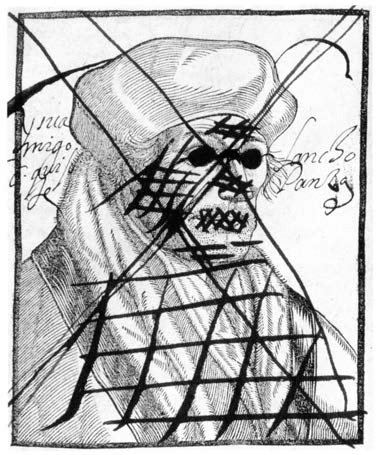
The Christian Humanists were firmly committed to elevate our souls to the highest realm of moral and intellectual beauty by freeing us from our earthly attachments — not by inflicting guilt feelings or moral orations and the lucrative business of fear from hell, but by laughter!
Laughter can ruin the authority of the powerful and the tyrants. Therefore, it is the most devastating political weapon ever conceived.
For the evil forces, truth-seeking laughter, of the sort promoted by Erasmus and his followers, had and remains to be ignored, slandered and as much as possible eradicated and replaced with melancholy, obedience and submission to in advance justified narratives and doctrines of painful scholastic constipation.
5. Sebastian Brant, Hieronymus Bosch and The Ship of Fools


Years before Erasmus published his In Praise of Folly (written in 1509 and first published in Paris in 1511)50, the Strasbourg humanist poet and social reformer Sebastian Brant (1458-1521), opened the of the gates of such Socratic laughter with his Narrenshiff (The Ship of Fools, published in 1494 in Basel, Strasbourg, Paris and Antwerp)51, a hilarious satirical work illustrated with engravings of Dürer and later Holbein the Younger. 73 of the 105 illustrations for the original edition were produced by Dürer.
Brant was a key contact and ally of Johann Froben (1460-1529) and Johann Amerbach (1441-1513), the Swiss printer families that later welcomed Erasmus when being persecuted in the Low Countries he had to go into exile in Basel.
The Ship of Fools took Europe by a storm. Brant was not only a satirist but a well educated humanist who had notably translated Petrarch’s poems.52
“Genre-painting,” wrote Georges Marlier in 195453 and more recently the American art historian Larry Silver54, depicting aspects of everyday life by portraying ordinary people engaged in common activities, was born with Quinten Matsys (One should rather say with the Erasmian paradigm we just identified).


Images of more ordinary women and men, wealthy tradesman and bankers, suddenly appeared as sovereign individuals to be portrayed for their own merits rather than as donors praying while assisting at a religious scene. Dürer made an engraving of « A cook and his wife. »55
Of course, times had changed and so had the client-base of painters. The orders came much less from the religious orders and wealthy cardinals in Rome and increasingly more from wealthy bourgeois out to embellish their homes and eager to offer their portraits to friends.
The expansion of the Antwerp market that made paintings available as a middle-class luxury product is a well-studied phenomenon, and research has confirmed Lodovico Guicciardini’s56 claim that there were at least 300 active painters’ workshops in Antwerp by the 1560s.
Brant’s Ship of Fools, was a real turning point and game changer of the day, the prelude of a new paradigm. It marked the beginning of a long arch of creativity, reason and education through healthy laughter whose echo resonated loudly until the death of Pieter Bruegel the Elder57 in 1569. That élan was ony halted when Charles Vth resurrected the Inquisition in 1521 by plublishing his decrees (“placards”) forbidding ordinary citizens from reading, commenting and discussing the Bible.

The Ship of Fools is divided in 113 sections, each of which, with the exception of a short introduction and two concluding pieces, treats independently of a certain class of fools or vicious persons; and we are only occasionally reminded of the fundamental idea by an allusion to the ship. No folly of the century is left uncensored. The poet attacks with noble zeal the failings and extravagances of his age, and applies his sword unsparingly even against the dreaded Hydra of popery and monasticism.
The book opens with the denunciation of the first fool, one which turns away from the study of all the wonderful books in his possession58. The third one (out of 113), not far away, is greed and avarice.59
Coherent with this, is Hieronymus Bosch’s partly lost triptych. Modern research has established that Bosch’s Ship of Fools (Louvre, Paris), eventually painted before Brant60 wrote his satire, was the left panel of a triptych whose right panel was The Death of the Miser (National Gallery, Washington). 61
Interesting here, is the fact that there is no fatality in this painting and that what people become, a fool or a wise man, depends on each person’s personal decision, a doctrine quintessential to the convictions of the Brothers of the Common Life62 with whom Bosch, had major affinities. Even the miser, until his last breath, can choose between looking up to Christ or down to the devil!
We ignore the theme of the central panel which is lost. But we do know that the backsides of the two lateral panels folded together complete the image of a Door-to-door salesman (before mistakenly called The return of the prodigal son) also depicted on the outside panels of Bosch’s triptych of the Hay wagon, showing kings, princes and popes running after a wagon full of hay (a metaphor for money).
The theme of a peregrinating peddler63 was very popular among the Brothers of the Common Life and the Devotio Moderna64 for whom individual responsibility and choice was decisive for each person to save above all himself with some help of God.
For Augustine, man is permanently confronted with an existential choice. Either he takes the bumpy, difficult road moving him to a spiritually more elevated position and closer to God, or he goes down the easy way by attaching himself to earthly passions and affections. The beauty of man and nature, warns Augustine, can and should be fully enjoyed and celebrated under condition they are understood as a mere “foretaste of divine wisdom” 65 and not as purely earthly pleasures. The peddler as found in Bosch and Patinir is therefore a metaphor of mankind fighting to remain on the right road and in the right direction.
Bosch will populate his paintings with deprived men and women running like brainless animals behind little fruits as cherries and beys, metaphors for extremely ephemeral earthly pleasures unable to offer any real durable satisfaction.
The peddler advances “op een slof en een schoen” (on a slipper and a shoe) i.e., he has abandoned his house and has left the created world of sin (we see a bordello, drunkards, etc.), and all material possessions. With his “staff” (a symbol of Faith) he succeeds in repelling the “infernal dogs” (Evil) that try to hold him back. Such metaphorical images are not personal outbursts of the exuberant imagination of Bosch, but a common image very much used in that period. An illumination of a fourteenth-century English psalm book, the Luttrell Psalter, features exactly the same allegorical representation.
The same theme, that of a homo viator, the man who detaches himself from earthly goods, is also recurrent in the art and literature of this period, particularly since the Dutch translation of Pèlerinage de la vie et de l’âme humaine (pilgrimage of life and the human soul), written in 1358 by the Norman Cistercian monk Guillaume de Degulleville (1295-after 1358).
If the three surviving images on the panels of the Bosch triptych (the Ship of fools, the Miser and the Peregrinating peddler) are hard to connect when analysed separately, their coherence appears strongly once one identifies this overriding concept.66
Today, an imaginative, creative painter could try to find out what Bosch’s lost panel would have looked like, the theme certainly having focused on the origin of evil (going from a ship of fools to the death of the miser).
6. Chambers of Rhetoric and Landjuweel
One man’s laughter does not make another man happy. It undermines the illegitimate authority of emperors, popes, bankers, dukes and tyrants. Irony, satire and humor are indeed the most powerful political weapons ever devised. Persecution, censorship, intimidation, terror and punishment must extirpate it from minds and souls.

The wave of cultural emancipation in the Low Countries, to which Erasmus and Matsys made their own contributions, reached its apogee during the second half of the 16th Century and provoked a brutal reaction from the ruling powers.
The “beginning of the end” of the Spanish occupation of the Netherlands was the banning of the Landjuweel 67. As early as the 13th and 14th centuries, Landjuwelen were poetry contests organized between the archers’ guilds of the Duchy of Brabant. In the 15th and 16th centuries, the Rederijkers (Rhetoricians) organized competitions between Chambers of Rhetoric along similar lines.
Each contest was organized around a central philosophical question, a zinne, e.g., “What most incites man to art?” (Antwerp, 1561) or ”What most comforts man in the hour of his death? » (Ghent, 1539). The contending Chambers of Rhetoric then had to answer with a play, a zinne-spel (where the zinne is the question asked).
Other contests included entertaining and wacky plays, esbattements, songs and the rebus coat of arms. This was a sort of coat of arms with a rebus on it. The role of « cathartic laughter » (catharsis = purification) deployed in comedy and satire is well known. Faced with the anguish of everyday life or political oppression, humor provides an immediate emotional release, while offering a critical distance. Mockerey and cathartic laughter can be beneficial, although there’s a danger that if they aren’t followed by a call to action, they may demobilize us.

The Landjuweel organized by Antwerp’s Chamber of Rhetoric De Violieren in August 1561 goes down in history as the most dazzling. This chamber was in fact nothing but the literary branch of the Saint-Luke’s Guild, i.e. the painters’ guild of which Matsys, Patinir, David and other friends of Erasmus had been members. 68
Fourteen chambers took part. Some 1,400 rhetoricians on horseback, in festive costume, with music and song, made their entrance into the city. The procession included 23 floats and 200 other carriages.
Drama, poetry, music and painting shared the same visual imagery. One of these “points” (ornately decorated floats with allegorical-moralizing representations) during the Onze-Lieve-Vrouwe-ommegang (our Lady’s procession) of Antwerp in 1563 was described at that time as the kind of hay wagon that appears at the center of one of Bosch’s paintings, The Hay Wagon (1501, Madrid), an allegory for the morbid pursuit of “earthly gain” :
« Eene Hoywaghen daer op zittentende eene Sater,
ghenaempt Bedrieghelijck aen locken,
achter volghende alle Natie van volck, treckende aen het Hoy,
als Woekers, Cassiers, Creemers &c.
midts dat ertsch ghewin al hoy is“
(A hay wagon with a satyr on it named ”the Deceptive Temptation » and behind it all kinds of people, such as usurers, bankers and hawkers, pulling at the hay, while earthly gain is all hay). 69

The same theme is also at the center of an engraving by Frans Hogenberg of 1559. On this print, the people around the hay wagon are divided into groups and provided with captions.
« Geestelyck weerlijck het sij in wat staten
Vint men ghebreck tot allen stonden
Daer om doeghet goodet en wilet quaet laten
Want anders (Ilaes) eest al hoy bevonden. »
(Spiritual and secular persons of all ranks are found to be constantly defective. Therefore, do good and avoid evil. For otherwise (alas) all will prove hay). 70

Stage performances took place on a beautifully decorated wooden stage in the Grote Markt, in front of the yard of the new City Hall. It was designed by Cornelis II Floris.
The introductory plays are written by Willem van Haecht.
The play of sentences should answer the question “what drives man most to art.”
Three hundred years before Friedrich Schiller, people considered elevated art as an important tool for humanization and political emancipation.
The Landjuweel and the Ommegang were popular festivals where “everything was allowed”, where the “little man” could taunt and mock the oppressor with satires, disguises and songs of mockery and thus, if only for a very short moment, make the yoke of Spain a little more bearable.
Most allegorical plays that were performed were biting satires against the pope, monks, indulgences, pilgrimages and so on. As soon as they appeared, they were considered a threat. , It was not without reason that the Landjuweel of 1561 was later cited as the first to incite both both the people and the literary world in favor of the Protestant Reformation. Because these works were far from favorable to the Spanish regime, the Duke of Alba ordered their abolition by the Index of 1571, and later the government even banned all public and private theatrical performances organized by the Chambers of Rhetoric.
B. Quinten Matsys, biographical elements
With this in mind, and knowing what were the stakes at that time, we can now examine more profoundly Matsys’ life 71 and some of his works.
1. From Blacksmith to painter
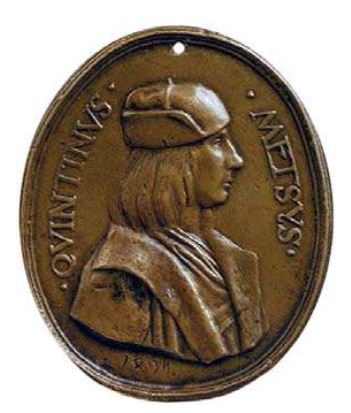
One of four children, Quinten Matsys was born in Leuven to Joost Matsys (d. 1483) and Catherine van Kincken sometime between April 4 and September 10, 1466. Most early accounts of Matsys’ life are composed primarily of legends 72 and very little contemporary accounts exist of the nature of his activities or character.
According to the Historiae Lovaniensium by Joannes Molanus (1533-1585), Matsys was born in Leuven between April 4 and September 10, 1466, as one of four children of Joost Matsys (d. 1483) and Catherine van Kincken.
Most accounts of his life blend fact and legend. In reality, there are very few clues as to his activity or character.
In Leuven, Quinten is said to have had modest beginnings as an ironworker. Legend has it that he fell in love with a beautiful girl who was also being courted by a painter. As the girl much preferred painters to blacksmiths, Quentin quickly abandoned the anvil for the paintbrush.
In 1604, chronicler Karel Van Mander states that Quintin, stricken with an illness since the age of twenty, “was in the impossibility to earn his bread” as a blacksmith.
Van Mander reminds us that in Antwerp, during « Shrove Tuesday » celebrations,
“… the brothers who cared for the sick would go around town, carrying a large carved and painted wooden torch, distributing engraved and colored images of saints to the children; so they needed a large number of them. It so happened that one of the confreres went to see Quentin and advised him to color some of these images, with the result that Quentin tried his hand at the job. From this tiny beginning, his talent became apparent, and from then on he began to paint with great enthusiasm. In no time at all, he made extraordinary progress and became an accomplished master.”73


In Antwerp, in front of Our Lady’s cathedral at the Handschoenmarkt (glove market), one still can find the « putkevie » (a decorated wrought iron gate on a well) said to be made by Quinten Matsys himself and depicting the legend of Silvius Brabo and Druon Antigoon, respectively the names of a mythical Roman officer who liberated Antwerp from the oppression of a giant called Antigoon who would harm the trade of the city by blocking the entrance of the river.
The inscription on the well reads: “Dese putkevie werd gesmeed door Quinten Matsijs. De liefde maeckte van den smidt eenen schilder.” (« The ironwork for this well was forged by Quinten Matsys. Love made the blacksmith a painter. »)
Documented donations and possessions of Quinten’s father Joost Matsys indicate that the family had a respectable income and that financial need was not the most likely reason for which Matsys turned to painting.
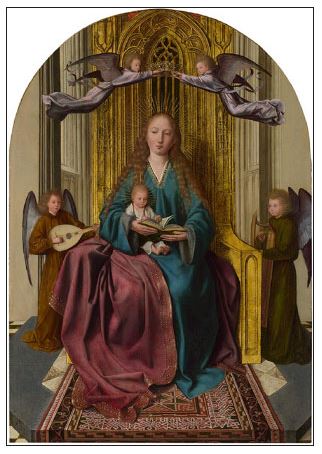
Although no evidence exists documenting Quinten Metsys’ training before his enrolment as a free master in the Antwerp painter’s guild in 1491, his brother Joos Matsys II’s design project74 in Leuven and their father’s activities suggest that the young artist first learned how to draw and transfer his ideas to paper from his family and that they first exposed him to architectural forms and their creative deployment.
His earlier works in particular clearly suggest that he had training as an architectural draughtsman. In his 1505 Virgin and Child Enthroned with Four Angels, the divine titular characters are seated on a gilded throne whose gothic tracery echoes that in the window on the parchment drawing and the limestone model for the St Peter’s project to which his brother was assigned at around the same time.
In 1897, Edward van Even, without presenting any evidence, wrote that Matsys also composed music, wrote poetry and produced etchings.75

What we do know for sure is that the artist produced some magnificent bronze medaillons representing Erasmus, his sister Catarina and himself.
Around 1492, he married Alyt van Tuylt, who gave him three children: two sons, Quinten and Pawel, and a daughter, Katelijne. Alyt died in 1507 and Quentin remarried a year later. With his new wife Catherina Heyns, they had ten more children, five sons and five daughters. Shortly after their father’s death, two of his sons, Jan (1509-1575) and Cornelis (1510-1556),76 became painters and members of the Antwerp Guild.
Cornelis made an engraving showing « The Blind guiding the Blind », which Bruegel made later into a painting.

2. The Duchy of Brabant

Leuven, at that time, was the capital of the Duchy of Brabant which extended from Luttre, south of Nivelles to ‘s Hertogenbosch. It included the cities of Aalst, Antwerp, Mechelen, Brussels and Leuven, where in 1425, one of the first universities of Europe saw the light.
Five years later, in 1430, together with the Duchies of Lower Lotharingia and Limburg, Brabant was inherited by Philip the Good of Burgundy and became part of the Burgundian Netherlands77.
Then, when Matsys was around 11 years old, in 1477, the Duchy of Brabant fell under Hapsburg rule as part of the dowry of Mary of Burgundy to Maximilian of Austria.
The subsequent history of Brabant is part of the history of the Hapsburg « Seventeen Provinces » increasingly under the control of such Augsburg banking families as the Fuggers and Welsers.78
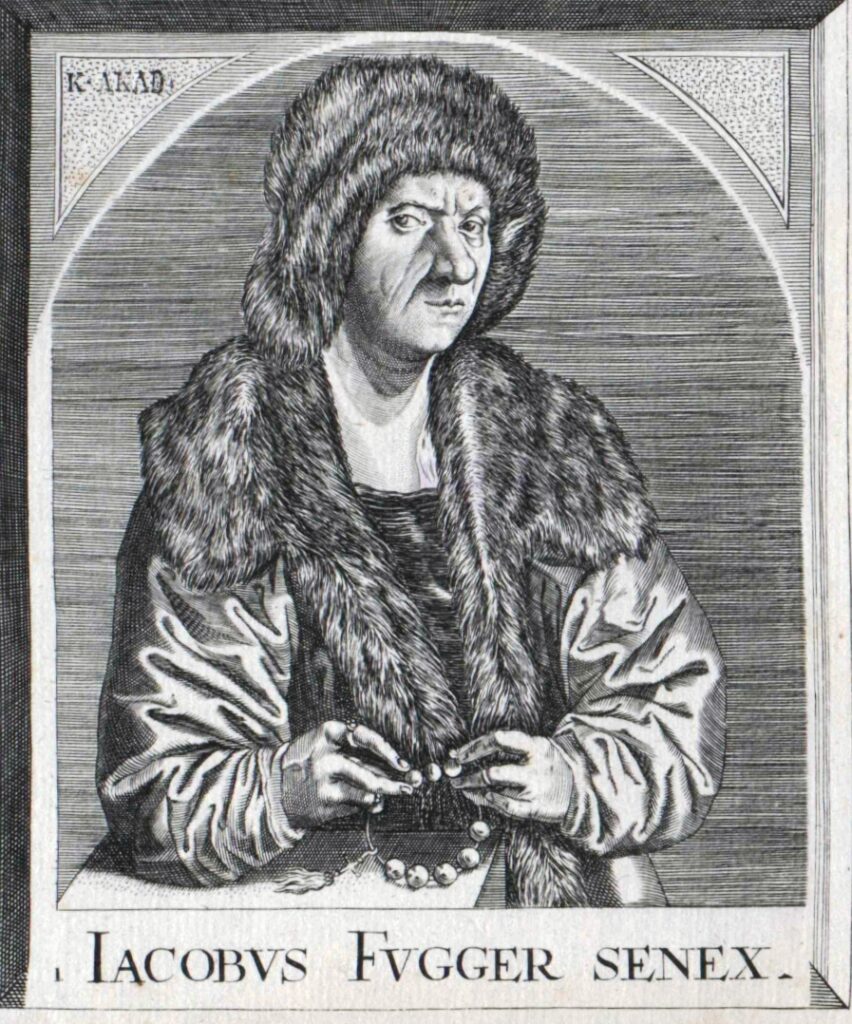
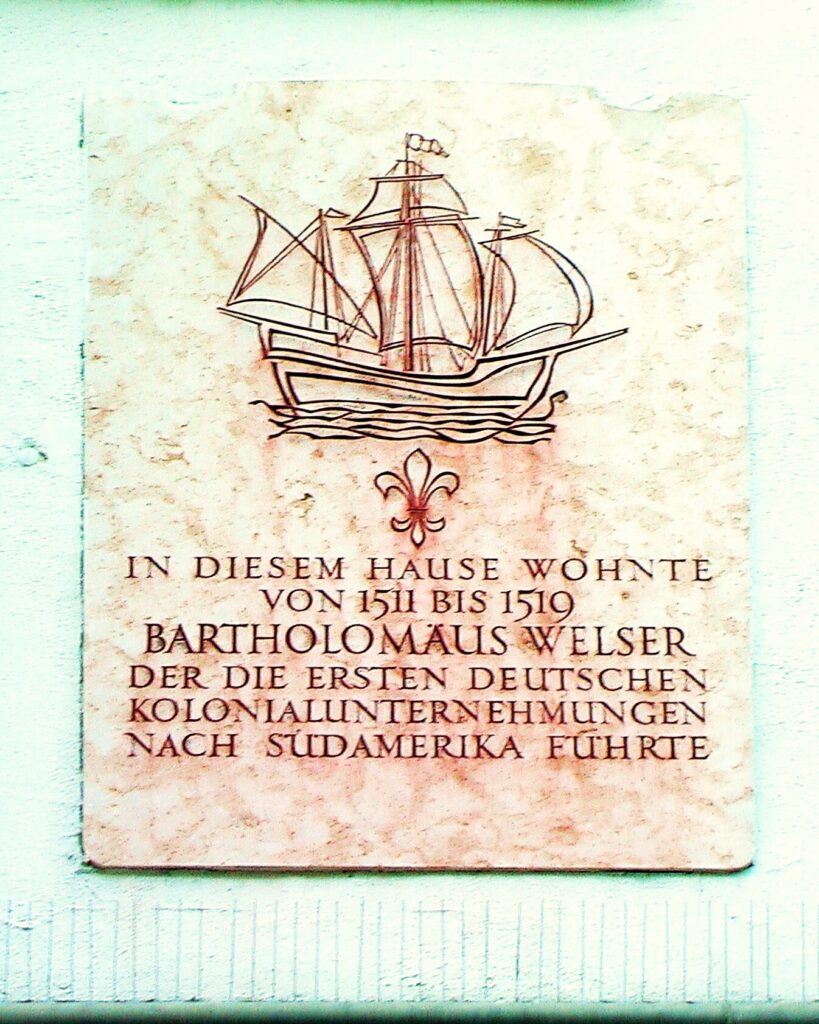
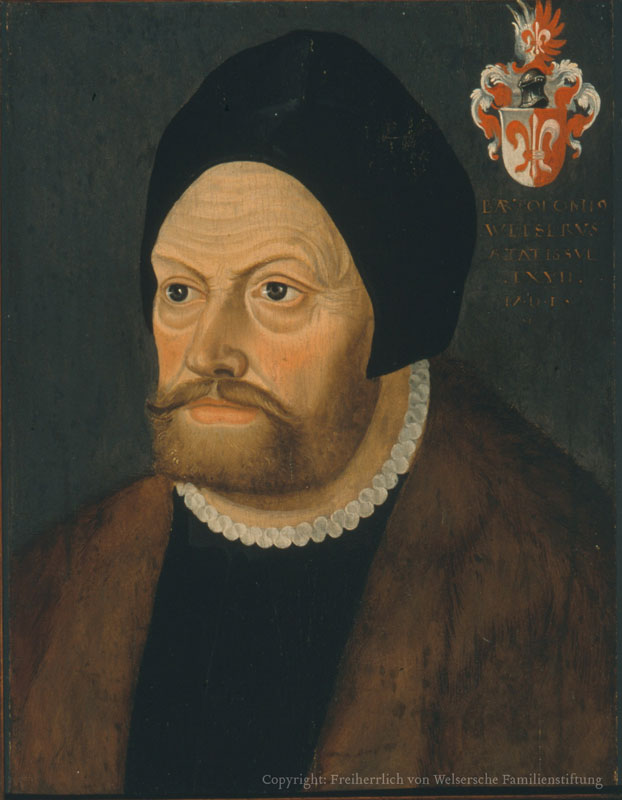
Erasmus’ and Matsys’ epoch was a glorious period of the “Renaissance in the North” but also marks the continuous efforts of these banking families’ to “buy up” the papacy and achieve world hegemony. The imperial geopolitical sharing of the entire world among the Spanish Empire (run by Venetian and Fugger bankers) and the Portuguese Empire (run by Genovese and Welser bankers), a deal formalized by the Treaty of Tordesillas, endorsed in 1494 in the Vatican by Pope Alexander VI Borgia, opened the gates to colonial subjugation of people and countries, fueled by a highly questionable sense of cultural superiority.
Following the never-ending state bankruptcies of these financial oligarchs, the Low Countries fell prey to economic looting, military dictatorship and fanaticism. By demonizing Luther, increasingly committed to creating an opposition outside the Catholic church, the oligarchy avoided successfully those urgent reforms called for by the Erasmians to eradicate abuses and corruption inside the Catholic church. Rome’s refusal to accept Henry VIII’s demands for divorce, were part of an overall strategy to plunge the entire European continent in “religious wars,” that only ended with the 1648 Peace of Westphalia.
3. Training: Bouts, Van der Goes and Memling
The early triptychs, painted by Matsys, gained him a lot of praise and got historians to present him as one of the last “Flemish Primitives”, in reality a nickname given by Michelangelo79 to intrinsically slander and discredit all non-Italian art considered “Gothic” (barbarian), or “primitive” in comparison to Italian art whichh immitated the immortal antique style.
Since he was born in Leuven, it has been thought he could have been trained by Aelbrecht Bouts (1452-1549), the son of painter dominating Leuven at that time, Dieric Bouts the Elder (c. 1415-1475).80
In 1476, one year after his father’s death, Aelbrecht reportedly left Leuven, perhaps to complete his training with a master outside the city. This master, in my view, was most probably Hugo van der Goes (1440-1482)81, whose influence on Aelbrecht Bouts, but also on Quinten Matsys, seems real.
Van der Goes, who became the dean of the Painting guild of Ghent in 1474 and died in 1482 in Red Cloister close to Brussels, was a vehement follower of the Brother’s of the Common Life and their principles82. As a young assistant of Aelbrecht Bouts, and getting training from Van der Goes, Matsys could have discovered what was the cradle of Christian humanism at that time.
Van der Goes’s most outstanding surviving work is the Portinari Triptych (Uffizi, Florence), an altarpiece commissioned for the church of Sant’Egidio in the hospital of Santa Maria Nuova in Florence by Tommaso Portinari, the manager of the Bruges branch of the Medici Bank.
The raw features of the shepherds (expressing the three states of spiritual elevation identified Jan van Ruusbroec (1294-1381) and the Brothers of the Common Life83) in van der Goes’s composition made a deep impression on painters working in Florence.
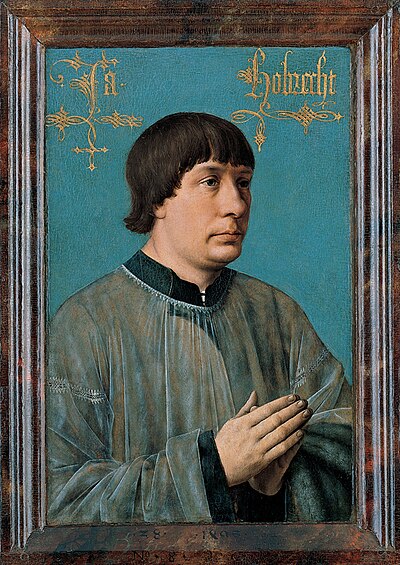
Matsys is also considered as a possible pupil of Hans Memling (1430-1494), the latter being a follower of Van der Weyden (1400-1464)84 and a leading painter in Brugge.
Memling’s style and that of Matsys, in certain aspects, are hard to distinguish.
While the Flemish art historian Dirk de Vos inscribed, in his 1994 catalogue of Hans Memling’s work, the portrait of the Flemish musician composer Jacob Obrecht85 (1496, Kimbell Art Museum, Fort Worth), as a very late work by Hans Memling, current experts, among which Larry Silver, conclusively demonstrate that in reality, it is far more likely that the portrait is the earliest known work of Quinten Matsys86.
Obrecht, who was a major influence on polyphonic Renaissance music, had been named choirmaster of the Cathedral of Our Lady in Antwerp in 1492. Erasmus served as one of Obrecht’s choirboys around 1476.
Obrecht made at least two trips to Italy, once in 1487 at the invitation of Duke Ercole d’Este I of Ferrare87 and again in 1504. Ercole had heard Obrecht’s music, which is known to have circulated in Italy between 1484 and 1487, and said that he appreciated it above the music of all other contemporary composers; consequently he invited Obrecht who died from the plague in Italy.
Already in the 1460s, Erasmus teacher in Deventer, music composer and organist Rudolph Agricola88, had travelled to Italy. After studying civil low in Pavia and attending lectures by Battista Guarino, he went to Ferrare where he became a protégé of the Este court.
Around 1499 Leonardo made a drawing of Ercole’s daughter, Isabella d’Este, according to some to be the person painted in the Mona Lisa.
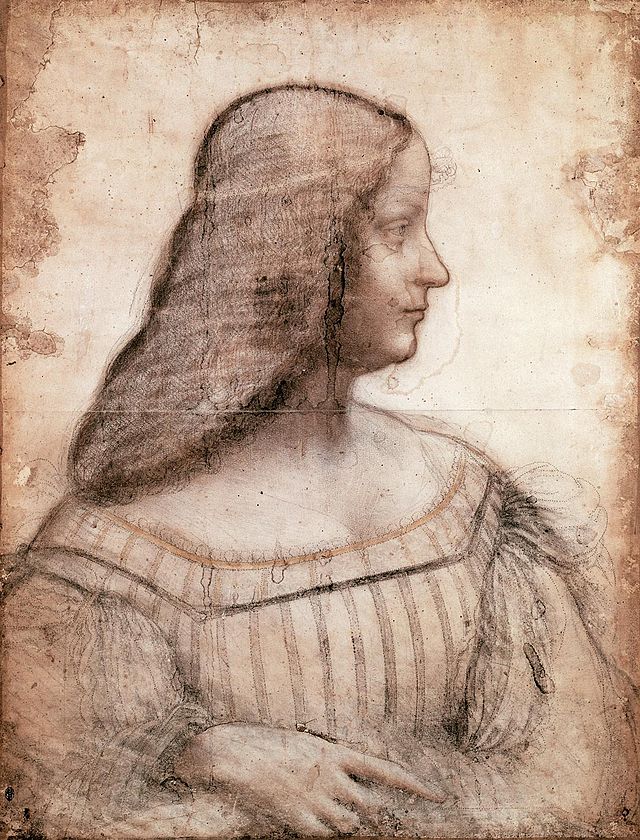

4. Getting started in Antwerp and abroad
Matsys was registered in Leuven in 1491, but the same year he was equally admitted as a master painter in the Guild of St Luke in Antwerp where, at the age of twenty-five, he decided to settle. In Antwerp, as said before, he depicted the choirmaster Jacob Obrecht in 1496, his first known work, and several Virgin and Child devotional paintings.
After that, since the Liggeren (painting guild records) don’t report any information about Matsys activity in the Low Countries for a period of several years, it remains very tempting to imagine Matsys going on an eventual trip to Italy. 89 Renowned Belgian Art Historian Dirk de Vos, considers such a trip to Northern Italy a plausible possibility.
“Metsys’s early and mature styles contrast so sharply that one can only explain what separates them by appealing to the hypothesis of an assiduous frequentation of the works of the Italian Renaissance, and more precisely those of Leonardo da Vinci and his disciples of the late 15th century. Indeed, Metsys’ immediate borrowings from Leonardo seem to rule out any other source of inspiration. While there is no tangible evidence of a trip to Italy, Metsys’ presence in Antwerp nevertheless presents solutions of continuity compatible with a prolonged absence, for example between 1491 and 1507. A trip to Italy is therefore by no means improbable.” 90
There, he could have met great masters among which Leonardo da Vinci, who lived in Milan between 1482 and 1499 and returned to Milan in 1506 where he met his pupil Francesco Melzi (1491-1567) who later accompanied him to France. Matsys could also have traveled over the Rhine to Strasbourg or Colmar. He eventually could have traveled to Nuremberg where he could have met Dürer which he seems to have known longtime before the latter came to the Netherlands in 1520.
Dürer was sent by his parents to Alsace to be trained in the art of engraving by Martin Schongauer (1450-1491), by far the most talented engraver of his time. 91
But when he arrived in Colmar in the summer of 1492, Schongauer had died. From Colmar the artist traveled to Basel, where he made designs for the woodcut illustrations for books and discovered the impressive engravings of Jacob Burgkmair (1473-1531) and Hans Holbein the Elder. 92
He then went to Strasbourg in 1492 where he met and made the portrait of the erudite humanist poet and author Sebastian Brant already mentioned above.
C. Selected Works
1. The Virgin and the Child, Divine Grace and the Free Will
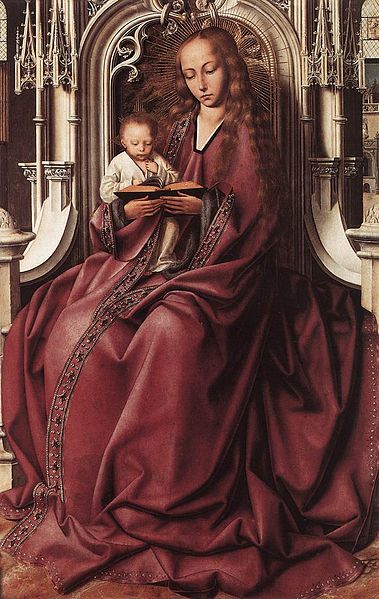

In 1495, Matsys painted a Virgin and Child (left) (Brussels). Even while still very normative, Matsys already “enriches” devotion with less formal scenery of daily life. The child, playfully exploring new physical principles, clumsily tries to turn the pages of a book, while a very serious Virgin sits herself in an elaborated niche of Gothic architecture, probably chosen to fit with the building or house where the work would end up being exposed.
Another Virgin and Child (right) (Rotterdam) of Matsys goes even further in this direction. It shows a quite happy caring young mother with a playful child, underlying the fact that Christ was the son of God but now had become human.
On a display close to the viewer, a loaf of bread and a cup of milk-soup with a spoon, undoubtedly the daily scene for most inhabitants of the Low Countries trying to feed their children.

Another “Madonna and child with the milk soup,” (Brussels) this one painted in 1520 by Matsys’ friend, the painter Gerard David, literally shows a young mother teaching her child that the backside of a spoon is not the best tool to transfer milk soup to one’s mouth.
One outstanding feature of many virgins of these period, be it by Quinten Matsys (Virgin and Child, Louvre, 1529, Paris) or Gerard David (Rest on the flight into Egypt), National Gallery, Washington), is the image of the child trying, with great difficulties, to get a hold on a fruit, be it a cherry or a grape of raisin.

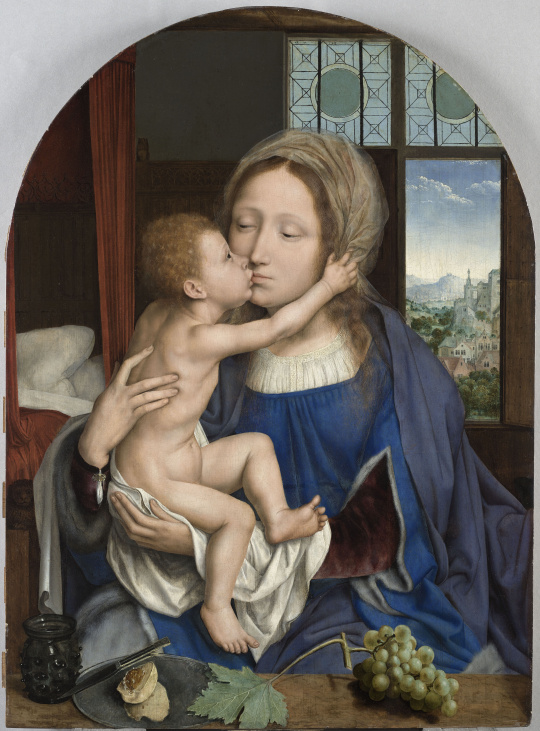
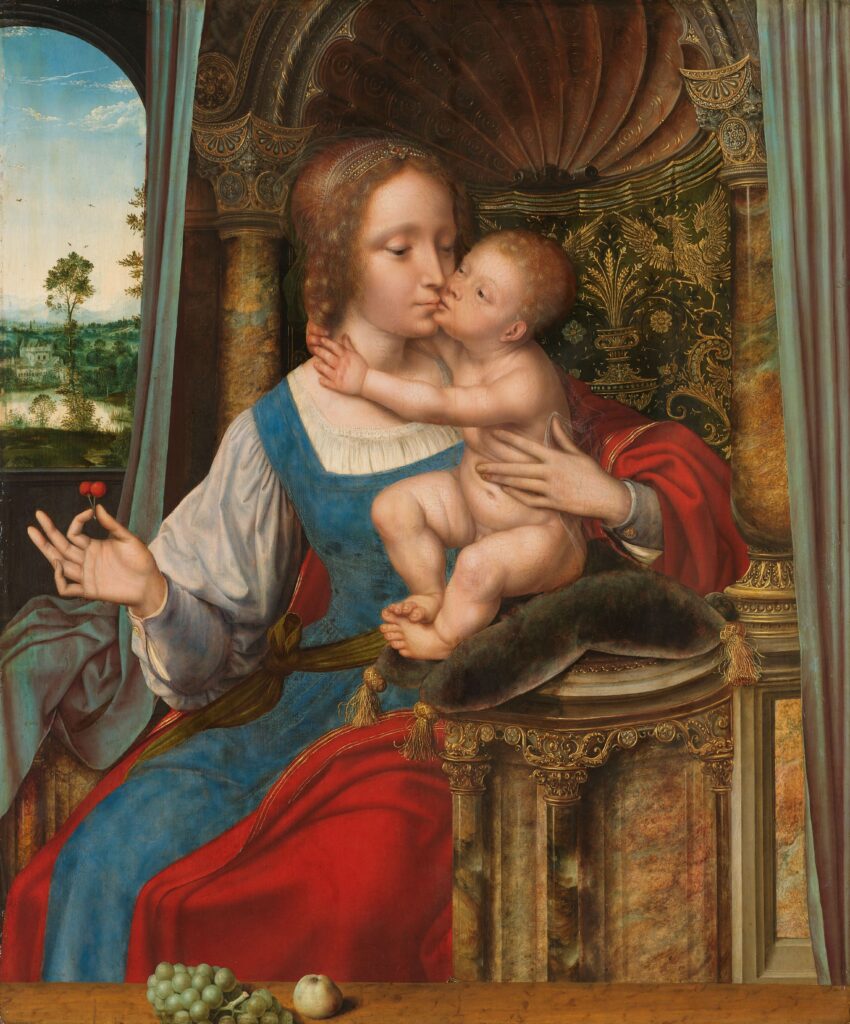
In 1534, in his Diatribe on the Free Will, Erasmus also used this metaphor on the fragile equilibrium to be considered in the proportion between the operations of the free will (which, alone, separated from a higher purpose, can become pure arrogance) and those of divine grace (which alone can be misunderstood as a form of predestination).
To make that point clear with an image, paints paints a very simple metaphor, but of extreme tenderness and beauty:
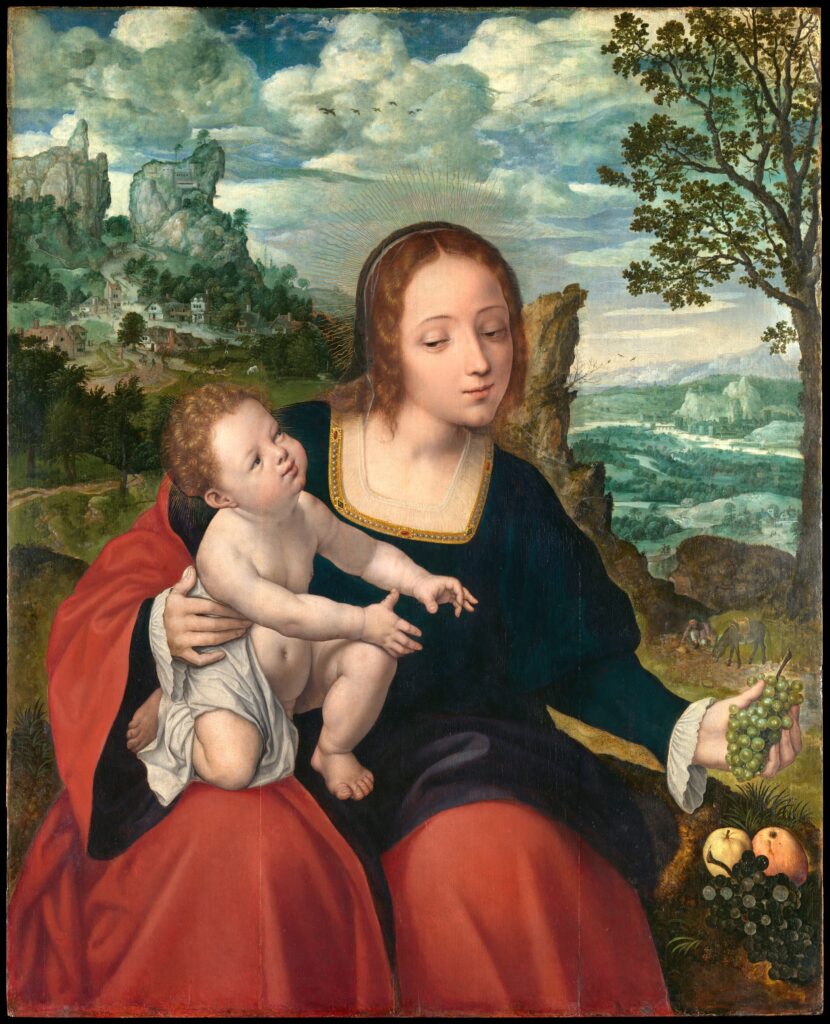
“A father has a child still incapable of walking; it falls; the father pulls him up while the child makes hectic moves and struggles to keep his balance; he shows him a fruit in front of him; the child strives to grab it, but because the weakness of its limbs it would quickly fall if the father did not stretch out his hand to support and guide his walking.
Thus, guided by his father, the child arrives at the fruit that the father willingly puts in his hands as a reward for his effort. The child would never have risen if the father had not lifted him up; he would never have seen the fruit if the father had not shown it to him; he could not have advanced had the father not supported his feeble steps; and he would not have reached the fruit if his father had not put it into his hands.
What will the child claim as his own acts in this case? Hence, one cannot say he did not do anything. But there is no reason to glorify his strength, since he owes to his father everything that he is.” 93
In short, free will, yes, but without pretending that man can do it alone.
2. Saint Anne Altarpiece
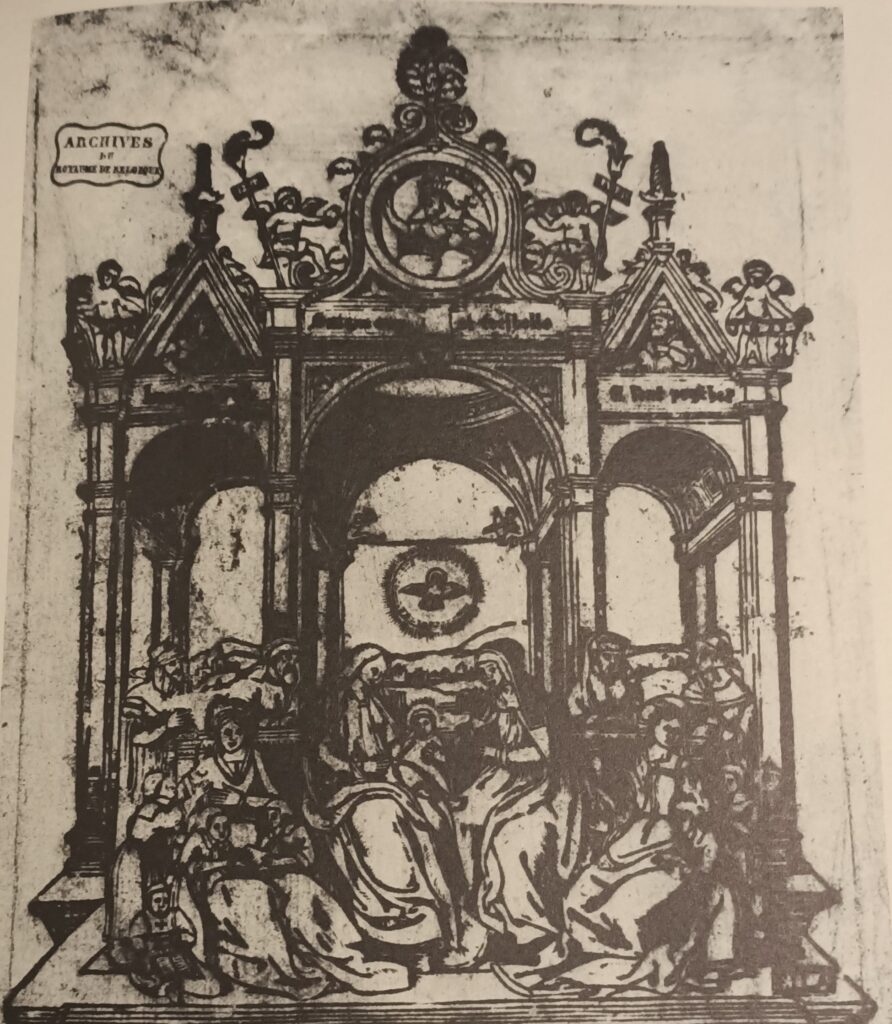
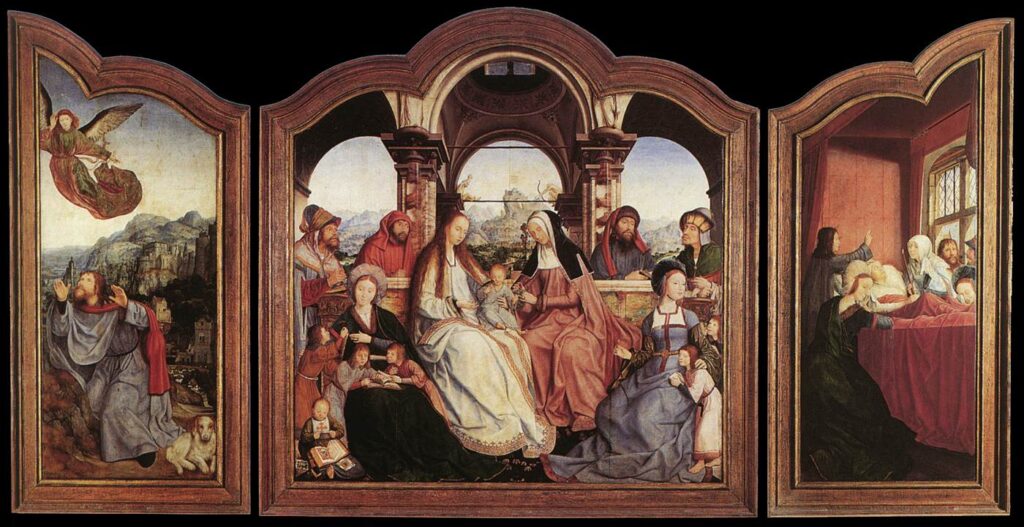
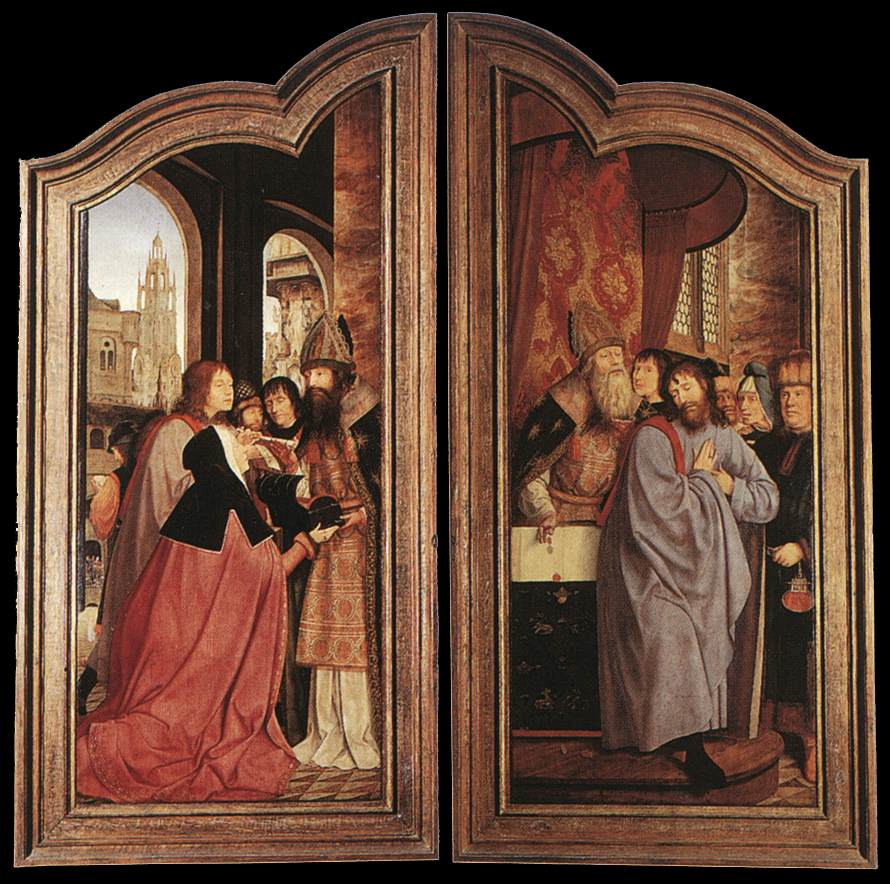
In Antwerp, Matsys’ activity made a major step forward with the first important public commissions for two large triptych altarpieces:
- the Joiners’ Guild Altarpiece (c. 1511, Antwerp museum), also known as the Lamentation, clearly inspired by Roger Van der Weyden’s Deposition of the cross (Prado, Madrid) ;
- the Saint Anne Altarpiece (1507–1509, Brussels museum), painted for the Collegiate Church of St Peter in Leuven and signed “Quinte Metsys screef dit.” (Quinten Metsys wrote this).
Saint Anne Alterpiece
The content and narrative of the Saint Anne Alterpiece was of course entirely dictated to the painter by the commissioners willing to decorate their dedicated chapel of the Church. The central panel depicts the history of the family of St Anne – the Holy Kinship – inside a monumental building crowned by a truncated dome and arcades that offer a wide view on a mountainous landscape.
The altarpiece depicts five scenes from the life of Anne, the Virgin’s mother and her husband Joachim. The various members of the saint’s family appear on the central panel. The key event in the life of Anne and her husband Joachim, namely that they will become the parents of the Virgin Mary while they thought themselves incapable of having children, is depicted in the left and right panels of the triptych.
The Chaste Kiss
The “immaculate” conception, allowing Anna to have the virgin Mary as her child, is depicted as a chaste kiss between the couple in front of the Golden Gate of the Jerusalem city wall. This subject was immensely popular and painted before by Giotto and later by Dürer.
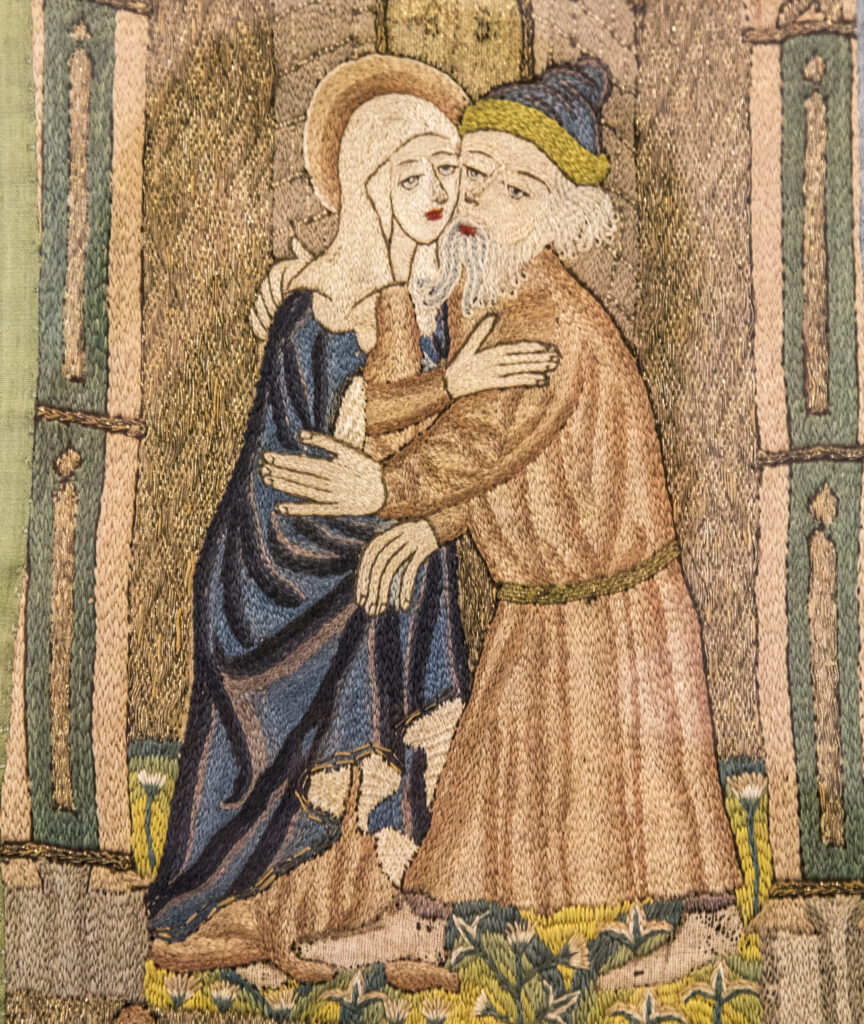


The “chaste kiss” as a metaphor for the immaculate conception of the Virgin, was well received by the public. As a result, it was rapidly transposed to the immaculate conception of Christ himself. Hence, the sudden appearance of paintings showing Mary “kissing” her baby as close as on the lips.
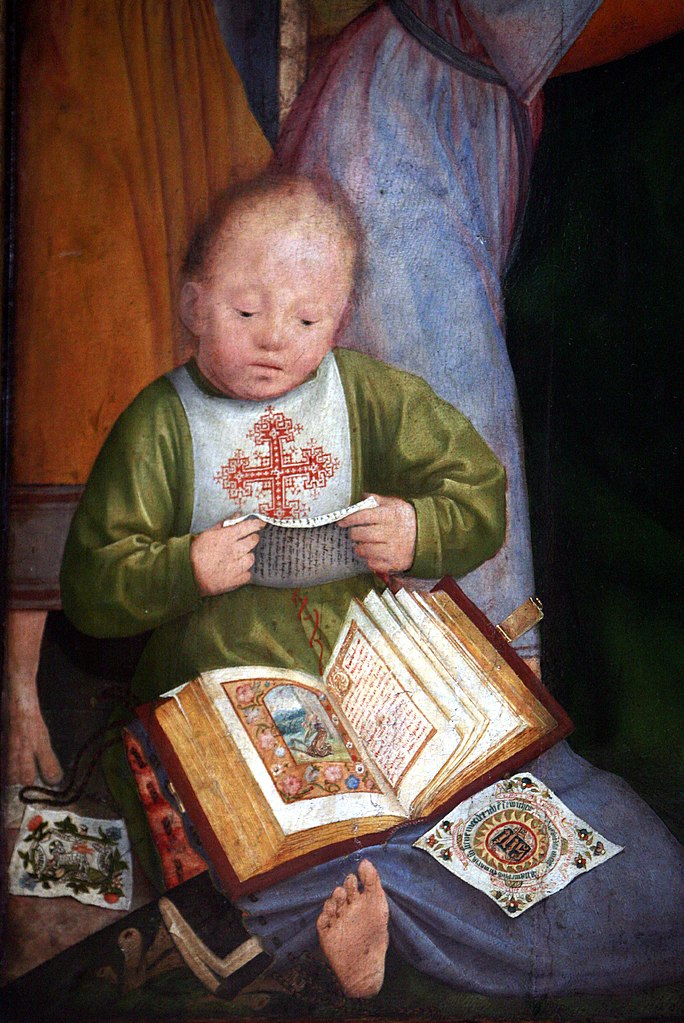
The cycle on the Altarpiece ends with Anne’s death depicted on the inside right panel where she is surrounded by her children and Christ giving his blessings.
Despite the impressive scale and the conventional narrative, Matsys sought to create a more intimate feeling of contemplation. An example of this is the figure of the small cousin of Jesus in the left corner, who playfully gathers beautiful illuminations around him and, now fully focused, tries to read them.
3. A new perspective
In two other articles94, I have underscored the fact that both Jan Van Eyck95 and Lorenzo Ghiberti96 were quite familiar with “Arab optics”, in particular the works of Ibn-al-Haytham97 (known by his Latinized name Alhazen).
During the Renaissance, at least two “schools”, after opposing each other, ended up completing each other respecting the best way to represent “space” in art.
For one school, centered on Alberti98, space could be reduced to a “central” vanishing point, i.e. a purely mathematical geometrical construction. For the other, that of Roger Bacon, Witelo and later Johannes Kepler, one had to start from the physiognomy of both eyes and how they produce the image of space in the mind. Van Eyck and Ghiberti used both approaches employing either the one-eyed « cyclopic » Alberti model denounced by Leonardo, or the « bi-focal » Alhazen approach.
Since the cyclopic approach has been decreed to be the only “mathematical” and therefore the only “scientific” way to represent space, the bi-focal approach was slandered as being full of “errors” or purely intuitive and “non-scientific”. Among those accused, most paintings of the “Flemish Primitives”
Now, as mentioned earlier, since 2007, the Ghent Interdisciplinary Center for Art and Science (GICAS) has been working on a new « catalogue raisonné » of the work of Quinten Matsys.
In 2010, Jochen Ketels and Maximiliaan Martens investigated99 Matsys’s 1509 Saint Anne Altarpiece and the impressive italianate portico on the central panel to be understood as a visual element integrating the entire work in a three-dimensional wooden frame currently lost (see images above).
“When we directed our photographic lamps to the central panel, they reported, the raking light revealed something that hadn’t been mentioned in the literature at all: incised construction lines in the coffered vaults of the architecture.” 100
Infra-red also brought to light the existence of
“a complicated set of drawn construction lines, both freehand as well as aided ones, created with several tools and techniques. Not only has such a complex construction system not been observed in Northern paintings of this period, Matsys must have used a mathematically based procedure to construct the complex loggia.”
« (…) To design the contours of the truncated dome and its decoration, Matsys hardly used any lines, but preferred points” (…) “to the bottom of the capital, Matsys added a few separated letters, presumably a ‘z’, ‘e’ or ‘c’ and ‘l’ or ‘e’. Because of their position close to the element, and the fact that e.g. Piero della Francesca had already used a similar system with numbers and letters in his drawings in De Prospectiva Pingendi (On the perspective of paintings, about 1480), there are reasons to assume a link with the outline or the composition of the column.” 101

In this respect, it is noteworthy that one of the rare persons, in contact with Matsys at one point or another, which had read and studied Piero della Francesca’s treaty on perspective was none-other than Albrecht Dürer, whose own Four Books on Human Proportion (1528) builds on Piero’s groundbreaking achievements.102
The investigators also verified Matsys’ use of the central vanishing point perspective by employing the “cross-ratio” method. Astonished, they demonstrate that “Matsys shows his competence in matters of perspective, equal to Italian renaissance standards” and that his perspective was “very correct, indeed.” 103
Till now, it was taken for granted that the science of perspective only reached the Low Countries after Jan Gossaert’s trip to Rome in 1508, while Matsys’s, showing his masterful and extensive knowledge of science of perspective, started composing this oeuvre as early as 1507.
4. Matsys’ cooperation with Patinir, Dürer and Leonardo
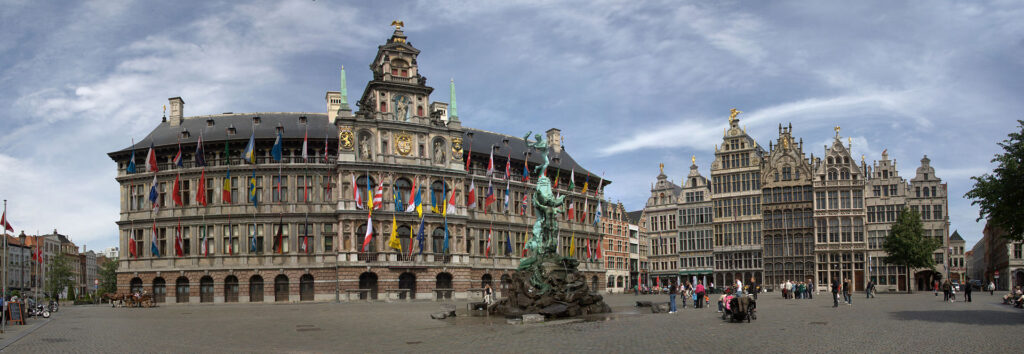
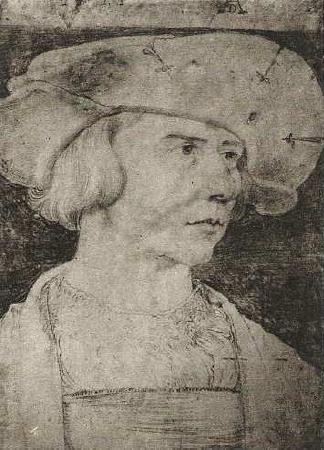
A final note on this painting: the mountainous landscape behind the figures already resembles the typical, disquieting landscapes produced by Matsys’s close friend Joachim Patinir, another little-known giant in the history of painting.
Yet Patinir’s authority was no mean feat. Felipe de Guevara, friend and artistic advisor to Charles V and Philip II, mentions Patinir in his Commentaries on Painting (1540) as one of the three greatest painters in the region, alongside Rogier van der Weyden and Jan van Eyck.
Patinir ran a large studio with assistants in Antwerp. Among those under the triple influence of Bosch, Matsys and Patinir are:
- Cornelis Matsys (1508-1556), son of Quinten, who married Patinir’s daughter;
- Herri met de Bles (1490-1566), active in Antwerp, possible nephew of Patinir;
- Lucas Gassel (1485-1568), active in Brussels and Antwerp;
- Jan Mostaert (1475-1552), painter active in Haarlem;
- Frans Mostaert (1528-1560), painter active in Antwerp;
- Jan Wellens de Cock (1460-1521), painter active in Antwerp;
- Matthijs Wellens de Cock (1509-1548), painter-engraver active in Antwerp;
- Jérôme Wellens de Cock (1510-1570), painter-engraver, who, with his wife Volcxken Diericx, founded In de Vier Winden, probably the largest engraving workshop north of the Alps at the time, employing Pieter Brueghel the Elder.
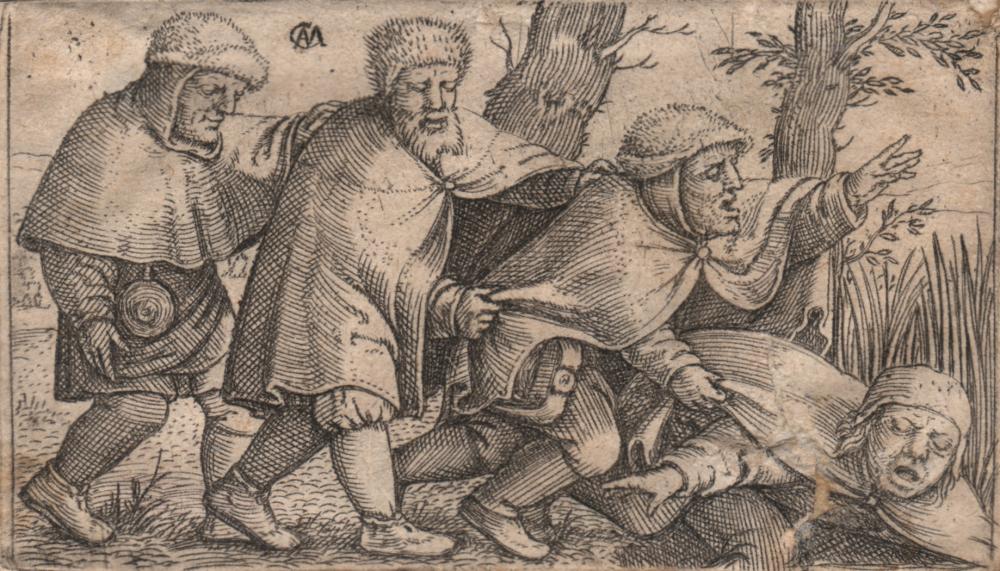
It is generally accepted that Matsys painted the figures in some of Patinir’s landscapes. According to the 1574 Escorial inventory, this was the case for The Temptations of Saint Anthony (1520, Prado, Madrid).
One is tempted to think that this collaboration between friends worked both ways, with Patinir creating landscapes for Matsys’ works and at his request, a reality that somewhat challenges the persistent myth of a Renaissance presented as the cradle of modern individualism.
The fact that Matsys and Patinir were very close is confirmed by the fact that, after Patinir’s untimely death (at age 44), Matsys became the guardian of his two daughters. It’s also interesting to note that Gerard David, who became Bruges’ leading painter after Memling, became a member of the St. Lucas guild in Antwerp in 1515 jointly with Patinir, which gave him legal access to the booming Antwerp art market.
Modern art historians tend to present Patinir as the « inventor » of the landscape painting, claiming that for him religious subjects were mere pretexts for the development of landscapes that were the true protagonists, much as Rubens painted Adam and Eve only because we wanted to paint nudes.
Eventually true for Rubens but dead wrong for Patinir, whose “beautiful” landscapes, as art historian Reindert L. Falkenberg documented in depth104, were nothing but a sophisticated sort of deceptive trick of the devil attracting souls to attach themselves to earthly pleasure…

Albrecht Dürer
A unique source of information is Dürer’s diary of his visit to the Low Countries. 105 Why did Dürer come to the Low Countries? One of the explanations is that following the death of his main patron and order giver emperor Maximilian I, the artist came in an effort to get his pension confirmed by Charles V.
Dürer arrived in Antwerp on August 3, 1520 and visited Brussels and Mechelen where he was received by Margaret of Austria (1480-1530), aunt of Charles V, who sometimes lent Erasmus a sympathetic ear, in charge of administering the Burgondian Low Countries as long as Charles was to young.


In Mechelen, Dürer certainly visited the beautiful residence of Hieronymus of Busleyden (1470-1517, soon to become the financial mecenas of the « Trilingual College »106 launched by Erasmus in Leuven in 1517. Busleyden was a friend of Cuthbert Tunstall (1475-1559), the Bishop of London who introduced him to Thomas More.
While staying with Margaret, Dürer reports having been able to admire an incredible painting from her collection, The Arnolfini couple (1434) by Jan van Eyck. Margaret had just granted a pension to a Venetian painter, Jacopo de’ Barbari (1440-1515), 107 a painter-engraver, diplomat and political exile in Mechelen who painted a portrait of Luca Pacioli (1445-1514), the Franciscan friar that introduced Leonardo to Euclid and wrote the De Divina Proportiona (1509), illustrated by Leonardo. De Barbari was described by his contemporaries, including Dürer, the Venetian art-lover Marcantonio Michiel (1584-1552) and the Antwerp humanist Gerad Geldenhauer.
In 1504, de Barbari met with Dürer in person in Nuremberg, and the pair discussed the canon of human proportions, a core subject of the latter’s research over the next 24 years. 108
Hence, an unpublished draft version of Dürer’s own treatise on the subject reveals that he thought the Italian was holding back on him:
“…I find no one who has written anything about how to make a canon of human proportions except for a man named Jacob, born in Venice and a charming painter. He showed me a man and a woman which he had made according to his system of measurement, so that I would now rather see what he meant than dream of a new kingdom, Jacobus did not want to show his principles to me clearly, that I saw well.” 109
By March of 1510 de’ Barbari was in the employ of the regentess Archduchess Margaret of Austria (1480-1530) in Brussels and Mechelen. In January 1511, he fell ill and made a will, and, in March, the Archduchess gave him a pension for life on account of his age and weakness. He was dead by 1516, leaving the Archduchess with his stock of 23 engraving plates and a book of drawings. 110 But when Dürer asked to get a hold on them, she politely declined his request. 111
For his part, Matthias Mende believes that:
“Dürer’s theoretical works are unthinkable without direct or indirect knowledge of Leonardo da Vinci’s ideas. Even tracings of Leonardo’s anatomical plates have been found in Dürer’s estate.” 112

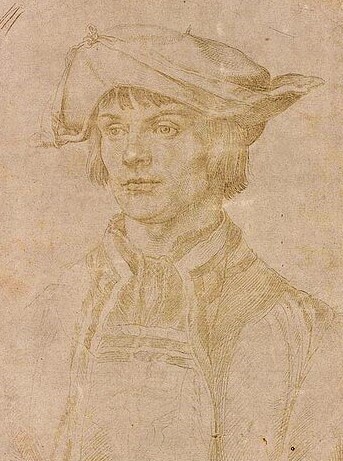

The artist’s diary reveals nevertheless that he was often entertained by his local colleagues. In Antwerp, « I went to see Quinten Matsys in his house, » wrote Dürer in his journal.113
In the same city, he makes a portrait sketch of Lucas van Leyden114, and the famous portrait of the 93 year old bearded old man who became the model for his St. Jerome.

He met Erasmus at least three times, and sketched a wonderful portrait of him showing mutual complicity. Erasmus placed an order with him since the humanist needed a large number of portraits to send to his correspondents throughout Europe. As his diary indicates, Dürer sketched Erasmus several times in charcoal during these meetings and used them for an engraved portrait of him six years later.
After the death of his wife, Patinir married Johanna Noyts. On 5 May 1521, he invited Albrecht Dürer to his wedding. How and when that friendship started, or if it was just opportunistic, is not known. The master of Nuremberg sketched Patinir’s portrait and called him « der gute Landschaftsmaler » (« the good landscape painter »), creating a new word for what became a new genre.
At the wedding he meets Jan Provoosst (1465-1529), Jan Gossaert (of Mabuse) (1462-1533) and Bernard van Orley (1491-1542), some of them more attracted by the pomp of the court than by Erasmian humanism. But Provoost’s Death and the Miser (1515) is clearly inspired by Bosch.
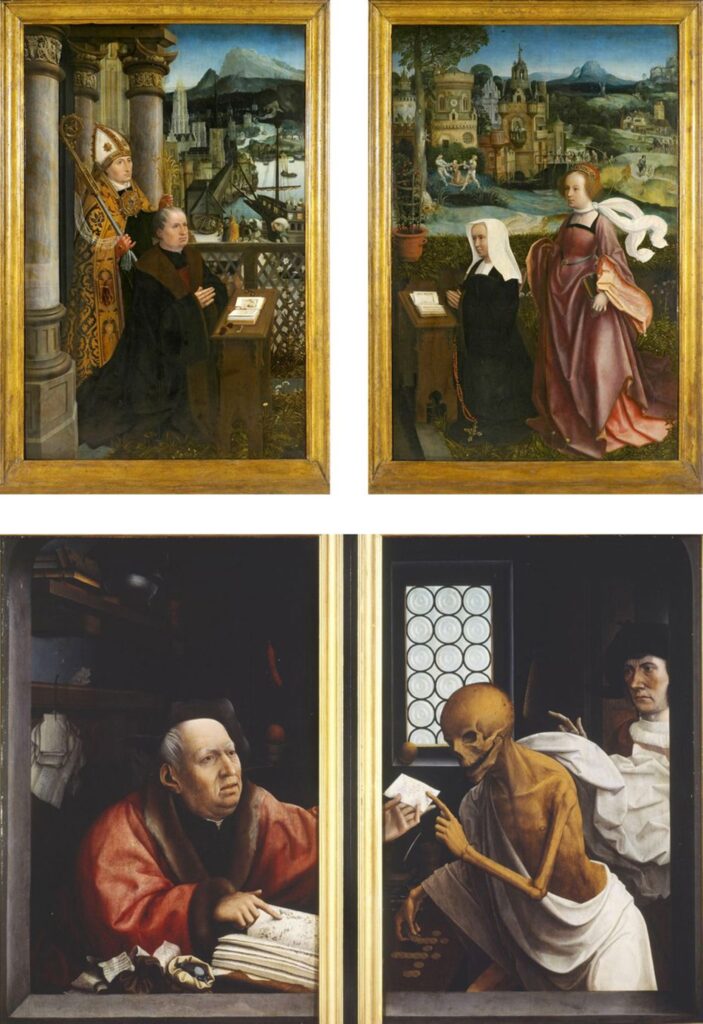
One figure that could have mediated the encounters between intellectuals and craftsmen, was the poet, Latin teacher and philologist Grapheus, a collaborator of Erasmus printer Dirk Martens. In 1520, he became secretary to the city of Antwerp.
Printers and editors played a key role in the Renaissance as they where the key middlemen between intellectuals, erudites and scholars on the one side, and illustrators, engravers, painters and craftsmen on the other side.
As Dürer himself, he was attracted to the ideas of the Reformation of which they considered both Luther and Erasmus to be leading voices. What is known is that Grapheus bought Dürer a copy of Luther’s De Captivitate (On the Babylonian Captivity of the Church), at that time a must read for anyone having interest in the reform of the Church.
Just as Erasmus and many other humanists, Dürer is also said to have been the guest of Quinten Matsys in the latter’s fabulous house in the Schuttershofstraat, decorated with Italianate decorations (festoons of leaves, flowers or fruit) and decorative and symmetric motives of lines and figures.

An idealized representation of the Dürer-Matsys encounter (with Thomas More and Erasmus looking on) can be seen in a painting of Nicaise de Keyser (1813-1887) at the Royal Museum of Arts of Antwerp.
Another scene, an 1889 drawing by Godfried Guffens (1823-1901) shows the Antwerp Alderman Gerard van de Werve receiving Dürer presented to him by Quinten Matsys.

When Charles V returned from Spain and visited Antwerp, Grapheus wrote a panegyric to welcome his return. But in 1522, he was arrested for heresy, taken to Brussels for interrogation and imprisonment. As a result, he lost his position as secretary. In 1523, he was released and returned to Antwerp, where he became a Latin teacher. In 1540, he was reinstated as secretary of the city of Antwerp.
Quentin Matsys’ own sister Catherine and her husband suffered at Leuven in 1543 for what had become the capital offense of reading the Bible since 1521: he being decapitated, she allegedly buried alive in the square before the church.
Because of their religious convictions, the Matsys children left Antwerp and went into exile in 1544. Cornelis ended his life somewhere abroad.
5. The Erasmus connection


In 1499, Thomas More and Erasmus met in London. Their initial meeting turned into a lifelong friendship as they continued to correspond on a regular basis during which time they worked collaboratively to translate into Latin and have printed some of the works of the Assyrian satirist, Lucian of Samosata (c. 125-180 AD), erroneously called « The Cynic. »
Erasmus translated Lucian’s satirical text De Mercede Conductis (The Dependant Scholar115 and had it send to his friend Jean Desmarais, a Latin teacher at the University of Louvain and a canon at Saint Peter’s Church in that city.
Lucian blasts scholars that sell their soul, mind and body to the ruling oligarchy:
“The elite of Rome are their friends. They dine sumptuously, and call for no reckoning. They are lodged splendidly, and travel comfortably — nay, luxuriously — with cushions at their backs, and as often as not a fine pair of creams in front of them. And, as if this were not enough, the friendship they enjoy and the handsome treatment they receive is made good to them with a substantial salary. They sow not, they plough not; yet all things grow for their use.”…116
In a real manifesto against voluntary servitude, Lucian goes after their personal corruption and the real reasons for their selling out:
“And now for the true reason, which you will never hear from their lips. Voluptuousness and a whole pack of desires are what induce them to force their way into great houses. The dazzling spectacle of abundant gold and silver, the joys of high feeding and luxurious living, the immediate prospect of wallowing in riches, with no man to say them nay,— these are the temptations that lure them on, and make slaves of free men; not lack of the necessaries of life, as they pretend, but lust of its superfluities, greed of its costly refinements. And their employers, like finished coquettes, exercise their rigors upon these hapless slaves of love, and keep them forever dangling in amorous attendance; but for fruition, no! never so much as a kiss may they snatch. To grant that would be to give the lover his release, a conclusion against which they are jealously on their guard. But upon hopes he is abundantly fed. Despair might else cure his ardent passion, and the lover be lover no more. So there are smiles for him, and promises; always something shall be done, some favor shall be granted, a handsome provision shall be made for him,— someday. Meanwhile, old age steals upon the pair; the superannuated lover ceases from desire, and his mistress has nothing left to give.”117
It was through his meeting with Erasmus that Thomas More got introduced to Erasmus’ friend, Pieter Gillis, a fellow humanist and chief town secretary of Antwerp. It was Erasmus who suggested that Gillis meet Thomas More. The meeting took place in Antwerp in 1515, when More was sent on a diplomatic mission by King Henry VIII to settle some major international commercial disputes.
Gillis, who started as a seventeen year-old proofreader in Dirk Martens print shop in Leuven, met Erasmus in 1504. The humanist gave him the advice to study further and they kept in contact. Printer Martens had edited in Leuven several humanist’s books, most notably those of Denis the Carthusian and Rudolphus Agricola’s De inventione dialectica (1515) the higher-education manual most widely bought, and used in schools and universities throughout Europe.
Just as More and Erasmus, Gillis was an was an admirer of the latter’s teacher at the Deventer school of the Brothers of the Common Life, Agricola, a great pedagogue, musician, builder of church organs, a poet in Latin and the vernacular, a diplomat, a boxer and a Hebrew scholar towards the end of his life.
Gillis’ house in Antwerp was an important meeting place for humanists, diplomats and artists with international allure. Quinten Matsys is also a gladly seen guest. Gillis also recommended the painter Hans Holbein the Younger, who had illustrated Erasmus In Praise of Folly, to the court of England, where Thomas More received him delighted. His brother Ambrosius Holbein (1494-1519), would later illustrate Erasmus’ and More’s Utopia.
6. Thomas More’s Utopia
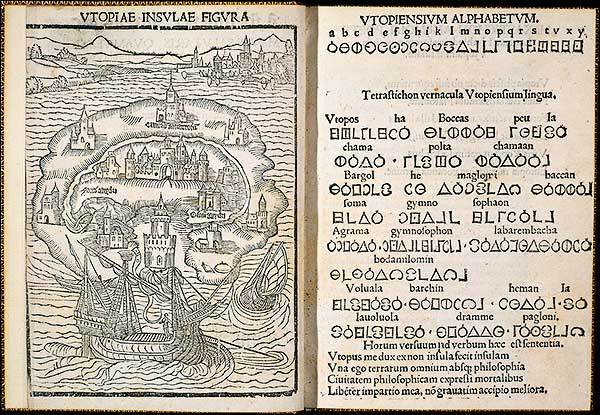
Gillis shared with More and Erasmus a great sensitivity to justice, as well as a typically humanist sensibility devoted to the search for more established sources of truth.
As a matter of fact, he is best known as a character in Utopia, a famous book in whose first pages Thomas More presents him as a model of civility and a humanist who was both pleasant and seriousness:
“I often received during this stay [in Bruges], among other visitors and welcome among all, Pieter Gilles. Born in Antwerp, he enjoys great credit and a prominent position among his fellow citizens, worthy of the highest, for this young man’s knowledge and character are equally remarkable. He is indeed full of kindness and erudition, welcoming everyone liberally, but, when it comes to his friends, with such élan, affection, fidelity and sincere devotion, that one would find few men to compare with him when it comes to the things of friendship. Few also have his modesty, his lack of affectation, his natural good sense, so much charm in conversation, so much wit with so little malice.”

Thomas More’s most famous composition was of course his two-volume work entitled Utopia. It is a depiction of a fictional island that was not ruled by an oligarchy as most western states and empires, but ruled on the basis of the ideas of the good and the just Plato formulated in his dialogue, the Republic.
While Erasmus’ In Praise of Folly called for a reform of the Catholic Church, Erasmus’ and More’s Utopia, satirizing the corruption, greed, cupidity and failings they saw all around them, called for the reform of the State and Economy.
The whole idea of the book came to Thomas More whilst he was staying at the Antwerp residence of Gillis, Den Spieghel, in 1515.
In the first volume, entitled Dialogue of Counsel, it begins with correspondence between More himself and others, including Pieter Gillis. On his return to England in 1516, the English humanist wrote the main part of the work and the first edition was completed and edited by Erasmus and published in Leuven.


The first edition contained a woodcut map map of the island of Utopia, verses by Gillis and the “Utopian alphabet” the latter invented for the occasion, verses of Geldenhouwer and Grapheus, completed with Thomas More’s epistle dedicating the work to Gillis.
Several years after More’s and Erasmus’ death, in 1541, Cornelius Grapheus, with Pieter Gilles, published his Enchiridio Principis Ac Magistratus Christiani.
7. Pieter Gillis and the “Friendship Diptych”
Besides triptychs and religious paintings, Matsys also excelled in portraits. One of the most beautiful works of Quinten Matsys is the double portrait of Erasmus and his friend Gillis, painted in 1517118. This friendship diptych would act as a “virtual” visit to their English friend Thomas More in London and they approached Quinten Matsys to carry out the two paintings as he was the leading Antwerp painter at that time.
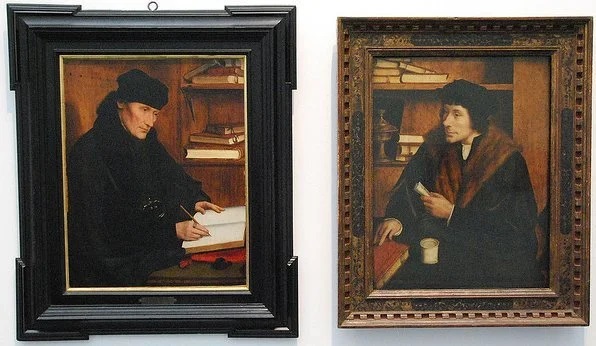
Erasmus’ portrait was the first to be completed because the portrait of Gillis was constantly being delayed due to him falling ill during the sittings. The two men had told Thomas More about the paintings which may not have been a wise move as More constantly queried them as to the progress of the paintings and became very impatient to receive the gift. The two works were finally completed and were sent to More whilst he was in Calais.
Both learned educated men, although they are portrayed on separate panels, are presented in one continuous study area. Erasmus is busy writing and Pieter Gillis points to a book (not yet published) by the Humanist, the Antibarbari, while he holds a letter from More in his left hand. The presentation in a study room makes one think of presentations of St. Hieronymus study room, who with his bible translation is an example for all humanists and whose work Erasmus had just published.
If you look closely, in the folds of Erasmus’ cloak you can just make out a purse. It could be that Erasmus wanted the artist to include this in order to illustrate his generosity. Erasmus and Gillis made a point of informing Thomas More that they had split the cost of the painting because they wanted it to be a present from them both. If you look at the two paintings side by side then one can see that Matsys has cleverly continued the bookcase behind the two sitters and this gives the impression that the two men depicted in the two separate panels occupy the same room and are facing each other.
It is interesting to look at the books on the shelves in the background. On the upper shelf of the Erasmus painting there is a book which has the inscription Novum Testament which alludes to Novum Testamentum Graece, the first published edition of the Greek New Testament produced by Erasmus in 1516.
On the lower shelf there is a stack of three books. The bottom tome has the inscription Hieronymus which refers to Erasmus’s edition of St Jerome; in the middle, there is a book with the inscription Lucian and refers to Erasmus and Thomas More’s collaboration in translating Lucian’s satirical Dialogues. The inscription on the book on top of these three is the word Hor, which originally read Mor. The first letter was probably altered during an early restoration, for besides Mor being the first letters of Thomas More’s surname they almost certainly refer to the satirical essays written by Erasmus whilst staying with Thomas More in his London home in 1509 and entitled Encomium Moriae (Praise of Folly). This collection of essays was considered one of the most notable works of the Renaissance.
We see Erasmus writing in a book. This depiction has been carefully thought out for the words one sees on the page paper are a paraphrase of St Paul’s Epistle to the Romans, the handwriting is a careful replication of Erasmus’s own hand, and the reed pen he holds was known to be Erasmus’s favorite writing tool.
Thomas More let his pleasure about these portraits be known in many letters, the paintings being executed, « with such a great virtuosity that all painters from Antiquity pale in comparison », while confessing once he would have preferred his image carved in (far more immortal) stone.
8. The Da Vinci connection (I)


Several paintings clearly prove that Matsys and his circle had extensive knowledge and took some of their inspiration from some of Leonardo da Vinci’s paintings and drawings without necessarily fully comprehending its full and far ranging scientific and philosophical content.
Such is clearly the case in the Virgin and child (1513, Poznan, Poland), literally presenting in front of a Patinir style mountain landscape, the gracious loving pose of Mary embracing the Christ with the latter embracing the lamb, directly a copy of Da Vinci’s Saint Anna and the Virgin (1503-1517), one of the works Leonardo had brought to Amboise in France in 1517 and of which also Leonardo’s pupil Francesco Melzi made a copy/interpretation.
As said before, it is not known how this “form” came to the attention of the master, be it prints, drawings or other.

A second example can be seen in The Lamentation of Christ (1508–1511), a vast triptych painted for the chapel of the Carpenter Corporation in the Cathedral of Our Lady in Antwerp (Koninklijk Museum voor Schone Kunsten, Antwerp). Both John the Baptist and John the Evangelist, which appear when the triptych is closed, were there patron saints.
The central scene of the open triptych, which is reminiscent of Rogier van der Weyden’s The Descent from the Cross (1435 Museo del Prado, Madrid), is supported by the landscape. The religious drama is considered in detail and harmoniously staged.
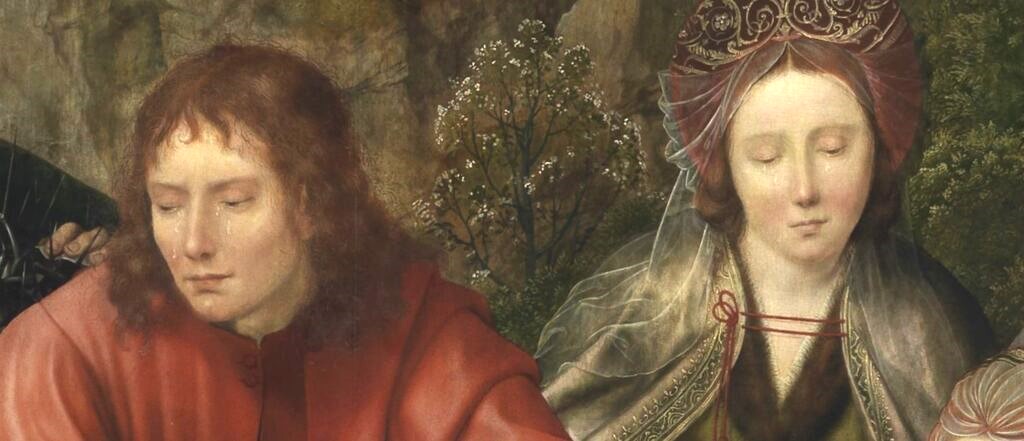
At the same time, Matsys respects the great attachment of the believers to the narration and the description. If the scene is conducive of reflection and prayer. Matsys uses the science of contrast. If some of the figures, especially the oriental heads, could have been inspired by the many exotic faces the painter would have seen around him in the world trade hub that was Antwerp in his days, the graceful faces of those struck with pain and sorrow are extremely beautiful.
In the middle panel, we see not the suffering, but the lament after the suffering. It depicts the moment at which Joseph of Arimathea119 comes to ask the Virgin for her permission to bury Christ’s body. Behind the central action is the hill of Golgotha, with its few trees, the cross and the crucified thieves.
The left wing panel shows the martyrdom of John the Evangelist and Salome presenting John the Baptist’s head to the Roman Jewish Client King Herod the Great.120
The right hand panel is a scene of extraordinary cruelty, depicting St John, his body plunged into a cauldron of boiling oil. The saint, who is naked from the waist up, seems almost angelic, as if he were not suffering. Around him is a crowd of sadistic faces, ugly boors in garish clothes. The one exception to this rule is the figure of a young Flemish boy, maybe a representation of the painter himself, who is watching the scene from above in a tree.
Now the faces of those surrounding St John the Baptist and also the two main figures heating up the cauldron are directly taken or inspired by a drawing after Leonardo in the Royal Collection at Windsor Castle, labeled Man tricked by gypsies (formerly known as the Five Grotesque Heads).
Flemish irony and humor gave a great welcome to that of Leonardo!
In Leonardo’s case, the faces even seem as breaking up in hilarious laughter, when looking at each other and at the central figure with a crown on his head. The leaves of the crown are not those of laurels to celebrate poets and heroes, but leaves of an oak tree. At that time, the anti-humanist and war mongering pope was Julius II121, which Rabelais put in hell. Julius was a member of a powerful Italian noble family, the House of Della Rovere, literally “of the oak tree”…

D. The Science of Erasmian Grotesque
1. In religious painting
The use of grotesque heads expressing the low passions that overwhelm and dominate evil persons was common practice in religious paintings to create contrast of expression.
In 1505, Dürer went to Venice and also to the university city of Bologna to learn about perspective and then journeyed further south to Florence, where he saw some works of Leonardo and Raphael, and further south to Rome.

Christ Among the Doctors, 1506, was painted in Rome in five day’s time and reflects the influence of Leonardo’s grotesques. Dürer was back in Venice early in 1507 before returning to Nuremberg in the same year.

Hieronymus Bosch’s Christ carrying the cross (after 1510, Ghent) is another famous example. Christ’s head is surrounded by a dynamic group of grotesque “tronies” or faces. Was Bosch inspired by Leonardo and Matsys, or was it the other way around?
While the composition may seem chaotic at first glance, its structure is actually very rigid and formal. Christ’s head is positioned precisely at the intersection of two diagonals. The beam of the cross forms one diagonal, with the figure of Simon of Cyrene helping carry the cross at the top left, and with the “bad” murderer to the bottom right.
The other diagonal connects the imprint of Christ’s face on Veronica’s sudarium at the bottom left with the penitent thief, at the top right. He is attacked by an evil charlatan or a Pharisee and an evil monk, a clear allusion by Bosch to the religious fanaticism of his era. The grotesque heads remind us of the masks that are often used in passion plays as well as of Leonardo’s caricatures.
By way of contrast, the softly modeled face of Christ is serene. He is the Suffering Christ, who has been abandoned by everyone and who shall triumph over all evil in the world. This representation ties in perfectly with the ideas of the Devotio Moderna.122


Quinten Matsys, in his Ecce Homo’s (1526, Venice, Italy) cleary bases his work on the Bosch’s tradition.
2. Misers, bankers, tax collectors and money-changers, the fight against usury
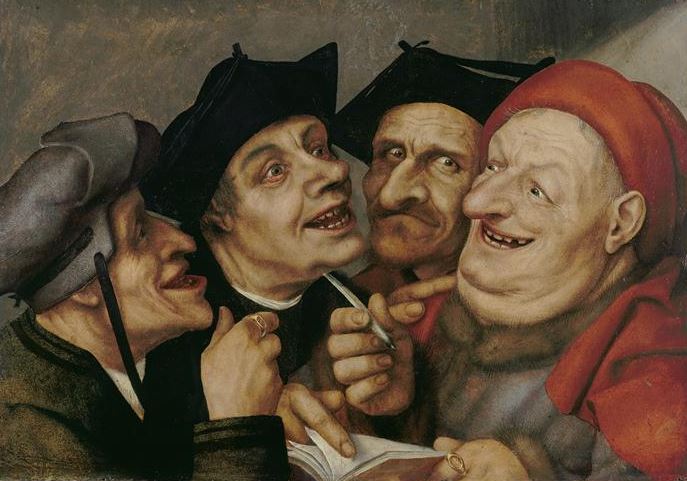
Directly relevant to Erasmus’ and More’s religious, philosophical, sociological and political critique, and certainly with some relevance for today, Matsys’ denunciation of usury and greed.
Marlier keenly sketches how usurers and speculators became dominant players of Antwerp’s economic life.
« In the sixteenth century, the gradual replacement of the old corporate system by the new capitalist economy went hand in hand with a succession of crises, with the little people suffering most of all. While stock market speculation, currency manipulation and money trading helped build up considerable fortunes, they also impoverished and often ruined craftsmen and peasants. Enriched merchants and financiers took over industry, reducing workers to the status of proletarians. From now on, workers are subject to all the conditions of those who employ them. Wages were no longer respected, and unemployment often plunged families into misery.”
« The economic upheaval was accompanied by financial turmoil caused by the influx of precious metals from America to Spain. Huge banking operations were carried out in Antwerp, which became Europe’s major money market under Charles V. From the third decade of the century onwards, the purchasing power of currencies began to weaken, resulting in a steady rise in prices. Wages, on the other hand, remained static. Men of finance took possession of goods, erected monopolies and even seized land, squeezing tenants mercilessly. These were the new rich, against whom the poor and weak whispered, but whom the Emperor protected, because they alone were able to advance him the funds required by his European policy. Charles V had to submit to the draconian demands of his bankers, and the exorbitant interest payments prompted him to multiply taxes. He discounted the proceeds of future taxes and auctioned off certain treasury offices. The resulting abuses are easy to guess. Taxes were not levied directly by the government, but leased to private tax-collectors, who make themselves odious by their exactions. They have no mercy on the little people, from whom they take what little they have. »123
Under those circumstances, notes Marlier, with everybody over their neck into debt and in urgent need for cash, usurers found a fantastic market to prosper.
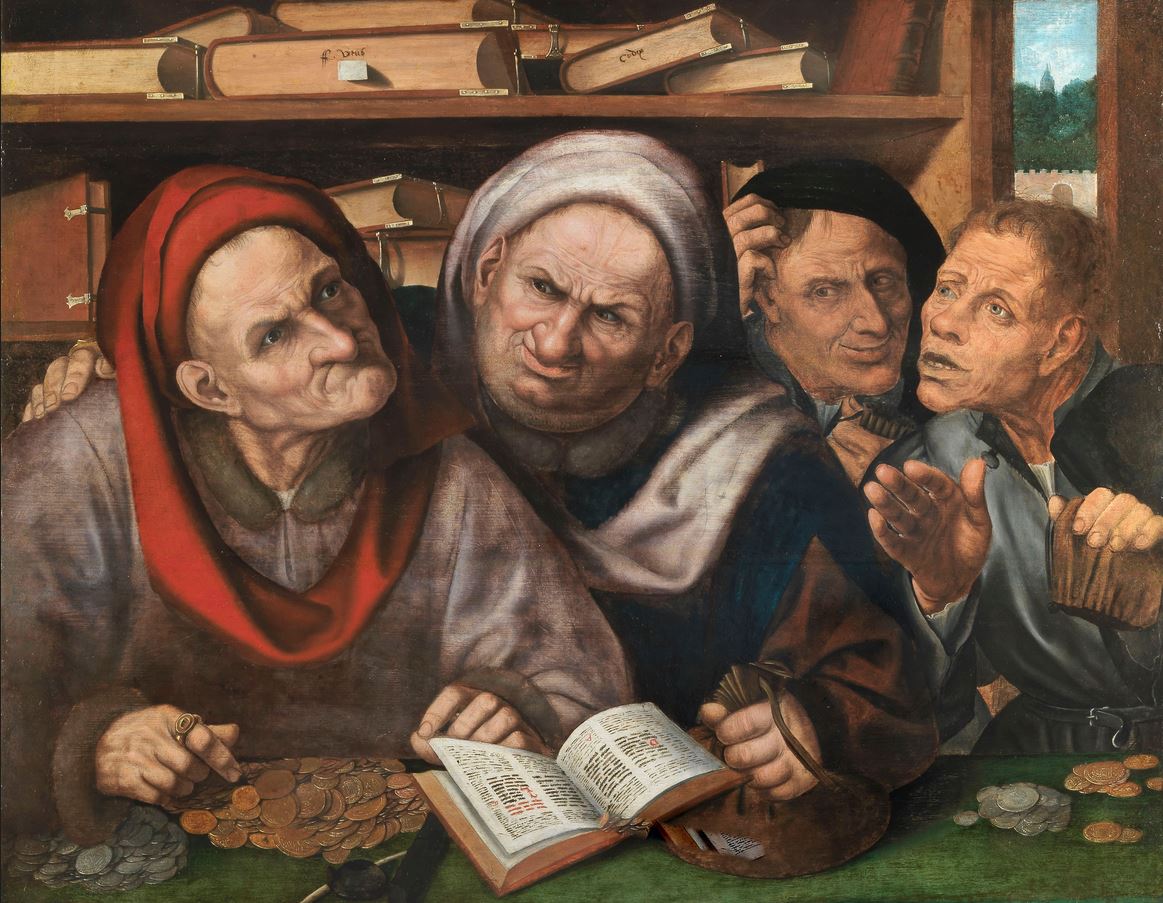
Abroad, the Fuggers and Welsers124 duly participated in the emerging trade of enslaved people from Africa.
The Fuggers used their mines in Eastern Europe and Germany to produce manillas — metal objects of exchange that have gone down in history as a “slave trade currency” due to their use on the coasts of West Africa. The Welsers, in turn, attempted to establish a colony in what is now Venezuela (Spanish name derived from the Italian Venezziola, “little Venice”, which became Welserland) and shipped more than 1,000 enslaved Africans to America. Meanwhile, in the homes of prosperous Augsburg citizens, enslaved people from India were forced to toil for their “masters”.
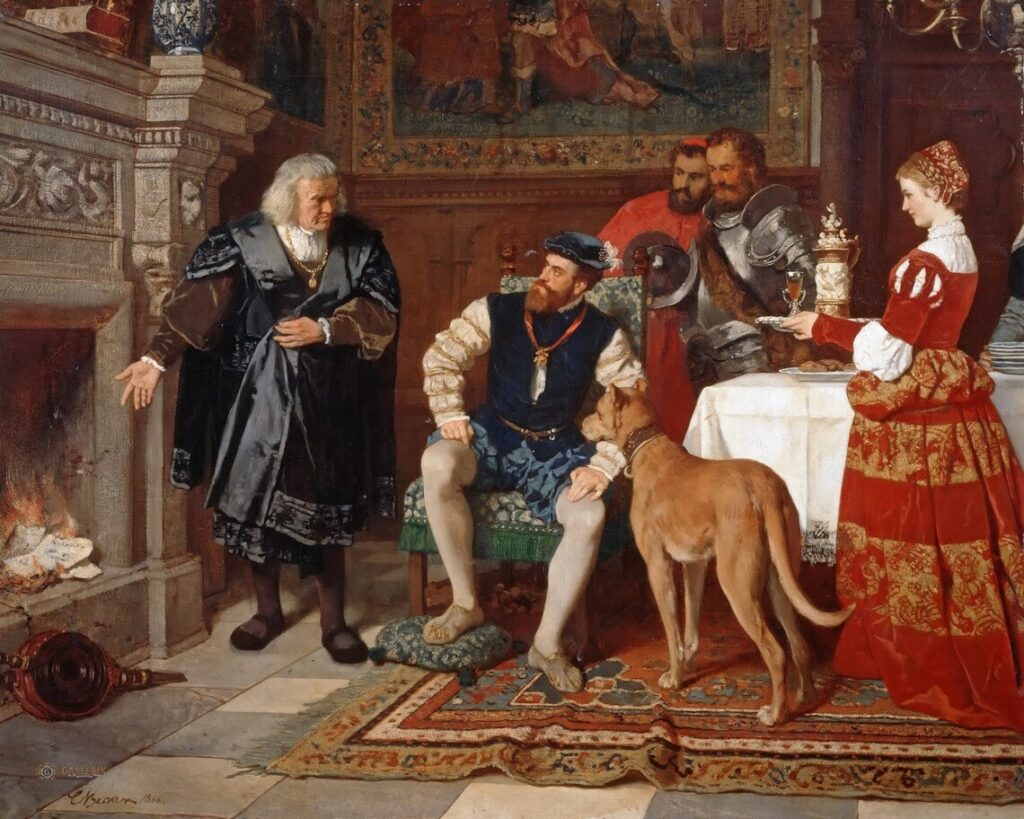
According to the official Fugger family website, the story that Anton Fugger threw his promissary notes into the fire in 1530, in front of Charles V, in order to generously waive repayment of loans, is pure fiction. But he did grant the new emperor a proverbial “haircut”. In exchange Charles V abandoned his plans for an “imperial monopoly law” that would have massively curtailed the scope of action of the banking and trading houses in the Holy Roman Empire.
According to Fugger researcher Richard Ehrenberg, the story about Anton didn’t emerge until the late 17th century, presumably to demonstrate his loyalty to the Emperor. 125
Thomas More and Erasmus expose and sharply condemn the rise of predatory and criminal financial abuse in their book Utopia. Erasmus, while not refusing the rise of modern entrepreneurial capitalism, denounces the abuses of financial greed.
“Christ, he said, did not forbid ingenious activity, but the tyrannical search for profit.” 126
Civil servants, he argued in his Education of a Christian Prince written for Charles V, should be recruited on the basis of their competence and merit, and not because of their glorious name or social status.
For Erasmus, (speaking through the mouth of Folly):
« The craziest and most despicable of all human classes is that of merchants. Constantly occupied with the vile love of gain, they use the most infamous means to satisfy it: lying lies, perjury, theft, fraud and imposture fill their entire lives. However, they believe themselves to be great people, because their fingers are laden with gold rings, and there are enough flatterers who don’t blush to give them the most honorable titles in public honourable titles in order to catch a piece of such ill-gotten acquisitions. » 127
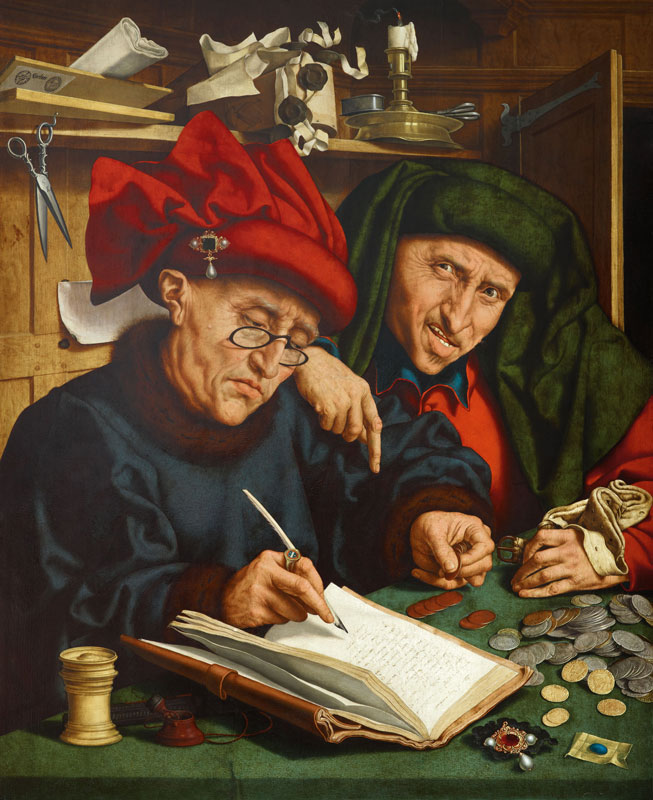
Liechtenstein Collection, Vaduz.
One can, as Silver argues, on the basis of what’s written in the records and the fact that tax collection was outsourced to private individuals, rebrand Quinten Matsys’ painting, often referred to as The Misers, as the more « factually exact » name of Tax Collectors. However, that doesn’t change the fact the subject is precisely what exposes an old Netherlandish proverb of the period:
“A usurer, a miller, a money-changer, and a tax-collector are Lucifer’s four evangelists.”
While the municipal financial officer on the left seems « reasonable » since his face is not “grotesque”, the man sitting behind, in a strange turn of his arm protecting a leather purse, shows the grotesque, ugly face of greed, justified by what he declared and was noted in the records. The complicity between both men is the real ugliness of the story.
Money-changers, admits Silver, often performed the same role as bankers, citing economic historian Raymond de Roover. Moreover, the unrepresented fourth scoundrel, the miller (a target in Bosch’s and Bruegel’s paintings), was often castigated because grain prices became a chronic sore spot in eras of fluctuating commodity prices, as was true in just this period.
Considering the fact that financial looting became dominant after the 1520s, such denunciations of financial greed could not but become very popular. The satirical subject was taken up almost immediately by the painter’s son Jan Matsys (1510-1575), copied close to identically by Marinus van Reymerswaele (1490-1546) and by Jan Sanders van Hemessen (1500-1566).
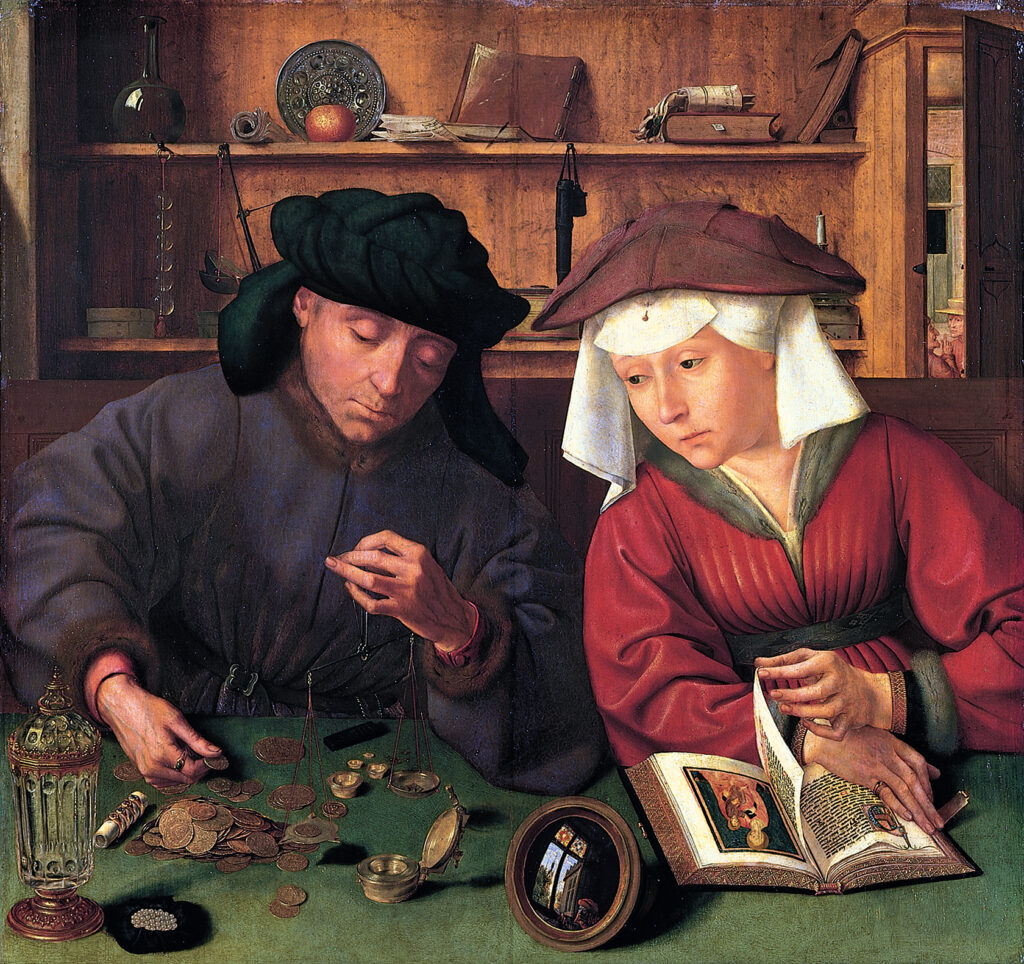
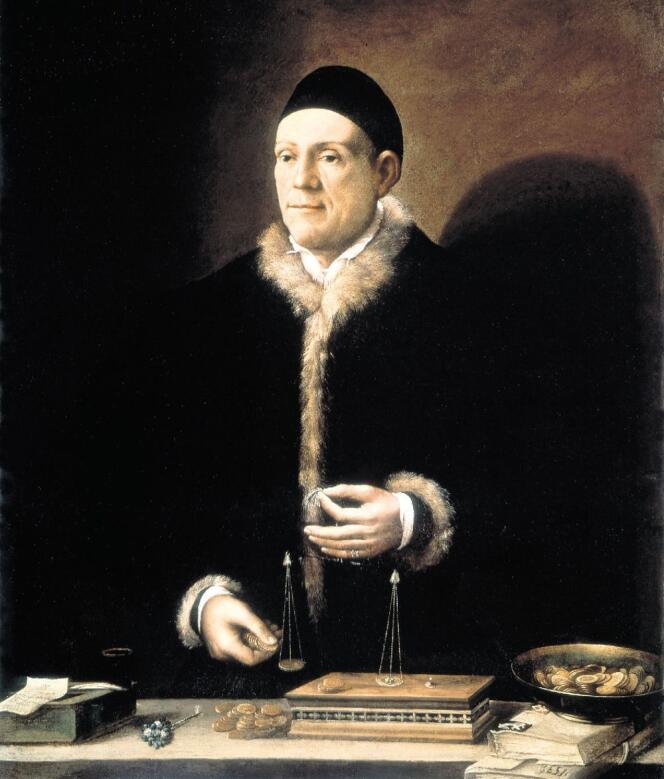
In a more “civilized” version of this metaphor, starting from the same theme, there is Matsys’ famous Banker (or Money Changer) and His Wife (1514, Louvre, Paris). 128
In a chapter of his opus majus Flemish Primitives entitled The Heirs of the Founders, Erwin Panofsky considers Matsys’ The Money Changer and his Wife to be a “reconstruction” of a “lost work by Jan van Eyck (a ‘painting with half-body figures, depicting a boss doing his accounts with his employee’), which Marcantonio Michiel claims to have seen in the Casa Lampugnano in Milan.” 129
Once again, it is not a double portrait of a banker of his wife, but a moralizing metaphor. While the banker, who has attached his prayer beads on the wall behind him, is cross-checking if the weight of the metal of the coins correspond to their nominal value, his wife, turning the pages of a religious hour book, throws a sad look at the greedy obsessions of her visibly unhappy husband.
In 1963, Georges Marlier wrote: « The painting in the Louvre has no satirical accent, but reflects a moral concern (…) The edifying intention was underlined by an inscription that appeared on the frame at the time, around the middle of the 17th century, when the painting was in the Stevens collection in Antwerp: ‘Stature justa et aequa sint podere’ (let the scales be just and the weights equal » (Leviticus, XIX, 35).” 130
The banker has, besides the scales he’s using, attached a pair of them to the wall behind him. For the Christian Humanists, the weight of material wealth is the opposite of that of spiritual richness.
In Van der Weyden’s Last Judgment in Beaune, France, the painter ironically shows an angel weighing the resurrected souls, sending the heaviest of them… to hell.
Others speculate the banker’s wife is not completely unaffected by all the coins on the table but the attention of her eyes goes more to the hands of her husband than to the objects on the table. Piety or the pleasure of wealth? A fruit on the shelve (apple of orange), juste above her husband, might be a reference to the forbidden fruit but the estinguished candle on the shelve behind herself recalls the shortness of earthly pleasures.
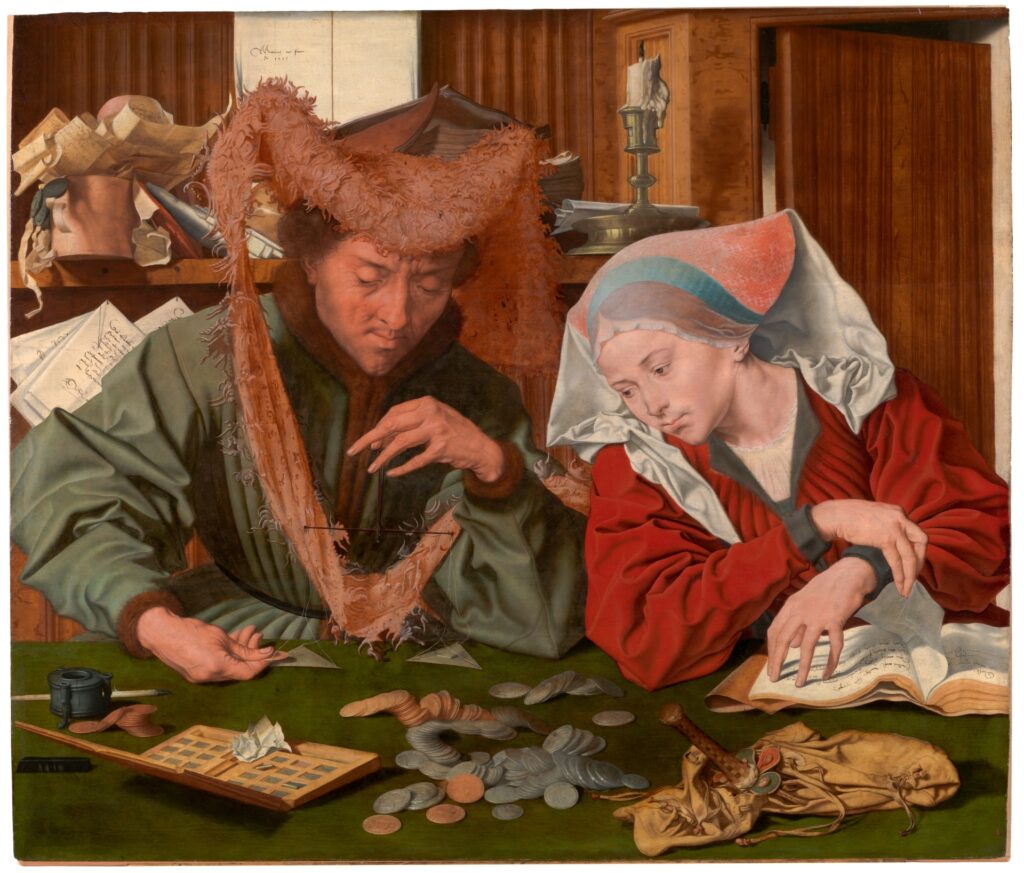
When Marinus van Reymerswaele copies this theme, the woman’s temptation for the money on the table seems even bigger.

The convex mirror131 (who disappears in the copies made by Matsys’ followers), operating as a “mise en abîme” (a play in the play or a painting in a painting), shows a man (the banker?), reading himself a (religious?) book. The mirror does not necesseraly shows some existing real space but can very will represent an imaginary time sequence outside that of the space-time of the main scene. It might show the banker in his future life, free from greed, reading a religious book with great fervor.
While the use of image of convex mirrors (whose optical laws were examined in depth by arab scientists such as Ibn al-Haytam and studied by Franciscans at Oxford132 such as Roger Bacon) reminds both Van Eyck’s Arnolfini couple (National Gallery, London)133 and Petrus Christus (1410-1475) Goldsmith in his workshop or Saint Eligius (1449, Metropolitan Museum of Art, New York), with a couple standing behind134, Matsys’ painting, is a unique creation of its kind.
In terms of content, the painting could also be related to a common theme at that period, namely The Calling of Saint Matthew.135
9 As Jesus went on from there, he saw a man named Matthew sitting at the tax collector’s booth. “Follow me,” he told him, and Matthew got up and followed him.
10 While Jesus was having dinner at Matthew’s house, many tax collectors and sinners came and ate with him and his disciples. 11 When the Pharisees saw this, they asked his disciples, “Why does your teacher eat with tax collectors and sinners?”
12 On hearing this, Jesus said, “It is not the healthy who need a doctor, but the sick. 13 But go and learn what this means: ‘I desire mercy, not sacrifice.’[a] For I have not come to call the righteous, but sinners.”
(Mt 9:9-13)
The above passage is probably autobiographical in that it describes the Matthew’s call to follow Jesus as an apostle. As we know, St. Matthew responded positively to Jesus’ call and became one of the Twelve Apostles.

According to the Gospel, Matthew’s name was originally Levi, a tax collector serving Herod and therefore not very popular. The Romans forced the Jewish people to pay taxes. Tax collectors were known to cheat the people by charging more than required and pocketing the difference. Of course, once Levi accepted the call to follow Jesus, he was pardoned and given the name Matthew, meaning “Yahweh’s gift.”

This theme of course could not but have pleased Erasmus, since it doesn’t insist on punishment but on positive transformation for the better. Both Marinus van Reymerswaele (in 1530) and Jan van Hemessen (in 1536), who copied and were inspired by Matsys, took up the subject as The calling of Saint-Matthew showing Jesus (on the right) calling on a tax collector to abandon his profession. In Van Hemessen’s painting we also see, just as in Matsys’ work, the wife of the tax-collector standing in front, also with her hand on an open book.
The good news is that, till now, the most generally accepted hypothesis as to the meaning of this painting is that it is an allegorical and moralizing work, on the theme of the vanity of earthly goods in opposition to timeless Christian values, and a denunciation of avarice as a cardinal sin.
3. The Da Vinci connection (II)
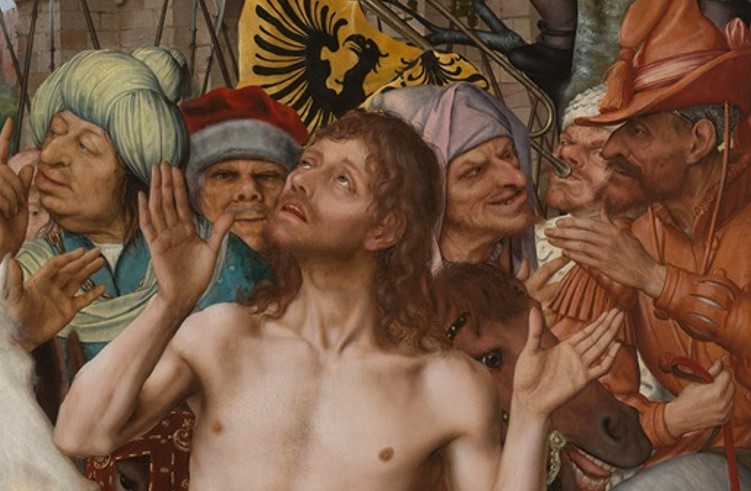
To sum it up, so far three elements of Matsys’ work have enabled us to establish his deep links with Italy and Leonardo.
1. His expertise knowledge of perspective, in particular that of Piero della Francesca, as demonstrated by the Italian-style marble vault appearing in the Altarpiece of Saint Anne (Antwerp). 136
2. His use of Leonardo’s « five grotesque heads, » on the right panel of the same Altarpiece of Saint Anne (Antwerp).
3. His reworking of the Virgin’s pose from Leonardo’s The Virgin and Child with Saint Anne (Louvre, Paris), in his Virgin and Child at the Poznan Museum.
How this influence came about remains to be elucidated. Several hypotheses,
which may complement each other, are possible:
1. At an early age, he traveled to Italy (Milan, Venice, etc.), where he may have established direct contact with Leonardo, or with one or more of his pupils. Philippe d’Aarschot, wrote that « Without ever having set foot in Itlie, Matsys was influenced by Leonardo da Vinci. Isn’t his Magdalena a northern answer to Da Vinci’s Gioconda? »137 Also Holbein the Younger, is thought to have mad such a trip and considered by some as strongly influenced by Leonardo in certain of his compositions.138
2. He was able to exchange ideas and prints with other artists who had made such trips
and had established contacts in Italy. Whether Dürer, who had his own contacts in Italy, might have acted as an intermediary is another hypothesis to be explored. Some of Dürer’s anatomical drawings are said to have been made after Leonardo. Jacopo de’ Barbari had painted a portrait of Luca Pacioli, the Franciscan friar who had helped Leonardo to read Euclid in Greek. Dürer had met Barbari in Nuremberg, but, as we saw above, their relationship soured.

3. He was able to see reproductions made and distributed by Italian and northern artists. Although the original drawings and manuscripts were copied and sold by Melzi, Leonardo’s pupil, after his master’s death in Amboise in 1519, Leonardo’s influence on Matsys appeared as early as 1507.
Leonardo’s work captivated the attention of many in Europe. For example, a life-size replica of Leonardo’s Last Supper fresco was purchased in 1545 by the Norbertine Abbey in Tongerlo, Belgium. Andrea Solario (1460-1524), a pupil of Leonardo da Vinci, is said to have created the work with other artists. Recent research suggests that Leonardo may have painted parts of the replica himself.
Professor Jean-Pierre Isbouts and a team of scientists from the Imec research institute examined the canvas using multispectral cameras, which can reconstruct the different layers of a painting and distinguish restorations from the original. According to the researchers, one figure in particular catches the eye. John, the apostle to Jesus’ left, is painted using a special “sfumato” technique. This is the same technique used to paint the Mona Lisa, and one that only Leonardo mastered, says Isbouts.
Similarly, Joos Van Cleve, in the lower part of his Lamentation (1520-1525), repeats the composition of Leonardo’s Last Supper, showing that the image was known to most northern painters.
Moreover, as Silver keenly points out, one of those same heads, a near-profile but reversed from its Leonardo model (the head on the left), reappears for the lustful old man in Matsys’ later “Ill-Matched Lovers » !
The fact that it appears as a mirror image might be the result of Matsys working from a print. The engraver copies the « positive » image, but whet it is prited it appears as « negative ». In other words, as a mirror image of the original.


But also a study by Leonardo of a (not grotesque) head of an Apostle for the Last Supper, shows features close to those used by Matsys.

A life-sized replica of Leonardo’s Last Supper fresco, has been owned since 1545 by the Norbertijnen abbey in Tongerlo. Andrea Solario (1460-1524) a student of Da Vinci, would have created the work with fellow artists.
However, according to recent research, it seems that Da Vinci painted parts of the replica himself.139 Professor Jean-Pierre Isbouts, together with a team of scientists from Imec research institute, went over the canvas with multispectral cameras, that can reconstruct the different layers in a painting, and distinguish the restorations from the original.
One figure specifically catches the eye, according to Isbouts. John, the apostle on Jesus’ left side is painted with the special ‘sfumato’ technique. This is the same technique used to paint the Mona Lisa, and Da Vinci himself was the only artist that had mastered it, claims Isbouts.

Also Joos Van Cleve, in the lower section of his Lamentation (1520-1525), bases himself on Leonardo’s Last Supper, showing clearly the image was well-known to most painters in the North.

4. The Art of Grotesque per se
Da Vinci’s work on what he called visi monstruosi (monstruous faces) dates at least from the early Milan period (1490s) and later when he started looking for a model to paint “Judas” in the Last Supper fresco (1495-1498). Leonardo reportedly used the likenesses of people in and around Milan as inspiration for the painting’s figures. When the painting was nearly finished, Leonardo still was lacking a model for Judas. It’s said that he loitered around jails and with Milanese criminals to find an appropriate face and expression for Judas, the fourth figure from the left and the apostle who ultimately betrayed Jesus. He advised artists to always carry a notebook to draw people around town, “quarreling or laughing or fighting”. He took note of outlandish faces on the piazza, because in another note recommending sketching strangers, he adds:
“Of monstrous faces I shall say nothing because they naturally stay in the mind.”
When the convent’s prior complained to Ludovico Sforza of Leonardo’s « laziness » as he wandered the streets to find a criminal to base Judas on, Leonardo responded that if he could find no one else, the prior would make a suitable model… While the painting was being executed, Leonardo’s friend, the mathematician Luca Pacioli, was around and in contact with the master.
For the Italian scientist, always keen to explore the dynamic of contrasts of nature, exploring the ugly was not only a game but inherent to the role of the artist:
“if the painter wishes to see beauties that would enrapture him,” Leonardo wrote in his notebook, « he is master of their production, and if he wishes to see monstrous things which might terrify or which would be buffoonish and laughable or truly pitiable, he is their lord and god.”
Leonardo and other humanists questioned the relationship between inner beauty (virtue) and outer, physical beauty. On the back of the master’s portrait of Genivra de’ Benci‘s (Washington DC), you can see a banner with the Latin text Virtutem forma decorat (Beauty adorns virtue). And so, conversely, they wondered how someone’s ugliness could be an expression of his vice.
From her side, Italian scholar Sara Taglialagamba 140 thinks that the grotesque, being abnormal or “out of norm”, in the works of Leonardo is conceived as “the opposite of balance and harmony” but “not to oppose beauty.”
The deformities that connote Leonardo’s figures affect both men and women, are present in the young and the old (although on the latter they are concentrated for the most part), spare no portion of the body, and are often combined to give the subjects even more bestial appearances.
Geometry of Human Proportions
From his side, Dürer, now accused of « racial profiling » took very seriously the issue of understanding human proportions, considered, especially with the discovery of Vitruvius book De Architectura, as to offer the key to the right proportions for human architecture and urban planning. According to Vitruvius,
« Beauty is produced by the pleasing appearance and good taste of the whole, and by the dimensions of all the parts being duly proportioned to each other. 141«
Dürer therefore measured all parts of the human body to establish harmonic relations among them. The variations in the proportions of faces and bodies, he concluded, obey the variations generated by geometric projections. They don’t change in terms of harmony but will appear different and even grotesque when projected from a different angle.


Both Leonardo and Dürer, and later Holbein the Younger in his painting The Ambassadors (1533, National Gallery, London), became masters in the science of “anamorphoses”, I.e. geometrical projections from tangent angles making an image hardly recognizable for the viewer looking straight to the plane surface while the image can be understood when viewed from that surprising angle.
Having such masters of “serious” beautiful forms as Leonardo or Matsys suddenly engaging in outrageous cartoon drawing may look disturbing, while it should not. All cartoons are based on metaphorical thinking and so is all great art.
Renaissance art is often assumed to be orderly and reassuring but these faces succeed the uncompromising polemics of the gargoyles of the cathedral builders, the “monsters” in the margin of so many illuminated manuscripts that Bosch invited on the forefront and anticipate those of Rabelais, Goya and Ensor. 142
They are so distorted and out of the habitual norm that they get the label “grotesque” but they also make us smile when we, reluctantly and even with some anger, accept to look down on our own imperfections or those of our beloved we prefer not to see. We are not the icons we take for real that we see in the magazines.
In Erasmus’ Praise of Folly, the narrator (Folly personified), first identifies, among many other accomplishments, its own leading role in making things work that with pure logic, reason and intellect would fail, such as the ridiculous acts required to achieve human reproduction.
Hence, says Folly, “if all were thus wise you see how soon the world would be depopulated, and what need there would be of a second Prometheus, to plaster up the decayed image of mankind?”
Folly, with satirical irony, claims it is doing a great job helping especially older people to refuse dying off like animals:
“Of my gift it is, that you have so many old Nestors everywhere that have scarce left them so much as the shape of a man; stutterers, dotards, toothless, gray-haired, bald; or rather, to use the words of Aristophanes, « Nasty, crumpled, miserable, shriveled, bald, toothless, and wanting their baubles, » yet so delighted with life and to be thought young that one dyes his gray hairs; another covers his baldness with a periwig; another gets a set of new teeth; another falls desperately in love with a young wench and keeps more flickering about her than a young man would have been ashamed of. For to see such an old crooked piece with one foot in the grave to marry a plump young wench, and that too without a portion, is so common that men almost expect to be commended for it.
But the best sport of all is to see our old women, even dead with age, and such skeletons one would think they had stolen out of their graves, and ever mumbling in their mouths, « Life is sweet; » and as old as they are, still caterwauling, daily plastering their face, scarce ever from the glass, gossiping, dancing, and writing love letters. These things are laughed at as foolish, as indeed they are; yet they please themselves, live merrily, swim in pleasure, and in a word are happy, by my courtesy.” 143
5. The metaphor of the “Ill-matched Lovers”
If Erasmus will blast with biting irony the corruption and madness of the Kings, Popes, Dukes and Princes, he will also expose with uncompromising irony the corruption affecting the common man, for example older men dropping their spouses to hook up with younger women, a practice, says Folly, “grown so common, that it is become the a-la-mode of the times.”
The pairing of unequal couples has a literary history dating back to antiquity when Plautus, a Roman comic poet from the 3rd–century BC, cautioned elderly men against courting younger ladies.
The « grotesque marriage » comes straight from the satirical literature, such as the above mentioned Ship of Fools (1494) of Sebastian Brant, which in its 52nd chapter tackles the « marriage-for-money » theme.
Besides In Praise of Folly, Erasmus Erasmus dedicated in 1529 a colloquium 144 to this theme titled The Unequal Marriage.
The Unequal Marriage, Excerpt:
Gabriel. Do you know Lampridius Eubulus ?
Petronius. Yes ; there is not a better nor happier Man in the City.
Ga. Well, and do you know his Daughter Iphigenia too?
Pet. You have mention’d the very Flower of the Age.
Ga. She is so; but, do you know who she’s married to?
Pet. I shall know when you have told me.
Ga. She is married to Pompilius Blennus.
Pet. What, to that Hector, that us’d to talk Folks to Death in cracking of his bullying Tricks?
Ga. To the very Man.
Pet. He has been for a long Time very noted in this Town, for two Things chiefly, i.e. Lying and the Mange, which has no proper Name to it, tho’ indeed it has a great many.
Ga. A very proud Distemper, that won’t strike Sail to the Leprosy, the Elephantine Leprosy, Tetters, the Gout, or Ringworm, if there was to be an Engagement between them.
Pet. So the Sons of Esculapius tell us.
Ga. What Need is there, Petronius, for me to describe to you a Damsel that you are very well acquainted with ? altho’ her Dress was a great Addition to her native Beauty. My Petronius, you would have taken her for a Goddess, had you seen her. Every Thing in her and about her was graceful. In the mean Time out comes our blessed Bridegroom with his Snub-Nose, dragging one Leg after him, but not so cleverly neither as the Switzers do ; itchy Hands, a stinking Breath, heavy Eyes, his head bound up with a Forehead-Piece, and a Running at his Nose and Ears. Other People wear their Rings on their Fingers, but he wears his on his Thighs.
Pet. What was in the Mind of the Lady’s Parents, to join such a Daughter to a living Mummy?
Ga. I can’t tell, except it was with them, as it is with many more, that have lost their Senses.
Pet. It may be he was very rich ?
Ga. He is very rich indeed, but it is in the Debts he owes.
Pet. What greater Punishment could they have inflicted upon the Maid, if she had poison’d her Grand-Fathers and Grandmothers, both of the Father’s and Mother’s Side ?
Ga. Nay, if she had scatter’d her Water upon the Grave of her Parents, it would have been a Punishment bad enough to have oblig’d her but to have given a Kiss to such a Monster.
Pet. I am of your Mind.
Ga. I look upon it a greater Piece of Cruelty, than if they had stripp’d their Daughter naked, and expos’d her to Bears, Lions, or Crocodiles : For these wild Beasts would either have spar’d her for her exquisite Beauty, or put her out of her Pain by a quick Dispatch.
Pet. You say right : I think this is what would have become Mezentius himself, who, as Virgil tells us,’bound dead Bodies to living ones, Hands to Hands, and Mouths to Mouths.’ But I don’t believe Mezentius himself would have been so inhuman as to have bound such a lovely Maid to such a Carcass as this : Nor is there any dead Body you would not chuse to be bound to, rather than to such a stinking one ; for his Breath is rank Poison, what he speaks is Pestilence, and what he touches mortifies.
This Erasmian theme of the “Ill-matched Lovers,” became quite popular. According to art historian Max J. Friedlander 145, Matsys was the first to propagate this theme in the Low Countries.
Matsys depicts this theme by showing an older man besotted by a younger, beautiful woman. He gazes at her adoringly, not noticing that she is stealing his purse. In reality, the grotesque ugliness of the man, blinded by his lust for the young woman, corresponds to the ugliness of his soul. She, blinded by her greed, appears superficially as a “nice” girl, but in reality is abusing the naive fool. But the viewer rapidly finds out that the money she steals from the old fool, goes directly in the hands of the jester standing behind her and whose face expresses a combination of both lust and greed. In final analysis, that’s the moral, all the gain goes neither to him nor to her, but to foolishness itself (The Jester). A situation reminiscent of Bosch’s 1502 painting The Conjurer and philosophically, the central theme of Erasmus’ In Praise of Folly (At the end of the day, it is she that rules the world !).
Matsys’ painting raises the issue of “Mutually Assured Corruption,” where, just as in geopolitics, both sides think they are winning at the expense of the other in a zero sum game. From that standpoint, the “moralistic” lesson here goes far beyond simple cheating among partners.
As said before, what were considered so far as “sins” (lust and greed) by the Church, became a subject of laughter for the humanist with the painting offering a “mirror” allowing viewers to self-reflect and to improve their own character.

The theme already appears in a copper engraving of Dürer in 1495, with the girl offering her hand to channel money from his purse into her own.

And in 1503, Jacopo Barbari painted a similar subject, An old man and a young woman. (Philadelphia)
Cranach the Elder (1472-1553), who made a trip to Antwerp in 1508146, and was visibly inspired by the Leonardo style grotesques of Matsys, started mass producing paintings on this theme (including the use of Matsys reworked grotesque of Leonardo!), clearly answering the growing demand of protestant Germany, a production continued by his son Cranach the Younger (1515-1586).147
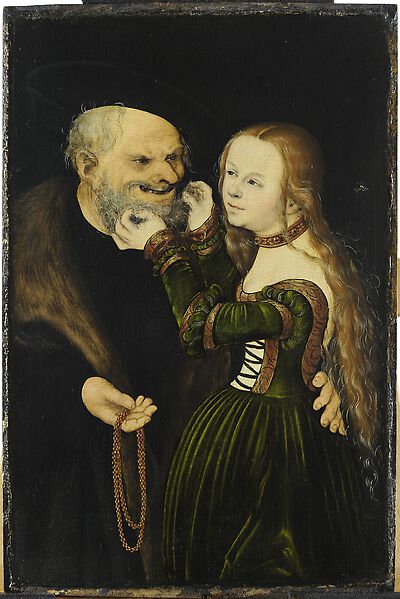


Cranach will make variations on the theme, often reducing the theme to only “lust” leaving “greed” (money grabbing) out of the picture.
Of course, the uglier and the older the man, and the younger and the more beautiful the lady, the more the resulting contrast creates an emotional impact by underscoring the shocking character of the event. Cranach will playfully inverse roles and show an old woman with her maid, seducing a handsome young gentleman.

Quinten Matsys’ son, Jan Matsys (1510-1575), will do his own variation on the theme, adding a new social dimension, that of poor families using their daughters as bait to trap older rich gentlemen whose wealth and money will allow the family to have a living, a theme also Goya took up.
Already in one of Cranach’s versions, the rich man has in front of him a loaf of bread on the table. But what strikes in Jan’s version, is the mother, standing behind the old foolish man, staring at the bread and the fruits on the table. If the greed and the lust remain real, Jan points to a given context which cannot simply be laughed away.
Among the many other artists that painted this theme one has to note Hans Baldung Grien (1485-1545), Christian Richter (1587-1667) and Wolfgang Krodel the Elder (1500-1561).
None of them reproduced completely the pun crafted by Matsys and most loyal to the real spirit of Erasmus, that of foolishness coming out on top winning the game, a truly laughable situation ! The Triumph of Folly!
Also here, for the face of the old foolish man, Matsys was influenced by sketches of grotesque heads by Leonardo.
6. Leonardo’s baby, the “Ugly Duchess”
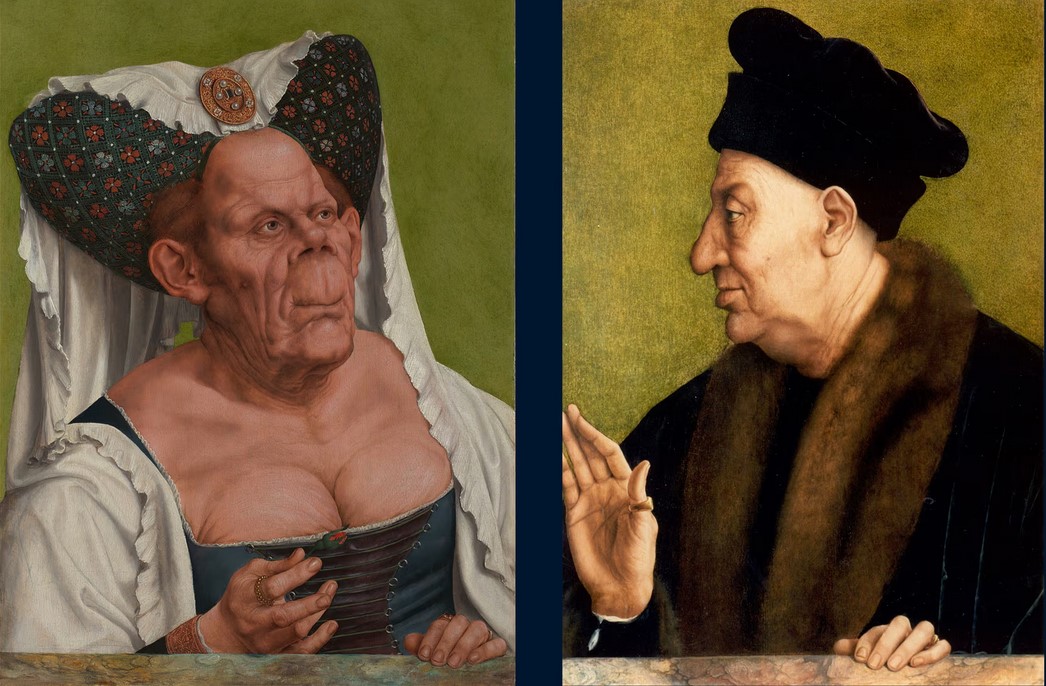
The old man (on the right), Quinten Matsys, Musée Jacquemart André, Paris.
This allows us now to introduce maybe the most outrageous painting ever made, alternatively called the Old ugly woman or The ugly Duchess. Oceans of ink have been thrown on paper to speculate on her identity, her “disease” (Paget’s disease), her “gender”, most of the time to turn the eye of the viewer to a literal, “fact-based” explanation rather than enjoying and discovering the “mental” metaphor the artist paints, not on the panel, but in the mind of the viewer.
The painting has to be analyzed and understood with its pendant – an accompanying painting – which depicts an old man whose attention she solicits. In a surprise move, as a first approach, one can say that Matsys inverts the common gender roles here, since what we see is not an old man trying to seduce the girl, but an old woman trying to attract a rich old man.
–First, there is the old lady, whose physical state is ultimate decrepitude, who desperately tries to seduce an old rich man. Just as Domenico Ghirlandaio’s Old man and young boy (1490, Louvre, Paris), the person’s outside appearance prompts the audience to consider the relationship between internal and external beauty.
“Externally, writes one observer, based on her exquisite dress, jeweled accessories, and budding flower, this woman was theoretically beautiful. However, her internal beauty is reflected in her exaggerated and displeasing physical appearance.” 148
Once again, the obvious literary influence is Erasmus’s essay In Praise of Folly (1511), which satirizes women who « still play the coquette », « cannot tear themselves away from their mirrors » and « do not hesitate to exhibit their repulsive withered breasts. »149

The woman’s clothes are rich. She is dressed to impress, including bulbous headgear that heightens her unusual features. Defying the modesty expected from older women during the Renaissance, she is wearing a low-cut, uncovered, and tightly laced bodice that emphasizes her wrinkly cleavage.
Her hair is concealed in the horns of a heart-shaped bonnet, over which she has placed a white veil, secured by a large, bejeweled brooch. However fine her attire, by the time this panel was painted in the early sixteenth century her clothes would have been many decades out of date, reminding those of Van Eyck’s portrait of his wife Margaret a century earlier, prompting laughter rather than admiration.
Erasmus, in The Ciceronianus, a fictive dialogue published in 1528, argues that literary style, like fashion, changes overnight. One of his characters, Nosophon, is quoted saying:
« Just look at pictures that aren’t that old, painted, say, sixty years ago and see what was being worn by those of the fair sex belonging to prominent families or living at court. If a woman went out in public dressed like that now, the village idiots and street-urchins would pelt her with rotten fruit. »
Hypologus, his interlocuter then replies:
« Who would put up now with a decent married woman wearing those huge horns and pyramids and cones sticking out from the top of the head and having her brows and temples plucked so that nearly half her head is bald. » 150
Her headdress had by then become an iconographic shorthand for female vanity, its horns compared to those of the devil or at best those indicating she was betrayed by her lovers (cornuto). She appears to be selling herself on her looks, for she holds a flower, often an advert for sex work in Renaissance art. It was in the tragic fate of the rose that the flight of time, and with its physical decay, found its most alarming illustration. Whether fresh or fragile, the rose, while calling for immediate pleasure, seems to protest that death is just around the corner.
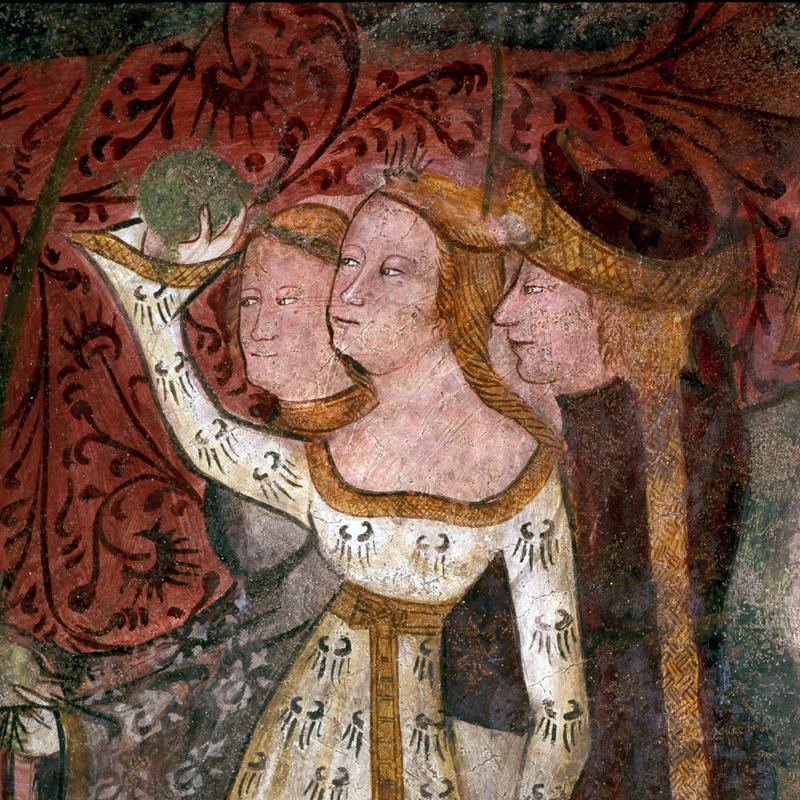
To identify the woman, several names are put forward. In the seventeenth century, the painting was misidentified as a portrait of Margarete Maultasch (1318-1369), who, having separated from her first husband Jean Henri de Luxembourg, remarried Louis 1er, Margrave of Brandenburg, after a thousand and one twists and turns, culminating in the couple’s excommunication by Clement VI. A complicated story in turbulent times, which earned Margarete the nickname “mouth-bag” (big mouth), or “prostitute” in Bavarian dialect. The problem is that other portraits of Margarete are known to exist, in which she appears most comely…
Defamed as the “ugliest woman in history,” she gained the nickname “The Ugly Duchess,.” In the Victorian era, this picture (or one of its many versions) inspired John Tenniel’s depiction of the Duchess in his illustrations of Lewis Carroll’s Alice’s Adventures in Wonderland (1865). This entrenched the moniker and turned this figure into an icon for generations of readers.
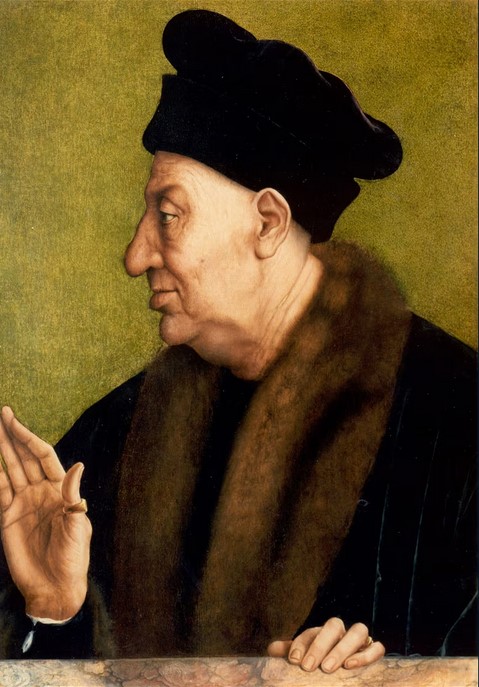
–Second, The old Man, whose fur-trimmed robe and visible gold rings, while not as demonstrably archaic or absurd as the costume of the Woman, nonetheless suggest conspicuous wealth, and his distinctive profile echoes the familiar profile of Europe’s leading merchant-banker of the fifteenth century, the late Cosimo de’ Medici of Florence.
After having played a key role as a patron of the arts and a backer of the Renaissance and the Council of Florence, became quite a disgusting figure. It has to be noted that in 1513 the warrior pope Julius II, a strong enemy of Erasmus, died and Giovanni di Lorenzo de’ Medici became pope Leo X.
The figure has also been compared to the lost portraits of the early fifteenth century of Duke Philip the Bold of Burgundy.
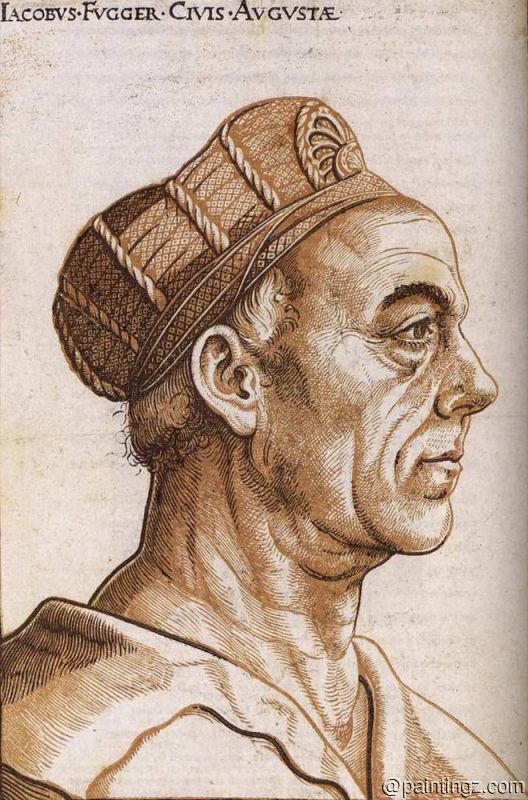
But if one takes a second look, and forgets the woman’s breasts, the viewer realizes that her face is that… of an ugly man. Maybe the whole undertaking was a political statement and the faces were those of real people whose identity we’ve not yet discovered. They might be some hated politicians or theologians of those days, selling out one to the other in an elan of greed and lust. Maybe the old ugly prostitute was a reference to fugger banker Jacob the Rich, the eternal bankroller of the increasingly bankrupt Vatican ? For the moment, let’s accept we just don’t know.
The Bohemian artist Wenceslaus Hollar (1607-1677) saw Matsys double portrait and made in 1645 an engraving of it, adding the title “King and Queen of Tunis, invented by Leonardo da Vinci, executed by Hollar.”

In periods of carnival, when people were allowed to do away with the rules of society for a couple of days, at least in the Low Countries and the Northern Rhine area, people had a lot of fun by shifting roles. Putting things upside down, poor peasants could dress up as rich merchants, laymen as clergymen, thieves as policemen, male as female and one and all the other way around.
The original concept of this metaphor seems to have come from Leonardo, who made a tiny sketch of an ugly woman, eventually a prostitute, remarkably with the horn bonnet and a tiny flower planted between her breasts, exactly the same attributes, metaphors and symbols employed later by Matsys in his work.


Leonardo’s pupil Melzi and other students or followers, as they did with many other of Leonardo’s sketches, seem to have copied Leonardo’s work and, amused, counter-posed the horny woman with a greedy, wealthy Florentine merchant. Did Melzi share or sell his sketches to others?

Various amusing versions of the theme are scattered around the world and figure in private and pubic collections.
Another sketch, either by Leonardo himself of his followers, shows a wild grotesque man with his hair raising up his head, with a series of grotesque looking scholars, including one looking like Dante!
Leonardo, of course, who always signed his writings with the words “man without letters,” (omo sanza lettere)151 was a mere craftsman and never taken serious by those scholars Lucian exposed for having sold out to the establishment.
All these elements that what Matsys did was nothing “bizarre” or “extravagant,” but as someone sharing a “culture” of grotesque faces whose variations could be used to express the metaphorical puns of the humanist culture.
But of course, what made his old man and woman impact so huge, was the fact that what for Leonardo were nothing but rapid sketches in a notebook, became with Matsys life-size frighteningly hyper-realistic representations!
In the Queen’s Windsor Collection, there exists a red chalk drawing of the woman nearly exactly as she appears in Matsys work.

Untill very recently, historians were convinced that Quentin Matsys had “copied” this drawing of around 1490 attributed to Leonardo which he enlarged to produce his oil painting. 152 “So Leonardo designed this unique person, even to the wrinkled bosom emerging from her dress. All Matsys did was enlarge her in oils,” it is said.
However, recent research suggests it could have been the other way around! Either Melzi, or Leonardo himself, could have made the red chalk drawing starting from Matsys painting, either from a direct view, prints or reproductions. An Italian copying a Flemish painter, can you imagine?
Leading expert Susan Foister, Deputy Director and Curator of Early Netherlandish, German and British Painting at The National Gallery, London, who was also the curator of the museum’s 2008 exhibit “Renaissance Faces: Van Eyck to Titian,” told The Guardian at that time :
« We can now say with confidence that Leonardo – or, at least, one of his followers – copied Matsys’s wonderful painting, not the other way around. This is a very exciting discovery. »153
Foister said they had discovered that Matsys made amendments as he went along, suggesting he was creating the image all by himself rather than copying a model. Also, in the two Leonardo copies, the forms of the body and clothes are oversimplified and the woman’s left eye is not in its socket. « It was always assumed that a lesser known northern European artist would have copied Leonardo and it has not really been thought that it could have been the other way round, » 154 said Foister.
She added that both artists were known to be interested in ugliness and exchanged drawings « but credit for this masterful work belongs to Matsys ». 155
Emma Capron, Associate Curator of Renaissance Painting at the National Gallery, London, pointedly wrote in 2023:
« In treating figures of fun with the serious trappings of portraiture, Massys therefore parodied the genre, perhaps implicitly poking fun at the self-pretension inherent in sitting for any portrait. The tension between dignified form and obscene content was a fundamental comic device expounded by the Roman orator Cicero and satirist Lucian. It drew on a rhetorical mode known as ‘paradoxical encomium’ (paradoxical praise), which consisted in the glorification of a subject jest, it was revisited during the Renaissance in mock odes to faded beauties and, most famously, in Erasmus’ Praise of Folly. » 156
7. Liefrinck and Cock
In his commentary, Jan Muylle 157 gives interesting information about the work of Antwerp woodcarver-engraver and print publisher Hans Liefrinck (c. 1518-1573). Liefrinck produced the second state of Pieter Bruegel’s drawings The Fat Kitchen and The Thin Kitchen, among others, and collaborated in Antwerp with master printer Christophe Plantin.
He also produced four little-known copper engravings of grotesque heads borrowed from drawings by or after Leonardo da Vinci.
“I am convinced that their importance far exceeds these occasional mentions,” writes Muylle. These engravings « sometimes present – and this has not been reported anywhere – strong similarities with certain grotesque heads in paintings by Quinten Metsijs (1465-1530), who has long been known to be indebted to Leonardo da Vinci, as well as with a print by Liefrinck’s famous publisher Hieronymus Cock (c. 1510-1570), also a patron of Bruegel. (…) The grotesque heads by Metsijs, Cock and Liefrinck show how quickly Da Vinci’s examples – the master died in Amboise on May 2, 1519 – were adopted in their artistic tradition by the masters of the Southern Netherlands, all of whom worked in Antwerp.”
The captions and epigrams on the engravings by Liefrinck and de Cock, continues Muylle, « also provide a valuable aid to interpretation. This is a representative body of work, which is most welcome. »
In the cartouche of Liefrinck’s second legend, we read something that Leonardo was not far from thinking: Deformes, bone spectator, ne despice vultus. Sic natura homines sic variare solet. (Dear spectator, don’t despise these deformed faces. This is how nature usually makes men differ from one another).
Hieronymus Cock (c. 1510-1570) also uses the grotesque imagery of the “Ill-matched Couple” (unequal love). Cock’s plate is thought to be a copy of a work by the Italian engraver Agostino Veniziano (1490-1550). Veniziano’s epigram is typical of Venetian “humor”.
It moves from the grotesque to the burlesque: “Chi non ci vol veder si cavi gli occhi” (He who doesn’t want to see us, gouge out his eyes). It’s not clear which version was produced first. Both artists abandon the original theme, but the jester (Folly) who triumphs behind it is a legacy of Matsys and Erasmus.
What is clear is that the epigram at the bottom of Cock’s engraving is far more in the humanist spirit:
“Al ben ick leelyck, ick ben sier plesant, Wilt ghij wel doen houet u aen mijnen kant.” (Even if I’m ugly, I’m a lot of fun, If you want to be well, stand on my side).
The captions in Liefrinck’s and Cock’s engravings are clearly more in line with Erasmus’ humanism and Da Vinci’s vision of mankind.
8. To die of laughter, Zeuxis, Matsys and Rembrandt
Finally, reading the book La Renaissance et le rire by Daniel Ménager 158 drew our attention to the stories relating the life of the Greek painter Zeuxis. This historical anecdote provides, in our opinion, a major key to understanding Matsys’ painting « The Hideous Old Woman. »
Zeuxis of Heraclea (464–398 BC) was one of the most famous Greek painters of Antiquity. A native of Heraclea, his art surpassed almost all other painters of his time.
At an artist’s competition, legend has it, Zeuxis painted grapes so truthfully that birds came and pecked at them. However, a rival painter, Parrhasios of Ephesus , presented a curtain painting so lifelike that Zeuxis, proud of the birds’ verdict, asked that the curtain be drawn so that he could see the painting. Recognizing his delusion, he admitted defeat with frank modesty, given that he had only deceived animals, while Parrhasios had deceived humans.
As both Pliny the Elder and Cicero recount, Zeuxis, whose work has not survived, was called upon to decorate the Temple of Hera in Crotona. The painter proposed to paint the ideal of feminine beauty there: a representation of Helen of Troy, the canon of the time. To create this ideal beauty, Zeuxis is said to have extracted the most sublime aspects of five women and united them in a single figure. The scene appeared in 1525 in an illumination of a manuscript of the Romance of the Rose executed for Francis I.
In the 2nd century, Sextus Pompeius Festus reported that Zeuxis once painted Aphrodite, the Greek goddess of procreation, pleasure, love, and beauty, a painting commissioned by an old woman who insisted that she herself be the model for the young, beautiful, and curvaceous Aphrodite.
Zeuxis agreed, but upon seeing the final result, Aphrodite, depicted as a wrinkled old woman, burst out laughing and choked to death. It was this mad stubbornness of old women to believe themselves eternal in their physical appearances, a theme that Goya would take up again in his time, that provoked laughter so powerful that it became dangerous!
The story did not escape Erasmus, who mentions it in his Praise of Folly (published in 1511) in a passage that can be linked to the painting by Matsys, which dates from around 1513.
Erasmus throws the ball back into the men’s court:
« A woman so ugly as to frighten her husband seems as beautiful as Venus; would he be more so if she were truly beautiful to that point? A man owns a certain wicked painting and takes it for a Zeuxis or an Apelles; he never stops looking at it, admiring it; is he not a man just as content as the connoisseur who has paid his weight in gold for a genuine painting by these masters, and who perhaps finds less pleasure in it? » 159
The man, the counterpart of Matsys’s double portrait with the « ugly old woman », is clearly the type of man struck by madness who believes that his beloved is the goddess Venus when in fact she is a « frighteningly ugly woman » . The man, like many spectators, does not even realize that this body of his beloved is crowned with a man’s head! The madness is therefore double and widely shared, including with the spectators.
The humanist is not unaware of the causes of Zeuxis’s death, which he mentions in passing in Adage 2401 on « Sardonic Laughter »:
« The painter Zeuxis died from not being able to stop laughing at an old woman he was painting, as did Chrysippus when he saw a donkey feasting on figs. » 160
Matsys, a member of the Guild of Saint Luke and, according to some, of its literary division, the Chamber of Rhetoric De Violieren (The Wallflowers), may have found inspiration in this story.
By painting the « ugly old woman, » as Zeuxis had done before him, Matsys aimed to make us die of laughter (at vanity)! A Praise of Folly transposed into painting!
The subject got some traction in the following centuries.
In 1662, Rembrandt, at the age of about 56, only seven years before his death in 1669, depicts himself as Zeuxis laughing himself to death painting an old woman whose nose and jewels can be seen. 161
The theme was taken up in 1685 by Rembrandt’s last pupil, Aert de Gelder. While Rembrandt took a while to identify the profile of the old woman in the shadows, de Gelder’s subject is beyond doubt.
E. Conclusion
The work of Quinten Matsys and his visual dialogue with the work of Leonard da Vinci provides us with clear evidence that the Low Countries did not hermetically seal themselves off from the influence of the Italian Renaissance. Rather, in these regions people chose what they saw as an added value to our national culture: the love of God, beauty and man of Petrarch, the science of perspective of Piero della Francesca, the hilarious tronies of Leonardo da Vinci. All this found much attention and admiration in the Low Countries. This was not the land of backward peasants without culture as was sometimes claimed in aristocratic circles who understood nothing at all of Bruegel’s deeper message.
Culturally speaking, one has to admit that unfortunately, the “Seven Deadly Sins” that More and Erasmus tried to contain five centuries ago have become the axiomatic “values” of today’s “Western” society!
Yet they are the very opposite of the universal human values shared by the vast majority of humanity, whether philosophically, religiously, agnostically, progressively or conservatively.
“Freedom” was decoupled from « necessity; » « individual rights » decoupled from « civil duties. » Anything goes. Lust, envy, greed, laziness, gluttony, avarice, greed, anger, violence, cruelty, addiction, etc. are portrayed in a positive light and promoted on television and the Internet on a daily basis, including for low age children. All this is allowed and even encouraged, as long as it does not call into question the privileges of the dominant power structures.
Erasmus would turn around in his grave if he knew that his name is mainly associated with a scholarship offered by the EU for pupils willing to study in other EU member states. As a Belgian professor has suggested, such scholarships should include a mandatory training period in Erasmus’ thoughts and especially his advanced concepts of peace building162.
Mobilizing Reason alone is not enough. Without humor, the Renaissance, with its unprecedented explosion of discoveries and inventions in science, art and society, would never have occurred. Humor is a catalyst for creativity. As some contemporary Chinese scientists put it: “Effective Ha-ha helps people to A-Ha”. 163
Humor itself is a creative act because creativity, like humor, arouses surprise by breaking certain frames. Both involve establishing non-obvious links between incongruous elements. And what is a joke, if it is not a combination of different and/or contrasting ideas that create an irony, a discrepancy, disobeying conventional expectations. Humor brings awareness of the incongruity between two elements. And the ability to switch from one element to another is a cognitive process identified as enhancing creativity. In other words, humor changes the way we think and facilitates an unexpected way of thinking, like the “thought experience” that prompted Einstein imagining himself “riding a beam” of light.
By developing our sense of humor, we develop a new ability to understand problems from different angles, and this type of thinking leads to greater creativity. Tackling problems in a linear and traditional way provides conventional, if not trivial, solutions. However, as Albert Einstein suggested: “In order to stimulate creativity, one must develop a childish inclination for play.”
And man’s “instinct for play”, as Friedrich Schiller underscores in his On the Aesthetic Education of Man in a Series of Letters (1795), as the first encounter with an absence of constraints, serves a broader project of human progress, in which the freedom necessary for men to govern themselves adequately is exercised through the interplay of faculties that occur during aesthetic experience. In sum, the development of man’s “instinct for play” and humor, are essential for creativity and art, including the art of statecraft.
Dutch Historian Herman Pleij puts it well: “Actually, one would wish the present world more folly. Not for nothing does the jester on the early modern stage like to present fellow players and spectators the mirror he holds in his hand. Know yourself. And be aware of the relativity of things. If only for a moment. ”164
In short, to make a new renaissance a reality, we have to liberate our fellow citizens from Angst (Fear). While unaware about such real dangers as nuclear war, they live in fear of threats they have been brought to imagine.
Let’s stop laughing under our breath and laugh heartily. Most scientific studies agree that laughter is good for your health, and sudden deaths from laughter attacks are rare.
For those of us who aspire to peace through the development of every individual and every state, it’s time to take very, very, very seriously the vision of Erasmus, Rabelais, Leonardo and Matsys on the art of “good-hearted”, truthful and emancipatory laughter.
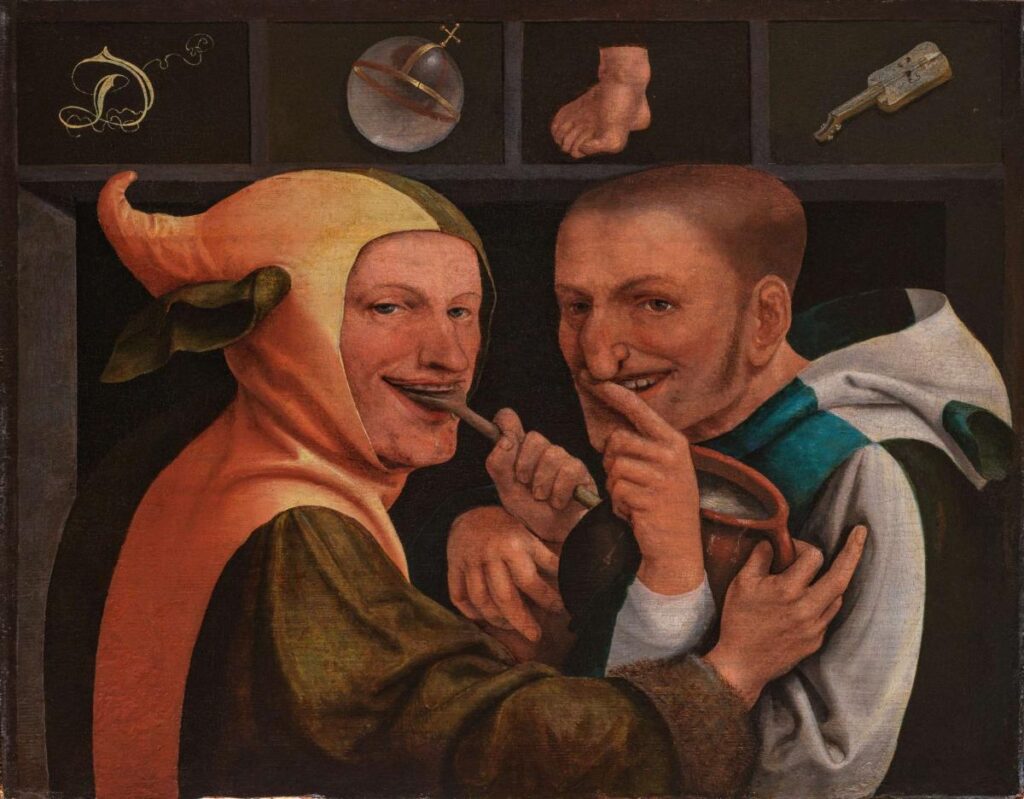
I end here with a painting of Matsys’s son, Jan, presenting the following rebus:
« D » stands for « The »; the globe stands for the « World »; the foot, in flemish « voet », means also « feeds », and the « vedel » (Vielle, ancestor of the violin) also means « many », following by two happy fools. The phrase therefore reads: « The World Feeds Many Happy Fools! » And you are one of them! But don’t tell! Mondeken Toe!
Selected biography
- ACCATINO, (date ?)
Sandra Accatino, Quentin Massys, Anciana grotesca o La duquesa fea, in « El Arte del Mirar », Academia.edu. - AGRICOLA, 2016
Rudolf Agricola, Brieven, Levens en Lof, Uitgeverij Wereldbibliotheek, Amsterdam. - AINSWORTH, MARTENS, 1995
Maryan W. Ainsworth, Maximiliaan P. J. Martens, Petrus Christus: Renaissance Master of Bruges, Ludion and Metropolitan Museum of Art, Gent-New York. - ALBERTI, 1435
Leon Baptitta Alberti, De Pictura, Macula Dédale, 1992, Paris. - ANOUILH, 1987
Jean Anouilh, Thomas More ou l’Homme libre, Editions de la Table ronde, Paris. - ANTOINE-KÖNIG, POGAM, 2024
Elisabeth Antoine-König, Pierre-Yves Le Pogam. Figures du Fou. Du Moyen Âge aux Romantiques, Musée du Louvre, Gallimard, Paris. - ARASSE, 1997
Daniel Arasse, Léonard de Vinci, Hazan, Paris. - BAKKER, 2004
Boudewijn Bakker, Landschap en Wereldbeeld, van Van Eyck tot Rembrandt, Uitgeverij Thoth, Bussem. - BATAILLON, 1998
Marcel Bataillon, Erasme et l’Espagne, Droz, Genève. - BAX, 1978
Dirk Bax, Bosch, his picture-writing deciphered, A.A.Balkema, Rotterdam. - BIALOSTOCKI, 1993
Jan Bialostocki, L’Art du XVe siècle des Parler à Dürer, Librairie générale française, Paris. - BLOCH, 2016
Amy R. Bloch, Lorenzo Ghiberti’s Gates of Paradise: Humanism, History, and Artistic Philosophy in the Italian Renaissance, Cambridge University Press. - BORCHERT, 2010
Till-Holger Borchert, Cranach der Ältere und die Niederlande, in DIe Welt von Lucas Cranach, editions G. Messling. - BOSQUE, 1975
Andrée de Bosque, Quinten Metsys, Arcade Press, Brussels. - BRANT, 1494
Sébastien Brant, La Nef des Fous, Editions Seghers et Nuée Bleue, Paris, 1979. - BRISING, 1908
Harald Brising, Quinten Matsys; essai sur l’origine de l’italianisme dans l’art des Pays-Bas, Brising, Harald, 1908, Leopold Classic Library, reprint 2015. - BROWN, 2008
Mark Brown, Solved: mystery of The Ugly Duchess – and the Da Vinci connection, The Guardian, Oct. 11, 2008, London. - BRUCKER, 1993
Gene Adam Brucker, Florence, six siècles de splendeur et de gloire, Editions de la Martinière, Paris. - BRUYN, 2001
Eric de Bruyn, De vergeten beeldentaal van Jheronimus Bosch, Heinen, ‘s-Hertogenbosch. - BRUYN, BEECK, 2003
Eric de Bruyn and Jan Op de Beeck, De Zotte Schilders, ‘t Vliegend Peerd, Mechelen. - BRUYN, 2013
Yanice de Bruyn, Masterthesis ‘Gebaar en wereldbeeld: Een onderzoek naar de herkomst en betekenis van het gebaar van de Man met bril van Quinten Metsys, Universiteit van Gent. - BUCK, 1999
Stéphanie Buck, Hans Holbein, Maîtres de l’Art allemande, Könemann, Cologne. - BUTTERFIELD, 2019
Andrew Butterfield, Verrochio, Sculptor and Painter of Renaissance Florence, National Gallery of Art and Princeton University Press, Washington. - CAUTEREN, HUTS, 2016
Katherina Van Cauteren and Fernand Huts, Voor God & Geld, Gouden tijd van de zuidelijke Nederlanden, Lannoo. - CAMPBELL, STOCK, 2009
Lorne Campbell, Jan van der Stock, Rogier van der Weyden 1400-1464, Maître des passions, Davidsfonds. - CAPRON, 2023
Emma Capron, Quinten Massys and the Art of Satire, in The Ugly Duchess, Beauty & Satire in the Renaissance, published by the National Galery Global, Yale University Press to accompagny the exhibition of the same name; - CHASTEL, KLEIN, 1995
André Chastel, Robert Klein, L’Humanisme, l’Europe de la Renaissance, Skira, Genève. - CHATELET, 1988
Albert Châtelet, Early Dutch Painting, Painting in the Northern Netherlands in the Fifteenth Century, Montreux Fine Art Publications, Lausanne. - CHATELET, 1994
Albert Châtelet, Le beau Martin – études et mises au point, Actes du colloque, Musée d’Unterlinden, Berlin. - CHAUNU, 1975
Pierre Chaunu, Le temps des réformes, Histoire religieuse et système de civilisation, La Crise de la chrétienté, L’éclatement, Pluriel, Fayard, Paris. - CLARK, PEDRETTI, 1969
Kenneth Clark and Carlo Pedretti, Leonardo da Vinci drawings at Windsor Castle, Phaidon Press. - CLAYTON, 2003
Martin Clayton, Leonardo da Vinci, the Divine and the Grotesque, The Royal Collection, London. - CLELAND, 2014
Elisabeth Cleland, Pieter Coecke van Aelst, Fonds Mercator, The Metropolitan Museum of Art. - CLOULAS, 1990
Iva Cloulas, Jules II, Fayard, Paris. - COLE, 1894
Timothy Cole, Quinten Massys, Century Magazine, Volume 48, Issue 4, Old Dutch Masters. - COOLS, 2016
Hans Cools, Europa-Amerika-Utopia: visioenen van een ideale wereld in de zestiende eeuw, in Op zoek naar Utopia, Jan Van der Stock, Davidsfonds, Leuven. - CUSANUS, 1543
Nicolaas of Cusa (Cusanus), Het Zien van God, vertaald door Inigo Bocken, Uitgeverij De Kok, Pelckmans. - CUSANUS, 2008
Nicolas de Cues, La Docte Ignorance, traduction d’Hervé Pasqua, Bibliothèque Rivages. - CUSANUS, 2012
Nicolas de Cues, Anthologie, Marie-Anne Vannier, Editions du CERF, Paris. - DEGUILEVILLE, LYDGATE, 1426
Guillaume De Deguileville, The Pilgrimage of Man (the Soul), Kessinger Reprints. - DELCOURT, 1986
Marie Delcourt, Erasme, Editions Labor, Bruxelles. - DHANENS, 1980
Elisabeth Dhanens, Van Eyck, Mercatorfonds, Albin Michel, Antwerpen. - DHANENS, 1998
Elisabeth Dhanens, Hugo van der Goes, Mercatorfonds, Antwerpen. - D’IETEREN, 2005
Catheline Périer D’Ieteren, Thierry Bouts, Fonds Mercator, Bruxelles. - DLABACOVA, HOFMAN, BOER, HOGESTIJN, HORST, 2018
Anna Dlabacova, Rijcklof Hofman, Erik de Boer, Clemens Hogestijn, Ewout van der Horst, De Moderne Devotie, Spiritualiteit en cultuur vanaf de late Middeleeuwen, WBooks, Zwolle. - DOMINICI, 2013
Tamara Dominici, Erasmo da Rotterdam e Quintin Metsys, ipotesi per un incontro, doctoral thesis, Università degli Studi di Urbino « Carlo Bo ». - DOMINICI, 2016
Tamara Dominici, Quentin Metsys e l’Italia: immagini di un viaggio, Studiolo. - DOMINICI, 2019
Tamara, Dominici, Erasmus of Rotterdam and Quentin Metsys: a Reassessment, P. FORESTA, F. MELONI (a cura), Arts, Portraits and Representation in the Reformation Era. Proceedings of the Fourth Reformation Research Consortium Conference. - DRIFT, 2023
Lucia Van der Drift, A mindfull Look at the Ugly Duchess, video, National Gallery of Art, London. - DÜRER, 1613
Albrecht Dürer, Les Quatre Livres d’Albert Dürer, Peintre & Géometricien tres excellent, De la proportion des parties & pourtraicts des corps humains, chez Jan Janszoon, Arnhem, reprint Roger Dacosta, Paris, 1975. - DÜRER, 1995
Albrecht Dürer, Géométrie, Presented and translated by Jeanne Peiffer, Sources du savoir, Editions du Seuil, Paris. - EICHLER, 1999
Anja-Franziska Eichler, Albrecht Dürer, Könemann, Cologne. - ENENKEL, PAPY, 2006
Karl A. E. Enenkel, Jan Papy, Petrarch and His Readers in the Renaissance, Brill. - ERASMUS, 1900
Desiderius Erasmus, The Colloquies of Erasmus, Translated by N. Bailey, Gibbing & Company, London. - ERASMUS, 1964
Desiderius Erasmus, Eloge de la Folie, Garnier-Flammarion, Paris. - ERASMUS, 1967
Desiderius Erasmus, La Correspondance d’Érasme (XII volumes), translation and notes after Opus Epistolarum of P.S. Allen, H.M. Allen and H.W. Garrod; french translation under the direction of Alois Gerlo and Paul Foriers, Bruxelles, Presses académiques européennes, Bruxelles - ERASMUS, 1991
Desiderius Erasmus, Oeuvres choisies, annotations by Jacques Chomarat, Livre de Poche, Paris. - ERASMUS, 1992
Desiderius Erasmus, Erasme, Collection Bouquins, Robert Laffont, Paris. - ERASMUS, 1992
Desiderius Erasmus, Erasme, Colloques (II volumes), Imprimerie nationale éditions, Paris. - ERASMUS, 1997
Desiderius Erasmus, The Education of a Christian Prince, Cambridge Texts in the History of Political Thought, Cambridge University Press. - ERASMUS, LUTHER, 2000
Erasmus-Luther, Discours on Free Will, The Continuing Publishing Company, New York. - ERASMUS, 2013
Desiderius Erasmus, Les Adages, sous la direction de Jean-Christophe Saladin, Le Miroir des Humanistes, Les Belles Lettres, Paris. - ESTAMPES, 1977
Cabinet des Estampes, Diables et diableries, La représentation du diable dans la gravure des XVe et XVIe siècle, Genève. - EWING, 1990
Dan Ewing, Marketing Art in Antwerp, 1460-1560: Our Lady’s Pand, The Art Bulletin, Vol. 72, N° 4, pp. 558-584. - FALKENBURG, 1985
Reindert L. Falkenburg, Joachim Patinir, Het landschap als beeld van de levenspelgrimage, Nijmegen. - FALKENBURG, 2015
Reindert Falkenburg, Bosch, le jardin des délices, Hazan, Paris. - FERRETTI-BOCQUILLON, 2003
Marina Ferretti-Bocquillon, L’horrible et l’exquis, les portraits, in Léonard de Vinci, dessins et manuscrits, Connaissance des Arts, Louvre, Paris. - FLORENKI, 2021
Pavel Florenski, La Perspective inversée, Editions Allia, Paris. - FOLL, 2012
Joséphine Le Foll, Raphaël, sa vie, son oeuvre, son temps, Editions Hazan, Paris. - FRANCESCA, 1998
Piero della Francesca, De la Perspective en Peinture, In Medias Res, Paris. - FRAENGER, 1997
Wilhelm Fraenger, Hieronymus Bosch, new edition, G&B Arts International. - FRIEDLANDER, 1971
Max J. Friedländer, Early Netherlandish Painting. volume 7, Quentin Massys, Editions de la Connaissance, Bruxelles. - GALASSI, 2024
Maria Clelia Galassi, Jan Massys (c. 1510-1573): Renaissance Painter of Flemish Female Beauty, Brepols. - GASSIER, WILSON, 1970
Pierre Gassier and Juliette Wilson, Goya, Office du Livre, Editions Vilo, Paris. - GEERTS, 1987
Katelijne Geerts, De spelende mens in de Boergondische Nederlanden, Genootschap van de geschiedenis, Brugge. - GERARD, 1978
Jo Gérard, Bruegel l’ancien et son époque, Editions Paul Legrain, Bruxelles. - GERLO, 1969
Alois Gerlo, Erasme et Ses Portraitistes: Metsijs, Durer, Holbein, Hes & de Graaf Publishers bv. - GIBSON, 1980
Michael Gibson, Bruegel, Nouvelles Editions française, Paris. - GILBERT, 1905
Felix Gilbert, The Pope, His Banker and Venice, A vivid account of men, money, and states in the High Renaissance, Harvard University Press, Cambridge, Massasuchusetts, London, England. - GONDINET-WALLSTEIN, 1990
Eliane Gondinet-Wallstein, Un retable pour l’Au-delà, Editions Mame. - GREILSAMMER, 1990
Myriam Greilsammer, L’Envers du tableau. Mariage et maternité en Flandre médiévale, Armand Colin, Paris. - GRIEKEN, LUIJTEN, STOCK, 2013
Joris van Grieken, Ger Luijten and Jan Van der Stock, Hieronymus Cock, De Renaissance in prent, Mercatorfonds. - GROOTE, MALAISE
Gerard Groote, Joseph Malaise, The Following of Christ, the Spiritual Diary of Gerard Groote (1340-1384), Kessinger Reprints. - GROTE, 1998
Lettres et traités. Aux origines de la Devotio Moderna, Gérard Grote, fondateur de la Dévotion Moderne, Brepols. - HALE, 1993
John Hale, The Civilisation of Europe in the Renaissance, Fontana Press/HarperCollins Publishers, London. - HALKIN, 1987
Léon E. Halkin, Erasme parmi nous, Fayard, Paris. - HAY, 1967
Denys Hay, The Age of the Renaissance, Thames & Hudson. - HECK, 2003
Christian Heck, L’art flamand et hollandais, Le siècle des primitifs (1380-1520), Citadelles & Mazenod, Paris. - HEYDEN, 1968
Dr. M. C. A. Van der Heijden, O Muze kom nu voort, Ontluiking van de Renaissance, Uitgeverij Spectrum, Utrecht/Antwerpen. - HERRE, 1985
Franz Herre, The Age of the Fuggers, Presse-Druck- und Verlag-GmbH Augsburg. - HILLS, 1980
Paul Hills, Leonardo & Flemish Painting, Burlington Magazine. - HUET, 2021
Leen Huet, Pieter Bruegel, la biographie, Editions CFC, Bruxelles. - HUIZINGA, 1955
Johan Huizinga, Erasme, Gallimard, Paris. - JADRANKA, 2003
Bentini Jadranka, Une Renaissance Singulière – La Cour Des Este À Ferrare – Bentini Jadranka, Quo Vadis. - JANSSEN, KOK, MAESSCHALK, ROEY, SCHEPPER, 1996
Paul Janssen, Harry de Kok, Edward De Maesschalk, Jan Van Roey and Hugo De Schepper, Le Delta d’Or des Plats Pays, Vingt siècles de civilisation entre Seine et Rhin, Fonds Mercator. - JENSMA, BLOCKMANS, WEILAND, DRESDEN, NUCHELMANS, KOLDEWEIJ, FRIJHOFF, 1996
G. Th. Jensma, W.P.Blockmans, J.Sperna Weiland, S. Dresden, J. Nuchelmans, A.M. Koldeweij and W.Th.M.Frijhoff, Erasmus. De actualiteit van zijn denken, Walburg Pers, Zuthphen. - KEMP, 2019
Martin Kemp, Léonard de Vinci, Citadelles & Mazenod, Paris. - KEMPIS, 1905
Thomas A. Kempis, The Founders of The New Devotion: Being The Lives of Gerard Groote, Florentius Radewin and Their Followers, Kessinger reprints. - KETELS, MARTENS, 2014
Jochen Ketels and Maximiliaan Martens, Foundations of Renaissance, Architecture and Treatises in Quentin Matsys’ S. Anne Altarpiece (1509). European Architectural Historians Network, EAHN: Investigating and Writing architectural history : subjects, Methodologies and Frontiers. pp. 1072-1083. - KLIBANSKY, PANOFSKY, SAHL
Raymond Klibansky, Erwin Panofsky and Fritz Sahl. Saturne et la Mélancolie, Bibliothèque illustrée des histoires, Gallimard, 1989, Paris. - KOLDEWIJ, VANDENBROECK, VERMET
Jos Koldewij, Paul Vandenbroeck and Bernard Vermet, Jérôme Bosch, l’oeuvre complet, Ludion/Flammarion, Gand, Amsterdam. - KWAKKELSTEIN, 2023
Michael W. Kwakkelstein, Heads in Histories. From Likeness to Type in Verrocchio, Leonardo, Durer, Massys and a Follower of Bosch, Academia.edu. - LEVENSON, OBERHUBER, SHEEHAN, 1971
Jay A. Levenson, Konrad Oberhuber, Jacquelyn L. Sheehan, Italian Engravings from the National Gallery of Art, National Gallery of Art. - LAUR, 1872
H. Durand de Laur, Erasme, précurseur de l’esprit moderne (II volumes), Didier et Cie, Libraires-éditeurs, Paris. - LUCCO, 2011
Mauro Lucco, Antonello de Messine, Editions Hazan, Paris. - LUTHER, ERASME, 1526, 1525
Martin Luther, Du serf arbitre; Desiderius Erasmus, Diatribe du Libre Arbitre, Folio Essais, Gallimard, Paris - MAKOWSKI, 1999
Claude Makowski, Albrecht Dürer, Le songe du Docteur et La Sorcière, Editions Jacqueline Chambon/Slatkine, Genève. - MARGOLIN, 1995
Jean-Claude Margolin, Erasme, précepteur de l’Europe, Editions Julliard, Paris. - MANDER, 1604
Karel van Mander, Le Livre des peintres, Vies des plus illustres peintres des Pays-Bas et d’Allemagne, Les Belles Lettres, 2001. - MANDEVILLE, 1732
Bernard Mandeville, The Fable of the Bees, Penguin classics, Reprint Edition. - MANN, 1984
Nicolas Mann, Petrarch, Oxford University Press. - MARIJNISSEN, SEIDEL, 1984
Roger H. Marijnissen and Max Seidel, Bruegel, Artabas Book, Crown Publishers. - MARIJNISSEN, 1987
Roger H. Marijnissen, Bosch, The Complete Works, Mercatorfonds, Antwerp. - MARIJNISSEN, 1988
Roger H. Marijnissen, Bruegel, Fonds Mercator, Albin Michel, Anvers. - MARLIER, 1954
Georges Marlier, Erasme et la peinture flamande de son temps, Editions van Maerlant, Damme. - MARTENS, 1998
Maximiliaan P.J. Martens, Bruges et la Renaissance: De Memling à Pourbus, Stichting Kunstboek, Ludion, Flammarion. - MARTENS, BORCHERT, DUMOLYN, SMET, DAM, 2020
Maximiliaan Martens, Till-Holger Borchert, Jan Dumolyn, Johan De Smet, Frederica Van Dam, Van Eyck, une révolution optique, Hannibal, MSK Gent. - MELCHIOR-BONNET
Sabine Melchior-Bonnet, Histoire du miroir, Imago, Paris. - MEGANCK, 2014
Tine Luk Meganck, Pieter Bruegel the Elder, Fall of the Rebel Angels, Art, Knowledge and Politics on the Eve of the Dutch Revolt, SilvanaEditoriale, Royal Museums of Fine Arts of Belgium, Brussels; - MENAGER, Daniel, 1995
Daniel Ménager, La Renaissance et le rire, Perspectives littéraires, PUF; - MESSLING, SANDER, 2023
Guido Messling, Jochen Sander. Renaissance in the North. Holbein, Burgkmair, and the Age of the Fuggers, Hirmer; - MICHELET, 1982
Jules Michelet, Renaissance et Réforme, Histoire de la France au XVIe siècle, Bouquins, Robert Laffont, Paris. - MIEGROET, 1989
Hans J. Van Miegroet, Gerard David, Fonds Mercator, Anvers. - MILLNER KAHR, 1973
Madlyn Milner Kahr, La peinture hollandaise du siècle d’or, Livre de Poche, Librairie générale française. - MORE, 2012
Thomas More, Utopia, Penguin Classics. - MULS, 1953
Jozef Muls, Erasmus en Quinten Matsijs, Uitgeverij NV Standaard Boekhandel. - OBERHUBER, 1999
Konrad Oberhuber, Raphaël, Editions du Regard, Paris. - PANOFSKY, 1971
Erwin Panofsky, Early Netherlandish Painting, Harvard University Press. - PAPY, 2016
Jan Papy, Thomas More, Utopia en Leuven: sporen naar de intellectuele en culturele contextn, Het boek Utopia in Leuven en in de Nederlanden and Utopia en het Europees humanisme, in Op zoek naar Utopia, Jan Van der Stock, Davidsfonds, Leuven. - PAPY, 2018
Jan Papy, Le Collège des Trois langues de Louvain (1517-1797), Editions Peeters, Louvain. - PANOFSKY, 1971
Erwin Panofsky, The Life and Art of Albrecht Durer, Princeton University Press. - PATOUL, SCHOUTE, 1994
Brigitte de Patoul and Roger Van Schoute, Les Primitifs flamands et leur temps, La Renaissance du livre. - PETRARCA, 2001
De mooiste van Petrarca, Uitgeverij Lannoo/Atlas. - PETRARCH, 2022
Francis Petrarch (Francesco Petrarca), The Triumphs of Petrarch, Legare Street Press. - PHILIPPOT, 1994
Paul Philippot, La peinture dans les anciens Pays-Bas, XVe-XVIe siècles, Flammarion, Paris. - PINELLI, 1996
Antonio Pinelli, La Belle Manière, Anticlassicisme et maniérisme dans l’art du XVIe siècle, Livre de Poche, Librairie générale française. - PIRENNE, 1932
Henri Pirenne, Histoire de Belgique, Vol. II, La Renaissance du Livre, Bruxelles. - PLEIJ, 2007
Herman Pleij, De Eeuw van de Zotheid, over de nar als maatschappelijke houvast in de vroegmoderne tijd, Uitgeverij Bert Bakker, Amsterdam. - PREVENIER, BLOCKMANS, 1983
Walter Prevenier, Wim Blockmans, Les Pays-bas bourguignons, Fonds Mercator et Albin Michel. - PONS, BARRET, 1980
Maurice Pons, André Barret, Patinir ou l’harmonie du monde, Robert Laffont, Paris. - PYE, 2021
Michael Pye, Antwerp. The Glory Years, Allen Lane, London. - RAYAUD, 1988
Dominque Raynaud, L’hypothèse d’Oxford, Presses Universitaires de France, Paris. - RAYNAUD, 2003
Dominique Raynaud, Ibn al-Haytham on binocular vision: a precursor of physiological optics, Arabic Sciences and Philosophy, Raynaud, Cambridge University Press (CUP). - RENAUDET, 1998
Augustin Renaudet, Erasme et l’Italie, Droz, Genève. - REVEL, 1995
Emmanuelle Revel, Le prêteur et sa femme de Quinten Metsys, Collection Arrêt sur œuvre, Service culturel, Action éducative, Louvre, Paris. - RETI, 1974
Ladislao Reti, Léonard de Vinci, L’Humaniste, l’artiste, l’inventeur, Mc Graw Hill et Robert Laffont, Paris. - RIDDERBOS, 2014
Berhard Ridderbos, Schilderkunst in de Bourgondische Nederlanden, Davidsfonds, Leuven. - ROBERTS-JONES, 1997
Philippe and Françoise Roberts-Jones, Bruegel, Flammarion, Paris. - RUUSBROEC, 2010
Jan van Ruusbroec, La Pierre brilliante, Ornement des Noces spirituelles, Sources mystiques, Centre Saint-Jean-de-la-Croix, Editions du Carmel. - SAMOSATE, 1905
Lucian of Samosata, De Mercene Conductis (The Dependant Scholar). Translated by Fowler, H W and F G. Oxford: The Clarendon Press. 1905. - SCHNEIDER, 1995
Norbert Schneider, Portretschilderkunst, Taschen/Librero. - SCHOUTE, VERBOOMEN, 2000
Roger Van Schoute and Monique Verboomen, Jérôme Bosch, La Renaissance du Livre, Tournai. - SHAFFER, 2015
Katie Shaffer, The Ugly Duchess by Quinten Massys, An Analyses, Academia.edu. - SILVER, 1978
Larry Silver, « Prayer and Laughter: Erasmian Elements in Two Late Massys Panels, » Erasmus in English 9, pp. 17-23. - SILVER, 1984
Larry Silver, The Paintings of Quinten Massys : With Catalogue Raisonné, Montclair, Allanheld & Schram. - SILVER, 2006
Larry Silver, Hieronymous Bosch, Abbeville Press Inc. - SILVER, 2011
Larry Silver, Bruegel, Citadelles & Mazenod, Paris. - SILVER, 2015
Larry Silver, Massys and Money, The Tax Collectors Rediscovered, Journal of Historians of Netherlandish Art (JHNA) Volume 7, Issue 2, Summer. - SILVER, 2018
Larry Silver, Metsys’s Musician: A Newly Recognized Early Work, Journal of Historians of Netherlandish Art (JHNA), Volume 10, Issue 2, Summer. - SILVER, 2021
Larry Silver, Keep Your Mouth Shut – Quinten Metsys (c. 1465–1530) and the Fool in the Sixteenth Century, Hannibal Editions, Antwerp. - STOCK, 1985
Jan Van der Stock, Cornelis Matsys 1510/11-1556/57: Grafisch werk. Tentoonstellingscatalogus. - STOCK, 2016
Jan Van der Stock, Op zoek naar Utopia, Davidsfonds, Leuven. - STOUTEN, GOEDEGEBUURE, OOSTROM, 1999
Hanna Stouten, Jaap Goedegebuure and Frits Van Oostrom, Le bas Moyen Âge et le temps de la rhétorique, in Histoire de la littérature néerlandaise, Fayard, Paris. - STRIEDER, 1990
Peter Strieder, Dürer, Fonds Mercator, Albin Michel. - TAGLIALAGAMBA, 2014
Sara Taglialagamba, Leonardo, Metsys e le teste grottesche. Rinascenza antigraziosa, in “Art Dossier”, N° 309, pp. 72-77. - TOMAN, 1995
Rolf Toman, Renaissance italienne, Architecture, Sculpture, Peinture, Dessin, Editions de la Martinière, Paris, Könemann, Cologne. - TRACY, 1996
James D. Tracy, Erasmus of the Low Countries, University of California Press, Berkely. - VANDENBROECK, 1987
Paul Vandenbroeck, Jheronimus Bosch, tussent volksleven en stadscultuur, EPO, Berchem. - VANDENBROECK, 2002
Paul Vandenbroeck, Jheronimus Bosch, de verlossing van de wereld, Ludion Gent-Amsterdam. - VANDENBROECK, 2016
Paul Vandenbroeck, Erotische utopie: de ‘Tuin der Lusten’ in context, in Op zoek naar Utopia, Jan Van der Stock, Davidsfonds, Leuven. - VANNIER, EULER, REINHARDT, SCHWAETZER, 2010
Marie-Anne Vannier, Walter Euler, Klaus Reinhardt and Harald Schwaetzer, Les mystiques rhénans, Eckhart, Tauler, Suso, Anthologie, Editions du CERF, Paris. - VANNIER, EULER, REINHARDT, SCHWAETZER, 2011
Marie-Anne Vannier, Walter Euler, Klaus Reinhardt and Harald Schwaetzer, Encyclopédie des mystiques rhénans, d’Eckhart à Nicolas de Cues et leur réception, Editions de CERF, Paris. - VASARI, 1549
Giorgio Vasari, The Lives of the Artists, Oxford University Press. - VERDEYEN, 1997
Paul Verdeyen, Jan van Ruusbroec, Mystiek licht uit de Middeleeuwen, Davidsfonds, Leuven. - VEREYCKEN, 2002
Karel Vereycken, Leonardo da Vinci, painter of movement, Fidelio, Schiller Institute, Washington; - VEREYCKEN, 2005
Karel Vereycken, How Erasmus Folly Saved Our Civilization, website Schiller Institute, Washington. - VEREYCKEN, 2007
Karel Vereycken, Albrecht Dürers fight against Neo-Platonic Melancholia, Academia.edu. - VEREYCKEN, 2019
Karel Vereycken, Dirk Martens, L’imprimeur d’Erasme qui diffusa les livres de poche, Academia.edu. - VERMEERSCH, 1981
Valentin Vermeersch, Brugge, duizend jaar kunst, Mercatorfonds, Antwerpen. - VINCI, RICHTER, 1970
Leonardo da Vinci, Notebooks, two volumes, compiled and edited by Jean-Paul Richter, Dover Editions - VINCI, 1987
Léonard de Vinci, Traité de la Peinture, traduit par André Chastel, Editions Berger-Levrault, Paris. - VLIEGHE, 1986
Hans Vlieghe, Centrum van de nieuwe kunst, in Antwerpen, Twaalf eeuwen geschiedenis en cultuur, p. 133-162, Mercatorfonds, Antwerp. - VOET, 1976
Léon Voet, L’âge d’or d’Anvers, Fonds Mercator, Anvers. - VOS, 1985
Dirk de Vos, L’Art flamand, Peinture, p. 95-138, Fonds Mercator, Antwerp. - VOS, 1994
Dirk de Vos, Hans Memling, Fonds Mercator, Albin Michel. - VOS, 1999,
Dirk de Vos, Rogier van der Weyden, Mercatorfonds, Antwerpen. - WEEMANS, 2013
Michel Weemans, Herri met de Bles, Les ruses du paysage au temps de Bruegel et d’Erasme, Hazan, Paris. - WANGERMEE, 1968
Robert Wangermée, Flemish Music, Arcade, Brussels. - ZWEIG, 1935
Stephan Zweig, Erasme, Grandeur et décadence d’une idée, Editions Bernard Grasset, Paris.
FOOTNOTES:
- The artist’s name spelling differs over time and according to language cultures. In French, he is named Quentin Metsys, in English Quinten Massys and in Dutch Quinten (Kwinten) Matsijs. In Grobbendonk, he is called Matsys. Since the « ij » didn’t exist at the end of the XVth century, the author chose « Quinten Matsys » for this text, identical to the spelling used by Harald Brising in 1908 and Matsys himself for signing his 1514 painting, The Banker and his Wife, Louvre. ↩︎
- In La peinture dans les Anciens Pays-Bas, XVe et XVIe siècle (1994), Paul Philippot underscores: « Les grandes découvertes déplaçant l’activité mondiale de la Méditerranée vers l’Atlantique, Anvers devient, dès le début du XVIe siècle, le principal lieu d’échange entre le Nord et le Sud. Les marchands portugais y échangent des épices apportées des Indes avec les métaux d’Europe centrale et les draps anglais, qui repartent aussi vers l’Allemagne après avoir reçu leur finition à Anvers. »; Antwerpen, Twaalf eeuwen geschiedenis en cultuur, Karel Van Isacker and Raymond van Uytven, Mercatorfonds, Antwerpen, 1986. ↩︎
- L’âge d’or d’Anvers, Léon Voet, Fonds Mercator, Anvers, 1976. ↩︎
- Brugge, duizend jaar kunst, Valentin Vermeersch, Mercatorfonds, Antwerpen, 1981. ↩︎
- Complainte de la Paix, in Erasme, guerre et Paix, selected quotes annotated by Jean-Claude Margolin, Bibliothèque sociale, Aubier Montaigne, 1973, Paris. ↩︎
- How Erasmus Folly Saved Our Civilization, Karel Vereycken, website Schiller Institute, Washington, 2005. ↩︎
- Pieter Gillis (1486-1533), known as Petrus Aegidius. Pupil of Erasmus friend and printer Dirk Martens, he worked as a corrector in his company before becoming Antwerp’s chief town clerk. Friend of Erasmus and Thomas More, he appears with Erasmus in the double portrait painted by Quinten Matsys, another friend of both. ↩︎
- Dirk Martens, l’imprimeur d’Erasme qui diffusa le livre de poche, Karel Vereycken, webpage of Solidarité & Progrès, Paris. ↩︎
- Also known as Noviomagus, the Dutch historian Gerardus Geldenhouwer (1482-1542) of Nijmegen, gave up his catholic faith to join Luther’s and rapidly Melanchthon’s moderate reformation. Initially, just as Erasmus, he was trained at the famous Latin school created by the Modern Devotion (Brothers of the Common Life) in Deventer. In Leuven he wrote his first publications, amongst which are a collection of Satires in the trend of Erasmus’ Praise of Folly. In this period, (working with Dirk Martens?), he also oversaw the printing of several works of Erasmus and Thomas More. ↩︎
- Cornelius Grapheus (1482-1558), latinized from Cornelis De Schryver, was a Flemish writer, translator, poet, musician and friend of Erasmus. He traveled as a young man to Italy. The first edition of More’s Utopia in 1516 included some of Grapheus liminary verses. By 1520 he became chief town clerk of the city of Antwerp, writing a Latin panegyric to greet Charles V’s arrival. In 1522 he was arrested on accusation of heresy, was taken to Brussels for questioning, and made a full recantation. In 1523 he was set at liberty and returned to Antwerp, where he became a teacher. In 1540 he was reinstated as secretary to the city. ↩︎
- Upon the death of Hans Memling in 1494, Gerard David (1460-1523) became Bruges’ leading painter. He became dean of the guild in 1501. Notwithstanding his success in Bruges, he registered jointly with Patinir as a master in Antwerp which allowed him to sell his work also on that city’s rising art market, notably at the Our Lady’s Pand. ↩︎
- Patinir ou l’harmonie du monde, Maurice Pons and André Barret, Robert Laffont, Paris, 1980. ↩︎
- Dürer lived in Antwerp for eleven months: from Aug. 2, 1520, till July 2, 1521. His travel journal informs us about whom he met in Antwerp, among them the famous artists Quinten Matsys, Bernard van Orley and Lucas van Leyden. His return to Nuremberg coincides with the announcement of Charles V’th « placards » (decrees), forbidding Catholics to read the Bible. Since Dürer’s income came largely from Bible illustrations, prospects to live from that profession became close to zero. ↩︎
- In 1510, Lucas van Leyden (1489-1533), born in Leiden, influenced by Dürer, produced two masterpieces of engraving, The Milkmaid and Ecce Homo, the latter much admired by Rembrandt. Lukas met Dürer in Antwerp in 1521 and profited again from his influence, as can be seen in the Passion series of the same year. Lucas may have improved his etching skills with Dürer’s help, for he produced a few etchings after their encounter. ↩︎
- Holbein the Younger (1497-1543) was a Swiss painter. As an adolescent, he was asked, and succeded with great success, to annotate with drawings a copy of Erasmus’ Praise of Folly. They met in person, when Erasmus went into exile to Basel. Holbein made several oil portraits of the humanist and came to Antwerp to meet Pieter Gillis. ↩︎
- The Antwerp Mannerists’ style is accused of lacking character and individual expression. It is said to be « mannered », and, worse, characterized by artificial elegance. In Les Primitifs flamands et leur temps, pages 621-622-623-624, Editions Renaissance du Livre, 1994. ↩︎
- L’art flamand et hollandais, le sièce des primitifs (1380-1520), pages 178, 221, Editions Citadelles et Mazenod, 2003. ↩︎
- The research group Ghent Interdisciplinary Centre for Art and Science (GICAS) is a collaboration between members of the Faculties of Arts and Philosophy (Art History, Archaeology, History), Sciences (Analytical Chemistry) and Architecture and Engineering (Image Processing). Research concentrates on material aspects of works of art, with special focus on painting from the Low Countries (15th -17th centuries). The Centre applies both imaging as image processing techniques, as well as material analysis with respect to art historical questions and applications in conservation and restoration. ↩︎
- The Paintings of Quinten Massys with Catalogue Raisonné, Larry Silver, Allanheld & Schram, 1984. ↩︎
- Quentin Metsys, Andrée de Bosque, Arcade Press, Brussels, 1975. ↩︎
- Quinten Matsys; essai sur l’origine de l’italianisme dans l’art des Pays-Bas, Brising, Harald, 1908, Leopold Classic Library, reprint 2015. ↩︎
- Martin Luther King, in a sermon, reminds us that in ancient Greece they distinguished three different qualities of love: eros, for gendered love, philia for (brotherly) friendship and agape, translated in Latin as caritas for boundless charity. Agape chooses to regard the other as it does in 1 Corinthians 13: always ready to think the best of the other, ready to forgive, ready to seek the best for the other. An important characteristic of agape, is that it is not based on one’s own needs.
↩︎ - Erasme et la peinture flamande de son temps, Georges Marlier, Editions van Maerlant, Damme, 1954; ↩︎
- Marlier, Georges, Ibid. p. 163. ↩︎
- How Erasmus folly saved our civilization, Karel Vereycken, Schiller Institute archive webpage, 2005. ↩︎
- Albrecht Dürer’s fight against Neo-Platonic Melancholia, Karel Vereycken, Solidarité & Progrès webpage, 2007. ↩︎
- De Eeuw van de Zotheid, over de nar als maatschappelijke houvast in de vroegmoderne tijd, Herman Pleij, Uitgeverij Bert Bakker, Amsterdam, 2007. ↩︎
- Le bas Moyen Âge et le temps de la rhétorique, Hanna Stouten, Jaap Goedegebuure and Frits Van Oostrom, in Histoire de la littérature néerlandaise, Fayard, 1999. ↩︎
- De vergeten beeldentaal van Jheronimus Bosch, Dr Eric de Bruyn, Heinen, ‘s-Hertogenbosch, 2001; Bosch, his picture-writing deciphered, Dirk Bax, A.A.Balkema, Rotterdam, 1978. ↩︎
- French writer and Christian humanist François Rabelais (1583-1553), in his letter to Salignac (in reality, Erasmus), calls him his « father » and even his « mother » and affectionately compares himself to a kind of baby that has grown in his womb, Rabelais, Oeuvres complètes, p. 947, Editions du Seuil, 1973. ↩︎
- Spanish literary genius Miguel de Cervantès (1547-1616) was trained by his schoolmaster Juan Lopez de Hoyos (1511-1583), an enthusiastic follower of Erasmus of Rotterdam, whose spirit he breathed into his most beloved disciple. ↩︎
- It has been convincingly argued that the English playwright and poet William Shakespeare (1564-1616) wrote, or at least was a major contributor to the 1595 theater play Sir Thomas More, Erasmus’ « twin brother » in spirit and action. ↩︎
- Erasmus of the Low Countries, James D. Tracy, p. 104. Erasmus began speaking of “the Philosophy of Christ” in works about 1515. Already in Julius Exclusus (Pope Julius II Excluded from Heaven, 1514) he introduces the idea when St. Peter contrasts the divine simplicity of Christ’s teaching with the worldly arrogance of « warrior » Pope Julius II. “This kind of philosophy” was expressed “more in the emotions [affectibus] than in syllogisms,” it was a matter of “inspiration more than learning, transformation more than reasoning.” ↩︎
- On Plato’s humanism: Bierre, Christine, Platon contre Aristote, la République contre l’oligarchie. Webpage of Solidarité & Progrès, 2004. ↩︎
- Between 339 and 397 AD, the church father Jerome of Stridon studied and wrote, utilizing many works of history and philosophy from his own library. Jerome’s use of his classical scholarship in the service of Christianity was continued and the intellectual discipline involved valued so long as it could serve the Christian purpose–and without endangering the new Christian Society. ↩︎
- Saint Augustine of Hippo‘s epistemology was clearly platonic. For him, in spite of the fact that God is exterior to humans, human minds are aware of him because of his direct action on them (expressed in terms of the shining of his light on the mind, or sometimes of teaching) and not as the result of reasoning or learning from mere empirical sense experience. ↩︎
- Among Pieter Brueghel the Elder’s greatest commercial successes stands The Seven Deadly Sins and The Virtues, two series of drawings, engraved and printed by collaborators at the Vier Winden printshop of Jerome Cock in Antwerp, in visual language adopted from his inspirer, the painter Hieronymus Bosch. ↩︎
- The Life and Art of Albrecht Durer, Erwin Panofsky, Princeton University Press, 1971. ↩︎
- Vanitas (Latin for « vanity », in this context meaning pointlessness, or futility, is a genre of memento mori or symbolic trope acting as a reminder of the inevitability of death, symbolizing the transience of life, the futility of pleasure, and thus the vanity of an existence defined by the permanent quest for earthly pleasure. ↩︎
- On Petrarch’s and Boccaccio’s fight for the introduction of classical Greek in Europe: The Greek Language Project. Plato and the Renaissance, Karel Vereycken, Artkarel, 2021. ↩︎
- One cannot underestimate the immense popularity, and therefore the historic importance, of these cycles, notably in France. In the Netherlands, Pieter Brueghel the Elder’s imaginary for his painting The Triomph of Death, often misunderstood, are nearly directly taken from Petrarch’s poetic cycle. Translations in English exist such as The Triumphs of Petrarch, Francis Petrarch (Francesco Petrarca), Legare Street Press, 2022. ↩︎
- With Jeronymous Bosch on the track of the Sublime, Karel Vereycken, Archive webpage, Schiller Institute, Washington. ↩︎
- Bosch, le jardin des délices, Reindert Falkenburg, Hazan, Paris, 2015. ↩︎
- In his main literary work, Il Cortegiano (The courtier), Book XXXIX, Baldassar Castiglioni (1478-1519) mocks Leonardo da Vinci, regretting « that one of the prime painters of the word despises the art in which he is unique and started learning philosophy, in which he has forged so strange conceptions and chimeras that he could never paint them in his work ». ↩︎
- Notebooks of Leonardo da Vinci, Richter, 1888, XIX Philosophical Maxims. Morals. Polemics and Speculations, N° 1178, Dover Editions, Vol. II., 1970. ↩︎
- The secret to be creative: laughing, Angeles Nieto, Angeles Earth; ↩︎
- De Docta Ignorantia (On learned ignorance/on scientific ignorance), Cusanus (Nicolaus of Cusa), 1440. Cusanus was a follower of Socrates who, according to Plato said « I know that I know nothing » (Plato, Apology, 22d). ↩︎
- With his De Servo Arbitrio (The Enslaved Will), Martin Luther responded extensively in 1525 to Erasmus’ De libero arbitrio diatribe sive collation (On The Free Will) published one year earlier, in 1524. ↩︎
- On 31 October 1517, Luther wrote to his bishop, Albrecht von Brandenburg, protesting against the sale of indulgences. He enclosed in his letter a copy of his « Disputation on the Power and Efficacy of Indulgences », which came to be known as the 95 Theses. Among others, Erasmus had already exposed this scam extensively, including in his 1509 Praise of Folly. ↩︎
- Written in a couple of days in the residence of Thomas More at Bucklersbury close to London, the work expresses the deep shock Erasmus experienced when discovering the pitiful state in which
he found « his » Church and « his » Italy, when he traveled to Rome in 1506. For Erasmus, opposite to the Scholastics, emotion should not be ignored or suppressed, but elevated and educated, a theme later developed by Friedrich Schiller in his Letters on the esthetical education of Man (1795). Stultitia (the Latin name for Folly) is the personification of Folly that oscillates permanently between apparent madness=real wisdom and apparent wisdom=real madness, speaks out and firmly claims her paternity and authorship of everything. From the “soft” folly of the weak, of women and children, of men who through sin have abandoned reason, Erasmus transitions to mobilize all his irony and wit to lambaste the “hard” criminal madness of the powerful, of “folly-sophers, » merchants, bankers, princes, kings, popes, theologians and monks. ↩︎ - La Nef des Fous, Sébastien Brant, Editions Seghers et Nuée Bleue, reprint, 1979, Strasbourg. ↩︎
- Sebastian Brant, Forschungsbeiträge zu seinem Leben, zum Narrenschiff und zum übrigen Werk, Thomas Wilhelmi, Schwabe Verlag, p. 34, 2002, Basel. ↩︎
- Ibid, note N° 22. ↩︎
- Massys and Money: The Tax Collectors Rediscovered, Larry Silver, JHNA, Volume 7, Issue 2 (Summer 2015), Silver writes: « Yet the influence of Massys’s picture in the history of genre paintings—the subject was taken up almost immediately by the painter’s son Jan Massys, by Marinus van Reymerswaele, and by Jan van Hemessen–has been recognized for some time. » ↩︎
- Durer made this engraving to illustrate a popular collection called The Book of the Knight of the Tower, a manual for decent conduct for young ladies. According to the story, the wife of the cook ate an eel meant for a special guest, but rather than admitting it to her husband, she told a lie. A magpie revealed the woman’s secret to her husband, and was punished by having its feathers plucked by the vengeful wife. The cook, represented with all the attributes of his trade: knife, pan and a spoon, is listening to the bird with a growing expression of surprise on his face, whereas his wife turns her gaze to the side in anticipation, which verges on resolute. ↩︎
- The fact that the Florentine writer and merchant Lodovico Guicciardini (1521-1589) lived for most of his life in Antwerp, even if that is after 1542, makes him a valuable source of information. ↩︎
- For Bruegel, his World is Vast, Interview of the author with Bruegel expert Michael Gibson, art critic of the International Herald Tribune, Fidelio, Vol. 8, N° 4, Winter 1998. ↩︎
- Sebastian Brant, Ibid., p. 23. ↩︎
- Sebastian Brant, Ibid., p. 27. ↩︎
- Dendrochronological study by Peter Klein has allowed to date the wood to 1491, and it is tempting to see the painting as a response to Brant’s Ship of Fools or even the illustrations of the first edition of 1493. Another possible source for the ship allegory is the XIVth-century Pilgrimage of the Soul of Guillaume de Deguileville, printed in Dutch in 1486. ↩︎
- Dendrochronological Analysis of Works by Hieronymus Bosch and His Followers, Peter Klein, Museum Boijmans Van Beuningen-NAi Publishers-Ludion, Rotterdam, 2001; ↩︎
- See Moderne Devotie et Broeders en van het Gemene Leven, bakermat van het Humanisme, lezing van Karel Vereycken, 2011, Artkarel.com. ↩︎
- This theme, powerfully developed by Joachim Patinir, Herri met de Bles and others, forcefully appears in The Pilgrimage of Man (The Soul), Guillaume De Deguileville, XIVth Century. ↩︎
- De Moderne Devotie, Spiritualiteit en cultuur vanaf de late Middeleeuwen, collective work, WBooks, Zwolle, 2018. ↩︎
- That is the vision of Denis the Carthusian (1401-1471), who wrote a treatise on theological aesthetics under the title of De Venustate Mundi and Pulchritudine Dei (About the Attractiveness of the World and the Beauty of God). ↩︎
- One has to congratulate here the groundbreaking insights of Pr. Eric de Bruyn in his remarkable book De vergeten beeldentaal van Jheronimus Bosch, Heinen, ‘s-Hertogenbosch, 2001, where he conclusively demonstrated that the subject of the backside of Bosh’s painthing « The Haywagon, » was not the « Return of the Prodigal Son », as was thought for years, but « The Peddler. » ↩︎
- Les Flamands de France, Louis de Baecker, Messager des sciences historiques et archives des arts de Belgique, p. 181, Gent, Vanderhaeghen, 1850. ↩︎
- The 1561 Landjuweel of Antwerp made Art a Weapon for Peace, Karel Vereycken, Artkarel.com, 2025; ↩︎
- Contemporary description, quoted in De vergeten beeldentaal van Jheronimus Bosch, p. 23. Dr. Eric de Bruyn, Adriaan Heinen Uitgevers, s’Hertogenbosch, 2001 ↩︎
- De Bruyn, Ibid. p. 23; ↩︎
- For a detailed account of Matsys’ youth, see Quinten Metsys, Andrée de Bosque, p. 33, Arcade Press, Brussels, 1975. ↩︎
- The legend started with Dominicus Lampsonius (1536-1599) who included, in his Effigies of some celebrated painters of Lower Germany, published in 1572 by the widow of Hieronymus Cock in Antwerp, an engraved portrait of Matsys done by Wierx, accompanied by a poem about how Matsys’ girlfriend preferred the quiet paintbrush to the heavy noise of a blacksmith’s hammerings. The story was taken up in 1604 by Karel van Mander in his Schilder-Boeck and later by Alexander van Fornenberg (1621-1663) in his enthusastic presentation of Matsys, Den Antwerpschen Protheus, ofte Cyclopshen Apelles; dat is; Het Leven, ende Konst-rijcke Daden, des Uyt-nemenden, ende Hoogh-beroemden, Mr. Quinten Matsys: Van Grof-Smidt, in Fyn-Schilder verandert, Antwerpen, published by Hendrick van Soest, 1658. ↩︎
- The Book of Painters, Karel Van Mander, 1604. ↩︎
- Architectural Drawings from the Low Countries: Fifteenth to Sixteenth Centuries, Oliver Kik, CODART eZine, no. 8, Autumn 2016. ↩︎
- Quinten Metsys, Edward van Even, in Het Belfort, Jaargang 12, 1897, Digitale Bibliotheek voor de Nederlands letteren, webpage. ↩︎
- For more: Cornelis Matsys 1510/11-1556/57: Grafisch werk, Jan Van der Stock, Tentoonstellingscatalogus. ↩︎
- Les Pays-bas bourguignons, Walter Prevenier and Wim Blockmans, Fonds Mercator et Albin Michel, 1983. ↩︎
- For at detailed account, see The Age of the Fuggers, Franz Herre, Presse-Druck- und Verlag-GmbH Augsburg, 1985. ↩︎
- In 1548, Francisco de Hollanda (1517-1585) recorded a conversation in his De Pinture Antigua between Vittoria Colonna and the well-known painter Michelangelo in which they were discussing the art from the north. Michelangelo expressed his viewpoint on Flemish painting as follows: « Flemish painting will generally speaking, Signora, please the devout better than any painting of Italy, which will never cause him to shed a tear, whereas that of Flanders will cause him to shed many; and that not through the vigor and goodness of the painting, but owing to the goodness of the devout person. In Flanders they paint with a view to external precision or such things as may cheer you and of which you cannot speak ill, as for example, saints and prophets. They paint objects and masonry, the green grass of the fields, the shadows of trees, and rivers and bridges, which they call landscapes, with many figures on this side and many figures on that one. And all this, though it pleases some persons, is done without skillful choice of boldness and, finally, without substance or vigor. » ↩︎
- On this artist: see Thierry Bouts, Catheline Périer D’Ieteren, Fonds Mercator, Bruxelles, 2005. ↩︎
- On this artist: see Hugo van der Goes, Elisabeth Dhanens, Mercatorfonds, Antwerpen, 1998. Also Hugo van der Goes and the Modern Devotion, Karel Vereycken, Artkarel.com. ↩︎
- See Schilderkunst in de Bourgondische Nederlanden, Berhard Ridderbos, Davidsfonds, Leuven, 2014. ↩︎
- Les trois degrés de la vision selon Ruysbroeck l’Admirable et les Bergers du triptyque Portinari de Hugo van der Goes, Delphine Rabier in Studies in Spirituality, N° 27, pp. 163-179, 2017. In his second work in Brussels, Die geestelike brulocht (c. 1335/40) (the spiritual wedding), Ruusbroec explains that the spiritual life proceeds in three stages in which the love of God deepens each time: the working life, the inward life and the God-reflecting life. Ruusbroec emphasizes that the mystic who has reached the highest stage never abandons the previous two, but practices them from union with God. This Ruusbroec calls the “Common” life. ↩︎
- On this artist: see Rogier van der Weyden, Dirk De Vos, Mercatorfonds, Antwerpen, 1999. ↩︎
- On the musical compositions of Jacob Obrecht (1457-1505), see Flemish Music, Robert Wangermée, Arcade, Brussels, 1968. ↩︎
- Metsys’s Musician: A Newly Recognized Early Work, Larry Silver, Journal of Historians of Netherlandish Art (JHNA), Volume 10, Issue 2, Summer 2018. ↩︎
- On the Renaissance in Ferrare: Une Renaissance Singulière – La Cour Des Este À Ferrare – Bentini Jadranka, Quo Vadis, 2003. ↩︎
- The Latin School of the Brothers of the Common Life in Deventer was directed at Erasmus time by Alexander Hegius (1433-1498), pupil of the famous Rodolphe Agricola (Huisman) (1442-1485), follower of Cusa and enthusiastic defender of the Italian renaissance and classical literature. Erasmus called him a “divine intellect.” At the age of 24, Agricola made a tour of Italy to give organ concerts and meets Ercole d’Este I (1431-1505) ruler of the court of Ferrara. At the University of Pavia, he also discovered the horrors of Aristotelian scholasticism. When teaching in Deventer, Agricola would start his class by saying: “Do not trust anything you have learned until this day. Reject everything! Start from the standpoint that you have to unlearn everything except what you can re-discover based on your own authority or on decrees by superior authors.” ↩︎
- The hypothesis that Quentin Matsys went for a trip to Italy has also been suggested by italian author Limentani Virdis, who even gives the painter the authorship of a fresco of the Milan Oratory of Santa Maria di Rovegnano Abbey. ↩︎
- Dirk de Vos in L’Art flamand, p. 261, Fonds Mercator, 1985. ↩︎
- Le Beau Martin, Gravures et dessins, Musée d’Unterlinden, Colmar, 1991 ; ↩︎
- Renaissance in the North, Holbein, Burgkmair, and the Age of the Fuggers, Guido Messling, Jochen Sanders (eds), Hirmer, 2023; ↩︎
- Discourse on Free Will, Desiderius Erasmus, Bloomsbury Revelations, 2013. ↩︎
- Van Eyck, a Flemish Painter using Arab Optics, Karel Vereycken, lecture on the subject of “Perspective in XVth-century Flemish religious painting” at the Paris Sorbonne University on April 26-28, 2006. ↩︎
- Van Eyck, une révolution optique, Maximiliaan Martens, Till-Holger Borchert, Jan Dumolyn, Johan De Smet and Frederica Van Dam, Hannibal, MSK Gent, 2020. ↩︎
- Avicenna and Ghiberti’s role in the invention of perspective during the Renaissance, Karel Vereycken, Artkarel, 2022. ↩︎
- Ibn al-Haytham on binocular vision: a precursor of physiological optics, Arabic Sciences and Philosophy, pp. 79-99, Raynaud, Dominique, Cambridge University Press, 2003. ↩︎
- Leon Battista Alberti (1404-1472) published in 1435 his De Pictura. While the book develops important geometrical concepts employed in perspective representation, it lacks any form of illustration or image and doesn’t inquire into the formation of images in the mind of the viewers. Leonardo took time to demonstrate the limits of the Albertian system and presented some alternatives. ↩︎
- Foundations of Renaissance, Architecture and Treatises in Quentin Matsys’ S. Anne Altarpiece (1509), Jochen Ketels and Maximiliaan Martens, European Architectural Historians Network, EAHN: Investigating and Writing architectural history: subjects, Methodologies and Frontiers. p.1072-1083. ↩︎
- Ketels, Martens, Ibid.; ↩︎
- Ketels, Martens, Ibid.; ↩︎
- De prospectiva pingendi (On the Perspective of Painting), written by Piero della Francesca (1415-1492) is the earliest Renaissance treatise in italian devoted to the subject of perspective. See The Egg without shadow of Piero della Francesca, Karel Vereycken, Fidelio, Vol. 9, N° 1, Spring 2000, Schiller Institute, Washington. ↩︎
- Ketels, Martens, Ibid. ; ↩︎
- Joachim Patinir, Het landschap als beeld van de levenspelgrimage, Reindert L. Falkenburg, Nijmegen, 1985. ↩︎
- More on this in Albrecht Dürer, Anja-Franziska Eichler, Könemann, 1999, Cologne, p. 112. ↩︎
- More on this in Le Collège des Trois langues de Louvain (1517-1797), Pr. Jan Papy, Editions Peeters, Louvain, 2018. ↩︎
- Jacopo de’ Barbari and Northern Art of the Early Sixteenth Century, Jay A. Levenson, New York university, 1978. ↩︎
- Four Books on Human Proportions, Albrecht Dürer, 1528. Noteworthy for our subject here, the fact that the artist, in the third book, gives principles by which the proportions of the figures can be modified, including the mathematical simulation of convex and concave mirrors. ↩︎
- Quote from Italian Engravings from the National Gallery of Art, Jay A. Levenson, Konrad Oberhuber, Jacquelyn L. Sheehan, National Gallery of Art, 1971. ↩︎
- Les premières gravures italiennes, Quattrocento-début du cinquecento. Venise, Vicence, Padoue : Jacopo de Barbari, Girolamo Mocetto, p. 312-348, Inventaire de la collection du département des Estampes et de la Photographie, Éditions de la Bibliothèque nationale de France, 2015 ↩︎
- Les premières gravures italiennes, Quattrocento-début du cinquecento. Venise, Vicence, Padoue : Jacopo de Barbari, Girolamo Mocetto, p. 312-348, Inventaire de la collection du département des Estampes et de la Photographie, Éditions de la Bibliothèque nationale de France, 2015. ↩︎
- Albert Dürer et ses rencontres avec les artistes des Pays-Bas, Matthias Mende, Stadtgeschiedliches Museum-Nuremberg, in Albert Dürer aux Pays-Bas, son voyage (1520-1521), son influence, Palais des Beaux Arts, Brussels, 1977, p. 149; ↩︎
- Albrecht Durer; Diary of His Journey to the Netherlands 1520-1521. Accompanied by the Silverpoint Sketchbook and Paintings and Drawings Made During His Journey, New York Graphic Society, Greenwich, 1996. ↩︎
- Ibid, Note N° 14. ↩︎
- De Mercene Conductis (The Dependant Scholar), Lucian of Samosata. Translated by Fowler, H W and F G. Oxford: The Clarendon Press. 1905. ↩︎
- Lucianus, Ibid. ↩︎
- Lucianus, Ibid. ↩︎
- Erasme parmi nous, p. 72-73, Léon E. Halkin, Fayard, Paris, 1987. ↩︎
- Joseph of Arimathea is a Biblical figure who assumed responsibility for the burial of Jesus after his crucifixion. ↩︎
- Herod the Great (c. 72 – c. 4 BC) was a Roman Jewish « client King » (satrap) of the kingdom of Judea. He is known for his colossal building projects, notably the rebuilding of the Second Temple in Jerusalem. ↩︎
- On Julius II’s role in the rebuilding of Rome, see What the What Humanity can learn from Raphael’s School of Athens, Karel Vereycken, Artkarel.com, 2022. ↩︎
- Ibid, note N° 88. ↩︎
- Marlier, Ibib, p. 252. ↩︎
- On the role of the Fuggers and Welsers in financial and physical slavery in the XVIthe century, see Jacob the Rich, father of financial fascism, Karel Vereycken, Artkarel, 2024. ↩︎
- Ehrenberg, Richard, Capital et finance à l’âge de la Renaissance : A Study of the Fuggers, and Their Connections, 1923; ↩︎
- Quoted in Marlier, Ibid., p. 252; ↩︎
- Quoted by door Marlier, Ibid. p. 270; ↩︎
- For a detailed analysis: Le prêteur et sa femme de Quinten Metsys, Emmanuelle Revel, Collection Arrêt sur œuvre, Service culturel, Action éducative, Louvre, Paris, 1995. ↩︎
- Les primitifs flamands, Erwin Panofsky, Harvard University Press, 1971, traduit de l’anglais par Dominique Le Bourg, Hazan, collection « 35/37 », Paris, 1992, pp. 280-282. ↩︎
- Le siècle de Bruegel. La Peinture en Belgique qu XVIe siècle, catalogue d’exposition 27 septembre – 24 novembre 1963, Musées royaux des Beaux-Arts de Belgique, Bruxelles, notice dirigé par Georges Marlier. ↩︎
- For an in depth analysis, see opposing views: on the one side, the diabolical nature of mirrors, in Histoire du miroir, Sabine Melchior-Bonnet, Imago, Paris, 1994, and on their role as a mediator to the divine, Nicolaus of Cusa’s De Visione Dei, 1453. ↩︎
- L’hypothèse d’Oxford, Dominque Raynaud, Presses Universitaires de France, Paris, 1988. ↩︎
- Jan van Eyck, a Flemish painter using Arab Optics, lecture of Karel Vereycken in 2006 at la Sorbonne University, Artkarel, France. ↩︎
- For a complete analysis: Petrus Christus, Maryan W. Ainsworth and Maximiliaan P. J. Martens, p. 96. ↩︎
- Iconographie de l’art chrétien, Louis Réau, Presses Universitaires de France, 1958, tome III, Iconographie des saints, pp. 927-928. ↩︎
- Ketels, Martens, Ibid. ; ↩︎
- Philippe d’Aarschot, in Gids voor de Kunst in België, p. 105, Spectrum, 1965. ↩︎
- Holbein’s Lais of Corinth, 1526, reveals the influence of Leonardo. Also Pierre Vays, honorary professor of Art History at the Geneva Faculty, points to the « leonardesque touch of certain of his compositions », in Holbein le Jeune, on https://www.clio.fr.
↩︎ - Da Vinci likely painted part of Belgium’s ‘The Last Supper’ replica, Maïthé Chini, The Brussels Times, May 2, 2019. ↩︎
- In Les grotesques et mouvements de l’âme, Léonard de Vinci conçu par Wenceslaus Hollar à la Fondation Pedretti, Federico Giannini, Finstre Sull’Arte, 26 mars 2019. ↩︎
- Ten Books on Architecture, 1.3.2, Vitruvius. ↩︎
- Figures du fou, Du Moyen Âge aux Romantiques, Elisabeth Antoine-König, Pierre-Yves Le Pogam, Musée du Louvre, Gallimard, 2024; ↩︎
- In Praise of Folly, Erasmus, Chap. XXXI; ↩︎ ↩︎
- The Colloquies of Erasmus, Translated by N. Bailey, Gibbing & Company, London, 1900. ↩︎
- Early Netherlandish Painting. volume 7, Quentin Massys, Max J. Friedländer, Editions de la Connaissance, Bruxelles, 1971. ↩︎
- Cranach der Ältere und die Niederlande, Till-Holger Borchert, in DIe Welt von Lucas Cranach, editions G. Messling, 2010. ↩︎
- Les couples mal assortis – Lucas Cranach, Perceval, eve-adam.over-blog.com, 2016, ↩︎
- The Ugly Duchess by Quinten Massys, An Analyses, Katie Shaffer, Academia.edu, 2015. ↩︎
- Picturing women in late Medieval and Renaissance art, Christa Grössinger, Manchester University Press, 1997. p. 136. ↩︎
- Quinten Massys and the Art of Satire, Emma Capron, in The Ugly Duchess, Beauty & Satire in the Renaissance, p. 20-21, published by the National Galery Global, Yale University Press to accompagny the exhibition of the same name, 2023. ↩︎
- Léonard de Vinci, Daniel Arasse, p. 36, Hazan, Paris, 1997. ↩︎
- L’Encyclopédie Larousse notes that « L’influence de Léonard apparaît dans une Vierge à l’Enfant (musée de Poznań), inspirée de la Vierge et sainte Anne, et se lit également dans la facture de la Vierge Rattier (1529, Louvre) ou de la Madeleine (musée d’Anvers). Elle a peut-être suscité la tendance caricaturale du Vieillard (1514, Paris, musée Jacquemart-André), de la Femme laide (copie à Londres, N. G.) et peut-être même indirectement des scènes de genre comme le Vieux galant (Washington, N. G.) ou l’Usurier (Rome, Gal. Doria-Pamphili). » ↩︎
- Solved: mystery of The Ugly Duchess – and the Da Vinci connection, Mark Brown, The Guardian, Oct. 11, 2008. ↩︎
- Mark Brown, Ibid.; ↩︎
- Mark Brown, Ibid.; ↩︎
- Emma Capron, Ibid.; ↩︎
- Groteske koppen van Quinten Metsijs, Hieronymus Cock en Hans Liefrinck naar Leonardo da Vinci, Jan Muylle, De Zeventiende Eeuw, 10th year, 1994. ↩︎
- La Renaissance et le rire, Daniel Ménager, PUF, 1995; ↩︎
- Erasmus, In Praise of Folly; ↩︎
- Erasmus, Adage N° 1204 on Sardonic Laughter; ↩︎
- Rembrandt database, IV 25, Self-portrait as Zeuxis laughing, p. 551, Ernst van de Wetering, Rembrandt Research Project. ↩︎
- Erasmus, Complaint of Peace, Ibid. ↩︎
- Creativity and Humor, Chapter 4 – Why Humor Enhances Creativity From Theoretical Explanations to an Empirical Humor Training Program: Effective “Ha-Ha” Helps People to “A-Ha”, Ching-Hui Chen, Hsueh-Chih Chen, Anne M. Roberts, pages 83-108, Explorations in Creativity Research, 2019. ↩︎
- De Eeuw van de Zotheid, over de nar als maatschappelijke houvast in de vroegmoderne tijd, Herman Pleij, p. 11, Uitgeverij Bert Bakker, Amsterdam. ↩︎
Kasteel van Rumbeke


Suggestions d’encadrements:


Abbaye de Fontfroide

How James Ensor ripped off the mask off the oligarchy

Lire cet article en FR en ligne
By Karel Vereycken,
December 2022.
James Ensor was born on April 13, 1860 into a petty-bourgeois family in Ostend, Belgium. His father, James Frederic Ensor, a failed English engineer and anti-conformist, sank into alcoholism and heroin addiction.
His mother, Maria Catherina Haegheman, a Flemish-Belgian who did little to encourage his artistic vocation, ran a store selling souvenirs, shells, chinoiserie, glassware, stuffed animals and carnival masks – artifacts that were to populate the painter’s imagination.
A bubbly spirit, Ensor was passionate about politics, literature and poetry. Commenting on his birth at a banquet held in his honor, he once said:
« I was born in Ostend on a Friday, the day of Venus [goddess of peace]. Well, dear friends, as soon as I was born, Venus came to me smiling, and we looked into each other’s eyes for a long time. Ah! the beautiful green persian eyes, the long sandy hair. Venus was blonde and beautiful, all smeared with foam, smelling of the salty sea. I soon painted her, for she bit my brushes, ate my colors, coveted my painted shells, ran over my mother-of-pearl, forgot herself in my conch shells, salivated over my brushes ».
After an initial introduction to artistic techniques at the Ostend Academy, he moved to Brussels to live with his half-brother Théo Hannon, where he continued his studies at the Académie des Beaux Arts. In Théo’s company, he was introduced to the bourgeois circles of left-wing liberals that flourished on the outskirts of the Université libre de Bruxelles (ULB).
With Ernest Rousseau, a professor at the Université libre de Bruxelles (ULB), of which he was to become rector, Ensor discovered the stakes of the political struggle. Madame Rousseau was a microbiologist with a passion for insects, mushrooms and… art.
The Rousseaus held their salon on rue Vautier in Brussels, near Antoine Wiertz‘s studio and the Royal Belgian Institute of Natural Sciences. A privileged meeting place for artists, freethinkers and other influential minds.
Back in Ostend, Ensor set up his studio in the family home, where he produced his first masterpieces, portraits imbued with realism and landscapes inspired by Impressionism.
The Realm of Colors
« Life is but a palpitation« , exclaimed Ensor. His clouds are masses of gray, gold and azure above a line of roofs. His Lady at the Breakwater (1880) is caught in a glaze of gray and mother-of-pearl, at the end of the pier. Ensor is an orchestral conductor, using knives and brushes to spread paint in thin or thick layers, adding pasty accents here and there.
His genius takes full flight in his painting The Oyster Eater (1882). Although the picture seems to exude a certain tranquility, in reality he is painting a gigantic still life that seems to have swallowed his younger sister Mitche.
The artist initially called his work “In the Realm of Colors”, more abstract than La Mangeuse d’huîtres, since colors play the main role in the composition.
The mother-of-pearl of the shells, the bluish-white of the tablecloth, the reflections of the glasses and bottles – it’s all about variation, both in the elaboration and in the tonalities of color. Ensor retained the classical approach: he always used undercoats, whereas the Impressionists applied paint directly to the white canvas.
The pigments he uses are also very traditional: vermilion red, lead white, brown earth, cobalt blue, Prussian blue and synthetic ultramarine. The chrome yellow of La Mangeuse d’huîtres is an exception. The intensity of this pigment is much higher than that of the paler Naples yellow he had previously used.
The writer Emile Verhaeren, who later wrote the painter’s first monograph, contemplated La Mangeuse d’huîtres and exclaimed: « This is the first truly luminous canvas ».
Stunned, he wanted to highlight Ensor as the great innovator of Belgian art. But opinion was not unanimous. The critics were not kind: the colors were too garish and the work was painted in a sloppy manner. What’s more, it’s immoral to paint « a subject of second rank » (in monarchy, there are no citizens, only « subjects », a woman not being part of the aristocracy) in such dimensions – 207 cm by 150 cm.
In 1882, the Salon d’Anvers, which exhibited the best of contemporary art, rejected the work. Even his former Brussels colleagues at L’Essor rejected La Mangeuse d’huîtres a year later.
The XX group
In Belgium, for example, the artistic revolution of 1884 began with a phrase uttered by a member of the official jury: « Let them exhibit at home! » he proclaimed, rejecting the canvases of two or three painters; and so they did, exhibiting at home, in « citizens’ salons », or creating their own cultural associations.
It was against this backdrop that Octave Maus and Ensor founded the « Groupe des XX », an avant-garde artistic circle in Brussels. Among the early « vingtists », in addition to Ensor, were Fernand Khnopff, Jef Lambeaux, Paul Signac, George Minne and Théo Van Rysselberghe, whose artists included Ferdinand Rops, Auguste Rodin, Camille Pissarro, Claude Monet, Georges Seurat, Gustave Caillebotte and Henri de Toulouse-Lautrec.
It wasn’t until 1886, therefore, that Ensor was able to exhibit his innovative work La mangeuse d’huîtres for the first time at the Groupe des XX. But this was not the end of his ordeal. In 1907, the Liège municipal council decided not to buy the work for the city’s Musée des Beaux-Arts.
Fortunately, Ensor’s friend Emma Lambotte did not give up on the painter. She bought the painting and exhibited it in her salon citoyen.
Social and political commitment
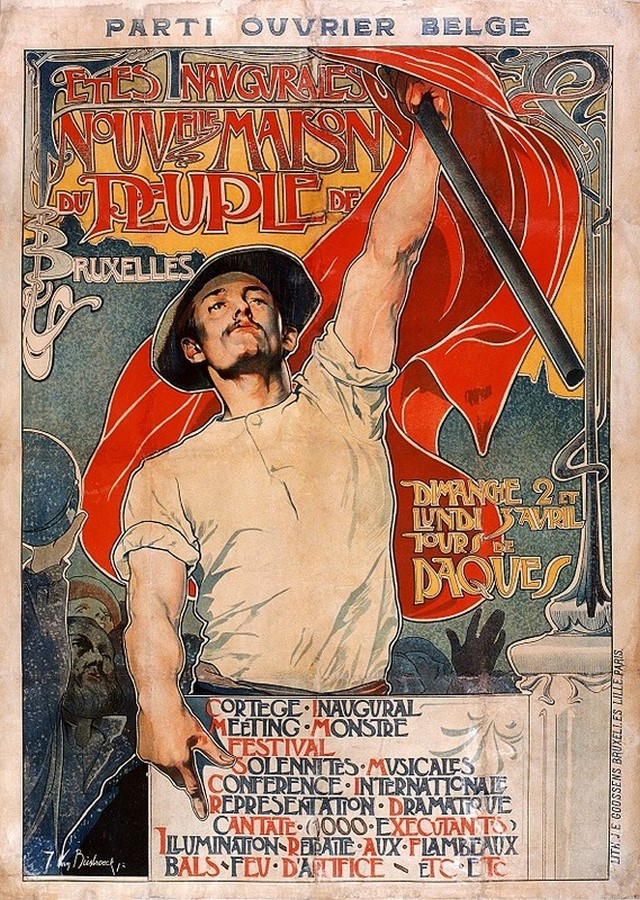
The social unrest that coincided with his rise as a painter, and which culminated in tragedy with the deadly clashes between workers and civic guards in 1886, prompted him to find in the masses, as a collective actor, a powerful companion in misfortune. At the end of the 19th century, the Belgian capital was a bubbling cauldron of revolutionary, creative and innovative ideas. Karl Marx, Victor Hugo and many others found exile here, sometimes briefly. Symbolism, Impressionism, Pointillism and Art Nouveau all vied for glory.
While Marx was wrong on many points, he did understand that, at a time when finance derived its wealth from production, the modernization of the means of production bore the seeds of the transformation of social relations. Sooner or later, and at all levels, those who produce wealth will claim their rightful place in the decision-making process.
Ensor’s fight for freer art reflects and coincides with the epochal change taking place at the time.
Originating in Vienna, Austria, the banking crisis of May 1873 triggered a stock market crash that marked the beginning of a crisis known as the Great Depression, which lasted throughout the last quarter of the 19th century.
On September 18, 1873, Wall Street was panic-stricken and closed for 10 days. In Belgium, after a period marked by rapid industrialization, the Le Chapelier law, which had been in force since 1791, i.e. forty years before the birth of Belgium, and which prohibited the slightest form of workers’ organization, was repealed in 1867, but strikes were still a crime punishable by the State.
It was against this backdrop that a hundred delegates representing Belgian trade unions founded the Belgian Workers’ Party (POB) in 1885. Reformist and cautious, in 1894 they called not for the « dictatorship of the proletariat », but for a strong « socialization of the means of production ». That same year, the POB won 20% of the votes cast in the parliamentary elections and had 28 deputies. It participated in several governments until it was dissolved by the German invasion of May 1940.
Victor Horta, Jean Jaurès and the Maison du Peuple in Brussels
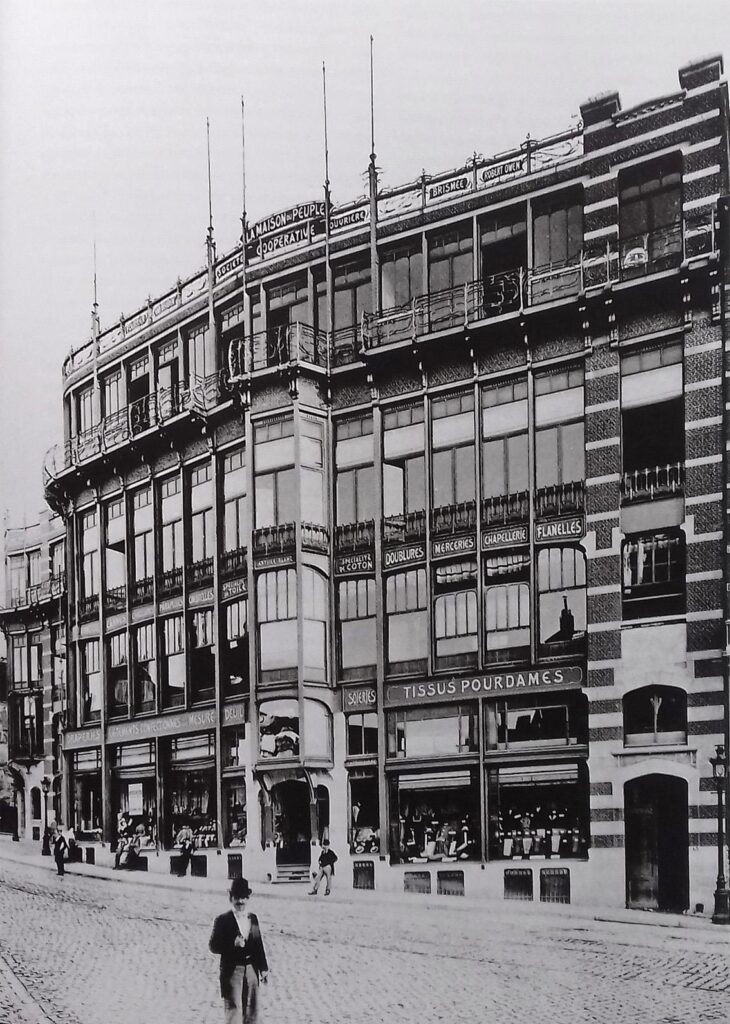
The architect Victor Horta, a great innovator of Art Nouveau whose early houses symbolized a new art of living, was commissioned by the POB to build the magnificent « Maison du Peuple » in Brussels, a remarkable building made mainly of steel, housing a maximum of functionalities: offices, meeting room, stores, café, auditorium…
The building was inaugurated in 1899 in the presence of Jean Jaurès. In 1903, Lenin took part in the congress of the Russian Social-Democratic Workers’ Party.
Jean Jaurès gave his last speech on July 29, 1914, at the Cirque Royal in Brussels, during a major meeting of the Socialist International to save peace. Speaking of the threat of war, Jaurès said: « Attila is on the brink of the abyss, but his horse is still stumbling and hesitating ».
Opposing, as he did all his life, France’s submission to a subordinate role, he said:
« If we appeal to a secret treaty with Russia, we will appeal to a public treaty with Humanity ». And he ended his speech, the best of his life, with these prophetic words, written almost literally: « At the beginning of the war, everyone will be drawn in. But when the consequences and disasters unfold, the people will say to those responsible: ‘Go away and may God forgive you' ».
According to eyewitness accounts, Jaurès’ speech in Brussels aroused thousands of people from all classes of society. Two days later, on July 31, 1914, Jaurès was assassinated on his return to Paris, and the Maison du Peuple in Brussels was demolished in 1965 and replaced by a model of ugliness.
Doctrinary Food
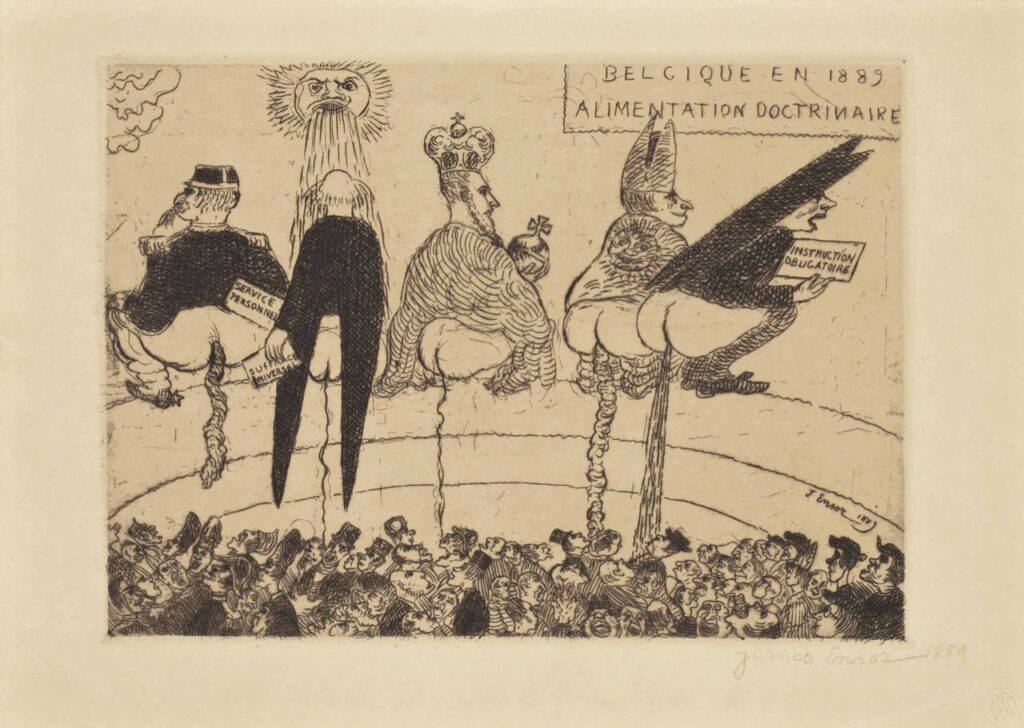
Ensor’s art, especially his etchings, echoed this upheaval. His social and political criticism permeates his best work, none of which is perhaps as virulent as his etching Doctrinary Food (1889/1895) showing figures embodying the powers that be (the King of the Belgians, the clergy, etc.) literally defecating on the masses, a nasty habit that remains entrenched among our French « elites », if we review the treatment meted out, without the slightest discrimination, to our « yellow vests ».
In these engravings, Ensor presents the major demands of the POB: universal suffrage (passed in 1893, albeit imperfectly, at least for men), « personal » military service (i.e. for all, passed in 1913) and compulsory universal education (passed in 1914).
Revenge
Faced with injustice and incomprehension, Ensor can no longer suppress his righteous anger. For his own amusement – and, let’s face it, revenge – he set out to « get even » with those who ignored, despised and sabotaged him, above all the Belgian aristocracy, who clung to their privileges like mussels to rocks.
Deconstructing the straitjacket of academic rules, and drawing inspiration from Goya, Ensor forged a powerful language of metaphor and symbol. Between 1888 and 1892, Ensor began to deal with religious themes. Like Gauguin and Van Gogh, he identified with the persecuted Christ.
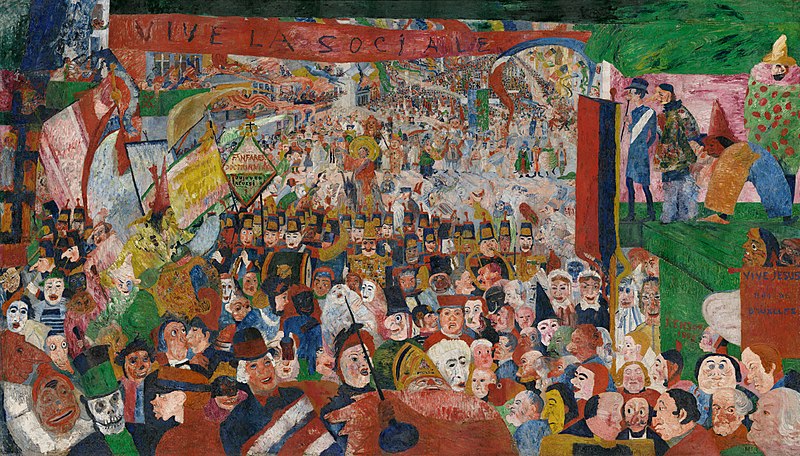
In 1889, at the age of 28, he painted L’Entrée du Christ à Bruxelles, a vast satirical canvas that made his name. Even those closest to him, eager for recognition in order to exist, didn’t want it. The painting was rejected at the Salon des XX, where there was talk of excluding him from the Cercle, of which he was a founding member! Against Ensor’s wishes, the « vingtistes », racing towards success, split up four years later to re-create themselves under the name of La Libre Esthétique.
In this work, a large red banner reads « Vive la sociale », not « Vive le Christ ». Only a small panel on the side applauds Jesus, King of Brussels. But what on earth is the prophet, with the painter’s features and almost lost in the crowd, doing in Brussels? Has socialism replaced Christianity to such an extent that if Jesus were to return today, he would do so under the banner « For Ensor’s friends, he had lost his mind.
The Belgian lawyer and art critic Octave Maus, co-founder with Ensor of Les XX, famously summed up the reaction of contemporary art critics to Ensor’s « pictorial outburst »:
« Ensor is the leader of a clan. Ensor is in the limelight. Ensor summarizes and concentrates certain principles that are considered anarchist. In short, Ensor is a dangerous person who has initiated great changes (…) He is therefore marked for blows. All the harquebuses are aimed at him. It is on his head that the most aromatic containers of the so-called serious critics are poured ».
In 1894, he was invited to exhibit in Paris, but his work, more intellectual than aesthetic, aroused little interest. Desperate for success, Ensor persisted with his wild, saturated and violently variegated painting.
Skeletons and masks

Skulls, skeletons and masks burst into his work very early on. This is not the morbid imagination of a sick mind, as his slanderers claim. Radical? Insolent? Certainly; sarcastic, often; pessimistic? Never; anarchist? let’s rather say « yellow vest spirit », i.e. strongly contesting an established order that has lost all legitimacy and, absorbed in immense geopolitical maneuvers, is marching like a horde of sleepwalkers towards the « Great War » and the Second World War that’s coming behind!
Dead heads, symbols of truth
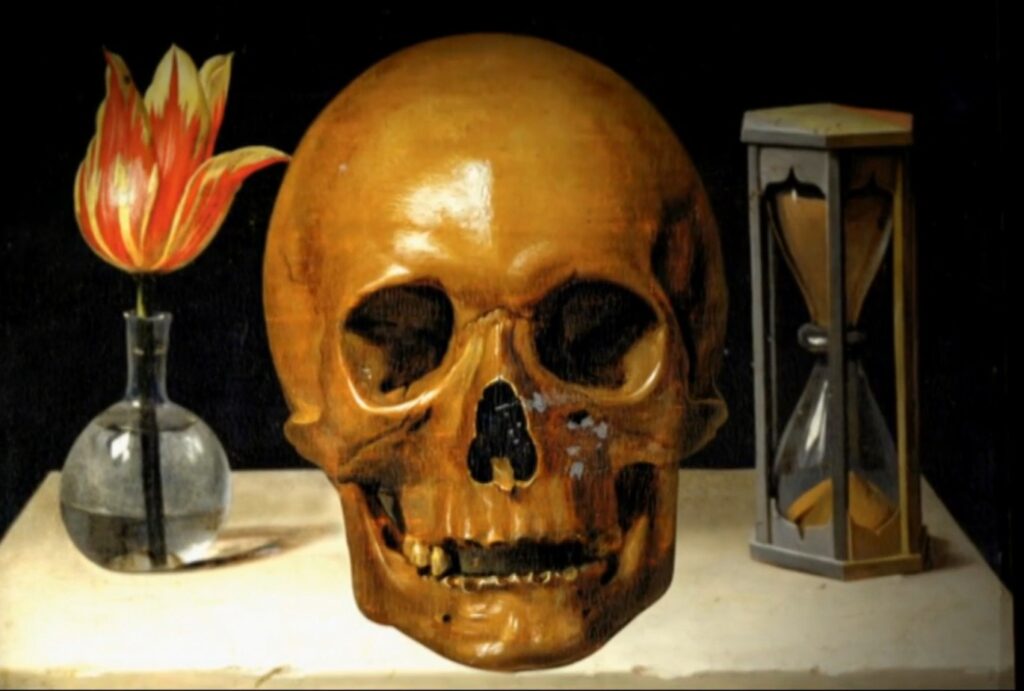
Poetically, Ensor resurrected the ultra-classical Renaissance metaphor of the « Vanities« , a very Christian theme that already appeared in « The Triumph of Death », the poem by Petrarch that inspired the Flemish painter Pieter Bruegel the Elder, and Holbein’s series of woodcuts, « The Dance of Death ».
A skull juxtaposed with an hourglass were the basic elements for visualizing the ephemeral nature of human existence on earth. As humans, this metaphor reminds us, we constantly try not to think about it, but inevitably, we all end up dying, at least on a physical level. Our « vanity » is our constant desire to believe ourselves eternal.
Ensor did not hesitate to use symbols. To penetrate his work, you need to know how to read the meaning behind them. Visually, in the face of the triumph of lies and hypocrisy, Ensor, like a good Christian, sets up death as the only truth capable of giving meaning to our existence. Death triumphs over our physical existence.
Masks, symbols of lies

Gradually, as in Death and Masks (1897) (image at the top of this article), the artist dramatized this theme even further, pitting death against grotesque masks, symbols of human lies and hypocrisy.1
Often in his works, in a sublime reversal of roles, it is death who laughs and it is the masks who howl and weep, never the other way around.
It may sound grotesque and appalling, but in reality it’s only normal: truth laughs when it triumphs, and lies weep when they see their end coming! What’s more, when death returns to the living and shows the trembling flame of the candlestick, the latter howl, whereas the former has a big advantage: it’s already dead and therefore appears to live without fear!
No doubt thinking of the Brussels aristocracy who flocked to Ostend for a dip, Ensor wrote:
« Ah, you have to see the masks, under our great opal skies, and when, daubed in cruel colors, they evolve, miserable, their spines bent, pitiful under the rains, what a pitiful rout. Terrified characters, at once insolent and timid, snarling and yelping, voices in falsetto or like unleashed bugles ».
The same Ensor also castigated bad doctors pulling a huge tapeworm out of a patient’s belly, kings and priests whom he painted literally « shitting » on the people. He criticized the fishwives in the bars, the art critics who failed to see his genius and whom he painted in the form of skulls fighting over a kipper (a pun on « Art Ensor »).
The King’s Notebooks
In 1903, a scandal of unprecedented proportions shook Belgium, France and neighboring countries. Les Carnets du Roi (The King’s Notebooks), a work published anonymously in Paris and quickly banned in Brussels, portrayed a white-bearded autocrat: Leopold II, King of the Belgians, without naming him. Arrogant, pretentious and cunning, he was more concerned with enriching himself and collecting mistresses than ensuring the common good of his citizens and respect for the laws of a democratic state. The book, published by a Belgian publisher based in Paris, was the brainchild of a Belgian writer from the Liège region, Paul Gérardy (1870-1933), who happened to be a friend of Ensor.
The story of the Carnets du Roi is first and foremost that of a monarch who was not only mocked in writing and drawing throughout his reign, but also criticized extremely harshly for the methods used to govern his personal estate in the Congo. Divided into some thirty short chapters, the work is presented as a series of letters and advice from the aging king to his soon-to-be successor on the throne, his nephew Albert, who went on to become Ensor’s patron and, along with his friend Albert Einstein, whom he welcomed to Belgium, was deeply involved in preventing the outbreak of the Second World War.
In Les Carnets, a veritable satire, the monarch explains how hypocrisy, lies, treachery and double standards are necessary for the exercise of power: not to ensure the good of the « common people » or the stability of the monarchical state, but quite simply to shamelessly enrich himself.
The pages devoted to the exploitation of the people of the Congo and the « re-establishment of slavery » (sic) by a king who, via the explorer Stanley, was said to have been one of its eradicators, are ruthlessly lucid, and echo the most authoritative denunciations of the white-bearded monarch, to whom Gérardy lends these words:
« I took care to have it published that I was only concerned with civilizing the negroes, and as this nonsense was asserted with sincerity by a few convinced people, it was quickly believed and saved me some trouble ».
Meeting Albert Einstein
After 1900, the first exhibitions were devoted to him. Verhaeren wrote his first monograph. But, curiously, this success defused his strength as a painter. He contented himself with repeating his favorite themes or portraying himself, including as a skeleton. In 1903, he was awarded the Order of Leopold.
The whole world flocked to Ostend to see him. In early 1933, Ensor met Albert Einstein, who was visiting Belgium after fleeing Germany. Einstein, who resided for several months in Den Haan, not far from Ostend, was protected by the Belgian King, Albert I, with whom he coordinated his efforts to prevent another world war.
If it is claimed that Ensor and Einstein had little understanding of each other, the following quotation rather indicates the opposite.
Ensor, always lyrical, is quoted as saying:
« Let us all promptly praise the great Einstein and his relative orders, but let us condemn algebraism and its square roots, geometers and their cubic reasons. I say the world is round.… »
In 1929, King Albert I conferred the title of Baron on James Ensor. In 1934, listening to all that Franklin Roosevelt had to offer and seeing Belgium caught up in the turmoil of the 1929 crash, the King of the Belgians commissioned his Prime Minister De Broqueville to reorganize credit and the banking system along the lines of the Glass-Steagall Act model adopted in the United States in 1933.
On February 17, 1934, during a climb at Marche-les-Dames, Albert I died under conditions that have never been clarified. On March 6, De Broqueville made a speech to the Belgian Senate on the need to mourn the Treaty of Versailles and to reach an agreement with Germany on disarmament between the Allies of 1914-1918, failing which we would be heading for another war…
De Broqueville then energetically embarked on banking reform. On August 22, 1934, several Royal Decrees were promulgated, in particular Decree no. 2 of August 22, 1934, on the protection of savings and banking activities, imposing a split into separate companies, between deposit banks and business and market banks.
Pictorial bombs
From 1929 onwards, Ensor was dubbed the « Prince of Painters ». The artist had an unexpected reaction to this long-awaited recognition, which came too late for his liking: he gave up painting and devoted the last years of his life exclusively to contemporary music, before dying in 1949, covered in honors.
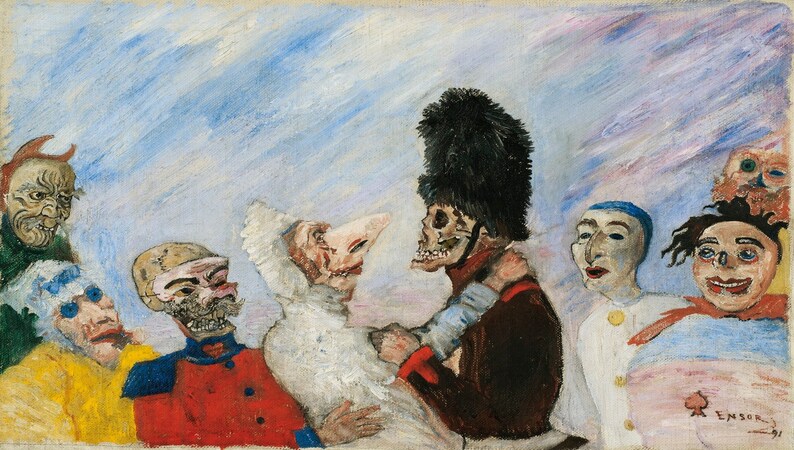
In 2016, a painting by Ensor from 1891, dubbed « Skeleton stopping masks », which had remained in the same family for almost a century and was unknown to historians, sold for 7.4 million euros, a world record for this artist. In the center, death (here a skull wearing the bearskin cap typical of the 1st Grenadier Regiment) is caught by the throat by strange masks that could represent the rulers of countries preparing for future conflicts.
Are the masks (the lie) about to strangle the truth (the skull and crossbones) without success? And so, over a hundred years later, Ensor’s pictorial bombs are still happily exploding in the heads of the narrow-minded, the floured bourgeois and the piss-poor, as he himself would have put it.
Notes:
- In 1819, another artist, the English poet Percy Bysshe Shelley, composed his political poem The Mask of Anarchy in reaction to the Peterloo massacre (18 dead, 700 wounded), when cavalry charged a peaceful demonstration of 60,000-80,000 people gathered to demand reform of parliamentary representation. In this call for liberty, he denounces an oligarchy that kills as it pleases (anarchy). Far from a call for anarchic counter-violence, it is perhaps the first modern declaration of the principle of non-violent resistance. ↩︎
ARTKAREL AUDIO GUIDE: Van Eyck, Rolin and the Peace of Arras (Paris)


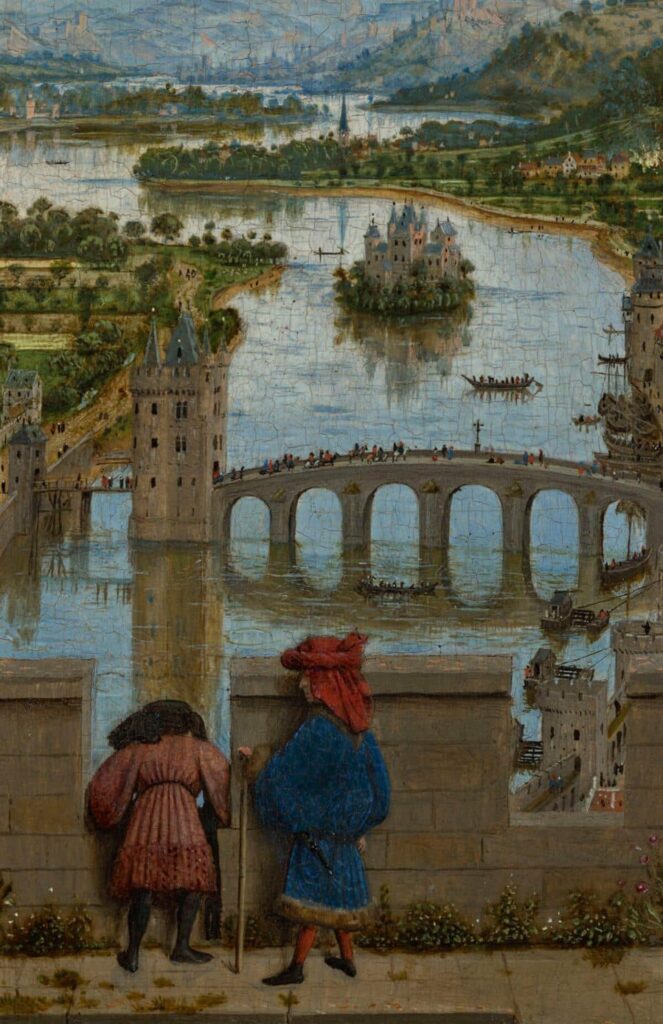
Listen:
Audio on this website
Other audios of the Louvre Audio Guide collection:
- Short note about the building;
- The Greek tradition behind the Fayum Mummy Portraits;
- Cimabue, Giotto, Fra Angelico, the Wonders of the Italian Trecento;
- Who was whispering in the Ear of Joan of Arc;
- Van der Weyden and Cusanus;
- Antonello de Messina and Man in the image of Christ;
- Ghirlandaio’s immortality;
- The Rigor of Mantegna’s crucifixion;
- Leonardo and Verrocchio’s workshop;
- Why Leonardo didn’t like painting;
- Mona Lisa made in China?;
- How Bosch’s Ship of Fools drove the Jester out of business;
- Why Erasmus had no time to pause for portraits;
- Rembrandt, sculptor of Light;
- Why Vermeer was hiding his convictions;
- Van Eyck, Nicolas Rolin and the Peace of Arras.
Read:
- Jan van Eyck, la beauté comme prégustation de la sagesse divine (FR en ligne) + EN on line.
- Jan Van Eyck, un peintre flamand dans l’optique arabe (FR en ligne)
- Jan Van Eyck, a Flemish Painter using Arab Optics (EN online)
- Rogier Van der Weyden, maître de la compassion (FR pdf)
- Comment Jacques Cœur a mis fin à la Guerre de Cent Ans (FR en ligne)
- How Jacques Coeur put an end to the Hundred Years War (EN online);
Le Bac (d’après Pierre Billet)

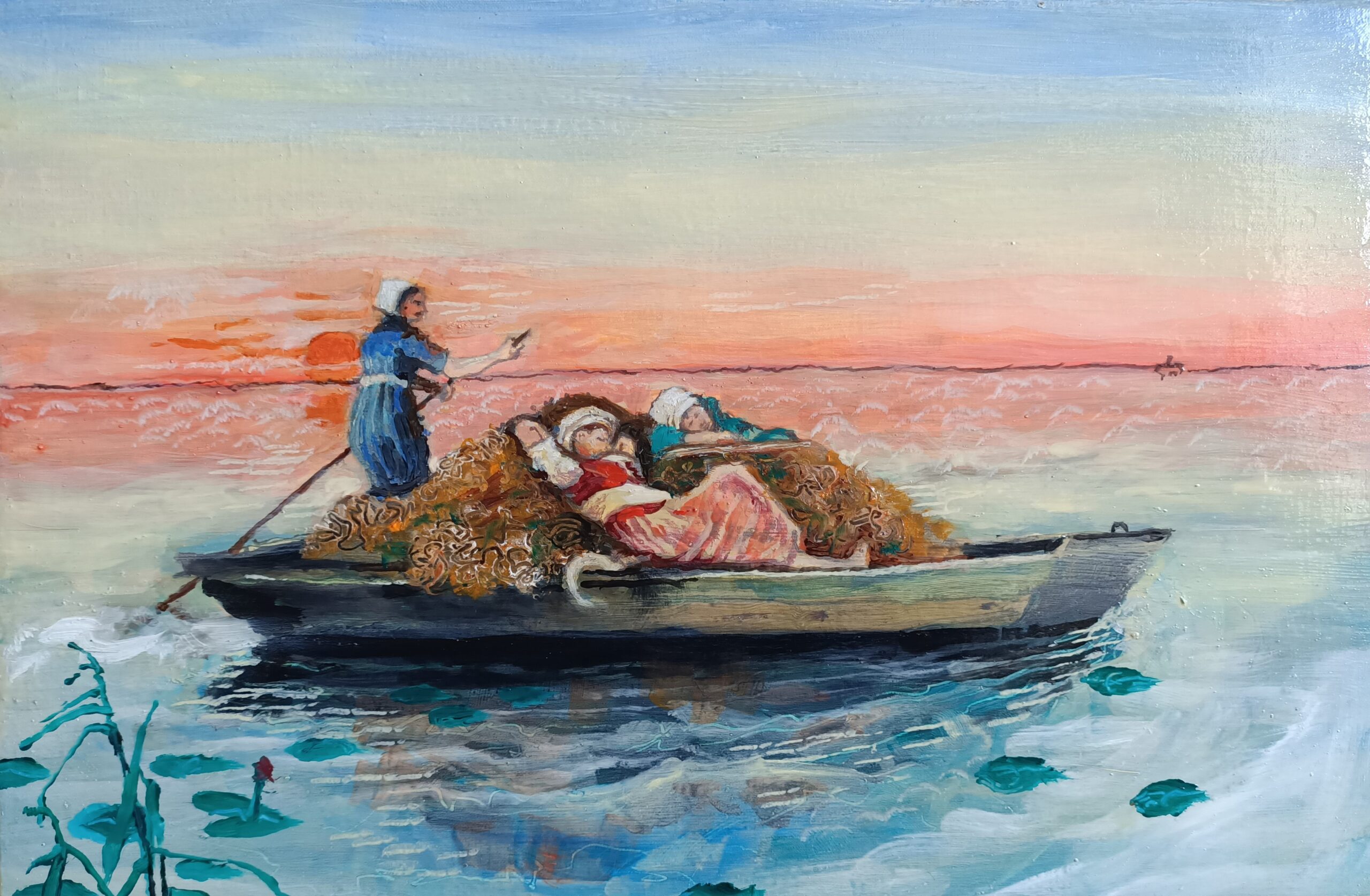
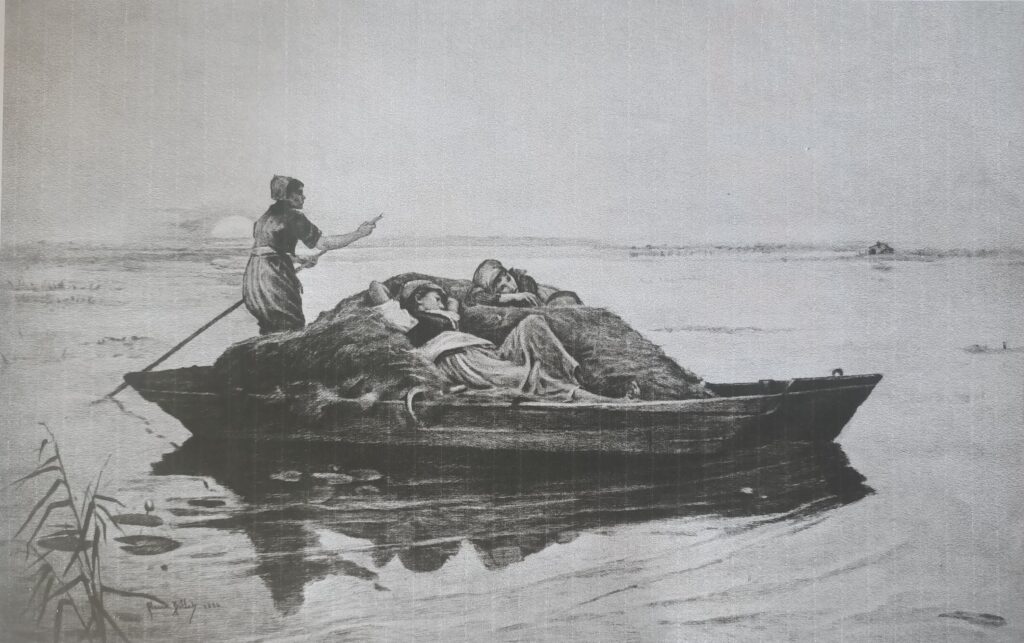

LOUVRE AUDIO GUIDE: Antonello de Messina in the Image of Christ

Listen:
to the audio on this website:
Read:
- Les Frères de la vie commune et la Renaissance du nord (FR en ligne)
- Moderne Devotie en Broeders van het Gemene Leven, bakermat van het humanisme (NL online)
- Devotio Moderna, Brothers of the Common Life, the cradle of humanism in the North (EN online)
- Hugo van der Goes et la Dévotion moderne (FR en ligne);
LOUVRE AUDIO GUIDE: Mona Lisa made in China?

Listen?
Audio on this website
Read?
- La Cène de Léonard, une leçon de métaphysique (FR en ligne) + EN pdf (Fidelio).
- Léonard de Vinci : peintre de mouvement (FR en ligne) + EN pdf (Fidelio).
- La Vierge aux rochers, l’erreur fantastique de Léonard (FR en ligne).
- Romorantin et Léonard ou l’invention de la ville moderne (FR en ligne) + EN pdf (Executive Intelligence Review) + DE pdf (Neue Solidarität) + IT pdf (Movisol website).
- L’Homme de Vitruve de Léonard de Vinci (FR en ligne) + EN online.
- Léonard en résonance avec la peinture traditionnelle chinoise — entretien avec Le Quotidien du Peuple. (en ligne: texte chinois suivi des traductions FR + EN).
ARTKAREL AUDIO GUIDE: short note before starting your visit at the Louvre

Listen:
- To the audio on this website
Read:
- Index of articles dealing with art history and Renaissance studies on this website.

——————————
ARTKAREL AUDIO GUIDE: The rigor of Mantegna’s crucifixion (Paris)

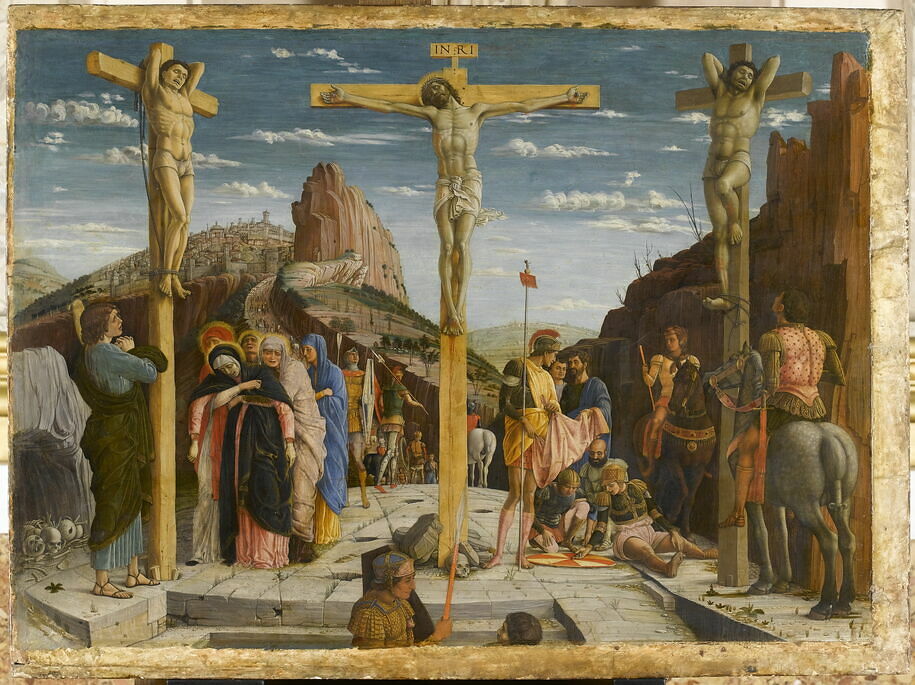
Listen:
To the audio on this website.
Read:
- Avicenne, Ghiberti, leur rôle dans l’invention de la perspective à la Renaissance (FR en ligne) et EN online.
- Les secrets du dôme de Florence (FR en ligne) + EN pdf (Schiller Institute archive website) + DE pdf (Neue Solidarität).
- L’œuf sans ombre de Piero della Francesca (FR en ligne) + EN pdf (Fidelio).
- Uccello, Donatello, Verrocchio et l’art du commandement militaire (FR en ligne) et EN online.
LOUVRE AUDIO GUIDE: Rembrandt, sculptor of light

Listen:
To the audio on this website.
Read:
- Rembrandt, un bâtisseur de nations FR pdf (Nouvelle Solidarité).
- Rembrandt et la lumière d’Agapè (FR en ligne) : Rembrandt et Comenius pendant la guerre de trente ans.
- Rembrandt and the Light of Agapè (EN online)
- Rembrandt : 400 ans et toujours jeune ! (FR en ligne).
- Rembrandt: 400 years old and still young ! (EN online).
- Rembrandt et la figure du Christ (FR en ligne) + EN pdf + DE pdf.
ARTKAREL AUDIO GUIDE: Cimabue, Giotto, Fra Angelico; Wonders of the Italian Trecento (Paris)


Listen
To the audio on this website.
Read:
- L’invention de la perspective FR pdf (Fusion) + EN pdf (Fidelio)
- La révolution du grec ancien, Platon et la Renaissance (FR en ligne)
- The Greek language project, Plato and the Renaissance (EN online).
- Les Frères de la vie commune et la Renaissance du nord (FR en ligne)
- Moderne Devotie en Broeders van het Gemene Leven, bakermat van het humanisme (NL online)
- Devotio Moderna, Brothers of the Common Life, the cradle of humanism in the North (EN online)
ARTKAREL AUDIO GUIDE: Why Vermeer was hiding his convictions (Paris)

Listen:
To the audio on this website
Read: