Étiquette : renaissance
Pieter Bruegel the Elder, political commentator and pacifist

Five centuries after his birth, the publication of new research seems (finally) to do justice to the great Flemish painter « Pieter Bruegel the Jolly » , known as the Elder (1525-1569).
Until now, it was all too common to hear him described as « an unclassifiable figure. » In 2024, art historian Mónica Ann Walker Vadillo did not hesitate to write in the History section of the newspaper Le Monde that, since Bruegel painted peasant feasts and weddings, art critics « came to regard him as an unrefined man and disdainfully nicknamed him ‘Bruegel the Peasant,' » while expressing surprise that so many « academics, humanists, and wealthy businessmen—who appreciated his work and collected his paintings » associated with him.
Fall of the Rebel Angels

In 2014, Tine Luk Meganck ‘s book, « Pieter Bruegel the Elder. Fall of the Rebel Angels. Art, knowledge and Politics on the Eve of the Dutch Revolt », especially with the last sentence of her title, had nevertheless reopened the debate on the political dimension of his work.
Meganck ventured a highly improbable hypothesis regarding the painting The Fall of the Rebel Angels (1562, Brussels Museum): the jealous angels, whom God punishes for conspiring against him, are supposed to represent the alliance of nobles, the middle classes, and the common people, led by William the Silent against the rule of the Spanish Empire. Consequently, the commissioner of the work, according to the expert, was most likely the famous Cardinal Antoine Perrenot de Granvelle, one of the advisors to the regent Margaret of Parma and a fervent supporter of the persecution of heretics.
We have documented in an article why this interpretation seems unacceptable to us, as Cardinal Granvelle, a member of the « secret government, » was universally hated by the humanists of the time for his blind zeal in endorsing all the crimes of his masters.
Furthermore, no tangible proof exists that he commissioned any work from Bruegel. Certainly, he owned some, but apart from a « Flight into Egypt » (1563), a work devoid of any controversy, and a « View of the Bay of Naples, » a beautiful study inspired by drawings made during Bruegel’s trip to Italy, Granvelle was far from being « one of the greatest collectors » of Bruegel’s works, as is often repeated.
Landjuweel

That being said, the important contribution of Meganck’s book, let’s acknowledge it, was the recognition of the decisive influence of the Chambers of Rhetoric and the Antwerp Landjuweel of 1561, for understanding Bruegel’s visual language.
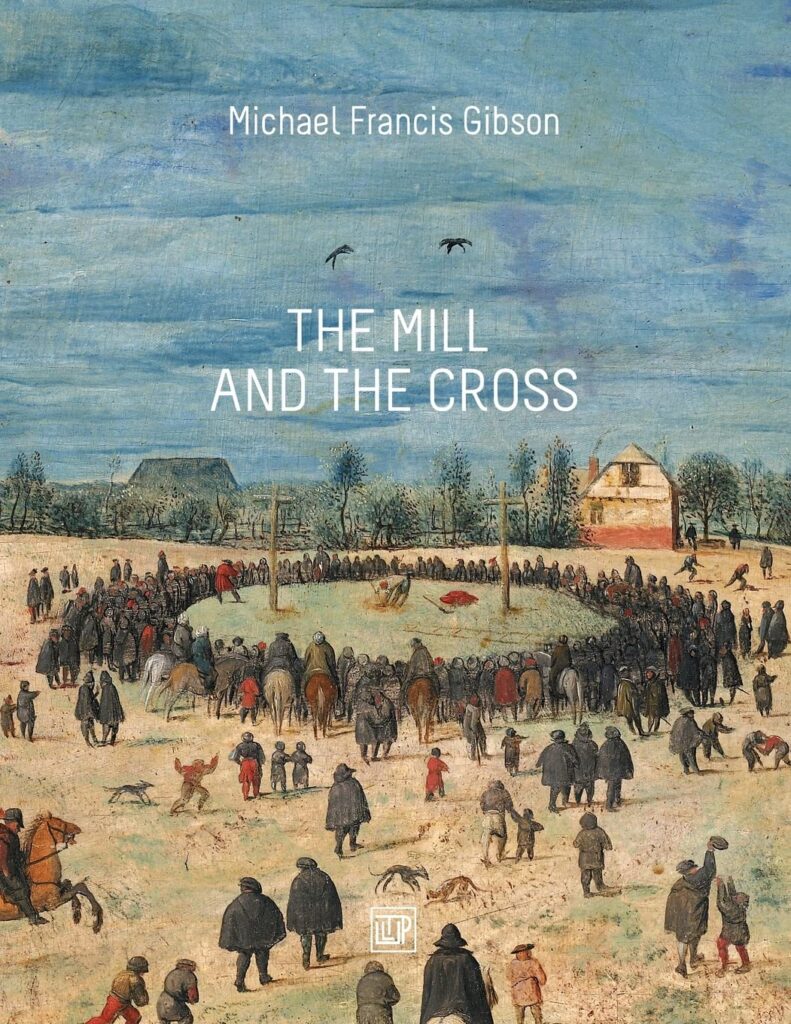
My friend, the late American art critic Michael Frances Gibson, had mentioned this possibility to me during an interview this author conducted with him.
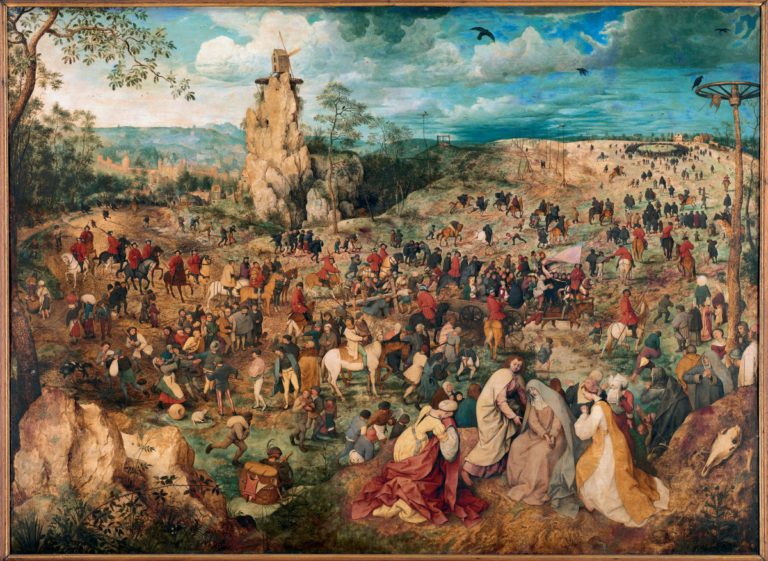
He discusses this in his book The Carrying of the Cross (Editions Noêsis, Paris 1996), which was used in 2011 for the quite innovative film « Bruegel, the Mill and the Cross ».
In August 1561, Antwerp, where Bruegel resided, hosted an exceptional celebration, the Landjuweel, or national competition of the Chambers of Rhetoric.
In practice, the Antwerp Chamber « De Violieren« , in charge of organizing a festival that cost the city one hundred thousand crowns, operated as the literary division of the Guild of Saint Luke, the corporation that brought together painters, engravers, illustrators, architects, sculptors, cartographers, goldsmiths and printers.
It was there that people read in Flemish as well as in Latin or French, Plato, Homer, Petrarch, Erasmus and Rabelais, both during private gatherings and often, in public.
The first Bible in French? Printed in Antwerp in 1535 by the French humanist Jacques Lefèvre d’Etaples (1450-1536), who published the first translations of the complete works of Nicholas of Cusa in Paris in 1514, three years before the publication, in the French capital, of the first edition of Erasmus‘s In Praise of Folly.
The Landjuweel of Antwerp stands historically as one of the most remarkable cultural renaissance events in European history. 2000 rhetoricians on horseback, from 10 cities, passed under 40 triumphal arches to the strident sounds of fifes, entering a city in full celebration. For a whole month, orators and poets, songwriters and actors competed without pausing for breath. Citizen’s were invited on every streetcorner to participate in polyphonic madrigals and chorusses. 5000 artists entertained close to a 100,000 viewers !

Bruegel had to follow them all the more since his dear friend Hans Frankaert (1520-1584), his friend and master Peeter Baltens (1527-1584), very well connected with the great local financiers who preferred commerce to war, as well as his first patron, the engraver Hieronymus Cock (1518-1570), were all involved in the organization of this event whose theme was peace and, two centuries before Kant and Schiller, this burning philosophical question: « What leads man most towards the arts? » This, then, was the bubbling cauldron of urban culture in which Bruegel was immersed from his beginnings.
Moreover, as Belgian historian Leen Huet details in her sumptuous biography of the artist (first published in Dutch in 2016 by Polis, then in French by CFC in Brussels in 2021), when he crossed the Alps, Bruegel was probably accompanied by the painter Maarten de Vos (1532-1603) and the cartographer Abraham Ortelius (1527-1598), a close friend of Christophe Plantin, the head of the largest printing house in Antwerp, the team having thousands of addresses of collectors in connection with the printing house Les Quatre Vents of Jérôme Cock, in Antwerp.
The « Bruegel Code »

The image of Bruegel as a political commentator, deliberately obfuscating his message to thwart the regime’s Gestapo agents who were lying in wait for him, and embracing the Erasmian philosophy of the Landjuweel to defend peace and mutual understanding, is further developed by the classical historian Leo Spaepen, whose recent book, Pieter Bruegel de oude, politiek commentator en pacifist. De Bruegel Code (published in Dutch by MER Books, 2025), has stirred enthusiasm.
A good pedagogue, Spaepen establishes a kind of code for deciphering, or at least fruitfully approaching, Bruegel’s visual language. Escaping the Aristotelian confines, the aim is to immediately discard formal and symbolic representations in favor of what I would call a metaphorical approach.
Narrative A and B
Each painting contains a « narrative A » and a « narrative B. » The former typically reflects a concern shared by the humanist and Erasmian community regarding the socio-political events of the time, where corruption and violent Spanish repression brought the Hispano-Burgundian Netherlands to the brink of revolt. The « narrative B » often depicts a scene from the Bible or scripture.
As with any metaphor, the paradox arising from the analogy between narrative A and B brings forth, not on the canvas but in the viewer’s mind, a range of clues allowing them to grasp where the painter intends to lead them.
Spaepen, whose courage, rigor, and audacity deserve high praise, has sufficiently delved into the political and cultural history of Bruegel’s era to formulate compelling hypotheses that illuminate his major works. By testing this cognitive approach, painting by painting, the author generates not a scholarly compendium of facts or evidence, but an extremely interesting « gestalt » of the painter, whose true genius has often been denied recognition. It is therefore impossible, in a simple article like this, to reproduce the full richness of this approach.
« Mad Meg »

Let us nevertheless look at an emblematic work by Bruegel, known by its nickname, Dulle Griet (« Margot the Enraged » or « Mad Meg » ), a work painted in 1563, not to please a patron, but to provoke discussions with his relatives during meals at his home, as was the custom at the time.
The painting is striking in its contradictions. In the foreground, against a backdrop of burning cityscapes, a woman, mad with rage, sword in hand, carries a basket filled with jewels and precious metalwork. Behind her, a cohort of unarmed women bravely strives to subdue and repel an army of monsters and devils.
Finally, at the intersection of the painting’s diagonals, a strange creature appears, reminiscent of Hieronymus Bosch ‘s Garden of Earthly Delights. A man carrying a large bubble on his back shakes his backside, from which silver coins fall, which some women hastily gather up.
As for narrative B, we find roughly the image that Bruegel had developed in a drawing used for a 1557 engraving representing one of the deadly sins, here rage ( Ira in Latin), again represented by a giant woman, with the subtitle: « Rage swells the lips and sours the character. It troubles the mind and blackens the blood. »
Spaepen also picks up on (p. 131) a great find by Leen Huet. The historian discovered that during the Landjuweel of Antwerp in 1561, the chamber of rhetoric of Mechelen had mentioned a « Griete die den roof haelt voor den helle » (a girl who goes to plunder hell), a figure perhaps taken from a play that is now lost.
Huet also mentions (p. 35) the Flemish proverb that says of an old harpy that she « could go and plunder hell and come back safe and sound. » At the same time, Huet notes (p. 48), the author Sartorius , in a collection of adages inspired by Erasmus, states a saying similar in spirit to the Dulle Griet sign:
« One woman alone makes a racket, two women cause much trouble, three women gather only to trade for an annual market, four women lead to strife, five women form an army, and against six women, Satan himself has no weapon to fight them. »
In reality, the status of urban women from the 15th century onwards in Flanders, with the beguinages, and especially in Brabant in the 16th century, was one of the most advanced in Europe1, probably explaining in part the concerns of some members of the male gender in the face of the growing power of women.
Granvelle

But Spaepen, a good observer, exonerates Bruegel from this kind of masculinist reaction by bringing back the reality of narrative A, the current political situation.
The painter, Spaepen believes, is denouncing here Cardinal Granvelle , zealous advisor to the regent Margaret of Parma, a woman torn between the general interest and submission to the tyranny of the Catholic Church, whose dogmas were instrumentalized by Madrid to plunder the country in order to repay the colossal debt of Charles V and Philip II to the Fugger bankers.
Personally, I thought for a moment that Bruegel had invented for the occasion an 8th deadly sin, « incitement to war » (Oorlogstokerij), but I am probably too much in the present.
In August 1561, disregarding Granvelle’s advice, Margaret had authorized the Guild of Saint Luke and the Violieren to organize the Antwerp Landjuweel to promote peace and mutual understanding. But immediately afterward, she yielded to pressure from Madrid by forbidding the publication of the proceedings of the Chambers of Rhetoric, which were accused of having united the entire country against the Emperor.

In 1563, the year Bruegel painted his Dulle Griet, the Council of Trent decided to curb polyphonic art by restoring the primacy of the sung text in music and prohibiting any ambiguity in a painting, linked to a role of propaganda, exactly as Granvelle wished.
In the painting « Mad Meg, » the strange creature in the center, draped in a red cloak, could very well be Cardinal Granvelle himself.
As Spaepen reminds us, Granvelle had just established a vast network of informants to hunt down heretics « even in the toilets. »
This targeted all those—Lutherans, Calvinists, Erasmians, or Anabaptists—who challenged the predatory grip of the regime. And yet, the money « shat out » by Granvelle is being recovered by women ready to plunder hell! Bruegel, not exactly kind to Mad Meg (Marguerite of Parma), could therefore be expressing his horror at this regent who has lost her mind, and especially at the idea that Flemish women, who had become so free and educated, could end up as informers for a totalitarian regime!
Familia Caritatis

Spaepen (p. 194) documents the strong influence exerted on Bruegel (who was not necessarily a member of the group) by the Familia Caritatis (Family of Charity), a philosophical and religious movement founded and led by Hendrik Niclaes (1502-1570), a prophetic and charismatic figure advocating peace and tolerance about whom little is known but who undoubtedly appeared to many, without reaching his wisdom and erudition, as a kind of successor to Erasmus.
Many humanists and a number of Bruegel’s acquaintances were in contact with this movement which, passing through England, would dissolve into the Quaker revolt against the Anglican Church.2
Plantin, considered the official printer of the Spanish regime, had the Familia Caritatis booklets (deemed heretical by the regime) printed (at night), with initial financial assistance for his printing press from Niclaes, himself a merchant. Niclaes’s major work, Terra Pacis, denounces the « Blind leading the Blind, » a theme also found in the work of Quinten Matsys‘s son (who fled the persecution), and later in Bruegel.
Niclaes draws upon Socrates and the philosophy of the Brethren of the Common Life , for whom selfless love (agape or caritas) should be the driving force of humankind. Another conviction he holds is that life is « a pilgrimage of the soul. »
As in the landscapes of Joachim Patinir, Homo Viator must constantly detach himself from earthly matters and move on. Through his free he must seek union with God by resisting earthly temptations. Inner peace—with oneself, with one’s conscience, and with the divine will—is the foundation of peace on Earth, an ideal that also clearly inspired the painter.
This is the true story, that of a great political commentator and resistance fighter of his time, a painter intellectually and spiritually committed to peace.
NOTES:
- See on this subject Myriam Greilsammer, L’envers du tableau : Mariage et maternité en Flandre médiévale , Armand Colin, 1990, as well as this author’s article on the Landjuweel. ↩︎
- These included the printers Christoffel Plantin and John Gailliart; the humanists Abraham Ortelius, Justus Lipsius, Andreas Masius, Goropius Becanus, and Benito Arias Montano; the poets Peeter Heyns, Jan van der Noot, Lucas d’Heere, Filips Galle, and Joris Hoefnagel; the theologian Hubert Duifhuis; the writer Dirck Volkertsz; Coornhert (right-hand man of William the Silent); the « familists » Daniel van Bombergen, Emanuel van Meteren, and Johan Radermacher; and the Antwerp merchants Marcus Perez and Ferdinando Ximines. ↩︎
AUDIO: Bruegel’s Fall of Empire (Icarus)

TO LISTEN TO THIS AUDIO, CLICK HERE TO OPEN WEBPAGE
Further information on Bruegel:
- Portement de croix: redécouvrir Bruegel grâce au livre de Michael Gibson (FR en ligne) + EN pdf (Fidelio).
- ENTRETIEN Michael Gibson: Pour Bruegel, le monde est vaste (FR en ligne) + EN pdf (Fidelio)
- Pierre Bruegel l’ancien, Pétrarque et le Triomphe de la Mort (FR en ligne) + EN online.
- A propos du film « Bruegel, le moulin et la croix » (FR en ligne).
- L’ange Bruegel et la chute du cardinal Granvelle (FR en ligne).
- AUDIO: Bruegel’s « Dulle Griet » (Mad Meg): we see her madness, but do we see ours? (EN)
- AUDIO: Bruegel’s Theodicy: The Fall of the Rebel Angels. (EN)
- AUDIO: Bruegel’s Fall of Empire (Icarus) (EN)
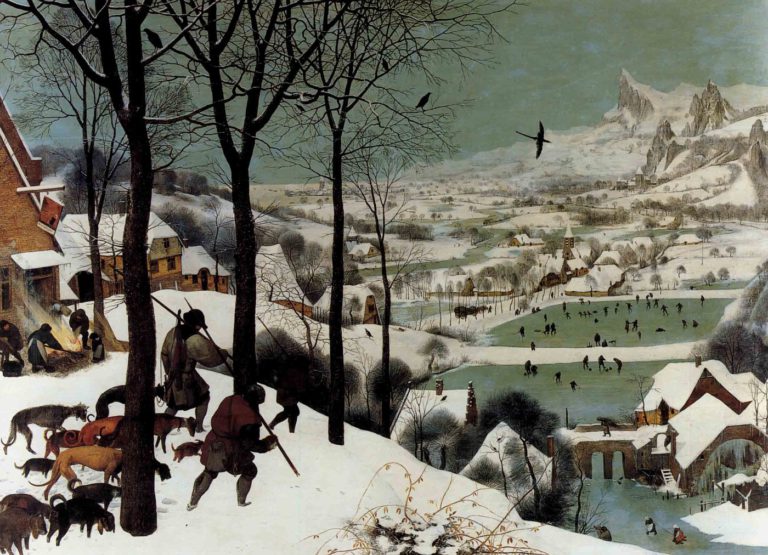
- AUDIO: What Bruegel’s snow landscape teaches us about human fragility (EN)
AUDIO: What Bruegel’s snow landscape teaches us about human fragility

OPEN WEBPAGE TO LISTEN TO AUDIO: CLICK HERE

Further information on Bruegel:
- Portement de croix: redécouvrir Bruegel grâce au livre de Michael Gibson (FR en ligne) + EN pdf (Fidelio).
- ENTRETIEN Michael Gibson: Pour Bruegel, le monde est vaste (FR en ligne) + EN pdf (Fidelio)
- Pierre Bruegel l’ancien, Pétrarque et le Triomphe de la Mort (FR en ligne) + EN online.
- A propos du film « Bruegel, le moulin et la croix » (FR en ligne).
- L’ange Bruegel et la chute du cardinal Granvelle (FR en ligne).
- AUDIO: Bruegel’s « Dulle Griet » (Mad Meg): we see her madness, but do we see ours? (EN)
- AUDIO: Bruegel’s Theodicy: The Fall of the Rebel Angels. (EN)
- AUDIO: Bruegel’s Fall of Empire (Icarus) (EN)
- AUDIO: What Bruegel’s snow landscape teaches us about human fragility (EN)
AUDIO – Bruegel’s Theodicy: The Fall of the Rebel Angels


Further information on Bruegel:
- Portement de croix: redécouvrir Bruegel grâce au livre de Michael Gibson (FR en ligne) + EN pdf (Fidelio).
- ENTRETIEN Michael Gibson: Pour Bruegel, le monde est vaste (FR en ligne) + EN pdf (Fidelio)
- Pierre Bruegel l’ancien, Pétrarque et le Triomphe de la Mort (FR en ligne) + EN online.
- A propos du film « Bruegel, le moulin et la croix » (FR en ligne).
- L’ange Bruegel et la chute du cardinal Granvelle (FR en ligne).
- AUDIO: Bruegel’s « Dulle Griet » (Mad Meg): we see her madness, but do we see ours? (EN)
- AUDIO: Bruegel’s Theodicy: The Fall of the Rebel Angels. (EN)
- AUDIO: Bruegel’s Fall of Empire (Icarus) (EN)
- AUDIO: What Bruegel’s snow landscape teaches us about human fragility (EN)
Rembrandt, la science de « peindre l’invisible »

article in EN online on this website
article in RU at the bottom of this page
Intervention de Karel Vereycken, peintre-graveur, historien, vice-président de Solidarité & Progrès, lors de la conférence organisée par S&P et l’Institut Schiller à Paris, les 8 et 9 novembre 2025.
Je souhaite que cette présentation prenne la forme d’un atelier. C’est pourquoi je demande à ceux qui « savent déjà » ne pas répondre immédiatement à mes questions, mais de laisser la parole à ceux qui ne sont pas encore familiarisés avec ce domaine afin qu’ils puissent s’exprimer et formuler leurs hypothèses.
Dans l’art contemporain commercial, la seule science dont il est question consiste à renoncer à toute forme de rationalité et à laisser libre cours à une émotion quelconque qui s’empare de l’artiste, souvent plus dégradante qu’élévatrice. Cependant, dans les œuvres fondées sur des paradoxes métaphoriques, il existe une véritable « science de la composition », qui élève les idées et les émotions en mobilisant une combinaison de l’invention et de la maîtrise de la représentation.
Peu d’artistes nous ont permis de pénétrer dans les coulisses de leur processus créatif. L’un d’eux fut le grand poète américain Edgar Allan Poe qui, en 1846, dans sa Philosophie de la composition, expliqua la genèse de son célèbre poème Le Corbeau, composé un an auparavant.

L’humanité a la chance de pouvoir admirer « Cornelis Anslo et sa femme » de Rembrandt, une grande peinture à l’huile sur toile réalisée en 1641 et conservée à la Gemäldegalerie de Berlin. L’étude des dessins préparatoires et de leurs modifications au cours du processus de création nous permet de lever en partie le voile sur les étapes de ce processus et d’entrevoir le génie créatif de Rembrandt.
Anslo et les mennonites

Sur le tableau, on voit le prédicateur mennonite Cornelis Anslo assis à une table couverte de gros livres, s’adressant à une femme, très probablement son épouse.1
La composition est très asymétrique, ce qui était assez inhabituel pour l’époque. Le point de vue en contre-plongée, d’où l’on observe la table avec les livres, détermine en grande partie l’effet produit par le tableau. L’impression prévaut qu’Anslo, inspiré des saintes écritures, prononce un sermon du haut d’une chaire.
Le tableau est assez grand : 1,73 m de haut sur 2,07 m de large. L’homme au chapeau noir est Cornelis Claesz Anslo (1592-1646), un riche armateur et marchand de tissus. Il est né à Amsterdam, quatrième fils du marchand de tissus néerlandais d’origine norvégienne Claes Claeszoon Anslo. Anslo signifie « d’Oslo ». Certains prétendent qu’il porte un manteau de fourrure car le tableau a été réalisé en hiver, mais la fourrure ici n’est autre qu’un signe de richesse, de réussite et de statut social. Les frères d’Anslo étaient des figures majeures de la guilde des drapiers qui contrôlait l’industrie textile d’Amsterdam. Ils ont fait fortune en vendant des tapis comme celui-ci, posé sur la table.
Mais Cornelis était aussi un homme profondément religieux, pour qui la religion se traduisait par des actes et non par de simples paroles. Après son mariage, il fonda un hospice pour femmes âgées démunies. Instruit, il devint ensuite prédicateur à la Grote Spijker, l’église des Waterlanders, les mennonites d’Amsterdam.
Les mennonites étaient un groupe religieux néerlandais fondé à l’origine par Simon Menno (1496-1561), un prêtre qui quitta l’Église catholique pour créer sa propre branche au sein de la Réforme protestante. Certains Amish, aux États-Unis, descendent des mennonites néerlandais et flamands.
Il serait trop fastidieux de retracer leur histoire ici. En bref, ils se considéraient comme une communauté de chrétiens désireux de vivre à l’image de Dieu. Ils ne souhaitaient pas d’Église officielle. Ils se réunissaient simplement, lisaient la Bible et s’efforçaient de traduire son message en actes concrets. Par exemple, ils prenaient très au sérieux le passage des Écritures où Jésus nous invite à « aimer nos ennemis et à prier pour ceux qui nous persécutent ». De ce fait, les mennonites décidèrent de ne jamais faire la guerre à quiconque ni d’y prendre part. Ils n’étaient donc pas vraiment appréciés des autres confessions religieuses de l’époque, souvent engagées dans divers conflits armés. Contrairement à bon nombre de ses connaissances, Rembrandt n’a jamais été officiellement membre des mennonites. Il partageait néanmoins certains aspects de leur vision pacifique du monde.2

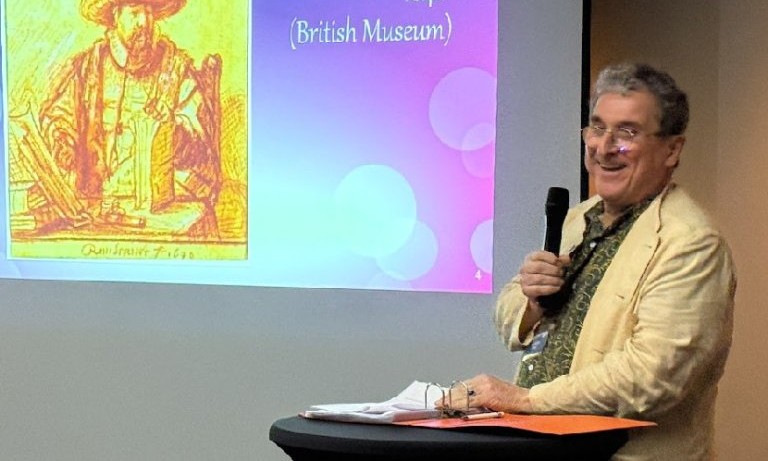
(Crédit: domaine public, British Museum.)
En 1640-1641, Anslo fit appel à Rembrandt pour son portrait. Le prédicateur demanda probablement au peintre de réaliser une esquisse afin de se faire une idée du résultat final. Le prédicateur apparaît sur le premier dessin à la sanguine conservé au British Museum.
QUESTION : Qu’y a-t-il de particulier dans ce dessin ?
PUBLIC : ….
KAREL : Alors qu’il était droitier, il tient sa plume de la main gauche, car le dessin est préparatoire à une gravure. Si l’on transfère l’image telle quelle sur une plaque de cuivre ou de zinc, puis qu’on l’imprime, on obtient une image en miroir. Ainsi, dans la gravure imprimée, Anslo apparaîtra avec une plume dans la main droite, puisque l’effet miroir inverse le sens de l’image. Il faut le prévoir dès le départ.
Nous avons ensuite la gravure de 1641, au Metropolitan Museum de New York.

QUESTION : Qu’est-ce qui différencie l’eau-forte du dessin ?
PUBLIC : ….
KAREL : Il a ajouté de l’espace vide. Pourquoi ?
PUBLIC : …
KAREL : Dans une bonne école d’art, on apprend à recadrer l’image.

à gauche, format intégral ; à droite, recadrée Metropolitan Museum, New York.

KAREL : Mais attendez une minute, cet espace supplémentaire est-il vraiment vide ?
PUBLIC : …
KAREL : En fait, il a ajouté deux choses :
- un clou dans le mur derrière lui (très esthétique !)
- un tableau posé au sol, l’image tournée vers le mur (également très esthétique).
Étrange ? Pas tant que ça, puisque la congrégation s’appelait De grote spijker (« Le grand clou », clou signifiant également le « grand magasin » ou la « grange » leur servant de temple).
Vondel et la poésie
Pas vraiment. Pour trouver une réponse, il faut faire un petit détour. Ce que l’on sait peu, c’est qu’en dessous des tirages de la gravure apparaît souvent, ajouté à la main, un court poème de Joost van der Vondel, considéré comme le plus grand poète de langue néerlandaise :

On peut y lire en néerlandais/flamand :
“Op de Teekeninge van / Kornelis Nikolaesz Anslo /
Kunstich door Rembrandt gedaen /
Ay Rembrandt mael Kornelis stem /
het zichtbare deel is’t minst van hem /
’t onzichtbare kent men slecht deur d’ooren /
wie Anslo zien wil, moet hem hooren. /
J. v. Vondel »
Traduction française :
« Ô Rembrandt, peins la voix de Cornelis.
La partie visible est la moindre de lui ;
l’invisible, nous ne le connaissons que par nos oreilles ;
celui qui veut voir Anslo doit l’entendre. »
J. v. Vondel
ou, la version rimée que m’a offerte mon amie russe:
« Rembrandt, ô peins, vibrant, la voix de Cornelis.
La part visible de lui n’est qu’une esquisse
Son invisible, c’est l’ouï qui nous le révèle;
Seul qui l’entend puisse voir Anslo tel quel.«
Jusqu’en 1641, Vondel fut le doyen des Waterlanders, le groupe mennonite d’Amsterdam dont Anslo était un prédicateur de premier plan.
Son poème mentionne un « tekening » (dessin) et, en effet, on peut déjà trouver le poème au verso de l’esquisse initiale. On peut penser qu’Anslo a montré, pour avis, l’esquisse préparatoire de Rembrandt à Vondel, le doyen de sa congrégation.
En réagissant par son poème, Vondel met en lumière trois points :
- Il affirme haut et fort la position officielle de la congrégation des mennonites, à savoir que la parole (et plus encore la voix, c’est-à-dire la parole prononcée) est supérieure à l’image pour évangéliser l’humanité. Transformer les autres par sa voix a plus de valeur que le simple apprentissage, et enfin, que pour connaître il faut enseigner.3
- Vondel fait subtilement comprendre que son propre art, la poésie, est supérieur à celui de Rembrandt, la peinture…
- Il dit que Rembrandt pourrait même faire mieux.
Il est clair que Rembrandt s’est senti interpellé par les remarques plutôt amicales du poète. La gravure pourrait constituer une première réponse du peintre, puisqu’elle souligne l’importance de la parole par cette idée du clou, symbolisant l’image décrochée et placée face contre le mur.
Mais pour préparer le grand tableau à l’huile, Rembrandt réalisa une nouvelle esquisse, aujourd’hui conservée au Louvre.

L’iconographie de la gravure était certainement comprise des mennonites, mais cela ne suffisait pas à toucher un public plus large au fil du temps. Il fallait donc inventer autre chose, visuellement parlant, pour présenter à un niveau supérieur le même argument et surmonter le défi de « peindre l’invisible ».

Déjà dans le dessin du Louvre, la main d’Anslo se déplace vers la gauche, ou plutôt sa tête vers la droite, donnant l’impression que le prédicateur se penche vers son interlocuteur. Dans ce deuxième dessin, si Anslo ne parle pas encore, bien qu’il soit « sur le point » de parler, il se trouve dans une position instable, disons de transition, entre deux mouvements, c’est-à-dire en « point de changement de mouvement » (mid-motion-change, comme l’a formulé Lyndon LaRouche).
La parole sera pleinement manifeste dans le tableau final : la bouche d’Anslo est ouverte et ses sourcils sont levés.

Mais au-delà du simple portrait d’Anslo, Rembrandt ajoute un élément totalement inédit : une personne qui écoute avec une attention extrême.
Ainsi, pour peindre la « voix » (le son), il peint un autre phénomène invisible, son contraire : le silence. Une voix qui résonne sans auditeur est aussi morte qu’un mot dans un livre.
Par là, Rembrandt surmonte le paradoxe de Vondel et affirme la supériorité de son art, la peinture, et le fait que, par l’image, les apparents opposés du son et du silence peuvent être dépassés et rendre visible la parole de Dieu, agissant à travers la voix d’Anslo et surtout l’écoute de sa femme.
Alors, la lumière céleste de Dieu pénètre dans la pièce et éteint la lumière terrestre des bougies pour faire place à la lumière céleste.

Pour conclure, si vous souhaitez poursuivre ce type de discussion, je vous invite à rejoindre le groupe de travail international sur l’art, parmi les artistes amateurs de notre mouvement. Ce groupe fut lancé par le Dr Ned Rosinsky. À ce jour, il comprend principalement son initiateur, Debbie Sonnenblick, Ilko Dimov, peut-être Sébastien Drochon, Philip Ulanowsky, Christine Bierre et moi-même. Vous pouvez voir quelques-unes de leurs œuvres ici. N’hésitez pas à me contacter à ce sujet.
Merci
BIOGRAPHIE SOMMAIRE :
- Corpus des peintures de Rembrandt, base de données
https://rembrandtdatabase.org/literature/corpus.html - Filippi, Elena, Weisheit zwischen Bild und Word in Fall Rembrandt, Coincidentia, groupe 2/1, 2011
- Haak, Bob, Rembrandt : sa vie, son œuvre et son époque, Thames & Hudson, 1969
- Kauffman, Ivan J., Voir la lumière, Essais sur les images religieuses de Rembrandt, Academia.edu, 2015
- Schama, Simon, Les yeux de Rembrandt, Alfred A. Knopf, 1999
- Schwartz, Gary, Rembrandt, Flammarion, Mercatorfonds, 2006
- Tümpel, Christian, Rembrandt, Albin Michel, Mercatorfonds, 1986
- Vereycken, Karel, Rembrandt, bâtisseur de nation, Nouvelle Solidarité, 1985
- Vereycken, Karel, Rembrandt et la lumière d’Agapè, Artkarel.com, 2001
- Wright, Christopher, Rembrandt, Citadelles et Mazenot, 2000.
- Les experts ont souvent divergé quant à l’identité de la femme. S’agit-il de sa mère, de son épouse ou d’une servante de l’hospice fondé par Anslo ? En 1767, Camelis van der Vliet, la gouvernante de l’hospice, rapporta un passage des archives indiquant qu’Anslo prêchait l’Évangile non seulement en public mais aussi « à sa femme et à ses enfants ; tout comme il est merveilleusement représenté dans le tableau susmentionné, parlant à sa femme de la Bible qui est ouverte devant lui, et que sa femme, représentée d’une manière inimitable et artistique, écoute avec une attention dévote ». A cela s’ajoute que la femme n’est pas vêtue comme une indigente pensionnaire d’un hospice, mais conformément à son statut d’épouse d’un riche marchand. Ce n’est que bien plus tard que le tableau, réalisé pour la demeure privée d’Anslo, deviendra propriété de l’hospice. ↩︎
- En 1686, le critique d’art italien Filippo Baldinucci déclara que « l’artiste professait à cette époque la religion des ménistes (mennonites) ». Des recherches récentes confirment que Rembrandt avait des liens étroits avec la communauté mennonite Waterlander d’Amsterdam, notamment par l’intermédiaire d’Hendrick Uylenburgh, un marchand d’art mennonite qui dirigeait un atelier d’artistes où Rembrandt travailla de 1631 à 1635. Rembrandt devint le peintre en chef de l’atelier et épousa en 1634 la cousine germaine de Van Uylenburgh, Saskia van Uylenburgh, qui n’était pas mennonite. ↩︎
- Le débat sur le rôle exact de la voix, de la parole et de l’image pour les prêcheurs, dégénéra en 1625 en une violente dispute entre les membres de la communauté des Waterlanders d’Amsterdam et d’ailleurs. Une faction affirmait que la parole écrite n’était qu’une voix « morte » et que seul importait la parole vivante, c’est-à-dire Jésus, qui était vivant en chacun en tant que « parole intérieure » des chrétiens. En publiant un pamphlet anonyme, Anslo a pu calmer le débat et réconcilier les croyants, évitant ainsi un schisme. ↩︎
Zheng He and the Chinese Maritime Expeditions
Cet article en FR

By launching its « 21st Century Maritime Silk Road », China is reconnecting with a particularly rich naval and maritime past. Its first activities in this field date back, as far as navigation in the China Sea is concerned, to the Zhou dynasty (771-256 BC).
(See also my article The Maritime Silkroad, a history of 1001 Cooperations )
By Karel Vereycken
By the Han period (1st to 3rd century CE), China was already familiar with naval techniques, including a primitive form of compass and the famous junks capable of reaching the coasts of Africa.

An activity, undoubtedly carried out by Chinese, Indian and Arab navigators, which developed, notably from the great Indian port of Calicut, over a thousand-year period, in particular under the Tang (618-907) and the Song (960-1279).
« The annual import into China of ivory, rhinoceros horn, pearls, incense and other products found specifically along the coasts of Yemen and East Africa, amounted (around 1053) to 53,000 units of account, » according to the chroniclers of the dynasty of the time.

In exchange for imperial silk, ceramics and porcelain, Chinese sailors also bought large quantities of pearls and precious objects. Many Song and Tang Chinese coins have been found, as well as porcelain, in the coastal regions of Somalia, Kenya and Tanganyika as well as the island of Zanzibar.
The XVth Century

However, the expeditions of Admiral Zheng He (1371-1433) under the Ming dynasty, at the beginning of the XVth century, are something exceptional because they were strongly oriented towards scientific exchanges.
Zheng was born a Muslim. Grandson of the governor of Yunnan Province, he became a eunuch at the court of Zhu Di, the future Yongle Emperor (1402-1424).
The latter made history by launching a series of (very) major works:
- It reinvigorates the Silk Roads;
- He restored the astronomical observatory to its former functions;
- He moved the Chinese capital from Nanking to Beijing;
- In the heart of the capital, he had the Forbidden City built by 1 million workers and craftsmen;
- It modernizes the Grand Canal to guarantee the food security of the capital;
- He expanded the system of imperial examinations for the selection of scholars;
- He had 2,180 scholars write the largest encyclopedia ever written, comprising more than 11,000 volumes;
- He appointed Admiral Zheng He as commander-in-chief of a high seas fleet tasked with publicizing and recognizing the achievements of China and its Emperor throughout the world.

Thus, between 1405 and 1433, Admiral Zheng will lead seven expeditions which will land in almost all the countries, ports and sites that count in the Indian Ocean:
- Vietnam: the kingdom of Champa, city of Cochinchina;
- Indonesia: the island of Java and Sumatra, Aru Islands, city of Palembang;
- Thailand: Siam;
- Malaysia: port of Malacca, islands of Pahang and state of Kelantan (Malaysia);
- Sri Lanka: the island of Ceylon;
- India: Kozhikode (or Calicut), capital of the state of Kerala in India;
- The Maldives Islands;
- Iran: Hormuz Island in the Persian Gulf
- Yemen: Aden;
- Somalia: Mogadishu;
- Kenya: Kingdom of Malindi (Melinde);
- Sultanate of Oman: Muscat and Dhofar;
- Saudi Arabia: Jeddah and Mecca.

The Science of Navigation

His fleet, during the first expedition between 1405 and 1407, had no fewer than 27,800 men on board 317 vessels, including 62 « treasure ships », XXL ships capable of carrying 500 people.
The largest junk is 122 metres long and 52 metres wide, it has nine masts and 3000 tonnes, while Christopher Columbus’ caravels of 1492 are only 25 metres long and 5 metres wide, its sails hoisted on only two masts and carrying only 450 tonnes!
Imitating the partitioned stems of bamboo, these ships are composed of watertight compartments which make them less vulnerable to shipwrecks and fires. The ancestral technique of watertight compartments, taken up by Western shipbuilding in the 19th century, was registered in November 2010 by UNESCO as an intangible cultural heritage of humanity.
Historians note that in Europe, shipbuilding drew its inspiration from the swimming of fish. Throughout history, our ships have sought to cut through the waves and the bow remains one of the fundamental points of our shipbuilding.

However, the Chinese note that the fish that swims underwater cannot be an example for evolving on the water. Their reference animal is the duck. No bow when it is enough to fly over the surface. The junk was therefore designed according to the shape of this sea bird. From this one, it takes its elongation, its very low draft on the front of the hull and its great width.
According to some historians, on February 2, 1421, the Yongle Emperor gathered 28 leaders and dignitaries from Asia, Arabia, the Indian Ocean and Africa.
This summit, according to Serge Michel and Michel Beuret, was
« the most international conference ever organized and which would have testified to the influence of Ming China (1368-1644), an empire then open to the world. »1
In France, in 1431, Joan of Arc was burned at the stake in Rouen…
A civilizational chasm

At the end of the 14th century, a gulf separated the level of development of China from that of a Europe ruined by the Hundred Years’ War, an unprecedented financial crash, famine and the Black Death.
For example, the library of the English king Henry V (1387-1422) consisted of only six manuscript volumes, three of which were loaned by a convent. The Vatican, for its part, possessed only about a hundred books before 1417.
While for the inauguration of the Forbidden City in Beijing in 1421, some 26,000 guests feasted on a banquet consisting of ten courses served on plates of the finest porcelain, in Europe, a few weeks later, at the wedding of Henry V to Catherine of Valois, it was salted cod on slices of stale bread that was served to the six hundred guests!
While the Chinese army could field a million men armed with firearms, the same Henry V of England, when he went to war against France the same year, had barely 5,000 fighters armed with bows, swords and pikes. And the English monarch, lacking a powerful navy, was forced to use fishing boats to cross the Channel…
Diplomacy and Prestige

Contrary to what has been said, the Ming dynasty was not concerned with seeking new trade routes, systematically supplying itself with slaves or finding land to colonize.
The sea routes used by Zheng’s fleet were already known and had been frequented by Arab merchants since the 7th century.
That this was a demonstration of Chinese prestige is demonstrated by the fact that in 1407 Zheng founded a language school in Nanking.
Sixteen translators would travel with the Chinese fleets, allowing the admiral to converse, from India to Africa, in Arabic, Persian, or even in Swahili, Hindi, Tamil and other languages.
Since religious freedom was one of the Emperor’s great virtues, Muslim, Hindu and Buddhist scholars were included in the journey.
Equally remarkable was the presence of scientists on ships so large that they allowed scientific experiments to be conducted there.
The metallurgists who had embarked for the occasion prospected in the countries where the fleet stopped. The doctors could collect plants, remedies and treatments for diseases and epidemics.
Botanists tried to acclimatize useful plants or food crops. The ships also brought seeds that the Chinese hoped to cultivate abroad.

It was during these expeditions that China established diplomatic relations with around thirty countries. The story of these exchanges has come down to us thanks to the remarkable work of his traveling companion Ma Huan.
Also a Muslim, his writings are available in a book entitled Ying-yai Sheng-lan ( The Wonders of the Oceans ).
During their last voyage, the two friends were granted the right to go as far as Mecca with a view to establishing commercial exchanges.
On his fourth expedition, National Geographic claims, Zheng met with representatives of the Sultanate of Malindi (present-day Kenya), with whom China had established diplomatic relations in 1414.
As tribute, African dignitaries offered Zheng He zebras and a giraffe, an animal the Romans called the cameleopard (half-camel, half-leopard).
In China, the Emperor hoped to one day possess a qilin , that is to say an animal as mythical as the unicorn in the West, a cross between a deer or a horse with hooves, and a lion or a dragon with a brightly colored skin.
The emperor also wanted a painting of the giraffe, a copy of which was found in 1515 in a painting by the Flemish painter Hieronymus Bosch, who had copied it from a book by Cyriacus of Ancome (1391-1452), a great Italian traveller.

Right: détail of Hieronymus Bosch’s Garden of Earthly Delights, left panel, Madrid.
Unfortunately, in May 1421, two months after the departure of the great fleet, the Forbidden City, struck by lightning, was reduced to ashes.
Interpreted as a sign from heaven, this will be the beginning of a period of national withdrawal which will lead China to abandon its projects, to even destroy, in 1479, all the documents relating to these expeditions and to interrupt its foreign trade until 1567.
Faced with the Mongol threat, China will then concentrate on the construction of the Great Wall, agriculture and education.
Today
It was not until 1963 that Zhou Enlai, during his tour of Africa, rehabilitated Admiral Zheng. In 2005, China celebrated the 600th anniversary of his first expedition and evoked his memory at the opening ceremony of the 2008 Olympic Games.
For China, Zheng’s expeditions are emblematic of its ability to promote harmonious commercial development that broke with the Western and Japanese colonial practices from which China suffered during the « 150 years of humiliation. »
President Xi rightly said in 2014:
« Countries that have tried to pursue their development goals through the use of force have failed (…) This is what history has taught us. China is committed to maintaining peace. »
NOTE:
- In his book 1421, the Year China Discovered America , the amateur historian Gavin Menzies, a former commander of the British Royal Navy, claims, on the basis of copies of old maps whose authenticity is more than questionable, that Zheng We’s men were able to reach America, even Australia, and this well before the Europeans. His publisher, who had his text completely rewritten by 130 communicators to make it a bestseller, granted him 500,000 English pounds to acquire the copyright worldwide. The Chinese, knowing full well that you have to be wary of the English especially when they flatter you, without closing the doors to further research, have so far resisted any idea of crediting his thesis. ↩︎
The Creative Principle in Painting

Discussion paper written (updated later but initially conceived in Belgium before 1980) by my beloved wife Christine (Ruth) BIERRE who was a precious source of many of my works, research and inspiration.
Empathy, sympathy, compassion – Humanity’s cultural heritage, key to world peace
Dieses artikel in gutes Deutsch PDF
Cet article en français en ligne

Empathy, sympathy, compassion – Humanity’s cultural heritage, key to world peace. Speech by Karel Vereycken, painter-engraver, at the Schiller Institute’s international conference on 15 and 16 June 2024.

Before talking about World Cultural Heritage, two words about the notions of “sympathy”, “empathy” and “compassion,” three words constructed with the word “pathos”, the Greek word for “suffering” or “affection”.
Today, the word “empathy” is often used interchangeably with the words “sympathy” and “compassion,” but they aren’t really the same thing. All three refer to a caring response to someone else’s distress (pathos).
–Sympathy is a feeling of sincere concern for and share the feelings of someone who is experiencing something difficult or painful (pathos).
—Empathy was a word coined in the early 20th century as a translation of the German Einfühlung, it means feeling with people, not just feeling for them. When you’re empathetic, you’re right there with them, feeling it too, because you put yourself, in a sense, “in the shoes of the other person.”
–Compassion goes of course beyond empathy and means action. Compassion goes with altruism, or “a desire to act on that person’s behalf.” Put simply: you relate to someone’s situation, and you want to help them.
But empathy is particularly key for our subject here, that of “peace building” because it can build a bridge between persons considering each other as “enemies”. We can show empathy for persons we don’t consider sympathetic at all. We don’t share their feelings, but we go beyond mere affection and engage in what is called “cognitive empathy”: we know enough about the other person’s background and culture to understand his motivations. As a byproduct, empathy can help us to forgive and pardon as requested by the Peace of Westphalia.
Today, if we want to make peace a reality, we have to mobilize ourselves to raise the level of empathy. Empathy is under massive attack:
- –by the promotion of brutal competition (that’s why professionnal sports are allowed)
- –a culture of screens and
- –the breakdown of person to person dialogue.
There was a campaign to increase empathy in Europe after the bloody wars between France and Germany, when the Goethe Institute opened in France and the Alliance Française in Germany. There was also a movement of “sister” cities allowing people from one village to visit a “sister” village in the other country. They would talk, laugh with their prejudices and celebrate together, have inter personal dialogue and learn to read on the faces the emotions standing “behind” the words.
Now, the knowledge one can acquire of each other culture, language and history, are of course a fundamental tools to develop this “cognitive empathy” which allows you to see persons as “products” of a history, a culture and a civilization, rather then as atomized little entities.
For example, after I discovered the philosophy of mutazalism of the Baghdad Abassides Califate, my entire vision of Islam changed. I know exactly what happened to their civilization, their frustrations and hopes.
Today, China is currently heavily involved and mobilized to protect especially the pre-islamic cultural heritage of Afghanistan and other countries of Central Asia. It is in its own interest. One leading Chinese archaeologist which I met, rightly said that the beauty and intellectual challenge of this art is “the best way to fight terrorism.” Not weapons and drones but culture!
It it was in Afghanistan that the silk road players met when the Greek culture walked towards the East and the Chinese culture walked towards the West.
The Buddhists that prospered in this area were very active over both the maritime and terrestrial silk roads, reaching into Pakistan, India, Sri Lanka, Xinjiang and China. They paid huge attention to metallurgy, architecture, painting, sculpture, poetry, and literature. The first printed text known today is a Buddhist text of 868 AD.
Added to this, the birth of a very agapic form of Mahayana buddhism in the region of Gandhara (now mainly in Pakistan). Its followers, in stead of pursuing a purely personal goal of nirwana (enlightenment), rather took pleasure to free all of humanity from suffering !
Empathy, compassion and mercy were the supreme qualities to be glorified in Gandhara art especially in the form of what are called Bodhisattva’s, that is ordinary persons that are set to become enlightened but elect instead to remain in this world, easing the suffering of all beings and helping others attain enlightenment.
Two examples:


The one who understood that this revolutionary form of Buddhism could pacify the region was the Indian Prime minister Nehru who named his daughter Indira Priyadashini (the future Prime Minister Indira Gandhi), because « Priyadarshi » was the name adopted by the great emperor Ashoka the great (304 – 232 BC) after he converted and became a Buddhist prince of peace!
In 1956, just before the creation of the non-aligned movement and the Bandung conference, Nehru orchestrated a year-long celebration honorifying “2,500 years of Buddhism”, not to resurrect an ancient faith per se, but to claim for India the status as the birthplace of Buddhism: an ancient belief advocating non-violence, pacifism and that calls for ending the disgraceful “caste system” the British worsened and wanted to maintain worldwide.
Mes Aynak
Today, with the Ibn Sina Research & Development Center in Kaboul, we of the Schiller Institute are working day and night to save the archaeological site of Mes Aynak which we want to have classified by UNESCO as a world heritage site.
Mes Aynak is the world’s second largest copper reserve and Afghanistan needs the mining activity to get revenues to complete its urgent reconstruction. But on top of the mine stands the ruins of a vast monastic Buddhist complex that was a key trading post of the silk road between the 1st and the 8th century.
After our campaign and forth and back discussions between the afghan government, China and the Chinese mining company, all actors agreed that the entire cultural heritage on the surface will be protected and mining will only take place with underground mining techniques.
We won a fight, now we have to win the peace.
Full study:
AUDIO – Van Eyck’s theological metaphor in his Madonna in the Cathedral (Berlin)

Karel Vereycken, on June 15, analyzing Jan Van Eyck’s theological metaphor of light in his « Madonna in the Cathedral », at Berlin’s Gemäldegalerie, Germany.

Listen
to the AUDIO
Read
Jan Van Eyck, a Flemish Painter using Arab Optics (EN online)
Jan van Eyck, la beauté comme prégustation de la sagesse divine (FR en ligne) + EN on line.
ARTKAREL AUDIO GUIDE — Bruegel’s Two Apes (Berlin)


Karel Vereycken, on June 15, analyzing and commenting Bruegel’s painting « The Two Apes » at Berlin’s Gemäldegalerie, Germany.
AUDIO – Rembrandt painting the voice of Anslo (Berlin)

1st AUDIO with comments made in Berlin Museum on June 6, 2025.


Karel Vereycken, on June 6, 2025, decrypting Rembrandt’s painting of the predicator Cornelis Anslo and his wife, Gemäldegalerie, Berlin, Germany.
For more on this subject, see my 1985 article (FR) Rembrandt, bâtisseur de nations, Nouvelle Solidarité.
2nd AUDIO with détailed 45 minutes presentation and analysis during zoom dialogue on September 21, 2025 with Schiller Institute friends in the United States.
Read:
- Rembrandt, un bâtisseur de nations FR pdf (Nouvelle Solidarité).
- Rembrandt et la lumière d’Agapè (FR en ligne) : Rembrandt et Comenius pendant la guerre de trente ans.
- Rembrandt and the Light of Agapè (EN online)
- Rembrandt : 400 ans et toujours jeune ! (FR en ligne).
- Rembrandt: 400 years old and still young ! (EN online).
- Rembrandt et la figure du Christ (FR en ligne) + EN pdf + DE pdf.
ARTKAREL AUDIO GUIDE — Matsys and the Art of « The Deal » (Berlin)

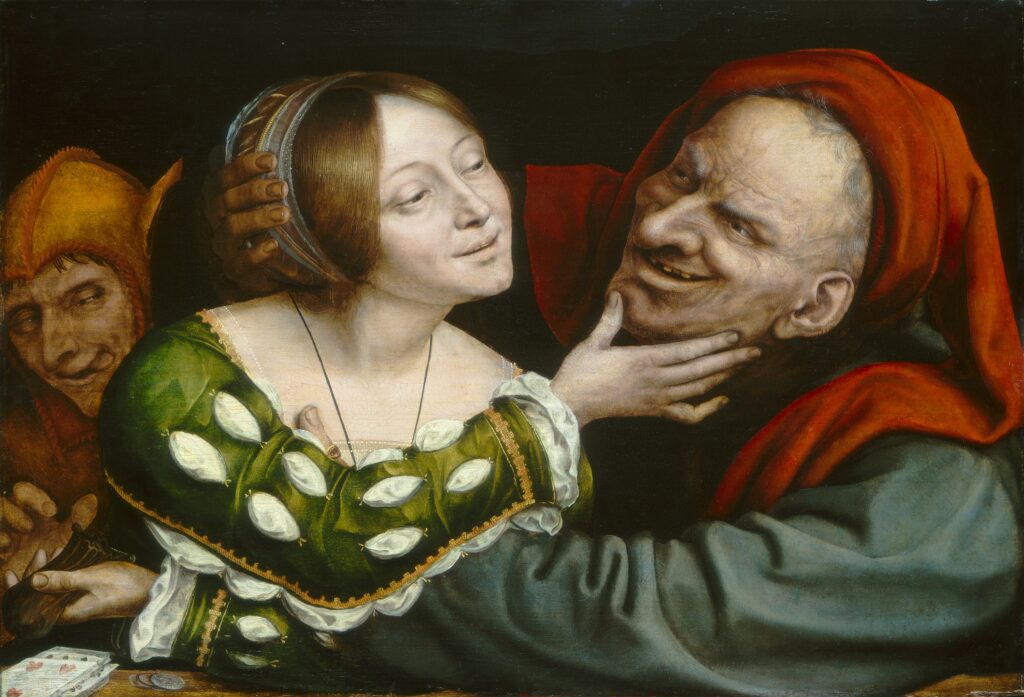
Comment on Quinten Matsys‘ painting « The Deal » (aka « The Contract ») in the Gemäldegalerie of Berlin, Germany. (June 2025)
For more on this artist, see my study on Matsys and Leonardo, the dawn of the Age of Laughter and Creativity.

Audio:
This Audio
Read:
- Quinten Matsys and Leonardo — The Dawn of the Age of Laugher and Creativity, (EN online);
- Квентин Массейс и Леонардо: на заре смехотворчества (RU pdf)
- Joachim Patinir et l’invention du paysage en peinture (FR en ligne).
- Joachim Patinir and the invention of landscape painting (EN online)
- Le Landjuweel d’Anvers de 1561 — Faire de l’art une arme pour la paix (FR en ligne)
- The 1561 Landjuweel of Antwerp that made art a weapon for Peace (EN online)
La leçon d’économie de Shakespeare
This article in EN

par Karel Vereycken
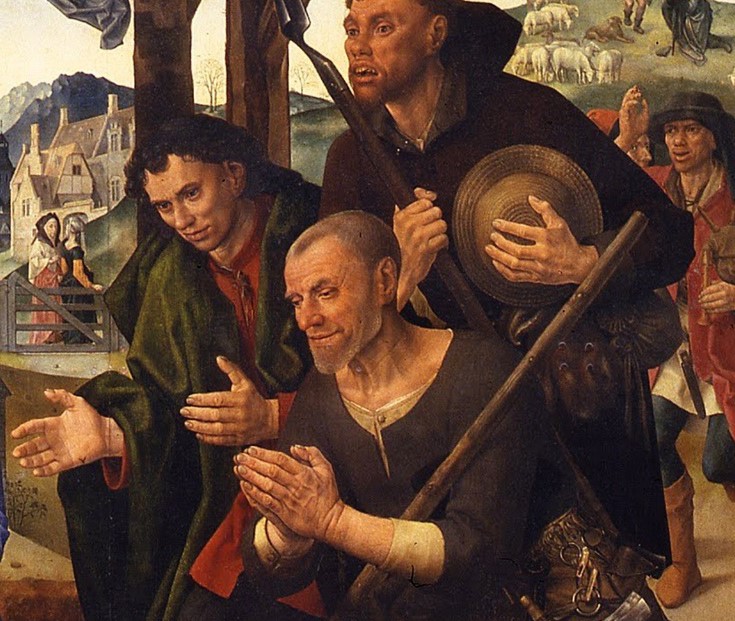
Déjà en 1913, l’année même où une poignée de grandes banques anglo-américaines constituait la Réserve fédérale pour fixer les règles de la monnaie et du crédit, Henry Farnam 1, un économiste de l’Université de Yale, faisait remarquer que « si l’on examine les drames de Shakespeare, on remarquera qu’assez souvent, dans ses pièces, l’action tourne entièrement ou en partie autour de questions économiques ».
La comédie Le marchand de Venise (vers 1596) en est sans doute l’exemple le plus éclatant. Si l’on connaît généralement le déroulé de l’histoire, on passe assez souvent à côté du sens profond de cette pièce qui se lit à différents niveaux. L’enchaînement des faits (la petite histoire) en est un, ce qu’ils dévoilent (des principes) en est un autre.
La petite histoire
Pour rendre service à son protégé Bassanio et lui permettre d’épouser sa bien-aimée Portia, un marchand et armateur vénitien catholique du nom d’Antonio emprunte de l’argent à un prêteur juif Shylock. Ce dernier déteste Antonio car celui-ci, l’archétype même du chrétien hypocrite, le traite avec mépris. Antonio, quant à lui, déteste Shylock parce qu’il est juif et parce qu’il est un usurier : il prête avec intérêt.
Shakespeare nous fait comprendre que la prospérité de Venise repose sur la séparation et sur la détestation mutuelle entre Juifs et Chrétiens, selon son célèbre principe de « Diviser pour régner ». 2
L’oligarchie vénitienne n’a jamais manqué d’imagination pour contourner les normes qu’elle faisait appliquer à ses adversaires.
L’usure
En effet, aussi bien chez les Juifs que chez les Chrétiens, l’usure financière est condamnée et même punie. L’intérêt qu’on définit simplement comme la rémunération d’un créancier par son débiteur pour lui avoir prêté du capital, est un concept très ancien qui date probablement des Sumériens et qu’on retrouve aussi dans d’autres civilisations antiques comme les Égyptiens ou les Romains.
Or, rappelons ici que le Judaïsme, qui est la première des religions abrahamiques, interdit clairement le prêt à intérêt. On rencontre de nombreuses fois des passages qui condamnent l’intérêt dans la Torah comme le livre de l’Exode 22:25-27, le Lévitique 25:36-37 et le Deutéronome 23:20-21.
Cependant, cette interdiction ne concerne que les prêts dans la communauté juive. Dans le Deutéronome 23:20-21, il est dit que
« lorsque vous prêterez de l’argent, des vivres ou toute autre chose à un compatriote, vous n’exigerez pas d’intérêt de sa part. Vous pouvez exiger des intérêts lorsque vous faites un prêt à un étranger, mais vous ne prêterez pas à intérêt à vos compatriotes ».
Initialement, la même règle s’appliquait chez les Chrétiens. Ce n’est qu’à partir du premier Concile de Nicée (en 325) que le prêt à intérêt est interdit. A l’époque, de nombreuses églises sont tenues par des lignages de prêtres, tout comme les châteaux voisins sont contrôlés par des lignages de seigneurs, les deux étant souvent apparentés. Alors que sa condamnation était relativement modérée dans le Christianisme auparavant, l’intérêt devient un grave péché lourdement puni à partir des années 1200.
L’exploitation des juifs
L’Italie abrite des Juifs depuis l’Antiquité. Ils dépendent soit des papes, soit des princes, soit des républiques marchandes. Rome, la Sicile, le royaume de Naples comprennent de larges communautés et les papes engagent parfois des médecins juifs. Au XIIIe siècle, certaines villes accordent à des banquiers juifs, avec licence pontificale, le monopole du prêt sur gages.
Venise accueille les Juifs mais leur interdit de pratiquer tout autre métier que prêteur contre intérêt. Dans un premier temps, les Juifs s’enrichissent au grand jour à Venise et s’attirent les foudres du reste de la population.
Pour « protéger » les Juifs, le doge de Venise crée le premier « ghetto » (un mot vénitien), offrant, il faut le préciser, le quartier le plus insalubre de la lagune à ces Juifs qu’il déteste tout en chérissant le financement qu’ils permettent aux expéditions coloniales vénitiennes et au trafic d’esclaves que Venise la « Catholique » pratique sans complexes.
Le marchand de Venise
Voilà l’essence du système vénitien que Shakespeare démasque dans sa comédie Le marchand de Venise. 3
Ainsi, lorsqu’Antonio va solliciter auprès de Shylock un prêt de 3000 ducats pour une période de trois mois, il lui précise dans un premier temps :
« Shylock, quoique je ne prête ni n’emprunte à intérêt, cependant pour fournir aux besoins pressants d’un ami, je dérogerai à ma coutume ».
Shylock répond alors :
« Seigneur Antonio, mainte et mainte fois vous m’avez fait des reproches au Rialto sur mes prêts et mes usances. Je n’y ai jamais répondu qu’en haussant patiemment les épaules, car la patience est le caractère distinctif de notre nation. Vous m’avez appelé mécréant, chien de coupe-gorge, et vous avez craché sur ma casaque de juif, et tout cela parce que j’use à mon gré de mon propre bien. Maintenant il paraît que vous avez besoin de mon secours, c’est bon.
Vous venez à moi alors, et vous dites : ‘Shylock, nous voudrions de l’argent.’ Voilà ce que vous me dites, vous qui avez expectoré votre rhume sur ma barbe ; qui m’avez repoussé du pied, comme vous chasseriez un chien étranger venu sur le seuil de votre porte. C’est de l’argent que vous demandez ! Je devrais vous répondre, dites, ne devrais-je pas vous répondre ainsi : ‘Un chien a-t-il de l’argent ? Est-il possible qu’un roquet prête trois mille ducats ?’ Ou bien irai-je vous saluer profondément, et dans l’attitude d’un esclave, vous dire d’une voix basse et timide : ‘Mon beau monsieur, vous avez craché sur moi mercredi dernier, vous m’avez donné des coups de pied un tel jour, et une autre fois vous m’avez appelé chien ; en reconnaissance de ces bons traitements, je vais vous prêter tant d’argent’ ? »
A quoi Antonio rétorque :
« Je suis tout prêt à t’appeler encore de même, à cracher encore sur toi, à te repousser encore de mon pied. Si tu nous prêtes cet argent, ne nous le prête pas comme à des amis, car l’amitié a-t-elle jamais exigé qu’un stérile métal produisît pour elle dans les mains d’un ami ? mais prête plutôt ici à ton ennemi. S’il manque à son engagement, tu auras meilleure grâce à exiger sa punition ».

Offusqué, Shylock répond :
« Eh ! mais voyez donc comme vous vous emportez ! Je voudrais être de vos amis, gagner votre affection, oublier les avanies que vous m’avez faites, subvenir à vos besoins présents, et ne pas exiger un denier d’usure pour mon argent, et vous ne voulez pas m’entendre ! »
Shylock, pour sortir de la détestation mutuelle propose de lui prêter (selon la règle juive et chrétienne), en ami, sans intérêt. Mais le « bon » catholique Antonio refuse de devenir ami avec le Juif. Il affirme qu’en affaires, il ne faut pas avoir d’amis, et exige qu’on lui prête en tant qu’ennemi car c’est plus facile à sanctionner en cas de non-respect du contrat.
Comme le disait Churchill, un Empire n’a pas d’amis, il n’a que des intérêts. Ce principe sera théorisé ensuite par Carl Schmidt pour devenir la règle de l’oligarchie d’aujourd’hui : pour exister, il faut un ennemi et s’il en manque, dépêchons-nous d’en inventer un !
Le double jeu des Vénitiens
Comme on le voit, Shakespeare pointe sur l’hypocrisie de ce système vénitien qui base sa prospérité sur une politique « gagnant-gagnant » non pas entre amis mais entre ennemis.
Rappelons ici que, bien qu’elle soit régulièrement en guerre contre les Turcs, Venise crée également un ghetto pour les marchands turcs et même une « fondation », c’est-à-dire une représentation commerciale fonctionnelle.

Si l’on reprochait à un ambassadeur vénitien ce commerce avec les Ottomans qui menaçaient l’Occident, celui-ci répondait : « En tant que marchands, nous ne pouvons vivre sans eux. »
Les Ottomans vendaient du blé, des épices, de la soie grège, du coton et de la cendre (pour la fabrication du verre) aux Vénitiens, tandis que Venise leur fournissait des produits finis tels que du savon, du papier, des textiles et… des armes. Bien que cela soit explicitement interdit par le pape, la France, l’Angleterre, les Pays-bas, mais surtout Venise, Gênes, et Florence vendaient des armes à feu et de la poudre à canon au Levant et aux Turcs. 4
Venise fournit de sa main gauche des canons et des ingénieurs militaires aux Turcs tout en louant à prix fort, de sa main droite, des navires aux Chrétiens voulant les combattre. A cela s’ajoute la rivalité avec Gênes qui s’était alliée à la dynastie des Paléologues mais que les Ottomans ont battue au profit des Vénitiens.
En 1452, un an avant la chute de Constantinople, l’ingénieur et fondeur hongrois Urban (ou Orban), spécialiste des grosses bombardes, se met au service des Ottomans. Ces canons confie-t-il au Sultan, sont si puissants qu’ils feraient chuter « les murs de Babylone ». On connaît la suite en 1453.

Lorsque les Francs veulent louer des navires à Venise pour partir en croisade, l’argent leur fait défaut.
Pas de souci : Venise trouve l’arrangement qui convient. Pour payer la location des navires, les Francs sont invités à faire un petit détour sur le trajet, et commencer la croisade par la libération de Constantinople que Venise veut reprendre aux Ottomans. Et ça marche ! Venise multiplie ses comptoirs et ses bases militaires à Constantinople pour étendre son empire financier et commercial.
Une livre de chair
Face à la réponse sotte et arrogante d’Antonio, Shylock pousse la logique jusqu’à l’absurde et, sur le ton de la plaisanterie, propose alors que dans l’éventualité où son débiteur ne rembourserait pas sa dette en temps et en heure, il aurait le droit de prélever sur celui-ci une livre de chair.
On peut y voir une interprétation littérale et loufoque de ce qui s’écrivait sur les « obligations » ou « reconnaissances de dette » de l’époque. Antonio, qui est convaincu que ses navires rentreront à temps à Venise pour lui fournir de quoi rembourser Shylock, accepte les conditions du contrat, presque en riant de leur caractère surréaliste.
C’est là que Shakespeare pose une question fondamentale et nous offre une belle leçon d’économie, sous la forme d’une métaphore tragique et paradoxale. Dans la plupart des civilisations de l’Antiquité, le non-remboursement d’une dette pouvait vous conduire en esclavage, vous coûter la vie ou vous envoyer en prison pour le reste de vos jours. De l’esclavage monétaire on passait ainsi à l’esclavage physique.
Plus tard, on trouve, par exemple, dans les archives des tribunaux d’Anvers le texte d’un procès en 1567 concernant une obligation entre Coenraerd Schetz et Jan Spierinck :
« Moi, Jan Spierinck, confesse et déclare de ma propre main devoir à l’honorable seigneur Coenraerdt Schetz la somme de quatre cents livres flamandes, et ce sur la base de la somme égale que j’ai reçue de lui à ma satisfaction. Je promets de payer intégralement ledit seigneur Coenraerdt Schetz ou le porteur de la présente, le quatrième jour du prochain mois d’août sans aucun retard, en engageant ma personne et tous mes biens maintenant et à l’avenir. En l’an 1565, le 11 juin ». Vous avez bien lu : « en engageant ma personne ».
Pris à la lettre, le débiteur gage sa personne en caution à son créancier. Rappelons également qu’en France la prison pour dettes privées est instituée par une ordonnance royale de Philippe Le Bel de mars 1303. En dehors de deux périodes de suppression, de 1793 à 1797 et en 1848, la contrainte par corps des débiteurs a persisté en France jusqu’à son abolition en 1867.
A la Renaissance, l’humanisme chrétien de Pétrarque, d’Erasme, de Rabelais et de Thomas More allie la notion de justice de Socrate avec celle de l’amour d’autrui, et un nouveau principe émerge : la vie de chaque individu est sacrée et a une valeur incommensurablement supérieure à tous les titres de dette financière.
C’est une remise en question de ce principe qui fait tourner la comédie de Shakespeare au drame. Petit à petit, le spectateur apprend que les navires d’Antonio ont tous été emportés par des tempêtes et d’autres déconvenues. Il ne dispose donc pas en temps et en heure des moyens nécessaires pour s’acquitter de sa dette.
Le marchand de Venise doit donc accepter que Shylock lui prenne une livre de chair comme le stipule la reconnaissance de dette qu’il a signée… un titre de dette validé par les lois de la République.

Pour sauver la vie d’Antonio, ses amis proposent alors au prêteur le double de la somme initiale empruntée, mais Shylock, animé par un sentiment de vengeance, ne veut rien entendre, fâché de surcroît du fait que sa fille est partie de sa maison avec un jeune marchand chrétien emportant une coquette somme de ducats et des bijoux de famille.
Shylock répond vicieusement au Doge qui lui demande d’être clément, qu’il ne réclame rien d’autre que l’application de la loi. Au passage il rappelle aux Vénitiens qu’ils sont mal placés pour donner des leçons de moralité, car à Venise on peut « acheter » des personnes :
« Quel jugement aurais-je à redouter, puisque je ne fais point de mal ? Vous avez chez vous un grand nombre d’esclaves que comme vos ânes, vos chiens et vos mulets, vous employez aux travaux les plus abjects et les plus vils, parce que vous les avez achetés. Irai-je vous dire : rendez-leur la liberté, faites leur épouser vos héritières ? Pourquoi suent-ils sous des fardeaux ? Donnez-leur des lits aussi doux que les vôtres. Que leur palais soit flatté par les mêmes mets que le vôtre. Vous me répondez : ces esclaves sont à nous. Je vous réponds de même : la livre de chair que j’exige de lui m’appartient : je l’ai chèrement payée, et je la veux. Si vous me refusez, honte à vos lois ! Il n’y a plus aucune force dans les décrets du sénat de Venise. — J’attends que vous me rendiez justice. Parlez : l’aurai-je ? »
A cela, le Doge impuissant n’apporte aucun contre-argument. Lui-même doit obéir aux lois de la cité. L’unique chose qu’il a le droit de faire, c’est de laisser la parole à un docteur en droit qui a examiné l’affaire, pour qu’il livre son avis d’expert.
Retournement de la situation
Ici, Shakespeare fait intervenir Portia qui, déguisée en homme de loi et agissant au nom d’un principe supérieur, l’amour pour l’humanité et le bien, prend la parole. 5
Une fois reconnue la validité de la demande de Shylock, elle retourne la situation avec le genre d’audace qui nous manque aujourd’hui. A propos de la créance, elle relève un détail important concernant la mise en œuvre de la sanction :
« Le billet ne t’accorde pas une goutte de sang : les termes sont exprès ; une livre de chair. Prends ce qui t’est dû ; prends ta livre de chair. Mais si, en la coupant, tu verses une seule goutte de sang chrétien, les lois de Venise ordonnent la confiscation de tes terres et de tes biens au profit de la république. »

C’est une autre belle leçon que nous donne Shakespeare. Combien de lois excellentes ne valent rien du simple fait que leurs auteurs n’ont pas pris la peine d’en spécifier la mise en œuvre ? Connaissez-vous les lois vous permettant de vous défendre contre les injustices que le système vous inflige ? Car si le diable est dans les détails, le bon Dieu n’est parfois pas loin. A vous d’aller le chercher.
Shakespeare nous rappelle que l’économie ne se réduit pas au droit et aux mathématiques. Tout choix économique reste un choix de société. En réalité, seule « l’économie politique » devrait être enseignée dans nos facultés et nos théâtres.
Présenter la science de l’économie et de la finance comme une réalité « objective » et non pas comme une réalité des choix humains, est la meilleure preuve que nous sommes soumis à de la propagande.
Pour conclure, soulignons que contrairement à la pièce de Christopher Marlowe, Le Juif de Malte (vers 1589), l’acteur principal de la pièce de Shakespeare n’est pas le Juif maléfique Shylock (comme le prétendaient des antisémites qui faisaient jouer des versions dénaturées de la pièce durant les périodes noires de notre histoire), mais bien le très catholique marchand de Venise qui, on l’a vu, se sert des Juifs pour son propre intérêt. Rappelons que dans le ghetto juif de Venise, les Juifs n’avaient que le droit de s’occuper de finance mais de rien d’autre…
Enfin, dans Le marchand de Venise, Shakespeare démasque le fonctionnement d’une finance folle et criminelle qui sait utiliser des interprétations formelles du droit (l’apparence de la justice) pour satisfaire sa cupidité (la véritable injustice).
NOTES:
- Henry Farnam, Shakespeare as an economist, p. 437, Yale Publishing Association, New Haven ; ↩︎
- Voir à ce propos Sinan Guven, Le conflit entre l’intérêt et les religions abrahamiques, HEConomist, le journal des étudiants ; ↩︎
- Toutes les citations qui suivent du Marchand de Venise de Shakespeare sont tirées de la version en lecture libre sur le site Atramenta. ↩︎
- Salim Aydoz, Artillery Trade of the Ottoman Empire, Muslim Heritage website, Sept. 2006 ; ↩︎
- Le principe d’une femme « prométhéenne » intervenant déguisée en homme pour le bien de l’humanité sera, avec la personne de Leonore, au centre de Fidelio, l’unique opéra de Beethoven ; ↩︎