Catégorie : Comprendre
 Articles, analyses et conférences pédagogiques.
L’histoire de l’art avec le regard d’un amoureux de toutes les renaissances.
FR/EN/NE/GE/IT/ES
Enseignement mutuel : curiosité historique ou piste d’avenir ?

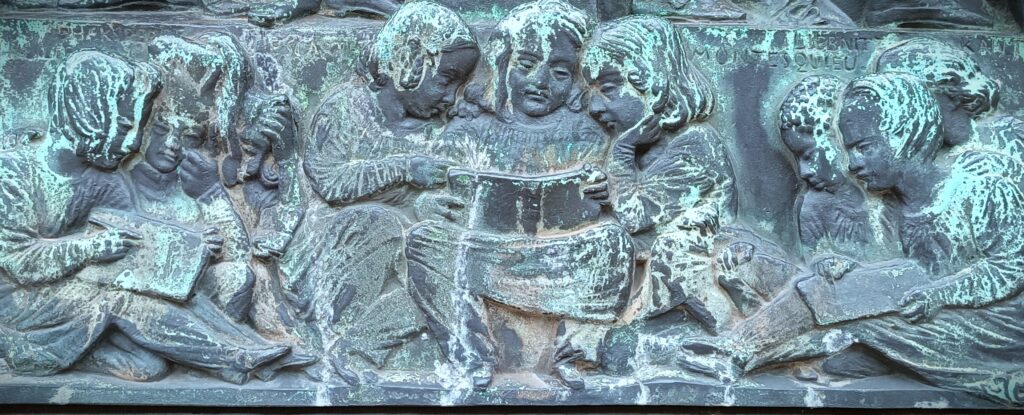
Par Karel Vereycken, Paris, France
- Introduction
- Apprendre et enseigner, une même joie
- Précédents
A. En Inde
B. En France - Les brigades de Gaspard Monge
- Andrew Bell
- Joseph Lancaster
- Enseignement mutuel, comment ça marche ?
A. Le local
B. Maîtres et moniteurs
C. Fonctionnement
D. Progresser selon sa connaissance
E. Les outils
F. Commandement - Bellistes contre lancastériens
- Lorsque ça intéresse les Français
- Lazare Carnot à la manœuvre
- Enseignement mutuel et chant choral
- Le projet pilote de la rue Saint-Jean-de-Beauvais
- Jomard, Choron, Francœur et savoirs élémentaires
- Rayonnement national
- Critiques
- Dérive mécaniste ?
- Mort de l’enseignement mutuel en France
- Conclusion
- Quelques ouvrages et textes consultés, en accès libre
« Répondez, mes amis : il doit vous être doux
D’avoir pour seuls mentors des enfants comme vous ;
Leur âge, leur humeur, leurs plaisirs sont les vôtres ;
Et ces vainqueurs d’un jour, demain vaincus par d’autres,
Sont, tour à tour parés de modestes rubans,
Vos égaux dans vos jeux, vos maîtres sur les bancs.
Muets, les yeux fixés sur vos heureux émules,
Vous n’êtes point distraits par la peur des férules ;
Jamais un fouet vengeur, effrayant vos esprits,
Ne vous fait oublier ce qu’ils vous ont appris ;
J’écoute mal un sot qui veut que je le craigne,
Et je sais beaucoup mieux ce qu’un ami m’enseigne. »
Victor Hugo, Discours sur les avantages de l’Enseignement mutuel, 1817.
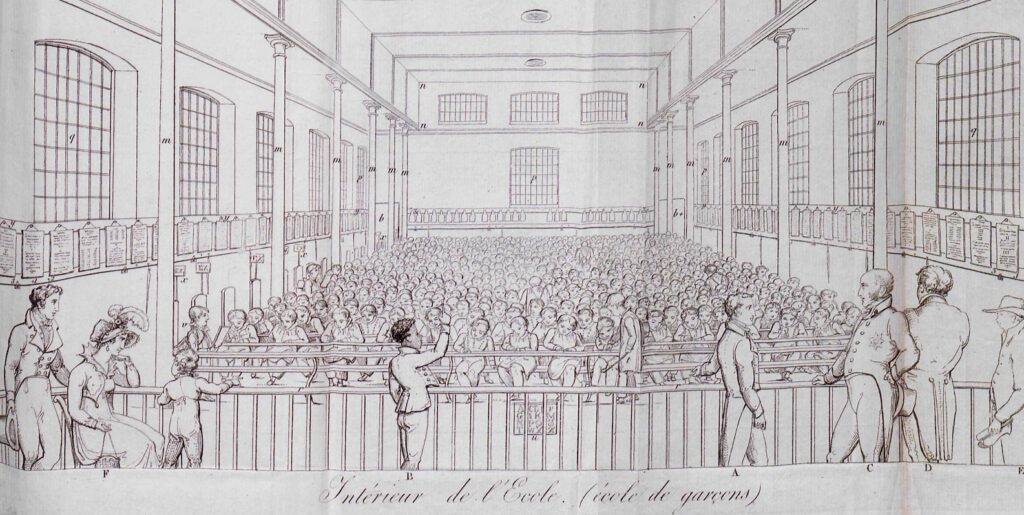
1. Introduction
Enseigner la lecture et l’écriture à 1000 enfants présents dans une même salle, sans instituteur, sans livres scolaires, sans papier et sans encre, c’est clairement impossible. Et pourtant, cela a été imaginé et mis en pratique avec grand succès ! Chut ! Il ne faut pas en parler, car cela pourrait donner des idées à certains, et pas seulement dans les pays émergents !
Qu’un tel défi puisse être relevé ne pouvait qu’inquiéter l’oligarchie et ses serviteurs. Depuis la nuit des temps ils formatent une « élite » (les grands prêtres de la connaissance, les « experts » et autres sachants) se reproduisant en vase clos au sommet, tout en veillant à ce que la grande masse du peuple d’en bas s’instruise juste assez pour pouvoir livrer des colis, payer ses impôts, se plier aux règles définies par le sommet, et surtout, ne fasse pas (trop) désordre.
Pourtant, comme l’avait compris bien avant nous Hippolyte Carnot, ministre de l’Instruction publique de la IIe République, sans éducation républicaine, c’est-à-dire sans une véritable formation de citoyen dès la maternelle, le suffrage universel devient, assez souvent, une farce tragique capable d’engendrer des monstres.
Au début du XIXe siècle, « l’enseignement mutuel » (parfois appelé système « monitorial » anglais, « système de Madras » ou « système de Lancaster »), se répand comme un feu de brousse en Europe puis à travers le monde.
Si le maître s’adresse à un seul élève, c’est le mode individuel (cas du précepteur) ; s’il s’adresse à toute une classe, c’est le mode simultané ; s’il charge des enfants d’instruire les autres, c’est le mode mutuel. L’alliance des procédés simultané et mutuel est appelée mode mixte.
L’enseignement mutuel est rapidement victime de querelles de personnes et d’enjeux idéologiques, politiques et religieux. Il est vécu comme une agression par les congrégations religieuses qui pratiquent, elles, « l’enseignement simultané », édicté dès 1684 par Jean-Baptiste de la Salle pour les « Frères des écoles chrétiennes » : classes par âge, division par niveau, place fixe et individuelle, discipline stricte, travail répétitif et simultané surveillé par un maître inflexible.
Avec la constitution de petits groupes où les élèves enseignent les uns aux autres, se déplacent dans la salle de classe, l’enseignement mutuel a immédiatement fait naître, assez bêtement, la crainte d’un monde cul par-dessus tête, sortant d’un tableau de Jérôme Bosch. Dans quel monde sommes-nous si l’élève enseigne au maître, l’enfant au parent, le fidèle au prêtre, le citoyen au gouvernement ! Sans chef, que faire, chef ?
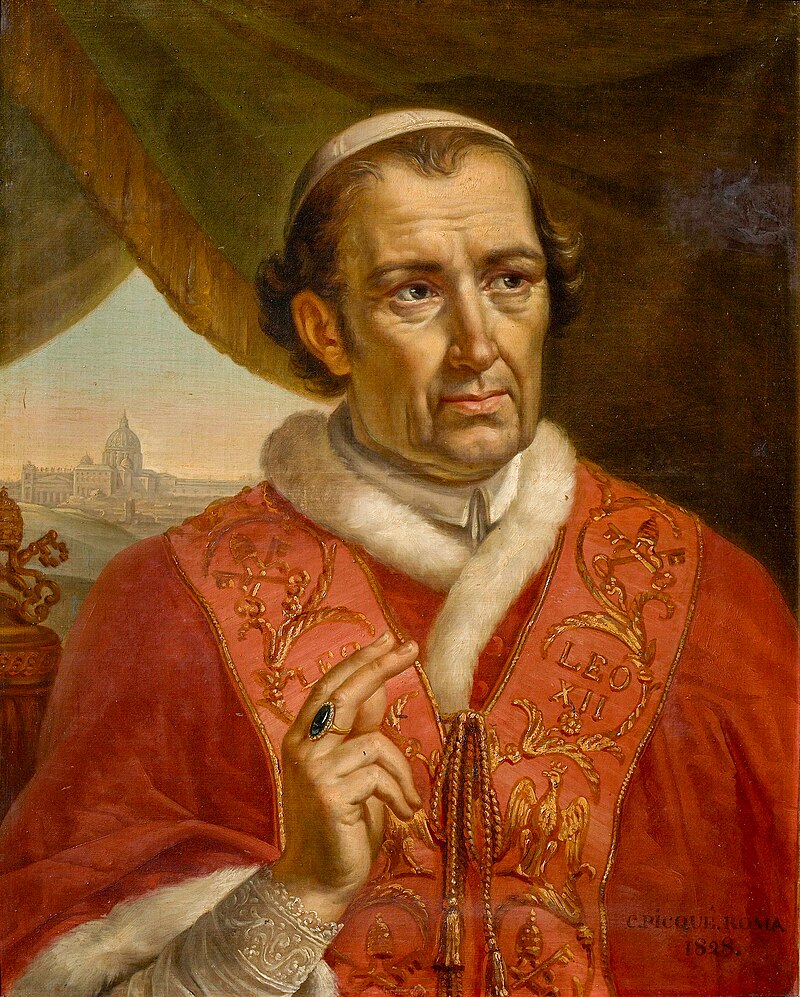
Estimant qu’un tel enseignement « affaiblit l’autorité » aussi bien des maîtres que des autorités politiques et religieuses, en 1824, le pape Léon XII (à ne pas confondre avec le bienveillant Léon XIII), le « pape de la Sainte-Alliance », farouche partisan de l’ordre et soupçonnant un vaste complot protestant contre le Vatican, l’interdit.
En France, où dans les années qui suivent la Révolution de 1830, près de 2 000 écoles mutuelles existent, principalement dans les villes, en concurrence avec les écoles confessionnelles, François Guizot, ministre de Louis-Philippe, les fera disparaître.
2. Apprendre et enseigner, une même joie
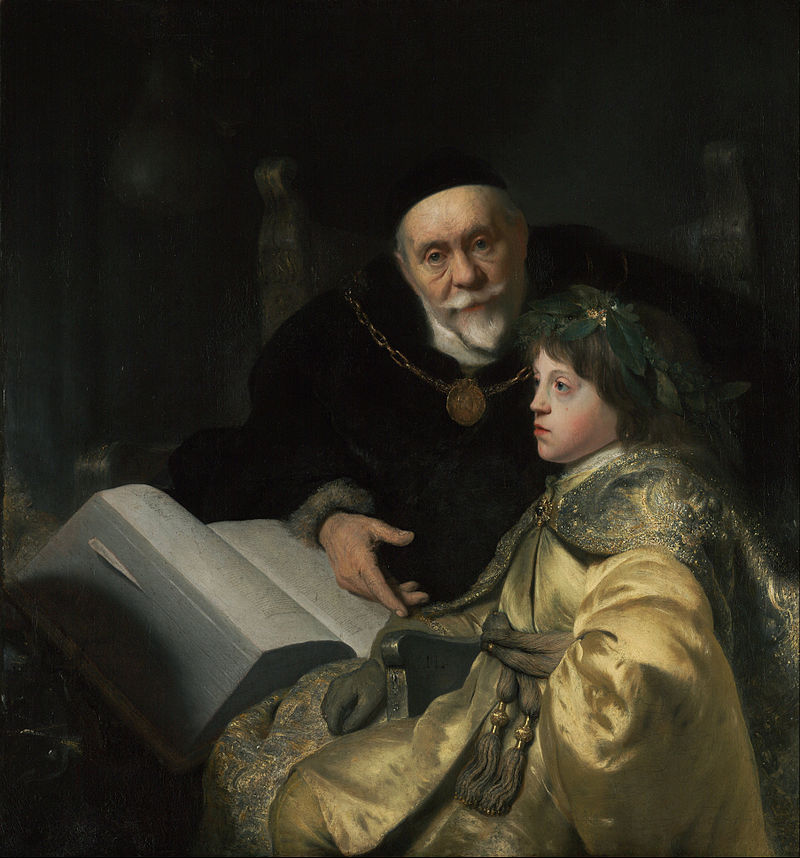
Le tutorat connaît aujourd’hui un regain d’intérêt dans le cadre des apprentissages scolaires et formations professionnelles. Il s’agit d’un processus « d’assistance de sujets plus expérimentés à l’égard de sujets moins expérimentés, susceptible d’enrichir les acquisitions de ces derniers ». C’est ainsi que le tutorat entre enfants, en particulier entre enfants d‘âges différents, est encouragé dès l’école maternelle, jusqu’à l’université avec l’institutionnalisation au niveau du premier cycle du tutorat méthodologique, en passant par l’école élémentaire et le secondaire qui ont vu se développer depuis les années 1980, tant en France qu’à l’étranger, de nombreuses expériences tutorales.
Or, le tutorat n’est que le pâle héritier de l’enseignement mutuel développé en Angleterre puis en France au XIXe siècle.
Il existe une vérité immuable : l’avenir de l’humanité dépend d’une faculté exclusivement humaine : la découverte de principes physiques universels nouveaux, parfois dépassant de loin les bornes de notre appareil sensoriel, permettant à l’Homme d’accroître sa capacité de transformation de l’univers afin d’améliorer de façon qualitative son sort et celui de son environnement. Or, une découverte n’est jamais le fruit d’une somme ou d’une moyenne d’opinions multiples mais bien celui d’un acte unique parfaitement souverain.

Cependant, sans la socialisation de cette découverte, elle ne servira à rien. L’histoire de l’humanité est donc, par sa propre nature, pourrait-on dire, l’histoire d’un « enseignement mutuel ».
Le plus grand plaisir de celui qui vient d’effectuer une découverte, et cela est naturel chez les enfants, n’est-il pas de partager, non seulement ce qu’il ou elle vient de découvrir, mais la joie et la beauté que représente toute percée scientifique ? Et lorsque ceux qui découvrent, enseignent, le plaisir est au rendez-vous. Laissons-donc à nos enseignants professionnels le temps de faire des découvertes, leur enseignement y gagnera en qualité !
3. Précédents
A. En Inde
En 1623, l’explorateur italien Pietro Della Valle (1586-1652), après un voyage en « Indoustan » (Inde), dans une lettre expédiée d’Ikkeri (ville du sud-ouest de l’Inde), rapporte avoir vu :
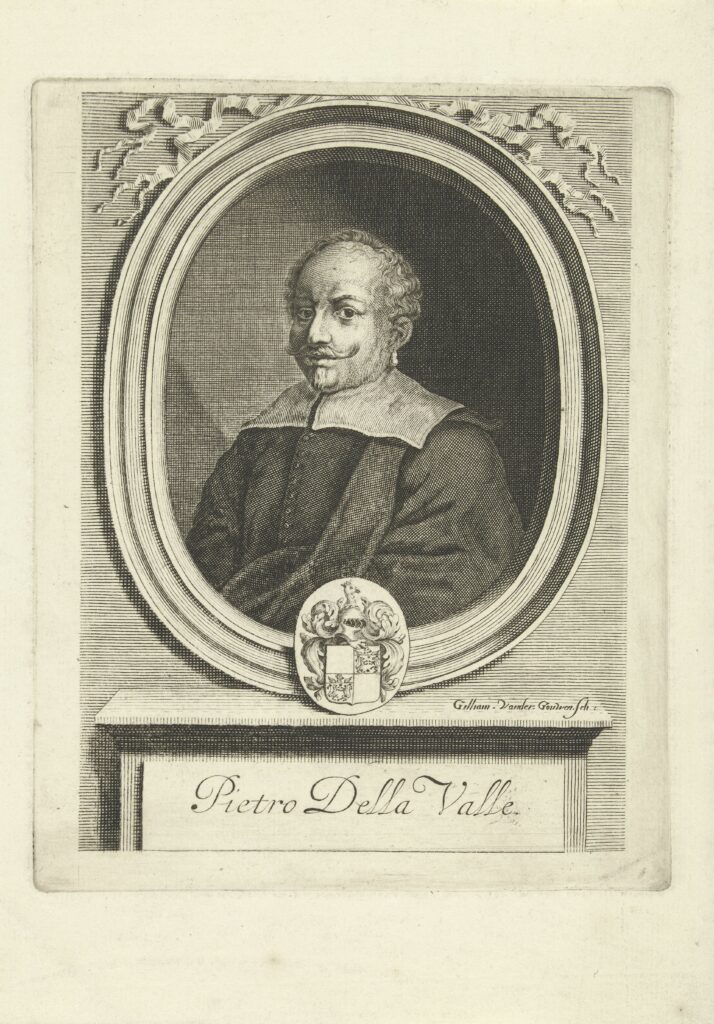
« certains jeunes enfants qui y apprenaient à lire d’une façon extraordinaire (…) Ils étaient quatre et avaient pris du maître une même leçon ; afin de l’inculquer parfaitement dans leur mémoire, de répéter les précédentes qui leur avaient été prescrites, de peur de les oublier, l’un d’eux chantait d’un certain ton musical une ligne de la leçon, comme par exemple deux et deux font quatre. En effet, on apprend facilement une chanson. Pendant qu’il chantait cette partie de leçon pour l’apprendre mieux, il l’écrivait en même temps, non pas avec une plume, ni sur du papier. Mais pour l’épargner et n’en pas gâter inutilement, ils en marquaient les caractères avec le doigt sur le même plancher où ils étaient assis en rond, qu’ils avaient couvert pour ce sujet d’un sable très délié. Après que le premier de ces enfants avait écrit de la sorte en chantant, les autres chantaient et écrivaient la même chose tous ensemble (…) Sur ce que je leur demandais qui (…) les corrigeait lorsqu’ils manquaient, vu qu’ils étaient tous écoliers, ils me répondirent fort raisonnablement, qu’il était impossible qu’une seule difficulté les arrêtât tous quatre en même temps, sans pouvoir la surmonter et que pour le sujet ils s’exerçaient toujours ensemble afin que si l’un manquait les autres fussent ses maîtres. »
Dans ce texte apparaissent déjà les grands principes de l’enseignement mutuel, notamment l’apprentissage simultané de la lecture et de l’écriture, l’utilisation du sable pour les exercices d’écriture afin de ne pas gaspiller le papier qui est rare et fort cher, un cours en collectif donné par un maître, puis un travail en sous-groupes dans lequel les élèves apprennent à s’autoréguler, et enfin, une intégration du savoir qui, grâce à l’utilisation du chant, va faciliter la mémorisation.
B. En France
A Lyon, le prêtre lyonnais Charles Démia figure comme l’un des précurseurs de l’enseignement mutuel qu’il a théorisé dès 1688, et qu’il mettait en pratique dans les « petites écoles » pour enfants pauvres qu’il a fondées. D’après le Nouveau dictionnaire de pédagogie et de l’instruction primaire,

« Démia introduisit dans les classes ce qu’on appela plus tard l’enseignement mutuel : il recommande de choisir, parmi les écoliers les plus capables et les plus studieux, un certain nombre d’officiers, dont les uns, sous le nom d’intendants et de décurions, seront chargés de la surveillance, tandis que les autres devront faire répéter les leçons du maître, reprendre les écoliers quand ils se trompent, guider la main hésitante des ‘jeunes écrivains’, etc. Pour rendre possible la simultanéité de l’enseignement, l’auteur des règlements divise l’école en huit classes, dont le maître devra s’occuper tour à tour ; chacune de ces classes peut se subdiviser en bandes. »
A Paris, dès 1747, l’enseignement mutuel est pratiqué avec un grand succès dans une école de plus de 300 élèves, établie par M. Herbault à l’hospice de la Pitié, en faveur des enfants des pauvres. L’expérience, hélas, ne survécut pas à son fondateur.
En 1772, la charité ingénieuse du chevalier Paulet conçut et exécuta le projet d’appliquer une semblable méthode à l’éducation d’un grand nombre d’enfants, que la mort de leurs parents laissaient sans appui dans la société.
4. Les brigades de Gaspard Monge
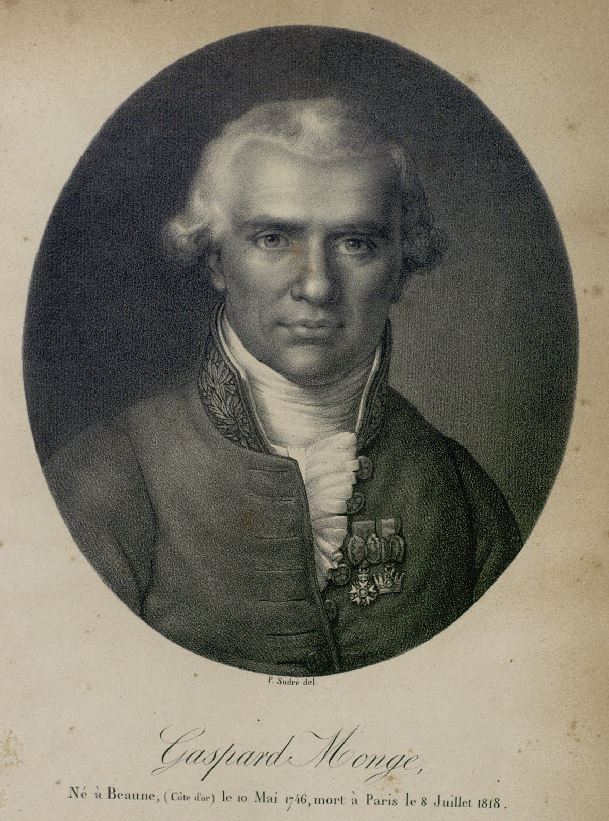
Enfin, comme le raconte, dans sa biographie de Gaspard Monge, son élève le plus brillant, l’astronome François Arago (1786-1853), lui-même un ami proche d’Alexandre de Humboldt, c’est à l’École polytechnique que Monge va peaufiner son propre système d’enseignement mutuel et de tutorat.
Jugeant qu’il était inacceptable de devoir attendre trois ans pour voir sortir les premiers ingénieurs de l’École polytechnique, Monge décida, afin d’accélérer la formation des élèves, d’organiser des « cours révolutionnaires », une formation accélérée pendant trois mois. Pour cela, il perfectionna le concept de « chefs de brigades », une technique qu’il avait déjà pu tester avec succès à l’école du Génie de Mézières.
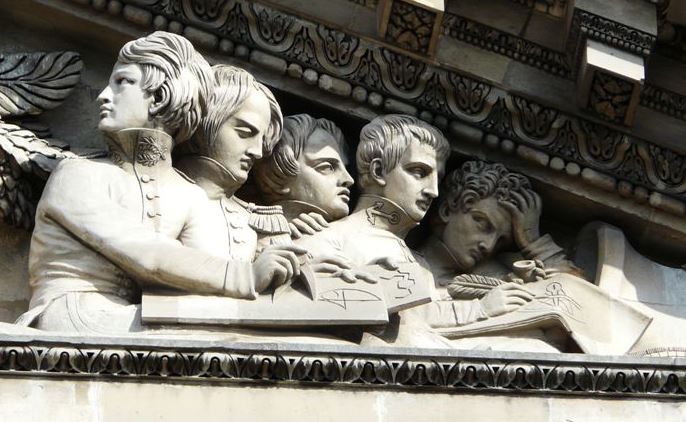
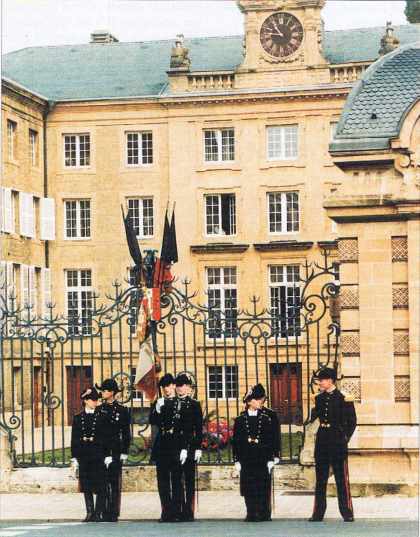
François Arago :
« Les chefs de brigade, toujours réunis à de petits groupes d’élèves dans des salles séparées, devaient avoir des fonctions d’une importance extrême, celles d’aplanir les difficultés à l’instant même où elles surgiraient. Jamais combinaison plus habile n’avait été imaginée pour ôter toute excuse à la médiocrité ou à la paresse.
« Cette création appartenait à Monge. A Mézières, où les élèves du génie étaient partagés en deux groupes de dix, à Mézières, où, en réalité, notre confrère fit quelque temps, pour les deux divisions, les fonctions de chef de brigade permanent, la présence, dans les salles, d’une personne toujours en mesure de lever les objections avait donné de trop heureux résultats pour qu’en rédigeant les développements joints au rapport de Fourcroy, cet ancien répétiteur n’essayât pas de doter la nouvelle école des mêmes avantages.
« Monge fit plus ; il voulut qu’à la suite des leçons révolutionnaires, qu’à l’ouverture des cours des trois degrés, les 23 sections de 16 élèves chacune, dont l’ensemble des trois divisions devait être composé, eussent leur chef de brigade, comme dans les temps ordinaires ; il voulut, en un mot que l’École, à son début, marchât comme si elle avait déjà trois ans d’existence.
« Voici comment notre confrère atteignit ce but en apparence inaccessible. Il fut décidé que 25 élèves, choisis par voie de concours parmi les 50 candidats que les examinateurs d’admission avaient le mieux notés, deviendraient les chefs de brigade de trois divisions de l’école, après avoir reçu à part une instruction spéciale. Le matin, les 50 jeunes suivaient, comme tous leurs camarades, les cours révolutionnaires ; le soir, on les réunissait à l’hôtel Pommeuse, près du Palais-Bourbon, et divers professeurs les préparaient aux fonctions qui leur étaient destinées. Monge présidait à cette initiation scientifique avec une bonté, une ardeur, un zèle infinis. Le souvenir de ses leçons est resté en traits ineffaçables dans la mémoire de tous ceux qui en profitèrent. »
Arago cite alors le témoignage d’Edme Augustin Sylvain Brissot (1786-1819), fils du célèbre girondin et abolitionniste, un des 50 élèves :
« C’est là, que nous commençâmes à connaître Monge, cet homme si bon attaché à la jeunesse, si dévoué à la propagation des sciences. Presque toujours au milieu de nous, il faisait succéder aux leçons de géométrie, d’analyse, de physique, des entretiens particuliers où nous trouvions plus à gagner encore. Il devint l’ami de chacun des élèves de l’Ecole provisoire ; il s’associait aux efforts qu’il provoquait sans cesse, et applaudissait, avec toute la vivacité de son caractère, aux succès de nos jeunes intelligences ».
Si une forme d’enseignement mutuel y est pleinement pratiquée, le dévouement total d’un maître aussi fervent que Monge, vient compléter ce qui ne serait autrement qu’un « système ».
5. Andrew Bell
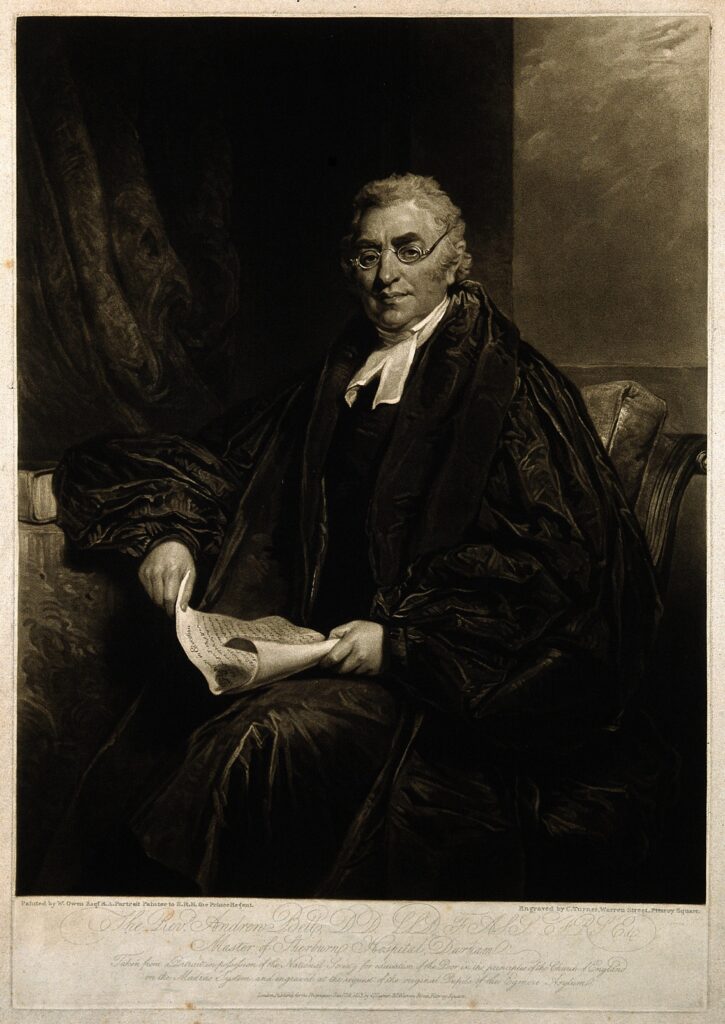
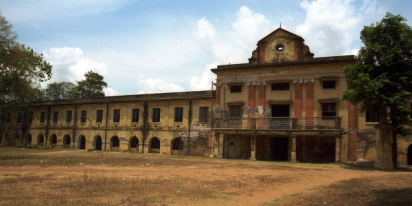
C’est un Écossais, le pasteur anglican Andrew Bell (1753-1832), qui revendique la paternité de l’enseignement mutuel qu’il a pratiqué et théorisé en Inde, à la tête de l’Asile militaire pour orphelins d’Egmore (Inde orientale). Cette institution, créée en 1789, est chargée d’éduquer et d’instruire les orphelins et les fils indigents des officiers et des soldats européens de l’armée de Madras.
Après sept ans sur place, Bell rentre à Londres et en 1797, il rédige un rapport destiné à la Compagnie des Indes (son employeur à Madras) sur les incroyables avantages de son invention.
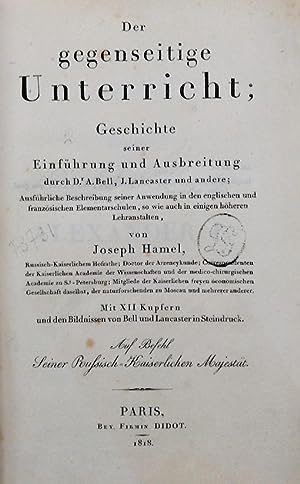
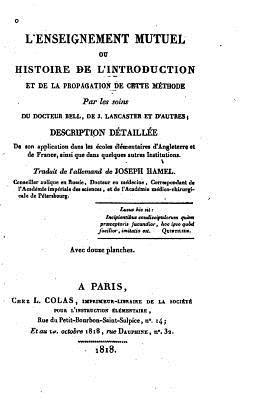
Le médecin, naturaliste et inventeur russe Iosif Kristianovich (Joseph Christian) Hamel (1788-1862), membre de l’Académie des Sciences, est chargé par le Tsar de Russie Alexandre Ier, de faire un rapport complet sur ce nouveau type d’enseignement dont toute l’Europe discutait alors.
Il relate, dans Der Gegenseitige Unterricht (1818), ce qu’écrivait Bell dans un de ses écrits :
« Il arriva dans ce temps, qu’en faisant un matin ma promenade ordinaire, je passai devant une école de jeunes enfants Malabares, et je les vis occupés à écrire sur la terre. L’idée me vint aussitôt qu’il y aurait peut-être moyen d’apprendre aux enfants de mon école, à connaître les lettres de l’alphabet, en leur faisant tracer sur le sable. Je rentrai sur-le-champ chez moi, et je donnai ordre au maître de la dernière classe, de faire exécuter ce que je venais d’arranger dans mon chemin. Heureusement, l’ordre fût très mal accueilli ; car si le maître s’y fut conformé à ma satisfaction, il est possible que tout développement ultérieur eût été arrêté, et par là, le principe même de l’enseignement mutuel… »
Accueilli avec froideur en Angleterre, l’enseignement mutuel finit par séduire Samuel Nichols, un des dirigeants de l’école de St-Botolph’s Aldgate, la plus vieille paroisse protestante anglicane de Londres. La mise en œuvre des préceptes de Bell est réalisée avec grand succès et sa méthode est reprise par le docteur Briggs lorsqu’il ouvre une école industrielle à Liverpool.

6. Joseph Lancaster

En Angleterre, c’est Joseph Lancaster (1778-1838), un instituteur londonien âgé de vingt ans, qui s’empare de la nouvelle manière d’enseigner, la perfectionne et la généralise à grande échelle.
En 1798, il ouvre une école élémentaire pour les enfants pauvres à Borough Road, un des faubourgs les plus miséreux de Londres. L’enseignement n’y est pas encore totalement gratuit mais 40 % moins cher que dans les autres écoles de la capitale.
Faute d’argent, Lancaster fait tout pour faire baisser encore les coûts de ce qui devient un véritable « système » : emploi de sable et d’ardoises plutôt que d’encre et de papier (Erasme de Rotterdam rapporte en 1528 qu’en son temps il y avait des gens qui écrivaient avec une sorte de poinçon sur des tables recouvertes d’une fine poussière) ; tableaux reproduisant les pages d’ouvrages scolaires suspendus aux murs pour éviter l’achat de livres ; maîtres auxiliaires remplacés par des élèves pour éviter de payer des salaires ; augmentation du nombre d’élèves par classe.
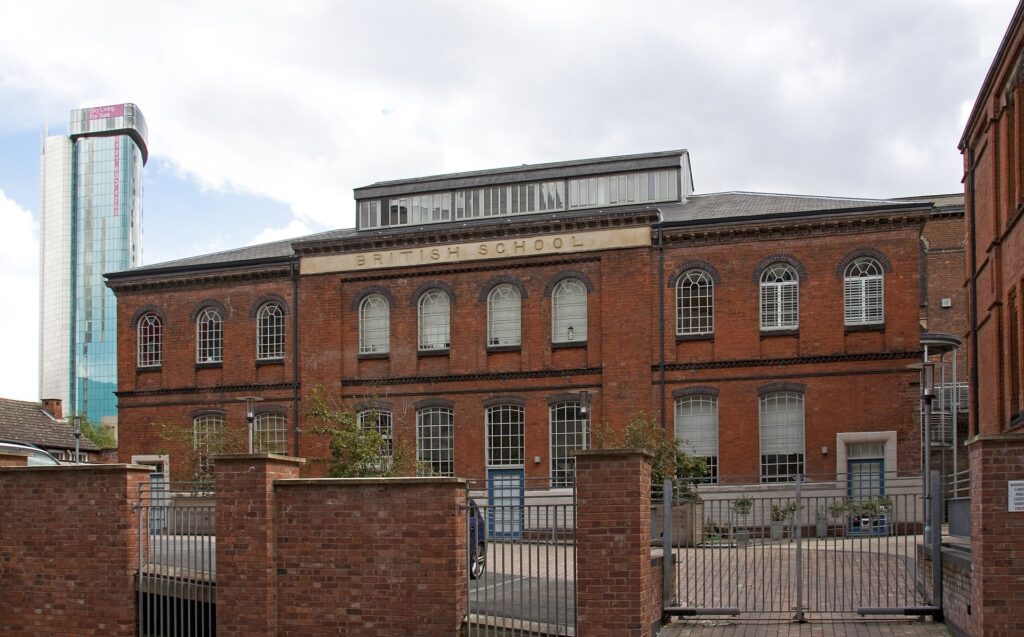
En 1804, son école compte 700 élèves, et douze mois plus tard, un millier. Lancaster, en s’endettant de plus en plus, ouvre une école pour 200 filles. Pour échapper à ses créanciers, il quitte Londres en 1806 et lors de son retour il est enprisonné pour dette. Deux de ses amis, le dentiste Joseph Foxe et le fabricant de chapeaux de paille William Corston, remboursent sa dette et fondent avec lui « La société pour la promotion du système lancastérien pour l’éducation des pauvres ». D’autres quakers viendront alors les soutenir, notamment l’abolitionniste William Wilberforce (1759-1833) que David d’Angers, sur le socle de son célèbre monument commémorant Gutenberg à Strasbourg, fait figurer aux côtés de Condorcet et de l’abbé Grégoire.
A partir de là, comme le relate Joseph Hamel dans son rapport de 1818, la nouvelle approche s’est répandue aux quatre coins du monde : Angleterre, Écosse, Irlande, France, Prusse, Russie, Italie, Espagne, Danemark, Suède, Pologne et Suisse, sans oublier le Sénégal et plusieurs pays d’Amérique du Sud comme le Brésil et l’Argentine et, bien sûr, les États-Unis d’Amérique. L’enseignement mutuel a été adopté comme pédagogie officielle à New York (1805), Albany (1810), Georgetown (1811), Washington D.C. (1812), Philadelphie (1817), Boston (1824) et Baltimore (1829), et la législature de Pennsylvanie a envisagé de l’adopter à l’échelle de l’État.
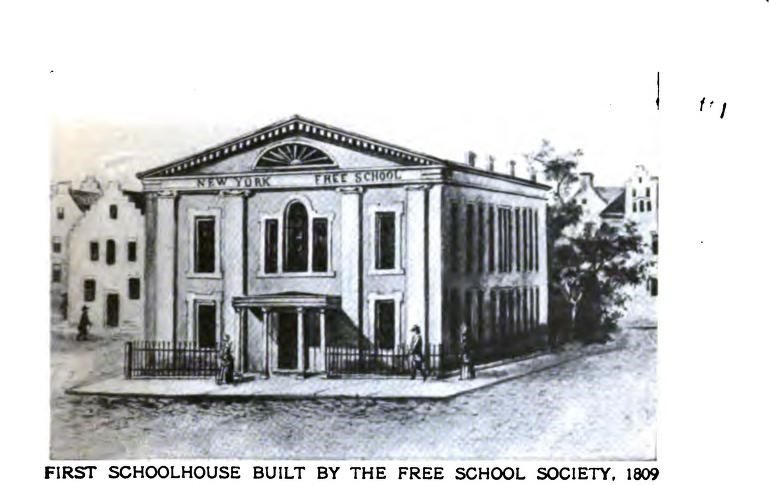
7. Enseignement mutuel, comment ça marche ?
Le principe fondamental de « l’enseignement mutuel », particulièrement pertinent pour l’école primaire, consiste dans la réciprocité de l’instruction entre les écoliers, le plus capable servant de maître à celui qui l’est moins. Dès le début, tous avancent graduellement, quel que soit le nombre d’élèves. Bell et Lancaster, et leurs disciples français, posent en postulat la diversité des facultés, l’inégalité des progrès, des rythmes de compréhension et d’acquisition. Ils sont donc conduits à repartir les élèves en classes différentes suivant les disciplines et suivant le niveau de connaissances des enfants, l’âge n’intervenant aucunement dans cette classification. Les écoliers ainsi réunis prennent part aux mêmes exercices. Leur programme d’étude est identique dans son contenu et dans ses méthodes.
Si l’effectif d’une division est trop élevé dans une discipline, la lecture ou l’arithmétique, par exemple, on constitue des sous-groupes qui évoluent parallèlement, les méthodes et supports de l’enseignement restant identiques.
Comment se présente alors une école du nouveau système ?
A. La salle de classe
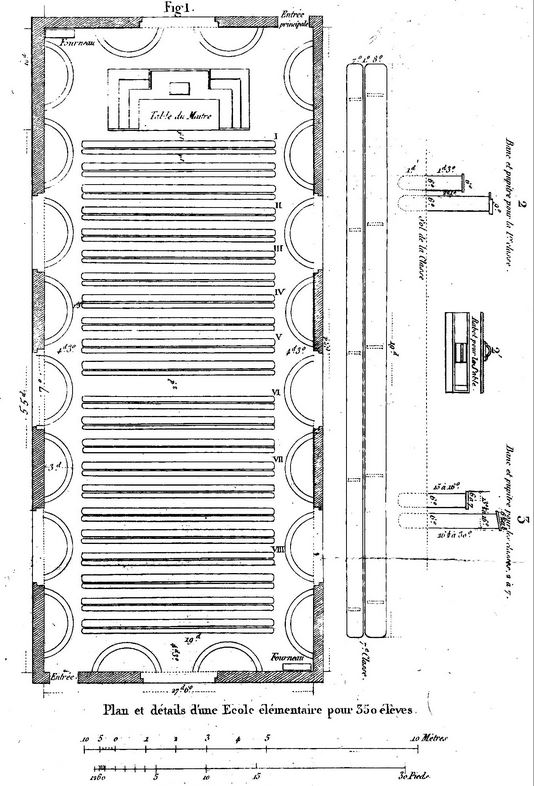
Quel que soit le nombre d’élèves — une centaine dans les bourgades françaises, mille dans l’école de Lancaster à Londres, deux cents dans les écoles parisiennes – ceux-ci sont groupés dans une salle unique, rectangulaire, sans cloisons. Jomard qui déploya dans les premières années de l’installation du mode d’enseignement mutuel une extraordinaire et féconde activité, a fixé les normes souhaitables pour des effectifs variant de 70 à 1 000 élèves. Il indique, par exemple, pour 350 élèves la nécessité d’une salle de 18 m de long sur 9 m de large. En Angleterre et dans les campagnes françaises, on utilise souvent une grange pour la nouvelle école. En France, les édifices religieux désaffectés depuis la période révolutionnaire sont nombreux et répondent parfaitement aux normes souhaitées. Ils accueilleront beaucoup d’écoles mutuelles.
B. Maîtres et « moniteurs »
Le mode mutuel répartit la responsabilité de l’enseignement entre le « maître » et des élèves désignés comme « moniteurs » et considérés comme « la cheville ouvrière de la méthode ». Le moniteur (ou admoniteur) est un élève un peu plus grand et plus avancé dans la discipline. Il de doit point enseigner mais s’assurer que les élèves s’enseignent entre eux. Comme le rappelle Bally, dès 1819 :
« La base de l’enseignement mutuel repose sur l’instruction communiquée par les élèves les plus forts à ceux qui sont les plus faibles. Ce principe qui fait le mérite de cette méthode, a nécessité une organisation toute particulière pour créer une hiérarchie raisonnable, qui pût concourir de la manière la plus efficace, au succès de tous. »
Chaque jour, dans une « classe » réservée aux moniteurs, le maître transmet des connaissances et dispense à ses adjoints les conseils techniques pour la bonne application de la méthode. Au cours de la journée, il reste responsable de la 8e classe (celle de l’achèvement du cursus scolaire), et, à ce titre, se charge de la conduite de leurs exercices. Il procède aux examens périodiques, mensuels ou occasionnels, dans les classes et décide, éventuellement, des changements de classe. C’est lui, enfin, qui, au stade ultime, distribue punitions et récompenses.
C. Fonctionnement
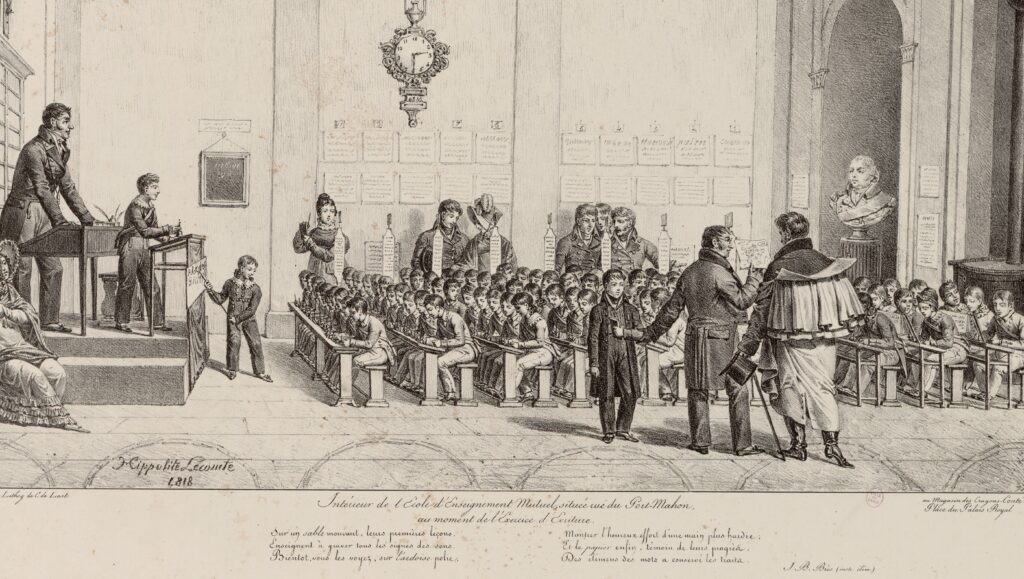
Ainsi, sur une estrade, le bureau du maître avec un large tiroir où sont rangés argent, billets de récompense, registres, modèles d’écriture, sifflets, cahiers des enfants.
Derrière le maître, à côté de l’horloge – instrument essentiel pour organiser la vie de l’enseignement – un tableau noir sur lequel sont écrits sentences et modèles d’écriture.
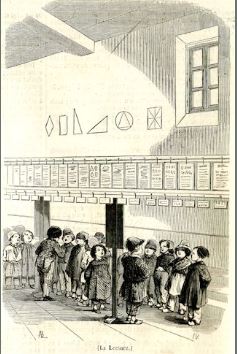
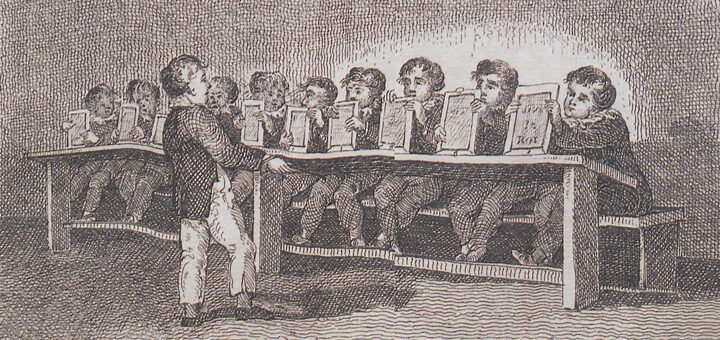
Au pied de l’estrade, des bancs sont fixés transversalement aux pupitres, de tailles différentes, au milieu de la pièce. Les premières tables, non inclinées, comportent du sable sur lesquelles les petits enfants tracent des signes, les autres tables reçoivent des ardoises ; on trouve également, sur les dernières d’entre elles, des encriers de plomb et du papier, des baguettes pour indiquer les mots ou les lettres à lire.
À l’extrémité de chaque table sont fixés les « tableaux de dictées » ainsi que des signaux télégraphiques indiquant les moments de la leçon, tel par exemple « COR » pour « correction » ou « EX » pour « examen du travail ». Des modèles de table demi-circulaire ont été ensuite proposés afin de faciliter le travail des moniteurs.
D. Progresser en fonction de sa connaissance
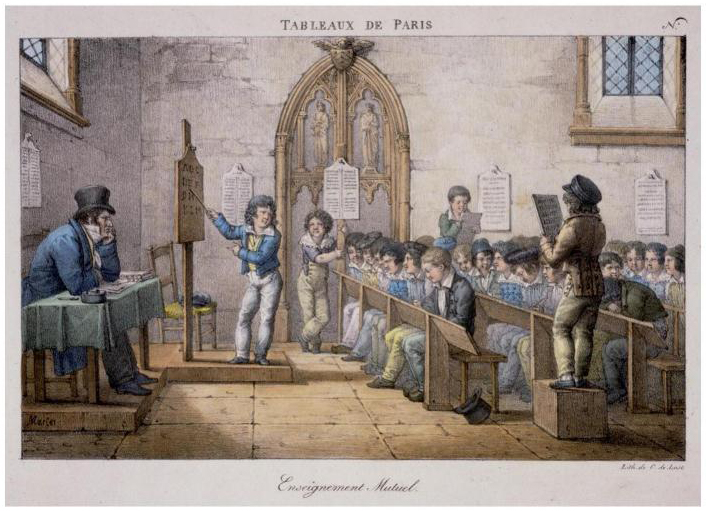
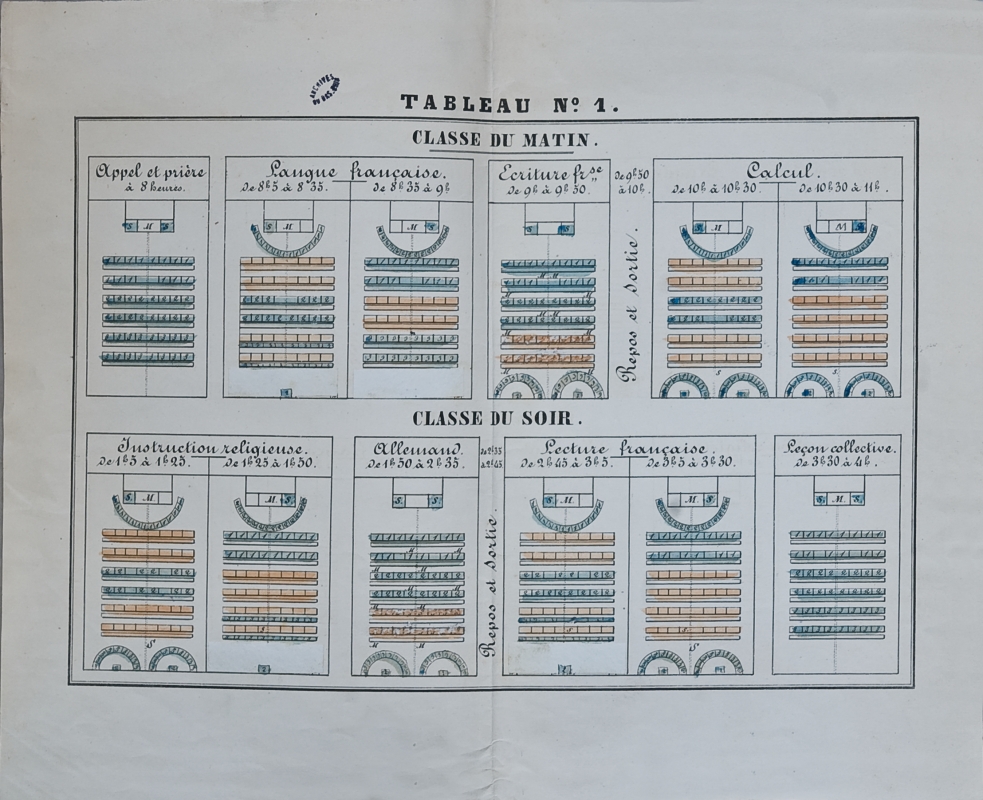
A l’origine, le programme de l’école mutuelle est limité aux trois disciplines fondamentales : lecture, écriture, arithmétique, et à l’enseignement de la religion. S’y ajouteront rapidement, la géographie, la grammaire, la rédaction, le chant et le dessin. Les groupements d’élèves, souples, mobiles, différenciés, sont fonction de la nature des matières d’étude et des activités pratiquées dans la discipline.
Chaque matière enseignée dans les écoles mutuelles repose sur un programme précis et codifié. Ce programme est découpé en 8 degrés hiérarchisés, qui doivent être parcourus successivement. Chaque degré s’appelle « classe » et c’est ainsi que l’on parle de 8 classes d’écriture ou d’arithmétique. Ce terme de « classe » est totalement exclusif de la notion d’architecture ou de local. Il ne s’entend que par rapport aux acquisitions et aux connaissances, la 1ere classe étant celle des débutants et la 8e celle de l’achèvement du cursus scolaire. Les rythmes d’apprentissages et les acquisitions varient suivant les élèves et suivant la discipline.
Ainsi, au bout de six mois de présence, tel élève pourra se trouver en 4e classe de lecture, en 5e classe d’écriture et en deuxième classe d’arithmétique. Comme nous l’avons dit, l’affectation dans la classe se décide en fonction du niveau de connaissance et non pas en fonction de l’âge.
Mais cette première répartition s’assortit, au sein de chaque classe et dans chaque discipline, de la constitution de groupes restreints établis selon les activités qui doivent y être pratiquées. En arithmétique, par exemple, des travaux écrits se font sur l’ardoise. Ils ont lieu, assis, sur les bancs réservés à cet usage, avec 16 à 18 élèves au maximum par banc, selon les normes établies par Jomard.
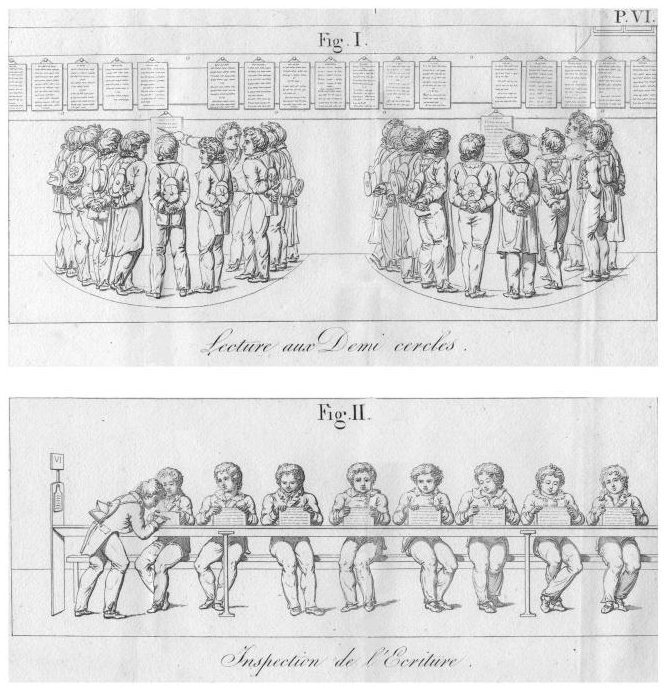
Les exercices oraux, en lecture, en arithmétique ou en dessin linéaire, à l’aide d’un tableau noir, se font debout, par groupes de 9 au maximum, les élèves se tenant côte à côte et formant un demi-cercle. De là, d’ailleurs, l’appellation donnée à ce genre d’activité : « travail au cercle ».
Ainsi, dans une école mutuelle ayant 36 élèves en 3e classe d’arithmétique, le travail aux bancs se fera en deux groupes avec deux moniteurs et les exercices au tableau noir avec 4 groupes et 4 moniteurs. Les effectifs des classes pourront donc varier suivant les écoles et tout au cours de l’année, la seule limitation étant imposée par l’étendue du local.
D. Les outils
Le souci d’économie est l’une des caractéristiques fondamentales du nouvel enseignement. Le mobilier reste donc très sommaire.
- Les bancs et pupitres sont faits de planches très ordinaires, fixées avec de gros clous. Les bancs n’ont pas de dossier : c’est un luxe superflu !
- L’estrade est nettement surélevée : 0,65 m environ. On accède par plusieurs marches au bureau du maître. Celui-ci règne sur la collectivité enfantine autant par sa position matérielle que par son ascendant personnel.
- La pendule est notée comme « indispensable », l’enseignement et les manœuvres étant strictement minutés.
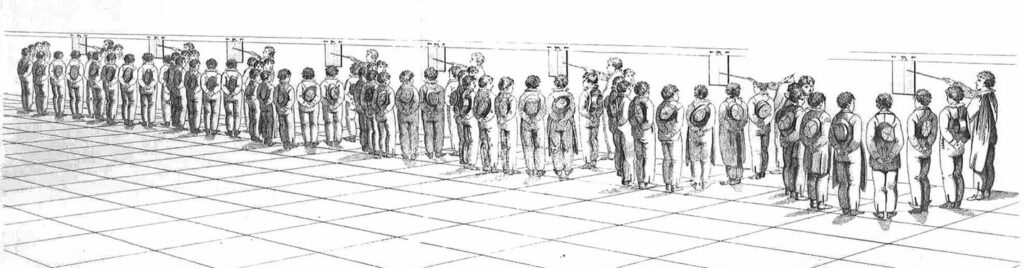
- Les demi-cercles, encore appelés cercles de lecture, donnent aux écoles mutuelles un aspect typique et original. Ce sont, généralement, des cintres de fer, demi-circulaires, qui peuvent se lever ou s’abaisser à volonté. Parfois, la matérialisation est simplement portée sur le plancher : rainures, gros clous ou bandes tracées en forme d’arc.
- Les tableaux noirs ont été systématiquement utilisés pour le dessin linéaire et l’arithmétique. Ils mesurent 1 m de long sur 0,70 m de large et portent à leur partie supérieure un mètre mobile. On les place à l’intérieur de chaque demi-cercle.
- Les télégraphes. Lorsque le travail a lieu aux tables, l’écriture par exemple, on se sert de signaux permettant la liaison et la communication entre le moniteur général et les moniteurs particuliers : ce sont les télégraphes. Une planchette, fixée à l’extrémité supérieure d’un bâton rond de 1,70 m de haut, est installée à la première table de chaque classe, grâce à deux trous percés en haut et en bas du pupitre. Sur l’une des faces est inscrit le numéro de la classe (de 1 à 8) ; sur l’autre, la mention EX (examen) remplacée vers 1830 par COR (correction). Ces télégraphes sont transportables. On les déplace en cas d’augmentation ou de diminution du nombre d’élèves. Le maître et le moniteur général ont ainsi la composition exacte de chaque classe et le nombre de tables occupées par chacune d’elles. Dès qu’un exercice est terminé, le moniteur de classe fait tourner le télégraphe et présente vers le bureau la face EX. Tous les moniteurs font de même. Le moniteur général donne l’ordre de procéder à l’inspection et de faire des corrections éventuelles. Celles-ci achevées, on présente de nouveau le numéro de la classe. Et les exercices reprennent. Près des télégraphes se trouvent aussi, à l’occasion, les porte-tableaux.
- Les baguettes des moniteurs. Elles servent à indiquer sur les tables les lettres ou mots à lire, le détail des opérations à effectuer, les tracés à reproduire. Elles n’existent généralement dans les écoles rurales que grâce à la bonne volonté et à l’ingéniosité des moniteurs qui se les procurent dans les bois avoisinants.
- Le sable (pour l’écriture) puis les ardoises sont constamment utilisés dans toutes les disciplines. C’est là une innovation essentielle du mode mutuel, les autres écoles n’en faisant pas usage.
- Tableaux à la place de livres. La première raison est d’ordre pécuniaire, un seul tableau suffisant jusqu’à neuf élèves. Mais les motifs pédagogiques ne sont pas moindres. Le format permet une lecture aisée et un rangement facile. Le souci de présentation et de valorisation de certains caractères s’accompagne d’un souci de mise en page différent de ceux des manuels.
- Les livres sont réservés à la huitième classe, de même que les plumes, l’encre et le papier.
- Des registres, couramment en service, garantissent une saine gestion des établissements. L’un d’eux mérite une mention particulière : c’est « Le grand livre de l’école », avant tout un cahier- matricule. On y inscrit le nom, le prénom et l’âge de l’enfant, la profession et l’adresse des parents. Le maître y porte la date précise de l’entrée et de la sortie de chaque enfant, dans chaque classe, y compris pour les cours de musique et le dessin linéaire.
E. Le commandement
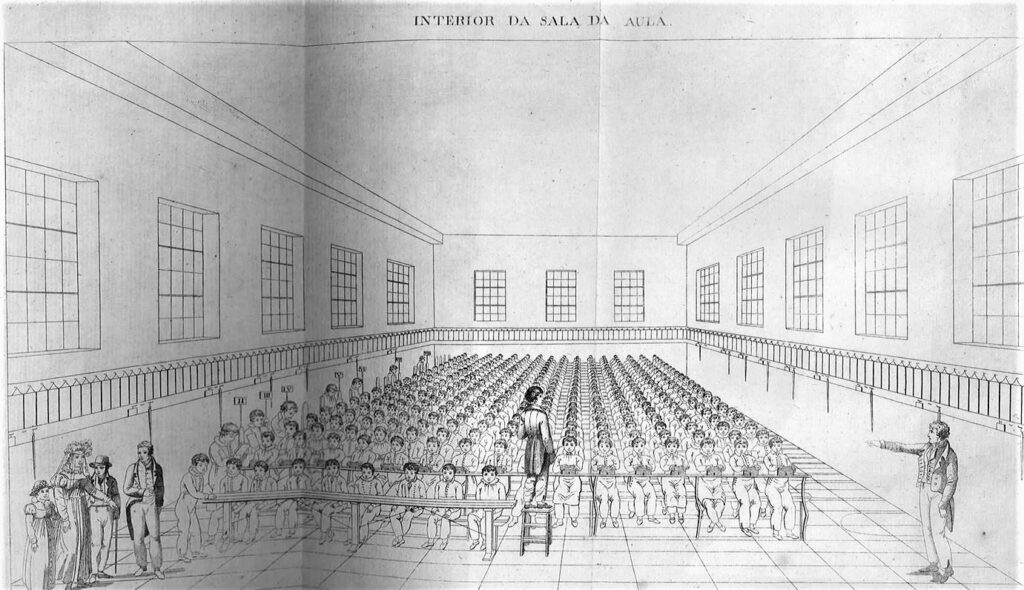
Pour conduire et faire évoluer correctement des dizaines ou centaines d’élèves et éviter toute perte de temps, les responsables de l’enseignement mutuel ont prévu des ordres précis, rapides, immédiatement compréhensibles :
- La voix intervient peu. Les injonctions transmises de cette manière s’adressent généralement aux moniteurs, parfois à une classe tout spécialement.
- La sonnette attire l’attention. Elle précède une information ou un mouvement à exécuter.
- Le sifflet est à double usage. Il permet des interventions dans l’ordre général de l’école, « imposer le silence », par exemple, et il commande le début ou la fin de certains exercices au cours de la leçon, «faire dire par cœur, épeler, cesser la lecture ». Le maître est seul habilité à s’en servir.
- Quant aux signaux manuels, ils ont été beaucoup utilisés. Destinés à évoquer l’acte ou le mouvement à accomplir, ils attirent le regard et doivent apporter le calme dans la collectivité.
Bellistes contre lancastériens
Alors que les deux écoles, celle de Bell et celle de Lancaster sont très proches l’une de l’autre, tant sur le plan des contenus d’enseignement que des méthodes et de l’organisation, elles s’opposeront violemment sur le rôle et la place de l’enseignement religieux. Toutes les autres divergences liées au programme sont affaires de goût, d’habitude ou de circonstances locales.
Comme le précisent Sylvian Tinembert et Edward Pahud dans Une innovation pédagogique, le cas de l’enseignement mutuel au XIXe siècle (Editions Livreo-Alphil, 2019), Lancaster, en tant qu’adepte du mouvement dissident quaker,
« reconnaît le christianisme mais professe que la croyance appartient à la sphère personnelle et que chacun est libre de ses convictions. Il prône également l’égalitarisme, la tolérance et défend l’idée que, dans le pays, il y a une telle variété de religions et de sectes qu’il est impossible d’enseigner toutes les doctrines. Par conséquent, il faut rester neutre, limiter cet enseignement à la lecture de la Bible, en évitant toute interprétation, et laisser l’instruction religieuse fondamentale aux diverses Églises en s’assurant que les élèves suivent les offices et les enseignements de la confession à laquelle ils appartiennent ».
N’empêche que Bellistes et Lancastériens vont s’écharper. Pour les Lancastériens, Bell n’a rien inventé et ne fait que décrire ce qu’il a vu en Inde. Pour les Bellistes, furieux que Lancaster trouve un répondant positif de la part de certains membres de la famille royale, il est dépeint comme le diable, un « ennemi » de la religion anglicane officielle, lui qui admet dans ses écoles des enfants de toutes les confessions !
9. Lorsque la méthode intéresse les Français
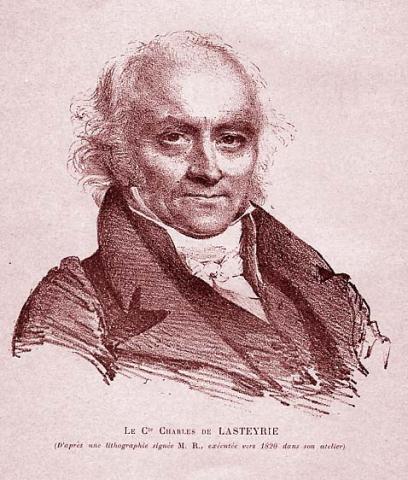
A Londres, l’association de Lancaster sera rejointe par de nombreuses personnalités de haut rang, aussi bien anglaises qu’étrangères. On y retrouve notamment le physicien genevois Marc Auguste Pictet de Rochemont (1752-1825), l’anatomiste et paléontologue français Georges Cuvier (1769-1832) et ses compatriotes, l’agronome Charles Philibert de Lasteyrie et le futur traducteur de Lancaster, l’archéologue Alexandre de Laborde (1773-1842).
Après la paix de 1814, de nombreux pays, notamment l’Angleterre, la Prusse, la France tout comme la Russie, rendus exsangues par les guerres napoléoniennes qui provoquèrent la perte de milliers de jeunes enseignants et cadres qualifiés sur les champs de bataille, font de l’éducation leur priorité notamment pour être à la hauteur de la révolution industrielle qui vient les bousculer.
A cela il faut ajouter que le nombre d’orphelins en Europe est devenu un problème majeur pour tous les États, d’autant plus que les coffres sont vides. Pour occuper les enfants de la rue, il faut des écoles, beaucoup d’écoles à construire avec très peu d’argent et beaucoup de professeurs… inexistants. Apprenant le succès retentissant de l’enseignement mutuel, plusieurs Français se rendent alors outre-Manche pour y découvrir la nouvelle méthode.
De Laborde en rapporte un « Plan d’éducation pour les enfants pauvres, d’après les deux méthodes (du docteur Bell et de M. Lancaster) », et Lasteyrie son « Nouveau système d’éducation pour les écoles primaires ». En 1815, le duc de la Rochefoucauld-Liancourt (1747-1827), publie son livre sur le « Système anglais d’instruction de Joseph Lancaster ».
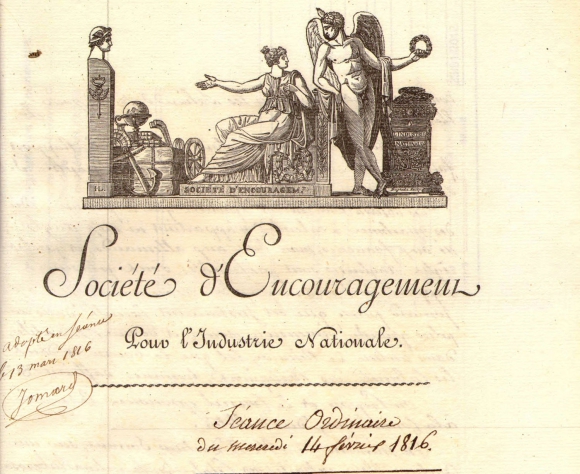
Depuis 1802, il existait à Paris la « Société d’encouragement pour l’industrie nationale », dont le secrétaire général était le linguiste Joseph-Marie de Gérando (1772-1842) et dont Laborde était un des fondateurs. Sans surprise, Gérando avait été élevé par les Oratoriens et se destinait initialement à l’Église.
Le 1er mars 1815, Lasteyrie, Laborde et Gérando proposent à la Société d’encouragement la création d’une association qui aurait pour objet
« de rassembler et de répandre les lumières propres à procurer à la classe inférieure du peuple le genre d’éducation intellectuelle et morale le plus approprié à ses besoins ».
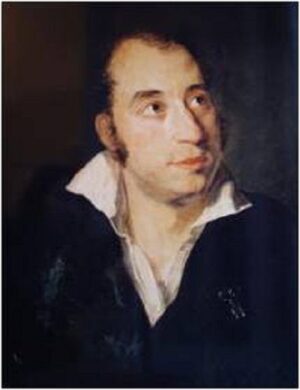
Dans son rapport présenté le 20 mars 1815 devant la Société d’encouragement, Gérando propose de solliciter le tout nouveau ministre de l’Intérieur Lazare Carnot (du 20 mars au 22 juin 1815) pour qu’il favorise « l’adoption des procédés propres à régénérer l’instruction primaire en France », c’est-à-dire le système d’enseignement mutuel.
L’intérêt politique et social ne sont pas seuls en jeu. L’économie française aussi doit tirer profit du développement de l’instruction. Qu’espérer, dit Carnot en 1815,
« si l’homme qui conduit la charrue est aussi stupide que les chevaux qui la tirent ? »
Gérando propose également la création d’une société dédiée spécifiquement à sa propagation en soulignant les avantages de la nouvelle approche : avantage économique d’abord, puisqu’il s’agit d’« employer les enfants eux-mêmes, les uns vis-à-vis des autres, comme auxiliaires de l’enseignement » et qu’un seul maître suffit pour 1000 élèves ; avantage éducatif ensuite, puisqu’il est possible « d’enseigner, en deux ans, tout ce que les enfants des conditions inférieures ont besoin de savoir et beaucoup plus qu’ils n’apprennent aujourd’hui par des procédés bien plus longs » ; avantage moral et social enfin, dans la mesure où les enfants « se pénètrent de bonne heure du sentiment du devoir, sentiment qui garantira un jour leur obéissance aux lois et leur respect pour l’ordre social ».
L’ingénieur-géographe et polytechnicien Edme-François Jomard (1777-1862), pour qui l’instruction du peuple est une obligation de la société vis-à-vis d’elle-même, ne disait rien d’autre: « Comment exiger d’infortunés, dénués de toutes lumières, qu’ils connaissent le pacte social et s’y soumettent ? ou comment pourrait-on, sans être insensé, compter sur leur invariable et aveugle soumission ? »
La Société d’encouragement valida alors les conclusions de son rapport en souscrivant pour une somme de 500 francs en faveur de l’association nouvelle et en décidant qu’elle mettrait à la disposition de celle-ci, outre son influence morale, les divers moyens d’exécution qui pouvaient lui appartenir.
10. Lazare Carnot à la manœuvre
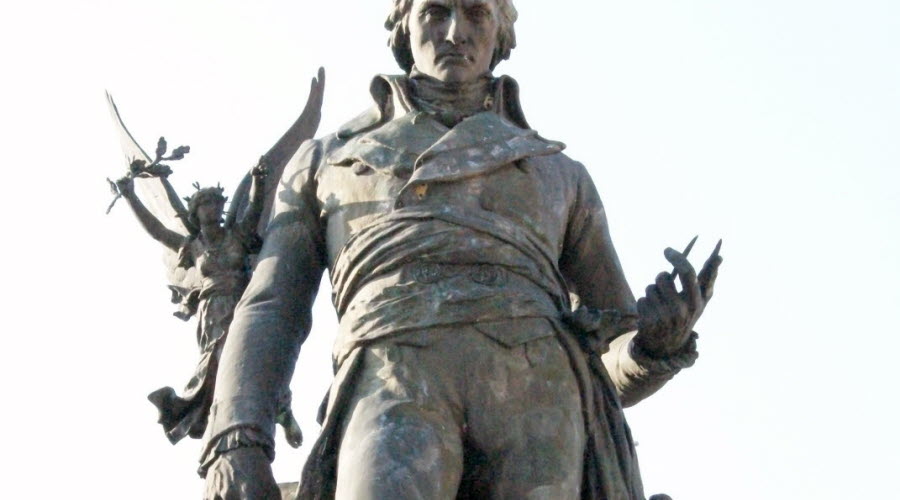
Suite au Concordat entre Napoléon et le Vatican, l’Empereur, par son décret du 15 août 1808 sur l’éducation, décide que les écoles doivent désormais suivre les « principes de l’Église catholique ».
Les « Frères des écoles chrétiennes » (ou Lasalliens), partisans inconditionnels de « l’enseignement simultané », théorisé par leur fondateur Jean-Baptiste de La Salle, s’occuperont désormais de l’enseignement primaire et formeront les instituteurs.
Dispersés lors de la Révolution, ils reprennent leurs fonctions en 1810. Encouragés à se développer pour contrer l’influence des jésuites, autorisés en 1816 à revenir en France, ils se développent rapidement dans toute la France.
Mais la situation de l’éducation est pitoyable. C’est ce que constatent des hauts fonctionnaires français lorsqu’ils se rendent dans les territoires annexés par l’Empire, notamment l’Allemagne du Nord et la Hollande. La comparaison avec la France les fait rougir de honte.
« Nous aurions peine, écrit en 1810 le naturaliste Georges Cuvier dans son rapport, à rendre l’effet qu’a produit sur nous la première école primaire où nous sommes entrés en Hollande. »
Enfants, maîtres, local, méthodes, enseignement, tout est d’une tenue parfaite : « Plusieurs préfets ont assuré qu’on ne trouverait pas aujourd’hui dans leur département un seul jeune garçon qui ne sût lire et écrire. » Devant un tel contraste, qui ne tournait pas à l’avantage du conquérant, l’Université impériale, comme la Rome antique, se mit à l’école du pays conquis. Dans son décret du 15 novembre 1811 l’Empereur décide : « Le conseil de notre Université Impériale nous présentera un rapport sur la partie du système établi en Hollande pour l’instruction primaire qui serait applicable aux autres départements de notre Empire. »
L’Empereur abdique le 4 avril 1814 avant qu’une décision ait été prise pour régénérer les « petites écoles » françaises. Du moins l’Université Impériale avait-elle, par ses rapports, étalé au grand jour leur misère, attirant sur elles l’attention de l’opinion.
Nommé ministre de l’Intérieur, et donc en charge de l’Education lors des Cent-Jours, Lazare Carnot est persuadé du potentiel d’excellence de « l’enseignement mutuel ».
Il crée, le 10 avril 1815, un Conseil d’industrie et de bienfaisance, à la première séance duquel il donne lui-même communication du rapport de Gérando ;
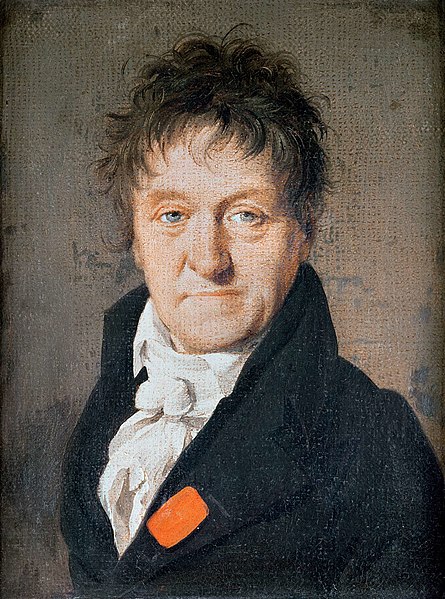
Le 27 avril 1815, Lazare Carnot fait un rapport à l’Empereur où il dit :
« Il y a en France, 2 millions d’enfants qui réclament l’éducation primaire, et, sur ces 2 millions, les uns en reçoivent une très imparfaite, tandis que les autres en sont complètement privés. »
Il recommande alors l’enseignement mutuel :
« Elle a pour objet de donner à l’éducation primaire le plus grand degré de simplicité, de rapidité et d’économie, en lui donnant également le degré de perfectionnement convenable pour les classes inférieures de la société et aussi en y portant tout ce qui peut faire naître et entretenir dans le cœur des enfants le sentiment du devoir, de la justice, de l’honneur et le respect pour l’ordre établi ».
Il fait signer le même jour à l’empereur le décret suivant :
« Article 1er. – Notre ministre de l’Intérieur appellera près de lui les personnes qui méritent d’être consultées sur les meilleures méthodes d’éducation primaire. Il examinera ces méthodes, décidera et dirigera l’essai de celles qu’il jugera devoir être préférées.
« Art. 2. – Il sera ouvert, à Paris, une École d’essai d’éducation primaire, organisée de manière à pouvoir servir de modèle et à devenir école normale, pour former des instituteurs primaires.
« Art. 3. – Après qu’il aura été obtenu des résultats satisfaisants de l’École d’essai, notre ministre de l’Intérieur nous proposera les mesures propres à faire promptement jouir tous les départements des nouvelles méthodes qui auront été adoptées ».
Pour Carnot, en rupture avec ceux qui ne pensaient qu’en termes de philanthropie, il n’y avait plus d’enfants riches ou pauvres. En tant que citoyens, tous devraient désormais pouvoir disposer de la meilleure éducation possible.
Le conseil consultatif constitué par Carnot comprend ses amis Laborde, Jomard, l’abbé Gaultier, puis Lasteyrie et Gérando, c’est-à-dire les promoteurs mêmes ou les premiers fondateurs de la Société en formation.
Ainsi naîtra, le 17 juin 1815 (c’est-à-dire la veille de la défaite de Waterloo) la Société pour l’instruction élémentaire (SIE), toujours sous l’impulsion de Carnot bien décidé à gagner la guerre pour l’instruction. La première assemblée générale de la SIE se tient dans les locaux de la Société d’encouragement. À sa tête, on retrouve plusieurs protagonistes de la commission ministérielle : Jomard devient l’un des secrétaires de la nouvelle société, aux côtés de Gérando (président), Lasteyrie (vice-président) et Laborde (secrétaire général).

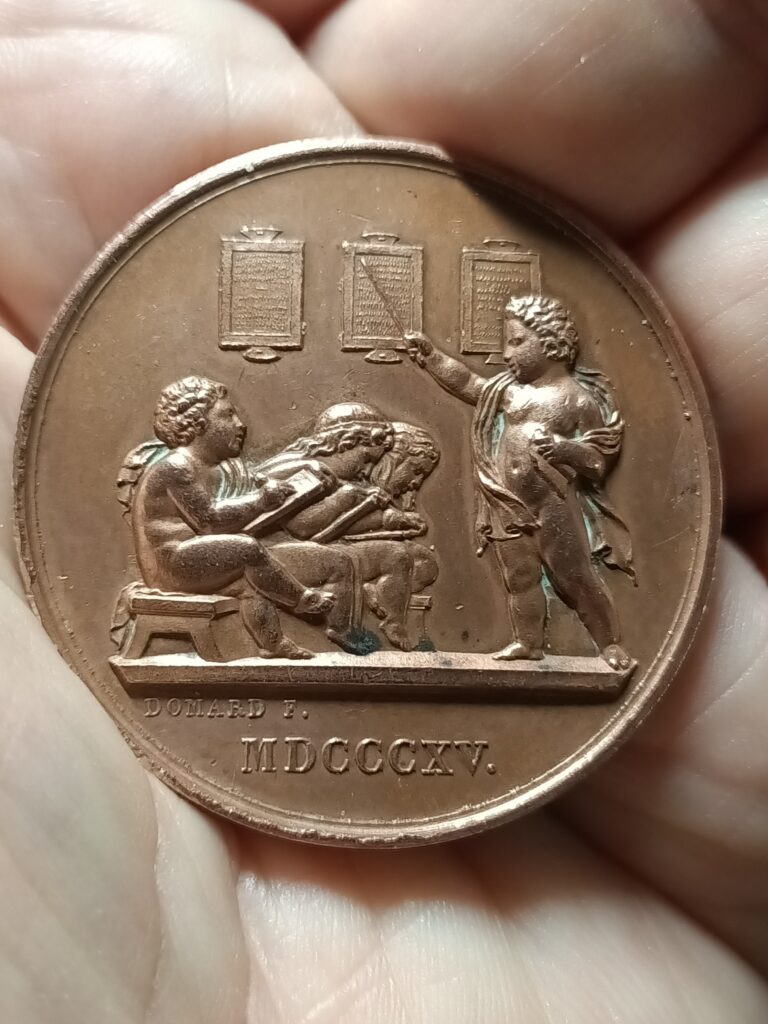
Avant l’ordonnance de 1816, le nombre d’enfants qui suivaient les petites écoles était de 165 000 dans toute la France, et il se trouve porté à 1 123 000 à la fin de 1820.
Lazare Carnot a clairement voulu pérenniser son offensive lancée durant les Cent-Jours en faveur de la propagation de l’enseignement mutuel à travers le pays et, ce faisant, en participant au développement rapide de l’instruction de tous les enfants de la Patrie.
Après sa création, les souscriptions pour la SIE affluent, et en peu de temps 150 noms s’ajoutent à ceux des fondateurs pour promouvoir et organiser l’enseignement mutuel en France. L’un de ces souscripteurs est forcément Lazare Carnot.
Au cours de sa première année d’existence, la SIE recueille l’adhésion de près de 700 membres, dans un premier temps des enseignants de l’École polytechnique (Ampère, Berthollet, Chaptal, Guyton de Morveau, Hachette, Mérimée, Thénard), et ensuite une trentaine d’anciens élèves, dont environ la moitié est issue de la première promotion (1794) de l’École polytechnique. Parmi ces derniers, un camarade de Jomard à l’Ecole des géographes, Louis-Benjamin Francœur, professeur d’algèbre supérieure à la Faculté des sciences de Paris, des camarades de la campagne d’Egypte ou encore Chabrol de Volvic, préfet de la Seine depuis 1812.
Tous n’ont qu’un seul espoir : que les méthodes géniales de Monge, brigades et enseignement mutuel, diminuées et interdites depuis que Napoléon a transformé Polytechnique en une simple école militaire sous la direction du mathématicien Pierre-Simon Laplace (1749-1827), puissent profiter au plus grand nombre et organiser un redressement national.
De Paris, la sollicitude de la SIE s’étend à la province ; elle y encourage la fondation de sociétés filiales, à qui elle offre « de leur envoyer des maîtres, de leur communiquer les renseignements dont elles pourraient avoir besoin, de leur donner au prix coûtant les tableaux et les livres… ».
La SIE se mobilise également pour l’éducation publique des filles (art. 10). Elle met sur pied, pour s’occuper d’elles, un comité de dames : présidente, la baronne de Gérando ; vice-présidente, la comtesse de Laborde. Des filles, le mouvement gagne les adultes sans instruction, si nombreux alors.
Le 1er mai 1816 la Société créait une commission pour l’établissement d’écoles d’adultes. Elle s’occupe aussi des casernes, dont on veut faire des écoles pour militaires ; des prisons, prisons d’enfants surtout; des habitants des colonies, que l’on pense élever par le développement de l’instruction.
Enfin les membres de la Société, attribuant une valeur humaine et générale à leur mission, rêvent de fonder des filiales à l’étranger. En novembre 1818, Laborde demande la création d’un comité spécial pour les écoles étrangères.
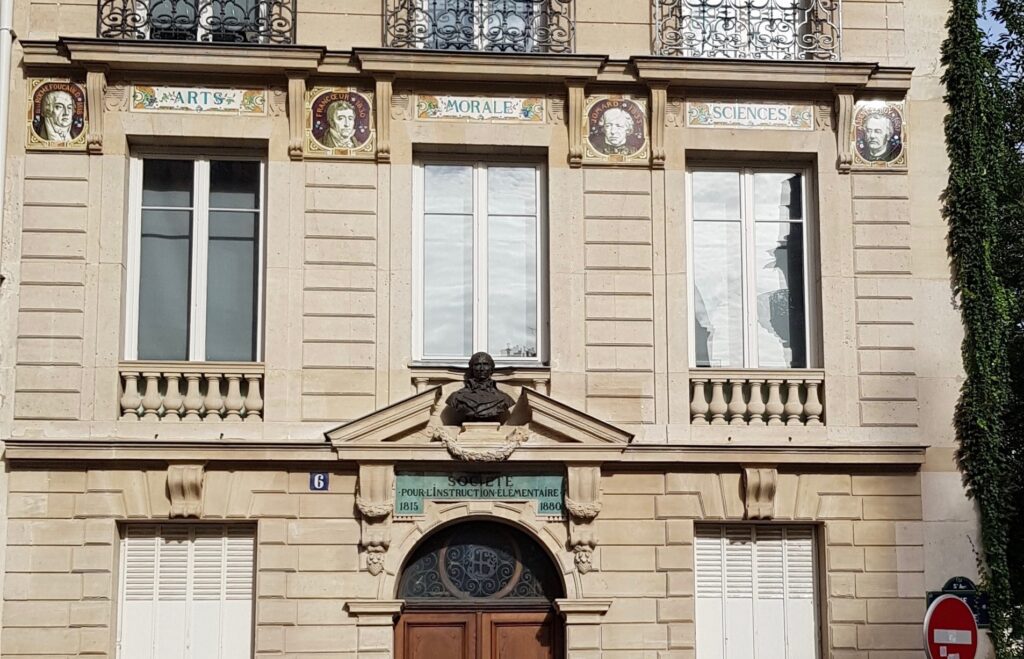
La Société enfin, ne bornant pas son activité à la simple création d’écoles, organisait des inspections, des examens. Elle assurait la publication d’ouvrages (ouvrages relatifs à la méthode mutuelle, livres élémentaires de lecture, de grammaire et d’arithmétique). Elle distribuait des récompenses aux meilleurs maîtres et moniteurs. Elle demandait aux maîtres, après promulgation de l’ordonnance du 29 juillet 1818 autorisant les sociétés de Caisse d’Epargne, de confier à ces Caisses une partie de leurs gages pour assurer leurs vieux jours. Donnant l’exemple, elle déposait à la Caisse des fonds pour les maîtres des écoles créées par elle.
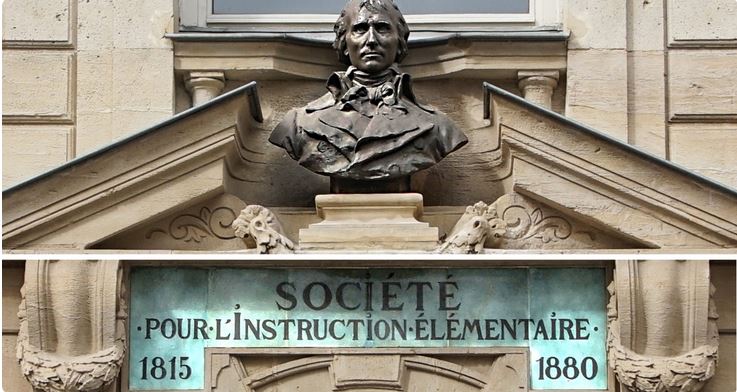
La SIE, dont le siège est un local spécialement construit pour elle, situé au 6, rue du Fouarre à Paris 5e, reste aujourd’hui la plus ancienne et la plus grande association laïque d’enseignement primaire que nous possédons en France.
11. Le projet pilote de la rue Saint-Jean-de-Beauvais
Après son voyage en Angleterre, Jomard, dont le portrait figure en médaillon sur la façade de la SIE est lui aussi acquis au nouveau système. Faisant part de ses « réflexions sur l’état de l’industrie anglaise », il écrit, après s’être enthousiasmé pour diverses inventions observées outre-Manche :
« Il y a cependant quelque chose de plus extraordinaire encore : ce sont des écoles sans maîtres : rien, pourtant, n’est plus réel. On sait à présent qu’il existe des milliers d’enfants enseignés sans maître proprement dit, et sans qu’il n’en coûte rien à leur famille, ni à l’État : admirable méthode qui ne peut tarder à se propager en France. »
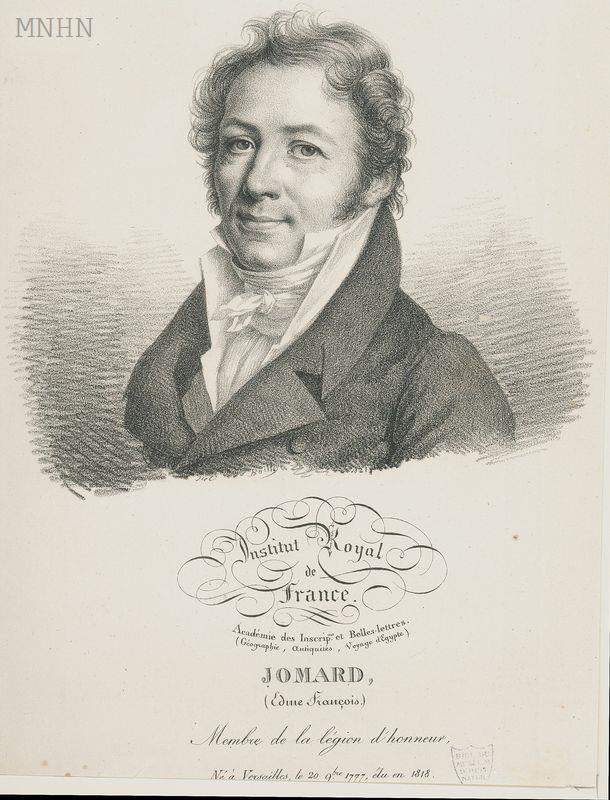
Polytechnicien, Jomard est l’homme idéal pour piloter l’organisation matérielle de l’école d’essai, s’attachant notamment à faire réaliser le mobilier et imprimer les supports pédagogiques conformément aux principes anglais. Il supervise également la formation au rôle de « moniteur » d’un petit noyau d’élèves – ils sont une vingtaine – avant l’ouverture en septembre 1815 de l’école proprement dite, prévue pour 350 élèves : une modalité qui n’est pas sans rappeler les « chefs de brigade » de la première promotion de l’École polytechnique.
Cependant, très rapidement, les membres de la SIE se rendent à l’évidence qu’il faut former des formateurs. Les Anglais accueillent alors plusieurs Français pour les former à l’enseignement mutuel. Un pasteur cévenol, François Martin (1793-1837), après sa formation comme « moniteur » en Angleterre, est appelé par Lasteyrie pour diriger la première école mutuelle, qui ouvre ses portes le 13 juin 1815, rue Saint-Jean-de-Beauvais à Paris. Il s’agit de l’école modèle qui doit permettre l’ouverture d’autres écoles mutuelles grâce à la formation de « moniteurs » compétents. Rapidement, elle ne peut plus faire face à la demande de centaines de communes qui envisagent d’y envoyer l’un des leurs pour se former à la nouvelle méthode.
Le pasteur Paul-Emile Frossard, lui aussi formé par les Anglais, prend la tête d’une école parisienne rue Popincourt, Bellot en dirige une autre. En juillet, Martin rend son rapport. La classe modèle accueille une quinzaine d’élèves destinés à devenir moniteurs et directeurs d’écoles élémentaires qui comptent jusqu’à 350 enfants. Martin rapporte qu’en six semaines, ils lisent, écrivent, calculent et « savent exécuter les mouvements qui forment la partie gymnastique du nouveau système d’éducation ».
12. Enseignement mutuel et chant choral
Or, comme le documente amplement Christine Bierre dans son article « La musique et formation du citoyen à l’ère de la Révolution française » (1990),
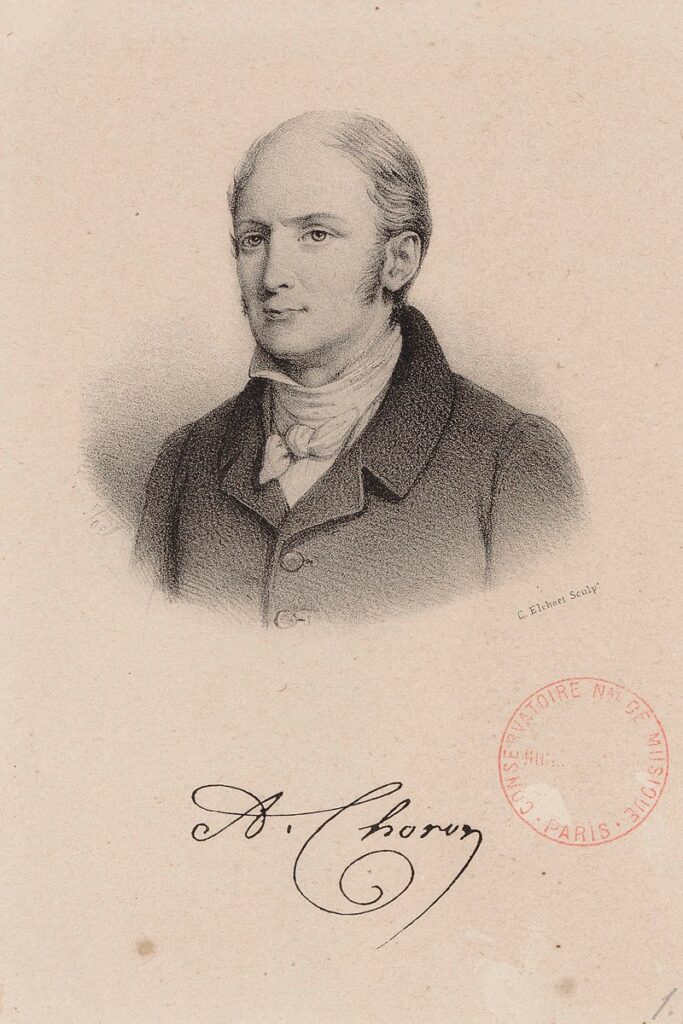
« C’est à cette école de la rue Saint-Jean-de-Beauvais, sous la direction d’une Commission comprenant Gérando, Jomard, Lasteyrie, Laborde et l’abbé Gaultier, que fut testée pour la première fois, l’application de l’enseignement mutuel à l’apprentissage du solfège et du chant.
Alexandre Choron, qui depuis 1814 avait ouvert deux écoles de musique de garçons et de filles, faisait également partie de la Commission.
Il n’est donc pas étonnant de découvrir que ce fut à l’initiative du baron de Gérando, que l’idée d’introduire le chant dans l’instruction primaire a été adoptée. ‘Quant Monsieur le baron de Gérando vous a fait la proposition d’introduire le chant élémentaire dans les écoles de premier degré’, dit Jomard dans un rapport présenté au Conseil d’administration de la Société pour l’Enseignement mutuel, ‘vous avez tous été frappés de la justesse des vues développées par notre collègue (…) Il a fait voir l’influence heureuse que pourrait avoir une pareille pratique, et la connexion réelle qui existe entre un bon emploi du chant et le perfectionnement de la morale, but final de l’instruction et de tous nos efforts. Non seulement, l’application de l’enseignement mutuel à la musique était révolutionnaire en elle-même, mais ce qui l’était tout autant, c’est le fait que les enfants apprenaient à lire et à écrire, de façon presque aussi intensive. Les enfants étudiaient le chant, à raison de quatre à cinq heures par semaine ! »
En réalité, c’est Lazare Carnot lui-même qui a voulu introduire la musique dans les écoles d’enseignement mutuel. Dans cette intention, il rencontre plusieurs fois Alexandre Choron, qui réunit un certain nombre d’enfants et leur fait exécuter en sa présence plusieurs morceaux appris en fort peu de leçons. Carnot connaît Wilhem depuis dix ans. Il entrevoit donc la possibilité d’introduire, par lui, le chant dans les écoles, et tous deux visitent ensemble celle de la rue Saint-Jean-de-Beauvais, école pilote gratuite d’enseignement mutuel ouverte à Paris à trois cents enfants.
L’article récent de Michael Werner, « Musique et pacification sociale, missions fondatrices de l’éducation musicale (1795-1860) » dans la revue Gradhiva (N° 31/2020), vient en écho confirmer les recherches initiées par Christine Bierre en 1990.
Extrait :
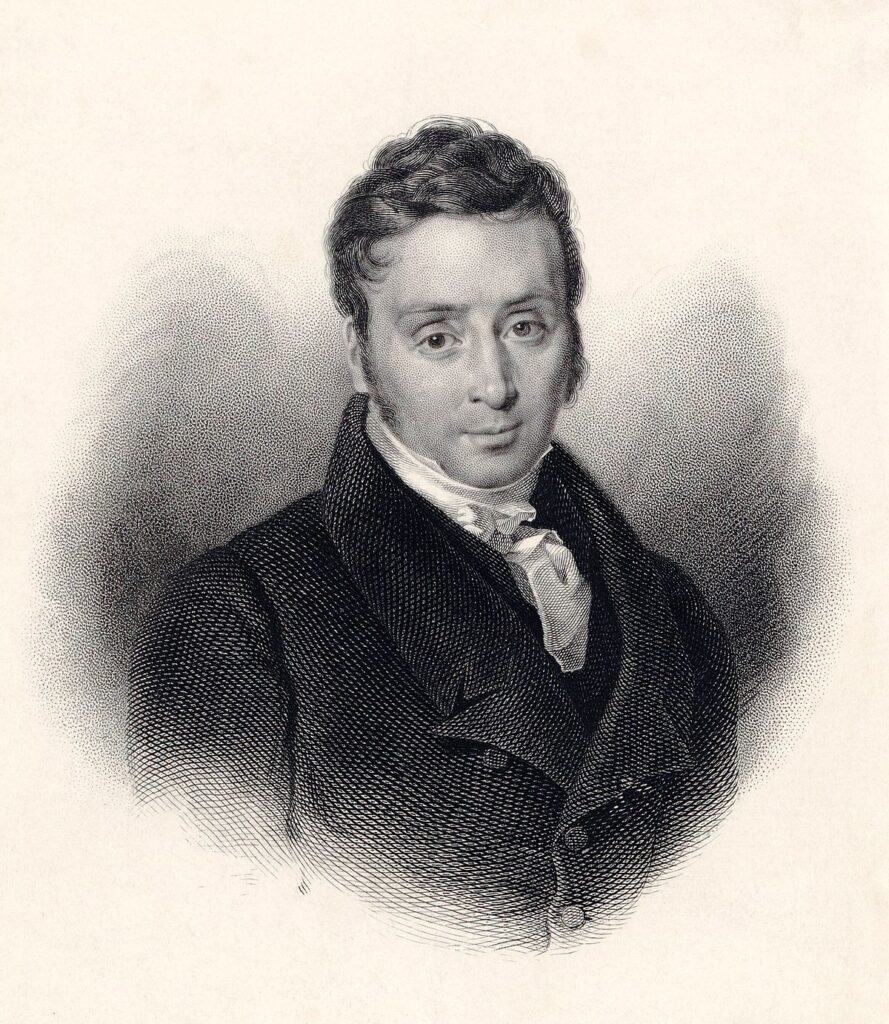
« L’un des domaines où les résultats de la pédagogie mutualiste sont bien visibles est précisément l’éducation musicale. Plusieurs acteurs y ont joué un rôle décisif et méritent qu’on s’y attarde un moment. Le premier est Guillaume-Louis Bocquillon, dit Wilhem. Fils d’officier et lui-même issu d’une formation militaire, il s’est ensuite consacré à la composition et à l’enseignement musicaux, en particulier au lycée Napoléon (ultérieurement collège Henri-IV). Son ami Pierre Jean de Béranger le met en contact avec Joseph-Marie de Gérando et François Jomard, grands animateurs de la SIE. Par leur intermédiaire, il prend connaissance de l’enseignement mutuel et comprend immédiatement les apports de cette méthode à l’éducation musicale. En 1818, la municipalité de Paris lui permet de monter une première expérience à l’école élémentaire de la rue Saint-Jean-de-Beauvais.
Wilhem élabore une méthode, le matériel pédagogique nécessaire (sous forme de tableaux) et instruit les élèves moniteurs choisis. Les résultats sont, aux dires de Jomard, spectaculaires. Au terme d’un enseignement de quelques mois, les élèves ont non seulement acquis les notions de base du solfège et de la notation musicale, les gammes chromatiques, les intervalles et mesures, mais exécutent aussi des chants collectifs à plusieurs voix (Jomard 1842 : 228 sq.).
La réussite conduit la SIE à proposer au préfet et au ministre de l’Intérieur d’introduire la musique dans l’enseignement des écoles élémentaires de la ville de Paris, ce qui sera officiellement entériné en 1820. Wilhem lui-même est nommé professeur titulaire d’enseignement musical à Paris et les cours de musique se généralisent dans un grand nombre d’écoles de la ville avant de se répandre dans les départements et en région. En même temps, la municipalité ouvre deux écoles normales chargées de former les futurs professeurs de chant.
Le deuxième acteur à intervenir très tôt dans le débat est le compositeur Alexandre Choron. Membre, comme Jomard et Francœur, de la première promotion de l’École polytechnique (1795), compositeur et ami d’André Grétry, il s’est dès 1805 préoccupé du dépérissement du chant choral consécutif à la suppression des maîtrises. Adversaire du Conservatoire dont il critique l’académisme et le désintérêt pour l’enseignement du chant choral, il est chargé par le ministère en 1812 d’une mission de « réorganisation du chœur et des maîtrises de musiques des églises de France ». Il élabore une méthode d’enseignement appelée « méthode concertante », mais reste également attaché à la vocation sociale de la musique chorale. Choron fait par ailleurs partie des membres fondateurs de la SIE en 1815, signe de son engagement dans les questions éducatives. Pendant la Restauration, il se tourne davantage vers les chants religieux qu’il considère comme le cœur historique de la pratique de la chorale.
(…) Enfin, il fonde, avec l’appui du roi l’Institution royale de musique classique et religieuse, concurrençant avec succès le Conservatoire dans l’enseignement de l’art vocal. Pour le grand public, il fait exécuter, à grand renfort de chanteurs issus de son école, des oratorios, requiem et cantates dans quelques églises spacieuses, assurant ainsi à la musique sacrée une nouvelle présence sur la scène parisienne. Pour certains de ces concerts, il lui arrive de mobiliser des élèves chanteurs des écoles élémentaires et des écoles des pauvres qu’il n’a jamais cessé de suivre tout au long de sa carrière.
« (…) Ce qui a favorisé cette expansion de l’enseignement de la musique à destination des jeunes et des couches populaires à partir de 1820 était bien une volonté politique partagée par un large spectre de responsables et d’intervenants. Du côté des libéraux qui constituaient le noyau de la SIE, on continuait de s’inscrire dans la mission émancipatrice de l’éducation, fixée par la Convention. En pointant à la fois la formation intérieure de l’âme et l’épanouissement d’une conscience collective, la musique, et en particulier le chant, devient un terrain de choix pour l’éducation populaire. Les libéraux insistent donc sur les bienfaits moraux de la musique. Ainsi, dans sa proposition d’introduire le chant dans les écoles primaires, Gérando remarque-t-il : ‘Ceux d’entre nous qui ont visité l’Allemagne ont été surpris de voir toute la part qu’a une musique simple aux divertissements populaires et aux plaisirs de famille, dans les conditions les plus pauvres, et ont observé combien son influence est salutaire sur les mœurs.’
« Et Joseph d’Ortigue constate de façon lapidaire : ‘Un peuple qui chante est un peuple content, et par conséquent un peuple moral.’ Cette mise en avant des bienfaits sociaux de l’activité musicale correspond bien à l’idée d’une ‘éducation universelle’, héritée des Lumières et au fondement des pédagogies de Lancaster en Angleterre ou de Johann Heinrich Pestalozzi en Suisse.
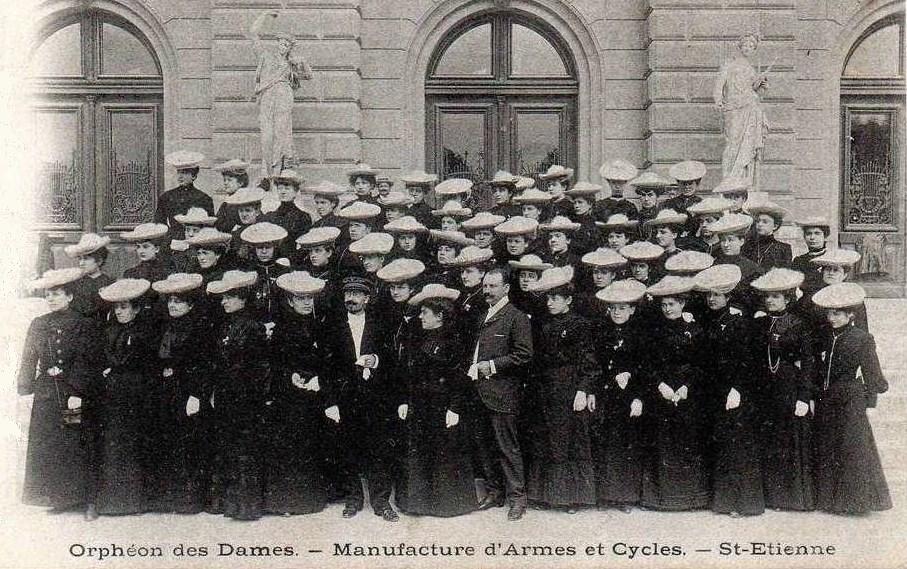
« Le chant, après l’essai fait à l’école St-Jean-de-Beauvais en 1819, pénètre très rapidement dans toutes les écoles mutuelles. Wilhem est à la fois le créateur et l’artisan du développement de cet enseignement qui gagne bientôt les cours d’adultes et d’apprentis. Des réunions périodiques d’enfants initiés à la musique vocale furent organisées. Ainsi naquit la première œuvre post-scolaire française : l‘Orphéon qui, après Wilhem, compte parmi ses directeurs Charles Gounod et Jules Pasdeloup. »
Dans un discours de 1842 devant la SIE, Hippolyte Carnot (fils de Lazare Carnot) affirme que Wilhem « a élevé la musique au rang d’une institution civique » et que « l’ennoblissement » de l’âme individuelle doit s’accomplir dans le nouvel ordre collectif de la nation réunie.
13. Jomard, Choron, Francoeur et savoirs « élémentaires »
L’article très complet de Renaud d’Enfert, publié sur le site de la Société de la bibliothèque et de l’histoire de l’Ecole polytechnique (SABIX), permet de compléter le tableau en faisant un gros plan sur l’action de Jomard et Francoeur dont les portraits figurent d’ailleurs en médaillon sur la façade du siège de la SIE rue du Fouarre à Paris.
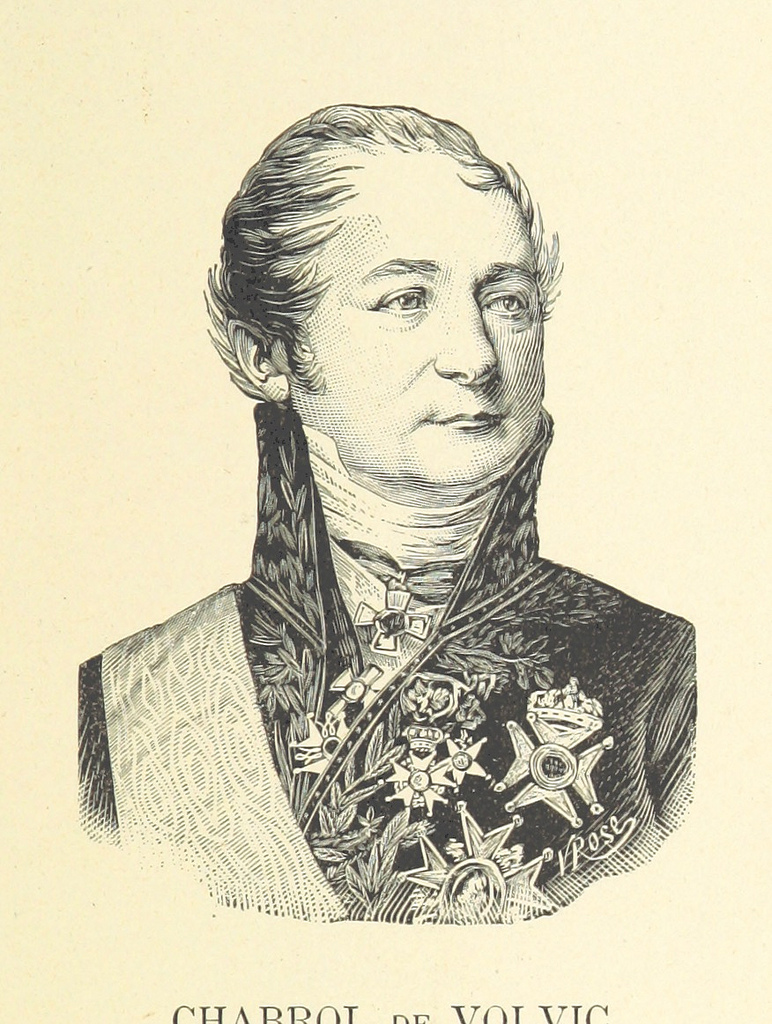
Dès le début de la Seconde Restauration, la SIE reçut l’adhésion et l’appui du préfet de la Seine, Gaspard Chabrol de Volvic (1773-1843). Ce dernier va nommer dès l’été 1815 Jomard, le linguiste en contact avec les frères Humboldt qui a fait partie de l’éphémère commission sous Carnot et qui l’a protégé pendant les Cent-Jours, « chef de bureau d’instruction publique et arts », poste qu’il occupe jusqu’en 1823.
Par un arrêté du 3 novembre 1815, Volvic, afin d’arrêter « les mesures nécessaires pour étendre le bienfait de l’instruction à toutes les familles pauvres domiciliées dans l’étendue de la préfecture » et de développer « le nouveau système d’instruction élémentaire » dans l’ensemble du département de la Seine, crée, « pour étendre les bienfaits de l’instruction gratuite au département de la Seine » un comité de onze personnes, et y fait entrer tous les membres influents de la SIE (Jomard, Gérando, Laborde, Doudeauville, Lasteyrie, Gaultier, etc.).
Dans ces fonctions, Jomard est chargé de trouver des sites pour établir de nouvelles écoles. Celles-ci se multiplient rapidement dans la capitale et ses environs : en 1818, il comptabilise 18 écoles mutuelles gratuites et 32 payantes couvrant l’ensemble des arrondissements de la capitale, ainsi que 13 écoles dans les arrondissements de Sceaux et de Saint-Denis. De ce travail, il tire son « Abrégé des écoles élémentaires » (1816), sorte de guide pratique dans lequel il réunit tout ce que doit savoir, du point de vue de l’organisation matérielle, tout citoyen décidé à fonder une école mutuelle.
Sur le plan pédagogique, Jomard est l’auteur, en 1816, d’une méthode de lecture réalisée en collaboration avec le compositeur et musicien Alexandre Choron qui avait publié dès 1802 une méthode pour apprendre à lire et à écrire, et l’abbé Gaultier, un pédagogue qui avait développé une méthode d’enseignement sous le nom de « jeux instructifs » et s’était rendu à Londres pour étudier les méthodes anglaises.

Conçue pour la nouvelle école normale élémentaire de la rue Saint-Jean-de-Beauvais, où Choron a été nommé comme enseignant de musique, elle rompt avec la méthode traditionnelle d’épellation. Au lieu de dire « b-o-n = bon », elle part des sonorités musicales de la langue pour dire « b-on = bon ».
Jomard fait également paraître, en 1821-1822, une « Arithmétique élémentaire », destinée à pallier les faiblesses constatées de la méthode d’arithmétique de Lancaster : celle-ci est en effet accusée de « faire contracter aux enfants une simple habitude routinière et mécanique » au lieu de servir « à fortifier leur attention et à les former au raisonnement ». Dans l’intervalle, il a mis au point avec Francœur et Lasteyrie, au sein d’une « Commission de calligraphie » de la SIE, les principes qui doivent guider l’apprentissage de l’écriture dans les écoles mutuelles, une écriture voulue « nationale », afin de remplacer les modèles anglais.
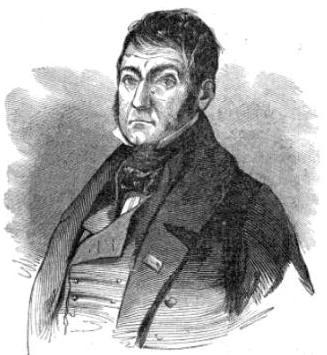
Pour sa part, Louis-Benjamin Francoeur (1773-1849) fournit, selon Jomard, « une longue suite de rapports lumineux sur les traités d’arithmétique, de poids et mesures, de chant et d’art musical, de dessin et de géométrie, qu’il serait bien trop long de rapporter ou de citer ».
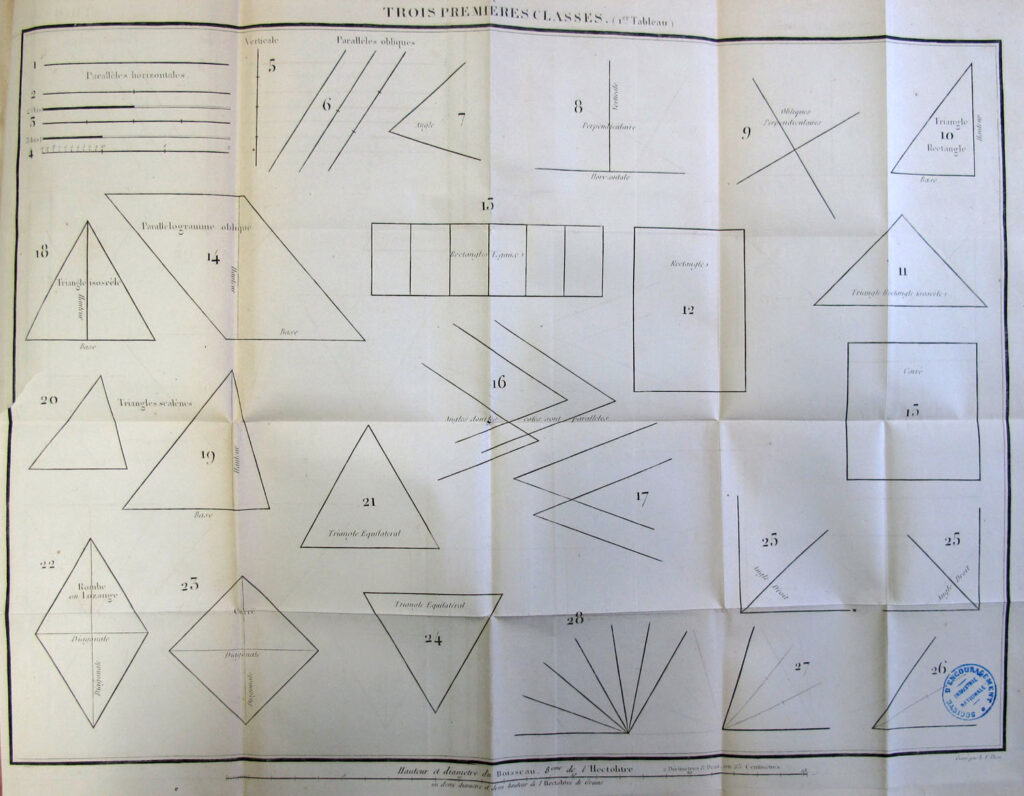
Comblant un manque, Francœur publie en 1819 « Le dessin linéaire », une méthode de dessin basée sur le dessin à main levée des figures géométriques qui rompt avec les modalités traditionnelles d’enseignement et d’apprentissage du dessin, inspirées de pratiques académiques.
Pour Jomard et Francoeur, il s’agit, avec l’enseignement mutuel, d’élargir le nombre des matières de l’instruction primaire au-delà du traditionnel « lire, écrire, compter » : outre le dessin, des matières comme le chant, la gymnastique, la géographie ou la grammaire font ainsi leur apparition dans les écoles primaires via l’enseignement mutuel. Le dessin linéaire n’en apparaît pas moins comme un savoir élémentaire à part entière, au même titre que la lecture, l’écriture et l’arithmétique.
Présentant la méthode de Francœur à la Société d’encouragement, Jomard déclare ainsi :
« L’utilité que l’industrie en peut retirer un jour est si grande et si visible, qu’il serait superflu d’y insister. Ce n’est pas sans raison qu’on a regardé ce résultat comme aussi précieux pour le peuple, que la connaissance de la lecture et de l’écriture. »
Enfin, pour Jomard, l’apprentissage généralisé de la lecture, de l’écriture, du calcul, du dessin linéaire et du chant, est le préalable obligé à l’éducation scientifique du peuple :
« On a dans ces derniers temps, avec grande raison, insisté sur l’utilité de l’enseignement des éléments des sciences physiques et mathématiques à la classe ouvrière. C’est de là que dépend l’avancement de l’industrie et de l’agriculture, qui, malgré tous leurs progrès, sont encore arriérées chez nous sous plusieurs rapports. Ce n’est que par la possession de ces notions élémentaires que les ouvriers perfectionneront leurs procédés, leurs moyens, leurs instruments, leurs produits, et pourront devenir d’habiles contremaîtres et de bons chefs d’ateliers. Mais comment arriver à ce résultat, quand la masse de la population est encore si ignorante.
« Comment, sans l’art de lire et d’écrire, pourrait-elle, non pas comprendre un seul mot des arts chimiques et mécaniques, mais seulement en sentir l’avantage et consentir à se livrer à des études pénibles ? Quoi ! 15 millions de Français et plus peut-être, ne savent pas faire les deux premières règles de l’arithmétique, et l’on se flatterait de propager parmi eux les premiers principes de la mécanique et de la géométrie ! La base de cette amélioration est évidemment l’instruction primaire rendue plus générale ou même universelle. »
14. Rayonnement au niveau national
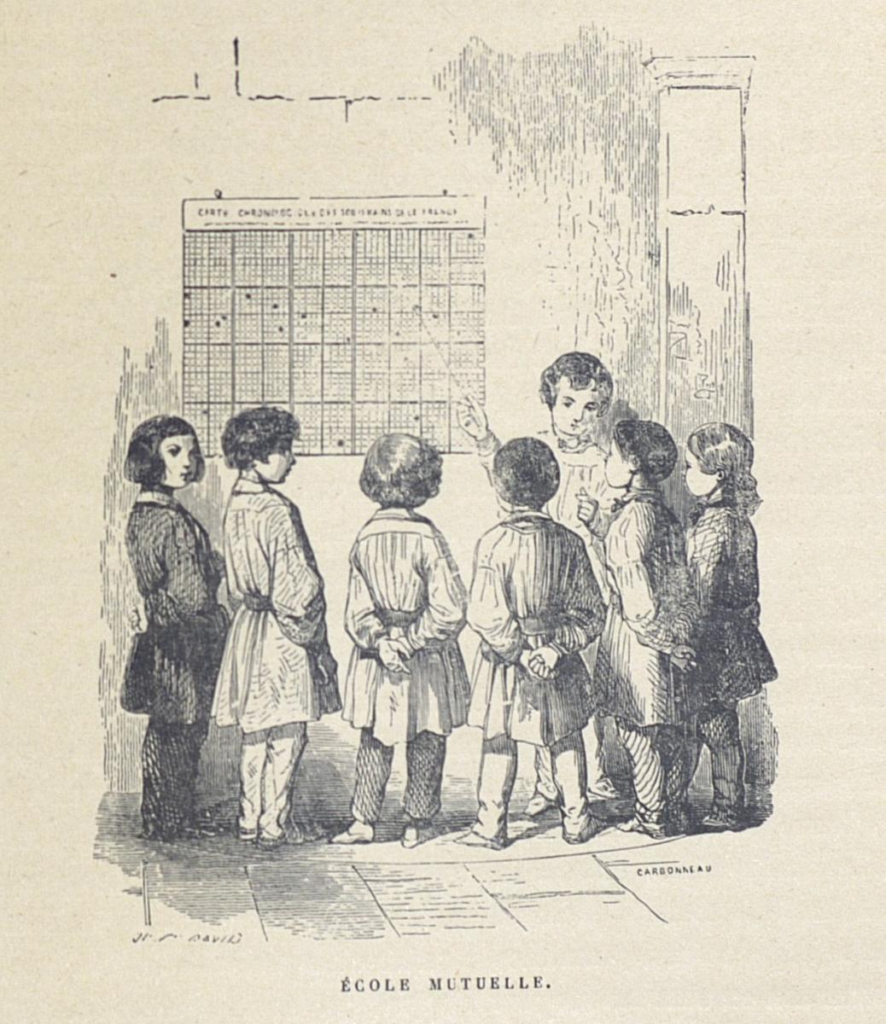
Les résultats de l’enseignement mutuel sont spectaculaires et rapides, qu’il s’agisse de la durée des apprentissages ou de la qualité des acquis. Alors que dans les écoles des Frères il fallait 4 années pour apprendre à lire, ce temps est réduit à une année et demie dans les établissements mutuels !
Les Français de 1815, à l’enthousiasme si prompt, et à l’imagination si vive, virent dans ce système d’enseignement, une véritable panacée. Il présentait certes d’incontestables avantages. D’abord il est économique puisqu’il exige peu de maîtres, et permet d’instruire à peu de frais un nombre considérable d’enfants. On estime qu’il suffisait de 4000 à 5000 fr. par an pour entretenir une école de 1000 enfants : 4 francs par élève ! Jamais l’instruction n’aura été donnée à si bas prix. Il permettait aussi d’assurer un développement rapide de l’enseignement primaire puisque l’on n’était plus arrêté désormais par la pénurie de maîtres. Chiffres à l’appui, on calculait qu’il suffirait d’une douzaine d’années pour étendre à la France entière les bienfaits de l’instruction primaire !
A ces avantages indiscutables, ceux qui avaient visité l’Angleterre en 1815 ajoutaient des arguments qualitatifs. Ils estimaient l’enseignement des instructeurs supérieur à celui des maîtres :
« Il ne sait pas sa leçon mieux que le maître, écrivait Laborde, mais il la sait autrement ».
L’enfant instructeur (moniteur) a plaisir à communiquer à ses camarades ses connaissances nouvellement acquises, il fait son travail
« avec autant de charme qu’un précepteur y trouve de dégoût » (Laborde).
D’autre part, étant enfant lui-même, il connaît mieux que le maître les difficultés de la tâche, les embûches de la leçon, sur lesquelles il vient juste de trébucher. Il conduira donc ses camarades plus lentement, plus sûrement, sera pour eux un meilleur guide.
Mais l’enseignement ne sera pas seul à profiter du système mutuel ; la discipline de l’école et la morale y trouveront aussi leur compte. L’enfant, soumis à son camarade, lui obéira plus volontiers qu’au maître, puisque le jeune instructeur ne doit sa supériorité qu’à son mérite. Enfin l’enfant, avec son camarade qui le connaît bien puisqu’il vit avec lui, n’aura pas, comme avec le maître, la ressource de mentir pour cacher ses pensées intimes ou ses fautes ; et la dissimulation, fléau social que l’on apprenait dès les bancs de l’école, disparaîtra ainsi des établissements mutuels. Et Laborde concluait son apologie de la méthode par ce chant de triomphe : dans les nouvelles écoles,
« le travail est pour eux un jeu, la science une lutte, l’autorité une récompense ».
Les bienfaits de cet enseignement ne devaient d’ailleurs pas se limiter au cadre de l’école : les enfants rentrés chez eux exerçaient à leur tour sur leurs parents une heureuse influence ; ils devenaient des « missionnaires », à la fois de la morale et de la vérité dans leur famille.
« Et que de mauvais esprits n’aillent pas dire qu’il s’agit là de rêveries et d’utopies d’idéalistes ! » écrit Gontard en 1956. Des preuves existent, et irréfutables, de la valeur de la méthode. Regardez l’Ecosse. C’était à la fin du XVIIe siècle une terre de mendicité et de misère, vivant sans loi, sans religion, sans morale, les hommes buvant, les femmes blasphémant, tous se battant. En 1815, grâce à la baguette magique de l’école mutuelle, l’Ecosse est devenue un paradis.
«Il n’est pas rare de trouver en Ecosse un berger lisant Virgile… mais il est presque inconnu d’y rencontrer un malfaiteur », renchérit Laborde. Que l’on développe la méthode en France et celle-ci, en 1850, sera une terre de prospérité et de bonheur, d’où seront bannis l’immoralité, le fanatisme, les révolutions, les troubles sociaux, tous fils et filles de l’ignorance.
En 1818 Joseph Hamel, dans son rapport à l’Empereur de Russie, constate que
« la méthode d’enseignement mutuel s’est introduite dans toute la France avec une rapidité et un succès fort supérieur à ce qu’on pouvait raisonnablement en attendre, et, en moins de trois années, on a déjà fondé plus de 400 écoles. Tout porte donc à espérer que, dans un temps peu éloigné, plus de 2 millions d’enfants qui restaient dans l’ignorance la plus complète, pourront recevoir chaque année les bienfaits d’un enseignement gratuit, suffisant pour leur vocation ultérieure ».
D’emblée, toute la France s’y met ! A titre d’exemple, le récit de l’arrivée à Amiens et dans le département de la Somme.
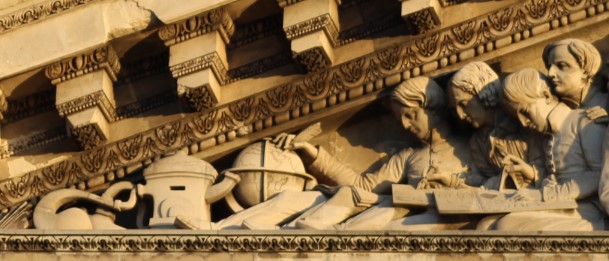
A Amiens et dans la Somme
Après beaucoup de méfiance et bien des hésitations, la mairie d’Amiens fonde, le 15 mai 1817, une société d’encouragement de l’instruction élémentaire dans le département. Plus que l’ennoblissement de l’âme des élèves, pour le recteur, il s’agit,
« en donnant aux enfants de ces ouvriers l’instruction élémentaire, [de les préparer] non seulement à l’habitude de l’ordre et de la subordination que l’on puise dans les écoles d’enseignement mutuel et qu’ils reportent dans les ateliers, mais encore que cela les mette en état de servir plus utilement dans l’intérieur des fabriques comment pouvoir étudier les procédés industriels dont la conservation et le perfectionnement sont si essentiels à la prospérité nationale ».
Pour le recteur, la rapidité d’acquisition est un gage de succès de la nouvelle méthode par rapport à la « méthode simultanée » :
« Qu’une instruction primaire qui enlève pendant des années entières les enfants à un travail nécessaire à la subsistance de la famille devienne pour les pauvres une charge très onéreuse ; mais que l’expérience apprenne au père de famille que quelques mois suffiront pour procurer à ses enfants un avantage dont il a regretté tant de fois dans le cours de la vie de n’avoir pas pu jouir lui-même, on doit espérer qu’il ne balancera pas pour faire un léger sacrifice pour obtenir un résultat important ».
Ce sont principalement des écoles de garçons. Il existe quelques écoles de filles et des cours du soir pour adultes. Elles accueillent surtout des enfants de petits artisans : teinturier, employé d’octroi, cabaretier, contremaître, tailleur, garçon meunier, apprêteur, tonnelier, couturier, serrurier, boucher, fileur, repasseur, ouvrier, chargeur de voiture, menuisier, bouquiniste, allumeur de réverbère, coutelier, relieur, etc.
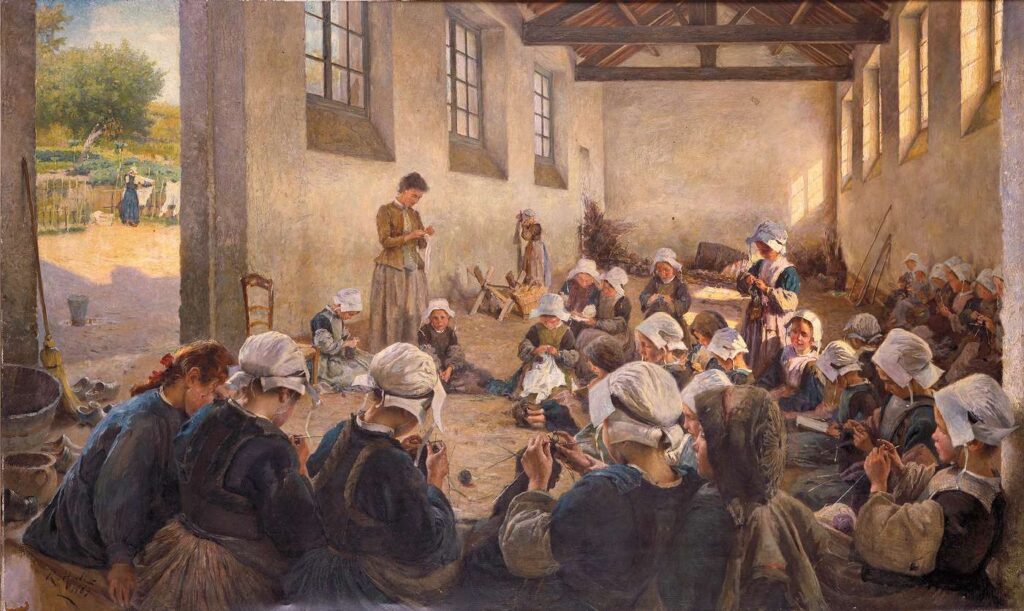
À son apogée, en 1821, l’enseignement mutuel comporte dans le département de la Somme non pas une école mais 25 dont 4 (payantes) pour des filles : près de la moitié sont situées en ville. Il en comportera encore 16 en 1833. Le réseau se réduira considérablement ensuite, toutefois, il ne disparaîtra pas complètement. Les deux dernières écoles d’Amiens fermeront involontairement leurs portes en 1879 et celle d’Abbeville en 1880 : jusqu’à cette date, elle jouera un rôle important dans la préparation des candidats aux examens.
L’école modèle d’Amiens – la première école modèle d’enseignement mutuel de province – prépare les futurs instituteurs à la pratique de l’enseignement mutuel. Elle est fondée le 26 mai 1817. Elle accueille plus de 200 élèves. Dès 1818, 6 instituteurs de la Somme en sortaient. La plupart des maîtres de l’Aisne, de l’Oise et du Pas-de-Calais y font un séjour avant de prendre leur fonction. C’est dire son importance, au point d’ailleurs que lorsque le préfet a créé l’école normale de garçons en 1831, elle s’appelle « école normale primaire d’enseignement mutuel ». Elle servit d’abord d’école d’application : les élèves maîtres devaient se rendre une fois par semaine dans ses locaux afin d’observer et de pratiquer, en s’exerçant, la méthode mutuelle.
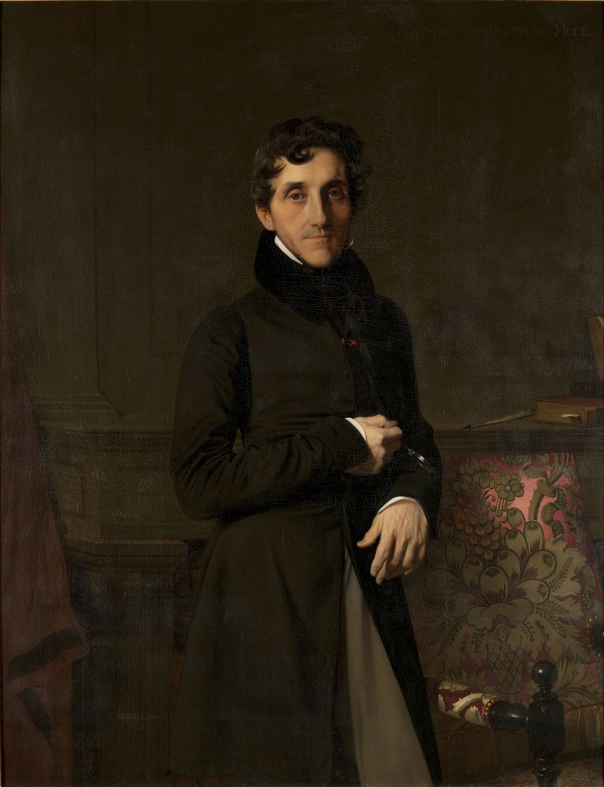
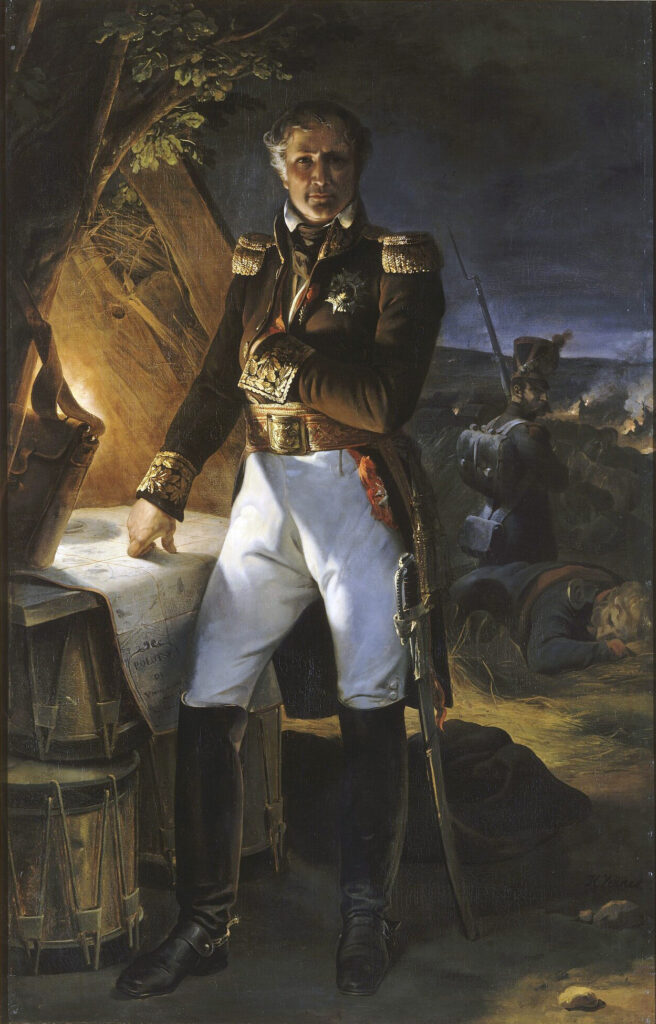

Après les remaniements de 1817-1818, plusieurs membres de la SIE accèdent à des ministères importants : Mathieu Molé (1778-1838) à la Marine, Laurent Gouvion-Saint-Cyr (1764-1830) à la Guerre, Elie Decazes (1780-1860) surtout, à l’Intérieur, ministère dont dépend l’enseignement primaire. Le soutien gouvernemental devient alors systématique.
Le ministre de l’Intérieur soutient la SIE de Paris et ses filiales par des subventions pour fondation ou entretien d’écoles. Il invite les préfets à concourir par tous moyens au développement de la méthode. Les préfets prennent l’initiative de constituer des sociétés locales, ils interviennent auprès des assemblées pour solliciter des subventions.
Des conseils généraux et municipaux, en nombre croissant, votent des crédits pour l’établissement d’écoles mutuelles. L’école fondée, les autorités locales, préfet, maire, la visitent, et président sa distribution des prix. De son côté, la commission d’instruction publique, qui depuis 1815 remplace le Grand Maître de l’Université, décide le 22 juillet 1817 d’établir dans les chefs-lieux des douze Académies de France une école modèle pour l’enseignement mutuel, pépinière des futurs maîtres. Les autres ministres, chacun dans leur sphère, soutiennent la méthode.
Mathieu Molé, chargé de colonies, fonde des écoles d’enseignement mutuel au Sénégal.
En 1818, Laurent Gouvion-Saint-Cyr établit à Paris, dans la caserne Babylone, une véritable école normale militaire d’enseignement mutuel. Chaque régiment de Paris et de province doit y envoyer un officier et un sous-officier qui, de retour après quelques mois de stage, dispenseront à la troupe les bienfaits de l’instruction primaire.
En 1817-1818, l’enseignement mutuel triomphe. Un enthousiasme irrésistible porte la France vers lui. Le réseau des écoles ne cesse de s’étendre. De trimestre en trimestre, toujours plus nombreux, arrivent à Paris les comptes-rendus de la province, dénombrant les écoles et leurs élèves.
C’est un chant de victoire que peut entonner Jomard à la séance de la SIE de janvier 1819. Sur les 81 départements que compte la France, 5 seulement sont dépourvus d’école mutuelle ; les 76 autres groupent 687 écoles, fréquentées par plus de 40 000 élèves. On compte en outre 105 écoles régimentaires, 5 écoles d’adultes, 4 écoles de prisons, 2 ou 3 écoles au Sénégal.
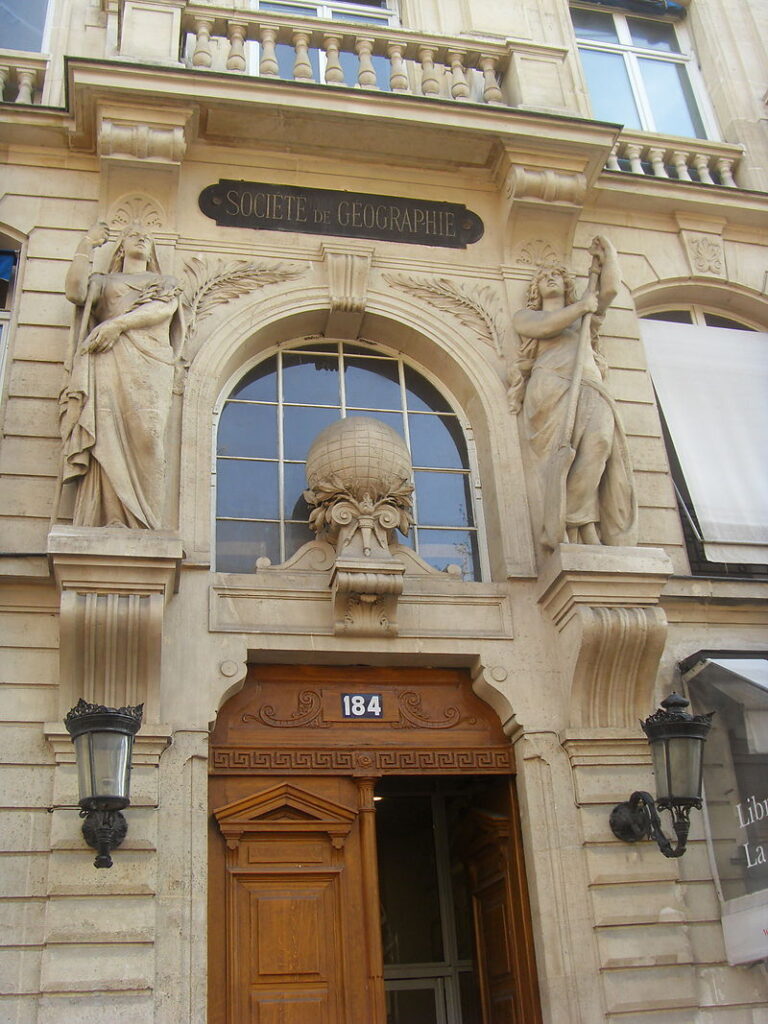
Exemplaire de ce qui devient alors un nouveau paradigme prométhéen d’optimisme scientifique, le 15 décembre 1821, lors d’une réunion à l’hôtel de ville de Paris, est fondée la Société de géographie par 217 personnalités dont les plus grands savants de l’époque, notamment Jomard, Champollion, Cuvier, Chaptal, Denon, Fourier, Gay Lussac, Berthollet, von Humboldt, Chateaubriand. Parmi ses membres illustres, on peut citer également Jean-Baptiste Charcot, Dumont d’Urville, Élisée Reclus et Jules Verne.
La collecte et l’étude des données géographiques de nombreux continents vont permettre à certains membres, comme Gustave Eiffel et Ferdinand de Lesseps, de proposer de grands projets d’infrastructure, notamment le canal de Suez et le canal de Panama.
15. Critiques
Les premières critiques contre l’éducation mutuelle ne proviennent pas de son échec mais de son succès. Le premier « risque » venait du fait que les enfants, ayant appris trop efficacement et trop vite (de 2 à 3 fois plus rapidement), allaient retourner dans la rue trop tôt, n’ayant pas encore l’âge d’aller travailler !
Les enfants n’étaient pas « enfermés » à l’école assez longtemps, et donc l’enseignement mutuel troublait l’ordre social existant. Ainsi entendit-on au sein du Conseil général du Calvados en 1818 :
« Le plus grand service à rendre à la société serait peut-être d’imaginer une méthode qui rendît l’instruction destinée à la classe inférieure et indigente de la société plus difficile et plus longue »…
Le deuxième « risque » était qu’en continuant à utiliser l’enseignement mutuel, ces nouvelles personnes instruites, pour la plupart issues des classes les plus pauvres, deviennent trop intelligentes, trop « éveillées », et commencent à exprimer des revendications politiques ou sociales, et notamment que chacun ait les mêmes droits que les classes sociales les plus aisées.
Imaginez le chaos si l’ordre social est remis en question ! L’urbaniste et sociologue Anne Querrien remarque qu’en effet, une majorité des organisateurs du mouvement ouvrier à l’époque sont issus de l’école mutuelle au sein de laquelle ils avaient bien sûr appris à lire, à écrire, à compter, mais aussi à se faire confiance et à faire confiance à leurs camarades. L’école mutuelle pousse ses élèves à réfléchir, et notamment à réfléchir à l’organisation de la société, société qui leur assignait alors un destin de soumission et d’obéissance.

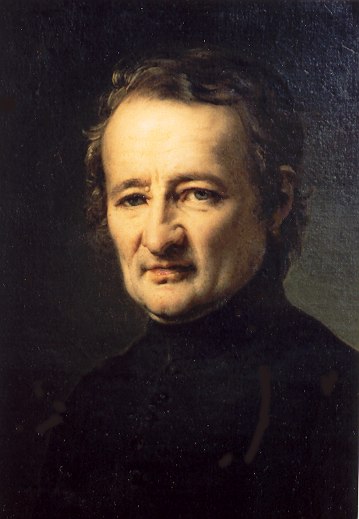
Pour l’influent théologien et homme politique breton, Félicité Robert de Lamennais (1782-1854),
« Les écoles à la Lancaster sont la folie du jour. Toutes les autorités de ce pays, et surtout le Préfet, en sont engouées au-delà de toute expression. La haine pour les prêtres entre pour beaucoup dans cette manie. Le fait est que tout ce qu’il y a de bon dans cette méthode, était pratiqué depuis plus d’un siècle par les Frères des Écoles chrétiennes ; le reste est pur charlatanisme. On parle d’apprendre à lire et à écrire en quatre mois aux enfants : d’abord ce serait un grand malheur, car que faire de ces enfants si bien instruits, et à qui leur âge ne permettrait pas encore de travailler ? En second lieu, rien n’est plus faux que ces résultats merveilleux ».
S’il faut « se prononcer entre l’instruction de l’abbé de La Salle et celle de Lancaster, la question est bien simple ; il s’agit de choisir entre la société et l’anarchie ».
Son frère, le vicaire Jean-Marie de la Mennais (1780-1860) prendra alors la tête de ce qu’il faut bien qualifier de chasse aux sorcières. Il dit :
« L’enseignement mutuel fut introduit en France par des protestants, dans les funestes cent jours. M. Carnot était alors ministre de l’Intérieur ; sous ses auspices, la société d’encouragement, établie pour propager cette méthode, tint sa première séance le 16 mai 1815 ».
Il se démène pour prouver que « la méthode lancastérienne est défectueuse dans ses procédés, dangereuse pour la religion et les mœurs dans ses résultats » et dans une brochure, De l’Enseignement mutuel, publiée en 1819 à Saint-Brieuc, il attaque vigoureusement ce mode d’enseignement.
Il n’est pas faux que la remise en question de l’autorité et de l’ordre établi est en soi inhérente à l’enseignement mutuel. L’école « simultanée » se base sur le postulat que pour transmettre un savoir il faut être diplômé (être le professeur). À l’inverse, au sein de l’école mutuelle, le professeur n’est plus le dépositaire du savoir, chaque élève pouvant expliquer à ses camarades.
Un autre souci pour les élites était lié au fait qu’avec cette méthode, les enfants ne sont plus qu’instruits et non pas « éduqués », qu’aucune éducation morale chrétienne ne leur est transmise.
Enfin, l’enseignement mutuel s’appuyait sur un nombre d’encadrants plus faible, du fait du rôle des élèves comme créateurs, transmetteurs et porteurs de savoirs. Certains ont peut-être eu peur pour leur poste…
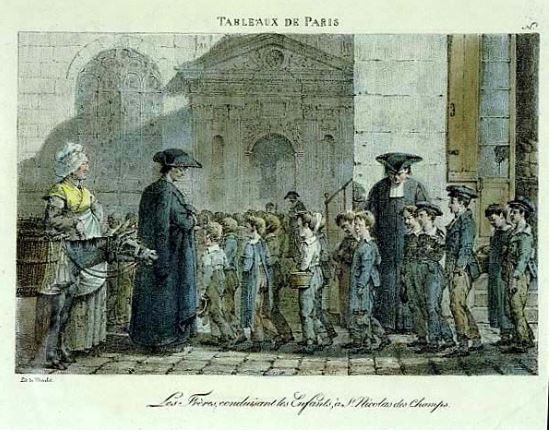
Joseph Hamel, en 1818, dans son rapport à l’Empereur de Russie, répond aux principaux adversaires des mutualistes, les « Frères des écoles chrétiennes », qu’ils ignorent presque entièrement ce qu’ils dénoncent. Hamel rappelle également qu’il y a 40 000 communes à prévoir des écoles primaires et que le nombre d’écoles des Frères ne « s’élève pas à plus de 100 dans le royaume… »
Du côté négatif, ce qui frappe, lorsqu’on examine les incriminations, c’est qu’on dise une chose le matin et son contraire l’après-midi. Le matin on dit que l’enseignement mutuel brouille les esprits en diluant l’autorité des maîtres, l’après-midi on affirme qu’il « militarise » à outrance l’éducation par une structure de commandement totalement hiérarchisée ! Allez comprendre…
Sur la question de la moralité, jamais Lazare Carnot n’aurait cautionné une éducation ruinant l’esprit chrétien et encore moins la notion d’autorité légitime, tout en combattant avec vigueur celle qui en manquait, comme par exemple celle de la Monarchie de droit divin ou du Consulat à vie imposé par Napoléon. De la même façon, le matin on accuse le système mutualiste de ne pas transmettre « la morale » chrétienne, l’après-midi on y voit un complot protestant…
Or, l’élan national en faveur de « la patrie » et des générations futures, a justement réussi à unir, dans un même effort, des personnalités de tout bord politique et religieux. Cuvier (protestant) et Gérando (catholique), tous deux fervents républicains et promoteurs du mode mutuel, ainsi que l’inspecteur général de l’Université, Ambroise Rendu (1778–1860, catholique), participent même à la rédaction de l’ordonnance du 29 février 1816 promulguée par Louis XVIII et le ministre de l’Intérieur, de Vaublanc (1756–1845).
Suite aux pressions massives des congrégations, les enseignants mutualistes Martin, Frossard et Bellot, tous trois protestants, se voient contraints de quitter leur direction d’école. Martin se rendra fort utile dans d’autres pays européens, notamment à Bruxelles où il organise, en 1820, une école mutuelle aux Minimes.
16. Dérive mécaniste ?
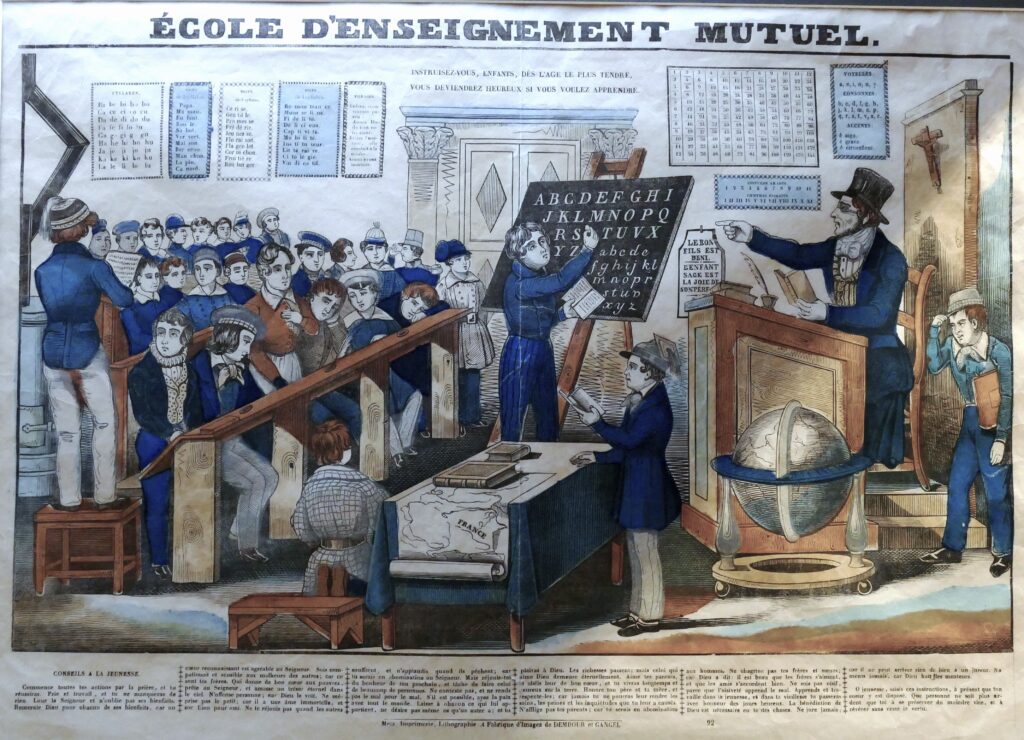
Sans appréhender l’état d’esprit et l’enthousiasme que pouvaient avoir des jeunes polytechniciens pour l’éclosion d’une culture industrielle et les merveilles du machinisme, les défenseurs d’une France cul-terreuse et féodale n’y voient qu’une « vision foncièrement mécaniste », lorsque Jomard compare la méthode mutuelle à une machine, avec ses rouages et ses ressorts, dont le maître n’est qu’un simple opérateur :
« Une fois l’école disposée et garnie de tout le mobilier qui lui est nécessaire, il ne s’agira plus que d’introduire les élèves et le maître, et de mettre ensuite en mouvement tous les ressorts de cette espèce de mécanisme, au moyen des nouvelles pratiques ».
Alors que Victor Hugo y évoquait un « essaim heureux », on accuse Laborde de dérive « mécaniste » lorsqu’il compare le bourdonnement produit par l’activité des élèves dans les écoles mutuelles anglaises au bruit des machines dans les filatures de coton.
La communication, disent-ils, y est « toute mécanique et entièrement hiérarchisée ». Elle ne s’exerce « que du maître ou du moniteur général vers les moniteurs et vers les élèves, non dans l’autre sens. C’est un moyen d’action, non un moyen d’échange. »
Admettons que toute approche pédagogique, peu importe laquelle, érigée en système et postulant qu’il suffit de l’appliquer mécaniquement à une personne humaine, peut faire dans l’horreur. Facile donc d’accuser l’enseignement mutuel de tous les maux dont souffraient, peut-être bien plus, ceux qui l’en accusaient.
A l’école mutuelle, les châtiments corporels sont bannis. C’est une décision courageuse qu’Octave Gréard (1828-1904) ne manquera de souligner :
« C’est l’un des titres des fondateurs des écoles mutuelles à la reconnaissance publique d’avoir proscrit les peines corporelles, férules et fouets, qui étaient encore en usage, et l’on ne saurait trop leur savoir gré d’avoir cherché à remplacer dans le cœur des élèves le sentiment de la crainte par le sentiment de l’honneur, ou, comme disait M. de Laborde, le sentiment de la honte bien administrée. »
Connaissant l’immense bonheur des milliers d’enfants qui ont accédé rapidement à un minimum d’instruction publique et qui ont connu la joie indescriptible d’instruire leurs camarades, on ne peut que soupçonner la plume des congrégations jalouses derrière ce poème se désolant faussement du malheur des pauvres petits :
« Ce système, dit l’un, né de l’anglomanie,
Contraste horriblement avec notre génie.
Là, tout est mécanisme et nos tristes enfants
Semblent une machine, au milieu de leurs bancs ;
Leur discipline absurde, et sans doute funeste,
Règle même les pas, l’attitude ou le geste :
On peut, dès aujourd’hui, prophétiser le sort
De ce peuple automate ainsi mu par ressort ».
17. Mort de l’enseignement mutuel en France
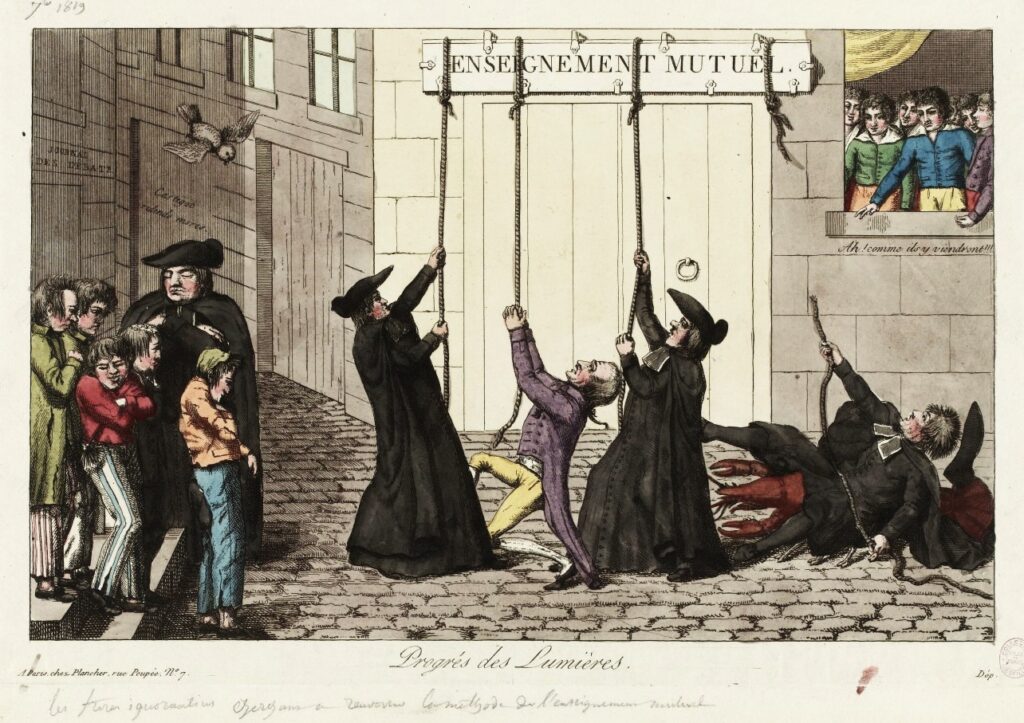
En 1815, après Waterloo, Louis XVIII, qui avait fui, revient le 8 juillet 1815. Contrairement à son frère, le futur Charles X, chef des ultra-royalistes, il a pleinement conscience que l’on ne peut effacer les pages de l’histoire de la Révolution. Il constate que la France ne peut plus redevenir un pays de « sujets » et qu’elle est devenue une Nation. D’où la « Charte constitutionnelle » qu’il promulgue, et qui a valeur de constitution. Dans le même esprit, face à la popularité de l’enseignement mutuel, il lui accorde ses faveurs (subsides, création d’écoles modèles, protection du ministère de l’Intérieur).
L’enseignement mutuel va rapidement perdre ses protecteurs, la commission ministérielle créée par le décret du 27 avril ne survivant pas à la chute de Napoléon en juin 1815.
Dès l’automne 1816, alimentées par les congrégations, les critiques pleuvent. Le Grand Aumônier de France, cardinal de Talleyrand-Périgord, archevêque de Reims (ville natale de Jean-Baptiste de La Salle…), s’adressa de son côté au Roi pour lui faire connaître les alarmes des catholiques.
Si, en 1820, la SIE possède déjà un réseau de 1 500 écoles mutuelles groupant, grâce à une audacieuse pédagogie collective, plus de 170 000 élèves, le mutualisme subit les coups de bélier des ultras qui l’estiment trop libéral, trop favorable à l’autonomie des enfants et incapable « d’élever la jeunesse dans des sentiments religieux et monarchiques ».
L’enfant sortant de cette école, disent-ils,
« est un perroquet savant, sans idée religieuse, sans valeur morale, plus dangereux que l’ignorant pour l’ordre politique et social puisque l’instruction a développé en lui de nouveaux besoins, toujours prêt à s’engager dans de nouvelles scènes de révolution ou de déchristianisation. Ah, Carnot, le conventionnel régicide, le patron de l’enseignement mutuel, savait ce qu’il préparait en l’introduisant en France par le décret de 1815 ! »
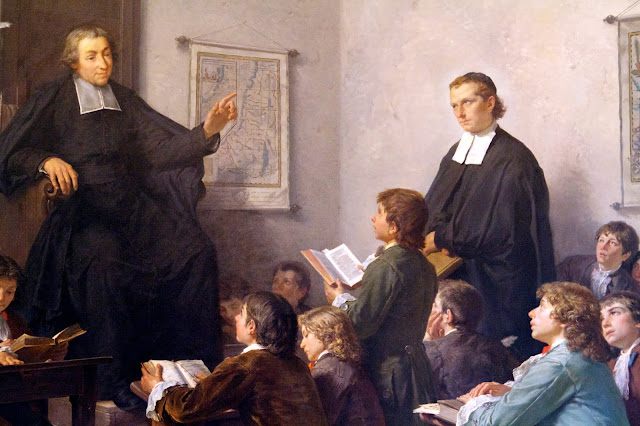
Partisan farouche de l’ordre et soupçonnant un vaste complot protestant contre le Vatican, le pape Léon XII, le « pape de la Sainte-Alliance » décide dans Quod Divina Sapientia, sa bulle papale du 28 août 1824 (art. XXVII, 299), que
« les écoles publiques d’instruction mutuelle seront supprimées et abolies dans tous les États pontificaux. Les évêques poursuivront ceux qui continueront à utiliser cette méthode d’enseignement ou qui tenteront de l’introduire dans leurs diocèses ».
Comme on l’a dit plus haut, en France, l’enseignement mutuel est perçu comme une agression par les congrégations religieuses qui pratiquent « l’enseignement simultané », codifié dès 1684 par Jean-Baptiste de La Salle (1651-1719) pour les Frères des Écoles Chrétiennes (Latin : Fratres Scholarum Christianarum ; Italien : Fratelli delle Scuole Cristiane, en abrégé FSC) : classes par âge, division par niveau, places fixes et individuelles, discipline stricte, travail répétitif et simultané supervisé par un maître inflexible.
Et les mérites des écoles des FSC et de « l’enseignement simultané », confirmés depuis leur création, sont considérés en totale opposition avec ceux de l’enseignement mutuel, la « manie du moment », et considéré comme l’œuvre de « charlatans » spéculant sur l’enseignement primaire.
Anticipant la bulle papale par l’ordonnance d’avril 1824, l’enseignement mutuel est placé chez nous sous la stricte tutelle de l’Église traditionnelle qui s’empare de l’ensemble de la question éducative. En août, donc après la bulle de Léon XII, un ministère des « Affaires ecclésiastiques et de l’Instruction publique », dont l’appellation dit bien le retour de l’Eglise aux affaires, est créé. L’accession de Charles X, ne fera qu’aggraver cette situation. L’Église d’alors aime les Lumières, mais avant tout celles des bougies…
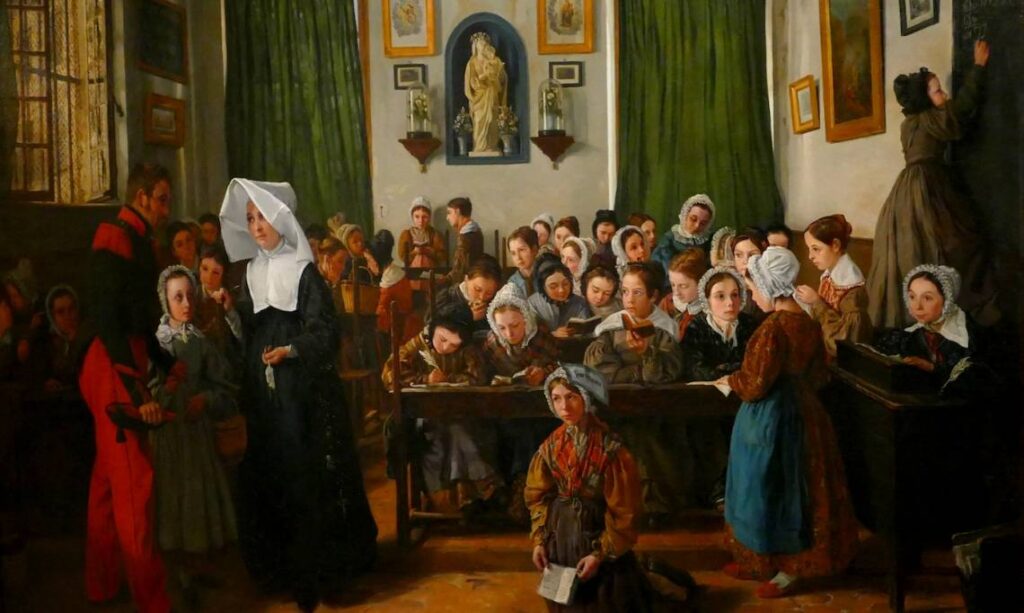
Dès lors, le bilan de la scolarisation tourne au drame. En 1828, sur les 39 381 communes :
- environ 24 000 sont pourvues d’écoles de garçons, recevant 1 070 000 enfants ;
- le nombre des jeunes filles qui fréquentent les écoles primaires est au plus de 430 000 ;
- 15 381 communes sont sans écoles de garçons ;
- et peut-être 20 000 sans écoles de filles ;
- 1 680 000 garçons et 2 320 000 jeunes filles, soit 4 millions au total, ne fréquentent aucune école.
Malgré une embellie entre 1828 et 1829, le mutuellisme est rejeté, ses écoles fermées les unes après les autres (leur nombre diminua des trois-quarts par rapport à 1820) bien que le poids électoral des ultras diminue d’élections en élections. Cependant, les éducateurs du peuple résistent.
Dans les années qui suivent la révolution de 1830, encore plus de 2 000 écoles mutuelles fonctionnent, principalement dans les villes, en concurrence avec les écoles confessionnelles promues par le régime. Officiellement, l’école mutuelle n’était pas garante de la moralité et on affirmait qu’elle était « industrielle », inhumaine.

Arrive alors le fameux « moment Guizot ». Alors qu’il avait milité initialement pour le développement de l’enseignement mutuel au sein de la SIE, François Guizot (1787-1874), à partir de 1832 ministre de l’Instruction publique de Louis-Philippe, donnera le coup de grâce en France à l’enseignement mutuel en faisant entériner le mode simultané comme unique méthode pédagogique officielle. Les écoles adoptant l’enseignement mutuel ne sont alors plus subventionnées, elles ne reçoivent plus aucun soutien du gouvernement ni de l’Église. Devant les difficultés matérielles, une majorité des élèves admis gratuitement jusqu’alors doivent payer une rétribution. Beaucoup de parents, dans le besoin, les retirent pour les mettre à l’école gratuite des Frères ou des Sœurs qui vient d’ouvrir ses portes. L’Église calomnie, jette le doute sur la moralité des maîtres, s’efforce d’éloigner de l’école « du Diable » les enfants des familles catholiques, persécute et menace de les écarter du catéchisme et de la communion. Elle veut briser l’enseignement mutuel. Les maîtres, pour la plupart, abandonnent la méthode pour se rallier à l’enseignement simultané. Plus d’élèves, plus de maître, les écoles mutuelles disparaissent peu à peu.
C’est encore Guizot qui donne le dernier coup de marteau pour clouer le cercueil de l’enseignement mutuel en créant en 1867 l’École normale des instituteurs pour former les futurs professeurs de l’école de Jules Ferry à la méthode simultanée.
Le jeune Hippolyte Carnot adhère lui aussi à la SIE afin de renouer, post mortem, avec son père. Il tentera en 1847, lorsqu’il est ministre de l’Instruction publique sous la IIe République, de faire renaître cet enseignement mutuel que son père Lazare Carnot chérissait, mais, bien que son œuvre fût grande, ses ennemis furent nombreux et son mandat fort court.
18. Conclusion
L’enseignement est en crise. Le dossier La désintégration contrôlée de l’éducation – Ce que tout parent et enseignant devrait savoir (S&P, mars 2023) documente en détail comment tout ce qui a été en grande partie accompli par Lazare Carnot et son fils Hippolyte, repris bien sûr par la suite, notamment dans le plan Langevin-Wallon, a été systématiquement mis en pièce par les nouvelles congrégations de notre temps, adorateurs du veau d’or : l’oligarchie financière, transhumaniste et décadente, après avoir conduit le monde au bord du gouffre, toujours déterminée à sauver ses privilèges en organisant la ruine physique et morale de l’humanité.
Pour reconstruire une instruction digne de ce nom, nous en sommes convaincu, l’éducation mutuelle, sous condition de l’adapter à notre époque et de ne pas en faire un système déshumanisant, est une piste extrêmement prometteuse. Plusieurs pays africains ne nous ont pas attendu. Bien que dépourvus de moyens suffisants, ils s’en inspirent déjà. Il ne s’agit donc nullement d’une relique du passé, mais bien un outil concret pour construire l’avenir.
En France, Vincent Faillet, un jeune professeur de SVT, docteur en sciences de l’éducation et de la formation en région parisienne, dont le travail est évoqué dans cette vidéo, semble bien décidé à ouvrir le dossier :
19. Quelques ouvrages et textes consultés
- François Arago, Biographie de Gaspard Monge, lue à l’Académie des sciences, 1846.
- Joseph Hamel, L’enseignement mutuel, Paris, 1818.
- John Franklin Reigart, The Lancastrian System of Instruction in the schools of New York City, Teachers College, Columbia University, 1916.
- Sylviane Tinembart, Edward Pahud, Une innovation pédagogique, le cas de l’enseignement mutuel au XIXe siècle. Editions Livreo-Alphil, 2019, Neuchâtel, Switzerland;
- Bruno Poucet, Petite histoire de l’enseignement mutuel : l’exemple du département de la Somme, Carrefours de l’éducation, N° 27, 2009/1, pages 7 to 18;
- Michel Chalopin, L’enseignement mutuel en Bretagne, Presses Universitaires de Rennes, 2011; (thèse de 2008, en format pdf);
- M. Gontard, Un aspect des luttes de partis en France au début de la Restauration : la question de l’enseignement mutuel, Revue d’Histoire du XIXe siècle – 1849, Année 1953, pp. 48-63.
- Dell Upton, Lancasterian Schools, Republican Citizenship, and the Spatial Imagination in Early Nineteenth-Century America, Journal of the Society of Architectural Historians, Vol. 55, No. 3 (Sep., 1996), pp. 238-253,University of California Press;
- Alexis de Garaudé, Manuel de l’enseignement mutuel et populaire de la musique, Paris, 1854;
- Anne Querrien, L’école mutuelle – Une pédagogie trop efficace?, Les Empêcheurs De Penser En Rond, 2005.
- Claire Giordanengo, La grande vogue de l’enseignement mutuel, Hypotheses, Bibliothèque Diderot de Lyon;
- Jacques Cheminade, Dino di Paoli, Claude Albert, La science de l’Education républicaine, le secret de Monge et Carnot: Polytechique et les Arts et Métiers, Campaigner Publications, Paris, 1980;
- René Girard, Carnot et l’éducation populaire pendant les Cents Jours, Paris, 1907.
- Michael Werner, Musique et pacification sociale, missions fondatrices de l’éducation musicale (1795-1860) « , Gradhiva (N° 31/2020);
- Rémi Dalisson, Hippolyte Carnot – 1801-1888, La liberté, l’école et la République, CNRS, Paris, 2019;
- Renaud d’Enfert, Jomard, Francœur et les autres… Des polytechniciens engagés dans le développement de l’instruction élémentaire (1815-1850), Bulletin de la Société des amis de la Bibliothèque et de l’Histoire de l’École polytechnique (SABIX), Paris, 2014.
- Karel Vereycken, Le combat républicain de David d’Angers, la statue de Gutenberg à Strasbourg, Argenteuil, juillet 2023.
- Groupe éducation de S&P, La désintégration contrôlée de l’éducation. Ce que tout parent et enseignant devrait savoir, Clichy, mars 2023;
- Vincent Faillet, La métamorphose de l’école, quand les élèves font la classe, Publishroom Factory, Paris, 2020.
- Radio France: A la découverte de l’enseignement mutuel, Paris, 7 mai 2017.
- Karel Vereycken, Hippolyte Carnot, père de l’éducation républicaine moderne, août 2023.
- Christine Bierre, Musique et formation du citoyen à l’ère de la Révolution française, 2007.
« Mutual tuition »: historical curiosity or promise of a better future?
By Karel Vereycken, July 2023, PARIS.
1. Introduction
2. Learning and teaching at the same time, a precious joy
3. Precedents:
A. In India
B. In France
4. Gaspard Monge’s brigades
5. Andrew Bell
6. Joseph Lancaster
7. Mutual Tuition, how it works
A. The class room
B. Teachers and monitors
C. A day at a mutual school
D. Progress according to each pupil’s knowledge
E. Tools
F. Command
8. Bellists vs. Lancasterians
9. France adopting Mutual Tuition
10. Lazare Carnot takes the helm
11. Mutual tuition and choral music
12. The rue Saint-Jean-de-Beauvais pilot project
13. Jomard, Choron, Francœur and elementary knowledge
14. Going Nationwide
15. Critique
16. Mechanistic drift?
17. Death of mutual tuition in France
18. Conclusion
19. Short list of books and texts consulted
« Answer, my friends: it must be sweet for you
To have as your only mentors children like yourselves;
Their age, their mood, their pleasures are your own;
And these victors of one day, tomorrow vanquished by others,
Are, in turn, adorned with modest ribbons,
Your equals in your games, your masters on the benches.
Mute, eyes fixed on your happy emulators,
You are not distracted by the fear of ferulas;
Never an avenging whip, frightening your spirits,
Makes you forget what they taught you;
I listen badly to a fool who wants me to fear him,
And I know much better what a friend teaches me. »
Victor Hugo, Discours sur les avantages de l’Enseignement mutuel, 1817.
1. Introduction
Teaching reading and writing to 1,000 children in the same room, without a teacher, without school books, without paper and ink, is clearly impossible. And yet, it has been imagined and put into practice with great success!
Shh! we mustn’t talk about it, because it could give some people ideas, and not just in emerging countries!
That such a challenge could be taken up could only worry the oligarchy and its servants, who since the dawn of time have been mandated to train an « elite » (the high priests of knowledge, « experts » and other know-it-alls) who reproduce in a vacuum at the top, while ensuring that the great mass of people below are educated just enough to be able to deliver parcels, pay their taxes, abide by the rules defined by the top, and above all, not make (too) much of a mess.
And yet, as Hippolyte Carnot, Minister of Public Instruction in the Second Republic, understood long before us, without a republican education – in other words, without genuine citizen training from kindergarten onwards – universal suffrage often becomes a tragic farce capable of producing monsters.
In the early 19th century, « mutual tuition », (sometimes referred to as the English Monitorial System, also known as Madras System or Lancasterian System), spread like wildfire across Europe and then the rest of the world including the United States of America.
If the teacher addresses a single pupil, it’s the individual mode (as in the case of the preceptor); if he addresses an entire class, it’s the simultaneous mode; if he instructs some children to teach others, it’s the mutual mode. The combination of simultaneous and mutual modes is called mixed mode.
Mutual tuition quickly fell victim to personal quarrels and ideological, political and religious issues. In France, it was seen as an aggression by religious congregations who practiced « simultaneous teaching », codified as early as 1684 by Jean-Baptiste de La Salle : classes by age, division by level, fixed and individual places, strict discipline, repetitive and simultaneous work supervised by an inflexible master.
With the formation of small groups where pupils teach each other and move around the classroom, mutual teaching immediately gave rise, rather foolishly, to the fear of an ass-over-head world straight out of a Hieronymus Bosch painting. What kind of world are we in if the pupil teaches the teacher? the child the parent? the faithful the priest? the citizen the government ! Without a clear leader, aren’t we lost ?
In 1824, Pope Leo XII (not to be confused with the benevolent Leo XIII), the « Pope of the Holy Alliance », a fierce supporter of order and suspect of a vast Protestant plot against the Vatican, forbade such teaching, believing it to « weaken the authority » of both teachers and political and religious authorities.
In France, where in the years following the 1830 revolution over 2,000 mutual schools existed, mainly in towns, in competition with denominational schools, François Guizot, Louis-Philippe’s minister and initially a promoter of broad public education, had them closed down.
2. Learning and teaching at the same time,
a precious joy
Today, « tutoring » is enjoying a revival in the context of school and vocational training. It is a process of « assistance by more experienced subjects to less experienced subjects, likely to enrich the latter’s acquisitions ».
Tutoring between children, in particular between children of different ages, is encouraged from nursery school right through to university, with the institutionalization of methodological tutoring at undergraduate level. Since the 1980s, elementary and secondary schools in France and abroad have seen the development of numerous tutoring experiments.
In reality, tutoring is no more than the pale heir to the mutual tuition system developed in England and then France in the 19th century.
Hence, the future of humanity depends on an exclusively human faculty: the discovery of new universal physical principles, often totally beyond the limits of our sensory apparatus, enabling Man to increase his capacity to transform the universe to qualitatively improve his lot and that of his environment. A discovery is never the result of the sum or average of opinions, but of an individual, perfectly sovereign act. Are we able to organize our society so that this « sacred » creative principle is cherished, respected and cultivated in any newborn child?
Because, without the socialization of this discovery, it will be useless. The history of mankind is therefore, by its very nature, the history of « mutual tuition ».
Is not the greatest pleasure of those who have just made a discovery – and this is natural for children – to share, with a view to a shared future, not only what he or she has just discovered, but the joy and beauty that every scientific breakthrough represents? And when those who discover teach and those that teach, discover, the pleasure is immense. So let’s give our professional teachers the time they need to make discoveries, for the quality of their teaching will be enhanced!
Precedents:
A. In India
In 1623, the Italian explorer Pietro Della Valle (1586-1652), after a trip to « Industan » (India), in a letter dispatched from Ikkeri (a town in south-west India), reports having seen boys teaching each other how to read and write using singing :
« In order to inculcate it perfectly in their memory, to repeat the previous lessons that had been prescribed to them, lest they forget them, one of them would sing in a certain musical tone a line from the lesson, such as two and two make four. After all, it’s easy to learn a song.
« While he sang this part of the lesson to learn it better, he wrote it down at the same time, not with a pen, nor on paper. But to spare him and not spoil it unnecessarily, they marked the characters with their fingers on the same floor where they were sitting in a circle, which they had covered for this purpose with very loose sand. After the first of these children had written in this way while singing, the others sang and wrote the same thing all together
« (…) When I asked them who (…) corrected them when they missed, given that they were all schoolboys, they answered me very reasonably, that it was impossible that a single difficulty should stop them all, four at the same time, without being able to overcome it and that for the subject they always practiced together so that if one missed, the others would be his teachers.«
In Della Valla‘s report, we can already identify some of the basic principles of mutual tuition, notably the simultaneous learning of reading and writing, the use of sand for writing exercises to avoid wasting paper, which is scarce and very expensive, a group lesson given by a teacher, followed by work in sub-groups in which pupils learn to self-regulate, and finally, an integration of knowledge which, thanks to the use of song, will facilitate memorization.
B. In France
In Lyon, the priest Charles Démia, was one of the precursors of mutual tuition, which he put into practice in the « petites écoles » for poor children he founded and theorized as early as 1688. According to the Nouveau dictionnaire de pédagogie et de l’instruction primaire:
« Démia introduced what later came to be known as mutual tuition into the classroom: he recommended that a certain number of officers be chosen from among the most capable and studious pupils, some of whom, under the name of intendants and decurions, would be responsible for supervision, while the others would have to have the master’s lessons repeated, correct pupils when they made mistakes, guide the hesitant hand of ‘young writers’, etc. » In order to make simultaneous teaching possible, Démia’s idea of ‘mutual teaching’ was based on the principle of ‘teaching to one another’. To make simultaneous teaching possible, the author of the regulations divides the school into eight classes, to be taught in turn by the master; each of these classes can be subdivided into bands ».
In Paris, as early as 1747, mutual education was practiced with great success in a school of over 300 pupils, established by M. Herbault, at the Hospice de la Pitié, in favor of the children of the poor. Unfortunately, the experiment did not survive its founder.
In 1772, the ingenious charity of Chevalier Paulet conceived and carried out the project of applying a similar method to the education of a large number of children, left without support in society by the death of their parents.
4. Gaspard Monge’s « brigades »
Finally, as recounted in his biography of Gaspard Monge by his most brilliant pupil, the astronomer François Arago (1786-1853), himself a close friend of Alexander von Humboldt, it was at the École Polytechnique that Monge perfected his own system of mutual tuition and tutoring.
Finding it unacceptable to have to wait three years for the first engineers to graduate from the Ecole Polytechnique, Monge decided to speed up student training by organizing « revolutionary courses », an accelerated training program lasting three months for those in charge of teaching to the others. To achieve this, he perfected the concept of « chefs de brigades », a technique he had already successfully tested at the Mézières engineering school.
François Arago:
« The brigade leaders, always working with small groups of students in separate rooms, were to have the extremely important task of ironing out difficulties as they arose. Never had a more skilful combination been devised to remove any excuse for mediocrity or laziness.
« This creation belonged to Monge. At Mézières, where the engineering students were divided into two groups of ten, and where, in fact, our colleague acted for some time as permanent brigade leader for both divisions, the presence in the classrooms of a person who was always in a position to overcome objections had produced results that were too fortunate for this former repetiteur, in drafting the developments attached to Fourcroy’s report, not to try to endow the new school with the same advantages.
« Monge did more; he wanted the 23 sections of 16 students each, of which the three divisions were to be composed, to have their brigade leader, as in ordinary times, following the revolutionary lessons, and at the opening of the courses of the three degrees. In a word, he wanted the School, at its beginning, to function as if it had already been in existence for three years.
« Here’s how our colleague achieved this seemingly unattainable goal. It was decided that 25 students, chosen by competitive examination from among the 50 candidates who had received the best marks from the admission examiners, would become brigade leaders of three divisions of the school, after receiving special instruction separately. In the mornings, the 50 young people, like all their classmates, attended revolutionary classes; in the evenings, they were brought together at the Hôtel Pommeuse, near the Palais-Bourbon, and various teachers prepared them for the functions they were destined to perform. Monge presided over this scientific initiation with infinite kindness, ardor and zeal. The memory of his lessons remains indelible in the minds of all those who benefited from them.
Arago then quotes Edme Augustin Sylvain Brissot (1786-1819), son of the famous abolitionist, , one of the 50 students, who reported : « It was there that we began to get to know Monge, this man so kind to youth, so devoted to the propagation of science. Almost always in our midst, he followed lessons in geometry, analysis and physics with private discussions where we found even more to gain. He became a friend to each and every one of the students at the Ecole provisoire, joining in the efforts he was constantly provoking, and applauding, with all the vivacity of his character, the successes of our young minds ».
While mutual teaching is fully practiced, the total dedication of a master as devoted as Monge completes what otherwise becomes nothing more than a « system ».
5. Andrew Bell
It was a Scotsman, the Anglican clergyman Andrew Bell (1753-1832), who claimed the paternity of mutual tuition, which he theorized and practiced in India, at the head of the Egmore Military Asylum for Orphans (Eastern India), an institution created in 1789 to educate and instruct the orphans and destitute sons of the European officers and soldiers of the Madras army.
After 7 years there, Bell returned to London and, in 1797, wrote a report to the East India Company (his employer in Madras) on the incredible benefits of his invention.
Russian physician, naturalist and inventor Iosif Khristianovich (Joseph) Hamel (1788-1862), a member of the Russian Academy of Sciences, was commissioned by Alexander I, Emperor of Russia, to write a full report on this new type of education, which was then being discussed throughout Europe.
In Der Gegenseitige Unterricht (1818), he reports what Bell wrote in one of his writings: « It happened at this time, that one morning as I was taking my usual walk, I passed a school of young Malabar children, and saw them busy writing on the ground. The idea immediately occurred to me that perhaps the children at my school could be taught the letters of the alphabet by tracing on the sand. I immediately went home and ordered the teacher of the last class to carry out what I had just arranged. Fortunately, the order was very poorly received; for if the master had complied to my satisfaction, it is possible that all further development would have been stopped, and with it the very principle of mutual education… »
Mutual education was coldly received in England, but eventually won over Samuel Nichols, one of the school leaders at St. Botolph’s Aldgate, London’s oldest Anglican Protestant parish. Bell’s precepts were implemented with great success, and his method was taken up by Dr. Briggs when he opened an industrial school in Liverpool.
6. Joseph Lancaster
In England, it was Joseph Lancaster (1778-1838), a twenty-year-old London schoolteacher, who seized upon the new way of teaching, perfected it and generalized it on a large scale. (See text of his 1810 booklet)
In 1798, he opened an elementary school for poor children in Borough Road, one of London’s poorest suburbs. Education was not yet totally free, but it was 40% cheaper than other schools in the capital. Lacking money, Lancaster did everything in his power to drive down the costs of what was becoming a veritable « system »: use of sand and slate instead of ink and paper (Erasmus of Rotterdam reported in 1528 that in his day, people wrote with a kind of awl on tables covered in fine dust); boards reproducing the pages of school books hung on the walls to avoid having to buy books; auxiliary teachers replaced by pupils to avoid paying salaries; increase in the number of pupils per class.
By 1804, his school had 700 pupils, and twelve months later, a thousand. Lancaster, getting deeper and deeper into debt, opened a school for 200 girls. To escape his creditors, Lancaster left London in 1806, and on his return was jailed for debt. Two of his friends, dentist Joseph Foxe and straw hat maker William Corston, repaid his debt and founded with him « The Society for the Promotion of the Lancasterian System for the Education of the Poor ».
Other Quakers stepped in with support, notably abolitionist William Wilberforce (1759-1833), whom the french sculptor David d’Angers depicted alongside Condorcet and Abbé Grégoire on his famous monument commemorating Gutenberg in Strasbourg.
From there, as Joseph Hamel recounts in his 1818 report, the new approach spread to the four corners of the world: England, Scotland, France, Prussia, Russia, Italy, Spain, Denmark, Sweden, Poland and Switzerland, not forgetting Senegal and several South American nations such as Brazil and Argentina and of course, the United States of America. Mutual Tuition was adopted as the official pedagogy in New York City (1805), Albany (1810), Georgetown (1811), Washington D.C. (1812), Philadelphia (1817), Boston (1824) and Baltimore (1829), and the Pennsylvania legislature considered statewide adoption.
7. Mutual tuition, how does that works ?
The fundamental principle of « mutual tuition », particularly relevant to elementary school, is reciprocity of instruction between pupils, with the more able serving as teacher to the less able. From the outset, everyone progresses gradually, regardless of the number of pupils.
Bell and Lancaster, and their French disciples, postulated: the diversity of faculties, the inequality of progress, the rhythms of comprehension and acquisition. This led them to divide the school into different classes according to subjects and children’s level of knowledge, with age playing no part in this classification. Schoolchildren thus brought together take part in the same exercises. Their study program is identical in content and methods.
If the number of pupils in a division is too high in a particular subject – reading or arithmetic, for example – sub-groups are formed, which progress in parallel, while the teaching methods and materials remain identical.
So what does a school under the new system look like?
A. The classroom
Whatever the number of pupils – around a 100 in French villages, close to a 1000 in the Lancaster school in London, 200 in Parisian schools – they are grouped together in one single rectangular room with no partitions.
Jomard, who was extraordinarily active and prolific in the early years of the mutual education system, set desirable standards for class sizes ranging from 70 to 1,000 pupils.
For 350 pupils, for example, he indicated the need for a room 18 m long by 9 m wide (graphic).
In England and the French countryside, a barn was often used for the new school. In France, a large number of religious buildings have been disused since the revolutionary period, and meet the required standards perfectly. Many mutual schools were built in these buildings.
B. « Masters » and « monitors »
The mutual method divided responsibility for teaching between the « master » and students designated as « monitors », considered « the linchpin of the method ».
As Bally reminded us as early as 1819: « The basis of mutual teaching rests on the instruction communicated by the strongest pupils to those who are weaker. This principle, which is the merit of this method, required a very special organization to create a reasonable hierarchy, which could contribute in the most effective way to the success of all. »
Each day, in a dedicated « classroom » reserved for instructors, the master imparts knowledge and provides his assistants with technical advice on the proper application of the method. During the course of the day, he remains in charge of the 8th class, and as such is responsible for conducting their exercises. He conducts periodic, monthly or occasional examinations in the classes, and may decide to change classes. Finally, it is he who, at the final stage, distributes punishments and rewards.
C. A day at a mutual school
Thus, on a platform, the teacher’s desk with a large drawer where money, reward tickets, registers, writing templates, whistles and children’s notebooks are kept.
Behind the teacher, next to the clock – an essential instrument for organizing teaching life – is a blackboard on which are written sentences and writing models.
At the foot of the platform, benches are attached across the desks, of different sizes, in the middle of the room. The first tables, which are not inclined, have sand on which small children trace signs, while the other tables have slates; on the last of these there are lead inkwells and paper, and chopsticks to indicate words or letters to be read.
At the end of each table are « dictation tables » and telegraphic signals indicating the lesson’s moments, such as « COR » for « correction » or « EX » for « examination of work ». Semicircular table models were then proposed to facilitate the work of the instructors.
D. Progress according to each person’s knowledge
Initially, the mutual school program was limited to the 3 fundamental disciplines of reading, writing and arithmetic, and to the teaching of religion. Geography, grammar, writing, singing and linear drawing were soon added. The instrumental disciplines (music) are taught together, rather than in succession, as is customary in other schools. Pupil groupings are flexible, mobile and differentiated, depending on the nature of the subjects studied and the activities practised in the discipline.
Each subject matter taught in mutual schools is based on a precise, codified curriculum. This program is divided into 8 hierarchical levels, which must be covered in succession. Each degree is called a « class », and this is how we speak of the 8 classes of writing or arithmetic.
The term « class » refers only to acquisitions and knowledge, the 1st class being that of beginners and the 8th that of the completion of the school curriculum. The pace of learning and acquisition varies from student to student and from subject to subject.
Thus, after six months’ attendance, pupil « X » may find himself in 4th class reading, 5th class writing and 2nd class arithmetic. As we said, class assignment is decided on the basis of knowledge level, not age.
But this initial allocation is accompanied, within each class and in each subject, by the constitution of restricted groups established according to the activities to be practiced. In arithmetic, for example, written work is done on the slate. This takes place seated on benches reserved for this purpose, with a maximum of 16 to 18 students per bench, according to the standards established by Jomard.
Oral exercises, in reading or arithmetic, or with the aid of a blackboard, arithmetic or linear drawing, are done standing up, in groups of no more than 9, with pupils standing side by side, forming a semi-circle. Hence the name given to this kind of activity: « circle work ».
So, in a mutual school with 36 students in 3rd arithmetic class, bench work will be done in two groups with two monitors, and blackboard exercises with 4 groups and 4 monitors. Class sizes can therefore vary from school to school and throughout the year, the only limitation being the size of the premises.
D. Tools
Low costs are one of the preoccupations of the new teaching method. Furniture was therefore very basic.
- Benches and desks are made of ordinary planks, fastened with heavy nails. The benches have no backrests: a superfluous luxury!
- The platform is clearly elevated: about 0.65 m. Several steps lead up to the teacher’s desk. The master reigns over the children’s community as much by his material position as by his personal ascendancy.
- The clock is noted as « indispensable », as teaching and maneuvers are strictly timed.
- Half-circles, also known as reading circles, give mutual schools a typical and original appearance. These are usually semi-circular iron hangers that can be raised or lowered at will. Sometimes, the materialization is simply applied to the floor: grooves, large nails or arched strips.
- Blackboards were systematically used for linear drawing and arithmetic. They are 1 m long and 0.70 m wide, with a movable meter at the top. They are placed inside each semicircle.
- Telegraphs. When work takes place at the tables, such as writing, signals are used to link and communicate between the general monitor and the individual monitors: these are the telegraphs. A planchette, attached to the upper end of a round stick 1.70 m high, is installed at the first table of each class, thanks to two holes drilled at the top and bottom of the desk. On one side is the class number (1 to 8); on the other, EX (examen), replaced around 1830 by COR (correction). These telegraphs are portable. They could be moved if the number of students increased or decreased. In this way, the master and the general monitor have the exact composition of each class and the number of tables occupied by each. As soon as an exercise is completed, the class monitor turns the telegraph and presents the EX side to the desk. All monitors do the same. The general monitor gives the order to proceed with inspection and any corrections. Once these have been completed, the class number is presented again. And the exercises resume. Next to the telegraphs are the occasional board stands.
- Monitor rods. These are used to indicate on tables the letters or words to be read, the details of operations to be carried out, and the lines to be reproduced. In rural schools, these are generally only available thanks to the good will and ingenuity of the teachers, who obtain them from nearby woods.
- Sand (for writing) and then slates are constantly used in all subjects. This was an essential innovation in the mutual mode, as other schools did not use them.
- Boards instead of books. The first reason is financial, as a single board is sufficient for up to nine pupils. But the pedagogical reasons are no less important. The format makes them easy to read and store. The concern for presentation and highlighting certain characters is accompanied by a different layout from that of the textbooks.
- Books are reserved for the eighth grade, as are nibs, ink and paper.
- Registers, currently in use, ensure sound management of the schools. One in particular deserves special mention: « Le grand livre de l’école » (the school’s ledger), which is first and foremost a registration book. It records the child’s surname, first name and age, as well as the parents’ occupation and address. The teacher enters the precise date of entry and exit of each child, in each class, including music and linear drawing.
E. Communication
To ensure that dozens or hundreds of pupils are led and developed correctly, and to avoid wasting time, those in charge of mutual education have planned precise, rapid, immediately comprehensible orders:
- The voice is rarely used. Injunctions transmitted in this way are generally addressed to the instructors, sometimes to a specific class;
- The bell attracts attention. It precedes information or a movement to be executed;
- The whistle has a dual function. It is used to intervene in the general order of the school, « to impose silence », for example, and to signal the start or end of certain exercises during the lesson, « to have the pupils say by heart, to spell, to stop reading ». Only the teacher is authorized to use them.
- As for hand signals, they have been used extensively. Intended to evoke the act or movement to be accomplished, they attract the eye and should bring calm to the community.
« Bellists » versus « Lancasterians »
While the two schools, Bell’s and Lancaster’s, were very close to each other in terms of content, methods and organization, they clashed violently over the role and place of religious education. All other program-related differences are a matter of taste, habit or local circumstance.
As Sylvian Tinembert and Edward Pahud point out in « Une innovation pédagogique, le cas de l’enseignement mutuel au XIXe siècle » (Editions Livreo-Alphil, 2019), Lancaster, as a follower of the dissident Quaker movement,
« recognized Christianity but professed that belief belonged to the professional sphere and that each person was free in his or her convictions. He also advocates egalitarianism, tolerance and the idea that, in this country, there is such a variety of religions and sects that it is impossible to teach all doctrines. Consequently, it is necessary to remain neutral, to limit teaching to the reading of the Bible, avoiding any interpretation, and to leave fundamental religious instruction to the various churches, ensuring that pupils follow the services and teachings of the denomination to which they belong ».
Nevertheless, Bellists and Lancasterians had their differences. For the Lancasterians, Bell had invented nothing and was merely describing what he had seen in India. For the Bellists, furious that Lancaster found a positive response from certain members of the Royal family, Lancaster was portrayed as the devil, an « enemy » of the official Anglican religion, who admitted children of all origins and denominations to his schools !
9. France adopting mutuel tuition
In London, the Lancaster association was joined by a number of high-ranking personalities, both English and foreign. These included Geneva physicist Marc Auguste Pictet de Rochemont (1752-1825), French paleontologist Georges Cuvier (1769-1832) and his compatriots, agronomist Charles Philibert de Lasteyrie (1759-1849) and Lancaster’s future translator into French, archaeologist Alexandre de Laborde (1773-1842).
After the peace of 1814, many countries – notably England, Prussia, France and Russia – bled dry by the Napoleonic wars, which had resulted in the loss of thousands of young teachers and qualified executives on the battlefields, made education their top priority, not least to keep up with the industrial revolution that was coming to shake them to their foundations.
Added to this is the fact that the number of orphans in Europe has become a major problem for all states, especially as the coffers are empty. To keep street children occupied, schools were needed, many of them to be built with very little money and many teachers… nonexistent. Learning of the resounding success of mutual education, several Frenchmen travelled to England to discover the new method.
Laborde brought back his « Plan d’éducation pour les enfants pauvres, d’après les deux méthodes (du docteur Bell et de M. Lancaster) », and Lasteyrie his « Nouveau système d’éducation pour les écoles primaires ». In 1815, the Duc de la Rochefoucauld-Liancourt (1747-1827) published his book on Joseph Lancaster’s « Système anglais d’instruction ».
Since 1802, Paris had been home to the « Société d’encouragement pour l’industrie nationale », whose Secretary General was linguist Joseph-Marie de Gérando (1772-1842), and of whom Laborde was a founder together with Jean-Antoine Chaptal (1752-1832). Unsurprisingly, Gérando had been raised by the Oratorians and was initially destined for the Church.
On March 1, 1815, Lasteyrie, Laborde and Gérando proposed to the Société d’Encouragement the creation of a new association whose purpose would be « to gather and spread enlightenment likely to provide the lower classes of the people with the kind of intellectual and moral education most suited to their needs ».
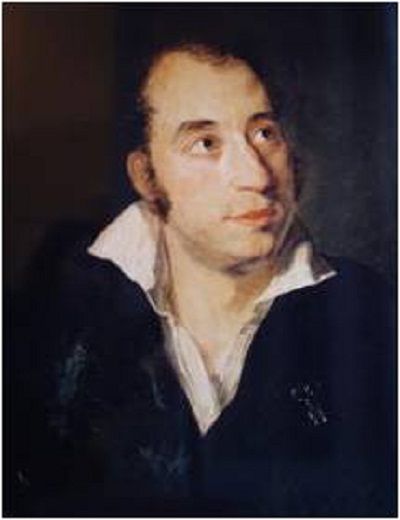
In his report presented to the Société d’Encouragement on March 20, 1815, Gérando proposed that the newly-appointed Minister of the Interior, Lazare Carnot (During les Cents-Jour, i.e. between March 20-June 22, 1815), be asked to promote « the adoption of procedures likely to regenerate primary education in France », i.e. the system of mutual tuition.
Political and social interests were not the only ones at stake. The French economy, too, was much to benefit from the development of education. « What can we expect, » said Carnot in 1815, « if the man who drives the plough is as stupid as the horses that pull it?«
Gérando also proposed the creation of an association dedicated specifically to its propagation, underlining the advantages of the new approach: economic advantage first, since it involves « employing the children themselves, in relation to each other, as teaching aids », and that a single teacher is sufficient for 1,000 pupils; educational advantage second, since it is possible « to teach, in two years, everything that children of inferior conditions need to know, and much more than they learn today by much longer processes »; a moral and social advantage, insofar as children « are imbued from an early age with a sense of duty, a feeling that will one day guarantee their obedience to the law and their respect for the social order ».
The engineer-geographer and polytechnician Edeme-François Jomard (1777-1862), for whom the education of the people is an obligation of society towards itself, said nothing else: « How can we demand that unfortunate people, devoid of all enlightenment, know the social pact and submit to it? Or how can we, without being foolish, count on their invariable and blind submission?«
The Société d’Encouragement then validated the conclusions of its report by subscribing the sum of 500 francs in favor of the new association, and by deciding that, in addition to its moral influence, it would place at the latter’s disposal the various means of execution that might belong to it.
10. Lazare Carnot at the helm
Following the Concordat between Napoleon and the Vatican, the Emperor issued a decree on education on August 15, 1808, requiring schools to follow the « principles of the Catholic Church ».
The Frères des Ecoles Chrétiennes (Institute of the Brothers of the Christian Schools), unconditional advocates of the « simultaneous education » theorized by their founder Jean-Baptiste de La Salle (1651-1719), were to take charge of all primary education and train teachers.
Disbanded during the Revolution, the Brothers resumed their functions in 1810. Encouraged to develop to counter the influence of the Jesuits, authorized in 1816 to return to France, they rapidly expanded throughout France.
But the educational situation was pitiful. This is what senior French officials constantly say when they visit the territories annexed by the Empire, notably North Germany and Holland. The comparison with France makes them blush with shame.
In 1810, the naturalist Georges Cuvier wrote in his report:
« We would be hard pressed to convey the effect produced on us by the first elementary school we entered in Holland. Children, teachers, premises, methods, teaching, everything is in perfect order (…) Several prefects have assured us that we would not find a single young boy in their department today who did not know how to read and write. »
Faced with such a contrast, which was not to the conqueror’s advantage, the Imperial University, like ancient Rome, set out to teach the conquered country. In his decree of November 15, 1811, the Emperor decided:
« The council of our Imperial University will present us with a report on the part of the system established in Holland for primary instruction that would be applicable to the other departments of our Empire. »
The Emperor abdicated on April 4, 1814, before any decision had been taken to regenerate the French « petites écoles ». At least the Imperial University’s reports had exposed their misery and drawn public attention to them.
Appointed Minister of the Interior, and therefore in charge of Education during the Cents-Jours, Lazare Carnot, a co-founder of the Ecole Polytechnique, was completely convinced of the potential excellence of « mutual education ».
On April 10, 1815, he set up a Council for Industry and Charity, at whose first meeting he himself presented Gérando‘s report;
On April 27, 1815, he submitted a report to the Emperor in which he stated:
« There are 2 million children in France clamoring for primary education, and of these 2 million, some receive a very imperfect education, while others are completely deprived« .
He then recommended mutual education, whose « purpose is to give primary education the greatest degree of simplicity, rapidity and economy, while also giving it the degree of perfection suitable for the lower classes of society, and also by bringing into it everything that can give rise to and maintain in the hearts of children a sense of duty, justice, honor and respect for the established order ».
Minutes later, Lazare Carnot had the French Emperor sign the following decree:
« Article 1. – Our Minister of the Interior will call upon those persons who deserve to be consulted on the best methods of primary education. He will examine these methods, and decide on and direct the testing of those he deems to be preferable.
« Art. 2 – A primary education test school will be opened in Paris, organized in such a way as to be able to serve as a model and to become a normal school for training primary school teachers.
« Art. 3 – Once satisfactory results have been obtained from the trial school, our Minister of the Interior will propose the appropriate measures to ensure that all departments can rapidly benefit from the new methods that will have been adopted.«
For Carnot, contrary to those in the business of Philanthropy, there were not any longer poor or rich children. All citizens of the Republic required and had to be offered the best education available on Earth.
The advisory board set up by Carnot included his friends Laborde, Jomard, Abbé Gaultier, then Lasteyrie and Gérando, i.e. the very promoters or first founders of the Société en formation.
Thus, on June 17, 1815 (the eve of the defeat at Waterloo), the Société pour l’instruction élémentaire (SIE) was born, still under the impetus of Carnot, determined to win the war for education. The SIE’s first general meeting was held on the premises of the Société d’Encouragement. At its head were several protagonists of the ministerial commission: Jomard became one of the secretaries of the new society, alongside Gérando (president), Lasteyrie (vice-president) and Laborde (general secretary).
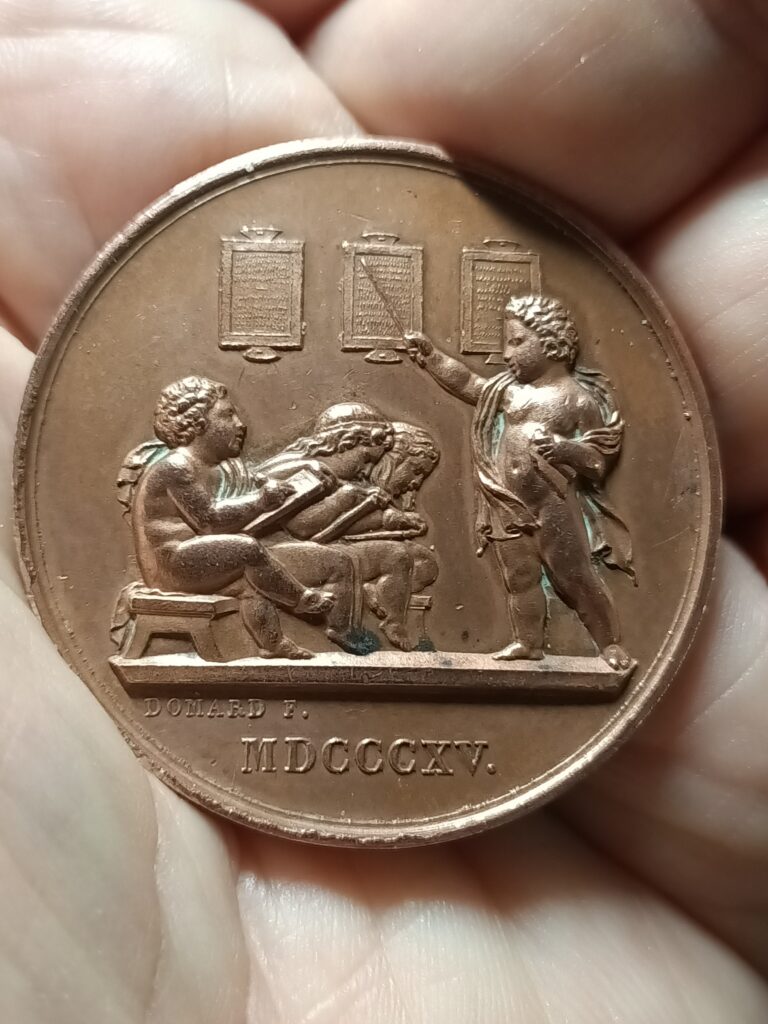
for whom Mutual Tuition was the core of their commitment to primary education.
Before the ordinance of 1816, the number of children attending « petites écoles » was 165,000 throughout France, and by the end of 1820 it had risen to 1,123,000. Almost a factor of 10!
Lazare Carnot clearly wanted to perpetuate the offensive he had launched during the Hundred Days to propagate mutual education throughout the country and, in so doing, to rapidly develop the education of all the children of the Patrie.
After its creation, subscriptions for the SIE poured in, and before long 150 names were added to those of the founders to promote and organize mutual education in France. One of these subscribers was Lazare Carnot.
In its first year of existence, the SIE attracted almost 700 members, initially teachers from the École Polytechnique (Ampère, Berthollet, Chaptal, Guyton de Morveau, Hachette, Mérimée, Thénard), and then some 30 alumni, around half of them from the first graduating class (1794) of the École Polytechnique. Among the latter were a fellow student of Jomard‘s at the geographers’ school, Louis-Benjamin Francœur, professor of higher algebra at the Paris Faculty of Science, comrades from the Egyptian campaign, and Chabrol de Volvic, prefect of the Seine since 1812.
All had but one hope: that Monge’s genial methods of brigades and mutual tuition, which had been diminished and banned once Napoleon turned Polytechnique into a mere military school under the direction of mathematician Pierre-Simon Laplace (1749-1827), could benefit the greatest number and organize a national recovery.
Based in Paris, the SIE extended its operations to the provinces, where it encouraged the founding of subsidiary companies, to which it offered « to send them teachers, to provide them with any information they might need, to give them paintings and books at cost price… ».
The SIE was also interested in education girls (art. 10). It set up a committee of ladies to look after them: president, Baroness de Gérando; vice-president, Countess de Laborde.
Beyond women, the movement spread to uneducated adults, so numerous at the time. On May 1, 1816, the Society set up a commission for the establishment of adult schools. It was also concerned with barracks, which were to be turned into military schools; prisons, especially children’s prisons; and the colored inhabitants of the colonies, who were to be regenerated by the development of education.
Finally, the members of the Society, attributing a human and general value to their mission, dreamed of founding branches abroad. In November 1818, Laborde called for the creation of a special committee to do so.
Last but not least, the Society did not limit its activities to simply creating schools, but also organized inspections and examinations. It published works (on the mutual tuition method, elementary books on reading, grammar and arithmetic). It distributed awards to the best teachers and instructors.
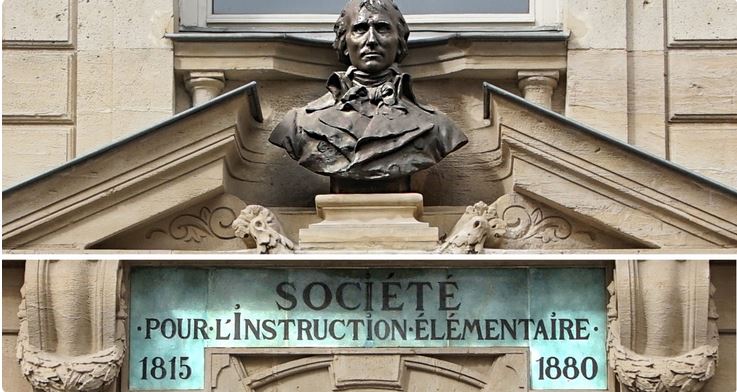
Following the promulgation of the ordinance of July 29, 1818 authorizing Caisse d’Epargne societies (Saving Banks associations), it asked teachers to entrust part of their salaries to these funds to ensure their retirement; setting an example, it deposited funds with the Caisse for the teachers of the schools it had set up.
Today, the SIE, whose head office is a specially-built building at 6, rue du Fouarre in the 5th arrondissement of Paris, remains the oldest and largest secular primary education association in France.
11. The rue Saint-Jean-de-Beauvais pilot program
As said before, after his trip to England, Jomard, whose portrait appears in a medaillon on the façade of the SIE, also embraced the new system.
In his « reflections on the state of English industry », he wrote, after expressing his enthusiasm for various inventions observed across the Channel: « There is, however, something even more extraordinary: these are schools without teachers: nothing, however, is more real. We now know that there are thousands of children taught without a teacher, and at no cost to their families or the State: an admirable method that will soon spread to France.«
A graduate of the Ecole Polytechnique, and an exceptionnal scientist who went with Monge to Egypt, Jomard was the ideal man to oversee the material organization of the test school, in particular by arranging for furniture to be made and teaching aids to be printed in accordance with English principles. Jomard also supervised the training of a small nucleus of students – around 20 – as « monitors » before the opening of the school proper in September 1815, planned for 350 students: a modality reminiscent of the « chefs de brigade » of the first graduating class of the École polytechnique.
However, the members of the SIE soon realized that they needed to train trainers. The English therefore welcomed several Frenchmen to train them in mutual teaching. A pastor from the Cévennes, François Martin (1793-1837), after training as a « monitor » in England, was called in by Lasteyrie to run the first mutual school, which opened its doors on June 13, 1815, on rue Saint-Jean-de-Beauvais in Paris, close to Place Maubert. This was the model school that would enable other mutual schools to be opened, thanks to the training of competent « monitors ». The school was soon unable to keep up with demand from hundreds of communes, which were considering sending one of their own to be trained in the new method.
Pastor Paul-Emile Frossard, also trained by the English, took charge of a Parisian school on rue Popincourt, while Bellot ran another. In July, Martin submitted his report. The model class takes in some 15 students destined to become monitors and principals of elementary schools with up to 350 children. Martin reports that in six weeks, they read, write, calculate and « know how to execute the movements that form the gymnastic part of the new education system ».
12. Mutual tuition and music
As Christine Bierre amply documents in her article « La musique et formation du citoyen à l’ère de la Révolution française » (1990):
« It was at this school on rue Saint-Jean-de-Beauvais, under the direction of a Commission comprising Gérando, Jomard, Lasteyrie, Laborde and Abbé Gaultier, that the application of mutual teaching to the learning of solfeggio and singing was tested for the first time. Alexandre Choron (1771-1834), who since 1814 had opened two music schools for boys and girls, was also a member of the Commission. Not surprisingly, it was on the initiative of Baron de Gérando that the idea of introducing singing into primary education was adopted. When Monsieur le baron de Gérando proposed the introduction of elementary singing in primary schools’, says Jomard in a report presented to the Board of Directors of the Société pour l’Enseignement mutuel, ‘you were all struck by the correctness of the views developed by our colleague (…) It showed the happy influence that such a practice could have, and the real connection that exists between the proper use of song and the perfecting of morals, the ultimate goal of instruction and of all our efforts. Not only was the application of mutual instruction to music revolutionary in itself, but what was equally revolutionary was the fact that children were learning to read and write, almost as intensively. Children studied singing, for four to five hours a week! »
In fact, it was Lazare Carnot himself who wanted to introduce music into the mutual education schools. To this end, he met several times with musician Alexandre Choron (1771-1834), who brought together a number of children and had them perform in his presence several pieces learned in very few lessons. Carnot also was acquinted with Guillaume-Louis Bocquillon, known as Wilhem (1781-1842) for ten years. He saw the possibility of using him to introduce singing into schools, and together they visited the one on rue Saint-Jean-de-Beauvais, a free pilot school for mutual education in Paris open to three hundred children.
Michael Werner‘s recent article, « Musique et pacification sociale, missions fondatrices de l’éducation musicale (1795-1860) », echoes and confirms the groundbreaking research initiated by Christine Bierre in 1990.
Excerpt:
« One of the fields in which the results of mutualist pedagogy are clearly visible is musical education. Several players played a decisive role here, and deserve a brief mention.
The first is Guillaume-Louis Bocquillon, known as Wilhem (1781-1842). The son of an officer and himself from a military background, he then devoted himself to musical composition and teaching, particularly at the Lycée Napoléon (later Collège Henri-IV). His friend Pierre Jean de Béranger put him in touch with Joseph-Marie de Gérando and François Jomard, the leading lights of the SIE. Through them, he learned about mutual teaching and immediately understood the benefits of this method for musical education. In 1818, the Paris municipality allowed him to set up a first experiment at the elementary school on rue Saint-Jean-de-Beauvais. Wilhem developed a method, the necessary teaching materials (in the form of charts) and instructed the chosen student monitors. The results were, according to Jomard, spectacular. At the end of a few months’ instruction, the pupils had not only acquired the basic notions of solfeggio and musical notation, chromatic scales, intervals and measures, but were also performing collective songs in several voices (Jomard 1842: 228 ff)
This success led the SIE to propose to the Prefect and Minister of the Interior that music be introduced into the teaching of elementary schools in the city of Paris, a move officially endorsed in 1820. Wilhem himself was appointed full professor of music teaching in Paris, and music classes were introduced in many of the city’s schools, before spreading to the départements and regions. At the same time, the municipality opened two teacher-training colleges to train future singing teachers.
The second early player in the debate was the composer Alexandre Choron (1771-1834). A member, like Jomard and Francœur, of the first graduating class of the École polytechnique (1795), composer and friend of André Grétry, he had been concerned since 1805 about the decline of choral singing following the abolition of the master classes. An opponent of the Conservatoire, whose academicism and lack of interest in the teaching of choral singing he criticized, in 1812 he was entrusted by the Ministry with a mission to « reorganize the choir and the choirmasters of the churches of France ». He developed a teaching method known as the « concertante method », but also remained committed to the social vocation of choral music. Choron was also one of the founding members of the SIE in 1815, a sign of his commitment to educational issues. During the Restoration, he turned more to religious songs, which he considered to be the historical heart of choral practice. (…) Finally, with the king’s support, he founded the Institution royale de musique classique et religieuse, successfully competing with the Conservatoire in the teaching of vocal art.
For the general public, he arranged for oratorios, requiems and cantatas to be performed by singers from his school in a number of spacious churches, thus ensuring a new presence for sacred music on the Parisian stage. For some of these concerts, he sometimes mobilized student singers from elementary and poor schools, whom he never ceased to follow throughout his career. »
« (…) What fostered this expansion of music education for young people and the working classes from 1820 onwards was a political will shared by a broad spectrum of leaders and stakeholders. The liberals who formed the core of the SIE continued to adhere to the emancipatory mission of education set out by the Convention. By focusing on both the inner formation of the soul and the blossoming of a collective conscience, music – and singing in particular – became a prime field for popular education. Liberals therefore emphasized the moral benefits of music. Thus, in his proposal to introduce singing into elementary school, Gérando remarks:
‘Those of us who have visited Germany have been surprised to see how much simple music plays a part in popular entertainment and family pleasures, even in the poorest conditions, and have observed how salutary its influence is on morals. And Joseph d’Ortigue states lapidary: ‘A people that sings is a happy people, and therefore a moral people. This emphasis on the social benefits of musical activity fits in well with the idea of ‘universal education’, inherited from the Enlightenment and the foundation of the pedagogies of Lancaster in England or Johann Heinrich Pestalozzi in Switzerland.' »
After a trial run at the St-Jean-de-Beauvais school in 1819, singing quickly spread to all the mutual schools. Wilhem was both the creator and the architect of the development of this teaching method, which soon spread to adult and apprentice classes. Periodic meetings of children initiated into vocal music were organized. Thus was born the first French post-school organization: the Orphéon, which, after Wilhem, counted Charles Gounod and Jules Pasdeloup among its directors.
In an 1842 speech to the SIE, Hippolyte Carnot asserted that Wilhem had « elevated music to the rank of a civic institution », and that the « ennoblement » of the individual soul was to be achieved in the new collective order of the reunited nation.
13. Jomard, Choron, Francoeur and « elementary » knowledge
Renaud d’Enfert‘s comprehensive article, published on the website of the Société de la bibliothèque et de l’histoire de l’Ecole polytechique (SABIX), completes the picture with a close-up on the work of Jomard and Francoeur, whose portraits are featured in a medallion on the façade of the SIE headquarters on rue du Fouarre in Paris.
Right from the start of the Second Restoration, the SEI received the backing and support of the Prefect of the Seine, Gaspard de Chabrol de Volvic (1773-1843). In the summer of 1815, the latter appointed Jomard, a linguist in contact with the Humboldt brothers who had been part of the short-lived commission under Carnot and who had protected him during the Hundred Days, « head of the office of public instruction and arts », a position he held until 1823.
In a decree dated November 3, 1815, Volvic, in order to take « the necessary measures to extend the benefits of instruction to all poor families domiciled within the prefecture » and to develop « the new system of elementary instruction » throughout the Seine department, created an eleven-person committee « to extend the benefits of free education to the Seine department », and included all the influential members of the SIE (Jomard, Gérando, Laborde, Doudeauville, Lasteyrie, Gaultier, etc.). ).
In this role, Jomard was responsible for finding sites for new schools. These rapidly multiplied in and around the capital: in 1818, he counted 18 free and 32 fee-paying mutual schools covering all of the capital’s arrondissements, as well as 13 schools in the arrondissements of Sceaux and Saint-Denis. From this work, he drew up his « Abrégé des écoles élémentaires » (1816), a sort of practical guide in which he compiled everything a cityen decided to set up a mutual school needed to know about material organization.
On the pedagogical front, Jomard was the author, in 1816, of a reading method produced in collaboration with the composer and musician Alexandre Choron, who had published a method for learning to read and write as early as 1802, and Abbé Gaultier, a pedagogue who had developed a teaching method under the name of « jeux instructifs » and had traveled to London to study English methods.
Designed for the new elementary school on rue Saint-Jean-de-Beauvais, where Choron was appointed music teacher, it breaks with the traditional spelling method.
Instead of saying « b-o-n = bon », she uses the musical sounds of the language to say « b-on = bon ». In 1821-1822, Jomard also published « Arithmétique élémentaire » (Elementary Arithmetic), designed to remedy the weaknesses of Lancaster’s arithmetic method, which he accused of « making children contract a simple, routine and mechanical habit » instead of serving « to fortify their attention and train them in reasoning ». In the meantime, he and Francœur and Lasteyrie had set up a « calligraphy commission » at the SIE, to develop the principles that would guide the teaching of writing in mutual schools, a writing style intended to be « national », to replace the English models.
For his part, Louis-Benjamin Francoeur (1773-1849) provides, according to Jomard, « a long series of luminous reports on treatises on arithmetic, weights and measures, singing and musical art, drawing and geometry, which it would take far too long to relate or quote ». Filling a gap, in 1819 Francœur published « Le dessin linéaire » (Linear Drawing), a drawing method based on freehand drawing of geometric figures, which broke with traditional, academically inspired ways of teaching and learning drawing.
For Jomard and Francoeur, the idea behind « mutuel tuition » was to broaden the range of subjects taught in primary schools beyond the traditional « reading, writing and arithmetic »: in addition to drawing, also singing, gymnastics, geography and grammar now made their appearance in elementary school.
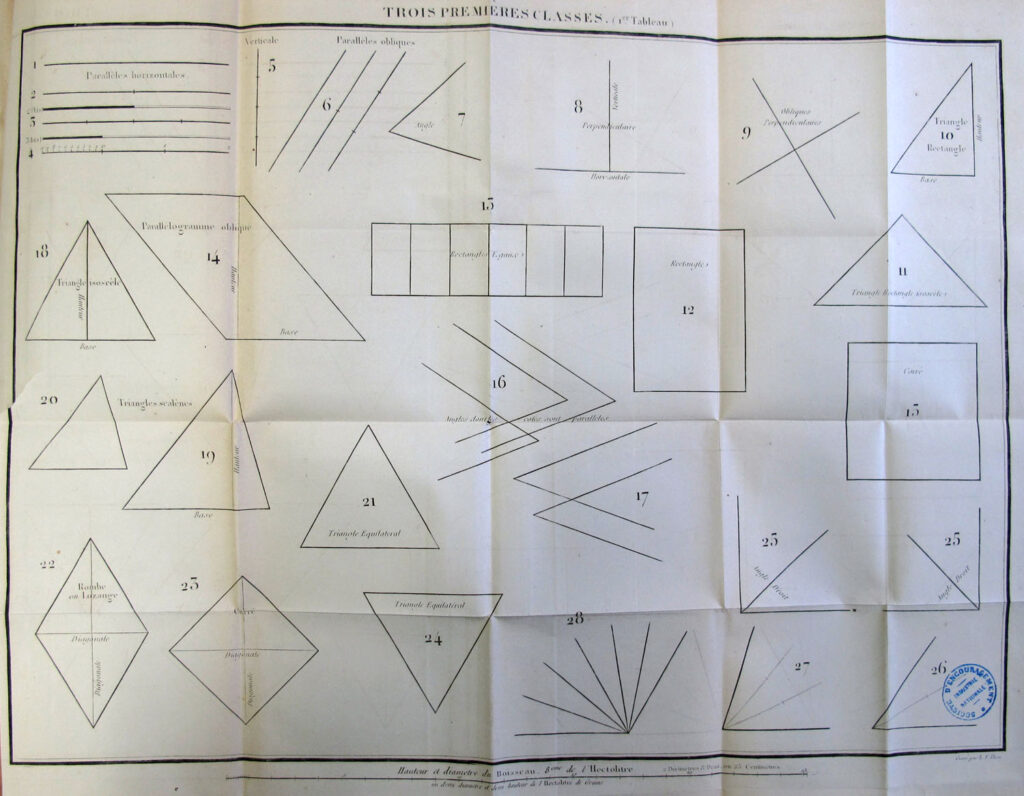
Linear drawing was nonetheless seen as an elementary skill in its own right, on a par with reading, writing and arithmetic.
Presenting Francœur‘s method to the Société d’Encouragement, Jomard declared:
« The usefulness that industry may one day derive from it is so great and so visible, that it would be superfluous to insist on it. It is not without reason that this result has been considered as precious for the people, as the knowledge of reading and writing ».
Finally, for Jomard, the widespread teaching of reading, writing, arithmetic, linear drawing and singing is the prerequisite for the scientific education of the people:
« In recent times, we have rightly insisted on the usefulness of teaching the elements of the physical and mathematical sciences to the working class. On this depends the advancement of industry and agriculture, which, despite all their progress, are still backward in many respects. It is only through the possession of these elementary notions that workers will perfect their processes, their means, their instruments and their products, and will be able to become skilful foremen and good workshop managers. But how can this be achieved when the mass of the population is still so ignorant?
How, without the art of reading and writing, could they not understand a single word of the chemical and mechanical arts, but only feel their advantage and consent to engage in arduous studies? What’s this! Fifteen million Frenchmen and more perhaps, do not know how to do the first two rules of arithmetic, and we would flatter ourselves to propagate among them the first principles of mechanics and geometry! The basis of this improvement is obviously primary education made more general or even universal ».
14. Nationwide
The results of mutual education are spectacular and rapid, both in terms of learning time and the quality of skills acquired. Whereas in the Lasalle Brothers’ schools it took 4 years to learn to read, this time was reduced to a year and a half in the mutuel establishments!
The enthusiastic French of 1815, with their vivid imagination, saw in this teaching system a veritable panacea. It had undeniable advantages. First of all, it was economical, requiring few teachers and enabling a considerable number of children to be taught at low cost. It is estimated that 4,000 to 5,000 fr. a year were sufficient to maintain a school of 1,000 children: 4 fr. per pupil! Education would never have been so cheap. It also ensured rapid development of primary education, since the shortage of teachers was no longer a limiting factor. With figures to back it up, it was calculated that it would only take a dozen years to extend the benefits of primary education to the whole of France!
To these indisputable advantages, the travelers of 1815 added qualitative arguments. They considered the teaching of instructors superior to that of masters: « He does not know his lesson better than the master, » wrote Laborde, « but he knows it differently ». The child instructor (monitor) takes pleasure in communicating his newly acquired knowledge to his classmates, doing his job « with as much charm as a preceptor finds it disgusting » (Laborde).
On the other hand, being a child himself, he knows better than the teacher the difficulties of the task, the pitfalls of the lesson, over which he has just stumbled. He will therefore lead his classmates more slowly, more surely, and be a better guide for them.
But teaching won’t be the only thing to benefit from the mutual system; school discipline and morals will also benefit. The child, submissive to his classmate, will obey him more readily than the teacher, since the young instructor owes his superiority solely to his own merit. Finally, the child, with his classmate who knows him well because he lives with him, will not have, as with the teacher, the resource of lying to hide his intimate thoughts or faults: and dissimulation, the social scourge that was learned from the school benches, will thus disappear from mutual establishments.
And Laborde concluded his apology for the method : in the new schools, « work is for them a game, science a struggle, authority a reward ».
The benefits of this teaching were not to be confined to the school: children returning home would in turn exert a happy influence on their parents, becoming « missionaries » of both morality and truth in their families.
Gontard wrote in 1956:
« And let no evil spirits say that these are the daydreams and utopias of idealists! There is irrefutable proof of the value of this method. Look at Scotland. At the end of the 17th century, it was a land of beggary and misery, living without law, without religion, without morals, men drinking, women blaspheming, all fighting. In 1815, thanks to the magic wand of the mutual school, Scotland became a paradise. « It is not uncommon in Scotland to find a shepherd reading Virgil… but it is almost unheard of to meet a malefactor there, »
Laborde agrees.
« Let’s develop the method in France and, by 1850, it will be a land of prosperity and happiness, from which immorality, fanaticism, revolutions and social unrest, all sons and daughters of ignorance, will be banished. »
In 1818, Joseph Hamel, in his report to the Emperor of Russia, notes:
« The method of mutual education has been introduced throughout France with a rapidity and success far greater than could reasonably be expected, and in less than three years more than 400 schools have already been founded. There is every reason to hope that, in the not-too-distant future, more than 2 million children who were still in complete ignorance will be able to receive the benefits of a free education, sufficient for their future vocation.«
Right from the start, with Carnot and a generation of brilliant scientist coming out of Polytechnique, France was giving leadership !
Amiens and the Somme department
Interesting in that regard, the following account of the adoption of mutual tuition methods in Amiens and the Somme department.
« On May 15, 1817, after much mistrust and hesitation, the Amiens town council founded a society to encourage elementary education in the department. More than ennobling the pupils’ souls, for the rector, it was a question of ‘giving the children of these workers an elementary education, [to prepare them] not only for the habit of order and subordination that is acquired in the mutual education schools and which they carry over to the workshops, but also to put them in a position to serve more usefully inside the factories, how to study the industrial processes whose preservation and improvement are so essential to national prosperity' ».
For the Rector, speed of acquisition was a guarantee of success for the new method compared to the « simultaneous method »:
« That a primary education which takes children away for whole years from work necessary for the family’s subsistence becomes for the poor a very onerous burden; but that experience teaches the father of a family that a few months will suffice to procure for his children an advantage which he has regretted so many times in the course of life not to have been able to enjoy himself, we must hope that he will not sway to make a slight sacrifice in order to obtain an important result ».
These are mainly boys’ schools. There are a few girls’ schools and evening classes for adults. They mainly catered for the children of small craftsmen: dyers, octroi clerks, innkeepers, foremen, tailors, millers, dressmakers, coopers, dressmakers, locksmiths, butchers, spinners, ironers, laborers, car loaders, carpenters, booksellers, lamplighters, cutlers, bookbinders and so on.
At its peak, in 1821, mutual education in the Somme department included not one but 25 schools, 4 of them for girls (for a fee): 4 out of 10 were located in towns. In 1833, there were 16 more. The network shrank considerably thereafter, but did not disappear altogether. The last two schools in Amiens closed their doors involuntarily in 1879, and the one in Abbeville in 1880: until then, it played an important role in preparing candidates for examinations.
The Amiens Model School – the first provincial model school – prepares future teachers for the practice of mutual education. It was founded on May 26, 1817. It welcomed over 200 pupils. By 1818, 6 teachers from the Somme had graduated. Most of the teachers from the Aisne, Oise and Pas-de-Calais departments spent some time there before taking up their duties.
In 1831, when the Prefect created the Ecole normale de garçons, it was called the « Ecole normale primaire d’enseignement mutuel ». At first, it served as a training school: student teachers were required to visit the school once a week to observe and practice the mutual teaching method.
After the government reshuffles of 1817-1818, several SIE members were appointed to important ministries: Mathieu Molé (1778-1838) to the Navy, Laurent Gouvion-Saint-Cyr (1764-1830) to the War, Elie Decazes (1780-1860) above all to the Interior, the ministry on which primary education depended. Government support became systematic.
The Minister of the Interior supported the SIE de Paris and its subsidiaries with grants for school foundations and maintenance. He invited the prefects to contribute in any way they could to the development of the method. Prefects took the initiative in setting up local companies, and lobbied local assemblies for subsidies.
A growing number of General and Municipal Councils voted to set up mutual schools. Once a school had been founded, the local authorities (prefect and mayor) visited it and presided over the prize-giving ceremony. For its part, on July 22, 1817, the Commission d’Instruction Publique, which since 1815 had replaced the Grand Master of the University, decided to establish a model mutual-education school in the chief towns of France’s twelve Academies, as a breeding ground for future teachers. Other ministers, each in their own sphere, supported the method.
Molé, in charge of the colonies, founded mutual tuition schools in Senegal.
In 1818, Gouvion-Saint-Cyr established a full-fledged « Ecole normale militaire d’enseignement mutuel » in the caserne Babylone of Paris. Each regiment in Paris and the provinces was required to send one officer and one non-commissioned officer, who would return after a few months’ training to teach the troops the benefits of primary education.
In 1817-1818, mutual tuition triumphed. An irresistible enthusiasm carried France towards it. The network of schools continued to expand. From term to term, more and more reports arrived in Paris from the provinces, counting schools and their pupils.
It was a song of victory that Jomard could sing at the SIE meeting in January 1819. Of the 81 départements in France, only 5 had no mutual school; the other 76 had 687 schools, attended by over 40,000 pupils. There were also 105 regimental schools, 5 adult schools, 4 prison schools and 2 or 3 schools in Senegal.
Exemplifying what was becoming a new Promethean paradigm of scientific optimism, on December 15, 1821, at a meeting at Paris City Hall, the Geographical Society was founded by 217 leading figures, including some of the greatest scientists of the day, such as Jomard, Champollion, Cuvier, Chaptal, Denon, Fourier, Gay Lussac, Berthollet, von Humboldt and Chateaubriand. Other illustrious members include Jean-Baptiste Charcot, Dumont d’Urville, Élisée Reclus and Jules Verne.
The collection and study of geographical data from many continents enabled certain members, such as Gustave Eiffel and Ferdinand de Lesseps, to propose major infrastructure projects, notably the Suez and Panama Canals.
15. Criticism
The first criticisms of mutual education came not from its failure, but from its success. The first « risk » was that the children, having learned too effectively and too quickly (2 to 3 times faster !), would return « to the streets » too soon, not yet being old enough to go to work!
Children weren’t « locked up » at school long enough, and so mutual education disturbed the existing social order. In 1818, the General Council of Calvados heard:
« The greatest service to be rendered to society would perhaps be to devise a method that would make instruction for the lower and indigent classes of society more difficult and time-consuming »…
The second « risk » was that, by continuing to use mutual education, these newly-educated people, mostly from the poorer classes, would become too intelligent, too « enlightened », and begin to express political or social demands, in particular that everyone should have the same rights as the better-off social classes.
Imagine the mess if the social order were challenged! French urban planner and sociologist Anne Querrien notes that, in fact, most of the organizers of the labor movement at the time came from the mutual school, where they had of course learned to read, write and count, but also to trust themselves and their comrades. The mutual school encouraged its pupils to think, and in particular to reflect on the organization of society, a society that assigned them a destiny of submission and obedience.
The influential theologian and politician Félicité Robert de Lamennais (1782-1854) said it loud and clearly :
« Lancaster-style schools are the craze of the day. All the authorities in this country, and especially the Prefect, are infatuated beyond expression. Hatred for priests has a lot to do with this mania. The fact is that everything good about this method has been practiced for over a century by the Brothers of the Christian Schools; the rest is pure charlatanism. There is talk of teaching children to read and write in four months: in the first place, this would be a great misfortune, for what can be done with such well-educated children, whose age would not yet allow them to work? Secondly, nothing could be further from the truth than these marvellous results. »
If one has « to decide between the instruction of Abbé de La Salle and that of Lancaster, the question is quite simple; it’s a question of choosing between society and anarchy ».
His brother, the vicar Jean-Marie de la Mennais (1780-1860), took the lead in what can only be described as a political witch-hunt. He said:
« Mutual education was introduced into France by Protestants during the disastrous Hundred Days. M. Carnot was then Minister of the Interior; under his auspices, the Société d’Encouragement, established to propagate this method, held its first meeting on May 16, 1815 ».
He struggled to prove that « the Lancastrian method is defective in its procedures, dangerous for religion and morals in its results » and in a brochure, De l’Enseignement mutuel, published in 1819 in Saint-Brieuc, Brittany, he vigorously attacked this teaching method.
It’s true that questioning authority and the established order is inherent to mutual education. The « simultaneous » method is based on the premise that to pass on knowledge, you need to be qualified (to be the teacher). Conversely, in the mutual school, the teacher is no longer the repository of knowledge, as each student can enlighten his or her classmates.
Another concern for the elites was that, with this method, children are merely instructed, not « educated », and no Christian moral education is imparted.
Last but not least, mutual teaching required fewer supervisors, given the pupils’ role as creators, transmitters and bearers of knowledge. Some may have feared for their jobs…
In 1818, in his report to the Emperor of Russia, Joseph Hamel told the mutualists’ main opponents, the « Brothers of the Christian Schools », that they were almost entirely unaware of what they were denouncing. Hamel also points out that there are 40,000 communes to be provided with elementary school, and that the number of Brothers‘ schools « does not amount to more than one hundred in the kingdom… ».
On the negative side, what is striking, when examining the incriminations, is that one thing is said in the morning and its opposite in the afternoon. In the morning, it’s said that mutual education blurs minds by diluting the authority of teachers; in the afternoon, it’s asserted that it overly « militarizes » education through a totally hierarchical command structure!
On the question of « morality », Lazare Carnot would never have endorsed an education that ruined the Christian spirit, let alone the notion of legitimate authority, while vigorously combating those that lacked it, such as the Monarchy of divine right or the Consulate for life imposed by Napoleon. In the same way, in the morning, the mutualist system was accused of failing to transmit Christian « morals »; in the afternoon, it was seen as a Protestant plot…
And yet, the national impulse in favor of « the fatherland » and future generations has succeeded in uniting personalities from all political and religious backgrounds in a single effort.
Cuvier (Protestant) and Gérando (Catholic), both fervent republicans and promoters of the mutual mode, as well as the Inspector General of the University, Ambroise Rendu (1778-1860, Catholic), even took part in drafting the ordinance of February 29, 1816, promulgated by Louis XVIII and the Minister of the Interior, de Vaublanc (1756-1845).
Following massive pressure from the congregations, mutualist teachers Martin, Frossard and Bellot, all Protestants, were forced to leave their school headships. Martin went on to be very useful in other European countries, notably Brussels, where in 1820 he organized a mutual school at Les Minimes.
16. Mechanistic drift?
Without grasping the state of mind and enthusiasm that young polytechnicians might have had for the blossoming of an industrial culture and the wonders of machinismo, the defenders of a feudal France see only a « fundamentally mechanistic vision », when Jomard compares the mutual method to a machine, with its cogs and springs, of which the teacher is a mere operator:
« Once the school has been establisehd out and equipped with all the furniture it needs, all that remains to be done is to introduce the pupils and the teacher, and then to set in motion all the springs of this kind of mechanism, by means of the new practices ».
While Victor Hugo evoked a « happy swarm », Laborde was accused of a « mechanistic » drift when he compared the buzzing activity of pupils in English mutual schools to the noise of machines in cotton mills.
Communication, argued critiques, is « entirely mechanical and hierarchical ». It flows « only from the master or general instructor to the instructors and pupils, not in the other direction. It’s a means of action, not a means of exchange.«
Let’s face it, any pedagogical approach, no matter which one, set up as a system and postulating that it’s « enough » to apply mechanically to a human being, can be horrifying. It’s easy, then, to accuse the mutual school of all the ills from which those who accused them suffered, perhaps even more so.
At the mutual school, corporal punishment is banned. It was a courageous decision that Octave Greard was quick to point out:
« It is one of the claims of the founders of the mutual schools to public recognition that they outlawed the corporal punishments, ferulas and whips, which were still in use, and we cannot be too grateful to them for having sought to replace in the hearts of pupils the feeling of fear with the feeling of honor, or, as M. de Laborde used to say, the feeling of well-administered shame ».
Knowing the immense happiness of the thousands of children who quickly gained access to a minimum of public instruction and experienced the indescribable joy of educating their peers, one can only suspect the pen of jealous congregations behind this poem falsely lamenting the misfortune of the poor little ones:
« This system, it is said, born of Anglomania,
Contrasts horribly with our genius.
There, everything is mechanism and our sad children
Seem like a machine, in the middle of their benches;
Their absurd discipline, and no doubt fatal,
Governs even the steps, the attitude or the gesture:
Today, we can prophesy the fate
Of this automaton people thus moved by spring ».
17. Death of Mutual Tuition in France
In 1815, after Waterloo, King Louis XVIII, who had fled, returned on July 8, 1815. Unlike his brother, the future Charles X, leader of the ultra-royalists, was fully aware that the history of the Revolution could not be erased. He realized that France could no longer be a country of « subjects », and that it had become a Nation. Hence the « Constitutional Charter » he promulgated, which had the force of a constitution. In the same spirit, in view of the popularity of mutual education, he granted it favors (subsidies, creation of model schools, protection from the Ministry of the Interior).
Mutual education soon lost its protectors, as the ministerial commission created by the decree of April 27 did not survive Napoleon’s fall in June 1815.
By the autumn of 1816, criticism was pouring in from the Congregationalists. The Grand Chaplain of France, Cardinal de Talleyrand-Périgord, Archbishop of Reims (John Baptist de La Salle’s birthplace…), for his part, addressed the King to express the alarm of Catholics.
By 1820, the SIE already had a network of 1,500 mutual schools, grouping together more than 170,000 pupils thanks to an audacious collective pedagogy. However, mutualism came under fire from the ultras, who considered it too liberal, too favorable to children’s autonomy and incapable of « raising youth in religious and monarchical sentiments ».
The child who leaves this school, they say, « is a learned parrot, without religious ideas, without moral values, more dangerous than the ignorant for the political and social order, since instruction has developed new needs in him, always ready to engage in new scenes of revolution or dechristianization. Ah, Carnot, the regicidal conventionalist and patron of mutual education, knew what he was up to when he introduced it into France with the decree of 1815! »
As said earlier, in France, mutual tuition was seen as an aggression by the religious congregations who practiced « simultaneous teaching », codified as early as 1684 by Jean-Baptiste de La Salle (1651-1719) for Institute of the Brothers of the Christian Schools (Latin : Fratres Scholarum Christianarum; French Frères des Écoles Chrétiennes; Italian: Fratelli delle Scuole Cristiane, abbreviated FSC) : classes by age, division by level, fixed and individual places, strict discipline, repetitive and simultaneous work supervised by an inflexible master.
And the merits of the FSC’s schools and « simultaneous teaching », confirmed by centuries of experience, were considered in total opposition to those of mutual education, the « mania of the moment », and considered the work of « charlatans » speculating on primary education.
A fierce supporter of order and suspecting a vast Protestant plot against the Vatican, Pope Leo XII, the « Pope of the Holy Alliance », decided in Quod Divina Sapientia, his papal bull of August 28, 1824 (art. XXVII, 299), that « public schools of mutual instruction will be suppressed and abolished in all the Papal States. The bishops will prosecute those who continue to use this teaching method or who attempt to introduce it into their dioceses ».
In anticipation of the Papal Bull, the Ordinance of April 1824 placed mutual education in France under the strict supervision of the traditional Church, which took over the entire educational question. In August, just after Leo XII’s bull, a Ministry of « Ecclesiastical Affairs and Public Instruction » was created, a name that reflected the Church’s return to business. The accession of Charles X only exacerbated this situation. The Church of the time loved the Enlightenment, but above all it loved candlelight…
From then on, the schooling situation took a dramatic turn for the worse.
In 1828, of the 39,381 communes :
- around 24,000 had boys’ schools, catering for 1,070,000 children ;
- no more than 430,000 girls attended elementary school;
- 15,381 communes have no boys’ schools ;
- and perhaps 20,000 without girls’ schools;
- 1,680,000 boys and 2,320,000 girls attend no school at all, making a total of 4 million.
Despite an upturn between 1828 and 1829, mutuellism was rejected, its schools closed one after the other (their number fell by three-quarters compared to 1820), although the electoral weight of the ultras diminished from election to election. However, the people’s educators resisted.
In the years following the 1830 revolution, over 2,000 mutual schools were still in operation, mainly in towns, in competition with the denominational schools promoted by the regime. Officially, the mutual school was not a guarantor of morality, and was said to be « industrial » and inhumane.
Then came the famous « Guizot moment ». Although he had initially campaigned for the development of mutual education within the SIE, François Guizot (1787-1874), Louis-Philippe’s Minister of Public Instruction from 1832 onwards, gave mutual education the coup de grâce in France by having the « simultaneous » method endorsed as the only official teaching method.
Schools adopting mutual tuition were no longer subsidized, nor did they receive any support from the government or the Church. Faced with material difficulties, the majority of pupils mostly admitted free of charge had now to pay a fee. Many parents in need withdrew their children and sent them to the newly opened Brother of the Christian Schools, who had become free of charge…
The Church slanders, casts doubt on the morality of the teachers, tried to keep the children of Catholic families away from the « devil’s school », persecutes and threatens to keep them away from catechism and communion in order to break mutual tuition. Most of the teachers using that method felt obliged to bandon it and embrace the official « simultanous » method. With no more pupils, no more teachers, mutual schools gradually disappeared.
It was Guizot who put the final nail in the coffin of mutual tuition, creating the École normale des instituteurs in 1867 to train the future teachers of Jules Ferry’s school in the simultaneous method still the norm today.
The young Hippolyte Carnot also joined the SIE in order to reconnect, post mortem, with his father. In 1847, when he became Minister of Public Instruction under the Second Republic, he attempted to revive the mutual education cherished by his father Lazare Carnot, but although his work was great, his enemies were many and his term of office very short.
18. Conclusion
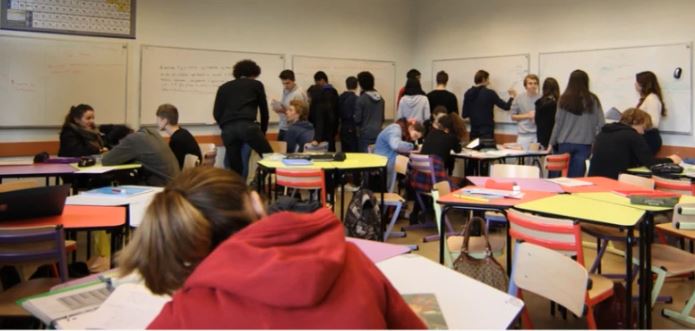
Education is in deep crisis. Everything that was largely accomplished by Lazare Carnot and his son Hippolyte has been systematically destroyed by the new church of our time: the financial, transhumanist and decadent oligarchy, having led the world to the brink of collapse, still determined to save its privileges by organizing the physical and moral ruin of humanity.
To rebuild an education worthy of the name, we are convinced that mutual education, provided it is adapted to our times, is an extremely promising avenue. Several African countries, currently lacking sufficient resources, are already taking inspiration from it.
Mutual tuition is not a relic of the past, but an experiment to be renewed to open the gates of the futur. For the Global South, still plagued by post-colonial exploitation, war and epidemics, education of this kind is the way to go: efficient, rapid and cheap but also humanizing and joyfull, it is the way to go.
It’s a message that Vincent Faillet, a young french teacher with a doctorate in education and training in the Paris region, who is reviving this method, cleary expresses in this video:
19. Short list of works consulted
- François Arago, Biography of Gaspard Monge, read at the Académie des Sciences, 1846.
- Joseph Hamel, L’enseignement mutuel, 1818, Paris.
- John Franklin Reigart, The Lancastrian System of Instruction in the schools of New York City, Teachers College, Columbia University, 1916.
- Sylviane Tinembart, Edward Pahud, Une innovation pédagogique, le cas de l’enseignement mutuel au XIXe siècle. Editions Livreo-Alphil, 2019, Neuchâtel, Switzerland;
- Bruno Poucet, Petite histoire de l’enseignement mutuel : l’exemple du département de la Somme, Carrefours de l’éducation, N° 27, 2009/1, pages 7 to 18;
- Michel Chalopin, L’enseignement mutuel en Bretagne, Presses Universitaires de Rennes, 2011;
- Claire Giordanengo, La grande vogue de l’enseignement mutuel, Hypotheses, Bibliothèque Diderot de Lyon;
- M. Gontard, Un aspect des luttes de partis en France au début de la Restauration : la question de l’enseignement mutuel, Revue d’Histoire du XIXe siècle – 1849, Année 1953, pp. 48-63.
- Dell Upton, Lancasterian Schools, Republican Citizenship, and the Spatial Imagination in Early Nineteenth-Century America, Journal of the Society of Architectural Historians, Vol. 55, No. 3 (Sep., 1996), pp. 238-253,University of California Press;
- Alexis de Garaudé, Manuel de l’enseignement mutuel et populaire de la musique, 1854;
- Anne Querrien, L’école mutuelle – Une pédagogie trop efficace?, Les Empêcheurs De Penser En Rond, 2005.
- René Girard, Carnot et l’éducation populaire pendant les Cents Jours, 1907, Paris.
- Michael Werner, Musique et pacification sociale, missions fondatrices de l’éducation musicale (1795-1860) « , Gradhiva (N° 31/2020);
- Rémi Dalisson, Hippolyte Carnot – 1801-1888, La liberté, l’école et la République, CNRS, Paris, 2019;
- Renaud d’Enfert, Jomard, Francœur et les autres… Des polytechniciens engagés dans le développement de l’instruction élémentaire (1815-1850), Bulletin de la Société des amis de la Bibliothèque et de l’Histoire de l’École polytechnique (SABIX), 2014.
Hippolyte Carnot, father of modern republican education

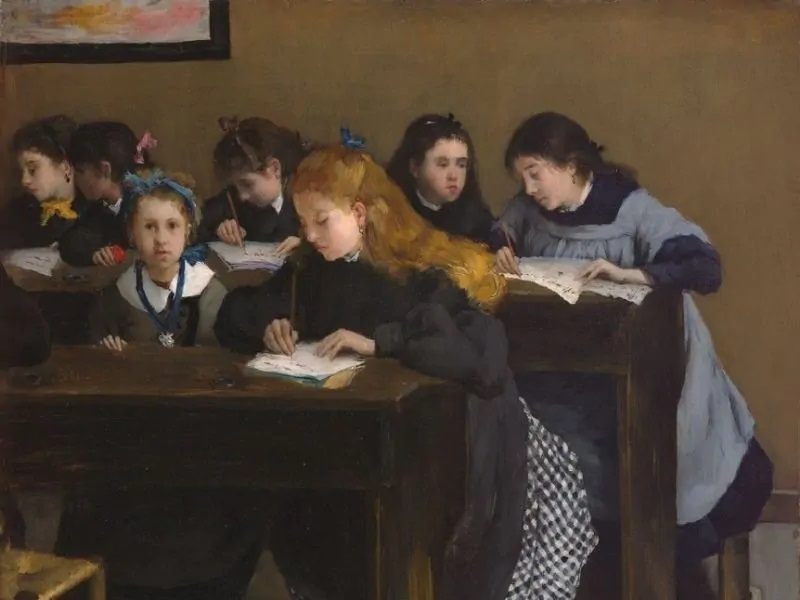
Table of contents
- Introduction
- In the storm
- From charity to universal schooling
- Malebranche and the Oratorians
- The Revolution of the Mind
- The Committee of Public Instruction (1791)
- Condorcet and the « American Party
- The « Condorcet » Plan
- The battle under the Convention (1792-1795)
- Lazare Carnot under Les Cent-Jours (The Hundred Days)
- Carrying on the torch
- Lazare Carnot’s exile
- Hippolyte with Abbé Grégoire
- Like Schiller, patriot and citizen of the world
- The Revolution of 1830
- Minister of Public Instruction under the Second Republic
- Hippolyte’s Carnot’s reforms
A. Nursery school
B. Primary school
C. Explanatory memorandum to the School Act of June 1848
D. Teachers to enlighten the rural world
E. Secondary education
F. High Commission for Scientific and Literary Studies
G. A School of Administration
H. Lifelong education for all
I. People’s libraries
J. Fine arts, hygiene and gymnastics on the program
K. Citizen Concord - Conclusion
- Appendix: works by Hippolyte Carnot
- Short list of books and articles consulted.
« The tree you are planting is as young as the Republic itself (…) It will spread its branches over you, just as the Republic will spread over France the benefits of Popular Instruction.
« Hippolyte Carnot, Memorial (1848), dossier 13.

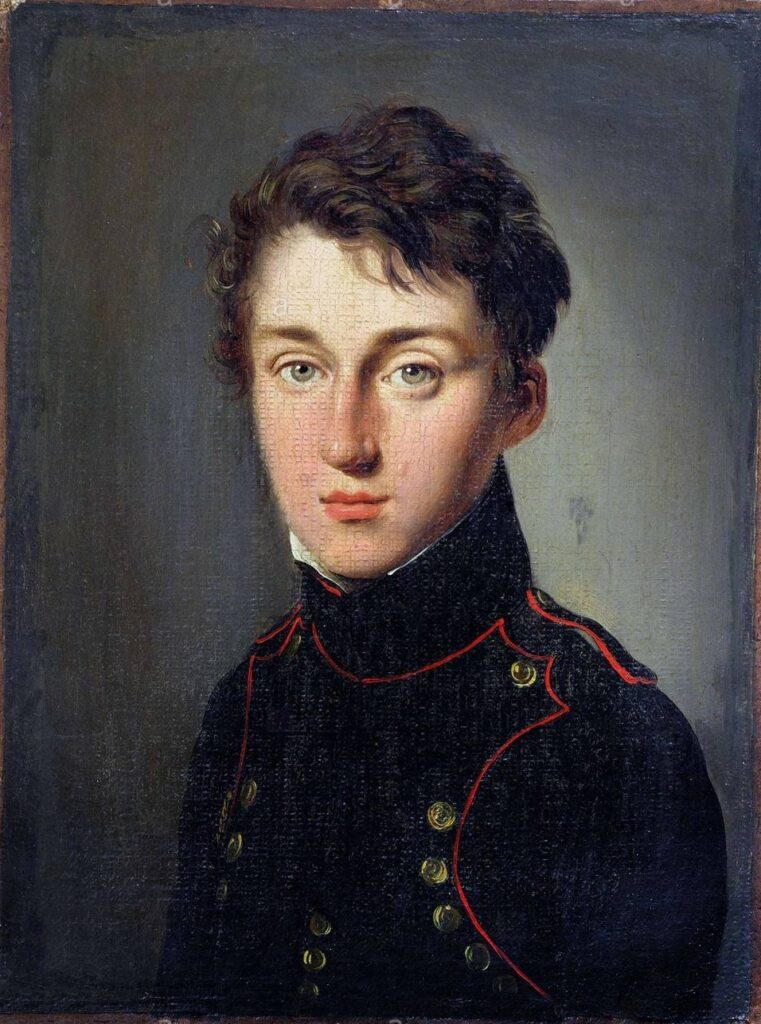
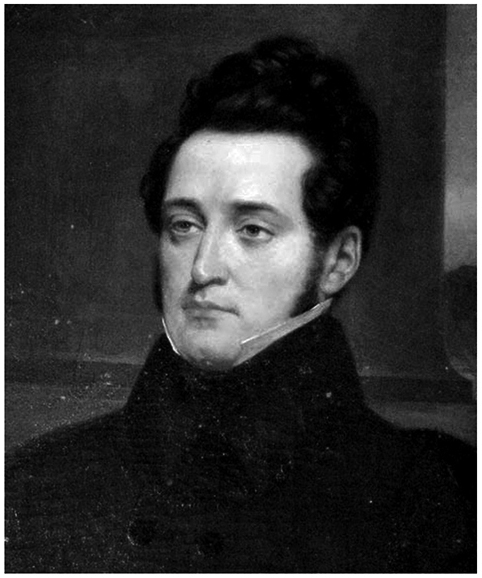
1. Introduction
Hippolyte Carnot (1801-1888) had neither the glory of his father Lazare Carnot (1753-1823), the « Organizer of Victory » of Year II, nor the renown of his brother, the inventor of thermodynamics Léonard Sadi Carnot (1796-1832), nor the tragic fate of his son, François Sadi Carnot (1837-1887), President of the Republic assassinated by an anarchist in Lyon.
History retains almost exclusively his magnificent « Memories on Lazare Carnot by his son », in which he recounts the actions, ideas and life of his father, the « great Carnot », scientific mind, poet, fervent republican and Minister of War.
Hippolyte remains little-known, despite the fact that his long life (87 years), slightly longer than Victor Hugo‘s (83 years), spans almost an entire century (1801-1888), and that his work and influence are considerable.
As is amply demonstrated by « Hippolyte Carnot et le ministère de l’Instruction publique de la IIe République » (PUF, 1948), written by his son, the physician Paul Carnot (1867-1957), he was much more than a mere observer or commentator on events.
2. In the storm
The 19th century was a period of profound change. The flame of hope kindled by the American and French Revolutions, the ideal of liberty, fraternity and emancipation of individuals, peoples and sovereign states alike, proved unquenchable, and was affirmed and extended throughout the 19th century. The long march towards a new paradigm was fraught with pitfalls. Changes took place slowly, against a backdrop of brutal crises and violent ruptures.

During his lifetime, Hippolyte Carnot (1801-1888) was directly or indirectly involved in :
Two Empires:
1803-1814: First Empire under Napoleon Bonaparte
1852-1870: Second Empire under Napoléon III
Three Monarchies:
1814-1815: First Restoration under Louis XVIII
1815-1830: Second Restoration under Charles X
1830-1848: July Monarchy under Louis-Philippe, Duc d’Orléans.
Two Republics:
1848-1852: Second Republic
1870: Third Republic
Three Revolutions expressing popular republican fervor:
1830 (Trois Glorieuses) ;
1848 (uprisings) ;
1871 (Commune).
In an ever-changing environment, through revolutions, coups d’état, monarchies, empires or republics, wars and trials, the man who was (too) briefly Minister of Public Instruction in 1848, a friend of Victor Hugo and Jules Ferry, Hippolyte was a nation builder and an inspiration.
Philosopher and journalist, memoirist and minister, Freemason and believer, political exile and member of parliament, senator and member of the Académie, he took part in all the battles for public and private freedoms, laid the foundations for teacher training and free, compulsory schooling, including kindergarten, created the forerunner of the ENA and defended the most advanced causes (schooling for girls, universal suffrage, the fight against slavery and the abolition of the death penalty).
Rémi Dalisson, in a fascinating and richly documented biography entitled « Hippolyte Carnot 1801-1888. La liberté, l’école et la République », published by the French CNRS in 2011, with supporting evidence, points out that « the vulgate of Jules Ferry as the inventor of the republican and secular school has been widely debunked ».
Given that Hippolyte‘s name, let alone his work, is nowhere to be found on the Ministry’s website, the author laments that « few people, including those at the Ministry of Education, pay tribute to the role and personality of Hippolyte Carnot« .
The anthologies of founding texts and speeches of the republican school, which have proliferated in recent years, systematically forget him.
« It is therefore an injustice and an oversight that we are repairing by tracing the life and work of Hippolyte Carnot, which go far beyond his educational projects and achievements. Through his stature, his training, his career, his ideas, his writings and his battles, this man of many talents will enable us to retrace the history of the construction of the school and therefore of society in the 19th century (…) And as this question refers to the political, social, even economic and cultural question of the nation, and as the minister was involved in all the philosophical battles of his century (…) it is largely the history of a century that will be evoked (…) ».
The full text of this magnificent biography is available free of charge on the Internet, and we have drawn heavily on it to write this text.
3. From charity to universal schooling
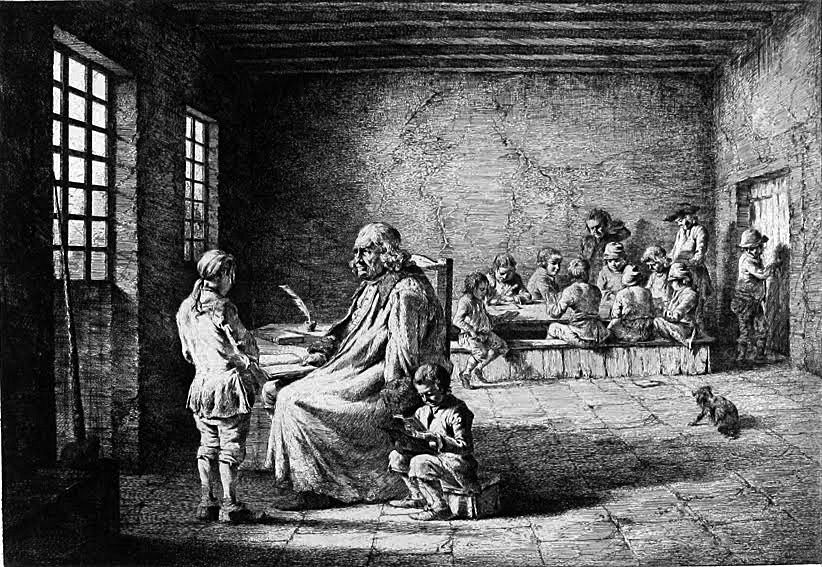
In order to fully appreciate the fundamental contribution of Lazare Carnot‘s ideas, and of their initial implementation by his son Hippolyte, a brief history of schooling in our country is in order.
Educating a handful of more or less talented children? We knew how to do it, especially since the tasty advice of the great Renaissance pedagogues (Vittorino da Feltre, Alexandre Hegius, Erasmus of Rotterdam, Juan Luis Vivès, Comenius, etc.). But organizing compulsory, secular and free education for an entire nation, boys and girls alike, remained an enormous challenge.
And as the following chronology shows, the road to universal schooling was strewn with many pitfalls.
In France, from the 16th century onwards, the royal state entrusted the Catholic Church (Jesuits, Oratorians and Brothers of the Christian Schools) with the task of educating state officials and the children of the nobility: only wealthy families could afford to pay a tutor for their own children, while the others, often described as « not suited to study », remained essentially illiterate.
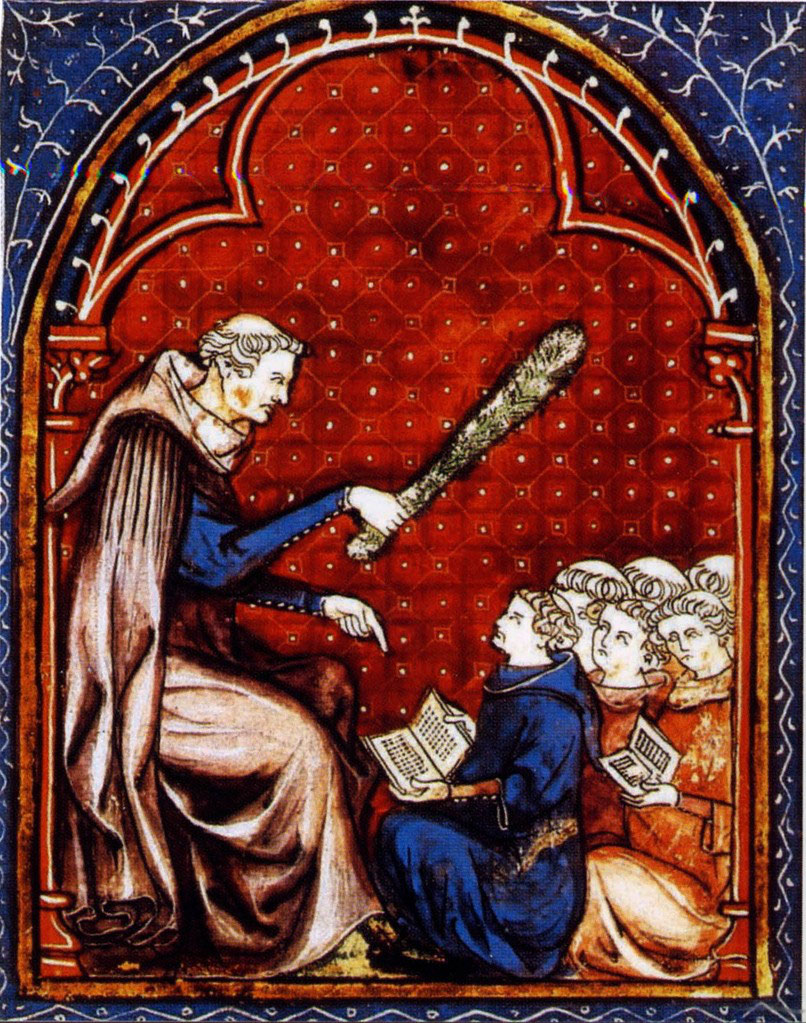
In the 17th century, holy men, moved by the great misery of the children of the people, founded teaching orders to take in orphans and abandoned children free of charge. Their teaching was primarily religious, but they also provided them with food, basic education and basic writing and arithmetic skills. In the 18th century, women’s congregations took in poor girls in the same way.
Whatever his real motives, in 1698, following the revocation of the Edict of Nantes in 1685, Louis XIV ordered every village community or parish to open a school, whose teacher had to be a Catholic priest. This was the first time the state considered providing education for rural children.
Literacy figures at the end of the Ancien Régime show the scope and limits of the work accomplished. At that time, an estimated 37% of French people were literate enough to sign their marriage certificate, compared with 21% a century earlier. Female education progressed slowly, with around a quarter of women literate, many of them only in very basic terms. There were major disparities between town and country.
4. Malebranche and the Oratorians
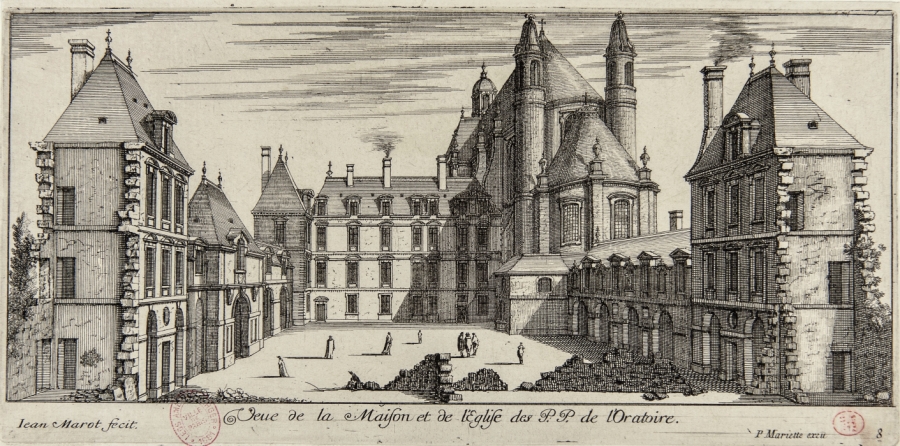
Among the congregations, the Oratorians have been the exception since 1660, under the influence of the philosopher and theologian Nicolas Malebranche (1638-1715), who became its director. Breaking away from the Aristotelianism of the Jesuits and the dualism advocated by René Descartes, Malebranche, who had become an honorary member of the Académie des Sciences, was to be won over to the optimistic vision of the great German scientist Wilhelm Gottfried Leibniz through a sustained exchange of letters. Reconciling science and faith, on the metaphysical level his god is a wise and reasonable God, always respecting his essence and the laws of order he generates. His perfection lies above all in his function as legislator, identified with wisdom or reason, rather than arbitrary power.
Two examples demonstrate the excellence of their teaching: Gaspard Monge and Lazare Carnot, two great scientific minds and future co-founders of the Ecole Polytechnique. Convinced that the political, economic and industrial future of the Republic depended on it, they led the fight to ensure that the best possible education was available to all, not just the privileged few of whom they were a part.
The son of a Savoyard merchant, Gaspard Monge (1746-1818) studied at the Collège des Oratoriens in his native Beaune. From the age of 17, he taught mathematics at the Oratoriens de Lyon, then in 1771, mathematics and physics at the École de Génie established in Mézières. That same year, he came into contact with the physicist Jean Le Rond d’Alembert (1717-1783) and corresponded with the mathematician Nicolas de Condorcet (1743-1794), who encouraged him to submit four dissertations, one in each of the fields of mathematics he was studying at the time. It wasn’t long before his talents as a geometrician came to the fore: at the Ecole de Génie, he invented « Descriptive Geometry », which became part of the school’s curriculum and was essential to the industrial revolution just around the corner…
As for the future General Lazare Carnot (1753-1823), son of a Burgundian notary, after studying at the Oratoriens d’Autun (1762), he too entered the École du Génie de Mézières (1771), where he was taught by Gaspard Monge.
5. The Revolution of the Mind (1789)
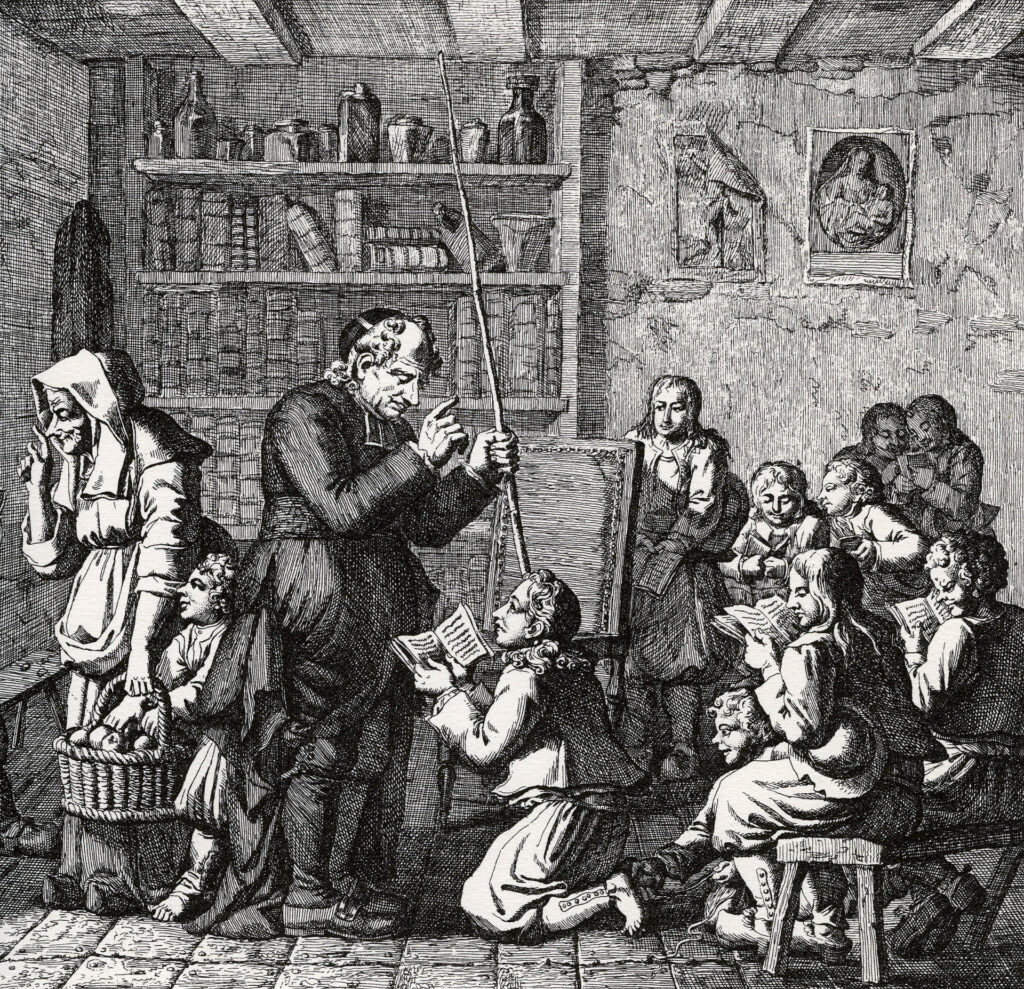
In 1789, the Revolution turned the situation upside down. On February 13, 1790, all religious corporations and congregations were abolished by decree, and religious were ordered to swear an oath to the revolution. The all-powerful Church was totally challenged, and the few education that existed collapsed.
In a break with the Ancien Régime, the Constitution of 1791 asserted that « public instruction common to all citizens shall be created and organized. » A report and draft law were presented by Talleyrand (1754-1838) on September 10, 1791.
His Rapport sur l’Instruction publique, drafted in reality with contributions from some of the greatest scientists of the time (Condorcet, Lagrange, Monge, Lavoisier, La Harpe), represented a real break with the way education had been conceived under the Ancien Régime. It poses the question of public education in new terms, both in terms of principle (public education is presented as a political, social and moral necessity, and therefore as something the State must guarantee to its citizens) and in terms of form.
The plan encompassed the entire national education system, which was organized on four levels and whose establishments were distributed across the country according to administrative divisions. It laid the foundations for free education for all, including girls (separate schools and curricula), and specified that « the first elements of the French language, both spoken and written, will be taught ». In 1794, the jurist Bertrand Barère de Vieuzac (1755-1841) specified: « We will teach French to populations that speak Bas-Breton, German, Italian or Basque, in order to put them in a position to understand republican laws, and to attach them to the cause of the Revolution. » Due to lack of time, the bill was not passed.
In the bill, Talleyrand proposed the creation of an elementary school in each municipality. The Constituent Assembly had just established the territorial organization that is still in place today. The decree of December 14, 1789 had just created 44,000 municipalities (on the territory of the former « parishes »), which became « communes » in 1793. The law of December 22, 1789 created the départements, and the decree of February 26, 1790 set their number at 83.
6. The « Committee of Public Instruction » (1791)
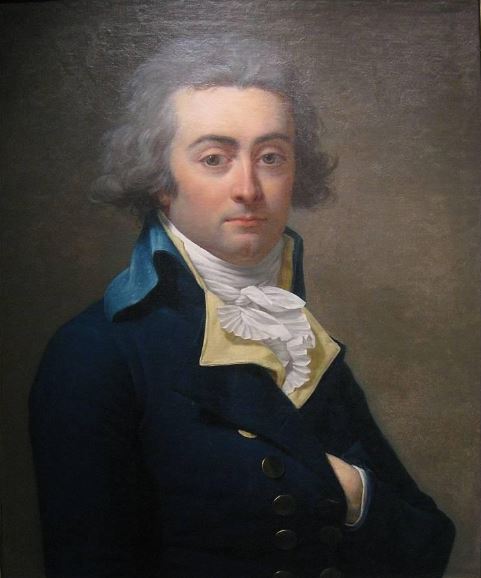
A month after Talleyrand’s report, on October 14, 1791, the National Legislative Assembly created its first « Committee of Public Instruction », of which the mathematician and philosopher Nicolas de Condorcet (1743-1794) was elected president and lawyer Emmanuel de Pastoret vice-president. The other members were future general Lazare Carnot, deputy Jean Debry, mathematician Louis Arbogast and politician Gilbert Romme.
Condorcet also presided over one of the three sections, dealing with the general organization of public education. On March 5, 1792, he was appointed rapporteur for the draft decree on the general organization of public education that the committee was to present to the Assembly.
Educated at the age of 11 at the Jesuit college in Reims, he was sent to the Collège de Navarre in Paris at the age of 15. Throughout his life, he retained painful memories of this primarily religious education, which he criticized for its brutality and humiliating methods. His indignation led him to imagine a totally different approach. In 1791, in La Bibliothèque de l’homme public (The Public Man’s Library), he published five memoirs on public education, constituting a veritable plan.
They formed the basis of the project he drafted for the Legislative Assembly, and were approved by the Committee of Public Instruction on April 18 and presented to the National Assembly on April 20 and 21, 1792.
7. Condorcet and the « American Party »
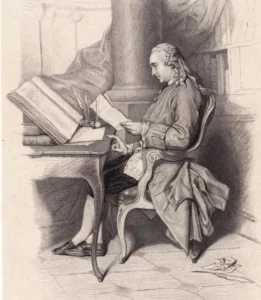
A hagiographer of the physiocrat Anne Robert Jacques Turgot (1727-1781), while criticizing the sectarianism of the « economists », Condorcet, in terms of economics, largely shared his Physiocratic worldview, notably the establishment of a tax on agricultural income alone, considered to be the nation’s sole source of wealth, with industry seen as a « sterile » category of the national economy (see my article dealing with Karl Marx’s errors).
For the Physiocrats, great defenders of the land rent that made them fat, the enemy to be fought was the centralized, dirigiste and mercantile state that Jean-Baptise Colbert, following in Sully’s footsteps, had begun to set up.
This did not prevent Condorcet, more courageous than many of his generation, from taking center stage in openly supporting the American Revolution in its fight for dignity and emancipation against the horrors of the British Empire: slavery, the death penalty, human and women’s rights.

Although a friend of Voltaire, Condorcet wrote a vibrant eulogy of Benjamin Franklin. A friend of the influential English pamphleteer Thomas Paine, in 1786 he published « De l’influence de la Révolution d’Amérique sur l’Europe », dedicated to La Fayette. In this vibrant plea for democracy and freedom of the press, Condorcet considers that American Independence could serve as a model for a new political world. Along with Paine and du Chastellet, Condorcet contributed anonymously to an intermittent publication, Le Républicain, which promoted republican ideas. At the time, there were only a few states in the world known as republics (the Swiss cantons, Venice and the United Provinces, among others). Condorcet later had an argument with the second President of the United States, John Adams, whose encyclopedists scorned his proposal for a bicameral parliament.
Condorcet also made friends with the American president Thomas Jefferson, who promoted and published Condorcet’s writings in favor of the physiocrat Turgot in order to make them known in America. On July 31, 1788, Jefferson wrote to James Madison: « I am also sending you two little pamphlets by the Marquis de Condorcet, in which is the most judicious judgment I have ever seen on the great questions which are agitating this nation at this moment ». These were « Lettres d’un Citoyen des États-Unis à un Français et des Sentiments d’un Républicain ».
While in Paris, Jefferson frequented Mme de Condorcet’s cosmopolitan salon. Before returning to America, he received his closest friends one last time at his home, the Hôtel de Langeac: Condorcet, La Rochefoucauld, Lafayette and key organizer, Governor Morris.
After Jefferson’s return to America, Condorcet continued his dialogue with the American Secretary of State in Washington. On May 3, 1791, he sent him a copy of the report on the choice of a unit of measurement, presented by Borda, Lagrange, Laplace, Monge and himself to the Académie des Sciences on March 19, and subsequently submitted to the Assemblée nationale on the 26th. Indeed, it was a matter of common interest: on July 4, 1790, Jefferson had presented his Report on Weights and Measures to the American Congress, a copy of which he had sent to Condorcet. It was the same faith in progress that encouraged both men to support the idea of a universal, decimal system of measurement.
In a letter, Jefferson informed Condorcet of the work of a black American mathematician and astronomer, Benjamin Banneker, author of an almanac, of which he had sent him a copy. In his « Réflexions sur l’esclavage des nègres » (Reflections on Negro Slavery), Condorcet, though a staunch abolitionis, had expressed himself in favor of a gradual abolition of slavery, in the same way as Jefferson did in his « Notes on the State of Virginia ».
Jefferson oscillated in his positions, attributing the inferiority of blacks sometimes to natural causes, sometimes to the effects of slavery, while Condorcet – in agreement with Franklin – had always been convinced of the natural equality of all men.
In reality, the very man who became the third president of the United States owned over 600 slaves during his adult life. He freed two slaves during his lifetime, and five more were freed after his death, including two of his children from his relationship with his slave Sally Hemings. After his death, the remaining slaves were sold to pay off the debts of his estate.
Jefferson strongly opposed the « Federalists » like Alexander Hamilton, who promoted a strong federal state, Colbert-style economic dirigisme and mercantilism. Condorcet was to encourage Jefferson in his project of « agrarian democracy », the physiocratic vision of the great landowners that would become, until the arrival of Abraham Lincoln and his advisor Henry Carey, the ideology of the American Republican Party.
8. The « Condorcet » Plan
Progress of science and reason will lead to the happiness of societies and individuals, according to Condorcet. In Esquisse d’un tableau historique des progrès de l’esprit humain, he writes:
« Our hopes, concerning the future state of the human species, can be reduced to these three important points: the destruction of inequality between nations, the progress of equality within the same people; finally, the real perfection of man. »
Preferring « L’Instruction publique » to national education, he dreamed of an education totally independent of the State and free of dogmatism:
« Public authority cannot, even on any subject,
have the right to teach opinions as truths; it must not impose any belief. »
(Sur l’instruction publique, first memoir, 1791).
Outlining secular principles, for Condorcet, « the principles of morality taught in schools and institutes will be those which, founded on our natural feelings and on reason, belong equally to all men. »
At the National Assembly, he received massive applause when he declared :
« In these schools, the primary truths of social science will precede their applications. Neither the French Constitution nor even the Declaration of Rights will be presented to any class of citizens as tables descended from heaven, to be worshipped and believed. Their enthusiasm will not be based on the prejudices and habits of childhood; and they will be told: ‘This Declaration of Rights, which teaches you both what you owe to society and what you are entitled to demand of it, this Constitution which you must uphold at the expense of your life, are but the development of those simple principles, dictated by nature and reason, whose eternal truth you learned to recognize in your early years.
This Bill of Rights, which teaches you both what you owe to society and what you have the right to demand of it, this Constitution, which you must uphold at the cost of your life, is but the development of those simple principles, dictated by nature and reason, whose eternal truth you learned to recognize in your early years. As long as there are men who do not obey their reason alone, who receive their opinions from a foreign opinion, in vain will all chains have been broken, in vain will these command opinions be useful truths; the human race will no less remain divided into two classes, that of men who reason and that of men who believe, that of masters and that of slaves.' »
For those standing behind the Condorcet plan, the aim was to ensure the development of each individual’s abilities, and to strive for the perfection of humanity. His project proposed the creation of 5 categories of establishments:
- elementary school for civic and practical education ;
- secondary schools, with a focus on mathematics and science;
- institutions, providing training for primary and secondary school teachers in each département, and general education for pupils;
- lycées, training teachers and those « destined for professions in which great success can only be achieved through in-depth study of one or more sciences »;
- the Société nationale des sciences et des arts, whose mission was to manage schools, enrich cultural heritage and disseminate discoveries.
The plan was also characterized by the equality of ages and sexes in education, universal and free elementary education, and the freedom to open schools. Last but not least, religion was to be confined to the private sphere.
The project did not forget « the people », as weekly and monthly lectures for adults were intended to « continue education throughout life », an ambition taken up by Abbé Grégoire and Hippolyte Carnot.
As his son Paul Carnot recounts:
« In its short existence, the Constituent Assembly had only been able to pass on Talleyrand’s famous report to the Convention. After the no less famous reports by Condorcet and Lakanal, and the discussions of its Education Committee (almost as active as the Public Safety Committee), the Convention proclaimed the principles of compulsory, free and secular primary education, which are still ours today. The Declaration of the Rights of Man (art. XXII) proclaimed, with Robespierre, ‘Instruction is the need of all; society must favor, with all its power, the progress of public reason and put Instruction within the reach of all citizens’. »
Rarely were all parties in agreement on these points. The Girondins (Condorcet, Ducos) said, along with François Xavier Lanthenas (1754-1799), that « instruction is the State’s first debt to its citizens. »
On the subject of free education, Georges Danton said: « No one has the right not to educate his children. There is no real expense where there is a good use for the public interest. After bread, education is the first need of the people.
But the program of public education leading to the perfectibility of mankind thanks to reason, had not the chance to become a priority, as King Louis XVI, at the suggestion of General Dumouriez, went to the National Assembly to propose declaring war on Austria… Added to that, money for education wasn’t available.
Condorcet had to interrupt the lecture of his project. At the end of the afternoon of April 20, 1792, the Assembly adopted the declaration of war against the King of Bohemia and Hungary, unanimously minus seven votes. The following day, Condorcet completed the reading of his project. The Assembly decreed that the report be printed, but postponed discussion of it.
On May 24, Romme, on behalf of the Committee of Public Instruction, requested in vain that discussion of the report be placed on the agenda. Condorcet’s project, like Talleyrand’s report, did not have time to be debated, and was not adopted.
9. The battle under the « Convention » (1792-1795)

The protagonists of Year I (under the Convention) were hardly more decisive. A new Committee of Public Instruction was set up. It included Abbé Henri Grégoire, abolitionist and close friend of Lazare Carnot and later of his son Hippolyte, and Joseph Lakanal (1762-1845).
On December 12, 1792, Marie-Joseph de Chénier (1764-1811) read Lanthénas’s proposals, which echoed the ideas of Talleyrand and Condorcet. The discussions were fruitless, and the project was swept aside by Marat. Marat exclaimed that day:
« However brilliant the speeches we hear here on this subject may be, they must give way to more urgent interests. You are like a general who would amuse himself by planting and removing trees to feed starving soldiers. I ask that the assembly order the printing of these speeches, to attend to more important objects. »
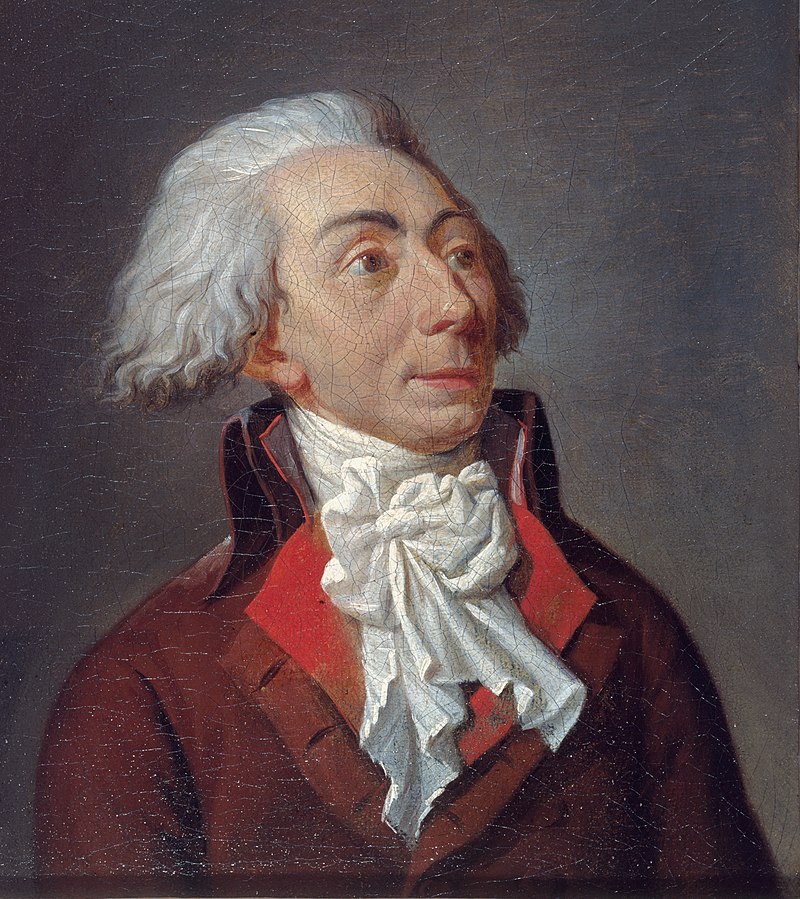
The following year, Robespierre opted for a national education plan devised by Lepeltier de Saint-Fargeau (1760-1793). According to this plan, presented by Robespierre himself on July 13, 1793, education without a healthy dose of republican ideology would not suffice to regenerate the human race. It is therefore up to the State to inculcate a republican morality, by taking charge of the common education of children between the ages of 5 and 12.
On January 21, 1793, the King was beheaded. While Carnot, who only backed the decision to prevent any possible return to power of the Monarchy, Condorcet, who was opposed to the death penalty on principle, opposed it.
Debates on public education were delayed. It was not until the end of the year that compromise legislation on the organization of elementary school came into being, making education compulsory and free for all children aged six to eight, and establishing the freedom to all to open schools. The decree of December 19, 1793 stipulated that primary schools were the first level of instruction, teaching the knowledge strictly necessary for all citizens, and that those responsible for teaching in these schools would henceforth be called « instituteurs » (teachers). This decree was only partially implemented.
1794 saw a profusion of legislative texts on the subject including the decree of January 27, 1794 which imposed the use of the French language in all education.
On October 21, 1794, another decision organized the distribution of the first schools in the communes.
On October 30, at the instigation of Dominique Joseph Garat, Joseph Lakanal and the Comité d’Instruction Publique, the first « Ecole Normale » was created to train teachers. The law stipulated that « a teacher training college would be established in Paris, to which citizens from all parts of the Republic who were already educated in the useful sciences would be called, to learn the art of teaching under the most skilful teachers in all disciplines ». The school, planned for some 1,500 students, was set up in an amphitheatre at the Muséum national d’histoire naturelle, which was too small to accommodate the entire class. Although the school was soon closed, it nevertheless attracted a number of brilliant teachers, including the scientists Monge, Vandermonde, Daubenton and Berthollet.
On November 17, 1794, Lakanal had a law passed making education free, with the Republic providing salaries and housing for teachers, and authorizing the creation of private schools.
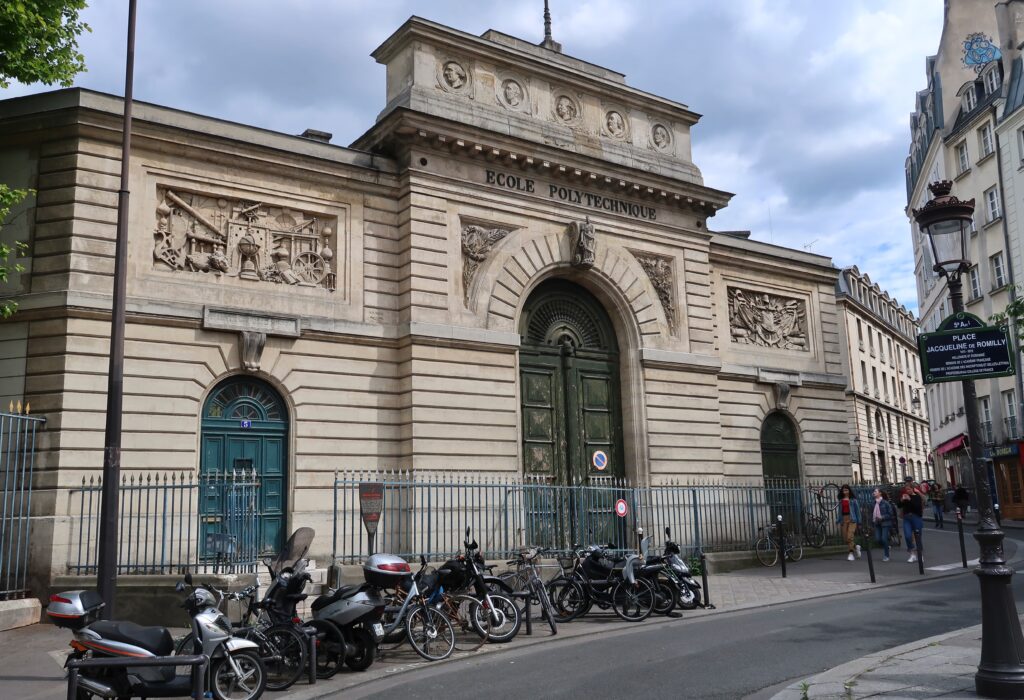
Also in 1794, Jacques-Élie Lamblardie, Gaspard Monge and Lazare Carnot, the institution’s founding fathers, were given the task of organizing a « Ecole centrale des travaux publics », renamed the « École Polytechnique » in 1795 by Claude Prieur de la Côte d’Or, not only to alleviate the shortage of engineers in post-Revolution France, but to create, by intensive training in projective geometry, a generation of scientific geniuses.
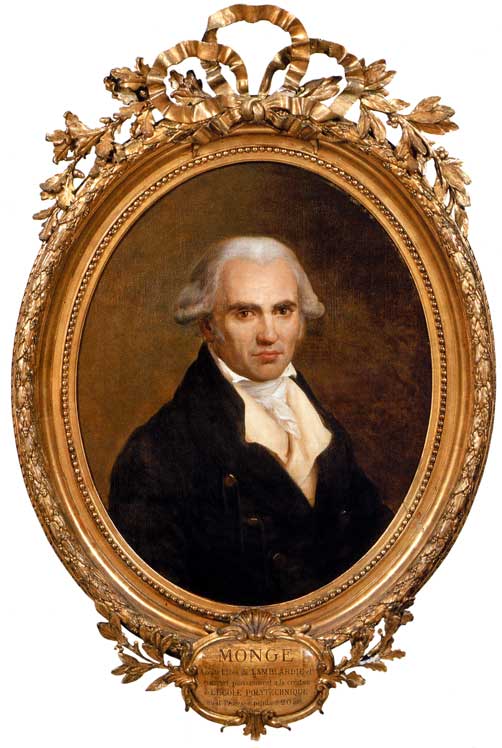
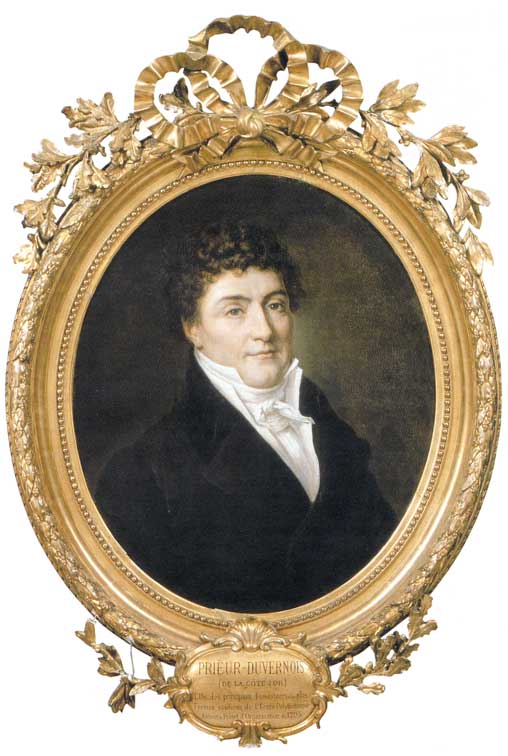
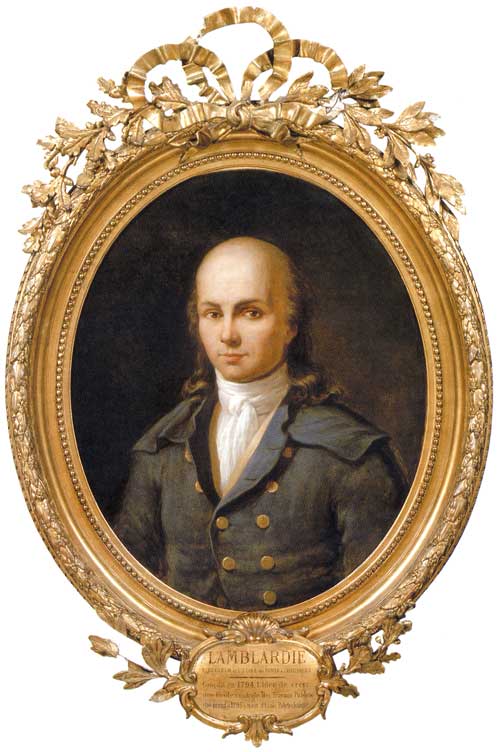
Unfortunately, in terms of universal schooling, the results in 1795 were disastrous: none of the decrees of 1794 had been implemented. Worse still, on October 25, 1795, a new law drafted by Pierre Daunou marked a step backwards: for lack of a budget, education was no longer free, teachers had to be paid by pupils (and their wealthy relatives), and the school curriculum was poor. This law remained in force until Napoleon’s texts on secondary and higher education in 1802. While it abandoned compulsory and free education, it did call for the creation of one elementary school per canton and secondary « central schools » in each département.
The new authorities set deadlines for municipalities to organize schools. They sent special envoys to see whether municipalities were taking the necessary steps to find and install a teacher.
In the towns and cities, the administration managed to recruit a certain number of candidate teachers, but in the countryside, the list often remained empty. In addition to the problem of recruitment, local authorities were faced with the problem of money, furniture, heating and books. Practising teachers complained about the shortage of pupils, as the republican school aroused mistrust. When the teacher ventured to replace the catechism and the Gospels with the Constitution and the Rights of Man, parents, encouraged by resistant priests, preferred to keep their children at home. The Comité d’Instruction Publique was inundated with questions, suggestions and requests.
On November 17, 1795, Lakanal had a new law passed by the Convention. Education remained free but not compulsory. It guaranteed a fixed salary and pension for teachers, and provided them with premises and housing. It authorized all citizens to set up private schools.
10. Lazare Carnot during the Cent-Jours (The Hundred Days)
On November 9, 1799, Bonaparte fomented a coup d’état and established the Consulate regime. As First Consul, he signed the Concordat with Pope Pius VII on July 16, 1801, abolishing the 1795 law separating Church and State.
Seizing the opportunity of the moment, and above all seeking to respond to immediate needs, the Minister of the Interior, the republican chemist and industrialist Jean-Antoine Chaptal (1756-1832), submitted to Bonaparte a project for the organization of secondary education, entrusted in particular to the Oratorians of Tournon. In 1800, he presented his « Rapport et projet de loi sur l’instruction publique » (Report and draft law on public education).
Recalled by the First Consul, Lazare Carnot was given the War portfolio, which he held until the conclusion of the Peace of Amiens in 1802, after the battles of Marengo and Hohenlinden.
An early revolutionary, but also a moderate and republican, he voted against the Consulate for life, then was the only speaker to vote against the Empire on May 1, 1804.
From then on, deprived of all political influence, he refocused on the Académie des Sciences. In 1814, he was entrusted with the defense of Antwerp, a city of which he became mayor: he held on for a long time, and only agreed to hand over the city on the orders of Louis XVIII.
But a few months later, the Emperor returned to power for the Hundred Days, from March to June 1815. It was at this point that Lazare, who had finally been threatened with arrest to the point of hiding out on rue du Parc-Royal, was appointed Minister of the Interior on March 22, 1815. And as this ministry included Public Instruction in its remit, he was able to launch the educational project that was so close to his heart.
Three days after his installation at the Ministry, Lazare Carnot commissioned a study on education. It was inspired by the work of the « Société d’encouragement pour l’industrie nationale », headed by philanthropist Joseph Marie de Gérando, who had also been educated by the Oratorians in Lyon and was a proponent of Mutual Tuition.
Carnot and his faction then founded the « Société pour l’Instruction Elémentaire » (SIE) to promote this type of education. For Carnot and Grégoire, education and instruction should « elevate all individuals of the human species to the dignity of Man », educate as much as moralize, and spread love among men.
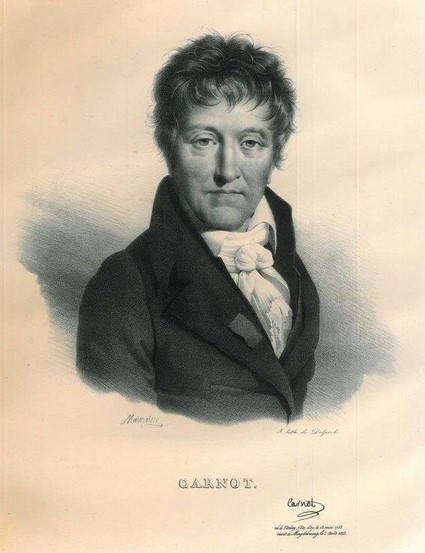
During the Hundred Days, Carnot had just enough time to prepare, in April 1815, a « comprehensive plan for popular education », followed by a decree and the creation of a Special Commission for Elementary Education, tasked with outlining prospects in this area, drawing inspiration from English and Dutch models.
Familiar with the « brigades » invented by Gaspard Monge at Polytechnique, where the best students supervised the others, Carnot was in favor of the system of mutual tuition in popular schools. For him, the issue was not alleviating the suffering of the poor or avoiding social chaos, but educating every citizen of the Republic, whatever his conditions, to have a functial Republic. After spreading to England and Switzerland, Carnot established mutual tuition in France. Convinced of the importance of music and linear drawing, he wanted pupils to be taught it.
With this in mind, he met several times with Alexandre-Étienne Choron (1771-1834), who had also been educated by the Oratorians, and brought together a number of children to perform several pieces learned in very few lessons. Carnot had also known the pedagogue Louis Bocquillon, known as Wilhem (1781-1832), for ten years. He also saw the possibility of introducing singing into schools, and together they visited the Mutual Tuition pilot project on rue Jean-de-Beauvais, which had opened in Paris to three hundred children. Starting from there, Wilhem created the mass musical movement known as « Orphéons ». (see article by Christine Bierre)
11. Hippolyte carries on the Torch
Lazare, a pupil of Gaspard Monde and a scientific mind of the highest order, had strong ideas about education that would shape the personalities of his sons, notably Hippolyte, the future Minister of Public Instruction in the Second Republic. For the two Carnots,
« all social institutions must aim at the physical, intellectual and moral improvement of the largest and poorest classes ».
More than « full heads », he aspired to turn his sons into « well-made heads », « to let us know the taste of good things rather than make us infallible about the meaning of words », in the words of his younger son. For Lazare, it was a matter of putting to the test in the family the educational principles he advocated for the nation.
Although he had little interest in « dead languages » and was more interested in living ones, Lazare introduced his children to Latin, which was once again a compulsory language in the imperial lycées created in May 1802. For the rest, while their father’s rich library introduced Sadi Carnot and his brother Hippolyte to the classics that were essential to the humanist culture on which secondary education was based, it also introduced them to other, more contemporary and innovative thinkers.
Among them, Hippolyte was interested in those who addressed educational issues, such as Rousseau, but also in more original philosophers like Saint-Simon (whose movement was attractive but became a cult after his lifetime), of whom Lazare Carnot said:
« Here is a man who is called extravagant, yet he has said more sensible things in his entire life than the wise men who scoff at him […]. But he is a very original, very bold mind whose ideas deserve the attention of philosophers and statesmen ». Evoking his father, Hippolyte would later say, « The lessons we received were all intended to make us, like the master who gave them, virtuous without effort, wise without system. »
Lazare Carnot sends Hippolyte to the Polytechnic Institution, 8 avenue de Neuilly. According to Dalisson,
« the young Carnot received a Spartan education where, while discipline did not exclude corporal punishment under the rule of ‘Inspecteurs généraux’, pedagogy was innovative. Pupils were divided into classes according to age, and teaching combined intellectual and physical education through programs that complemented their father’s education. Hippolyte thus perfected his reading, ancient and modern languages, literature, mathematics, physics and geometry, and acquired a taste for chronology, history, drawing, music, fencing and dance, proving himself an excellent student in every respect.«
12. Exile of Lazare Carnot
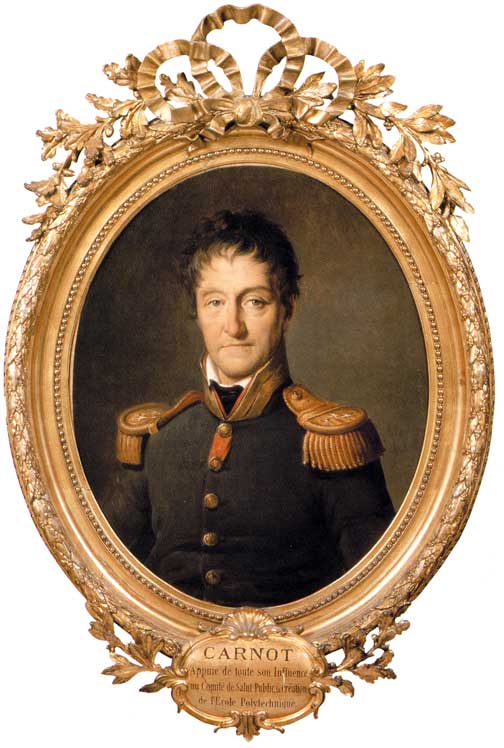
After Napoleon’s second abdication, Lazare Carnot joins the provisional government. Exiled at the time of the Restoration, he was banished as a regicide in 1816 and retired to Warsaw, then to Magdeburg, where he devoted the rest of his life to study and, above all, the education of his children.
Dalisson: « when he’s not at school, he (Hippolyte) serves as secretary to his father, who continues his education ». In Magdeburg, « one of Carnot’s consolations was to complete the education of his young son, whose studies he directed more especially towards historical questions and social economics ». So it was in Prussia that Hippolyte found his way, abandoning the « hard » sciences to devote himself to philosophy in general, and political and social philosophy in particular. There, education had a privileged status since Frederick II had made primary education compulsory in 1763, envisaged a form of free education (for poor families) and created gymnasiums for secondary education. Enough to inspire Carnot père and fils to imagine how France could catch up.
Better still, as Dalisson points out:
« Prussia remains a kingdom which, like France a few years earlier, carried out a « levée en masse » (mass recruitment) in 1813 to drive out the invader. The link between popular education and national sentiment, between education and the economy, between liberalism and national education, is an obvious one, and ties in with the Carnot family’s educational ideals. That’s why, at the [prussian] government’s request, Lazare set up an educational project to create a « vocational school » in this distant host country. With the help of Hippolyte, he set up a complete teaching system for agriculture and industry. Although we have no trace of the text, it undoubtedly influenced the young man as much for his Parisian and liberal years as for his future ministry ».
13. Hippolyte with Abbé Grégoire
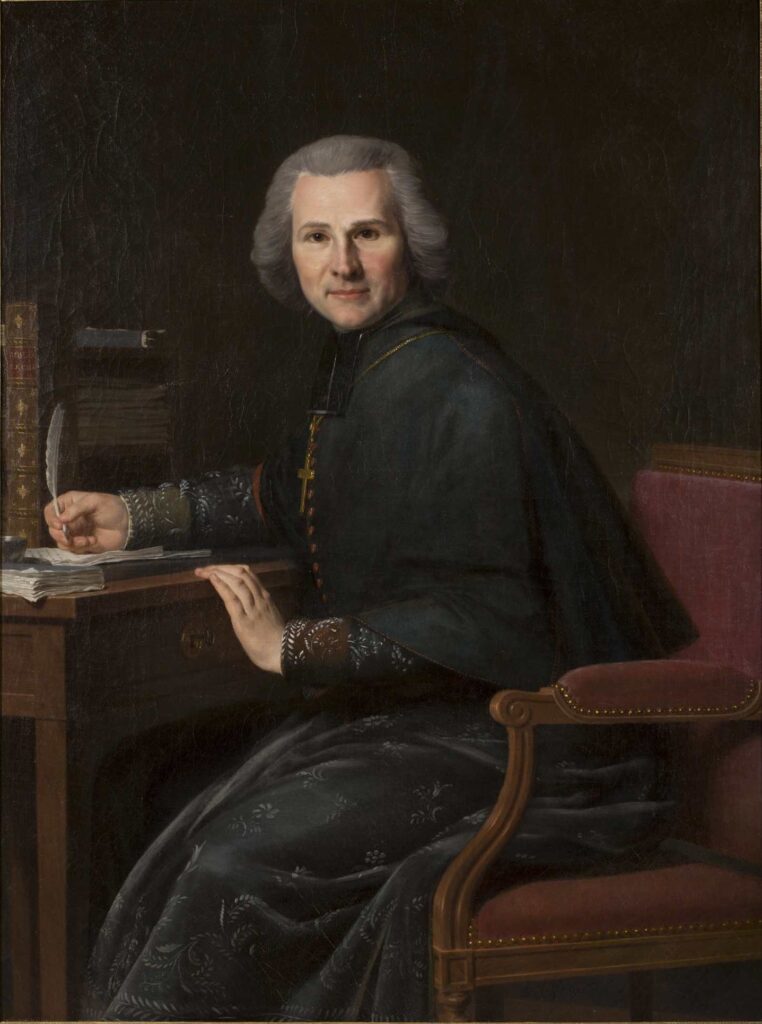
Back in France, Hippolyte contacted his father’s old friends, notably Abbé Henri Grégoire. An emblematic figure in the fight for the emancipation of Jews and blacks, this « revolutionary bishop » called for the total abolition of privileges and advocated universal male suffrage.
In principle, Hippolyte approved. However, in practice, after observing the people’s infatuation with public executions, he discovers how easily a crowd can be led, even manipulated, by playing on irrationality, passion and impulses – all things that make the use of universal suffrage tricky, and can lead to dictatorship. He concludes that popular education must enlighten the people to bring them back to more fraternal and reasonable sentiments.
For Abbé Grégoire, as for Carnot père and fils, slavery must be abolished, nations must free themselves from Empires by recovering their sovereignty, and education must free citizens from ignorance, a set of subjects marvelously brought together in the iconography of the bas-reliefs on the base of the statue of Gutenberg in Strasbourg, a commemorative monument created by a friend of both Grégoire and Hippolyte, after Victor Hugo, the sculptor David d’Angers.
As a member of the Comité d’Instruction Publique, Henri Grégoire called for the generalization of the French language, as the Oratorians had done before him, and became the rapporteur for the abolition of the old academies and the creation of the Institut.
The opening of a whole series of « special schools », such as the Ecole polytechnique (1794) and the Institut des langues orientales (1795), the establishment of the Musée du Louvre (1793), the preliminary project for a Bibliothèque nationale (1790), the creation of the Bureau des Longitudes (1795), the introduction of new units of weights and measures, the metric and decimal systems, the extension of elementary schools to all communes and one of the jewels in the crown of this policy: the founding of the Conservatoire National des Arts et Métiers (1794), owed much of their success to the boundless energy of Abbé Grégoire.
The aim was to transmit technical knowledge to two types of audience. On the one hand, the « grandes écoles », aimed at the country’s new elites, provided high-level education to train scientists and engineers (École polytechnique, Ponts et chaussées, etc.) or the future teachers of the new public education system with the École normale (1794); on the other hand, schools designed for middle management in factories, good workers and workshop managers: this was the case of the écoles d’arts et métiers, heirs to the vocational school imagined in 1780 in Liancourt (60) by the Duc de la Rochefoucauld-Liancourt.
Grégoire also established several major institutions that still exist today, including, in addition to those already mentioned, the Natural History Museum (1793), the Royal Garden of Medicinal Plants (1793) and the Museum of French Monuments (1795).
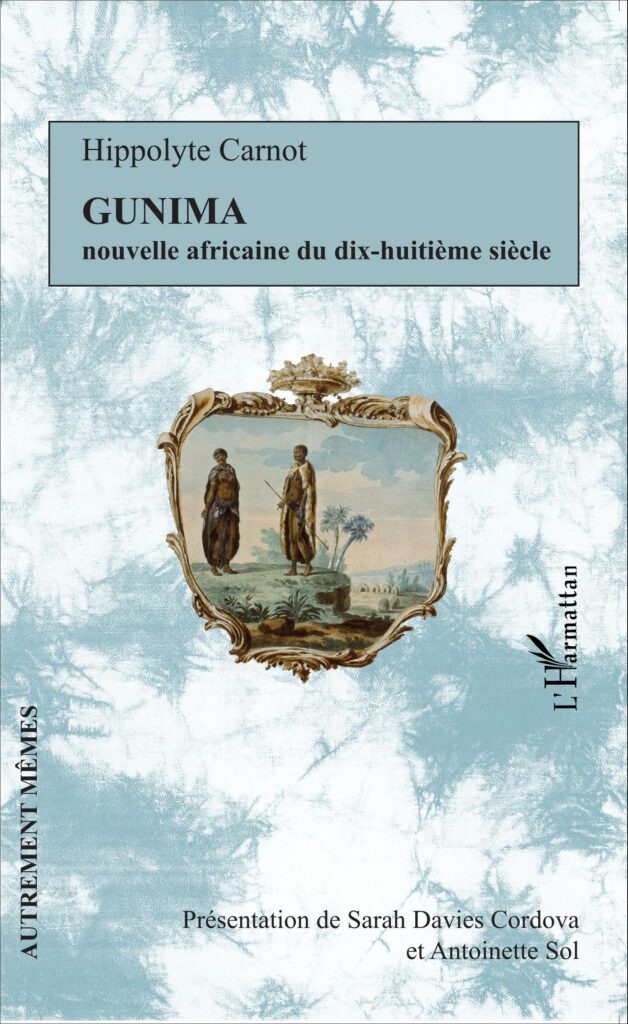
Grégoire introduced the young Hippolyte to the Masonic lodge of which he was a member, Les Philadelphes. Inspired by Grégoire’s struggle, of which he would be the executor and about which he would publish a work towards the end of his life, Hippolyte, barely 23 years old, published « Gunima, an 18th-century African short story » (1824), a philosophical tale recounting the moral education of young Benjamin who, equipped with the principles of the Enlightenment, confronts his prejudices and the injustice of the slave and servitude regime of the so-called Hottentots of the Cape. Surprisingly modern, the story takes up the challenge of fraternity at a time when France was responding to Haiti’s demands for recognition.
True to the philosophy of Abbé Grégoire, he protested against the expulsion of Jews from Dresden, where they were forbidden to stay. Indignant, he tried to alert public opinion: since 1789, Jews have been French citizens like any others. He reaffirmed his faith in freedom of worship, which had enabled the emancipation of the Jews, and exclaimed:
« If we call a Jew someone who, from his mother’s womb, society condemns to the vilest slavery, who vegetates without rights in his homeland and serves as a breastplate for the insults of the rabble, to whom his actions deserve nothing (…) and who is relentlessly pursued by shame and contempt, then I am a Jew and always will be ».
14. Like Schiller, patriot and world citizen
From Dalisson‘s book:
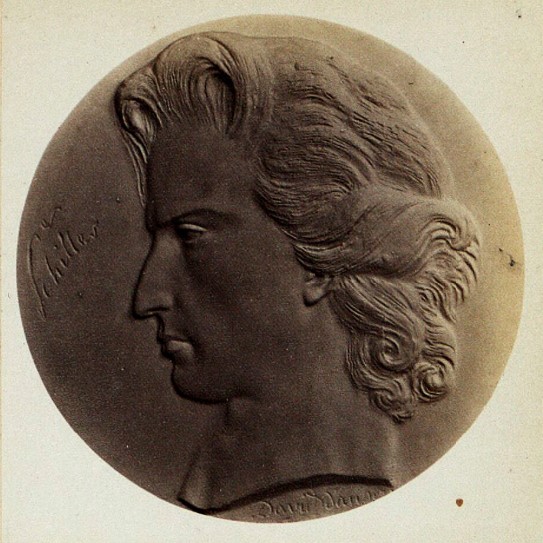
« Carnot’s position is summed up at a celebration in homage to the French Revolution on March 19, 1838 in Paris. In the name of ‘holy equality, solidarity between all peoples and all races of men in a spirit of fraternity’, he toasted ‘the abolition of slavery, the cessation of this awful scandal of humanity’.
« From that day on, he collaborated regularly with Victor Schoelcher, a journalist, Freemason, close to the Saint-Simonians and member of the same societies as himself, whom he would meet again three years later in the government of the Republic, then in exile. Schoelcher had been confronted with slavery in Cuba as early as 1828 and also believed that their emancipation should be gradual, before changing his mind and becoming a supporter of immediate abolition.
« Freedom must also apply to peoples and therefore to nations, because ‘the principle of all sovereignty lies in the nation’. A son of 1789, educated during the struggles for national emancipation, a student steeped in Romanticism, passionate about the revolts of the fifties and thirties before being caught up in the « Spring of the Peoples », Carnot placed his trust in the freedom of nations: « Salvation will come from peoples uniting to overcome the common enemy, despotism. If liberated nations and peoples manage to get along and unite, they will even build ‘United Europe’.
« Throughout the century, he would support all national struggles, and hence national unity, against empires that oppressed minorities. For nationality ‘is the human right proclaimed in 1789, the right to group together according to one’s affinities of character, tradition, race and language, and is basically LIBERTY itself’.
Even after the 1870 war, he was convinced of a kind of « right of peoples to self-determination » in a Europe founded on the freedom of peoples.
In his writings on foreign policy, notes Dalisson, he regularly recalled Friedrich Schiller‘s maxim: « Man is created free, he is free, even if he is born in chains. (…) Do not tremble before the free man. This freedom of peoples and nations must even be based, horresco referens, on the necessary reconciliation between France and Germany, two neighboring peoples who have been separated by the vicissitudes of history, but who are « two friends who have been divided by long quarrels and who need to explain themselves ».
15. The 1830 Revolution
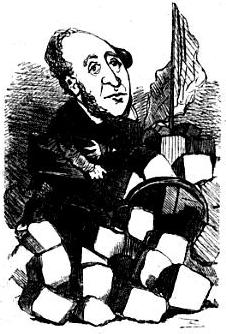
The Revolution of 1830, also known as the July Revolution or the « Three Glorious Days », took place in Paris on July 27-28-29, 1830. Parisians, at that time the foremost revolutianary citizenry, rose up against the reactionary policies of King Charles X’s government. One of them, was Hippolyte Carnot who had transgressed his legendary moderation, took a rifle and joined those on the barricades. The question immediately arose: « What should replace the king? » Many intended to restore the Republic.
On July 30, deputies and journalists in favor of the Duc d’Orléans put up posters recalling the « patriotic » past of the duke, a veteran of Valmy who claimed to be in line with the ideas of George Washington, and his commitment to the future: he would be « a citizen-king ».
Unconditionally, the representatives of the people (95 deputies present in Paris) proposed that the Duc d’Orléans be appointed Lieutenant-General of the kingdom.
On July 31, he accepted the position and went to Hôtel de Ville in Paris, the Republican headquarters. There, before a gathered crowd, he was embraced by La Fayette, both wrapped in the tricolor flag. Lafayette felt that a gradual transition to a republic could only be achieved through a constitutional monarchy. On August 9, the deputies amended the Charter of 1814 to become the constitutional « charter » of 1830, and the Duc d’Orléans was proclaimed « King of the French » under the name of Louis-Philippe I.
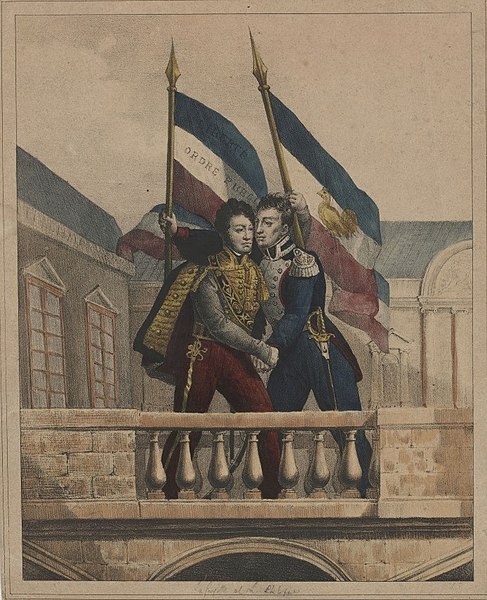
Hippolyte Carnot, always a moderate, believed in « representative democracy » and was elected three times as a deputy under the Monarchy of 1830. A spokesman of the opposition to the regime, he prepared for what was to come.
16. Minister of Public Instruction under the Second Republic (1848)
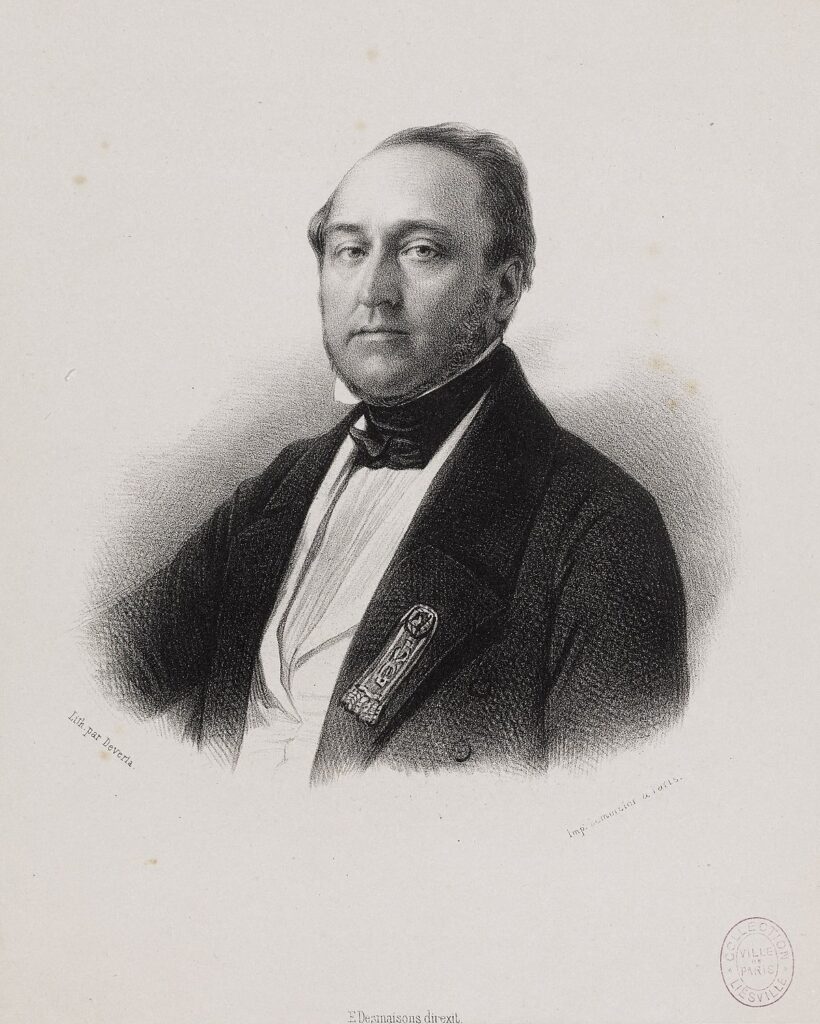
After an initial attempt to re-establish republican values, neutralized by Louis-Philippe’s « Coup d’état » in 1830, the uprisings of 1847-48 succeded in February 1848 with the formation, at Paris City Hall, of the « Provisional Government » led by several friends of Hippolyte Carnot, to establish the « Second Republic ».
The provisional government’s first measures were intended to break with the previous period. The death penalty was abolished in politics. Corporal punishment was abolished on March 12, and « contrainte par corps » (imprisonment for debt) on March 19.
On March 4, a commission was set up to resolve the problem of slavery in the French colonies. Under the aegis of the Minister of Colonies, the Republican astronomer François Arago, a close friend of Alexander von Humboldt, and whose Secretary of State was Victor Schoelcher, its work led to abolition on April 27.
In the political sphere, the changes were significant. Freedom of the press and of assembly were proclaimed on March 4. On March 5, the government instituted universal male suffrage, replacing the censal suffrage in force since 1815. In one fell swoop, the electorate rose from 250,000 to 9 million…
This democratic measure made the rural world, which accounted for three-quarters of the population, the master of political life for many decades to come. Elections for a Constituent Assembly are scheduled for April 9. Lafayette’s National Guard, previously reserved for notables and shopkeepers, was made accessible to all citizens.
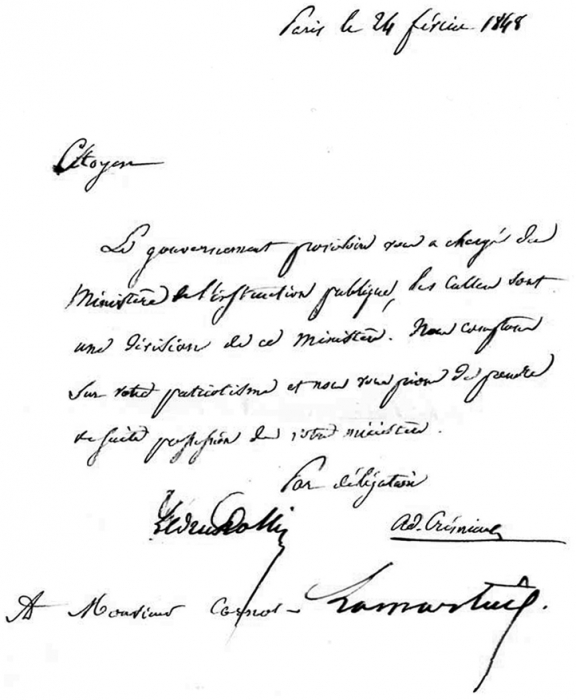
The provisional government proposed appointing Hippolyte Carnot to the Ministry of War or the Interior; he declined the offer, but accepted the Ministry of Public Instruction (which Victor Hugo had just refused), to which was added the Ministry of Religious Affairs, which until then had been the responsibility of the Ministry of Justice. Carnot’s desire to see cults be part of public education was based not only on his lack of hostility to the Church, but also on his belief that a close alliance between the Republic and the lower clergy was the best guarantee of progress.
« I myself, » he wrote, « have religious sentiment too deeply engraved in my heart not to be and not to want those around me to be full of deference towards the ministers of all religions. » And again: « My constant efforts have been aimed at reattaching the lower clergy to the Republic. The minister of religion and the schoolmaster are, in my eyes, the columns on which the republican edifice must rest. »
17. Hippolyte Carnot’s reforms
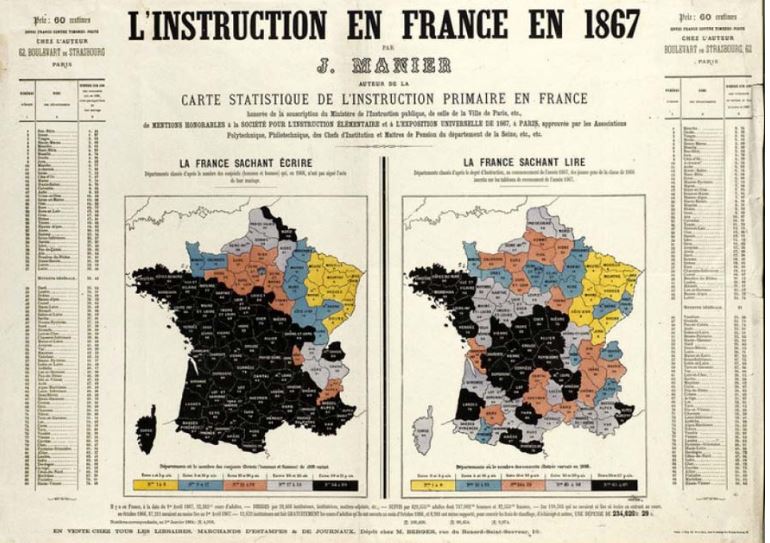
En s’appuyant sur le degré d’instruction des Français à l’âge du mariage, cette carte met en
évidence une grande disparité entre les régions. Ainsi, le taux d’alphabétisation des
habitants du nord et de l’est est-il nettement supérieur à celui des habitants du sud et de
l’ouest. La France alphabétisée est celle des grandes villes, des campagnes riches et des
populations denses.
During his very short ministry, armed with an overall vision that had been carefully thought through and prepared in advance, he announced, sometimes several times a week, republican reforms of all the major areas of education, from early childhood through to adults, including teacher training, senior civil servants and all citizens. Declaring in his preparatory notes that « it is important that the various levels of the education system integrate into each other, leading directly from one to the other ».
A. Nursery schools
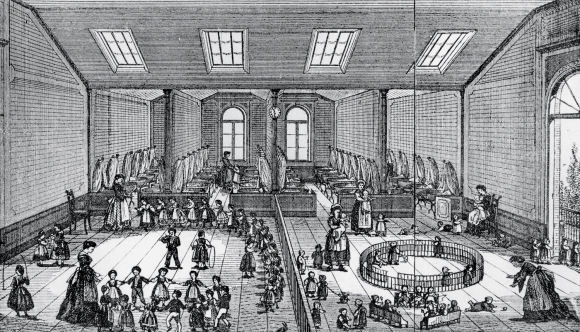
For Carnot, « salles d’asile » were little more than charitable establishments run by nuns. Little was done to educate infants. Their name, reminiscent of misery and almsgiving, was replaced on April 28 by « nursery school ». « The child should find there the education he cannot receive from his mother, i.e. the care of the body, the language of feeling, and those little exercises intended, not yet to furnish the intelligence, but only to open it up ».
In the minds of Jean Reynaud (Under-Secretary of State for Public Instruction) and Carnot, the asylum was neither a school of instruction, nor a place of refuge for children deprived of their parents. At the same time, a « normal nursery school » was set up in Paris, for pupils aged between twenty and forty.
B. Primary schools
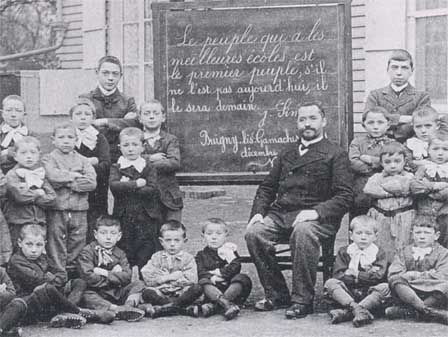
As early as February 27, in a circular to the rectors, Carnot expressed his intention to improve the condition of primary school teachers: « The condition of primary school teachers is one of the main objects of my solicitude…. It is to them that the foundations of national education are entrusted. It is not only important to raise their status through a fair increase in their salaries; the dignity of their function must be enhanced in every way…. Instead of sticking to the education they have received in elementary school, they must be constantly encouraged to improve it… There is nothing to prevent those who are capable of doing so from rising to the highest echelons of our hierarchy. Their lot in terms of advancement cannot be inferior to that of soldiers; their merit is also entitled to conquer ranks… However, to ensure that all are encouraged to emulate each other in such a glorious way, intermediate positions must be guaranteed. This will naturally be achieved by extending the teaching of mathematics, physics, natural history and agriculture to higher elementary school. In the name of the Republic, primary school teachers will therefore be invited to prepare themselves for the recruitment of staff for these schools. This is one of the complements to the establishment of primary teacher training colleges. It is in the interest of the Republic that the doors of the university hierarchy should be opened as wide as possible to these popular magistrates ».
On June 30, the Minister therefore tackled primary education. Before him, the ordinance of February 29, 1816 had marked a turning point. It established a cantonal committee to oversee schools and, in article 14, obliged communes, without giving them the means to do so, to « ensure that the children who live there receive primary education, and that indigent children receive it free of charge ». In short, primary education was left entirely to the communes, which in turn, for lack of premises and resources, called on religious congregations.
The minister therefore proposed « to raise the status of teachers by transforming them from commune officials into state officials », to emancipate them from local potentates, parents and clerics. For « it is certainly necessary that the teacher be accepted in his commune, but if he depends too much on it, he is not considered enough. It is therefore important that he cannot be capriciously dismissed ». With this in mind, he abolished the « certificate of morality », which had tied schoolteachers to the Church and, incidentally, to the government.
In addition to the compulsory schooling (for both sexes and for communes of at least 300 inhabitants) and total free education already mentioned, he wanted to complete the curricula to form a « uniform core curriculum (…) designed to review everything and serve to determine vocations », prefiguring the school of Jules Ferry and going further than just reading, writing and arithmetic.
In addition to national history and geography, several of Carnot’s favorite subjects, singing, natural history and linear drawing – three subjects designed to develop and educate – there are several specific features to be found in the new texts. The first, which would be taken up again thirty years later, is a kind of civic instruction that the Minister describes as « the duties and rights of man and citizen, the development of feelings of liberty, equality and fraternity (…), the basis of a civic education for the republican education of the country ».
Hippolyte had been elected to the Constituent Assembly on April 23, 1848. When, on May 10, 1848, the « Executive Commission » (May 9 – June 28, 1848) replaced the « Provisional Government » (February 24 – May 9, 1848), he retained his portfolio; but the executive, « in order to strengthen the revolutionary element », appointed Jean Reynaud (1806-1863), a former Saint-Simonian like himself, also elected as a representative, as Under-Secretary of State: I knew the real moderation of his principles, » Carnot wrote; « he knew the firmness of mine, and together we laughed at the role they were trying to assign him« . Edouard Charton (1807-1890), also a former Saint-Simonian and now a member of the Assembly, resigned as Secretary General, but continued his good offices without an official title.
Among Carnot’s actions in this second period of his ministry, we should mention the tabling, on June 3, of a draft decree opening a credit of 995,000 francs, intended to increase, for the second half of 1848, the salaries of those primary schoolteachers whose fixed and contingent salaries remained below six hundred francs; and a second credit, of 105,000 francs, intended to assist, during 1848, female communal schoolteachers whose fixed and contingent salaries remained below four hundred francs (the decree was voted on July 7).
C. Explanatory memorandum to the June 1848 School Act
The drafting of the primary education law continued in a small committee, charged with coordinating the work prepared by the High Commission. It was completed in the course of June, but the submission of the draft, delayed by events, could only take place on June 30, 1848. The explanatory statement reads as follows:
« Citoyens représentants, the difference between the Republic and the monarchy should nowhere be more profoundly demonstrated, in the field of public education, than in what concerns elementary school. Since the free will of the citizens must henceforth give the country its direction, it is on the proper preparation of this will that the future salvation and happiness of France will depend.
« The purpose of primary education is thus clearly defined. It is no longer simply a matter of equipping children with the notions of reading, writing and grammar; the State’s duty is to ensure that all children are brought up to be truly worthy of the great name of citizen that awaits them. Primary education must therefore include everything necessary for the development of the human being and the citizen, as the current conditions of French civilization allow us to conceive them. At the same time as introducing a greater body of knowledge into this teaching, it must also contribute more directly to moral education, and particularly to the consecration of the great principle of fraternity that we have inscribed on our flags, and which it is essential to make penetrate and live everywhere in people’s hearts if it is to be truly immortal.
« It is here, citizens, that primary education joins religious education, which is not the responsibility of the schools, but to which we sincerely appeal, to whatever religion it relates, because there is no more solid and general basis for the love of men than that which is deduced from the love of God.
« The establishment of the Republic, in giving primary education this new tendency, also required, as natural consequences, two important measures, which are to make this education free and compulsory.
« We want it to be compulsory, because no citizen can be exempted, without damage to the public interest, from an intellectual culture recognized as necessary for the proper exercise of his personal participation in sovereignty.
« We want it to be free, because we want it to be compulsory, and because there should be no distinction between the children of the rich and those of the poor in the schools of the Republic.
« We ask you to proclaim the freedom of education, i.e. the right of every citizen to communicate to others what he knows, and the right of the father of a family to have his children brought up by the teacher of his choice. We consider the declaration of this right as one of the legitimate and sincere applications of the word of liberty that our Republic has enthusiastically thrown into the world (…). (…) It even seemed to us that it would not be the least of the means of raising the standards of public schools to allow private schools to flourish, on condition that in this career of emulation, the former did not lack any favorable chance (…) In a word, citizens, the idea according to which we have directed ourselves has been the continual union of the principle of authority with that of liberty. (…) It is in this conciliation between two equally respectable principles that the whole spirit of the law we have the honor of submitting to you consists. »
Source : Hippolyte Carnot, Bulletin des lois, 1848
D. Schoolteachers called to enlighten the countryside

On March 5, a decree set April 9 as the date for convening the electoral assemblies for the appointment, by universal suffrage, of the « Constituent Assembly », which would sit from May 4 to 26. These were the first elections since 1792 to be held by universal male suffrage.
By decision of the Second Republic, the number of voters, which rose to 9,395,035, was multiplied by 40 !
However, as we have said, while Hippolyte Carnot was theoretically in favor of universal suffrage, with the vast majority of French people uneducated, the expression of the vote was likely to lead to disaster. No part of primary education, he writes, « has been more neglected under previous governments than the training of children as citizens ». As a result, many of the voters who have just been invested with the right to vote by the decree of the provisional government are not, especially in the countryside, sufficiently educated in the interests of public affairs.
To try and enlighten these voters about their rights and freedoms, Carnot appealed to schoolteachers:
« Encourage those around you who are capable of such a task to compose short manuals for your schoolteachers, with questions and answers, on the rights and duties of citizens. See to it that these books reach the teachers in your jurisdiction, and that they become in their hands the text of profitable lessons. This is what is going to be done in Paris before my eyes; imitate it. Let our 36,000 primary schoolteachers rise to my call and immediately become the repairers of public education for the rural population. May my voice reach even our last villages! I beg them to do their part in founding the Republic. It’s not a question of defending it against the danger of its borders, as it was in the days of our fathers; it’s a question of defending it against ignorance and lies, and it’s up to them to do this. New men, that’s what France needs. A revolution must not only renew institutions, it must also renew men. You change your tools when you change your work. This is a fundamental principle of politics. But schoolteachers, in enlightening voters, must not only teach them to choose the representatives most capable of consolidating the democratic regime; they can do more: « Why shouldn’t our primary schoolteachers put themselves forward, not only to teach this principle, but to take their place among these new men? There are some, I have no doubt, who are worthy: let a generous ambition ignite in them; let them forget the obscurity of their condition; it was most humble under the monarchy; it becomes, under the Republic, most honorable and most respected (…) Let them come among us, in the name of these rural populations in whose bosom they were born, whose sufferings they know, whose misery they share only too much. Let them express within the legislature the needs, wishes and hopes of this element of the nation, so vital and so long neglected. Such is the new service which, in these revolutionary times, I claim from the zeal of Messieurs les instituteurs primaires. »
These were words the like of which France had not heard since Year II. They caused deep emotion; they put the flame in the heart of all that was young and generous in the primary teaching staff, at the same time as they produced the most lively irritation in the conservative camp. Furious, Léon Faucher wrote to a friend on March 7: « Read Carnot’s circular to the rectors. It’s a masterpiece of madness!«
The Minister’s call for textbooks on the rights and duties of the citizen was heard. In several académies, rectors had civic education catechisms written and published. In Paris, the historian Henri Martin published a Manuel de l’instituteur pour les élections; the philosopher Charles Renouvier published, under the auspices of the Minister, a Manuel républicain de l’homme et du citoyen: both works were sent to the rectors and distributed by them.
Their electoral efforts were not crowned with success. The elections finally held on April 23 gave a majority to the moderates (« camouflaged monarchists » and « moderate republicans »). The « advanced » Republicans, including Carnot, were clearly defeated. The new assembly met on May 4. It proclaimed the Republic and put an end to the existence of the provisional government. It elected an « Executive Commission » from which the most progressive elements of the provisional government were excluded.
E. Secondary Education
Then, on February 28, a circular outlined the program of the Minister and his collaborators, « unfolding the general principles of our undertaking », said Carnot. It read:
« It is necessary, in the interests of society, that a certain number of citizens should receive knowledge beyond that which is sufficient to ensure human development. The establishment of secondary education is the answer. The republican government intends to recruit these essential agents from the mass of the people. It is therefore necessary to ensure that the doors of secondary education are not closed to any of the elite students who perform in primary schools. All necessary measures will be taken in this respect. – It is only in the higher schools that the principle of specialization, cautiously prepared for in the others, should fully take shape. No one can be denied access to the lessons of these schools; but it is with a view to students worthy of serving the general interest that they must be instituted. Only the decision of examinations can confer full rights. »
F. School of Administration
A decree dated March 8, 1848 announced that a:
« School of Administration, intended for the recruitment of the various branches of administration hitherto lacking preparatory schools, will be established on a basis similar to that of the Ecole Polytechnique ».
For Carnot, the aim was to create a home capable of « radiating » the « republican light » throughout France, by promoting the philosophical values of human rights. It was not up to the private sector, but rather the State, to establish « a seedbed for public service » by training administrators who would devote themselves body and soul to the general interest. In the absence of sufficient subsidies, the school was set up in a dilapidated building, the former Collège du Plessis, and the Ministry provided the chairs; students were required to attend lectures at the Collège de France, which were then repeated and commented on by lecturers. The curriculum was eclectic: alongside vocational training, « a large part was devoted to scientific studies, but also to literary studies, which furnish the intellect and give it breadth ». Unlike today’s ENA, this school did not teach « management » and statistics, but architecture, drawing, art history and oriental religions. Caught up in the political turbulence, this school did not survive the minister who founded it, but it would go on to become a benchmark.
G. High Commission for Scientific and Literary Studies
In preparation for a new law on primary education, and to find solutions to the new issues that were arising, Carnot set up a High Commission for Scientific and Literary Studies, chaired by Jean Reynaud, and including « the most notable men and friends of progress in the sciences, letters, administration and, above all, teaching ». Among the 45 members of the Commission were songwriter Pierre-Jean de Béranger, Boussingault, Henri Martin, Poncelet, Edgar Quinet and Charles Renouvier.
H. Lifelong Education for all
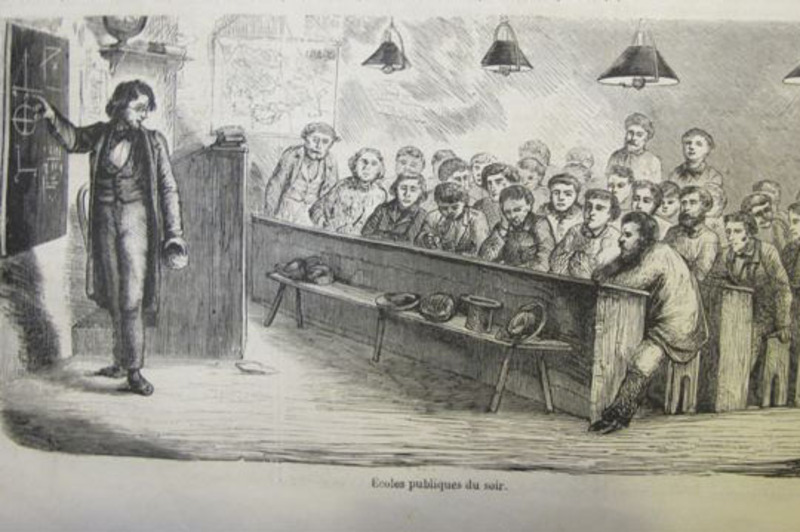
In terms of education, the situation in 1848 remained disastrous. Out of 300,000 conscripts, more than 112,000 could neither read nor write. Among the oldest, the proportion was even higher. Hence the decree of June 8, which instituted public evening readings in Paris, « intended to popularize knowledge of the masterpieces of our national literature ». These readings were to take place twice a week, « in various venues located, as far as possible, in the most populous districts of Paris ».
The Minister’s priority target is the peasants – two-thirds of the population – who have no association structures and are far from the towns and schools. It was they who had to be converted by reading, the key to education and emancipation, and brought into the schools:
« The teachers, now librarians, will read to them, aloud and intelligibly, and will be able to instruct them, interest them and (…) enthuse them about the political life of the country. Teachers, according to their availability, will provide general instruction in agricultural matters and readings in the schoolhouse or town hall, for civics and even literature. »
I. People’s Libraries
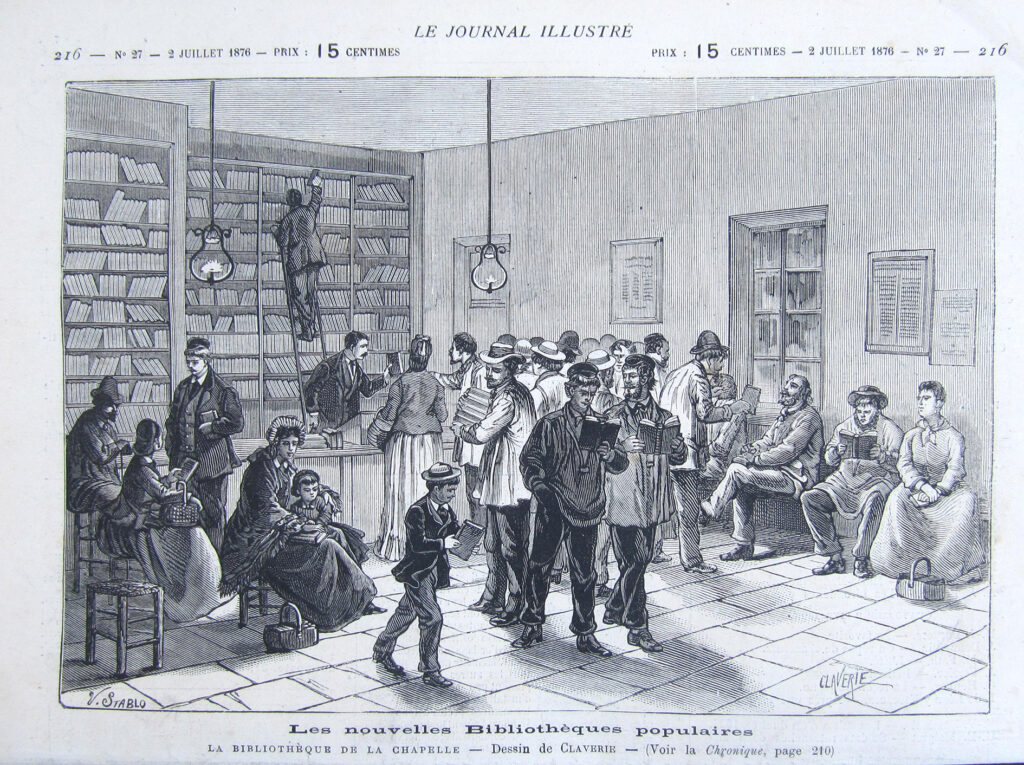
Based on the observation that « we lack reading books for the people as there are elsewhere », the Minister set up a vast public network of communal libraries of all sizes. He commissioned the publisher Paulin to assemble collections of the widest possible variety of books in every city district and rural canton, and make them available to the public free of charge. He also created a whole range of complementary establishments, such as special libraries near faculties, to make the most learned knowledge available to as many people as possible. Based on an idea by Jules Simon, he set out to create popular and rural libraries, which he renamed « circulating collections », with teachers who would « travel to small villages and bring to isolated children the instruction they could not find elsewhere ». The « missionary librarians » of these itinerant establishments would be « teacher-curators of the little people’s library », guiding the public, checking loans and reading on demand.
The creation of an official Service des lectures publiques du soir in the spring of 1848 should be seen in this bibliophile light. The aim was always the same: to give the best to the people. As Émile Deschanel explains:
« The Minister of the Republic wanted the sovereign people to have their own readers and teachers too. This service, as political as it is moral, is reminiscent of the sessions organized by philanthropists and Saint-Simonians, intended to replace cabarets and over-served balls. They would enable the worker (and later the peasant) tired « of daily toil to find a convenient asylum, a pleasure that would carry with it instruction, good advice and the familiarity of the great minds of our race ».
The aim was to popularize heritage texts and, if necessary, to comment on them in order to « nobly instruct listeners while amusing them », as the former Saint-Simonian Sainte-Beuve put it. The program of these readings must be varied to avoid fatigue. The great classics such as Corneille and Molière alternated with Michelet-style history, which had an obvious civic function, and comedies or songs such as those by Béranger.
The first Parisian screenings, attended by respectful workers and craftsmen, were a success « in an attentive silence where the slightest impressions were painted on faces ». The Minister noted amused reactions to the comedies, patriotic ones to the evocation of great battles such as Crécy, critical ones to the pompous style and bewildered ones to the Fables de la Fontaine. With this in mind, the Ministry envisaged the creation of a free Athénée based on the German and American models. The idea would be to bring together a handful of teachers in an amphitheater or former auditorium to offer free tuition, open to all and delivered by « pioneers in as yet unexplored fields » of science and technology.
J. Fine Arts, Hygiene and Gymnastics
In addition to « elements of national history and geography », he added French, public law and hygiene, not forgetting gymnastics to improve the health of the most disadvantaged. This was the adult version of what the new school and republican instruction would offer all French children. These courses should even bring art within everyone’s reach, through the promotion of heritage: « Is there a more powerful means of popular education? » he says, referring to art in general and the Beaux-Arts in particular.
In concrete terms, on March 29, the Minister and thirteen teachers founded the Association Philotechnique to provide workers with the professional and technical knowledge required for modern trades. The association agreed on courses in geometry, grammar, algebra, mechanics and drawing, to be given in the rooms of the Halle aux draps, and later at the École Turgot. Teachers from Parisian high schools are the first to be called on by the association to complete the training in history and law. The experiment began in early April, with 150 dyer-workers from the faubourg Saint-Marcel learning about science in the amphitheater of the pharmacy school. Vocational training soon spread to the provinces, including Orléans, before disappearing in the tumult of June.
Carnot wanted to go further, and envisaged « club-schools » based on the Scottish model of « Mechanic-institutions », i.e. lecture halls, libraries and permanent courses for workers in buildings adjoining factories. Keeping abreast of Braille’s work, he also took an interest in the deaf and blind, for whom he intended to multiply the number of specialized institutions under his ministry, rather than the Interior.
K. Citizen Concord
To crown this democratization, Carnot considered one of the Revolution’s most original methods: civic education through public festivals. At the end of February, he had already tested their civic virtues by taking part in the planting of a Tree of Liberty, a ritual practice in 1848, in the gardens of Saint-Nicolas in Paris. In this establishment specialized in the education of workers’ children, the ceremony was placed under the sign of the Three Colors. The clergyman blessed the tree, as is customary, in the presence of the mayor of the arrondissement. The Minister’s speech was edifying:
« The tree you are planting is as young as the Republic itself (…) It will spread its branches over you, just as the Republic will spread the benefits of popular education over France. (…) Good pupils become good citizens ».
The Minister of Education was also impressed by the « Fête de la Concorde » on March 21, between the Bastille and the Champ de Mars, with its parades, civic statuary, reviews of industrial works, hymns to the Republic and reformist enthusiasm. This civic pedagogy seemed effective to him, thanks to its symbolic representation of the regime and its « crowd of men obeying a common inspiration ».
18. Conclusion
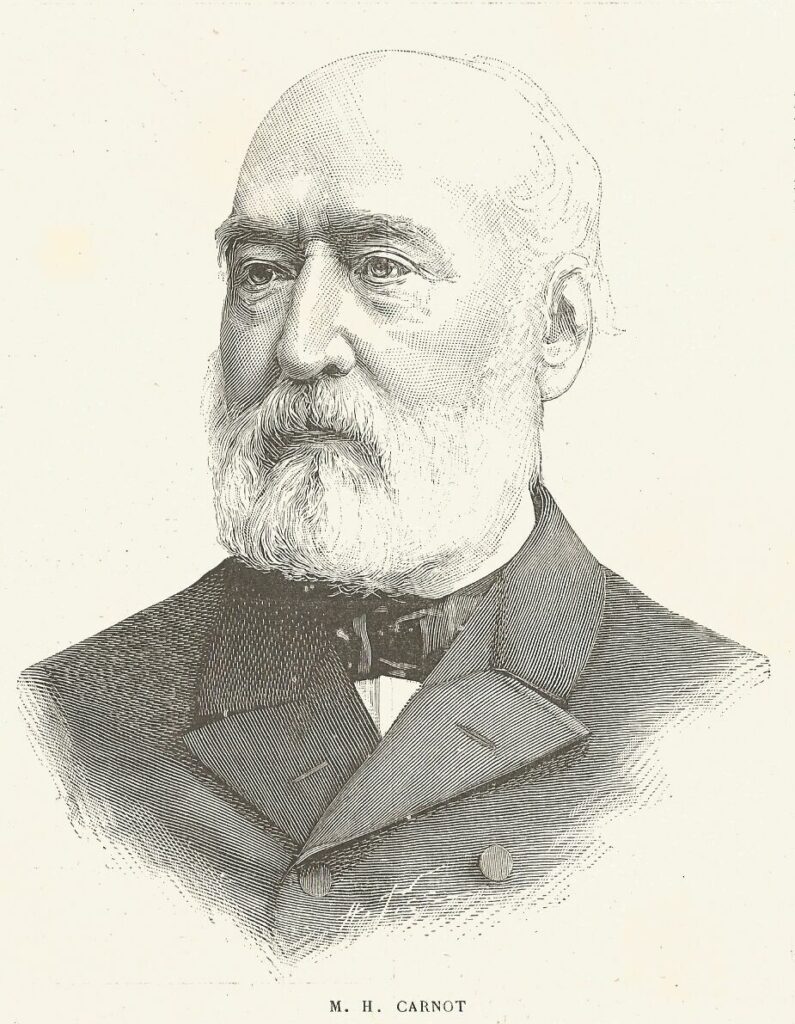
By way of conclusion, here’s the end of that of Remi Dalisson, whose magnificent biography of Hippolyte Carnot we highly recommend:
« His practice is his legislative texts on instruction, including school curricula, as varied as they are innovative, like those of his School of Administration or the ‘nursery school’. They make Carnot the undisputed precursor of Jules Ferry and the educational and civic project of the Third Republic. His laws and decrees were designed (…) to emancipate children and turn them into active, critical citizens in a peaceful, moderate and socially fluid democracy, under the aegis of restored teachers, symbols of the new times.
« His practice was his fights and commitments, first and foremost in the opposition, to which he belonged for a long time. His early writings against the death penalty, his participation in the events of 1830, his role in the 1848 Assembly, his fight for teachers, for whom he spent lavishly, and his voluntary exile are all worthy of note. (…)
« In a century crushed by the memory of two world wars, by the erasure of the Republic under Vichy and then by decolonization and the fall of Communism, forgetting 1848 and its social and educational hopes speaks volumes about our mental structures and our memory. This kind of amnesia, which does not prevent the often anachronistic sacralization of the republican corpus, has consigned Hippolyte Carnot and the whole of the 19th century to a sad oblivion. The period no longer evokes much of anything, apart from the occasional spotlight. It has even been sacrificed in teaching, as if only the 20th century were worthy of study.
« At a time when the French educational model is being called into question, when the republican school is doubting its missions, when secularism is also being discussed and when teachers feel abandoned, it is more necessary than ever to understand the roots of an educational system intimately linked to the republican regime. To this end, at the dawn of the 21st century, a reappraisal of the life and work of Hippolyte Carnot, a staunch defender of freedom, schools, Clio and the Republic, can lay the foundations for renewed, civic-minded reflection on the school system.«
19. Appendix: list of works by Hippolyte Carnot
- Gunima, an 18th-century African short story (Paris, Barba, 1824).
- Le Gymnase, a collection of morals and literature (Paris, Balzac, 1828).
- Doctrine de Saint-Simon (Brussels, Hauman, 1831).
- Mémoires de Grégoire, Évêque constitutionnel de Blois (Paris, Dupont, 6 vols., 1837-1845).
- Quelques réflexions sur la domesticité (Paris, Henry, 1838).
- Rapport sur la législation qui règle dans quelques états d’Allemagne les conditions de travail des jeunes ouvriers (Paris, Imp. Royale, 1840).
- Mémoires de Barère de Vieuzac (avec David d’Angers) (Paris, Labitte, 4 volumes, 1842-1844).
- L’Allemagne avant l’invasion française (Fragments*, Paris, Revue indépendante, 1842).
- L’Allemagne pendant la Révolution (Fragments*, Paris, Revue indépendante, 1843).
- Les Esclaves noirs (Paris, Magasin pittoresque, 1844).
- De l’esclavage colonial (Paris, Revue indépendante, 1845).
- Les Radicaux et la Charte, (Paris, Pagnerre, 1847).
- Le Ministère de l’Instruction Publique et des Cultes, 24 février-5 juillet 1848 (Paris, Pagnerre, 1848).
- Éducation républicaine, (Paris, Prost, 2 vols., 1849).
- L’insurrection littéraire en Allemagne (Fragments*, Paris, Liberté de penser, 1848).
- Le Mémorial de 1848, (Paris, Revue indépendante, n.p. 1849).
- Doctrine saint simonienne (Paris, Librairie nouvelle, 1854).
- Mémoires sur Lazare Carnot par son fils (Paris, Pagnerre, 1861-63, reed. in 1893 and 1907, Hachette).
- Œuvres de Saint-Simon by Enfantin, preceded by two historical notes by H. Carnot (Paris, Dentu, 1865).
- La Révolution française, résumé historique (2 vols., Paris, Dubuisson et Pagnerre, 1867).
- L’Instruction populaire en France (Paris, Degorce-Cadot, 1869).
- Trois discours sur l’instruction publique, (Paris, Degorce-Cadot, 1869).
- Cours de l’association philotechnique pour l’instruction gratuite des adultes (Paris, Parent, 1872).
- Ce que serait un nouvel Empire (Paris, Société du patriote, Bibliothèque utile, 1874).
- Lazare Hoche, général républicain (Paris, Société du patriote, Bibliothèque utile, 1874).
- D’une École d’Administration (Versailles, Aubert, 1878);
- Henri Grégoire, évêque républicain (Paris, Libraire des publications populaires, 1882).
- La Révolution française (Paris, Boulanger, 1888).
- Les premiers échos de la Révolution française au-delà du Rhin (Paris, Picard, 1888).
20. Short list of books and articles consulted
- Rémi Dalisson, Hippolyte Carnot, la liberté, l’école et la République, CNRS Editions, Paris 2011.
- Paul Carnot, Hippolyte Carnot et le ministère de l’Instruction publique de la IIe République, PUF, Paris, 1948.
- Jacques Cheminade, Lazare Carnot, l’organisateur de la victoire.
- Jacques Cheminade, L’exemplarité de l’oeuvre d’Henri Grégoire et de Lazare Carnot, 2005.
- Jacques Cheminade, Dino di Paoli and Claude Albert, L’Ecole polytechnique et la science de l’éducation républicaine, Campaigner publications, 1980.
- Website: Le temps des instituteurs.
- Karel Vereycken, The statue of Gutenberg in Strasbourg, the republican fight of David d’Angers.
- José Manuel Menudo, Une apologie des physiocrates par Condorcet, Dixhuitième siècle N° 46, pp 657 to 672.
- Condorcet, De l’influence de la révolution d’Amérique sur l’Europe (excerpts).
- Manuel Albertone, Condorcet, Jefferson and America.
- Dorette Huggins, John Adams and his reflections on Condorcet.
- E. -T. Hamy, Correspondance d’Alexandre de Humboldt avec François Arago, 1907, Paris.
Le combat républicain de David d’Angers, statue de Gutenberg à Strasbourg

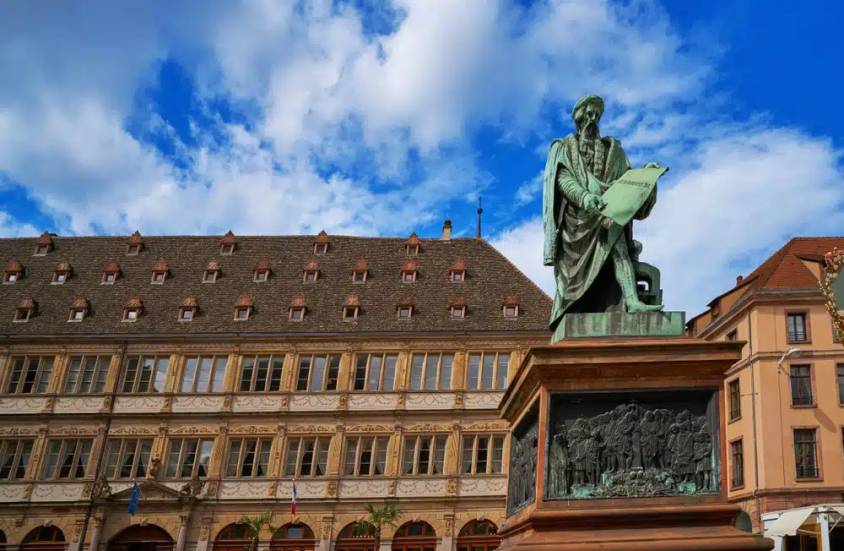
En plein centre-ville de Strasbourg, à deux pas de la cathédrale, tournant le dos à la Chambre de commerce qui date de 1585, la belle statue en bronze représentant l’imprimeur allemand Johannes Gutenberg tenant une page à peine imprimée de sa Bible sur laquelle on peut lire : « Et la lumière fut ! » (NOTE 1)
Évoquant l’émancipation des peuples grâce à la diffusion de la connaissance par le développement de l’imprimerie, la statue, érigée en 1840, arrive à un moment où les partisans de la République sont vent debout contre la censure de la presse imposée par Louis-Philippe sous la Monarchie de Juillet.
Strasbourg, Mayence et la Chine
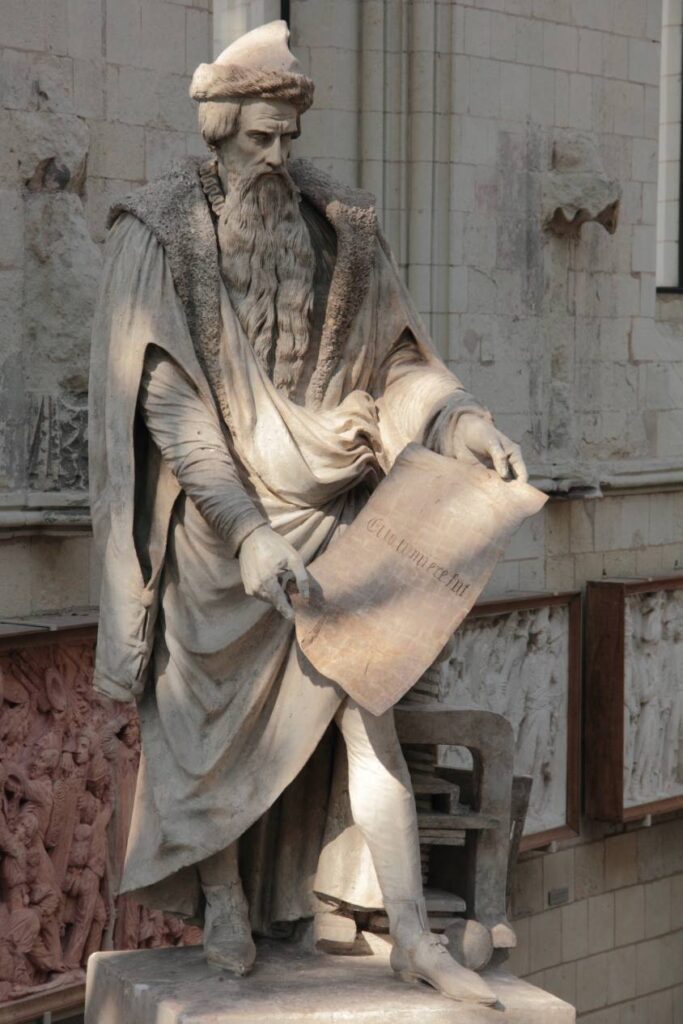
Né vers 1400 à Mayence, Johannes Gutenberg, avec l’argent que lui prête le marchand et banquier Johann Fust, réalise à Strasbourg, entre 1434 et 1445, ses premiers essais avec des caractères d’imprimerie mobiles en métal, avant de perfectionner son procédé à Mayence, notamment en imprimant à partir de 1452 sa fameuse Bible dite à 42 lignes.
A sa mort (à Mayence) en 1468, Gutenberg lègue son procédé à l’humanité permettant l’envol de l’imprimerie en Europe. Des chroniqueurs évoquent également le travail de Laurens Janszoon Coster à Harlem ou encore ceux de l’imprimeur italien Panfilo Castaldi qui aurait ramené le savoir-faire chinois en Europe. Soulignons que le monde « civilisé » d’alors refusait de reconnaître que l’imprimerie avait vu le jour en Asie avec les fameux « caractères mobiles » (en porcelaine et en métal) mis au point plusieurs siècles plus tôt en Chine et en Corée. (NOTE 2)
En Europe, Mayence et Strasbourg se disputent la place d’honneur. Ainsi, pour célébrer le 400e anniversaire de « l’invention » de l’imprimerie, Mayence inaugure, le 14 août 1837, sa statue de Gutenberg érigée par le sculpteur Bertel Thorvaldsenalors, alors qu’à Strasbourg, dès 1835, un comité local avait confié la réalisation d’un monument du même type au sculpteur David d’Angers.
Ce dernier, assez peu connu, fut aussi bien un grand sculpteur ami proche de Victor Hugo, qu’un républicain fervent en contact personnel avec la fine fleur de l’élite humaniste de son époque en France, en Allemagne et aux Etats-Unis. Il fut également un combattant inlassable de l’abolition de la traite négrière et de l’esclavage.
La vie du sculpteur
Sculpteur français Pierre-Jean David, dit « David d’Angers » (1788-1856) est le fils du maître sculpteur Pierre Louis David. Pierre-Jean sera marqué par l’esprit républicain de son père qui le forme à la sculpture dès son jeune âge. A douze ans, son père l’inscrit au cours de dessin de l’École centrale de Nantes. A Paris, il est sollicité pour réaliser les ornementations de l’Arc de Triomphe du Carrousel et la façade sud du palais du Louvre. Enfin il entre aux Beaux-arts.

David d’Angers possède un sens aigu de l’interprétation de la figure humaine et une aptitude à pénétrer les secrets de ses modèles. Il excelle dans le portrait que ce soit en buste ou en médaillon. Il est l’auteur d’au moins soixante huit statues et statuettes, d’une cinquantaine de bas-reliefs, d’une centaine de bustes et plus de cinq cents médaillons. Victor Hugo avait dit à son ami David: « C’est la monnaie de bronze avec laquelle vous payez votre péage à la postérité. »
Il voyage en Europe : Berlin, Londres, Dresde, Munich où partout, il exécute des bustes.
Vers 1825, alors qu’il obtient la commande du monument funéraire que la Nation élève par souscription publique en l’honneur du général Foy, un tribun de l’opposition parlementaire, une mutation idéologique et artistique s’opère en lui. Il fréquente les milieux progressistes des intellectuels de la « génération de 1820 » et rejoint le courant républicain international. Il s’interroge alors sur les problèmes politiques et sociaux de la France et de l’Europe. Plus tard, il resta toujours fidèle à ses convictions, refusant par exemple la commande prestigieuse du tombeau de Napoléon.
Production artistique
Son art s’infléchit donc dans le sens d’un naturalisme dont l’iconographie et l’expression détonnent si on le compare à l’art que pratiquent ses collègues académiciens et à celui des sculpteurs dissidents dits alors « romantiques ». Pour David, point de sensualisme mythologique, d’allégories obscures ni de pittoresque historique. La sculpture, selon David, doit au contraire généraliser et transposer ce que l’artiste observe, de façon à assurer la survie des idées et des destinées dans une postérité intemporelle. David s’attacha à cette conception particulière, limitée de la sculpture, adoptant ainsi les réflexions de l’âge des Lumières selon lesquelles cet art se fait « le dépôt durable des vertus des hommes » en perpétuant le souvenir des exploits des êtres d’exception.

Prévaut alors l’image, un peu austère, des « grands hommes » que l’on connaît surtout grâce à quelque 600 médaillons représentant les hommes et femmes célèbres, de plusieurs pays, la plupart étant ses contemporains. A cela, s’ajoute une centaine de bustes, avant tout représentant ses amis, des poètes, des écrivains, des musiciens, des chansonniers, des scientifiques et des hommes politiques avec lesquels il partage l’idéal républicain.
Parmi les plus éclairés de son époque, on compte : Victor Hugo, Lafayette, Wolfgang Goethe, Alfred de Vigny, Alphonse Lamartine, Pierre-Jean de Béranger, Alfred de Musset, François Arago, Alexandre de Humboldt, Honoré de Balzac, Lady Morgan, James Fennimore Cooper, Armand Carrel, François Chateaubriand, Ennius Quirinus Visconti et autres Niccolo Paganini.
Pour magnifier ses modèles et rendre visuellement les qualités du génie propre à chacun, David d’Angers invente un mode d’idéalisation non plus fondé sur le classicisme à l’antique, mais sur une grammaire des formes issue d’une science nouvelle, la phrénologie du Docteur Gall, qui voulait que les « bosses » crâniennes d’un individu traduisent ses aptitudes intellectuelles et ses passions. Pour le sculpteur il s’agissait de transcender la physionomie du modèle pour que la grandeur de l’âme rayonne à son front.
En 1826, il est élu membre de l’Institut de France et, la même année, professeur aux Beaux-Arts. En 1828, David d’Angers est victime d’un premier attentat jamais élucidé. Blessé à la tête, il est obligé de garder le lit pendant trois mois. Ce qui ne l’empêche pas, en 1830, toujours fidèle aux idées républicaines, de participer aux journées révolutionnaires et combats sur les barricades. Fronton du Panthéon, David d’Angers.
Le sculpteur se trouva ainsi tout désigné, en 1830, pour exécuter la commande du programme de sculpture politique le plus chargé de sens de la monarchie de Juillet et, peut-être, du XIXe siècle en France, la nouvelle décoration du fronton de l’église Sainte-Geneviève reconvertie, dès juillet, en Panthéon.
Il s’agit pour lui, historiographe, de représenter les civils et hommes de guerre qui édifièrent la France républicaine. L’exécution des personnages qu’il avait choisis et disposés dans une esquisse d’abord approuvée puis suspendue, devait nécessairement conduire, en 1837, à un conflit avec le haut-clergé et le gouvernement. À gauche, nous voyons Bichat, Voltaire et Jean-Jacques Rousseau, David, Cuvier, Lafayette, Manuel, Carnot, Berthollet, Laplace, Malesherbes, Mirabeau, Monge et Fénelon. Alors que le gouvernement tente de faire supprimer l’effigie de Lafayette, ce que David d’Angers refuse avec obstination, appuyé en cela par la presse libérale, le fronton est dévoilé sans cérémonie officielle en septembre 1837, sans la présence de l’artiste, non invité.
Entrée en politique
Lors de la Révolution de 1848, il est nommé maire du XIe arrondissement de Paris, entre à l’Assemblée nationale constituante puis à l’Assemblée nationale législative où il vote avec la Montagne (gauche révolutionnaire). Il défend l’existence de l’Ecole des Beaux-arts et de l’Académie de France à Rome. Il s’oppose à la destruction de la Chapelle Expiatoire et au retrait de deux statues de l’Arc de Triomphe, (Résistance et Paix d’Antoine Etex).
Il vote aussi contre les poursuites à l’encontre de Louis Blanc (autre homme d’Etat républicain condamné à l’exil), contre les crédits de l’expédition romaine de Napoléon III, pour l’abolition de la peine de mort, pour le droit au travail, pour l’amnistie générale.
Exil
Il n’est pas réélu député en 1849 et se retire de la vie politique. En 1851, à l’avènement de Napoléon III, David d’Angers est arrêté et également condamné à l’exil. Il choisit la Belgique puis voyage en Grèce (son vieux projet). Il veut revoir sa Jeune grecque sur le tombeau du républicain patriote grec Markos Botzaris, qu’il trouve mutilée et à l’abandon (il la fera rapatrier en France et restaurer).
Déçu par la Grèce, il revient en France, en 1852. Aidé par son ami de Béranger, il est autorisé à séjourner à Paris où il reprend ses travaux. En septembre 1855, il est terrassé par une attaque d’apoplexie qui l’oblige à cesser ses activités. Il décède en janvier 1856.
Amitiés avec Lafayette, l’abbé Grégoire et Pierre-Jean de Béranger
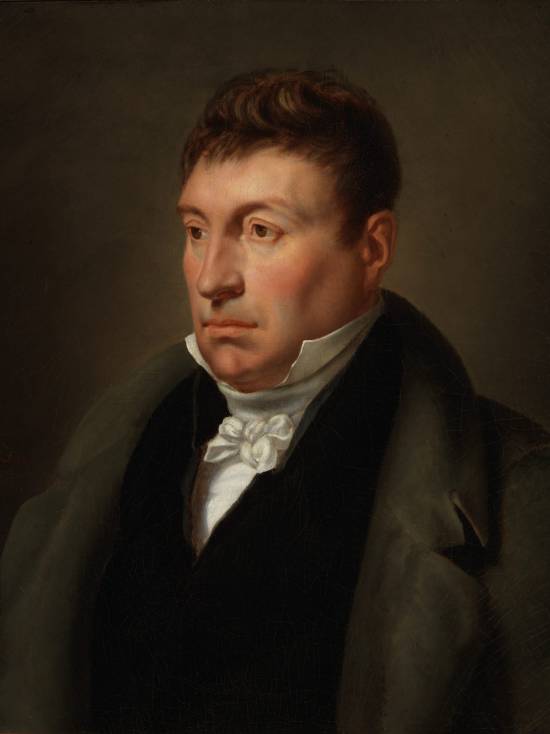
David d’Angers apparaît comme un véritable trait-d’union entre les républicains du XVIII et ceux du XIXe siècle et une passerelle vivante entre ceux d’Europe et d’Amérique.
Né en 1788, il aura la chance de fréquenter dans son jeune âge certaines grandes figures révolutionnaires de l’époque avant de s’impliquer personnellement dans les révolutions de 1830 et 1848.
Vers la fin des années 1820, David participe aux réunions chaque mardi du salon de Madame de Lafayette épouse de Gilbert du Motier, marquis de La Fayette (1757-1834).
Alors que le général Lafayette s’y tenait droit comme « un chêne vénérable », ce salon, note le sculpteur,
« a une physionomie bien tranchée, écrit-il. Là les hommes causent de choses sérieuses, surtout politiques, les jeunes gens mêmes ont l’air grave : il y a quelque chose de décidé, d’énergique et de courageux dans leur regard et dans leur maintien (…) Toutes les dames et aussi les demoiselles ont l’air calme et réfléchi ; elles ont plutôt l’air d’être venues pour voir ou assister à des délibérations importantes, que pour se faire voir. »
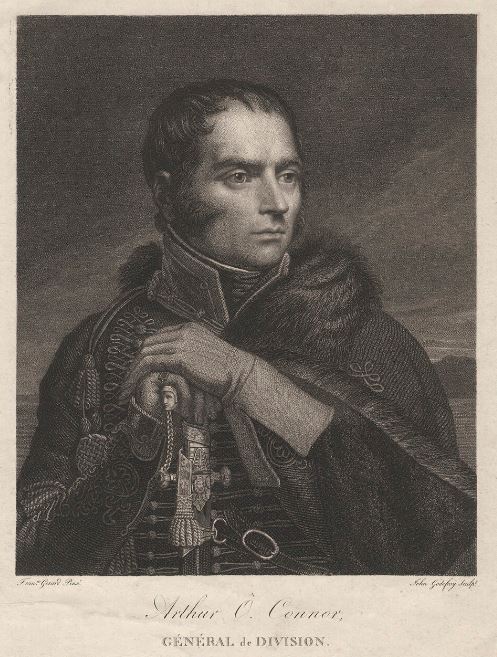
David y rencontre un compagnon d’armes de Lafayette, le général Arthur O’Connor (1763-1852), ancien député irlandais acquis à la cause républicaine ayant rejoint les volontaires de l’Etat-Major de Lafayette en 1792.
Accusé d’avoir suscité des troubles contre l’Empire britannique et en contact avec le général Lazare Hoche, O’Connor se réfugia en France en 1796 et participa à l’expédition d’Irlande. O’Connor, épousa en 1807 la fille de Condorcet et sera naturalisé Français en 1818.

Lafayette et David d’Angers se retrouvaient souvent avec un petit groupe d’amis, quelques « frères », membres de loges maçonniques : tels le chansonnier Pierre-Jean de Béranger, François Chateaubriand, Benjamin Constant, Alexandre Dumas (qui correspondait avec Edgar Allan Poe), Alphonse Lamartine, Henri Beyle dit Stendhal ou encore les peintres François Gérard et Horace Vernet.
Dans ces mêmes cercles, David fera également connaissance avec l’Abbé Grégoire (1750-1831) et on y évoquait souvent le problème de l’abolition de l’esclavage que Grégoire avait fait voter le 4 février 1794.
Dans leurs échanges, Lafayette aimait rappeler ce que disait son ami de jeunesse Nicolas de Condorcet :
« L’esclavage, c’est une horrible barbarie, si nous ne pouvons manger du sucre qu’à ce prix, il faut savoir renoncer à une denrée souillée du sang de nos frères.«
Pour Grégoire, le problème était bien plus profond :
« Tant que les hommes seront altérés de sang, ou plutôt, tant que la plupart des gouvernements n’auront pas de morale, que la politique sera l’art de fourber, que les peuples, méconnaissant leurs vrais intérêts, attacheront une sotte importance au métier de spadassin, et se laisseront conduire aveuglément à la boucherie avec une résignation moutonnière, presque toujours pour servir de piédestal à la vanité, presque jamais pour venger les droits de l’humanité, et faire un pas vers le bonheur et la vertu, la nation la plus florissante sera celle qui aura plus de facilité pour égorger les autres.«
(Essai sur la régénération physique, morale et politique des juifs)
Napoléon et l’esclavage
La première abolition de l’esclavage avait été, hélas de courte durée. En 1802, Napoléon Bonaparte, à court d’argent pour financer ses guerres, rétablit l’esclavage et neuf jours plus tard, il exclut de l’armée française les officiers de couleur. Enfin, il proscrit les mariages entre « fiancés dont la couleur de peau est différente ». David d’Angers restait très sensible à cette question, ayant comme camarade, un tout jeune écrivain, Alexandre Dumas, dont le père était né esclave à Haïti.
Dès 1781, sous le pseudonyme de Schwarz (noir en Allemand), Nicolas de Condorcet avait fait paraître un manifeste plaidant pour la disparition graduelle de l’esclavage sur une période de 60 à70 ans, un point de vue rapidement partagé par Lafayette. Fervent militant de la cause abolitionniste, Condorcet condamne l’esclavage comme un crime mais dénonce aussi son inutilité économique : le travail servile, dont la productivité est faible, est un frein à l’établissement de l’économie de marché.
Et avant même la signature du traité de paix entre la France et les Etats-Unis, Lafayette écrivit à son ami George Washington le 3 février 1783 pour lui proposer de s’associer à lui afin de mettre en route un processus d’émancipation progressif des esclaves. Il lui suggérait un plan qui « deviendrait franchement bénéfique pour la portion noire de l’humanité ».
Il s’agissait d’acheter un petit État dans lequel on ferait l’expérience de libérer les esclaves et de les faire travailler comme fermiers. Un tel exemple, expliquait-il, « pourrait faire école et ainsi devenir une pratique générale ». (NOTE 3)
Washington lui répond qu’à titre personnel il aurait plutôt envie d’appuyer une telle démarche mais que le Congrès américain (déjà) y était totalement hostile.
De la Société des amis des Noirs à la Société française pour l’abolition de l’esclavage
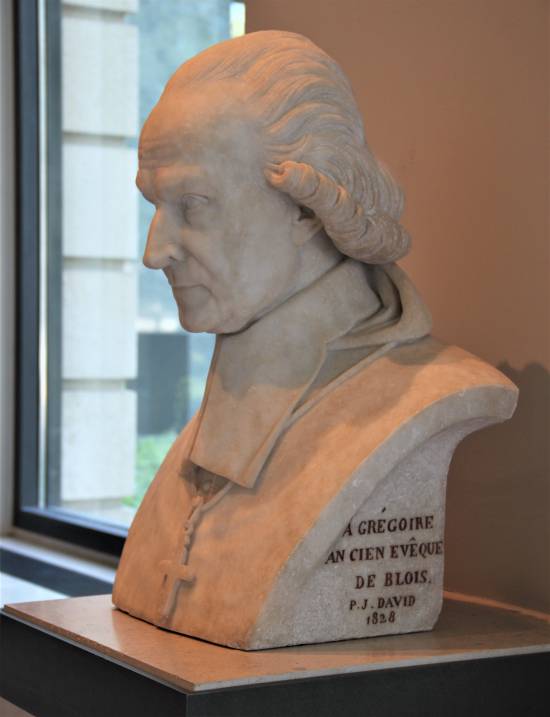
A Paris, l’abbé Grégoire et Jacques Pierre Brissot créent le 19 février 1788 « La Société des amis des Noirs » dont le règlement fut rédigé par Condorcet et dont les époux Lafayette furent également membres.
La société avait pour but l’égalité des Blancs et des Noirs libres dans les colonies, l’interdiction immédiate de la traite des Noirs et progressive de l’esclavage ; d’une part dans le souci de maintenir l’économie des colonies françaises, et d’autre part dans l’idée qu’avant d’accéder à la liberté, les Noirs devaient y être préparés, et donc éduqués.
Après la quasi disparition des « Amis des Noirs », l’offensive fut renouvelée avec d’abord, en 1821, la fondation de la « Société de la morale chrétienne » constituant en 1822 un « Comité pour l’abolition de la traite des Noirs », dont une partie des membres ira fonder en 1834 la « Société française pour l’abolition de l’esclavage (SFAE) ».
D’abord favorable à une abolition progressive, la SFAE sera ensuite favorable à une abolition immédiate. Interdit de réunion, elle décide de créer des comités abolitionnistes dans l’ensemble du pays pour que ceux-ci relaient tant au plan local qu’au plan national la volonté de faire cesser l’esclavage.
Goethe et Schiller
À l’été 1829, David d’Angers effectue son premier voyage en Allemagne et rencontre Goethe (1749-1832), le poète et philosophe qui s’était retiré à Weimar. Plusieurs séances de pose ont permis au sculpteur de réaliser son portrait.

L’écrivain et poète Victor Pavie (1808-1886), ami de Victor Hugo et un des fondateurs des « Cercles catholiques ouvriers », nous relate un épisode pittoresque du sculpteur dans son « Goethe et David, souvenirs d’un voyage à Weimar » (1874).
En 1827, le journal français Globe avait fait paraître deux lettres racontant deux visites rendues à Goethe, en 1817 et 1825, par Victor Cousin (1792-1887), ainsi qu’un courrier d’André-Marie Ampère (1775-1867), de retour de l’« Athènes de l’Allemagne ». Le tout jeune savant y faisait part de son admiration, et donnait de nombreux détails qui aiguisèrent l’intérêt de ses compatriotes. Lors de son séjour à Weimar, Ampère compléta les connaissances de son hôte au sujet des auteurs romantiques, et notamment en ce qui concerne Mérimée, Vigny, Deschamps et Delphine Gay. Goethe avait déjà une opinion (positive) sur Victor Hugo, Lamartine et Casimir Delavigne, et sur tout ce qu’ils devaient à Chateaubriand.
Abonné au Globe depuis sa fondation en 1824 Goethe disposait d’un merveilleux instrument d’information française. En tous cas, il ne lui restait pas grand chose à apprendre sur la France, quand David et Pavie se présentèrent chez lui, au mois d’août 1829. Fort de son expérience malheureuse avec Walter Scott à Londres, David d’Angers avait, cette fois, pris ses précautions, se munissant d’un certain nombre de lettres de recommandation pour les habitants de Weimar, ainsi que de deux lettres d’introduction auprès de Goethe, signées par l’abbé Grégoire et Victor Cousin. Afin de montrer à l’illustre écrivain ce qu’il savait faire, il avait mis dans une caisse quelques uns de ses plus beaux médaillons.
Arrivés à Weimar, David d’Angers et Victor Pavie rencontreront de grandes difficultés dans leur quête, d’autant que les destinataires des lettres de recommandation étaient tous absents. Frappé de désespoir, craignant l’échec, David accuse alors son jeune ami Victor Pavie :
c« Oui, tu t’es lancé avec ton optimisme de jeune homme sans me laisser le temps de réfléchir et de me dégager. Ce n’est point en poltron et sous le patronage interlope d’un aventurier, c’est de front et résolument qu’il nous fallait aborder le personnage. (…) On vaut par ce qu’on est, c’est oui ou non. Tu me connais, à genoux devant le génie, et, devant le pouvoir, imployable.
Ah ! les poètes de cour, grands ou petits, partout les mêmes !
(…) Et d’un bond s’élançant de la chaise où il s’était insensiblement laissé choir : Où est Schiller (1759-1805) que je l’embrasse ! Celui-là était peuple, on ne disait point Monsieur de Schiller ; sa tombe, où je frapperai, ne me restera point scellée ; j’irai l’y prendre, et l’en ramènerai glorieux. Je ne l’ai point vu, qu’importe ? ai-je vu Corneille, ai-je vu Racine ? Le buste que je lui destine n’en ressemblera que mieux ; sur son front reluira l’éclair de son génie. Je le ferai tel que je l’aime et l’admire, non point avec ce nez pincé dont l’a gratifié Dannecker, mais les narines gonflées de patriotisme et de liberté ».
Le récit de Victor Pavie révèle la ferveur républicaine animant le sculpteur qui, fidèle aux idéaux de l’abbé Grégoire, réfléchissait déjà à la grande sculpture contre l’esclavage qu’il projetait de réaliser :
« En ce moment, la fenêtre entrebâillée de notre chambre, cédant à la brise du soir, s’ouvrit à deux battants. Le ciel était superbe ; la voie lactée s’y déroulait avec un tel éclat qu’on en eût compté les étoiles. Il (David) resta quelque temps silencieux, ébloui ; puis, avec cette soudaineté d’impression qui renouvelait incessamment autour de lui le domaine des sentiments et des idées : ‘Quelle œuvre, et quel chef-d’œuvre ! Sommes-nous pauvres près de cela ! Tous vos génies en un, écrivains, artistes, poètes, atteindraient-ils jamais à ce poème incomparable dont les tâches sont des splendeurs ? Dieu sait pourtant vos prétentions insatiables ; on vous écorche en vous louant… Et légers ! Retiens bien ceci (et ses pressentiments à cet égard n’étaient rien moins qu’une chimère), c’est que tel d’entre eux qui a reçu de moi pour gage de mon admiration un buste en marbre, en aura quelque jour littéralement perdu le souvenir. – Non, il n’y a rien de noble et de grand dans l’humanité que ce qui souffre. J’ai toujours dans la tête, ou plutôt dans le cœur, cette protestation de la conscience humaine contre la plus exécrable iniquité de nos temps, la traite des nègres : après dix ans de silence et de souffrance il faut qu’elle éclate par la voix de l’airain. Tu vois d’ici le groupe : l’esclave garrotté, l’œil au ciel protecteur et vengeur du faible ; près de lui, gisante et brisée, sa femme, au sein de laquelle une frêle créature suce du sang au lieu de lait ; à leurs pieds, détaché du collier rompu de la négresse, le crucifix, l’Homme-Dieu mort pour ses frères, noirs ou blancs. Oui, le monument sera de bronze, et quand soufflera le vent, l’on entendra battre la chaîne, et les anneaux résonneront’ ».
Enfin, Goethe finit par rencontrer les deux Français et David d’Angers réussit à faire son buste. Victor Pavie : « Goethe s’inclina avec politesse devant nous, attaqua dès l’abord le français avec aisance, et nous fit asseoir de cet air calme et résigné qui m’étonnait, comme si c’était une chose toute simple de se trouver debout à quatre-vingts ans, face à face avec une troisième génération, à laquelle il se trouve transmis à travers la seconde, ainsi qu’une vivante tradition.
« (…) David portait sur lui, comme l’on dit vulgairement, un échantillon de son savoir-faire. Il présenta au vieillard quelques uns de ses profils vivants, d’une expression si morale, d’une exécution si nerveuse et si intime, fragment d’un grand tout qui va se complétant avec notre âge, et qui réserve aux siècles d’après la physionomie monumentale du XIXe. Goethe les prit dans sa main, les considéra muet, avec une scrupuleuse attention, comme pour en soutirer une harmonie cachée, et fit entendre une exclamation sourde et équivoque que je reconnus plus tard pour une marque de satisfaction authentique. Puis à ce propos, par une transition plus intelligible et bien flatteuse, dont il ne se douta peut-être pas, marchant à sa bibliothèque, il nous étala avec charme une riche collection de médailles du moyen âge, rares et précieuses reliques d’un art que l’on pourrait dire perdu, et dont notre grand sculpteur David a su de nos jours retrouver et retremper le secret.
« (…) Le projet de buste n’eut pas à languir longtemps : et dès le lendemain un des appartements de l’immense maison du poète était transformé en atelier, et un tertre informe gisait sur le parquet, attendant le premier souffle de l’existence. Sitôt qu’il se fut remué lentement vers une apparence humaine, on vit se mouvoir en même temps la figure jusque-là calme et impassible de Goethe. Peu-à-peu, comme s’il se fut déterminé une secrète et sympathique alliance entre le portrait et le modèle, à mesure que l’un s’acheminait à la vie, l’autre s’épanouissait à la confiance et à l’abandon : on en vint bientôt à ces confidences d’artiste, à ce confluent de poésie, où réunies de part et d’autre, les idées du poète et du sculpteur se précipitent dans un moule commun. Il allait, venait, rôdant autour de cette masse croissante, (pour me servir d’une comparaison triviale) avec l’inquiète sollicitude d’un propriétaire qui fait bâtir. Il nous adressait de nombreuses questions sur la France dont il suivait la marche avec une jeune et active curiosité ; et s’ébattant à loisir sur la littérature moderne, il passait tour-à-tour en revue Chateaubriand, Lamartine, Nodier, Alfred de Vigny, Victor Hugo, dont il avait médité sérieusement la manière dans Cromwell.
« (…) Le buste de David sera beau comme celui de Chateaubriand, de Lamartine, de Cooper, comme toute application de génie à génie, comme l’œuvre d’un ciseau apte et puissant à la reproduction d’un de ces types créés tout exprès par la nature pour l’habitation d’une grande pensée. De toutes les ressemblances tentées avec plus ou moins de bonheur, dans tous les âges de cette longue gloire, depuis sa jeunesse de vingt ans jusqu’au buste de Rauch, le dernier et le mieux entendu de tous, ce n’est pas une prévention de dire que celui de David est le meilleur, ou pour parler plus franchement encore, la seule réalisation de cette ressemblance idéale qui n’est pas la chose, mais qui est plus que la chose, la nature prise au-dedans et retournée au-dehors, la manifestation extérieure d’une intelligence divine passée à l’état d’écorce humaine. Et il est peu d’occasion comme celle-ci, où l’exécution colossale ne semble que l’indication impuissante d’un effet réel. Un front immense, sur lequel se dresse, comme des nuages, une épaisse touffe de cheveux argentés ; un regard de haut en bas, creux et immobile, un regard de Jupiter olympien, un nez de proportion large et de style antique, dans la ligne du front ; puis cette bouche singulière dont nous parlions tout-à-l’heure, avec la lèvre inférieure un peu avancée, cette bouche, tout examen, interrogation et finesse, complétant le haut par le bas, le génie par la raison ; sans autre piédestal que son cou musculeux, cette tête se penche comme voilée, vers la terre : c’est l’heure où le génie couchant abaisse son regard vers ce monde qu’il éclaire encore d’un rayon d’adieu. Telle est la description grossière de la statue de Goethe par David. – Quel malheur que dans son buste de Schiller, si célèbre et si prôné, le sculpteur Dannecker lui ait préparé un si misérable pendant ! »
Quand Goethe reçoit son buste, il remercie chaleureusement l’Angevin pour les échanges épistolaires, les livres et les médaillons… mais ne fait aucune mention du buste ! Pour une raison simple : il ne se reconnaît pas du tout dans l’œuvre, qu’il ne garde d’ailleurs pas chez lui… Le poète allemand est représenté avec un front démesuré, pour refléter sa grande intelligence. Et ses cheveux ébouriffés symbolisent les tourments de son âme…
David d’Angers et Hippolyte Carnot
Parmi les fondateurs de la Société française pour l’abolition de l’esclavage (SFAE), Hippolyte Carnot (1801-1888), frère cadet de Nicolas Sadi Carnot (1796-1832), pionnier de la thermodynamique et fils de « l’organisateur de la victoire », le génie militaire et scientifique Lazare Carnot dont il va, en 1869, relater l’œuvre et le combat dans sa biographie Mémoires sur Lazare Carnot 1753-1823 par son fils Hippolyte.
Hippolyte publiera en 1888, sous le titre Henri Grégoire, évêque républicain, les Mémoires de ce défenseur de tous les opprimés d’alors (des nègres comme des juifs), grand ami de son père et qui lui avait gardé cette amitié.
Pour l’ancien évêque de Blois,
« il faut éclairer l’ignorance qui ne connait pas et la pauvreté qui n’a pas les moyens de connaitre.«
Grégoire avait été un des grands « éducateurs de la Convention » et c’est sur son rapport que fut fondé, 29 septembre 1794, notamment, pour l’instruction des artisans, le Conservatoire des Arts-et-Métiers. Grégoire contribua également à la création du Bureau des longitudes le 25 juin 1795 et de l’Institut de France le 25 octobre 1795.

Hippolyte Carnot et David d’Angers publièrent ensemble les Mémoires de Bertrand Barère de Vieuzac (1755-1841) qui, au Comité de Salut Public, avait en quelque sorte le rôle de Ministre de l’Information, chargé d’annoncer à la Convention, dès leur arrivée, les victoires des Armées Républicaines.
C’est également l’abbé Grégoire qui chargea David d’Angers, avec l’aide de son ami Béranger, d’apporter en 1826 un peu de confort matériel et financier à Rouget de Lisle (1860-1836), l’auteur légendaire de La Marseillaise composée à Strasbourg, lorsque dans ses vieux jours, le compositeur croupillait en prison pour dette.
Dépassant les sectarismes de leur époque, voilà trois fervents républicains plein de compassion et de reconnaissance pour un génie musical qui n’a jamais voulu accepter de renoncer à ses convictions royalistes mais dont la création patriotique deviendra l’hymne national de la jeune République française.
Gouvernement provisoire de la IIe République
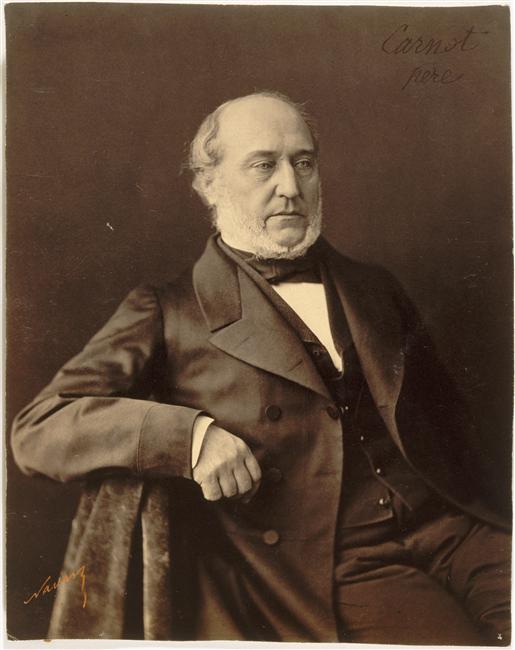
Tous ces combats, démarches et mobilisations aboutiront en 1848, lorsque, pendant deux mois et 15 jours (du 24 février au 9 mai), une poignée d’authentiques républicains firent partie du « gouvernement provisoire » de la IIe république.
En si peu de temps, que de bonnes mesures furent prises ou mises en chantier ! Hippolyte Carnot y est un ministre de l’Instruction publique déterminé à créer une éducation de haut niveau pour tous, et femmes incluses, suivant les modèles fixés par son père pour Polytechnique et de Grégoire pour les Arts et Métiers.
L’article 13 de la Constitution de 1848, « garantit aux citoyens (…) l’enseignement primaire gratuit ». Le ministre de l’Instruction publique, toujours Lazare Hippolyte Carnot, soumet à l’Assemblée le 30 juin 1848 un projet de loi qui anticipe totalement sur les lois Ferry, en prévoyant un enseignement élémentaire obligatoire pour les deux sexes, gratuit et laïc, tout en garantissant la liberté d’enseignement. Il prévoit également pour les instituteurs une formation gratuite de trois ans dans une école normale, avec en contrepartie une obligation d’enseigner pendant au moins dix ans, système qui sera longtemps en vigueur. Il propose une nette amélioration de leurs salaires. Il exhorte, déjà, les instituteurs « à dispenser un catéchisme républicain ».
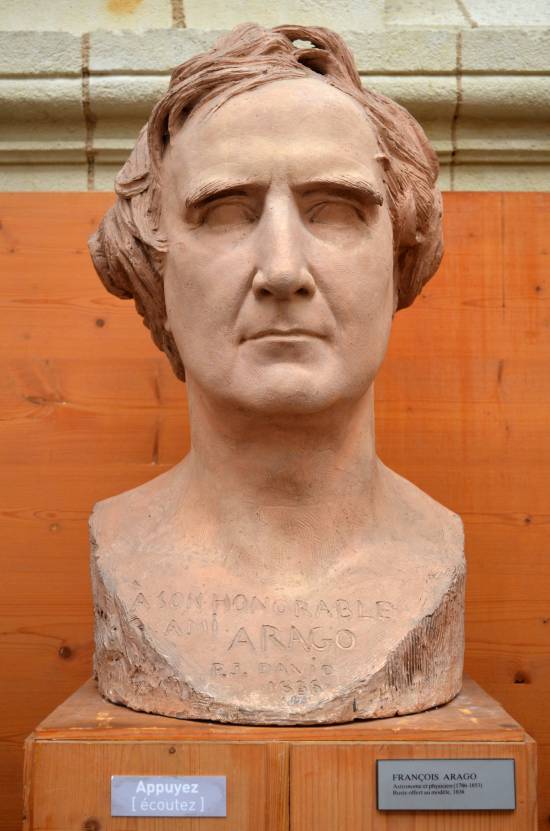
Membre du gouvernement provisoire, le grand astronome et scientifique François Arago est ministre des colonies, après avoir été désigné par Gaspard Monge à lui succéder à l’Ecole polytechnique pour y enseigner la géométrie projective. Son ami le plus proche n’est autre qu’Alexandre de Humboldt, ami de Johann Wolfgang Goethe et de Friedrich Schiller.
Il est un autre militant abolitionniste ayant passé une bonne partie de sa vie d’adulte à Paris. Humboldt fait partie de la Société d’Arcueil formée autour du chimiste Claude-Louis Berthollet où se rencontrent également François Arago, Jean-Baptiste Biot, Louis-Joseph Gay-Lussac avec lesquels Humboldt se lie d’amitié. Ils publient ensemble plusieurs articles scientifiques.
Humboldt et Gay-Lussac mènent des expériences communes sur la composition de l’atmosphère, sur le magnétisme terrestre et la diffraction de la lumière, recherches dont le grand Louis Pasteur cueillera par la suite les fruits.
Napoléon, qui voulait initialement expulser Humboldt, finit par tolérer sa présence. La Société de géographie de Paris, fondée en 1821, le choisit comme président.
Humboldt, Arago, Schoelcher, David d’Angers et Hugo

Humboldt ne cache pas ses idéaux républicains. Son Essai Politique sur l’Ile de Cuba (1825), a l’effet d’une bombe. Trop hostile aux pratiques esclavagistes, l’ouvrage fut interdit de publication en Espagne. Londres va jusqu’à lui refuser tout accès à son Empire.
Bien plus déplorable, John S. Trasher, qui en publia, en 1856, une version en langue anglaise, supprima carrément le chapitre consacré aux esclaves et à la traite ! Humboldt protestera énergiquement contre cette mutilation, opérée à des fins politiques. Trasher était esclavagiste, Sa traduction expurgée fut destinée à combattre les arguments des abolitionnistes nord-américains, qui par la suite publièrent le chapitre escamoté dans le New-York Herald et le Courrier des États-Unis. Victor Schoelcher et le décret abolissant l’esclavage dans les colonies françaises.
En France, sous Arago, le sous-secrétaire d’État à la Marine et aux colonies se nomme Victor Schoelcher. Il n’a pas besoin d’argumenter beaucoup pour convaincre l’astronome que toutes les planètes sont alignés pour passer à l’acte.
Franc-maçon, Schoelcher est un frère de loge de David d’Angers, « Les amis de la Vérité » aussi connu sous le nom de Cercle social, en réalité « un mélange de club politique révolutionnaire, de loge maçonnique et de salon littéraire ».
Le 4 mars une commission est mise en place pour résoudre le problème de l’esclavage dans les colonies françaises. Elle est présidée par Victor de Broglie, président de la SFAE à laquelle adhèrent cinq des douze membres de la commission. Grâce aux efforts de François Arago, Henri Wallon et surtout Victor Schoelcher, ses travaux permettent l’abolition de l’esclavage le 27 avril.
Hugo abolitionniste
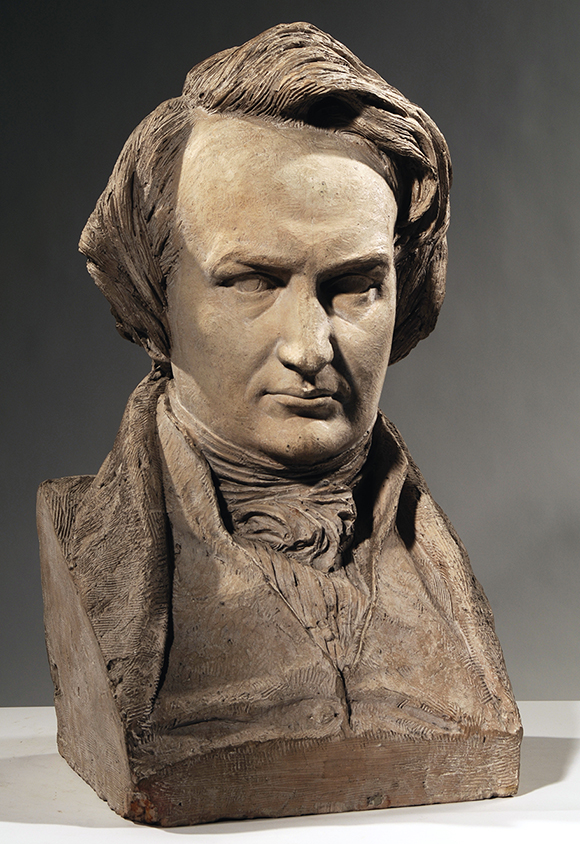
Victor Hugo fut un des partisans de l’abolition de l’esclavage, en France, mais aussi d’une égalité entre ce que l’on désignait encore comme « les races » au XIXe siècle. « République blanche et république noire sont sœurs, de même que l’homme noir et l’homme blanc sont frères », affirmait déjà Hugo en 1859. Pour lui, tous les hommes étant des créations de Dieu, la fraternité était de mise.
Lorsque le 27 avril 1851, une anti-esclavagiste, Maria Chapman, écrit à Hugo pour lui demander de soutenir la cause abolitionniste, Hugo lui répond : « L’esclavage aux États-Unis ! s’exclame-t-il le 12 mai, y a-t-il un contresens plus monstrueux ? ». Comment, en effet, une république dotée d’une aussi belle constitution est capable de préserver une pratique aussi barbare ?
Huit ans plus tard, le 2 décembre 1859, il écrit une lettre ouverte aux États-Unis d’Amérique, publiée par les journaux libres d’Europe, pour défendre l’abolitionniste John Brown condamné à mort.
Partant du fait qu’« il y a des esclaves dans les états du Sud, ce qui indigne, comme le plus monstrueux des contre-sens, la conscience logique et pure des états du Nord », il relate le combat de Brown, son procès et son exécution annoncée, et conclut : « il y a quelque chose de plus effrayant que Caïn tuant Abel, c’est Washington tuant Spartacus ».
Un journaliste de Port-au-Prince, Exilien Heurtelou, le remercie le 4 février 1860. Hugo lui répond le 31 mars :
« Vous êtes, monsieur, un noble échantillon de cette humanité noire si longtemps opprimée et méconnue. D’un bout à l’autre de la terre, la même flamme est dans l’homme ; et les noirs comme vous le prouvent. Y a-t-il eu plusieurs Adam ? Les naturalistes peuvent discuter la question ; mais ce qui est certain, c’est qu’il n’y a qu’un Dieu. Puisqu’il n’y a qu’un père, nous sommes frères.
C’est pour cette vérité que John Brown est mort ; c’est pour cette vérité que je lutte. Vous m’en remerciez, et je ne saurais vous dire combien vos belles paroles me touchent. Il n’y a sur la terre ni blancs ni noirs, il y a des esprits ; vous en êtes un. Devant Dieu, toutes les âmes sont blanches.
J’aime votre pays, votre race, votre liberté, votre révolution, votre république. Votre île magnifique et douce plaît à cette heure aux âmes libres ; elle vient de donner un grand exemple ; elle a brisé le despotisme. Elle nous aidera à briser l’esclavage. »
En 1860 également, la Société abolitionniste américaine, mobilisée derrière Lincoln publiera un recueil de discours. La brochure s’ouvre sur trois textes de Hugo, suivis par ceux de Carnot, Humboldt et Lafayette.
Hugo accepte de présider, le 18 mai 1879, une commémoration de l’abolition de l’esclavage en présence de Victor Schoelcher, auteur principal du décret d’émancipation de 1848, qui salue en Hugo « le défenseur puissant de tous les déshérités, de tous les faibles, de tous les opprimés de ce monde » et déclare ceci :
« La cause des nègres que nous soutenons, et envers lesquels les nations chrétiennes ont tant à se reprocher, devait avoir votre sympathie ; nous vous sommes reconnaissants de l’attester par votre présence au milieu de nous.«
Un début de mieux
Autre mesure prise par le gouvernement provisoire de cette éphémère IIe République : l’abolition de la peine de mort dans le domaine politique et la suppression, le 12 mars, des châtiments corporels, tout comme la contrainte par corps (prison pour dette) le 19 mars.
Dans le domaine politique, la liberté de la presse et celle de réunion sont proclamées le 4 mars. Le 5 mars le gouvernement institue le suffrage universel masculin, en remplacement du suffrage censitaire en vigueur depuis 1815. D’un coup le corps électoral passe de 250 000 à 9 millions d’électeurs. Cette mesure démocratique place le monde rural, qui regroupe les trois quarts des habitants, au cœur de la vie politique, et ce, pour de nombreuses décennies. Cette masse de nouveaux électeurs, faute de véritable formation citoyenne, voyant en lui un protecteur, plébiscitera en masse Napoléon III, aussi bien en 1851, en 1860 qu’en 1870.
Victor Hugo
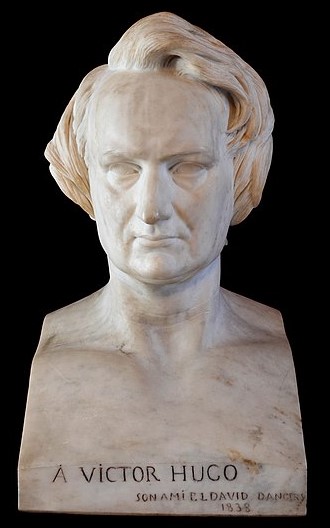
Pour revenir à David d’Angers, une amitié durable l’unit à Victor Hugo (1802-1885). Fraîchement mariés, Hugo et David se retrouvaient pour dessiner. Le poète et le sculpteur aimaient dessiner ensemble, faire des caricatures, peindre des paysages ou des « architectures » qui les inspiraient.
Un même idéal les unissait et avec l’arrivée de Napoléon III, les deux hommes connurent l’exil politique.
Par amitié, David d’Angers a fait plusieurs bustes de son ami. Hugo est représenté portant un costume élégant contemporain.
Son large front et ses sourcils légèrement froncés expriment la grandeur, encore à venir, du poète. Renonçant à détailler les pupilles, David confère à ce regard une dimension intérieure et pensive qui fit écrire à Hugo :
« Mon ami, c’est l’immortalité que vous m’envoyez.«
En 1842, David d’Angers réalise un autre buste de Victor Hugo, couronné de laurier, où cette fois ce n’est pas Hugo l’ami intime qui est évoqué mais davantage le génie et le grand homme.
Enfin, pour les funérailles de Hugo, en 1885, la République d’Haïti tint à manifester au poète sa reconnaissance en se faisant représenter par une délégation. Emmanuel-Edouard, écrivain haïtien, la présidait et déclara notamment au Panthéon :
« La République d’Haïti a le droit de parler au nom de la race noire ; la race noire, par mon organe, remercie Victor Hugo de l’avoir beaucoup aimée et honorée, de l’avoir raffermie et consolée.«
Les quatre bas-reliefs de la statue de Gutenberg
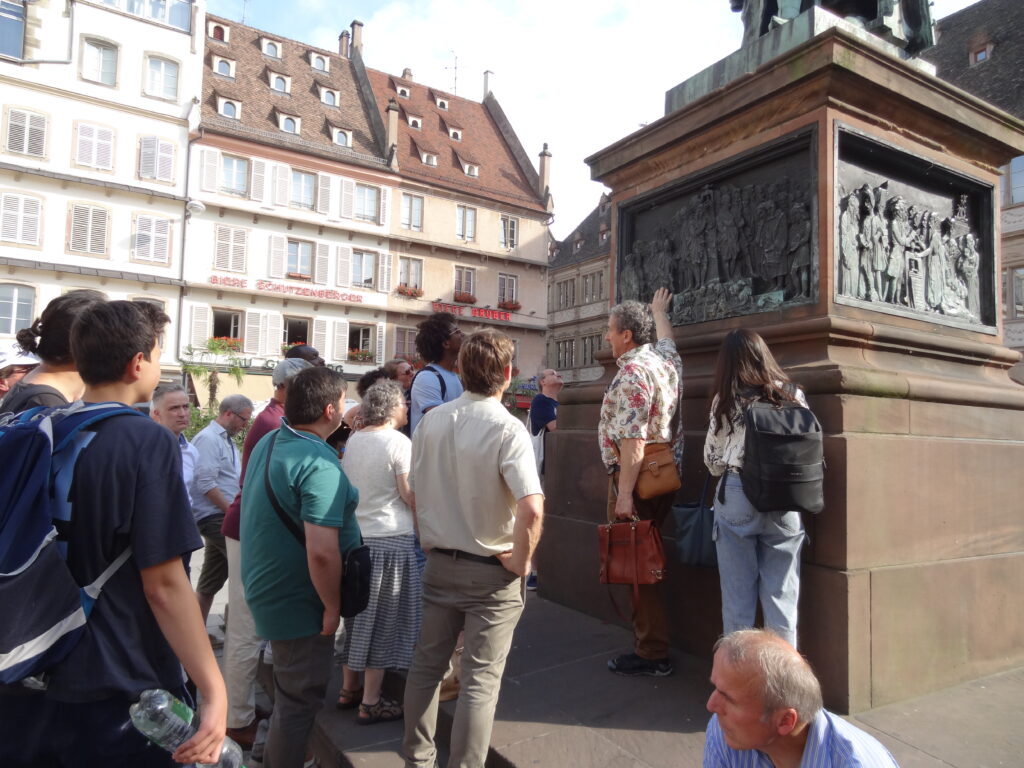
Une fois que le lecteur identifie ce « grand arche » qui traverse l’histoire et, les idées et convictions, qui animaient David d’Angers, il saisira la belle unité qui sous-tend les quatre bas-reliefs du socle de la statue commémorant Gutenberg à Strasbourg.
Ce qui ressort c’est l’idée très optimiste que le genre humain, dans sa grande et magnifique diversité, est un et fraternel . Une fois libéré de toutes les formes d’oppressions (l’ignorance, esclavage, etc.), il peut vivre ensemble dans la paix et l’harmonie.
Ces bas-reliefs en bronze ont été ajoutés en 1844. Après d’âpres débats et contestations, , ils ont remplacé les modèles en plâtre peints originaux de 1840 apposés lors de l’inauguration. Ils représentent les bienfaits de l’imprimerie en Amérique, en Afrique, en Asie et en Europe. Au centre de chaque relief, une presse d’imprimerie entourée de personnages identifiés par des inscriptions ainsi que des instituteurs, des enseignants et des enfants.
Pour conclure, voici un extrait du compte-rendu de l’inauguration décrivant les bas-reliefs. Sans tomber dans le wokisme (pour qui toute idée de « grand homme » est forcément à combattre), soulignons qu’il est écrit dans les termes de l’époque et donc sujet à discussion :

L’EUROPE
« L’Europe est représentée par un bas-relief sur lequel se côtoient René Descartes dans une attitude méditative, placé sous Francis Bacon et Herman Boerhaave. A gauche, l’on voit successivement William Shakespeare, Pierre Corneille, Molière et Racine. Un rang en dessous se succèdent Voltaire, Buffon,Albrecht Dürer, John Milton et Cimarosa, Poussin, Calderone, Camoëns et Puget. A droite du tableau, se pressent Martin Luther, Wilhelm Gottfried Leibniz, Emmanuel Kant, Copernic, Wolfgang Goethe, Friedrich Schiller, Hegel, Richter, Klopstock. Rejetés sur le coté Linné et Ambroise Parée. Près de la presse, on peut voir au-dessus de la figure de Martin Luther, Erasme de Rotterdam, Rousseau et Lessing. Sous le gradin se voient Volta, Galilée, Isaac Newton, James Watt, Denis Papin et Raphaël. Un petit groupe d’enfants étudient parmi lesquels un Africain et un Asiatique « .
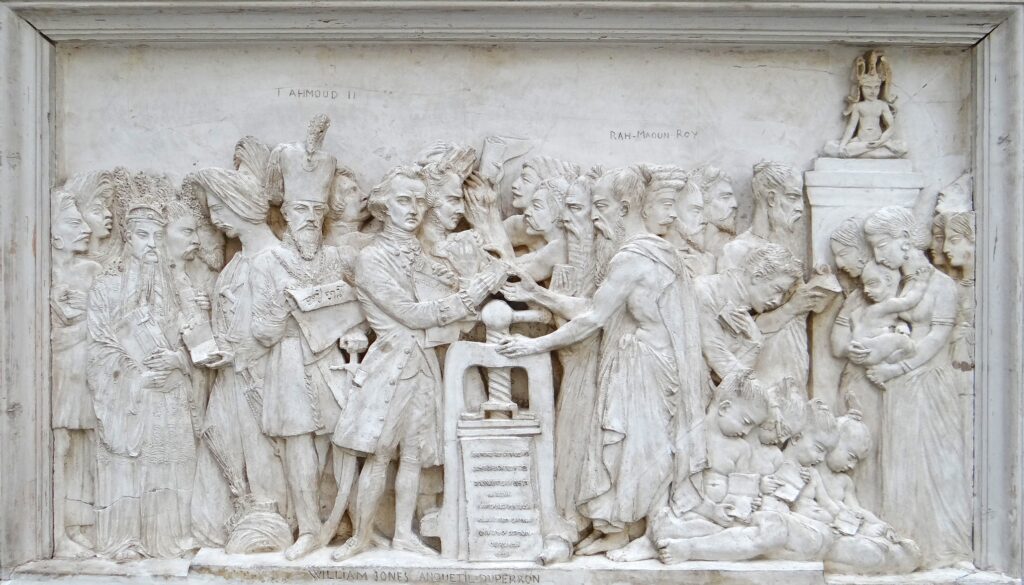
L’ASIE
« Une presse est de nouveau représentée à côté de laquelle William Jones et Abraham Hyacinthe Anquetil-Duperron offrent des livres aux brahmanes qui leur donnent en retour des manuscrits. Près de Jones, le sultan Mahmoud II est en train de lire le Moniteur revêtu de vêtements modernes, son ancien turban gît à ses pieds et tout près un Turc lit un livre. Un degré en dessous un empereur chinois entouré d’un Persan et d’un Chinois lit le livre de Confucius. Un Européen instruit des enfants tandis qu’un groupe de femmes indiennes se tient près d’une idole et du philosophe indien Rammonhun-Roy. «
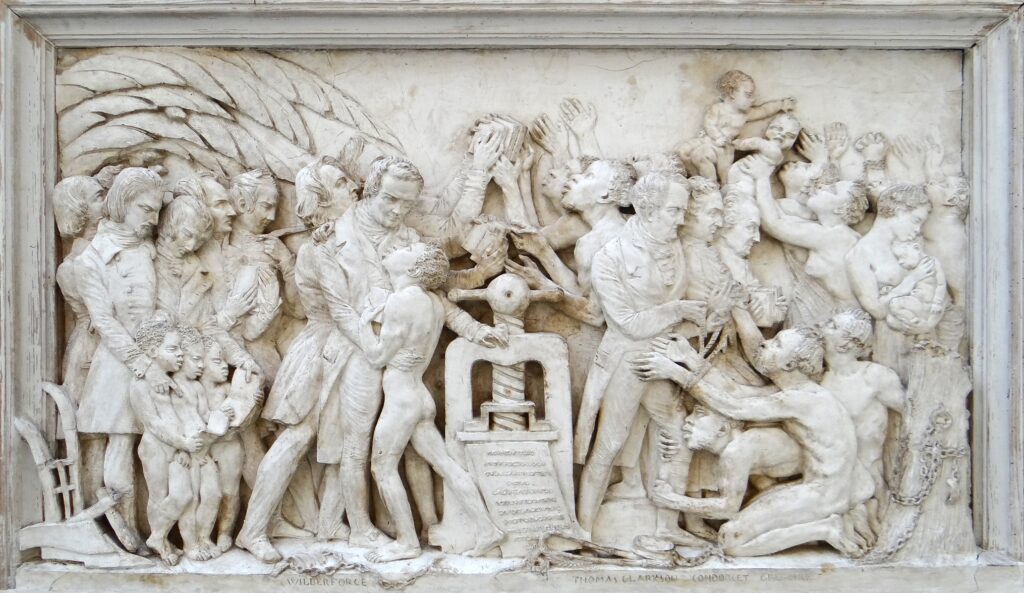
L’AFRIQUE
« Appuyé sur une presse, William Wilberforce étreint un Africain possédant un livre, alors que des Européens distribuent à d’autres Africains des livres et s’occupent à instruire les enfants. A droite, on peut voir Thomas Clarkson brisant les fers d’un esclave. Derrière lui, l’abbé Grégoire aide un noir à se relever et tient sa main sur son cœur. Un groupe de femmes élève leurs enfants retrouvés vers les ciel, qui ne verra désormais plus que des hommes libres, tandis qu’à terre gisent des fouets et des fers brisés. C’est la fin de l’esclavage. »
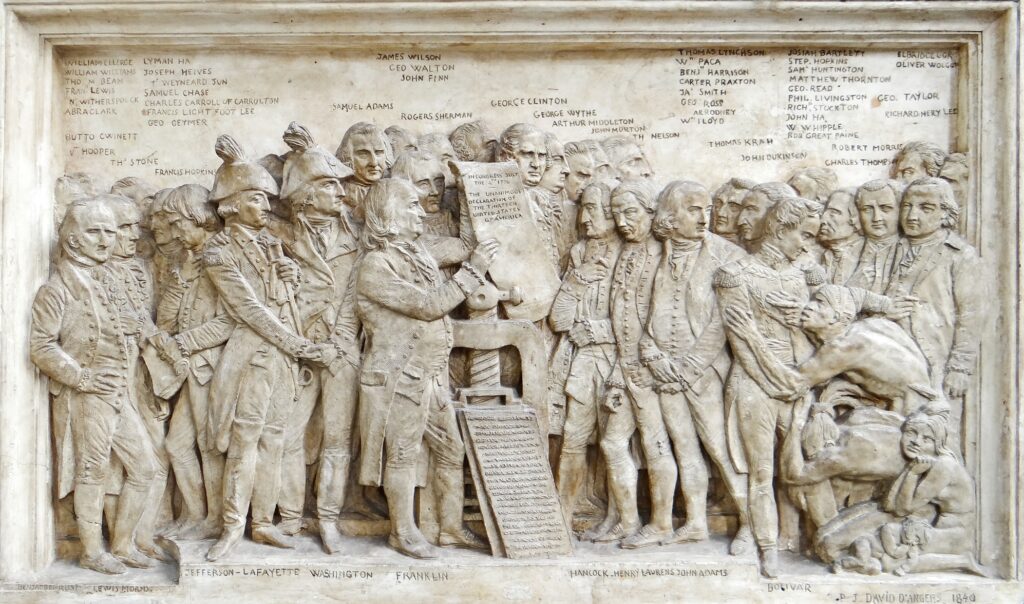
L’AMERIQUE
« L’acte de l’indépendance des Etats-Unis qui a fraîchement été tiré de sous la presse figure dans les mains de Benjamin Franklin. Près de lui se tiennent Washington et Lafayette qui tient sur sa poitrine l’épée que lui donne sa patrie adoptive. Jefferson et tous les signataires de l’acte d’indépendance sont rassemblés. A droite, Bolivar serre la main d’un Indien. «
L’Amérique
L’on comprend mieux les paroles prononcées par Victor Hugo, le 29 novembre 1884, c’est-à-dire peu avant sa mort, lors de sa visite de l’atelier du sculpteur Frédéric-Auguste Bartholdi où le poète est invité à admirer la statue géante portant le nom symbolique « La Liberté éclairant le monde », fabriquée avec le concours de Gustave Eiffel et prête à partir aux Etats-Unis par bateau. Don de la France à l’Amérique, elle consacrera le souvenir de la part active que le pays de Lafayette a prise pendant la guerre d’Indépendance.
Initialement, Hugo s’est surtout intéressé aux héros et grands hommes d’Etat américains : William Penn, Benjamin Franklin, John Brown ou encore Abraham Lincoln. Des modèles, selon Hugo qui permettaient au peuple de progresser. Aussi l’Amérique est-elle, pour l’homme politique français devenu républicain en 1847, l’exemple à suivre. Même s’il est très déçu par la position des américains sur la peine de mort et l’esclavage.
Après 1830, l’écrivain abandonne cette vision un peu idyllique du Nouveau Monde et s’en prend aux « civilisateurs » blancs, pourchasseurs d’indiens :
« Vous croyez civiliser un monde, lorsque vous l’enfiévrez de quelque fièvre immonde [4], quand vous troublez ses lacs, miroirs d’un dieu secret, lorsque vous violez sa vierge, la forêt. Quand vous chassez du bois, de l’antre, du rivage, votre frère naïf et sombre, le sauvage… Et quand jetant dehors cet Adam inutile, vous peuplez le désert d’un homme plus reptile… Idolâtre du dieu dollar, fou qui palpite, non plus pour un soleil, mais pour une pépite, qui se dit libre et montre au monde épouvanté l’esclavage étonné servant la liberté ! «
(NOTE 5)
Surmontant sa fatigue, devant la statue de la Liberté, Hugo improvise ce qu’il sait être sa dernière allocution :
« Cette belle œuvre tend à ce que j’ai toujours aimé, appelé : la paix entre l’Amérique et la France – La France qui est l’Europe – Ce gage de paix demeurera permanent. Il était bon que cela fût fait ! «
NOTES:
- Si la phrase figure dans le livre de la Genèse, il pourrait également se référer à Notre-Dame de Paris (1831) un roman de Victor Hugo, grand ami du sculpteur de la statue, David d’Angers. On sait par une lettre d’Hugo d’août 1832 que le poète porta à David d’Angers la huitième édition du livre. La scène la plus directement incarnée dans la statue est celle durant laquelle le personnage de Frollo converse avec deux érudits (l’un étant Louis XI déguisé) tout en désignant d’un doigt un livre et de l’autre la cathédrale en remarquant : « Ceci tuera cela », c’est-à-dire qu’un pouvoir (la presse imprimée), la démocratie, supplantera l’autre (l’Église), la théocratie, une évolution historique qu’Hugo pensait inéluctable.
- C’est la rencontre avec l’Asie qui va amener en Europe d’innombrables savoirs-faire techniques et découvertes scientifiques d’Orient, les plus connus étant la boussole et la poudre à canons. Tout aussi essentiel pour l’imprimerie que les caractères mobiles, le papier dont la fabrication fut mis au point en Chine à la fin de la Dynastie des Han de l’Est (vers l’année 185). Quant à l’imprimerie, à ce jour, le plus vieux livre imprimé que nous possédons est le Sûtra du Diamant, un écrit bouddhique chinois datant de 868. Enfin, c’est au milieu du XIe siècle, sous la dynastie des Song, que Bi Sheng (990-1051) inventa les caractères mobiles. Gravés dans de la porcelaine, céramique d’argile visqueuse, durcis dans le feu et assemblés dans la résine, ils révolutionnent l’imprimerie. Comme le documente le musée Gutenberg de Mayence, c’est le Coréen Choe Yun-ui (1102-1162) qui va améliorer cette technique au XIIe siècle en utilisant du métal (moins fragile), procédé que reprendra Gutenberg et ses associés. L’Anthologie des enseignements zen des grands prêtres bouddhistes (1377), également connue sous le nom de Jikji, a été imprimée en Corée, 78 ans avant la Bible de Gutenberg, et est reconnue comme le plus ancien livre à caractères métalliques mobiles existant au monde.
- Etienne Taillemite, Lafayette et l’abolition de l’esclavage.
- Victor Hugo a sans doute voulu rebondir sur les nouvelles qui lui arrivèrent d’Amérique. L’épidémie de variole du Pacifique Nord-Ouest de 1862, qui a été apportée de San Francisco à Victoria, a dévasté les peuples indigènes de la côte du Pacifique Nord-Ouest, avec un taux de mortalité de plus de 50 % sur toute la côte, de Puget Sound au sud-est de l’Alaska. Certains historiens ont décrit l’épidémie comme un génocide délibéré, car la colonie de l’île de Vancouver et la colonie de la Colombie-Britannique auraient pu la prévenir, mais ont choisi de ne pas le faire, et l’ont en quelque sorte facilitée.
- Victor Hugo, La civilisation extrait de Toute la lyre (1888 et 1893).
With Kondiaronk and Leibniz, re-inventing a society without oligarchy

By Karel Vereycken, May 2023.
Helga Zepp-LaRouche, the founder of the Schiller Institute, in her keynote address to the Schiller Institute’s Nov. 22, 2022 videoconference, “For World Peace—Stop the Danger of Nuclear War: Third Seminar of Political and Social Leaders of the World,” called on world leaders to eradicate the evil principle of oligarchy.
Oligarchy is defined as a power structure in which power rests with a small number of people having certain characteristics (nobility, fame, wealth, education, or corporate, religious, political, or military control) and who impose their own power over that of their people.
To be precise, Zepp-LaRouche said :
“For 600 years, there has been a continuous battle between two forms of government, between the sovereign nation state and the oligarchical form of society, vacillating back and forth with sometimes a greater emphasis in this or that direction.
All empires based on the oligarchical model have been oriented towards protecting the privileges of the ruling elite, while trying to keep the masses of the population as backward as possible,
because as sheep they are easier to control (…)”
Now, unfortunately, most of the citizens of the transatlantic world and elsewhere will tell you that abolishing the oligarchical principle is “a good idea”, a “beautiful dream”, but that reality tells us “it can’t happen” for the very simple reason that “it never happened before”.
Societies, by definition, they argue, are in-egalitarian. Kings and Presidents of Republics, they argue, eventually might have “pretended” they ruled over the masses for their “common good”, but in reality, our fellow-citizens think, it was always the rule of a handful favoring their own interest over the majority.
The BRICS
Interesting for all of us, is that some leading thinkers involved in the BRICS movement, are trying to imagine new ways of collective rule excluding oligarchical principles.
For example, going in that direction, economist Pedro Paez, former advisor to Ecuador’s Rafael Correa, in his intervention at the April 15-16 Schiller Institute’s video conference, defended
“a new concept of currency based on monetary arrangements of clearing houses for regional payments, that can be joined into a world clearing house system, which could also prevent another type of unilateral, unipolar hegemony from arising, such as the one that was established with Bretton Woods, and that would instead open the doors to multipolar management”.
Also Belgian philosopher and theologian Marc Luyckx, a former member of the Jacques Delors famous taskforce « Cellule de Prospective » of the European Commission, in a video interview on the de-dollarization of the world economy, underlined that the BRICS countries are creating a world order whose nature makes it so that not a single member of their own group can become the dominant power.
The Dawn of Everything
The good news is that a mind-provoking, 700-page book, titled “The Dawn of Everything: A New History of Humanity”, written and published in 2021 by the American anthropologist David Graeber and the British archaeologist David Wengrow, destroys the conventional notions of ancient human cultures making linear progress toward the neo-liberal economic model and therefore, by implication, high levels of inequality.
Even better, based on hard facts, the book largely debunks the “narrative” that oligarchical rule is somehow “natural”. Of course, the oligarchical principle ruled often and often for a long time. But, surprisingly, the book offers overwhelming indications and “hard facts” proving that in ancient times, some societies, though not all, which eventually prospered over centuries, through political choices, consciously adopted modes of governance preventing minority groups from permanently keeping a hegemonic grip over societies.
Zepp-LaRouche’s 10th point
The subject matter of this issue is intimately linked to the 10th point raised by Helga Zepp-LaRouche, which, in order to demonstrate that all sources of evil can be eradicated by education and political decision, that man’s natural inclination, is intrinsically to do the good. The very existence of historical precedents of societies surviving without oligarchy over hundreds of years, is of course, the “practical” proof of man’s axiomatic inclination to do the good.
Unsurprisingly, some argue that the issue of “good” and “evil” is nothing but a “theological debate”, since the concepts of “good” and “evil” are concepts made up by humans in order to compare themselves with one another. They argue it would never occur to anyone to argue about whether a fish, or a tree, were good or evil, since they lack any form of self-conscience enabling them to measure if their deeds and actions fulfill their own inclination or that of their creator.
Now, part of the “Biblical answer” to this question, if man is bad or evil, claims that people “once lived in a state of innocence”, yet were tainted by original sin. We desired to be godlike and have been punished for it; now we live in a fallen state while hoping for future redemption.
Overturning the evil Rousseau and Hobbes
Graeber and Wengrow, establishing the core argument of their entire book, demonstrate in a very provocative way how we got brainwashed by the pessimistic and destructive oligarchical ideology, especially that promoted by both Rousseau and Hobbes, for whom inequality is the natural state of man, a humanity which might have eventually been good as “a noble savage”, before becoming “civilized” and a society only surviving thanks to a “social contract” (voluntary bottom-up submission) or a “Leviathan” (top down dictatorship) :
“Today, the popular version of this [biblical] story [of man thrown out of the Garden of Eden] is typically some updated variation on Jean-Jacques Rousseau’s Discourse on the Origin and the Foundation of Inequality Among Mankind, which he wrote in 1754. Once upon a time, the story goes, we were hunter-gatherers, living in a prolonged state of childlike innocence, in tiny bands. These bands were egalitarian; they could be for the very reason that they were so small. It was only after the “Agricultural Revolution,” and then still more the rise of cities, that this happy condition came to an end, ushering in ‘civilization’ and ‘the state’—which also meant the appearance of written literature, science and philosophy, but at the same time, almost everything bad in human life: patriarchy, standing armies, mass executions and annoying bureaucrats demanding that we spend much of our lives filling in forms.
“Of course, this is a very crude simplification, but it really does seem to be the foundational story that rises to the surface whenever anyone, from industrial psychologists to revolutionary theorists, says something like ‘but of course human beings spent most of their evolutionary history living in groups of ten or twenty people,’ or ‘agriculture was perhaps humanity’s worst mistake.’ And as we’ll see, many popular writers make the argument quite explicitly. The problem is that anyone seeking an alternative to this rather depressing view of history will quickly find that the only one on offer is actually even worse: if not Rousseau, then Thomas Hobbes.
“Hobbes’s Leviathan, published in 1651, is in many ways the founding text of modern political theory. It held that, humans being the selfish creatures they are, life in an original State of Nature was in no sense innocent; it must instead have been ‘solitary, poor, nasty, brutish, and short’—basically, a state of war, with everybody fighting against everybody else. Insofar as there has been any progress from this benighted state of affairs, a Hobbesian would argue, it has been largely due to exactly those repressive mechanisms that Rousseau was complaining about: governments, courts, bureaucracies, police. This view of things has been around for a very long time as well. There’s a reason why, in English, the words ‘politics’ ‘polite’ and ‘police’ all sound the same—they’re all derived from the Greek word polis, or city, the Latin equivalent of which is civitas, which also gives us ‘civility,’ ‘civic’ and a certain modern understanding of ‘civilization.
“Human society, in this view, is founded on the collective repression of our baser instincts, which becomes all the more necessary when humans are living in large numbers in the same place. The modern-day Hobbesian, then, would argue that, yes, we did live most of our evolutionary history in tiny bands, who could get along mainly because they shared a common interest in the survival of their offspring (‘parental investment,’ as evolutionary biologists call it). But even these were in no sense founded on equality. There was always, in this version, some ‘alpha-male’ leader. Hierarchy and domination, and cynical self-interest, have always been the basis of human society. It’s just that, collectively, we have learned it’s to our advantage to prioritize our long-term interests over our short-term instincts; or, better, to create laws that force us to confine our worst impulses to socially useful areas like the economy, while forbidding them everywhere else
“As the reader can probably detect from our tone, we don’t much like the choice between these two alternatives. Our objections can be classified into three broad categories. As accounts of the general course of human history, they:
1) simply aren’t true;
2) have dire political implications and
3) make the past needlessly dull.”
As a consequence of the victory of imperial models of political power, the only accepted “narrative” of man’s “evolution”, automatically validating an oligarchical grip over society, is that which allows “confirming” the pre-agreed-upon dogma erected as immortal “truth”. And any historical findings or artifacts contradicting or invalidating the Rousseau-Hobbes narrative will be, at best, declared anomalies.
Open our eyes
Graeber and Wengrow’s book is an attempt
“to tell another, more hopeful and more interesting story; one which, at the same time, takes better account of what the last few decades of research have taught us. Partly, this is a matter of bringing together evidence that has accumulated in archaeology, anthropology and kindred disciplines; evidence that points towards a completely new account of how human societies developed over roughly the last 30,000 years. Almost all of this research goes against the familiar narrative, but too often the most remarkable discoveries remain confined to the work of specialists, or have to be teased out by reading between the lines of scientific publications.”
To give just a sense of how different the emerging picture is:
“[I]t is clear now that human societies before the advent of farming were not confined to small, egalitarian bands. On the contrary, the world of hunter-gatherers as it existed before the coming of agriculture was one of bold social experiments, resembling a carnival parade of political forms, far more than it does the drab abstractions of evolutionary theory. Agriculture, in turn, did not mean the inception of private property, nor did it mark an irreversible step towards inequality. In fact, many of the first farming communities were relatively free of ranks and hierarchies. And far from setting class differences in stone, a surprising number of the world’s earliest cities were organized on robustly egalitarian lines, with no need for authoritarian rulers,
ambitious warrior-politicians, or even bossy administrators.”
Kondiaronk, Leibniz and the Enlightenment

In fact, Rousseau’s story, argue the authors, was in part a response to critiques of European civilization, which began in the early decades of the 18th century. “The origins of that critique, however, lie not with the philosophers of the Enlightenment (much though they initially admired and imitated it), but with indigenous commentators and observers of European society, such as the Native American (Huron-Wendat) statesman Kondiaronk,” and many others.
And when prominent thinkers, such as Leibniz, “urged his patriots to adopt Chinese models of statecraft, there is a tendency for contemporary historians to insist they weren’t really serious”.
However, many influential Enlightenment thinkers did in fact claim that some of their ideas on the subject of inequality were directly taken from Chinese or Native American sources!
Just as Leibniz became familiar with Chinese civilization through his contact with the Jesuit missions, the ideas from Native Americans reached Europe by way of books such as the widely read seventy-one-volume report The Jesuit Relations, published between 1633 and 1673.
While today, we would think personal freedom is a good thing, this was not the case for the Jesuits complaining about the Native Americans. The Jesuits were opposed to freedom in principle:
“This, without doubt, is a disposition quite contrary to the spirit of the Faith, which requires us to submit not only our wills, but our minds, our judgments, and all the sentiments of man
to a power unknown to the laws and sentiments of corrupt nature.”
Jesuit father Jérôme Lallemant, whose correspondence provided an initial model for The Jesuit Relations, noted of the Wendat Indians in 1644: “I do not believe that there is a people on earth freer than they, and less able to allow to the subjection of their wills to any power whatever”.
Even more worrisome, their high level of intelligence. Father Paul Le Jeune, Superior of the Jesuits in Canada in the 1630:
“There are almost none of them incapable of conversing or reasoning very well, and in good terms, on matters within their knowledge. The councils, held almost every day in the Villages, and on almost all matters, improve their capacity for talking”.
Or in Lallemant’s words:
“I can say in truth that, as regards intelligence, they are in no ways inferior to Europeans and to those who dwell in France. I would never have believed that, without instruction, nature could have supplied a most ready and vigorous eloquence, which I have admired in many Hurons (American Natives); or more clear-nearsightedness in public affairs, or a more discreet management in things to which they are accustomed”.
(The Jesuit Relations, vol. XXVIII, p. 62.)
Some Jesuits went much further, noting – not without a trace of frustration – that New World “savages” seemed rather cleverer overall than the people they were used to dealing with at home.
The ideas of Native Indian statesman Kondiaronk (c. 1649–1701), known as “The Rat” and the Chief of the Native American Wendat people at Michilimackinac in New France, reached Leibniz via an impoverished French aristocrat named Louis-Armand de Lom d’Arce, Baron de la Hontan, better known as Lahontan.
In 1683, Lahontan, age 17, joined the French army and was posted in Canada. In his various missions, he became fluent in both Algonkian and Wendat and good friends with a number of indigenous political figures, including the brilliant Wendat statesman Kondiaronk. The latter impressed many French observers with his eloquence and brilliance and frequently met with the royal governor, Count Louis de Buade de Frontenac. Kondiaronk himself, as Speaker of the Council (their governing body) of the Wendat Confederation, is thought to have been sent as an ambassador to the Court of the French King, Louis XIV, in 1691.
The Great Peace of Montreal
Even after being betrayed by the French, and obliged to conduct his own wars to secure his fellow men, Kondiaronk, played a key role in what is remembered as the “Great Peace of Montreal” of August 1, 1701, which ended the bloody Beaver Wars, in reality proxy wars between the British and the French, each of them using the native Indians as “cannon fodder” for their own geopolitical schemes
France was increasingly cornered by the British. Therefore, at the request of the French, in the summer of 1701, more than 1,300 Indians, from forty different nations, gathered near Montreal, dispite the fact that the city was ravaged by influenza. They came from the Mississippi Valley, the Great Lakes, and Acadia. Many were lifelong enemies, but all had responded to an invitation from the French governor. Their future and the fate of the colony were at stake. Their goal was to negotiate a comprehensive peace, among themselves and with the French. The negotiations dragged on for days, and peace was far from being guaranteed. The chiefs were wary. The main stumbling block to peace was the return of prisoners who had been captured during previous campaigns and enslaved or adopted.
Without Kondiaronk’s support, peace was unattainable. On August 1, seriously ill, he spoke for two hours in favor of a peace treaty that would be guaranteed by the French. Many were moved by his speech. The following night, Kondiaronk died, struck down by influenza at the age of 52.
But the next day, the peace treaty was signed. From now on there would be no more wars between the French and the Indians. Thirty-eight nations signed the treaty, including the Iroquois. The Iroquois promised to remain neutral in any future conflict between the French and the Iroquois’ former allies, the English colonists of New England.
Kondiaronk was praised by the French and presented as a “model” of peace-loving natives. The Jesuits immediately put out the lie that, just before dying, he had “converted” to the Catholic faith in the hope other natives would follow his model.
Lahontan from Amsterdam to Hanover
Now, following various events, Lahontan ended up in Amsterdam. In order to make a living he wrote a series of books about his adventures in Canada, the third one entitled Curious Dialogues with a Savage of Good Sense Who Has Travelled (1703), comprising four dialogues with a fictional figure, “Adario” (in reality Kondiaronk), which were rapidly translated into German, Dutch, English, and Italian. Lahontan, himself, gaining some sort of celebrity, settled in Hannover, where he befriended the great philosopher and scientist Wilhelm Gottfried Leibniz.
On the lookout for everything that was being discussed in Europe, the philosopher, then 64 years old, seems to have been put on the track of Lahontan by Dutch and German journalists, but also by the text of an obscure theologian from Helmstedt, Conrad Schramm, whose introductory lecture, the « The Stammering Philosophy of the Canadians », had been published in Latin in 1707. Referring first to Plato and Aristotle (which he abandoned almost immediately), Schramm used the Dialogues and the Memoirs of Lahontan to show how the « Canadian barbarians knock on the door of philosophy but do not enter because they lack the means or are locked into their customs”.

Far less narrow-minded, Leibniz saw in Lahontan a confirmation of his own political optimism, which allowed him to affirm that the birth of society does not come from the need to get out of a terrible state of war, as Thomas Hobbes believed, but from a natural aspiration to concord.
But what captured his main interest, was not so much whether the “American savages” were capable, or not, of philosophizing, but whether they really lived in concord without government.
To his correspondent Wilhelm Bierling, who asked him how the Indians of Canada could live “in peace although they have neither laws nor public magistracies [tribunals]”, Leibniz replied:
“It is quite true […] that the Americans of these regions live together without any government but in peace; they know neither fights, nor hatreds, nor battles, or very few, except against men of different nations and languages.
I would almost say that this is a political miracle,
unknown to Aristotle and ignored by Hobbes.”
Leibniz, who claimed to know Lahontan well, underlined that Adario, “who came in France a few years ago and who, even if he belongs to the Huron nation, judged its institutions superior to ours.”
This conviction of Leibniz will be expressed again in his Judgment on the works of M. le Comte Shaftesbury, published in London in 1711 under the title of Charactersticks:
« The Iroquois and the Hurons, savages neighboring New France and New England, have overturned the too universal political maxims of Aristotle and Hobbes. They have shown, by their super-prominent conduct, that entire peoples can be without magistrates and without quarrels, and that consequently men are neither sufficiently motivated by their good nature, nor sufficiently forced by their wickedness to provide themselves with a government and to renounce their liberty. But these savages shows that it is not so much the necessity, as the inclination to go to the best and to approach felicity, by mutual assistance, which makes the foundation of societies and states; and it must be admitted that security is the most essential point”.
While these dialogues are often downplayed as fictional and therefore merely invented for the sake of literature, Leibniz, in a letter to Bierling dated November 10, 1719, responded: « The Lahontan’s Dialogues, although not entirely true, are not completely invented either.”
As a matter of fact, Lahontan himself, in the preface to the dialogues, wrote:
“When I was in the village of this [Native] American, I took on the agreeable task of carefully noting all his arguments. No sooner had I returned from my trip to the Canadian lakes than I showed my manuscript to Count Frontenac, who was so pleased to read it that he made the effort to help me put these Dialogues into their present state.”
People today tend to forget that tape-recorders weren’t around in those days.
For Leibniz, of course, political institutions were born of a natural aspiration to happiness and harmony. In this perspective, Lahontan’s work does not contribute to the construction of a new knowledge; it only confirms a thesis Leibniz had already constituted.
A critical view on the Europeans and the French in particular
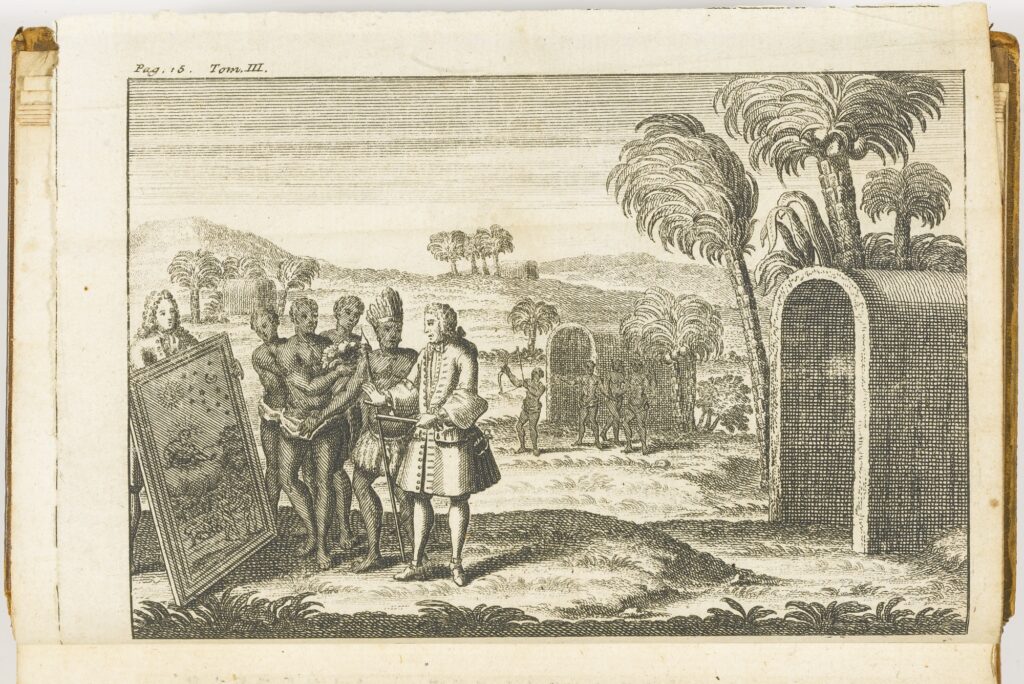
Hence, Lahontan, in his memoirs, says that Native Americans, such as Kondiaronk, who had been in France,
“were continually teasing us with the faults and disorders they observed in our towns, as being occasioned by money. There’s no point in trying to remonstrate with them about how useful the distinction of property is for the support of society: they make a joke of everything you say on that account. In short, they neither quarrel nor fight, nor slander one another; they scoff at arts and sciences, and laugh at the difference of ranks which is observed with us. They brand us for slaves, and call us miserable souls, whose life is not worth having, alleging that we degrade ourselves in subjecting ourselves to one man [the king] who possesses all power, and is bound by no law but his own will.”
Lahontan continues:
“They think it unaccountable that one man should have more than another,
and that the rich should have more respect than the poor.
In short, they say, the name of savages, which we bestow upon them, would fit ourselves better,
since there is nothing in our actions that bears an appearance of wisdom.”
In his dialogue with Kondiaronk, Lahontan tells him that if the wicked remained unpunished, we would become the most miserable people of the earth. Kondiaronk responds:
“For my part, I find it hard to see how you could be much more miserable than you already are. What kind of human, what species or creature, most Europeans be, that they have to be forced to do the good, and only refrain from evil because of fear of punishment?… You have observed we lack judges. What is the reason for that? Well, we never bring lawsuits against one another. And why do we never bring lawsuits? Well because we made a decision neither to accept or make use of money. And why do we refuse to allow money in our communities? The reason is this: we are determined not to have laws – because, since the world was a world, our ancestors have been able to live contentedly without them.”
Brother Gabriel Sagard, a French Recollect Friar, reported that the Wendat people were particularly offended by the French lack of generosity to one another:
“They reciprocate hospitality and give such assistance to one another that the necessities of all are provided for without there being any indigent beggar in their towns and villages;
and they considered it a very bad thing when they heard it said
that there were in France a great many of these needy beggars,
and thought that this was for lack of charity in us, and blamed us for it severely”.

Money, thinks Kondiaronk, creates an environment that encourages people to behave badly:
“I have spent six years reflecting on the state of European society and I still can’t think of a single way they act that’s not inhuman, and I genuinely think this can only be the case, as long as you stick to your distinctions of ‘mine’ and ‘thine’. I affirm that what you call money is the devil of devils; the tyrant of the French, the source of all evils; the bane of souls and the slaughterhouse of the living. To imagine one can live in the country of money and preserve one’s soul is like imagining one could preserve one’s life at the bottom of a lake. Money is the father of luxury, lasciviousness, intrigues, trickery, lies, betrayal, insincerity, – all of the world’s worst behaviors. Fathers sell their children, husbands their wives, wives betray their husbands, brothers kill each other, friends are false, and all because of money. In the light of all this, tell me that we Wendat are not right in refusing to touch, or so much as to look at money?”
In the third footnote of his speech on the origins on inequality, Jean-Jacques Rousseau, who invented the idea of the “noble savage” presumably existing before man engaged in agriculture, himself refers to
“those happy nations, who do not know even the names of the vices
which we have such trouble controlling,
of those American savages whose simple and natural ways of keeping public order
Montaigne does not hesitate to prefer to Plato’s laws…”
Europeans refusing to return
Another observation is that of Swedish botanist Peher Kalm, who, in 1749, was astonished by the fact that a large number of Europeans, exposed to Aboriginal life, did not want to return:
“It is also remarkable that the greater part of the European prisoners who, on the occasion of the war, were taken in this way and mixed with the Indians, especially if they were taken at a young age, never wanted to return to their country of origin afterwards, even though their father and mother or close relatives came to see them to try to persuade them to do so, and they themselves had every freedom to do so. But they found the Indians’ independent way of life preferable to that of the Europeans; they adopted native clothing and conformed in every way to the Indians, to the point where it is difficult to distinguish them from the Indians, except that their skin and complexion are slightly whiter. We also know of several examples of Frenchmen who have voluntarily married native women and adopted their way of life; on the other hand, we have no example of an Indian marrying a European woman and adopting her way of life; if he happens to be taken prisoner by the Europeans during a war, he always looks for an opportunity, on the contrary, to return home, even if he has been detained for several years and has enjoyed all the freedoms that a European can enjoy.”
Before Lahontan:
Thomas More’s Utopians
In 1492, as the joke goes, “America discovered Columbus, a Genoese captain lost at sea”. The mission he had been entrusted with was motivated by a variety of intentions, not least the idea of reaching, by traveling west, China, a continent thought to be populated by vast populations unaware of Christ’s inspiring and optimistic message, and therefore in urgent need of evangelization.
Unfortunately, two years later, a less theological interest arose when, on June 7, 1494, the Portuguese and Spanish signed the Treaty of Tordesillas at the Vatican, under the supervision of Pope Alexander IV (Borgia), dividing the entire world between two dominant world powers:
- the Spanish Empire under top-down control of the continental Habsburg/Venice alliance;
- the Portuguese Empire under that of the banking cartel of Genoese maritime slave traders.
This didn’t stop the best European humanists, two centuries before Lahontan, from raising their voices and showing that some of the so-called “savages” of the United States had virtues and qualities absolutely worthy of consideration and possibly lacking here in Europe.
Such was the case with Erasmus of Rotterdam and his close friend and collaborator Thomas More, who shared what are thought to be their views on America in a little book entitled “U-topia” (meaning ‘any’ place), jointly written and published in 1516 in Leuven, Belgium.
By instinct, the reports they received of America and the cultural characteristics of its natives, led them to believe that they were dealing with some lost colony of Greeks or even the famous lost continent of Atlantis described by Plato in both his Timaeus and Critias.
In More’s Utopia, the Portuguese captain Hythlodeus describes a highly organized civilization: it has flat-hulled ships and “sails made of sewn papyrus”, made up of people who “like to be informed about what’s going on in the world” and whom he “believes to be Greek by origin”.
At one point he says:
“Ah, if I were to propose what Plato imagined in his Republic, or what the Utopians put into practice in theirs, these principles, although far superior to ours – and they certainly are –
might come as a surprise, since with us, everyone owns his property,
whereas there, everything is held in common.”
(no private property).
As far as religion is concerned, the Utopians (like the Native Americans)
“have different religions but, just as many roads lead to one and the same place, all their aspects, despite their multiplicity and variety, converge towards the worship of the divine essence. That’s why nothing can be seen or heard in their temples except what is consistent with all beliefs.
The particular rites of each sect are performed in each person’s home;
public ceremonies are performed in a common place;
Public ceremonies are performed in a form that in no way contradicts them.«
And to conclude :
“Some worship the Sun, others the Moon or some other planet (…) The majority, however, and by far the wisest, reject these beliefs, but recognize a unique god, unknown, eternal, in-commensurable, impenetrable, inaccessible to human reason, spread throughout our universe in the manner, not of a body, but of a power. They call him Father, and relate to him alone the origins, growth, progress, vicissitudes and decline of all things. They bestow divine honors on him alone (…) Moreover, despite the multiplicity of their beliefs, the other Utopians at least agree on the existence of a supreme being, creator and protector of the world.”
Exposing the trap of woke ideology
Does that mean that “all Europeans were evil” and that “all Native Americans were good”? Not at all! The authors don’t fall for such simplistic generalizations and “woke” ideology in general.
For example, even with major similarities, the cultural difference between the First Nation of the Canadian Northwest Coast and those of California, was as big as that between Athens and Sparta in Greek antiquity, the first a republic, the latter an oligarchy.
Different people and different societies, at different times, made experiments and different political choices about the axiomatics of their culture.
While in California, forms of egalitarian and anti-oligarchical self-government erupted, in some areas of the north, oligarchical rule prevailed:
“[F]rom the Klamath River northwards, there existed societies dominated by warrior aristocrats engaged in frequent inter-group raiding, an in which, traditionally, a significant portion of the population had consisted of chattel slaves. This apparently had been true as long as anyone living there could remember.”
Northwest societies took delight in displays of excess, notably during festivals known as “potlach” sometimes culminating in
“the sacrificial killing of slaves (…) In many ways, the behavior or Northwest Coast aristocrats resembles that of Mafia dons, with their strict codes of honor and patronage relations; or what sociologists speak of as ‘court societies’ – the sort of arrangement one might expect in, say, feudal Sicily, from which the Mafia derived many of its cultural codes.”
So, the first point made by the authors is that the infinite diversity of human societies has to be taken into account. Second, instead of merely observing the fact, the authors underline that these diversities very often didn’t result from “objective” conditions, but from political choices. That also carries the very optimistic message, that choices different from the current world system, can become reality if people rise to the challenge of changing them for the better.
Urbanization before agriculture
In the largest part of the book, the authors depict the life of hunter-gatherers living thousands of years before the agricultural revolution but able to create huge urban complexes and eventually ruling without a dominant oligarchy.
The book identifies examples in China, Peru, the Indus Valley (Mohenjo-Daru), Ukraine ((Taljanki, Maidenetske, Nebelivka), Mexico (Tlaxcala), the USA (Poverty Point), and Turkey (Catalhoyuk), where large-scale, city-level living was taking place (from about 10,000 BC to 6,000 BC).
But these didn’t involve a ruling caste or aristocratic class; they were explicitly egalitarian in their house building and market trading; made many innovations in plumbing and street design; and were part of continental networks which shared best practice. The agricultural revolution was not a “revolution”, the book argues, but rather a continual transformative process spread across thousands of years when hunter-gatherers were able to flexibly organize themselves into mega-sites (several thousand inhabitants), organized without centers or monumental buildings, but built with standardized houses, comfortable for daily life, all of this achieved without static hierarchies, kings, or overwhelming bureaucracy.
Another case in point is the example of Teotihuacan, which rivaled Rome in grandeur between about 100 BC and 600 AD, where, following a political revolution in 300 AD, an egalitarian culture embarked on a massive social housing program designed to give all residents decent quarters.
Conclusion
Living today, it is very difficult for most of us to imagine that a society, a culture, or a civilization, could survive over centuries without a centralized, forcibly hierarchical power structure.
While, as the authors indicate, archaeological evidence, if we are ready to look at it, tell us the contrary. But are we ready to challenge our own prejudices?
As an example of such self-inflicted blindness, worth mentioning is the case of the “King-Priest”, a small male carved figure showing a neatly bearded man, found during the excavation of the ruined Bronze Age city of Mohenjo-daro (Pakistan), dated to around 2000 BC and considered « the most famous stone sculpture » of the Indus Valley civilization. While in Mohenjo-Daro there exists neither a royal palace or tomb, nor a religious temple of any nature, British archaeologists immediately called it a “King-Priest”, because very simply “it can’t be otherwise”.
Reading Graeber and Wengrow’s book obliges us to adjust our views and become optimistic. They show that radically different human systems are not only possible but have been tried many times by our species. In a public talk in 2022, Wengrow presented what he sees as lessons for the political present from the past, where human beings were much more fluid, conscious and experimental with their social and economic structures :
“Now what do all these details amount to? What does it all mean? Well, at the very least, I’d suggest it’s really a bit far-fetched these days to cling to this notion that the invention of agriculture meant a departure from some egalitarian Eden. Or to cling to the idea that small-scale societies are especially likely to be egalitarian, while large-scale ones must necessarily have kings, presidents and top-down structures of management. And there are also some contemporary implications. Take, for example, the commonplace notion that participatory democracy is somehow natural in a small community—or perhaps an activist group—but couldn’t possibly have a scale-up for anything like a city, a nation or even a region. Well, actually, the evidence of human history, if we’re prepared to look at it, suggests the opposite. If cities and regional confederacies, held together mostly by consensus and cooperation, existed thousands of years ago, who’s to stop us creating them again today with technologies that allow us to overcome the friction of distance and numbers? Perhaps it’s not too late to begin learning from all this new evidence of the human past, even to begin imagining what other kinds of civilization we might create if we can just stop telling ourselves that this particular world is the only one possible.”
Avec Leibniz et Kondiaronk, ré-inventer un monde sans oligarchie
Introduction
Helga Zepp-LaRouche, la fondatrice de l’Institut Schiller, dans son discours d’ouverture de la vidéoconférence de l’Institut Schiller du 22 novembre 2022, « Pour la paix mondiale – arrêtons le danger de guerre nucléaire : troisième séminaire des dirigeants politiques et sociaux du monde », a appelé les dirigeants du monde à éradiquer le principe maléfique de l’oligarchie.
L’oligarchie est définie comme une structure de pouvoir dans laquelle le pouvoir repose sur un petit nombre de personnes présentant certaines caractéristiques (noblesse, renommée, richesse, éducation ou contrôle corporatif, religieux, politique ou militaire) et qui imposent leur propre pouvoir sur celui de leur peuple.
Helga Zepp-LaRouche a précisé :
« Depuis 600 ans, il y a eu une bataille continue entre deux formes de gouvernement, entre l’État-nation souverain et la forme oligarchique de la société, vacillant d’un côté et de l’autre avec parfois une plus grande emphase dans l’une ou l’autre de ces directions. Tous les empires reposant sur le modèle oligarchique ont été orientés vers la protection des privilèges de l’élite dirigeante, tout en essayant de maintenir les masses populaires aussi arriérées que possible, parce qu’en les transformant en moutons obéissants, elles sont plus faciles à contrôler (…)«
Or, malheureusement, la plupart des citoyens du monde transatlantique et d’ailleurs vous diront que l’abolition du principe oligarchique est « une bonne idée », un « beau rêve », mais que la réalité nous dit que « ça ne peut pas arriver » pour la simple et bonne raison que « ça n’est jamais arrivé avant ».
Les sociétés, par définition, affirment-ils, sont inégalitaires. Les rois et les présidents de républiques, affirment-ils, ont pu éventuellement « prétendre » qu’ils régnaient sur les masses pour leur « bien commun », mais en réalité, pensent nos concitoyens, il s’agissait toujours du règne d’une poignée privilégiant ses propres intérêts au détriment de la majorité.
Les BRICS
Il est intéressant pour nous tous de constater que certains penseurs de premier plan impliqués dans le mouvement des BRICS tentent d’imaginer de nouveaux modes de gouvernance collective excluant les principes oligarchiques.
Par exemple, dans cette direction, l’économiste Pedro Paez, ancien conseiller du président équatorien Rafael Correa, a défendu, dans son intervention à la vidéoconférence de l’Institut Schiller les 15 et 16 avril 2023,
« un nouveau concept de monnaie fondé sur des accords monétaires de chambres de compensation pour les paiements régionaux, qui peuvent être réunis dans un système de chambre de compensation mondiale, qui pourrait également empêcher un autre type d’hégémonie unilatérale et unipolaire de se produire, comme celle qui a été établie avec Bretton Woods, et qui ouvrirait au contraire les portes à une gestion multipolaire.«
Le philosophe et théologien belge Marc Luyckx, ancien membre de la fameuse « Cellule de Prospective » de la Commission européenne de Jacques Delors, a également souligné, dans une interview vidéo sur la dédollarisation de l’économie mondiale, que les pays BRICS sont en train de créer un ordre mondial dont la nature fait qu’aucun membre de leur propre groupe ne peut devenir la puissance dominante.
Une nouvelle histoire de l’humanité

La bonne nouvelle est qu’un livre décapant de 700 pages, intitulé « Au commencement était… Une nouvelle histoire de l’humanité » (Editions Les liens qui libèrent), écrit et publié en 2021 par l’anthropologue américain David Graeber* (à droite) et le professeur britannique d’archéologie comparée David Wengrow (à gauche) de l’University College de Londres (UCL), fracasse les notions conventionnelles selon lesquelles les anciennes cultures humaines ont progressé de façon linéaire vers le modèle économique néolibéral actuel et, par conséquent, vers des niveaux élevés d’inégalité.
Mieux encore, en se fondant sur des faits concrets, le livre réfute en grande partie le « récit » selon lequel le modèle oligarchique est en quelque sorte « naturel ». Bien sûr, le principe oligarchique a souvent régné, et souvent pendant longtemps. Mais, étonnamment, le livre présente des indications accablantes et des indices archéologiques fortes permettant de croire que dans les temps anciens, certaines sociétés, mais pas toutes, ont réussi à prospérer et perdurer au fil des siècles par le biais de choix politiques totalement différents..
Par conséquent, et c’est la bonne nouvelle, si nos lointains ancêtres ont consciemment su construire des modes de gouvernance rendant impossible que des groupes minoritaires conservent une emprise hégémonique permanente et des privilèges sur la société, cela peut le refaire aujourd’hui.
Le 10e point de Helga Zepp-LaRouche
Cette question est intimement lié au 10e point soulevé par Helga Zepp-LaRouche qui, pour démontrer que toutes les sources du mal peuvent être éradiquées par l’éducation et renversées par une décision politique, affirme que l’inclination naturelle de l’homme est intrinsèquement de faire le bien.
L’existence même de précédents historiques de sociétés ayant survécu sans oligarchie pendant des centaines d’années est bien sûr la preuve « pratique » de l’inclination axiomatique de l’homme à faire le bien.
Sans surprise, certains affirment que la question du « bien » et du « mal » n’est qu’un « débat théologique », puisque les concepts de « bien » et de « mal » n’existent que pour des humains cherchant à se comparer les uns aux autres. Selon eux, personne ne se demanderai si un poisson ou un arbre est bon ou mauvais, puisqu’ils n’ont aucune forme de conscience de soi leur permettant de mesurer leurs actes et leurs actions à la lumière de leur propre nature ou à celle de l’intention de leur créateur.
Or, une partie de la « réponse biblique » à cette allégorie, à savoir si l’homme est bon ou mauvais, part du postulat que les gens « vivaient autrefois dans un état d’innocence », mais qu’ils ont succombé au péché originel. Nous nous sommes pris pour Dieu et avons été punis pour cela ; maintenant nous vivons dans un état de déchéance, tout en espérant une rédemption future.
Rousseau et Hobbes, même combat ?
Graeber et Wengrow, en en faisant le socle de leur livre, démontrent de manière très provocante comment nous avons subi un lavage de cerveau par l’idéologie oligarchique pessimiste et destructrice, en particulier celle promue par Rousseau et Hobbes, pour qui l’inégalité est l’état naturel de l’homme, une humanité qui aurait pu éventuellement être bonne comme « un bon sauvage », avant de devenir, suite à l’apparition de l’agriculture et de l’industrie, « civilisée » et une société ne survivant que grâce à un « contrat social » (soumission volontaire du bas vers le haut) ou un Léviathan (dictature du haut vers le bas) : Écoutons les auteurs :
« Aujourd’hui, la version populaire de cette allégorie [biblique] [de l’homme chassé du jardin d’Eden] est généralement une version moderne du Discours sur l’origine et les fondements de l’inégalité parmi les hommes, écrit par Jean-Jacques Rousseau en 1754.
« En voici la trame générale. Il fut un temps où les hommes, aussi innocents qu’au premier jour, vivaient de chasse et de cueillette au sein de tout petits groupes – des groupes qui pouvaient être égalitaires justement parce qu’ils étaient petits. Cet âge d’or pris fin avec l’apparition de l’agriculture, et surtout avec le développement des premières villes. Celles-ci marquèrent l’avènement de la ‘civilisation’ et de ‘l’Etat’, donnant naissance à l’écriture, à la science et à la philosophie, mais aussi à presque tous les mauvais côtés de l’existence humaine : le patriarcat, les armées permanentes, les exterminations de masse, sans oublier les vastes bureaucraties qui nous inondent de formulaires.
« Bien sûr, il s’agit d’une simplification très grossière, mais il semble que ce soit le récit de base qui refait surface chaque fois que quelqu’un, des psychologues du travail aux théoriciens révolutionnaires, dit quelque chose du genre ‘mais bien sûr, les êtres humains ont passé la majeure partie de leur évolution à vivre dans des groupes de dix ou vingt personnes’, ou ‘l’agriculture a peut-être été la pire erreur de l’humanité’. Et comme nous le verrons, de nombreux auteurs populaires avancent explicitement cet argument. Le problème, c’est que quiconque cherche une alternative à cette vision plutôt déprimante de l’histoire s’aperçoit rapidement que la seule proposée est encore pire : si ce n’est pas Rousseau, alors c’est Thomas Hobbes.
« Le Léviathan de Hobbes, publié en 1651, à bien des égards, fait figure de texte fondateur de la théorie politique moderne. Hobbes y soutient que, les hommes étant ce qu’ils sont —des créatures égoïstes—, l’état de nature originel n’était en aucun cas un état d’innocence. On y menait forcément une existence ’solitaire, pauvre, méchante, brutale et courte’ – fondamentalement, un état de guerre, une guerre de tous contre tous. Et s’il y a eu des progrès par rapport à cet état de fait, un hobbesien dirait qu’ils sont dus en grande partie aux mécanismes répressifs dont se plaignait précisément Rousseau : les gouvernements, les tribunaux, les bureaucraties, la police. Cette vision des choses existe également depuis très longtemps. Ce n’est pas pour rien qu’en anglais, les mots ’politics’, ’polite’ et ’police’ se prononcent tous de la même façon : ils dérivent tous du mot grec polis, ou ville, dont l’équivalent latin est civitas, qui nous donne aussi ’civility’, ’civic’ et une certaine conception moderne de la ‘civilisation’.
« En vertu de cette conception, la société humaine repose sur la répression collective de nos plus bas instincts, ce qui devient d’autant plus nécessaire lorsque les hommes vivent en grand nombre en un même lieu. Le hobbesien des temps modernes dirait donc que, oui, nous avons vécu la plus grande partie de notre évolution en petits groupes, qui pouvaient s’entendre principalement parce qu’ils partageaient un intérêt commun pour la survie de leur progéniture. Mais même ces groupes n’étaient en aucun cas fondés sur l’égalité. Il y avait toujours, dans cette version, un chef ‘mâle alpha’. Les sociétés humaines n’auraient donc jamais fonctionné selon d’autres principes que la hiérarchie, la domination et l’égoïsme cynique. C’est juste que, collectivement, nous avons appris qu’il était à notre avantage de donner la priorité à nos intérêts à long terme plutôt qu’à nos instincts à court terme ; ou, mieux encore, de créer des lois qui nous obligent à confiner nos pires impulsions dans des domaines socialement utiles comme l’économie, tout en les interdisant partout ailleurs.
« Comme le lecteur peut probablement le déceler à notre ton, nous n’aimons pas beaucoup le choix entre ces deux alternatives. Nos objections peuvent être classées en trois grandes catégories. En tant que récits du cours général de l’histoire de l’humanité, ils :
1. ne sont tout simplement pas vrais ;
2. ont des implications politiques désastreuses et
3. donnent du passé une image inutilement ennuyeuse.«
Conséquence de la victoire des modèles impériaux de pouvoir politique, le seul « récit » accepté de « l’évolution » de l’homme, validant automatiquement une emprise oligarchique sur la société, est celui qui permet de « confirmer » le dogme convenu à l’avance et érigé en « vérité » immortelle ou absolue. Et toute découverte historique ou artefact contredisant ou invalidant le récit de Rousseau-Hobbes seront, considérés, au mieux, comme des anomalies.
Ouvrir les yeux
Graeber et Wengraw affirment,
« vouloir raconter une autre histoire, plus prometteuse et plus intéressante ; une histoire qui, en même temps, tient mieux compte de ce que les dernières décennies de recherche nous ont appris. Il s’agit en partie de rassembler les preuves accumulées par l’archéologie, l’anthropologie et d’autres disciplines apparentées, preuves qui permettent de rendre compte d’une manière totalement nouvelle de la façon dont les sociétés humaines se sont développées au cours des 30 000 dernières années environ. La quasi-totalité de ces recherches vont à l’encontre des idées reçues, mais trop souvent les découvertes les plus remarquables restent confinées aux travaux des spécialistes ou doivent être découvertes en lisant entre les lignes des publications scientifiques.«
Et en effet, leur regard nouveau les conduit à constater :
« qu’il il est établi aujourd’hui que les sociétés humaines avant l’avènement de l’agriculture n’étaient pas confinées à des groupuscules égalitaires. Au contraire, le monde des chasseurs-cueilleurs tel qu’il existait avant l’avènement de l’agriculture était un monde d’expériences sociales audacieuses, ressemblant bien plus à un défilé carnavalesque de formes politiques qu’aux abstractions ternes de la théorie de l’évolution. L’agriculture, quant à elle, n’a pas signifié l’avènement de la propriété privée, pas plus qu’elle n’a marqué un pas irréversible vers l’inégalité. En fait, bon nombre des premières communautés agricoles étaient relativement exemptes de rangs et de hiérarchies. Et loin de graver dans le marbre les différences de classe, un nombre surprenant des premières villes du monde étaient organisées sur des bases solidement égalitaires, sans avoir besoin de dirigeants autoritaires, de guerriers-politiciens ambitieux, ni même d’administrateurs autoritaires.«
Kondiaronk,
Leibniz et les Lumières
En fait, la dissertation de Rousseau, selon les auteurs, était en partie une réponse aux critiques de la civilisation européenne, qui ont commencé dans les premières décennies du XVIIIe siècle.
« Les origines de cette critique, cependant, ne se trouvent pas chez les philosophes des Lumières (bien qu’ils les aient admirés et imités au début), mais chez les commentateurs et observateurs indigènes de la société européenne, tels que l’homme d’État amérindien (Huron-Wendat) Kondiaronk », et bien d’autres encore.
Et lorsque d’éminents penseurs, comme Leibniz,
« ont exhorté leurs patriotes à adopter les modèles chinois de gestion de l’État, les historiens contemporains ont tendance à insister sur le fait qu’ils n’étaient pas vraiment sérieux.«
Pourtant, de nombreux penseurs influents du siècle des Lumières ont effectivement affirmé que certaines de leurs idées sur le thème de l’inégalité étaient directement inspirées de sources chinoises ou amérindiennes !
Tout comme Leibniz s’est familiarisé avec la civilisation chinoise grâce à ses contacts avec les missions jésuites, les idées des Indiens ont atteint l’Europe par le biais d’ouvrages tels que le rapport en soixante-et-onze volumes, Les relations des jésuites de la Nouvelle France, publié entre 1633 et 1673 et qui fit couler beaucoup d’encre.
Alors qu’aujourd’hui, nous pensons que la liberté individuelle est une bonne chose, ce n’était pas le cas des Jésuites qui se plaignaient des Indiens. Les Jésuites étaient opposés à la liberté par principe :
« C’est là, sans aucun doute, une disposition tout à fait contraire à l’esprit de la foi, qui exige que nous soumettions non seulement nos volontés, mais nos esprits, nos jugements et tous les sentiments de l’homme à une puissance inconnue des lois et des sentiments d’une nature corrompue. »
Le père jésuite Jérôme Lallemant, dont la correspondance a servi de modèle initial aux Relations des Jésuites, notait à propos des Indiens Wendats en 1644 :
« Je ne crois pas qu’il y ait peuples sur la Terre plus libre que ceux-ci, et moins capables de voir leurs volontés assujetties à quelque puissance que ce soit.«
Plus inquiétant encore, leur haut niveau d’intelligence. Le Père Paul Le Jeune, supérieur des Jésuites au Canada dans les années 1630 :
« Il n’y en a quasi point qui ne soit capable d’entretien, et ne résonne fort bien, et en bons termes, sur les choses dont il a connaissance : ce qui les forme encore dans le discours, sont les conseils qui se tiennent quasi tous les jours dans les villages en toutes occurrences. »
Ou encore, selon Lallemant :
« Je puis dire en vérité que pour l’esprit, ils n’ont rien de moins que les Européens, et demeurant dedans la France, je n’eusse jamais cru, que sans instruction la nature eût pu fournir une éloquence plus prompte et plus vigoureuse que j’en ai admiré en plusieurs Hurons, ni de plus clairvoyant dans les affaires, et une conduite plus sage dans les choses qui sont de leur usage. (Relations des Jésuites, vol. XXVIII, p. 62.) »
Certains jésuites sont allés beaucoup plus loin, notant – non sans une certaine frustration – que les « sauvages » du Nouveau Monde semblaient globalement plus intelligents que les personnes avec lesquelles ils avaient l’habitude de traiter dans leur pays.
Les idées de l’homme d’État amérindien Kondiaronk (v. 1649-1701), connu sous le nom de « Le Rat » et chef du peuple amérindien Wendat (Huron) à Michilimackinac en Nouvelle-France, sont parvenues à Leibniz par l’intermédiaire d’un aristocrate français appauvri nommé Louis-Armand de Lom d’Arce, baron de La Hontan, plus connu sous le nom de Lahontan (1666-1715).
En 1683, Lahontan, âgé de 17 ans, s’engage dans l’armée française et est affecté au Canada. Au cours de ses différentes missions, il parle couramment l’algonquin et le wendat et se lie d’amitié avec de nombreuses personnalités politiques autochtones, dont le brillant homme d’État wendat Kondiaronk, qui, en tant que porte-parole du Conseil (organe directeur) de la Confédération wendat, est envoyé comme ambassadeur à la cour de Louis XIV en 1691.
La Grande Paix de Montréal
Même après avoir été trahi par les Français et obligé de mener ses propres guerres pour assurer la sécurité de ses concitoyens, Kondiaronk a joué un rôle clé dans ce que l’on appelle la « Grande Paix de Montréal » du 1er août 1701, qui a mis fin aux sanglantes guerres des Castors.
C’était en réalité des guerres par procuration entre les Britanniques et les Français, chacun d’eux utilisant les Indiens comme « chair à canon » pour leurs propres projets géopolitiques.
La France est de plus en plus acculée par les Britanniques. Ainsi, à la demande des Français, au cours de l’été 1701, plus de 1 300 Indiens, issus de quarante nations différentes, se rassemblent près de Montréal, contestant le fait que la ville soit ravagée par la grippe. Ils viennent de la vallée du Mississippi, des Grands Lacs et de l’Acadie. Beaucoup sont des ennemis de toujours, mais tous ont répondu à l’invitation du gouverneur français. Leur avenir et le destin de la colonie sont en jeu. Leur objectif est de négocier une paix globale, entre eux et avec les Français. Les négociations durent des jours et la paix est loin d’être garantie. Les chefs sont méfiants. La principale pierre d’achoppement est le retour des prisonniers capturés lors des campagnes précédentes et réduits en esclavage ou adoptés. Indiens s’attristant du décès de Kondiaronk. Sans le soutien de ce dernier, la paix est impossible. Le 1er août, gravement malade, il parle pendant deux heures en faveur d’un traité de paix qui serait garanti par les Français. Son discours émeut beaucoup de monde. La nuit suivante, Kondiaronk meurt, terrassé par la grippe à l’âge de 52 ans.
Mais le lendemain, le traité de paix est signé. Désormais, il n’y aura plus de guerre entre les Français et les Indiens. Trente-huit nations signent le traité, dont les Iroquois. Les Iroquois s’engagent à rester neutres dans tout conflit futur entre les Français et leurs anciens alliés, les colons anglais de Nouvelle-Angleterre. Kondiaronk est loué par les Français et présenté comme un « modèle » d’indigène pacifique. Les Jésuites ont immédiatement répandu le mensonge selon lequel, juste avant de mourir, il se serait « converti » à la foi catholique dans l’espoir que d’autres indigènes suivent son exemple.
Lahontan, d’Amsterdam à Hanovre
Or, à la suite de divers événements, Lahontan se retrouve à Amsterdam. Pour gagner sa vie, il écrit une série de livres sur ses aventures au Canada (« Voyages du baron de La Hontan dans l’Amérique Septentrionale, qui contiennent une relation des différents peuples qui y habitent »), dont le troisième, intitulé « Dialogue curieux entre l’auteur et un sauvage de bon sens qui a voyagé », comprend quatre dialogues avec un personnage fictif, un dénommé Adario (en réalité Kondiaronk).
Les Dialogues sont rapidement traduits en allemand, en néerlandais, en anglais et en italien. Lahontan lui-même, acquière alors une certaine célébrité, s’installe à Hanovre où il se lie d’amitié avec le grand philosophe et scientifique Wilhelm Gottfried Leibniz. (1646-1716). A l’affût de tout ce qui se discutait en Europe, le philosophe, alors âgé de 64 ans, semble avoir été mis sur la piste de Lahontan par des journalistes hollandais et allemands, mais aussi par le texte d’un obscur théologien de Helmstedt, Jonas Conrad Schramm (1675-1739), dont la conférence introductive sur « la Philosophie balbutiante des Canadiens » avait été publiée en latin en 1707. Se référant d’abord à Platon et à Aristote (qu’il abandonne presque aussitôt), Schramm s’appuie sur les Dialogues et les Mémoires de Lahontan pour montrer comment les
« barbares canadiens frappent à la porte de la philosophie mais n’y entrent pas parce qu’ils n’ont pas les moyens suffisants ou qu’ils sont enfermés dans leurs coutumes ».
Beaucoup moins borné, Leibniz voit dans Lahontan une confirmation de son propre optimisme politique qui lui permet d’affirmer que la naissance de la société ne vient pas de la nécessité de sortir d’un terrible état de guerre, comme le pensait Thomas Hobbes, mais d’une aspiration naturelle à la concorde.
Mais ce qui l’intéresse avant tout, ce n’est pas tant de savoir si les « sauvages américains » sont capables ou non de philosopher, mais s’ils vivent réellement en concorde sans gouvernement.
A son correspondant Wilhelm Bierling, qui lui demande comment les Indiens du Canada peuvent vivre « en paix bien qu’ils n’aient ni lois ni magistratures publiques », Leibniz répond :
« Il est tout à fait véridique (…) que les Américains de ces régions vivent ensemble sans aucun gouvernement mais en paix ; ils ne connaissent ni luttes, ni haines, ni batailles, ou fort peu, excepté contre des hommes de nations et de langues différentes. Je dirais presque qu’il s’agit d’un miracle politique, inconnu d’Aristote et ignoré par Hobbes.«
Leibniz, qui affirme bien connaître Lahontan, souligne qu’Adario :
« venu en France il y a quelques années et qui, quoiqu’il appartienne à la nation huronne, a jugé ses institutions supérieures aux nôtres.«
Cette conviction de Leibniz s’exprimera encore dans son Jugement sur les œuvres de M. le Comte Shaftesbury, publiées à Londres en1711 sous le titre de Characteristicks :
« Les Iroquois et les Hurons, sauvages voisins de la Nouvelle France et de la Nouvelle Angleterre, ont renversé les maximes politiques trop universelles d’Aristote et de Hobbes. Ils ont montré par une conduite surprenante, que des peuples entiers peuvent être sans magistrats et sans querelles, et que par conséquent les hommes ne sont ni assez portés par leur bon naturel, ni assez forcés par leur méchanceté à se pourvoir d’un gouvernement et à renoncer à leur liberté. Mais la rudesse de ces sauvages fait voir, que ce n’est pas tant la nécessité, que l’inclination d’aller au meilleur et d’approcher de la félicité, par l’assistance mutuelle, qui fait le fondement des sociétés et des États ; et il faut avouer que la sûreté en est le point le plus essentiel. »
Alors que ces dialogues sont souvent qualifiés de purement fictifs, Leibniz, dans une lettre à Bierling datée du 10 novembre 1719, estime que :
« Les Dialogues de Lahontan, bien qu’ils ne soient pas entièrement vrais, ne sont pas non plus complètement inventés.«
Pour Leibniz, bien sûr, les institutions politiques sont nées d’une aspiration naturelle au bonheur et à l’harmonie. Dans cette perspective, le travail de Lahontan ne contribue pas à la construction d’un nouveau savoir, il ne fait que confirmer une thèse qu’il avait déjà constituée.
Regard sur les Européens
et les Français en particulier
Ainsi, Lahontan, dans ses mémoires, raconte que des Amérindiens, comme Kondiaronk, qui avaient séjourné en France,
« nous taquinaient continuellement avec les défauts et les désordres qu’ils observaient dans nos villes, comme étant causés par l’argent. On a beau à leur donner des raisons pour leur faire connaître que la propriété des biens est utile au maintien de la société : ils se moquent de tout ce qu’on peut dire sur cela. Au reste, ils ne se querellent ni ne se battent, ni se médisent jamais les uns des autres ; ils se moquent des arts et des sciences, et ils rient de la différence de rangs qu’on observe chez nous. Ils nous traitent d’esclaves et d’âmes misérables, dont la vie ne vaut pas la peine d’être vécue, alléguant que nous nous dégradons en nous soumettant à un seul homme [le Roi] qui peut tout, et qui n’a d’autre loi que son bon vouloir.«
Lahontan poursuit :
« Ils trouvent étrange que les uns aient plus de biens que les autres, et que ceux qui en ont le plus sont estimés davantage que ceux qui en ont le moins. Enfin, ils disent que le titre de sauvages, dont nous les qualifions, nous conviendrait mieux que celui d’hommes, puisqu’il n’y a rien moins que de l’homme sage dans toutes nos actions.«
Dans son dialogue avec Kondiaronk, Lahontan lui dit que si les méchants restaient impunis, nous deviendrions le peuple le plus misérable de la terre. Kondiaronk répond :
« Vous l’êtes assez déjà, je ne conçois pas que vous puissiez l’être davantage. Ô quel genre d’hommes sont les Européens ! Ô quelle sorte de créatures ! Qui font le bien par la force, et n’évitent à faire le mal que par la crainte des châtiments ? (…) Tu vois que nous n’avons point de juges ; pourquoi ? Parce que nous n’avons point de querelles ni de procès. Mais pourquoi n’avons-nous pas de procès ? C’est parce que nous ne voulons point recevoir ni connaître l’argent. Pourquoi est-ce que nous ne voulons pas admettre cet argent ? C’est parce que nous ne voulons pas de lois, et que depuis que le monde est monde nos pères ont vécu sans cela.«
Frère Gabriel Sagard, un frère récollet français, a rapporté que les Wendats étaient particulièrement offensés par le manque de générosité des Français les uns envers les autres :
« Ils se rendent l’hospitalité réciproque, et assistent tellement l’un l’autre qu’ils pourvoient à la nécessité de chacun, sans qu’il ait aucun pauvre mendiant parmi leurs villes et villages.Et trouvent fort mauvais entendant dire qu’il y avait en France grand nombre de ces nécessiteux et mendiants, et pensaient que cela fut faute de charité qui fut en nous, et nous en blâmaient grandement.«
L’argent, pense Kondiaronk, crée un environnement qui encourage les gens à mal se comporter :
« Plus je réfléchis à la vie des Européens et moins je trouve de bonheur et de sagesse parmi eux. Il y a six ans que je ne fais que penser à leur état. Mais je ne trouve rien dans leurs actions qui ne soit au-dessous de l’homme, et je regarde comme impossible que cela puisse être autrement, à moins que vous ne vouliez vous réduire à vivre sans le Tien ni le Mien, comme nous faisons. Je dis donc que ce que vous appelez argent est le démon des démons, le tyran des Français ; la source des maux ; la perte des âmes et sépulcre des vivants. Vouloir vivre dans les pays de l’argent et conserver son âme, c’est vouloir se jeter au fond du lac pour conserver la vie ; or ni l’un ni l’autre ne se peuvent. Cet argent est le père de la luxure, de l’impudicité, de l’artifice, de l’intrigue, du mensonge, de la trahison, de la mauvaise foi et généralement de tous les maux qui sont au monde. Le père vend ses enfants, les maris leurs femmes, les femmes trahissent leurs maris, les frères se tuent, les amis se trahissent, et tout pour l’argent. Dis-moi, je te prie, si nous avons tort après cela de ne vouloir point ni manier ni même voir ce maudit argent.«
Dans la troisième note de bas de page de son discours Sur les origines et les fondement de l’inégalité parmi les hommes, Jean-Jacques Rousseau, qui a inventé l’idée du « noble sauvage » supposé exister avant que l’homme ne se lance dans l’agriculture, fait lui-même référence à
« ces nations heureuses qui ne connaissent pas même le nom des vices que nous avons tant de peine à réprimer, de ces sauvages d’Amérique dont Montaigne ne balance point à préférer la simple et naturelle police, nos seulement aux lois de Platon, mais même à tout ce que la philosophie pourra jamais imaginer de plus parfait pour le gouvernement des peuples.«
Ces Européens qui refusent de rentrer
Autre observation, celle du botaniste suédois Peher Kalm qui s’étonne, en 1749 du fait qu’un grand nombre d’Européens, exposés à la vie autochtone, ne veulent pas en revenir :
« Il est également remarquable que la plus grande partie des prisonniers européens qui, à l’occasion de la guerre, ont été pris ainsi et mêlés aux Sauvages, surtout s’ils ont été pris dans leur jeune âge, n’ont jamais voulu revenir par la suite dans leur pays d’origine, bien que leurs père et mère ou leurs proches parents soient venus les voir pour tenter de les en persuader et qu’eux-mêmes aient eu toute liberté de le faire. Mais ils ont trouvé le mode de vie indépendant propre aux Sauvages préférable à celui des Européens ; ils ont adopté les vêtements indigènes et se sont conformés en tout aux Sauvages, au point qu’il est difficile de les en distinguer, si ce n’est qu’ils ont la peau et le teint légèrement plus blancs. On connaît également plusieurs exemples de Français qui ont volontairement épousé des femmes indigènes et ont adopté leur mode de vie ; par contre on n’a pas d’exemple qu’un Sauvage se soit uni à une Européenne et ait pris sa façon de vivre ; s’il lui arrive d’être fait prisonnier par les Européens au cours d’une guerre, il cherche toujours une occasion, au contraire, de retourner chez lui, même s’il a été retenu plusieurs années et a bénéficié de toutes les libertés dont un Européen peut jouir.«
Avant Lahontan :
les Utopiens de Thomas More
En 1492, comme le dit la plaisanterie, « l’Amérique découvrit Colomb, un capitaine génois perdu en mer ».
La mission qui lui avait été confiée était motivée par diverses intentions, en particulier l’idée d’atteindre, en voyageant vers l’ouest, la Chine, un continent que l’on croyait peuplé de vastes populations ignorant le message inspirant et optimiste du Christ et ayant donc un besoin urgent d’évangélisation.
Malheureusement, deux ans plus tard, un intérêt moins théologique se manifesta lorsque, le 7 juin 1494, les Portugais et les Espagnols signèrent au Vatican, sous la direction du pape Alexandre IV (Borgia), le traité de Tordesillas, partageant le monde entier entre deux empires, l’espagnol sous le contrôle de l’alliance continentale Habsbourg/Venise, et le portugais sous celui du cartel bancaire d’esclavagistes maritimes génois.
Cela n’a pas empêché, deux siècles avant Lahontan, les meilleurs humanistes européens d’élever la voix et de montrer que certains des soi-disant « sauvages » des États-Unis avaient des vertus et qualités qui méritaient absolument d’être pris en considération et éventuellement manquant chez nous en Europe.
C’est le cas d’Érasme de Rotterdam et de son ami intime et collaborateur Thomas More, qui partagent ce que l’on pense être leurs opinions sur l’Amérique dans un petit livre intitulé « U-topia » (qui signifie ’quelque’ endroit), écrit en commun et publié en 1516 à Louvain.
Par instinct, les rapports qu’ils reçoivent de l’Amérique et les caractéristiques culturelles de ses indigènes, les incitent à croire qu’ils ont affaire à quelque colonie perdue de Grecs ou même au fameux continent perdu de l’Atlantide décrit par Platon à la fois dans son Timée et dans son Critias.
Dans l’Utopie de More, le capitaine portugais Hythlodée décrit une civilisation très organisée : elle possède des vaisseaux à carène plate et « des voiles faites de papyrus cousu », composée de gens qui « aiment à être renseignés sur ce qui se passe dans le monde » et qu’il « croit Grecque d’origine ».
A un moment il est dit :
« Ah ! Si je venais proposer ce que Platon a imaginé dans sa République ou ce que les Utopiens mettent en pratique dans la leur, ces principes, encore que bien supérieurs aux nôtres, et ils le sont à coup sûr, pourraient surprendre, puisque chez nous, chacun possède ses biens tandis que là, tout est mis en commun. » (pas de propriété privée)
En ce qui concerne la religion, les Utopiens (tout comme les indigènes indiens)
« ont des religions différentes mais, de même que plusieurs routes conduisent à un seul et même lieu, tous leurs aspects, en dépit de leur multiplicité et de leur variété, convergent tous vers le culte de l’essence divine. C’est pourquoi l’on ne voit, l’on entend rien dans leurs temples que ce qui s’accorde avec toutes les croyances. Les rites particuliers de chaque secte s’accomplissent dans la maison de chacun ; les cérémonies publiques s’accomplissent sous une forme qui ne les contredit en rien.«
Et même :
« Les uns adorent le soleil, d’autres la lune ou quelque planète (…) Le plus grand nombre toutefois et de beaucoup les plus sages, rejettent ces croyances, mais reconnaissent un dieu unique, inconnu, éternel, incommensurable, impénétrable, inaccessible à la raison humaine, répandu dans notre univers à la manière, non d’un corps, mais d’une puissance. Ils le nomment Père et rapportent à lui seul les origines, l’accroissement, les progrès, les vicissitudes, le déclin de toutes choses. Ils n’accordent d’honneurs divins qu’à lui seul. (…) Au reste, malgré la multiplicité de leurs croyances, les autres Utopiens tombent du moins d’accord sur l’existence d’un être suprême, créateur et protecteur du monde.«
Pas de complaisance
envers l’idéologie woke
Cela signifie-t-il que « tous les Européens étaient mauvais » et que « tous les Indiens étaient bons » ? Pas du tout ! Les auteurs ne tombent pas dans le piège des généralisations simplistes et de l’idéologie « woke » en général.
Par exemple, même avec de grandes similitudes, la différence culturelle entre les Premières Nations de la côte nord-ouest du Canada et celles de Californie était aussi grande que celle entre Athènes et Sparte dans l’antiquité grecque, la première étant une république, la seconde une oligarchie.
Différents peuples et différentes sociétés, à différentes époques, ont fait des expériences et des choix politiques différents concernant les axiomes de leur culture.
Alors qu’en Californie, des formes d’autonomie égalitaire et anti-oligarchique apparaissent, dans certaines régions du nord, c’est le régime oligarchique qui prévaut :
« de la rivière Klamath vers le nord, il existait des sociétés dominées par des aristocrates guerriers engagés dans de fréquents raids entre groupes, et dans lesquelles, traditionnellement, une partie importante de la population était constituée d’esclaves à titre onéreux. Il semble que cela ait été le cas aussi longtemps que l’on s’en souvienne. »
Les sociétés du Nord-Ouest pour le plaisir qu’elles prenaient à afficher des excès, notamment lors des fêtes connues sous le nom de potlach, qui culminaient parfois, champignons hallucinogènes aidant, avec
« le meurtre sacrificiel d’esclaves (…) À bien des égards, le comportement des aristocrates de la côte nord-ouest ressemble à celui des mafieux, avec leurs codes d’honneur stricts et leurs relations de patronage, ou à ce que les sociologues appellent les ‘sociétés de cour’ – le genre d’arrangement auquel on pourrait s’attendre, par exemple, dans la Sicile féodale, d’où la mafia a tiré bon nombre de ses codes culturels. »
La première remarque de Graeber et Wengrow est donc qu’il faut tenir compte de l’infinie diversité des sociétés humaines. Deuxièmement, au lieu de se contenter d’observer le fait, les auteurs soulignent que, très souvent, ces diversités ne résultent pas de conditions « objectives », mais de choix politiques. Cela véhicule également un message très optimiste, à savoir que des choix différents du système mondial actuel peuvent devenir réalité si les gens relèvent le défi de les changer pour le mieux.
Les premières villes du monde
Dans la plus grande partie du livre, les auteurs décrivent la vie des chasseurs-cueilleurs qui ont vécu des milliers d’années avant la révolution agricole, mais qui ont été capables de créer d’immenses complexes urbains et qui parfois ont fini par gouverner sans oligarchie dominante.
Le livre identifie des exemples en Chine, au Pérou, dans la vallée de l’Indus (Mohenjo-Daro), en Ukraine (Talianki, Maydenetsk, Nebelivka), au Mexique (Tlaxcala), aux États-Unis (Poverty Point, Lousiane) et en Turquie (Göbekli Tepe, Catal Höyük), où l’on vivait à grande échelle au niveau de la ville (d’environ 10 000 à 6 000 ans av. J.-C.). Catal Höyük (Anatolie, Turkye) comptait jusqu’à 8000 habitants au moment de son extension maximum, entre le VIIe et le VIe millénaire avant notre ère.
Cathérine Louboutin, dans son ouvrage de la collection Découvertes Gallimard, « Au Néolithique, les premiers paysans du monde », écrivait en 1990 : « Malgré sa taille, un riche artisanat, la connaissance du métal (cuivre et plomb) et de l’irrigation, Catal Höyük ne montre aucune hiérarchie sociale et ne semble pas rassembler, pour la redistribuer, la richesse économique de la région dont elle serait le pôle majeur : ce n’est donc pas tout à fait une ville. »
Mais ces villes n’impliquaient pas de caste dirigeante ou de classe aristocratique ; elles étaient explicitement égalitaires dans la construction de leurs maisons et dans leurs échanges commerciaux ; elles ont apporté de nombreuses innovations en matière de plomberie et de conception des rues ; et elles faisaient partie de réseaux continentaux qui partageaient les meilleures pratiques.
La révolution agricole n’a pas été une « révolution », affirme les auteurs, mais plutôt un processus de transformation continu étalé sur des milliers d’années, lorsque les chasseurs-cueilleurs ont été capables de s’organiser de manière flexible en méga-sites (quelques milliers d’habitants), organisés sans centres ni bâtiments monumentaux, mais construits avec des maisons standardisées, confortables pour la vie quotidienne, tout cela sans hiérarchies statiques, sans rois ni bureaucratie écrasante.
Un autre exemple est celui de la ville de Teotihuacán, qui a rivalisé en grandeur avec Rome entre environ 100 avant J.-C. et 600 après J.-C., où, à la suite d’une révolution politique en 300 après J.-C., une culture égalitaire s’est lancée dans un programme massif de logement social destiné à donner à tous les habitants des quartiers décents.
Conclusion
Aujourd’hui, il est très difficile pour la plupart d’entre nous d’imaginer qu’une société, une culture ou une civilisation puisse survivre pendant des siècles sans une structure de pouvoir centralisée et hiérarchisée par la force.
Pourtant, comme l’indiquent les auteurs, les preuves archéologiques, si nous sommes prêts à les regarder, nous disent le contraire. Mais sommes-nous prêts à remettre en question nos propres préjugés ?
A titre d’exemple de cette cécité auto-infligée, il convient de mentionner le cas du « Roi-prêtre », une petite figure masculine représentant un homme à la barbe soignée, découverte lors des fouilles de la ville en ruines de Mohenjo-Daro (Pakistan), datant de l’âge du bronze, environ 2000 ans avant J.-C. et considérée comme « la plus célèbre sculpture en pierre » de la civilisation de la vallée de l’Indus.
Alors qu’il n’existe à Mohenjo-Daro ni palais royal, ni tombe, ni temple religieux d’aucune sorte, les archéologues britanniques ont immédiatement parlé d’un « Roi-prêtre », parce que, tout simplement, « il ne peut en être autrement ».
La lecture du livre de Graeber et Wengrow nous oblige à ajuster nos points de vue et à devenir optimistes. Ils montrent que des systèmes humains radicalement différents sont non seulement possibles, mais qu’ils ont été essayés à de nombreuses reprises par notre espèce.
Lors d’une conférence publique en 2022, Wengrow a présenté ce qu’il considère comme des leçons pour le présent politique du passé, où les êtres humains étaient beaucoup plus fluides, conscients et expérimentaux avec leurs structures sociales et économiques :
« Qu’est-ce que tous ces détails signifient ? Qu’est-ce que tout cela signifie ? À tout le moins, je dirais qu’il est un peu tiré par les cheveux de nos jours de s’accrocher à l’idée que l’invention de l’agriculture a marqué la fin d’un Eden égalitaire. Ou de s’accrocher à l’idée que les sociétés à petite échelle sont particulièrement susceptibles d’être égalitaires, alors que les sociétés à grande échelle doivent nécessairement avoir des rois, des présidents et des structures de gestion du haut vers le bas. Et il y a aussi des implications contemporaines. Prenons, par exemple, la notion courante selon laquelle la démocratie participative est en quelque sorte naturelle dans une petite communauté. Ou peut-être dans un groupe d’activistes, mais qu’elle ne peut en aucun cas s’étendre à une ville, une nation ou même une région. En fait, les preuves de l’histoire de l’humanité, si nous sommes prêts à les examiner, suggèrent le contraire. Il n’est peut-être pas trop tard pour commencer à tirer des leçons de toutes ces nouvelles preuves du passé humain, et même pour commencer à imaginer quels autres types de civilisation nous pourrions créer si nous pouvions cesser de nous dire que ce monde particulier est le seul possible.«
NOTE
*David Graeber, né le 12 février 1961 à New York (États-Unis) et mort le 2 septembre 2020 à Venise (Italie), est un anthropologue et militant anarchiste américain, théoricien de la pensée libertaire nord-américaine et figure de proue du mouvement Occupy Wall Street. Évincé de l’université Yale en 2007, David Graeber, « l’un des intellectuels les plus influents du monde anglo-saxon » selon le New York Times, est ensuite professeur à la London School of Economics. Il est notamment le théoricien du « bullshit job » et l’auteur de Dette : 5000 ans d’histoire (Debt : the First Five Thousand Years).
Le défi que nous lance la modernité de la Civilisation de l’Indus

Une découverte archéologique majeure vient d’être effectuée en Israël en 2022 : les premières preuves de l’utilisation de fibres de coton au Proche-Orient et parmi les plus anciennes au monde, datant de près de 7000 ans, ont été découvertes par des archéologues israéliens, américains et allemands, lors d’une fouille archéologique à Tel Tsaf, au sud-est de Beit She’an, dans la vallée du Jourdain en Israël.

La plus ancienne preuve dont on disposait jusqu’à présent de la présence de fibres de coton dans la région a été datée de quelques centaines d’années plus tard, de la fin de la période chalcolithique (âge du cuivre) et de l’âge du bronze précoce (il y a environ 5000 à 6500 ans) en provenance du site archéologique de Dhuweila, dans l’est de la Jordanie.
Découvert en 1940, le site de Tel Tsaf nous livre ses secrets. « Tsaf se caractérise par une préservation étonnante des matériaux organiques », a déclaré au Times of Israel le professeur Danny Rosenberg, de l’Institut d’archéologie Zinman, au sein de l’université de Haïfa.
« Tel Tsaf était une sorte de pôle qui concentrait des activités commerciales importantes et qui avait établi des contacts avec de nombreux autres peuples, estime Rosenberg. Il y avait là-bas des capacités de stockage massives pour accueillir les céréales, des capacités énormes, comparées à d’autres sites.«
Par exemple, c’est là qu’on a découvert les preuves les plus anciennes de l’usage social de la consommation de bière et du stockage rituel de produits alimentaires. Rosenberg et les autres chercheurs ont également mis la main sur des perles en provenance de l’Anatolie contemporaine, de Roumanie, d’Egypte et d’autres secteurs d’Afrique ; des poteries venues d’Irak, de Syrie ou d’Arménie et les tout premiers cuivres et autres métaux trouvés dans le monde.
« L’arbre à laine » et « Routes du coton »
Le coton, on y reviendra, venait probablement de la région de l’Indus – le Pakistan moderne – le seul endroit au monde ayant commencé à en pratiquer la culture à cette époque avant qu’elle n’apparaisse en Afrique des milliers d’années plus tard.
« Ce qui est intéressant dans cette preuve précoce d’un lien avec une région aussi lointaine, c’est qu’elle provient de fibres – des morceaux microscopiques de fils anciens. Nous supposons que ces fibres de coton, trouvées avec des fibres de laine et des fibres végétales, sont arrivées sur le site en tant que partie de tissus ou de vêtements, c’est-à-dire de textiles anciens », précise Rosenberg.
Le coton ne servait pas qu’à l’habillement :
« A l’ère préhistorique, les textiles étaient impliqués dans de nombreux domaines de l’existence, pas seulement dans les vêtements mais aussi dans la chasse, la pêche, etc. C’est beaucoup plus important que de se dire seulement que ce que nous avons trouvé, ce sont des morceaux de vêtements qui étaient portés par les habitants du coin. Cette découverte nous en dit long sur les pratiques économiques de la région », estime l’archéologue.
Dans la mesure où le coton n’a jamais été cultivé à Tel Tsaf, en trouver à cet endroit fut une surprise pour les chercheurs, qui estimèrent que cette présence dénotait l’importance de la ville en tant que pôle commercial mondial au cœur de ce qu’on pourrait appeler les « Routes du coton » de cette époque.
La culture du coton pose un défi considérable. D’abord, elle requiert un climat modéré ou tropical et des quantités d’eau faramineuses. Fabriquer un tee-shirt et une paire de jeans (représentant environ 1 kg de coton) ne nécessite pas moins de 20 000 litres d’eau ! Quelle civilisation pouvait s’offrir une telle performance au début du VIIe millénaire avant J.-C. ?
La civilisation de la vallée de l’Indus

Le terme de « Civilisation de la vallée de l’Indus » désigne un ensemble culturel et politique qui s’épanouit dans la région nord du sous-continent indien entre environ 8000 et 1900 avant J.-C., s’étendant du Baloutchistan (Pakistan), à l’ouest, à l’Uttar Pradesh (Inde), à l’est, et du nord-est de l’Afghanistan, au nord, au Gujarat (Inde), au sud.
Faute de monuments permettant d’étayer cette hypothèse, on ne parle pas de royaume ou d’empire de l’Indus. Son nom moderne dérive simplement de son emplacement dans la vallée de l’Indus, mais cette culture est aussi communément appelée la « civilisation Indus-Saraswati » ou encore « civilisation harappéenne ». Ces désignations proviennent d’une part de la rivière Saraswati, mentionnée dans les sources védiques, qui coulait à côté de l’Indus et qui aurait disparu, et de la ville de Harappa (Pendjab, Pakistan), une cité antique découverte dès 1829, mais laissée inexplorée par les Britanniques jusqu’en 1921.
L’apparition d’une grande civilisation urbaine dans la vallée de l’Indus, qui atteint sa maturité vers 2500-2400 avant J.-C., a longtemps été considérée comme un phénomène soudain et mystérieux. Cependant, un ensemble de découvertes permet de retracer, de 7000 à 2500 avant J.-C., une suite de transformations et d’innovations dont les effets cumulatifs, stimulés par l’élargissement du réseau des échanges à partir de 3000 avant J.-C., créent les conditions favorables au développement d’une civilisation urbaine.
Mehrgarh, lumière du monde !
En haut, à droite, un entrepôt pour céréales.
Depuis la préhistoire, la région de l’Indus est pionnière et riche en découvertes. A titre d’exemple, bien qu’il s’agisse d’un cas à part, le village agricole de Mehrgarh (Baloutchistan, Pakistan), qui date du néolithique (n’utilisant que la pierre comme outil) mais peut être considérée comme la culture et la ville clé ayant fait passer l’humanité, dès le VIIIe millénaire avant J.-C., de la pierre à l’âge du bronze.
Le site est situé sur la route principale entre ce qui est aujourd’hui l’Afghanistan et la vallée de l’Indus : cette route faisait aussi sans doute partie d’une connexion commerciale établie assez tôt entre le Proche-Orient et le sous-continent indien.
Les fouilles menées à Mes Aynak (Afghanistan), où les archéologues commencent à peine à découvrir, sous le niveau bouddhique, les vestiges d’un site de l’âge du bronze vieux de 5000 ans, dont une ancienne fonderie de cuivre, apporteront sans doute un nouvel éclairage sur ces relations.
Sur la base de découvertes archéologiques bien documentées, il a été établi que la culture « pré-harappéenne » de Mehrgarh représente plusieurs percées historiques pour l’ensemble de l’humanité :
- des traces d’agriculture (blé et orge) et d’élevage (bovins, moutons et chèvres), parmi les plus anciennes en Asie du Sud ;
- les premières brasseries (à partir de blé et d’orge) ;
- les plus anciens lacs de retenue au service d’une agriculture irriguée et de la prévention contre les inondations ;
- les plus anciennes traces de culture du coton (VIe millénaire avant J.-C.) ;
- le plus ancien bijou en bronze fabriqué avec la technique de fonte à la cire perdue, dite « amulette de Mehrgarh » (VIe millénaire avant J.-C.) ;
- les plus anciens forets à archet (en jaspe vert) permettant de percer des trous dans le lapis-lazuli et la cornaline ;
–les toutes premières pratiques réussies de la dentisterie (!) (IXe millénaire avant J.-C.), comme en témoignent les dents percées de certains des squelettes découverts sur le site. L’analyse des dents montre que les dentistes préhistoriques soignaient les maux de dents avec des forets fabriqués à partir de lames de silex. Le travail était si élaboré que même les dentistes modernes sont surpris de l’efficacité avec laquelle leurs prédécesseurs éliminaient les tissus dentaires en décomposition. Parmi les vestiges, un total de onze couronnes percées a été découvert, dont un exemple témoigne d’une procédure complexe impliquant le retrait de l’émail dentaire suivi de la sculpture de la paroi de la cavité ! Aucun des individus présentant des dents percées ne semble provenir d’une tombe ou d’un sanctuaire particulier, ce qui indique que les soins bucco-dentaires qu’ils recevaient étaient accessibles à tous.
Densément peuplée
A l’origine, cette civilisation s’est érigée autour des méandres poissonneux de l’Indus, ce fleuve long de près de 3200 kilomètres qui s’écoule des montagnes de l’Himalaya vers la mer d’Arabie. A l’image des populations d’autres grandes vallées fluviales, cette société a été séduite par la fertilité des terres et la possibilité d’utiliser l’Indus comme voie de transport. Cette civilisation, dont la prospérité repose en grande partie sur l’exploitation de plus en plus systématique des riches limons de l’Indus, se répand sur un immense territoire englobant toute sa vallée et une partie du Gujarat indien.
A la vaste zone de distribution de la civilisation de l’Indus, il faut ajouter quelques « colonies » harappéennes comme Sutkagan Dor, près de Gwadar sur les bords de la mer d’Oman, à la frontière irano-pakistanaise, et la ville Shortugai (mines de lapus lazuli), proche du fleuve Amou Darya, à la frontière afghano-tadjik, à près de 1200 kilomètres de Mohenjo-daro.
A son apogée, cette civilisation était deux fois plus vaste que l’ancien empire d’Egypte. Avec une superficie de 2,5 millions de kilomètres carrés, c’était alors la civilisation la plus étendue au monde : elle regroupait 5 millions de personnes, soit 10 % de la population mondiale de l’époque, bien plus que Sumer (0,8 à 1,5 million de personnes) ou que l’Egypte antique (2 à 3 millions).
A ce jour, ce sont plus de 2000 sites répartis entre l’Inde, le Pakistan et l’Afghanistan actuels qui ont été découverts, dont moins de 10 % de la surface totale a été fouillée. Sur le sous-continent indien, les principaux centres de cette civilisation sont Harappa et Mohenjo-daro au Pakistan et Lothal, Dholavira et Kalibangan en Inde. Outre les relations commerciales avec la Mésopotamie et l’Iran, les cités-états harappéens entretenaient également des relations commerciales actives avec les peuples d’Asie centrale.
Agriculture, artisanat et industries
Agriculture, élevage, industrie, commerce et échanges constituaient la principale source de revenus.
L’agriculture était la principale activité des habitants de la vallée de l’Indus. Ils cultivaient l’orge et le blé à grande échelle mais aussi d’autres produits tels que légumineuses, coton, céréales, sésame, dattes, moutarde, melons, pois, etc. Il n’y a pas de preuve réelle de la culture du riz, mais quelques grains en ont été trouvés à Rangpur et à Lothal.
Dans le village de Mehrgarh et les villes d’Harappa et de Mohenjo-daro, on trouve des vestiges de grands greniers à grains, ce qui suggère que leur production était supérieure aux besoins de leurs habitants et qu’ils faisaient des stocks en prévision de mauvaises récoltes.
L’élevage était une autre occupation majeure. Les sceaux suggèrent qu’ils domestiquaient les vaches, buffles, chèvres, moutons, cochons, etc., mais aussi les chameaux et les ânes, qui servaient de bêtes de somme. Des os de chameaux ont été retrouvés en grand nombre sur de nombreux sites, mais on ne trouve aucune trace de ces animaux sur les sceaux. Lors de la fouille de Surkotado au Gujarat (Inde), la mâchoire d’un cheval a été trouvée. Des figurines en terre cuite représentant un cheval ont été trouvées à Nausharo et à Lothal.
Les habitants de la vallée de l’Indus étaient très habiles. Ils fabriquaient, à l’aide de tours de potier, des céramiques, des récipients en métal, des outils et des armes, tissaient et filaient, teignaient et pratiquaient d’autres métiers. Les tisserands portaient des vêtements en coton et en laine. Ils connaissaient le cuir, mais il n’y a aucune trace de la production de soie.
A l’origine, les habitants de cette civilisation appartenaient à l’âge du bronze et utilisaient des outils en pierre, mais ils vont rapidement exceller dans la fabrication et la transformation de l’or, de l’argent, du cuivre, du plomb et du bronze, notamment pour des ornements artistiques d’une grande finesse.
Des artisans fabriquaient des bijoux à Mohenjo-daro, à Chanho-daro et à Lothal, utilisant l’ivoire et diverses pierres précieuses comme la cornaline, le lapis-lazuli, l’agate et le jaspe. Le travail des coquillages était également une industrie prospère. Les artisans des colonies côtières en faisaient des boutons de chemise, des pendentifs, des anneaux, des bracelets, des perles, etc.
Pour le transport, on utilisait la charrette à bœufs, mais également les voies fluviales le long de l’Indus et de ses affluents.
Les professions artisanales nécessitaient diverses matières premières. Pour fabriquer des briques et des céramiques, l’argile était disponible localement, mais pour le métal, ils devaient l’acquérir à l’étranger.
Le commerce était axé sur l’importation de matières premières destinées aux ateliers des cités harappéennes, notamment des minéraux d’Iran et d’Afghanistan, du plomb et du cuivre d’autres régions de l’Inde, du jade de Chine et du bois de cèdre descendant les rivières de l’Himalaya et du Cachemire. Les autres marchandises échangées comprenaient des pots en terre cuite, de l’or, de l’argent, des métaux, des perles, des silex pour la fabrication d’outils, des coquillages, des perles et des pierres précieuses de couleur, comme le lapis-lazuli et la turquoise.
L’un des moyens par lesquels les historiens connaissent le réseau commercial maritime opérant entre les civilisations harappéennes et mésopotamiennes est la découverte de sceaux et de bijoux sur des sites archéologiques dans les régions de la Mésopotamie, qui comprend la majeure partie de l’Irak, du Koweït et de certaines parties de la Syrie actuels.
Le commerce maritime à longue distance sur des étendues d’eau telles que la mer d’Oman, la mer Rouge et le golfe Persique est peut-être devenu possible grâce au développement de bateaux à planches, équipés chacun d’un mât central unique supportant une voile en joncs ou en tissu.
Les historiens ont également fait des déductions sur les réseaux d’échange en se basant sur les similitudes entre les artefacts des différentes civilisations. Entre 4300 et 3200 avant notre ère, les céramiques de la région de la civilisation de la vallée de l’Indus présentent des similitudes avec le sud du Turkménistan et le nord de l’Iran. Au cours de la période harappéenne précoce – entre 3200 et 2600 avant J.-C. – on observe des similitudes culturelles dans la poterie, les sceaux, les figurines et les ornements qui témoignent du commerce caravanier avec l’Asie centrale et le plateau iranien.
Les merveilles de Mohenjo-daro
Parfois surnommée la « Manhattan de l’âge du bronze » pour le tracé quadrillé du plan de la ville, la cité de Mohenjo-daro (Sind, Pakistan) est restée enfouie sous des mètres de sédiments alluviaux jusqu’à sa découverte au début des années 1920.
Véritable métropole faite de briques cuites, elle s’étend sur plus de 200 hectares. Strictement quadrillée, coupée en deux par un boulevard de dix mètres de large, sillonnée du nord au sud par une douzaine d’artères tracées au cordeau et traversée d’est en ouest par des rues pavées, Mohenjo-daro représente, de par son cadre urbain parfaitement réfléchi, la cité modèle de la civilisation de l’Indus. Elle aurait pu accueillir jusqu’à quarante mille personnes !
Maîtres en ingénierie hydraulique, les Harappéens pratiquaient l’agriculture irriguée dans les corridors fluviaux qu’ils exploitaient. Ils possédaient à la fois le chadouf (appareil à bascule servant à puiser l’eau d’un puits) et le moulin à vent. Dans leurs cités, les quartiers d’habitation et les zones manufacturières étaient séparés les uns des autres.
Les habitants, qui occupent des logements d’un, deux et parfois trois étages, semblent avoir été principalement des artisans, des agriculteurs et des marchands. Ils avaient développé la roue, les charrettes tirées par le bétail, des bateaux à fond plat suffisamment larges pour transporter les marchandises, et peut-être aussi la voile. Dans le domaine de l’agriculture, ils avaient compris les techniques d’irrigation et construit des canaux, ils utilisaient divers outils agricoles et avaient délimité différentes zones pour le pâturage et les cultures.
Les sceaux et l’écriture harappéenne
et que le texte donne des détails annexes.
Parmi les milliers d’artefacts découverts sur les différents sites, on trouve de petits sceaux en stéatite d’un peu plus d’un pouce (3 cm) de diamètre, utilisés pour signer des contrats, autoriser des ventes de terres et authentifier le point d’origine, l’expédition et la réception de marchandises lors d’échanges de longue distance.
Les contacts commerciaux entre les populations de l’Indus et de Sumer sont bien documentés. De nombreux sceaux de la vallée de l’Indus ont été découverts en Mésopotamie. Sur chaque sceau, un petit texte en harappéen, une langue qui reste à déchiffrer.
Si 4200 textes nous sont parvenus, 60 % d’entre eux sont des sceaux ou des mini-tablettes de pierre ou de cuivre, gravées, et elles ne comportent en moyenne… que cinq signes ! Le texte le plus long comporte 26 signes. Les textes sont toujours accompagnés de l’image d’un animal, souvent une licorne ou un buffle majestueux. Ils étaient destinés à marquer des marchandises en indiquant probablement le nom du propriétaire ou du destinataire et une quantité ou une année. Tenter de décrypter la langue de l’Indus, c’est un peu comme si l’on essayait d’apprendre le français uniquement à partir des étiquettes du rayon alimentation d’un supermarché !
L’invention des sanitaires
Outre cette attention toute particulière qu’ils portaient à l’urbanisme, les membres de la civilisation de l’Indus semblent également avoir été des pionniers de l’hygiène moderne. Certaines villes, notamment Mohenjo-daro, étaient équipées de petits conteneurs (poubelles) dans lesquels les habitants pouvaient déposer leurs ordures ménagères.
Anticipant nos systèmes de « tout à l’égout » imaginés au XVIe siècle par Léonard de Vinci pour le projet dont François Ier voulait doter la nouvelle capitale française, Romorantin, de nombreuses villes disposaient d’approvisionnement public en eau et d’un système ingénieux d’assainissement.
A Mohenjo-daro, Harappa, Lothal ou encore Rakhigari, notamment, les maisons individuelles ou blocs de maisons s’approvisionnaient en eau à partir de puits. Cette eau de qualité servait tout autant à l’alimentation et l’hygiène personnelle (bains, toilettes) qu’aux activités économiques des habitants.
A titre d’exemple, le système d’assainissement de la ville portuaire de Lothal (aujourd’hui en Inde), où de nombreuses habitations disposaient d’une salle de bain et de latrines privées en brique. Les eaux usées étaient évacuées par un réseau communal d’égouts aboutissant soit vers un canal du port, soit dans une fosse de trempage hors des murs de la ville, soit dans des urnes enterrées, équipées d’un trou permettant l’évacuation des liquides, régulièrement vidées et nettoyées.
Les fouilles réalisées sur le site de Mohenjo-daro ont également révélé l’existence de pas moins de 700 puits en brique, de maisons équipées de salles de bains et de latrines individuelles et collectives. Les toilettes y étaient un élément essentiel. Cependant, les premiers archéologues ont identifié la plupart de ces installations comme des urnes funéraires post-crémation ou de simples puisards. De nombreux bâtiments de la ville comportaient deux étages ou plus. L’eau ruisselant du toit et des salles de bain des étages supérieurs était acheminée par des tuyaux en terre cuite fermés ou des goulottes ouvertes qui se vidaient, le cas échéant via les toilettes, dans les égouts couverts sous la rue.
Affirmation confirmée par une étude scientifique de 2016, intitulée « L’évolution des toilettes dans le monde à travers les millénaires », qui rapporte que
« les premières toilettes à chasse d’eau multiple reliées à un système d’égouts sophistiqué qui ont été identifiées jusqu’à présent, se trouvaient dans les villes antiques de Harappa et Mohenjo-daro dans la vallée de l’Indus, datant du milieu du IIIe millénaire av. J.-C. Presque chaque unité d’habitation à Harappa, Mohenjo-daro et Lothal était équipée d’un espace bain-toilette privé, avec des drains pour évacuer les eaux sales dans un plus grand drain qui se déversait dans le système d’égouts et de drainage.«
Jusqu’à présent, c’est à la civilisation minoenne (Crète) et à la Chine que l’on attribue la première utilisation de canalisations souterraines en argile pour l’assainissement et l’approvisionnement en eau. La capitale crétoise de Knossos possédait un système bien conçu pour acheminer l’eau propre, évacuer les eaux usées, et éviter les débordements en cas de fortes pluies.
On y a retrouvé également l’une des premières utilisations de toilettes à chasse d’eau, datant du XVIIIe siècle av. JC. La civilisation minoenne possédait des égouts en pierre qui étaient périodiquement nettoyés à l’eau claire. Dans l’Antiquité, la Crète était un grand fournisseur de minerai de cuivre pour le monde entier et avait de vastes connexions commerciales internationales.
Croyances religieuses et culturelles

Des rituels de fertilité furent sans doute observés afin de favoriser une pleine récolte ainsi que pour les grossesses des femmes, comme en témoignent un certain nombre de figurines, d’amulettes et de statuettes de forme féminine.
On pense que le peuple, à l’instar des Dravidiens que certains croient être à l’origine de la civilisation de l’Indus, vénérait une « déesse mère » et, éventuellement, un compagnon masculin représenté sous la forme d’une figure cornue en compagnie d’animaux sauvages. Statue dit du Roi-Prêtre, trouvé sur le site de Mohenjo-daru au début des années 1920.
Le « grand bain » de Mohenjo-daro aurait été utilisé pour des rites de purification liés à la croyance religieuse, mais il pourrait tout aussi bien s’agir d’une piscine publique. Nos connaissances des croyances religieuses de cette culture restent dans le domaine de simples hypothèses.
L’intitulé de la fameuse statue du « Roi-prêtre », retrouvée à Mohenjo-daro, est trompeur, car aucun indice factuel ne permet de démontrer qu’il s’agisse d’un roi ou d’un prêtre. Il pourrait tout autant s’agir de l’effigie d’un simple marchand de coton…
A part la poterie, des armes rudimentaires (pointes de lance, haches, flèches, etc.) et certains outils agricoles et industriels, deux types d’artefacts retrouvés nous livrent quelques rares indices culturels sur la société harappéenne.

D’abord, des figurines, qu’on tente d’interpréter comme des objets de dévotion, semblent n’être que de simples jouets.
Pour d’autres objets, il s’agit clairement de jouets, notamment des animaux montés sur des petits chariots à roulettes (bœufs, buffles, éléphants, chèvres et même une simple poule), fabriqués en bronze ou en terre cuite.
Révélant un haut niveau de sensibilité et de conscience, une série de masques avec des visages humains, dont certains, pourvus de deux petits trous pour attacher les ficelles, semblent inspirés des masques de Mongolie.
Il s’agit clairement de masques ayant servi (à des enfants et/ou des adultes) lors de représentations comiques ou tragiques, nous rappelant ceux qui nous sont parvenus de la Grèce classique.
Plus ancien que Sumer et l’Egypte ?
Les fouilles archéologiques de la civilisation de la vallée de l’Indus ont donc démarré bien tardivement, et l’on pense aujourd’hui que nombre des réalisations et des « premières » attribuées à l’Egypte (- 3150 av. JC) et à la Mésopotamie (- 4500 av. JC) pourraient en fait appartenir aux habitants de la civilisation de la vallée de l’Indus.
En mai 2016, le rapport rédigé par une équipe de chercheurs de l’IIT Kharagpur, de l’Institut d’archéologie, du Deccan College de Pune, du Physical Research Laboratory et de l’Archaeological survey of India (ASI), publié dans la revue Nature, a fait voler en éclats un certain nombre de faits considérés comme des certitudes inébranlables.
Jusque-là, on datait les 900 ans de la phase de « maturité » de la civilisation de l’Indus comme allant de -2800 à -1900 av. J.-C. Or, l’étude indienne indique que cette civilisation était beaucoup plus ancienne qu’on ne le pensait : elle a au moins 8000 ans !
Pour déterminer l’âge de cette civilisation, les chercheurs ont daté des poteries grâce à une technique appelée « luminescence optiquement stimulée » (OSL), et ont découvert qu’elles avaient près de -6000 ans, soit les plus anciennes poteries connues à ce jour. D’autres artefacts ont été datés jusqu’à -8000 ans. Les résultats proviennent d’un site majeur fouillé à Bhirrana, dans l’Haryana, qui montre la préservation de tous les niveaux culturels de cette ancienne civilisation, de la phase pré-harappéenne Hakra à l’époque harappéenne mature, en passant par la phase harappéenne précoce. Bhirrana faisait partie d’une forte concentration de sites le long de la mythique rivière védique Saraswati, aujourd’hui asséchée, une extension de la rivière Ghaggar dans le désert du Thar.
Les villes submergées du golfe de Khambhat

Ces nouvelles datations convergent avec la découverte, en janvier 2002, de ruines de villes submergées au large de la côte de l’Etat de Gujarat, au nord-ouest de l’Inde.
Ce sont les océanographes du National Institute of Ocean Technology (NIOT) de Madras qui font cette découverte. L’équipe parcourait la mer boueuse à 30 km au large de l’Etat du Gujarat, dans le golfe de Khambhat (ex-Cambay), afin de mesurer les niveaux de pollution marine. Par mesure de routine, ils enregistrèrent des images acoustiques du fond de l’océan.
Ce n’est que plusieurs mois plus tard, en analysant les données, que l’équipe se rend compte qu’elle a, sans le savoir, recueilli des images des ruines d’une immense cité, engloutie à 40 mètres sous le niveau de la mer. Et, fin janvier 2002, après avoir passé des semaines à draguer le site et remonté plus de 2000 objets, l’équipe du NIOT était en mesure de faire d’extraordinaires révélations.
Les ruines s’étendent sur 9 km le long des rives d’un ancien fleuve, et l’on peut distinguer les vestiges d’un barrage. La ville engloutie partage des similarités frappantes avec les sites de la civilisation de l’Indus. L’un des édifices, de la taille d’une piscine olympique, aux marches effondrées, rappelle le Grand Bain de Mohenjo-daro. Un autre monument rectangulaire de 200 m de long sur 45 m de large est aussi vaste que l’acropole découverte à Harappa. L’équipe du NIOT a également entrevu un autre édifice, sorte de grenier à blé, fait de briques de boue, d’une longueur de 183 m. A proximité de ces installations monumentales, on aperçoit des rangées de constructions rectangulaires qui s’apparentent aux fondations de maisons en ruine, un système de drainage, et même des routes. Lors d’une autre visite sur le site, l’équipe a remonté des outils en pierre polie, des ornements et des figurines, des débris de poteries, des pierres semi-précieuses, de l’ivoire et les restes fossilisés d’une colonne vertébrale, d’une mâchoire et d’une dent humaine. Mais l’équipe n’était pas au bout de ses surprises.
Elle envoya les échantillons d’un rondin de bois fossilisé à deux grands laboratoires indiens spécialisés dans les méthodes de datation : le Birbal Sbahni Institute of Paleobotany (BSIP), à Lucknow, et le National Geophysical Research Institute (NGRI), à Hyderabad. Le BSIP l’a daté de 5500 av. J.-C., alors que, pour le NGRI, l’échantillon est bien plus ancien et remonte probablement à 7500 av. J.-C.
Cette datation ferait de Khambhat le site le plus ancien découvert en Inde. Cette découverte pourrait marquer la fin de la théorie selon laquelle l’urbanisation se propage de l’Asie, depuis l’ouest, vers l’Indus. Cette datation suscita d’intenses controverses. L’archéologue G. Possehl signale qu’il n’y a aucune raison de croire que ce morceau de bois fossilisé appartient aux ruines de l’ancienne cité. Etant donné les forts courants marins de la région, il pourrait provenir d’ailleurs. Reconnaissant le bien-fondé de ces critiques, l’équipe de NIOT a assuré que d’autres objets seraient soumis aux méthodes de datation. Il s’agit aussi de comprendre comment cette cité a été engloutie et comment elle s’est retrouvée à 30 km de la côte. Harsh Gupta, géologue, pense que c’est un gigantesque tremblement de terre qui en a causé la destruction. On se trouve dans une zone à fort risque sismique, et le tremblement de terre de 2001 à Bhuj a montré la vulnérabilité de la région à ces phénomènes. Toutefois, la priorité est d’établir définitivement l’âge de la cité engloutie, et si ces recherches dans le passé de Khambhat sont approfondies, cette découverte peut se révéler la plus excitante de ce siècle.
Berceau historique du textile

Dans son livre Empire of Cotton, A Global History (2015), Sven Beckert retrace en profondeur le développement de ce que les anciens, intrigués par sa ressemblance avec le toucher de la laine, appelaient « arbre à laine ». Si cette plante pousse dans des climats tempérés et tropicaux, elle a besoin d’une abondante humidité pour prospérer pleinement, ce qui en circonscrit la culture aux vallées fluviales naturellement, puis artificiellement irriguées.
D’après l’auteur,
« Les agriculteurs de la vallée de l’Indus furent les premiers à filer et tisser le coton. En 1929, des archéologues ont retrouvé des fragments de textiles en coton à Mohenjo-daro, dans l’actuel Pakistan, datant de 3250 à 2750 avant notre ère. Les graines de coton trouvées à Mehrgarh, non loin de là, ont été datées de 5000 avant notre ère. Les références littéraires témoignent également de l’ancienneté de l’industrie du coton dans le sous-continent. Les écritures védiques, composées entre 1500 et 1200 avant notre ère, font allusion au filage et au tissage du coton. »
Historiquement, les premiers fragments de coton ont été découverts à Mohenjo-daro, dans la région pakistanaise du Sind, lors d’une expédition dirigée par Sir John Marshall, directeur général de l’Archaeological Survey of India de 1902 à 1928. Dans son livre sur Mohenjo-daro et la civilisation de l’Indus, Sir Marshall raconte que des fragments de tissu avaient été enroulés autour d’un pot à parfum en argent et d’une salière.
Gouvernement sans chef ?
Reste que l’organisation politique des cités de l’Indus échappe aux experts. Car contrairement aux civilisations mésopotamiennes et égyptiennes, les recherches réalisées sur les sites de la vallée de l’Indus n’ont mis au jour aucun temple ou palais d’envergure. Aucune preuve non plus de l’existence d’une armée permanente… De quoi s’interroger sur la présence ou non d’un pouvoir politique. Panique chez les archéologues et géopoliticiens britanniques, toujours enclins à projeter sur le reste du monde leur propre idéologie coloniale de castes aristocratiques.
En réalité, chaque ville semble avoir eu son propre gouverneur, ou un conseil citoyen se coordonnant avec d’autres centres urbains, tous adhérant à un certain nombre de principes communs considérés comme mutuellement bénéfiques.
Cette « coïncidence des opposés », celle de la grande diversité avec la plus parfaite similitude, intrigue l’expert John Keay :
« Ce qui a étonné tous ces pionniers, et qui reste la caractéristique distinctive des plusieurs centaines de sites harappéens aujourd’hui connus, est leur apparente similitude : ‘Notre impression dominante est celle d’une uniformité culturelle, à la fois tout au long des plusieurs siècles durant lesquels la civilisation harappéenne a prospéré, et sur la vaste zone qu’elle occupait.’ Les briques omniprésentes, par exemple, ont toutes des dimensions standardisées, de même que les cubes de pierre utilisés par les Harappéens pour mesurer le poids sont également standardisés et basés sur le système modulaire. La largeur des routes est conforme à un module similaire ; ainsi, les rues sont généralement deux fois plus larges que les voies latérales, tandis que les artères principales sont deux fois ou une fois et demie plus larges que les rues. La plupart des rues fouillées jusqu’à présent sont droites et vont du nord au sud ou d’est en ouest. Les plans de la ville se conforment donc à un quadrillage régulier et semblent avoir conservé cette disposition à travers plusieurs phases de construction.«
Vue l’existence d’un système de poids et de mesures unifié, vue la similitude de l’organisation urbaine ainsi que la standardisation de la taille des briques en terres cuites pour des centaines de villes, il est donc tout simplement impossible que le chacun pour soi ait régné en maître.
Berceau de la démocratie ?
En 1993, dans un article intitulé « La civilisation de la vallée de l’Indus, berceau de la démocratie ? », publié dans le Courrier de l’Unesco, l’archéologue et muséologue pakistanais de renommée internationale, Syed A. Naqv, qui s’est battu pour la préservation du site de Mohenjo-daro, tentait de répondre à la question.
« Dans toutes les civilisations hautement développées du passé – la Mésopotamie, la vallée du Nil, l’Anatolie, la Chine – on peut sentir l’influence omniprésente de l’autorité impériale, qui assure le patronage des arts et oriente le développement de la société. Un examen attentif du rôle d’une telle autorité dans cette civilisation, qui a fleuri il y a quelque 5 000 ans et couvrait presque deux fois la superficie des civilisations de la Mésopotamie et du Nil réunies, semble démentir la présence d’un régime autoritaire. La civilisation de l’Indus avait un mode de vie bien discipliné, des contrôles civiques et un système d’organisation qui ne pouvaient qu’être issus du type de ’gouvernement par le peuple’ exercé dans une cité-État grecque quelque 2 000 ans plus tard. La Grèce a-t-elle donné naissance à la démocratie ou s’est-elle contentée de suivre une pratique développée antérieurement ?«
Bien qu’il n’existe aucune grande structure agissant comme centre d’autorité,
« les découvertes effectuées suggèrent que la réglementation s’appliquait sur un territoire d’environ 1600 km du nord au sud et de plus de 800 km du sud au sud-est. Le principal argument en faveur de cette thèse est l’existence de normes et de standards bien établis qui auraient nécessité le consensus du peuple s’ils n’avaient pas été imposés par un régime autoritaire. Il est impossible d’ignorer les preuves fournies par la planification parfaite de la grande ville de Mohenjo-daro et l’utilisation dans sa construction de briques de taille standard de 27,94 cm de long, 13,96 cm de large et 5,71 cm d’épaisseur.«
Dans les deux grandes villes de Mohenjo-daro et de Harappa, distantes d’environ 600 km, « le quadrillage du tracé des rues mis au jour par les fouilles archéologiques montre qu’une grande attention a été accordée à la sécurité des habitants et suggère l’existence d’un système de contrôle civique très développé et bien monolithique ».
Il en va de même pour le système d’égouts très perfectionné et l’existence
« d’une série presque complète de poids en pierre hautement polis, de forme cubique, semi-cubique, cylindrique et sphérique, dont très peu seraient défectueux, ce qui prouve une fois de plus que les autorités civiles maintiennent des normes commerciales cohérentes.
Il n’est pas possible de conclure à l’existence d’une telle conception philosophique de la démocratie tant que l’on n’aura pas déchiffré l’écriture harappéenne et fourni des preuves écrites à ce sujet. Mais les signes sont là, et des recherches plus poussées dans cette direction pourraient bien établir que le ‘gouvernement par le peuple’ est né dans la vallée de l’Indus », conclut l’auteur.
Enfin, ce peuple agricole, qui connaissait l’usage des lances et des flèches, n’ayant par ailleurs laissé aucune trace d’une quelconque activité militaire (peu d’armes ni de fortifications à but exclusivement défensif retrouvées), de nombreux avis s’accordent à dire que cette société pourrait avoir connu la plus longue période de paix de l’histoire de l’humanité.
Déclin et chute

Dans deux de ses livres, le Timée et le Critias, le philosophe grec Platon raconte l’histoire « certainement vraie, bien qu’étrange » d’un peuple maritime à la puissance incomparable : les Atlantes, dont il décrit la civilisation et la capitale avec force détails.
Partis 10 000 ans avant notre ère d’une île située au-delà des colonnes d’Hercule, les Atlantes auraient fini par dominer l’ensemble de l’Afrique et de l’Europe de l’Ouest. Dans un passage qui n’est pas sans rappeler le type d’organisation politique qui a pu exister à Mohenjo-daro, Critias précise qu’Atlantide était alors habitée
« par les différentes classes d’hommes qui s’occupent des métiers et de l’agriculture. Les guerriers, séparés dès le commencement par des hommes divins, habitaient à part, possédant tout ce qui était nécessaire à leur existence et à celle de leurs enfants. Parmi eux, il n’y avait pas de fortunes particulières ; tous les biens étaient en commun : ils n’exigeaient rien des autres citoyens au-delà de ce qu’il leur fallait pour vivre, et remplissaient en retour toutes les obligations que notre entretien d’hier attribuait aux défenseurs de la patrie tels que nous les concevons.«
S’exprimant sans doute sous forme métaphorique, Platon affirme qu’initialement vertueuse, la civilisation atlante aurait sombré dans la démesure, l’arrogance et la corruption au point d’être châtiée par Poséidon lui-même pour s’être lancée dans une guerre de trop, cette fois contre Athènes. Et « en l’espace d’un seul jour et d’une nuit terribles (…), l’île Atlantide s’abîma dans la mer et disparut ».
Au niveau historique, le déclin soudain de la civilisation de l’Indus, vers -1900 ans avant J.-C., reste un mystère.
Certains historiens soulignent des aspects de la civilisation minoenne (Crète) présentant d’étonnantes similitudes avec la civilisation de la vallée de l’Indus, notamment la gestion de l’eau et les premiers systèmes d’égouts à Knossos la capitale, les techniques de fonte de bronze à la cire perdue et les combats de taureaux qui font la gloire de Crète.
Quelques traces d’incendies et de destructions, ainsi qu’une quarantaine de squelettes blessés à l’arme blanche et retrouvés sans sépulture à Mohenjo-daro ont d’abord laissé supposer une invasion par des peuples d’Aryens venus de l’Asie centrale ou du plateau iranien. « Cette théorie est aujourd’hui abandonnée. Nous n’avons en effet retrouvé aucune trace effective de massacres ou de violences sur les sites de la vallée de l’Indus, ni de mobilier qui pourrait être associé à de telles populations », précise Aurore Didier, chargée de recherche au CNRS et directrice de la mission de l’Indus.
Autre hypothèse, l’incapacité à renforcer sa résilience face à un chaos climatique.
Les carottages réalisés dans le nord-ouest de l’Inde ont montré que le climat s’y est passablement altéré environ 2000 ans avant notre ère.
On rapporte que ce fut aussi le cas en Mésopotamie. « Il s’est rapproché de celui, sec et aride, que connaissent ces régions aujourd’hui, ce qui a perturbé les cultures et, de facto, le commerce des civilisations de l’Indus. Le bouleversement socio-économique qui s’ensuivit peut avoir mené au déclin de ces sociétés. Cette hypothèse est la plus communément admise à ce jour », indique l’archéologue.
Les habitants auraient quitté leurs vallées devenues infertiles pour migrer vers les plaines du Gange.
« Cela s’est accompagné d’un changement dans les stratégies de subsistance. La civilisation de l’Indus s’est progressivement convertie dans des cultures céréalières estivales basées sur le riz et le millet, deux denrées plus à même de supporter ces nouvelles conditions climatiques et nécessitant, pour le riz, le développement d’une agriculture irriguée, suggère Aurore Didier. Elle a également tissé des liens avec de nouveaux partenaires commerciaux. «
Pas de quoi, donc, parler d’« effondrement » d’une société au sens des « collapsologues ». Il s’agit plutôt d’une adaptation graduelle à l’évolution de l’environnement, s’étant étalée sur plusieurs siècles.
Au fur et à mesure que se poursuivent les fouilles des sites de la civilisation de la vallée de l’Indus, de nouvelles informations contribueront sans aucun doute à une meilleure compréhension de son histoire et de son développement. En tout cas, toute connaissance supplémentaire de cet héritage civilisationnel commun pourra à l’avenir servir de fondement à une coopération fraternelle entre le Pakistan, l’Inde et l’Afghanistan.
En attendant, au lieu de vouloir se calquer sur les modèles barbares de l’Empire mongol, de l’Empire romain ou encore de l’Empire britannique, les « élites » du monde transatlantique feraient mieux de s’inspirer de cette magnifique civilisation qui semble avoir prospéré pendant 5000 ans sans guerres et massacres perpétuels, mais simplement grâce à une bonne entente, au niveau national entre citoyens, et à des coopérations mutuellement bénéfiques avec de nombreux partenaires lointains.
La modernité de la civilisation de la vallée de l’Indus, capable d’offrir à chacun de la nourriture, un abri, de l’eau et des installations sanitaires, nous montre, à nous tous qui vivons dans le présent, à quel point nous sommes devenus arriérés.
Victor Hugo et le réveil du colosse

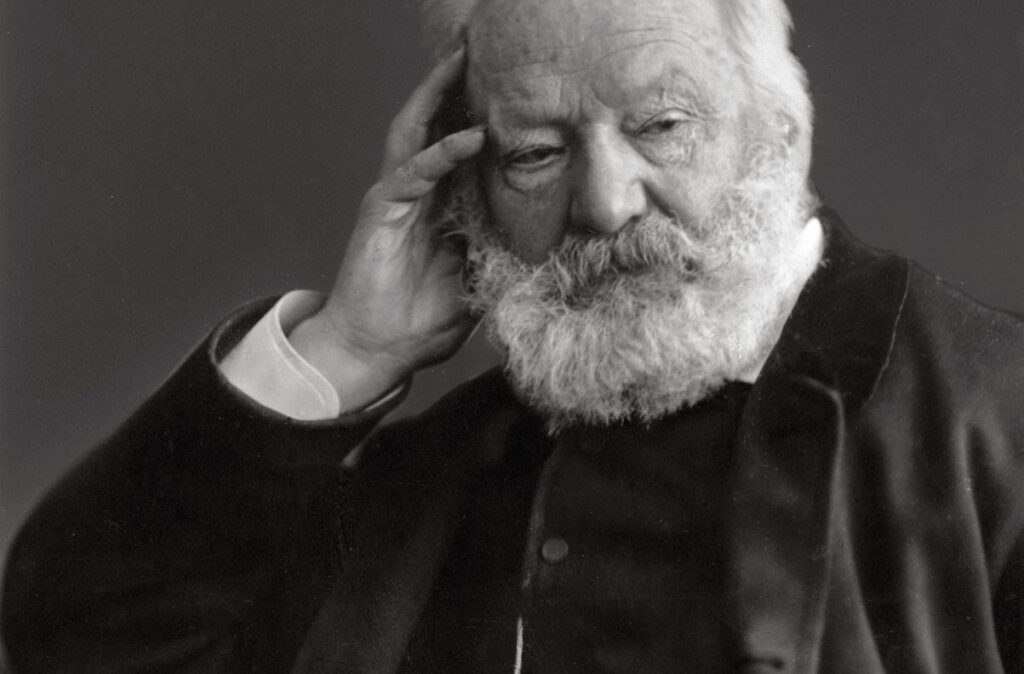
Portrait de Victor Hugo (1802-1885) par Nadar (1884).
Comme l’affirme d’emblée Christophe Hardy sur le site L’Eléphant (avril 2014), dans un article dont je me suis largement inspiré, l’auteur des Misérables passe, à juste titre, pour un homme qui, dans ses textes et ses engagements, a « défendu la cause du peuple ».
Nourri d’un humanisme chrétien et de l’amour d’autrui, Victor Hugo est mis au défi par le peuple et la misère dans laquelle il se trouve, sans pour autant être conduit à s’en faire une vision idéalisée ou romantique. Et lorsqu’il voit ce peuple s’éveiller, Hugo prend la mesure de sa puissance colossale, pour le bien comme pour le mal.
Dans son poème Au peuple (Les Châtiments, Livre VI), il utilise la puissante métaphore de l’Océan pour caractériser cette force. En l’évoquant, Hugo s’adresse au peuple :
« Il te ressemble ; il est terrible et pacifique. (…)
Sa vague, où l’on entend comme des chocs d’armures,
Emplit la sombre nuit de monstrueux murmures,
Et l’on sent que ce flot, comme toi, gouffre humain,
Ayant rugi ce soir, dévorera demain. »
Durant la première moitié de son existence, Hugo fut témoin de plusieurs soulèvements populaires. Les années 1830 sont particulièrement agitées.
Des émeutes et des grèves se déclenchent dans les grandes villes, à Paris, Lyon, Marseille, provoquées par la dureté de la vie qu’aggrave la moindre crise de la production agricole.
D’une manière générale, la rigueur des conditions de travail découle des mécanismes absurdes du marché : face à l’effondrement des prix industriels (1817-1851), les entrepreneurs décident purement et simplement de diminuer les salaires.
La paupérisation explose et les ouvriers s’insurgent contre cette baisse dramatique de leurs revenus. A Paris, Hugo a sous les yeux le spectacle d’une masse laborieuse, venue de la province s’entasser dans le centre de la capitale, déracinée, vivant dans l’insalubrité et la précarité, exposée aux épidémies (choléra en 1832), prompte à l’émeute (février et septembre 1831, juin 1832, avril 1834).
Cependant, le monde ouvrier, qui ne représente qu’une petite minorité dans un pays largement agricole et paysan, peine à faire valoir ses revendications, notamment sur la diminution des journées de travail. Pas encore structuré, son morcellement l’empêche de se doter d’une véritable conscience de classe solidaire. Cette masse malmenée, agitée régulièrement de secousses brutales, effraye les notables et les possédants, qui la voient comme une classe dangereuse menaçant leurs privilèges.
L’amour plus fort que la pitié
Hugo a très tôt conscience que la misère du peuple est la principale « question sociale ». Cette sensibilité au sort des plus pauvres n’est pas celle de la dame charitable hypocrite, elle est le fond de son âme. Et lorsque, élu député, il l’évoque à l’Assemblée, les conservateurs dont il se croyait proche jusqu’en 1849, se mettent à hurler.
« Toute ma pensée, dira-t-il,
je pourrais la résumer en un seul mot.
Ce mot, le voici :
haine vigoureuse de l’anarchie,
tendre et profond amour du peuple ! »
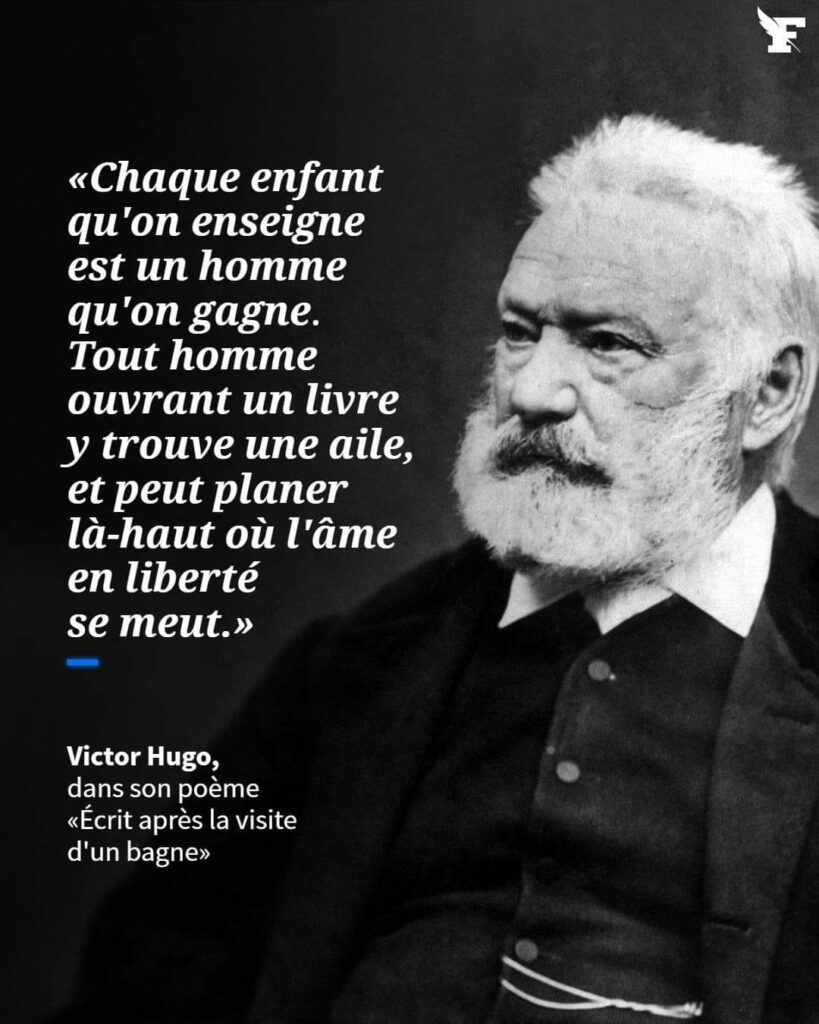
La misère des classes populaires, l’écrivain la connaît pour être allé à sa rencontre, en avoir rendu compte : misère de la prison (visite de la Conciergerie, dans Choses vues, septembre 1846), misère de la vie ouvrière (visite des caves de Lille en février 1851, discours non prononcé qui inspirera le poème des Châtiments « Joyeuse vie »). Il est persuadé qu’elle peut être vaincue.
Contredisant les conservateurs, les classes laborieuses ne sont pas, à ses yeux, des « classes dangereuses ». Elles sont même en danger, et ce danger menace la stabilité de la société tout entière :
« Je vous dénonce la misère,
qui est le fléau d’une classe et le péril de toutes !
Je vous dénonce la misère
qui n’est pas seulement la souffrance de l’individu,
qui est la ruine de la société. »
(Discours du 9 juillet 1849.)
S’il abandonne ses convictions de jeune royaliste pour devenir un républicain de progrès passionné, Hugo craint le chaos et le sang versé inutilement.
Même s’il n’a pas vécu 1793 et la Terreur, il est obsédé par le souvenir des jours sanglants de la Révolution française, où la guillotine travaillait à plein régime.
Rendant compte de l’insurrection, en 1832, plus que la violence en tant que telle, il dénonce les extrémistes qui, par calculs personnels et non pour lutter contre l’injustice, excitent les masses à la révolte et annoncent pour la fin du mois « quatre belles guillotines permanentes sur les quatre maîtresses places de Paris ».
Hugo considère cette stratégie comme une impasse politique (« Ne demandez pas de droits tant que le peuple demandera des têtes »), tout en en comprenant la légitimité :
« Il est de l’essence de l’émeute révolutionnaire,
qu’il ne faut pas confondre avec les autres sortes d’émeutes,
d’avoir presque toujours tort dans la forme
et raison dans le fond. »
Avec ironie, il signale aux puissants que
« le plus excellent symbole du peuple, c’est le pavé.
On marche dessus jusqu’à ce qu’il vous tombe sur la tête. »
(Choses vues, 1830 à 1885.)
Comme le poète allemand Friedrich Schiller, Hugo a la conviction que le rôle de l’artiste et du poète est d’élever le débat. L’art, telle l’étoile polaire brillant dans la nuit pour les marins perdus sur l’océan, est essentiel pour guider le peuple à bon port.
Magnanime
Politiquement, afin de poser les bases d’un destin futur, pacifique et harmonieux, il affirme que la compassion et le pardon doivent prévaloir sur la haine et la vengeance.
« Tel a assassiné sur les grandes routes qui,
mieux dirigé, eût été le plus excellent serviteur de la cité.
Cette tête de l’homme du peuple, cultivez-la, défrichez-la,
arrosez-la, fécondez-la, éclairez-la, moralisez-la, utilisez-la ;
vous n’aurez pas besoin de la couper. »
(Claude Gueux, roman, 1834.)
Lucide, le poète déclare qu’« ouvrir une école, c’est fermer une prison », car « quand le peuple sera intelligent, alors seulement le peuple sera souverain ».
C’est le traitement appliqué à Jean Valjean, héros principal des Misérables : le pauvre voleur, bagnard évadé, finira par devenir la grande âme que son hôte d’un soir, monseigneur Myriel, avait su déceler en lui alors que le reste de la société s’avérait incapable de l’identifier…
Les Gueux
Hugo passera sa vie à dédiaboliser « les gueux », c’est-à-dire le peuple. En 1812, dans sa chanson Les gueux, le chansonnier populaire Pierre-Jean de Béranger*, qu’il admirait, entonnait :
« Des gueux chantons la louange.
Que de gueux hommes de bien !
Il faut qu’enfin l’esprit venge
L’honnête homme qui n’a rien. »
Dans un de ses plus grands discours (en juillet 1851, sur la réforme de la Constitution), Hugo réclame pour le peuple (et pour tous) le droit à la vie matérielle (travail assuré, assistance organisée, abolition de la peine de mort) et le droit à la vie intellectuelle (obligation et gratuité de l’enseignement, liberté de conscience, liberté d’expression, liberté de la presse).
Bref, en embryon, la vision d’un Jaurès et d’un De Gaulle qu’on retrouvera dans « Les Jours heureux », le programme du Conseil national de la Résistance (CNR), et l’antithèse de la mondialisation financière qu’on nous inflige aujourd’hui.
Lanceur d’alerte
En 1527, dans une lettre à son ami Thomas More, l’humaniste Erasme de Rotterdam avait prévenu les puissants : si l’Eglise de Rome n’adopte pas les mesures de réforme progressive et pacifique que lui, Erasme, propose, ils seront coupables d’avoir provoqué un siècle de violence !
Dans Les années funestes (1852), connaissant la puissance du colosse (Fig. 1), Victor Hugo aura, lui aussi, mis l’oligarchie en garde. Un avertissement qui garde son actualité :
Il Colosse, tableau de Goya (1808). Lorsque le colosse se lève, tous s’enfuient en courant.
Le seul qui reste immobile, c’est l’âne (symbolisant le roi d’Espagne Carlos IV, qui refusait de prendre en compte les aspirations du peuple).
« Vous n’avez pas pris garde au peuple que nous sommes.
Chez nous, dans les grands jours, les enfants sont des hommes,
Les hommes des héros, les vieillards des géants.
Oh ! Comme vous serez stupides et béants,
Le jour où vous verrez, risibles escogriffes,
Ce grand peuple de France échapper à vos griffes !
Le jour où vous verrez fortune, dignités,
Pouvoirs, places, honneurs, beaux gages bien comptés,
Tous les entassements de votre orgueil féroce,
Tomber au premier pas que fera le colosse !
Confondus, furieux, cramponnés vainement
Aux chancelants débris de votre écroulement,
Vous essaierez encore de crier, de proscrire,
D’insulter, et l’Histoire éclatera de rire. »
Victor Hugo, Les années funestes (1852)
NOTE:
*Christine Bierre, « Pierre-Jean de Béranger : la chanson, une arme républicaine » dans Nouvelle Solidarité N°07/2022.
Le violoniste, d’après Jacques Callot

The challenging modernity of the Indus Valley Civilization

Get an easy-to-print pdf file of this article
Karel Vereycken, Paris, France, January 2023
A major archaeological discovery has just been made in Israel in 2022: the first evidence of the use of cotton fibers in the Near East and among the oldest in the world, dating back nearly 7,000 years, was discovered by Israeli, American and German archaeologists during an archaeological excavation at Tel Tsaf, southeast of Beit She'an, in the Jordan Valley of Israel.
So far, the earliest available evidence of cotton fibers in the area was dated to a few hundred years later, to the late Chalcolithic (Copper Age) and Early Bronze Age (about 5,000 to 6,500 BCE) from the archaeological site of Dhuweila in eastern Jordan.
Discovered in 1940, the site of Tel Tsaf reveals its secrets. « Tsaf is characterized by an amazing preservation of organic materials, » said Professor Danny Rosenberg of the Zinman Institute of Archaeology at the University of Haifa. « Tel Tsaf was a kind of pole that concentrated important commercial activities and had established contacts with many other peoples, » Rosenberg believes. « There was massive storage capacity there to accommodate grain, enormous capacity if you compare it to other sites.
For example, the earliest evidence of the social use of beer drinking and ritual food storage has been found there. Rosenberg and the other researchers also found beads from contemporary Anatolia, Romania, Egypt and other parts of Africa; pottery from Iraq, Syria and Armenia; and the earliest copper and other metals found in the world.
“Wool Tree” and “Cotton Roads”
The cotton found in Israel, probably came from the Indus region—modern Pakistan/India—which was the only place in the world that had begun to domesticate cotton at that time before its cultivation appeared in Africa thousands of years later.
« What’s interesting about this early evidence of a link to such a distant region is that it comes from fibers – microscopic pieces of ancient yarn. We assume that these cotton fibers, found along with wool fibers and plant fibers, arrived at the site as part of fabrics or clothing, i.e., ancient textiles, » Rosenberg says.
In addition, cotton was not only used for clothing: « In the prehistoric era, textiles were involved in many areas of life, not only in clothing but also in hunting, fishing … This is much more important than just saying that what we found are pieces of clothing that were worn by the inhabitants of the area. This discovery tells us a lot about the economic practices of the area, » says Rosenberg.
Since cotton had never been grown in Tel Tsaf, it was a surprise for the researchers to find it, and they felt that its presence underscored the city’s importance as a global trading hub at the heart of what could be called, the « Cotton Roads » of those days.
Growing cotton poses major challenges: a moderate to tropical climate and vast amounts of water. Just to produce a single T-shirt and a pair of jeans (representing about 1 kg of cotton), no less than 20,000 liters of water are required! Which civilization can afford such a performance at the beginning of the 7th millennium BC?
The Indus Valley civilization (IVC)

The term « Indus Valley Civilization » (IVC) refers to a vast cultural and political entity that flourished in the northern region of the Indian subcontinent between about 8000 and about 1900 BCE., a region that stretched from Baluchistan (Pakistan) in the west to Uttar Pradesh (India) in the east and from northeastern Afghanistan in the north to Gujarat (India) in the south.
In the absence of both literary sources and remnants of palaces and temples to confirm it, one cannot qualify this entity as a “Kingdom” or an “Empire”. Its modern name (IVC) derives simply from its location in the Indus Valley, but also goes under the name of the « Indus-Sarasvati civilization » or « Harappan civilization ». These last designations come from the river Sarasvati, mentioned in the Vedic sources, which flowed next to the Indus and which would have disappeared, and from the ancient city of Harappa (Punjab, Pakistan), discovered by the British in 1829, but deliberately left unexplored.
The rise of a great urban civilization in the Indus Valley, which reached its maturity around 2500-2400 BCE, was long considered a sudden and mysterious phenomenon. Today, a series of discoveries allows us to follow, from 7000 to 2500 BCE, a series of transformations and innovations whose cumulative effects, stimulated by the enlargement of the network of exchanges from 3000 BCE onwards, created the conditions for the development of an incredibly modern and prosperous urban civilization.
Enter Mehrgarh, the light of the world!
Since prehistoric times, the Indus region has been pioneering and rich in discoveries. As an example, for the Guinness Book of Records, although a case apart, the farming village of Mehrgarh (Baluchistan, Pakistan) which dates from the Neolithic (using only stones as tools) but can be considered as the key culture and city that lead humanity, as early as in the 8th millennia BCE, from the Stone Age into the Age of Copper.
The site is located on the principal route between what is now Afghanistan and the Indus Valley: this route was also undoubtedly part of a trading connection established quite early between the Near East and the Indian subcontinent.
Excavations in Mes Aynak (Afghanistan), where archaeologists are only beginning to find remnants of a 5,000-year-old Bronze Age site beneath the Buddhist level, including an ancient copper smelter, will undoubtedly shed new light on these relationships.
On the basis of a variety of well-documented archaeological finds, it has been established that “pre-Harrapan” Mehrgarh, made several historical breakthroughs for the benefit of humanity as a whole.
Mehrgarh gave the world:
- among the oldest traces of agriculture (wheat and barley) and breeding (cattle, sheep and goats) in South Asia ;
- the first breweries (with wheat and barley);
- the oldest reservoirs for irrigated agriculture and flood prevention;
- the oldest traces of cotton culture (6th millennium BCE);
- the oldest jewel, called the « Mehrgarh amulet » (6th millennium BCE), produced with the « lost wax » bronze casting technique ;
- the oldest bow drills (in green jasper) allowing to drill holes in lapis lazuli and carnelian;
- the very first traces of successfull dentistry practices (!) (9th millennium BCE); The inhabitants of Mehrgarh appeared to have developed an understanding of surgery and dentistry, as evidenced by the drilled teeth of some of the skeletons found at the site. Analysis of the teeth shows that prehistoric dentists worked to treat toothaches with drills made from flint heads. The work was so elaborate that even modern dentists are surprised at the efficiency with which the Mehrgarh « dentists » removed decaying tooth tissue. Among the remains, a total of eleven drilled crowns were found, with one example showing evidence of a complex procedure involving the removal of tooth enamel followed by carving of the cavity wall. Four of the teeth show evidence of decay associated with the drilled hole. None of the individuals with drilled teeth appear to have come from a special tomb or shrine, indicating that the oral health care they received was available to all.

Densely populated
Originally, the IVC was built around the fishy meanders of the Indus, a river nearly 3200 kilometers long that flows from the Himalayan mountains towards the Arabian Sea. Like the populations of other great river valleys, this society was seduced by the fertility of the land as well as by the possibility of using the Indus as a transportation route.
The IVC, whose prosperity rests largely on the increasingly systematic exploitation of the rich silt of the Indus, spread over an immense territory encompassing the entire Indus Valley and part of Indian Gujarat. It is necessary to add to the vast zone of distribution of the Indus civilization some Harappan « colonies » or outposts like Sutkagan Dor (Ballochistan, Pakistan), close to Gwadar on the edges of the sea of Oman, at the Iranian-Pakistani border, and the lapus lazuli mining town of Shortugai, close to Amu Darya river, at the Afghan-Tajik border, at nearly 1,200 kilometers of Mohenjo-daro, by far the largest IVC urban concentration.
At its peak, this civilization was twice as large as the Old Kingdom of Egypt. With an area of 2.5 million square kilometers, it was at the time the largest civilization in the world: it included 5 million people, or 10 % of the world population at the time, much more than less older civilizations as Sumer (0.8 to 1.5 million people) or ancient Egypt (2 to 3 million).
To date, about 2,000 sites have been discovered in India, Pakistan and Afghanistan. Because of various wars and conflicts, only 10 % of the territory of these sites has been excavated and scientifically investigated. On the Indian subcontinent, the main centers of this civilization are Harappa (estimated 23,500 inhabitants) and Mohenjo-daro (est. 40,000 inhabitants) in Pakistan and Lothal, Dholavira and Kalibangan in India. In addition to trade relations with Mesopotamia and Iran, the Harappan city-states also maintained active trade relations with the peoples of Central Asia.
Agriculture, crafts and industry
Agriculture, animal husbandry, industry, trade and commerce were the main source of income.
Agriculture was the main occupation of the people of the Indus Valley. They cultivated barley and wheat on a large scale (and made beer) but also other crops such as legumes, cotton, cereals, sesame, dates, mustard, melons, peas, etc.
There is no real evidence of rice, but a few grains of rice have been found in Rangpur and Lothal.
In the towns of Mehrgarh, Harappa, and Mohenjo-daro, there are remains of large granaries, suggesting that they produced more than they needed and physically stocked cereals and other food products in case of crop failure.
Animal husbandry was another major occupation. Seals suggest that they domesticated cows, buffalos, goats, sheep, pigs, etc. Camels and bullocks were also domesticated and used as beasts of burden. Camel bones have been found in large numbers at many sites, but there is no trace of them on the seals. During the excavation of Surkotado in Gujarat, India, the jawbone of a horse was found. Terracotta figurines representing a horse were found in Nausharo and Lothal.
The inhabitants of the Indus Valley were very skillful. They made ceramics, metal vessels, tools and weapons, weaved and spun, dyed and practiced other crafts with potter’s wheels. The weavers wore clothes made of cotton and wool. They knew leather, but there is no record of silk production.
The inhabitants of this civilization originally came from the Bronze Age and used stone tools, but they soon excelled in the manufacture and processing of gold, silver, copper, lead and bronze, especially for artistic ornaments of great finesse.
Artisans made jewelry in Mohenjo-daro, Chanho-daro and Lothal. They used ivory and various precious stones such as carnelian, lapis lazulite, agate and jasper to make them. Shell work was also a thriving industry. Craftsmen in the coastal colonies used shells to make buttons for shirts, pendants, rings, bracelets, beads, etc.
To supply the production of these craft professions, they needed to import various raw materials. To produce bricks and ceramics, clay was available locally, but for metal they had to acquire it from abroad. Trade focused on importing raw materials to be used in Harappan city workshops, including minerals from Iran and Afghanistan, lead and copper from other parts of India, jade from China, and cedar wood floated down rivers from the Himalayas and Kashmir. Other trade goods included terracotta pots, gold, silver, metals, beads, flints for making tools, seashells, pearls, and colored gemstones, such as lapis lazuli and turquoise.
Ox carts were used to transport goods from one place to another. They also constructed barges used on the waterways along the Indus and its tributaries for transportation.
One of the ways historians know about the maritime trade network operating between the Harappan and Mesopotamian civilizations is the discovery of Harappan seals and jewelry at archaeological sites in regions of Mesopotamia, which includes most of modern-day Iraq, Kuwait, and parts of Syria. Long-distance sea trade over bodies of water—such as the Arabian Sea, Red Sea and the Persian Gulf—may have become feasible with the development of plank watercraft that were each equipped with a single central mast supporting a sail of woven rushes or cloth.
Historians have also made inferences about networks of exchange based on similarities between artifacts across civilizations.
Between 4300 and 3200 BCE, ceramics from the Indus Valley Civilization area show similarities with southern Turkmenistan and northern Iran. During the Early Harappan period—about 3200 to 2600 BCE—there are cultural similarities in pottery, seals, figurines, and ornaments that document caravan trade with Central Asia and the Iranian plateau.
The wonders of Mohenjo-daro
Sometimes referred to as the « Manhattan of the Bronze Age » for the grid pattern of the city plan, Mohenjo-daro (Sind, Pakistan) remained buried under meters of alluvial sediment until 1922.
A real metropolis made of baked bricks, it covers more than 200 hectares. Strictly squared, cut in two by a street of ten meters wide, divided from north to south by a dozen arteries drawn with the cord, and crossed from east to west by paved streets, Mohenjo-daro represents, by its strictly reflected urban framework, the model city of the Indus civilization. It could have accommodated up to 40,000 people!
The Harappans were masters of hydraulic engineering, a “riparian” people working in river corridors practicing irrigated agriculture. They mastered both the shaduf (an irrigation tool used to draw water from a well), and windmills.
In the Harappan cities, the domestic and manufacturing areas were separated from each other.
The inhabitants, living in one-, two-, and sometimes three-story dwellings, seem to have been mainly artisans, farmers, and merchants. The people had developed the wheel, cattle-drawn carts, flat-bottomed boats large enough to carry goods, and perhaps also sailing. In the field of agriculture, they had understood and used irrigation techniques and canals, various agricultural implements, and had established different areas for livestock grazing and cultivation.
Seals and harrapan script
Among the thousands of artifacts found at the various sites are small soapstone seals just over one inch (3 cm) in diameter, used to sign contracts, authorize land sales, and authenticate the point of origin, shipment, and receipt of goods in long-distance trade. On each seal is a small text in Harappan, a language yet to be deciphered.
Among the thousands of artifacts found at the various sites are small soapstone seals just over one inch (3 cm) in diameter, used to sign contracts, authorize land sales, and authenticate the point of origin, shipment, and receipt of goods in long-distance trade.
Commercial contacts between the Indus and Sumer populations are well documented. Numerous seals from the Indus Valley have been discovered in Mesopotamia. On each seal, a small text in Harappean, a language that remains to be deciphered.
If 4,200 texts reached us, 60 % of them are seals or mini-tablets of stone or copper, engraved, and they comprise on average… only five signs! The longest text has 26 signs. The texts are always accompanied by the image of an animal, often a unicorn or a majestic buffalo. They were intended to mark goods, probably indicating the name of the owner or the recipient and a quantity or a year. Trying to decipher the Indus language is a bit like trying to learn French only from the labels on the food shelf of a supermarket!
The invention of sanitation
In addition to this particular attention that they paid to urban planning, the members of the Indus civilization also seem to have been pioneers of modern hygiene. Some cities, notably Mohenjo-daro, were equipped with small containers (dustbins) in which the inhabitants could deposit their household waste.
Anticipating our « all to the sewer » systems imagined in the 16th century by Leonardo da Vinci for the project envisaged by François I for the new French capital Romarantin, many cities had already public water supply and an ingenious sanitation system.
In many cities, including Mohenjo-daro, Harappa, Lothal and Rakhigari, individual houses or groups of houses were supplied with water from wells. This quality fresh water was used as much for food and personal hygiene (baths, toilets) as for the economic activities of the inhabitants.
As an example, the sanitation system of the port city of Lothal (Gujarat, India) where many houses had a bathroom and private brick latrines. The wastewater was evacuated through a communal sewer system that led either to a canal in the port, or to a soaking pit outside the city walls, or to buried urns equipped with a hole allowing the evacuation of liquids, which were regularly emptied and cleaned.
Excavations at the Mohenjo-daro site have also revealed the existence of no less than 700 brick water wells, houses equipped with bathrooms and individual and collective latrines. Toilets were an essential element. However, early archaeologists erroneously identified most toilets as post-cremation burial urns or simple cesspools. Many buildings in the city were two or more stories high. Water from the roof and bathrooms of the upper floors was channeled through closed clay pipes or open troughs that emptied, if necessary via the toilets, into the covered sewers underneath the paved street.
This extraordinary achievement is confirmed by a 2016 scientific study, entitled « The Evolution of Toilets Around the World Across the Millennia, » which reports that,
The earliest multi-flush toilets connected to a sophisticated sewage system that have been identified so far were found in the ancient cities of Harappa and Mohenjo-Daro in the Indus Valley, dating from the middle of the third millennium BC. Nearly every dwelling unit in Harappa, Mohenjo-Daro, and Lothal was equipped with a private bath-toilet area with drains to carry dirty water into a larger drain that emptied into the sewer and drainage system.
Till now, it are the Minoan (Crete) civilization and China that have been credited for the first use of underground clay pipes for sanitation and water supply. In the Cretan capital Knossos, there was a well-organized water system to bring in clean water, to evacuate wastewater and to provide storm sewers for overflow in case of heavy rains.
In Knossos existed also one of the earliest uses of flush toilets, dating back to the 18th century BCE. The Minoan civilization had stone sewers that were periodically cleaned with clean water. Crete, of course, was a large provider of Copper ore for the entire world in Antiquity and had vast international trade connections.
Religious and cultural worldview
In the IVC, fertility rituals were probably observed in order to promote a full harvest as well as for women’s pregnancies, as evidenced by a number of figurines, amulets and statuettes with female form.
It is thought that the people, like the Dravidians who some believe were the origin of the Indus Civilization, worshiped a “mother goddess” and possibly a male companion represented as a horned figure in the company of wild animals.
The « Great Bath » at Mohenjo-daro would have been used for purification rites related to religious belief, but it could just as easily have been a public pool for recreation. Our knowledge of the religious beliefs of this culture remains in the realm of mere hypothesis.
The title of the famous statue of the « Priest-King » found at Mohenjo-daro is misleading, as there is no evidence that it is a king or a priest, and it may be a simple cotton trader…
Apart from pottery, certain types of elementary weapons (spearheads, axes, arrows, etc.) and certain tools for practical purposes, two types of artifacts give us cultural clues about Harappean society.
First, some figurines, which we try to interpret as devotional objects, seem to be simple toys. For others, they are clearly toys, notably animals (oxen, buffaloes, elephants, goats and even a simple hen), made of bronze or terracotta, mounted on small carts with wheels.
Second, among other objects expressing a high level of sensitivity and consciousness, a series of masks, some of which seem inspired by Mongolian masks.
These masks are clearly intended to serve comic or tragic representations and remind us of the ancient masks that have come down to us from classical Greece.
Older than Sumer and Egypt?
Archaeological excavations of the IVC got off to a late start, and it is now believed that some of the achievements and « firsts » attributed to Egypt ( – 3150 BC) and Mesopotamia ( – 4500 BC) may in fact belong to the inhabitants of the Indus Valley civilization.
In May 2016, the report published by a team of researchers from IIT Kharagpur, Institute of Archaeology, Deccan College Pune, Physical Research Laboratory and Archaeological survey of India (ASI), published by the journal Nature, shattered a number of “facts” that were considered unshakeable certainties.
Until now, the 900 years of the « mature » phase of the IVC was dated as ranging from 2800 to 1900 BCE. However, the aforementioned Indian study indicates that this civilization was much older than previously thought – it is at least 8,000 years old!
To determine the age of this civilization, researchers dated pottery using a technique called optically stimulated luminescence (OSL) – and found it to be nearly 6,000 years old, the oldest pottery known to date.
Other artifacts have been dated to 8,000 years ago. The results come from a major site excavated at Bhirrana (Haryana, India) that shows the preservation of all cultural levels of this ancient civilization, from the pre-Harappan phase through the Early Harappan to the Mature Harappan period. Bhirrana was part of a high concentration of sites along the mythical Vedic river « Saraswati », now dried up, an extension of the Harki-Ghaggar River in the Thar Desert.
The submerged cities of the Gulf of Khambhat
These new dates converge with the discovery, in January 2002, of ruins of submerged cities in the Gulf of Khambhat (formerly Cambay), off the coast of the state of Gujarat in northwest India.
It is the oceanographers of the National Institute of Ocean Technology (NIOT) of Madras who made this discovery. The team was surveying the muddy sea 30 km off the coast of the state of Gujarat, in the Gulf of Khambhat, to measure the levels of marine pollution. As a routine measure, they recorded acoustic images of the ocean floor.

It was only several months later, while analyzing the data, that the team realized that they had, without knowing it, obtained images of the ruins of a huge city, sunken 40 meters below sea level. And, at the end of January 2002, after having spent weeks to dredge the site and to bring up more than 2 000 objects, the team of the NIOT was able to make extraordinary revelations.
The ruins stretch for 9 km along the banks of an ancient river, and the remains of a dam can be distinguished. The sunken city shares striking similarities with the sites of the Indus civilization. One of the buildings, the size of an Olympic swimming pool, with collapsed steps, recalls the Great Bath of Mohenjo-daro. Another rectangular monument, 200 m long and 45 m wide, is as large as the acropolis discovered at Harappa. The team of NIOT also glimpsed another building, a kind of granary, made of mud bricks, 183 m long. Near these monumental installations, rows of rectangular buildings that resemble the foundations of ruined houses can be seen, and even a drainage system and roads. On another visit to the site, the team recovered polished stone tools, ornaments and figurines, pottery debris, semi-precious stones, ivory and the fossilized remains of a human spine, jaw and tooth. But the team was not at the end of its surprises.
It sent samples of a fossilized log to two major Indian laboratories specializing in dating methods: the Birbal Sbahni Institute of Paleobotany (BSIP) in Lucknow and the National Geophysical Research Institute (NGRI) in Hyderabad. The BSIP dated it to 5500 BCE, while the NGRI dated the sample much earlier, probably to 7500 BCE.
This dating would make Khambhat the oldest site discovered in India. According to some, this discovery could mark the end of the theory according to which urbanization spreads from Asia from the west towards the Indus. This dating caused intense controversy. Archaeologist G. Possehl points out that there is no reason to believe that the fossilized piece of wood belongs to the ruins of the ancient city, given the strong sea currents in the region, it could have come from elsewhere. NIOT’s team acknowledged the validity of these criticisms and assured that other objects would be subjected to dating methods. It is also a question of understanding how this city was sunk and how it ended up 30 km from the coast.
Harsh Gupta, geologist, thinks that it is a gigantic earthquake which caused the destruction of the city. We are in a high seismic risk area, and the 2001 Bhuj earthquake showed the vulnerability of the region to such phenomena. However, the priority is to definitively establish the age of the sunken city and prove it to be the most exciting discovery of this century.
Historical cradle of textiles

In his book Empire of Cotton, A Global History (2015) Sven Beckert traces in depth the development of what the ancients, intrigued by its resemblance to the feel of wool, called the « wool tree. » While this plant grows in both temperate and tropical climates, it needs an abundance of moisture to thrive fully, which consigns its cultivation to naturally and then artificially irrigated river valleys.
According to the author, « The farmers of the Indus Valley were the first to spin and weave cotton. In 1929, archaeologists found fragments of cotton textiles at Mohenjo-Daro, in present-day Pakistan, dating from 3250 to 2750 BCE. Cotton seeds found in nearby Mehrgarh have been dated to 5000 BCE. Literary references also attest to the antiquity of the cotton industry in the subcontinent. The Vedic scriptures, composed between 1500 and 1200 BCE., allude to the spinning and weaving of cotton…”
Historically, the discovery of the first cotton fragments was made at Mohenjo-daro during an expedition led by Sir John Marshall, Director General of the Archaeological Survey of India from 1902 to 1928. In his book on Mohenjo-daro and the Indus Civilization, Sir Marshall relates that fragments of cloth were wrapped around a silver perfume pot and a salt shaker.
Early forms of Self-government?
The fact remains that the political organization of the Indus cities escapes the experts. Because contrary to the Mesopotamian and Egyptian civilizations, the researches realized on the sites of the valley of the Indus did not bring to light any temple or palace of scale. There is no proof either of the existence of a permanent army…
Of what to wonder about the presence or not of a political power. Panic among British archaeologists and geopoliticians always inclined to project their own colonial ideology of aristocratic castes on the rest of the world.
In reality, each city seems to have had its own governor, or citizen council coordinating with other urban areas, all adhering to a number of common principles considered mutually beneficial.
This “Coincidence of Opposites”, of great diversity with perfect similarity, intrigues expert John Keay:
What amazed all those pioneers, and what remains the distinguishing characteristic of the several hundred Harappan sites now known, is their apparent similarity: ‘Our overriding impression is of cultural uniformity, both throughout the several centuries during which Harappan civilization flourished, and over the vast area it occupied.’ The ubiquitous bricks, for example, all have standardized dimensions, just as the stone cubes used by the Harappans to measure weight are also standardized and based on the modular system. The width of roads conforms to a similar module; thus, streets are generally twice as wide as side streets, while main arteries are two or one and a half times as wide as streets. Most of the streets excavated so far are straight and run north to south or east to west. The city plans thus conform to a regular grid pattern and seem to have retained this arrangement through several phases of construction.
Hence, given the existence of a unified system of weights and measures; given the similarity of urban organization as well as the standardization of the size of terracotta bricks for hundreds of cities, it is therefore simply impossible that the every man for himself reigned supreme.
Cradle of democracy?
In 1993, in an article entitled « The Indus Valley Civilization, Cradle of Democracy? », published by the UNESCO Courier, the internationally renowned Pakistani archaeologist and museologist, Syed A. Naqv, who has been fighting for the preservation of the Mohenjo-daro site, attempted to answer the question.
In all the highly developed civilizations of the past – Mesopotamia, the Nile Valley, Anatolia, China – the pervasive influence of an imperial authority can be felt, providing patronage for the arts and directing the evolution of society. A close examination of such an imperial authority over this civilization, which flourished some 5,000 years ago and covered almost twice the area of the civilizations of Mesopotamia and the Nile combined seems to belie the presence of an authoritarian regime, the Indus civilization had a well-disciplined way of life, civic controls and organizational system which could only have stemmed from the kind of “rule by the people” that was exercised in some Greek city-State some 2,000 years later. Did Greece give birth to democracy, or did Greece simply follow a practice developed earlier?
Although there are no large structures acting as centers of authority,
the discoveries made so far suggest that the rule of law extended over an area measuring roughly 1,600 kilometers from the north to the south and more that 800 kilometers from east to west. The main argument in support of this thesis is the existence of well-established norms and standards which would have required the consensus of the people if they had not been imposed by an authoritarian regime. It is impossible to ignore the evidence furnished by the perfect planning of the great city of Mohenjo-daro and the use in its construction of standard-sized bricks 27.94 cm long, 13.96 cm wide and 5.71 cm thick.
In the two large cities of Mohenjo-daro and Harappa, about 600 km distant,
the grid pattern of the street layout uncovered by the archaeological excavations shows that great attention was paid to the security of the inhabitants and suggests the existence of a highly developed and well-monolithic system of civic control.
The same is true of the highly sophisticated sewage system and the existence of
a virtually complete series of highly polished stone weights. Their shapes are cubical, half-cubical, cylindrical and spherical, and very few of them are reported to be defective. They provide yet another proof of a civic authority maintaining consistent commercial standards.
It is not possible to conclude that such « a philosophical conception of democracy exists until the Harappan script is deciphered and written evidence is provided. But the signs are there, and further research in this direction may well establish that ‘government by the people’ originated in the Indus Valley, » the author concludes.
Finally, since this agricultural people, who knew the use of the spears and the arrows but didn’t leave any trace of a major military activity – few weapons nor fortifications with exclusively defensive purpose have been found – , many observers agree to say that this society could have known the longest period of peace of the history of the humanity.
Decay and fall
In two of his books, the Timaeus and the Critias, the Greek philosopher Plato tells the story « certainly true, although strange » of a maritime people with incomparable power: the Atlantes whose civilization and capital he describes in great detail.
Starting 10,000 years before our era from an island located beyond the columns of Hercules, the Atlanteans would have ended up dominating the whole of Africa and Western Europe.
In a passage which is not without recalling the type of political organization which could exist in Mohenjo-daro, Critias specifies that Atlantis was then inhabited « by the various classes of men who deal with the trades and agriculture. The warriors, separated from the beginning by divine men, lived separately, possessing all that was necessary for their existence and that of their children. Among them, there were no particular fortunes; all goods were in common: they demanded from the other citizens nothing beyond what they needed to live, and fulfilled in return all the obligations that our talk of yesterday attributed to the defenders of the fatherland as we conceive them. »
Perhaps speaking metaphorically, Plato states that initially virtuous, the Atlantis civilization would have sunk into excess, arrogance and corruption to the point of being chastised by Poseidon himself for having embarked on one war too many, this time against Athens. And « in the time lapse of a single terrible day and night (…) the island of Atlantis sank into the sea and disappeared ».
At the historical level, the sudden decline of the Indus civilization around 1900 BC remains a mystery. Historians point to aspects of Minoan civilization (Crete) showing astonishing similarities with the IVC, especially watermanagement and early sewer systems in Knossos, lost wax broze casting techniques and bull fighting.
A few traces of fire and destruction, as well as forty skeletons wounded with knives and found without burial at Morenjo-daro, first suggested an invasion by Aryan peoples from Central Asia or the Iranian plateau. « This theory has now been abandoned. We have indeed found no effective trace of massacres or violence on the sites of the Indus Valley, or furniture that could be associated with such populations, » says Aurore Didier, researcher at the CNRS and director of the Indus mission.
Another hypothesis, an inability to strengthen its resilience to climatic chaos. « The samples taken in the northwest of India have shown that the climate there has changed significantly about 2000 years before our era. It is reported that this was also the case in Mesopotamia. « It became more like the dry and arid climate of today, which disrupted the cultivation and, in fact, the trade of the Indus civilizations. The ensuing socio-economic upheaval may have led to the decline of these societies. This hypothesis is the most commonly accepted to date, » says the archaeologist.
The inhabitants would have left their valleys become infertile to migrate to the plains of the Ganges. « This was accompanied by a change in livelihood strategies. The Indus civilization gradually converted to summer cereal crops based on rice and millet, two commodities more able to withstand these new climatic conditions and requiring, for rice, the development of irrigated agriculture, » says Aurore Didier. « It has also forged links with new trading partners.”
So there is no reason to talk about the « collapse » of a society in the sense of collapsologists. It is rather a gradual adaptation to the evolution of the environment, spread over several centuries.
As the excavations of the sites of the Indus Valley civilization continue, new information will undoubtedly contribute to a better understanding of its history and development. Any additional knowledge of this common civilizational legacy will serve in the future as a basis for fraternal cooperation between Pakistan, India and Afghanistan and others.
In the meantime, instead of trying to copy the barbaric « models » of the Mongolian Empire, the Roman Empire or the British Empire, the « elites » of the transatlantic world would do better to draw inspiration from a magnificent civilization that seems to have prospered for 5,000 years without perpetual wars and massacres, but simply thanks to a good mutual understanding, at the national level, between citizens, and thanks to mutually beneficial cooperation with the overriding majority of its distant partners.
The Indus Valley Civilization’s modernity, capable of offering food, shelter, water and sanitation to all, in a mirror image, shows all of us living in the present, how backwards we became.
Raphael 1520-2020: What Humanity can learn from « The School of Athens »

Ce texte en FR.
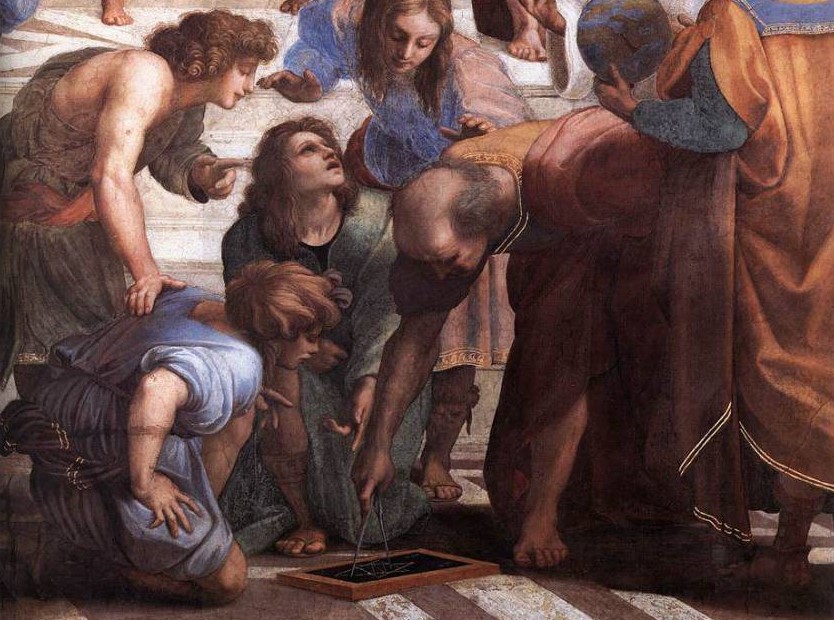
On the occasion of the five-hundredth anniversary of the death of the Italian painter Raffaello Sanzio da Urbino (1483-1520), several exhibitions are honoring this artist, notably in Rome, Milan, Urbino, Belgrade, Washington, Pasadena, London, and Chantilly in France.
The master is honored, but what do we really know about the intention and meaning of his work?
Introduction
There is no doubt that in the collective mind of the West, Raphael, along with Michelangelo and Leonardo da Vinci, appears as one of the most brilliant artists and even as the best embodiment of the « Italian Renaissance”.
Although he died at the age of 37, Raphael was able to reveal his immense talent to the world, in particular by giving birth, between 1509 and 1511, to several monumental frescoes in the Vatican, the most famous of which, 7.7 meters long and 5 meters high, is known as The School of Athens.
The viewer finds himself inside a building that brings together the thoughts of all mankind: united in a timeless space, fifty philosophers, mathematicians and astronomers of all ages meet to discuss their vision of man and nature.
The image of this fresco embodies so powerfully the « ideal » of a democratic republic, that in France, during the February 1848 revolution, the painting representing Louis Philippe (till then hanging behind the President of the National Assembly) was taken down and replaced by a representation of Raphael’s fresco, in the form of a tapestry from the Manufacture des Gobelins, produced between 1683 and 1688 at the request of Jean-Baptiste Colbert, the founder of the French Academy of Sciences.
Then, in France, arrived the idea that Raphael, being « the Prince of painters », embodied « the ultimate artist ». Superior to Rubens or Titian, Raphael was thought to have achieved the subtle « synthesis » between the « divine grace » of a Leonardo da Vinci and the « silent strength » of a Michelangelo. What more can be said ? A true observation as long as one looks only at the purity of the « forms » and thus of the « style ». Adored or hated, Raphael was erected in France as a model to be imitated by every young talent attending our Academies of Fine Arts.
Hence, for five centuries, artists, historians and connoisseurs have not ceased to comment and often to confront each other, not on the intention or the meaning of the artist’s works, but on his style! In a way akin to some of our contemporaries who adore Star Wars and its special effects without paying attention to the ideology that, underhandedly, this TV series conveys…
For this brand of historians, « iconography », that branch of art history which is interested in the subjects represented, in the possible interpretations of the compositions or particular details, is only really useful to appreciate the « more primitive » paintings, that is to say that of the « Northern Schools »…
One knows well, especially in France, that once the « form » takes the appearance of perfection, it does not matter what the content is! This or that writer tells abject horrors, but « it is so well written! »
The good news is that in the last twenty years or so, a handful of leading historians and especially female art historians, have undertaken and published in depth new research.
I am thanking in particular of Marcia Hall (Temple University), Ingrid D. Rowland (University of Chicago), Reverend Timothy Verdon (Florence and Stanford), Jesuit historian John William O’Malley, and especially Christiane L. Joost-Gaugier.
The latter’s book Raphael’s Stanza della Signatura, Meaning and Invention (Cambridge University Press, 2002), which I was able to read (thanks to the pandemic lockdown), allowed me to adjust some of the leads and intuitions I had summarized in 2000 in, let’s be honest, a rather messy note.
If my work had consisted in trying to give some coherence to what is in the public domain, through their assiduous archival work in the Vatican and elsewhere, these historians, for whom neither Latin nor Greek have any secrets, have largely contributed to shed new light on the political, philosophical, cultural and religious context that contributed to the genesis of Raphael’s work.
Enriched by these readings, I have tried here, in a methodical way, to « make readable » what is rightly considered Raphael’s major work, The School of Athens.
Instead of identifying and commenting from the outset on the figures we see in the Stanza della Segnatura (« Room of the Segnatura” of the Vatican in Rome), I have chosen first to sketch a few backgrounds that serve as “eye-openers” to penetrate this work. For, in order to detect the painter’s intentions, actions and feelings, it is essential to penetrate the spirit of the epoch that engendered the artist’s: those days political and economic challenges, the cultural heritage of Rome and the Church, a close-up on the pope who commissioned the work, the philosophical convictions of the advisors who dictated the theme of the work, etc.
However, if all this seems too tedious for you dear reader, or if you are just eager to familiarize yourself with the work, nothing prevents you from going back and forth between the deciphering of the frescoes at the end of this article (Guided visit) and the contextualization that precedes them.
Cleaning our eyeglasses
To see the world as it is, let’s wipe our glasses and stop looking at the tint of our glasses. For as is often the case, what « prevents » the viewer from penetrating a work, from seeing its intention and meaning, is not what his eyes see as such, but the preconceived ideas that prevents him from looking at the outside world. Learning to see usually starts by challenging some of our preconceptions.
1. It’s not a easel painting! Since the 16th century, we Europeans have been thinking in terms of « easel paintings » (as opposed to mural). The artist paints on a support, a wooden panel or a canvas, which the client then hangs on the wall. However, The School of Athens, as such, is not a « painting » of this type, but simply, in the strict sense, a part or a « detail » of what we would call today, « an installation ». I explain myself. What constitutes the work here is the whole of the frescoes and decorations covering the ceiling, the floor and the four walls of the room! We will explain them to you. The viewer is, in a way, inside a cube that the artist has tried to make appear as a sphere. So, to « explain » the meaning of The School of Athens, in isolation from the rest and without demonstrating the thematic and symbolic interconnections with the iconography of the other walls, the ceiling and the floor, is not only an exercise in futility but utter incompetence.
2. Error of title! Neither at the time of its commission, nor at the time of its realization or in the words of Raphael, the fresco carried the name “School of Athens”! That name was given later. Everything indicates that the entire room covered with frescoes was to express a divine harmony uniting Philosophy (The School of Athens), Theology (on the opposite side), Poetry (on its right side) and Justice (on its left side). We will come back to that.
3. The theme is not the artist’s choice! The only person who met both Raphael and Pope Julius II during his lifetime was the physician Paolo Giovio (1483-1552) who arrived in Rome in 1512, a year before the death of Julius II. According to Giovio, it was the pontiff himself who, as early as 1506, that is, two years before Raphael’s arrival, conceived the contents of the « Signing Chamber ». This is logical, since it was the place where he installed his personal library, a collection of some 270 books, arranged on shelves below the frescoes and classified according to the themes of each wall decoration (Philosophy, Theology, Poetry and Justice). However, given the complexity of the themes, and given Julius II’s poor literary culture, historians agree that the intellectual authorship of the frescoes was attributed to the pope’s advisors and especially to the one who would have been able to synthesize them, his chief librarian, Thomaso Inghirami (1470-1516).
Raphael, who seems to have constantly modified his preparatory drawings according to the feedback and comments he received from the commissioners, was able to translate this theme and program into images with his vast talent. In short, if you like the images, congratulate Raphael; if you like or don’t like the content, talk to the « boss ».
4. Painted by several people? What remains to be clarified is that, according to Vatican accounts, the entire decoration of the room was entrusted in mid-1508 to the talented fresco artist Giovanni Antonio Bazzi (1477-1549), six years older than Raphael and known as Il Sodoma. He appears to be the only person to have received any money for this work. Raphael does not appear in these accounts until 1513…
However, as the cycle of frescoes on the life of St. Benedict in the territorial abbey of Santa Maria in Monte Oliveto Maggiore testifies, Sodoma also had considerable talent, and above all, an incomparable know-how in fresco technique. Although he has never been honored, his style is so similar to Raphael’s that it is hard to mistake him.
It should also be noted that Sodoma, who came to Rome at the request of the pope’s banker Agostino Chigi (1466-1520), was asked to decorate the latter’s villa in 1508, which would have given Raphael free rein in the Vatican before joining him on the same site.
According to the french historian Bernard Levergeois, the sulphurous Pietro Aretino (1495-1556), a pornographic pamphleteer, before becoming the protégé and « cultural agent » of the banker Chigi in Rome, spent many years in Perugia.
There he took interest in the young pupils of Pietro Perugino (c. 1448-1523), Raphael’s master, and, says Levergeois, it was there that he
« met the most prestigious painters of the day: Raphael, Sebastiano del Piombo, Julius Romano, Giovanni da Udine, Giovan Francesco Penni and Sodoma, all of whom took turns decorating the magnificent villa (the Farnesina) that Chigi had built in Rome. Some of them also worked on the no less famous Villa Madam (for pope Julius II), a grandiose project that was never completed.«
As seen in the portrait painted by Titian, Aretino, nicknamed « the scourge of Princes », was a powerful, possessive and tyrannical character. A blackmailer, a flamboyant pansexual and well-informed about what was going on in the alcoves of the elites, he worked himself up, like FBI boss Edgar Hoover in the Kennedy era, as a king-maker, a power above power. Historians report that both Raphael and Michelangelo, before showing their works to the public, felt compelled to seek the advice of this pervert Aretino.
And in the Sistine Chapel, Michelangelo depicts St. Bartolomeo in the guise of the Aretino. The artist must have thought that the traditional attribute of the martyr flayed alive was a perfect fit for the one who was bullying him: Aretino is wearing the remains of Michelangelo’s skin and holding in his hand the large knife that was used for the torture…
It is therefore tempting to think that it was Aretino, the favorite of the Pope’s banker, and not necessarily Renaissance architect Donato Bramante, as is commonly accepted, who may have played the role of intermediary in bringing both Sodoma and Raphael to Rome in order to revive the glory of his patron and the oligarchy that held the Eternal City in contempt.
To my knowledge, Raphael, neither in his own letters nor in the statements reported by his entourage, would have commented on the theme and intention of his work. Strange modesty. Did he consider himself a simple « decorative painter »?
Finally, if Sodoma‘s participation in the realization of the School of Athens remains to be clarified, his portrait does appear. He is in the foreground on the far right, standing side by side to a rather sad Raphael (both on the side of the Aristotelians). A double signature?
This makes the question arise: Can one continue to speak of the frescoes as painted « by Raphael »? Are they not rather the frescoes of the four men team composed of Julius II, Inghirami, Sodoma and Raphael?
An unusual patron, « the warrior pope » Julius II
Before talking about these famous « impresarios of the Renaissance » and understanding their motivations, it is necessary to explore the character of future pope Julius II: Giuliano della Rovere (1443-1513). He was appointed bishop of Carpentras by Pope Sixtus IV, his uncle. He was also successively archbishop of Avignon and cardinal-bishop of Ostia.
On October 31, 1503, 37 of the 38 cardinals composing the Sacred College, make him the head of the Western Church, under the name of Julius II, until its death in 1513, a moment Giuliano had been waiting for 20 years.
Before him, others had made their way. In fact, in 1492, his personal enemy, the Spanish Rodrigo de Borgia (1431-1503), succeeded in getting himself elected as pope Alexander VI. True to the legendary corruption of the Borgia dynasty, he was one of the most corrupt popes in the history of the Church. Jealous and angry at his own failure, Giuliano accused the new pope of having bought a number of votes. Fearing for his life, he leaves for France to the court of King Charles VIII, whom he convinces to lead a military campaign in Italy, in order to depose Alexander VI and to recover the Kingdom of Naples… Accompanying the young French king in his Italian expedition, he enters Rome with him at the end of 1494 and prepares to launch a council to investigate the pope’s actions. But Alexander VI managed to circumvent the machinations of his enemy and preserved his pontificate until his death in 1503.
From the moment of his accession, Giuliano della Rovere confessed that he had chosen his name as pope, Julius II, not after Pope Julius I, but in reference to the bloodthirsty Roman dictator Julius Caesar. He asserts from the start his firm will to restore the political power of the popes in Italy. For him, Rome must once again become the capital of an Empire much larger than the Roman Empire of the past.
When Julius II took office, decadence and corruption had brought the Church to the brink. The territories that would later become Italy were a vast battlefield where Italian condottieri, French kings, German emperors and Spanish nobles came to fight. The ancient city of Rome was nothing more than a vast heap of ruins systematically plundered by rapacious entrepreneurs in the service of princes, bishops and popes, each one seeking to monopolize the smallest column or architrave likely to come and decorate their palace or church. Reportedly, out of the 50,000 inhabitants of the city, there were 10,000 prostitutes and courtesans…
Obviously, Julius II was the pope chosen by the oligarchy to restore a minimum of order in the house. For, particularly since 1492, the extension of Catholicism in the New World and then in the East, required a « rebirth », not of « Christian humanism », as during the Renaissance of the early 15th century, but of the authority of the Church.
For us today, the word « Renaissance » evokes the heyday of Italian culture. However, for the powerful oligarchs of Raphael’s time, it was a matter of resurrecting the splendor of Greco-Roman antiquity, embodied in the glory of the Roman « Republic », mistakenly idealized as a great and well-administered state, thanks to efficient laws, capable civil servants possessing a great culture, based on the assiduous study of Greek and Latin texts.
And it is well to this rebirth of the Roman authority that Julius II is going to dedicate himself. In first place by the sword. In less than three years (1503-1506), the rebellious César Borgia is reduced to impotence. He was the illegitimate son of Pope Alexander VI who, at the head of an army of mercenaries, waged war in the country and terrorized the Papal States,
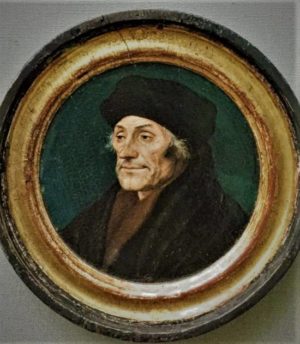




In 1506, Julius II, quickly nicknamed « the warrior pope » at the head of his troops, took back Perugia and Bologna.
As the humanist Erasmus of Rotterdam (1467-1537), who was present in Italy and was an eyewitness to the sacking of Bologna by the papal troops, reproached him, Julius II preferred the helmet to the tiara. Questioned by Michelangelo in charge of immortalizing him with a bronze statue, to know if he did not wish to be represented with a book in his hand to underline his high degree of culture, Julius II answers:
« Why a book? Rather, show me a sword in hand.«
Originally from the region of Genoa (Liguria), Julius II undertook to chase the Venetians, whom he abhorred, out of Romagna, which they occupied. « I will reduce your Venice to the state of hamlet of fishermen from which it left, » had said one day the Ligurian pope to the ambassador Pisani, to which the proud patrician did not fail to retort:
« And we, Holy Father, we will make of you a small village priest, if you are not reasonable… »
This language gives the measure of the bitterness to which one had arrived on both sides. In the bull of excommunication launched shortly afterwards (April 27, 1509) against the Venetians, these were accused of
« uniting the habit of the wolf with the ferocity of the lion, and of flaying the skin by pulling out the hairs… ».
The League of Cambrai

Against the rapacious practices of Venice, on December 10, 1508, in Cambrai, Julius II officially rallies to the « League of Cambrai », a group of powers (including the French King Louis XII, the regent of the Netherlands Margaret of Austria, King Ferdinand II of Aragon and the German Emperor Maximilian I).
For Julius II, the happiness is total because Louis XII comes in person to expel the Venetians of the States of the Church. Better still, on May 14, 1509, after its defeat by the League of Cambrai at the battle of Agnadel, the Republic of Venice agonizes and finds itself at the mercy of an invasion. However, at that juncture, Julius II, fearing that the French would establish their influence on the country, made a spectacular turnaround. He organized, from one day to the next, the survival of Venice!
His treasurer general, the Sienese banker Agostino Chigi (a Sienese billionaire close to the Borgias, to whom he had lent colossal sums of money and later Raphael’s patron), set the conditions:
- In order to pay for the Swiss mercenaries capable of repelling the attackers of the Ligue of Cambrai, Chigi granted the Venetians a substantial loan.
- In exchange, the Serenissima agreed to give up its monopoly on the trade of alum that it imported from Constantinople. At the time, alum, an irreplaceable mineral used to fix fabric dyes, represented a real « strategic » issue.
- Once Venice stopped importing alum, the entire Mediterranean world was forced, from one day to the next, to obtain supplies, not from Venice, but from the Vatican, that is to say, from Chigi, who was in charge of exploiting the « alum of Rome » for the Papacy, located in the mines of the Tolfa mountains, northwest of Rome in the heart of the Papal States.
- Aware that its very survival was at stake, and for lack of an alternative, Venice grudgingly accepted the golden deal.
In his biography on Jules II, french historian Ivan Cloulas specifies:
« Above all stands out Agostino Chigi, the banker from Siena, farmer of the pontifical mines of alum of Tolfa since the reign of Alexander VI. The favor that this character enjoyed with Julius II is surprising, since he was a banker who had long served Caesar Borgia.
The pontiff, according to the tradition, conferred at the time of his accession the load of ‘depositary’ to one of his Genoese compatriots, Paolo Sauli, charged to carry out all the financial transactions of the Holy See in connection with the cardinal camerlingue Raffaelo Sansoni-Riario.
But Chigi did not suffer disgrace, because he advanced Julian della Rovere considerable sums of money to buy electors [cardinal members of the Sacred College], and he made the exploitation and export of alum extracted from the pontifical mines a success. The experience and value of the Sienese made him a partner of the various bankers of the papacy, notably the Sauli and the Fugger, who gained new wealth as the fruitful trade in indulgences developed in Germany.«
Hence, now in alliance with Venice, Julius II, in what appears to the naive as a spectacular « reversal of alliance », set up the « Holy League » to « expel from Italy the Barbarians » (Fuori i Barbari!). A coalition in which he made enter the Swiss, Venice, the kings Ferdinand of Aragon and Henri VIII of England, and finally, the emperor Maximilian. This league will then drive out the French out of Italy. Julius II said with irony:
« If Venice had not existed, it would have been necessary to invent it.«
In response, Louis XII, the King of France, attempted to transpose the struggle into the spiritual realm. Thus, a national council, meeting in Orleans in 1510, he declared France exempt from the obedience of Julius II. A second council was convened in Italy itself, in Pisa, then in Milan (1512) trying to depose the pope. Julius II opposed to the King of France the Vth ecumenical council of the Lateran (1512) where he will welcome warmly those who abandoned that of Milan…
Maritime Empires

Julius II was determined to re-establish his authority both on land and on the oceans. A bit like in ancient Greece, Italy experienced a rather particular phenomenon, that of the emergence of « maritime republics ».
If the « Republic of Venice » is famous, the « maritime republics » of Noli, Genova, Pisa, Gaeta, Amalfi, Anconca and Ragusa (Dubrovnik on the Dalmatian coast), are less known.
In each case, operating from a port, a local oligarchy built a maritime empire and above all poisoned its competitors. However, maritime activity, by its very nature, implies taking risks over time. Hence the need for skillful, robust and forward-looking finance, offering insurance and purchase options on future assets and profits. It is therefore no coincidence that most financial empires developed in symbiosis with maritime empires, notably the Dutch and British, and with the West and East India Companies.
At the end of the 15th century, it was essentially Genoa and Venice that were fighting for control of the seas. On the one hand, Venice, historically the bridgehead of the Byzantine Empire and its capital Constantinople (Istanbul), was by far the largest city in the Mediterranean world in 1500 with 200,000 inhabitants. Since its heyday in the 13th century, the Serenissima has defended tooth and nail its status as a key intermediary on the Silk Road to the West. On the other hand, Genoa, which, after having established itself in the Levant thanks to the crusades, by taking control of Portugal, financed all the Portuguese colonial expeditions to West Africa from where it brought back gold and slaves.
Two maritime achievements will exacerbate this rivalry a little more:
- 1488. Although the works of the Persian scholar Al Biruni (11th century) and old maps, including that of the Venetion monk Fra Mauro, made it possible to foresee the bypassing of the African continent by the Atlantic Ocean to reach India, it was not until 1488 that Portuguese sailors passed the Cape of Good Hope. Thus, Genoa, without any intermediary, could directly load its ships in Asia and bring its goods back to Europe;
- 1492. Seeking to open a direct trade route to Asia without having to deal with the Venetians or the Portuguese (Genoese), Spain sent the Genoese navigator Christopher Columbus west in 1492. More than a new route to Asia, Columbus discovered a new continent that would be the object of covetousness.

as signed on by Pope Alexander VI Borgia with the treaty of Tordesillas in 1494
Two years later, on June 7, 1494, the Portuguese and Spanish signed the Treaty of Tordesillas to divide the entire world between them. Basically, all of the New World for Spain, all of the old one (from the Azores to Macao) for Portugal. To delimit their empires, they drew an imaginary line, which Pope Alexander VI Borgia set in 1493 at 100 leagues west of the Azores and the Cape Verde Islands.
Later, the line was extended, at the request of the Portuguese, to 370 leagues. Any land discovered to the east of this line was to belong to Portugal; to the west, to Spain. At the same time, any other Western maritime power was denied access to the new continent. However, in 1500, to the horror of the Spaniards, it was a Portuguese who discovered Brazil. And given its geographical position, to the west of the famous line, this country fell under the control of the Portuguese Empire!
Julius II, a child of Liguria (region of Genoa, therefore linked to Portugal) and vomiting Alexander VI Borgia (Spanish), in 1506, takes great pleasure in confirming, by the bull Inter Cætera, the treaty of Tordesillas of 1494 allowing to fix the dioceses of the New World, obviously to the advantage of the Portuguese and therefore to his own.
The ultimate weapon, culture
On the « spiritual » and « cultural » level, if Julius II spent most of his time at war, posterity retains essentially the image of « one of the great popes of the Renaissance » as a great protector and patron of the arts.
Indeed, to re-establish the prestige (the French word for soft power) and therefore the authority of Rome and its Empire, culture was considered a weapon as formidable as the sword. To begin with, Julius II opened new arteries in Rome, including the Via Giulia. He placed in the Belvedere courtyard the antiques he had acquired, in particular, the « Apollo of Belvedere » and the « Laocoon », discovered in 1506 in the ruins of Nero’s Imperial Palace.
In the same year, that is to say six years before the end of the military operations, Julius II also launched great projects, some of which were only partially or entirely completed after his death:
- The reconstruction of St. Peter’s Basilica, a task entrusted to the architect and painter Donato Bramante (1444-1514) ;
- The tomb of Julius II, which the sculptor Michelangelo was entrusted with in the apse of the new basilica and of which his famous statue of Moses, one of the 48 bronze statues and bas-reliefs originally planned, should have been part;
- The decoration of the vault of the Sistine Chapel built by Pope Sixtus IV, the uncle of Julius II, was also entrusted to Michelangelo. Julius II let himself be carried away by the creative spirit of the sculptor. Together, they worked on ever more grandiose projects for the decoration of the Chapel. The artist gave free rein to his imagination, in a different artistic genre that did not please the pope. Until October 31, 1512, Michelangelo painted more than 300 figures on the vault;
- The frescoes decorating the personal library of the pope will be entrusted to the painter Raphael, called to Rome in 1508, probably at the suggestion of Chigi, Aretino or Bramante. The Stanza was the place where the pope signed his briefs and bulls. This room later became the private library of the pontiff Julius II, then the room of the Tribunal of Apostolic Signatures of Grace and Justice and later, that of the Supreme instance of appeal and cassation. Before the arrival of Julius II, this room and « the room of Heliodorus », were covered with frescoes by Piero della Francesca (1417-1492), a painter protected by the great Renaissance genius cardinal philosopher Nicolaus of Cusa (1401-1464), immortalizing the great ecumenical council of Florence (1438). Decorations by Lucas Signorelli and Sodoma were added later. Following his election, Julius II, anxious to mark his presence in history, and to re-establish the authority of the oligarchy and the Church, had the frescoes of the Council of Florence covered with new ones. Convinced by his advisors, the pope agreed to entrust the direction of the work to Raphael. Officially, it is said that Raphael spared some of the frescoes on the ceiling, notably those executed by Sodoma, so as not to antagonize him entirely. But, as we have said, the content, the very elaborate theme and part of the iconography of the frescoes were decided upon as early as 1506, even before Raphael’s arrival in 1508;
- To modernize the city of Rome. Julius II, undoubtedly advised by the architect Bramante, singularly transformed the road system of Rome. In order for all the roads to converge towards St. Peter’s Basilica, he ordered the Via Giulia to be pierced on the left bank and the Lungara, the paths that meandered along the river on the right bank, to be transformed into a real street. His death interrupted the great works he had planned, in particular the construction of a monumental avenue leading to St. Peter’s and that of a new bridge to relieve the congestion of the bridge over St. Angelo, to which he had also facilitated access by widening the street leading to it. The extent of the work undertaken poses the problem of materials; although it was, in principle, forbidden to attack the ancient monuments, the reality was quite different. Ruinante, became the nickname of Bramante.
These major construction projects, patronage and military expenses drained the Holy See’s revenues. To remedy this, Julius II multiplied the sale of ecclesiastical benefits, dispensations and indulgences.
In the twelfth century, the Roman Catholic Church established the rules for the trade of « indulgences » (from the Latin indulgere, to grant) through papal decrees. They provided a framework for the total or partial remission before God of a sin, notably by promising, in exchange for a given amount of money, a reduction in the time spent in purgatory to the generous faithful after their death. In the course of time, this practice, essentially exploiting a form of religious superstition, turned into a business so lucrative that the Church could no longer do without it.
In northern Europe, particularly in Germany, the Fugger bankers of Augsburg were directly involved in organizing this trade. This practice was strongly denounced and fought against by the humanists, in particular by Erasmus, before Luther made it an essential part of the famous 95 theses that he posted, in 1517, on the doors of the church in Wittenberg.
In his book Erasmus and Italy, french historain Augustin Renaudet writes that Erasmus, after having met the highest authorities of the Vatican, was not fooled:
« He was not long in understanding that apart from the Holy See, the services of the Curia and the Chancellery, apart from the cardinals, the innumerable prelates on mission and in charge, apart from a motley crowd of civil servants and scribes, who populated the administrative or financial offices and the courts, there was nothing in Rome. In all the cities he had known, in Brussels, in Paris, in London, in Milan, in Florence, and recently in Venice, an active economy, fed by industry, commerce, and finance, supported a strong urban bourgeoisie, or as in Venice, an aristocracy of shipowners. In Rome, all the economy, all the trade, all the finance, were in the hands of foreigners: Florentine or Genoese merchants, Florentine or Genoese bankers. These foreigners held in their dependence a people of small merchants, of small craftsmen who sold in the back room, of money changers and Jewish traffickers. Very little industry, the Roman population lived at the service of the Curia, the prelates and the convents. Erasmus marveled at the pride with which the descendants of the people-king pretended to maintain their ancient majesty.
The word of the Roman people was no longer an empty word; Erasmus was to write one day that, in the modern world, a Roman citizen counted less than a burgher of Basel.«
Historians André Chastel and Robert Klein, in L’Humanisme, l’Europe de la Renaissance, share this observation:
« Another trend, favorable to Caesar and Augustus, had emerged: Rome becoming again more and more the ‘imperial’ capital of all the powerful borrowed or sought to borrow a style from it.
This new style associates besides more and more arma and litterae, the sword and the book.
(…) Rich or poor, any sovereign of the Renaissance will occupy the artists and the scholars insofar as he needs prestige: the greatest patrons of the Renaissance were the ambitious and the warriors, Maximilian, Julius II, Henry VIII, François I, Charles V.«
Raphael’s « impresarios »
If, from a contemporary point of view, it seems close to unthinkable for an artist to be « dictated » the theme of his work, this was not the case at the time of the Renaissance and even less so in the Middle Ages. For example, although he was a high-level diplomat of the Duke of Burgundy Philip the Good, the Flemish painter Jan Van Eyck (, one of the first painters to sign his works with his name, was advised on theology by the Duke’s confessor, the erudite Dionysus the Cartusian (1401-1471), a close friend of Cardinal Nicolaus of Cusa. And no one will dare say that Van Eyck « did not paint » his masterpiece The Mystic Lamb.
Raphael’s position was more delicate. In his time, painters still had the status of craftsmen. Including Leonardo da Vinci, who was known for his superior intelligence, declared himself to be a « man without letters », that is to say, unable to read Latin or Greek. Raphael could read and write Italian, but was in the same condition. And when, towards the end of his short life, he was asked to work on architecture (St. Peter’s Basilica) and urban planning (Roman antiquities), he asked a friend to translate the Ten Books of the Roman architect Vitruvius into Italian. Now, any visitor to the « Chambers of the Signature » is immediately struck by the great harmony uniting several dozen philosophers, jurists, poets and theologians whose existence was virtually unknown to Raphael before his arrival in Rome in 1508.
Moreover, with the exception of The Marriage of the Virgin, painted in 1504 at the age of 21, based on the way his master Pietro di Cristoforo Vannucci, known as Pietro Perugino (c. 1448-1523) had treated the same subject, Raphael had not yet had to meet the kind of challenge that the Stanza would pose to him.
As we have already said, the cartoons and other preparatory drawings, sometimes quite different from the final result, also suggest that, following the « commission, » discussions with one or more impresarios led the artist to modify, improve or change the iconography to arrive at the final result.
As for the theme, as we have already mentioned, the ideas and concepts seem to have emerged during a long period of maturation and were undoubtedly the result of multiple exchanges between Pope Julius II and several of his advisors, librarians, and « orators » of the papal court.
According to historian Ingrid D. Rowlands, the archival documents unquestionably indicate the decisive contribution of three very different personalities of the time:
- Battista Casali ;
- Giles of Viterbo;
- Tommaso « Fedra » Inghirami.
The thorough investigation of the historian Christiane L. Joost-Gaugier has established the predominant role of Inghirami. He was the only one in a position, and in a position, as the pope’s chief librarian, to set the program of the rooms. Raphael, will be his enthusiastic collaborator and will undoubtedly end up being « recruited » to the orientations and vision of his commissionners. This is evidenced by the fact that he demanded to be buried in the Roman Pantheon, considered the most Pythagorean, and believed to be the most neo-Platonic, temple of the Roman era.
Battista Casali
As documented by the Jesuit historian John William O’Malley, it was on January 1, 1508, the year of his appointment to St. John Lateran, a few months before Raphael’s arrival in Rome, that Battista Casali (1473-1525), a professor at the University of Rome, evoked the image of The School of Athens in an oration delivered in the Sistine Chapel in the presence of Julius II:
« One day (… ) the beauty of Athens inspired a contest between the gods, where humanity, learning, religion, primacies, jurisprudence and law came into being before being distributed in every country, where the Athenaeum and so many other gymnasiums were founded, where so many princes of knowledge trained their youth and taught them virtue, fortitude, temperance and justice – all of this destroyed in the whirlwind of the Mohaematan war machine…
However, just as [your illustrious uncle Pope] Sixtus IV [who ordered the construction of the Sistine Chapel], in a way, laid the foundations of education, you laid the cornice. Here is the Vatican library which he erected as if it had come from Athens itself, gathering the books he was able to save from the wreckage, and created in the image of the Academy.
You, now, Julius II, supreme pontiff, have founded a new Athens when you invoke the downtrodden world of letters as if it were rising from the dead, and order it, surrounded by threats of suspended work, that Athens, its stadiums, its theaters and its Athenaeums, be restored.«
Giles of Viterbo
Another major influence on the theme, Giles of Viterbo (1469-1532) of which we will say more below.
- An outstanding orator, he was called to Rome in 1497 by Pope Alexander VI Borgia ;
- In 1503, he became the Superior General of the Order of Hermits of Saint Augustine; with 8000 members, it was the most powerful order of its time;
- He is known for the boldness and seriousness of the speech he gave at the opening of the Fifth Lateran Council in 1512;
- He severely criticized the bellicose policy of Julius II and urged him to triumph by culture rather than by the sword;
- After the death of the latter, he became the preacher and theologian of Pope Leo X who appointed him cardinal in 1517.
Tommaso Inghirami
Finally, the prelate Tommaso Inghirami (1470-1516), who spoke both Latin and Greek, was also a formidable orator. The man owed his fortune to Lorenzo the Magnificent (1449-1492).
Educated by the Neoplatonic philosopher Marsilio Ficino, Lorenzo the Magnificent was the patron of both Botticelli and Michelangelo who lived with him for three years.
Born in Volterra, Inghirami was also taken in by the Magnificent after the sacking of that city. He carefully supervised his studies and later sent him to Rome where Alexander VI Borgia welcomed him. Inghirami was a handsome and well-dressed man.
At 16, Inghirami earned the nickname « Phaedra » after brilliantly playing the role of the queen who commits suicide in a Seneca tragedy performed in a small circle at the residence of the influential Cardinal Raphael Riario, cousin of Julius II or nephew of Pope Sixtus IV and therefore cousin of Julius II. Thereafter, Phaedra, bon vivant and for whom the celestial and terrestrial pleasures were happily completed, gained in political and especially… physical weight.
- In 1475, he accompanied the nuncio of Pope Alexander VI to the court of Emperor Maximilian I of the Holy Roman Empire, who named him Count Palatine and poet laureate;
- On January 16, 1498, Inghirami delivered an oration in the Spanish Church of Rome in honor of the Infant Don Juan, the murdered son of the King of Spain. Inghirami, in the name of Alexander VI Borgia, fully endorsed the Spanish policy of the time: to extend Christianity as well as imperial looting into the New World, to drive the Moors out of Europe and to strengthen the colonial plunder of Africa. If Julius II hated Alexander VI, he will continue this policy;
- In 1508, Julius II nominates Inghirami to head the Library of the Vatican to be installed in the Stanza;
- In 1509, while he was heavily involved in the realization of the frescoes of the Stanza, Raphael made his portrait. Raphael shows us a man suffering from divergent strabismus who seems to turn his gaze towards the sky in order to signify where this « humanist » drew his inspiration from;
- In 1510, the Pope appointed him Bishop of Ragusa;
- Finally, in 1513, he became papal secretary and at the urgent request of the dying pope, Inghirami delivered his funeral oration: « Good God! What a mind this man had, what sense, what ability to manage and administer the Empire! What a supreme and unshakable strength! »
Inghirami soon served as secretary to the conclave electing Pope Leo X (John of Medici, second son of Lorenzo de Medici, also a great protector of neo-Platonists and « culture »), another pope whose portrait Raphael will paint.
In 1509, eager to reform the Catholic church on the basis of the study of the three languages (Latin-Greek-Hebrew) to settle the religious conflicts which were looming and announced the religious wars to come, Erasmus of Rotterdam meets Inghirami in Rome. The latter exposes to him the imposing cultural building sites which he directed. Erasmus does not say a word about it.
However, a long time after the death of Inghirami, Erasmus complained that the Vatican and the oligarchy recruited among the humanists. He notably fingerpointed the sect of “the Ciceronians”, omnipresent in the Roman Curia and of which Inghirami was one of the leaders.
Thus, in 1528, in a pamphlet titled The Ciceronians, Erasmus quoted Inghirami’s oration on Good Friday of 1509. He denounced the fact that the members of this sect, on the grounds of the elegance of the Latin language, only used Latin words that appeared as they were in the works of Cicero! As a result, all the new language of evangelical Christianity, enshrined in the Council of Florence, which Erasmus wished to promote, was either banned or « re-translated » into pagan terms and words of the Roman era! For example, in his sermon, Inghirami had presented Christ on the cross as a pagan god sacrificing himself heroically rather than as a redeemer.
Finally, shortly after Raphael’s death, Cardinal Jacopo Sadoleto (1477-1547) wrote a treatise on philosophy in which Inghirami (meanwhile tragically deceased) defended rhetoric and denied the value of philosophy, his main argument being that everything written was already contained in the mystical and mythological texts of Orpheus and his followers…
Plato and Aristotle, the impossible synthesis
Now, in order to be able to « read » the theme deployed by Raphael in the « Chamber of the Signature, » let us examine this Florentine « neo-Platonism » that animated both Giles of Viterbo and Tommaso Inghirami.
The approach of these two orators consisted above all in putting their « neo-Platonism » and their imagination at the service of a cause: that of asserting with force that Julius II, the pontifex maximus at the head of a triumphant Church, embodied the ultimate outcome of a vast line of philosophers, theologians, poets and humanists. At the origin of a civilizational and theological « big bang » presumed to lead to the immeasurable lustre of the Catholic Church under Julius II, not only Plato and Aristotle themselves, but those who had preceded them including Apollo, Moses and especially Pythagoras.
From 1506 onwards, Giles de Viterbo, in an exercise that can be described as « beyond” impossible, wrote a text entitled Sententia ad mentem Platonis (« Sentences with the mind of Plato »). In it, he tried to combine into one ideology the Sentences of Peter Lombard (1096-1160), the scholastic text par excellence of the 13th century and the starting point for the commentaries of the Dominican Saint Thomas Aquinas (1225-1274) for his Summa Theologica, and the esoteric Florentine neo-Platonism of Marsilio Ficino (1433-1499) * of whom Giles de Viterbe was a follower.
All this could only please a pope who, in order to establish his authority on earthly and spiritual matters, warmly welcomed this agreement between Faith and Reason defended by Thomas Aquinas who says that “the Truth being one”, reason’s only role is to confirm faith’s superiority.
The very idea to present the wedding of Aristotelian scholasticism (logic presented as « reason ») with Florentine neo-Platonism (Plotinus’ emanationism dressed as « faith ») as a source of poetry and justice as « The Signing Room » does, comes from this.
Let us recall that in the middle of the 13th century, two mendicant Orders, the Franciscans and the Dominicans, were contesting the drift of a Church that had become, above all, the simple manager of its earthly possessions. The one who would later be called St. Thomas Aquinas, opposed on this point (his competitor) St. Bonaventure (1221-1274), founding figure of the Franciscan Order.
For his part, Aquinas relies on Aristotle, whom Albert the Great (1200-1280), whose disciple he was in Cologne, had made known to him, to establish the primacy of « reason ». For the man who was nicknamed « the dumb ox », faith and human reason, each managing their own domain, had to move forward together, hand in hand while of course, the Church had the last word.
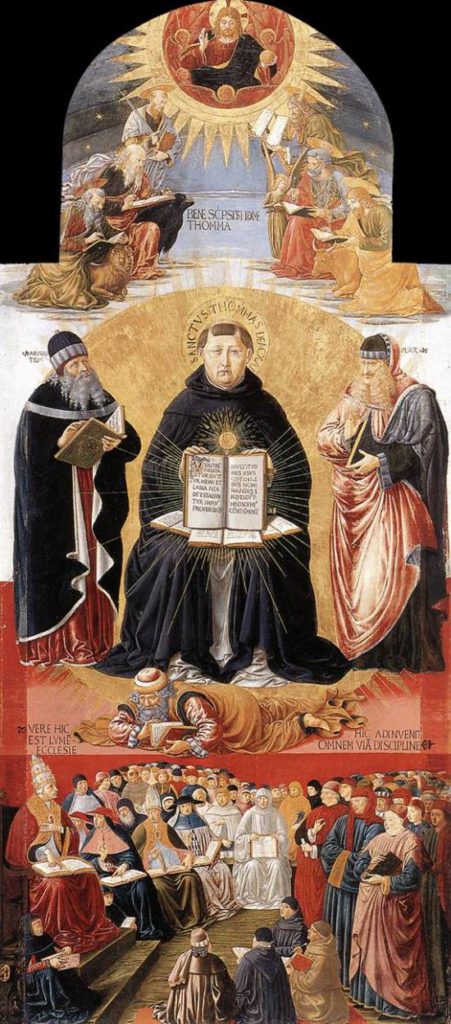
Several paintings (the great fresco of 1366 in the Spanish chapel of Santa Maria Novella in Florence; the painting by Filippino Lippi of 1488 in the Carafa chapel in Rome; or the painting by Benozzo Gozzoli (1421-1497), painted around 1470, in the Louvre in Paris), have immortalized the “Triumph of Thomas Aquinas”.
Gozzoli’s painting in the Louvre is of particular importance because several elements prefigure the iconography of the Signing Chamber, notably the three levels found in Theology (Trinity, Evangelists and religious leaders) as well as the couple Plato and Aristotle found in Philosophy.
In Gozzoli’s painting, we see Aquinas, standing between Plato and Aristotle, throwing down before him the Arab philosopher Averroes (1126-1198) (Ibn-Rushd of Cordoba) expelled for having denied the immortality and the thought of the individual soul, in favor of a « Single Intellect » for all men that activates in us the intelligible ideas.
In the West, before the arrival of Greek delegations in Italy to attend the Council of Ferrara-Florence in 1438, if several works of Plato, including the Timaeus, were known to a handful of scholars, such as those of the School of Chartres or Italians as Leonardo Bruni in Florence, most of the West’s knowledge of Greek thought came down to the works of Aristotle.
For the Aristotelians, who became dominant in the Catholic Church with Aquinas, Plato had to be considered as incompatible with Christianity.
On the other hand, for the Platonists, including Augustine, Jerome and especially Nicholas of Cusa and Erasmus, who honored and adorned him that Erasmus called « Saint Socrates », Plato was to be venerated by Christians: he was monotheistic, believed in the immortality of the soul and venerated, in the form of the Pythagorean triad, the mystery of the Trinity.
In the 15th century, for lack of epistemological clarity and some confusion on the authorship of certain manuscripts, some humanists, in particular Nicolaus of Cusa‘s friend and close collaborator Cardinal John Bessarion (1403-1472), one of the key organizers of the reunification of the Eastern and Western Churches, presented Plato as the « equal » of Aristotle, the latter’s disciple, with the sole purpose of making Plato « as acceptable as possible » to the Catholic Church.
Hence Bessarion‘s now famous phrase « Colo et veneror Aristotelem, amo Platonem » (I cultivate and venerate Aristotle, I love Plato) which appears in his In Calumniatorem Platonis (republished in 1503), a rejoinder to the virulent charge against Plato elaborated by the Greek Georges Trébizond.
Thus, in the School of Athens painted by Raphael, Plato and Aristotle appear side by side, not confronting each other but complementing the other with their respective wisdom : the first holding his book the Timaeus (on the creation of the universe) in one hand, and with the other, pointing to the sky (To the One, to God), the second holding his Ethics (the science of the good in personal life) in one hand, and raising the other arm horizontally to indicate the earthly realm (Physics).
If the commissioners had wanted to underscore the opposition of both philosophers, Plato would have rather been portrayed with his Parmenides (On Ideas) and Aristotle with his Physics (On natural sciences). That is clearly not the case.
Giles de Viterbo in his Sententia ad mentem Platonis will mobilize extreme sophism to erase the irreconcilable and very real oppositions (see box below) between the Platonic thought and that of Aristotle.
Why Plato and Aristotle are not complementary
By Christine Bierre
The fundamental concepts that gave birth to our European civilization can be traced back to classical Greece, and through it, to Egypt and other even more ancient civilizations.
Among the Greek thinkers, Plato (-428/-347 B.C.) and Aristotle (-385/-323 B.C.) asked all the great questions that interest our humanity: who are we, what are our characteristics, how do we live, where are we situated in the universe, how can we know it?
The accounts that have come down to us from this distant period speak of the disagreements that led Aristotle to leave Plato’s Academy, of which he had been a disciple. History then bears witness to the violence of the oppositions between the disciples of the one and the other. During the Renaissance, the most reactionary Catholic currents, the Council of Trent in particular, were inspired by Aristotle, whereas Plato reigned supreme in the camp of humanism, in the hands of some of the greatest, such as Erasmus and Rabelais.
There were various attempts, however, to make them complementary, as discussed in this article by Karel Vereycken. If Plato represents the world of Ideas, Aristotle represents the world of matter. Impossible to build a world without both, we are told. It seems so obvious!
The Greek philosopher, Plato.
All this starts, however, from a false idea opposing these two characters. For Plato, we are told, reality is found in the existence of ideas, universal concepts which represent, in an abstract way, all the things which participate of this concept. For example, the general concept of man contains the concept of particular men such as Peter, Paul and Mary; similarly for good, which includes all good things whatever they are. For Aristotle, on the contrary, reality is located in matter, as such.
What is false in this reasoning is the concept that the Platonic Ideas are abstractions. The Platonic Ideas are, on the contrary, dynamic entities that generate and transform reality. In the myth of the cave in The Republic, Socrates says that at the origin of things is the sovereign Good. In The Phaedo, he explains that it is through « Ideas » that this sovereign Good has generated the world.
In the myth of the cave, Socrates uses an offspring of the idea of the good, the Sun, to help us understand what the sovereign Good is. The Good, he says, has generated the Sun, which is, in the visible world, in relation to sight and objects of sight, what the Good is in the intelligible world in relation to intelligence and intelligible objects. The prisoners in the cave saw only the shadows of reality, and then, on coming out, they saw, thanks to the Sun, the real objects, the firmament and the Sun. After this, they will come to the conclusion about the Sun, that it is he who produces the seasons and the years, that he governs everything in the visible world and that he is in some way the cause of all those things that he and his companions saw in the cave.
The Sun not only gives objects the ability to be seen, but is also the cause of their genesis and development. In the same way for the knowable objects, they hold from the Good the faculty to be known but, in addition, they owe him their existence and their essence. The idea of the Good is thus for Plato the dynamic cause of the things: material and immaterial and not dead universals.
Aristotle’s splintered « One »
For Aristotle, as for all the empiricist current which followed him, reality is situated at the level of the objects knowable by the senses. Nature sends us its signals that we decode with our mental faculties. Ideas are only abstractions of the sensible universe which constitutes reality. For him the universals have no real existence: man « in general », does not generate anything. It is only an abstraction of all the men in particular. The particular man is generated by the particular man; Peter is generated by Paul.
It is also said of Aristotle that he « exploded » Plato’s One. There are two ways of conceiving the One. One can think of it either as an absolute One (God or first cause), depending on whether one is a religious person or a philosopher, a purely intelligible principle but a dynamic cause that has generated all things; or one can think of it as the number « one » that determines each particular thing: the number one when we say: a man, a chair, an apple.
Aristotle‘s One simply becomes a particular unity, characteristic of all things that participate in unity. It is not the cause of what « is » but only the predicate of all the elements that are found in all the categories. The Being and the One, he will say, are the most universal of predicates. The One, he will say again, represents a definite nature in each kind but never the nature of the One will be the One in itself. And the Ideas are not the cause of change.
What is the point of all this?
Does this discussion make more sense than all the never-ending debates about the sexes of angels that gave scholasticism such a bad name in the Middle Ages? The One or the many, what does it matter in our daily lives?
This point is however essential. The fact of being able to go back to the intelligible causes of all that exists, puts the human species in a privileged situation in the universe. Unlike other species, it can not only understand the laws of the universe, but also be inspired by them, in order to improve human society. This is why, in history, it is the « Platonic » current that was at the origin of the great scientific, technological and cultural breakthroughs in astronomy, geometry, mechanics, architecture, but also the discovery of proportions that allow the expression of beauty in music, painting, poetry and dance.
As for Aristotle, it must be said that his conceptions of man and knowledge only led him to establish categories defining a dozen possible states of being. Aristotle was also the founder of formal logic, a system of thought that does not claim to know the truth, but only to define the rules of a correct reasoning. Logic is so little interested in the search for truth that one can consider that a judgment that is totally false in relation to reality can be said to be right if all the rules of « good reasoning » of logic have been used.
Suite
To begin with, Giles de Viterbo underlines that Aristotle is a « pupil » of Plato and that the « two princes of philosophy » could be reconciled. Very much imbued with the neo-Pythagorean spirit, and for whom Plato was only one of the greatest disciples of Pythagoras, the author argues that both philosophers agree that, contrary to the pagan pantheon, the « One » is the ultimate expression of the divine. Clearly, they were both monotheists and thus their convictions anticipated those of Christianity.
Giles of Viterbo:
Philosophy, which traces and examines all things, judges that all number and multiplicity are absent from God, as Plato and his pupil Aristotle say.
Humanity has as its goal the understanding of divine things, as even Aristotle admits in his Ethics. Thus, if it is necessary to pursue this goal, it is necessary to arrive at the understanding of God.
And he continues:
Now these princes of Philosophy [Plato and Aristotle] can be reconciled, and no matter how much they disagree about creation, the Ideas, or the goal of the Good, these points [of agreement] can be identified and demonstrated.
(…) [Then], they appear not to disagree with each other at all (…) These great princes can be reconciled if we postulate the double nature of things, one which is free from matter and the other which is within matter.
(…) Plato follows the first, Aristotle the second, and because of this, these two great leaders of philosophy hardly differ from each other. If you think that we are making this up, listen to them yourselves. For if we speak of humanity, after all the subject of our conversation, then Plato says the same thing, he says humanity is the soul, in the (First) Alcibiades; and in the Timaeus, he says that humanity has two natures, and we know one of these natures by means of the senses, and the other by means of reason.
Also, in the same book, he teaches us that each part in us does not exist in isolation from the other, that each nature is concerned with the other nature. Aristotle, in the tenth book of his Ethics, calls humanity Understanding. So you can know that each philosopher (Plato and Aristotle) feels the same way, no matter how much it seems to you that they are not saying the same thing.
Pico della Mirandola the Neo-Platonist
Giles of Viterbo, like Tommaso Ingharimi, seems to have taken up the gauntlet thrown to them by John Pico della Mirandola (1463-1494), the young disciple of Ficino.
A precocious scholar, a protégé of Lorenzo de’ Medici (like Inghirami), this man of omniscience was fearless. Thus, in 1485, at the age of 23, he announced his project to gather, at his own expense, in the eternal city and capital of Christianity, the greatest scholars of the world to debate the mysteries of theology, philosophy and foreign doctrines. The objective was to go back from scholasticism to Zoroaster, passing by the Arabs, the Kabbalah, Aristotle and Plato, to expose to the eyes of all, the concordance of wisdom. The affair failed. His initiative, which reserved an important place for magic, could only arouse distrust. For the Vatican, all this could only smell of sulfur, and the initiative was discarded at the time.
However, it will mark the minds of a generation. For his Oratio de hominis dignitate, his inaugural speech written in an elegant and almost Ciceronian style, intended for the presentation of his nine hundred theses, published together after his death, was a great success, especially among young scholars like… Inghirami.
Pico’s achievement, which was not well received by the authorities, was to give humanistic studies (studia humanitatis) a new purpose: to seek the concordance of doctrines and define the dignity of the human being. The aim was, by bringing out what unites them despite their differences, to discover their common ground and, by a coincidence of opposites, to have them meet in a unity that transcends them.
Pico della Mirandola:
« That is why, not content with having added to the common doctrines a quantity of remarks on the primitive theology of Mercury Trismegistus, on the teachings of the Chaldeans and Pythagoras, on the most secret mysteries of the Jews, we have also proposed for discussion a certain number of discoveries and conceptions of our own in the physical and theological fields.
First of all, we have argued that Plato and Aristotle agree: many have thought so before us, no one has proved it sufficiently. Among the Latins, Boethius had promised himself to do so, but there is no indication that he ever realized what was always his project.
Among the Greeks, Simplicius had given himself the same program: heaven forbid that he should have lived up to his intentions! Augustine himself, in his work Against the Academicians, writes that many authors have conceived, with great finesse in argumentation, the project of establishing this same point, namely that the philosophies of Plato and Aristotle are one.
Thus John the Grammarian [The Hellenist John Lascarus] affirms well that only those who do not hear the words of Plato believe him to be in disagreement with Aristotle, but it is to his successors that he left the care of the demonstration. We have also added various developments where the concordance between the opinions – reputedly discordant – of Scotus and Thomas on the one hand, of Averroes and Avicenna on the other hand, is affirmed. Secondly, our considerations on Aristotelian and Platonic philosophy have been enriched by seventy-two new physical and metaphysical propositions: by making them one’s own, if I am not mistaken (and I will soon be sure of this), one will be able to solve any problem of a natural or theological nature, according to a philosophical method which is quite different from the one taught orally in schools and which is in honor among the doctors of our time.«
In a manuscript found unfinished at the time of his death in 1494 and entitled Concordia Platonis et Aristotelis, Pico della Mirandola explicitly mentions Plato’s Timaeus and Aristotle‘s Ethics, precisely the two books that appear as attributes of their authors in Raphael’s fresco.
Then, in his Heptaplus, a work he completed in 1489, Pico della Mirandola asserted that the writings of Moses and the Mosaic Law, according to him the foundation of all wisdom, were the basis of Greek civilization before becoming that of the Church of Rome. The Timaeus, the major work of Plato, says Pico, demonstrates that its author was an “attic Moses” (from Athens).
Cicero the Neo-platonist
For Inghirami, fascinated by the eloquence and the style of Cicero (-106/-43 BC) of whom he believed himself the reincarnation, the challenge launched by Pico della Mirandola to reconcile Apollo, Pythagoras, Plato and Aristotle, appeared almost as a divine test and the frescoes of Raphael decorating the Stanza will be above all his answer.
In addition, Cicero himself claimed to be a neo-Platonist. In the first volume of his work, the Academica, after condemning Socrates for continually asking questions without ever « laying the foundations of a system of thought », Cicero asserts, several centuries before Pico della Mirandola, that the ideas of Plato and Aristotle, in essence, « had the same principles »:
« In the shadow of Plato’s genius, a fertile, varied, universal genius, a unique philosophy was established under the double banner of the academicians and the peripatetics, who, agreeing on things, differed only on the terms.
For Plato, who had made Speusippus, son of his sister, the heir of his philosophy, also left two disciples of great talent and rare science, Xenocrates of Chalcedony and Aristotle of Stagire: those who followed Aristotle, were named peripatetics, because they discussed while walking in the Lyceum; whereas those who, according to the institution of Plato, held their assemblies and disserted in the Academy, the other gymnasium of Athens, received from this place the name of Academicians. But both of them, all penetrated by Plato’s fertile genius, formulated philosophy into a certain complete and finished system, and abandoned the universal doubt of Socrates, and his habit of discussing everything without affirming anything. There was then what Socrates entirely disapproved of, a philosophical science, with regular divisions and a whole methodical apparatus.
This philosophy, as I have said, under a double name, was one; for between the doctrine of the peripatetic [Aristotle] and the ancient Academy [Plato] there was no difference. Aristotle prevailed, in my opinion, by the richness of his genius; but the one and the other had the same principles, and judged the goods and the evils in the same way.«
Inghirami was also strengthened by the reading of countless Christian authors in this sense, such as the Frenchman, Bernard of Chartres (12th century), a Neoplatonist philosopher who played a fundamental role in the Chartres school, which he founded. He was appointed master (1112) and then became chancellor (1119) responsible for the teaching of the cathedral school.
You wonder the sculptures of Pythagoras and Aristotle appear side by side on the western portal of the cathedral?
Historian Etienne Gilson writes:
« Bernard of Chartres was first of all influenced by Boethius, whose Platonism he adapts. He then set out to reconcile Plato’s thought with that of Aristotle, which made him the greatest Aristotelian and Platonic thinker of the 12th century. John of Salisbury affirmed, in the most formal terms, that Bernard of Chartres and his disciples did not believe that they were simply expounding Plato’s thought by explaining in this way the relation of ideas to things, but that they had the pretension of putting Aristotle in agreement with Plato. That the trouble they took was wasted, is what John of Salisbury clearly states. With a very British humor he notes that these philosophers arrived too late and that they worked uselessly to reconcile dead men who had been arguing all their lives.«
Inghirami will have read St. Bonaventure (1217-1274), one of the founders of the Franciscan order, who pointed out that Plato and Aristotle each excelled in their own field:
« And so it appears that among philosophers, Plato’s gift is to speak of wisdom, Aristotle‘s of science.«
Or the Florentine Marsilio Ficino, this neo-Platonic philosopher of the XVth century whose « Platonic Academy » had put in saddle Pico della Mirandola. Ficino, had he not written in his Platonic Theology that
Plato treats natural things divinely while Aristotle treats even divine things naturally.
In the preface he wrote for The Fable of Orpheus, a play written by his disciple Poliziano (1454-1494), Ficino, referring to Saint Augustine, makes the mythical Hermes Trismegistus (Mercury) the first of the theologians: his teaching would have been transmitted successively to Orpheus, Aglaophemus, Pythagoras, Philolaos and finally Plato.
Thereafter, Ficino will place Zoroaster at the head of these prisci theologi, to finally attribute to Zoroaster and Mercury an identical role in the genesis of the ancient wisdom: Zoroaster teaches this one among the Persians at the same time as Trismegistus taught it among the Egyptians.
Preceding Plato, Pythagoras
In Raphael’s School of Athens, the figure of Pythagoras of Samos (580-495 B.C.), surrounded by a group of admirers, takes a major place. He is clearly identifiable by a tablet on which the musical chords and the famous Tetraktys appear, which we will discuss here.
While historians have so far mainly explored the influence of the Platonic and Neo-Platonic currents on the Italian Renaissance, historian Christiane L. Joost-Gaugier, in her book Pythagoras and Renaissance Europe, has highlighted the extent to which the ideas of the great pre-Socratic thinker Pythagoras influenced the thought and art of the Renaissance.
In art, Pythagoras inspired the Roman architect Vitruvius (90-15 BC), and later such theorists of the golden mean such as the Franciscan monk Luca Pacioli (1445-1517), whose treatise, De Divina Proportiona, illustrated by Leonardo da Vinci, appeared in Venice in 1509.
However, if a theorem, probably from India, bears his name (attributed to Pythagoras by Vitruvius), little is known of his life. Just like Confucius, Socrates and Christ, if we are sure that he really existed, no writing from his hand has come down to us.
By necessity, Pythagoras
became a living legend, and even very active during the Renaissance, so much so that most people saw Plato as a mere « disciple » of the « divine Pythagoras ».
Born in the first half of the 6th century B.C. on the island of Samos in Asia Minor, Pythagoras was probably in contact with the school of geometer’s founded by Thales of Miletus (-625/-548 B.C.).
Around the age of 40, he left for Crotone in southern Italy to found a society of friends, both philosophical, political and religious, whose chapters were to multiply.
For Pythagoras, the issue is to build a bridge between man and the divine and on this basis to transform society and the city. When asked about his knowledge, Pythagoras, before Socrates and Cusa, asserted that he knew nothing, but that he sherished « the love of wisdom ». The word philo-sophy would have thus been born.
No Christian humanist, reading Saint Jerome (347-420), one of the Fathers of the Catholic Church, could escape the praise that the latter gives to Pythagoras.
In his polemic Apology against the Books of Rufinus, Jerome, in order to evoke an exemplary behavior, quotes what two disciples of Pythagoras would have said:
« We must by all possible means avoid softness of the body, ignorance of the spirit, intemperance, civil dissensions, domestic dissensions and in general excess in all things.«
And Jerome invokes the « Precepts of Pythagoras » :
« Everything must be common among friends; a friend is another ourselves. We must consider two periods in life, the morning and the evening, that is, what we have done and what we must do. After God, we must seek the truth, which alone can bring men closer to the Creator.”
Secondly, Jerome believes that Pythagoras, in affirming the concept of the immortality of the soul, preceded Christianity:
« Listen to what Pythagoras was the first to find in Greece, Jerome says: That souls are immortal, that they pass from one body into another, and, it is Virgil himself who tells us in the sixth book of the Aeneid: When they have made a revolution of a thousand years, God calls them in great numbers to the banks of the river Lethe, so that they may undoubtedly see again the heaven they no longer remember; it is then that they begin again to revive a new body, which first was Euphorbus, then Calide, then Hermoticus, then Perhius and finally Pythagoras ; and that after a certain time what has existed begins to be born again, that there is nothing new in the world, that philosophy is a collection of meditations on death, that every day it strives to free the soul from the chains that bind it to the body and to give it back its freedom. Plato communicates many other ideas in his writings, especially in the Phaedo and in the Timaeus.«
The hidden geometry of numbers
For Pythagoras « the beginning is half of everything ». According to Theon of Smyrna (v. 70/v. 135), for the philosopher, « numbers are, so to speak, the principle, the source and the root of all things ».
Aristotle, in his Metaphysics reports:
« The Pythagoreans first applied themselves to mathematics… Finding that things [including musical sounds] model their nature mainly on the set of numbers and that numbers are the first principles of the whole of nature, the Pythagoreans concluded that the elements of numbers are also the elements of everything that exists, and they made the world a harmony and a number.«
And as Cleinias of Tarantum (4th century BC), a Pythagorean friend of Plato, said:
« When these things, therefore, are at rest, they give birth to mathematics and geometry, when they are in motion to the harmonica and astronomy.«
The idea of the « monad », a dynamic unity participating in the One, perfected several centuries later by the philosopher and scientist Gottfried Wilhelm Leibniz (1646-1716) in his « Monadology« , comes to us from this period. Etymologically meaning « unity » (monas), it is the supreme unity (the One, God, the principle of numbers) which, while being at the same time the minimal unity, reflects in the microcosm the same dynamic activity that the One represents in the macrocosm.
Already, just the name of Apollo (a god considered as « the father » of Pythagoras) means, as Plato, Plutarch and other ancient authors point out: free of all multiplicity (Pollo = multiplicity; a-pollo = non-multiple).
Xenophanes of Colophones (born around 580 BC), asserts the existence of a unique God governing all things by the power of his intelligence. It is about a god not similar to the men, because eternal, incorporeal and spherical.
As much as this conception of a dynamic One has sometimes provoked an explosion of esoteric interpretations, it has stimulated the most creative minds and terrorized the formalists of thought.
When speaking about simple things, arithmetic numbers, Pythagoras uses the terms of one, two, three, four, five, ten…, while to evoke ideal numbers and their power, he speaks about: monad, dyad, triad, tetrad, decad, etc. Thus, by conceiving numbers in a non-linear but figurative way, he offers an arithmetic applicable to astronomy, music and architecture. By arranging these numbers, like marbles, in a particular way, Pythagoras discovered the famous « geometry of numbers ». For example, in the case of triangular numbers, three points form a triangular surface. If we add three points below, we find the number 6, but it is still a triangle. And if we add four more points, we get the number 10, still a triangular number.
The Patriarch of Constantinople Photius (810-893) confirms that :
« The Pythagoreans proclaimed that the complete number is ten.
The number ten, is a compound of the first four numbers that we count in their order. That is why they called Tetraktys the whole constituted by this number.«
Besides the plane and triangular numbers (1, 3, 6, 10, etc.), Pythagoras explored the square numbers (1, 4, 9, 16, …), rectangular, cubic, pyramidal, star-shaped, etc. In doing so, Aristoxenus said, Pythagoras had « raised arithmetic above the needs of merchants ». This approach, that of seeing harmony above and within the multiple, has inspired many scientists throughout history. One thinks of Mendeleev for the elaboration of his table of elements or of Einstein.
The power of numbers was also well understood by the cardinal-philosopher Nicolaus of Cusa, who evokes Pythagoras in the first chapter of his treatise De Docta Ignorantia (1440), when he states that :
« All those who search, judge the uncertain by comparing it to a certain presupposition by a system of proportions. All research is therefore comparative, and uses the means of proportion: if the object of research can be compared to the presupposition by a small proportional reduction, the judgment of apprehension is easy; but if we need many intermediaries, then difficulty and pain arise. This is well known in mathematics: the first propositions are easily brought back to the first principles which are very well known, whereas the following ones, because they need the intermediary of the first ones, have more difficulty.
Therefore, all research consists of a comparative proportion, easy or difficult, and this is why the infinite, which escapes, as infinite, from all proportion, is unknown. Now, the proportion which expresses agreement in a thing on the one hand and otherness on the other hand, cannot be understood without the number. This is why the number encloses all that is susceptible of proportions.
Therefore, it does not create a proportion in quantity only, but in everything that, in some way, by substance or by accident, can agree and differ. Therefore, Pythagoras strongly believed that everything was constituted and understood by the power of numbers.
Now, the precision of combinations in material things and the exact adaptation of the known to the unknown are so far above human reason that Socrates considered that he knew nothing but his ignorance; at the same time as the very wise Solomon affirms that all things are difficult and that language cannot explain them.«
The Geometry of numbers,
the secret of mental calculations
Here is a simple example.
One day, in Göttingen, the teacher of the young German mathematician Carl Gauss (1777-1855) asked his students to calculate the sum of all the numbers from one to one hundred. The students did so and began to add the numbers 1 + 2 + 3 + 4 + 5, etc.
The young Gauss raises his hand and, following a mental calculation, announces the result of the operation: « 5050, Sir! »
The teacher, surprised, asks him how he arrived at the result so quickly. The young Gauss explains: to see if there is a geometry in the number 100, I added the first digit (1) with the last (100). This gives 101. Now, if I add the second digit (2) with the second to last one (99), it also makes 101. I concluded that within the number 100 there are fifty pairs of even and odd numbers whose sum is 101 each time. Thus, by multiplying 101 by the number of couples (50), I immediately arrive at 5050.
From Pythagoras to Plato
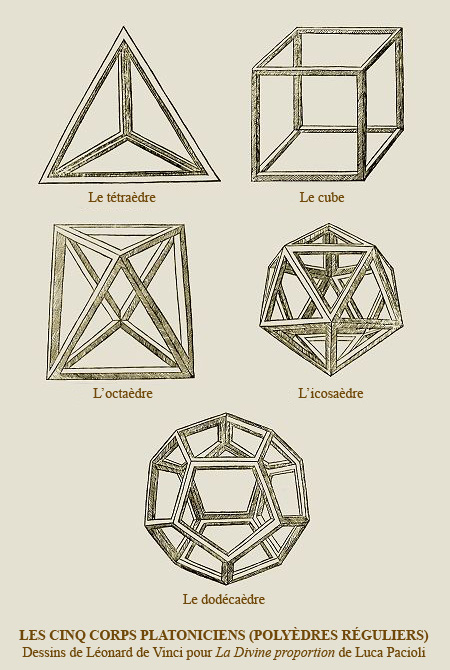
For Pythagoras, the most perfect surface is the circle and the ideal volume is the sphere since regular polyhedra can be inscribed. According to one of his disciples, the Italian Philolaus of Croton (-470/-390 BC), Pythagoras would have been the first to define the five regular polyhedrons:
- the cube,
- the tetrahedron (a pyramid with 4 triangular faces),
- the octahedron (composed of 8 triangles),
- the icosahedron (64 triangles) and
- the dodecahedron (composed of 12 pentagons).
Since Plato describes them in his work, the Timaeus, these regular polyhedra took the name of « Platonic solids ». Let’s recall that Plato went to Italy several times, notably to meet his close friend, the great Pythagorean scientist, astronomer, musical theorist and political leader, Archytas of Tarantum (-428/-387), considered today as « the father of robotics ».
A direct disciple of Philolaos, Archytas became the mathematics teacher of the brilliant Greek astronomer and physician Eudoxus of Cnidus (-408/-355).
Starting with Archytas, the Pythagoreans associate the 1 to the point, the 2 to the line, the 3 to the surface (the two-dimensional geometrical figure: circle, triangle, square…), the 4 to the solid (the three-dimensional geometrical figure: tetrahedron, cube, sphere, etc.).
Let’s add that in the Timaeus, one of Plato’s last dialogues, after a brief exchange with Socrates, Critias and Hermocrates, the Pythagorean philosopher Timaeus of Locri (5th century BC) exposes a reflection on the origin and the nature of the physical world and of the human soul seen as the works of a demiurge while addressing the questions of scientific knowledge and the place of mathematics in the explanation of the world.
Cicero (Republic, I, X, 16) specifies that Timaeus of Locri was an intimate of Plato:
No doubt you have learned, Tuberon, that after the death of Socrates, Plato went first to Egypt to learn, then to Italy and Sicily, in order to learn all about the discoveries of Pythagoras.
There he lived for a long time in the intimacy of Archytas of Taranto and Timaeus of Locri, and had the chance to obtain the Commentaries of Philolaos.
The music of the spheres
A magnificent bas-relief on the campanile of the Florence cathedral reflects what the early Italian humanists knew about Pythagoras.
Luca della Robbia (1399-1482), the sculptor working on the instructions of the humanist chancellor of Florence Leonardo Bruni (1370-1444), shows Pythagoras, a large hammer in one hand, a small hammer in the other, striking an anvil and concentrating his mind on the difference in the sounds he produces.
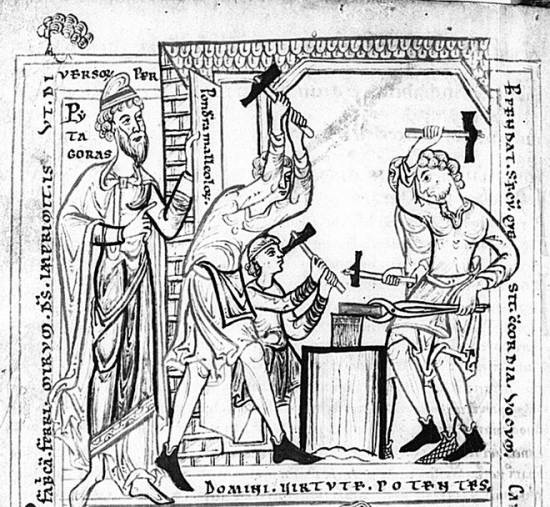
According to the legend, Pythagoras was walking near a forge when his attention was caught by the sound of hammers striking the anvil. He discerned in his ear the same consonances as those he could produce with his lyre. His intuition led to a fundamental discovery: musical sounds are governed by numbers.
This is how Guido d’Arezzo (992-1050), the Benedictine monk who created the system of musical notation still in use, relates the event in the last chapter (XX) of his book Micrologus around 1026:
« A certain Pythagoras, a great philosopher, was traveling adventurously; he came to a workshop where an anvil was being struck with five hammers. Amazed by the pleasant harmony [concordiam] they produced, our philosopher approached them and, believing at first that the quality of sound and harmony [modulationis] lay in the different hands, he interchanged the hammers. When this was done, each hammer retained its own sound. After having removed one that was dissonant, he weighed the others, and, admirably, by the grace of God, the first weighed twelve, the second nine, the third eight, the fourth six of I don’t know what unit of weight. He thus knew that the science [scientiam] of music resided in the proportion and ratio of numbers [in numerorum proportione et collatione] […] What can we say about the science of music? […] What more can be said? By arranging the notes according to the intervals mentioned above, the illustrious Pythagoras was the first to perfect the monochord. As it is not lasciviousness that one finds there, but a fast revelation of the knowledge of our art, it met a general assent among the scholars. And this art has gradually been affirmed and developed to this day, for the Master himself always illuminates the human darkness and his supreme Wisdom endures for all centuries. Amen.«
Here, the diagram (found on a slate placed at the feet of Pythagoras in Raphael’s fresco), which visualizes the musical harmonies obtained by dividing a string. Dividing it in two gives the octave, in three the fifth and in four the fourth. Finally, epogdoon (from the prefix epi- meaning above and ogdoon meaning the eighth) translates the interval of 9/8, which here corresponds to the tone.
IMAGE
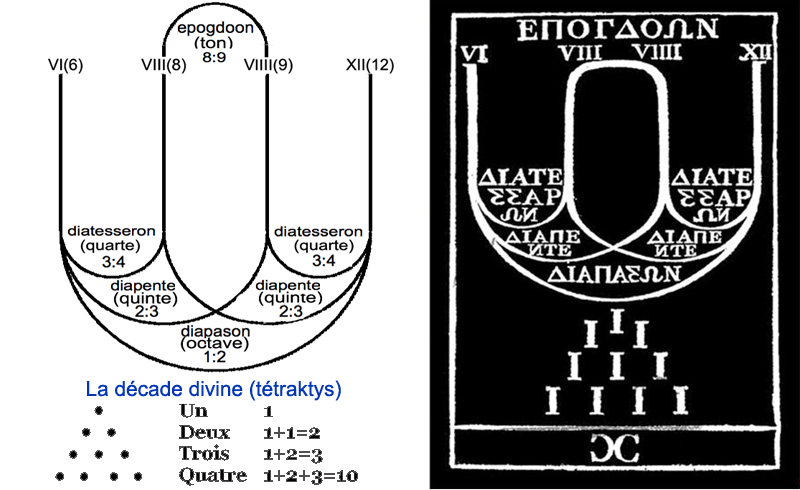
Let’s go back to the harmonic ratios that Pythagoras discovered from the weights of the hammers: 12, 9, 8 and 6.
- The ratio between 12 and 6 is the half and corresponds to the octave (diapason). It is found on a musical instrument by vibrating half a string;
- The ratio between 12 and 8 is a ratio of two thirds, which corresponds to the fifth (diapente);
- The ratio between 8 and 6, is a ratio of three quarters, which corresponds to the fourth (diatessaron);
- Finally, the ratio between 8 and 9 gives the interval of a tone (epogdoon, the prefix epi- meaning above and ogdoon meaning the eighth).
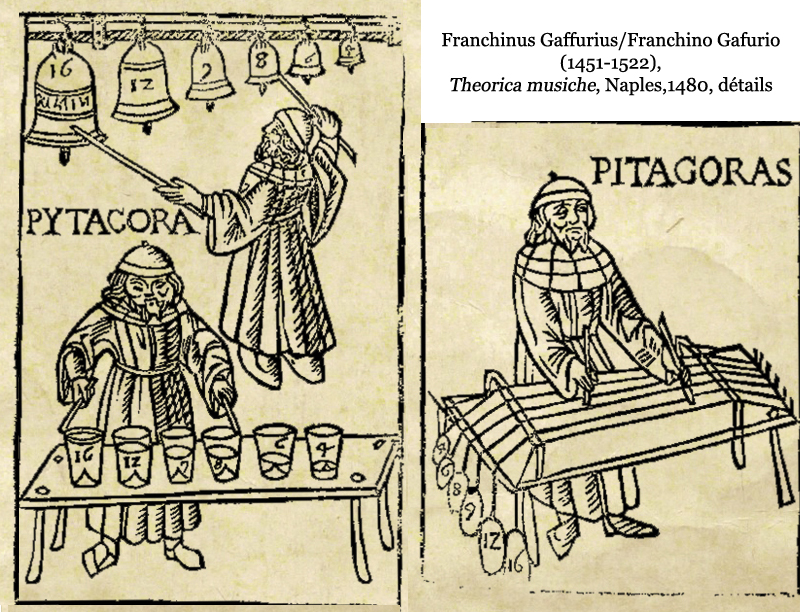
Later, the Pythagoreans transposed the same proportions to other objects, including volumes of water in glasses, the size of bells as well as bronze disks or the length of strings of musical instruments or flutes. For Pythagoras, this experience is fundamental because it corroborates the basic intuition of his philosophy: everything that exists is number, including phenomena as immaterial as musical intervals. In a famous passage of the Timaeus (35-36), Plato describes the fabrication of the proportions of the World Soul by the Demiurge. This passage is based on the numerical series 1, 2, 3, 4, 9, 8, 27, which corresponds to the fusion of the series of the first powers of 2 (2, 4, 8) and the series of the first powers of 3 (3, 9, 27). Now, from this series, we can derive the numerical relationships on which the musical intervals are based.
In his Metaphysics, Aristotle also notes :
« The Pythagoreans noticed that the whole of the modes of musical harmony and the relations which compose it are resolved in proportional numbers.«
With the French philosopher Pierre Magnard, we would rather say:
« If to know is to measure, music is the art of pursuing measurement beyond the threshold of incommensurability. When numerical, metric and weight standards are no longer capable of establishing proportions between natural realities, harmony comes to the rescue of its own scales – diatonic, chromatic, enharmonic – and of its intervals – fifth, fourth, third, octave – to make up for the lack of calculation.«
Finally, as the Roman musicologist Theon of Smyrna (70-135) stated:
« The Pythagoreans assert that music is a harmonic combination of opposites, a unification of multiples and an agreement of opposites.«
In addition, for the Pythagoreans, music also had an ethical and medical value:
« He started education with music, using certain melodies and rhythms, thanks to which he healed the character traits and passions of men, and brought harmony between the faculties of the soul.«
All this made Pythagoras the incarnation of a cosmic and universal harmony**. Moreover, he would have been the first to have used the word « cosmos » (perfection, order).
Pythagoras, praised by the first true astrophysicist Johannes Kepler (1571-1630), is said to have been the first to coin the concept of « the music of the spheres » or « the harmony of the spheres ».
For, as Sextus Empiricus (towards the end of the second century) states in his Pyrrhonian sketches, Pythagoras would have noted that the distances between the orbits of the Sun, the Moon and the fixed stars correspond to the proportions regulating the intervals of the octave, the fifth and the fourth. In the Republic, Plato states that astronomy and music are « sister sciences ».
Copernicus admits that the work of the Pythagoreans inspired his own research:
« Others think that the Earth moves. Thus, Philolaos the Pythagorean says that the Earth moves around the Fire in an oblique circle, as do the Sun and the Moon. Heraclitus of Pontus and Ecphantos the Pythagorean do not, it is true, give the Earth a translational motion [motion around the Sun, heliocentrism]… Starting from this, I too began to think of the mobility of the Earth. »
(Copernicus, letter to Pope Paul III, preface to De revolutionibus orbium caestium [On the Revolutions of the Celestial Orbs], 1543).
The name Pythagoras (etymologically, Pyth-agoras: « he who was announced by the Pythia », the goddess), derives from the announcement of his birth made by the oracle to his father during a trip to Delphi. However, legend has it that Pythagoras was the son of Apollo, the god of light, poetry and music.
According to the oldest pre-Socratic traditions, Apollo had conceived a plan to control the universe. This plan was revealed in « the music of the spheres » under the wise supervision of Apollo, the sun god and god of music; a Greek god who passed to the Romans without changing his name. Apollo is represented with a crown of laurels and a lyre, surrounded by the nine muses.
GUIDED TOUR
After reviewing the political situation of the time, the motivations of Pope Julius II and his advisors seeking to re-establish the authority of a « Triumphant Church, » the ultimate culmination for centuries to come of a culture that goes back to Apollo, Moses, Pythagoras, Plato, Cicero and their disciples, the viewer now has some solid « keys » (the « codes ») in hand that will allow him or her to « read » Raphael’s frescoes adorning the Stanza.
Without Raphael’s account of his work, this reading remains an obstacle course. For example, the identification of the figures remains uncertain, since, with a few rare exceptions, no tablet tells us this. The idea, in any case, is that the spectator, by analyzing the appearance and gestures of each one, discovers for himself who is represented.
As we said, when entering the room, the viewer is immediately asked to appreciate each fresco not in isolation, but as an expression of a coherent whole.
When entering the Stanza, as if inside a painted cube, one immediately realizes that one is facing a theatrical setting. For the great vaults that the spectator discovers are only painted images and do not respond to any structural reality of the building. Inghirami was a speaker, an actor and a director who knew who should appear where, with what attitude and dressed in what way. Thanks to this imagination, a room that was at first sight rectangular and boring, was transformed into a spherical cube because the corners of the room were « rounded » with stucco.
A. THE CEILING
From the thematic point of view, the visual path, as one might expect, begins on the ceiling and ends on the floor. In the center of the ceiling, a small circle with the coat of arms of Julius II. Around it, an octagon surrounded by four circles connected by four rectangles. Each of the four circles touches the top of one of the four vaults painted on the four walls and shows an allegorical figure and a text announcing the theme of the large frescoes below.
Each time, it is a question of emphasizing the harmony uniting all the opposing (circle, square) parts. While the real incompatibilities are left to the checkroom, the oppositions and the formal differences will even be strongly emphasized, but exclusively to show that one can accommodate them by submitting them to a higher design.
Thus two double themes (2 x 2) are articulated:
- Philosophy (the true accessible by reason), nicknamed The School of Athens, and Theology (the Truth accessible by divine revelation), nicknamed since the Council of Trent, the « Dispute of the Holy Sacrament »; a theme common to Aquinas and the neo-Platonists.
- Poetry and music (the Beautiful), and Justice (the Just), a theme of Ciceronian origin.
- Above the theme Philosophy, in one of the four circles, is represented by a woman wearing a dress with each of the four colors symbolizing the four elements evoked by a motif: blue illustrates the stars, red the tongues of fire, green the fish and golden brown the plants. Philosophy holds two books entitled « Morality » and « Nature », while two small genius (geniuses) carry tablets on which one can read « CAUSARUM » and « COGNITO », read together meaning « To know the causes ». Clearly, the aim of moral and natural philosophy is to know the causes, that is to say to go back to God.
- Above Theology, a woman dressed in red and green, colors of the theological virtues. In her left hand, she holds a book, her right hand points to the fresco below. Two geniuses carry tablets saying « DIVINAR.RER » and « NOTITIA », « The revelation of sacred things ».
- Above Poetry, the winged figure of the Poetry carrying lyre and crown of laurels. Two putti (cherubs) present us with tablets on which are inscribed the words of Virgil: « Inspired by the spirit » (NVMINE AFFLATVR). Since we are dealing with puttis and not geniuses, there is a clear reference to the Christian spirit that inspires the arts.
- Finally, above the last fresco, Justice, a woman holds the attributes of justice: the scales and the sword. Two putti carry tablets with the words of the Emperor Justinian: « IVS SVVM VNICUMQUE », that is, « to each his just punishment ».
Then, still on the ceiling, as we have indicated, there are four rectangular frescoes connecting the four circles whose theme we have just specified. Again, these are two pairs that complement each other.
A. A first rectangular fresco, linking Philosophy with Poetry, shows us a woman (wisdom, the first mover) here as the first cause and setting a celestial globe in motion and thus the universe in action. It may be the mythical Sibyl mentioned by Heraclitus, a superhuman incarnation of the prophetic voice. Philosophically, it is an allegory of the creation of the universe (or Astronomy). The constellation that appears on the globe has been identified. It corresponds to the sky map of the night of October 31, 1503, the date of the election of Julius II… which of course the date he became the “prime mover” of the universe.
B. The second rectangle, diametrically opposed to the first one and linking Justice to Theology, represents « Adam and Eve driven out of Paradise ». Considered as the beginning of theology, « The Fall of Man », will be repaired by the « redemption » that the Church and Pope Julius II will bring, embodied by the creative wisdom putting the universe back into motion.
C. The third rectangle, linking Philosophy and Justice, represents « The Judgment of Solomon, » a scene showing King Solomon’s wise judgment when two mothers claimed the same child.
D. And finally, the fourth, at the other end of the diagonal, connecting Poetry and Theology, represents, not « The Flogging of Marsyas » as has been claimed, but another rather rare scene, « The Triumph of Apollo over Marsyas » in the struggle for the lyre. The latter receives a crown of laurels. The two judgments are based on different bases for their mutual appreciation. While King Solomon, representing the Old Testament, judges on the basis of the divine law, Apollo, who represents antiquity here, prevails thanks to the rules of the pagan pantheon, his will power.
B. THEOLOGY
(THE DISPUTE OF THE HOLY SACRAMENT)
*In the upper (celestial) register :
A. God the Father, B. Jesus Christ, C. Mary, D. St. John the Baptist, E. Apostle Peter, F. Adam, G. St. John the Evangelist, H. King David, I. St. Lawrence, J. Judas Maccabaeus, K. St. Stephen, L. St. Stephen, M. Moses, N. James the Greater, O. Abraham, P. St. Paul, SE. Holy Spirit.
*In the lower (earthly) register:
1. Fra Angelico, 2. ?, 3. Donato Bramente, 4. ?, 5. ?, 6. Pico della Mirandola, 7. ?, 8. ?, 9. ?, 10. Saint Gregory, 11. Saint Jerome, 12. ?, 13. ?, 14. ?, 15. ?, 16. Saint Ambrose, 17. Saint Augustine, 18. Saint Thomas of Aquinas, 19. pope Innocent III, 20. Saint Bonaventure, 21. pope Sixtus IV, 22. Dante Alighieri, 23. ?, 24. ?; 25. a mason, 26. ?, 27. ?
Historians tell us that it was the first fresco to be made. The core subject here is the Trinity and « transubstantiation », a supernatural phenomenon signifying the conversion of one substance into another, in the case of Christians, the conversion of bread and wine into the body and blood of Christ in the Eucharist under the action of the Holy Spirit. This meant a « real presence » of God at mass and thus a major attraction to attract the faithful and a precondition to obtain « indulgences » from him. For some humanists, such as the Swiss Protestant Ulrich Zwingli (1484-1531), any doctrine of the real presence is idolatry because it would be tantamount to worshiping bread and wine as if it were God.
Erasmus, for whom the performance of rituals should never be a substitute for true faith, explains that when Christ said to his disciples, in offering them bread, « this is my body » and « this is my blood, » in offering them wine, he was in reality talking metaphorically, not of bread and wine, but of his disciples (his body) and his teaching (his blood).
The idea of the composition is to show the triumph of the unity of the Church in Christ in all its complexities and diversities. The scene takes place on two levels, one celestial and the other terrestrial, lining up, as in a theater, a vast variety of actors presenting themselves to the public.
Above, in the celestial register, the heart of the subject, « the Trinity » with God the Father (A) blessing enthroned above a Christ (C) surrounded by Mary (B) (the New Testament) on his right and St. John the Baptist (D) (the Old Testament) on his left, themselves appearing above a dove symbolizing the Holy Spirit (SE).
Around them, to match the architecture of the School of Athens opposite, sit peacefully on a semi-circular cloud bench, the remarkable figures of the Church Triumphant, accompanied by their traditional attributes and dressed in colorful garments specific to each.
At the ends of the semicircle, two apostles: the Apostle Peter (E), representing the Jews, and the Apostle Paul (P), representing the Gentiles, face each other, as if they were the outer guards of the triumphant Church, the custodians of both the key and the letter of it. The Old Testament is represented by Adam (F) facing Abraham (O), and Moses (M) facing King David (H) with his harp in hand. The New Testament is also represented by St. John (G) facing St. Matthew (N) (two authors of the Gospel), by St. Lawrence (I) and St. Stephen (L) (both martyred saints).
At the bottom, in the terrestrial register, there is an enormous altar (Y) on which is written (in the middle) « IV LI VS » (Julius). A golden monstrance (X) with a host in its center proclaims the presence of Christ in the mystery of transubstantiation. Next to it, the Doctors of the Church of the early days of Christianity: on the left (under the features of Julius II) St. Gregory (No. 10), the great reformer of the ritual and the chant of the Mass, next to St. Jerome (No. 11), the most profound scholar of Christianity), accompanied by his lion. On his right Saint Augustine (N° 17) and Saint Ambrose (N° 16). These four doctors are, unlike the other figures, seated, which already brings them closer to the figures in the heavens; we can also distinguish two later doctors who are St. Thomas Aquinas (No. 18), a Dominican; and St. Bonaventure (No. 20), a Franciscan.
The historian Konrad Oberhuber, adds that these last two,
embody two tendencies of the Church: one that sees its essence of Christianity in ritual and devout adoration (the dimension of feeling), the other that defends the importance of theology (the dimension of thought).
Then, Popes Innocent III (1160-1216) (N° 19), the most powerful pope of the Middle Ages who established the political independence of Rome) and Sixtus IV (1414-1471) (N° 21, Francesco della Rovere by name) rub shoulders with religious figures such as the Dominican Savonarola (instigator in 1494 in Florence of a political revolution (return to the Republic) and moral revolution (rechristianization) or, the painter Fra Angelico (N° 1), contemporary of Savonarola, admired for his frescoes and his sublime paintings, accompanied by Dante Alighieri (N° 20), whose Divine Comedy (with hell, purgatory and paradise) had an influence on theology in the Middle Ages, Donato Bramante (N° 3), the famous architect of St. Peter’s Basilica, not forgetting Pico della Mirandola (N° 6), (mistaken for Francesco Maria della Rovere) who, with his hair blowing in the wind, is pointing towards the Trinity in a light and graceful wiggle. On the right, masons (N° 22), who build churches, bend forward. If on the right, behind the figures, the white marble foundations (Z), allude to the new St. Peter’s Basilica whose reconstruction Julius II has just launched, on the left, a village church (Q) reminds us that Christianity must penetrate the daily life of the humble.
C. PHILOSOPHY
(“SCHOOL OF ATHENS”)
A. Apollo, B. Pallas Athena
Philosophy (« School of Athens »).
1. Porphyry, 2. Plotinus, 3. Alcibiades, 4. Crito, 5. Phaedo of Elis, 6. Socrates, 7. Isocrates, 8. Parmenides,
9. Plato, 10. Aristotle, 11. ?; 12. ?, 13. Apelles of Cos (Raphael), 14. Protogenes (Sodoma), 15. Strabo,
16. Ptolemy, 17. Hippocrates of Chios, 18. Diogenes of Sinope, 19. Heraclitus of Ephesus, 20. Anaximander of Milèt, 21. Pico della Mirandola, 22. Pythagoras, 23. Boethius, 24. Avicenna, 25. Epicurus, 26. Metrodorus.
A beautiful central view perspective shows a get together of 58 Greek and other thinkers in an ideal temple. No chiaroscuro effect disturbs the balance of the colors and the clarity of the composition.
The American thinker Lyndon LaRouche (1922-2019), during his visit to the Vatican, marveled at the graceful harmony that radiates from this work. It could not help but resonate with a concept LaRouche developed throughout his life: that of the « simultaneity of eternity »; the poetic idea that « immortal » ideas continue their dialogue in a place beyond material time and space.
According to historians, Raphael, faced with the Herculean task of creating this series of portraits, and lacking reliable visual data about the figures to be portrayed, sent one of his assistants to Greece to collect indications and provide him with documentation to meet the challenge.
Small detail: the event doesn’t take place in Athens or Greece, but in Rome. The architecture is clearly inspired by the church of Sant’Andrea of Mantua, renovated shortly before his death by Leon Battista Alberti (1404-1472) and by Bramante‘s plans for the reconstruction of St. Peter’s Basilica in Rome. It is Rome set to become the new Athens.
Although the steps can be found in the preparatory drawings, the large arches with their coffered vaults, typical of the dome of the Roman Pantheon, do not appear. Another probable source of inspiration is the arches, also with coffered vaults, the Basilica of Maxentius and Constantine, built in Rome at the beginning of the 4th century to reaffirm the power of the beauty of the Eternal City.
It is not excluded that Bramante himself, who had made a tromp-l’oeil using this type of pattern in the apse of the church of Santa Maria presso San Satiro in Milan, designed them in person. With three arches (tetrad) and seven rows of caissons, Pythagorean numerology is never far away.
Visually, the ensemble is divided in two. The audience is on the same level as the foreground, a paved parterre behind which a very wide staircase leads to a raised forecourt. For the viewer, a slightly cavalier perspective reinforces the monumental dimension of the figures on the upper level. This setting is inevitably reminiscent of a theater stage.
The actors, arriving from the old world, can enter the stage on one side, under the statue of the Greek god Apollo (A), god of light, and leave on the other, towards the new world, under the statue of Pallas Athena (B), which became Minerva in Roman times, protector of the Arts, to exchange ideas with each other, address the audience or climb the stairs and leave through the back.
In the center of the square and in the center of a perspective with a central point of view, Plato (N° 9) and Aristotle (N° 10) don’t confront each other but move forward, side by side, towards the viewers (and the Triumphant Church on the opposing wall).
The first one, with the Timaeus in his hand, points a finger towards the sky, meaning that beyond the visible, a higher principle exists. The second one extends his arm and his hand horizontally underlining that all truth comes to us from the testimony of the senses, while carrying the Ethics with the other arm.
Strangely, these are the only two books in the stanza whose names appear in Italian (Timeo, Etica) and not in Latin. As the art critic Eugenio Battisti (1924-1989) observed:
If we (…) examine the titles of the works respectively held by Plato and Aristotle, we see the philosopher of the Academy holding the Timaeus, that is to say the most Aristotelian and the most systematic of his works and the Stagirite, the Nicomachean Ethics, that is to say the most Platonic of his works.
The colors of the clothes of the two philosophers symbolize the four elements: Plato is dressed in red (fire) and purple (ether); Aristotle in blue (water) and yellow (earth).
If the whole fresco cuts the world in two between Platonists and Aristotelians, both walk together towards what is in front of them and behind the spectator who looks: towards the fresco of Theology with the Trinity in the center without forgetting the monstrance and the imposing altar on which is marked « JV-LI-VS PON TI CUS ». How generous of the Church to welcome so many pagans into its midst!
Raphael however communicates a great sense of movement. In the same way that the Dutch painter Rembrandt, in his 17th century masterpiece The Company of Captain Frans Banning Cocq, known as The Night Watch, broke with the formal representations of the dignitaries of the city guilds, Raphael here drew a line under the frozen and static representations of the series of « great men » often decorating the palaces and libraries of the great princes and lords in the style of his master Perugino.
His fresco, like Leonardo’s Last Supper in Milan, is organized as a sequence of small groups of three or four people conversing with a great thinker or each other, never out of sync with what is happening around them. In this sense, Raphael translated into images, and thus made accessible to the eyes of the spectators, that harmonic unity transcending the multiple so sought after by the commissioners.
Raphael and Inghirami did not hesitate to use portraits of people living in their time to represent historical figures. In addition to themselves, there are their patrons, colleagues and other personalities whom they hoped to please or charm.
In the foreground, four groups are shown.

On the left, Epicurus (N° 25), here with the features of Inghirami writing the setting of the play. Born in Samos like Pythagoras, he wears here, not a crown of laurels, reward given to great orators, but a crown of oak leaves, symbols that we find in the coat of arms of pope Julius II.
Some historians believe that Inghirami was a Dionysian follower of Orphism, another pre-Socratic current. Dionysus is indeed the brother of Apollo and according to some, their teachings are one and the same.
As mentioned above, shortly after Raphael’s death (1520), Cardinal Jacopo Sadoleto published a treatise in which Inghirami defends rhetoric and denies any value of philosophy, his main argument being that everything written is already in the mystical and mythological texts of Orpheus and his followers.
In Rome, the scholars of the time knew Epicurus mainly through their readings of Cicero for whom Epicurus was not a debauchee but someone who sought the noblest pleasure. Cicero had a friendship with an Epicurean philosopher, a certain Phaedrus, as it happens the nickname of Inghirami…
Finally, on the extreme left, there is an old bearded man, the Greek thinker Metrodorus (N° 26), disciple of Anaxagoras and for whom it is « the acting spirit » that organized the World. In front of him, a newborn baby. Together they could symbolize the birth of truth (the child) and wisdom (the old man) and experience.
Next to him, a little more in the center, the imposing figure of Pythagoras (N° 22) (whom the Italian historian Georgio Vasari mistook for the evangelist Saint Matthew), seated with a book, an inkwell and a pencil, writing surrounded by visibly intrigued people. Behind him, seated on the left, an old man, representing Boethius (N° 23), Roman author, in the sixth century, of a treatise on music, the first part of which evokes « the harmony of the spheres », tries to look at what he is writing in his book. Without capturing a moment of potential transformation, as Leonardo knew how to do, the scene is obviously inspired by his unfinished painting, the Adoration of the Magi.
At his feet, a black slate with the famous Tetraktys and a diagram of musical intervals (see our section in this article on Pythagoras).
Since it is totally unthinkable that it is Averroes (banned from the Church, as said, by Aquinas), the turbaned man who seems to admire him could be Avicenna (Ibn Sina) (N° 24). This Persian physician, influenced by the thought of both Hippocrates and Galen, in his Qanûn (of Medecine), operates a vast medico-philosophical synthesis of Aristotle‘s logic (which he corrects) and neo-Platonism, compatible with monotheism.
It could also be Al Fârâbi (872-950), another Arab scientist and musician who sought to reconcile faith, reason and science with the philosophy of Plato and Aristotle, whose translations from Greek into Arabic he had made. Avicenna admired him and the title of one of Al Fârâbî’s works leaves no ambiguity: The Harmony of the Opinions of the Two Sages: Plato the Divine and Aristotle.
Moreover, given his position on the side of the Platonists, although he wears a white turban, it is totally excluded that he is Averroes (Ibn Rushd), an author struck down by Aquinas (see the paintings showing The Triumph of Saint Thomas) and then by the Neoplatonists of Florence for having denied the immortality of the individual soul.
More in the center of the fresco, two isolated figures immersed in their thoughts. The first, on the left, appears to have been added later by Raphael and is not in his drawing. The man is dozing on a cube, a Pythagorean volume par excellence. It is thought to be Heraclitus of Ephesus (No. 19) (an Ionian pre-Socratic for whom « there is nothing permanent but change ») with the features of Michelangelo. This sculptor fascinated Raphael, not only for his gifts in drawing, anatomy and architecture, but also for his spirit of independence from a pope he considered tyrannical.
It should be noted that the Moses that Michelangelo sculpted for the tomb of Julius II is said to be looking at him with anger because the artist captured the moment when Moses, coming down from Mount Sinai with the Tables of the Law, noticed that the Hebrew people had returned to worshiping idols, such as « the Golden Calf ». Irritated by this return to idolatry, Moses broke the Tables of the Law.
One detail raises questions: Anaximander of Miletus places his right foot on a cubic block of marble whose volume seems to be eight times smaller than the one on which Heraclitus of Ephesus rests. However, to solve the problem of Delos (the duplication of the volume of the cube) it is necessary to wait for the Pythagorean and friend of Plato, Archytas of Taranto.
Anaximander of Miletus (N° 20) (and not Parmenides), also a representative of the Ionian school, stands behind Heraclitus and seems to contest the demonstration of Pythagoras (representative of the so-called « Italian » school). Behind him, a young man with long hair, looks at the spectator. Dressed in a white toga, an attribute of the Pythagoreans, he is once again Pico della Mirandola (N° 21), triumphant and surrounded by Pythagoras and two of his disciples. Legend has it that Raphael portrayed Hypatia of Alexandria (c. 370-415), a mathematician who headed the Neoplatonist school in Alexandria. When one of the cardinals examined the painting and knew that the woman depicted was Hypatia, he is said to have ordered that she be removed from it. Raphael is said to have obeyed, but replaced her with the effeminate figure of a nephew of Pope Julius II, Francesco Maria Della Rovere, future Duke of Urbino…
If this is really Pico della Mirandola, it would be a superb piece of praise, for appearing in both Philosophy and Theology, the two images of Pico, reminiscent of the kneeling angel looking at the viewer while pointing at St. John the Baptist in Leonardo’s Madonna of the Rocks, can contemplate each other!
The second isolated figure, nonchalantly spread out on the stairs, is the cynical and hedonistic philosopher Diogenes of Sinope (N° 18), here presented as an ascetic, but in the Aristotelian tradition.
Then, in the center right, an inspiring group of young people, amazed by their discoveries and exchanging their complicit glances with their comrades, around a surveyor who is examining or drawing with a compass parallel lines inside a hexagonal star on a slate laid on the ground.
This is an illustration of a theorem that neither Euclid (an Aristotelian) nor Archimedes mentioned, although the identity of one or the other is attributed to this figure in the guise of the architect Donato Bramante.
It could be, it is my conviction, the geometer Hippocrates of Chios (N° 17) of which Aristotle speaks in great good. He wrote the first mathematics textbook, entitled The Elements of Geometry. This work precedes Euclid’s Elements by a century. Unless we are talking about the architect Leon Battista Alberti, whose church in Mantua may have inspired Bramante and after all, author, in 1435, of De Pictura, a treatise (of Aristotelian spirit) on perspective.
However, in 1485, in his treatise on architecture De re Aedificatoria, Alberti, in a passage (IX, 5) that may have been of interest to the author of the fresco, stressed that:
“Beauty consists in a harmony and in an agreement of the parts with the whole, in accordance with determinations of number, proportionality and order such as the harmony requires it, that is to say the absolute and sovereign law of the nature.”
Finally, to add to the mystery, on the collar of the tunic of this figure can be read: « R.V.S.M. » (Raphael Vrbinas Sua Manu), meaning « By the Hand of Raphael of Urbino »).
For what the surveyor is addressing on the slate is the role played by the diagonals of the hexagon. The answer is provided by the geometrical composition, in the form of a hexagon, which underlies the entire construction of the perspective of the fresco.
The diagonals show a beautiful complementarity between the arithmetic mean and the harmonic mean (see authors diagram below).
It is a masterly demonstration in the field of the visible, of the concept structuring the whole theme of the work: complementarity, the foundation of universal harmony.
Credit: Karel Vereycken
On the right, the geographers Ptolemy (No. 16) and Strabo (No. 15) (in the guise of Baldassare Castiglione, the head of the Pope’s army and a friend of Raphael’s?), who is identified without real evidence with Zoroaster but to whom Pico della Mirandola indeed refers, stand face to face. The first shows the Earth as a sphere, the second a globe of the Heavens.
Finally, on the far right of the first register, with the features of Raphael, the legendary painter of the court of Alexander the Great, Apelles of Cos (N° 13). It should be remembered that, during his lifetime, Raphael was nicknamed « the Apelles of his time ». Next to him, his rival, the Greek painter Protogenes (N° 14) in the guise of Raphael’s colleague, the sulfurous but virtuoso fresco artist Sodoma. Coming from the world of the craftsmen, it is a question here of marking the entry of two painters-decorators into « the court of the big guys » and making their first steps in the world of philosophy.
On the steps, the central subject, as we have said, Plato and Aristotle. Plato‘s features in the fresco have nothing to do with any supposed portrait by Leonardo da Vinci. Leonardo was born in 1452 and was only 56 years old when the fresco was painted. Raphael is said to have used the image of a bust of Plato discovered in Athens in the ruins of the ancient academy. In reality, the famous drawing of an old man (Turin), supposed to be a self-portrait of Leonardo and resembling the image of Plato in the School of Athens, has been proven to date from the 19th Century.
In the crowd to the left of Plato is Socrates (no. 6), his teacher, whose face was known to everyone from Roman statues. The identification of the other figures remains largely hypothetical. One thinks of the speakers of Plato‘s dialogues. Close to Socrates, his old friend Crito (N° 4). Behind Socrates, the Athenian intellectual Isocrates (N° 7) who had withdrawn from political life and although close to Socrates, set himself up as Plato‘s rival. Close to the latter, the five interlocutors of Plato‘s dialogue, Parmenides. Among them, Parmenides (N° 8), considered at the origin of the concept of the One and the multiple, and the pre-Socratic thinker Zeno of Elaea, known for his philosophical paradoxes.
The Athenian general (here dressed as a Roman soldier) Alcibiades (N° 3) and the young man in blue could be Phaedo of Elis (N° 5) or Xenophon, both listening to Socrates counting on his fingers, a gesture suggesting his famous dialectic.
All around the Greek thinkers, other figures are stirring. Behind general Alcibiades, a figure (perhaps a librarian) holds back another running figure, begging him not to disturb the ongoing exchanges between philosophers and scientists.
At the far left, a man with a hat enters the stage. It could be Plotinus (N° 2), a founding figure of Neoplatonism admired by cardinal Bessarion, accompanied by Porphyry (N° 1), another Neoplatonist who brought his biography of Pythagoras as a messenger from the ancient world.
Here the giornata of the School of Athens.
D. JUSTICE
A. Fortitude, B. Prudence and C. Temperance.
1. Justinian, 2. Tribonian, 3. pope Paul III, 4. Antonio Del Monte,
5. pope Leo X, 6. pope Gregory IX (Julius II), 7. pope Clement VII.
On top, in the lunette (half moon), the three virtues represented would be Fortitude (A), Prudence (B) and Temperance (C). Together with Justice, they constitute the four cardinal (profane) virtues. The central female figure, holding a mirror, refers to Prudence. On the left, Fortitude holds an oak branch, an allusion to the della Rovere family from which Julius II, the pope who commissioned the frescoes, descended.
Below, once again, complementarity is at work. On the left, painted by Lorenzo Lotto, the Roman emperor Justinian I (N° 1) receives the Pandects (the civil law) from the Byzantine jurist Tribonian (N° 2).
On the right, in the guise of Julius II, Pope Gregory IX (N° 6) promulgates the Decretals; a masterly sum of canon law which he had ordered to be compiled and published in 1234.
On his right (thus on the left of the spectator), one sees a cardinal, in purple dress, having the features of the cardinal Jean de Médicis, future pope Leo X (N° 5). The two other cardinals behind him would be Alessandro Farnese, the future pope Paul III (N° 3), and Antonio Del Monte (N° 4). And to his left (right for the viewer) a cardinal representing Cardinal Julius de Medici, the future Pope Clement VII (N° 7). With your image immortalized on a fresco in the right place, your career to become pope would seem to be better engaged!
The fact that Julius II is represented wearing a beard allows to date the fresco beyond June 1511. Indeed, the pontiff, who left Rome beardless to wage war, then let his beard grow and vowed not to shave it off until he had liberated Italy. He returned to Rome in June. Historians point out that the prominence of the pope’s portrait indicates how the theme of the decoration of the Chambers was transformed, around 1511, into that of the glorification of the papacy. Hence, in this way “Justice” becomes the right of Julius II to impose « his » justice.
E. POETRY
(« PARNASSUS”)
The poets:
1. Alcaeus of Mytilene, 2. Corinna, 3. Petrarch, 4. Anacreon, 5. Sappho, 6. Ennius, 7. Dante, 8. Homer, 9. Virgil, 10. Statius (Poliziano), 11. Apollo, 12. Tebaldeo, 13. Boccaccio, 14. Tibullus, 15. Ariosto,
16. Propertius, 17. Ovid, 18. Sannazaro, 19. Pindar.
The nine muses:
A. Thalia, B. Clio, C. Euterpe, D. Calliope, E. Polyhymnia, F. Melpomene, G. Terpsichore, H. Urania. I. Erato.
A window reduces the space available for the fresco to a large lunette where the characters are divided into small groups on a semi-circular line.
The underlying idea here, taken from St. Thomas, is that truth is made accessible to man, either by Revelation (Theology) or by Reason (Philosophy). For the Neoplatonic school, this truth manifests itself to our senses through Beauty (poetry and music).
The scene painted here takes place near Delphi, at the top of Parnassus, the sacred mountain of Apollo and home of the Muses of Greek mythology.
The large window around which the fresco is organized offers a view, beyond the cortile (small circular temple) of Bramante, on the hill of Belvedere (Mons Vaticanus), where shows were given and where, in ancient times, Apollo was honored, which earned him the name of Apolinis.
Apollo is the patron of musicians: « It is through the Muses and the archer Apollo that there are singers and citharists », says Hesiod. He even inspires nature: when he passes by, « the nightingales, swallows and cicadas sing ». His music soothes the wild animals and moves the stones. For the Greeks, music and dance are not only entertainments: they allow to heal men by tuning the discords that eat away at their souls and thus to bear the misery of their condition.
At the top of the hill, seven laurels. Near the Castalia spring, Apollo (N° 11), crowned with laurel leaves and in the center of the composition, is tuning around him the nine muses (A to I) playing on his lyre.
On the left side Calliope (D), the one « who has a beautiful voice » and represents the epic poetry, and on the right, Erato (I), « the lovable one » who represents the lyric and erotic poetry as well as the nuptial song. Each presides over the tuning of the other’s chorus: on the left, behind Calliope, Thalia (A) (« the flourishing, the abundant »), Clio (B) (« who is famous » and represents history) and Euterpe (C) (« the joyful » who represents music). Finally, just behind Erato, Polyhymnia (E) (« the one who says many hymns » and represents rhetoric, eloquence and pantomime), Melpomene (F) (« the singer » who represents tragedy and song); Terpsichore (G) (« the charming dancer ») and Urania (H) (« the celestial one » who represents astronomy).
And you don’t have to be Pythagoras to count 7 laurels on the mountain and remember that nine muses plus Apollo make… ten.
As one of the square frescoes on the ceiling reminds us, Apollo had triumphed over Marsyas in a fight to seize the lyre, considered as the divine instrument capable of leading souls to heaven, better than the flute which only excites the lower passions. By detaching the man from his immediate material concerns, the victorious lyre allowed to arouse the divine love in men. In addition, the Romans knew of a seven-stringed lyre, a Pythagorean legacy, the number seven referring to the seven heavenly bodies orbiting the central fire.
However, strangely enough, Apollo is not holding a traditional four-stringed lyre, but a lira da braccio. If Apollo plays here the lyre with arms, the muses Calliope, Erato and the sibyl Sappho hold lyres identical to those of the sarcophagus known as « of the Muses » of the Museo delle Terme in Rome.
In many representations of the 16th century, the lyre is played by a group of angels or mythological characters, such as Orpheus and Apollo, but also King David, Homer or the Muses. Among its interpreters, we can count Leonardo da Vinci. The instrument is essentially designed like a violin, but with a wider fingerboard and a flat bridge that allows for chordal playing. The lyre generally has seven strings: four like a violin, augmented by an additional low string (making five), and two strings beyond the fingerboard, which are not played but serve as a drone and resonate in the octave. Now, Raphael, in order to create a perfect harmony with the number of muses around Apollo, will increase the number of strings from seven to nine, that is to say seven adjustable plus two drones. This detail concerning the lyre seems to have been modified in time. Indeed, an engraved reproduction, from 1517, probably from drawings prior to the fresco, or from its preliminary project, by Marcantonio Raimondi, reveals a state quite different from what we see today.

The composition is less dense and highlights, like the School of Athens, several groups of three figures each. What is striking at first is that the ancient lyre played by Apollo with his fingers rests on his thigh, while in the present version, Apollo vibrates the strings of his lira da braccio with a bow, while looking up to the sky, in accordance with the fresco on the ceiling where are inscribed the words of Virgil: « Inspired by the spirit » (NVMINE AFFLATVR).
All around, eighteen poets are divided into several groups. The identification of some is unequivocal, that of others more doubtful. They are all chained to each other by gestures and looks, forming a kind of continuous crescent.
At the top left, the father of Latin poetry Ennius (N° 6), seated, listens raptly to the song of Homer (N° 8), while Dante (N° 7), further back, looks at Virgil (N° 9) who turns towards him, the Roman poet Statius (N° 10), in the guise of Poliziano, at his side. The latter was a disciple of the florentine Neoplatonist Marsilio Ficino. To represent the historical figures, Raphael drew inspiration from Roman statuary. For the face of Homer, for example, he adopted the dramatic expression of the Laocoon, which he had found in Rome in 1506.
At the bottom left are the Greek poet Alcaeus of Mytilene (N°1), the Greek poetess Corinna (N° 2), Petrarch (N° 3) as well as the Greek poet Anacréon (N° 4). In the final version, two characters who leave the frame came to enrich the composition. On the left, the sibyl Sappho (N° 5) as indicated by a tablet. Considered the first poetess of ancient Greece, she lived in the seventh and sixth centuries BC. According to the Homeric Hymns, it is her who would have built the first lyre to accompany the poetic recitation. The only woman in entire fresco is painted with a monumentality that is reminiscent of Michelangelo in the Sistine Chapel.
Sappho is the counterpart of Pindar (N° 19), and not Horace as is claimed, considered one of the greatest lyric poets of Greece and for whom Apollo was the symbol of civilization. Pindar is here in conversation with the Italian poet Jacopo Sannazaro (N° 18), dressed in blue and standing, and above them Ovid (N° 17).
On the right, on the side of the mount, besides Pindar, Sannazaro and Ovid, five other poets and orators : Antonio Tebaldeo (N° 12), with his back turned towards Apollo and under the features of Baldassare Castiglione ? ), Boccaccio (N° 13), behind, Tibullus (N° 14), Ariosto (N° 15), Propertius (N° 16), under the features of the cardinal poet very « Petrarquist » Pietro Bembo, a friend of Inghirami and enemy of Erasmus, and at his sides two unknown poets said « poets of the future judging the past ».
The identification of these characters remains largely hypothetical and controversial. To arrive at satisfactory results, it would be necessary according to the historian Albert Chastel, to find precise correspondences between the nine muses, nine classic poets and nine modern, in addition to the grouping by poetic genre.
After the death of Julius II, Pope Leo X made the Stanza della signatura his music room, replacing the books of his predecessor (which were moved to the large library on the lower floor) with intarsiae. Leo X will also have the pavement completed.
F. THE MOSAIC ON THE FLOOR
A. Coat of arms of the pope, B. Spiral arm, C. Star of David, reference to the Jewish heritage.
The mosaic decorating the floor is said to be « cosmatesque », after the name of Cosmati, an old family of craftsmen and specialized in mosaics with four colors. Some materials come from Roman ruins, the green marble of the Peloponnese in Greece, the porphyry of Aswan in Egypt, and the yellow marble of North Africa. The white marble comes from the famous marble quarries of Carrara where Michelangelo chose his materials.
As on the ceiling, in the center of the room the coat of arms of the pope (A), this time inside a square (his earthly reign) inscribed in a circle (his theological mission). This first circle is surrounded by four spiral arms, each of which creates a new circular motif (B). This pattern is believed to be of Jewish origin. The Star of David (C) appears several times in this creation vortex. The doctrine of the four worlds, described in cabalistic cosmology, underlines their dynamic unity.
After all, for Giles de Viterbe, the recent discovery of Jewish mystical writings was of the same importance as the discovery of America by Christopher Columbus. Let us recall that for Julius II, like Plato and Pythagoras, Moses, whom Michelangelo sculpted for his tomb, already announced the later triumph of the Church of Rome which would, under his direction, synthesize them.
Conclusion
Thus, the whole theme of the « Chamber of the Signature » finds its full coherence with the idea of harmony and concordance. But when we look more closely, we see that it is only a question of « complementarity » at the level of forms and in the service of a temporal power disguised as a divine mission. Raphael, a talented painter, submitted to this by providing the product for which he was paid. He would end up painting things increasingly decadent by submitting to the pagan whims of the papal banker Agostino Chigi for the decoration of his villa, the Farnesina.
With the « Chamber of the Signature », we are far from the famous « coincidence of opposites » dear to Pythagoras, Plato, Nicholas of Cues and today Schiller Institute’s President Helga Zepp-LaRouche, which allows, in an uncompromising search for truth and for the love of humanity, to overcome paradoxes and solve a great number of problems from a higher point of view.
By piling up allegories and symbols, if it impresses, this masterly work ends up suffocating us. By the rules of its composition, it can only sink into the theatrical and the didactic. In a universe purged of the slightest irony or surprise, no real metaphor will be able to awaken us. And although Raphael tried to bring some life into it, the spectator is fatally left with a vast sediment of fossilized ideas, as dead as the most glorious ruins of the Roman Empire.
Brief bibliography:
- Julius II, Ivan Cloulas, Fayard, Paris 1990;
- Léon X et son siècle, Gonzague Truc, Grasset, Paris, 1941;
- Une histoire des empires maritimes, Cyrille P. Coutensais, CNRS, 2013;
- L’Humanisme, l’Europe de la Renaissance, André Chastel and Robert Klein, Editions Skira, Geneva, 1995;
- L’Arétin ou l’insolence du plaisir, Bertrand Levergeois, Fayard, Paris, 1999;
- Giorgio Vasari, l’homme des Médicis, Grasset, Paris, 1995;
- Marsile Ficin et l’Art, André Chastel, Droz, Geneva, 1996 ;
- Raphael and the Pope’s librarian, Nathaniel Silver, Ingrid Rowland, Paul Holberton Publishing, 2019;
- Raphael’s Stanza della Signatura, Meaning and Invention, Christiane L. Joost-Gaugier, Cambridge University Press, 2002;
- Pythagoras and Renaissance Europe, Finding Heaven, Christiane L. Joost-Gaugier, Cambridge University Press, 2009;
- Raphael, Stephanie Buck and Peter Hohenstatt, Könemann, 1998;
- The Intellectual Background of the School of Athens: Tracking Divine Wisdom in the Rome of Julius II, Ingrid D. Rowland, 1996;
- Pagans in the Church: The School of Athens in Religious Contex, Timothy Verdon, 1996;
- Raphael’s School of Athens, Marcia Hall, Cambridge University Press, 1997;
- Raphael, Konrad Oberhuber, Editions du Regard, Paris, 1999;
- L’énigme de la Segnatura, Raphael and Sodoma, André-Charles Coppier, Paris, 1928;
- Raphael, John Pope-Hennessy, Harper & Row, London, 1970;
- Who was Raphael, Nello Ponente, Editions Skira, Geneva, 1967:
- Lives and doctrines of the illustrious philosophers, Diogenes Laërtius, La pochothèque, Paris, 1999;
- Erasmus and Italy, Augustin Renaudet, Editions Droz, Paris, 2000 ;
- Erasmus among us, Léon Halkin, Fayard, 1987 ;
- Comment la folie d’Erasme sauva notre civilisation, Karel Vereycken, 2005 ;
- The egg without shadow of Piero della Francesca, Karel Vereycken, 2007;
- Albrecht Dürer against neo-platonic melancholy, Karel Vereycken, 2007.
NOTES:
* For an in-depth treatment of the subject, see Karel Vereycken, Albrecht Dürer against Neo-Platonic Melancholy, 2007.
**We can see here where certain sects, notably Rudolf Steiner’s Anthroposophists, draw their inspiration. Some still insist on demonstrating that Pythagoras, who believed in the transmigration of souls and therefore their possible reincarnation in animals or plants, was a vegetarian. Diogenes Laertius tells us that one day, « passing by someone who was mistreating his dog, it is said that he [Pythagoras, in a joking tone] was moved by compassion and addressed the individual with these words: ‘Stop and do not strike again, for it is the soul of a man who was my friend, and I recognized him by hearing the sound of his voice’ « . A whole series of authors ended up falling into numerology and irrational esoteric mumbo-jubo, in particular Francesco Zorzi, Agrippa of Nettesheim and Paracelsus.
Omar Merzoug: Avicenne ou l’islam des lumières

En avril 2022, Karel Vereycken s’est entretenu avec Omar Merzoug, docteur en philosophie et spécialiste de la pensée au Moyen Âge. Il a publié en 2018 Existe-t-il une philosophie islamique ? (Cahiers de l’Islam). Pendant sept ans, il a enseigné la philosophie et la civilisation islamique à l’Institut Al-Ghazâli de la Grande Mosquée de Paris.
This interview in EN (pdf)
Karel Vereycken : Monsieur Merzoug, bonjour. Après sept ans de recherches, d’études et de vérification de documents historiques, vous venez de publier en 2021, chez Flammarion, une biographie enthousiaste et fouillée d’Avicenne (980-1037). Qui était ce personnage et pourquoi avoir publié ce livre maintenant ?

Omar Merzoug : Il s’agit de l’illustre Ali Ibn Sînâ (que l’Occident nomme Avicenne), savant, médecin, philosophe et homme d’Etat, qui a eu une vie passionnante et fort mouvementée, et dont l’influence sur les penseurs chrétiens du Moyen Âge, de l’avis même des spécialistes les plus autorisés, fut considérable. Ce ne fut pas, comme on a tendance à le croire, un commentateur, mais c’était un penseur qui a créé tout un système s’inspirant d’Aristote, mais qui l’enrichit, le contredit.
Un penseur indépendant, par conséquent. Il fut lu comme philosophe jusqu’au XVIIe siècle et l’on retrouve dans les écrits des philosophes des Temps modernes, Malebranche, Leibniz et Spinoza, des échos de son œuvre. Comme médecin, ses travaux furent longtemps au programme des universités européennes. C’est donc une figure fort intéressante en tant que savant, mais aussi en tant qu’homme.
Publier ce livre maintenant, c’est d’abord saluer cette figure éminente du monde musulman à l’heure où, il faut bien le dire, l’islam n’a pas bonne presse. Le rationalisme d’Avicenne, sa curiosité intellectuelle, sa capacité à assimiler toutes sortes de savoir, son esprit encyclopédique et son inventivité philosophique sont autant de traits qui pourraient contribuer à une renaissance de la véritable culture philosophique dans le monde musulman, culture philosophique qui est bien malmenée aujourd’hui.
De père afghan, né en Ouzbékistan et d’éducation perse, de nombreux pays (qui n’existaient pas à son époque dans leurs frontières actuelles) se réclament les héritiers de sa gloire. Qui a raison ?
On ne prête qu’aux riches. Plus sérieusement, Avicenne est un persan d’Ouzbékistan. Tout l’indique, mais cela ne saurait empêcher Turcs, Arabes et Européens de se réclamer de lui, de le lire et même de le critiquer, et c’est d’ailleurs ce qui s’est produit.
La deuxième partie du titre de votre livre, L’islam des lumières, sous-entend qu’il y aurait plusieurs islams…
Il n’y a certes pas plusieurs islams, mais il y a des lectures et des approches différentes, et même contradictoires, de l’islam. Et cela ne date pas d’aujourd’hui. Il y a, pour résumer, une lecture littérale des textes fondamentaux de l’islam et il y a des lectures plus subtiles, plus soucieuses de faire prévaloir l’esprit sur la lettre. Au reste, le Coran lui-même autorise cette disparité des lectures (Sourate III, verset 7).
Comment Avicenne a-t-il concilié théologie et philosophie ?
Comme tous les grands penseurs du Moyen Âge et même des Temps modernes, Avicenne s’est attaqué à ce problème essentiel et inévitable du rapport entre la théologie et la philosophie. Il ne s’est pas tant agi de concilier la raison avec la foi, mais plutôt la Loi religieuse et la raison. Sur ce point, Avicenne présente notamment sa théorie de l’émanation comme la seule interprétation véritable de la création. Partant du principe qu’il ne faut pas prendre à la lettre les récits, les allégories, les métaphores et toute la symbolique du Coran, il conclut qu’il faut l’interpréter à l’aune des principes de la raison. C’est en définitive la raison qui garde la primauté en matière d’interprétation des textes religieux.
A son époque, Avicenne était-il apprécié pour son travail en médecine ou pour ses idées philosophiques ?
Sur ce point, les spécialistes d’Avicenne ne sont pas tous d’accord. En Orient on l’estime beaucoup plus comme médecin que comme philosophe. En Occident, on a plutôt tendance à le considérer comme philosophe, d’autant que sa médecine n’a plus, compte tenu des progrès de la science, qu’un intérêt historique.
Néo-platoniciens, aristotéliciens et thomistes se prétendent souvent disciples d’Avicenne, mais en le lisant, on constate que ce dernier n’entre dans aucune case. Quelle qualité faut-il donc avoir pour pouvoir se dire disciple d’Avicenne ?
Être disciple d’Avicenne aujourd’hui voudrait signifier être rationaliste, pas au sens d’une sorte d’agnosticisme ou d’athéisme, mais au sens où la raison a qualité pour examiner toutes choses, que peu de domaines sont soustraits à son empire. Bien entendu, dans sa mystique qui est intellectualiste, Avicenne ménage une transition vers un au-delà de la raison, qui ne peut être atteint que par une sorte d’illumination. C’est bien la raison pour laquelle certains penseurs chrétiens du Moyen Âge ont pu établir un lien entre saint Augustin et Avicenne.
Sans avoir vécu à Bagdad et né après la grande période des Abbassides, sous Al-Mamoun et ses Maisons de la sagesse réunissant penseurs arabes, juifs et chrétiens nestoriens pour traduire l’héritage grec et syriaque, voyez-vous en Avicenne un héritier de la démarche mutazilite qui fit la grandeur de Bagdad ?
Avicenne est certainement plus proche des Mu’tazila que des partisans de l’approche littéraliste et anthropomorphiste. Les Mu’tazila combattaient pour la liberté de l’esprit et c’est, à peu de chose près, le combat d’Avicenne, convaincu que tout outrage à ce principe serait catastrophique. S’il n’y a pas de débat, de controverse, de libre dialogue et de recherche indépendante, il ne saurait y avoir au bout du compte qu’un recul de la pensée. La grandeur de la civilisation de Bagdad a été précisément, sous Al-Ma’mûn et ses successeurs immédiats, de permettre, par une politique délibérée et réfléchie, ce bouillonnement culturel, cette effervescence intellectuelle extraordinaire qu’on n’a pas revue depuis dans le monde musulman.
En lisant votre biographie d’Avicenne, qui nous introduit à lui en partant de sa vie quotidienne, on découvre qu’il n’avait rien d’un intellectuel de salon. Activement engagé pour le bien commun et la santé de tous, sa vie est loin d’être une sinécure et on le voit souvent contraint de s’exiler. Pourquoi ?
Se situant dans la tradition platonicienne qui voulait que les philosophes gouvernent les Etats parce qu’ils sont les plus savants, Avicenne a directement exercé les responsabilités du pouvoir. A deux reprises, il a géré un Etat et cela a failli lui coûter la vie. Introduisant les réformes indispensables et luttant contre les privilèges qu’il estimait indus de l’armée, il a déclenché une mutinerie des prétoriens. Oui, s’engager dans la cité pour des causes méritoires, c’est être d’une certaine manière avicennien. Comme Platon, il a échoué dans son entreprise, mais elle méritait d’être tentée, comme elle le mérite toujours.
Pourquoi le Canon de la médecine d’Avicenne a-t-il permis tant de progrès en médecine ?
C’est un livre fort intéressant sous plusieurs angles. C’est une somme du savoir médical, qui a d’ailleurs, en tant que telle, une postérité exceptionnelle. Dans cet ouvrage, il y a plusieurs avancées intéressantes. C’est un livre fort bien composé et qui est fondé de part en part sur les règles et les principes de la logique. Il a été de surcroît conçu dans une perspective pédagogique. Des fragments entiers du Canon sont rédigés sous forme d’abrégés pour permettre une assimilation plus rapide du savoir médical.
Avicenne estime qu’on ne saurait comprendre la maladie et donc lui trouver un remède que si on établit des liens de causalité. Reprenant la théorie des quatre causes d’Aristote, il les adapte à sa recherche médicale et juge qu’on n’atteint la pleine connaissance d’une maladie que si on en recherche les causes, écartant ainsi une approche strictement empirique.
A ses yeux, il y a une unité entre les organes et les fonctions du corps, de la même manière qu’il établit un rapport entre l’organisme et le monde extérieur. C’est d’ailleurs pour cela qu’il accordait, en tant que médecin, une importance essentielle aux mesures prophylactiques et à l’environnement.
Autre chose à signaler, Avicenne fut certainement le premier à proposer une approche de l’anatomie de l’œil, à émettre le diagnostic de la pleurésie et de la pneumonie, à distinguer la méningite infectieuse des autres infections aiguës.
D’autre part, il accordait une importance primordiale aux exercices physiques. C’est sans doute le premier, dix siècles avant Freud, à avoir insisté sur l’importance de la sexualité et de son rôle dans l’équilibre psychologique de la personne. Enfin, il fut sans doute l’un des pionniers de la médecine psychosomatique. En témoigne le cas de l’amoureux transi que je rapporte dans ma biographie.
Estimant sa personnalité hors du commun capable d’inspirer le meilleur de la civilisation islamique, Mme Helga Zepp-LaRouche, la fondatrice de l’Institut Schiller, a lancé une grande « initiative Ibn Sînâ » pour reconstruire l’Afghanistan et de son système de santé. Comment voyez-vous cette démarche ?
C’est sans doute une initiative extrêmement louable qui réintègre Avicenne dans son milieu (son père était afghan) et qui, sous deux perspectives, la santé et la grandeur de sa gloire, lui rend hommage.
Les raisons du succès de votre livre ?
C’est toujours délicat pour un auteur de dire quelles sont les raisons qui expliquent le succès, relatif dans mon cas, d’un livre. Je l’attribue d’abord au genre biographique qui s’apparente un peu au roman – au reste, la vie d’Avicenne est très romanesque. Ensuite, à l’effort pédagogique qui rend accessible la présentation de cette éminente figure du savoir, et peut-être aussi, à un style littéraire agréable et délié.
On connaît bien, d’Avicenne, ses travaux en médecine et maintenant, grâce à votre biographie, sa vie. A quand un nouveau livre dédié plus spécifiquement à ses idées philosophiques ?
Il n’existe pas sur le marché d’exposé systématique de la pensée d’Avicenne. Ce qui existe, fruit du travail de certains universitaires travaillant dans le champ avicennien, ce sont des monographies sur des thèmes ou des concepts avicenniens.
C’est de toute façon un travail d’une tout autre nature que la biographie et pour un tout autre public, plus restreint. Je me laisserai peut-être tenté par un tel projet, qui sait ?
Avicenna and Ghiberti’s role in the invention of perspective during the Renaissance

By Karel Vereycken, Paris, France.
Same article in FR, même article en FR.
No visitor to Florence can miss the gilded bronze reliefs decorating the Porta del Paradiso (Gates of Paradise), the main gate of the Baptistery of Florence right in front of the Cathedral of Santa Maria del Fiore surmounted by Filippo Brunelleschi’s splendid cupola.

In this article, Karel Vereycken sheds new light on the contribution of Arab science and Ghiberti’s crucial role in giving birth to the Renaissance.
Historical context
The Baptistery, erected on what most Florentines thought to be the site of a Roman temple dedicated to the Roman God of Mars, is one of the oldest buildings in the city, constructed between 1059 and 1128 in the Florentine Romanesque style. The Italian poet Dante Alighieri and many other notable Renaissance figures, including members of the Medici family, were baptized in this baptistery.
During the Renaissance, in Florence, corporations and guilds competed for the leading role in design and construction of great projects with illustrious artistic creations.
While the Arte dei Lana (corporation of wool producers) financed the Works (Opera) of the Duomo and the construction of its cupola, the Arte dei Mercantoni di Calimala (the guild of merchants dealing in buying foreign cloth for finishing and export), took care of the Baptistery and financed the embellishment of its doors.
The Gates of Paradise
The Baptistry, an octagonal building, has four entrances (East, West, North and South) of which only three (South, North and East) have sets of artistically important bronze doors with relief sculptures. Three dates are key : 1329, 1401 and 1424.
- In 1329, the Calimala Guild, on Giotto‘s recommendation, ordered Andrea Pisano (1290-1348) to decorate a first set of doors (initialy installed as the East doors, i.e. seen when one leaves the Cathedral, but today South). These consist of 28 quatrefoil (clover-shaped) panels, with the 20 top panels depicting scenes from the life of St. John the Baptist (the patron of the edifice). The 8 lower panels depict the eight virtues of hope, faith, charity, humility, fortitude, temperance, justice, and prudence, praised by Plato in his Republic and represented during the XVIth century by the Flemish humanist painter and reader of Petrarch, Peter Brueghel the Elder. Construction took 8 years, from 1330 till 1338.
- In 1401, after having narrowly won the competition with Brunelleschi, the 23 year old and inexperienced young goldsmith Lorenzo Ghiberti (1378-1455), is commissioned by the Calima Guild to decorate the doors which are today the North Gate. Ghiberti cast the bronze high reliefs using a method known as lost-wax casting, a technique that he had to reinvent entirely since it was lost since the fall of the Roman Empire. One of the reasons Ghiberti won the contest, was that his technique was so advanced that it required 20 % less (7 kg per panel) bronze than that of his competitors, bronze being a dense material far more costly than marble. His technique, applied to the entire decoration of the North Gate, as compared to his competitors, would save some estimated 100 kg of bronze. And since in 1401, with the plague regularly hitting Florence, economic conditions were poor, even the wealthy Calimala took into account the total costs of the program.
The bronze doors are comprised of 28 panels, with 20 panels depicting the life of Christ from the New Testament. The 8 lower panels show the four Evangelists and the Church Fathers Saint Ambrose, Saint Jerome, Saint Gregory, and Saint Augustine. The construction took 24 years.
- In 1424, Ghiberti, at age 46, was given—unusually, with no competition—the task of also creating the East Gate. Only in 1452 did Ghiberti, then seventy-four years old, install the last bronze panels, since construction lasted this time 27 years! According to Giorgio Vasari (1511-1574), Michelangelo Buonarroti (1475-1564) later judged them « so beautiful they would grace the entrance to Paradise ».
Over two generations, a bevy of well paid assistants and pupils were trained by Ghiberti, including exceptional artists, such as Luca della Robbia, Donatello, Michelozzo, Benozzo Gozzoli, Bernardo Cennini, Paolo Uccello, Andrea del Verrocchio and Ghiberti’s sons, Vittore and Tommaso. And over time, the seventeen-foot-tall, three-ton bronze doors became an icon of the Renaissance, one of the most famous works of art in the world.
In 1880, the French sculptor Auguste Rodin was inspired by it for his own Gates of Hell on which he worked for 38 year
Revolution
Of utmost interest for our discussion here is the dramatic shift in conception and design of the bronze relief sculptures that occurred between the North and the East Gates, because it reflects how bot the artist as well as his patrons used the occasion to share with the broader public their newest ideas, inventions and exciting discoveries.
The themes of the North Gate of 1401 were inspired by scenes from the New Testament, except for the panel made by Ghiberti, « The Sacrifice of Isaac », which had won him the selection competition the same year. To complete the ensemble, it was therefore only logical that the East Gate of 1424 would take up the themes of the Old Testament.
Originally, it was the scholar and former chancellor of Florence Leonardo Bruni (1369-1444) who planned an iconography quite similar to the two previous doors. But, after heated discussions, his proposal was rejected for something radically new. Instead of realizing 28 panels, it was decided, for aesthetic reasons, to reduce the number of panels to only 10 much larger square reliefs, between borders containing statuettes in niches and medallions with busts.
Hence, since each of the 10 chapters of the Old Testament contains several events, the total number of scenes illustrated, within the 10 panels has risen to 37 and all appear in perspective :
- Adam and Eve (The Creation of Man)
- Cain and Abel (Jalousie is the origin of Sin)
- Noah (God’s punishment)
- Abraham and Isaac (God is just)
- Jacob and Esau
- Joseph
- Moses
- Joshua
- David (Good commandor)
- Solomon and the Queen of Sheba
The general theme is that of salvation based on Latin and Greek patristic tradition. Very shocking for the time, Ghiberti places in the center of the first panel the creation of Eve, that of Adam appearing at the bottom left.
After the first three panels, focusing on the theme of sin, Ghiberti began to highlight more clearly the role of God the Savior and the foreshadowing of Christ’s coming. Subsequent panels are easier to understand. One example is the panel with Isaac, Jacob and Esau where the figures are merged with the surrounding landscape so that the eye is led toward the main scene represented in the top right.
Many of the sources for these scenes were written in ancient Greek, and since knowledge of Greek at that time was not so common, it appears that Ghiberti’s “theological advisor” was Ambrogio Traversari (1386-1439), with whom he had many exchanges.
Traversari was a close friend of Nicolas of Cusa (1401-1464), a protector of Piero della Francesca (1412-1492) and a key organizer of the Ecumenical Council of Florence of 1438-1439, which attempted to put an end to the schism separating the Church of the East from that of the West.
Perspective
The bronze reliefs, known for their vivid illusion of deep space in relief, are one of the revolutionary events that epitomize the Renaissance. In the foreground are figures in high relief, which gradually become less protruding thereby exploiting the full illusionistic potential of the stiacciato technique later brought to its high point by Donatello. Using this form of “inbetweenness”, they integrate in one single image, what appears both as a painting, a low relief as well as a high relief. Or maybe one has to look at it another way: these are flat images traveling gradually from a surface into the full three dimensions of life, just as Ghiberti, in one of the first self-portraits of art history, reaches his head out of a bronze medal to look down on the viewers. The artist desired much more than perspective, he wanted breathing space!
This new approach will influence Leonardo Da Vinci (1452-1517). As art historian Daniel Arasse points out :
(…) It was in connection with the practice of Florentine bas-relief, that of Ghiberti at the Gate of Paradise (…) that Leonardo invented his way of painting. As Manuscript G (folio 23b) would much later state, ‘the field on which an object is painted is a capital thing in painting. (…) The painter’s aim is to make his figures appear to stand out from the field’ – and not, one might add, to base his art on the alleged transparency of that same field. It is by the science of shadow and light that the painter can obtain an effect of emergence from the field, an effect of relief, and not by that of the linear perspective.
Donatello
At the beginning of the 15th century, several theoretical approaches existed and eventuall contradicted each other. Around 1423-1427, the talentful sculptor Donatello, a young collaborator of Ghiberti, created his Herod’s Banquet, a bas-relief in the stiacciato technique for the baptismal font of the Siena Baptistery.
In this work, the sculptor deploys a harmonious perspective with a single central vanishing point. Around the same time, in Florence, the painter Massacchio (1401-1428) used a similar construction in his fresco The Trinity.
As we will see, Ghiberti, starting from the anatomy of the eye, opposed such an abstract approach in his works as well as in his writings and explored, as early as 1401, other geometrical models, called « binocular ». (see below).
Christ among the Doctors, Ghiberti, before 1424.
Christ among the Doctors, Ghiberti, before 1424.
Then, as far as our knowledge reaches, in 1407, Brunelleschi had conducted several experiments on this question, most likely based on the ideas presented by another friend of Cusa, the Italian astronomer Paolo dal Pozzo Toscanelli (1397-1482), in the latter’s now lost treaty Della Prospettiva. What we do know is that Brunelleschi sought above all to demonstrate that all perspective is an optical illusion.
Finally, it was in 1435, that the humanist architect Leon Baptista Alberti (1406-1472), in his treatise Della Pictura, attempted, on the basis of Donatello’s approach, to theorize single vanishing point perspective as a representation of a harmonious and unified three-dimensional space on a flat surface. Noteworthy but frustrating for us today is the fact that Alberti’s treatise doesn’t contain any illustrations.
However, Leonardo, who read and studied Ghiberti’s writings on, would use the latter’s arguments to indicate the limits and even demonstrate the dysfunctionality of Alberti’s “perfect” perspective construction especially when one goes beyond a 30 degres angle.
In the Codex Madrid, II, 15 v. da Vinci realizes that « as such, the perspective offered by a rectilinear wall is false unless it is corrected (…) ».
Perspectiva artificialis versus perspectiva naturalis
Alberti’s “perspectiva artificialis” is nothing but an abstraction, necessary and useful to represent a rational organization of space. Without this abstraction, it is fairly impossible to define with mathematical precision the relationships between the appearance of objects and the receding of their various proportions on a flat screen: width, height and depth.
From the moment that a given image on a flat screen was thought about as the intersection of a plane cutting a cone or pyramid, a method emerged for what was mistakenly considered as an “objective” representation of “real” three dimensional space, though it is nothing but an “anamorphosis”, i.e. a tromp-l’oeil or visual illusion.
What has to be underscored, is that this construction does away with the physical reality of human existence since it is based on an abstract construct pretending:
- that man is a single eyed cyclops;
- that vision emanates from one single point, the apex of the visual pyramid;
- that the eye is immobile;
- that the image is projected on a flat screen rather than on a curved retina.
Slanders and gossip
The crucial role of Ghiberti, an artist which “Ghiberti expert” Richard Krautheimer mistakenly presents as a follower of Alberti’s perspectiva artificialis, has been either ignored or downplayed.
Ghiberti’s unique manuscript, the three volumes of the Commentarii, which include his autobiography and which established him as the first modern historian of the fine arts, is not even fully translated into English or French and was only published in Italian in 1998.
Today, because of his attention to minute detail and figures « sculpted » with wavy and elegant lines, as well as the variety of plants and animals depicted, Ghiberti is generally presented as “Gothic-minded”, and therefore “not really” a Renaissance artist!
Giorgio Vasari, often acting as the paid PR man of the Medici clan, slanders Ghiberti by saying he wrote « a work in the vernacular in which he treated many different topics but arranged them in such a fashion that little can be gained from reading it. »
Admittedly, tension among humanists, was not uncommon. Self-educated craftsmen, such as Ghiberti and Brunelleschi on the one side, and heirs of wealthy wool merchants, such as Niccoli on the other side, came from entirely different worlds. For example, according to a story told by Guarino Veronese in 1413, Niccoli greeted Filippo Brunelleschi haughtily: « O philosopher without books, » to which Filippo replied with his legendary irony: « O books without philosopher ».
For sure, the Commentarii, are not written according to the rhetorical rules of those days. Written at the end of Ghiberti’s life, they may have simply been dictated to a poorly trained clerk who made dozens of spelling errors.
The humanists
The Commentarii does reveal a highly educated author and a thinker having profound knowledge of many classical Greek and Arab thinkers. Ghiberti was not just some brilliant handcraft artisan but a typical “Renaissance man”.
In dialogue with Bruni, Traversari and the “manuscript hunter” Niccolo Niccoli, Ghiberti, who couldn’t read Greek but definitely knew Latin, was clearly familiar with the rediscovery of Greek and Arab science, a task undertaken by Boccaccio’s and Salutati’s “San Spirito Circle” whose guests (including Bruni, Traversari, Cusa, Niccoli, Cosimo di Medici, etc.) later would convene every week at the Santa Maria degli Angeli convent. Ghiberti exchanges moreover with Giovanni Aurispa, a collaborator of Traversari who brought back from Byzantium, years before Bessarion, the whole of Plato’s works to the West.
Amy R. Bloch, in her well researched study Lorenzo Ghiberti’s Gates of Paradise, Humanism, History, and Artistic Philosophy in the Italian Renaissance (2016), writes that « Traverari and Niccoli can be tied directly to the origins of the project for the Gates and were clearly interested in sculptural commissions being planned for the Baptistery. On June 21, 1424, after the Calima requested from Bruni his program for the doors, Traversari wrote to Niccoli acknowledging, in only general terms, Niccoli’s ideas for the stories to be included and mentioning, without evident disapproval, that the guild had instead turned to Bruni for advice. »
Palla Strozzi
Ghiberti’s patron, sometimes advisor, and close associate was Palla Strozzi (1372-1462), who, besides being the the richest man in Florence with a gross taxable assets of 162,925 florins in 1427, including 54 farms, 30 houses, a banking firm with a capital of 45,000 florins, and communal bonds, was also a politician, a writer, a philosopher and a philologist whose library contained close to 370 volumes in 1462.
Just as Traversari and Bruni, Strozzi learned Latin and studied Greek under the direction of the Byzantine scholar Manuel Chrysoloras, invited to Florence by Salutati.
Ghiberti’s close relationship with Strozzi, writes Bloch, « gave him access to his manuscripts and, as importantly, to Strozzi’s knowledge of them. »
But there was more. « The relationship between Ghiberti and Palla Strozzi was so close that, when Palla went to Venice in 1424 as one of two Florentine ambassadors charged with negociating an alliance with the Venetians, Ghiberti accompanied him in his retinue. »
Strozzi was known as a real humanist, always looking to preserve peace while strongly opposing oligarchical rule, both in Florence as in Venice.
In fact it was Palla Strozzi, not Cosimo de’ Medici, who first set in motion plans for the first public library in Florence, and he intended for the sacristy of Santa Trinita to serve as its entryway. While Palla’s library was never realized due to the dramatic political conflict knows as the Albizzi Coup that led to his exile in 1434, Cosimo who got a free hand to rule over Florence, would make the library project his own.
A bold statement
Ghiberti begins the Commentarii with a bold and daring statement for a Christian man in a Christian world, about how the art of antiquity came to be lost:
The Christian faith was victorious in the time of Emperor Constantine and Pope Sylvester. Idolatry was persecuted to such an extent that all the statues and pictures of such nobility, antiquity an perfection were destroyed and broken in to pieces. And with the statues and pictures, the theoretical writings, the commentaries, the drawing and the rules for teaching such eminent and noble arts were destroyed.
Ghiberti understood the importance of multidisciplinarity for artists. According to him, “sculpture and painting are sciences of several disciplines nourished by different teachings”.
In book I of his Commentarii, Ghiberti gives a list of the 10 liberal arts that the sculptor and the painter should master : philosophy, history, grammar, arithmic, astronomy, geometry, perspective, theory of drawing, anatomy and medecine and underlines that the necessity for an artist to assist at anatomical dissections.
As Amy Bloch underscores, while working on the Gates, in the intense process of visualizing the stories of God’s formation of the world and its living inhabitants, Ghiberti’s engagement « stimulated in him an interest in exploring all types of creativity — not only that of God, but also that of nature and of humans — and led him to present in the opening panel of the Gates of Paradise (The creation of Adam and Eve) a grand vision of the emergence of divine, natural, and artistic creation. »
The inclusion of details evoking God’s craftmanship, says Bloch, « recalls similes that liken God, as the maker of the world, to an architect, or, in his role as creator of Adam, to a sculptor or painter. Teh comparison, which ultimately derives from the architect-demiurge who creates the world in Plato’s Timaeus, appears commonly in medieval Jewish and Christian exegesis. »
Philo of Alexandria wrote that man was modeled « as by a potter » and Ambrose metaphorically called God a « craftsman (artifex) and a painter (pictor) ». Consequently, if man is « the image of God » as says Augustine and the model of the « homo faber – man producer of things », then, according to Salutati, « human affairs have a similarity to divine ones ».
The power of vision and the composition of the Eye
Concerning vision, Ghiberti writes:
I, O most excellent reader, did not have to obey to money, but gave myself to the study of art, which since my childhood I have always pursued with great zeal and devotion. In order to master the basic principles I have sought to investigate the way nature functions in art; and in order that I might be able to approach her, how images come to the eye, how the power of vision functions, how visual [images] come, and in what way the theory of sculpture and painting should be established.
Now, any serious scholar, having worked through Leonardo’s Notebooks, who then reads Ghiberti’s I Commentarii, immediately realizes that most of Da Vinci’s writings were basically comments and contributions about things said or answers to issues raised by Ghiberti, especially respecting the nature of light and optics in general. Leonardo’s creative mindset was a direct outgrowth of Ghiberti’s challenging world outlook.
In Commentario 3, 6, which deals with optics, vision and perspective, Ghiberti, opposing those for whom vision can only be explained by a purely mathematical abstraction, writes that “In order that no doubt remains in the things that follow, it is necessary to consider the composition of the eye, because without this one cannot know anything about the way of seeing.” He then says, that those who write about perspective don’t take into account “the eye’s composition”, under the pretext that many authors would disagree.
Ghiberti regrets that despite the fact that many “natural philosophers” such as Thales, Democritus, Anaxagoras and Xenophanes have examined the subject along with others devoted to human health such as “Hippocrates, Galen and Avicenna”, there is still so much confusion.
Indeed, he says, “speaking about this matter is obscure and not understood, if one does not have recourse to the laws of nature, because more fully and more copiously they demonstrate this matter.”
Avicenna, Alhazen and Constantine
Therefore, says Ghiberti:
it is necessary to affirm some things that are not included in the perspective model, because it is very difficult to ascertain these things but I will try to clarify them. In order not to deal superficially with the principles that underlie all of this, I will deal with the composition of the eye according to the writings of three authors, Avicenna (Ibn Sina), in his books, Alhazen (Ibn al Haytham) in his first volume on perspective (Optics), and Constantine (the Latin name of the Arab scholar and physician Qusta ibn Luqa) in his ‘First book on the Eye’; for these authors suffice and deal with much certainty in these subjects that are of interest to us.
This is quite a statement! Here we have “the” leading, founding figure of the Italian and European Renaissance with its great contribution of perspective, saying that to get any idea about how vision functions, one has to study three Arab scientists: Ibn Sina, Ibn al Haytham and Qusta ibn Luqa ! Cultural Eurocentrism might be one reason why Ghiberti’s writings were kept in the dark.
Ibn al-Haytham (Alhazen) made important contributions to opthalmology and improved upon earlier conceptions of the processes involved in vision and visual perception in his Treatise on Optics (1021), which is known in Europe as the Opticae Thesaurus. Following his work on the camera oscura (darkroom) he was also the first to imagine that the retina (a curved surface), and not the pupil (a point) could be involved in the process of image formation.
Avicenna, in the Canon of Medicine (ca. 1025), describes sight and uses the word retina (from the Latin word rete meaning network) to designate the organ of vision.
Later, in his Colliget (medical encyclopedia), Ibn Rushd (Averroes, 1126-1198) was the first to attribute to the retina the properties of a photoreceptor.
Avicenna’s writings on anatomy and medical science were translated and circulating in Europe since the XIIIth century, Alhazen’s treatise on optics, which Ghiberti quotes extensively, had just been translated into Italian under the title De li Aspecti.
It is now recognized that Andrea del Verrocchio, whose best known pupil was Leonardo da Vinci (1452-1517) was himself one of Ghiberti’s pupils. Unlike Ghiberti, who mastered Latin, neither Verrocchio nor Leonardo mastered a foreign language.
What is known is that while studying Ghiberti’s Commentarii, Leonardo had access in Italian to a series of original quotations from the Roman architect Vitruvius and from Arab scientists such as Avicenna, Alhazen, Averroes and from those European scientists who studied Arab optics, notably the Oxford Fransciscans Roger Bacon (1214-1294), John Pecham (1230-1292) and the Polish monk working in Padua, Erazmus Ciolek Witelo (1230-1275), known by his Latin name Vitellion.
As stressed by Professor Dominque Raynaud, Vitellion introduces the principle of binocular vision for geometric considerations.
He gives a figure where we see the two eyes (a, b) receiving the images of points located at equal distance from the hd axis.
He explains that the images received by the eyes are different, since, taken from the same side, the angle grf (in red) is larger than the angle gtf (in blue). It is necessary that these two images are united at a certain point in one image (Diagram).
Where does this junction occur? Witelo says: « The two forms, which penetrate in two homologous points of the surface of the two eyes, arrive at the same point of the concavity of the common nerve, and are superimposed in this point to become one ».
The fusion of the images is thus a product of the internal mental and nervous activity.
The great astronomer Johannes Kepler (1571-1630) will use Alhazen’s and Witelo’s discoveries to develop his own contribution to optics and perspective. “Although up to now the [visual] image has been [understood as] a construct of reason,” Kepler observes in the fifth chapter of his Ad Vitellionem Paralipomena (1604), “henceforth the representations of objects should be considered as paintings that are actually projected on paper or some other screen.” Kepler was the first to observe that our retina captures an image in an inverted form before our brain turns it right side up.
Out of this Ghiberti, Uccello and also the Flemish painter Jan Van Eyck, in contact with the Italians, will construct as an alternative to one cyclopic single eye perspective revolutionary forms of “binocular” perspective while Leonardo and Louis XI’ court painter Jean Fouquet will attempt to develop curvilinear and spherical space representations.
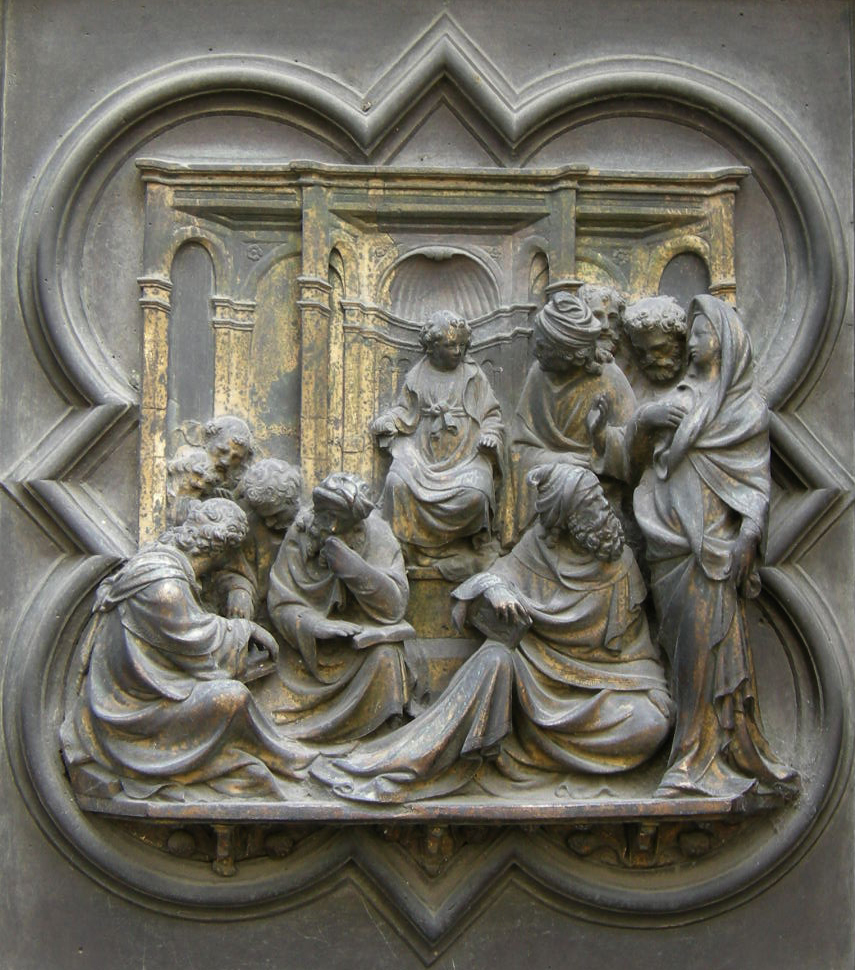

In China, eventually influenced by Arab optical science breakthrough’s, forms of non-linear perspective, that integrate the mobility of the eye, will also make their appearance during the Song Dynasty.
Light
Ghiberti will add another dimension to perspective: light. One major contribution of Alhazen was his affirmation, in his Book of Optics, that opaque objects struck with light become luminous bodies themselves and can radiate secondary light, a theory that Leonardo will exploit in his paintings, including in his portraits.
Already Ghiberti, in the way he treats the subject of Isaac, Jacob and Esau (Figure), gives us an astonishing demonstration of how one can exploit that physical principle theorized by Alhazen. The light reflected by the bronze panel, will strongly differ according to the angle of incidence of the arriving rays of light. Arriving either from the left of from the right side, in both cases, the Ghiberti’s bronze relief has been modeled in such a way that it magnificently strengthens the overall depth effect !
While the experts, especially the neo-Kantians such as Erwin Panofsky or Hans Belting, say that these artists were “primitives” because applying the “wrong” perspective model, they can’t grasp the fact that they were in reality exploring a far “higher domain” than the mere pure mathematical abstraction promoted by the Newton-Galileo cult that became the modern priesthood ruling over “science”.
Much more about all of this can and should be said. Today, the best way to pay off the European debt to “Arab” scientific contributions, is to reward not just the Arab world but all future generations with a better future by opening to them the “Gates of Paradise”.
See all of Ghiberti’s works at the WEB GALLERY OF ART
Short Biography
- Arasse, Daniel, Léonard de Vinci, Hazan, 2011;
- Avery, Charles, La sculpture florentine de la Renaissance, Livre de poche, 1996, Paris;
- Belting, Hans, Florence & Baghdad, Renaissance art and Arab science, Harvard University Press, 2011;
- Bloch, Amy R., Lorenzo Ghiberti’s Gates of Paradise; Humanism, History and Artistic Philosophy in the Italian Renaissance, Cambridge University Press, 2016, New York;
- Borso, Franco et Stefano, Uccello, Hazan, Paris, 2004 ;
- Butterfield, Andrew, Verrocchio, Sculptor and painter of Renaissance Florence, National Gallery, Princeton University Press, 2020 ;
- Butterfield, Andrew, Art and Innovation in Ghiberti’s Gates of Paradise, High Museum of Art, Yale University Press, 2007;
- Kepler, Johannes, Paralipomènes à Vitellion, 1604, Vrin, 1980, Paris;
- Krautheimer, Richard and Trude, Lorenzo Ghiberti, Princeton University Press, New Jersey, 1990;
- Martens, Maximiliaan, La révolution optique de Jan van Eyck, dans Van Eyck, Une révolution optique, Hannibal – MSK Gent, 2020.
- Pope-Hennessy, John, Donatello, Abbeville Press, 1993 ;
- Radke, Gary M., Lorenzo Ghiberti: Master Collaborator; The Gates of Paradise, Lorenzo Ghiberti’s Renaissance Masterpiece, High Museum of Atlanta and Yale University Press, 2007;
- Rashed, Roshi, Geometric Optics, in History of Arab Sciences, edited by Roshdi Rashed, Vol. 2, Mathematics and physics, Seuil, Paris, 1997.
- Raynaud, Dominique, L’hypothèse d’Oxford, essai sur les origines de la perspective, PUF, 1998, Paris.
- Raynaud, Dominique, Ibn al-Haytham on binocular vision: a precursor of physiological optics, Arabic Sciences and Philosophy, Cambridge University Press (CUP), 2003, 13, pp. 79-99.
- Raynaud, Dominique, Perspective curviligne et vision binoculaire. Sciences et techniques en perspective, Université de Nantes, Equipe de recherche: Sciences, Techniques, et Sociétés, 1998, 2 (1), pp.3-23.;
- Vereycken, Karel, interview with People’s Daily: Leonardo Da Vinci’s « Mona Lisa » resonates with time and space with traditional Chinese painting, 2019.
- Vereycken, Karel, Uccello, Donatello, Verrocchio and the art of military command, 2022.
- Vereycken, Karel, The Invention of Perspective, Fidelio, 1998.
- Vereycken, Karel, Van Eyck, un peintre flamand dans l’optique arabe, 1998.
- Vereycken, Karel, Mutazilism and Arab astronomy, two bright stars in our firmament, 2021.
- Walker, Paul Robert, The Feud That Sparked the Renaissance, How Brunelleschi and Ghiberti changed the World, HarperCollins, 2002.
La paix de Westphalie, une réorganisation financière mondiale

par Karel Vereycken, Paris, France.
En 1648, après cinq ans de négociations, conduites notamment par le diplomate français Abel Servien sur les instructions du Cardinal Mazarin, était signée la « Paix de Westphalie » mettant fin à la guerre de Trente Ans. Bien avant la charte de l’ONU, 1648 fera de la souveraineté nationale, du respect mutuel et du principe de non-ingérence les fondements du droit international. La République des Pays-Bas et la Confédération helvétique sont reconnues et de nombreux traités bilatéraux de paix mettent fin aux conflits.
Mais ce n’est pas tout. Un lecteur attentif de ces traités de paix découvre que l’engagement de chacune des parties, qui consiste à prendre en considération « l’avantage d’autrui » autant, sinon plus, que le sien, se traduit par des actes concrets jetant les bases d’un nouvel ordre financier et économique international.
L’article 1 énonce le principe philosophique fondamental sur lequel repose la paix :
Qu’il y ait une paix chrétienne et universelle, et une amitié perpétuelle, vraie et sincère, entre [liste des parties renonçant au combat] ; et que cette paix et cette amitié soient observées et promues avec une telle sincérité et un tel zèle, que chaque partie s’efforce de procurer le bénéfice, l’honneur et l’avantage d’autrui ; et qu’ainsi, de tous côtés, ils puissent voir cette paix et cette amitié dans l’Empire romain, et le Royaume de France prospérer, en entretenant un bon et fidèle voisinage.
L’article 2 décrit ensuite le type de « réinitialisation » dont nous avons si urgemment besoin aujourd’hui :
Il y aura d’un côté et de l’autre un oubli, une amnistie ou un pardon perpétuel de tout ce qui a été commis depuis le début de ces troubles, en quelque lieu ou de quelque manière que les hostilités aient été pratiquées, de telle sorte qu’aucun acteur, sous quelque prétexte que ce soit, ne puisse pratiquer aucun acte d’hostilité, entretenir aucune inimitié ou causer aucun trouble ; (…) tout ce qui s’est passé d’un côté et de l’autre, aussi bien avant que pendant la guerre, en paroles, écrits et actions outrageantes, en violences, hostilités, dommages et dépenses, sans aucun respect pour les personnes ou les choses, sera entièrement aboli de telle sorte que tout ce qui pourrait être exigé ou prétendu par l’un et l’autre à ce sujet sera enseveli dans un oubli éternel.
Pendant des décennies, la plupart des belligérants de la guerre de Trente Ans se sont mutuellement infligés des dommages inouïs, essentiellement pour pouvoir rembourser leurs dettes avec le butin de leurs pillages et de leurs conquêtes, afin de satisfaire une minuscule oligarchie financière qui prêtait aussi généreusement aux uns qu’aux autres. C’est cet asservissement par la dette que le traité propose d’« ensevelir dans un oubli éternel ».
Ainsi, avant même de régler les disputes et les revendications territoriales, le traité s’attelle à créer les conditions mettant fin à la ruine financière dans laquelle tous se trouvaient plongés.
Les dettes, intérêts, obligations, rentes et créances financières impayables, insoutenables et illégitimes, explicitement identifiés comme alimentant une dynamique de guerre perpétuelle, sont examinés, triés et réorganisés, le plus souvent par l’annulation des dettes (articles 13 et 35, 37, 38 et 39), par des moratoires ou un rééchelonnement selon des échéanciers précis (article 69).
L’article 40 conclut que ces annulations s’appliqueront « à la réserve toutefois des sommes de deniers, qui durant la guerre ont été fournies de bon cœur et à bonne intention pour d’autres, afin de détourner les plus grands périls et dommages dont ils étoient menacez. » (Impliquant que ces dettes devront être honorées.)
Enfin, regardant vers l’avenir et pour faire en sorte que « le commerce refleurisse », le traité abolit de nombreux péages et octrois « inusités » et « privés », obstacles aux échanges des biens physiques et des savoirs-faire et donc du développement mutuel. (Art. 69).
Dans le texte :
- Art. 13 : « Le Seigneur Électeur de Bavière renoncera entièrement pour lui, ses héritiers et successeurs à la dette de treize millions, et à toute prétention sur la haute Autriche, et incontinent après la publication de la paix donnera à sa Majesté Impériale les actes obtenus sur cela pour être cassez et annullez. »
- Art. 35 : « La pension annuelle que le bas Marquisat avoit accoutumé de payer au haut Marquisat, soit en vertu du présent Traité entièrement supprimée, abolie et annullée, sans que doresnavant on puisse prétendre ou exiger pour ce sujet aucune chose, ni pour le passé, ni pour l’avenir. »
- Art. 37 : « Que les contracts, échanges, transactions, obligations, et promesses illicitement extorquez par force ou par menaces des États ou des sujets, (…) comme aussi les actions rachetées et cédées soient abolies et annullées ; en sorte qu’il ne sera permis à personne d’intenter aucun procès ou actions pour ce sujet. »
- Art. 38 : « Que si les débiteurs ont extorqué des créanciers par force ou par crainte les actes de leurs obligations, tous ces actes seront restituez, les actions sur ce demeurant en leur entier. »
- Art. 39 : « Que si l’une ou l’autre des parties qui sont en guerre, ont extorqué par violence, en haine des créanciers, des dettes causées pour achat, pour vente, pour revenus annuels, ou pour quelqu’autre cause que ce soit, il ne sera décerné aucune exécution contre les débiteurs qui allégueront, et s’offriront de prouver qu’on leur aura véritablement fait violence, et qu’ils ont payé réellement et de fait, si non après que ces exceptions auront été décidées en pleine connoissance de cause. Que le procès qui sera sur ce commencé, sera fini dans l’espace de deux ans à compter dez la publication de la paix, faute de quoi il sera imposé perpétuel silence aux débiteurs contumax. »
- Art. 40 : « Mais les procès qui ont été jusques-ici intentés contre eux de cette sorte ; ensemble les transactions, et les promesses faites pour la restitution future des créanciers, seront abolies et annullez ; à la réserve toutefois des sommes de deniers, qui durant la guerre ont été fournies de bon cœur et à bonne intention pour d’autres, afin de détourner les plus grands périls et dommages dont ils étoient menacez. »
- Art. 68 : « Quant à la recherche d’un moyen équitable et convenable, par lequel la poursuite des actions contre les débiteurs ruinez par les calamitez de la guerre, ou chargez d’un trop grand amas d’intérêts, puisse être terminée avec modération, pour obvier à de plus grans inconveniens qui en pourroient naître, et qui seroient nuisibles à la tranquillité publique, Sa Majesté Imperiale aura soin (…) »
- Art. 69 : « Et d’autant qu’il importe au public que la paix étant faite, le commerce refleurisse de toutes parts on est convenu à cette fin que les tributs, et péages, comme aussi les abus de la bulle Brabantine et les représailles et arrêts qui s’en seront ensuivis, avec les certifications étrangères, les exactions, les détentions, de même les frais excessifs des postes, et toutes autres charges, et empêchemens inusitez du commerce et de la navigation qui ont été nouvellement introduits à son préjudice et contre l’utilité publique çà et là dans l’Empire, à l’occasion de la guerre, par une authorité privée, contre tous droits et privilèges, sans le consentement de l’Empereur et des Électeurs de l’Empire, seront tout-à-fait ôtez ; en sorte que l’ancienne sûreté, la jurisdiction et l’usage tels qu’ils ont été longtemps avant ces guerres, y soient rétablis et inviolablement conservez aux Provinces, aux ports et aux rivières. »
Source des citations (texte du traité de Paix) :
https://mjp.univ-perp.fr/traites/1648westphalie.htm
The 1648 Peace of Westphalia, a worldwide financial reorganization
Cet article en PDF
In 1648, after five years of negotiations, led by the French diplomat Abel Servien on the instructions of Cardinal Mazarin, the “Peace of Westphalia” was signed, putting an end to the Thirty Years’ War (1618-1648). Long before the UN Charter, 1648 made national sovereignty, mutual respect and the principle of non-interference the foundations of international law.
The Republic of the Netherlands and the Helvetian Confederation were recognized and numerous bilateral peace treaties put an end to many conflicts.
But that is not all. A careful reader of these treaties discovers that the commitment of all parties to take into account “the advantage of others” as much, if not more, than their own, is translated into concrete acts laying the foundations of a new international financial and economic order.
Article 1 states the fundamental philosophical principle upon which peace rests:
“That there shall be a Christian and Universal Peace, and a perpetual, true, and sincere Amity, between [list of parties renouncing combat]; That this Peace and Amity be observ’d and cultivated with such a Sincerity and Zeal, that each Party shall endeavour to procure the Benefit, Honour and Advantage of the other; that thus on all sides they may see this Peace and Friendship in the Roman Empire, and the Kingdom of France flourish, by entertaining a good and faithful Neighbourhood.”
Article 2 goes on to describe the kind of « Global Reset » so urgently needed today:
“That there shall be on the one side and the other a perpetual Oblivion, Amnesty, or Pardon of all that has been committed since the beginning of these Troubles, in what place, or what manner soever the Hostilitys have been practis’d, in such a manner, that no body, under any pretext whatsoever, shall practice any Acts of Hostility, entertain any Enmity, or cause any Trouble to each other; (…) all that has pass’d on the one side, and the other, as well before as during the War, in Words, Writings, and Outrageous Actions, in Violences, Hostilitys, Damages and Expences, without any respect to Persons or Things, shall be entirely abolish’d in such a manner that all that might be demanded of, or pretended to, by each other on that behalf, shall be bury’d in eternal Oblivion.”
For decades, most of the belligerents in the Thirty Years’ War inflicted terrible damage on each other, mainly in order to pay off their debts with the spoils of their plunder and conquests, essentially to satisfy a tiny financial oligarchy that lent as generously to one as to another. It is precisely this “enslavement by debt” that the treaty proposes to “bury in eternal oblivion”.
Hence, even before settling disputes and territorial claims, the treaty sets out to create the conditions that will put an end to the financial ruin into which all were descending.
As in the case of other rare “Debt Jubilee”, unpayable, unsustainable and illegitimate debts, interests, bonds, annuities and financial claims, explicitly identified as fueling a dynamic of perpetual war, were examined, sorted out and reorganized, most often through the cancellation of debts (articles 13 and 35, 37, 38 and 39), through moratoria or debt rescheduling according to specific timetables (article 69).
Article 40 concludes that debt cancellations will apply in most cases, “and yet the Sums of Money, which during the War have been exacted bona fide, and with a good intent, by way of Contributions, to prevent greater Evils by the Contributors, are not comprehended herein. » (Implying that these debts would have to be honored.)
Finally, looking to the future, for Commerce to be “reestablished”, the treaty abolished many tolls and customs established by “private” authorities for they were obstacles to the exchange of physical goods and know-how and hence to mutual development. (Art. 69 and 70).
In the text:
Art. 13:
“Reciprocally, the Elector of Bavaria renounces entirely for himself and his Heirs and Successors the Debt of Thirteen Millions, as also all his Pretensions in Upper Austria; and shall deliver to his Imperial Majesty immediately after the Publication of the Peace, all Acts and Arrests obtain’d for that end, in order to be made void and null.”
Art. 35:
“That the Annual Pension of the Lower Marquisate, payable to the Upper Marquisate, according to former Custom, shall by virtue of the present Treaty be intirely taken away and annihilated; and that for the future nothing shall be pretended or demanded on that account, either for the time past or to come.”
Art. 37:
“That the Contracts, Exchanges, Transactions, Obligations, Treatys, made by Constraint or Threats, and extorted illegally from States or Subjects (…) shall be so annull’d and abolish’d, that no more Enquiry shall be made after them.”
Art. 38:
“That if Debtors have by force got some Bonds from their Creditors, the same shall be restor’d, but not with prejudice to their Rights.”
Art. 39:
“That the Debts either by Purchase, Sale, Revenues, or by what other name they may be call’d, if they have been violently extorted by one of the Partys in War, and if the Debtors alledge and offer to prove there has been a real Payment, they shall be no more prosecuted, before these Exceptions be first adjusted. That the Debtors shall be oblig’d to produce their Exceptions within the term of two years after the Publication of the Peace, upon pain of being afterwards condemn’d to perpetual Silence.”
Art. 40:
“That Processes which have been hitherto enter’d on this Account, together with the Transactions and Promises made for the Restitution of Debts, shall be look’d upon as void; and yet the Sums of Money, which during the War have been exacted bona fide, and with a good intent, by way of Contributions, to prevent greater Evils by the Contributors, are not comprehended herein.”
Art. 68:
“As for the finding out of equitable and expedient means, whereby the Prosecution of Actions against Debtors, ruin’d by the Calamitys of the War, or charg’d with too great Interests, and whereby these Matters may be terminated with moderation, to obviate greater inconveniences which might arise, and to provide for the publick Tranquillity; His Imperial Majesty shall take care to hearken as well to the Advices of his Privy Council, as of the Imperial Chamber, and the States which are to be assembled, to the end that certain firm and invariable Constitutions may be made about this Matter (…)”.
Art. 69 :
“And since it much concerns the Publick, that upon the Conclusion of the Peace, Commerce be re-establish’d, for that end it has been agreed, that the Tolls, Customs, as also the Abuses of the Bull of Brabant, and the Reprisals and Arrests, which proceeded from thence, together with foreign Certifications, Exactions, Detensions; Item, The immoderate Expences and Charges of Posts, and other Obstacles to Commerce and Navigation introduc’d to its Prejudice, contrary to the Publick Benefit here and there, in the Empire on occasion of the War, and of late by a private Authority against its Rights and Privileges, without the Emperor’s and Princes of the Empire’s consent, shall be fully remov’d; and the antient Security, Jurisdiction and Custom, such as have been long before these Wars in use, shall be re-establish’d and inviolably maintain’d in the Provinces, Ports and Rivers. ”
Full texte of the quotes and the Treaty
Click on this link
Uccello, Donatello, Verrocchio et l’art du commandement militaire

Uccello, Donatello, Verrocchio et l’art du commandement militaire. Enquête et réflexions sur les événements clés et les réalisations artistiques qui ont fait la Renaissance. Par Karel Vereycken, Paris.
Prologue
S’il y a encore beaucoup à dire, à écrire et à apprendre sur les grands génies de la Renaissance européenne, il est temps aussi de s’intéresser à ceux que l’historien Georgio Vasari appela avec condescendance des « figures de transition ».
Comment mesurer l’apport de Pieter Bruegel l’Ancien sans connaître Pieter Coecke van Aelst ? Comment apprécier l’œuvre de Rembrandt sans connaître Pieter Lastman ? En quoi Raphaello Sanzio a-t-il innové par rapport à son maître Le Pérugin ?
En 2019, une exposition remarquable consacrée à Andrea del Verrocchio (1435-1488), à la National Gallery de Washington, a mis en lumière ses grandes réalisations, fulgurances étonnantes d’une beauté inouïe que son élève Léonard de Vinci (1452-1519) a su théoriser et mettre à profit.
Le sfumato de Léonard ? Verrocchio en est le pionnier, notamment dans ses portraits de femmes, exécutés aux traits estompés combinant le crayon, la craie et la gouache.

Une découverte
En feuilletant le catalogue de cette exposition, ma joie fut grande en découvrant (et à ma connaissance, personne avant moi ne semble l’avoir remarqué) que l’image de l’ange énigmatique qui rencontre l’œil du spectateur dans le tableau de Léonard intitulé La Vierge aux rochers (1483-1486) (Louvre, Paris), à part sa posture plus posée, n’est grosso modo qu’une « citation visuelle » d’un haut-relief en terre cuite (Louvre, Paris) réalisé, nous dit-on, par « Verrocchio et un assistant ».
L’hypothèse qu’il s’agisse de Léonard en personne est plus que tentante, étant donné sa présence comme apprenti auprès du maître !


Bien d’autres ont fait leurs débuts dans l’atelier de Verrocchio, notamment Lorenzo de Credi, Sandro Botticelli, Piero Perugino (maître de Raphaël) et Domenico Ghirlandaio (maître de Michel-Ange).
S’inscrivant dans la tradition des grands chantiers lancés à Florence par le grand mécène de la Renaissance Côme de Medicis pour la réalisation des « portes du Baptistère » et l’achèvement de la coupole de Florence par Philippo Brunelleschi (1377-1446), Verrocchio conçoit son atelier comme une véritable école « polytechnique ».
A Florence, pour les artistes, les commandes affluent. Afin de pouvoir répondre à toutes les demandes, Verrocchio, ayant lui-même reçu une formation d’orfèvre, forme ses élèves comme artisans-ingénieurs-artistes : dessin, anatomie, perspective, géologie, sculpture, travail des métaux, de la pierre et du bois, architecture, décoration intérieure, poésie, musique et enfin, peinture. Un niveau de liberté et une exigence de créativité malheureusement disparus depuis longtemps.
En peinture, Verrocchio aurait fait ses débuts chez le peintre Fra Filippo Lippi (1406-1469). Quant au métier de fondeur de bronze, il aurait été, comme Donatello, Masolino, Michelozzo, Uccello et Pollaiuolo, l’un des apprentis recrutés par Lorenzo Ghiberti (1378-1455) dont l’atelier, à partir de 1401 et pendant plus de quarante ans, est chargé de concevoir et de réaliser les bas-reliefs en bronze de deux des immenses portes du Baptistère de Florence.
D’autres suggèrent que Verrocchio aurait été formé par Michelozzo, l’ancien compagnon de Ghiberti devenu par la suite l’associé en affaires de Donatello. Adolescent, ce dernier avait accompagné Brunelleschi lorsqu’il se rendait à Rome pour y étudier l’héritage de l’art grec et romain, et pas seulement au niveau architectural.
L’héritage humaniste de Ghiberti
En réalité, Verrocchio n’a fait que faire sienne l’approche de l’atelier « polytechnique » de Ghiberti, avec qui il avait appris le métier.
Excellent artisan qu’on accuse à tort d’être resté accroché au « style gothique », lui aussi est orfèvre, collectionneur d’art, musicien, lettré humaniste et historien.
Son génie, c’est d’avoir compris l’importance de la pluridisciplinarité pour les artistes. Selon lui « la sculpture et la peinture sont des sciences de plusieurs disciplines agrémentées de différents enseignements. »
Les dix disciplines qu’il juge important pour former les artistes sont la grammaire, la philosophie, l’histoire. Suivent ensuite la perspective, la géométrie, le dessin, l’astronomie, l’arithmétique, la médecine et l’anatomie.
On ne peut découvrir, pense Ghiberti, que lorsqu’on est parvenu à isoler l’objet de sa recherche de facteurs interférant, et on ne peut trouver qu’en se détachant d’un système dogmatique ;
comme la nature des choses le veut, les sciences cachées sous des artifices ne sont pas constituées afin que les hommes aux poitrines étroites les puissent juger.
Anticipant le type de biomimétisme qui va caractériser Léonard par la suite, Ghiberti affirme qu’il a cherché
à découvrir comment la nature fonctionnait et comment il pouvait s’en rapprocher pour savoir comment les objets viennent à l’oeil, comment fonctionne la vue et de quelle manière on devait pratiquer la statuaire et la peinture.
Ghiberti, qui fréquente le cercle des humanistes animé par Ambrogio Traversari, a le souci de s’appuyer sur l’autorité des textes anciens, en particulier arabes :
Mais pour ne pas répéter de façon superficielle et superflue les principes qui fondent toutes les opinions, je traiterai la composition de l’œil particulièrement selon les opinions de trois auteurs, c’est-à-dire Avicenne (Ibn Sina), dans ses livres, Alhazen (Ibn al-Haytam), dans le premier livre de sa perspective, et Constantin (Qusta ibn Luqa) dans le premier livre sur l’œil ; car ces auteurs suffisent et traitent avec plus de certitude des choses qui nous intéressent.
Bien que volontairement ignoré et calomnié par Vasari, le livre des Commentaires de Ghiberti constitue un véritable manuel pour les artistes, écrit par un artiste. C’est d’ailleurs en lisant ce manuscrit que Léonard de Vinci se familiarise avec d’importantes contributions arabes à la science, en particulier l’œuvre remarquable d’Alhazen, dont le traité d’optique venait d’être traduit du latin en italien sous le titre De li Aspecti, œuvre longuement citée par Ghiberti dans son Commentario terzo. Saint Jean-Baptiste, bronze réalisé par Ghiberti, Orsanmichele, Florence.
Dans ce manuscrit, les apports de Ghiberti sont modestes. Cependant, pour les élèves de son élève Verrocchio, comme Léonard, qui ne maîtrisaient aucune langue étrangère, le livre de Ghiberti mettait à leur disposition en italien une série de citations originales de l’architecte romain Vitruve, de scientifiques et de polymathes arabes comme Alhazen, Avicenne, Averroès et de scientifiques européens ayant étudié l’optique arabe, tels que les franciscains d’Oxford Roger Bacon et John Pecham ou encore le moine polonais Witelo (Vitellion) à Padou.
Ce qui fait dire à l’historien A. Mark Smith que, par l’intermédiaire de Ghiberti, le Livre d’optique d’Alhazen
pourrait bien avoir joué un rôle central dans le développement de la perspective artificielle dans la peinture italienne du début de la Renaissance.
Enfin, en 1412, tout en coordonnant les travaux de la porte du Baptistère, Ghiberti est aussi, avec son Saint Jean-Baptiste, le premier sculpteur de la Renaissance à couler une statue en bronze d’une hauteur de 255 cm pour décorer Orsanmichele, la maison des Corporations à Florence.
La fonte « à la cire perdue »
Pour réaliser des bronzes d’une telle taille, vu le prix du métal, les artistes font appel à la technique dite de « fonte à la cire perdue ».

Elle consiste à confectionner d’abord un modèle en terre réfractaire (A), recouvert d’une épaisseur de cire correspondant à l’épaisseur de bronze recherchée (B). Ce modèle est ensuite recouvert d’une épaisse couche de plâtre qui, en se solidifiant, forme un moule extérieur. En pénétrant dans ce moule par des tiges prévues à cet effet (J), le bronze en fusion va se substituer à la cire. Enfin, une fois le métal solidifié, on brise le revêtement (K). Reste alors à affûter les détails et polir l’ensemble selon le choix de l’artiste (L).
Cette technique s’avérera par la suite fort utile pour fabriquer des canons et des cloches. Si elle semble avoir été parfaitement maîtrisée en Afrique, notamment à Ifé dès le XIIe siècle, en Europe, ce n’est qu’à la Renaissance, avec les commandes reçues par Ghiberti et Donatello, qu’elle sera entièrement réinventée.
En 1466, à la mort de Donatello, c’est Verrocchio qui devient à son tour le sculpteur en titre des Médicis pour lesquels il réalise une série d’œuvres, notamment, après Donatello, son propre David en bronze (musée national du Bargello, Florence).
Si, avec cette promotion, son ascendance sociale est certaine, Verrocchio se trouve devant le plus grand défi qu’un artiste de la Renaissance ait pu imaginer : comment égaler, voire dépasser Donatello, un artiste dont on n’a jamais assez loué le génie ?
L’art équestre
Le décor ainsi planté, abordons maintenant le sujet de l’art du commandement militaire en comparant quatre monuments équestres :
A) l’empereur romain Marc-Aurèle, sur la place du Capitole à Rome (175 après J.-C.) ;
B) la fresque de John Hawkwood par Paolo Uccello, dans l’église de Santa Maria del Fiore à Florence (1436) ;
C) Erasmo da Narni, dit « Gattamelata » (1446-1450), réalisé par Donatello à Padoue ;
D) Bartolomeo Colleoni par Andrea del Verrocchio à Venise (1480-1488).
Les statues équestres sont apparues en Grèce au milieu du VIe siècle avant J.-C. pour honorer les cavaliers victorieux d’une course. À partir de l’époque hellénistique, elles sont réservées aux plus hauts personnages de l’État, souverains, généraux victorieux et magistrats. À Rome, sur le forum, elles constituaient un honneur suprême, soumis à l’approbation du Sénat. Réalisées en bronze, ces statues équestres se dressent le plus souvent à l’endroit où les troupes ont combattu. Si chaque statue rappelle l’importance du commandement militaire et politique, la manière d’exercer cette responsabilité est bien différente.
A. Marc Aurèle à Rome
Marc Aurèle est né à Rome en 121 après J.-C., dans une famille noble d’origine espagnole. A la mort de son père, son oncle l’empereur Hadrien confie l’enfant à son successeur Antonin. Ce dernier l’adopte et lui donne une excellente éducation. Il est initié très tôt à la philosophie par son maître Diognetus. Intéressé par les stoïciens, il adopte un temps leur mode de vie, dormant à même le sol, portant une tunique rêche, avant d’en être dissuadé par sa mère.
En 175, il se rend à Athènes où il se met à encourager la philosophie. Il aide financièrement les philosophes et les rhétoriciens en leur accordant un salaire fixe. Partisan du pluralisme, il soutient l’Académie platonicienne, le Lycée d’Aristote, le Jardin d’Épicure et le Portique stoïcien.
En revanche, sous son règne, les persécutions contre les chrétiens sont nombreuses. Il les considère comme des fauteurs de troubles, du fait qu’ils refusent de reconnaître les dieux romains, et comme des fanatiques.
Érigée en 175 après J.-C., la statue était entièrement dorée. Si on ignore son emplacement dans l’Antiquité, au Moyen Âge, elle se trouvait devant la basilique Saint-Jean-de-Latran, érigée par Constantin, et le palais du Latran, alors résidence papale. En 1538, le pape Paul III fait transférer le monument de Marc Aurèle au Capitole, siège du gouvernement de la ville. Michel-Ange restaure la statue et redessine la place qui l’entoure.
C’est sans doute la statue équestre la plus célèbre, et surtout la seule datant de la Rome antique qui ait survécu, les autres ayant été fondues pour fabriquer des pièces de monnaie ou des armes… Si la statue a survécu, c’est grâce à un malentendu : on pensait qu’elle représentait Constantin, le premier empereur romain à s’être converti au christianisme au début du IVe siècle, et il était hors de question de détruire l’image d’un souverain chrétien.
Mais la présence d’un ennemi vaincu sous la jambe avant droite du cheval (présence attestée par des témoignages médiévaux, et disparue depuis), le geste de l’empereur et la forme du tapis de selle, inhabituelle dans le monde romain, suggèrent que la statue commémorait les victoires de Marc Aurèle, peut-être à l’occasion de son triomphe à Rome en 176, ou même après sa mort. En effet, son règne (161-180) a été marqué par des guerres incessantes pour contrer les incursions de peuples germaniques ou orientaux aux frontières d’un Empire désormais menacé et sur la défensive.
Le cheval, qui n’est pas très grand mais semble puissant, a été sculpté très soigneusement et avec réalisme. Ses naseaux sont fortement dilatés, ses lèvres tirées par le mors laissent apparaître ses dents et sa langue. La jambe levée, il vient d’être arrêté par son cavalier, qui tient les rênes de la main gauche. Comme lui, le cheval tourne légèrement la tête vers la droite, signe que la statue a été conçue pour être vue de ce côté. Une partie de son harnais est conservée, mais les rênes ont disparu.
L’athlétique cavalier domine néanmoins par sa taille celle de ce puissant cheval, qu’il monte sans étriers (accessoires inconnus des Romains). Il est vêtu d’une tunique courte ceinturée à la taille et d’un manteau d’apparat agrafé sur l’épaule droite. Il s’agit d’un vêtement civil et non militaire, adapté à un contexte pacifique. Il porte des chaussures en cuir maintenues par des lanières entrelacées.
La statue frappe par sa taille (424 cm de haut incluant le socle) et la majesté qu’elle dégage. Sans armure ni arme, les yeux grands ouverts et sans émotion, l’empereur lève le bras droit. Son autorité découle avant tout de la fonction qu’il incarne : il est l’Empereur qui protège son Empire et son peuple en punissant ses ennemis sans pitié.
B. La fresque de Paolo Uccello à Florence
En 1436, à la demande de Côme de Médicis, Paolo Uccello (1397-1475) est chargé de réaliser une fresque (732 × 404 cm) représentant John Hawkwood (1323-1394), fils d’un tanneur anglais devenu chef de guerre pendant la guerre de Cent Ans en France et dont le nom sera italianisé en Giovanno Acuto. Au service du plus offrant, notamment de villes italiennes rivales, la compagnie de mercenaires de Hawkwood, sanguinaires, inspire la terreur car elle ne fait pas de quartiers.
A Florence, même si cela peut paraître paradoxal, c’est le chancelier humaniste Coluccio Salutati (1331-1406) qui met Hawkwood à la tête d’une armée régulière au service de la Signoria.
Cette démarche n’est pas sans rappeler celle du roi Louis XI qui, pour contrôler les écorcheurs et autres égorgeurs qui ravageaient alors la France, parvint à les discipliner en les incorporant dans une armée permanente, la nouvelle armée royale.
Les humanistes de la Renaissance, notamment Leonardo Bruni (1370-1440) dans son De Militia (1420), sont conscients du fléau que représente l’utilisation de mercenaires dans les conflits. Seule une armée permanente, pensent-ils, formée de professionnels et mieux encore, de citoyens, et entretenue par un Etat ou une ville, peut garantir une paix durable.
Bien que Hawkwood ait fidèlement protégé la ville pendant 18 ans, son « professionnalisme » de mercenaire était loin de faire l’unanimité, au point d’inspirer le proverbe « Inglese italianato è un diavolo Incarnato » (« Un Anglais italianisé est un diable incarné »). Pétrarque le dénonce, Boccace tente en vain de monter une offensive diplomatique contre lui, sainte Catherine de Sienne le supplie de quitter l’Italie, Chaucer le rencontre et, sans doute, l’utilise comme modèle pour The Knight’s Tale (Les Canterbury Tales).
Tout cela n’empêchera pas Côme, membre de la conspiration humaniste et grand mécène, de vouloir l’honorer lorsqu’il rentre d’exil. Mais à défaut d’une statue équestre en bronze, Florence n’offrira au mercenaire qu’une fresque dans la nef de Santa Maria del Fiore, c’est-à-dire sous la coupole du Duomo.
Dès le début, la fresque de Paolo Uccello a clairement suscité la controverse. Un dessin préparatoire conservé dans les collections du musée des Offices de Florence le montre casqué, plus armé, plus grand et, avec son cheval, dans une position plus militaire. Uccello avait initialement représenté Hawkwood comme « plus menaçant », avec son bâton levé et son cheval « prêt à foncer ».
Une étude récente aux ultraviolets confirme que le peintre avait initialement représenté le condottiere armé de la tête aux pieds. Dans la version définitive, il porte une veste sans manches, la giornea, et un manteau ; seuls ses jambes et ses pieds sont protégés par une pièce d’armure. Enfin, la version finale présente un cavalier moins imposant, moins guerrier, plus humain et plus individualisé.
Dans la dispute, ce n’est pas Uccello qui est blâmé mais ses commanditaires. D’ailleurs, le peintre est rapidement chargé de refaire la fresque d’une façon jugée « plus appropriée ».
Malheureusement, il n’existe aucune trace des débats qui ont dû faire rage au sein du conseil de fabrique de la cathédrale (Opera Del Duomo). Ce qui est certain, c’est que dans la version actuelle, le condottiere est passé du statut de chef de guerre dirigeant une bande de mercenaires, à l’image d’un « roi-philosophe » dont la seule arme est son bâton de commandement. Au bas de la fresque, on peut lire en latin : « Giovanno Acuto, chevalier britannique, qui fut en son temps tenu pour un général très prudent et très expert en affaires militaires. »
Par ailleurs, la position du cheval et la perspective du sarcophage ont été modifiées, passant d’un simple profil à une vue di sotto in su.
Si cette perspective est quelque peu surréaliste et la pose du cheval, levant les deux jambes du même côté, tout simplement impossible, il n’en demeure pas moins que la fresque d’Uccello va fixer les normes de l’image idéale et impassible de la vertu et du commandement que doit incarner le héros de la Renaissance : son but n’est plus de « gagner » la guerre (objectif du mercenaire), mais de préserver la paix en prévenant tout conflit (objectif d’un roi-philosophe ou simplement d’un chef d’État avisé, pour qui la prospérité du royaume se mesure en termes du nombre de ses sujets et de leur prospérité).
Changement de paradigme

A ce titre, loin d’être une simple curiosité artistique, la fresque d’Uccello est le marqueur d’un nouveau paradigme, instituant la fin de l’ère des guerres féodales perpétuelles et donc le début de la Renaissance, où s’organise la concorde entre Etats-nations souverains dont la sécurité est indivisible, la sécurité de l’un garantissant celle de l’autre, paradigme encore plus rigoureusement défini lors de la Paix de Westphalie de 1648, lorsqu’elle fait de la notion du respect de « l’avantage d’autrui » la condition même de son succès.
Un historien suggère que les modifications imposées à la fresque d’Uccello faisaient partie de la rénovation de la cathédrale Santa Maria del Fiore voulue en 1436, date de la commande de la fresque, par le pape humaniste Eugène IV, déterminé à convaincre les Églises d’Orient et d’Occident de surmonter pacifiquement leur schisme et de se réunifier, comme cela fut tenté lors du Concile de Florence de 1437-1438 et pour lequel le Duomo était central.
Il est intéressant de noter que la fresque d’Uccello apparaît à peu près à la même époque où, en France, Yolande d’Aragon et Jacques Cœur, dont les relations avec l’Italie sont documentées, ont convaincu le roi Charles VII de mettre fin à la guerre de Cent Ans en créant une armée permanente. En 1445, par ordonnance, il se résout à discipliner et rationaliser l’armée sous la forme d’unités de cavalerie regroupées en Compagnies d’Ordonnances, la première armée permanente à la disposition du Roi de France plutôt que de la noblesse.
C. Le Gattamelata de Donatello (1447-1453) à Padoue

Ce n’est que quelques années plus tard, à Padoue, entre 1447 et 1453, que Donatello (1386-1466) travaillera à la statue d’Erasmo da Narni (1370-1443), un condottiere de la Renaissance, c’est-à-dire le chef d’une armée de métier au service de la République de Venise, qui régnait alors sur la ville de Padoue.
Détail important, Erasmo était surnommé « il Gattamelata ». En français, « faire la chattemite » signifie affecter un faux air de douceur pour tromper ou séduire… qualité qui peut s’avérer fort utile en temps de guerre. D’autres avancent que son surnom de « chat miellé » lui vient de sa mère, Melania Gattelli, ou du cimier (casque) en forme de chat couleur miel qu’il portait au combat…
Né en Ombrie vers 1370, l’homme est d’origine modeste, fils de boulanger. Il apprend le maniement des armes auprès de Ceccolo Broglio, seigneur d’Assise, puis, à l’âge de trente ans, auprès du capitaine Braccio da Montone, connu pour recruter les meilleurs combattants.
En 1427, Erasmo, qui a la confiance de Côme de Médicis, signe un contrat de sept ans avec le pape humaniste Martin V, qui souhaite renforcer un corps d’armée fidèle à sa cause dans le but de mettre au pas les seigneurs d’Émilie, de Romagne et d’Ombrie rebelles à l’autorité papale. Il a acheté une solide armure pour renforcer sa haute stature.
Gattamelata n’était pas un combattant impétueux, mais un maître de la guerre de siège, ce qui l’obligeait à agir lentement, de manière réfléchie et progressive. Il épie longuement sa proie avant de la piéger. En 1432, il s’empare de la forteresse de Villafranca près d’Imola par la seule ruse et sans combat. L’année suivante, il fait de même pour s’emparer de la ville fortifiée de Castelfranco, épargnant ainsi ses soldats et son trésor. Incapables de comprendre sa tactique, certains l’accusaient de lâcheté pour avoir « fui » la ligne de front, sans se rendre compte que cela faisait partie de sa stratégie gagnante.
C’était un capitaine prudent, à la tête d’une troupe parfaitement disciplinée, et soucieux d’entretenir de bonnes relations avec les magistrats des villes qui l’employaient. Il obtient le grade de capitaine général de l’armée de la République de Venise lors de la quatrième guerre contre le duc de Milan en 1438 et meurt à Padoue en 1443.
A sa mort, la République de Venise lui rend les honneurs et Giacoma della Leonessa, sa veuve, passe commande d’une sculpture en l’honneur de son défunt mari pour 1650 ducats. La statue, qui représente le condottiere grandeur nature, sur son cheval, en armure de style antique et tête nue, tenant son bâton de commandement dans sa main droite levée, a été réalisée selon la méthode de la fonte « à la cire perdue ».
Dès 1447, Donatello réalise les modèles pour le moulage du cheval et du condottiere. Les travaux avançant très rapidement, l’œuvre est achevée en 1453 et placée sur son piédestal, dans le cimetière qui jouxte la basilique de Padoue.
Brillant par sa ruse et son astuce, Gattamelata était un combattant réfléchi et efficace dans l’action, le type de chef recommandé par Machiavel dans Le Prince, et qui apparaît au XVIe siècle chez François Rabelais dans son récit des « guerres picrocholines ». Non pas la puissance brute des armes, mais la ruse et l’intelligence seront les qualités majeures que Donatello fera apparaître avec force dans son œuvre.
Contrairement à Marc Aurèle, ce n’est pas son statut social qui confère au commandant son autorité, mais son intelligence et sa créativité dans le gouvernement de la cité et l’art de la guerre. Donatello avait le sens du détail. En regardant le cheval, nous voyons que c’est un animal massif mais loin d’être statique. Il a une démarche lente et déterminée, sans la moindre hésitation.

Mais ce n’est pas tout. Une analyse rigoureuse montre que les proportions du cheval sont d’un ordre supérieur à celles du condottiere. Donatello s’est-il trompé en faisant Erasmo trop petit et son cheval trop grand ? Non, le sculpteur a fait ce choix pour souligner la valeur de Gattamelata qui, grâce à ses compétences, est capable de dompter des animaux d’une taille impressionnante. En outre, les yeux du cheval le suggèrent sauvage et indomptable.
En le regardant, on pourrait penser qu’il est impossible de le monter, mais Gattamelata y parvient sans effort, car en regardant les rênes dans les mains du protagoniste, on remarque qu’il les tient en toute tranquillité. C’est un autre détail qui met en évidence la ruse puissante et l’ingéniosité d’Erasmo.
En outre, avez-vous remarqué que l’un des sabots du cheval est délicatement posé sur une sphère ? Si cette sphère (qui pourrait aussi être un boulet de canon, puisqu’Erasmo était un guerrier) sert à donner de la stabilité à l’ensemble de la composition, elle indique aussi comment cet animal à la force gigantesque (symbolisant ici la violence guerrière), une fois apprivoisé et habilement utilisé, permet de tenir le globe (le règne terrestre) en équilibre.
La ruse
Après le cheval, venons-en maintenant au condottiere. Son expression est fière et déterminée. Il tient en main le bâton de commandement. Il ne s’agit pas seulement d’un objet symbolique ; il pourrait l’avoir reçu en 1438 de la République de Venise.
Contrairement à la fresque d’Uccello, Gattamelata n’est pas habillé comme un prince de son époque, mais bien comme une figure au-delà du temps incarnant le passé, le présent et le futur. Pour capter cela, attentif à chaque détail, Donatello a repris un modèle ancien et l’a modernisé avec un résultat incroyable. Les détails de l’armure du protagoniste comprennent des motifs purement classiques tels que la tête de Méduse (reprise du Marc Aurèle), l’une des trois gorgones de la mythologie grecque, dont les yeux ont le pouvoir de pétrifier tout mortel qui croise son regard.
Bien que le casque de Gattamelata aurait permis de l’identifier immédiatement, Donatello a écarté cette option. Ainsi casqué, il aurait symbolisé un guerrier assoiffé de sang plutôt qu’un homme rusé. En revanche, l’absence de casque permet à l’artiste de nous montrer le regard fixe d’Erasmo, et donc la détermination gravée sur son visage.
En le représentant le visage légèrement incliné et les jambes tendues, l’épée au fourreau placée de biais à son côté, Donatello donne l’illusion d’un déséquilibre, qui renforce dans l’esprit du spectateur l’idée que le cheval avance avec force.
L’historien d’art John Pope-Hennessy est formel :
Les différences fondamentales qui séparent le Gattamelata du Marc Aurèle sautent aux yeux. L’empereur se tient passivement assis sur son cheval, jambes ballantes. Au XVe siècle, en revanche, l’art de l’équitation suppose le recours à des éperons. L’impression d’autorité qui se dégage du monument conçu par Donatello provient de la domination totale du condottiere sur sa monture. (…) Les plantes des pieds sont exactement parallèles à la surface du piédestal, ainsi que les grands éperons à six pointes, étirés jusqu’au milieu du flanc de l’animal.
Ainsi, Gattamelata n’est pas la sculpture classique, grecque ou romaine, d’un héros au physique sculpté, mais une sorte d’homme nouveau qui réussit par la raison.
Le fait que la statue ait un piédestal aussi haut a aussi sa raison d’être. A cette hauteur, le Gattamelata ne partage pas notre propre espace. Il est dans une autre dimension, éternelle et hors du temps.
D. Le Bartolomeo Colleoni de Verrocchio à Venise
Une trentaine d’années plus tard, entre 1480 et 1488, à l’issue d’un concours, Andrea del Verrocchio est sélectionné pour réaliser une grande statue équestre (400 × 380 cm) en bronze d’un autre condottiere italien, Bartolomeo Colleoni (1400-1475).
Mercenaire impitoyable, travaillant tel jour pour un mécène et pour son rival le lendemain, à partir de 1454, il sert la République de Venise avec le titre de général en chef (capitano generale). Il meurt en 1475 en laissant un testament dans lequel il lègue une partie de sa fortune à Venise en échange de l’engagement d’ériger une statue de bronze en son honneur sur la place Saint-Marc.
Le Sénat vénitien accepte d’élever un monument équestre à sa mémoire, tout en mettant les frais à la charge de la veuve du défunt…
En outre, le Sénat refuse de l’ériger sur la place Saint-Marc, qui constitue, avec la basilique consacrée, le cœur vivant de la ville. Le Sénat décide donc d’interpréter les conditions posées par Colleoni dans son testament sans les contredire, en choisissant d’ériger sa statue en 1479, non pas sur la place Saint-Marc, mais dans une zone plus éloignée du centre de la ville, devant la Scuola San Marco, sur le campo dei Santi Giovanni e Paolo.
Bien que Verrocchio ait commencé à y travailler dès 1482, ce projet reste inachevé à sa mort, en 1488. Et c’est, non pas comme le souhaitait Verrocchio, son héritier Lorenzo di Credi qui coulera la statue, mais le vénitien Alessandro Leopardi (qui avait perdu le concours face à Verrocchio), qui n’hésitera pas à la signer de son nom !
Si le cheval est conforme à la typologie des magnifiques chevaux composant le quadrige dominant la basilique Saint-Marc de Venise (statuaire grecque du IVe siècle avant J.-C., ramenée par les croisés de Constantinople à Venise en 1204) et du cheval de Marc Aurèle, sa musculature est plus nerveusement soulignée et tracée. Objectivement, cette statue est idéalement plus proportionnée. Les détails sont également plus fins, grâce aux nouvelles techniques de pré-sculpture, ce qui rend l’œuvre captivante et réaliste.
La sculpture déborde de son piédestal. Selon André Suarès (cité dans La majesté des centaures) :
Colleone à cheval marche dans les airs, il ne tombera pas.
Il ne peut choir. Il mène sa terre avec lui. Son socle le suit […] Il a toute la force et tout le calme. Marc Aurèle, à Rome, est trop paisible. Il ne parle pas et ne commande pas. Colleone est l’ordre de la force, à cheval. La force est juste, l’homme est accompli. Il va un amble magnifique. Sa forte bête, à la tête fine, est un cheval de bataille ; il ne court pas, mais ni lent ni hâtif, ce pas nerveux ignore la fatigue. Le condottiere fait corps avec le glorieux animal : c’est le héros en armes.
Son bâton de commandement se retrouve même métamorphosé en matraque ! Mais vu que ce n’est pas Verrocchio qui a fondu cette œuvre, ne le blâmons pas pour la fureur guerrière qui en émane.
Il est clair qu’ici, Venise, ce vicieux empire financier et maritime esclavagiste se présentant, à l’instar de Gènes, comme une « République », s’est vengée de la belle conception développée à la Renaissance d’un roi philosophe défendant l’Etat-nation. Andrea dell Verrocchio, détail du visage, statue équestre de Bartolomeo Colleoni, Venise.
Sur le plan esthétique, ce mercenaire sent l’animal. En bon observateur, Léonard nous avait prévenus : lorsqu’un artiste représente un personnage prisonnier d’une seule émotion (joie, rage, tristesse, etc.), il finit par peindre quelque chose qui nous éloigne de l’âme véritablement humaine. C’est ce que nous voyons dans cette statue équestre.
S’il montre, au contraire, un visage animé de différentes émotions, l’aspect humain sera mis en valeur. C’est le cas, comme nous l’avons vu, du Gattamelata de Donatello, incarnant ruse, détermination et prudence pour vaincre la peur face à la menace.
Le projet de Léonard de Vinci d’un gigantesque cheval en bronze, auquel il travailla pendant des années, élaborant de nouvelles techniques de fonte du bronze, ne fut malheureusement jamais construit, vu le contexte particulièrement mouvementé de l’époque.
Enfin, au-delà de toutes les interprétations, admirons le savoir-faire de ces artistes. En termes d’artisanat et d’habileté, il fallait généralement toute une vie pour être capable de réaliser des œuvres aussi monumentales, sans parler de la patience infinie et surtout de la passion requise.
A nous de les faire revivre !
Bibliographie :
- Verrocchio, Sculptor and painter of Renaissance Florence, Andrew Butterfield, National Gallery, Princeton University Press, 2020 ;
- Lorenzo Ghiberti, Richard and Trude Krautheimer, Princeton University Press, 1982;
- Uccello, Franco et Stefano Borsi, Hazan, 2004 ;
- Donatello, John Pope-Hennessy, Abbeville Press, 1993 ;
- Les Commentaires de Lorenzo Ghiberti dans la culture florentine du Quattrocento, Pascal Dubourg-Glatigny, Histoire de l’Art, N° 23, 1993, Varia, pp. 15-26 ;
- Monumento Equestre al Gattamelata di Donatello : la Statua del Guerriero Astuto, blog de Dario Mastromattei, mars 2020 ;
- La sculpture florentine de la Renaissance, Charles Avery, Livre de poche, 1996 ;
- La sculpture de la Renaissance au XXe siècle, Taschen, 1999 ;
- Ateliers de la Renaissance, Zodiaque-Desclée de Brouwer, 1998 ;
- Rabelais et l’art de la guerre, Christine Bierre, 2007 ;
- La révolution du grec ancien, Platon et la Renaissance, Karel Vereycken, jan. 2021;
- Avicenne et Ghiberti, leur rôle dans l’invention de la perspective à la Renaissance, Karel Vereycken, mars 2022.
Uccello, Donatello, Verrocchio and the art of military command

Uccello, Donatello, Verrocchio and the art of military command. An inquiry into the key events and artistic achievements that created the Renaissance. By Karel Vereycken, Paris.
Prologue
If there is still a lot to say, write and learn about the great geniuses of the European Renaissance, it is also time to take an interest in those whom the historian Georgio Vasari condescendingly called « transitional figures ».
How can one measure the contributions of Pieter Bruegel the Elder without knowing Pieter Coecke van Aelst? How can we value Rembrandt’s work without knowing Pieter Lastman? How did Raphaelo Sanzio innovate in relation to his master Perugino?
In 2019, an exceptional exhibition on Andrea Del Verrocchio (1435-1488), at the National Gallery in Washington, D.C., highlighted his great achievements, truly inspiring outbursts of great beauty that his pupil Leonardo da Vinci (1452-1519) would theorize and put to his greatest advantage.
The sfumato of Leonardo ? Verrochio is the pioneer, especially in the blurred features of portraits of women made with mixed techniques (pencil, chalk and gouache).
The joy of discovery
Leafing through the catalog of this exhibition, my joy got immense when I discovered (and to my knowledgne nobody else seems to have made this observation before me) that the enigmatic angel the viewer’s eye meets in Leonardo’s painting titled The Virgin on the Rocks (1483-1486) (Louvre, Paris), besides the movement of the body, is grosso modo a visual “quote” of the image of a terra cotta high relief (Louvre, Paris) attributed to Verrochio and “one of his assistants”, possibly even Leonardo himself, since the latter was training with the master as early as age seventeen ! The finesse of its execution and drapery also reminds us of the only known statue of Da Vinci, The Virgin with the laughing Child.
Many others made their beginnings in Verrocchio’s workshop, notably Lorenzo de Credi, Sandro Botticelli, Piero Perugino (Raphael’s teacher) and Domenico Ghirlandaio (Michelangelo’s teacher).
Coming out of the tradition of the great building sites launched in Florence by the great patron of the Renaissance, Cosimo de Medici for the realization of the doors of the Baptistery and the completion of the dome of Florence by Philippo Brunelleschi (1377-1446), Verrocchio conceived his studio as a true “polytechnic” school.
In Florence, for the artists, the orders flowed in. In order to be able to respond to all requests, Verrocchio, initially trained as a goldsmith, trained his students as craftsman-engineer-artists: drawing, calculation, interior decoration, sculpture, geology, anatomy, metal and woodworking, perspective, architecture, poetry, music and painting. A level of freedom and a demand for creativity that has unfortunately long since disappeared.
The Ghiberti legacy
In painting, Verrocchio is said to have begun with the painter Fra Filippo Lippi (1406-1469). As for the bronze casting trade, he would have been, like Donatello, Masolino, Michelozzo, Uccello and Pollaiuolo, one of the apprentices recruited by Lorenzo Ghiberti (1378-1455) whose workshop, starting from 1401, over forty years, will be in charge of casting the bronze bas-reliefs of two of the huge doors of the Baptistery of Florence.
Others suggest that Verrocchio was most likely trained by Michelozzo, the former companion of Ghiberti who said up shop with Donatello. As a teenager, Donatello had accompanied Brunelleschi on their joint expeditions to Rome to investigate the legacy of Greek and Roman art, and not only the architectural legacy.
In reality, Verrocchio only perpetuated and developed the model of Ghiberti’s « polytechnic » studio, where he learned the art. An excellent craftsman, Ghiberti was also goldsmith, art collector, musician and humanist scolar and historian.
His genius is to have understood the importance of multidisciplinarity for artists. According to him « sculpture and painting are sciences of several disciplines nourished by different teachings ».
The ten disciplines that he considered important to train artists are grammar, philosophy, history, followed by perspective, geometry, drawing, astronomy, arithmetic, medicine and anatomy.
You can discover, says Ghiberti, only when you managed to isolate the object of your research from interfering factors, and you can discover by detaching oneself from a dogmatic system;
as the nature of things want it, the sciences hidden under artifices are not constituted so that the men with narrow chests can judge them.
Anticipating the type of biomimicry that will characterize Leonardo thereafter, Ghiberti affirms that he sought:
to discover how nature functioned and how he could approach it to know how the objects come to the eye, how the sight functions and in which way one has to practice sculpture and painting.
Ghiberti, who was familiar with some of the leading members of the circle of humanists led by Salutati and Traversari, based his own reflexions on optics on the authority of ancient texts, especially Arabic. He wrote:
But in order not to repeat in a superficial and superfluous way the principles that found all opinions, I will treat the composition of the eye particularly according to the opinions of three authors, namely Avicenna [Ibn Sina], in his books, Alhazen [Ibn al Haytam], in the first book of his perspective, and Constantine [Qusta ibn Luqa] in the first book on the eye; for these authors are sufficient and treat with more certainty the things that interest us.
Deliberately ignored (but copied) by Vasari, Ghiberti’s Commentaries are a real manuel for artists, written by an artist. Most interestingly, it is by reading Ghiberti’s Commentaries that Leonardo da Vinci became familiar with important Arab contributions to science, in particular the outstanding work of Ibn al Haytam (Alhazen) whose treatise on optics had just been translated from Latin into Italian under the title De li Aspecti, and is quoted at length by Ghiberti in his Commentario Terzio. Author A. Mark Smith suggests that, through Ghiberti, Alhazen’s Book of Optics
may well have played a central role in the development of artificial perspective in early Renaissance Italian painting.
Ghiberti’s comments are not extensive. However, for the pupils of his pupil Verrocchio, such as Leonardo, who didn’t command any foreign language, Ghiberti’s book did make available in italian a series of original quotes from the roman architect Vitruvius, arab scientists such as Alhazen), Avicenna, Averroes and those european scientists having studied arab optics, notably the Oxford fransciscans Roger Bacon, John Pecham and the Polish monk working in Padua, Witelo.
Finally, in 1412, Ghiberti, while busy coordinating all the works on the Gates of the Baptistry, was also the first Renaissance sculptor to cast a life-size statue in bronze, his Saint John the Baptist, to decorate Orsanmichele, the house of the Corporations in Florence.
Lost wax casting
However, in order to cast bronzes of such a size, the artists, considering the price of metal, would use the technique known as “lost wax casting”.
This technique consists of first making a model in refractory clay (A), covered with a thickness of wax corresponding to the thickness of the bronze thought necessary.
The model is then covered with a thick layer of wet plaster (B) which, as it solidifies, forms an outer mold. Finally, the very hot molten bronze, pored into the mold it penetrates by rods (J) provided for this purpose, will replace the wax.
Finally, once the metal has solidified, the coating is broken. The details of the bronze (K) are then adjusted and polished (L) according to the artist’s choice.
This technique would become crucial for the manufacture of bells and cannons. While it was commonly used in Ifé in Africa in the 12th century for statuary, in Europe it was only during the Renaissance, with the orders received by Ghiberti and Donatello, that it was entirely reinvented.
In 1466, after the death of Donatello, it was Verrocchio’s turn to become the Medici’s sculptor in title for whom he produced a whole series of works, notably, after Donatello, his own David in bronze (Bargello National Museum, Florence).
If with this promotion his social ascendancy is certain, Verrocchio found himself facing the greatest challenge that any artist of the Renaissance could have imagined: how to equal or even surpass Donatello, an artist whose genius has never been praised enough?
Equestrian art
This being said, let us now approach the subject of the art of military command by comparing four equestrian monuments:
- Roman Emperor Marcus Aurelius on the Capitoline square in Rome (175 AD) ;
- Paolo Uccello’s fresco of John Hawkwood in the church of Santa Maria del Fiore in Florence (1436);
- Erasmo da Narni, known as “Gattamelata” (1446-1450), casted by Donatello in Padua.
- Bartolomeo Colleoni by Andrea del Verrocchio in Venice (1480-1488).
Equestrian statues appeared in Greece in the middle of the 6th century B.C. to honor the victorious riders in a race. From the Hellenistic period onward, they were reserved for the highest state figures, sovereigns, victorious generals and magistrates. In Rome, on the forum, they constituted a supreme honor, subject to the approval of the Senate. Apart from being bronze equestrian statues, each one is placed in a place where their troops fought.
While each statue is a reminder of the importance of military and political command, the way in which this responsibility is exercised is quite different.
Marcus Aurelius in Rome
Marcus Aurelius was born in Rome in 121 A.D., into a noble family of Spanish origin. He was the nephew of the emperor Hadrian. After the death of Marcus Aurelius’ father, Hadrian entrusted him to his successor Antonin. The latter adopts and gives him an excellent education. He was initiated early in philosophy by his master Diognetus.
Interested in the stoics, he adopted for a while their lifestyle, sleeping on the ground, wearing a rough tunic, before he was dissuaded by his mother.
He went to Athens in 175 A.D. and became a promotor of philosophy. He helps financially the philosophers and the rhetoricians by granting them a fixed salary. Concerned with pluralism, he supported the Platonic Academy, the Lyceum of Aristotle, the Garden of Epicurus and the Stoic Portico.
On the other hand, during his reign, persecutions against Christians were numerous. He saw them as troublemakers – since they refused to recognize the Roman gods, and as fanatics.
Erected in 175 A.D., the statue was entirely gilded. Its location in antiquity is unknown, but in the Middle Ages it stood in front of the Basilica of St. John Lateran, founded by Constantine, and the Lateran Palace, then the papal residence.
In 1538, Pope Paul III had the monument of Marcus Aurelius transferred to the Capitol, the seat of the city’s government. Michelangelo restored the statue and redesigned the square around it, one of the fanciest in Rome. It is undoubtedly the most famous equestrian statue, and above all the only one dating back to ancient Rome that has survived, the others having been melted down into coins or weapons…
If the statue survived, it is thanks to a misunderstanding: it was thought that it represented Constantine, the first Roman emperor to have converted to Christianity at the beginning of the 4th century, and it was out of the question to destroy the image of a Christian ruler.
Neither the date nor the circumstances of the commission are known.
But the presence of a defeated enemy under the right foreleg of the horse (attested by medieval testimonies and since lost), the emperor’s gesture and the shape of the saddle cloth, unusual in the Roman world, make us to belief that the statue commemorated Marcus Aurelius’ victories, perhaps on the occasion of his triumph in Rome in 176, or even after his death. Indeed, his reign (161-180) was marked by incessant wars to counter the incursions of Germanic or Eastern peoples on the borders of an Empire that was now threatened and on the defensive.
The horse, while not that large, but looking powerful, has been sculpted with great care and represented with realism. Its nostrils are strongly dilated, its lips pulled by the bit reveal its teeth and tongue.
One leg raised, he has just been stopped by his rider, who holds the reins with his left hand. Like him, the horse turns his head slightly to the right, a sign that the statue was made to be seen from that side. Part of his harness is preserved, but the reins have disappeared.
The size of the athletic rider nevertheless dominates that of a powerful horse that he rides without stirrups (accessories unknown to the Romans). He is dressed in a short tunic belted at the waist and a ceremonial cloak stapled on the right shoulder. It is a civil and not a military garment, adapted to a peaceful context. He is wearing leather shoes held together by intertwined straps.
The statue is striking for its size (424 cm high) and for the majesty it exudes. Without armor or weapons, eyes wide open and without emotion, the emperor raises his right arm. His authority derives above all from the function he embodies: he is the Emperor who protects his Empire and his people by punishing their enemies without mercy.
The fresco by Paolo Uccello
In 1436, at the request of Cosimo de’ Medici, the young Paolo Uccello was commissioned to paint a fresco depicting John Hawkwood (1323-1394), the son of an English tanner who had become a warlord during the Hundred Years’ War in France and whose name would be Italicized into Giovanno Acuto.
Serving the highest bidder, especially rival Italian cities, Hawkwood’s company of mercenaries was no slouch.
In Florence, although it may seem paradoxical, it was the humanist chancellor Coluccio Salutati (1331-1406) who put Hawkwood at the head of a regular army in the service of the Signoria.
This approach is not unlike that of Louis XI in France, who, in order to control the skinners and other cutthroats who were ravaging the nation, did not hesitate to discipline them by incorporating them into a standing army, the new royal army.
The humanists of the Renaissance, notably Leonardo Bruni (1370-1440) in his De Militia (1420), became aware of the curse of using mercenaries in conflicts and of the fact that only standing army, i.e. a permanent army formed of professionals and even better by citizens and maintained by a state or a city could guarantee a lasting peace.
Although Hawkwood faithfully protected the city for 18 years, his ugly “professionalism” as a mercenary was not unanimously accepted, to the point of inspiring the proverb “Inglese italianato è un diavolo Incarnato” (« An Italianized Englishman is a devil incarnate »).
Petrarch denounced him, Boccaccio tried in vain to mount a diplomatic offensive against him, St. Catherine of Sienna begged him to leave Italy, Chaucer met him and, no doubt, used him as a model for The Knight’s Tale (The Canterbury Tales).
All this will not prevent Cosimo, a member of the humanist conspiracy and a great patron of the arts, returning from exile, from wanting to honor him. But in the absence of the bronze equestrian statue (which had been promised to him…), Florence, will only offer him a fresco in the nave of Santa Maria del Fiore, that is to say under right under the cupola of the Duomo.
From the very beginning, Paolo Uccello’s fresco seems to have stirred quite a controversy. A preparatory drawing in the collections of Florence’s Uffizi Museum indicates the commander, more armed, taller, and, with his horse in a more military position. Uccello had originally depicted Hawkwood as « more threatening », with his baton raised and horse « at the ready ».
A recent ultraviolet study confirms the fact that the painter had originally depicted the condottiere armed from head to toe. In the final version, he wears a sleeveless jacket, the giornea, and a coat; only his legs and feet are protected by a piece of armor. The final version presents a less imposing rider, less warlike, more human and more individualized
In the dispute, it was not Uccello who was considered faulty, but his sponsors. Moreover, the painter was quickly given the task of redoing the fresco in a way deemed “more appropriate”.
Unfortunately, there is no record of the debates that must have raged among the officials of the church fabric (Opera Del Domo). What is certain is the fact that in the final version, visible today, the condottiere has been transformed from a warlord running a gang of mercenaries, into the image of philosopher-king whose only weapon is his commanding staff. At the bottom of the fresco, we can read in Latin: “Giovanno Acuto, British knight, who was in his time held as a very prudent general and very expert in military affairs.”
The position of the horse and the perspective of the sarcophagus have been changed from a simple profile to a di sotto in su view.
If this perspective is somewhat surrealistic and the pose of the horse, raising both legs on the same side, simply impossible, it remains a fact that Uccello’s fresco will set “the standards” of the ideal and impassive image of virtue and command that must embody the hero of the Renaissance: his goal is no longer to “win” a war (the objective of the mercenary), but to preserve the peace by preventing it (the objective of a philosopher-king or simply a wise head of state).
Paradigm shift
As such, one might say that Uccello’s fresco announces the “paradigm shift” marking the end of the age of perpetual feudal wars, to that of the Renaissance, that is to say to that of a necessary concord between sovereign nation-states whose security is indivisible, the security of one being the guarantee of the security of the other, a paradigm even more rigorously defined in 1648 at the Peace of Westphalia, when it made the agapic notion of the “advantage of the other” the basis of its success.
One historian suggests that the recommissioning of Uccello’s fresco was part of the « refurbishing » of the cathedral associated with its rededication as Santa Maria del Fiore by the humanist Pope Eugene IV in March 1436, determined to convince the Eastern and Western Churches to peacefully overcome their divisions and réunite as was attempted at the Council of Florence of 1437-1438 and for which the Duomo was central.
Interesting is the fact that Uccello’s fresco appeared at around the same time that Yolande d’Aragon and Jacques Coeur, who had his Italian connections, persuaded the French king Charles VII to put an end to the Hundred Years’ War by setting up a permanent, standing army.
In 1445, an ordinance was passed to discipline and rationalize the army in the form of cavalry units grouped into Compagnies d’Ordonnances, the first permanent army at the disposal, not of warlords or aristocrats, but of the King of France.
Donatello’s “Gattamelata” (1447-1453)
It was only some years later, in Padua, between 1447 and 1453, that Donatello would work on the statue of Erasmo da Narni (1370-1443), a Renaissance condottiere, i.e. the leader of a professional army in the service of the Republic of Venice, which at the time ruled the city of Padua. An important detail is that Erasmo was nicknamed “il Gattamelata”.
In French, « faire la chattemite » means to affect a false air of sweetness to deceive or seduce… Others explain that his nickname of “honeyed cat” comes from the fact that his mother was called Melania Gattelli or that he wore a crest (a helmet) in the shape of a honey-colored cat in battle…
The man was of humble origin, the son of a baker, born in Umbria around 1370. He learned to handle weapons from Ceccolo Broglio, lord of Assisi, and then, when he was in his thirties, from the captains of Braccio da Montone, who was known for recruiting the best fighters.
In 1427, Erasmo, who had the confidence of Cosimo de’ Medici, signed a seven-year contract with the humanist Pope Martin V, who wished to strengthen an army corps loyal to his cause with the aim of bringing to heel the lords of Emilia, Romagna and Umbria who were rebellious against papal authority.
He bought a huge suit of armor to reinforce his high stature. He was not an impetuous fighter, but a master of siege warfare, which forced him to take slow, thoughtful and progressive action. He spied on his prey for a long time before trapping it.
In 1432, he captured the fortress of Villafranca near Imola by cunning alone and without fighting. The following year he did the same to capture the fortified town of Castelfranco, thus sparing his soldiers and his treasure.
Those who were unable to grasp his tactics, accused him of being a coward for “running away” from the front-line, not realizing, that on a given moment, this was part of the tactics of his winning strategy.
He was a prudent captain, with a very well-mannered troop, and he was careful to maintain good relations with the magistrates of the towns that employed him. He obtained the rank of captain-general of the army of the Republic of Venice during the fourth war against the Duke of Milan in 1438 and died in Padua in 1443. Following his death, the Venetian Republic gave him full honors and Giacoma della Leonessa, his widow, commissioned a sculpture in honor of her late husband for 1650 ducats.
The statue, which represents the life-size condottiere, in antique-style armor and bareheaded, holding his commanding staff in his raised right hand, on his horse, was made by the lost-wax method. As early as 1447, Donatello made the models for the casting of the horse and the condottiere. The work progresses at full speed and the work is completed in 1453 and placed on its pedestal in the cemetery that adjoins the Basilica of Padua.
Brilliant for his cunning and guile, Gattamelata was a thoughtful and effective fighter in action, the type of leader recommended by Machiavelli in The Prince, and which appears in the sixteenth century by François Rabelais in his account of the “Picrocholine wars”.
Not the brute power of weapons, but the cunning and the intelligence will be the major qualities that Donatello will make appear powerfully in his work.
Contrary to Marcus Aurelius, it is not his social status that gives the commander his authority, but his intelligence and his creativity in the government of the city and the art of war. Donatello had an eye for detail. Looking at the horse, we see that it is a massive animal but far from static. It has a slow and determined gait, without any hesitation.
But that’s not all. A rigorous analysis shows that the proportions of the horse are of a “higher order” than those of the condottiere. Did Donatello make a mistake and make Erasmo too small and the horse too large? No, the sculptor made this choice to emphasize the value of Gattamelata who, thanks to his skills, is able to tame even wild and gigantic animals. In addition, the horse’s eyes show him as wild and untameable. Looking at him, one could say that it is impossible to ride him, but Gattamelata manages it with ease and without effort.
Because if you look at the reins in the hands of the protagonist, you will notice that he holds them in complete tranquility. This is another detail that highlights Erasmus’ powerful cunning and ingenuity.
Next, did you notice that one of the horse’s legs rests on a sphere? If this sphere (which could also be a cannonball, since Erasmus was a warrior) serves to give stability to Donatello’s composition as a whole, it also indicates how this animal of gigantic strength (symbolizing here warlike violence), once tamed and well used, allows the globe (the earthly kingdom) to be kept in balance.
Having told you about the horse, it is time to know more about the condottiere.
He has a proud and determined expression. The baton of command, which he holds in his hand, delicately touches the horse’s mane. The baton is not just a symbolic object; he may have received it in 1438 from the Republic of Venice.
Unlike Uccello’s fresco, Gattamelata is not dressed as a contemporary prince of commander, but as a figure beyond time embodying both the past, the present and the future. To capture this, Donatello, who takes care of every detail, has taken an ancient model and modernized it with incredible results. The details of the protagonist’s armor include purely classical motifs such as the head of Medusa, taken from Marcus Aurelius, in Greek mythology one of the three gorgons whose eyes had the power to petrify any mortal who crossed her gaze.
Although the helmet of Gattamelata would have allowed to identify him at eyesight, Donatello has discarded this option. With a helmet on his head, he would have been the symbol of a bloodthirsty warrior, rather than a cunning man. Even better, the absence of a helmet allows the artist to show us a fearless commander whose fixed gaze shows his determination. With the figure slightly bowed and legs extended, the sword in its scabbard placed at an angle, Donatello gives the illusion of an “imbalance” that reinforces in the viewer’s mind the idea that the horse is advancing with full strength.
Art historian John Pope-Hennessy is emphatic:
The fundamental differences between the Gattamelata and Marcus Aurelius are obvious. The (roman) emperor sits passively on his horse, legs dangling. In the fifteenth century, on the other hand, the art of riding implies the use of spurs. The impression of authority that emanates from the monument designed by Donatello comes from the total domination of the condottiere over his horse. (…) The soles of the feet are exactly parallel to the surface of the pedestal, as are the large six-pointed spurs, stretched to the middle of the animal’s flank.
As a result, Gattamelata is not a remake of the “classical Greek or Roman sculpture” of a hero with a sculpted physique, but a kind of new man who succeeds through reason. The fact that the statue has such a high pedestal also has its reason. Placed at such a height, the Gattamelata does not “share” our own space. It is in another dimension, eternal and out of time.
Verrocchio’s Colleoni
Some thirty years later, between 1480 and 1488, Andrea del Verrocchio, after a contest, was selected to make a large bronze equestrian statue of another Italian condottiere named Bartolomeo Colleoni (1400-1475).
A ruthless mercenary, working for a patron one day and his rival the next day, he served from 1454 the Republic of Venice with the title of general-in-chief (capitano generale). He died in 1475 leaving a will in which he bequeathed part of his fortune to Venice in exchange for the commitment to erect a bronze statue to his honor in St. Mark’s Square.
The Venetian Senate agreed to erect an equestrian monument to his memory, while charging the costs to the widow of the deceased…
In addition, the Senate refused to erect it in St. Mark’s Square, which was, along with St. Mark’s Basilica, at the heart of the city’s life. The Senate therefore decided to interpret the conditions set by Colleoni in his last will and testament without contradicting them, choosing to erect his statue in 1479, not in St. Mark’s Square, but in an area further from the city center in front of the Scuola San Marco, on the campo dei Santi Giovanni e Paolo.
Although Verrocchio had started working on the project since 1482, it remained unfinished at his death in 1488. And it is, not as Verrocchio wished, his heir Lorenzo di Credi who will cast the statue, but the Venetian Alessandro Leopardi (who lost the contest to Verrocchio), who will not hesitate to sign it!
If the horse is in conformity with the typology of the magnificent horses composing the quadriga overseeing the Basilica of Saint Mark of Venice (Greek statuary of the IVth century BC brought back by the crusaders from Constantinople to Venice in 1204) and of the horse of Marcus Aurelius, its musculature is more nervously underlined and traced. Objectively, this statue is ideally more proportionate. There is also more fine detail, a result of new pre-sculpture techniques, making the work captivating and realistic to look at.
The sculpture overflows its pedestal. According to André Suarès quoted in The Majesty of Centaurs:
Colleone on horseback walks in the air, he will not fall. He cannot fall. He leads his earth with him. His base follows him […] He has all the strength and all the calm. Marcus Aurelius, in Rome, is too peaceful. He does not speak and does not command. Colleone is the order of the force, on horseback. The force is right, the man is accomplished. He goes a magnificent amble. His strong beast, with the fine head, is a battle horse; he does not run, but neither slow nor hasty, this nervous step ignores the fatigue. The condottiere is one with the glorious animal: he is the hero in arms.
His baton of command is even metamorphosed into a bludgeon! But since it is not Verrocchio who finished this work, let us not blame the latter for the warlike fury that emanates from this statue.
Venice, a vicious slave-trading financial and maritime Empire fronting as a “Republic”, clearly took its revenge here on the beautiful conception developed during the Renaissance of a philosopher-king defending the nation-state.
On the aesthetic level, this mercenary smells like an animal. As a good observer, Leonardo warned us: when an artist represents a man entirely imprisoned by a single emotion (joy, rage, sadness, etc.), he ends up painting something that takes us away from the truly human soul. This is what we see in this equestrian statue.
If, on the contrary, the artist shows several emotions running through the figure represented, the human aspect will be emphasized. This is the case, as we have seen, with Donatello’s Gattamelata, uniting cunning, determination and prudence to overcome fear the face of threat.
Leonardo’s own, gigantic project to erect a gigantic bronze horse, on which he worked for years and developed new bronze casting techniques, unfortunately was never build, seen the hectic circumstances.
Finally, beyond all the interpretations, let us admire the admirable know-how of these artists. In terms of craft and skill, it generally took an entire life to become able to realize such great works, not even mentioning the patience and boundless passion required.
Up to us to bring it back to life !
Bibliography:
- Verrocchio, Sculptor and Painter of Renaissance Florence, Andrew Butterfield, National Gallery, Princeton University Press, 2020;
- Donatello, John Pope-Hennessy, Abbeville Press, 1993;
- Uccello, Franco and Stefano Borsi, Hazan, 2004;
- Les Commentaires de Lorenzo Ghiberti dans la culture florentine du Quattrocento, Pascal Dubourg-Glatigny, Histoire de l’Art, N° 23, 1993, Varia, pp. 15-26;
- Monumento Equestre al Gattamelata di Donatello: la Statua del Guerriero Astuto, blog de Dario Mastromattei, mars 2020;
- La sculpture florentine de la Renaissance, Charles Avery, Livre de poche, 1996 ;
- La sculpture de la Renaissance au XXe siècle, Taschen, 1999;
- Ateliers de la Renaissance, Zodiaque-Desclée de Brouwer, 1998;
- Rabelais et l’art de la guerre, Christine Bierre, 2007.
- The Greek language project, Plato and the Renaissance, Karel Vereycken, jan. 2021.
Moderne Devotie en Broeders van het Gemene Leven, bakermat van het humanisme

Ce même texte en français
Op 10 september 2011, gaf Karel Vereycken van het Schiller Institute, de volgende presentatie voor een kleine groep vrienden van de LaRouche Studiegroep Nederland.
Het huidige globale financiële systeem is failliet en zal in elkaar zakken over de komende dagen, weken en maanden, als er niets gedaan wordt om het rotte economische paradigma van vrijhandel, globalisatie en monetarisme te verdelgen.
De weg uit de crisis betekent onmiddellijk brugpensioen voor Obama et de splitsing van banken (Glass-Steagall Act) als hefboom om terug een echt krediet systeem op te bouwen, in tegenstelling tot een geldsysteem. Het gaat erom echte investeringen te bemiddelen in de schepping van fysieke en menselijke rijkdom via grootschalige infrastructuur projecten en de creatie van hooggekwalificeerde en welbetaalde banen.
Kan dat gedaan worden? Ja, dat kan, maar de grootste uitdaging is niet de politieke uitdaging. De echte uitdaging die ons toekomt, is het leggen van de grondvesten van een nieuwe renaissance, een fundamentele wending, weg van het groene en malthusiaanse pessimisme, naar een cultuur die er naar streeft de creatieve vermogens van elke persoon, hier, in Afrika en elders, volledig te doen opbloeien.
Was dat ooit gedaan in verleden? Ja, en vooral vanwaar ik hier spreek, beroerd door een grote emotie. Misschien omdat ik het privilege heb een zeker inzicht te bezitten over de rol van enkele leidende figuren die in de XIVde eeuw Zwolle tot “neuronenversneller” van de Europese cultuur hebben gemaakt.
Vergun me het plezier om hier in het kort de geschiedenis te schetsen van een beweging van lekenbroeders en onderwijzers, de Broeders en Zusters van het Gemene Leven, die in feite de peetvaders zijn van onze geliefde Erasmus van Rotterdam.
Zoals heel dikwijls, begint alles met een persoon die beslist een einde te maken aan zijn eigen tekortkomingen, en daarom oprijst als een natuurlijke leider. Je wilt een leidinggevende persoon worden? Begin met je eigen boel op te kuisen vooraleer je gaat preken bij anderen!
Geert Groote, de stichter
De geestelijke vader van de Broeders is Geert Groote, geboren in 1340 als zoon van een rijke textielhandelaar van Deventer, in die tijd, zoals Zwolle, Kampen en Roermond, een rijke handelsstad van de Hanze liga.
In 1345, na de internationale financiële krach, woekert de pest over heel Europa en bereikt onze gewesten in 1449-50. Meer dan 50 % van de bevolking verliest het leven en Groote, volgens sommige bronnen, verliest beide ouders.
Groote walgde voor de schijnheiligheid van de hordes van flagellanten die door de straten trekken. In plaats van openlijke zelfkastijding meent hij dat innerlijke boetedoening belangrijker is.
Groote heeft aanleg voor studeren en wordt snel naar Parijs gestuurd. Als hij 18 is, geeft men hem de titel van Magister Artium normaal alleen maar toereikbaar aan studenten ouder dan 20. Hij blijft acht jaar in Parijs maar maakt waarschijnlijk enkele uitstapjes naar Keulen en Praag.
Gedurende die periode assimileert hij alles wat men weten moest en kon op het gebied van Wijsbegeerte, Theologie, Geneeskunst, Kerkelijk Recht en Astronomie. Volgens sommigen leert hij Grieks, Latijns en Hebreeuws en beschouwd als een van de meest erudiete personen van zijn tijd.
Vervolgens krijgt hij een prebende van de kapittels van Aken (1368) en Utrecht (1371-1374). Op zevenentwintigjarige leeftijd wordt hij als diplomaat naar Keulen en naar het hof in Avignon in Frankrijk gestuurd om met paus Urbanus V een verschil te regelen tussen Deventer en de bisschop van Utrecht.
Groote’s hoofd, vol met kennis en successen, wordt groter en groter. Zijn beste vrienden, bewust van zijn talenten, zeggen hem vriendelijk op te passen en zich los te werken van de obsessie van het aardse paradijs. De eerste is Guillaume de Salvarvilla, de koormeester van Notre Dame in Parijs. De andere is Heinrich Eger von Kalkar (1328-1408) met wie hij studeerde in Parijs en die nu de nieuwe prior was van het Kartuizerklooster van Monnikshuizen bij Arnhem.
In 1372 is Groote doodziek, maar de priester van Deventer weigert hem, zolang hij niet afstand doet van zijn boeken over zwarte kunst, de laatste sacramenten toe te dienen. Vrezend voor zijn leven, verbrandt Groote koortsig al deze boeken op de markplaats van Deventer. Nu voelt hij zich stukken beter en begint te genezen. Hij beslist ook afscheid te nemen van het luxe leventje met erebanen waar hij weinig voor hoefde te doen en die hem veel geld opleverde.
Na deze bekering neemt Groote keiharde resoluties. In zijn Besluiten en voornemens schrijft hij:
Mijn leven wil ik ordenen op de eer en verheerlijking en de dienst van God en op het heil van mijn ziel. Geen enkel tijdelijk goed: noch zingenot, noch eer, noch tijdelijke goederen, noch wetenschap zal ik stellen boven het heil van mijn ziel… Mijn eerste voornemen is niet langer mijn hoop te vestigen in, of in de toekomst naar het verlangen van aardse winst; want hoe meer ik zal bezitten des te hebzuchtiger ik zal worden; en in tweede instantie, volgens de regels van de primitieve kerk, kan men niet tegelijkertijd winst halen uit meerdere voordelen [zowel uit het wereldlijke als het geestelijke]… Onder de wetenschappen van de heidenen, dient hun morele filosofie het minst vermeden te worden – want ze is dikwijls van groot nut en voordelig voor eigen studie en om anderen te beleren. Dat is zo omdat de wijste onder hen, zoals Socrates en Plato, alle filosofie doortrokken tot morele beschouwingen, en wanneer zij diepe onderwerpen aanspraken deden zij dat op figuurlijke en lichte wijze, met een klemtoon op hun moreel aspect…
Hij trekt zich terug bij de Kartuizers in Monnikshuizen. Maar na drie jaar zegt zijn voormalige schoolkameraad en vriend, de prior Eger van Kalkar aan Groote: “U kunt veel meer goeds doen door in de wereld te gaan preken, waarvoor God U groot talent heeft gegeven, dan hier te blijven in het klooster”.
Vooraleer aan de slag te gaan, doet Groote in 1378 een laatste reis naar Parijs om daar de boeken te kopen die hij nodig heeft. Volgens Pomerius maakte Groote die reis met zijn vriend van Zwolle, de toen al vermaarde schoolmeester Joan Cele (circa 1350-1417).
Jan van Ruusbroec, bron van inspiratie
Onderweg bezoeken ze Jan van Ruusbroec (1293-1381), de Vlaamse mystieker en prior van Groenendaal, een kluis aan de rand van het Zoniënwoud bij Brussel. Groote trachtte eerst diens originele geschriften “te verbeteren” maar schreef later in een brief: “Voor tijd en eeuwigheid zou ik ‘des priors voetschabel’ willen zijn, zo sterk is mijn ziel in liefde en eerbied met hem verenigd”. (Nota 1)
Terug in Deventer, spits Groote zich toe op studeren en preken. Eerst meld hij zich in 1379 bij zijn bisschop om tot diaken te worden gewijd. Als diaken krijgt hij het recht te prediken in heel het bisdom Utrecht (ruwweg het huidige Nederland boven de grote rivieren, met uitzondering van de Groningse Ommelanden).
Grote gaat al predikend rond door de Nederlanden en verzamelt vele volgelingen om zich heen. Zijn roem spreidt zich snel over de Lage landen en van overal komt men naar hem luisteren. Hij preekt eerst in Deventer, dan in Zwolle, Kampen, Zutphen en later in Amsterdam, Haarlem, Gouda, Delft en verder. Zijn succes was zo groot dat er binnen de kerk wel wat jaloersheid ontstond. Anderzijds is het ook begrijpelijk dat de wanorde binnen de westerse kerk, namelijk grote schisma tussen 1378 en 1417, Groote’s inspanningen bewerkstelligden.
Al vanaf 1374, schenkt hij het huis van zijn ouders aan een groep arme vrouwen die er samen willen gaan wonen en voorziet hen van een reglement: het eerste zusterhuis van de ???? is in Deventer geboren. Hij noemt hen de Zusters van het Gemene Leven, een concept ontwikkeld door Ruusbroec in verschillende van zijn werken zoals in de slotparagraaf van Vanden Blinckenden Steen:
Die mensche die ute deser hoocheit van Gode neder-ghesent wert inde werelt, hi es volder waerheit, ende rijcke van allen doechden. Ende hi en soeket sijns niet, maer Des-gheens eere diene ghesonden heeft. Ende daer-omme es hi gherecht ende warechtich in alle dinghen. Ende hi heeft eenen rijcken melden [milden] gront, die ghefondeert es inde rijcheit Gods. Ende daeromme moet hi altoes vloeyen in alle die-ghene die sijns behoeven; want die levende fonteyne des Heilich Gheests die es sine rijcheit diemen niet versceppen en mach. Ende hi es een levende willich instrument Gods daar Gode mede werct wt Hi wilt ende hoe Hi wilt; ende des en dreecht hi hem nit ane, maar hi gheeft Gode die eere. Ende daarom blijft hi willich ende ghereet alles te doene dat God ghebiedt; ende sterc ende ghenendich alt te dogene ende te verdraghene dat God op hem gestaedt. Ende hier-omme heeft hi een ghemeyn leven; want hem es scouwen [contemplatie] ende werken even ghereet, ende in beiden is hi volcomen.
Florens Radewijns, de doener

Gedurende een van zijn eerste preken, rekruteert Groote Florens Radewijns (1350-1400). Geboren in Utrecht, studeerde deze in Praag waar ook hij Magister Artium werd op achttienjarige leeftijd. Groote stuurt hem eerst naar Worms om daar tot priester gewijd te worden.
In 1380 neemt Groote zelf met een groepje van tien leerlingen zijn intrek in het huis van Radewijns in Deventer. Dit huis zou later als ‘Heer Florenshuis’ of ‘Rijke Fratershuis’ bekend komen te staan: het eerste broederhuis. Het werd de uitvalsbasis van veel van Geert Groote’s activiteiten.
Wanneer Groote sterft in 1384 van de pest beslist Radewijns, de beweging die Groote uit te bouwen tot de Broeders en Zusters van het Gemene leven.
Al snel noemen ze zich de Devotio Moderna (Moderne Devotie).
Boeken en begijnhoven
Een aantal sterke overeenkomsten bestaan er met de Begijnen die in het begin van de XIIIde eeuw ontstonden. (Nota 2)
De eerste begijnen waren onafhankelijke, alleenwonende, geestelijk diepbewogen vrouwen (zonder man noch regel) die in de wereld het geweldige avontuur aandurfden van een persoonlijke verhouding met God. (Nota 3)
Ze verlangden geen geloften, geen klooster en geen speciale band met de hiërarchie. Ze leefden niet van aalmoezen maar werkten zelf voor hun dagelijkse kost.
Nog meer dan voor de Begijnen staan boeken centraal in alle activiteiten van de Broeders en Zusters van het Gemene Leven.
Het overschrijven en maken van boeken is een voorname bron van inkomsten die tegelijkertijd het goede woord aan de grote massa kan brengen.
De Broeder- en Zusterhuizen spitsen zich toe op onderwijs en hun priesters of preken. Dankzij hun scriptorium en drukkerijen zal hun geestelijke literatuur en ook hun muziek zich ver verspreiden.
Congregatie van Windesheim
Om de beweging tegen ongerechte kritiek te beschermen, richt Radewijns een klooster op van reguliere kanunniken die de regel volgen van Augustinus. In Windesheim, tussen Zwolle en Deventer, op een stukje land van Berthold ten Hove, een van hun leden, wordt een klooster opgebouwd. Een tweede klooster, ditmaal voor vrouwen, komt er in Diepenveen bij Arnhem. De bouw van Windesheim nam meerdere jaren tijd in beslag en verschillende broeders leefden daar tijdelijk in hutten op de werf.
Toen in 1399 Johannes van Kempen, die ook bij Groote had gewoond in Deventer, de eerste prior werd van het klooster Agnietenberg bij Zwolle, kreeg de beweging een nieuw elan. Van Zwolle, Deventer en Windesheim, zwermde de nieuwe leden uit over de lage landen en de rest van noord-Europa om overal nieuwe godshuizen te vestigen.
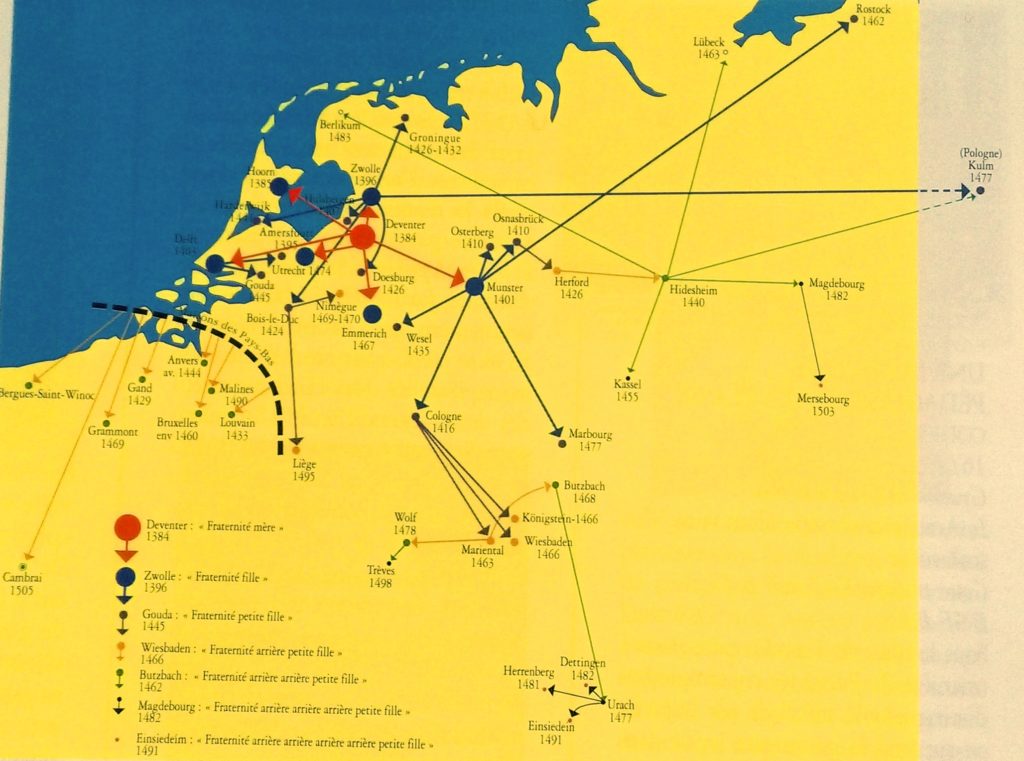
In 1412 kende de congregatie 16 kloosters en hun aantal rees tot 97 in 1500: 84 mannen- en 13 vrouwenpriorijen. Bovendien bestonden er talrijke kloosters van kanunnikessen, die niet formeel tot het kapittel van Windesheim behoorden, maar die een Windesheimer als rector hadden. Groenendaal en vele andere kloosters maakten vanaf 1394 deel uit van de Congregatie van Windesheim, slechts erkend door de bisschop van Utrecht in 1423.
A Kempis, Cusanus en Erasmus

Johannes van Kempen was natuurlijk de broer van de wereldberoemde Thomas a Kempis (1379-1471) die, na lange jaren leiding van de Broeders van het Gemene Leven, op 92 jarige leeftijd stierf in het klooster Agnietenberg van Zwolle. Behalve een relaas over het leven van Groote en de opkomst van de beweging schreef hij de Imitatione Christi (In navolging Christus), na de Bijbel, het meest gelezen boek ter wereld.
Zowel Rudolf Agricola (1444-1485) als Alexander Hegius (1433-1498), twee markante professors van Erasmus van Rotterdam en onvergelijkbare meesters van het Latijn, het Grieks en het Hebreeuws, werden in Deventer door de Broeders opgeleid en in Zwolle door Thomas a Kempis.
Ook Nicolaus Cusanus (1401-1464), die Agricola beschermde en na zijn dood, via een Bursa Cusana geld gaf om wezen en arme studenten op te leiden, werd mogelijkerwijs door de Broeders opgeleid. Wanneer Cusanus in 1451 naar de Nederlanden reist om daar de scheefgegroeide situaties recht te trekken, bezoekt hij de streek met Dionysius de Karthuizer (van Rykel) (1402-1471), een volgeling van Ruusbroec aan wie hij de opdracht geeft deze taak af te ronden. Geboren in Limburg, volgde ook Dionysius de Karthuizer school in Zwolle. (Nota 4)
Wessel Ganzevoort
Een andere uitzonderlijke figuur was Wessel Ganzevoort (1419-1489) die samenwerkte met de Griekse kardinaal Bessarion, zelf een intieme medewerker van Cusanus voor het Oecumenische concilie van Ferrare-Firenze.
Gansfoort werd opgeleid in de door de Broeders geleide Sint Maartensschool van Groningen alvorens verder te studeren aan de Latijnse School van Groote’s vriend Joan Cele in Zwolle. Ook de eerste Nederlandse paus, Adrianus VI, werd opgeleid aan de Zwolse Latijnse school alvorens te studeren onder Hegius in Deventer. Vooraleer hij naar Rome ging, stond deze paus open voor de ideeën van Erasmus.
In een brief verzonden van Deventer schrijft Hegius aan Ganzevoort, wie hij de Lux Mundi (het licht der wereld) noemt:
Ik stuur U, zeer eerwaarde heer, de Homiliën van Johannes Crysostomus. Ik hoop dat hun lectuur U mag behagen. Gezien gouden woorden U altijd meer plezier deden dan gouden geldstukken. Ik ben, zoals u weet, in Cusanus’s bibliotheek geweest. Daar vond ik veel boeken die me helemaal onbekend waren… (…) Vaarwel, en als U wilt dat ik voor U iets doe, geef me een teken en beschouw de zaak als gedaan.
Rembrandt van Ryn
Een blik op de vorming van Rembrandt bewijst dat ook hij een later product was van al deze inspanningen. In 1609 gaat Rembrandt, amper drie jaar oud, naar de basisschool waar jongens en meisjes leren lezen, schrijven en rekenen.
In de zomer beginnen de lessen om zes uur ’s morgens en om zeven in de winter. De lessen worden beëindigd om zeven uur ’s avonds. De lessen beginnen met bidden, het bespreken van passages uit de Bijbel en het zingen van psalmen. Het is daar dat Rembrandt een elegant handschrift ontwikkelt en meer dan een basisbegrip krijgt over godsdienst.
Gedurende die jaren trachten de Nederlanden te overleven. Het twaalfjarige bestand wordt gebruikt om het algemene goed to ontwikkelen en Nederland wordt één van de eerste landen waar iedereen de kans krijgt om te leren lezen, schrijven en rekenen.
Deze universele educatie voor zowel rijk als arm, zij het met enige tekortkomingen, was het geheim van de “Gouden Eeuw” en de belezenheid van Nederlandse immigranten in Amerika zal een eeuw later ook een voorname rol spelen gedurende de Amerikaanse revolutie.
Hoewel de meeste kinderen het secundair onderwijs aanpakten op twaalfjarige leeftijd, begon Rembrandt zijn opleiding op de Latijnse School van Leiden op zevenjarige leeftijd!
Daar leerde men, buiten retorica, logica en kalligrafie, niet alleen Grieks en Latijns maar ook Engels, Frans, Spaans of Portugees. In 1620, wanneer Rembrandt veertien jaar oud is, schrijft hij in als student aan de universiteit gezien toen geen wet jonge talenten kon weerhouden.
Als vak kiest hij niet Theologie, Rechten, Wetenschap of Geneeskunst, maar… Literatuur. Wilde Rembrandt Griekse en Hebreeuwse filologie en misschien Koptisch of Arabisch aan zijn brede cultuur toevoegen?
Men beseft dus, dat de Nederlanden, België inbegrepen, met Ruusbroec en Groote en later met Erasmus en Rembrandt, in een niet zo ver verleden, een bakermat was voor het soort humanisme dat de mensheid tot de grootste mogelijkheden kan verheffen. Hier falen om onze beweging uit te breiden is dus onmogelijk.
VOETNOTEN:
1. Geert Groote vertaalde in het Latijn op zijn minst drie van Ruusbroec’s werken die hij waarschijnlijk in Monnikshuizen voor het eerst had ontdekt. Hij stuurde het boek over het Tabernakel naar de cisterciënzers van Altencamp en naar zijn vrienden in Amsterdam. Toen de Brulocht werd aangevallen, nam hij persoonlijk de verdediging op van Ruusbroec. Dankzij het gezag van Groote werden de werken van Ruusbroec overvloedig gekopieerd en zorgvuldig bewaard. Ruusbroec’s leer werd gevulgariseerd in de geschriften van de Moderne Devotie en vooral in de Navolging van Christus.
2. In het begin van de XIIIde eeuw werden de begijnen beschuldigd van ketterij en vervolgd, behalve in de Bourgondische Nederlanden. In Vlaanderen werden ze vrijgesproken en kregen ze een officieel statuut. In feite genoten zij de bescherming van twee belangrijke vrouwen: Johanna en Margareta van Constantinopel, gravinnen van Vlaanderen. Zij organiseerden de stichting van de begijnhoven van Leuven (1232), Gent (1234), Antwerpen (1234), Kortrijk (1238), Ieper (1240), Rijsel (1240), Zoutleeuw (1240), Brugge (1243), Douai (1245), Geraardsbergen (1245), Hasselt (1245), Bergen (1248), Anderlecht (1252), Breda (1252), Diest (1253), Lier (1258), Tongeren (1257), Mechelen (1258), Haarlem (1262) en in 1271 deponeerde Jan I, graaf van Vlaanderen, persoonlijk de statuten van het Groot Begijnhof van Brussel. In 1321 schatte de Paus het aantal begijnen op 200.000.
3. Het poëtisch Platonisme van de Antwerpse begijn Hadewijch heeft een onmiskenbare invloed gehad op Jan van Ruusbroec.
4. Het eerste boek gedrukt in Vlaanderen door Erasmus’ vriend Dirk Martens, was Dionysius’ werk Een spiegel van de bekering van de zondaars in 1473.
Rembrandt’s oil painting is back… in China?

While in the West, “modern” artistic expression has degenerated into vibrant eulogies on the “Eros/Thanatos” theme (sex/death), Chinese artists have been encouraged to revive the most uplifting forms of art, often combining classical universal geniuses with their own historic traditions.
A case in point is Wang Shaolun (born 1968), whose “realistic” paintings, including beautiful portraits of women, are rejected by western critiques as remnants of “social realism”. It is true that, even when the country is rapidly becoming an industrial giant and urban residents become richer and richer, this young artist continues depicting farmers.
Following his graduation from the Beijing Central Academy of Fine Arts, Shaolin, sponsored by the Chinese government, could finish his training at the world famous Repin Art Academy of Saint-Petersburg. Recently, Shaolin was commissioned by the Chinese government to paint several life-size oil paintings for museums in major cities, as well as for national celebratory events.
On Nov. 18, CGTN, presented Shaolun’s 1999 work titled: « Xiaogang, The Night Of November 24, 1978 » depicting a night scene in a rural farming village in Anhui Province. “That evening, 18 farmers signed an agreement that would change the course of agriculture in China.” writes CGTN. Before 1978, China practiced collective farming. But food shortages due to drought, lack of incentives and other challenges were persistent.
The historical accord was called « The Household Responsibility System (HRS)” and for the first time all allowed individual households to contract land and machinery to produce their own yields. With this new procedure, “Each household sold the government their grain at an official price. But any leftover grain could be sold on the open market at a much higher price.” The new system was one of the key reforms of Deng Xiaoping and a key step of pulling millions out of extreme poverty. As a result, between 1978 and 1984, agricultural output in China almost doubled. The HRS resolved the food scarcity crisis and elevated incomes.
The painting is clearly inspired by Rembrandt’s 1661 oil painting called the “Conspiracy of Claudius Civilis” with the light literately emanating out of the table and illuminating a group of peasants intensively concentrating on accomplishing an act that’s going to change the course of history.
Posted by: Karel Vereycken | on avril 10, 2022
Avicenne et Ghiberti, leur rôle dans l’invention de la perspective à la Renaissance
This article, in EN
Tout visiteur du centre historique de Florence pose fatalement, à un moment donné, son regard sur les portes richement décorées du Baptistère, cet édifice roman faisant face à la cathédrale Santa Maria del Fiore, coiffée par Filippo Brunelleschi de sa magnifique coupole.
Dans cet article, Karel Vereycken apporte un éclairage nouveau sur les apports arabes à la science et le rôle crucial de Lorenzo Ghiberti dans l’invention de la perspective à la Renaissance.
Le Baptistère, que la plupart des Florentins pensaient être construit sur l’emplacement d’un temple romain dédié à Mars, le dieu tutélaire de l’ancienne Florence, est l’un des plus anciens bâtiments de la ville, construit entre 1059 et 1128 dans le style roman local.
Le poète italien Dante Alighieri et de nombreuses autres personnalités de la Renaissance, dont des membres de la famille Médicis, y furent baptisés.
A la Renaissance, à Florence, les corporations et les guildes se disputaient le premier rôle à coup de réalisations artistiques toutes aussi prestigieuses les unes que les autres.
Alors que l’Arte dei Lana (Corporation des producteurs de laine) finançait les Œuvres (Opera) du Duomo et donc la construction de sa coupole géante, l’Arte dei Mercatanti o di Calimala (Guilde des marchands d’étoffes étrangères) s’occupait du Baptistère et finançait l’embellissement des portes.
Les portes du Paradis
Le bâtiment octogonal possède quatre entrées, dont trois ont acquis une renommée artistique mondiale avec des portes ornées de bas-reliefs en bronze, recouverts entièrement ou en partie d’une fine couche d’or. Trois dates marquent les travaux : 1339, 1401 et 1424.
détail : baptême de Jésus (à gauche) et de ses disciples (à droite).
Avec l’aide de son père, il va réaliser son ouvrage en utilisant une technique connue sous le nom de « fonte à la cire perdue », technique qu’il a dû entièrement réinventer car perdue depuis la chute de l’Empire romain. L’une des raisons pour lesquelles Ghiberti a remporté le concours est le simple fait que sa technique était si avancée qu’elle nécessitait 20 % de métal en moins (7 kg par panneau) que celle de ses concurrents, le bronze étant un matériau onéreux, bien plus coûteux que le marbre. Sa technique, appliquée à l’ensemble de la décoration de la porte Nord, par rapport à celle de son concurrent, aurait permis d’économiser environ 100 kg de bronze. Or, en 1401, avec la peste qui harcelait régulièrement Florence, les conditions économiques étaient déclinantes, ce qui fait que la riche Calimala surveillait de près le coût du programme.
Pendant de l’œuvre de son prédécesseur, les bronzes de la porte nord comprennent eux aussi 28 panneaux, dont 20 représentent la vie du Christ d’après le Nouveau Testament. Les 8 panneaux inférieurs représentent les quatre évangélistes et les Pères de l’Église, saint Ambroise, saint Jérôme, saint Grégoire et saint Augustin.
Selon les Vies des artistes de Giorgio Vasari (1511-1574), Michelangelo Buonarroti (1475-1564) les jugera plus tard « si belles qu’elles orneraient l’entrée du Paradis ».
(commencées en 1424, terminées en 1452).
Dessin, sculpture, anatomie, perspective, travail des métaux, architecture, etc., en deux générations, le grand chantier des Portes permit à une myriade d’assistants et d’élèves bien payés d’accéder à une formation hors pair.
Parmi eux, plusieurs artistes exceptionnels tels que Luca della Robbia, Donatello, Michelozzo, Benozzo Gozzoli, Bernardo Cennini, Paolo Uccello, Andrea del Verrocchio et les fils de Ghiberti, Vittore et Tommaso. Au fil du temps, ces portes de bronze pesant trois tonnes et hautes de 5,06 mètres sont devenues une icône de la Renaissance, l’une des œuvres d’art les plus célèbres au monde.
En 1880, le sculpteur français Auguste Rodin s’en inspira pour ses propres Portes de l’Enfer, sur lesquelles il travailla pendant 38 ans.
La révolution
Le changement radical de conception de la sculpture en bronze, intervenu entre la Porte du nord et la Porte orientale, est essentiel pour notre discussion ici, car il reflète la façon dont l’artiste et ses mécènes ont voulu partager avec le public leurs nouvelles idées, inventions et découvertes.
Les thèmes du portail nord de 1401 s’inspiraient de scènes du Nouveau Testament, excluant de facto le panneau réalisé par Ghiberti, Le Sacrifice d’Isaac, qui lui avait valu de remporter le concours la même année. Pour compléter l’ensemble, il était donc tout à fait logique que la porte orientale de 1424 reprenne les thèmes de l’Ancien Testament.
A l’origine, c’est l’érudit et ancien chancelier de Florence Leonardo Bruni (1369-1444) qui avait programmé une iconographie assez semblable aux deux portes précédentes. Après des discussions animées, sa proposition fut écartée pour quelque chose de radicalement nouveau. En effet, au lieu de prévoir 28 panneaux, on décida, pour des raisons esthétiques, d’en réduire le nombre à seulement 10 reliefs carrés beaucoup plus grands, entre des bordures contenant des statuettes dans des niches et des médaillons avec des bustes.
Ainsi, chacun des 10 chapitres de l’Ancien Testament contient, pour ainsi dire, plusieurs événements, de sorte que le nombre net de scènes est passé de 20 à 37, et en plus, toutes apparaissent en perspective :
Le thème général est celui du salut à partir de la tradition patristique latine et grecque. Après les trois premiers panneaux, centrés sur le thème du péché, Ghiberti commence à mettre plus clairement en évidence le rôle du Dieu sauveur et la préfiguration de la venue du Christ. Les panneaux ultérieurs sont plus faciles à comprendre. C’est le cas du panneau Isaac, Jacob et Esaü, où les personnages se fondent dans une perspective de telle sorte que l’œil est guidé vers la scène principale.
La plupart des sources de ces scènes étant écrites en grec ancien, dont la maîtrise n’était pas si courante à l’époque, on pense que Ghiberti aurait eu pour conseiller théologique Ambrogio Traversari (1386-1439), avec qui il était en constante relation. Traversari était un proche de Nicolas de Cues (1401-1464), protecteur de Piero della Francesca (1412-1492) et organisateur actif du Conseil œcuménique de Florence de 1438-39, qui tenta de mettre fin au schisme séparant les Églises d’Orient et d’Occident.
Perspective
Les reliefs en bronze, connus pour leur vive illusion d’espace, sont l’un des événements révolutionnaires qui incarnent la Renaissance. On y voit de façon spectaculaire des figures passer d’une surface plane à toute la plénitude d’une existence en trois dimensions ! Techniquement parlant, on passe du stiacciato (développé à la perfection par Donatello)* à la ronde bosse, en passant par le bas-relief et le haut relief. Ghiberti avait bien conscience de son exploit, comme en témoigne son autoportrait sur la porte, la tête sortant d’une médaille de bronze, regardant avec satisfaction les spectateurs admirant son œuvre. L’artiste souhaitait bien plus qu’une perspective, il cherchait un espace de respiration !
Cette approche nouvelle influencera Léonard de Vinci (1452-1517). Comme le souligne l’historien d’art Daniel Arasse :
Au début du XVe siècle, plusieurs approches théoriques s’opposent. Vers 1423-1427, Donatello, un jeune collaborateur de Ghiberti réalisa son Festin d’Hérode, un bas relief selon la technique du stiacciato réalisé pour les fonts baptismaux du baptistère de Sienne.
Dans cette œuvre, le sculpteur déploie une perspective harmonieuse à point de fuite centrale. Vers la même époque, le peintre Massacchio (1401-1428) a utilisé une construction semblable dans sa fresque La Trinité.
Comme nous allons le voir, Ghiberti, partant de l’anatomie de l’œil, s’oppose aussi bien dans ses œuvres que dans ses écrits à cette approche abstraite et travaille, dès 1401, sur d’autres modèles géométriques, dites binoculaires. (voir plus bas).
Jésus parmi les docteurs, Ghiberti, avant 1424.
Jésus parmi les docteurs, Ghiberti, avant 1424.
Vers 1407, Brunelleschi a lui aussi mené plusieurs expériences sur cette question, très probablement sur la base d’idées développées par un autre ami de Nicolas de Cues, l’astronome italien Paolo dal Pozzo Toscanelli (1397-1482), dans son traité Della prospettiva, aujourd’hui perdu. Ce que l’on sait, c’est que Brunelleschi cherchait avant tout à démontrer que toute perspective n’est qu’illusion optique.
En 1435, l’architecte humaniste Leon Baptista Alberti (1406-1472), dans son traité Della Pictura, tentera, sur la base de l’approche de Donatello, de théoriser la représentation d’un espace tridimensionnel harmonieux et unifié sur une surface plane.
Malheureusement, au désespoir de bien des artistes, le traité d’Alberti, entièrement théorique, ne contient aucun diagramme ni illustration…
Sept ans plus tôt, le peintre Massacchio (1401-1428) avait utilisé, du moins en partie, une construction semblable dans sa fresque La Trinité.
Enfin, Léonard, qui avait lu et étudié les écrits de Ghiberti, utilisa ses arguments pour souligner les limites et même démontrer le dysfonctionnement de la construction de la perspective « parfaite » d’Alberti, surtout lorsqu’elle dépasse le cadre d’un angle de 30 degrés.
Dans le Codex Madrid, II, 15 v. de Vinci se rend à l’évidence qu’« en soi, la perspective offerte par une paroi rectiligne est fausse à moins d’être corrigée (…) »
Perspectiva artificialis versus perspectiva naturalis
La perspectiva articifialis d’Alberti n’est autre qu’une abstraction qui se veut nécessaire et utile pour représenter une organisation rationnelle de l’espace. Sans cette abstraction, nous dit-on, il est quasiment impossible de définir avec une précision mathématique les relations entre l’apparition des objets et le recul de leurs différentes proportions sur un écran plat : largeur, hauteur et profondeur.
A partir du moment où une image donnée sur un écran plat a été pensée comme la coupe transversale d’un cône ou d’une pyramide, une méthode a émergé pour ce qui est considéré, à tort, comme une représentation objective de l’espace tridimensionnel réel, alors qu’il ne s’agit que d’une anamorphose, c’est-à-dire un trompe-l’œil ou une illusion optique.
Ce qui est fâcheux, c’est que cette construction fait totalement abstraction de la réalité physique de notre appareil perceptif, en prétendant :
Calomnies et ragots
Pour des raisons qui restent à élucider, le rôle crucial de Ghiberti a été soit ignoré soit minimisé. Par exemple, les Commentarii, un manuscrit en trois volumes où Ghiberti retrace sa vie, son approche artistique et ses recherches sur l’optique et la perspective, n’a jamais été traduit en anglais ni en français. Et l’édition italienne ne date que de 1998.
Au XVIe siècle, Giorgio Vasari, qui fit souvent office d’agent de relations publiques pour le clan des Médicis, et dont l’ouvrage Les Vies des artistes est devenu l’alpha et l’oméga des historiens d’art, signale avec condescendance, mais sans évoquer une once de son contenu, que Ghiberti a écrit « un ouvrage en langue vernaculaire dans lequel il a traité de nombreux sujets différents, mais les a disposés de telle manière que l’on ne peut guère tirer profit de sa lecture ».
Qu’il ait pu exister des tensions entre humanistes, certes. Après tout, ces artisans autodidactes, tels que Ghiberti passionnés de progrès techniques, d’une part, et les héritiers de riches marchands de laine, tel le bibliophile Niccoli d’autre part, venaient de mondes totalement différents. D’après une anecdote racontée par Guarino Veronese, en 1413, Niccoli rencontre un jour Filippo et le salue de manière hautaine en ces termes : « Ô philosophe sans livres », à quoi Filippo lui aurait répliqué en souriant : « Ô livres sans philosophe… »
A cela s’ajoute que comme le stipulait le contrat, Ghiberti a accordé l’œuvre commandée en 1401 avec l’œuvre de Pisano d’inspiration gothique. Du coup, certains en déduisent que Ghiberti n’appartenait pas réellement à la Renaissance. Pour preuve, selon ses détracteurs, « son souci du détail et ses figures aux lignes ondulées et élégantes, ainsi que la variété des plantes et des animaux représentés… »
Les humanistes
symbolisée ici par la rencontre entre ces deux personnages royaux.
On pense que cette scène a été créée à la demande d’Ambrogio Traversari, présent dans la foule et instigateur du Conseil œcuménique de Florence de 1438.
Certes, les Commentarii ne sont pas rédigés selon les règles rhétoriques de l’époque. Écrits à la fin de sa vie, ils pourraient même avoir été dictés par l’artiste vieillissant à un clerc mal formé, faisant quantité de fautes d’orthographe.
Cependant, les propos de Ghiberti révèlent un auteur instruit, ayant une connaissance approfondie de nombreux penseurs classiques grecs et arabes. Il n’était pas seulement un brillant artisan, mais bien un « homme de la Renaissance » typique. En dialogue permanent avec Bruni, Traversari et le « chasseur de manuscrits » Niccolo Niccoli, Ghiberti, qui ne savait pas lire le grec mais connaissait bien le latin, était manifestement au courant de cette redécouverte de la science grecque et arabe.
Cette ambition était portée par les membres du Cercle San Spirito fondé par Boccace et Salutati, et dont les invités (parmi lesquels Bruni, Traversari, Cues, Niccoli, Côme de Médicis, etc.) se réuniront par la suite au couvent Santa Maria degli Angeli.
Ghiberti échange d’ailleurs avec Giovanni Aurispa, ce collaborateur de Traversari qui ramena, avant Bessarion, l’ensemble des oeuvres de Platon en Occident.
Amy R. Bloch, dans son étude très documentée Lorenzo Ghiberti’s Gates of Paradise, Humanism, History, and Artistic Philosophy in the Italian Renaissance (2016), note que « Traversari et Niccoli peuvent être liés directement aux origines du projet des Portes et étaient clairement intéressés par les commandes de sculptures prévues pour le Baptistère « .
« Le 21 juin 1424, après que la Calima ait demandé à Bruni son programme pour les portes, Traversari écrit à Niccoli en reconnaissant, en termes seulement généraux, les idées de Niccoli pour les histoires à inclure et en mentionnant, sans désapprobation évidente, que la guilde s’était plutôt tournée vers Bruni pour obtenir des conseils.«
Palla Strozzi
Ghiberti se lie également d’amitié avec Palla Strozzi (1372-1462), qui, en plus d’être l’homme le plus riche de Florence avec une fortune imposable de 162 925 florins en 1427, comprenant 54 fermes, 30 maisons, une entreprise bancaire au capital de 45 000 florins et des obligations communales, était aussi un homme politique, un écrivain, un philosophe et un philologue.
Tout comme Ambrogio Traversari, Paolo Rossi et Leonardo Bruni, Palla Strozzi a étudié le grec sous la direction de l’érudit byzantin Manuel Chrysoloras, invité à Florence par Salutati pour y enseigner le grec. A noter, le fait que Strozzi prit à sa charge une partie du traitement de Chrysoloras et fit venir de Constantinople et de Grèce les livres nécessaires à l’enseignement nouveau. La relation étroite de Ghiberti avec Palla Strozzi, écrit Bloch, « lui donnait accès à ses manuscrits et, ce qui est tout aussi important, à la connaissance qu’en avait Strozzi. «
Ce n’était pas tout, car « la relation entre Ghiberti et Palla Strozzi était si étroite que, lorsque Palla se rendit à Venise en 1424 comme l’un des deux ambassadeurs florentins chargés de négocier une alliance avec les Vénitiens, Ghiberti l’accompagna dans sa suite. »
Strozzi était connu comme un véritable humaniste, cherchant toujours à préserver la paix tout en s’opposant fermement au pouvoir oligarchique, tant à Florence qu’à Venise.
En fait, c’est Palla Strozzi, et non Cosimo de’ Medici, qui a été le premier à lancer les plans de la première bibliothèque publique de Florence, et il avait l’intention de faire de la sacristie de Santa Trinita son entrée. Si la bibliothèque de Palla n’a jamais été réalisée en raison du conflit politique dramatique connu sous le nom de Coup des Albizzi qui a conduit Strozzi à son exil en 1434, Cosimo, qui a eu les coudées franches pour régner sur Florence, fera sien le projet de bibliothèque.
Un constat audacieux
Tout d’abord, Lorenzo Ghiberti fait un constat audacieux, pour un chrétien dans un monde chrétien, sur la façon dont l’art de l’Antiquité a été perdu :
Ghiberti comprenait l’importance de la multidisciplinarité pour la formation de l’artiste.
Selon lui, « la sculpture et la peinture sont des sciences de plusieurs disciplines nourries par des enseignements différents ».
Dans le livre I de ses Commentarii, Ghiberti donne une liste des 10 arts libéraux que le sculpteur et le peintre doivent maîtriser : philosophie, histoire, grammaire, arithmétique, astronomie, géométrie, perspective, théorie du dessin, anatomie et médecine et souligne la nécessité pour un artiste d’assister aux dissections anatomiques.
Comme le souligne Amy Bloch, alors qu’il travaillait sur les Portes, dans le processus intense de visualisation des histoires de la formation du monde par Dieu et de ses habitants vivants, l’engagement de Ghiberti « a stimulé en lui un intérêt pour l’exploration de tous les types de créativité – non seulement celle de Dieu, mais aussi celle de la nature et des humains – et l’a conduit à présenter dans le panneau d’ouverture de la Porte du Paradis (La création d’Adam et Eve) une vision grandiose de l’émergence de la création divine, naturelle et artistique. »
création d’Adam, création d’Eve, la tentation et enfin, expulsion du Jardin d’Eden.
L’inclusion de détails évoquant le savoir-faire de Dieu, dit Bloch, « rappelle les images qui comparent Dieu, en tant que créateur du monde, à un architecte, ou, dans son rôle de créateur d’Adam, à un sculpteur ou à un peintre. Cette comparaison, qui dérive finalement de l’architecte-démiurge qui crée le monde dans le Timée de Platon, apparaît couramment dans l’exégèse médiévale juive et chrétienne ».
Philon d’Alexandrie a écrit que l’homme a été modelé « comme par un potier » et Ambroise a métaphoriquement appelé Dieu un « artisan (artifex) et un peintre (pictor) ».
Par conséquent, si l’homme est « l’image vivant du créateur » comme le dit Augustin et le modèle de « l’homo faber – homme producteur de choses », alors, soulignait l’humaniste Coluccio Salutati, « l’organisation des affaires humaines doit avoir une similitude avec celle des affaires divines ».
Ghiberti portait une attention particulière au fonctionnement de la vision :
Ainsi, tout chercheur honnête, qui a épluché les Carnets de Léonard après avoir lu les Commentarii de Ghiberti, se rend immédiatement à l’évidence que bien des observations de Léonard, dont le caractère génial est incontestable, font écho aux problématiques soulevées par Ghiberti, notamment en ce qui concerne la nature de la lumière et l’optique en général. L’état d’esprit créatif de Léonard était en partie le fruit de cette continuité, comme conséquence heureuse de la vision stimulante du monde de Ghiberti.
La composition de l’œil
Dans son Commentario 3, 6, qui traite de l’optique, de la vision et de la perspective, s’opposant à ceux pour qui la vision ne peut être expliquée que par une abstraction purement mathématique, Ghiberti écrit que « pour qu’aucun doute ne subsiste dans les choses qui suivent, il est nécessaire de considérer la constitution de l’œil, car sans cela, on ne peut rien savoir sur comment fonctionne la vision ». Selon lui, ceux qui écrivent sur la perspective ne tiennent aucun compte de « la composition de l’œil », sous prétexte que trop d’auteurs se contredisent.
Alhazen, Avicenne et Constantine
Il regrette aussi que, bien que des « philosophes de la nature » tels que Thalès, Démocrite, Anaxagore ou Xénophane, aient examiné le sujet avec d’autres s’intéressant à la santé humaine, tels qu’Hippocrate, Galien et Avicenne, trop de choses restent confuses et incomprises.
C’est pourquoi, dit Ghiberti, « parler de cette matière est obscur et incompris si l’on n’a pas recours aux lois de la nature, car elles démontrent cette question de manière plus complète et plus abondante ».
Par conséquent, poursuit Ghiberti,
Arrêtons-nous un instant sur ce passage qui nous dit tant de choses. Voici Ghiberti, un, ou plutôt « le » personnage central, fondateur de la Renaissance italienne et européenne et de son grand apport en termes de perspective, qui affirme que pour avoir une idée du fonctionnement de la vision, il faut étudier trois scientifiques arabes : Ibn Sina, Ibn al Haytham et Qusta ibn Luqa ! L’eurocentrisme culturel pourrait peut-être expliquer pourquoi les écrits de Ghiberti ont été ignorés et restent quasiment au placard.
Ibn al-Haytham (Alhazen) a apporté d’importantes contributions à l’ophtalmologie. Dans son Traité d’optique (1021, en arabe Kitab al-Manazir (كِتَابُ المَنَاظِر ), en latin De Aspectibus ou Opticae Thesaurus: Alhazeni Arabis), il a amélioré les conceptions antérieures des processus impliqués dans la vision et la perception visuelle. Au cours de ses travaux sur la camera oscura (chambre noire), il fut également le premier à imaginer que la rétine (une surface incurvée), et non plus la pupille (un point), pouvait être impliquée dans le processus de formation des images. Avicenne, dans le Canon de la médecine (vers 1025), décrit la vue et utilise le mot rétine (du latin rete qui signifie réseau) pour désigner l’organe de la vision. Plus tard, dans son Colliget (encyclopédie médicale), Averroès (1126-1198) est le premier à attribuer à la rétine les propriétés d’un photorécepteur.
Si les écrits d’Avicenne sur l’anatomie et la science médicale avaient été traduits et circulaient en Europe dès le XIIIe siècle, le traité d’optique d’Alhazen, que Ghiberti cite abondamment, venait d’être traduit en italien sous le titre De li Aspecti.
Il est désormais reconnu qu’Andrea del Verrocchio, dont l’élève le plus célèbre fut Léonard de Vinci (1452-1517), était lui-même un élève de Ghiberti. Contrairement à ce dernier, qui maîtrisait le latin, ni Verrocchio ni Léonard ne maîtrisaient de langue étrangère. Ainsi, c’est en étudiant les Commentarii de Ghiberti que Léonard eut accès à la traduction en italien de citations originales de l’architecte romain Vitruve et aux apports de scientifiques arabes tels qu’Avicenne, Alhazen ou Averroès, de scientifiques européens ayant étudié l’optique arabe, notamment les franciscains d’Oxford, Roger Bacon, John Pecham, ainsi que le moine polonais travaillant à Padoue, Erazmus Ciolek Witelo (Vitellion, 1230-1275).
Comme le souligne le Pr Domnique Raynaud, Vitellion introduit le principe de la vision binoculaire par des considérations géométriques.
Il donne une figure où l’on voit les deux yeux (a, b) recevant des images différentes provenant d’un même plan. Or, chaque œil, lorsqu’il observe par exemple le segment gf, le voit avec un angle différent, puisque l’œil a est plus proche que l’œil b du segment observé (l’angle de grf n’est pas le même que l’angle gtf). Il faut donc qu’à un moment donné ces images soient réunies en une seule. Où se produit cette jonction ?
Vitellion répond :
La fusion des images est donc un produit de l’activité mentale et nerveuse interne.
Le grand astronome Johannes Kepler (1571-1630) utilisera les découvertes d’Alhazen repris par Witelo pour développer sa propre contribution à l’optique et à la perspective.
« Bien que jusqu’à présent l’image [visuelle] ait été [comprise comme] une construction de la raison », observe Kepler dans le cinquième chapitre de son ouvrage Ad Vitellionem Paralipomena (1604), « désormais, les représentations des objets doivent être considérées comme des peintures qui sont effectivement projetées sur du papier ou sur un autre écran. »
Kepler fut le premier à constater que notre rétine capte l’image sous forme renversée, avant que notre cerveau ne la remette à l’endroit.
A partir de là, Ghiberti, Uccello, de même que le peintre flamand Jan Van Eyck (1390-1441), en contact avec les Italiens, construiront, comme alternative à la perspective abstraite, des formes de perspective « binoculaire », tandis que Léonard et Jean Fouquet, le peintre de la cour de Louis XI, tenteront de développer des représentations de l’espace curviligne et sphérique.
En Chine, sous l’influence éventuelle des percées de la science optique arabe, des formes de perspective non-linéaire, intégrant la mobilité de l’œil, feront également leur apparition sous la dynastie Song.
La lumière, une autre dimension
Ghiberti ajoutera une autre dimension à la perspective : la lumière. L’un des apports majeurs d’Alhazen est l’affirmation, dans son Livre sur l’optique, que les objets opaques frappés par la lumière deviennent eux-mêmes des corps lumineux et peuvent rayonner une lumière secondaire, une théorie que Léonard exploitera dans ses tableaux, y compris dans ses portraits.
Déjà Ghiberti, dans la façon dont il traite le sujet d’Isaac, Jacob et Ésaü, nous donne une démonstration étonnante de la façon dont on peut exploiter ce principe physique théorisé par Alhazen.
La lumière réfléchie par le panneau de bronze diffère fortement selon l’angle d’incidence des rayons lumineux qui arrivent. Arrivant soit du côté gauche, soit du côté droit, dans les deux cas, le relief en bronze de Ghiberti a été modelé de telle façon qu’il renforce magnifiquement l’effet de profondeur de la scène !
Conclusion
Les historiens d’art, en particulier les néo-kantiens comme Erwin Panofsky ou Hans Belting, qui affirment que ces peintres étaient des primitifs parce qu’ils appliquaient « le mauvais modèle » de perspective, s’avèrent en réalité incapables de concevoir que ces artistes qu’ils méprisent exploraient un domaine nettement supérieur à la pure abstraction mathématique promue par les grands prêtres de la science post-Leibniz, pour qui le dogme Newton-Galilée-Descartes sera l’évangile ultime.
Bien des sujets devront être exposés plus amplement que le résumé que j’en ai fait ici. En attendant, disons simplement que la meilleure façon d’honorer notre dette envers les contributions scientifiques arabes et les artistes de la Renaissance, serait de donner au monde entier, qui aurait dû en profiter bien plus tôt, la récompense d’un avenir meilleur bénéfique pour tous.
Il n’est pas trop tôt pour ouvrir toutes grandes les « Portes du Paradis ».
Regarder toutes les œuvres de Ghiberti sur la GALERIE D’ART WEB
Biographie sommaire
[1] Le relief aplati, relief écrasé ou stiacciato (de l’italien schiacciato, « écrasé »), est un terme qui désigne une technique sculpturale située entre le relief méplat et le bas-relief, permettant de réaliser sur une surface plane un relief de très faible épaisseur obéissant aux règles de la représentation en perspective. L’impression de profondeur par effet d’optique (plusieurs plans perspectifs) est donnée par une façon de sculpter graduellement en « relief écrasé », quelquefois sur une épaisseur de seulement quelques millimètres, du premier plan jusqu’à un point de fuite souvent central. Cette technique a été utilisée surtout aux XVe et XVIe siècles et Donatello en fut le principal initiateur.
Posted in Comprendre, Etudes Renaissance | Commentaires fermés sur Avicenne et Ghiberti, leur rôle dans l’invention de la perspective à la Renaissance
Tags: al Haytham, Alberti, Alhazen, anatomie, Ancien Testament, Andrea del Verrocchio, Andrea Pisano, antiqua, arabe, arithmétique, artkarel, astronomie, Averroès, avicenne, Bagdad, Baptistère, Belting, Benozzo Gozzoli, Bernardo Cennini, Borso, bronze, Brunelleschi, Calimala, chine, Christ, Côme, Commentarii, Concile de Florence, concours, corporations, coupole, cues, cyclope, Della Pictura, Descartes, dessin, dôme, Donatello, évangile, Florence, Galien, Galilée, géométrie, Ghiberti, gothique, grammaire, guildes, Hippocrate, Ibn Luqa, Ibn Sina, invention, Karel, Karel Vereycken, Kepler, Krauthammer, La vie des artistes, Lana, Léonard, Léonardo Bruni, Lorenzo Ghiberti, Luca della Robbia, Massacchio, médecine, Medecis, Michelange, Mutazilisme, Newton, Niccoli, Nouveau Testament, Occident, oeil, orfèvre, Orient, Panofsky, Paolo Uccello, perspective, Pétrarque, philosophie, Piero della Francesca, Pierre Brueghel l'Ancien, Portes du Paradis, Rashed, Raynaud, renaissance, retine, Sacrifice d'Isaac, saint Ambroise, Saint Augustin, saint Grégoire, saint Jean-Baptiste, Saint Jérôme, San Spirito, Santa Maria degli Agneli, Santa Maria del Fiore, schisme, sculpteur, song, stiacciato, Tommaso, toscanelli, Traversari, Van Eyck, Vasar, Vereycken, vinci, Vitellion, Vitruve, Vittore